Tags
1966, Black Panther, Fantastic Four, Fantastic Four 52, jack Kirby, Stan Lee, Wakanda, Wyatt Wingfoot
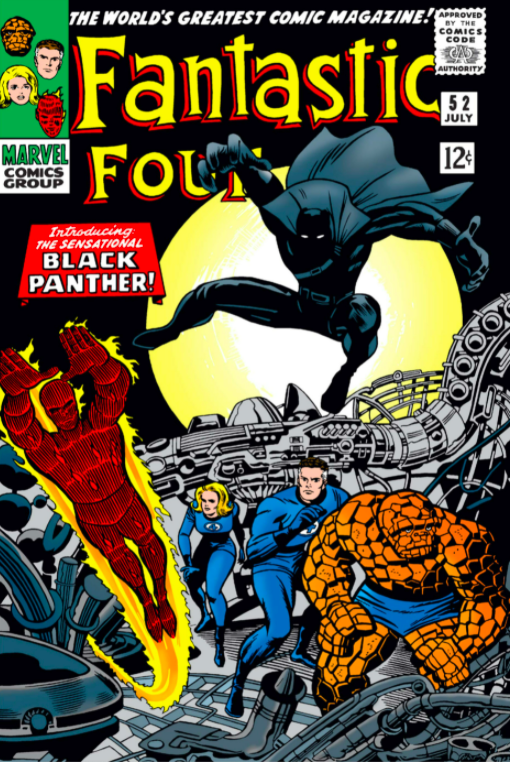
Fantastic Four 52
“The Black Panther”
Published: April 1966
Story: Stan Lee and Jack Kirby
Script: Lee
Pencils: Kirby
Inks: Joe Sinnott
Letters: Sam Rosen
Cover: Kirby and Sinnott
Synopsis
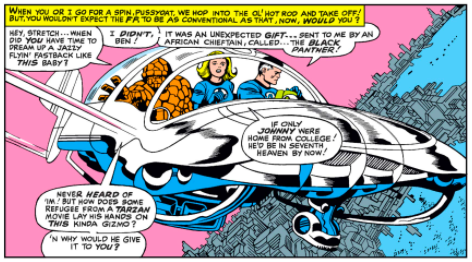
Fantastic Four 52 opens with Mr. Fantastic, the Invisible Girl and the Thing (the Human Torch is off at college) tooling around in a new flying car they received as a gift from “an African Chieftain” called the Black Panther. The Black Panther’s emissary offers the car to Reed permanently if the team accompanies him to Wakanda to take part in a hunt. Reed, saying the team needs a vacation, takes him up on the offer, first stopping to pick up Johnny and his roommate, Wyatt Wingfoot.
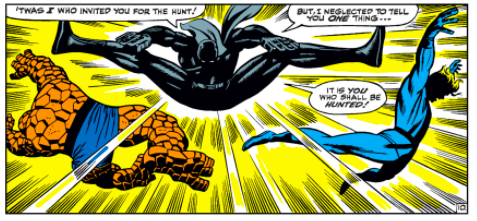
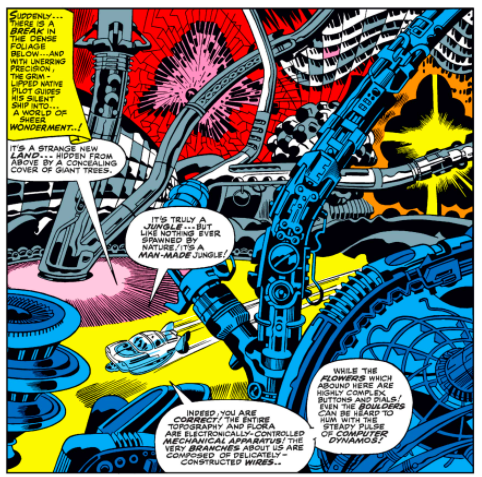
Wakanda is revealed to be technologically advanced, but when the team arrives, the emissary vanishes and the team is attacked by the Black Panther. He manages to subdue each member of the team but Wyatt manages to free them, ultimately foiling the Black Panther’s conquest. The issue ends with him beginning to explain his motives to the team.
FF 52 also cuts away from the main story to reveal the Inhumans are struggling to escape the Negative Zone that has imprisoned them, an indication that we will be seeing much more of them.
What’s going on here?
Obviously, the big development of FF 52 is the introduction of the Black Panther, a character who goes on to be a member of the Avengers (and a fill-in member of the FF for a time) and be the star of his own on-again, off-again solo title. With the success of the MCU Black Panther movie in 2018, he’s only become a bigger deal, moving in to the upper tier of Marvel characters.
The significance of the Black Panther isn’t just that he’s a black, or African, hero—although both were rarities at the time—but that he upends so many of the stereotypes of blacks and Africans that were (and to some extent still are) pervasive in comics. Wakanda, as created by Stan and Jack, isn’t a primitive backwater, but a sophisticated enclave. T’Challa isn’t a hot-blooded savage, but a calculating scientist. The Fantastic Four wasn’t lured to Africa by a villain, but by a hero. In a world where B’wana Beast was still waiting to debut, Black Panther is a remarkable creation.
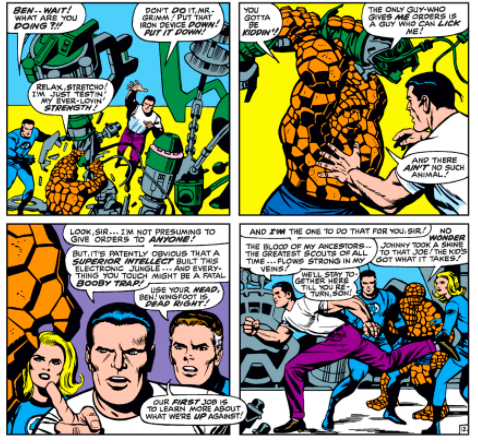
Given the Black Panther’s impact, it’s easy to overlook the other big development in FF 52, which is the realization of Wyatt Wingfoot as a bona fide member of the FF’s supporting cast. Wyatt was introduced as Johnny’s college roommate in issue 50 and we learned a bit more about him last issue—his dad was a standout athlete but Wyatt had no interest in joining the college football team—but he really comes into his own here.
Like the Black Panther, Wingfoot, a Native American, refuses to conform to the comic book stereotype. He doesn’t wear a fringed jacket or a feather, he doesn’t talk like Tonto, and even if he does evince skill as a tracker, he’s more adept at thinking than fighting. Wyatt doesn’t have the same profile of the Black Panther—surprisingly, he never gains powers or becomes a real super hero—but remains a classic member of the FF’s supporting cast.
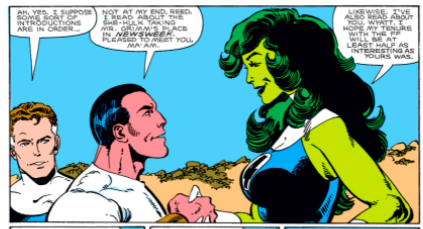
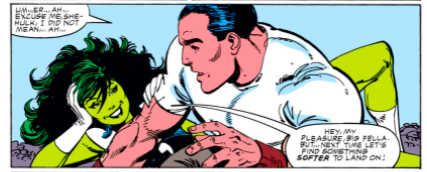
He later becomes She-Hulk’s love interest, adding a new dimension to his character (even if he is wearing the same T-shirt). They meet in FF 269-270 (written and illustrated by John Byrne).
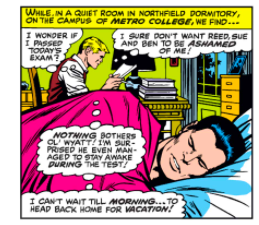
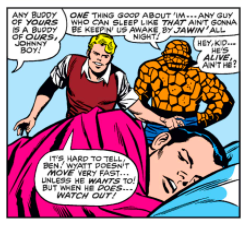
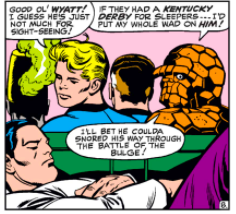
A fun running gag in FF 52 is Wyatt’s imperturbability. He seemingly can sleep through anything.
Crazy credits

The sexist sixties
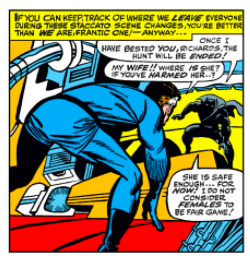
The Black Panther may be technologically sophisticated, but he’s not exactly progressive.
Weird science
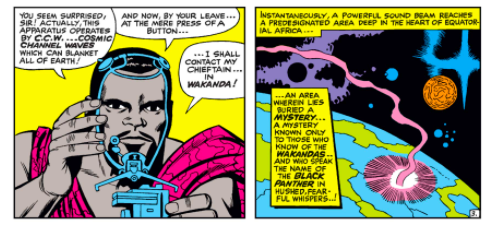
There’s a lot of dubious claims in this issue. Like these “cosmic channel waves”:
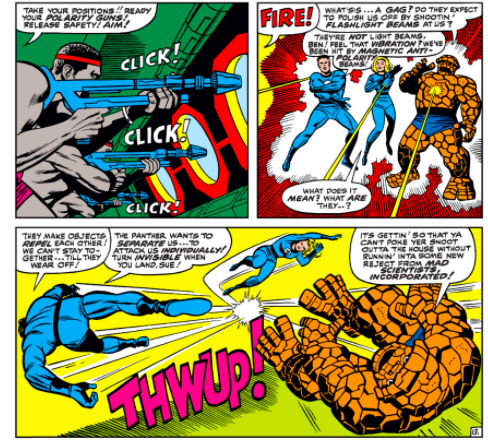
And these polarity guns:
The comic code was here
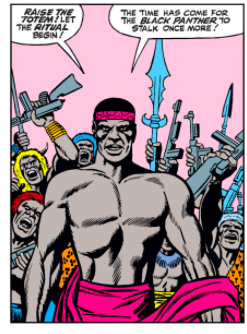
Shouldn’t T’challa have nipples?
Dig that Kirby Krackle
Some great stuff from the King:
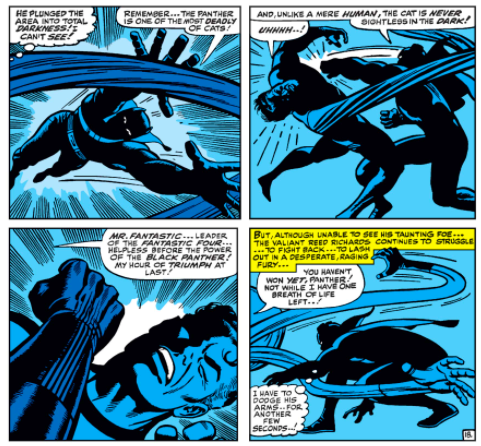
These panels are amazing (Joe Sinnott deserves a lot of credit here, too):
Next issue: The FF and the Black Panther fight Klaw!
 Percival Henry: The Fantastic Four and more