• About Percival Henry

Percival Henry: The Fantastic Four and more

~ Blogging the Fantastic Four issue by issue (plus whatever else grabs my attention)

Percival Henry: The Fantastic Four and more

Monthly Archives: May 2014

Very Short Review: Cave of Forgotten Dreams (2010)

17 Saturday May 2014

Posted by percivalhenry in Very Short Review

≈ Leave a comment

Tags

movies

caves-of-forgotten-dreams-poster-usa-768x1024


“Cave of Forgotten Dreams” crosses Discovery-channel type documentary with philosophizing art house cinema. While not as gripping as his earlier “Grizzly Man,” it is similarly a canvas for German filmmaker and eccentric Werner Herzog’s ruminations about life and death, man and nature. Here, he is given rare access to film the Chauvet cave in France, rediscovered in 1994 after being completely sealed off by a landslide for 30,000 years. The natural formations of the cavern are spectacular but the real star is the paintings of prehistoric mammals, rendered with amazing vitality and sophistication. Long sections of the movie are devoted to simply filming the art in changing light. Herzog doesn’t dwell on the motivations of the painters,  declaring them unknowable, and instead focuses on the abyss of time between us and them. In one section of the cave, carbon dating reveals two similar paintings were completed almost 5,000 years apart, a seeming instant for the artists but an incomprehensible gulf for us. The movie was filmed in 3D, to better capture the art on the cave’s undulations and ridges, and while it still worked in the conventional 2D, I wish I had seen it in its intended format. Herzog closes with an odd, whimsical coda about mutant albino crocodiles invading the cave, which didn’t make much sense but reminds us the film isn’t journalism but a personal vision, and he’s showing us the world as he sees it.

Ranking Sports: Some observations

15 Thursday May 2014

Posted by percivalhenry in Ranking Sports, Sports

≈ Leave a comment

Tags

baseball, rankings

So that was interesting.

My post ranking major league baseball team names got almost 2,000 visitors yesterday, thanks to a link on the very cool Uni Watch blog here. That’s by far the biggest single day in this little blog’s brief history, and I’m thrilled that so many people took the time to check it out. My post also got about 25 comments and most of them were not, ahem, very complimentary. That’s cool, too. The fact that people took the time to compose (mostly) polite and reasoned responses means they were engaged, and that’s all I can ask for. If the comments were critical, well, if you can’t stand the heat, stay out of the kitchen …

When you write about something as deeply felt as sports (or art history, for that matter), it’s going to rile people up, and if you’re going to rank teams – for whatever reason – it’s going to piss people off. Fans of every team  – save, I guess, the Orioles – feel I didn’t properly appreciate their team name, and should rank it higher. But in ranking 30 teams, some are going to be ranked highly and others low. So my instinctual response to this grumbling is to just say, `Fine, I screwed up and I’m moving every team up 10 places.’

I did want to make a few more specific points, which I probably didn’t make clear in the post’s introduction.

1, This is an aesthetic, not scientific, exercise. It’s a ranking of the team names in the order I like them. The criteria I listed served to guide my decisions, not to compel them. And I never intended to give all three criteria equal ranking in every case (at one point I considered assigning numerical values to each and adding them up but I rejected that because it felt too rigid). So, for example, in the case of the Diamondbacks, while they meet two of my criteria – it’s a unique name and more-or-less geographically specific- it’s such a blatantly ugly and commercial name, that criteria overwhelmed the others.

2, History counts, but it’s not the determining factor in how I feel about a name. A boring, historical name is still a boring name. So whatever the origins of the names Tigers, Pirates and Giants, they’re still bland, generic names used by other teams in other sports in other cities. Even if the Tigers wore orange socks in 1890, that’s not something specific to Detroit or even baseball. (It should also be noted there’s a lot of debate, even in the comments to my post, over the stories behind some of these names). Lastly, even if the origins of names Tigers and Pirates were non-feline or piratical, it hasn’t kept the teams from cloaking themselves in Tiger and Pirate iconography. If they had a claim to uniqueness, they lost it when they trotted out the trite mascots.

3, I didn’t make racism one of my explicit criteria, but I guess I should have. I don’t like it.

Anyway, thanks again to everyone who checked out the post and stay tuned for my next ranking project: World Cup soccer uniforms. I doubt anyone will have opinions about those.


Ranking Sports: Best major league baseball team names

12 Monday May 2014

Posted by percivalhenry in Ranking Sports, Sports

≈ 26 Comments

Tags

rankings, sports

This is the first of what I hope will be a series of ranking of some things I tend to care about in sports, like team names, logos, stadiums, uniform designs etc. Because it’s April May, we’re starting with the nicknames of the 30 major league baseball teams. The rankings are based on my criteria, which are as follows:

* Originality. Unusual or historic names will score higher. Names used by dozens of teams – I’m looking at you, Tigers – will fare less well. Even if the team was the first to use it, if other have copied it, I’m taking points off, because of criteria No. 2.

* Specificity. Does the name only make sense for that team, for reasons of history or geography? Names that can be applied to any team, in any sport, won’t score well. Great non-basketball examples of good, location-specific teams are the Minnesota Vikings and the (late, lamented) Seattle Supersonics.

* Lack of marketability. I prefer names that weren’t devised with cap or jersey sales in mind, but reflect historical accidents or the quirks of fans or owners. The less menacing the animal or creature, the more I tend to like it. Probably the worst offender in this category in all of sports are the Toronto Raptors.

(Note: it’s come to my attention that a few team names I’ve ranked lower on the list – namely the Nationals and Mets – are nods to older, defunct teams. I still think those are boring names but feel free to bump them up a few notches).


And the team with the best name in baseball is:

1, Baltimore Orioles
250px-Baltimore_Orioles_Script.svg

As much as it pains me personally, as a Yankees fan, the Orioles get the nod. The Baltimore Oriole is a small bird (icterus galbula) that eats grubs and small insects. Not only is their name original, it’s hard to pronounce, sounds like Oreo and must be a marketers nightmare. It’s specific to the region – the bird got its name because it shares its colors with the coat of arms of Lord Baltimore – and a nice nod to history. The team, formerly the St. Louis Browns, adopted the name of an early incarnation of the Orioles when they moved to Baltimore in 1954 (that earlier version, which left Baltimore in 1901, became the Yankees).

2, Minnesota Twins
20091116__Secondary Logo_300

Named after the Twin Cities, the Twins could only play in Minneapolis (or St. Paul). There’s nothing menacing or dangerous about twins, and you can’t design a twin mascot. But it does have a nice, zingy sound, it fits nicely in headlines and it’s got the word “win” in it. It’s a great baseball nickname.

3, St. Louis Cardinals
St_Louis_Cardinals_1998-present_logo

Another small, colorful bird. The Cardinals spent a year as the Perfectos – which might have gotten them even higher on this list – before adopting the Cardinal nickname in 1900. There’s something dignified and elegant about the bird, and it fits this very successful franchise. It only loses points because other teams have used the nickname, most notably the Arizona Cardinals which began as the Chicago Cardinals in 1920 (and which took its name from an even earlier team, the Racine Cardinals, which began using that name in 1901).

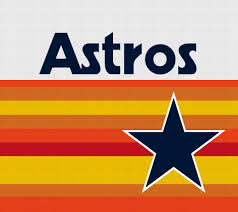
4, Houston Astros
url

Short for Astronauts, the Astros have great local flavor. Houston is home of the Johnson Space Center, which directs NASA missions. No other city could name its team the Astros (although the Houston Rockets took similar inspiration). Astronauts were pretty cool in the 1960s – when the team was renamed from the Colt .45s –  and the name has a fun, retro quality. The image of a puffy-suited astronaut bouncing round the moon doesn’t exactly suggest winning baseball. I don’t recall their ever having an astronaut mascot and they’ve gone through lots of color and logo redesigns (I like the one above best) but they’ve used the star in all of them.

5, Milwaukee Brewers
17648362_SA

Another classic example of a city-specific nickname. They brew beer in other cities, of course, but not even St. Louis is as associated with brewing as Milwaukee. Like the Steelers, it’s a blue-collar name that plays off the city’s industrial identity. I preferred their old ball-in-mitt logo, but the new one (above), with its shafts of wheat, is even more evocative of old-timey beer making.

6, Los Angeles Dodgers
LA-dodgers-logo

The Dodgers are a problem: it’s a great name but one that obviously makes no geographic sense. In Brooklyn, the name was a shortened version of Trolley Dodgers (and before that, they were awesomely named Superbas, giving the Perfectos a run for the money), named for the borough’s street cars. And that makes it an excellent name: regional character, with a sense of fun and whimsy. In Los Angeles, they join the Lakers (and, in spirit, the Utah Jazz) as teams whose names are vestiges of their original cities. But I give them credit for sticking with a name that has character rather than abandoning it to take on a newer, blander identity (see: Nationals).

7, Chicago Cubs
7253

Is there anything less menacing than a Cub? It’s a bit too universal – there’s nothing specifically Chicago about Cubs (or even Bears) – but it is unique. No other team seems to have copied them. There’s something about a soft, clumsy baby bear that seems to fit the way the Cubs play baseball, too.

8, Philadelphia Phillies
philadelphia-phillies-logo

The Phillies are a sort of an un-mascot. It’s more of a nickname, and not a very imaginative one, and feels like a barely-thought out European soccer name (ie, Wolverhampton Wolves, Wigan Lactics)  But it scores high on all my criteria and I like how unmarketable it is.

9, Los Angeles Angels
38525_3292012115207AM80234

An excellent name. A reference to the City of Angels, it’s specific, unique and highly unthreatening. It also lends itself to the cool halo logo.

10, Boston Red Sox
imgres-1

Another one that pains me, but the Red Sox name is so stupid, it’s great. It’s a misspelling of a clothing item the team doesn’t wear, it’s impossible to turn into a mascot, and could only exist if it was adopted more than a century ago. I’m downgrading it because it’s not really Boston-specific (like the Celtics and Patriots) and they trailed the White Sox by a few years.

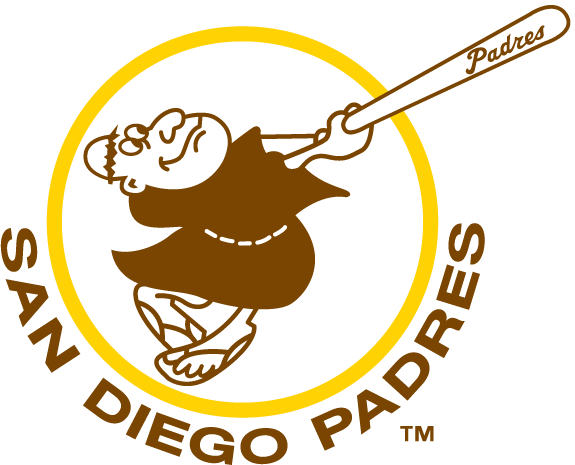
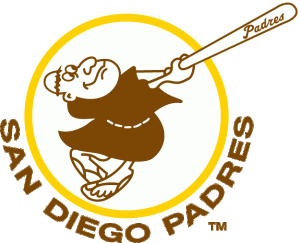
11, San Diego Padres
X5qgaefxmvbsmrkzw3k8qggwr

One of the goofiest names in sports, I’m going with their old logo to remind you that, yes, they named the team after Spanish monks. Not exactly designed to strike fear into their opponents hearts.

12, New York Yankees
300px-NewYorkYankees_PrimaryLogo.svg

I’m a Yankees fan, but the name never made a lot of sense to me. “Yankee” usually refers to a New Englander, like in a “A Connecticut Yankee in King Arthur’s Court,” and not a New Yorker. But even if it’s geographically inexact, it’s still a good name: regional, unusual and slightly odd. It’s quirkiness has been obscured by the team’s success.

13, Seattle Mariners
url-1

A solid, unpretentious name. I liked their old trident logo, but the compass one is more dignified. While I guess you can have Mariners anywhere there’s water, it seems pretty unlikely another team will ever adopt this name.

14, Chicago White Sox
ChicagoWhiteSoxOldLogo2

Since they predate the Red Sox, I suppose they should be ranked higher. But sports socks are supposed to be white, so while it’s still odd to name your team for your socks, it’s less odd if they’re white. They do get points for their secondary nickname, the Pale Hose.

15, Miami Marlins
imgres-2

There’s a lot of reasons to dislike the Marlins, but their name isn’t one of them. It evokes the old Miami of sport fishing and Earnest Hemingway, and has a nice, sharp baseball sound to it.

16, Oakland Athletics
sioej7efu95jbuxer1tg16ji6

The Athletics are a historically bland name, which in my system both helps and hurts them. The name is clearly an ancient relic, but the fact they were the Athletics in Philadelphia and Kansas City before Oakland makes clear how universal it is. I much prefer Athletics to the truncated “A’s”, though, and I like their elephant mascot, which of course makes no sense.

17, Texas Rangers
texas_rangers-9679

Not a bad name – a salute to the historic Texas Rangers – but a bit too rootin’, tootin’ for me. And there’s a New York Rangers hockey team, whose name makes less sense but they got there first.

18, Kansas City Royals
imgres-1

I had the Royals a lot lower – the name seems completely unsuited for this very un-royal midwest city – but I read up on the origin of their name, and it’s derived from the American Royal livestock show, apparently a Kanas City institution. So it gets points for history and a connection to the city, even if it’s not readily apparent.

19, Cincinnati Reds
imgres-5

Like the Athletics, the Reds have a lot of history – they’re the oldest club in major league baseball – but the name is uninspired. Formerly the Red Stockings,  they chose boring over quirky (as opposed to the the Red Sox). They get some credit for persisting with their name through the Cold War, although lose some for temporarily abandoning it in favor of the Redlegs during the 1950s.

20, New York Mets
imgres-4

Just a weird, unlovable name. I’ll give it points for being completely uncynical, but it’s generic to the point of ridiculous (couldn’t every city name its team the Metropolitans?). The fact that it’s the third institution in New York nicknamed Met – after a museum and opera – doesn’t help.

21, Toronto Blue Jays
imgres-3

Inoffensive, and an homage (or rip off) of the bird nicknames higher on this list, but also generic. As far as I can tell, there’s nothing specifically Toronto about Blue Jays, and the name seems to have been chosen in part because the team owner of the time, Labatt Brewery, made Labatt Blue.

22, Colorado Rockies
imgres

Not terrible but sort of bland and obvious.

23, Washington Nationals
imgres-2

Formerly the Montreal Expos, the franchise gave up that colorful and odd name for the grim, institutional sounding Nationals. It sounds like a compromise chosen by a committee, with an eye toward fitting in newspaper headlines. In a city full of groups named things like the National Association of Insurance Actuaries, maybe it makes sense but couldn’t they have found something more fun? Even the Senators – the name of the two previous Washington franchises – would have been better. And Senators are definitely not fun.

24, Tampa Bay Rays
imgres-3

I actually preferred their first name, the Devil Rays, even if it violates my own rule because it was such a naked grab for T-shirt sales. But it had some local character and I like teams named for seafood. Lopping off the Devil seems designed to appease Florida’s religious conservatives, and the result is a weak nod to the state’s sunshine, which is odd for a team that plays indoors. If they were aggressively appealing to teenagers with Devil Rays, now they’re chasing the senior citizens who want to sit in the sun.

25, San Francisco Giants
giants

We’re now in the realm of the vague and boring. The Giants may be an old and distinguished franchise, but their name is dull. That it survived a trans-continental move, and inspired the name of a football team, just proves the point.

26, Detroit Tigers
images

There are no Tigers in Detroit. Or in Princeton, Missouri, Auburn, Baton Rouge or any of the other dozen places that use the name.

27, Pittsburgh Pirates
Pittsburgh-Pirates-Logo


No pirates in Pittsburgh, either.

28, Atlanta Braves
imgres-4

We’re now moving from aesthetically offensive to just plain offensive. The Braves are an improvement over the Indians – naming your team after a subset of a subjugated people seems preferable than naming it after the entire people – and both are a whole lot better than the Redskins, but it’s still not cool. I might feel differently it there was any intelligence behind the appropriation, but it’s a Hollywood/Davey Crockett version of Indian identity. They seem to have exiled Chief Noc-A-Homa and his tepee in the bleachers, but the tomahawk and name remain.

29, Cleveland Indians
preview

See the Braves, above. The Indians may or may not have been named after former player Louis Sockalexis, a Native American, but whatever. It’s still blatantly racist. And if the name doesn’t convince you, check out Chief Wahoo.

30, Arizona Diamondbacks
37a5ef3f0a0d028a013d72544387d6ab

While not as problematic as the Braves and Indians, those teams at least have history as an excuse. The Diamondbacks are baseball’s best (or worst) example of choosing a name for commercial purposes. Instead of considering baseball’s tradition of easy-going names, they tried to adopt the menace of a venomous serpent. In an effort to be edgy and cool, they’ve ended up with something tacky and cheap, a name best suited for an Arena Football team.

Year of Fiction: The Strange Case Dr Jekyll and Mr Hyde, by Robert Louis Stevenson (1886)

07 Wednesday May 2014

Posted by percivalhenry in Year of Fiction

≈ Leave a comment

jekyl-hyde_stevenson

I picked up this famous novella because I wanted to read something English and specifically, London-ish. Despite my vow to whittle down my stack of unread novels, I was getting frustrated with the American content of the pile, given that I live  in London.

Like,  I suspect, a lot of people, I knew the story of Dr Jekyll and Mr Hyde without actually knowing the story of Dr. Jekyll and Mr. Hyde. That is, I knew the broad outlines, mostly as they’ve appeared in other media (in my case, comic books like The League of Extraordinary Gentlemen). I knew scientist Jekyll drank a potion and turned into the monstrous Hyde. The actual novella tells a slightly more complicated story.

Stevenson’s tale is a mystery that follows Gabriel Utterson, the lawyer of prosperous London physician Henry Jekyll. Utterson is in possession of a strange will of Jekyll, who leaves everything he owns to the mysterious Edward Hyde but refuses to explain their relationship. Utterson gradually learns that Hyde is a small, vicious thug, and when Hyde is witnessed bludgeoning a member of parliament to death, Utterson implores Jekyll to drop his association with Hyde. Jekyll assures Uttterson he has renounced all dealings with Hyde. Matters come to head after Jekyll’s servant report that Jekyll has disappeared and Hyde has taken his place and locked himself in Jekyll’s chambers. Utterson crashes through the locked doors to find Hyde dead of suicide and a long letter from Jekyll explaining what happened.

For a modern reader who know the basic story, the build up to the climax is frustrating. There’s no real mystery, and it’s just a matter of finding out how and why. Stevenson writes in typically ornate Victorian style, so we get a lot of detail about everyone’s appearance, their character, their motivations and in the case of Jekyll, his torment. It’s only in the last chapter, Jekyll’s account, that the story really comes alive. In his telling, Jekyll’s potion didn’t just transform him, but reverted him to his evil nature. Hyde is smaller than Jekyll (counter to my prior conception of the brutish Hyde) because the staid Jekyll theorized he suppressed that side of his character for so long it was under developed. As Hyde, he was aware of Jekyll, but, as he explains, viewed him as means to escape detection, in the way a bandit views his hideout cave. As Hyde, Jekyll gleefully indulges in his worst tendencies, which run toward violence but perhaps can be read as sexual deviancy, as well. In a Freudian structure, Jekyll is all superego and Hyde is all id. That within a proper English gentlemen lies a raging monster fits nicely with our modern idea of Victorian repression, and the dangers of not understanding our true nature.

While Jekyll initially had to consume his potion to transform into Hyde and back to Jekyll, soon he needs more and more to change back. Eventually, he is startled to discover that he changes into Hyde without the potion. After the murder, he resolves to never venture forth as Hyde again, only to discover he has run out of the chemical he needs for the potion. In his last lucid moments as Jekyll, he kills himself rather than live as Hyde forever.

Books completed this year:

1, The Man in the High Castle (Dick)
2, Disgrace (Coetzee)
3, The Finkler Question (Jacobson)
4, The Moon is a Harsh Mistress (Heinlein)
5, Beautiful Ruins (Walter)
6, Petropolis (Ulinich)
7, The Caves of Steel (Asimov)
9, Winter in the Blood (Welch)
10, Lena Finkle’s Magic Barrel (Ulinich)
11, The Strange Case of Dr Jekyll and Mr Hyde (Stevenson)

  • “The World’s Greatest Comic Magazine!” Fantastic Four Annual No. 15
  • “The World’s Greatest Comic Magazine!” Fantastic Four No. 223
  • “The World’s Greatest Comic Magazine!” Fantastic Four No. 222
  • “The World’s Greatest Comic Magazine!” Fantastic Four No. 221
  • “The World’s Greatest Comic Magazine!” Fantastic Four No. 220
  • July 2026
  • June 2026
  • May 2026
  • April 2026
  • March 2026
  • February 2026
  • January 2026
  • December 2025
  • November 2025
  • October 2025
  • September 2025
  • August 2025
  • July 2025
  • June 2025
  • May 2025
  • April 2025
  • March 2025
  • February 2025
  • January 2025
  • December 2024
  • November 2024
  • October 2024
  • September 2024
  • August 2024
  • July 2024
  • June 2024
  • May 2024
  • April 2024
  • March 2024
  • February 2024
  • January 2024
  • December 2023
  • November 2023
  • September 2023
  • July 2023
  • June 2023
  • May 2023
  • April 2023
  • March 2023
  • February 2023
  • January 2023
  • December 2022
  • November 2022
  • October 2022
  • September 2022
  • August 2022
  • July 2022
  • June 2022
  • May 2022
  • April 2022
  • March 2022
  • February 2022
  • January 2022
  • December 2021
  • November 2021
  • October 2021
  • September 2021
  • August 2021
  • July 2021
  • June 2021
  • May 2021
  • April 2021
  • March 2021
  • February 2021
  • January 2021
  • December 2020
  • February 2018
  • May 2016
  • February 2016
  • January 2016
  • December 2015
  • November 2015
  • October 2015
  • September 2015
  • August 2015
  • July 2015
  • April 2015
  • March 2015
  • January 2015
  • December 2014
  • November 2014
  • October 2014
  • September 2014
  • August 2014
  • June 2014
  • May 2014
  • April 2014
  • March 2014
  • February 2014
  • July 2026
  • June 2026
  • May 2026
  • April 2026
  • March 2026
  • February 2026
  • January 2026
  • December 2025
  • November 2025
  • October 2025
  • September 2025
  • August 2025
  • July 2025
  • June 2025
  • May 2025
  • April 2025
  • March 2025
  • February 2025
  • January 2025
  • December 2024
  • November 2024
  • October 2024
  • September 2024
  • August 2024
  • July 2024
  • June 2024
  • May 2024
  • April 2024
  • March 2024
  • February 2024
  • January 2024
  • December 2023
  • November 2023
  • September 2023
  • July 2023
  • June 2023
  • May 2023
  • April 2023
  • March 2023
  • February 2023
  • January 2023
  • December 2022
  • November 2022
  • October 2022
  • September 2022
  • August 2022
  • July 2022
  • June 2022
  • May 2022
  • April 2022
  • March 2022
  • February 2022
  • January 2022
  • December 2021
  • November 2021
  • October 2021
  • September 2021
  • August 2021
  • July 2021
  • June 2021
  • May 2021
  • April 2021
  • March 2021
  • February 2021
  • January 2021
  • December 2020
  • February 2018
  • May 2016
  • February 2016
  • January 2016
  • December 2015
  • November 2015
  • October 2015
  • September 2015
  • August 2015
  • July 2015
  • April 2015
  • March 2015
  • January 2015
  • December 2014
  • November 2014
  • October 2014
  • September 2014
  • August 2014
  • June 2014
  • May 2014
  • April 2014
  • March 2014
  • February 2014
“The World’s Greatest Comic Magazine!” Fantastic Four Annual No. 15

“The World’s Greatest Comic Magazine!” Fantastic Four Annual No. 15

percivalhenry's avatar by percivalhenry July 18, 2026
“The World’s Greatest Comic Magazine!” Fantastic Four No. 223

“The World’s Greatest Comic Magazine!” Fantastic Four No. 223

percivalhenry's avatar by percivalhenry July 14, 2026
“The World’s Greatest Comic Magazine!” Fantastic Four No. 222

“The World’s Greatest Comic Magazine!” Fantastic Four No. 222

percivalhenry's avatar by percivalhenry July 5, 2026
“The World’s Greatest Comic Magazine!” Fantastic Four No. 221

“The World’s Greatest Comic Magazine!” Fantastic Four No. 221

percivalhenry's avatar by percivalhenry June 25, 2026
“The World’s Greatest Comic Magazine!” Fantastic Four No. 220

“The World’s Greatest Comic Magazine!” Fantastic Four No. 220

percivalhenry's avatar by percivalhenry June 15, 2026
“The World’s Greatest Comic Magazine!” Fantastic Four No. 219

“The World’s Greatest Comic Magazine!” Fantastic Four No. 219

percivalhenry's avatar by percivalhenry June 7, 2026

Blog at WordPress.com.

  • Subscribe Subscribed
    • Percival Henry: The Fantastic Four and more
    • Join 74 other subscribers
    • Already have a WordPress.com account? Log in now.
    • Percival Henry: The Fantastic Four and more
    • Subscribe Subscribed
    • Sign up
    • Log in
    • Report this content
    • View site in Reader
    • Manage subscriptions
    • Collapse this bar
Loading Comments...