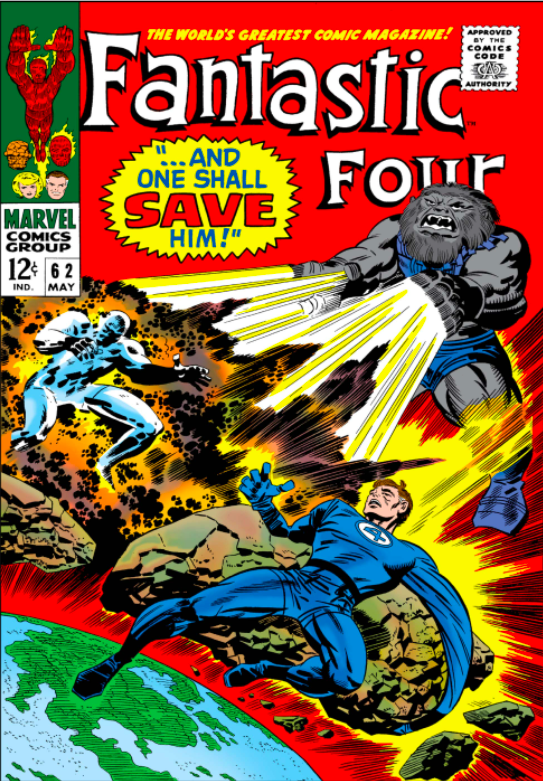
Fantastic Four 62 “And One Shall Save Him!” Published: Feb. 1967 Story: Stan Lee and Jack Kirby Script: Lee Pencils: Kirby Inks: Joe Sinnott Letters: Sam Rosen Cover: Kirby and Frank Giacoia
Synopsis
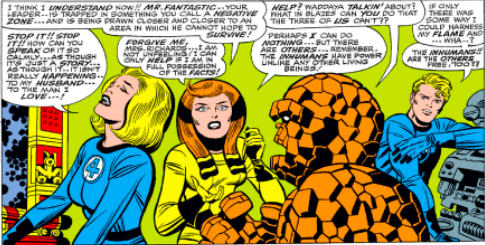
Fantastic Four 62 picks up where the last issue left off, with Mr. Fantastic tumbling through the Negative Zone toward the “exploding area” while the rest of the team watches helplessly through a scanner in the Baxter Building. The Inhuman Crystal and her teleporting dog Lockjaw then appear—Crystal has been looking for the Human Torch for about a dozen issues now—and she offers to help.
We then cut to a Mediterranean island where the rest of the Inhumans repel an invasion by a hostile army. Crystal arrives and explains the situation, and Black Bolt dispatches Triton to save Reed.
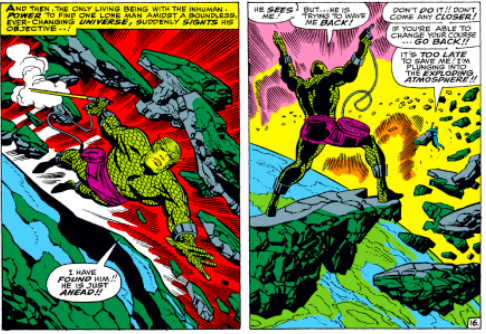
Back in the Negative Zone, a space craft drops off a menacing package near where Reed flounders, soon revealed to be the villain Blastaar. Triton then appears and rescues Reed, and as they return to our dimension, Blastaar sneaks in behind them. He is then confronted by the Sandman, who has been on the roof of the Baxter Building since the last issue, and they form an alliance. The issue concludes with the happy reunions of Reed and Sue and Johnny and Crystal.
What’s going on here?
A bit of an unsatisfying issue. For one, despite the promise of the cover, Blastaar —a major villain making his first appearance—doesn’t fight the FF in this issue. He appears, but there’s no confrontation—they don’t even intersect with each other. More significantly, the rescue of Reed is incredibly anticlimactic. Instead of Reed figuring out some scientific whammy, or Ben plunging into the Negative Zone after him, he’s rescued by Triton in a development that comes out of left field. And Triton just … goes and gets him. It’s explained that Triton’s ability to navigate the ocean depths makes him uniquely suited for this mission, but the rescue seems pretty straightforward. There’s no real drama or unusual heroics required.
The arrival of Crystal does serve to reunite her and Johnny, resolving their soap opera separation that began in issue 48. We also get a lot of Inhumans action, seemingly setting them up for their own series.
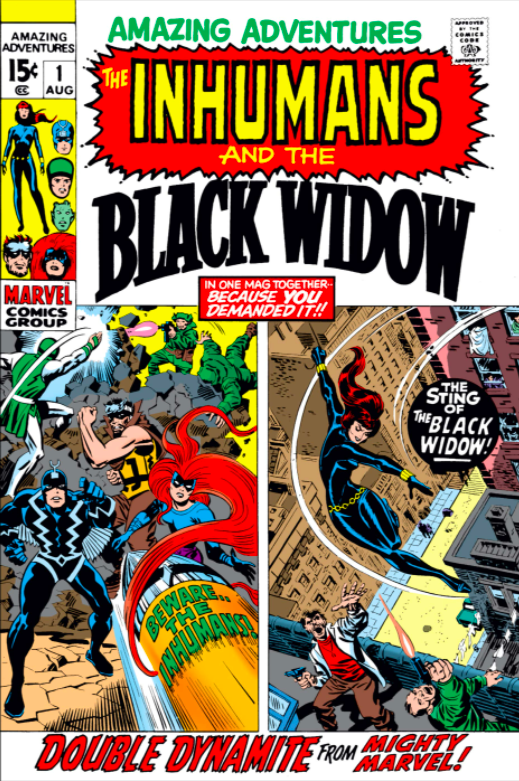
They didn’t get their own book until 1970, however, and even that they had to share with the Black Widow. As I recall, the mistreatment of the Inhumans was another factor that led to Jack leaving Marvel for DC.
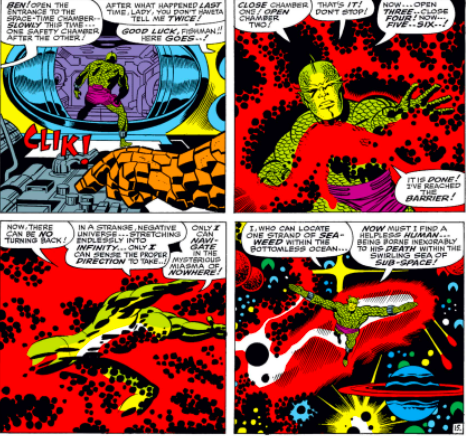
Negative Zone
FF 62 also marks the first time the Negative Zone is really understood to be an alien dimension, complete with its own races and civilizations. Blastaar is he first villain to appear, but eventually we’ll be introduced to Annihillus, a first-tier bad guy.
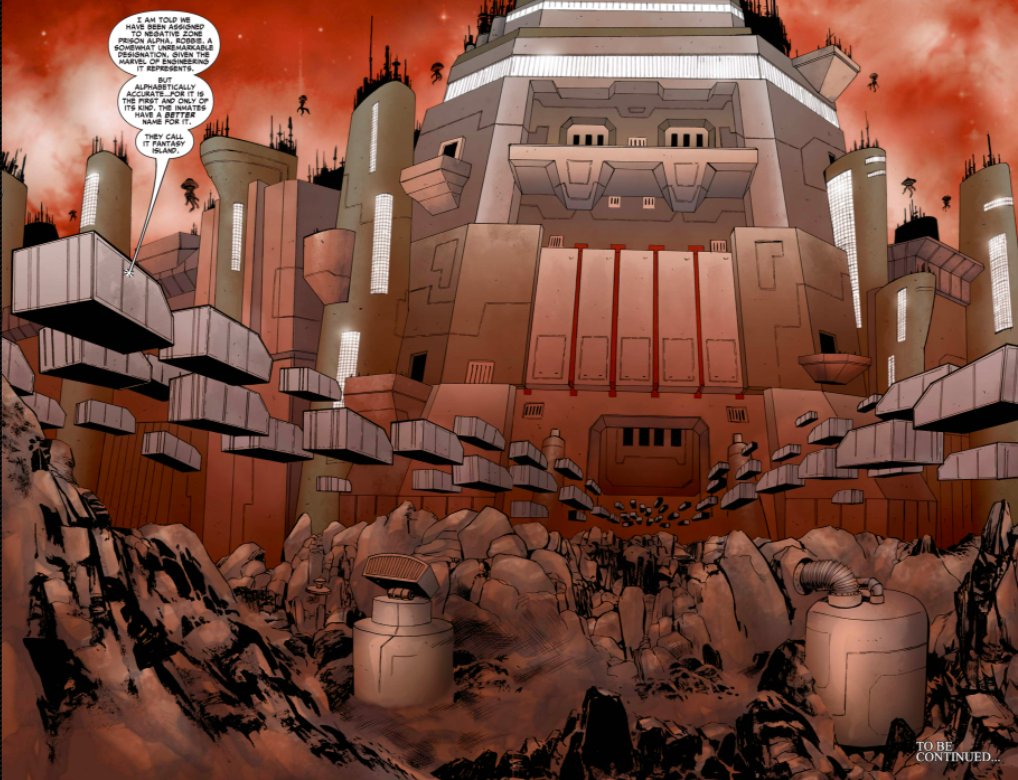
The Negative Zone becomes a major part of the FF’s mythos, and Reed and the FF are often either exploring it or using it place to store undesirables, such as when Reed created a prison there during the Civil War.
Civil War Front Line 5 (2006, Ramon Rachs and John Lucas)
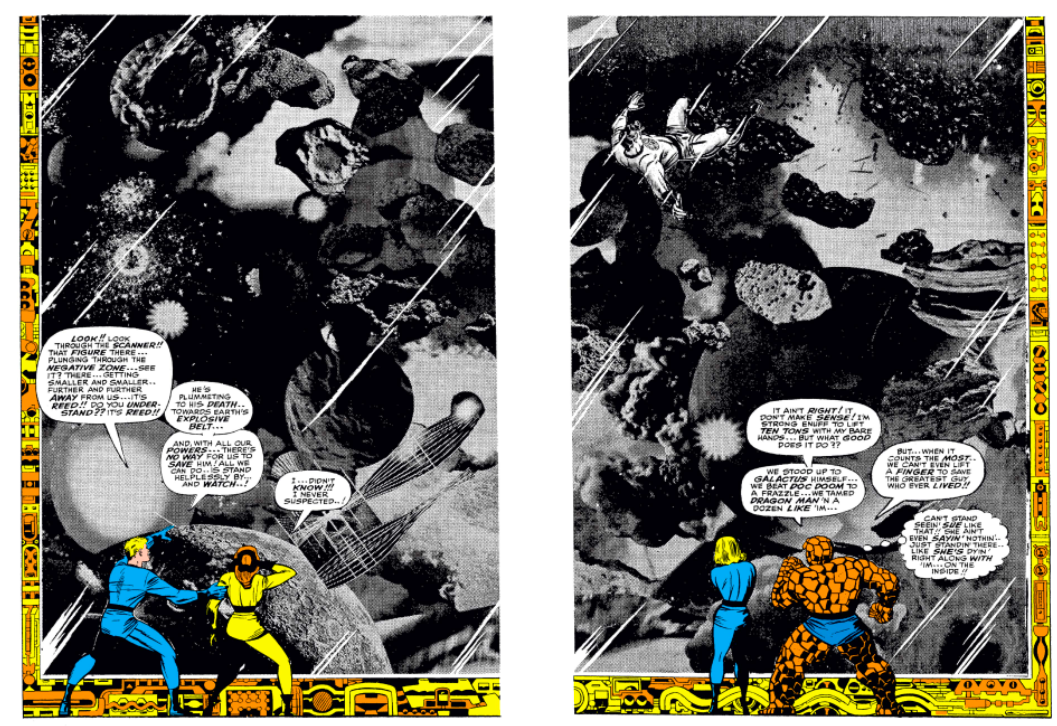
Kirby Kollage
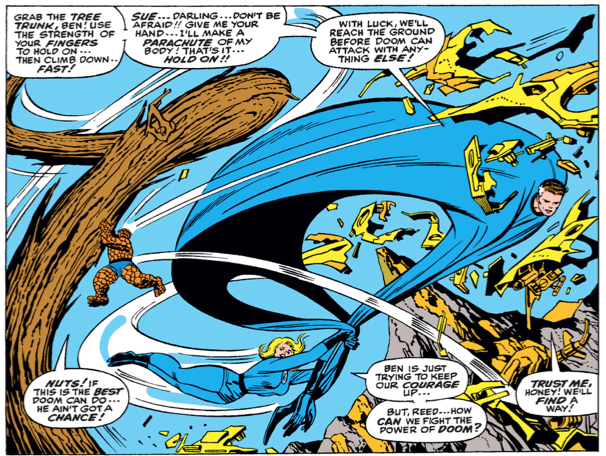
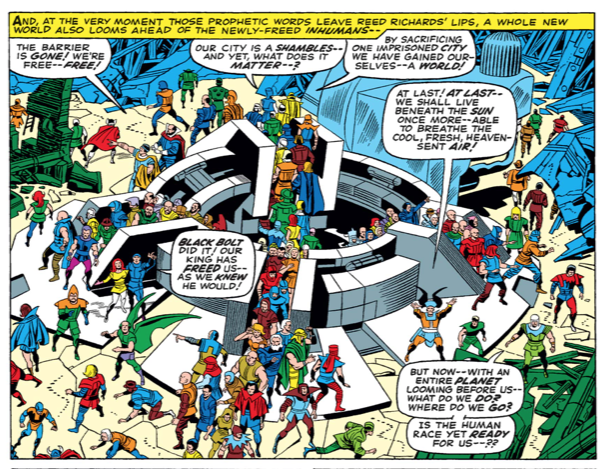
This is the first double-page splash in 62 issues of the Fantastic Four, and another amazing Kirby collage. Unfortunately I don’t have the tools to stitch the two pages together properly.
Welcome to a very belated round up of the 15 books I read in 2021 (honestly, I meant to do this in January). I fell way short of my goal of reading 24 books, or two a month, but as will be clear, I read some monstrously long books that put 24 out of reach. As I do every year, I try to mix up my reading, between fiction and non-fiction, sci-fi and literary fiction, classics and lesser known stuff. And as in years past, my reading was divided between books I have had on my list for years and books I chanced upon, many at our local library’s book sale. Over the last few years I have tried to be more deliberate about the diversity of the authors I read, with mixed success.
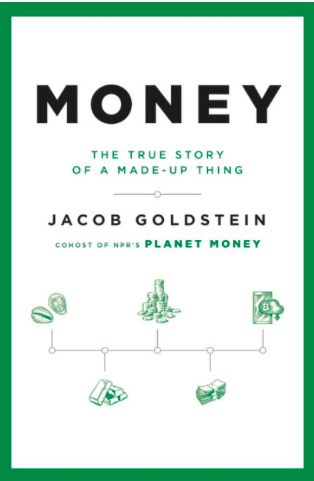
1, Money: The True Story of a Made Up Thing, by Jason Goldstein (2020)
This is a fun and fast tour through the history of money and finance by a guy I’ve know for years. Jake finds a lot of quirky details and anecdotes to enliven the subject, and goes deep into some corners of the financial world —the invention of money market funds, for example—that are often overlooked in discussions about the history of capitalism. Given the rise of crytocurrencies, Jake’s essential question—why do we believe in money?—seems extremely relevant
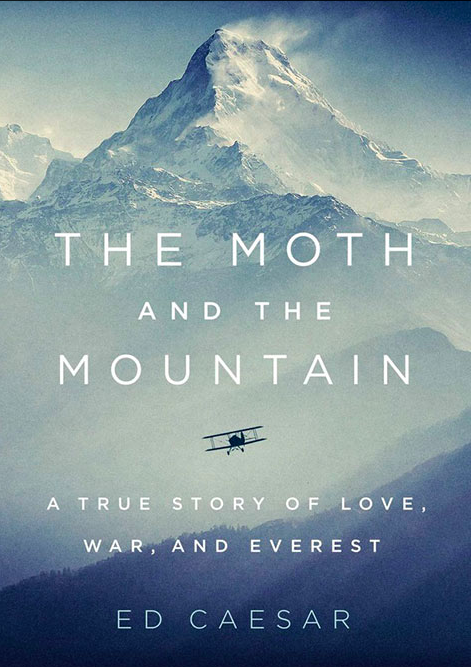
2, The Moth and the Mountain, by Ed Caesar (2020)
This was a Christmas present, and would appear to be just the sort of book I would go for, combining history, mountaineering and adventure. But the story, about Maurice Wilson, a World War I veteran fixated on flying to Nepal and climbing Everest, never is more than the sum of the parts. In part, it’s because Caesar struggles to pin down Wilson, an apparent flimflam man whose motivations always seem murky. And in part, because the most dramatic aspect of the story, the actual attempt to climb Everest, is basically undocumented, and so feels like a footnote to his story.
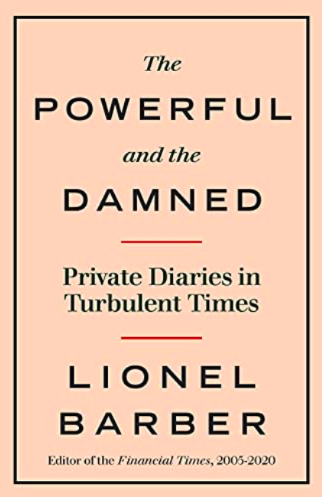
3, The Powerful and the Damned, by Lionel Barber (2020)
I realize now this is the third recent nonfiction release I read in a row, which is highly unusual for me. Usually there’s more variety in my choices, but I read this one for work, in preparation for an interview with Barber, which I wrote about for Quartz. It’s an engaging book, written by a professional name dropper who met and interviewed everyone from Donald Trump to Vladimir Putin and is happy to share his personal and sometimes snarky views about them all. Barber ran the Financial Times during the financial crisis and Brexit, but for media insiders, his accounts of the newspaper’s sale to Japan’s Nikkei might be of the most interest.
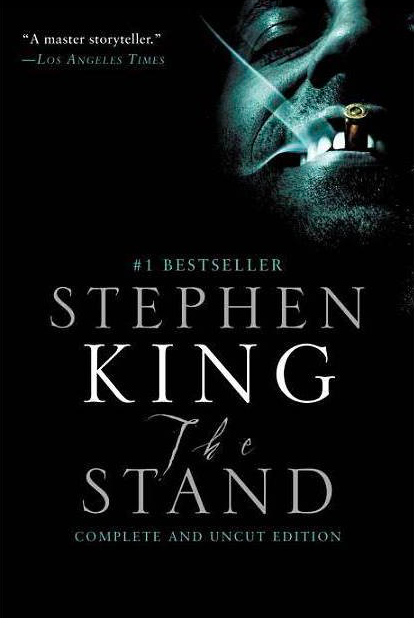
4, The Stand, by Stephen King (1978)
Reason one I didn’t reach 24 books last year was this 1,300 page monster. I am a late convert to King, and since I am more of a sci-fi guy then a horror fan, this was always high on my list to read. It didn’t disappoint, although it did ramble at times, and the King heroic archetype—the underestimated working-class white guy—feels a bit cliched at this point. Still, the rich character development, and the ambition and size of it all, made it an engrossing read.
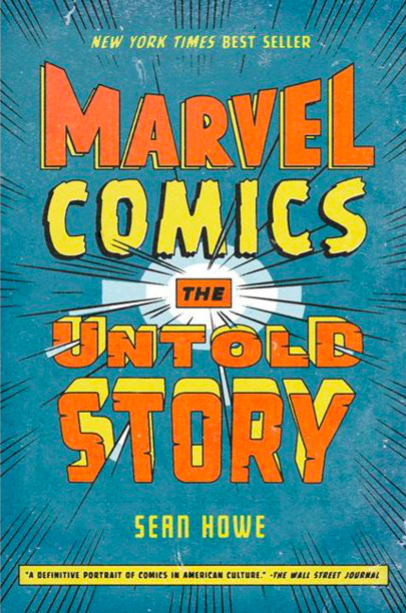
5, Marvel Comics: The Untold Story, by Sean Howe (2013)
As a lifelong comic book collector, it was a only a matter of time before I read this. There weren’t a lot of surprises in it for me, but it did fill in a lot of gaps in my understanding. Interestingly, this book is a business history more than a cultural history, and the big takeaway is the consistent shortsightedness of Marvel’s management. Whatever were triumphs of its artists and writers, they were despite, not because, of their bosses.
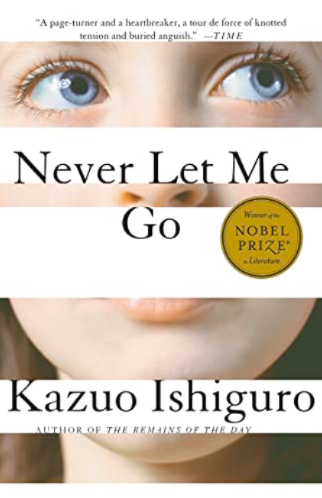
6, Never Let Me Go, by Kazuo Ishigiro (2006)
After the previous year’s disappointment reading Ishigiro’s The Buried Giant, I wasn’t quite ready to write him off. It was a good call, because this is a powerful, heartbreaking story. A slow burn, it begins as a deep dive into the lives of children at an English boarding school before revealing itself as a dystopian parable. It’s sad, thought-provoking and one of the best books I read last year.
7, Beyond the 100th Meridian, by Wallace Stegner (1953)
I bought this in Flagstaff on a family vacation to the Grand Canyon, in part because it’s about the Colorado river and the western landscape, and because I’ve never read anything about Stegner and always wanted to. It’s a biography of 19th century explore and scientist John Wesley Powell, and it’s really two books on one. The first half is about Powell’s expedition to float the length of the Colorado, which no one had done previously. The second is about his later career as a a government official with the US Geologic Survey, and the politics and policies that shaped the settling of the American west. The first part of the book was thrilling, the second was a bit wonky but deeply interesting as it explains a lot about why the US west looks the way it does today.
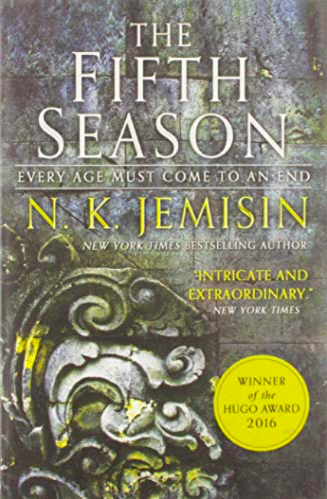
8, The Fifth Season, by N.K. Jeminson (2015)
“World building” is a bit of a science fiction cliché but there sure is a lot of it in this book. Jemison’s trilogy got a lot of attention, and most of it is deserved, as she describes a world where geologic events play a central role, and the mutants that can shape them are shunned and feared. There are some obvious metaphors about race, and a plot twist that wasn’t that hard to see coming, but in all a pretty satisfying read. I didn’t, however, feel compelled to read the rest of the trilogy. Maybe some day.
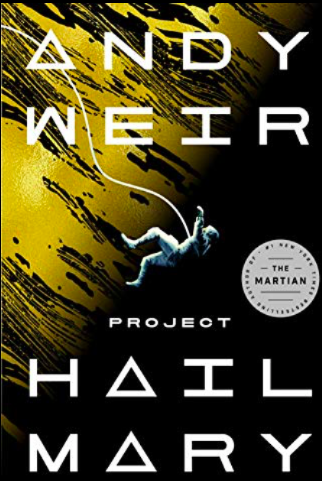
9, Project Hail Mary, by Andy Weir (2021)
My teenage son and I listened to this as a book on tape (yes, I am counting audio books) during a long road trip across the midwest and it felt like a great choice. Like in Weir’s The Martian, there’s a lot of hard science, but it’s offered in such a palatable way that it’s never a struggle and instead makes the outlandish plot almost convincing. The story, about a scientist battling an alien menace, is told as a series of digressions, which seemed like an unnecessarily complicated structure but on the whole the book is fast-paced fun and by the time we reach the end, surprisingly moving.
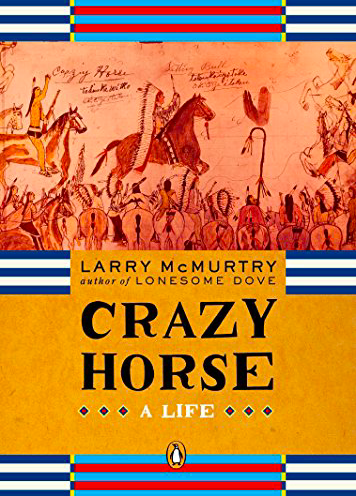
10, Crazy Horse, by Larry McMurtry (1999)
I picked this up at Mt. Rushmore, near the Crazy Horse monument. Not a lot is known about Crazy Horse, the Sioux warrior and mystic, and McMurtry, author of massive books like Lonesome Dove, wisely doesn’t try to pad out the story. Instead, we have a slim, spare, well-told account of Crazy Horse’s life at the end of a Native culture and the beginning of a genocide.
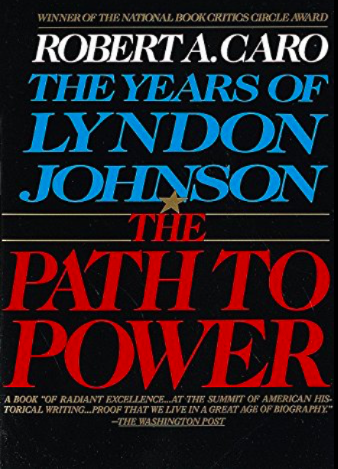
11, The Path to Power, by Robert Caro (1982)
The other monster I read in 2021, and probably by proudest reading accomplishment of the year, was the first volume in Caro’s biography of Lyndon Johnson. At some point, maybe after reading excerpts of Caro’s most recent book in the New Yorker, I vowed to read his LBJ series, one a year, until I was done (I’m currently reading the second). This first volume, which takes us up to LBJ’s first senate campaign in 1941, when he was about 30, is an amazing achievement of reporting and writing. Caro not only carefully unfolds every detail of LBJ’s early years, but spends whole chapters explaining the geology, economy and history of the Texas Hill Country from whence he came. Calling it the Sistine Chapel of journalism doesn’t seem like an exaggeration. It can be hard to read at times, not out of any fault of Caro’s, but because LBJ is so vile, amoral and unlikeable.
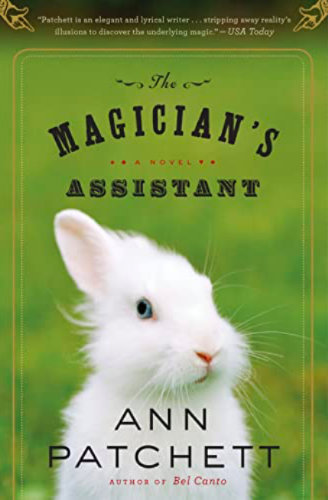
12, The Magician’s Assistant, by Ann Patchett (1997)
Ann Patchett wrote an amazing essay in the New Yorker about her three fathers (two are step-fathers) and after that I thought I would try her fiction. This books is unlike most books I read—it’s a quiet, contemporary story about a woman processing grief, in which most of the main characters are female—but I thoroughly enjoyed it. It took a little while to build up speed but the second half flies by.
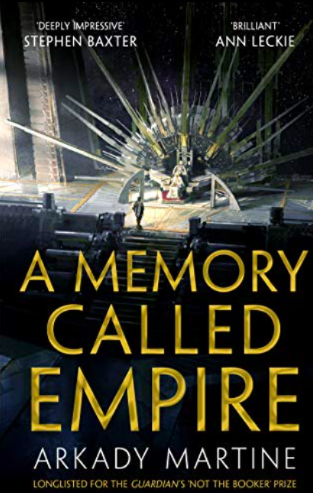
13, A Memory Called Empire, by Arkady Martine (2019)
More science fiction. If I recall, I picked this up as a free review copy that made its way to Quartz. It’s structured like an old-fashioned space opera with an intriguing premise, about a civilization that takes on the memories of their predecessors, and where verse and poetry have enormous cultural capital. Unfortunately, Martine (a nom de plume for Anna Linden Weller, a US historian) never really achieves escape velocity, and the plot, about an out-of-her-depth provincial ambassador in the empire’s capital solving a murder, seems to be mostly series of meetings and conferences before an obligatory action sequence ending.
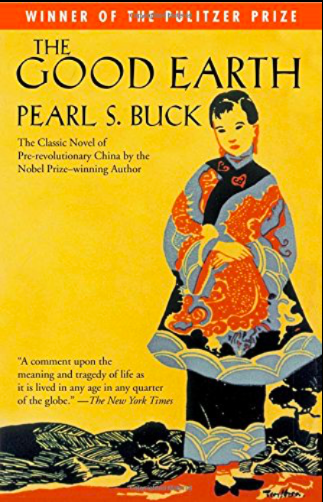
14, The Good Earth, by Pearl Buck (1931)
I picked this up at our local library’s book sale, mostly out of curiosity. It’s a book I knew mostly by reputation, but had never encountered it or had to read it in school (apparently that’s where many people encounter it). I thought it was fascinating. Written by the daughter of missionaries who grew up in rural China, it’s the story of a peasant who endures hardships and famine as he builds wealth and raises a family in an almost medieval society. Buck is sympathetic to Wang Lung but doesn’t romanticize him or his callous treatment of his wife and children. While dated in parts, the book still feels like a valuable window on an element of Chinese history and culture that seems relevant today.
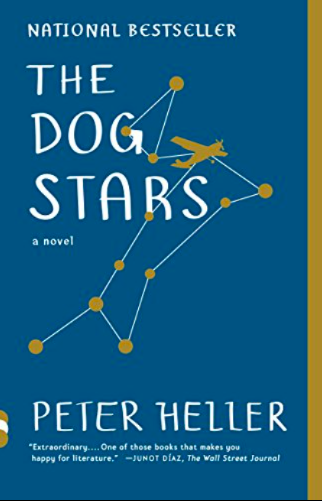
15, The Dog Stars, by Peter Heller (2012)
Another library-sale pick up. I would categorize this book as literary post-apocalyptic fiction, and include Station Eleven in the same category. This isn’t as good as Station Eleven, but it’s still pretty good, blending action and adventure with some beautiful nature writing and philosophizing about what it means to be alive. The plot concerns an amateur pilot who lost his wife and most everything else to a superflu, and now lives in a Colorado airport with his dog and a slightly terrifying survivalist. The story veers into cliches at times, and some plot developments are just too convenient, and at times the book made me wonder if I wasn’t really reading the treatment for a movie.
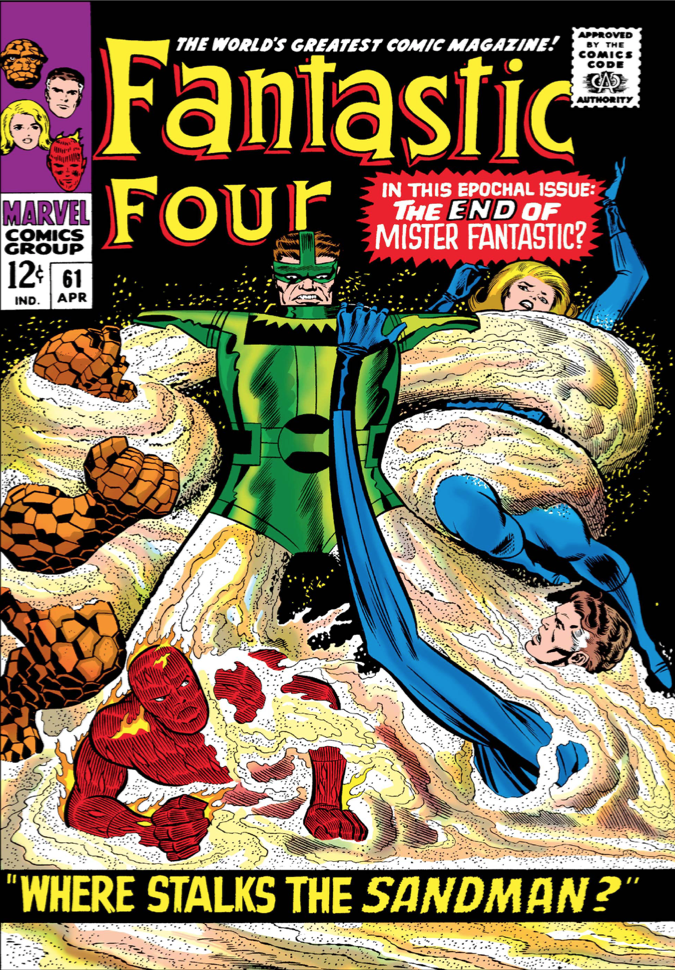
Fantastic Four 61 “Where Stalks the Sandman!” Published: January 1967 Story: Stan Lee and Jack Kirby Script: Lee Pencils: Kirby Inks: Joe Sinnott Letters: Sam Rosen Cover: Kirby and Sinnott
Synopsis
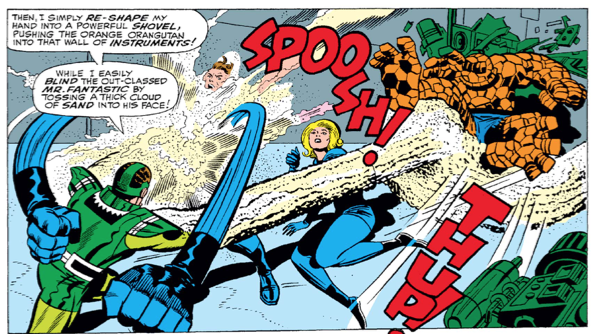
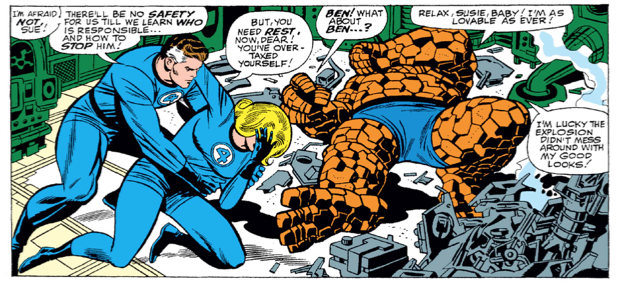
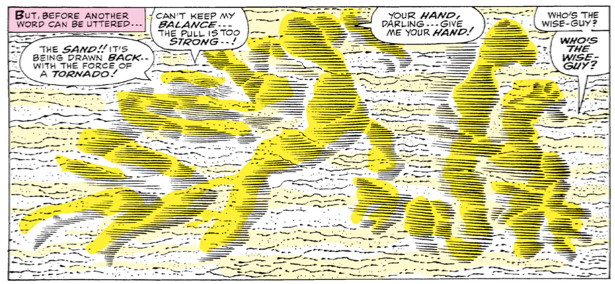
With the conclusion of the Doom/Surfer story arc in the last issue, Fantastic Four 61 starts off with a bang, as Mr. Fantastic, the Invisible Woman and the Thing are attacked by the equipment (the “atom igniter,” among other devices) in Reed’s lab. Eventually their antagonist is revealed to be the Sandman, who has turned the FF’s devices against them, although it’s never really explain how. The FF and the Sandman battle, and are eventually joined by the Human Torch.
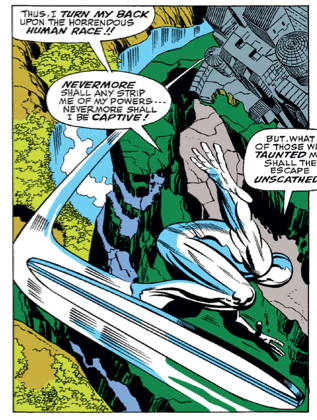
Meanwhile, in a pair of digressions, the Silver Surfer’s board returns to him with his powers, allowing him to escape Latveria, and the Inhuman Crystal teleports with Lockjaw to a Metro College football game in search of Johnny.
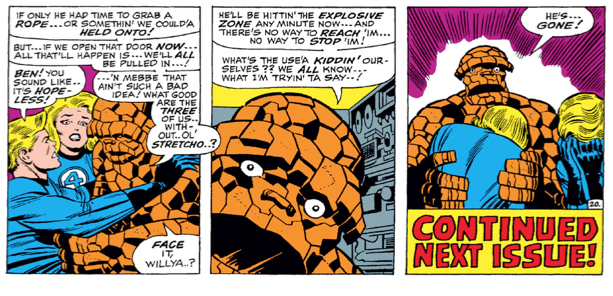
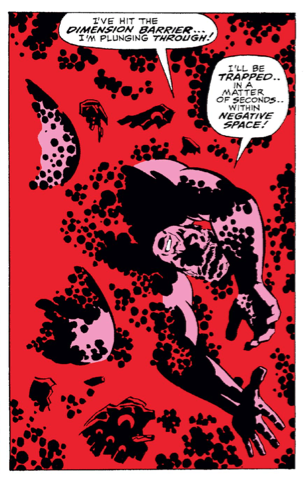
During the FF’s fight with the Sandman, the villain generates poisonous gasses. To escape, Reed opens the portal to the Negative Zone, and while Johnny and the Sandman escape, Reed is sucked into the other dimension. The issue end on a cliffhanger with Reed’s fate unknown.
What’s going on here?
This is an interesting issue. It starts off as a fairly pedestrian story, and one that felt a lot like issue 57, when the FF also fought the Sandman in the Baxter Building. But the story takes a surprising and dramatic turn when Reed opens the door to the Negative Zone and tumbles through, leading to a genuinely suspenseful ending and compelling pathos as the rest of the team watches him float away. The issue also has some stand-out pages from Kirby and Sinnott.
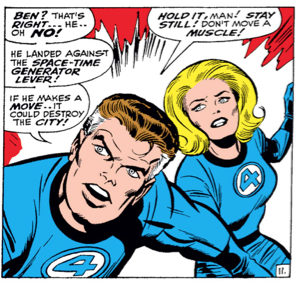
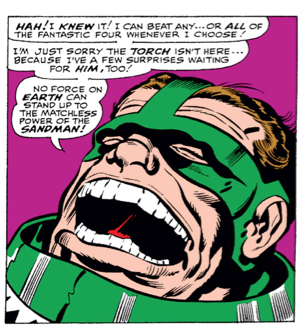
There are, of course, a whole lot of implausibilities in this issue, starting with how the Sandman, up until now a lunkhead, managed to hijack Reed’s devices. Then there’s the question why Reed’s devices are so vulnerable—at one point Sandman leans against a lever and threatens New York (this also happens to be an excel Joe Sinnott panel):
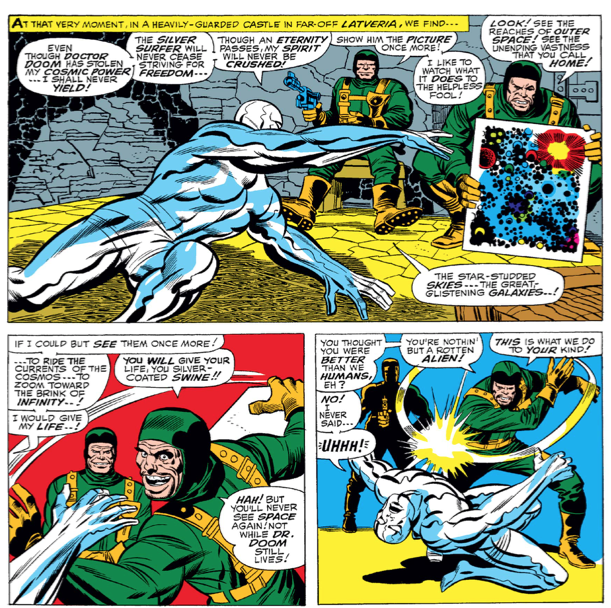
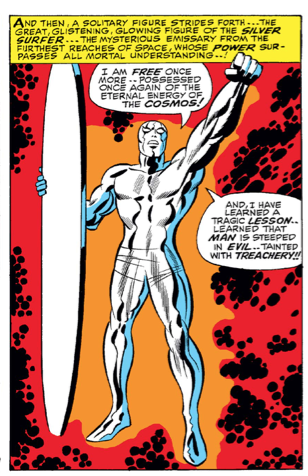
FF 61 also continues the almost sadistic torture of the Silver Surfer that began in issue 57. Oddly, while we saw his baord begin its return to him in the last issue, it didn’t arrive until this issue (“at that very moment”). The FF were able to fly across the Atlantic in the time his board crossed Latveria.
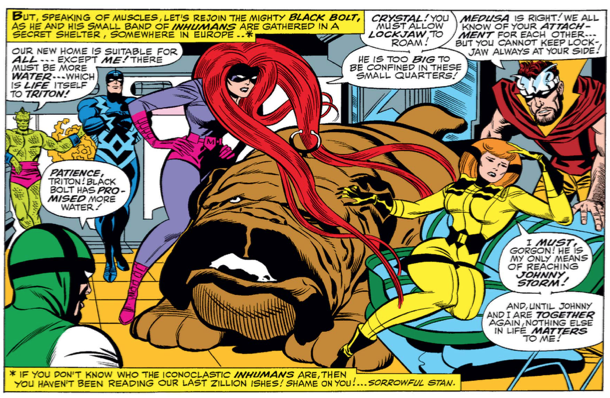
And like every issue for the last five or so, we have an obligatory Inhumans check-in. In this one, Crystal looks unusually curvy.
Who is that guy?
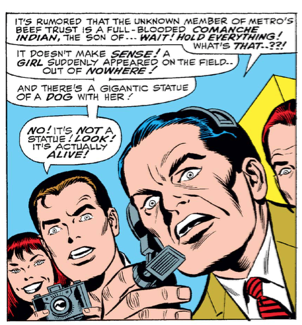
An unannounced (and unacknowledged) cameo from a certain Daily Bugle photographer.
Costume change
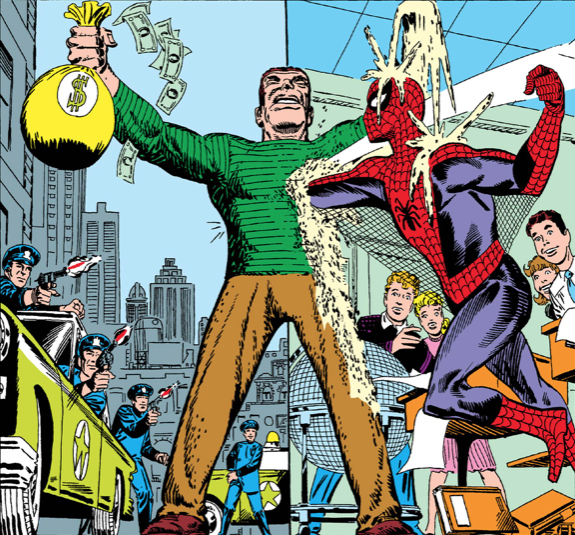
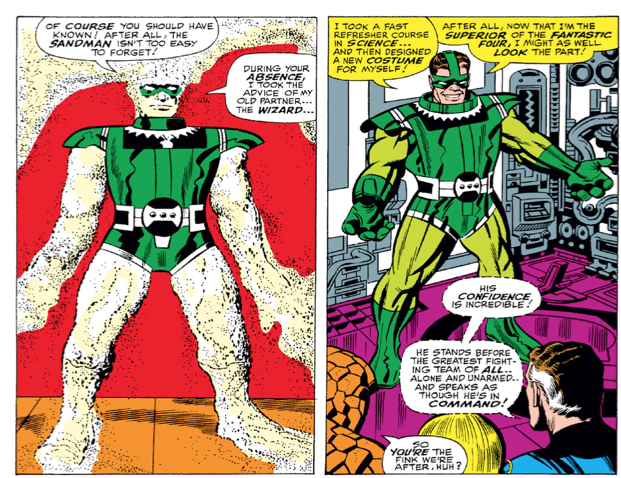
This issue also marks a new costume for the Sandman,a much more Kirby-esque getup than the striped shirt Steve Ditko gave him. You can almost sense Jack chafing at having to draw such a drab costume for some many issues up to now.
The sexist sixies
More gender-role conformity
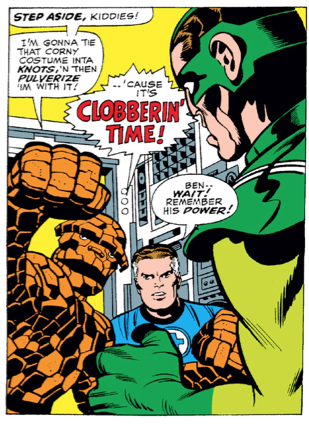
Clobberin’ Time
This is a pretty good one, with it’s own font and everything.
Weird science
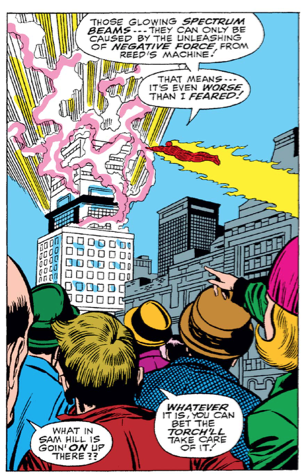
Watch out for those spectrum beams!
Crazy credits
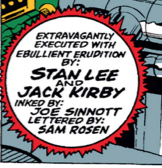
They’ve been pretty tame the last few issues, but we get a bit of flourish here.
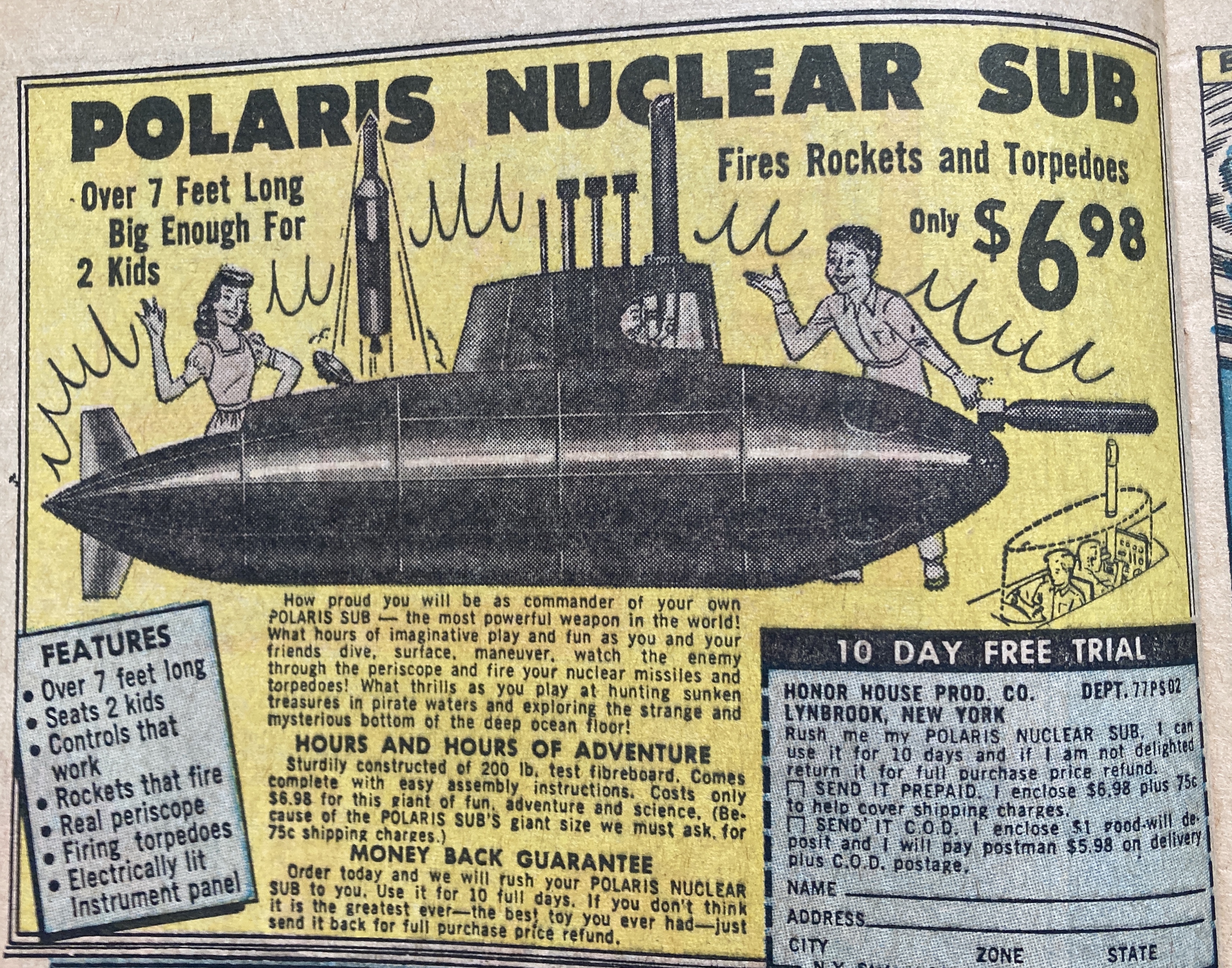
For sale
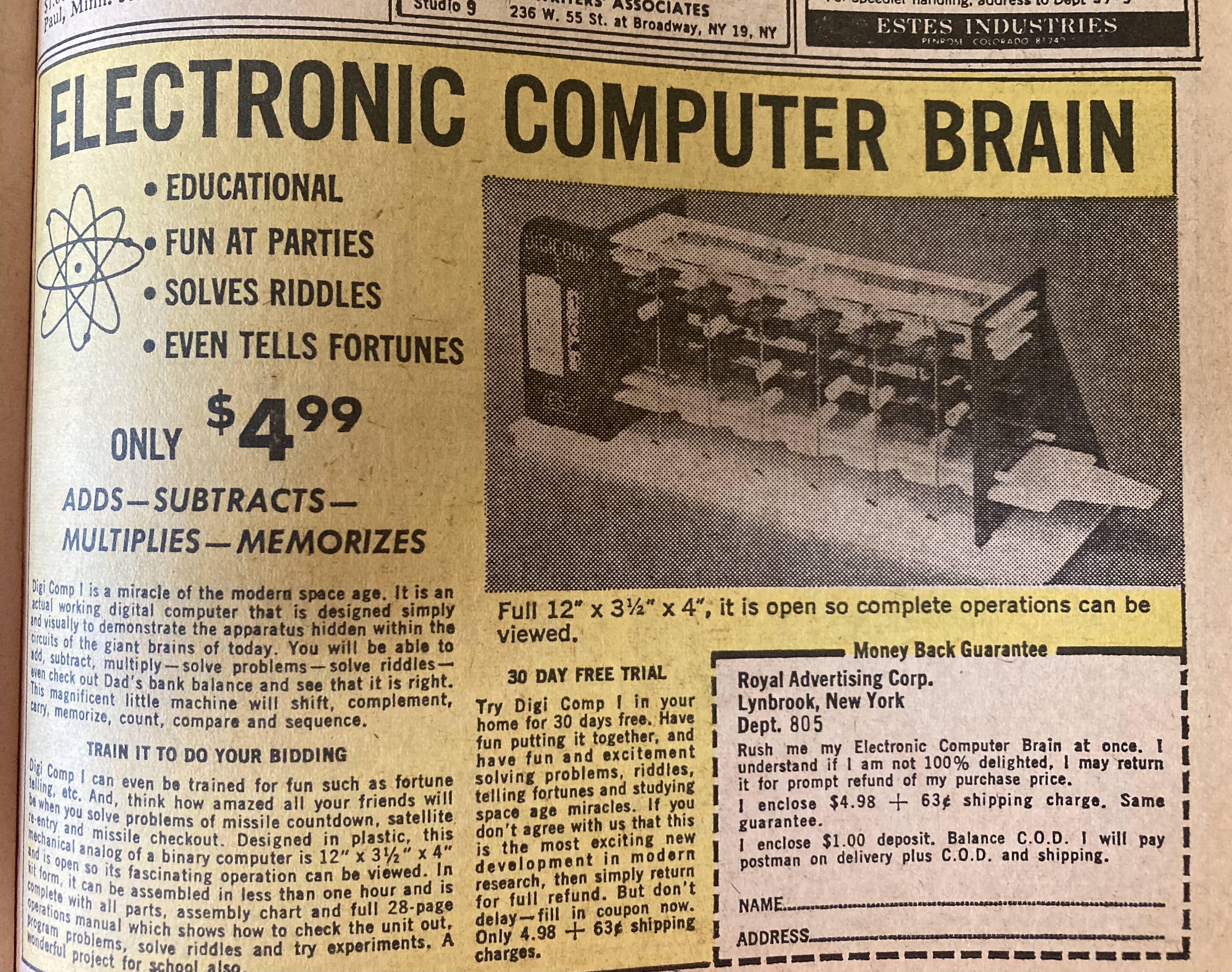
A computer for $4.99. It’s a great deal, because a similar device made by IBM in 1967 cost about $4 million.
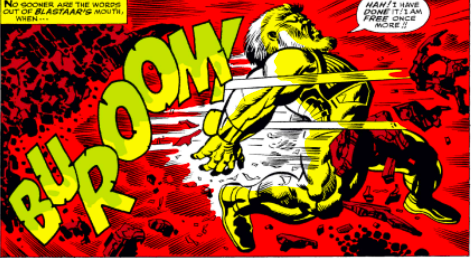
Dig that Kirby Krackle
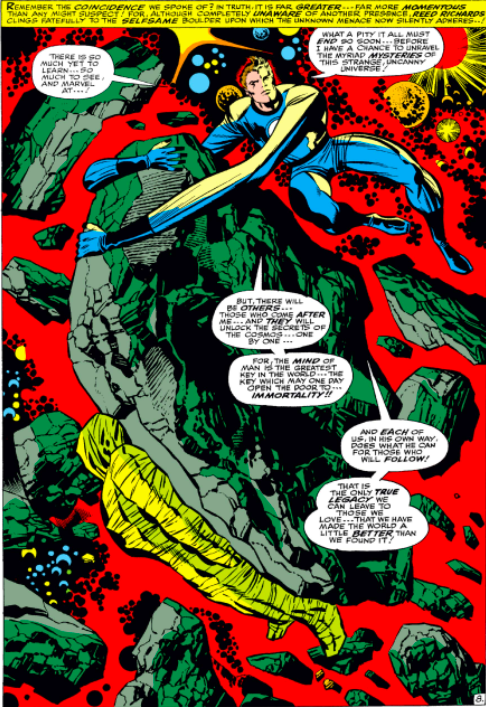
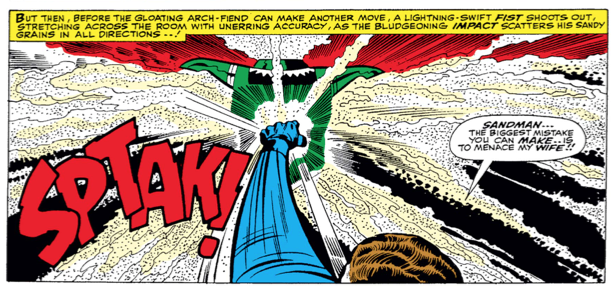
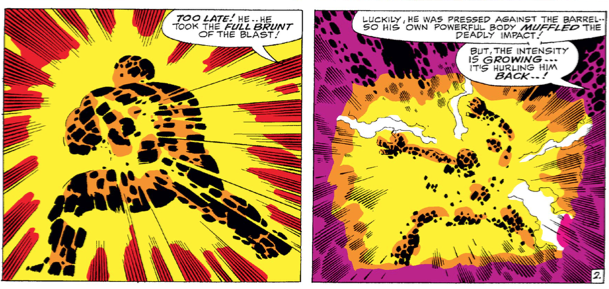
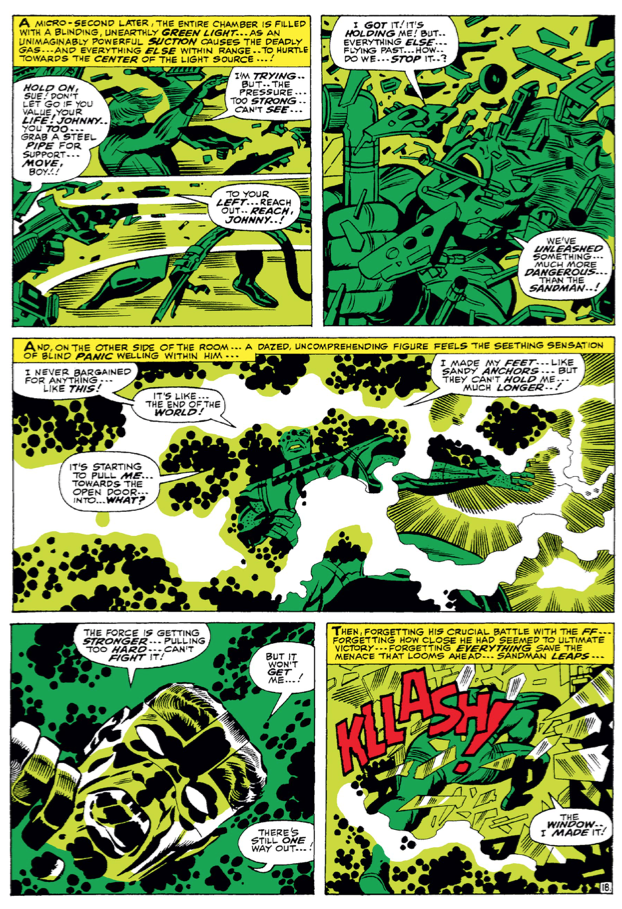
So much awesomeness in this issue! Like this sequence:
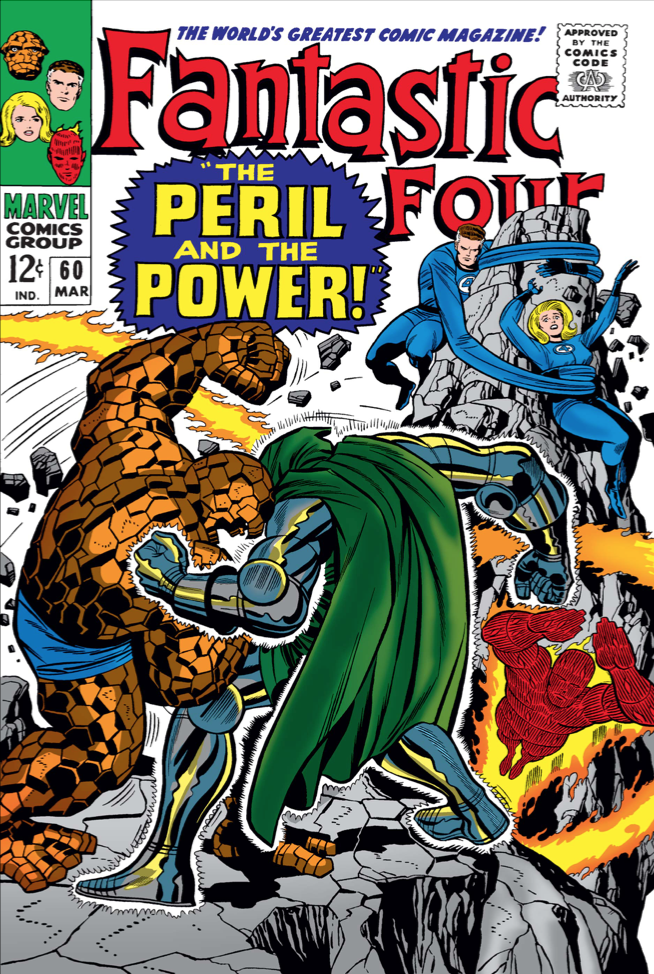
Fantastic Four 60 “The Peril and the Power!” Published: Dec. 1966 Story: Stan Lee and Jack Kirby Script: Lee Pencils: Kirby Inks: Joe Sinnott Letters: Sam Rosen Cover: Kirby and Sinnott
Synopsis
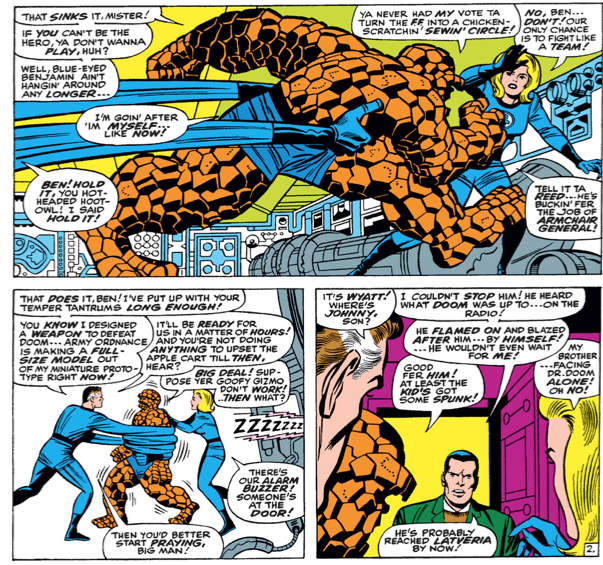
Fantastic Four 60 picks up where issue 59 left off, with Dr. Doom preparing to conquer Earth with the stolen power of the Silver Surfer. As the Thing rages in frustration, Mr. Fantastic urges patience as the Army is building a weapon he designed. But when Wyatt Wingfoot tells the team the Human Torch has gone after Doom on his own, the rest of the FF flies off in pursuit.
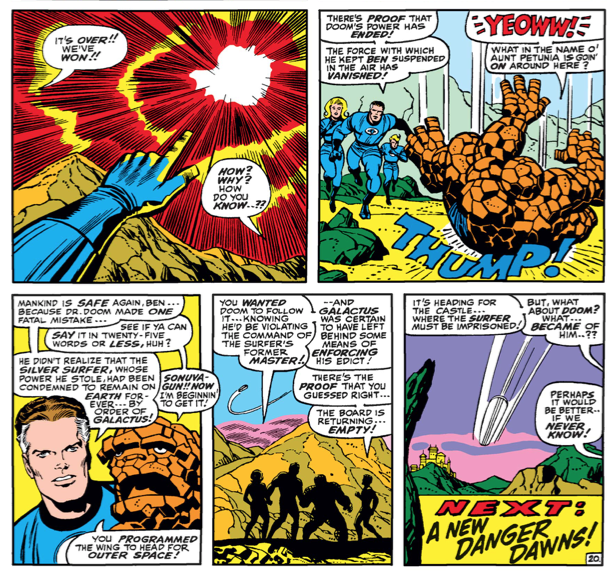
Johnny is defeated by Doom, and when the rest of the FF approach, he destroys their aircraft before battling the Thing in hand-to-hand combat. Doom and the FF then fight for most of the rest of the issue until Reed’s “anti-cosmic flying wing”—which we saw a glimpse of in the last issue—appears and stuns Doom. Doom then chases it into the stratosphere when he loses his powers, the result of the barrier Galactus placed around earth to prevent the Silver Surfer from escaping. This issue ends with the Surfer’s board heading back to the castle in Latveria where he was imprisoned.
What’s going on here?
FF 60 wraps up the four-issue arc start that started when Doom stole the Surfer’s powers in FF 57, and the 16 issue stretch, starting in FF 44 with the introduction of the Inhumans, that marks the apex of the Lee/Kirby run. To recap, in a bit more than a year, Stan and Jack introduced Gorgon, Crystal, Karnak, Triton, Lockjaw, Black Bolt, Maximus, Attilan, the Silver Surfer, Galactus, “the power cosmic”, the ultimate nullifier, Wyatt Wingfoot, Wakanda, the Black Panther, Klaw, Prester John, and Quasimodo, and along the way wrote FF 51, a one-shot many consider one of the greatest stand-alone comics of all time. It’s not that there weren’t great issues before and after, but every mountain has a peak, and FF 44-60 is Stan and Jack’s.
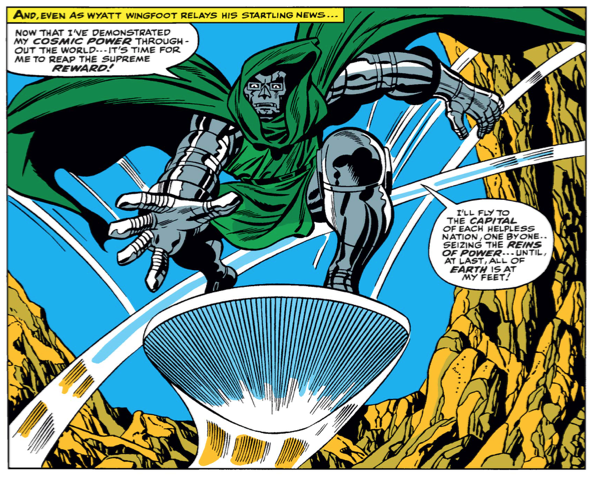
Given all that, FF 60 feels like a bit of a let down. The concept animating this arc—Doom stealing the Surfer’s power—is brilliant, and as I’ve said before, really cements Doom as a formidable villain. Up until this point he’d been crafty, but stealing the Surfer’s power added an element of ruthlessness and grandiosity that we’ll see again and again over the years. But the story’s end doesn’t live up to its beginning and middle: the business with the flying wing feels rushed, and when Doom is stripped of his powers, it happens basically off-camera and explained only in Reed’s narration.
The scene seems designed for a dramatic Kirby panel, with Doom crashing into Galactus’s barrier, so it’s a puzzle why we don’t see it. It’s possible Jack ran out of room to finish the story, something we have seen in earlier issues. Or maybe plans for another issue wrapping up the arc were dropped, meaning they had to cram the endinging into this one. In any event, it’s shame, because as a story-telling mechanism, it’s a great device: Doom, like Icarus, challenges the gods and is pushed for his hubris.
Who invited them?
FF 60 features a few odd cameo appearances. The Inhumans show up for a few panels, as the the royal family makes its way from its refuge. We’ve been following their story for a while now, so the subplot isn’t too surprising, but it is jarring when it appear in the middle of a the FF’s fight with Doom.
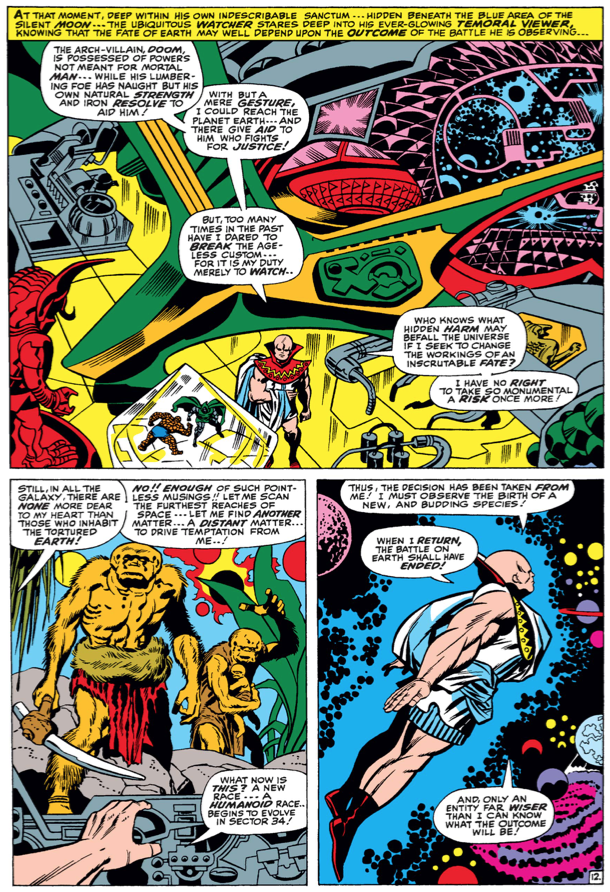
Stranger is the appearance of the Watcher, who observes the FF’s struggles, when (for once) obits his vow of non-interference and goes on to do something else. It’s a great excuse for Jack to draw some cosmic stuff but otherwise a peculiar insertion.
Hero time
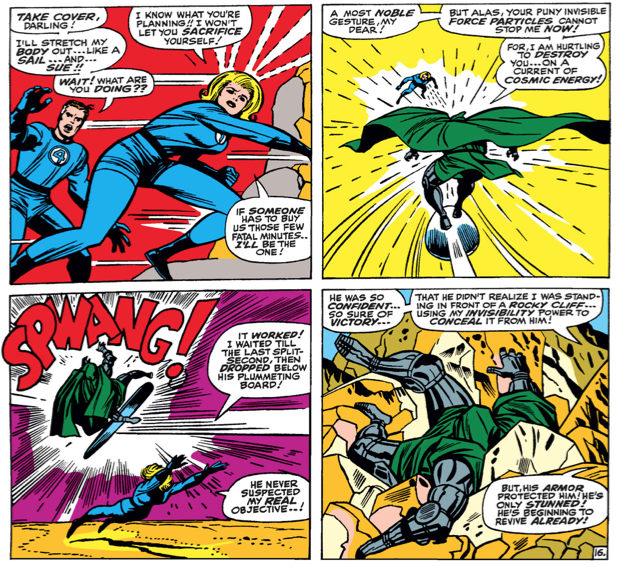
Since most of the issue features the FF fighting Doom, there’s chance for each of the four to get a moment in the spotlight. In a rarity, Sue gets to use her powers creatively, and she rises to the occasion to take on Doom here.
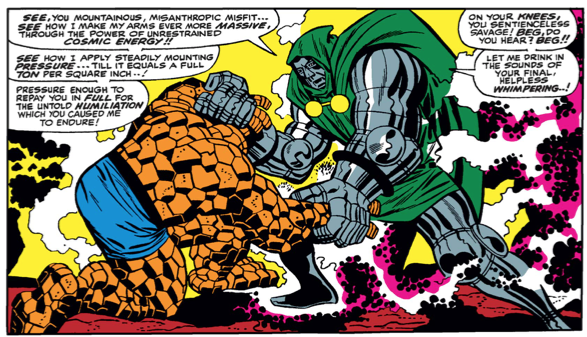
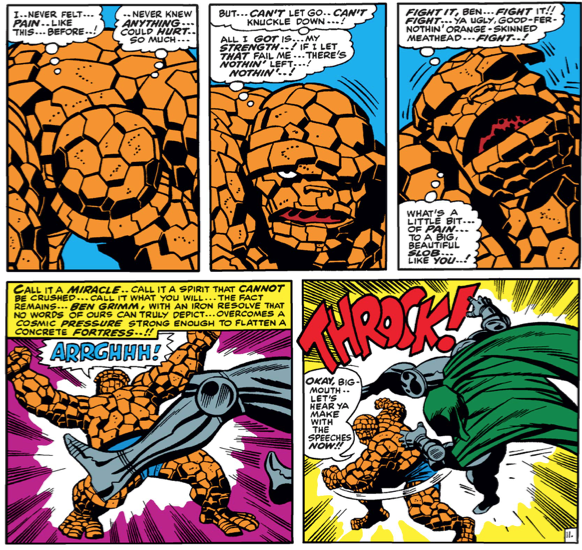
Ben also battles Doom, and it’s another opportunity to showcase his tenacity and resolve.
Plus, we get an excellent …
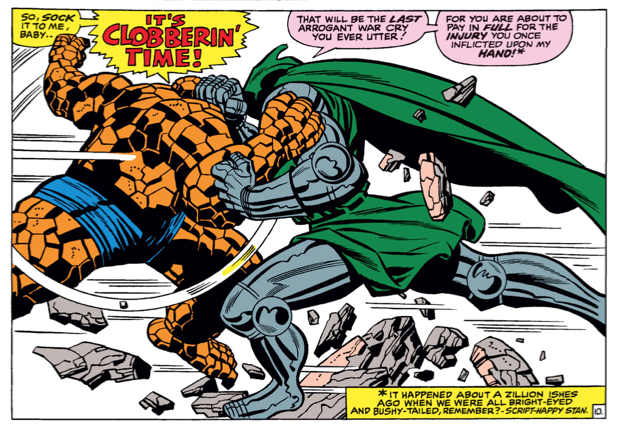
Clobberin’ Time
This is one of the best matches between story, art and catch phrase to date.
They’re fighting again
The sexist sixties
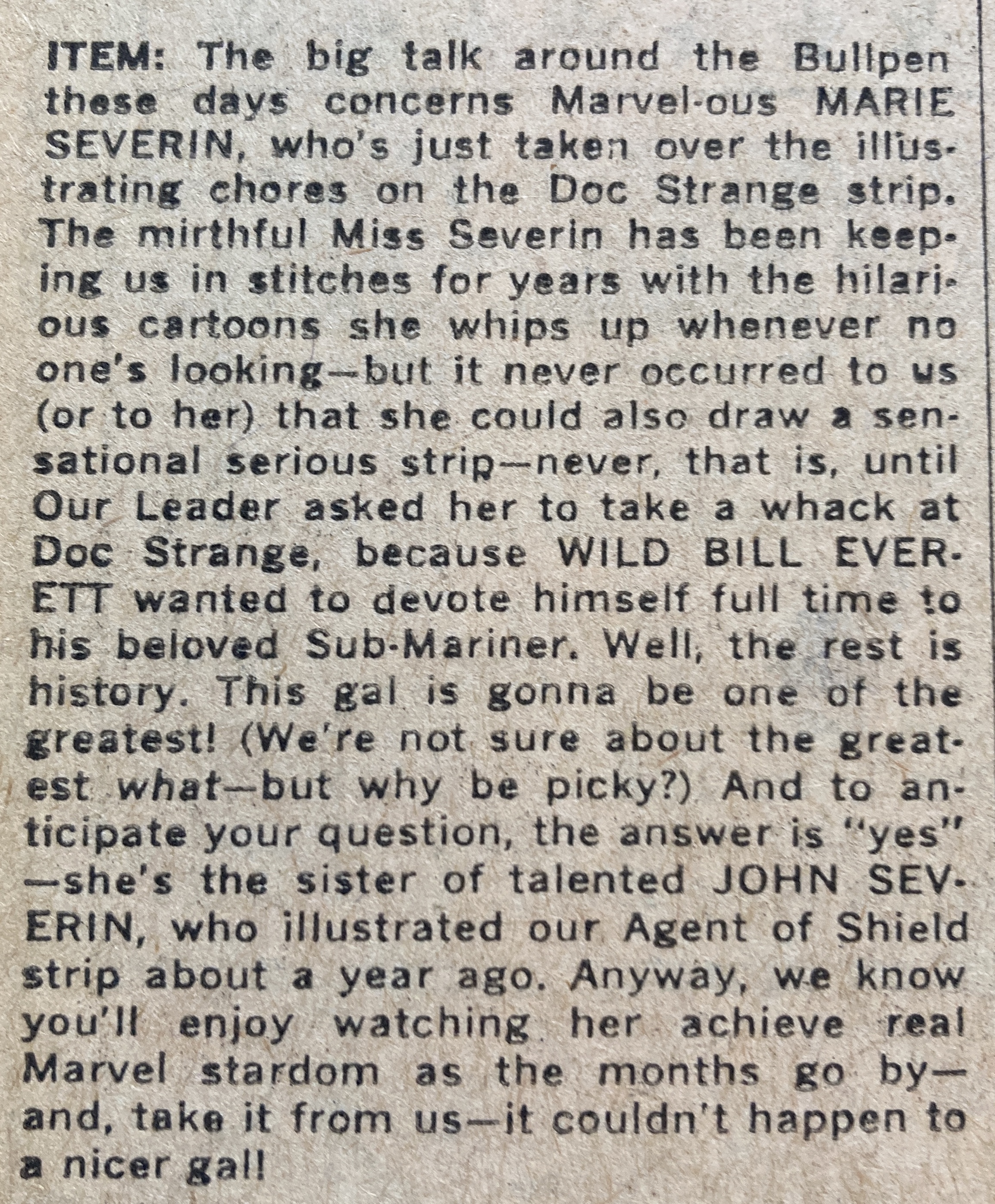
It was probably too much to ask for a whole issue without a woman being demeaned. Here, in the Bullpen Bulletins, Stan manages to belittle Marie Severin while trying to praise her.
Oops
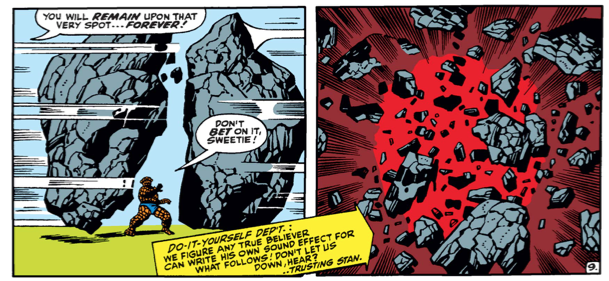
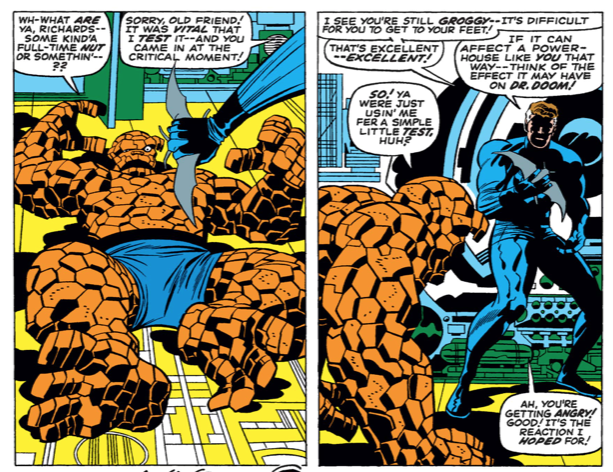
Not sure if this is a legit goof, ad Jack forgot to add the sound effects, or if Stan and Jack were just having fun.
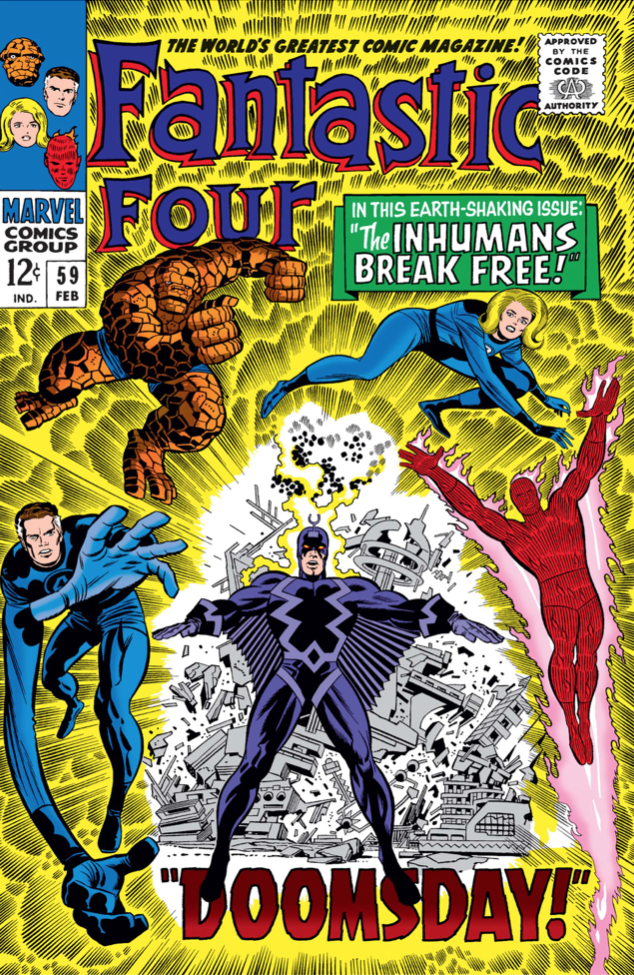
Fantastic Four 59 “Doomsday!” Published: Nov. 1966 Story: Stan Lee & Jack Kirby Script: Lee Pencils: Kirby Inks: Joe Sinnott Letters: Artie Simek Cover: Kirby & Sinnott
Synopsis
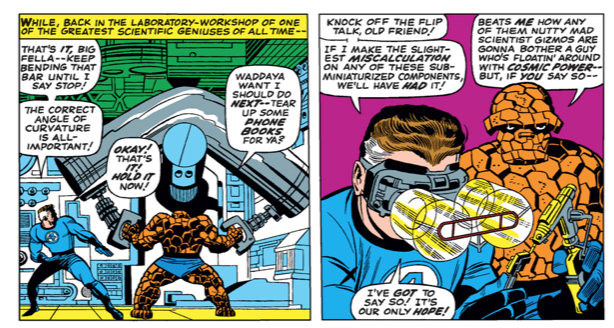
After Dr. Doom’s defeat of the Fantastic Four in the previous issue, FF 59 is another stage-setting comic, where a number of storylines are advanced without any reaching their climax.
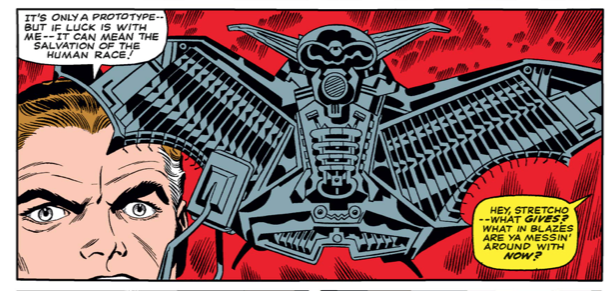
In the first, main thread, Mr. Fantastic, the Thing and the Invisible Girl are regrouping in the aftermath of Doom’s victory. Reed warns the nation’s of Earth to prepare for the menace of Doom, then, goaded by Ben, begins making plans to defeat him. Toward the end of the comic, we get a glimpse of what Reed’s working on: an explosive flying device that saps power from this it comment with.
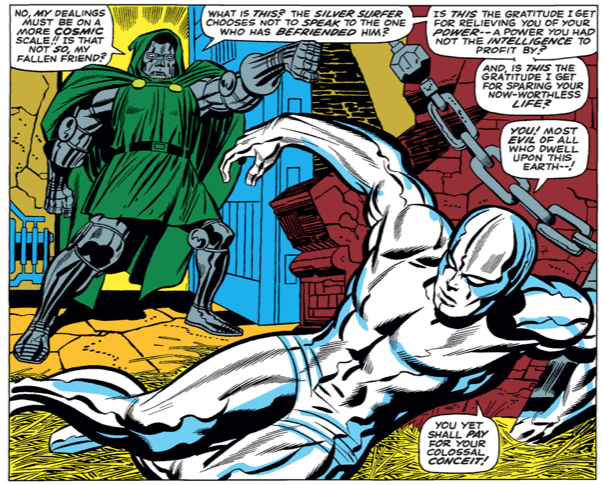
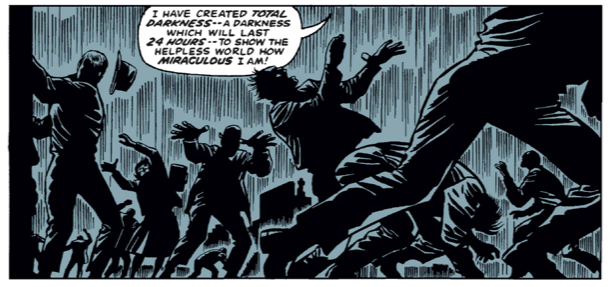
Meanwhile, Doom is plotting his conquest of Earth. He dismisses an attack by (presumably) the Soviet Union, taunts the helpless Silver Surfer, a prisoner in Latveria, then circles the globe displaying his power, for example, by throwing cities into darkness for 24 hours.
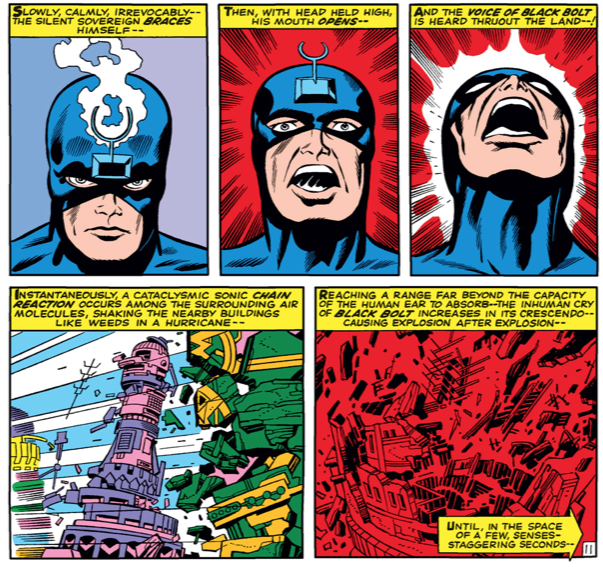
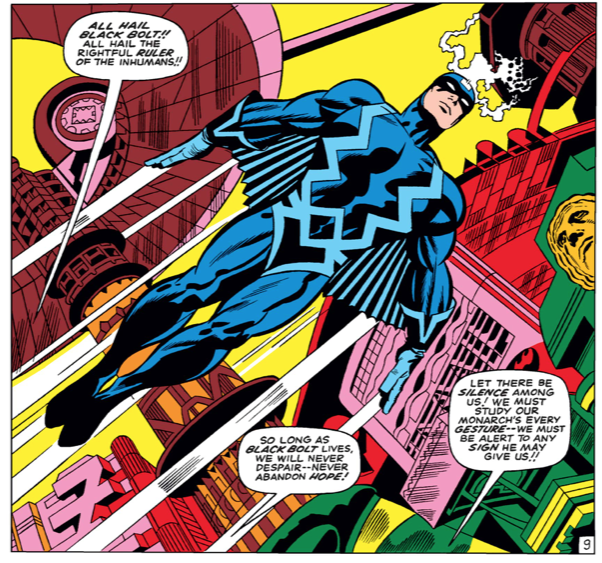
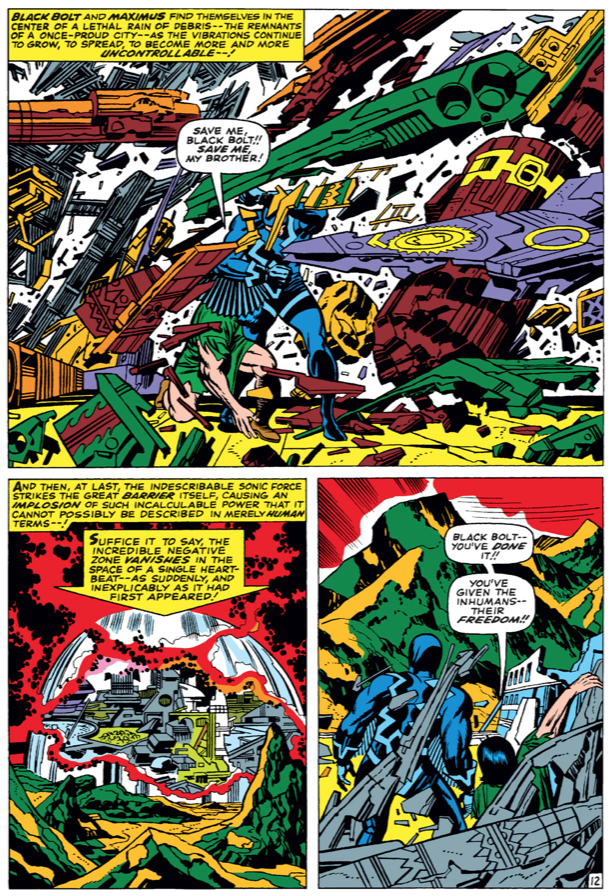
In the third storyline, the Inhumans, trapped in their city behind a negative zone barrier for many issues now, finally break free after Black Bolt uses his voice to destroy both the barrier and the city. The Inhuman royal family then travels to help Crystal reunite with Johnny Storm.
And in the last storyline, the Human Torch decides he alone has the power to take on Doom, and despite his misgivings, his friend Wyatt Wingfoot joins him on his quest.
What’s going on here
This is a transitional issue, but a good one, enhanced by some of the best art on this book to date. Lots of character is developed here: Ben’s needling of Reed is revealed to be more cunning than buffoonery, Doom’s mania becomes more apparent, the Surfer’s resolve becomes more clear, and we finally see Black Bolt cut loose with his power. It had been hinted at for a few issues now, but we now understand why he is silent, breadcrumbs first dropped all the way back in issue 46.
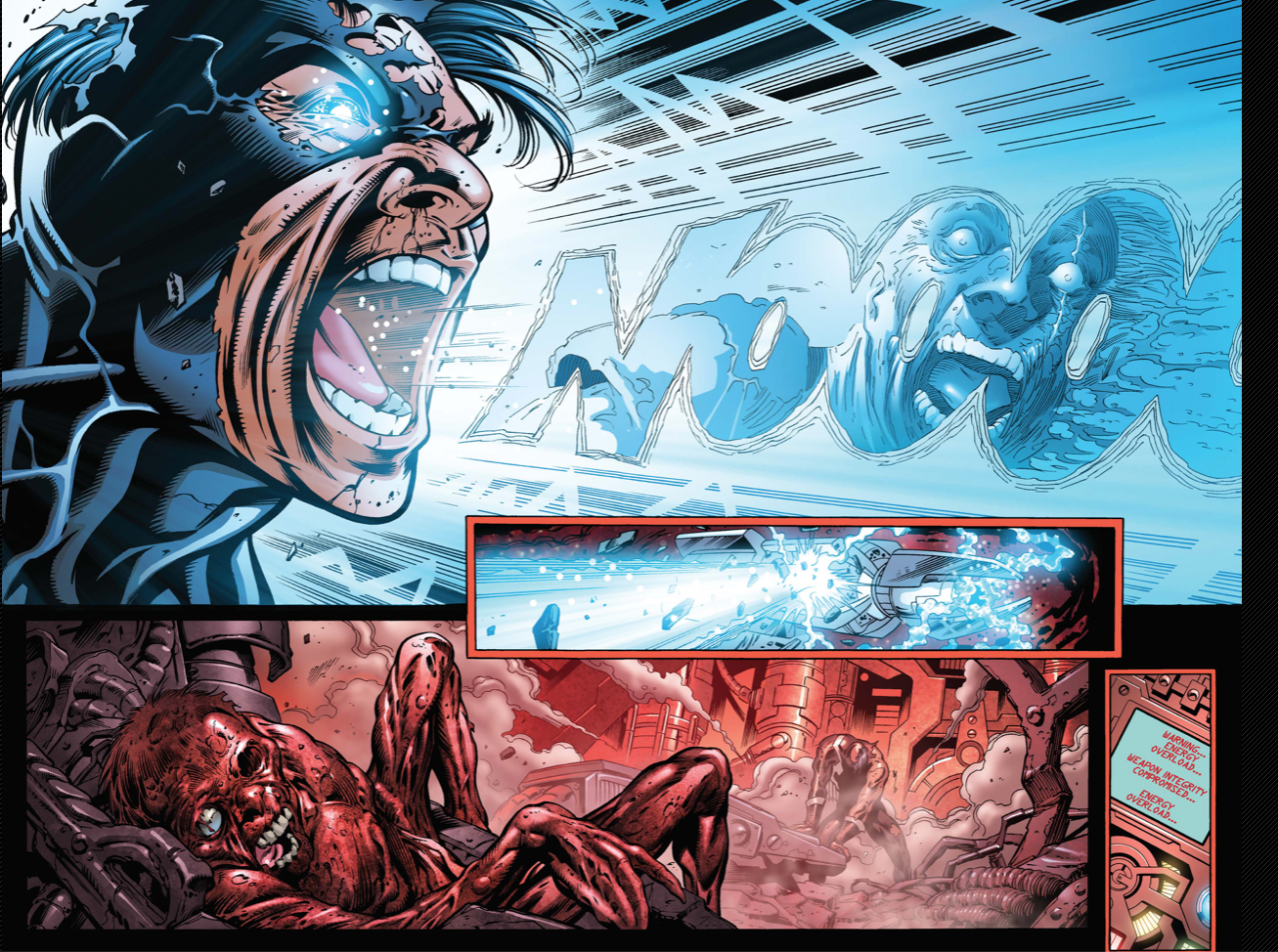
It’s always a big deal when Black Bolt uses his voice, and comic book writers have generally been pretty sparing with it. Here’s a pretty good run down in Comic Book Resources of 20 times he used his voice, including in 2009’s War of Kings, where he uses it to defeat Vulcan (the crazy brother Cyclops and Havok never knew they had—it’s a long story) and then detonate a Terrigen bomb which tears a hole in spacetime. That’s a not-untypical use case for Black Bolt’s voice.
War of Kings 6 (2009, Pelletier, Magyar & Hennessy)
The F-Team
I may be dating myself here, but in the 1980s TV show The A-Team, there was invariably a sequence of rapid cuts where the team, having suffered some defeat, works energetically to build a device or hatch a plan to save the day as the theme music plays. That is what I thought of when Reed and Ben get busy working to defeat Doom.
The sexist sixties
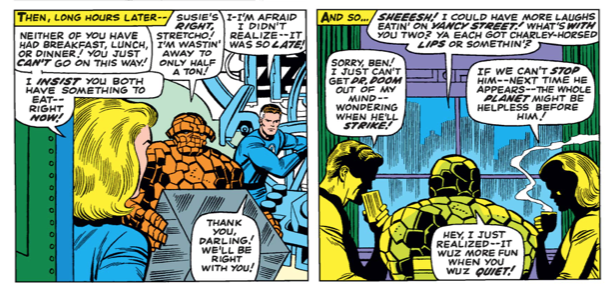
Of course, while Reed and Ben are making their plans, Sue is in the kitchen, worrying.
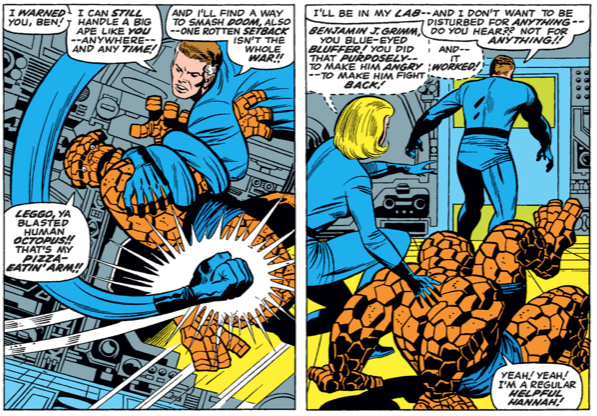
They’re fighting again
It’s been a long time since we saw this kind of thing. It makes me nostalgic.
Red menace
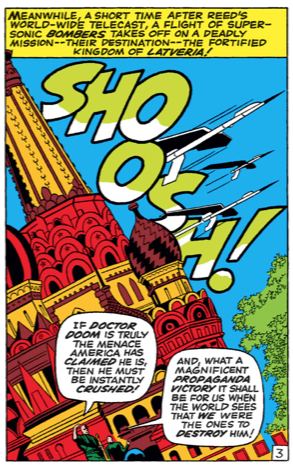
Doom is attacked by .. it’s not exactly clear. It sure looks like the Soviet Union, but for some reason Stan is reluctant to say as much.
Ladies and gentlemen, Joe Sinnott
Every now and then Sinnott’s inks just jump out at me, like they do in this sequence
Weird science
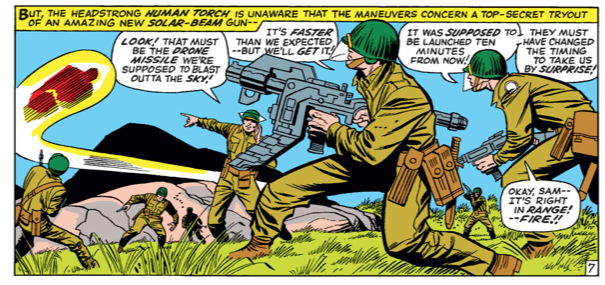
It’s “a solar-beam gun”
Nice ride
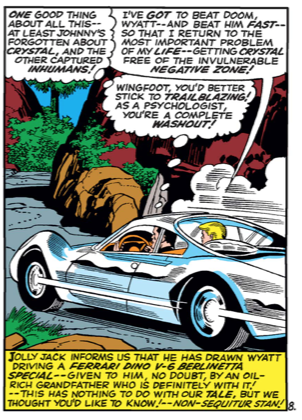
Johnny’s Ferrari is apparently courtesy of a rich grandfather. I don’t think we ever learn more about him.
Dig that Kirby Krackle
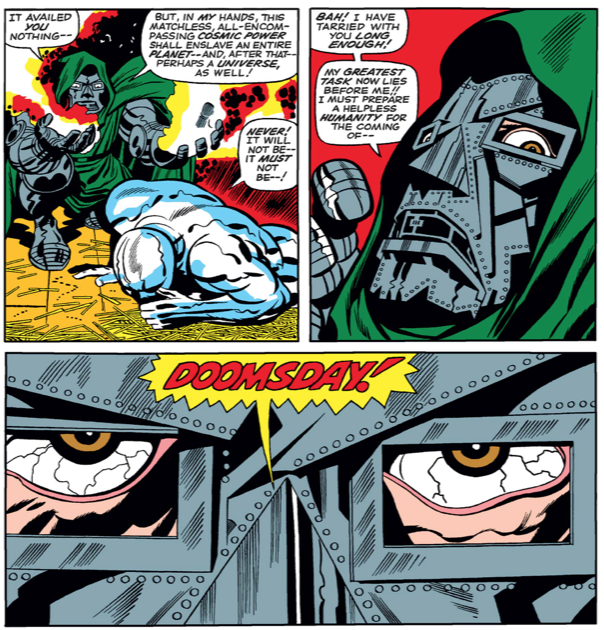
This issue has so much great Kirby art that I could have picked something from virtually every page. I restrained myself, but it’s really an amazing issue.

 Percival Henry: The Fantastic Four and more