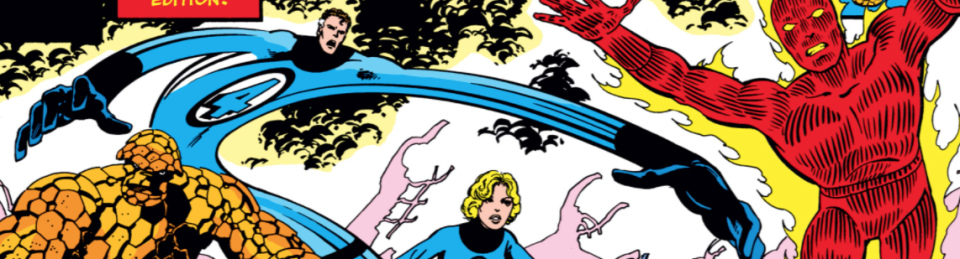
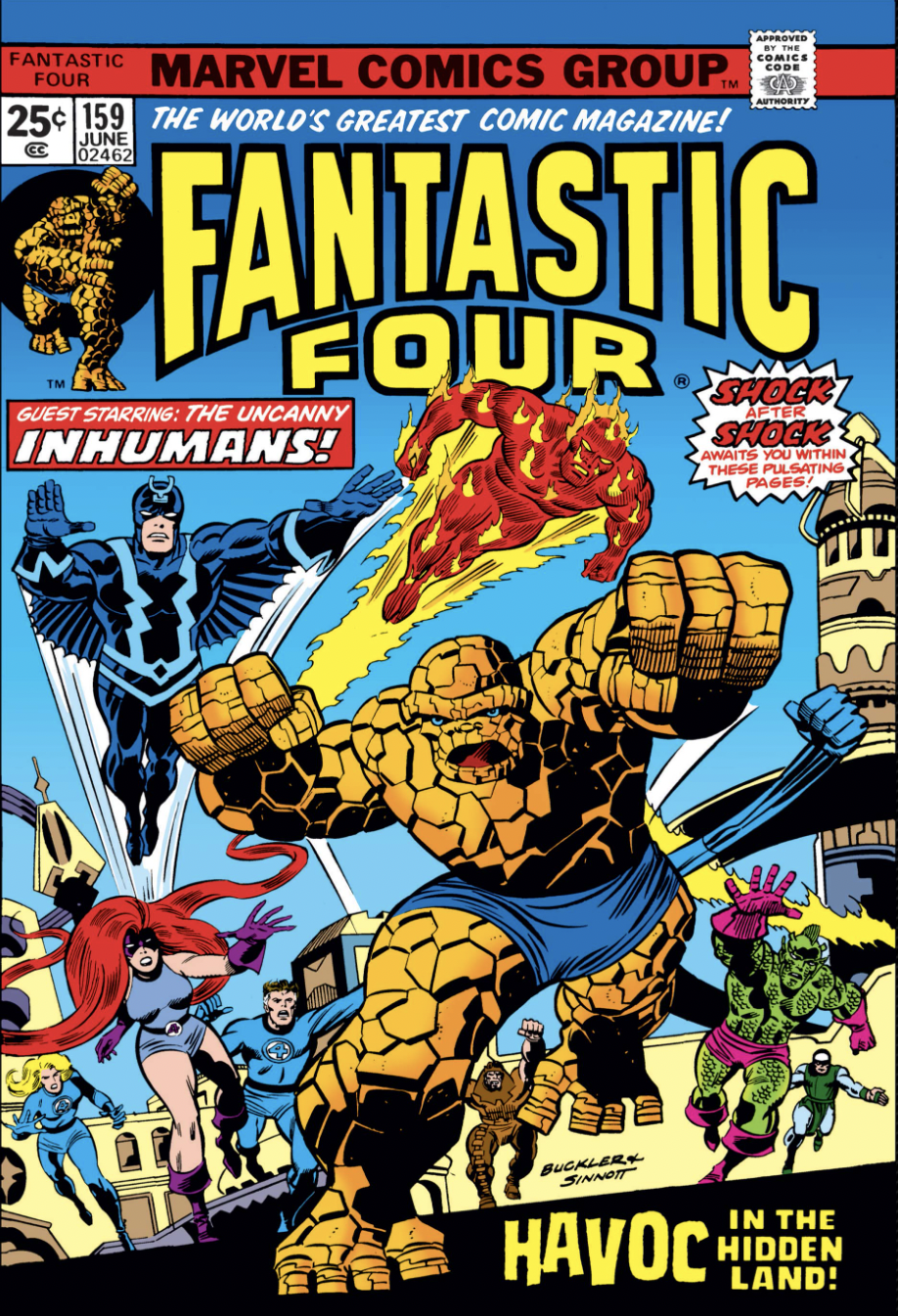
Fantastic Four 159 “Havoc in the Hidden Land!” Published March 1975 Writer: Roy Thomas Pencils: Rich Buckler Inks: Joe Sinnott Letters: Joseph Rosen Colors: Janice Cohen Editor: Thomas Cover: Buckler and Sinnott
Synopsis
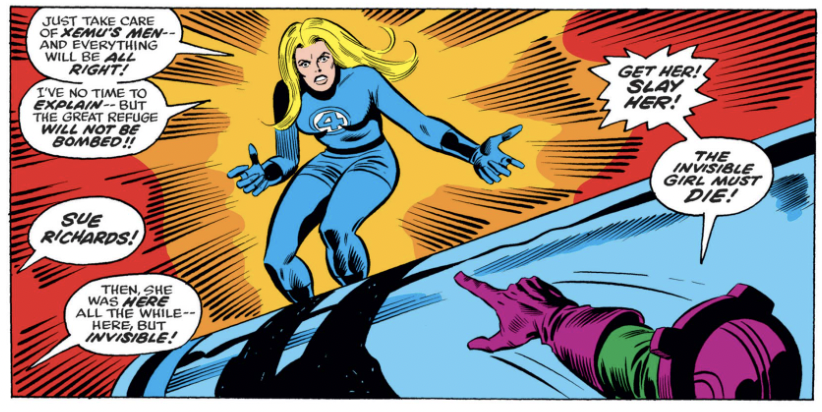
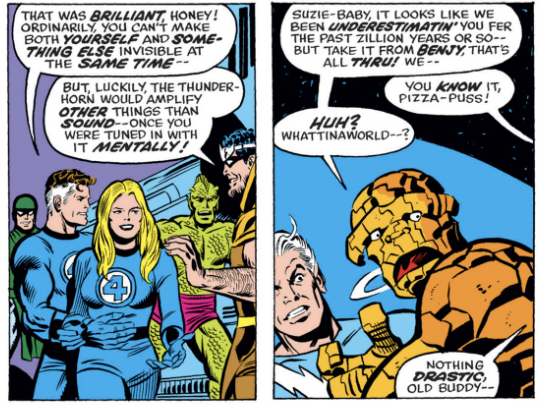
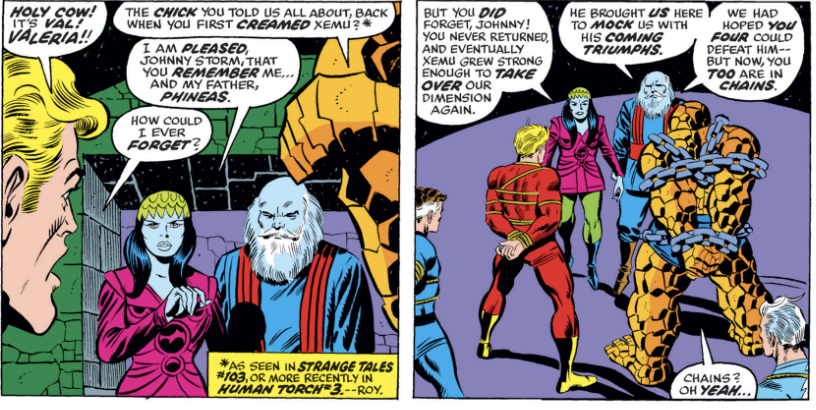
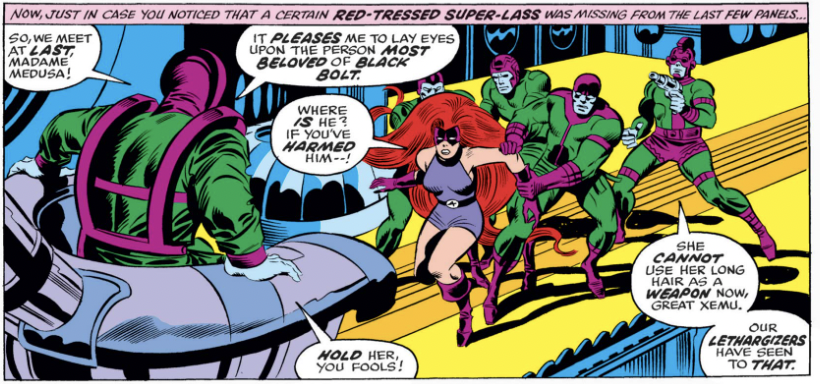
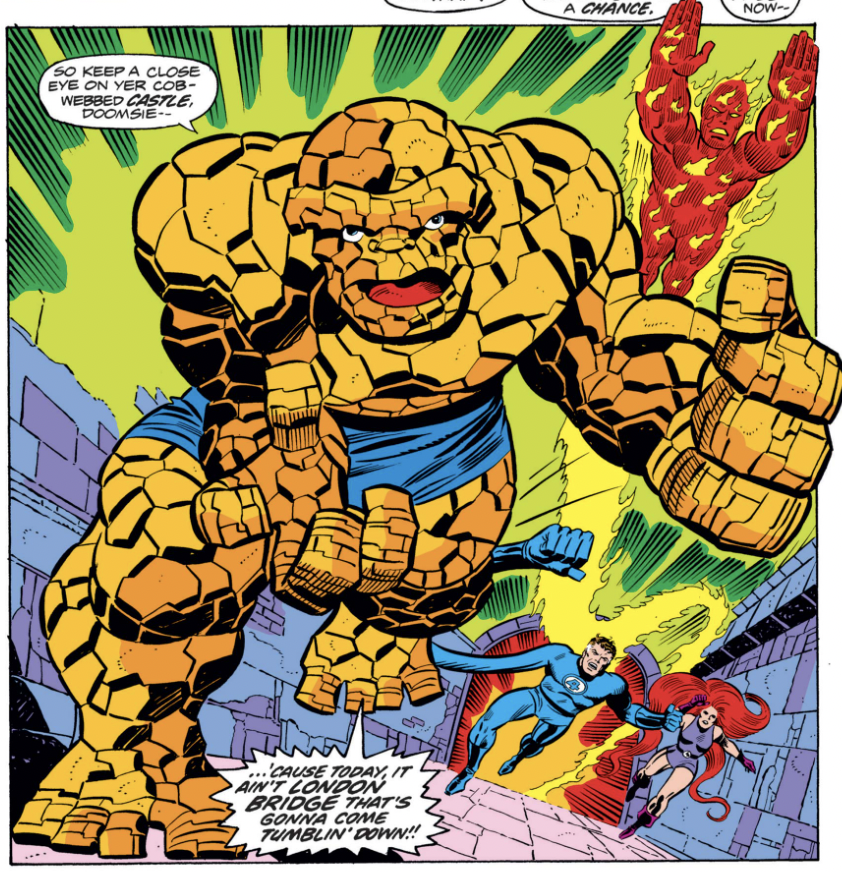
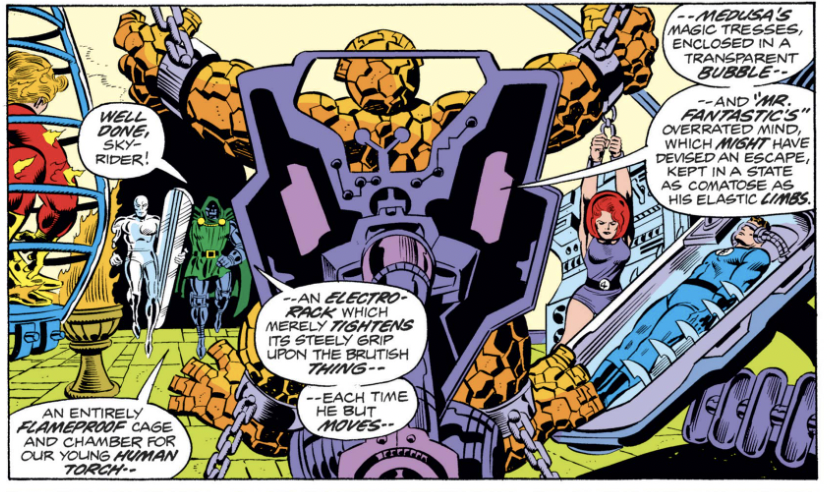
With Quicksilver, the Fantastic Four — minus the Invisible Girl, who was forbidden to come — travel to the Hidden Land in the Himalayas to rescue the Inhumans, where they are immediately captured by Xemu, the tyrant from the Fifth Dimension. In captivity, Johnny is reunited with Valeria, a princess from the Fifth Dimension he last encountered years ago. To force Black Bolt to power his sonic cannon, Xemu both threatens Medusa and tries to provoke an air strike by China. His plan is foiled by the Invisible Girl, who stowed aboard and used her powers to disguise the Hidden Land from the Chinese air force. The rest of the team and the Inhumans, freed by Triton, subdue Xemu and return him to the Fifth Dimension.
What’s going on here?
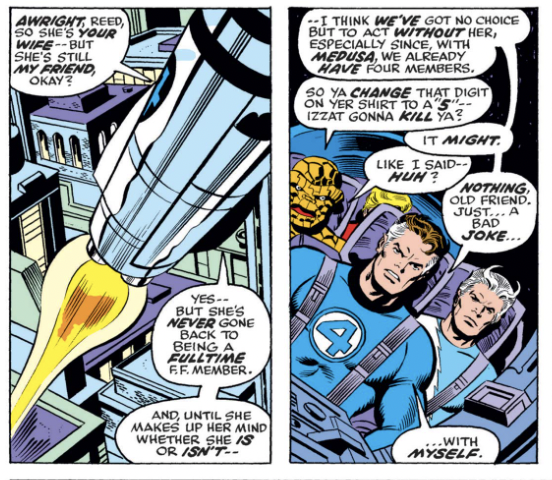
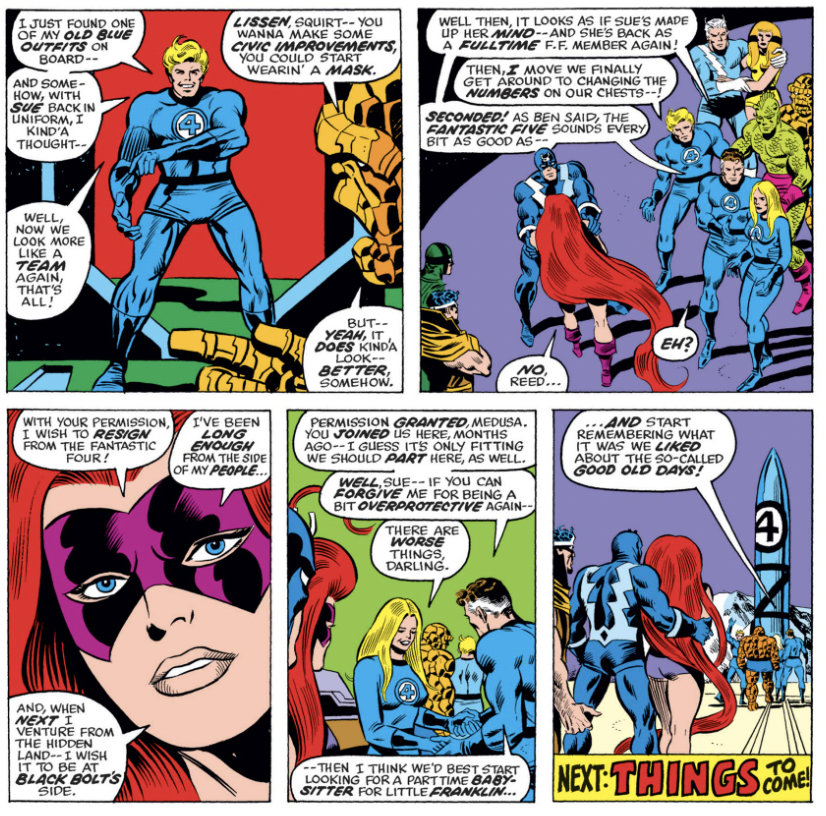
With this issue, Roy Thomas really puts his stamp on the Fantastic Four, undoing a slew of changes that had been introduced over Gerry Conway’s tenure as writer. Most notable is the return of the Invisible Girl as a member of the team. But Thomas also gives Johnny back his old blue uniform and dismisses Medusa from the team — both on the same page — reversing two changes to the FF that added little and distracted from their unified, familial nature that makes the team unique.
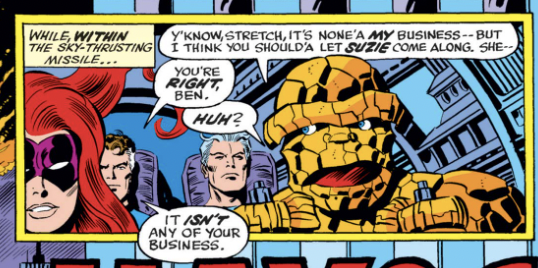
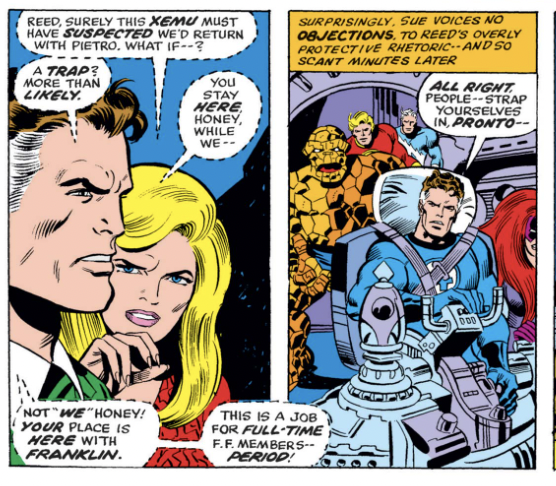
Readers of this blog know I have been very critical of the treatment of Medusa, who never found her place on the team, and especially of Sue, who spent the last two-plus years shunted aside, figuratively and sometimes literally. Sue’s diminished status is nothing new, of course, and was a fixture of the Lee / Kirby era. Her treatment surely reflected the sexism of the time, but her more recent exclusion from the team was perhaps also the result of an inability by Conway (who, remember, was in his early 20s) to imagine a role for a young mother on a superhero team. In the comics, her exclusion was justified by Reed being over-protective, and in some revealing dialogue early in FF 159, Ben makes the case she should join them, perhaps another case of Thomas using the characters to argue with other FF writers.
At this point in the comics I was resigned to yet another issue without Sue, and was genuinely surprised when she not only appeared, but saved the day with new and expanded powers. Thomas, it seems, was as frustrated with Sue’s marginalization as this fan.
And like a Gilbert & Sullivan operetta, all is wrapped up and forgiven in the last few panels.
What I liked
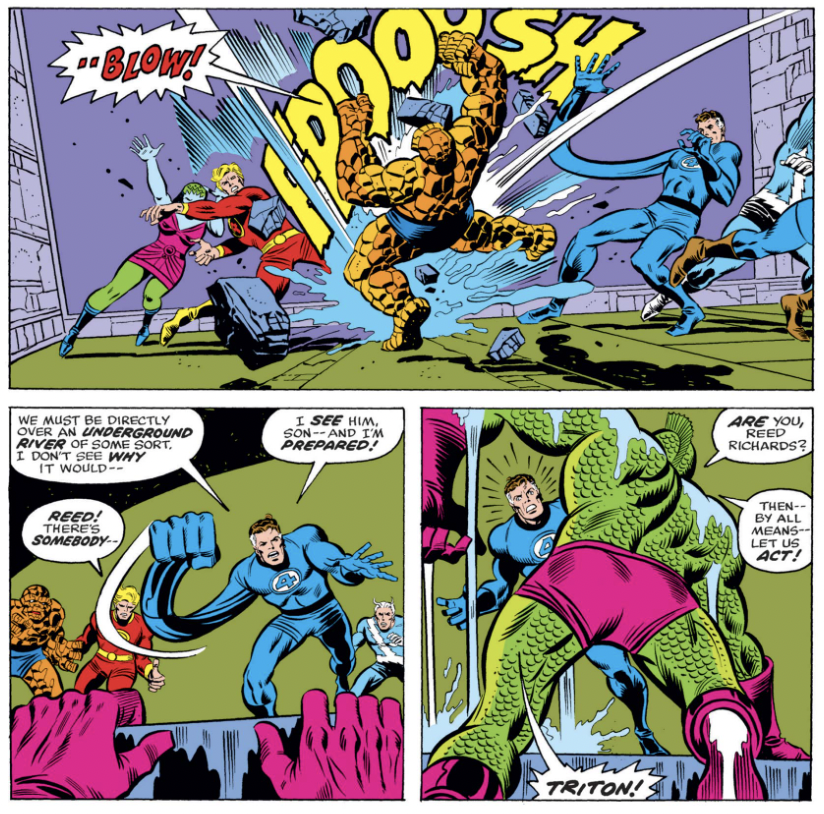
I loved Sue’s dramatic re-emergence, but Thomas also managed to surprise me with the sequence where the FF are imprisoned. This is a pretty familiar situation, and they usually use some aspect of their powers to escape, but here they are rescued by Triton, whose absence was explained last issue. This was another twist I didn’t see coming.
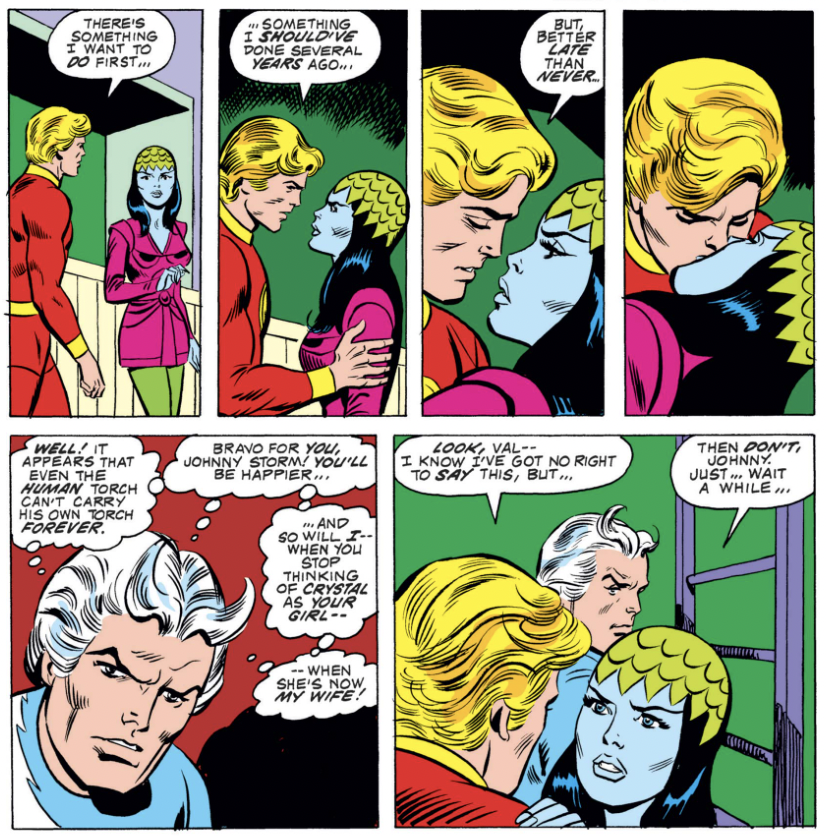
Thomas leans into soap opera by reintroducing Valeria, the alien princess Johnny had a dalliance with years ago and — as is his wont — jilted. I like how she reminded him that he ghosted her.
I’m not sure Valeria is the right woman for Johnny and history will prove she is not, but I like that Thomas is trying to make a clean break with Crystal and that mopey storyline.
What I didn’t like
Despite the many positive aspects of this comic, it’s plot was pretty lackluster and by-the-numbers. The FF are captured by an evil-doer, it all looks hopeless, they escape and save the day. This story was at times incoherent, in part because of Xemu’s dimension-hopping, but it was mostly forgettable.
Rich Buckler’s art looks rushed and unimaginative in this issue, which doesn’t help matters.
Also, what is a “lethargizer?”
About that name
“Valeria” is a familiar name to Fantastic Four fans, and the character in FF 159 is one of three to share it. She’s also the first, since her first appearance in 1962’s Strange Tales 103 predates the appearance of Victor Von Doom’s first true love, a Latverian woman named Valeria, who is first mentioned in 1969’s Marvel Super-Heroes 20. It is that Valeria who is the namesake of Valeria Richards, the daughter of Reed and Sue who was delivered by Doom and who claimed the right to name her.
Marvel Super-Heroes 20 was written by Larry Leiber (Stan’s brother) and I don’t know whether he was aware of the previous Valeria, who seemed like a throwaway character until she was resuscitated by Thomas. It is possible both characters were named after Valerie Barclay, a comic book inker who worked at Marvel (then Timely) in the 1950 who was described by artist Allen Bellman as “an exquisitely beautiful young lady.”
Note: If you are here for Fantastic Four content, you may want to skip this post. While these days my blog is almost all FF recaps, I occasionally still post things like this.
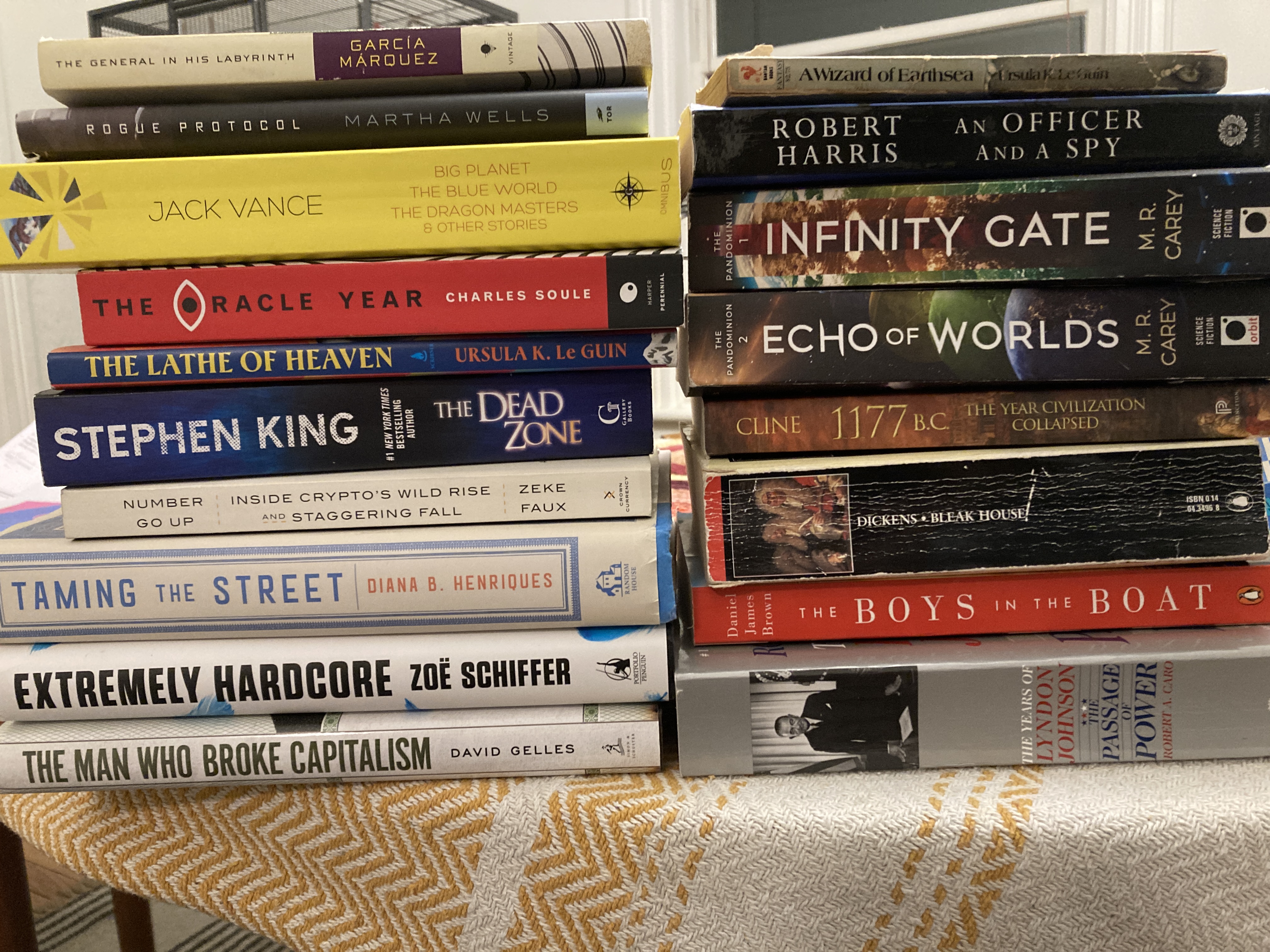
Last year was my fifth tracking and counting the books I read. Although I technically read 27 books, I’m only counting 24 (more on that in a bit) and therefore just reached my goal of two a month. As usual, I was very unsystematic about what I read, and my choices ranged from gifts I received, books I found at my parents’ house, things I picked up at library sales, entries in a business book contest I judged, and books reviewed in the Times. I read more science fiction and fewer non-fiction books than the previous year, and totaled 8,986 pages, down from 10,215 in 2023. I enjoyed most of what I read, although there were a few duds.
The books are presented in the order I read them. As always, for the images, I have tried to find the cover of the edition I read. Also, apologies for any layout wonkiness. WordPress was being particularly difficult with this post.
1,A Coffin for Dimitrios, Eric Amber (1939), 302 pages
This novel was named one of Time’s 100 best mysteries and thrillers of all time, and because my father was an Eric Ambler fan and it was on the shelf at my parents’ home, I decided to give it a shot. Set in Turkey, Greece and Bulgaria between the wars, it’s darkly atmospheric and full of intrigues and double-crosses. I’m not sure I ever quite bought into the premise — the protagonist is a novelist compelled to solve a mystery to satisfy his own curiosity — but Ambler propels the plot along briskly and sticks the landing.
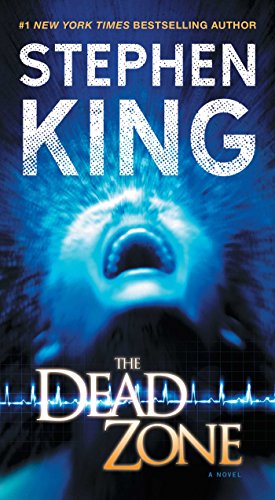
2,The Dead Zone, Stephen King (1979), 513 pages
I began reading Stephen King books a few years ago, and have pretty much enjoyed everything by him I’ve encountered. I’ve stuck mostly to his science fiction, and they are engrossing reads. This one, about a young man who after an accident realizes he can see into the future (the “dead zone” of the title refers to the quasi-hypnotic state he enters into) and the complicated consequences that follow. I read this while suffering from pneumonia and it offered the just the right amount of plot without requiring too much concentration.
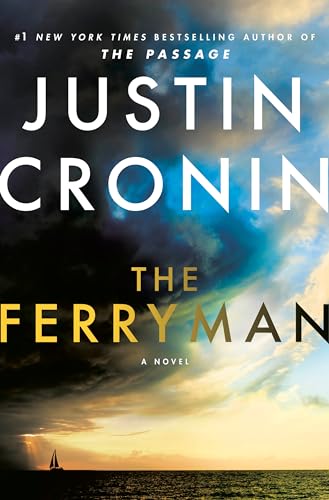
3,The Ferryman, Justin Cronin (2023), 538 pages
Easily the worst book I read in 2023. I saw this in one of the little free library boxes in my neighborhood, and because I enjoyed Cronin’s Passage trilogy, it seemed like it was a safe bet. It was not. The story is basically a version of The Matrix in which events play out in the mind of a slumbering protagonist, who in this case is in cryogenic sleep abroad a space ship. Except we don’t learn that until the last quarter of the book and instead of his imagined world being interesting or exciting, it’s incredibly tedious. I returned this book to the neighborhood library and regret not attaching a note of warning.
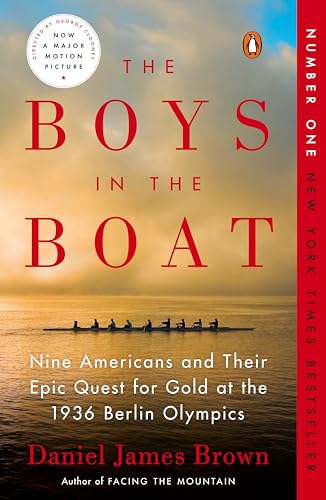
4, The Boys in the Boat, Daniel James Brown (2013) 375 pages
This was recommended by a CEO I interviewed years ago, and I when I saw a copy at a library sale, I picked it up and finally read it last year when I heard a movie was coming out. It reminded me a lot of Laura Hillenbrand’s Unbroken, another richly detailed story of plucky American courage and achievement against the backdrop of World War II (or in this case, the rise of Nazism). Brown interviewed the surviving members of the U.S. Olympic 1936 eight-man rowing crew, and tells a compelling story, with the focus on one rower from a hardscrabble background in Washington State. Brown is great at describing the complicated and slightly mystical sport of rowing, an activity that demands high levels of stamina, technique, teamwork and equipment. I suspect some of the details and dialogue lost to history might have been embroidered by Brown, but it all added up to a satisfying read.
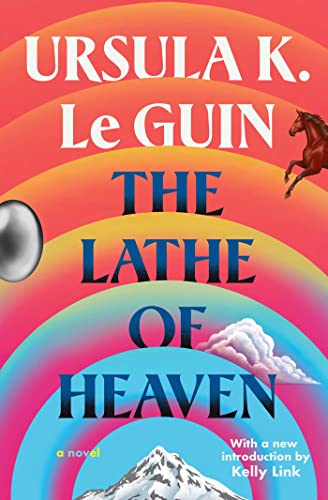
5,The Lathe of Heaven, Ursula K. Le Guin (1971), 184 pages
After reading The Left of Hand of Darkness two years ago I was eager to explore more of Le Guin. This book, about a man with the power to remake reality through his dreams, is less successful, in part because it’s set in late 1960s Portland, Oregon (where Le Guin lived), and being tethered to that era makes it somewhat dated and clunky. The protagonist is also a bit of a cypher, and his romantic connection didn’t really work. But Le Guin’s wildly imaginative premise made it worth reading.
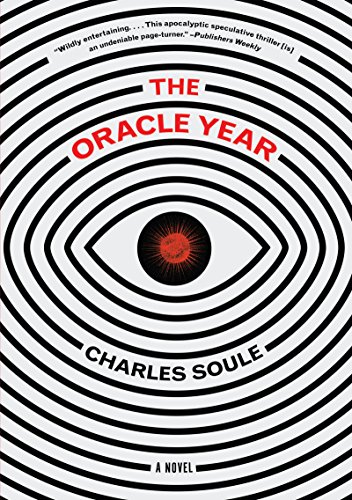
6, The Oracle Year, Charles Soule (2018), 402 pages
Soule is one of my favorite comic book authors and I bought this, his first novel, from him at New York Comic Con. The fun plot concerns an aimless 20-something who suddenly can predict the future, and his attempts to escape the evil doers who want to control him. Stephen King’s influence is obvious, from the surprisingly resourceful hero to the MacGuffin-like origin of his powers, but that doesn’t mean it wasn’t an entertaining story.
7,An Officer and a Spy, Robert Harris (2013), 429 pages
Starting with Fatherland, which I read a few years ago, I’ve mostly enjoyed the Harris books I’ve read and this may be his best. It retells the infamous Dreyfus Affair as a thriller, as Major Georges Picquart, a French officer who is first convinced Dreyfus — a Jewish artillery officer—is guilty of spying, then unearths evidence of his innocence. The story is really Piquart’s not Dreyfus’s, and his battles against France’s military establishment and his own prejudices. Harris does a masterful job of recreating France in the early 1900s, and mining the historic record for the elements to transform a well-known historical event into a compelling, and suspenseful, thriller. One of the best books I read in 2024.
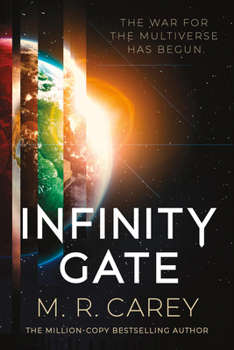
8,Infinity Gate, M. R. Carey (2023), 499 pages
I really enjoyed this science fiction novel, which I first encountered in a New York Times review. It’s a multiversal novel and so instead of taking place on multiple planets across the galaxy, it takes place on multiple Earths, most of which are part of a vast empire, the Pandominion. While the premise of the novel is intriguing, it’s real strengths are the richly realized characters who populate the novel, some of whom are from our Earth, and some from other similar and no-so similar Earths (one character comes from an Earth where humans share a common ancestor not with apes but with rabbits — she’s very good at jumping and kicking). When I bought this book, I was under the impression M.R. Carley was a woman, thereby helping me increase the number of books by female authors I am reading, a goal of mine. Alas, the M. stands for Michael, and Mike Carey is another comic book writer turned sci-fi author.
9,The Man Who Broke Capitalism, David Gelles (2023), 234 pages
This book arrived at my door last year by accident, due to some confusion on the publisher’s part about whether it was a finalist among the business books I was judging (it wasn’t). I read it because I’ve written about Welch and GE on-and-off over my career, and while there wasn’t anything in it that was particularly revelatory, it works really well as a primer on the trends in American business over the last 40 years. I would recommend it to a high school student (or I guess anyone) curious about why companies act the way they do.
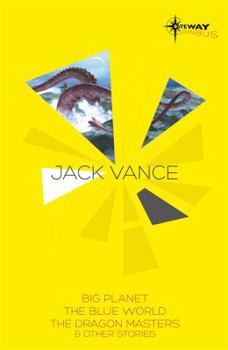
10,The Dragon Masters and Other Stories (2016), 183 pages
Jack Vance has become one of my favorite science fiction authors, as much for his incredibly imaginative stories as for his uniquely styled, almost archaic writing voice. I bought this collected volume in London years ago and after reading Big Planet and The Blue World over the last few years, finally turned to The Dragon Master and Other Stories, a collection of three novellas from the 50s and 60s which is somewhat confusingly included in this larger collection. The three stories are all fairly amazing and weird and thought provoking in their own ways. If you want to give Vance a try, TheMiracle Workers, about a feudal society that lost and rediscovers science, is a fun introductory work.
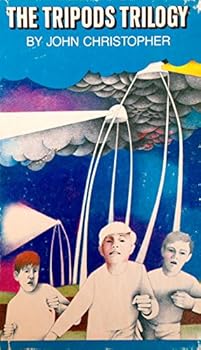
11,The Tripods Trilogy, John Christopher, (1967-68), 618 pages
I’m conflating these three books into one because they are really written for children and each are very short. Fairly obscure now, I bought these books — about a boy who finds himself part of a rebellion against aliens that have enslaved most humanity — as a middle-schooler and loved them. I have reread them a few times since, most recently as a nostalgic break as I read something much denser (see below) and as escapist science fiction, they hold up well. They are dated — there are almost no women or girls in them, for example — but Christoper’s writing is wonderfully crisp and economical, and a great lesson in how less can be more.
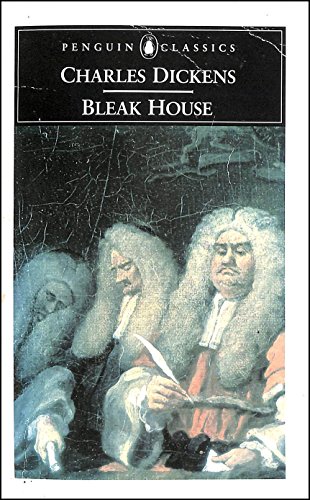
12, Bleak House, Charles Dickens (1853), 1053 pages
One of my reading goals is to tackle the so-called great books, the one’s that populate lists of the greatest novels ever written (like this one). Bleak House was a project, but a fascinating and rewarding one. While it concerns a slow-moving court case, Jarndyce vs Jarndyce, about a contested will, it contains layers and layers, with dozens of characters, multiple subplots, many humorous scenes, and maybe most interestingly, two narrators that alternate chapters (one is an omniscient third person narrator, the other is Esther Summerson, a young orphan who ends up living in Bleak House). The story zigs and zags, and is at times a detective novel, at times a romance, and at times pointed social commentary. Dickens can be both bombastic and subtle, sometimes on the same page, and at times I felt I overlooked important plot points, requiring me to flip back and forth a lot to see what I missed. By the time I finished, I felt like I had climbed a mountain; I was exhausted but very glad of the experience.
13,The Witch Hunter, Max Seeck (2020), 384 pages
Another selection from my father’s bookshelf, this was the only other real disappointment of the year. A police procedural in Finland, the setting is promising, but the plot is outlandish, the characters overwrought and the whole thing is too melodramatic. I hung on until the end to see how is tied up but it was a chore.
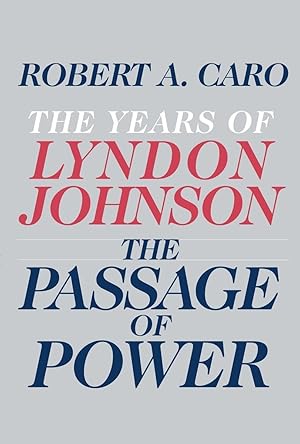
14, The Passage of Power, Robert Caro (2012), 692 pages
This was my other big project of the year: reading the most recent volume of Caro’s Lyndon Johnson biography. I’ve been reading one a year for the last four years and they are all extraordinary, for the depth of Caro’s reporting, for his elegant and propulsive writing, and for the sweep and insight with which he unfolds the events in mid-century America. This volume concerns LBJ’s vice presidency, which was grim, and his first year in office as president following Kennedy’s assassination, which was glorious. If I have a critique, it’s that Caro moves too quickly through the year of his presidency, maybe because he feels like it’s been covered sufficiently elsewhere, but compared to the stately pace with which he describes other periods in Johnson’s life, it almost felt rushed. Now I have to wait for volume five.
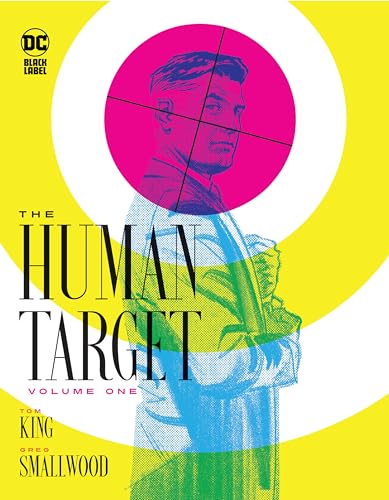
15, The Human Target, vols 1 and 2, Tom King and Greg Smallwood, (2022 and 2023)
Every year I read a lot of comic books and every year I don’t count them toward my reading totals with one exception: comics written by Tom King. King’s comics are so novelistic in their themes and stories they feel like literature, and The Human Target, which collects a 12-comic miniseries is one of his best. As with his other comics, here King takes another obscure DC character with a long history and puts him through the wringer. While his other stories like The Omega Men and Strange Adventures take place on distant planets, The Human Target is much narrower in its focus, a noir story about a down-on-his luck detective who impersonates assassination targets (hence his name). Here, he becomes entangled with the characters from Justice League Europe, a beloved comic from the 80s known for its slapstick humor. But now the characters are anything but funny, and it’s a bit of a jolt seeing some of them all grown up. While I’d recommend these to anyone who loves great storytelling, the biggest impact will land on comic readers whose memories of these once simply rendered characters are about to get upended.
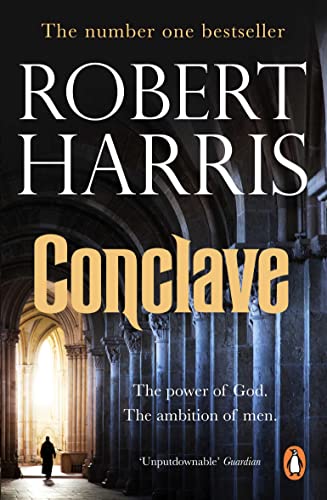
16, Conclave, Robert Harris, (2017), 391 pages
I generally don’t read multiple books by the same author in any given year (a practice I violated multiple times this year) but I liked An Officer and Spy so much that when I heard a Conclave movie was coming out, I wanted to read it in anticipation of seeing the film. But the book was a disappointment, at least compared to Officer, and in fact I felt the movie was much better. Ultimately, Conclave the film did a better job of capturing the pomp and majesty of the Vatican, and the story’s conspiracies and its big twist at the end — all of which seemed highly unlikely in the book — seemed much more plausible in a movie.
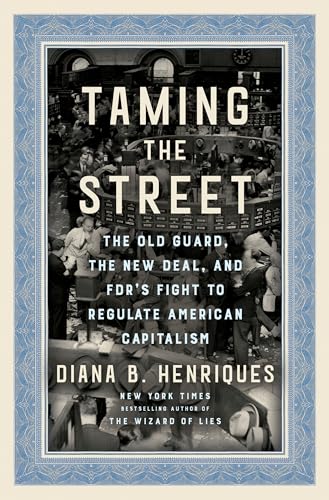
17, Taming the Street, Diana Henriques (2023), 354 pages
For the last few years I’ve served as a judge in a business book contest, and I read a handful of new business books over five weeks each fall. This was the first of this year’s batch, and the best (and the one awarded first place). Henriques, a longtime business journalist who wrote the definitive account of the Bernie Madoff scandal, describes the depredations of the stock market in the 1920s, and the birth of the Securities & Exchange Commission under Franklin Roosevelt. It’s full of colorful characters, including Joseph Kennedy, the roguish first chair of the SEC (and JFK’s father), and Richard Whitney, president of the New York Stock Exchange, whose downfall is stranger than fiction. It’s a fun read, the reporting is impressive and its lessons, about the importance of smart regulation to safeguard the financial system and grow the economy, are impossible to ignore.
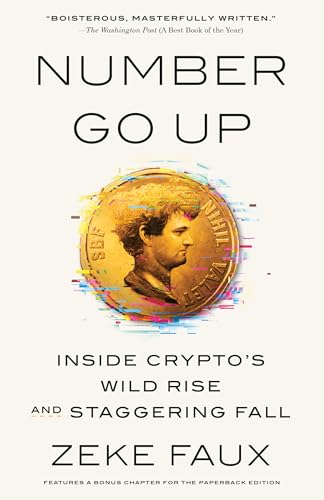
18, Number Go Up, Zeke Faux (2023), 261 pages
Another contest book, this one by a former colleague. There’s no denying the subject — cryptocurrency and the many grifters who have tried to make money from it — is incredibly compelling, and Faux is a great storyteller. Much of the book is told in the first person, as Faux tries to unwind the company behind Tether, a particularly notorious cryptocurrency, and he gets incredible access to crypto bros who seem to tell him everything. But the first person narrative is also a weakness, since the book follows his reporting without always giving us the bigger picture.
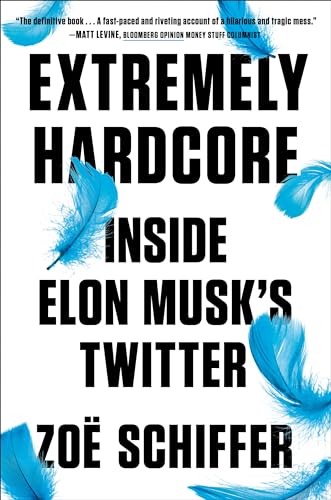
The last of the contest books, and the least successful. It’s basically a chronicle of Elon Musk’s first year running Twitter, and the employees who both benefitted and (mostly) suffered as a result. It’s extremely detailed and well reported, but the employees we meet don’t feel fully developed, and the book is very narrow in its scope. I would have loved a bigger picture via of Musk’s world and where Twitter falls in it. Especially now, as Musk as taken even more importance in the world, the book’s limited focus feels like a real detriment.
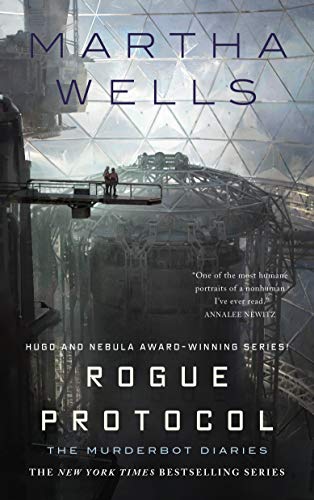
This is the third Murderbot novella I’ve read and the least successful. The premise is a lot of fun: basically a security robot, highly specialized in killing things, breaks free of its programming and develops a conscience. Unfortunately, this books is a direct sequel to the previous one which I read last year, and since I forgot most of the details, I was mildly confused by the robot’s motivations and the role of the sinister corporation that seemed to be pulling strings. Also, a lot of this story takes place on a satellite, and its specific layout and design is both very important to the narrative and frustratingly hard to picture.
21, 1177 B.C.: The Year Civilization Collapsed, Eric Cline, (2015) 190 pages
I encountered this book after seeing a bookstore copy of its sequel (After 1177 B.C.), and deciding that it looked interesting enough that I should read this first. In fact, this was very interesting, although not exactly what I expected. The book tells the story of the incredibly vibrant eastern Mediterranean kingdoms of the late Bronze Age and their unraveling. Eric Cline, an academic historian, promises an all-audiences book, but it’s not written as a narrative. Instead, he methodically, and at times ponderously, walks us through the upheaval of civilizations from Egypt to Mycenae to the Hittites, and examines all the evidence that points to their destruction. The book is full of references to historians and archeologists, and its end notes and bibliography run nearly 100 pages. Along the way Cline dispels the idea that an invasion of the mysterious “Sea Peoples” brought about ruin, and in fact he dismisses the idea that 1177 B.C. was the pivotal year (despite the book’s title). Instead, he argues it was a combination of factors, mostly climate related, that led to famine, wars, and the interruption of trade that caused a multi-decade long decline into the Iron Age. His main, prophetic takeaway is that no civilization lasts forever, their ends are multi-faceted and complicated, and no one realizes it’s happening at the time.
22,Echo of Worlds, M.R. Carey (2024), 502 pages
I liked Infinity Gate so much that I pre-ordered the sequel and, again breaking my vague rule about reading the same author twice in one year, devoured this one too. In some ways this story is a more conventional adventure; the cast of characters, assembled at the end of the last book, now embarks on a series of missions to save the multiverse. There are some amazing action set-pieces, and the story has an exciting urgency to it. The resolution of the events at the end felt slightly anticlimactic, but the biggest disappointment was finishing it and realizing there may not be another book in the series.
23, A Wizard of Earthsea, Ursula K. Le Guin (1980), 182 pages
Yet another violation of my rule (see above). I grabbed this in part because I remain Le Guin-curious, in part because I was curious if it held up from when I last read it, close to 40 years ago, and in part because I was stuck without anything to read. It’s really a wonderfully written book, a classic fantasy bildungsroman, about Sparrowhawk, a shepherd boy with a talent of magic who enrolls in an academy for wizards. The magic in this book isn’t the frivolous stuff in Harry Potter but deeply serious, and his mischief leads to horrible consequences he barely survives. In truth, it’s themes were probably way over my head when I read it as a young teen, and the Le Guin’s writing is lyrical and evocative. A terrific book.
24, The General in his Labyrinth, Gabriel Garcia Marquez (1991), 270 pages
I bought this book, about the last years of Simon Bolivar, after a family trip to Colombia five years ago, and brought it with me on a vacation to El Salvador. It was a good choice, as El Salvador retains a lot of the decaying colonial vestiges described by Marquez, and it wasn’t hard to picture the Colombian towns and villages Bolivar rode though 200 years ago. I last read Marquez 30 years ago, and I had forgotten his brilliant wordplay and hallucinogenic imagery. This book is perhaps more realism than magic, given its biographical nature, and there are lots of names and locations to keep track of, but the prose is wonderfully lush and hypnotic and the book is captivating.
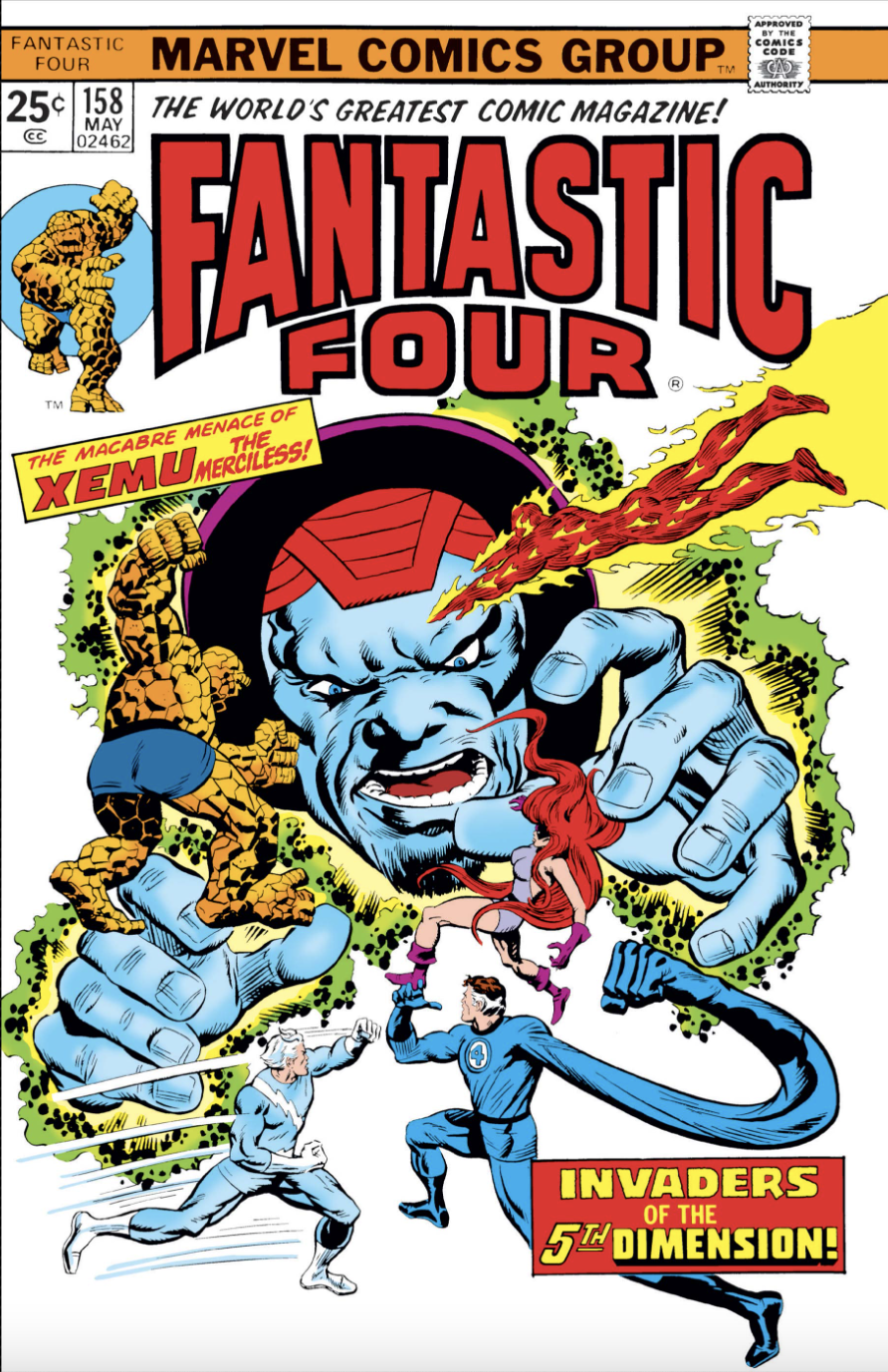
Fantastic Four 158 “Invasion From the 5th (count it, 5th!) Dimension!” Published Feb. 1975 Writer: Roy Thomas Pencils: Rich Buckler Inks: Joe Sinnott Letters: Joe Rosen Colors: Janice Cohen Editor: Thomas Cover: Buckler and Al Milgrom
Synopsis
Quicksilver is teleported from Atillan, home of the Inhumans, to New York to summon Medusa home. After a brief scuffle with the Human Torch, he explains Atillan has been invaded by Xemu, a tyrant from the Fifth Dimension, and plans to use Black Bolt’s voice to power his Thunder Horn, thereby conquering Earth (Medusa is required to coerce Black But to use his powers thusly). The issue ends with the Fantastic Four vowing to end this menace and taking off in their ICBM for Atillan.
What’s going here
There’s a lot to like in this issue, one of the best in many years. It also has an interesting origin, which may or may not explain why it’s better than other recent issues: According to an answer to a letter in this issue, this story was originally created for Giant-Size Fantastic Four 5, but penciler Rich Buckler ran afoul of “personal problems” and was unable to complete the story slated for FF 158. As a result, they chopped this story in two, with the second half to run in FF 159 while Giant-Size FF 5 became a fill-in issue. Whew!
Fantastic Four FF 158 reads like Roy Thomas at the peak of his powers. The story has lots of fun touches and bits of characterization, there’s an obligatory call back to an obscure comic, and he gets to show off his erudition as Ben and Alicia discuss Puccini’s Madama Butterfly. More importantly, while the plot structure is a pretty familiar one to FF readers, it’s suspenseful, well-paced and moves along briskly.
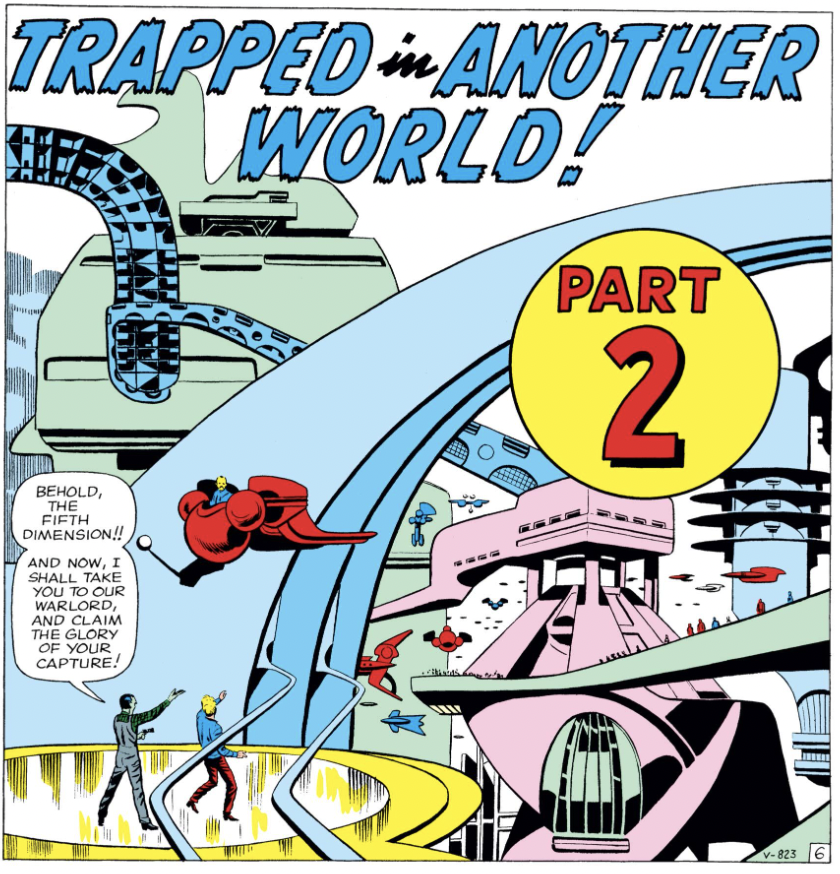
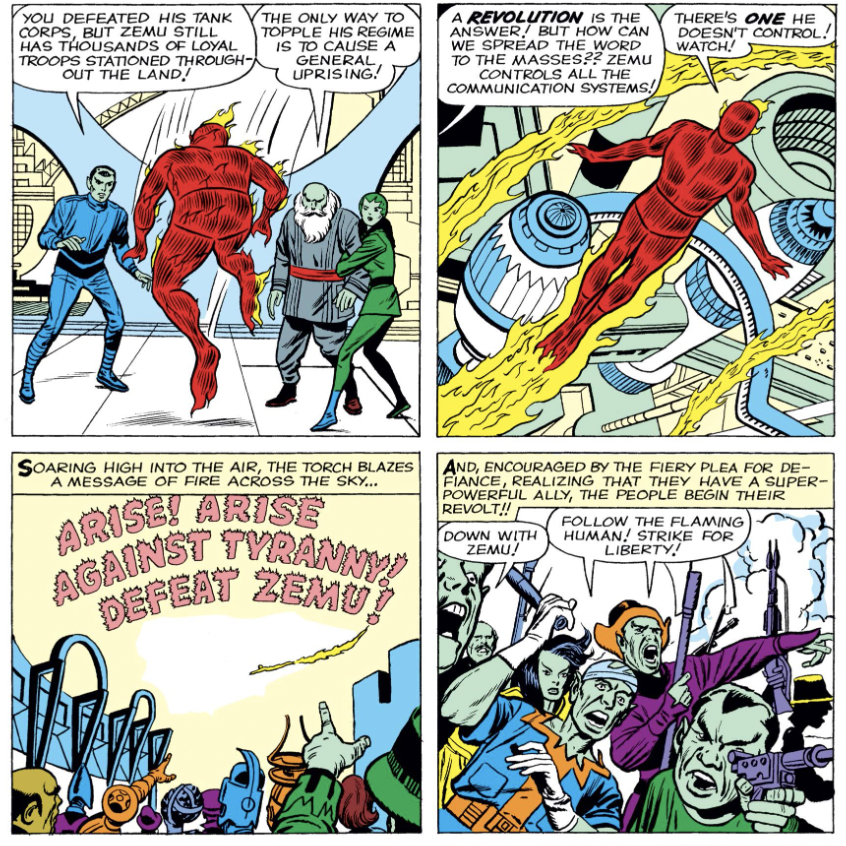
As Thomas notes in an editor’s note, Xemu and his Fifth Dimension first appeared in Strange Tales 103 from 1962 (although he was called Zemu back then), and you couldn’t not imagine a more Silver-age-ish comic than this. It has wonderful pencils from Jack Kirby, and is inked by Dick Ayers
Teenage Johnny investigates houses sinking into the muck on Long Island, discovers it’s an alien plot, is abducted to the Fifth Dimension, is taken prisoner, escapes with the help of sympathetic locals, starts a war, leads an uprising that liberate the planet, and returns home — all in 14 pages!
It’s clear Thomas has a lot of affection for this era of storytelling and he returns to it over and over throughout his career.
What I liked
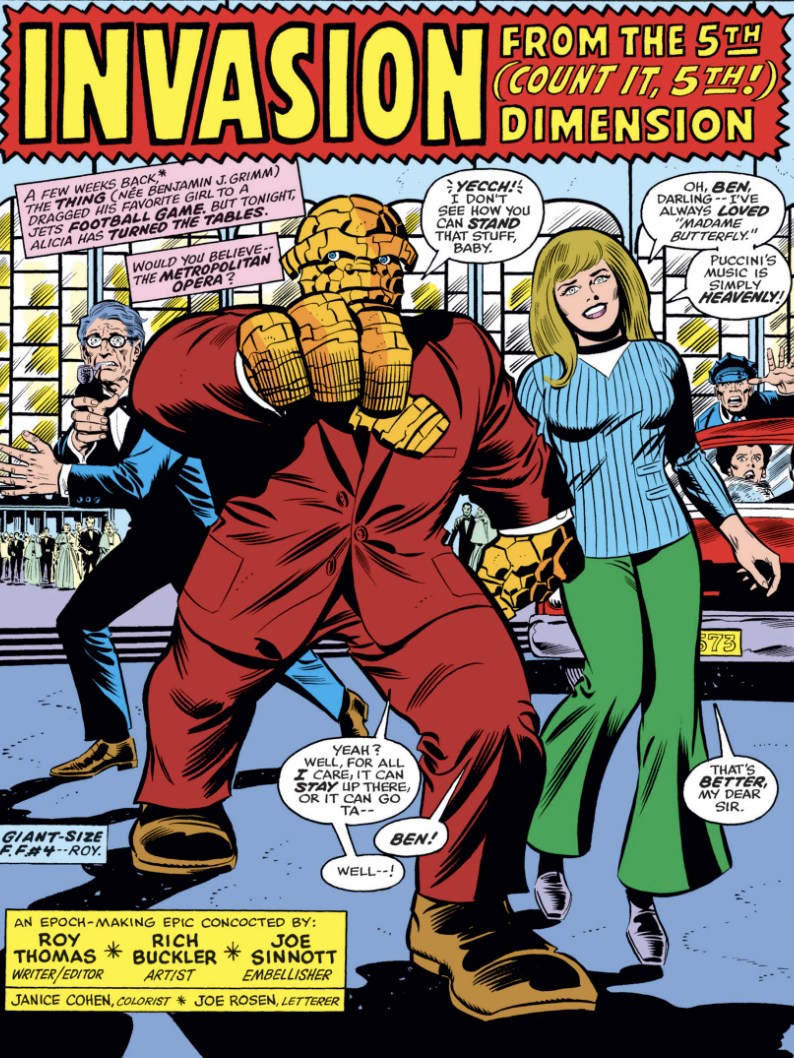
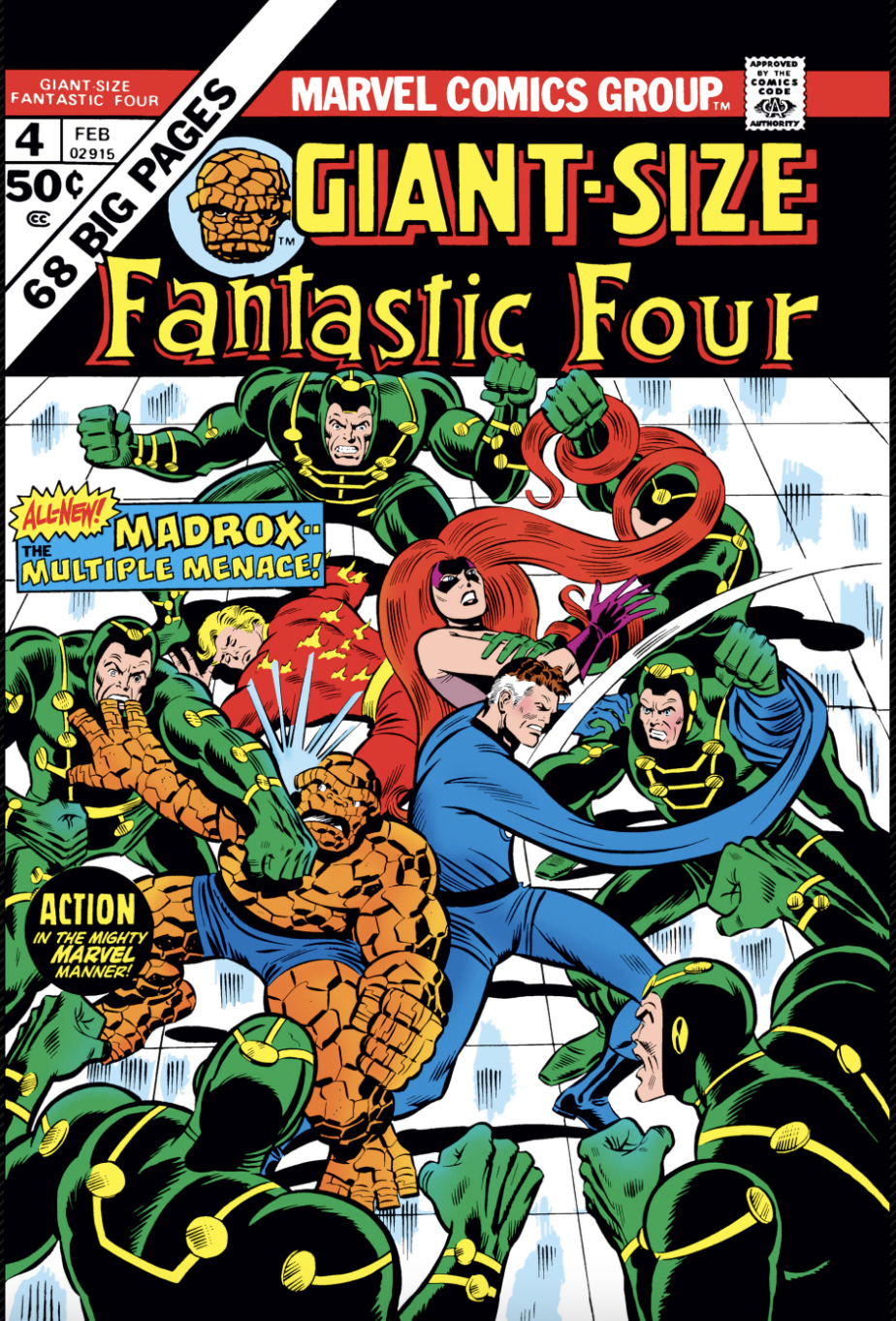
The opening sequence, when Ben and Alicia are leaving the opera, was well handled, with the right amount of humor and genuine affection between the two. I liked how the splash page was a riff on the splash page from Giant-Size FF 4 (and recall how this story was originally supposed to be in GSFF 5), with Alicia turning the tables on ben and taking him to the opera. I also liked how Thomas poked fun at the silliness of the Fifth Dimension conceit in the title.
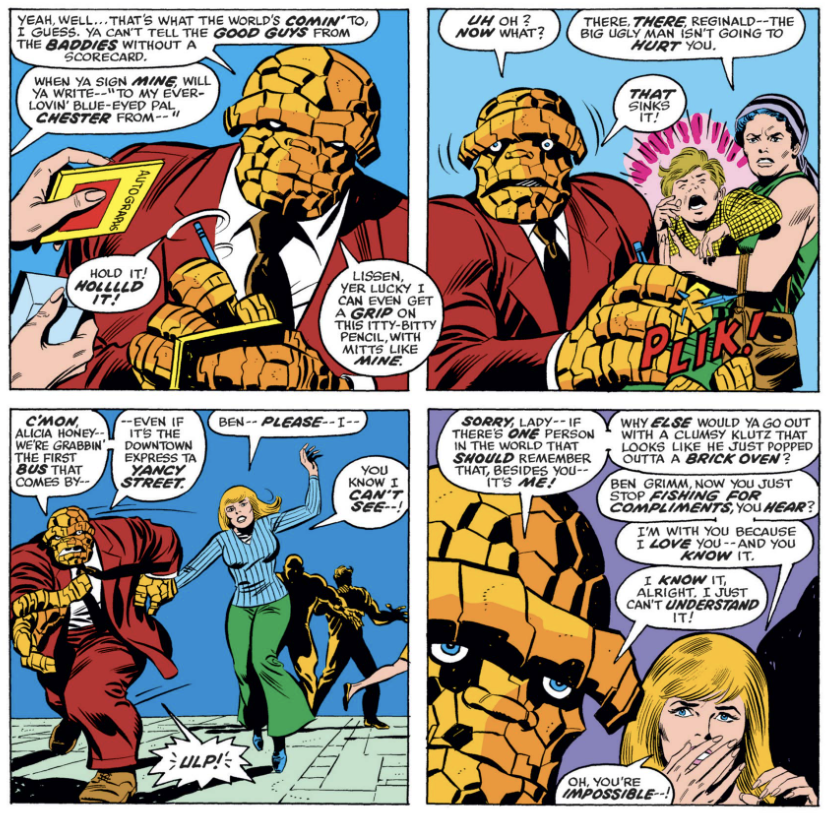
The fun banter between Ben and Alicia continues, and when Ben falls into his familiar woe-is-me routine, Alicia harmlessly bats it aside, recognizing it’s Ben’s schtick.
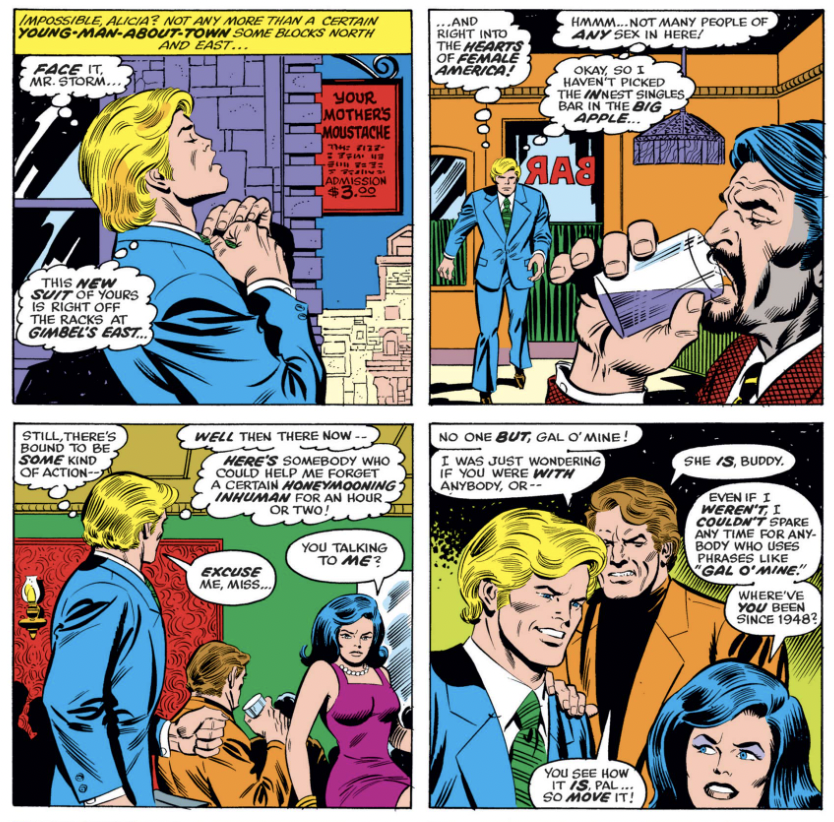
Thomas checks in on the rest of the FF as well. Johnny heads to a single bar, looking to, well, get laid. I love how the woman mocks his lingo, another subtle dig by Thomas at how dated Johnny’s slang was when written by Stan Lee.
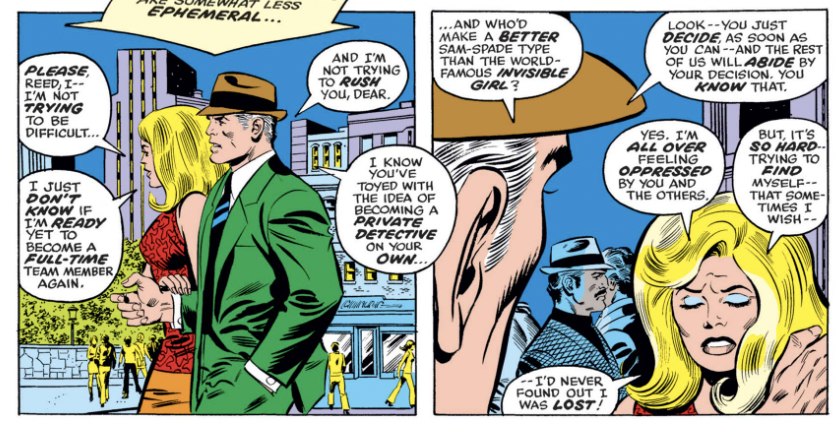
Then we have a brief interlude with Reed and Sue — Sue’s first appearance in many issues. This is the first I’ve heard of Sue becoming a private detective, and I don’t know if anything became of it but it’s a great idea for a comic (she was later retconned as a super-spy who does missions for Nick Fury in the 2019 Invisible Woman mini-series, which is sort of a similar idea).
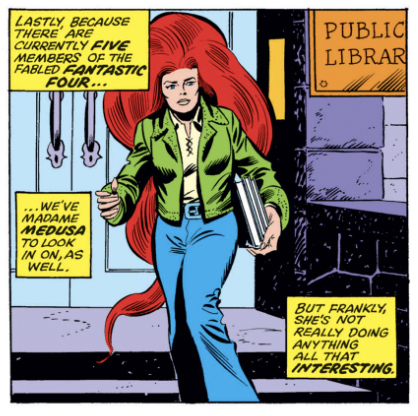
Lastly, we get a panel of Medusa, which seems to tell us what Thomas thinks of her as as story-telling material and which I suspect is a prelude to her leaving the FF.
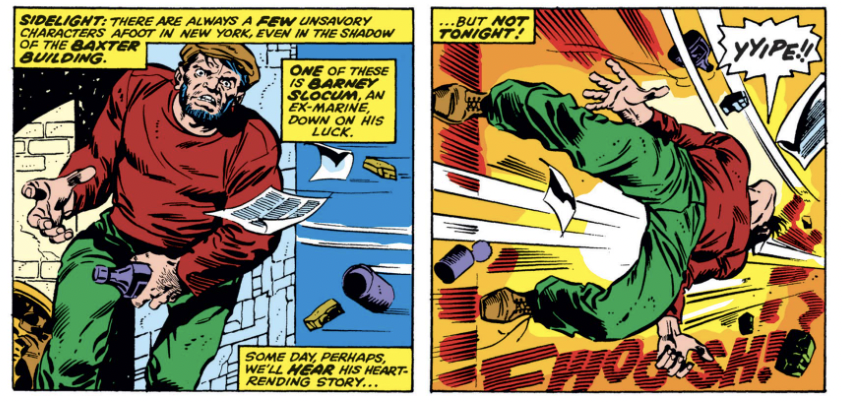
And, randomly, Thomas introduces Barney Slocum, who lasts all of two panels. (I would not be surprised if Thomas resurrected him decades in the future as a new villain).
What I didn’t like
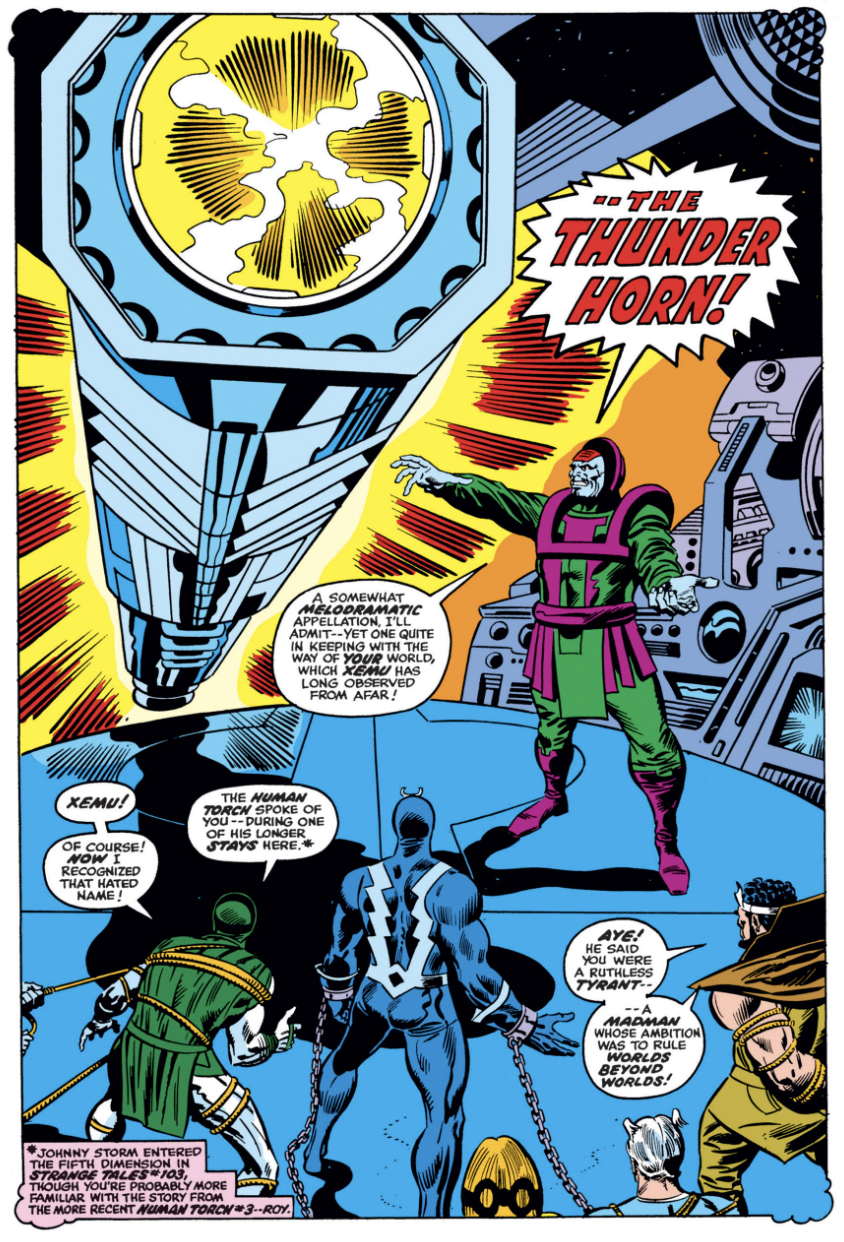
While Thomas seems to be having fun digging up Xemu, he’s a pretty tired concept, and he feels like a cross between Ming the Merciless and Xemnu, the Hulk villain. And his Thunder Horn seems lot like the Climate Cannon the evil Ternak planned to use to subjugate humanity in FF 145. (At least Xemu acknowledges it’s a silly name)
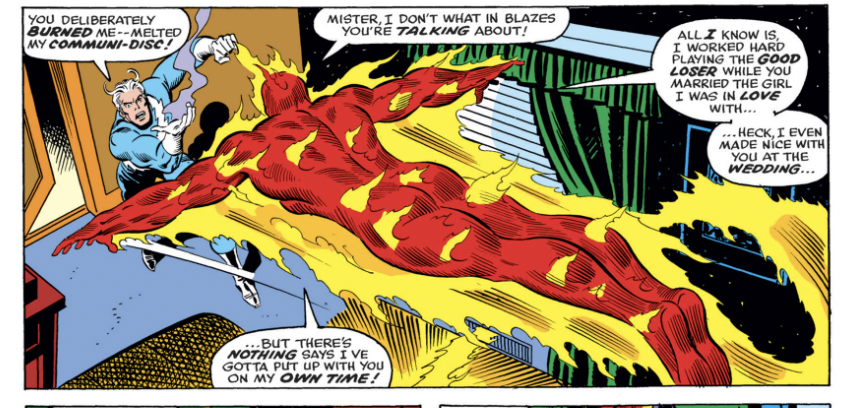
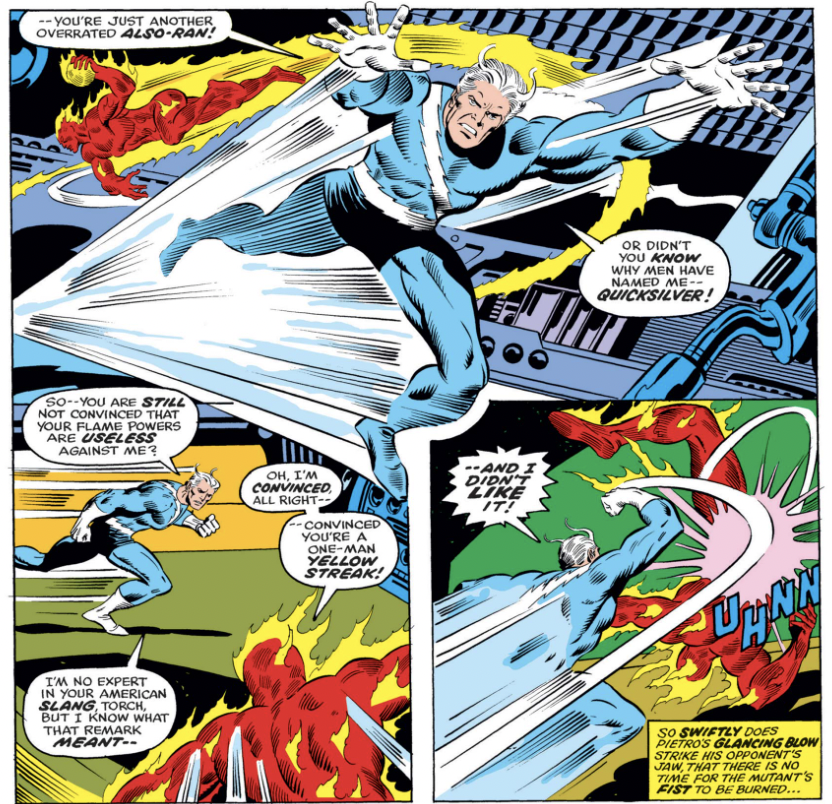
The fight between Johnny and Quicksilver felt pro forma and obligatory, but it was less forced since these two have real beef and it was over fast.
And just as Sue finally reappears, she is shunted aside one again:
Anything else?
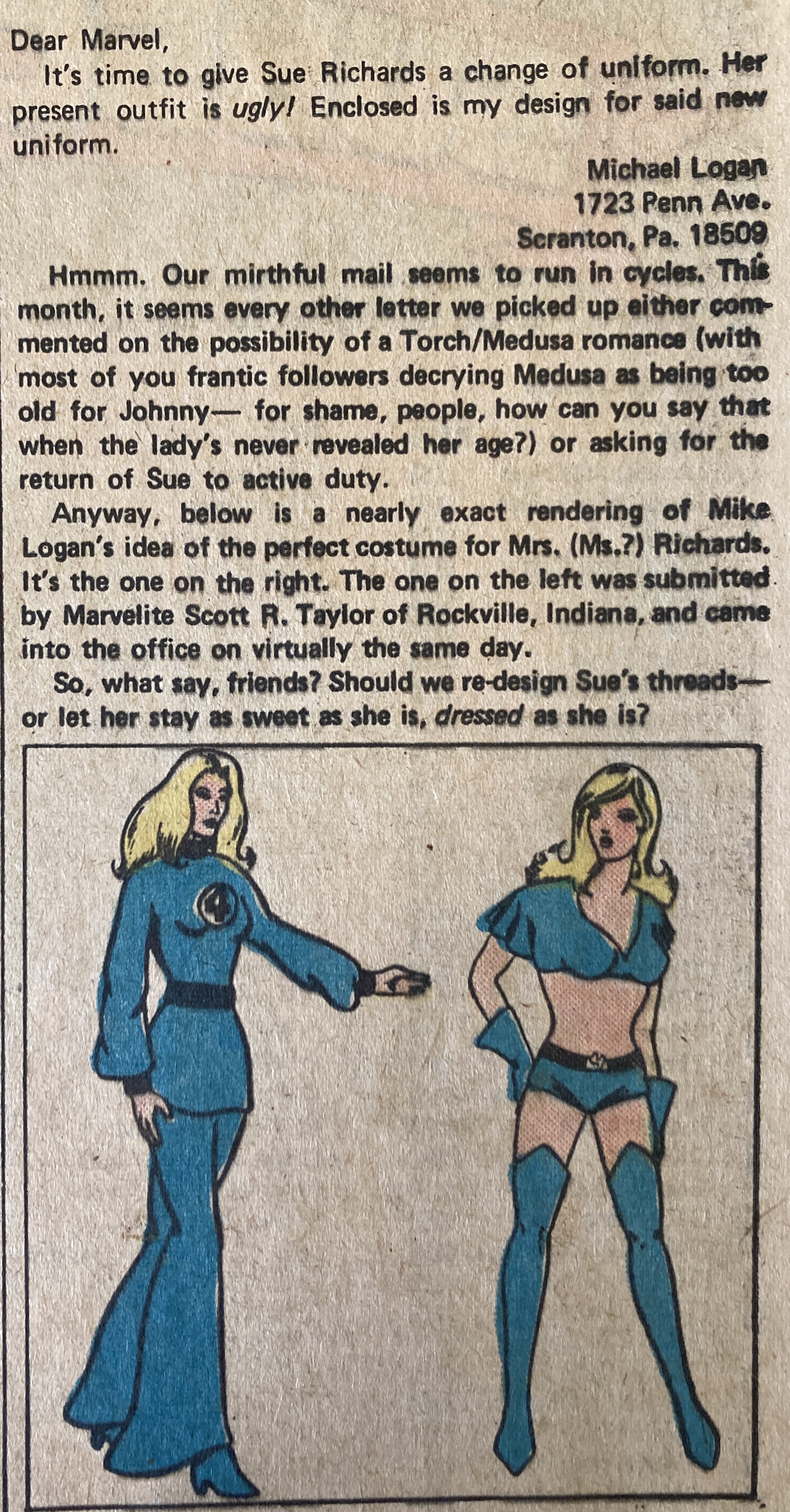
Some letter writers suggested some new outfits for Sue:
Giant-Size Fantastic Four 4 “Madrox, the Multiple Man!” Published November 1974 Writers: Len Wein and Chris Claremont Pencils: John Buscema Inkers: Chic Stone and Joe Sinnott Letters: John Costanza Colors: Glynis Wein Editor: Len Wein Cover: Rich Buckler and Joe Sinnott
Editor’s note: This comic was published prior to Fantastic Four 156 and 157 but I wanted to conclude the Doom/ Surfer story arc before tackling this issue
Synopsis
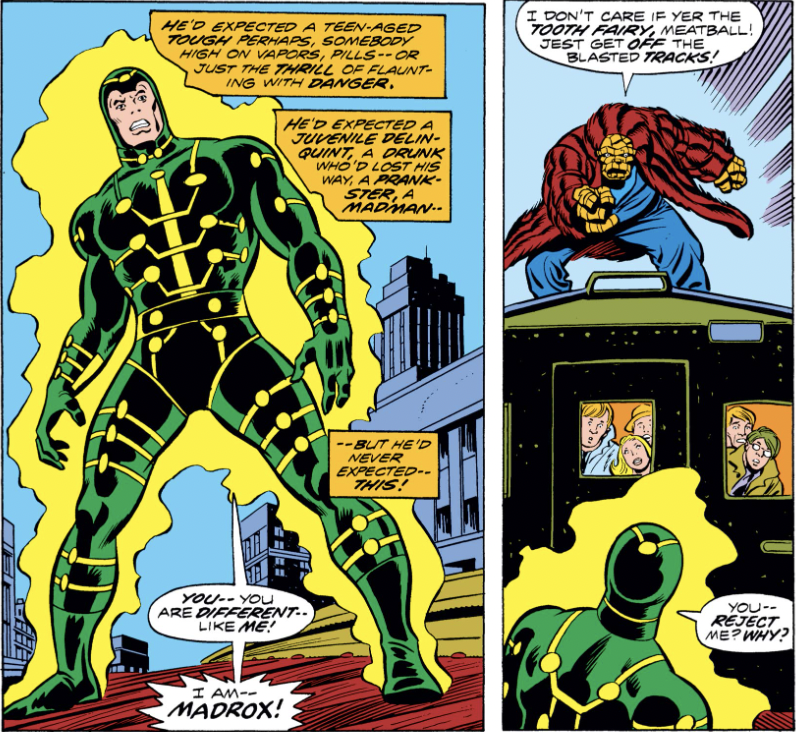
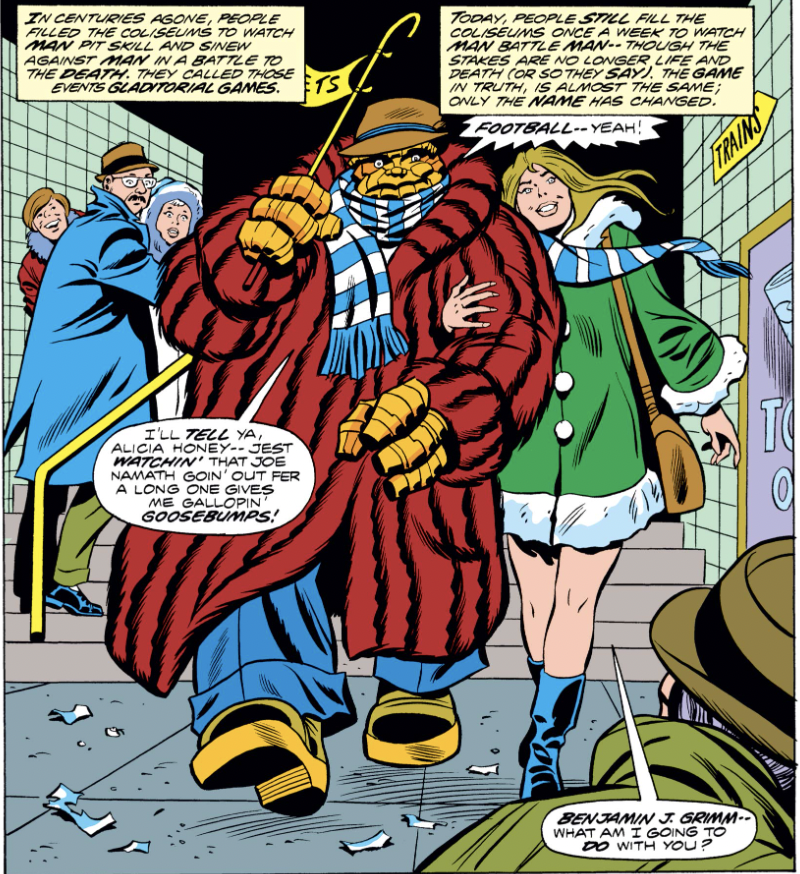
On his way to a Jets game with Alicia Masters, the Thing encounters and is defeated by Madrox, who has the power to create duplicates of himself. Ben is revived in the Baxter Building by Mr. Fantastic who says blackouts across the city are being caused by Madrox, who absorbs electricity. The team battles him, and is facing defeat when Professor X arrives, explains he knew Madrox as a child, and helps subdue him.
What’s going on here?
As discussed in previous posts, in 1974 Marvel began to publish giant-size editions of some its most popular titles. These usually included an original story and a reprint, and sort of operated as annuals, although they appeared quarterly. In this issue, the reprint is (appropriately enough) FF 28, guest starring the X-Men.
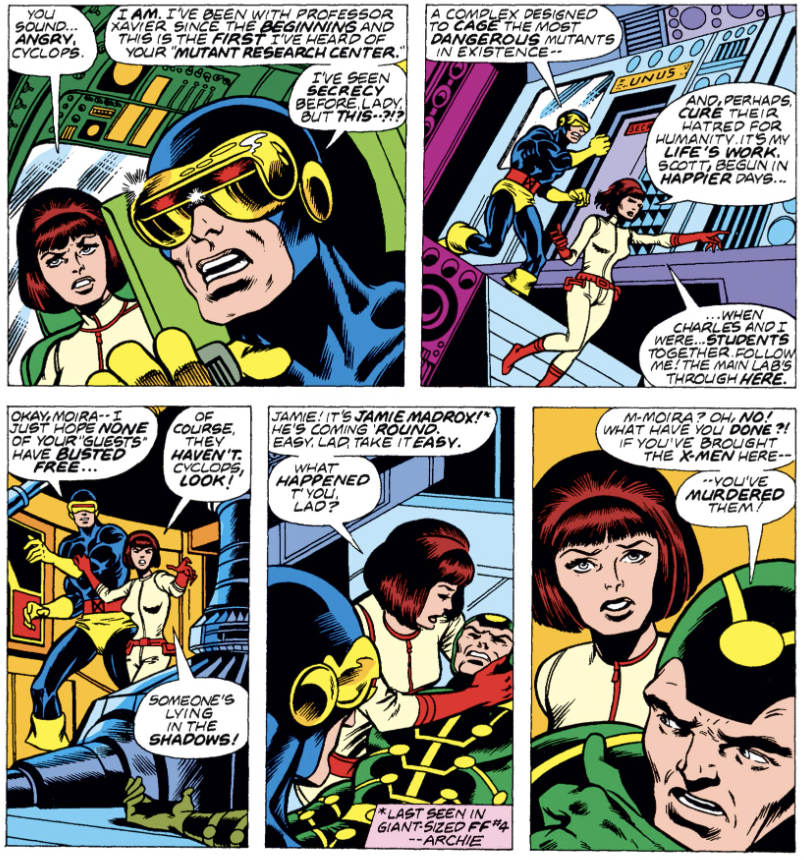
Giant-Size Fantastic Four 4 is notable for a few reasons. It marks the debut of the mutant Jamie Madrox the Multiple Man, who would go on to have a long career in X-Factor and other X books, and perhaps most significantly, it’s the first Fantastic Four issue written by Chris Claremont. In 1974, Claremont was brand new to Marvel, and this is listed as just his ninth Marvel writing credit. While he’s best known for his 15-year run on the X-Men and it’s many spinoffs, Claremont had a long run as the FF’s regular writer from 1998 to 2000. He also wrote the first Fantastic Four vs. X-Men mini-series in 1986 and frequently used FF members in his other comics.
What I liked
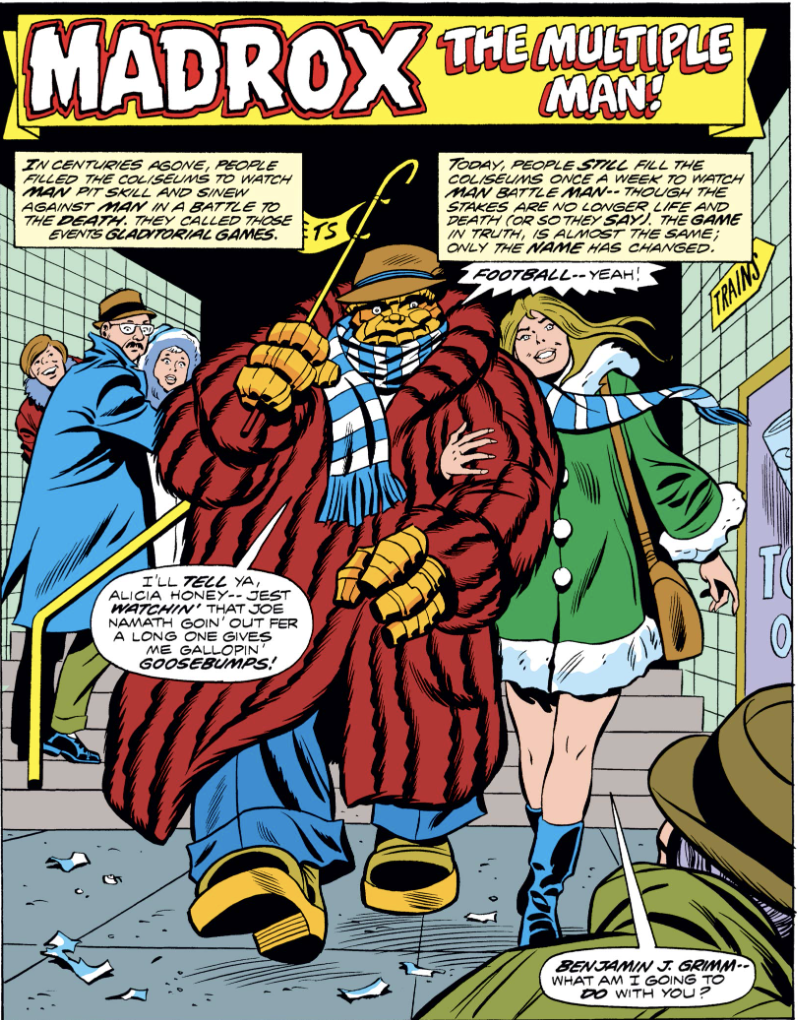
In many ways this is a pretty standard FF comic. The FF randomly encounter some menace, they tangle a few times, and it’s all wrapped up on the last page. That said, it’s a fun read, and the Wein / Claremont team does a good job with the opening sequence where Ben first confronts Madrox. Ben’s enthusiasm for the Jets game runs through the comic and is a nice touch. I loved his ridiculous outfit, as if he’s dressed for the Harvard-Yale game in 1922.
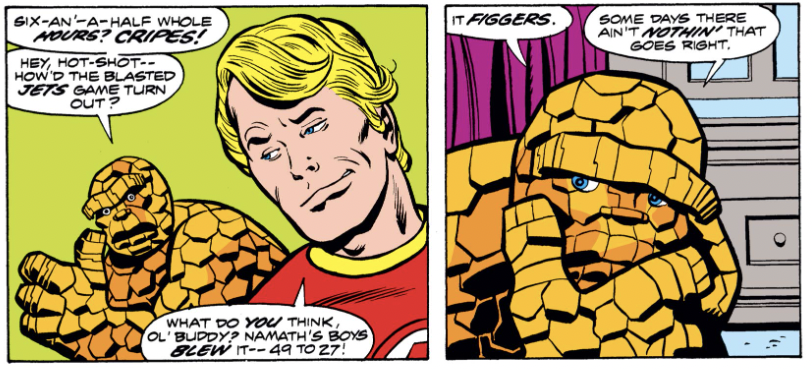
Later, he’s bummed that he missed the game (I checked and there’s no actual Jets game from that year that ended with that score).
What I didn’t like
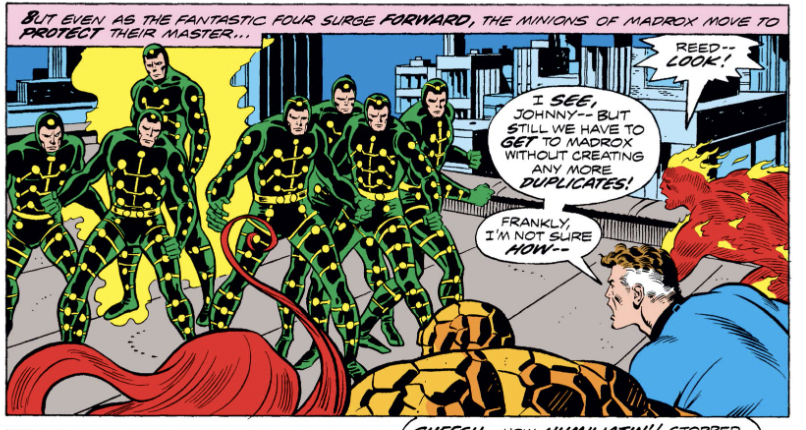
Madrox is an enigma throughout the comic. His stilted speech in his first appearance suggests he’s some sort of alien, but it’s later revealed he grew up in Kansas watching TV. He seems incredibly powerful —single-handedly defeating the Thing — but it’s not clear what is powers actually are, other than multiplying himself. It’s also not really explained why he is draining the city of power – it has something to do with his suit, but what?
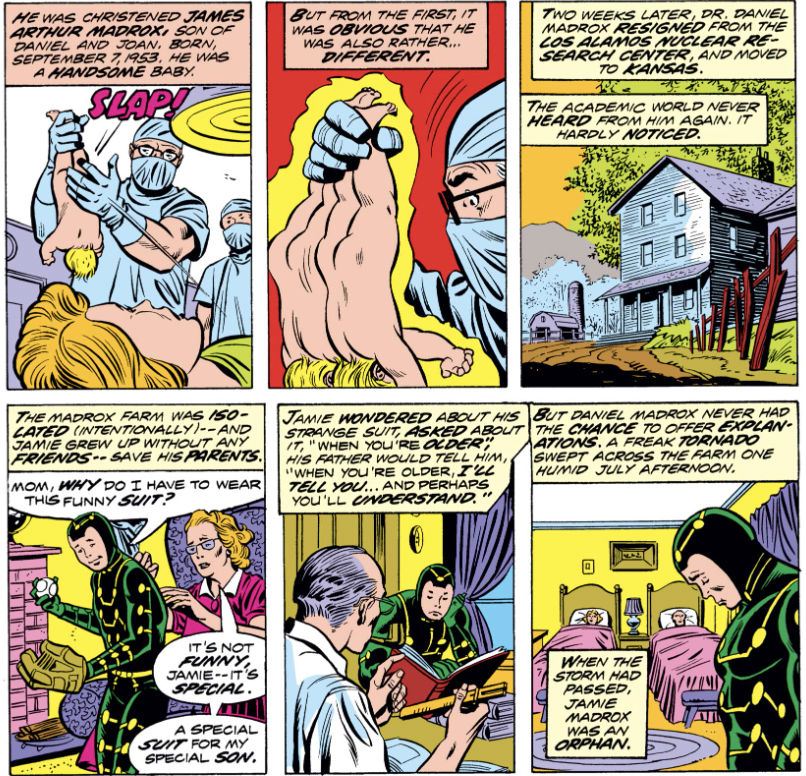
The appearance of Professor X reveals that Madrox is a mutant, although a flashback explains he developed his power as an infant, not at puberty as other mutants do (it’s later retconned to explain that he’s a “changeling,” a genetic predecessor of mutants).
There’s a certain deus ex machina quality to Prof X’s sudden appearance, although he seems strangely under-powered here. He does make good on his promise to look after Madrox, who next appears on Muir Island, without much explanation, in Claremont’s Uncanny X-Men 104 (art by the great Dave Cockrum with inks by Sam Grainger).
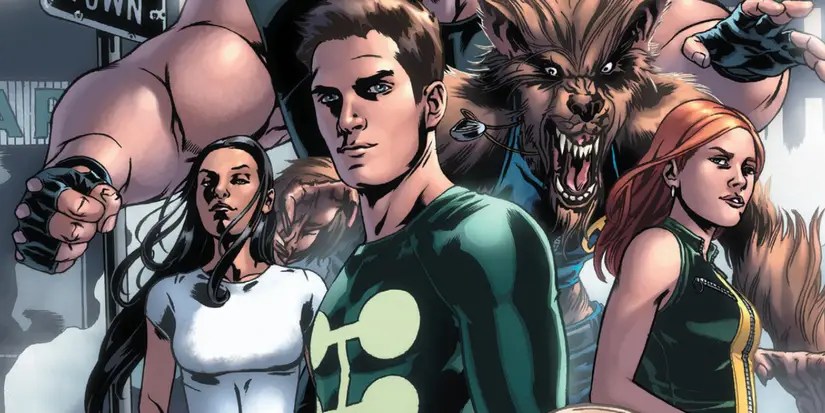
Years later he would become a significant player in X-Factor, and his “dupes” would become characters in their own right (I confess I’m not familiar with this era of the X-universe, so can’t really comment on how he was handled).
And at this point it perhaps goes without saying, but the Invisible Woman doesn’t appear in the comic, and Medusa is again a total non-factor.
Overall
A comic more interesting for its historical significance than its story.
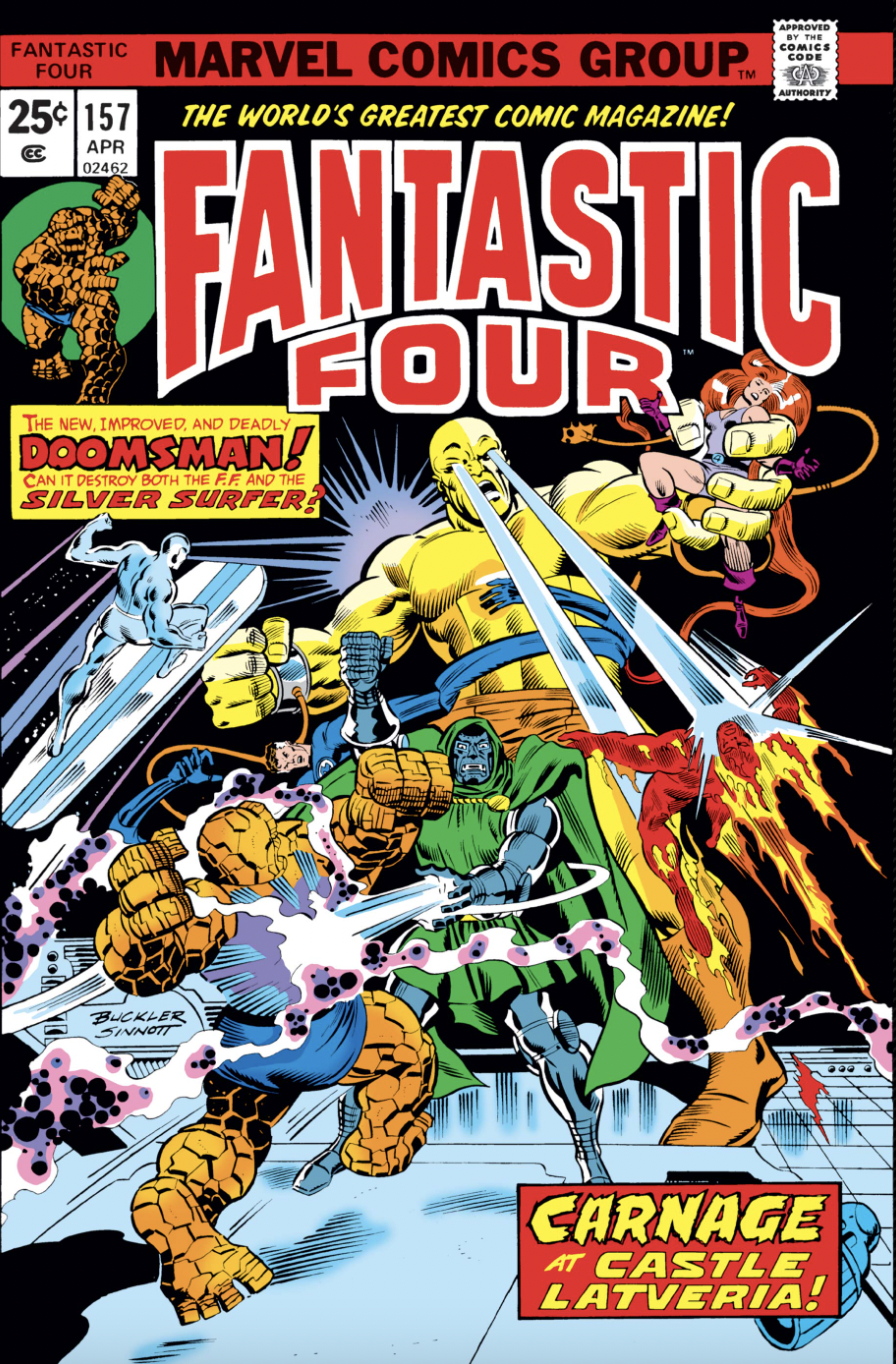
Fantastic Four 157 “The Endgame Cometh!” Published January 1975 Writers: Roy Thomas and Len Wein Pencils: Rich Buckler Inks: Joe Sinnott Letters: Joe Rosen Colors: Petra Goldberg Editor: Thomas Cover: Bucker and Sinnott
Synopsis
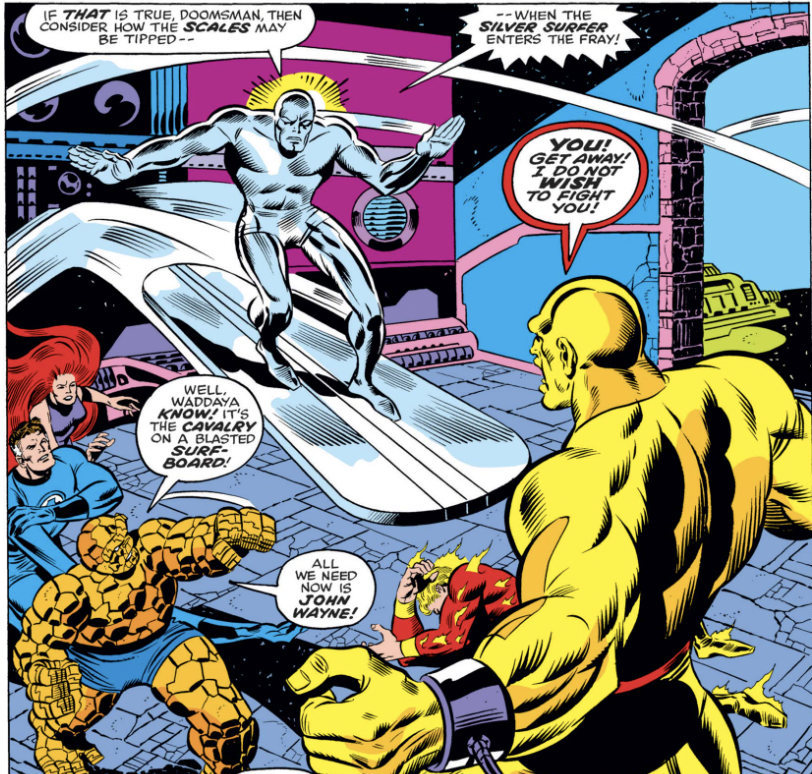
Trapped in Dr. Doom’s castle, the Fantastic Four battle Doomsman II, an android imbued with the Silver Surfer’s power. Meanwhile, the Silver Surfer’s lost lover is revealed to be a Latverian peasant girl, Helena, brainwashed by Doom into believing she is Shalla-Bal. The Surfer then joins the FF to defeat Doomsman, and they are about to go to battle with Doom himself when Helena begs them to spare Doom’s castle from destruction. The issue ends with the demon Mephisto, the Surfer’s nemesis, revealing that Helena was Shalla-Bal all long, put on earth to torment the Surfer.
What’s going on here?
This is Roy Thomas’s first full issue in his return gig as the Fantastic Four’s writer, and as if to announce he’s back, he’s crafted a classically complicated Thomasian story, full of odd tangents, obscure references and callbacks to plot points from earlier comics.
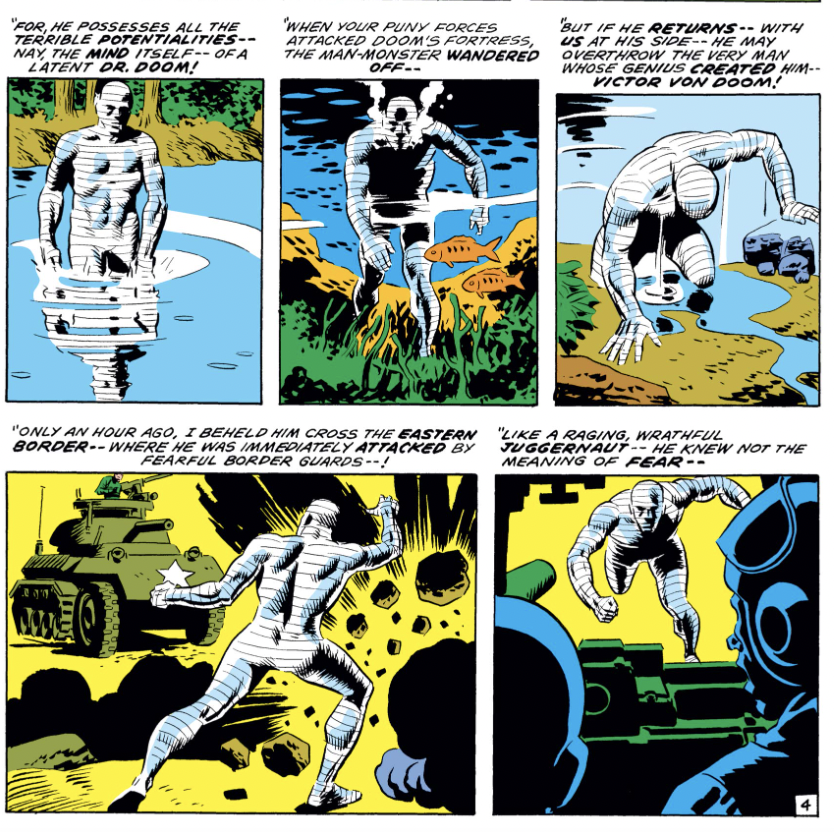
A big chunk of this comic’s backstory was told in Astonishing Tales 1-3, a complicated story by Thomas from 1970 that explains how Doom created the first Doomsman using cosmic rays and his own brain waves and lost control of it (the art is by the legendary Wally Wood).
The story also references Giant-Size Super Villain Team-Up 1, a comic on sale at the same as FF 157 (also by Thomas), that among other things explains how Doom survived his seeming death in FF 144 (he crashed to the ocean and was rescued by the Sub-Mariner).
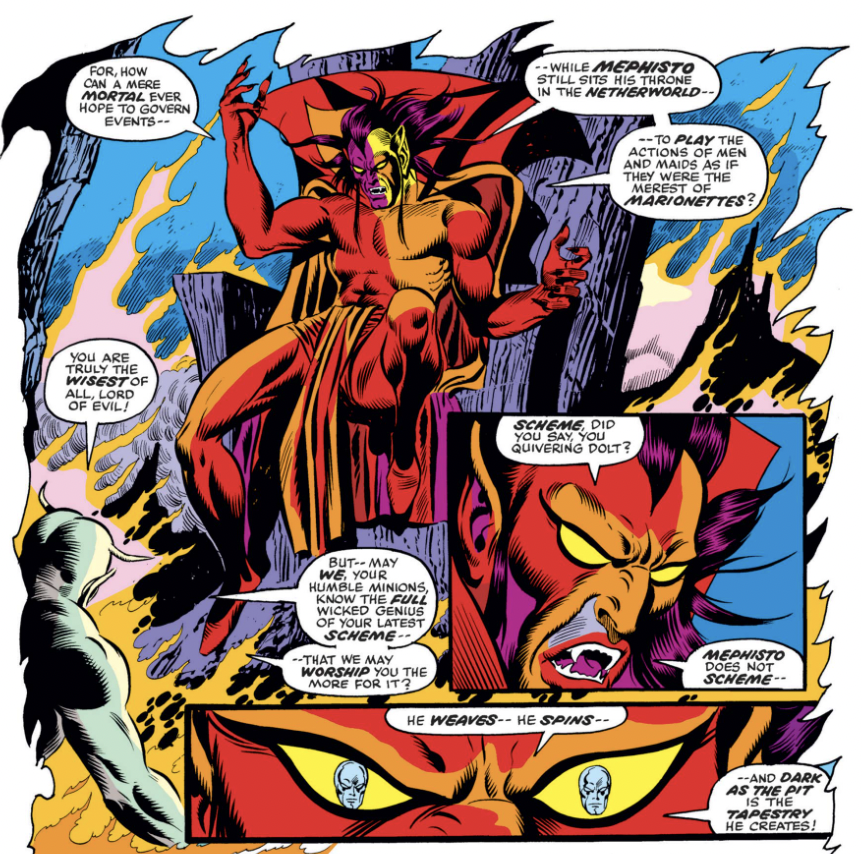
The last scene in FF 157, featuring Mephisto chewing the scenery, is basically pulled from the Silver Surfer’s own comic and I don’t recall him ever appearing in the FF prior to this comic.
There’s not a lot of explanation in FF 157 about any of these plot points, and the assumption is readers would have read these other comics. If all you read was the Fantastic Four, you’d be baffled by these goings on. It’s also reminder of how tightly woven Marvel stories were back then and how much emphasis Thomas placed on continuity. (It also makes me glad I have a subscription to Marvel Unlimited).
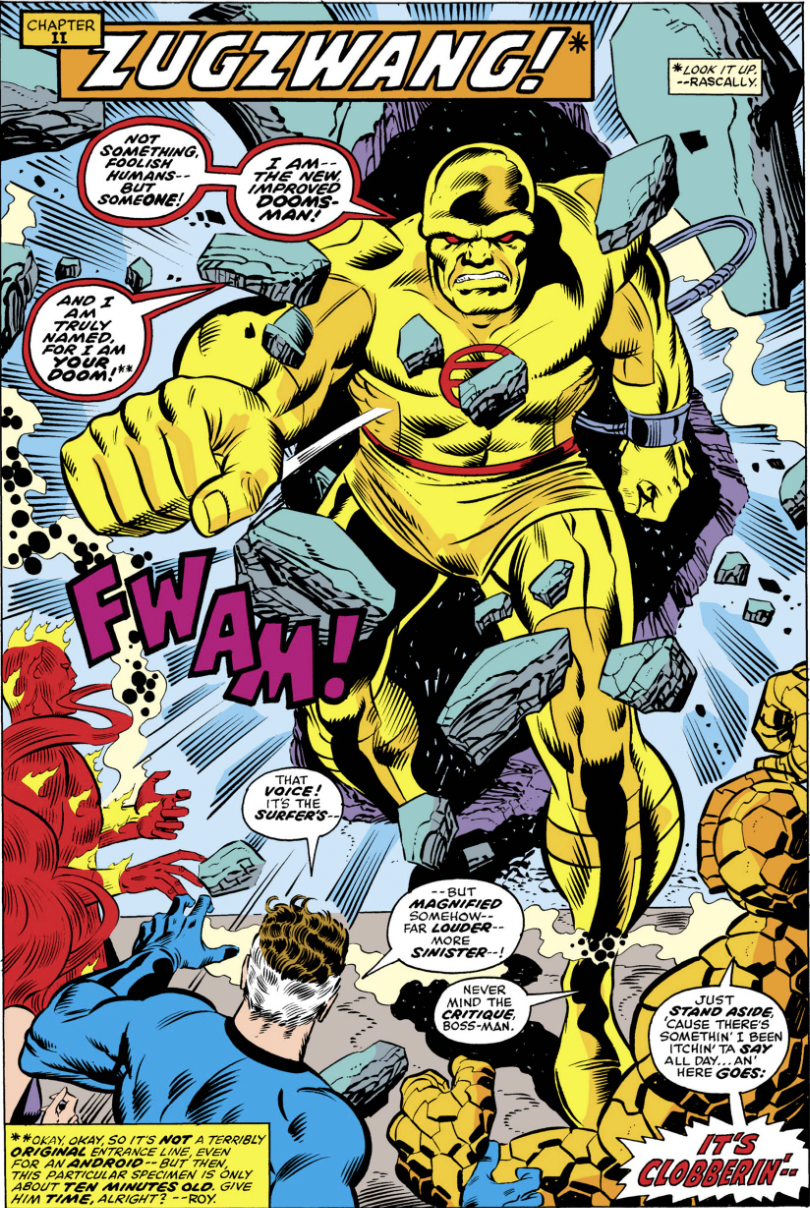
Lastly, another example of Thomas’s zany storytelling: titling a chapter of the comic “Zugzwang!” with no explanation. (It’s a German term used in chess, a play on the chess metaphor in the comic’s title). And self-referential footnotes mocking his own writing.
What I liked
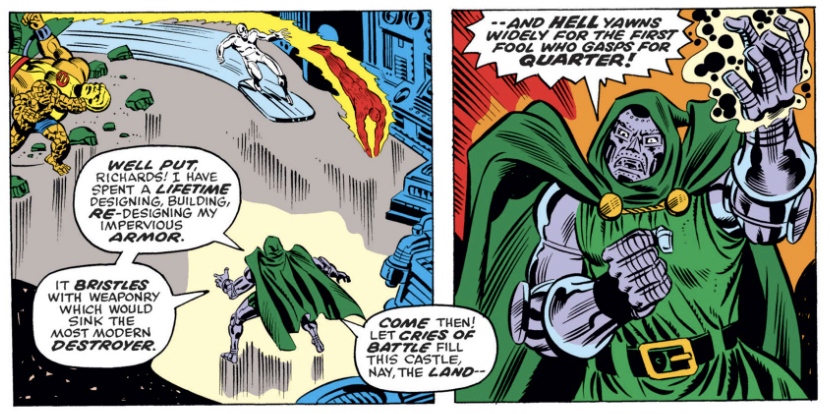
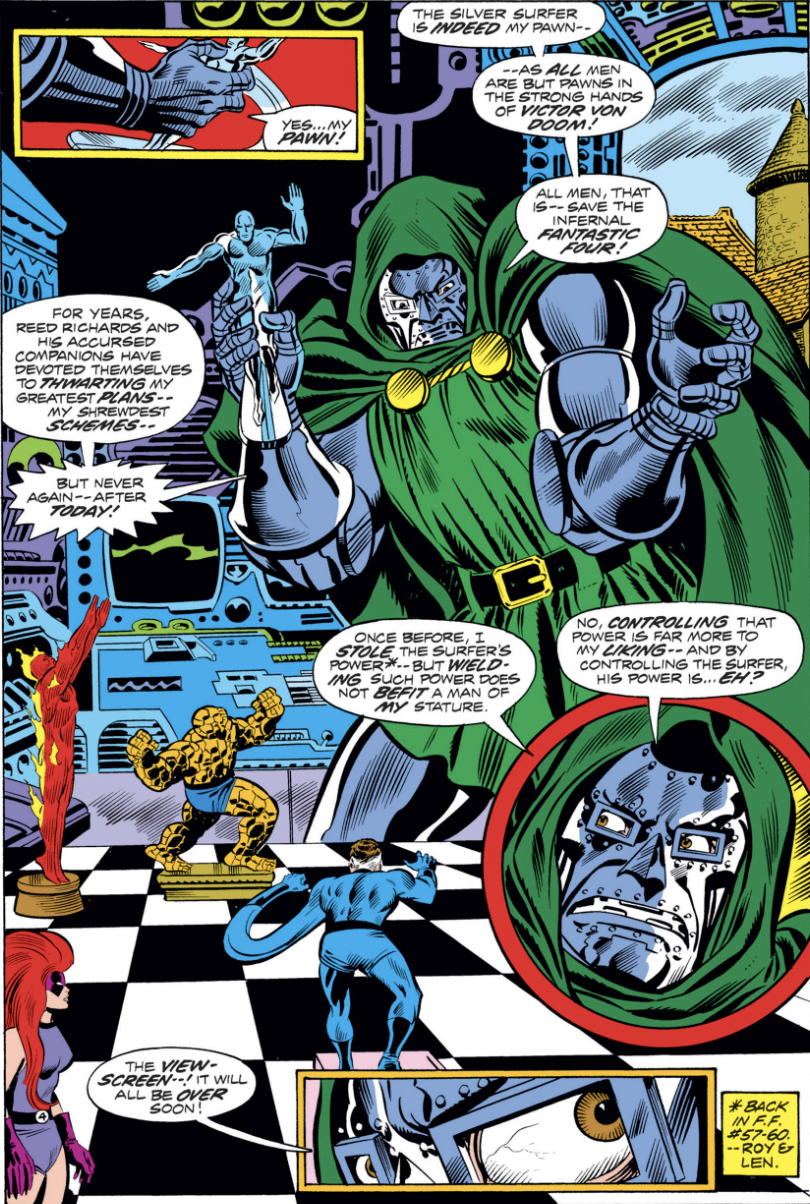
This was a fun comic, despite all its weird intricacies and jarring transitions. Thomas clearly loves writing Doom, and gives him some great, preposterous lines:
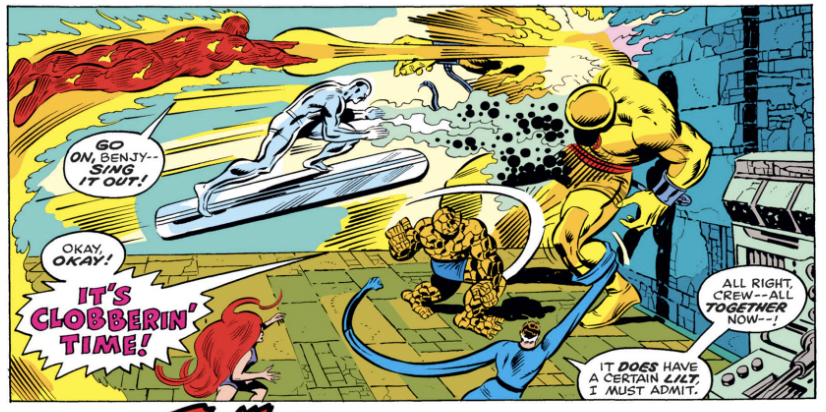
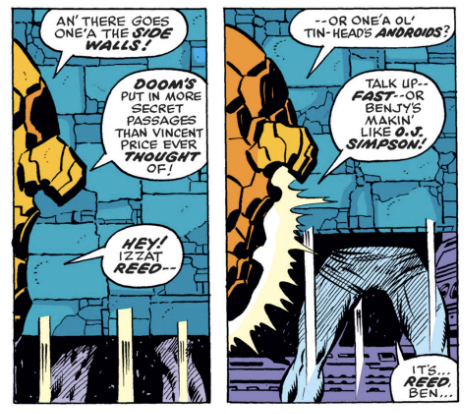
I also liked this byplay between Ben and Reed, revealing a more playful side to Mr. Fantastic.
What I didn’t like
Once again, there is no mention, much less an appearance, of Sue Richards or Franklin. And Medusa barely factors into the story at all.
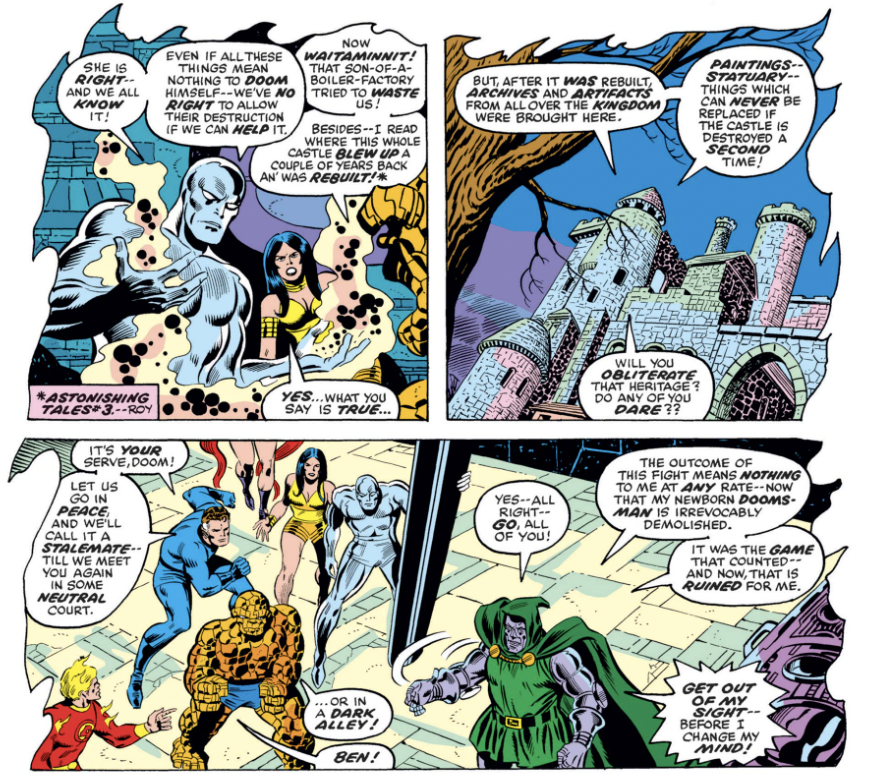
The initial ending is painfully anticlimactic and hard to swallow. The FF and Doom agree not to battle to preserve the Royal Latverian treasures? This in a comic where wide swathes of New York are frequently destroyed in the FF’s battles?
The disappointment is somewhat blunted by the strange Mephisto coda, but his appearance is such a non sequitur it’s hard to know what to make of it. Again, if readers weren’t paying attention to the Surfer’s title, it would be utterly confusing.
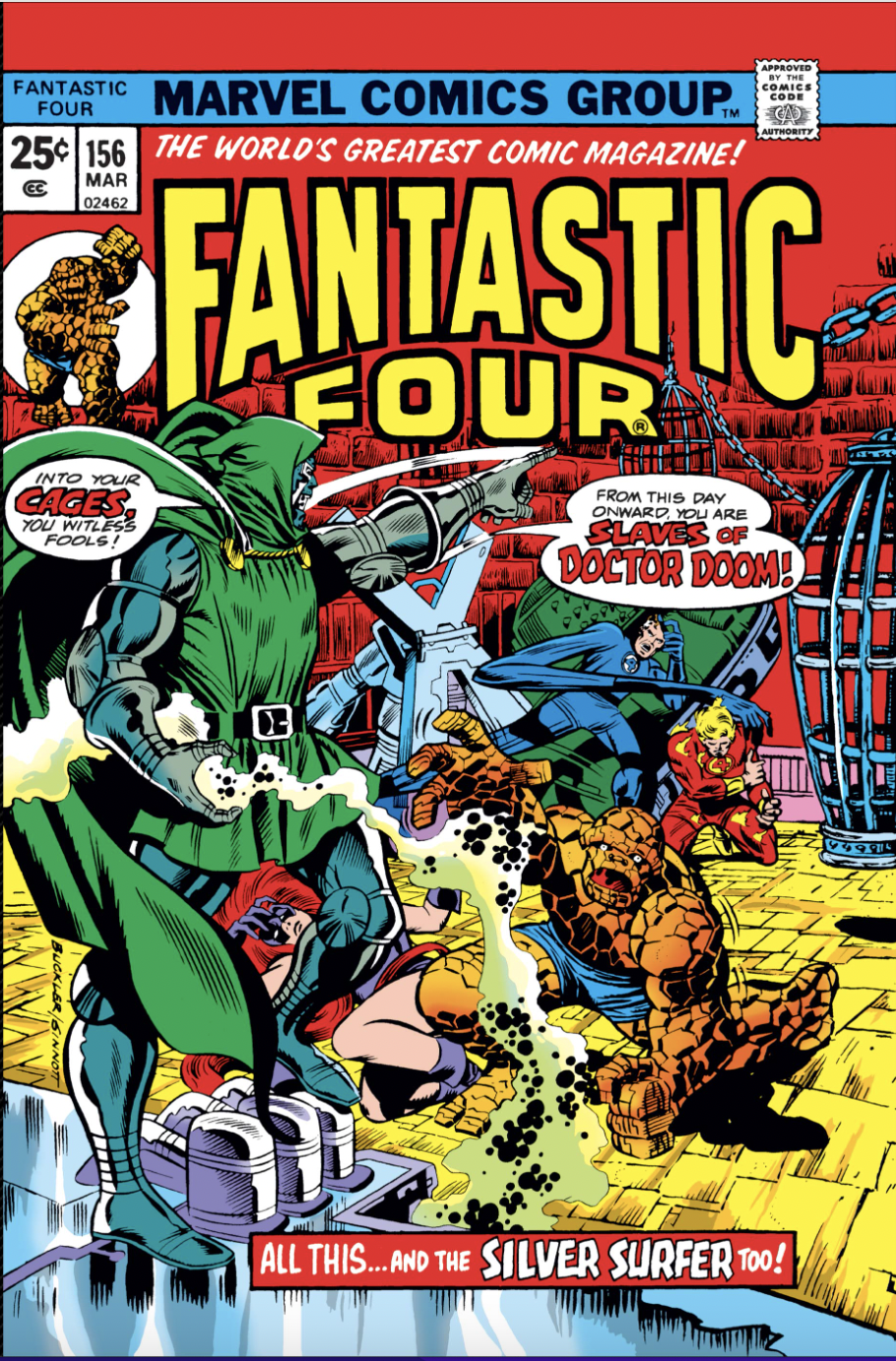
Fantastic Four 156 “Middle Game!” Published December 1974 Writers: Len Wein and Roy Thomas Pencils: Rich Buckler Inks: Joe Sinnott Letters: John Costanza Colors: Janice Cohen Editors: Wein and Thomas Cover: Bucker and Sinnott
Synopsis
To rescue his beloved Shalla-Bal, the Silver Surfer hypnotizes the Fantastic Four and delivers them to Dr. Doom, who further humiliates him. The FF, who submitted to the Surfer’s hypnotism to infiltrate Doom’s castle, break free of their confinement and defeat an army of Doom’s androids while Doom plans his next move.
What’s going on here?
This is the second of three comics in this arc (hence the story’s title) and a big improvement over the first one. It’s not great: there’s still a lot of purple prose, Doom’s ranting begins to get repetitive, and the FF-are-trapped-in-individual-cages plot device has become a cliché at this point. But the story is suspenseful — we really don’t know what Doom’s intentions are — and the action sequences are a lot of fun. Hopefully the conclusion of the story maintains the momentum of this one.
The credits for this issue are a bit odd, with Len Wein and Roy Thomas both credited as both writers and editors, but a note in the letters page explains that Wein intended to write the entire arc but stepped down to replace Thomas as editor. Thomas, slated to become the new regular writer, picked up the story halfway through. The Bullpen Bulletins further explains that Thomas is now “editor emeritus” (a lofty title for someone who just turned 34) while Wein is now running the show. This begins a chaotic period where Marvel went through five editor-in-chiefs in four years: Wein (1974-75), Marv Wolfman (1975-76), Gerry Conway (1976), Archie Goodwin (1976-78)and finally Jim Shooter, who took over in 1978 and restored some stability to the company.
What I liked
There’s some big, bold art from Rich Buckler, who seems to have gotten his mojo back, at least for this comic. This is a classic Doom splash page:
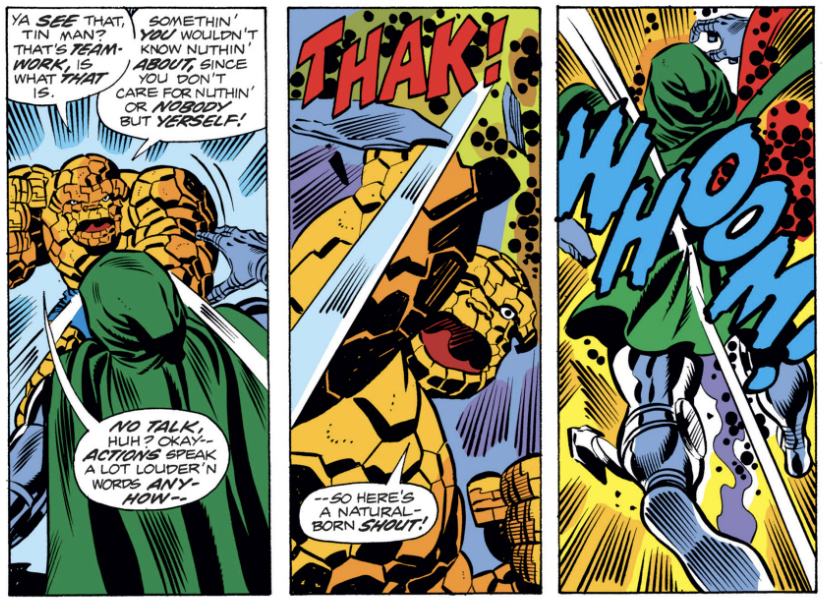
And I liked this action sequence:
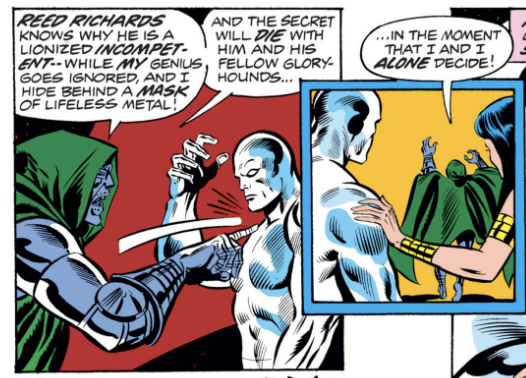
Hidden in all of Doom’s scenery chewing, there was also this intriguing nugget of backstory, hinting at some unknown motivation for his hatred of Reed. I don’t know what he’s referring to, and I hope it’s revealed in the next issue:
What I didn’t like
As mentioned above, confining the FF in cages designed to counter their powers has probably been employed in half a dozen issues by now. At least in this one Ben and Johnny note how easy it was to escape.
Anything else?
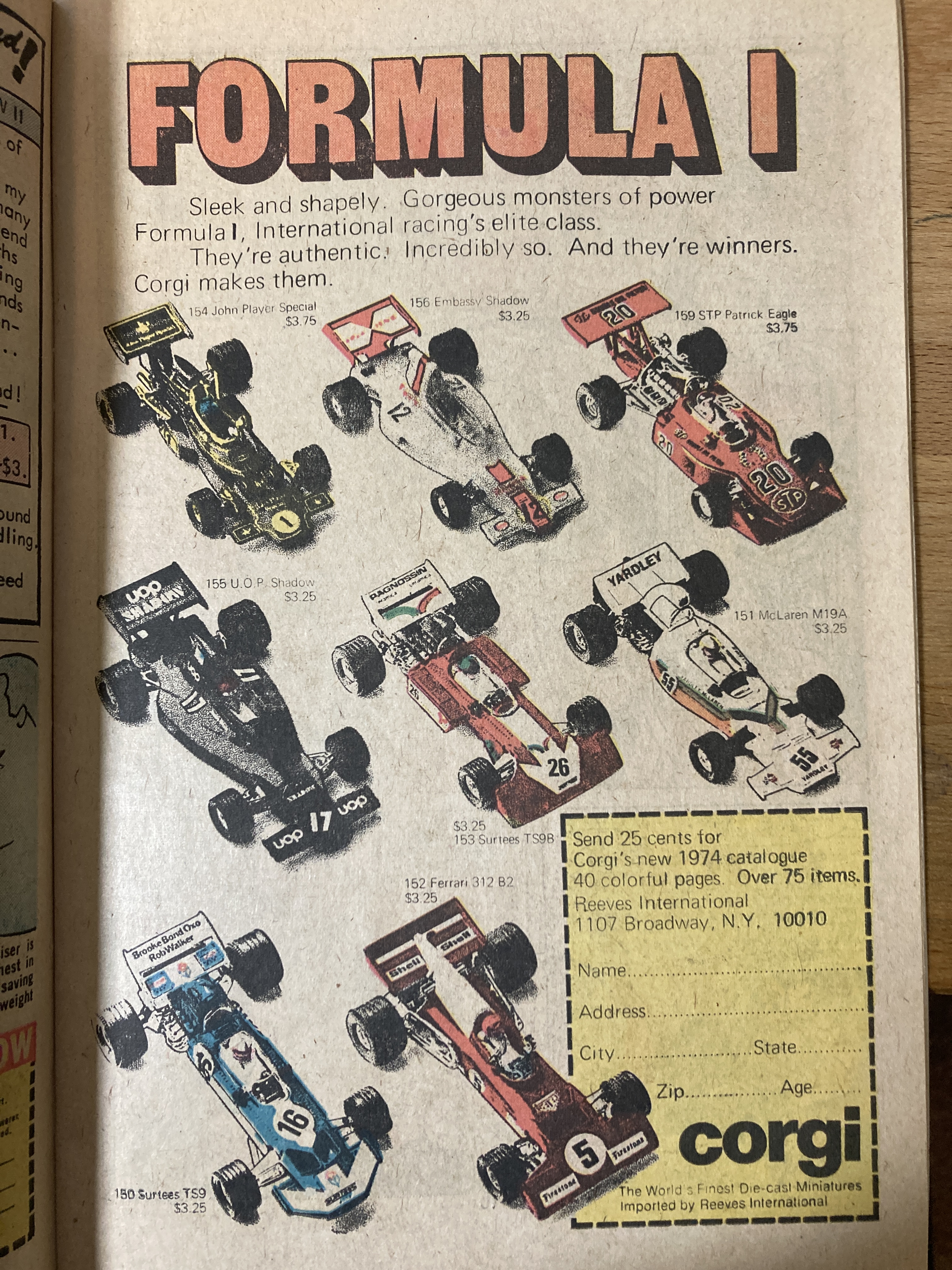
This ad was cool. I wonder if I can still get these cars?