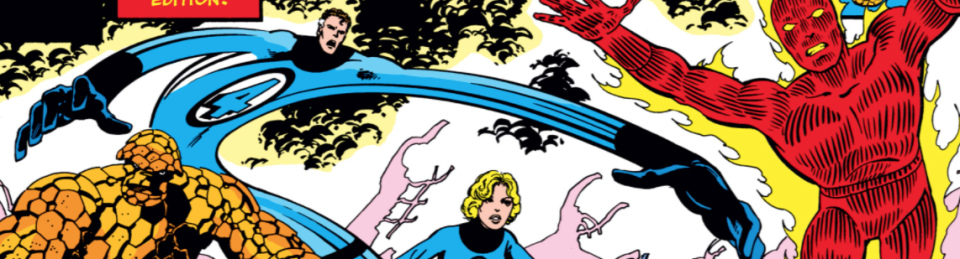
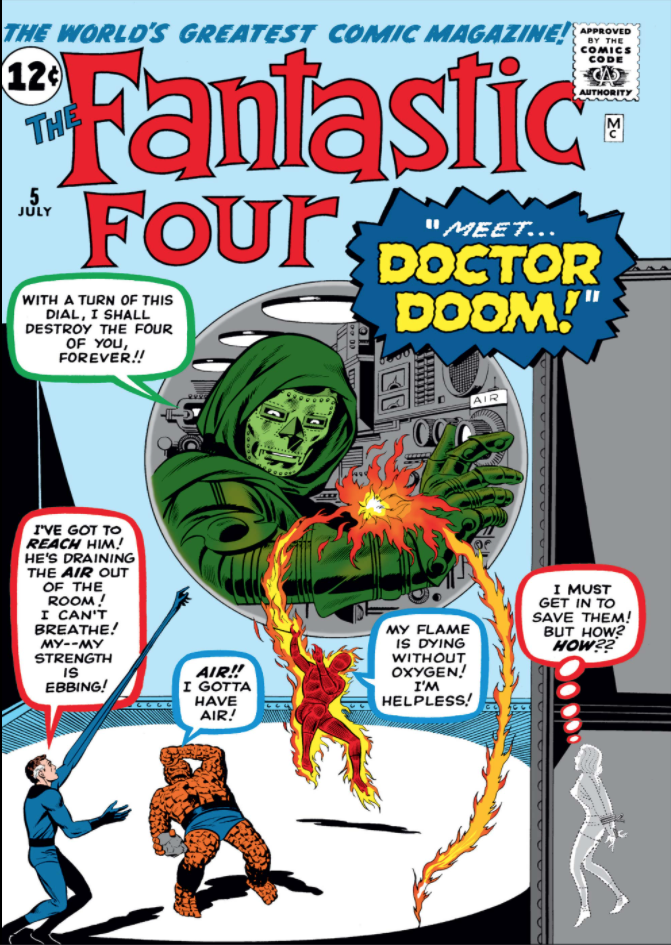
Fantastic Four 5
“Prisoners of Doctor Doom”
Published: April 1962
Plot: Stan Lee and Jack Kirby
Pencils: Kirby
Script: Lee
Inks: Joe Sinnott (uncredited)
Cover: Kirby and Sinnott
Synopsis
The Baxter Building is enveloped by a net that resists the Fantastic Four’s powers. Mr. Fantastic recognizes the voice of the villain responsible as that of Victor Von Doom, a college classmate who dabbled in sorcery and was expelled for reckless experiments. Doom demands Sue Storm as a hostage, then transports the team to his castle, where he sends the three male members of the FF back in time to recover the treasure chest of Blackbeard the Pirate. The team successfully disguises themselves, and joins a pirate crew to steal the treasure. The team return, but presents Doom with just the chest, without its treasure. A battle commences, Doom traps the three, and Sue rescues them before Doom escapes.
What’s going on here
This issue introduced Dr. Doom, not just the Fantastic Four’s nemesis, but arguably the greatest villain in comics (I would put him in a small group with Magneto, Lex Luthor, Darkseid, and the Joker). Doom’s significance in the Marvel universe is hard to overstate. He was the primary antagonist in Marvel’s first big crossover event, Secret Wars in 1984, and was again when Marvel revisited the concept in 2015. He is one of the few villains to headline his own comic, and has played the bad guy to heroes from Iron Man to Luke Cage to the X-Men.
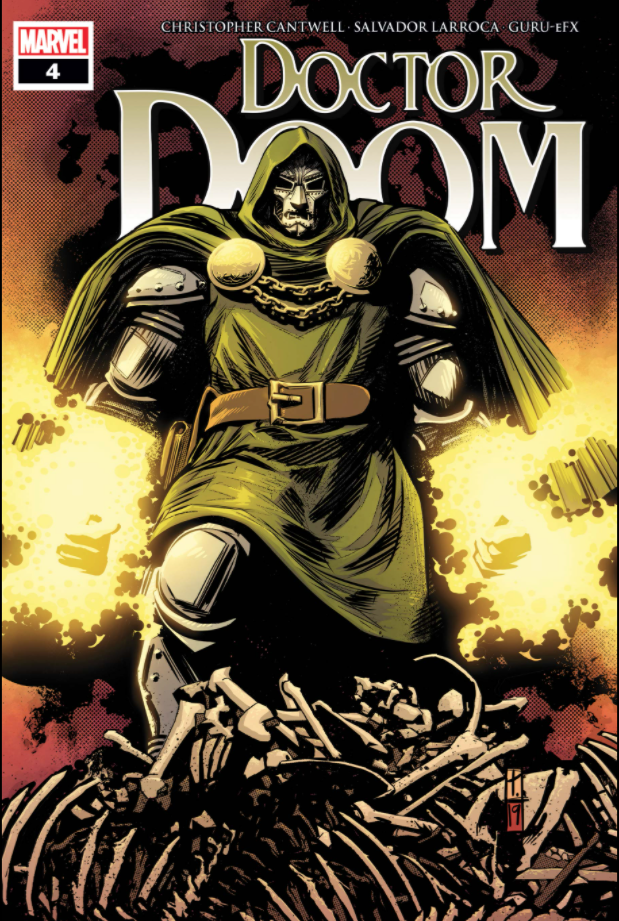
It’s in the Fantastic Four, of course, where he is most prominent, so much so that he’s been called the fifth member of the team. As we’ll see, it’s rare for him not to appear at least annually, and in some issues he, not the FF, is the star. In recent years his depictions have become more nuanced since he is the unofficial uncle to Valeria Richards, the daughter of Reed and Sue he mid-wifed (it’s complicated), and he spent a time trying to be a hero (it didn’t stick).
Of course, none of that could have been predicted in 1962, where Doom is the engineer of a silly time-travel plot in Fantastic Four 5, but Stan and Jack clearly intended Doom to have some staying power. In the comic, Reed quickly lays out Doom’s origin, and while many details have changed over the years, the salient points are there: Doom and Reed knew each other in college, Doom has scarred in an explosion, and Doom has fused science and sorcery.
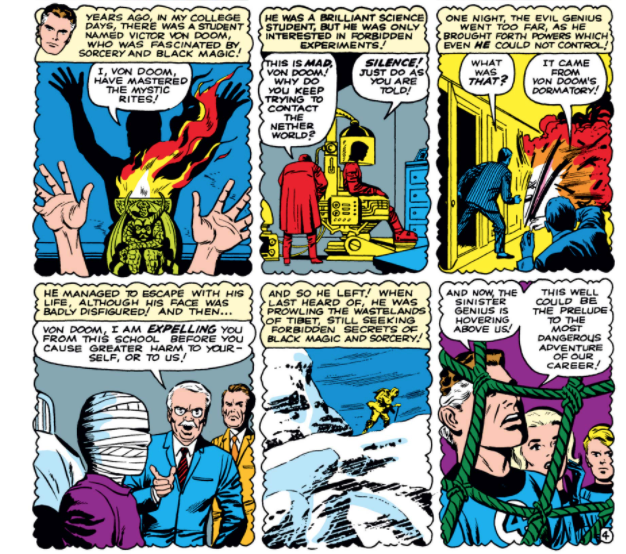
Tying his origin to Reed—that early connection between the two becomes more explicit in future issues—helped ensure he’s not a one-note villain. In later tellings, Doom blames Reed for the explosion, and it’s reminiscent of Luthor’s origin story (at least the first version), where Superboy, trying to extinguish a lab accident with his super breath, costs Luthor his hair.
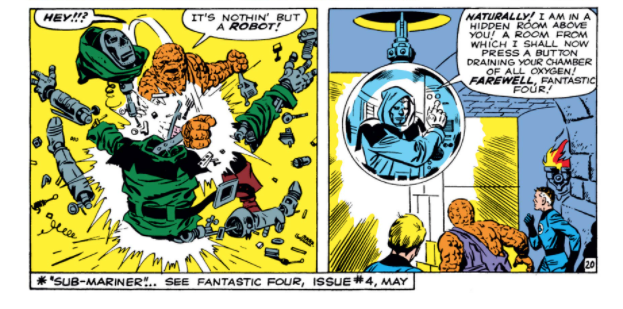
Doom’s first appearance also introduces a number of elements that become familiar aspects of his character, including his robot doubles:
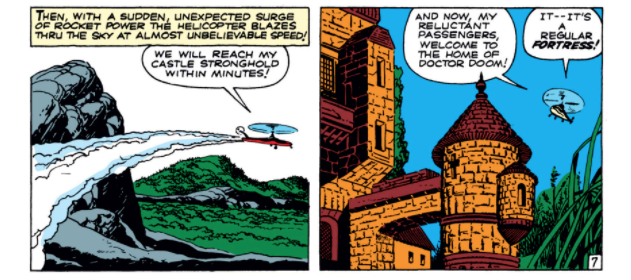
His castle (although this would appear to be is castle in the Adirondack mountains of New York State, give that it is minutes away, and not his kingdom of Latveria, which has yet to be introduced):
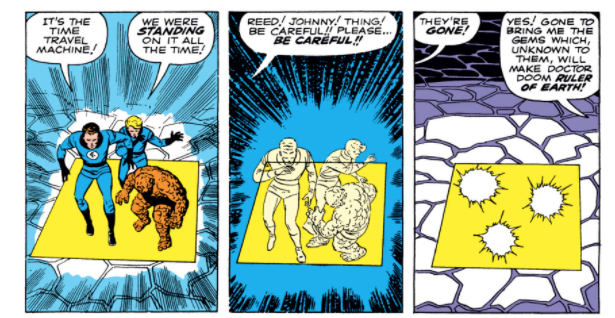
And his time machine:
About that time machine
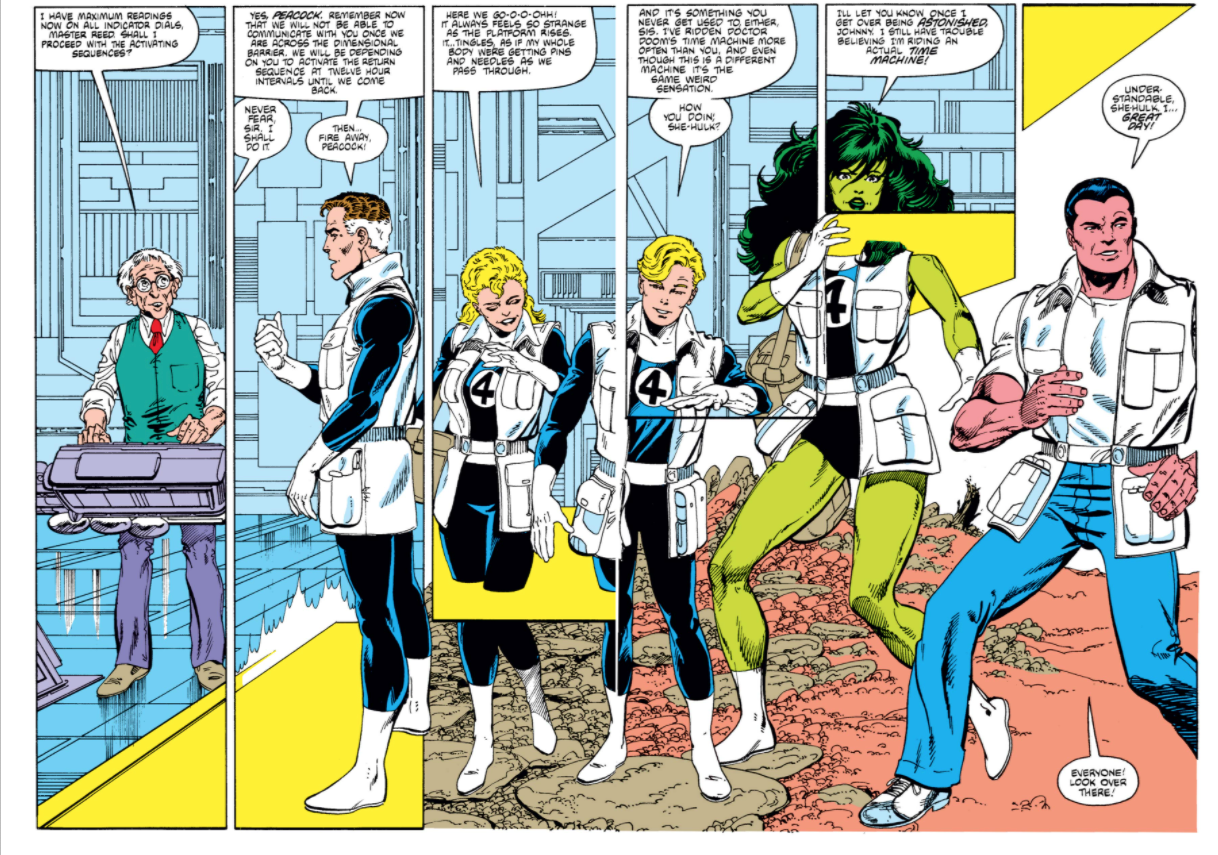
While used in the service of a particularly goofy plot in this issue, Doom’s time machine becomes a durable part of the Marvel universe, and when characters need to travel through time, it’s often their go-to device. It’s unclear if Doom leases it out, or if it’s more of a franchise business model.
I couldn’t possibly track down every instance where it was used but here’s a few memorable ones.
In the West Coast Avengers, a villain uses it to send the team back in time:
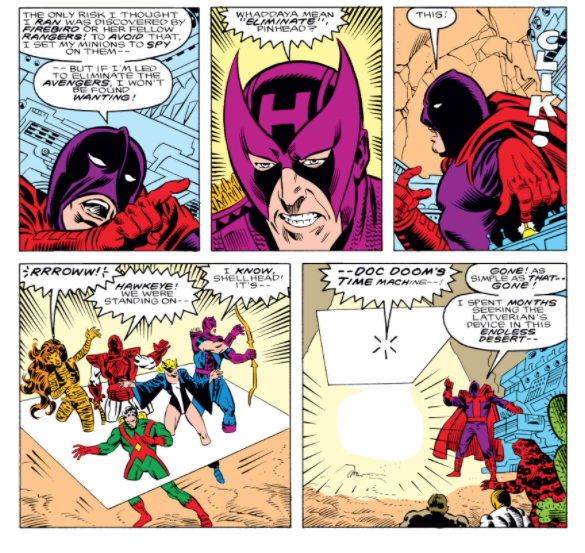
John Byrne used Doom’s time machine during his run, and I always thought this sequence was a particularly cool way to illustrate it:
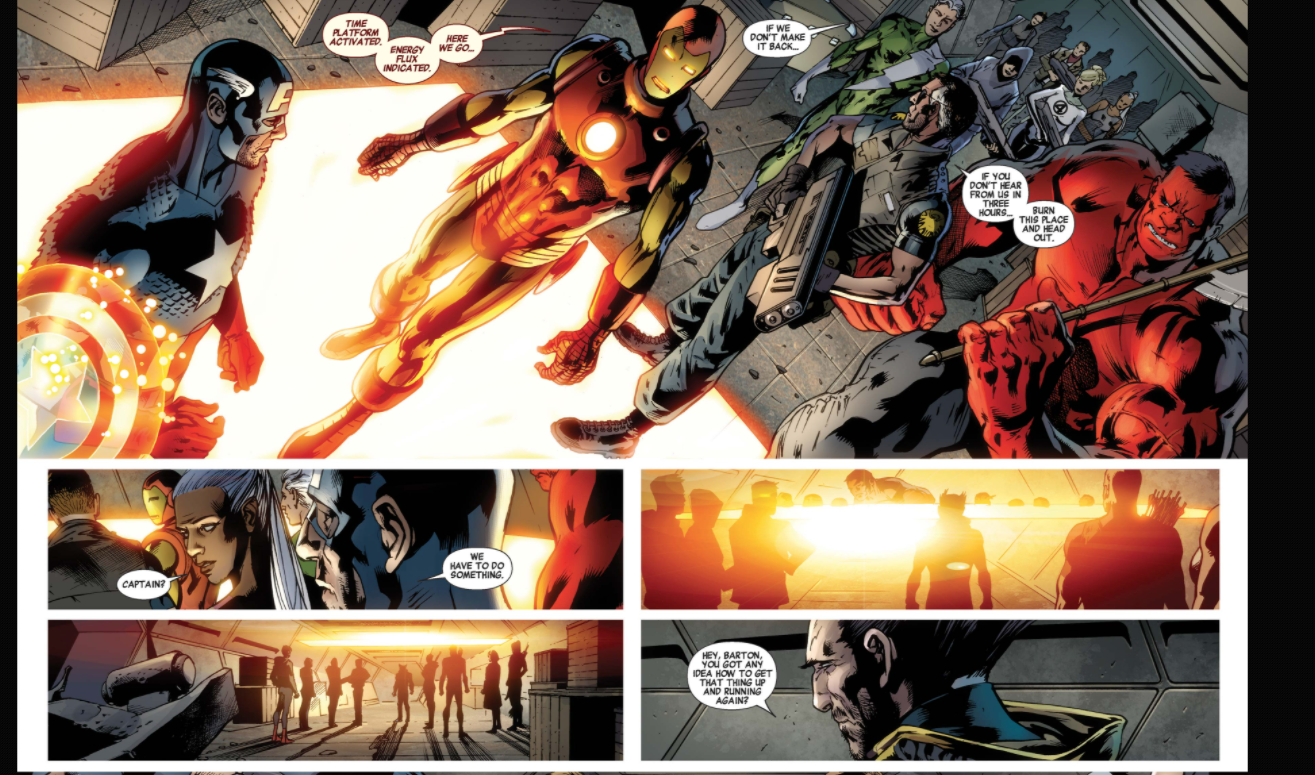
Decades later, it served an important role in the Age of Ultron crossover event:
Who’s the new guy?
This is the first Fantastic Four issue inked by Joe Sinnott, who had a nearly 60-year career in comics, and has more FF credits than any single creator. He didn’t return to the FF until issue 44, but then inked almost every issue from there through issue 231, a 15 year run, and his inks created a consistency to the FF’s look that extended well beyond Kirby’s tenure. One could argue he overpowered the pencils of artists like Byrne and George Perez early in their careers, but there’s no denying his impact on the title. He died last year at age 93. Here’s a nice obituary from The Comics Journal.
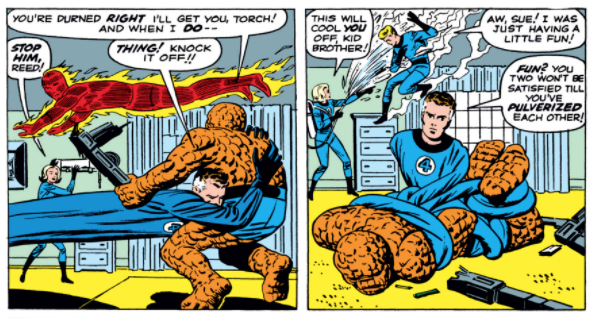
They’re fighting again
Of course they are
The torment of the Thing
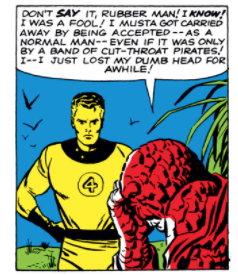
Ben gets carried away with his new identity as Blackbeard, and in a very uncharacteristic development, turns against his teammates:
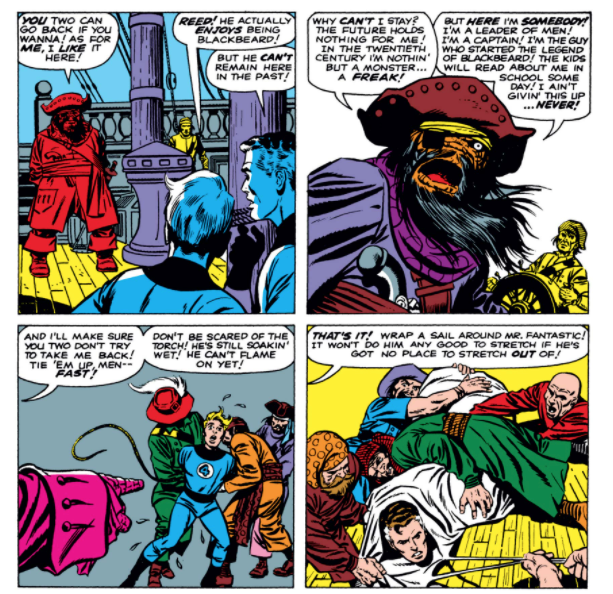
He later is ashamed of his betrayal:
The paradox of time travel
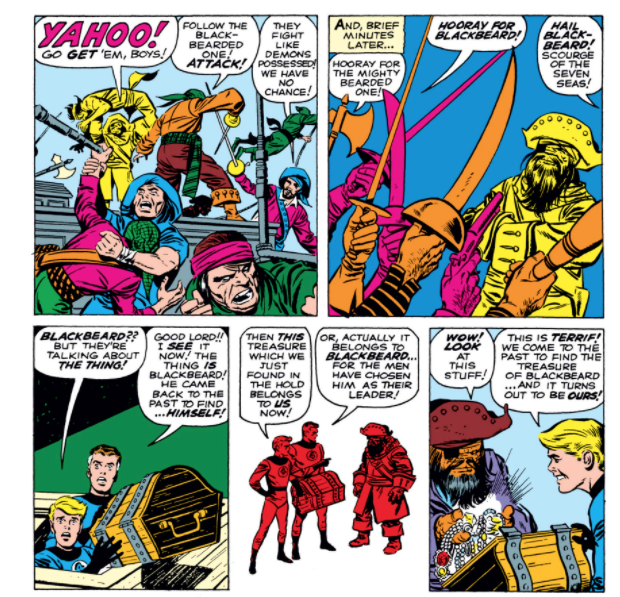
Time travel is a perennial trope of science fiction, and in comics, the Fantastic Four are involved in as many time travel stories as any characters. The plots becomes more intricate over the years, but the revelation that Ben is the actual historic Blackbeard is a fun touch and an early indication of the story-telling possibilities.
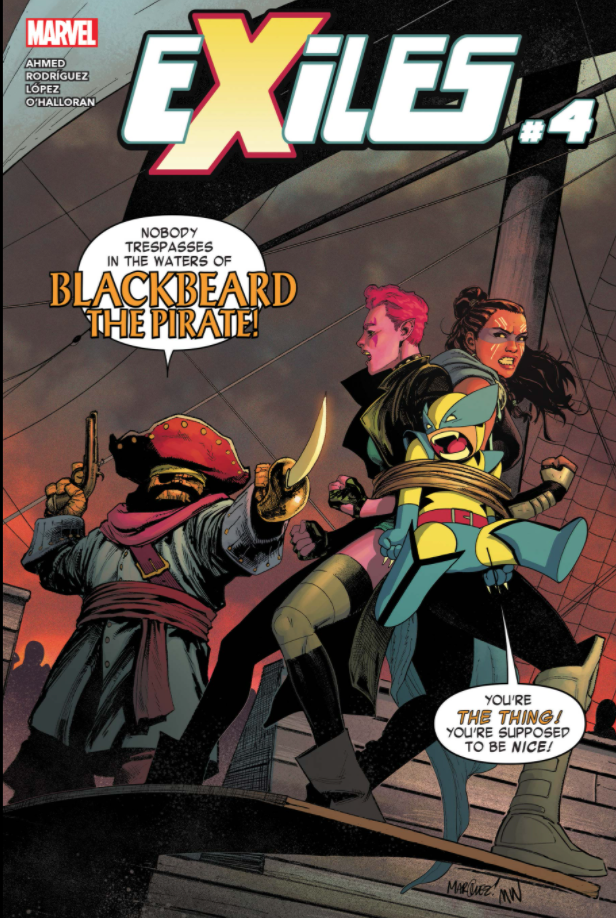
This weird footnote is revisited a few times, including on the cover of 2018’s Exiles (I have no idea what this comic is about):
The sexist sixties
Doom demands a hostage, and of course it’s the team’s female member. Why he didn’t think the hero who’s power is to turn invisible might be useful in his treasure heist is not explained.
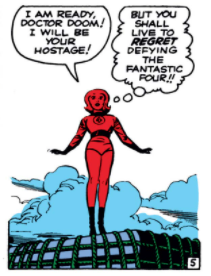
Stan and Jack later redeem themselves a bit by having Sue rescue the rest of the team:
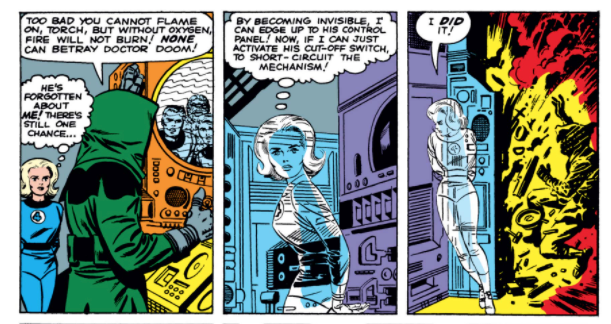
Dig that Kirby Krackle
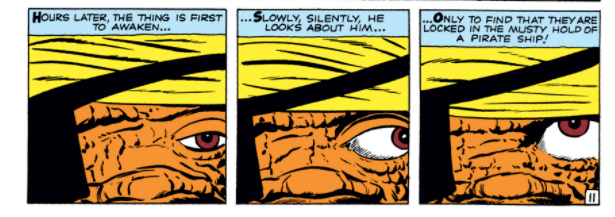
Love this sequence of Ben waking up from too much grog
For sale:
A mint (9.8) copy of FF 5 will cost you around $300,000 (and probably a lot more after Doom appears in the Marvel Cinematic Universe)
Let’s talk about us
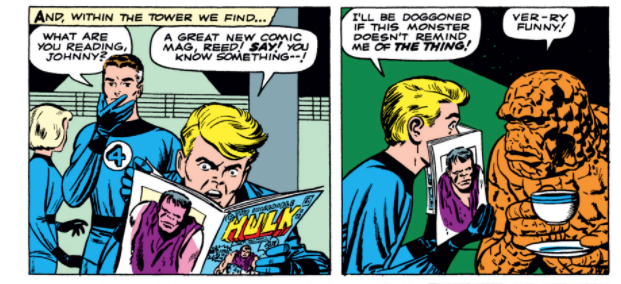
Johnny is seen reading an issue of the Incredible Hulk
Next issue: Doom and Namor team up!

