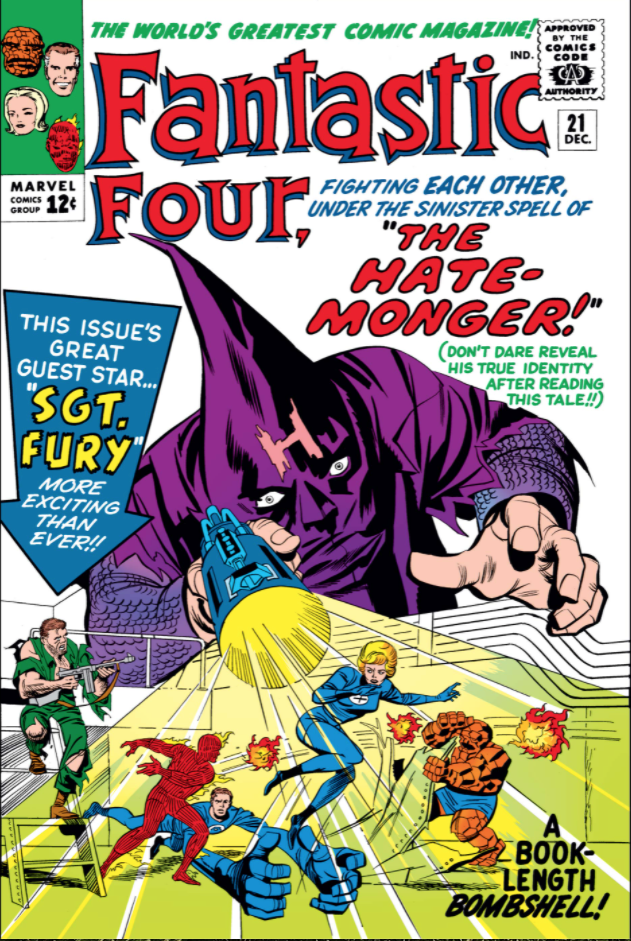
Fantastic Four 21
“The Hate Monger
Published: Sept. 1963
Story: Stan Lee and Jack Kirby
Pencils: Kirby
Inks: George Roussos (credited as George Bell)
Letters: Art Simek
Cover: Kirby and Paul Reinman
Synopsis
The Thing startles the rest of the Fantastic Four by lashing out at a punching bag; the cause of his frustration is newspaper articles about the Hate-Monger, a rabble rouser peaching hatred. Taking a walk, the team quickly stumbles across a Hate-Monger rally on a New York Street. When they confront him, he turns his “H-Ray” against them, causing them to fight amongst each other.
Mr. Fantastic, under the Hate-Monger’s influence, declares himself free of the rest of the FF, and, on returning to the Baxter Building, is greeted by Nick Fury, a former colleague from WWII and now a spy and CIA agent. Fury has come to recruit the FF to confront the Hate-Monger in the South American country of San Gusto, a US client state where he is whipping up a rebellion. Reed decides to go himself, and leaves in the FF’s Pogo Plane. The rest of the team, still under the effects of the H-Ray, are goaded by Fury into pursuing him in their ICBM.
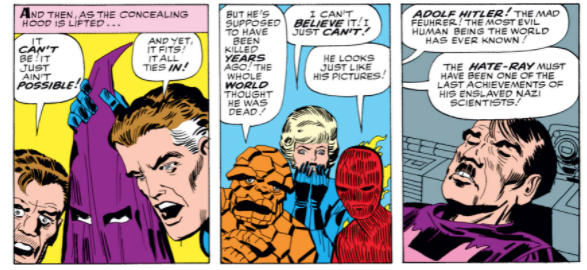
Once in San Gusto, Reed takes on the rebel army before he is captured by the Hate-Monger. He is rescued by Fury, who forces the Hate Monger to administer the antidote. The two then capture the rest of the team and restore them to normal, before confronting the Hate Monger. After his H-Ray is turned on his henchmen, the Hate-Monger is unmasked and revealed to be Adolf Hitler (or a clone there of).
What’s going on here?
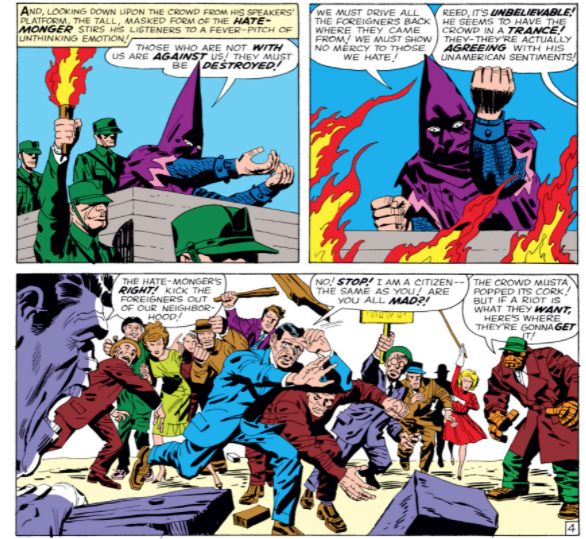
Fantastic Four 21 marks the first issue where Stan and Jack get anywhere near contemporary social issues. Wearing what looks like a purple Klan hood, surrounded by henchmen dressed like Nazi brown shirts, the Hate-Monger is as close to a real-world villain as exists in early 1960s Marvel. His presence also gives the FF an opportunity to call out the evils of prejudice and “unamerican sentiments” (with a gratuitous swipe at Sue).
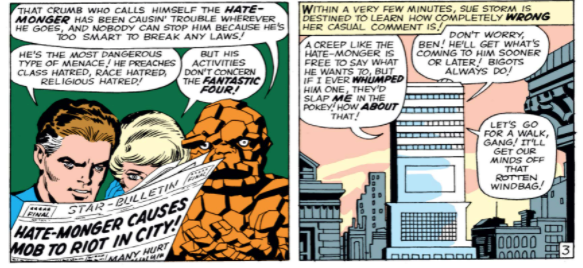
The story, unfortunately, doesn’t got much farther in exploring the issues of hatred and bigotry. There is an opportunity there for Stan and Jack to examine why the Hate-Monger’s message is able to find purchase in the American psyche, but instead the story rumbles on in classic FF fashion. The Hate-Monger becomes just another FF villain, with a secret headquarters and zany gadgets. The twist at the end, that he is actually Adolf Hitler, is essentially shrugged off. Future stories reveal him to have been a clone created by Arnim Zola, and he pops up over the decades, but never as a major FF villain.
The story is also notable for the first appearance of Nick Fury as a modern spy. Fury, who debuted in his own World War II comic a few months earlier, is brought up to the present here as a CIA agent and soon goes on to star in his own stories as an agent of S.H.I.E.L.D. in Strange Tales (and later his own book). Notably, he still has two eyes, since he doesn’t begin to wear his eye patch until Strange Tales 135.
He becomes a central figure in the Marvel universe (and Marvel cinematic universe) often serving as a mastermind moving chess pieces, but in this early appearance in the FF, Fury is still more of the WWII brawler. On the cover, he’s dressed as Sgt. Fury, complete with torn Army fatigues.
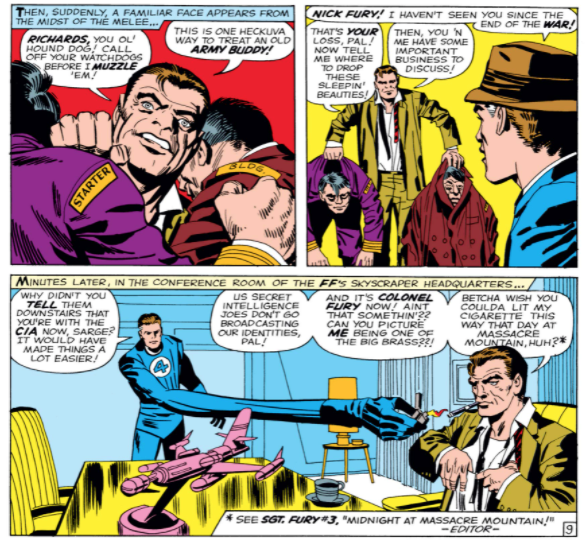
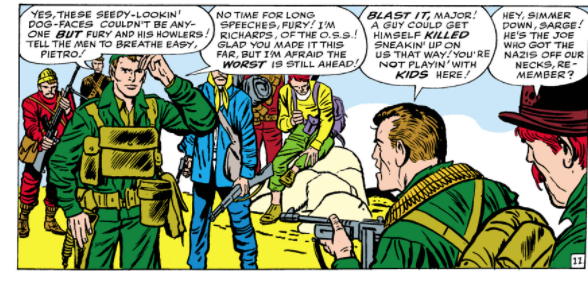
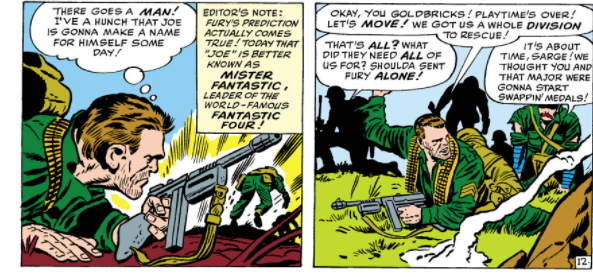
The issue also establishes a shared history between Nick and Reed in World War II, with an editor’s note plugging Sgt. Fury 3, conveniently on sale, and an early example of marvel using guest stars to promote new books. Here’s their encounter at Massacre Mountain:
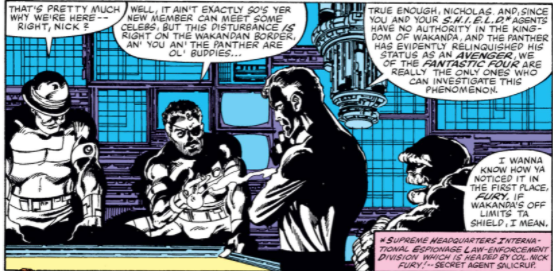
Fury’s appearance also launches a long tradition of him showing up early in Marvel comics books to set the story in motion. It’s an exceptionally convenient way to drop heroes into stories without a lot of build up: Fury just sends them on a mission and off they go. Often, he summons the heroes to the SHIELD helicarrier, where they confer around a big table that lights up, like here with the Avengers:
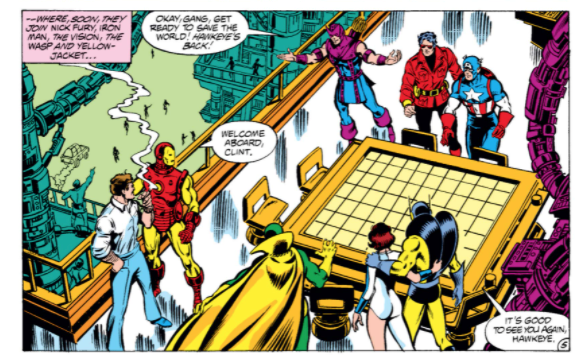
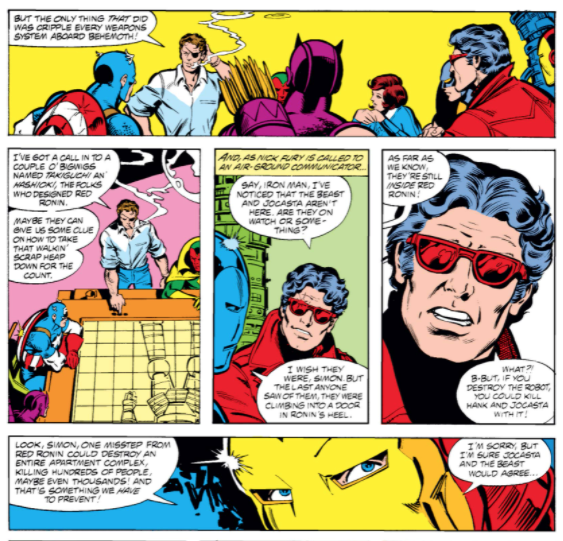
Or here with the FF:
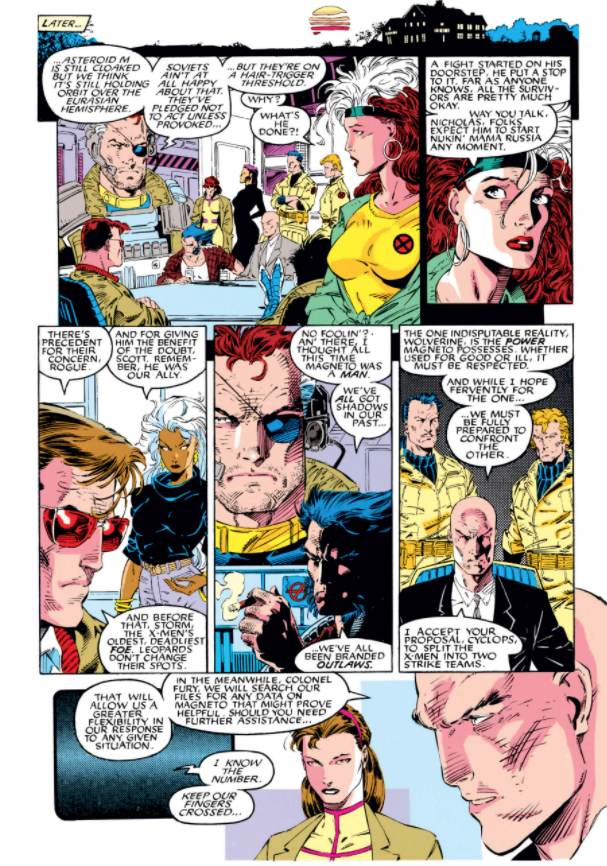
Sometimes he just appears on a monitor, like here with the X-Men :
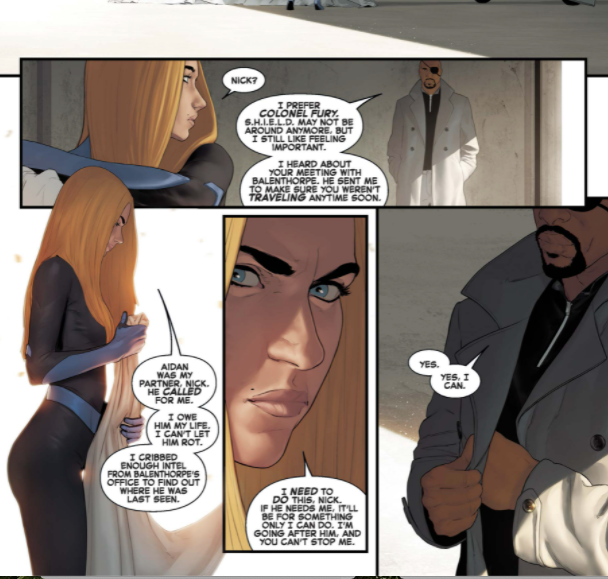
And to prove the apple doesn’t fall far from the tree, Nick Fury Jr. is up to the same plot-speeding-up tricks decades later:
About those inks
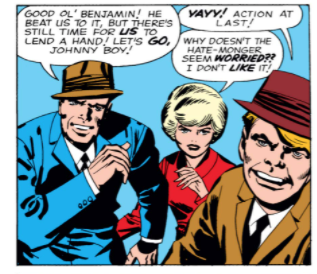
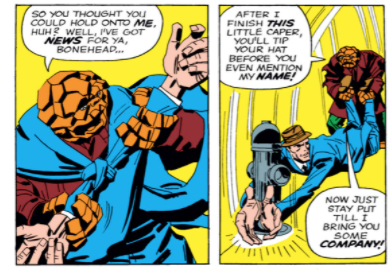
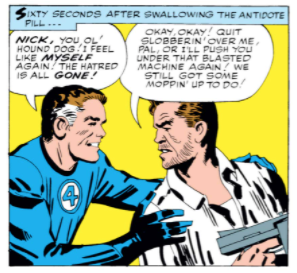
FF 21 was inked by George Roussos, who is credited in the comic as George Bell. Roussos had a remarkably long career at Marvel, with credits stretching from 1941 to 1995, spending his last three decades as a colorist. His style is very distinctive here, and Kirby’s FF take on a very different appearance, looking more like they did in their first issues.
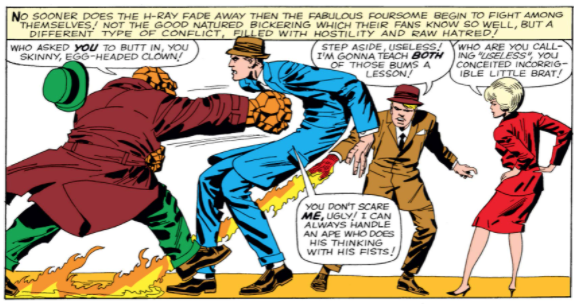
They’re fighting again
This time, at least, it’s with good reason.
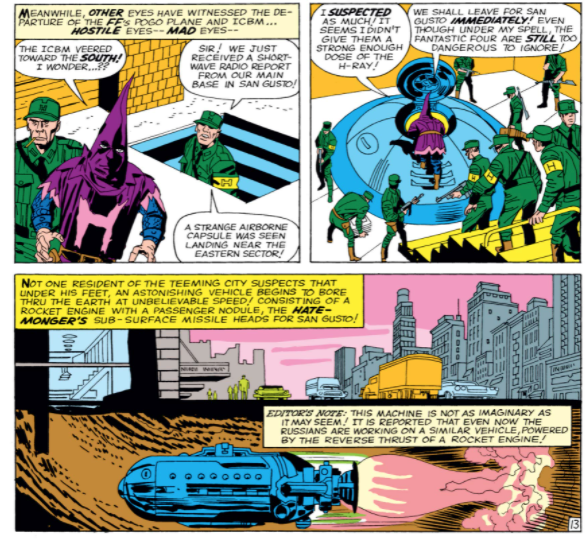
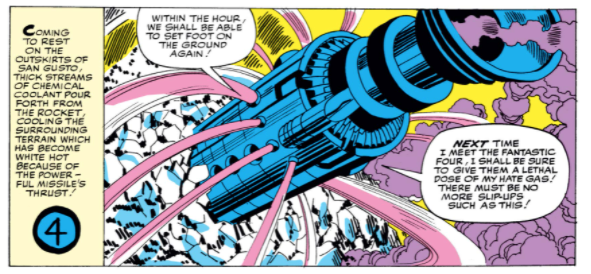
Going underground
Instead of flying to San Gusto, the Hate-Monger burrows his way there, using a device that Stan assures us in an editor’s note is *very* plausible.
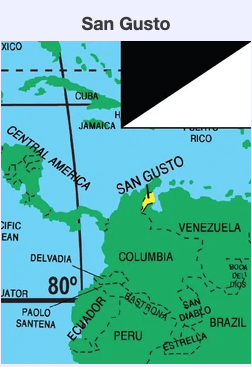
Speaking of San Gusto
This is the first and only appearance of San Gusto (future Marvel writers tend to use the imaginary country of San Marcos when they need a banana republic) but it does show up in the Marvel Atlas between Colombia and Venezuela.
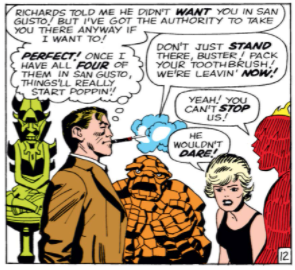
Mid-centry Modern
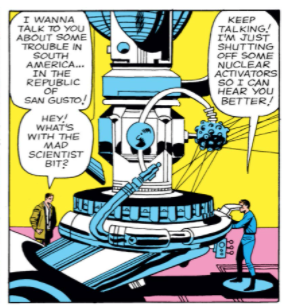
The FF’s unique taste in decorating shows up again
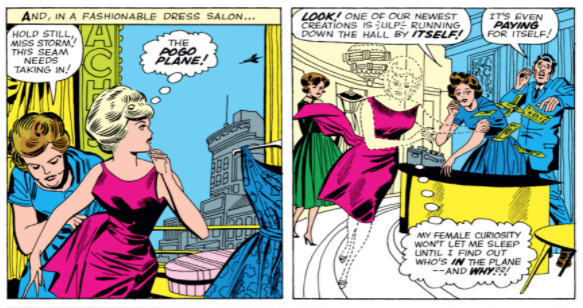
The sexist sixties
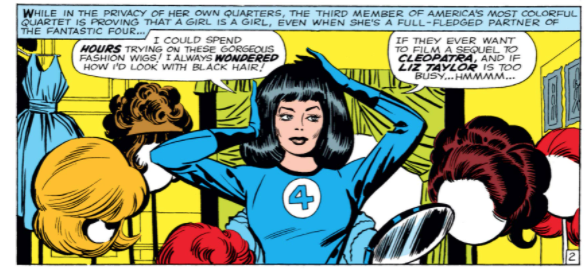
Sue relaxes by trying on wigs and dresses
The incredible Mr. Fantastic
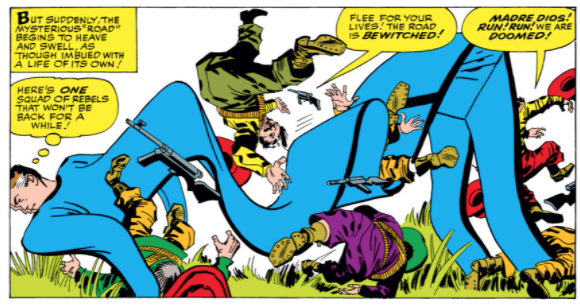
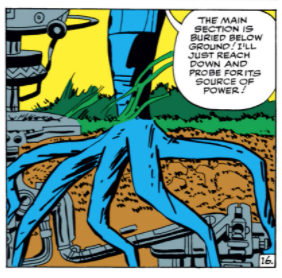
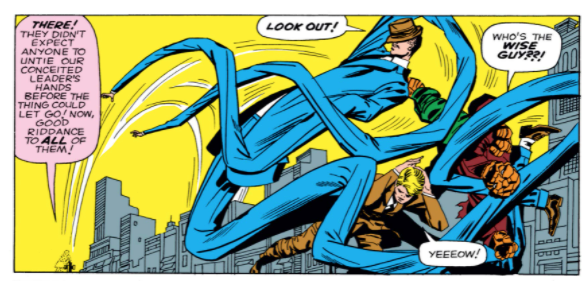
More creative stretching
Dig that Kirby Krackle
For sale
FF 21 in mint condition (9.8) will cost you about $13,000.
Next issue: The return of the Mole Man!


Pingback: “The World’s Greatest Comic Magazine!” Giant-Size Fantastic Four 3 | Percival Henry: The Fantastic Four and more