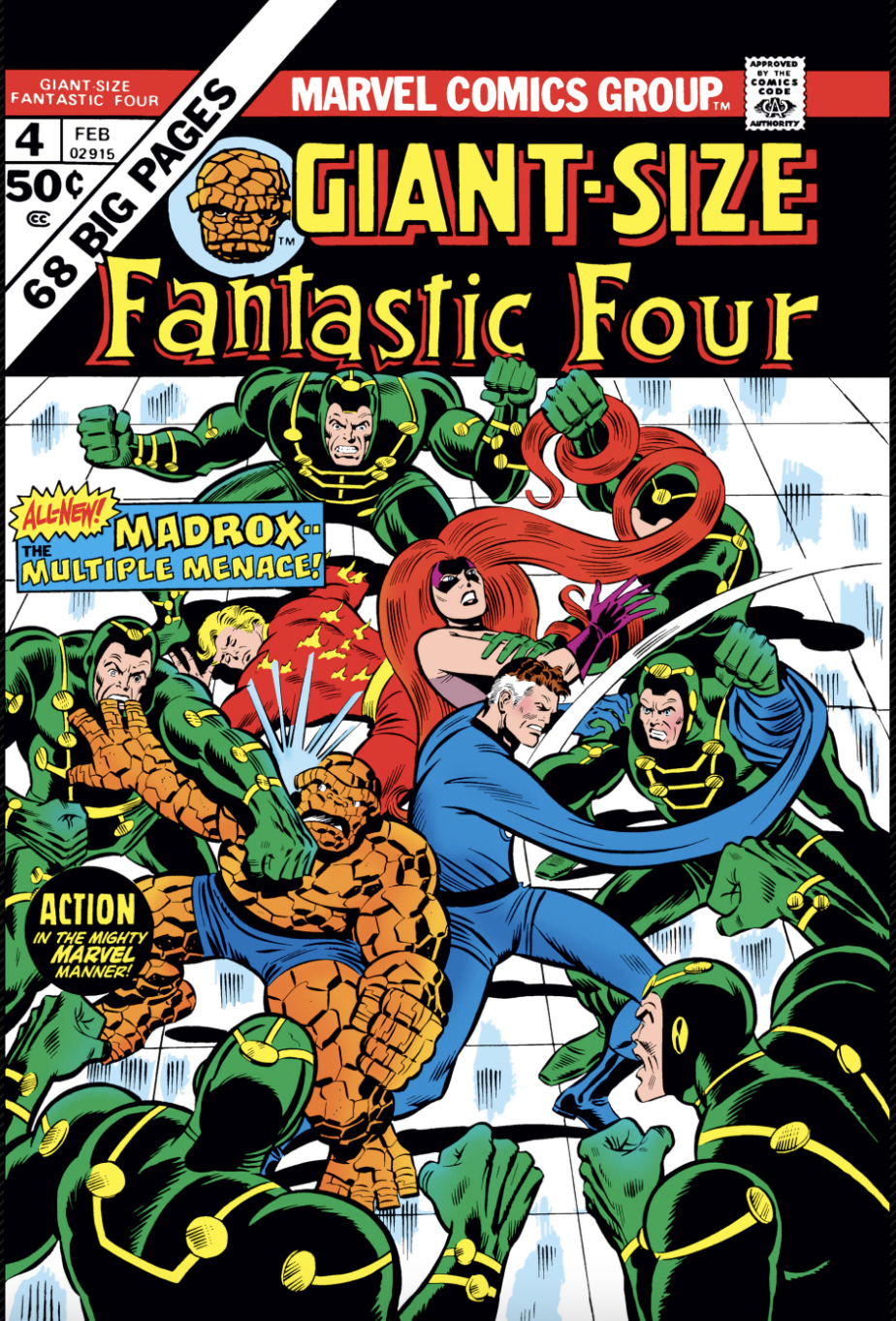
Giant-Size Fantastic Four 4
“Madrox, the Multiple Man!”
Published November 1974
Writers: Len Wein and Chris Claremont
Pencils: John Buscema
Inkers: Chic Stone and Joe Sinnott
Letters: John Costanza
Colors: Glynis Wein
Editor: Len Wein
Cover: Rich Buckler and Joe Sinnott
Editor’s note: This comic was published prior to Fantastic Four 156 and 157 but I wanted to conclude the Doom/ Surfer story arc before tackling this issue
Synopsis
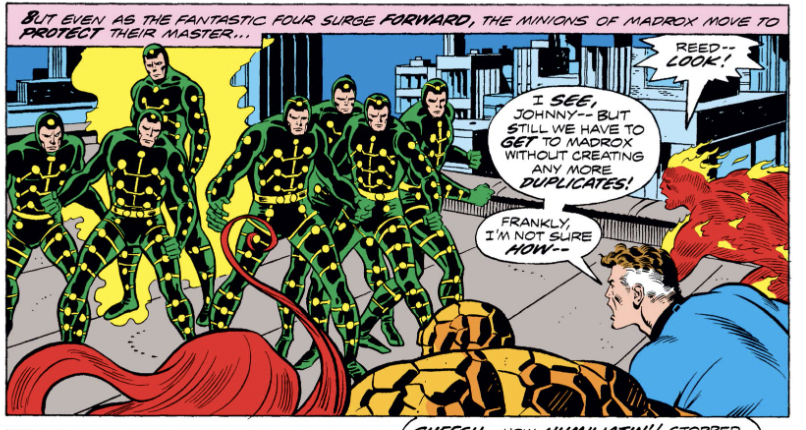
On his way to a Jets game with Alicia Masters, the Thing encounters and is defeated by Madrox, who has the power to create duplicates of himself. Ben is revived in the Baxter Building by Mr. Fantastic who says blackouts across the city are being caused by Madrox, who absorbs electricity. The team battles him, and is facing defeat when Professor X arrives, explains he knew Madrox as a child, and helps subdue him.
What’s going on here?
As discussed in previous posts, in 1974 Marvel began to publish giant-size editions of some its most popular titles. These usually included an original story and a reprint, and sort of operated as annuals, although they appeared quarterly. In this issue, the reprint is (appropriately enough) FF 28, guest starring the X-Men.
Giant-Size Fantastic Four 4 is notable for a few reasons. It marks the debut of the mutant Jamie Madrox the Multiple Man, who would go on to have a long career in X-Factor and other X books, and perhaps most significantly, it’s the first Fantastic Four issue written by Chris Claremont. In 1974, Claremont was brand new to Marvel, and this is listed as just his ninth Marvel writing credit. While he’s best known for his 15-year run on the X-Men and it’s many spinoffs, Claremont had a long run as the FF’s regular writer from 1998 to 2000. He also wrote the first Fantastic Four vs. X-Men mini-series in 1986 and frequently used FF members in his other comics.
What I liked
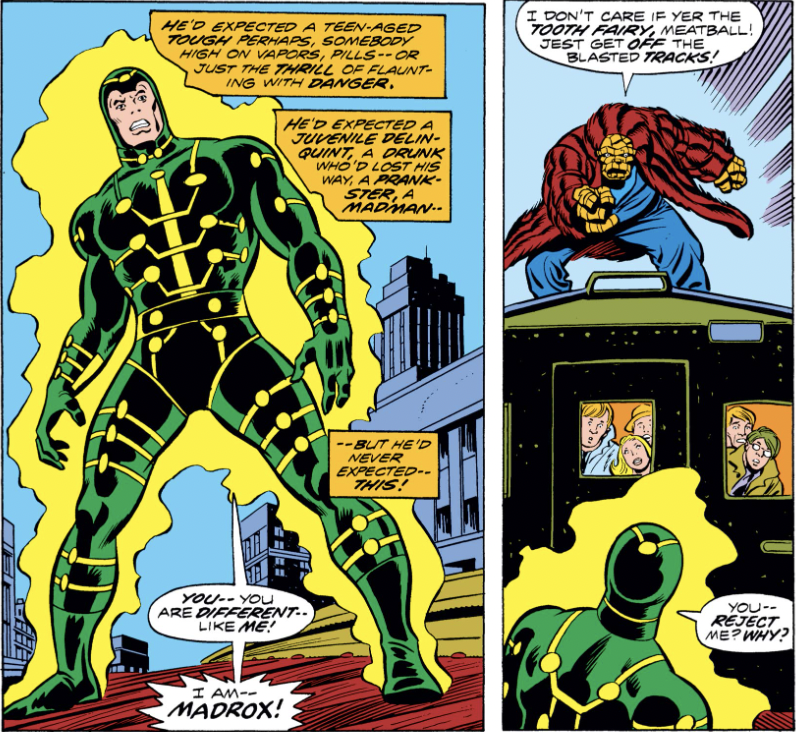
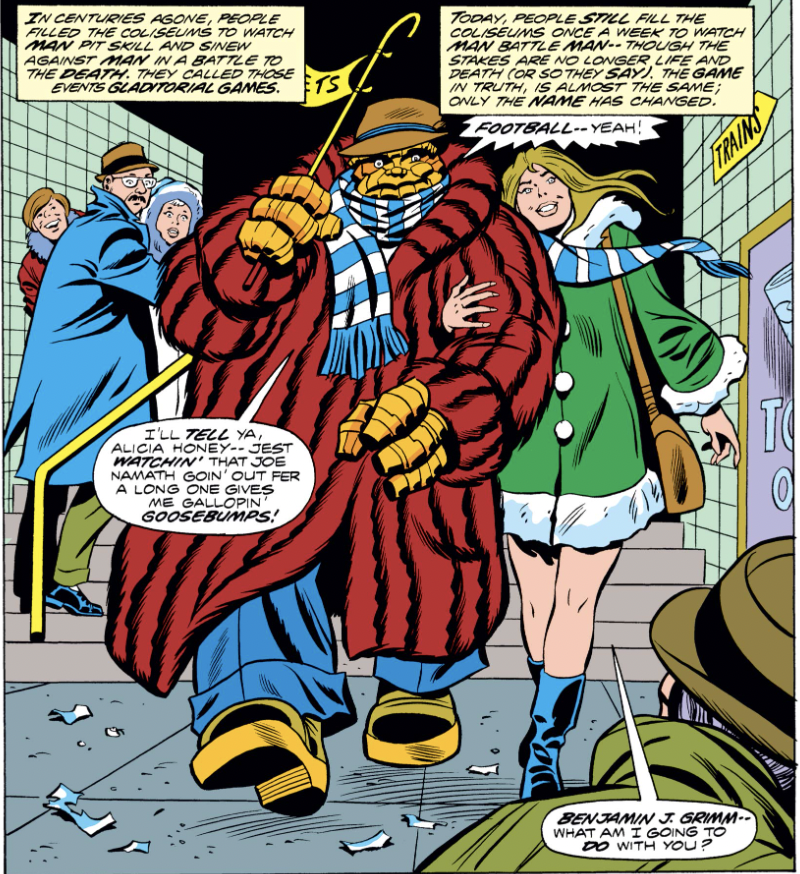
In many ways this is a pretty standard FF comic. The FF randomly encounter some menace, they tangle a few times, and it’s all wrapped up on the last page. That said, it’s a fun read, and the Wein / Claremont team does a good job with the opening sequence where Ben first confronts Madrox. Ben’s enthusiasm for the Jets game runs through the comic and is a nice touch. I loved his ridiculous outfit, as if he’s dressed for the Harvard-Yale game in 1922.
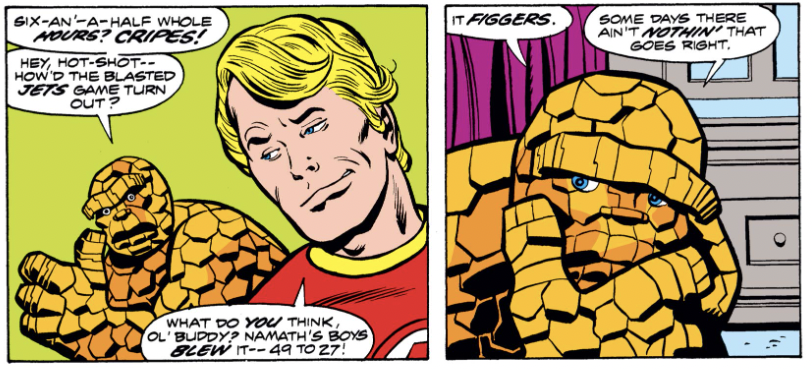
Later, he’s bummed that he missed the game (I checked and there’s no actual Jets game from that year that ended with that score).
What I didn’t like
Madrox is an enigma throughout the comic. His stilted speech in his first appearance suggests he’s some sort of alien, but it’s later revealed he grew up in Kansas watching TV. He seems incredibly powerful —single-handedly defeating the Thing — but it’s not clear what is powers actually are, other than multiplying himself. It’s also not really explained why he is draining the city of power – it has something to do with his suit, but what?
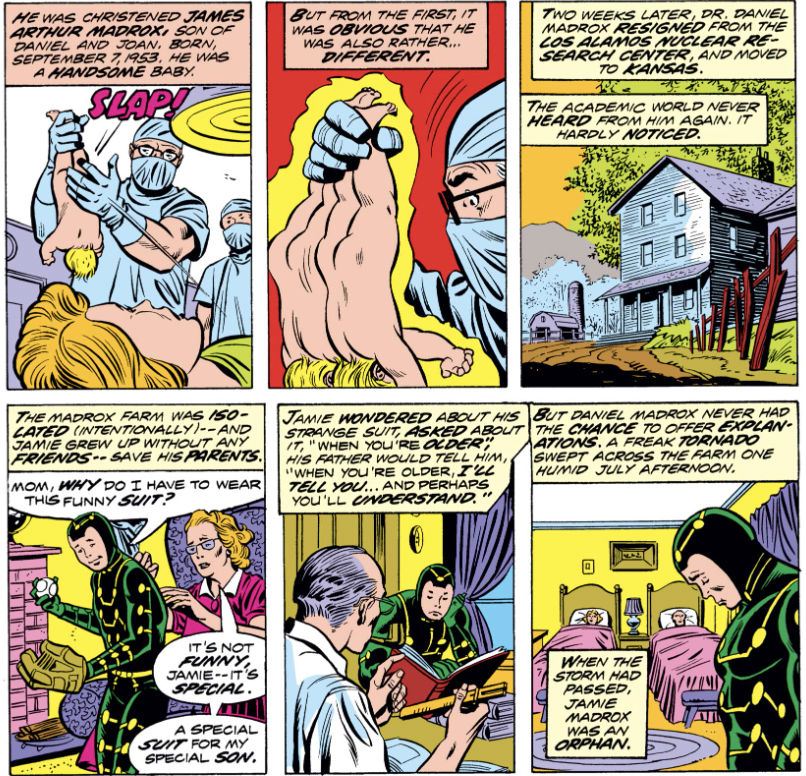
The appearance of Professor X reveals that Madrox is a mutant, although a flashback explains he developed his power as an infant, not at puberty as other mutants do (it’s later retconned to explain that he’s a “changeling,” a genetic predecessor of mutants).
There’s a certain deus ex machina quality to Prof X’s sudden appearance, although he seems strangely under-powered here. He does make good on his promise to look after Madrox, who next appears on Muir Island, without much explanation, in Claremont’s Uncanny X-Men 104 (art by the great Dave Cockrum with inks by Sam Grainger).
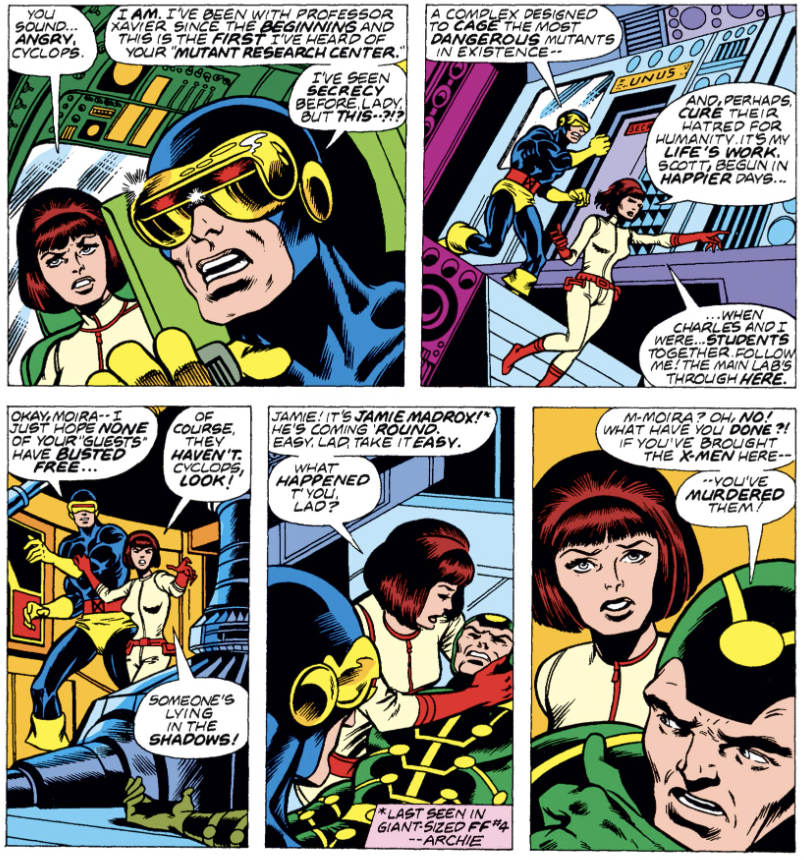
Years later he would become a significant player in X-Factor, and his “dupes” would become characters in their own right (I confess I’m not familiar with this era of the X-universe, so can’t really comment on how he was handled).
And at this point it perhaps goes without saying, but the Invisible Woman doesn’t appear in the comic, and Medusa is again a total non-factor.
Overall
A comic more interesting for its historical significance than its story.

