Fantastic Four 202 “There’s One Iron Man Too Many!” Published October 1978 Writer: Marv Wolfman Pencils: John Buscema Inks: Joe Sinnott Letters: Jim Novak Colors: Janice Cohen Editor: Wolfman Cover: Buscema and Sinnott
Synopsis
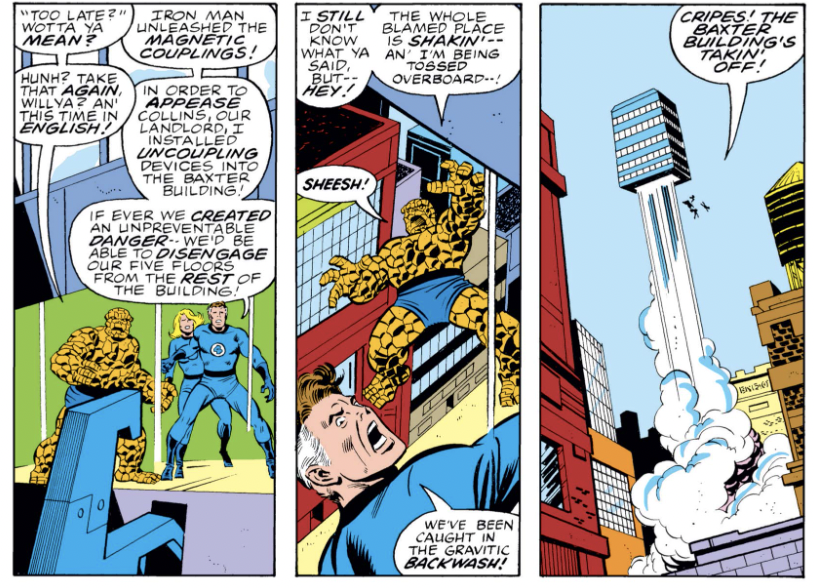
The Fantastic Four are attacked in the Baxter Building by a doppelgänger of Iron Man, who triggers a new device installed by Mr. Fantastic that allows the top six floors of the building to fly across the world (yes, really). The FF team up with the real Iron Man to track down their building and discover Quasimodo, an artificial intelligence, created a replica Iron Man and stole the Baxter Building to drain its power. After a battle, Quasimodo escapes into space in the FF’s rocket.
What’s going on here?
This issue is only notable because of the appearance of Iron Man, but the story makes clear there’s no legitimate reason for Iron Man to be in the comic. Quasimodo explains he needed a robot to serve as his arms and legs — makes sense! — but he could have built anything. It seems he chose a replica of Iron Man to compel Iron Man’s guest appearance in the comic. It’s the sort of plotting problem an editor could save a writer from making, but in this case, writer Marv Wolfman serves as his own editor. It’s a reminder that Wolfman is much stronger at dialogue and characterizations than in story telling, and another reminder (if we needed one) that writers need actual editors.
John Buscema fills in for Keith Pollard on pencils and delivers his usual steady work.
What I liked
Despite its practical impossibility, I liked the idea of the top floors of the Baxter Building shooting into the sky like a bottle rocket. And Reed’s explanation — that the landlord demanded some sort of failsafe to protect other tenants — actually makes sense.
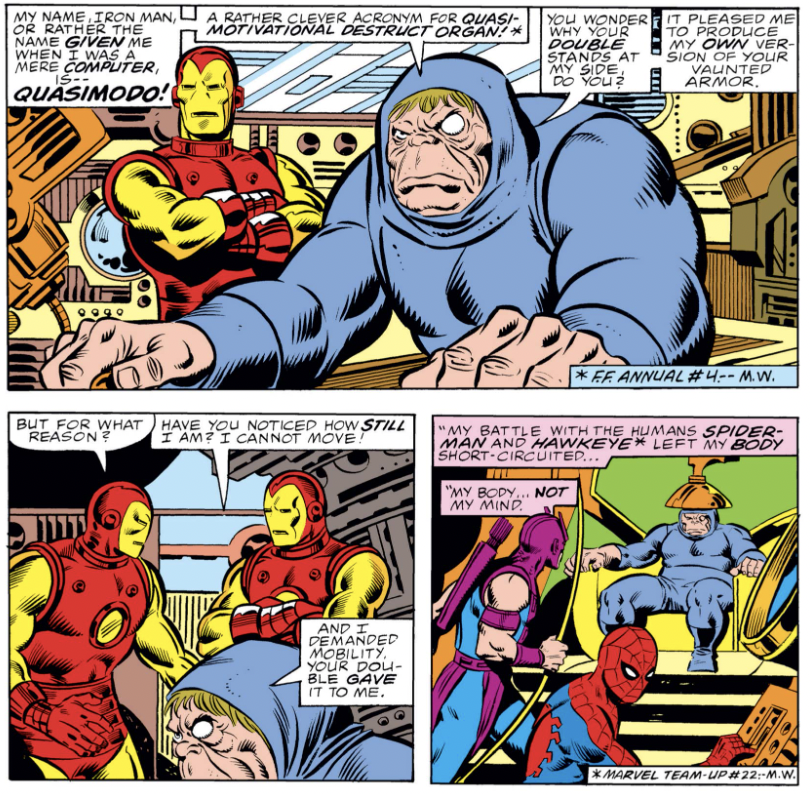
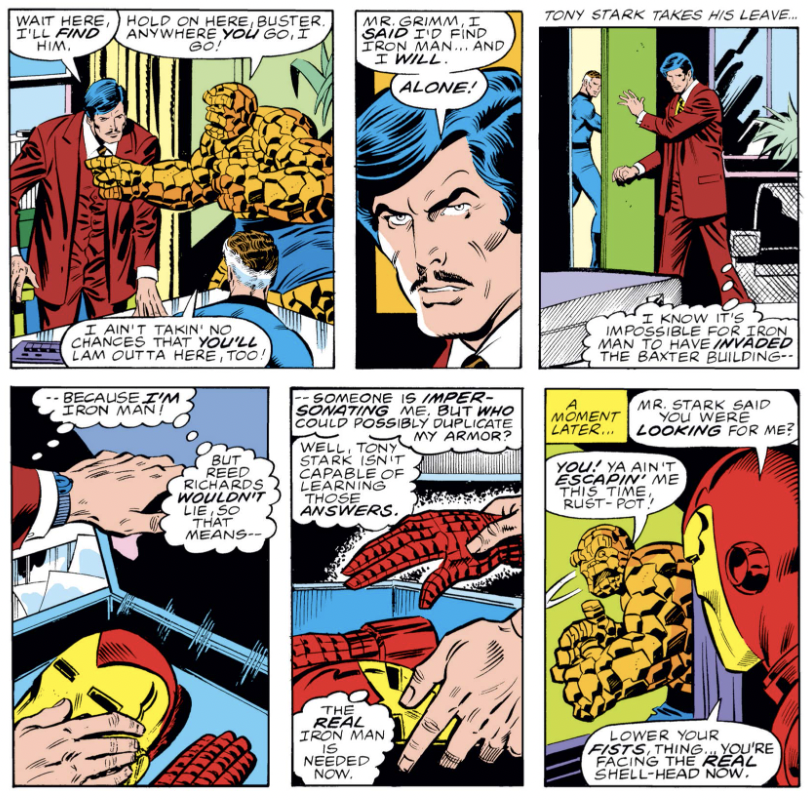
This scene with Tony Stark is a flashback to our pre-MCU concept of Iron Man, where everyone somehow accepted he was Stark’s body guard, despite them never being seen together.
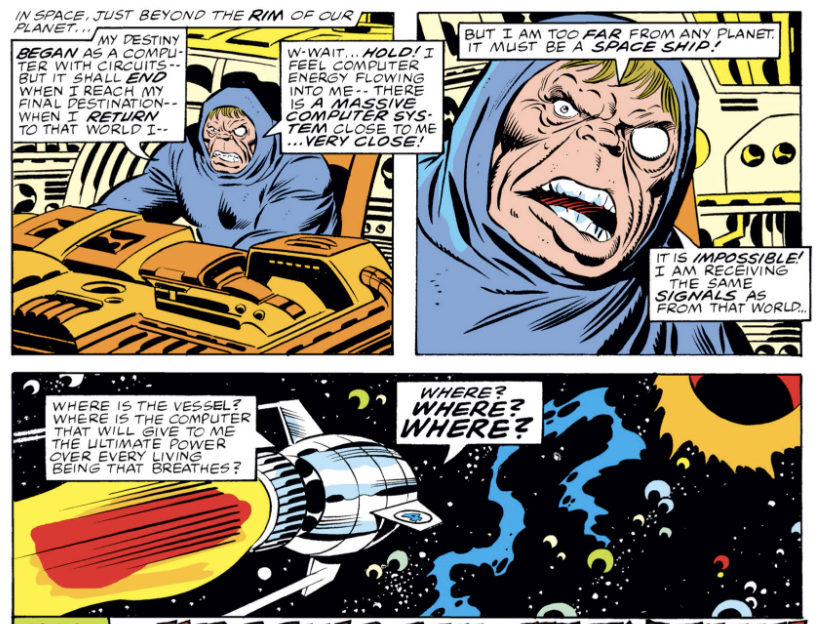
This cliff hanger ending was intriguing:
What I didn’t like
My big complaint is the dumbness of the story’s premise. But I’ve said my piece about that.
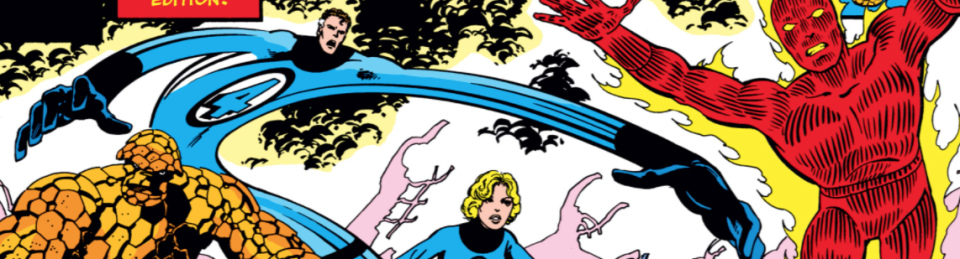
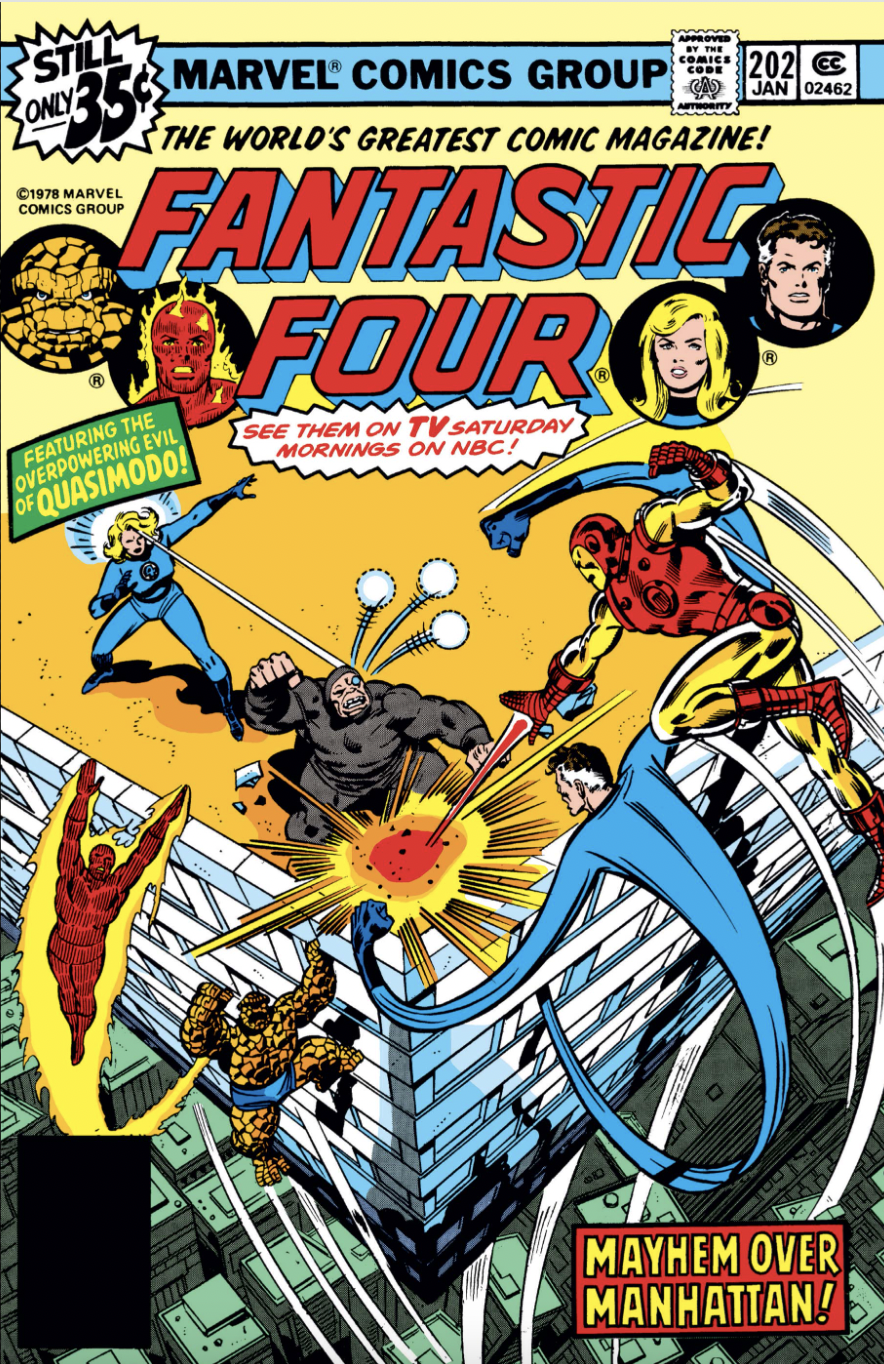
Also, I can usually accept that the image on the cover is meant as marketing, and doesn’t literally capture a scene from the comic. But it’s been a while since I’ve seen one this divorced from the events in the story. Even the the blurb — “Mayhem Over Manhattan! — is misleading.
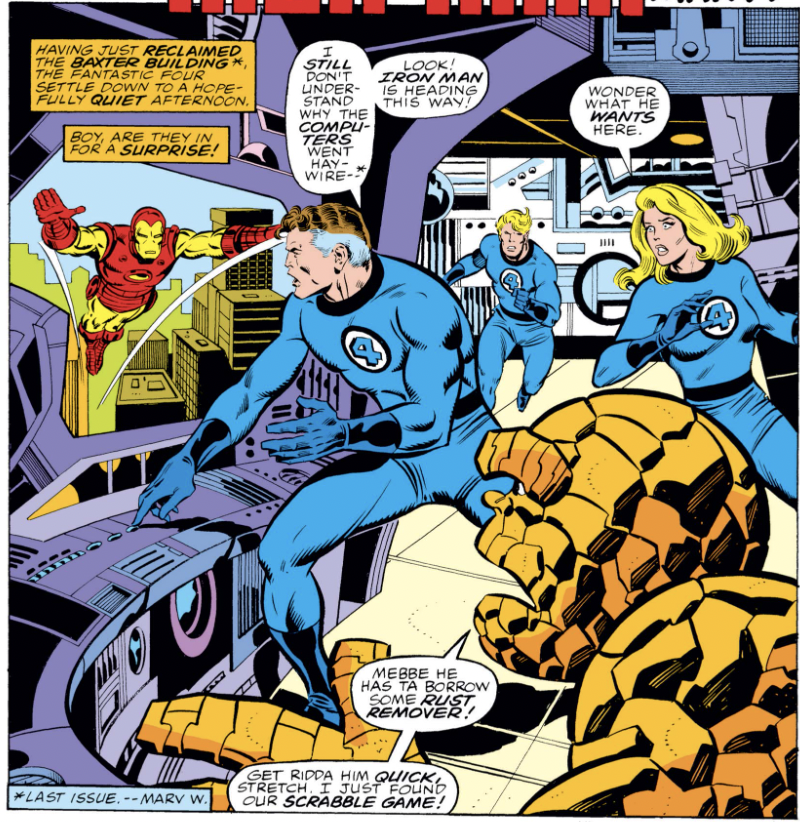
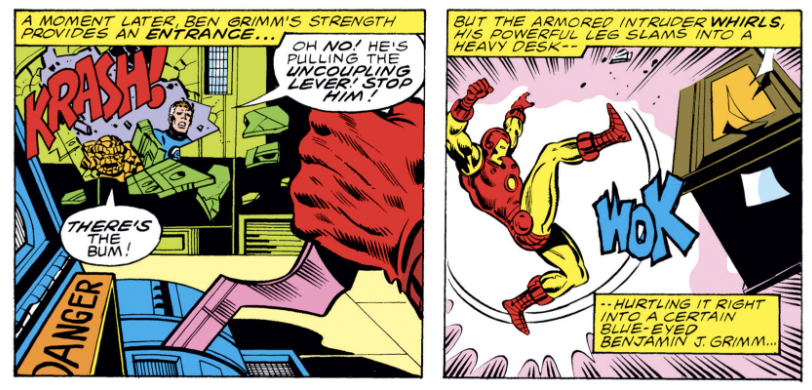
And why does the FF keep a wooden desk in their high-tech control room?
Anything else?
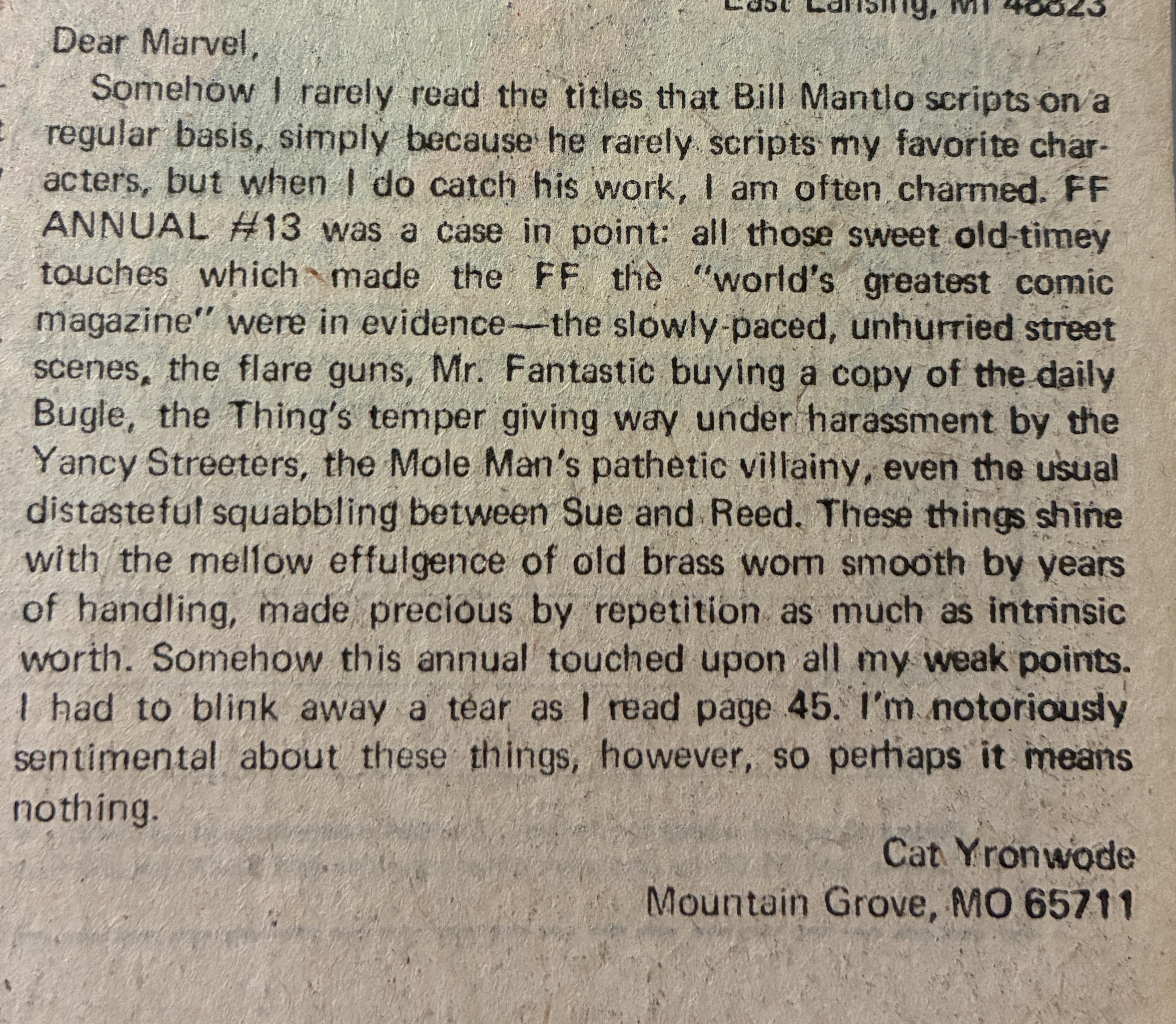
A very eloquent letter to the editor from Cat Yronwode, who would go to be the editor-in-chief of Eclipse Comics, among many other diverse and varied roles.
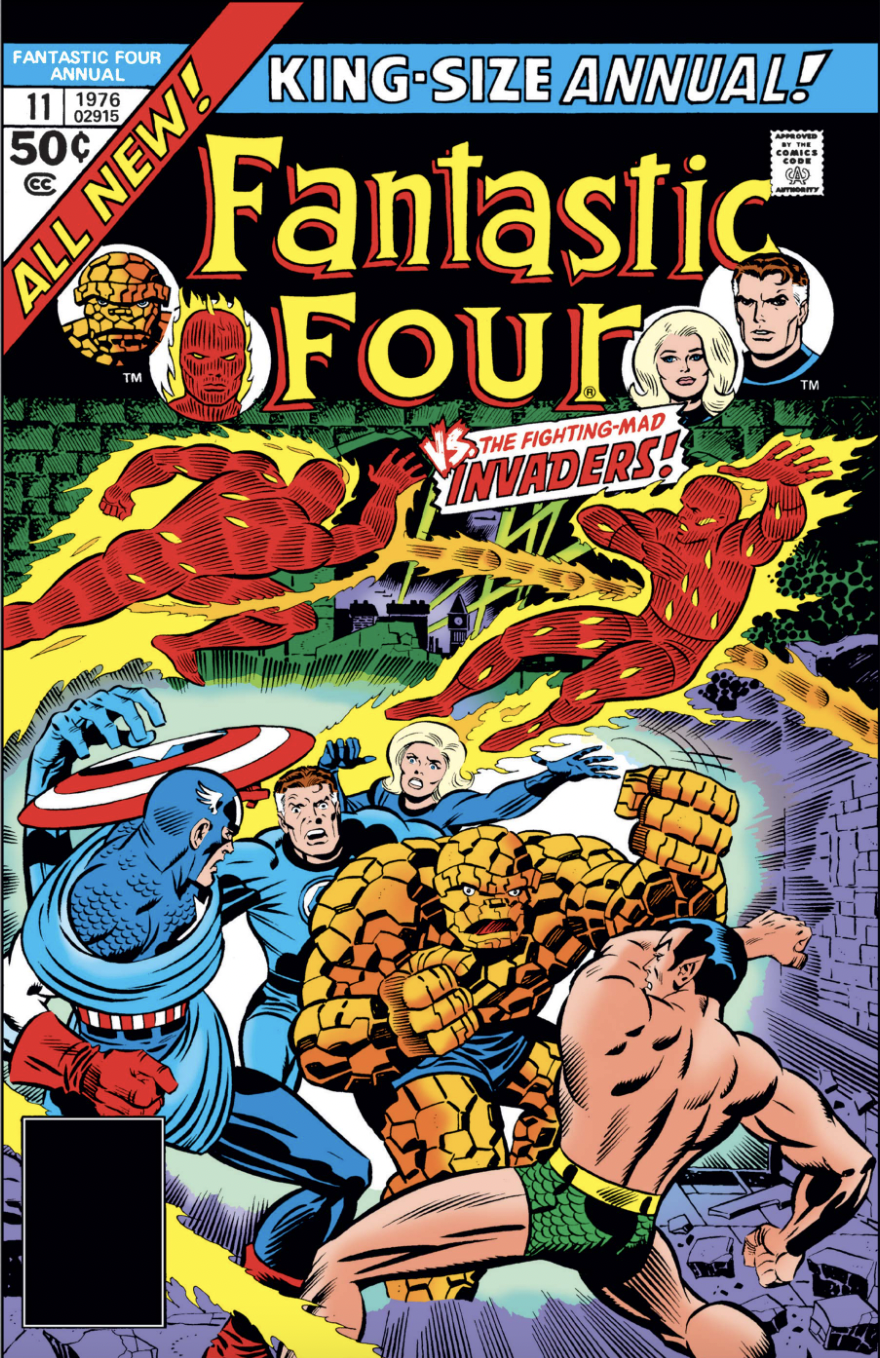
Fantastic Four Annual 11 “And Now Then the Invaders!” Published March 1976 Writer: Roy Thomas Pencils: John Buscema Inks: Sam Grainger Letters: Joe Rosen Colors: Phil Rachelson Editor: Thomas Cover: Jack Kirby and Joe Sinnott
Editor’s note: As I mentioned a while back, I am tackling this annual out of order, since it appeared after issue 170 and the end of the Power Man story arc. It’s basically a standalone story so it’s
Synopsis
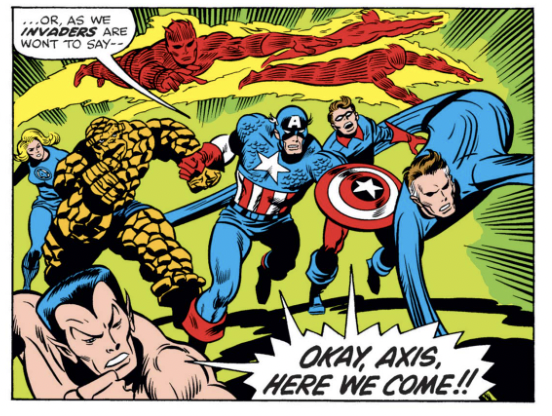
After a training exercise in the Baxter Building, the Fantastic Four discovers they accidentally triggered Dr. Doom’s time machine, and sent back a sample of vibranium to 1942 Germany. As a result, the Nazis were able to build more accurate rockets and conquer the world. The FF travel back in time and joins the WW II super hero team The Invaders to storm Baron Zemo’s castle and thwart his plan to launch the souped up missiles at London. After recovering the vibranium and restoring history, the team returns but the Thing realizes not all the vibranium made it back.
What’s going on here?
This is a fun but uneven comic with a lot to unpack. Notably, it’s the first FF annual with new content since the great Fantastic Four Annual 6 way back in 1968 (there were some Giant-Size FF’s that served the purpose of annuals, although they appeared quarterly).
It’s also the first time the FF encounters the Invaders, a team invented by Roy Thomas that ret-conned a number of World War II-era heroes into a super team. (He may have based his idea on the All-Winners Squad, a Golden-Age comic with some of the same members, but that was released in 1946, after the war). The Invaders debuted in its own comic in 1975 and given all the times the FF comic was used goose the sales of other Marvel titles, it’s probably not too surprising Thomas engineered a cross-over between the two titles.
Thomas had a decades-long fascination with World War II super heroes. Along with the Invaders, he created the Liberty Legion, a sort of B-team led by Bucky that appeared in Marvel Premier. Later, at DC in 1981, he created the All-Star Squadron, a massive team that spun out of the Justice Society and contained just about every Golden Age DC character. Also at DC he created Young All-Stars, a post-crisis version of the All-Star Squadron (which theoretically no longer existed).
In typical Thomas-ian form, Fantastic Four Annual 11 is more convoluted than it needs to be, with lots of exposition and obscure call backs. But it’s also a rollicking read, with clever nods to the paradoxes of time travel and to the novelty of the FF reuniting with characters like Namor and the original Human torch.
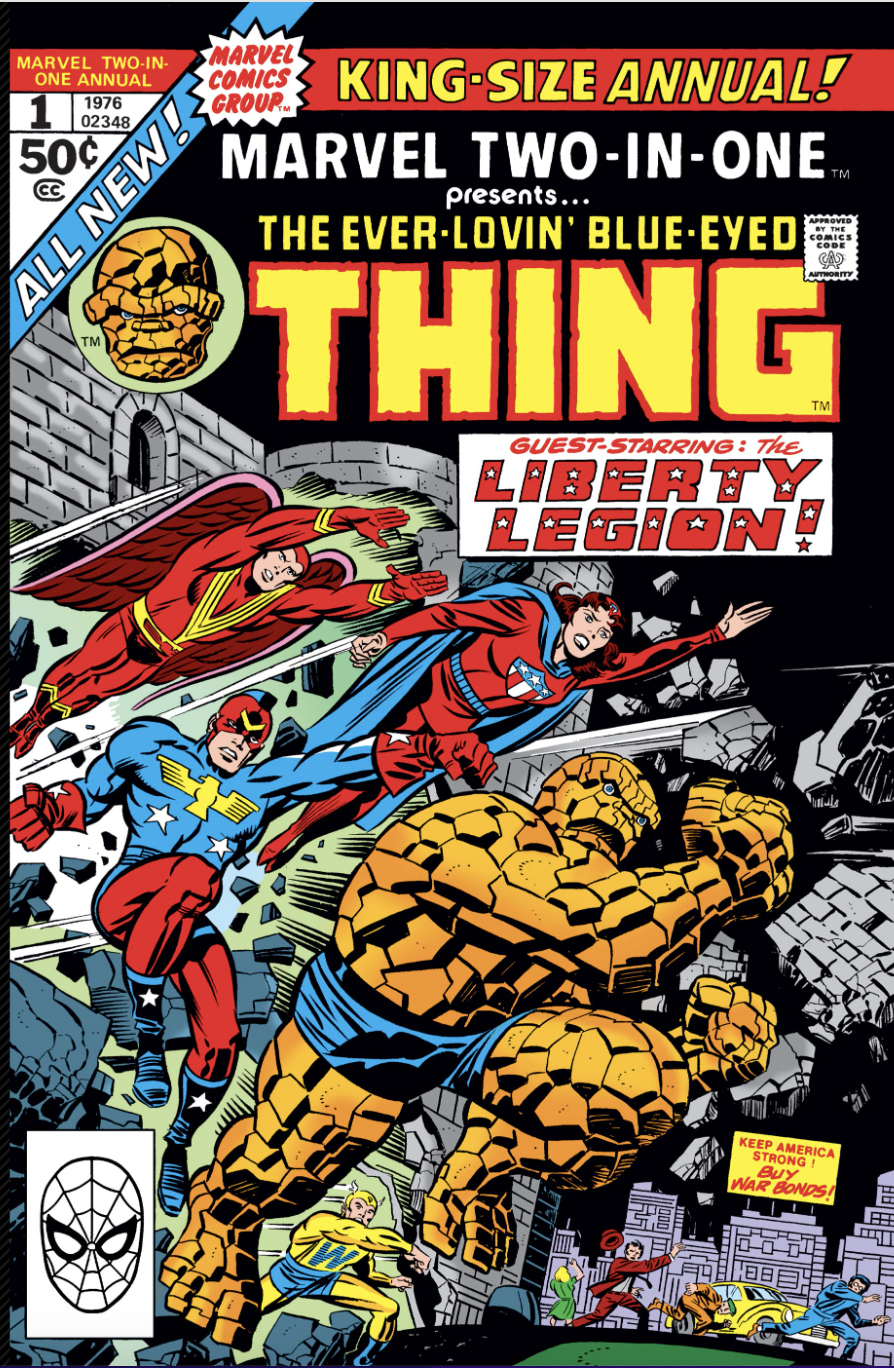
In a twist, the story ends on a bit of cliff-hanger, when Ben learns that he has to go back to World War II, a story which takes place in Marvel Two-In-One Annual 1 and features the Liberty Legion.
Fantastic Four Annual 11 is also the first and only work on the FF by inker Sam Grainger, over John Buscema’s pencils. Grainger, who had a two-decade career on titles from Charlton, Marvel, DC and First comics, does serviceable work here. The cover is by Jack Kirby and Joe Sinnott.
What I liked
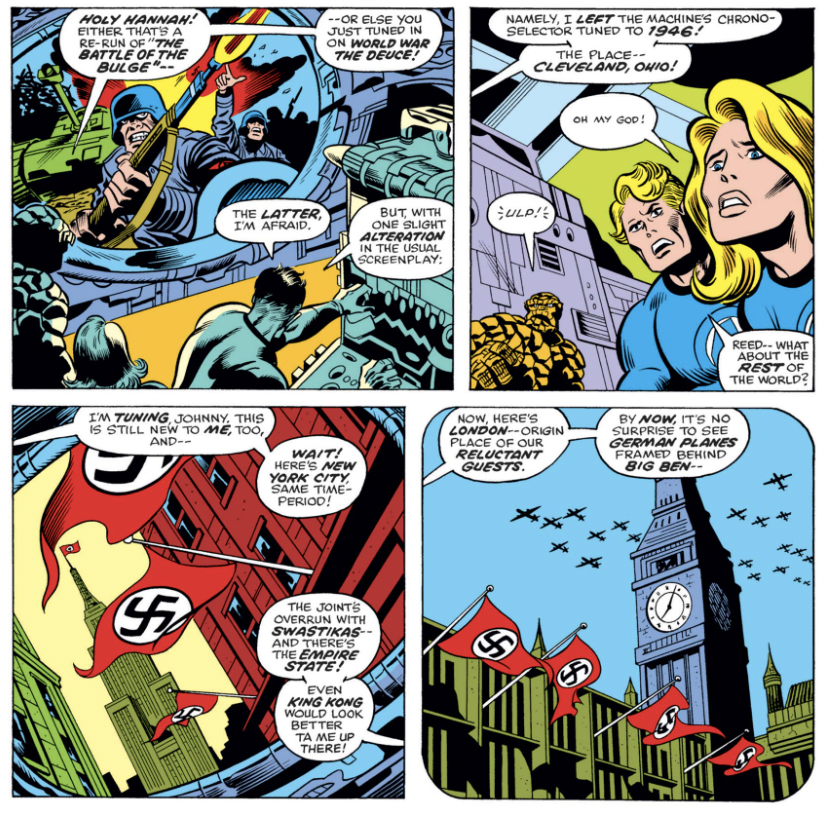
As a concept, the story works well. While the details are a little hard to swallow — the FF just happens to knock a tube of vibranium onto the time machine and they just happen to accidentally trigger it and send the tube back to 1942 where it just happens tp fall into the hands of Nazi scientists— the premise is fun. The idea that all Germany needed was more precise rockets with which to defeat Britain, and that vibranium was the one missing ingredient, is an intriguing one and nuanced enough to make the story more effective. It’s another entry in the long line of “What if Hitler won?” future histories covered by authors ranging from Len Deighton to Phillip K. Dick. The panels of the swastikas hanging in New York and London are chilling:
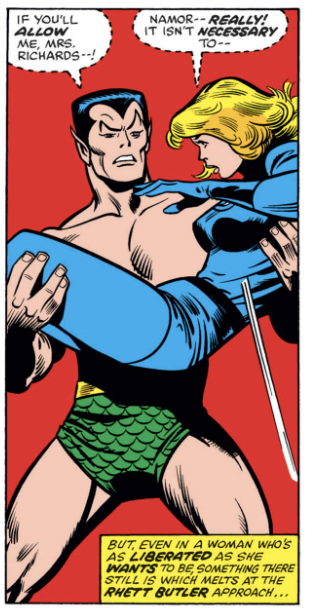
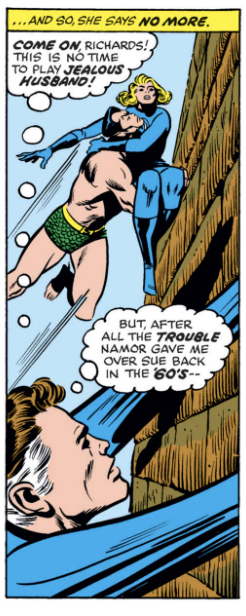
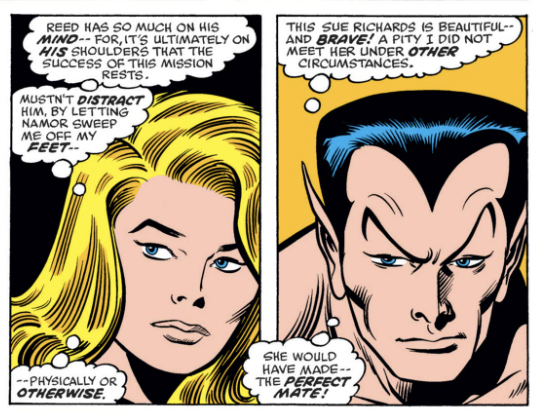
The story also reunites Sue and Namor, leading to some uncomfortable moments for Reed:
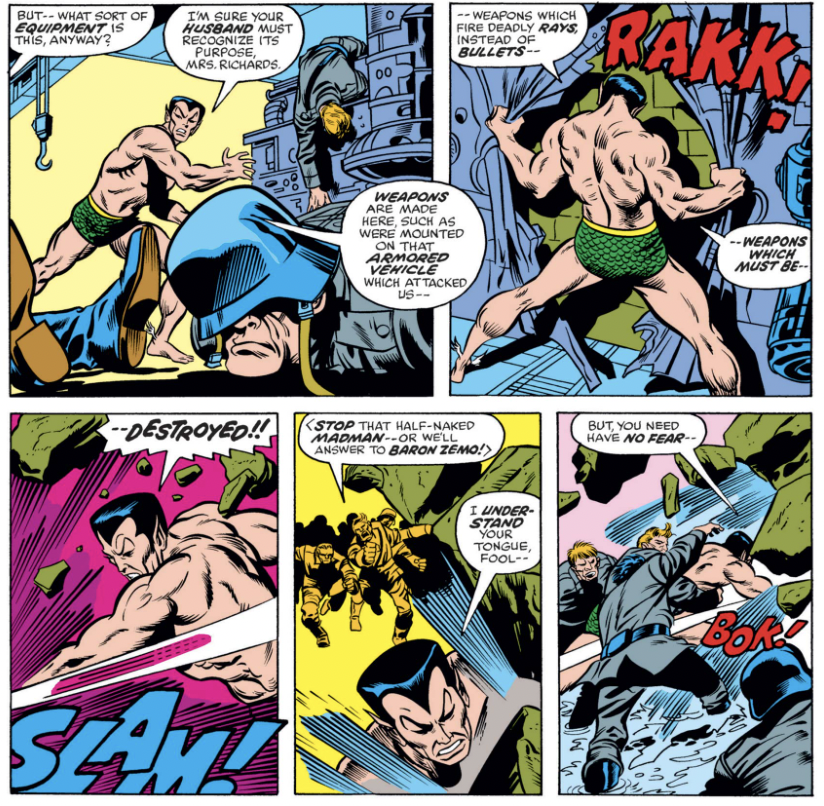
I also liked this sequence of Namor going all-out against the Nazis:
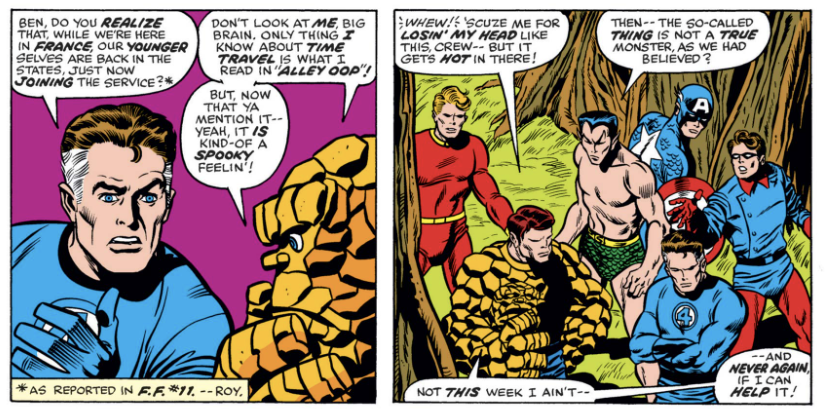
There is a lot of banter in this comic, some better than others. I liked this exchange between Ben and Reed, and Ben’s comments are poignant, given what we know is to come (note how different Reed looks when he isn’t inked by Joe Sinnott). “Alley Oop” was a newspaper comic strip.
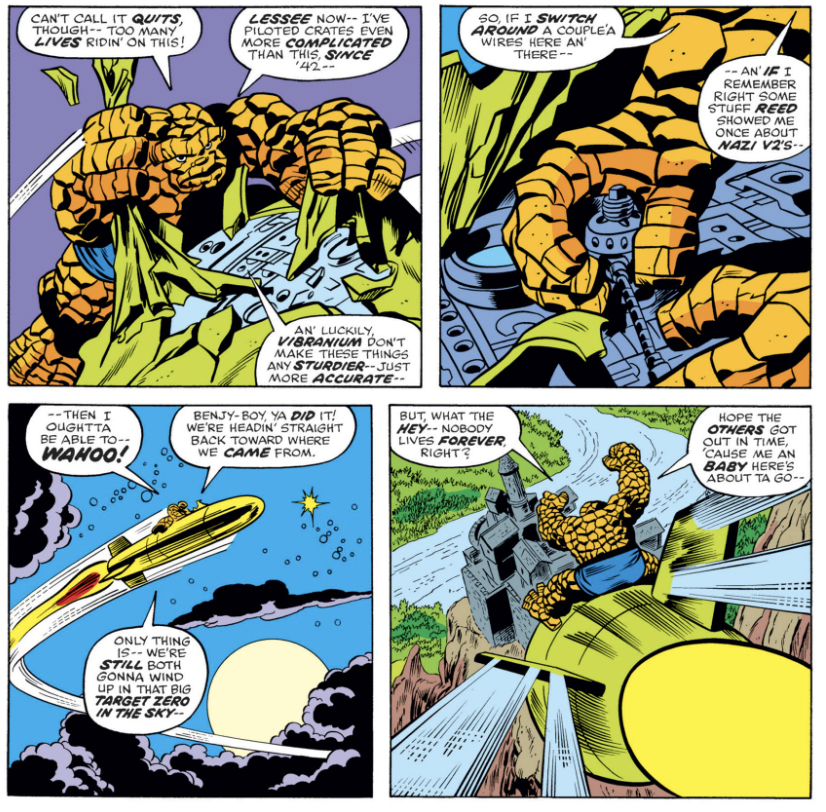
This climactic sequence was ridiculous but fun.
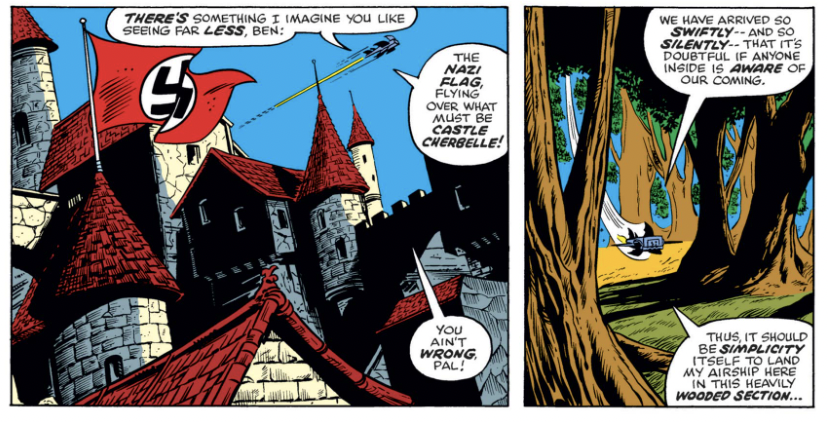
This is a nice series of panels from Big John Buscema:
What I didn’t like:
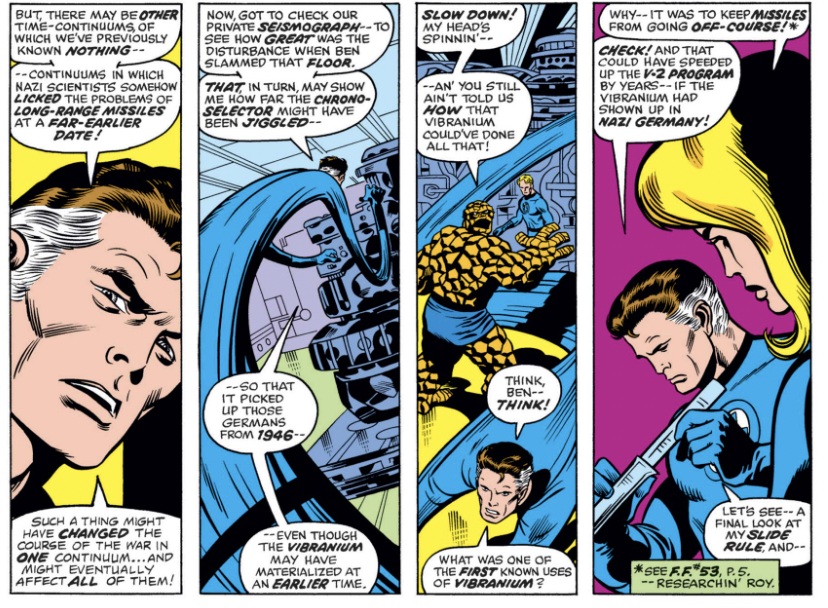
There is a lot of heavy-handed explanation in this comic. This sequence is an example:
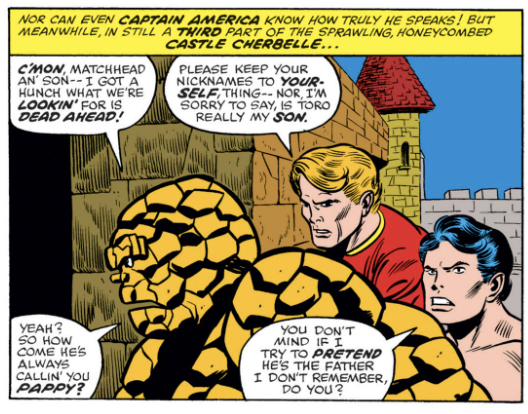
This was weird and awkward:
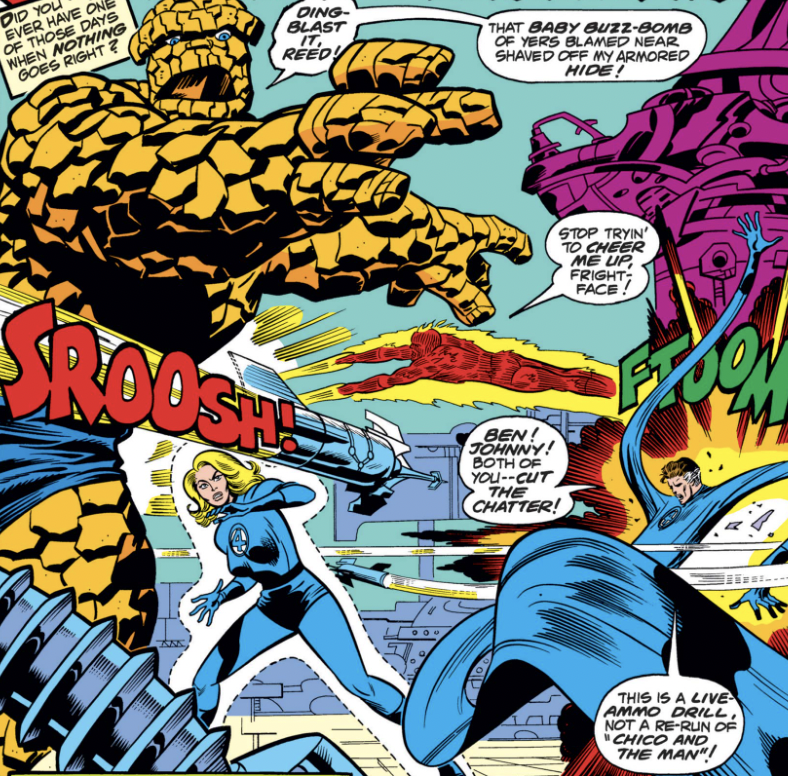
As I mention, not all banter is successful. Does Reed really watch Chico and the Man?
Anything else?
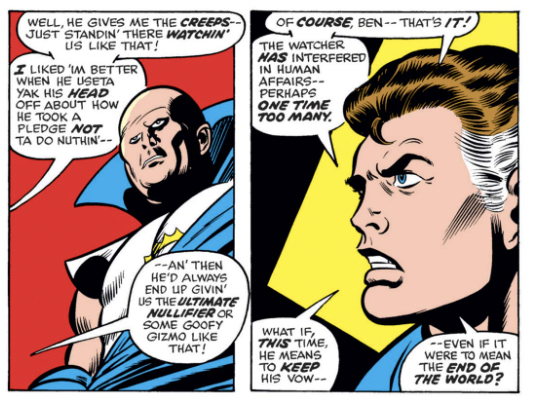
There are a few instances where Thomas seems to be poking fun. Here, Ben expresses what we all think about the Watcher, who seems to break his vow of non-interference more often than he upholds it:
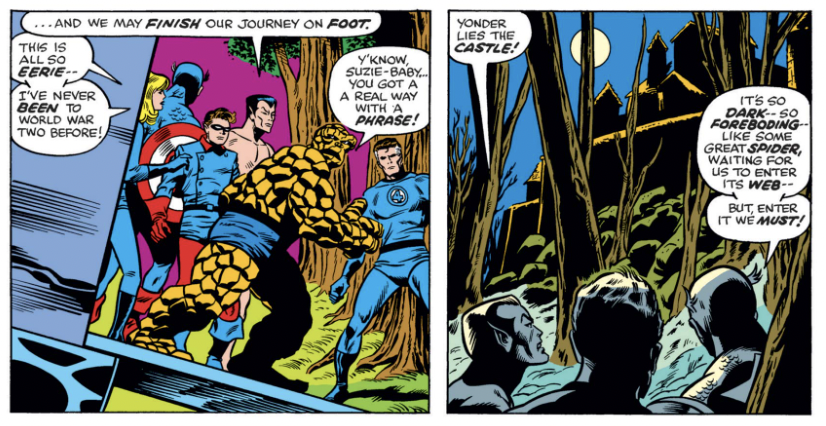
And here, alongside a totally inane comment from Sue, Namor seems to echo a line made famous by Tony Curtis, “Yondah lies the castle of my faddah” (although that appears to be an urban myth – Curtis never said that line).
Fantastic Four 175 “When Giants Walk the Sky!” Published July 1976 Writer: Roy Thomas Pencils: John Buscema Inks: Buscema Letters: Joe Rosen Colors: Jan Cohen Editor: Thomas Cover: Jack Kirby and Joe Sinnott
Synopsis
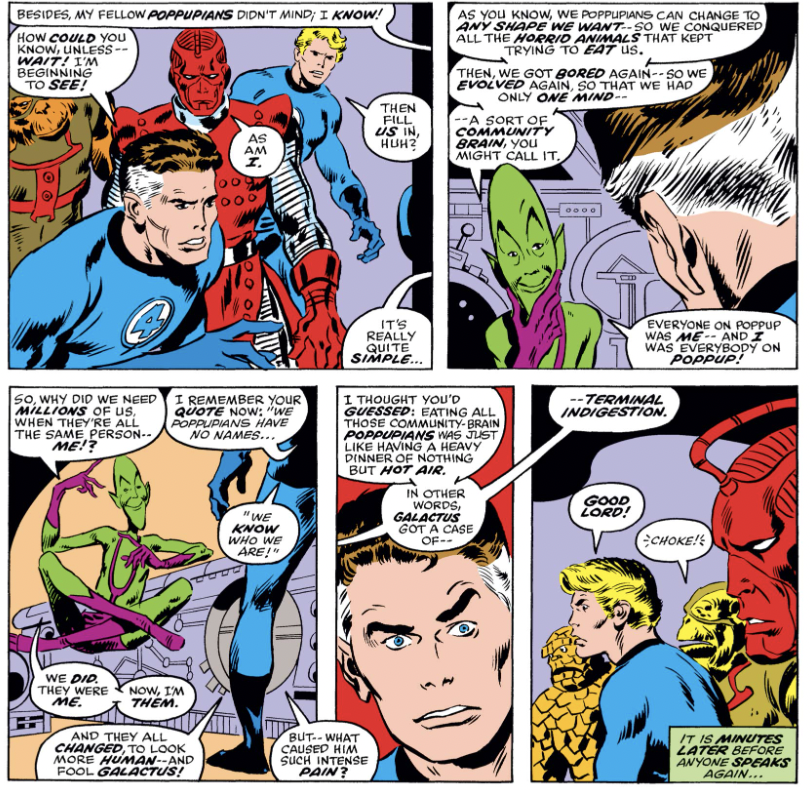
The High Evolutionary, with the help of the Fantastic Four, attempt to stop Galactus from devouring Counter Earth. At the last moment, the Invisible Girl seemingly appears and offers Galactus a new world, one she has just returned from. Galactus agrees, but after consuming it, becomes incapacitated and the High Evolutionary de-volves him to a state of pure energy. The Invisible Girl is revealed to the the Impossible Man, who offered his own planet Poppup to Galactus because his people’s shared consciousness means they had no need for a planet. The real Invisible Girl returns and lastly, Ben Grimm reverts to his Thing form, a result of Galactus zapping him with cosmic energy.
What’s going on here
This issue is very much a mixed bag. There’s some clever ideas here and the long-awaited confrontation between the High Evolutionary and Galactus begins on a strong note, but like many of Roy Thomas’s arcs, it fizzles out anti-climactically. The Impossible Man reveal feels too deus ex machina (although it’s totally in keeping with Thomas’s love of obscure call-backs) and the idea his people would sacrifice their planet makes little sense. Unlike the stories of the Lee / Kirby era, where Reed would whip up some solution to save the day, Thomas delivers another storyline where the FF are reduced to spectators as events swirl around them.
One note on the art: John Buscema handles both pencils and inks, filling in for Joe Sinnott. As a result, his characters look a bit more Busecma-esque (in fact, in some places they look as if they were drawn by Sal Buscema, John’s younger brother). Check out the close up of Reed below.
I was surprised to learn this was only the second appearance of the Impossible Man, a character so annoying it feels like he’s always showing up. Marvel’s version of Mr. Mxyptlk — another insufferable character — he first appeared way back in FF 11, and will hang around for the next several issues. I will try to keep an open mind but I am dreading these stories.
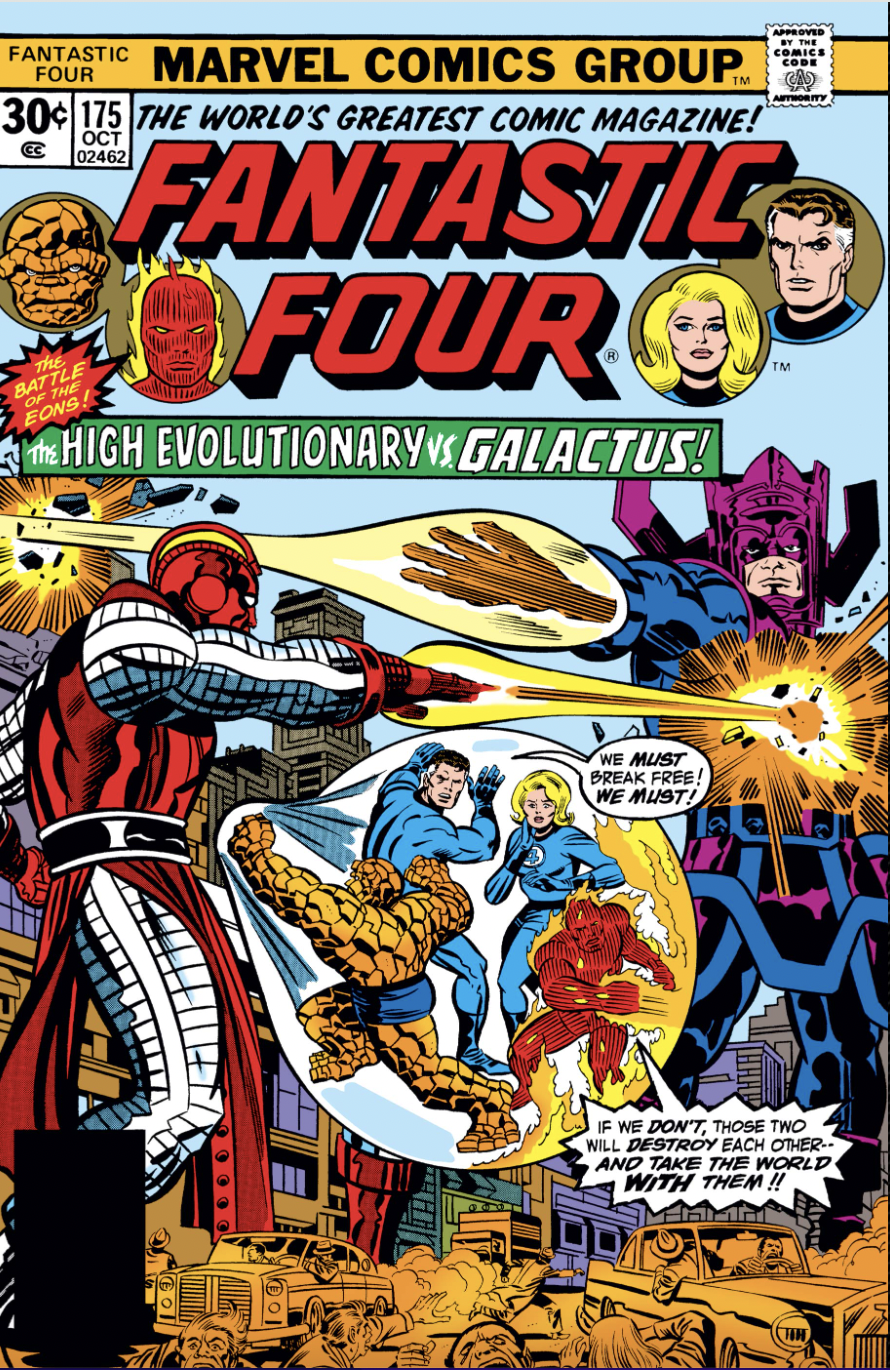
Kirby and Joe Sinnott return for the cover, which is stronger than their last few.
What I liked
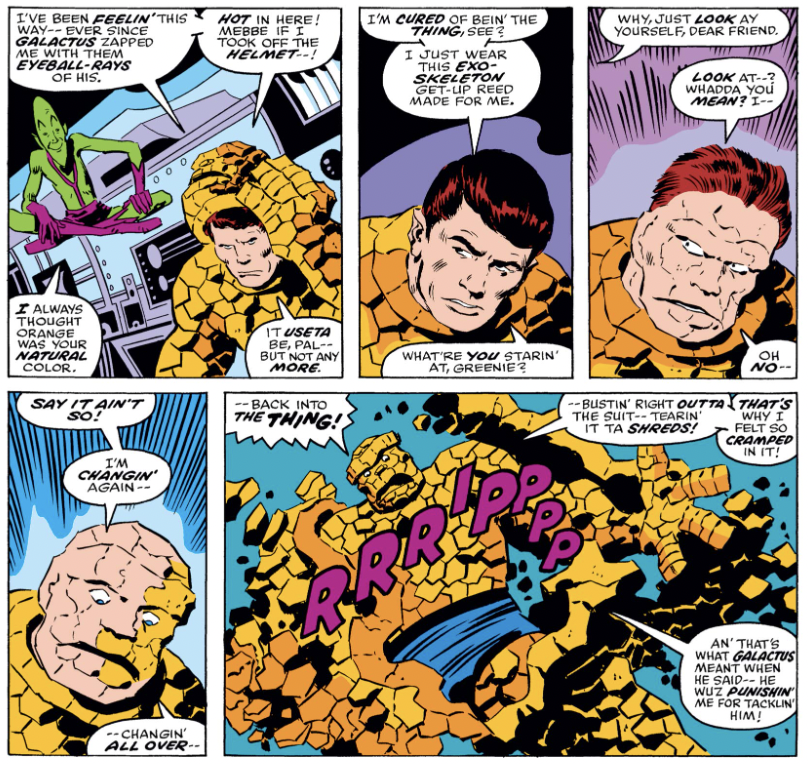
Ben’s reversion back to his Thing form at the hands of Galactus was well done. Ben wasn’t going to remain in the exoskeleton forever, and if Thomas needed a mechanism to change him back, the wrath of Galactus feels like a good choice.
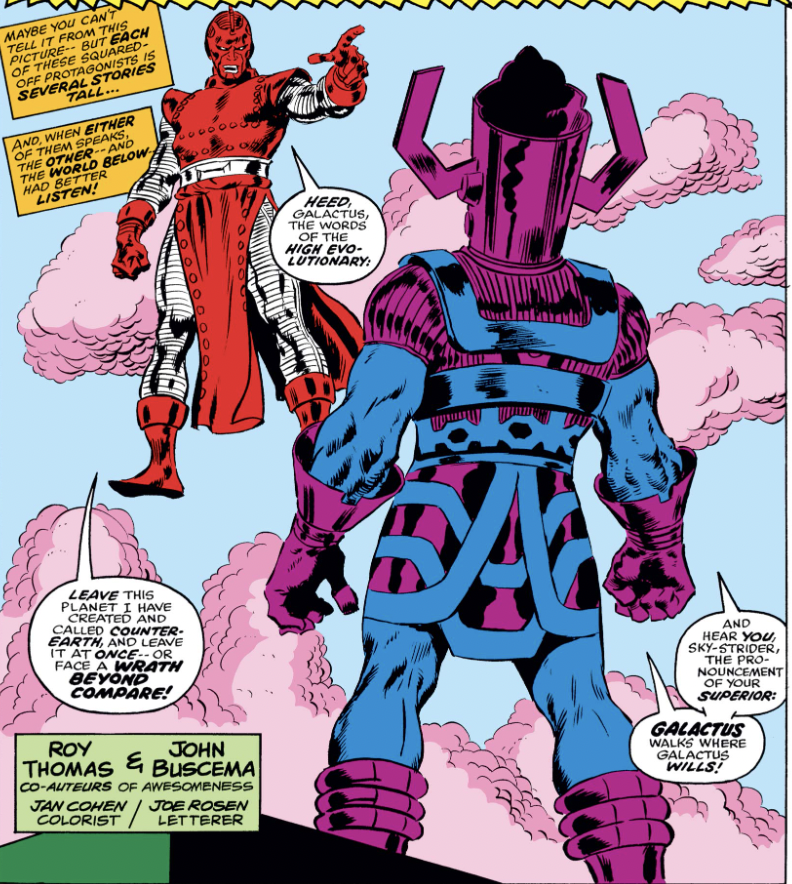
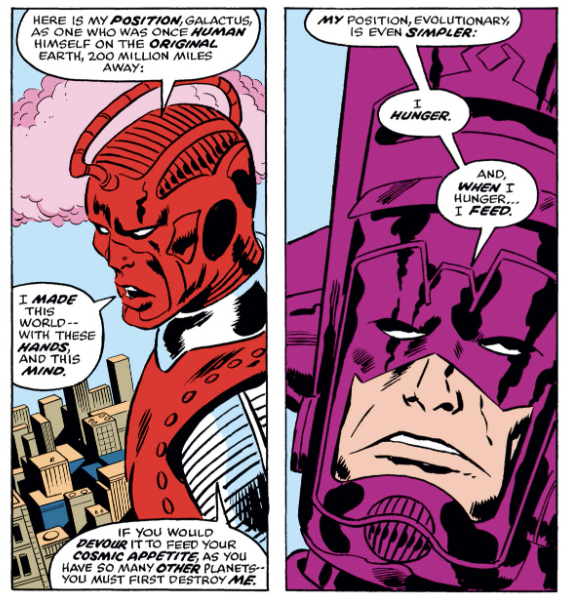
I also liked the posturing and pompous boasting between the High Evolutionary and Galactus. This was the clash this arc promised, but besides a few panels, didn’t really deliver.
What I didn’t like
I’ve detailed my bigger complaints with this issue above, but here are few other nits to pick:
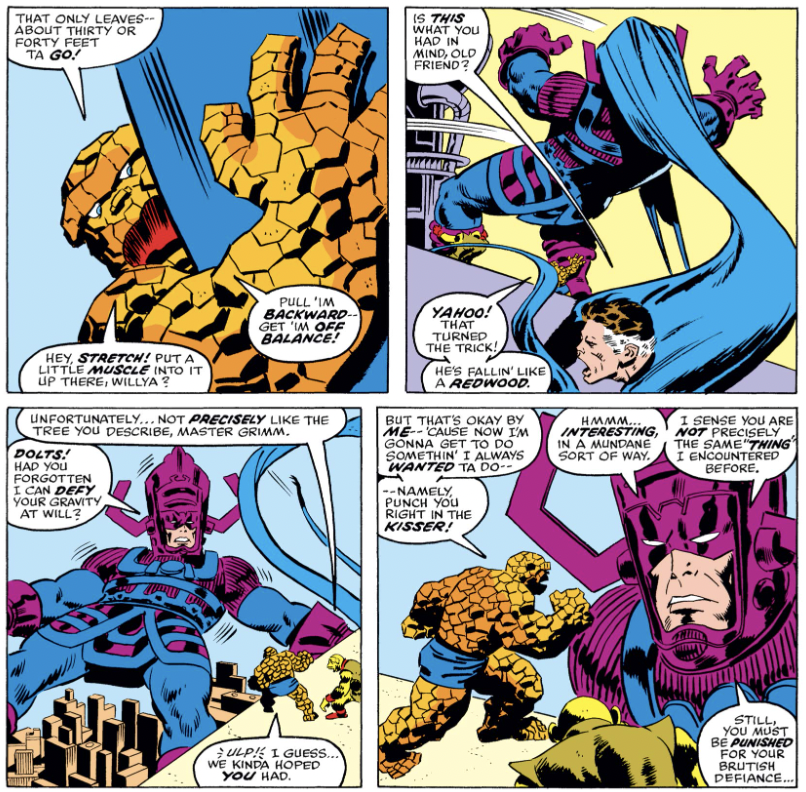
As I’ve mentioned, I hate it when writers force Galactus into physical fights with lesser foes. He should be above such things.
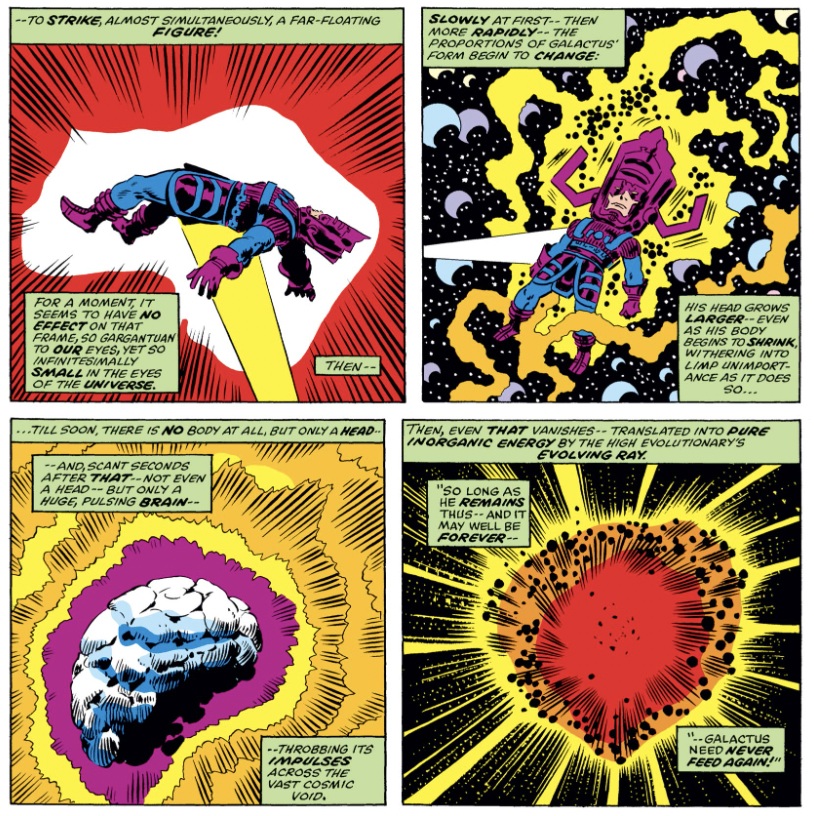
The devolution of Galactus was also peculiar. It’s an interesting way to remove him from the board (although of course it won’t be permanent) but I’m not sure it’s very successful.
Anything else?
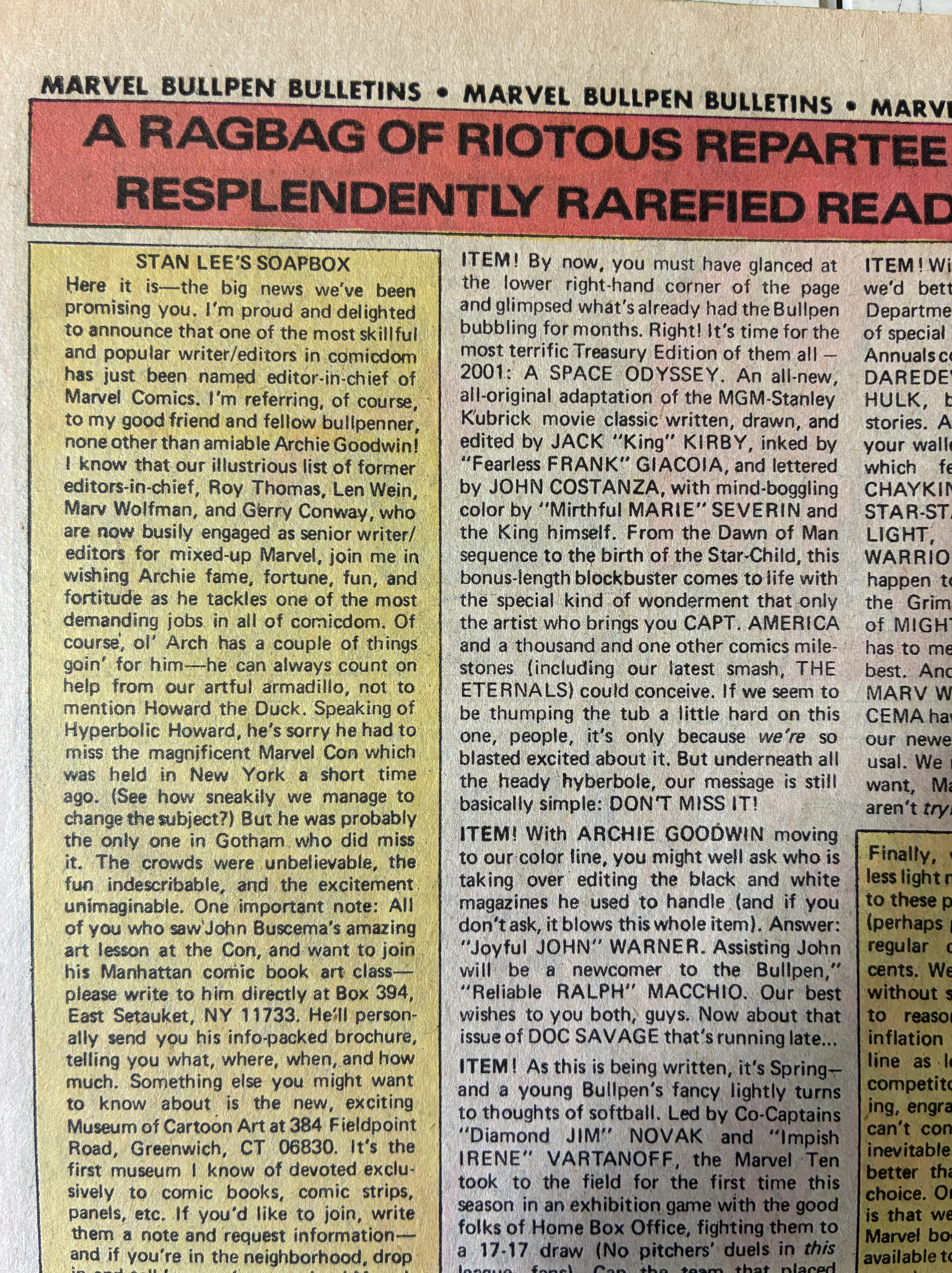
Here’s a Bullpen Bulletin notice that Archie Goodwin is taking over as editor, the fifth in four years in an era that led to lots of instability in the comics. This run of editors reminds me of late Rome, where emperors were crowned and deposed every few months.
Goodwin would last two years before he was replaced by Jim Shooter, who will hold the job for a decade and put his own stamp, for better or worse, on Marvel and comics in general.
Fantastic Four 174 “Starquest!” Published June 1976 Writer: Roy Thomas Pencils: John Buscema Inks: Joe Sinnott Letters: Joe Rosen Colors: Janice Cohen Editor: Thomas Cover: Jack Kirby and Frank Giacoia
Editor’s note: This may be the last blog update for a few weeks. I will be traveling and it’s unlikely I’ll have time for blogging while I’m on the road. Hang tight, we will wrap up this arc when I get back!
Synopsis
Frustrated that the High Evolutionary won’t act to rescue the rest of the Fantastic Four, the Invisible Girl uses his machinery to teleport herself to them, only she sends herself to the wrong planet where she risks running out of air. Meanwhile, on the planet Mekka, the Thing and Mr. Fantastic escape from Torgo and and subdue his world of robots, only to free them rather than have them consumed by Galactus. Torgo, in turn, gives them permission to leave. And on the medieval planet, where the Human Torch and Gorr the gorilla were captured, it is soon revealed the inhabitants were Skrulls play-acting as knights of the round table. With no planet available to serve up to Galactus, the High Evolutionary prepares to battle him.
What’s going on here?
This is the fourth installment in an arc that will reach five issues, making it one of the longest since the end of the Lee / Kirby era. This comic didn’t have the same energy as the previous issue, but it’s still a satisfying story and a solid prelude to the fifth and final issue. The Skrull reveal is a fun twist, and there’s nice pieces of character development throughout.
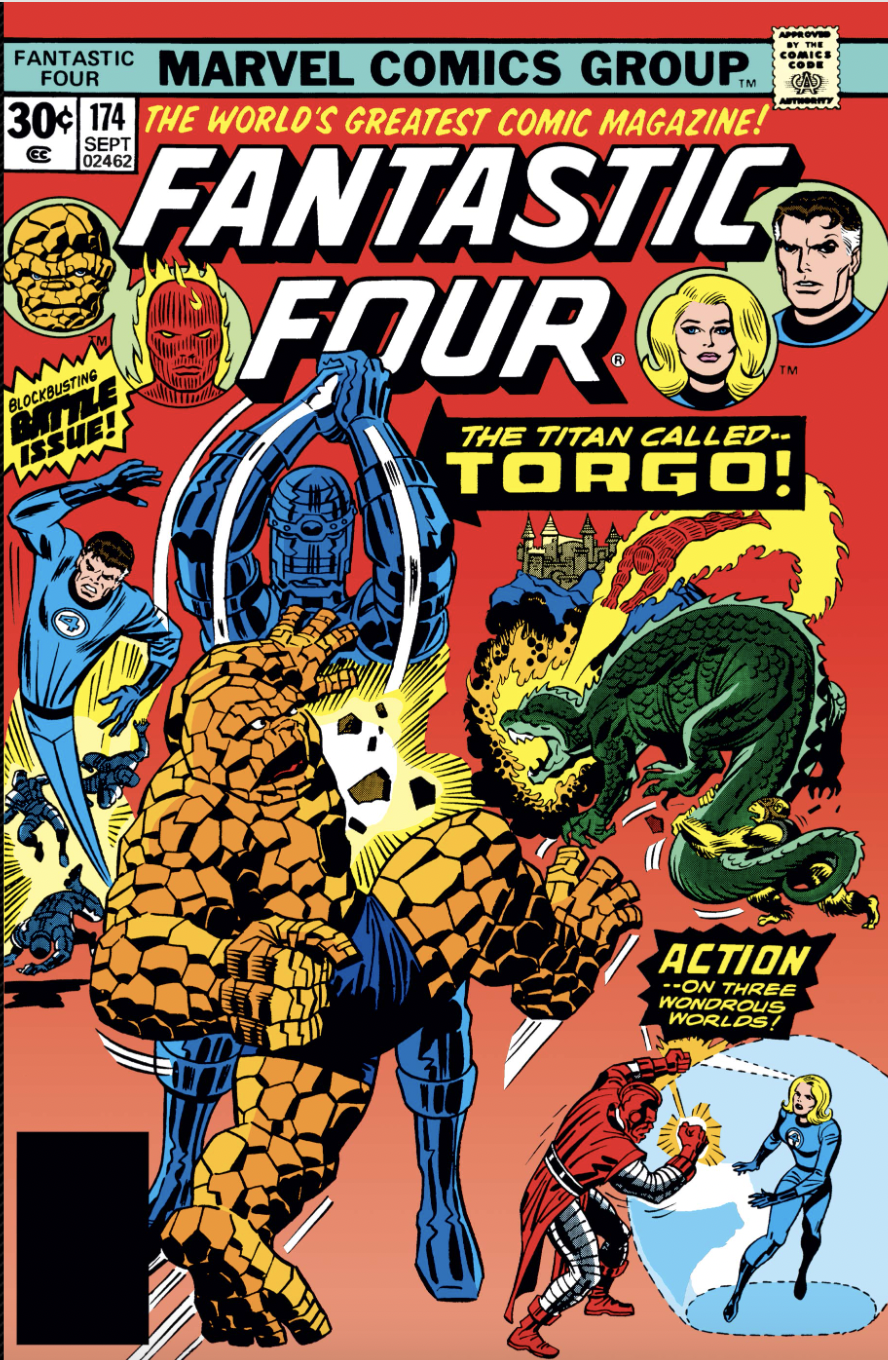
John Buscema returns as a fill-in artist, with mixed results (more about that later). Jack Kirby turns in another lackluster cover (inked by Frank Giacoia) and colorist Janice Cohen makes her Fantastic Four debut.
What I liked
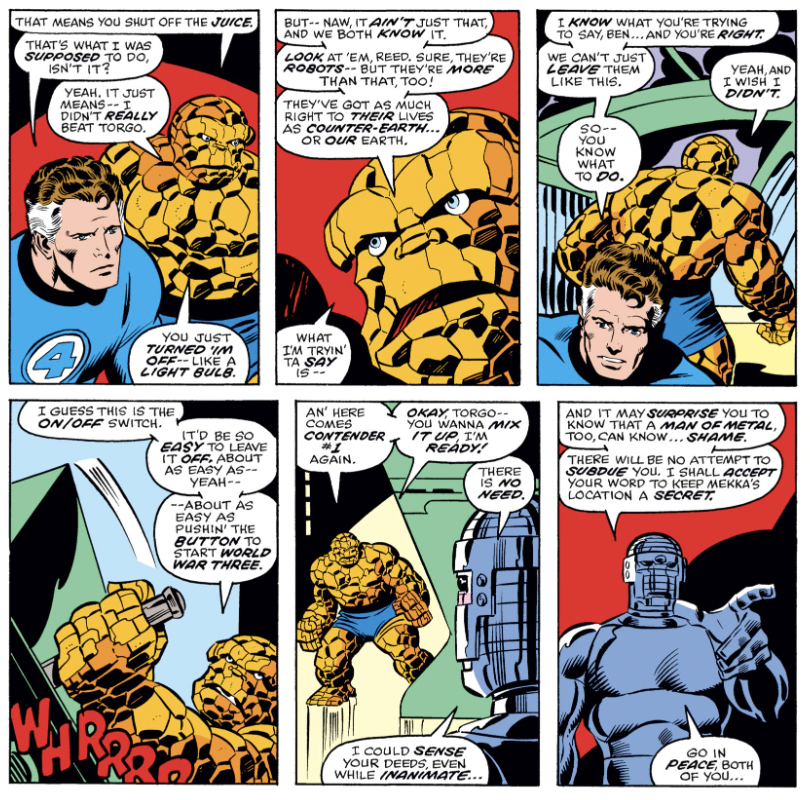
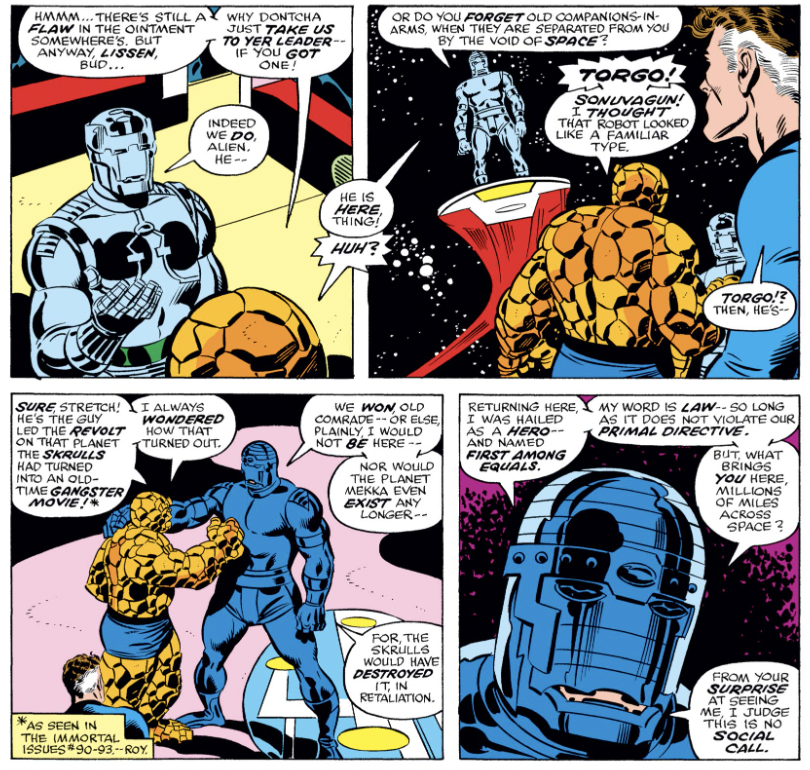
The resolution with Torgo was well handled. After engaging in a fight neither side really wanted, the parties reach an understanding based in mutual respect.
Torgo hangs around as a peripheral Marvel character for decades, appearing in a comic as recently as 2019.
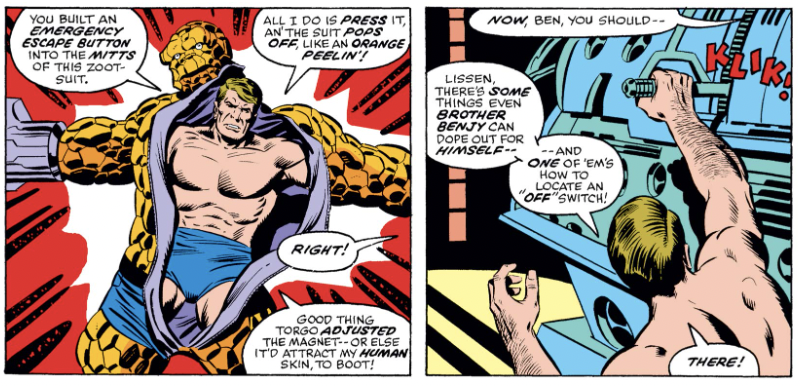
The entire sequence with Reed and Ben on Mekka was nicely done, starting with Ben’s escape from his ex-skeleton, which creates an odd visual.
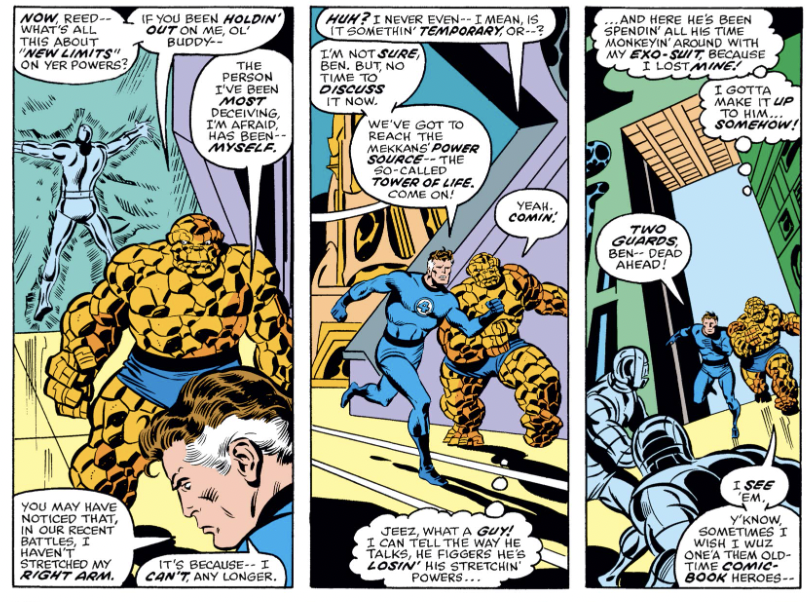
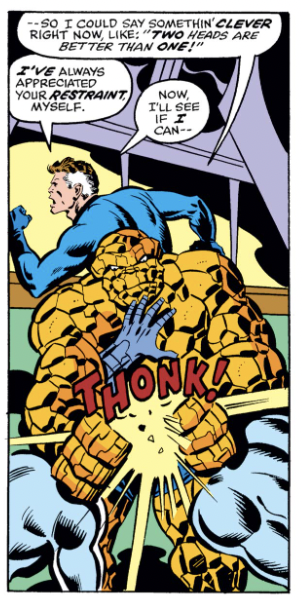
The banter between Ben and Reed continues with Reed’s admission that his powers no longer work properly, while Ben disguises his concern with another wisecrack where Reed plays along.
What I didn’t like
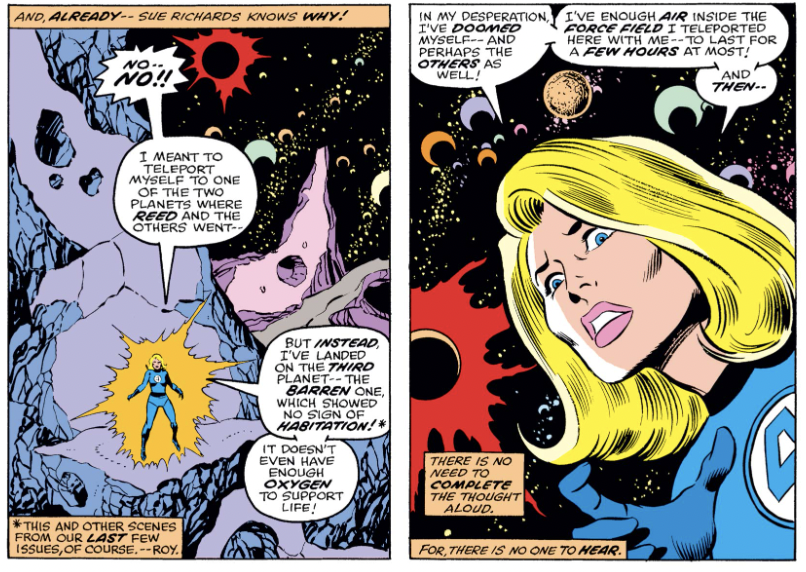
After being left out of the action in the last issue, Sue takes the initiative, only to end up stranded. Once again her powers and abilities are squandered.
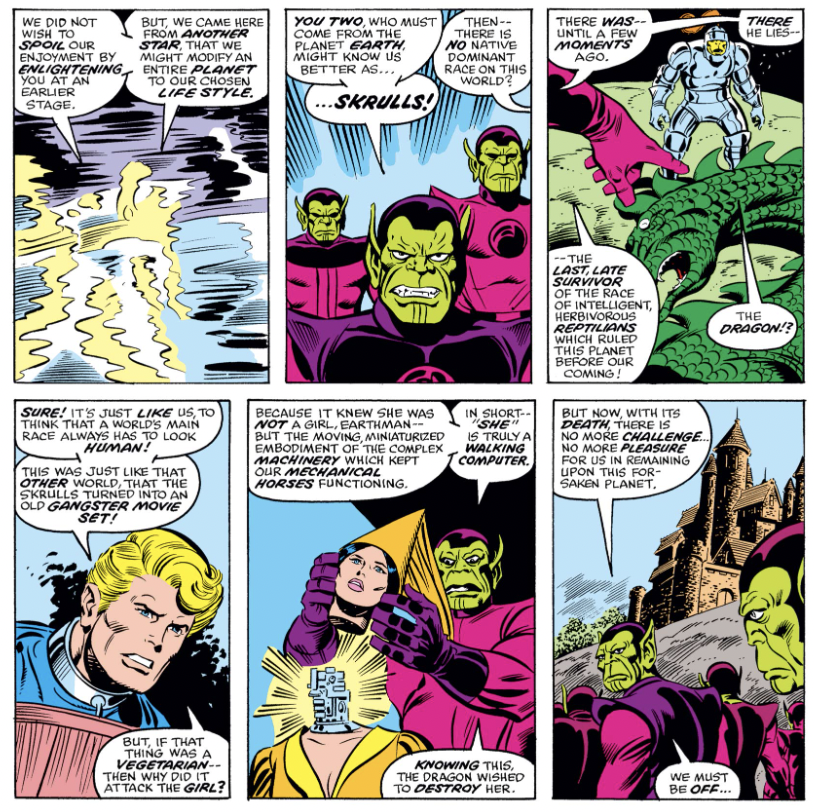
While the Johnny / Gorr arc was quirky and amusing, it’s resolution was crammed into six panels that revealed the RenFaire people were Skrulls, that the dragons were intelligent vegetarians, that there was only one left and it was just killed, that the damsel in distress was a robot, and the Skrulls were leaving. Whew!
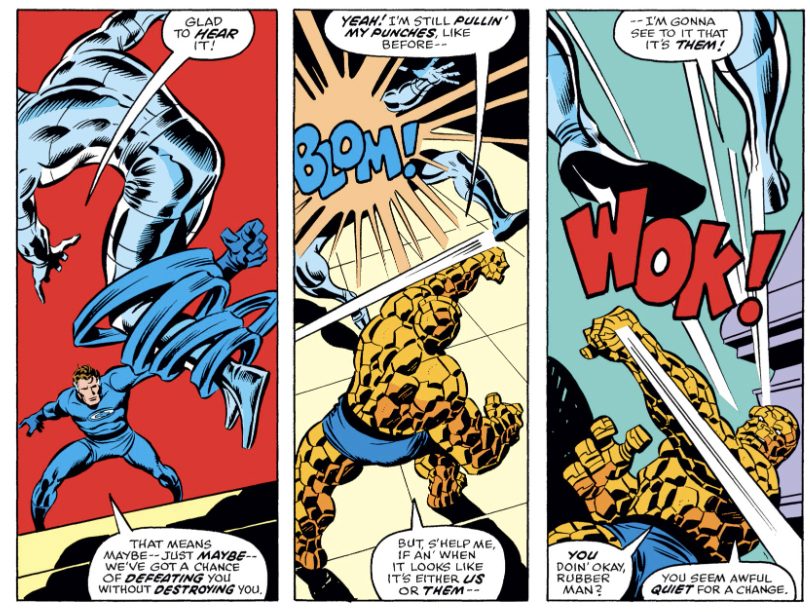
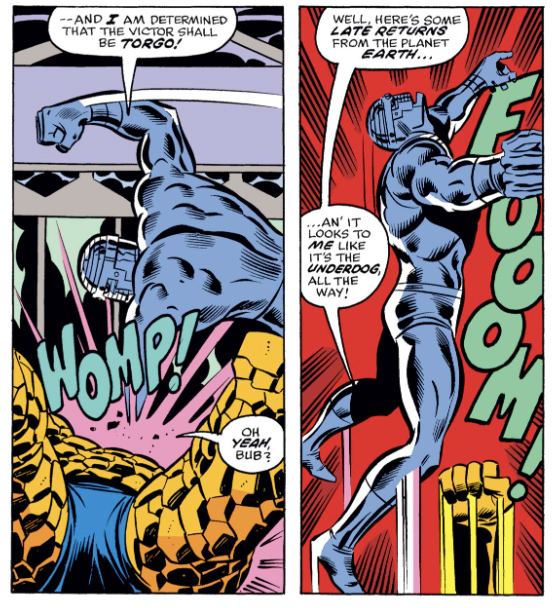
Buscema’s art seems rushed in this comic, and there’s two examples of mistakes I doubt he would normally make. First, in the panel of Ben punching up, he has five fingers, not his normal four:
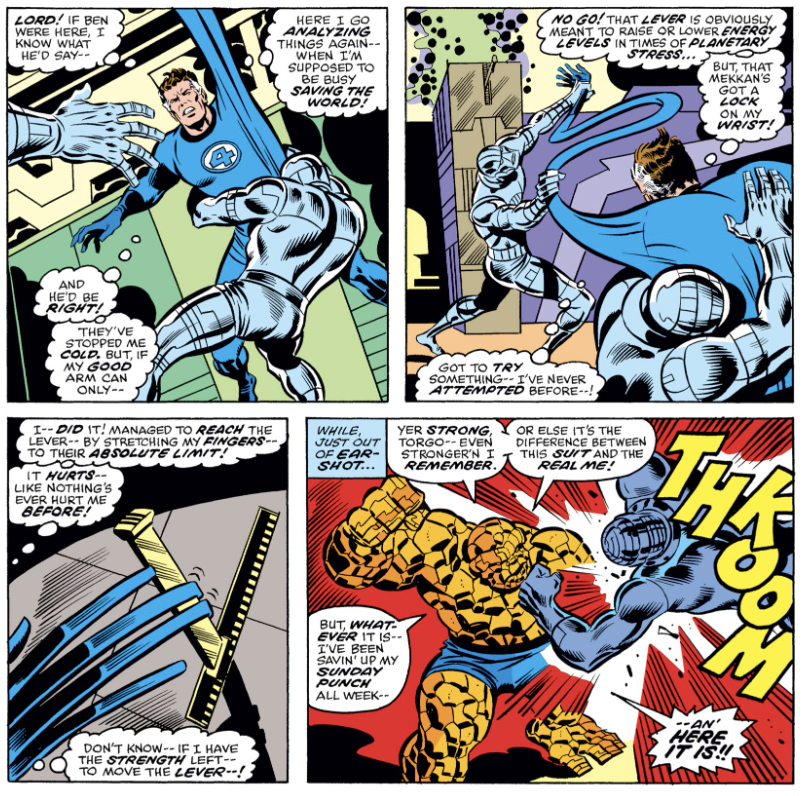
And here, Reed stretches with his left arm, but it’s his right hand that pulls the switch:
We all have bad days. Most of us are lucky that we don’t have bozos blogging about them 50 years later.
Anything else?
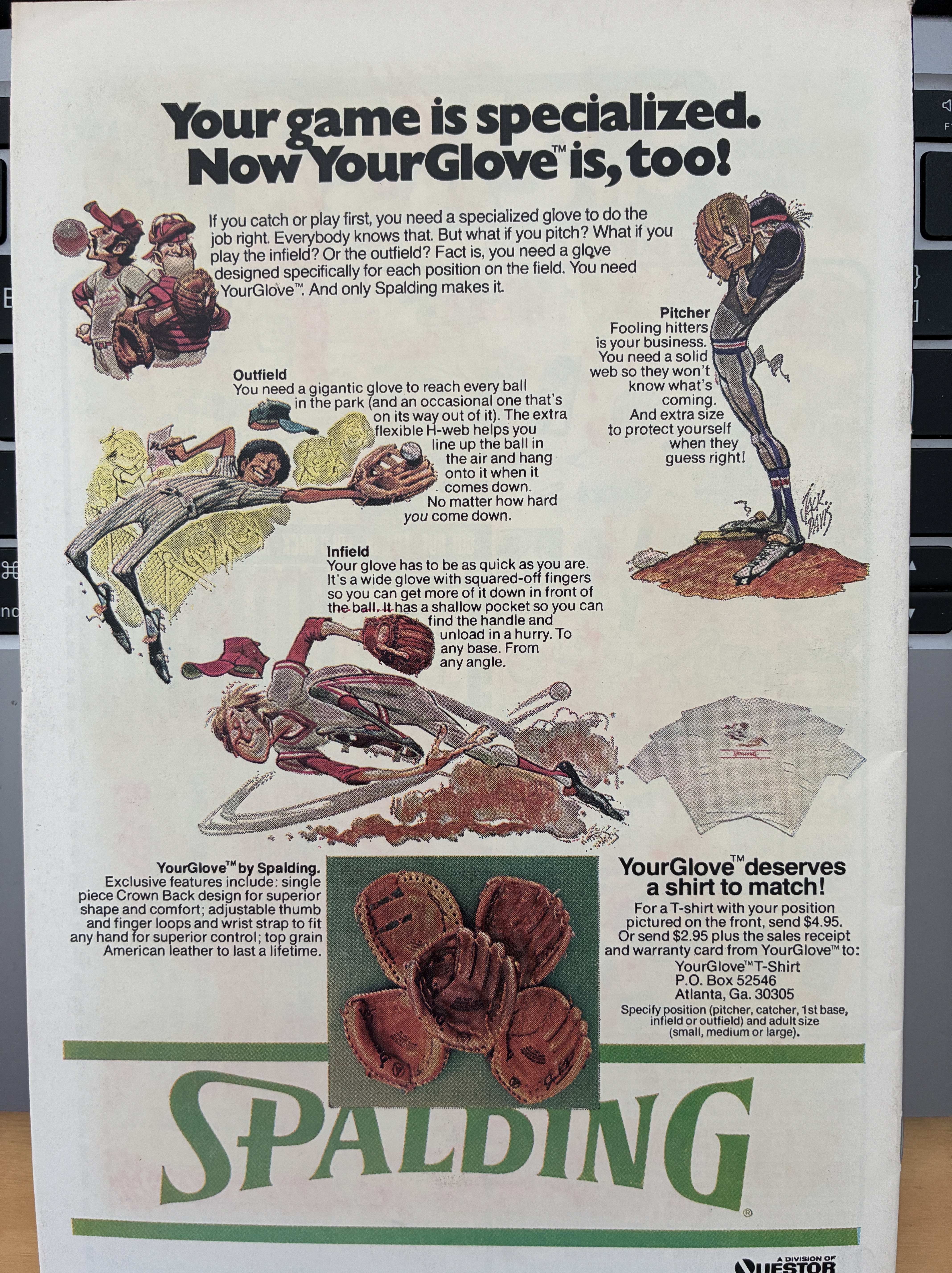
I liked this ad for Spalding baseball gloves on the back cover. Art by Jack Davis, best known for his work in MAD Magazine.
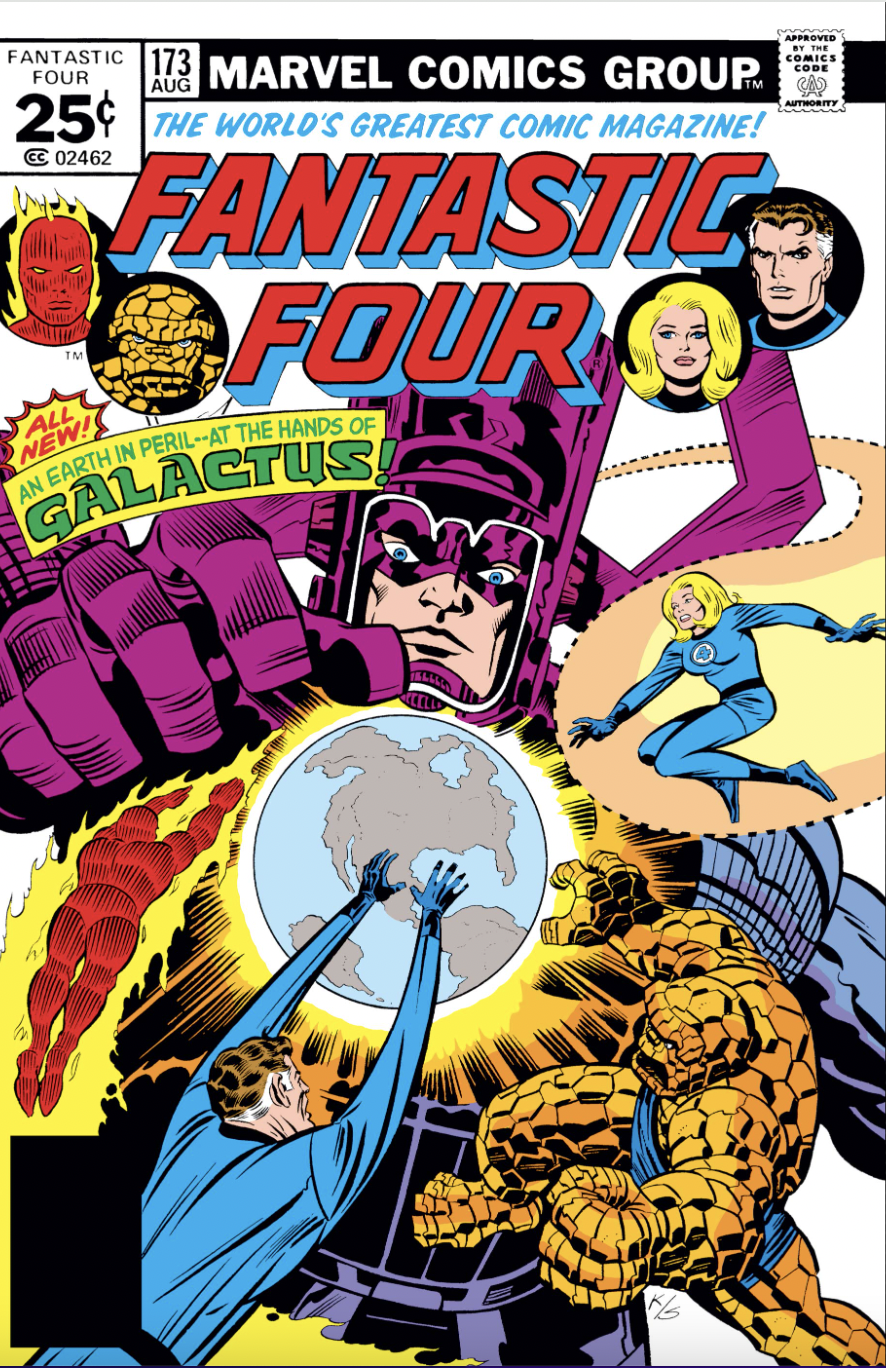
Fantastic Four 173 “Counter Earth Must Die — At The Hands of Galactus!” Published May 1976 Writer: Roy Thomas Pencils: John Buscema Inks: Joe Sinnott Letters: Joe Rosen Colors: Phil Rachelson Editor: Thomas Cover: Jack Kirby and Joe Sinnott
Synopsis
After Ben unsuccessfully attacks Galactus (while wearing his Thing exoskeleton), the FF, Gorr the Gorilla and the High Evolutionary try to stave off Galactus’s plans to devour Counter Earth. Galactus agrees to consume another suitable world without advanced life if they can find one, and the team splits up to scout two of three planets identified by the High Evolutionary. On the first, Ben and Reed find a city of robots led by Torgo, whom Ben previously battled against and alongside on a Skrull planet in issues 90-93. Torgo apprehends them lest they reveal the planet’s existence to Galactus. On the second, the Human Torch and Gorr find themselves in a medieval-type world, where they too are captured.
What’s going on here?
After a slow start, this story arc is picking up steam, and this is by far the best of the three thus far. There’s a lot of action, some fun and interesting plot twists, a bit of character development, and solid art by penciller John Buscema (Big John will handle this and the next two issues before George Perez returns).
Whenever I see Galactus used as a villain I become worried, since he should be written as god-like and above the fray. When he ends up physically scrapping with the FF, as he did in issue 122, it diminishes the character. Here, even though Ben attacks him (futilely), most of the action is directed elsewhere, as the FF and their allies struggle to prevent the destruction of Counter Earth. Galactus becomes less an antagonist and more of a force of nature that must be defended against.
I have called out Roy Thomas’s tics as a writer several times, including his propensity to call-up obscure characters and events from Marvel’s past. That can often lead to convoluted stories, but in this issue, the reappearance of Torgo is both surprising and well played by Thomas. Ben’s ordeal in the Skrull arena is one of the best stories from the latter years of the Lee / Kirby run, and it’s fun to see Ben reunited with his former sparring partner slash brother-in arms. Even when they end up fighting it’s clear neither’s heart is in it.
The cover is again by Jack Kirby, although it lacks his trademark energy. A bit of a dud from the master.
What I liked
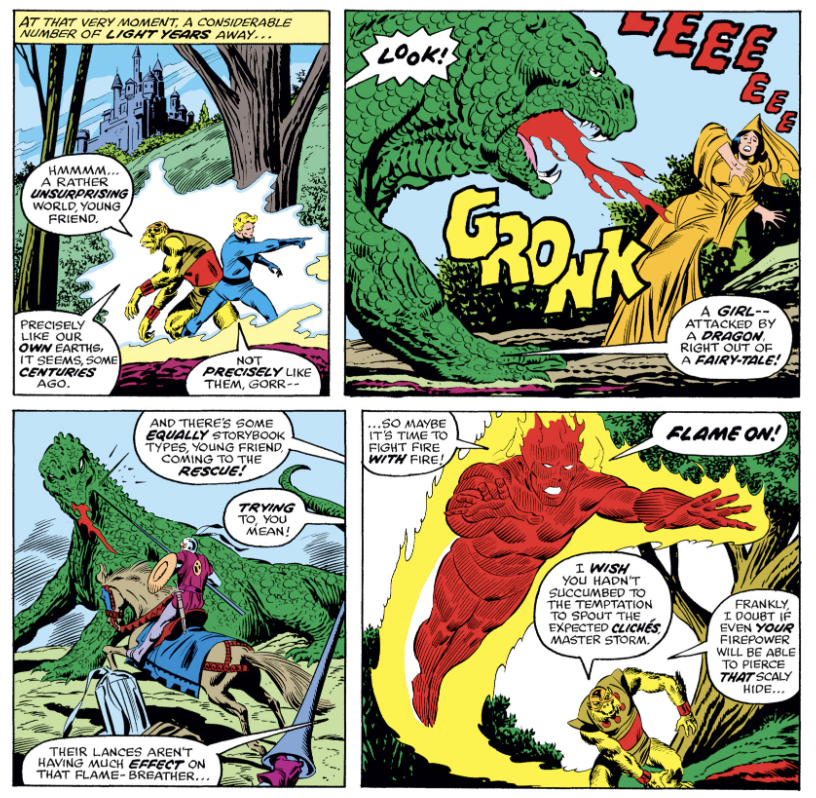
It’s generally fun when the team gets split up and goes on separate missions. Here, the Human Torch and Gorr have an adventure that features a gorilla’s critique of Johnny’s clichés.
I liked this meet-up between Reed and the High Evolutionary, two big brains who clearly have much to discuss.
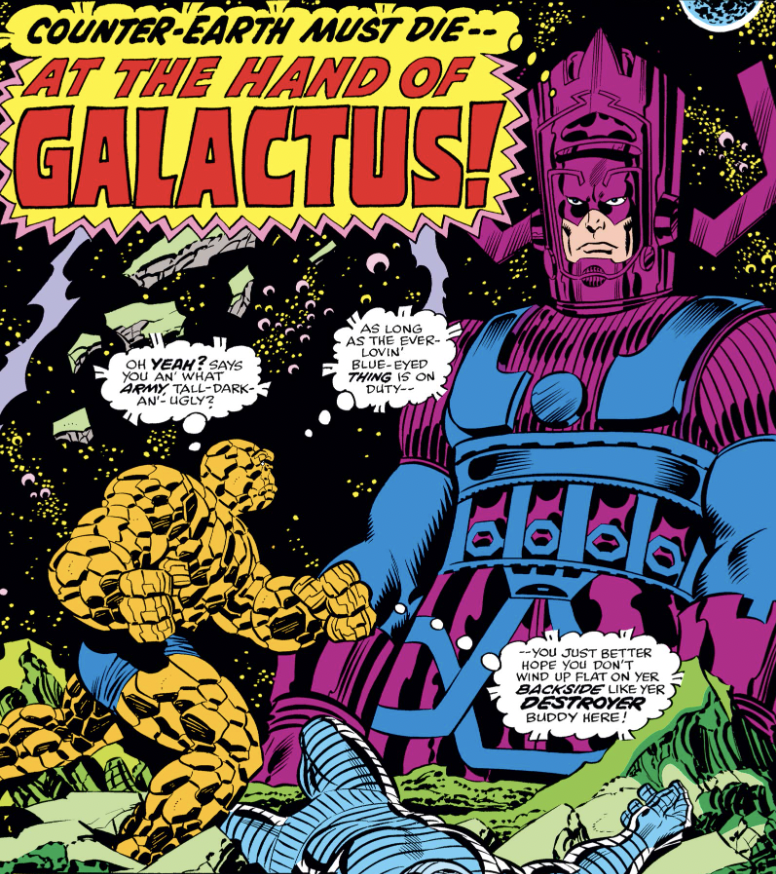
And this is a nice panel by Buscema evoking some Kirby-esque cosmic grandeur.
I also liked this panel of Ben in his exo-skeleton.
What I didn’t like
As mentioned before, I think it’s silly for the FF to try to physically assault Galactus. This sequence felt like a waste of time.
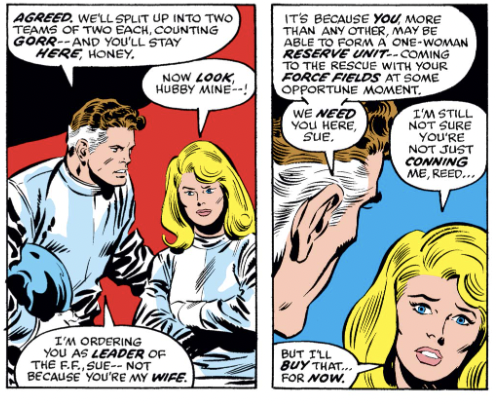
Sue is again shunted off to the side. At least here Reed comes up with an excuse, even if Sue is skeptical.
Overall
A solid issue. The Fantastic Four as it ought to be.
Fantastic Four 160 “In One World and Out the Other!” Published April 1975 Writer: Roy Thomas Pencils: John Buscema Inks: Chic Stone Letters: Raymond Holloway Colors: Janice Cohen Editor: Thomas Cover: Gil Kane and Al Milgrom
Synopsis
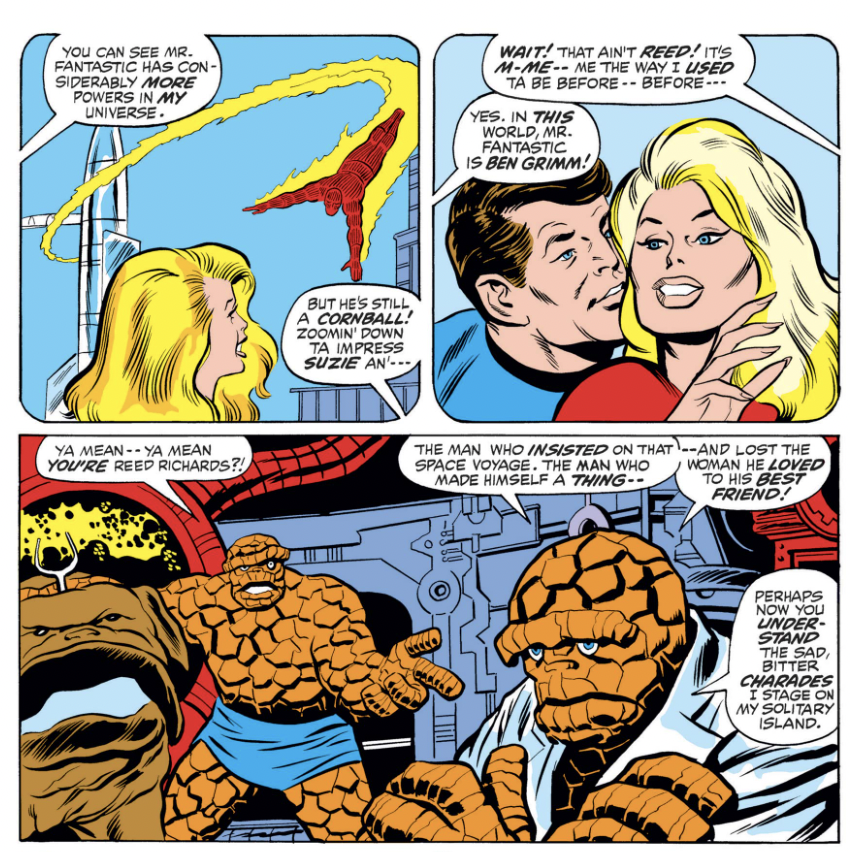
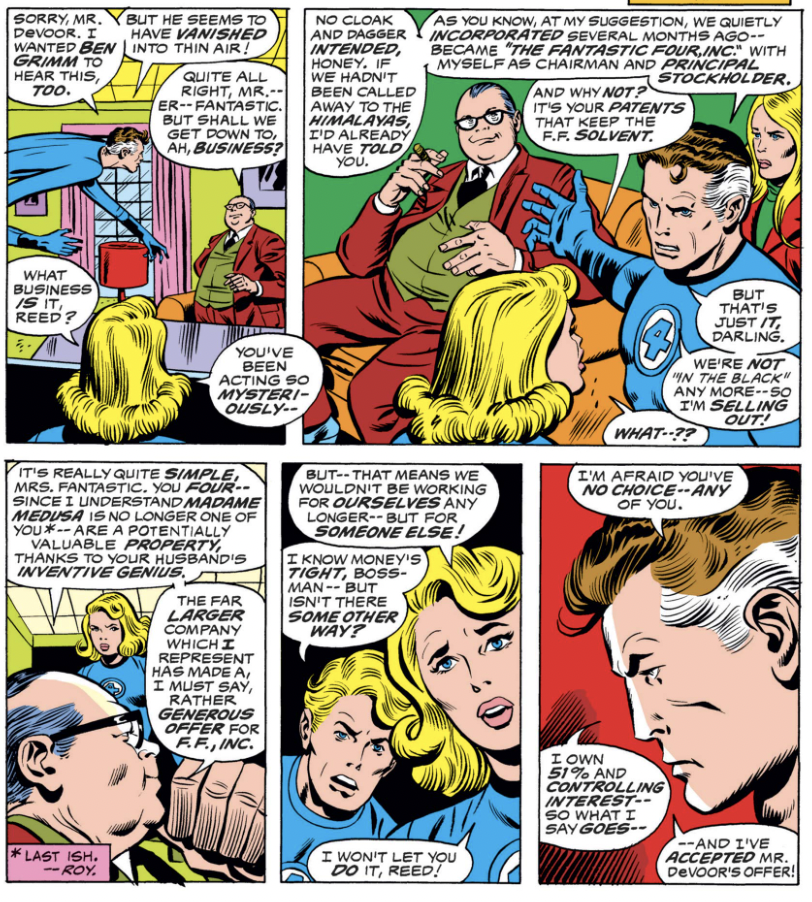
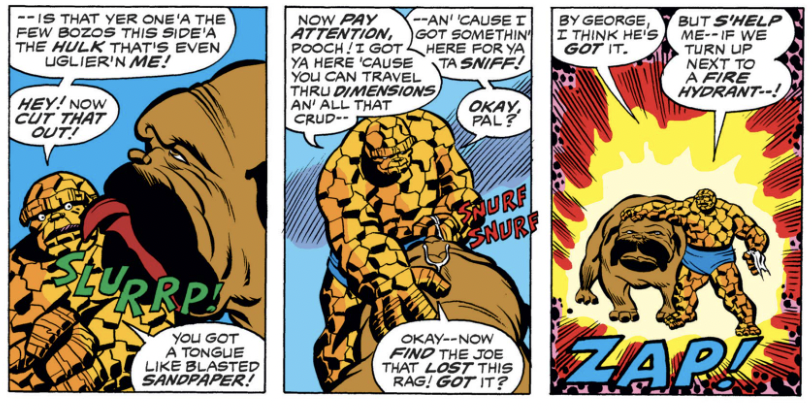
The issue opens with Arkon, a barbarian warrior from another dimension, and the Thing battling in midtown Manhattan, but Alicia Masters discovers that this Thing is not the man she knows. Back at the Baxter Building, the Ben Grimm of this Earth summons Lockjaw to teleport him to the dimension where the other Thing originated. There, after battling robot monsters and encountering a human version of himself, he discovers he is on the alternate Earth he visited in FF 118, one where Reed Richards became the Thing. Meanwhile, on our Earth, Mr. Fantastic announces plans to sell the Fantastic Four’s holding company over the objections of his teammates, a move that is somehow connected to the alternate Earth.
What’s going on here?
This issue is jam packed, and there’s a lot to discuss. The bottom line, however, is that it’s a really good comic — fun, interesting and suspenseful, the way Fantastic Four comics should be. It’s also irrefutably a Roy Thomas creation, and bears lots of his signatures: an intricate plot, dimension hopping, call-backs to older comics and his insufferable narration. For me, the ultimate validation of this comic is that I was eager to read the next one.
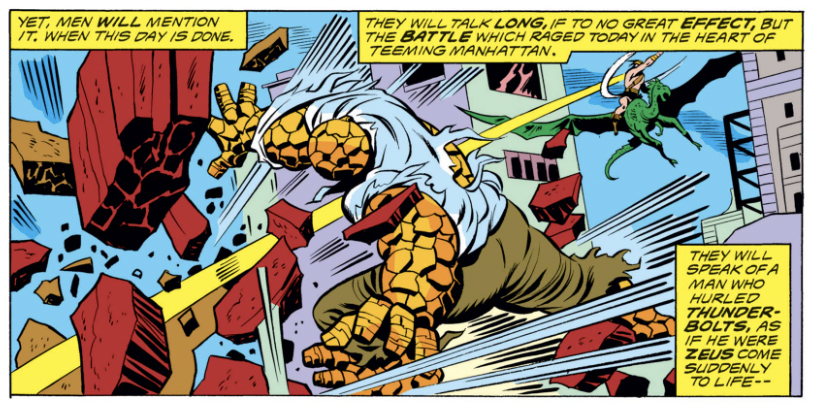
The length of my synopsis above signals the story’s complexity. While a Gerry Conway plot could be summarized in a sentence or two, Thomas’s takes four. The story begin abruptly, and confusingly, with the Thing (so far as we know) battling Arkon, an Avengers villain created by Thomas, and another indication of how Thomas is drawing the FF closer to the rest of the Marvel universe. In another call-back, he then takes Ben to an alternate universe created during Archie Goodwin’s brief run running the comic in one of the most imaginative (and shortest) FF stories, one in which only Ben and Reed took the ill-fated rocket trip, and where Reed becomes the Thing.
All of it is complicated by Reed’s surprising decision to sell the FF’s holding company. The move takes the comic into the world of business and finance, a category of subplot which rarely works out but here seems to hold together. Also, Reed giving himself controlling interest seems on brand for his depictions from this era.
Also of note is the return of John Buscema, here inked by Chic Stone, as artist. It’s only a one-issue fill in, and since Buscema’s work here looks rushed, I’m guessing it was a last-minute thing. Another new credit: Raymond Holloway as letterer, his first and last time lettering the FF, although he worked at Marvel for two decades. As far as I am aware, Holloway is the first Black creator to have a Fantastic Four credit, and you can read a bit more about him here.
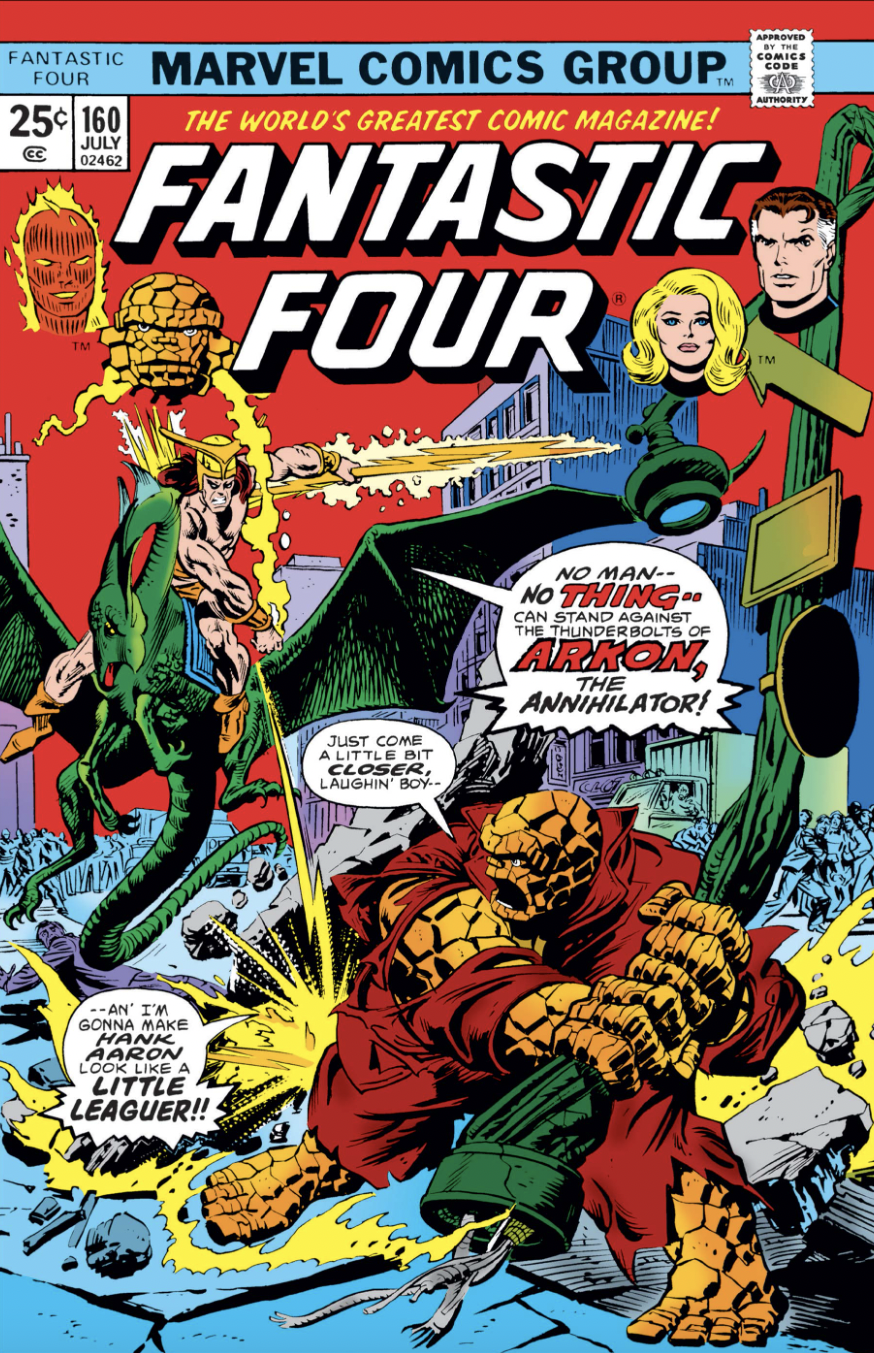
Lastly, the cover is by Gil Kane and Al Milgrom. The Hank Aaron reference is an interesting one; by the spring of 1975 Aaron had passed Babe Ruth as baseball’s all-time hime run hitter, and was a big enough star that he could be mentioned on the cover of comic book. While some racist fans mourned the dethroning of the Babe, Ben Grimm clearly wasn’t one of them (and it’s maybe worth noting the Thing on this cover is definitely Ben, not Reed, a bit of misdirection).
What I liked
Thomas has a lot of fun writing Ben, and he imbues him with an intelligence that some other writers ignore in favor of his wise cracking or woe-is-me pathos. This is the version of Ben that is on display in Marvel Two-in-One, the comic he starred in with a guest for 100 issues.
Here, Ben goofs around with Lockjaw:
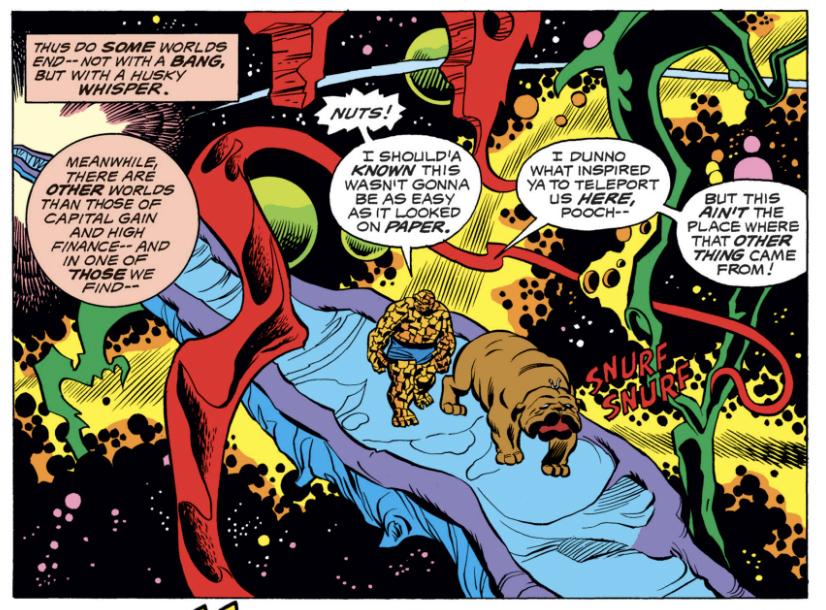
For some reason, Lockjaw first teleports them to a Ditko-esque dimension, which looks cool but has little to do the story:
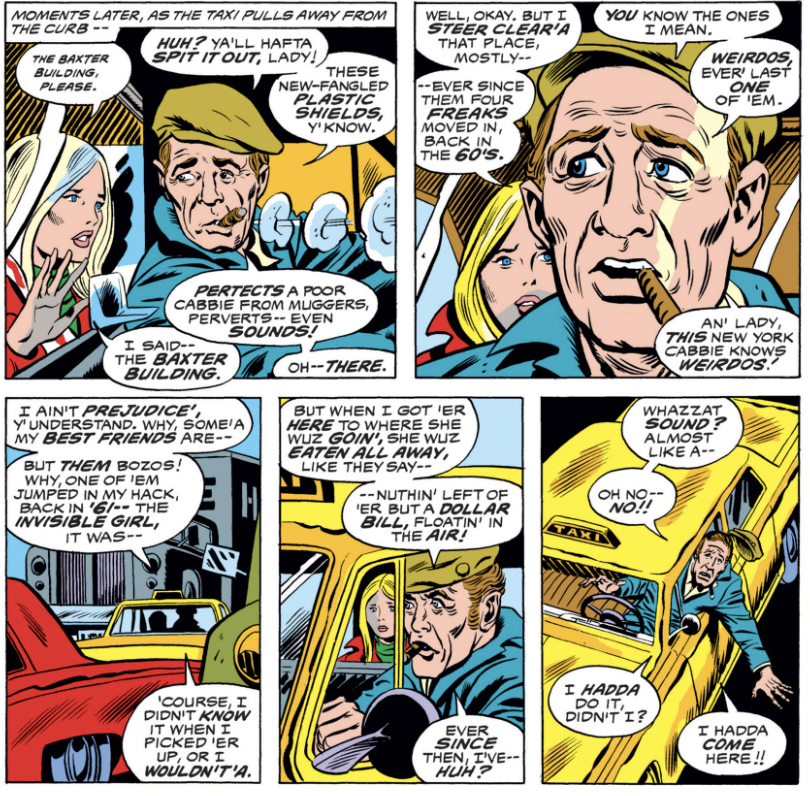
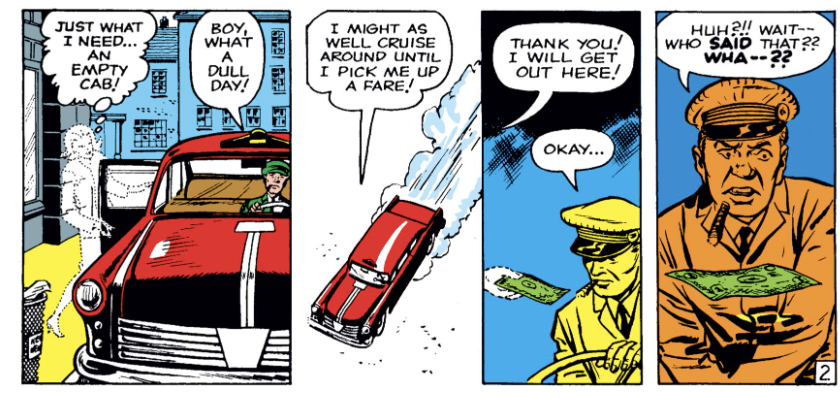
Another fun Thomasian flourish was Alicia’s interaction with a cabbie who is spooked to go near the Baxter Building:
The cabbie, of course, is referring to this sequence all the way back in Fantastic Four 1, and the introduction of the Invisible Girl (he dressed a little better in 1961):
What I didn’t like
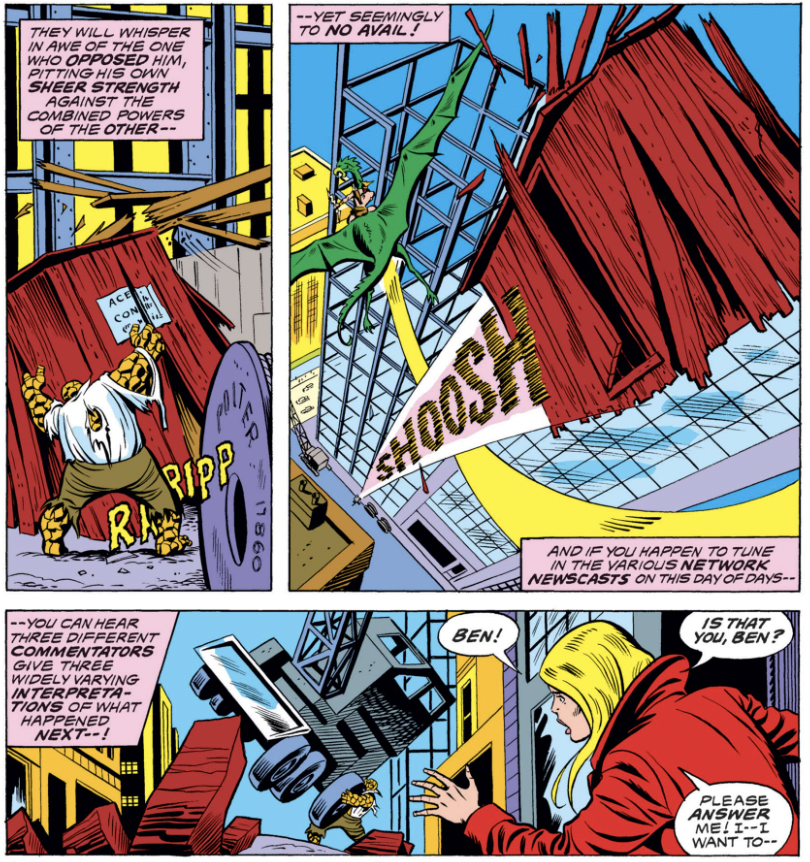
As always, Thomas is in love with the sound of his own voice (figuratively speaking) and his self-referential narration can get very annoying. Here, for whatever reason, he seems to be making some commentary about the evening TV news:
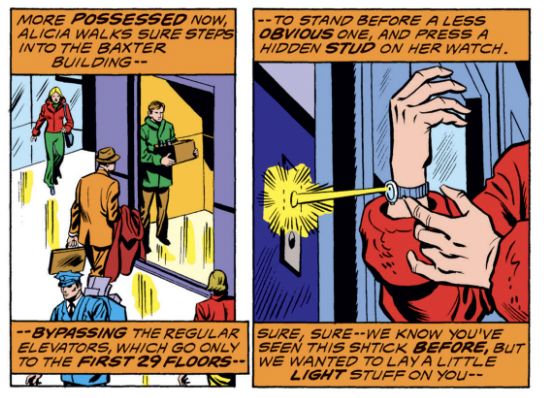
And here, more unnecessary patter:
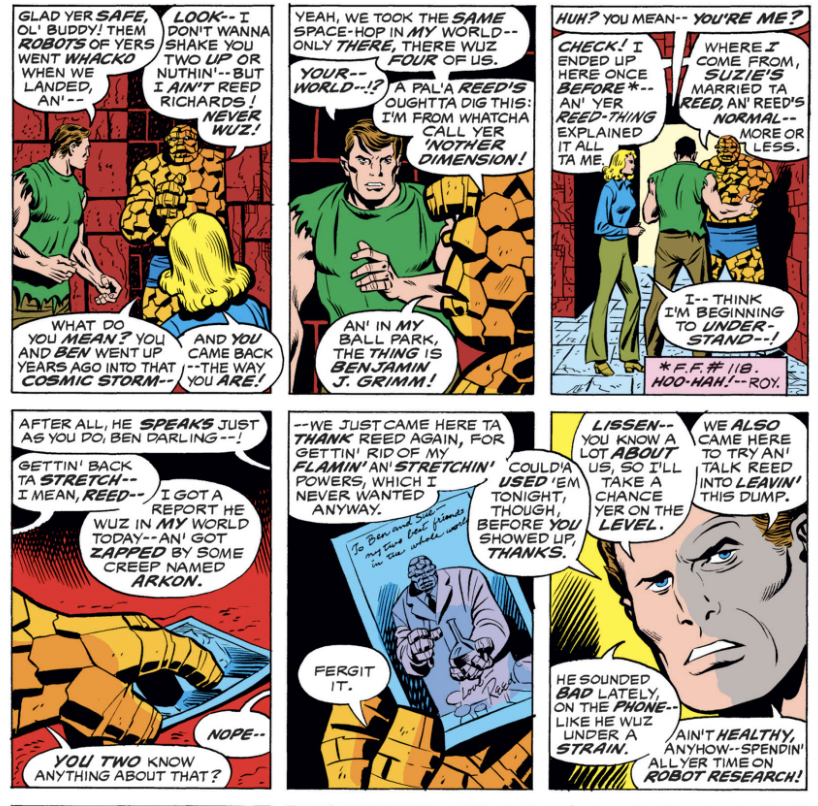
Thomas’s intricate, science fiction plots require a lot of explanation, which often means lots of expository dialogue. In some cases, it just about crowds out the art, as in these panels:
Anything else?
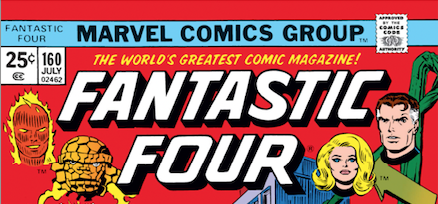
In perhaps another sign that Thomas wanted a break from the Conway era, this issue debuts a new Fantastic Four cover logo, just the third in the book’s history.
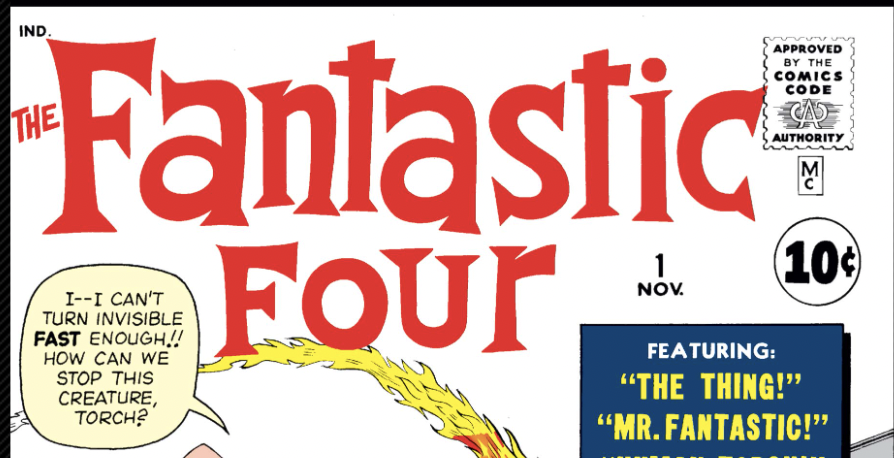
The first, of course, is the classic 60s logo, designed by Sal Brodsky:
According to longtime comic scholar Mark Evanier, via Todd Klein’s blog, it was inspired by the 1959 Twilight Zone TV show logo and which captured the spirit Stan Lee wanted in the comic.
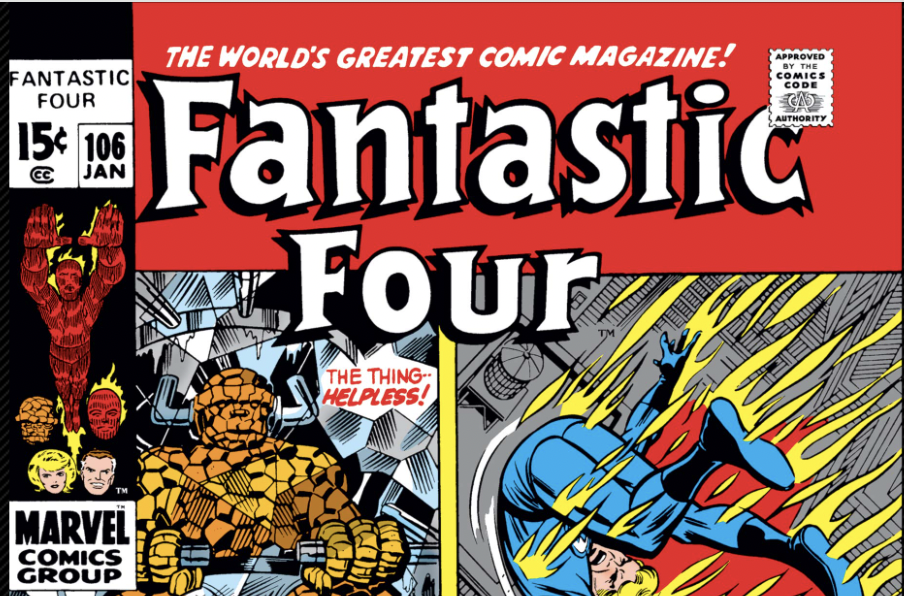
That FF logo was modified slightly, in part to accommodate the iconic Marvel corner box, which first appeared on the cover of FF 14. By the early 70s, it’s blockier and with shadow, and the letters don’t have the same zany flair, but it’s still recognizably the same.
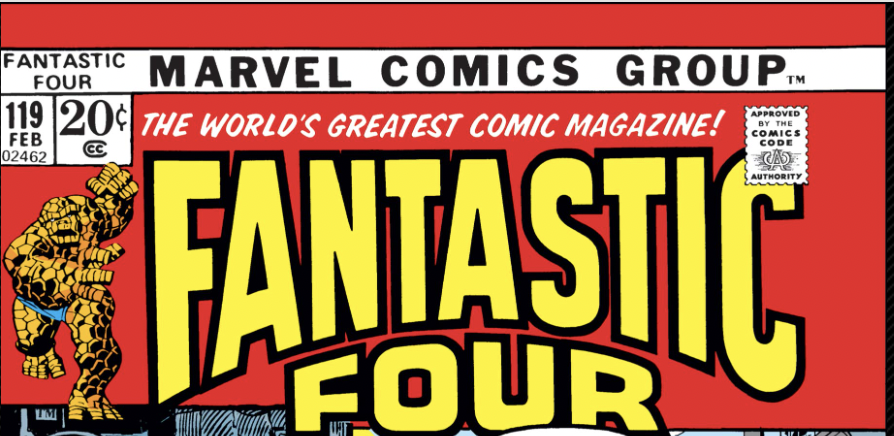
But that logo was dropped altogether in issue 119, in favor of a blockier logo that perhaps was a better fit for the new cover style which fit the art into a box (and which, for the record, I hated).
The new logo, which will last until issue 218, when it will revert back to the 60s logo, is an improvement over the previous one and has a zingy, sci-fi quality to it. It’s biggest departure, however, is dropping the corer box in far of four portraits of the FF (and maybe Marvel waited for Medusa to leave the team so it could include the original four on the logo).
Also, some fun ads in this comic.
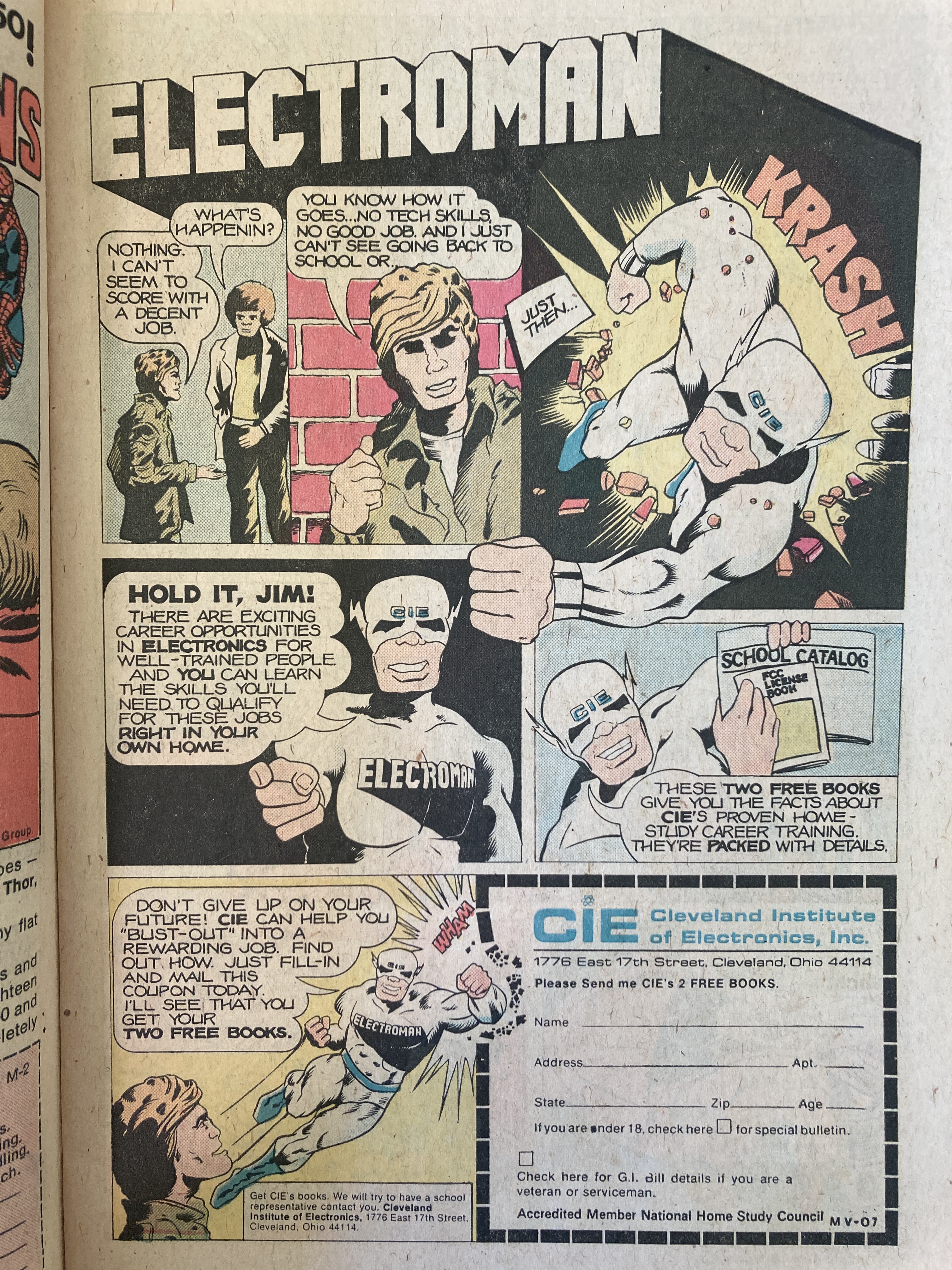
Electroman wants to get you a job! (I wonder if any artist will admit to drawing this)
And is there anything more ’70s than custom van-interior upholstering?
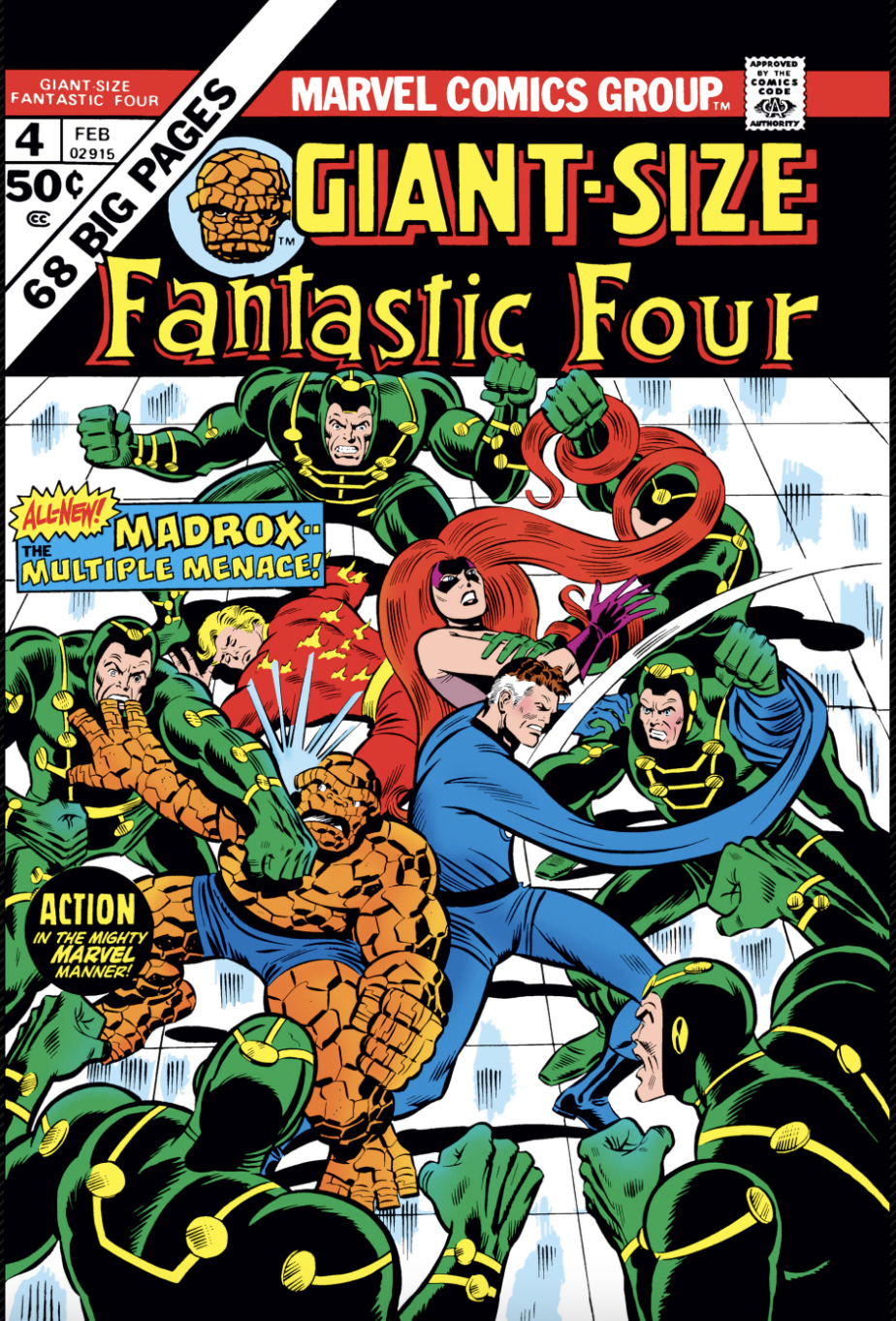
Giant-Size Fantastic Four 4 “Madrox, the Multiple Man!” Published November 1974 Writers: Len Wein and Chris Claremont Pencils: John Buscema Inkers: Chic Stone and Joe Sinnott Letters: John Costanza Colors: Glynis Wein Editor: Len Wein Cover: Rich Buckler and Joe Sinnott
Editor’s note: This comic was published prior to Fantastic Four 156 and 157 but I wanted to conclude the Doom/ Surfer story arc before tackling this issue
Synopsis
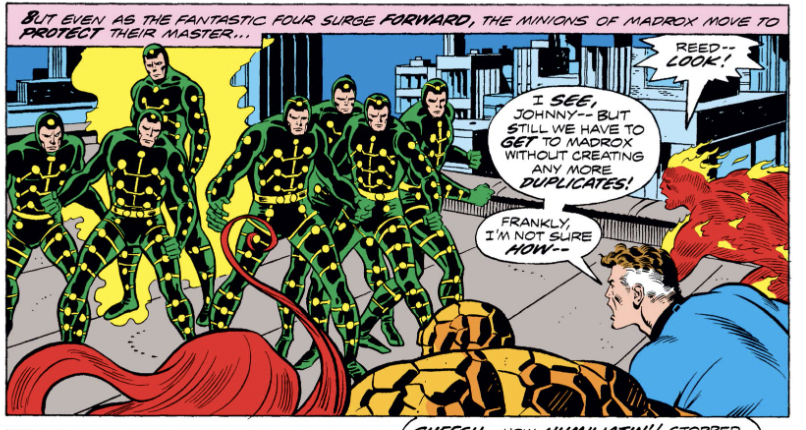
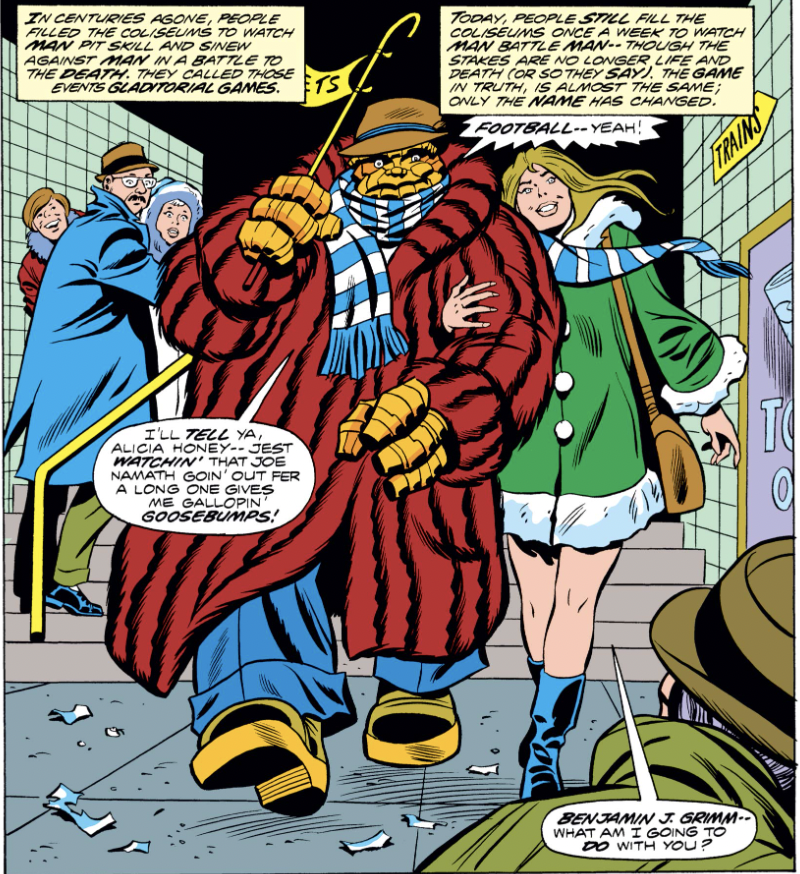
On his way to a Jets game with Alicia Masters, the Thing encounters and is defeated by Madrox, who has the power to create duplicates of himself. Ben is revived in the Baxter Building by Mr. Fantastic who says blackouts across the city are being caused by Madrox, who absorbs electricity. The team battles him, and is facing defeat when Professor X arrives, explains he knew Madrox as a child, and helps subdue him.
What’s going on here?
As discussed in previous posts, in 1974 Marvel began to publish giant-size editions of some its most popular titles. These usually included an original story and a reprint, and sort of operated as annuals, although they appeared quarterly. In this issue, the reprint is (appropriately enough) FF 28, guest starring the X-Men.
Giant-Size Fantastic Four 4 is notable for a few reasons. It marks the debut of the mutant Jamie Madrox the Multiple Man, who would go on to have a long career in X-Factor and other X books, and perhaps most significantly, it’s the first Fantastic Four issue written by Chris Claremont. In 1974, Claremont was brand new to Marvel, and this is listed as just his ninth Marvel writing credit. While he’s best known for his 15-year run on the X-Men and it’s many spinoffs, Claremont had a long run as the FF’s regular writer from 1998 to 2000. He also wrote the first Fantastic Four vs. X-Men mini-series in 1986 and frequently used FF members in his other comics.
What I liked
In many ways this is a pretty standard FF comic. The FF randomly encounter some menace, they tangle a few times, and it’s all wrapped up on the last page. That said, it’s a fun read, and the Wein / Claremont team does a good job with the opening sequence where Ben first confronts Madrox. Ben’s enthusiasm for the Jets game runs through the comic and is a nice touch. I loved his ridiculous outfit, as if he’s dressed for the Harvard-Yale game in 1922.
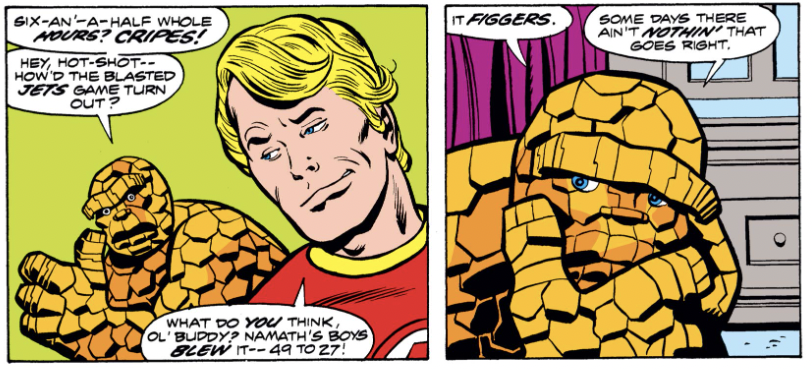
Later, he’s bummed that he missed the game (I checked and there’s no actual Jets game from that year that ended with that score).
What I didn’t like
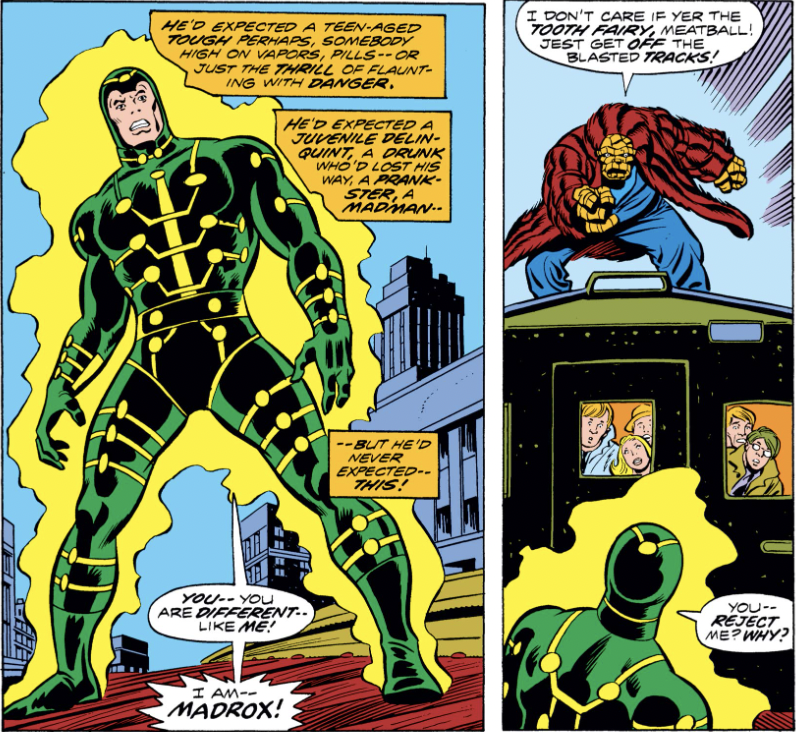
Madrox is an enigma throughout the comic. His stilted speech in his first appearance suggests he’s some sort of alien, but it’s later revealed he grew up in Kansas watching TV. He seems incredibly powerful —single-handedly defeating the Thing — but it’s not clear what is powers actually are, other than multiplying himself. It’s also not really explained why he is draining the city of power – it has something to do with his suit, but what?
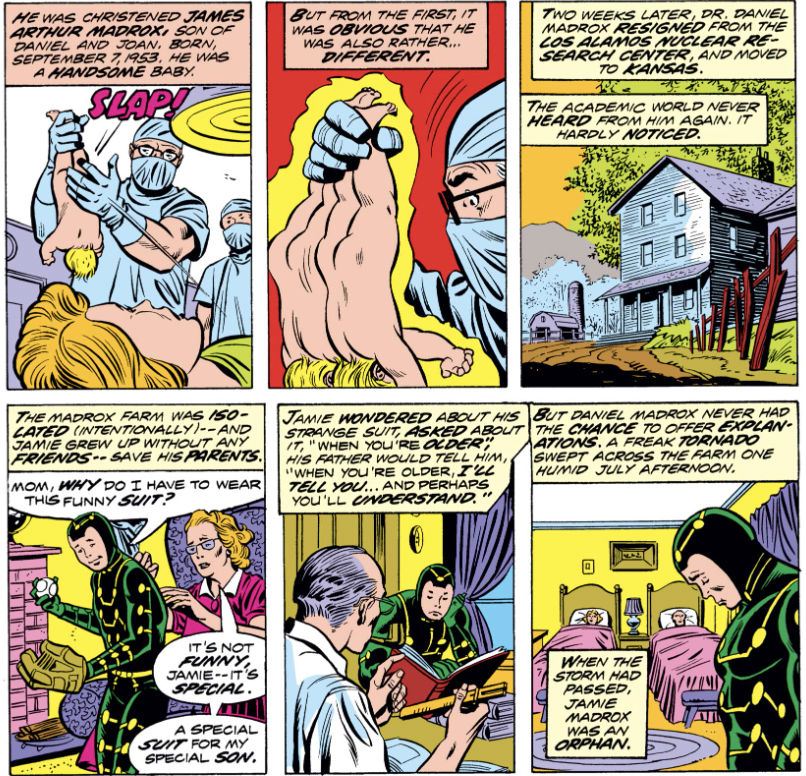
The appearance of Professor X reveals that Madrox is a mutant, although a flashback explains he developed his power as an infant, not at puberty as other mutants do (it’s later retconned to explain that he’s a “changeling,” a genetic predecessor of mutants).
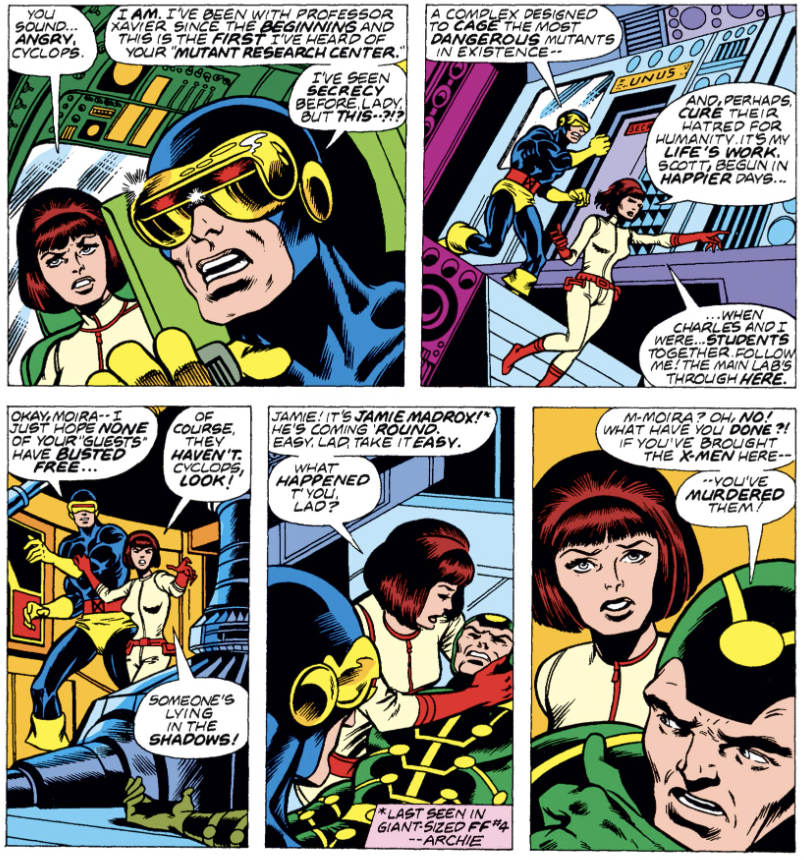
There’s a certain deus ex machina quality to Prof X’s sudden appearance, although he seems strangely under-powered here. He does make good on his promise to look after Madrox, who next appears on Muir Island, without much explanation, in Claremont’s Uncanny X-Men 104 (art by the great Dave Cockrum with inks by Sam Grainger).
Years later he would become a significant player in X-Factor, and his “dupes” would become characters in their own right (I confess I’m not familiar with this era of the X-universe, so can’t really comment on how he was handled).
And at this point it perhaps goes without saying, but the Invisible Woman doesn’t appear in the comic, and Medusa is again a total non-factor.
Overall
A comic more interesting for its historical significance than its story.
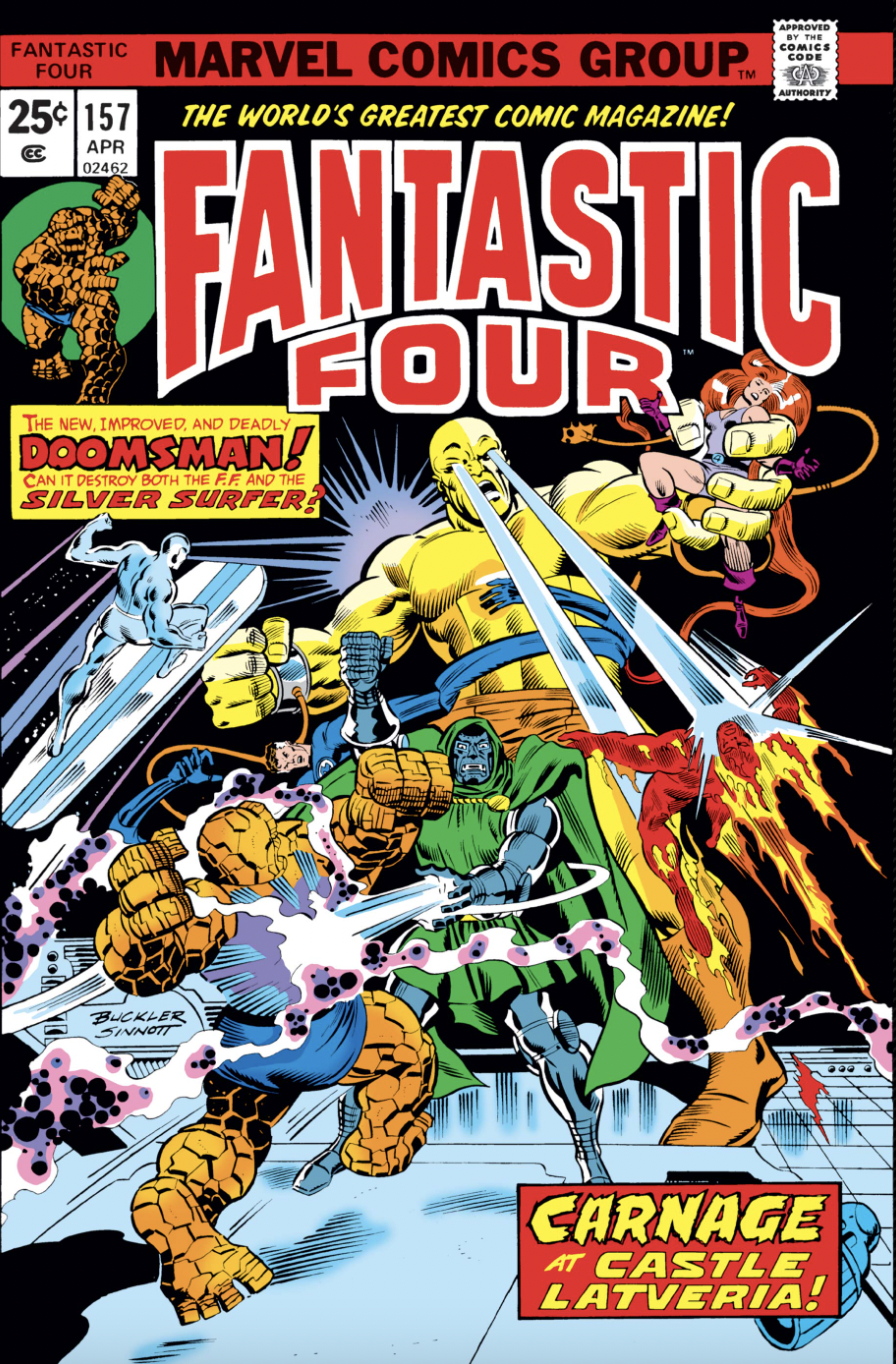
Fantastic Four 157 “The Endgame Cometh!” Published January 1975 Writers: Roy Thomas and Len Wein Pencils: Rich Buckler Inks: Joe Sinnott Letters: Joe Rosen Colors: Petra Goldberg Editor: Thomas Cover: Bucker and Sinnott
Synopsis
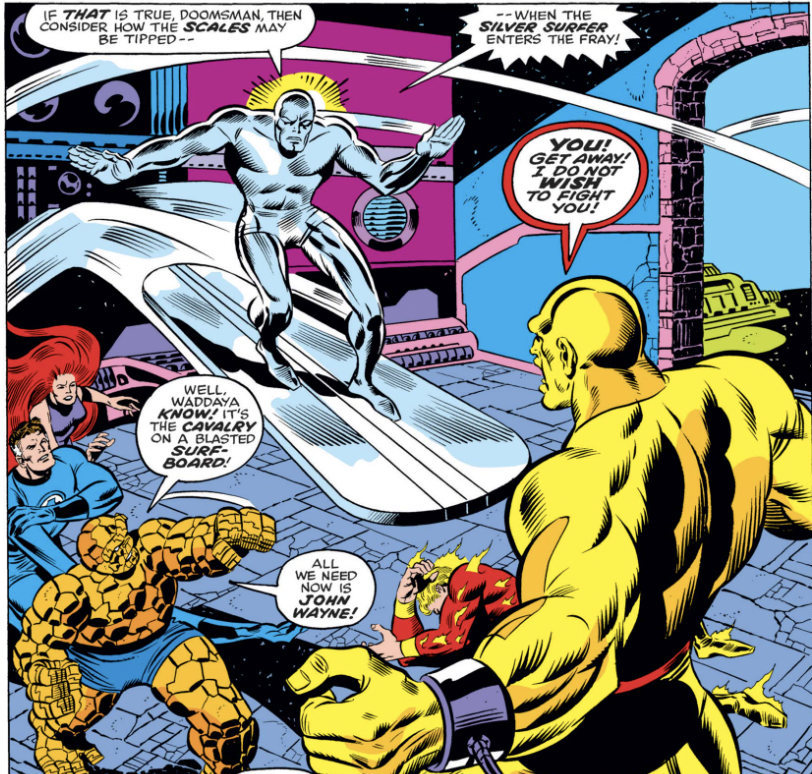
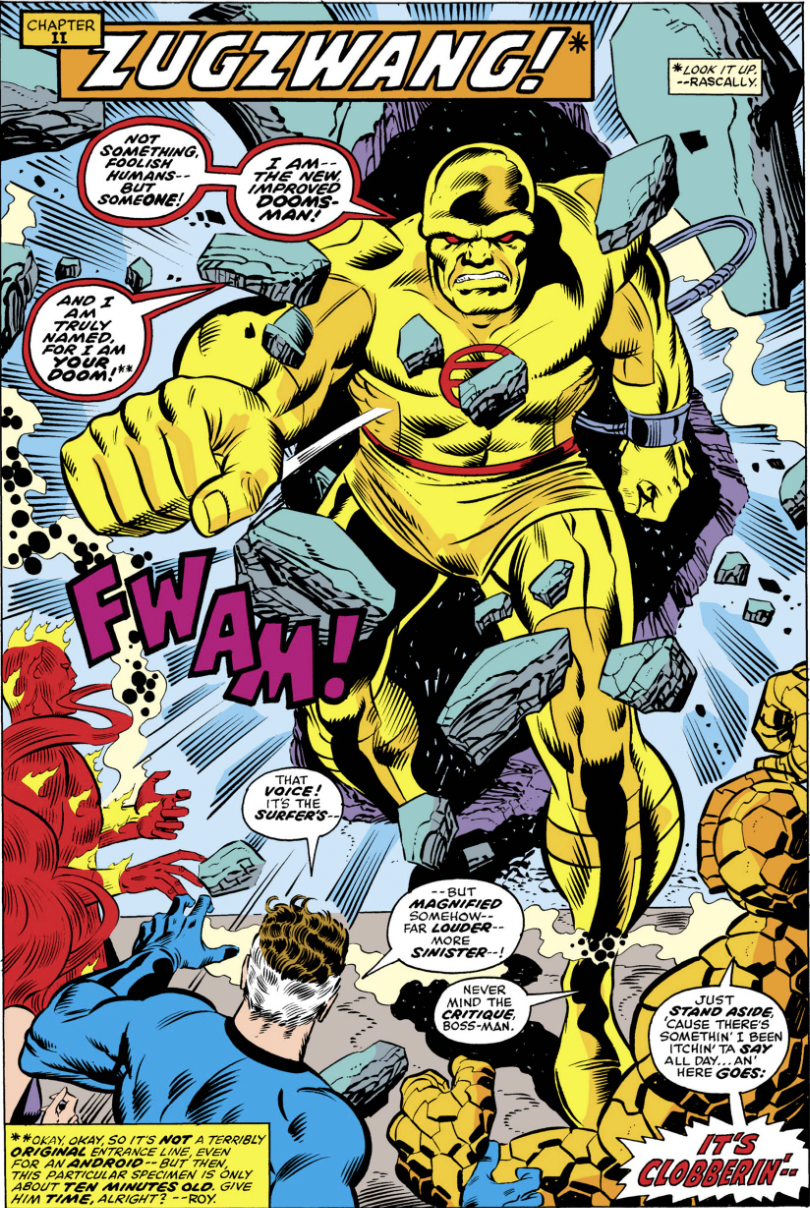
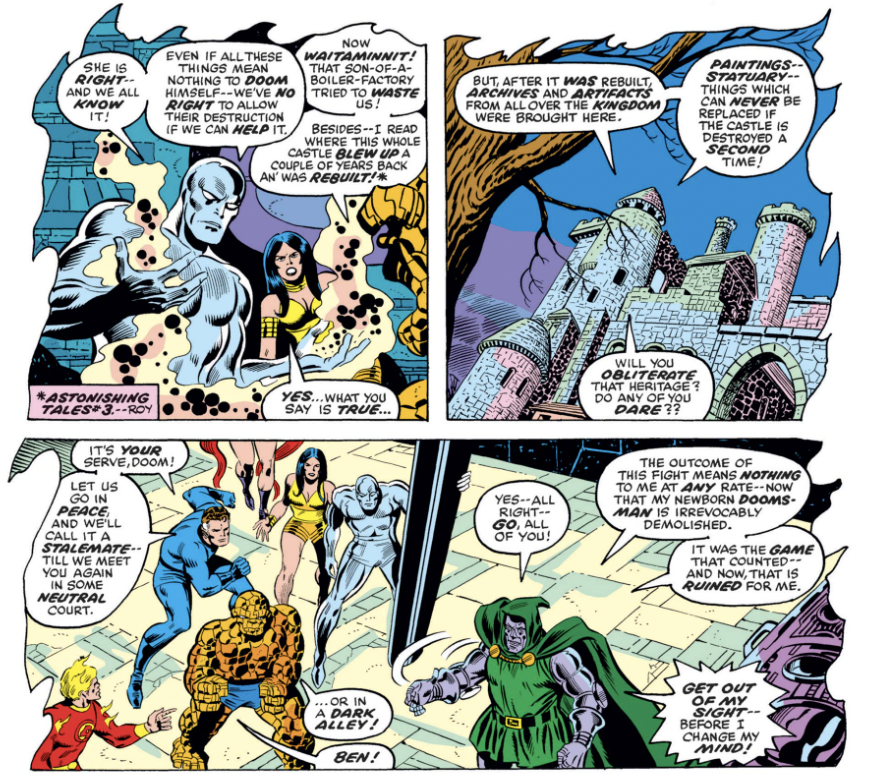
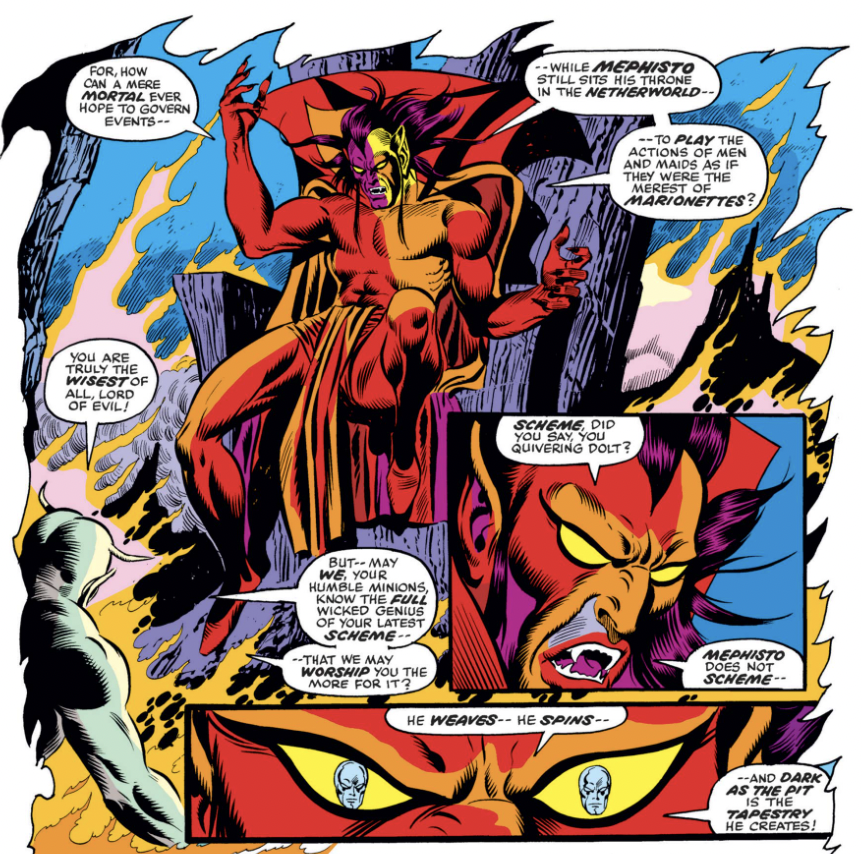
Trapped in Dr. Doom’s castle, the Fantastic Four battle Doomsman II, an android imbued with the Silver Surfer’s power. Meanwhile, the Silver Surfer’s lost lover is revealed to be a Latverian peasant girl, Helena, brainwashed by Doom into believing she is Shalla-Bal. The Surfer then joins the FF to defeat Doomsman, and they are about to go to battle with Doom himself when Helena begs them to spare Doom’s castle from destruction. The issue ends with the demon Mephisto, the Surfer’s nemesis, revealing that Helena was Shalla-Bal all long, put on earth to torment the Surfer.
What’s going on here?
This is Roy Thomas’s first full issue in his return gig as the Fantastic Four’s writer, and as if to announce he’s back, he’s crafted a classically complicated Thomasian story, full of odd tangents, obscure references and callbacks to plot points from earlier comics.
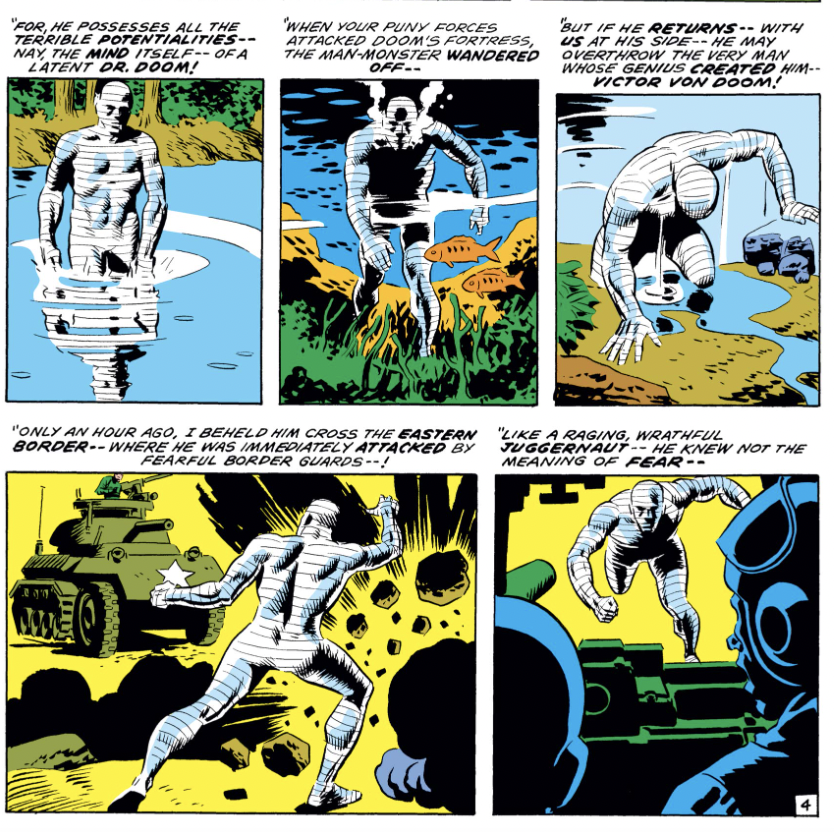
A big chunk of this comic’s backstory was told in Astonishing Tales 1-3, a complicated story by Thomas from 1970 that explains how Doom created the first Doomsman using cosmic rays and his own brain waves and lost control of it (the art is by the legendary Wally Wood).
The story also references Giant-Size Super Villain Team-Up 1, a comic on sale at the same as FF 157 (also by Thomas), that among other things explains how Doom survived his seeming death in FF 144 (he crashed to the ocean and was rescued by the Sub-Mariner).
The last scene in FF 157, featuring Mephisto chewing the scenery, is basically pulled from the Silver Surfer’s own comic and I don’t recall him ever appearing in the FF prior to this comic.
There’s not a lot of explanation in FF 157 about any of these plot points, and the assumption is readers would have read these other comics. If all you read was the Fantastic Four, you’d be baffled by these goings on. It’s also reminder of how tightly woven Marvel stories were back then and how much emphasis Thomas placed on continuity. (It also makes me glad I have a subscription to Marvel Unlimited).
Lastly, another example of Thomas’s zany storytelling: titling a chapter of the comic “Zugzwang!” with no explanation. (It’s a German term used in chess, a play on the chess metaphor in the comic’s title). And self-referential footnotes mocking his own writing.
What I liked
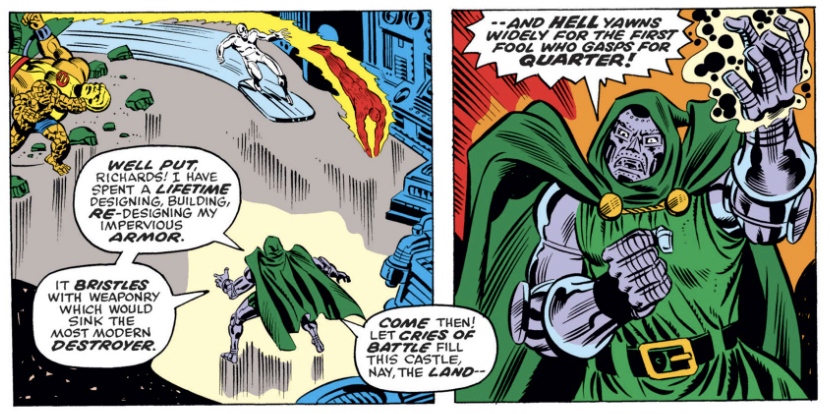
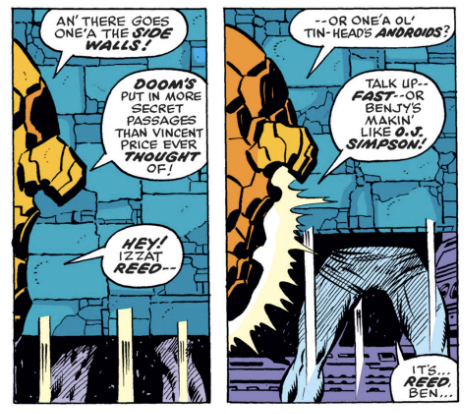
This was a fun comic, despite all its weird intricacies and jarring transitions. Thomas clearly loves writing Doom, and gives him some great, preposterous lines:
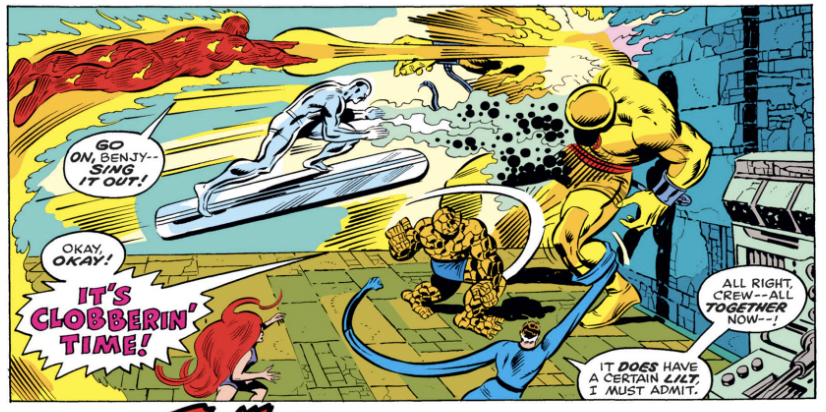
I also liked this byplay between Ben and Reed, revealing a more playful side to Mr. Fantastic.
What I didn’t like
Once again, there is no mention, much less an appearance, of Sue Richards or Franklin. And Medusa barely factors into the story at all.
The initial ending is painfully anticlimactic and hard to swallow. The FF and Doom agree not to battle to preserve the Royal Latverian treasures? This in a comic where wide swathes of New York are frequently destroyed in the FF’s battles?
The disappointment is somewhat blunted by the strange Mephisto coda, but his appearance is such a non sequitur it’s hard to know what to make of it. Again, if readers weren’t paying attention to the Surfer’s title, it would be utterly confusing.
Giant-Size Fantastic Four 2 “Cataclysm!” Published May 1974 Writer: Gerry Conway Pencils: John Buscema Inks: Chic Stone Letters: Joe Rosen Colors: Stan Goldberg Editor: Roy Thomas Cover: Gil Kane and Joe Sinnott
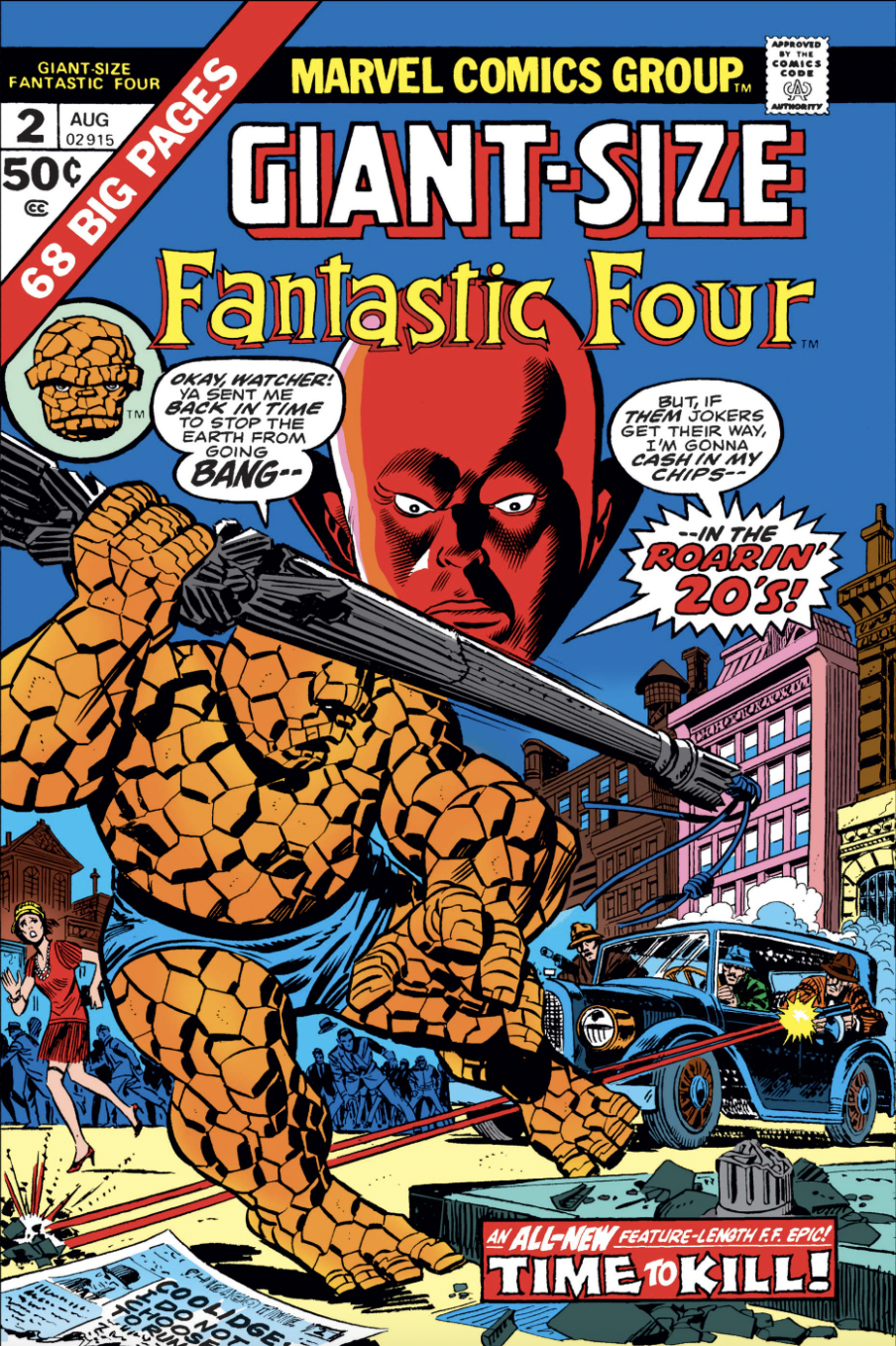
Editor’s Note: As discussed in my my last post, I belatedly discovered the four issues of Giant-Size Fantastic Four published in 1974 contained new stories worth blogging about here, so I am catching up over the next few posts. This issue takes place between the events of FF 149 and 150.
Synopsis
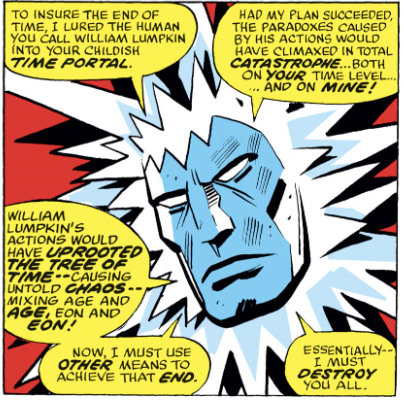
After completing a test flight in space for NASA, the Fantastic Four crash land in Florida and find the world is now inhabited by primitive ape-men. The Watcher appears and violates his oath (of course he does by) telling them someone invaded the Baxter Building and used Dr. Doom’s time machine to go back in history to disrupt events, changing the course of history (presumably, the FF were not affected because they were off-planet).
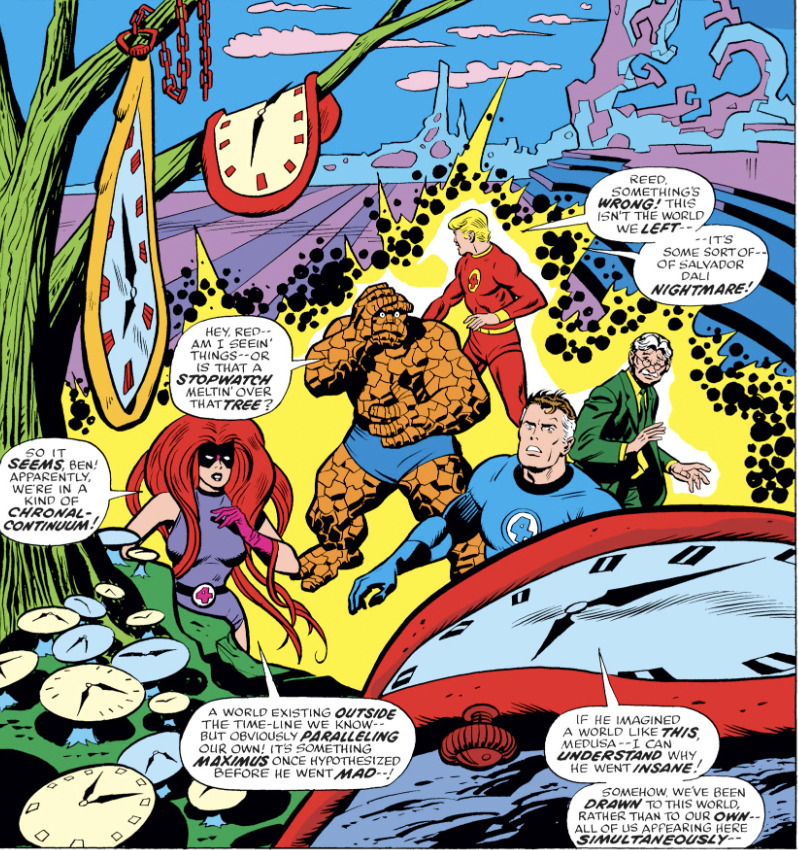
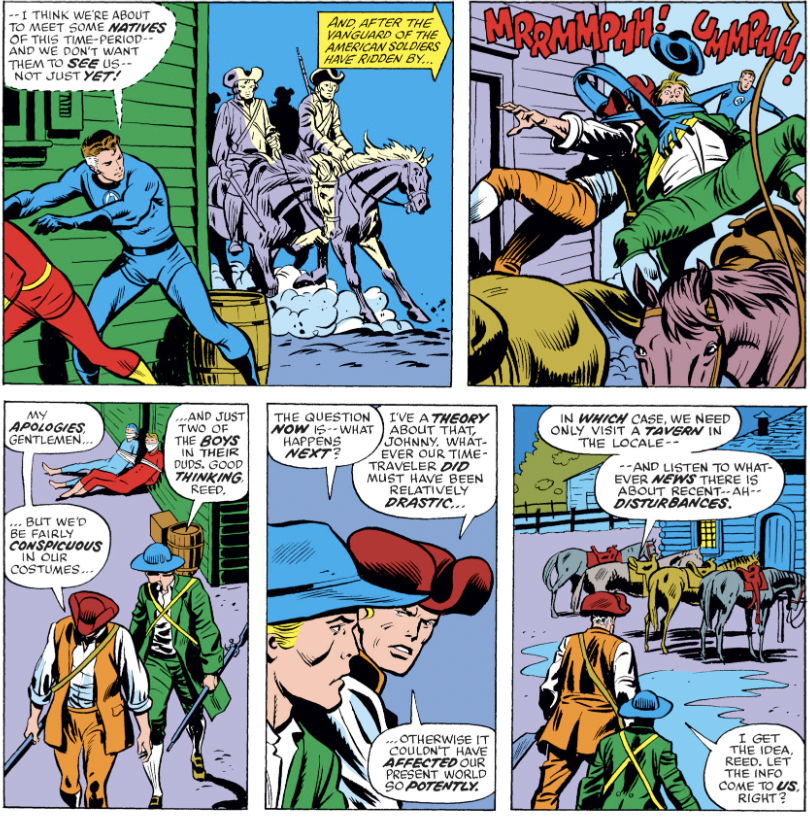
The Watcher sends Reed and Johnny back to the Revolutionary War, where they rescue George Washington from the British, and Ben and Medusa to Prohibition Era Chicago, where they stop gangsters from (somehow) preventing the Great Depression. Then, all four find themselves outside time, where they learn an immortal creature named Tempus engineered the events, using their mailman Willie Lumpkin as his agent, to bring about the end of time and cure his boredom. The FF defeat him and return to a restored Earth.
What’s going on here
There’s a lot to like in this comic. It has the fun, zany quality of old Lee / Kirby time-travel stories, and the chapters in revolutionary American and 1920s Chicago are well done. The story loses steam when the FF encounter Tempus, but it’s still an enjoyable read. More so than the last Giant-Size issue, this one captures the feel of an annual — a fun, meaty story outside the flow of the main comic.
Notably, the story also features the return of John Buscema, here inked by Chic Stone, and he does his normal excellent job. The cover is by Gil Kane, with Joe Sinnott’s inks.
What I liked
The sequence of Reed and Johnny rescuing George Washington was a lot of fun, and I particularly liked them sneaking around “a small town in upstate New York in the fall of 1777.”
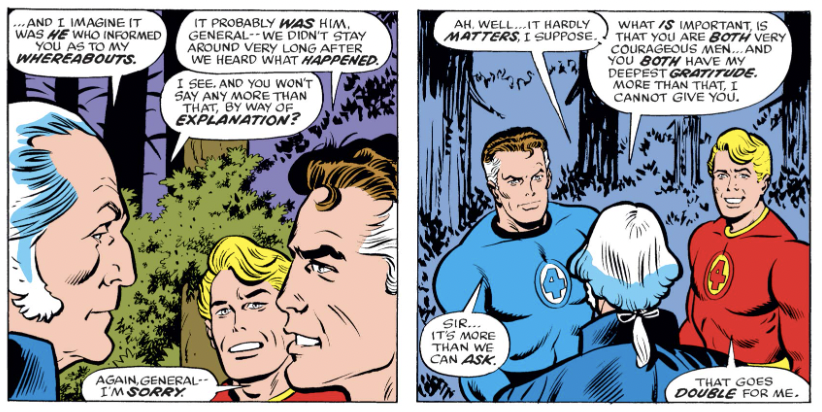
The encounter with Washington is also satisfying.
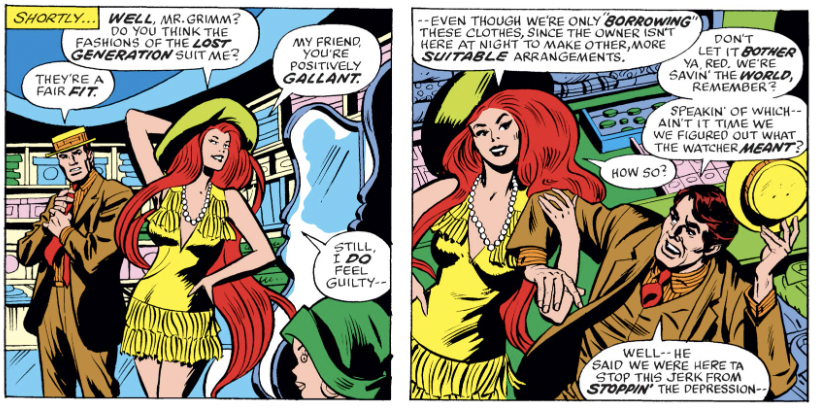
Ben and Medusa’s trip to the 20s isn’t quite as interesting, maybe because the FF have been to the 1920s-themes Skrull planet, but it is an opportunity for Medusa to do, you know , something.
For some reason Ben was returned to human form in the 20s, and his reversion back is as tragic as always.
What I didn’t like
The sequence at the end felt forced, and as a villain, Tempus is not terribly impressive. He does show up a few times after this, most prominently in Avengers Forever, but he’s pretty forgettable and doesn’t pose that big a challenge to the FF, who basically beat him by knocking him over.
Also, the revamped timeline doesn’t make a lot of sense. It’s hard to see how the British winning the Revolutionary War and the Great depression being averted leads to sub-human creatures living in Florida. But hey, what do I know?
Also, not one mention of, much less an appearence by, Sue or Franklin.
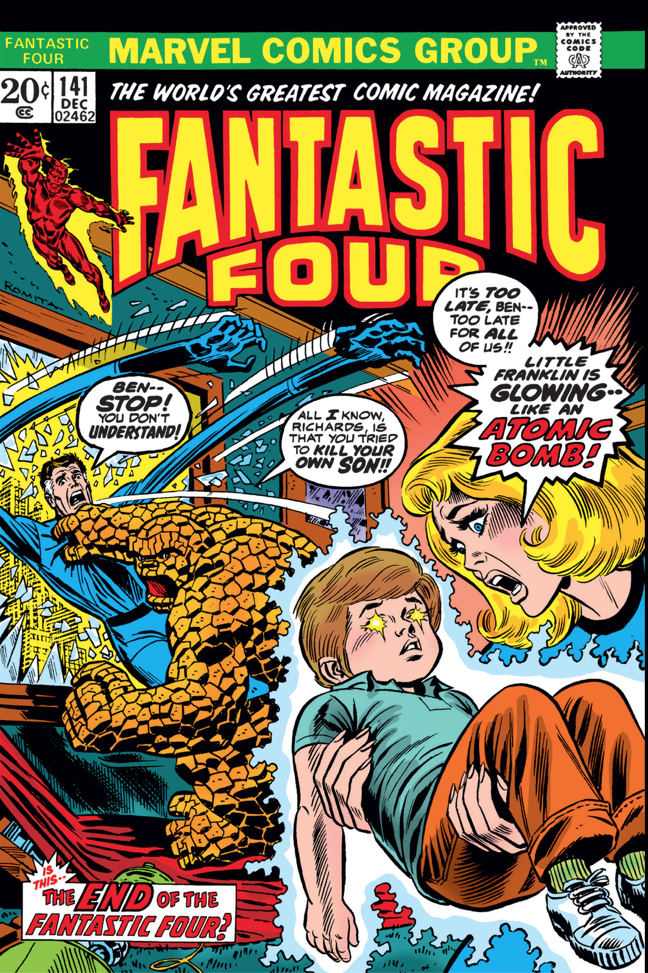
Fantastic Four 141 “The End of the Fantastic Four!” Published Sept. 1973 Writer: Gerry Conway Pencils: John Buscema Inks: Joe Sinnott Letters: John Costanza Colors: George Roussos Editor: Roy Thomas Cover: John Romita
Synopsis
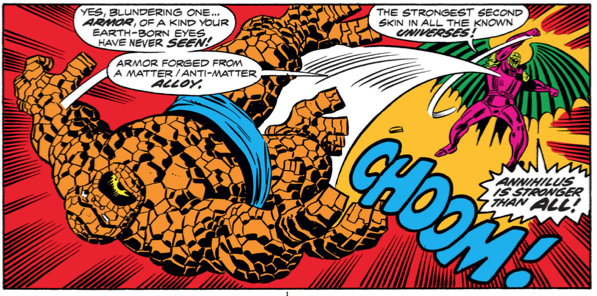
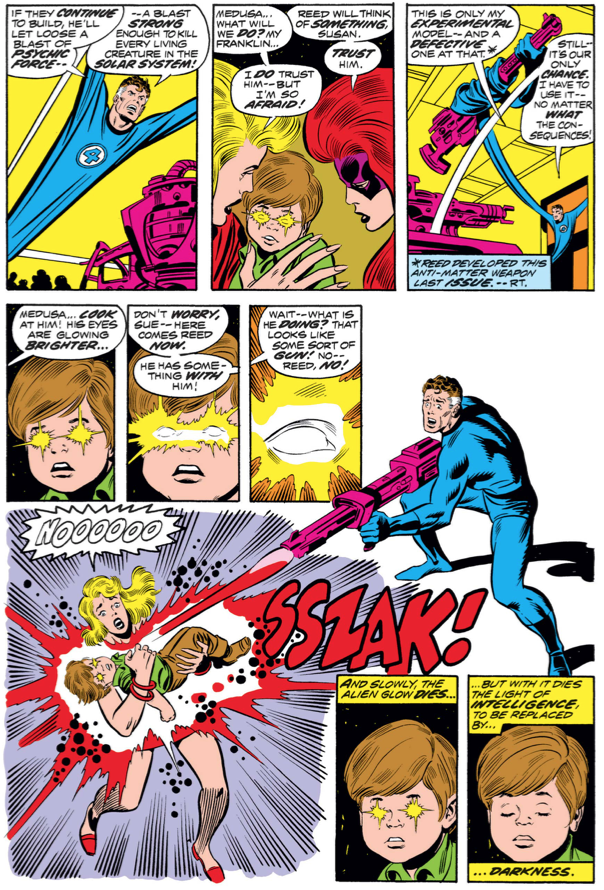
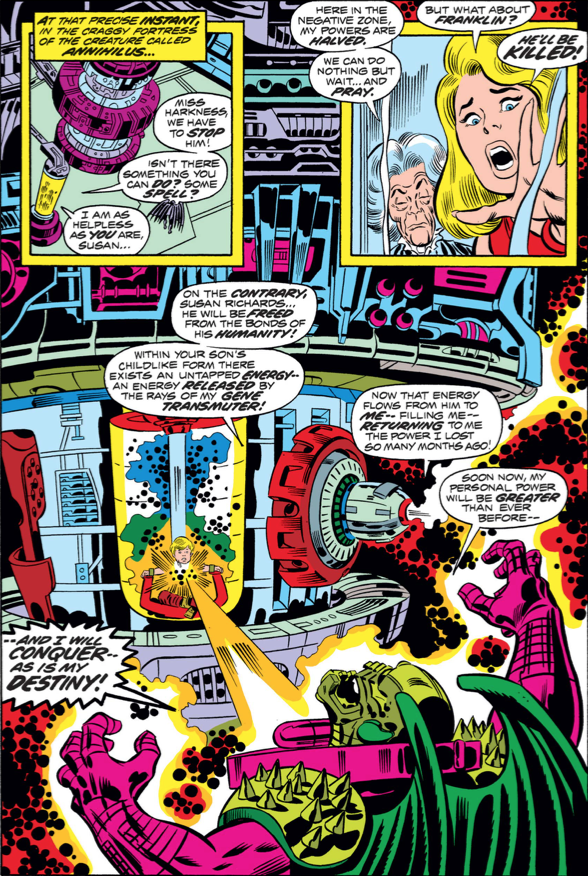
After capturing the now helpless Fantastic Four — plus Sue, Franklin, Agatha Harkness and Wyatt Wingfoot — in his Negative Zone stronghold, Annihilus taps Franklin’s comic powers in order to drain them. The FF escape, free Franklin and returns to the Baxter Building, where Reed, fearing Franklin’s powers will destroy the solar system, zaps him with a device that renders him a vegetable. Horrified, Ben declares this is the end of the Fantastic Four.
What’s going on here?
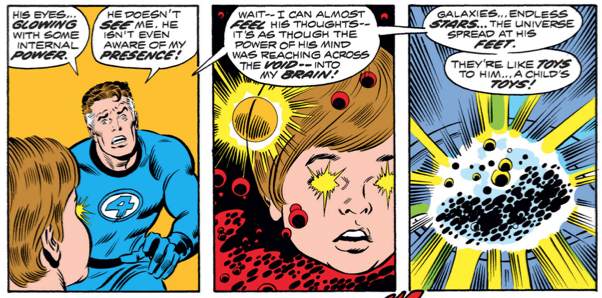
This is a heavy issue. I’m not particularly sure it’s a well-written story, but it has big themes and consequences. The big revelation is that Franklin possesses enormous power that threaten all of existence. His powers had been teased at for years now, but this is the first indication of their scope, and it’s a development that has major ramifications for not just the Fantastic Four but the Marvel universe for decades to come. As but one example, the mid-90s Onslaught storyline, which resulted in the cancellation and reboot of most of Marvel’s mainstream comics, was facilitated by Franklin creating a pocket universe. At some point he is identified as a mutant, although he’s not labeled one here.
It’s not clear who came up with the idea of giving Franklin these god-like powers. In an interview, Stan Lee said after they decided for Reed and Sue to have a child, he and Jack Kirby envisioned him having powers, and liked the idea of keeping readers guessing what they might be. It seems like Roy Thomas and Gerry Conway took that idea and ran with it. His powers have resulted in a lot of interesting stories, but also some petty tedious ones as well.
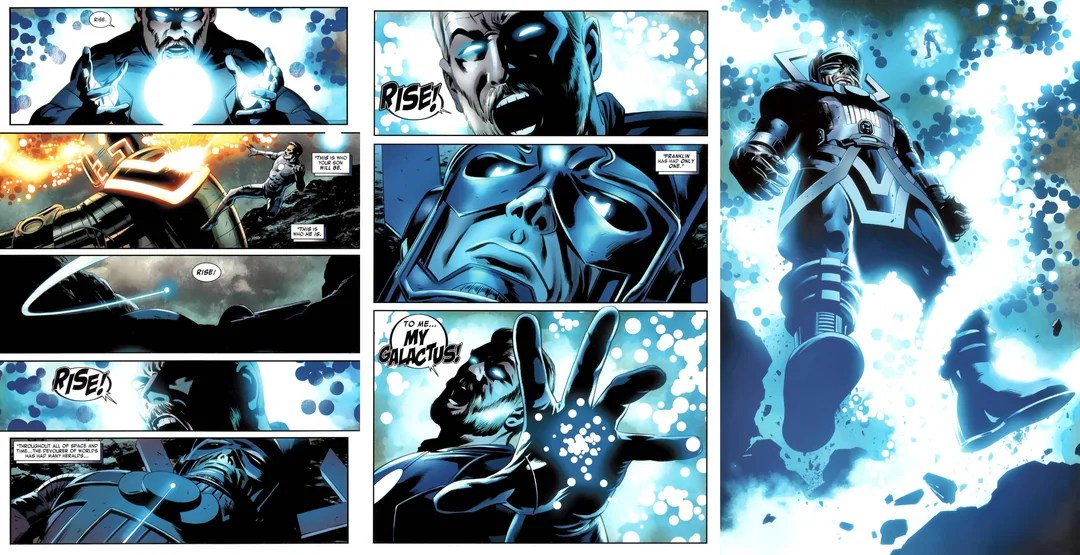
From my perspective, a super-powered Franklin is a mixed blessing. There is something compelling about the idea of a child with these immense powers, and when they are unleashed in the hands of a great writer, it can be a lot of fun. Hickman’s future Franklin battling Celestials and summoning Galactus might be as good as it gets (from FF 604, art by Steve Epting and Rick Magyar).
But for every fun story, there’s a lot of uneven ones about Franklin’s powers run amok, or Franklin in danger. And when taken together, they tend to reflect poorly and Reed and Sue as parents who are constantly exposing their child to danger.
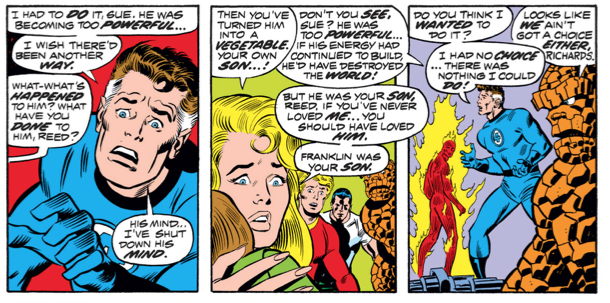
The other big development is Reed’s panicked decision to depower Franklin, and — it appears — effectively lobotomize him. It’s not the first, and certainly not the last, example of Reed prioritizing the good of humanity or the universe of over personal needs or desires, but it’s a poignant one. Of course, we know know that Franklin eventually recovers but for readers at the time, this must have felt like a pretty significant episode in the marriage of Reed and Sue and the future of the FF.
What I liked
I did appreciate how the stakes were ratcheted up in this story, and how Conway finally resolved long-hanging plot points, such as the disappearance of Agatha Harkness’s house way back in issue 134. Unlike Lee and Kirby, who rarely seemed to plot more than an issue or two in advance, Thomas and Conway unspool their subplots over months, creating bread crumbs for readers to follow. Even in this issue, which wraps up a long arc, Conway teases another story featuring Alicia Masters.
This form of story development isn’t always successful, but it suggests a respect for their readers’ ability to handle complicated ongoing stories. Chris Claremont would of course take this style of storytelling to absurd lengths, letting plots tangle for years, some never to be resolved.
I also enjoyed this splash from Buscema and Sinnott, which has a Kirby-ersque flair.
What I didn’t like
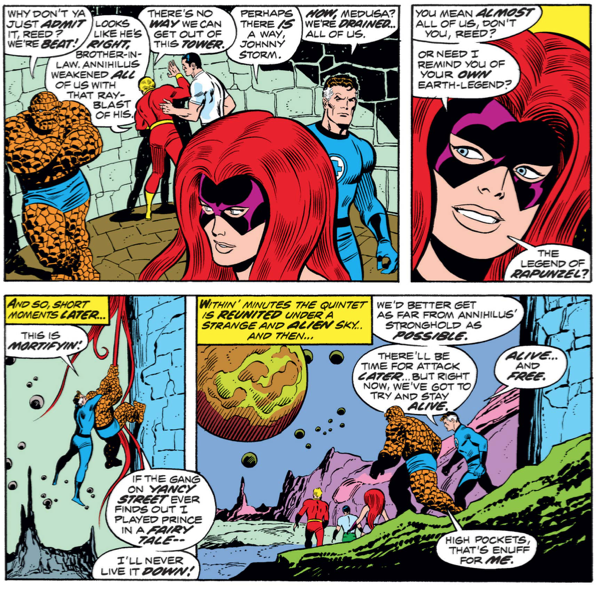
Despite the major themes introduced in this comic, the story itself wasn’t very interesting or well constructed. Basically, Annihilus captures the FF, they escape and defeat him. There’s not a lot of nuance, and it all feels pretty rote until we get to the climax.
One of my gripes about the Conway era has been how underutilized Medusa has been. Here, he rectifies that in the most obvious and silly way possible (Annihilus has imprisoned the FF in a room with an open window???).
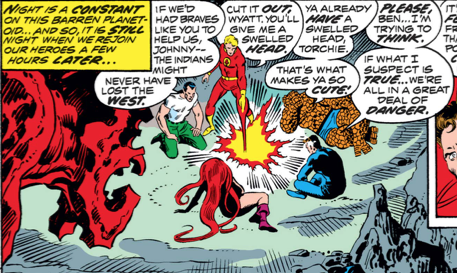
We also get this unfortunate exchange between Wyatt — even more under-utilized in this issue than Medusa — and Johnny.


 Percival Henry: The Fantastic Four and more