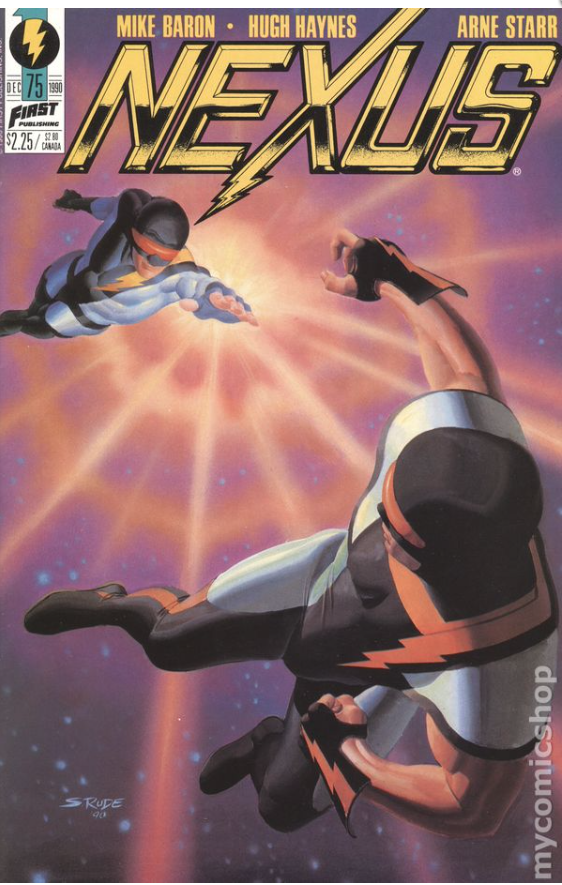
Nexus 75 “Blowout!” Publisher: First Publishing Published: Aug. 1990 Story: Mike Baron Pencils: Hugh Haynes Inks: Arne Starr Letters: Clem Robins Colors: Les Dorscheid Cover: Steve Rude
Synopsis
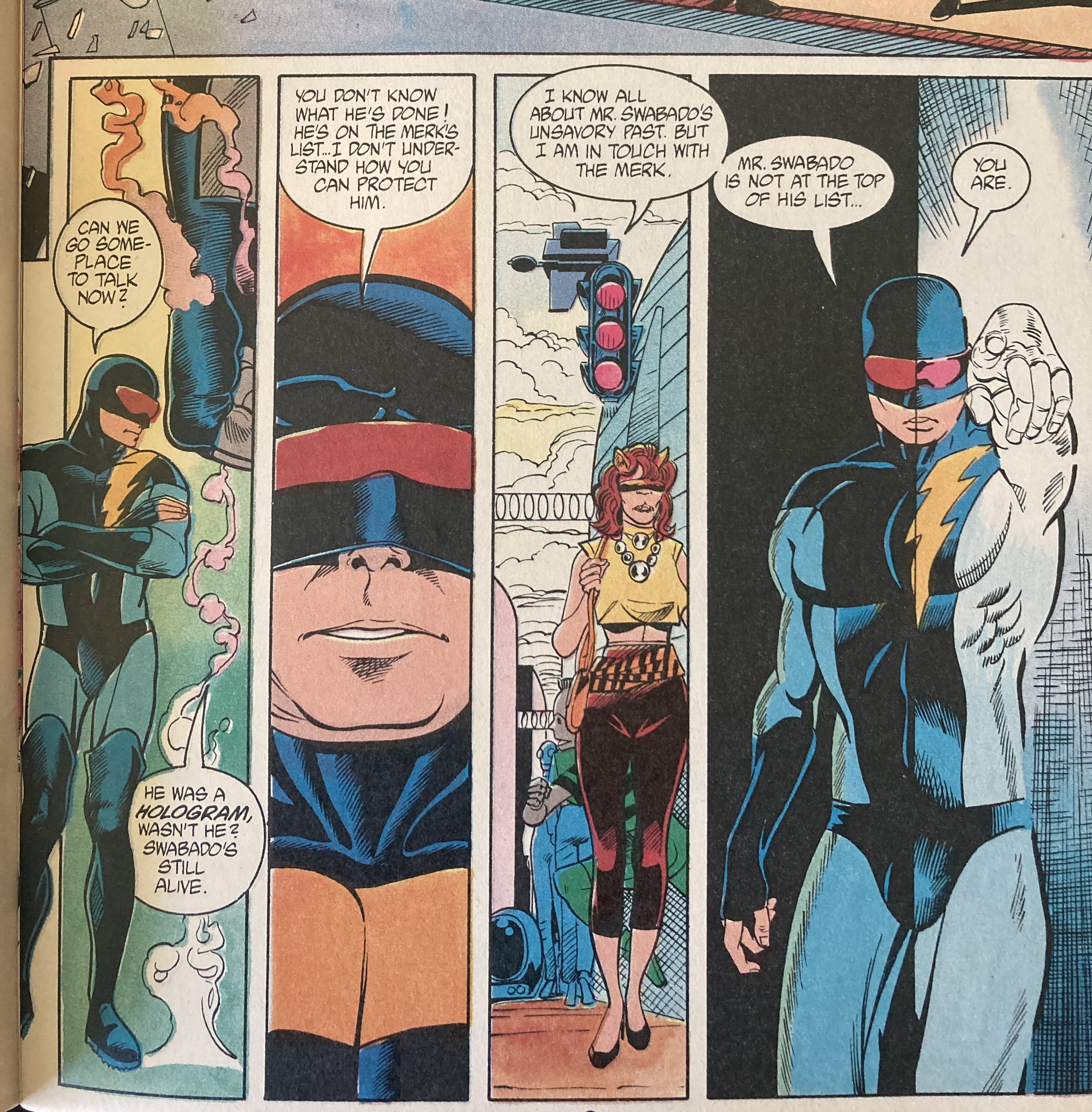
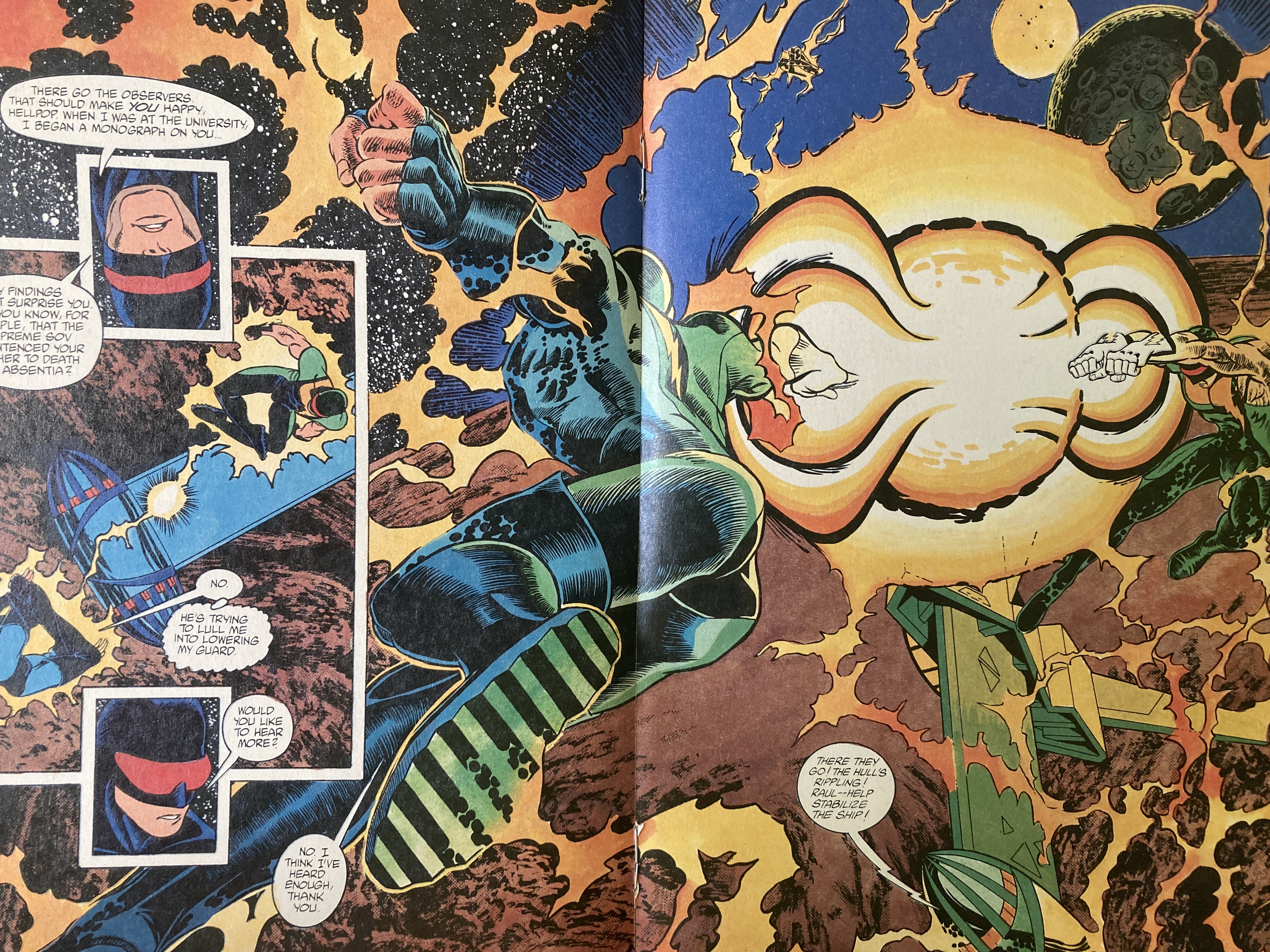
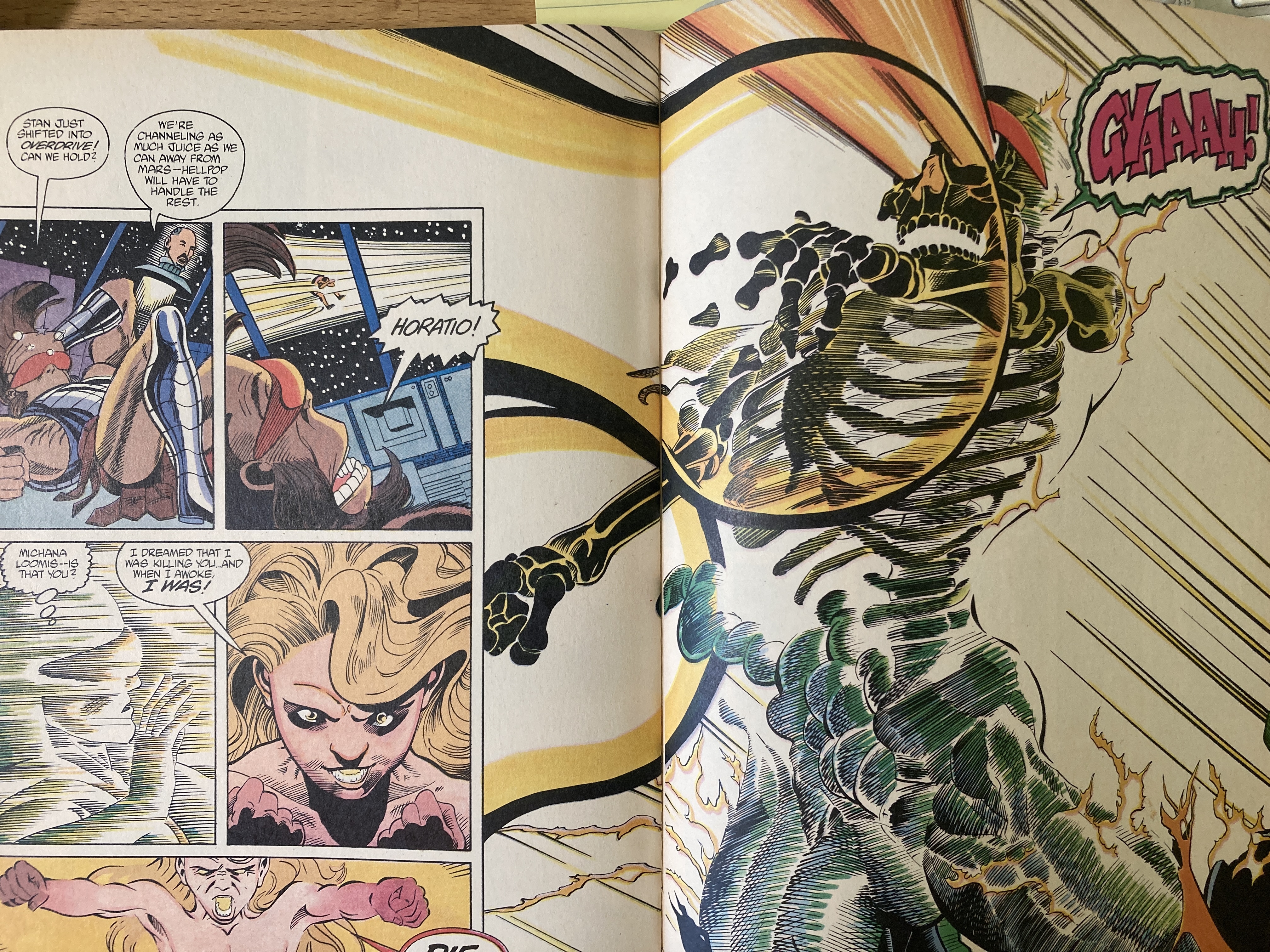
Horatio Hellhop, the original Nexus, confronts an erratic successor, Stan, who is powered by the Bad Brains. Sparks fly as they face off in the orbit of Mars.
What’s going on here?
In the 1980s, few comics were as cool as Nexus. At its peak, written by Mike Baron with art by the legendary Steve Rude, it was a science fiction epic, with a sleek vigilante hero who slaughtered his enemies with cool flair. He was an art deco Punisher. By issue 75, however, Nexus was past its prime and on the downside. Rude had left long ago—although he contributed a gorgeous cover—and the book was just five issues away from cancelation. It’s still a solid comic, and the high points remind you of why Nexus was such a fun read, but it feels a bit like a classic band with some new members. It’s not quite the same.
This issue is the fifth of a five-part arc featuring the rise and fall of Staislaus Korivitsky, a replacement Nexus. I have no recollection of any of this, and I may have just read this comic for the first time (by 1990, I was in college and reflexively buying comics without reading them). Despite that, the story isn’t hard to follow, and features some pretty impressive art from Haynes, who had a short career, mostly at Marvel in the early 90s.
What I liked
As mentioned, the art reaches some impressive peaks. The big, double page splashes feel like an early iteration of the wide-screen style later embraced by artists like Bryan Hitch, but the big stakes in the story justify it. And it’s fun to see Nexus and Judah Maccabee, his occasional sidekick, back in action. Oh and that cover [chef’s kiss].
What I didn’t like
Not much. It feels unfair to subtract points for what it isn’t, but unfortunately Nexus hit such great highs a few years prior that even a solid effort like this feels like a let down.
Overall
Not bad, but only really of value to Nexus completionists.
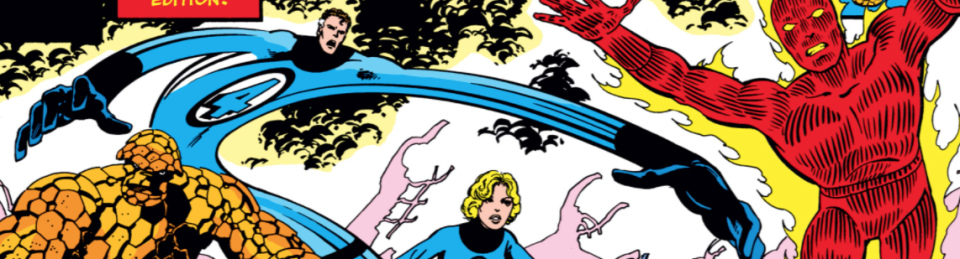
The Thing 5 “With Friends Like These …” Published July 1983 Writer: John Byrne Pencils: Ron Wilson Inks: Hilary Barta Letters: Jim Novak Colors: Bob Sharen Cover: Wilson and Al Milgrom
Synopsis
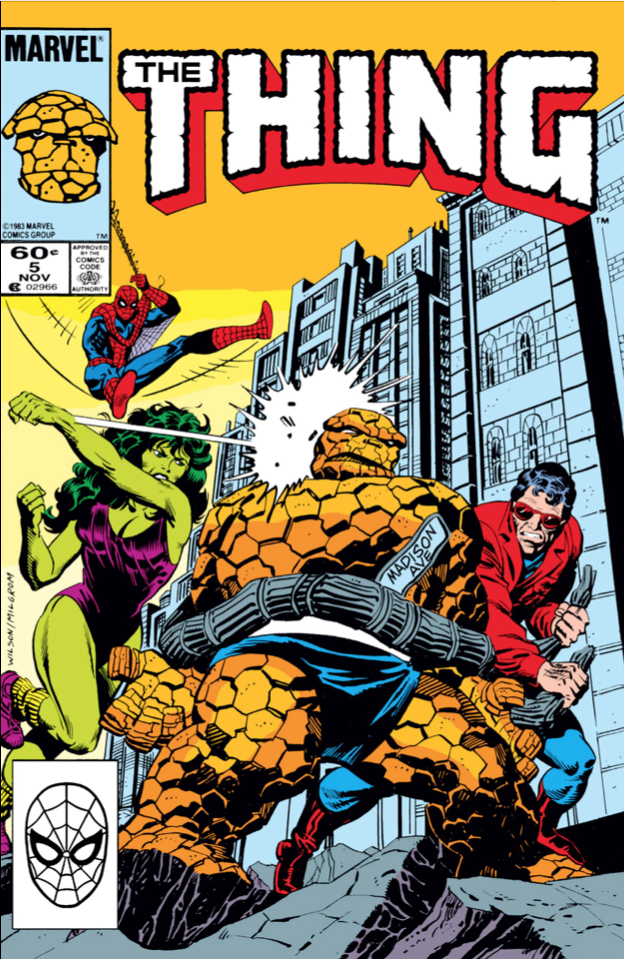
The Thing is attacked by Wonder-Man, She-Hulk and Spider-Man, all of whom are revealed to be under the control of the Puppet Master. The story continues in the next issue.
What’s going on here?
The Thing’s solo comic, written by John Byrne with art by Ron Wilson, followed the cancellation of Marvel Two-in-One, which co-starred the Thing and a different guest star each issue and was often very entertaining.
I’m not sure why Marvel’s powers-that-be made the change, and I wouldn’t be surprised if Byrne, then writing the Fantastic Four, wanted more control over one of his main characters. In general, the Thing’s solo book never really delivered on its promise, and after about a year of indifferent stories, took a (literal) detour when Ben Grimm was stranded in space and the stories got loopier and loopier. Byrne left the book after issue 22, Mike Carlin took over and made Ben a professional wrestler and the comic was mercifully canceled with issue 36.
I started collecting comics in August 1983, the month after this issue came out, so my first issue was Thing 6, which is the second part of the story. This issue, which I eventually bought as a back issue, feels very much like a prelude to the next issue, in which Ben battles the Puppet Master in his mind in a very dark issue (literally and figuratively). That was a challenging first issue to read, but was much more ambitious than issue 5.
What I liked
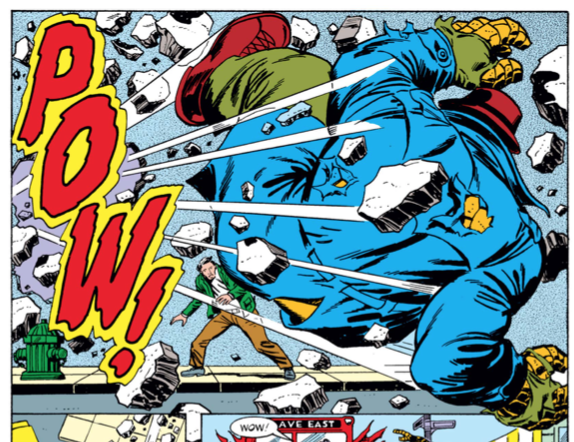
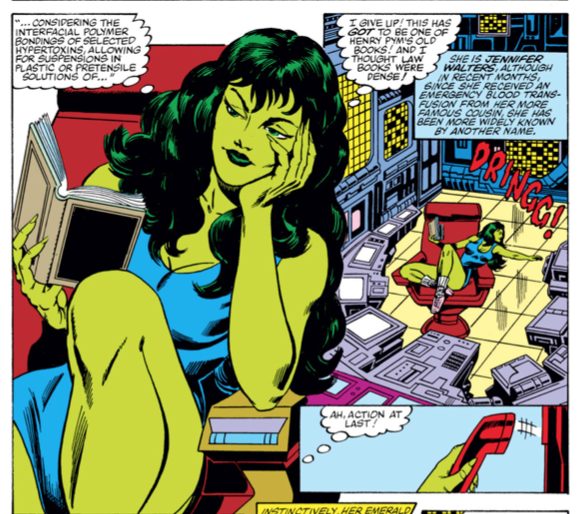
I was never a huge fan of Ron Wilson, whose pencils often felt workman-like and static to me. But there’s a lot of fun action in this comic, which he does well. And he draws a great looking She-Hulk.
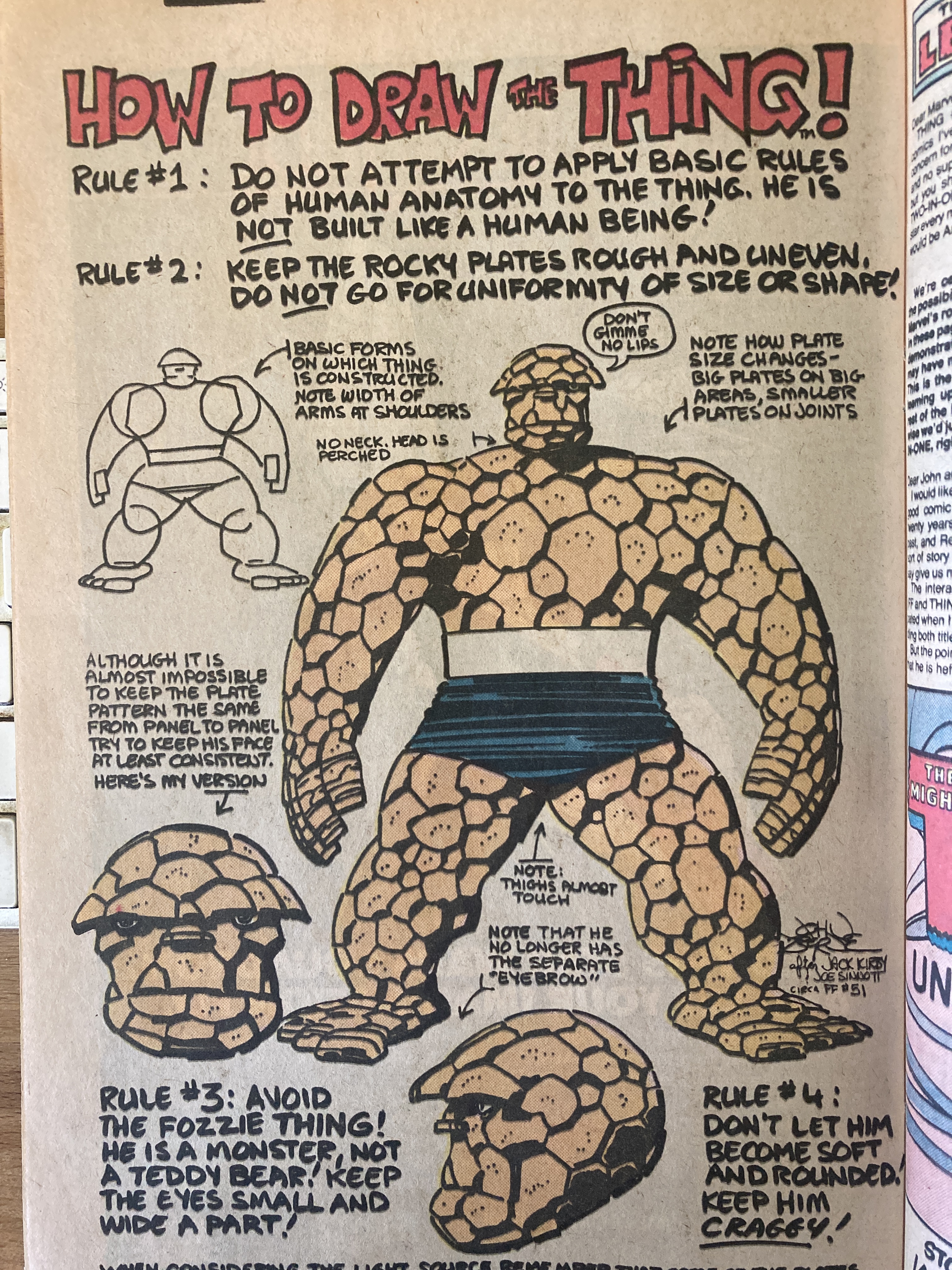
Interestingly, Byrne, includes a page at the end showing how to draw the Thing. It’s a fun guide that feels like it’s out of the classic How to Draw Comics the Marvel Way. But looking back now, I wonder if Byrne was using it to answer critics who felt his Thing was too odd looking. (Also, for whatever reason, this page isn’t included in the digital edition).
What I didn’t like
As mentioned, this comic really feels like a setup for the next issue, and in itself doesn’t offer much besides nonstop fighting. That’s OK as far as it goes, but Ben is such a great character it would have been good to have more substance (besides his usual fretting about his relationship with Alicia, which gets tedious). Also, it takes him an awful longtime to suspect his friend are under the control of the Puppet Master. Given their history, wouldn’t that be his first guess?
Batman 403 “One Batman Too Many” Published Oct. 1986 Writer: Max Allan Collins Pencils: Denys Cowan Inks: Greg Brooks: Letters: John Costanza Colors: Adrienne Roy Cover: Cowan and Dick Giordano
Synopsis
An insane former cop believing he’s Batman escapes from Arkham Asylum and, discovering the Batcave, steals a Batman costume and the Batmobile. The real Batman hunts him down.
What’s going on here?
This is an interesting issue, for a few reasons which editor Denny O’Neill very helpfully explains in a note at the end. First, this is the last issue before Batman: Year One, the Frank Miller/ David Mazzucchelli tour de force that would rock my (and lots of comic readers’) world starting with Batman 404. Secondly, it’s written by Max Collins, who I knew was the writer of the indy Ms. Tree comic but who also wrote the Dick Tracy newspaper strip. The man knows detectives!
Thirdly, the art is by a relatively young Denys Cowan, drawing his first Batman comic on his way to a long and distinguished comics career.
What I liked
This is an entertaining noir-ish comic that is technically a sequel of the previous issue but works as a one-and-done comic. This was written before the “Bat-God” of Grant Morrison—the all-knowing, all-powerful character without humor or pity—and instead Batman here is pretty much a normal hero, juggling a secret identity, telling jokes and having his car stolen by the bad guy.
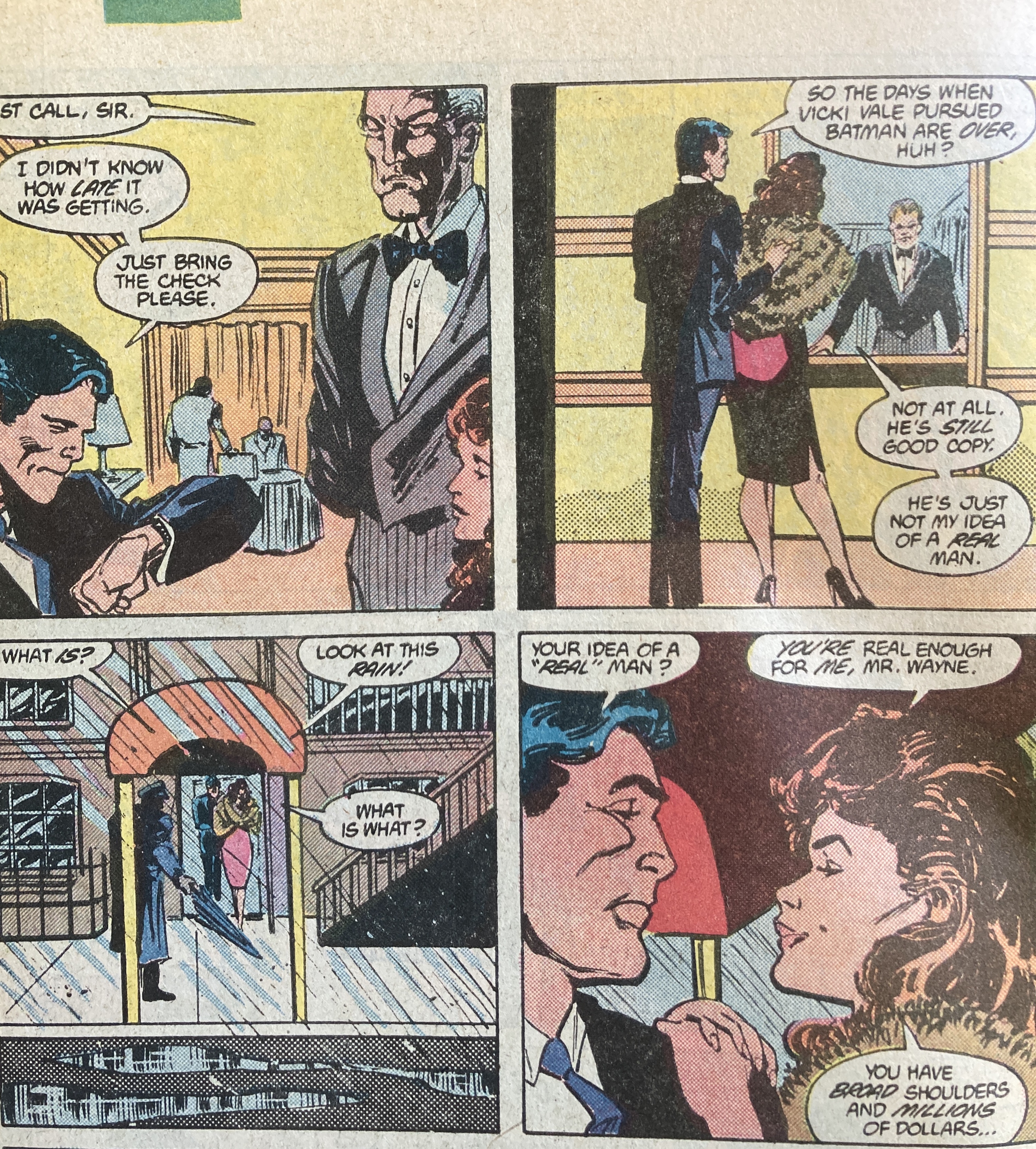
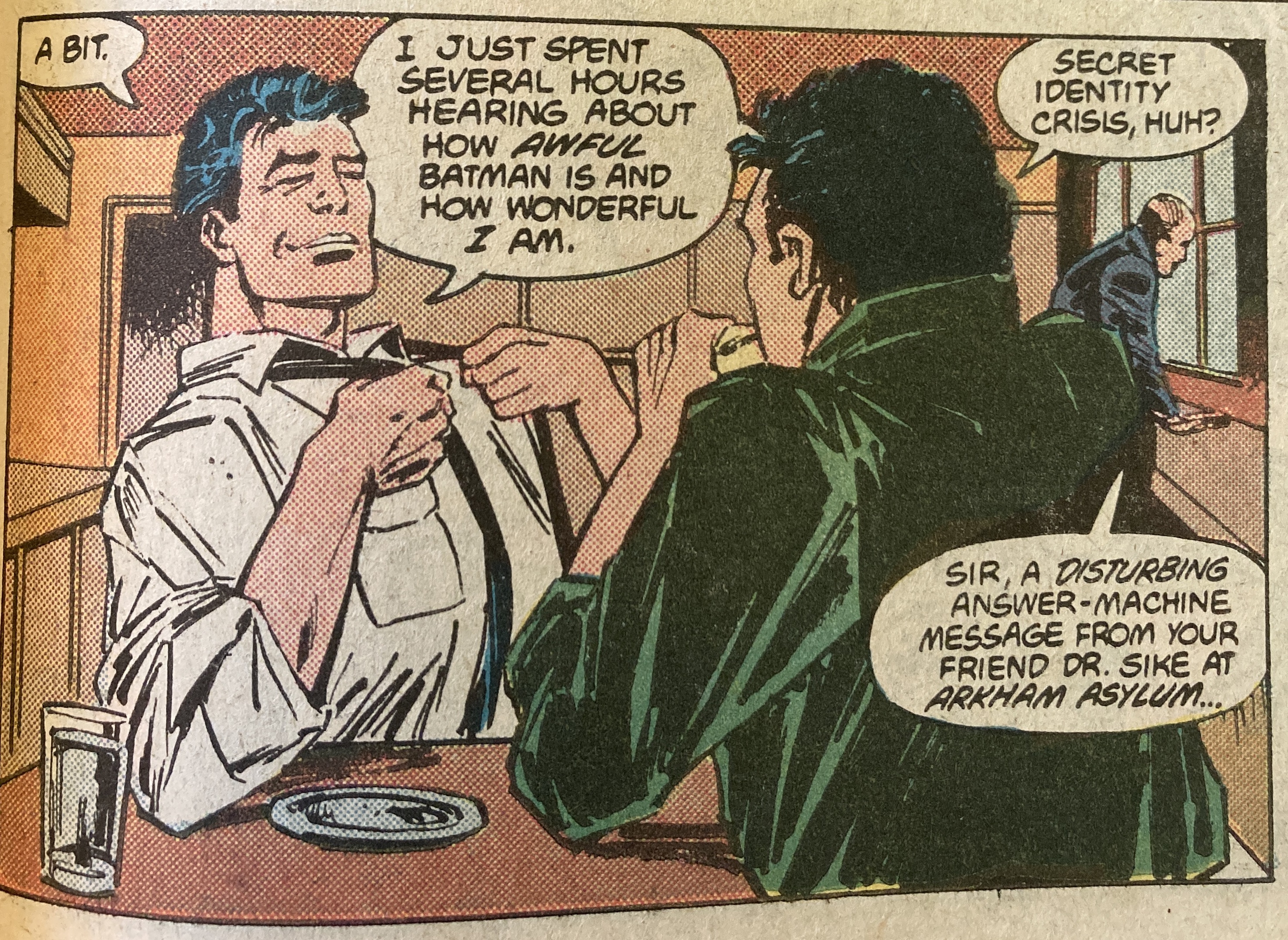
Collins has fun playing Bruce Wayne against his secret identity and he wins and dines Vicki Vale, who has no patience for masked vigilantes.
Here he is hanging out with Jason Todd —yes, this is when Todd was Robin—and telling him about his date.
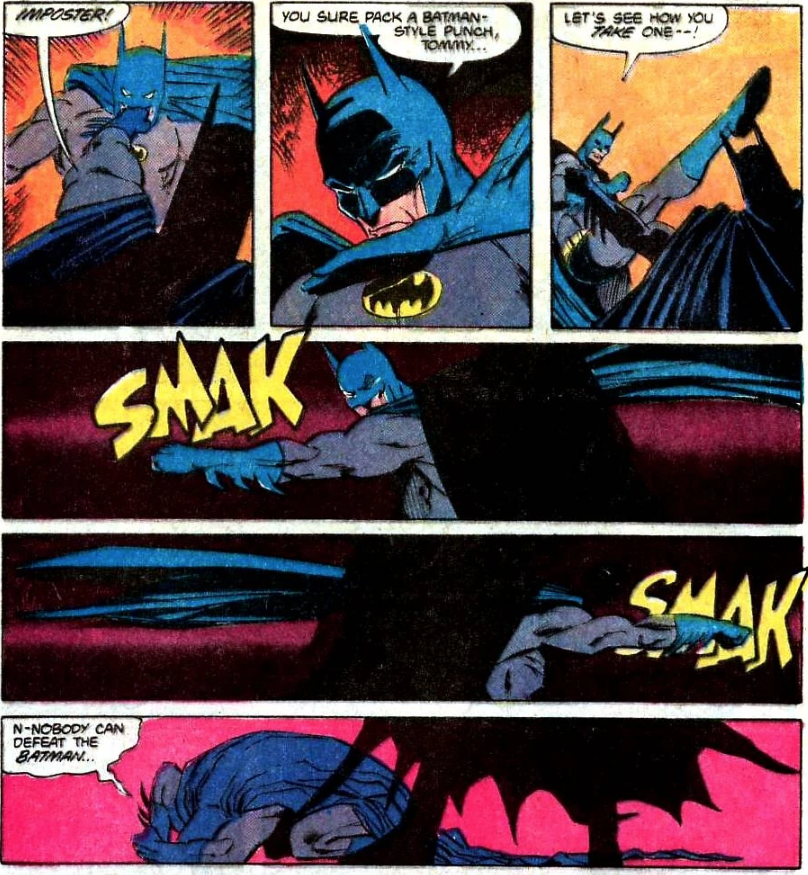
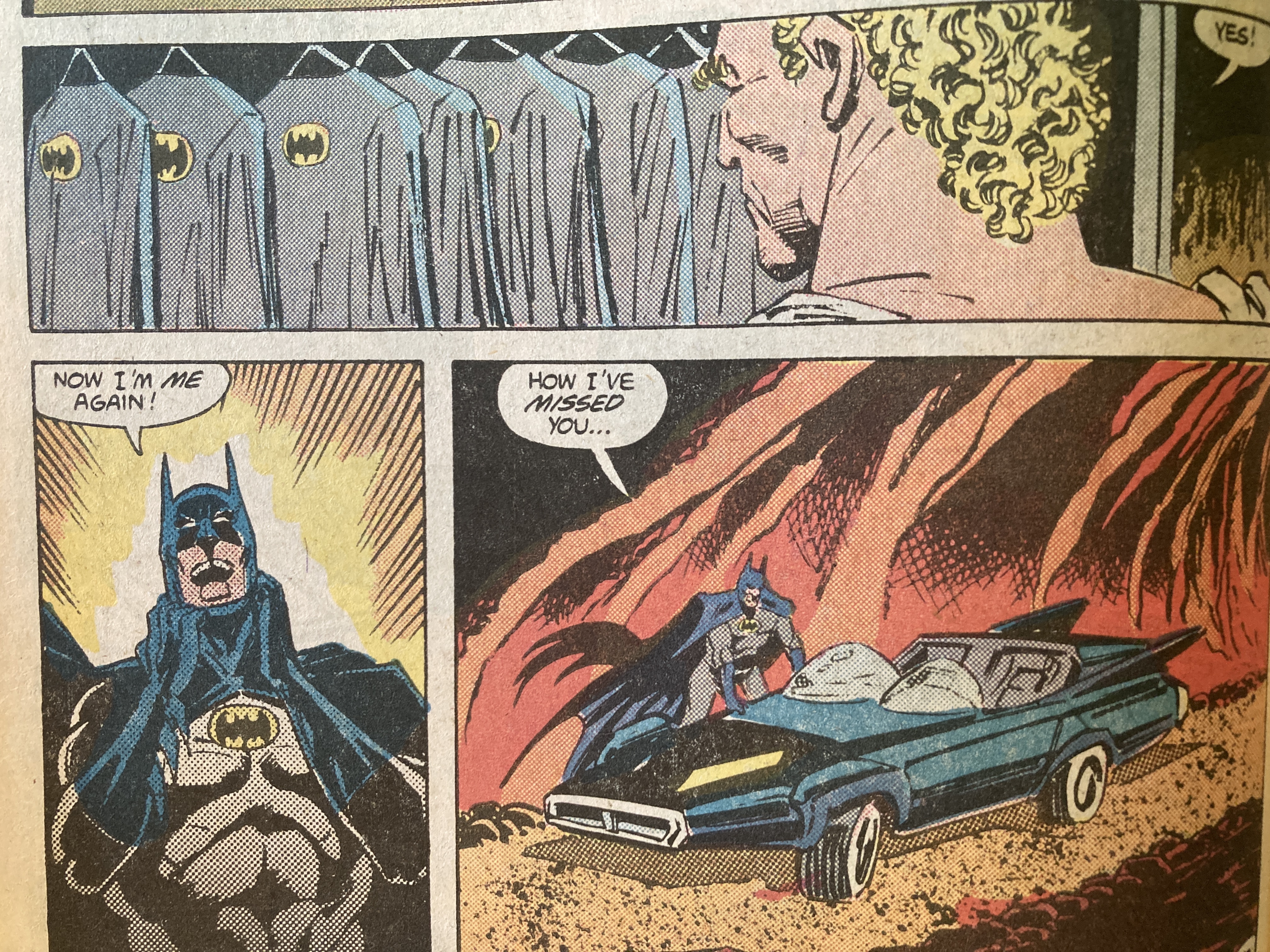
Collins also has fun with the two Batmen and the stolen Batmobile, first with the imposter finding it:
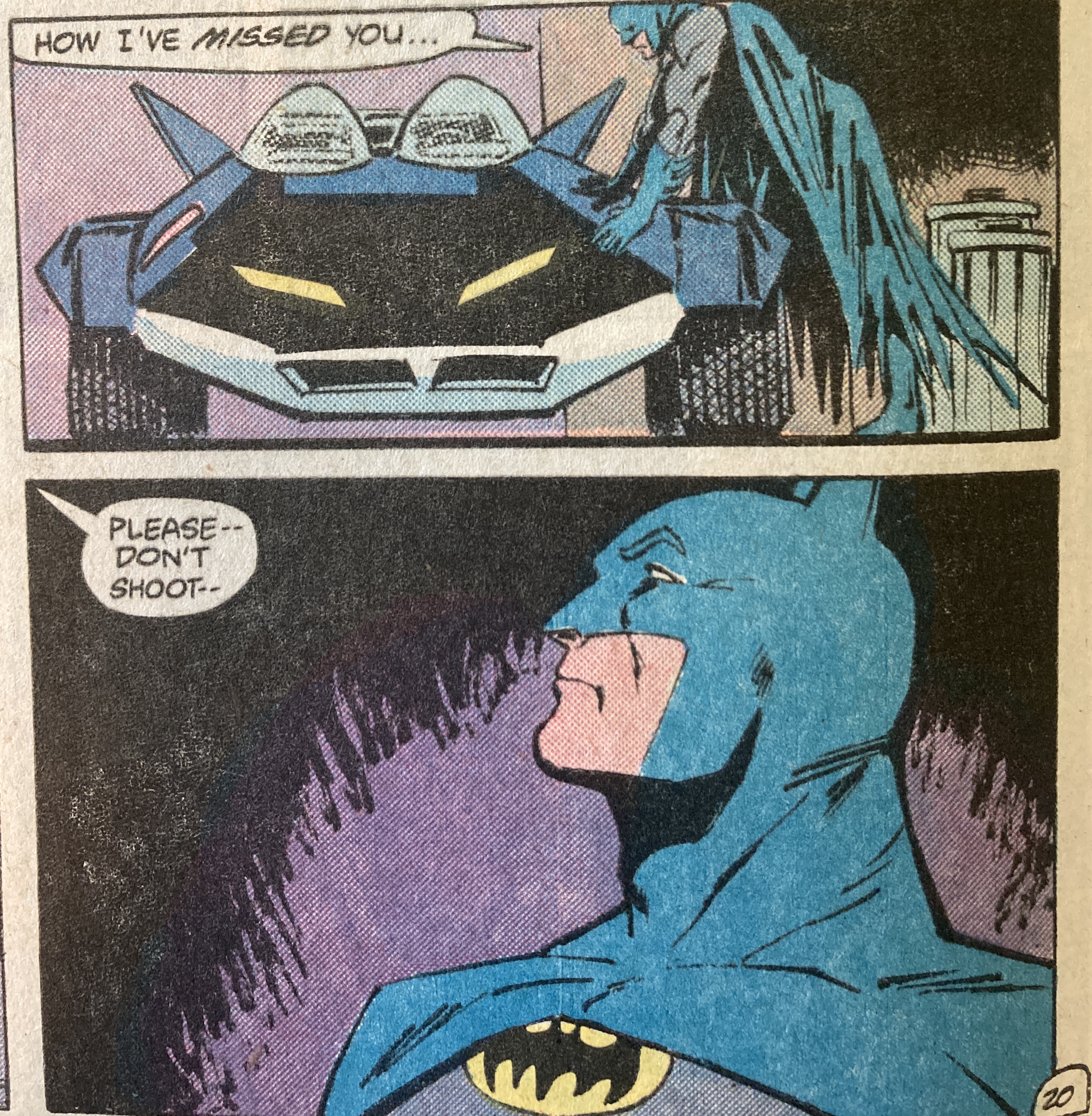
And the real Batman recovering it:
Cowan’s art looks great here, too. It’s appropriately dark and gritty but easy to follow.
What I didn’t like
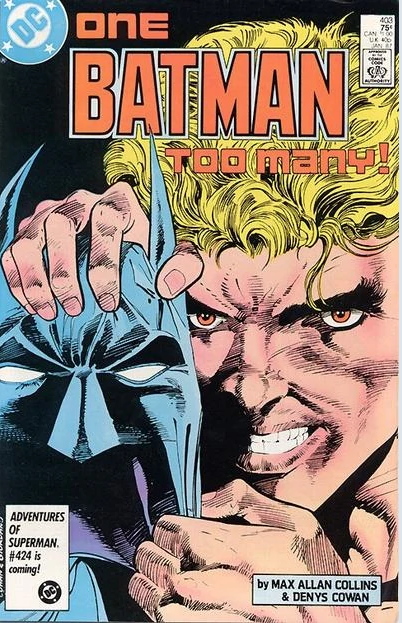
Not much! I suppose the action wraps up pretty conventionally, and there’s not a lot of angst about the Batcave being discovered, but I’d rather the story be told in 22 pages than over six issues, like it would be today. And I’m not sure the cover does a great job of capturing the story, but these are quibbles.
Overall
Almost a text book version of a great Batman story.
Iron Man 230 “The Day the Hero Died” Published Jan. 1988 Plot: Bob Layton and Dave Michelinie Script: Michelinie Pencils: Mark Bright Inks: Layton Letters Janice Chiang Colors: Bob Sharen Cover: Bright and Layton
Synopsis
This is chapter six in “Stark Wars,” a story arc detailing Tony Stark’s attempts to round up all the illicit uses of his technology. So far it’s been at a high cost, as he explains that an innocent was killed in the Soviet Union as he battled the Titanium Man. To disable all other uses of his tech, Tony is now deploying a “tapeworm” program, essentially a virus that infects all other technology.
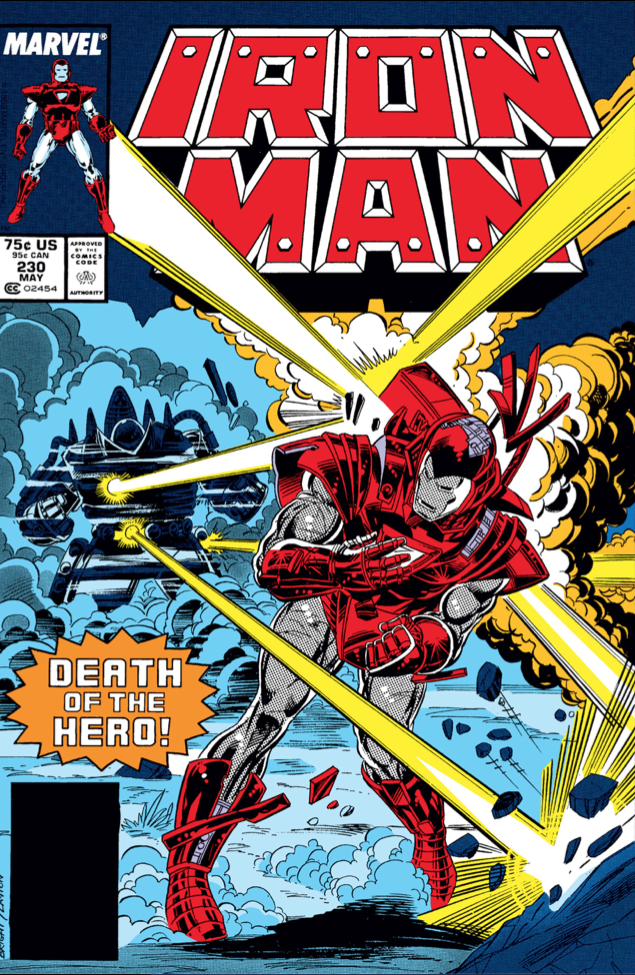
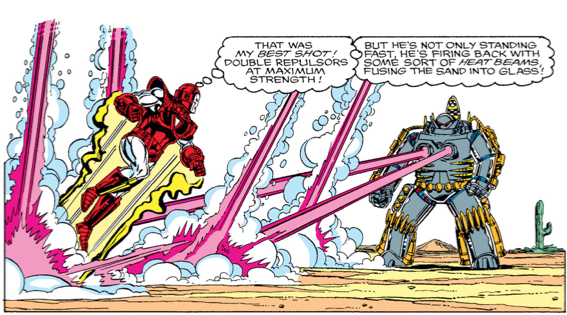
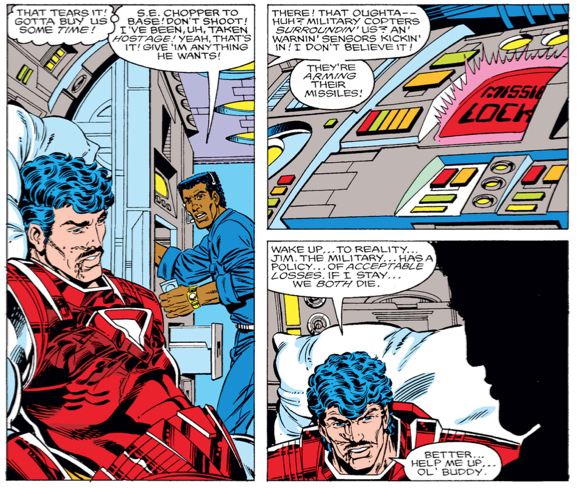
Meanwhile, the U.S. military is working with a contractor developing “Firepower,” its own high-powered armor that utilize stolen Stark technology, with the intention of taking down Iron Man. A senator and generals lean on Tony to help them corner Iron Man, and Tony agrees, reasoning he has to confront Firepower at some point. They battle in the desert, and Tony is badly beaten, and in the last panel appears to have been killed.
What’s going on here?
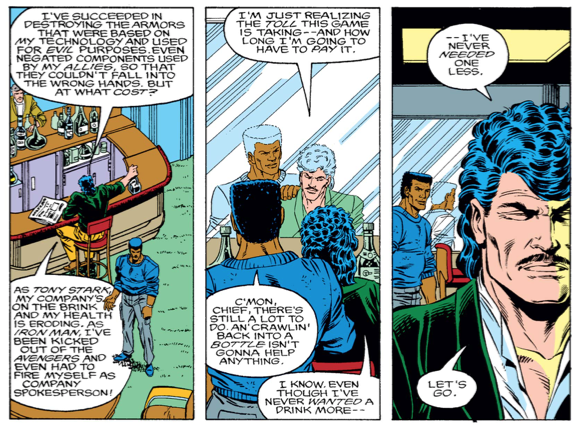
This is satisfying comic, even jumping in without having read (or more accurately, remembered) the first five installments in the Stark Wars story. It features a lot of the Iron Man set-pieces from this era: Tony looking suave in his fancy Stark offices, Rhodey being the helpful voice of reason, Tony tempted to drink but rejecting booze, etc. It also features the Silver Centurian armor, which, although relatively short-lived, was the main armor for much of my Iron Man-collecting youth and an underrated look for the character.
The comic was also produced by the longtime Iron team of Michelinie and Layton, with Bright on pencils. Layton, particularly, feels like the quintessential Iron Man artist, and manages to make the armor gleam like no other other.
What I liked
This was a well-paced story, with the action alternating between Tony and his plans to eliminate rogue uses of his technology, and the military eagerly testing its powerful new weapon. There’s also a grim sense of inevitability as Tony prepares to take on a foe that seems more than capable of handling him, and in fact kicks his ass. It’s rare to see a hero get as badly beaten as Iron Man was here.
Also, I love the cover logo. Maybe the best Iron Man logo ever.
What I didn’t like
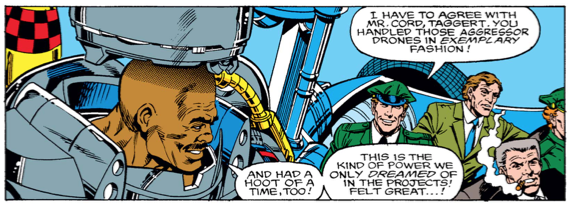
The Firepower design is pretty clumsy and unattractive. The last panel, suggesting Tony is dead, seems like such an obvious red herring. Only someone reading their first comic book would think Tony is dead. And while it’s cool to have Black characters like Rhodey and Jack Taggert, the soldier in the Firepower suit, in prominent roles, Michelinie is too quick to resort to stereotypes, such as Rhodey’s dropping letters in his speech and Taggart’s off-handed mention of “the projects.”
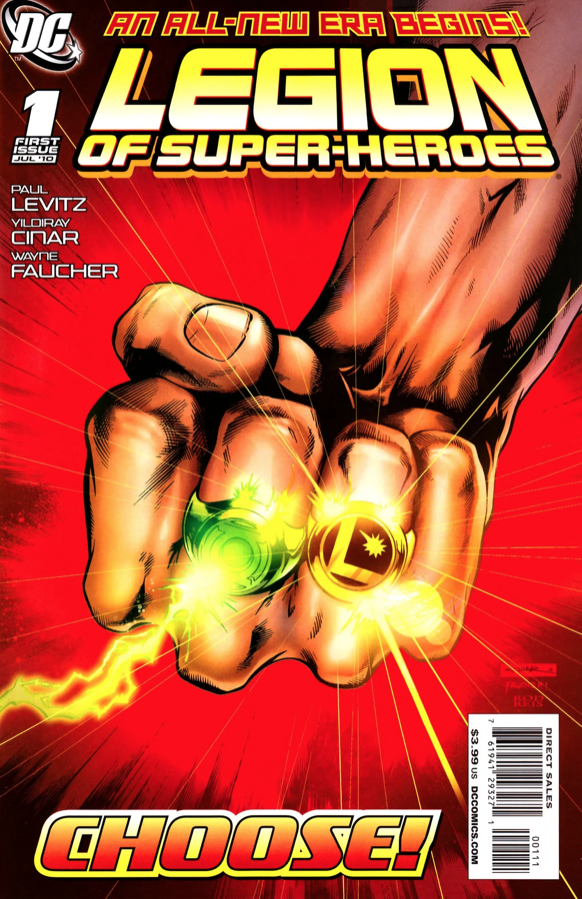
Legion of Super-Heroes (Vol. 6) 1 “The Scream Heard ‘Cross the Universe” Published: May 2010 Writer: Paul Levitz Pencils: Yildray Cinar Inks: Wayne Faucher Letters: Sal Cipriano Colors: Hi-Fi Cover: Cinar and Faucher
Synopsis
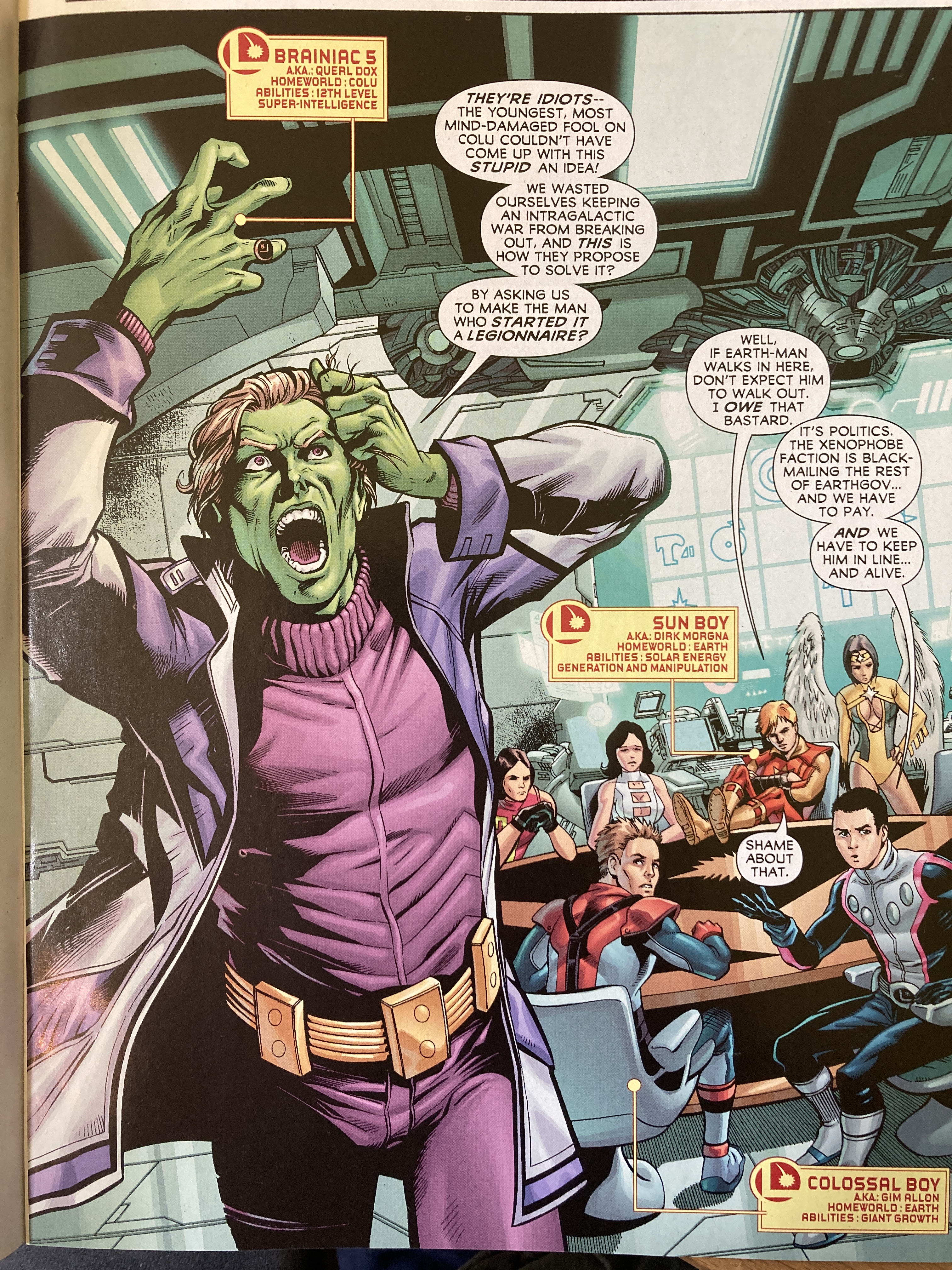
A number of story arcs are introduced in this comic, some of which tie together by the end. In one, Earth-Man, a xenophobic villain who hates “off-worlders,” is in custody and being drained of his powers. But to placate anti-alien forces on Earth, the United Planets government is forcing the Legion to take him on as a member in exchange of allowing them to maintain their headquarters on Earth. The unhappy legionnaires, led by Braniac 5, offer Earth-Man a Legion ring, with special modifications to keep him in check
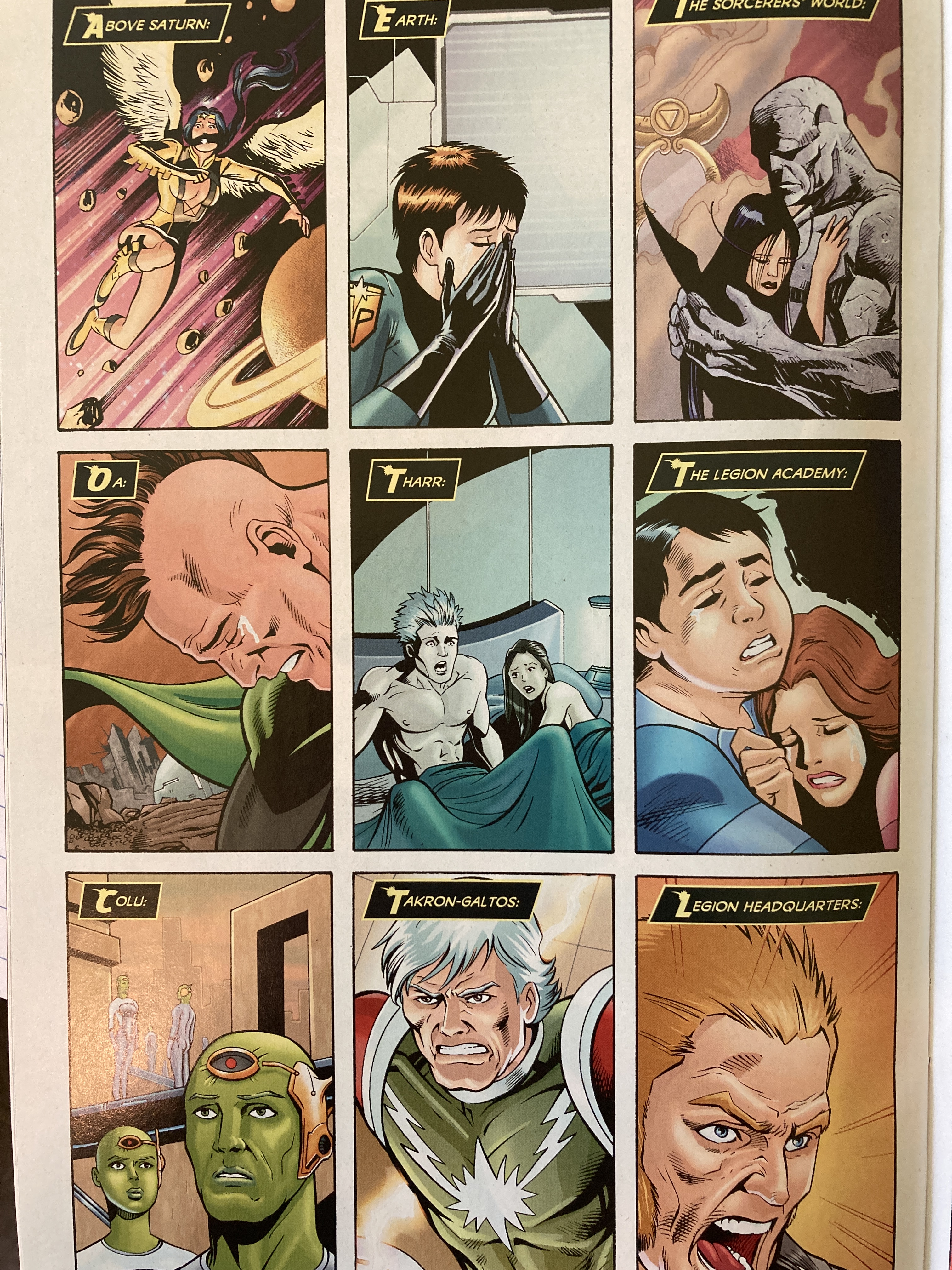
Meanwhile Saturn Girl is on her home moon of Titan, where time-travel researchers are conducting an experiment to witness the birth of the universe (which longtime DC readers know only means bad things). The experiment goes awry and sets up a chain reaction that transports Saturn Girl’s children to another time and ultimately destroys Titan.
The act of witnessing the birth of the universe reaches Oa, home of the Guardians, where Sodam Yot, last of the Green Lanterns, has his ring removed by Dyogene, an alien being. Dyogene then presents it to Earth-Man, naming him the new Green Lantern for Earth’s sector.
What’s going on here?
Sometimes it feels like the comic industry goes out of its way to complicate things. The inaugural issue of (yet another) Legion reboot should be an opportunity for new readers to jump on with a clean slate, but writer Paul Levitz—who wrote the Legion in the 80s and is back after 20 years—can’t seem to help himself.
Instead of a fresh start, we are evidently picking up a story that began in Superman and Final Crisis: Legion of Three Worlds. While the Final Crisis series appears to have restored the Legion back to the version Levitz last wrote, there’s still lots of loose ends to be dealt with. As a result, we are presented with a tangled plot concerning Earth-Man and Green Lanterns, and featuring Saturn Girl and her own complicated backstory.
All of this might have made lots of sense 13 years ago, when this comic came out, and I was more-or-less following along as a monthly reader. But now, sadly, it’s all a bit bewildering.
What I liked
Despite it all, it’s still the Legion, and no one has a better handle on this sprawling team than Levitz. It’s always fun to see these characters again, and we get fun snippets of their personalities from the legionnaires who get their moment on stage. The Earth-Man concept is a good one, and the idea of a Xenophobic element on Earth threatening the highly diverse Legion creates an interesting political dynamic. I’m just not sure I have the energy to read all the stories leading up to this to fully understand it.
I particularly liked this tour of the Legion universe, as the psychic shock of Titan’s destruction ripples across the galaxy.
What I didn’t like
As discussed, too much background knowledge is assumed and an awful lot of story is crammed into this comic. I also disliked Levitz’s handing of Braniac-5, who has gone from merely smug to dismissively arrogant. And the cover—Earth-Man’s fist with the Legion and later rings—feels like an odd choice for a first issue.
It’s also never been clear to me why the Legion has had so many reboots. More than any other mainstream title from the Big Two, the Legion seems a victim of the industry’s commercial forces, as every new event or company-wide reboot seems to produce a new vision for the Legion. The irony is, way out in the 30th century, they should be isolated from all the chaos in the here and now.
Overall
It’s fun to see these characters again but it feels like a missed opportunity.
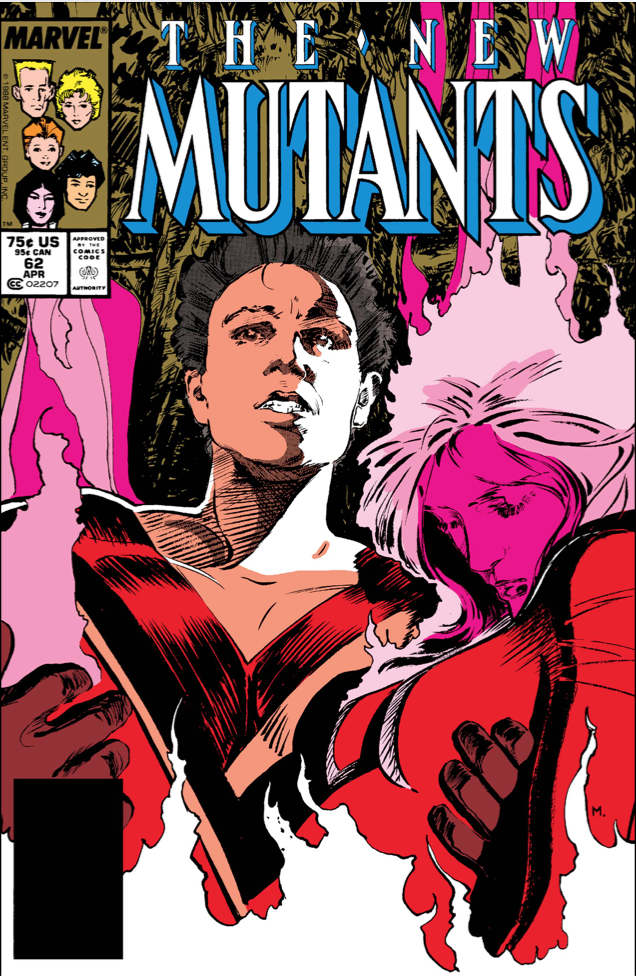
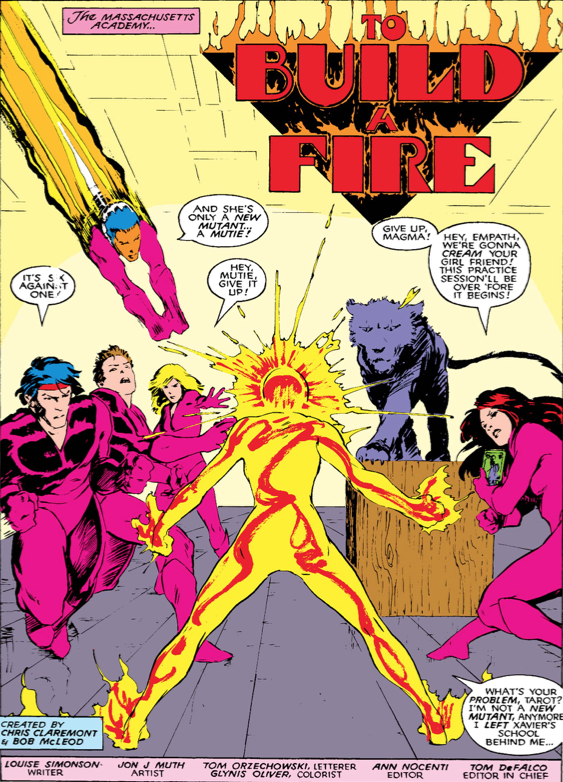
New Mutants 62 “To Build a Fire” Published: Dec. 1987 Writer: Louise Simonson Artist: Jon J. Muth (pencils and inks) Letters: Tom Orzechowski Colors: Glynis Oliver Cover: Muth
Welcome to a new, hopefully semi-regular new feature, where I examine an issue from my collection chosen more-or-less at random. I say more or less because I don’t want to waste my time on an issue I’ve just read, that’s super well-known or that I dislike. There’s no point in that. But otherwise, my hope is rediscover some hidden gems or oddities lurking in my 6,000+ comic collection. To pick a comic at random, I’m using CLZ, the online database, which has a “shake” feature which pulls a comic from a collection, yes, at random.
So here we go with the first installment …
Synopsis
The New Mutants gather around to read a letter from their former classmate, Amara Aquila, aka Magma, who has joined the group’s rivals-slash-enemies, the Hellions of Massachusetts Academy.
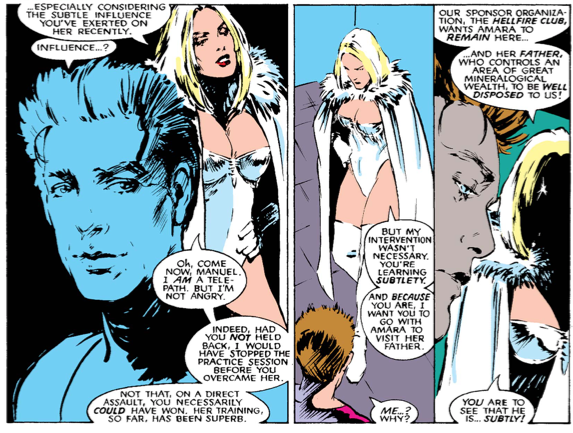
We cut to Magma facing off against the Hellions in a Danger Room situation, then getting into a heated confrontation with Empath, the emotion-manipulating jerk. Emma Frost, aka the White Queen and the school’s headmistress, interrupts to tell Magma her father is summoning her back to New Rome, the enclave of ancient Rome in the Amazon where she was raised. Frost instructs Empath to accompany her so that he can manipulate her father into leasing the Hellfire Club mineral rights.
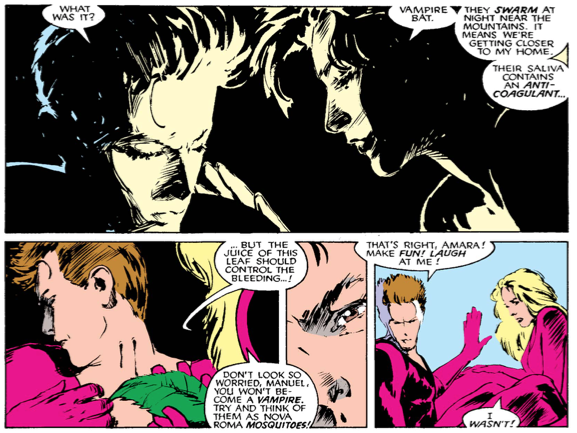
The pair are soon in a plane flying across the jungle when it it is hit by lighting and crashes, killing the pilot. Magma and Empath endure several days in the jungle, confronting panthers and vampire bats, and each other’s complicated feelings. Magma, it appears, doesn’t want to be rescued because she doesn’t want to be married off by her father. Empath confesses he is a coward who manipulates feelings to protect himself. After they reconcile, they are eventually rescued by Amara’s father.
What’s going on here?
I don’t recall reading this comic when it came out, although I bought it new. By late 1987, my attention was wandering from comics, save from the few that really engaged me, and I had lost interest in the New Mutants when artist Bill Sienkiewicz left the book.
By New Mutants 62, Louise Simonson had been writing the New Mutants for about a seven issues but this issue felt as if Chris Claremont never left. In fact, it reads like a number of his X-Men issues where two characters with feelings for each other are thrown together in hostile circumstances and have to work their through the difficulties and each other. Probably the most wel-know of these is Uncanny X-Men 186, aka Lifedeath, featuring Storm and Forge, but UXM 197, with Colossus and Kitty, has the same structure. There are others.
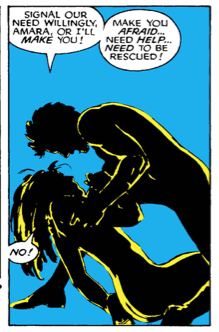
The similarity to Lifedeath also includes the art, which in both comics are remarkable work by artists not normally associated with the comic. While Lifedeath was a masterpiece by Barry Windsor-Smith, who filled in from regular artist John Romita Jr., New Mutants 62 is a gem from Jon J. Muth, who takes over from Bret Blevins from this issue. Muth is best known for atmospheric comics like Sandman and Moonshadow (which he painted), and his work here is dark and moody, befitting scenes set in a dark jungle, lit by fire light. It’s very effective, and a welcome departure from Blevins, whose cartoony style grates on me.
Muth’s inks are particularly dramatic:
What I liked
Along with the art, the story is an upgrade over recent issues, which featured the introduction of the irritating Ani-Mates and Bird Brain, a truly dreadful character. It was a welcome spotlight on Amara, who often felt lost in the shuffle among the other New Mutants. And it’s always fun to see Emma Frost as a bad guy before her eventual rehabilitation into an X-Man.
What I didn’t like
Part of the appeal of the New Mutants is that it’s a vehicle for teen angst, but a little goes a long way, and the confrontations been Amara and Empath bang to feel repetitive and tedious after a dozen pages. Also, Marvel comics of this era suffered from inconsistent printing, and the lettering particularly can be blotchy.
Overall
A good comic, with beautiful art that borders on great