FantasF
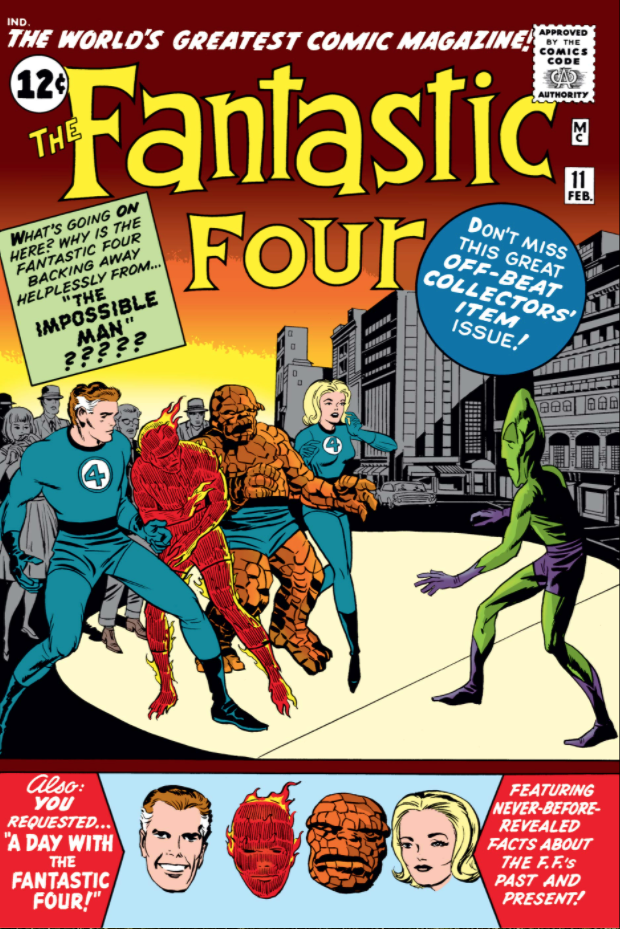
Fantastic Four 11
“A Visit with the Fantastic Four” and “The Impossible Man”
Published: Feb. 1963
Story: Stan Lee and Jack Kirby
Script: Lee
Pencils: Kirby
Inks: Dick Ayers
Cover: Kirby
Synopsis
This is an unusual issue in that there are two short stories instead of one, full-length story. The first is devoted to character building and revealing more of the Fantastic Four’s back story, allegedly in response to readers’ requests. The plot, if you can call it that, begins with the FF showing off in front of their fans, then reading fan mail after Ben is (again) temporarily turned human again by a concotion of Reed’s. They recount the team’s origins, filling in some important details about Reed and Ben’s time together in college and in the military, before they have a surprise birthday party for Sue.
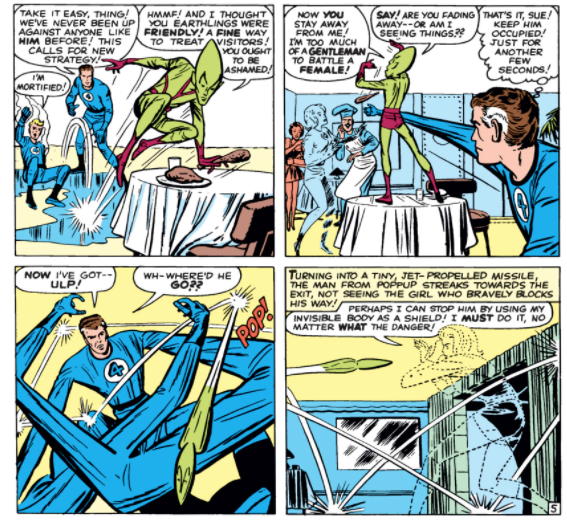
The second story introduces the Impossible Man, a recurring character—slash—blight from the planet Poppup who reappears over the years. In this story, the FF are summoned to capture the Impossible Man, who can change his form into any object or substance. After futilely chasing him around New York, Reed decides it’s best to ignore him and the Impossible Man grows bored and eventually returns home.
What’s going on here
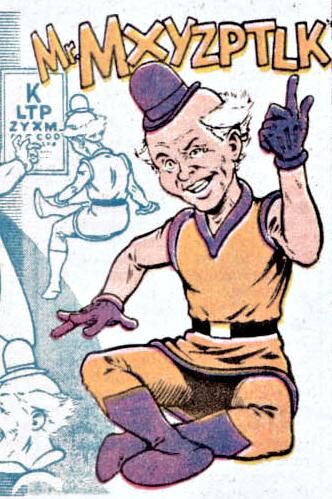
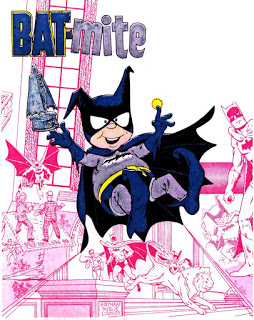
Both stories are significant, although for very different reasons. For better or worse (and it’s mostly been worse), the Impossible Man is an established part of the Marvel Universe, showing up over the decades in stories that tend to be full of gags and fourth-wall breaking. Your mileage may vary, but I tend to loathe these stories, which often feel self-indulgent and pointlessly silly. He’s very much a character of the Silver Age, and a reminder that these publications are called “comic books” for a reason. The Impossible Man owes a lot to Plastic Man, a Golden Age character with similar powers and tone, but his role as antagonist to the FF is most reminiscent of that of DC’s Mr. Mxyzptlk and Bat-Mite, who would make life miserable for Superman and Batman (and their readers), respectively.
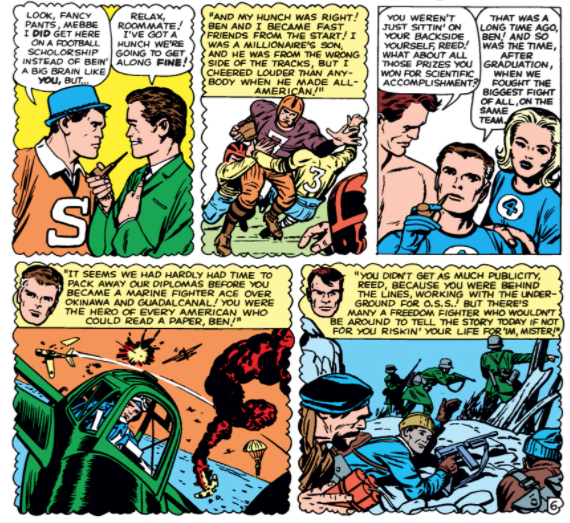
In the first story, Stan and Jack eschew the normal conventions of the genre, dispensing with a villain and fight, and instead spend 10 pages developing the characters and filling in some of the blanks of their story. We learn that Reed and Ben were roommates in college, where Ben was a football star “from the wrong side of the tracks” while Reed was a pipe-smoking “millionaire’s son.” We also discover the served in World War II—Ben as a pilot in the Pacific theater, Reed as an OSS operative—placing their ages around 40 in 1961. That eventually gets retconned as another, unnamed conflict as Marvel’s sliding time scale means they are too young to be WWII veterans.
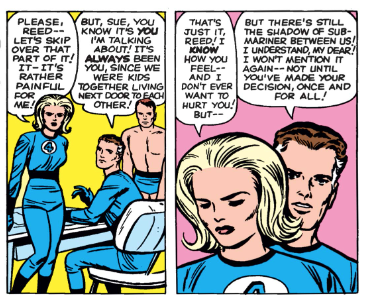
We also learn how Reed and Sue met, when Reed describes them as “kids together living next door to each other.” Sue continues to be ambivalent about Reed in this issue, which he attributes to her interest in the Sub-Mariner.
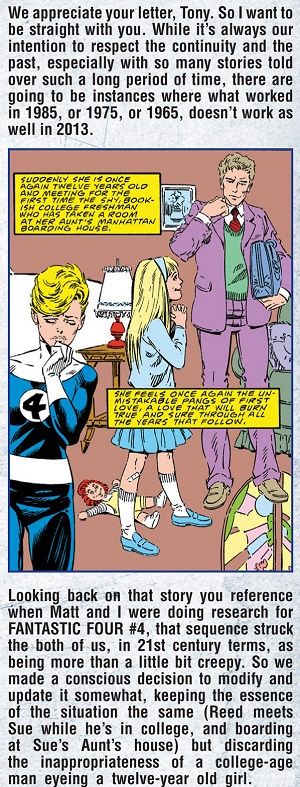
Growing up as kids would suggest they were roughly the same age, but later stories establish Reed as significantly older than Sue. In Fantastic Four 291, from 1986, John Byrne describes Sue as a 12-year old (who looks like a six-year-old, complete with doll) with a crush on the college-aged Reed.
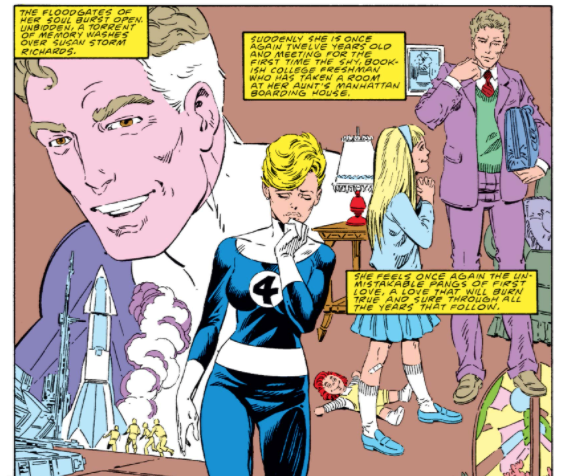
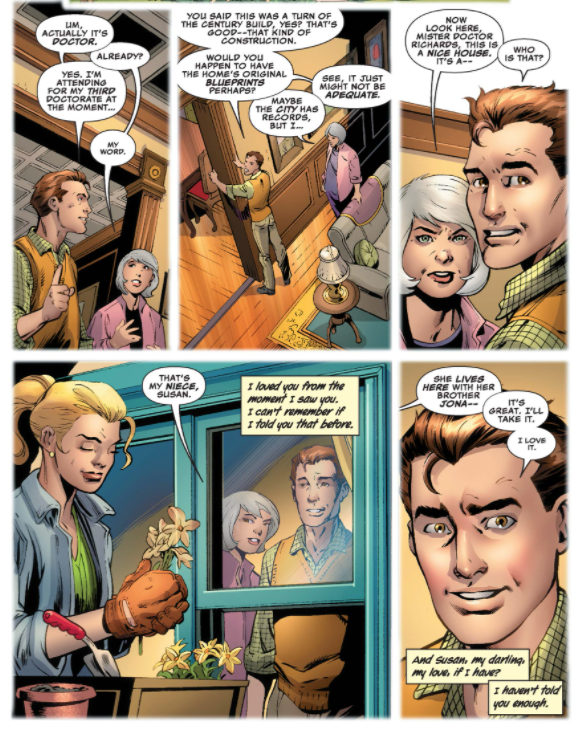
Later creators realized the creepiness of that scenario, and in 2013, writer Matt Fraction retconned Byrne’s retcon, making Sue more age appropriate.
The editors were upfront about the need to address the age issue (thanks to Brian Cronin in CBR.com for detailing this history).
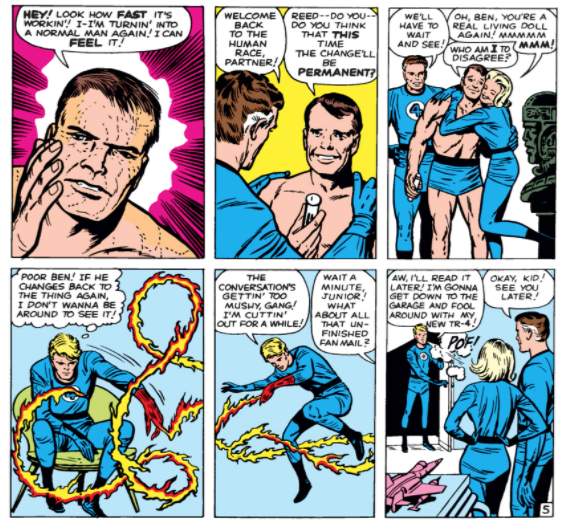
They’re (not) fighting again
Fantastic Four 11 contains a nice moment where Johnny, concerned about the implications of Ben reverting back to human, reveals his actual feelings about his frequent sparring partner. (A TR-4 is apparently a sports car made by Triumph).
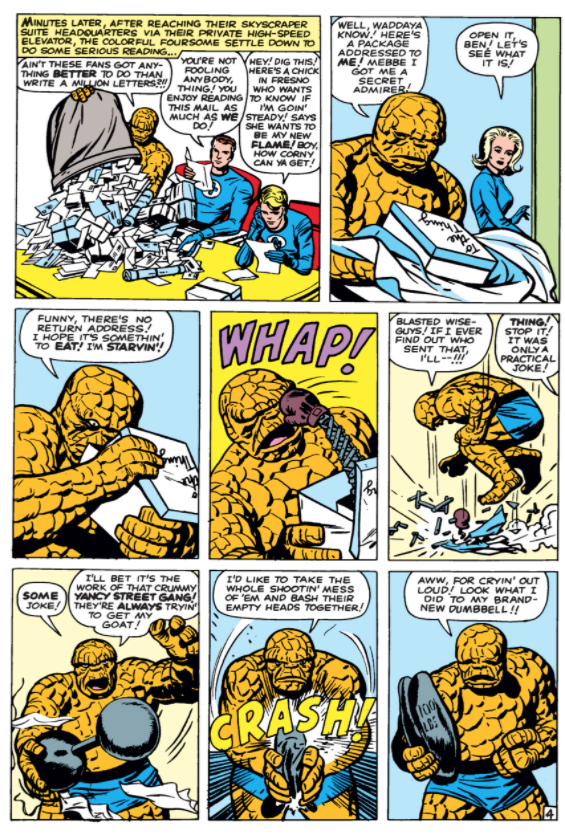
Meet the Yancy Street Gang …
FF 11 also marks the first time Bn is pranked by the Yancy Street Gang, a group from his old neighborhood on the Lower East Side. The Yancy Street Gang becomes another recurring feature of the FF, and Yancy Street (a riff on the real-life Delancy Street) grows in importance as a touchstone for Ben over the decades. The FF’s current headquarters is located there.
… and Willie Lumpkin
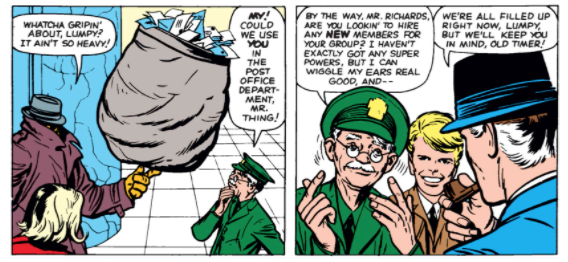
We’re also introduced to Willie Lumpkin (referred to here as Mr. Lumpkin, or Lumpy), the FF’s elderly letter carrier with the “power” to wiggle his ears.
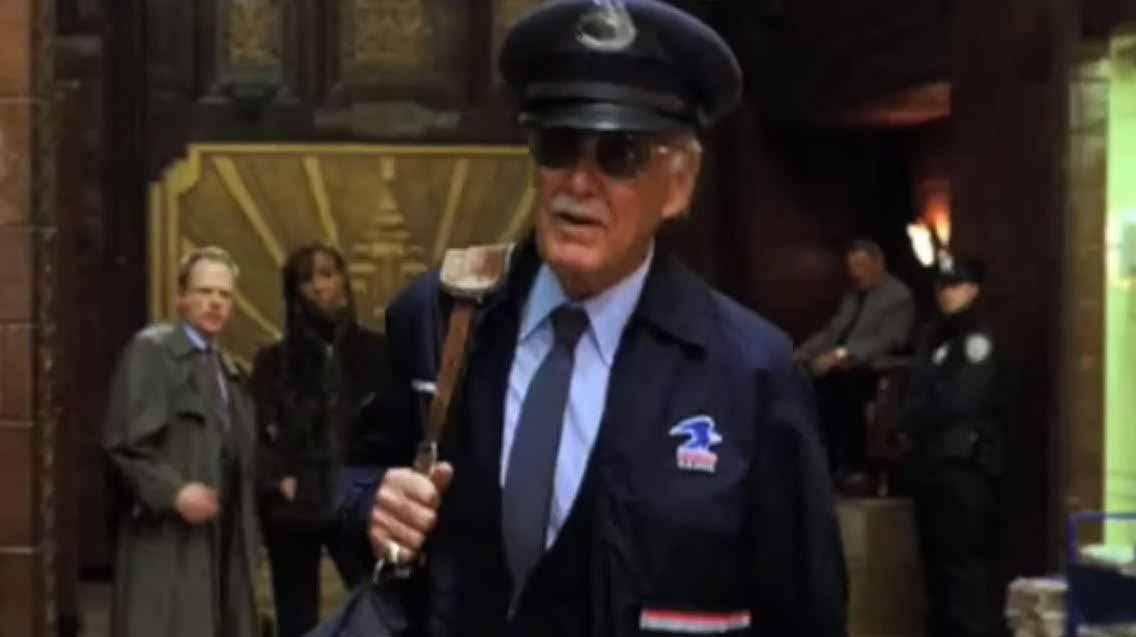
In a fun bit of casting, Stan Lee played Willie in the 2005 Fantastic Four movie.
The sexist sixties
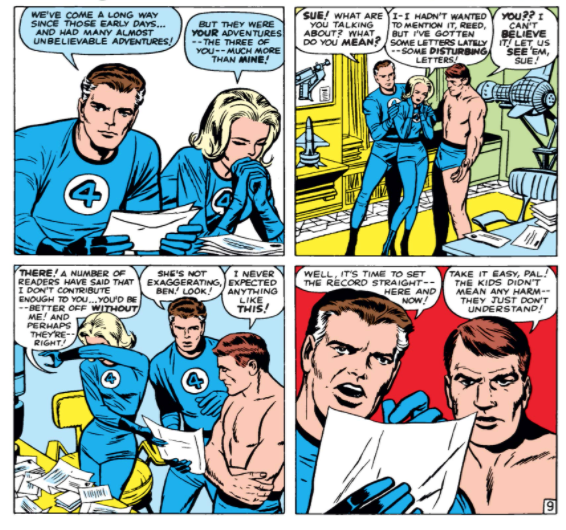
In a strange sequence, Sue recoils at the letters that point out that she’s not pulling her weight on the team (probably an accurate reflection of the real-life letters Marvel was getting).
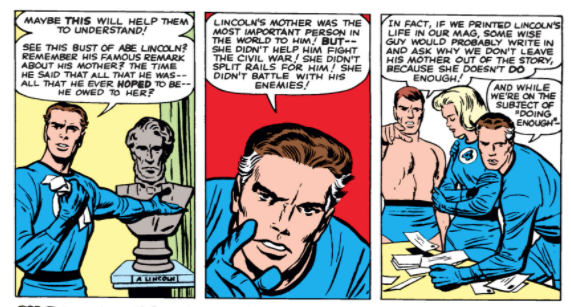
Before noting the times Sue has rescued the rest of the team, against the Skrulls and Dr. Doom, Reed makes a bizarre analogy to Abraham Lincoln’s reverence for his mother as evidence of Sue’s value (and of course the FF has a bust of Honest Abe in their home. Who doesn’t?).
Ben later suggests if readers want to watch women fight, they should “go see lady wrestlers.”
Let’s talk about us
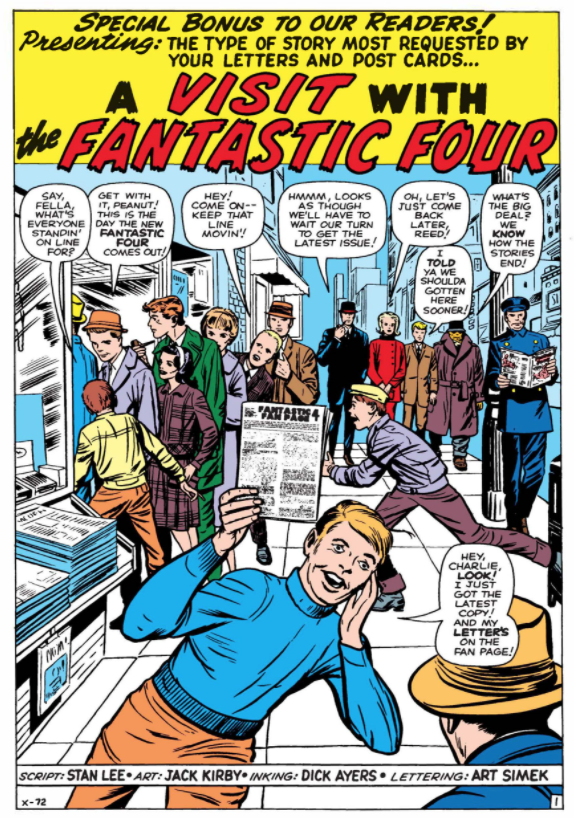
The issue opens with a knockout Kirby splash page with the FF, dressed like they’re in the 1940s, lining up to buy the latest edition of the Fantastic Four comic.
For sale
A mint (9.8) issue of FF 11 is worth about $49,000.
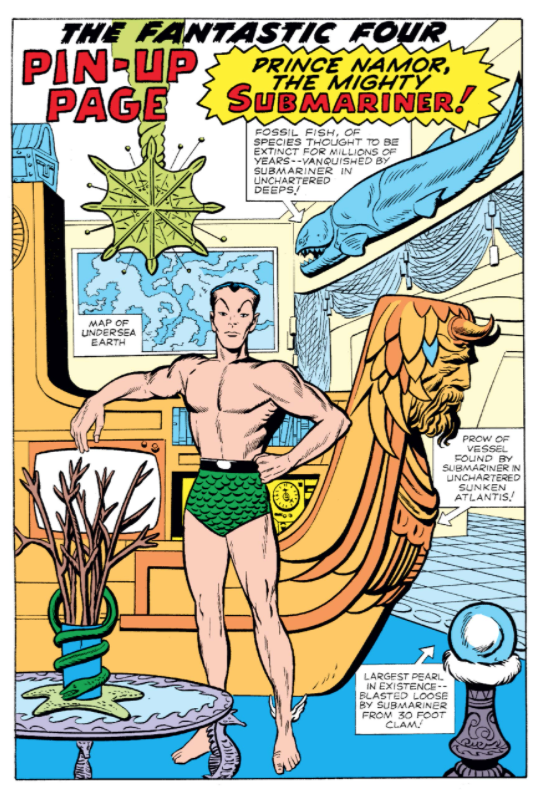
Pin up
The Sub-Mariner gets his own pin-up
Next issue: The FF meet the Incredible Hulk!

