• About Percival Henry

Percival Henry: The Fantastic Four and more

~ Blogging the Fantastic Four issue by issue (plus whatever else grabs my attention)

Percival Henry: The Fantastic Four and more

Tag Archives: George Perez

“The World’s Greatest Comic Magazine!” Fantastic Four Annual No. 15

18 Saturday Jul 2026

Posted by percivalhenry in The World's Greatest Comic Magazine

≈ Leave a comment

Tags

1980, Captain Marvel, Doug Moench, Dr. Doom, Fantastic Four, Fantastic Four Annual 15, George Perez, Marvel, Marvel comics
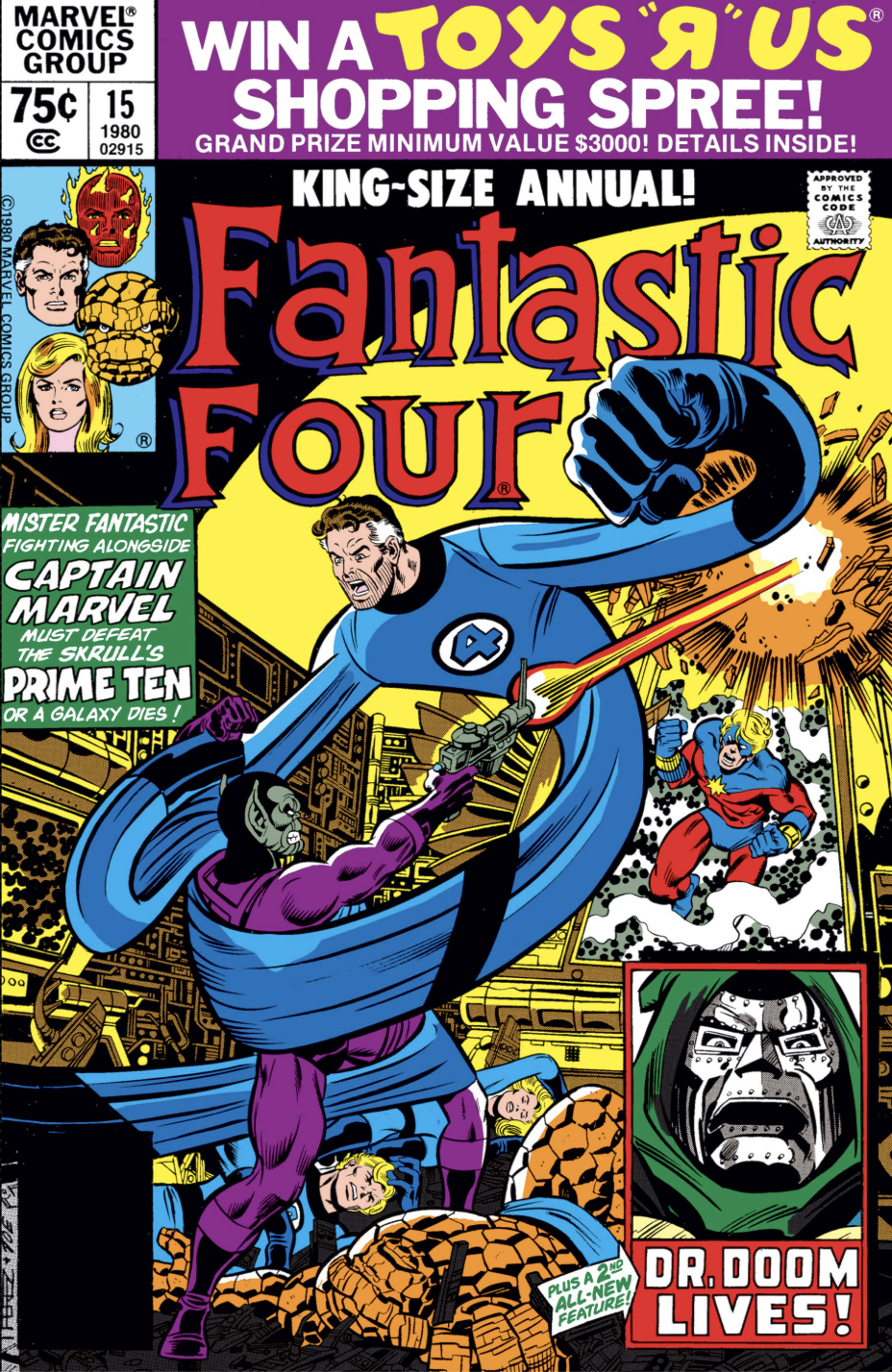
Fantastic Four Annual 15
Published July 1980
Cover: George Perez & Joe Sinnott
Editor: Jim Salicrup

“Time for the Prime Ten!”
Writer: Doug Moench
Pencils: Perez
Inks: Chic Stone, John D’Agostino and Mike Esposito
Letters: Jim Novak
Colors: George Roussos and Ben Sean

“The Power of the People!”
Writer: Moench
Pencils: Thomas Sutton
Inks: Sutton
Letters: Novak
Colors: Sean


Synopsis

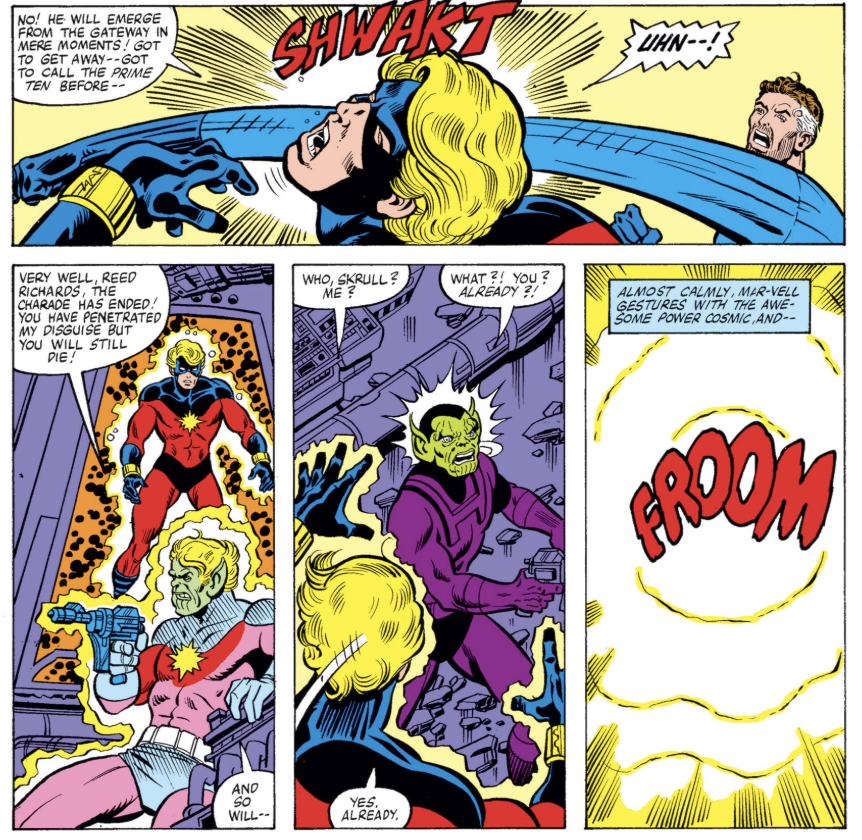
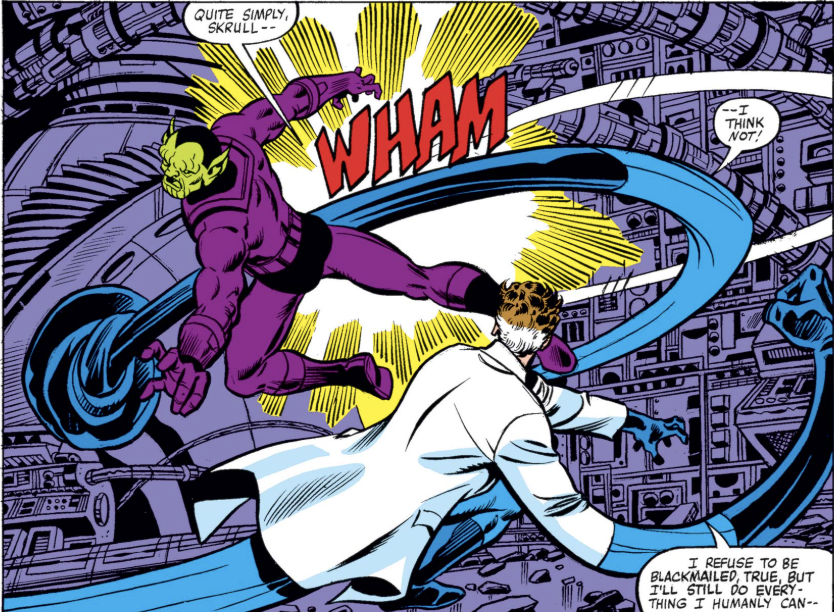
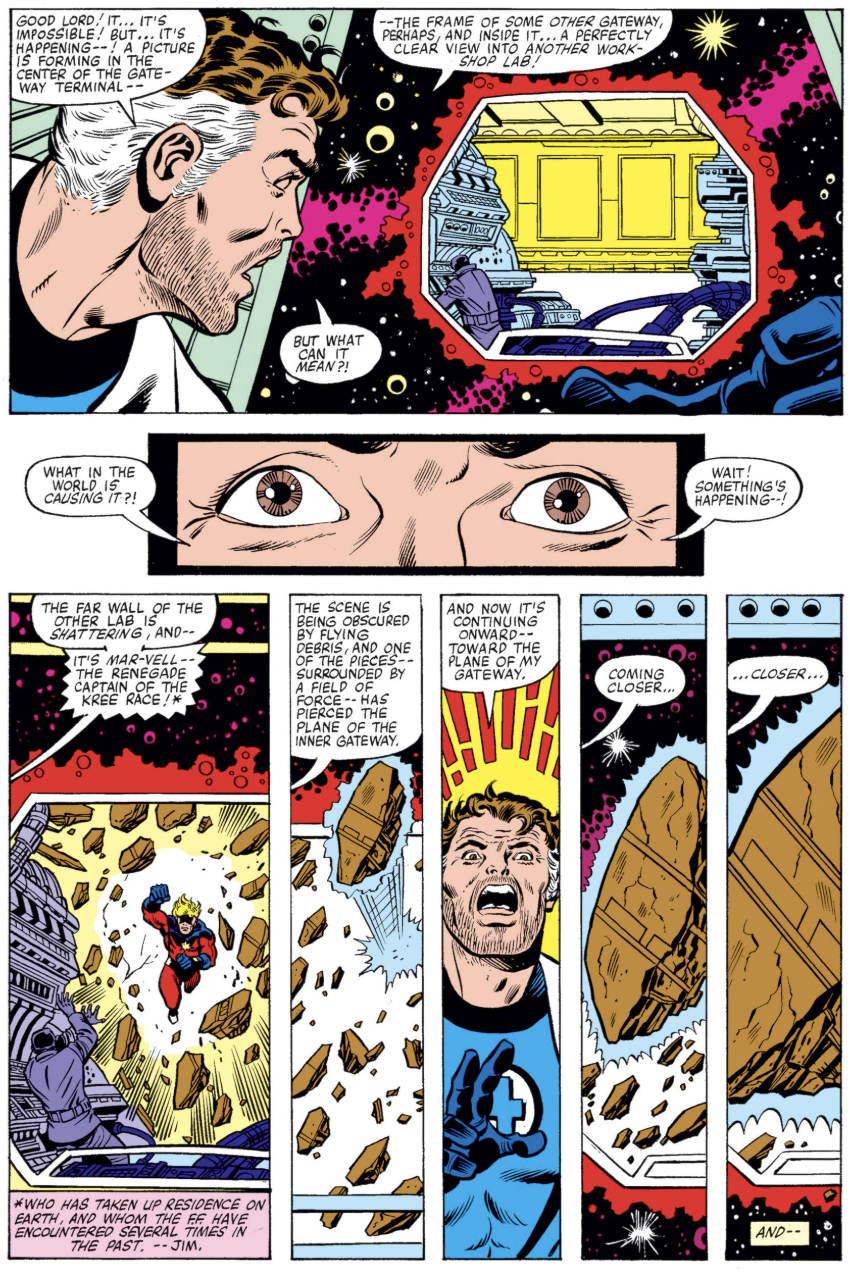
In the first story, Mr. Fantastic — after toiling for weeks in his lab — makes a breakthrough discovery that allows him to transmit energy through the air. But unexpectedly, Reed realized it has opened a portal into space, where he witnesses Captain Marvel, and discovers solid objects can also be transmitted. Meanwhile, the FF gets an unexpected visitor, their former mailman Willie Lumpkin, who soon reveals himself to be a Skrull. The Skrull confronts Reed, telling him he has captured the rest of the team and demanding he turn over his new energy transmitter. Suddenly, Captain Marvel appears, traveling through the energy transmitter, and asks Reed to hand it over so he can defeat the Skrulls. Reed deduces Marvel is also a Skrull at the same time the real Marvel appears. More Skrulls arrive, but with the rest of the FF, they are defeated and sent them back to space, destroying the transmitter at the same time. An epilogue reveals Sue, Ben and Johnny were never captured but were shunted two hours into the future by the Skrull.

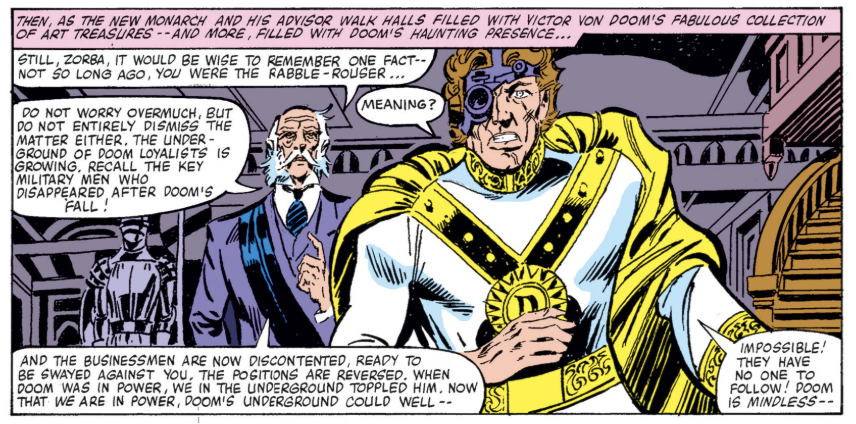
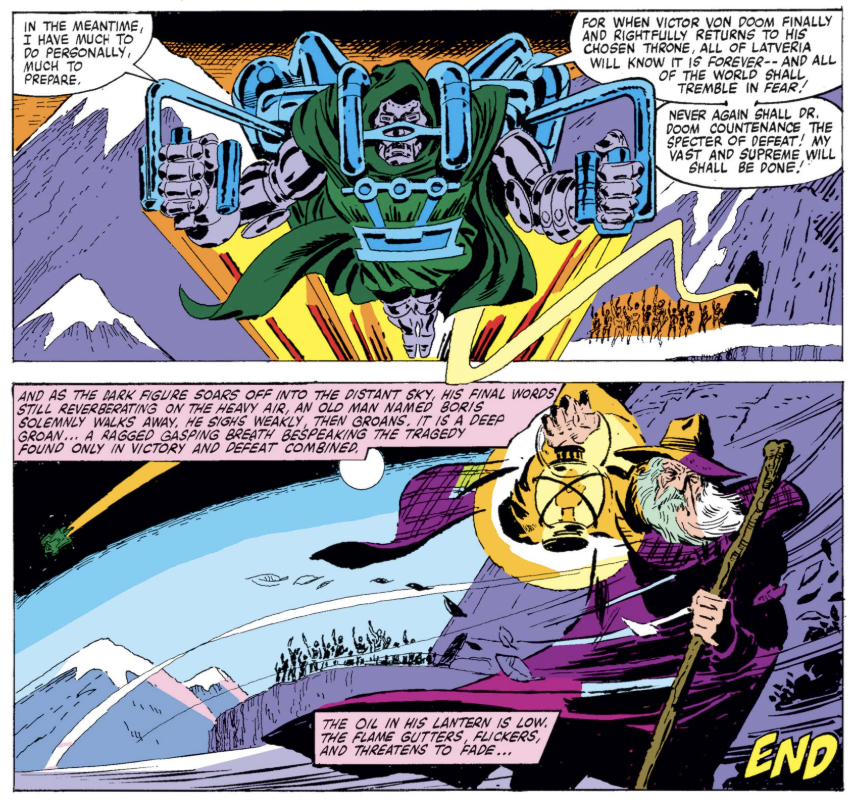
The second story takes place in Latveria, where its new leader Zorba, who has introduced democracy after the defeat of Dr. Doom in FF 200, is confronted by protests. Anxious, Zorba checks on the catatonic Doom only to discover he is a robot replaced by Doom loyalists. They then steal Doom’s armor, and through some science, use the armor’s energy to restore Doom to consciousness. Doom then drives out Zorba and makes plans to regain control of Latveria.

What’s going on here?


This is a pretty satisfying pair of stories and as a young reader I would have been pretty pleased with 75 cent investment in this annual. The Skrulls and Doom are not only among the FF’s oldest enemies (first appearing in issues 2 and 5) but some of their best, and put together these stories feel like a bit of a reset, returning the FF to core principles.

In some ways, the shorter Doom story is the better of the two. The FF don’t appear, but it’s a tightly plotted tale that further develops Latveria as a character in its own right, and gives more dimension of Doom’s henchmen and lackeys like Boris and Hauptman. It also serves the important role of returning Doom to the status quo ante and restoring a major part of the FF’s universe.

My sense is Moench — who spent a decade writing mostly horror, kung-fu and science-fiction comics — is more comfortable with a story of palace intrigue than the classic super hero adventures he’s tasked with writing for the Fantastic Four. The artist, Thomas Sutton, who is making his FF, had a very long career, starting in 1967 mostly at Marvel and Warren before working at DC and on independent comics in the 80s and 90s. He and Moench appear to have worked on many titles together.

The other, main story is a bit more uneven, although still solid. The appearance of Captain Marvel, or Mar-Vell, is interesting one. His own comic, last written by Moench, was just canceled, and I suspect Marvel was under pressure to use him in order to preserve the copyright, which was the subject of a long and tangled legal battle. Marvel was killed off by Jim Starlin right before I began reading comics, and unlike virtually every other deceased hero, he has managed to stay dead. Because I never made the effort to read his back issues, he’s always been a bit of a mystery. I’m not sure his appearance here was particularly illuminating, but it’s fun to see a new guest star.

George Perez returns to pencil the story, although he is credited only with breakdowns. Three inkers (Chic Stone, John D’Agostino and Mike Esposito) finished the art, although I’m not skilled enough to identify what pages were inked by what artists. Despite all that, Perez’s stamp on this comic is pretty clear, particularly in his dynamic layouts. Perez’s cover, inked by Joe Sinnott, is also excellent (although marred by that dumb Toys R Us ad)

What I liked

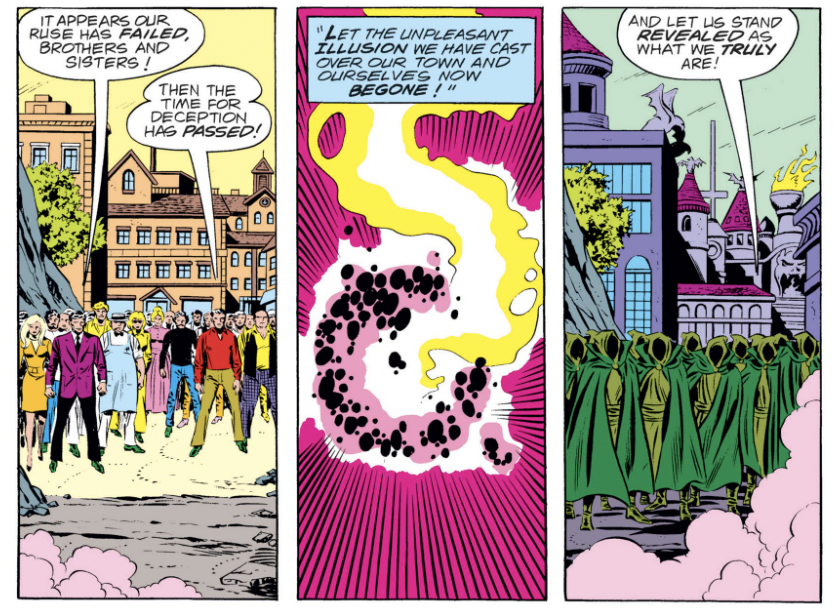
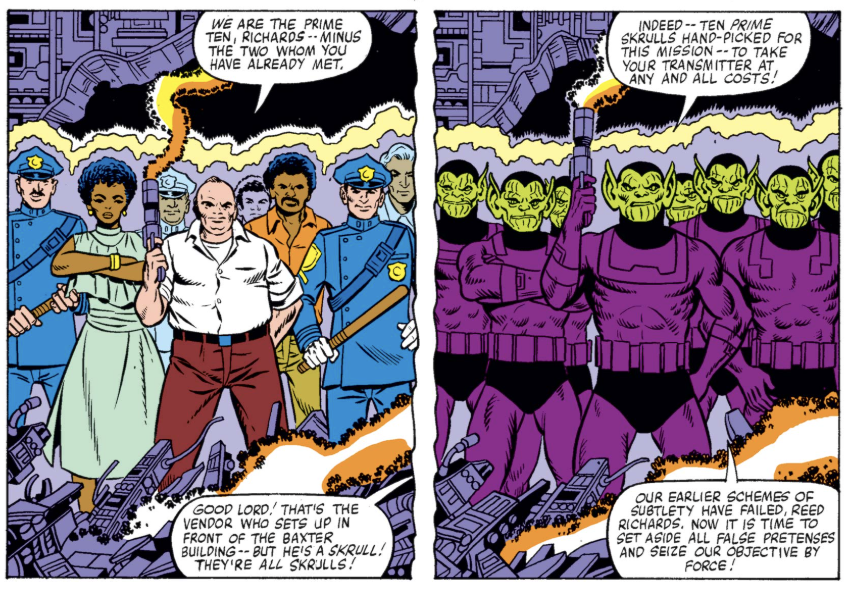
Moench does a good job of keeping us guessing throughout the story, particularly with some odd cutaways to ordinary people on the streets of Manhattan who have nothing to do with the story.
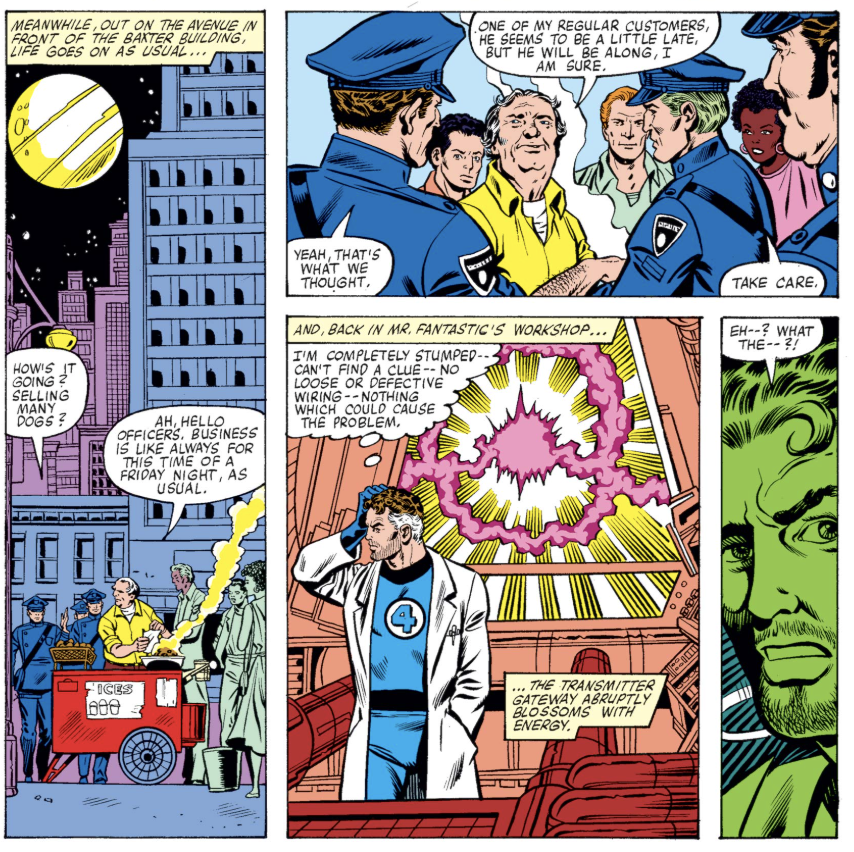
Only later are they revealed to be the Prime Ten Skrulls.
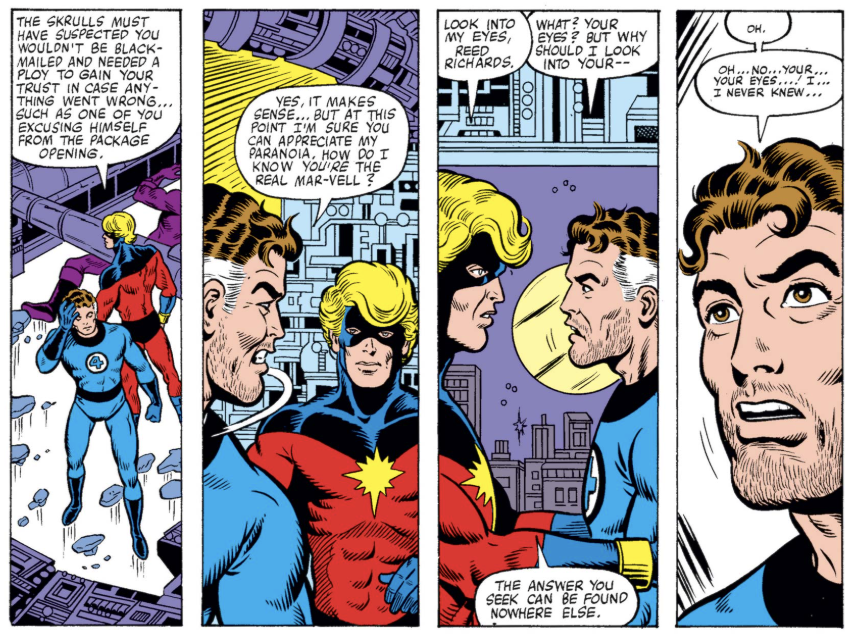
I also liked this interaction between Marvel and Reed, who is understandably a bit skeptical that he is who he says he is.
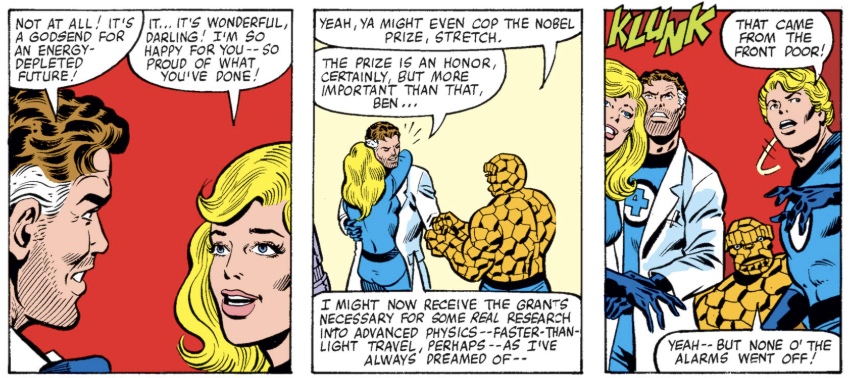
This is a notable exchange. Reed accepts congratulations for his new invention, the first (and maybe last) time I’ve read an actual discussion of the realities of science research funding in the FF (also, in that first panel you can see the limits of Perez’s breakdowns)

What I didn’t like

Despite all the dramatic potential of having two Captain Marvel’s face off — one ersatz, one real — it never comes to pass. First Reed suspects the Skrull of being a fake, then the real Marvel shows up It seems like a huge missed opportunity from Moench.
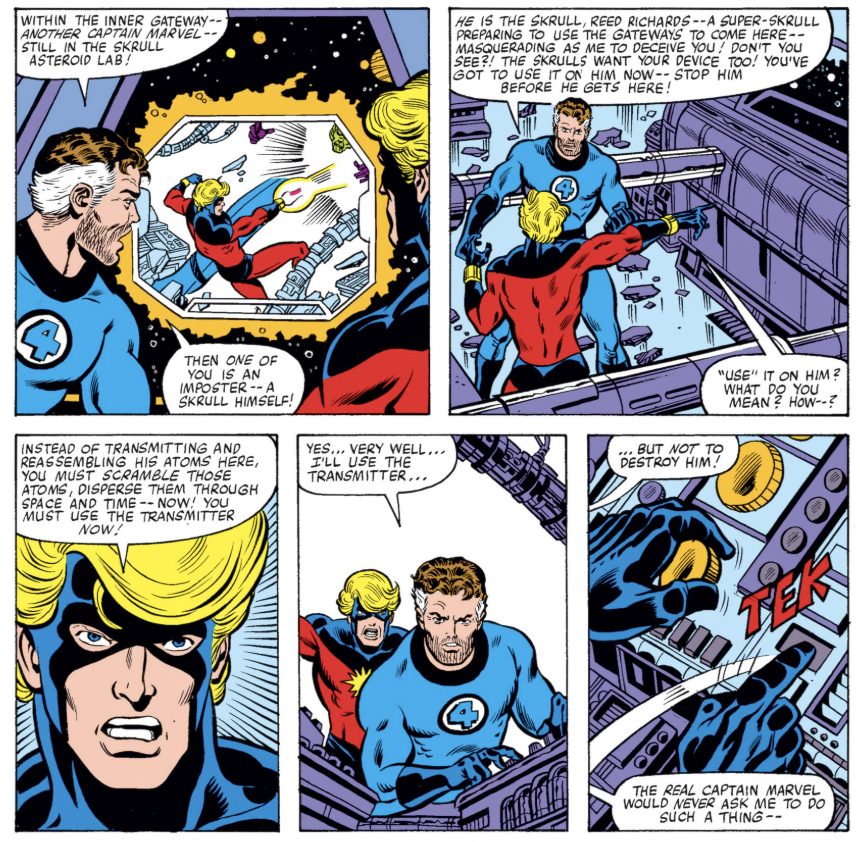

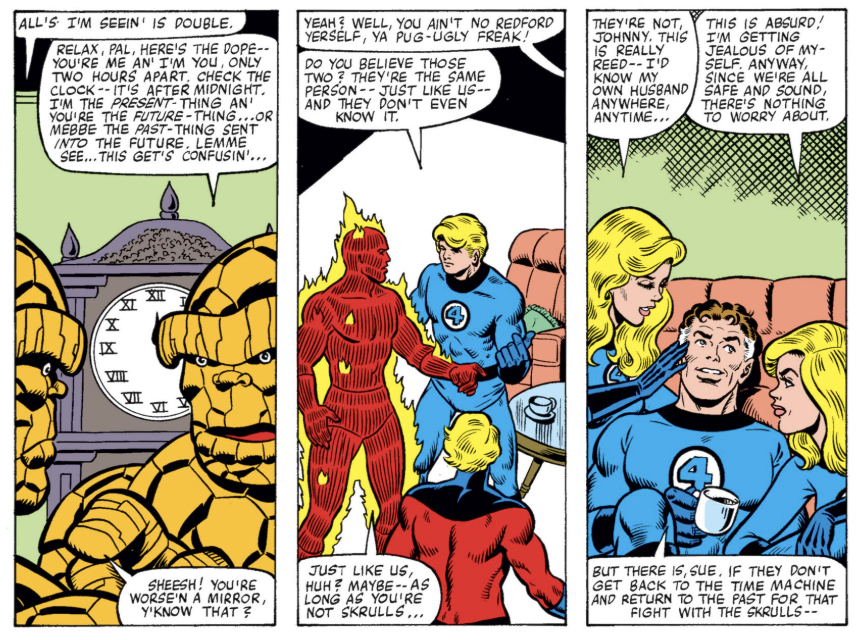
Also, the story’s time traveling twist serves no real purpose, and the epilogue just adds unnecessary confusion
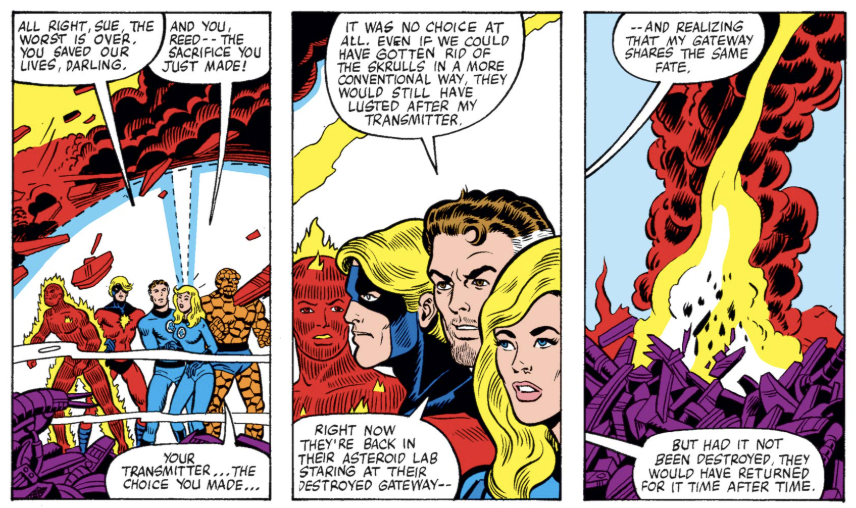
I’m not sure why Reed is so broken up about losing his energy transmitter. Surely he wrote down the plans, right?

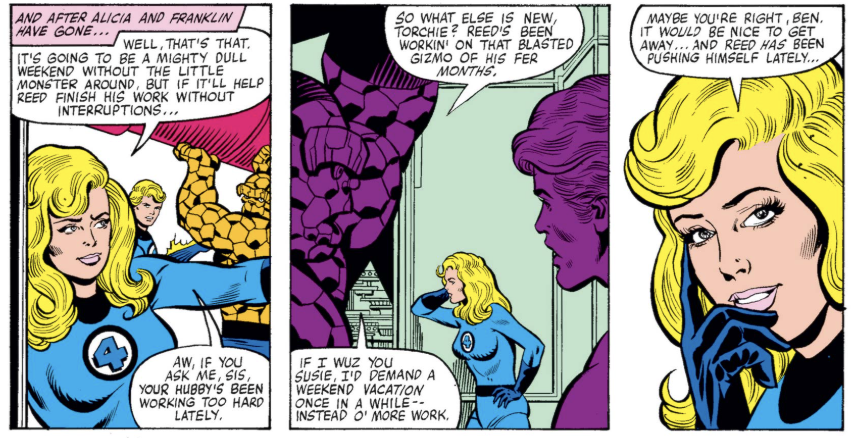
And lastly, are they really packing of Franklin for the weekend just so Reed can concentrate? Another dubious parenting decision from the Richards.

Overall

A lot of bang for the buck
“The World’s Greatest Comic Magazine!” Fantastic Four Annual No. 14

19 Sunday Apr 2026

Posted by percivalhenry in The World's Greatest Comic Magazine

≈ 5 Comments

Tags

1979, Agatha Harkness, Annual, Fantastic Four, Fantastic Four Annual 14, George Perez, marv wolfman, Marvel, marvel-comics, Salem's Seven

Fantastic Four Annual 14
“Cat’s-Paw!”
Published October 1979
Story: Marc Wolfman and Geore Perez
Pencils: Perez
Inks: Pablo Marcos
Letters: Jim Novak
Colors: Carl Gafford
Editor: Wolfman
Cover: Joe Sinnott

Synopsis

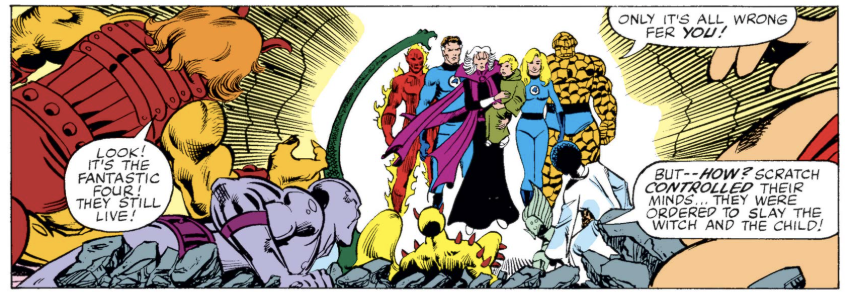
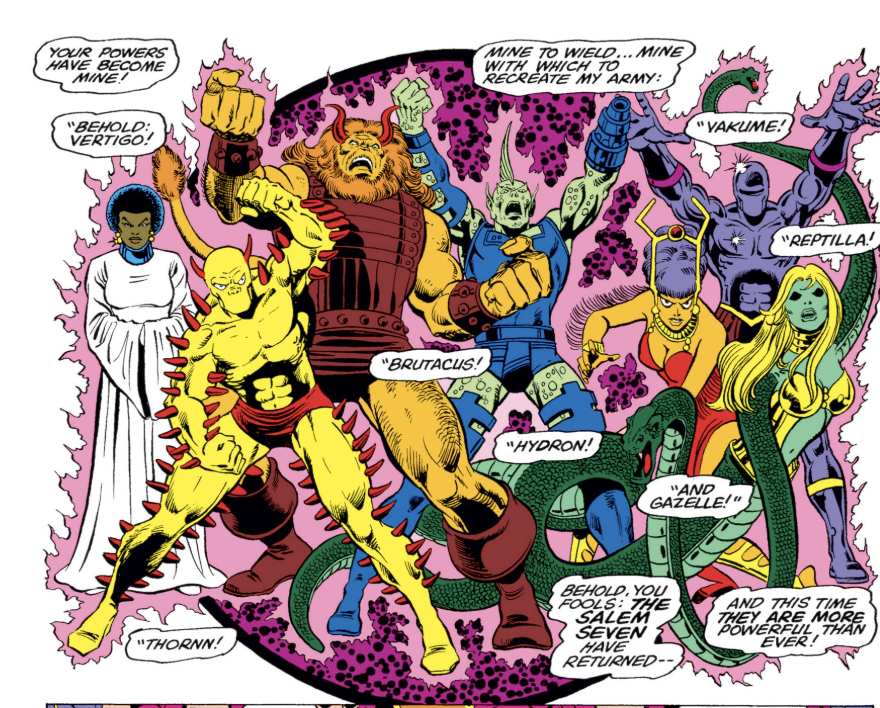
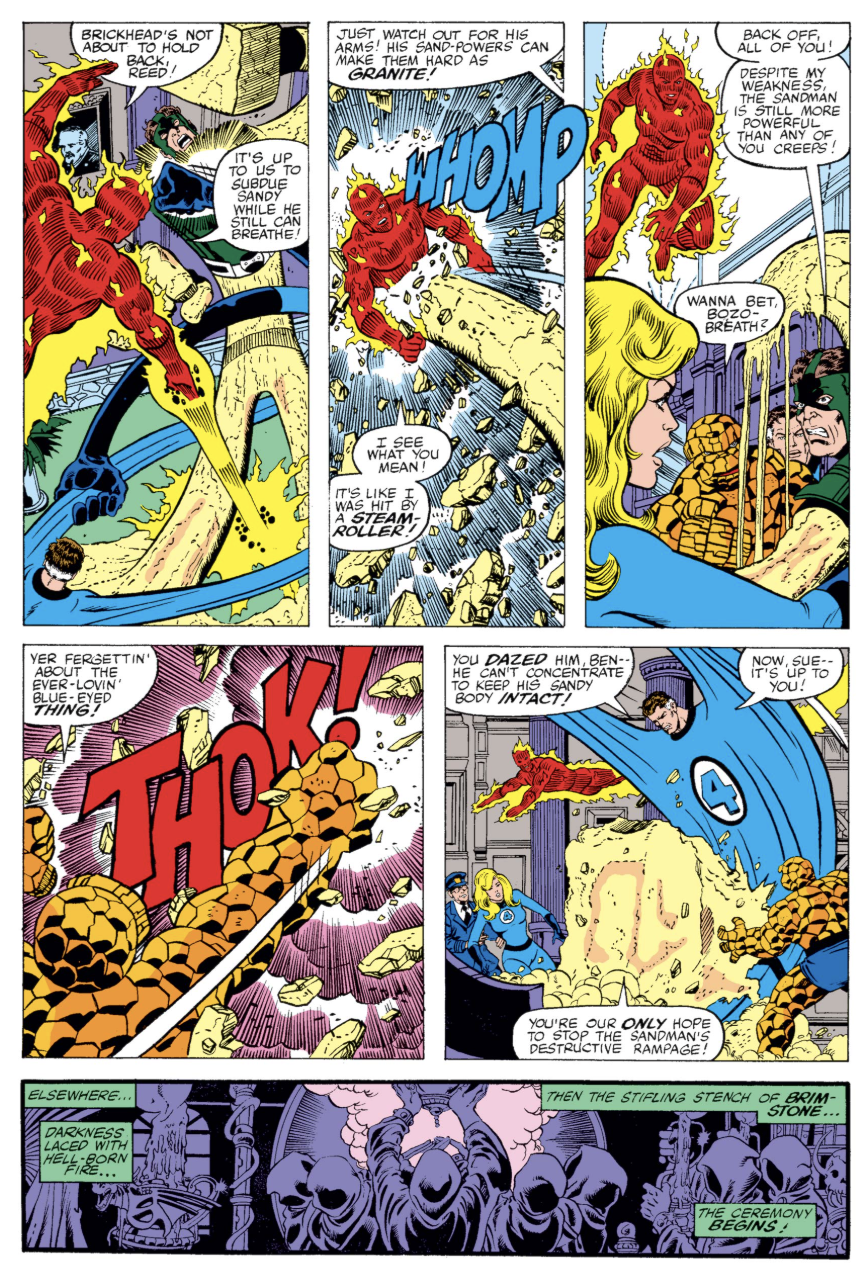
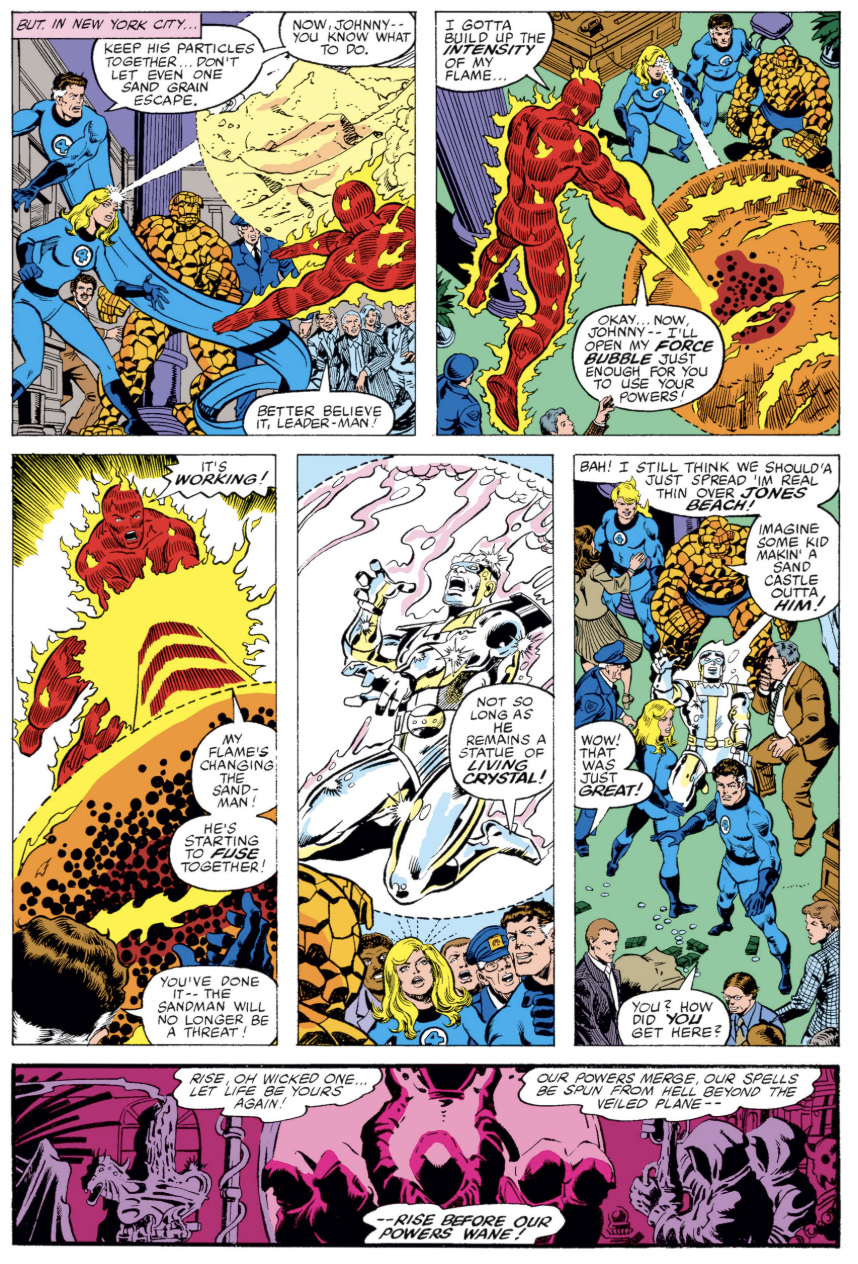
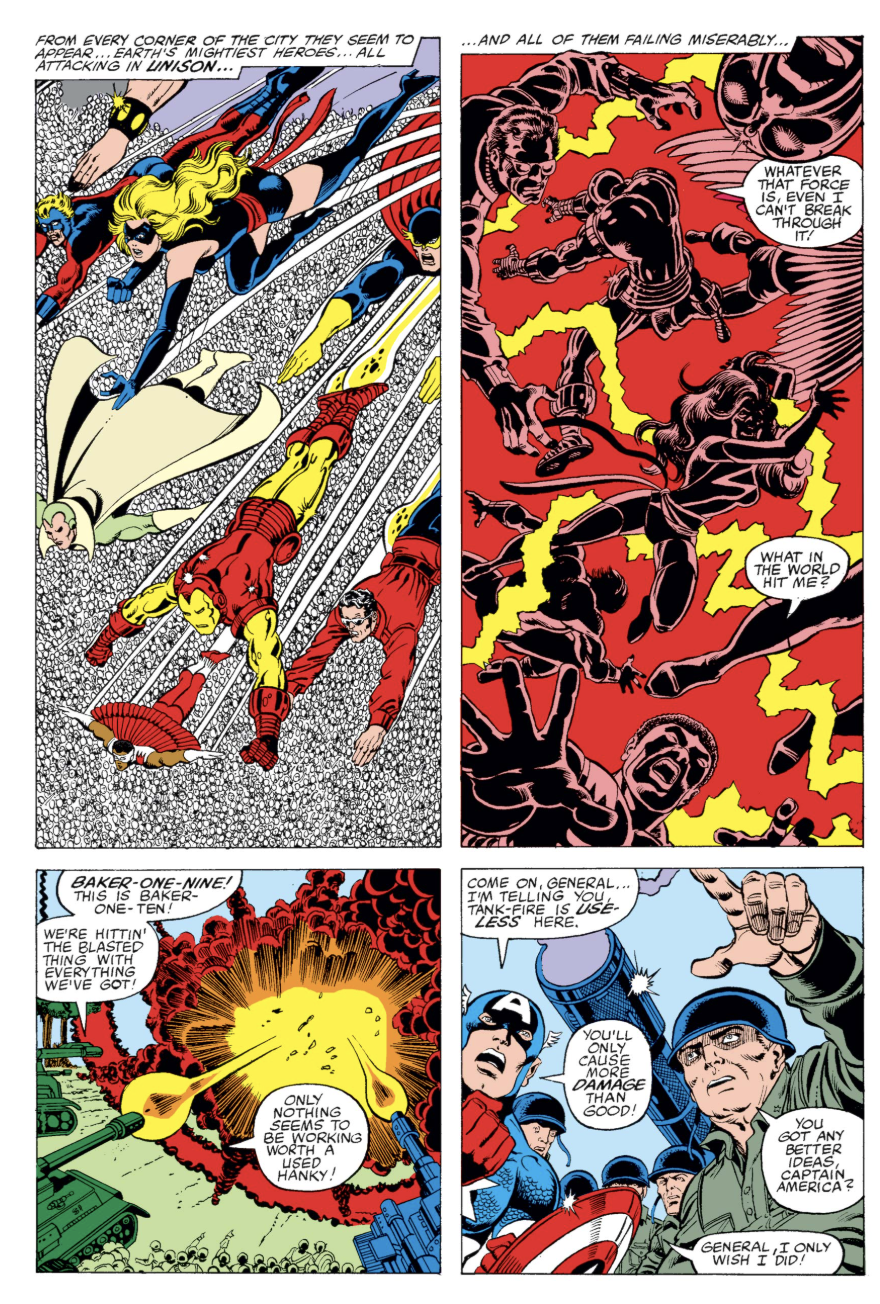
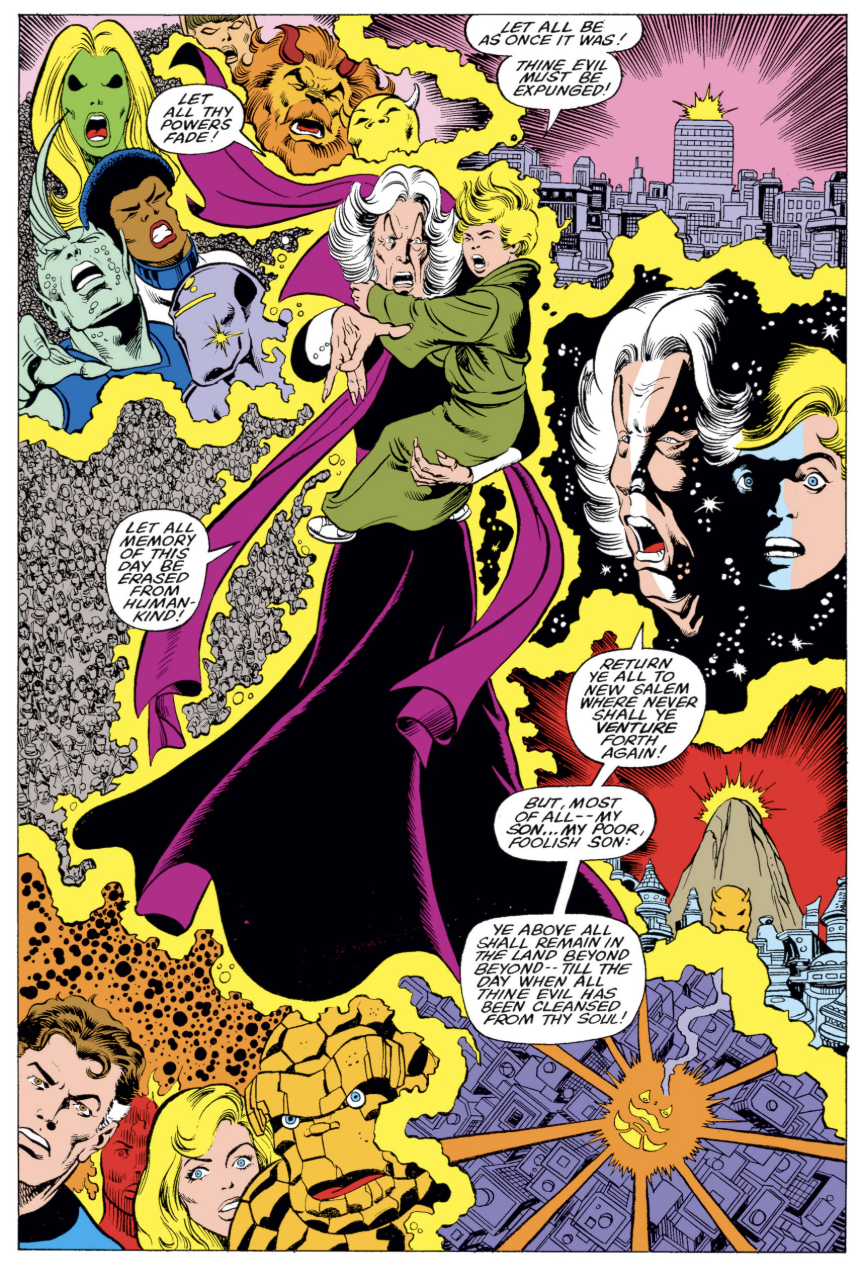
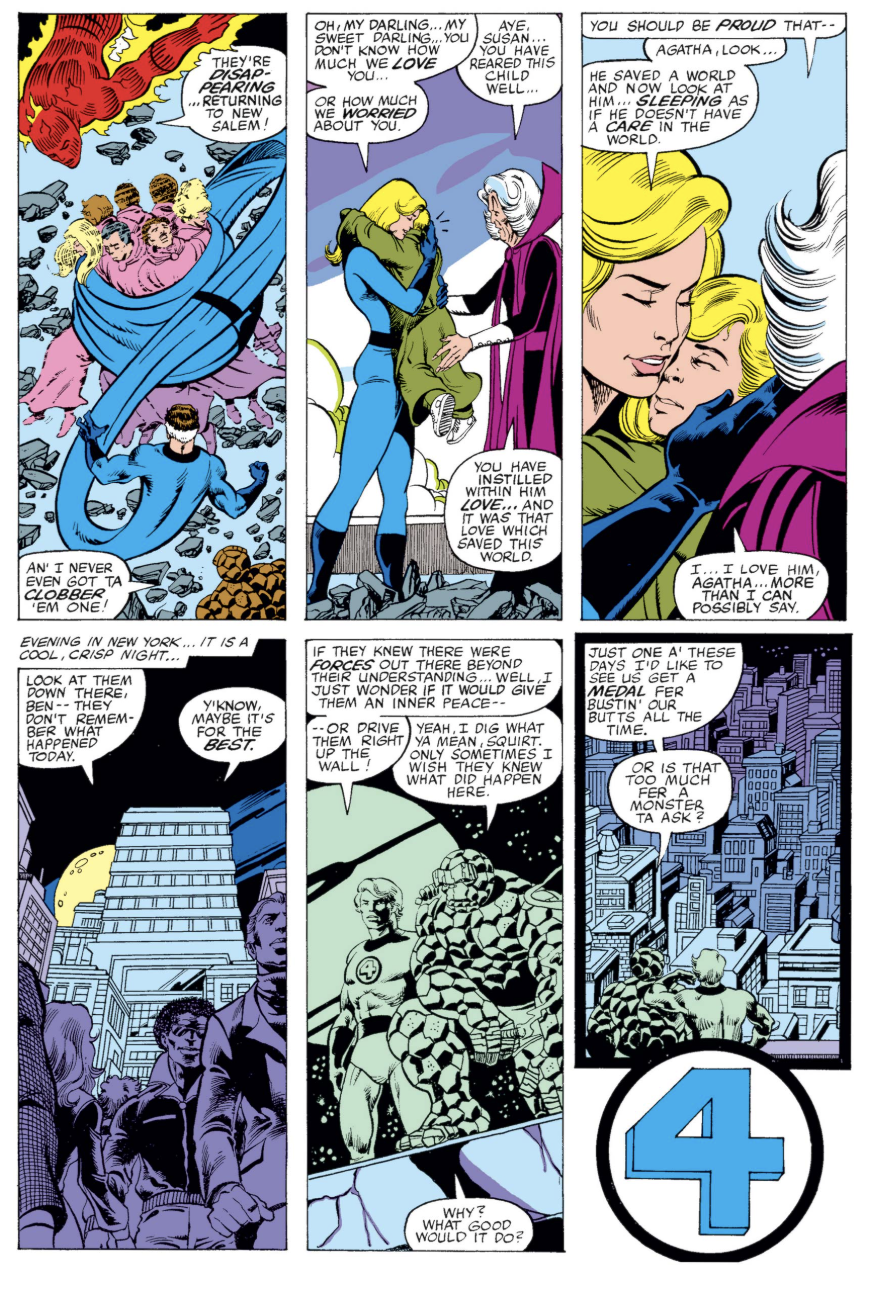
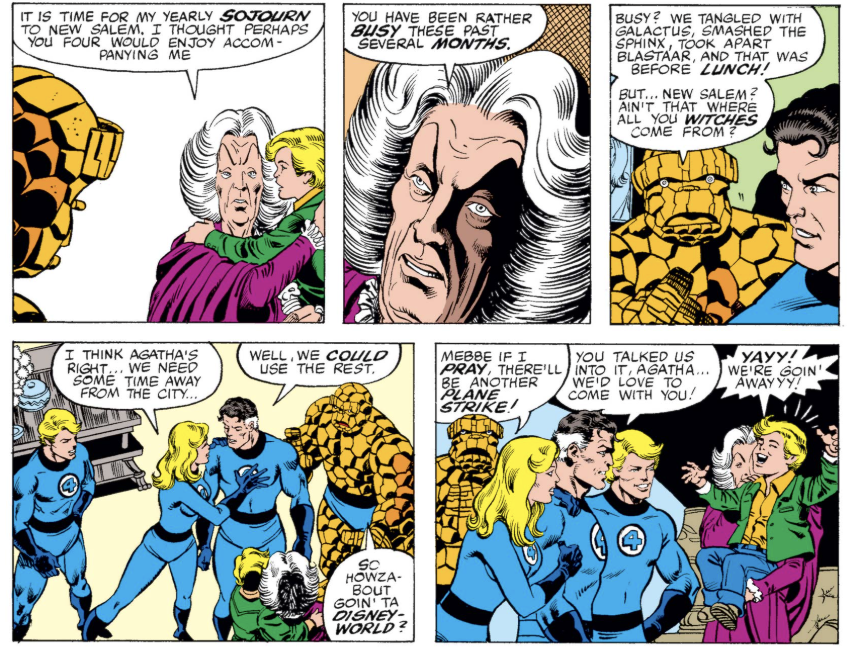
After a brief battle with Sandman, the Fantastic Four return to the Baxter Building to find Agatha Harkness, who convinces the team plus Franklin to accompany her to New Salem for her annual visit. Meanwhile, a group of Salem witches is plotting to restore Nicholas Scratch — defeated by his mother, Harkness, and the FF in issue 186 —and then reveal themselves to be Salem’s Seven. They battle and subdue the FF, but Franklin escapes and is found by Harkness. Back in New York, Salem’s Seven harnesses the powers of the unconscious FF in order to summon Scratch, creating a powerful force field around the Baxter Building that resists the military and the Avengers. With Franklin, Harkness withstands Scratch’s assaults and once in the Baxter Building, Franklin’s latent powers restore the hostile, mind-controlled FF back to normal. Harkness then defeats Salem’s Seven and prevents Scratch from returning to Earth.


What’s going on here?

This is a big, fun, rollercoaster of an annual that only barely makes sense and is held together by George Perez’s amazing layouts and pencils. He is ably assisted by Pablo Marcos on inks, who has a nice light touch. If Perez had not worked on this book I would likely have a much lower opinion of it but thankfully we’ll never know. More on this great art in a bit.

Like a lot of annuals, this story feels a bit padded, particularly the opening sequence with Sandman, which serves no real purpose. It’s filled out at the end with a series of pinups. The story hinges entirely on the FF’s impromptu decision to join Harkness, and she ultimately is the hero of the story. After they are captured, the FF are barely players in their own annual.

This annual brings back Salem’s Seven, a fun group of villains who are surprisingly underused. They only appear a handful of times after this issue, despite seemingly tailor-made for fighting other super teams. Couldn’t the X-Men have fought these guys?


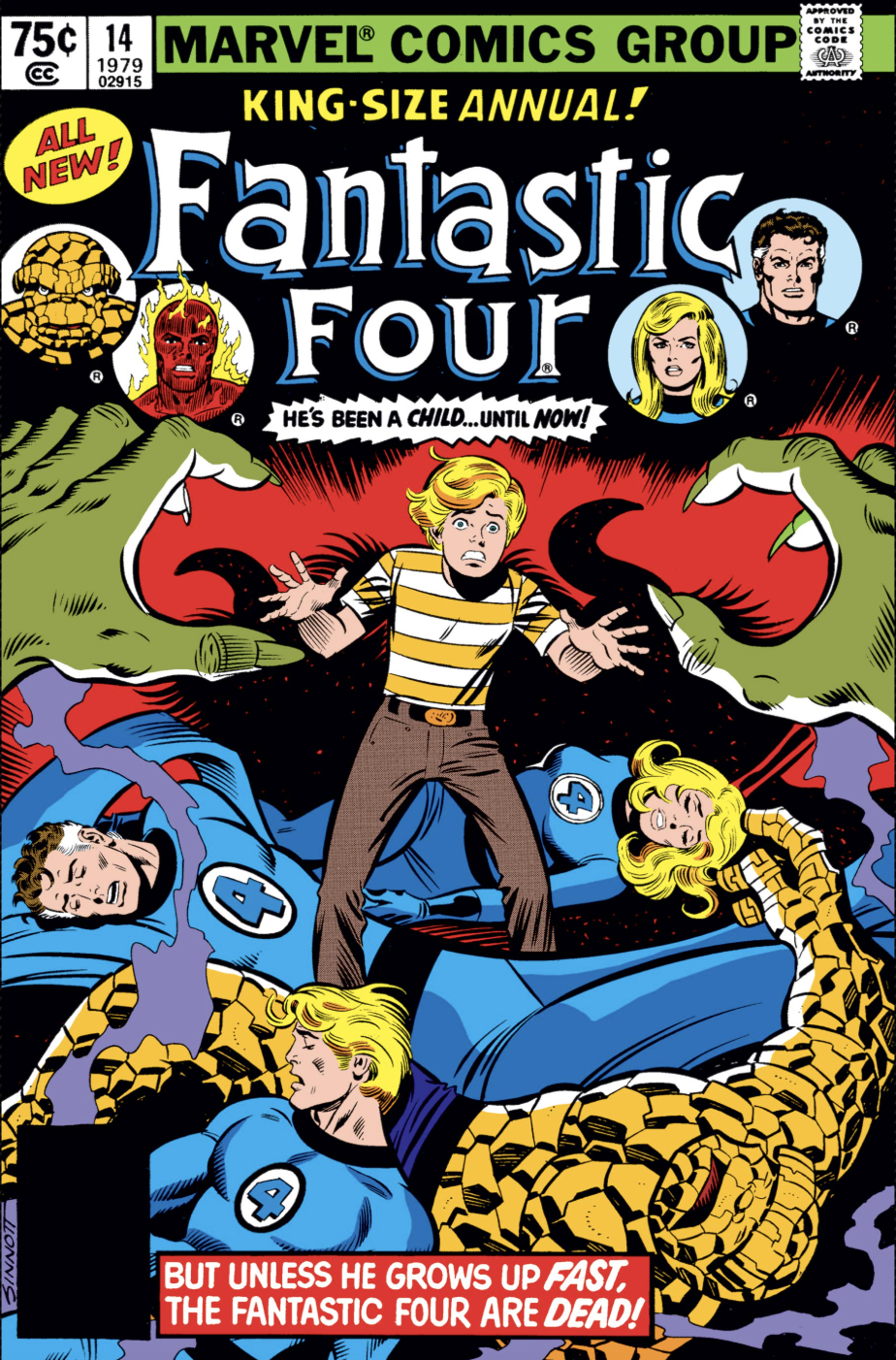
Also of note, the cover is by Joe Sinnott working solo, which is rare. It’s unfortunately not a particularly exciting or interesting cover, and my guess is Perez either couldn’t deliver his cover on time or it was rejected by Jim Shooter, necessitating a quick fill-in job by Sinnott.


What I liked

This is the first comic I’m aware of where we really see Perez’s layout innovations take hold. He was a master of propelling the story with panel designs, and often can fit seven, eight or nine on a page without it feeling cramped (most artists don’t exceed six). We can see the beginnings of that here, where he uses the bottom panel on four consecutive pages (I can only show three here) to introduce the main plot of the story through the sinister villainy of Salem’s Seven. Another artist might gave simply broken away from the main action and used four contiguous panels, but by using one panel per page, Perez undergirds the FF’s triumph over the Sandman with a portent of menace.


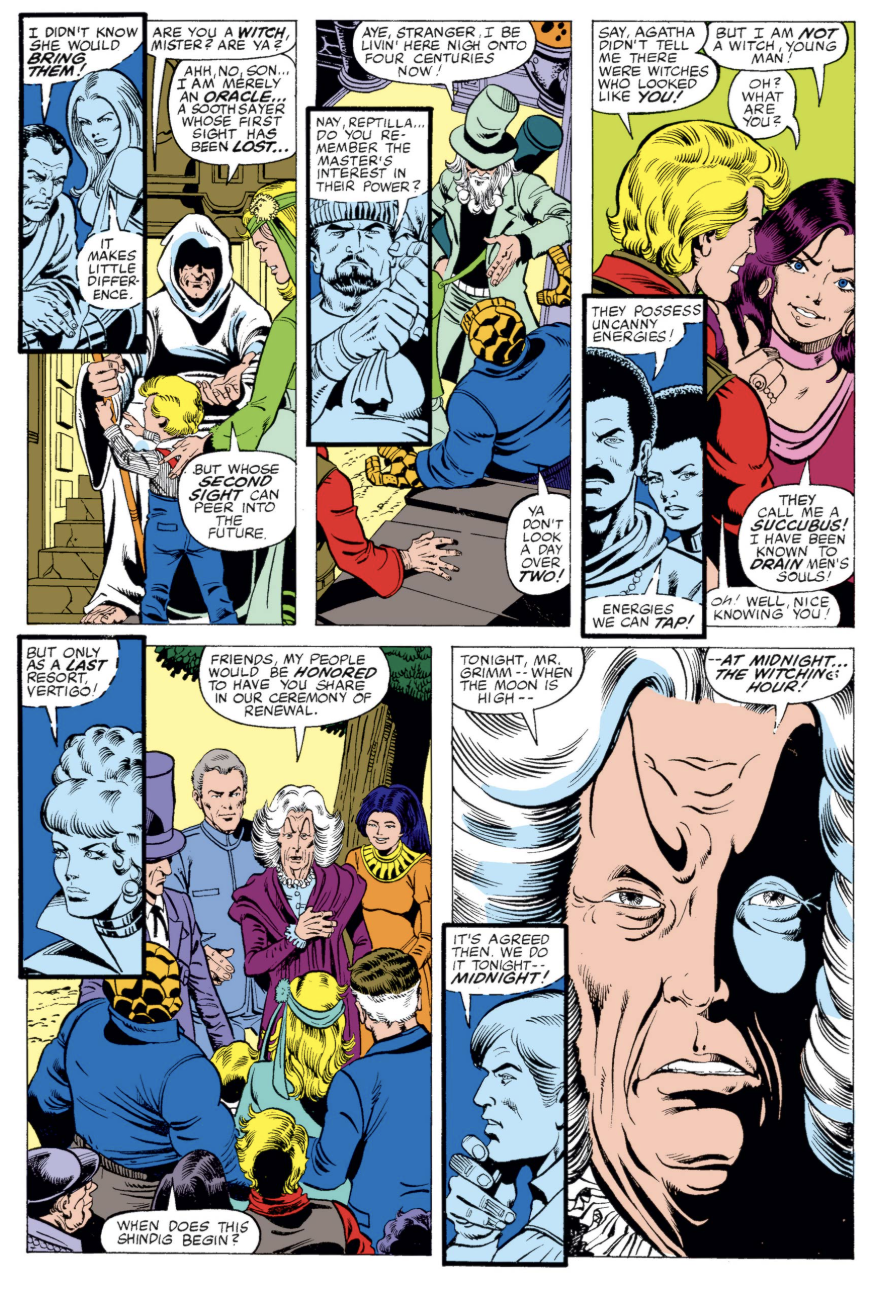
Here’s another page where Perez creates simultaneous action through page design. The small light blue panels show the machinations of the villains at the same time Harkness invites the FF to the evening’s big event. It’s a technique unique to comics; the movie or TV equivalent would be a picture-in-picture with separate characters and dialogue, which would be awful (you do sometimes see this in sports, but it’s hard to watch).

Perez uses 10 panels on this page, and it allows him to give the readers a sense of New Salem’s weirdness while advancing the plot.

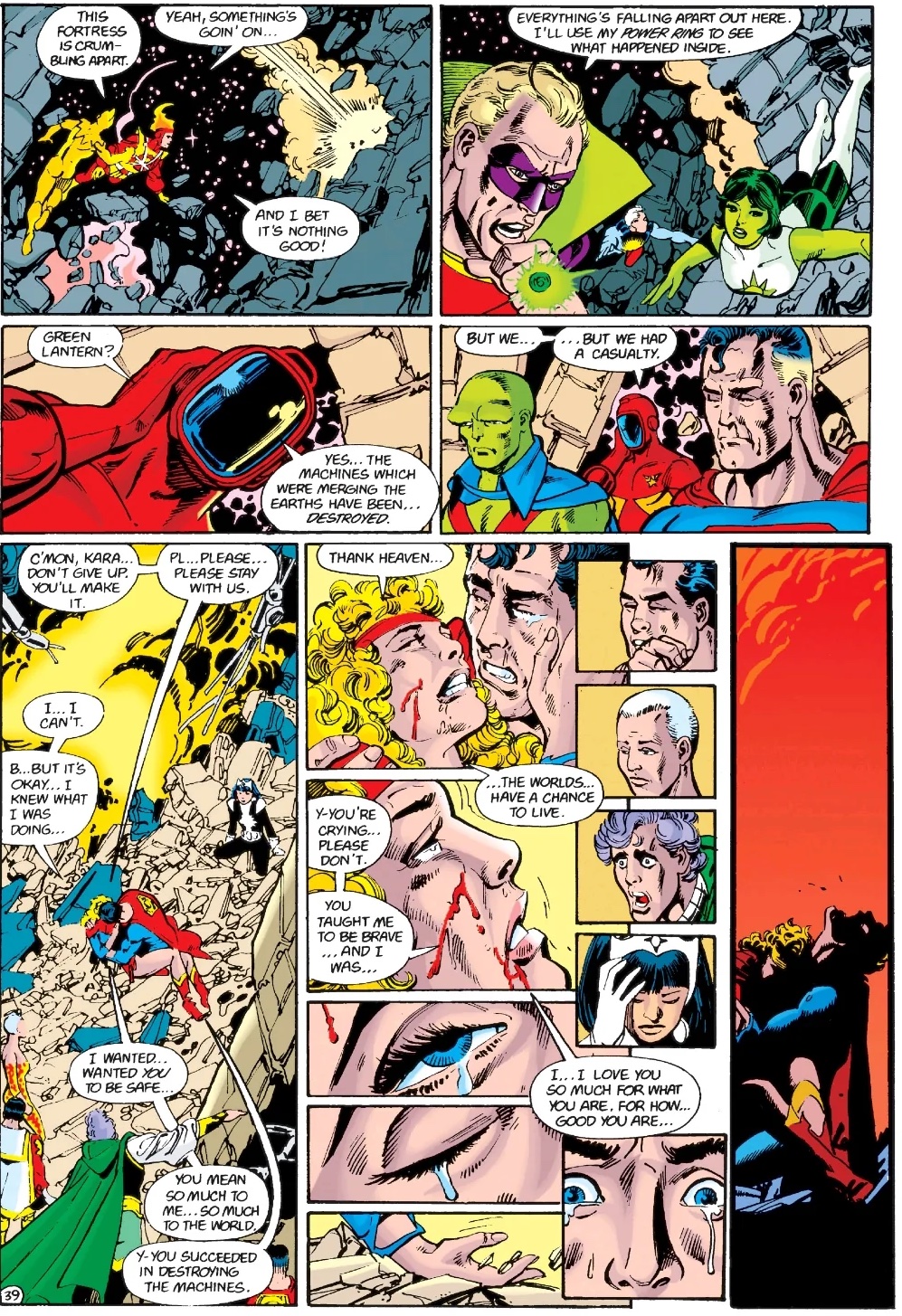
The high point of Perez’s panel wizardry was probably Crisis on Infinite Earths, six years later, where he had roughly a zillion characters to include and a lot of story to tell. Here, in issue seven, he uses an insane 16 panels to record the death of Supergirl.

Today, one wide-screen artist like Brian Hitch would probably use half of a comic for the same sequence.

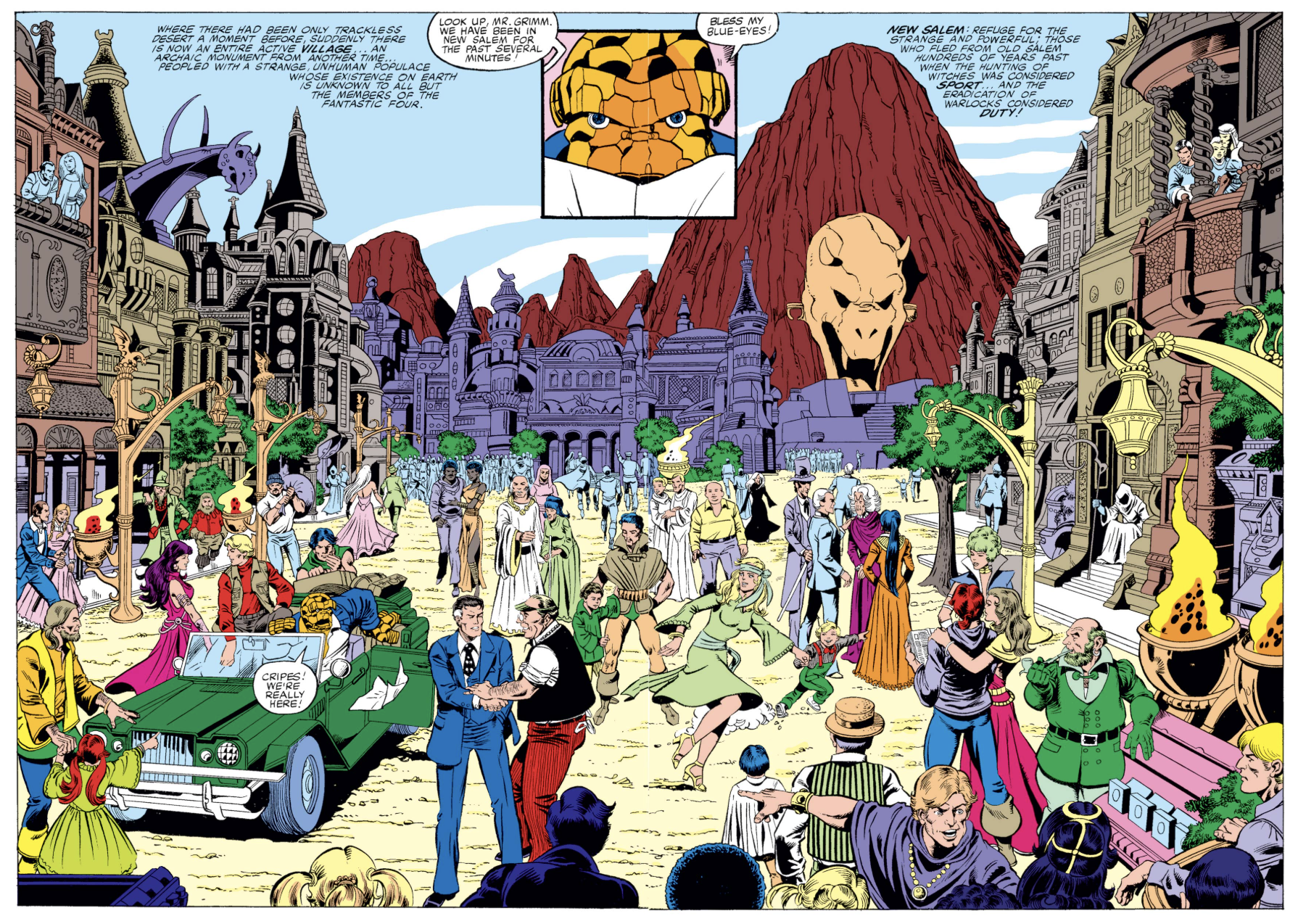
There’s lots of other great Perez art FF Annual 14, too, like this crazy double page splash:

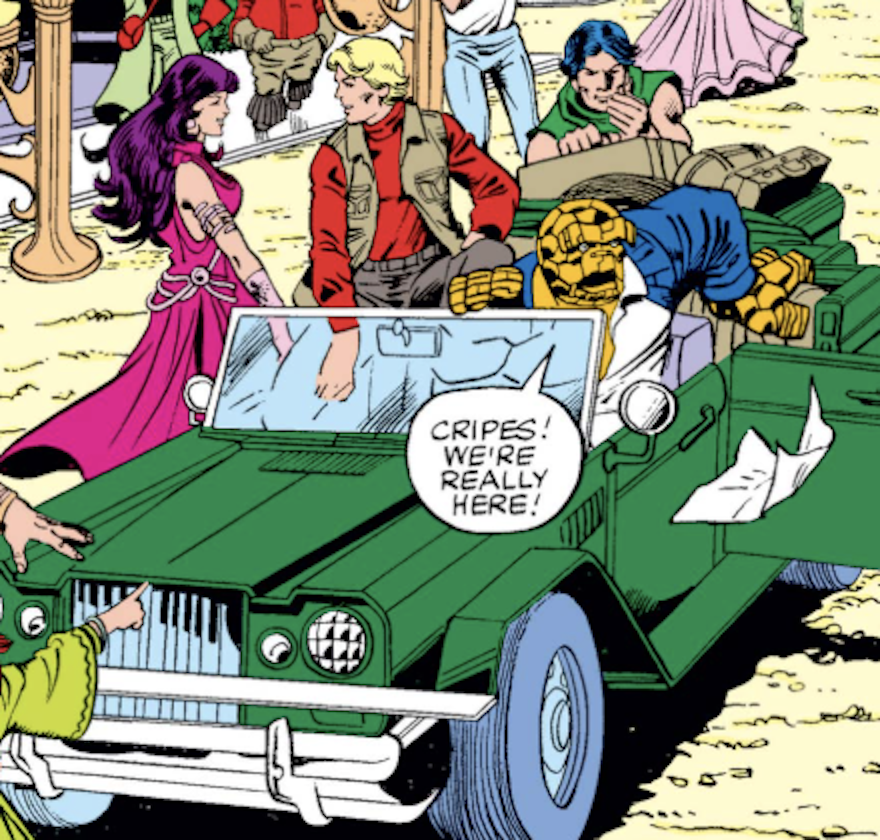
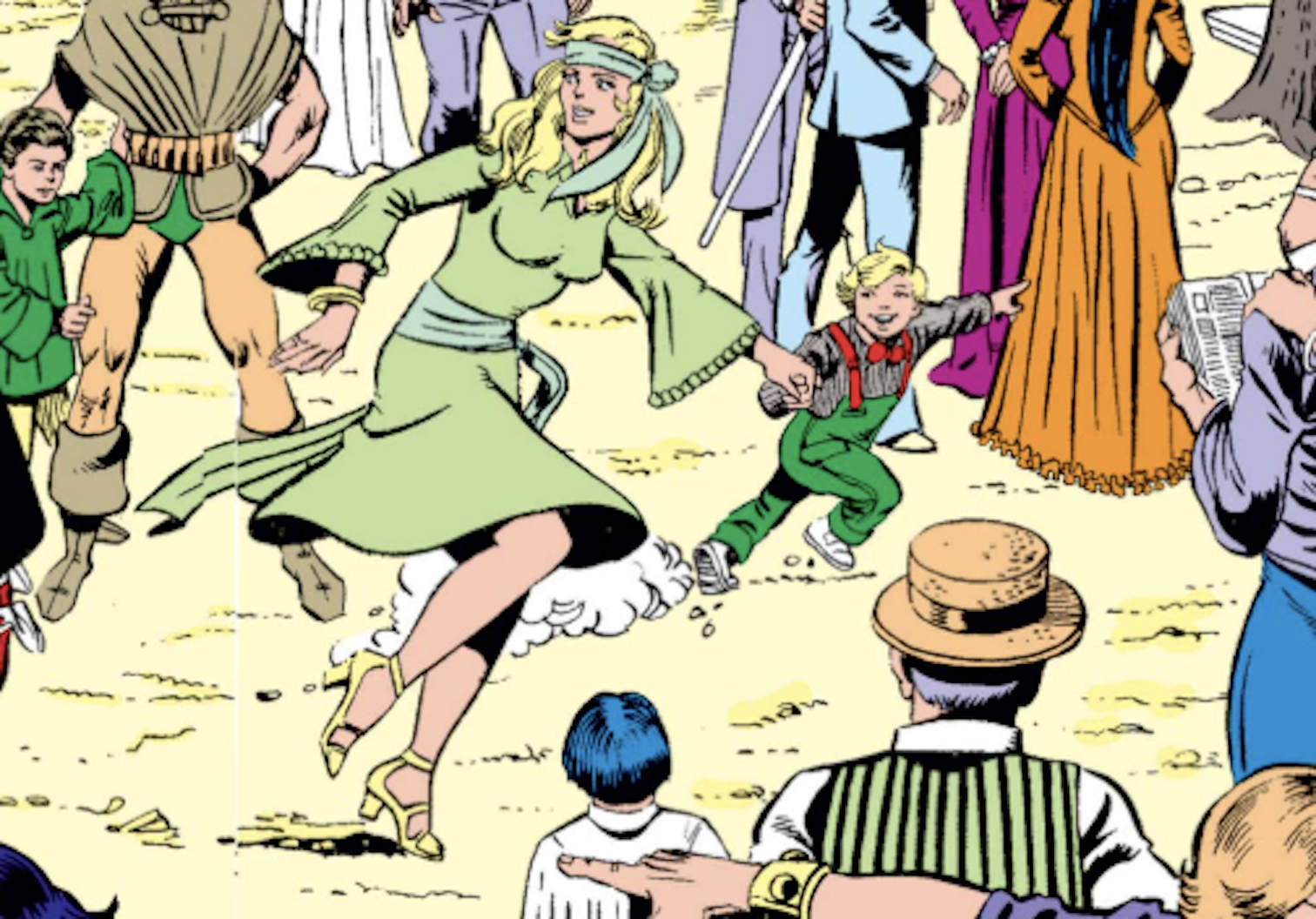
Although the design is pretty rudimentary, with its one-point perspective, it’s full of fun details, like Johnny making time with a New Salem native (later revealed to be a succubus) and Franklin and Sue (and what is Sue wearing on her head??)


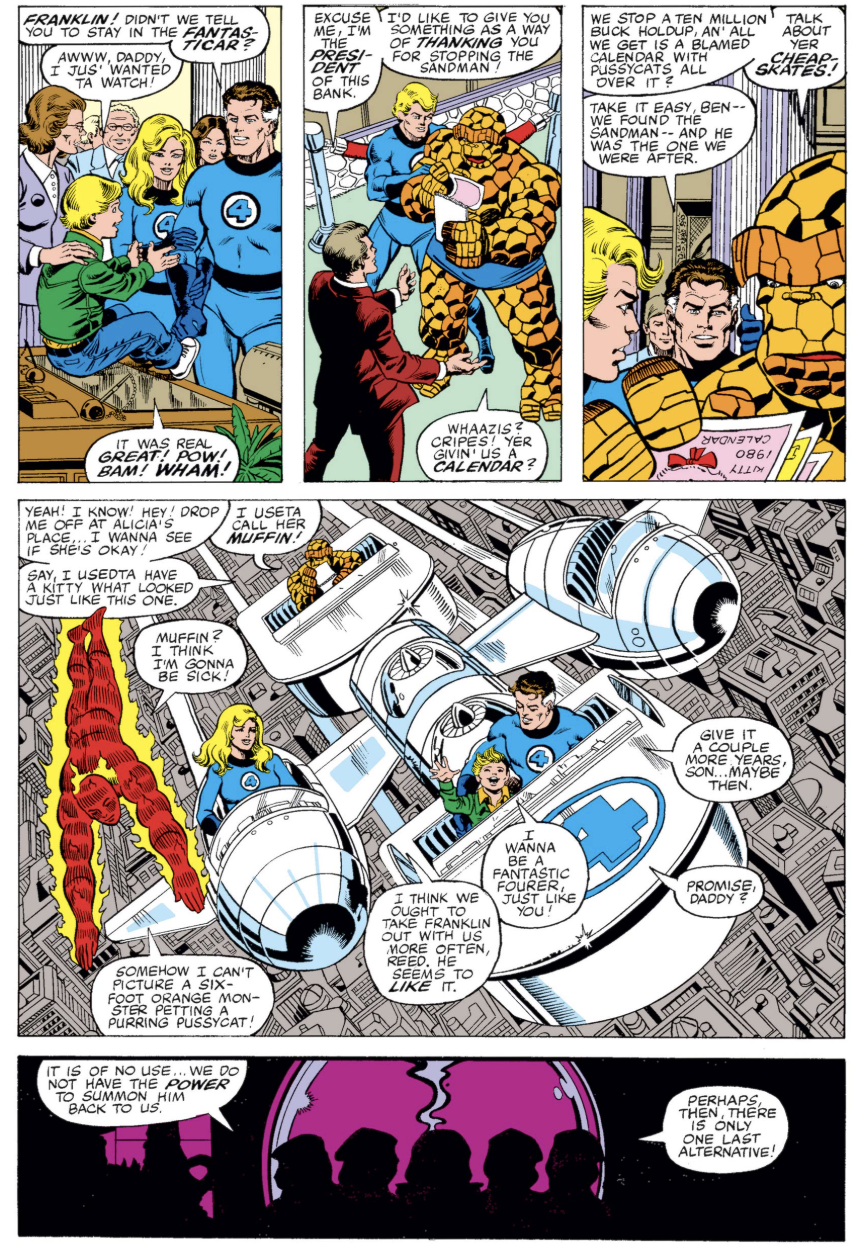
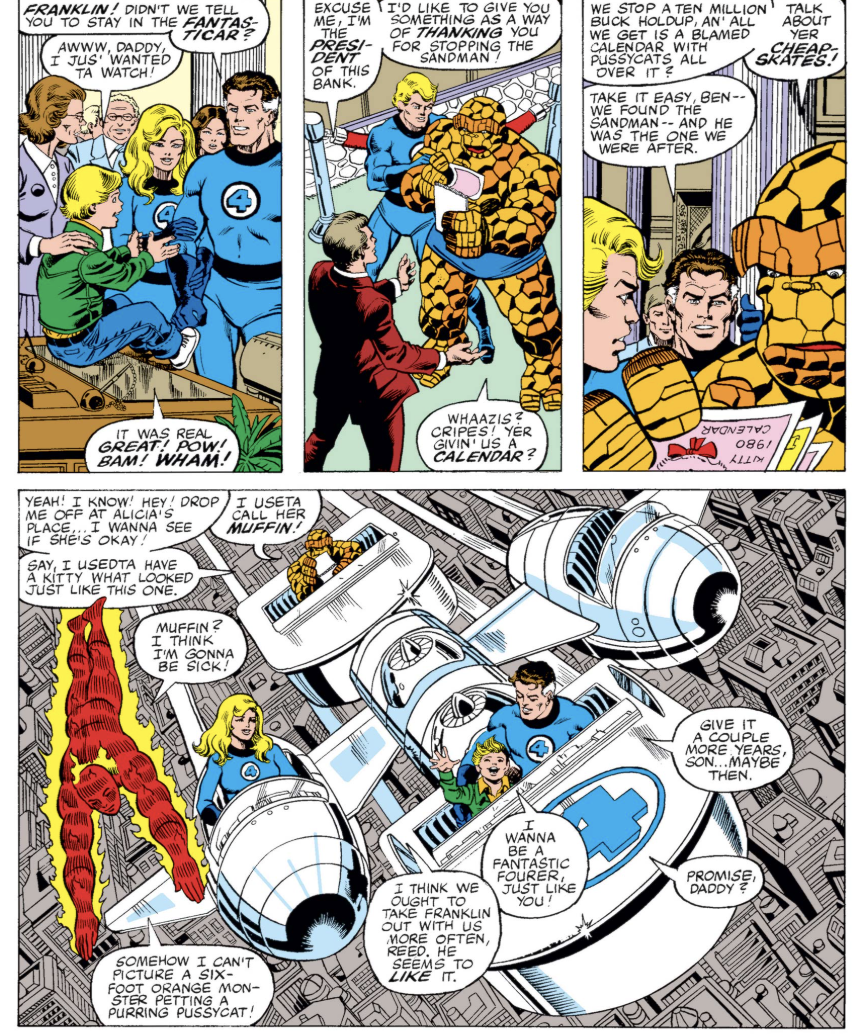
While this issue (and blog post) is really about Perez, Marv Wolfman has his moments. This was a fun sequence that followed the team thwarting the Sandman’s bank robbery and getting a kitten-themed calendar for their troubles:


And to finish up, just a few more amazing pages from Perez (the one with Avengers is stunning):


What I didn’t like

This being a Wolfman comic, there were all sort of odd plot devices and inconsistencies that seems could have been avoided with a bit of thought or (cough) an editor (cough) who wasn’t the same person as the writer.

Here, Harkness invites the FF to join her on a trip across the country and they decide to drop everything and go. Apparently world-class scientists like Reed don’t have meetings or lectures or experiments that keep him tied down. Would it have ruined the story to have made this a trip they planned in advance?

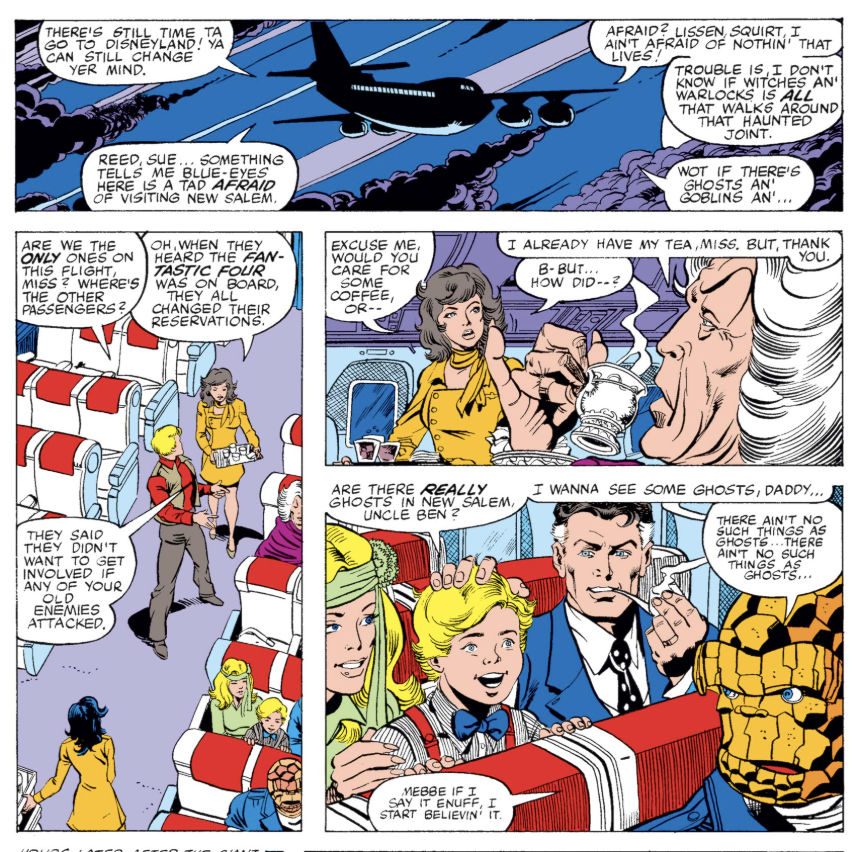
Then, instead of flying one of their several vehicles, they fly commercial. Because who doesn’t like an easily avoidable trip to the airport? (Also, note Reed is smoking a pipe on the plane. It was the seventies).


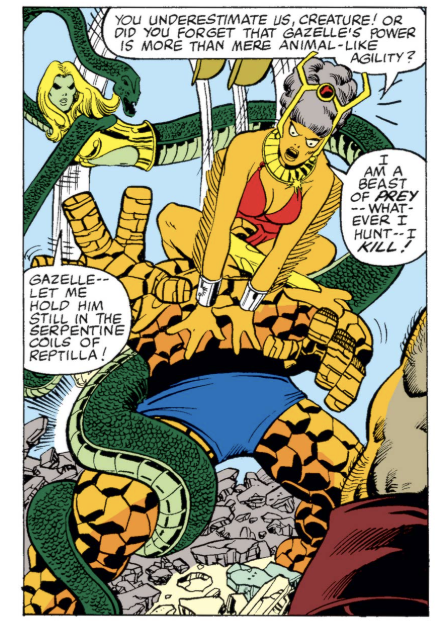
Later, the Salem witch Gazelle announces she’s a “beast of prey.” Really? Her name is Gazelle and she’s a predator??

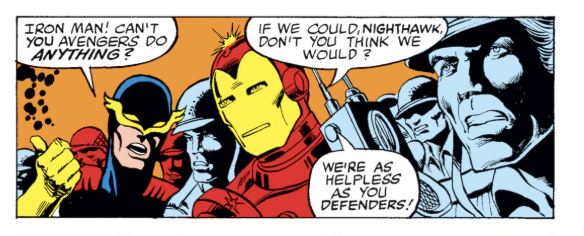
And this feels like an own-goal, but when the Defenders show up and Iron Man says they’re helpless against this mystical, magical forcefield, it kinda begs the question about a certain missing Defender. Wears a cape. Lives in the village. Sometimes called the Sorcerer Supreme. Maybe he could have helped.

Anything else?

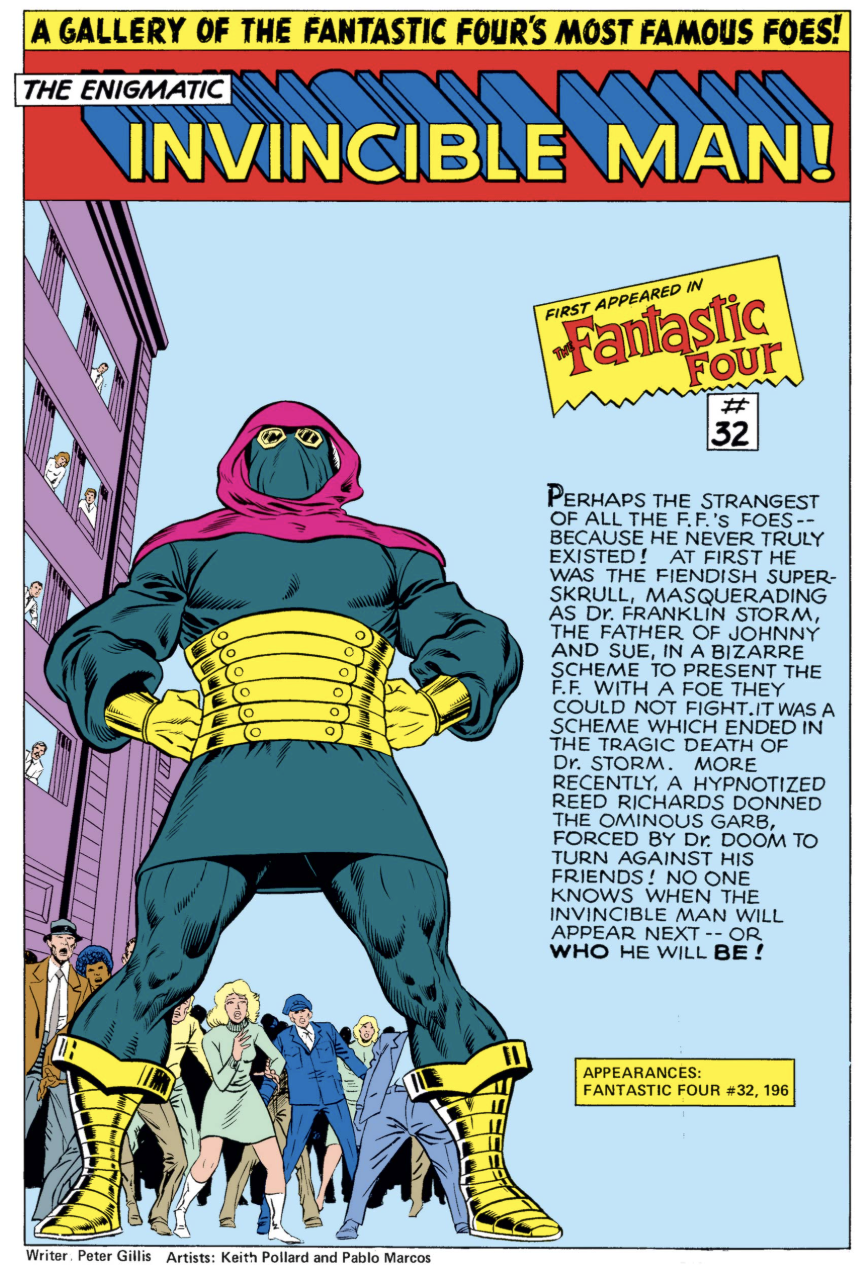
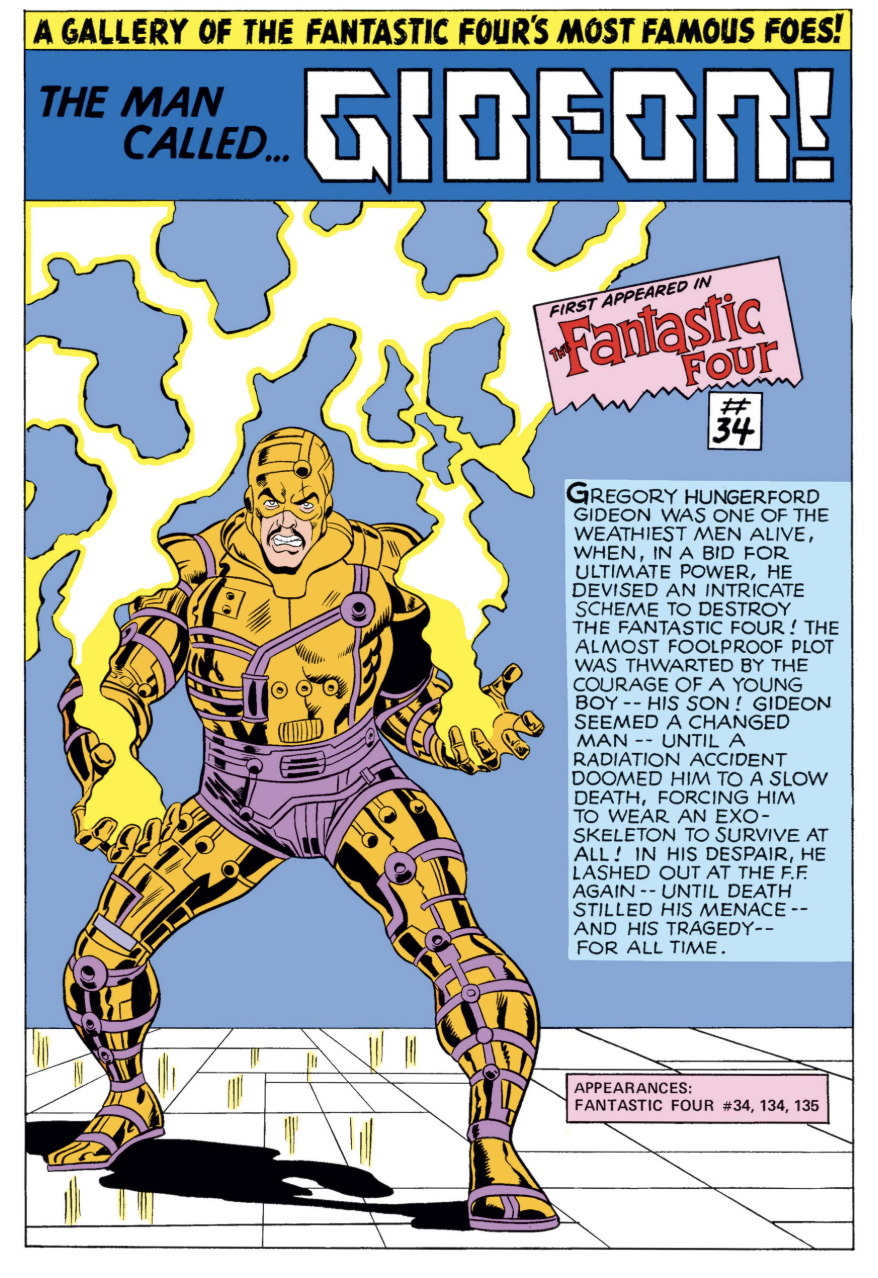
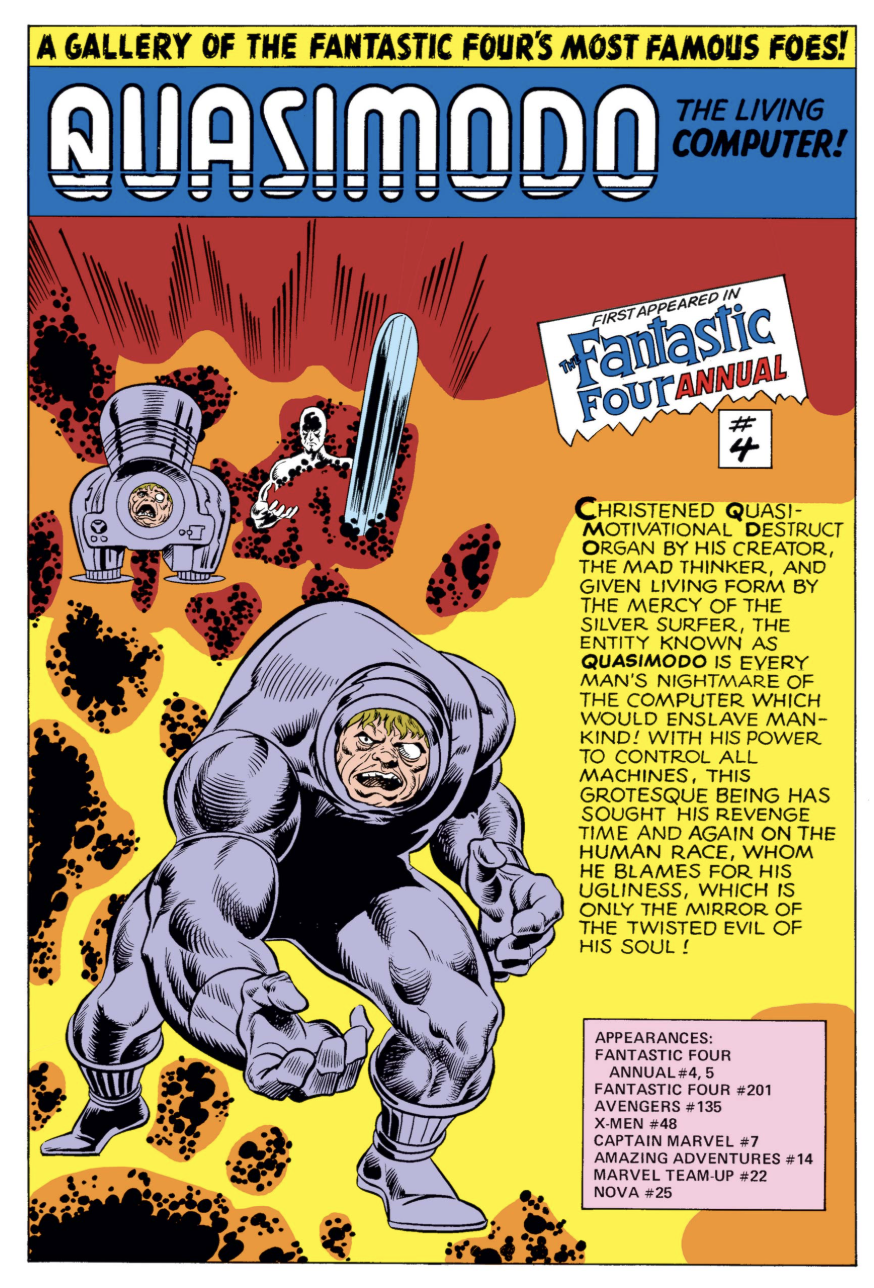
The pinups in the end are by Keith Pollard and Marcos. It’s called a gallery of the FF’s most famous foes but most of these guys are pretty obscure (there were six in total). I like that they each get a custom designed logos.


Overall

A Perez triumph!

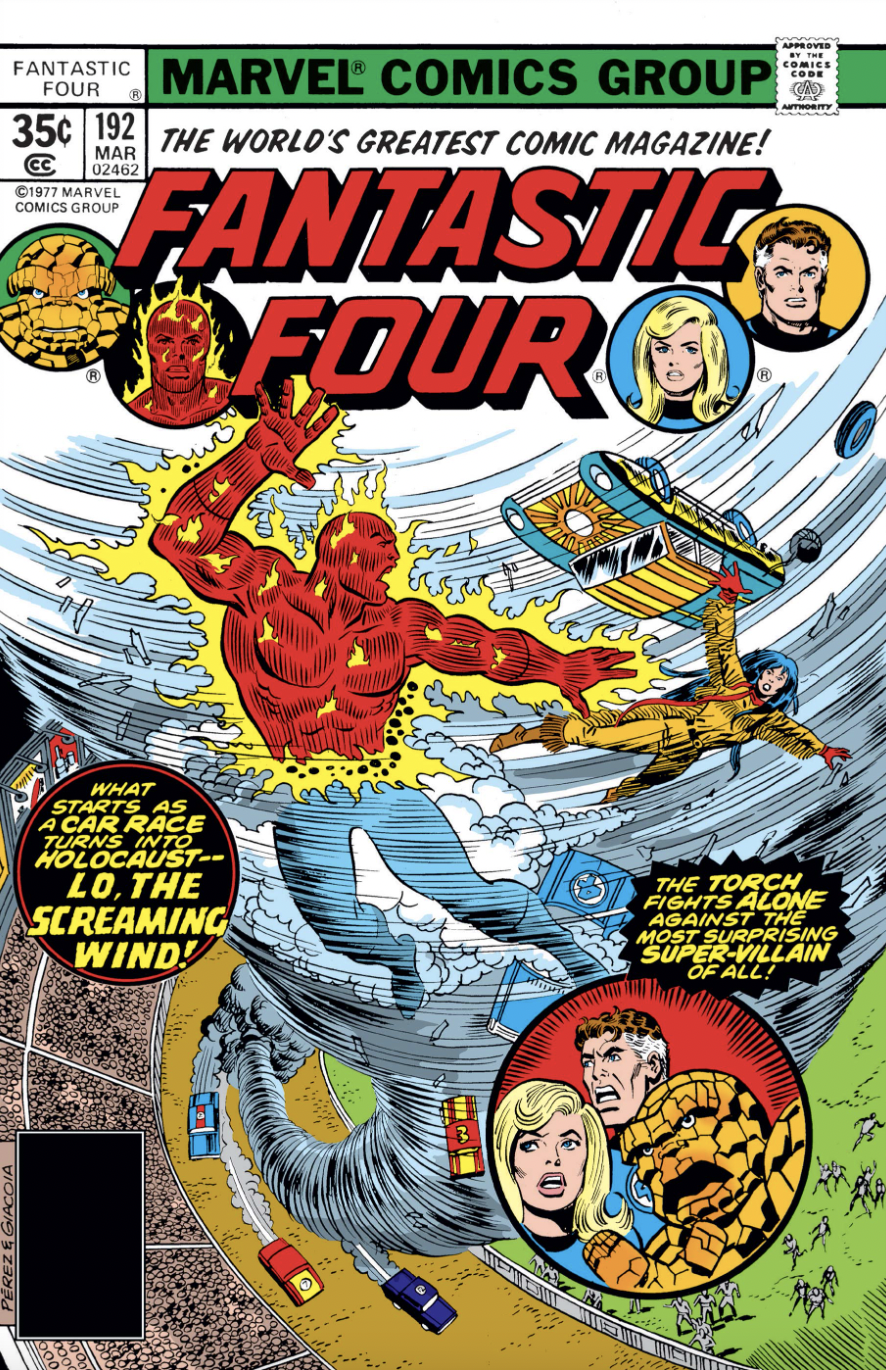
“The World’s Greatest Comic Magazine!” Fantastic Four No. 192

11 Saturday Oct 2025

Posted by percivalhenry in The World's Greatest Comic Magazine

≈ Leave a comment

Tags

1977, Fantastic Four, Fantastic Four 192, George Perez, Len Wein, Marvel comics

Fantastic Four 192
“He Who Soweth the Wind…!”
Published December 1977
Plot: Len Wein
Script: Roger Slifer
Pencils: George Perez
Inks: Joe Sinnott
Letters: Joe Rosen
Colors: Glynis Wein
Editor: Marv Wolfman
Cover: Perez and Frank Giacoia


Synopsis

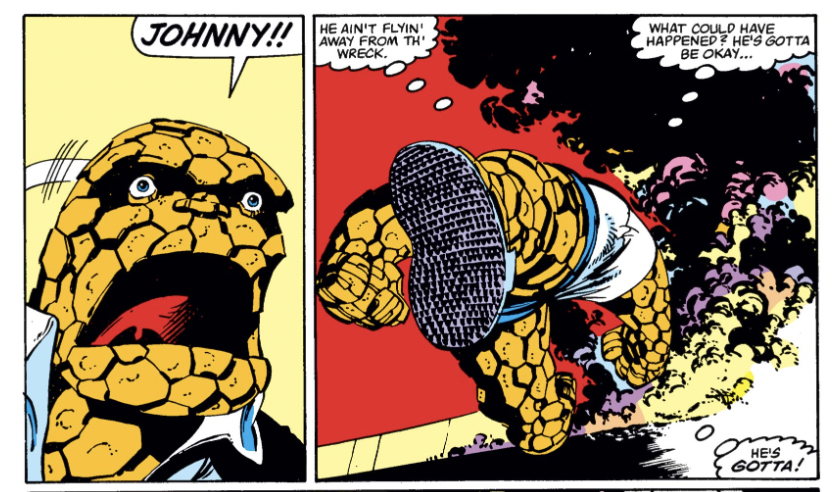
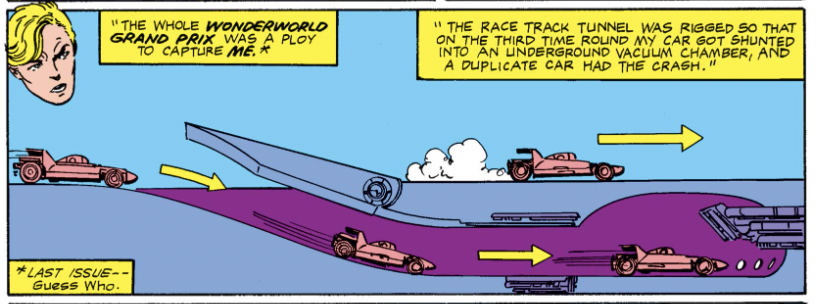
After the breakup of the Fantastic Four, the Human Torch travels to the southwest for a car race, where he is reunited with his old roommate, Wyatt Wingfoot, whose friend, Rebecca Rainbow, is also in the race. The race is interrupted by an attack by the mercenary Texas Twister, who is being paid to deliver Johnny to his employers. They fight to a draw and the Twister escapes.


What’s going on here?

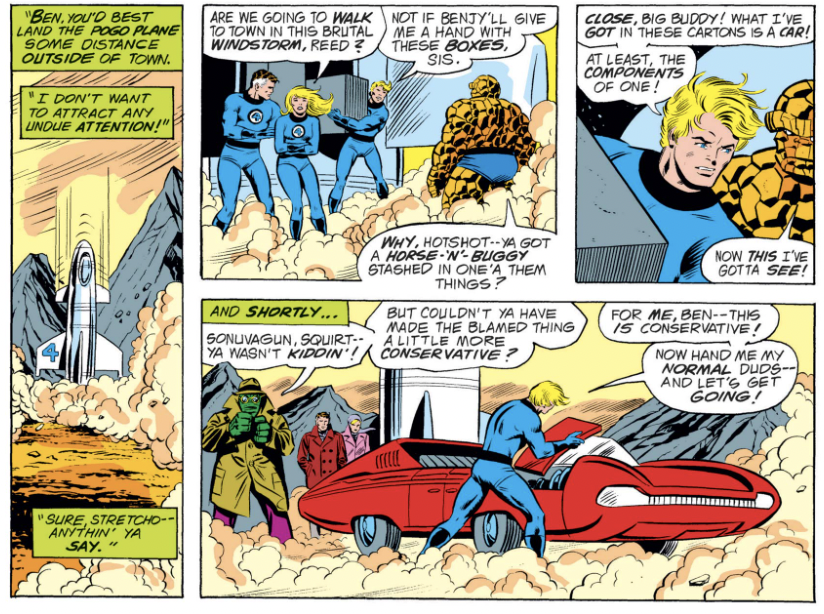
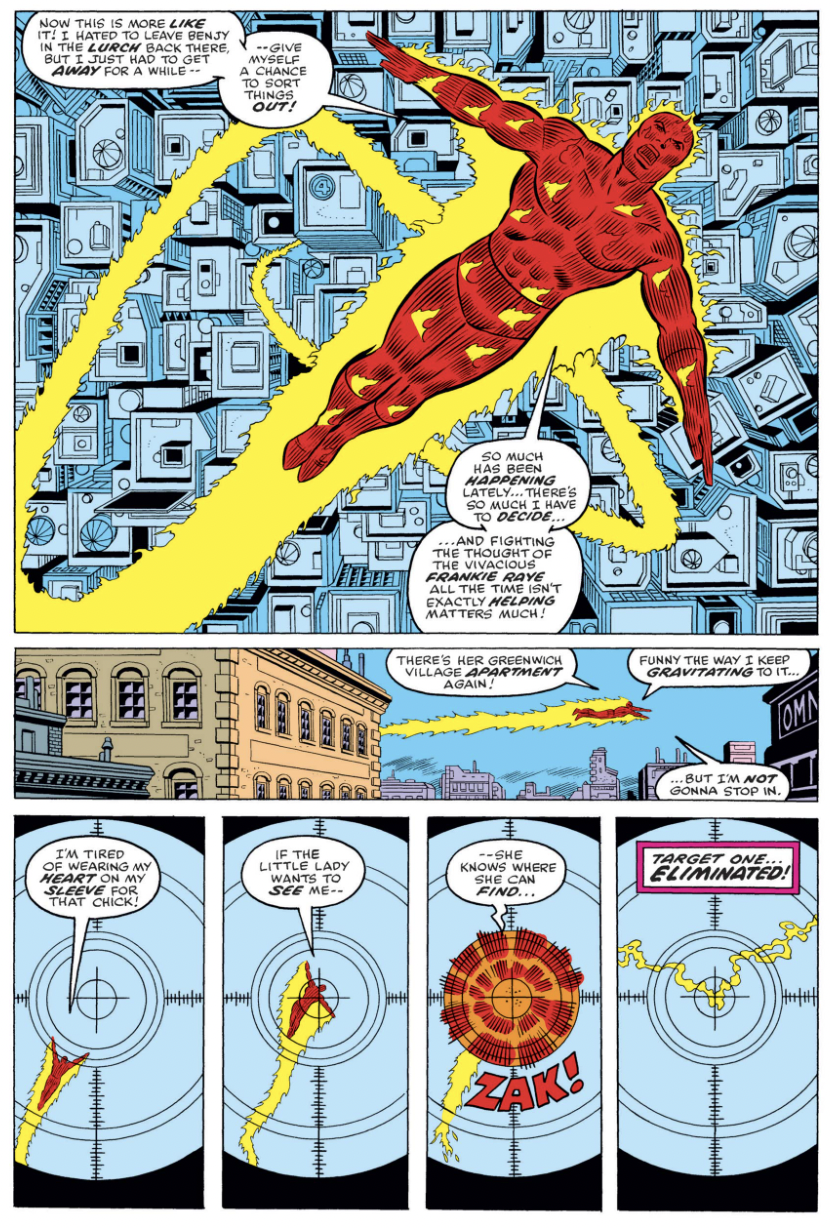
This is a fun, albeit pretty lightweight, Torch solo story that works well in the context of the FF’s purported dissolution. If you’re going to tell solo stories, this is the time to do it. It’s a pretty conventional one-and-done set-up, with the Torch ambushed in some random locale, but at least we have a guest appearance from Wyatt Wingfoot, a great and underutilized member of the FF’s supporting cast.

As discussed in my last post, Len Wein is being phased out as the FF’s writer, and here he is only given credited for the plot. The script is by Roger Slifer, a relatively new writer who would spent about a decade mostly writing Marvel’s B- and C-list books before going on to DC’s Omega Men. He later worked in animation before he was seriously injured in a hit-and-run accident and was institutionalized until his premature death.

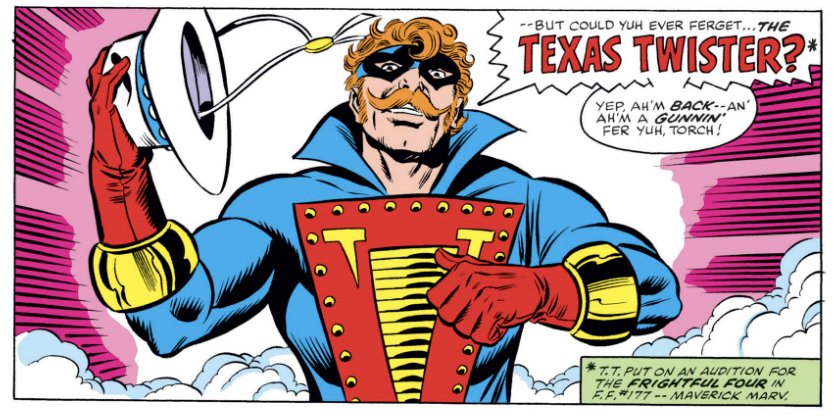
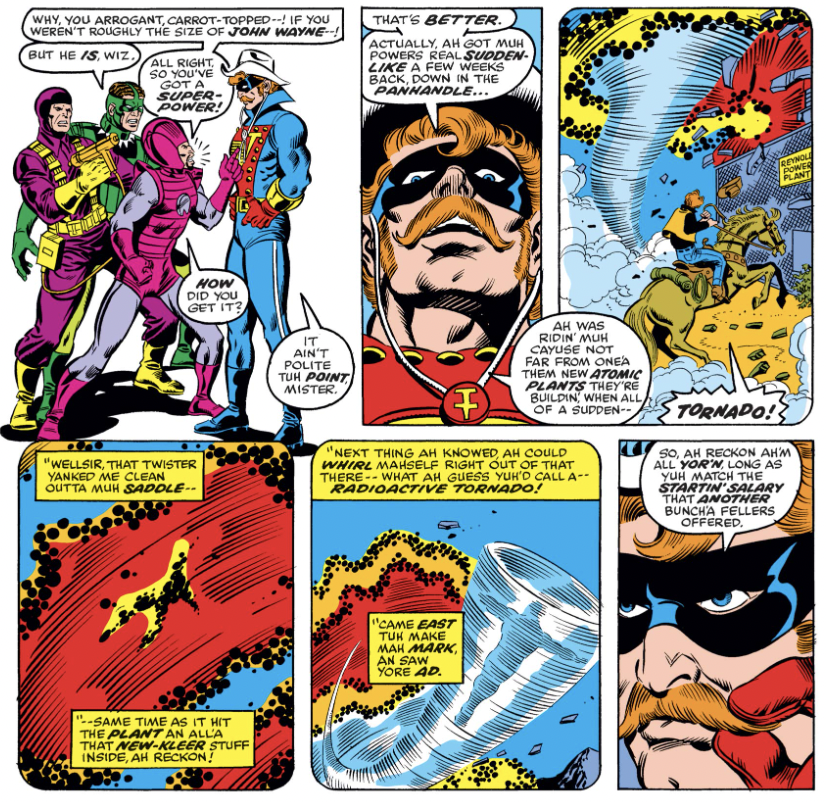
The villian, the Texas Twister, is a mostly fun, occasionally annoying character who first appeared in Fantastic Four 177 as one of the potential new members to audition for the Frightful Four. He eventually becomes a hero and a member of the Rangers, a regional team that would show up from time to time. Here is his origin, from FF 177 (story by Roy Thomas, art by Perez and Sinnott) (I blogged about the comic here):

I’m not sure I like the character as much as I like the idea of the character, or his later incarnation as a hero. As a kid, I loved minor-league super teams, like the Rangers and Great Lakes Avengers. It meant the Marvel universe was populated by more that the characters we saw every month, and it made sense that other parts of the country besides New York had heroes.

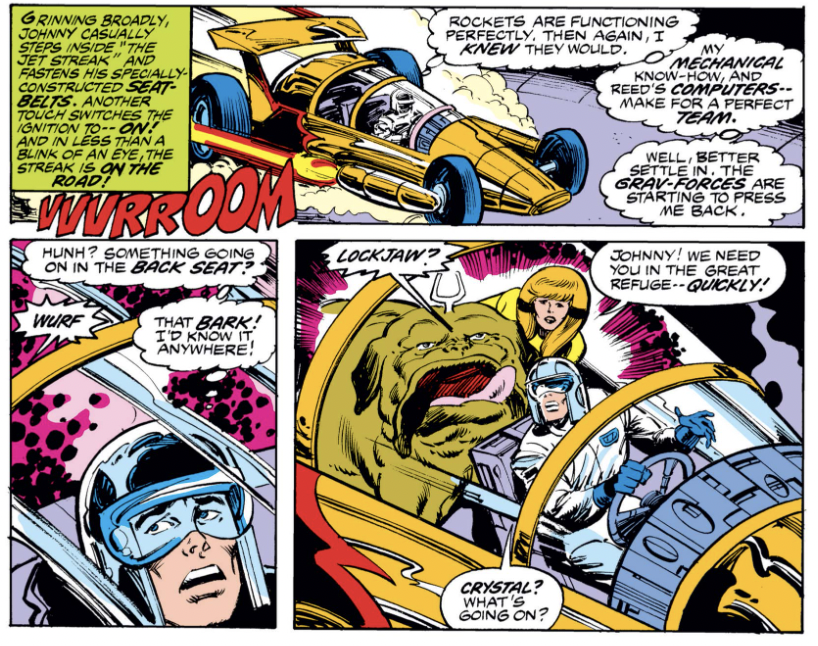
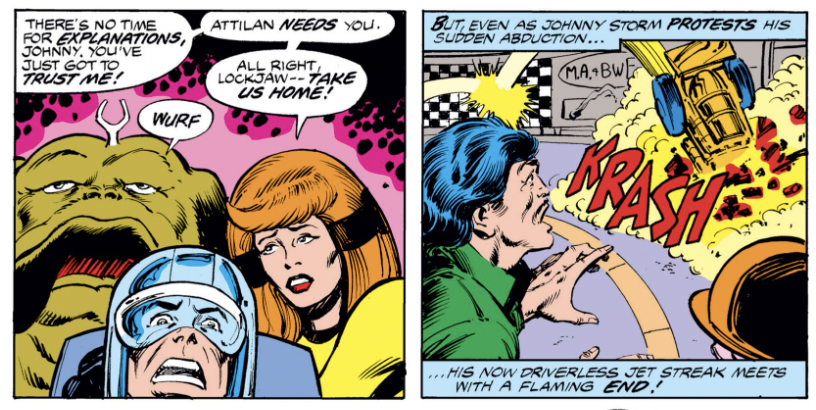
One other note: Has Johnny Storm ever successfully completed a race? Or is he always interrupted or abducted by a villain before he gets to the finish line? I can think of least two other instances of this trope. One is in the recently blogged-about Fantastic Four Annual 12, where Crystal and Lockjaw somehow fit into his race car and teleport him away:

And in Fantastic Four 263, he is abducted mid-race by a villain that wants his powers for nefarious purposes (story and art by John Byrne):


What I liked

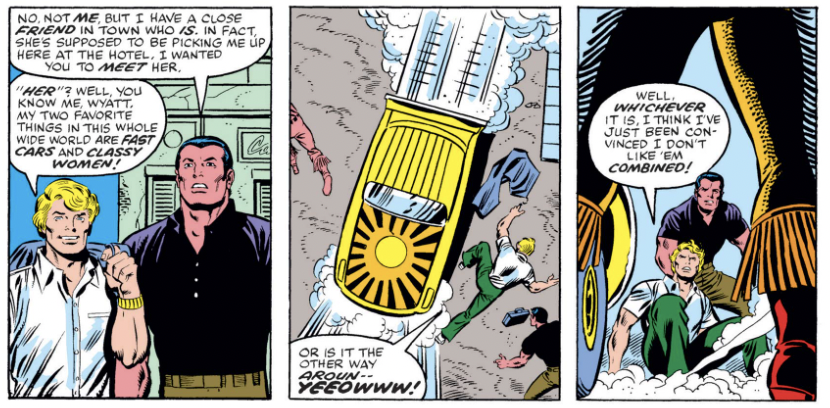
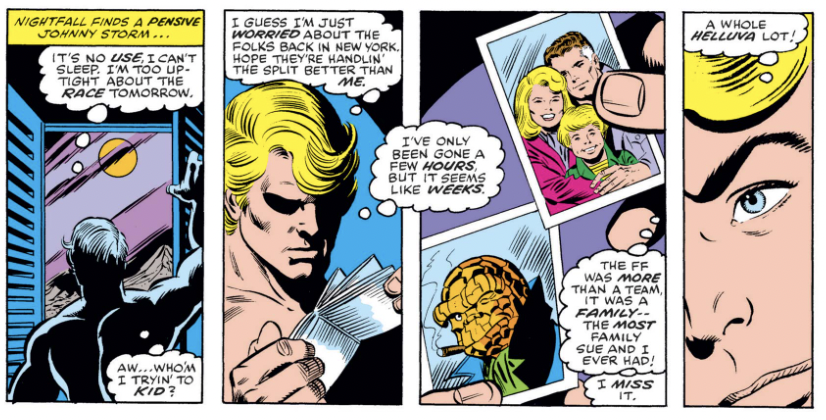
There’s a breezy, easy-going quality to the story, despite the over-wrought cover and title. It’s hard to take the Texas Twister too seriously, and nothing much of consequence happens. I liked the banter between Johnny and Wyatt, which gets very close to a sexual innuendo:


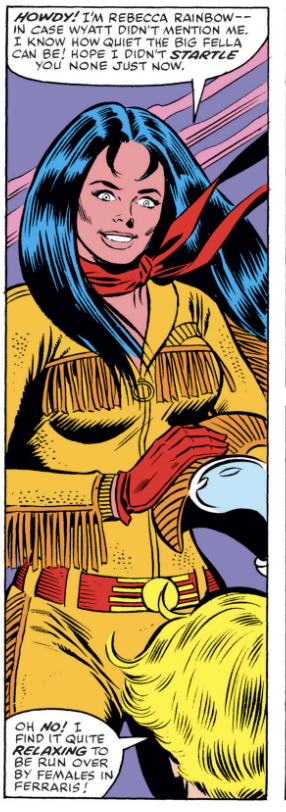
Rebecca Rainbow, Wyatt’s friend, is a fun character and I wish she stuck around. She was introduced in a Marvel Two-in-One issue, which is further proof I really should be including MTIO in this blog:

And this was a nice quiet moment for Johnny:


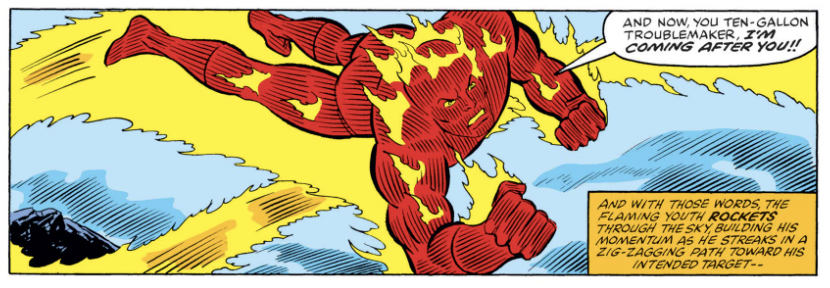
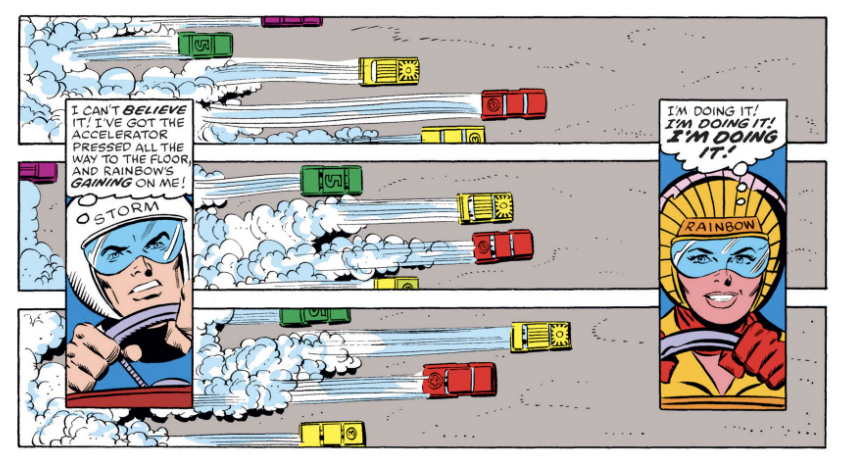
The art in this issue is very by-the-numbers and one Perez’s less inspired efforts in his FF run, The cover in particular is one of his weakest. But I liked this panel design showing Rebecca overtaking Johnny in the race:


What I didn’t like

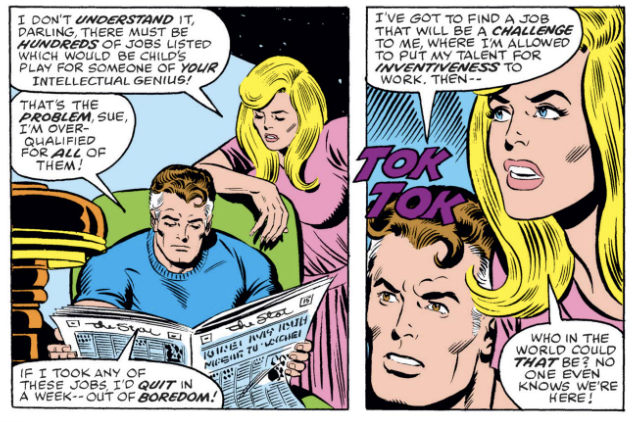
One of my persistent gripes about the Fantastic Four over the years is the inability of writers to understand how Reed Richards would fit into the real world. The world’s smartest man—one who invented interstellar space travel, unstable molecules and no end of amazing gizmos—would never be wanting for money or opportunities. Think of a benevolent Elon Musk, but one who’s an actual genius. At the very least he would be at a university with his own lab. Every time we get a story about how the FF are broke or need jobs it reads like the writers don’t have a clue how the world works. Here, Reed is (absurdly) looking at help wanted ads in the paper:


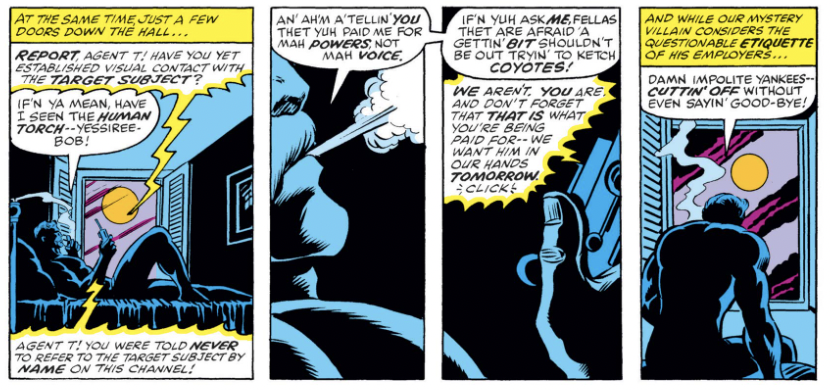
The Texas Twister’s accent and idiomatic speech is laid on very thick. I wonder of Slifer ever met an actual Texan?


Anything else?

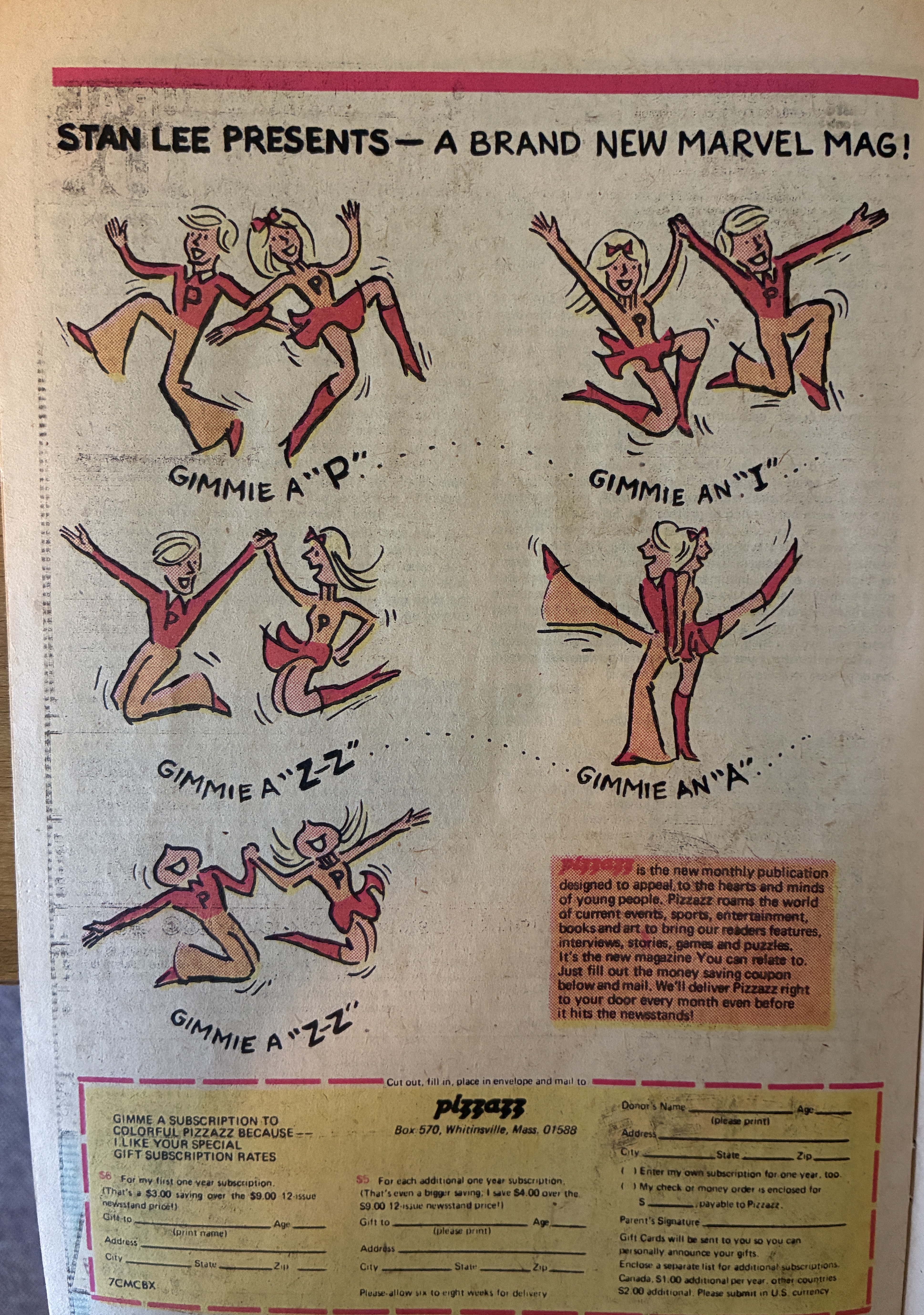
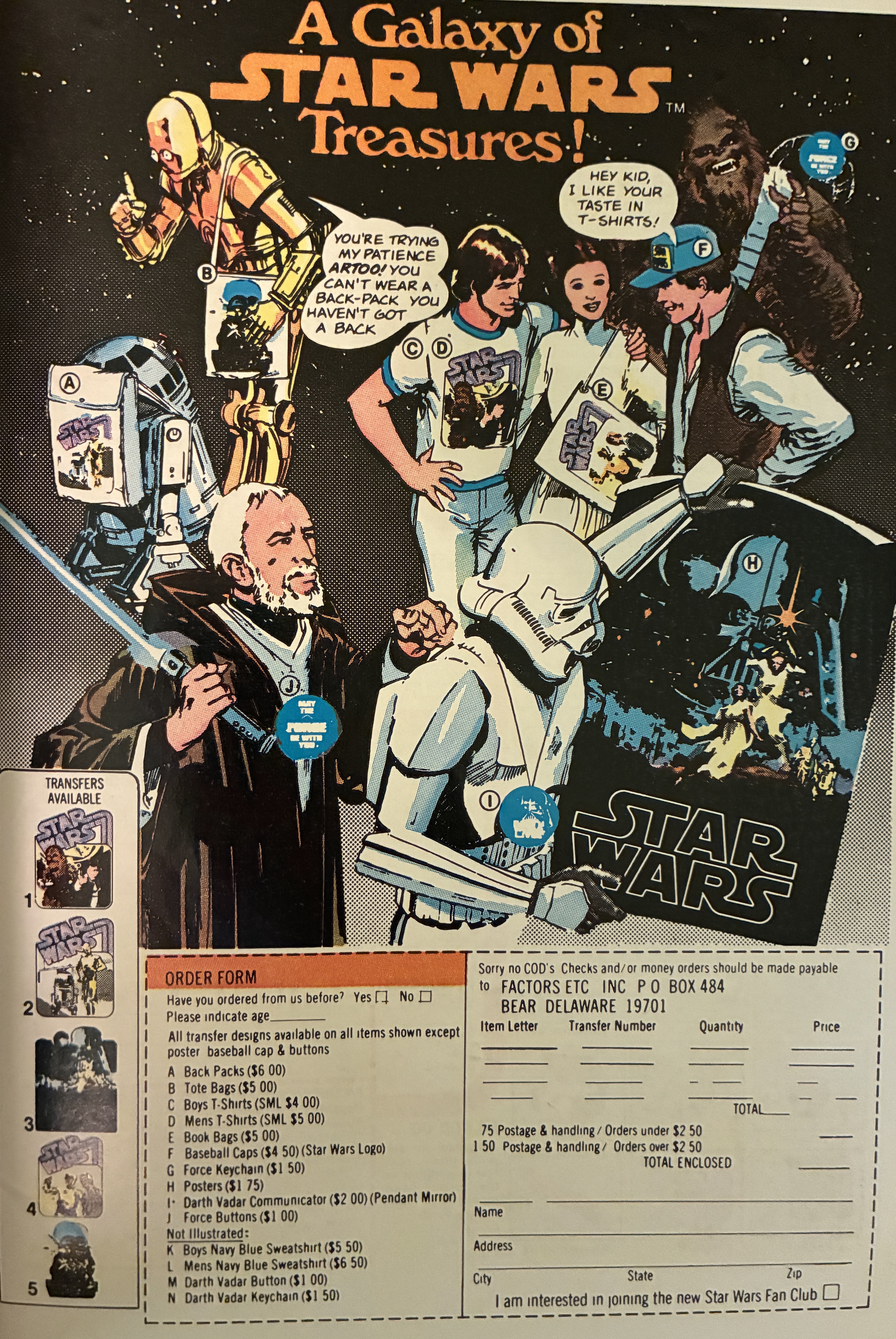
Some interesting ads. I’m not sure who this Pizzaz ad is supposed to appeal to … I can’t imagine it would entice a super hero fan. And this is the first reference to Star Wars I think we’ve seen in an FF comic. The movie opened a few months earlier.


Overall

A perfectly acceptable comic book

“The World’s Greatest Comic Magazine!” Fantastic Four No. 191

04 Saturday Oct 2025

Posted by percivalhenry in The World's Greatest Comic Magazine

≈ 1 Comment

Tags

1977, Fantastic Four, Fantastic Four 191, George Perez, Len Wein, Marvel comics

Fantastic Four 191
“Four No More!”
Published November 1977
Writer: Len Wein
Pencils: George Perez
Inks: Joe Sinnott
Letters: John Costanza
Colors Glynis Wein
Editor: Len Wein
Cover: Perez and Sinnott

Synopsis

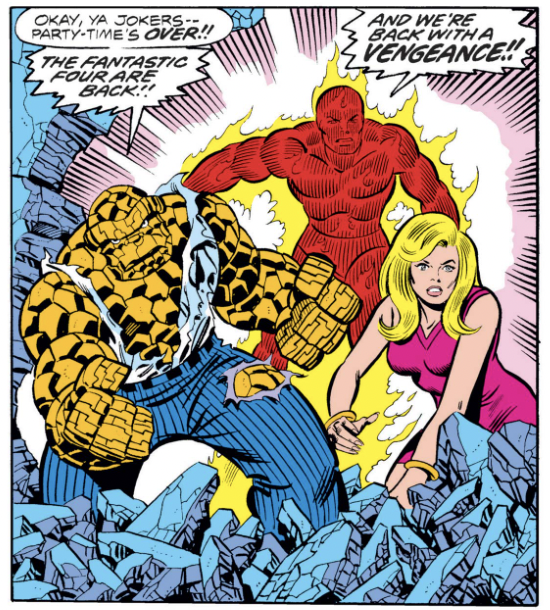
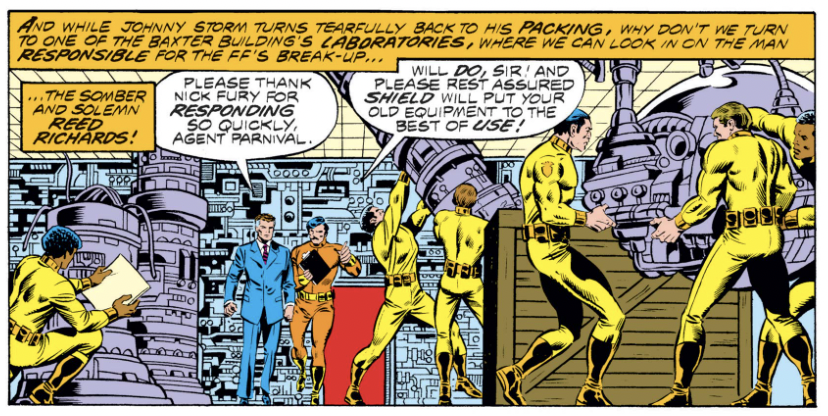
The Fantastic Four are breaking up after a de-powered Mr. Fantastic decides to disband the team. After they say their good-byes and depart, Reed stays behind to oversee his equipment being boxed up to be shipped to SHIELD. But it’s soon revealed that the movers aren’t SHIELD agents but henchmen of the Plunderer, who is attempting to steal he equipment. Reed summons the rest of the FF and after a quick fight defeat the Plunderer and his men, only to break up once again.


What’s going on here?

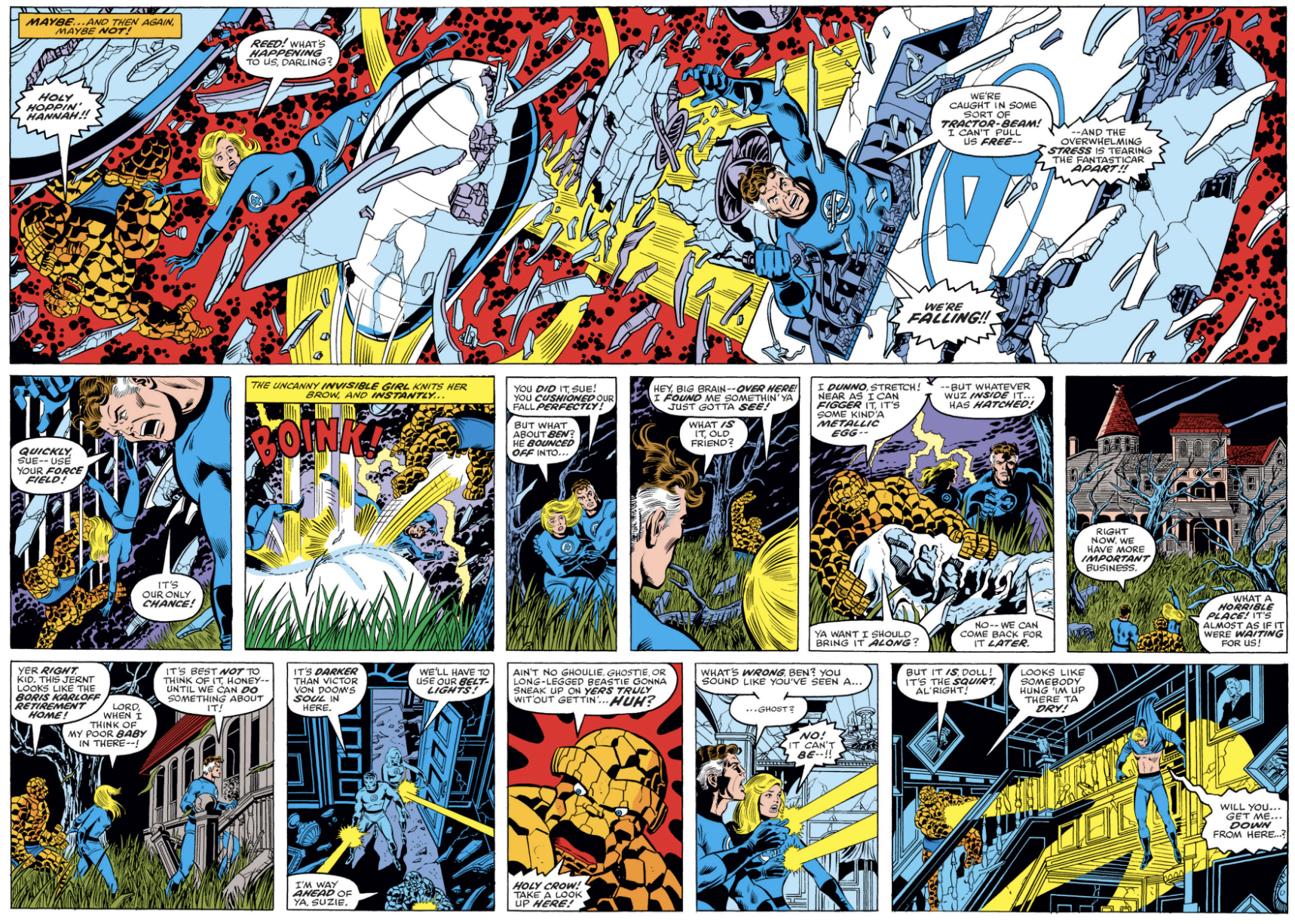
This is a very satisfying issue, a sturdy one-and-done comic that nonetheless advances the bigger narrative of the breakup of the Fantastic Four. A lot of credit goes to Len Wein, who has a real handle on the family dynamics and personalities of the team. He’s particularly deft at writing Ben as more than a wisenheimer or sad sack, but as a stand-up guy (a mensch, even) and big brother to Johnny. Wein’s writing does get overly maudlin about the team’s dissolution, since everyone except the team members know they will get back together, but it gives him opportunity for more character development. Sadly, this is his last issue as full writer, as he goes on to be credited as just the plotter before dropping off the book for good after issue 194 (and leaving Marvel for DC).
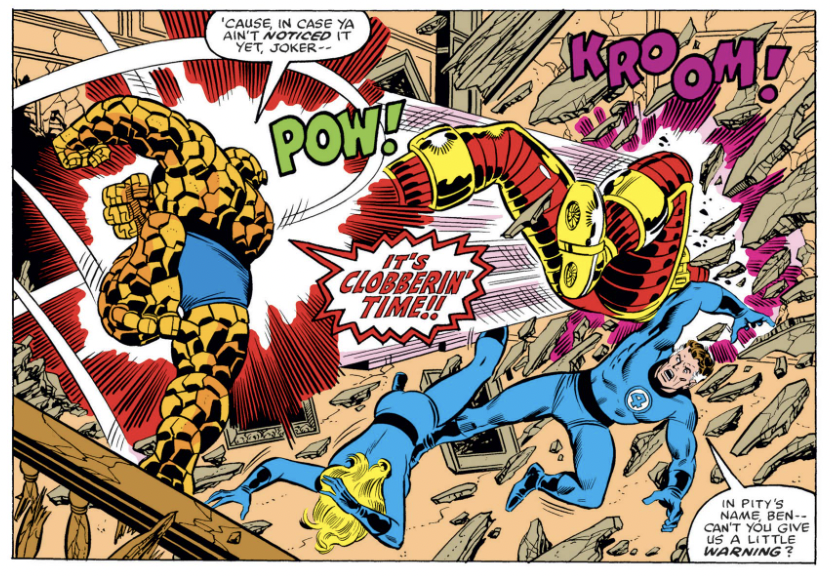
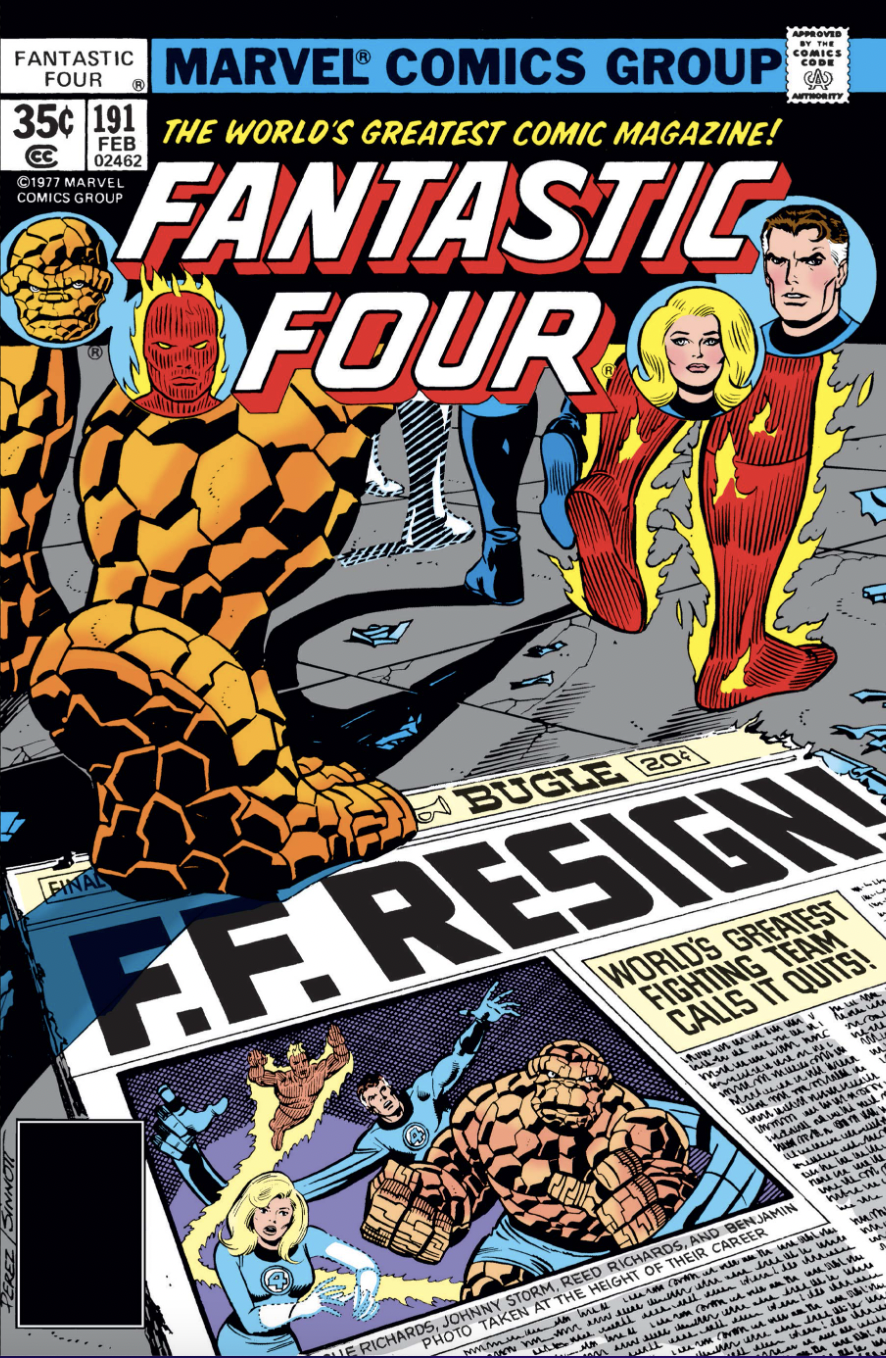
The Perez / Sinnott team do another solid job, especially with the cover, which is one of the best and most creative we’ve seen of this era. (Issue 187, with the team framed by the Molecule Man’s legs, is also excellent but most of the rest during this period are mostly just fight scenes, even if drawn by Jack Kirby). Perez also gets to stretch his machinery-drawing abilities here.


What I liked

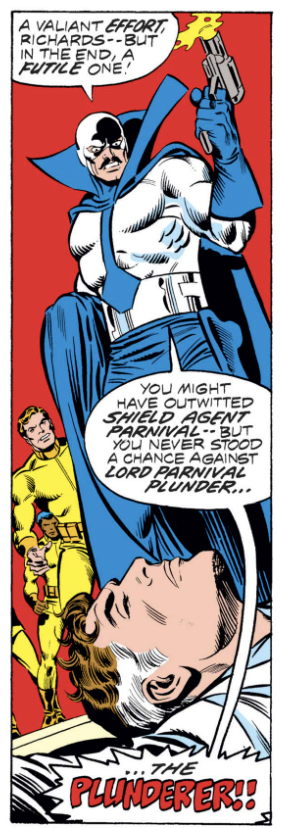
The reveal of the villain was well crafted. I confess I wasn’t familiar with The Plunderer, who, as Parnival Plunder, is the villainous brother of Kevin Plunder, a.k.a. Ka-Zar. He featured in a lot of Ka-Zar stories throughout the seventies, and would have been familiar to many readers. Using “Agent Parnival” as his assumed name is a clever hint some readers certainly would have picked up on. The Plunderer is just the right sort of villain for this kind of story; sinister enough to cause some trouble but not big enough of a threat to be a real menace and therefore take the focus off the main narrative of the team breaking up.


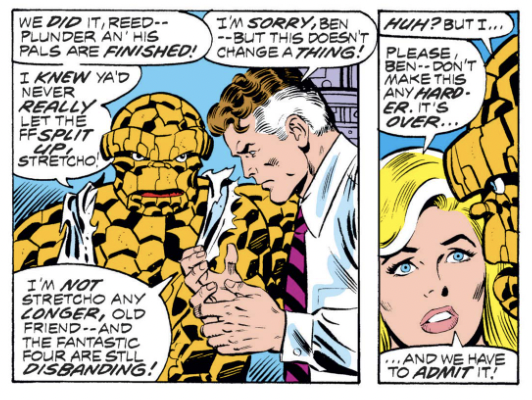
As discussed, the reaction to the team’s breakup could get a bit sappy, but I liked this sequence:


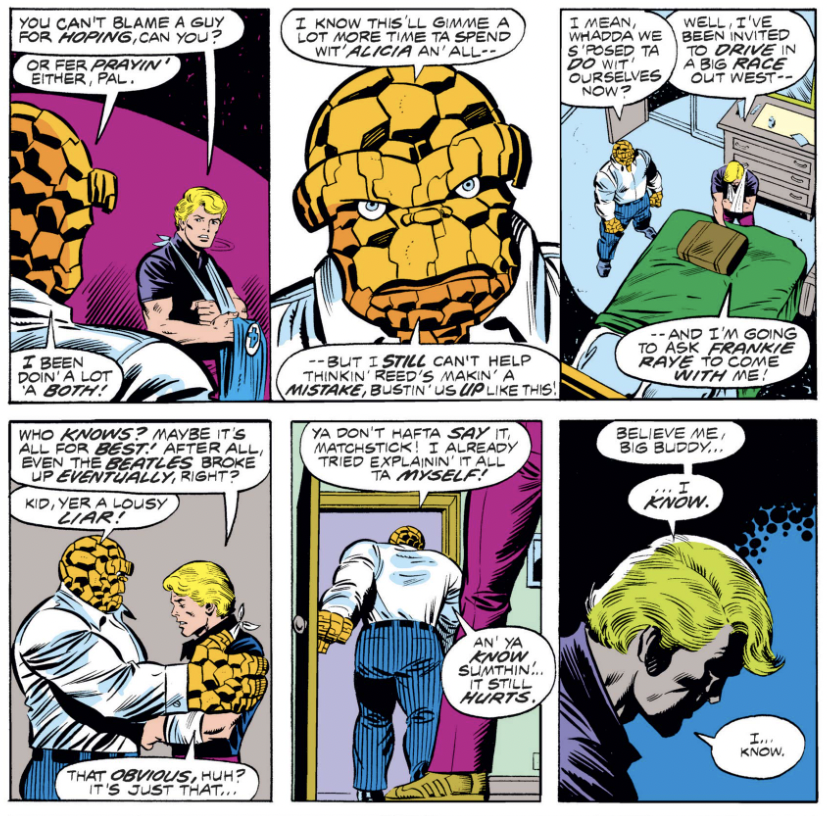
And this was genuinely moving, where Ben thinks they are getting back together only for Reed and Sue to let him down:


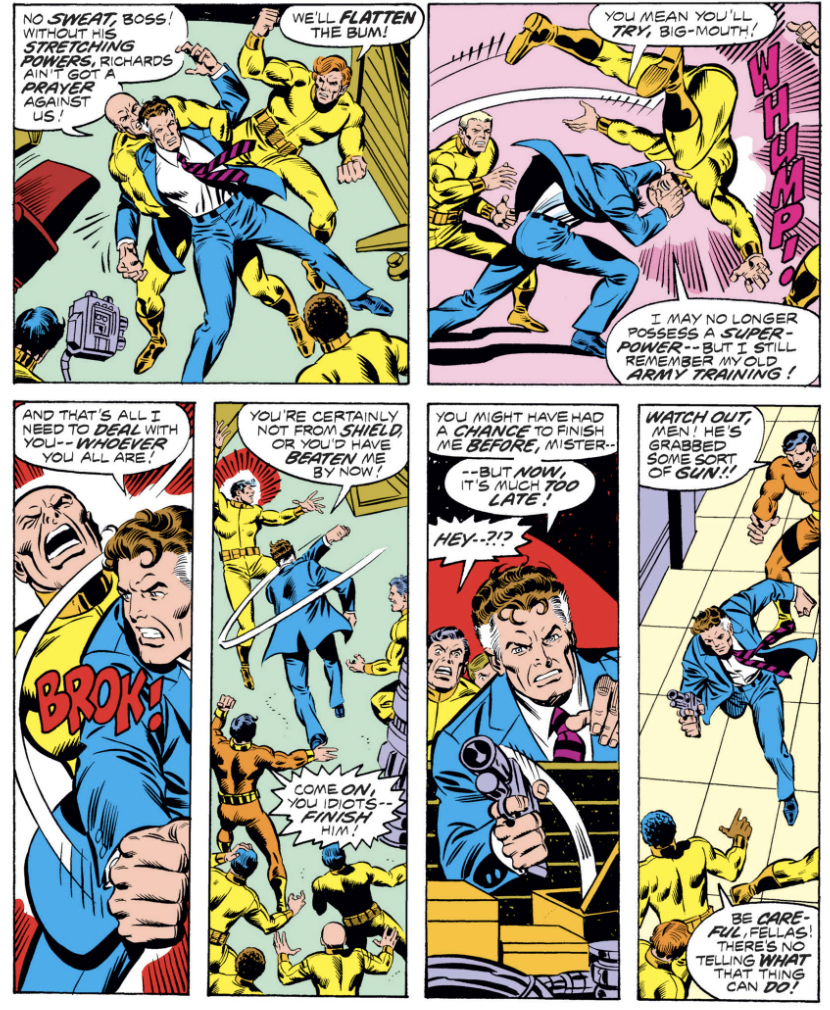
The action sequences were fun, too. Even without his powers, Reed holds his own against Plunder’s stooges:


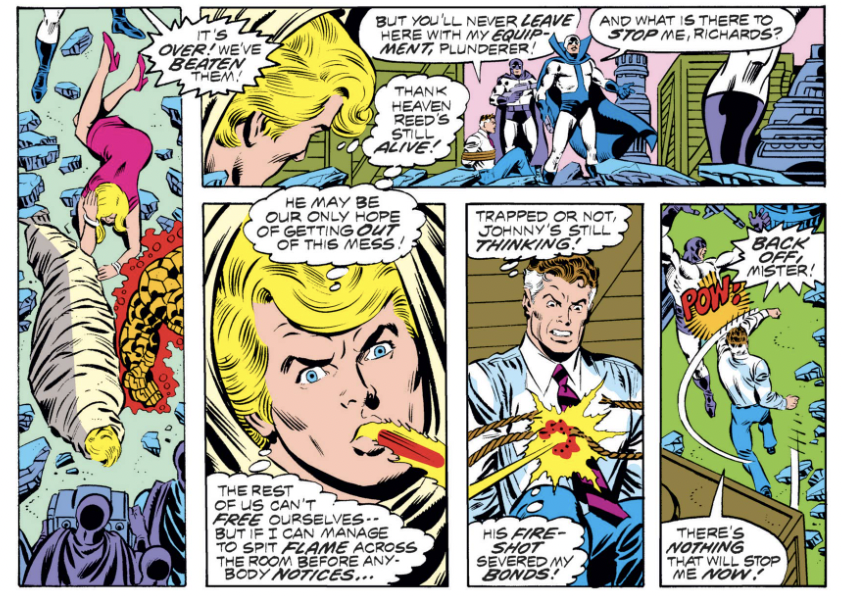
And Johnny demonstrates his growing maturity as a teammate and tactician:


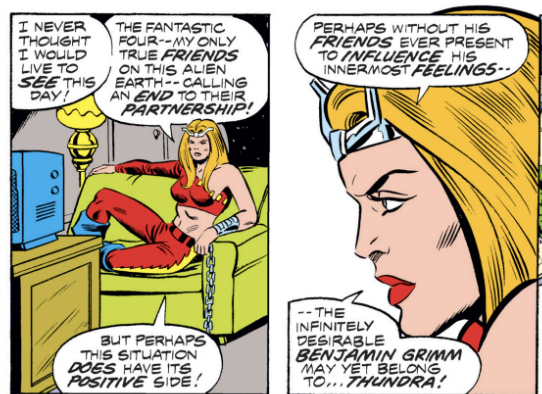
Lastly, I liked this cutaway to a scheming Thundra. Thundra’s crush on Ben is an underrated subplot.


What I didn’t like

This was too lachrymose for my tastes. Sometimes less is more.


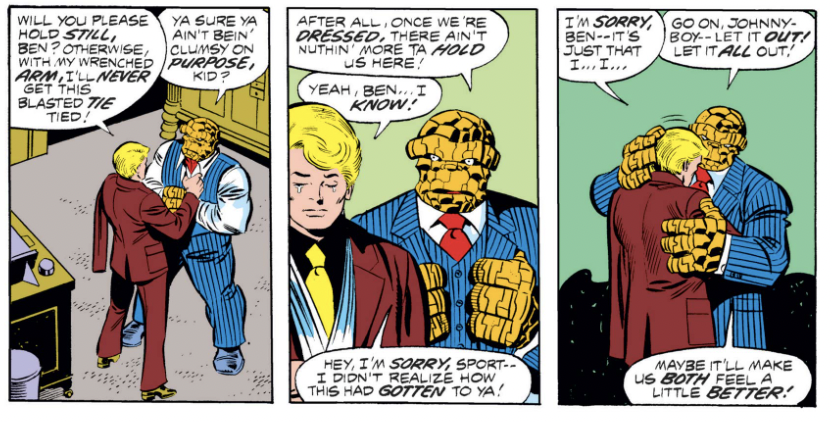
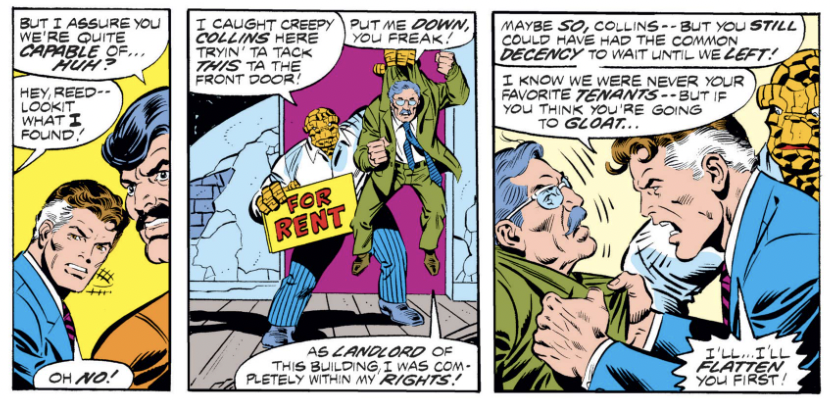
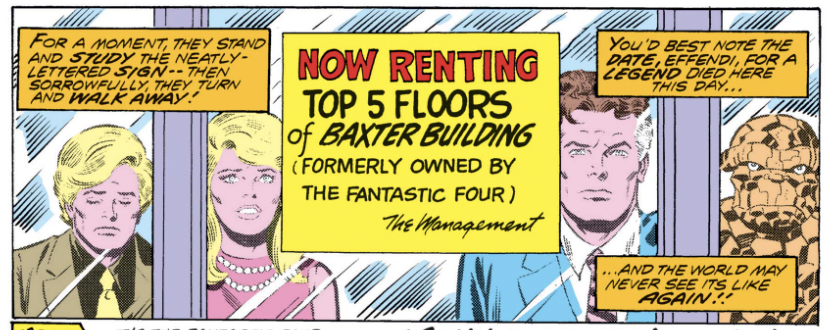
For some reason Perez drew the walls of the Baxter Building like they’re in a crumbling tenement. I’m pretty sure the skyscraper is not made of brick. And as longtime readers of this blog know, I have little patience in the landlord hijinks.


And somehow the FF went from renting the top floors to owning them. Never count on comic books when it comes to New York real estate.


Overall

An excellent comic book

“The World’s Greatest Comic Magazine!” Fantastic Four No. 188

14 Sunday Sep 2025

Posted by percivalhenry in The World's Greatest Comic Magazine

≈ Leave a comment

Tags

Fantastic Four, Fantastic Four 188, George Perez, Len Wein, Marvel comics, Molecule Man

Fantastic Four 188
“The Rampage of Reed Richards!”
Published August 1977
Writer: Len Wein
Pencils: George Perez
Inks: Joe Sinnott
Letters: Joe Rosen
Colors: Glynis Wein
Editor: Len Wein
Cover: Perez and Sinnott

Synopsis

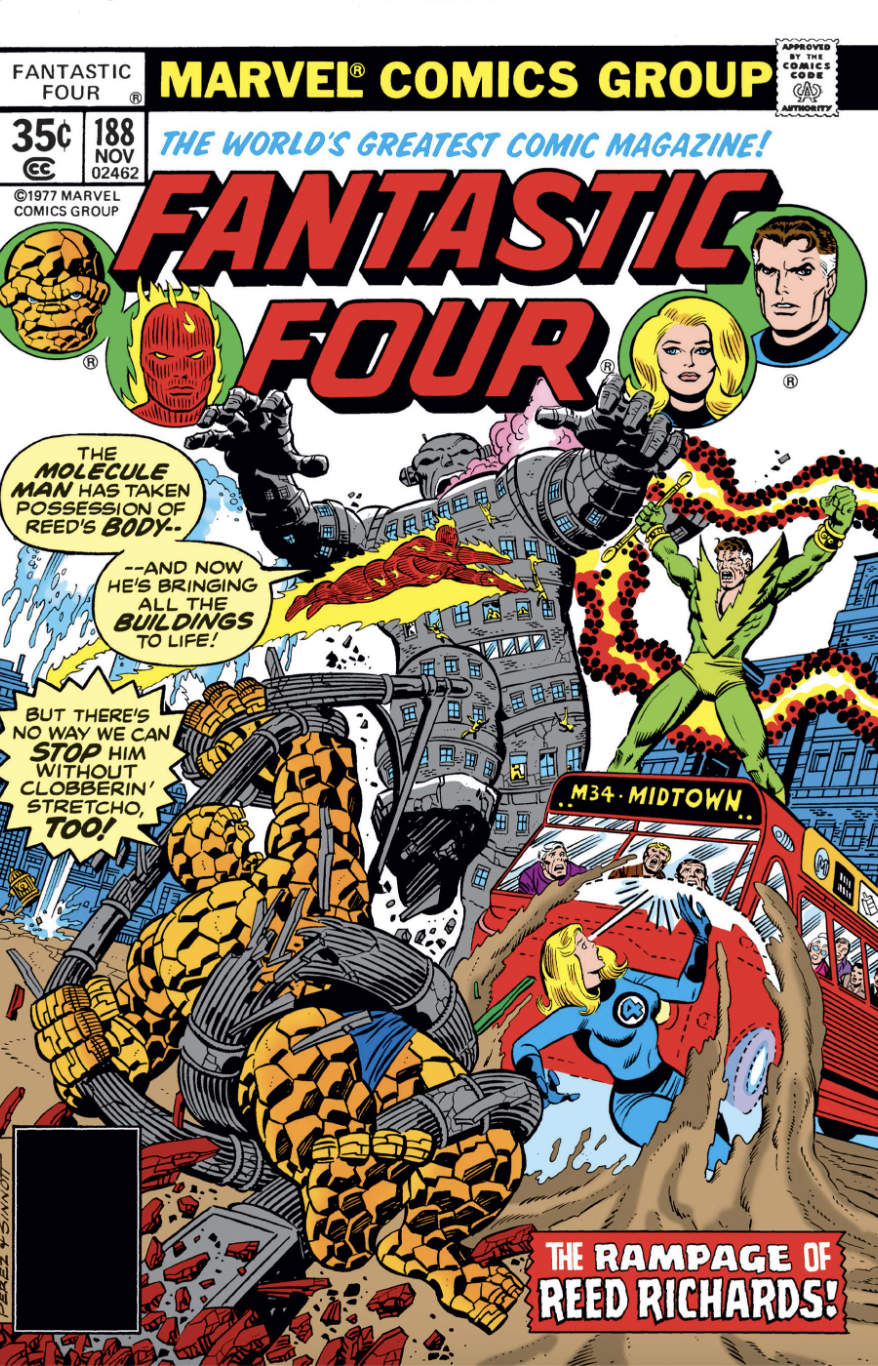
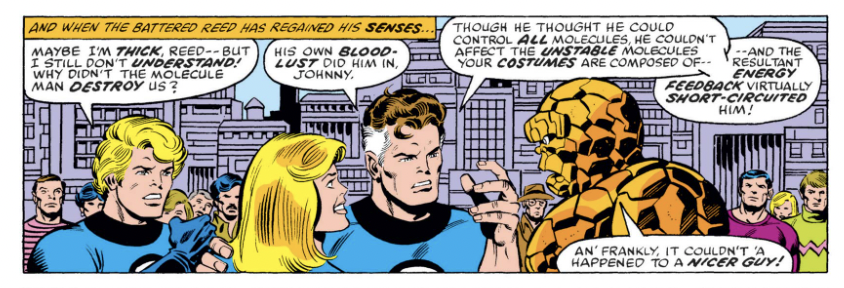
The Molecule Man has taken over Reed Richards’s body and goes on a rampage throughout New York as the Watcher mysteriously shows up and silently observes. The Molecule Man is defeated when he tries to manipulate the unstable molecules in the FF’s uniforms, and the issue concludes with Reed quitting the team.


What’s going on here?

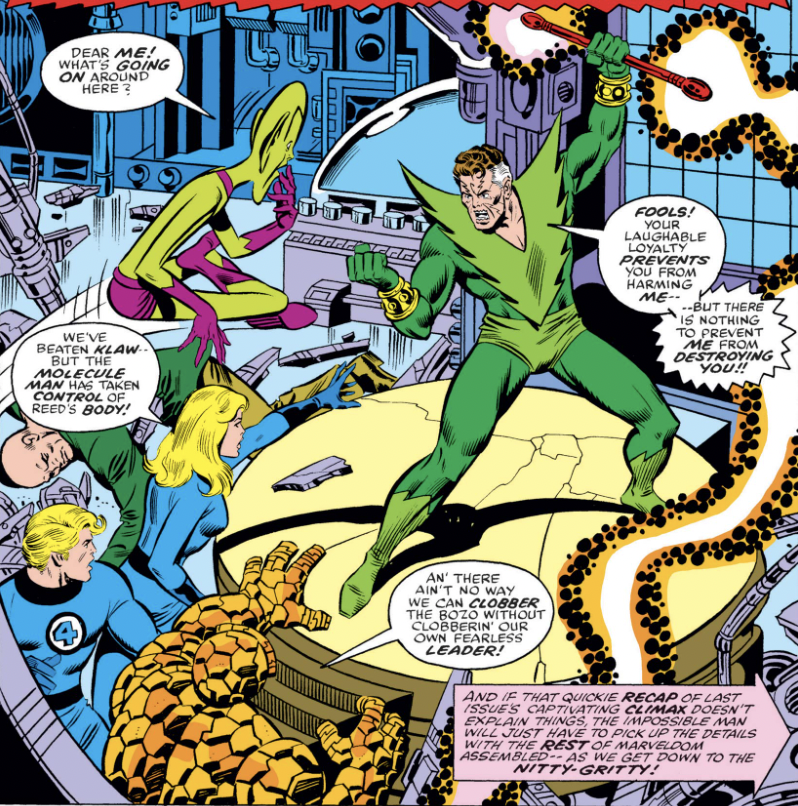
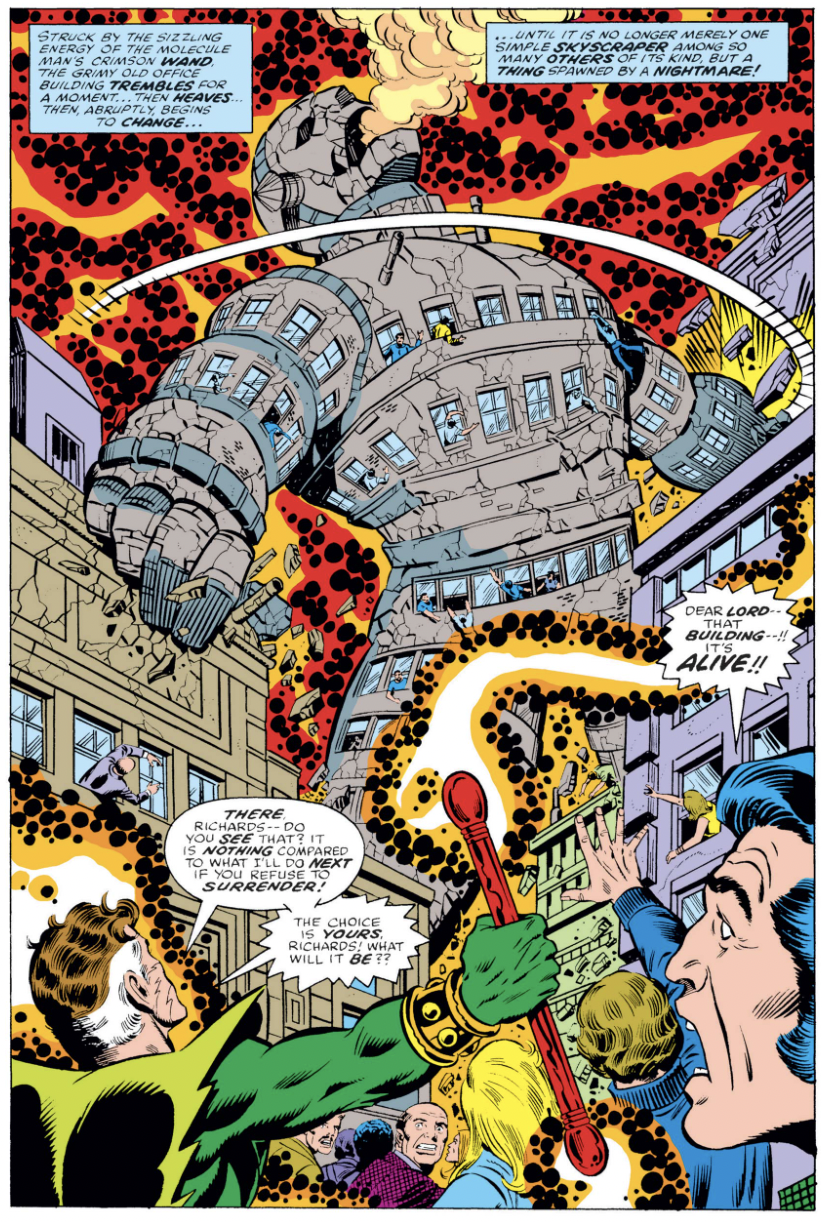
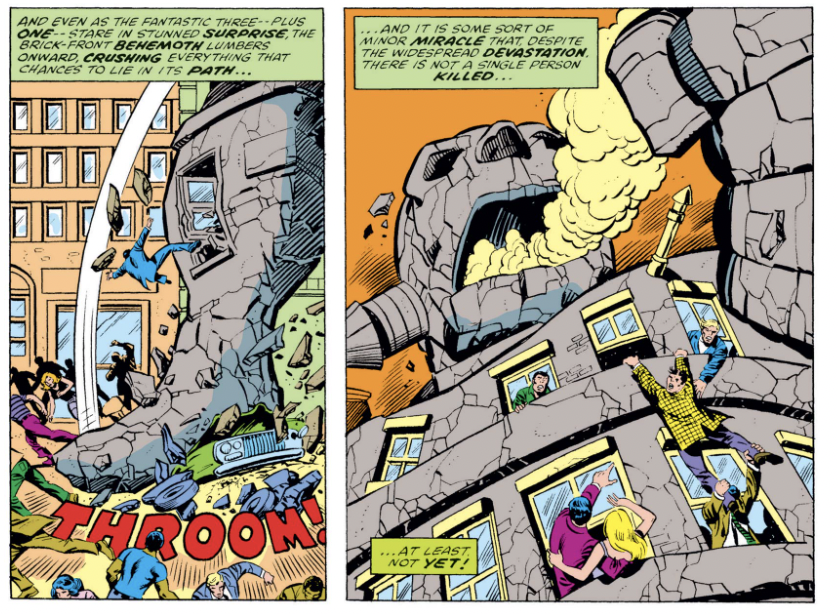
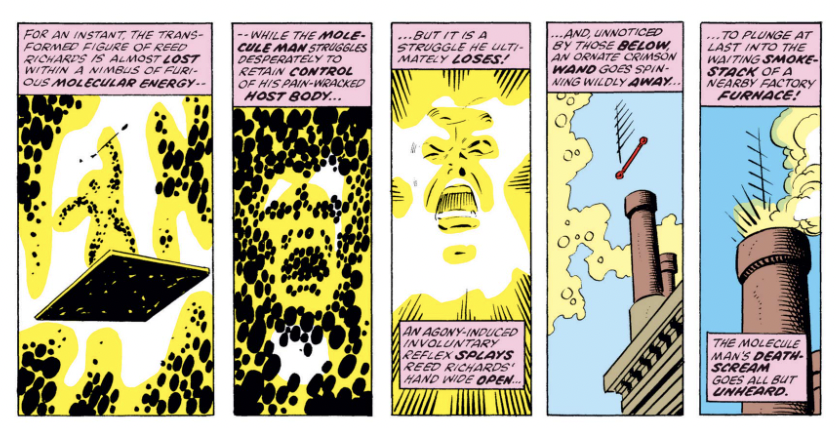
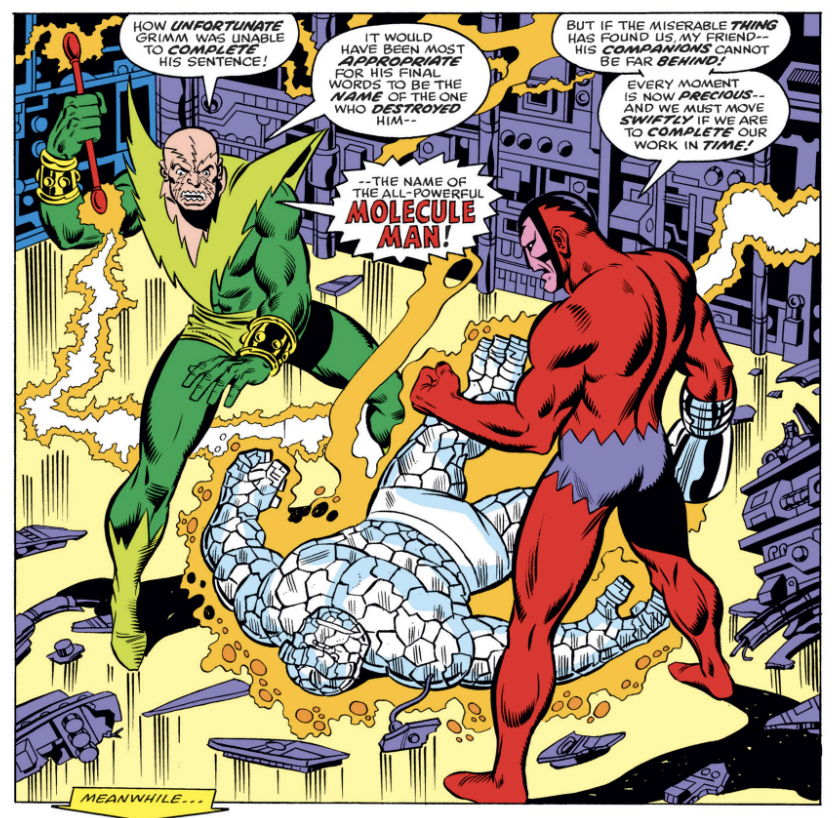
This is a fun, slightly goofy issue. The main storyline, of the Molecule Man inhabiting Reed’s body and battling his consciousness, is hard to follow and doesn’t make a ton of sense. And the climax, where the Molecule Man is undone by the FF’s unfits, is pretty anticlimactic. But the fight scenes are fun and the sequence where the Molecule Man animates a New York building, is pretty epic. George Perez does a great job with the details of this crazy idea (and he pours on the Kirby Krackle).


Here’s some more of that sequence:


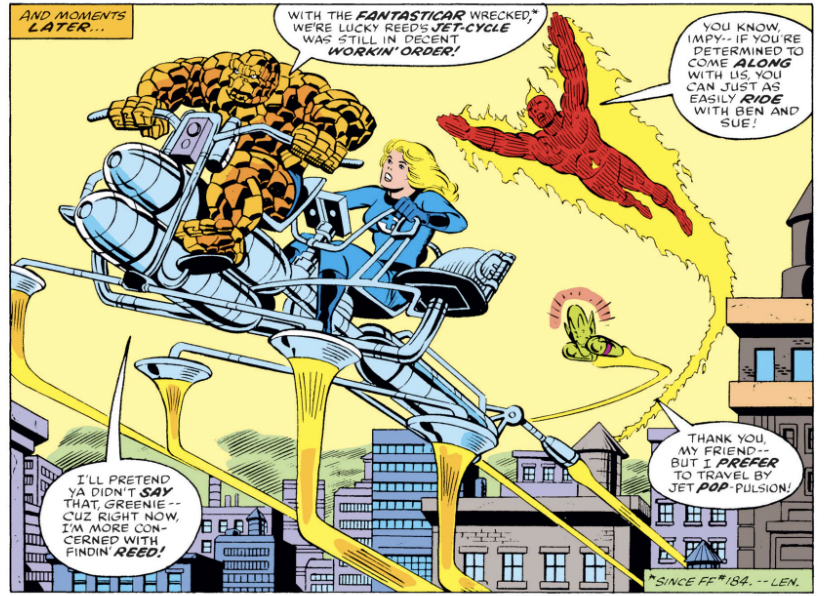
A few words about the Molecule Man. His powers obviously extend far beyond the ability to transform molecules from one chemical to another, as his name implies (and which is basically the power set of Element Lad in the Legion of Super Heroes). In the building sequence above, he’s not transforming chemicals as much as manipulating matter, a power more akin to the Scarlet Witch’s. In my recap of Fantastic Four 20, I address his transformation from standard-issue bad guy to one of the most powerful characters in the Marvel Universe. And interestingly, as writers like Joe Shooter and Johnathan Hickman imbued him with more power, they also changed his personality, from the megalomaniacal super villain to an insecure, borderline insane nerd.

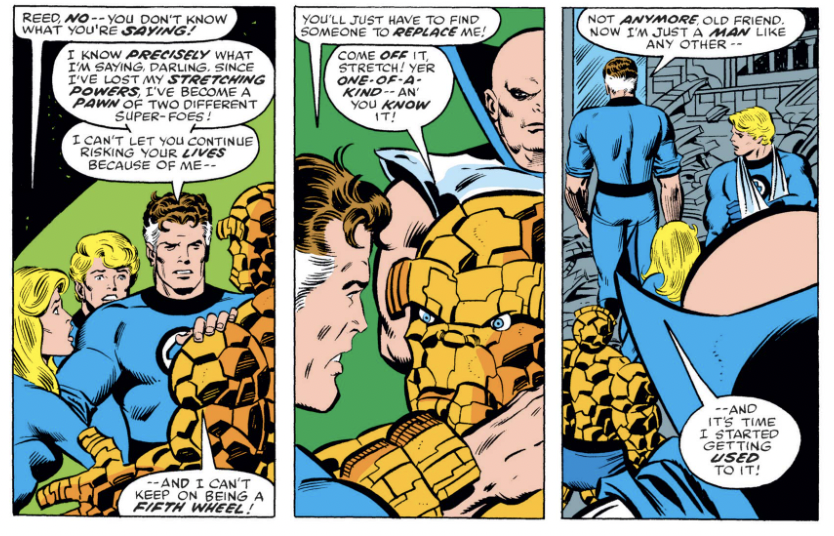
The allegedly most consequential event of this issue is Reed quitting the team (and Sue following him). Len Wein sets this up like it’s a big deal, even having the Watcher appear to observe it, but it’s hard to get too worked up about it. By this point every member of the FF had quit at least once, and the team always gets back together. And in the future, there will be many more departures and reunifications. I can’t imagine many FF readers even in 1977 would be very distressed by this turn of events,

What I liked

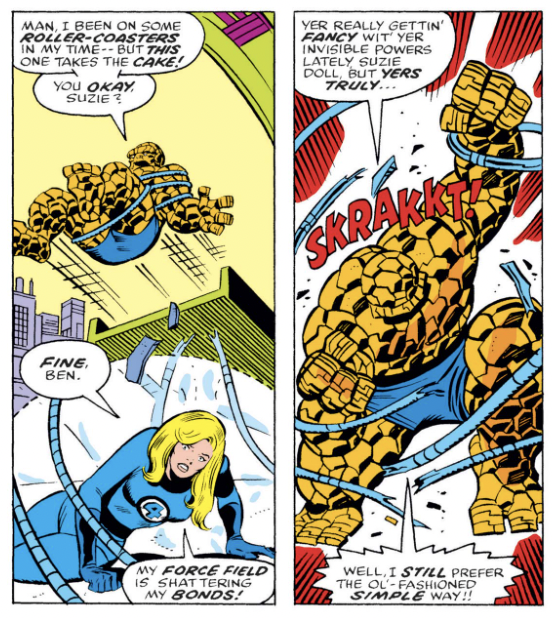
As discussed in previous posts, Wein seems committed to expanding Sue’s abilities. Here, even Ben takes note:


Perez turns in another solid job, although, as in recent issues, his unique style feels somewhat muted by Joe Sinnott’s inks. I liked this panel:


What I didn’t like

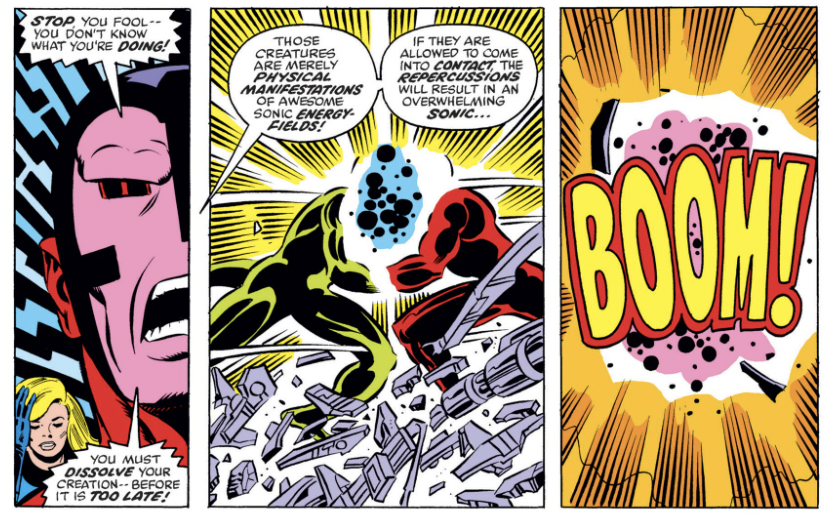
As mentioned, the Molecule Man’s defeat didn’t feel particularly hard-earned by the FF:

(This is more-or-less how the team defeated him back in FF 20, too).

I also didn’t care much for the Watcher hovering in the background. While he didn’t violate his oath of non-interference (for once) he also didn’t have much purpose other than to signify this story was a Big Deal.

Anything else?

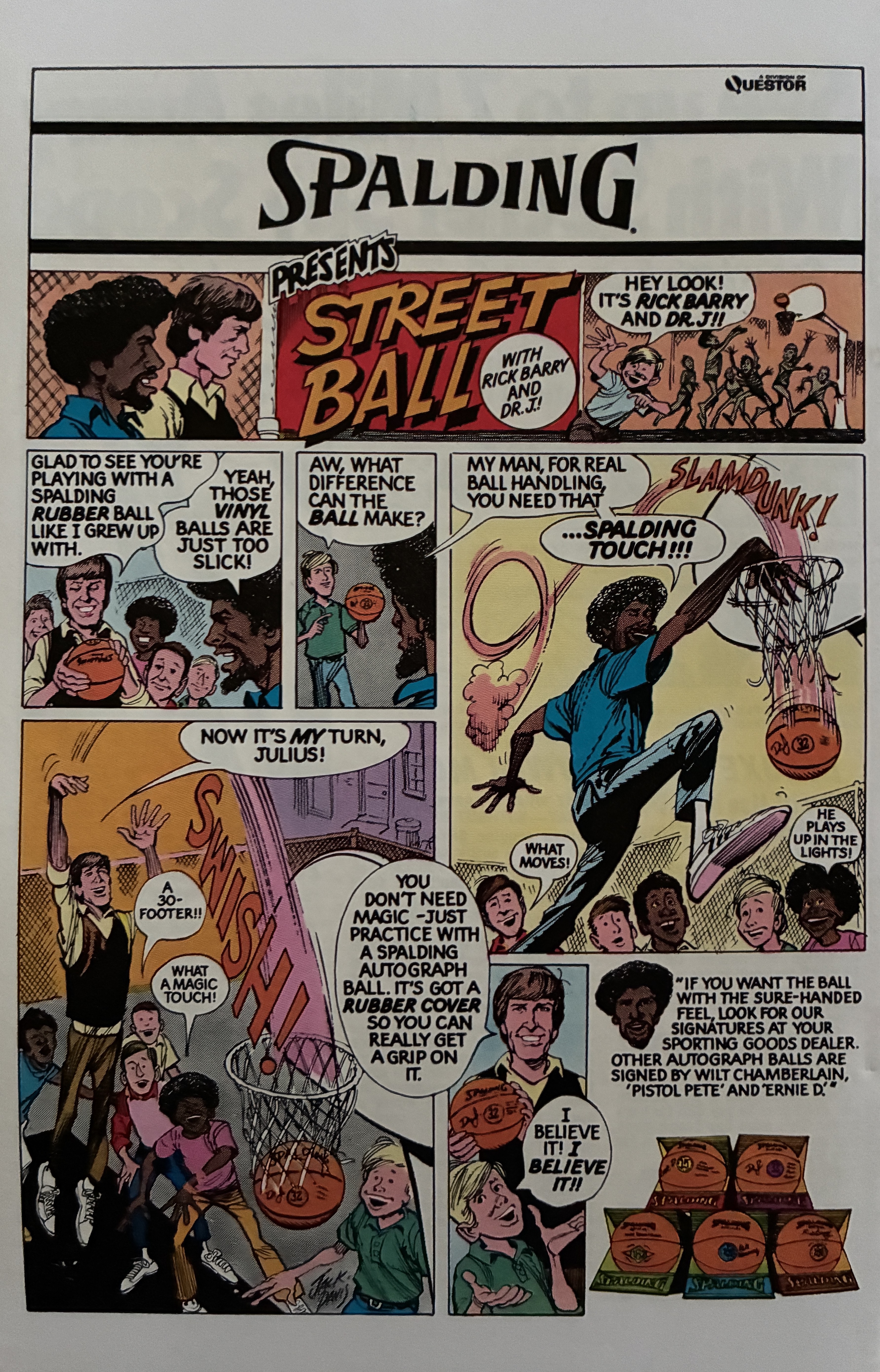
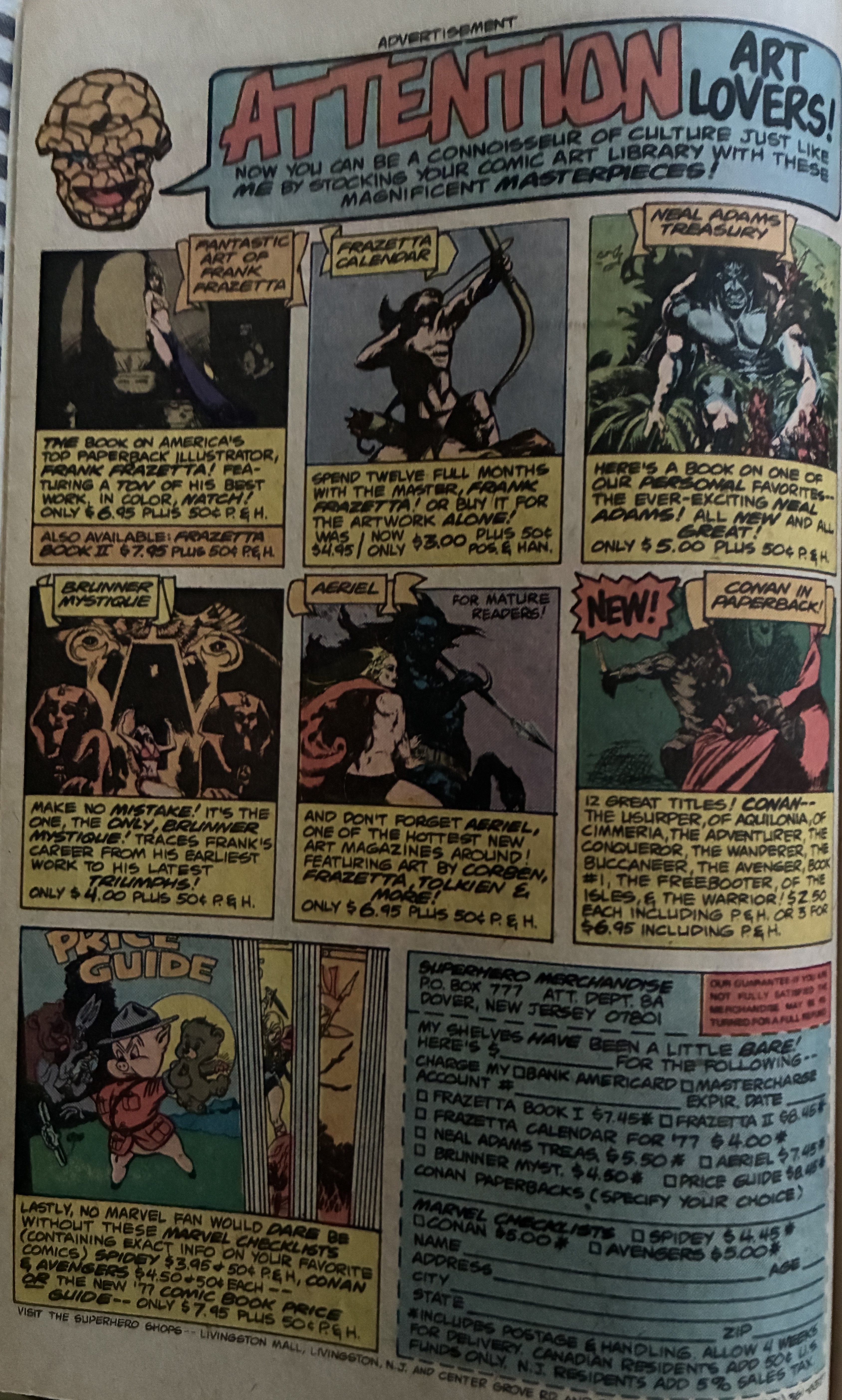
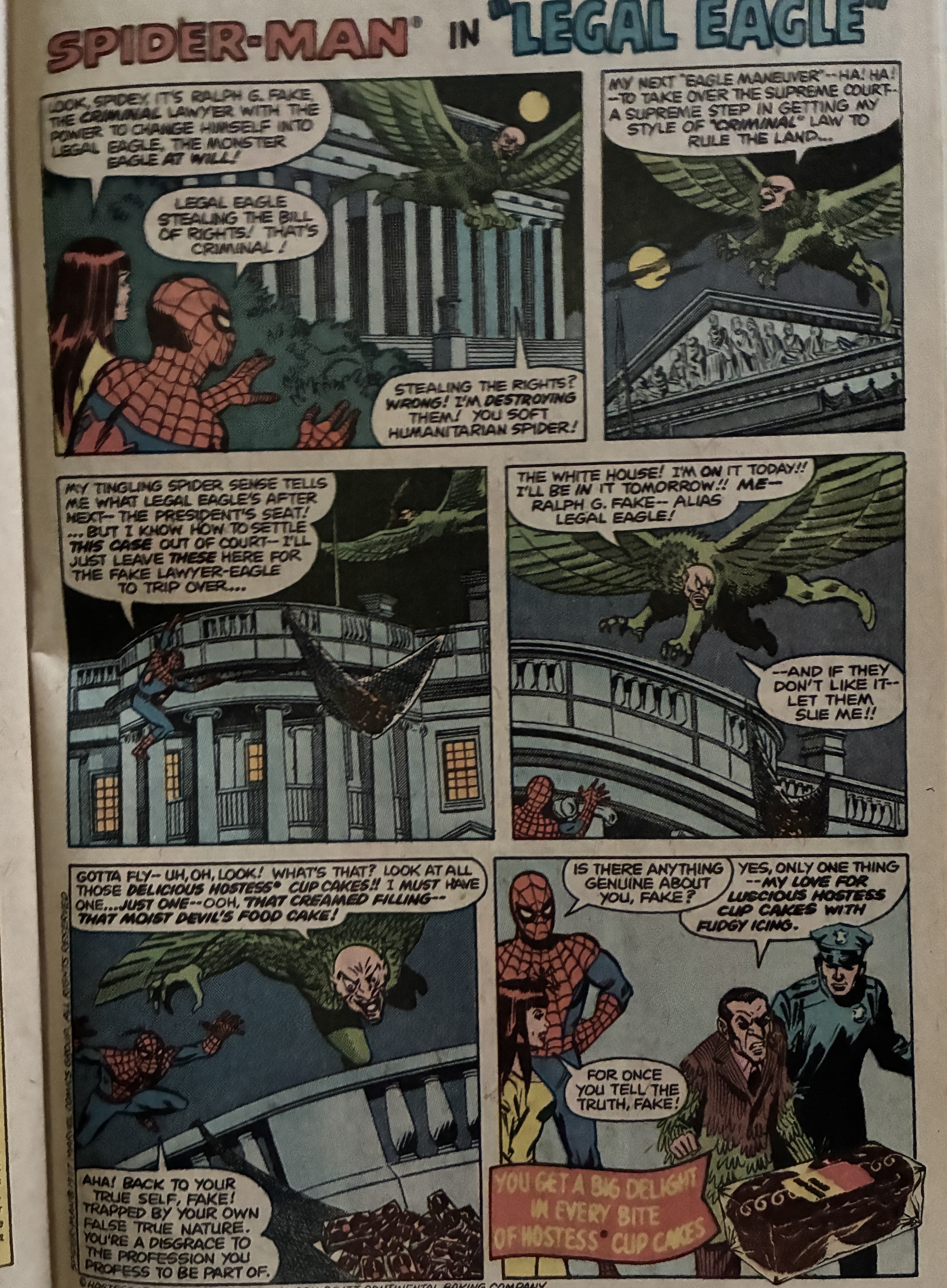
Some fun ads, including a classic for Spalding by Jack Davis (of Mad Magazine). And I would totally go for a Frazetta calendar.


Overall

A solid B.

“The World’s Greatest Comic Magazine!” Fantastic Four No. 187

31 Sunday Aug 2025

Posted by percivalhenry in The World's Greatest Comic Magazine

≈ Leave a comment

Tags

1977, Fantastic Four, Fantastic Four 187, George Perez, Klaw, Len Wein, Marvel comics, Molecule Man

Fantastic Four 187
“Trouble Times Two!”
Published July 1977
Writer: Len Wein
Pencils: George Perez
Inks: Joe Sinnott
Letters: Joe Rosen
Colors: Glynis Wein
Editor: Len Wein
Cover: Perez and Dave Cockrum

Synopsis

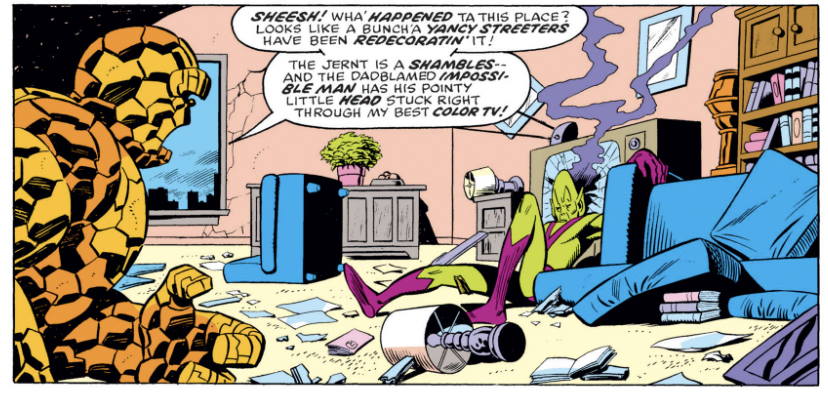
Returning to the Baxter Building from their adventure in New Salem with Agatha Harkness, the Fantastic Four discover the Impossible Man unconscious. They quickly run afoul of Klaw and the Molecule Man, who have teamed up and plan to use Reed Richards’s psi-amplifier to give the Molecule Man a permanent body. The villains defeat the FF but a revived Impossible Man attacks them, thwarting their plans until a misstep by Reed allows the Molecule Man to take over his body.


What’s going on here?

This is generally a satisfying issue. Len Wein has a good handle on plotting and pacing and his issues thus far have a nice mix of character development, plot and action. I have some quibbles, which I’ll get to, but nothing that gets in the way of this being a fun read.

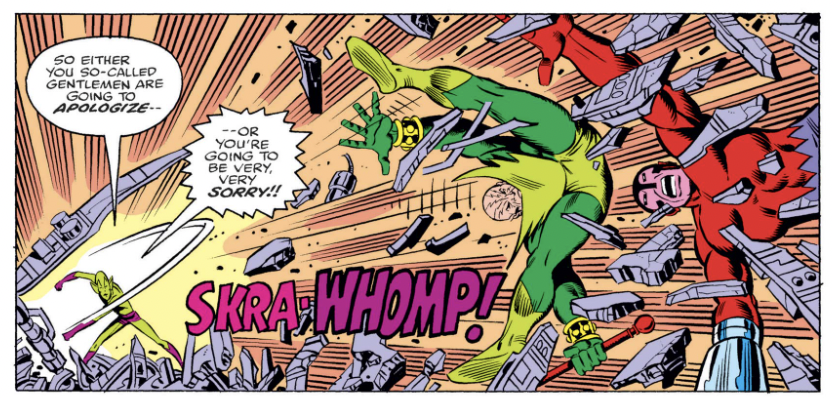
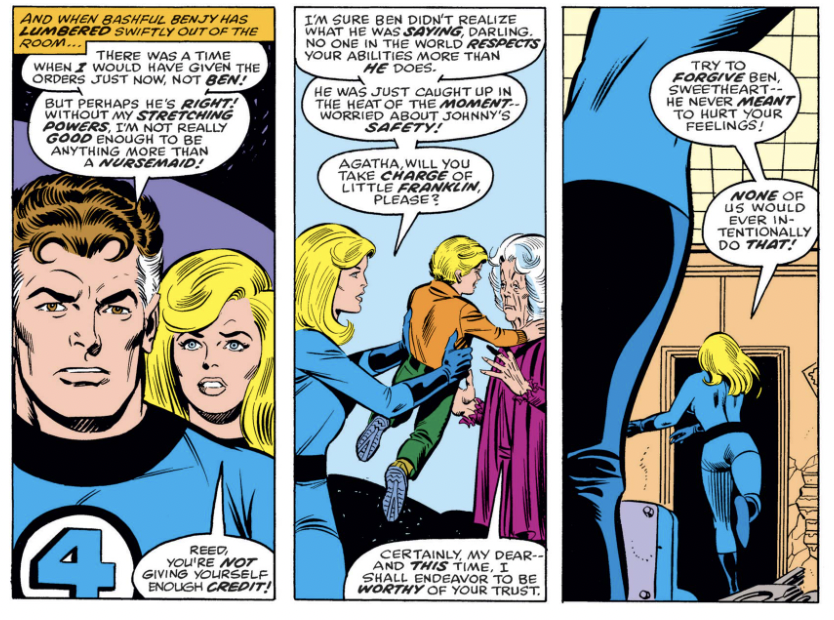
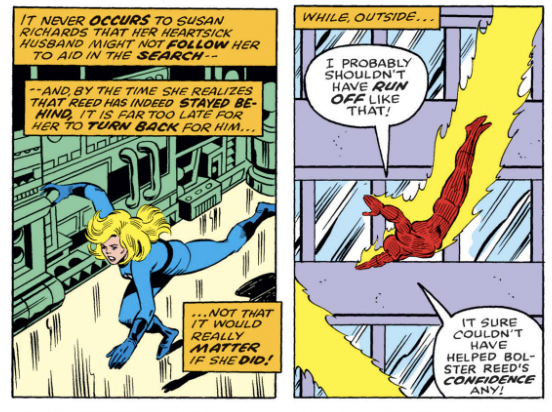
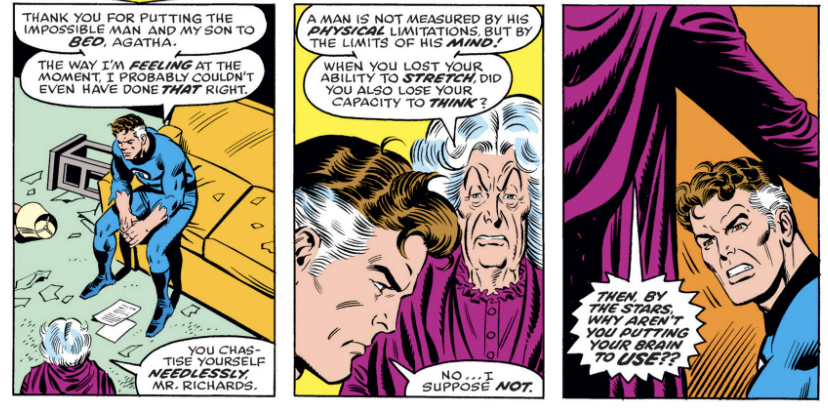
The most interesting aspect of the story is Reed’s apparent depression over losing his powers, which has been a subplot for some time now (and recall his robotic arms were destroyed last issue). It’s a bit puzzling, since most of Reed’s value to the team has little to do with his stretching ability, but for whatever reason it’s got him in the dumps. Wein develops a lot of space to this psychological development. Here:

and here:

and here:


Reed finally snaps out of his funk long enough to literally pull the plug on the Molecule Man, only to make an uncharacteristically dumb mistake:

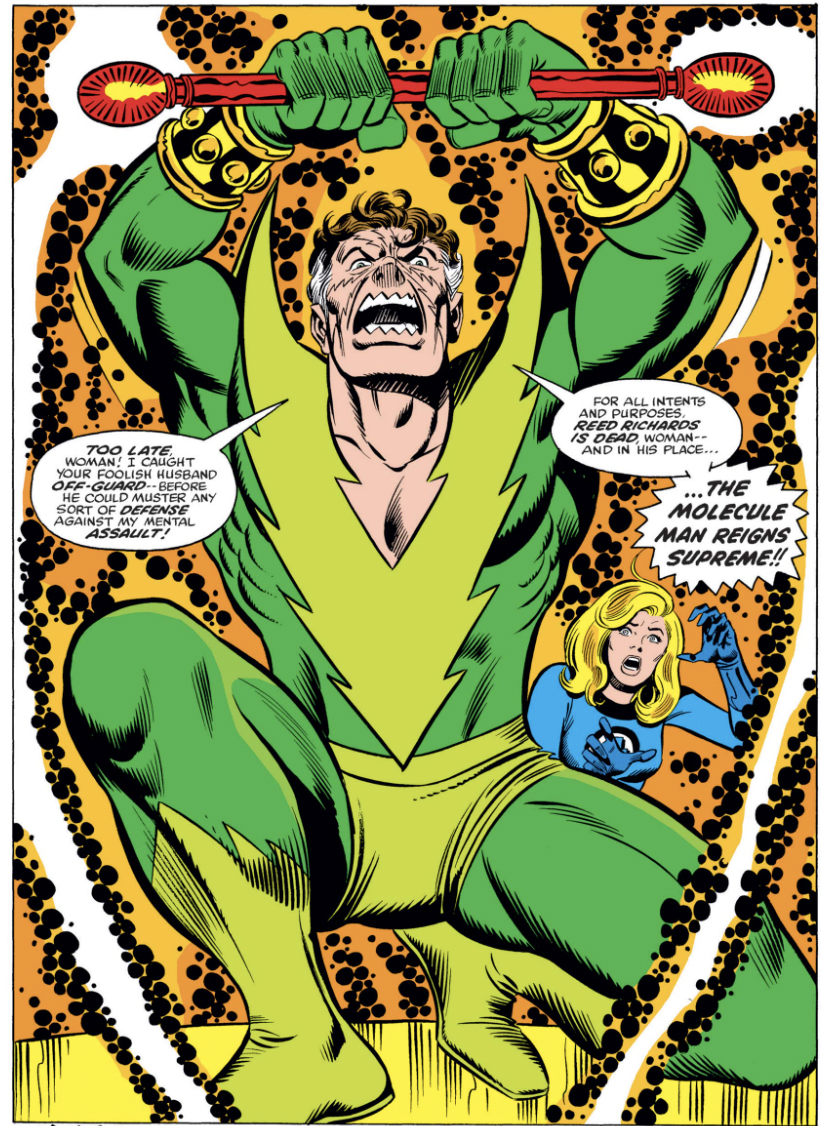
It’s as if losing his stretching power has also dulled his intellect. Or maybe he subconsciously is drawn to the wand’s power, as a way to regaining his own lost potency. The result is this surprising cliffhanger:


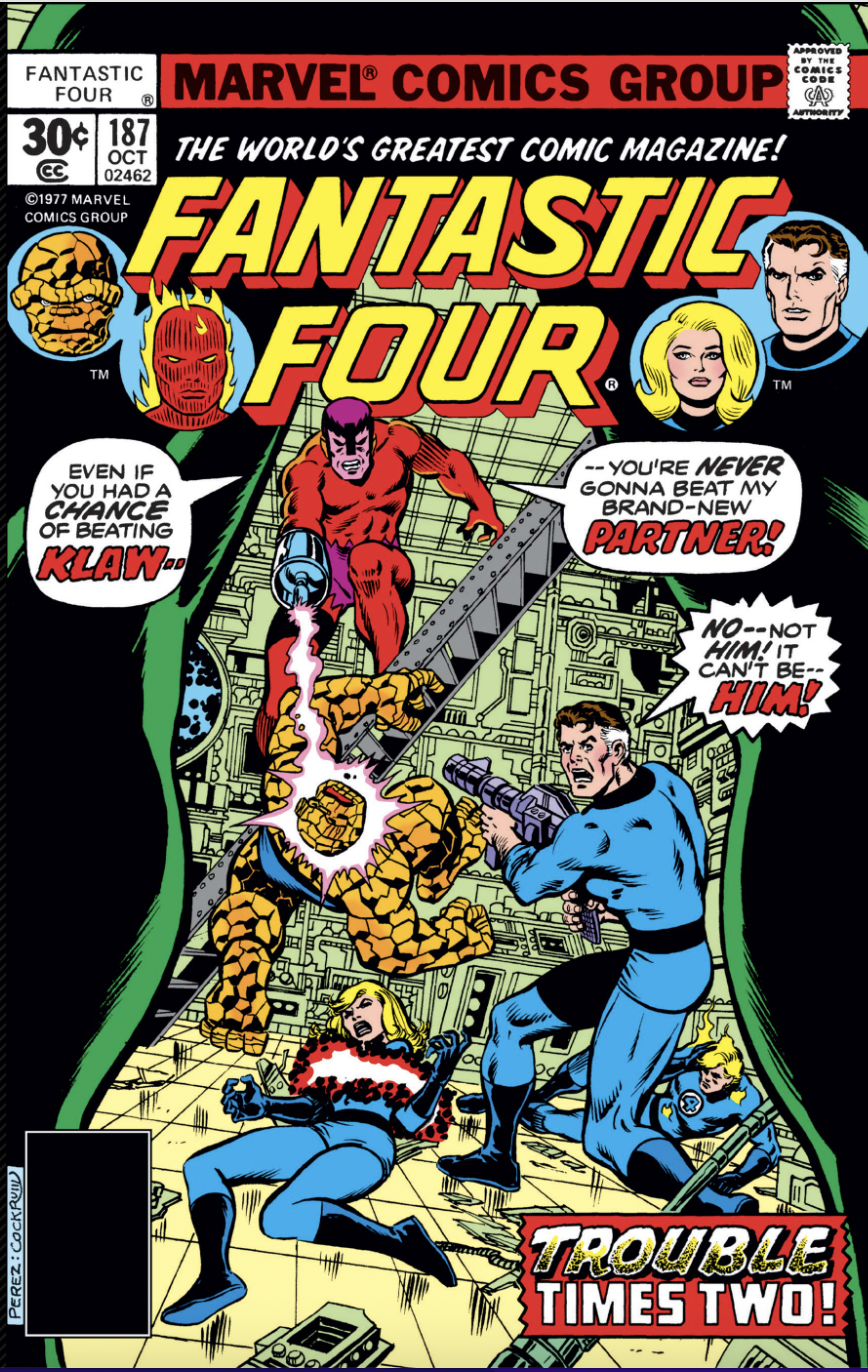
Also of note: the (excellent) George Perez cover is inked by Dave Cockrum, one of his very few contributions to the Fantastic Four.

What I liked

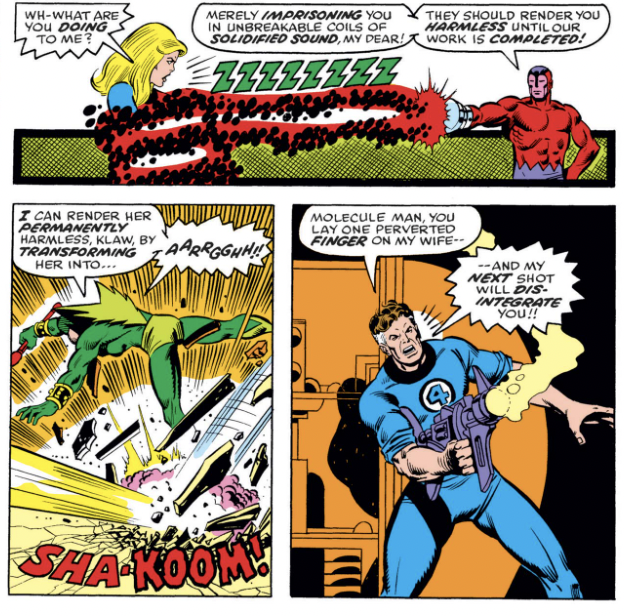
This is a pretty cool sequence, as a diminished Reed still has some fight left in him:

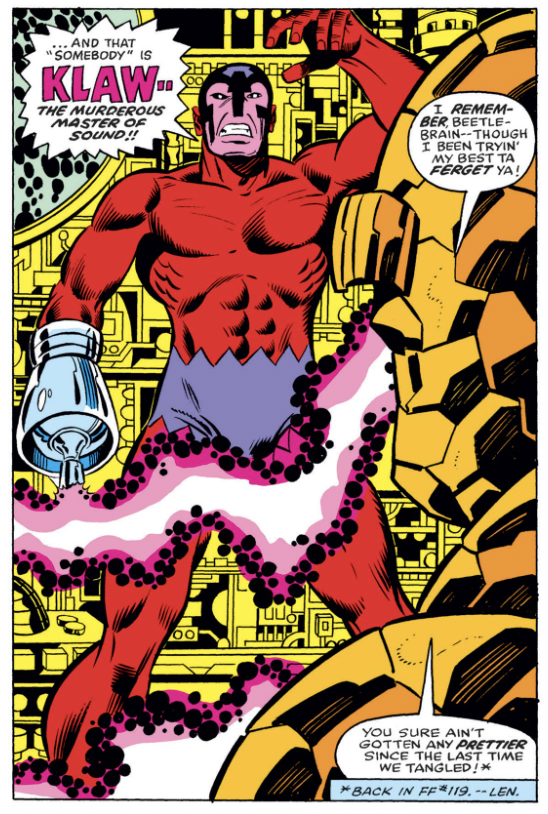
Perez again only appears to be providing layouts and breakdowns, leaving the finishes to Joe Sinnott. That said, he still delivers some great panels, like the entrance of Klaw, complete with Kirby Krackle:

(Only in comics do characters call themselves murderous).

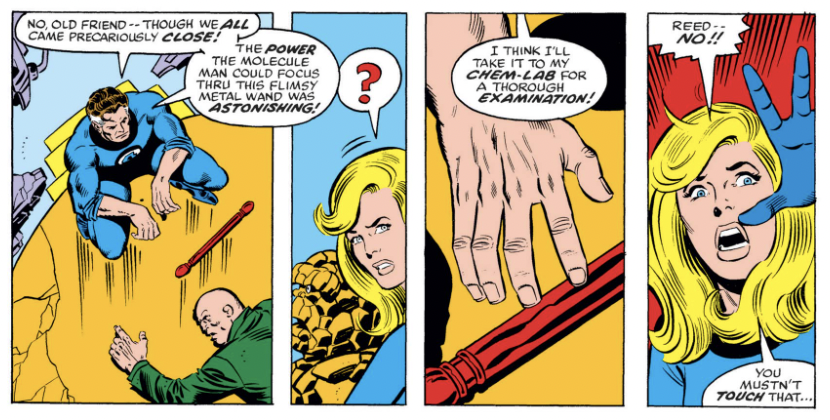
And this panel which reveals the secret villain on the cover is Molecule Man:

I liked this sequence too:


What I didn’t like

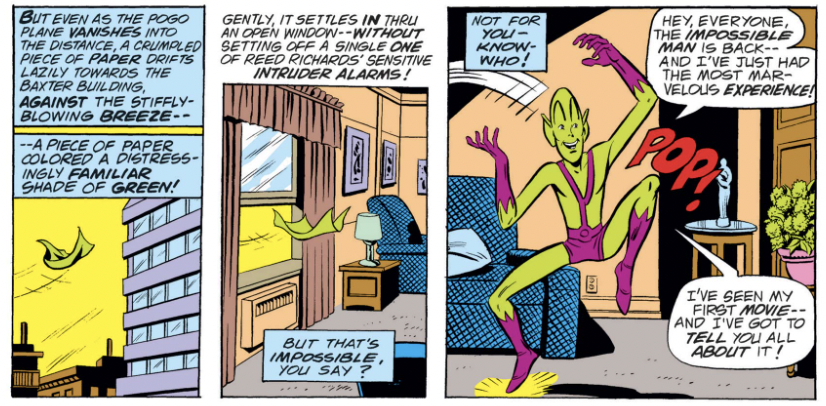
Longtime readers of this blog know how annoying I find the Impossible Man. For the last few issues he’s been harmlessly in the background but here he takes center stage, ultimately saving the day. He is essentially a gag character, a parody of Mr. Mxyzptlk, who has been upgraded into a character of consequence — and enormous power —while retaining his essential silliness. It’s not an effective combination. He’ll hang around the Fantastic Four another few issues before he thankfully disappearing for several decades.


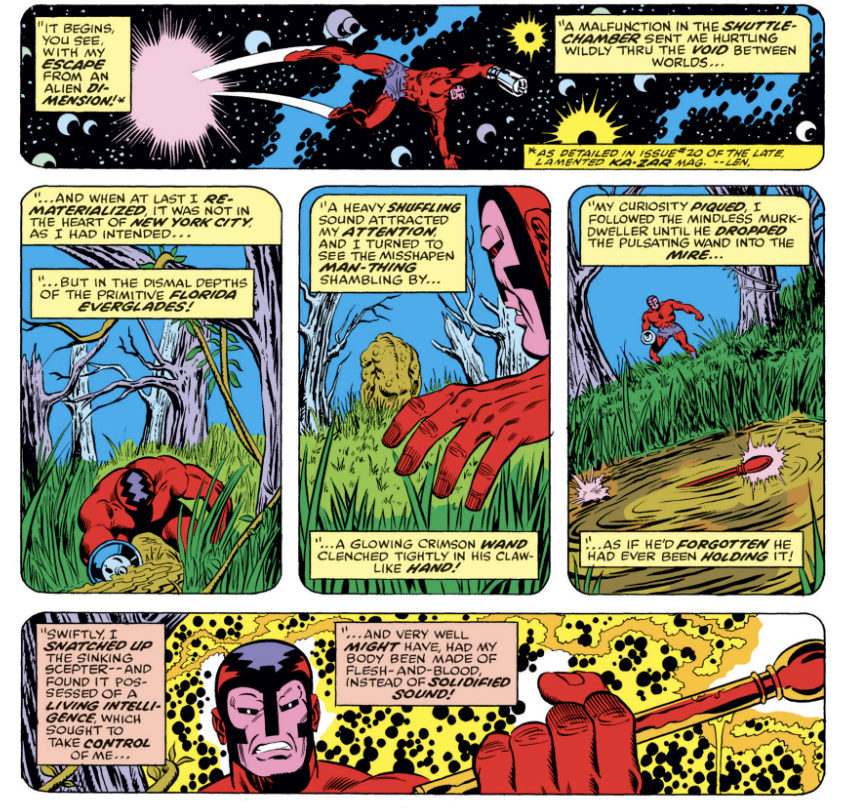
Klaw’s explanation of how he survived his near-death (which happened in a Ka-Zar comic) and his teaming up with the Molecule Man felt unnecessarily elaborate and detailed. I recognize it’s this sort of continuity accounting that fans loved about this era of Marvel but now it only gets in the way of storytelling.


Wein invests Johnny with a level of emotional insight here that seems pretty out of character. I would say he’s growing up, but it sure doesn’t last.


Anything else?

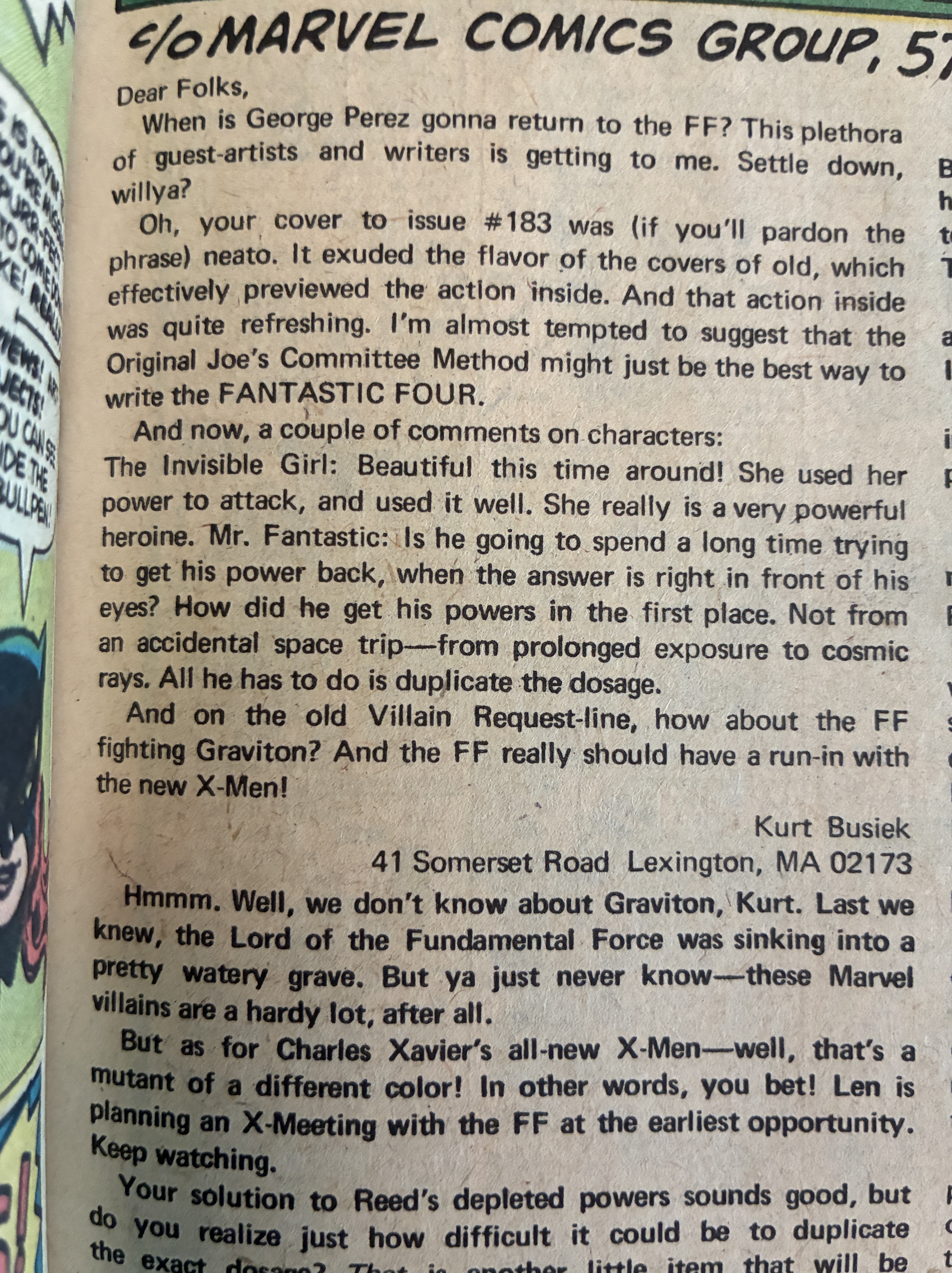
Another letter from Kurt Busiek, his second in two months.


Overall

A fine comic book

“The World’s Greatest Comic Magazine!” Fantastic Four No. 186

24 Sunday Aug 2025

Posted by percivalhenry in The World's Greatest Comic Magazine

≈ 1 Comment

Tags

1977, Agatha Harkness, Fantastic Four, Fantastic Four 186, George Perez, Len Wein, marvel-comics, Salem's Seven

Fantastic Four 186
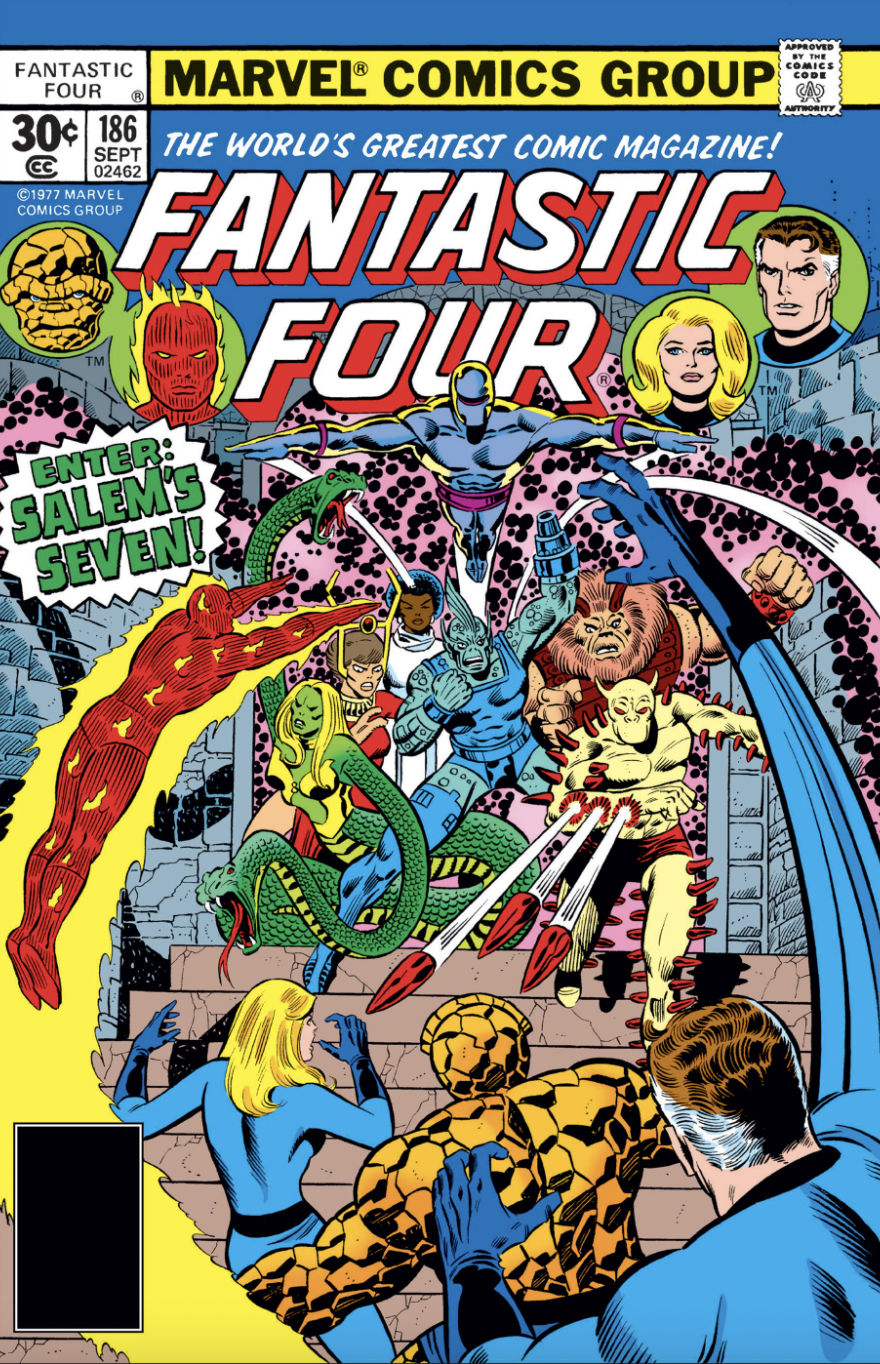
“Enter: Salem’s Seven!”
Published June 1977
Writer: Len Wein
Pencils: George Perez
Inks: Joe Sinnott
Letters: John Costanza
Colors: Glynis Wein
Editor: Len Wein
Cover: Perez and Sinnott

Synopsis

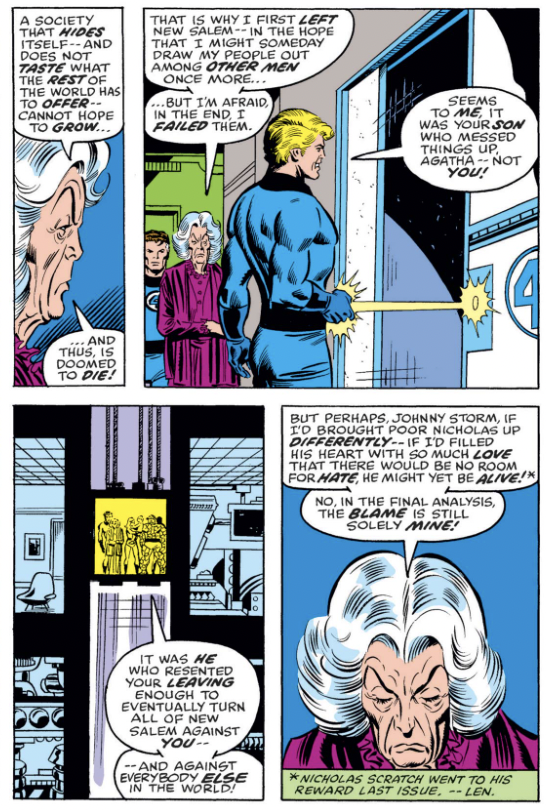
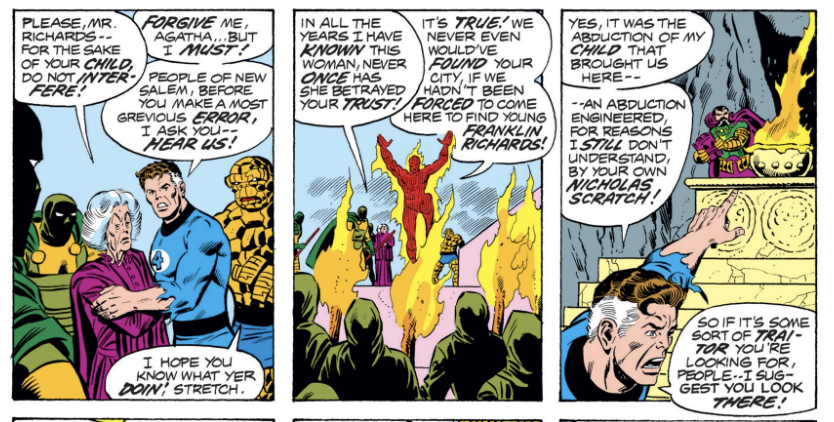
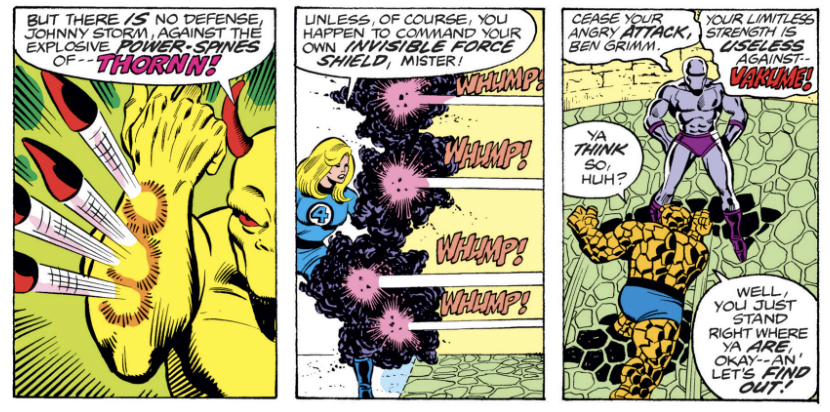
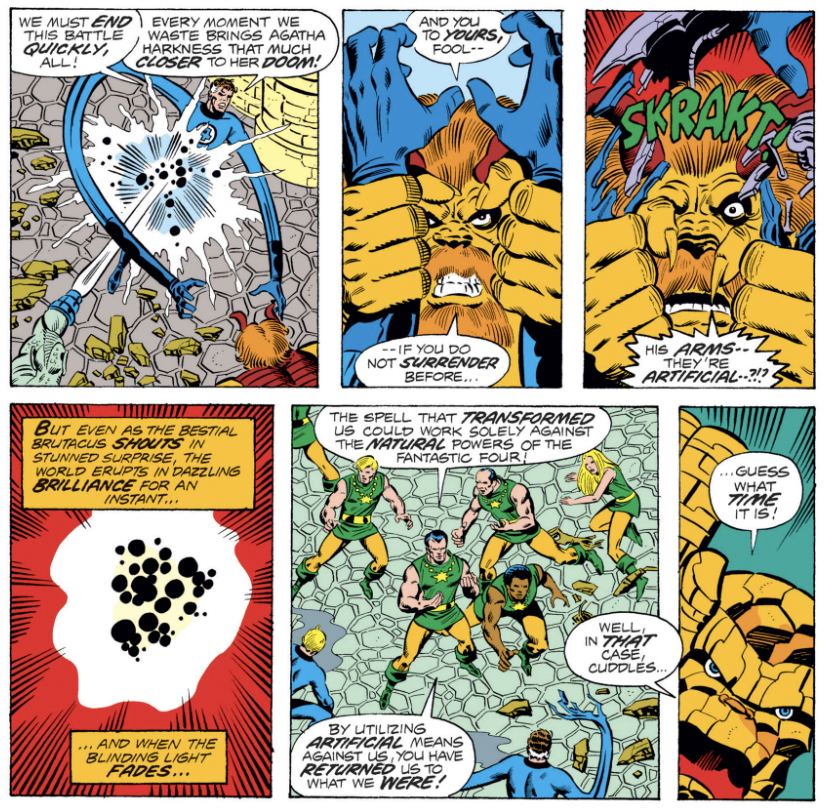
Captured last issue by Nicholas Scratch in New Salem, his town of witches, the Fantastic Four watch as Scratch prepares to execute Agatha Harkness for the crime of revealing the town to the outside world. Although Scratch takes Franklin hostage to ensure the FF’s docility, they escape their cell only to confront Salem’s Seven, a group of super-powered minions. The Seven are defeated when they encounter Reed’s artificial arms (no, it doesn’t make much sense) and the FF manages to turn New Salem against Scratch by revealing it was he, not Harkness, that revealed their location of the outside world when he abducted Franklin. The town’s witches banishes Scratch and as the FF depart, Harkness reveals she is Scratch’s mother.


What’s going on here?

This is a pretty satisfying comic, despite a few questionable plot holes. It neatly wraps up the New Salem arc that has been percolating for a few issues, introduces some fun new villains, fills in some of Agatha Harkness’s backstory and adds some desperately needed dimension to Sue and her power set. All of these developments are proof of Len Wein’s confidence as writer and his willingness to both plumb the FF’s history for ideas while forging ahead with new ones.

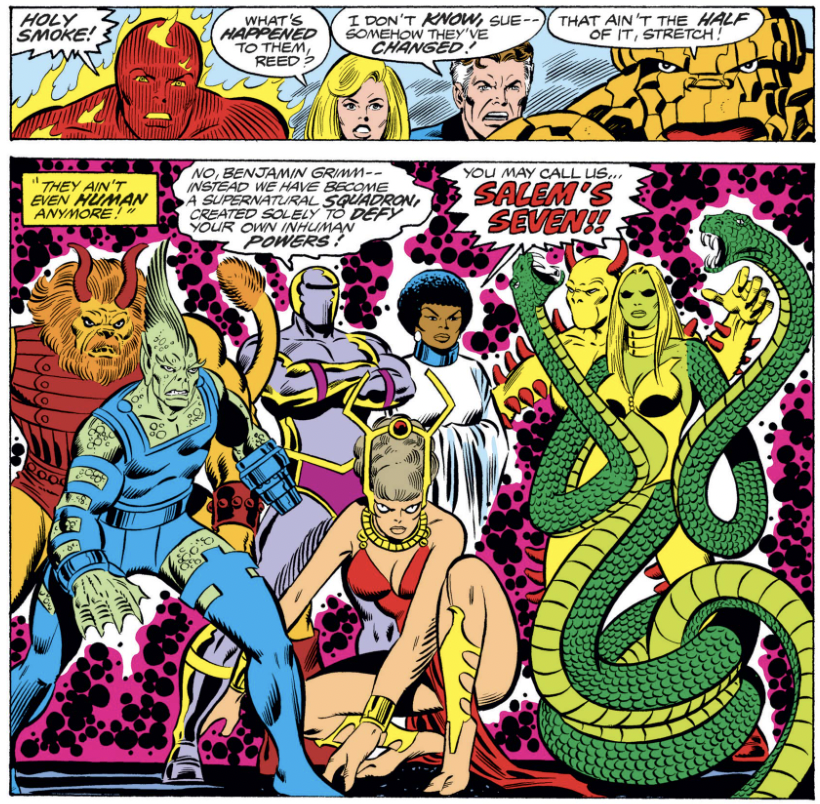
The most obvious development in the comic is the introduction of Salem’s Seven, who are later revealed to be the children of Scratch (and grandchildren of Harkness). There’s a fun, goofy quality to these villains, who don’t really seem supernatural at all but rather like generic characters created by rolling dice in a role playing game. They’re generic enough that they could sub in for other Marvel villains-of-the-month, like the Wrecking Crew or Seprent Squadron, and it’s a bit surprising that they are not more frequently used. Nor did they ever become first tier FF villains.

(It’s also a bit odd their debut doesn’t at get a full splash page).

Also interesting is the glimpses into Harkness’s history. Her mysteriousness was a defining part of her persona, and while peeling back the curtain on characters with a murky past is not always a good thing (see: Puck, Han Solo), what we learned in this issue adds depth and a bit of tragedy to Harkness. Dropping the line about Scratch being her son in the final panel was definitely a dramatic twist I didn’t see coming.

The art in this issue is much like last issue’s, with Perez contributing layouts and breakdowns and Sinnott finishing it up. It works but lacks the richness of detail Perez is capable of when he fully applies himself.

What I liked

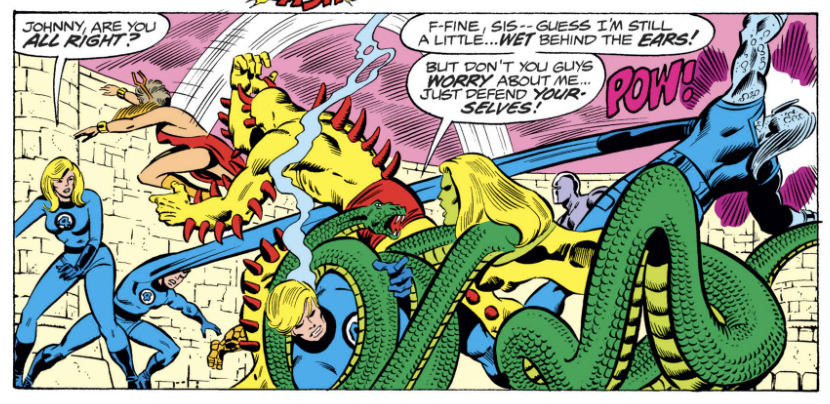
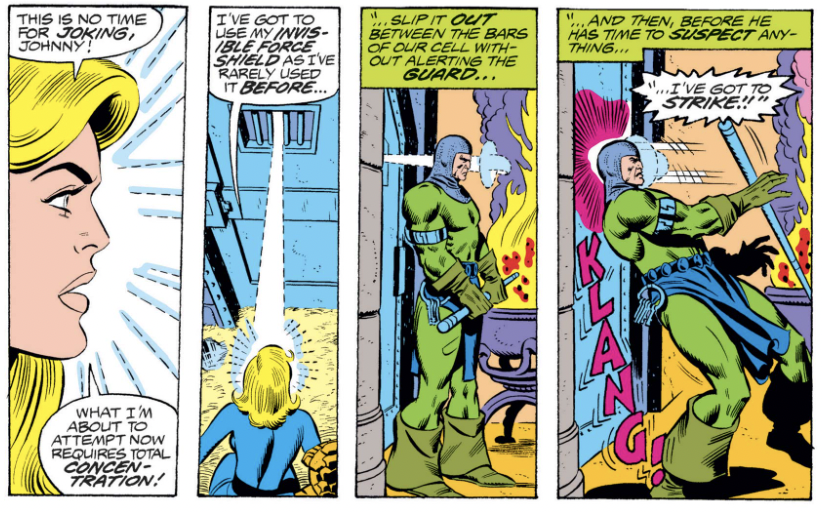
Wein seems determined to expand Sue’s use of her powers and with them, her role on the team. While there’s still a bit of her being treated like a hysterical mother when Franklin is abducted, she rises to the occasion by breaking the FF out of their jail cell (the key was it has to be done stealthily as not to raise the alarm and endanger Franklin).

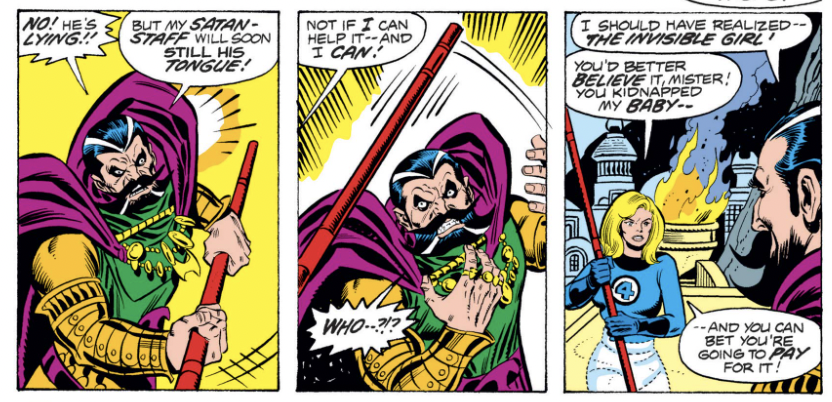
Later, she uses her invisibility in a way we’ve seen many times but it still comes at a pivotal point in the story.


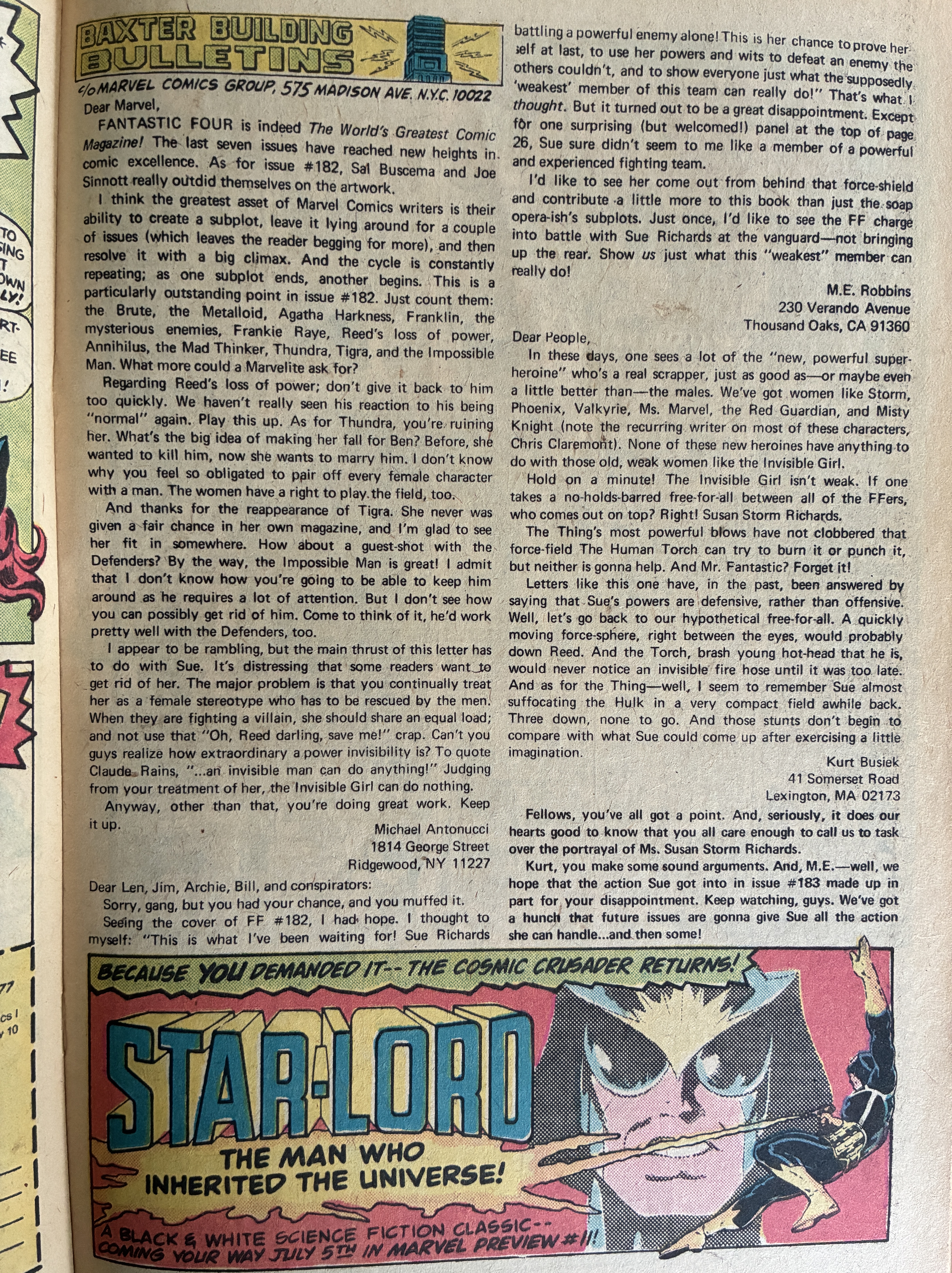
Perhaps not coincidentally, this expanded role for Sue comes in an issue when there are three letters to the editor making the case for just that. Notably one of the letters is from Kurt Busiek, who went on to become a longtime writer for Marvel and DC (but sadly, never of the Fantastic Four). Did Wein, who was also the comic’s editor, choose these letters to advance the case about Sue he was making in the story? It certainly seems possible.

Also: Star-Lord!

What I didn’t like

The resolution of the story, where Reed and Johnny convince the town of New Salem that Scratch is the bad guy, seems a bit too pat. Why would the town believe these outsiders over their leader (It’s possible he had them ensorcelled, and when he loses his staff he loses his power over them, but that is never explained).


There is something very silly about how Salem’s Seven introduces themselves by announcing their names in the third person. To be clear, all seven of them do this.


And the FF’s defeat of Salem’s Seven makes no sense. Somehow encountering Reed’s artificial arms negates their powers?


Anything else?

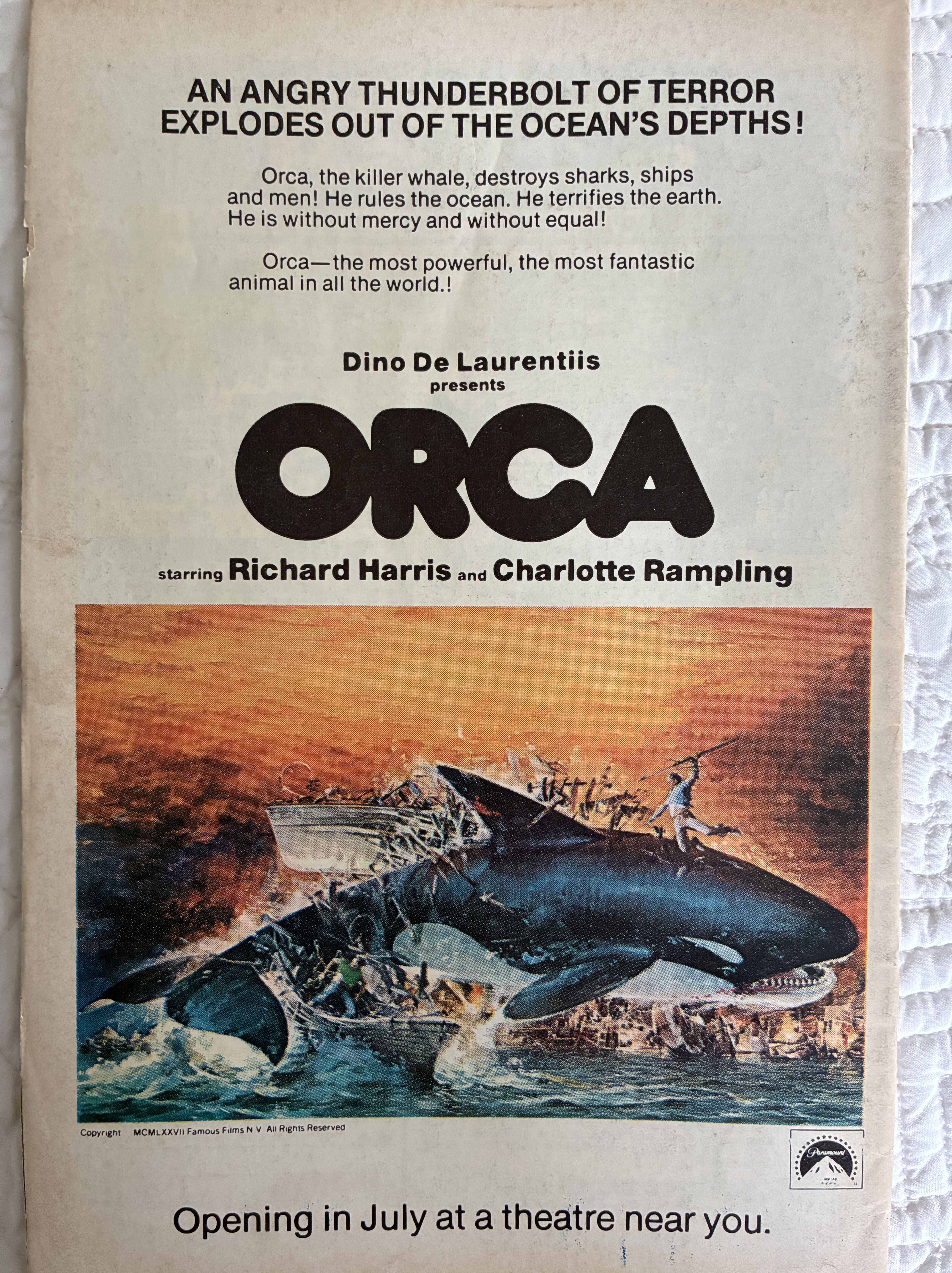
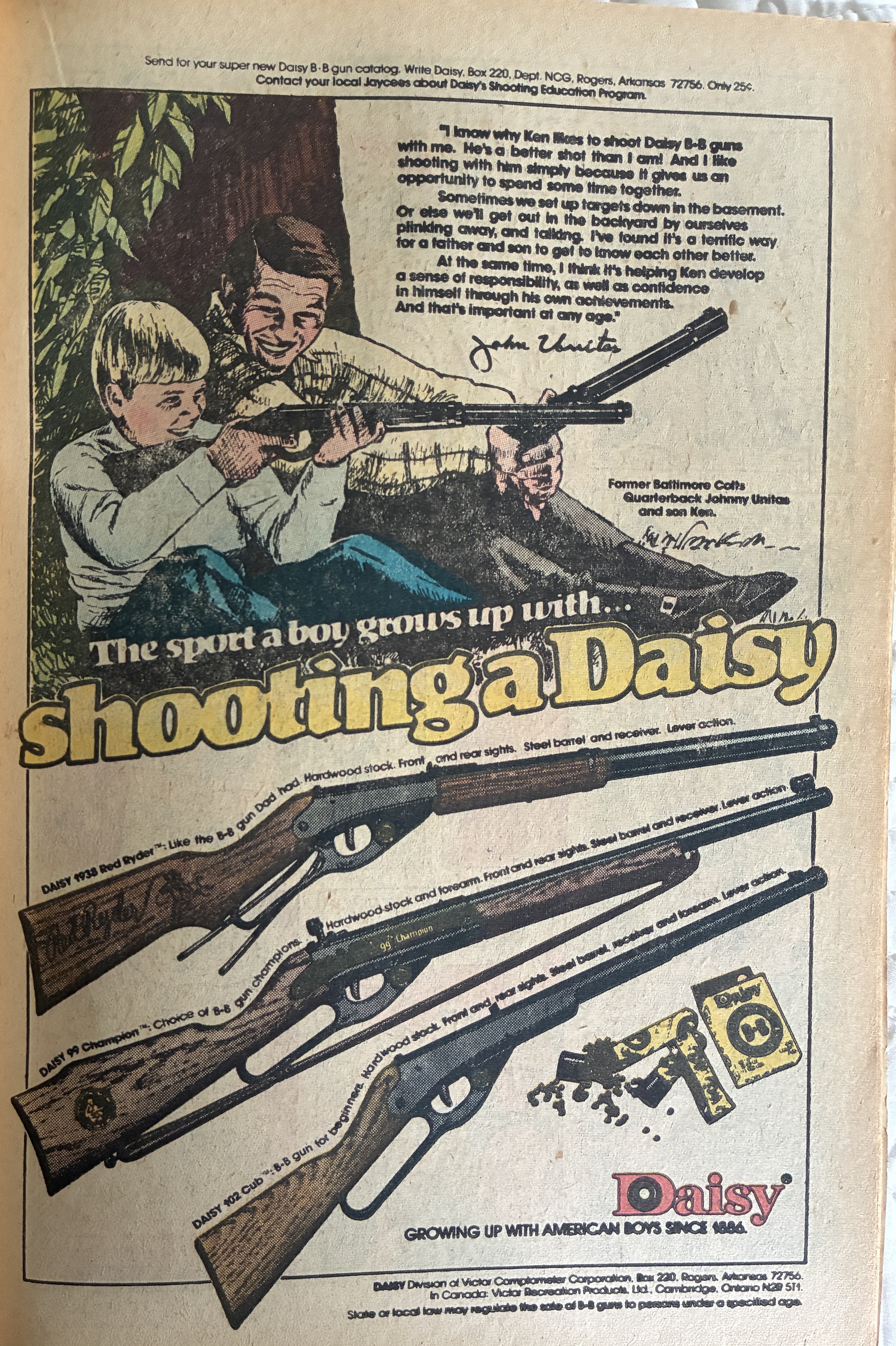
I remember this ad for the Orca movie when I was a kid and thinking it was very exciting. In retrospect it looks a lot like a Jaws rip-off, even if has a decent cast (fwiw, it gets an 11% rating from Rotten Tomatoes). Also, I’m pretty sure I had no idea who Johnny Unitas was when I first saw the ad for Daisy BB guns. Still not sure why he was a pitch-man for these things.


Overall

A fun if flawed comic

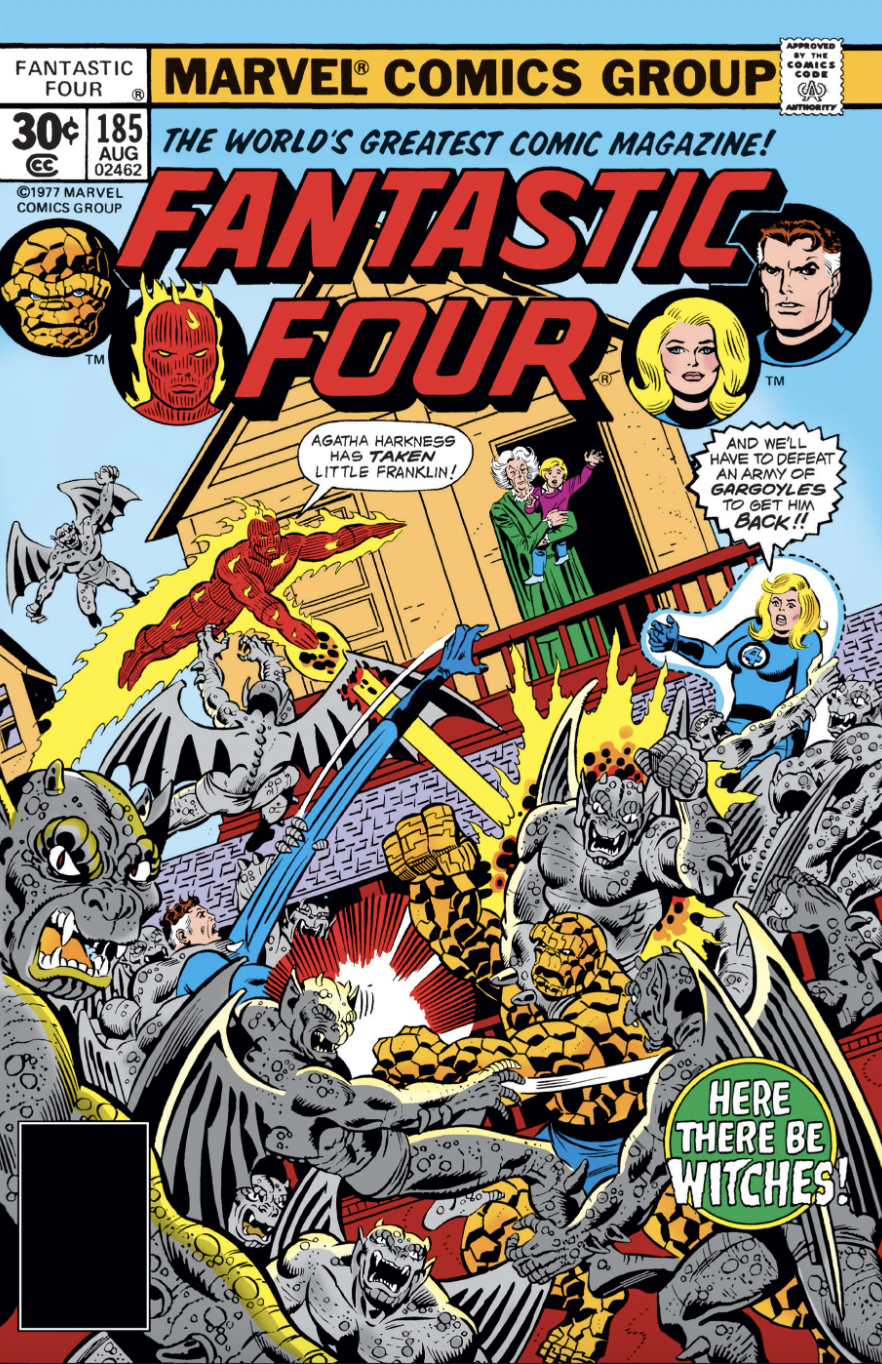
“The World’s Greatest Comic Magazine!” Fantastic Four No. 185

17 Sunday Aug 2025

Posted by percivalhenry in The World's Greatest Comic Magazine

≈ Leave a comment

Tags

1977, Fantastic Four, Fantastic Four 185, George Perez, Len Wein, marvel-comics, Salem's Seven

Fantastic Four 185
“Here There Be Witches!”
Published May 1977
Writer: Len Wein
Pencils: George Perez
Inks: Joe Sinnott
Letters: Gaspar Saladino
Colors: Glynis Wein
Editor: Len Wein
Cover: Perez and Sinnott

Synopsis

In search of missing Franklin and Agatha Harkness, the Fantastic Four track their whereabouts to a small town in the Rocky Mountains. Despite several indications that something is amiss, the town seems normal until Harkness alerts the FF to its supernatural nature. The town is then revealed to be a haven for witches and the FF battle stone gargoyles before succumbing to the power of the coven’s leader, Nicholas Trask.


What’s going on here?

This is a solid comic that introduces Nicholas Trask and sets the table for the debut of the Salem Seven, who will appear next issue and in a subsequent annual. Having the FF battle supernatural foes is an interesting idea, since they are very much a science-based team. Over the years Reed, in particular, struggles with sorcery and it creates an intriguing challenge.

The notable aspect of this comic is the looseness of George Perez’s pencils, and it appears he really only did breakdowns, because Joe Sinnott’s inks really dominate the panels. Here’s an example:


Compared to last issue, which was Perez as the peak of his powers, the difference is jarring. There’s much less detail, the panel designs are less intricate and it’s all a bit bland. My guess is that Perez was still getting used to the demands of a monthly comic, and fell behind, so Sinnott picked up the load for him.

What I liked

Sue gets a nice action sequence, and it seems like Len Wein sees more potential for her powers than previous writers.


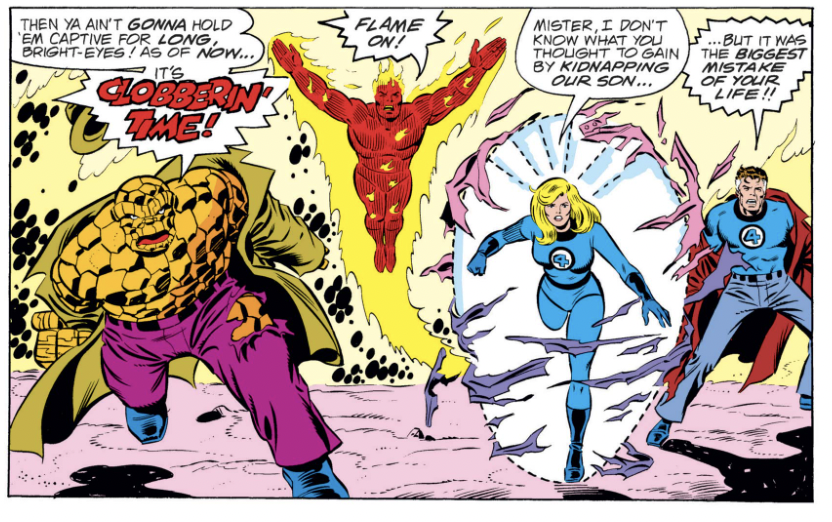
Wein also gives Johnny a speech that, while out of character for the Torch, reads like Wein’s declaration of principles for the FF. (It also feels like it could have been in the new Fantastic Four movie).


I liked this sequence, although it should have been bigger in the comic:


What I didn’t like

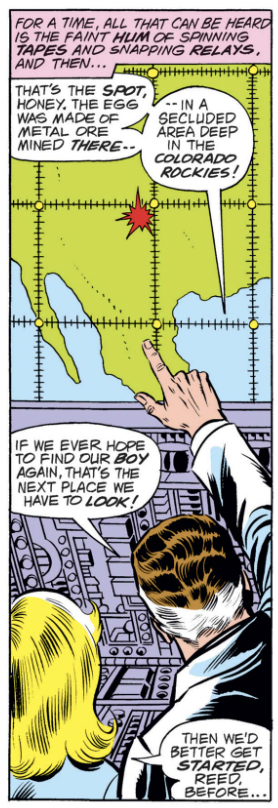
Reed seems to think the location where metal is mined is also where it is manufactured. Pretty sure that’s almost never the case.


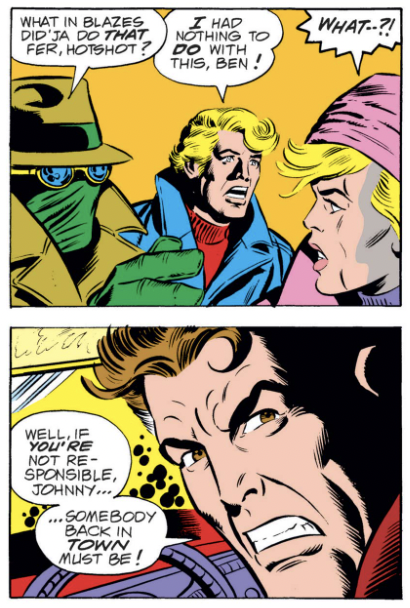
Johnny can apparently assemble a sports car from its parts in a matter of minutes:


And there seems no getting rid of the Impossible Man:


Overall

A perfectly fine comic, although a let down after last issue

“The World’s Greatest Comic Magazine!” Fantastic Four No. 184

10 Sunday Aug 2025

Posted by percivalhenry in The World's Greatest Comic Magazine

≈ 1 Comment

Tags

1977, Fantastic Four, Fantastic Four 184, George Perez, Len Wein, Marvel comics

Fantastic Four 184
“Aftermath: The Eliminator!”
Published April 1977
Writer: Len Wein
Pencils: George Perez
Inks: Joe Sinnott
Letters: Joe Rosen
Colors: Glynis Wein
Editor: Len Wein
Cover: Perez and Sinnott

Synopsis

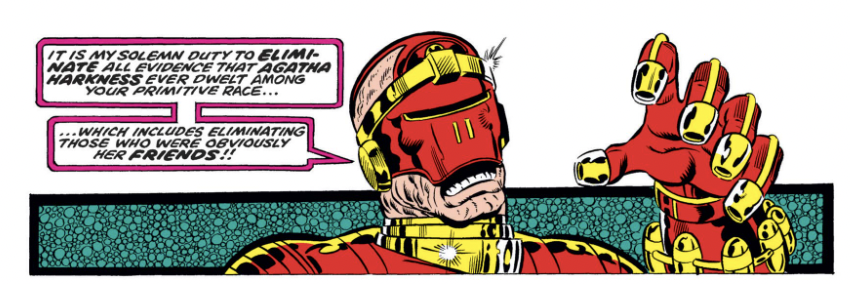
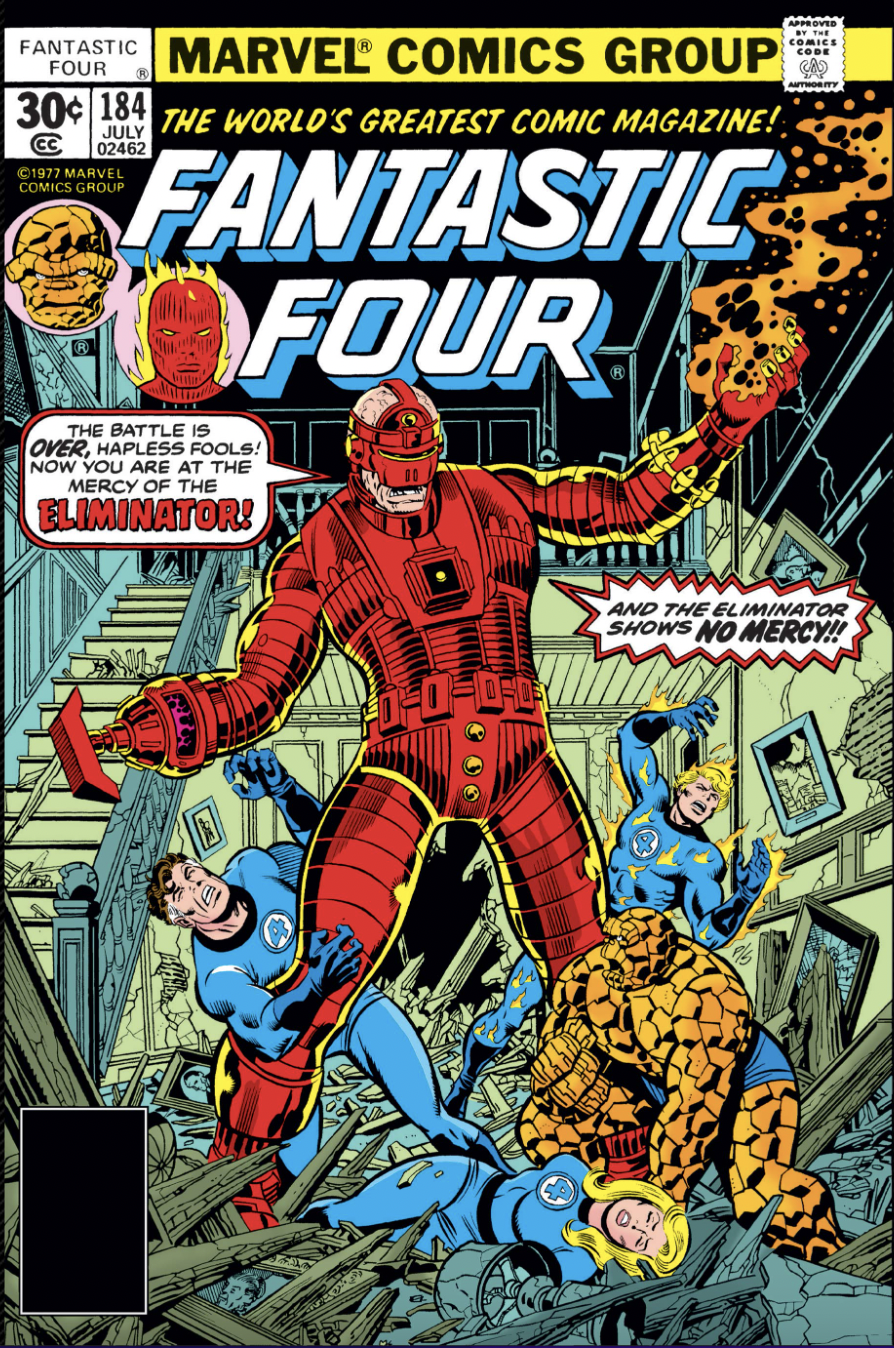
The Fantastic Four regroup in the Baxter Building after last issue’s battle, and Sue explains to Reed that Agatha Harkness abducted their son, and then both of them disappeared from her home of Whisper Hill. The Fantastic Four go to investigate, when they are attacked by an armored creature called the Eliminator, which calls itself an enemy of Harkness. The FF trick it into destroying itself, but they are no closer to finding Franklin.


What’s going on here?

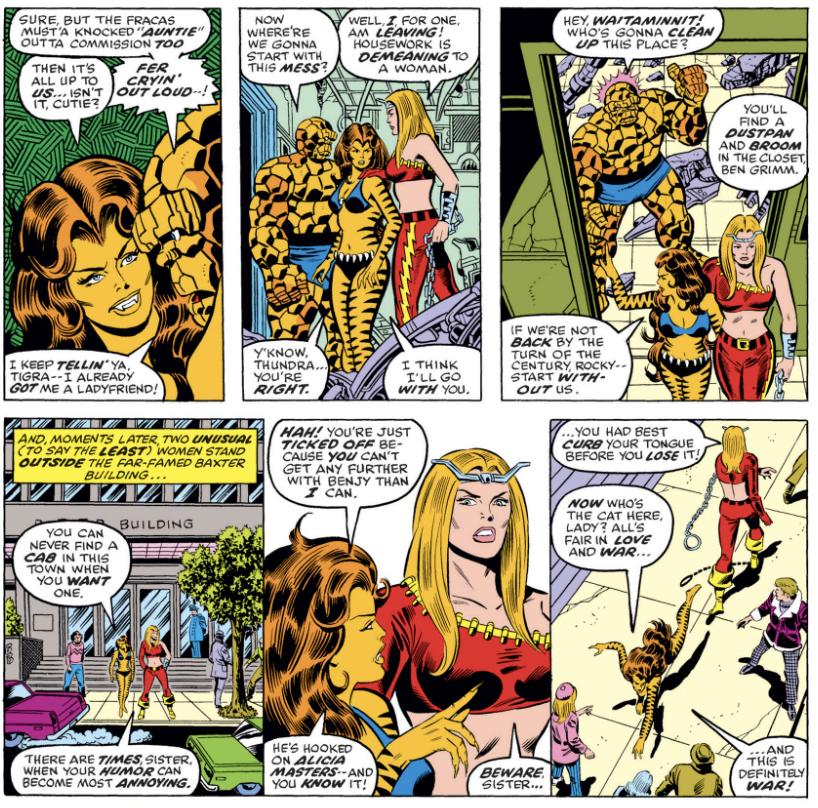
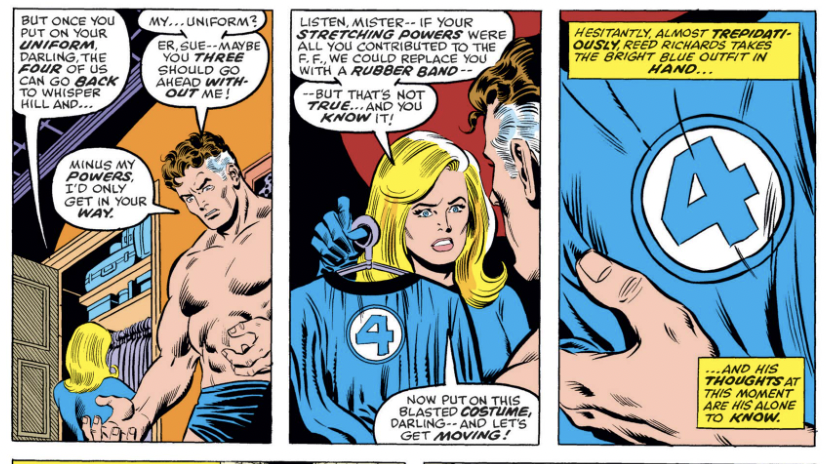
For the last handful of issues, we’ve been promised Len Wein would take over as writer. And now that he finally has … it was worth the wait. I don’t know what his future issues promise, but this one, at least, is one of the best written and enjoyable Fantastic Four comics in quite a while. There’s no real magic to it, and Wein sticks to the tried-and-true Lee / Kirby formula: some Baxter Building hijinx, some interpersonal dynamics among the team and their loved one, followed by a slow build-up toward an action-packed finish. But while it’s a familiar structure, Wein breathes new life into it, scripting a fun love-triangle between Ben, Tigra and Thundra; introducing new introspection to a now-powerless Reed; and crafting a genuinely suspenseful plot that culminates in a fun fight.

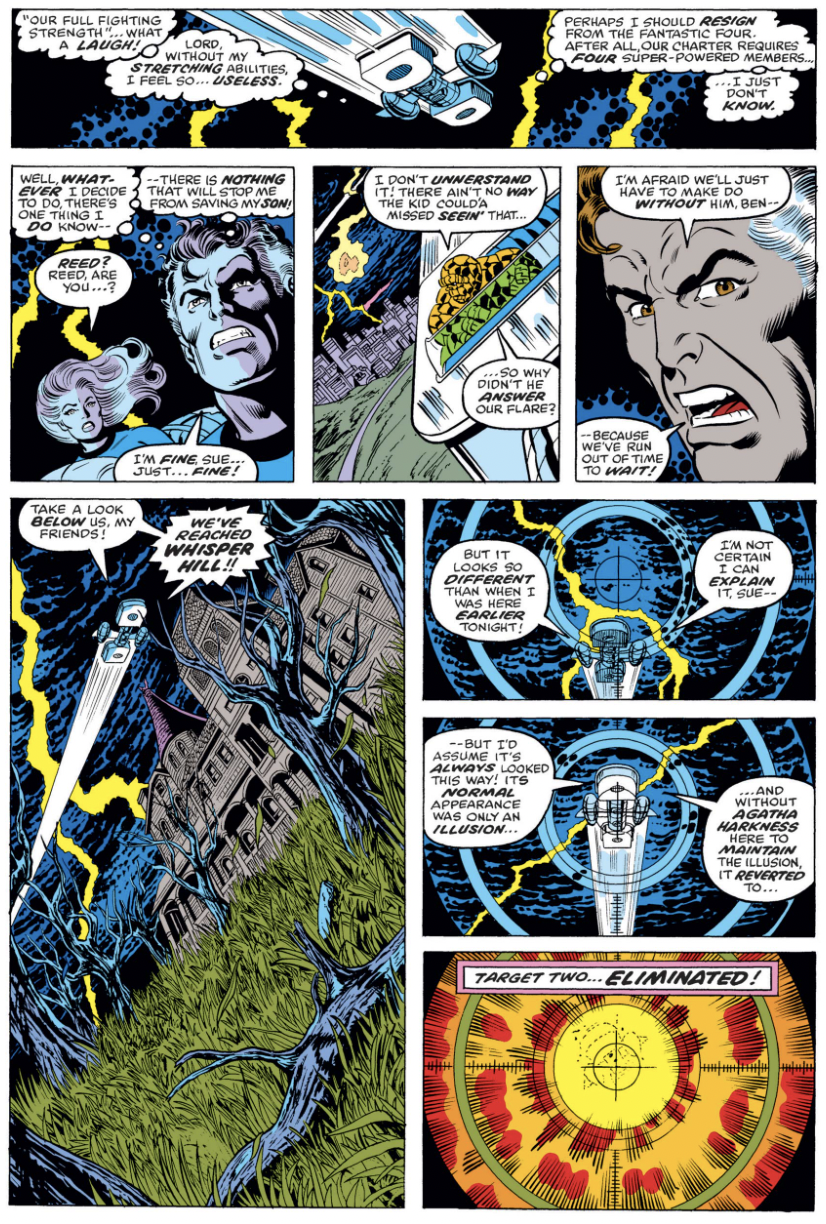
Of course, none of it would be half as interesting without the pencils of George Perez, who returns from a five-issue absence and delivers his best work on the Fantastic Four to date. The steadying presence of Joe Sinnott’s inks are still evident, but this issue feels like the first where we can really see Perez’s mature style and his signature combination of exquisite detail and powerful panel designs. It’s a treat to read.

Most notable in this issue is this incredible, 12-panel design spread over two pages, something rare at the time:

Also worth mentioning are the colors turned in Glynis Wein, then married to Len. The Whisper Hill sequences are particularly eerie because of her colors, and I wonder if sharing a home with the writer helped her better understand the story and what Len hoped to convey.

What I liked

There’s just a ton of great Perez art, like on these pages:


And this is an amazing panel (The Eliminator is a great looking villain, and his speech bubbles are a fun effect):


I liked this by-play between Ben, Tigra and Thundra:


And this scene with Reed and Sue:


What I didn’t like:

The big reveal of how the team fooled the Eliminator wasn’t all that revealing, and didn’t add much to the story.

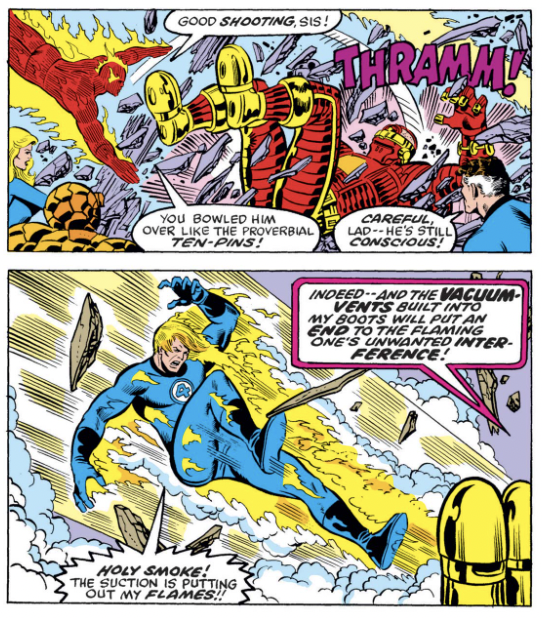
Also, vacuum vent boots are very convenient way to defeat the Human Torch:


Overall

One of the best since the Kirby / Lee era.

“The World’s Greatest Comic Magazine!” Fantastic Four No. 178

22 Sunday Jun 2025

Posted by percivalhenry in The World's Greatest Comic Magazine

≈ Leave a comment

Tags

1976, Fantastic Four, Fantastic Four 178, Frightful Four, George Perez, Marvel comics, Roy Thomas

Fantastic Four 178
“Call My Killer — The Brute!”
Published October 1976
Writer: Roy Thomas
Pencils: George Perez
Inks: David Hunt
Letters: Joe Rosen
Colors: Hunt
Editor: Thomas
Cover: John Romita and Joe Sinnott

Synopsis

The Thing is retrieved from the Negative Zone and captured by the Frightful Four alongside the rest of the Fantastic Four, Tigra and Thundra. The villains announce a billion dollar ransom for the team, but the city of New York is unable to deliver and the team faces death when the Impossible Man coincidentally pulls the plug on the Baxter Building’s power, freeing the heroes. They defeat the Frightful Four and the evil Reed Richards of Counter-Earth is apparently exiled to the Negative Zone — but it is revealed that it’s the real Reed, and the evil Reed has secretly infiltrated the Fantastic Four.


What’s going on here?

If last issue was an example of a successfully whimsical issue, this one is a successful return to classic adventure storytelling. There are some gags, but it’s mostly a taut, action-packed issue that delivers on the implicit promise of all Fantastic Four comics. The evil Reed / Brute plot creates suspense and the rest of the Frightful Four are just menacing enough to be compelling villains. Roy Thomas has struggled to stick the ending of his previous multi-part story arcs—which unfortunately tend to end with a whimper, not a bang—but I’m hopeful the payoff of this one will match the buildup.

This issue again features excellent George Perez pencils, and unusually, he’s inked not by Joe Sinnott but Dave Hunt (who also colored this issue). For better or worse, Sinnott had been inking the FF for more than a decade by this point and no matter the penciler, he brought a uniform, consistent look to the comic. Under Hunt’s inks, Perez’s pencils look lighter and crisper, and it’s a preview of what we will come to see from him on New Teen Titans, where he was inked by Romeo Tanghal.

I’m not that familiar with Hunt, who had a 30-year career as an inker, letterer and colorist. He seems like a classic comic journeyman. Also of note is the return of John Romita as cover artist (inked by Sinnott). He was then serving as Marvel’s art director, and I suspect he came to the rescue as an emergency fill-in.

What I liked

There’s a great fight scene in this comic, brilliantly choreographed by Perez, with the Fantastic Four and Frightful Four trading partners. It’s a lot of fun.


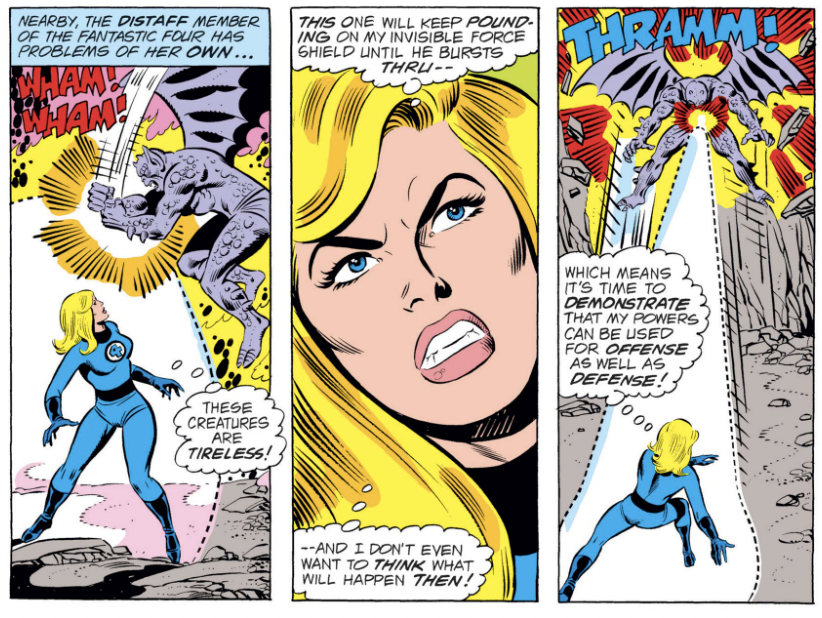
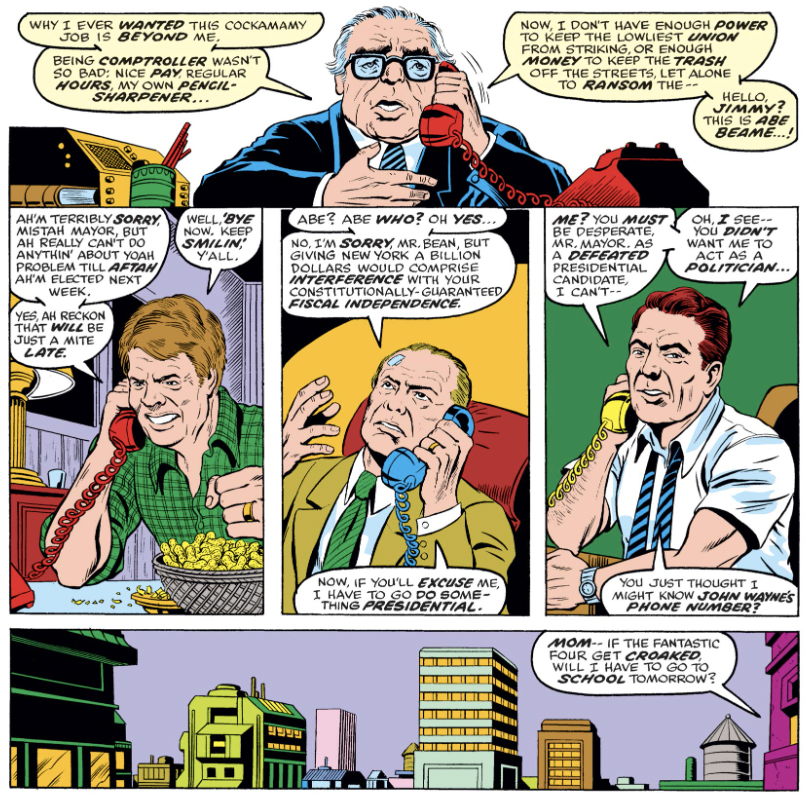
This issue also featured an amusing tour of politicians responding to the Frightful Four’s ransom demands. Often real politicians in comics are only alluded to but here it’s quite explicitly Abe Beame who is the mayor. The others are pretty obvious too. Ford’s comment is a reference to Washington’s refusal to bail out New York in 1975 (“Ford to City: Drop Dead”). Note this issue came out the weeks before the 1976 presidential election.


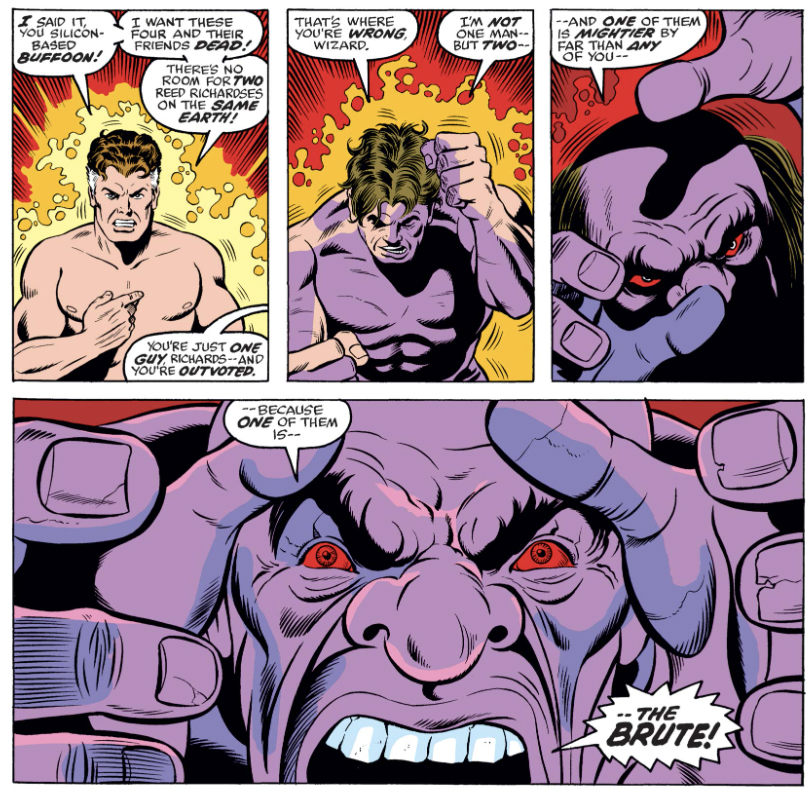
As mentioned, the business with evil Reed-slash-the Brute is pretty effective. This is a powerful sequence from Perez:


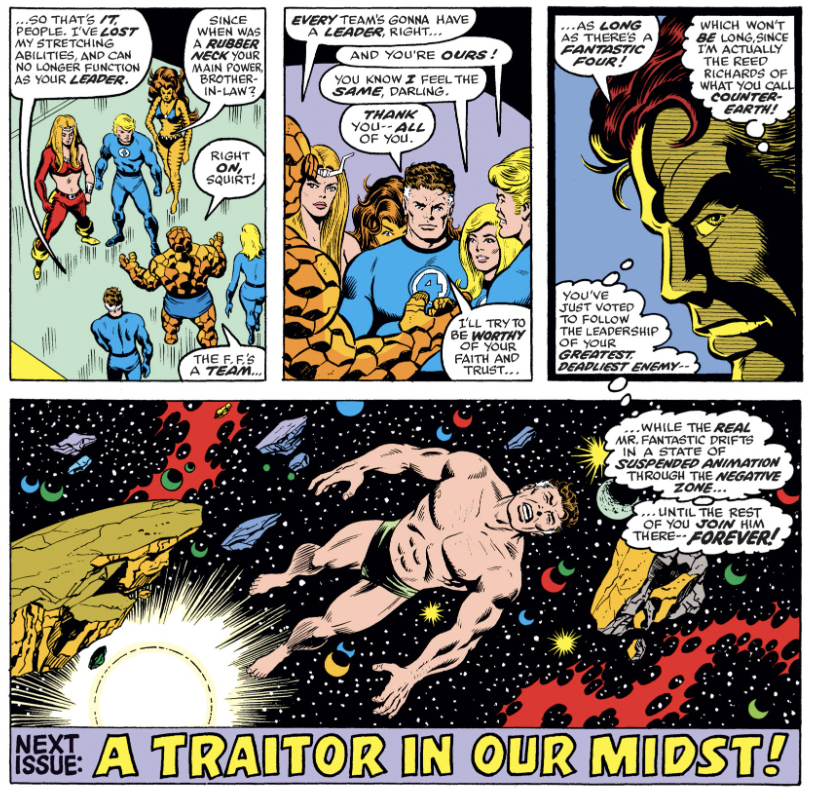
And while the switcheroo at the end was a bit predictable, it lends itself to a nice cliffhanger:


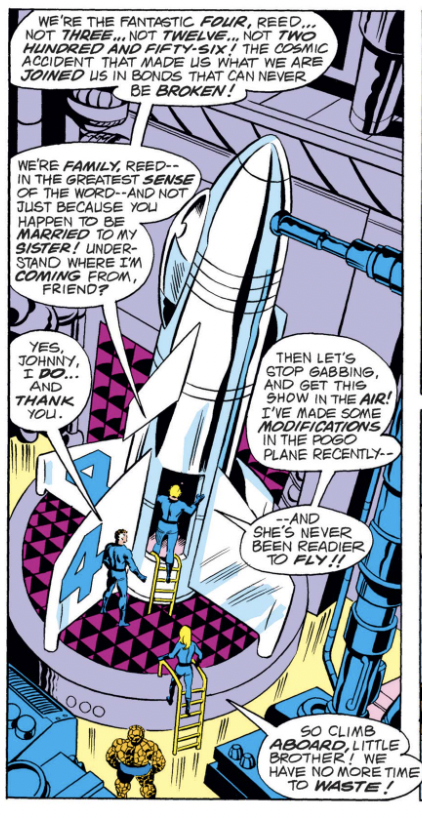
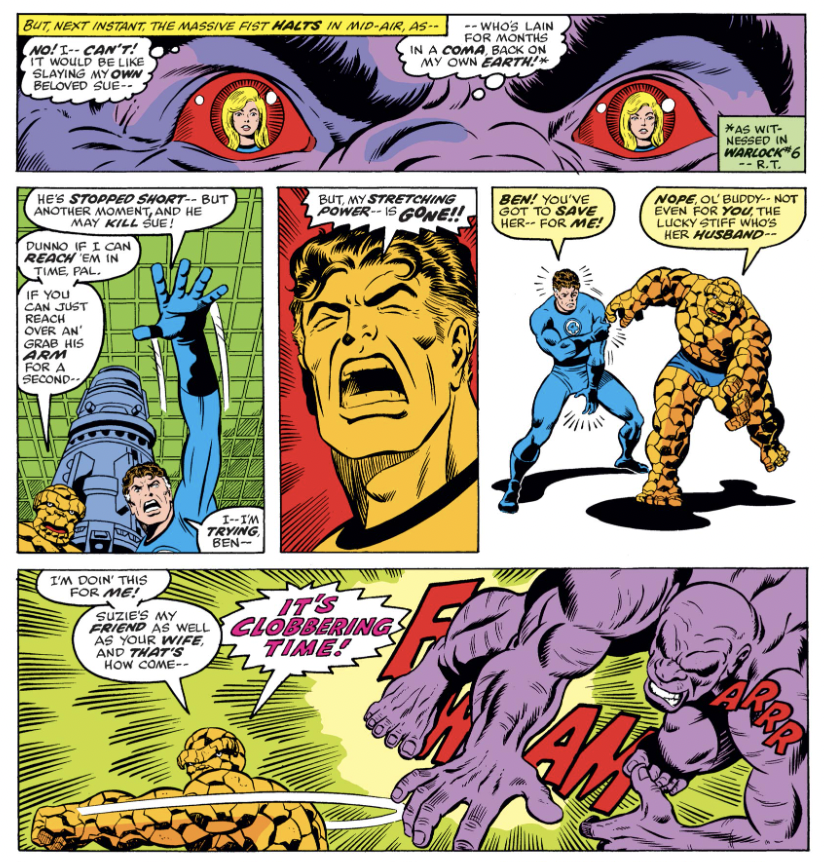
And I really liked this exchange between Ben and Reed, which reveals the family dynamic that’s at the core of the FF:


What I didn’t like

The issue opens with Ben drifting in the Negative Zone, but is instantly transported back to the Baxter Building with no real explanation. It suggests Thomas didn’t really have a plan after last issue and was making it up as he went along.


Anything else?

Some fun ads in this comic:


Overall

An excellent Fantastic Four comic book

← Older posts
  • “The World’s Greatest Comic Magazine!” Fantastic Four Annual No. 15
  • “The World’s Greatest Comic Magazine!” Fantastic Four No. 223
  • “The World’s Greatest Comic Magazine!” Fantastic Four No. 222
  • “The World’s Greatest Comic Magazine!” Fantastic Four No. 221
  • “The World’s Greatest Comic Magazine!” Fantastic Four No. 220
  • July 2026
  • June 2026
  • May 2026
  • April 2026
  • March 2026
  • February 2026
  • January 2026
  • December 2025
  • November 2025
  • October 2025
  • September 2025
  • August 2025
  • July 2025
  • June 2025
  • May 2025
  • April 2025
  • March 2025
  • February 2025
  • January 2025
  • December 2024
  • November 2024
  • October 2024
  • September 2024
  • August 2024
  • July 2024
  • June 2024
  • May 2024
  • April 2024
  • March 2024
  • February 2024
  • January 2024
  • December 2023
  • November 2023
  • September 2023
  • July 2023
  • June 2023
  • May 2023
  • April 2023
  • March 2023
  • February 2023
  • January 2023
  • December 2022
  • November 2022
  • October 2022
  • September 2022
  • August 2022
  • July 2022
  • June 2022
  • May 2022
  • April 2022
  • March 2022
  • February 2022
  • January 2022
  • December 2021
  • November 2021
  • October 2021
  • September 2021
  • August 2021
  • July 2021
  • June 2021
  • May 2021
  • April 2021
  • March 2021
  • February 2021
  • January 2021
  • December 2020
  • February 2018
  • May 2016
  • February 2016
  • January 2016
  • December 2015
  • November 2015
  • October 2015
  • September 2015
  • August 2015
  • July 2015
  • April 2015
  • March 2015
  • January 2015
  • December 2014
  • November 2014
  • October 2014
  • September 2014
  • August 2014
  • June 2014
  • May 2014
  • April 2014
  • March 2014
  • February 2014
  • July 2026
  • June 2026
  • May 2026
  • April 2026
  • March 2026
  • February 2026
  • January 2026
  • December 2025
  • November 2025
  • October 2025
  • September 2025
  • August 2025
  • July 2025
  • June 2025
  • May 2025
  • April 2025
  • March 2025
  • February 2025
  • January 2025
  • December 2024
  • November 2024
  • October 2024
  • September 2024
  • August 2024
  • July 2024
  • June 2024
  • May 2024
  • April 2024
  • March 2024
  • February 2024
  • January 2024
  • December 2023
  • November 2023
  • September 2023
  • July 2023
  • June 2023
  • May 2023
  • April 2023
  • March 2023
  • February 2023
  • January 2023
  • December 2022
  • November 2022
  • October 2022
  • September 2022
  • August 2022
  • July 2022
  • June 2022
  • May 2022
  • April 2022
  • March 2022
  • February 2022
  • January 2022
  • December 2021
  • November 2021
  • October 2021
  • September 2021
  • August 2021
  • July 2021
  • June 2021
  • May 2021
  • April 2021
  • March 2021
  • February 2021
  • January 2021
  • December 2020
  • February 2018
  • May 2016
  • February 2016
  • January 2016
  • December 2015
  • November 2015
  • October 2015
  • September 2015
  • August 2015
  • July 2015
  • April 2015
  • March 2015
  • January 2015
  • December 2014
  • November 2014
  • October 2014
  • September 2014
  • August 2014
  • June 2014
  • May 2014
  • April 2014
  • March 2014
  • February 2014
“The World’s Greatest Comic Magazine!” Fantastic Four Annual No. 15

“The World’s Greatest Comic Magazine!” Fantastic Four Annual No. 15

percivalhenry's avatar by percivalhenry July 18, 2026
“The World’s Greatest Comic Magazine!” Fantastic Four No. 223

“The World’s Greatest Comic Magazine!” Fantastic Four No. 223

percivalhenry's avatar by percivalhenry July 14, 2026
“The World’s Greatest Comic Magazine!” Fantastic Four No. 222

“The World’s Greatest Comic Magazine!” Fantastic Four No. 222

percivalhenry's avatar by percivalhenry July 5, 2026
“The World’s Greatest Comic Magazine!” Fantastic Four No. 221

“The World’s Greatest Comic Magazine!” Fantastic Four No. 221

percivalhenry's avatar by percivalhenry June 25, 2026
“The World’s Greatest Comic Magazine!” Fantastic Four No. 220

“The World’s Greatest Comic Magazine!” Fantastic Four No. 220

percivalhenry's avatar by percivalhenry June 15, 2026
“The World’s Greatest Comic Magazine!” Fantastic Four No. 219

“The World’s Greatest Comic Magazine!” Fantastic Four No. 219

percivalhenry's avatar by percivalhenry June 7, 2026

Blog at WordPress.com.

  • Subscribe Subscribed
    • Percival Henry: The Fantastic Four and more
    • Join 74 other subscribers
    • Already have a WordPress.com account? Log in now.
    • Percival Henry: The Fantastic Four and more
    • Subscribe Subscribed
    • Sign up
    • Log in
    • Report this content
    • View site in Reader
    • Manage subscriptions
    • Collapse this bar
Loading Comments...