Tags
1976, Fantastic Four, Fantastic Four Annual 11, Invaders, John Buscema, Marvel comics, Namor, Roy Thomas
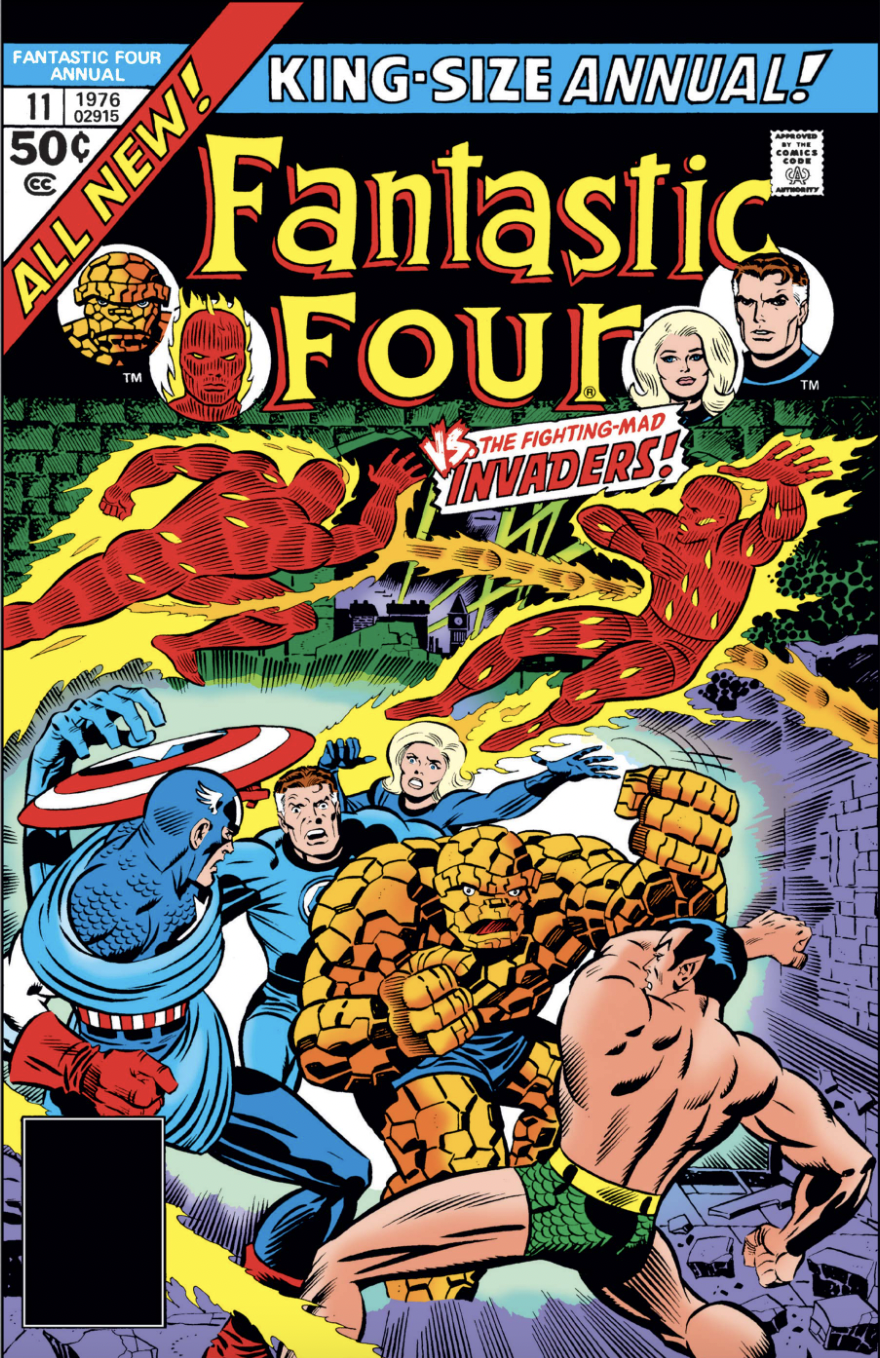
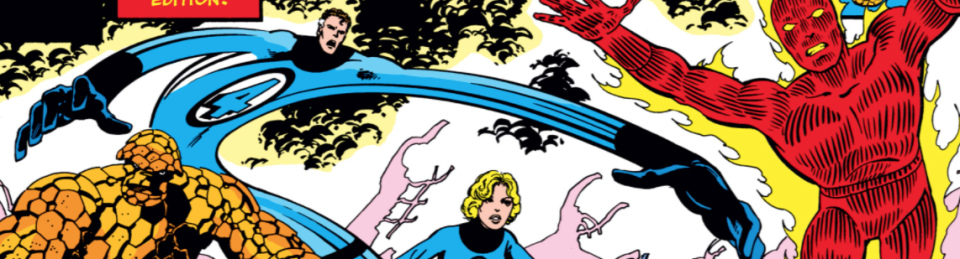
Fantastic Four Annual 11
“And Now Then the Invaders!”
Published March 1976
Writer: Roy Thomas
Pencils: John Buscema
Inks: Sam Grainger
Letters: Joe Rosen
Colors: Phil Rachelson
Editor: Thomas
Cover: Jack Kirby and Joe Sinnott
Editor’s note: As I mentioned a while back, I am tackling this annual out of order, since it appeared after issue 170 and the end of the Power Man story arc. It’s basically a standalone story so it’s
Synopsis
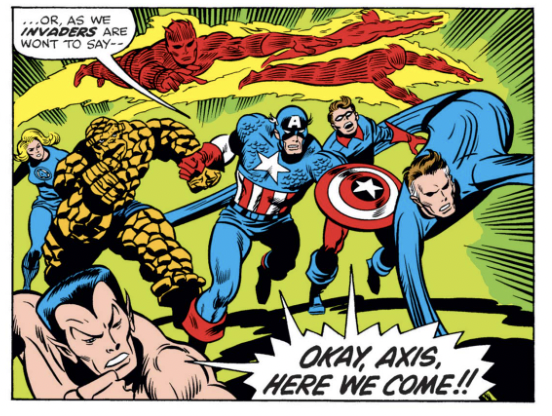
After a training exercise in the Baxter Building, the Fantastic Four discovers they accidentally triggered Dr. Doom’s time machine, and sent back a sample of vibranium to 1942 Germany. As a result, the Nazis were able to build more accurate rockets and conquer the world. The FF travel back in time and joins the WW II super hero team The Invaders to storm Baron Zemo’s castle and thwart his plan to launch the souped up missiles at London. After recovering the vibranium and restoring history, the team returns but the Thing realizes not all the vibranium made it back.
What’s going on here?
This is a fun but uneven comic with a lot to unpack. Notably, it’s the first FF annual with new content since the great Fantastic Four Annual 6 way back in 1968 (there were some Giant-Size FF’s that served the purpose of annuals, although they appeared quarterly).
It’s also the first time the FF encounters the Invaders, a team invented by Roy Thomas that ret-conned a number of World War II-era heroes into a super team. (He may have based his idea on the All-Winners Squad, a Golden-Age comic with some of the same members, but that was released in 1946, after the war). The Invaders debuted in its own comic in 1975 and given all the times the FF comic was used goose the sales of other Marvel titles, it’s probably not too surprising Thomas engineered a cross-over between the two titles.
Thomas had a decades-long fascination with World War II super heroes. Along with the Invaders, he created the Liberty Legion, a sort of B-team led by Bucky that appeared in Marvel Premier. Later, at DC in 1981, he created the All-Star Squadron, a massive team that spun out of the Justice Society and contained just about every Golden Age DC character. Also at DC he created Young All-Stars, a post-crisis version of the All-Star Squadron (which theoretically no longer existed).
In typical Thomas-ian form, Fantastic Four Annual 11 is more convoluted than it needs to be, with lots of exposition and obscure call backs. But it’s also a rollicking read, with clever nods to the paradoxes of time travel and to the novelty of the FF reuniting with characters like Namor and the original Human torch.
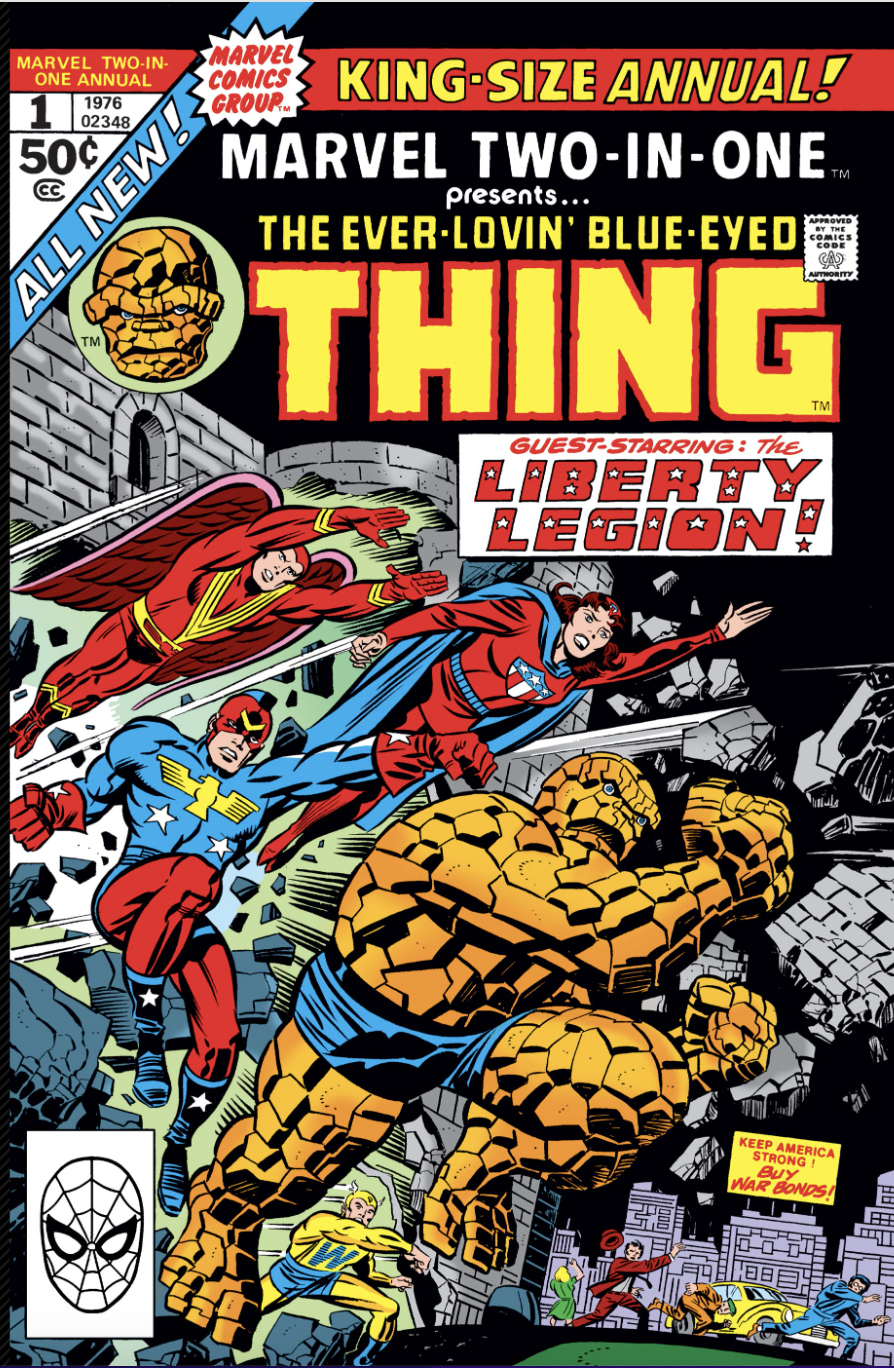
In a twist, the story ends on a bit of cliff-hanger, when Ben learns that he has to go back to World War II, a story which takes place in Marvel Two-In-One Annual 1 and features the Liberty Legion.
Fantastic Four Annual 11 is also the first and only work on the FF by inker Sam Grainger, over John Buscema’s pencils. Grainger, who had a two-decade career on titles from Charlton, Marvel, DC and First comics, does serviceable work here. The cover is by Jack Kirby and Joe Sinnott.
What I liked
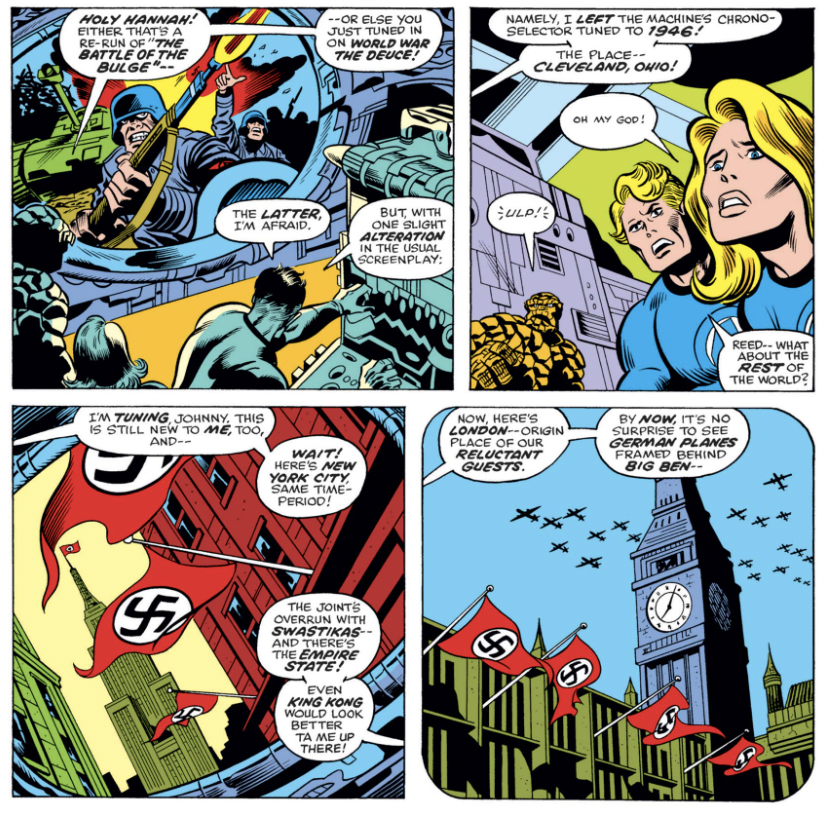
As a concept, the story works well. While the details are a little hard to swallow — the FF just happens to knock a tube of vibranium onto the time machine and they just happen to accidentally trigger it and send the tube back to 1942 where it just happens tp fall into the hands of Nazi scientists— the premise is fun. The idea that all Germany needed was more precise rockets with which to defeat Britain, and that vibranium was the one missing ingredient, is an intriguing one and nuanced enough to make the story more effective. It’s another entry in the long line of “What if Hitler won?” future histories covered by authors ranging from Len Deighton to Phillip K. Dick. The panels of the swastikas hanging in New York and London are chilling:
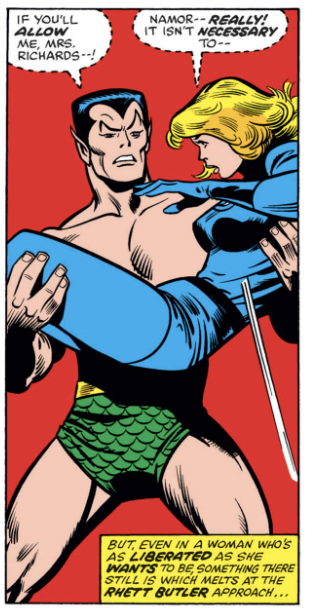
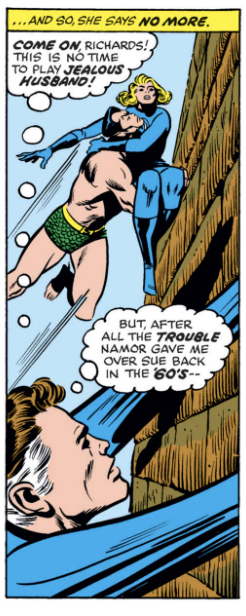
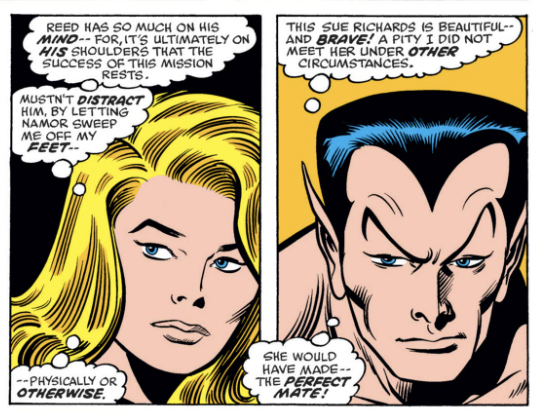
The story also reunites Sue and Namor, leading to some uncomfortable moments for Reed:
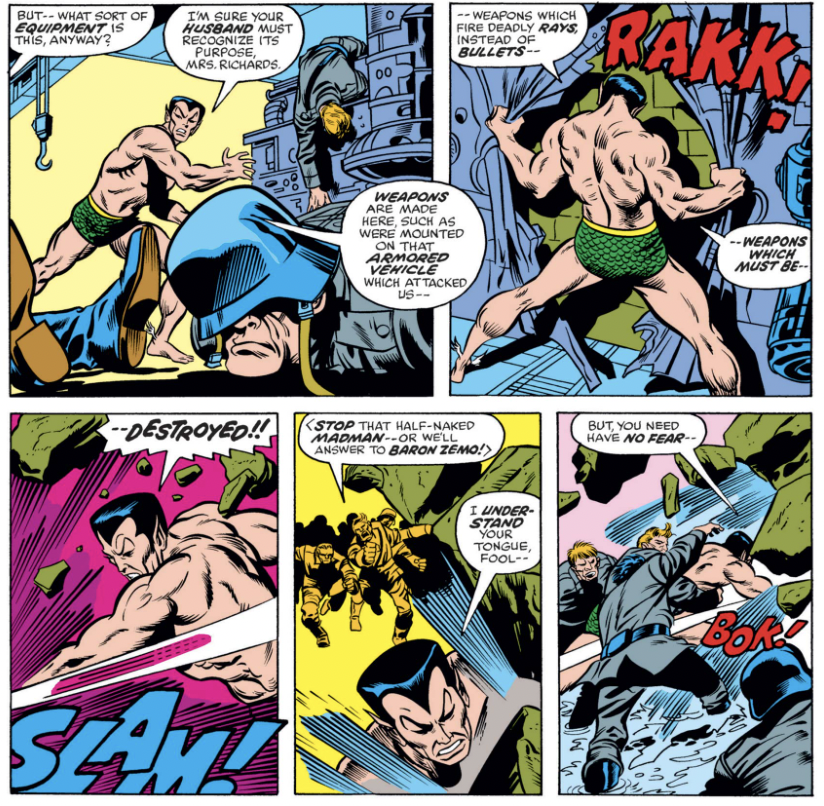
I also liked this sequence of Namor going all-out against the Nazis:
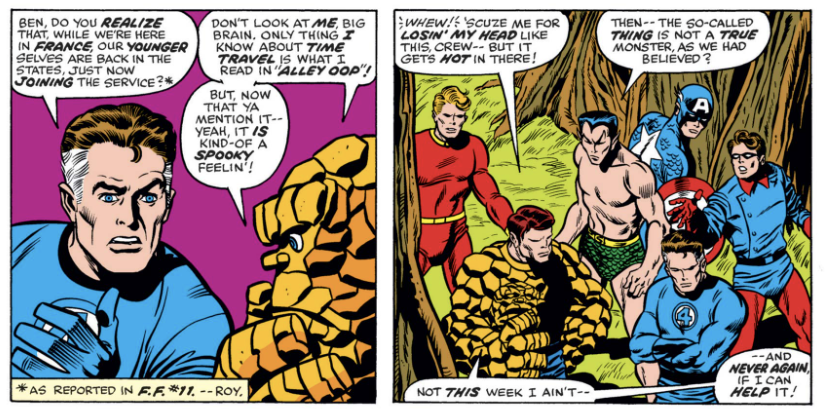
There is a lot of banter in this comic, some better than others. I liked this exchange between Ben and Reed, and Ben’s comments are poignant, given what we know is to come (note how different Reed looks when he isn’t inked by Joe Sinnott). “Alley Oop” was a newspaper comic strip.
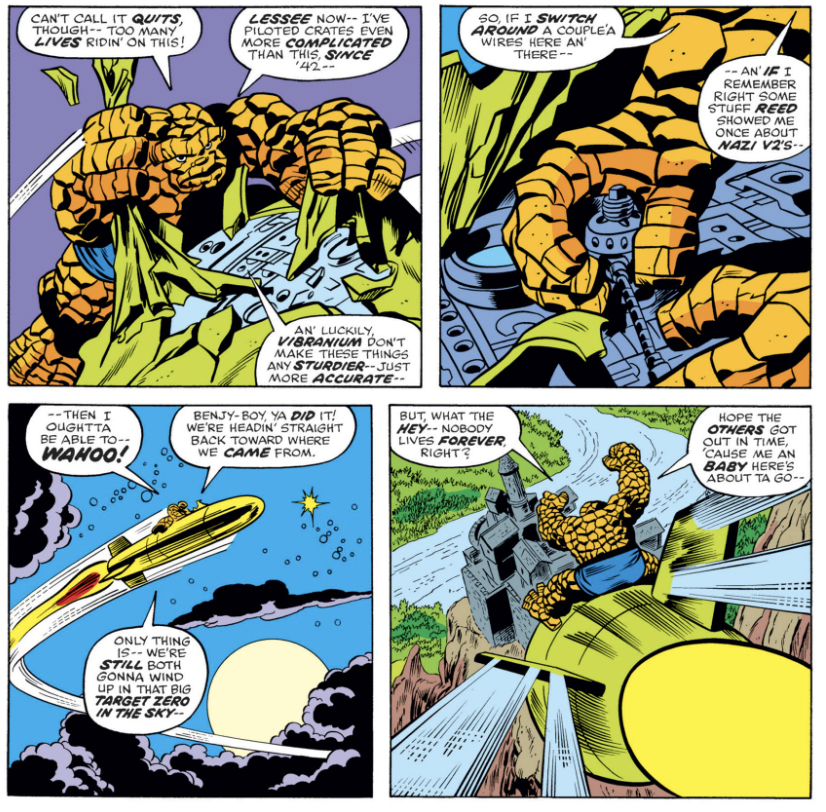
This climactic sequence was ridiculous but fun.
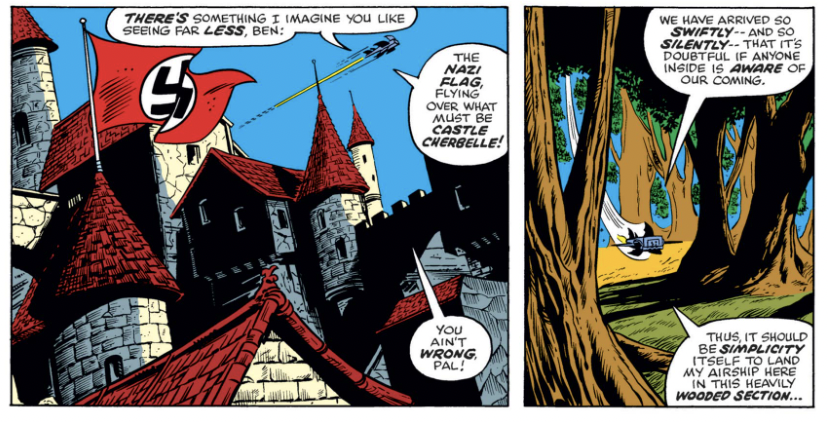
This is a nice series of panels from Big John Buscema:
What I didn’t like:
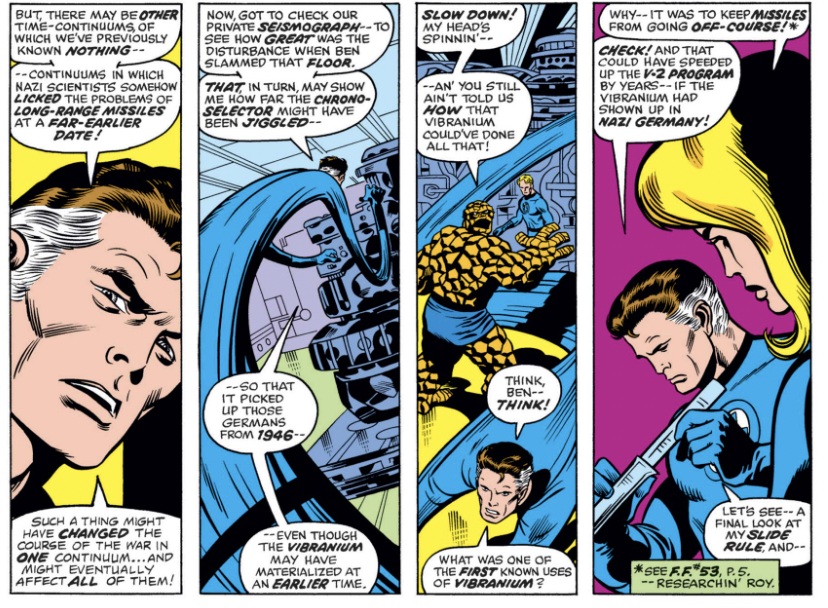
There is a lot of heavy-handed explanation in this comic. This sequence is an example:
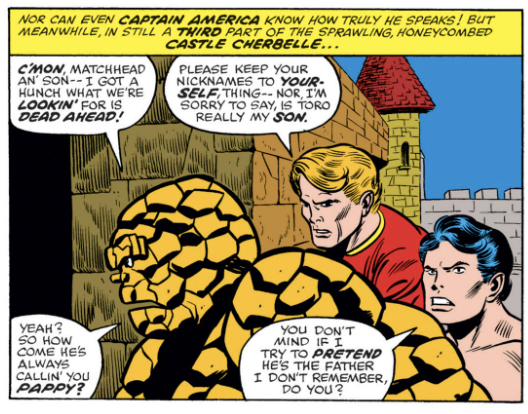
This was weird and awkward:
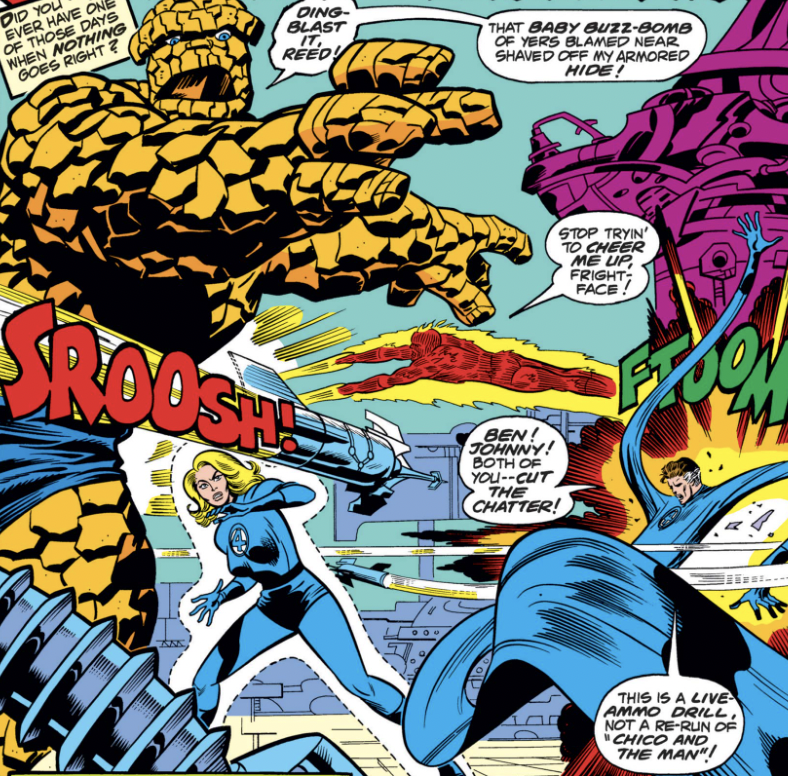
As I mention, not all banter is successful. Does Reed really watch Chico and the Man?
Anything else?
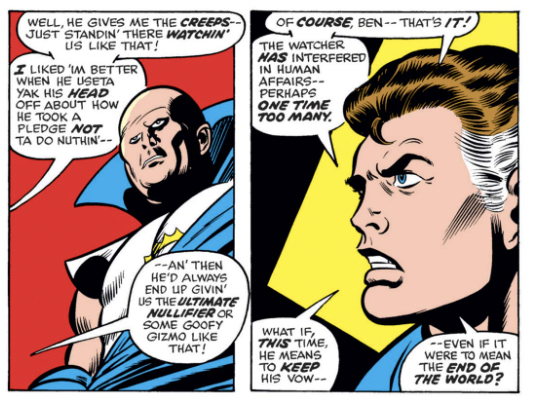
There are a few instances where Thomas seems to be poking fun. Here, Ben expresses what we all think about the Watcher, who seems to break his vow of non-interference more often than he upholds it:
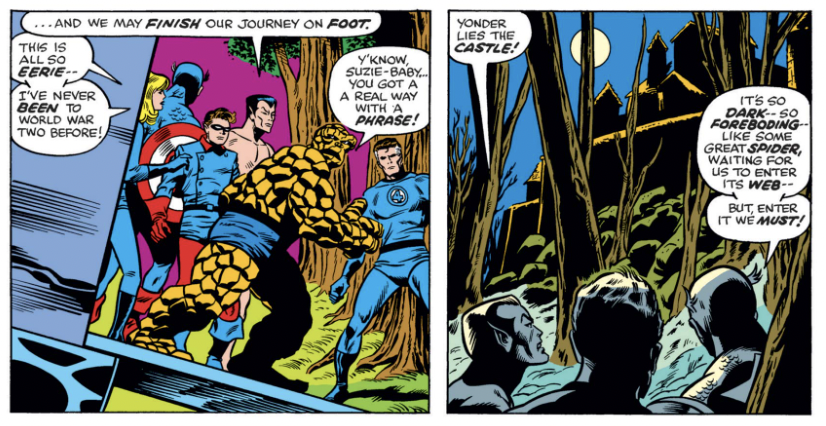
And here, alongside a totally inane comment from Sue, Namor seems to echo a line made famous by Tony Curtis, “Yondah lies the castle of my faddah” (although that appears to be an urban myth – Curtis never said that line).
Overall
A surpisingly satisfying comic
 Percival Henry: The Fantastic Four and more