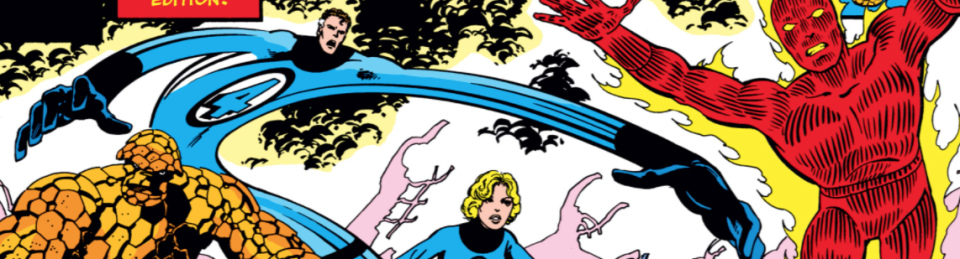
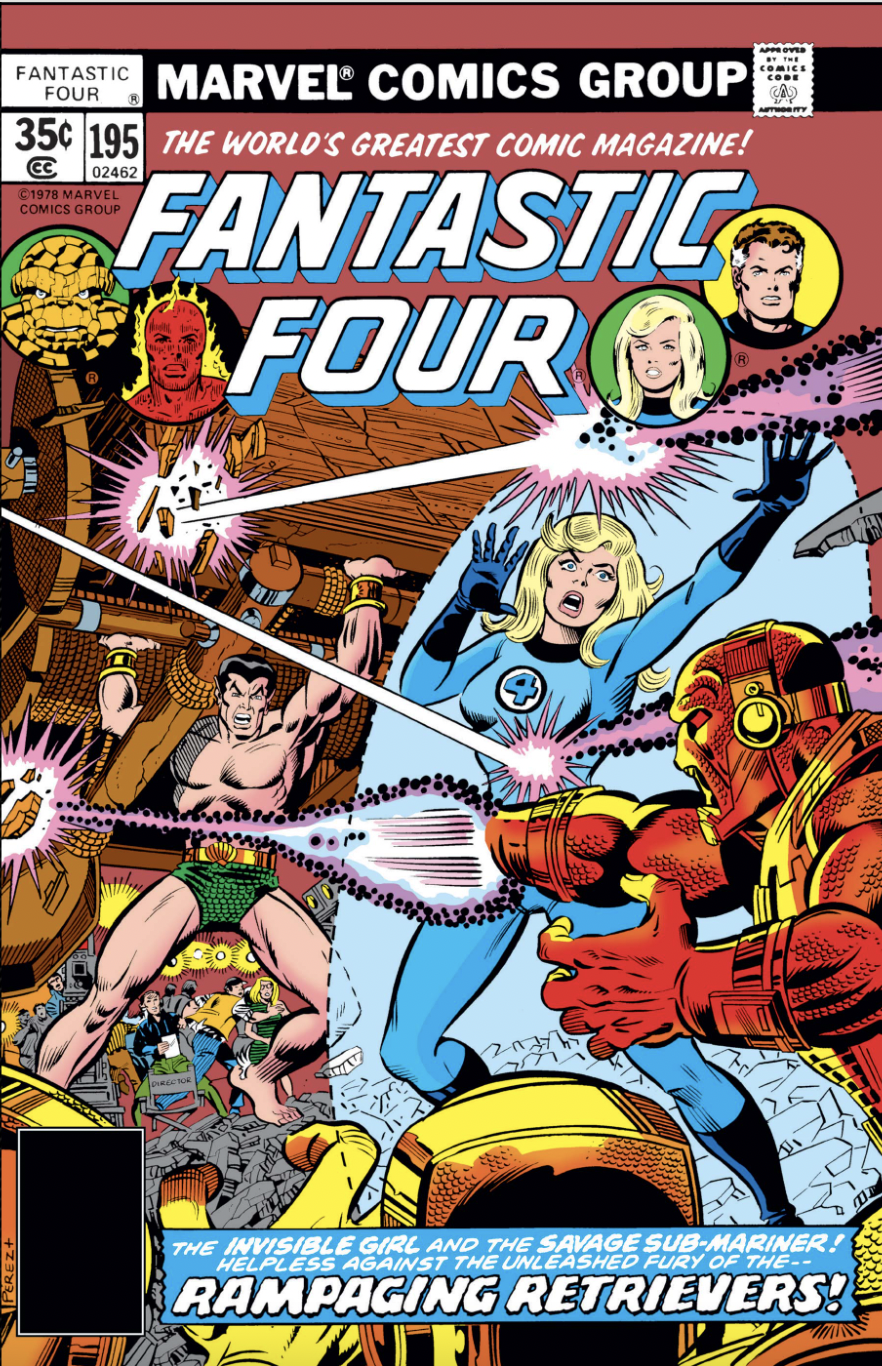
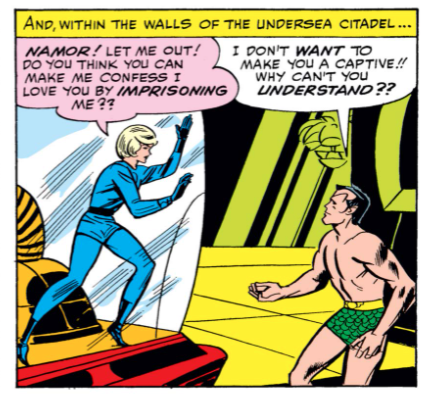
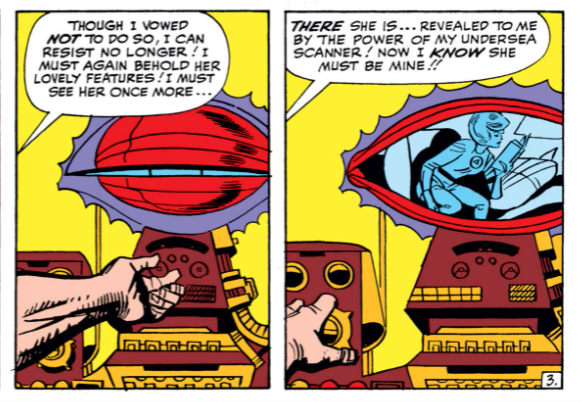
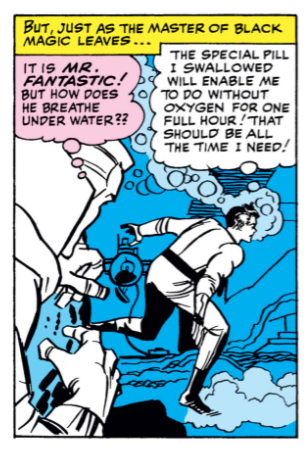
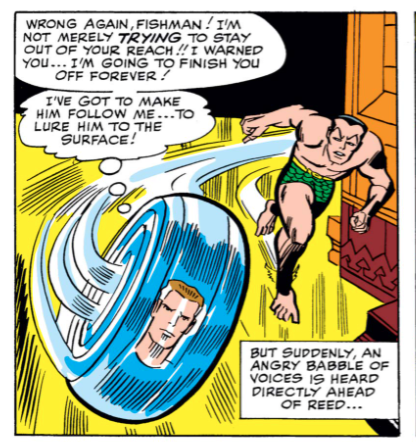
Fantastic Four 195 “Beware the Ravaging Retrievers!” Published March 1978 Writer: Marv Wolfman Layouts: Keith Pollard Finishes: Pablo Marcos Letters: Denise Wohl Colors: Phil Rachelson Editor: Wolfman Cover: George Perez and Joe Sinnott
Synopsis
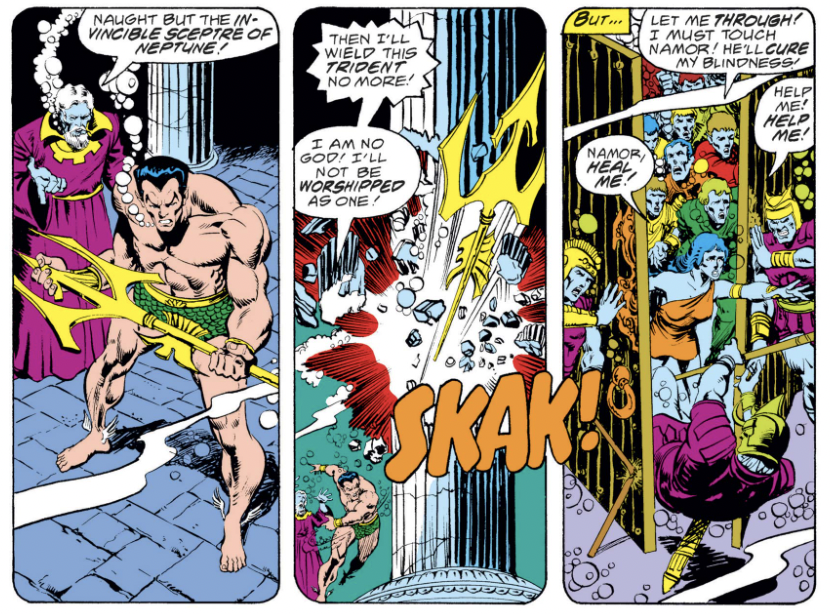
The Invisible Girl, in Hollywood filming a movie after the breakup of the Fantastic Four, discovers the figure behind the movie studio is the Sub-Mariner, who confesses he has fled Atlantis in frustration over being worshipped as a god. The filming is interrupted by Atlantean androids summoned to retrieve Namor back to Atlantis. Sue and Namor defeat the robots but the Sub-Mariner realizes he must nonetheless return home.
What’s going on here?
The premise of this comic is truly ridiculous —Namor objects to being worshipped as a god? Atlantis sends robots to capture him? He still owns the movie studio he had way back in FF 9? — but I still found it a fun read. Partially because the stakes of the conflict are so low that the silliness doesn’t really matter. Partially because it’s fun to see Sue and Namor resuming their will-they-or-won’t-they relationship. But mostly it was because I really enjoyed the art.
Keith Pollard is credited with the layouts, but it’s pretty clear that this is Pablo Marcos’s comic. Marcos, a Peruvian probably best known for his work on Conan, has a fluid, expressive style that reminds me of a cross between Gene Colan and Michael Golden. Significantly, his work looks nothing like Joe Sinnott’s, and as a result it’s a refreshing change from the FF house style that established by Kirby and enforced by Sinnott for the last decade. Not that we don’t love Joe Sinnott here, but variety is good.
Sinnott did ink George Perez on the cover, and from the looks of it, I would say it’s 90 percent Sinnott and 10 percent Perez (compare it to the cover of FF 194, which is entirely by Perez).
What I liked
Here’s a nice flashback sequence by Marcos:
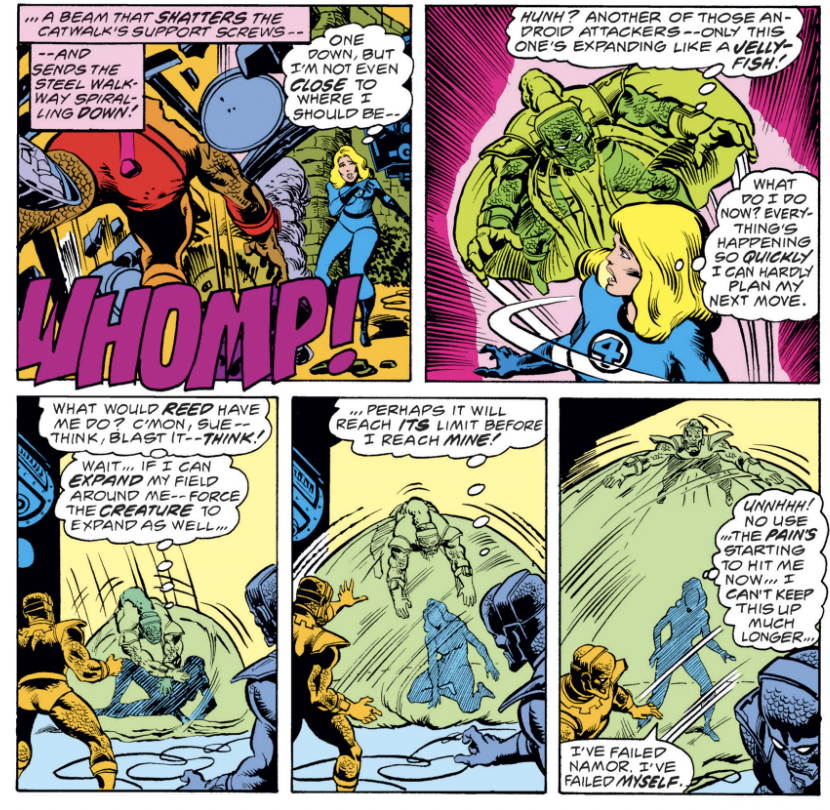
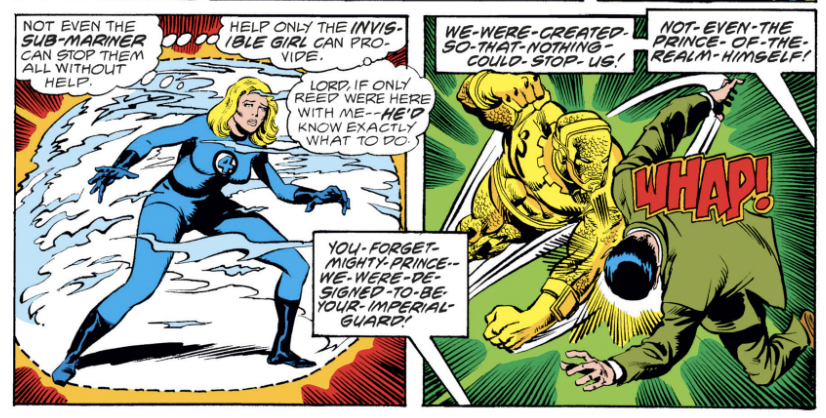
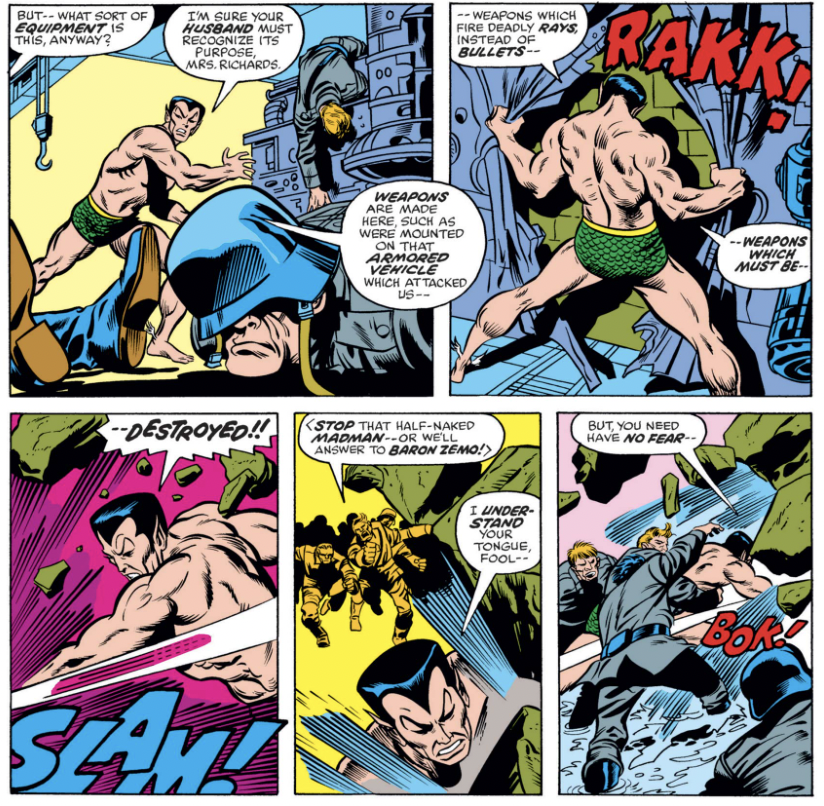
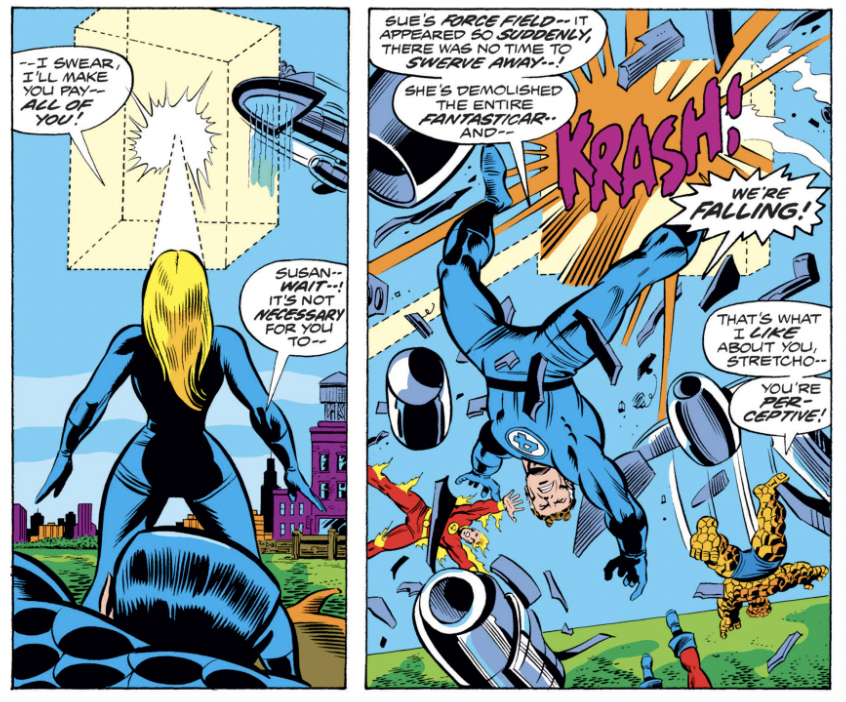
Sue gets to stretch herself in battle (although she’s still dependent on Reed, even in her own head):
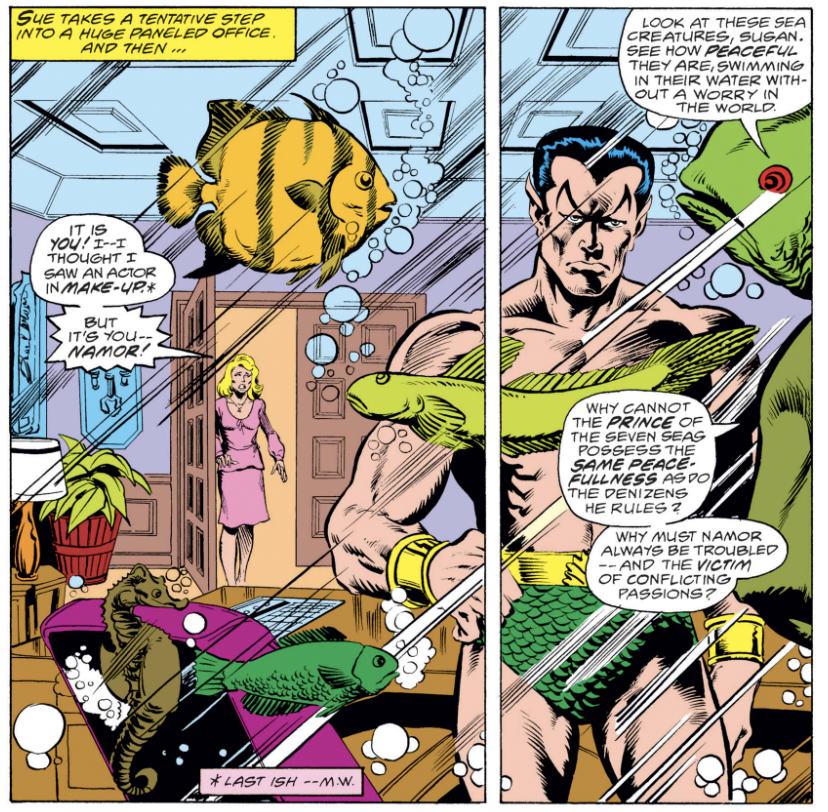
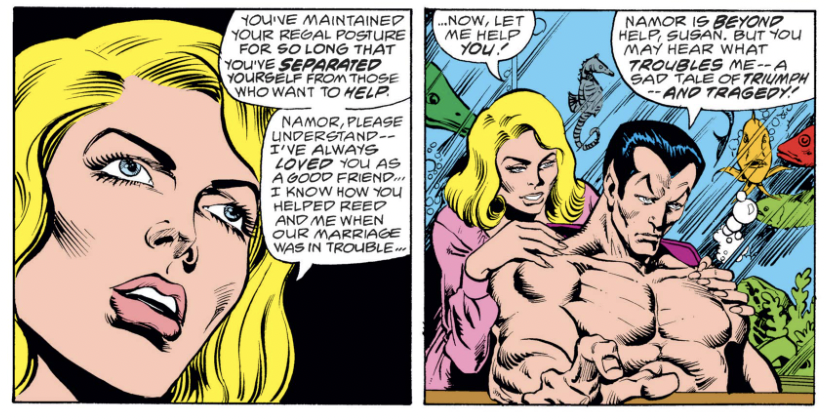
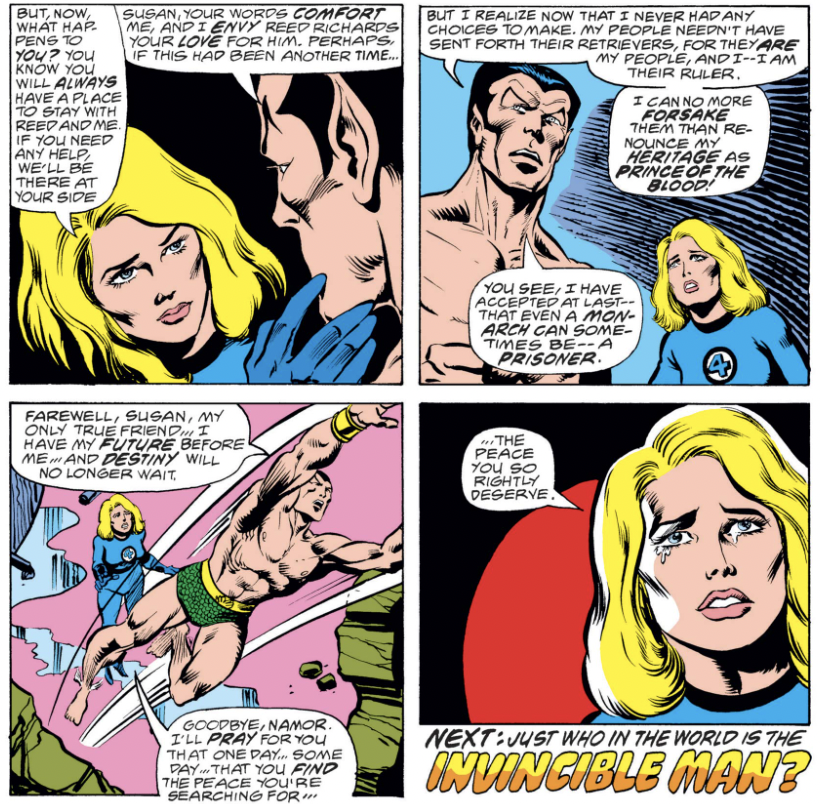
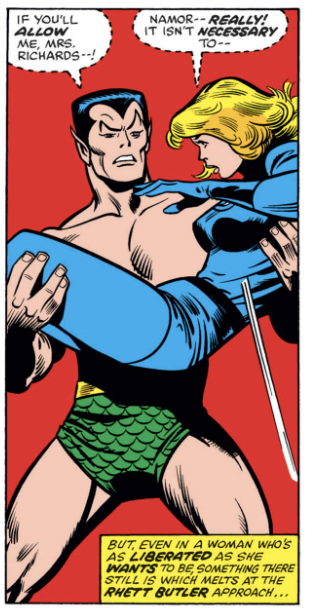
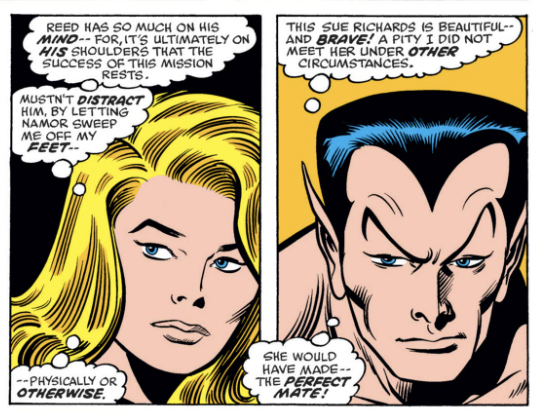
Sue and Namor are getting pretty cozy here:
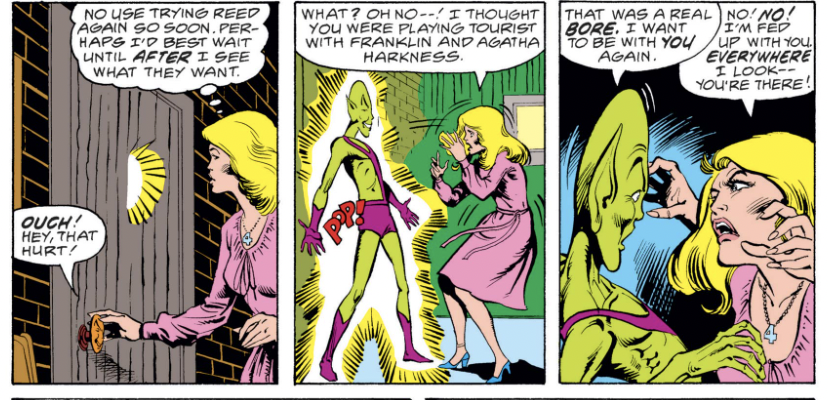
Here, Sue finally expresses how we all feel about the Impossible Man:
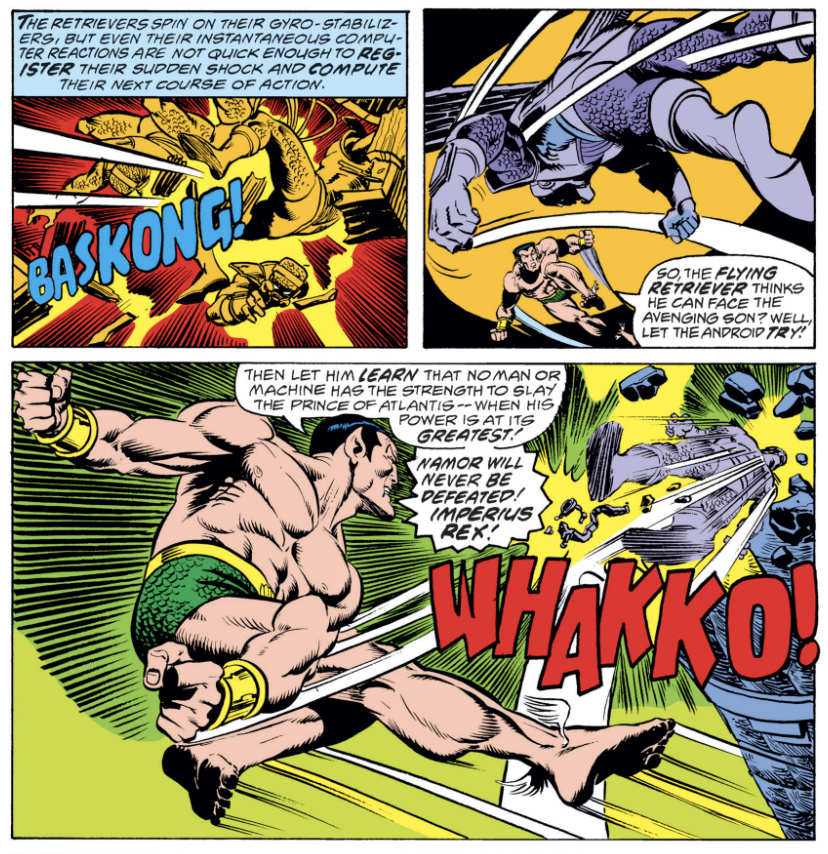
Lastly, there were some curious sound effects in this comic. Baskong!
What I didn’t like
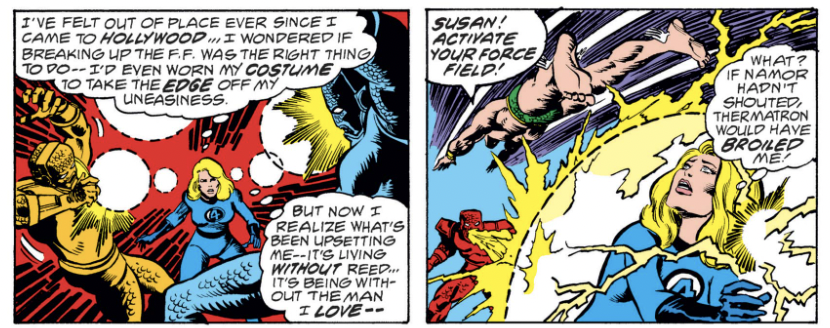
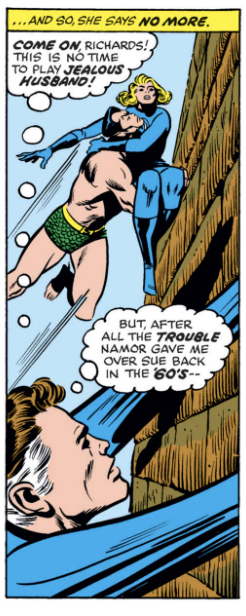
Following the (obviously temporary) break up of the FF, the powers-that-be decided to give them each solo stories. A fun idea, and yet despite that, Sue is stuck sharing her story with Namor. Worse, she’s either thinking about Reed or Namor during the entire issue. If comics had a Bechdel test, this one would fail utterly.
Here, in the middle of battle, she’s again wishing Reed was present:
And here, she’s so distracted thinking about her marriage she’s almost killed:
And the resolution, in which Namor does the robots’ bidding after all, is all about Namor, not Sue. For shame, Marv Wolfman, for shame.
Anything else?
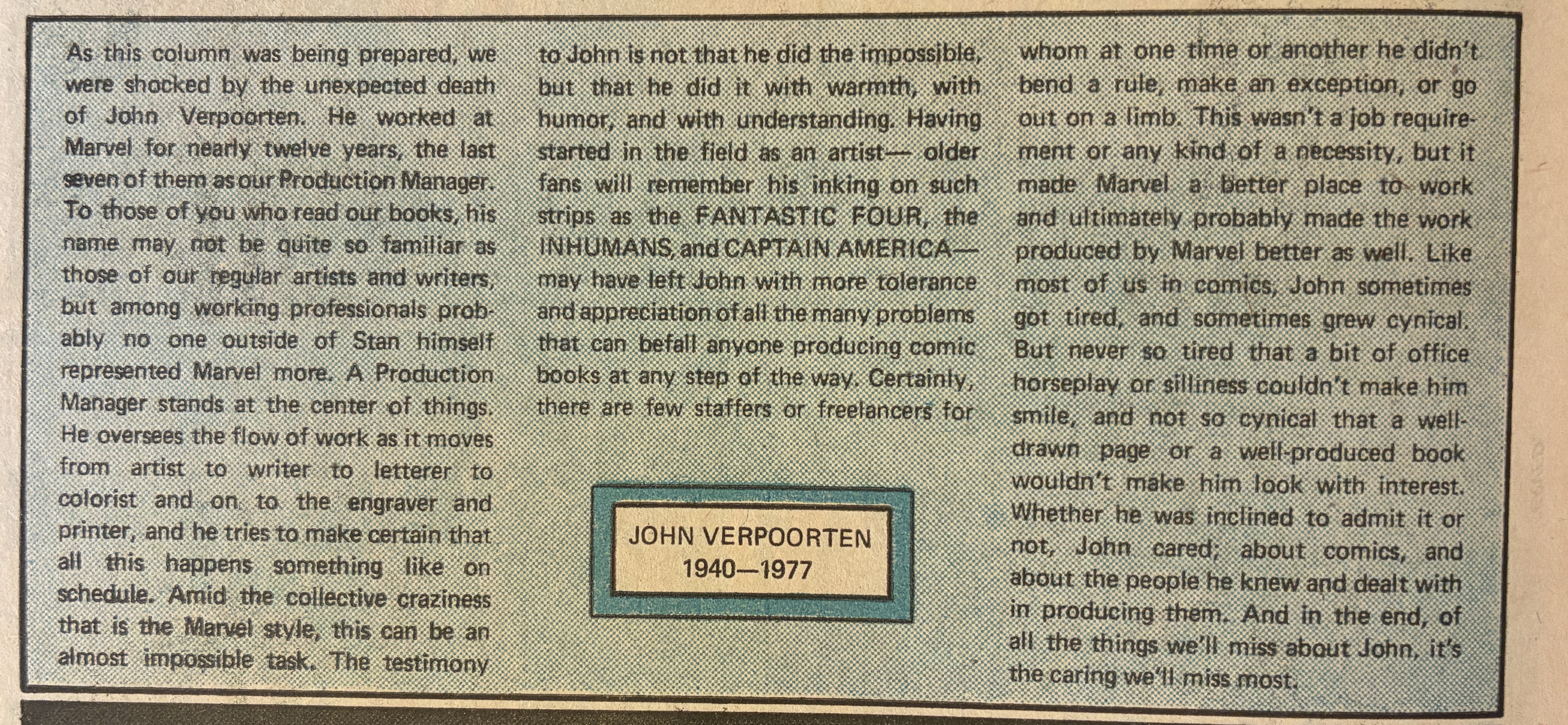
There’s a somber note in the Bullpen Bulletins about the sudden passing of John Verpoorten, who was an occasional FF inker, among his many other roles at Marvel.
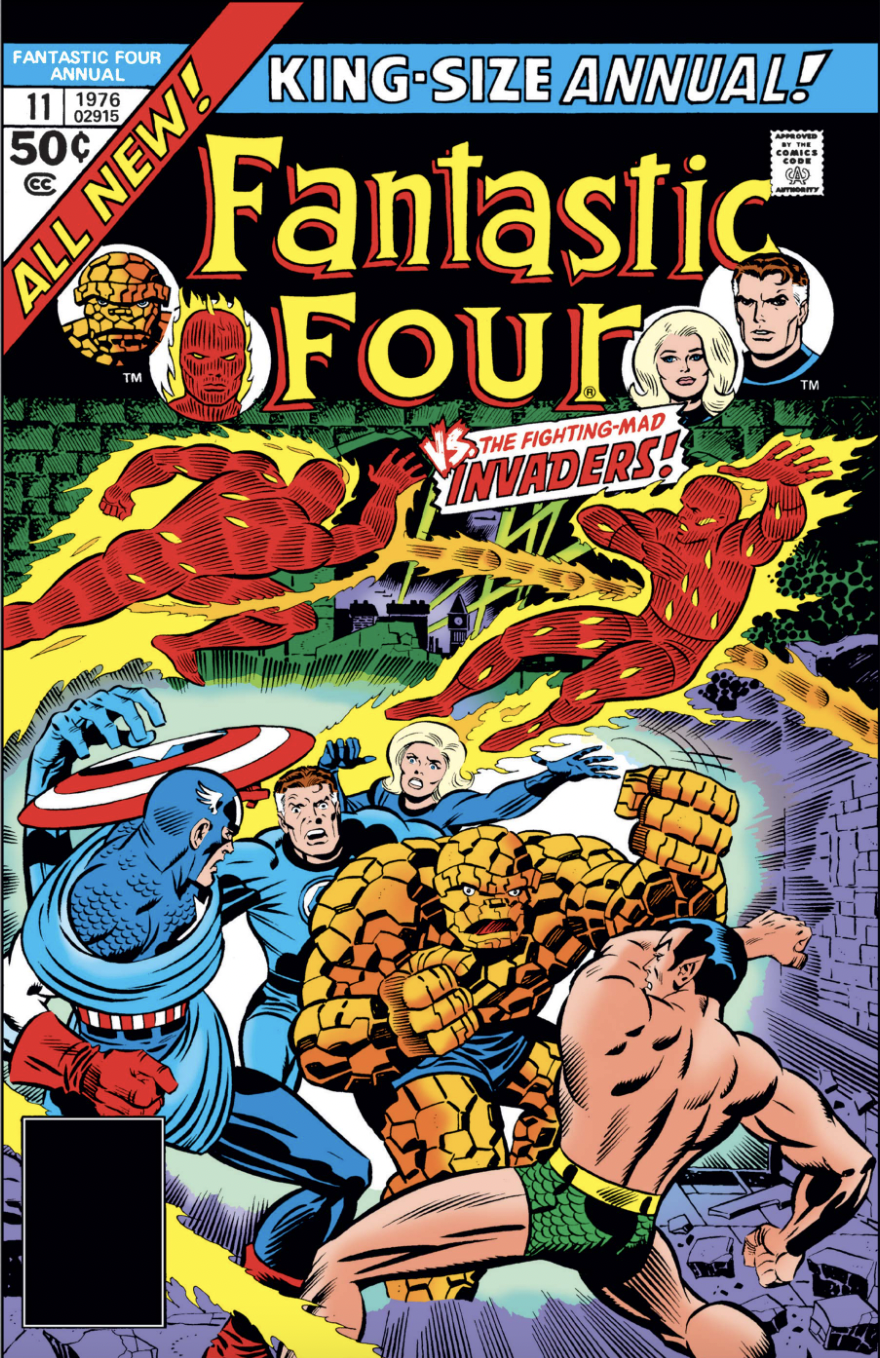
Fantastic Four Annual 11 “And Now Then the Invaders!” Published March 1976 Writer: Roy Thomas Pencils: John Buscema Inks: Sam Grainger Letters: Joe Rosen Colors: Phil Rachelson Editor: Thomas Cover: Jack Kirby and Joe Sinnott
Editor’s note: As I mentioned a while back, I am tackling this annual out of order, since it appeared after issue 170 and the end of the Power Man story arc. It’s basically a standalone story so it’s
Synopsis
After a training exercise in the Baxter Building, the Fantastic Four discovers they accidentally triggered Dr. Doom’s time machine, and sent back a sample of vibranium to 1942 Germany. As a result, the Nazis were able to build more accurate rockets and conquer the world. The FF travel back in time and joins the WW II super hero team The Invaders to storm Baron Zemo’s castle and thwart his plan to launch the souped up missiles at London. After recovering the vibranium and restoring history, the team returns but the Thing realizes not all the vibranium made it back.
What’s going on here?
This is a fun but uneven comic with a lot to unpack. Notably, it’s the first FF annual with new content since the great Fantastic Four Annual 6 way back in 1968 (there were some Giant-Size FF’s that served the purpose of annuals, although they appeared quarterly).
It’s also the first time the FF encounters the Invaders, a team invented by Roy Thomas that ret-conned a number of World War II-era heroes into a super team. (He may have based his idea on the All-Winners Squad, a Golden-Age comic with some of the same members, but that was released in 1946, after the war). The Invaders debuted in its own comic in 1975 and given all the times the FF comic was used goose the sales of other Marvel titles, it’s probably not too surprising Thomas engineered a cross-over between the two titles.
Thomas had a decades-long fascination with World War II super heroes. Along with the Invaders, he created the Liberty Legion, a sort of B-team led by Bucky that appeared in Marvel Premier. Later, at DC in 1981, he created the All-Star Squadron, a massive team that spun out of the Justice Society and contained just about every Golden Age DC character. Also at DC he created Young All-Stars, a post-crisis version of the All-Star Squadron (which theoretically no longer existed).
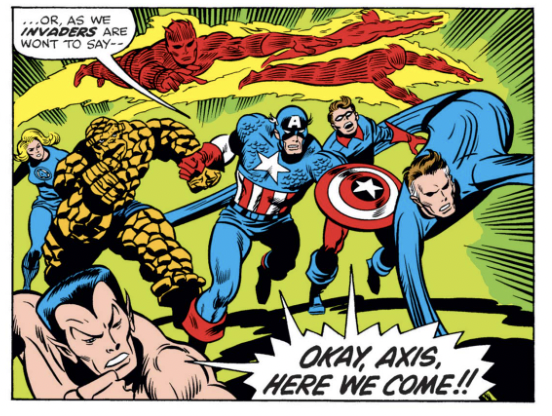
In typical Thomas-ian form, Fantastic Four Annual 11 is more convoluted than it needs to be, with lots of exposition and obscure call backs. But it’s also a rollicking read, with clever nods to the paradoxes of time travel and to the novelty of the FF reuniting with characters like Namor and the original Human torch.
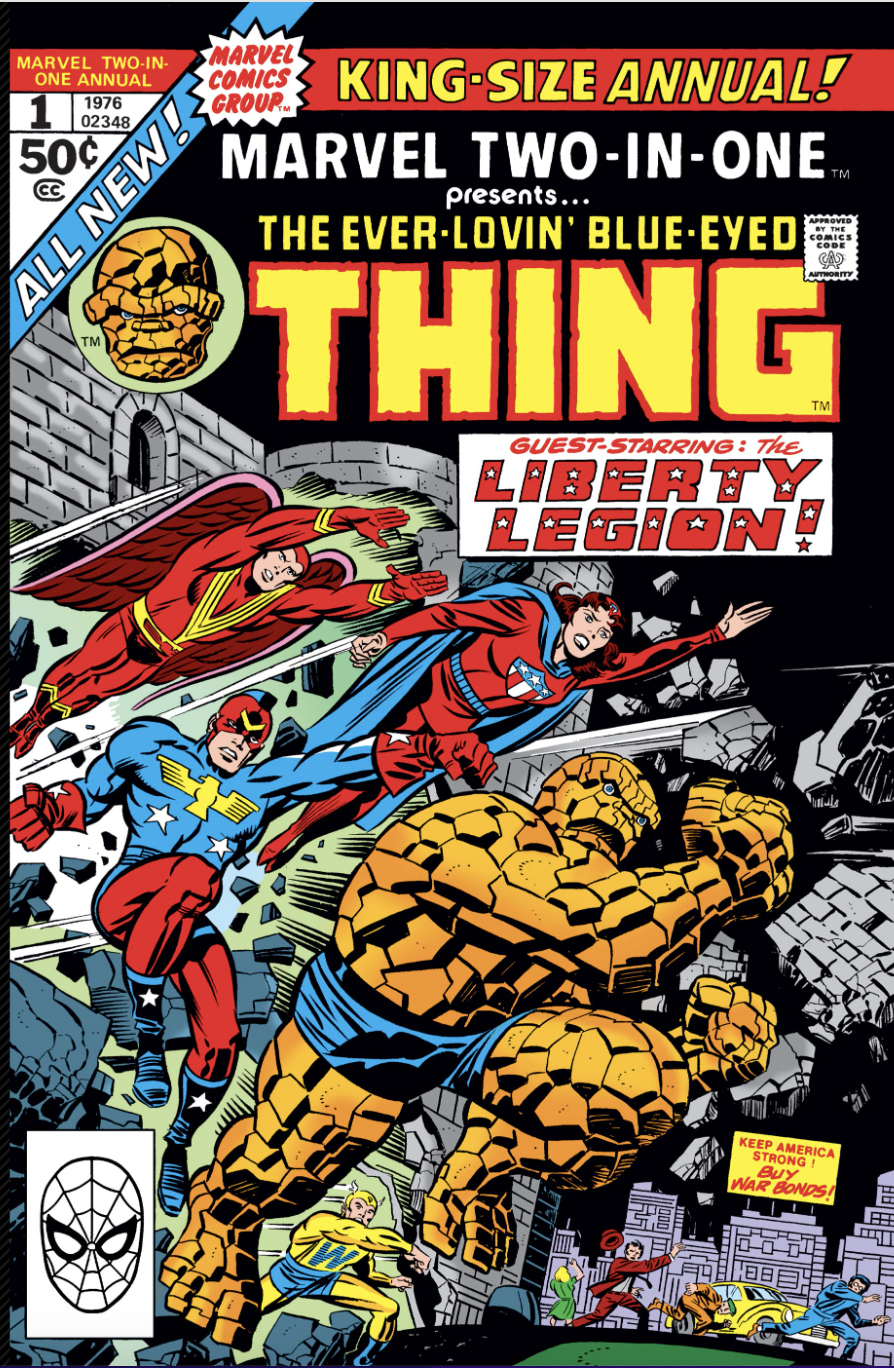
In a twist, the story ends on a bit of cliff-hanger, when Ben learns that he has to go back to World War II, a story which takes place in Marvel Two-In-One Annual 1 and features the Liberty Legion.
Fantastic Four Annual 11 is also the first and only work on the FF by inker Sam Grainger, over John Buscema’s pencils. Grainger, who had a two-decade career on titles from Charlton, Marvel, DC and First comics, does serviceable work here. The cover is by Jack Kirby and Joe Sinnott.
What I liked
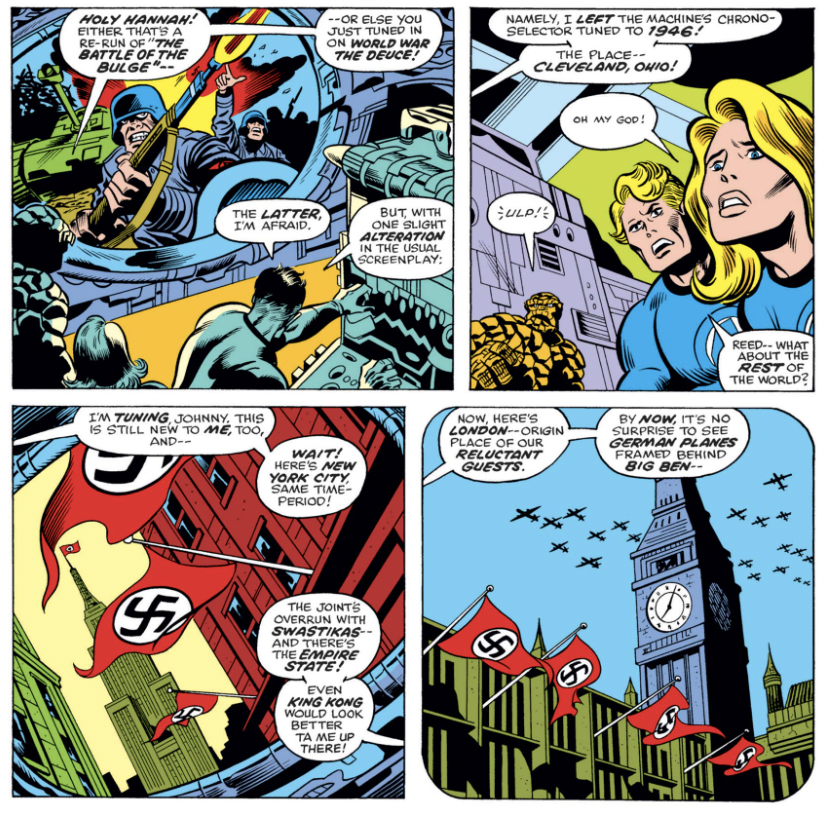
As a concept, the story works well. While the details are a little hard to swallow — the FF just happens to knock a tube of vibranium onto the time machine and they just happen to accidentally trigger it and send the tube back to 1942 where it just happens tp fall into the hands of Nazi scientists— the premise is fun. The idea that all Germany needed was more precise rockets with which to defeat Britain, and that vibranium was the one missing ingredient, is an intriguing one and nuanced enough to make the story more effective. It’s another entry in the long line of “What if Hitler won?” future histories covered by authors ranging from Len Deighton to Phillip K. Dick. The panels of the swastikas hanging in New York and London are chilling:
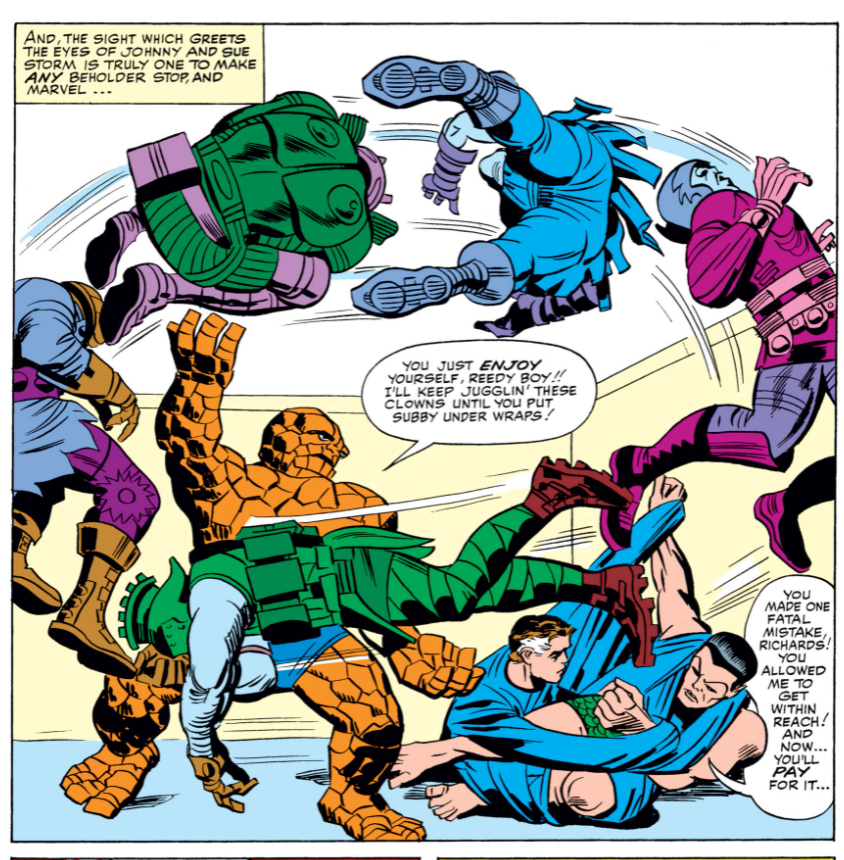
The story also reunites Sue and Namor, leading to some uncomfortable moments for Reed:
I also liked this sequence of Namor going all-out against the Nazis:
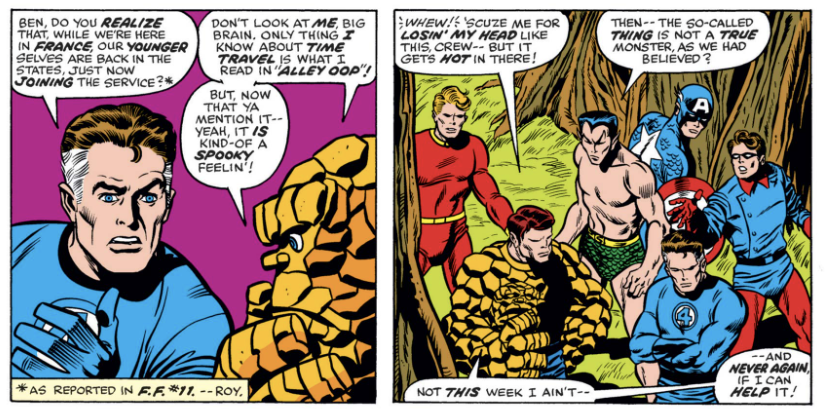
There is a lot of banter in this comic, some better than others. I liked this exchange between Ben and Reed, and Ben’s comments are poignant, given what we know is to come (note how different Reed looks when he isn’t inked by Joe Sinnott). “Alley Oop” was a newspaper comic strip.
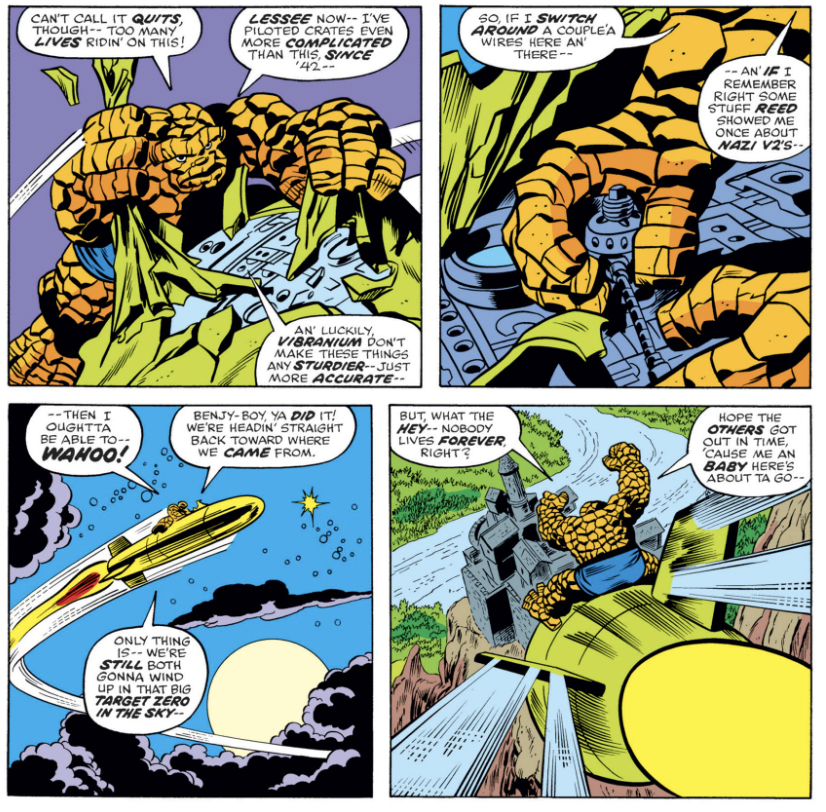
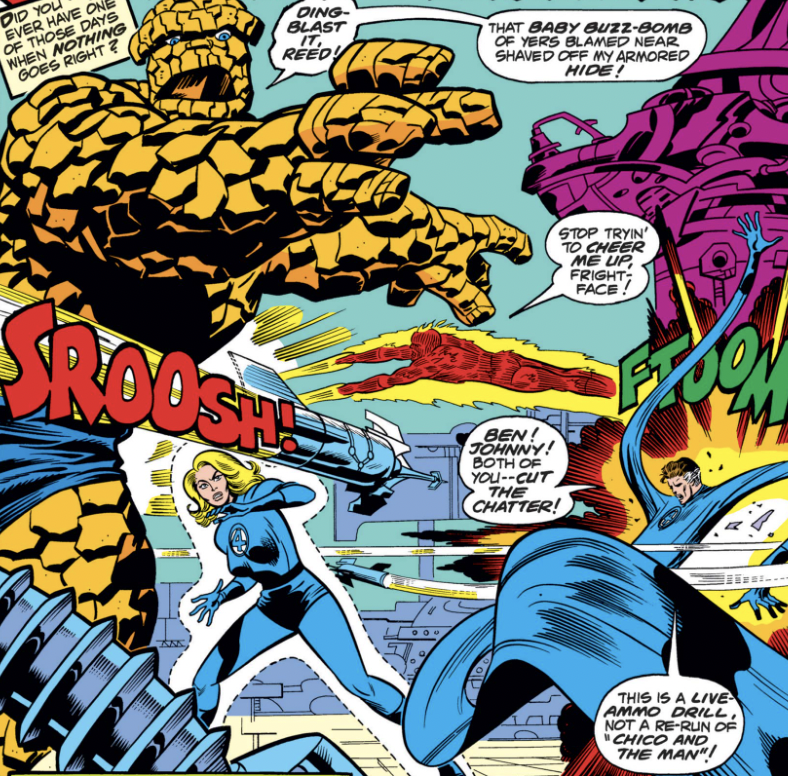
This climactic sequence was ridiculous but fun.
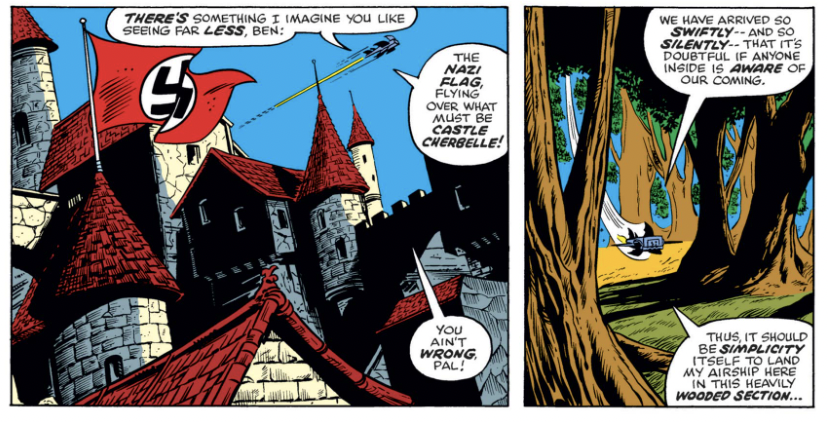
This is a nice series of panels from Big John Buscema:
What I didn’t like:
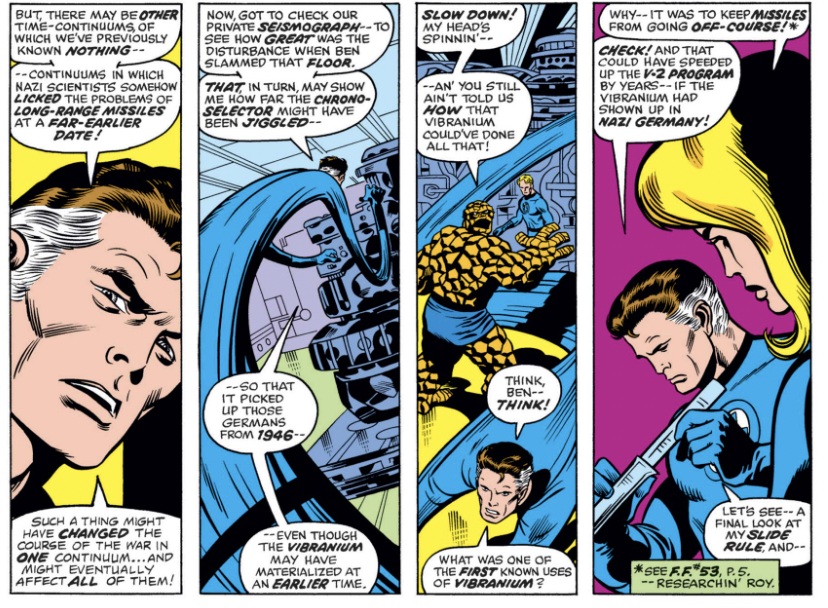
There is a lot of heavy-handed explanation in this comic. This sequence is an example:
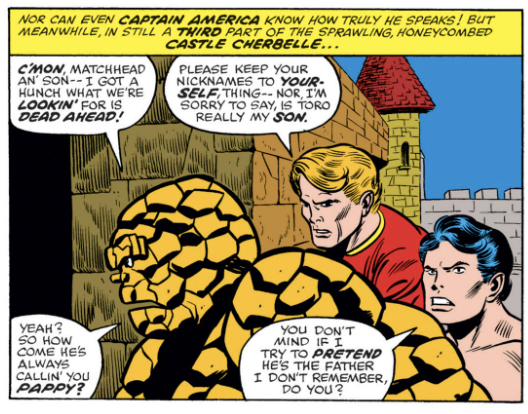
This was weird and awkward:
As I mention, not all banter is successful. Does Reed really watch Chico and the Man?
Anything else?
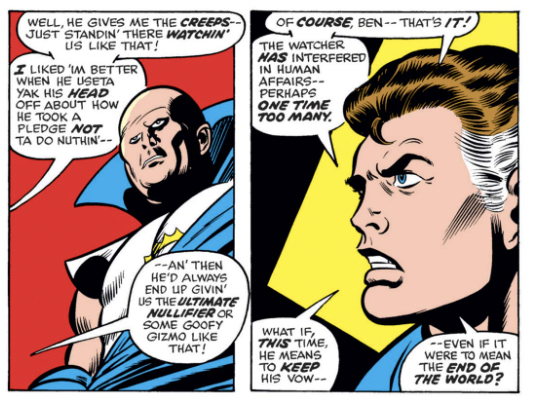
There are a few instances where Thomas seems to be poking fun. Here, Ben expresses what we all think about the Watcher, who seems to break his vow of non-interference more often than he upholds it:
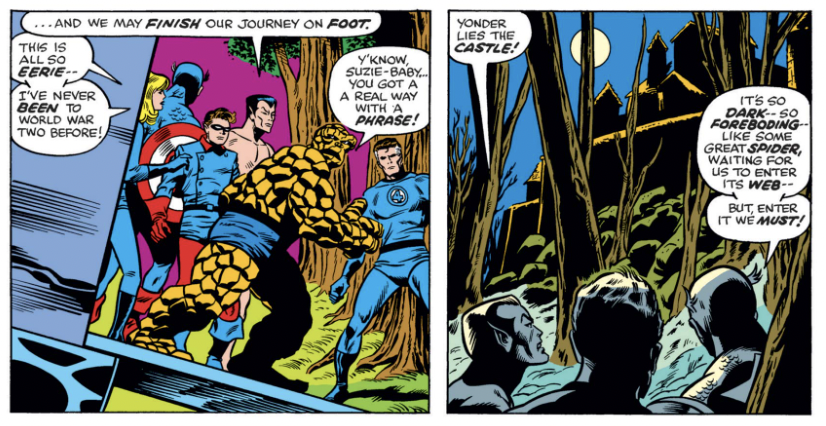
And here, alongside a totally inane comment from Sue, Namor seems to echo a line made famous by Tony Curtis, “Yondah lies the castle of my faddah” (although that appears to be an urban myth – Curtis never said that line).
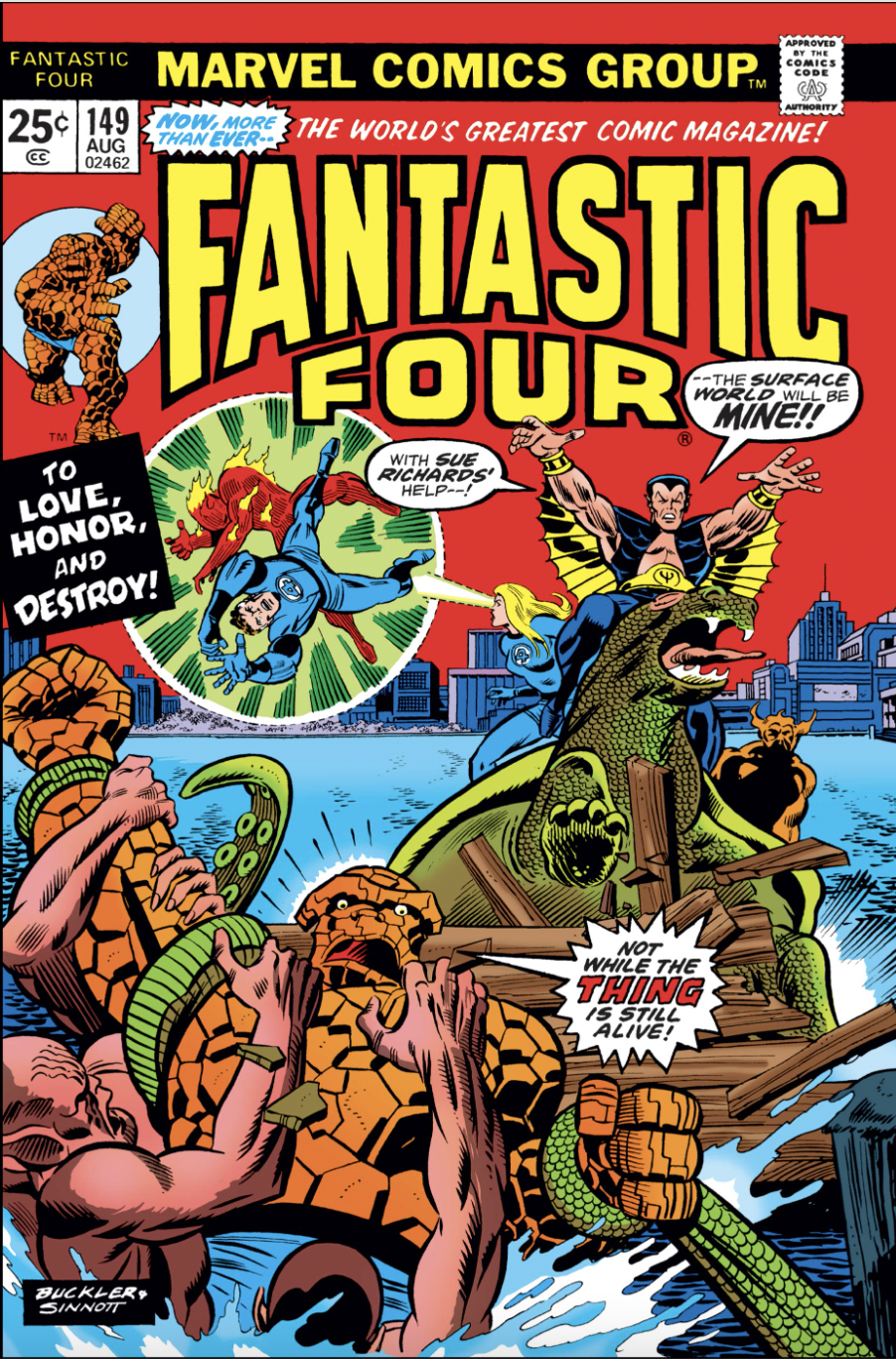
Fantastic Four 149 “To Love, Honor, and Destroy!” Published May 1974 Writer: Gerry Conway Pencils: Rick Buckler Inks: Joe Sinnott Letters: John Costanza Colors: Petra Goldberg Editor: Roy Thomas Cover: Buckler and Sinnott
Synopsis
The Sub-Mariner, with the Invisible Woman at his side, attacks Manhattan, ostensibly to avenge Mr. Fantastic’s treatment of Sue and their child, Franklin. After a long battle, the Thing convinces Sue to forgive Reed, and Namor’s attack is revealed to be a plot cooked by him and the Inhumans Medusa and Triton to bring Reed and Sue back together.
What’s going on here?
This is a really frustrating issue with a flimsy story doesn’t hold up to much scrutiny. It has the feel of a Julie Schwartz-era Silver Age comic, where a silly situation involving Lois Lane is revealed to be a scheme by Superman. Here, Namor’s invasion of the surface world was never a very convincing threat, because it was never fully explained, nor were Sue’s motivations for joining him. But it’s also not convincing that Namor would agree to take part in a elaborate plot to reunite Reed and Sue either. And Sue’s decision to forgive Reed doesn’t work, either (more on that later).
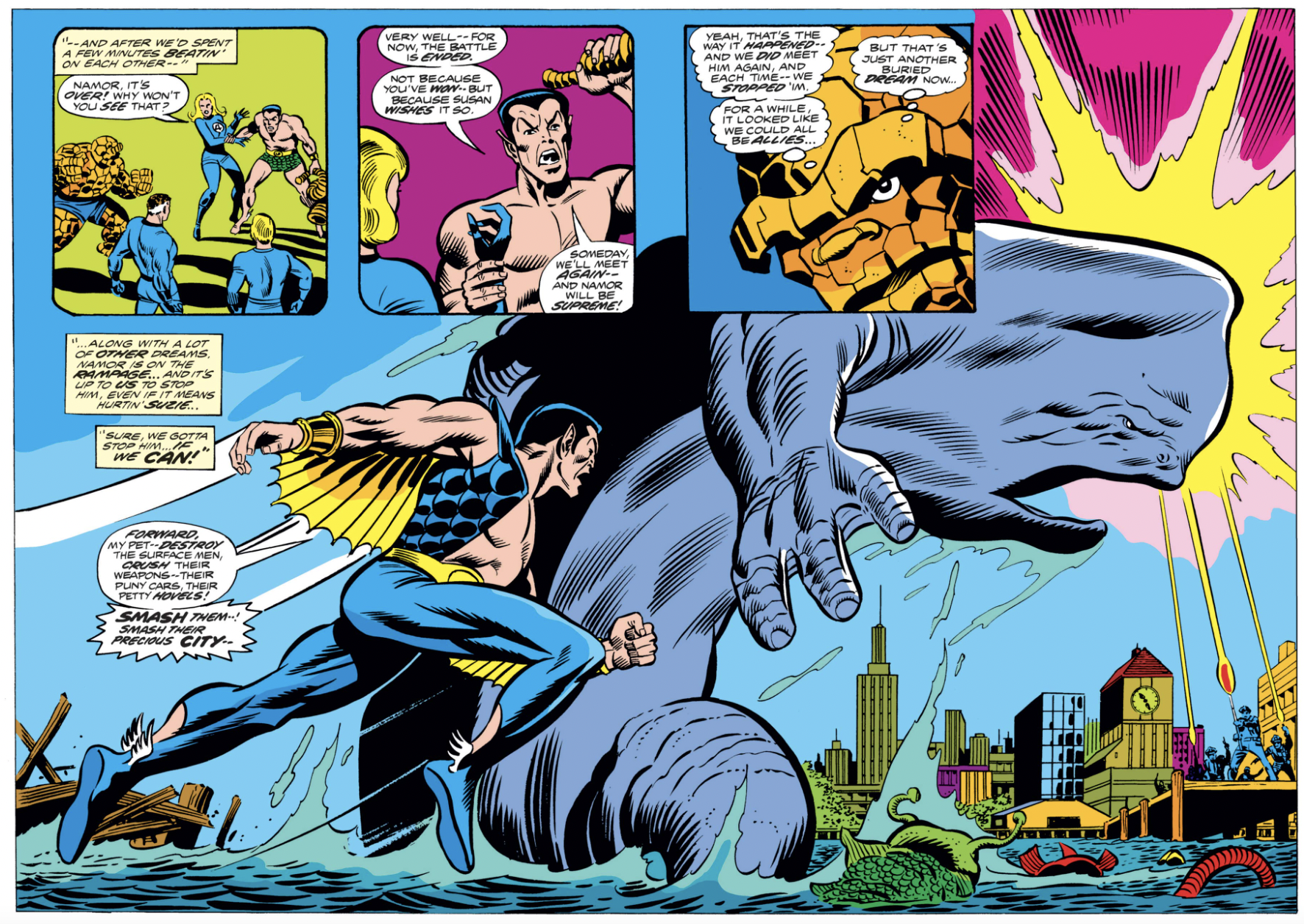
The comic is also padded with a long flashback of the FF’s first battle with the Sub-Mariner, and double-page spread that serves no real purpose other to take up space. The reconciliation of Reed and Sue deserved a better story than this gimmicky, ill-conceived nonsense.
What I liked
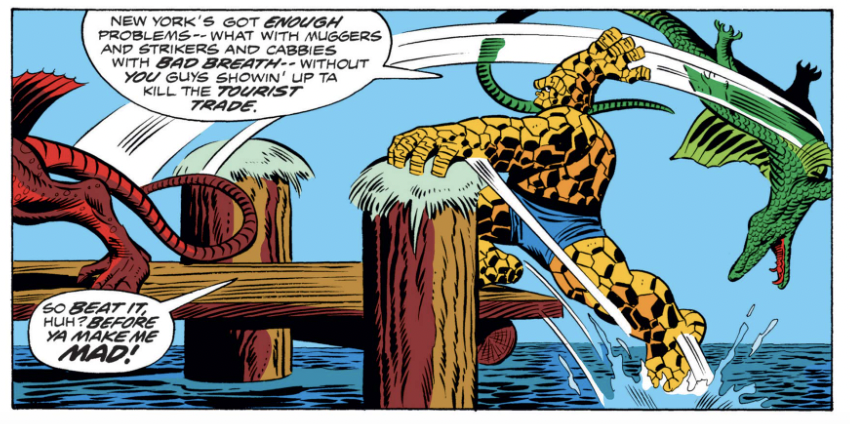
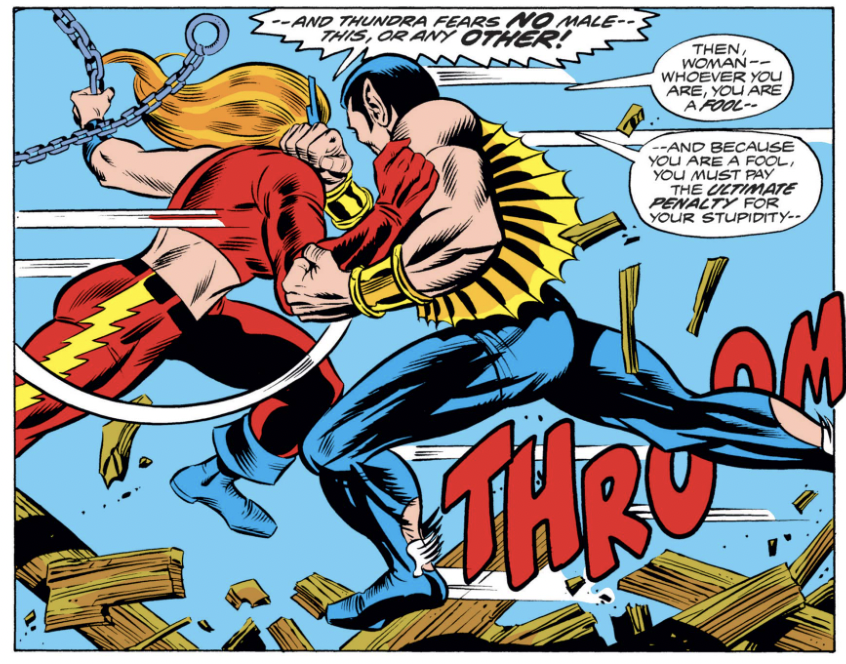
Suddenly, Thundra seems to be part of the team, or is at least tagging along until she can defeat Ben in combat. It’s not really clear what’s she doing here, but she’s a fun addition.
We haven’t seen much of Sue lately, so it was good to see her in action, and particularly using her powers to new and devastating effect.
What I didn’t like
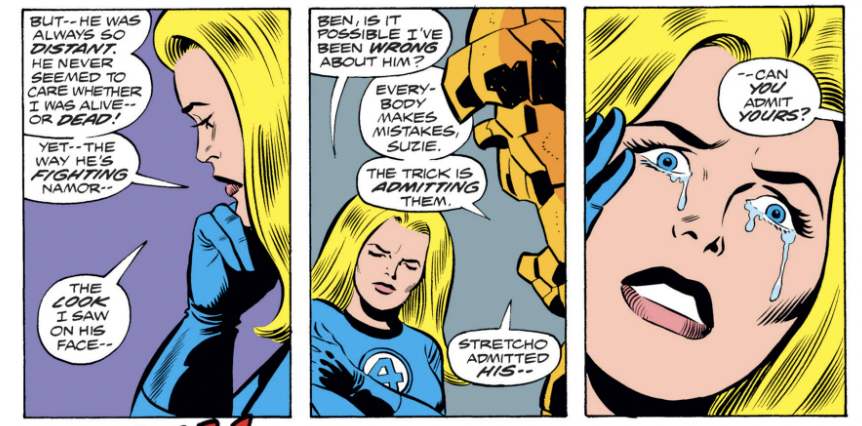
As noted above, the whole issue is a failure. But the biggest flaw is Sue’s decision to reunite with Reed, without Reed ever offering her an explanation or apology. Here,. Ben says Reed admitted his mistake, but did he? If so, it’s not in this issue and I don’t recall him ever telling that to Sue in the preceding issues.
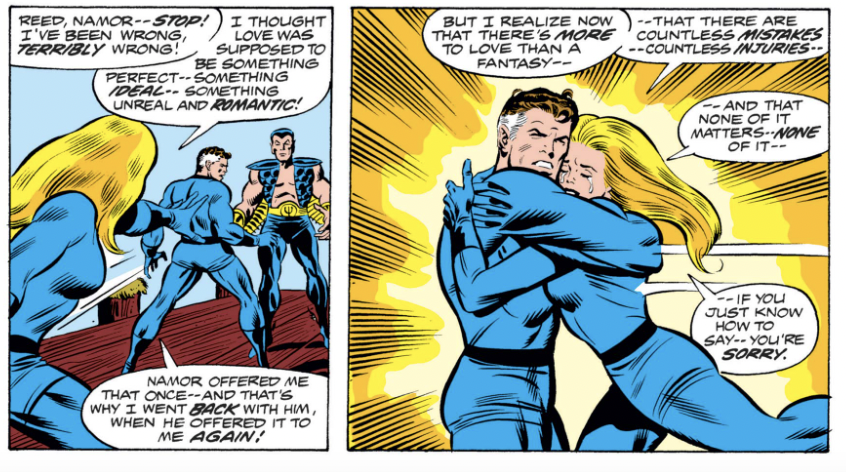
And despite that lack of admission of fault, Sue accepts Reed back by saying he knows how to say he’s sorry – which he never does!
Further, throughout all of this, there is no discussion of Franklin, whether he is still in a coma or vegetative state, or what Sue intended to do with him if she ran off with Namor. Was he going to grow up underwater? Go to Atlantean childcare? It all feels slapdash and rushed, as if Roy and Gerry needed to get Sue and Reed back together before the big 150th issue.
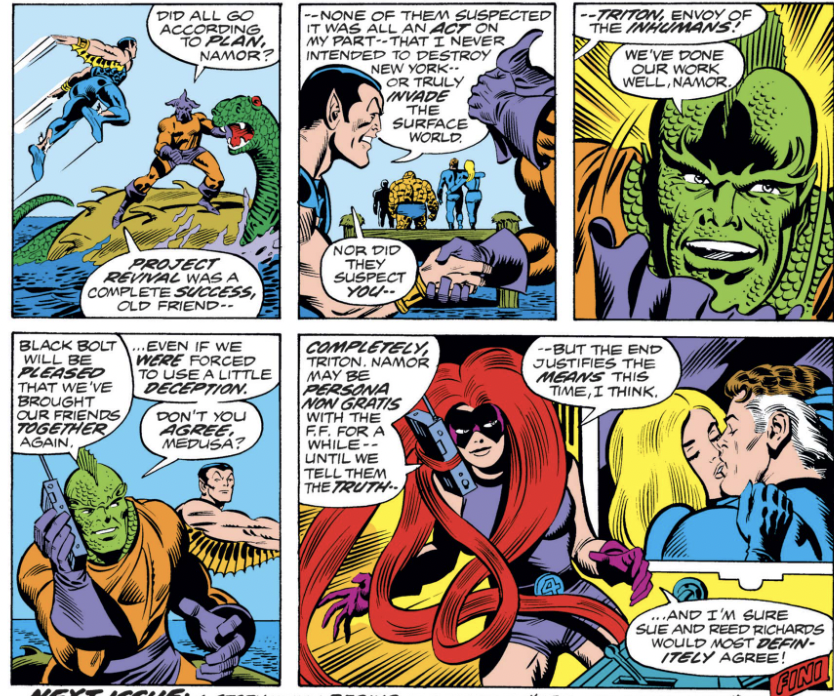
And the reveal at the end, with Triton pulling off his mask, had a goofy Scooby-Doo feel to it.
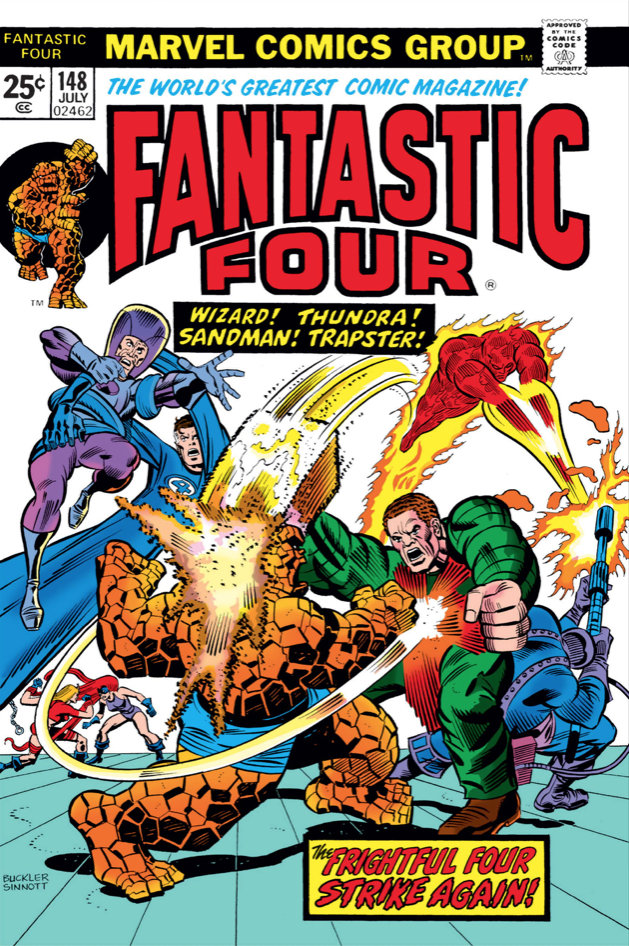
Fantastic Four 148 “War on the Thirty-Sixth Floor!” Published April 1974 Writer: Gerry Conway Pencils: Rich Buckler Inks: Joe Sinnott Letters: Artie Simek Colors: Linda Lessmann Editor: Roy Thomas Cover: Bucker and Sinnott
Synopsis
The Fantastic Four return from last issue’s battle with the Sub-Mariner to the Baxter Building, where they are attacked by the Wizard, Sandman and Trapster. The battle is turned when Thundra shows up to aid the FF. The issue ends with Namor seemingly invading New York, accompanied by the Invisible Woman.
What’s going on here?
There’s a tension in comic books between the silly and the realistic. A lot of fans love the nutty stories from the Silver Age, where science and logic is abandoned for goofy fun. Other fans prefer stories grounded in reality, where real-world consequences of comic stories are borne out in often grim or disturbing ways. Readers of this blog probably recognize I’m somewhere in the middle; I love the fun energy of comics that are unconcerned with practical concerns, but I like at least some pretense of explanation and structure. When plots are too unhinged, I get annoyed and lose interest.
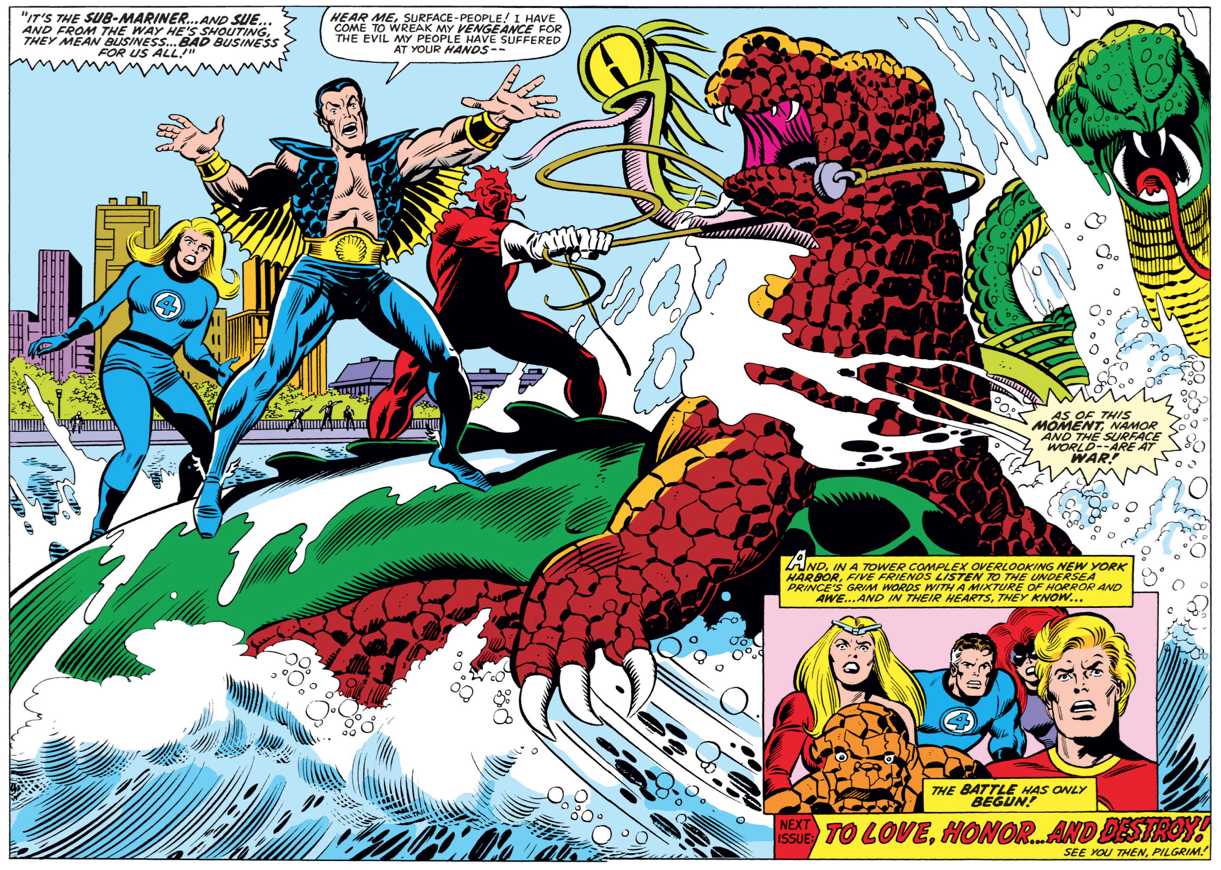
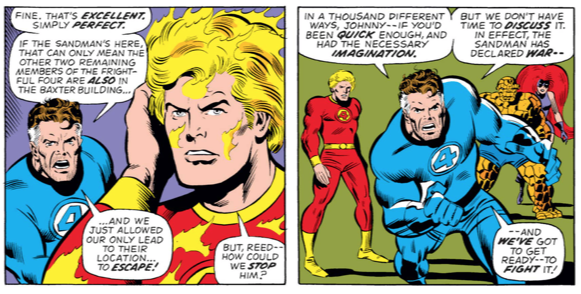
Fantastic Four 148 is squarely on the goofy side of the ledger. There’s not a lot in this comic that makes a lot of sense, from the random attack of the Frightful Four (Frightful Three?) to Thundra’s unexplained appearance to the out-of-nowhere double-page splash attack by Namor. But despite all that, the story is a lot of fun. It’s pretty much just a series of battles between FF members and the Wizard, Sandman and Trapster, in which they pair-off in various combinations and fight. There’s not a ton of plot involved, and the bad guys’ motivation is simply revenge, but it’s never boring and Buckler brings his high-energy style to it all.
What I liked
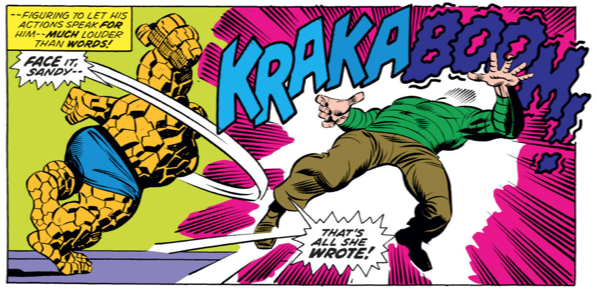
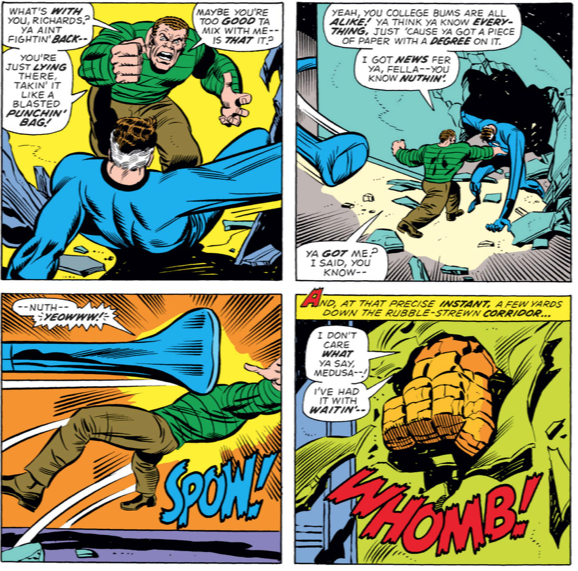
Along with the aforementioned fightin’, there were a few smaller moments I enjoyed, such as this sequence with the sandman running his mouth about Reed’s lack of street smarts, while Reed is out-smarting Sandy by sneaking his arm behind him.
I also thought this was a cute panel:
What I didn’t like
I’ve grumbled before about how Conway almost reflexively reaches into the Stan and Jack bag of tricks when he needs a plot device, and the Namor-invades-the-surface-world plot is a textbook example. We’ll see how this plays out (I’m guessing he doesn’t succeed) and how and when Sue’s estrangement from Reed is resolved, but so far it seems pretty uninspired as a storyline.
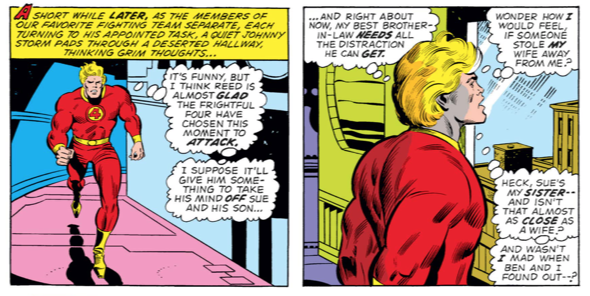
It’s also worth remembering Conway was very young when he wrote these comics, and while it’s not always evident, occasionally there’s an odd turn of phrase or idea that an older writer might have avoided, like this stray thought from Johnny about how having a sister is like having a wife:
(also, he’s crazy muscular in that left image)
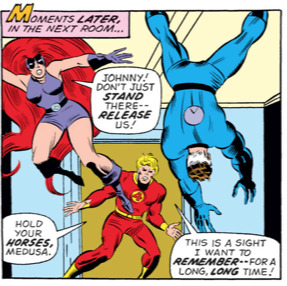
When I started this blog, I had a recurring item I called “Reed Richards is a Jerk” (a play on my favorite line from Kitty Pryde), in which I showed panels of Reed being, well, a jerk. This would have been a very good example:
And while I’ve mentioned this many times, but once again, Medusa has almost no role in this comic, which seems a real waste of potential.
Anything else?
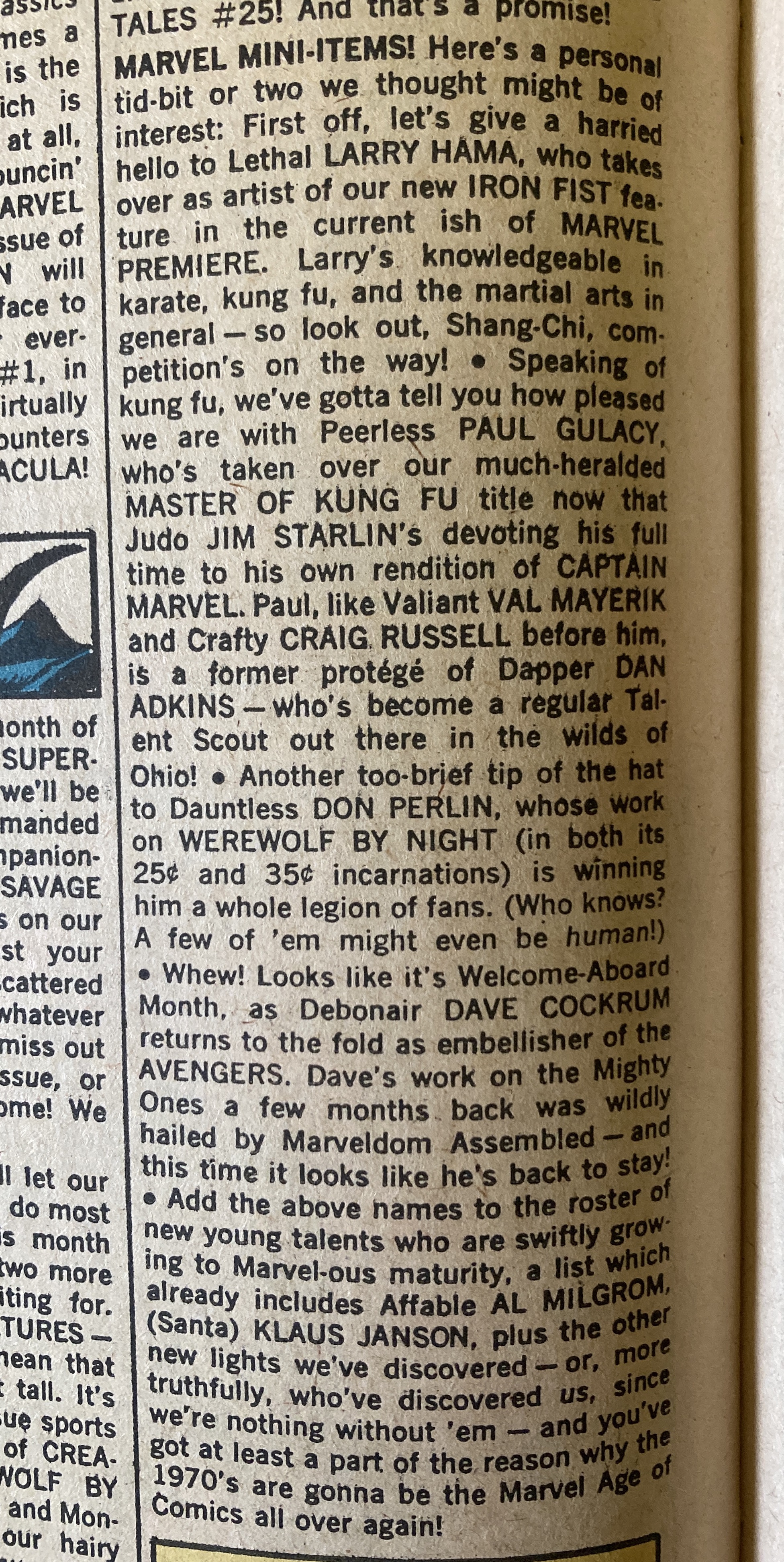
Lots of new names in this Bullpen Bulletins team who would go on to have a huge impact on Marvel and comics in general, among them Larry Hama, Paul Gulacy, Dave Cockrum, Al Milgrom and Klaus Janson.
This ad is another example of what seems to be an ongoing confusion in the ad sales department about who was reading comic books. Were there a lot of car owners and aspiring mechanics reading these things?
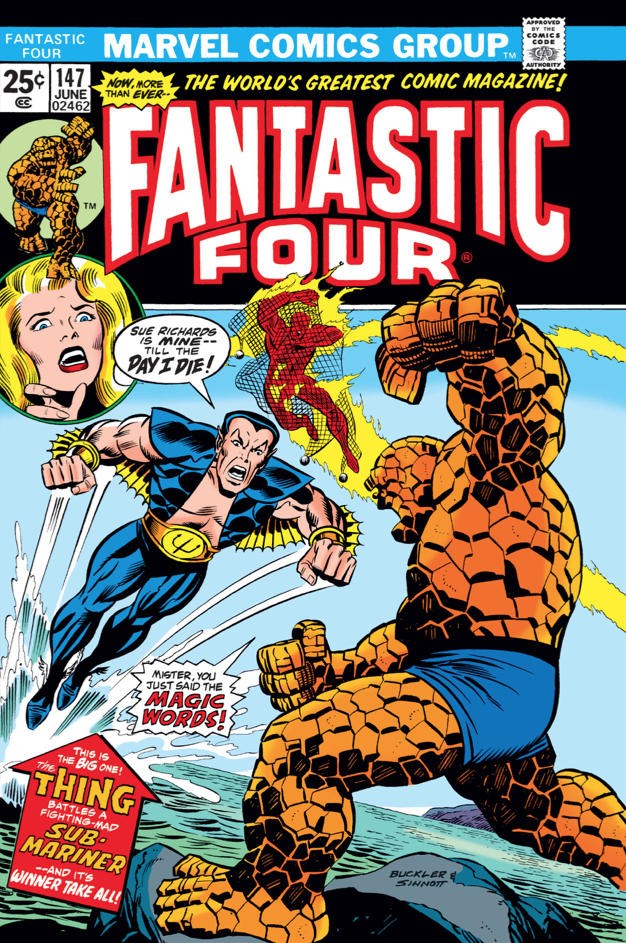
Fantastic Four 147 “The Sub-Mariner Strikes!” Published March 1974 Writer: Gerry Conway Pencils: Rick Buckler Inks: Joe Sinnott Letters: Artie Simek Colors: Linda Lessmann Editor: Roy Thomas Cover: Buckler and Sinnott
Synopsis
After their adventures in the Himalayas, the Thing, Human Torch and Medusa return to find a distraught Mr. Fantastic with divorce papers filed by the Invisible Girl. When Ben and Johnny fly to Pennsylvania to confront Sue, they are attacked by the Sub-Mariner, who they later learn has abducted Sue and Franklin. The team then mounts an attack on Namor’s underwater citadel, only to learn Sue joined him of her own volition.
What’s going on here?
This issue marks the return of artist Rick Buckler, which is a good thing, mostly (more on this later). It’s also the first issue colored by Linda Lessmann, a new Marvel colorist.
The story fits neatly in the established narrative of Reed and Sue’s unraveling marriage, which really began in FF 130, when Sue left Reed with Franklin, but accelerated in FF 141, when Reed zapped Franklin into a vegetable-like state to prevent his powers from destroying the world. To Gerry Conway’s credit, he has kept the sub-plot bubbling in the background, so readers were well prepared for the bombshell revelation of Sue filing for divorce. Unfortunately, the story deteriorates from there.
What I liked
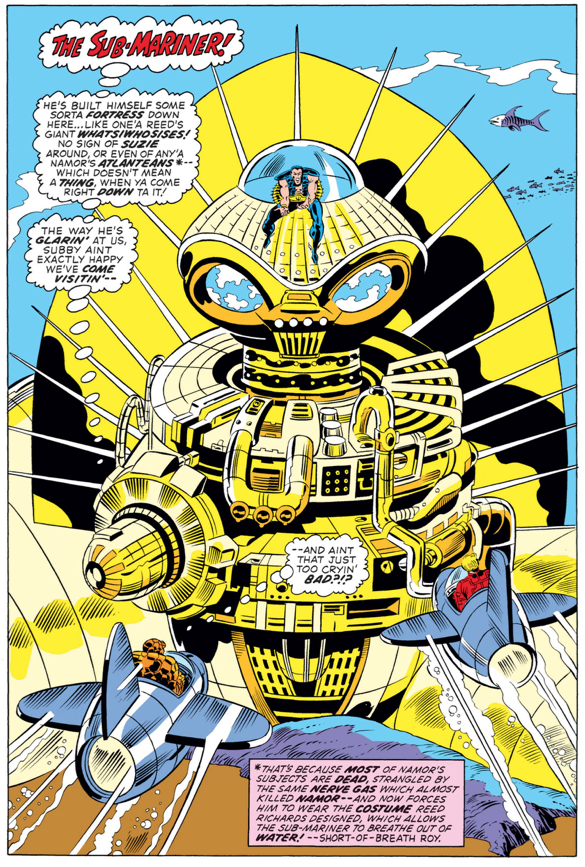
Buckler has a bold style and likes big panels and splash pages. Here, he gives us two, including a very Kirby-esque design of Namor’s underwater lair.
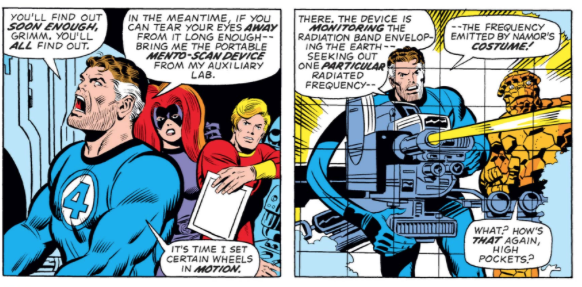
We also get a a lot of cool, sci-fi type stuff that has made the FF just a fun read over the years. Mento-scan device, anyone?
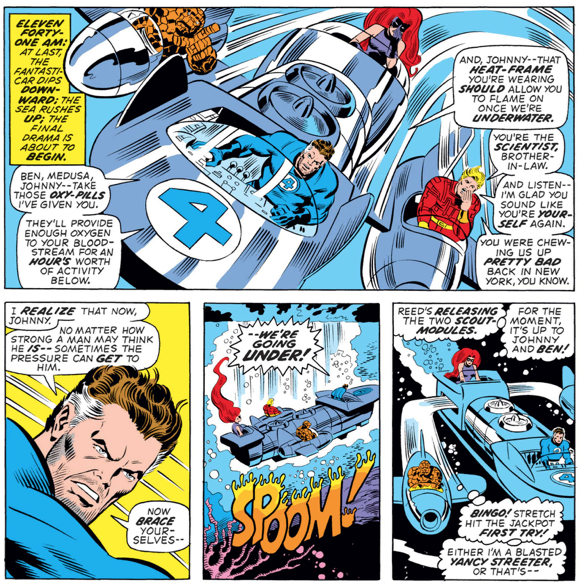
And Reed’s lengthy explanation of how they are going to fight underwater makes sense, I guess?
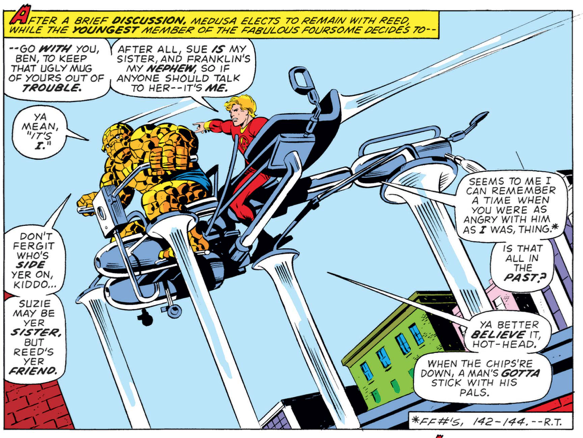
I also liked Ben correcting Johnny’s grammar.
What I didn’t like
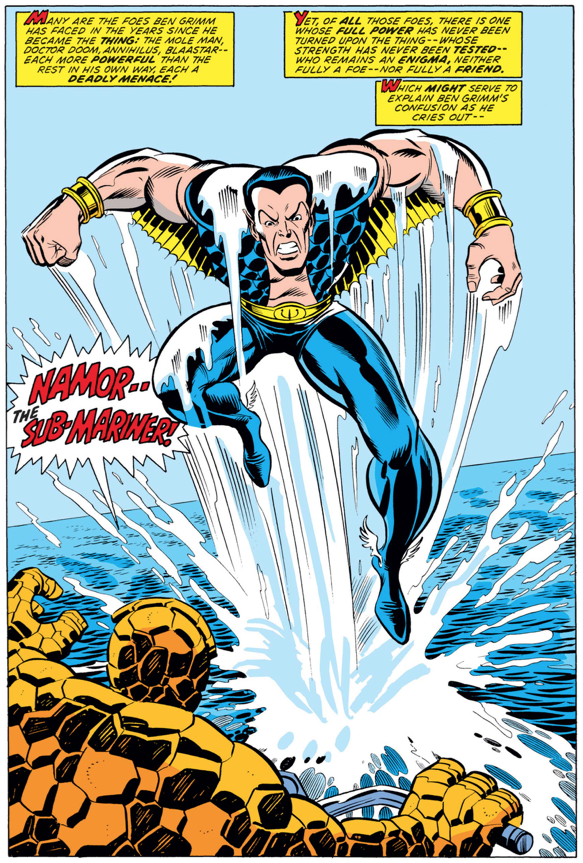
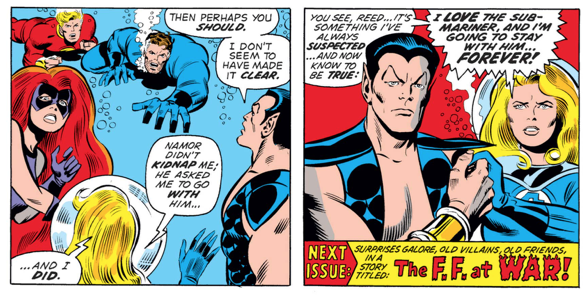
The introduction of the Sub-Mariner into the plot feels like lazy writing and a deliberate attempt to reclaim some of the old Lee / Kirby magic. Since Sue and her background is so thinly developed, writers like Conway seemingly have no choice but to resort to Namor whenever Sue is questioning her marriage. There’s an implied sexism here, that Sue couldn’t have any reason to want to leave Reed except for another man. Sue is basically invisible in this issue, which is ostensibly about her, and features a bunch of men fighting over her (Medusa, too, is basically ignored). The first time Sue speaks is in the final panels:
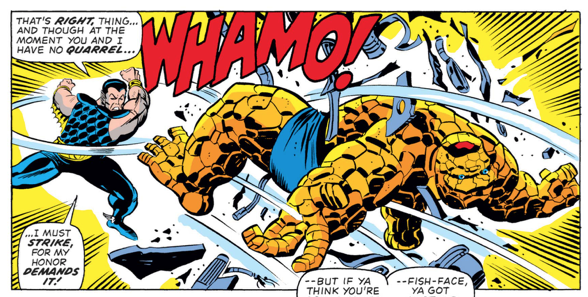
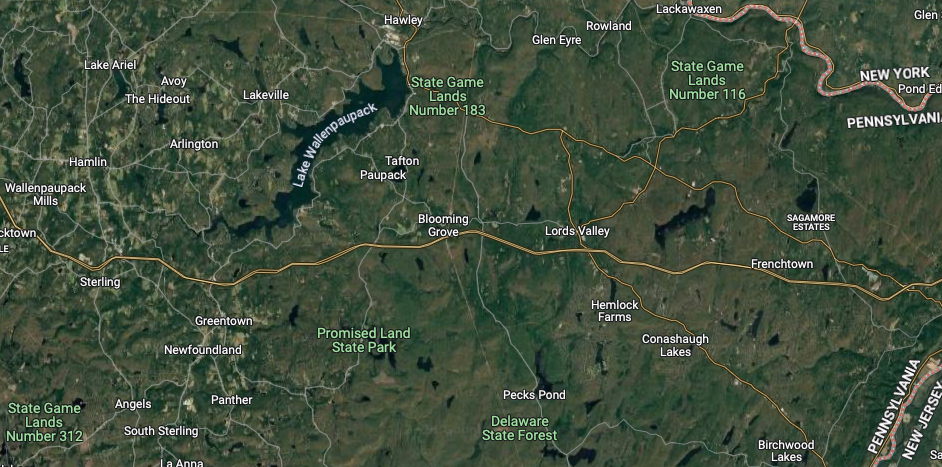
The fight between Ben, Johnny and Namor feels pro forma, and geographically implausible, since Pennsylvania does not have an abundance of large lakes. Maybe they fought over Lake Wallenpaupack?
We’ll see how the story resolves but this Reed-Sue Namor love triangle feels contrived and overly familiar.
Also, there’s an unevenness to Buckler’s art in this issue, particularly in this sequence:
Anything else?
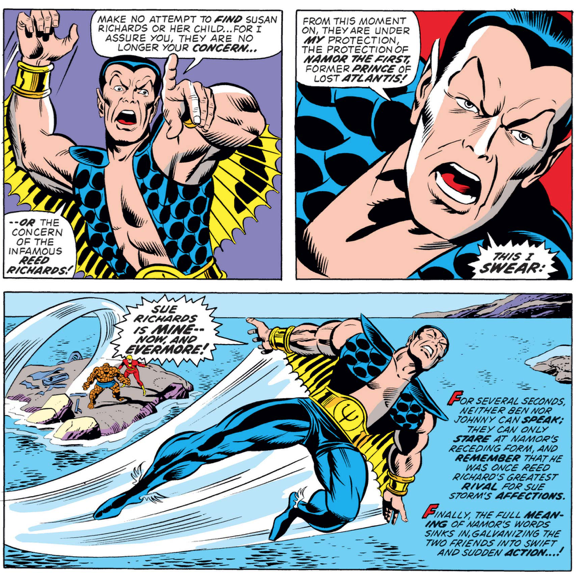
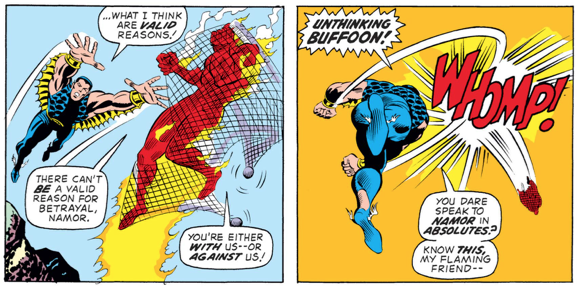
Star Wars fans might recognize this exchange, since a version of it appears 31 years later in the Revenge of the Sith (minus the “unthinking buffoon” line, which would have been fun):
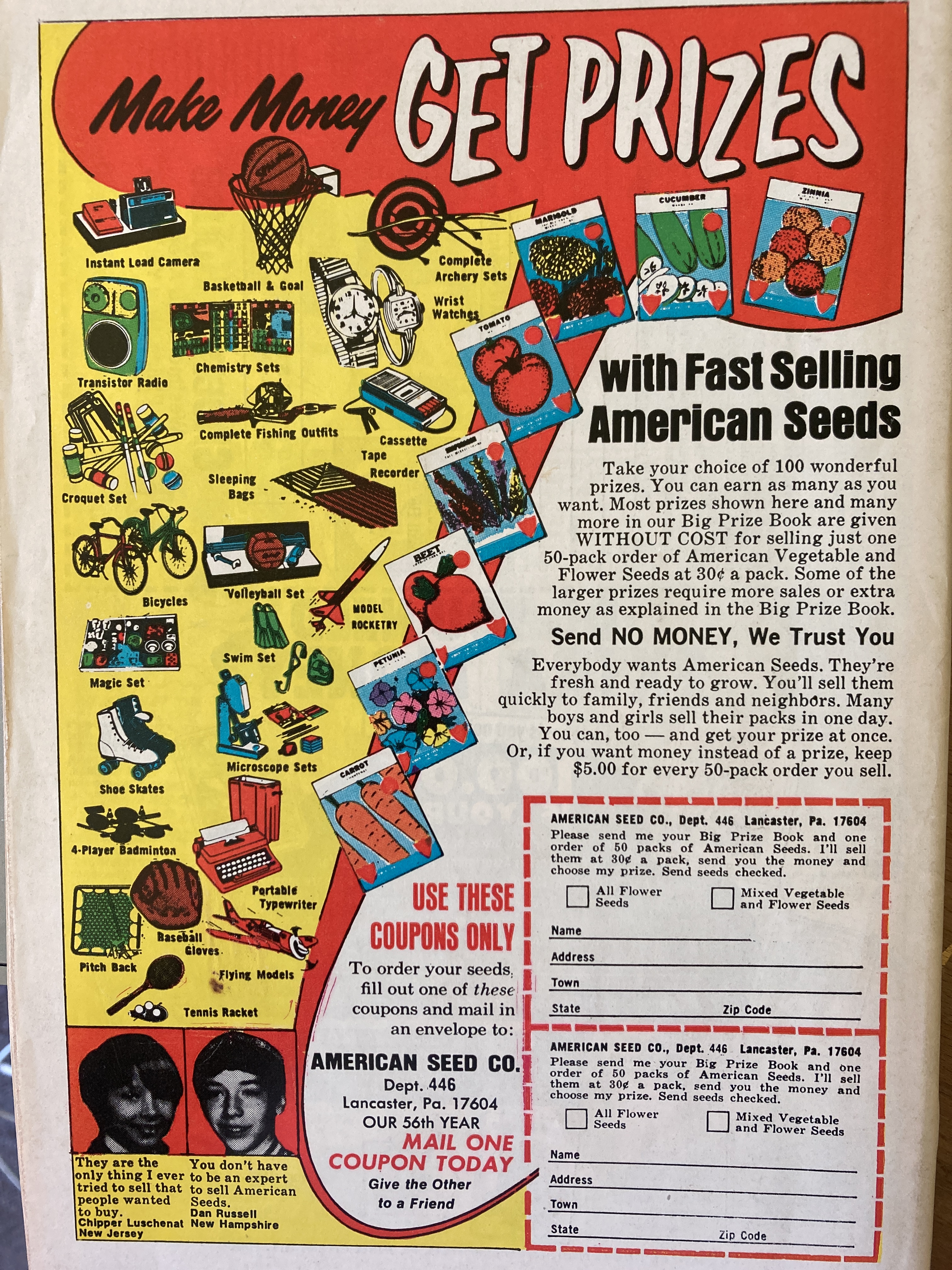
Whose idea was it to recruit comic book readers to sell gardening seeds? Do kids know anything about how to grow petunias and pansies?
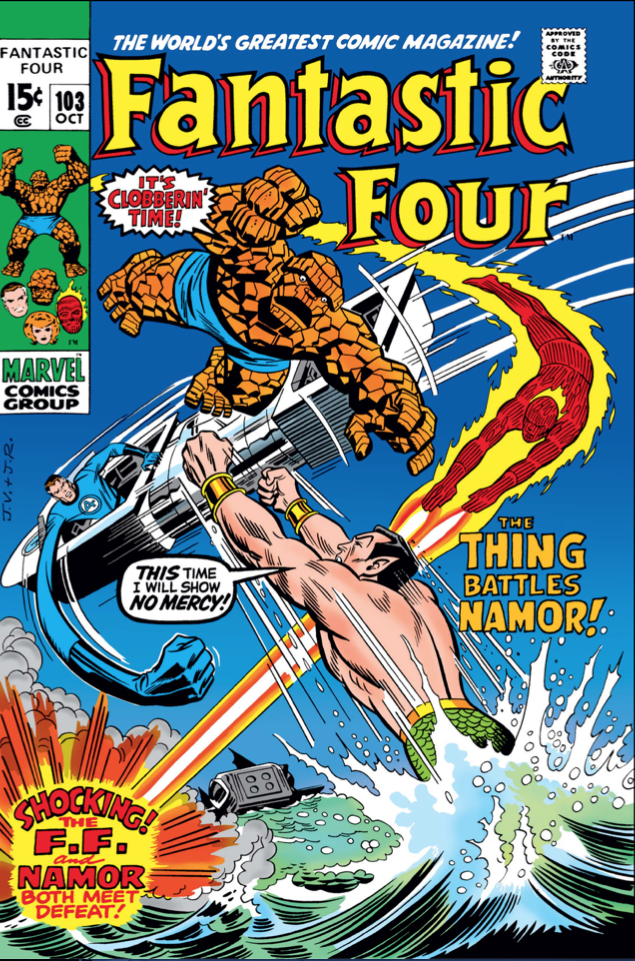
Fantastic Four 103 “At War With Atlantis!” Published: July 1970 Story: Stan Lee and John Romita Script: Lee Pencils: Romita Inks: John Verpoorten Letters: Sam Rosen
Note: I’m back! After taking the summer to mourn Jack Kirby’s departure from the Fantastic Four, I plan to resume regular weekly blog service. You may notice some changes in the format; basically I’m trying to streamline the writing process and make it more efficient so I can continue doing this. But hopefully nothing will be too jarring. As always, let me know if you have ideas or suggestions. Onward!
Synopsis
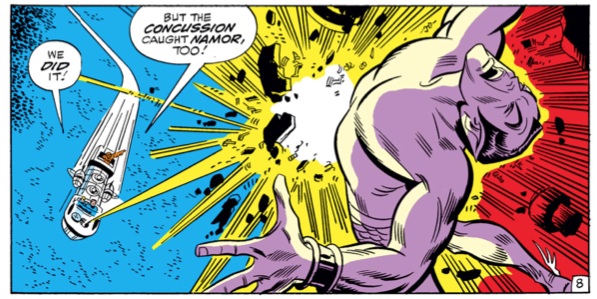
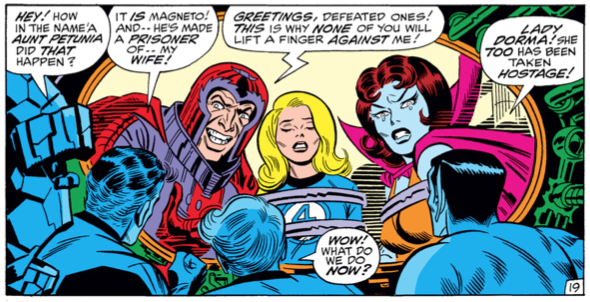
Magneto goads Namor into war against the surface world, then takes the Invisible Girl hostage.
What’s going on here?
This is obviously the first issue without Jack Kirby—and notably, also without Joe Sinnott—but Stan and the two Johns do a credible job of covering for them. In part, that’s because Romita and Veroorten seem to be deliberately copying Jack’s style. There are places where it’s obviously not Jack, such as close ups of the characters faces, but overall it’s a successful effort. Romita takes a back seat to no one in the comic-art business, so there will be no nitpicking of him here.
What I liked
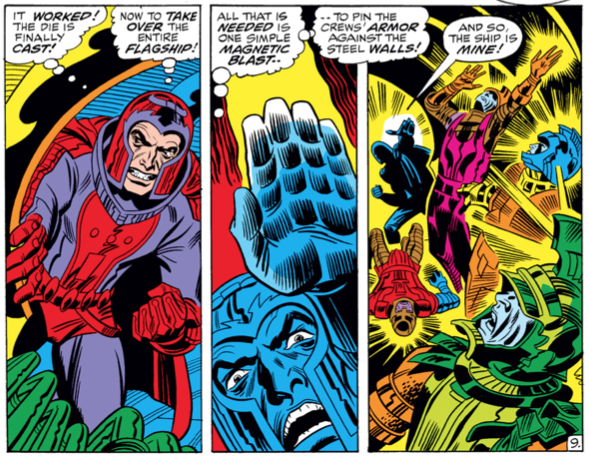
It’s always fun when a villain crosses over from one book to another. This is the first time the FF tangle with Magneto, as far as I am aware, and he’s definitely in his early, raving megalomaniac mode here (vs. his more statesman-like megalomaniac mode of more recent years).
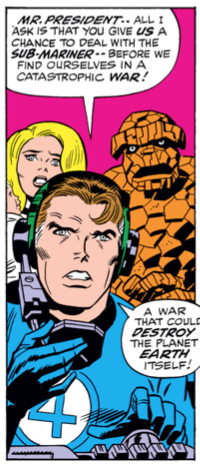
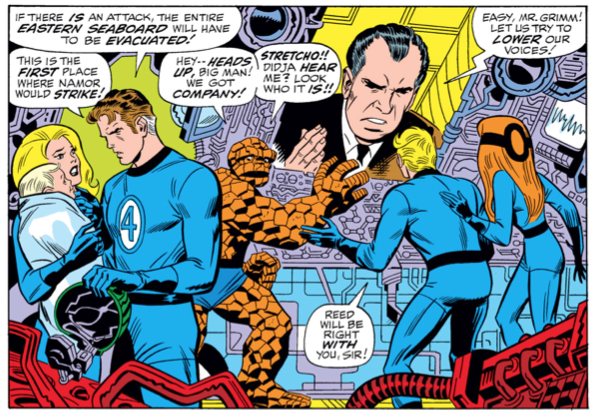
There’s also a very overt depiction of Richard Nixon as president (and Ben even makes a Spiro Agnew reference). While the president often shows up in comics, he’s often more generic, and not always this recognizable as an actual person.
What I didn’t like
One of the oldest and most tedious cliches in the early FF plots was how often Sue was taken hostage. By my count it was like a dozen times in the first 40 issues. Now, despite it being a new decade and with a new art team, Sue is once again taken hostage (along with Lady Dorma, for good measure).
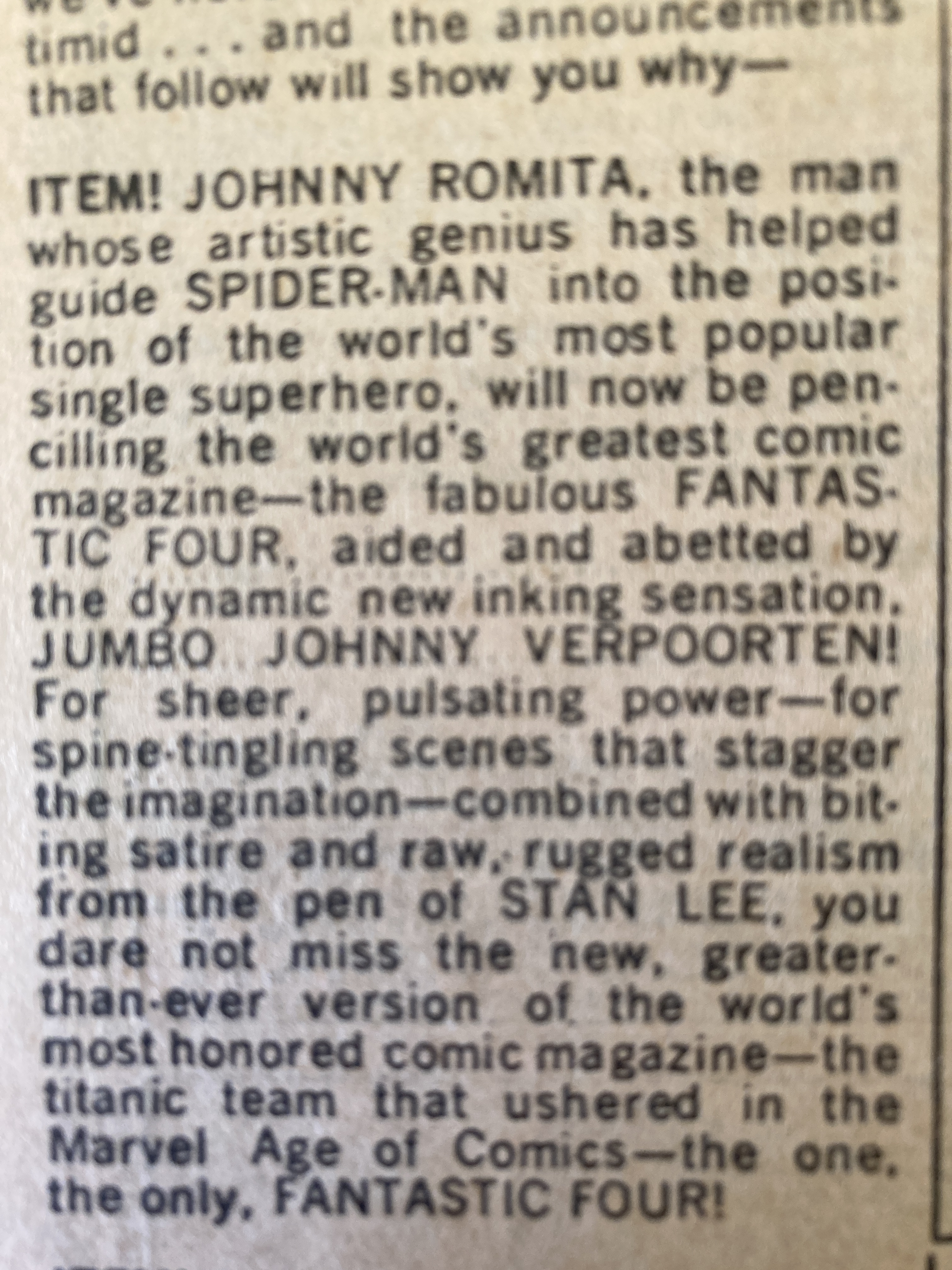
Also, the Bullpen Bulletin item welcoming Romita as the FF’s new penciler fails to acknowledge jack or his accomplishments, which seems a bit bush league.
Fantastic Four 102 “The Strength of the Sub-Mariner!” Published June 1970 Story: Stan Lee and Jack Kirby Script: Lee Pencils: Kirby Inks: Joe Sinnott Letters: Artie Simek Cover: John Romita and John Verpoorten
Note: This is a milestone issue of the Fantastic Four, the last issue penciled by Jack Kirby. It’s also a fitting place for me to take a break from blogging duties. After nearly two-and-half-years of writing (almost) weekly posts about the world’s greatest comic magazine, I’m a bit burned out and going to take a short hiatus. I’ll still write occasional entries like So Random!, but I’ll leave the FF alone for a while. I’m not sure how long I’ll be gone, but when I return, I will be looking forward to diving back into the post-Kirby era.
Synopsis
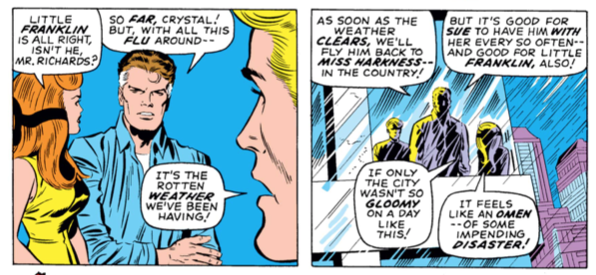
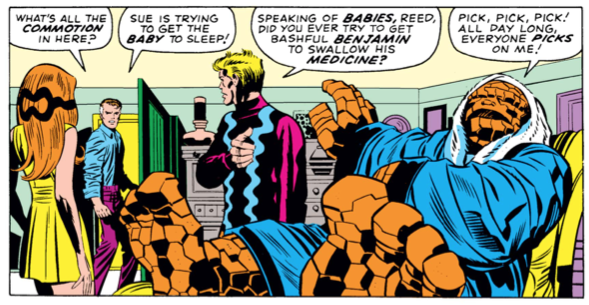
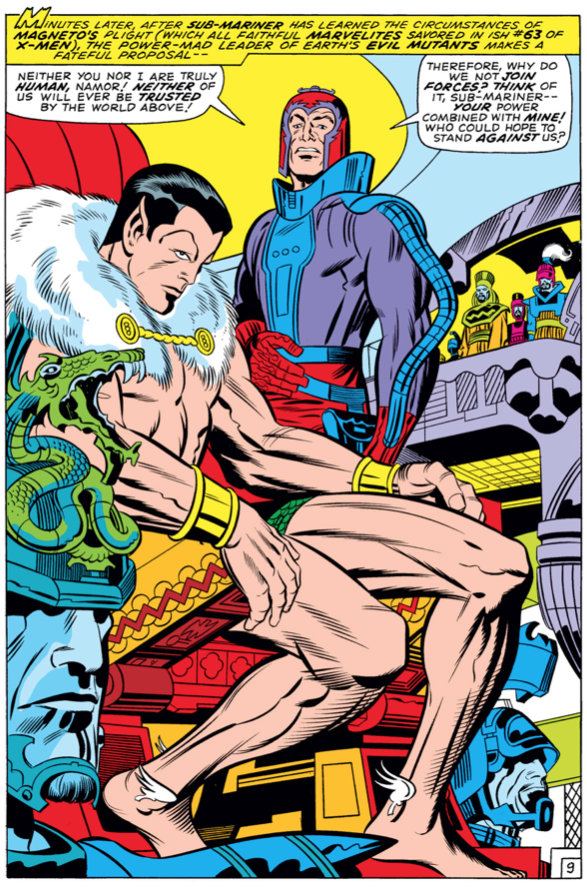
As per usual, the issue opens with Thing and the Human Torch—plus Crystal—hanging out in the Baxter Building. This time, Ben has a cold and is being a baby about it. The action then shifts beneath the ocean, where the Sub-Mariner, investigating a disturbance, discovers Magneto unconscious on a tropical island. He takes him back to Atlantis to recuperate, and there Magneto tries to convince Namor to join him in his fight against humans.
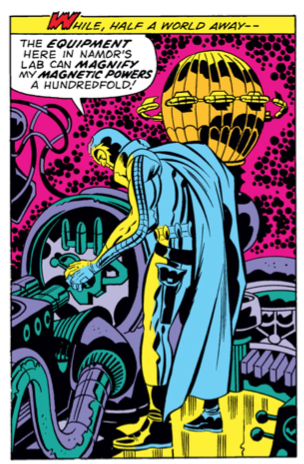
Meanwhile, back in New York, metal objects start to fly out of control, including the machinery in Mr. Fantastic’s lab. Reed uses a “magna-tracer” to track magnetic waves to Atlantis, and as a warning, sends a “sonic probe” which creates tremors under the sea. When the magnetic attacks against New York don’t stop, Ben sends a torpedo to Atlantis, against the protests of Reed, and the provocation leads Namor to declare war on the surface world, with Magneto behind him.
What’s going on here?
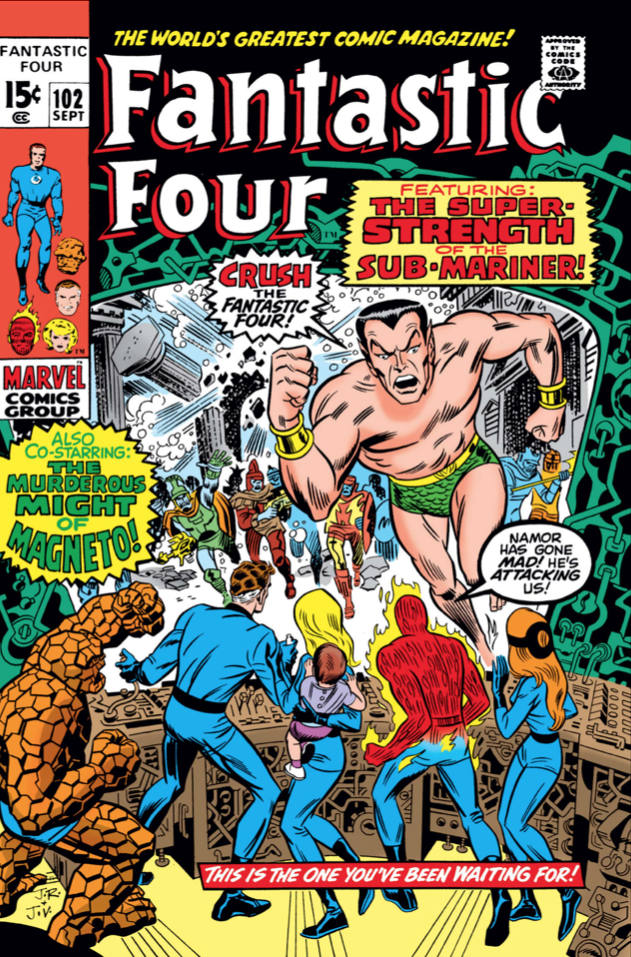
This, of course, is Jack Kirby’s last issue of the Fantastic Four and one of his final stories for Marvel before he decamped for rival DC. He didn’t even stick around to draw the cover, which was handled by John Romta.
Kirby’s frustrations with Stan Lee and Marvel had been brewing for years, and ranged from creative—such as seeing his character, the Silver Surfer, taken from him and given to John Buscema to draw—to financial. According to author Sean Howe, Marvel was by then licensing its characters to an entrepreneur who sold posters and other merchandise using Kirby’s images, but Kirby wasn’t compensated. Nor did he receive his share of a settlement in a dispute about the ownership of Captain America. After previously rejecting overtures from DC’s Carmine Infantino to jump ship, in March of 1970 a fed up Kirby finally signed a three-year contract with DC.
There’s no easy way to sum up the significance of the Lee / Kirby run on the Fantastic Four and I’m not sure I’ll be able to do so adequately here. There have been longer sustained runs (Dave Sims wrote and drew 300 issues of Cerebus!) and shorter runs with more recent acclaim (Neil Gaiman’s 75-issue Sandman run is often at the top of fans polls). But when combining quality, creativity, longevity and influence, I don’t think there’s really any comparison.
The Lee/ Kirby FF run seeded the Marvel universe, and the concepts and characters they created became the foundations on which a multi-billion-dollar entertainment empire has been built. Even a short list of characters introduced or reintroduced in their run is breathtaking: The Skrulls, Dr. Doom, Latveria, Namor, Atlantis, Rama Tut aka Kang, the Watcher, the Negative Zone, Annihilus, Galactus, the Silver Surfer, the Inhumans, the Black Panther, Wakanda, Agatha Harkness, Ronan the Accuser, the Kree, the Molecule Man, Him aka Adam Warlock and the Microverse. All of them have been recycled dozens, if not hundreds, of times across thousands of comics, TV shows and movies.
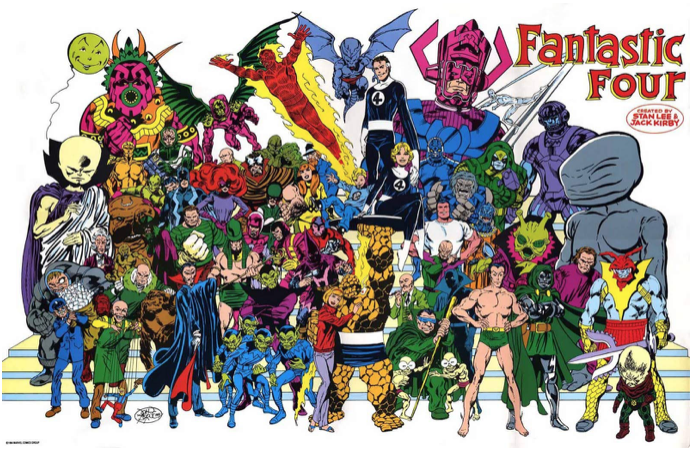
When I was a kid I had a Fantastic Four poster by John Byrne, in which the FF are surrounded by dozens of other characters. All I knew at the times that they were cool characters; what I didn’t realize is that they all had debuted in the Lee / Kirby run.
Back to issue 102
After about eight or 10 uninspired issues, Stan and Jack at least go out on a high note. Fantastic Four 102 isn’t a classic, but it it’s a reminder of how good the book could be when the elements combined into something greater than the whole. We have the Ben and Johnny hijinks, the noble-yet-misguided Namor, a dastardly villain in Magneto, and some amped-up stakes as Atlantis is on the brink of war with the surface world. Jack also leaves us with some great images, his best in a while.
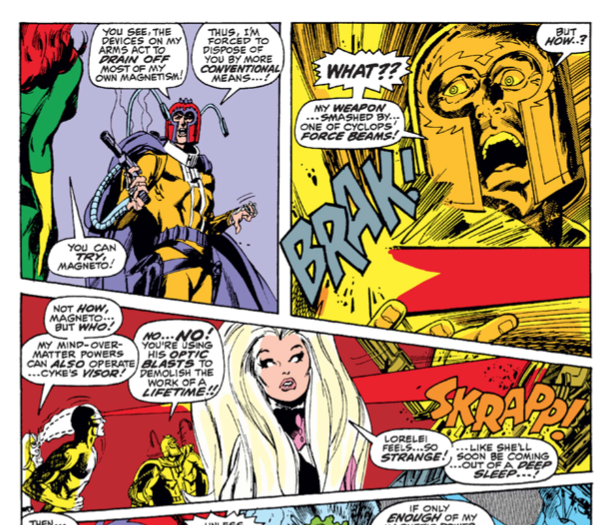
Magneto’s presence is an interesting choice. It’s the first time he’s appeared in the FF’s own book, and according to a footnote, it follows his appearance in X-Men 63, a classic Roy Thomas / Neal Adams comic that features Ka-zar and the Savage Land mutates. In that issues, he’s last seen in a burning compound in Antartica that is collapsing above him. How he winds up on an island and in a differently colored costume is not explained.
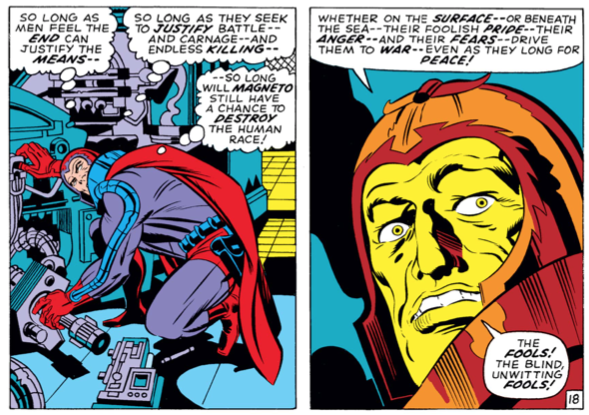
Jack’s Magneto isn’t a mad genius like Adams’s, or the hero he later becomes in later X-Men comics. Here, he’s a conniving sneak in a helmet that barely fits him.
The sexist seventies
The Invisible Girl doesn’t appear in this comic, and the only time Sue is mentioned is in a passing mention by Reed.
The latest in men’s fashion
Johnny’s sweater looks a bit like Black Bolt’s costume
Dig that Kirby Krackle
In our last installment of DTKK (sob), some great work from the Kirby, including this splash).
More from the King
Also on newsstands
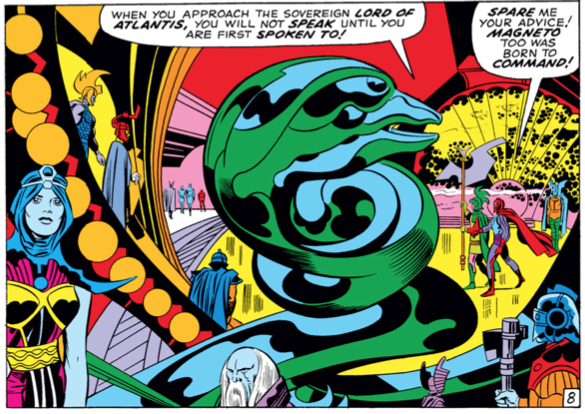
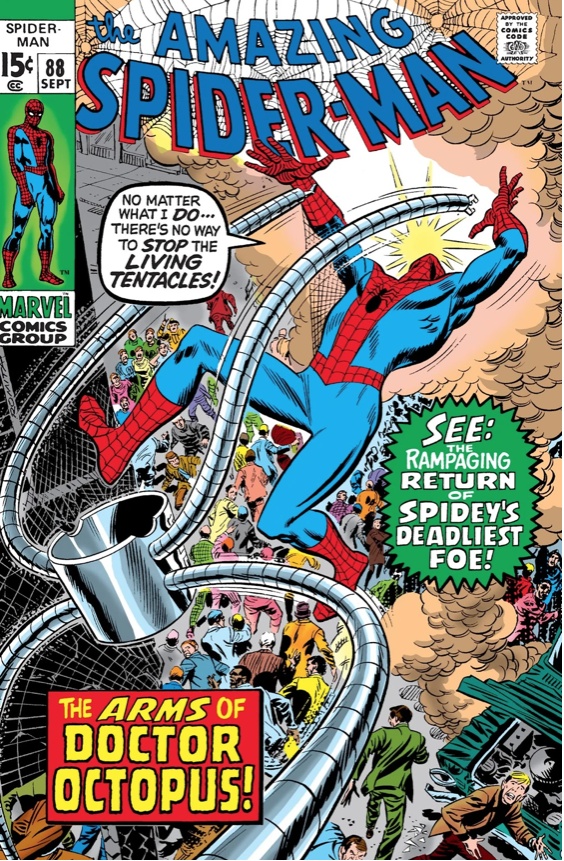
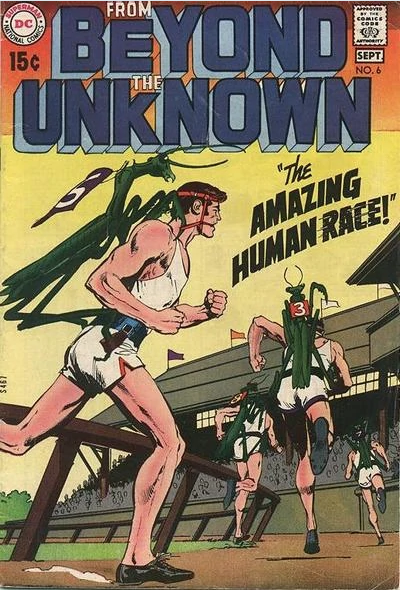
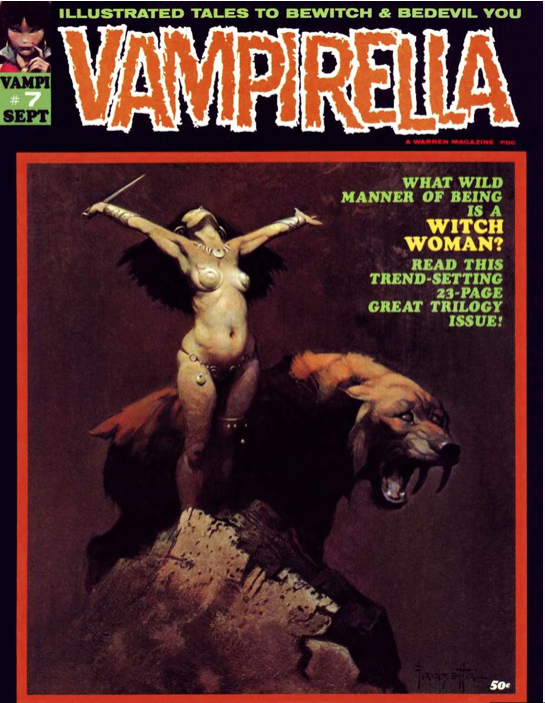
What other comics were on sale in June 1970? Covers by Romita, Adams and Franzetta.
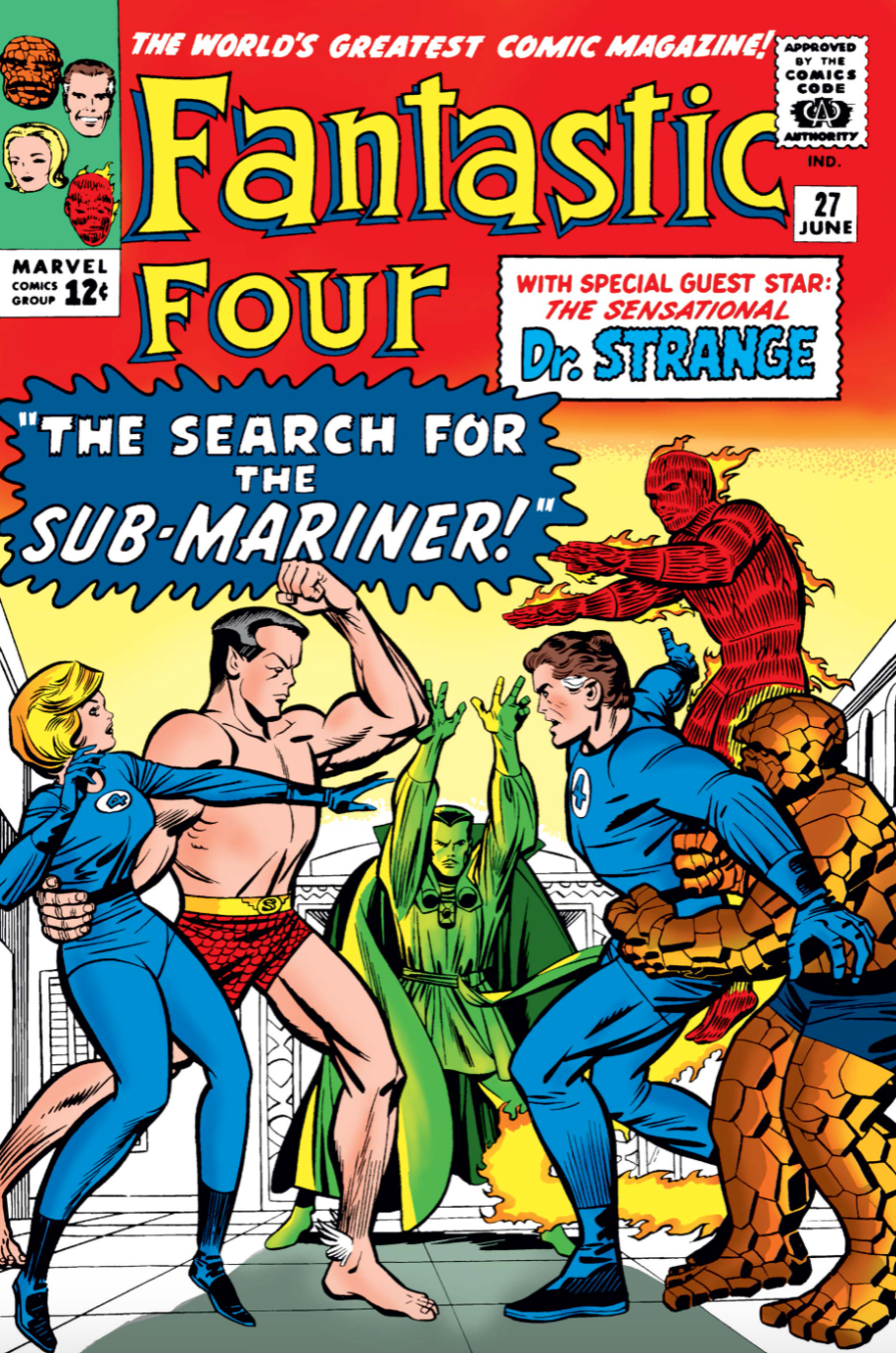
Fantastic Four 27 “The Search for the Sub-Mariner” Published: March 1964 Story: Stan Lee and Jack Kirby Script: Lee Pencils: Kirby Inks: George Roussos Letters: Sam Rosen Cover: Kirby and Chic Stone
Synopsis
At the Baxter Building, Reed experiments with a new thought projector, then tells Ben and Johnny of his intentions to propose to Sue. Meanwhile, under the ocean, the Sub-Mariner stews in loneliness, then declares his plan to wed Sue.
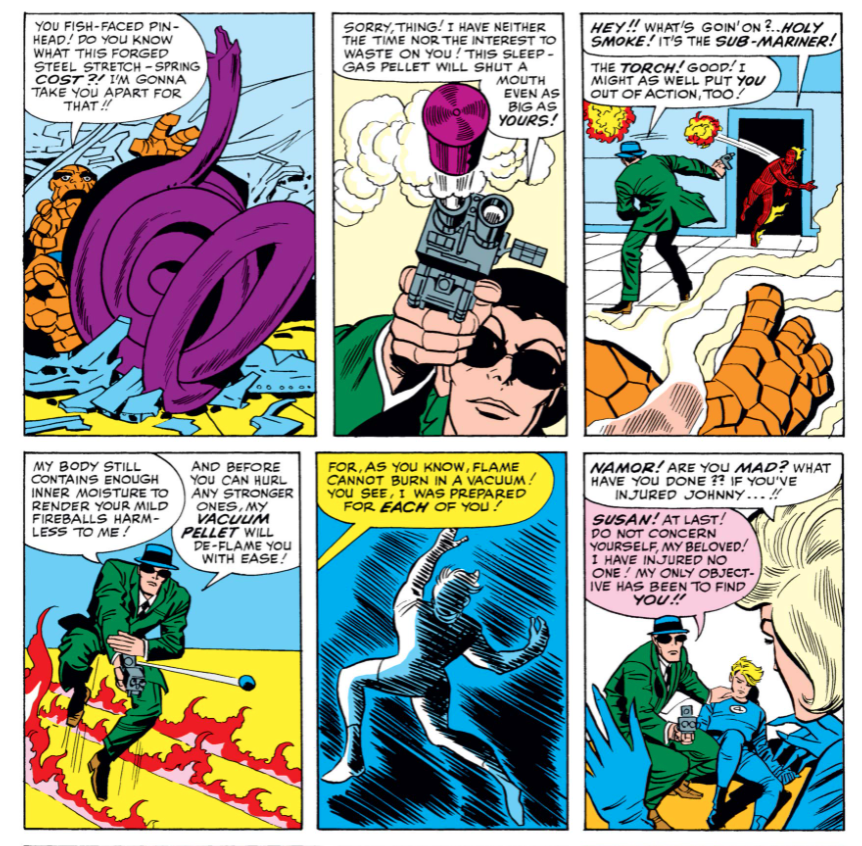
While Reed is out shopping for a ring, Namor uses new technology to subdue Ben and Johnny and abduct Sue. When Reed returns, he is overcome with rage and insists Ben and Johnny remain behind as he pursues Namor. Unsure of how to find Namor beneath the ocean, Johnny contacts Dr. Strange, who uses his mystic powers to locate Namor’s citadel, where he watches Reed fight Namor.
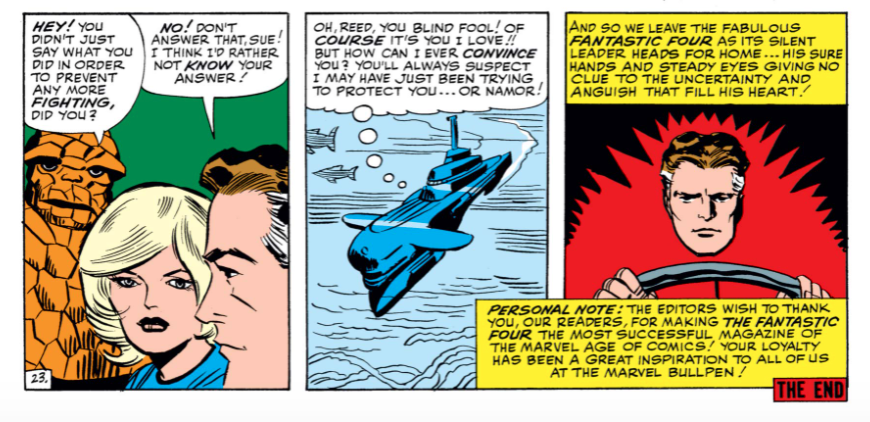
Dr. Strange then uses his to magic to transport Ben and Johnny to the fight, where Johnny frees Sue. After a battle with Namor and his henchmen, Sue ends it by telling Namor she loves Reed. Before Namor can react, Dr. Strange whisks the Fantastic Four away to Reed’s submarine, where Reed worries that Sue only pledged her love to save him from Namor.
What’s going on here?
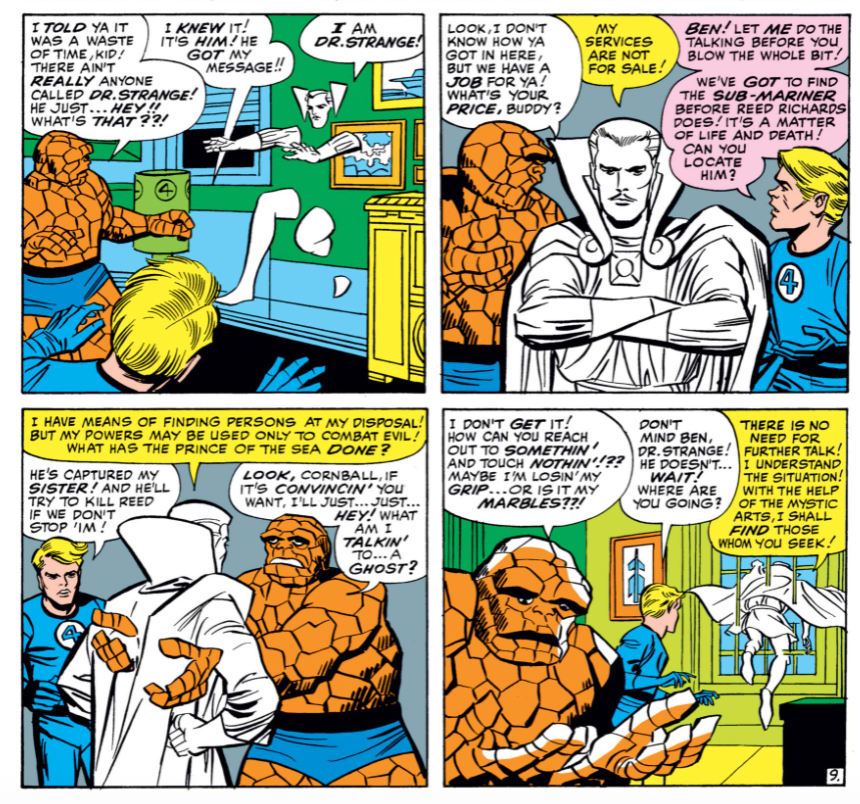
FF 27 falls in the middle of a busy run of Marvel cross-promotion. Starting with a guest appearance by Ant-Man in FF 16, then with Nick Fury in FF 21, the Hulk and Avengers in FF 25-26, and with Dr. Strange in this issue, it’s clear Stan is leveraging the popularity of the Fantastic Four to introduce readers to other Marvel heroes. (The X-Men will also appear soon). But while those other appearances tended to have some internal logic to them, Dr. Strange doesn’t add much to this story. It’s not obvious why the Torch contacted him to find Namor, given the FF had just battled him in Atlantis in the first FF annual. He mostly serves as a teleportation device, moving the FF from place to place. He does, however, manage to unleash a full arsenal of Dr. Strange-y oaths, invoking the Vishanti, Hoggoth and Dorammu, as he does.
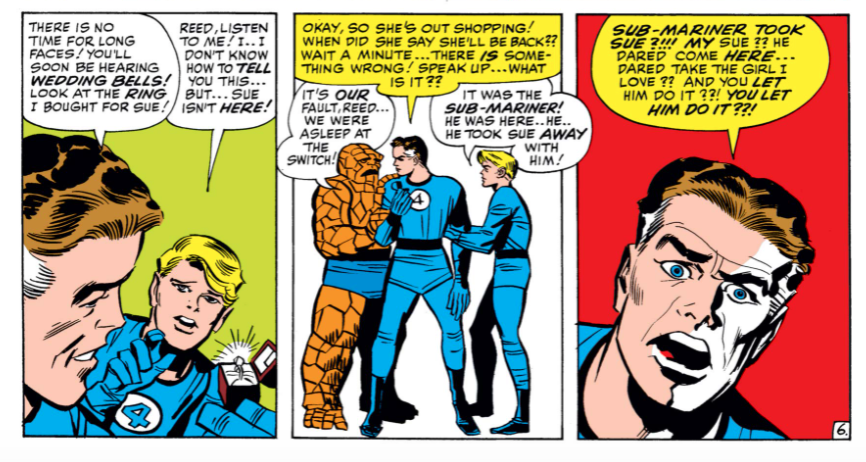
The more significant development is the further evolution of the relationship between Reed and Sue, which has sort of lurched along for the first few years of the FF. Now, finally, we’re on the verge of progress: a proposal! Reed is uncharacteristically exuberant about the idea and (understandably) distraught when she is adducted.
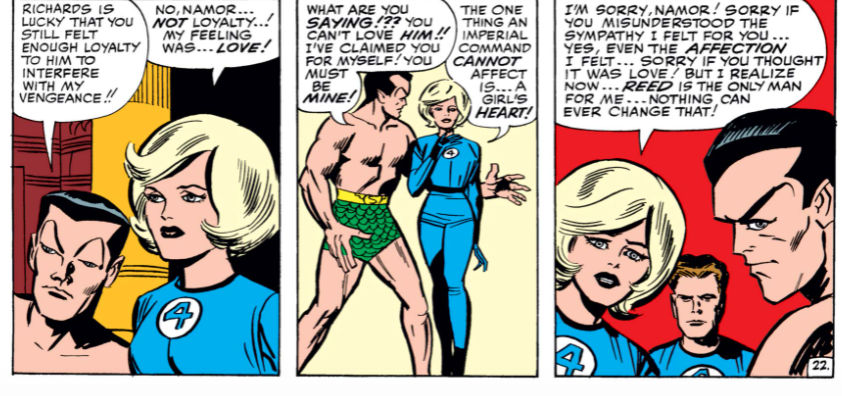
Stan and Jack really lean into the melodrama of the Reed-Sue-Namor love triangle in this issue, even though it feels like all of this was settled in the annual. As a result, none of it feels pareticularly suspenseful.
The denouement, however, does create a bit of uneasy tension, as Reed is agony about Sue’s true feelings.
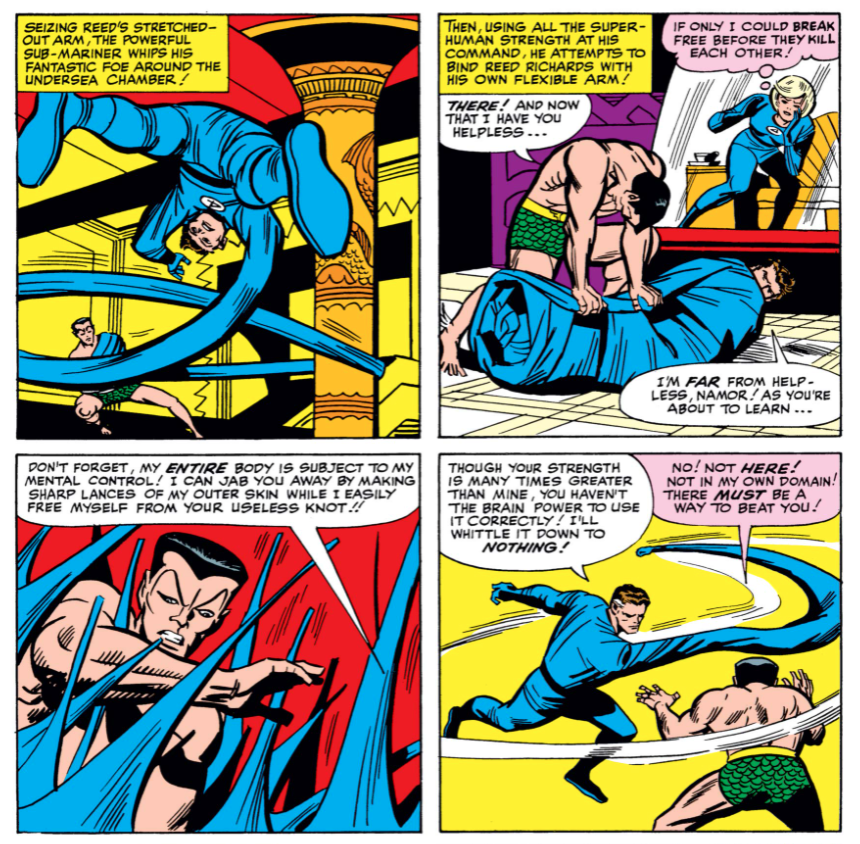
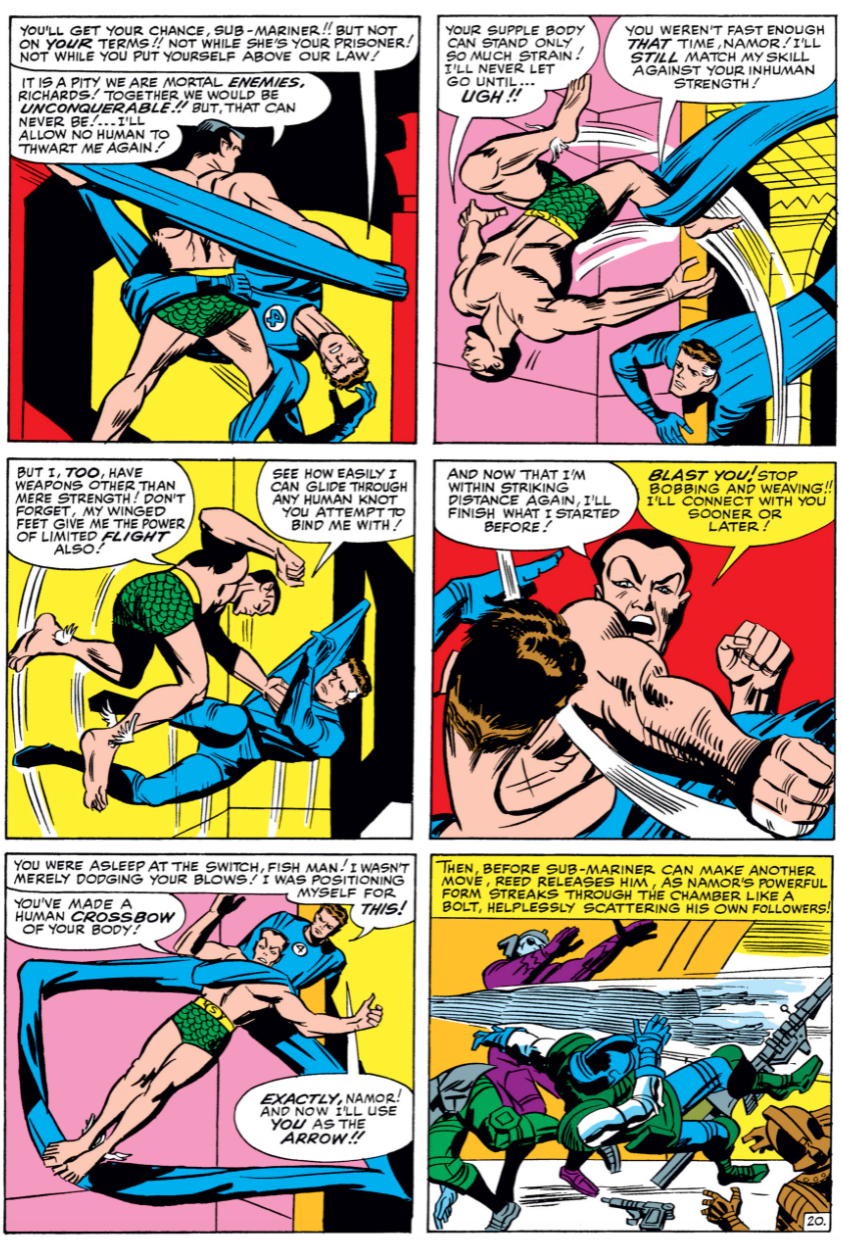
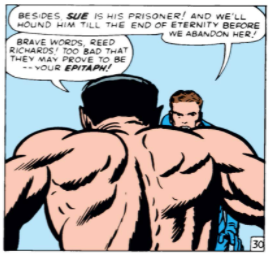
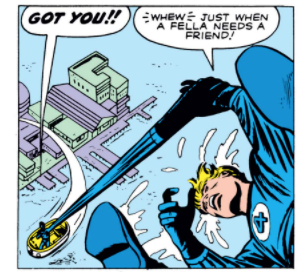
The issue is really devoted to Reed, and features several pages of him in combat with Namor. Here’s a cool one”
“The Sub-Mariner versus the Human Race” (main story) Story: Stan Lee and Jack Kirby Pencils: Kirby Script: Lee Inks: Dick Ayers Letters: Art Simek
“The Fabulous Fantastic Four Meet Spider-Man” (second story) Story: Lee Pencils: Kirby Inks: Steve Ditko Letters: Ray Holloway
Cover: Kirby and Ayers
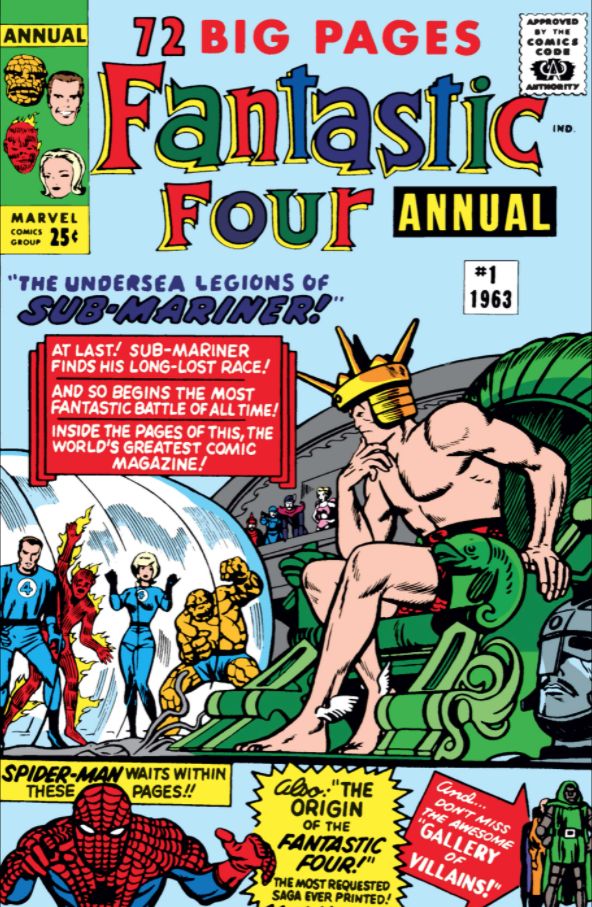
Buckle up everyone, because we’ve got a lot to cover in the Fantastic Four’s first annual. It features two stories, both loaded with historic significance, a gallery of pin-ups, and a handful of assorted extras, all of which are worth looking at.
But first, the main event:
Synopsis
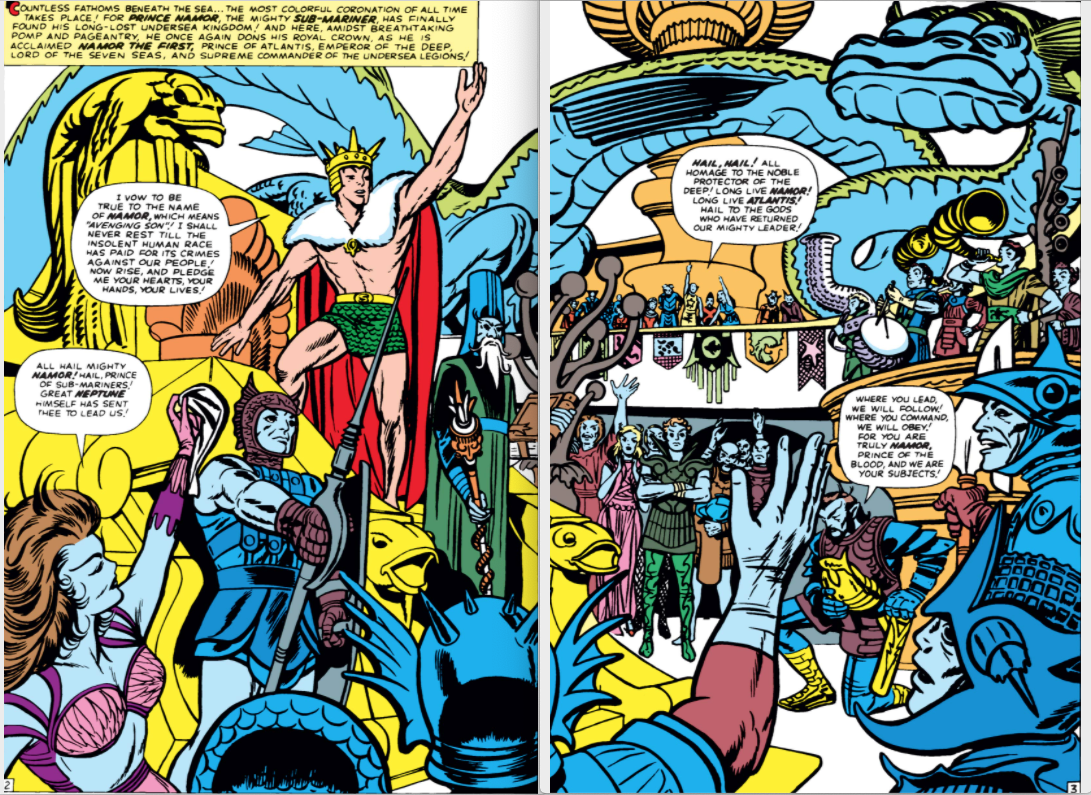
The story begins under the ocean, in Atlantis, which Namor the Sub-Mariner has finally rediscovered and where he is now crowned as ruler. We meet Dorma, his love interest, and Krang, a rival. Meanwhile, in New York, the Fantastic Four plan a cruise vacation in part to investigate the sighting of sea monsters. While at sea, the team is captured by Namor (the sea monsters were a lure), who informs the team the surface world can no longer encroach on his ocean kingdom, and releases the FF to spread the word.
Reed summons an emergency session of the United Nations, and introduces Dr. G. W. Falton, who explains the history of homo mermanus, the water-breathing off shot of humans, their civilization, and the birth of Namor. When Reed declares humanity must fight Atlantis, Falton reveals himself to be Namor in disguise, and then launches an invasion of New York.
New York is soon overwhelmed by Atlanteans, but Reed invents a device that evaporates the water in the their helmets, sending them back to the sea. Defeated, Namor abducts the Invisible Girl after a scuffle with the FF, and brings her to Atlantis. The rest of the FF pursues, and while Namor and the team battle, Dorma realizes Namor is in love with Sue and floods her chamber. Sue nearly drowns, and Namor calls off his fight with the FF to take Sue to a hospital on land. When he returns to the ocean, the city of Atlantis is deserted as his people have abandoned him.
What’s going on here?
This is the first annual of the modern Marvel era, but apparently not Marvel’s first annual. While investigating the history of Marvel’s annuals is an exercise in frustration, the lack of explanation in this issue suggests readers were used to them. Initially Marvel used its annuals to tell big stories or for big events like Reed and Sue’s wedding (spoiler!). Later, they became used for Marvel’s interminable cross-over events. While they were once reliably published one a year (annually, you might say) they’ve since become much more erratic. The FF reached 27 annuals before the first series was rebooted in 1998 (though some were reprints).
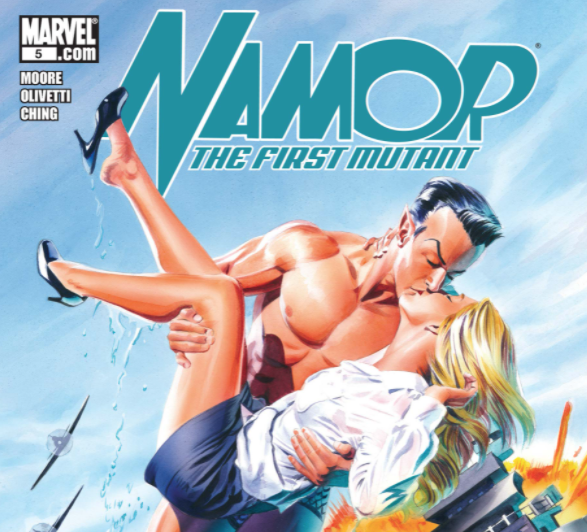
This first story has a lot going on. Most importantly it tells the story of Namor, his people, and his birth to an Atlantean princess and a human sea captain. Namor has now appeared in five stories in the FF’s first two years, as many as Dr. Doom, and with this annual he’s given more dimension and background. Notably, he’s also identified as by G.W. Falton (really Namor in disguise) “the first known mutant,” a tag line which Marvel used to advertise Namor’s solo book in later, mutant-crazed years.
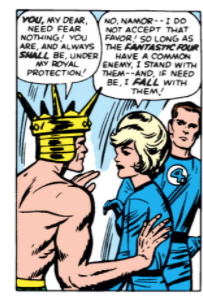
The story also moves Namor from villain closer to hero, or at least, anti-hero. Despite his new-found leadership of Atlantis, it doesn’t appear his heart is really in the invasion of earth, and he’s still clearly smitten with Sue. And while Sue remains Namor-curious, she seems to realize her future is with Reed and the team.
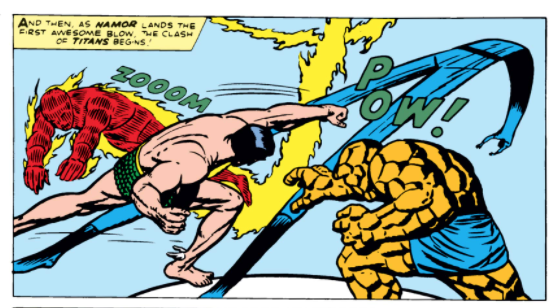
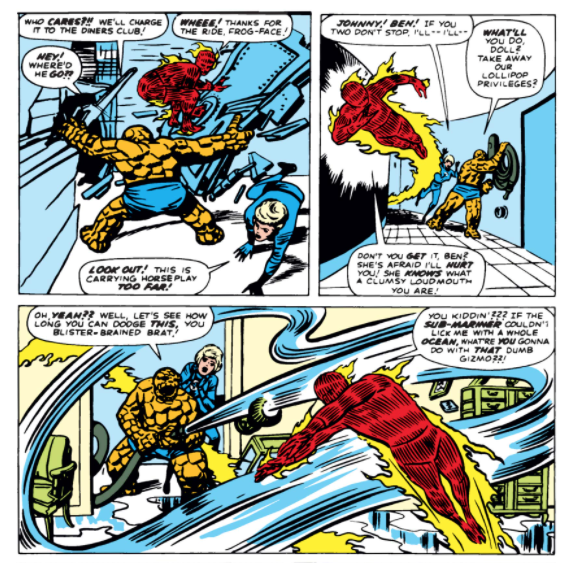
The annual just has a ton of action as Stan and Jack take advantage of the extra space to stretch out. The regular jokey fight between Ben and Johnny, usually just a panel or two each issue, covers more than two pages. The team also battles Namor twice, each time for several pages.
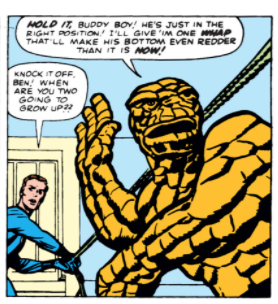
They’re fighting
As noted above, this is a big brawl.
The sexist sixties
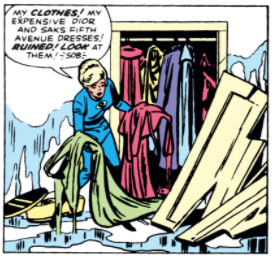
The real victim of Ben and Johnny’s fight? Sue’s dresses.
The Amazing Mr. Fantastic
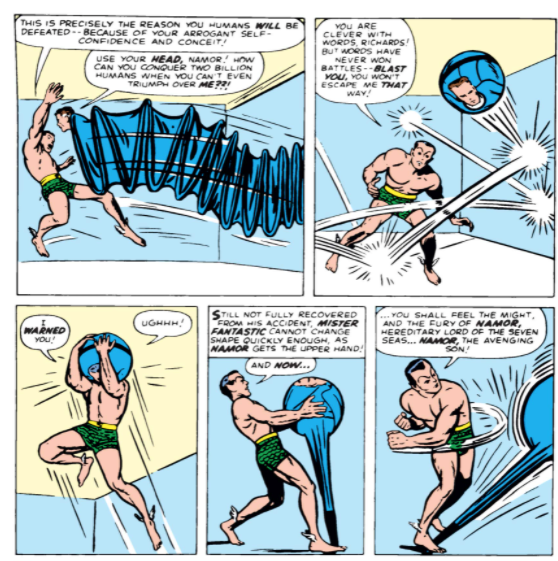
Reed gets to show off a bit while fighting Namor
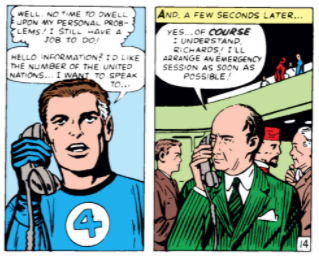
Operator
Reed never wrote down the number for the United Nations.
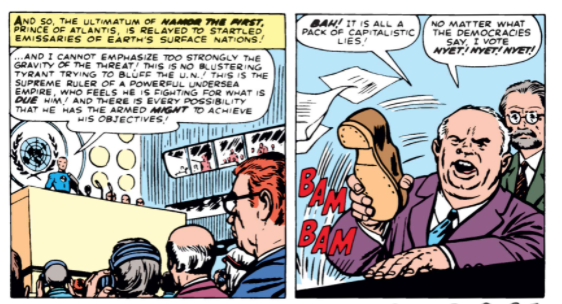
Red Menace
Khrushchev makes his second appearance in the FF. For those keeping score, that’s Khrushchev 2, JFK 1.
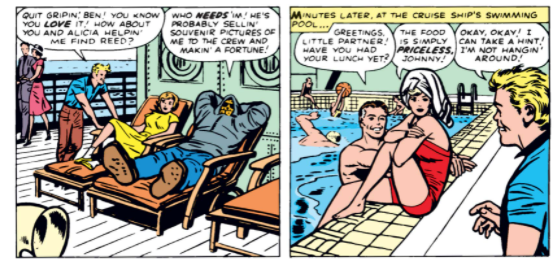
Vacation!
Ooops
Very odd drawing of Ben here by Jack. If I didn’t know better, I’d say he looked like Pepe the Frog.
Kirby Krackle
Kack makes up for his stumble with all sorts of cool images, particularly in this double-page spread of Atlantis, the only double-page spread in the FF to date.
Also this is a pretty excellent view of Namor. A swimmer’s body, indeed.
But wait, there’s more!
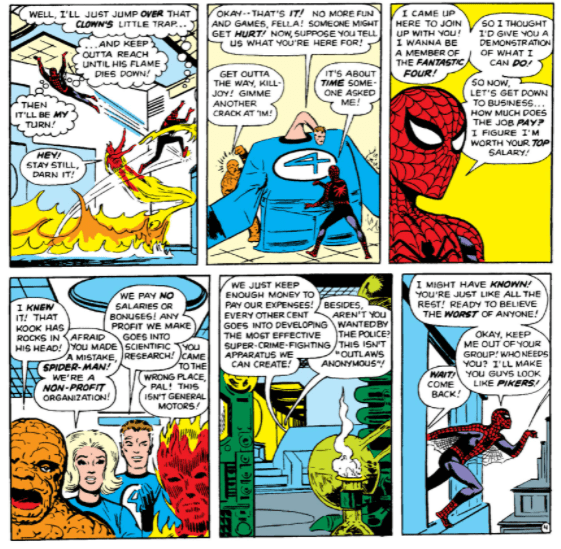
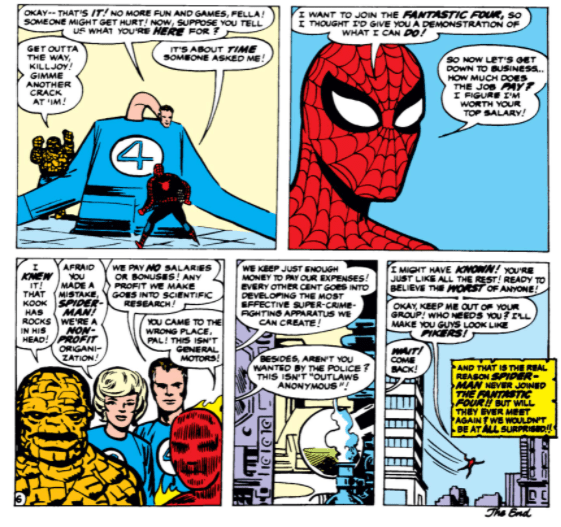
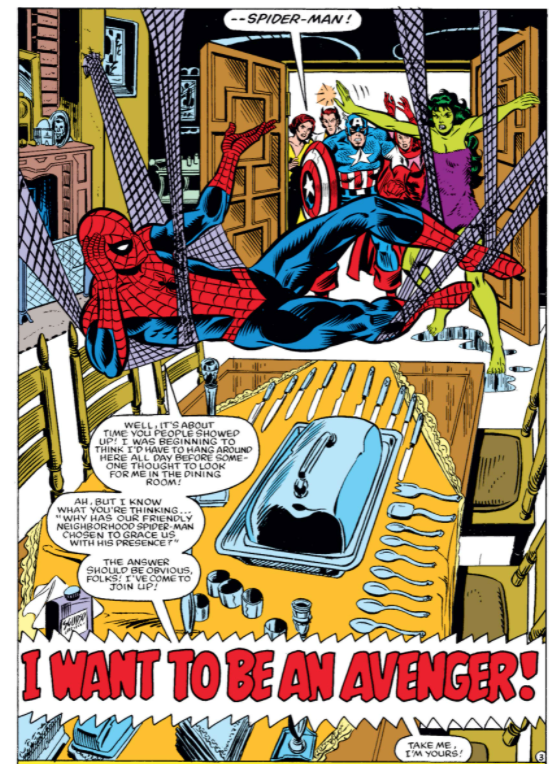
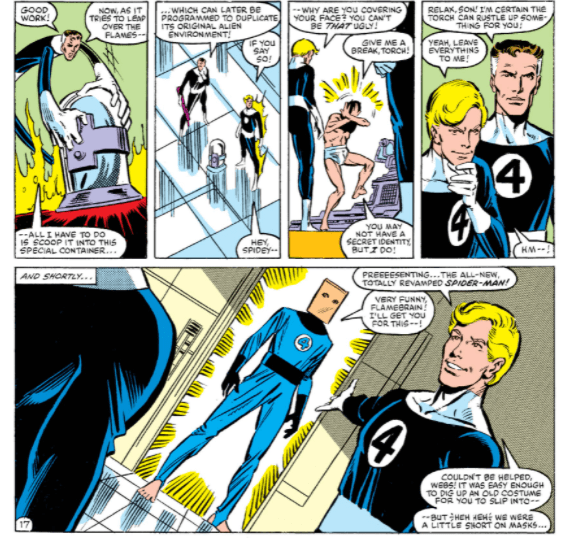
The second story is an odd one – it’s an expanded version of the FF’s first meeting with Spider-Man, which appeared as part of a larger story in Amazing Spider-Man 1, published a few months earlier.
There’s not much to it: Spider-man, very new to the super-heroing business, breaks into the Baxter Building and fights the FF, hoping to prove his value with the expectation they will hire him. When he finds out there’s no money in being an FF member, he sulks off. While the version in ASM 1 was drawn by Ditko, this one was drawn by Kirby with Ditko’s inks. The dialogue and the layouts are basically the same, but the art is very different. See for yourself:
ASM 1 (Ditko)
FF Annual 1 (Kirby/Ditko)
Spider-Man tried the same trick decades later with the Avengers, breaking into Avengers Mansion and asking for a job. It didn’t work out then, either. (Much later, of course, he ended up as a member of both teams).
Avengers 236 (Milgrom/ Sinnott)
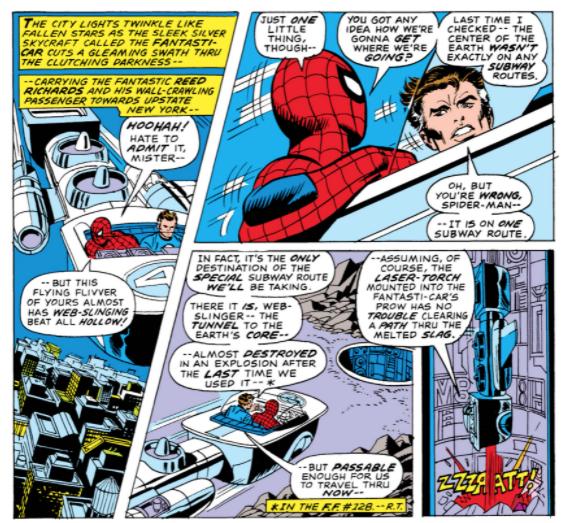
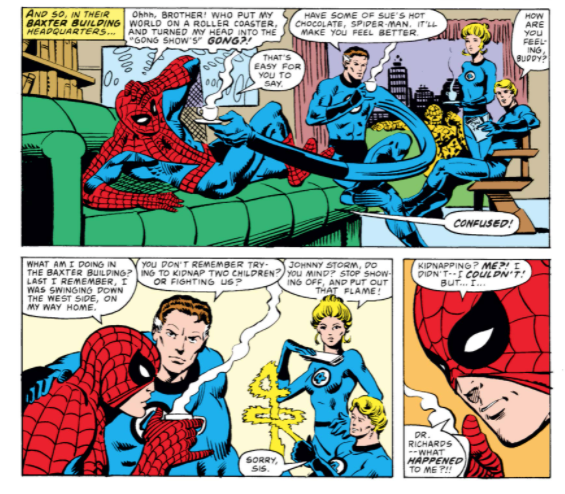
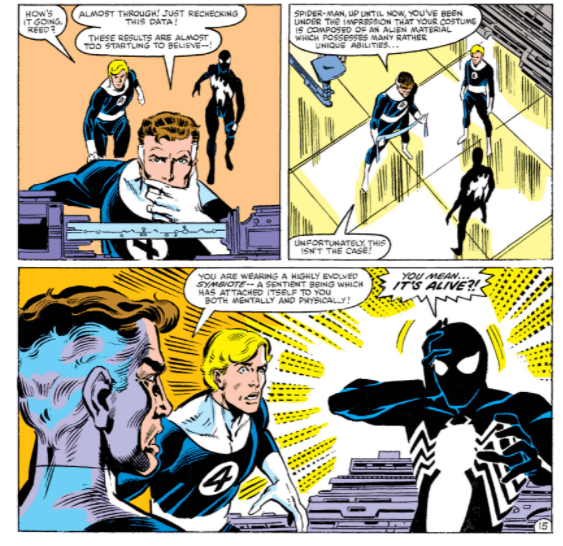
While Spidey’s initial meeting with the FF was an inauspicious one, it was the first of many encounters that led to a deep friendship between Peter Parker and the FF. They have appeared in so many issues together it would be impossible to list them all but here are some notable ones:
From Marvel Team-Up 17
Art by Gil Kane and “many hands”
From Marvel Team-Up 100
Art by Frank Miller and Bob Wiacek
From Amazing Spider-Man 258
ASM 258 (Frenz/ Rubinstein)
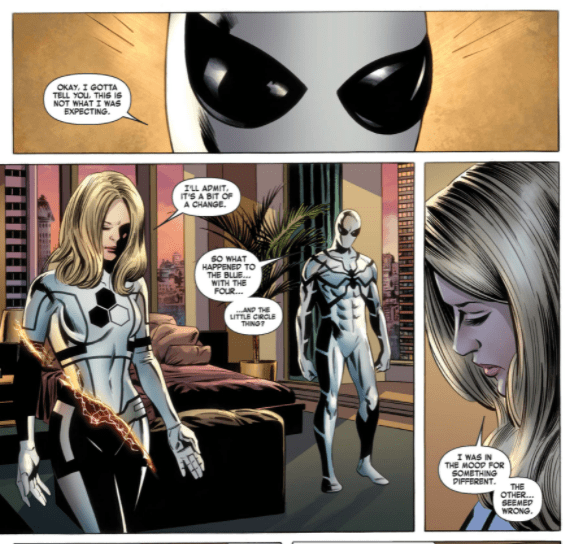
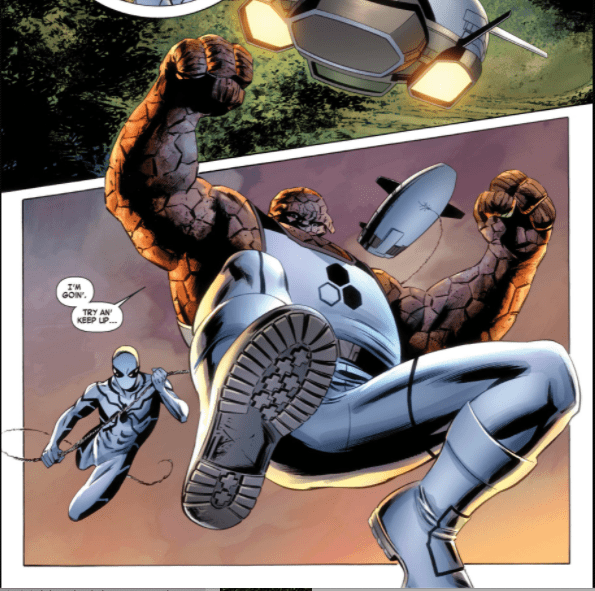
And much more recently, from 2011 ‘s FF 1, when Peter joined the team after Johnny was believed dead:
FF1 Epting/Mounts
We’re still not done!
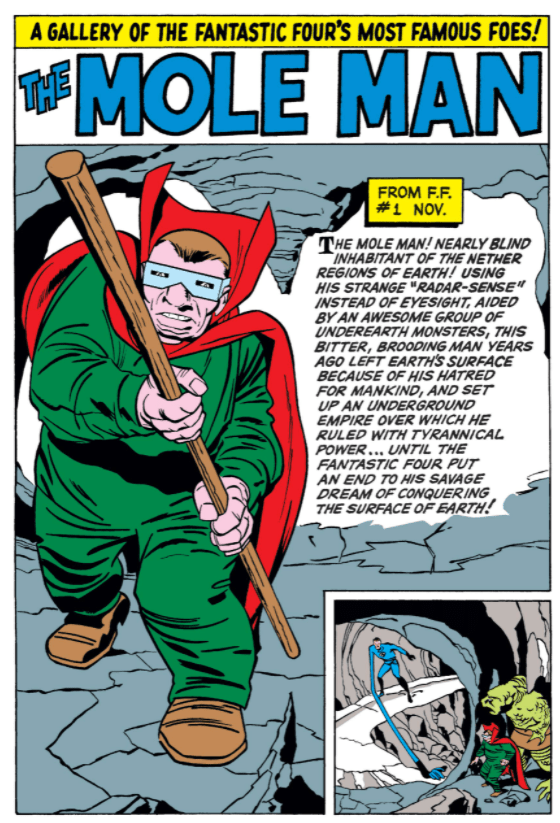
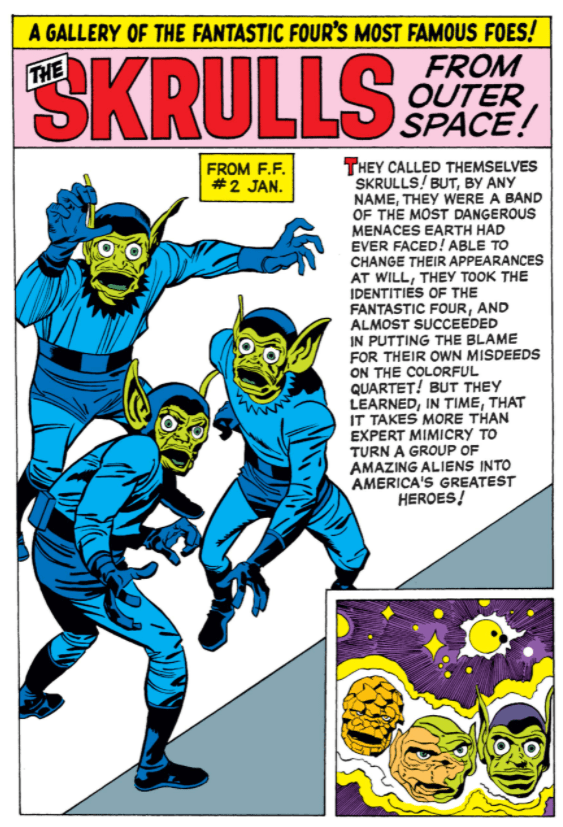
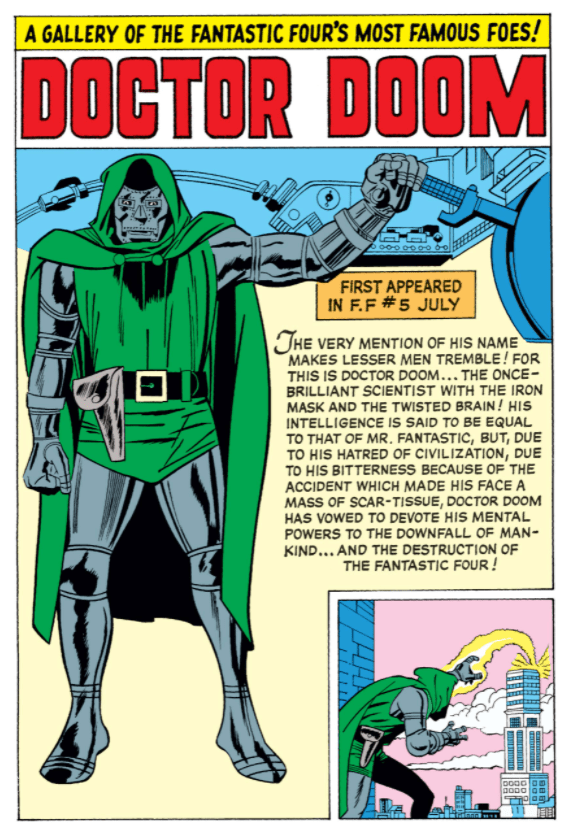
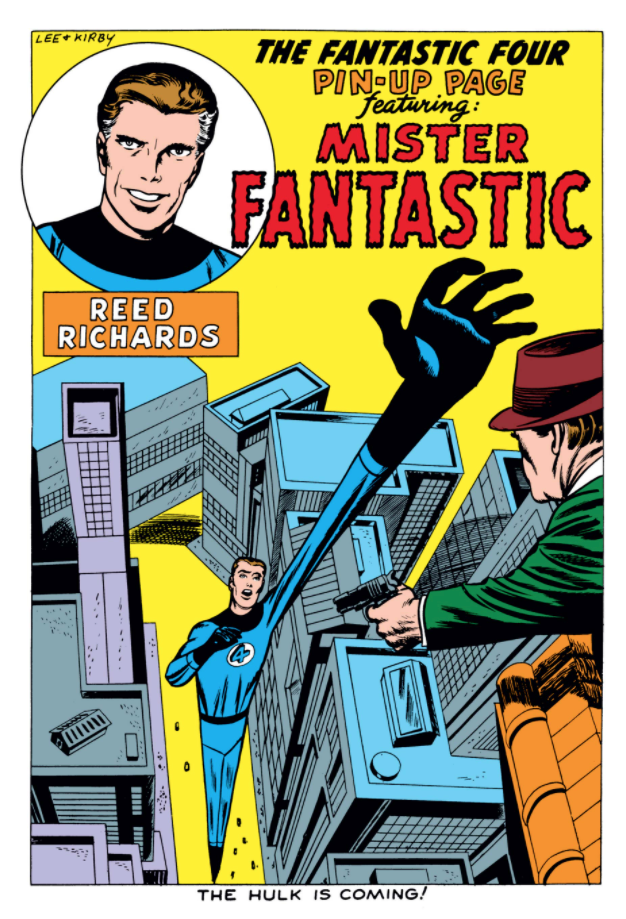
Fantastic Four Annual 1 included a series of pin-ups of the FF’s foes. Interestingly, while many—like the Mole Man and the Mad Thinker— had only appeared one, their presence in the gallery suggested Stan and Jack had long-term plans for them.
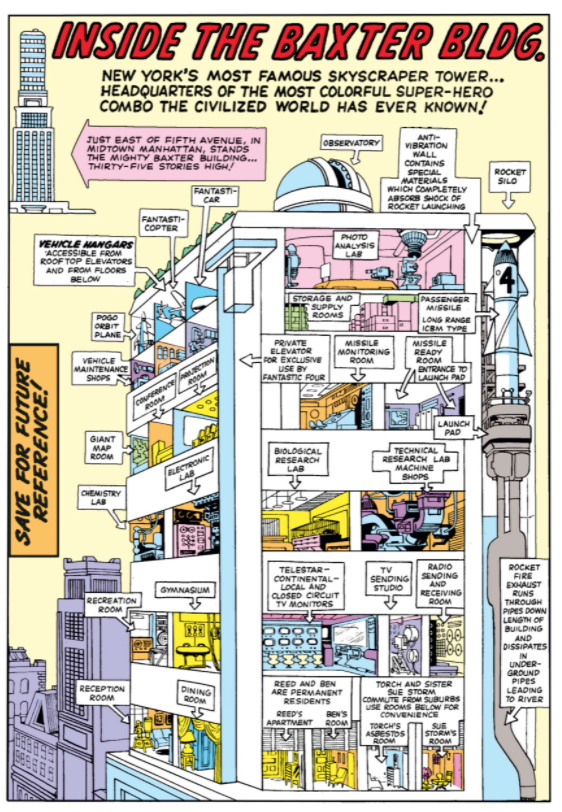
The annual also included a cutaway drawing of the Baxter Building, the third such illustration of the FF’s headquarters so far. Each one is a little more detailed, and this one includes an interesting tidbit about Sue and Johnny still living at home and commuting in from the suburbs.
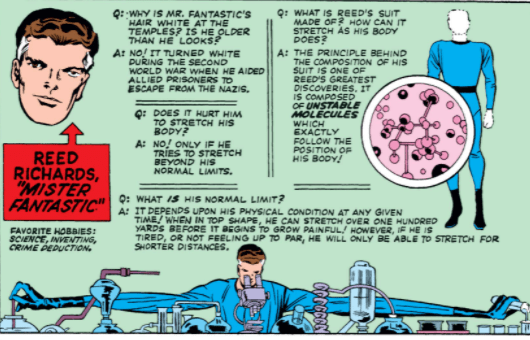
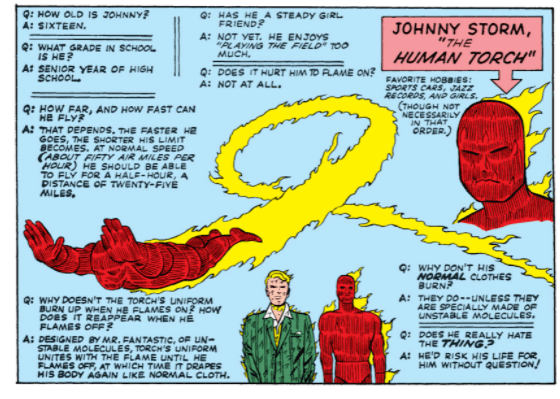
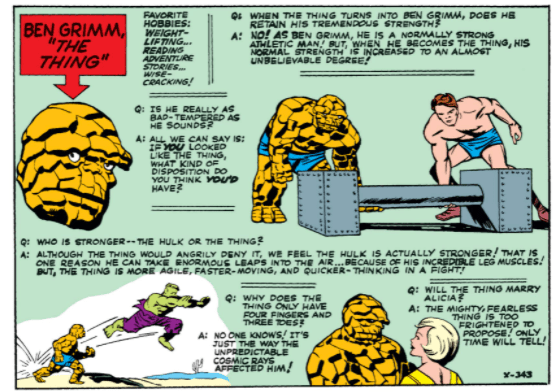
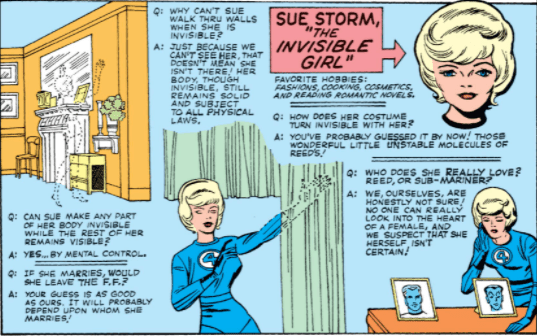
Lastly, each of the FF was the subject of a Q&A section that attempted to answer readers’ questions about the team. For example, we learn why Reed is grey at the temples, that Johnny is just 16, and that while the Hulk is stronger than the Thing, Ben is a more wily fighter. Alas, much of Sue’s Q&A is dedicated to her love life.
For sale
A mint version (9.8) of FF Annual 1 should cost you around $46,000.
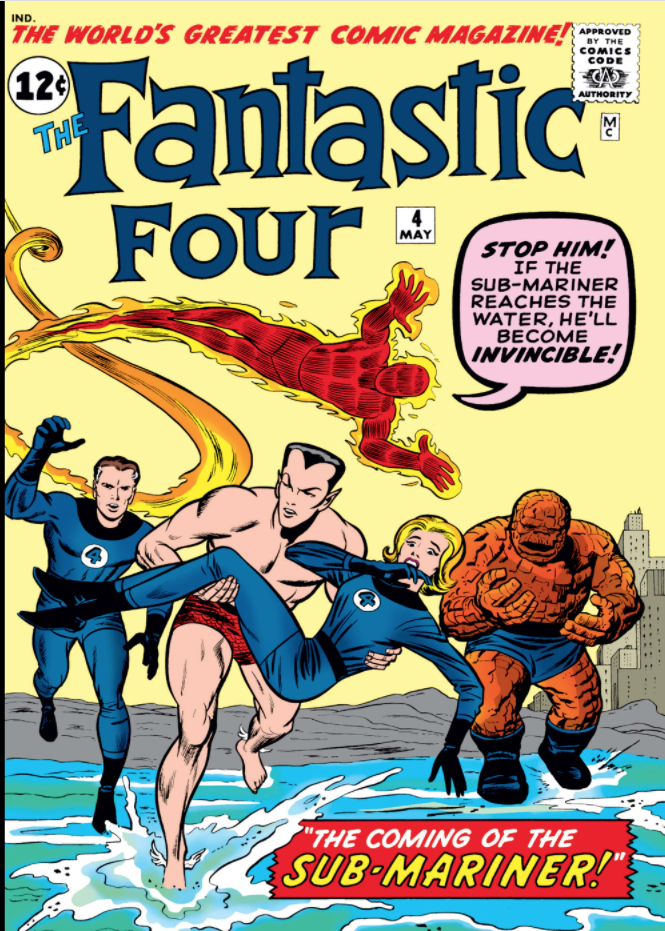
Fantastic Four 4 “The Coming of the Sub-Mariner” Published: Feb. 1962 Story: Stan Lee and Jack Kirby Pencils: Kirby Script: Lee Inks: Sol Brodsky (uncredited) Cover: Kirby and Brodsky
Synopsis
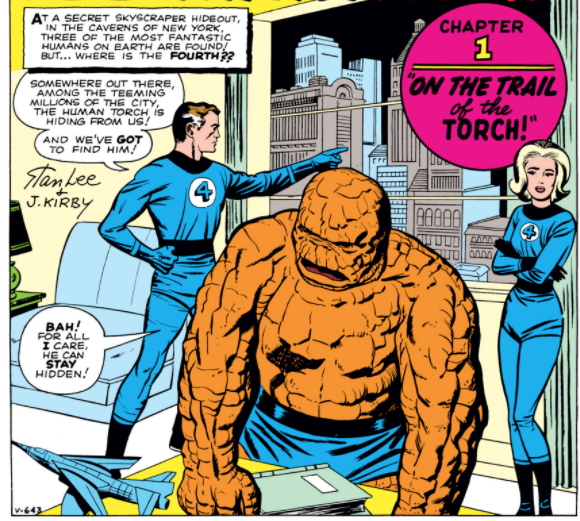
Following last issue’s departure of the Human Torch, the remaining members of the Fantastic Four search for him around New York. After a brief scuffle when he’s found by the Thing, the Torch hides in a Bowery flophouse, where he encounters a hobo with surprising strength. He’s revealed to be the amnesiac Namor the Sub-Mariner, and after the Torch drops him in the ocean, his memories are revived and he pledges revenge on surface dwellers for the destruction of Atlantis.
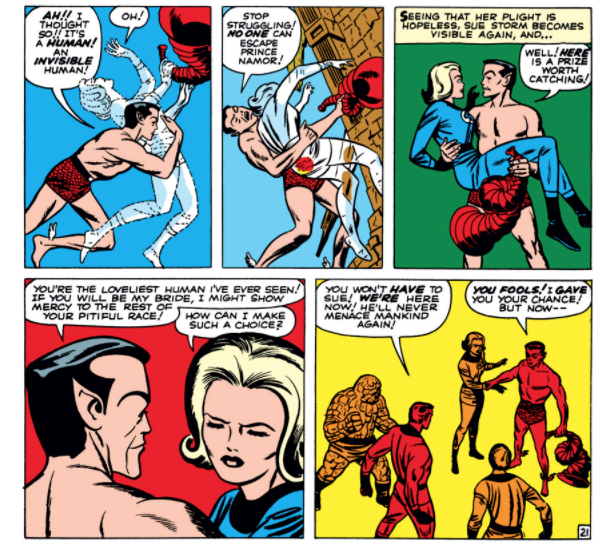
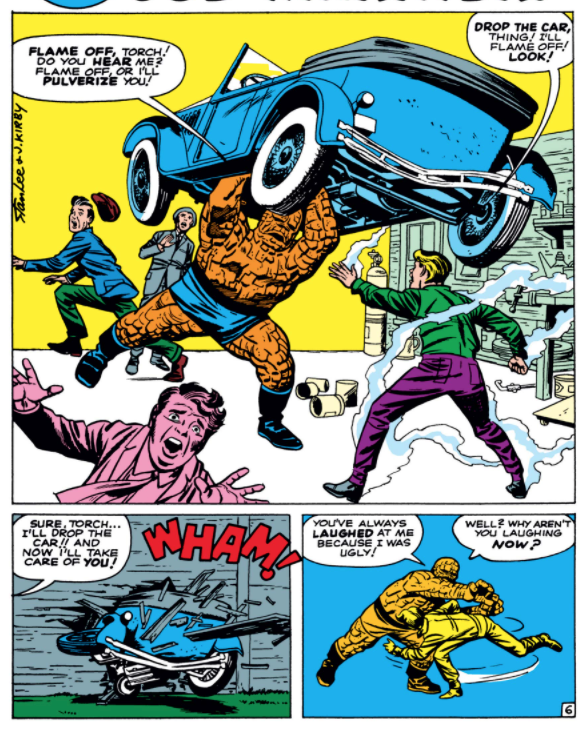
The Sub-Mariner enlists Giganto, a monstrous whale with arms, to invade New York, and it’s stopped only after the Thing detonates a nuclear bomb inside it. The Sub-Mariner then threatens to take the Invisible Woman as his bride or he’ll unleash a greater invasion. Sue agrees, but Namor, sensing her reluctance relents, and is defeated when the Torch created a tornado of fire that deposits Namor in the ocean.
What’s going on here
The issue is of course notable for the introduction of Namor to the Marvel Universe, and the beginning of his decades-long preoccupation with Sue Storm, which is occasionally reciprocated.
It’s also the best issue to date. It flows directly from the events of the previous issue, and the Fantastic Four tangle with a foe with a real backstory, plausible motivations, and the ability to cause serious trouble.
So who is this guy?
The Sub-Mariner, created by Bill Everett, first appeared in 1939. Inspired by the original Human Torch, Everett wanted to create a nautical equivalent and chose his name, Namor, because he wanted something noble-sounding (Namor is “Roman” spelled backwards). Half-human, half Atlantean, his father was a sea-captain and his mother was daughter of the emperor of Atlantis, making Namor its eventual king.
The Sub-Mariner was a mainstay of Timely Comics (Marvel’s precursor) during the 1940s, but faded out in the 1950s along with most super-heroes.
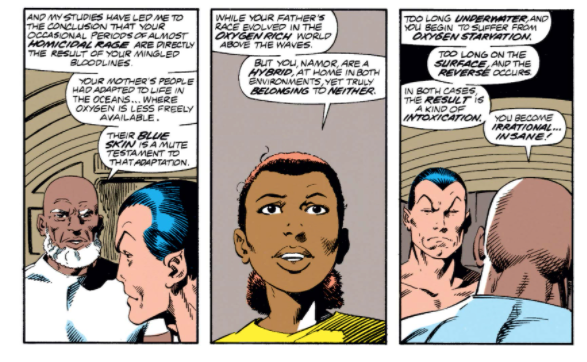
His depiction in Fantastic Four 4 is consistent with his Golden Age characterization: Arrogant and impetuous, but driven by a pursuit of justice. Initially written as a villain, Marvel gradually transitioned Namor to hero and his rages were retconned by John Byrne as a consequence of his mixed ancestry.
From Namor No. 1, 1990
Namor becomes a Marvel mainstay, starring in several versions of his own book while serving as a member of the Defenders, Avengers, and X-Men, with his ability to fly identify him as a mutant. He’s also retconned into Captain America’s World War II -era team, the Invaders.
Fantastic Four 4 also introduces the Namor-Sue entanglement, which twists and turns over the decades. One mild irony of Namor’s infatuation of Sue is that he clearly sees something in her which doesn’t become evident to the rest of us for decades, when her writer’s finally give her a personality and backbone. Until then, though, she’s mostly just a pretty face who whimpers a lot.
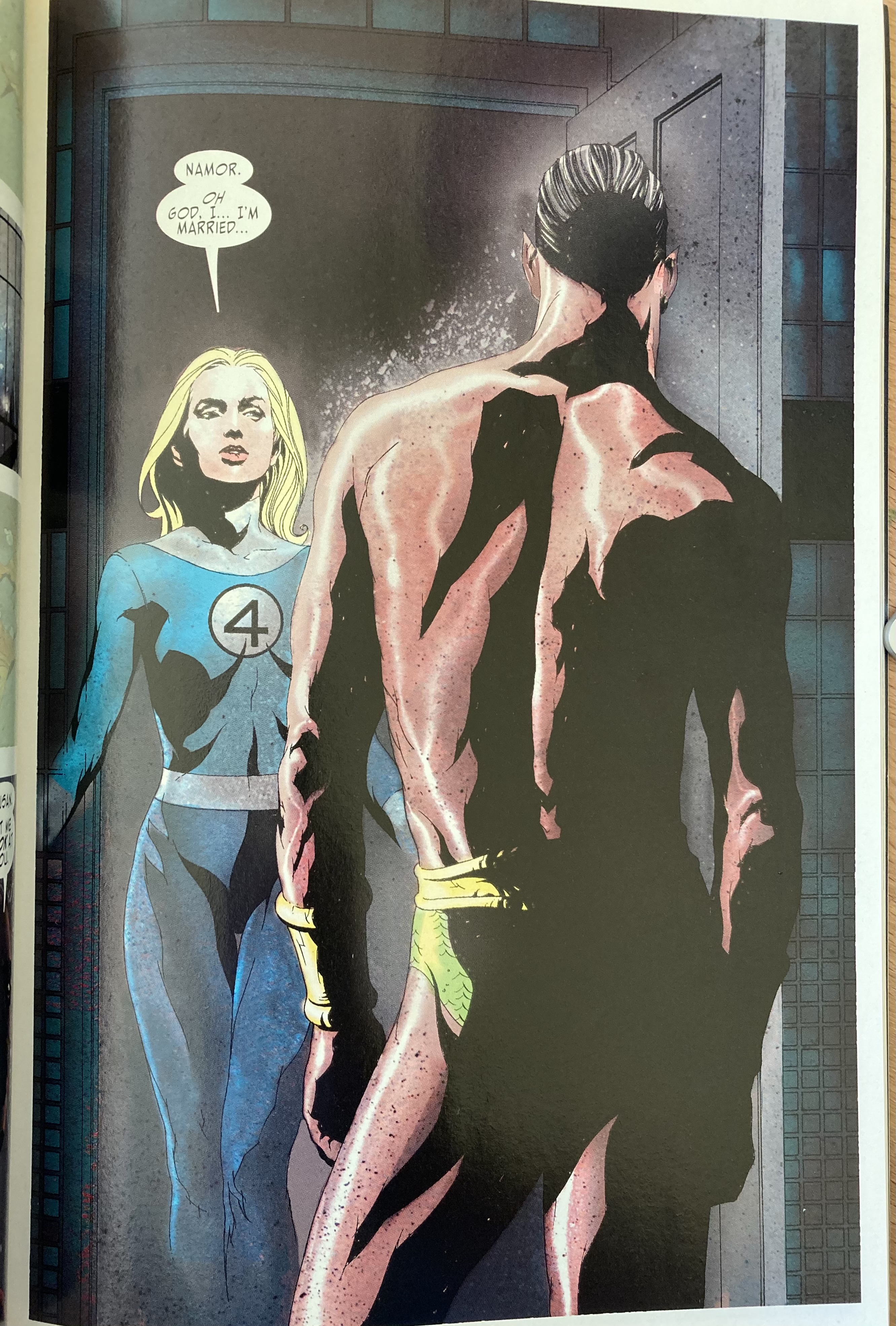
Their relationship is mostly flirtatious, although once in a while a writer will push things a bit, especially when Sue and Reed are in the midst of their occasional marital difficulties. Grant Morrison may have taken it the farthest in Fantastic Four 1234, a miniseries where Sue’s frustration with Reed’s absences comes close to a tipping point.
Fantasic Four 1234 (2001)
New York, New York
For the first time the Fantastic Four are described as living in New York instead of a fictional city like Metropolis or Gotham. That will have major repercussions for the future the Marvel Universe, and become a key differentiator of Marvel from DC as its fans celebrated the “realism” of its comics.
They’re fighting again
The Atomic Age
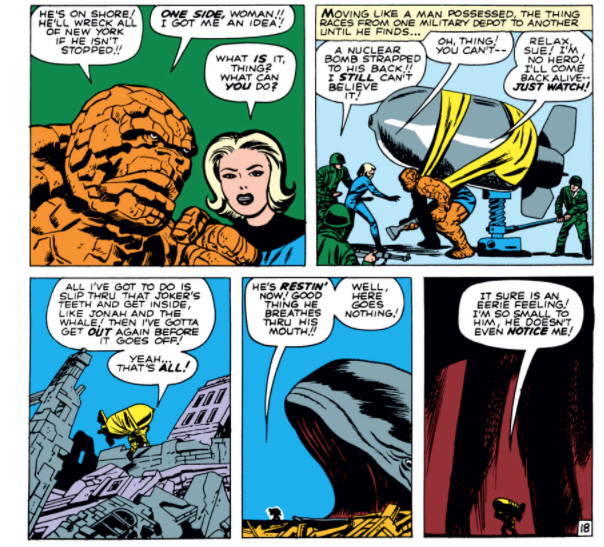
Namor plots his revenge on the surface world after discovering lingering radiation in the ruins of Atlantic, which he attributes to human and “their accursed atomic tests. And Ben somehow locates a nuclear bomb and totes it into the mouth of Giganto, Jonah-like, before detonating it.
Are you sure he’s a genius?
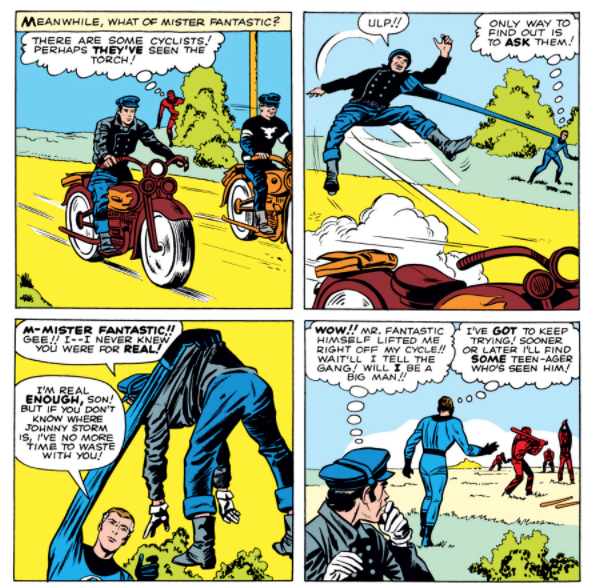
Mr. Fantastic takes a rather aggressive approach to asking some passing motorcyclists about the Torch’s whereabouts. Thankfully, they don’t press assault charges.
Dig that Kirby Krackle
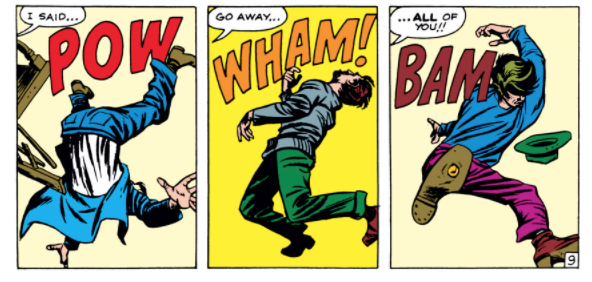
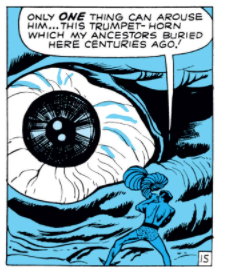
Jack does a great job with this fight sequence:
With this amazing panel:
And of course with Giganto:
We’re No. 1
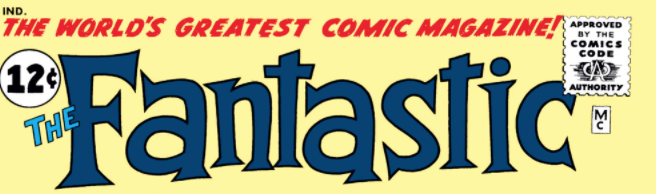
The “World’s Greatest Comic Magazine” is now affixed above the logo, where it will remain for decades:
Also, a house ad for the Hulk appears a few times at the top and bottom of the pages, a first.
For sale
A mint (9.8) copy of FF 4 will set you back around $450,000