• About Percival Henry

Percival Henry: The Fantastic Four and more

~ Blogging the Fantastic Four issue by issue (plus whatever else grabs my attention)

Percival Henry: The Fantastic Four and more

Tag Archives: 1973

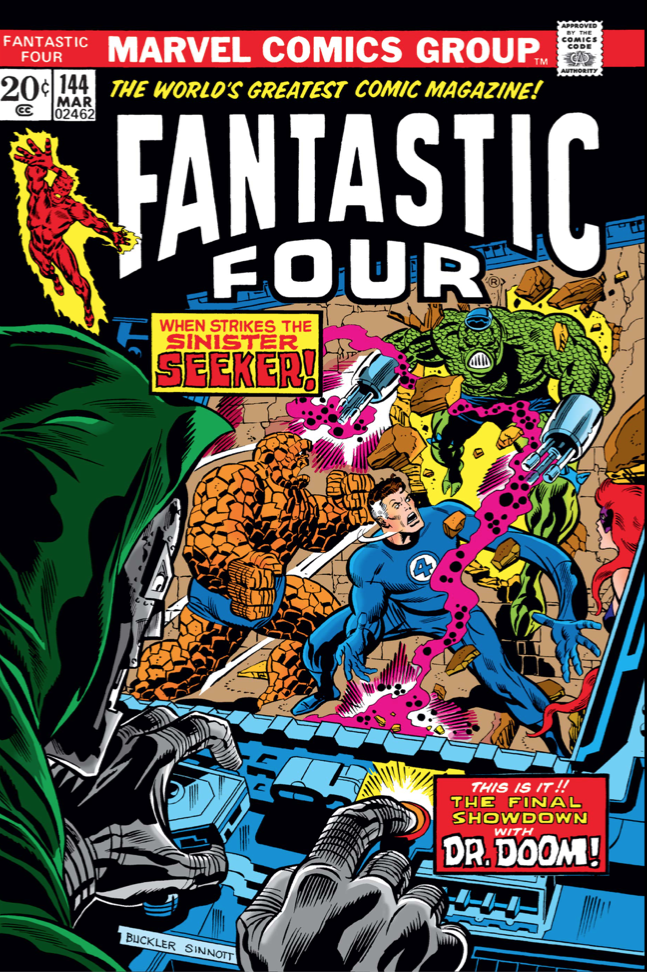
“The World’s Greatest Comic Magazine!” Fantastic Four No. 144

31 Saturday Aug 2024

Posted by percivalhenry in The World's Greatest Comic Magazine

≈ 1 Comment

Tags

1973, Dr. Doom, Fantastic Four, Fantastic Four 144, Gerry Conway, Marvel comics, Rich Buckler

Fantastic Four 144
“Attack!”
Published: Dec. 1973
Writer: Gerry Conway
Pencils: Rich Buckler
Inks: Joe Sinnott
Letters: Artie Simek
Colors: George Roussos
Editor: Roy Thomas
Cover: Bucker and Sinnott

Synopsis

Aided by Darkoth, Mr. Fantastic, the Thing and Medusa escape Dr. Doom’s subterranean New York lair, only to be attacked by the android Seeker. Reed reprograms the Seeker to free the Human Torch, and while Doom flees into space, he is attacked and apparently destroyed by Darkoth.

What’s going on here?

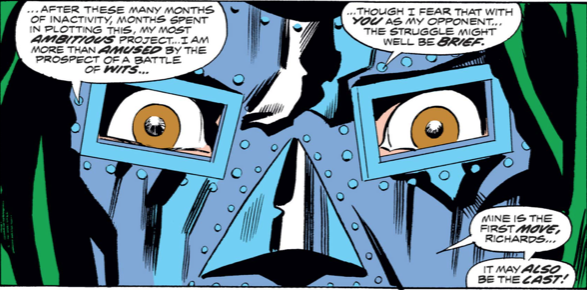
This is a fun, if not entirely coherent, issue. Bucker’s art is big and bold, as we will see, and Conway has crafted a rollicking story that hits a lot of the notes of later Lee / Kirby issues, but probably tries to stuff too much into the comic. This issue feels like the clearest example of how Conway and Bucker’s Fantastic Four differs from the Roy Thomas / John Buscema era. It’s less wordy, less concerned with intricacies of plot, while more exuberant and grandiose.

The issue wraps up a three-part arc that featured the return of Doom and introduced Darkoth. Both appear to die in the final pages, which feels like a classic way to wrap up a big story, but I assume most comic fans knew better than to think it was conclusive.

What I liked

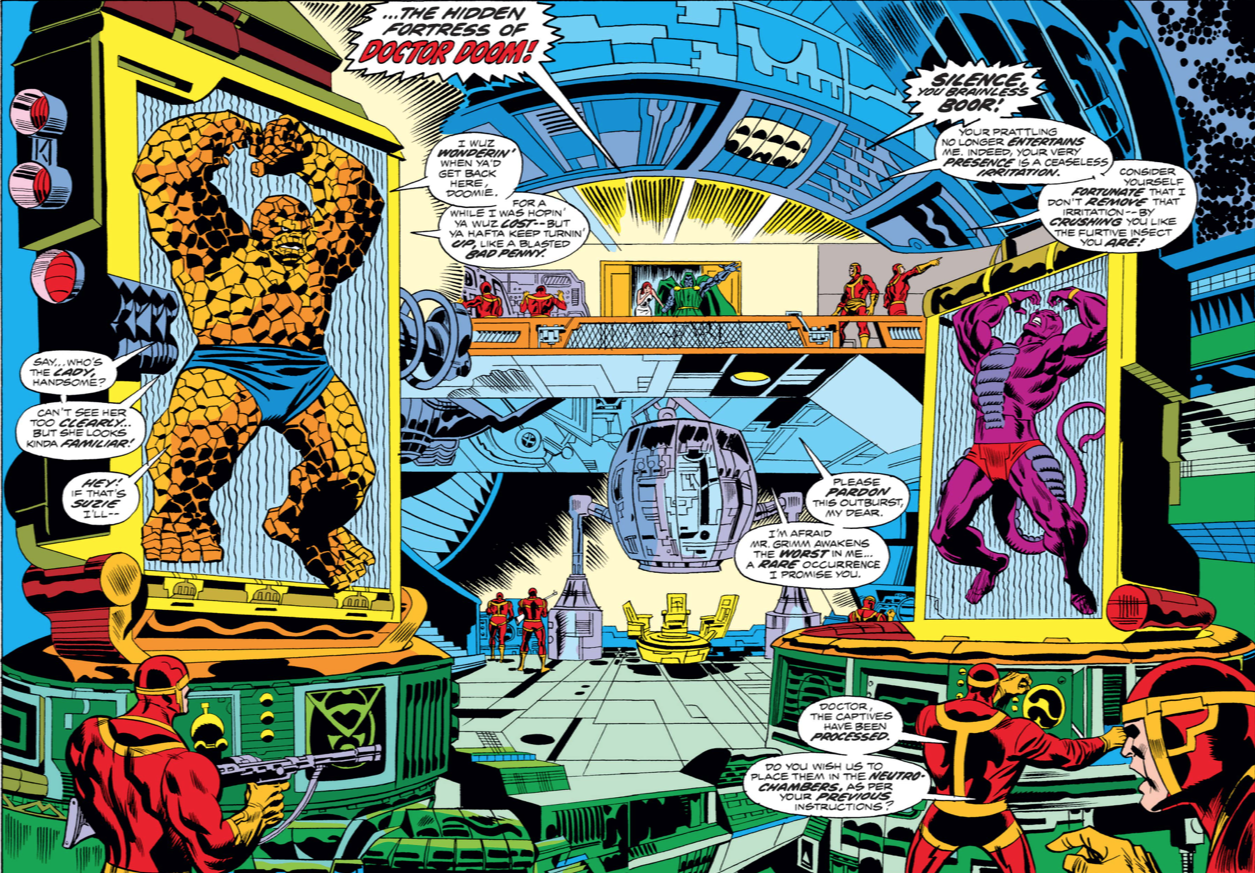
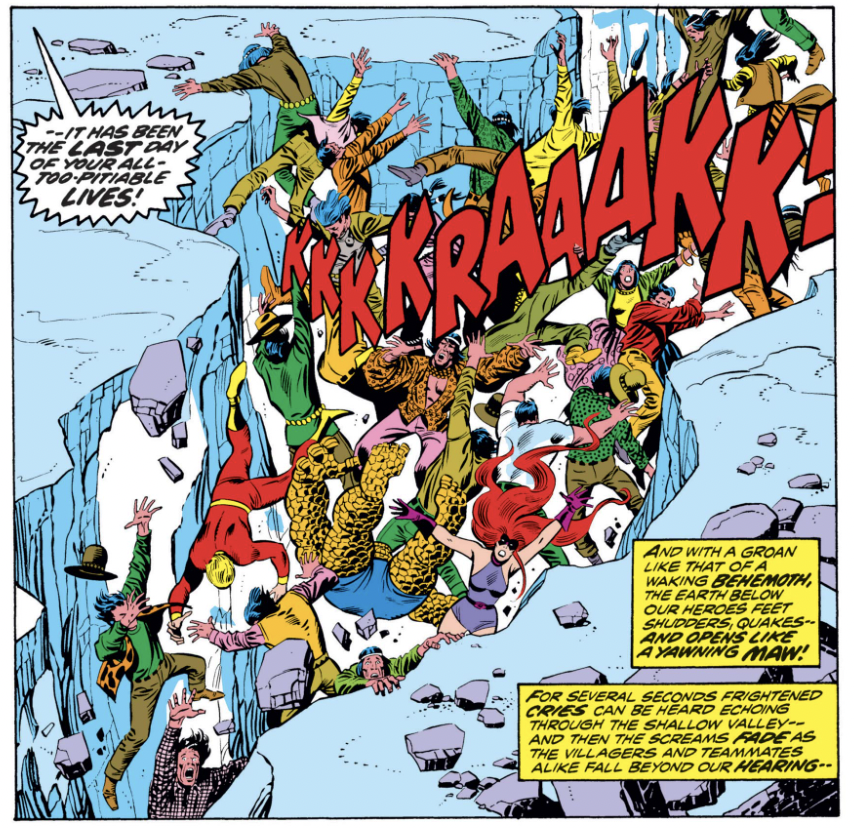
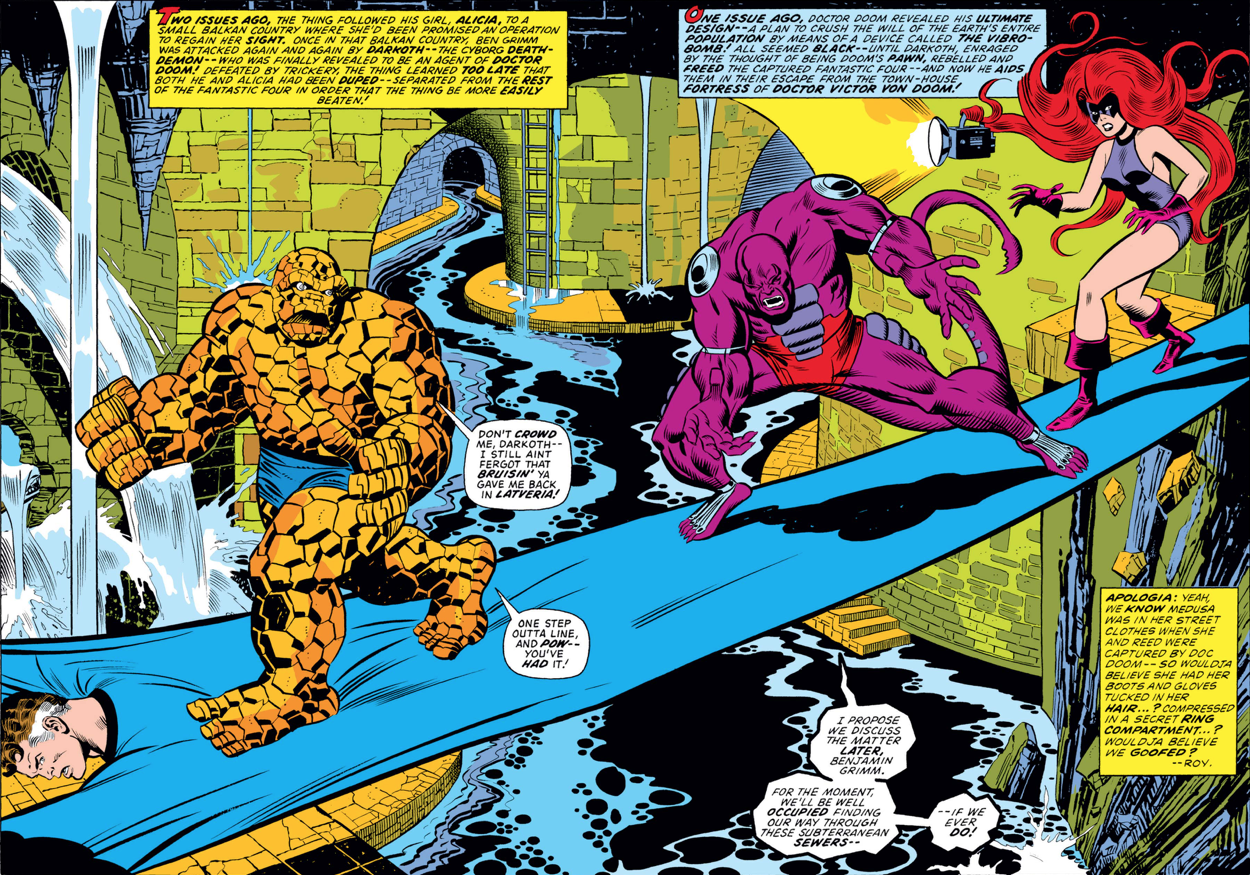
As mentioned, Bucker’s art is dynamic and the double-page spread above is a great example. I’m not sure the FF have had a double-page spread since the Kirby era (and they were pretty rare then) so this was a an exciting surprise when I found this across pages 2 and 3. The panel is big enough to serve up recaps from the last few issues, give a great visual image of the FF’s plight (who knew the New York sewers had stalactites?) and even include an apology about Medusa’s outfit.

Here’s another great Buckler image:
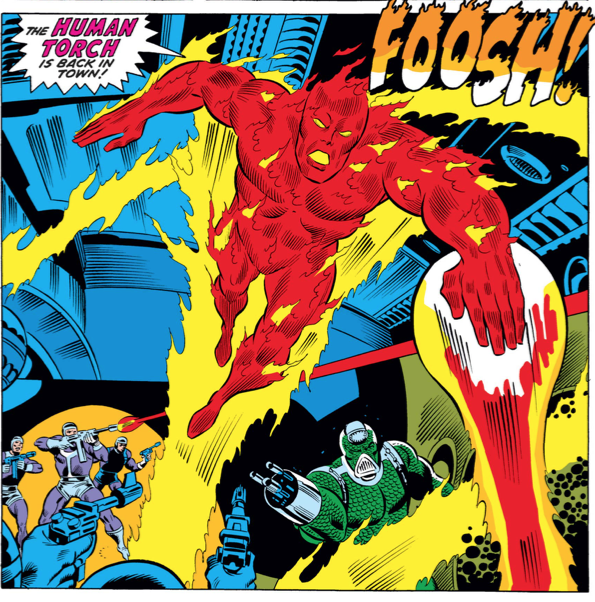
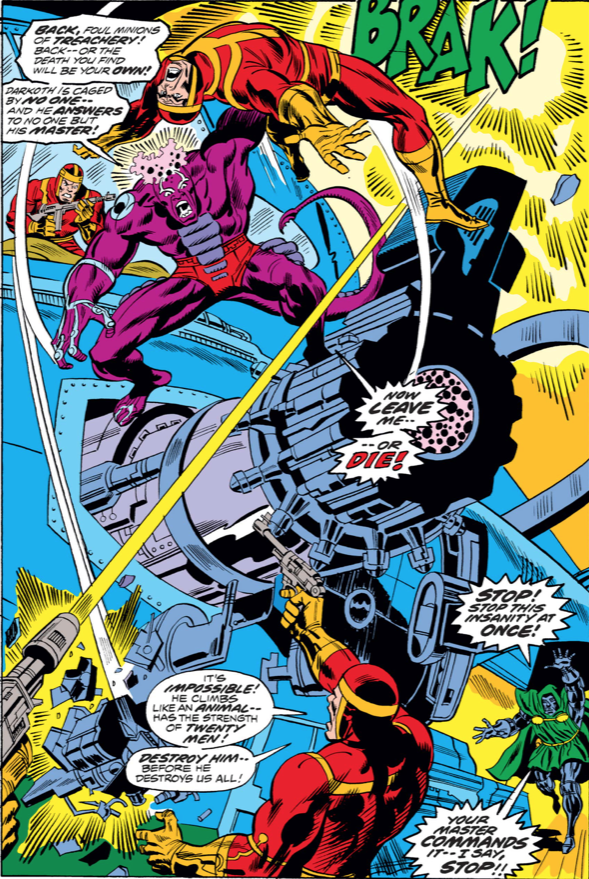
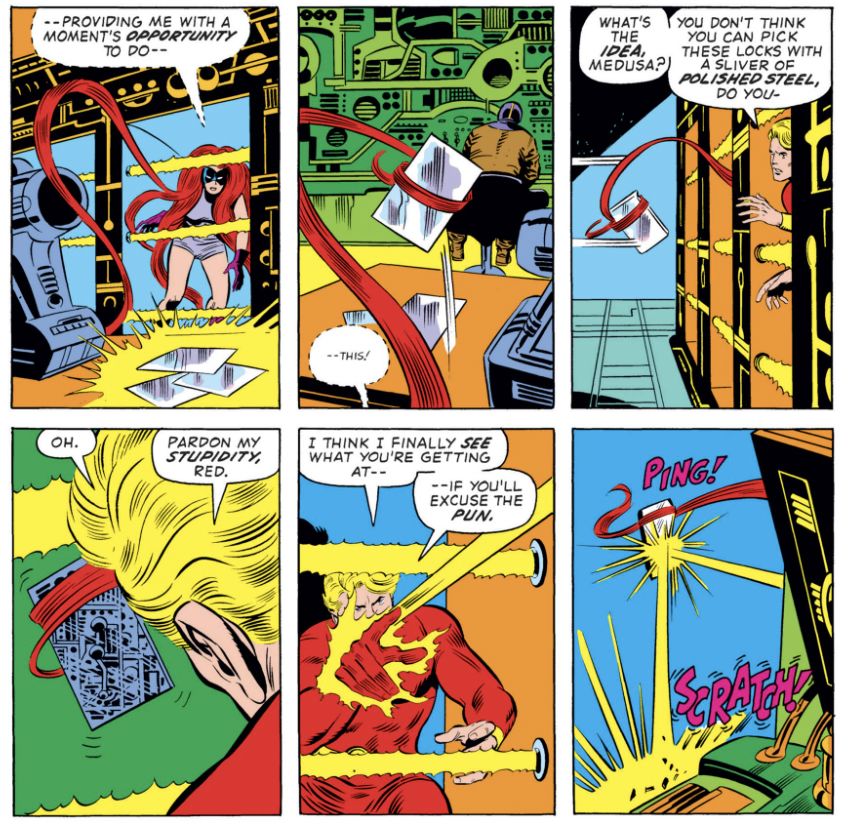
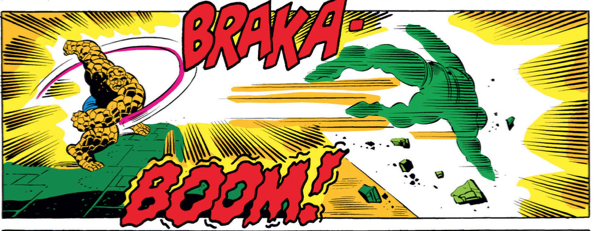
I love the way the Torch pops off the page. It’s like a 3-D comic.

This issue also had a lot of by-play between Reed and Ben, who is distraught and irritable about Alicia being held prisoner by Doom. Reed is at his best as a leader and friend here.
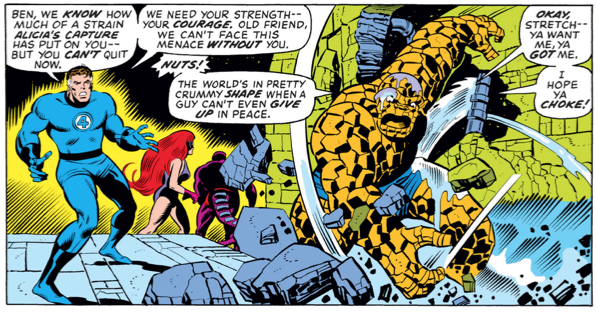
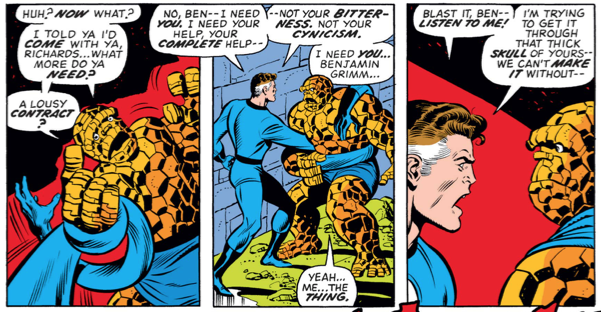
And a bit later:
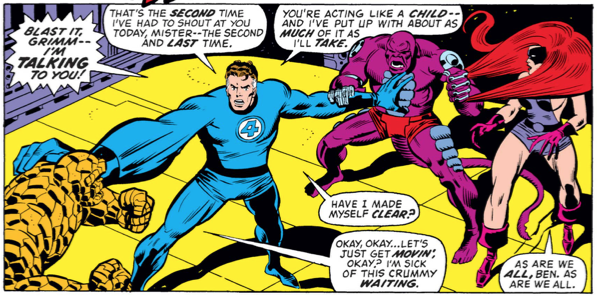
Conway strikes the right balance here with Reed, who can be a pushy and domineering jerk, but also knows how to motivate his team to get the job done.

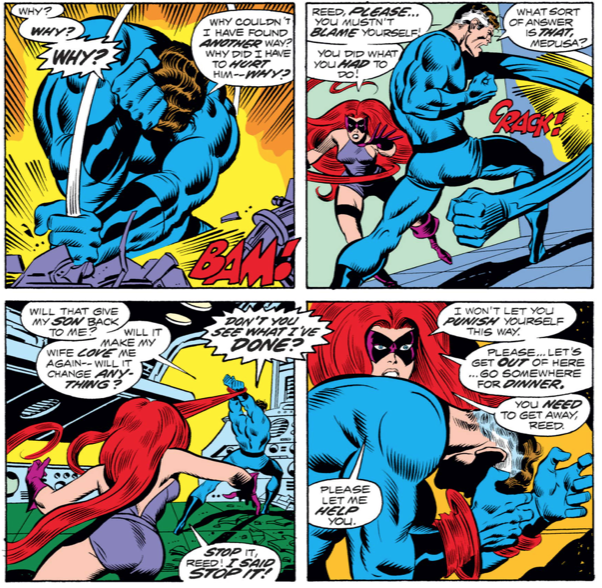
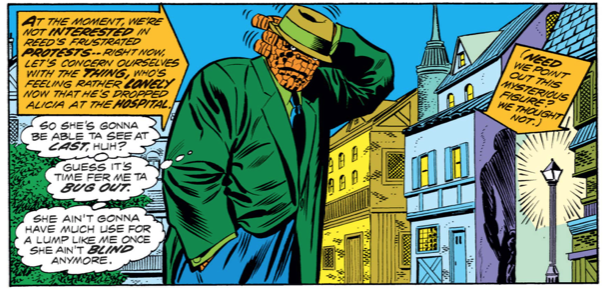
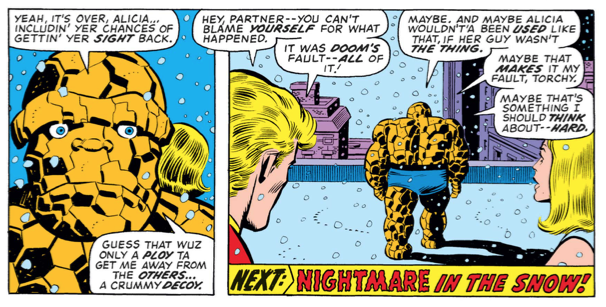
The comic had a bittersweet ending, with Ben once again reminded of his monstrosity.
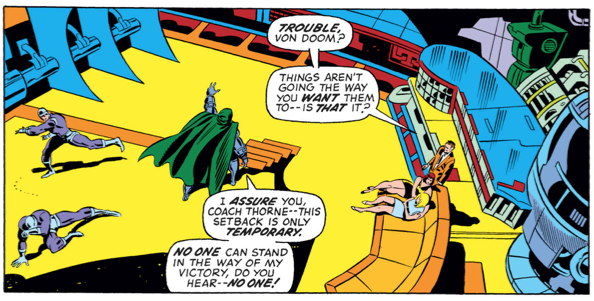
And I liked how Doom refers to his prisoner as “Coach Thorne.” Just like me, he has trouble referring to old teachers by their first names.

What I didn’t like

Overall, the story felt thin and not full developed. Darkoth’s backstory is confusing — is he a demon? is he a cyborg? — and it’s not clear how or where Doom found him. Doom’s plot for world domination, utilizing the mass-hypnotizing vibro-bomb, never feels like more than a McGuffin, while the Seeker shows up out of nowhere and makes little sense. It’s easily defeated, and serves as Doom’s undoing. I’ve written before about how the villain’s androids in the Fantastic Four rarely seem like androids, and have oddly human characteristics for machines. This is another example. Why does an android have muscles? Why does it need to talk? (And what are “nuclear-discharger rods,” anyway?)
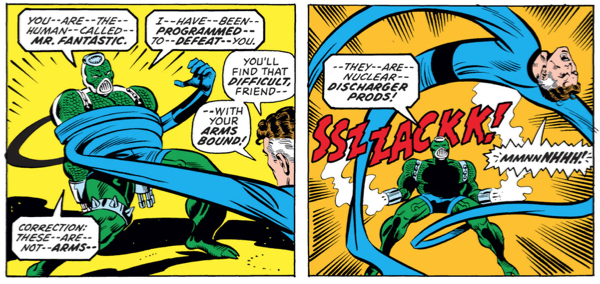
Once again, Medusa is barely in the story — I think she only speaks in two panels — and Sue and Franklin are not only not seen, but never referenced. In all, there’s a “let’s throw it against the wall and see what sticks” quality to the story that leaves it unsatisfying.

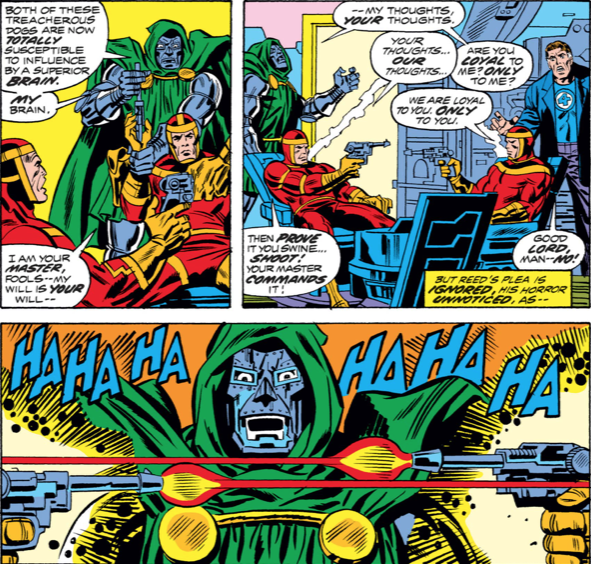
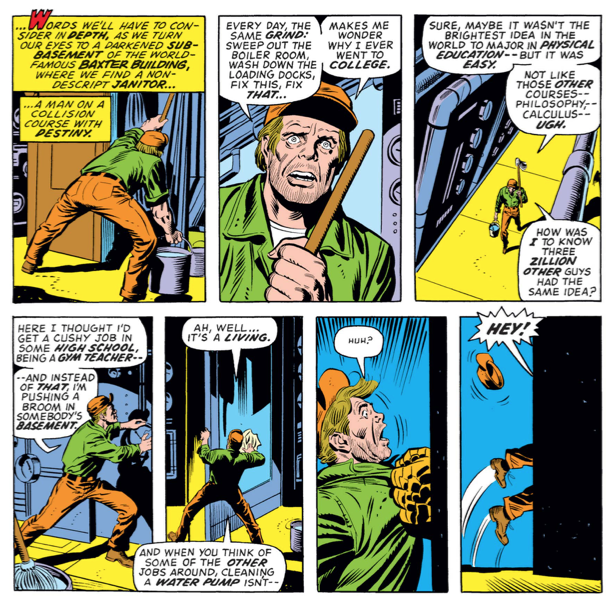
There’s also this weird interlude, which feels like Conway getting back at the jocks in his high school.

Anything else?

Lots of interesting advertising in this issue. I love these ads for record clubs. It’s reminder of what we think of music from the 1970s wasn’t all that people listened to. Englebert Humperdink, anyone?
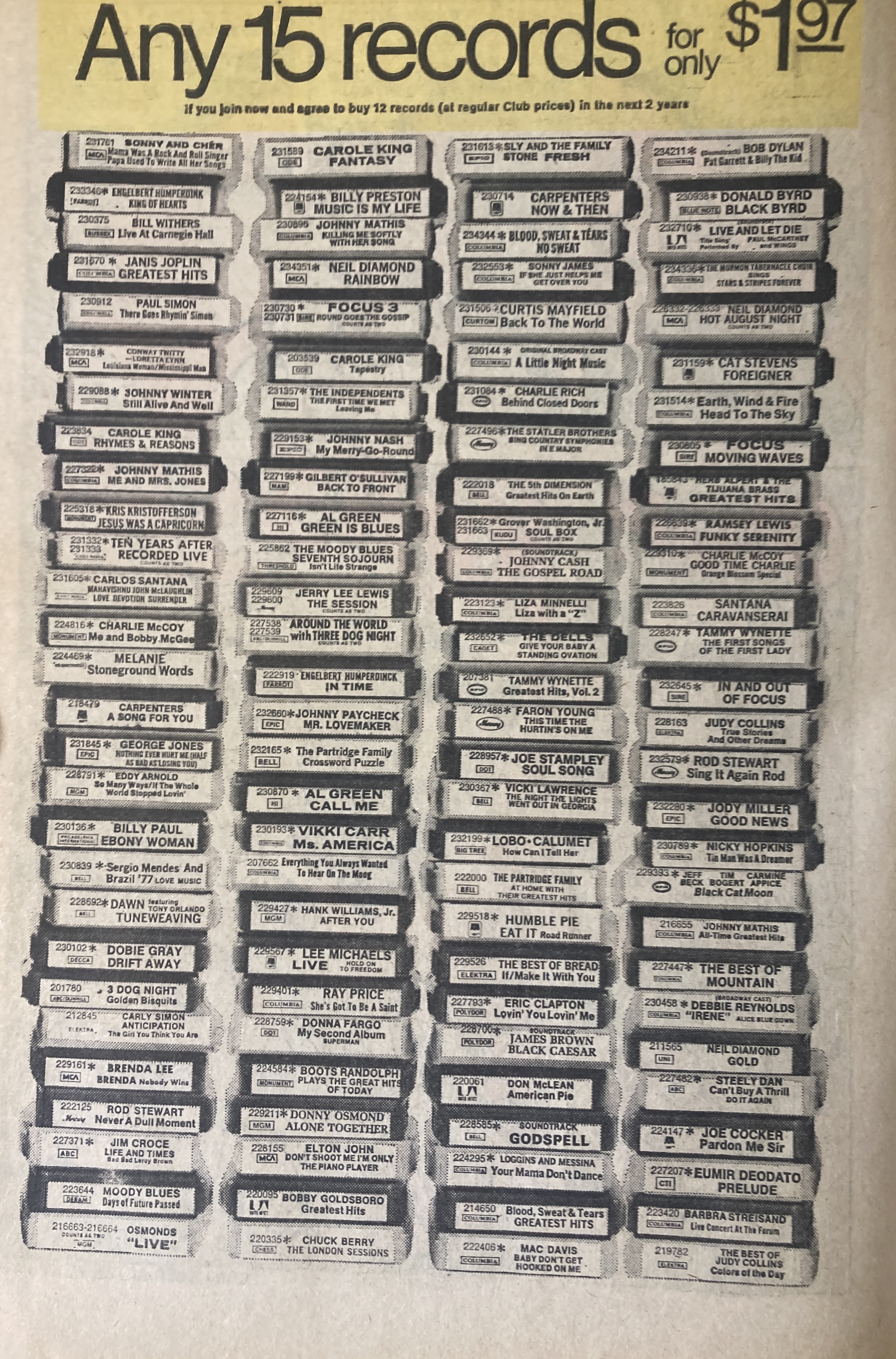
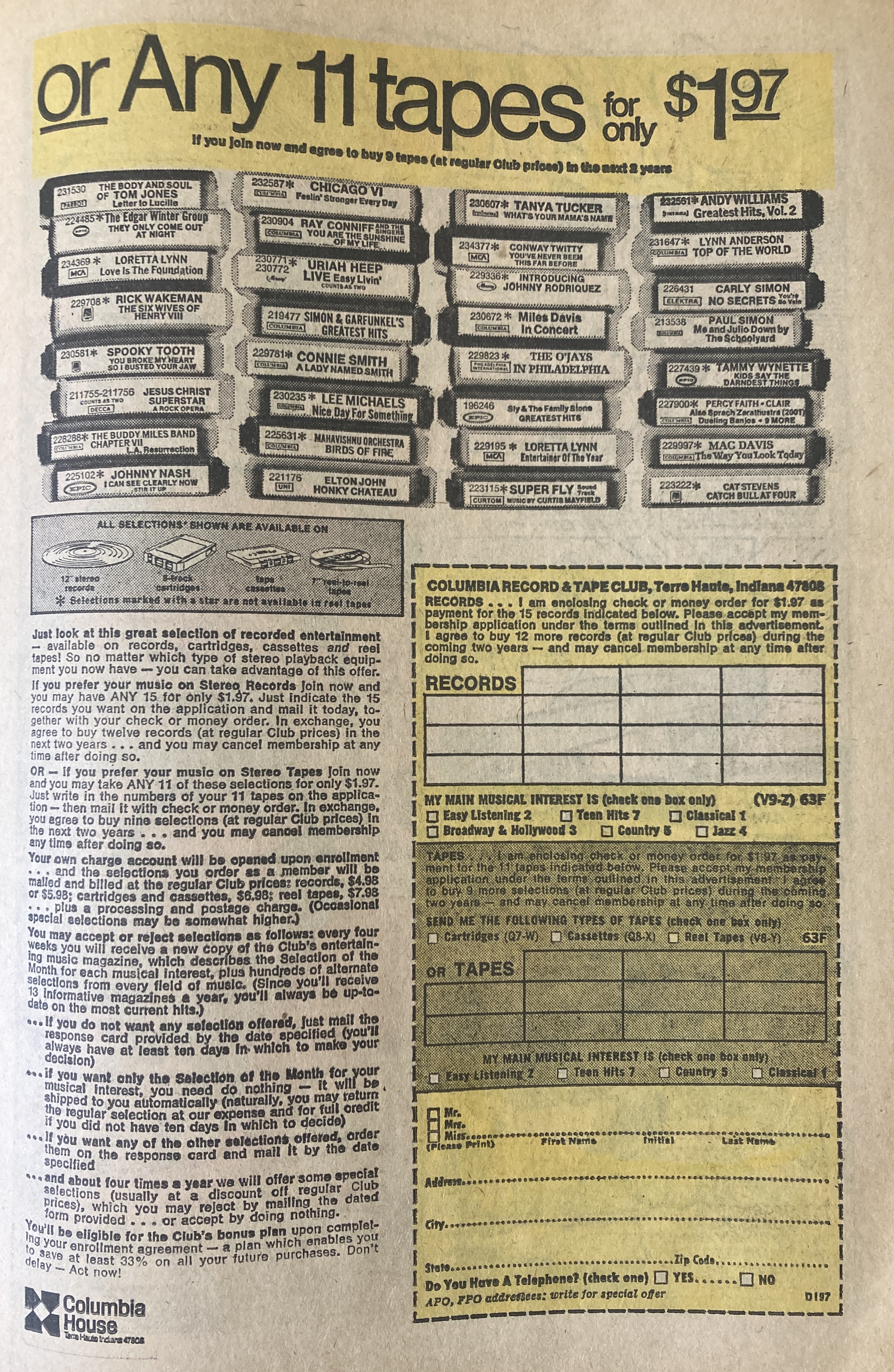
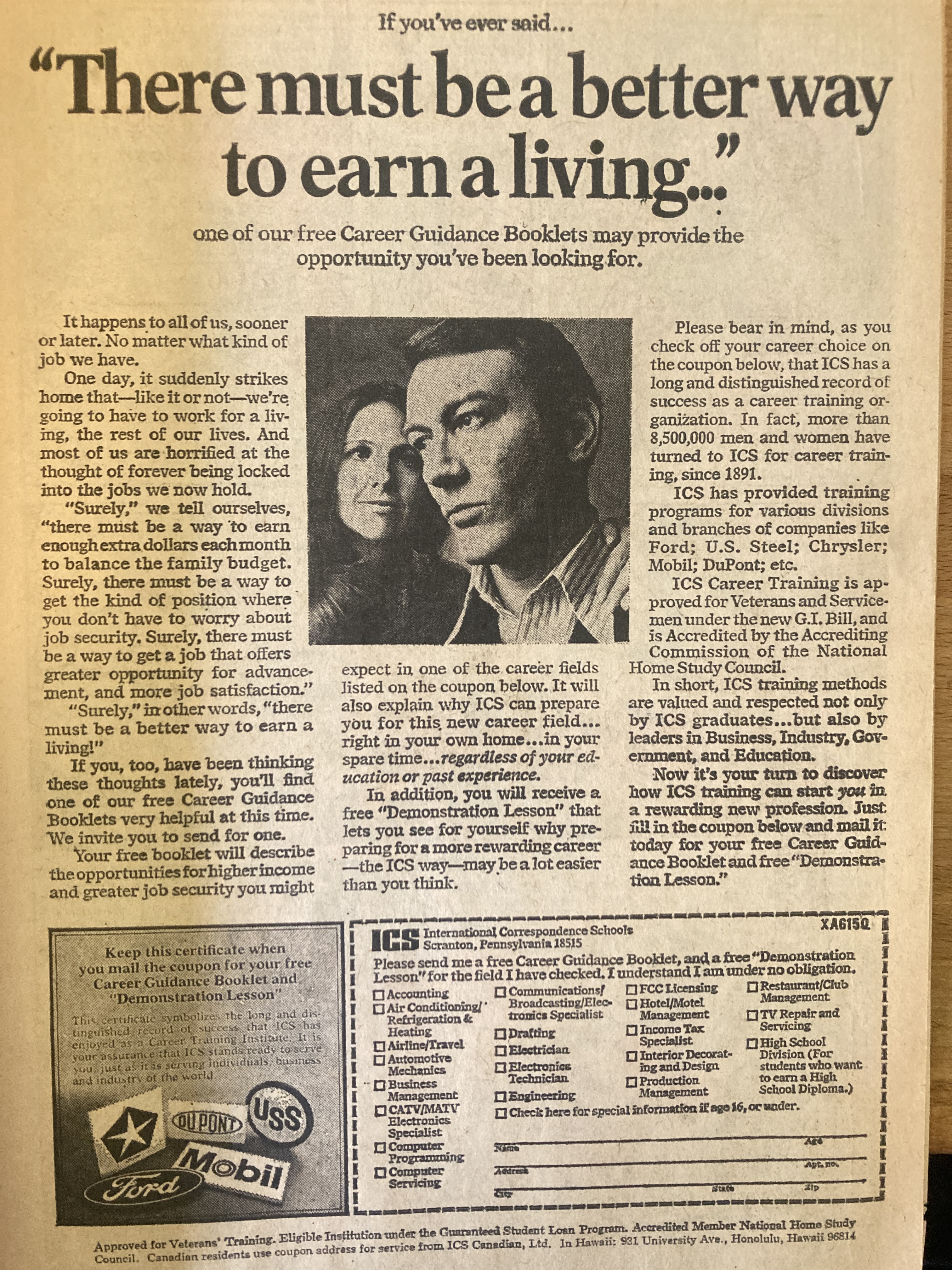
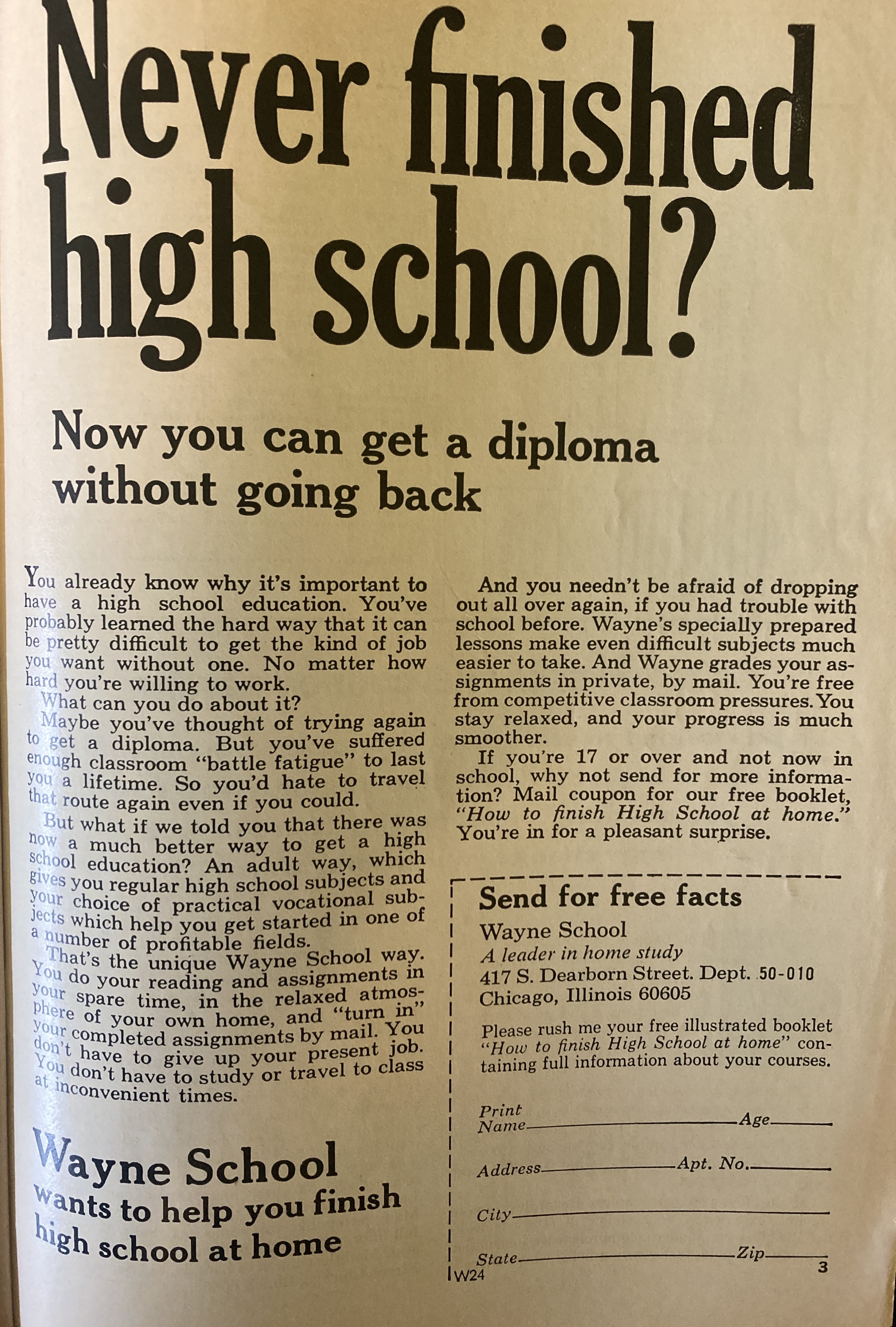
Also lots of ads for job training. The economy was not great in 1973.
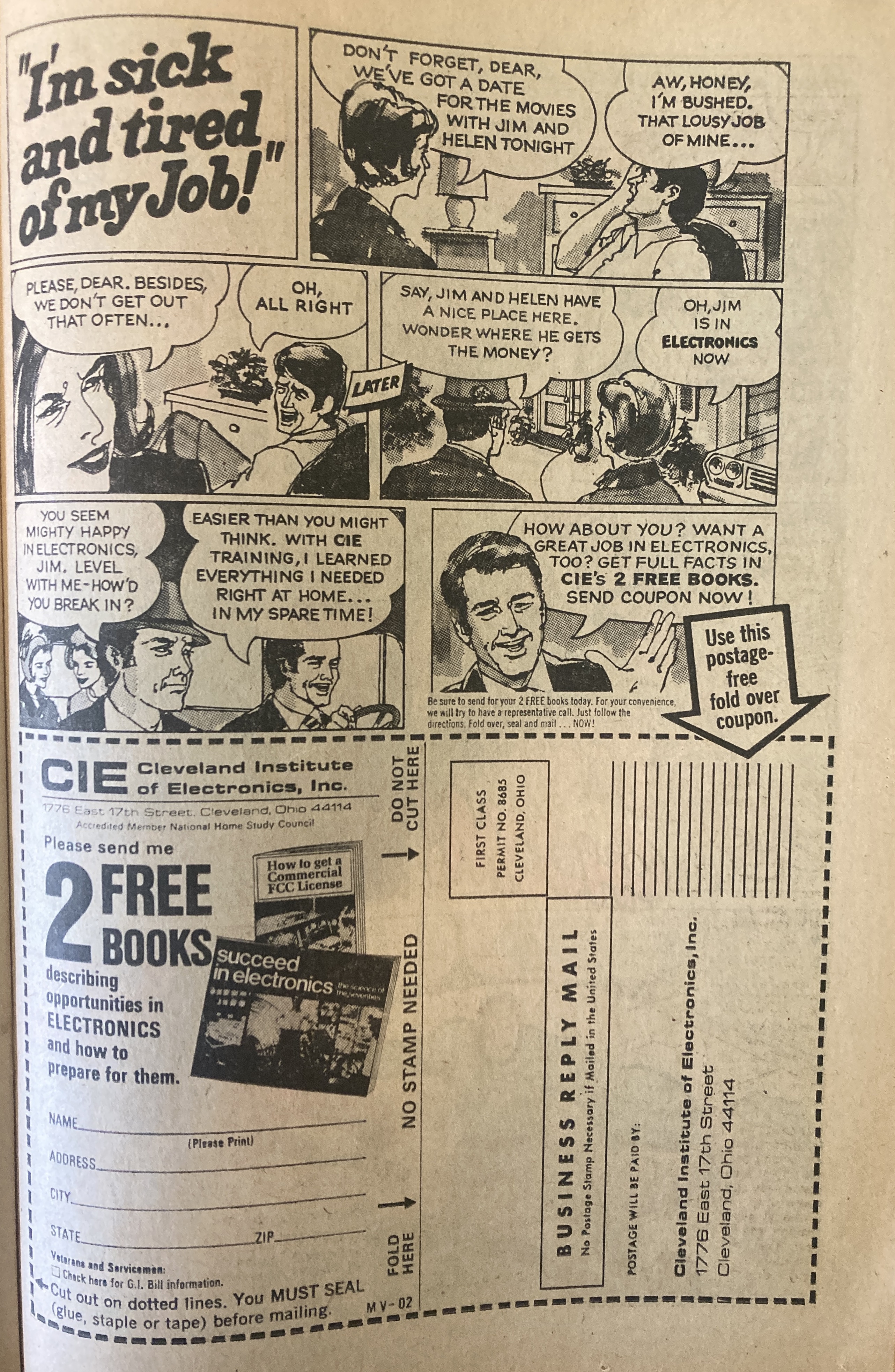
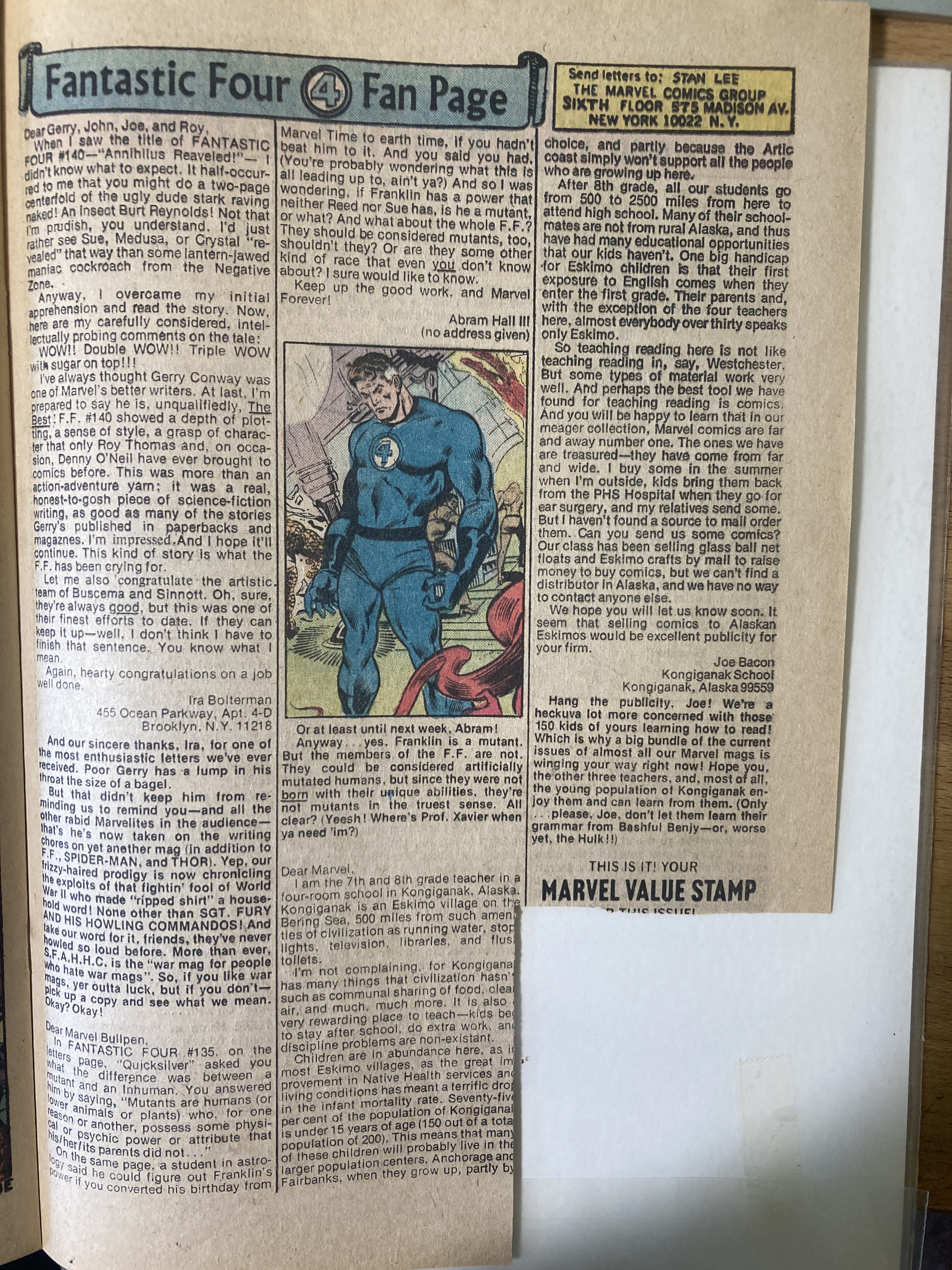
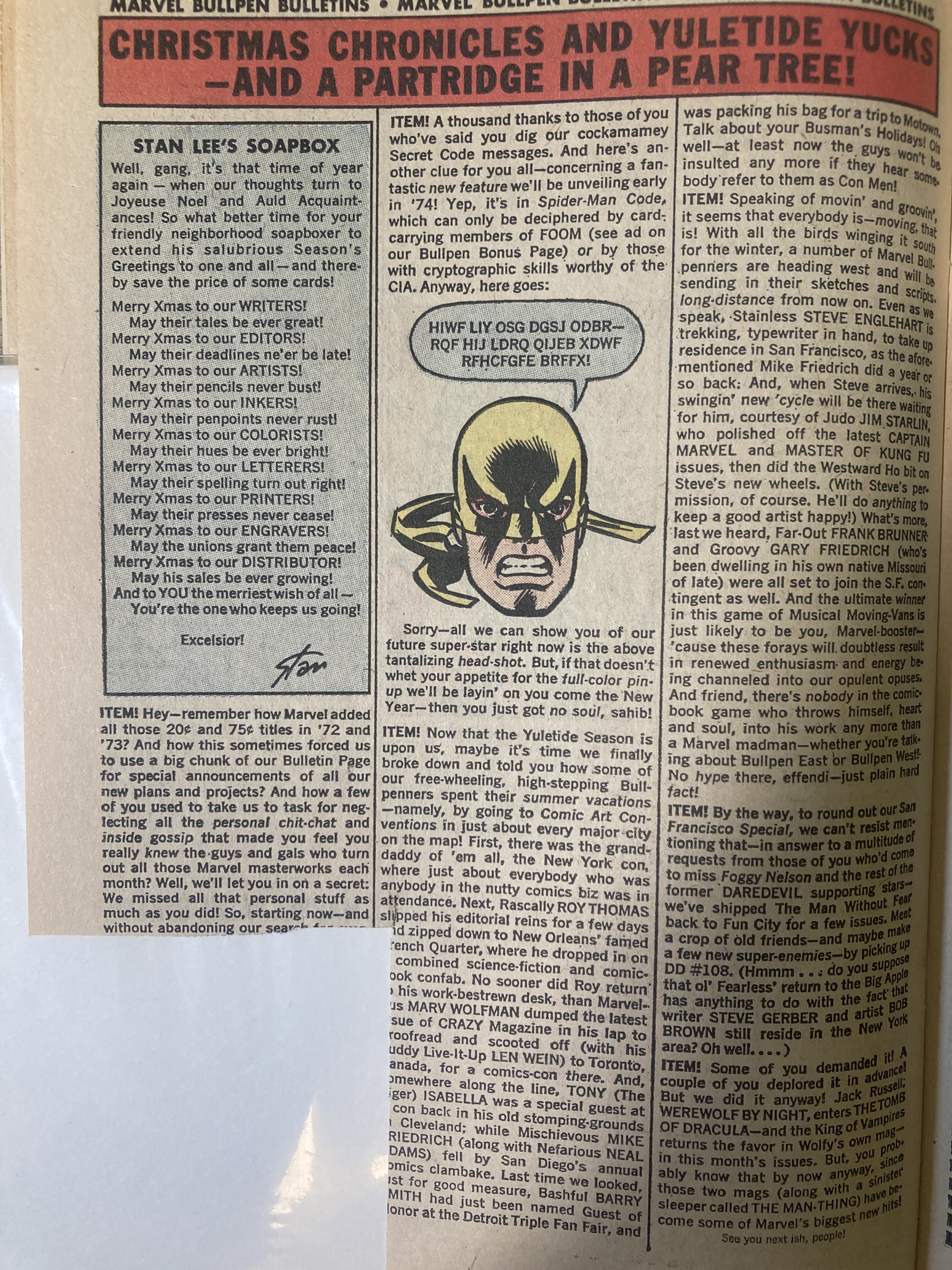
Lastly, I hate when this happens. Luckily the kid who owned it didn’t cut to cut out any of the story.
Overall

Fun but flawed (like most of ’em)
“The World’s Greatest Comic Magazine!” Fantastic Four No. 143

25 Sunday Aug 2024

Posted by percivalhenry in The World's Greatest Comic Magazine

≈ Leave a comment

Tags

1973, Dr. Doom, Fantastic Four, Fantastic Four 143, Gerry Conway, Marvel comics, Rich Buckler

Fantastic Four 143
“The Terrible Triumph of Dr. Doom!”
Published November 1973
Writer: Gerry Conway
Pencils: Rich Buckler
Inks: Frank Giacoia
Letters: John Costanza
Colors: Petra Goldberg
Editor: Roy Thomas
Cover: Gil Kane and Joe Sinnott

Synopsis

Dr. Doom captures Mr. Fantastic and Medusa, and reveals his plan for world domination by hypnotizing humanity. But as he subdues the Human Torch and Wyatt Wingfoot, Darkoth escapes and frees Reed and Medusa, enlisting them in a plot of revenge against Doom.


What’s going on here

This comic continues the story that began in earnest last issue. The focus is really on Doom and his machinations, and he’s in full, megalomaniac, world-beater mode in this comic. In years to come, Doom’s personality will shift and he’ll become more sinister and less grandiose, but this depiction, thanks to Gerry Conway’s over-the-top script, feels one of an archetypal super villain.

Rich Buckler’s art bolsters this concept of Doom, especially with this amazing double-paged splash that comes out of now where and blew my mind (Doom is addressing Belle Thorne, the wife of Reed’s now-unconscious college friend).


The Kirby influence is unmistakable here, not just in the layouts but in the finishes. But interestingly, this comic was inked by Frank Giacoia, not Joe Sinnott. Giacoia does a great job and is I think pretty under rated as an inker. (If anyone knows the whereabouts of the original art for this DPS, I would love to see it).

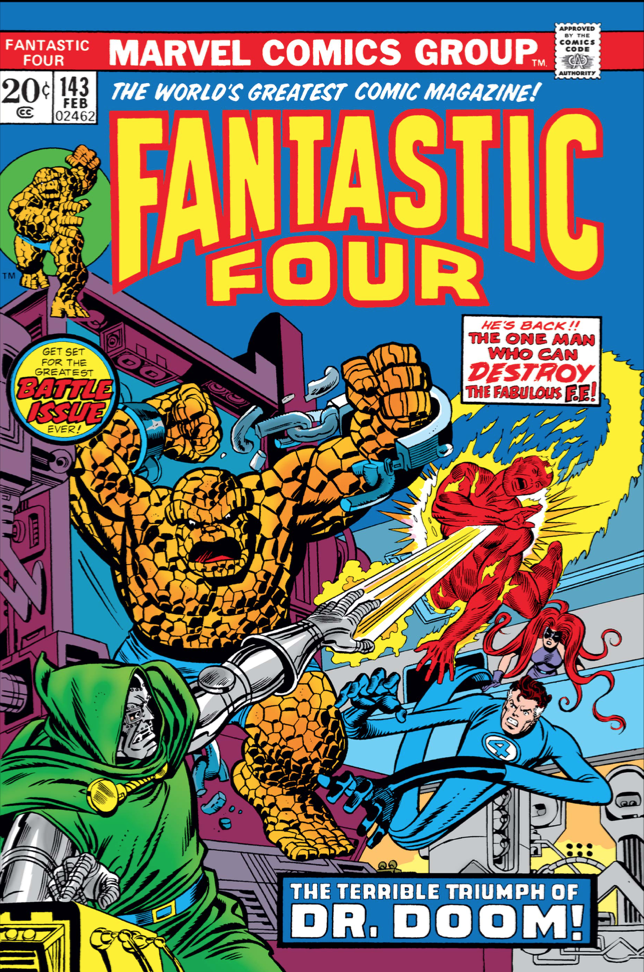
Also of note, the cover is by Gil kane and Sinnott, although it’s not obviously recognizable as such (nor does it depict anything that happens in the comic). Kane, a true legend, will go on to draw a few more FF covers over the next few years but never an interior, which is a shame.


What I liked

This was generally a well-plotted and -paced comic, with an exception I’ll get to. I liked the concept of Doom building a massive bunker under Manhattan, as if no one would notice (hopefully it was zoned appropriately). Doom’s scheme of hypnotizing all of humanity with a bomb is basically ridiculous, although no more than a million other comic plot devices. But his demonstration of its ability is chillingly cold blooded, and should be used as evidence for anyone who thinks Doom is warm and cuddly.


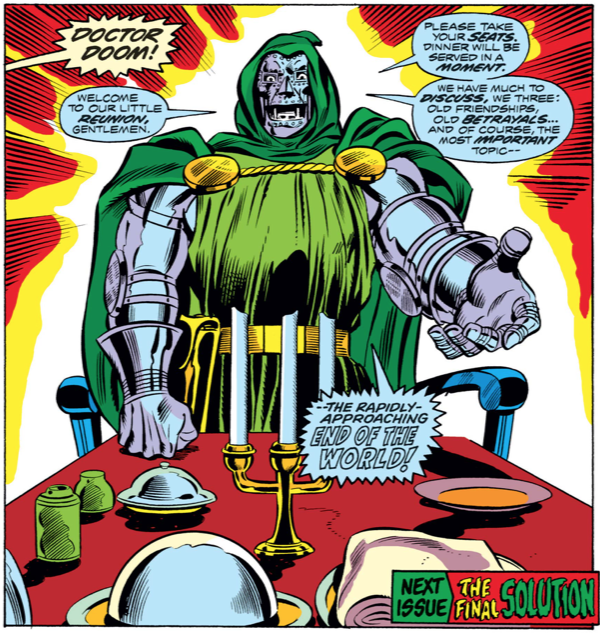
This splash page was also unexpected, and amazing:


What I didn’t like

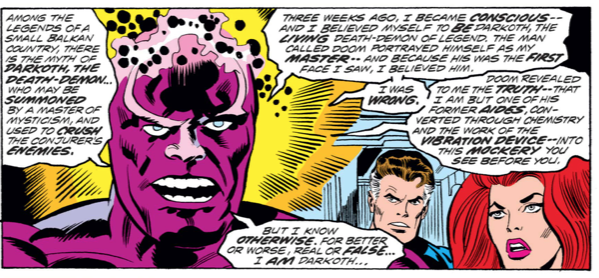
The Darkoth twist at the end wasn’t well set-up over the course of the last two comics and wound up convoluted and confusing (I wouldn’t be surprised if Thomas didn’t have a hand in it). A lot of exposition was jammed into the last page (a Lee / Kirby tic), and this panel, where Darkoth reveals what has transpired, might set a record for the number of words in one comic panel:


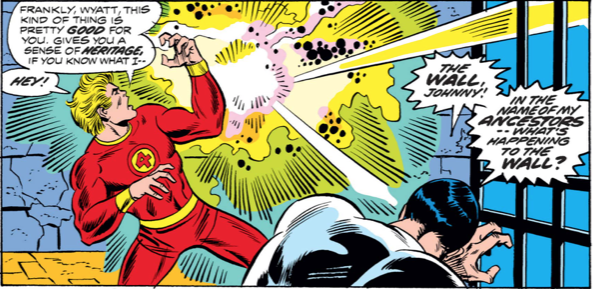
Also, this comment from Johnny is just weird, where it seems like he’s telling Wyatt he should be OK with being jailed because his ancestry. Yeesh.


Overall

A solid comic

“The World’s Greatest Comic Magazine!” Fantastic Four No. 142

17 Saturday Aug 2024

Posted by percivalhenry in The World's Greatest Comic Magazine

≈ Leave a comment

Tags

1973, darkoth, Dr. Doom, Fantastic Four, Fantastic Four 142, Gerry Conway, Marvel comics, Rich Buckler

Fantastic Four 142
“No Friend Beside Him!”
Published Oct. 1973
Writer: Gerry Conway
Pencils: Rich Buckler
Inks: Joe Sinnott
Letters: John Costanza
Colors: Petra Goldberg
Editor: Roy Thomas
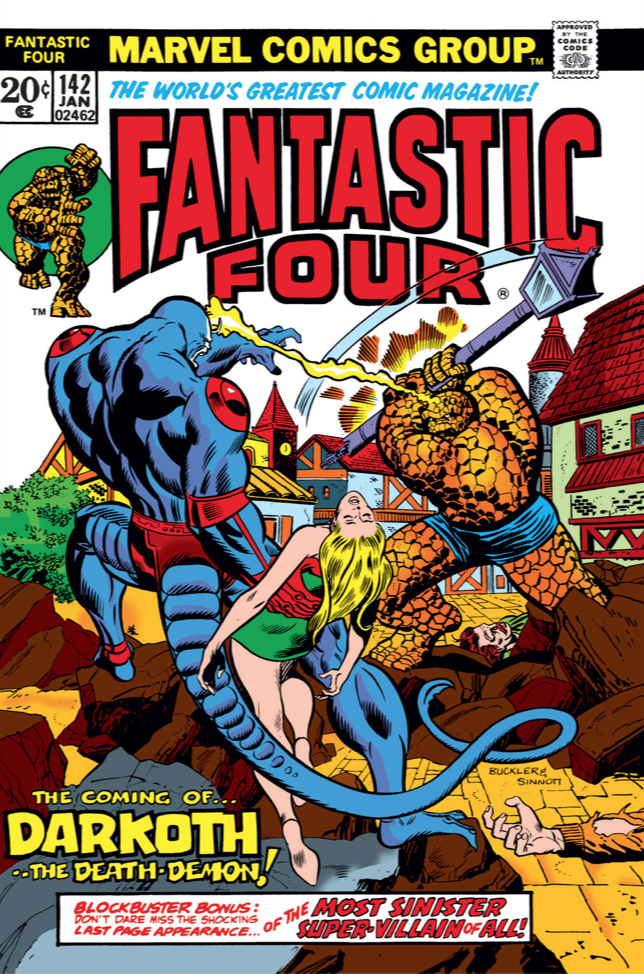
Cover: Buckler and Sinnott

Synopsis

The Thing, disgusted with Mr. Fantastic’s actions in the last issue, flies to Eastern Europe to join Alicia Masters, only to be attacked and subdued by the villain Darkoth. Meanwhile, a distraught Reed —accompanied by Medusa — attend his college reunion, where they are confronted by Dr. Doom.

What’s going on here?

The biggest development in FF 142 is the introduction of Rich Buckler as penciler, replacing John Buscema. Buscema, who took over with issue 107 and penciled almost every issue for more than three years, was responsible for establishing the post-Kirby look of the Fantastic Four, a style reinforced by inker Joe Sinnott, who kept the book’s art uniform even as it changed pencilers. I suspect many collectors wouldn’t have noticed the change if hadn’t been announced. Buscema will return to the FF several times over his career.

Buckler was relatively new to comics, starting in 1970, but would go on to have a long career, primarily at Marvel and DC but also at places like Archie. He may be best known for creating Deathlok, a cyborg killing machine from the future and an amazing character, and for drawing the notorious KISS comic. Buckler sadly died in 2017.

There’s no denying the dynamism of his art, and the Kirby influence:

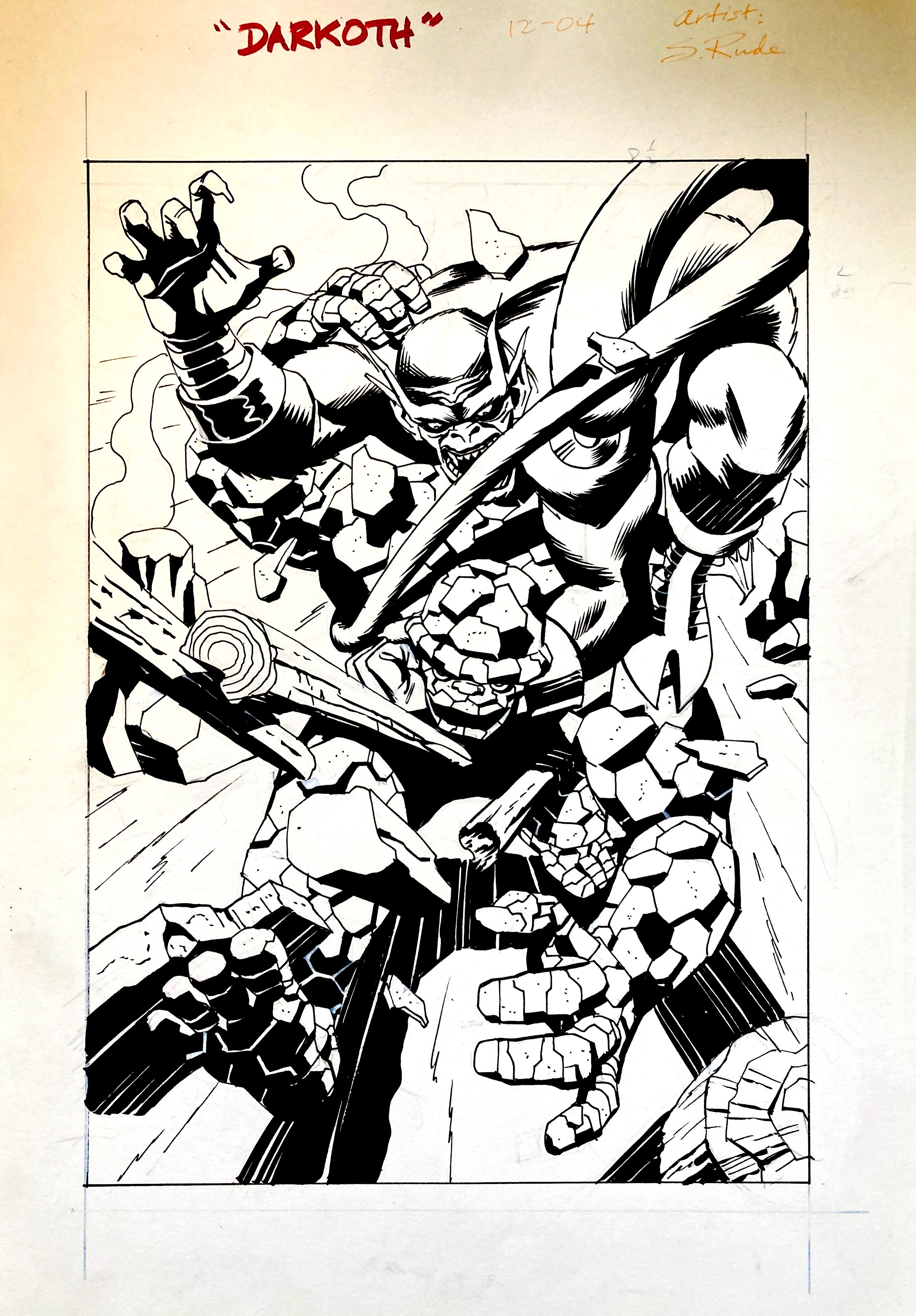
The other newcomer of note is Darkoth, the villain. This is my first exposure to the character, despite owning a Steve Rude drawing of him and the Thing, for a playing card almost certainly inspired by this comic. So far as a villain, there’s not much to him. He’s got an odd set of powers, and he speaks with Gerry Conway’s over-the-top grandiosity. A little online research reveals there’s more to the character than meets the eye but we’ll deal with that if and when we get to it.

Here’s is my Rude drawing of Darkoth:


What I liked

This was a fun, satisfying issue. It’s been a while since we had the Thing in what’s basically a solo adventure, and it was well structured and paced, starting with the Alicia subplot established in the last two issues. The Darkoth fight was fun, and the jumps between Ben’s story and that of Reed and Medusa, Johnny and Sue, rather than distracting from the flow, added dimension and which all paid off in the climactic scene, the Doom reveal. Doom, of course, makes any FF comic better.

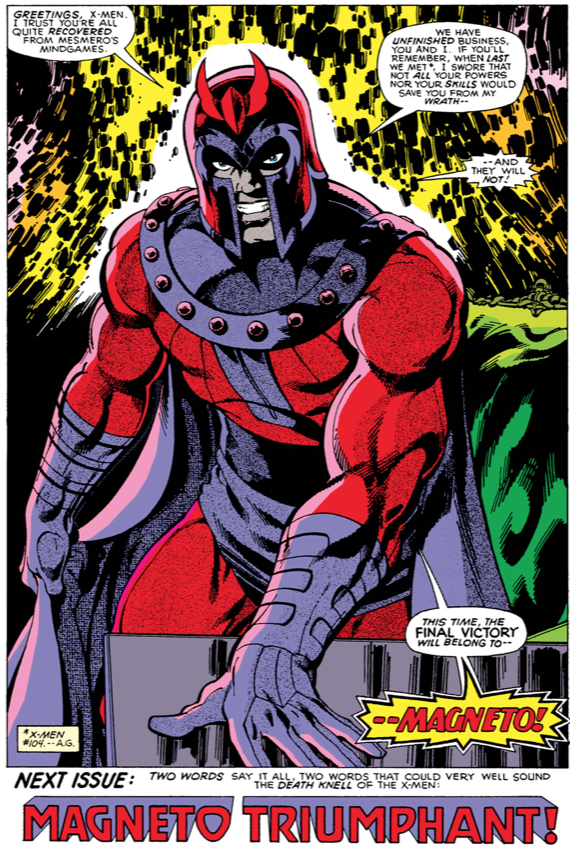
For those keeping track, Chris Claremont, John Byrne and Terry Austin used this same set-up, including the climactic last panel revealing the bad guy, in X-Men 111 about five years later:


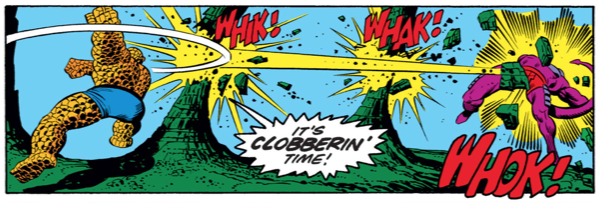
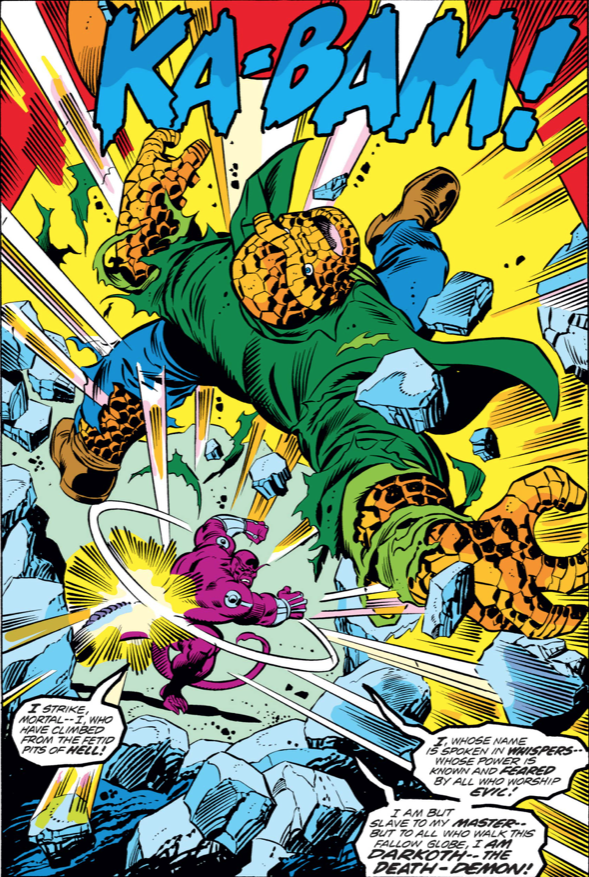
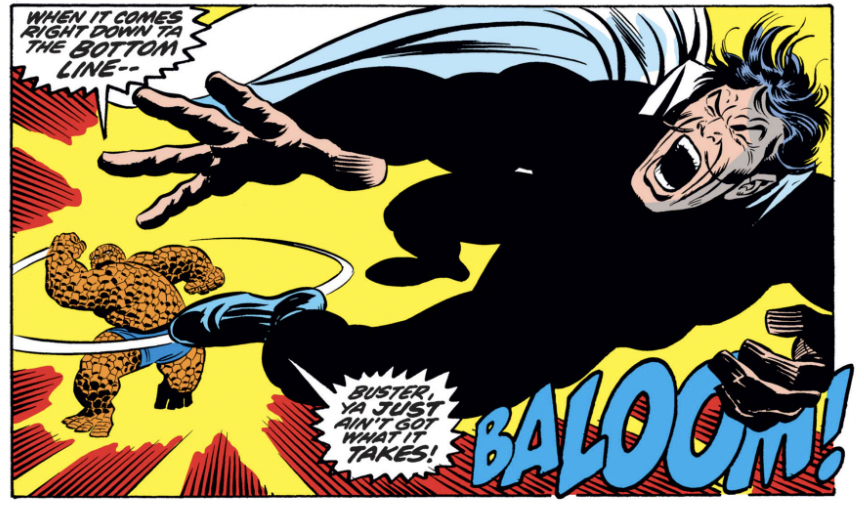
As mentioned above, Rich Buckler’s art packs a (literal) punch. I really liked this splash (who couldn’t?):

What I didn’t like

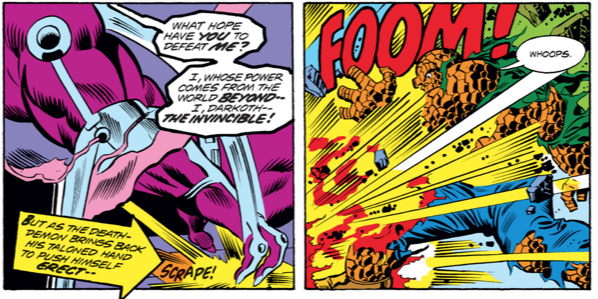
Oddly, some of Buckler’s panels were annotated with arrows, pointing out details that readers might otherwise have missed. That seems like either a failing of Bucker to make his art clearer, or of Conway and/or editor Roy Thomas, not giving him better direction. Either way, I found them distracting.

Anything else?

Some more ads of note. I have no idea what iced cologne is, and even less of an idea why a 12-year-old comic reader would want some (reading more closely, it seems like an ad to entice women to become saleswomen in a vertical marketing scheme. Even more confusing for 12-year-old comic readers).

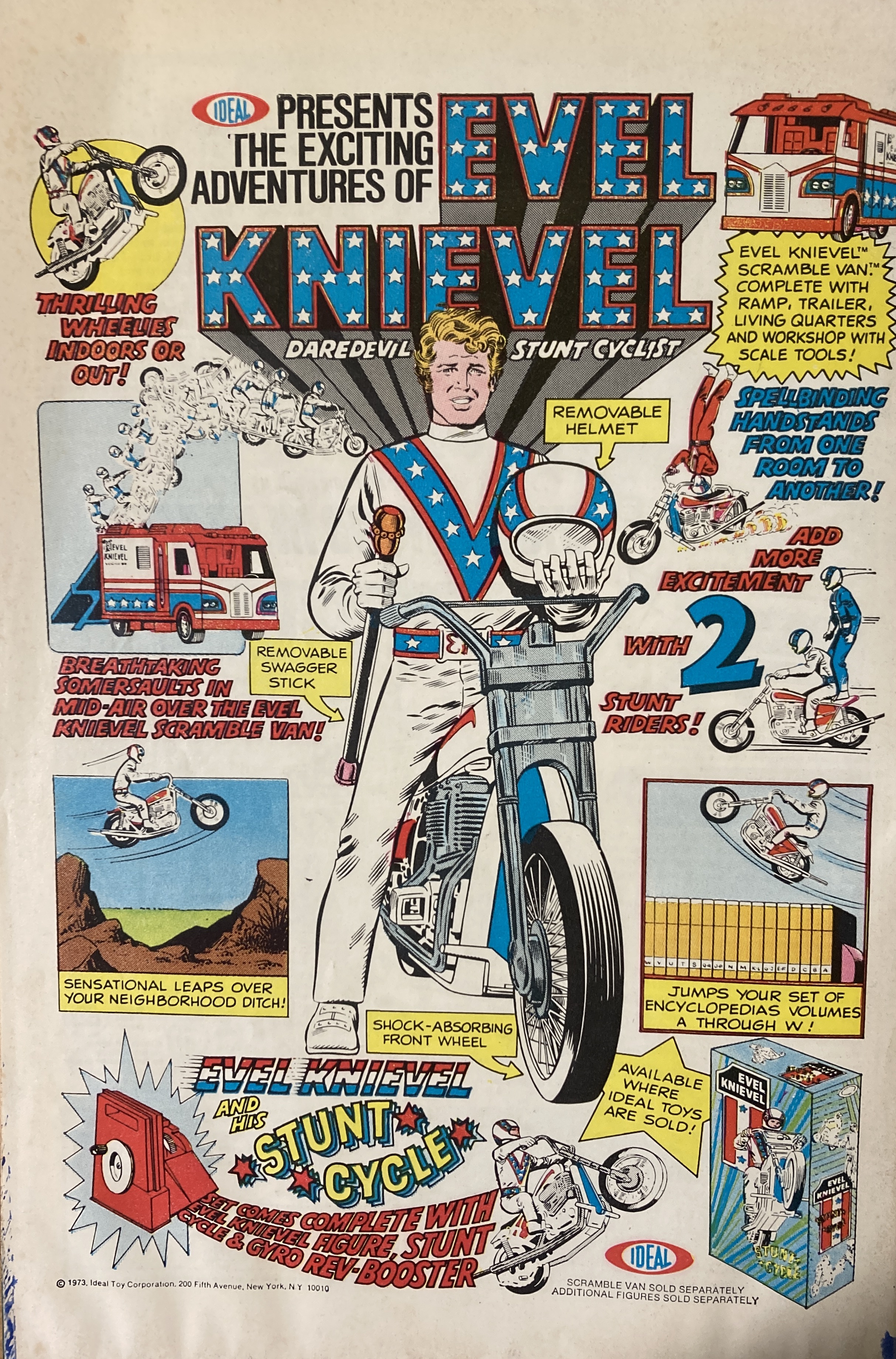
The Evel Kneivel toy, on the other hand, is exactly what 12-year old me would have wanted (and I think I did have some version of this as a kid).


Overall

Perhaps Gerry Conway’s best effort to date

“The World’s Greatest Comic Magazine!” Fantastic Four No. 141

10 Saturday Aug 2024

Posted by percivalhenry in The World's Greatest Comic Magazine

≈ 1 Comment

Tags

1973, Annhilus, Fantastic Four, Fantastic Four 141, Franklin Richards, Gerry Conway, John Buscema, Marvel comics

Fantastic Four 141
“The End of the Fantastic Four!”
Published Sept. 1973
Writer: Gerry Conway
Pencils: John Buscema
Inks: Joe Sinnott
Letters: John Costanza
Colors: George Roussos
Editor: Roy Thomas
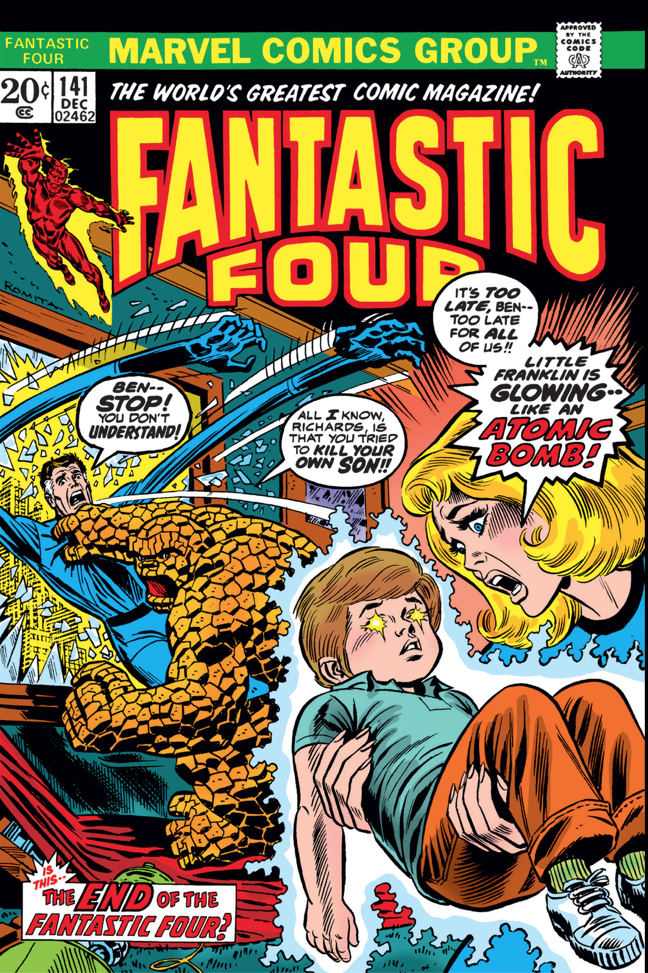
Cover: John Romita

Synopsis

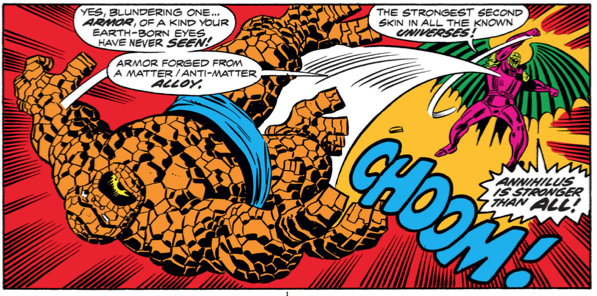
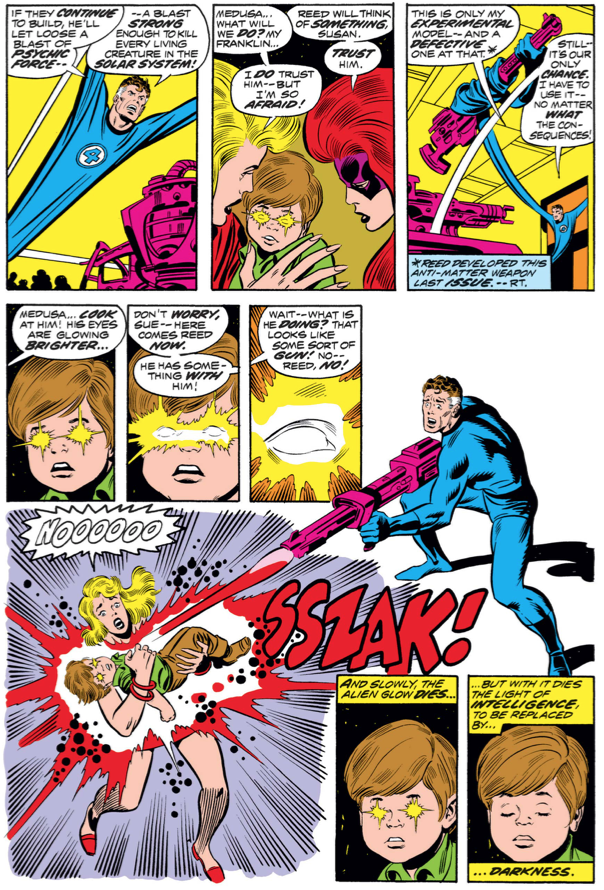
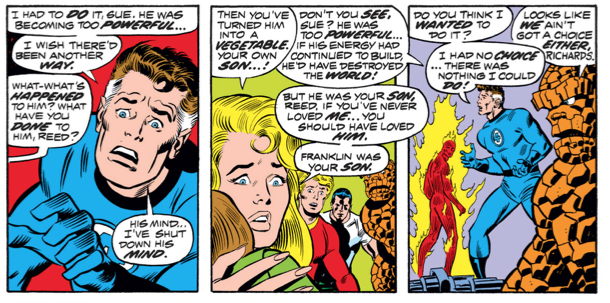
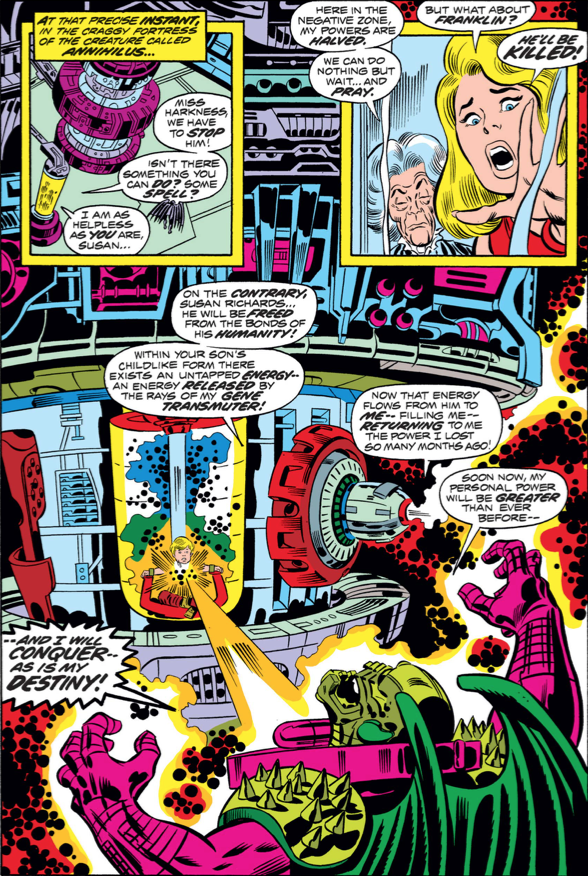
After capturing the now helpless Fantastic Four — plus Sue, Franklin, Agatha Harkness and Wyatt Wingfoot — in his Negative Zone stronghold, Annihilus taps Franklin’s comic powers in order to drain them. The FF escape, free Franklin and returns to the Baxter Building, where Reed, fearing Franklin’s powers will destroy the solar system, zaps him with a device that renders him a vegetable. Horrified, Ben declares this is the end of the Fantastic Four.


What’s going on here?

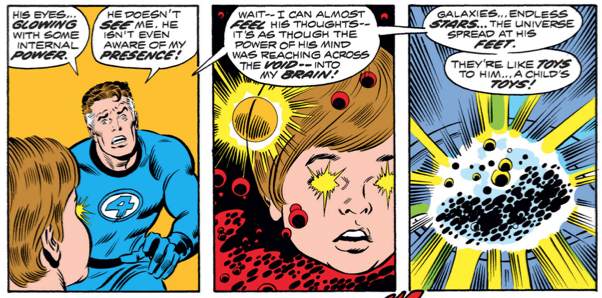
This is a heavy issue. I’m not particularly sure it’s a well-written story, but it has big themes and consequences. The big revelation is that Franklin possesses enormous power that threaten all of existence. His powers had been teased at for years now, but this is the first indication of their scope, and it’s a development that has major ramifications for not just the Fantastic Four but the Marvel universe for decades to come. As but one example, the mid-90s Onslaught storyline, which resulted in the cancellation and reboot of most of Marvel’s mainstream comics, was facilitated by Franklin creating a pocket universe. At some point he is identified as a mutant, although he’s not labeled one here.


It’s not clear who came up with the idea of giving Franklin these god-like powers. In an interview, Stan Lee said after they decided for Reed and Sue to have a child, he and Jack Kirby envisioned him having powers, and liked the idea of keeping readers guessing what they might be. It seems like Roy Thomas and Gerry Conway took that idea and ran with it. His powers have resulted in a lot of interesting stories, but also some petty tedious ones as well.

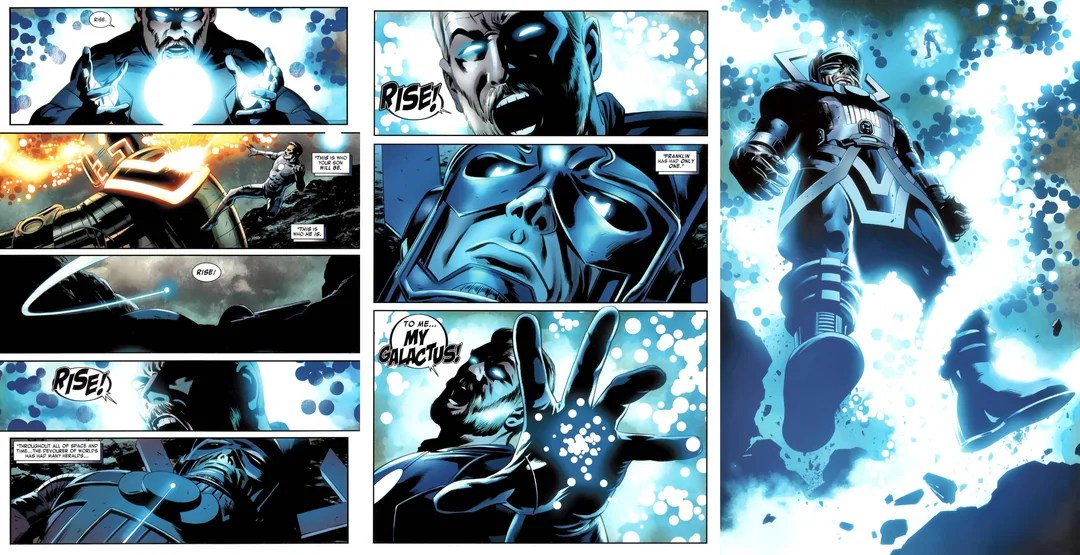
From my perspective, a super-powered Franklin is a mixed blessing. There is something compelling about the idea of a child with these immense powers, and when they are unleashed in the hands of a great writer, it can be a lot of fun. Hickman’s future Franklin battling Celestials and summoning Galactus might be as good as it gets (from FF 604, art by Steve Epting and Rick Magyar).


But for every fun story, there’s a lot of uneven ones about Franklin’s powers run amok, or Franklin in danger. And when taken together, they tend to reflect poorly and Reed and Sue as parents who are constantly exposing their child to danger.

The other big development is Reed’s panicked decision to depower Franklin, and — it appears — effectively lobotomize him. It’s not the first, and certainly not the last, example of Reed prioritizing the good of humanity or the universe of over personal needs or desires, but it’s a poignant one. Of course, we know know that Franklin eventually recovers but for readers at the time, this must have felt like a pretty significant episode in the marriage of Reed and Sue and the future of the FF.


What I liked

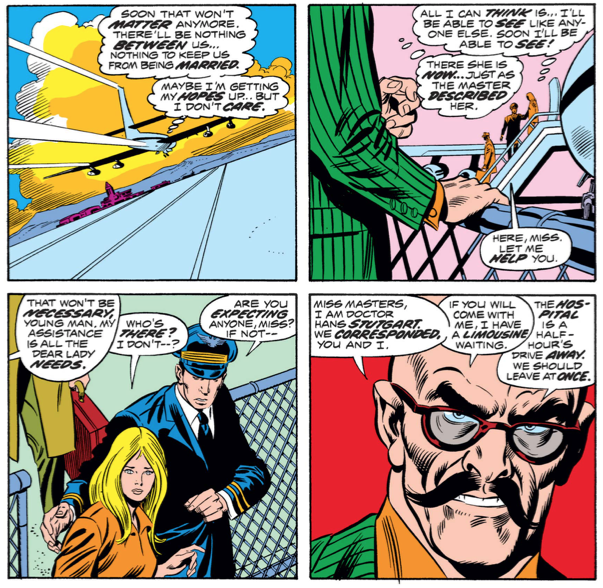
I did appreciate how the stakes were ratcheted up in this story, and how Conway finally resolved long-hanging plot points, such as the disappearance of Agatha Harkness’s house way back in issue 134. Unlike Lee and Kirby, who rarely seemed to plot more than an issue or two in advance, Thomas and Conway unspool their subplots over months, creating bread crumbs for readers to follow. Even in this issue, which wraps up a long arc, Conway teases another story featuring Alicia Masters.


This form of story development isn’t always successful, but it suggests a respect for their readers’ ability to handle complicated ongoing stories. Chris Claremont would of course take this style of storytelling to absurd lengths, letting plots tangle for years, some never to be resolved.

I also enjoyed this splash from Buscema and Sinnott, which has a Kirby-ersque flair.


What I didn’t like

Despite the major themes introduced in this comic, the story itself wasn’t very interesting or well constructed. Basically, Annihilus captures the FF, they escape and defeat him. There’s not a lot of nuance, and it all feels pretty rote until we get to the climax.

One of my gripes about the Conway era has been how underutilized Medusa has been. Here, he rectifies that in the most obvious and silly way possible (Annihilus has imprisoned the FF in a room with an open window???).


We also get this unfortunate exchange between Wyatt — even more under-utilized in this issue than Medusa — and Johnny.


Overall

A pivotal issue the history of the Fantastic Four

“The World’s Greatest Comic Magazine!” Fantastic Four No. 140

04 Sunday Aug 2024

Posted by percivalhenry in The World's Greatest Comic Magazine

≈ Leave a comment

Tags

1973, Annhilus, Fantastic Four, Fantastic Four 140, John Buscema, Marvel comics

Fantastic Four 140
“Annihilus Revealed!”
Published August 1973
Writer: Gerry Conway
Pencils: John Buscema
Inks: Joe Sinnott
Letters: John Costanza
Colors: George Roussos
Editor: Roy Thomas
Cover: Rich Buckler and Frank Giacoia

Synopsis

The Fantastic Four receive a distress call from Sue about Franklin’s manifesting powers, and while they race to find her in Pennsylvania, she is summoned elsewhere by Agatha Harkness. Meanwhile, Annihilus invades the Baxter Building, defeating the returning Fantastic Four and sending them to the Negative Zone before disclosing his origin to Wyatt Wingfoot.

What’s going on here?

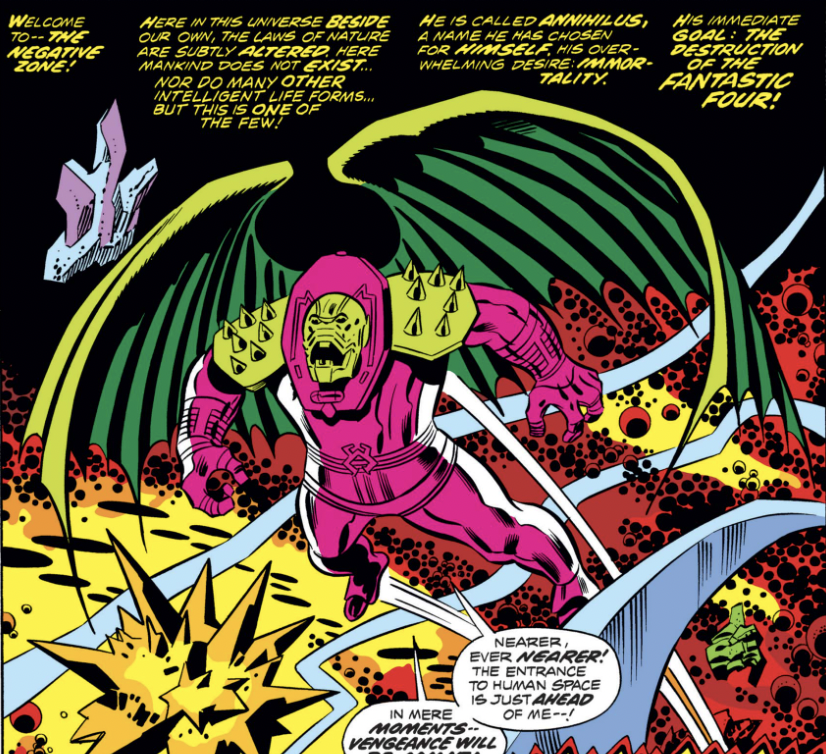
There’s a lot packed into this issue, which appears to be Gerry Conway’s first as full writer (up to this point he was credited only as a scripter, with Roy Thomas handling the plots). The highlight is the return of Annihilus, one of the FF’s best villains. and one who has been absent for a few years. The Annhilus plot was cooking in the background last issue, while the Franklin storyline has been developing for a few issues now, and it’s still not clear how (or if) they are related. We also get Annhilus’s complicated backstory, and a lot of inter-team bickering between Ben, Reed and Medusa.

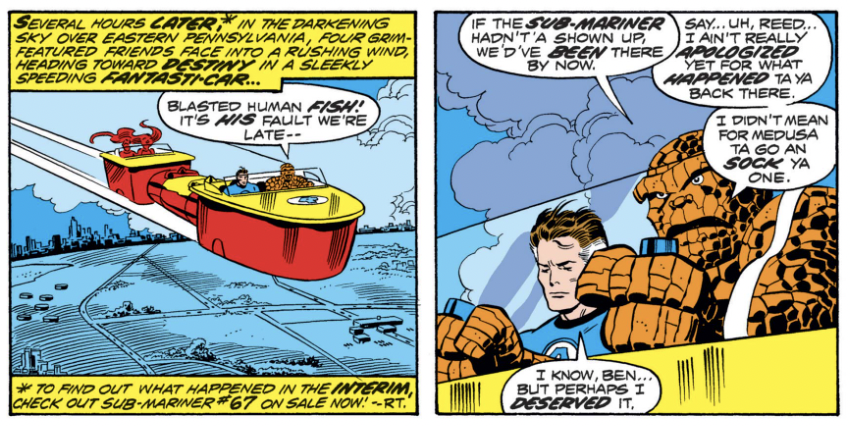
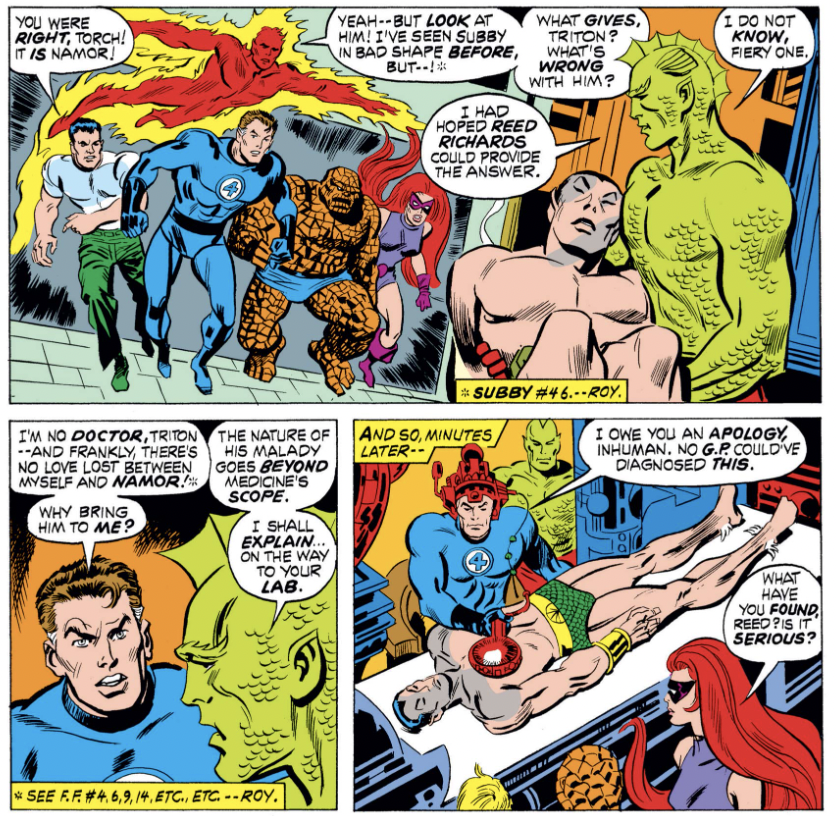
Oddly, the story is interrupted by the events of another comic, Sub-Mariner 67, which doesn’t really effect the flow of this comic, but is blamed by the Thing for the FF not being able to find Sue.

In Sub-Mariner 67, Namor is stricken by a nerve gas, and Triton the Inhuman brings him to the Baxter Building so Reed can save him. Naturally, a fight breaks out. (Story by Steve Gerber, art by Don Heck and Frank Bolle).

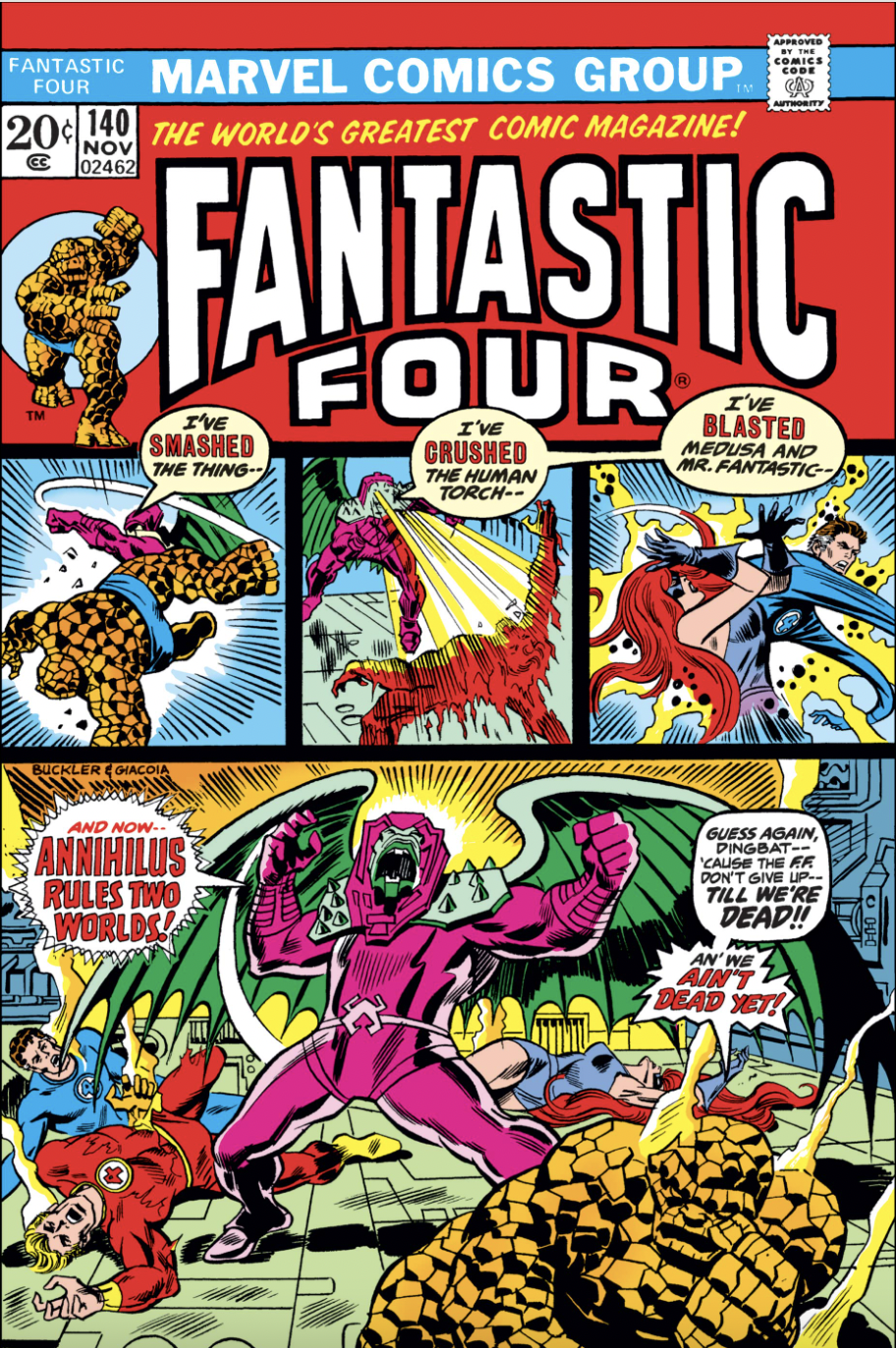
Also of note, the cover of FF 140 is drawn by Rich Buckler (with inks by Frank Giacoia), who will go on to replace John Buscema as the lead artist in a few issues. The cover, with its panels, is unusual, but seems perfectly engineered to appeal to 12 year-old comic buyers.

What I liked

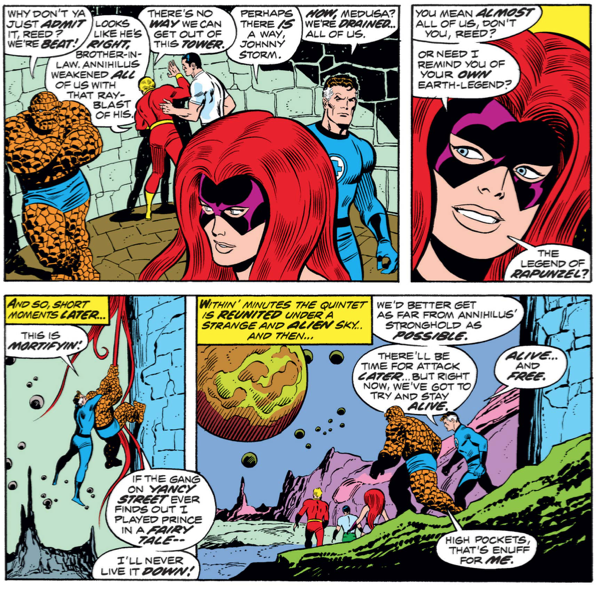
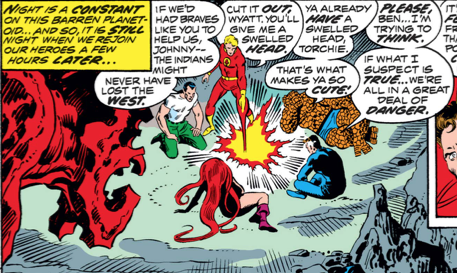
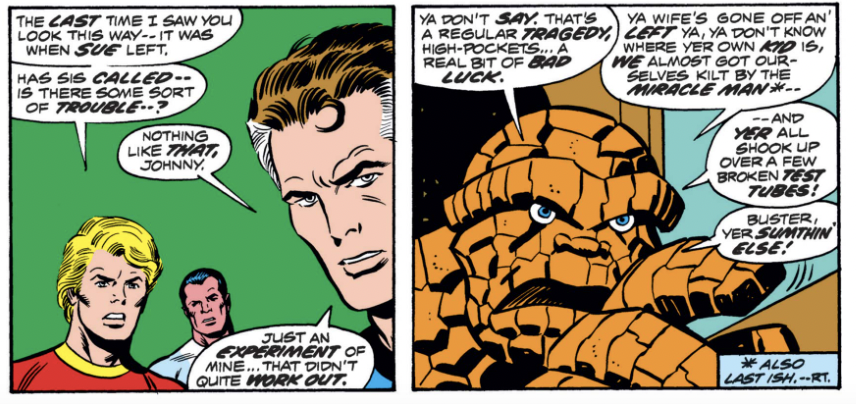
The back-and-forth between Ben and Reed was nicely handled by Conway, who seems to understand a friendship that’s both turbulent but build on longstanding respect and mutual history. Here, Ben tells off Reed:

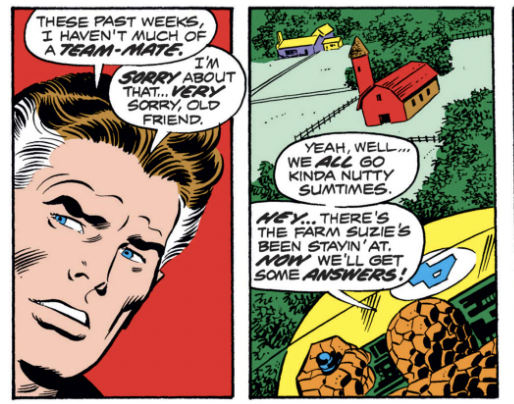
Then, after Reed goes ballistic when Sue calls for help, Ben is reassuring:

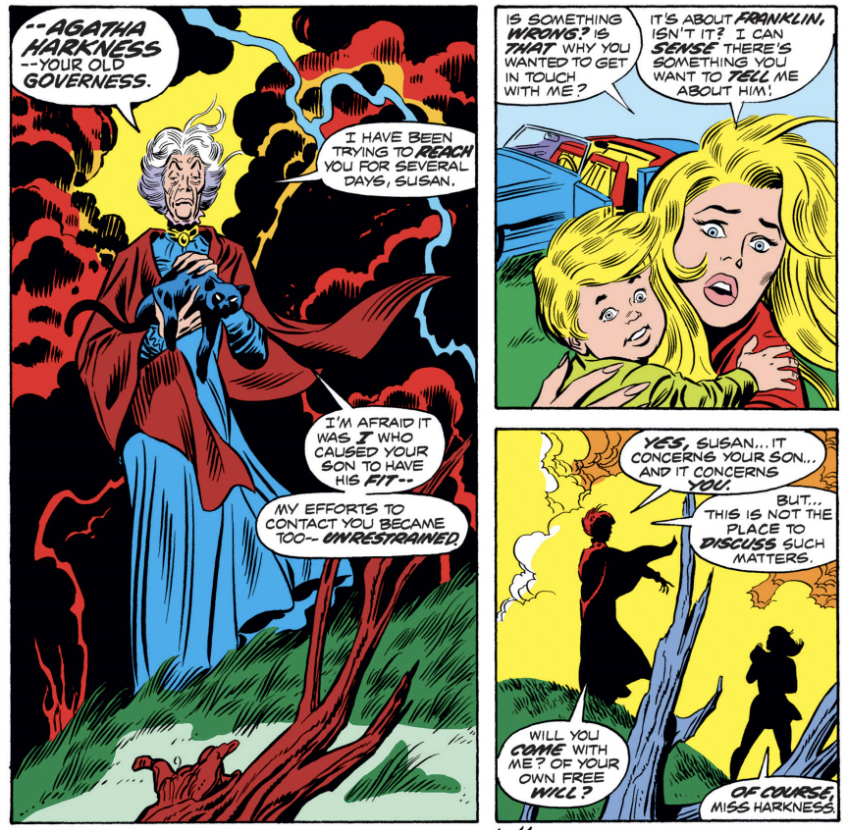
I also liked this near-splash page of Agatha Harkness by Buscema and Sinnott:


What I didn’t like

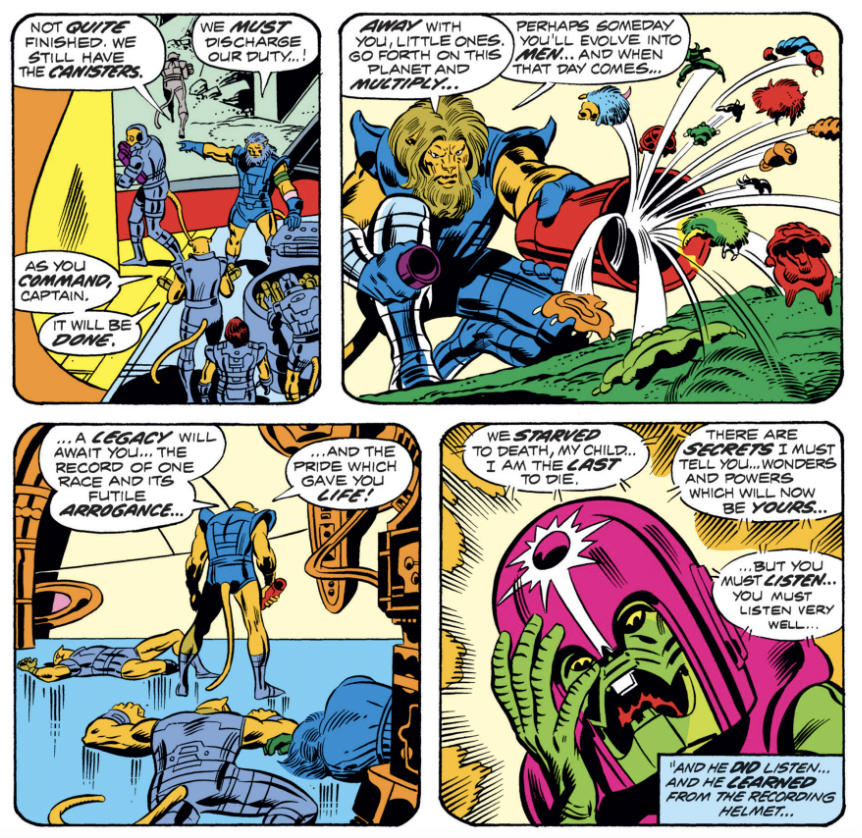
The last third or so of the comic is devoted to Annhilus telling his origin to Wyatt. It’s impossibly convoluted, since it involves his putting on a helmet left by a long-dead alien race in the Negative Zone, and then relating the narration of that species. So we are reading a story told by Annihilus to Wyatt that was told to Annihilus by this other race. And none of it seems particularly relevant to the story.

Anything else?

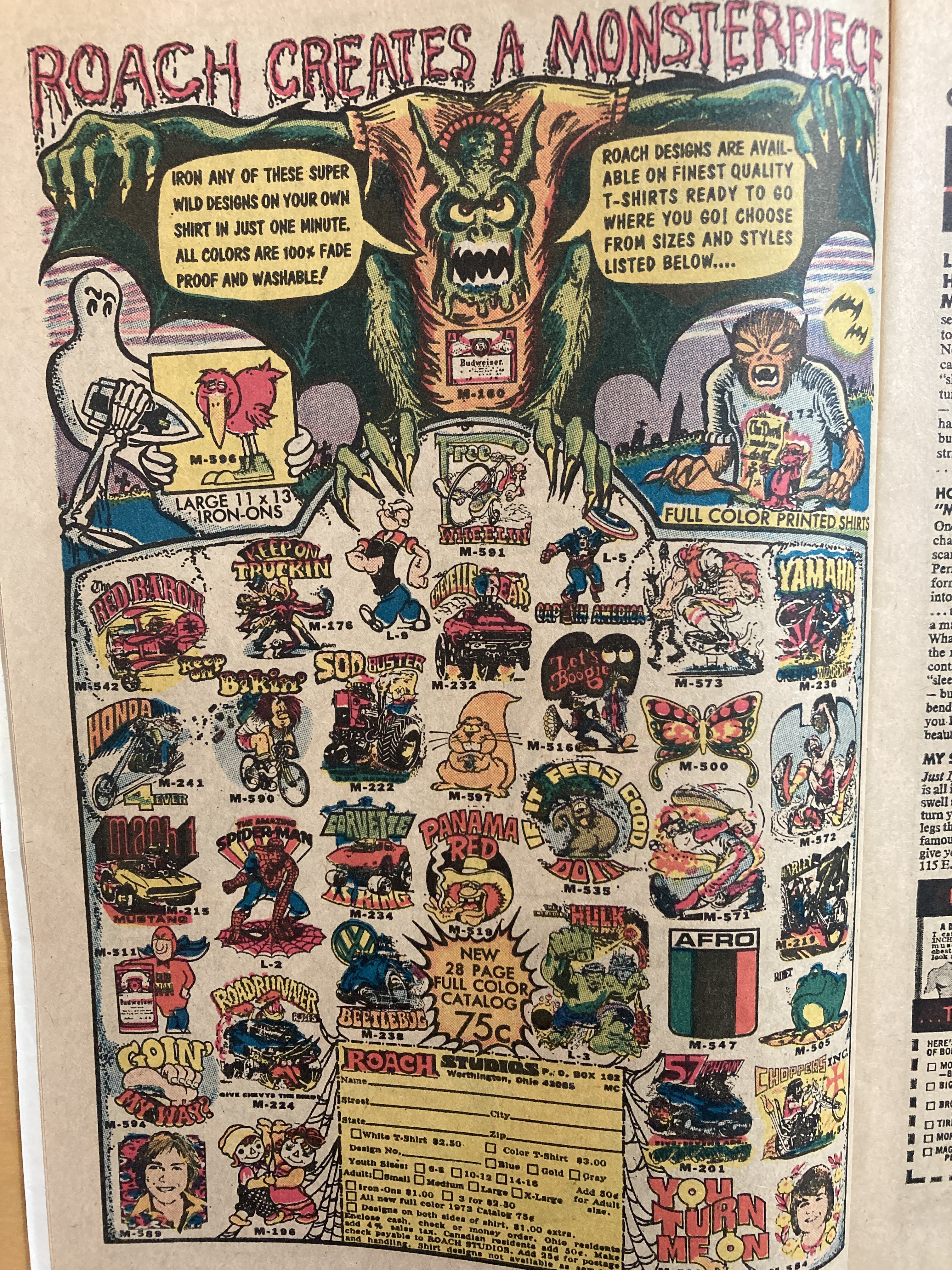
These look cool


Overall

The return of Annihilus lifts its grade to a solid B.

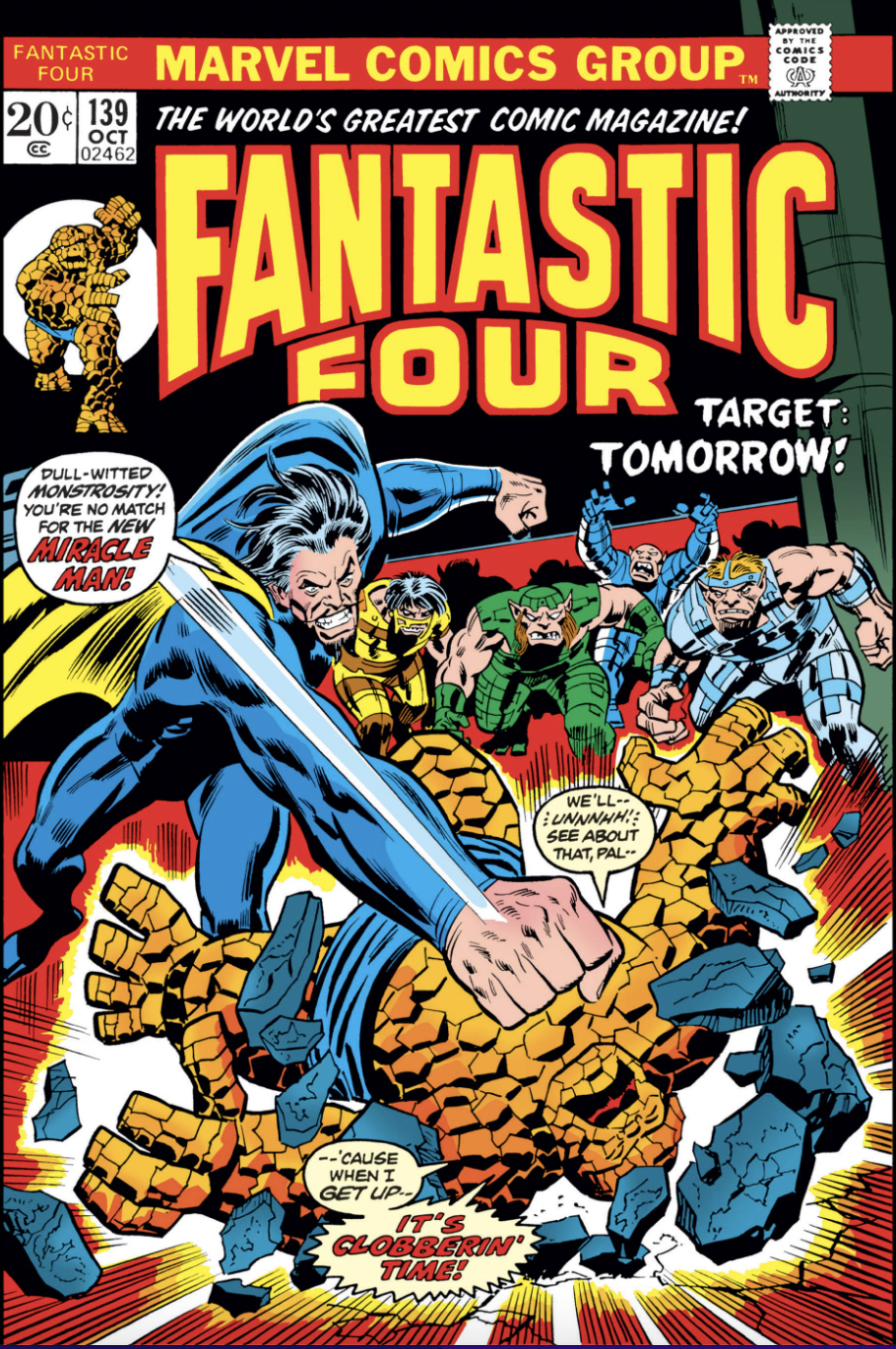
“The World’s Greatest Comic Magazine!” Fantastic Four No. 139

20 Saturday Jul 2024

Posted by percivalhenry in The World's Greatest Comic Magazine

≈ Leave a comment

Tags

1973, Fantastic Four, Fantastic Four 139, John Buscema, Marvel, Marvel comics

Fantastic Four 139
“Target: Tomorrow!”
Published July 1973
Script: Gerry Conway
Layouts: John Buscema
Finishes: Joe Sinnott
Letters: John Costanza
Colors: Stan Goldberg
Editor: Roy Thomas
Cover: Buscema and Frank Giacoia

Synopsis

The Fantastic Four escape the chasm they plunged into last issue and eventually defeat the Miracle Man, with the help of the ghosts of the Native American elders that granted him his powers. Meanwhile, Franklin’s powers continue to manifest, and a nuclear catastrophe, perhaps caused by Mr. Fantastic’s experiment, looms.


What’s going on here

This is a more-or-less satisfying conclusion to a two-issue story that began with the re-introduction of the Miracle Man as a vastly more powerful character. Here, he displays almost Beyonder-level power, creating a new city and willing into existence quasi-living people and creatures. Given his potential impact on the Marvel universe, it’s probably just as well he’s faded away into obscurity.

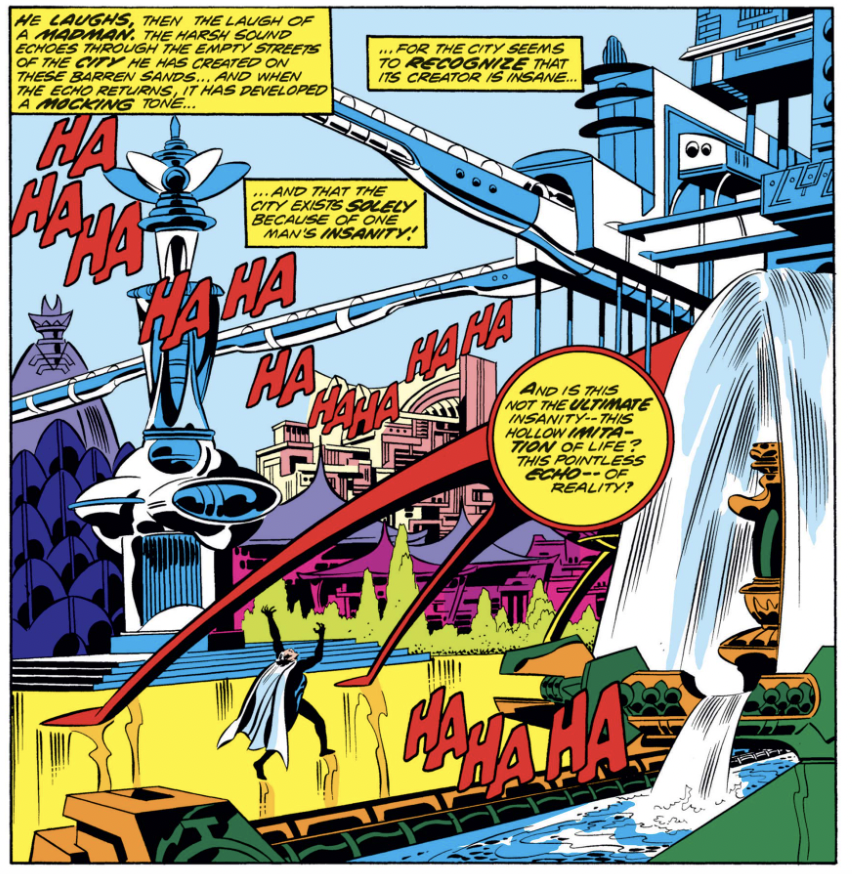
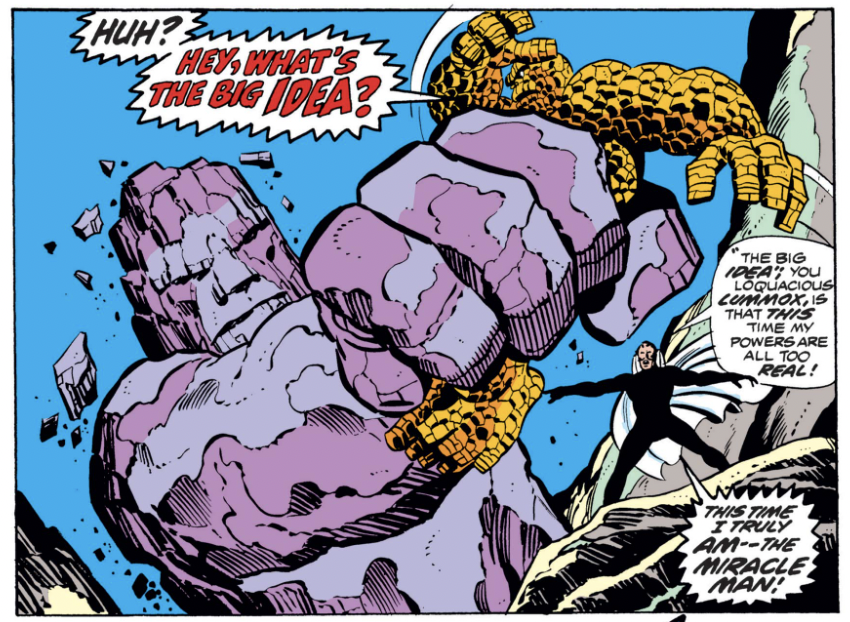
This is otherwise an unremarkable issue. It’s not helped by Gerry Conway’s hyperbolic writing (see panel above), which seems even more over-the-top than Stan or Roy’s, maybe because he’s clearly imitating both. There’s a lot of questionable physics and odd plot holes in this story, but it’s basically inoffensive. More interesting are the subplots: Reed’s tinkering with something that seems very dangerous, and more clues about Franklin’s powers. Also, it’s nice to see Sue again after a few issues of her being left out.


What I liked

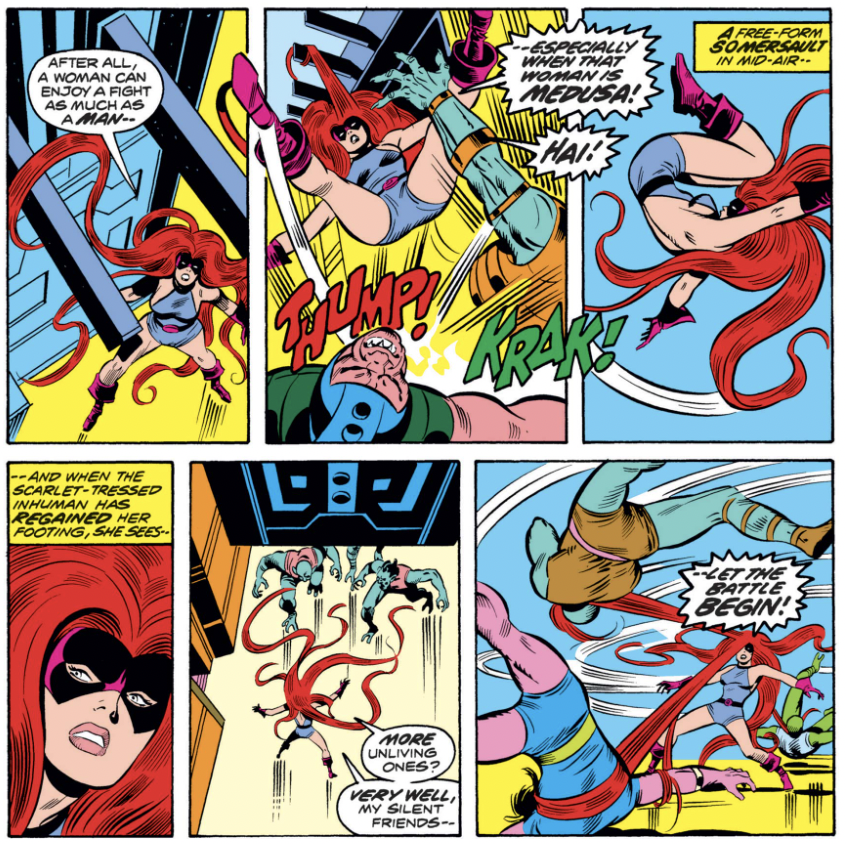
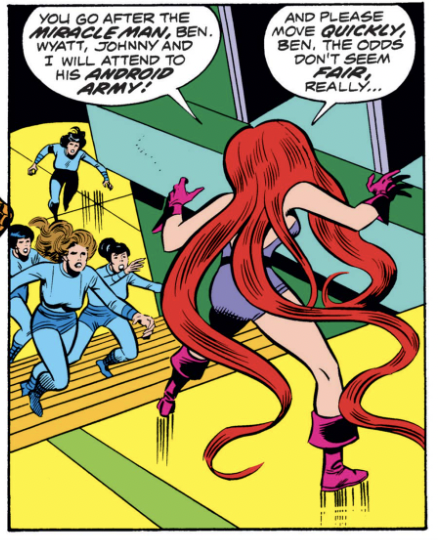
Speaking of left out, Medusa finally gets a bit more of a role. Her presence on the team still feels incidental, but at least he get a glimpse of her personality in this sequence.


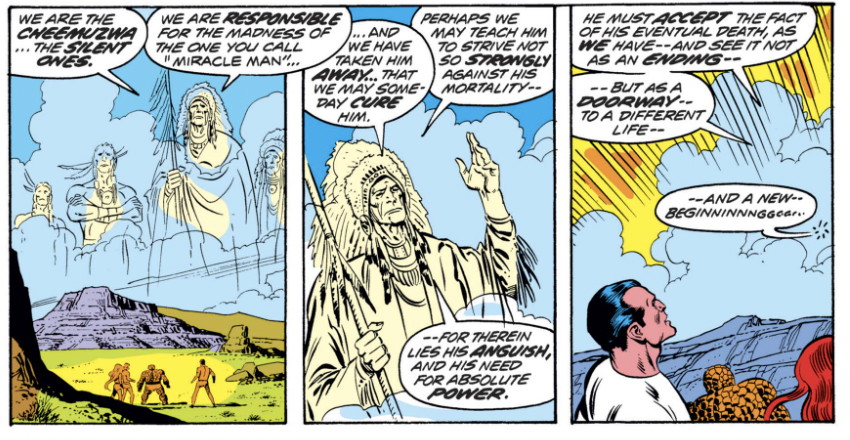
I thought the appearance of the Cheemuzwa spirits at the end was well handled. Yes, mystic Natives are a tired trope, but this was a graceful way to remove the Miracle Man from the board (he apparently shows up just once more, in Marvel Two-in-One 8)

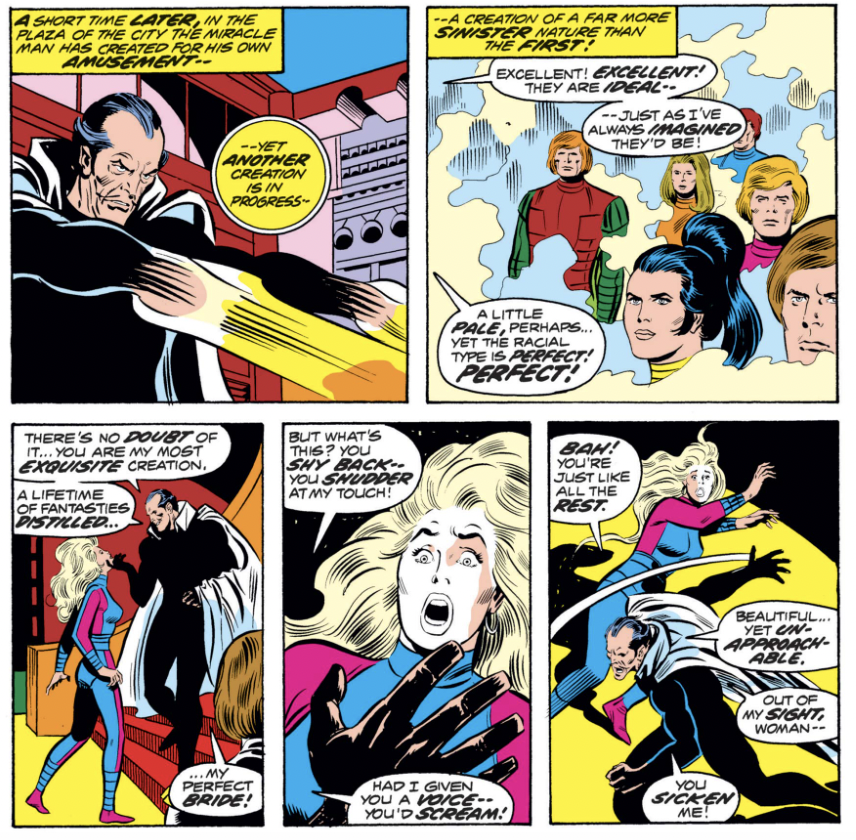
And this sequence with Miracle man being rejected by a woman he just created out of nothing was weird and creepy.


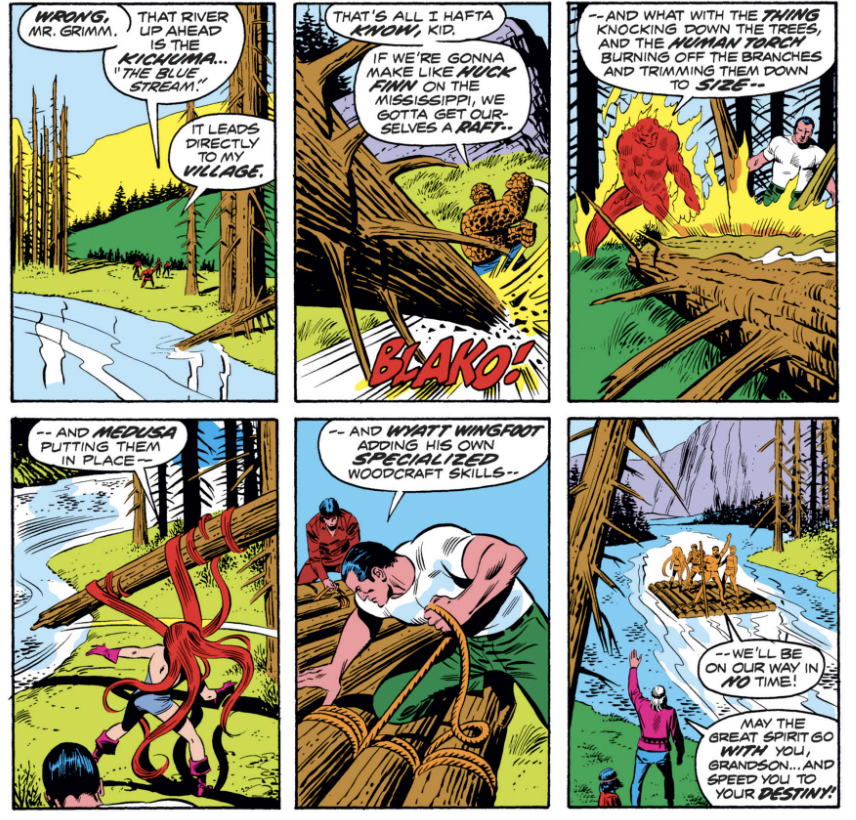
Then there’s this sequence of the FF building a raft. I wasn’t sure if I liked it or hated it, but it’s so ridiculous I think I like it. It reminds me of the montages in the A-Team TV shows, where the the team would assemble some sort of contraption as music played.


What I didn’t like

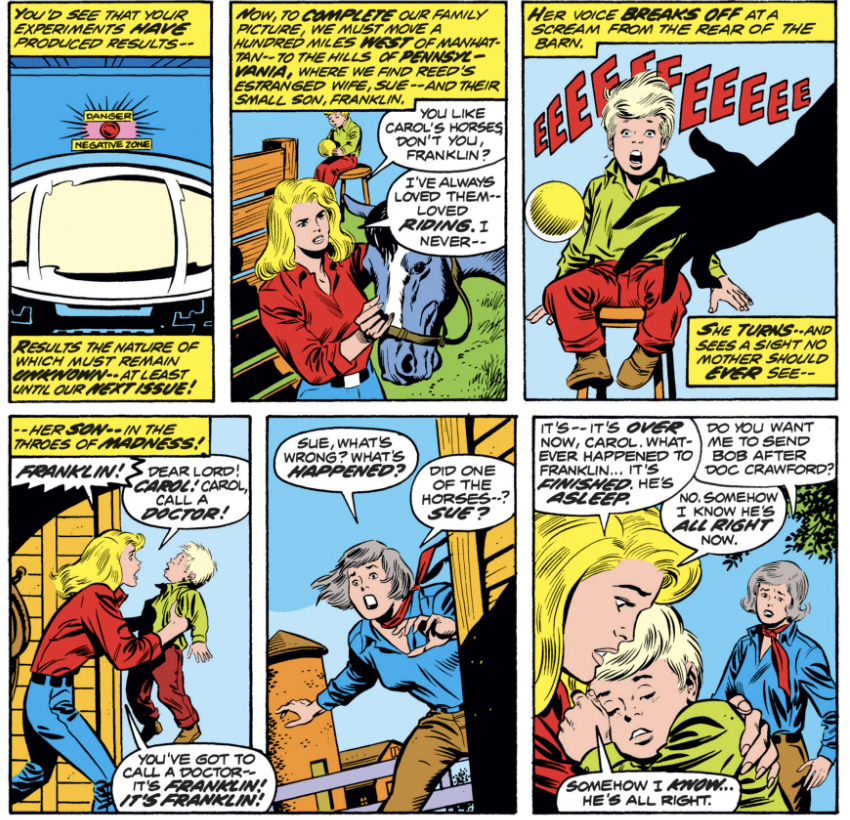
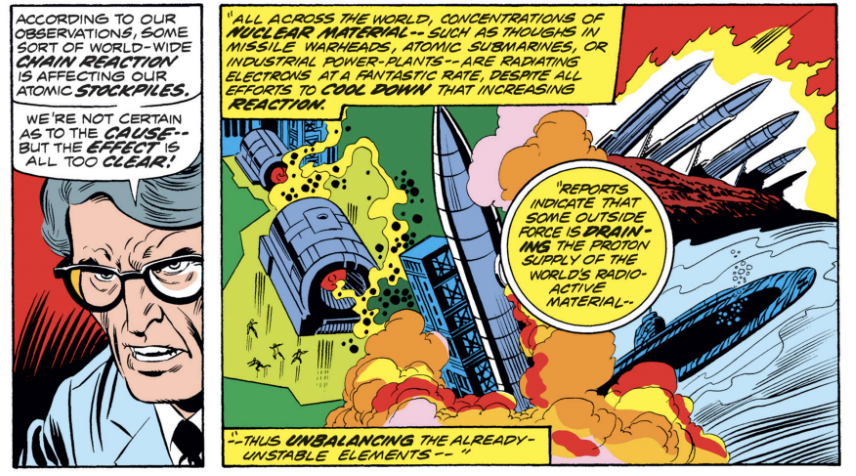
About halfway through the comic, the action cuts away and we learn of an imminent nuclear threat. It seemed like this was related to the Miracle Man, so I waited in vain to learn how, only for it to be revealed, lamely, that it’s a subplot connected to Reed’s tinkering. I have no problem with setting up next issue’s story, but this was poorly executed.


Anything else?

In previous posts I have written about Stan and Jack created very human androids (or very android-like humans), as if the distinction between alive and machine didn’t much matter. Here, the Miracle Man creates what appear to be living creatures, yet Medusa calls them “androids.” Not sure what Conway was thinking.


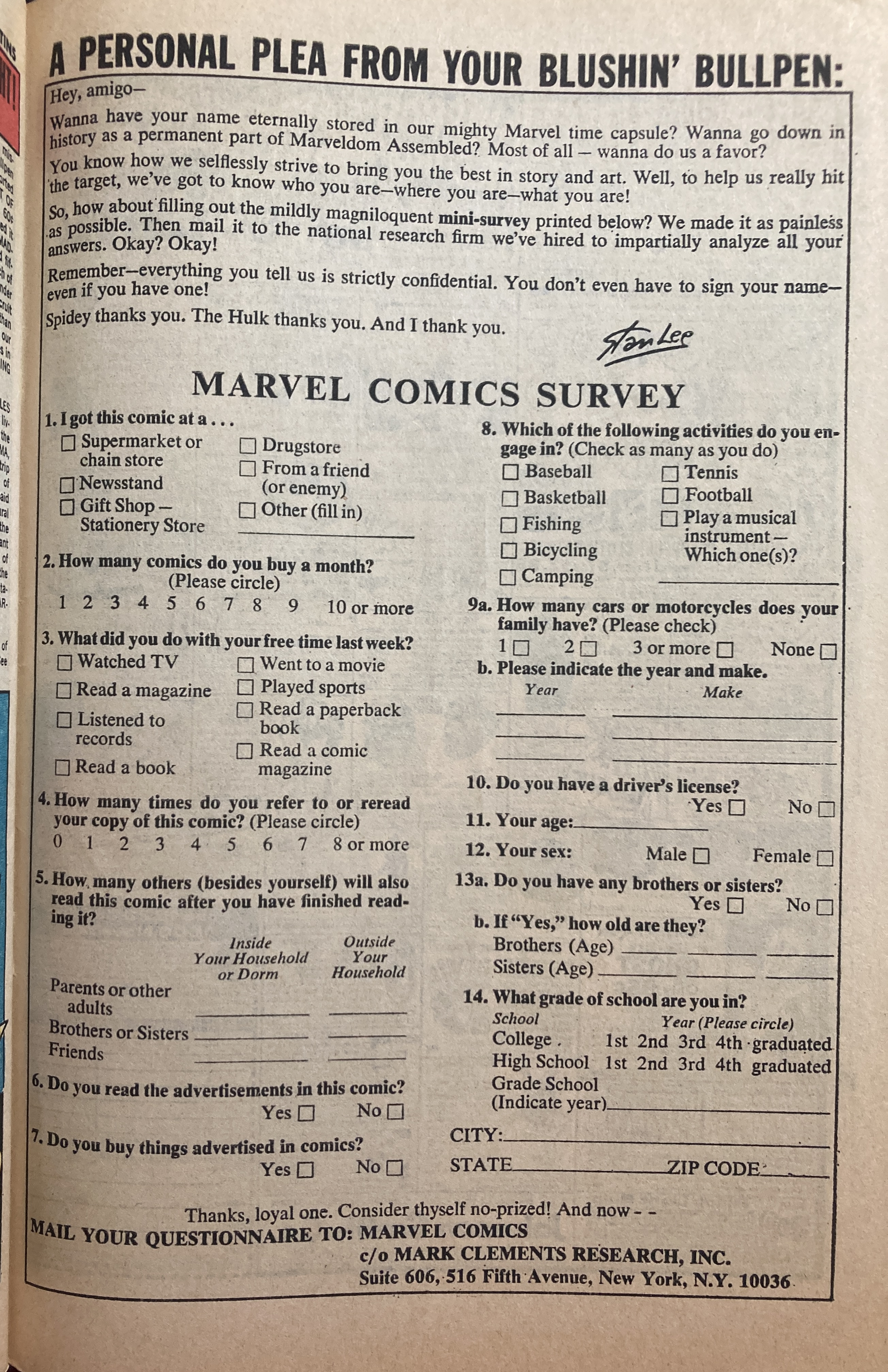
This survey seems specifically designed for advertisers. Still sort of interesting. (They seem to want auto advertising).


Overall

Just OK

“The World’s Greatest Comic Magazine!” Fantastic Four No. 138

13 Saturday Jul 2024

Posted by percivalhenry in The World's Greatest Comic Magazine

≈ Leave a comment

Tags

1973, Fantastic Four, Fantastic Four 138, John Buscema, Marvel comics, Roy Thomas

Fantastic Four 138
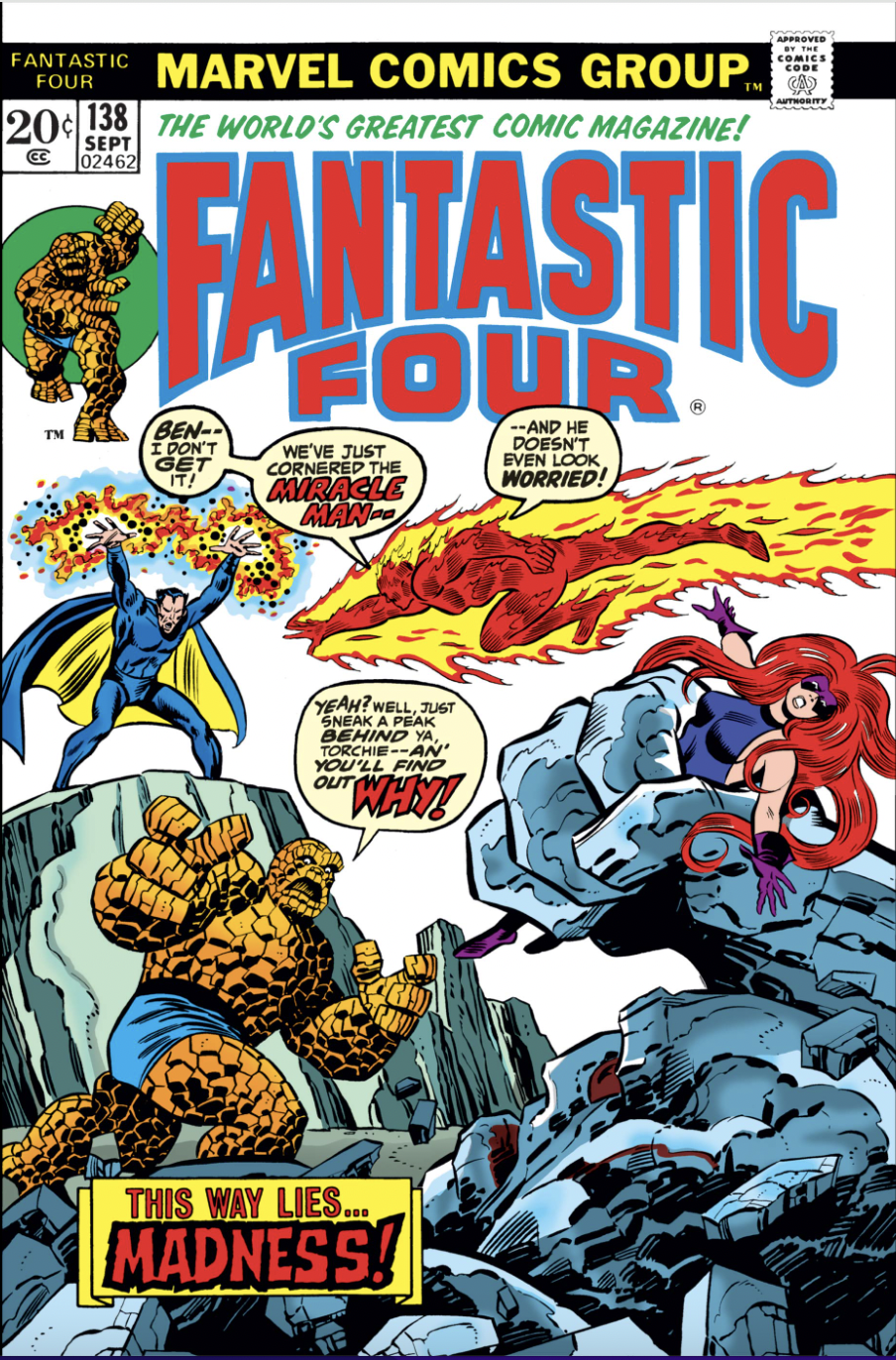
“Madness is … the Miracle Man!”
Published June 1973
Plot: Roy Thomas
Script: Gerry Conway
Pencils: John Buscema
Inks: Joe Sinnott
Letters: John Costanza
Colors: Petra Goldberg
Editor: Thomas
Cover: Buscema and Sinnott

NB: This issue came out after Fantastic Four Annual 10 (technically “King-Size Fantastic Four 10”) but since it consists of reprints of annuals 3 and 4, it didn’t seem worth posting about.

Synopsis

Wyatt Wingfoot reappears and asks the Fantastic Four to help with an emergency on his Oklahoma reservation. There, the team — minus Mr. Fantastic, who remained in New York — is attacked by the Miracle Man, who has discovered new powers.


What’s going on here?

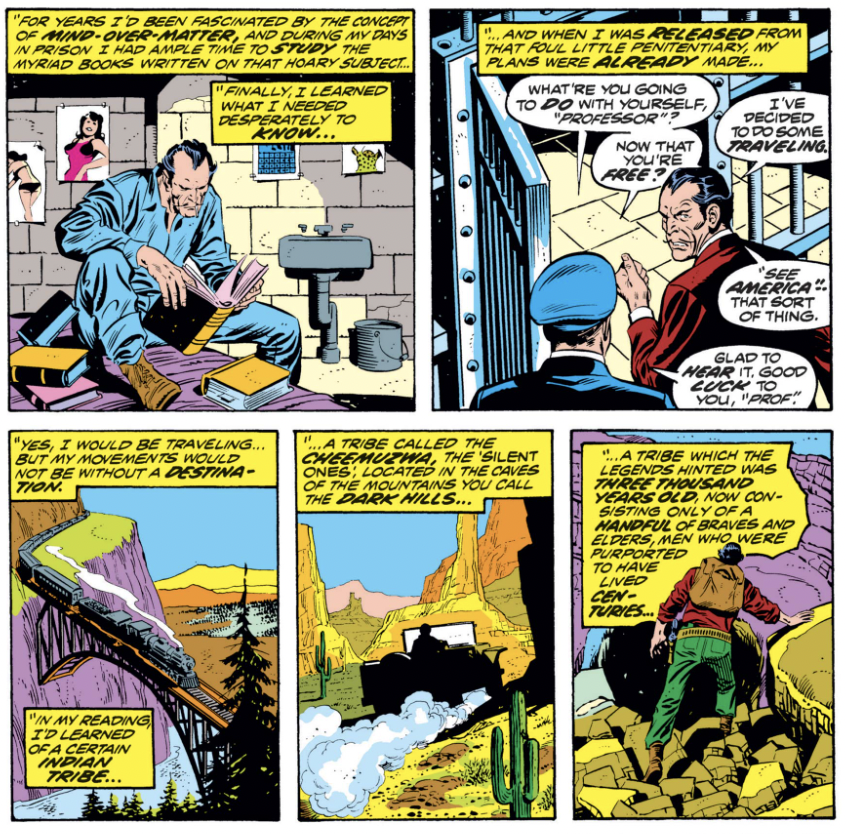
This story is very similar to the Gregory Gideon arc of a few issues ago. Basically, Roy Thomas unearths an obscure villain from the early Lee/ Kirby run (in this case, the Miracle Man debuted all the way back in FF 3), gives him new powers and sets him on world domination. It’s not really clear why Thomas needs to dredge up an old character vs. create a new one – he spends so much time explaining how the Miracle Man got his powers he might as well gave invented a similar villain from scratch. Plus, there’s something odd about this former stage magician cavorting about the mesas of Oklahoma.

The positive side of Thomas’s dredging up the past is the return of Wingfoot, last seen in issue 80. Wingfoot is a fun sidekick who, despite his many appearances over the years, has never suffered the fate of so many supporting characters and been given super powers. I hope I didnt jinx him.

Otherwise the story is unremarkable. There’s some classic comic book treatment of Native Americans as noble, spiritual primitives, and a few bits of nice character moments for Ben, Johnny, Reed and Alicia. Medusa is again basically sidelined into uselessness and Sue and Franklin don’t appear at all. The story does resolve one odd subplot introduced back in issue 134 and then dropped (and surely forgotten by most readers): the mysterious muscular figure entering the Baxter Building was Wingfoot.


What I liked

I’ve been critical of Thomas and Conway for stories that have been either absurd (the last two issues) or pedestrian, but to give credit where credit is due, this issue is well plotted and paced. It has a classic slow opening, with the FF in the Baxter Building, includes a nice scene at Metro University (last seen in issue 62), and builds to an action-filled climax without rushing to the end like so many Lee/Kirby stories. And as mentioned above, we get some character-focused scenes like this one:


There’s also some slam-bang Buscema art in this issue, like these panels:

And this one:


What I didn’t like

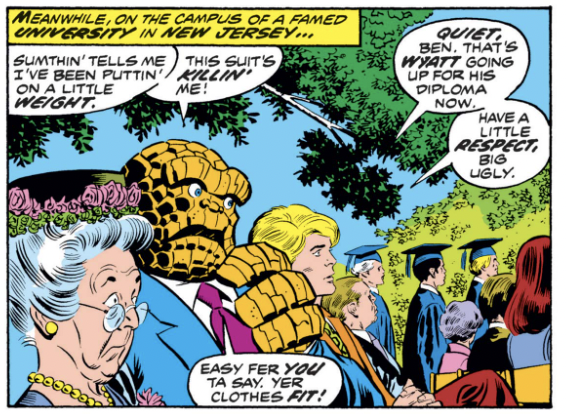
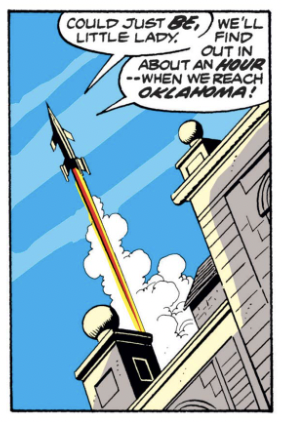
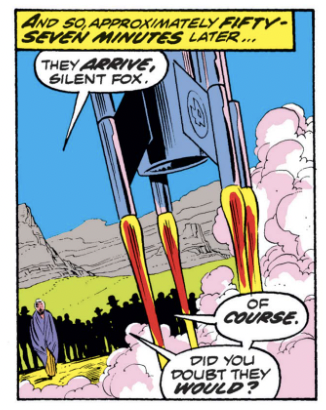
I will admit upfront this is picking nits, and maybe I only care because I am fascinated by geography, but the travel times in this issue don’t add up.

On the first part of the journey, the FF travel by Pogo Plane from New York to Metro University, which is established as somewhere in New Jersey (it’s an odd name for a NJ college but no matter). Ben says the trip will take half an hour.

Then, on the second part to Oklahoma, the trip takes 57 minutes.

I will accept there is some time lost in taking off and landing, and maybe there is congestion in the New York New Jersey airspace, but even the farthest corner of New Jersey is just 124 miles from Manhattan. From there it’s 1,100 miles to the nearest corner of Oklahoma! It shouldn’t take just twice as long to travel 10 times as far!

Ok, geography rant over.

Anything else?

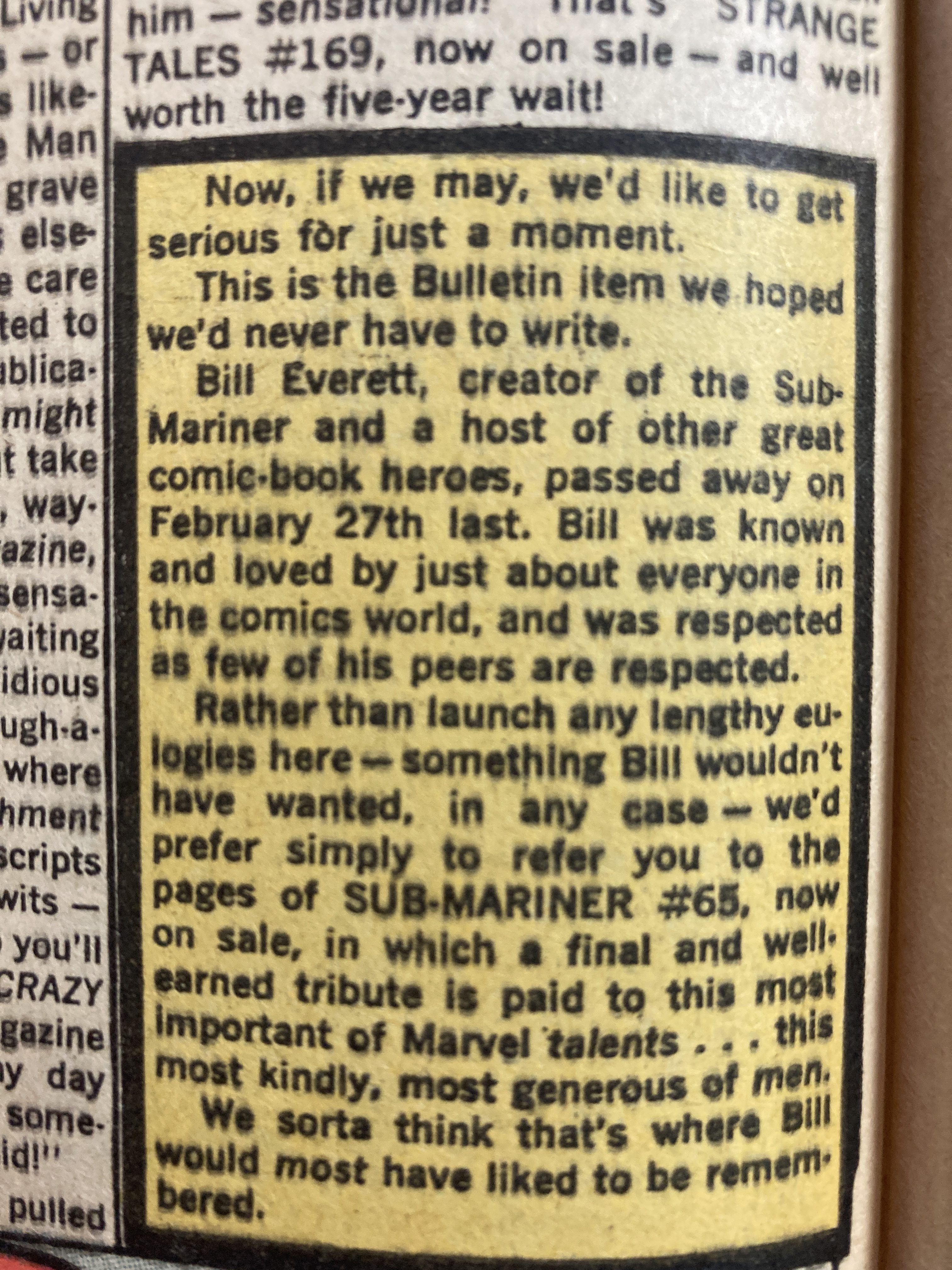
There is a nice tribute to Bill Everett, creator of the Sub-Mariner, in the Bullpen Bulletins. Oddly, this issue appeared in June, five months after he died.


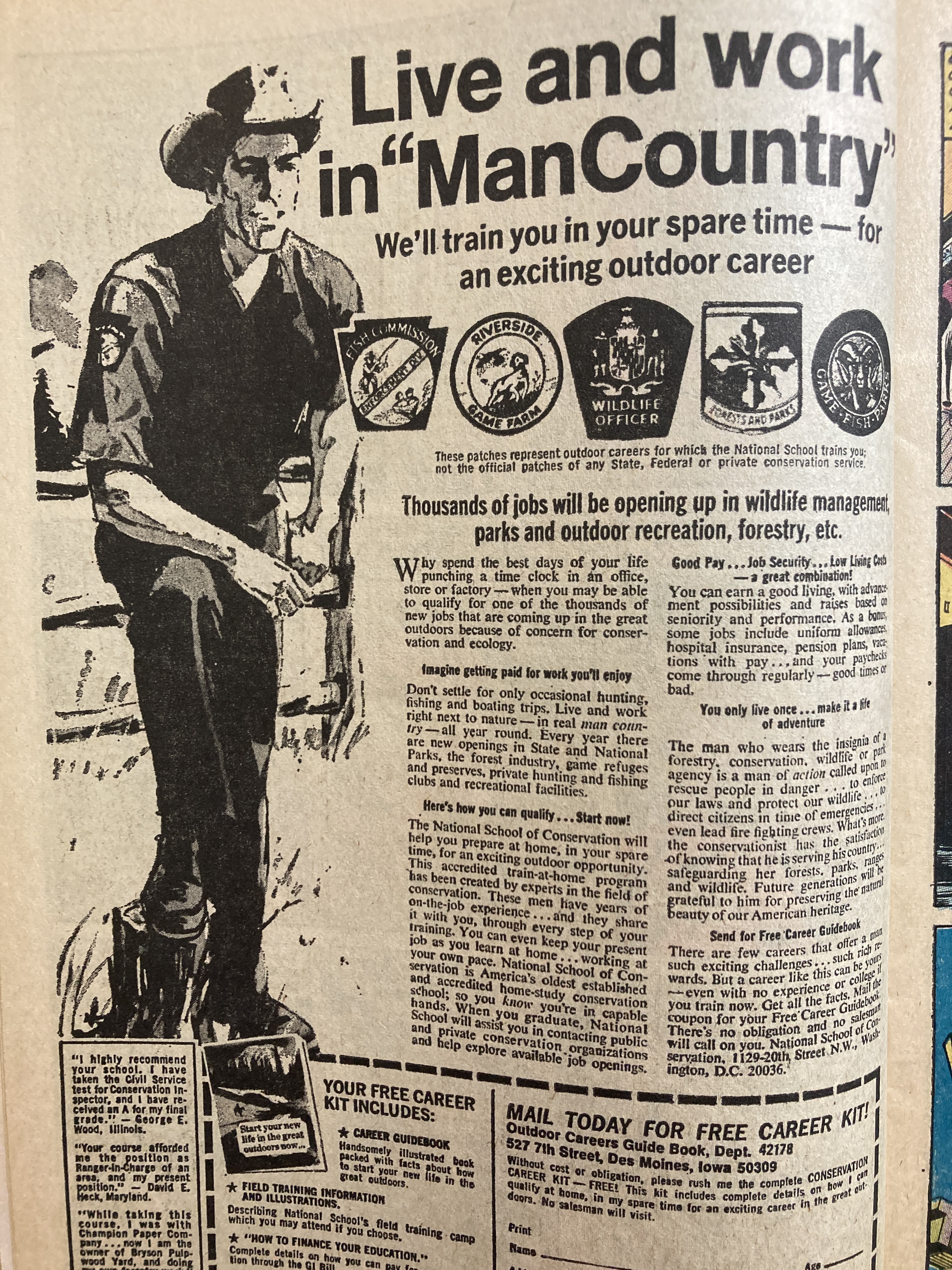
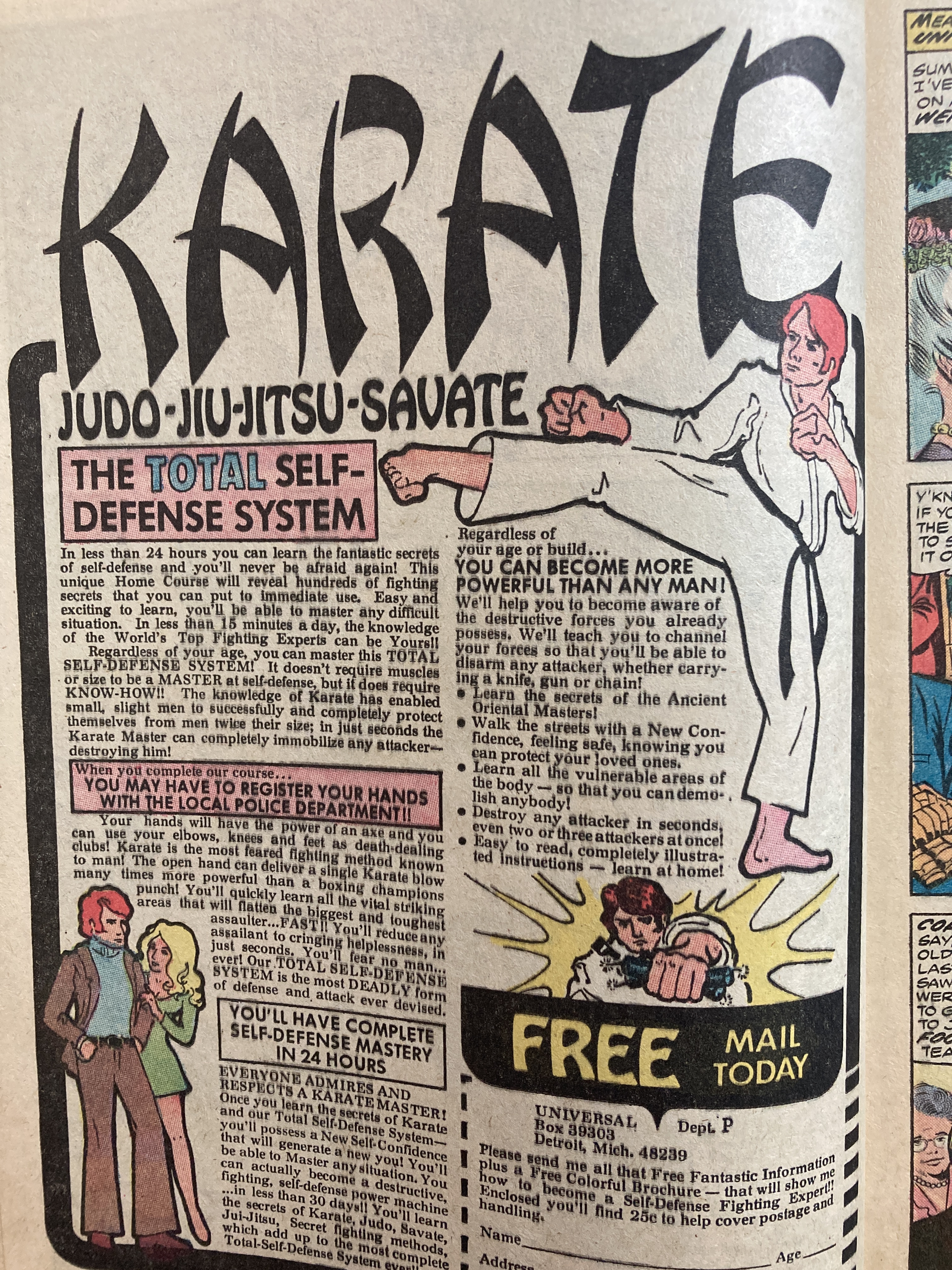
Some excellent ads in this issue. I love how the karate ad warns that, after completing the course, you may have to register your hands with the local police department. “May” is doing a lot of work there.

As per usual with comic ads, they seem designed to appeal to the (apparently low) self-esteem of the comic reader.


Overall

Nice rebound from the last two issues.

“The World’s Greatest Comic Magazine!” Fantastic Four No. 137

06 Saturday Jul 2024

Posted by percivalhenry in The World's Greatest Comic Magazine

≈ Leave a comment

Tags

1973, Fantastic Four, Fantastic Four 137, John Buscema, Marvel, Roy Thomas

Fantastic Four 137
“Rumble on Planet 3”
Published May 1973
Plot: Roy Thomas
Script: Gerry Conway
Pencils: John Buscema
Inks: Joe Sinnott
Letters: Artie Simek
Colors Glynis Wein
Editor: Thomas
Cover: Buscema & Sinnott

Synopsis

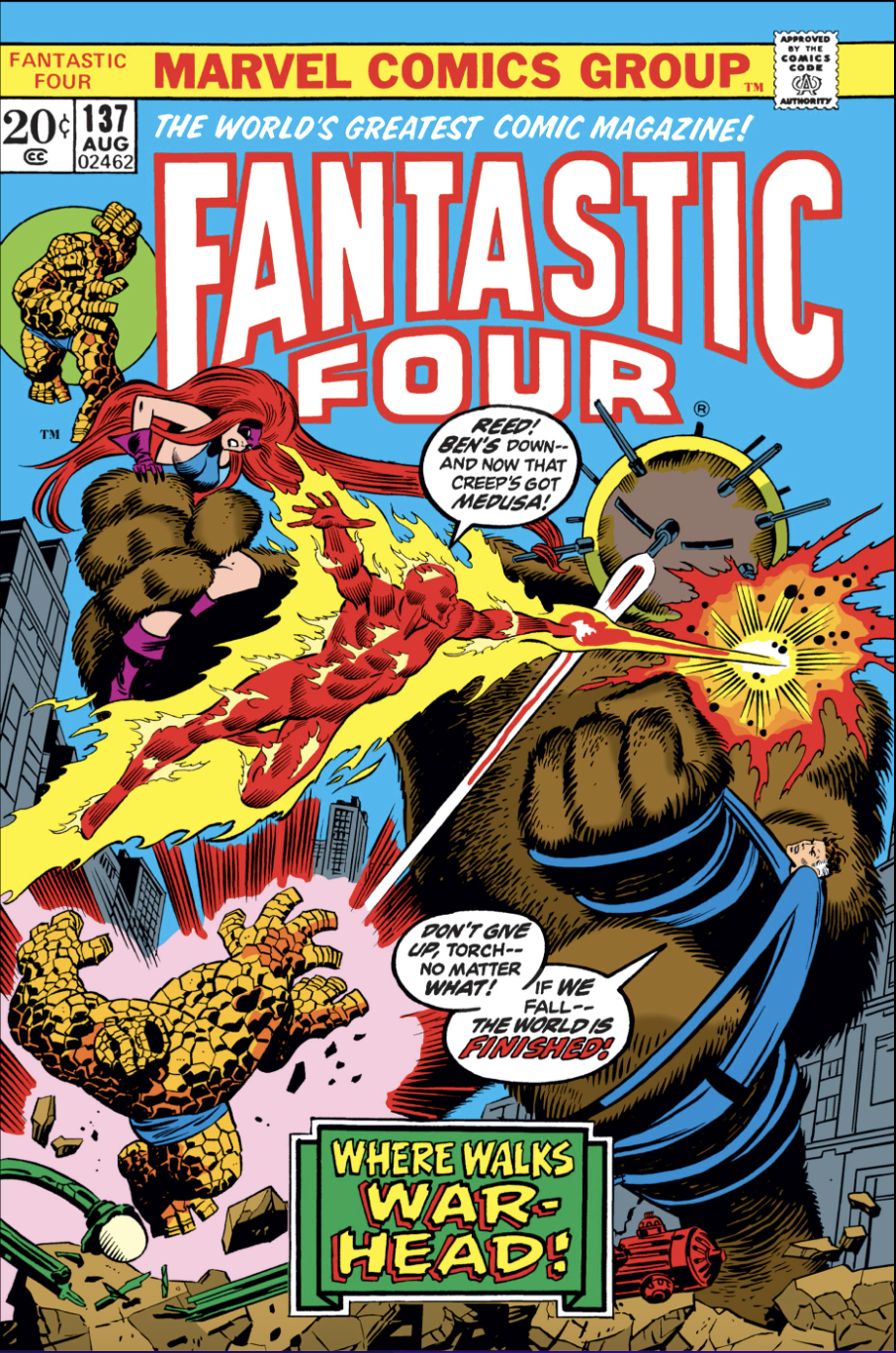
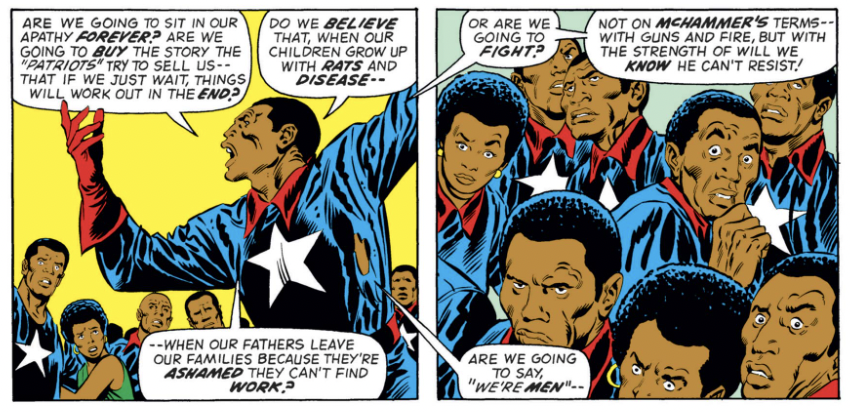
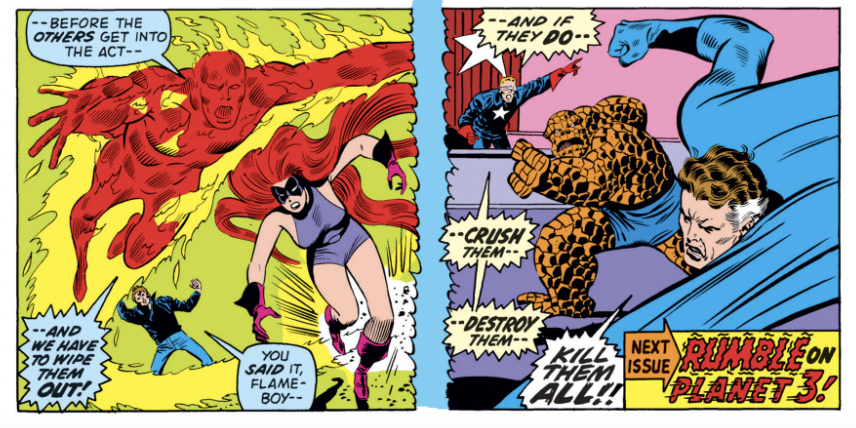
In the alternate, 1950s-themed world created by the Shaper of Worlds, the members of the Fantastic Four clash, then join together to battle the Warhead, a monster created by the Shaper. When both 50s factions — the “youthies” and “patriots” — are confronted by newly politicized African-Americans of the 1960s, the ’50s construct dissolves. The Shaper admits he made a big mistake choosing Slugger Johnson as the vehicle for his powers, and restores the world back to the 70s.


What’s going on here?

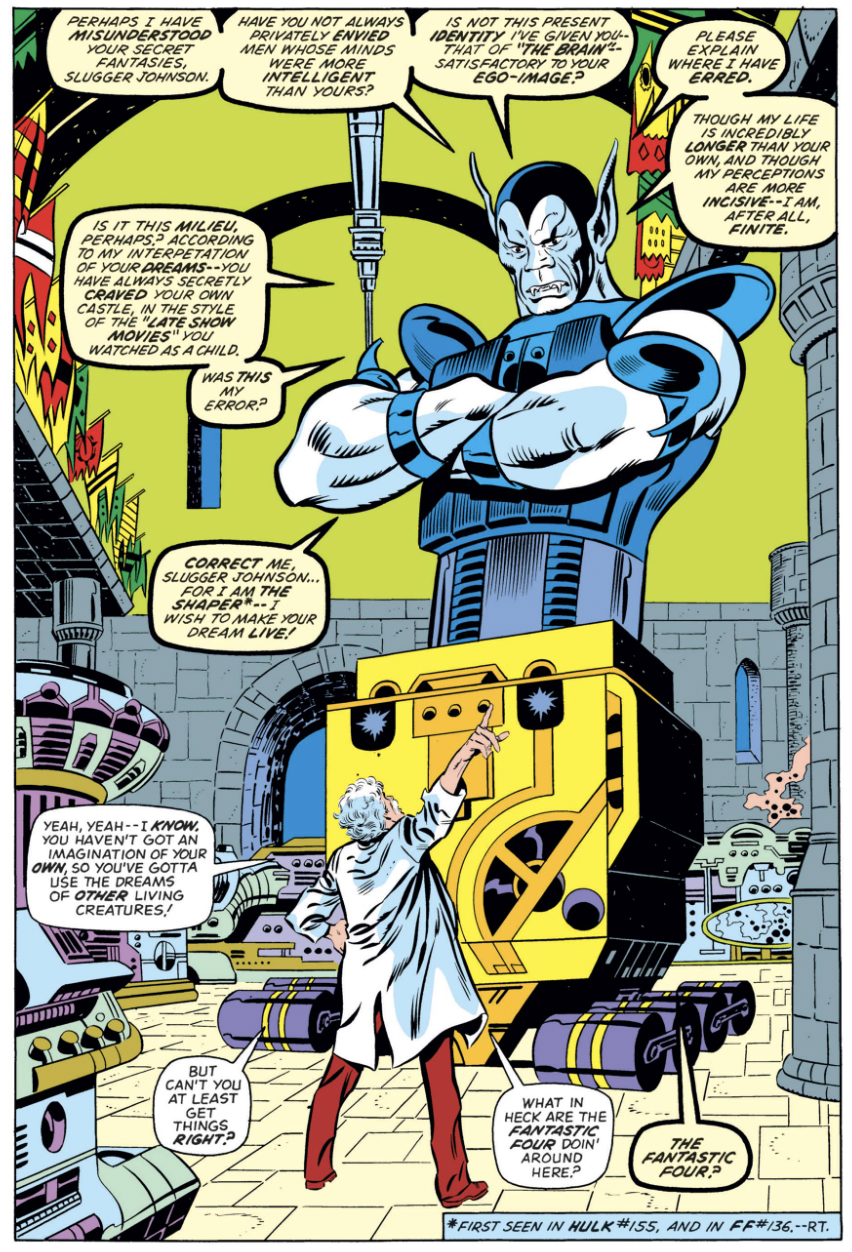
Fantastic Four 137 plays out the barely-intelligible string of last issue, filling in some blanks — we learn that The Brain is actually Slugger, who is intended to resemble Albert Einstein (he doesn’t) — while doubling down on its ham-handed analysis of mid-century sociology. The best thing about this two-issue arc is that it’s over, and seems to have left little mark on the FF or Marvel. One exception: Thomas Gideon, the orphaned son of Gregory Gideon, is whisked off by the Shaper to later become Glorian, who has a long run as a minor Hulk and Silver Surfer character.

One other note: This is the first issue of the Fantastic Four colored by Glynis Wein, who went on to have a long career, with more than 1,000 coloring credits. At this point she was married to comic writer Len Wein, but after their divorce she would return to her maiden name, Glynis Oliver.

What I liked

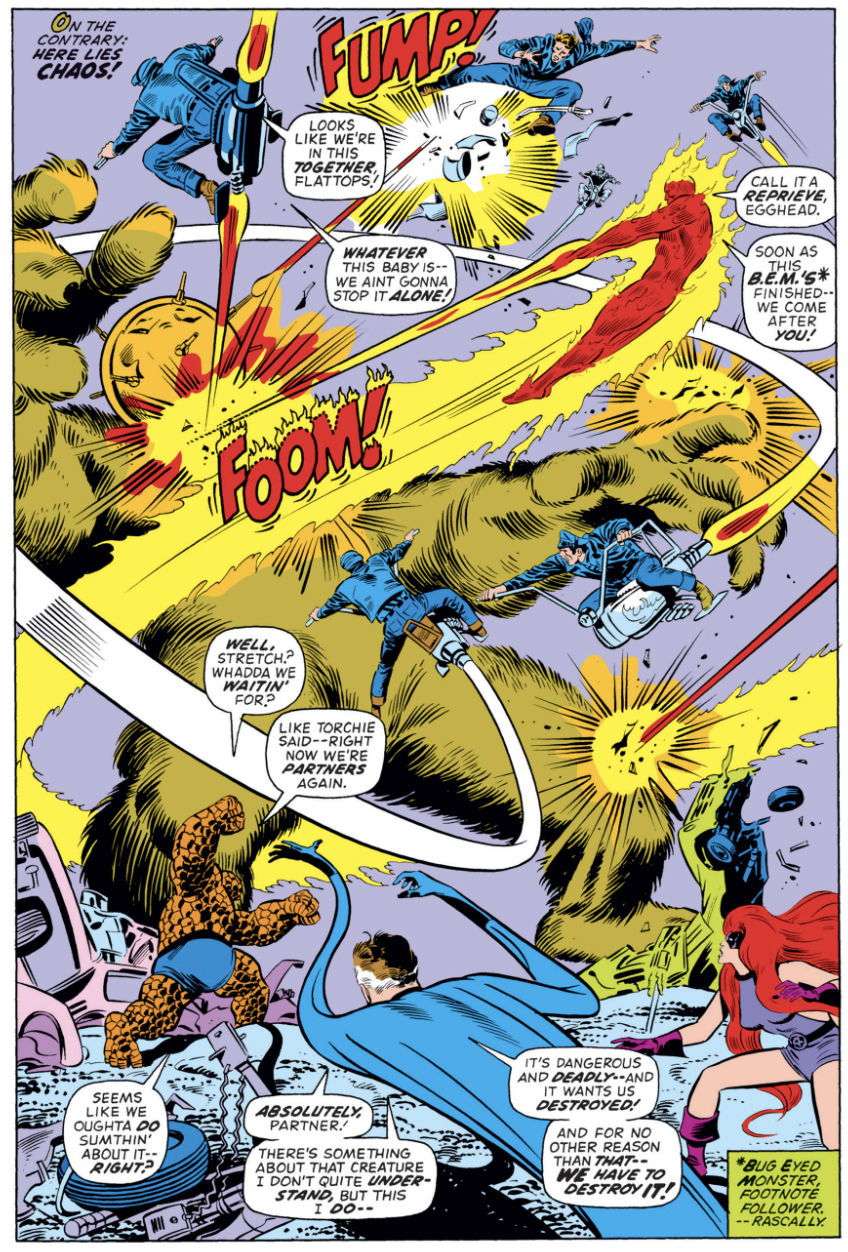
I’m generally a fan of splash pages, and there’s a few in this issue.


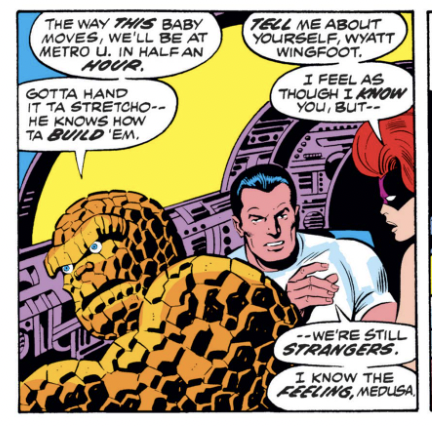
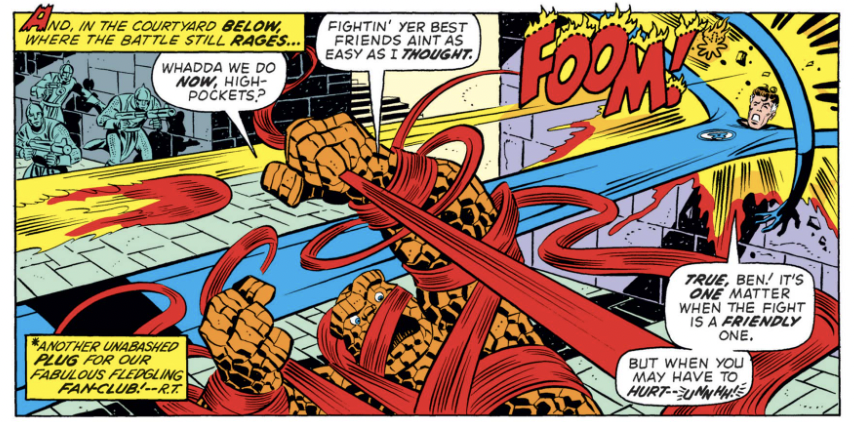
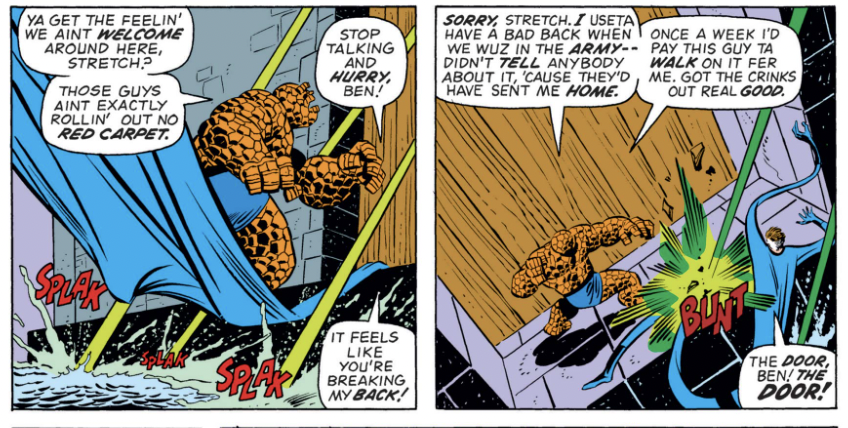
I also liked this sequence of Reed and Ben kibitzing:


What I didn’t like

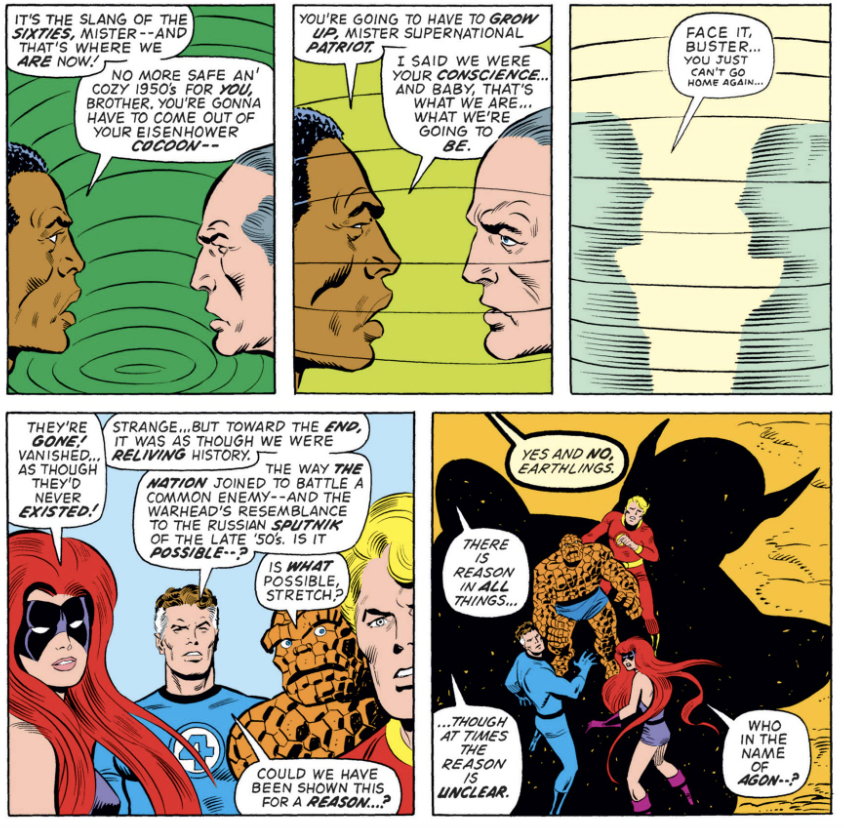
As with last issue, the story makes little sense, and ultimately feels like a silly and pointless exercise in clumsy cultural anthropology. Thomas and Conway compound their simplistic youths-vs.-olds of the 50s dynamic by introducing the Civil Rights struggle of the 60s (which actually began in the 40s). No doubt it was well intentioned, but in the absence of a coherent story it feels preachy and naive.


This new development somehow destablizes the Shaper’s entire project, until it fades away.


None of it makes much sense, and the Shaper acknowledges as much, telling us “the reason is unclear.” Which is another way of saying Thomas and Conway wrote themselves into a corner and had no way out. The hope is this arc was an aberration but knowing some of the stories in the next few years, I can predict more cringe to come.

Also, Warhead is one of the ugliest comic creature designs I’ve ever seen.

Overall

Good riddance

“The World’s Greatest Comic Magazine!” Fantastic Four No. 136

04 Thursday Jul 2024

Posted by percivalhenry in The World's Greatest Comic Magazine

≈ 1 Comment

Tags

1973, Fantastic Four, Fantastic Four 136, John Buscema, Marvel, marvel-comics, Roy Thomas

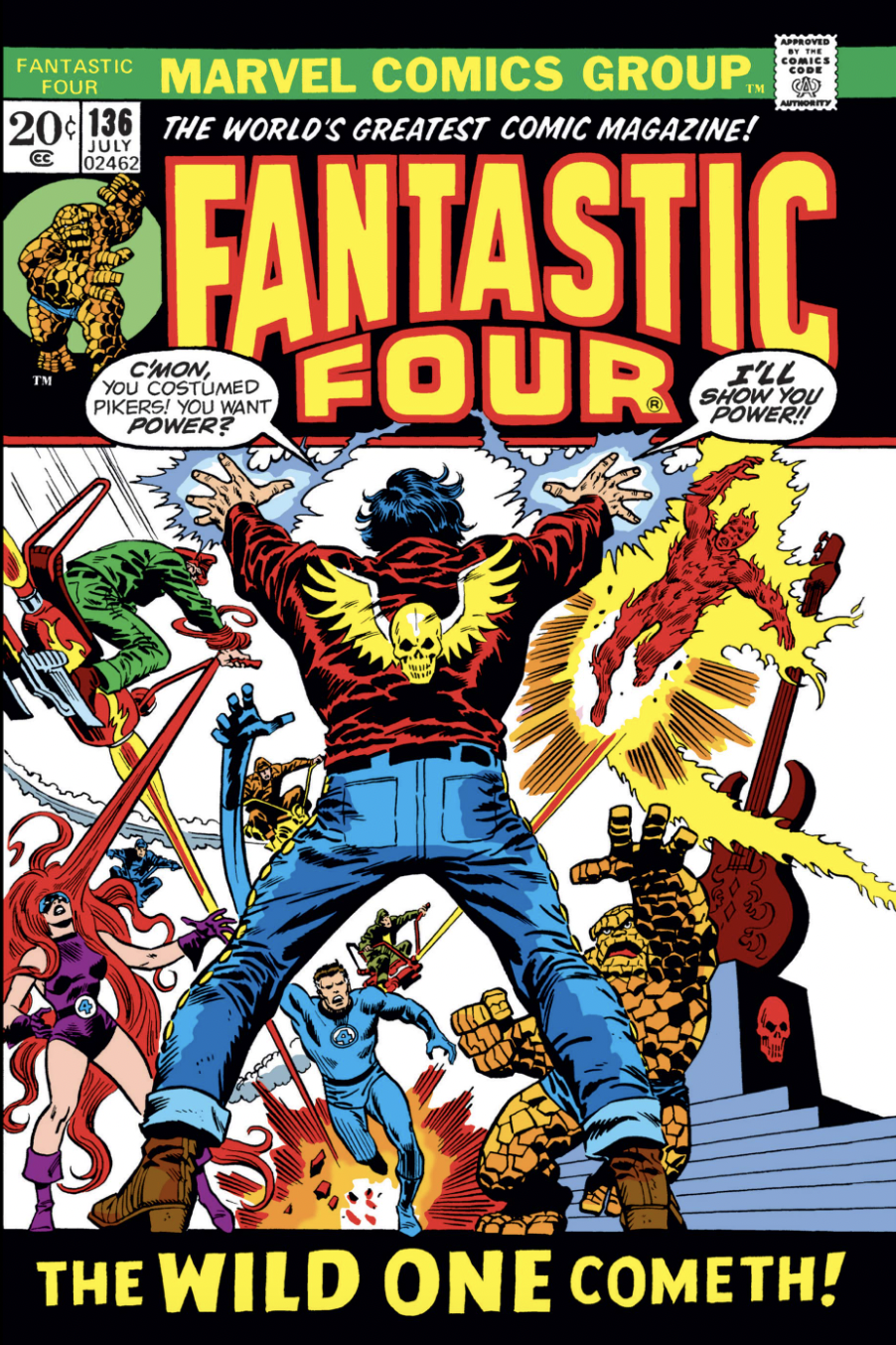
Fantastic Four 136
“Rock Around the Cosmos!”
Published April 1973
Plot: Roy Thomas
Script: Gerry Conway
Breakdowns: John Buscema
Finishes: Joe Sinnott
Letters: Artie Simek
Colors: Stan Goldberg
Editor: Thomas
Cover: Buscema and Frank Giacoia

Synopsis

In the aftermath of last issue’s battle, Slugger Johnson, a henchman of Gregory Godfrey who mourns for his lost youth in the 1950s, is imbued with atomic powers and identified by the Shaper of Worlds as a vehicle for its reality-bending visions. The Fantastic Four are then thrust into what appears to be a parallel universe oriented around 1950s culture, where youths battle elders, with Mr. Fantastic and the Thing on side and Medusa and the Human Torch on the other. Both pairs are brainwashed by rival camps and dispatched to retrieve a weapon from a mysterious figure called The Brain.


What’s going on here?

Where to begin? If there was proof that this was now Roy Thomas’s comic, look no further. A cynic might say this is what happens when a comic’s writer is also the editor, because this issue desperately needed editing.

At its core, FF 136 is a multiverse story, a speciality of Thomas’s, who gave us the Squadron Supreme in the Avengers two years earlier, and who later would spin DC’s Earth 2 Justice Society into a multi-generational epic. Here, the alternate earth aspect isn’t mentioned explicitly, but it’s pretty obvious what’s going on, and the tag line previewing the next issue makes it clear.


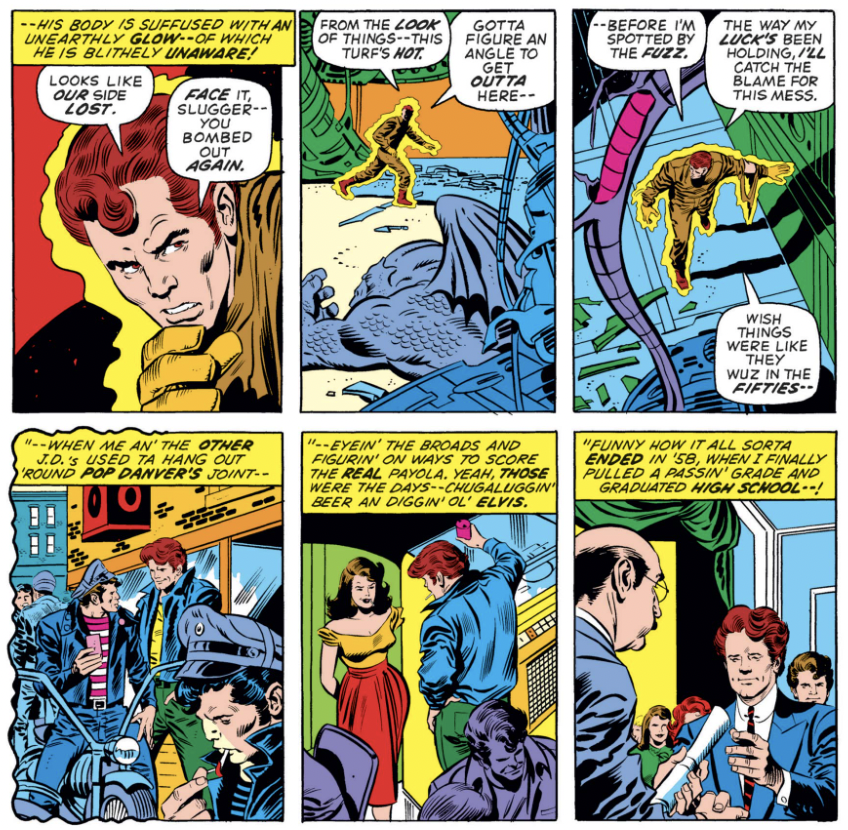
The defining nature of this alternate earth is that it is rooted in a caricatured vision of the 1950s, one drawn from the psyche for Slugger Johnson by the Shaper of Worlds. As we learn early on, Slugger really loved the 50s:


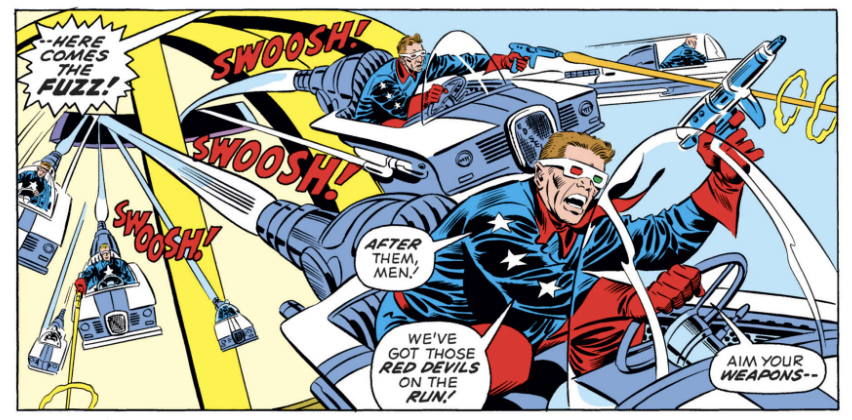
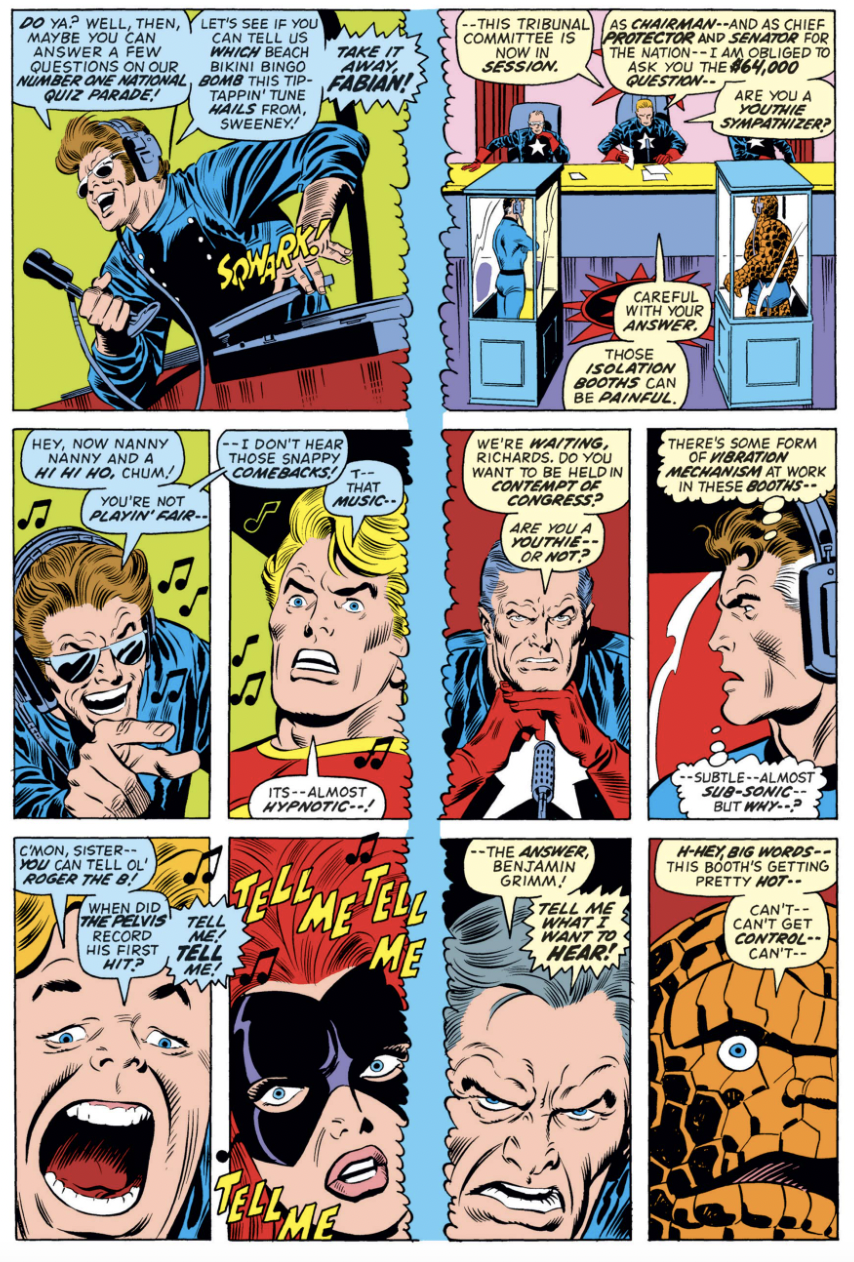
This painful 50s slang permeates the issue, and it seems clear that scripter Gerry Conway, who was born in 1952, learned it from watching B-movies on TV. What’s less clear is what lesson Thomas, who plotted the comics, wants us to draw from this extremely clumsy story. Is Thomas, born in 1940 and raised in the 50s, nostalgic for the era and its romanticized narratives of bikers rebellion and the birth of rock n’ roll? Or is he poking fun of that nostalgia? Is he using the excesses of the 50s youth culture to critique 60s youth culture? Is he hip? or is he square? Unfortunately, the story is so muddled it’s hard to know.

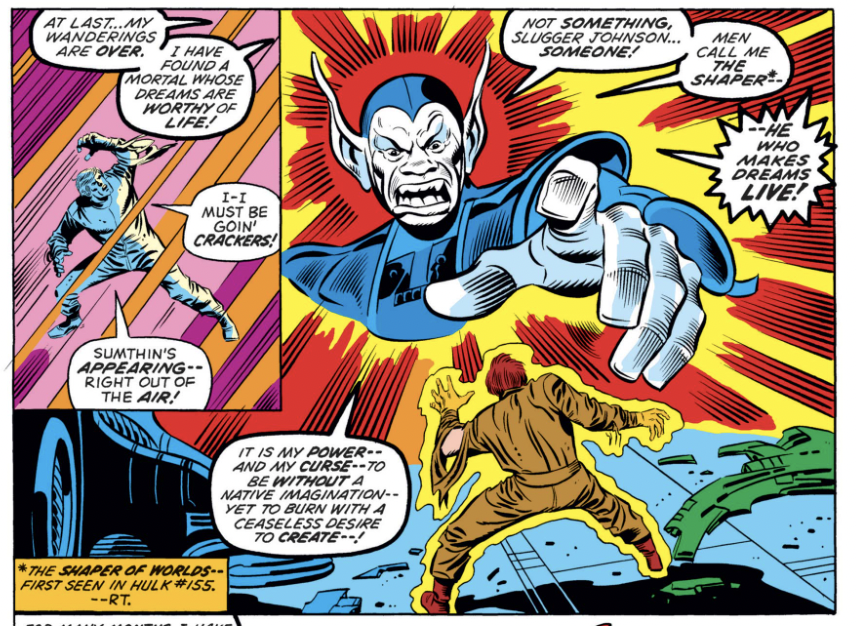
The presence of the Shaper of World’s is further evidence of the Thomasian drift of the Fantastic Four. Initially a Hulk villain created by Archie Goodwin the previous year, the Shaper is a Cosmic Cube brought to life by the Skrulls, and a character I know almost nothing about prior to this issue. But Thomas loves to play with characters from other comics, the more obscure the better, and a reality-bending cosmic creature is right up his alley. It’s fair to say Stan never would have dreamt of using it.


What I liked

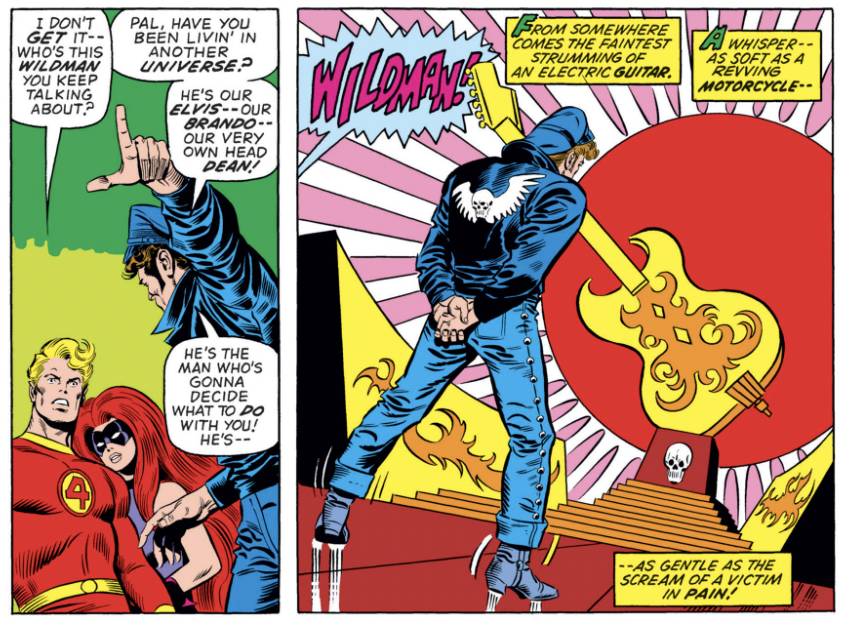
Despite its extreme goofiness, I admired how hard Thomas and Conway lean into the 50s conceit. Here is Slugger Johnson reintroduced as Wildman:


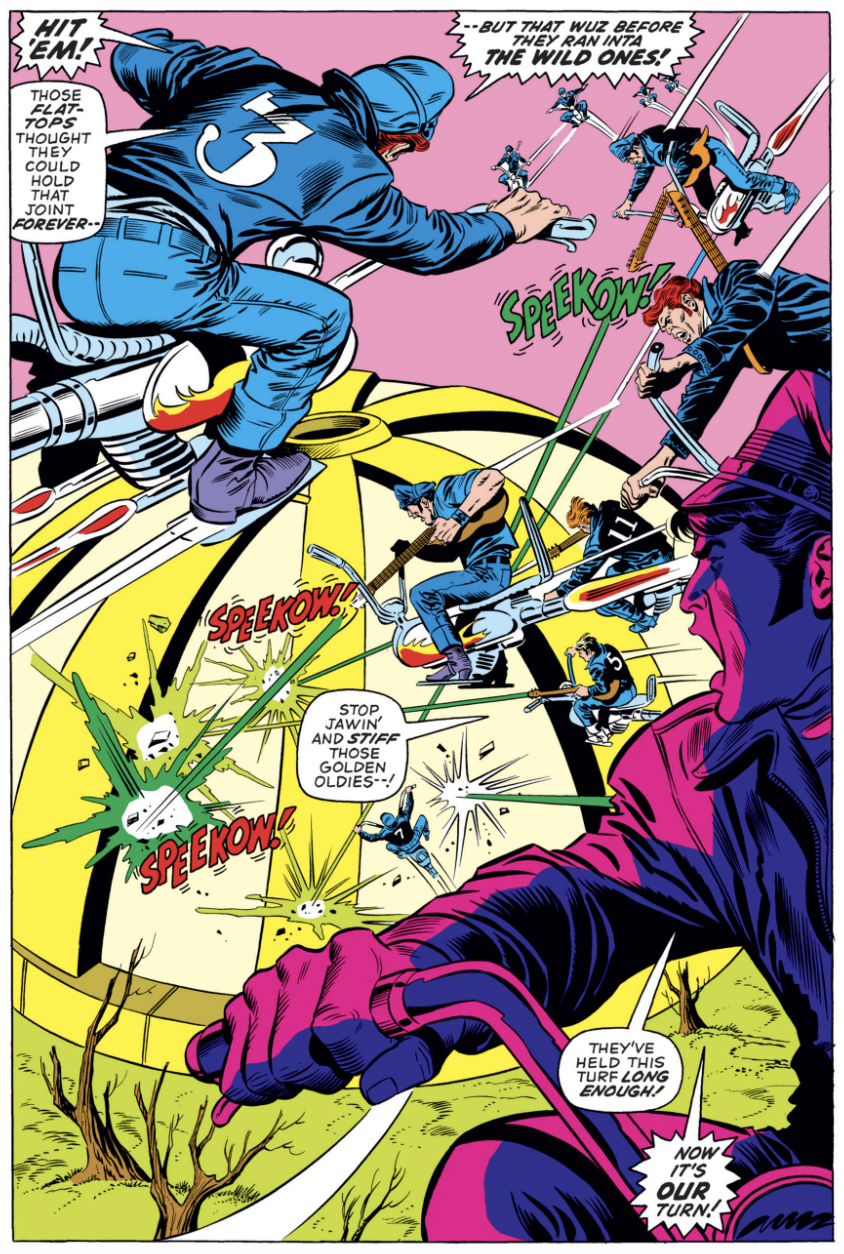
Buscema and Sinnott also deliver a socko splash page that introduces the 50s gangsters:


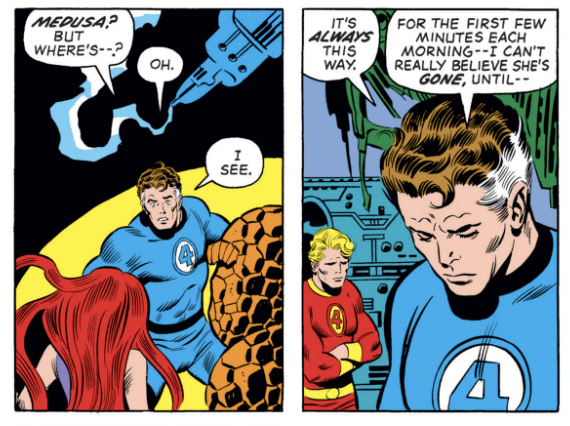
And before the silliness started, there was a touching sequence where Reed awakens from unconsciousness and imagines Medusa is Sue:


What I didn’t like

If it wasn’t obvious, this comic is an incoherent mess. The alternate earth plot is confusing and it’s never clear if Johnny and Medusa are in their right minds or not, since they attack Ben and Reed, then seem their normal selves. (And why is Medusa on the side of the youths? She’s a married Inhuman queen, hardly a teenager.)

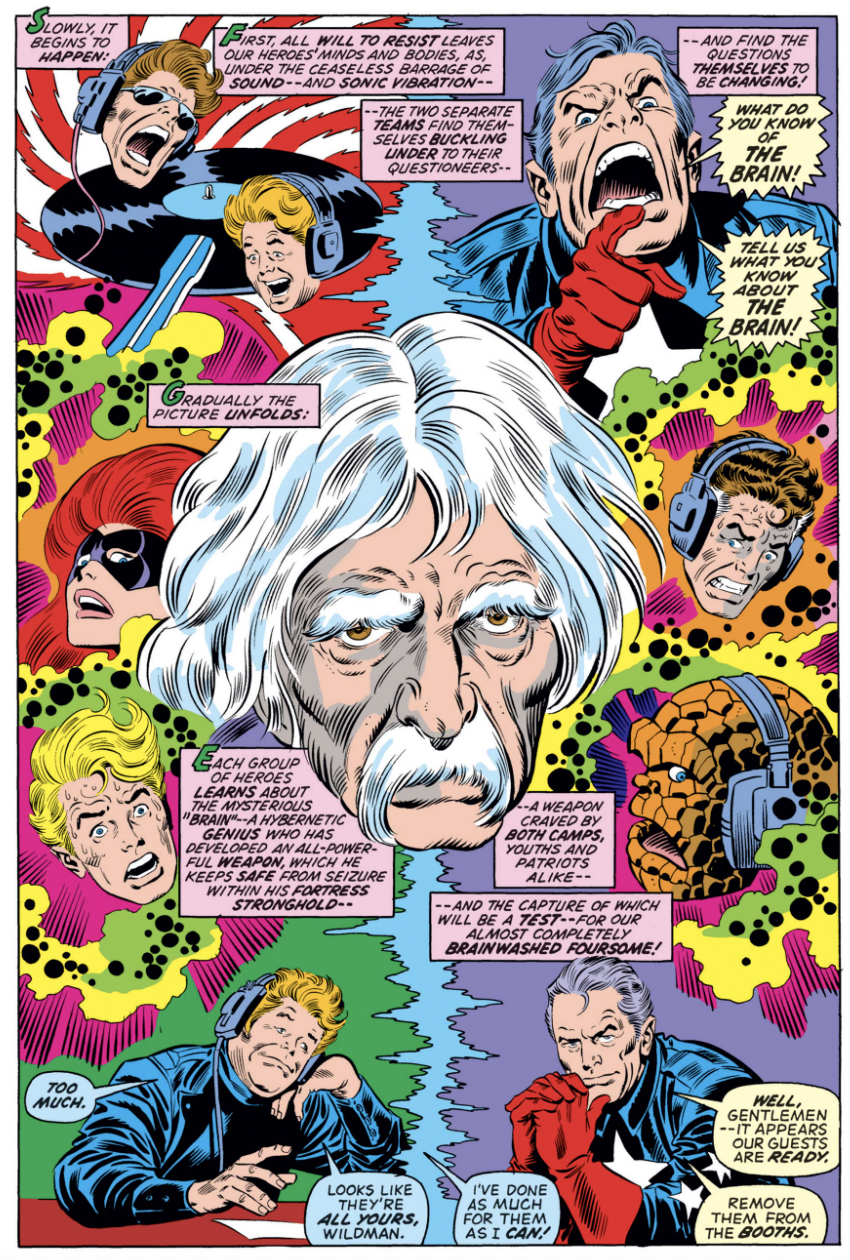
Then, instead of letting the jumbled story gel, Thomas and Conway shake it up again by introducing another character, The Brain, who we meet in this kaleidoscopic sequence:


I can’t imagine a kid picking up this comic as his or her first issue of the FF and making heads or tails of it.

Anything else?

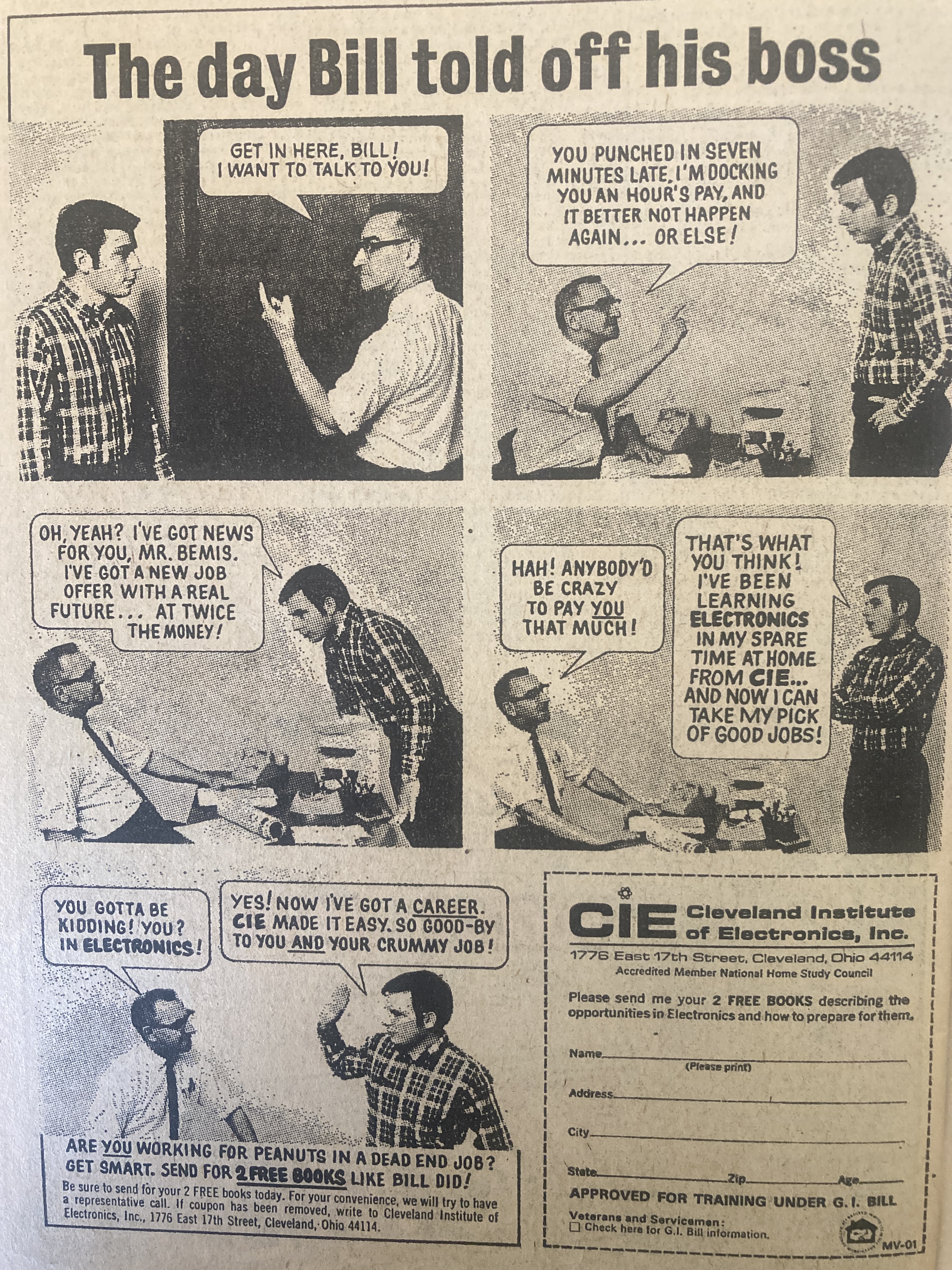
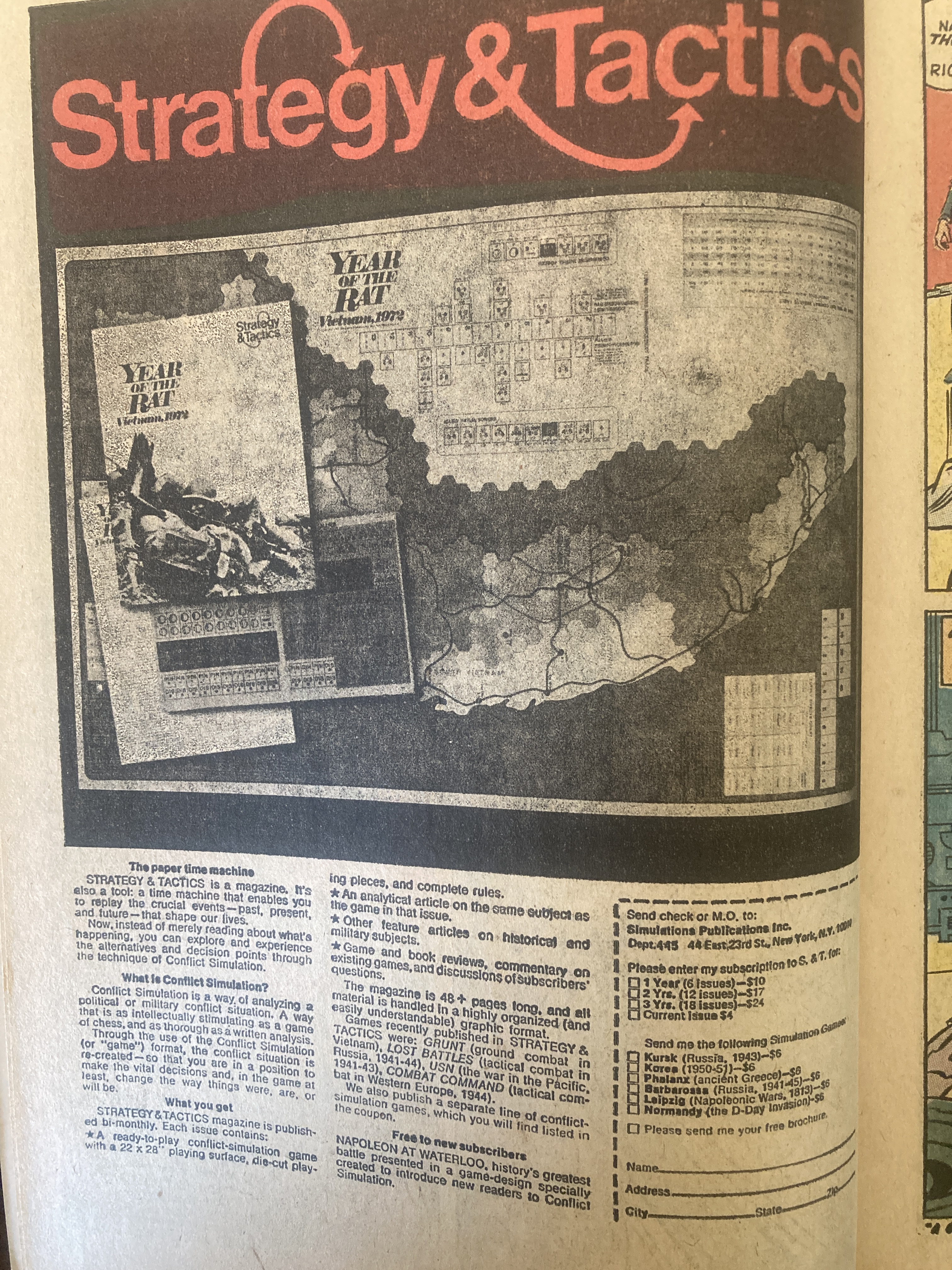
Some interesting ads in this issue. A fumetti-style ad for an anti-authoritarian trade school, and a pretty cool looking role playing magazine.


Overall

For Fantastic Four or Roy Thomas completionists only

“The World’s Greatest Comic Magazine!” Fantastic Four No. 135

23 Sunday Jun 2024

Posted by percivalhenry in The World's Greatest Comic Magazine

≈ Leave a comment

Tags

1973, Dragon Man, Fantastic Four, Fantastic Four 135, Gerry Conway, John Buscema

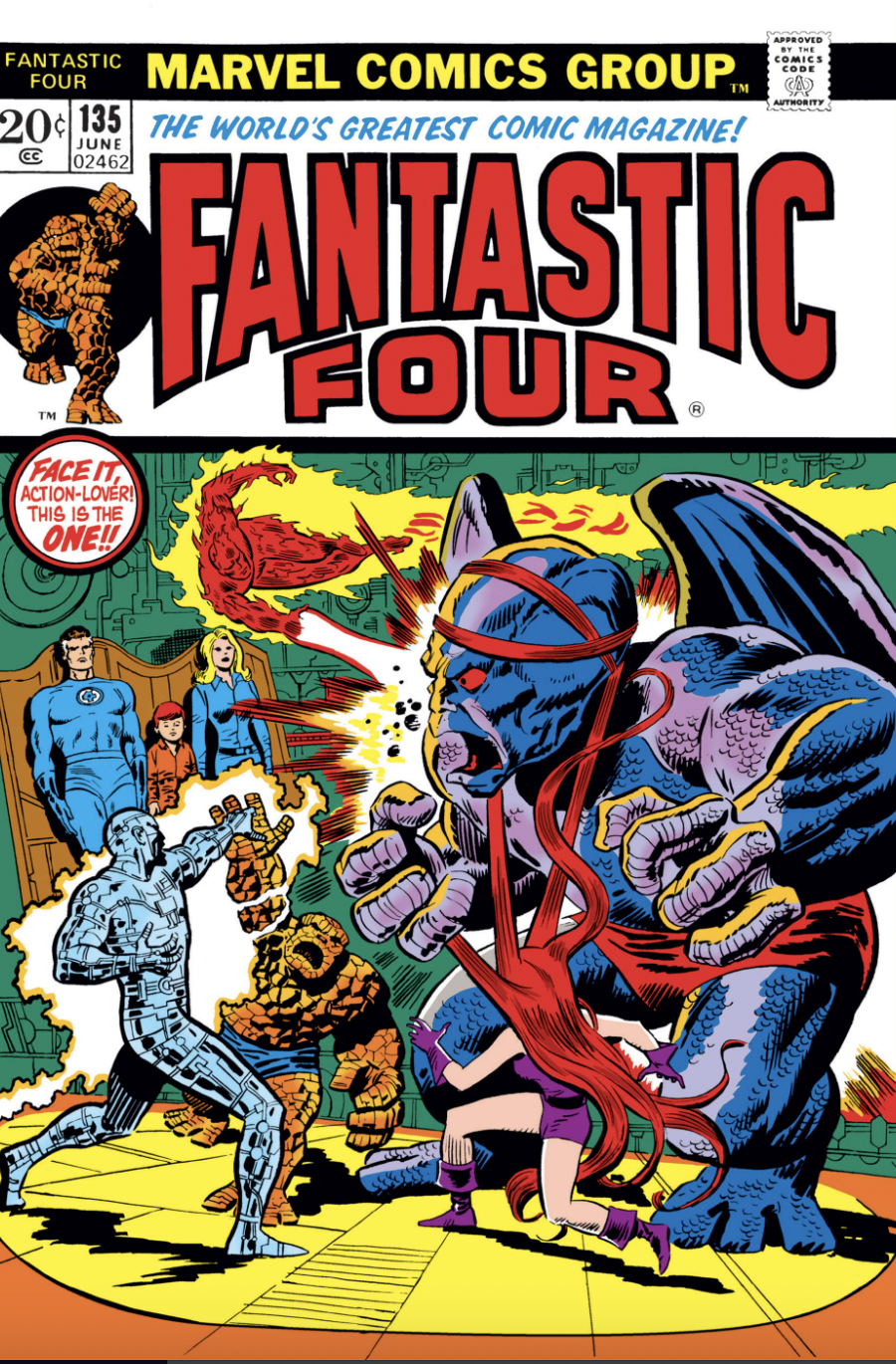
Fantastic Four 135
“The Eternity Machine”
Published: March 1973
Writer: Gerry Conway
Breakdowns: John Buscema
Finishes: Joe Sinnott
Letterer: Artie Simek
Colors: Petra Goldberg
Editor: Roy Thomas
Cover: Buscema and Michel Esposito

Synopsis

The Fantastic Four are trapped by Gregory Gideon, who reveals his plan to drain the powers of Mr. Fantastic, the Invisible Girl and their son Franklin to counter his radiation poisoning and rule the world. Thanks to new member Medusa, the team escapes their imprisonment and beats Gideon by turning Dragon Man against him.


What’s going on here?

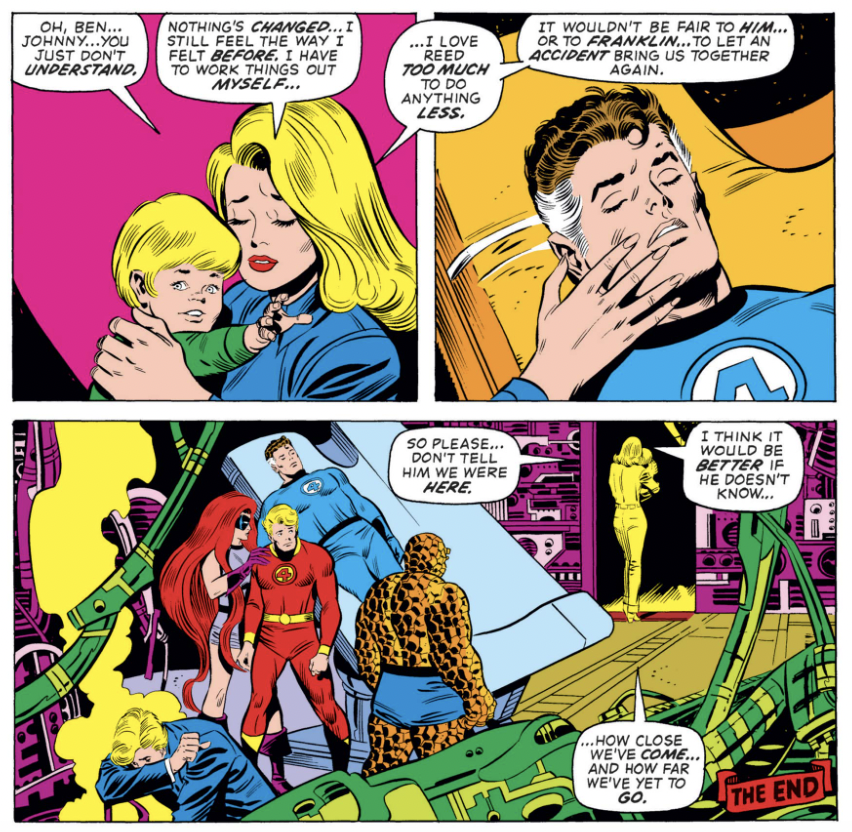
This is a fairly straightforward story, wrapping up a two-part arc while introducing some new sub-plots. Probably the biggest development isn’t a development at all, but the continuation of Sue’s estrangement from Reed. Despite both being captured with their son, at the conclusion of the issue Sue has no interest in reconciling with Reed.


It’s a poignant and effective ending, maybe even more so given writer Gerry Conway was just 20 years old when he wrote this comic. In a 2016 interview, Conway discusses his relative immaturity during this period and how he did his best to mask it as a writer. He concedes he wasn’t always successful, and we’ll see some of that toward the end of his Fantastic Four run. But for a writer barely out of his teens, he handled the strains in Reed and Sue’s marriage with surprising deftness.

What I liked

Another notable development is the emergence of Medusa—finally—as a useful member of the team. I’ve been surprised that, as the newest member of the team, she’s been relegated to the background, but in FF 135 she plays a key role in breaking herself, Ben and Johnny out of their imprisonment, then in removing a device that allowed Gideon to control Dragon Man. I would still welcome a story that focused on her and her decision to leave the Inhumans, but this is progress.

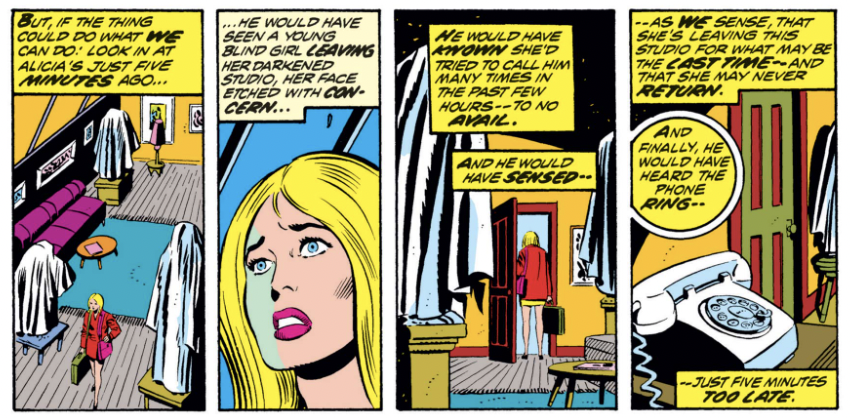
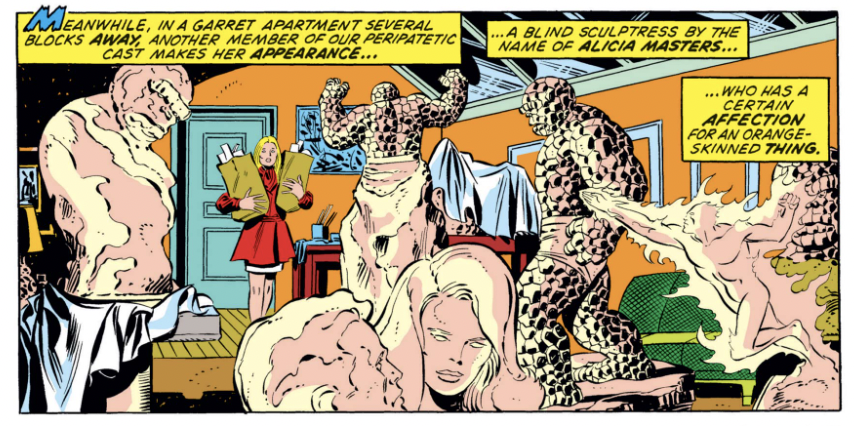
There’s also a nice interlude of Alicia pining away for Ben. It doesn’t seem to be furthering any plot point, but serves to remind us Ben’s life extends beyond the team.

This may be the first time we’ve seen Alicia crafting images of Ben. That becomes a pretty standard feature—at one point almost every appearance shows her surrounded by her sculptures of Ben and other heroes—but this is the first I recall seeing it. If anyone knows of an earlier appearance of this trope, let me know.

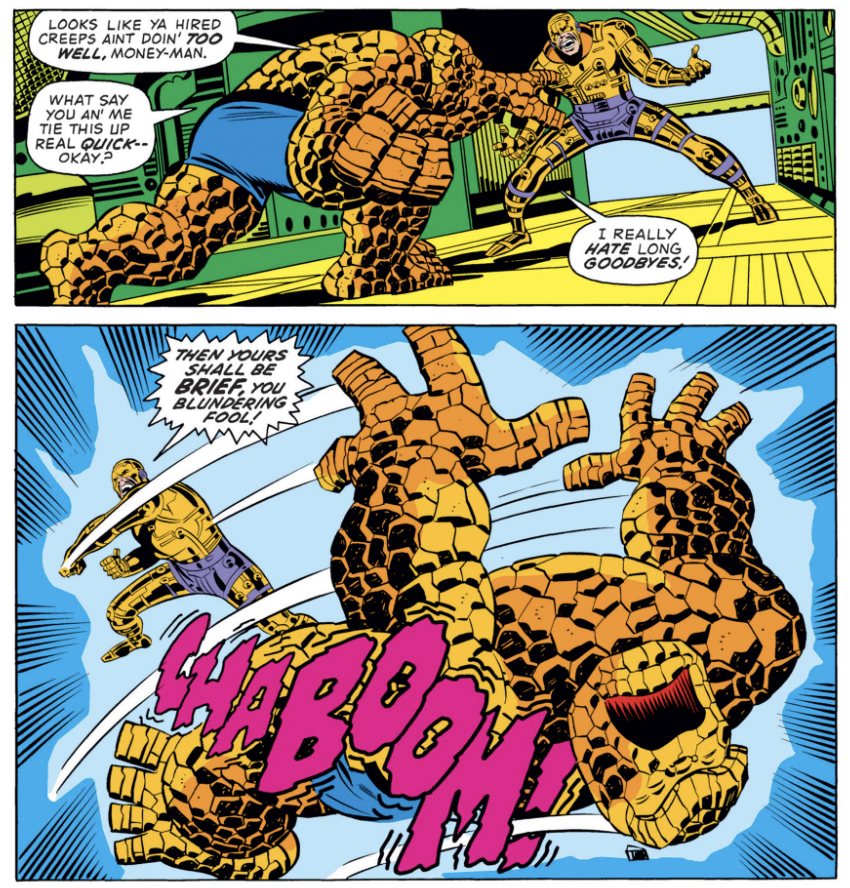
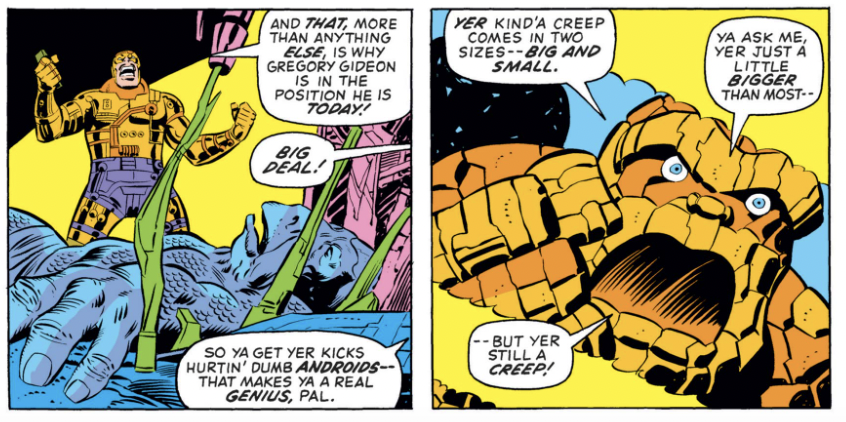
Also, I liked this exchange between Gideon and a salty Ben.


What I didn’t like

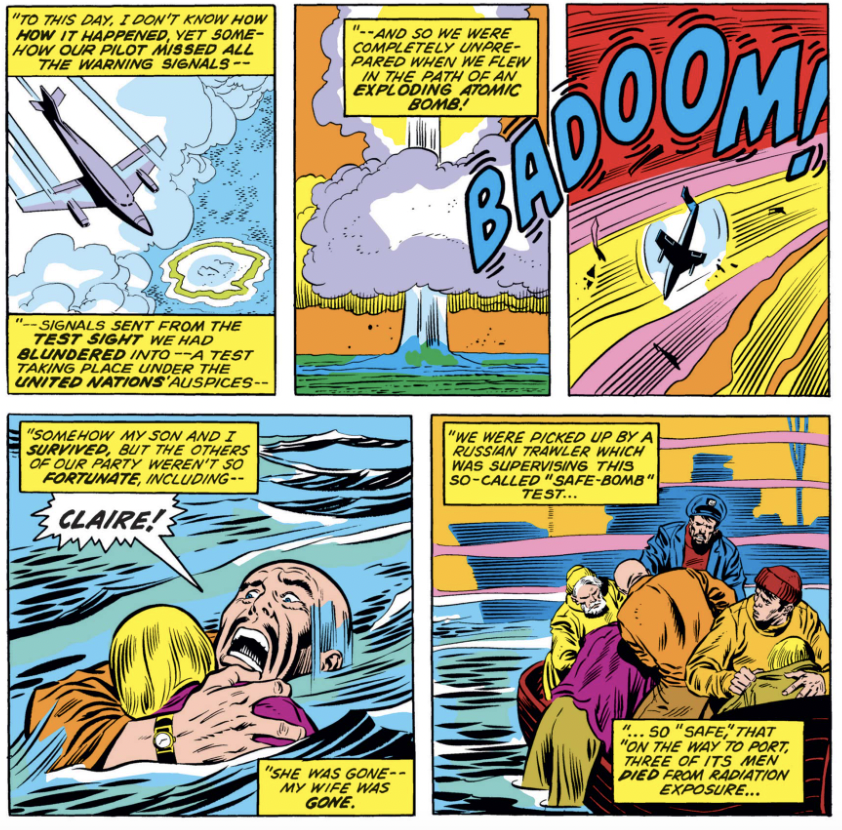
The backstory explaining Gideon’s turn from remorseful rich guy to super villain was truly absurd. His private pilot somehow flew them into a nuclear test site, killing his wife, and giving Gideon and his son radiation poisoning that would kill them in two years. The solution? Stealing the energy of half the Fantastic Four!

Also, a new subplot is introduced, when a mysterious, muscular man entering the FF’s Baxter Building headquarters. But what happened to last issues’s subplot, of Agatha Harkness’s missing house? Hopefully they tie together, or I fear we are entering Claremontian territory of subplots mushrooming without resolution.

Overall

A solid effort.

  • “The World’s Greatest Comic Magazine!” Fantastic Four Annual No. 15
  • “The World’s Greatest Comic Magazine!” Fantastic Four No. 223
  • “The World’s Greatest Comic Magazine!” Fantastic Four No. 222
  • “The World’s Greatest Comic Magazine!” Fantastic Four No. 221
  • “The World’s Greatest Comic Magazine!” Fantastic Four No. 220
  • July 2026
  • June 2026
  • May 2026
  • April 2026
  • March 2026
  • February 2026
  • January 2026
  • December 2025
  • November 2025
  • October 2025
  • September 2025
  • August 2025
  • July 2025
  • June 2025
  • May 2025
  • April 2025
  • March 2025
  • February 2025
  • January 2025
  • December 2024
  • November 2024
  • October 2024
  • September 2024
  • August 2024
  • July 2024
  • June 2024
  • May 2024
  • April 2024
  • March 2024
  • February 2024
  • January 2024
  • December 2023
  • November 2023
  • September 2023
  • July 2023
  • June 2023
  • May 2023
  • April 2023
  • March 2023
  • February 2023
  • January 2023
  • December 2022
  • November 2022
  • October 2022
  • September 2022
  • August 2022
  • July 2022
  • June 2022
  • May 2022
  • April 2022
  • March 2022
  • February 2022
  • January 2022
  • December 2021
  • November 2021
  • October 2021
  • September 2021
  • August 2021
  • July 2021
  • June 2021
  • May 2021
  • April 2021
  • March 2021
  • February 2021
  • January 2021
  • December 2020
  • February 2018
  • May 2016
  • February 2016
  • January 2016
  • December 2015
  • November 2015
  • October 2015
  • September 2015
  • August 2015
  • July 2015
  • April 2015
  • March 2015
  • January 2015
  • December 2014
  • November 2014
  • October 2014
  • September 2014
  • August 2014
  • June 2014
  • May 2014
  • April 2014
  • March 2014
  • February 2014
  • July 2026
  • June 2026
  • May 2026
  • April 2026
  • March 2026
  • February 2026
  • January 2026
  • December 2025
  • November 2025
  • October 2025
  • September 2025
  • August 2025
  • July 2025
  • June 2025
  • May 2025
  • April 2025
  • March 2025
  • February 2025
  • January 2025
  • December 2024
  • November 2024
  • October 2024
  • September 2024
  • August 2024
  • July 2024
  • June 2024
  • May 2024
  • April 2024
  • March 2024
  • February 2024
  • January 2024
  • December 2023
  • November 2023
  • September 2023
  • July 2023
  • June 2023
  • May 2023
  • April 2023
  • March 2023
  • February 2023
  • January 2023
  • December 2022
  • November 2022
  • October 2022
  • September 2022
  • August 2022
  • July 2022
  • June 2022
  • May 2022
  • April 2022
  • March 2022
  • February 2022
  • January 2022
  • December 2021
  • November 2021
  • October 2021
  • September 2021
  • August 2021
  • July 2021
  • June 2021
  • May 2021
  • April 2021
  • March 2021
  • February 2021
  • January 2021
  • December 2020
  • February 2018
  • May 2016
  • February 2016
  • January 2016
  • December 2015
  • November 2015
  • October 2015
  • September 2015
  • August 2015
  • July 2015
  • April 2015
  • March 2015
  • January 2015
  • December 2014
  • November 2014
  • October 2014
  • September 2014
  • August 2014
  • June 2014
  • May 2014
  • April 2014
  • March 2014
  • February 2014
“The World’s Greatest Comic Magazine!” Fantastic Four Annual No. 15

“The World’s Greatest Comic Magazine!” Fantastic Four Annual No. 15

percivalhenry's avatar by percivalhenry July 18, 2026
“The World’s Greatest Comic Magazine!” Fantastic Four No. 223

“The World’s Greatest Comic Magazine!” Fantastic Four No. 223

percivalhenry's avatar by percivalhenry July 14, 2026
“The World’s Greatest Comic Magazine!” Fantastic Four No. 222

“The World’s Greatest Comic Magazine!” Fantastic Four No. 222

percivalhenry's avatar by percivalhenry July 5, 2026
“The World’s Greatest Comic Magazine!” Fantastic Four No. 221

“The World’s Greatest Comic Magazine!” Fantastic Four No. 221

percivalhenry's avatar by percivalhenry June 25, 2026
“The World’s Greatest Comic Magazine!” Fantastic Four No. 220

“The World’s Greatest Comic Magazine!” Fantastic Four No. 220

percivalhenry's avatar by percivalhenry June 15, 2026
“The World’s Greatest Comic Magazine!” Fantastic Four No. 219

“The World’s Greatest Comic Magazine!” Fantastic Four No. 219

percivalhenry's avatar by percivalhenry June 7, 2026

Blog at WordPress.com.

  • Subscribe Subscribed
    • Percival Henry: The Fantastic Four and more
    • Join 74 other subscribers
    • Already have a WordPress.com account? Log in now.
    • Percival Henry: The Fantastic Four and more
    • Subscribe Subscribed
    • Sign up
    • Log in
    • Report this content
    • View site in Reader
    • Manage subscriptions
    • Collapse this bar
Loading Comments...