Tags
1973, Annhilus, Fantastic Four, Fantastic Four 141, Franklin Richards, Gerry Conway, John Buscema, Marvel comics
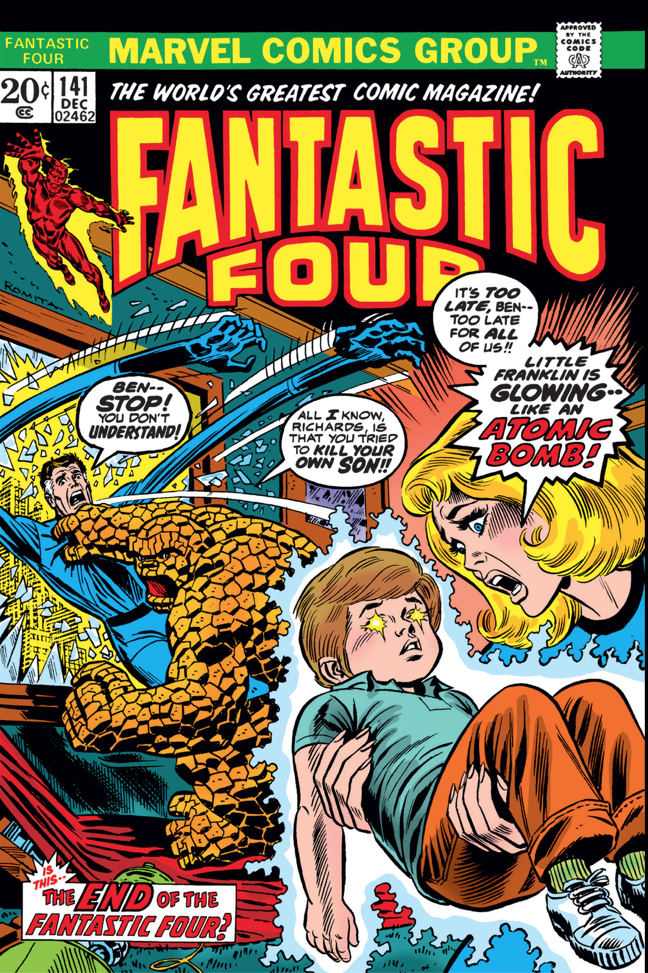
Fantastic Four 141
“The End of the Fantastic Four!”
Published Sept. 1973
Writer: Gerry Conway
Pencils: John Buscema
Inks: Joe Sinnott
Letters: John Costanza
Colors: George Roussos
Editor: Roy Thomas
Cover: John Romita
Synopsis
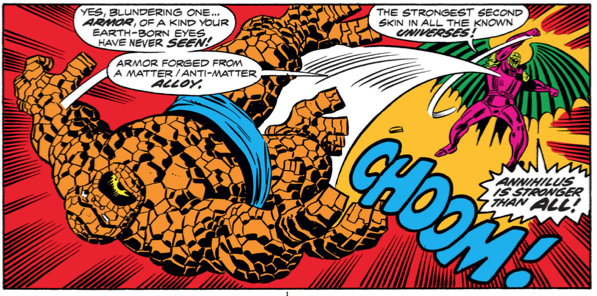
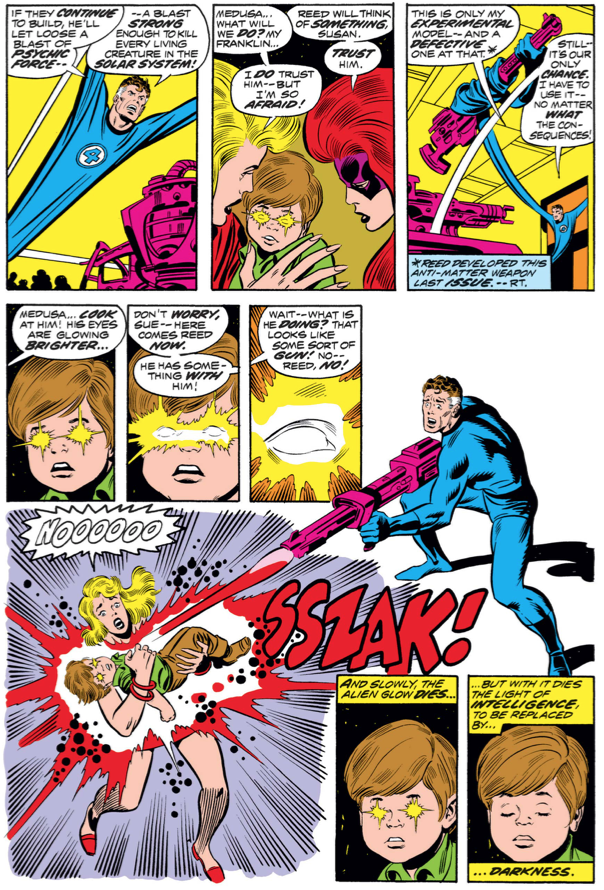
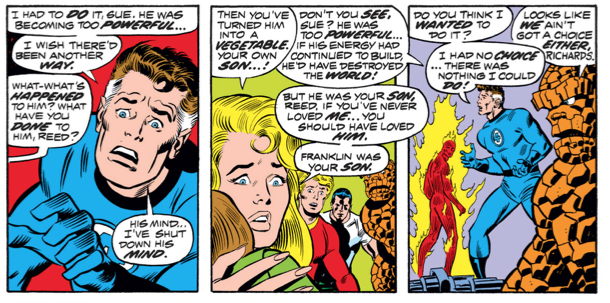
After capturing the now helpless Fantastic Four — plus Sue, Franklin, Agatha Harkness and Wyatt Wingfoot — in his Negative Zone stronghold, Annihilus taps Franklin’s comic powers in order to drain them. The FF escape, free Franklin and returns to the Baxter Building, where Reed, fearing Franklin’s powers will destroy the solar system, zaps him with a device that renders him a vegetable. Horrified, Ben declares this is the end of the Fantastic Four.
What’s going on here?
This is a heavy issue. I’m not particularly sure it’s a well-written story, but it has big themes and consequences. The big revelation is that Franklin possesses enormous power that threaten all of existence. His powers had been teased at for years now, but this is the first indication of their scope, and it’s a development that has major ramifications for not just the Fantastic Four but the Marvel universe for decades to come. As but one example, the mid-90s Onslaught storyline, which resulted in the cancellation and reboot of most of Marvel’s mainstream comics, was facilitated by Franklin creating a pocket universe. At some point he is identified as a mutant, although he’s not labeled one here.
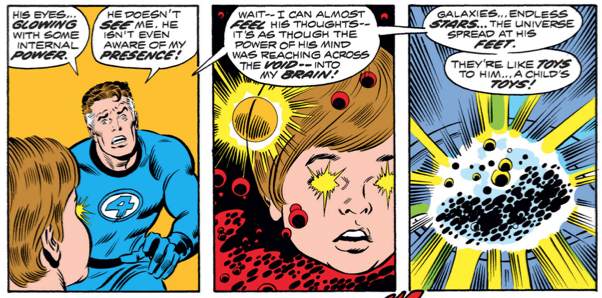
It’s not clear who came up with the idea of giving Franklin these god-like powers. In an interview, Stan Lee said after they decided for Reed and Sue to have a child, he and Jack Kirby envisioned him having powers, and liked the idea of keeping readers guessing what they might be. It seems like Roy Thomas and Gerry Conway took that idea and ran with it. His powers have resulted in a lot of interesting stories, but also some petty tedious ones as well.
From my perspective, a super-powered Franklin is a mixed blessing. There is something compelling about the idea of a child with these immense powers, and when they are unleashed in the hands of a great writer, it can be a lot of fun. Hickman’s future Franklin battling Celestials and summoning Galactus might be as good as it gets (from FF 604, art by Steve Epting and Rick Magyar).
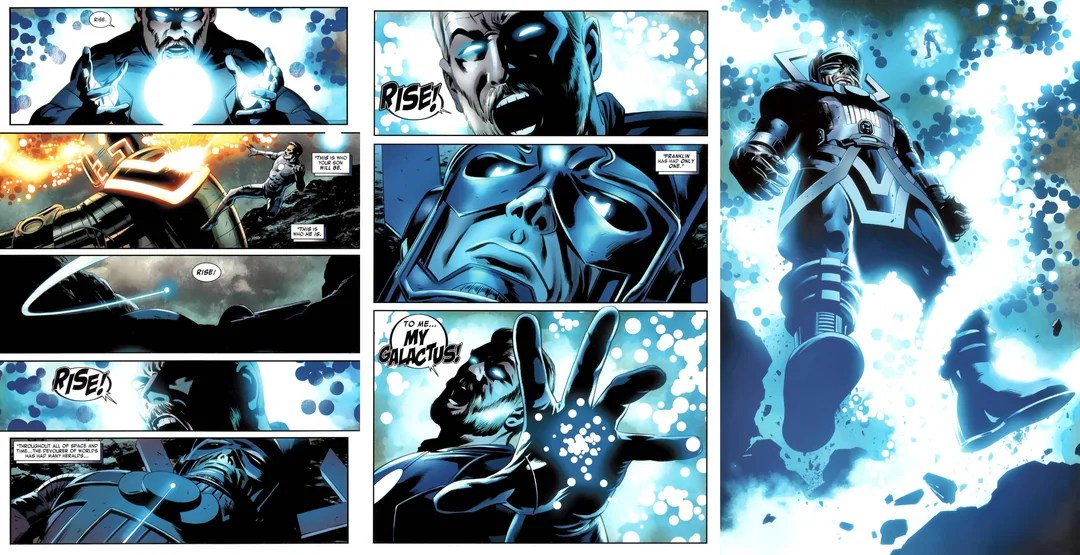
But for every fun story, there’s a lot of uneven ones about Franklin’s powers run amok, or Franklin in danger. And when taken together, they tend to reflect poorly and Reed and Sue as parents who are constantly exposing their child to danger.
The other big development is Reed’s panicked decision to depower Franklin, and — it appears — effectively lobotomize him. It’s not the first, and certainly not the last, example of Reed prioritizing the good of humanity or the universe of over personal needs or desires, but it’s a poignant one. Of course, we know know that Franklin eventually recovers but for readers at the time, this must have felt like a pretty significant episode in the marriage of Reed and Sue and the future of the FF.
What I liked
I did appreciate how the stakes were ratcheted up in this story, and how Conway finally resolved long-hanging plot points, such as the disappearance of Agatha Harkness’s house way back in issue 134. Unlike Lee and Kirby, who rarely seemed to plot more than an issue or two in advance, Thomas and Conway unspool their subplots over months, creating bread crumbs for readers to follow. Even in this issue, which wraps up a long arc, Conway teases another story featuring Alicia Masters.
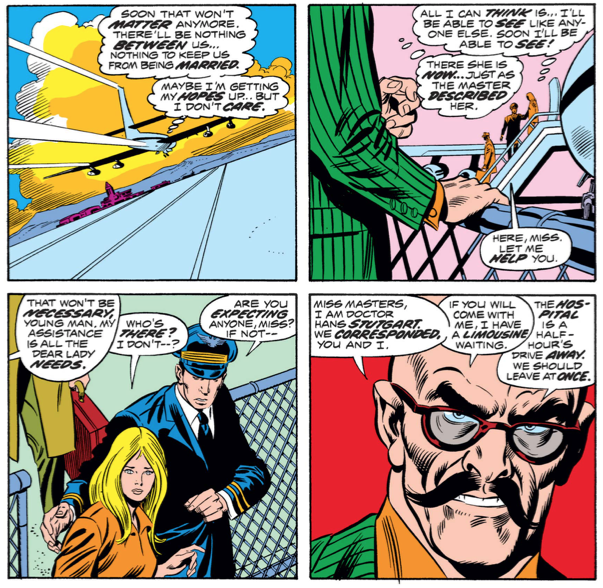
This form of story development isn’t always successful, but it suggests a respect for their readers’ ability to handle complicated ongoing stories. Chris Claremont would of course take this style of storytelling to absurd lengths, letting plots tangle for years, some never to be resolved.
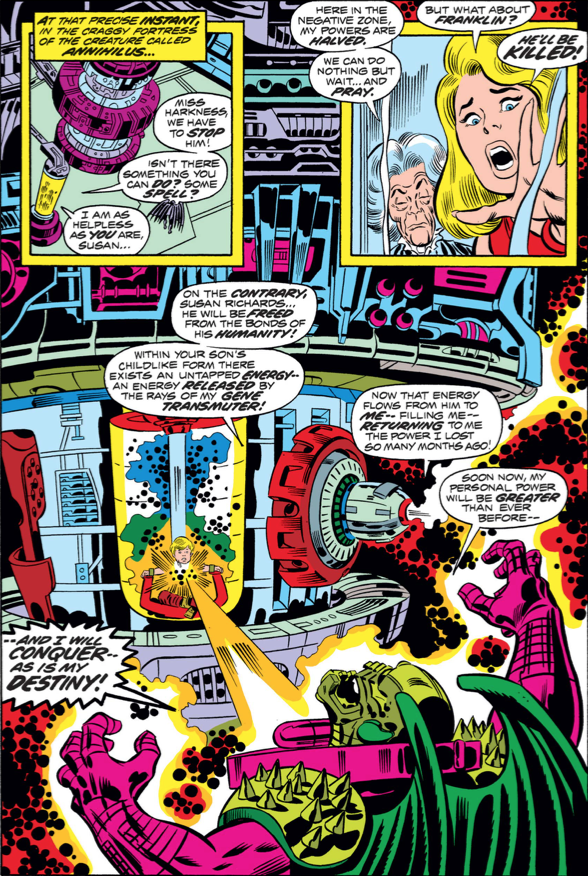
I also enjoyed this splash from Buscema and Sinnott, which has a Kirby-ersque flair.
What I didn’t like
Despite the major themes introduced in this comic, the story itself wasn’t very interesting or well constructed. Basically, Annihilus captures the FF, they escape and defeat him. There’s not a lot of nuance, and it all feels pretty rote until we get to the climax.
One of my gripes about the Conway era has been how underutilized Medusa has been. Here, he rectifies that in the most obvious and silly way possible (Annihilus has imprisoned the FF in a room with an open window???).
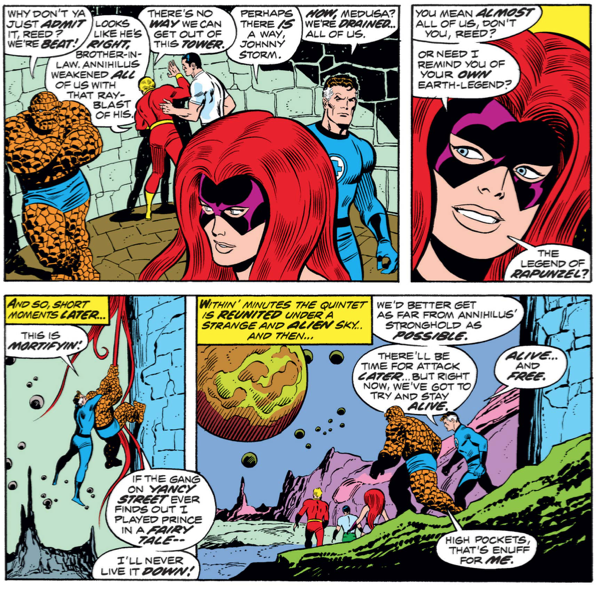
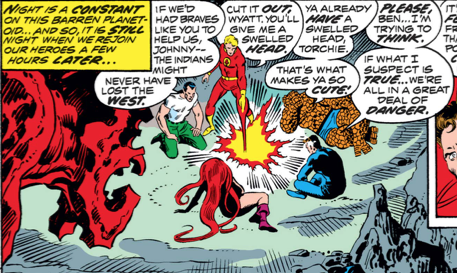
We also get this unfortunate exchange between Wyatt — even more under-utilized in this issue than Medusa — and Johnny.
Overall
A pivotal issue the history of the Fantastic Four


Pingback: “The World’s Greatest Comic Magazine!” Fantastic Four No. 222 | Percival Henry: The Fantastic Four and more