Tags
1961, comics, Fantastic Four 1, jack Kirby, Mole Man, Stan Lee
Welcome to the inaugural installment of what I’m hoping is a multi-year project to blog the entire run of the Fantastic Four, from its 1961 debut up until the present (assuming it’s still being published however many years in the future that will be).
Why the Fantastic Four? The easy answer is that it’s my favorite comic, but also because it’s steeped in history. The Fantastic Four launched the Silver Age at Marvel, and ushered in the Marvel universe as we know it, the overlapping and self-referencing world of superheroes and characters that, nearly six decades later, now spans tens of thousands of comics. The Marvel comics universe, of course, also gave birth to the Marvel Cinematic Universe, a potent pop-cultural force that has introduced many more millions (billions even) to these characters.
I don’t recall my first exposure to the Fantastic Four—it might have been the either the 1967 or 1978 cartoons—but I clearly remember the first FF comic I bought: issue 260, off of a spinner rack at the Amenia Variety store, near my parent’s house in Dutchess County, New York, in late August of 1983. I had spent the previous months at summer camp, and a fellow camper was Eddie Galton, son of then-Marvel president James Galton. I wasn’t particularly friendly with Eddie (now Edward, and a TV producer) but he had hundreds of comics, and they washed around our bunks. I had read comics before, mostly things like Archie and Richie Rich, but that was my first taste of modern Marvel superheroes and I was hooked (I can’t recall much of what I read that summer, although The Official Handbook to the Marvel Universe No. 11 one was definitely among them. When I got back from camp, I eagerly sought out more, and FF 260 was the first I bought.
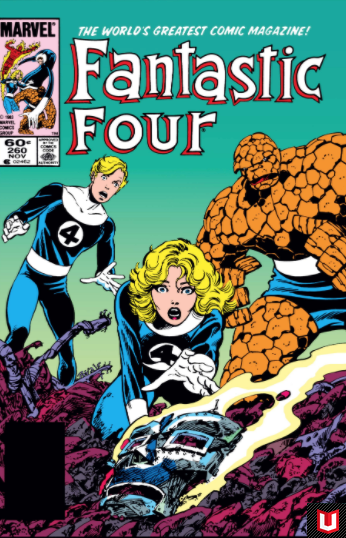
In retrospect, you would be hard pressed to find a better single-issue introduction to Marvel comics from that era than FF 260. Written and illustrated by comics maesto John Byrne at the peak of his powers, it featured the FF tussling with their best bad guy, Dr. Doom, and guest appearances from some of prominent supporting characters like the Silver Surfer and Sub-Mariner (more about that issue when we get to it in few years). More importantly, the individual personalities of the team’s members were clearly defined, as was their relationships to each other. This was more than a team, it was a family, and it was clear from the first issue I read.
Ultimately, that dynamic is what keeps me coming back to the Fantastic Four after many decades and creative teams. They’re not a team of superheroes who banded together to fight evil, like the Justice League or Avengers; they were a family of adventurers who became super heroes. Like all families they quarrel and sometimes drift apart, but they are tied together by love and shared history.
A few notes about this project: I hope to cover one issue a week, starting with the first. This is not a new format, and there are many similar blogs tackling lengthy comic book runs (including, probably, the Fantastic Four). I was inspired by The Matt Murdock Chronicles, a sadly defunct issue-by-issue look at Daredevil, and particularly Austin Gorton’s X-aminations X-Men Reviews, a heroic attempt to document every X-Men related comic on the The Real Gentlemen of Leisure blog. If some of the features look familiar, I will confess to having borrowed some of the best elements of from those two blogs. For historic data, I’m relying on Mike’s Amazing World, a great resource.
When possible, I will take note of non-story elements that will be relevant, such as notes from Bullpen Bulletins and the letter’s page, when they appear. Unfortunately, I’m relying on my Marvel Unlimited subscription for early issues, which doesn’t include those elements, so I won’t have them available until we get to the comics I actually own. If nothing else, this exercise should help spur me to fill into the gaps in my collection.
So with all that throat clearing out of the way, here is the one that started it all, Fantastic Four No. 1:
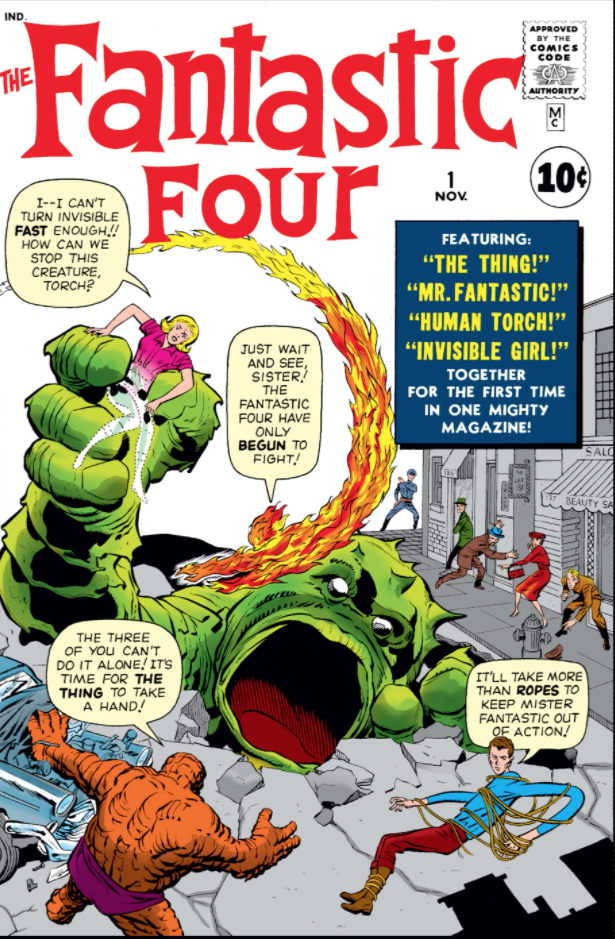
Fantastic Four No. 1
Published: August 1961
Story: Stan Lee and Jack Kirby
Pencils: Kirby
Script: Lee
Inks: George Klein (uncredited)
Cover: Kirby and Dick Ayers
Synopsis:
A mysterious man sends off a flare, summoning three strangely powered individuals: a woman who can turn invisible, a monstrous brute, and a teenager who bursts into flame. The man who summoned them is revealed to have stretching powers. A quick recap explains their origin: Scientist Reed Richards leads his best friend (Ben Grimm), his girlfriend (Sue Storm), and her younger brother (Johnny Storm) to sneak aboard a rocket for an unauthorized mission to space. Despite Grimm’s misgivings about the unknown effect of cosmic rays, he agrees to pilot the ship after his courage is called into question. In flight, the craft is bombarded by cosmic rays and after a crash landing, their powers manifest. After a brief squabble, they agree to use their powers for good.
Back in the present, Richards informs the rest of the team about atomic plants vanishing underground around the world. He pinpoints the location—Monsters Island!— and the team flies to investigate. After confronting a three-headed flying monster, Reed and Johnny are separated from Ben and Sue, tumble beneath the earth and meet the Mole Man, a misshapen man driven underground by a a cruel world. A fight ensues, Ben and Sue eventually catch up and Johnny blazes a path out of the cavern, sealing the Mole Man and his monsters beneath. An apparent nuclear explosion destroys the island as the team flies off.
What’s this all about?
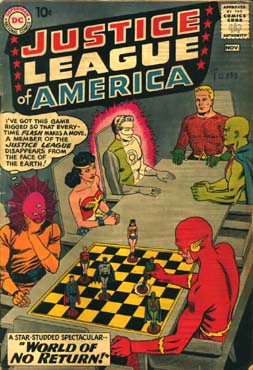
The Fantastic Four was born from a mix of influences. The genesis was a business decision: Magazine and comic publisher Martin Goodman wanted a comic that could compete with the Justice League of America, a super hero team-up book launched a year earlier by National Comics Publication, a precursor to DC. Goodman directed Stan Lee, his editor, to come up with something, and Lee recruited artist Jack Kirby, then newly arrived at what would become Marvel. Who actually contributed what to the origin is still debated, but it’s clear both Lee and Kirby played a role.
The use of space travel and cosmic rays as an origin device is very much of its time: Sputnik had launched four years earlier, and Yuri Gargarin became the first man in space in April of 1961. Space was on everyone’s minds, particularly the teenage boys the comics was targeting. The specter of communism is also present, as Sue warns that “the commies” could beat the team into space (and of course, they had).
Unlike the Justice League, which was an assembled group of existing heroes with their own origins and costumes, the Fantastic Four was created together. Their origin and uniformed appearance is very similar to that of the Challengers of the Unknown, a team Kirby created in 1958 while at National (you can read more about that here).
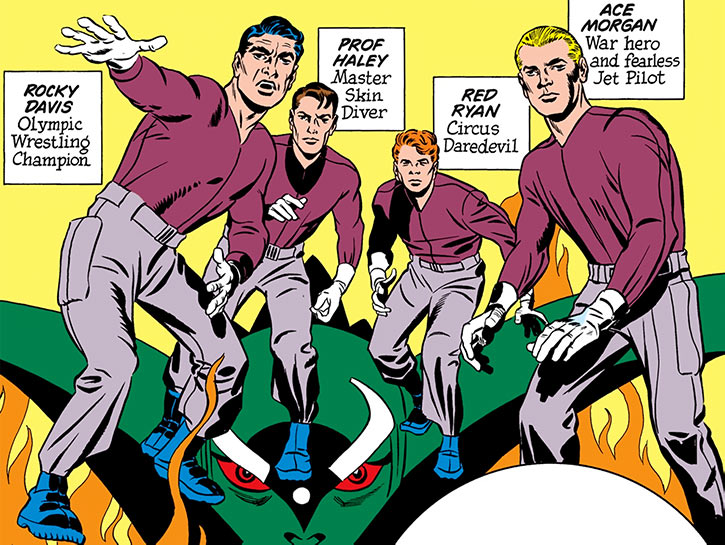
Other aspects of the story also echo earlier Kirby works, particularly the Mole Man’s monsters, the latest in a long line of bizarre monsters Kirby created.
It’s also worth noting that the powers acquired by the team aren’t particularly unique. Invisibility is a well-established power dating to H.G. Wells’ The Invisible Man (at least), a man who changes into a hulking monster draws from Beauty and the Beast and Dr. Jekyll and Mr. Hyde (and many others), Plastic Man was a stretching character dating from 1941, and not only did Marvel itself have a character who could burst into flames in the 1940s, but he was also called the Human Torch. At one point Stan Lee said he was riffing off of the four elements when he assigned the team their powers:air (Sue), water (Reed), earth (Ben) and fire (Johnny).
About that origin
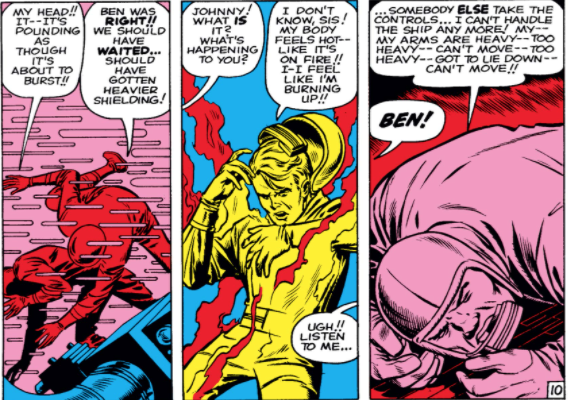
The five short pages of origin are among the most scrutinized texts in comics. Over the years the story has been expanded and retconned, often in an attempt to address some of the story’s central mysteries: Why would Reed, allegedly one of earth’s smartest men, risk exposure to the cosmic rays that even Ben knew were a risk? Why would he take along not just his fiancee but her teenage brother? Why would he sneak aboard his own ship in the middle of the night? The in-story explanation is that Reed doesn’t have time to wait for official clearances because “conditions are right tonight,” and that Sue and Johnny insist on accompanying Reed and Ben.
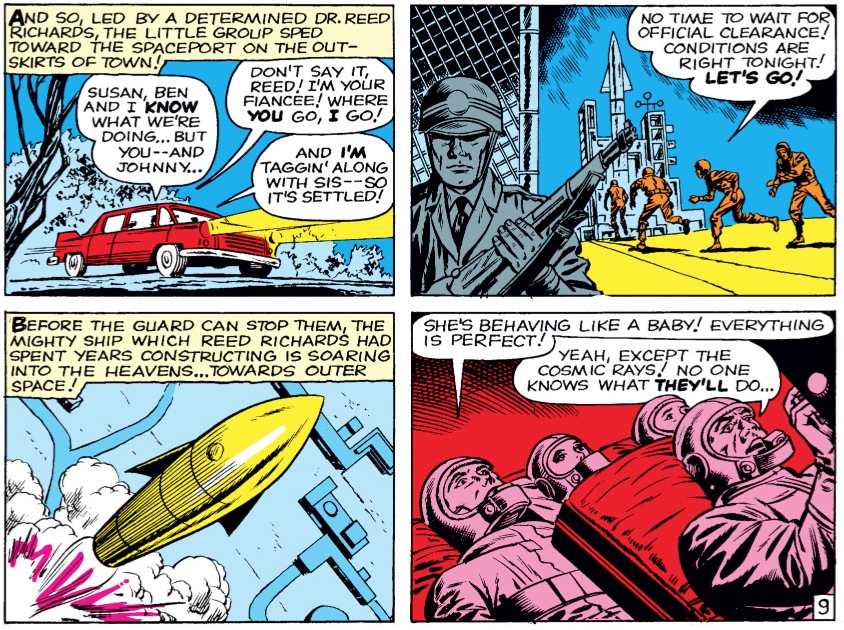
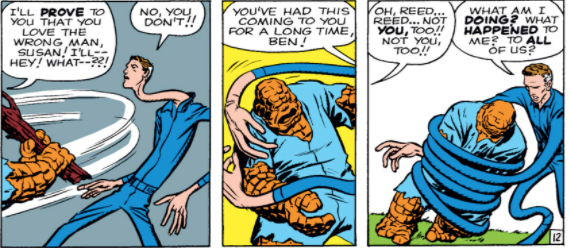
Ben’s resentment at Reed for his disfiguration and Reed’s guilt and attempts to cure Ben have fueled dozens of stories and remain a potent thematic element of the Fantastic Four through the present. In one of the recent retellings, by Dan Slott in Point of Origin, the space ship was adequately protected from ordinary cosmic rays but the ship was subjected to a barrage of the rays from the alien planet Spyre, the team’s original destination (no actual destination was given in the first issue).
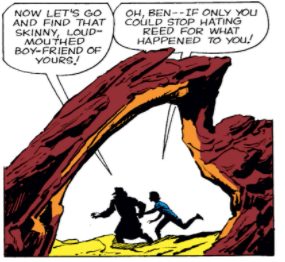
Ben’s long-simmering resentment at Reed is hinted at early on:
So who are these guys:
The first issue lays the template for hundreds of stories to come, and by-and-large the basic characters are established from the beginning, and while their appearances and powers change, the essential notes of their personalities will remain in place for years.
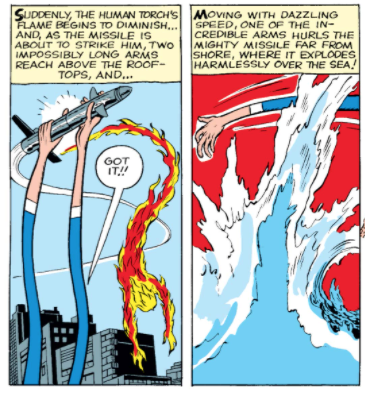
Reed, appearing with his pipe and hair that is going white at the sides, is basically the same confident, aloof professorial Reed we’ve known for decades. He is a bit overpowered in this first issue, at one point grabbing a nuclear missile aimed at Johnny out of the air and throwing it into the Atlantic (why the National Guard thinks firing a nuclear weapon over New York was prudent goes unaddressed).
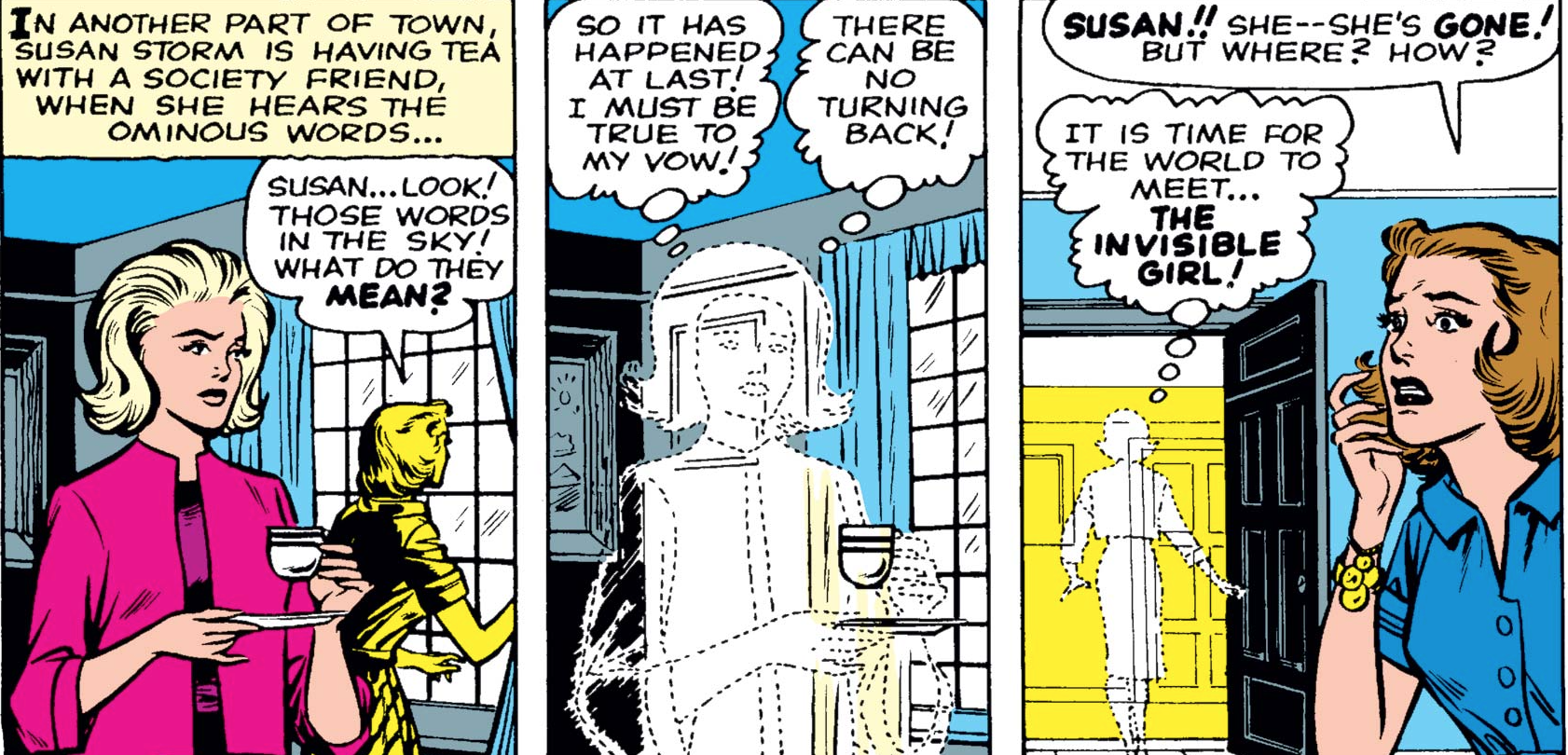
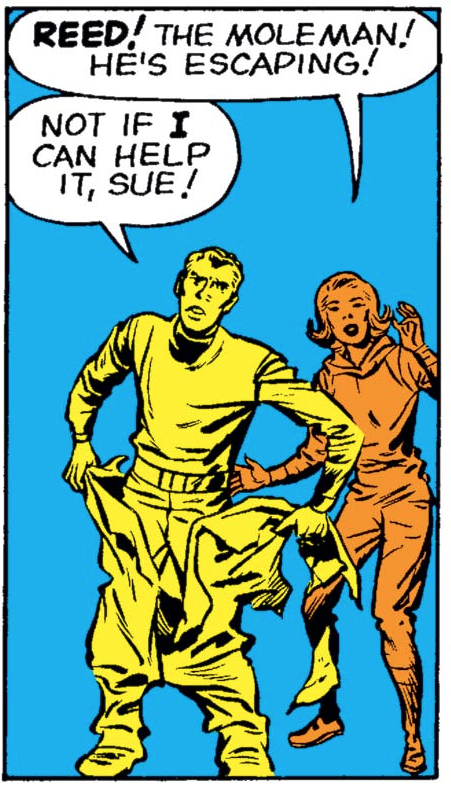
The basic character beats of Sue that persist for years are also established: She’s demure and dainty, supportive of Reed to a fault. Her power at this point remains invisibility, a metaphor for her vanishing personality, until issue 22, when she gains the ability to create force fields. It wasn’t until the 1980s and under John Byrne that those force fields are depicted as offensive weapons, and she eventually she is described as the team’s most powerful member.
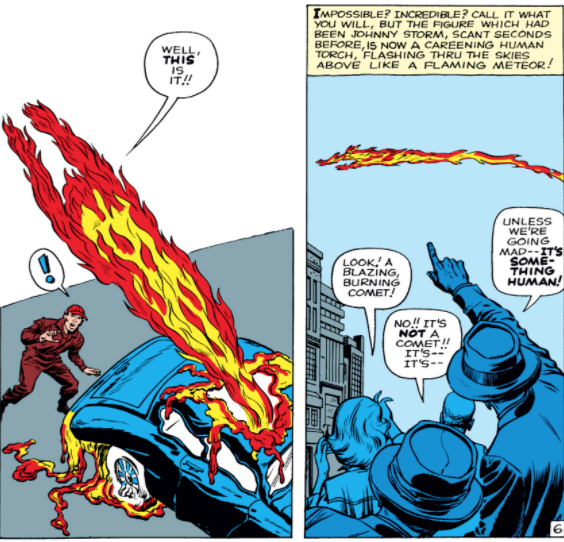
Johnny is a hot-headed teen (metaphor alert!) who is crazy about cars, a long-lasting element of his character. In his first appearances he resembles an actual flame, not the red man surrounded by flames he later becomes.
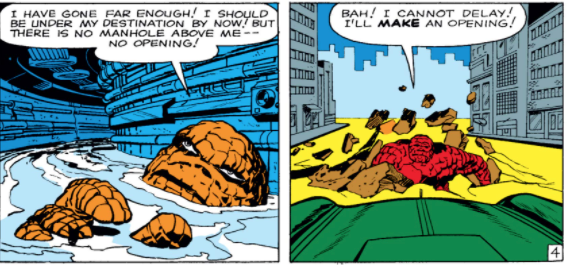
The Thing is the character whose initial appearance is most unfamiliar to modern readers. It’s not just his monstrous form, which transforms into the orange rocky one gradually over the next dozen issues (apparently Kirby found that version easier to draw) but his personality undergoes a major shift. His diction in this issue is more formal and archaic (at several points he says “bah!) and has none of the dropped g’s and colloquialisms that become his trademark. Nor does he have the sense of humor that helps define the character.
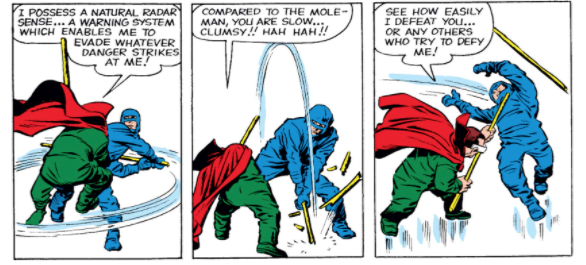
The Mole Man (here referred to as the Moleman) also debuts, and becomes a recurring villain. Although classically Silver Aged in his world-dominating ambitions, he’s given a sympathetic backstory and thus becomes a more nuanced character. Plus, he’s got some sweet moves:
The more things change
Some elements, however, will remain with the book for years. For example, they’re fighting with each other from the get go:
In what becomes a long sexist tradition, Sue stand back and reacts while the men take action:
And Kirby delivers some knockout art:
For sale
A mint condition (9.8) FF No. 1 will set you back $4.6 million
About that cover
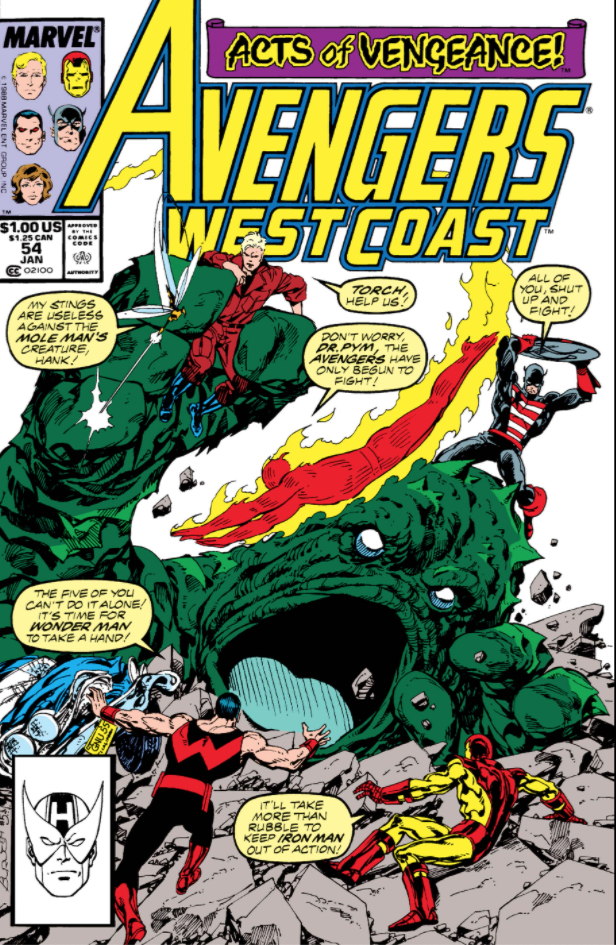
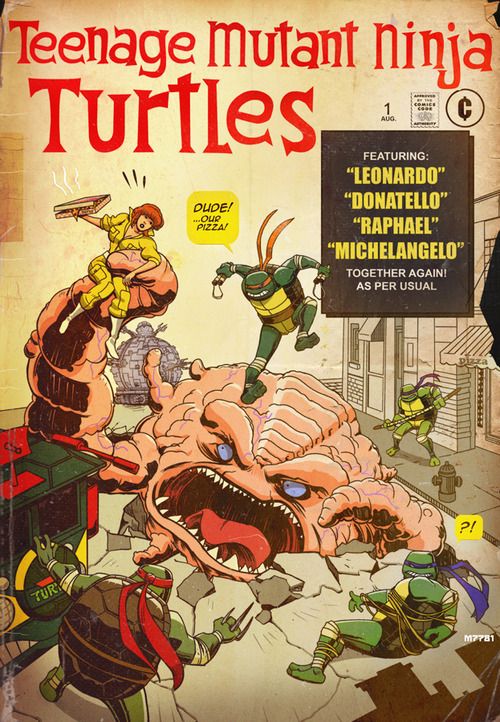
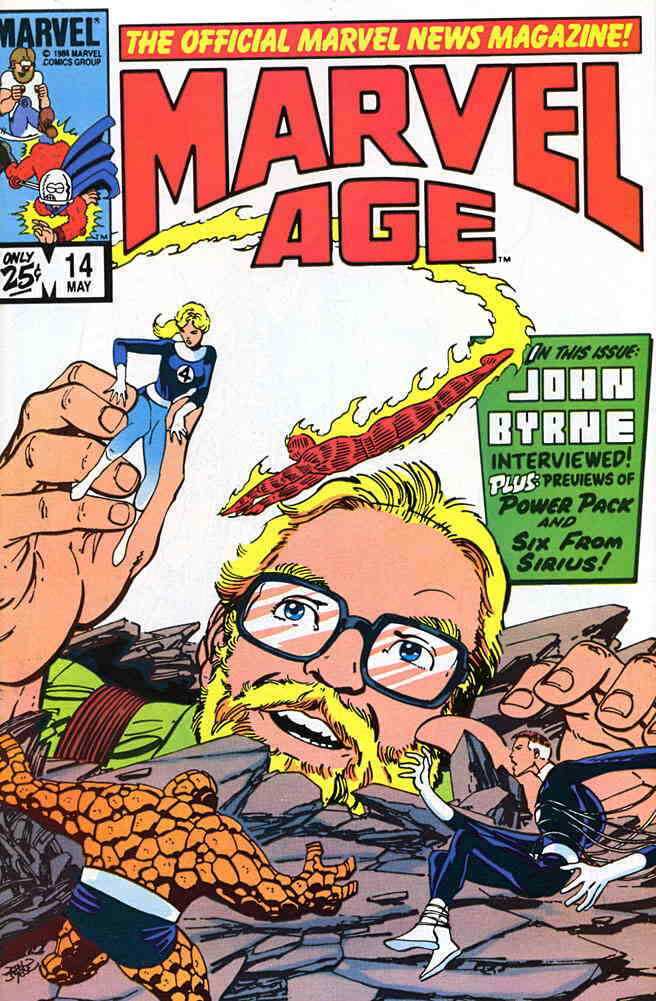
Fantastic Four 1 is one of the most copied, parodied or homaged covers in comics. It’s delightfully silly, and has nothing to do with the interior (who put those ropes around Mr. Fantastic, anyway?) It’s notable for a few other reasons, as well. The logo, with those groovy sixties letters, will be one of the the most enduring in comics, and while Marvel will occasionally swap it out for a more modern look, it often returns. Instead of Marvel’s logo, there is a tiny “MC” in a box under the Comic’s Code Authority seal. And the blurb introducing the team promises that they’re “together for the first time,” implying this is uniting a group of individual characters, like the Justice League.
Here are some other versions of the cover (it should be said Byrne in particular loved referencing it):
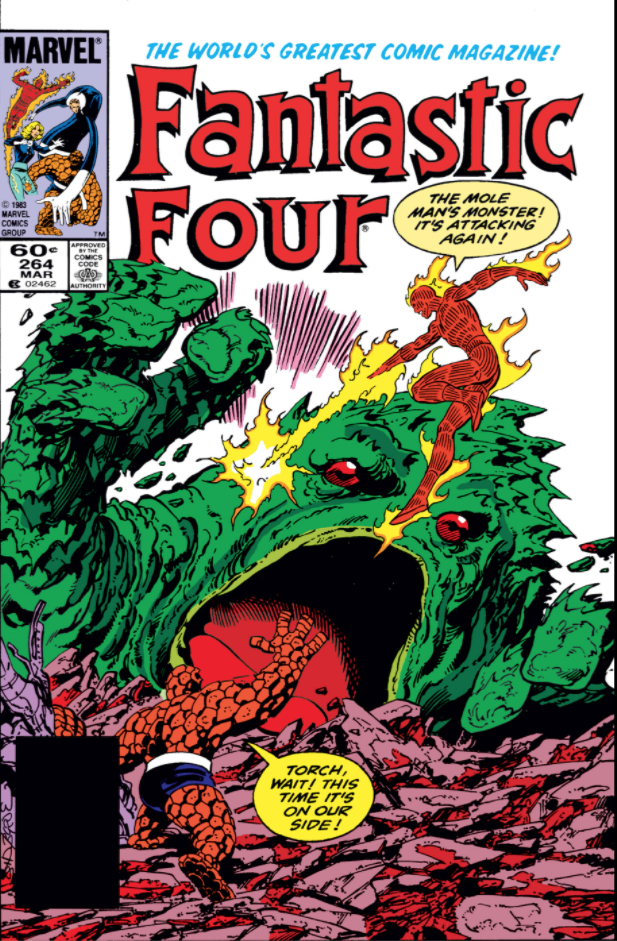
Questions? Comments? Concerns? Let me know!
Next week: Skrulls!


Interesting that the FF are not wearing any costumes in the issue.
The closest they get to uniforms are their space suits, which are pretty close to the Challengers’ uniforms.
Pingback: “The World’s Greatest Comic Magazine” Fantastic Four No. 22 | Percival Henry
Pingback: “The World’s Greatest Comic Magazine!” Fantastic Four No. 48 | Percival Henry: The Fantastic Four and more
Pingback: “The World’s Greatest Comic Magazine!” Fantastic Four No. 126 | Percival Henry: The Fantastic Four and more