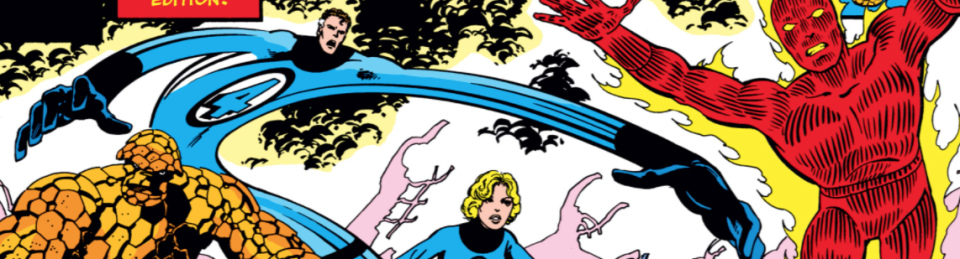
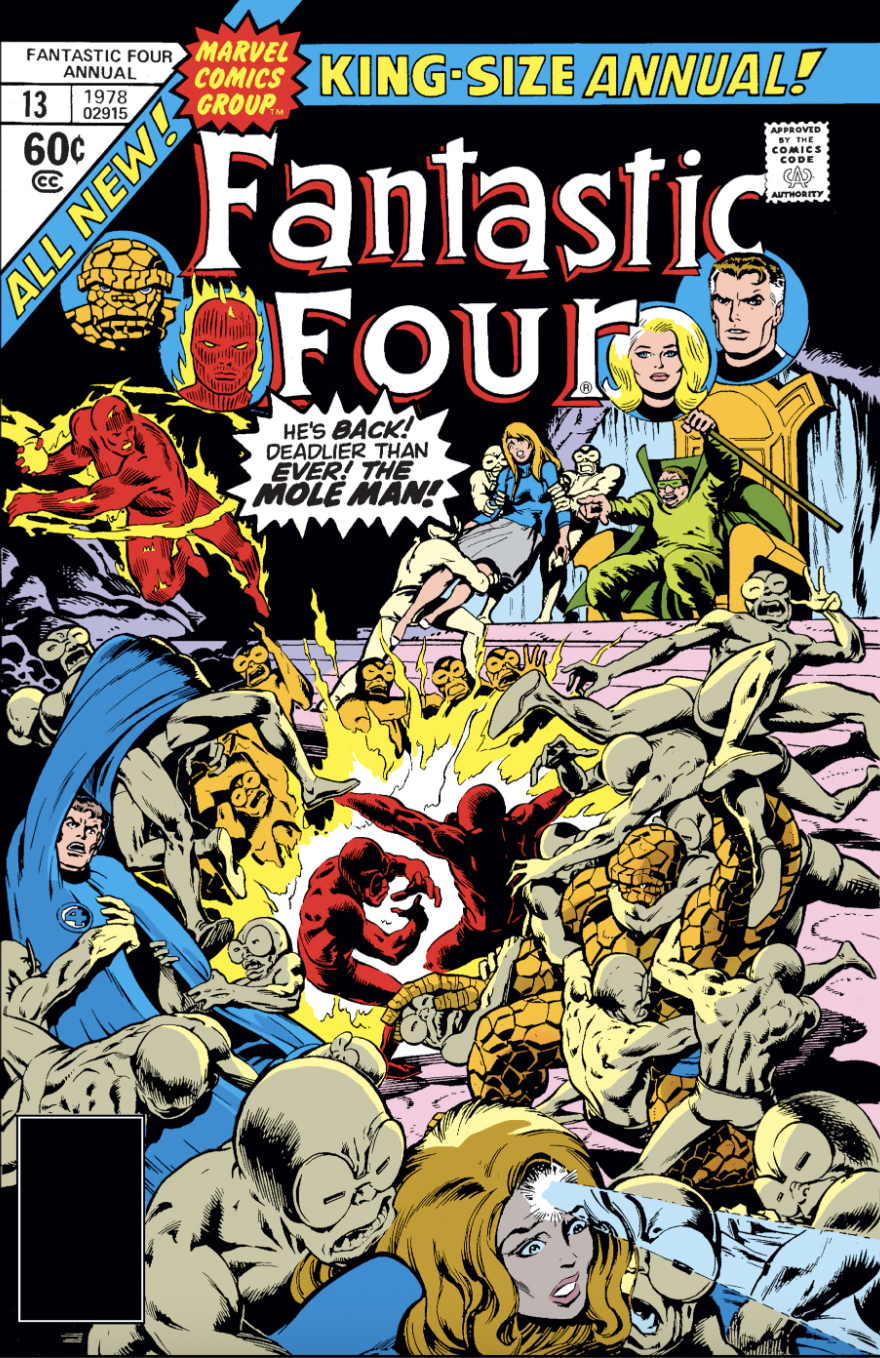
Fantastic Four Annual 13 Published July 1978 Writer: Bill Mantlo Pencils: Sal Buscema Inks: Joe Sinnott Letters: Irving Watanabe Colors: Françoise Mouly Editor: Marv Wolfman Cover: Keith Pollard and Steve Leialoha
Synopsis
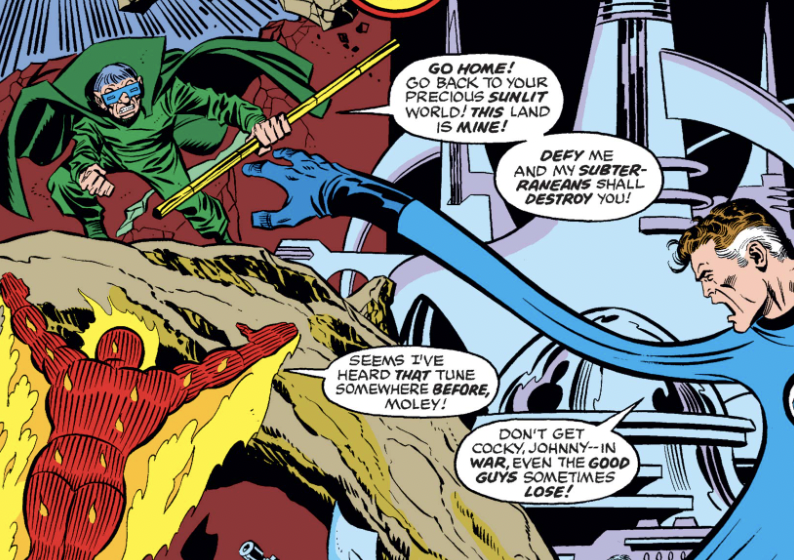
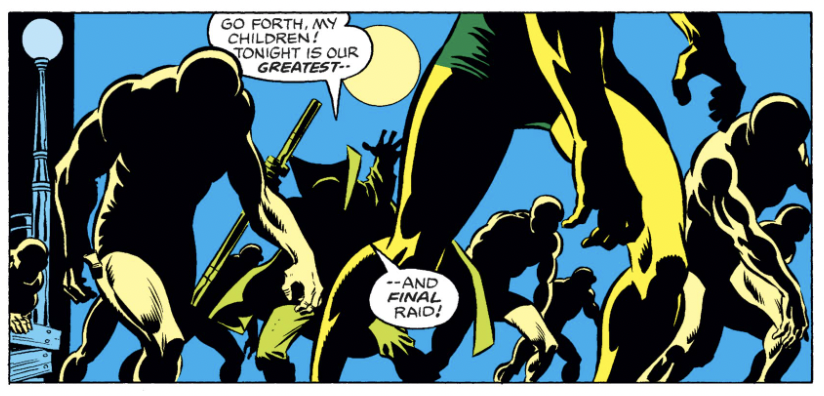
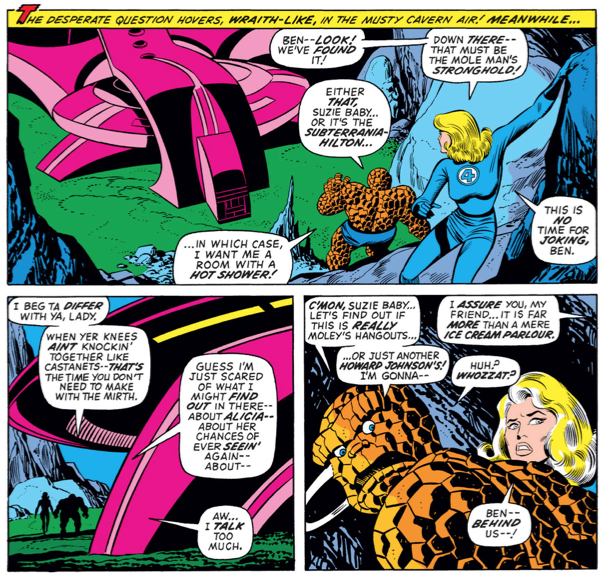
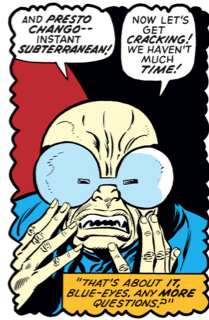
In the aftermath of their big confrontation with Dr. Doom, the re-formed Fantastic Four is taking stock of their new situation (since they moved out of the Baxter Building) while a mysterious figure is kidnapping homely and blind New Yorkers, while also stealing statues. At Alicia master’s studio, they discover the Mole Man is behind the abductions. He subdues the FF and captures Alicia, and the FF pursue him to Subterrenea. There, he explains he is capturing outcasts who might prefer a life underground and providing them with statues to enjoy (really). He then lets free anyone who wants to return to the surface while Alicia presents the Mole Man with a statue of himself.
What’s going on here?
This is a lackluster comic, and feels like a regular issue that was padded out into an annual. Nothing of much consequence happens, and after the big events of the last few issues, it makes sense for the FF to chill for a bit. Still, I think annuals should bring something extra, either in terms of story or the creative team, to justify the additional length and cost. This story mostly felt tedious. If it’s notable for anything, it’s the presentation of the Mole Man as a sympathetic figure who’s trying to help the misfortunate. I’m not sure it’s convincing but it’s an interesting evolution of a character that’s been around as long as the FF. And you can draw a through line from how he’s treated in this comic to his depiction in the new Fantastic Four movie.
Oddly, this is the second story in a row Alicia has been kidnapped for her sculpting skills..
Bill Mantlo is the writer, and given his history as a last-minute fill-in specialist, I wonder if he was pressed into service because Marv Wolfman couldn’t get it done in time. Sal Buscema delivers his usual workmanlike pencils which are enhanced by some dramatic inking by Joe Sinnott.
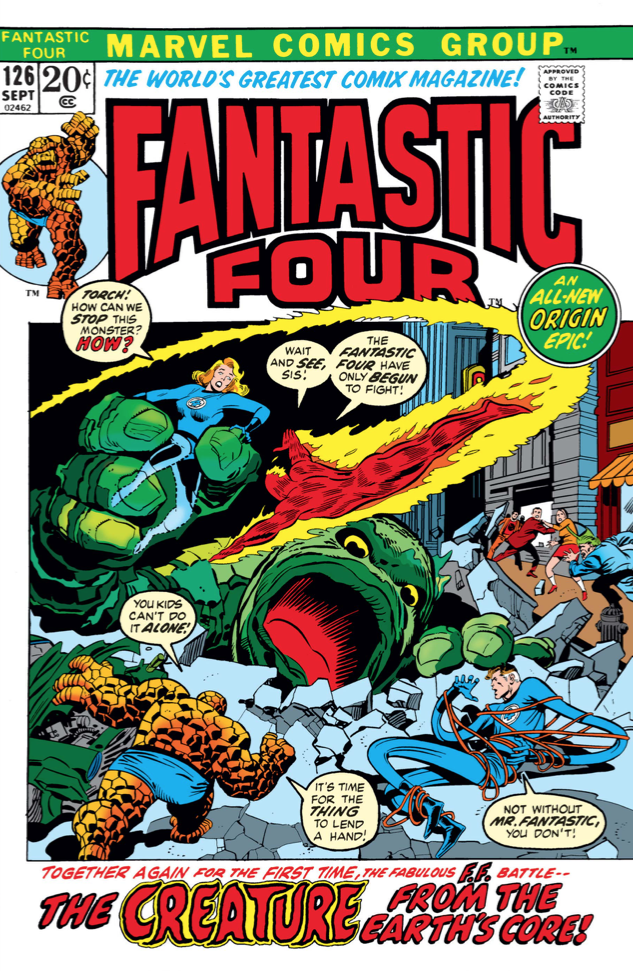
The cover is by Keith Pollard and inked by Steve Leialoha making his FF debut. Leieloha’s inks add a supple, fluid quality to the already strong Pollard and the cover is probably the best thing about this comic.
What I liked
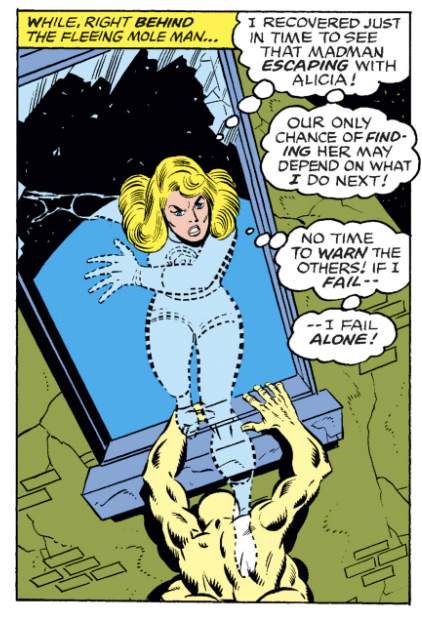
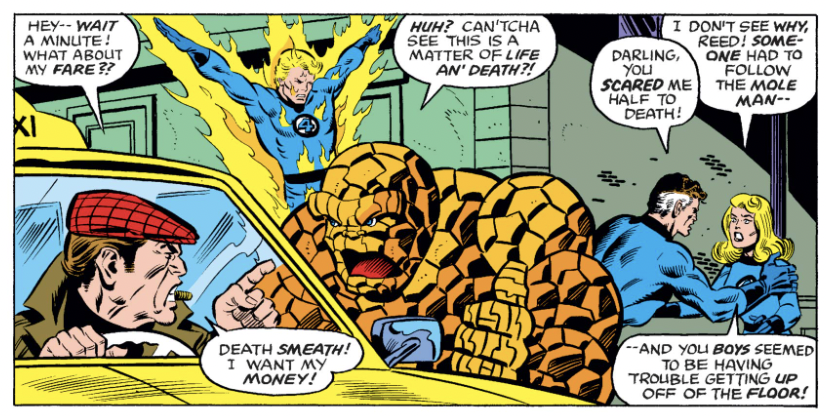
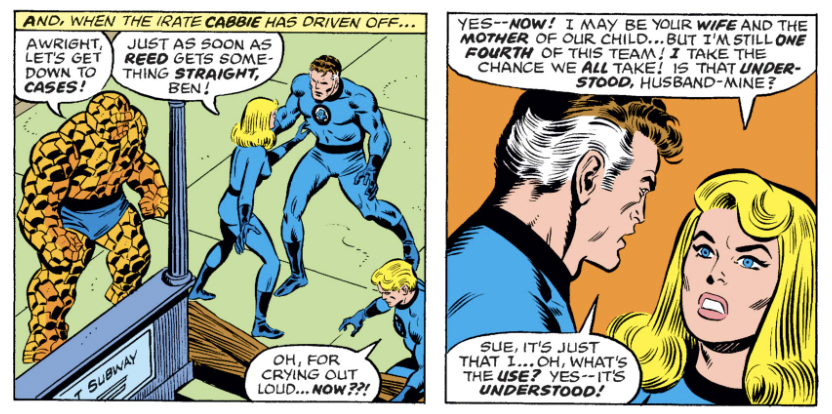
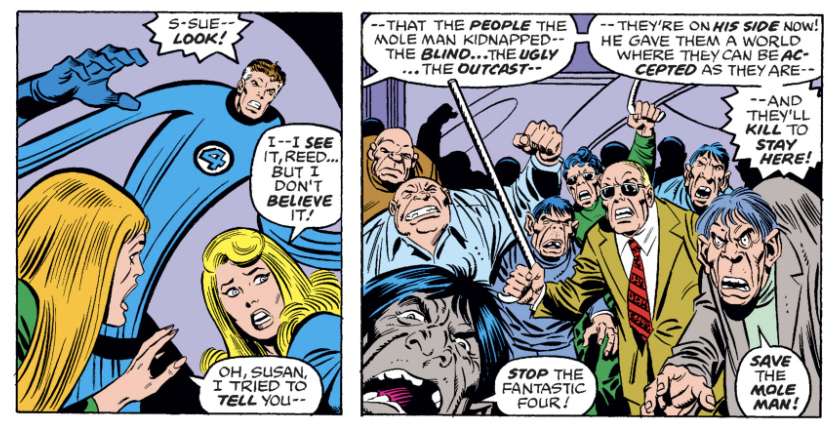
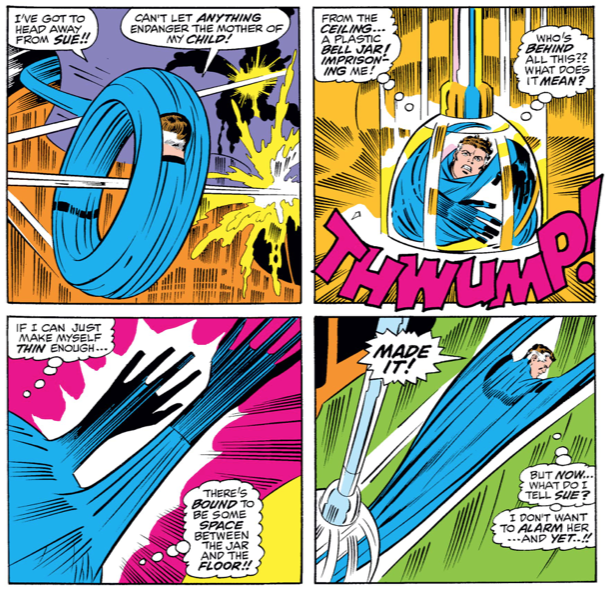
Beginning with Len Wein, continuing with Wolfman and now with Mantlo, there’s been a real effort to upgrade Sue’s powers and role with the team. Here, in a well-told sequence, she pursues the Mole Man by herself, then casually insults the rest of the team and puts Reed in his place (although has anyone outside of comics ever referred to someone as “husband-mine?”).
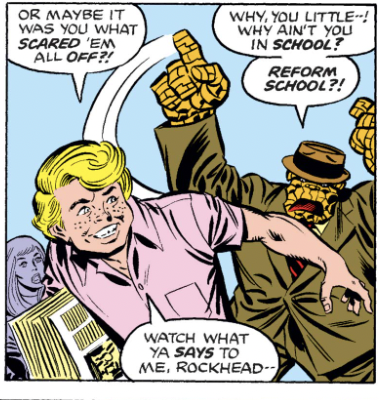
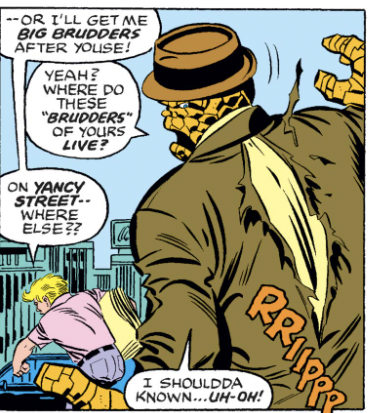
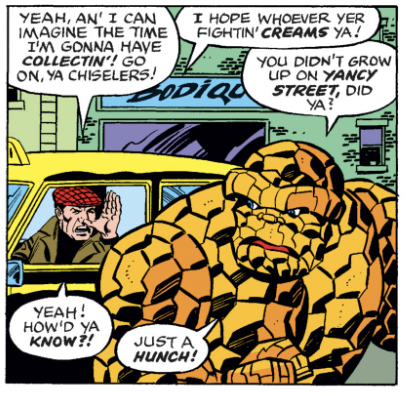
The padded-out story does give Mantlo room for a few running gags, like having Ben encounter obnoxious Yancy Streeters are every turn (incidentally, I’m pretty sure there aren’t any newsboys in NYC in 1978).
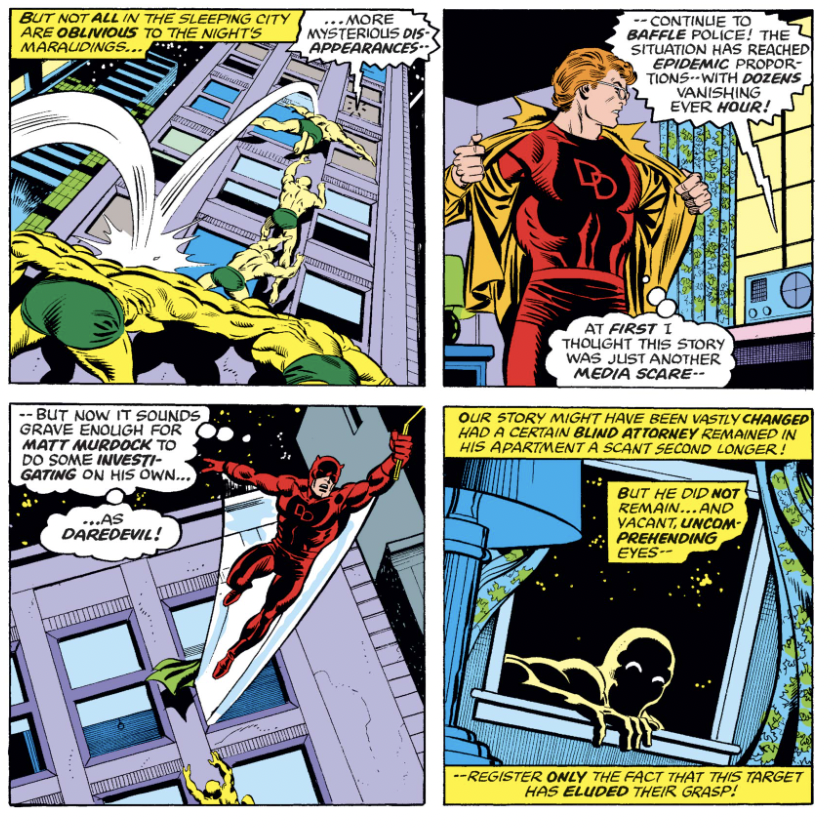
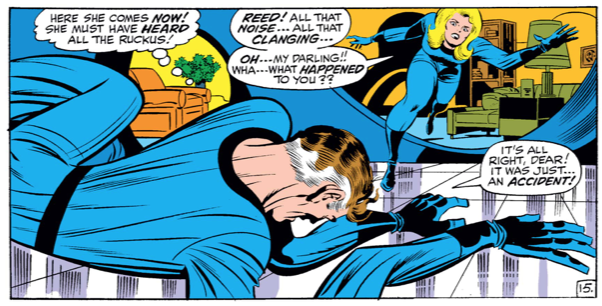
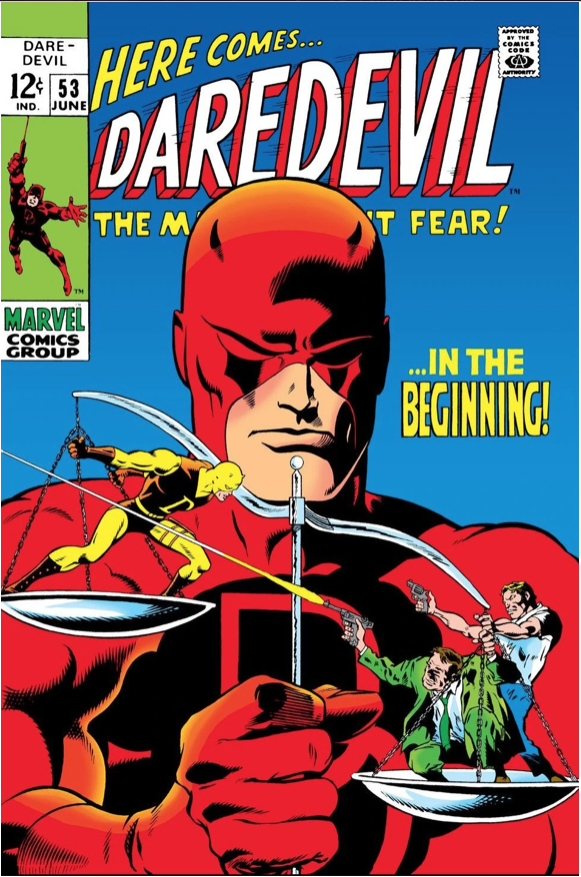
I also enjoyed this cameo of Daredevil. It’s completely incidental to the story, but reinforces the idea of all of Marvel’s heroes living in the same world. These little surprises were one of the things I liked most about reading comics as a kid.
What I didn’t like
Whatever Mantlo’s intentions, the central premise of the story felt clunky and forced. The Mole Man is kidnapping ugly people AND blind people? As if they are the same thing? And giving them statues to enjoy? None of it makes much sense and feels half-baked.
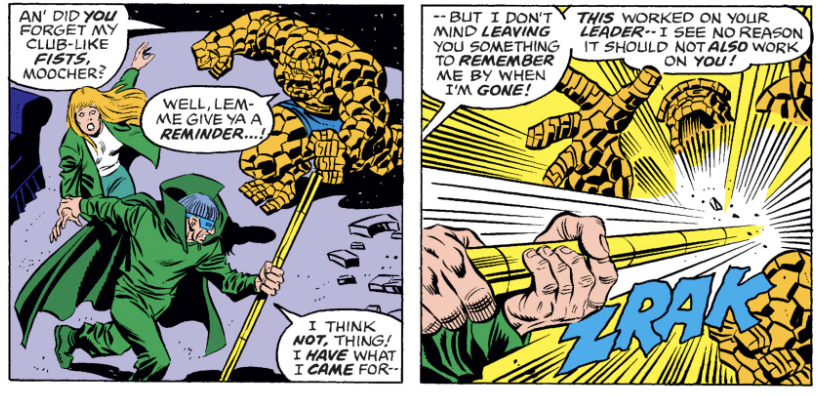
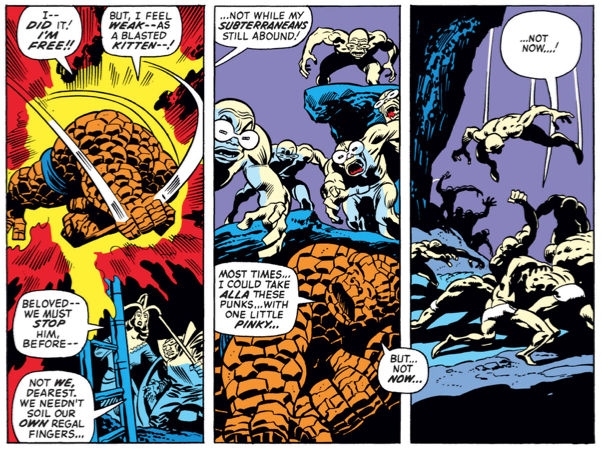
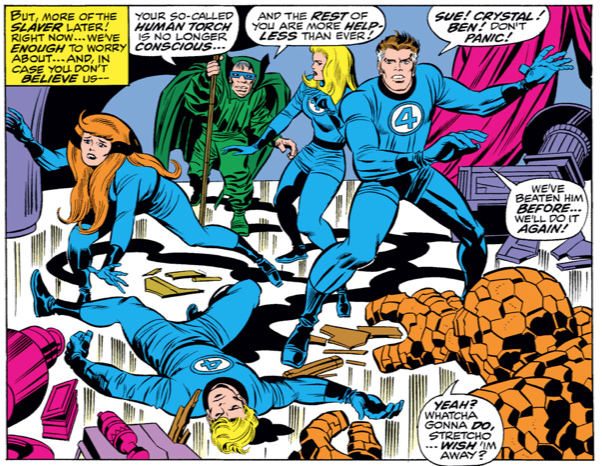
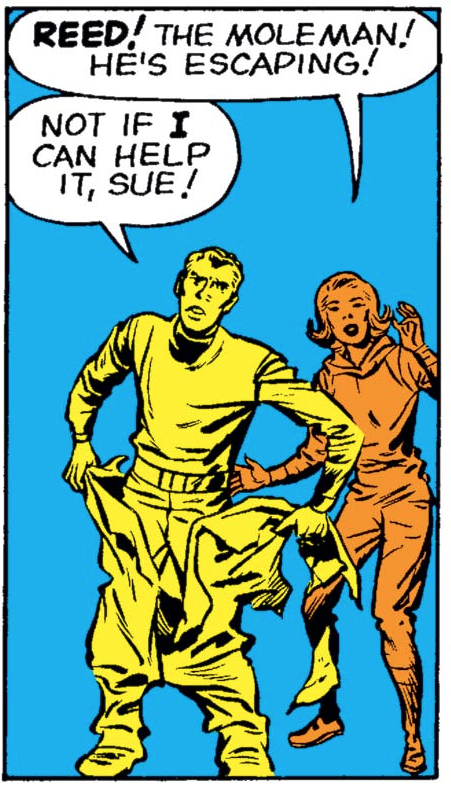
And while we have been trained to believe the Mole Man is a formidable opponent, it’s hard to accept he can take down the entire FF by himself. Here, he knocks out Ben with one zap of his staff.
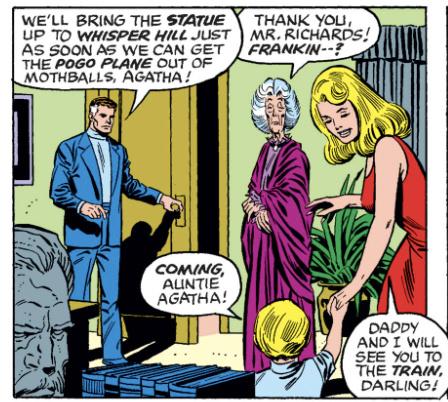
There’s also some sloppiness that speaks to a lack of communication between Mantlo, Wolfman and Buscema. Here, Reed explains the pogo plane is in storage, except the FF just used it to fly to Latveria and back.
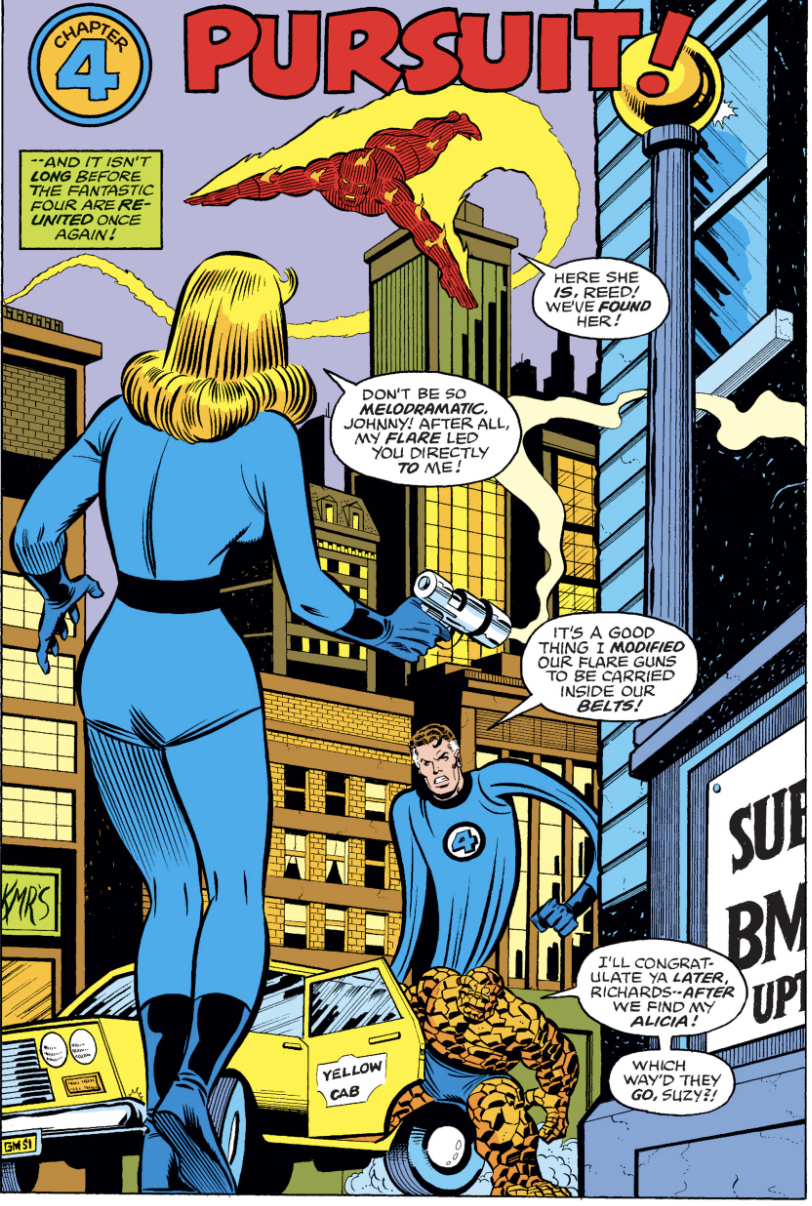
And here, Reed claims the flare gun can now fit in the FF’s belts on a shot that shows Sue holding a bulky gun and wearing a skin-tight uniform.
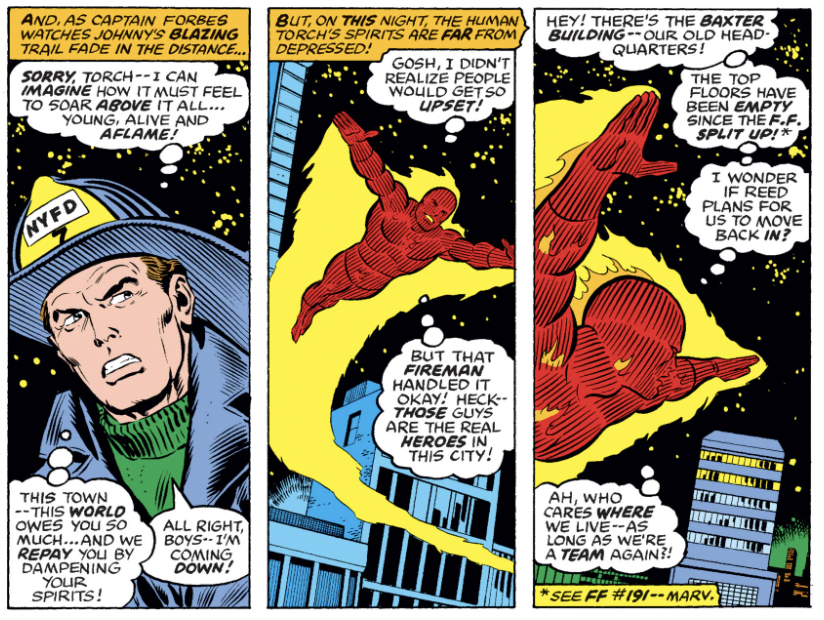
Lastly, Sal Buscema has some strengths as an artist but drawing faces isn’t one of them. Otherwise why would this fireman look so much like Peter Parker?
Anything else?
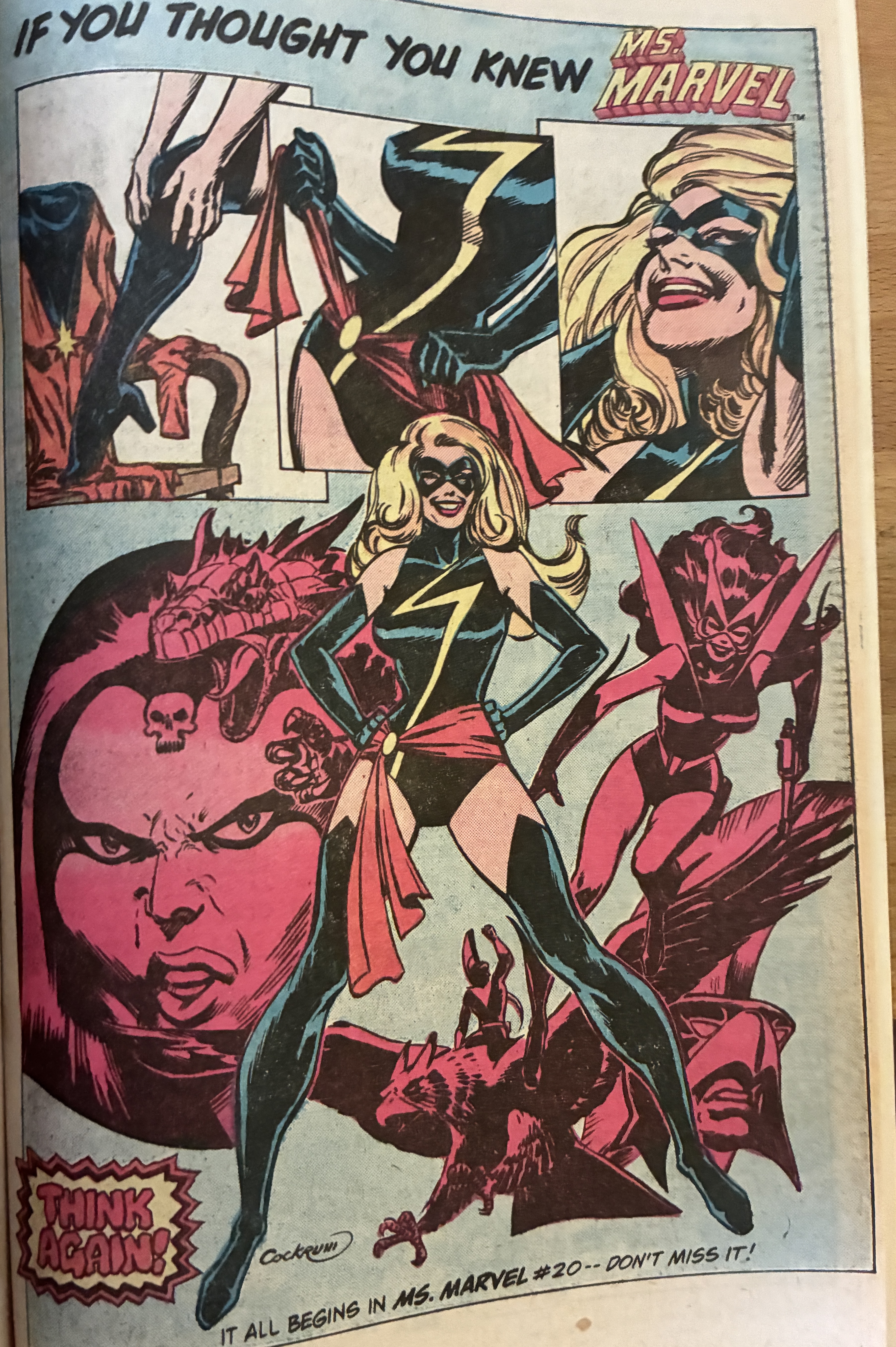
Fun house ad for Ms. Marvel (later Binary, later Warbird, later Captain Marvel) by Dave Cockrum.
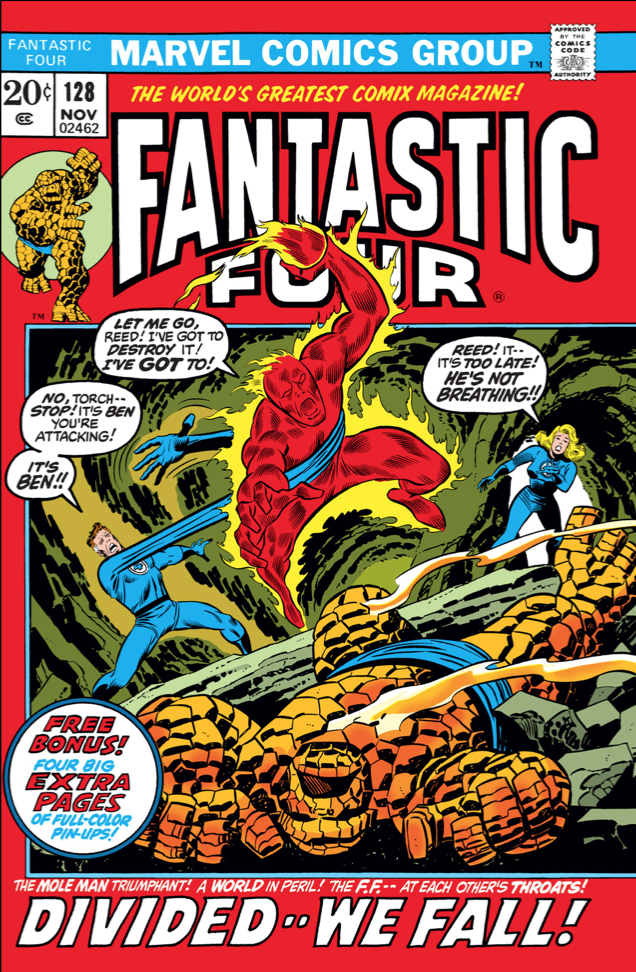
Fantastic Four 128 “Death in a Dark and Lonely Place!” Published Aug. 1972 Writer: Roy Thomas Pencils: John Buscema Inks: Joe Sinnott Letters: Artie Simek Editor: Thomas Cover: Buscema and Sinnott
Synopsis
After Mr. Fantastic realizes the monster attacking the team is actually the Thing, whose appearance was temporarily transformed, the team regroups to confront the Mole Man, only to be captured and apparently defeated. But the Mole Man is betrayed by his erstwhile lover, Kala, and the team is able to escape his underground kingdom.
What’s going on here?
This is solid follow-up and conclusion to the story Thomas launched in the previous issue, and augers well for the rest of his run on the comic. The story has a fun and surprising twists, it’s well paced and there’s some nice characterization. No big developments, but that’s OK.
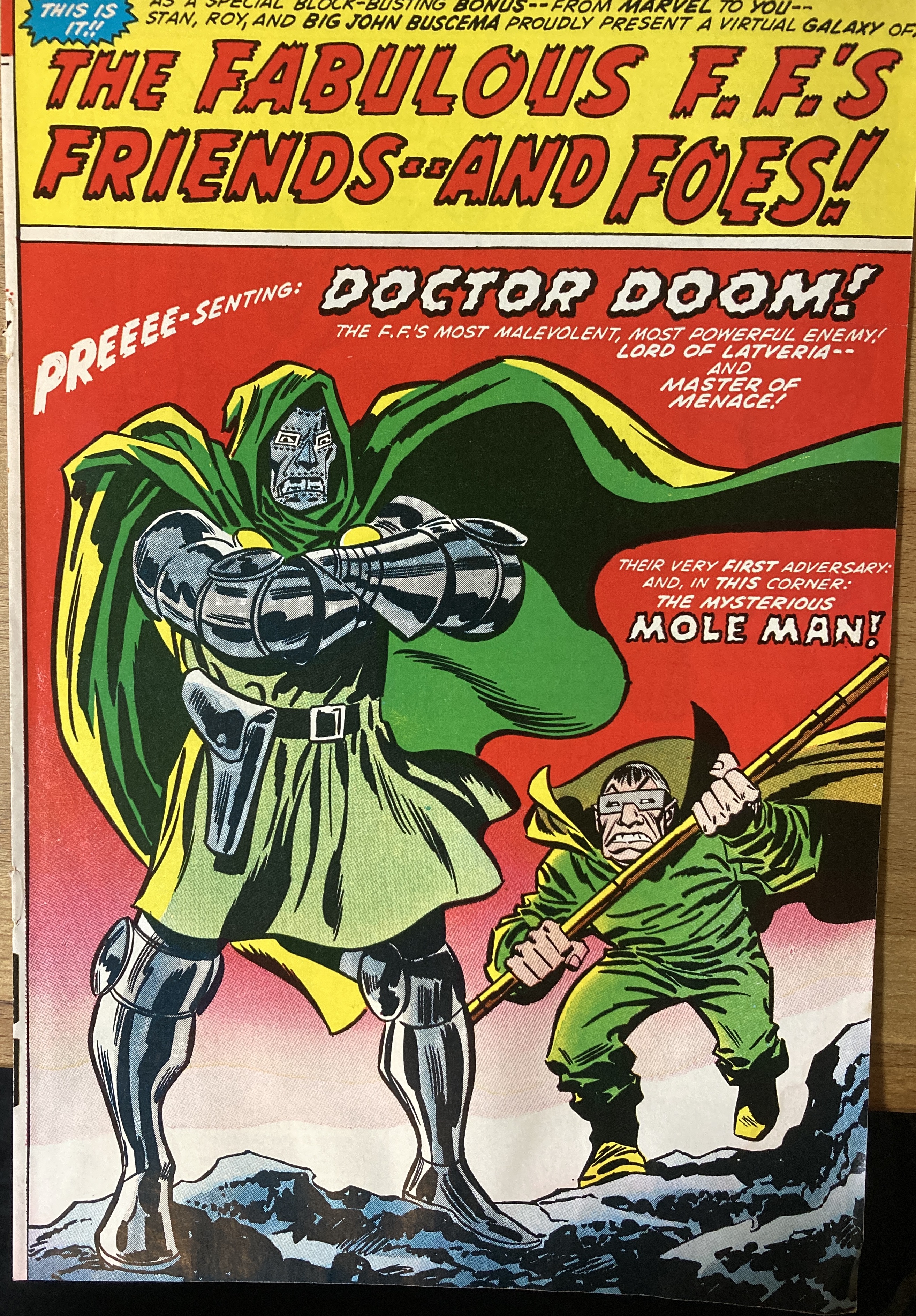
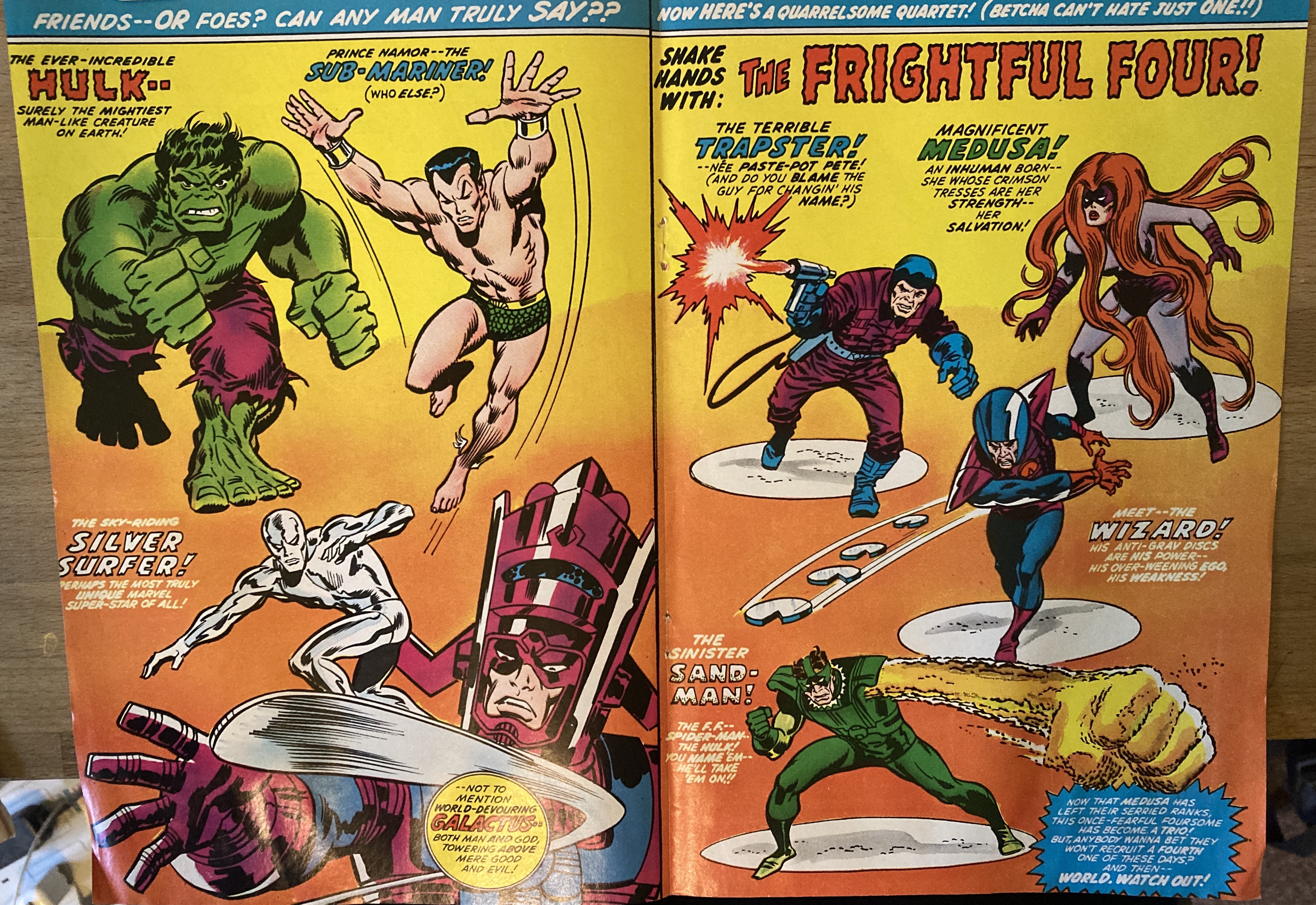
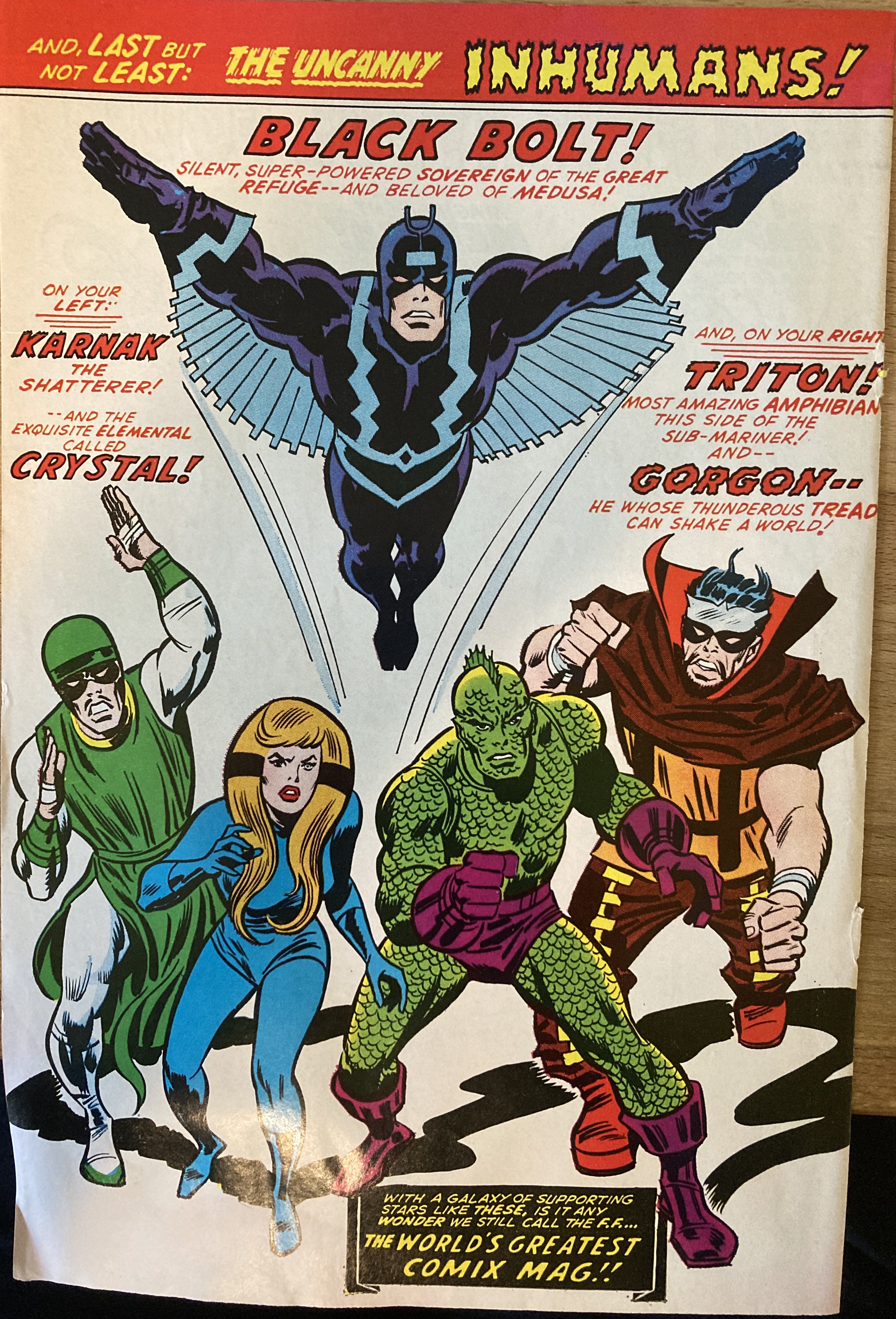
What distinguishes FF 128 isn’t the story but an insert—four pages of pinups on glossy paper (the same as used for the cover) drawn and by John Buscema (the inker is uncredited but it looks like Sinnott to me). They’re not included the online version of the comic, so I’ve photographed them:
As a kid reading the FF in 1972, I would have been pretty jazzed to see these in the middle of an otherwise ordinary comic. As a reader in 2024, they’re an interesting snapshot into who and what Marvel thought was important to depict. Leaving aside the decision not to include the FF, there’s no Agatha Harkness or Franklin, or Black Panther or Wyatt Wingfoot. The Mole Man and Frightful Four get prominent billing, but that could be because they’re appearing in this issue (Moley) or nest issue (the Frightful Four).
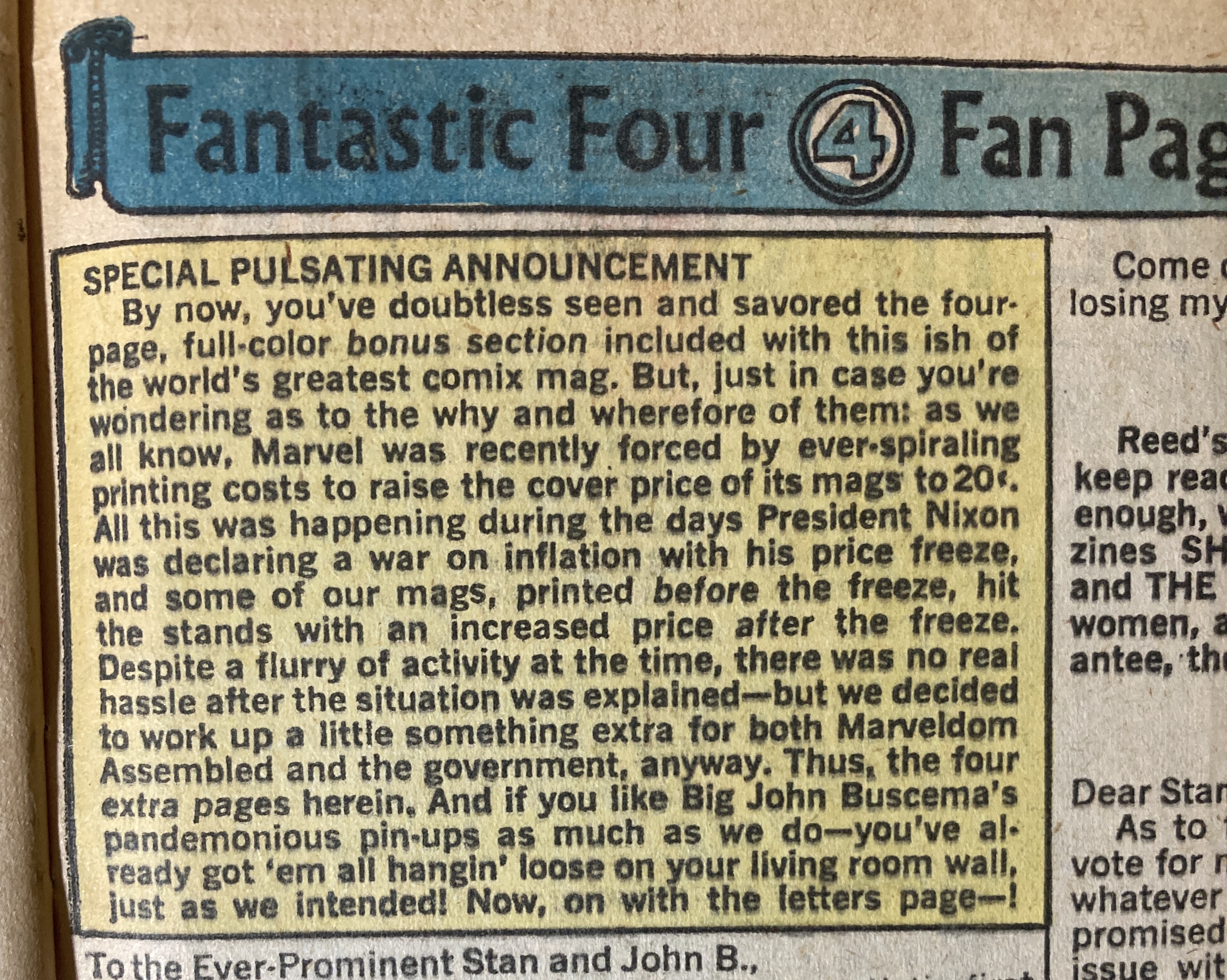
On the letter page, an editor’s note explains the pinups are to make up for raising the price of the comic to 20 cents, although the price hike took place a year earlier. There’s a convoluted explanation involving Nixon, but read for yourself:
What I liked
Roy does a nice job with interactions between our lead characters, including this revealing exchange between Ben and Sue:
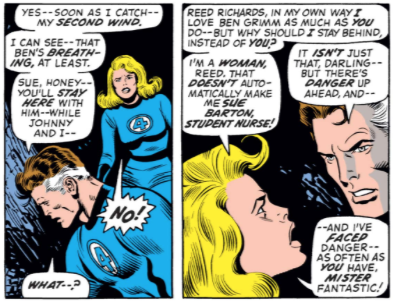
Or this, between Sue and Reed, which continues their debate about Sue’s role on the team that started last issue:
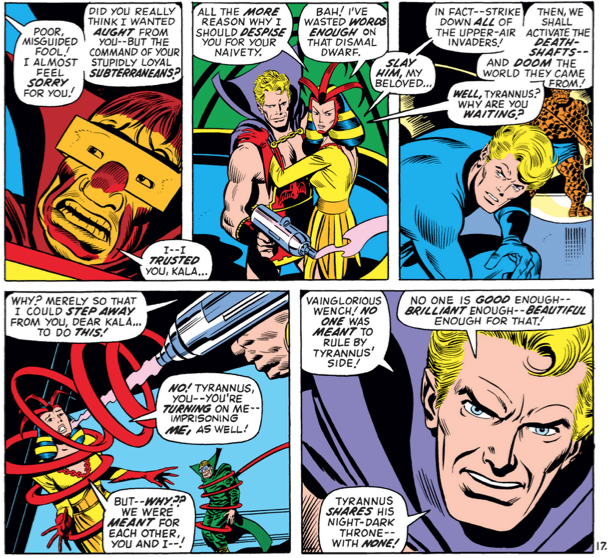
I also liked the plot twist toward the end. It wasn’t too surprising that the beautiful and evil Kala would turn against the Mole Man in favor of handsome Tyrannus (a long-lived Roman Emperor trapped underground and who appeared as the Mole Man’s slave briefly last issue). It was surprising, however, when Tyrannus in turn double crossed Kala, and giving the Mole Man reason to free the FF.
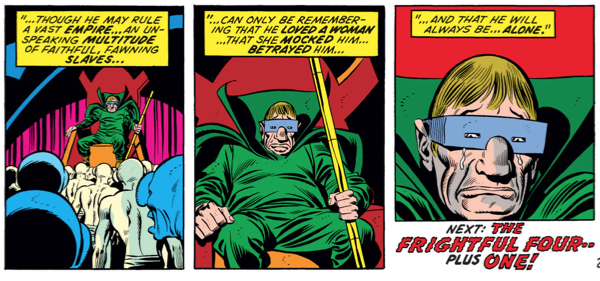
That twist, of course, leave the Mole Man jilted at the altar, setting up this satisfying and sympathetic ending sequence.
In the current run of the Fantastic Four, writer Ryan North has Reed deploying his stretching powers in novel (and occasionally grotesque) ways. But as we learn in FF 128, creative used of Reed’s powers are not new. (Also interesting is Reed’s dialogue throughout the comics – Roy has definitely loosened him up).
What I didn’t like
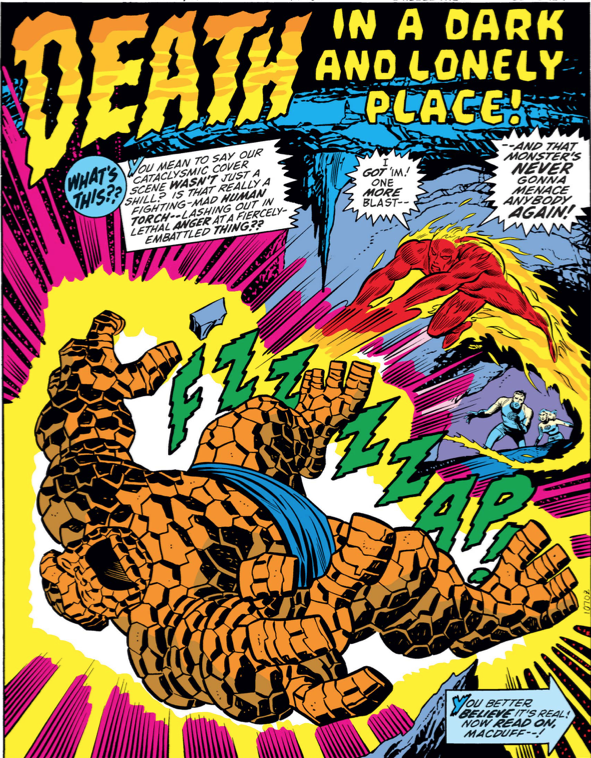
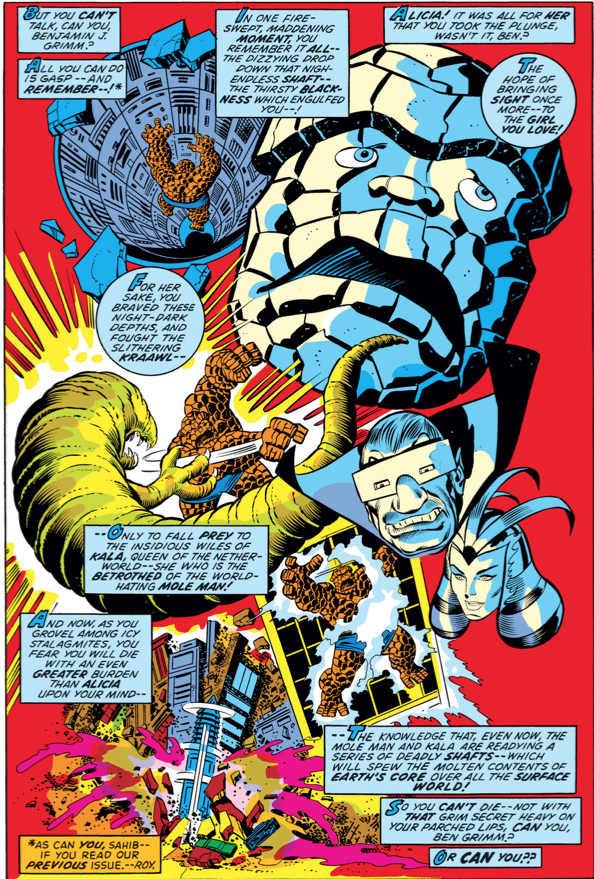
If Roy has a weakness, it’s a tendency to lapse into purple prose, as he does here in this otherwise cool looking flashback splash page. Pro tip: Avoid writing in the second person if at all possible.
Anything else?
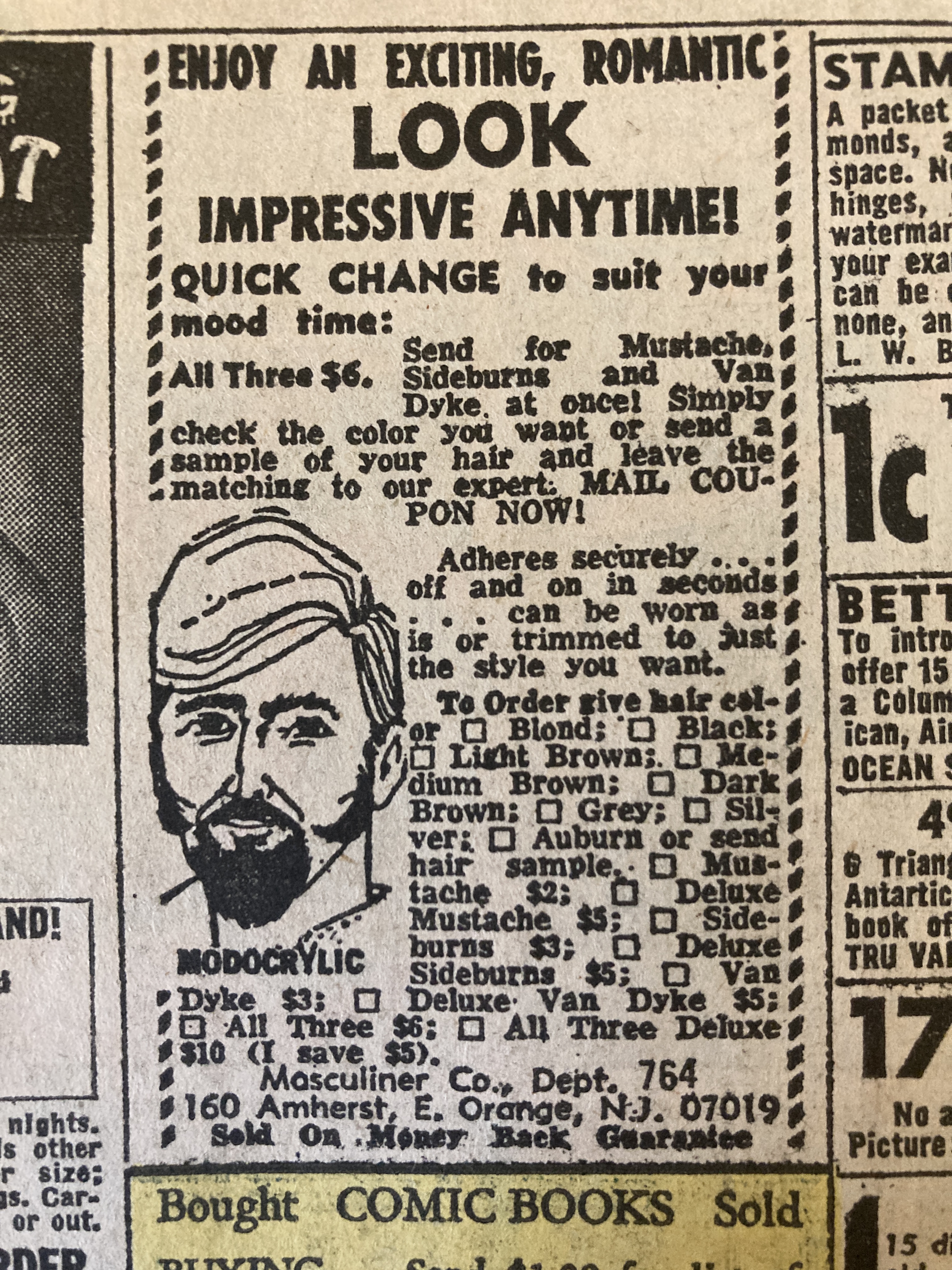
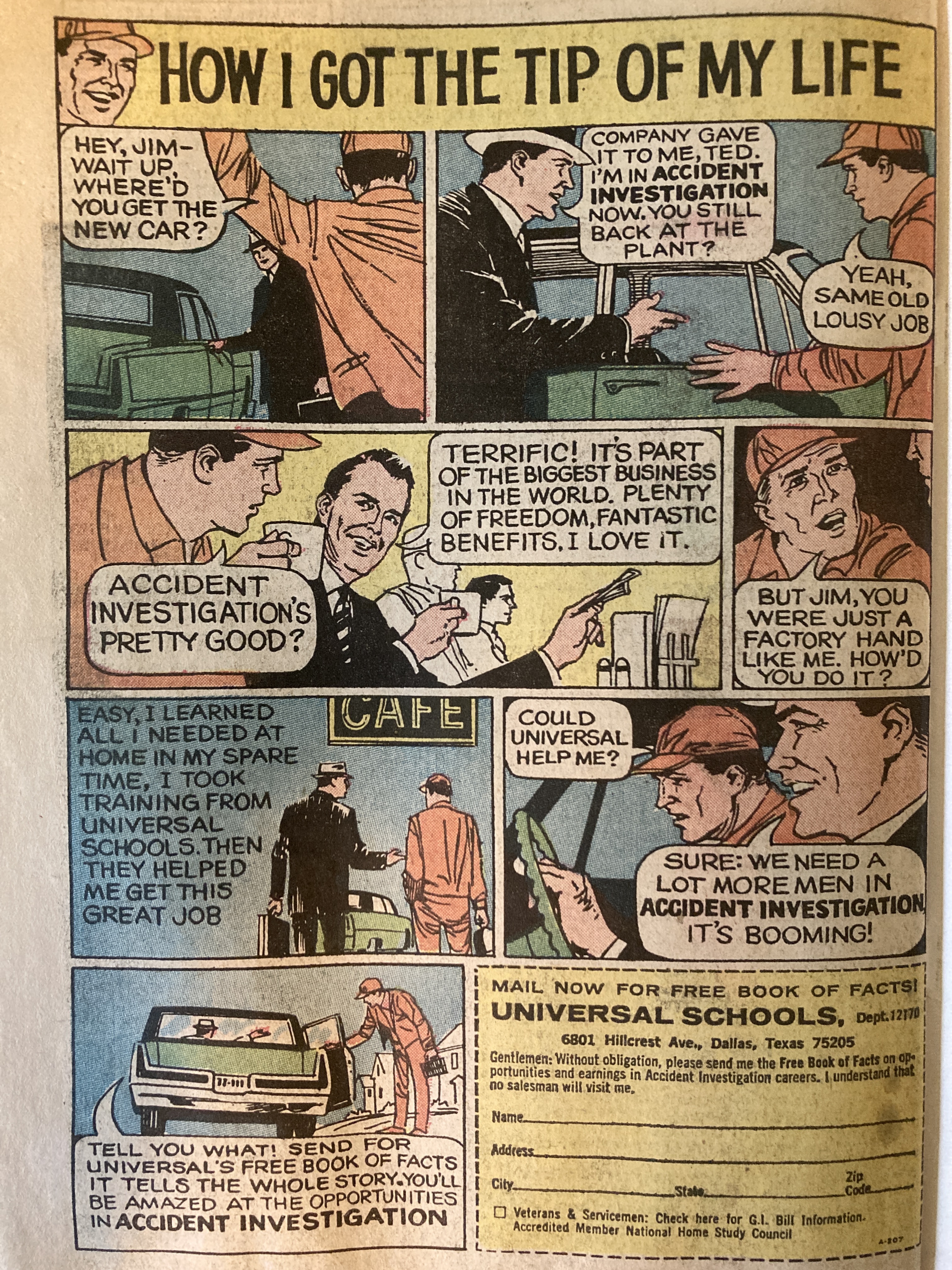
Some more intriguing ads. The fake beard-and-mustache kit—from the Masculiner Co., no less!—is particularly fascinating. Apparently you could mail in a sample of your own hair and they would match the color. Did anyone ever do that?
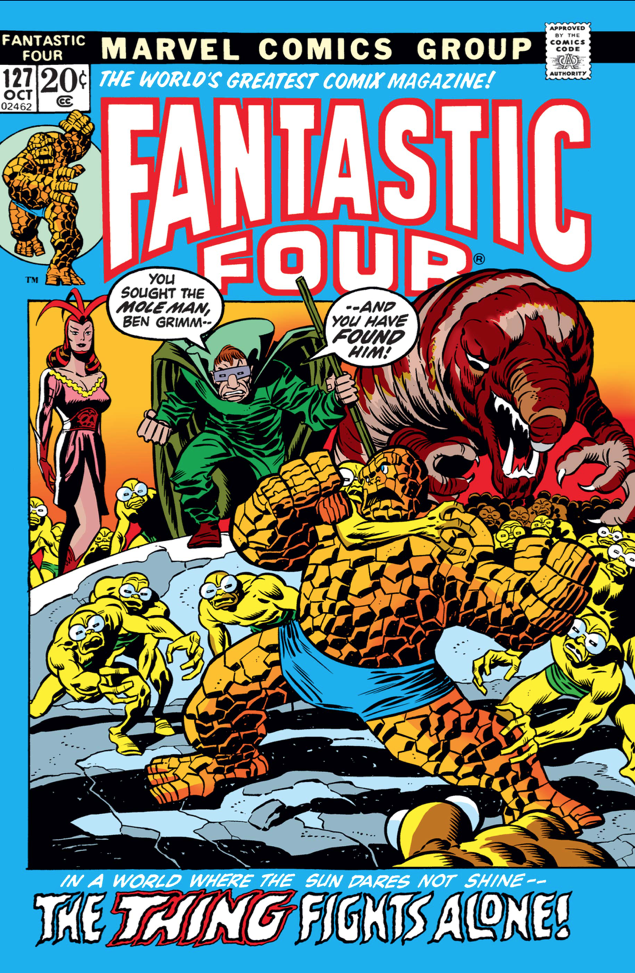
Fantastic Four 127 “Where the Sun Dares Not Shine!” Published July 1972 Writer: Roy Thomas Penciler: John Buscema Inker: Joe Sinnott Letterer: Artie Simek Editor: Thomas Cover: Buscema and Sinnott
Synopsis
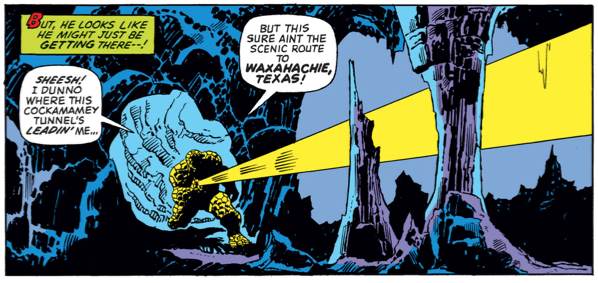
In pursuit of a cure for Alicia Masters’s blindness, the Thing enters the subterranean world of the Mole Man, where he encounters Kala, an Atlantean princess and the Mole Man’s paramour. They capture Ben, and change his appearance into that of a hairy monster, leading the rest of the Fantastic Four to attack him.
What’s going on here
Even though Fantastic Four 127 is technically Roy Thomas’s third as writer, it feels like the first issue where he really seizes the reins and makes it his own. It’s full of Thomas-ian flourishes—the purple prose with its highfalutin’ references to ancient Greece, the call-backs to obscure older comics (in this case, Tales of Suspense 43), the sometimes excruciating interior monologues.
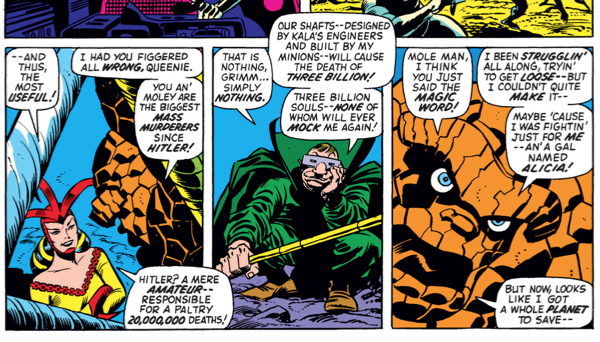
It’s also a pretty good story. On a mission to help Alicia, Ben is lured into complacency by the mysterious Kala, and is blindsided by her and the Mole Man. Thomas also ratchets up the stakes by having the Mole Man and Kala launch a plot against the surface world. His version of the Mole Man isn’t just a misunderstood outcast, but a truly evil villain who plans to kill 3 billion surface dwellers. The story is well paced, contains some fun surprises and ends with a satisfying cliff hanger.
What I liked
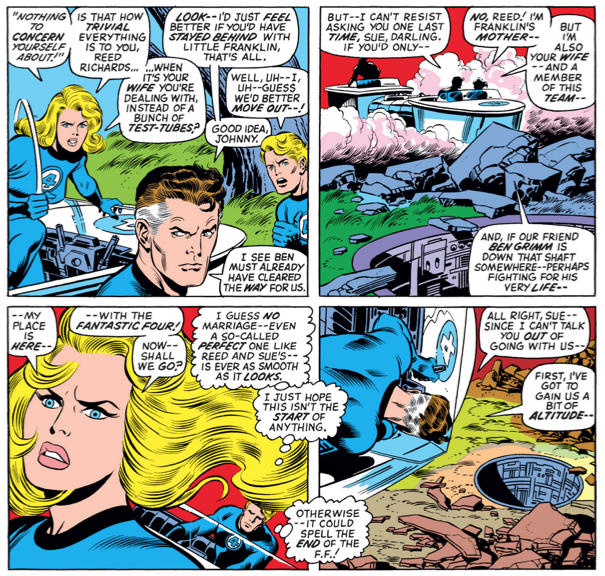
After showing some growth as a character over the past few years, Sue backslid into her whimpering helpmate status in Stan’s most recent run, as he (via Reed) sidelined her to protect Franklin. Here, Roy seems to be making a statement about Sue’s role on the team:
This is a great sequence from Big John:
There are also a lot of fun touches throughout the comic, such as this byplay in the editor’s notes between Roy and Stan en français.
Along with a sweet scene of domestic bliss, there is some clever dialogue from Reed here:
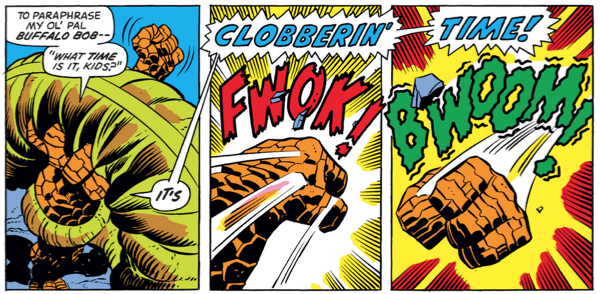
And it’s been while since we heard these magic words:
What I didn’t like
As mentioned above, Roy has a predilection toward pompous verbosity and anguished interior monologues. We get all of that and more here:
Fantastic Four 126 “The Way It Began!” Published June 1972 Writer: Roy Thomas Pencils: John Buscema Inks: Joe Sinnott Letters: John Costanza Editor: Thomas Cover: Buscema and Sinnott
Synopsis
After squabbling with the Human Torch, the Thing uses a thought projector invented by Mr. Fantastic to revisit the origins of the Fantastic Four, and ends up resolved to force the Mole Man —the first villain they fought—to give sight to his blind girlfriend, Alicia Masters.
What’s going on here?
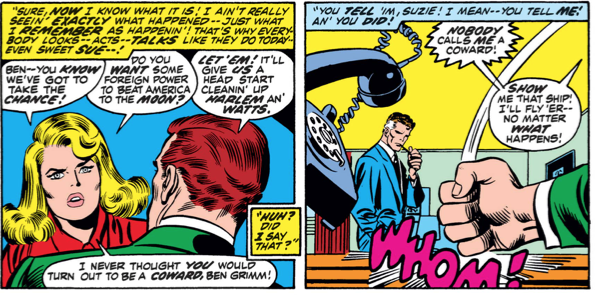
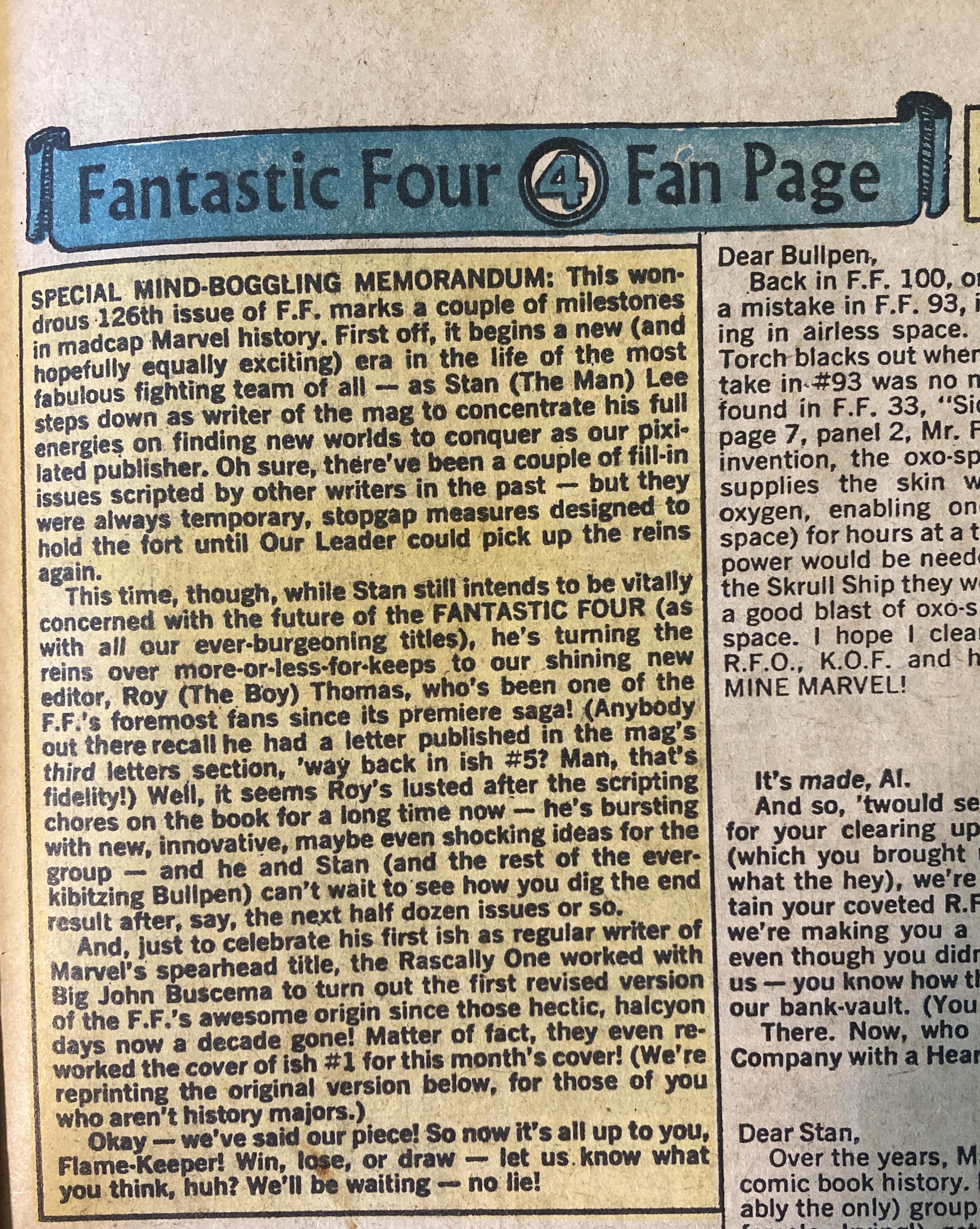
This is an interesting issue, for a few reasons. It’s the first issue after Stan Lee’s official departure from the FF—an occasion marked both in the Bullpen Bulletins and in a separate note on the letter’s page—and Roy Thomas’s first after officially taking the helm (although he wrote FF 119). Stan and Roy use the change as an opportunity to retell the origin of the Fantastic Four, in the longest re-cap of their origin to date. For modern readers, it might seem like a waste of an issue but we’re used to the immediate availability of back issues, either through reprints or online. New Fantastic Four readers in the early 1970s had fewer options to read FF 1 (although it had been reprinted in a few annuals by this point) and after a decade of comics, it made sense to reset the origin.
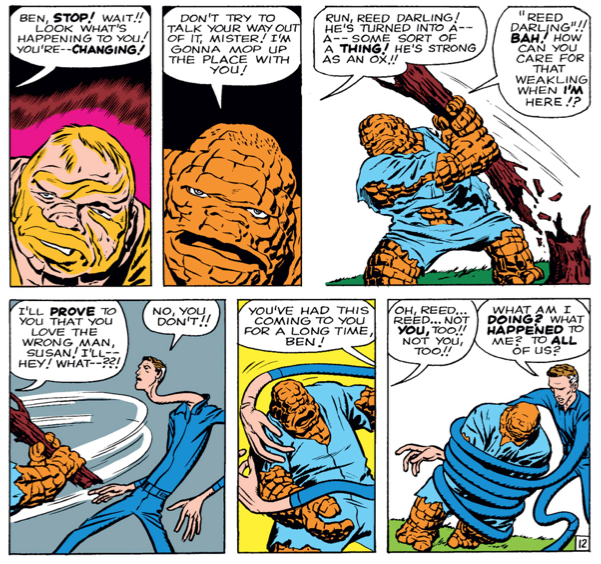
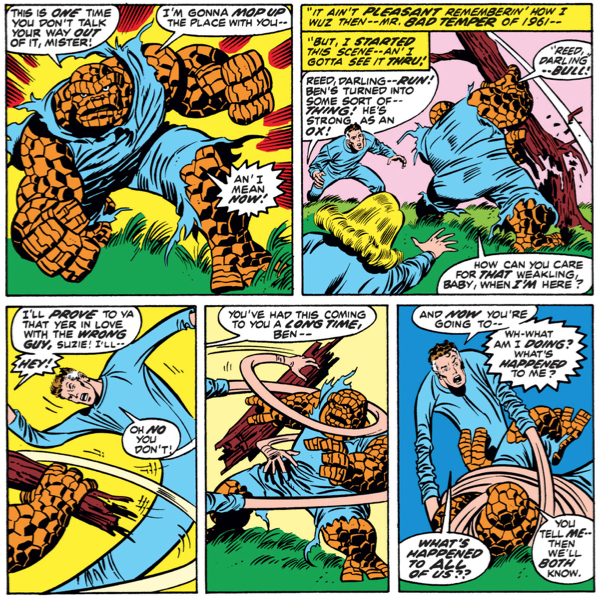
It also allows John Buscema a chance to put his spin on Jack Kirby’s classic story. He’s pretty faithful to the original, although there are a few tweaks, like modernizing Sue’s haircut.
Here is Jack’s:
And here’s Big John’s version of the same scene:
Probably the biggest difference is in how Buscema draws Ben, updating his original, lumpy look to the more familiar rocky version. Again, here’s FF 1:
And FF 126:
Roy also tweaks the dialogue a bit to make Ben’s style of speech more consistent with what we’re used to, but by and large it’s pretty similar.
Along with the recap of the origin (and both the original and a subsequent battle with the Mole Man, setting the stage for Ben’s quest), the issue also strikes a lot of familiar notes that seem designed reestablish the FF’s status quo. There’s a Ben and Johnny fight, which was once almost a mandatory feature. There’s an appearance from Alicia, and a reminder she’s blind. There’s Reed and Sue wondering about their future with the team now that they have a child. In all, it reads like jumping off place for new readers, and a new writer.
A few other items of note:
* The credits now say “Stan Lee presents” and Roy is credited as both writer and editor. * The cover now says “The World’s Greatest Comix Magazine!” I don’t know the basis for the change, and it lasted only until issue 131, but it’s a bit odd. * I realize I never addressed the change in the logo, which happened in issue 119. Just another sign of the changin’ times. Marvel will use this logo until issue 160 and doesn’t return to the classic ’60s logo until issue 218 (although it’s used for annuals).
Here is the note introducing Roy as writer on the letter page:
What I liked
I generally liked Buscema’s recap of the origin, and particularly his take on Jack’s classic cover for FF 1. That cover has been the subject of many homages over the years (some of which I get into in my recap of that issue here) and I assume this is the first. There is still no explanation of who tied up Reed. There is also a great splash page (seen above).
What I didn’t like
While it’s an interesting issue, I’m not sure it’s a particularly good issue. Roy tries to weave the lengthy flashback into the story, but it’s not really coherent, and the thought projector as a plot device feels unnecessary and clumsy. Leaping ahead from the FF’s first battle with the Moleman to one that took places in issues 88 and 89 also feels awkward and manufactured to set up the next issue.
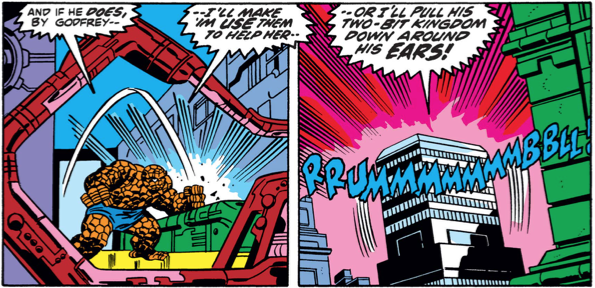
Also, it’s not really clear Roy has a grasp on Ben’s character, as evidenced by this sequence:
(who is Godfrey?)
Anything else?
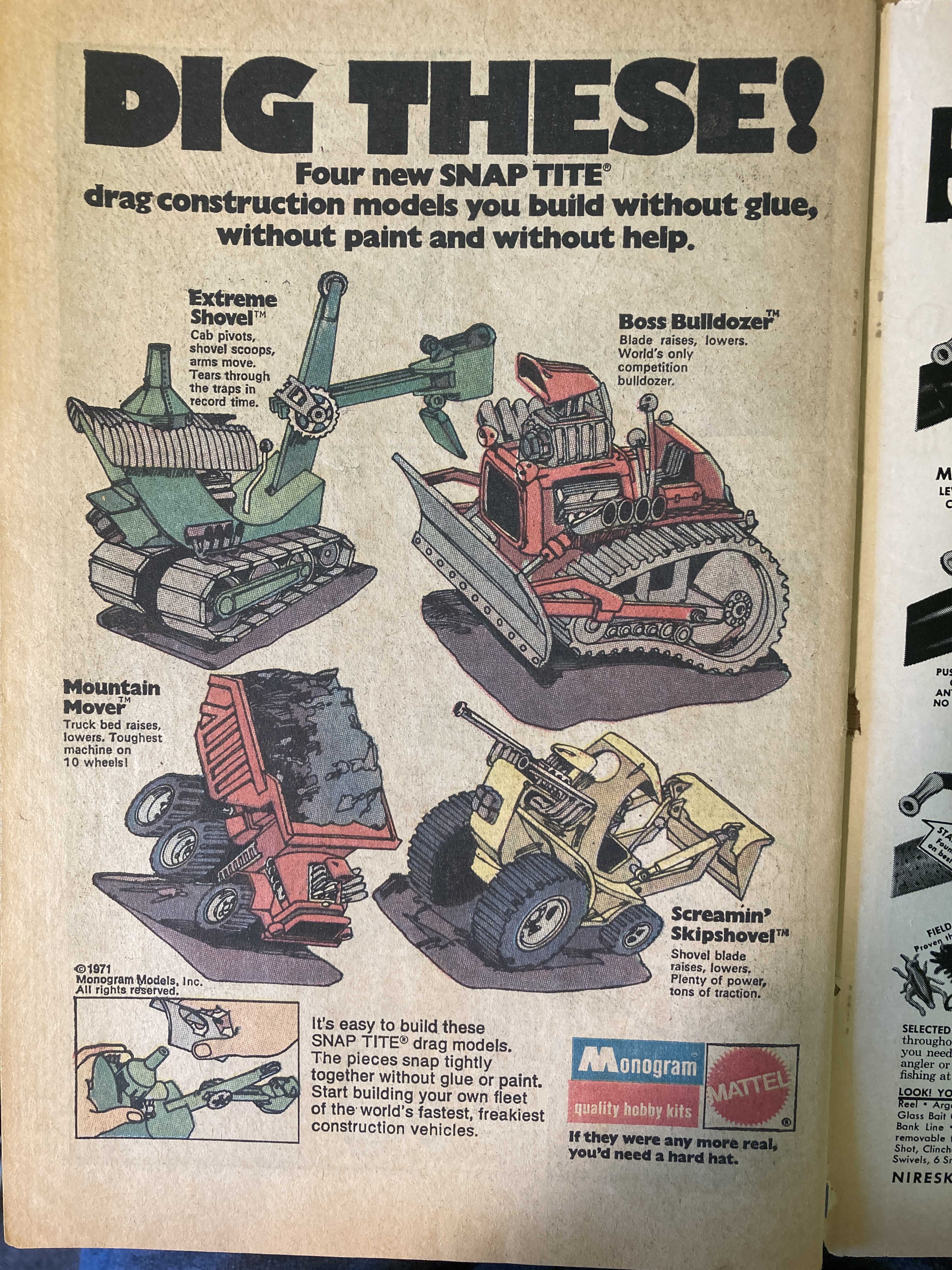
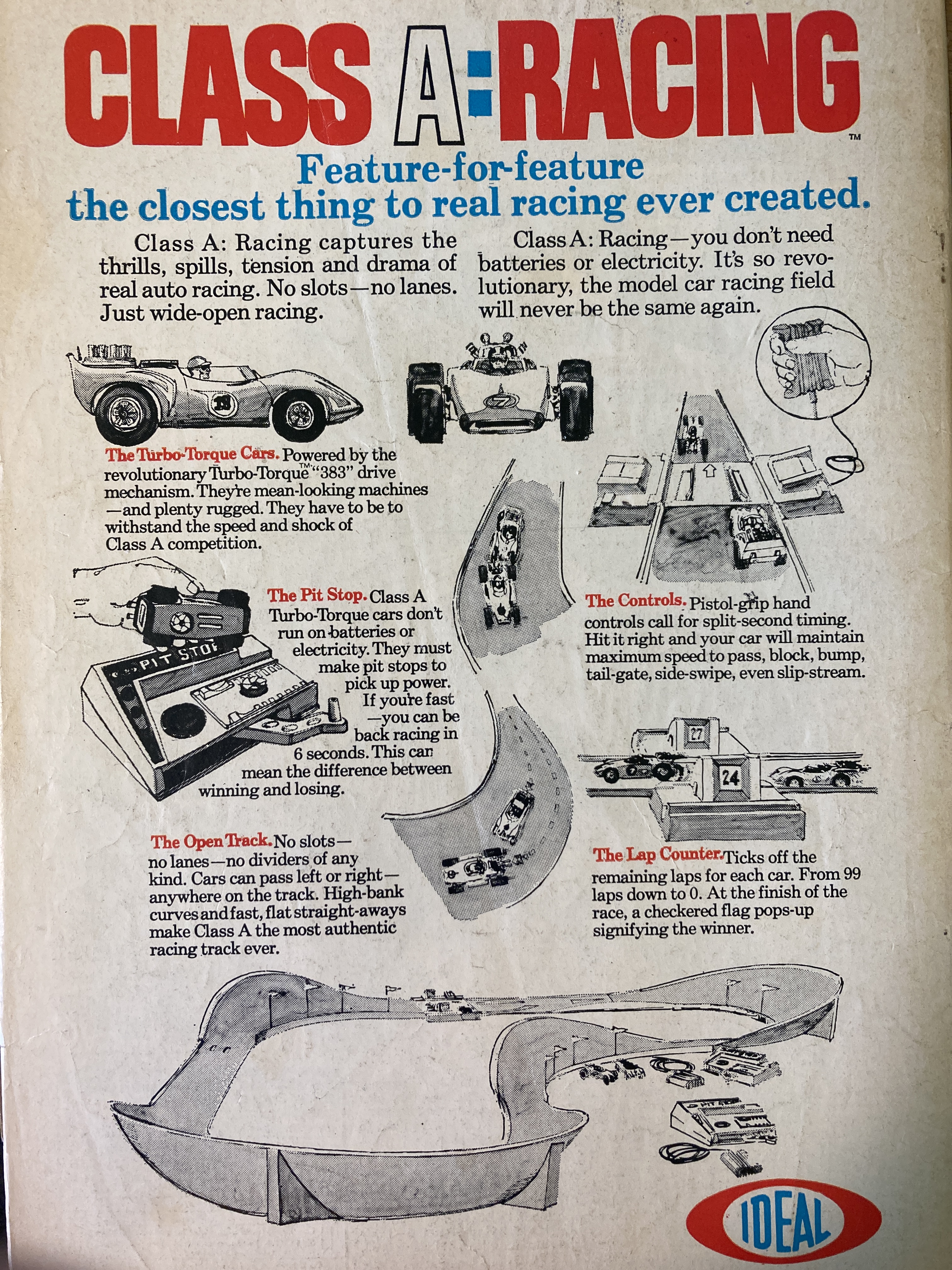
Ads for some neat-o toys in this issue:
Overall
An issue probably of more value to readers in 1972 than today
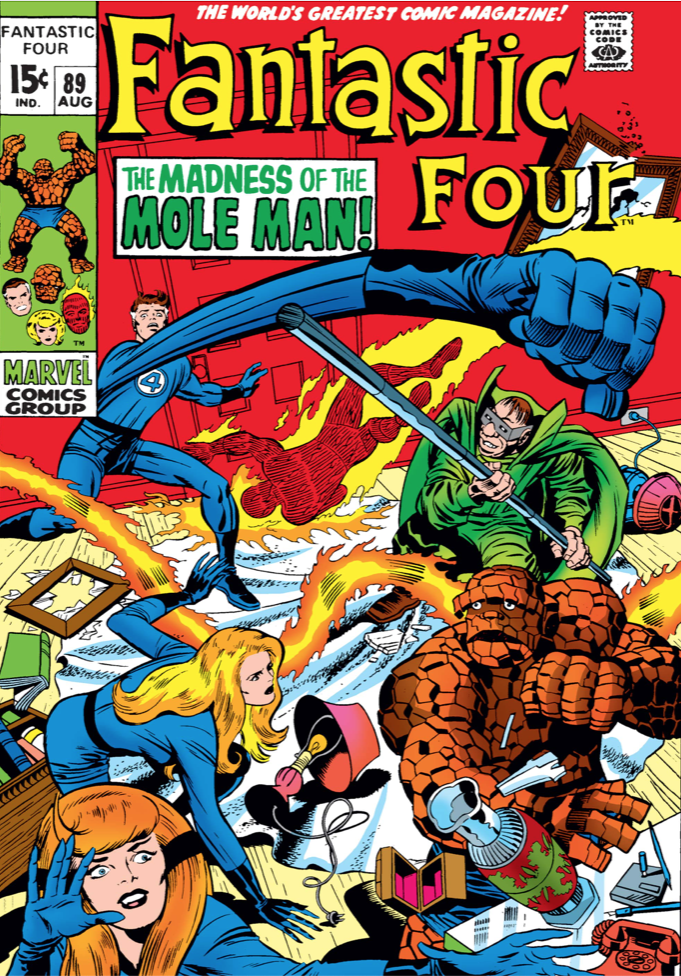
Fantastic Four 89 “The Madness of the Mole Man!” Published May 1969 Story: Stan Lee and Jack Kirby Script: Lee Pencils: Kirby Inks: Joe Sinnott Letters: Sam Rosen Cover: Kirby and Sinnott
Synopsis
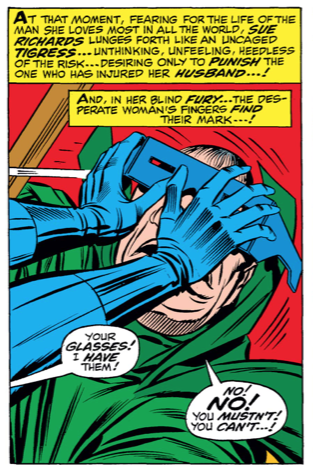
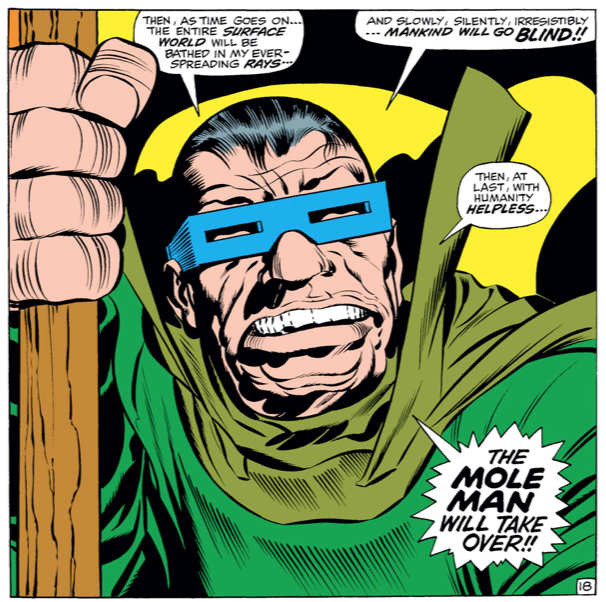
This issues picks up where issue 88 left off, sort of. The Thing is now at the Richards’ new house and under attack by the Mole Man, when last issue he very clearly was not present. Now he and the rest of the team are blinded and stumble about trying to defeat the Mole Man. The Mole Man has the upper hand until Mr. Fantastic tricks him into damaging his staff, and the Invisible Girl removes his glasses, rendering him helpless. Reed is badly injured, but revived by Ben.
A new subplot introduces a Skull “slaver” who is traveling to earth to abduct an unnamed contestant to compere in the Skrull’s games. Who could it be?
What’s going on here?
I hate to say it, but this issue is a dud. Last issue had a fun set-up and revealed a genuinely surprising villain, but this comic took a turn to the pedestrian. Most of the issue is a simple fight between the Mole Man and the FF and even blinded, it shouldn’t have been that difficult for them to overcome a non-powered human. I can think of half a dozen ways Reed could have concocted to end the fight much earlier, leaving room for a more interesting twist. And not only is there a very obvious continuity error of including Ben in the battle, when he was supposed to be in the city, but Stan and Jack chose not to include Alicia in the story, whose blindness surely would have made the story more interesting. What better answer for a villain who wants to turn the world blind than a character who already is blind?
More interesting was the tease for next issue’s story featuring the skulls. Although just three pages, two were splashes, and together they promised more drama and fun than the turgid story we were reading.
The Space Race
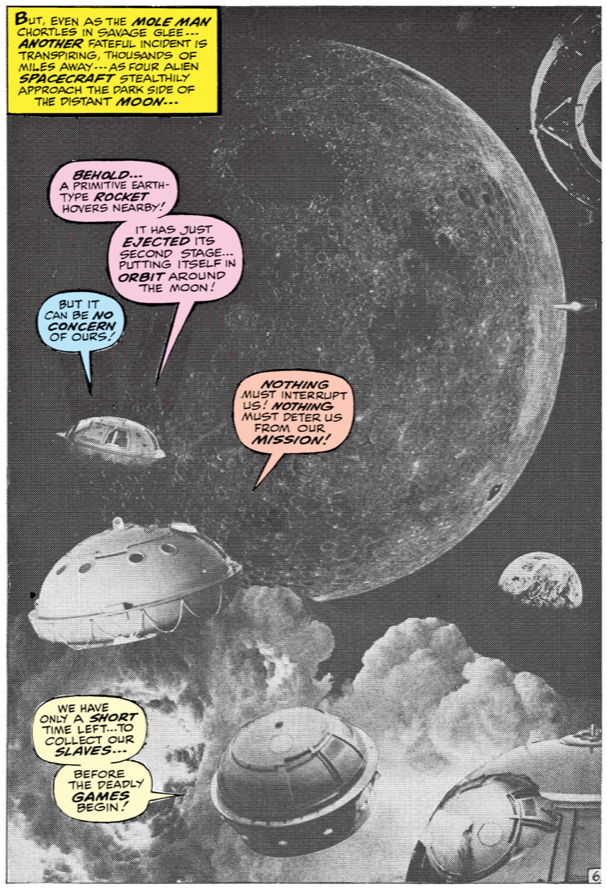
The Skull subplot features a rare Kirby collage—we haven’t seen one of these in a while—and a reference to the Apollo missions, which were building to the first moon landing in a few months.
It becomes more obvious in the next panel:
I love you, man!
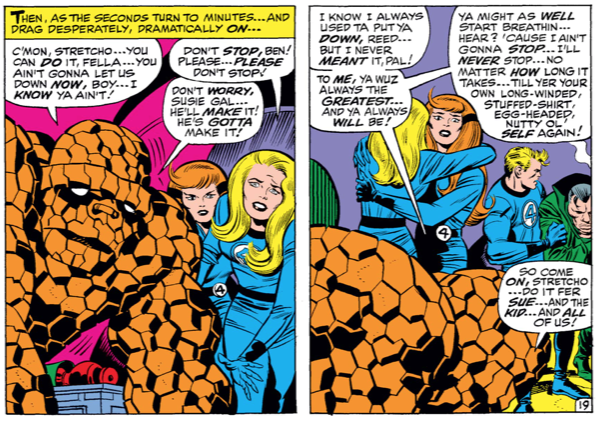
FF 89 also features a declaration of Ben’s affection for Reed. It would be more poignant if the outcome —Reed is going to be OK!—didn’t seem so obvious.
The sexist sixties
Sue can’t just fight bad guys like normal hero. She has to be “an uncaged tigress.”
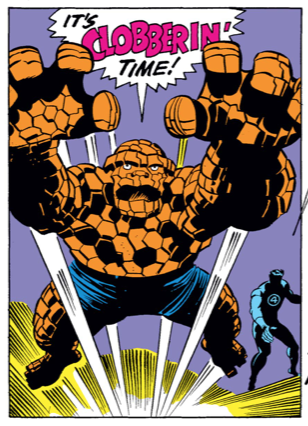
It’s Clobberin’ Time
Even this seems sort of lackluster.
Mid-century Modern
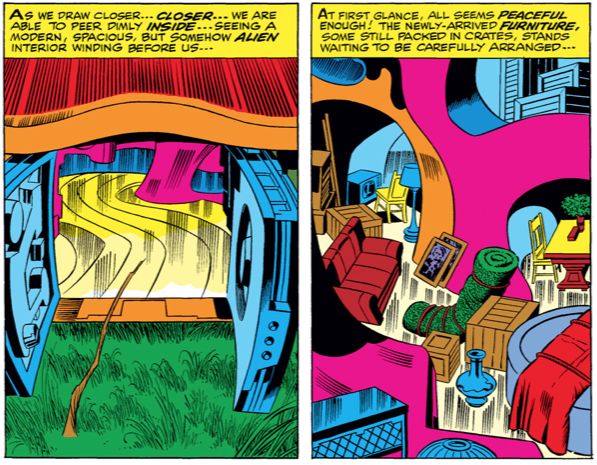
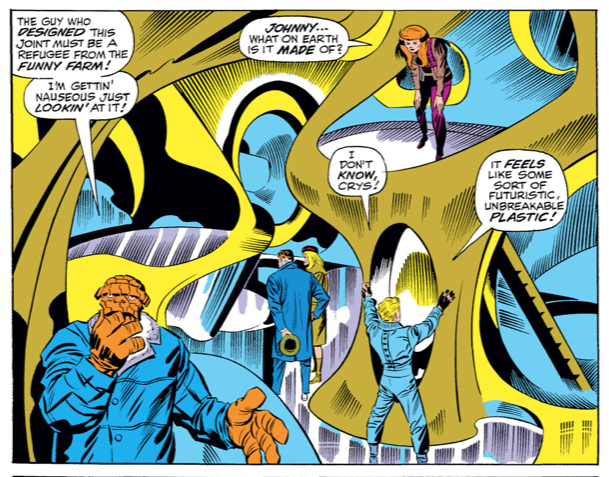
It’s hard to believe Reed and Sue were really going to live in this place, but they brought all their stuff.
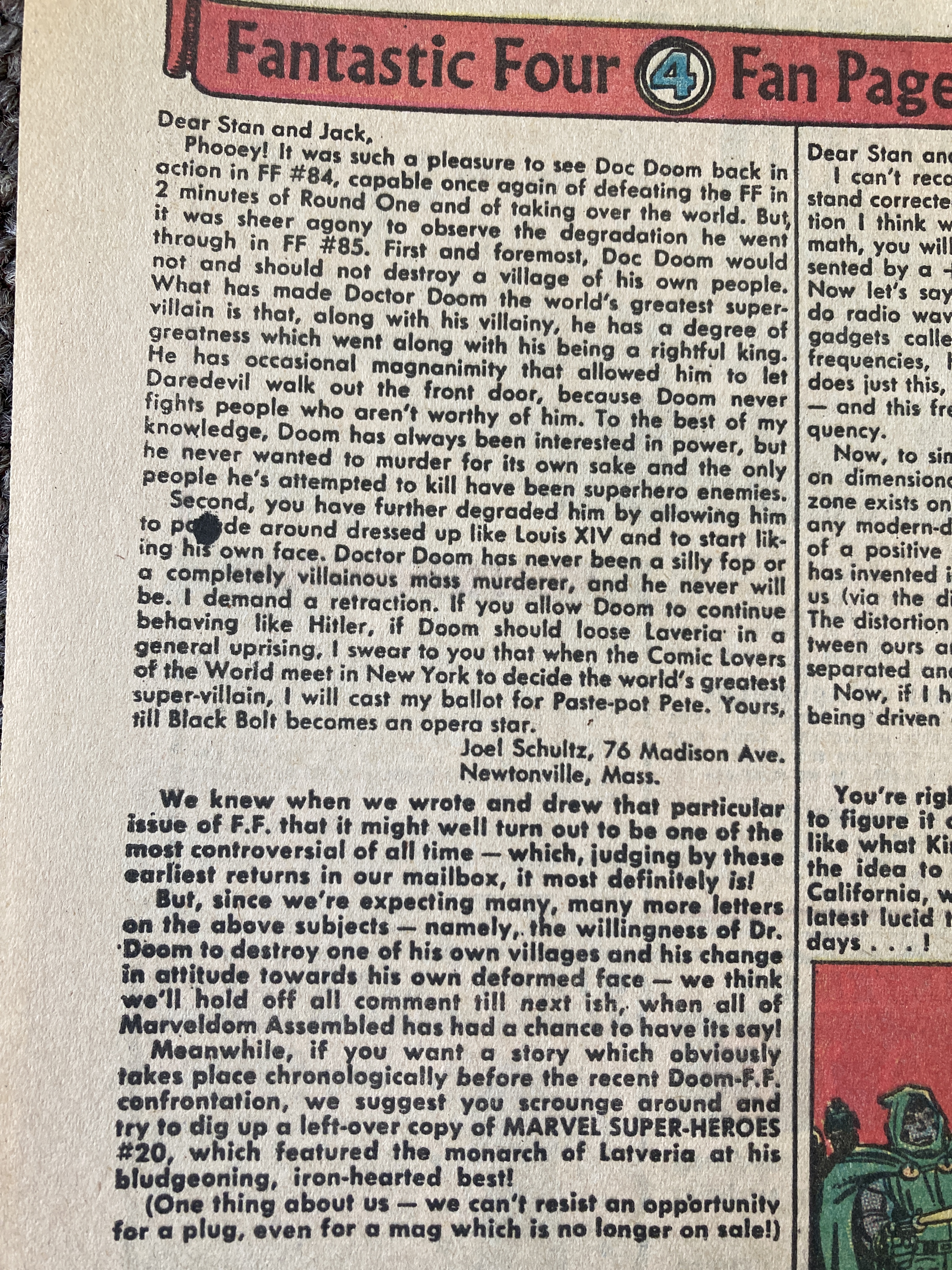
We Get Letters
And I thought Doom-stans were a 21st century phenomenon.
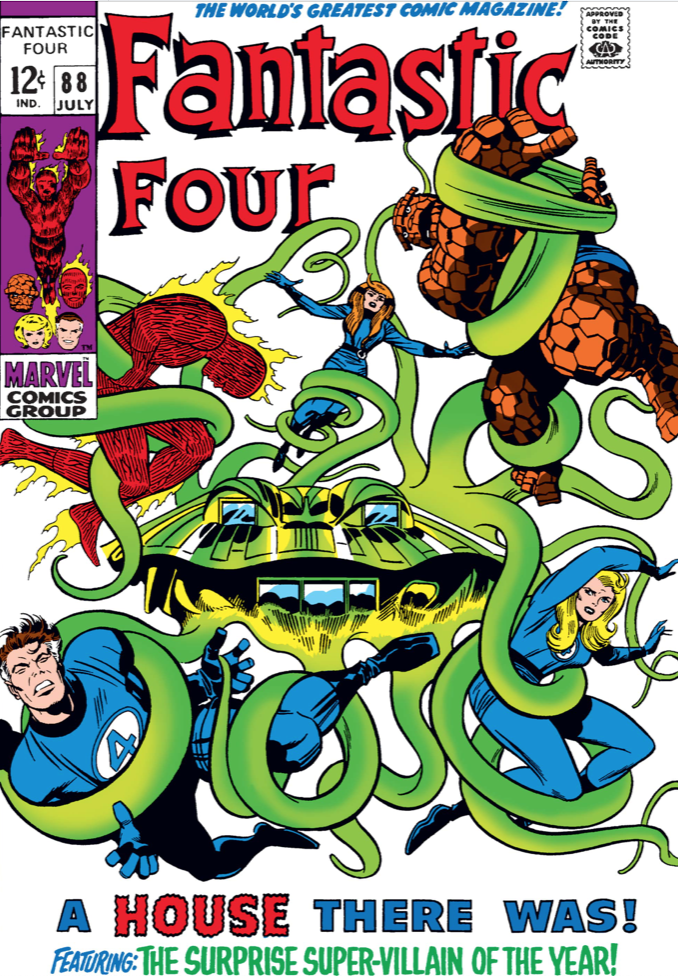
Fantastic Four 88 “A House There Was!” Published April 1969 Story: Stan Lee and Jack Kirby Script: Lee Pencils: Kirby Inks: Joe Sinnott Letters: Sam Rosen Cover: Kirby and Sinnott
Synopsis
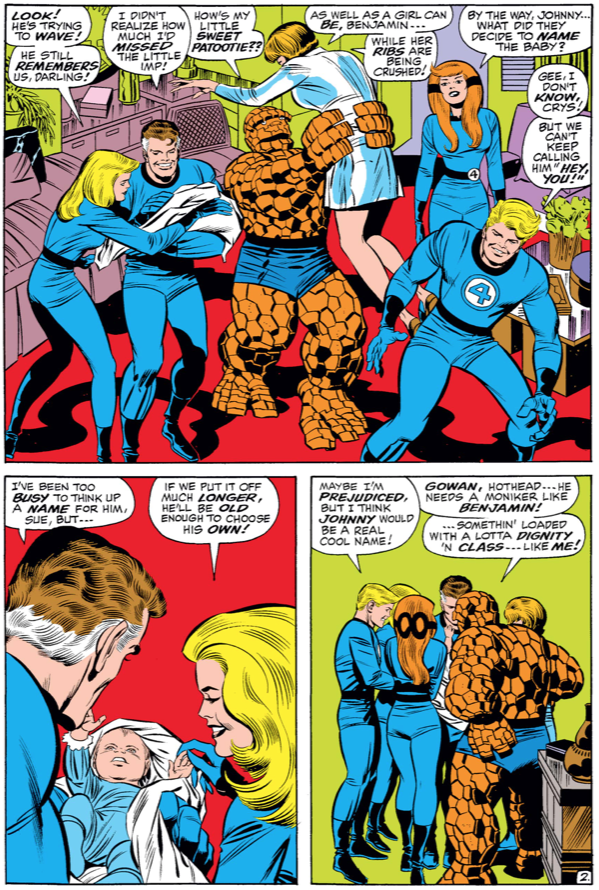
The Fantastic Four, which now includes Crystal, arrive back at the Baxter Building following their adventure in Latveria and greet Alicia, who is watching the still-unnamed baby of Mr. Fantastic and the Invisible Girl. After a joyful reunion, the team then heads off to inspect the suburban house Sue first visited a few issues ago, and which has featured in some forboding vignettes in subsequent issues.
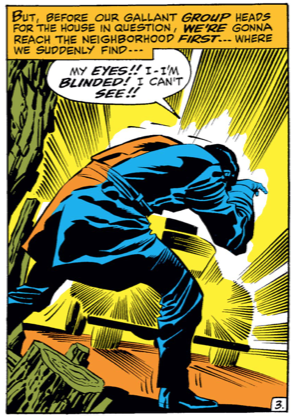
The house, which is mostly subterranean and unusual in almost every way, emits a low-level buzzing, and seems to affect the eyesight of the FF members, yet despite all that, Reed and Sue buy it and begin to move in. Reed, however, is attacked by the house’s security system when he attempts to drill holes in its walls. It is then revealed the house is connected to the Mole Man and his plan to conquer the surface world by blinding everyone. On the last page, the FF (minus Ben, who is remaining in the city with the baby and Alicia) are blinded as the Mole Man reveals himself.
What’s going on here?
There’s a lot to like about this issue. After the high drama and high stakes of the last four issues, the team needs time to relax at home, and the first few pages show the Fantastic Four as a family, cooing over the baby and gently teasing each other. The house-hunting excursion (which was preceded by hints over the last few issues that something wasn’t right about the house) has the feel of the prelude to a horror story, with an oblivious family stepping into something evil. And Jack seems to have a lot of fun drawing both the extremely modern house, and the clothes the FF are wearing on the visit.
There are, of course, some inexplicable plot developments, like why Reed and Sue buy a house that gives them headaches and blurry vision.
The Mole Man is a genuinely surprising villain (as teased on the cover) and so surprising I forgot he was in it since the first time I read it. His connection to the house isn’t made very clear, and it seems odd that the FF should stumble into a trap he didn’t lay for them, but crazy coincidences are pretty standard for this comic at the point.
Dynamite threads!
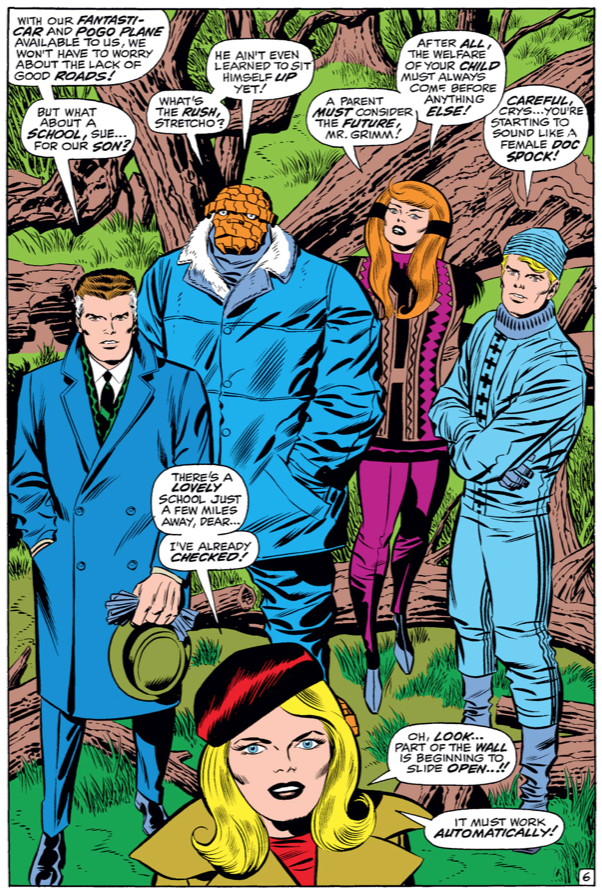
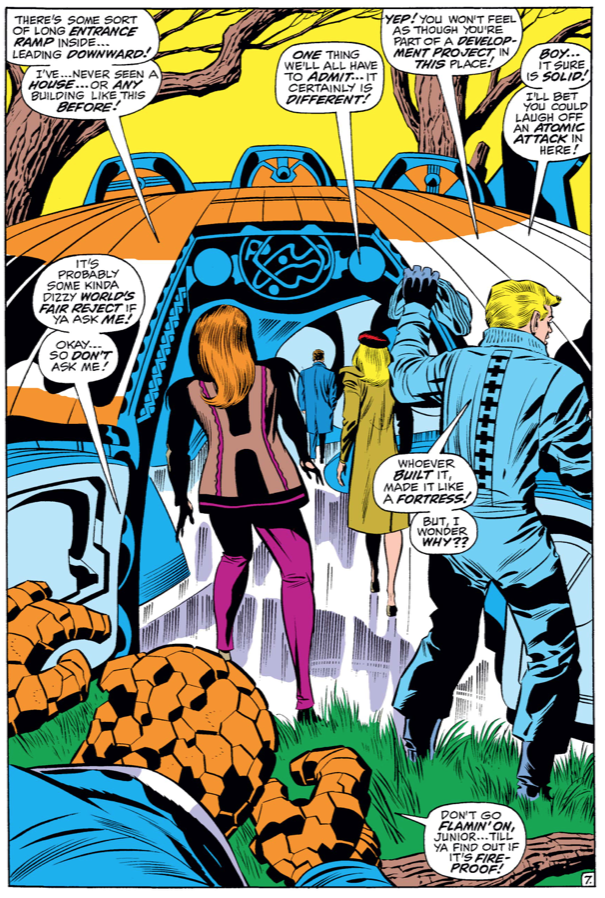
Jack drew back-to-back splash pages which both show off the FF’s amazing outfits (what exactly is Crystal wearing?) and create tension as they enter the house.
Domestic bliss
These scenes are quite charming and really drive home that the team is first and foremost a family.
The sexist sixties
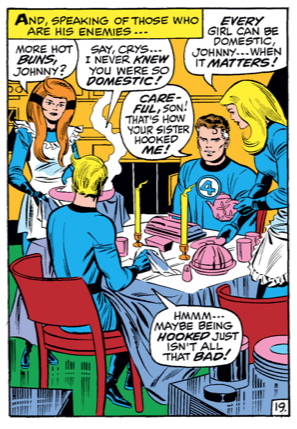
Not only do Sue and Crystal serve the men, but they wear frilly aprons to do so. (I am assuming “hot buns” was not a double entendre).
The incredible Mr. Fantastic
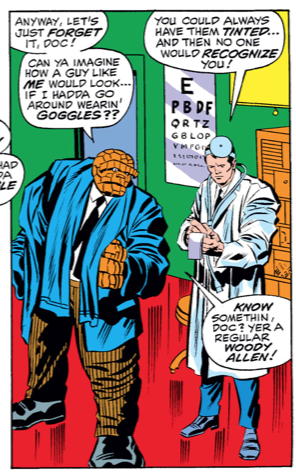
Woody Allen
Another topical reference that hasn’t aged that well.
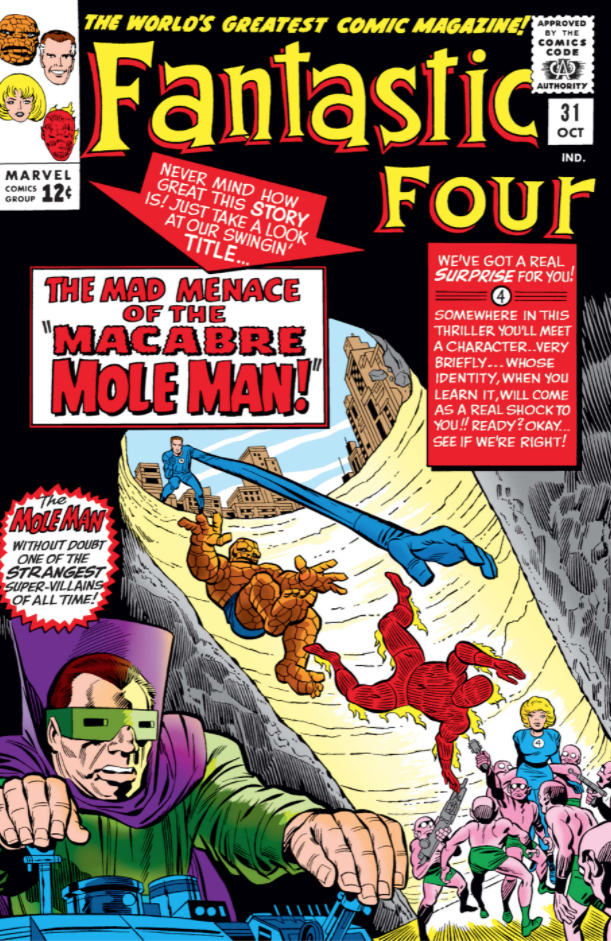
Fantastic Four 31 “The Mad Menace of the Macabre Mole Man!” Published: July 1964 Story: Stan Lee and Jack Kirby Script: Lee Pencils: Kirby Inks: Chic Stone Letters: Sam Rosen Cover: Kirby and Stone
Synopsis
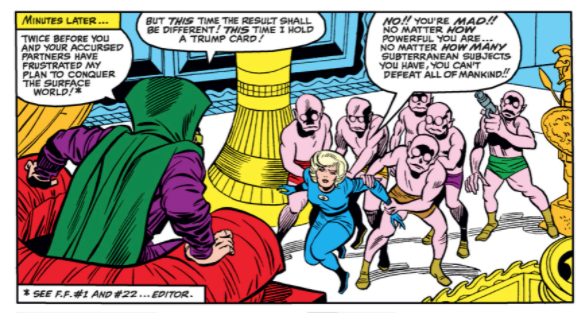
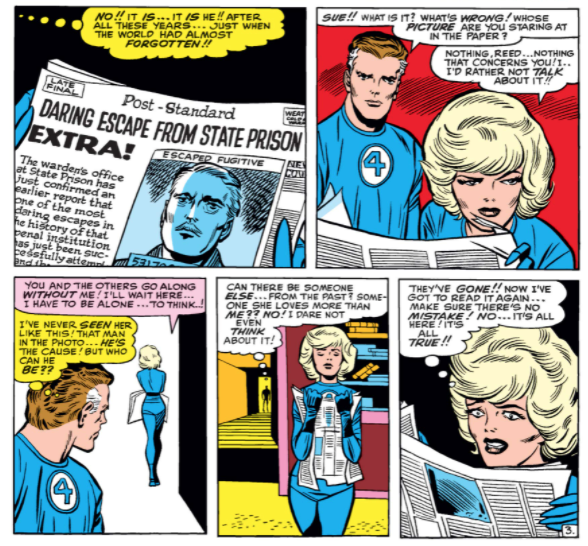
Earthquakes rock the Baxter Building and New York City. The Fantastic Four investigate, but as they rush out, the Invisible Girls sees a newspaper article about a man escaping from prison that gives her pause, and tells the rest of the team to go without her.
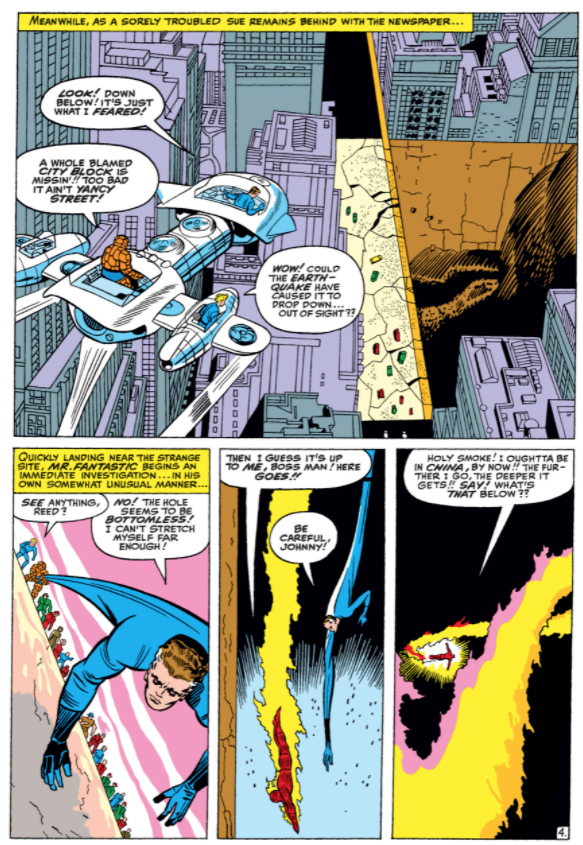
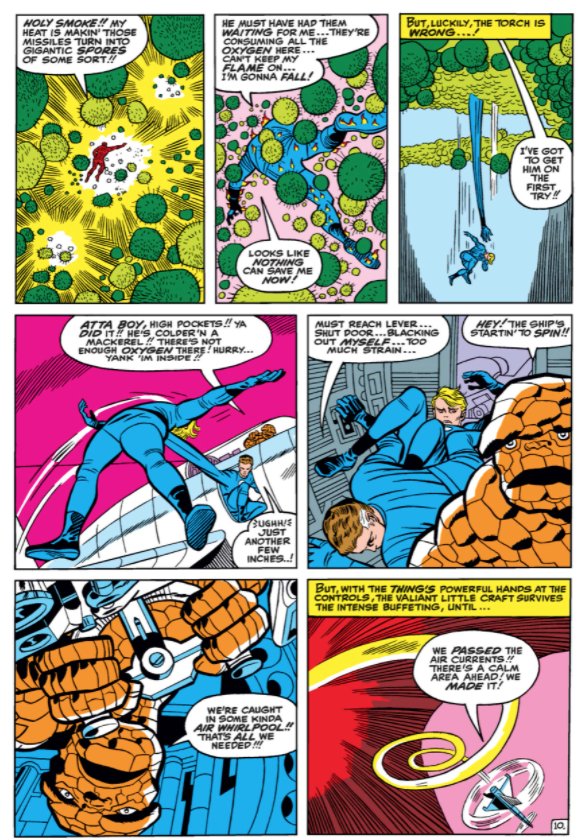
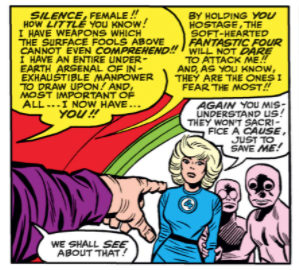
At the scene, the team discovers a city block has disappeared, leaving only a deep hole. Unbeknownst to the team, the Mole Man is responsible. The team returns to the Baxter Building to find the Invisible Girl has been take hostage by the Mole Man. The three use a Pogo Plane to descend to the Mole Man’s subterranean kingdom, avoiding obstacles along the way. There, the Mole Man demands the FF stand aside as he conquers the surface world, or risk losing Sue.
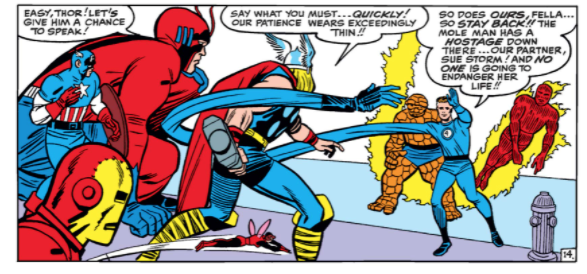
The team ascends to the surface to find the Avengers preparing to attack the Mole Man. After a brief scuffle, the FF convinces the Avengers to let them handle it and Mr. Fantastic invents a device that allows him to pinpoint Sue’s location. He then directs the Human Torch to blast a new tunnel down to the Mole Man’s kingdom, and Reed and Ben follow. With Johnny’s help, Sue escapes and the team returns the city blocks to the surface. But as the team ascends, Sue is hit by debris and is rushed to the hospital.
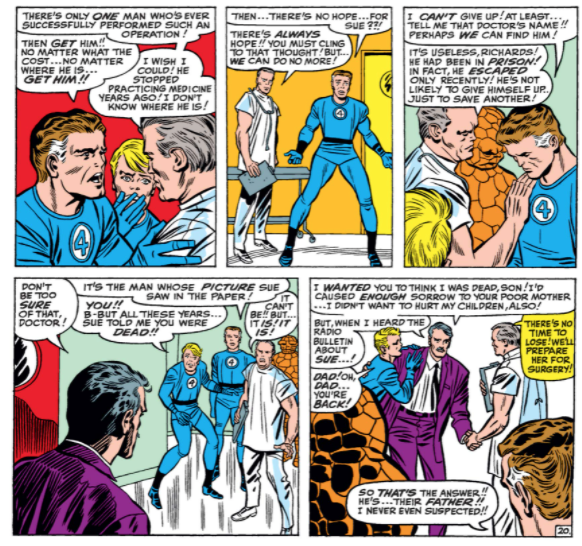
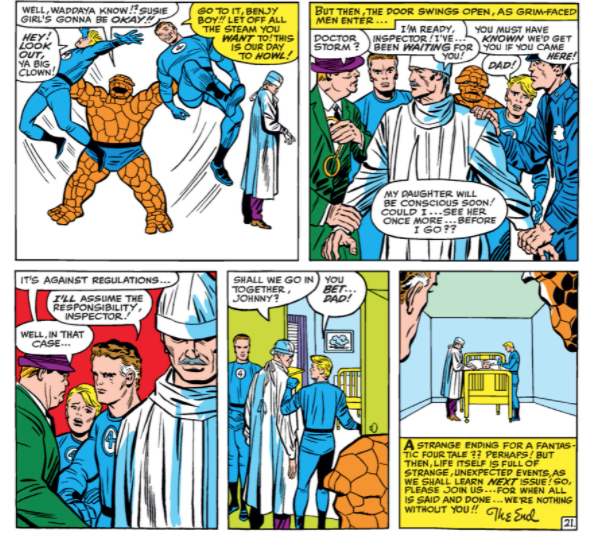
There, the doctors say only one surgeon can perform the necessary life-saving surgery, and he just escaped from prison. That man just appears, announces he is Sue and Johnny’s father, and successfully operates on Sue. He and Johnny have a moment at Sue’s bedside before the police arrive to return him to prison.
What’s going on here?
Fantastic Four 31 is notable for a few reasons, One is that Jack Kirby’s art seems to reach a new level of dynamism and creativity in this issue. Really, starting in issue 28, the Kirby’s art has been notably stronger, and FF 31 is a new peak. Some of that is Chic Stone’s inks, but it’s mostly Kirby who is using bigger panels, and more inventive perspectives and angles. Check out this page, for instance:
Or this one:
It seems light-years more sophisticated and interesting than the first few issues of the FF. I don’t know exactly why his art made a leap in 1964, but one idea may have been the increased popularity of the FF, and the sense that he and Stan were creating something special. Jack was famously overworked, so it’s to be expected that he would rush through most of his projects. But it also makes sense that he would take his time on a comic that he knew was being widely read and appreciated.
Also, FF 31 is marked by the appearance of Sue and Johnny’s father, Franklin. This is the first time any of the FF’s family has appeared in the book, and perhaps, after the lengthy unveiling of Dr. Doom’s origin in the FF Annual 2, Stan and Jack realized we knew more about Doom’s past than the FF’s. Even Reed claimed he didn’t know about Sue’s father, and assumed she and Johnny were orphans (or maybe he just didn’t pay attention when she told him). Over the years, we’ll meet more and more of the FF’s family and learn much more about their backstory.
Of course, Franklin Storm’s initial appearance is milked for maximum melodrama. First comes the foreshadowing in the newspaper:
then the deus ex machina revelation at the hospital:
and finally the reunion at Sue’s bedside:
But even while it’s clear Stan and Jack were building up to the conclusion, Sue’s injury and Franklin’s dramatic appearance seems strangely shoehorned into the story. We never actually see Sue get hurt, and the whole business with her hospitalization and operation is stuffed into the last two pages of the story.
Stan and Jack clearly thought introducing Franklin Storm was a big deal, though, teasing his appearance both on the cover and the splash page. But the story has a weird rhythm to it, and feels like an episode of Perry Mason or some other show where all plots are wrapped up in 22 minutes.
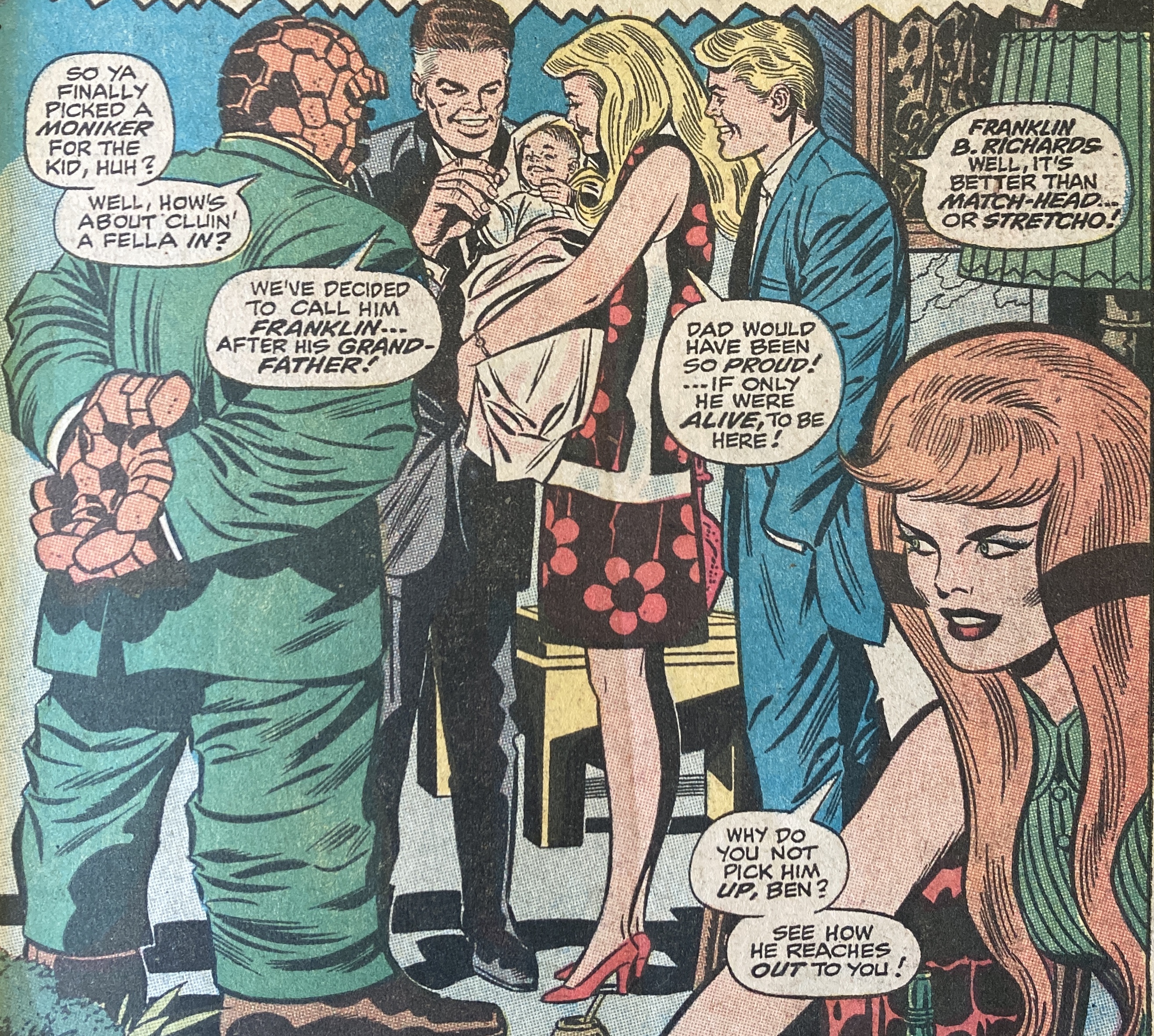
We will learn more about Franklin Storm in the next issue, but he doesn’t become as significant character as reed’s father, Nathaniel. He is, of course, the namesake of Franklin Richards, who gets his name in FF 94 (the B is for Benjamin):
Lastly, FF 31 includes a brief appearance from the Avengers. While from an in-universe perspective it’s not particularly surprising—if city blocks started disappearing in New York, the Avengers should show up—but at this point in the Marvel Universe, super teams weren’t routinely crossing paths. The encounter, which of course includes a brief fight, only lasts about a page, and doesn’t even warrant a mention on the cover.
The sexist sixties
I’ve lost track of how many times Sue has been kidnapped or taken hostage in the first 31 issues (and I don’t have the heart to count) but I’m sure it’s approaching double digits. And if it isn’t Sue who’s taken hostage, it’s usually Alicia.
Snappy banter
The brawling between the team has been replaced by witty repartee, at least for this issue.
Krazy Kredits
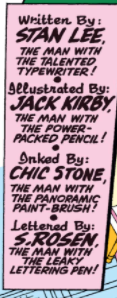
It’s Clobberin’ Time!
For sale
A mint (9.8) copy of FF 31 should cost around $26,000. An issue in fine condition (6.0) is about $120.
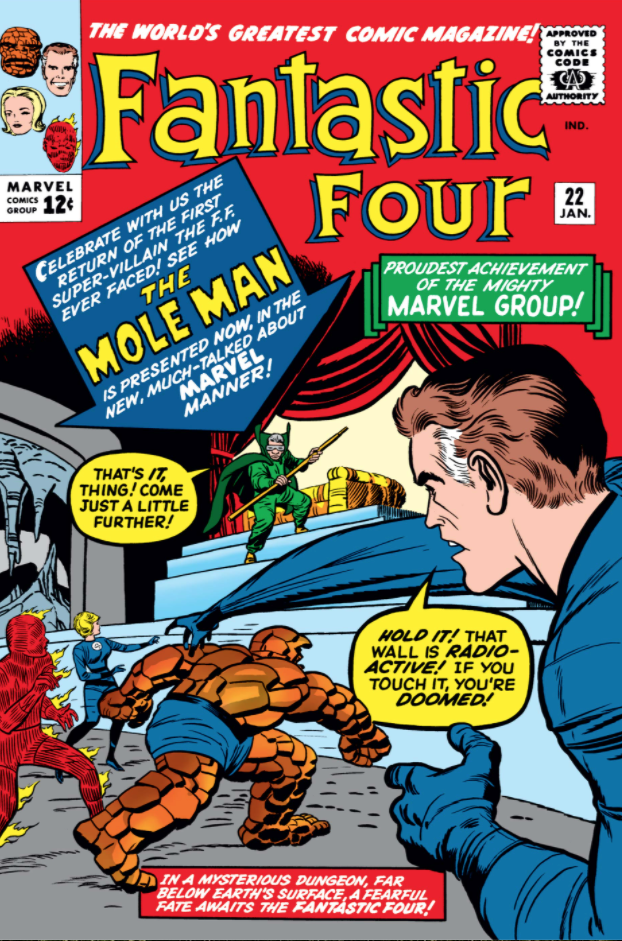
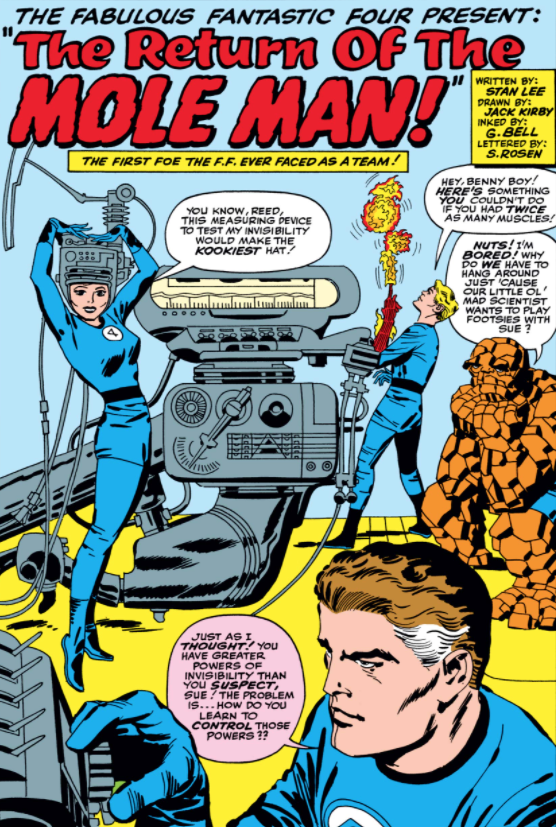
Fantastic Four 22 “The Return of the Mole Man” Published: October 1963 Story: Stan Lee and Jack Kirby Pencils: Kirby Script: Lee Inks: George Roussos Letters: Sam Rosen Cover: Kirby and Dick Ayers
Synopsis
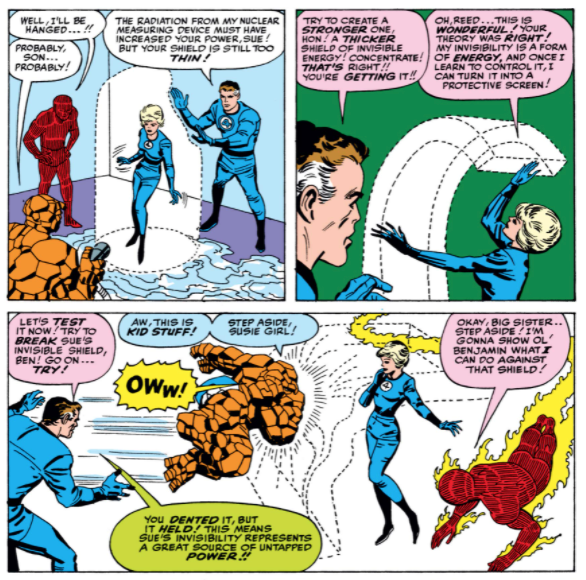
As Mr. Fantastic experiments on the Invisible Girl, she reveals two new powers: the ability to summon force fields, and to make other objects invisible. Meanwhile, the FF are besieged by complaints from neighbors about the noise and disruption they cause, so the team flies to investigate an island off the coast of New Jersey where Reed can conduct experiments and launch the team’s ICBM.
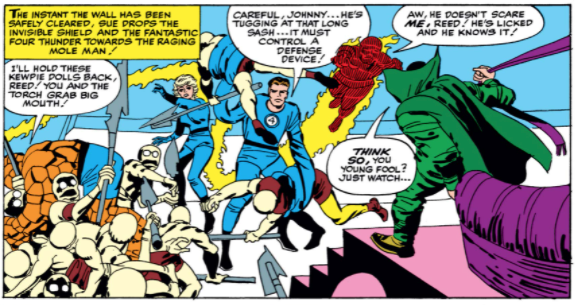
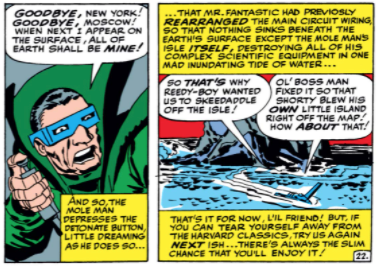
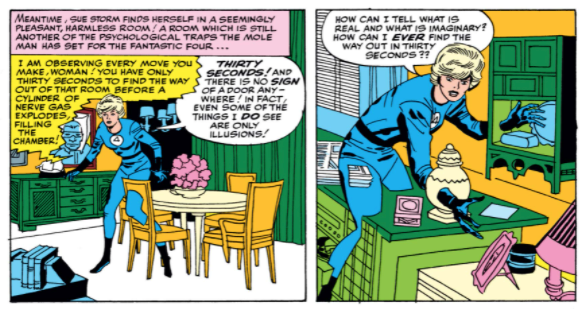
Once on the island, the team is trapped by the Mole Man, who lured them by instigating the complaints. To get his revenge on the FF from their first meeting in issue 1, he announces a plan to sink the earth’s major cities, provoking a nuclear war. The team is surrounded by a radioactive wall, but they surmount it with Sue’s new force field. The team is then trapped individually in cells designed to counter their powers (much like with Dr. Doom) but through ingenuity they each escape. Reed then hustles them off the island, and when the Mole Man initiates his plan to skink the cities, it’s revealed that Reed rewired the circuits, so only his island sinks.
What’s going on here
The story is a pretty conventional one: Hijinks in the Baxter Building, confronting a foe who traps them, then a frenzied finish. The issue, however, is notable for a few reasons: A big one is Sue’s new powers. Eventually, it appears, Stan and Jack realized the story-telling limitations of invisibility—there was only so many times Sue could use it to sneak up on a bad guy—so they added a few new wrinkles.
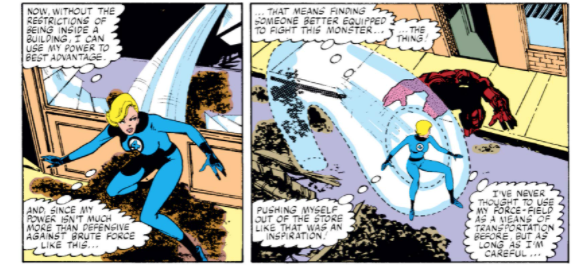
Initially Sue’s force fields were entirely a defensive power and it wasn’t until decades later that she began to wield them offensively, and use them to travel. They’ve effectively become a powerful form of telekineses, leading many to consider her the most powerful member of the FF.
While John Byrne traditionally receives credit for her transformation from weakest to strongest—which culminates with the symbolic adoption of the name Invisible Woman in issue 284—“The Great American Novel” blog makes a compelling case that lots of earlier writers had Sue deploy her force fields in creative, non-defensive ways. That said, I believe it’s fair to note the Byrne made it a project to expand Sue’s arsenal and was deliberate about powering her up.
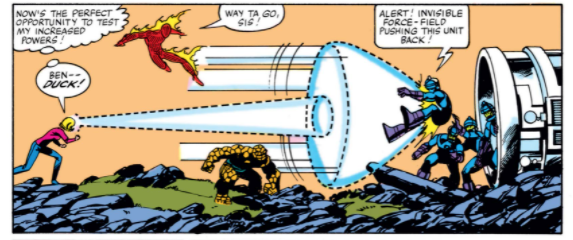
And Byrne has her consistently use her power as a battering ram, something rarely depicted before:
FF 236 (1981), Byrne
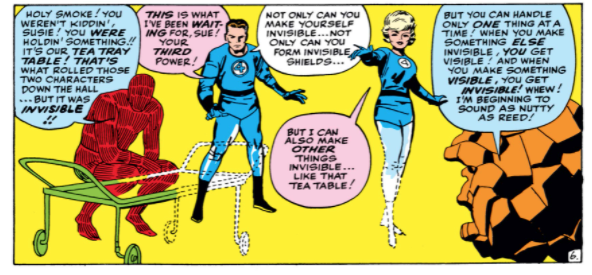
FF 22 also debuts Sue’s power to make other things invisible
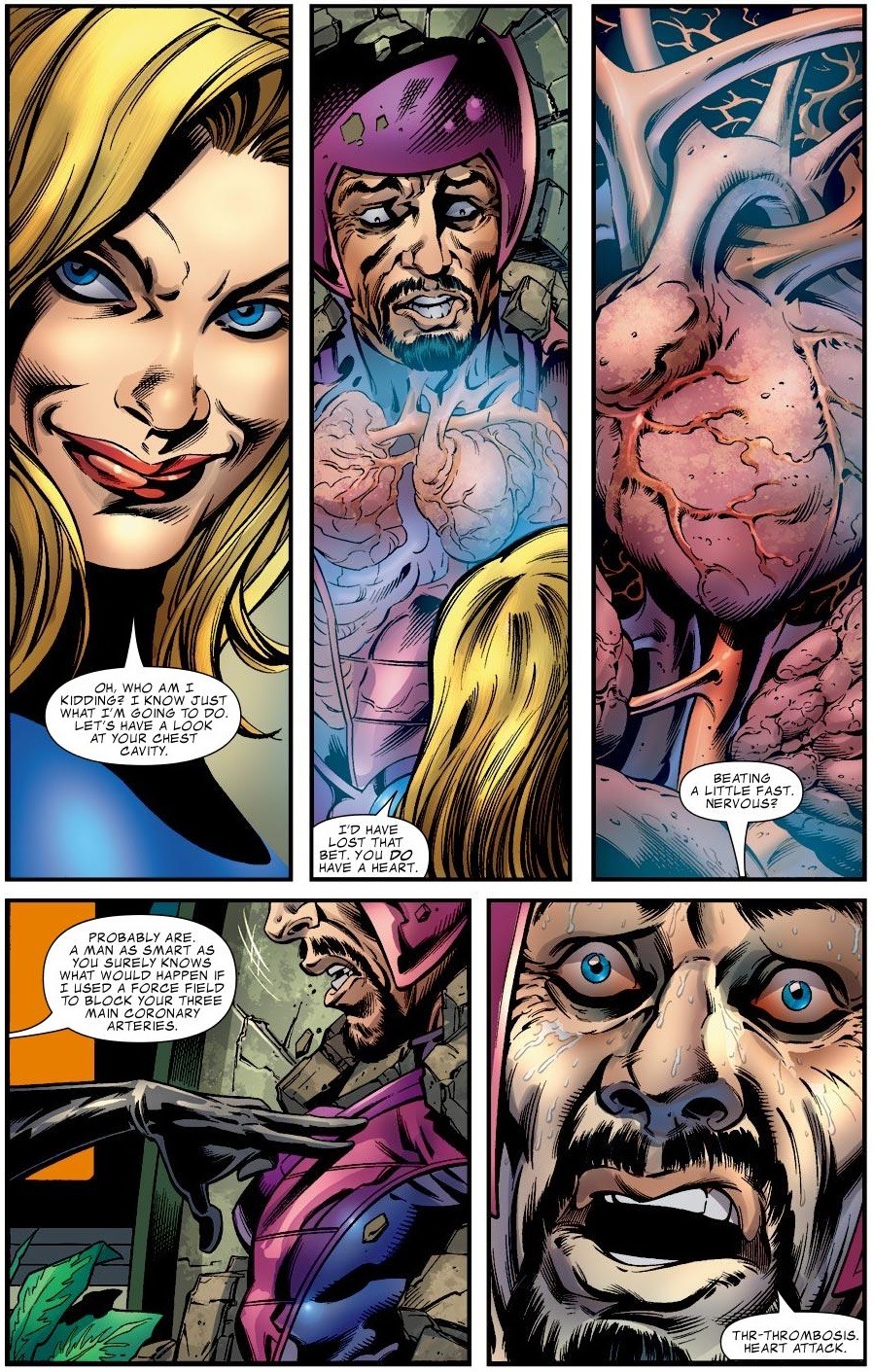
While not as potent as her force fields, it has come in handy over the years, and maybe is best used here, when she shows the Wizard what his heart looks like:
FF 549 (2007), Written by Dwayne McDuffie, art by Paul Pelletier and Rick Magyar
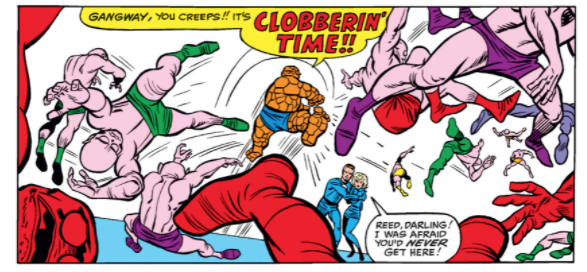
It’sClobberin’ Time!
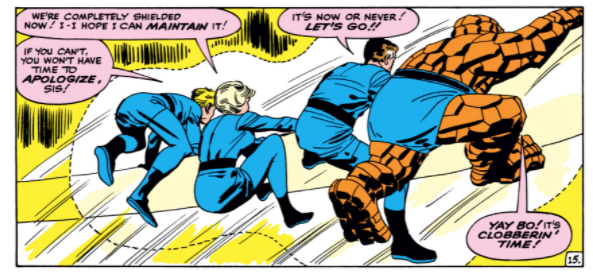
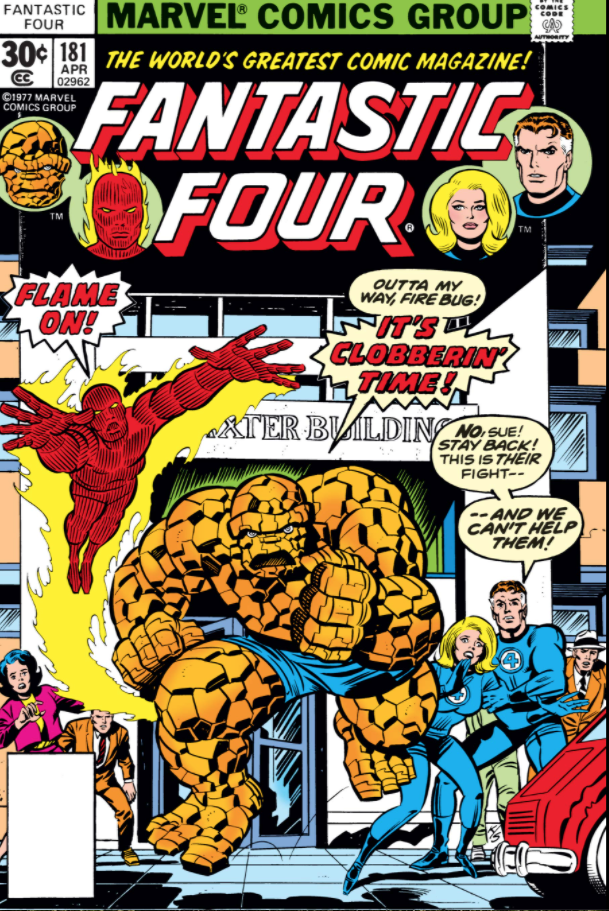
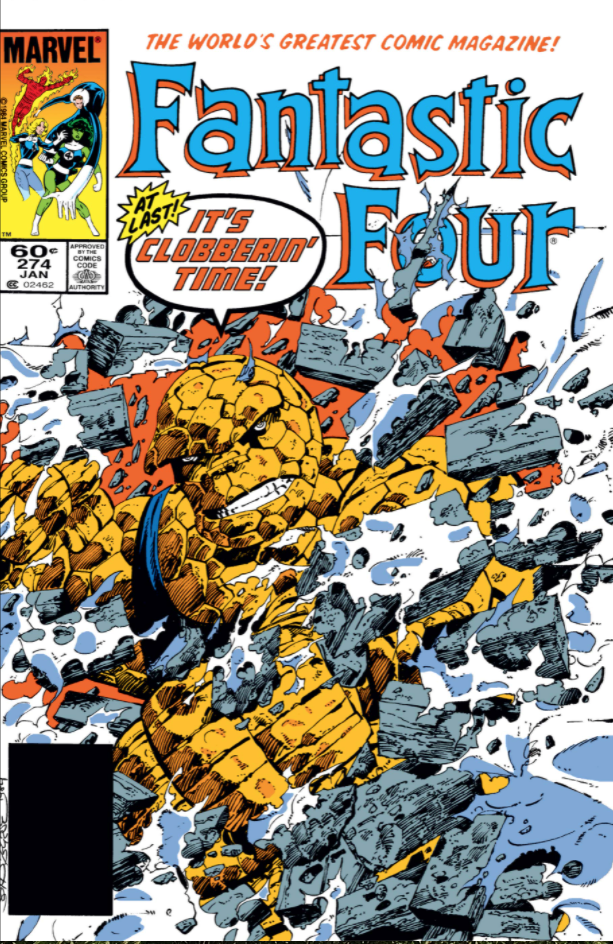
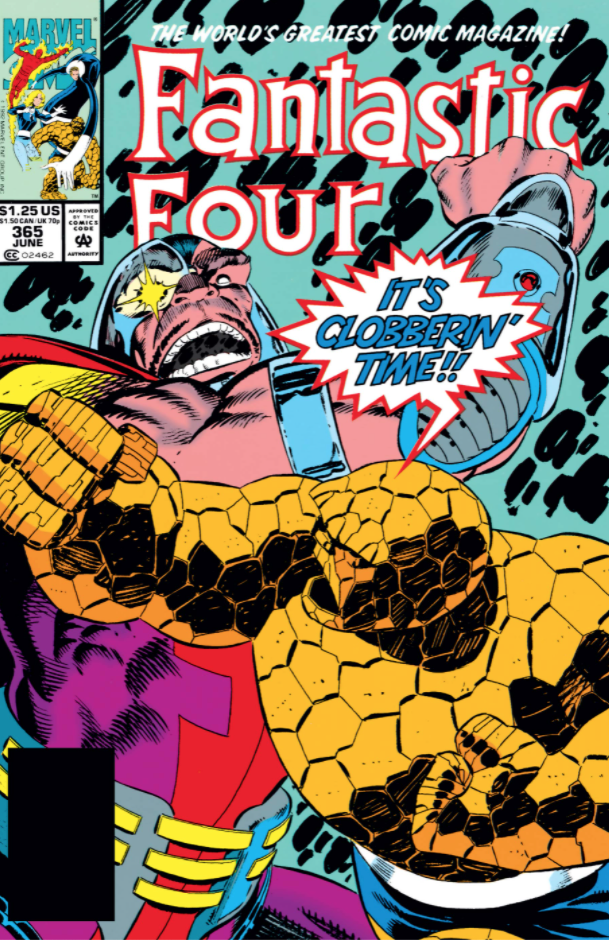
The other big debut in FF 22 was the Thing’s signature phrase (“Yay Bo!” didnt seem to catch on in the same way). “It’s clobberin’ time” quickly becomes as much part of Ben’s identity as his orange rocky appearance. It would be absurd to try to find every use of it, since he says it in virtually every issue, but here are some memorable covers:
Not only does it to become closely associated with Ben, but it becomes one the handful of comic book phrases that have escaped the genre and become part of pop culture. (“It’s a bird, it’s a plane…” “Up, up and away!” and “Hulk Smash!” are maybe the others). There’s no shortage of clobberin’ time merchandise available:
And it’s apparently been adopted / stolen by pro wrestler CM Punk:
Aunt Petunia
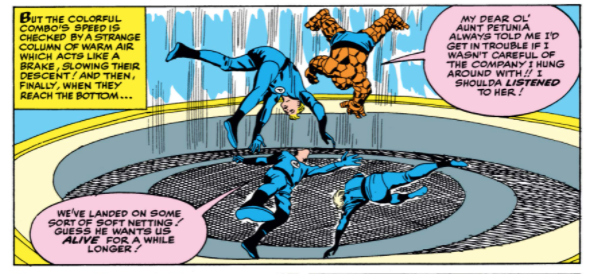
Lastly, FF 22 marks the first reference to Ben’s Aunt Petunia, another recurring catch phrase.
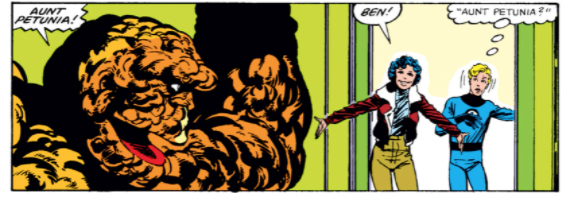
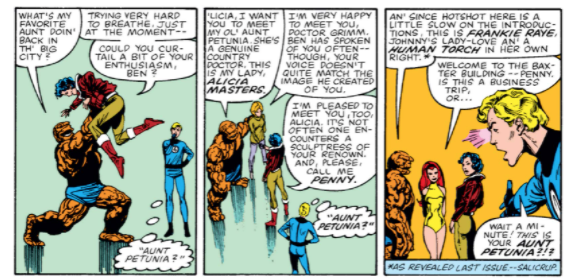
For more than 200 issues readers heard about, but never met, Ben’s Aunt Petunia, and it was assumed she was a prim older lady, not unlike Peter Parker’s Aunt May. So Byrne naturally subverted expectations by make her a young-ish country doctor.
FF 239 (1982), Byrne
What year is it?
Topical references abound in FF 22, with children’s comedian Pinky Lee and folk artist Grandma Moses among those getting name-dropped.
Oops
Looks like Stan is covering for Jack here to explain how this stranger wandered past the FF’s vaunted security system
Red menace
The Cold War is again evoked
This is the end?
Even by Stan and Jack’s standards, the ending of FF 22 feels awfully abrupt. The story could have used another page at a minimum instead of cramming all that exposition into the last panel.
They’re fighting again
Aren’t they always?
Dig that Kirby Krackle
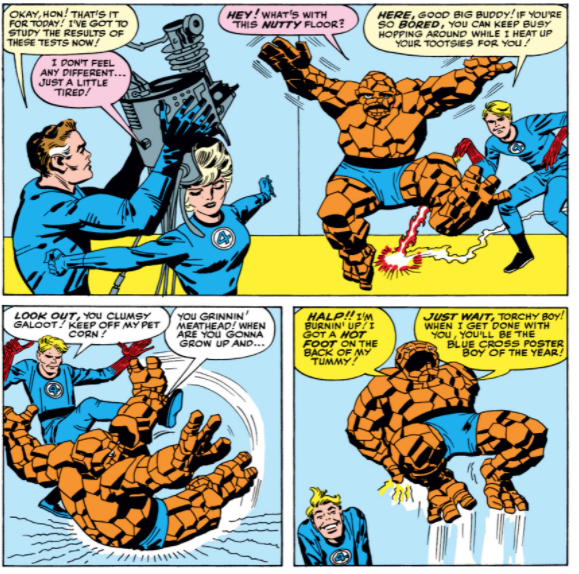
This is just a great splash page that captures the personalities of all the members, plus shows off some cool gee-whiz science stuff. George Roussos returned to ink this issue, giving it a different look than most of what came before.
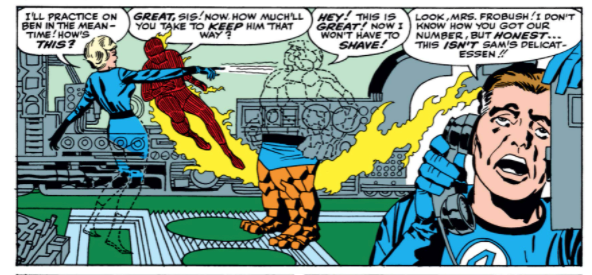
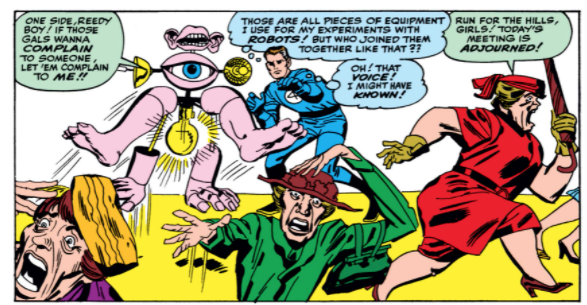
Here’s some other fun stuff from The King (note Reed’s face, and that he’s talking to Mrs. Frobush, a possible precursor to Marvel mascot Irving Forbush):
For Sale
FF 22 in mint condition (9.8) should cost you around $18,000
Welcome to the inaugural installment of what I’m hoping is a multi-year project to blog the entire run of the Fantastic Four, from its 1961 debut up until the present (assuming it’s still being published however many years in the future that will be).
Why the Fantastic Four? The easy answer is that it’s my favorite comic, but also because it’s steeped in history. The Fantastic Four launched the Silver Age at Marvel, and ushered in the Marvel universe as we know it, the overlapping and self-referencing world of superheroes and characters that, nearly six decades later, now spans tens of thousands of comics. The Marvel comics universe, of course, also gave birth to the Marvel Cinematic Universe, a potent pop-cultural force that has introduced many more millions (billions even) to these characters.
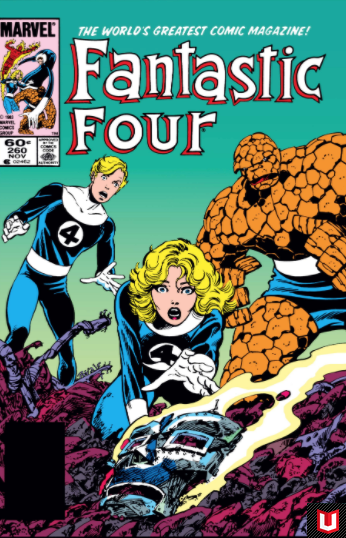
I don’t recall my first exposure to the Fantastic Four—it might have been the either the 1967 or 1978 cartoons—but I clearly remember the first FF comic I bought: issue 260, off of a spinner rack at the Amenia Variety store, near my parent’s house in Dutchess County, New York, in late August of 1983. I had spent the previous months at summer camp, and a fellow camper was Eddie Galton, son of then-Marvel president James Galton. I wasn’t particularly friendly with Eddie (now Edward, and a TV producer) but he had hundreds of comics, and they washed around our bunks. I had read comics before, mostly things like Archie and Richie Rich, but that was my first taste of modern Marvel superheroes and I was hooked (I can’t recall much of what I read that summer, although The Official Handbook to the Marvel Universe No. 11 one was definitely among them. When I got back from camp, I eagerly sought out more, and FF 260 was the first I bought.
In retrospect, you would be hard pressed to find a better single-issue introduction to Marvel comics from that era than FF 260. Written and illustrated by comics maesto John Byrne at the peak of his powers, it featured the FF tussling with their best bad guy, Dr. Doom, and guest appearances from some of prominent supporting characters like the Silver Surfer and Sub-Mariner (more about that issue when we get to it in few years). More importantly, the individual personalities of the team’s members were clearly defined, as was their relationships to each other. This was more than a team, it was a family, and it was clear from the first issue I read.
Ultimately, that dynamic is what keeps me coming back to the Fantastic Four after many decades and creative teams. They’re not a team of superheroes who banded together to fight evil, like the Justice League or Avengers; they were a family of adventurers who became super heroes. Like all families they quarrel and sometimes drift apart, but they are tied together by love and shared history.
A few notes about this project: I hope to cover one issue a week, starting with the first. This is not a new format, and there are many similar blogs tackling lengthy comic book runs (including, probably, the Fantastic Four). I was inspired by The Matt Murdock Chronicles, a sadly defunct issue-by-issue look at Daredevil, and particularly Austin Gorton’s X-aminations X-Men Reviews, a heroic attempt to document every X-Men related comic on the The Real Gentlemen of Leisure blog. If some of the features look familiar, I will confess to having borrowed some of the best elements of from those two blogs. For historic data, I’m relying on Mike’s Amazing World, a great resource.
When possible, I will take note of non-story elements that will be relevant, such as notes from Bullpen Bulletins and the letter’s page, when they appear. Unfortunately, I’m relying on my Marvel Unlimited subscription for early issues, which doesn’t include those elements, so I won’t have them available until we get to the comics I actually own. If nothing else, this exercise should help spur me to fill into the gaps in my collection.
So with all that throat clearing out of the way, here is the one that started it all, Fantastic Four No. 1:
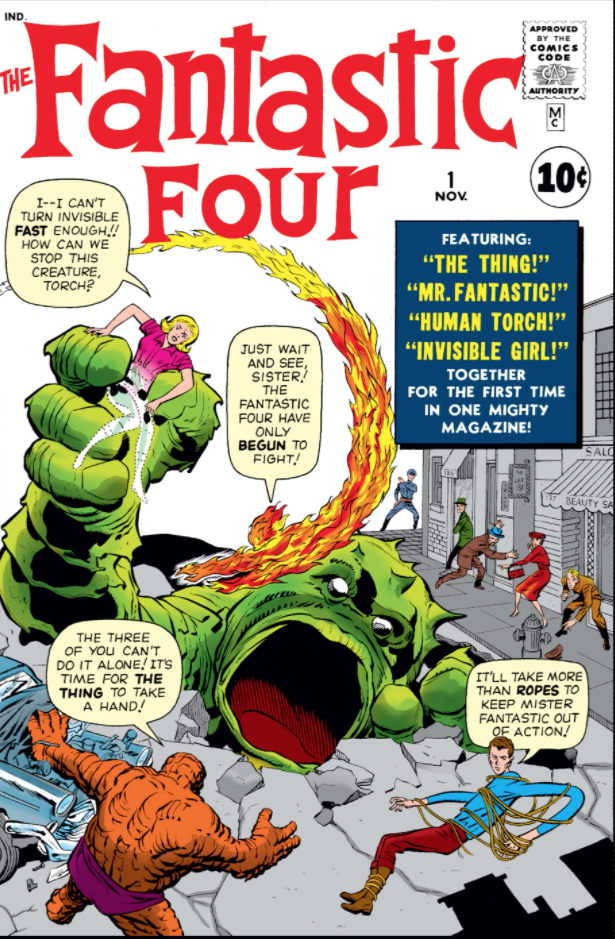
Fantastic Four No. 1 Published: August 1961 Story: Stan Lee and Jack Kirby Pencils: Kirby Script: Lee Inks: George Klein (uncredited) Cover: Kirby and Dick Ayers
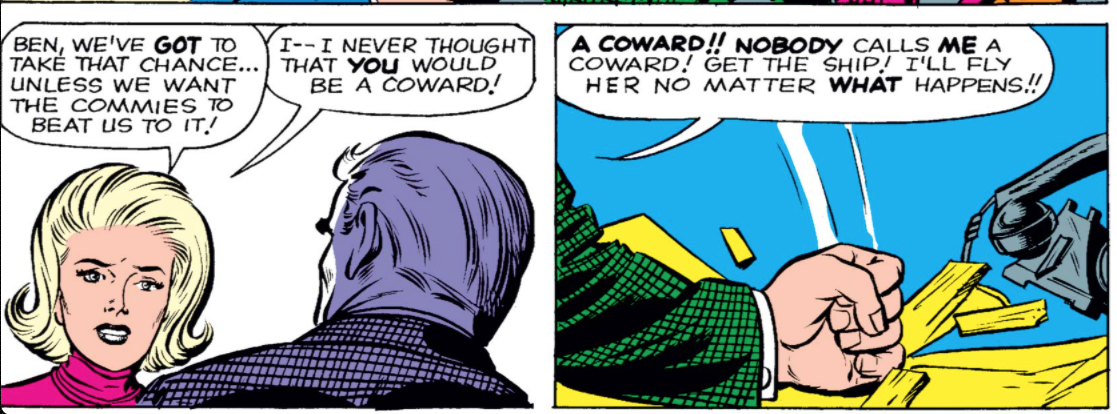
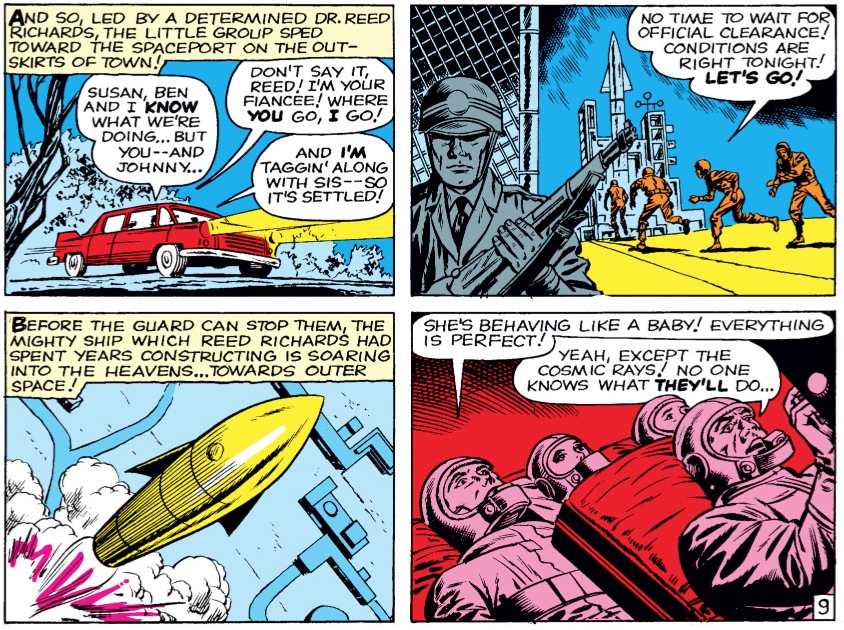
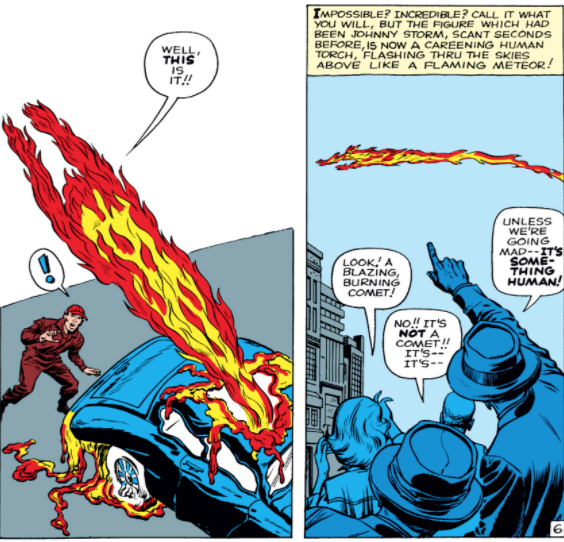
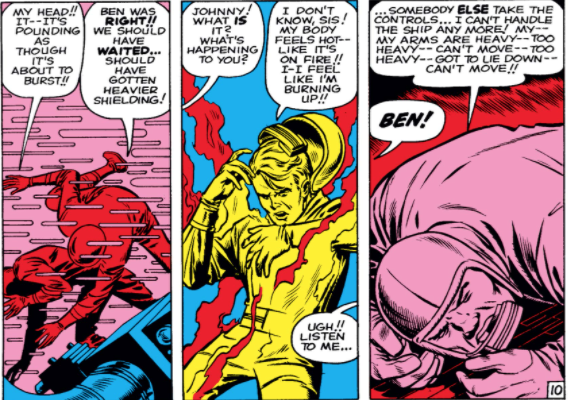
Synopsis: A mysterious man sends off a flare, summoning three strangely powered individuals: a woman who can turn invisible, a monstrous brute, and a teenager who bursts into flame. The man who summoned them is revealed to have stretching powers. A quick recap explains their origin: Scientist Reed Richards leads his best friend (Ben Grimm), his girlfriend (Sue Storm), and her younger brother (Johnny Storm) to sneak aboard a rocket for an unauthorized mission to space. Despite Grimm’s misgivings about the unknown effect of cosmic rays, he agrees to pilot the ship after his courage is called into question. In flight, the craft is bombarded by cosmic rays and after a crash landing, their powers manifest. After a brief squabble, they agree to use their powers for good.
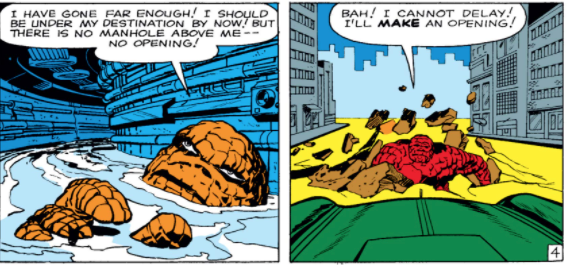
Back in the present, Richards informs the rest of the team about atomic plants vanishing underground around the world. He pinpoints the location—Monsters Island!— and the team flies to investigate. After confronting a three-headed flying monster, Reed and Johnny are separated from Ben and Sue, tumble beneath the earth and meet the Mole Man, a misshapen man driven underground by a a cruel world. A fight ensues, Ben and Sue eventually catch up and Johnny blazes a path out of the cavern, sealing the Mole Man and his monsters beneath. An apparent nuclear explosion destroys the island as the team flies off.
What’s this all about?
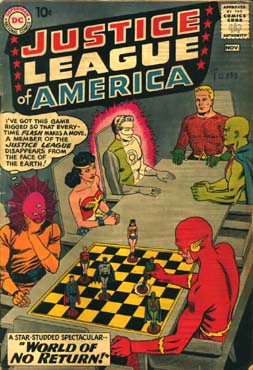
The Fantastic Four was born from a mix of influences. The genesis was a business decision: Magazine and comic publisher Martin Goodman wanted a comic that could compete with the Justice League of America, a super hero team-up book launched a year earlier by National Comics Publication, a precursor to DC. Goodman directed Stan Lee, his editor, to come up with something, and Lee recruited artist Jack Kirby, then newly arrived at what would become Marvel. Who actually contributed what to the origin is still debated, but it’s clear both Lee and Kirby played a role.
The use of space travel and cosmic rays as an origin device is very much of its time: Sputnik had launched four years earlier, and Yuri Gargarin became the first man in space in April of 1961. Space was on everyone’s minds, particularly the teenage boys the comics was targeting. The specter of communism is also present, as Sue warns that “the commies” could beat the team into space (and of course, they had).
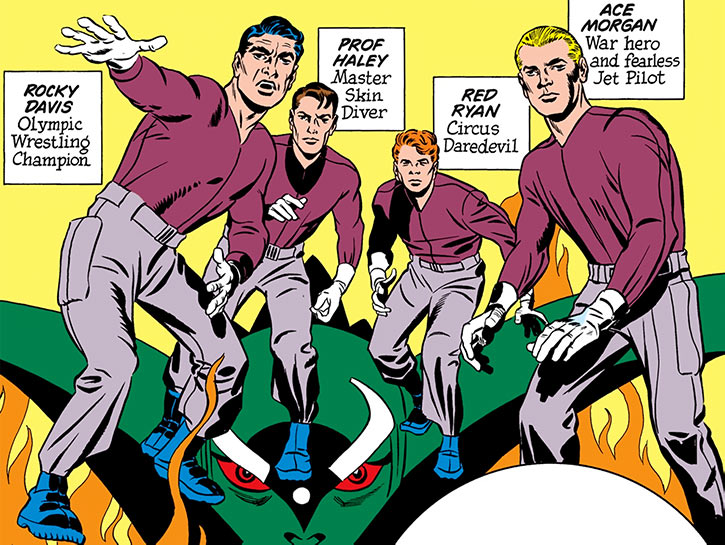
Unlike the Justice League, which was an assembled group of existing heroes with their own origins and costumes, the Fantastic Four was created together. Their origin and uniformed appearance is very similar to that of the Challengers of the Unknown, a team Kirby created in 1958 while at National (you can read more about that here).
It’s also worth noting that the powers acquired by the team aren’t particularly unique. Invisibility is a well-established power dating to H.G. Wells’ TheInvisible Man (at least), a man who changes into a hulking monster draws from Beauty and the Beast and Dr. Jekyll and Mr. Hyde (and many others), Plastic Man was a stretching character dating from 1941, and not only did Marvel itself have a character who could burst into flames in the 1940s, but he was also called the Human Torch. At one point Stan Lee said he was riffing off of the four elements when he assigned the team their powers:air (Sue), water (Reed), earth (Ben) and fire (Johnny).
About that origin
The five short pages of origin are among the most scrutinized texts in comics. Over the years the story has been expanded and retconned, often in an attempt to address some of the story’s central mysteries: Why would Reed, allegedly one of earth’s smartest men, risk exposure to the cosmic rays that even Ben knew were a risk? Why would he take along not just his fiancee but her teenage brother? Why would he sneak aboard his own ship in the middle of the night? The in-story explanation is that Reed doesn’t have time to wait for official clearances because “conditions are right tonight,” and that Sue and Johnny insist on accompanying Reed and Ben.
Ben’s resentment at Reed for his disfiguration and Reed’s guilt and attempts to cure Ben have fueled dozens of stories and remain a potent thematic element of the Fantastic Four through the present. In one of the recent retellings, by Dan Slott in Point of Origin, the space ship was adequately protected from ordinary cosmic rays but the ship was subjected to a barrage of the rays from the alien planet Spyre, the team’s original destination (no actual destination was given in the first issue).
Ben’s long-simmering resentment at Reed is hinted at early on:
So who are these guys:
The first issue lays the template for hundreds of stories to come, and by-and-large the basic characters are established from the beginning, and while their appearances and powers change, the essential notes of their personalities will remain in place for years.
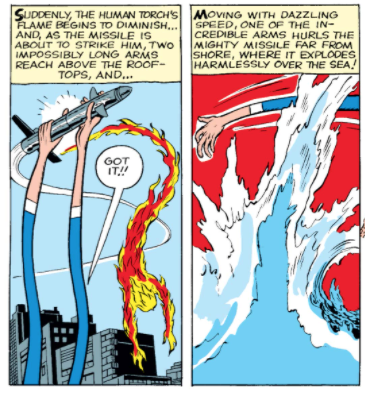
Reed, appearing with his pipe and hair that is going white at the sides, is basically the same confident, aloof professorial Reed we’ve known for decades. He is a bit overpowered in this first issue, at one point grabbing a nuclear missile aimed at Johnny out of the air and throwing it into the Atlantic (why the National Guard thinks firing a nuclear weapon over New York was prudent goes unaddressed).
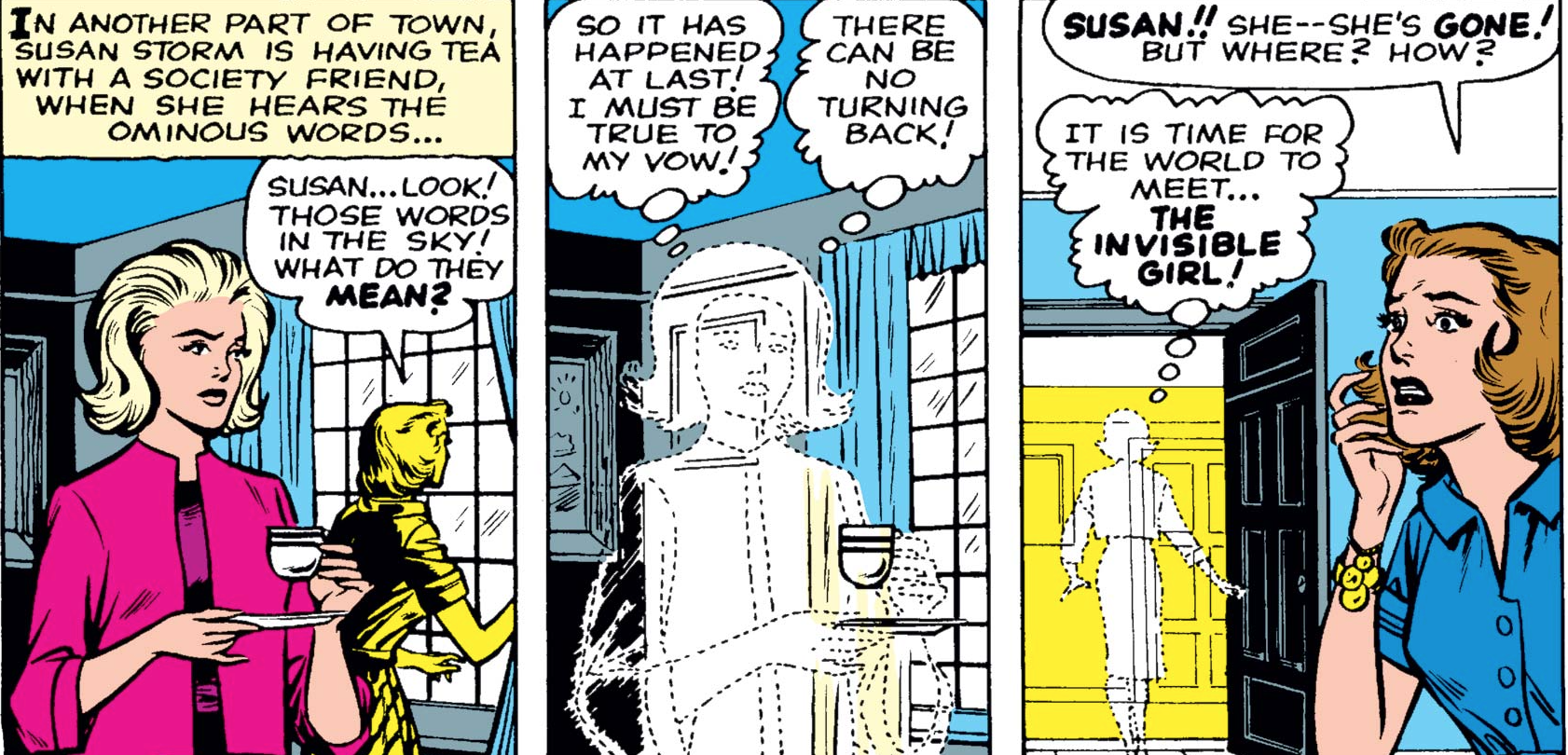
The basic character beats of Sue that persist for years are also established: She’s demure and dainty, supportive of Reed to a fault. Her power at this point remains invisibility, a metaphor for her vanishing personality, until issue 22, when she gains the ability to create force fields. It wasn’t until the 1980s and under John Byrne that those force fields are depicted as offensive weapons, and she eventually she is described as the team’s most powerful member.
Johnny is a hot-headed teen (metaphor alert!) who is crazy about cars, a long-lasting element of his character. In his first appearances he resembles an actual flame, not the red man surrounded by flames he later becomes.
The Thing is the character whose initial appearance is most unfamiliar to modern readers. It’s not just his monstrous form, which transforms into the orange rocky one gradually over the next dozen issues (apparently Kirby found that version easier to draw) but his personality undergoes a major shift. His diction in this issue is more formal and archaic (at several points he says “bah!) and has none of the dropped g’s and colloquialisms that become his trademark. Nor does he have the sense of humor that helps define the character.
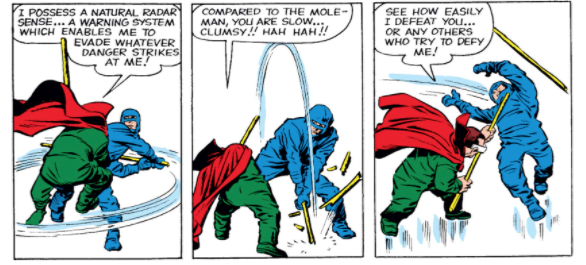
The Mole Man (here referred to as the Moleman) also debuts, and becomes a recurring villain. Although classically Silver Aged in his world-dominating ambitions, he’s given a sympathetic backstory and thus becomes a more nuanced character. Plus, he’s got some sweet moves:
The more things change
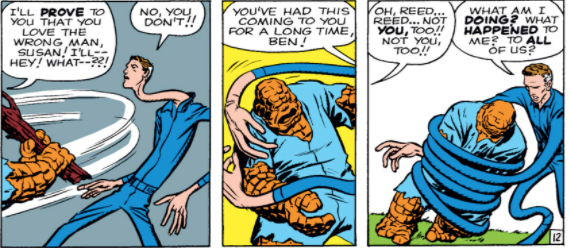
Some elements, however, will remain with the book for years. For example, they’re fighting with each other from the get go:
In what becomes a long sexist tradition, Sue stand back and reacts while the men take action:
And Kirby delivers some knockout art:
For sale
A mint condition (9.8) FF No. 1 will set you back $4.6 million
About that cover
Fantastic Four 1 is one of the most copied, parodied or homaged covers in comics. It’s delightfully silly, and has nothing to do with the interior (who put those ropes around Mr. Fantastic, anyway?) It’s notable for a few other reasons, as well. The logo, with those groovy sixties letters, will be one of the the most enduring in comics, and while Marvel will occasionally swap it out for a more modern look, it often returns. Instead of Marvel’s logo, there is a tiny “MC” in a box under the Comic’s Code Authority seal. And the blurb introducing the team promises that they’re “together for the first time,” implying this is uniting a group of individual characters, like the Justice League.
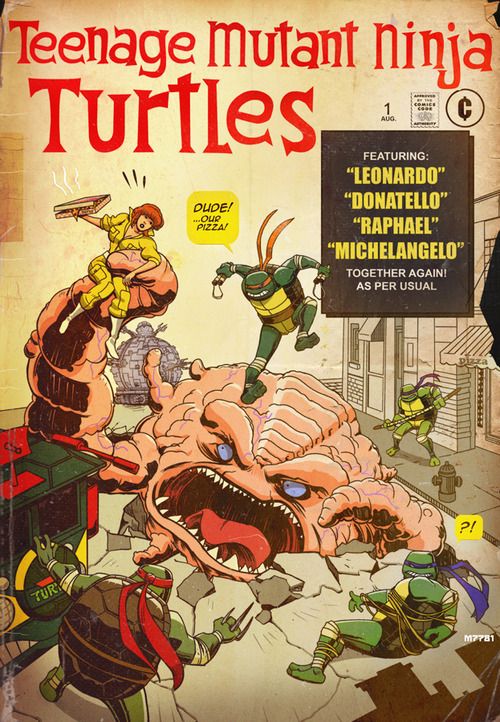
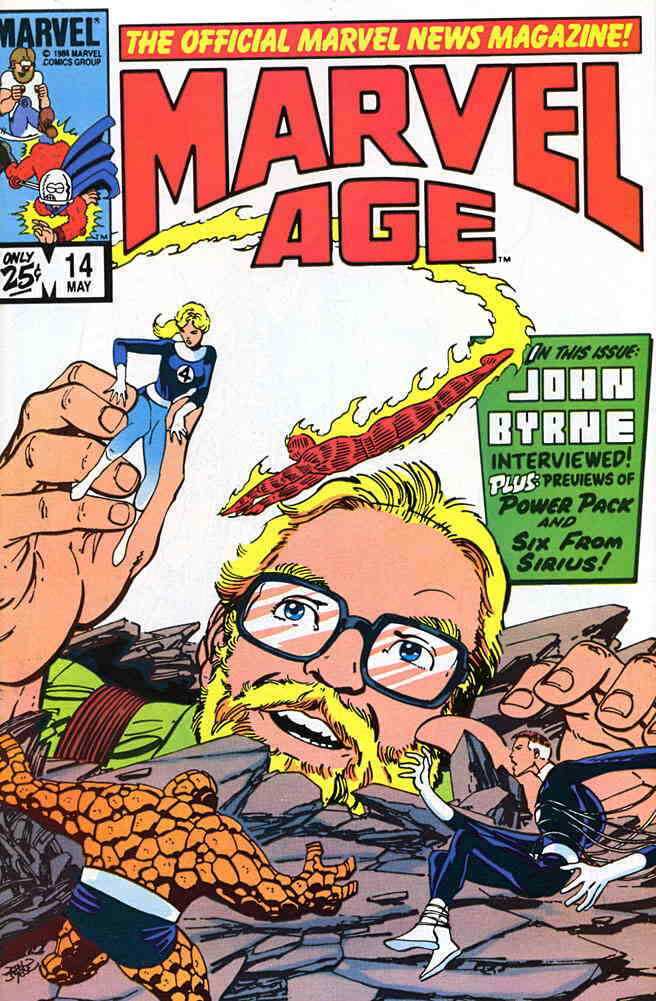
Here are some other versions of the cover (it should be said Byrne in particular loved referencing it):