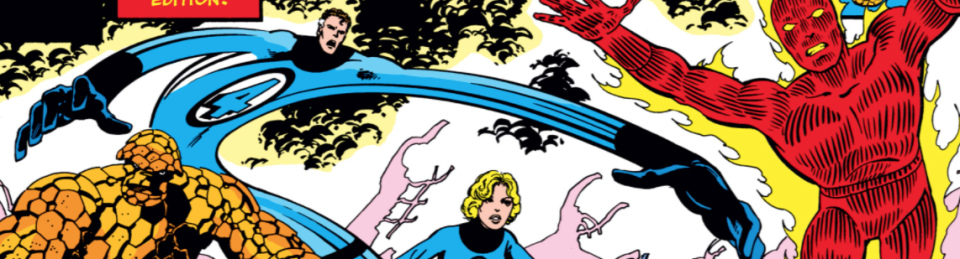
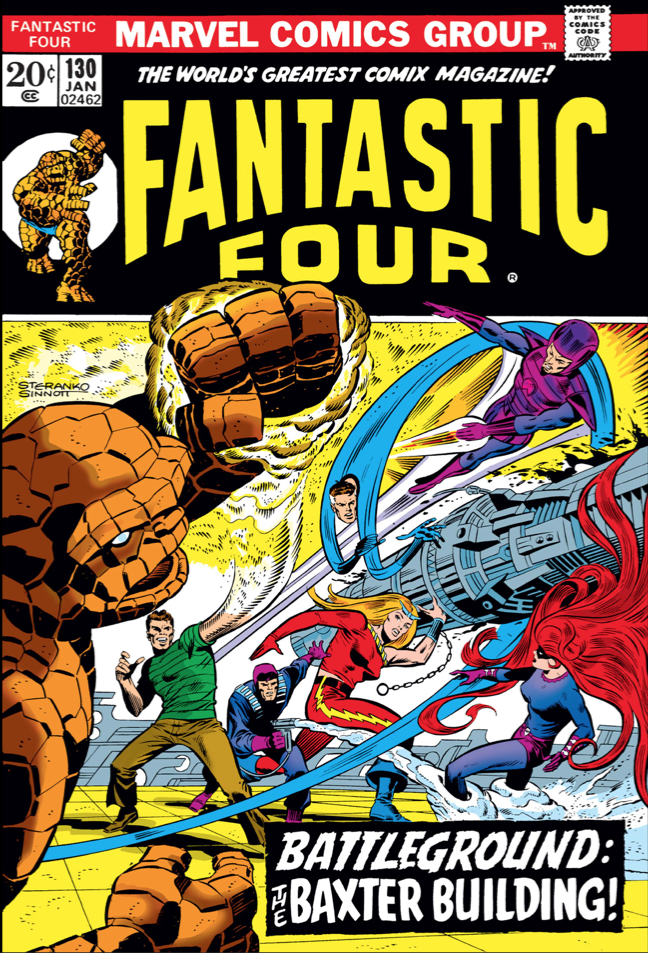
Fantastic Four 130 “Battleground: The Baxter Building!” Published Oct. 1972 Writer: Roy Thomas Pencils: John Buscema Inks: Joe Sinnott Letters: Artie Simek Colors: Petra Goldberg Editor: Thomas Cover: Jim Steranko and Sinnott
Synopsis
After subduing the Thing and Meduasa, the Frightful Four—reconstituted with Thundra—take on the rest of the Fantastic Four, minus the Human Torch, in the Baxter Building and are saved only by the awakening of Franklin’s powers. In the aftermath, Sue declares she is leaving the team. Meanwhile, in the Himalayas, the Torch confronts the Inhumans, where a secret concerning Crystal is revealed to him.
What’s going on here?
This is a jam-packed issue, with big developments in the story, and some smaller ones outside it. From an amateur-comic-historian’s perspective, it’s notable for being the first Fantastic Four issue to credit a colorist, in this case, Petra Goldberg.
The history of comic book coloring is complicated, and the technology evolves dramatically over time. But my understanding is that in the 60s, 70s and 80s, the colorist would identify what colors were needed (always a combination of cyan, magenta, yellow and black) and where they would go. They would make notes on the art (or actually color copies of the pages) that would then be used by a color separator at the printer as a guide. Because of the limitations of the process—at most, only 64 possible colors are available—and because the colorist didn’t directly work on the art like a penciler and inker, it seems they were viewed less like artists and more like technicians. Hence, they were not credited. (A pretty good explanation of all this can be found in this Comic Tropes video).
I don’t think it’s a coincidence that this changed soon after Roy Thomas became editor. Thomas also instituted an “editor” credit—here used for himself—and seemed more interested than Stan Lee in assigning proper credit where it was due (a longtime issue with Stan that we know came to haunt him).
Recall, the first issues of the Fantastic Four had no credits all, just the signatures of Stan Lee and Jack Kirby. And when credits first appeared, they were very scant and presented almost as an after thought (this is FF 10):
By FF 130, the credits for all the main creators were in place and they pretty much remained this way for decades. Note Stan Lee’s presenting credit is now his signature. That began with the previous month’s issues, and I neglected to mention it.
Also notable is that Jim Steranko penciled the cover for this issue (which is probably why the Sandman looks so much like Nick Fury). I’m not sure it’s a particularly great cover, but anything by Steranko is worth paying attention to. This is the first of three covers he did for the Fantastic Four, and are the only things he ever did with the FF during his short career.
What I liked
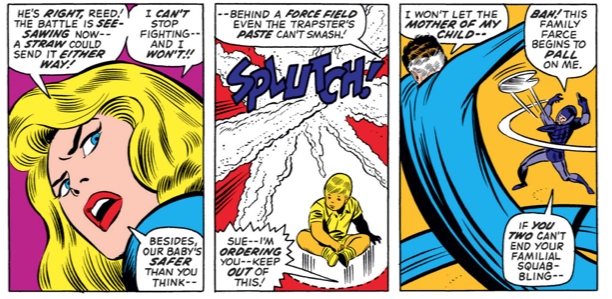
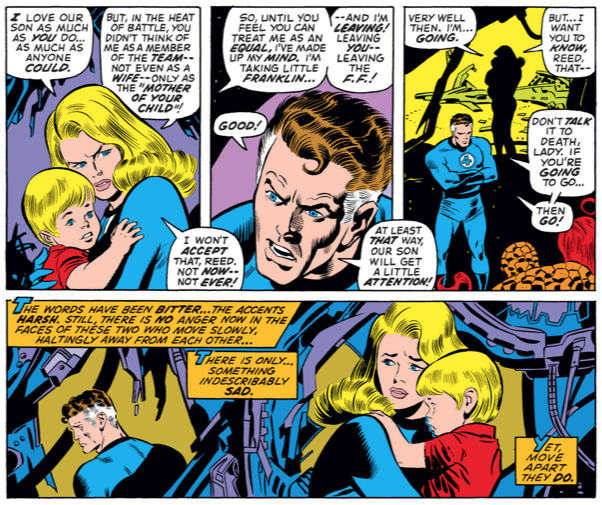
A big—but not the biggest—in-comic event in FF 130 is Sue’s decision to leave the team. This has been brewing for a few issues, and through Thomas’s writing she has voiced her displeasure with Reed and his constant demands that she be sidelined to look after Franklin.
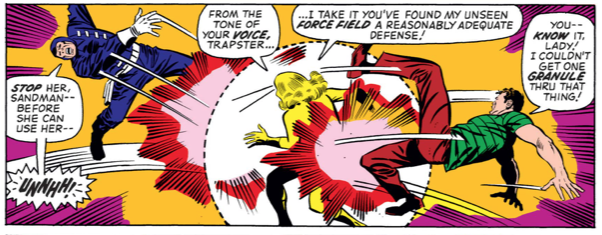
Here, she again raises those objections and he again tries to shut her down:
It finally boils over in the last page, featuring more jerk-like behavior from Reed:
Obviously, this doesn’t stick and she eventually returns. But her departure feels like a significant milestone in the development of Sue’s character, and, perhaps, in Thomas’s repudiation of the status quo he inherited from Stan. Thomas has been writing Reed pretty much the same way Stan and Jack did for a decade, but only under Thomas did Sue finally say, enough.
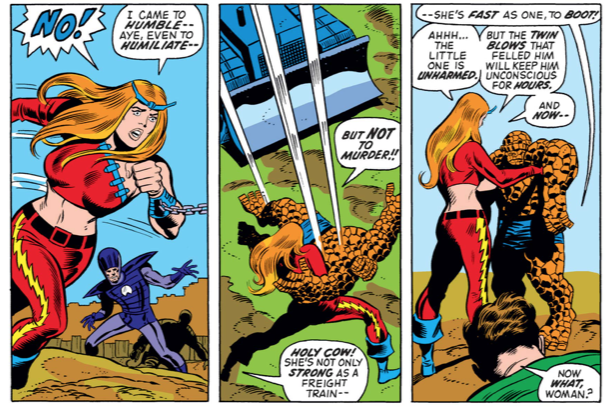
Speaking of gender dynamics, I also liked how Thomas played with cliches and stereotypes through Thundra, the Femizon from another dimension where women dominate men. Here, she picks up Ben like a doll:
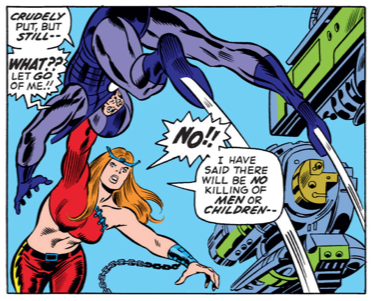
Or here, where she refers to “men and children:”
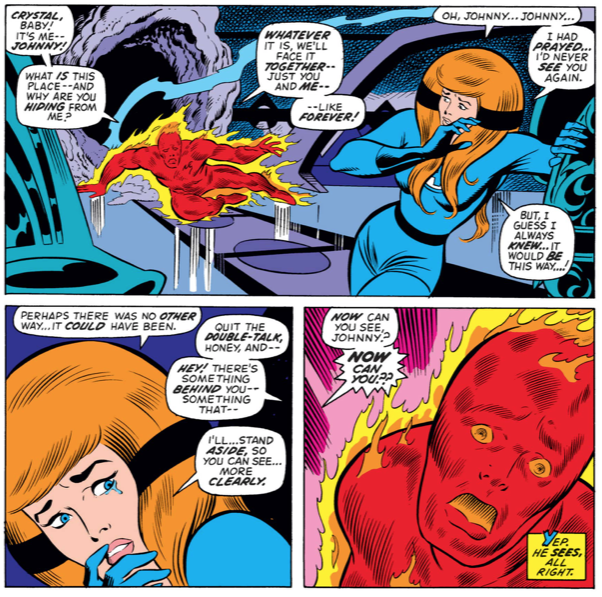
Thomas also created an interesting and suspenseful sidebar with the Human Torch and Crystal. I legitimately have no idea what he sees here (we have to wait until next issue):
The Inhuman subplot is another example of Thomas’s skill as a storyteller. There’s an awful lot going in in the main plot, yet he’s able to jump out and devote a few meaningful pages to the Johnny/Crystal dynamic that builds character and sets up future arcs, all without distracting from the bigger story. Further evidence that the FF is in very good hands.
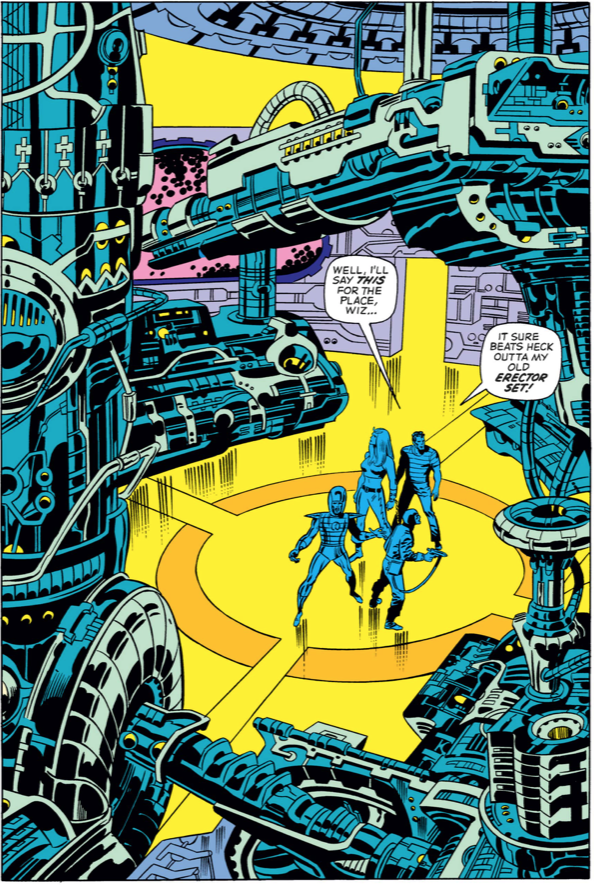
Oh, and I would remiss if I didn’t point out this jaw-dropping splash page from Big John. It doesn’t have a big impact on the plot, but it seems like it’s a fun opportunity for him to flex his Kirby muscles.
What I didn’t like
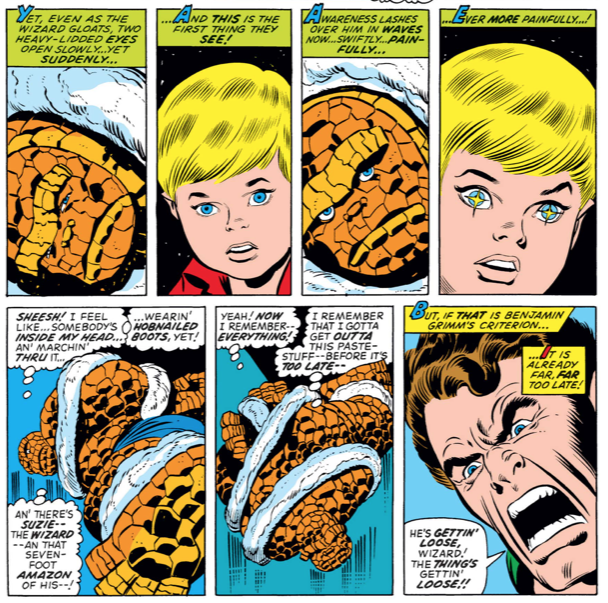
The biggest in-story development in FF 130 is the awakening of Franklin’s powers. Although hinted at a few issues ago, this is the first real manifestation of them.
In the bounds of this issue, it’s fine and I imagine for readers at the time, it must have been pretty cool. But it opened the door for decades of stories about Franklin’s powers that, on the whole, have been unsatisfying, confusing and distracting. No two writers seem to agree what to do with Franklin, and while some have embraced him as a mutant with god-like powers—Jonathan Hickman had him creating whole universes—others would be happier if he was just a kid. Dan Slott depowered him and Ryan North has a goofy retcon that has him using his powers one day a year.
I am sure Thomas didn’t know the can of worms he was opening up here, but the does-he -or doesn’t-he nature of Franklin’s powers been a perennially frustrating aspect of the Fantastic Four
Also, thumbs down for the story title—”Battleground: Baxter Building”—a combination of words which has been used probably a dozen times.
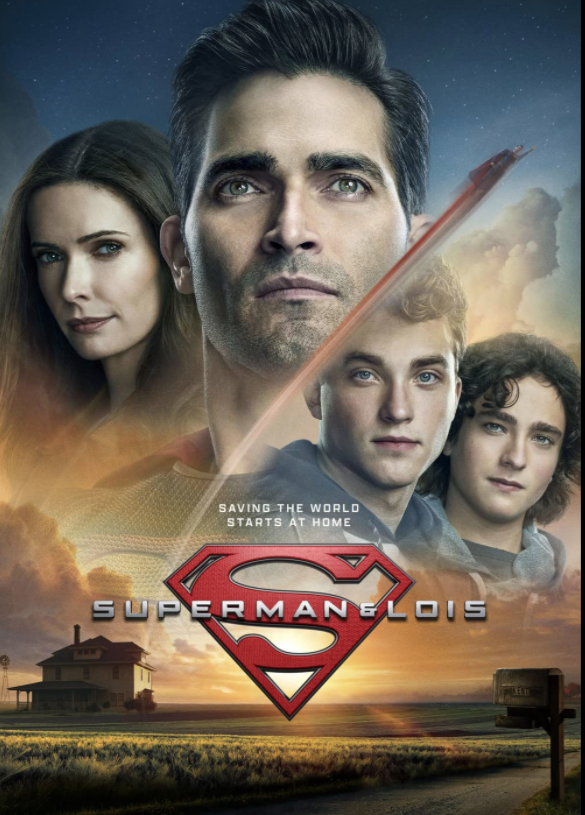
The problem with Superman, most writers discover, is that he’s just too powerful. Unlike human-scaled heroes like Batman and Spider-Man, there are few opponents that can challenge the Man of Steel, and secret-identity hijinks can only go so far. Eventually, storytellers realize the best stories are ones where the conflict isn’t between Superman and a bad guy, but between Superman and Clark Kent. Reconciling the thoroughly decent and very human Clark with the power and responsibility of his god-like alter ego lies at the heart of Superman & Lois, a CW show now available on HBOMax.
In this iteration of Superman, he’s married to Lois Lane and they’re raising twin teenage boys, Jonathan and Jordan. The boys are very different—Jonathan is a jock, Jordan has emotional issues—and a central point of tension is whether he’s available for his family. It’s clear the show will be as much about Clark’s parenting as his world-saving.
I confess the last time I checked in on the Superman comics, about a decade ago, he had an adopted son named Christopher, but this premise works, too. The legend of Superman is so potent that the particular details aren’t all that important so long as the main beats of the characters are there. But this shows gets a lot of the details right, too. Lois (played by Elizabeth Tulloch) is tough, sexy, and whip smart, Lana Lang is still stuck in Smallville, and media mogul Morgan Edge looms as a real-world bad guy. The writers know the source material, and the show succeeds in part because they trust our familiarity with these characters and their world. It’s confident enough to be subtle.
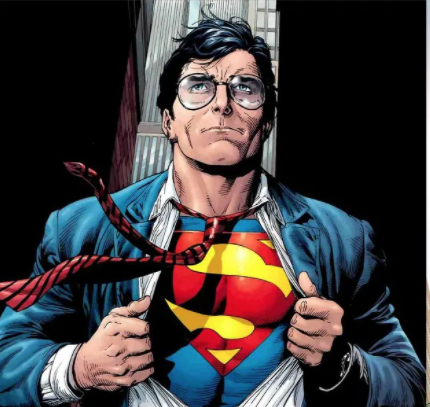
Perhaps most importantly, the show gets Superman, right. As a hero, he’s immensely powerful, but measured. As a dad, he’s visibly struggling. As a reporter, he’s recently unemployed. Tyler Hoechlin’s Superman isn’t as muscled as Henry Cavill’s and his Clark Kent isn’t as awkward as Christopher Reeve’s, but he manages to make both sides of the character convincing. It helps that he resembles Superman as drawn by longtime comic artist Gary Frank: soulful and pensive.
I’ve only seen the pilot, so the show may deteriorate, but it seems unlikely. Even its weaker moments—when the story follows the moody teenage boys doing moody teenage things—are thankfully brief. Tipping too much in that direction risks turning Superman & Lois into Riverdale with kryptonite, but so far it’s balanced with enough action and humor to offset any emo sulkiness.
After watching a few dreary episodes of The Flash and Arrow, I pretty much wrote off the CW’s foray into DC comics. Too much talk, too little respect for the comics that created them. But early on, Superman & Lois seems to get it all right.
Welcome to the inaugural installment of what I’m hoping is a multi-year project to blog the entire run of the Fantastic Four, from its 1961 debut up until the present (assuming it’s still being published however many years in the future that will be).
Why the Fantastic Four? The easy answer is that it’s my favorite comic, but also because it’s steeped in history. The Fantastic Four launched the Silver Age at Marvel, and ushered in the Marvel universe as we know it, the overlapping and self-referencing world of superheroes and characters that, nearly six decades later, now spans tens of thousands of comics. The Marvel comics universe, of course, also gave birth to the Marvel Cinematic Universe, a potent pop-cultural force that has introduced many more millions (billions even) to these characters.
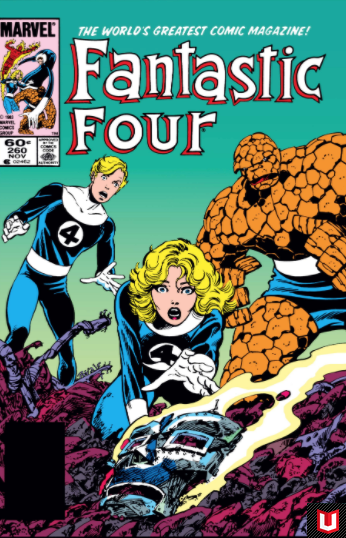
I don’t recall my first exposure to the Fantastic Four—it might have been the either the 1967 or 1978 cartoons—but I clearly remember the first FF comic I bought: issue 260, off of a spinner rack at the Amenia Variety store, near my parent’s house in Dutchess County, New York, in late August of 1983. I had spent the previous months at summer camp, and a fellow camper was Eddie Galton, son of then-Marvel president James Galton. I wasn’t particularly friendly with Eddie (now Edward, and a TV producer) but he had hundreds of comics, and they washed around our bunks. I had read comics before, mostly things like Archie and Richie Rich, but that was my first taste of modern Marvel superheroes and I was hooked (I can’t recall much of what I read that summer, although The Official Handbook to the Marvel Universe No. 11 one was definitely among them. When I got back from camp, I eagerly sought out more, and FF 260 was the first I bought.
In retrospect, you would be hard pressed to find a better single-issue introduction to Marvel comics from that era than FF 260. Written and illustrated by comics maesto John Byrne at the peak of his powers, it featured the FF tussling with their best bad guy, Dr. Doom, and guest appearances from some of prominent supporting characters like the Silver Surfer and Sub-Mariner (more about that issue when we get to it in few years). More importantly, the individual personalities of the team’s members were clearly defined, as was their relationships to each other. This was more than a team, it was a family, and it was clear from the first issue I read.
Ultimately, that dynamic is what keeps me coming back to the Fantastic Four after many decades and creative teams. They’re not a team of superheroes who banded together to fight evil, like the Justice League or Avengers; they were a family of adventurers who became super heroes. Like all families they quarrel and sometimes drift apart, but they are tied together by love and shared history.
A few notes about this project: I hope to cover one issue a week, starting with the first. This is not a new format, and there are many similar blogs tackling lengthy comic book runs (including, probably, the Fantastic Four). I was inspired by The Matt Murdock Chronicles, a sadly defunct issue-by-issue look at Daredevil, and particularly Austin Gorton’s X-aminations X-Men Reviews, a heroic attempt to document every X-Men related comic on the The Real Gentlemen of Leisure blog. If some of the features look familiar, I will confess to having borrowed some of the best elements of from those two blogs. For historic data, I’m relying on Mike’s Amazing World, a great resource.
When possible, I will take note of non-story elements that will be relevant, such as notes from Bullpen Bulletins and the letter’s page, when they appear. Unfortunately, I’m relying on my Marvel Unlimited subscription for early issues, which doesn’t include those elements, so I won’t have them available until we get to the comics I actually own. If nothing else, this exercise should help spur me to fill into the gaps in my collection.
So with all that throat clearing out of the way, here is the one that started it all, Fantastic Four No. 1:
Fantastic Four No. 1 Published: August 1961 Story: Stan Lee and Jack Kirby Pencils: Kirby Script: Lee Inks: George Klein (uncredited) Cover: Kirby and Dick Ayers
Synopsis: A mysterious man sends off a flare, summoning three strangely powered individuals: a woman who can turn invisible, a monstrous brute, and a teenager who bursts into flame. The man who summoned them is revealed to have stretching powers. A quick recap explains their origin: Scientist Reed Richards leads his best friend (Ben Grimm), his girlfriend (Sue Storm), and her younger brother (Johnny Storm) to sneak aboard a rocket for an unauthorized mission to space. Despite Grimm’s misgivings about the unknown effect of cosmic rays, he agrees to pilot the ship after his courage is called into question. In flight, the craft is bombarded by cosmic rays and after a crash landing, their powers manifest. After a brief squabble, they agree to use their powers for good.
Back in the present, Richards informs the rest of the team about atomic plants vanishing underground around the world. He pinpoints the location—Monsters Island!— and the team flies to investigate. After confronting a three-headed flying monster, Reed and Johnny are separated from Ben and Sue, tumble beneath the earth and meet the Mole Man, a misshapen man driven underground by a a cruel world. A fight ensues, Ben and Sue eventually catch up and Johnny blazes a path out of the cavern, sealing the Mole Man and his monsters beneath. An apparent nuclear explosion destroys the island as the team flies off.
What’s this all about?
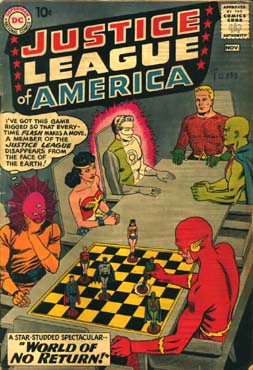
The Fantastic Four was born from a mix of influences. The genesis was a business decision: Magazine and comic publisher Martin Goodman wanted a comic that could compete with the Justice League of America, a super hero team-up book launched a year earlier by National Comics Publication, a precursor to DC. Goodman directed Stan Lee, his editor, to come up with something, and Lee recruited artist Jack Kirby, then newly arrived at what would become Marvel. Who actually contributed what to the origin is still debated, but it’s clear both Lee and Kirby played a role.
The use of space travel and cosmic rays as an origin device is very much of its time: Sputnik had launched four years earlier, and Yuri Gargarin became the first man in space in April of 1961. Space was on everyone’s minds, particularly the teenage boys the comics was targeting. The specter of communism is also present, as Sue warns that “the commies” could beat the team into space (and of course, they had).
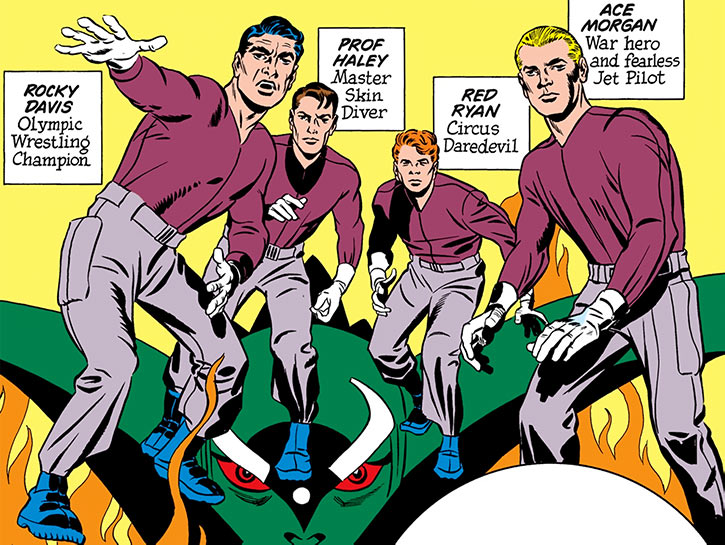
Unlike the Justice League, which was an assembled group of existing heroes with their own origins and costumes, the Fantastic Four was created together. Their origin and uniformed appearance is very similar to that of the Challengers of the Unknown, a team Kirby created in 1958 while at National (you can read more about that here).
It’s also worth noting that the powers acquired by the team aren’t particularly unique. Invisibility is a well-established power dating to H.G. Wells’ TheInvisible Man (at least), a man who changes into a hulking monster draws from Beauty and the Beast and Dr. Jekyll and Mr. Hyde (and many others), Plastic Man was a stretching character dating from 1941, and not only did Marvel itself have a character who could burst into flames in the 1940s, but he was also called the Human Torch. At one point Stan Lee said he was riffing off of the four elements when he assigned the team their powers:air (Sue), water (Reed), earth (Ben) and fire (Johnny).
About that origin
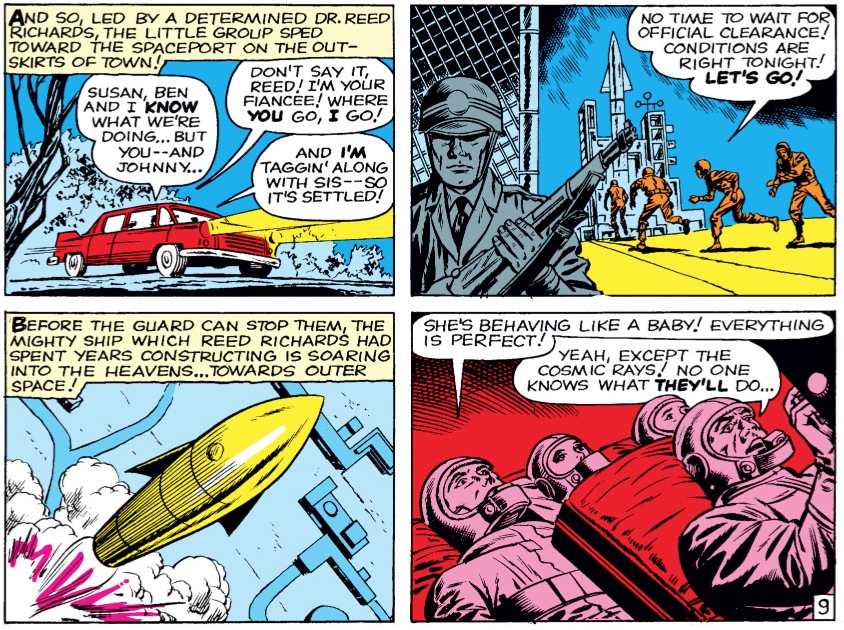
The five short pages of origin are among the most scrutinized texts in comics. Over the years the story has been expanded and retconned, often in an attempt to address some of the story’s central mysteries: Why would Reed, allegedly one of earth’s smartest men, risk exposure to the cosmic rays that even Ben knew were a risk? Why would he take along not just his fiancee but her teenage brother? Why would he sneak aboard his own ship in the middle of the night? The in-story explanation is that Reed doesn’t have time to wait for official clearances because “conditions are right tonight,” and that Sue and Johnny insist on accompanying Reed and Ben.
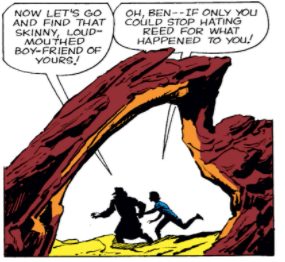
Ben’s resentment at Reed for his disfiguration and Reed’s guilt and attempts to cure Ben have fueled dozens of stories and remain a potent thematic element of the Fantastic Four through the present. In one of the recent retellings, by Dan Slott in Point of Origin, the space ship was adequately protected from ordinary cosmic rays but the ship was subjected to a barrage of the rays from the alien planet Spyre, the team’s original destination (no actual destination was given in the first issue).
Ben’s long-simmering resentment at Reed is hinted at early on:
So who are these guys:
The first issue lays the template for hundreds of stories to come, and by-and-large the basic characters are established from the beginning, and while their appearances and powers change, the essential notes of their personalities will remain in place for years.
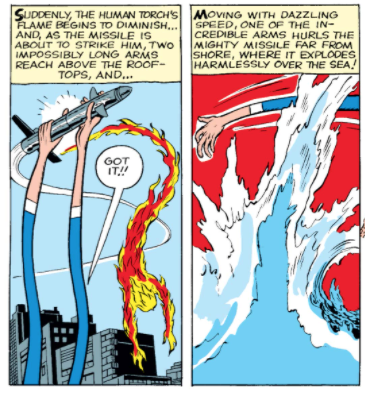
Reed, appearing with his pipe and hair that is going white at the sides, is basically the same confident, aloof professorial Reed we’ve known for decades. He is a bit overpowered in this first issue, at one point grabbing a nuclear missile aimed at Johnny out of the air and throwing it into the Atlantic (why the National Guard thinks firing a nuclear weapon over New York was prudent goes unaddressed).
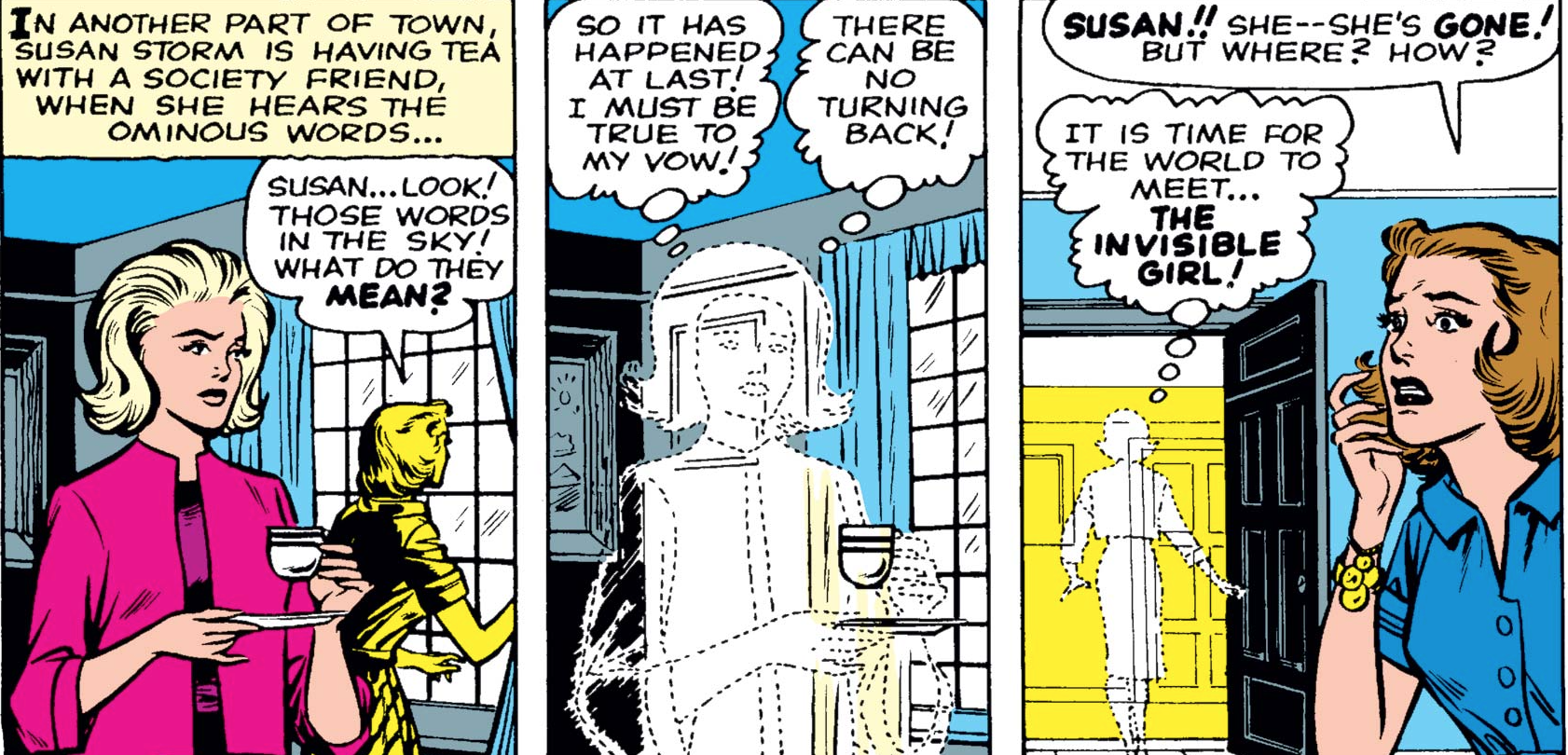
The basic character beats of Sue that persist for years are also established: She’s demure and dainty, supportive of Reed to a fault. Her power at this point remains invisibility, a metaphor for her vanishing personality, until issue 22, when she gains the ability to create force fields. It wasn’t until the 1980s and under John Byrne that those force fields are depicted as offensive weapons, and she eventually she is described as the team’s most powerful member.
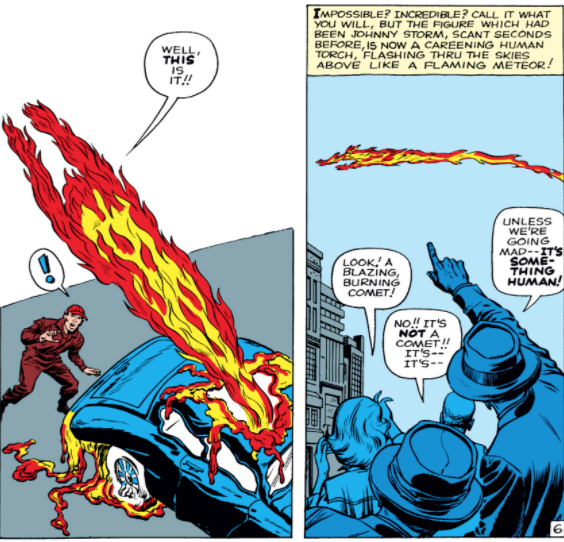
Johnny is a hot-headed teen (metaphor alert!) who is crazy about cars, a long-lasting element of his character. In his first appearances he resembles an actual flame, not the red man surrounded by flames he later becomes.
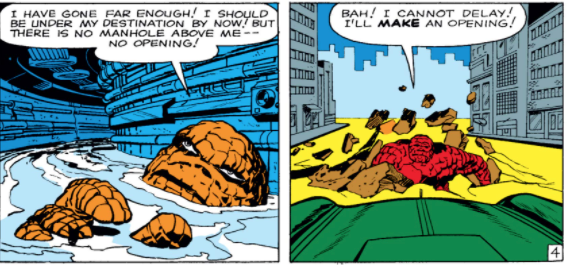
The Thing is the character whose initial appearance is most unfamiliar to modern readers. It’s not just his monstrous form, which transforms into the orange rocky one gradually over the next dozen issues (apparently Kirby found that version easier to draw) but his personality undergoes a major shift. His diction in this issue is more formal and archaic (at several points he says “bah!) and has none of the dropped g’s and colloquialisms that become his trademark. Nor does he have the sense of humor that helps define the character.
The Mole Man (here referred to as the Moleman) also debuts, and becomes a recurring villain. Although classically Silver Aged in his world-dominating ambitions, he’s given a sympathetic backstory and thus becomes a more nuanced character. Plus, he’s got some sweet moves:
The more things change
Some elements, however, will remain with the book for years. For example, they’re fighting with each other from the get go:
In what becomes a long sexist tradition, Sue stand back and reacts while the men take action:
And Kirby delivers some knockout art:
For sale
A mint condition (9.8) FF No. 1 will set you back $4.6 million
About that cover
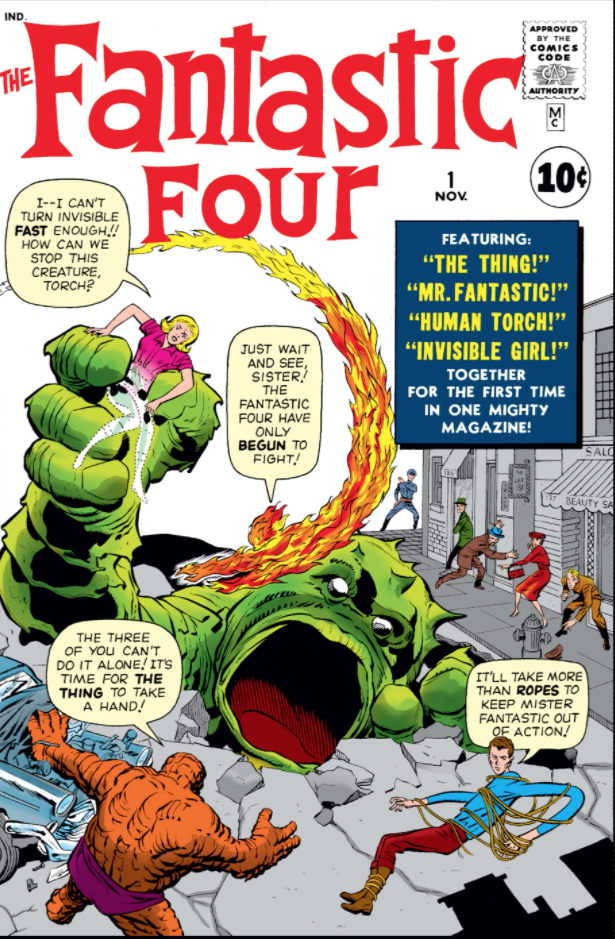
Fantastic Four 1 is one of the most copied, parodied or homaged covers in comics. It’s delightfully silly, and has nothing to do with the interior (who put those ropes around Mr. Fantastic, anyway?) It’s notable for a few other reasons, as well. The logo, with those groovy sixties letters, will be one of the the most enduring in comics, and while Marvel will occasionally swap it out for a more modern look, it often returns. Instead of Marvel’s logo, there is a tiny “MC” in a box under the Comic’s Code Authority seal. And the blurb introducing the team promises that they’re “together for the first time,” implying this is uniting a group of individual characters, like the Justice League.
Here are some other versions of the cover (it should be said Byrne in particular loved referencing it):
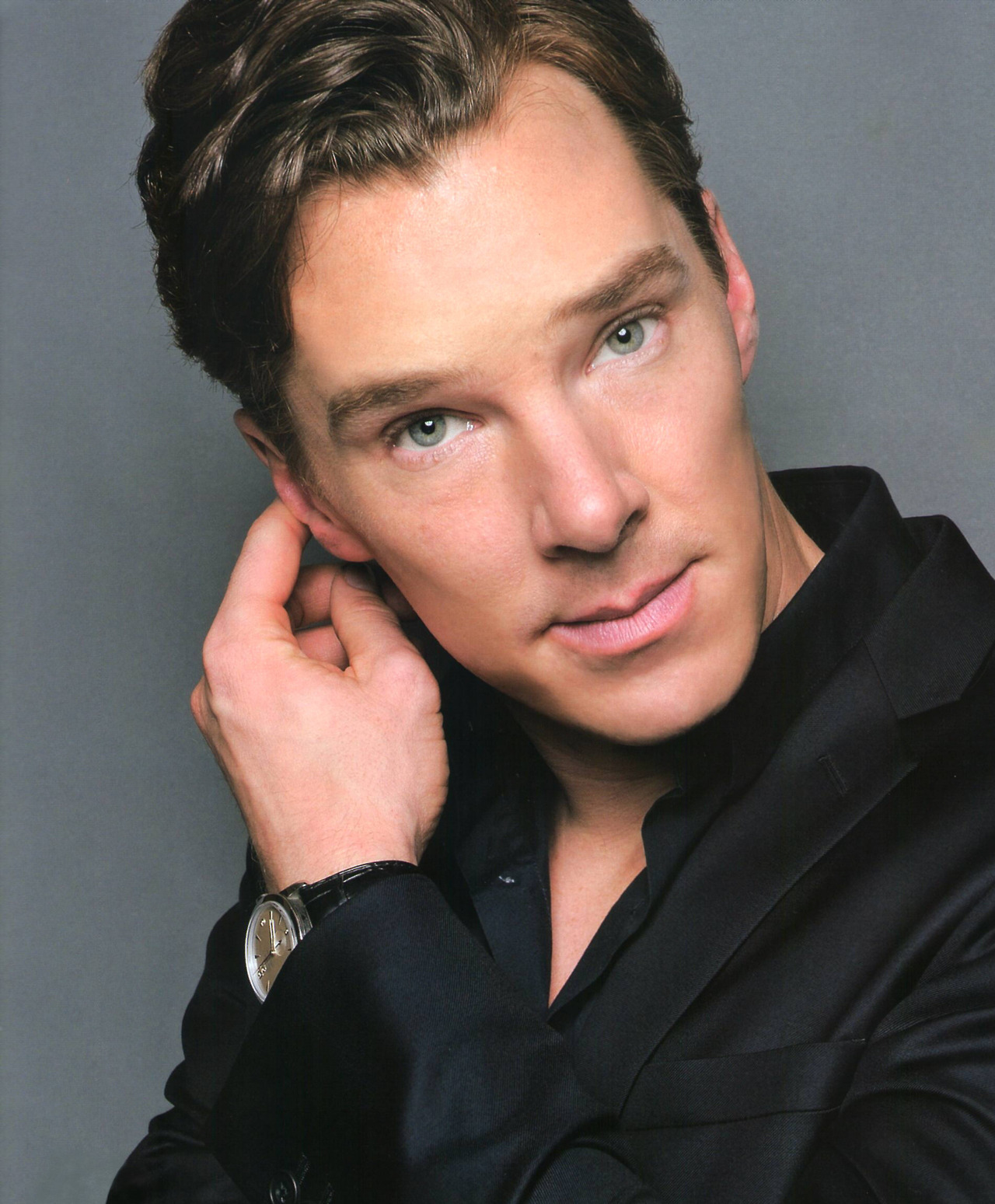
Marvel has announced it cast Benedict Cumberbatch to play Dr. Strange in an upcoming movie. I don’t have a problem with it – I would have preferred Clive Owen, but he’s probably past his sell-by date to carry a blockbuster – and Cumberbatch certainly can do arrogant, which is a big part of Strange’s character.
A lot of other people do seem to have a problem with it, at least judging from the comment sections on various fan sites. There are quibbles about Cumberbatch’s acting style and general ubiquity, but the strongest objections are to his being yet another white guy playing the lead in a super hero movie. Here’s a typical comment on the Marvel website:
Ah, yes, because Marvel needed MORE franchises headed by white males.
Another:
wanna see the number of lineups for diversity in the superhero roster in MCU movies?White Men: 9 (Cap, Iron Man, Hulk, Hawkeye, Thor, Peter Quill, Drax (kinda he’s half Filipino), ant-man, now DOCTOR STRANGE) White Women: 2 (Black widow, Captain Marvel)Men of color: 2 Black panther, ??Falcon?? (he IS a superhero in comics but in MCU he hasnt had his own movie OR been inducted into an official superhero group yet)Women of color: 1 (Gamora)Misc: 2 (Groot, Rocket Raccoon)so with the addition of cumberface, 9 male white superhero leads, 2 white women superheroes, 2 black male superheroes, 1 green female superhero (played by a black actress), and 1 animal and 2 tree
(The above isn’t actually accurate, as it omits Nick Fury)
This is fraught territory, and sucks in race, politics, identity, and the history of both comic books and movies. The flap over casting Cumberbatch for Strange adds a new wrinkle in the debate over the races of actors. It’s not new – I remember controversy over casting the white Jonathan Pryce as a Eurasian pimp in Miss Saigon – but it’s picked up steam in the age of the superhero flick as black actors were cast as white characters (or characters believed to be white). Samuel L. Jackson as Nick Fury, Idris Elba as Heimdall (a Norse God in Thor) and even Amandla Stenberg as Rue in the Hunger Games all provoked storms of mini-outrage. This, however, is the first example I can think of where people are upset by a black actor NOT being cast for a white character.
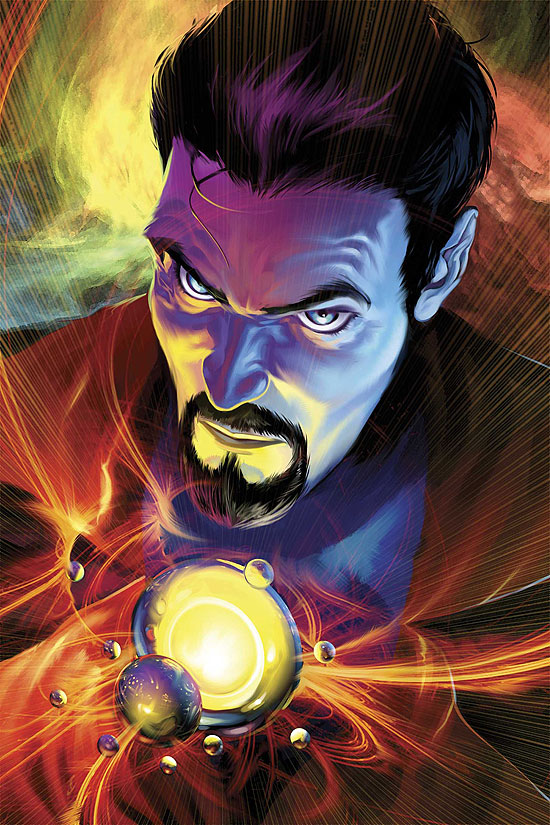
For those who live outside the nerd bubble, Stephen Strange was an asshole surgeon who lost the use of his hands in a car wreck. Desperate to find a cure, he seeks out the Ancient One, a Tibetan mystic, who teaches him the art of magic, and Strange becomes the Sorcerer Supreme, Earth’s preeminent wizard.
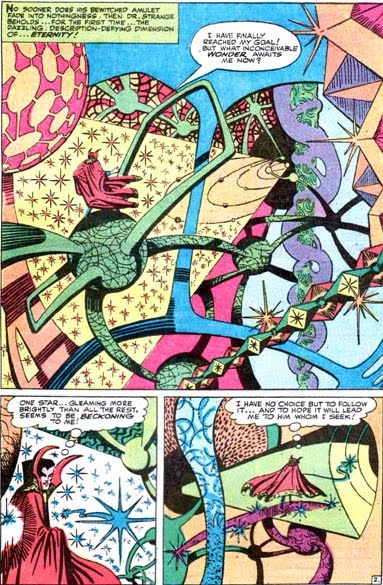
Dr. Strange first appeared in 1963, in a backup story in Strange Tales No. 110, and was created by Stan Lee, who had a hand in almost every Marvel character, and the great artist Steve Ditko, more famous for his work on Spider-Man. Dr. Strange stories were trippy excursions into alternate dimensions and universes, involving ancient artifacts like the Wand of Wattoomb, and epic battles with the Dread Dormammu and Baron Mordo.
Like virtually every character from that era, Strange was white. At least he was drawn as a white man, and while I’m not aware of any explicit discussion of his whiteness, Marvel was not subtle when it came to depicting minorities. If he was intended to be anything other than white, we would have known.
But does he need to be white in the movie? Actually, no. Unlike a number of characters whose racial identity is important to our understanding of them – ie., they come from Africa, they are part of a family of super heroes, they are masters of Kung Fu – Dr. Strange’s ethnicity isn’t tied down. He’s not really from anyplace in particular, and he has few connections to the rest of the world. It’s not hard to picture a rich black surgeon with the same issues as Stephen Strange (Eriq La Salle played one for years). Casting a non-white actor would change our perception of him, but not the character.
So should Marvel have cast an actor of color? That’s the trickier question. Marvel and DC have gotten better about creating minority characters but there’s no denying that during the Golden and Silver Ages (roughly, from 1938 to 1970) the most prominent superheroes and villains were white, and they remain the tent pole characters for those companies. They didn’t accurately represent America or the world then, and they don’t now. While undoing the 50 or 70 year history of characters in the comics to correct the imbalance is problematic at best (and offensive at worst), one could argue casting the movies offers a chance for a fresh start.
That argument makes more sense if you approach these characters as primarily a movie goer, with little familiarity of the characters. Dr. Strange is, at best, a second tier hero – he didn’t have his own title for years at a time – and it’s a fair bet the general public has no idea who he is. For them, a black Dr. Strange wouldn’t be as challenging as, say, a black Batman. For Dr. Strange fans, though, undoing a key part of the character’s visual identity would be a lot harder to accept. They’ve followed him faithfully since 1963. Now, when he’s finally getting a movie, they’re told a big part of his appearance is being changed to accommodate a movie-going public that has no investment in the character.
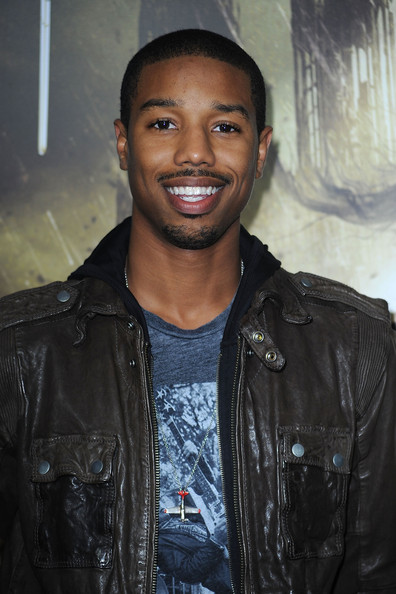
We will be faced with an extreme version of this problem with the casting of the black Michael J. Jordan as Johnny Storm, the Human Torch, in next year’s Fantastic Four. Unlike Strange, the Human Torch doesn’t exist in isolation. The Fantastic Four is a family. His sister is Susan Storm, the Invisible Woman. Tinkering with their races opens up issues so fundamental to the team that it risks invalidating the whole project (Marvel has experience with this: in the 1978 cartoon, it replaced Johnny with H.E.R.B.I.E the Robot) .
To avoid an all-white cinematic super hero universe, it makes sense to cast actors of colors in roles where the characters are less established, and their racial identity is not critical. More importantly, Marvel and Warner Brothers (owner of DC) should identify their existing black characters and develop them into the anchors of potential movies. To an extent, that’s happening, with Black Panther and Cyborg movies planned.
The easiest solution, of course, is to ignore race altogether. The comics have dozens of red androids, green aliens and blue-furred mutants eager for their star turn. Let the debate over casting Red Tornado begin.
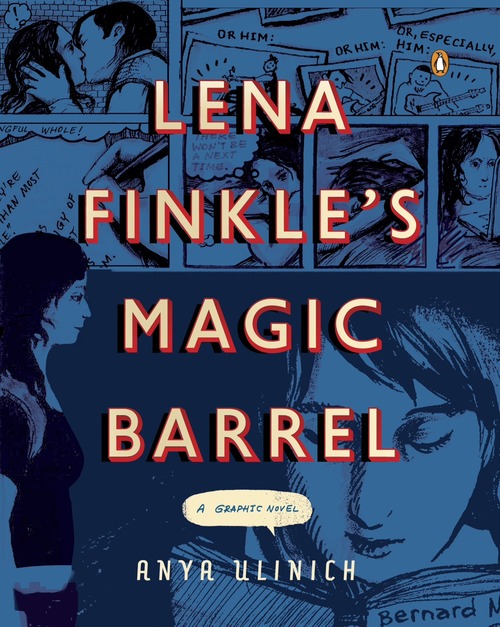
My wife and I are friends with Anya Ulinich, and she sent us an advance copy of her new book a few months ago. At the time, I thought I would hold off writing about until it was published, to, you know, help with that critical marketing push. But in the last few weeks Anya’s book received rave reviews in the Los Angeles Times and New York Times, making my meager contribution less than necessary. To save time, I’ll stipulate that I agree with those reviews: it’s a sharp, clever take on life and love in our confusing times, told from Anya’s unique, divorced-Russian-mother-emigre-in-Brooklyn-by-way-of-Phoenix perspective.
Anya’s book isn’t just a novel, though, it’s a graphic novel, and while the some reviews* treat the art as secondary, it’s not; it’s essential to the story. So if I can add anything to the discussion, it’s as a longtime reader of graphic novels (ie. comic books) who understands that art can work with writing to tell a different sort of story.
Anya comes into graphic novels from an interesting direction: she trained in fine arts (studying with my wife at UC Davis), then wrote a traditional novel (Petropolis) in 2008, before combining the disciplines in “Lena Finkle’s Magic Barrel.” The resulting synthesis is unlike anything I’ve seen before. I don’t know what Anya’s exposure to graphic novels was before she started hers – perhaps none – but she’s clearly at home in the genre, and is happy to play with the form in fun and interesting ways.
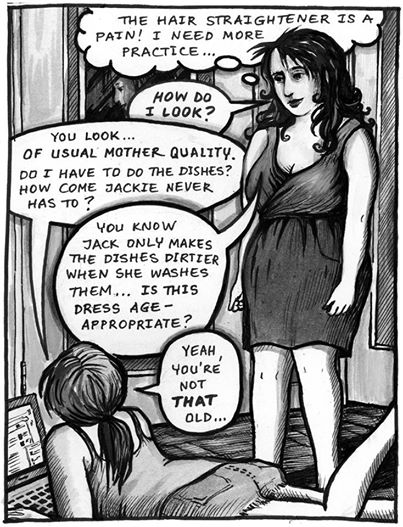
There’s a mix of styles and techniques in “Lena Finkle”, used for different purposes throughout the story. The most frequent is a straightforward, semi-realistic illustration that propels the plot:
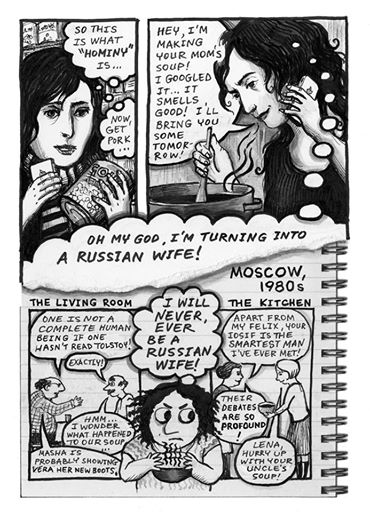
But for flashbacks to her girlhood in Russia, she deploys a cartoony style:
Sometimes the two combine, when Anya’s inner voice appears as a frizzy-haired avatar to mock her, an ingenious representation of her self doubt.
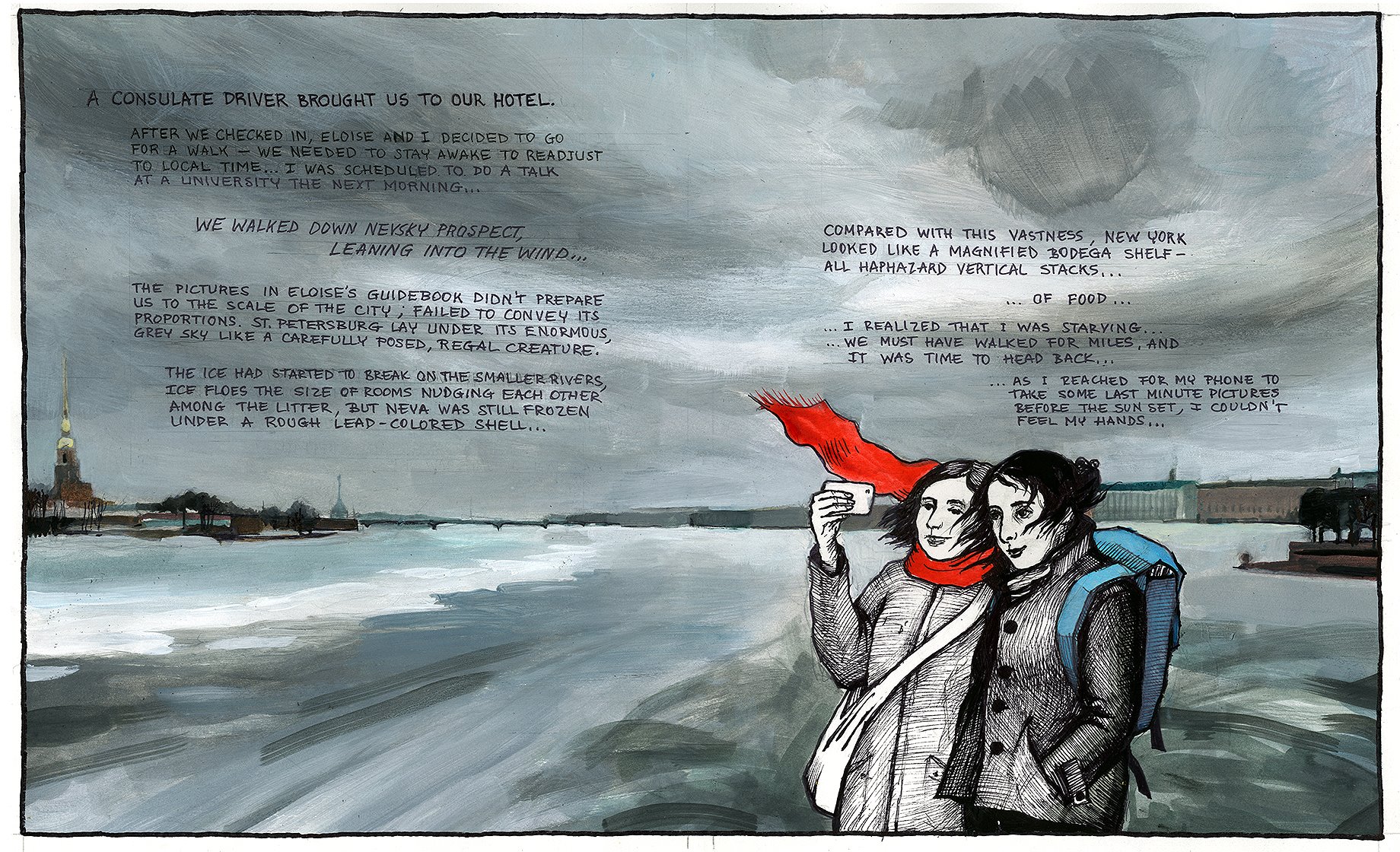
Anya also paints gorgeous, atmospheric images, like this one of St. Petersburg (the color here isn’t in the actual book):
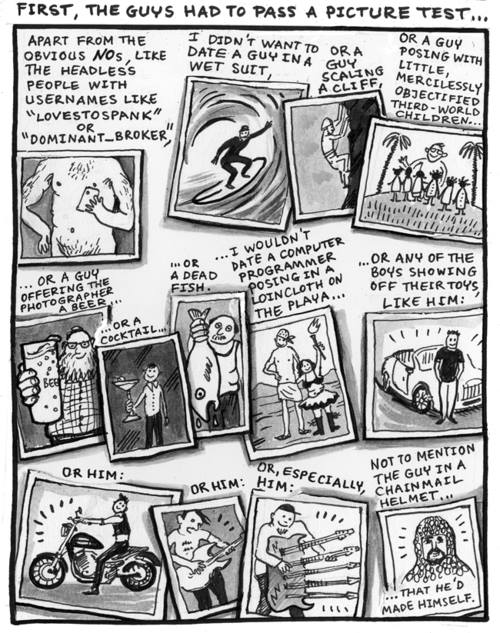
At its best, “Lena” takes full advantage of the opportunities offered by illustration. In journalism, we say “show, don’t tell,” an injunction to breath life into stories with color and detail, and that’s literally possible in a graphic novel. In one great double-page spread, she diagrams the various cliques and social groupings of Arizona State University undergraduates. And here, she gives a run down of potential dates whose online images make them non-starters:
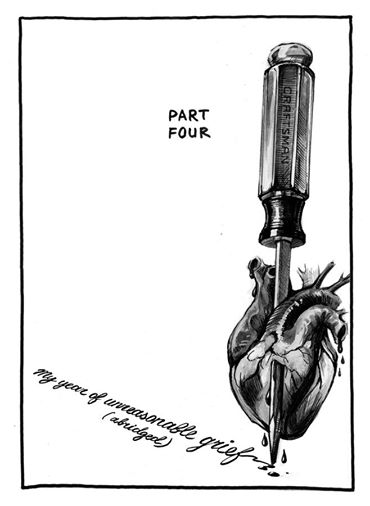
Among Anya’s strengths as an illustrator is knowing when and how to employ her various styles, dialing up and down the realism-to-cartoony meter as the story moves from humor to pathos and back. She’s also a gifted artist, as demonstrated by this chapter introduction:
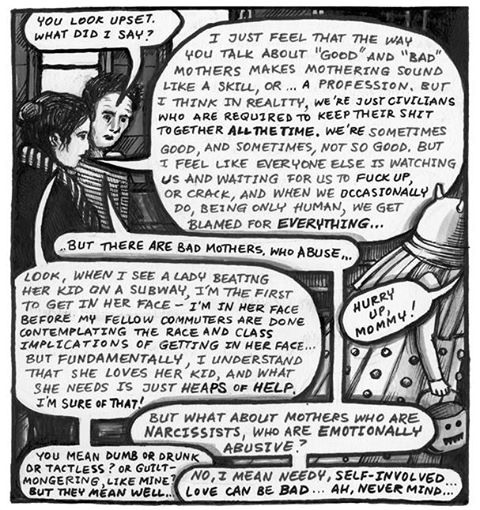
If “Lena Finkle” has a weakness, Anya the Writer can overpower Anya the Illustrator, and at times her text crowds out her art:
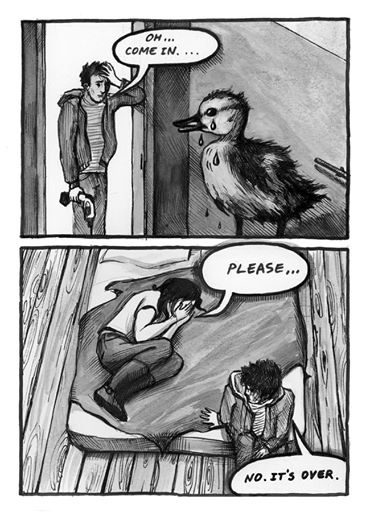
There’s a denseness to Lena’s neurotic introspection that’s part of the character, and her merciless examination of her life and choices give the book it’s honesty. But the story comes most alive when she gives her art room to breath. The strongest sequence comes at the book’s emotional climax, where Lena is trying (and failing) to understand why she was dumped. Anya draws her as a duckling, in a series of repeating images that captures the despair of the heartbroken. In a novel, Lena-as-duckling is a metaphor. In a graphic novel, Lena can become an actual duckling, literally helpless, a device that shows Anya’s creative embrace of the medium.
“Lena Finkle” is in black and white, which is unfortunate, because I suspect Anya would use color in smart and powerful ways. But that’s a quibble. The art soars in black and white, carrying the book with it. I’m eager to see what Anya does next.
*I fixed this after my wife pointed out a number of reviewers did write about the art. I was generalizing. My bad.
Books completed this year
1, The Man in the High Castle (Dick) 2, Disgrace (Coetzee) 3, The Finkler Question (Jacobson) 4, The Moon is a Harsh Mistress (Heinlein) 5, Beautiful Ruins (Walter) 6, Petropolis (Ulinich) 7, The Caves of Steel (Asimov) 9, Winter in the Blood (Welch) 10, Lena Finkle’s Magic Barrel (Ulinich) 11, The Strange Case of Dr Jekyll and Mr Hyde (Stevenson) 12, Moby-Dick (Melville) 13, The Road (Cormac McCarthy)
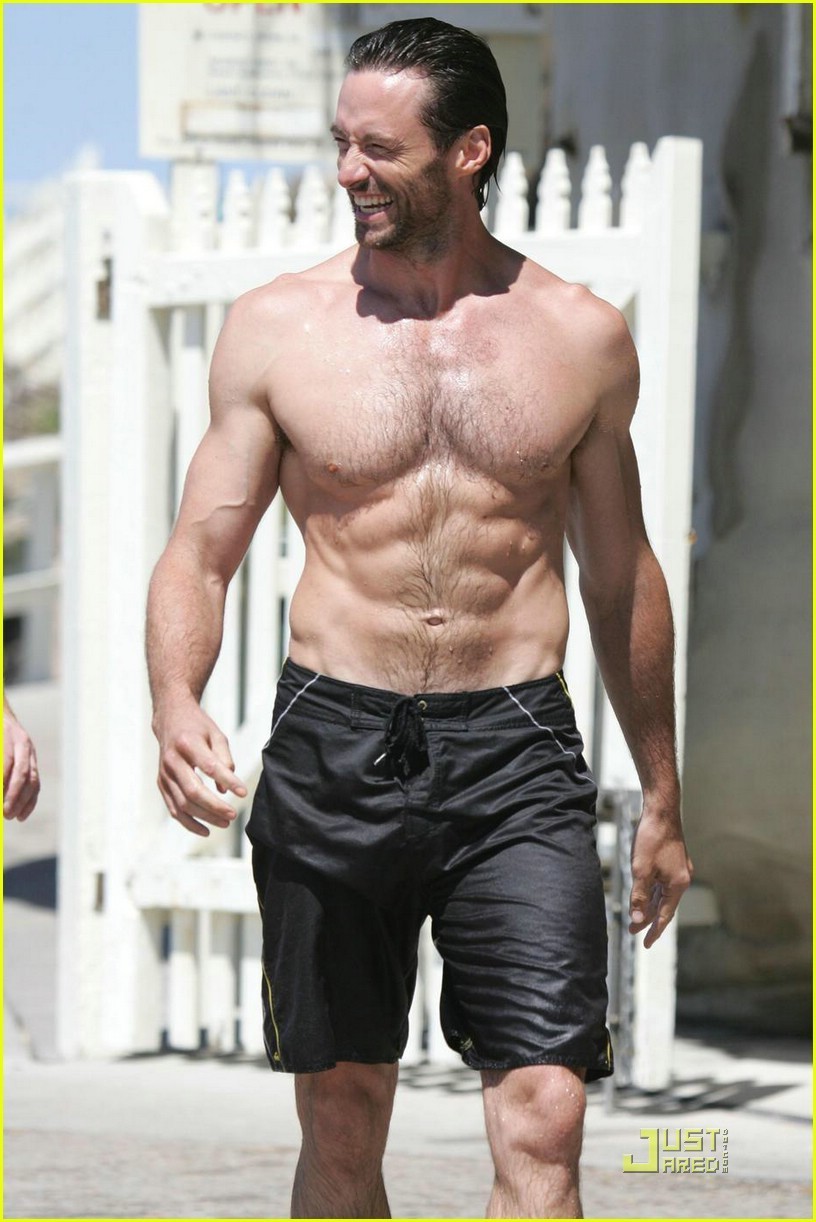
The thought occurred to me after watching The Wolverine the other night with my wife that Hugh Jackman probably took steroids for that role. The guy is a 45-year-old actor and he looks like this:
He may be a fitness fanatic, but I suspect to get in shape, and stay in shape, he’s aided by chemistry. And so long as he’s taking them under the supervision of a doctor, that’s fine. Steroids are used in a medical context all the time. We only get bent out of shape about them in sports, when we feel they are being used to create an unfair advantage. (Some people argue that the full legalization of steroids in sports would recreate a level playing field. It might, but it would also distort comparisons with athletes from the past.) We also don’t like it when kids take them, because of health concerns. I have no ethical issue with an actor taking steroids to prepare for a role; there’s no competition at stake here, besides with the egos of other 40-something males, and no party is injured.
But should steroids only be for actors? If they can be taken safely and legally, should others in professions that rely on strength – and where the artificial rules of competition are not enforced – be taking them? Do we want our fireman and soldiers to be as strong as possible, to fulfill their missions? Probably. How about sanitation workers? Would a regimen of safe steroids enhance garbage collection?
And that took me back to Wolverine. In the fictional comic book universe, would super heroes with only normal human strength be on steroids? If you accept the premise that their heroics are protecting lives and saving the world , then shouldn’t they maximize their strength by any (safe) means possible? Maybe some characters would shun them on moral grounds, but even Captain America, that pillar of rectitude, was created by vita-rays, a 1940s version of steroids. I’m guessing characters like Batman and Wolverine, who look for every other advantage, would quite naturally be on the juice.