Fantastic Four 10
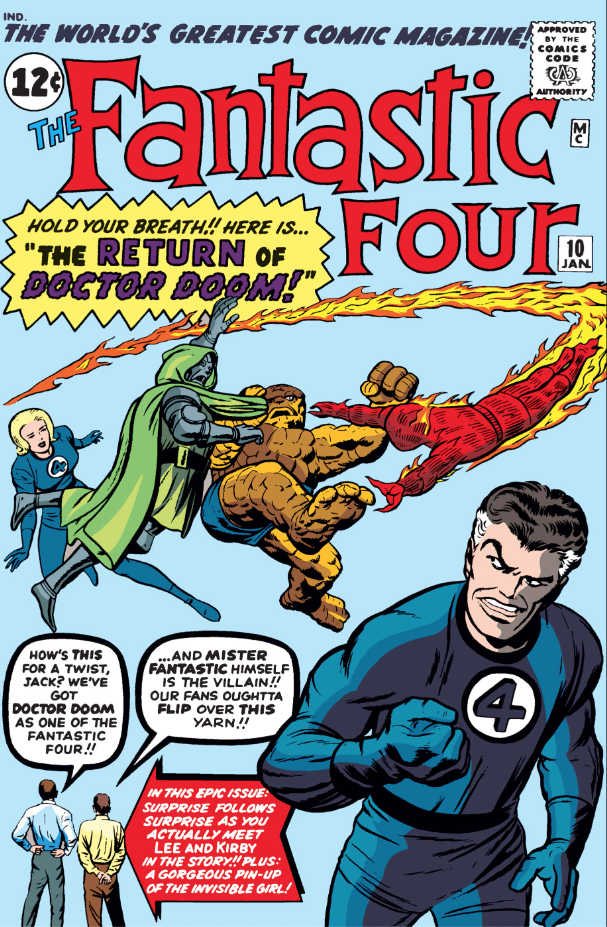
“The Return of Doctor Doom”
Published: October 1962
Plot: Stan Lee and Jack Kirby
Script: Lee
Pencils: Kirby
Inks: Dick Ayers
Cover: Kirby and Ayers
Synopsis
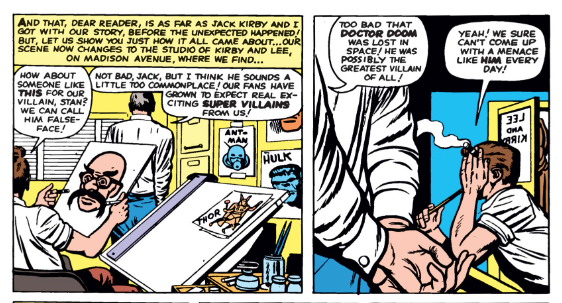
A meandering start to the comic is revealed to be a case of writer’s block from creators Stan Lee and Jack Kirby, who are plotting the issue only to be interrupted by Dr. Doom. Doom, last seen lost in space, was rescued by an the Ovoids, an alien race that taught him to the ability of transferring his mind into another body. They returned him to earth, and Doom demands Lee summon Reed Richards so that Doom can capture him and switch minds.
As planned, the rest of the FF arrive to rescue Reed, who unbeknowst to them is in the body of Doom. Doom, in the body of Reed, emprisons Reed and convinces the rest of the team to undergo a shrinking process he says will make them more powerful, but will actually reduce them to nothingness. Reed escapes and before the team undergoes the shrinking process, Johnny uses his powers to create a mirage of dynamite. While Reed (as Doom) tries to prevent it from exploding, Doom (as Reed) flees, each revealing their true nature. Confronted, a distracted Doom lets his mental power slip and he and Reed switch bodies again, returning to their true selves. As Doom tries to escape, he accidentally triggers the shrinking ray, which renders him microscopic.
What’s going on here?
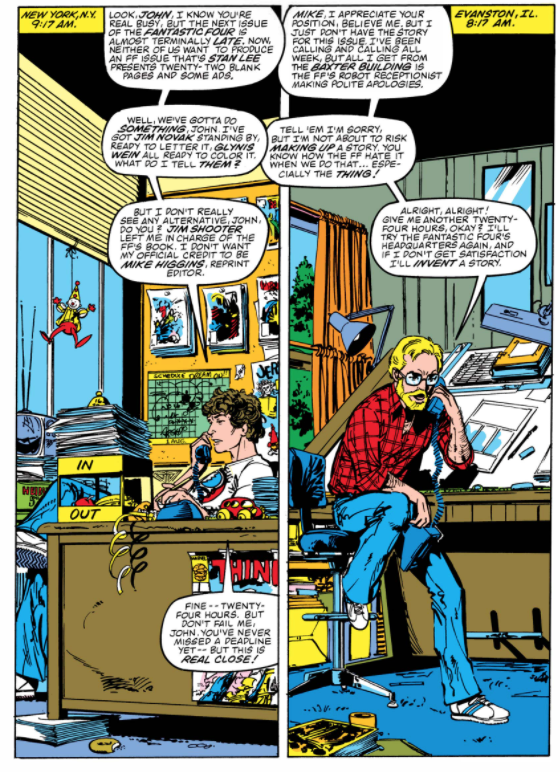
Aside from the return of Doom, this convoluted story is notable for the extremely meta insertion of the creators of the comic into the comic itself. Prior to this issue, members of the FF referred to comics, and Johnny read an issue of the Hulk, but this is the first indication that there is an in-universe Fantastic Four comic that recounts their adventures. We also learn the team is actively involved in telling their own stories to Stan and Jack, who appear in the comic (and on the cover!) but without ever revealing their faces
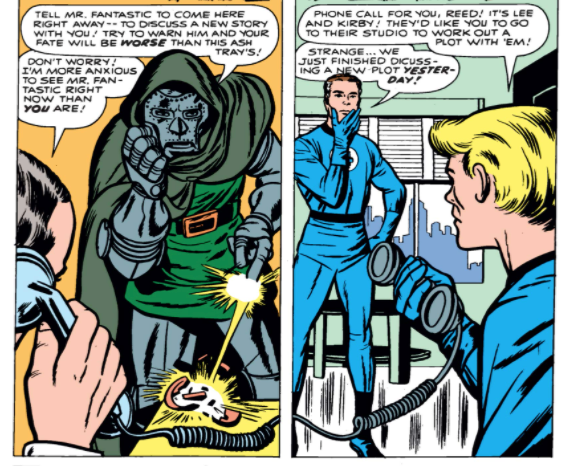
The conceit returns on occasion, often as a comedic device but occasionally in more serious stories, such as Fantastic Four 261, where author John Byrne is summoned into space to witness the trial of Reed Richards. The likelihood of a comic creator inserting him or herself into a story seems directly correlated to the size of the creator’s ego. (This device is similar but different from the fourth-wall breaking of comics like She-Hulk, Deadpool, and Animal Man, where the characters understand they are in a comic, and address the reader or creator directly).
The old switcheroo
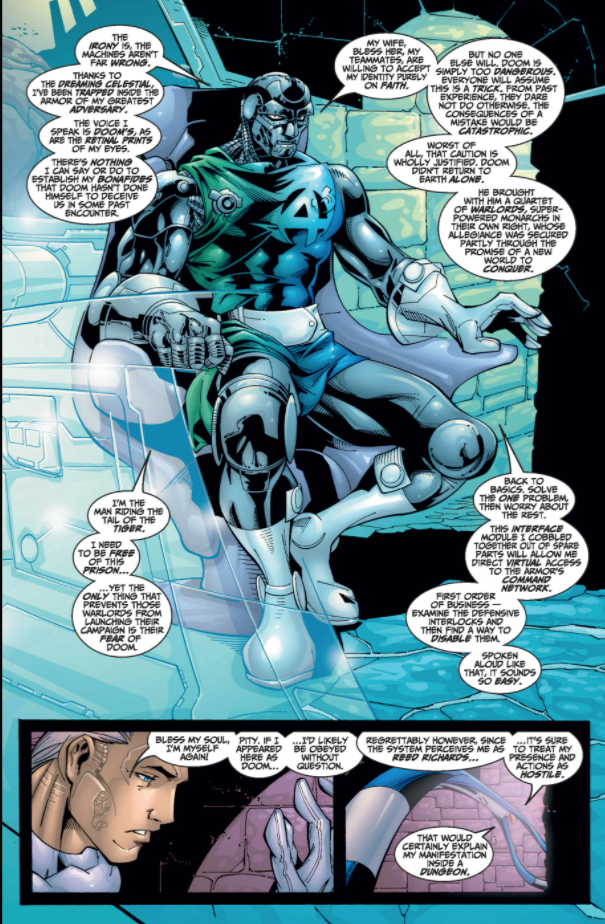
The story also is the first instance of Doom switching bodies with someone else, a power he manifests over the decades, although I don’t recall the Ovoids being mentioned again. He switches bodies with Reed at least one more time I’m aware of, in an arc written by Chris Claremont around the year 2000. In that story, the switch is performed by a Celestial, not Doom himself.
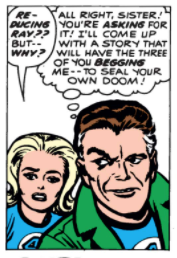
Back in issue 10, Doom (as Reed) talks more like a 30s gangster than the monarch of an Eastern European country.
Trapped!
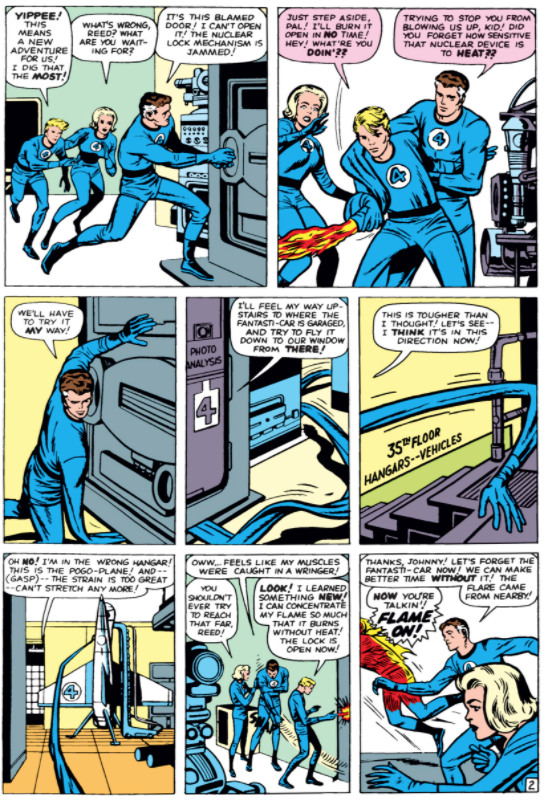
In one of the story’s odder moments, Reed, Sue, and Johnny are stuck in Reed’s lab because the “nuclear lock mechanism” is jammed. It’s yet another reminder of how atomic power is sprinkled liberally across these stories. And while the trio spend a page being trapped, it doesn’t advance the story in any way, save to show that Stan and Jack are spinning their wheels.
Weird science
Doom, as Reed, comes up with a pseudo-scientific explanation of why the rest of the team should subject themselves to his shrinking ray (he later concedes it’s bullshit and that Reed would never have fallen for it).
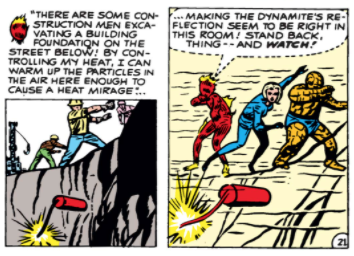
Later, Johnny uses his powers to create a mirage of a stick of dynamite so real both Reed and Doom fall for it.
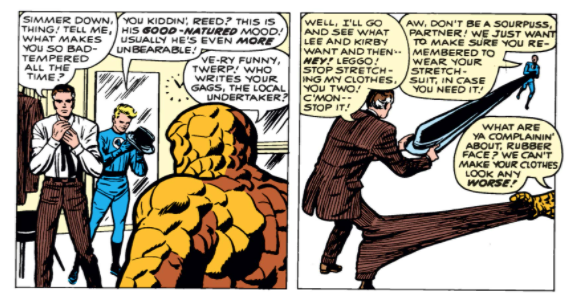
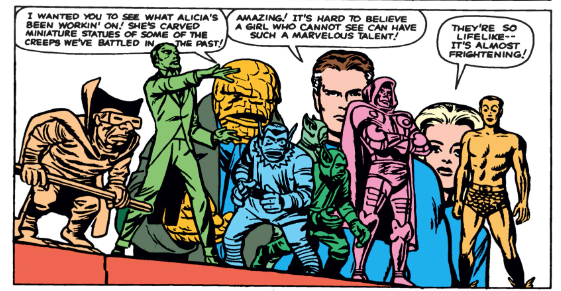
We get a demonstration of unstable molecules at work in Reed’s suit and hat.
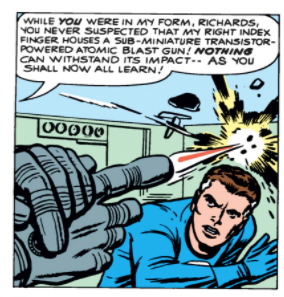
And Doom invokes nuclear power again as he fires the “sub-miniature transistor powered atomic blast gun” housed in the index finger of his armor (this weapon reappears, but never with such an awesome name).
They’re fighting again
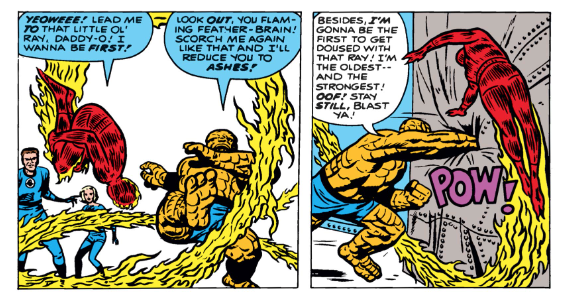
Kirby Krackle
A cool panel here from Jack
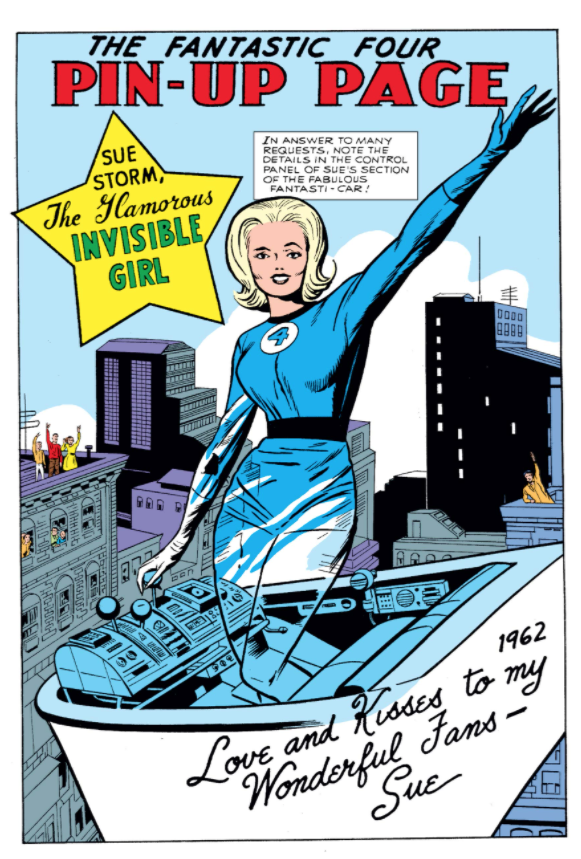
Pin up
The “glamorous Invisible Girl” gets a pin up that shows the controls of the Fantasticar (apparently by popular demand).
For sale
A mint (9.8) version of Fantastic Four 10 is worth about $25,000.
Next issue: The first appearance of the Impossible Man


Pingback: “The World’s Greatest Comic Magazine” Fantastic Four No. 16 | Percival Henry
Pingback: “The World’s Greatest Comic Magazine!” Fantastic Four No. 176 | Percival Henry: The Fantastic Four and more