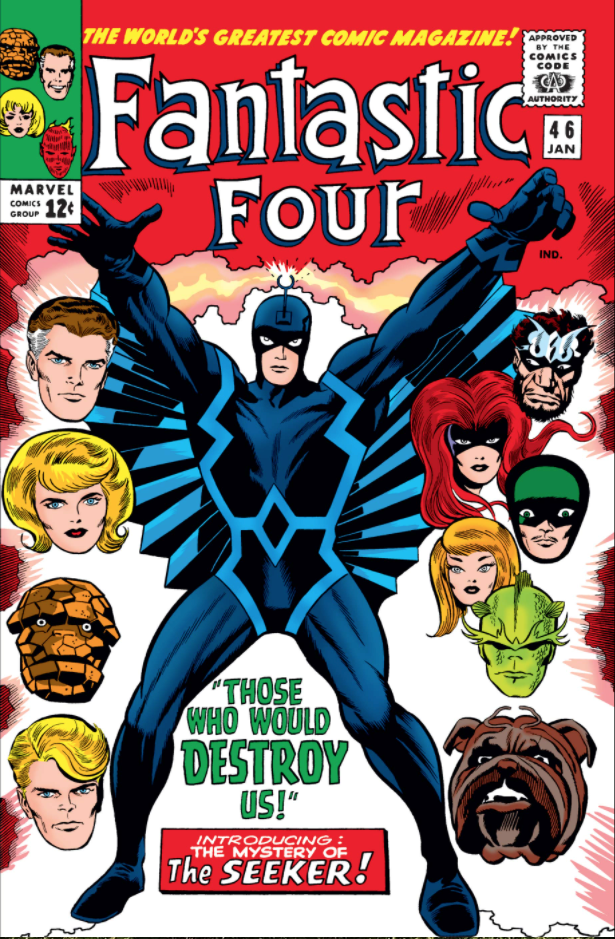
Fantastic Four 46
“Those who would destroy us!”
Published: Oct. 1965
Story: Stan Lee and Jack Kirby
Script: Lee
Pencils: Kirby
Inks: Joe Sinnott
Letters: Artie Simek
Cover: Kirby and Sinnott
Synopsis
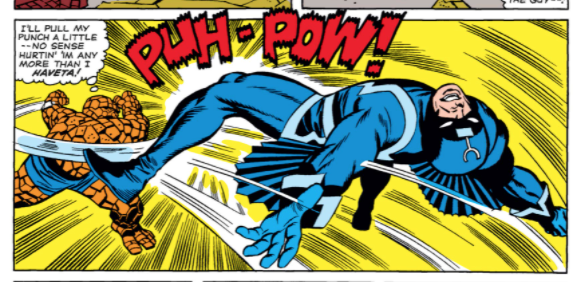
Fantastic Four 46 picks up where FF 45 leaves off, with the team battling the Inhumans on the roof of a New York City building. Black Bolt, leader of the Inhumans makes his appearance, and he and the Thing battle to a virtual standstill. Meanwhile, the Inhuman Triton is revealed to be a scaly fish creature who need a protective suit of water. When it ruptures, he flees to the nearby river.
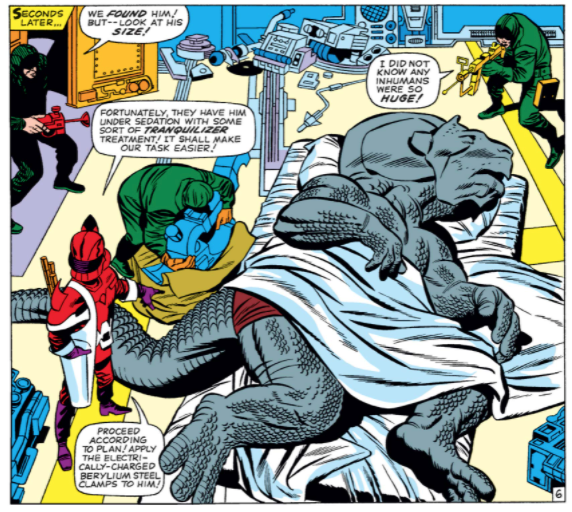
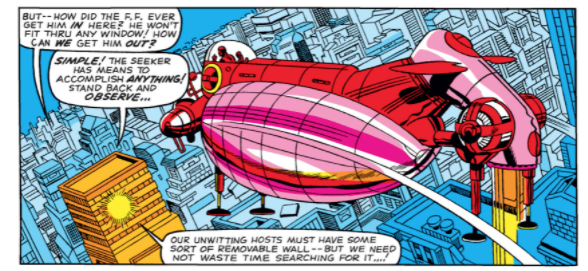
As the teams fight, a new character called the Seeker leads a team of henchmen into the Baxter Building in search of the Inhumans. He instead discover the sedated Dragon Man, and mistaking him for an Inhuman, abducts him via his aircraft.
Black Bolt depletes his power fighting the Thing, and when the Inhumans can’t find Triton, they realize the Seeker has caught up to them. Using Lockjaw’s power, they teleport away, and after the Fantastic Four discovers Dragon Man is missing, they track the Seeker to his hideout, where he has imprisoned Dragon Man and Triton. The Seeker reveals the origins of the Inhumans (more on that in a bit) then Dragon Man wakes up, escapes his shackles and flees, while shattering the water-filled globe that contained Triton. The issue ends with Dragon Man running amok in New York.
What’s going on here?
More Inhuman action and the introduction of Black Bolt!
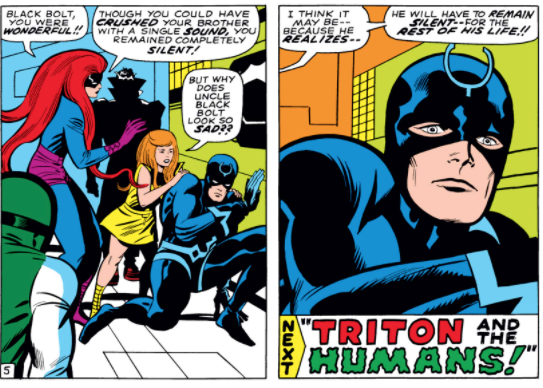
Black Bolt’s most salient quality is that he’s mute. Sure, he’s strong enough to battle the Thing, but his silence is what sets him apart from other characters. We’ll learn later that it’s because of the destructive power of his voice, but most of the time he’s a leader who can’t speak. In a world where there’s often a great deal of talk without much action, Black Bolt is cast as the opposite, the king who acts without talking. I doubt Stan and Jack meant Black Bolt to serve as a jab at anyone in particular, but probably as a blanket commentary on bloviating politicians as a class. The strong-yet-silent leader is a seductive concept, although one that works a lot better in comic books, where most conflicts are resolved with fists and not dialogue.
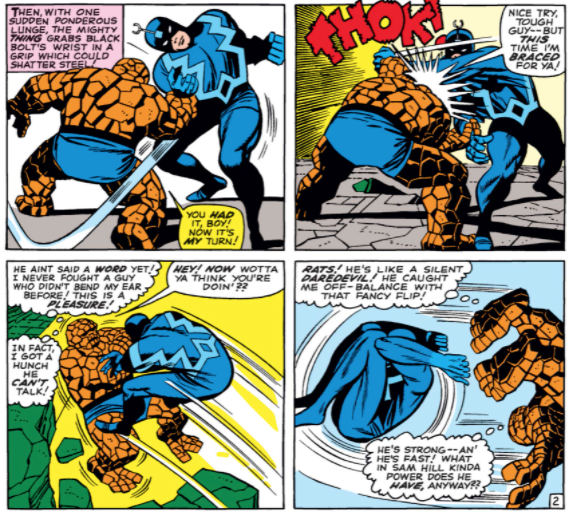
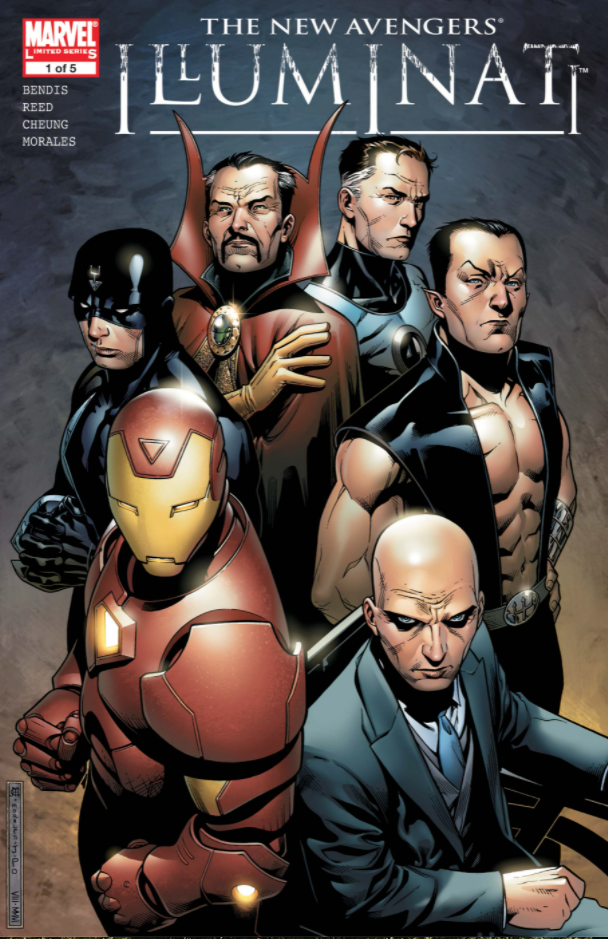
Black Bolt—whose full name was later retconned, painfully, into Blackagar Boltagon— occupies an interesting place in comics. As leaders of the Inhumans, he holds an important role, and is highly enough regarded enough, for example, to be part of the Illuminati, one of the six super heroes who dictate events in the Marvel Universe (according to writer Brian Bendis, anyway). Yet because he’s mute, he’s always been a cypher. His thoughts and intentions are always relayed through other characters, and he rarely is even given thought bubbles. What are his hopes and dreams? Who knows? It’s hard to think of another comic hero so prominent about whom we know so little.
About that mask
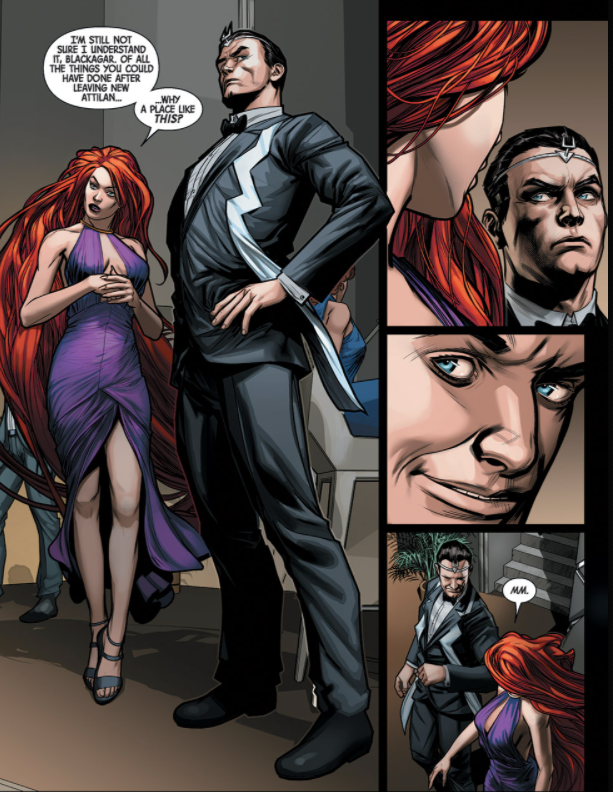
When the Inhumans were introduced, they almost all wore masks. While some have lost their’s over the years, Black Bolt almost always wears his. There’s no obvious reason in-story that’s ever given for his mask- it’s not like he was a secret identity to protect, or hideous scars to cover. Tracking down an image of Black Bolt’s actual face is surprisingly difficult, but here’s at least one instance, from 2015’s Uncanny Inhumans:
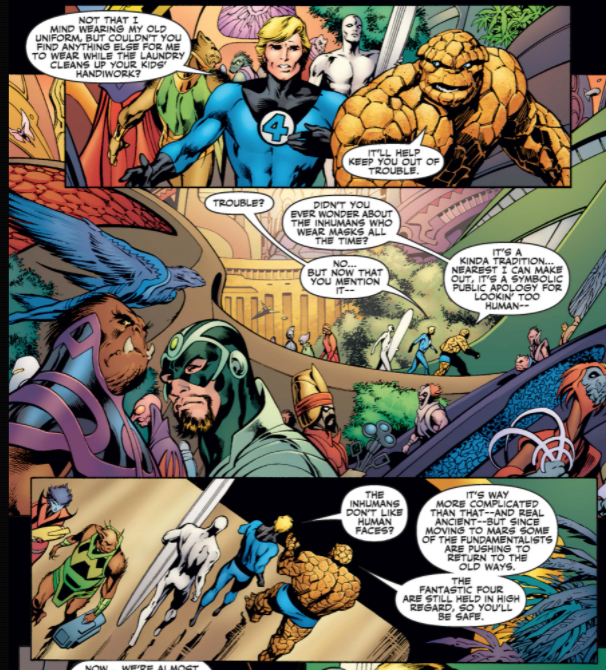
The best explanation of why members of the Inhuman royal family wear masks was provided by the great writer and artist Alan Davis, in his mini-series Fantastic Four: The End. It takes place in the team’s future, and Ben and Alicia are living with the Inhumans on Mars. It comes down to a tension about the appearance of the Inhumans, and the role of the transfarmative terrigen mists in their culture.
Who are these guys?
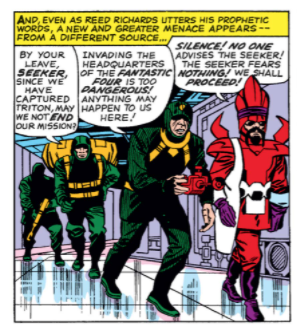
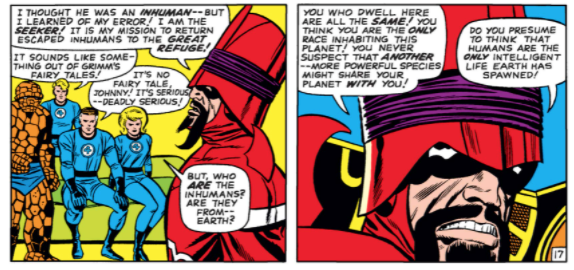
FF 46 also includes a brief origin of the Inhumans, courtesy of the Seeker.
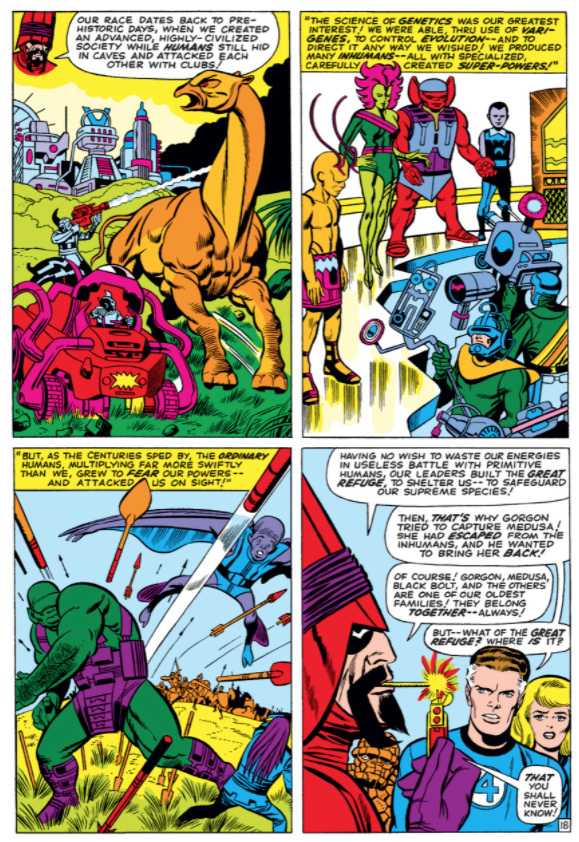
The origin omits a critical detail (or more likely, Stan and Jack hadn’t come up with it yet), which is that the Inhumans were an experiment of the Kree, an alien race that will be introduced in Fantastic Four 65. Eventually a much longer origin is unspooled as a back-up story in Thor 146-152 (of all places), published in 1967-68. Here are some key panels that explain the role of the Kree (the whole story is gorgeous, with peak Kirby/ Sinnott art).
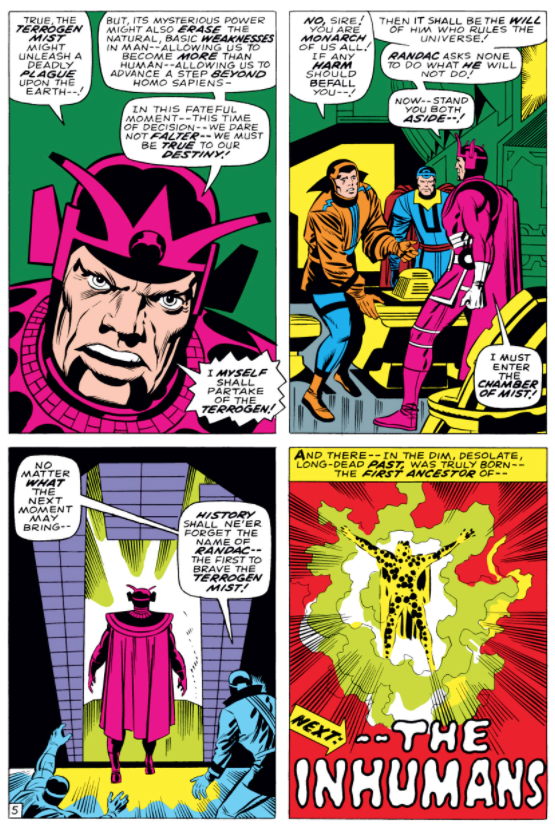
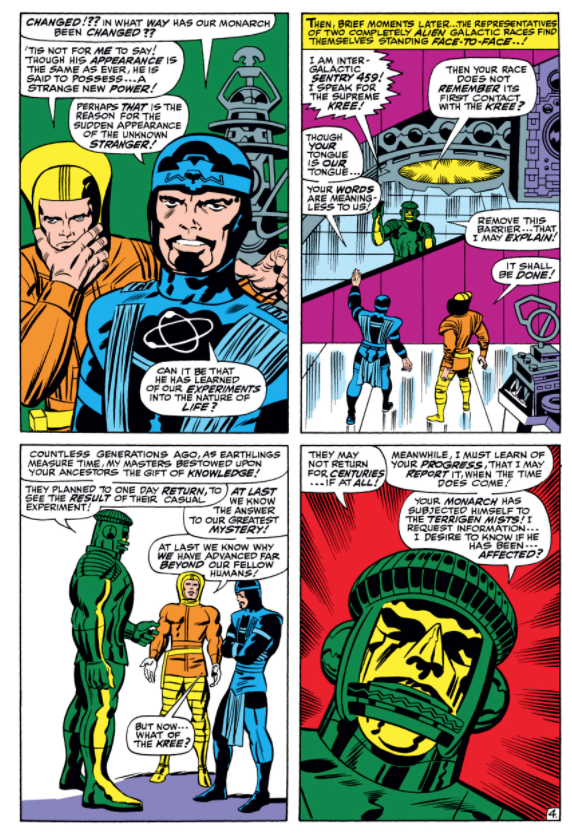
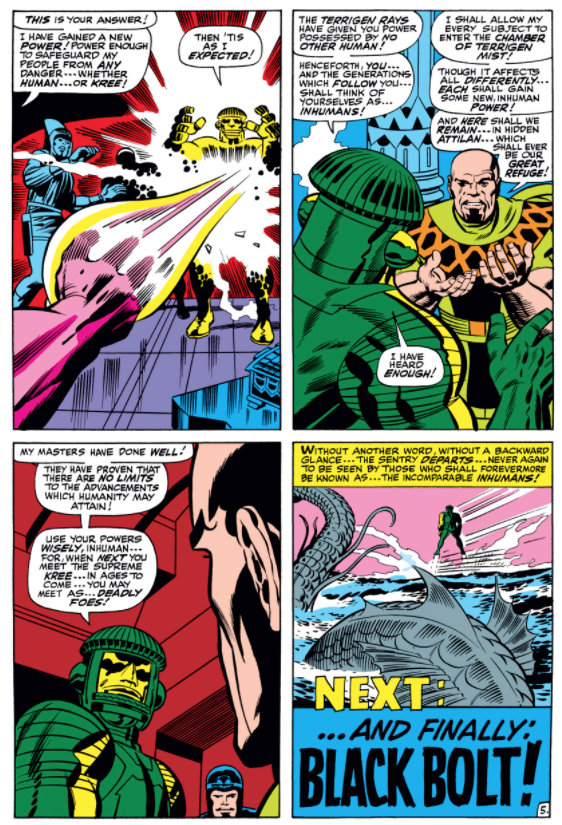
The Thor stories also delve into how Black Bolt became king of the Inhumans, and include this poignant sequence:
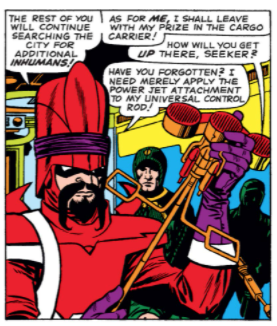
The Seeker
The Seeker is the heavy in this issue. In later stories he is named as Kadlec, a viceroy under a previous ruler of the Inhumans and given a bit of a back story. Although he never becomes a much more than a footnote in Inhumans history, he looks great here.
Crazy Credits
A bit more subdued this month.

Weird science
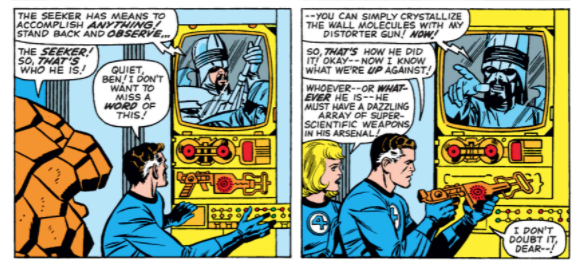
Reed invents … the security camera and VCR?
Dig that Kirby Krackle
Some cool stuff from Jack, including a slumbering Dragon Man…
… the Seeker’s airship …
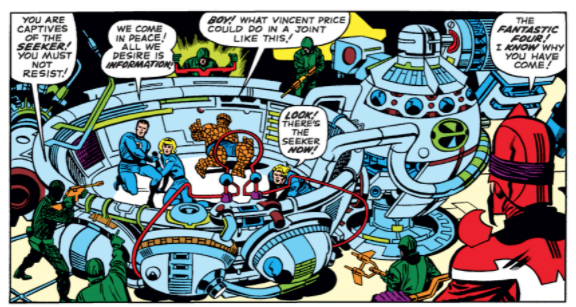
.. and whatever this is!
Next issue: The conclusion of the Inhumans saga!

