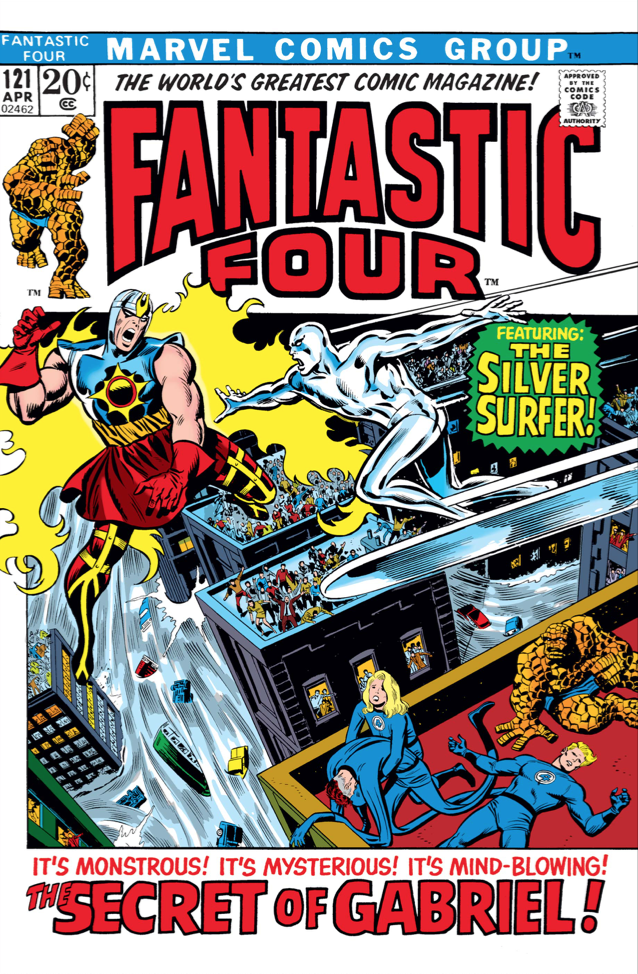
Fantastic Four 121 “The Mysterious Mind Blowing Secret of Gabriel!” Published: Jan. 1972 Story: Stan Lee & John Buscema Script: Lee Pencils: Buscema Inks: Joe Sinnott Letters: Sam Rosen Cover: Buscema and Sinnott
Synopsis
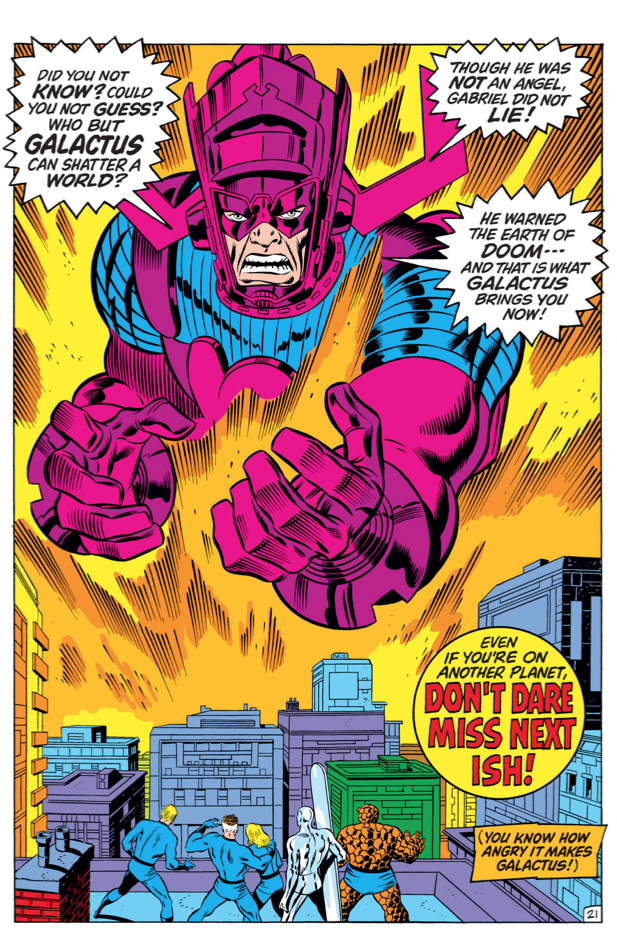
The Air-Walker turns humanity against the Fantastic Four, whose effort to battle him are futile, before admitting he was only attempting to lure the Silver Surfer. After the Surfer beats him and reveals him to be a robot, Galactus makes a dramatic appearance.
What’s going on here?
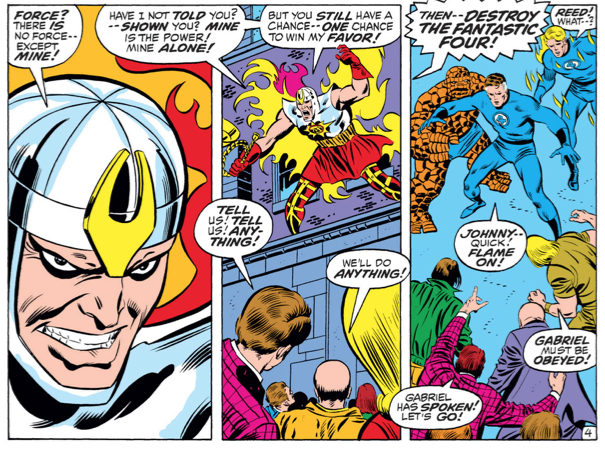
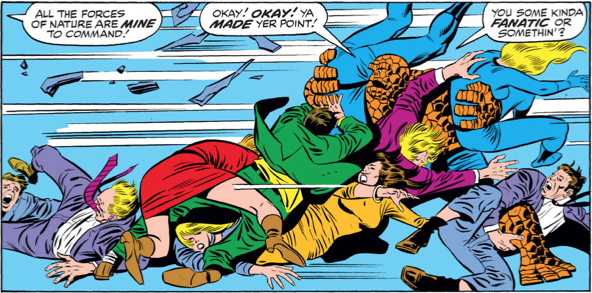
After last issue’s long build up, FF 121 delivers some pay off. There’s a long fight with Air-Walker, some not-too-subtle commentary about religious fanaticism by Stan, a dramatic appearance from the Silver Surfer and two big twists: Air-Walker is a robot, and he was doing the bidding of Galactus. Unfortunately, most comic readers today know Air-Walker as a herald of Galactus (information I first received from the Official Handbook of the Marvel Universe circa 1983) , but I imagine for a reader in 1972 this would have come as a shocking revelation. Mind-blowing, even (to quote the comic’s title). At this point, Stan may be close to the end of his days as a regular comic writer, but he shows here he’s still got something on his fastball.
Along with the aforementioned plot twists, I did like Stan’s injection of social commentary into the New Yorkers reaction of Gabriel. It’s pretty clear what Stan thinks of zealotry.
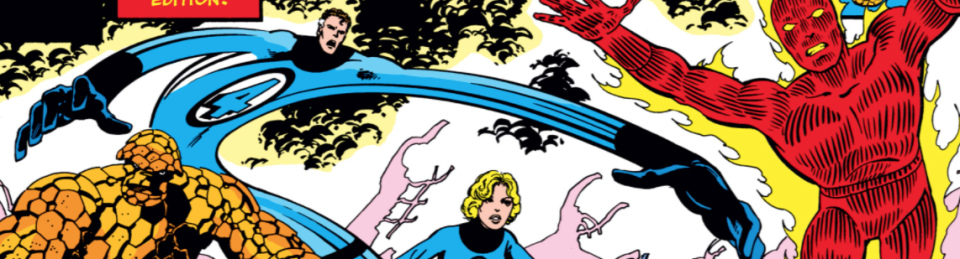
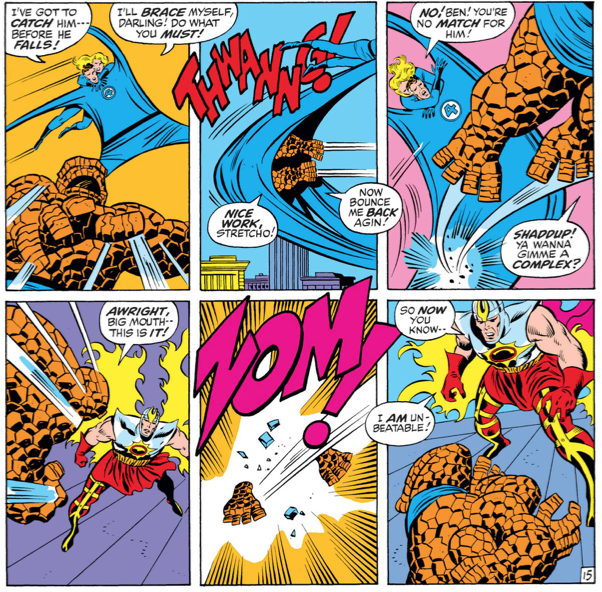
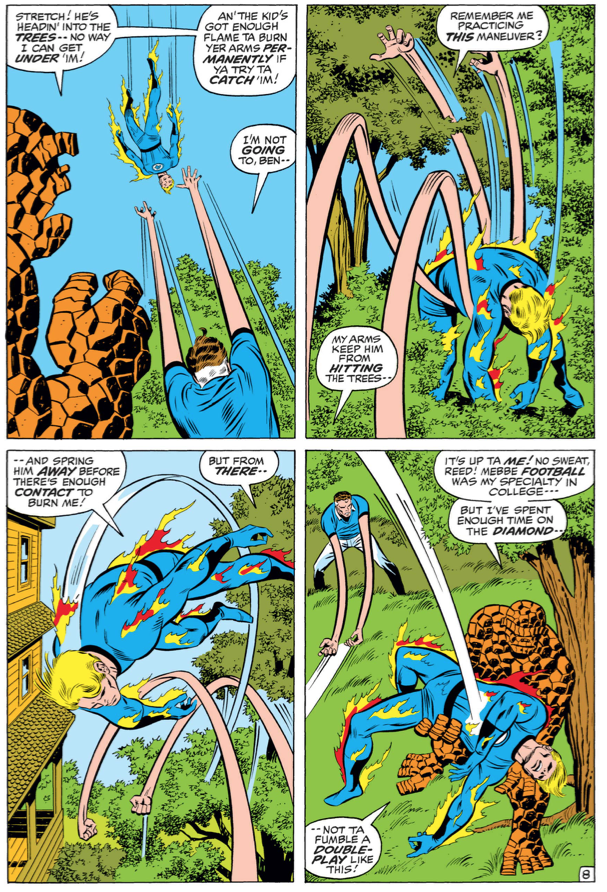
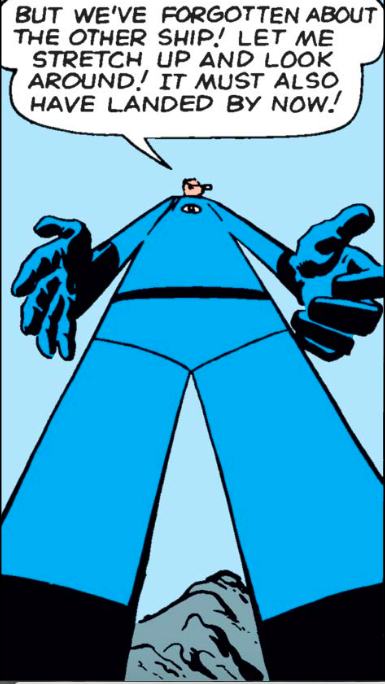
There are some great Buscema panels, like this one:
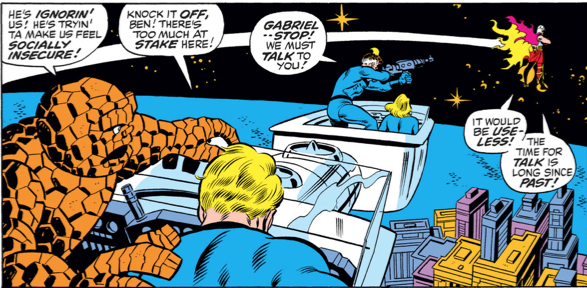
As well as some fun sound effects (which I think would be done by Buscema, not Sam Rosen, the letterer):
What I didn’t like
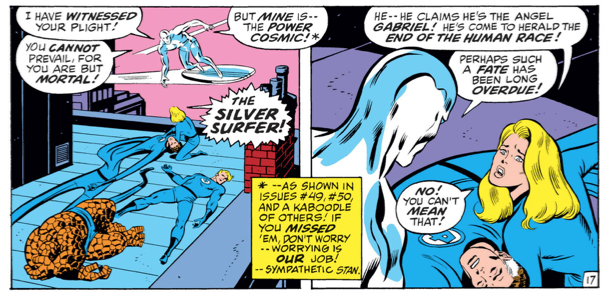
This issue suffers from the same sluggish pacing of a lot of Stan’s Fantastic Four comics. The FF spend an awful long time either fighting Air-Walker, running away from Air-Walker or escaping New Yorkers doing Air-Walker’s bidding, and so the appearance of the Silver Surfer is jammed into the last few pages. When he arrives to save the day, it’s a tiny panel and he’s about half an inch high. Surely this dramatic scene merits at least a half splash?
Anything else?
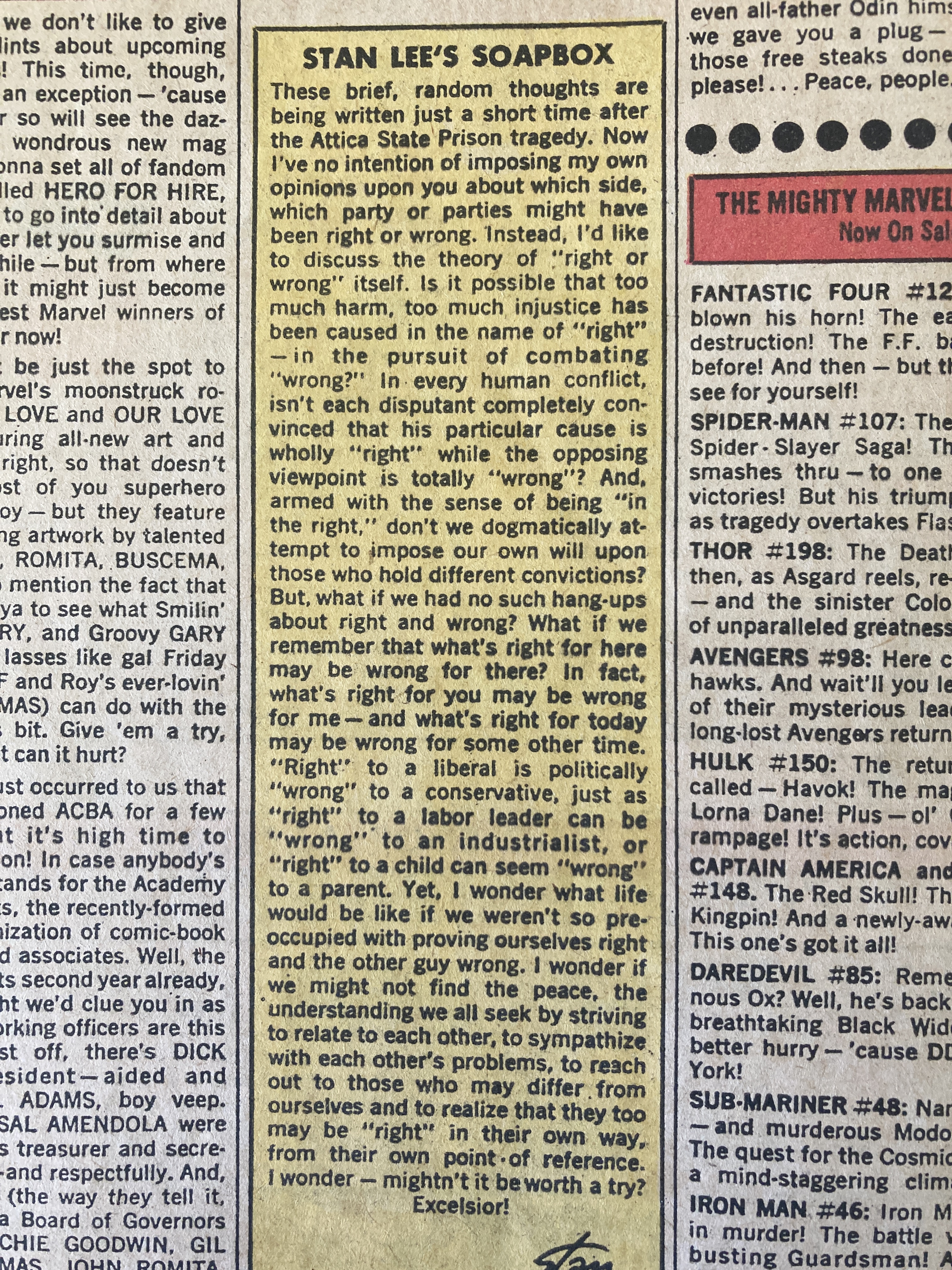
In his soap box, Stan take on another fun subject: the Attica prison riots!
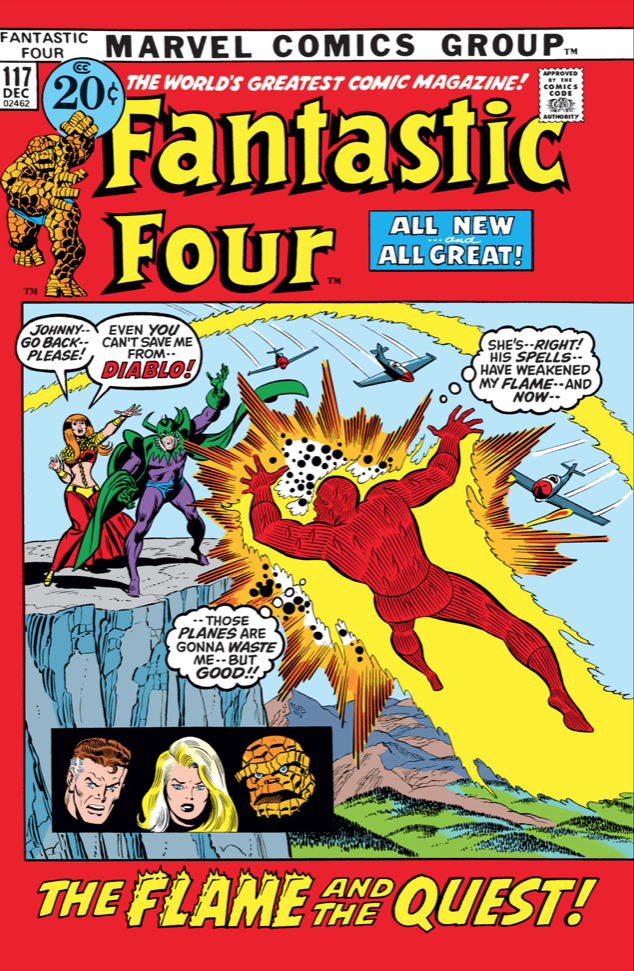
Fantastic Four 117 “The Flame and the Quest!” Published Sept. 1971 Writer: Archie Goodwin Pencils: John Buscema Inks: Joe Sinnott Letters: Sam Rosen Editor: Stan Lee Cover: Buscema and Sinnott
Synopsis
The Human Torch launches a desperate search for Crystal, and with the help of Agatha Harkness, discovers she has fallen under the control of Diablo, who is using her powers to take control of a Central American dictatorship.
What’s going on here
After the giant-sized extravaganza of last month, it makes sense to have an issue that allows the team and readers (and creators, presumably) a chance to catch their breath. There’s not a lot that’s notable in this issue. Johnny going on a crazed search for Crystal feels pretty familiar at this point, and we’re seeing a lot of Agatha Harkness lately.
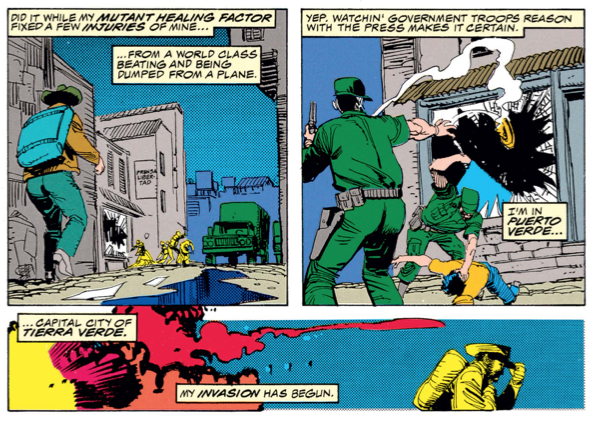
Archie Goodwin returns as the writer and introduces Tierra Verde (called Terra Verde here), a stereotypical banana republic that makes a few appearances over the years, including in Goodwin’s own run on Wolverine in 1989.
On a personal note, this issue was published the day I was born in 1971. Happy birthday to me!
What I liked
Diablo is a fun villain, and it’s good to see him back. Buscema delivers his usual excellent art, and the story hangs together well.
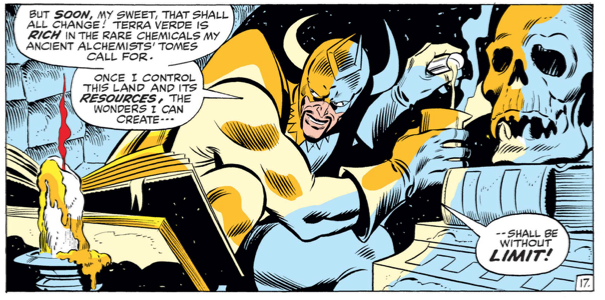
Here’s a fun sequence from Big John:
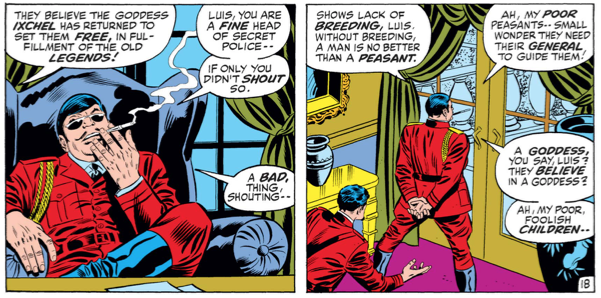
And while it’s a bit of a cliche, I liked the depiction of dictator General Robles and his lackey:
What I didn’t like
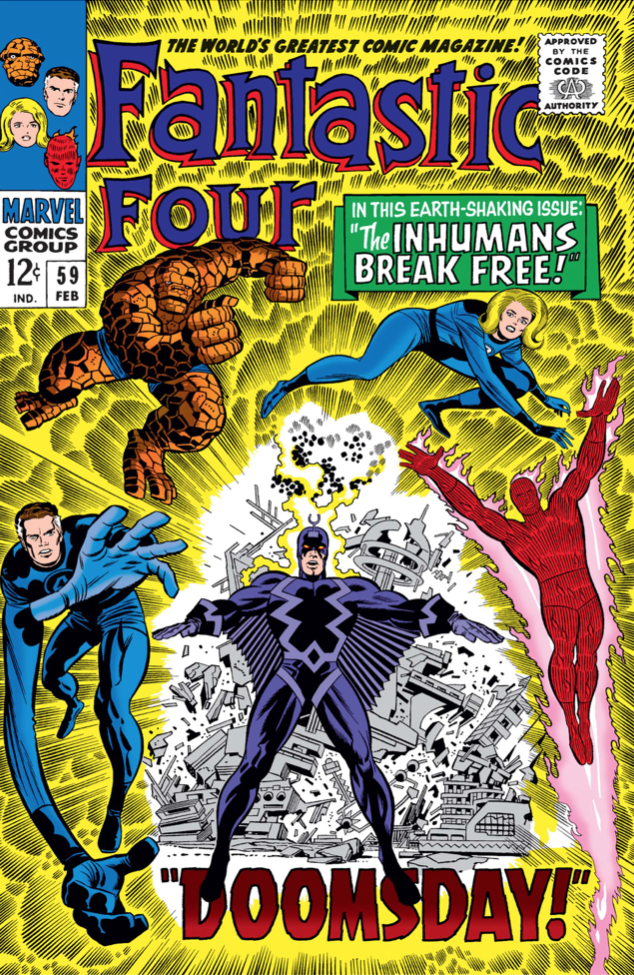
I really dislike this cover format. I better get used to it because it will be with us for another dozen issues or so.
Anything else?
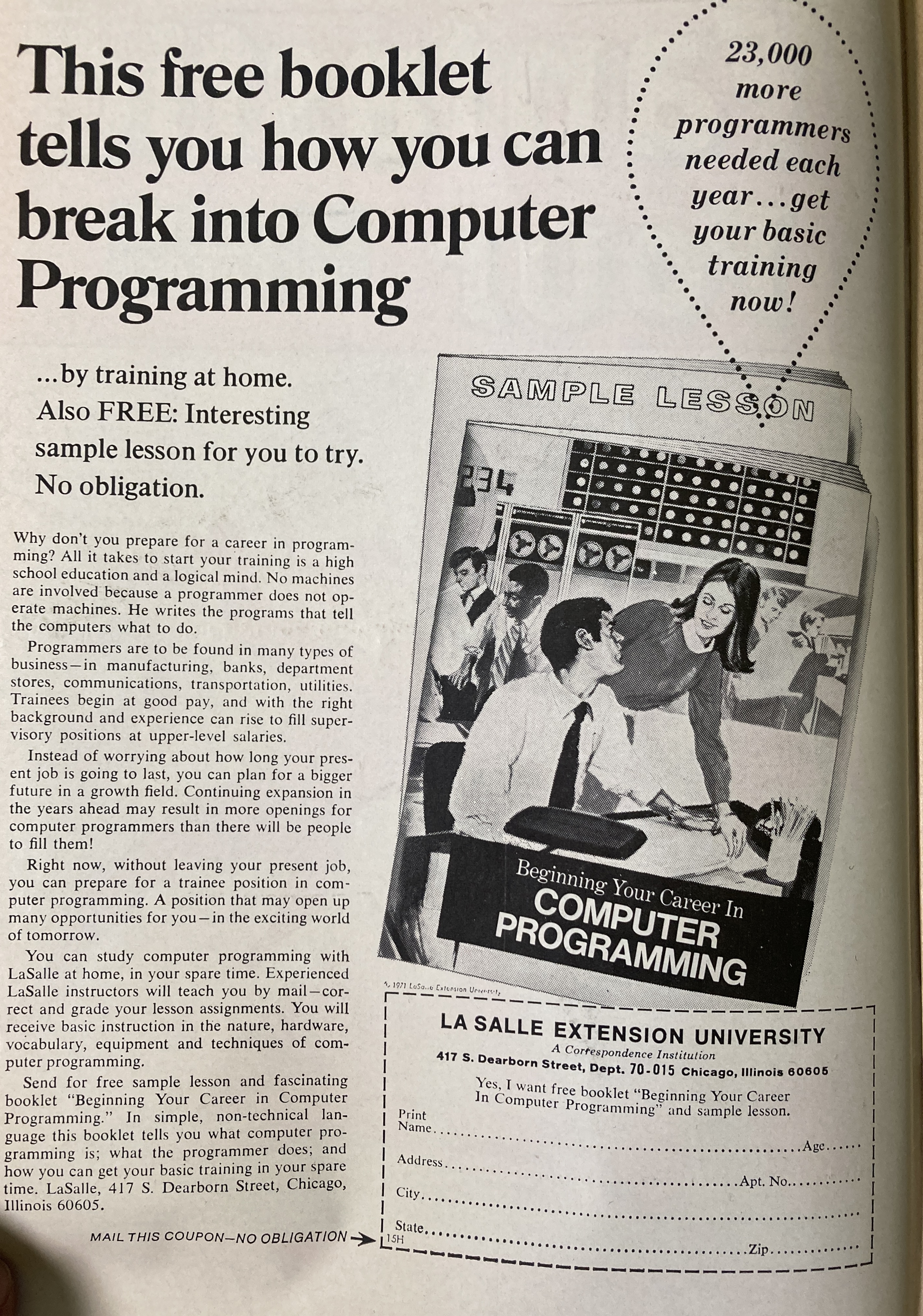
Study computer programming? I dunno, seems like a gimmick to me.
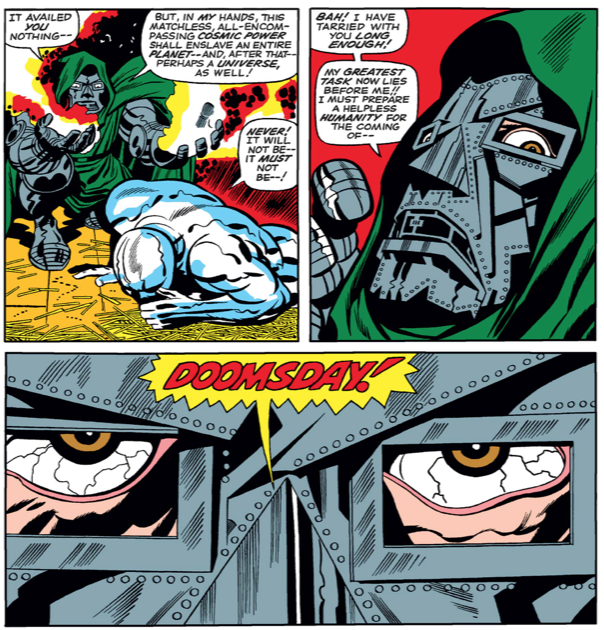
Fantastic Four 59 “Doomsday!” Published: Nov. 1966 Story: Stan Lee & Jack Kirby Script: Lee Pencils: Kirby Inks: Joe Sinnott Letters: Artie Simek Cover: Kirby & Sinnott
Synopsis
After Dr. Doom’s defeat of the Fantastic Four in the previous issue, FF 59 is another stage-setting comic, where a number of storylines are advanced without any reaching their climax.
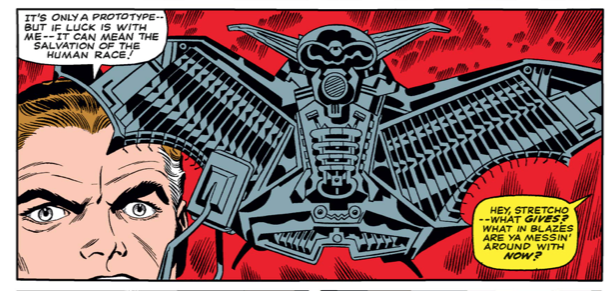
In the first, main thread, Mr. Fantastic, the Thing and the Invisible Girl are regrouping in the aftermath of Doom’s victory. Reed warns the nation’s of Earth to prepare for the menace of Doom, then, goaded by Ben, begins making plans to defeat him. Toward the end of the comic, we get a glimpse of what Reed’s working on: an explosive flying device that saps power from this it comment with.
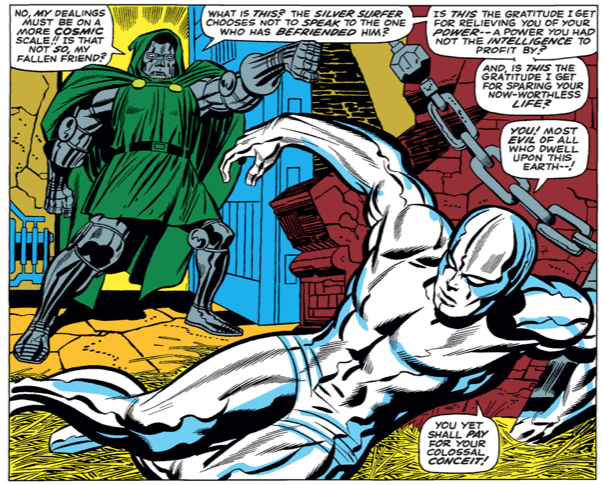
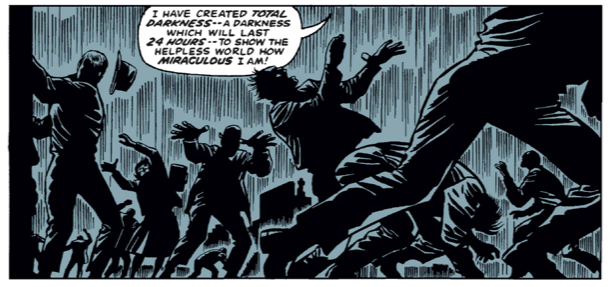
Meanwhile, Doom is plotting his conquest of Earth. He dismisses an attack by (presumably) the Soviet Union, taunts the helpless Silver Surfer, a prisoner in Latveria, then circles the globe displaying his power, for example, by throwing cities into darkness for 24 hours.
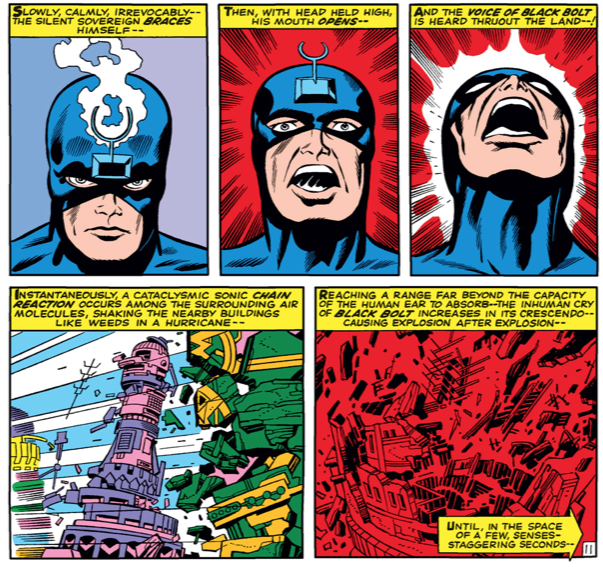
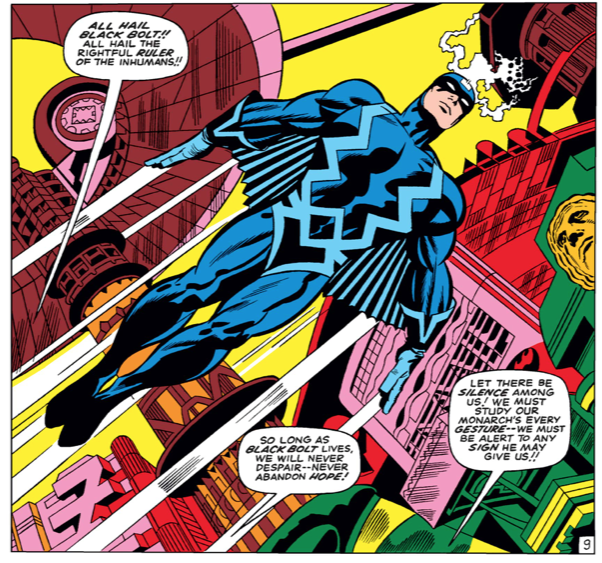
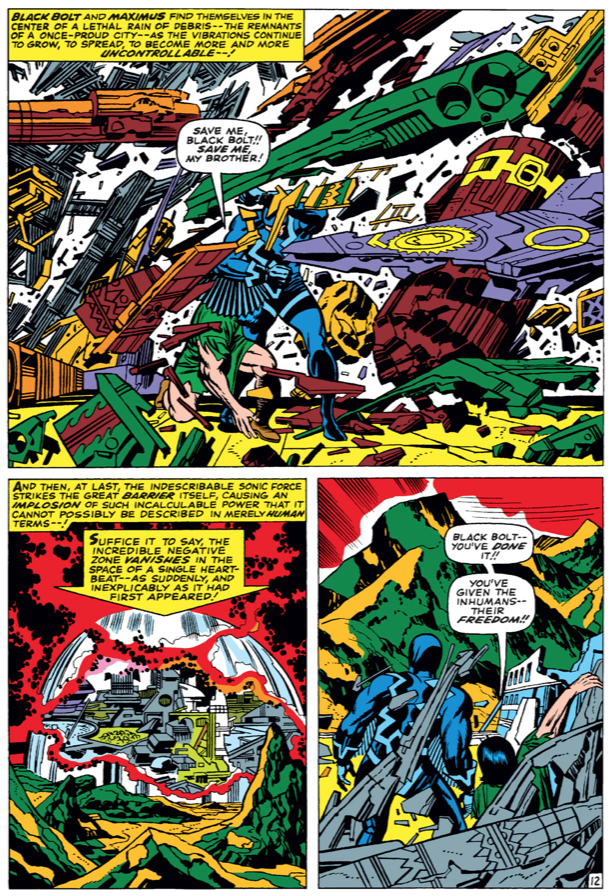
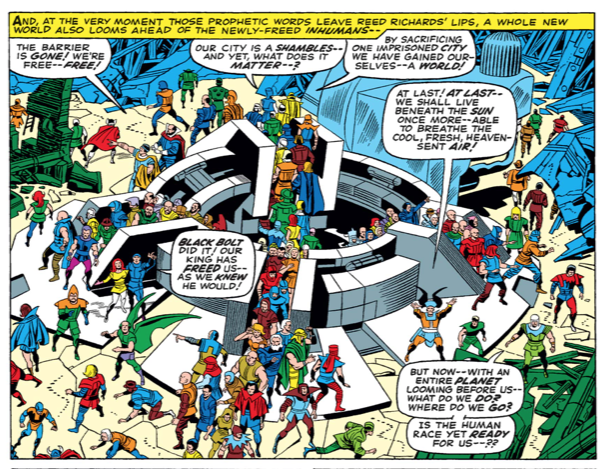
In the third storyline, the Inhumans, trapped in their city behind a negative zone barrier for many issues now, finally break free after Black Bolt uses his voice to destroy both the barrier and the city. The Inhuman royal family then travels to help Crystal reunite with Johnny Storm.
And in the last storyline, the Human Torch decides he alone has the power to take on Doom, and despite his misgivings, his friend Wyatt Wingfoot joins him on his quest.
What’s going on here
This is a transitional issue, but a good one, enhanced by some of the best art on this book to date. Lots of character is developed here: Ben’s needling of Reed is revealed to be more cunning than buffoonery, Doom’s mania becomes more apparent, the Surfer’s resolve becomes more clear, and we finally see Black Bolt cut loose with his power. It had been hinted at for a few issues now, but we now understand why he is silent, breadcrumbs first dropped all the way back in issue 46.
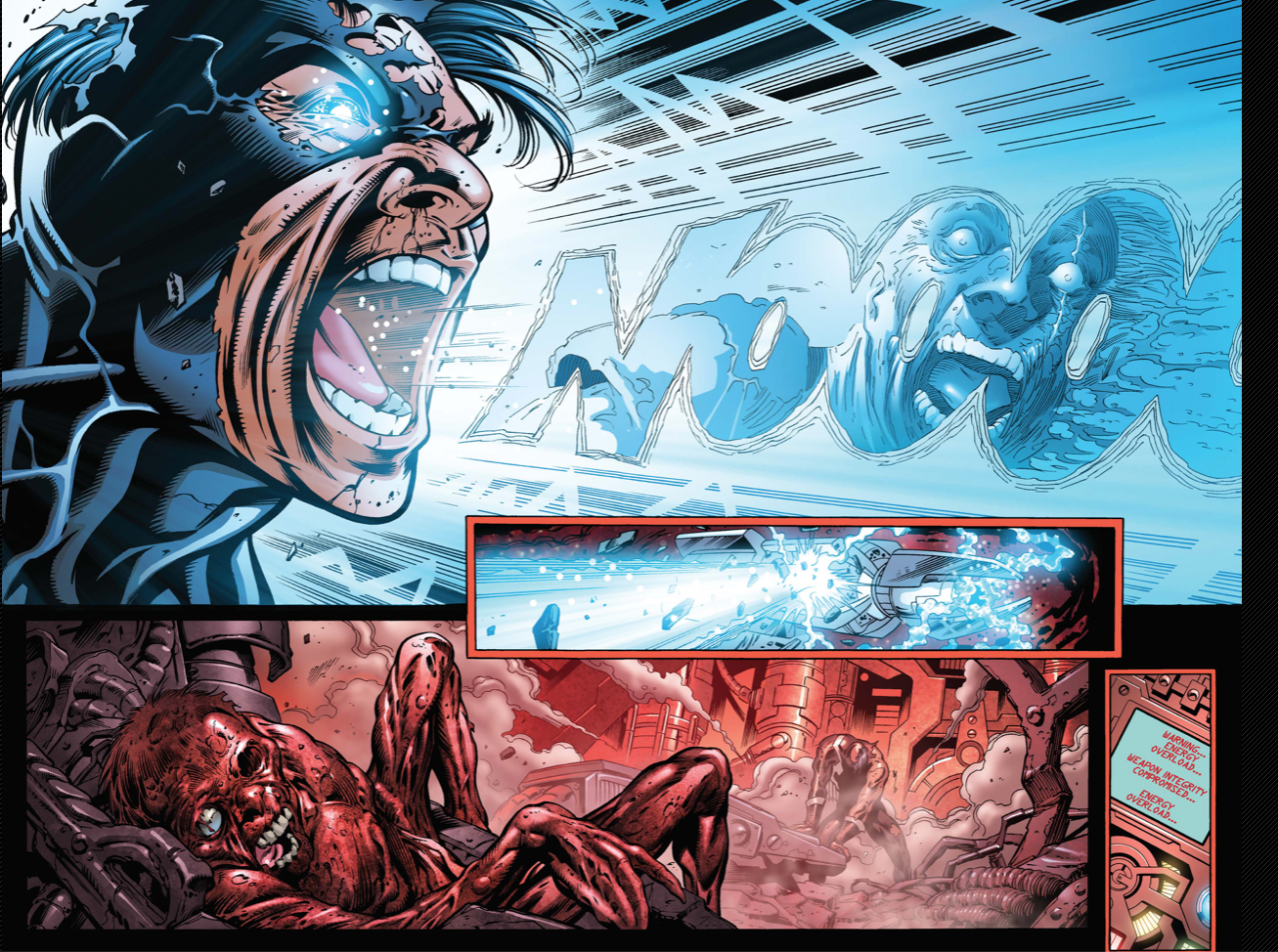
It’s always a big deal when Black Bolt uses his voice, and comic book writers have generally been pretty sparing with it. Here’s a pretty good run down in Comic Book Resources of 20 times he used his voice, including in 2009’s War of Kings, where he uses it to defeat Vulcan (the crazy brother Cyclops and Havok never knew they had—it’s a long story) and then detonate a Terrigen bomb which tears a hole in spacetime. That’s a not-untypical use case for Black Bolt’s voice.
War of Kings 6 (2009, Pelletier, Magyar & Hennessy)
The F-Team
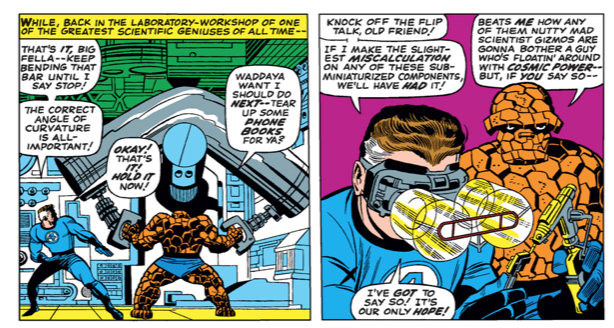
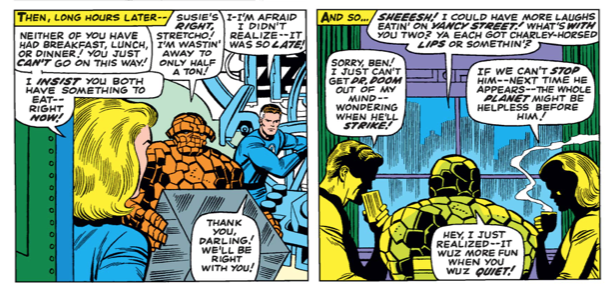
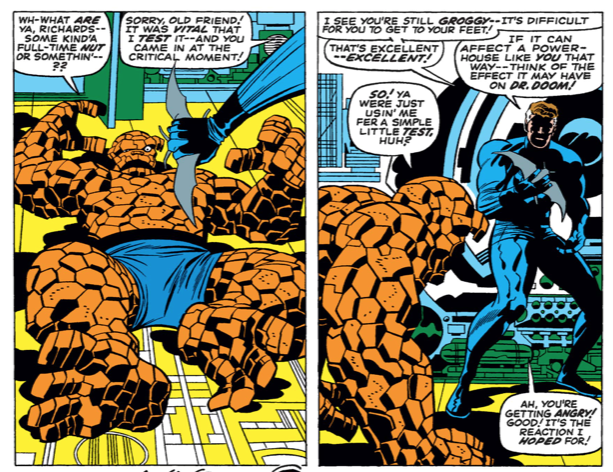
I may be dating myself here, but in the 1980s TV show The A-Team, there was invariably a sequence of rapid cuts where the team, having suffered some defeat, works energetically to build a device or hatch a plan to save the day as the theme music plays. That is what I thought of when Reed and Ben get busy working to defeat Doom.
The sexist sixties
Of course, while Reed and Ben are making their plans, Sue is in the kitchen, worrying.
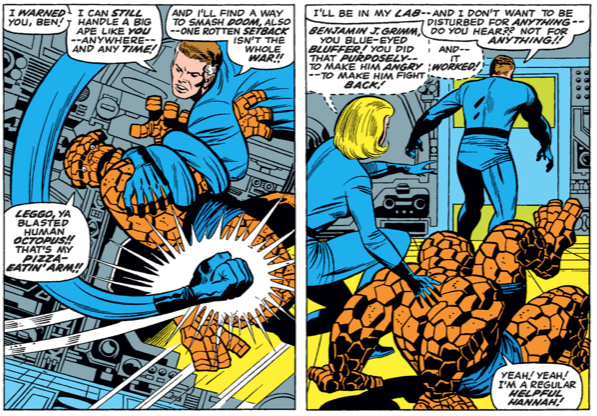
They’re fighting again
It’s been a long time since we saw this kind of thing. It makes me nostalgic.
Red menace
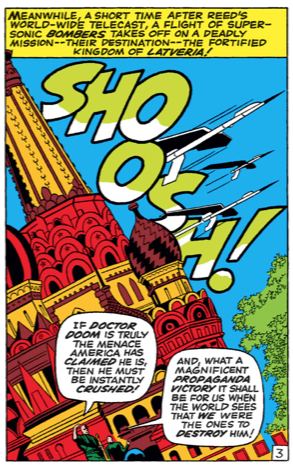
Doom is attacked by .. it’s not exactly clear. It sure looks like the Soviet Union, but for some reason Stan is reluctant to say as much.
Ladies and gentlemen, Joe Sinnott
Every now and then Sinnott’s inks just jump out at me, like they do in this sequence
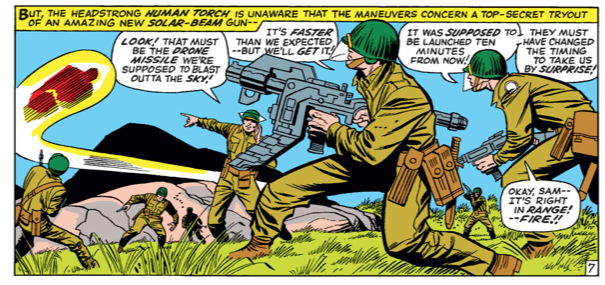
Weird science
It’s “a solar-beam gun”
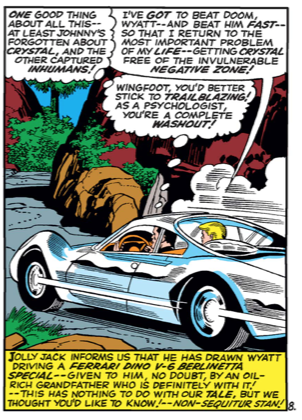
Nice ride
Johnny’s Ferrari is apparently courtesy of a rich grandfather. I don’t think we ever learn more about him.
Dig that Kirby Krackle
This issue has so much great Kirby art that I could have picked something from virtually every page. I restrained myself, but it’s really an amazing issue.
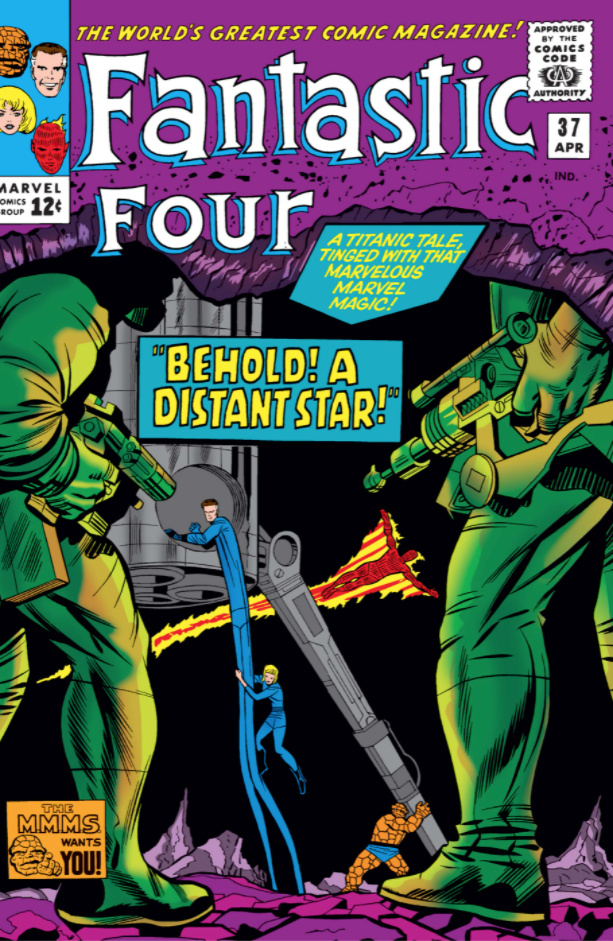
Fantastic Four 37 “Behold! A Distant Star” Published: Jan. 1965 Story: Stan Lee and Jack Kirby Script: Lee Pencils: Kirby Inks: Chic Stone Letters: Artie Simek Cover: Kirby and Stone
Synopsis
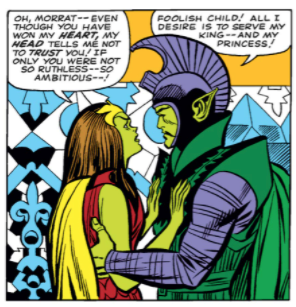
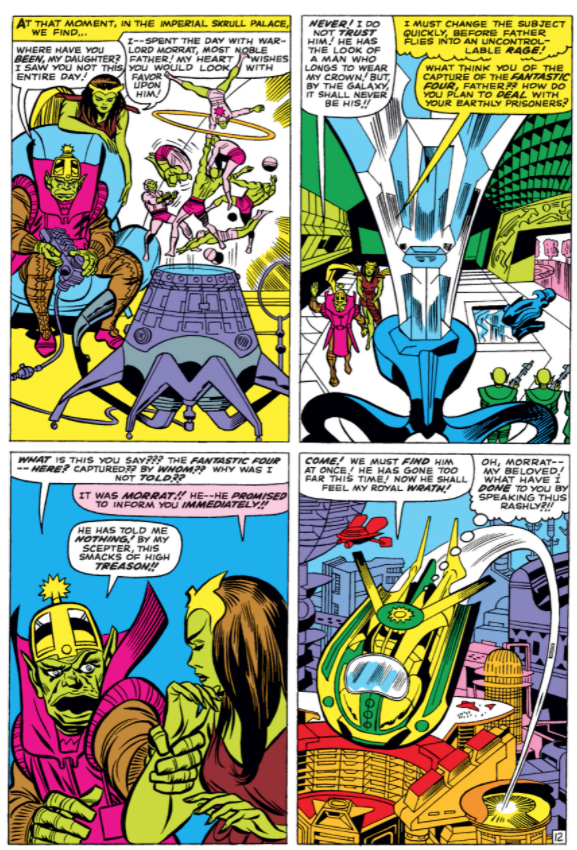
As usual, the issue opens with shenanigans at the Baxter Building, as Reed experiments with a Power-Ray that amplifies the Human Torch’s powers. The team is preparing for Reed and Sue’s wedding, but Sue confesses to Reed she is upset that her father, killed by the Skrulls in issue 32, remains unavenged. The story then cuts to the Skrull Princess Anelle and her betrothed, warlord Morrat, whom we learn was responsible for the death of Franklin Storm (and who happens to be a big jerk).
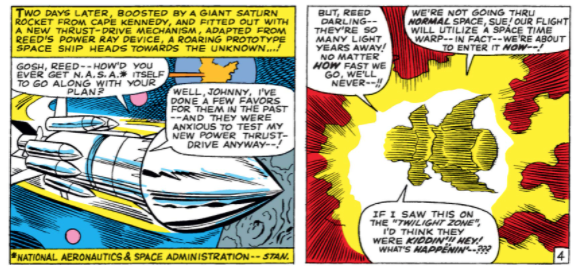
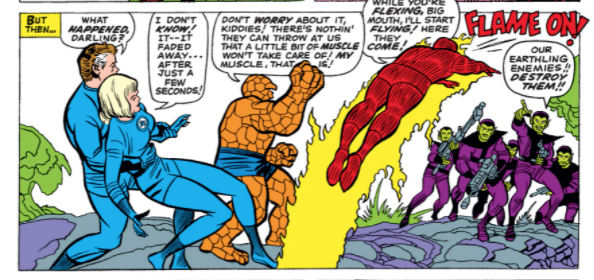
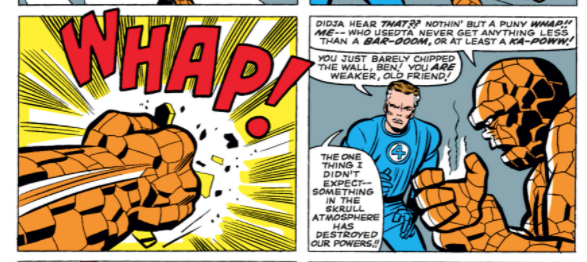
Back on Earth, Reed announces the team will travel to the Skrull home world to bring Franklin’s killers to justice, and using a Saturn rocket borrowed from NASA and outfitted with an engine of Reed’s invention, the team travels across the galaxy. There, after an initial encounter with the Skrulls, the team discovers the alien atmosphere has sapped their powers and they are captured by Morrat’s forces. Morrat schemes that once word of his conquest of the FF spreads, he will be able to unseat the emperor, Anelle’s father.
To prevent the team’s execution, Reed bargains with Morrat, promising to build him a weapon to make him all-powerful. When the rest of the team objects, Reed turns the weapon on them, restoring their powers (yes, you guessed it, it was the Power-Ray). Meanwhile, the emperor gets word of Morrat’s intentions and accuses him of treason. Morrat’s coup attempt fails, and he is killed by the Skrull army. Anelle is almost killed as well, but saved by the Invisible Girl’s forcefield. In gratitude, the emperor grants the FF a wish, and when they ask to know who killed Franklin Storm, the emperor reveals it was Morrat. The team the returns to Earth in time for a wedding rehearsal.
What’s going on here
FF 37 is a quintessential Silver Age comic, in all its glorious absurdity. A story that today would be spooled out over six or eight issues—if not made into an event: “The FF invade the Skrull Homeworld!—is done and dusted in 21 pages. The insanity of the premise—as a romantic gesture, Reed decides to launch a cross-galactic invasion—is glossed over in a few panels. The mechanism—the FF borrow a rocket from NASA—is told in another single panel. Reed’s massive miscalculation—not anticipating the team would lose its powers in the Skrull Galaxy—is barely acknowledged.
And yet, the story is incredibly fun. Kirby clearly has a blast drawing cool Skrull stuff, there’s lot’s of snappy banter, the subplot of Morrat’s betrayal creates some effective tension, and the Power-Ray reveal, although telegraphed a mile away, is still a satisfying twist.
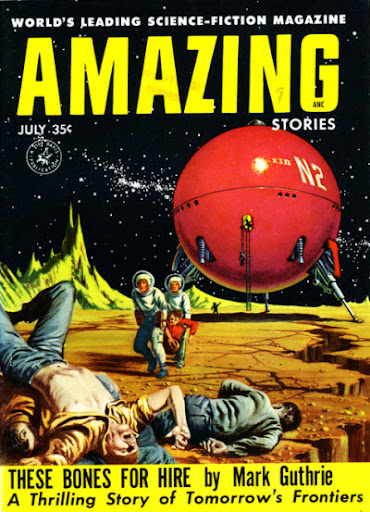
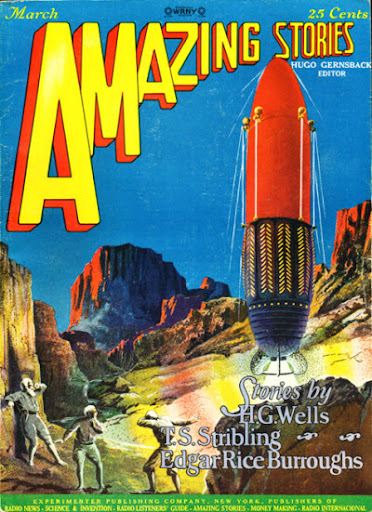
Adding to its appeal, the comic has a golden age of science fiction feel to it, from it’s lofty title (“Behold! A Distant Star”) to a terrific Kirby cover that feels like it belongs on the cover of Amazing Stories magazine. Compare it to the these covers:
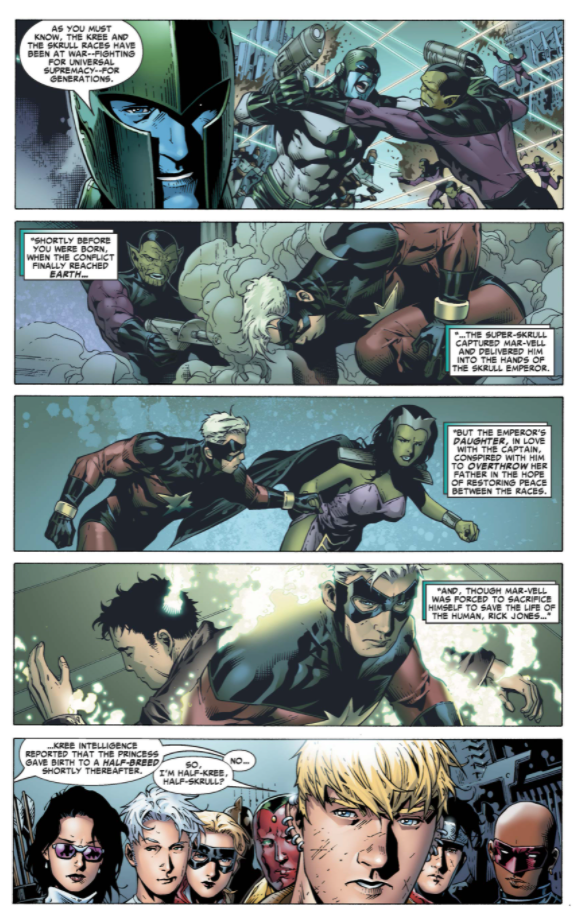
Fantastic Four 37 also adds the story of the Skrulls by introducing Princess Anelle as a member of the Skrull royal family. Princess Anelle becomes a significant figure, retconned into the lover of the Kree Mar-Vell, the first Captain Marvel. Together, they are the parents of Hulkling, a Young Avenger who later becomes emperor of both Kree and Skrull empires.
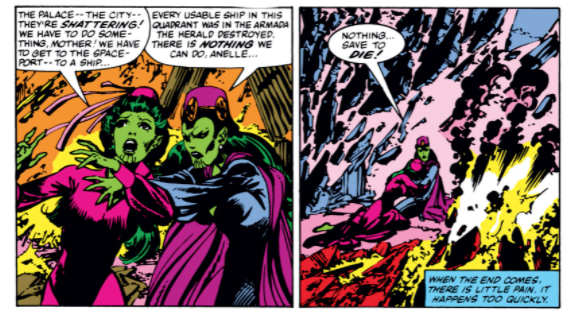
Unfortunately for Anelle, she missed all this, having died years earlier when Galactus devoured the Skrull home world in Fantastic Four 257.
Krazy Kredits
They’re back!
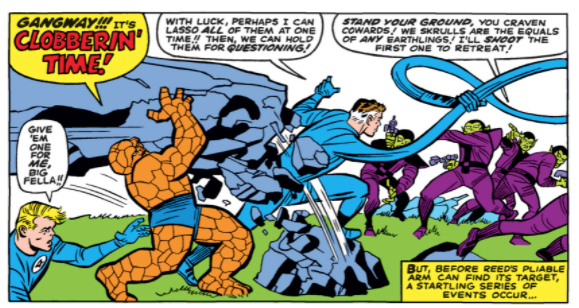
It’s Clobberin’ Time!
Also back after a few issues absence. This is still only the fourth or fifth time Ben has said the magic words.
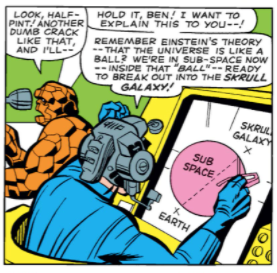
Weird science
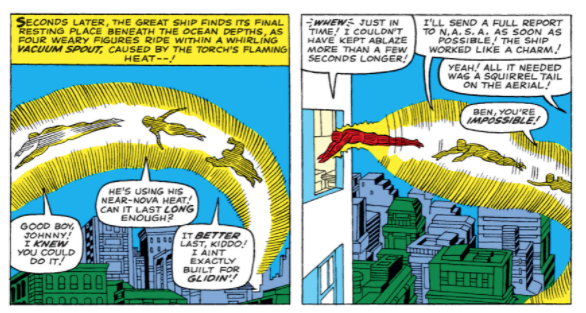
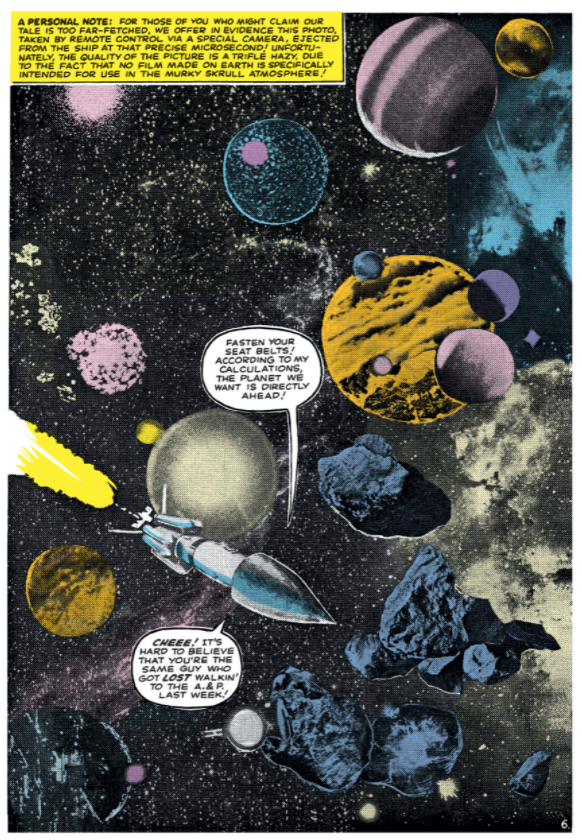
Reed explains intergalactic travel.
And here’s yet another new power of the Human Torch’s that shows up for one issue and then disappears.
Breaking the fourth wall
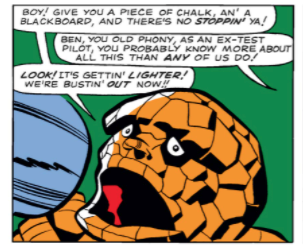
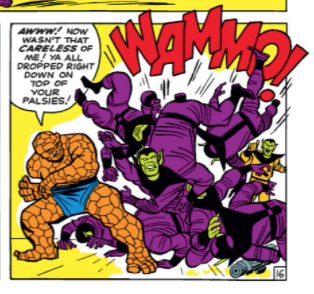
Ben seems to know sound effects in comics are words, not noises.
Speaking of Ben
He plays dumb a lot in this comic, so it’s nice when someone (probably Sue in this case) acknowledges he’s a lot more capable than he lets on.
Oops
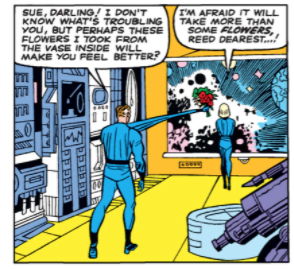
Looks like Stan had to explain where Reed got those flowers.
The sexist sixties
Sexism isn’t limited to earthlings.
Dig that Kirby Krackle In this issue we get another full-page Kirby Kollage (complete with a note from Stan).
Plus we gets lots of fun alien stuff.
Also, for the first time that I have noticed, Jack’s sound effects are crossing the gutters between panels, which gives the action a more dynamic affect.
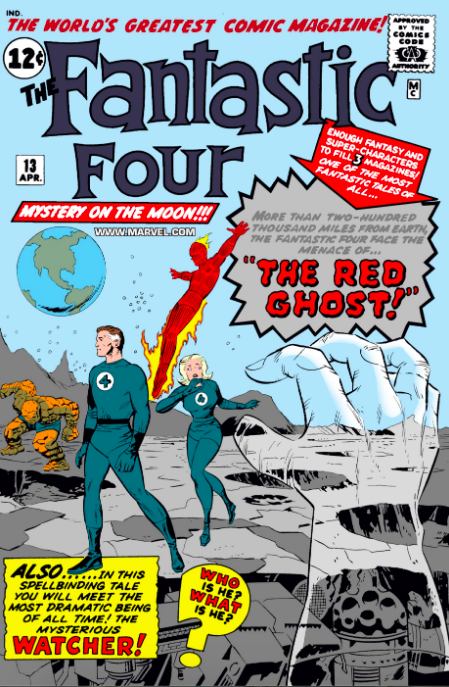
Fantastic Four 13 “The Red Ghost and his Indescribable Super Apes” Published: Jan. 1963 Story: Stan Lee and Jack Kirby Script: Lee Pencils: Kirby Inks: Steve Ditko Letters: Art Simek Cover: Jack Kirby and Don Heck
Synopsis
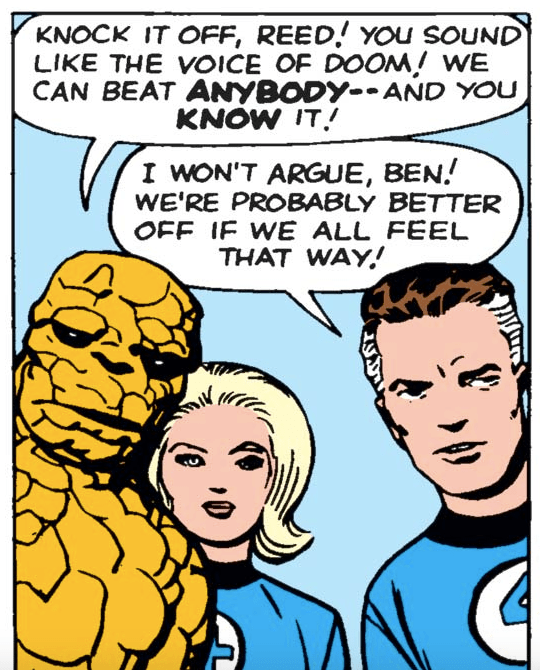
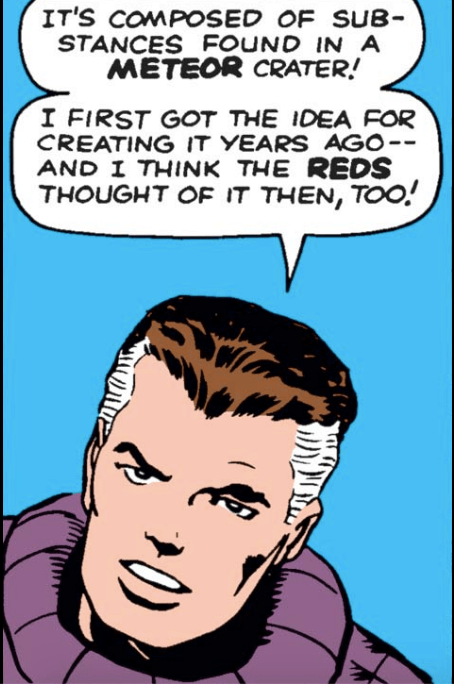
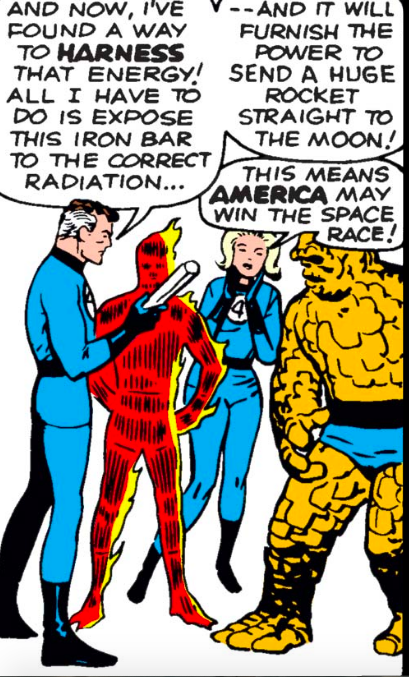
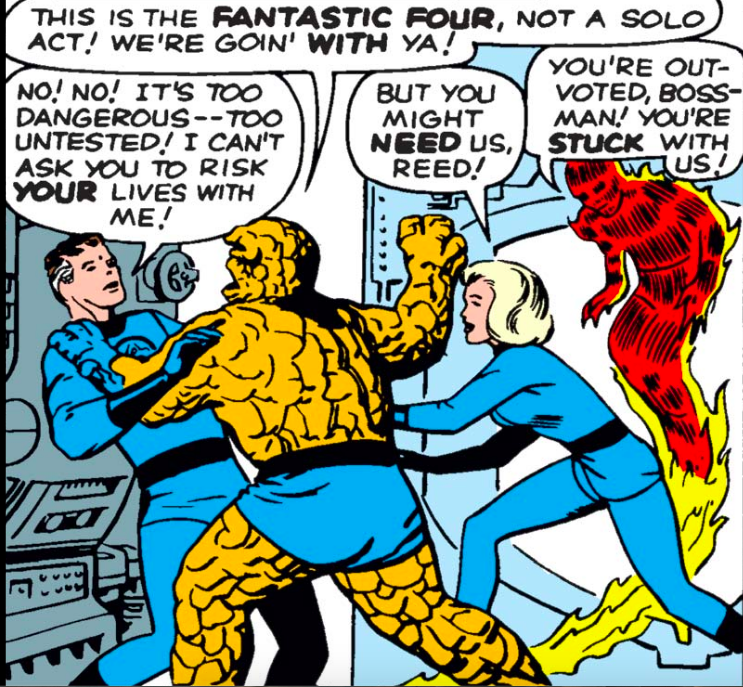
In his lab, Mr. Fantastic unveils his latest discovery to the rest of the team: A substance retrieved from a meteor crater in Arizona that provides “limitless energy.” He tells the team he intends to use to travel to the Moon, as he believes the “the reds” have found a similar substance in Siberia, and he wants to win the space race. The rest of the team persuades him to bring them along.
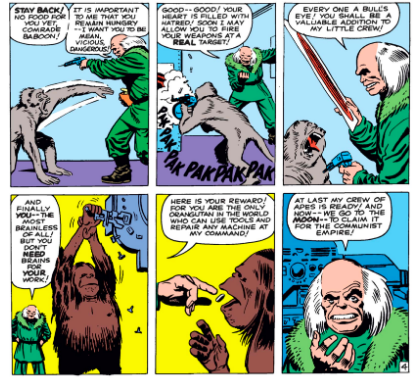
Meanwhile, “behind the Iron Curtain,” Ivan Kragoff launches his own rocket to the moon crewed by a team of trained apes. He leaves his ship unshielded to deliberately expose himself and the apes to the same cosmic rays that transformed the Fantastic Four. His plan works and the four gain powers.
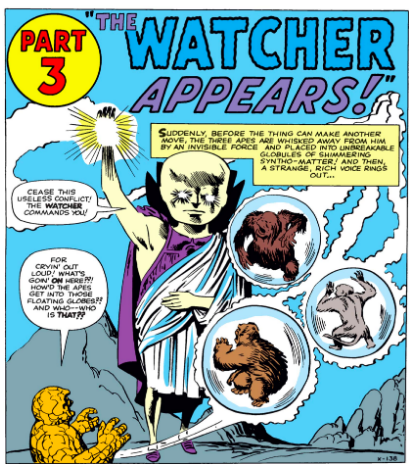
Both ships land on the Blue Area of the Moon, which contains an oxygen atmosphere and the ruins of an ancient civilization. As the Thing confronts Kragoff, now called the Red Ghost, and his apes, the Watcher appears. An ancient alien tasked with observing the Earth, he instructs the Ghost and the FF to “fight it out” for control of the moon. The Ghost captures the Invisible Girl, but as a hostage, she manages to free the apes and foil the Ghost’s plan to use a disintegrator ray on the Human Torch. The Ghost tries to escape, but is bewildered in the Watcher’s house, and is captured by a paralysis ray invented by Reed. He escapes again, only to be pursued by his apes as the FF return to Earth.
What’s going on here?
Fantastic Four 13 marks the first appearance of the Red Ghost (and his Super Apes), a recurring villain who never quite rises to the ranks of the A-list, but appears in plenty of comics over the years.
More notably, it’s the first appearance of the Blue Area of the Moon and its most famous denizen, the Watcher. Both appear prominently over the years and across Marvel’s entire line of comics. The Watcher often serves as a Greek chorus, introducing particularly big stories—among them Uncanny X-Men 137 and the death of Phoenix—and “hosted” the What If? comic, where he would introduce stories from alternative timelines. Uatu was killed in 2014’s Original Sin crossover event (he less said about that the better) before being resurrected in last year’s Empyre crossover.
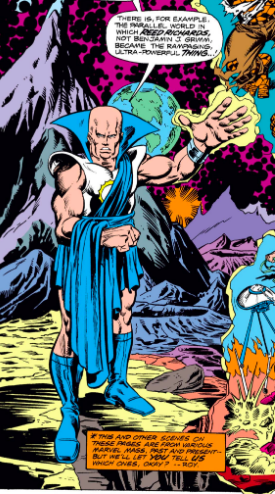
As originally drawn by Kirby in FF 13, the Watcher (not yet named Uatu) has spindly limbs and an enormous head, giving him a distinctly alien appearance.
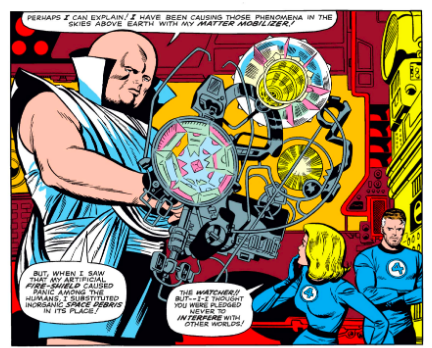
A few years later, in FF 48, Kirby made him significantly beefier.
By the time What If? 1 comes out in 1977, he’s pretty much unrecognizable.
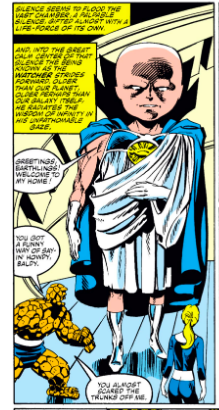
It’s not until John Byrne takes the reins of the FF does he revert back to his original proportions.
FF 261
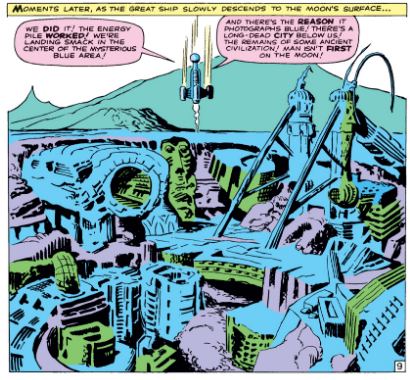
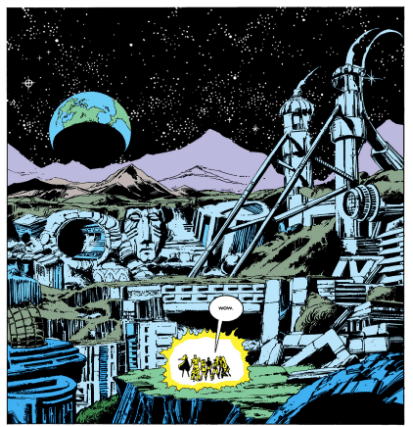
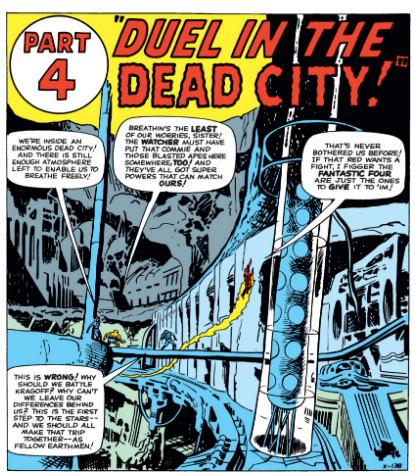
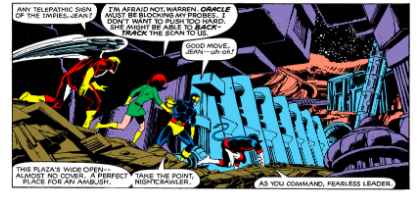
FF 13 also introduced the Blue Area of the Moon, another fixture of the Marvel universe. Created by the Skrulls, it became the home of the Inhuman’s city of Attilan, and featured prominently in X-Men 137, as a battleground between the X-Men and the Shi”ar Imperial guard. Byrne, then the X-Men’s penciler, drew heavily on FF 13 for his images of the Blue Area.
Both the FF and the X-Men arrive at the same location, for example:
FF 13
UXM 137
Later, both the FF and the X-Men pass the same alien machinery
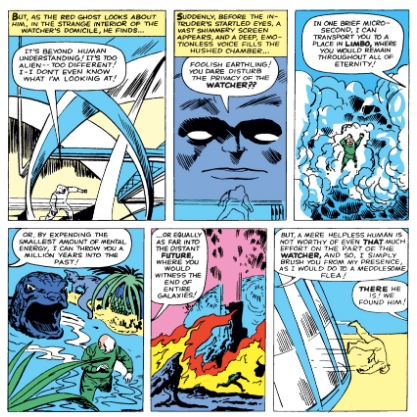
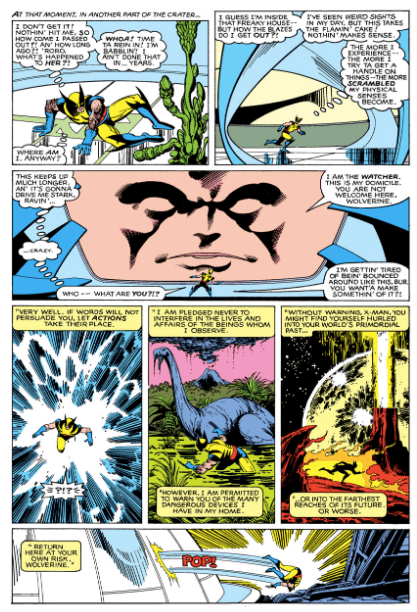
The homage extends to a sequence when the Ghost invades the Watcher’s home, which Byrne duplicates with Wolverine.
Fantastic Four 13 is also notable as the only regular issue of the comic inked by Steve Ditko (he also inked stories in a pair of annuals). Ditko, better know as the penciler of Spider-Man and Dr. Strange, is a good choice here, given the story has few Kirby-esque brawls, but is more about the spooky landscapes Ditko excels at. Despite that, I think his influence is most noticeable in close ups of the FF, and particularly Reed.
Red Menace
The Cold War and space race features prominently in the comic. Reed is determined to beat “the reds” to the Moon, while Kragoff wants to the extend the “communist empire.” Stan is notably averse to mentioning the Soviet Union by name even if Kragoff’s ship features a hammer and sickle.
They’re fighting again
This time it seems more playful.
Dig That Kirby Krackle
This is a fun sequence.
And so is this panel.
Oops
It seems like Stan is trying to explain why Jack drew this thing.