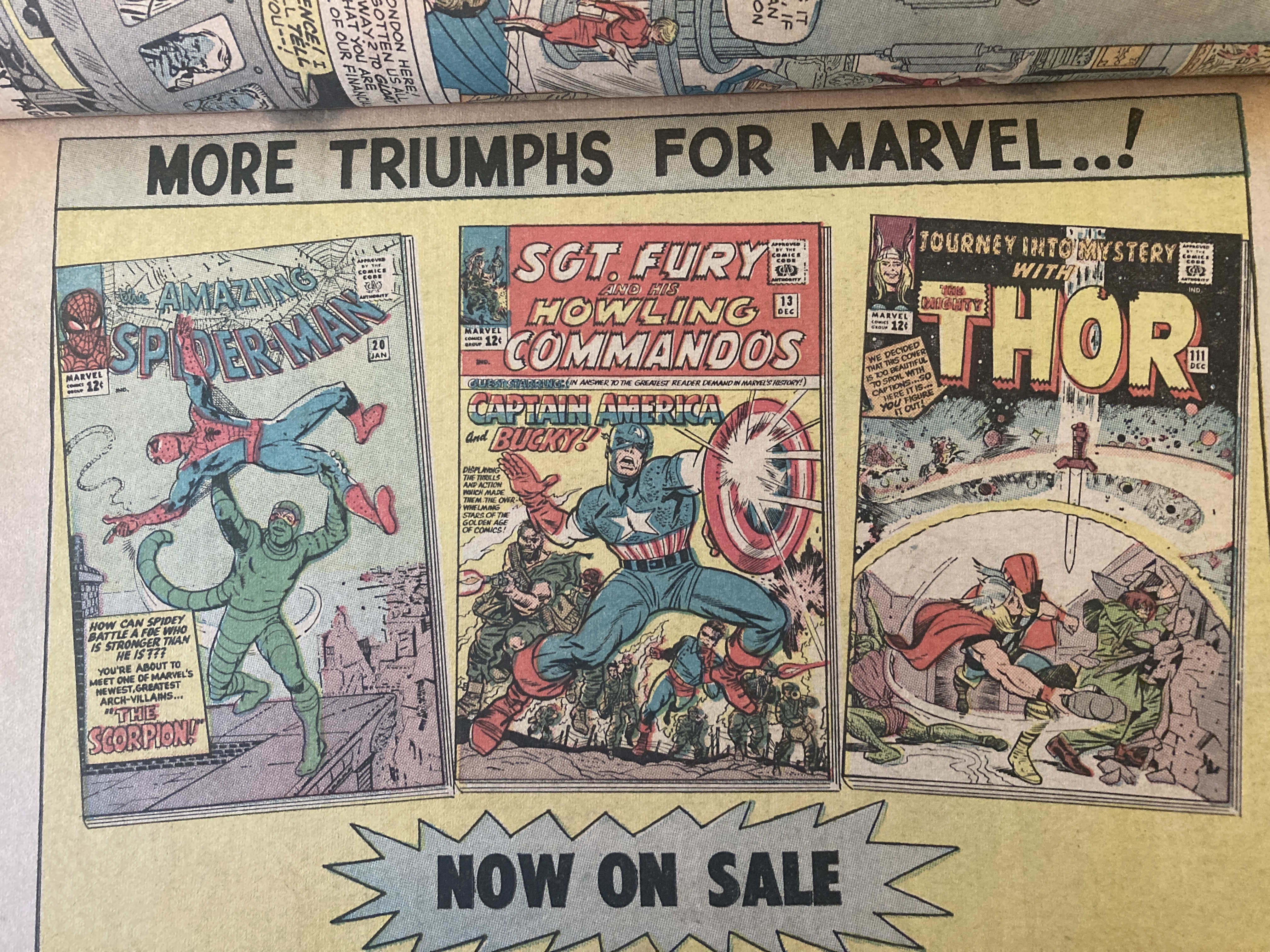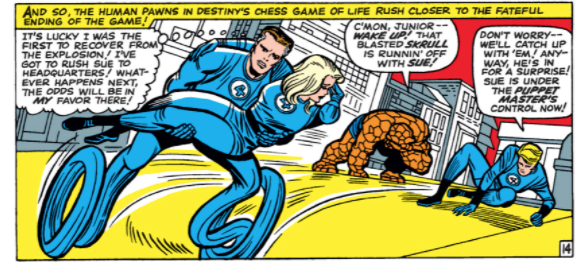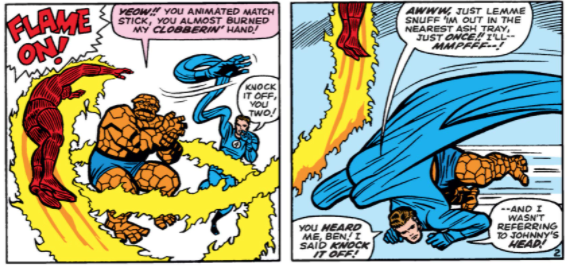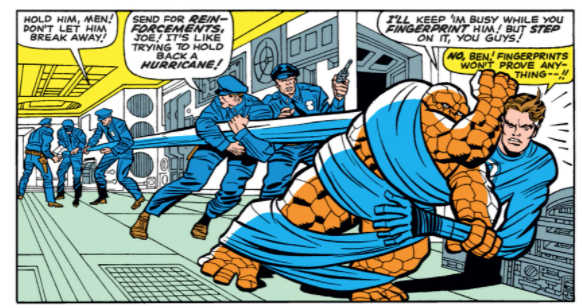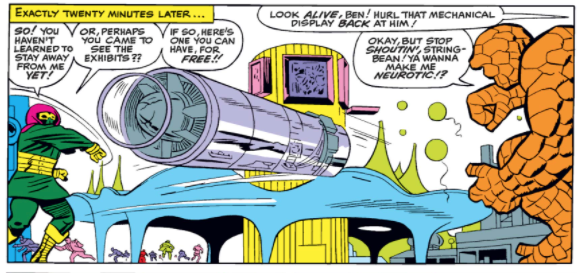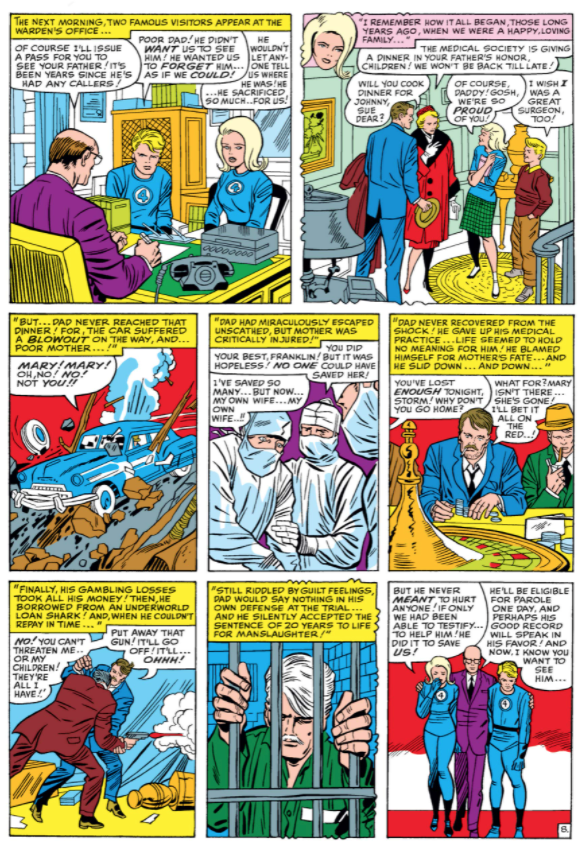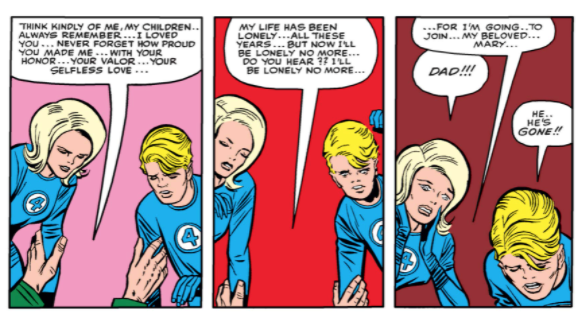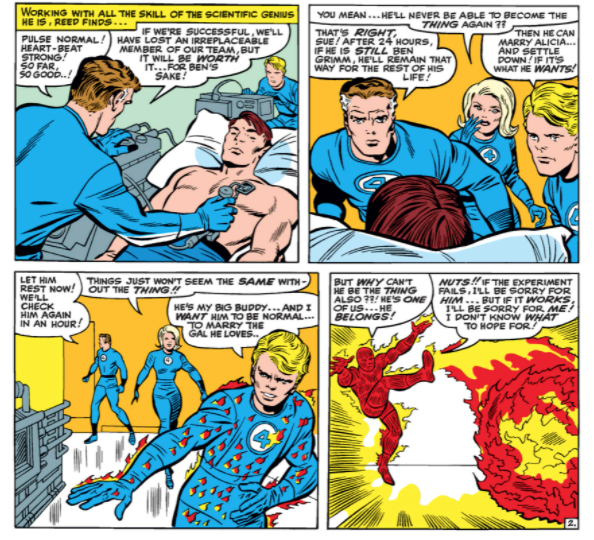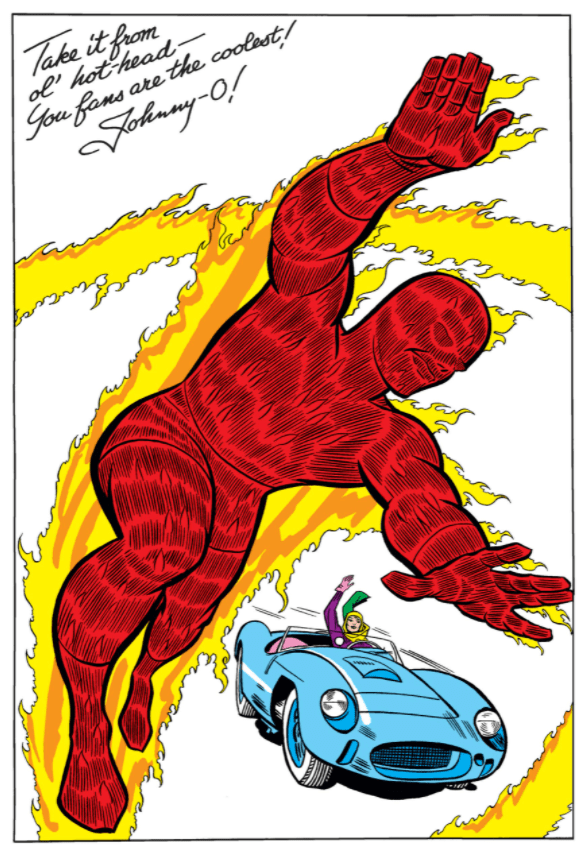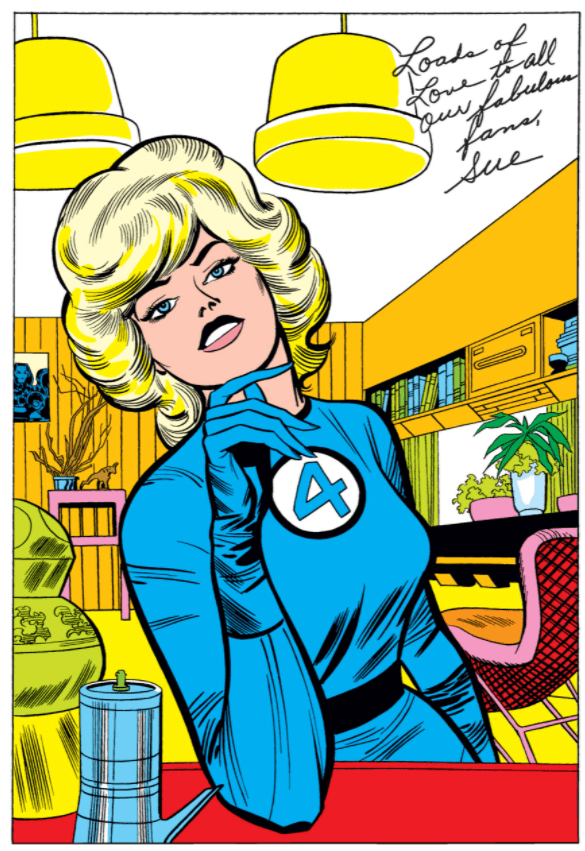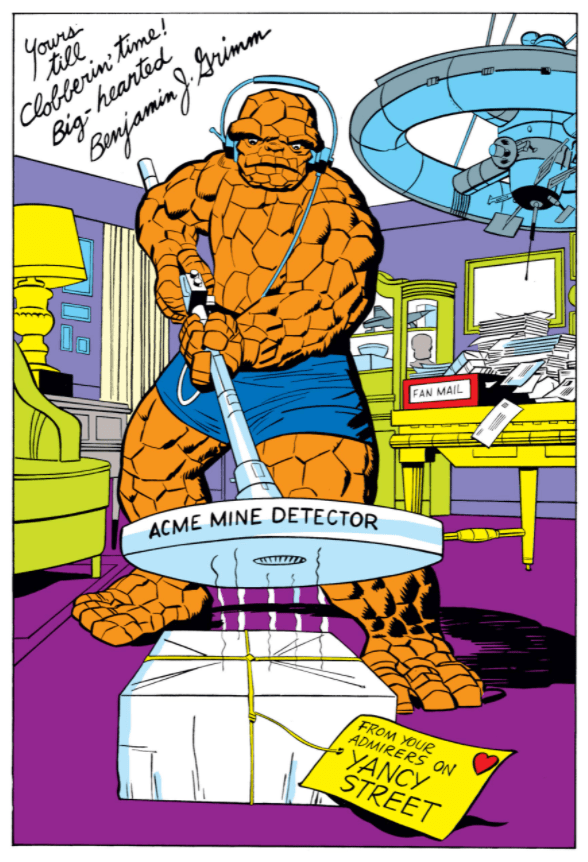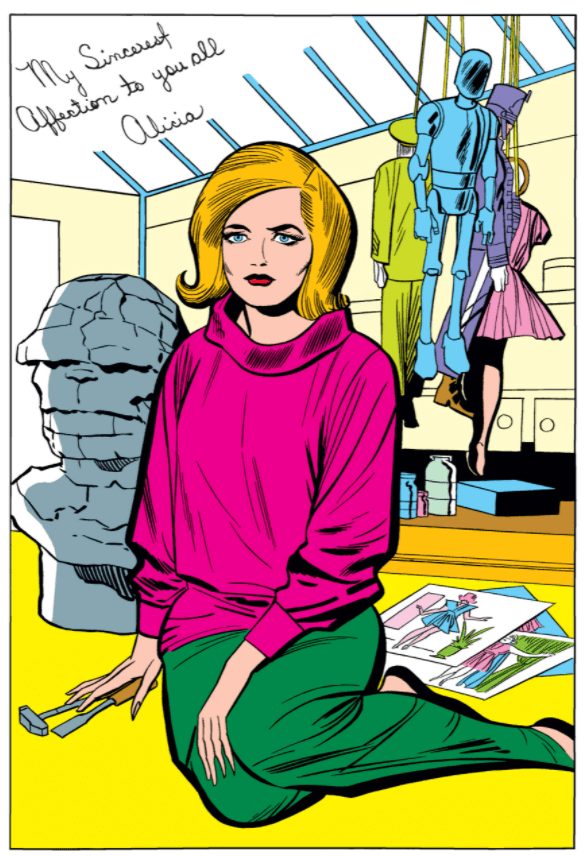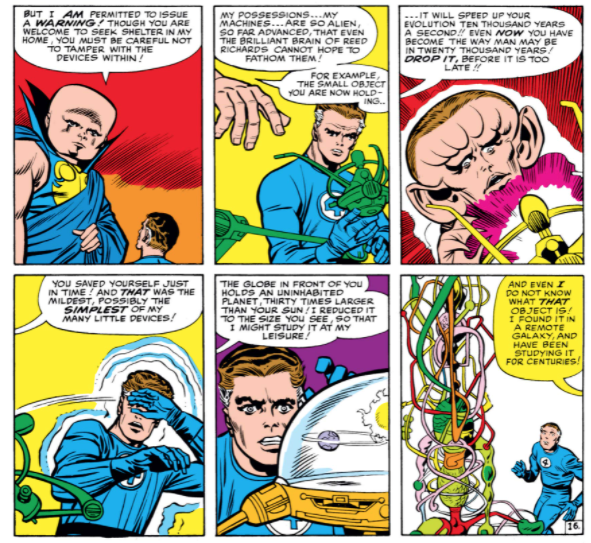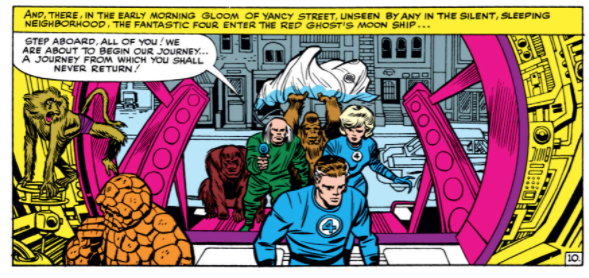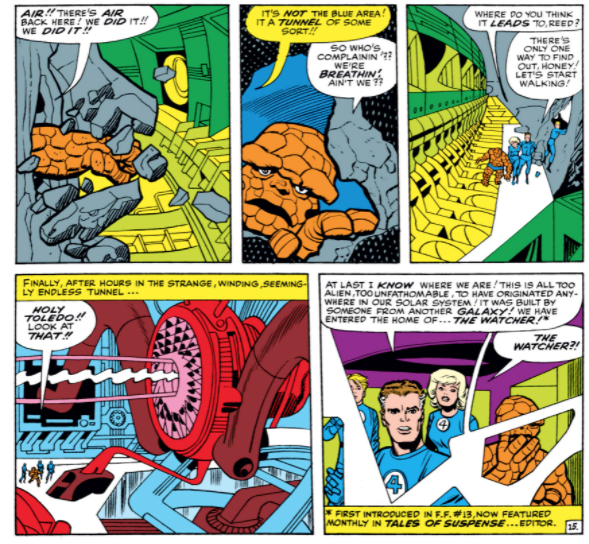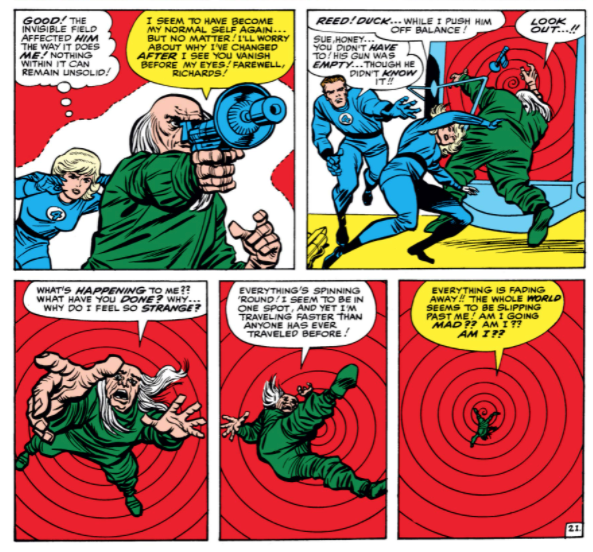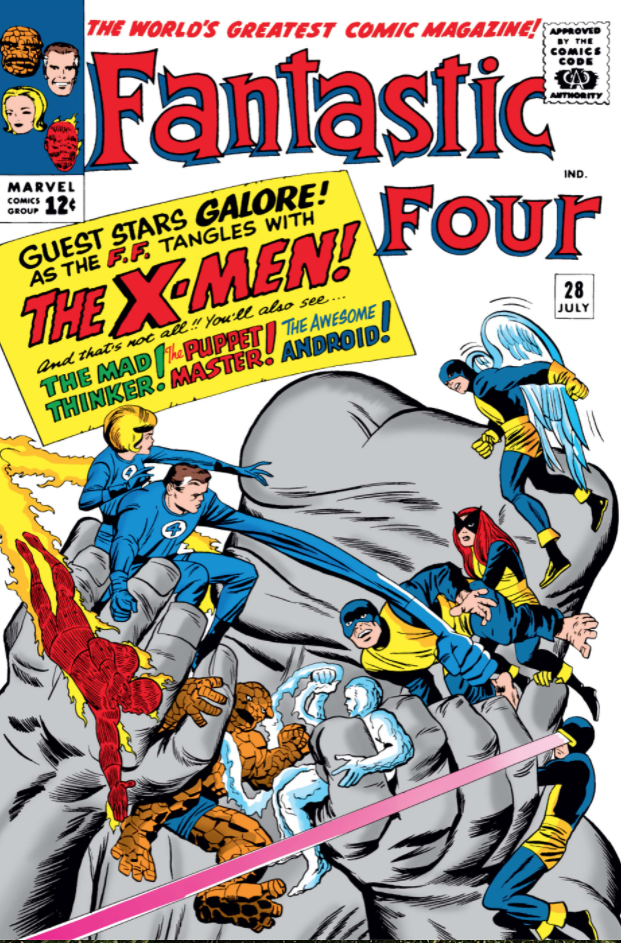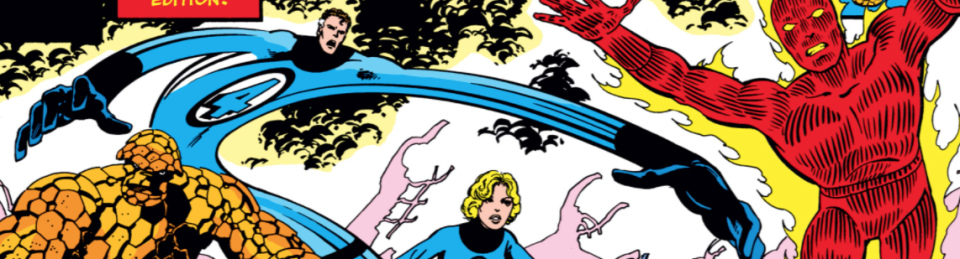
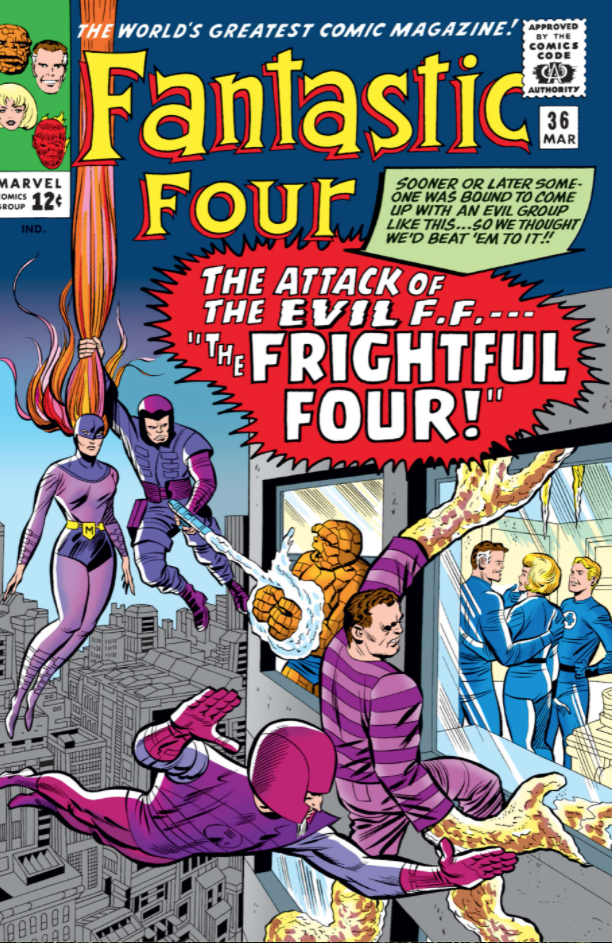
“The World’s Greatest Comic Magazine” Fantastic Four No. 36

Tags

, , , , , ,

Fantastic Four 36
“The Frightful Four”
Published Dec. 1964
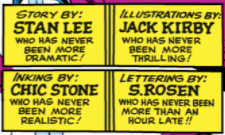
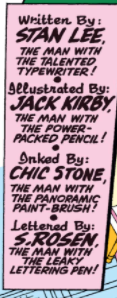
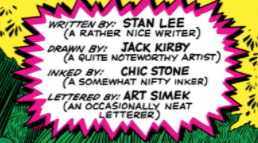
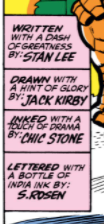
Story: Stan Lee and Jack Kirby
Script: Lee
Pencils: Kirby
Inks: Chic Stone
Letters:Art Simek
Cover: Kirby and Stone

Synopsis

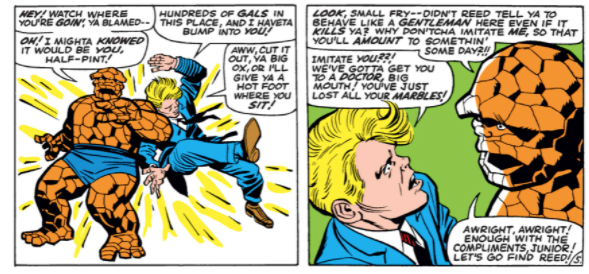
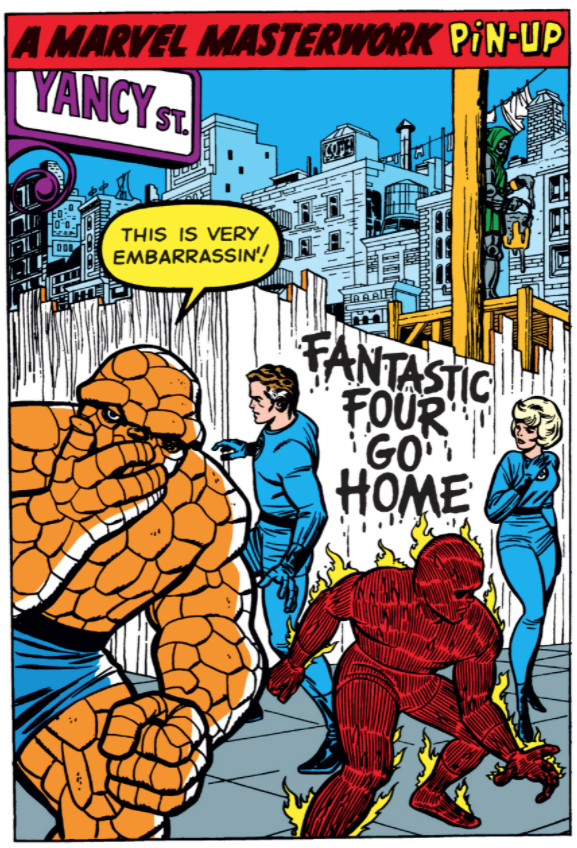
As the engagement of Reed Richards and Sue Storm, seen last issue, is made public, the Baxter Building is swarmed with media. The couple also gets gifts including a gag from, of course, the Yancy Street Gang. Meanwhile, a trio of enemies of the Human Torch—Paste-Pot Pete, the Sandman and the Wizard—plot to team up to defeat the FF by recruiting a fourth, female member, Madam Medusa.

As the FF rests after an engagement party, the newly named Frightful Four launch an attack on the Baxter Building, and successfully subdue the Thing, Mr. Fantastic and the Invisible Girl. Undetected, Alicia Masters uses Sue’s flare gun to summon the Human Torch. The Frightful Four then apprehend Alicia, and attach the Wizard’s anti-gravity disks to her and the unconscious captured trio, sending them up toward space.

The Human Torch forces the Wizard to fly them in his spacecraft to rescue the team and Alicia. Then, reunited the team confronts the rest of the Frightful Four back on earth. During a battle, the Wizard’s detonates his spacecraft, and the villains escape in the confusion.
What’s going on here?

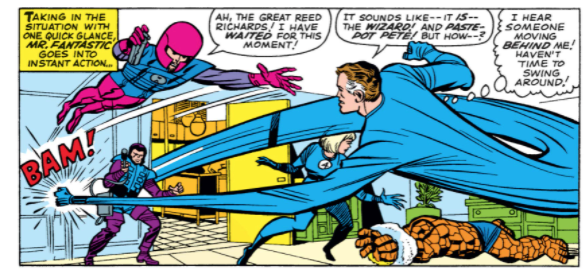
This is a fun comic, and contains a lot of elements that make the Fantastic Four so successful. There’s character development as Reed and Sue progress toward marriage. There’s the slapstick elements of the Thing (again) falling for a Yancy Street gag. There’s the Marvel world-building, with the synthesis of the assorted Torch villains into the Frightful Four. Plus there’s a pretty good action story, featuring some heroics from the Torch. What’s not to like?

The issue’s notable introductions are the Frightful Four as a super-team capable of taking on the FF—and we’ll see much more of them in issues to come—and of course, the first appearance of Medusa. Medusa is later revealed as queen of the Inhumans, and becomes a significant character in the Marvel Universe, but it’s doubtful Stan and Jack had that future in mind for her in FF 36. At this point, she’s just an intriguing female villain with an unusual power.
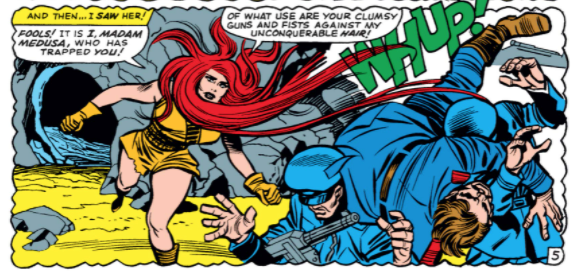
The formation of the Frightful Four is an interesting concept, since none of them had previously appeared in the Fantastic Four. While Sandman was primarily a Spider-man villain, he fought the Human Torch in Strange Tales, and the Wizard and Paste-Pot Pete (who thankfully will become the Trapster) were both introduced in Strange Tales.

(As an aside, I debated whether to include the Torch’s appearances in Strange Tales in this blog. They are in-continuity, and the rest of the FF often appear, so it would make sense to fold in those issues. Ultimately, I’ve decided to just focus the blog on the FF’s main title. The FF appear in so many comics outside their main book over the years—particularly the Thing, in Marvel Two-in-One and his solo titles—that adding them all could add hundreds of comics to the project. And with more than 600 issues of the main title in its various volumes, I have more than enough to write about.)

Here’s the first appearance of the Wizard:
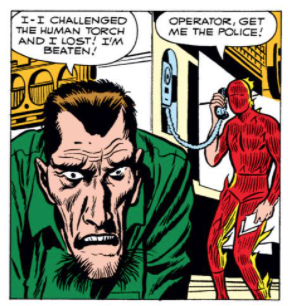
Strange Tales 102 (art by Kirby and Ayers)

and of Paste-Pot Pete:

Strange Tales 104 (Kirby/ Ayers)

And here’s an odd battle between the Torch and Sandman, where Johnny claims his flame powers give him super strength, which I’ve never seen before or since (then again, the comic was called Strange Tales).
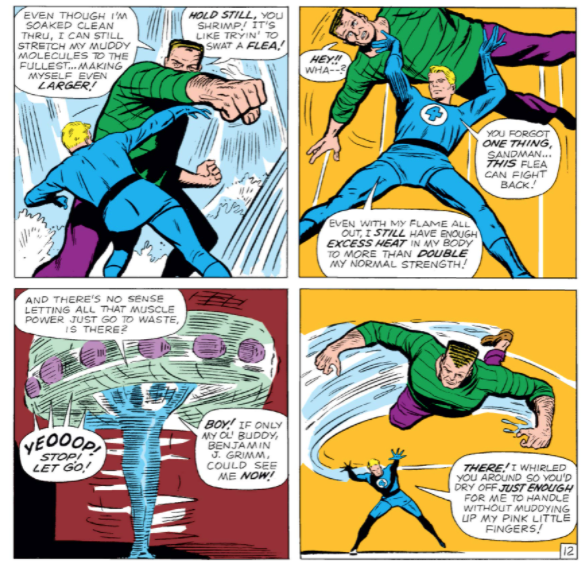
Strange Tales 115 (Ayers)

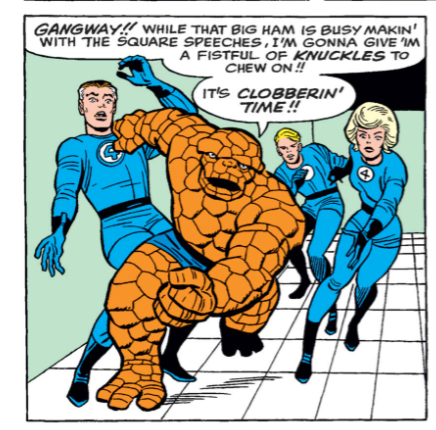
Eventually, in FF 36, the team gets together in snazzy new uniforms, and looks like a super team ought to:
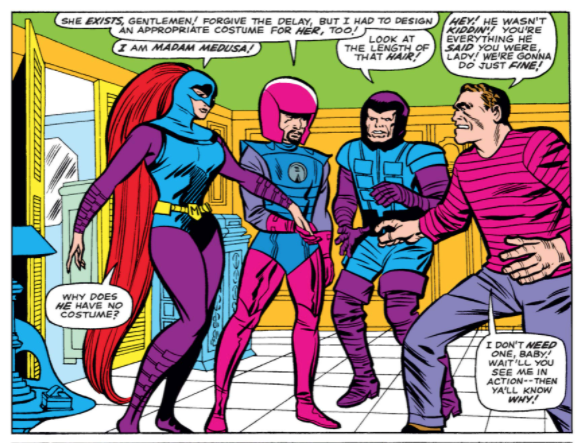
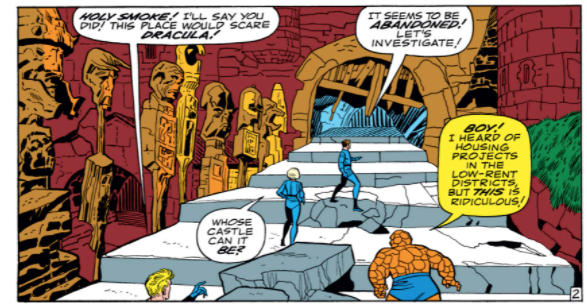
Saying the quiet part out loud

Stan and Jack sort of tip their hand a bit here. It’s not obvious why the Frightful Four needs a female version, save for better story-telling possibilities.
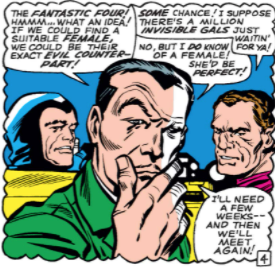
Cameos!

The guests at the FF’s engagement party seems to be mostly the Avengers and X-Men (plus Rick Jones), and features some stilted dialogue from Jean Grey:
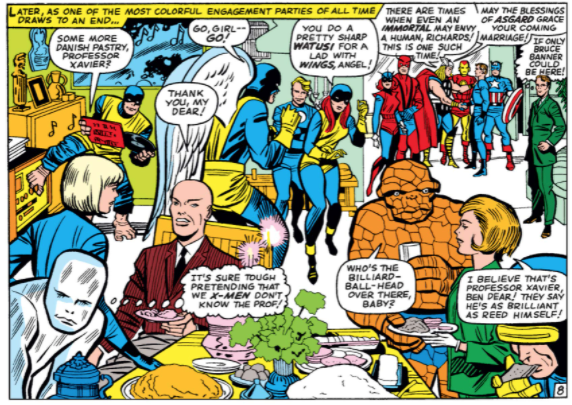
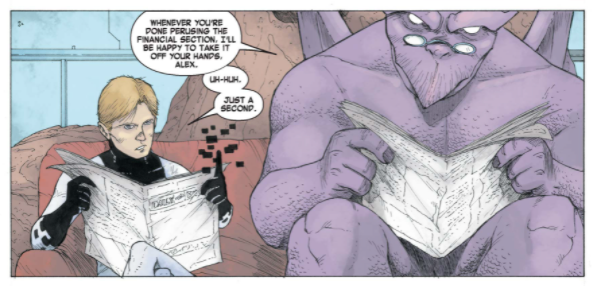
Also, a sort-of appearance from Spider-Man:
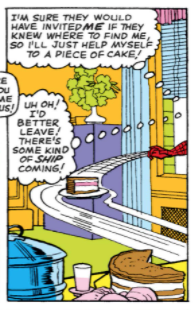
They don’t call him a genius for nothing

Reed can count to four.
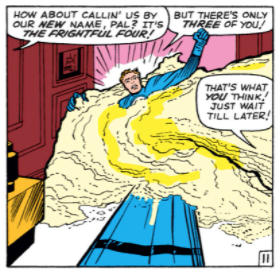
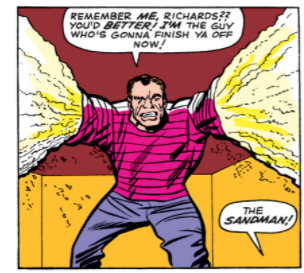
Have we met?

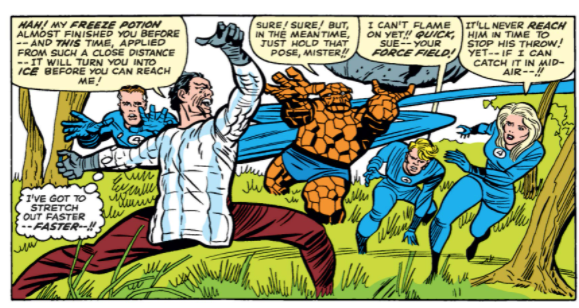
The Sandman seems intent on getting his revenge on Reed, although this appears to be the first time they have fought each other:
The sexist sixties

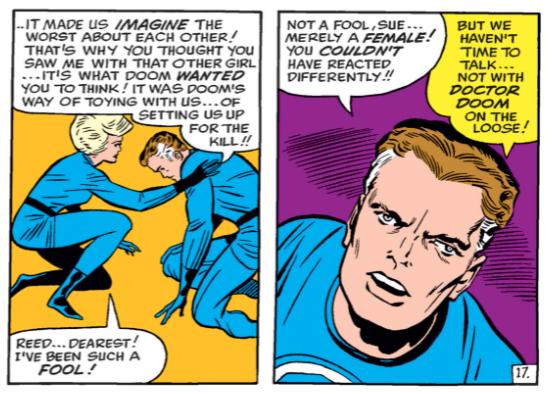
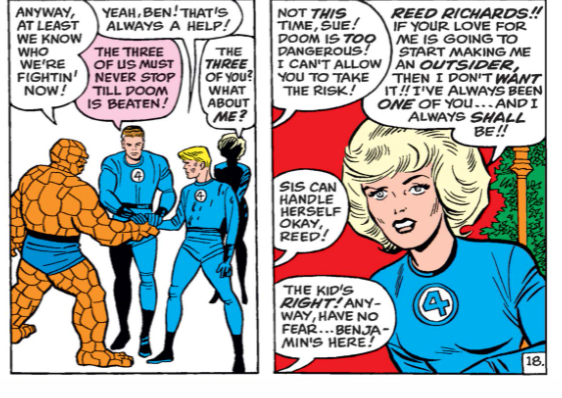
Sue actually does quite a bit in this issue, but it’s sadly undermined by this sort of language.
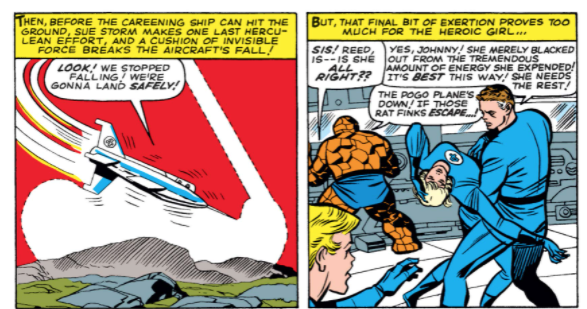
Weird science

Like the rest of us, the Sandman is befuddled by the Wizard’s antigravity disks.
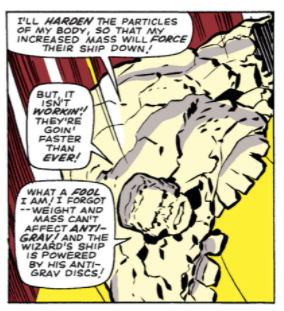
Dig that Kirby Krackle

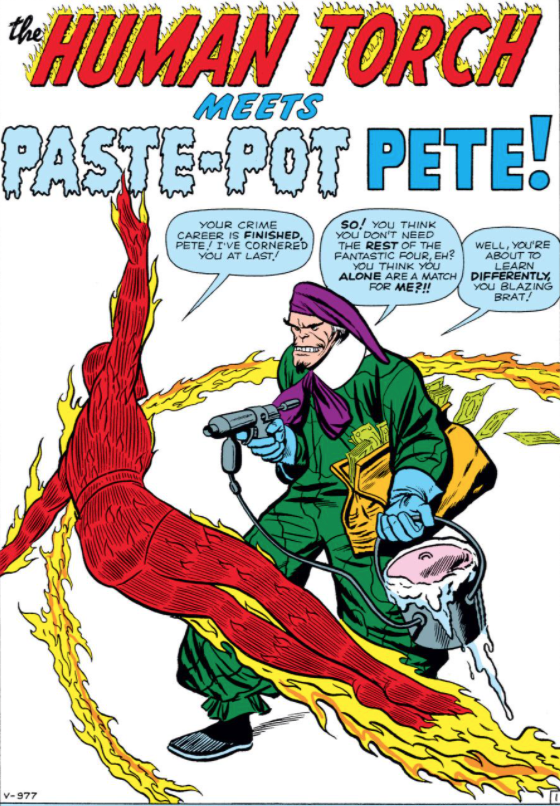
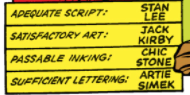
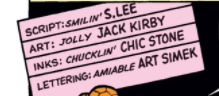
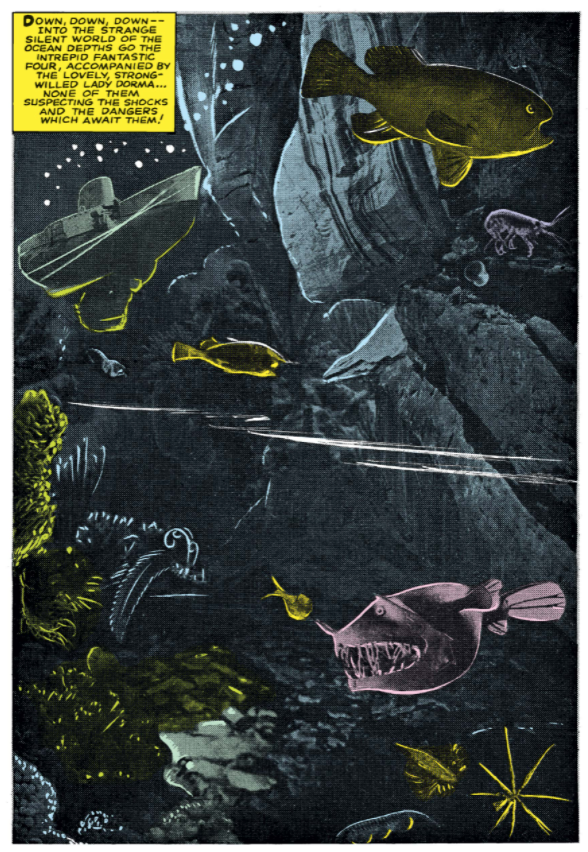
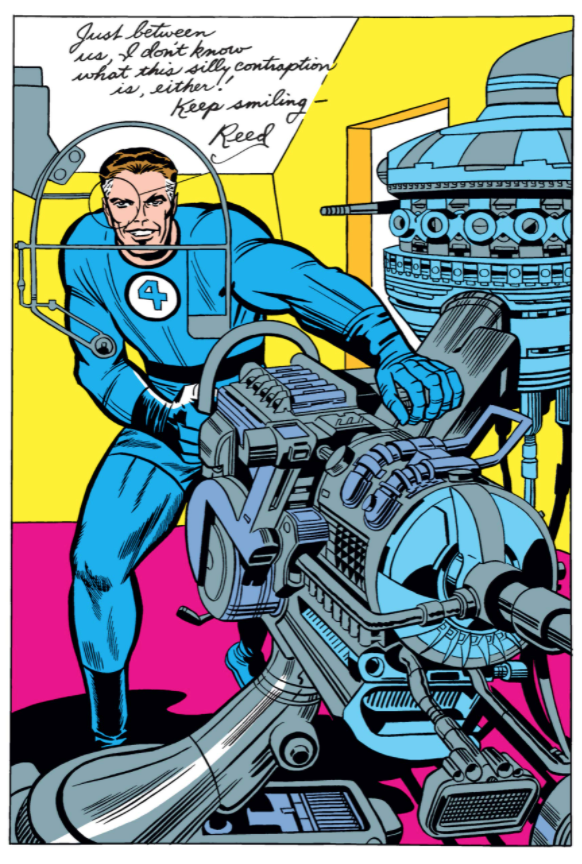
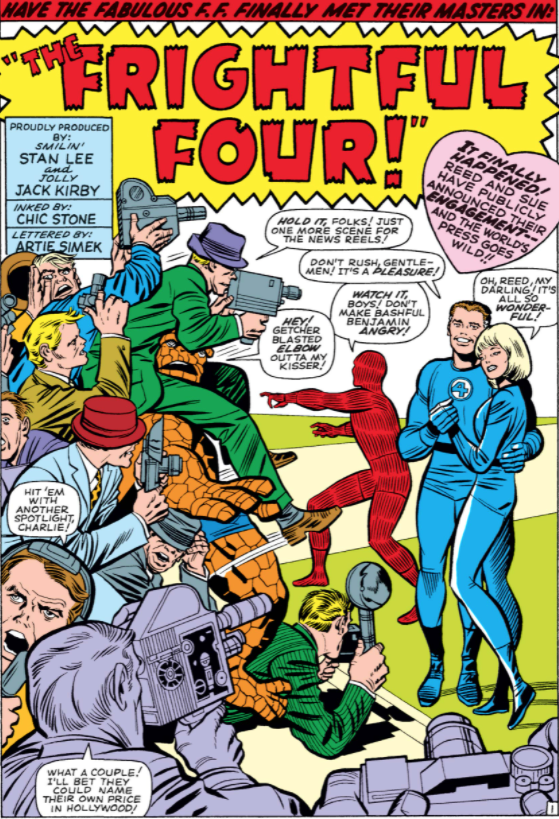
Jack leads off with a great splash page (incidentally, the credits are pretty subdued this issue):
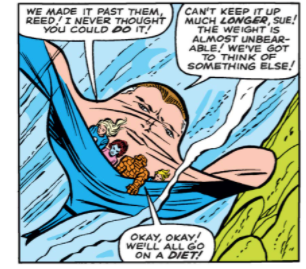
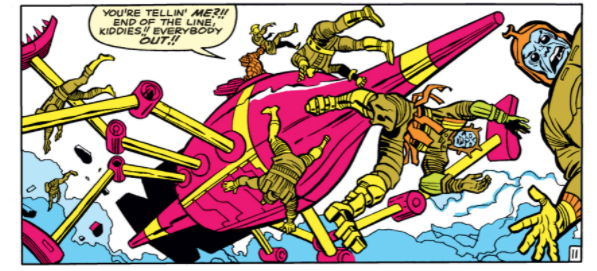
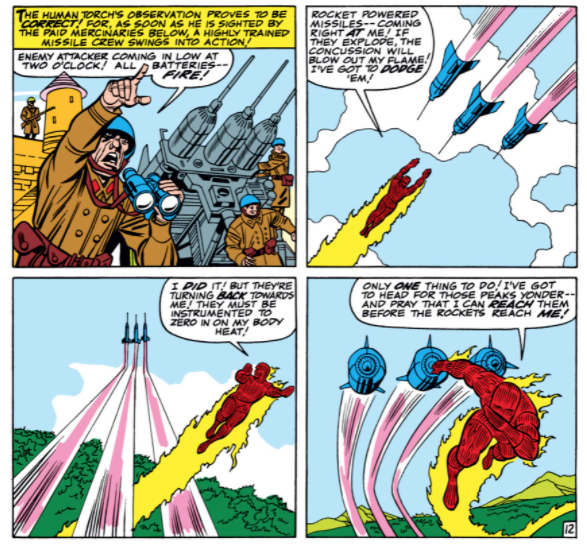
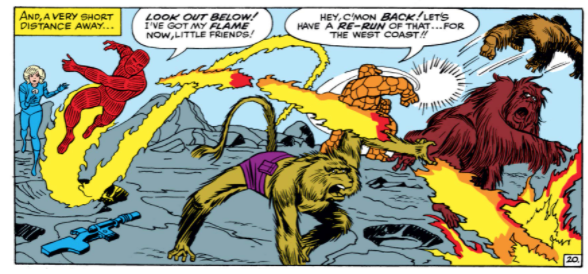
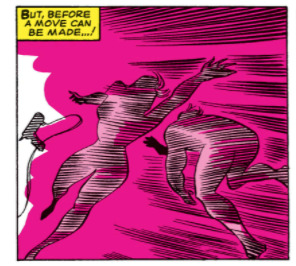
I love this image of the FF floating off into space:
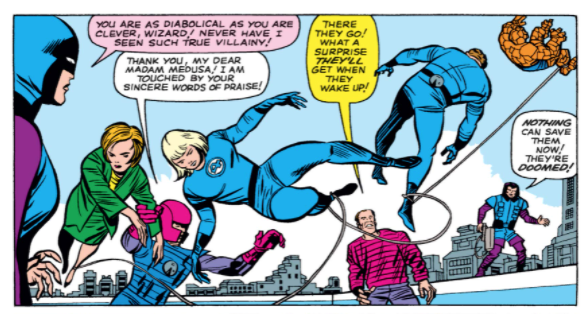
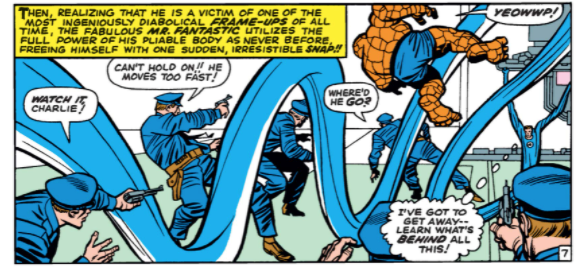
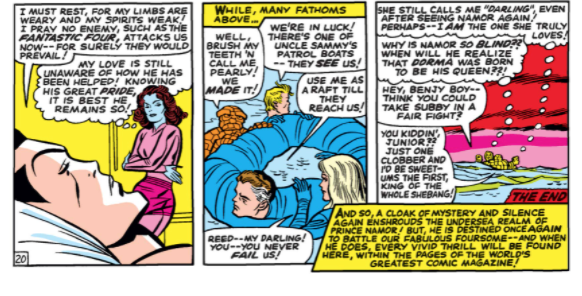
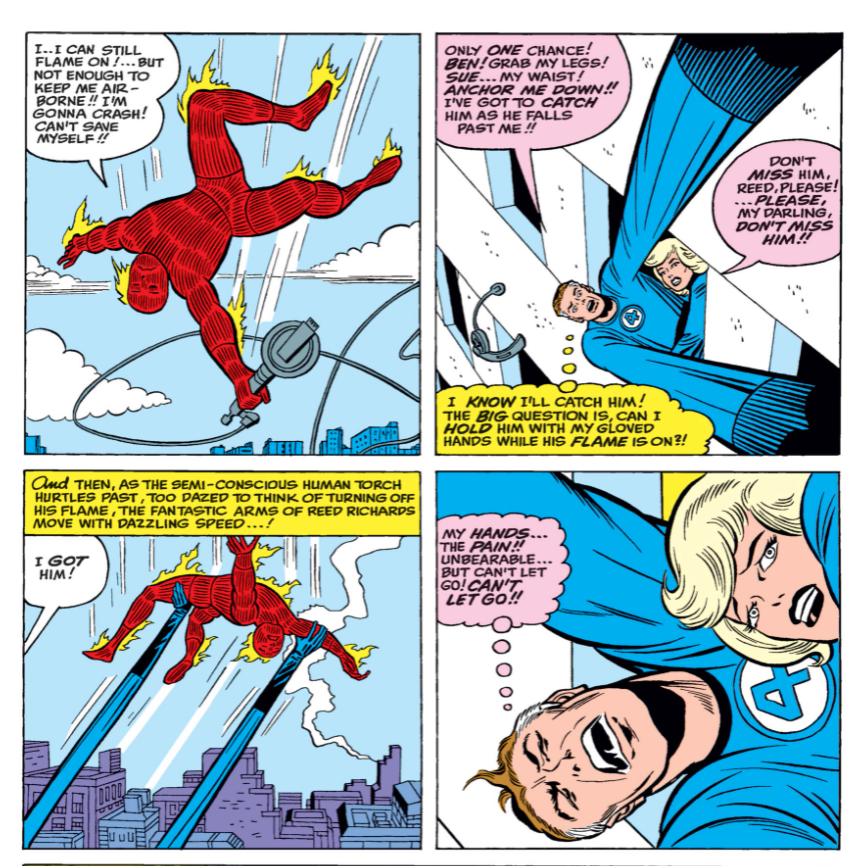
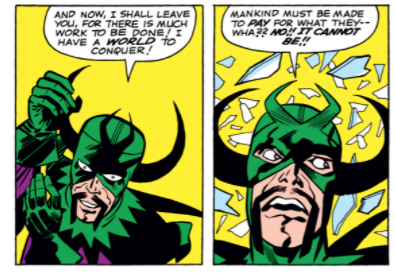
and this is a great panel:
For sale

A mint (9.8) copy of FF 36 is worth about $23,000. A fine (6.0) version is $325.

Next issue: The return of the Skrulls!
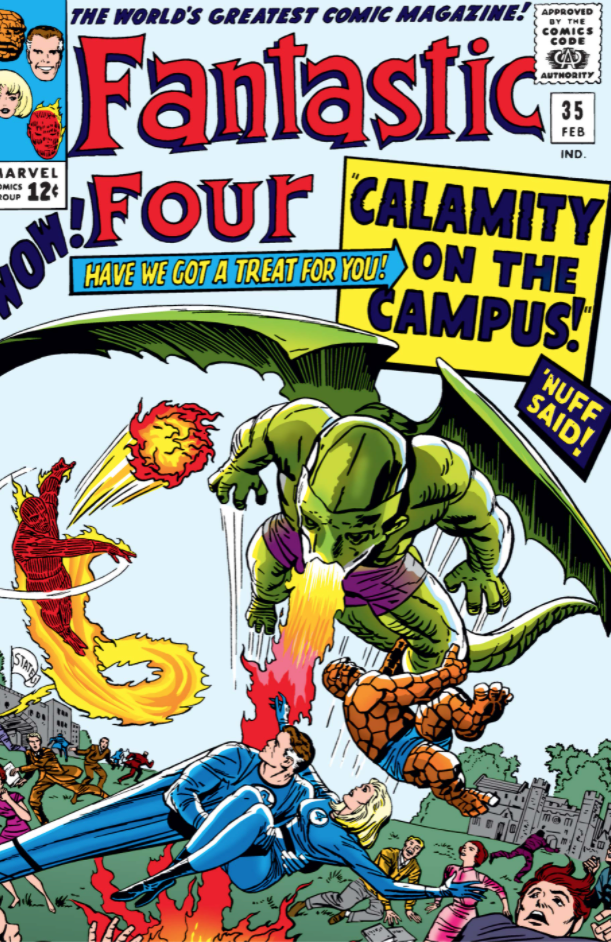
“The World’s Greatest Comic Magazine” Fantastic Four No. 35

Tags

, , , , , ,

Fantastic Four 35
“Calamity on the Campus”
Published Nov. 1964
Story: Stan Lee and Jack Kirby
Script: Lee
Pencils: Kirby
Inks: Chic Stone
Letters: Artie Simek
Cover: Kirby and Dick Ayers

Synopsis

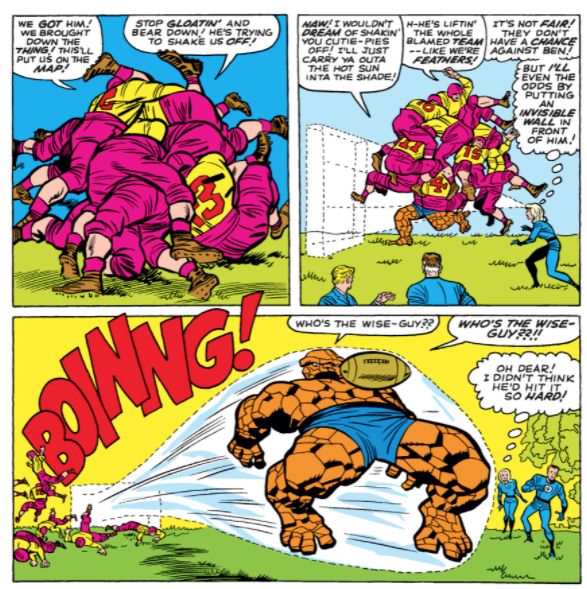
The comic opens on the campus of State University, the alma mater of Reed Richards and Ben Grimm, where Reed has been invited to give a lecture. Some hijinks on campus ensue as Ben and Sue tangle with the football team, and Reed learns that a Prof. Gilbert on campus is building “a creature more powerful than anything that lives—including the Fantastic Four.”

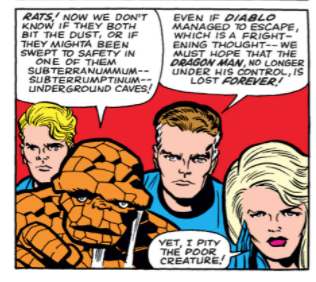
Meanwhile (although logically some time before the other events in the comic), in Transylvania, Diablo escapes the mountain under which he was buried in FF 30 and makes his way to New York in pursuit of the Fantastic Four. Once on campus at State U., he convinces Gilbert to let him animate his creature, which becomes Dragon Man.

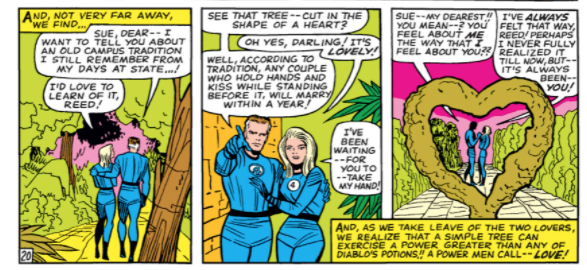
The Thing stumbles on the Gilbert and Diablo, and battles with Dragon Man, before the robot monster runs amok across campus. While Sue is able to subdue it with kindness, Diablo attacks the FF. Dragon Man now turns against Diablo, and both plunge into a lake and disappear. The story ends with Reed and Sue strolling down State U’s “lovers lane” and Reed kind-of, sort-of proposing to Sue.

What’s going on here?

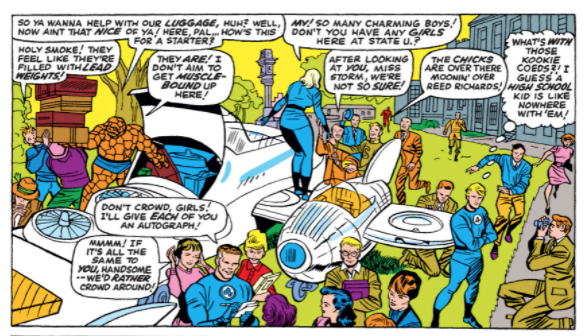
This is a fun issue, and Stan and Jack clearly enjoy the campus setting, with its swooning co-eds, tweedy professors and beefy football players. The FF comic book was gaining popularity among college students by this point, and it seems possible Stan and Jack were either inspired by the feedback they got from the students, or simply wanted to give some them college-based material. The story also reinforces Reed and Ben’s shared history as college roommates but interestingly, another former classmate, Victor Von Doom, isn’t mentioned.

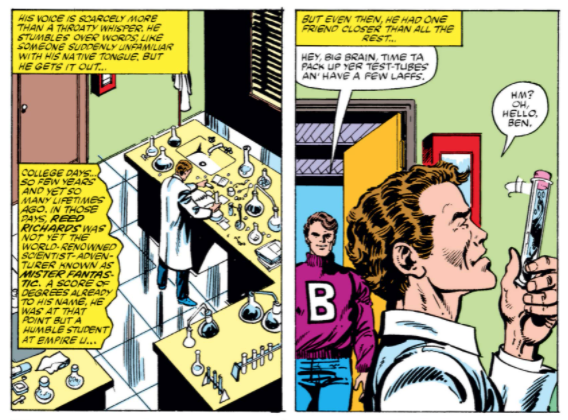
One puzzle that’s hard to unravel is where, exactly, did Reed and Ben, go to college? Here, in FF 35, it’s referred to as State University, and it appears to be a rural campus, with a lake and woods with a lover’s lane (some sources put it in Hegemans, New York). But later retellings of Reed and Ben’s origins put them on the campus of Empire University, or Empire State University. Here’s one mention of it, in The Thing 2, written by John Byrne:

The Thing 2, 1983, art by Ron Wilson and John Byrne

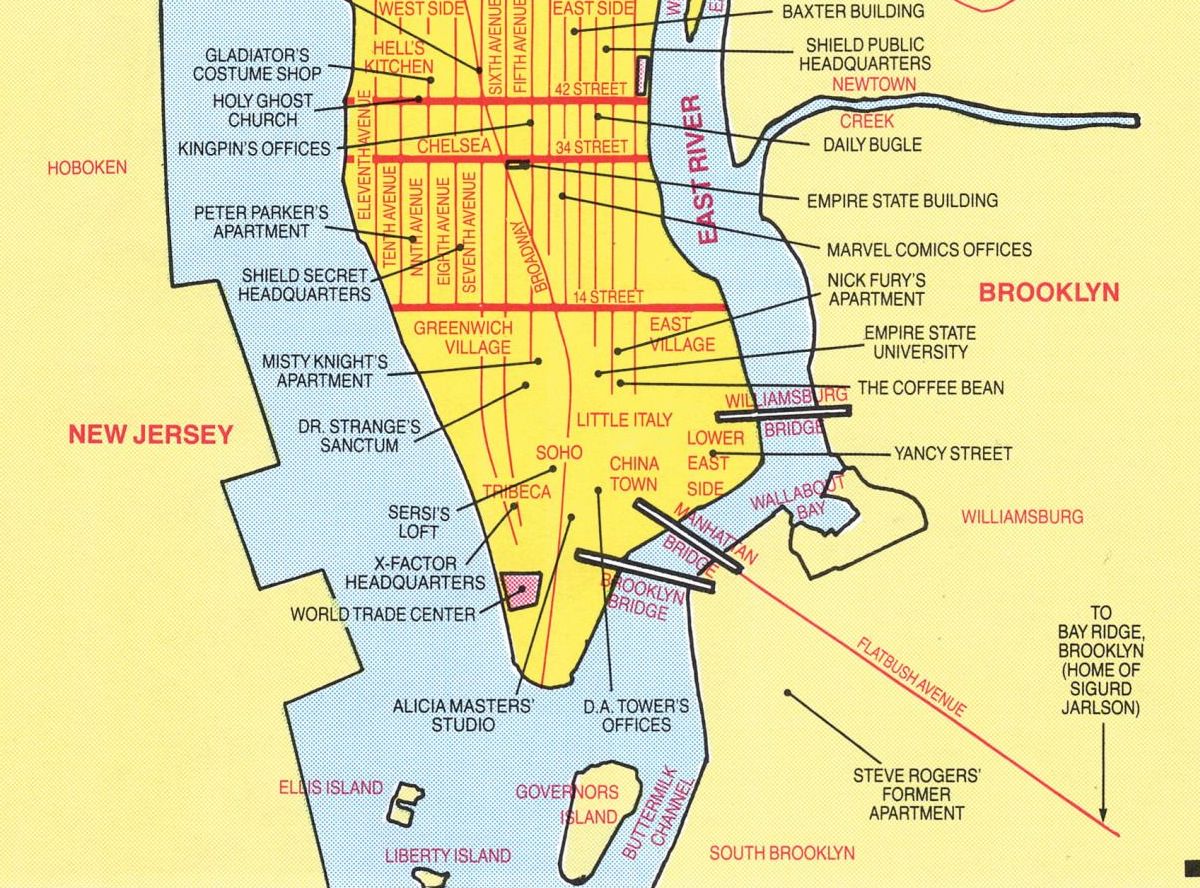
Empire State University plays a significant role in the Marvel Universe, chiefly as Peter Parker’s university both as a student, and a graduate assistant. So it would make sense that Reed and Ben went there, and that “State U.” is is just shorthand for “Empire State U.” Yet most depictions of Empire State U. place it it in the middle of Manhattan, making it an urban campus, and not at all the rural location of FF 35. The Official Handbook of the Marvel Universe puts it in the village, pretty much where New York University is in the real world:

Further confusing matters, the Handbook is inconsistent about where Reed and Ben attended college. Reed’s entry says it was State U. (among other institutions), while Ben’s says Empire State U.

The obvious, and unsatisfying, answer is that over the years writers have conflated the two universities, and since Empire State U. became a prominent part of the shared universe, it just made since to retcon away State U., although not every writer got the memo.

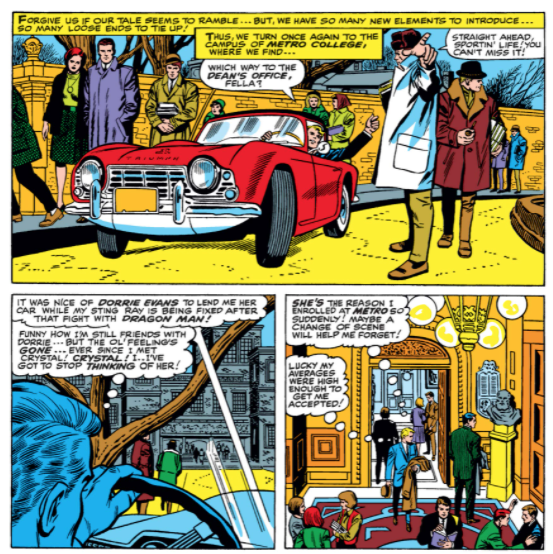
Just please don’t ask about Metro College, where Johnny begins classes in FF 50:

Introducing Dragon Man

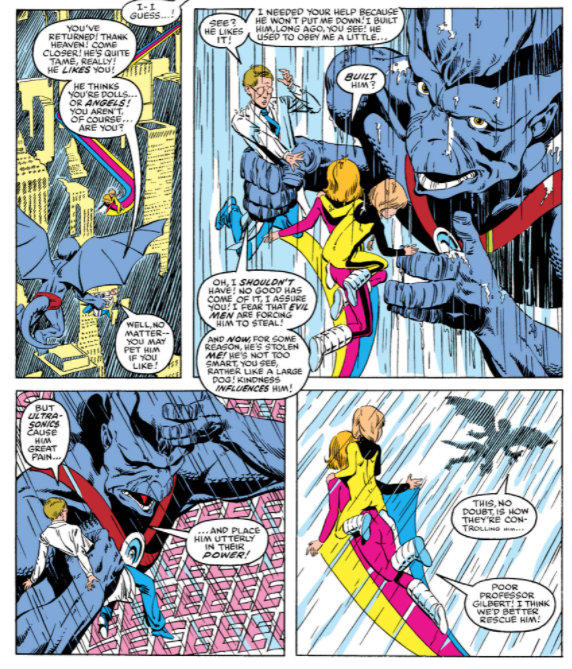
FF also features the return of Diablo, and the introduction of Dragon Man, who becomes a fixture in the Marvel Universe. It’s established in this issue that he (or it?) is not inherently evil, but does the bidding of whomever controls him. Over the next few decades that’s pretty much how he’s used, as a pawn of other villains. Here is is in Power Pack 6:

Power Pack 6 (1984), written by Louise Simonson, art by June Brigman and Bob Wiacek.

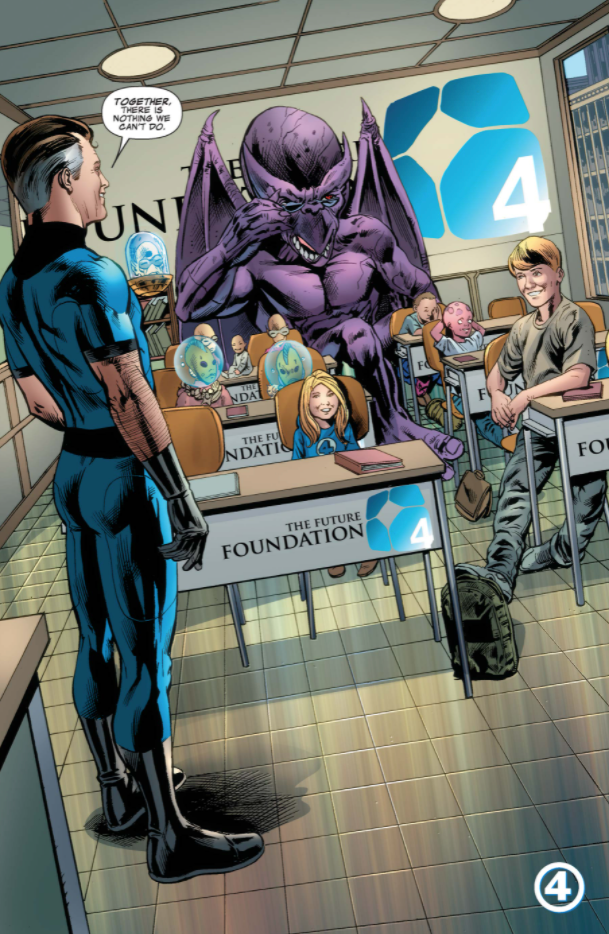
But much later, Dragon Man gets an intelligence upgrade, and joins the Future Foundation, the group of super-smart kids (and moloids and other creatures) founded by Reed.

Fantastic Four 579 (2010) written by Jonathan Hickman, art by Neil Edwards and Andrew Currie.

There, he becomes a sort of chaperone, keeping an eye on the kids, and developing some very urbane tastes.
FF 22 (2011) Hickman, art by Andre Araujo

True love

Since Reed and Sue have been married for most of their comic-book existence (more than 50 years in real time), it’s hard in retrospect to imagine there was any suspense about the future of relationship. But Stan and Jack are determined to tease us.

Cameos

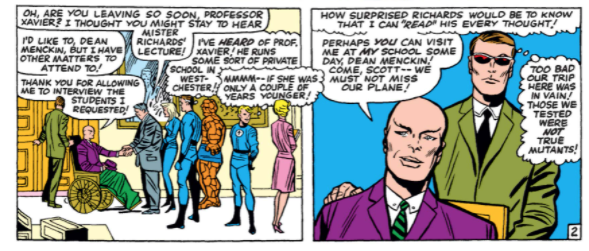
FF 35 also features some unannounced cameos, from Professor Xavier and Scott Summers:

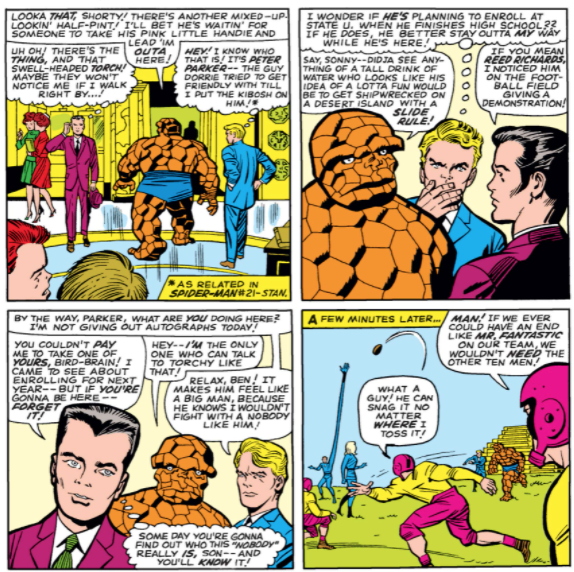
and from Peter Parker:

This is the sort of shared universe stuff that set Marvel apart in the Silver Age, and must have been so thrilling for fans to stumble across, particularly since their appearances were unannounced. Of course, Stan being Stan, he went ahead and took credit for that in the letters page:

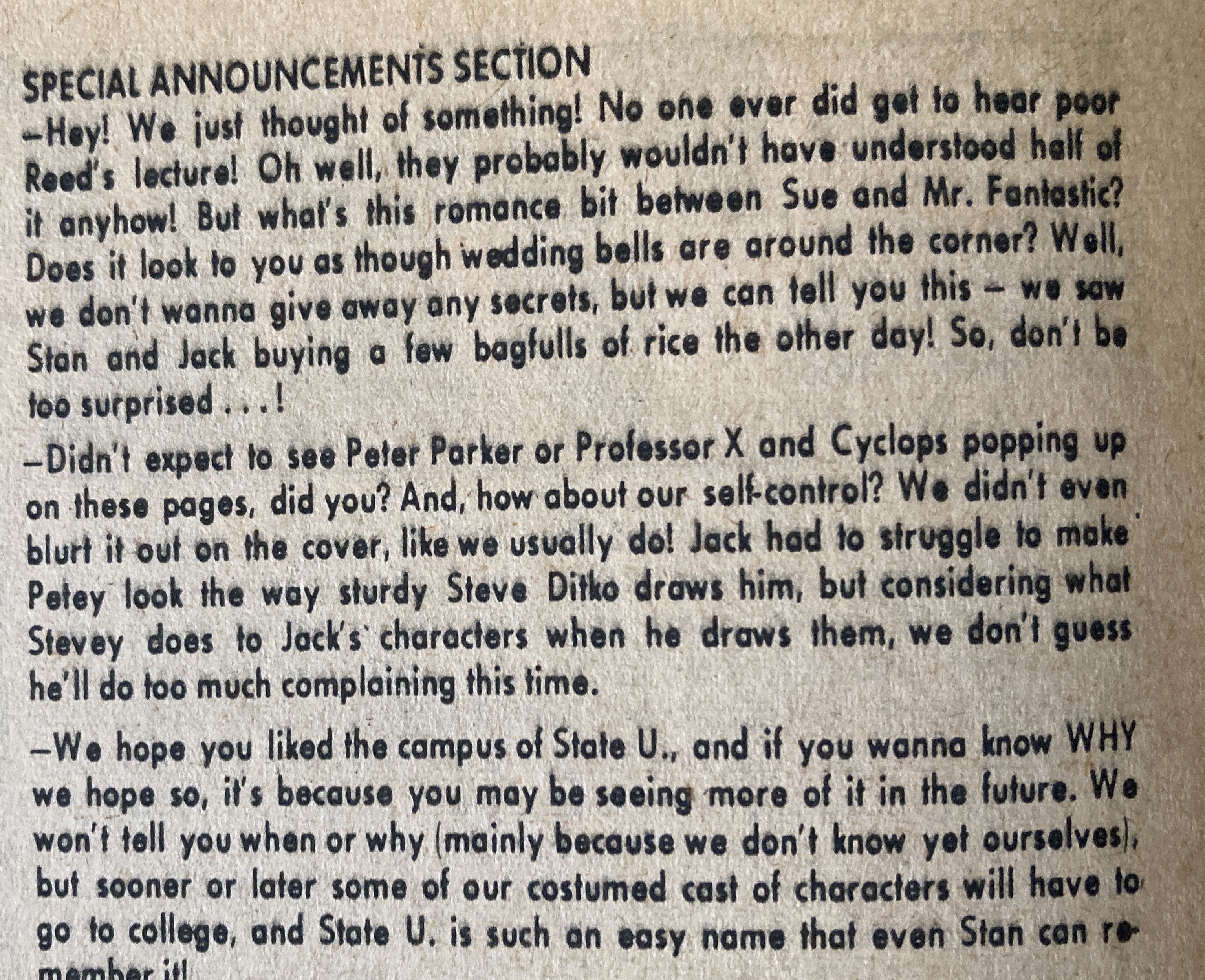
Note the shade-throwing regarding Kirby and Ditko, and the irony of State U. being such an easy name to remember, given the aforementioned issues.

Krazy Kredits

Sort of downbeat this issue.

They’re fighting again

Not actual fisticuffs, but some verbal sparring. I think it counts.

That’s a mouthful

I thought this was fun.

Dig That Kirby Krackle

Not too many gee-whiz panels, but still some nice work from the King:

House ad

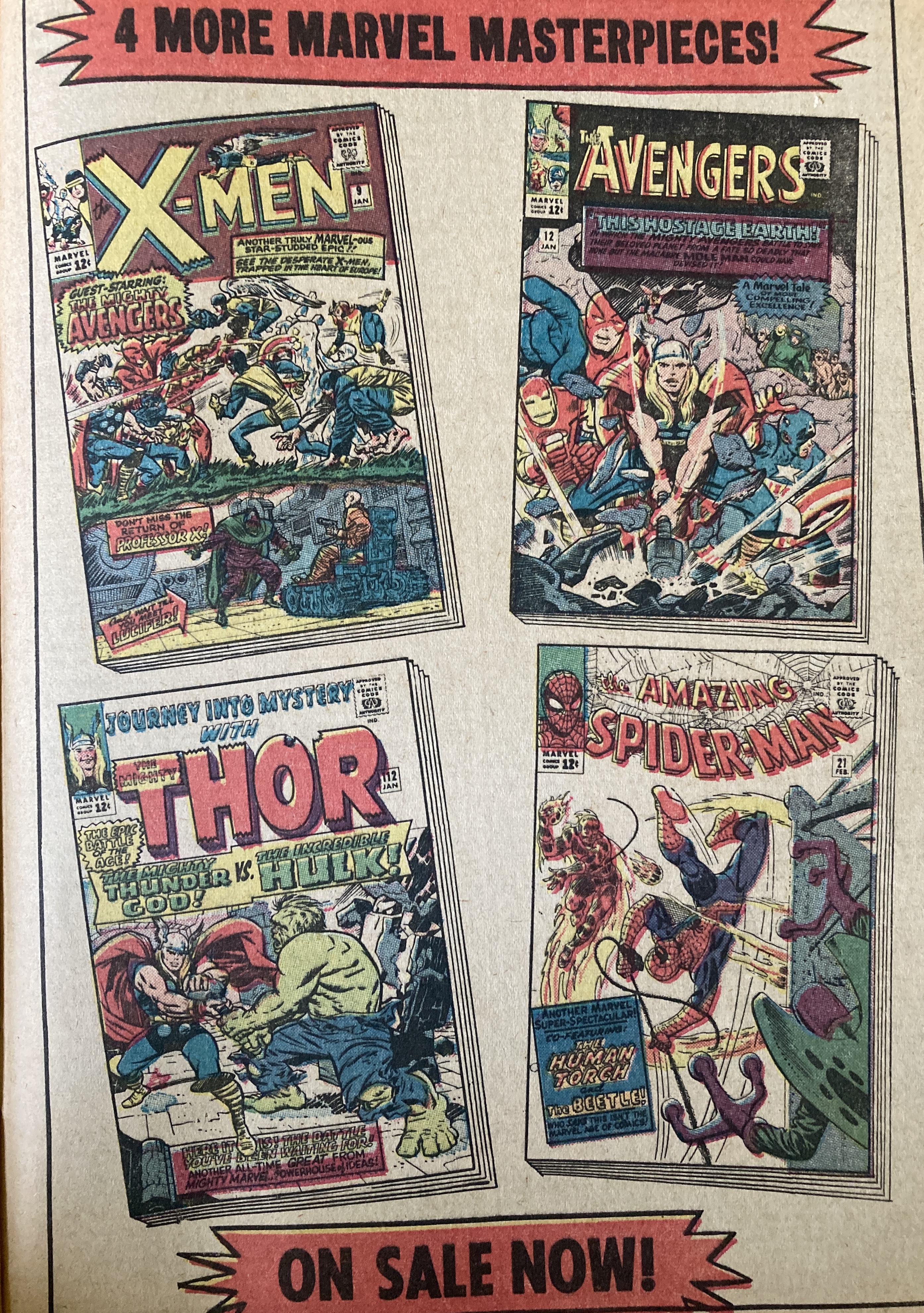
Speaking of shared-universe stories, cross-overs abound this month:

For sale

A mint (9.8) copy of FF 35 will run you about $6,750. Fine (6.0 is about $140. I bought a Very Good issue for $40.

Next issue: The Frightful Four!

“The World’s Greatest Comic Magazine” Fantastic Four No. 34

Tags

, , , ,

Fantastic Four 34
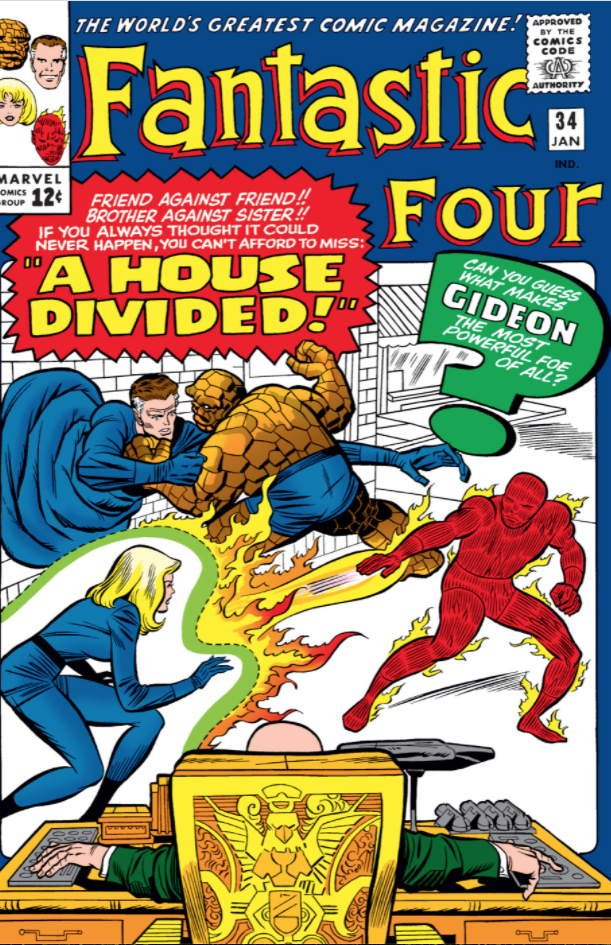
“A House Divided”
Published: Oct. 1964
Story: Stan Lee and Jack Kirby
Script: Lee
Pencils: Kirby
Inks: Chic Stone
Letters: Artie Simek
Cover: Kirby and Stone

Synopsis

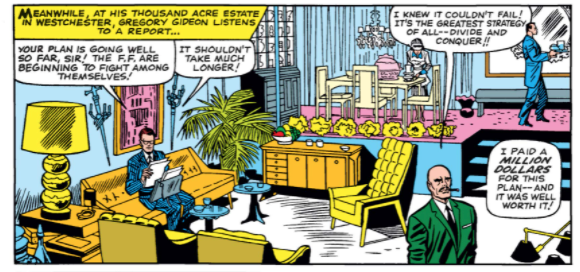
The Fantastic Four are opening mail in the Baxter Building, including a package with a Beatles wig sent to the Thing. Meanwhile, the world’s richest man, Gregory Gideon, is entering negotiations with his rivals. Rather than wait three years to take over their business empires, he dares them to give him a challenge: If he succeeds, they sell to him in a week; if he fails, he abandons his takeover plans. They accept and challenge him to defeat the Fantastic Four.

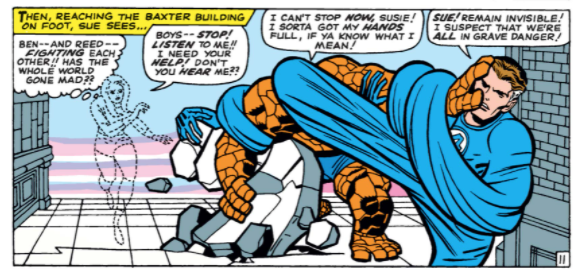
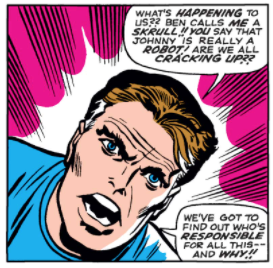
Mr. Fantastic awakens to the workmen dismantling the team’s vehicles at the behest of Ben, who is convinced Reed is a Skrull. They begin to fight. Meanwhile, in Long Island, Sue arrives at the home she shares with Johnny and finds evidence he is a Doom robot. After fighting amongst themselves, the four eventually converge at the Baxter Building, where Gideon has set a trap: a time machine that will remove the FF from the present.

However, Gideon’s young son is a fan of the FF, and rushes to save them. He and Ben are transported back in time, and Gideon, coming to his senses after losing his son, renounces his ambitions. Ben and Tommy Gideon return, due to Reed turning off the device’s power source, and the Gideon family is happily reunited.

What’s going on here?

This is an odd issue. As Stan notes at the end, it’s “the first story in a dog’s age without a costumed super-villain.” Depending on how you count these things, it could be the first since FF 3, when the FF fought the Miracle Man, who was basically just a stage magician.

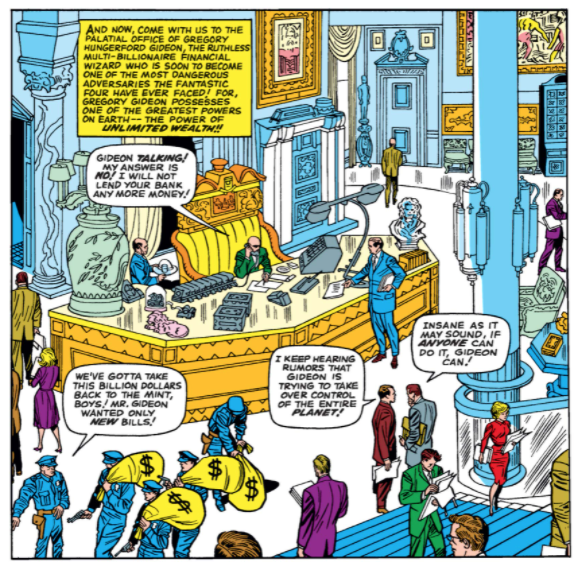
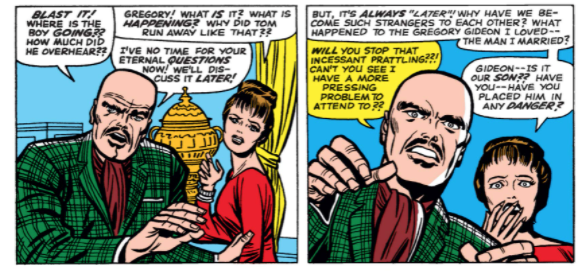
Despite the lack of super villains, FF 34 has its moments, especially when we spend time with Gideon, who, in his over-the-top plutocrat style, is sort of a combination of Daddy Warbucks, Richie Rich, and Donald Trump. This panel sort of says it all:

The story hangs together, but just barely, and like a lot of these early FF issues, depends a lot on coincidence, mistaken identity, and no one stopping long enough to ask what’s going on. It also relies on the FF fighting each other as its main hook, which would be novel if it didn’t happen almost every issue.

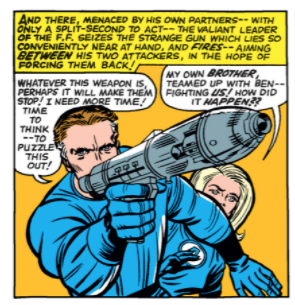
At some points, the story just falls apart. In one instance, Reed, in the middle of battling his teammates, grabs a ray gun left on the ground by Gideon’s henchmen, and fires it at his best friend and fiancee’s brother, without even knowing what it does.

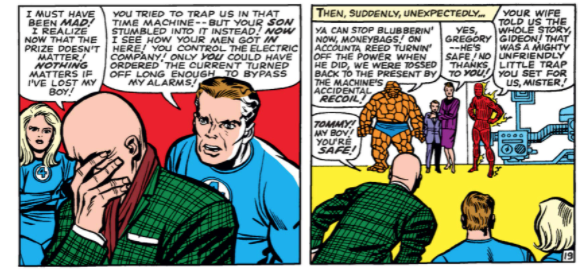
Then there’s this exhausting two panels of exposition that answers questions we didn’t really care about (how did Gideon’s henchmen get in the Baxter Building?) and doesn’t answer the ones we do. (Where did Ben and Tommy go when they went back in time?) Gideon will appear once more, in FF 134-136, about a decade hence, before disappearing forever.

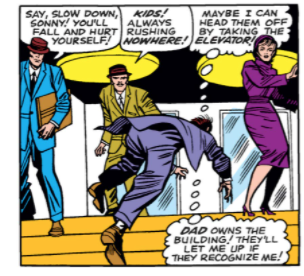
Plus this odd detail, which seems tossed in for plot purposes, and never returned to. But: Gideon owns the Baxter Building? That seems like a potentially big deal (and might also explain how his henchmen got in).

The sexist sixties

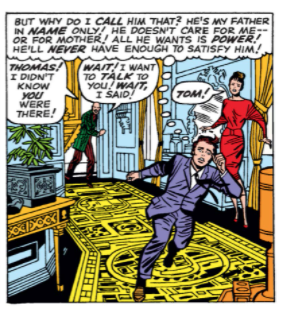
After about 33 issues of serving us Reed’s causal sexism, Stan and Jack now want us to see Gideon’s mistreatment of his wife as evidence of his villainy.

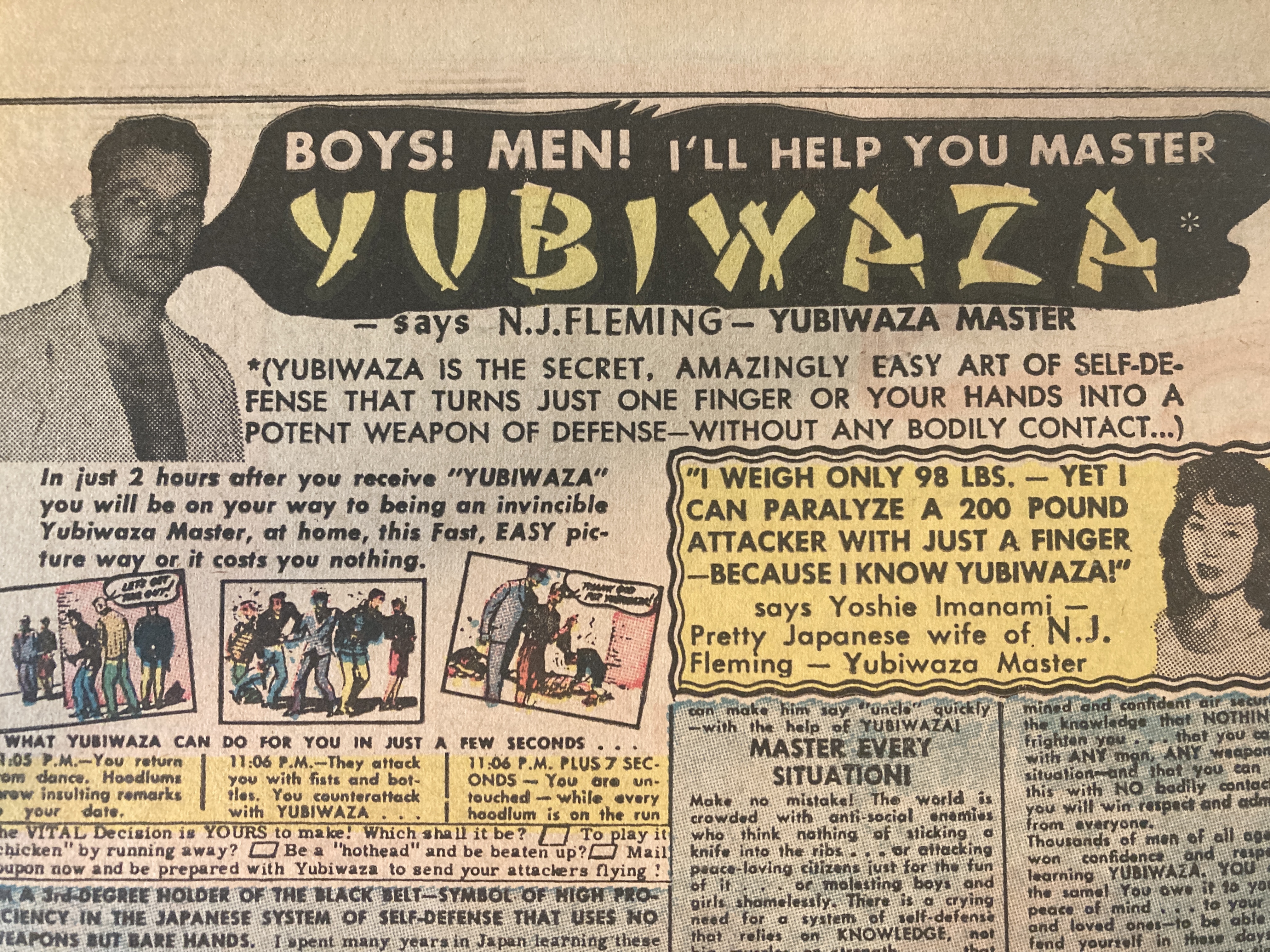
Speaking of sexist, check out this ad for a dubious karate technique, featuring the “pretty Japanese wife” of the instructor:

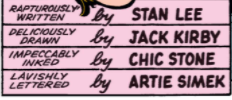
Krazy Kredits
Nothing too zany this month.

Suburbia

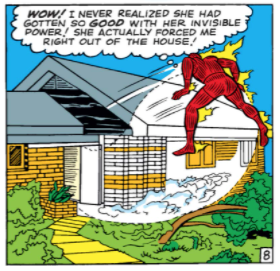
During these first few years of the FF, we’ve vaguely known Sue and Johnny still live at home in Long Island, although it’s rarely mentioned or discussed. Here, for the first time in the FF, we see their house.

Mid-century modern
Gideon, on the other hand, appears to live in a luxurious ranch house …

…with a carpet that could only have been designed by Jack Kirby.

Pop culture
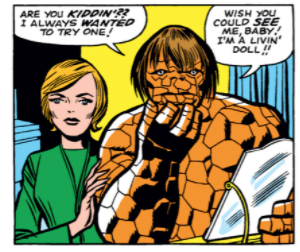
Apparently Beatles wigs were a thing.

Let’s talk about us
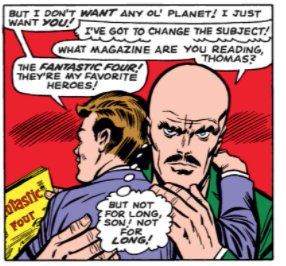
It’s been a while since the FF comic referenced itself, but it’s Tommy’s reading material of choice.

On the subject of comics, it was a pretty good month for Marvel collectors:

The incredible Mr. Fantastic
Apparently he could turn his legs into wheels. Who knew?

They’re fighting again
And this is before Gideon’s machinations.

Dig that Kirby Krackle
This is a great panel:

So is this:

And this:

Mail bag
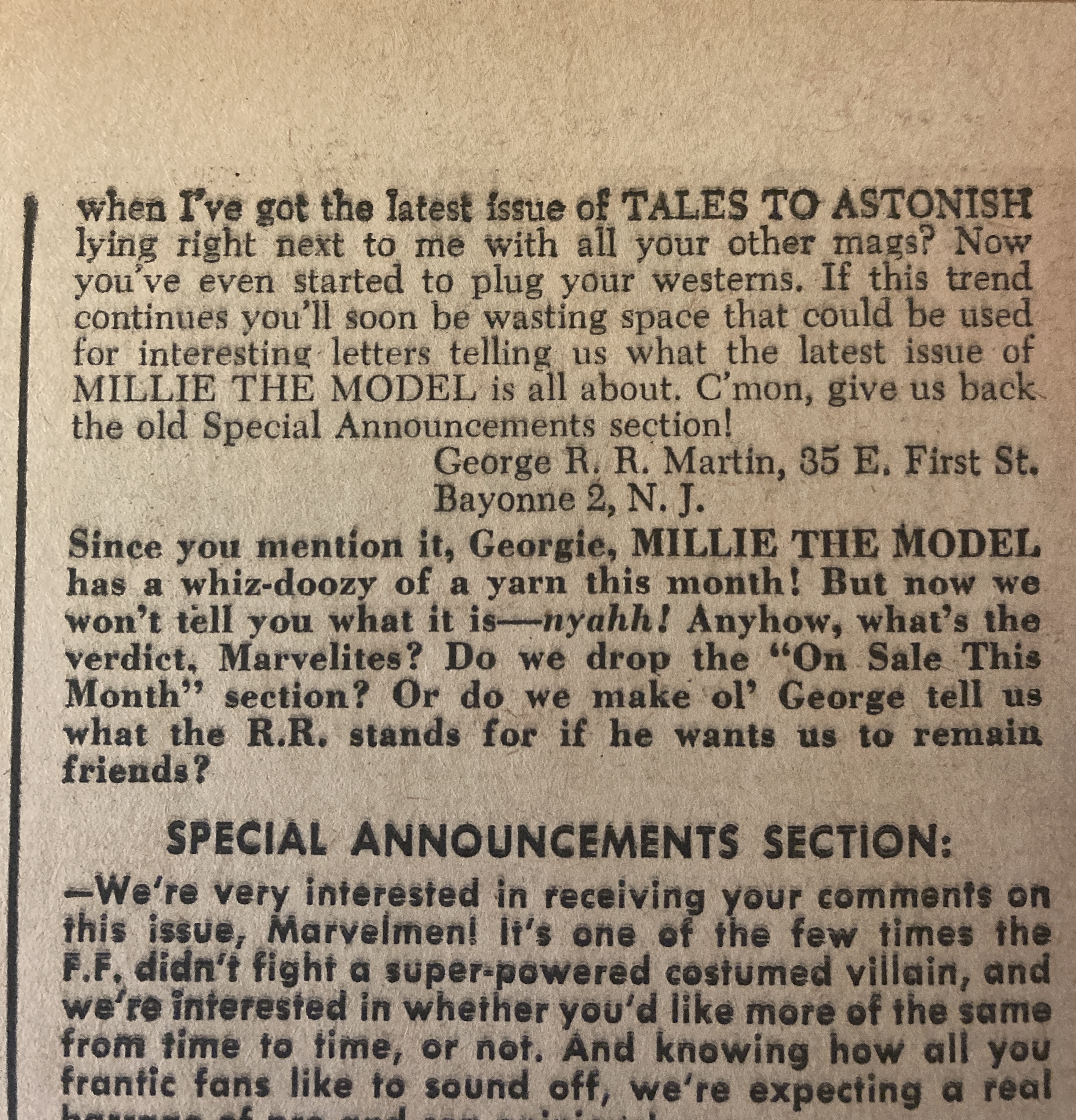
George R.R. Martin is in a cranky mood, and no fan of Millie the Model:

Pin up!
Dr. Doom lurking is a nice touch.


For sale
A mint (9.8) copy of FF 34 could cost you $13,000, while a Fine version will be about $100. I bought mine, listed at Very Good, for a lot less than that.

Next issue: Dragon Man!

“The World’s Greatest Comic Magazine” Fantastic Four No. 33

Tags

, , , , ,

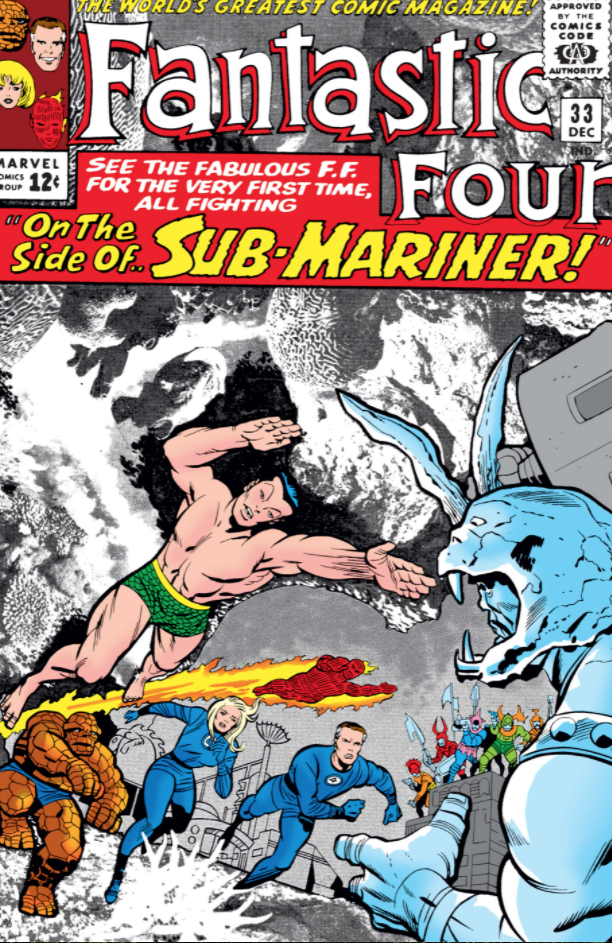
(This cover image on Marvel Unlimited is irritatingly cropped, so this is the best I can do – sorry)

Fantastic Four 33
“Side-by-Side with the Sub-Mariner!”
Published: Sept. 1964
Story: Stan Lee and Jack Kirby
Script: Lee
Pencils: Kirby
Inks: Chic Stone
Letters: Artie Simek
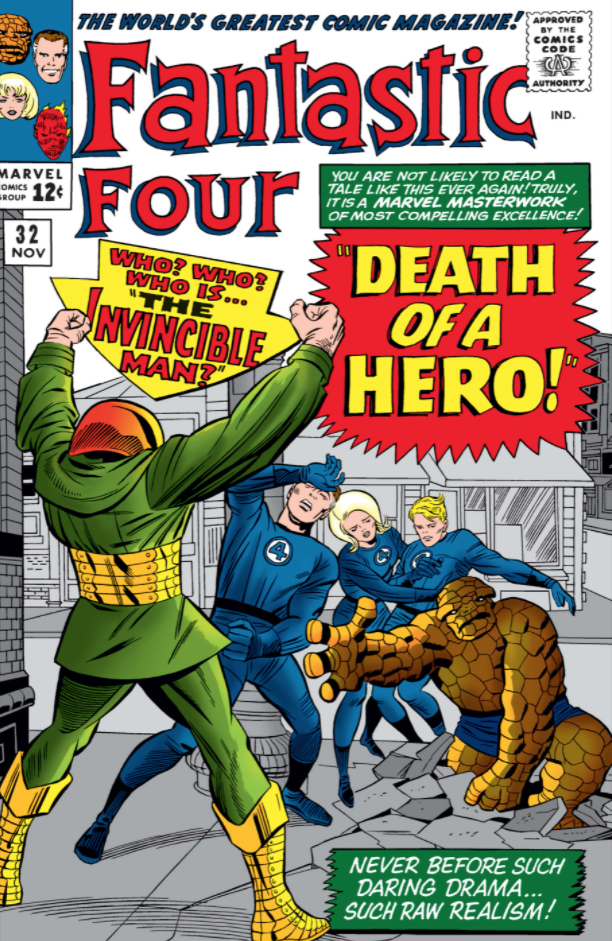
Cover: Kirby and Stone

Synopsis

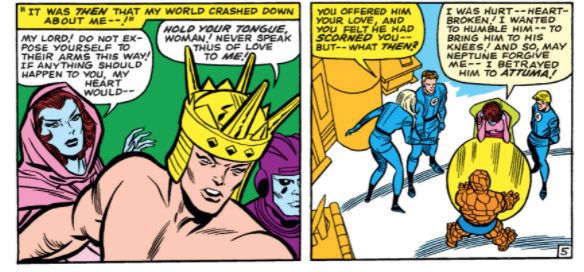
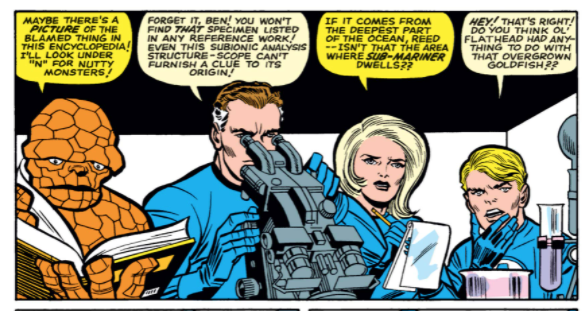
FF 33 opens with the team in the Baxter Building, examining a strange undersea creature that washed up on shore. Sensing something is amiss beneath the ocean, Mr. Fantastic sends the Human Torch to patrol the shoreline, where he discovers Lady Dorma of Atlantis, last seen in FF Annual 1, surfacing. Johhny brings her to the Baxter Building, where she explains the barbarian warlord Attuma has attacked Atlantis. Worse, she betrayed the Sub-Mariner and aided Attuma because Namor spurned her affections. Now she asks the FF for help.

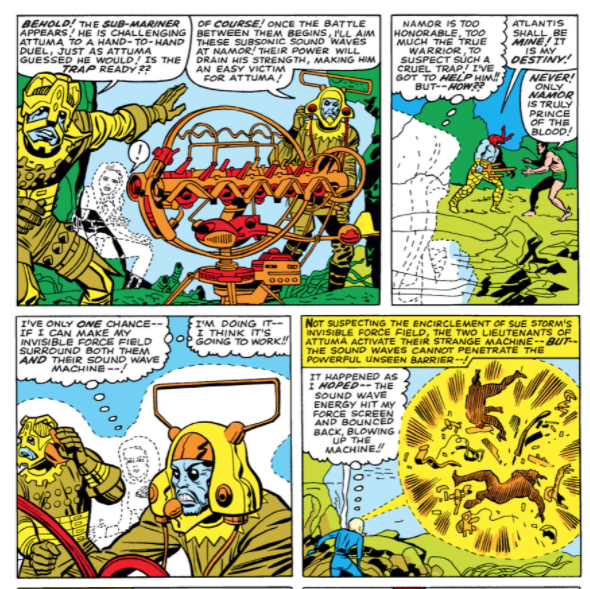
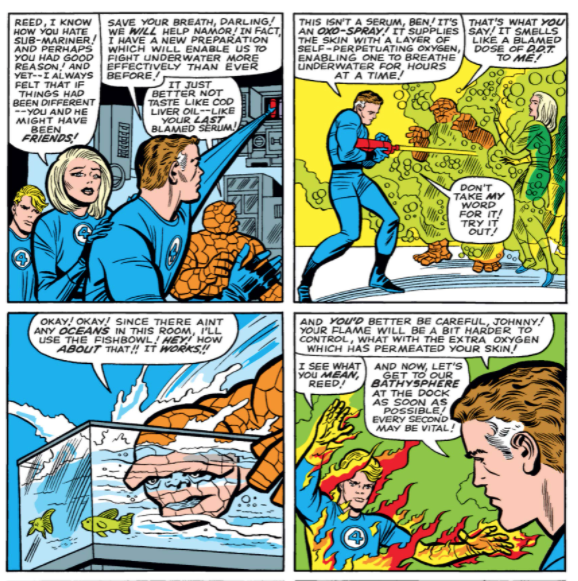
The team, aided by an “Oxy-Spray” that allows them to breath underwater, descend with Dorma to Atlantis, where Namor is battling Attuma’s forces. The team surreptitiously helps him, with Sue making Namor invisible at a critical juncture, helping him defeat Attuma. The FF runs out of oxygen, however, and flees to the surface, leaving Namor unaware they aided him. The issue concludes with Namor forgiving Lady Dorma for her betrayal.

What’s going on here

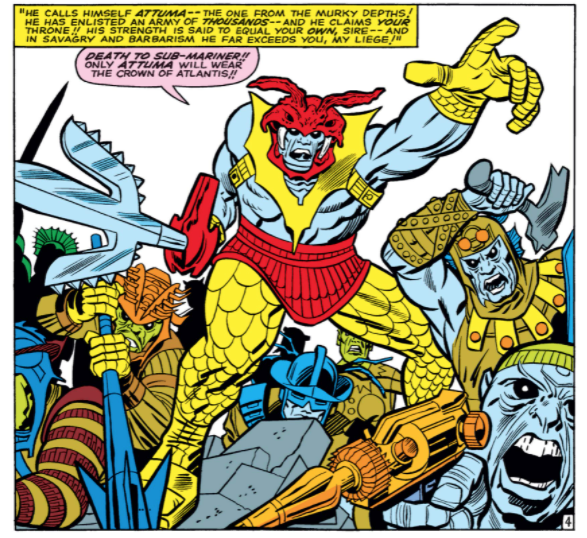
FF 33 is a pretty straightforward story, told in the traditional style: It opens in the Baxter Building, the plot unfolds slowly, the second half is mostly action, and it’s all tied up in a few panels at the end. To the extent it adds to the FF’s larger narrative, it does signal Sue seems to be over her infatuation with Namor (although we don’t know if Namor is done with her, since he doesn’t know she’s helping him) and it’s another step in recasting the Sub-Mariner as a hero. Here, he is a noble warrior fighting for his kingdom. The story also introduces Attuma, who becomes a main antagonist of Namor’s over the years. Surprisingly, it’s one of the few times he appeared in the FF’s own comic.

The sexist sixties

The whole plot hinges on Lady Dorma betraying Namor because her feelings are hurt. It’s a trite and lazy story-telling device, and the same result—Dorma enlists the FF—could have been achieved in a number of other ways.

On the flip side, Stan and Jack give Sue a rare star turn in combat, where she uses her force field power to cause some real damage.

Weird science

FF 33 is a gold mine for zany, pseudo-scientific devices, starting with Reed’s “subionic analysis structure-scope.”

There’s also Oxo-Spray…

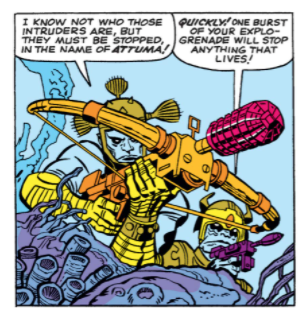
and Explo-Grenades (it’s unclear how these are different than normal exploding grenades)…

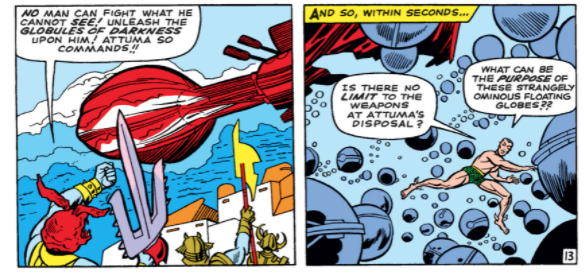
and Globules of Darkness …

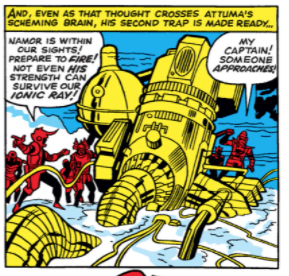
and Ionic Rays …

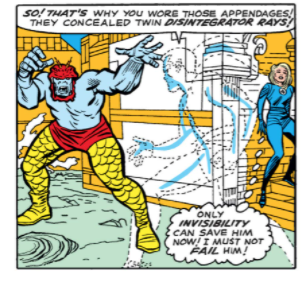
and when that fails, Disintegrator Rays. All this stuff works underwater, too.

The Incredible Mr. Fantastic

Reed changes his shape into a manta ray, which is kind of cool

Krazy Kredits

A little more sedate in this ish.

All’s well that ends well

Stan and Jack stuff a whole lot into the last three panels here: We learn Namor is unaware of the FF’s help, Reed is convinced of Sue’s love, and we get a bit of snappy banter between Ben and Johnny.

Dig that Kirby Krackle

Jack gives us another pair of collages, with one on the cover, and this one:

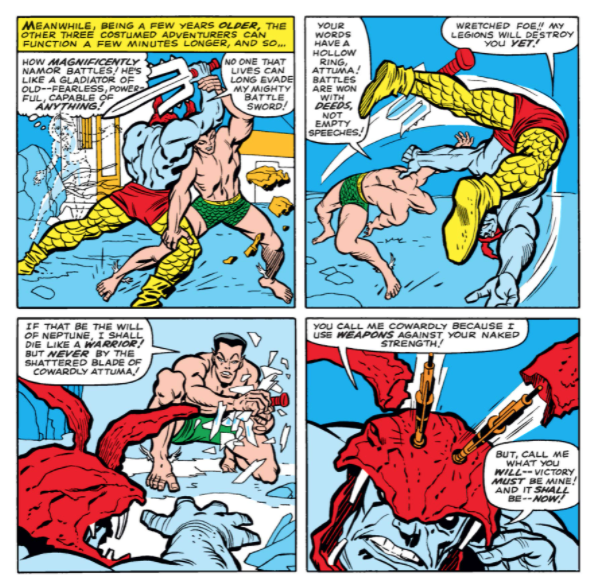
Also, there are some great fight scenes, like this:

And this:

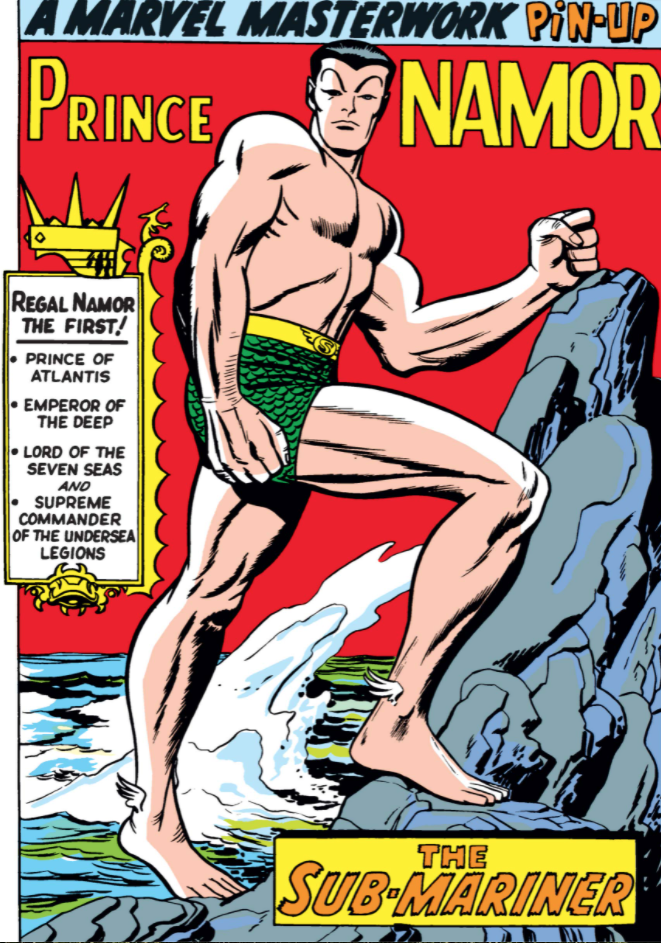
Pin up!

For sale

In near mint (9.8) condition, FF 33 will cost you $32,000. A Fine version (6.0) is $240. Both seem high to me, to be honest.

Next issue: Who is Mr. Gideon?

“The World’s Greatest Comic Magazine” Fantastic Four No. 32

Tags

, , , , , ,

Fantastic Four 32
“Death of a Hero!”
Published: Aug. 1964
Story: Stan Lee and Jack Kirby
Script: Lee
Pencils: Kirby
Inks: Chic Stone
Letters: Sam Rosen
Cover: Kirby and Stone

Synopsis

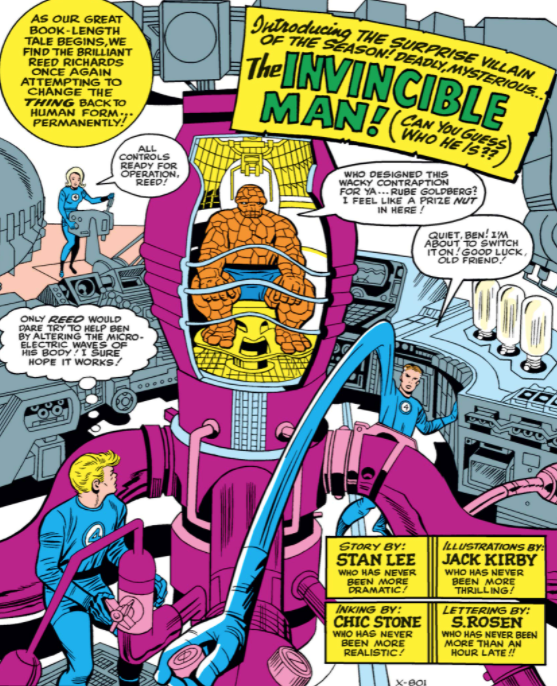
FF 32 opens in the Baxter Building with Mr. Fantastic, once again, trying to return the Thing to human form. The procedure works, but Ben loses his memory of the team and Alicia, so Reed reverses the process. Meanwhile, a ray from outer space blasts open a volcano on earth, and an unknown creature emerges. The creature enters the prison cell of Franklin Storm, the father of the Human Torch and Invisible Girl introduced last issue, and takes his form, sending Storm to outer space.

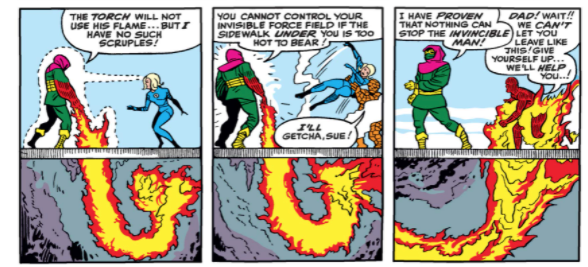
Sue and Johnny Storm, attempting to visit their father, find him transformed, and he uses new powers to blast out of prison. Sue and Johnny summon Reed and Ben, and together the team confronts Franklin, who is now costumed and calls himself the Invincible Man. They fight, but Sue and Johnny can’t bear to hurt their father, and the Invincible Man escapes, much to the chagrin of Reed.

The team retreats to the Baxter Building, where Reed devises a gizmo to defeat their foe, who, he tells Sue and Johnny, is not really Franklin Storm. When the team confronts the Invincible Man, Reed tells him he is communicating via “ultra-sonic radio transmitter” to his home galaxy, and demands Franklin Storm be returned. The Invincible Man then reveals himself to be the Super-Skrull, who had been trapped in the volcano since FF 18, and he is transmitted back to his home planet while Franklin Storm is returned.

Storm, however, is booby-trapped with a bomb, and he absorbs the blast rather than endanger the FF and his children, dying a heroic death in the arms of his children.

What’s going on here

FF 32 marks the second half of Franklin Storm’s story arc. Introduced last issue as a fugitive surgeon, it seems Stan and Jack liked his character so much they used him again. They also tied up any potential messy loose ends by killing him off, but not before we hear his sad story.

He then has a poignant—and long!—death scene, told in part with this nice perspective from Jack:

Unlike in FF 31, where Franklin’s appearance was awkwardly jammed into the comic, FF 32 is much more coherent, and tells a satisfying story. Not that there aren’t some holes in the plot: It’s not obvious why the Super-Skrull needed to take the form of Franklin Storm to defeat the FF—Reed says it was to discredit the team when the Storm children refuse to fight their father—and Reed defeats the Super-Skrull by basically threatening to fight him to the death, leading him the Skrull to run away. Some warrior.

Stan and Jack also spend nearly four pages on Reed’s latest unsuccessful effort to transform Ben back to human form. While it gave us some nice character moments, with Johnny torn about whether he wants Ben as a happy human or his monstrous teammate, the episode has no further bearing on the plot and feels like padding.

Krazy Kredits

Byrne Baby Byrne

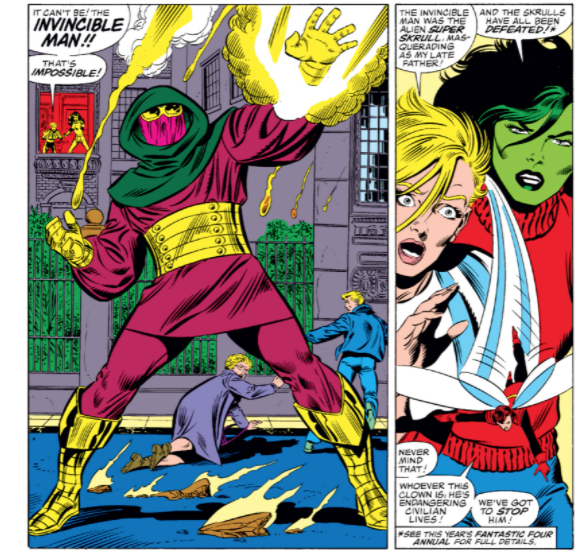
John Byrne borrowed the Invincible Man for a throwaway character in 1986’s FF 287 (inks by the legendary Joe Sinnott!).

Reed Richards is a jerk!

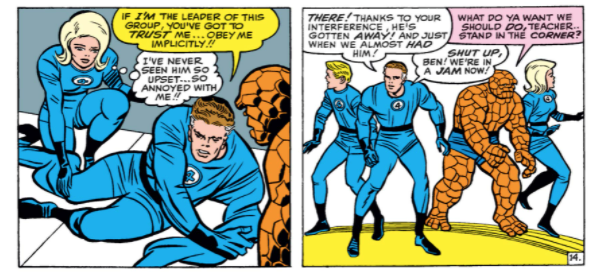
Reed gets a bee in his bonnet when the Storms won’t fight their father.

He stays pissy about it for several more pages.

Finally, he sort-of apologizes.

Snappy banter

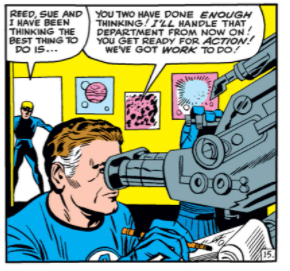
Reed’s peevishness is contrasted by his playful dialogue with Ben earlier.

Midcentury modern

The Baxter Building looks a bit more tasteful in this issue.

Weird science

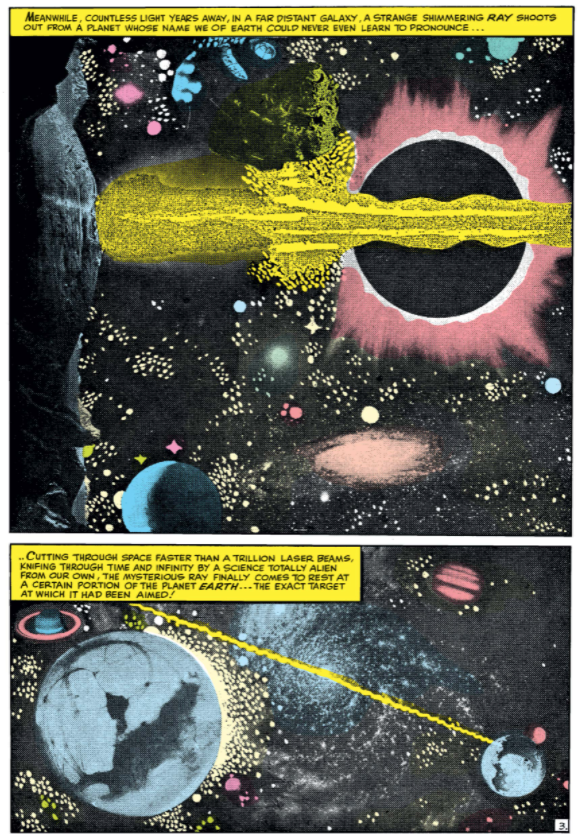
I’m not sure how trillion laser beams are faster than one, but maybe it’s Skrull technology.

Dig that Kirby Krackle

Jack returns to the photo collage, with stunning effect.

The splash page is pretty cool too

And so is this little sequence:

For sale

A mint (9.8) copy of FF 32 could cost you $17,000. A fine version (6.0) is a more reasonable $80.

Next issue: The Sub-Mariner is back!

“The World’s Greatest Comic Magazine” Fantastic Four No. 31

Tags

, , , , , ,

Fantastic Four 31
“The Mad Menace of the Macabre Mole Man!”
Published: July 1964
Story: Stan Lee and Jack Kirby
Script: Lee
Pencils: Kirby
Inks: Chic Stone
Letters: Sam Rosen
Cover: Kirby and Stone

Synopsis

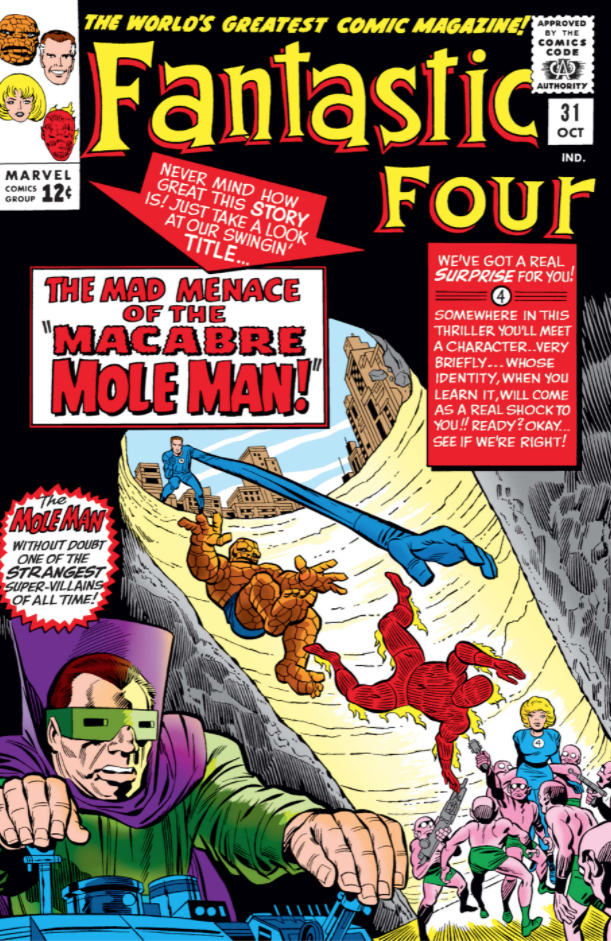
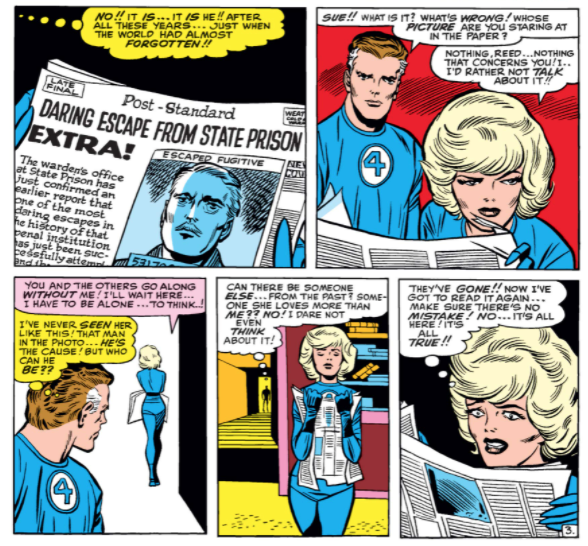
Earthquakes rock the Baxter Building and New York City. The Fantastic Four investigate, but as they rush out, the Invisible Girls sees a newspaper article about a man escaping from prison that gives her pause, and tells the rest of the team to go without her.

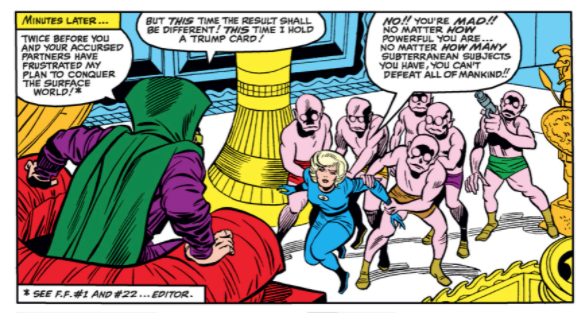
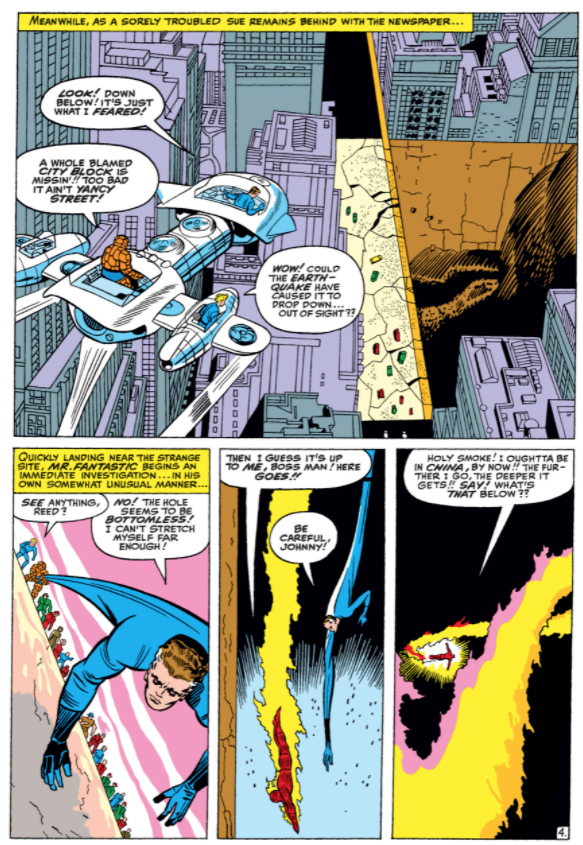
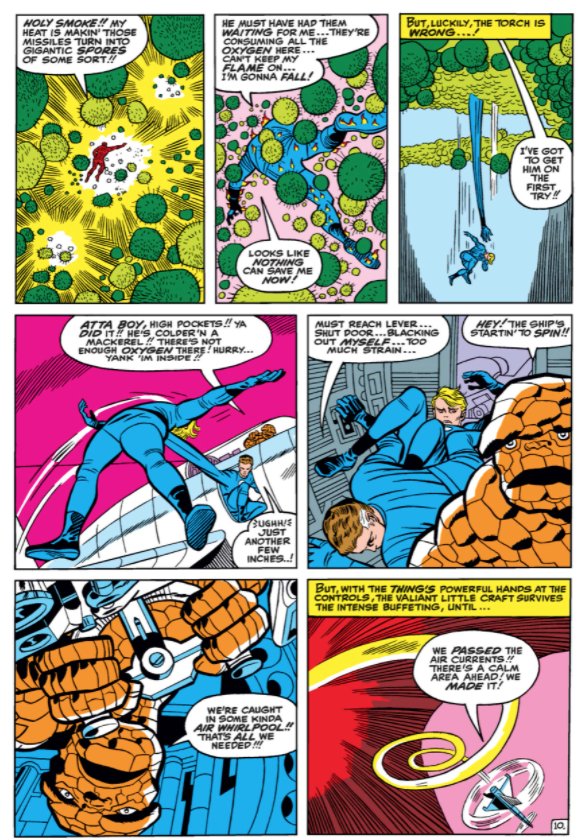
At the scene, the team discovers a city block has disappeared, leaving only a deep hole. Unbeknownst to the team, the Mole Man is responsible. The team returns to the Baxter Building to find the Invisible Girl has been take hostage by the Mole Man. The three use a Pogo Plane to descend to the Mole Man’s subterranean kingdom, avoiding obstacles along the way. There, the Mole Man demands the FF stand aside as he conquers the surface world, or risk losing Sue.

The team ascends to the surface to find the Avengers preparing to attack the Mole Man. After a brief scuffle, the FF convinces the Avengers to let them handle it and Mr. Fantastic invents a device that allows him to pinpoint Sue’s location. He then directs the Human Torch to blast a new tunnel down to the Mole Man’s kingdom, and Reed and Ben follow. With Johnny’s help, Sue escapes and the team returns the city blocks to the surface. But as the team ascends, Sue is hit by debris and is rushed to the hospital.

There, the doctors say only one surgeon can perform the necessary life-saving surgery, and he just escaped from prison. That man just appears, announces he is Sue and Johnny’s father, and successfully operates on Sue. He and Johnny have a moment at Sue’s bedside before the police arrive to return him to prison.

What’s going on here?

Fantastic Four 31 is notable for a few reasons, One is that Jack Kirby’s art seems to reach a new level of dynamism and creativity in this issue. Really, starting in issue 28, the Kirby’s art has been notably stronger, and FF 31 is a new peak. Some of that is Chic Stone’s inks, but it’s mostly Kirby who is using bigger panels, and more inventive perspectives and angles. Check out this page, for instance:

Or this one:

It seems light-years more sophisticated and interesting than the first few issues of the FF. I don’t know exactly why his art made a leap in 1964, but one idea may have been the increased popularity of the FF, and the sense that he and Stan were creating something special. Jack was famously overworked, so it’s to be expected that he would rush through most of his projects. But it also makes sense that he would take his time on a comic that he knew was being widely read and appreciated.

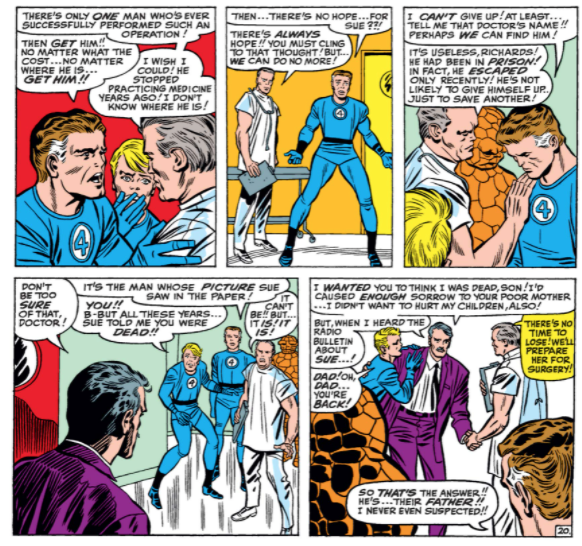
Also, FF 31 is marked by the appearance of Sue and Johnny’s father, Franklin. This is the first time any of the FF’s family has appeared in the book, and perhaps, after the lengthy unveiling of Dr. Doom’s origin in the FF Annual 2, Stan and Jack realized we knew more about Doom’s past than the FF’s. Even Reed claimed he didn’t know about Sue’s father, and assumed she and Johnny were orphans (or maybe he just didn’t pay attention when she told him). Over the years, we’ll meet more and more of the FF’s family and learn much more about their backstory.

Of course, Franklin Storm’s initial appearance is milked for maximum melodrama. First comes the foreshadowing in the newspaper:

then the deus ex machina revelation at the hospital:

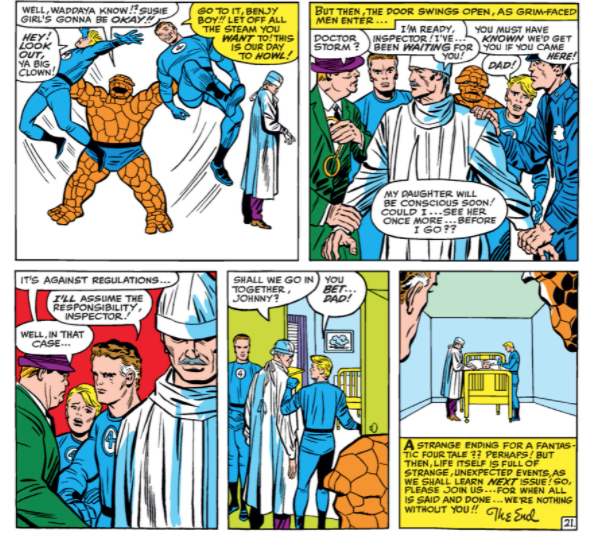
and finally the reunion at Sue’s bedside:

But even while it’s clear Stan and Jack were building up to the conclusion, Sue’s injury and Franklin’s dramatic appearance seems strangely shoehorned into the story. We never actually see Sue get hurt, and the whole business with her hospitalization and operation is stuffed into the last two pages of the story.

Stan and Jack clearly thought introducing Franklin Storm was a big deal, though, teasing his appearance both on the cover and the splash page. But the story has a weird rhythm to it, and feels like an episode of Perry Mason or some other show where all plots are wrapped up in 22 minutes.

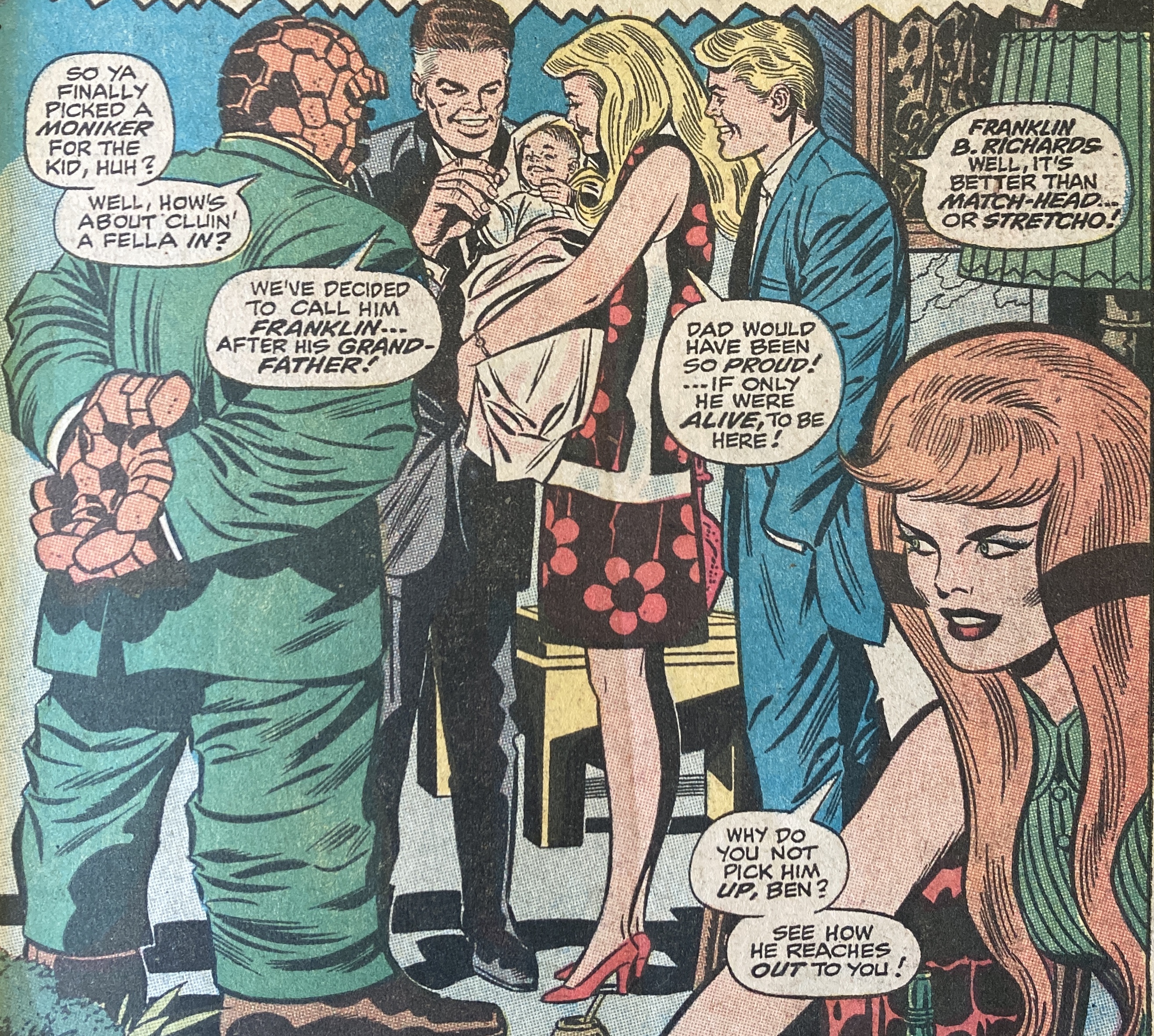
We will learn more about Franklin Storm in the next issue, but he doesn’t become as significant character as reed’s father, Nathaniel. He is, of course, the namesake of Franklin Richards, who gets his name in FF 94 (the B is for Benjamin):

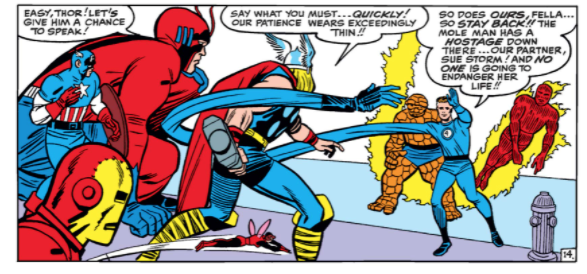
Lastly, FF 31 includes a brief appearance from the Avengers. While from an in-universe perspective it’s not particularly surprising—if city blocks started disappearing in New York, the Avengers should show up—but at this point in the Marvel Universe, super teams weren’t routinely crossing paths. The encounter, which of course includes a brief fight, only lasts about a page, and doesn’t even warrant a mention on the cover.

The sexist sixties

I’ve lost track of how many times Sue has been kidnapped or taken hostage in the first 31 issues (and I don’t have the heart to count) but I’m sure it’s approaching double digits. And if it isn’t Sue who’s taken hostage, it’s usually Alicia.

Snappy banter

The brawling between the team has been replaced by witty repartee, at least for this issue.

Krazy Kredits

It’s Clobberin’ Time!

For sale

A mint (9.8) copy of FF 31 should cost around $26,000. An issue in fine condition (6.0) is about $120.

Next issue: The return of the Super-Skrull!

“The World’s Greatest Comic Magazine” Fantastic Four Annual No. 2

Tags

, , , , ,

Fantastic Four Annual 2
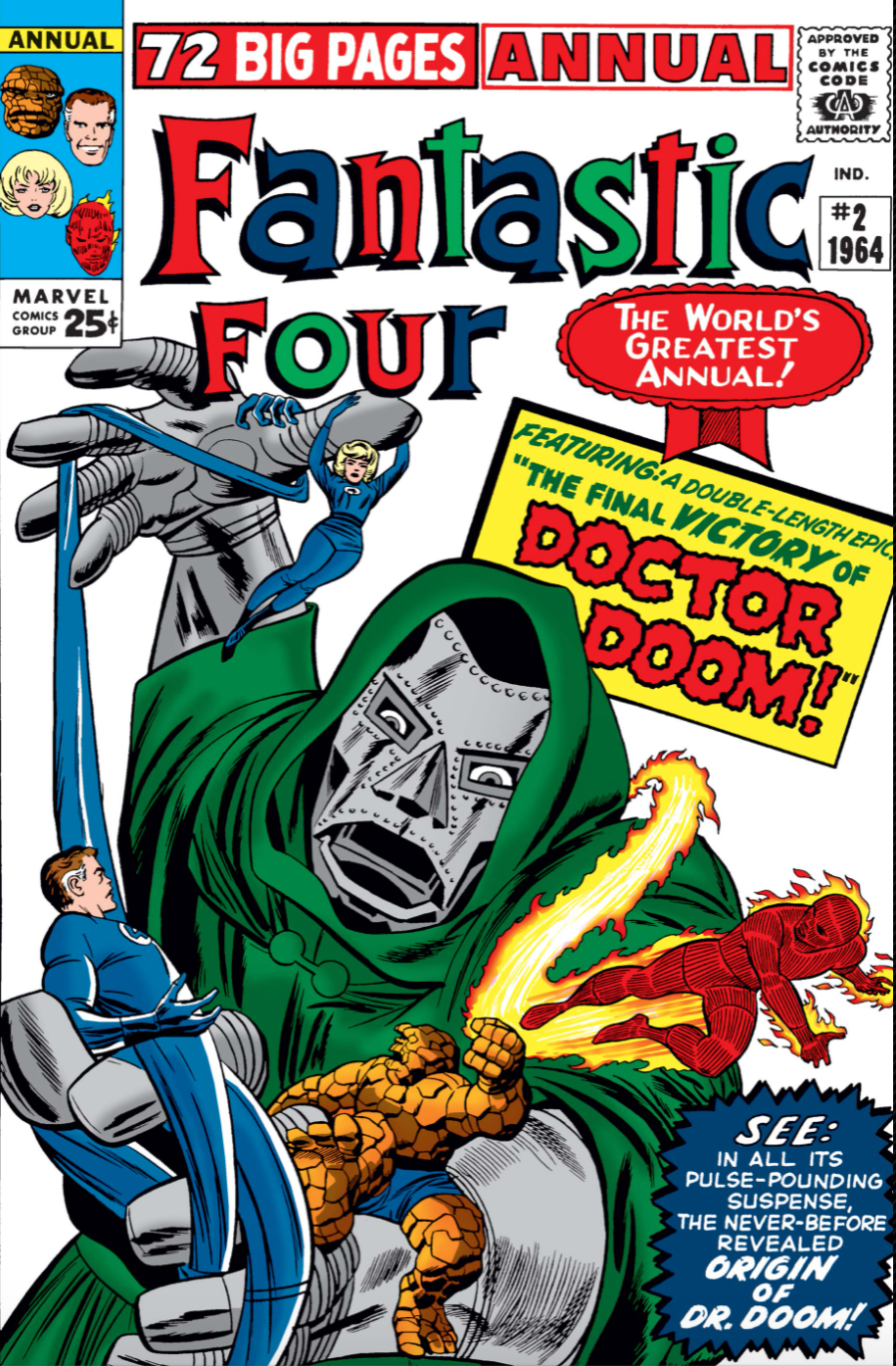
“The Fantastic Origin of Dr. Doom” and “The Final Victory of Dr. Doom”
Published: July 7, 1964
Stories: Stan Lee and Jack Kirby
Scripts: Lee
Pencils: Kirby
Inks: Chic Stone
Letters: Sam Rosen
Cover: Kirby and Sol Brodsky


This is a big one! Strap yourselves in, because a giant-size comic book means a giant-size blog post.

The Fantastic Four’s second annual contains three stories. One is a reprint of Fantastic Four 5, the first appearance of Dr. Doom. The other two are new, and both contain major contributions to the story of Dr. Doom, the Fantastic Four’s (and arguably the Marvel Universe’s) most significant antagonist.

First up is Doom’s origin story in a 12-page retelling that expands greatly on this brief, five-panel origin in FF 5:

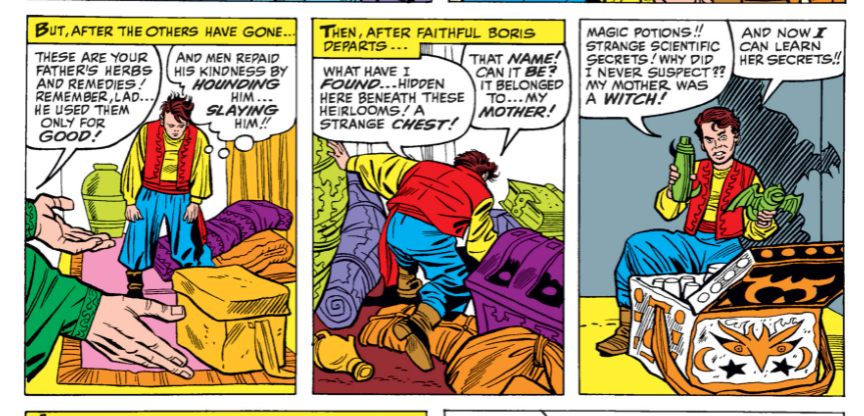
In Annual 2, we learn that Doom was a gypsy, the son of a sorceress and and healer. As a child, the cruel local Baron demands Doom’s father heal his ailing wife. When he can’t save her, the Baron vows revenge, and Werner Von Doom flees with young Victor, eventually dying of exposure while saving his son. Now an orphan, Victor discovers his mother’s magical artifacts and devotes himself to learning her secrets.

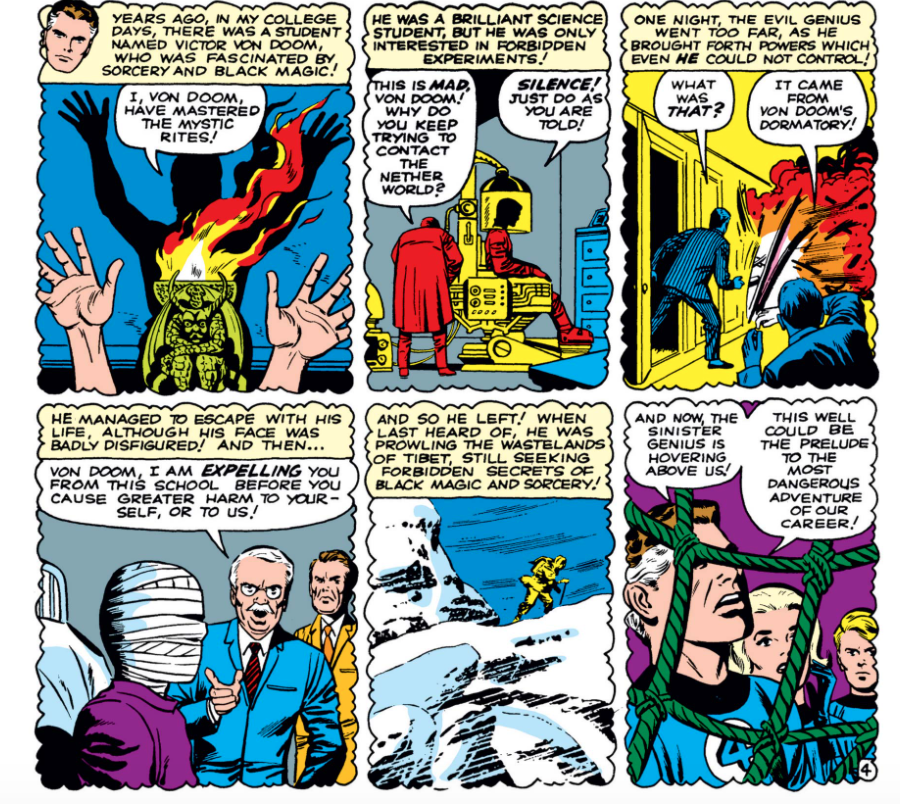
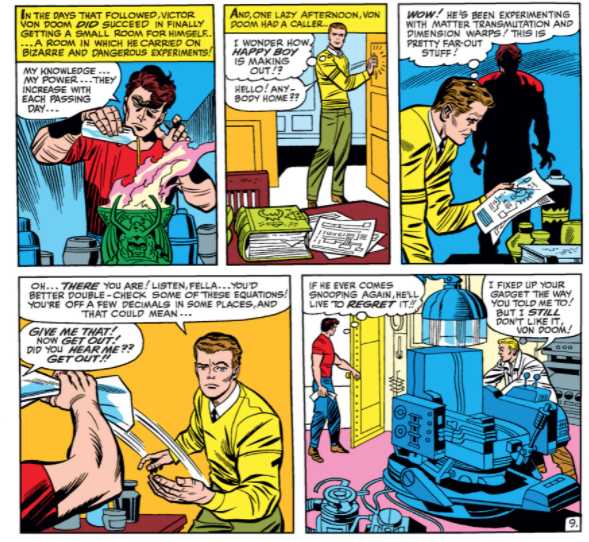
As a young man, Doom becomes a sort of con-man Robin Hood, selling inventions like a self-playing violin to the wealthy before they fell apart. He (somehow) attracts the attention of the dean of Empire State University, who offers him a scholarship. At ESU, Doom meets Reed Richards, and haughtily rebuffs his offer to be roommates. Doom spends his free time working on a device designed to “contact the nether world” and arrogantly dismisses Reed when he warns Doom about his miscalculations. The device explodes, scarring Doom’s face, and he is expelled from ESU.

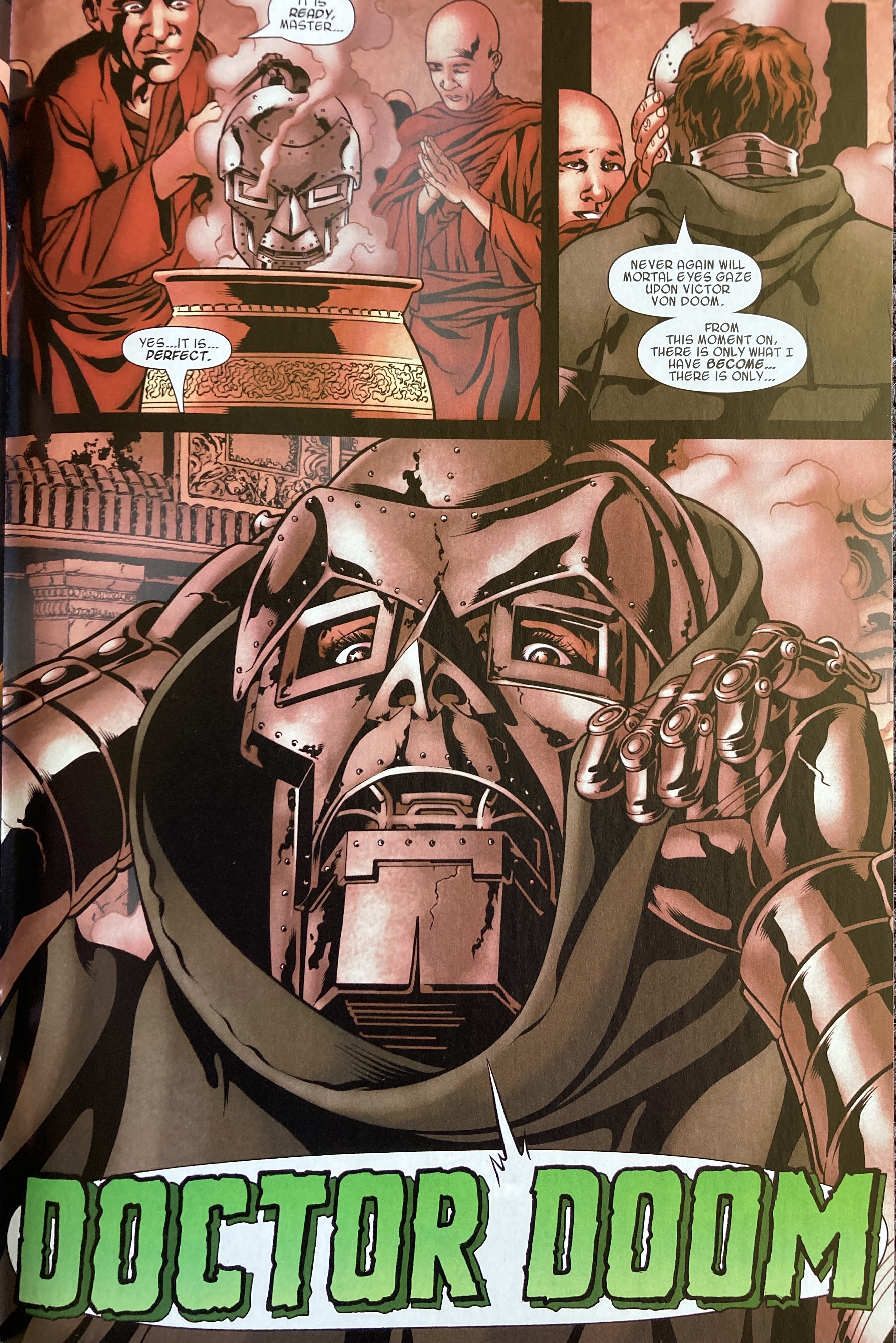
Still seeking occult knowledge, he travels to the Himalayas and joins a hidden order of monks, eventually becoming their master. He commands them to build him a suit of armor, and he leaves as Dr. Doom.

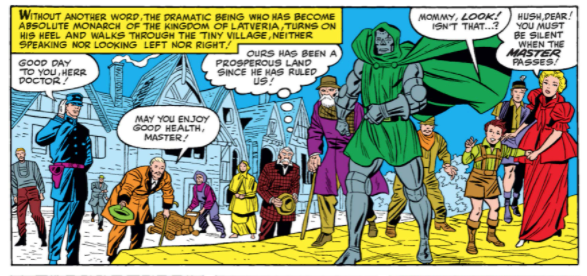
The story wraps up with Doom striding through Latveria, where his subjects seem to both love and fear him.

What’s going on here?

A lot. For the first time we learn about Doom’s sorceress mother, the tragic death of his father, and the origin of his armor. Notably, FF Annual 2 also introduces Doom as monarch of Latveria, one of Marvel’s most important fictional nations (Wakanda, Atlantis, and Genosha are the others). Remember, up to this point, Doom’s castle was in the Adirondack mountains in upstate New York. Making Doom a sovereign—giving him both diplomatic immunity and threats from coups and insurgencies—opened up dozens of story angles for FF writers over the years.

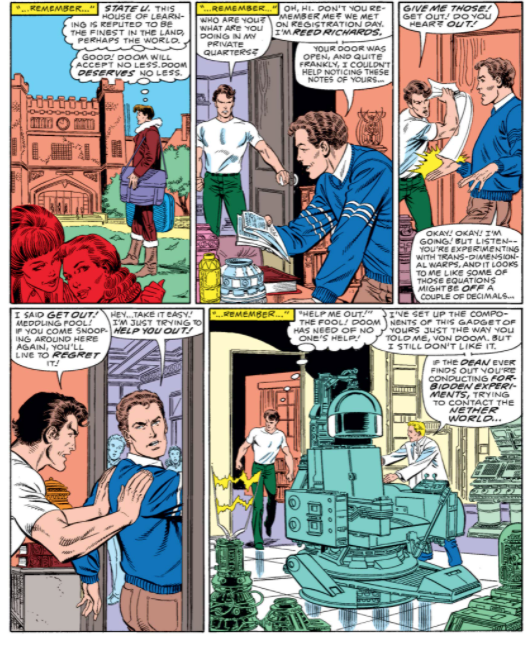
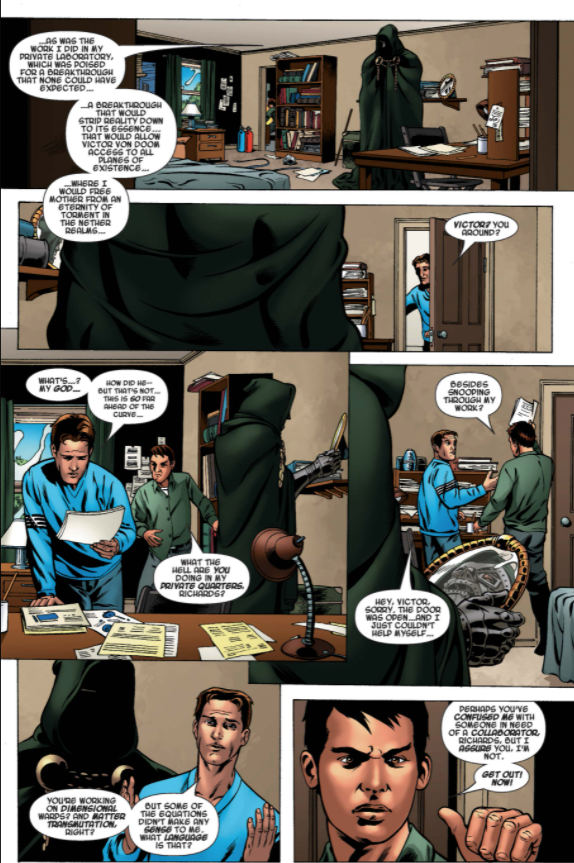
While Annual 2 expands Doom’s origins, it’s hardly the last word on the subject. Given Doom’s centrality in the Marvel universe, it’s not surprising his story has been continually revisited, tweaked, and retconned. While the same basic elements are always in place, over the decades writers have played with the specifics.

For example, here’s the scene where Reed tries to alert Doom to his miscalculations. First, in Annual 2:

Here’s how John Byrne depicted the same scene 20 years later, in a flashback in FF 278 (inks by Jerry Ordway):

And here’s how Ed Brubaker treated the same scene in 2006’s Books of Doom, a six-part series that expanded Doom’s origin at even greater length (art by Pablo Raimoni and Mark Farmer):

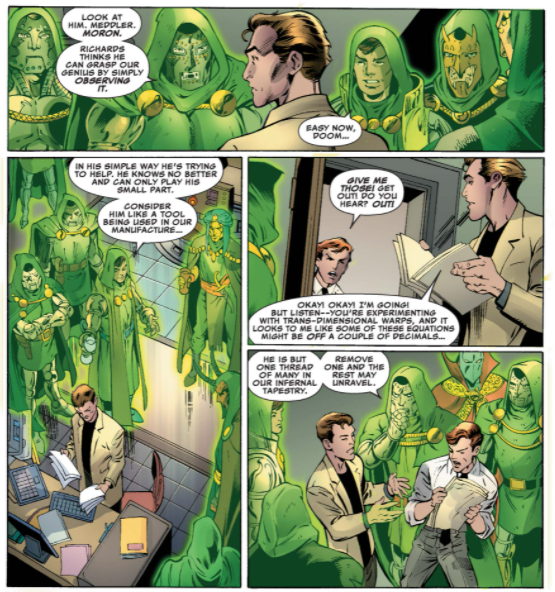
And finally, in 2013’s Fantastic Four, vol. 4, issue 9, Matt Fraction has a host of interdimensional Dooms visit what Doom here calls his “nativity” (art by Mark Bagley and Mark Farmer):

Interestingly, “dimensional warps” appear in all four tellings.

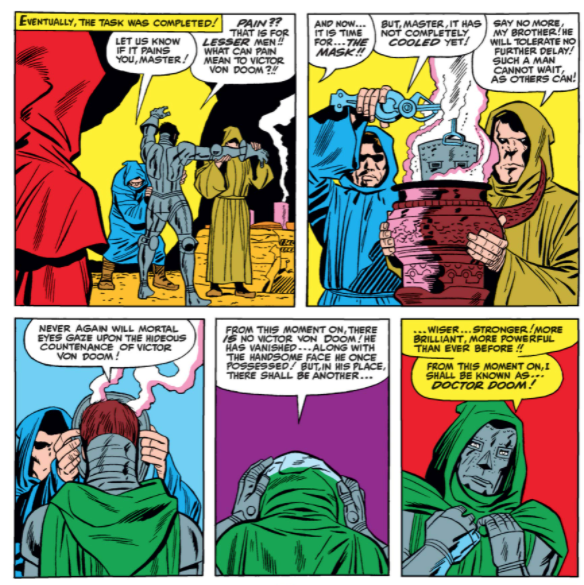
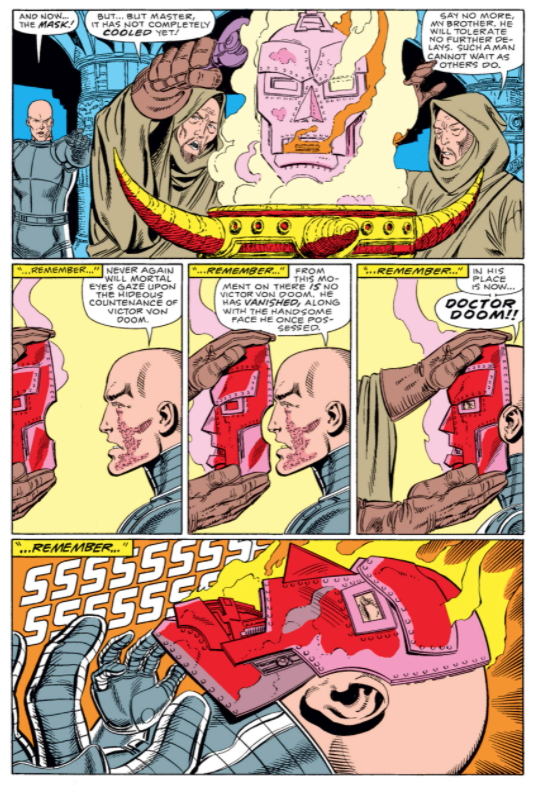
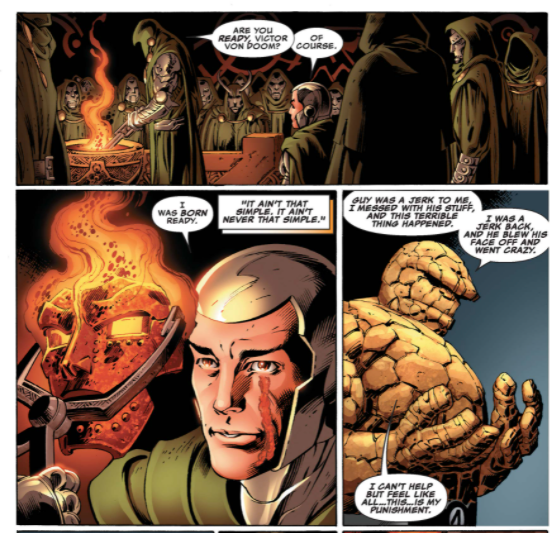
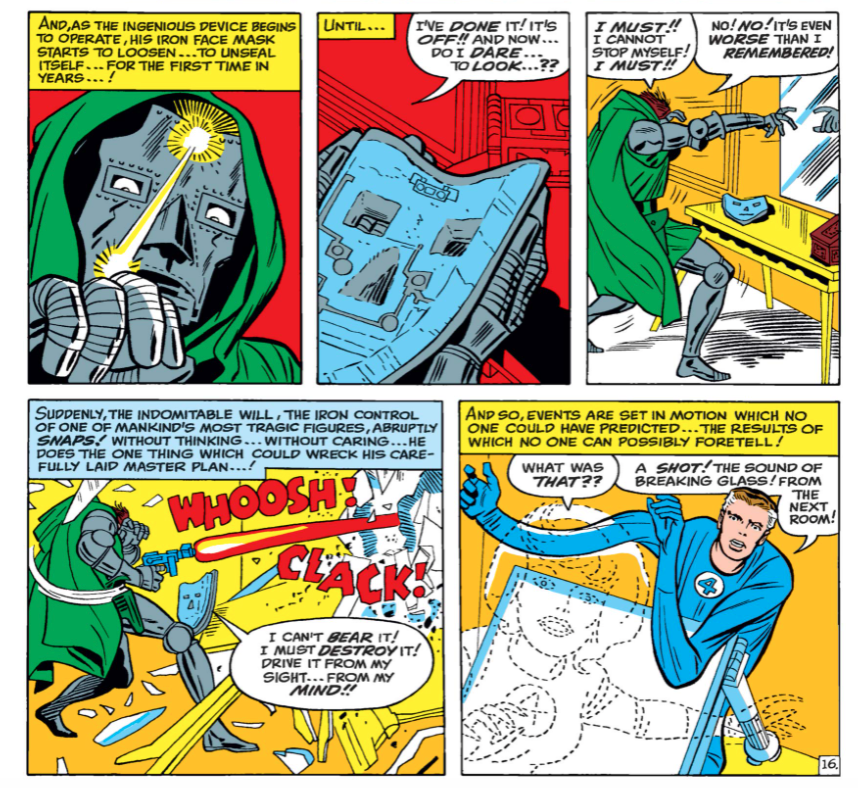
Here’s the various tellings of another critical scene, when Doom first puts on his mask.

First, in Annual 2:

Then, in FF 278:

Books of Doom:

And FF Vol. 4, No. 9 (Ben and Reed are also revisiting Doom’s origin):

The second new in Annual 2 story is a more straight forward FF adventure, with Doom as the villain.

Synopsis

The story opens with the Fantastic Four barely managing to land a balky Fantasticar on a New York City street. After some hijinks with the locals, we turn to outer space, where Doom, last seen drifting in the void in FF 23, is rescued by Rama-Tut. There, they discuss how they may in fact be the same person in different times, and they agree they must defeat the Fantastic Four.

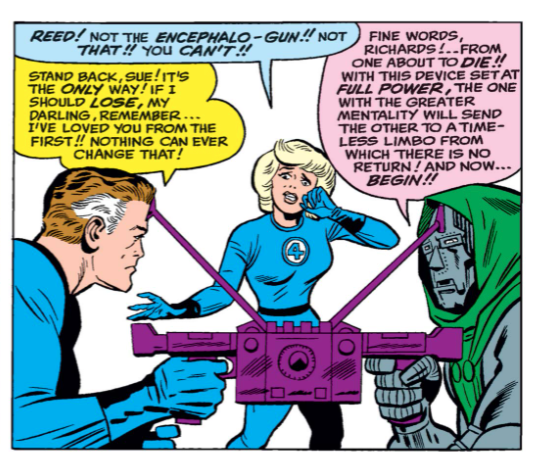
In a spacecraft borrowed from Rama-Tut, Doom returns to Earth and Latveria’s embassy in New York (technically, it should be a consulate since the embassy would be in Washington, but we’ll let it slide) to launch his plan. Meanwhile, the Fantastic Four are back in the Baxter Building, clowning around, when they are invited to a state dinner at the Latverian embassy. There, they are served a berry juice which causes hallucinations, leading the FF to fight with each other. Doom, however, attracts their attention when he breaks a glass mirror (after looking at his unmasked face), and the team pursues him to the Baxter Building. There, after a scuffle with the rest of the FF, Doom is challenged to a duel by Reed. After drinking a toast, they square off using the “encephalo-gun,” a device that will send the one with the lesser brain power “to a timeless limbo.”

Doom appears to win as Reed disappears, and walks off in triumph, only for Reed to reveal he tricked Doom into drinking the Latverian berry juice, and Doom only hallucinated defeating Reed.

What’s going on here?

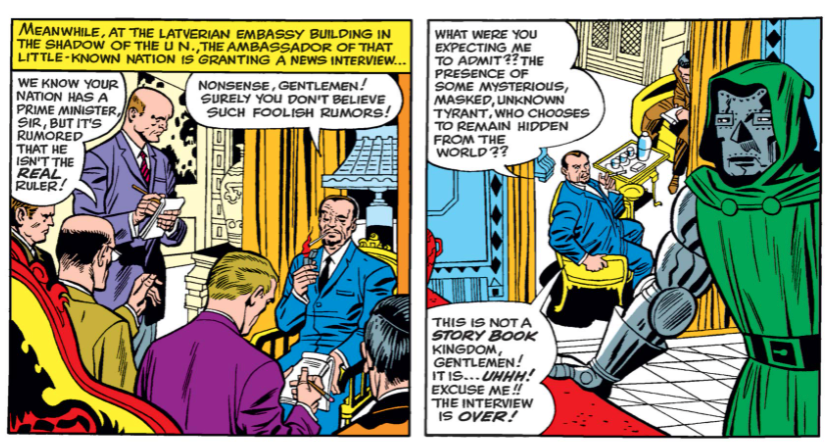
The whole business with the berry juice and encephalo-gun make this one of the sillier FF stories in a while, but there some interesting nuggets are revealed along the way. One detail is that while the earlier story established Doom is ruler of Latveria, it’s apparently not common knowledge outside the country, which is why the FF wouldn’t be suspicious of an invitation to the embassy. Stan and Jack have a bit of fun with this idea here:

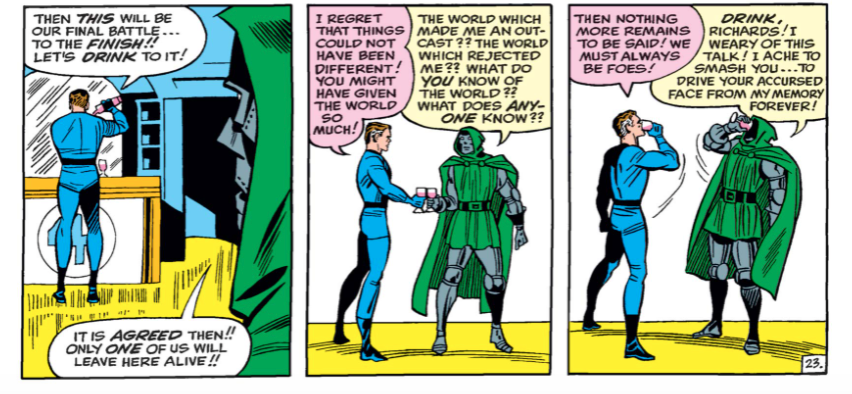
The story also helps establish the weird relationship between Doom and Reed, where they are enemies but have a grudging respect for one another that at times get very close to a friendship. We see that in the toast scene (which also suggests Doom is far stupider then we think if he falls for that trick):

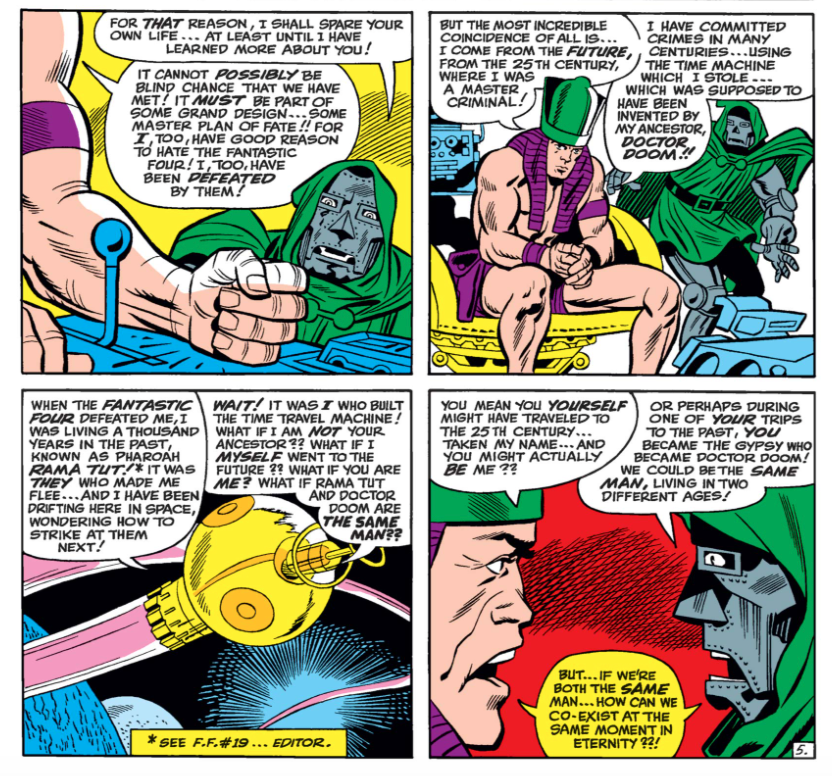
FF Annual 2 also gives us an early glimpse into the time-twisting storylines featuring Rama-Tut/Kang/Immortus so beloved of later Marvel writers like Steve Englehart, Roger Stern and Kurt Busiek. Like most of those stories, I found this exchange between Rama-Tut and Doom completely baffling. Maybe in a future blog post I’ll try and unravel it all.

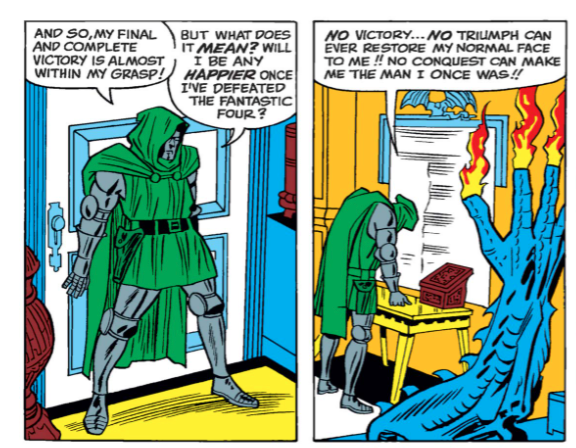
We also get a bit of drama about Doom’s face. We are told this is the first time in years he has taken off his mask.

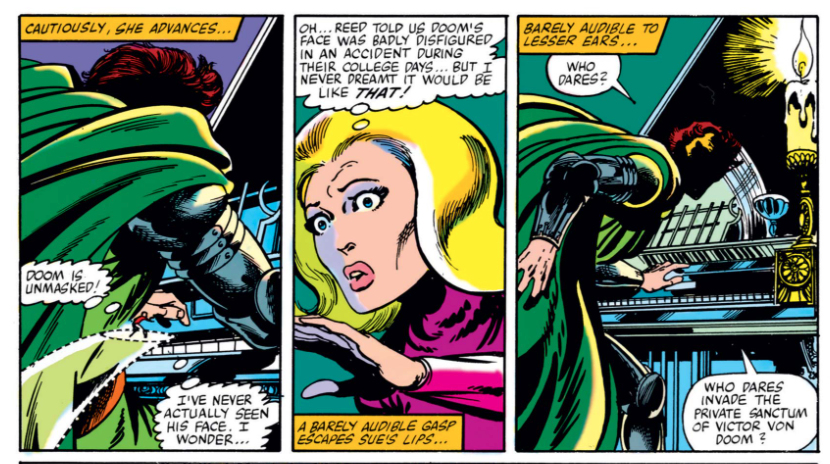
But his discomfort with his unmasked face seems to fade over the years, since he removes his mask to play the piano in FF 236 (by Byrne):

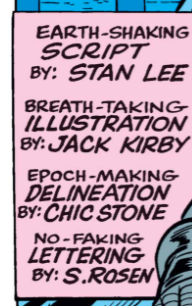
Krazy Kredits

Two stories means two opportunities for goofiness:

and

The sexist sixties

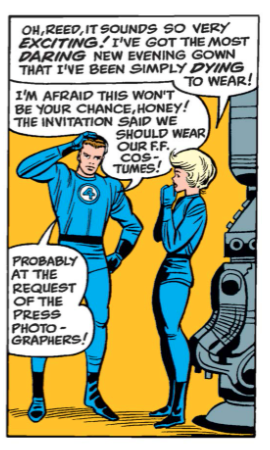
After a few issues where Sue was coming into her own as an effective member of the team, this story seriously back-slid into embarrassing sexism. First, there’s a return to Sue’s obsession with clothes:

Then this painful dialogue:


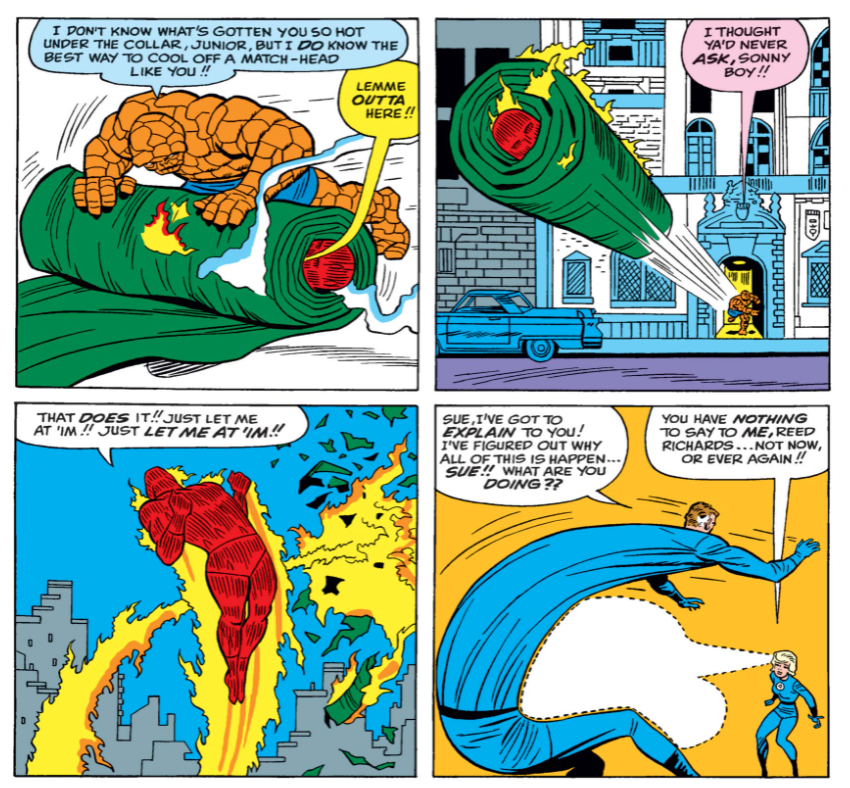
After Sue has proven her worth in about a dozen issue, Reed still wants to shunt her aside. Johnny, of all people, comes to her defense.

Then, after Sue battles Doom to a standstill, Reed intervenes to say:

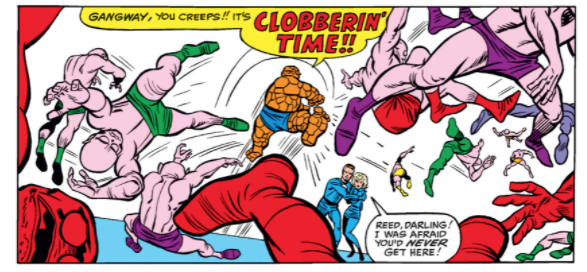
It’s clobberin’ time!

I believe this is only the second time we hear Ben use his signature phrase:

Weird science

Not the Encephalo-Gun!! Not that!!

They’re fighting again

The juice made them do it.

Mid-Century Modern

Doom also has a creative decorator.

Speaking of art

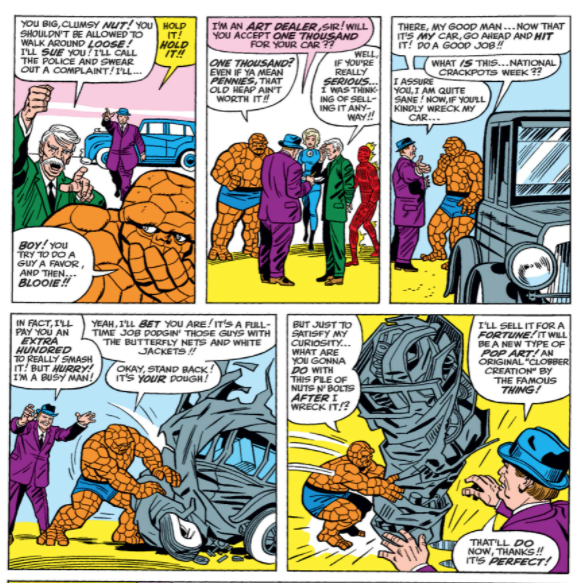
A bystander pays Ben to destroy a car to create a piece of modern art:

This would be just another example of Stan and Jack making fun of the excesses of 60s culture, expect artist John Chamberlain had a successful career making sculpture out of demolished cars:

Pin-ups!
FF Annual 2 has a collection of run-of-the mill pin-ups of villains, and some exquisite pin-ups of the FF (and Alicia). Kirby put a lot of attention to detail in these, particularly Reed’s and Johnny’s (and despite Ben only saying “it’s clobbering time” once before this issue, it’s already identified as a catch-phrase in is pinup).

Dig that Kirby Krackle

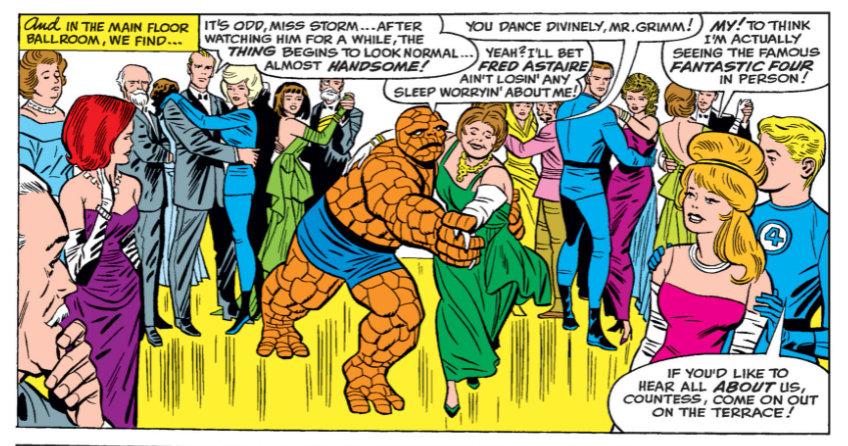
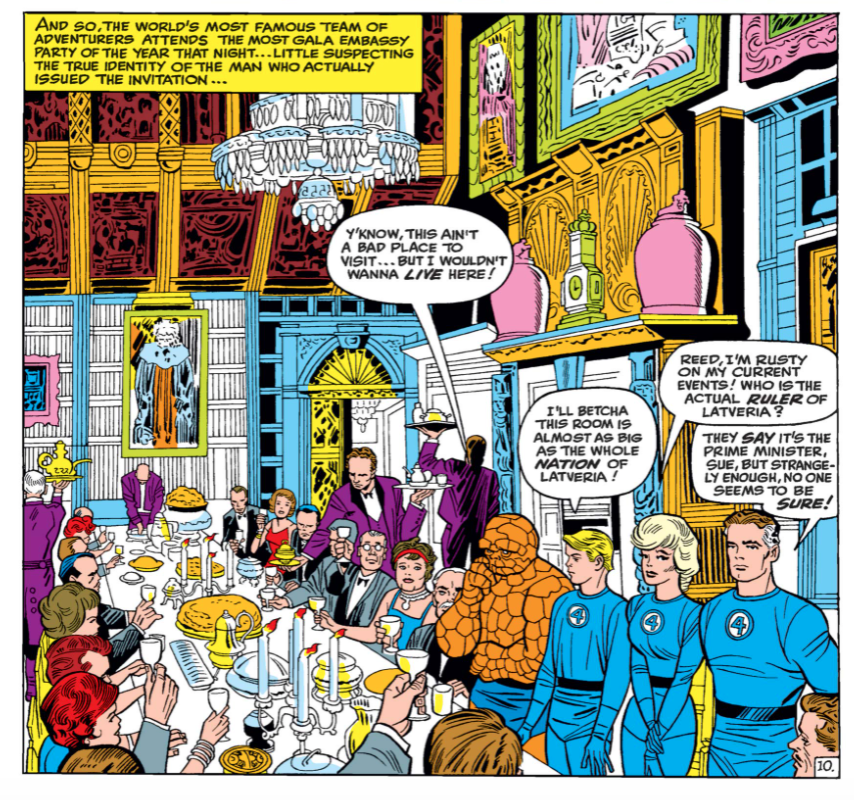
Check out this panel, of the party at the Latverian embassy:

And this is a great sequence:

For sale

A mint (9.8) copy of FF Annual 2 could cost you $50,000. An issue in Fine (6.0) condition is about $800.

Next issue: The return of the Mole Man!
“The World’s Greatest Comic Magazine” Fantastic Four No. 30

Tags

, , , , ,

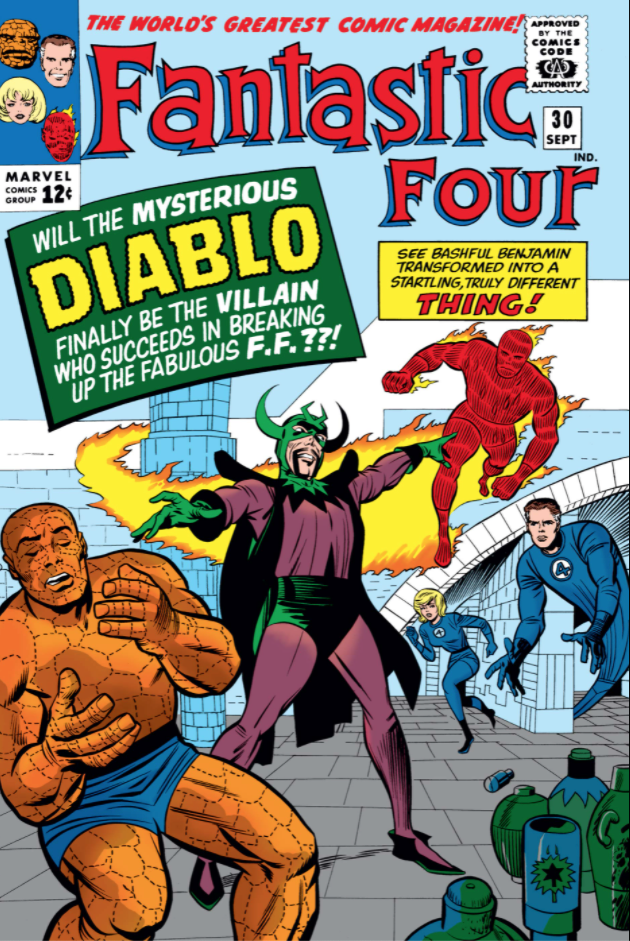
Fantastic Four 30
“The Dreaded Diablo”
Published: June 1964
Story: Stan Lee & Jack Kirby
Script: Lee
Pencils: Kirby
Inks: Chic Stone
Letters: Art Simek
Cover: Kirby & Stone

Synopsis

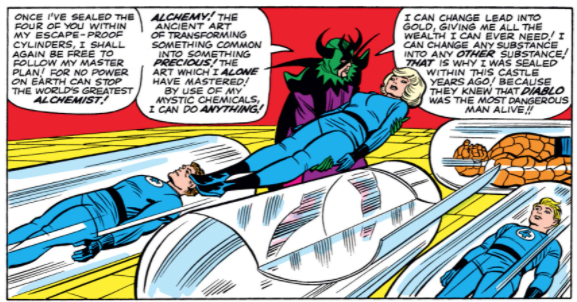
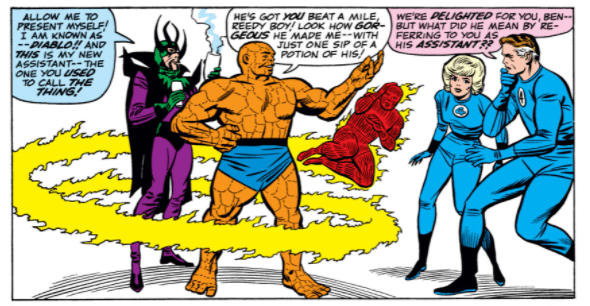
The Fantastic Four, lost while vacationing in Transylvania (don’t ask), stumble upon the castle of a centuries-old alchemist, Diablo. Before they enter, a local Baron warns them away, and invites the team to stay with him. In the middle of the night, the Thing is entranced, and frees Diablo from his crypt. The next day, the rest of the team discover Ben has been transformed by Diablo to something closer to his human form, and he has pledged his service to Diablo for a year. After a scuffle, the rest of the team leaves to plot its next move.

Soon, news of Diablo’s powers have reached the outside world, and he performs amazing feats, such as making barren deserts fertile. Meanwhile, Reed analyzes the formula Diablo used to transform Ben and realizes he’s a fraud. Ben, too, has a change of heart once he has reverted back to his old rocky self, but Diablo subdues him.

The FF launches an attack on Diablo’s castle, and after a battle with Diablo and his henchmen, discover Ben trapped in a glass-like cylinder. Unable to free him, the team is then captured by Diablo and also sealed in cylinders. Ben, however, finally escapes and defeats Diablo, chasing him back into his crypt. As Ben brings the castle down, the vibrations shatter the glass holding the rest of the team, and the four escape back into the Transylvania wilderness.

What’s going on here?

Fantastic Four 30 is pretty much wall-to-wall action. Like last month’s issue, it opens in media res, with the team already lost in Transylvania, and the entire issue takes place there. There’s no Baxter Building, no Alicia, and none of the normal set pieces. To the extent there’s any character building, we see Sue become more accomplished at using her powers in combat, and Ben, although tempted by the offer to return to normal, quickly comes to his senses and regrets his disloyalty.

FF 30 also marks the debut of Diablo, a second or third-tied FF villain whose appearances are always fun. By making Diablo an alchemist, Jack and Stan are reaching back into the bag of quasi-historical tricks that sustained so many horror and mystery stories. Stuff like alchemy, fabled lost cities, mythic creatures, ancient heroes etc. consistently pop up over the years in the FF and elsewhere as creators hunt for stories. Diablo wasn’t the first villain to practice alchemy (here’s a list) but he’s one of the more prominent.

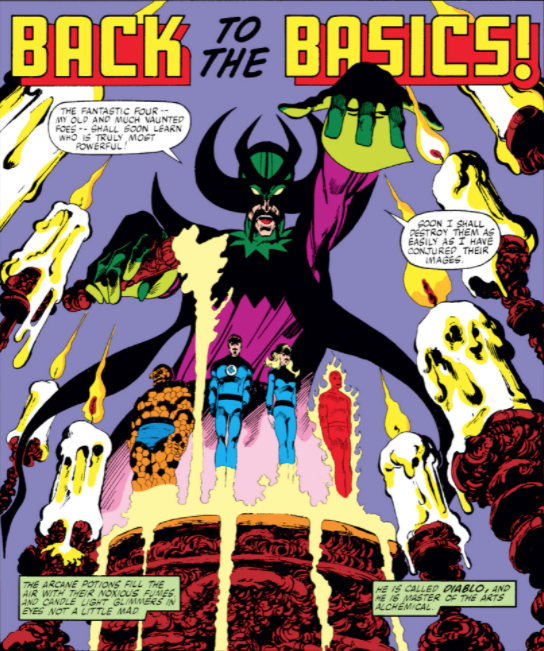
Interestingly, Diablo was the first villain John Byrne used in his landmark FF run of the 1980s, in FF 232, as a not-too-subtle signal that he was embracing the FF’s Lee/Kirby past (and if Diablo didn’t convince you Byrne was looking backward, the issue’s title should have).


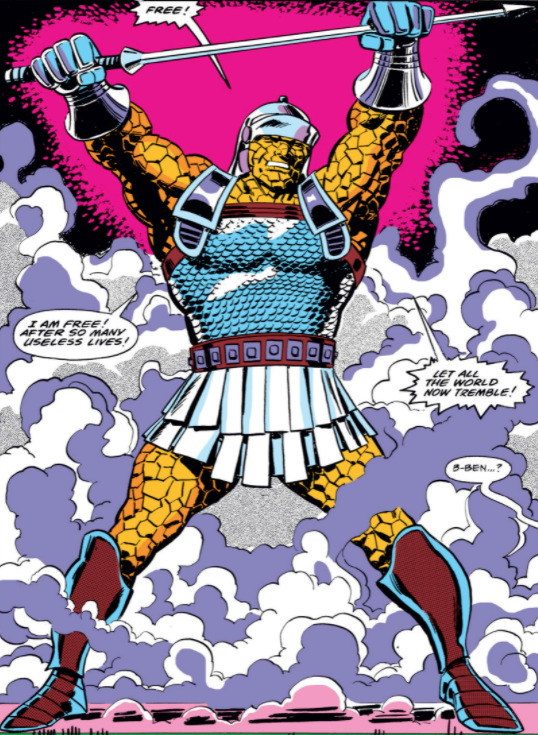
Also interesting is the version of the Thing Ben is transformed into by Diablo: essentially human in appearance, but with orange, rocky skin. Of the many various forms Ben has taken over the years, I’m only aware of seeing that specific one once, in The Thing 8, when Ben is transformed into the reincarnation of an ancient Egyptian warrior.

Krazy Kredits

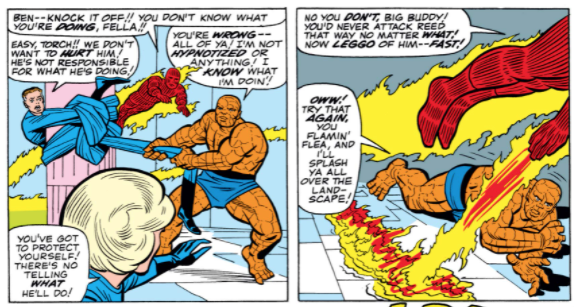
They’re fighting again

At least this time there’s a reason for it.

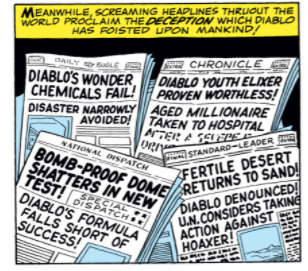
Read all about it

Print definitely isn’t dead in 1964.

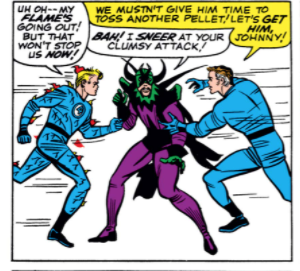
Great lines in villainy

Bah!
The incredible Mr. Fantastic

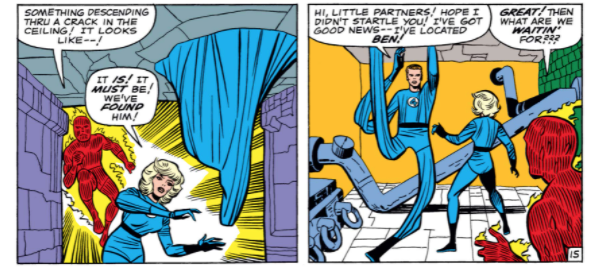
I like the way Reed sort of oozes out of the hole in the ceiling.

Weird science

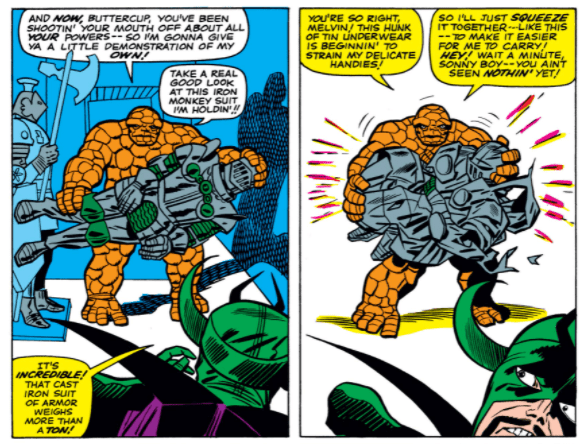
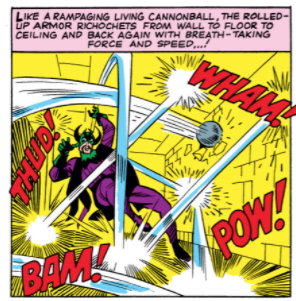
This is bizarre sequence. Ben grabs a suit of armor Diablo says weighs more than a ton (who can wear armor that weighs more than a ton?) Then, after smushing into a sphere, Ben manages to bounce it like it’s a tennis ball.

The sexist sixties

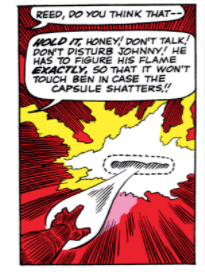
After telling Sue to shut up so she doesn’t distract the Torch, Reed yammers on while mansplaining.

Dig that Kirby Krackle

This is pretty awesome:

And so is this sequence:

And this one:

For sale

A mint (9.8) condition FF 30 is worth $23,000. A copy in fine (6.0) condition is a more reasonable $170.

Next issue: Time for FF Annual No. 2 and return of Dr. Doom!

“The World’s Greatest Comic Magazine” Fantastic Four No. 29

Tags

, , , , ,

Fantastic Four 29
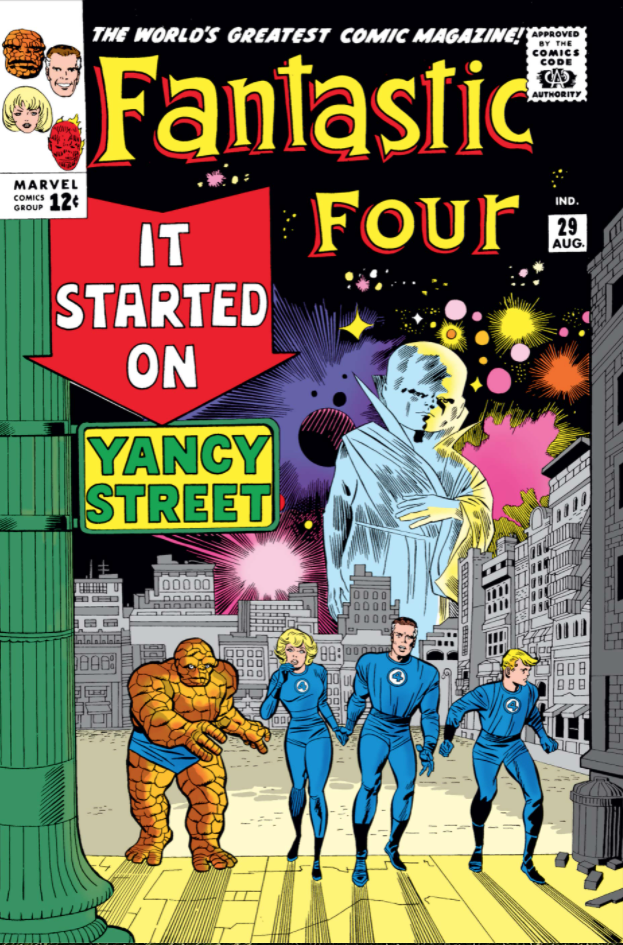
“It Started on Yancy Street”
Published: May 1964
Story: Stan Lee and Jack Kirby
Script: Lee
Pencils: Kirby
Inks: Chic Stone
Letters: Sam Rosen
Cover: Kirby and Stone

Synopsis

The Fantastic Four, visiting Yancy Street to investigate a rise in crime, are assaulted by the hidden Yancy Street Gang. The team escapes, pursued by a drone. Once back at the Baxter Building, Ben and Alicia come close to breaking up before reuniting. The team then turns to its fan mail, when Ben opens a package from the Yancy Street Gang, which explodes after he opens it. The package contains a note daring the team to return to Yancy Street.

But back on Yancy Street, the team is attacked not by the gang but by three apes with super powers, who are eventually revealed to the Red Ghosts’s super apes. The Red Ghost, last seen in FF 13, who vowed revenge, used a ruse to lure the FF to Yancy Street. After a battle, the apes take the Human Torch hostage—for once, it’s not the Invisible Girl—and the Red Ghost orders the FF onto a spaceship and they return to the moon.

He jettisons the team on the moon (surely there was a simpler way of killing them) but the Invisible Girl creates a force filed around the team containing enough air to save them until they reached the Blue Area and the home of the Watcher. Mr. Fantastic uses the Watcher’s technology to draw the Red Ghost’s ship back to the moon, where the team defeats him but his apes escape. The FF are then returned to Yancy Street by the Watcher.

What’s going on here

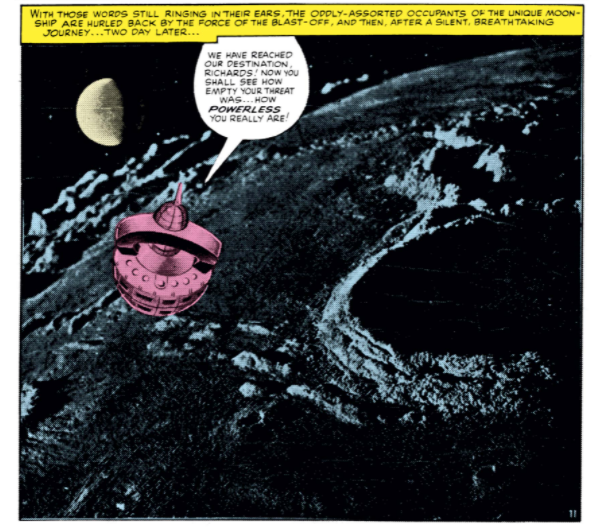
Fantastic Four 29 is a fun combination of old and new elements. There’s a lot that’s familiar: the Yancy Street schtick, the drama between Ben and Alicia, the hanging around the Baxter Building, the opening of fan mail. But there’s some new stuff as well. The issue opens in media res (fancy-talk for in the middle of things) rather than the slow build up to the action that’s customary. There’s the continued expansion of Sue’s powers, which prove indispensable in this issue. And there’s this amazing photo collage by Jack, the first (but certainly not last) that he will deploy in the Fantastic Four:

I was unable to find the source of the photo used by Kirby. It’s likely it was taken in 1959 by Luna 3, a Soviet satellite, since the first images of the moon from a US spacecraft didn’t appear until July of 1964, several months after the issue appeared.


It’s what’s inside that counts

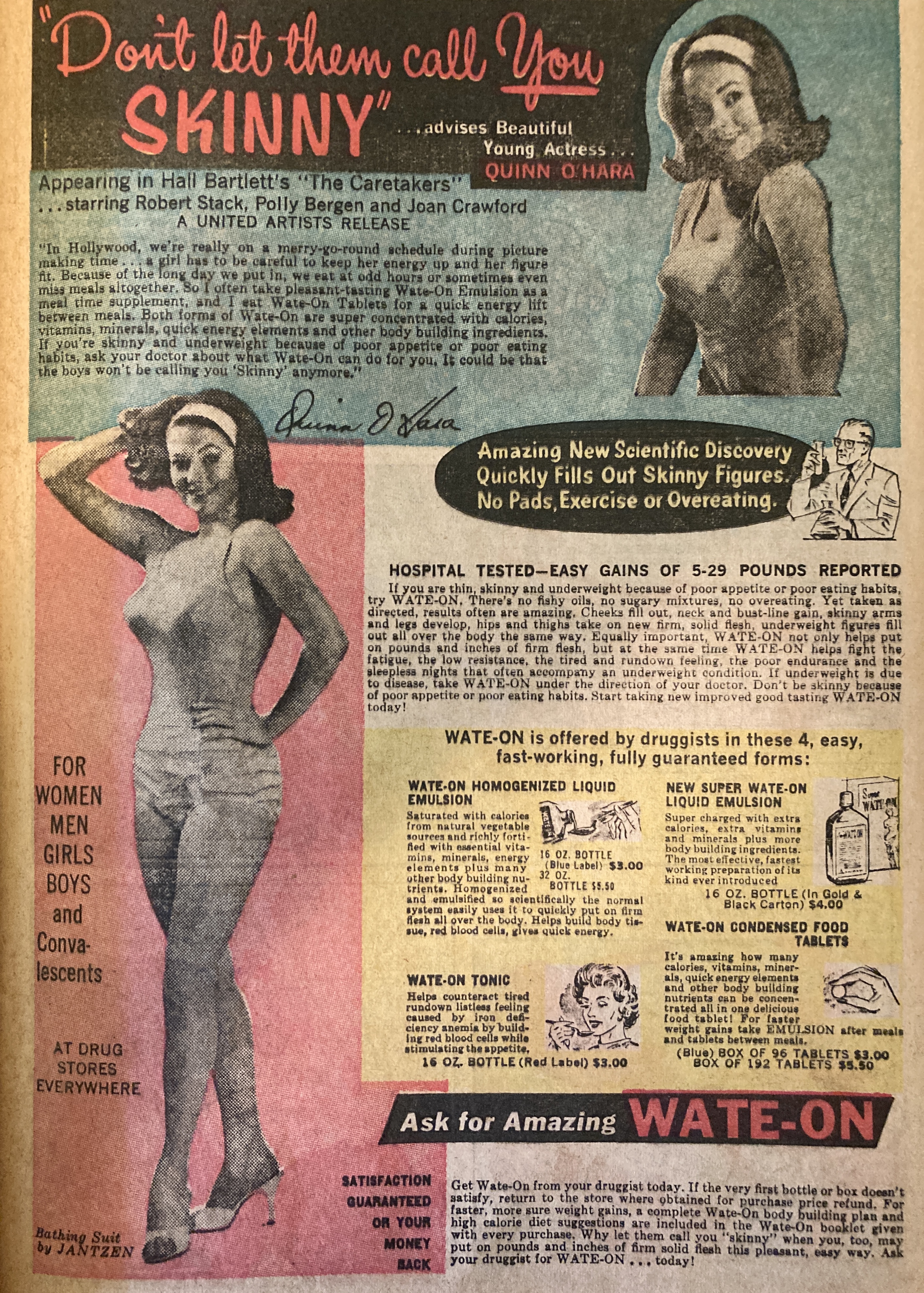
FF 29 is one of the earliest issues I actually own, and so I was able to read it as Stan and Jack intended. That means I got to see awesome ads like this:

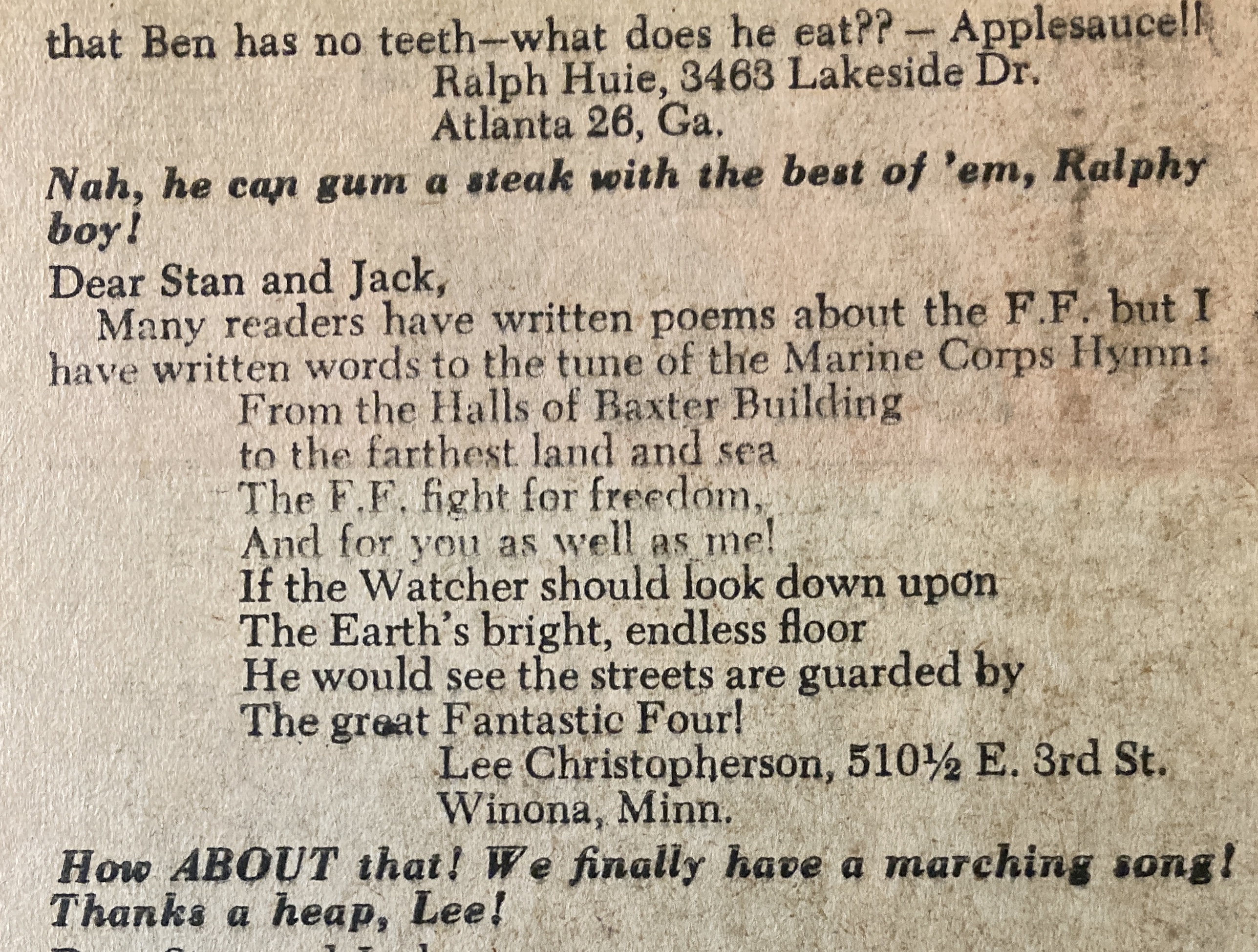
and letters like this:


Krazy Kredits

These are becoming a fixture.


Mid-century modern

The FF haven’t lost their decorating touch.

Those crazy kids

Ben and Alicia pour on the melodrama.

Oops

Looks like Stan is writing away a goof by Jack here

Weird science

The Watcher has some cool gizmos

Dig that Kirby Krackle

Some great stuff in this issue.

For sale

A mint (9.8) copy of FF 29 should sell for $46,000. A 9.6 copy sold for $11,000 in 2018.

Next issue: Diablo!

“The World’s Greatest Comic Magazine” Fantastic Four No. 28

Tags

, , , , ,

Fantastic Four 28
“We Have to Fight the X-Men!”
Published April 1964
Story: Stan Lee and Jack Kirby
Script: Lee
Pencils: Kirby
Inks: Chic Stone
Letters: Art Simek

Synopsis

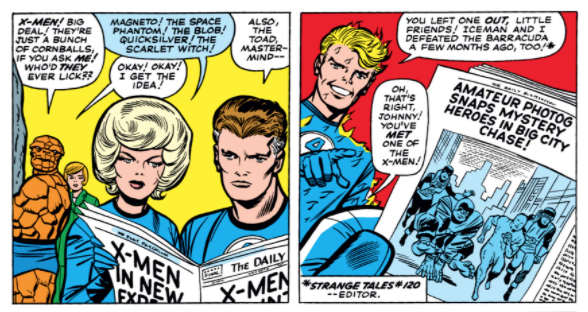
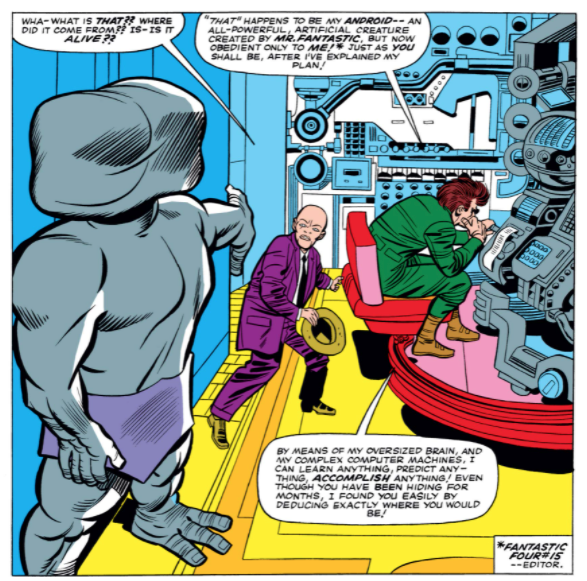
At the Baxter Building, the Fantastic Four discuss the exploits of the X-Men, whom they read about in the newspaper. Meanwhile, the Mad Thinker summons the Puppet Master, and enlists him in a plan to defeat the Fantastic Four. Following the Thinker’s instructions, the Puppet Master creates a replica of the X-men’s leader, Professor X with his “radioactive clay,” then uses it to control Prof. X, who orders the X-men to attack the FF.

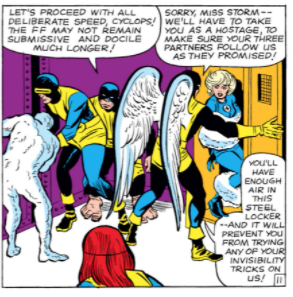
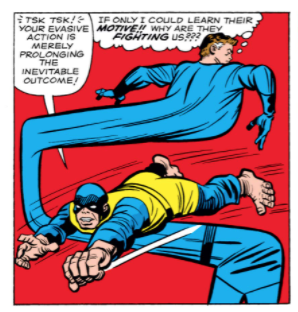
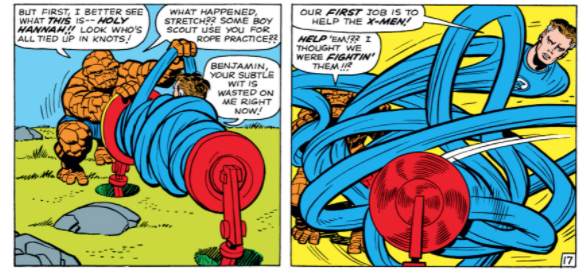
The X-Men fly to the Baxter Building in their “jetcopter,” and are welcomed by the unsuspecting FF. They then launch an attack and the teams battle until Mr. Fantastic, unable to understand the X-Men’s motives, orders the FF to surrender. The X-Men take the Invisible Woman as a hostage (of course they do), and the FF pursue the X-Men to a desert mesa, where the Mad Thinker and Puppet Master reveal themselves.

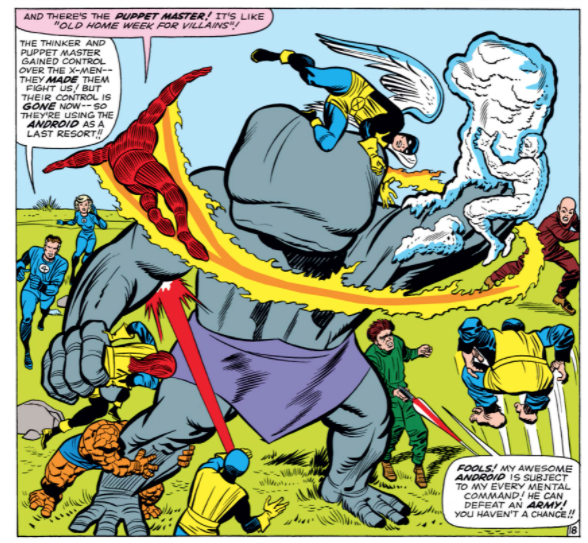
Still under the sway of the Puppet Master, Prof. X orders the X-men to battle the FF until the Puppet Master’s clay figurine of Prof. X is destroyed. The two teams then join forces to fight the Mad Thinker and his Awesome Android until Prof. X, still in Westchester, uses his telepathic powers to shut down the android. The villains escape before they can be captured, and the two teams of heroes part as allies.

What’s going on here?

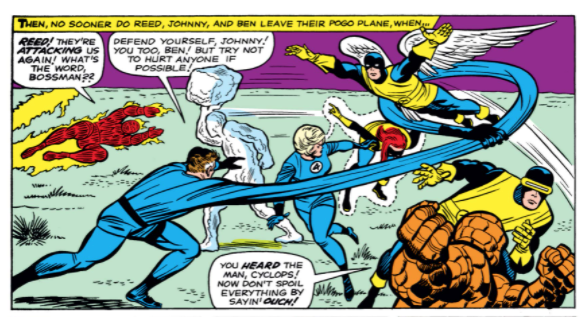
A fun issue! Yes, the fight between the X-Men and FF is contrived, and yes, it is clearly designed to promote Marvel’s new X-Men title—FF 28 is published between issues 4 and 5 of the X-Men—but it still delivers. The action is dynamic, the story moves along, and Kirby particularly is on his game. It might help that Chic Stone inked this issue, after a run by George Roussos, giving Kirby’s pencils a crisper look than what we’ve seen in the last few issues.

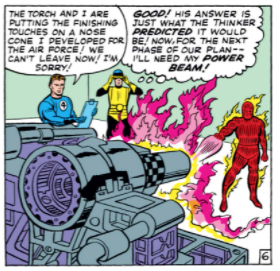
The big development is the appearance of the X-Men, marking the first of many meetings between the teams. The X-Men, of course, go on to become a global phenomenon, but in these early days, they were very much a work in progress (Cyclops fires “power beams” and not optic blasts, for instance, and Prof. X’s powers work on an android). However, as Austin Gorton notes, in his always X-cellent blog, X-amining the X-Men, the X-Men more than hold their own against the FF and it’s Prof. X, not Reed, who saves the day.

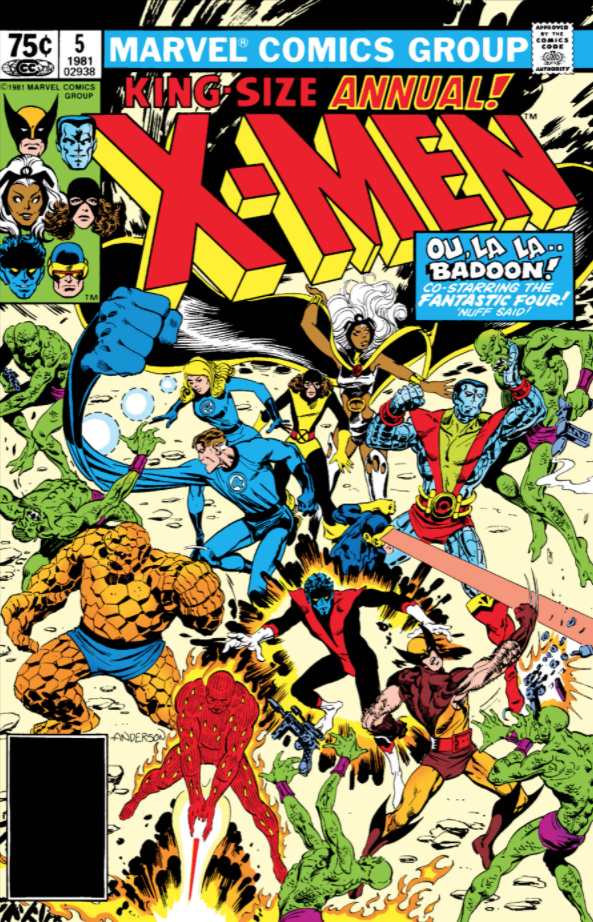
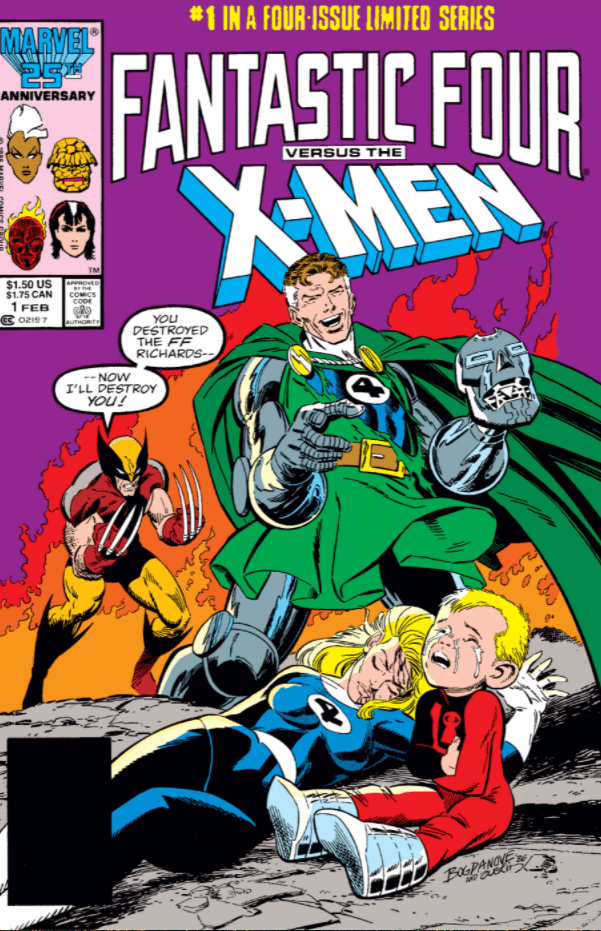
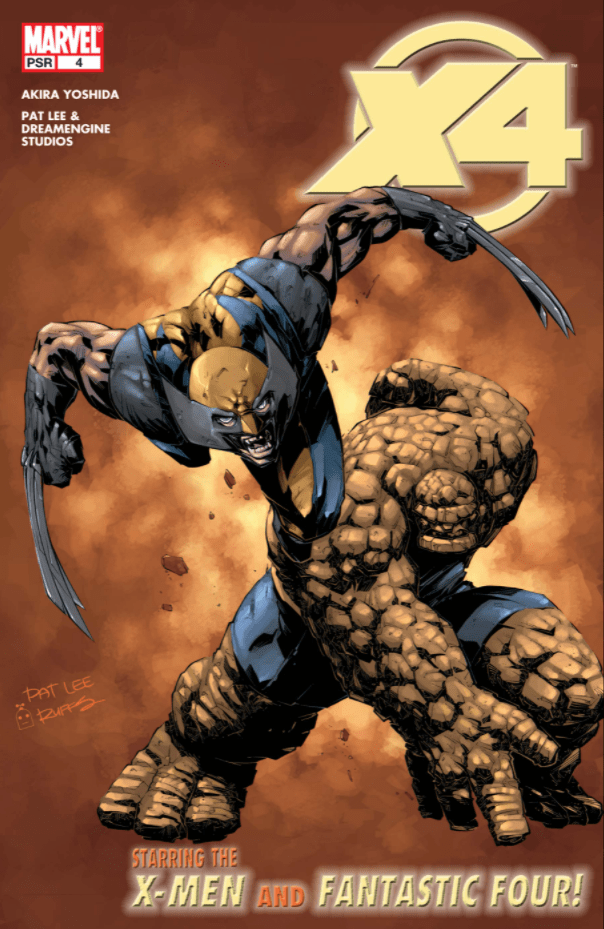
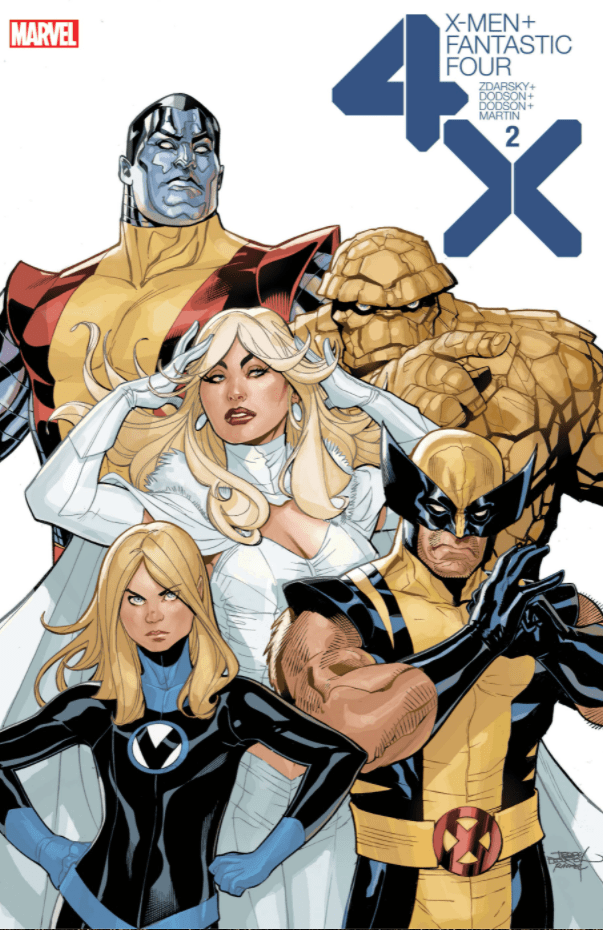
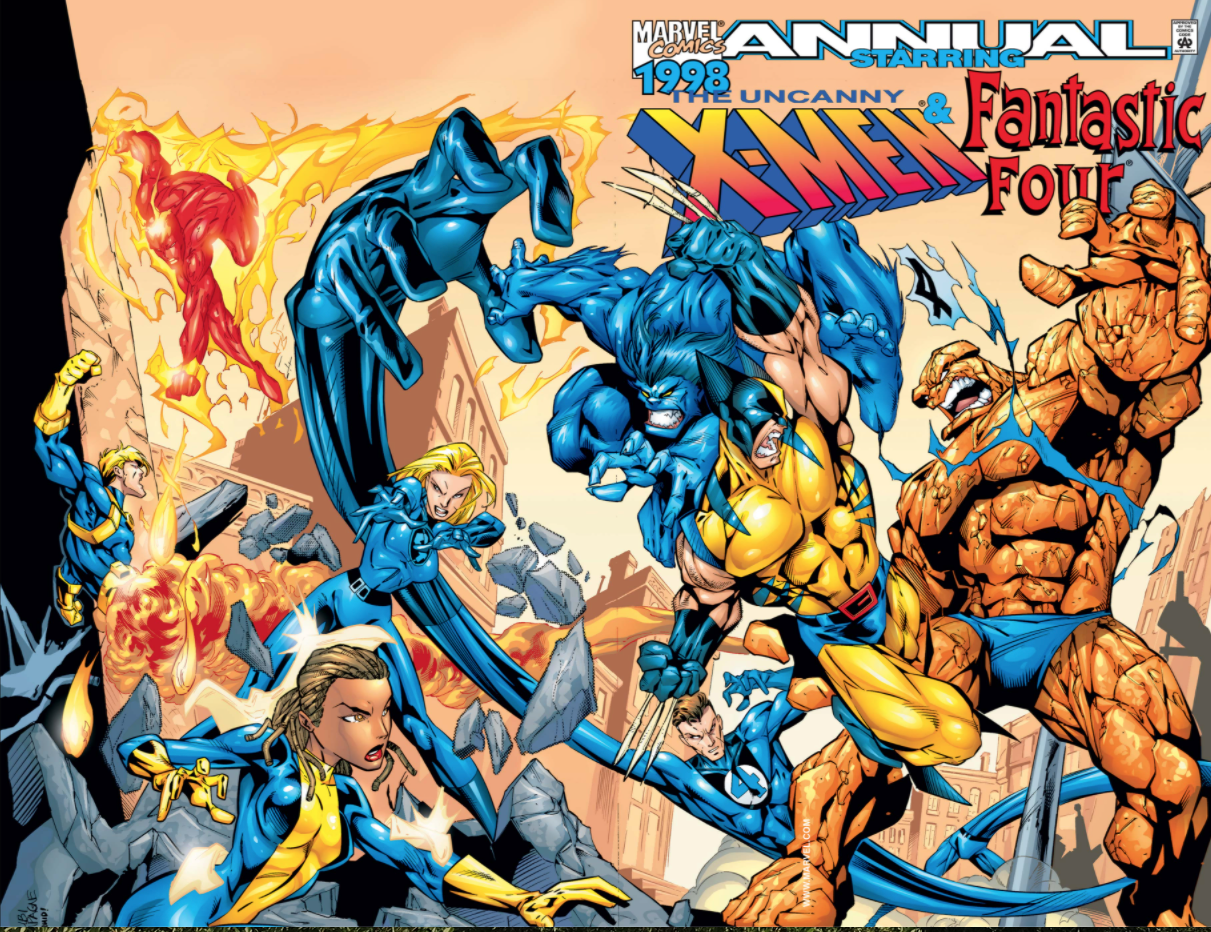
Tracking down all the joint appearances between the teams would be exhausting, but here the covers from some notable ones:

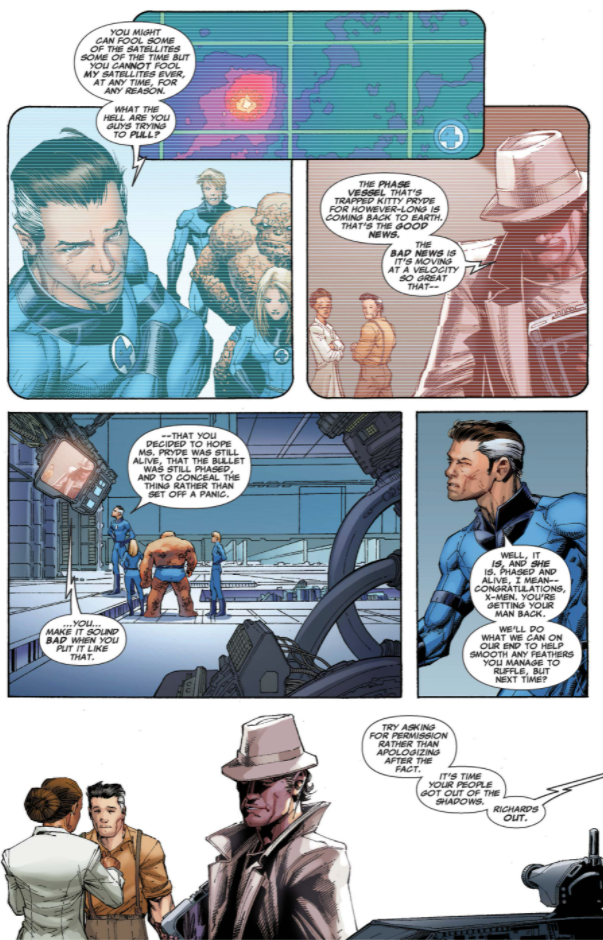
The teams interacted in less splashy ways over the years too. One of my favorites came in Uncanny X-Men 522, when the X-Men have relocated to San Francisco and are in one of their periodic us-against-the-world phases. Magneto is using his powers to pull an enormous, bullet-shaped rocket carrying Kitty Pryde from deep space, and Cyclops doesn’t want anyone on earth to know about it. Reed isn’t having it:

Read all about it

Once again, the FF use the strange and awesome technology of the newspaper to keep up with events. They are also surprisingly up to date on the activities of the X-Men.

Kooky Kredits

Stan is at it again

The sexist sixties

Would it be an issue of the FF if Sue wasn’t taken hostage?

Oops

Cyclops references the Mad Thinkers plan here, although at this point, he is unaware of the Thinker and Puppet Master’s control over Prof. X and thinks he’s merely following the professor’s inscrutable orders.

Dig that Kirby Krackle

There’s a ton of great Kirby art in this issue, but here are a few highlights:

For sale

A mint (9.8) issue of FF 28 will set you back around $22,000.

Next issue: The Red Ghost returns!