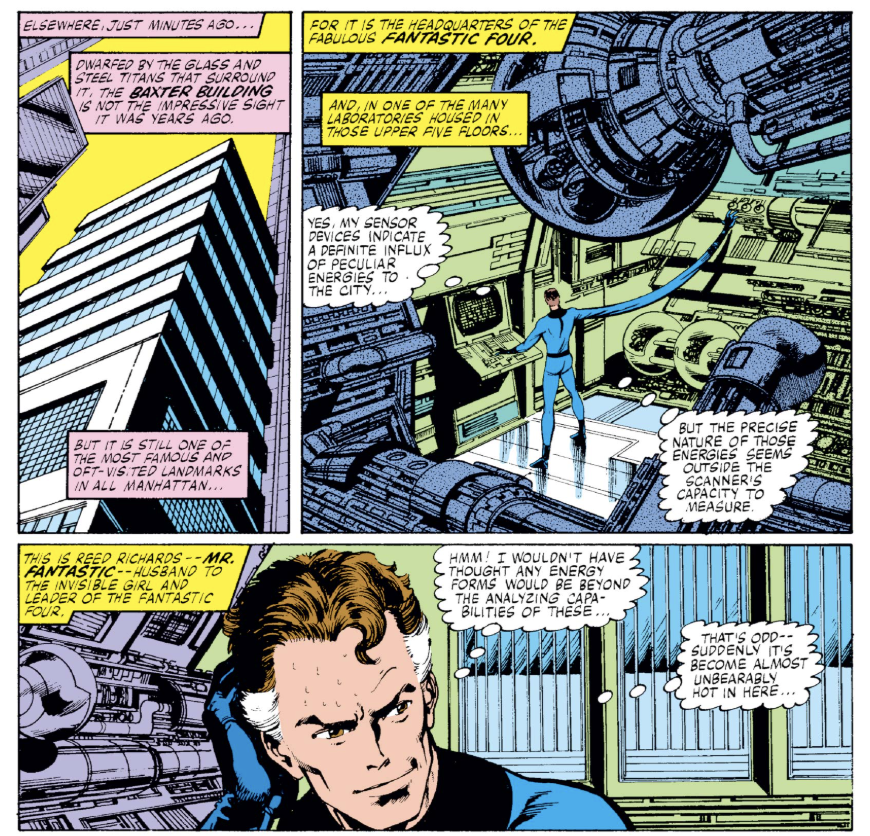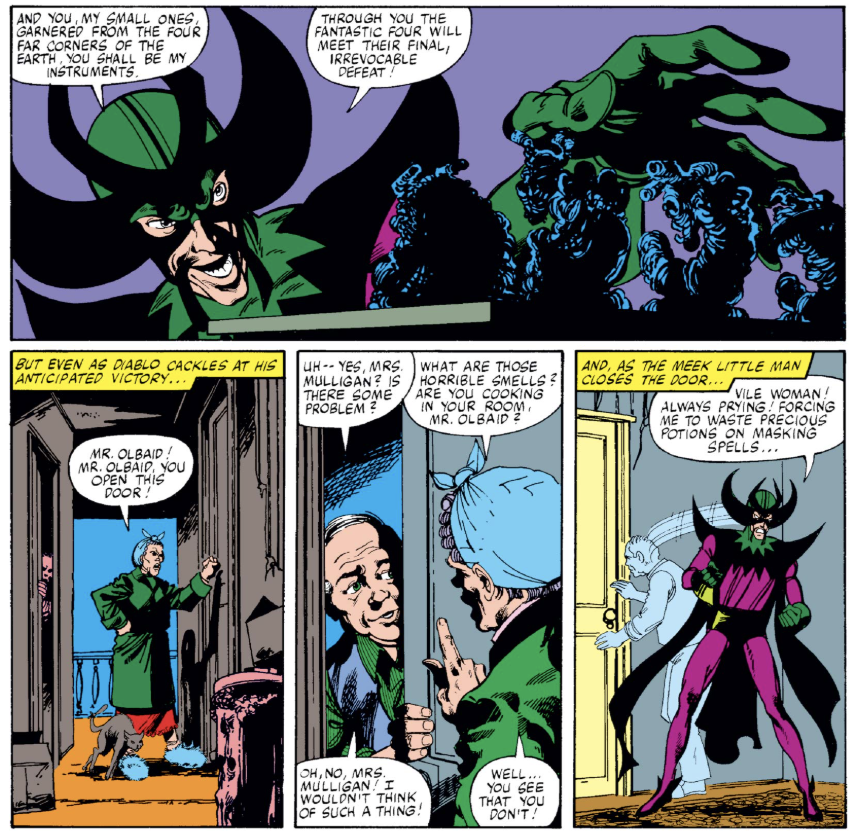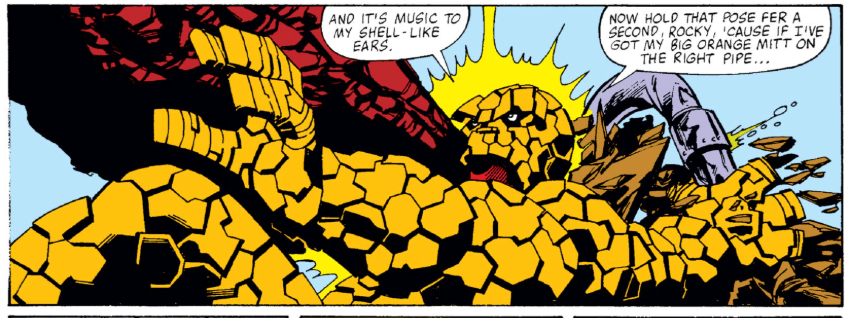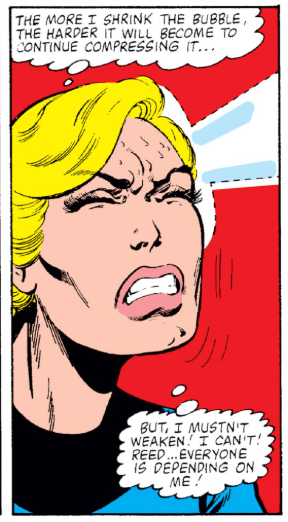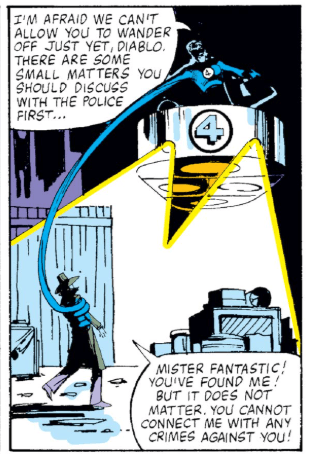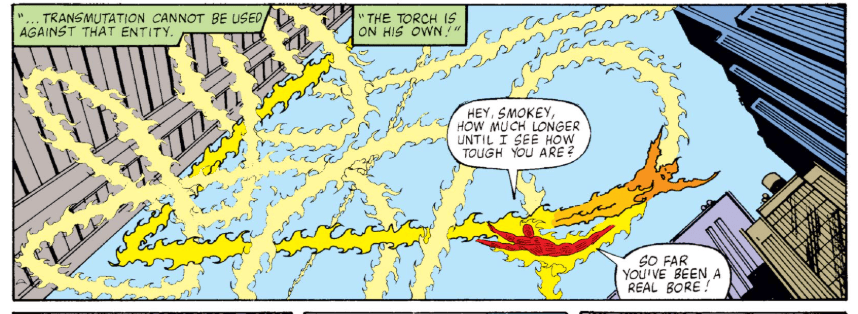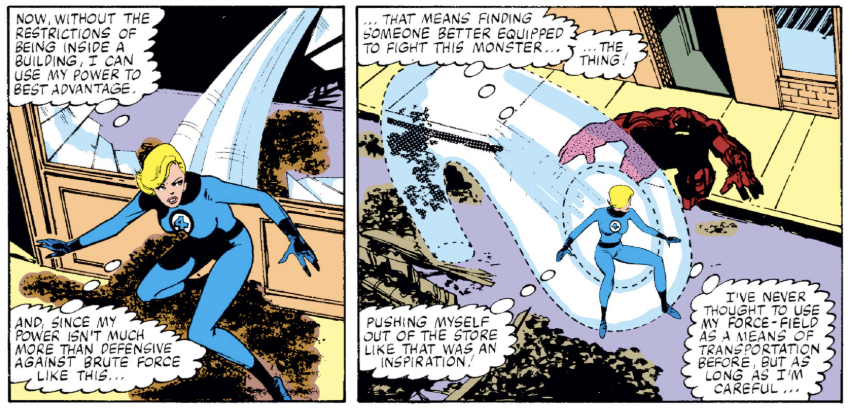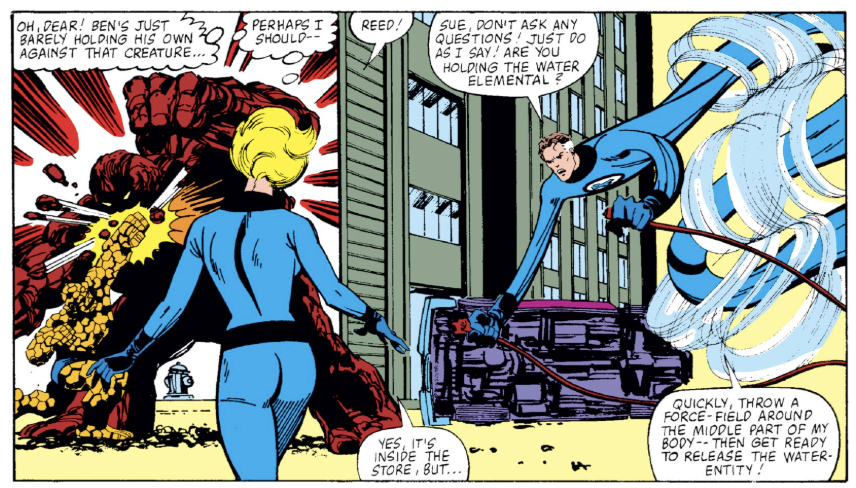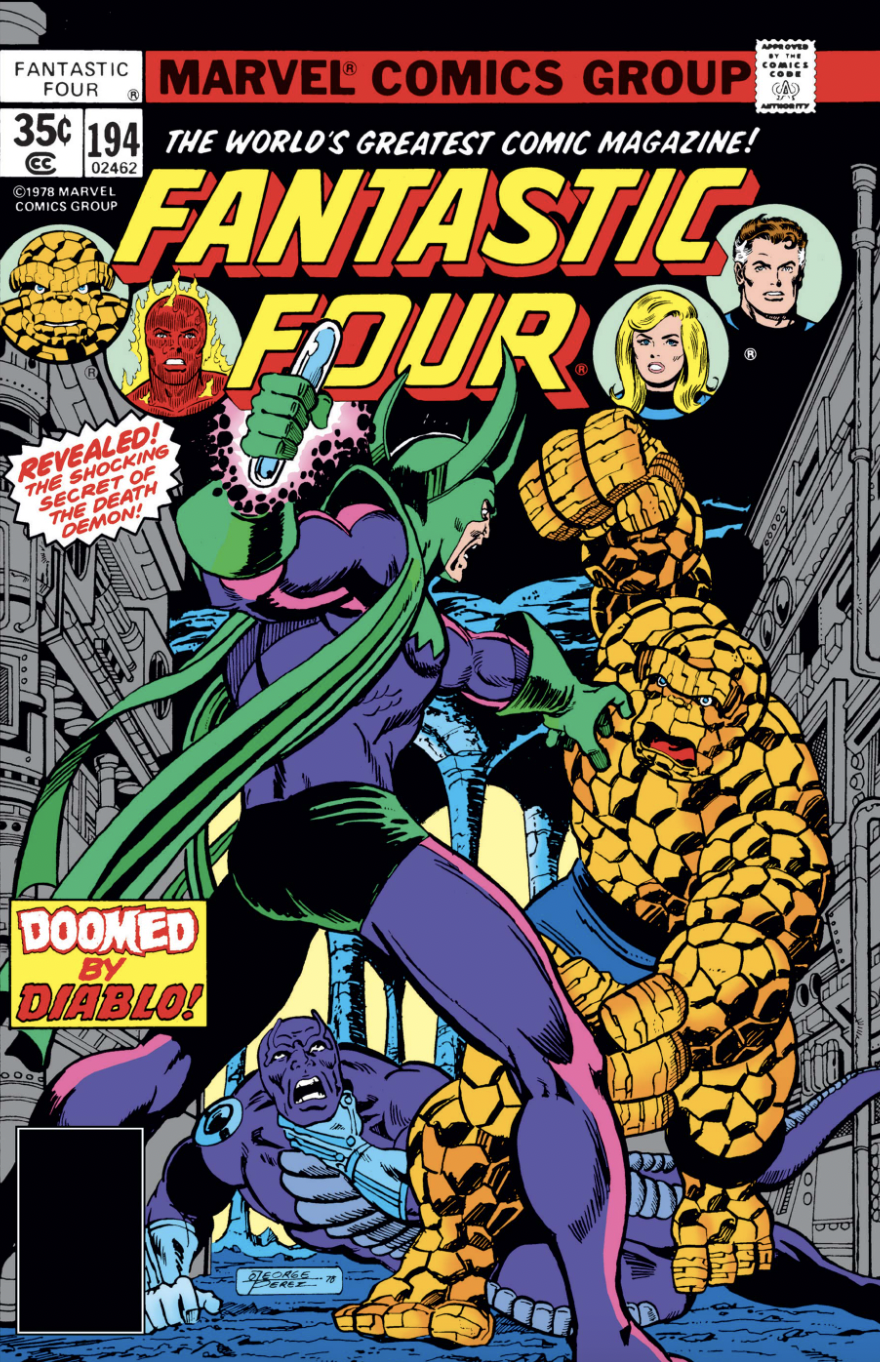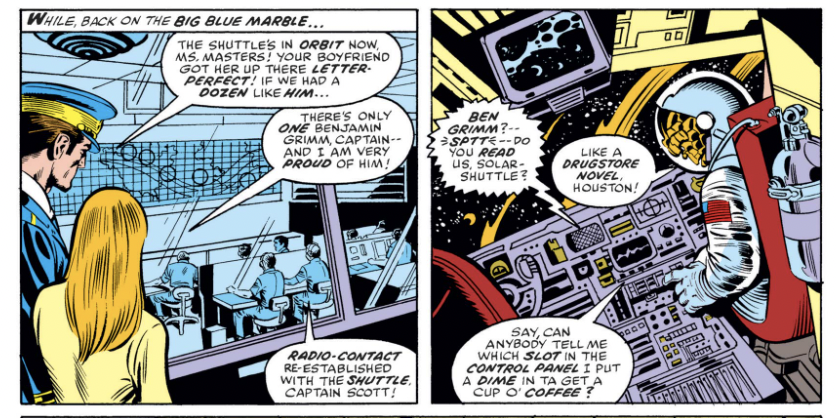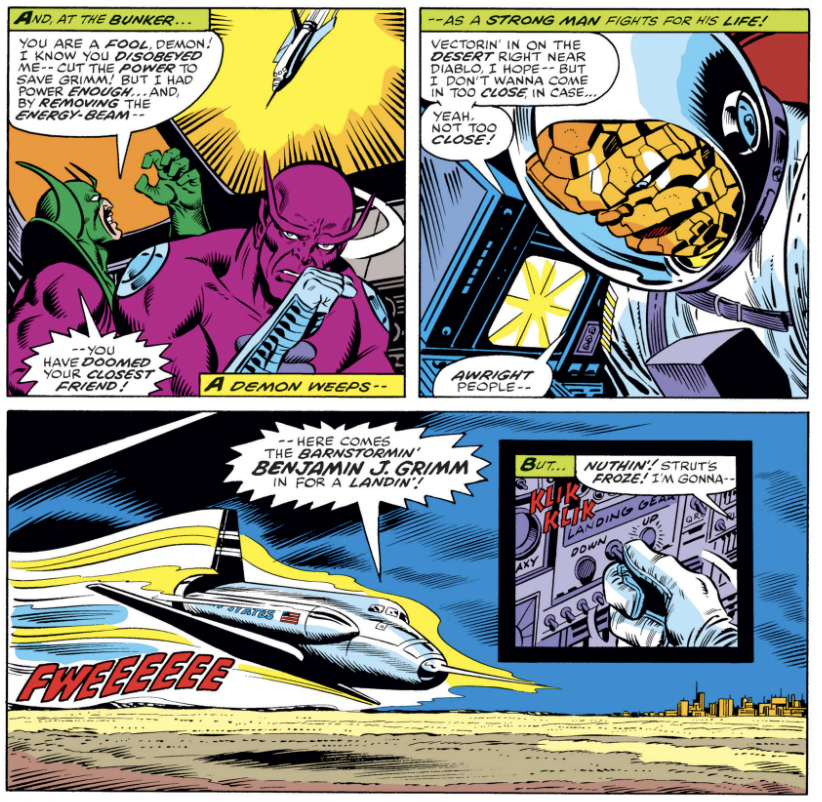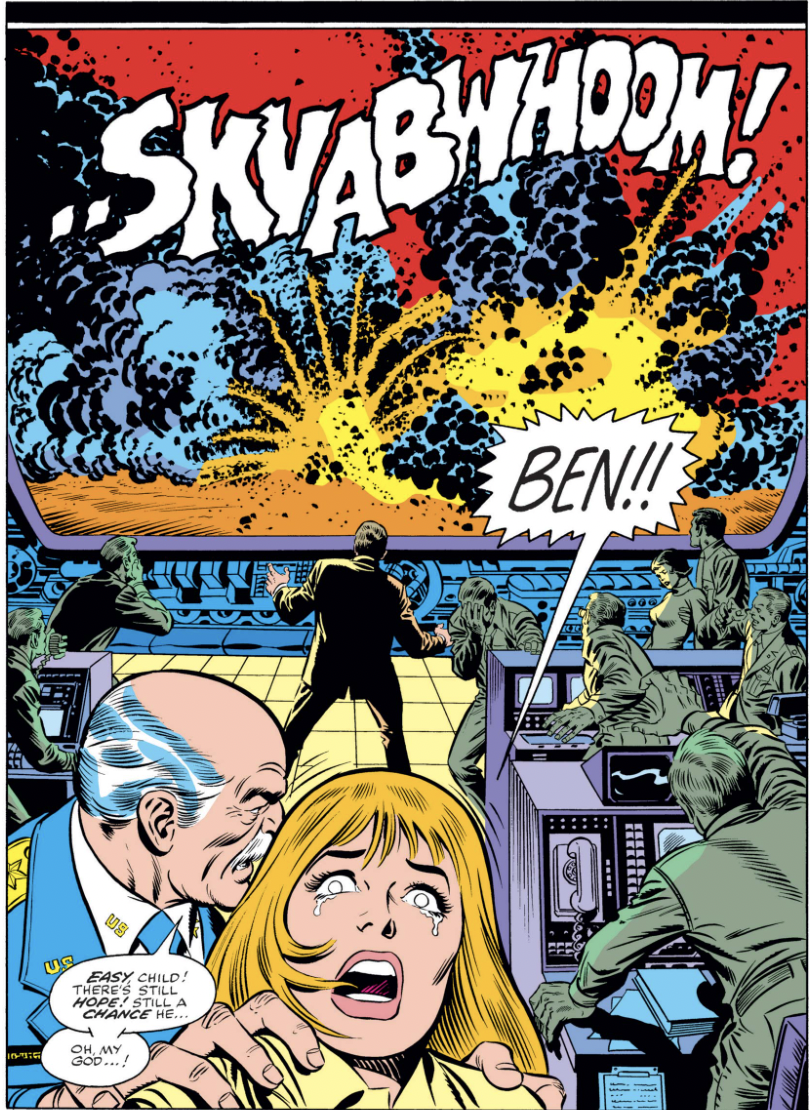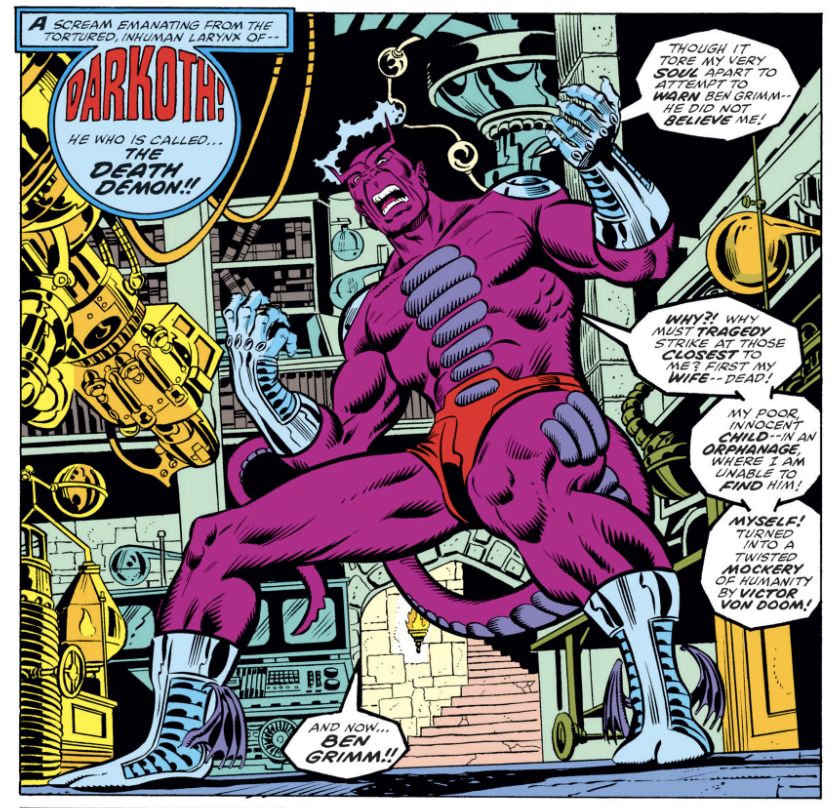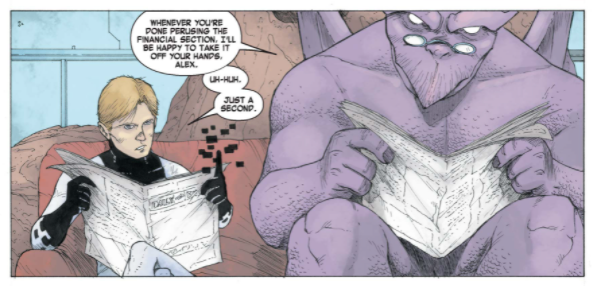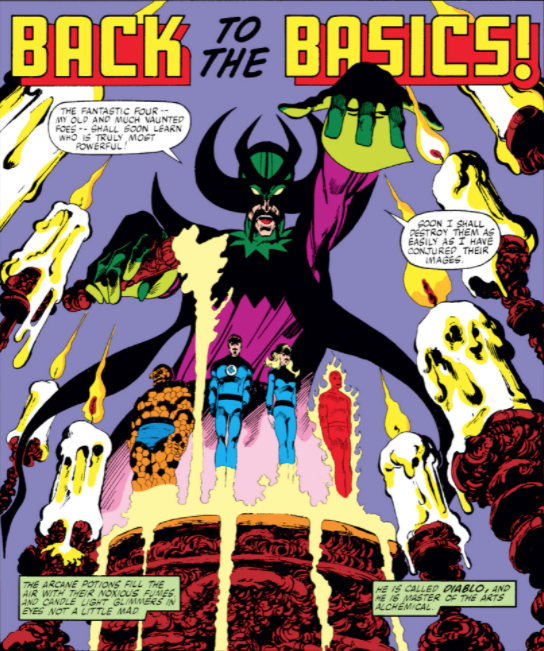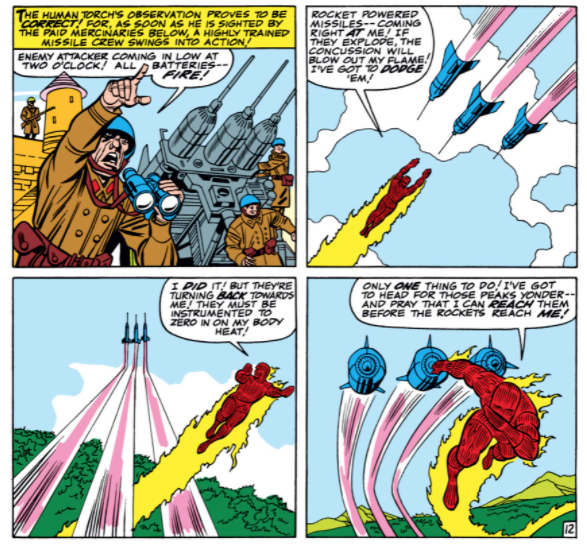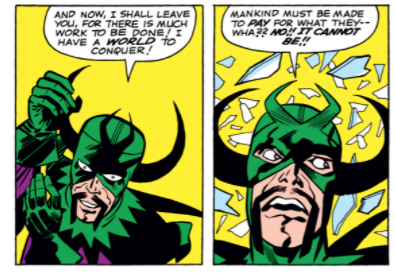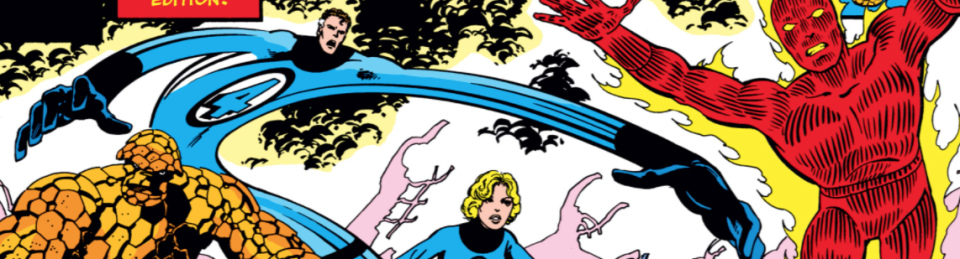
Fantastic Four 194 “Vengeance Is Mine!” Published February 1978 Plot: Len Wein & Keith Pollard Script: Bill Mantlo Pencils: Pollard Inks: Dave Hunt Letters: Annette Kawecki Colors: George Roussos Editor: Marv Wolfman Cover: George Perez
Synopsis
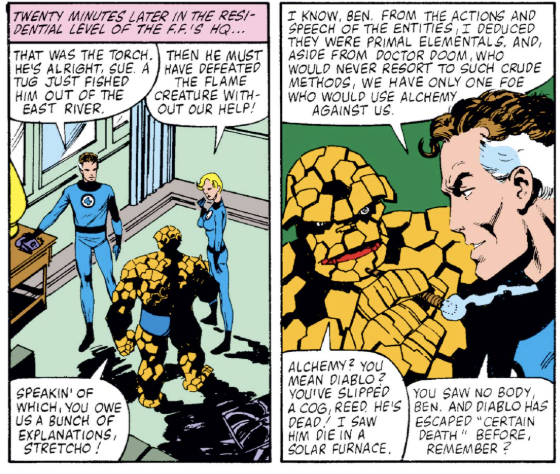
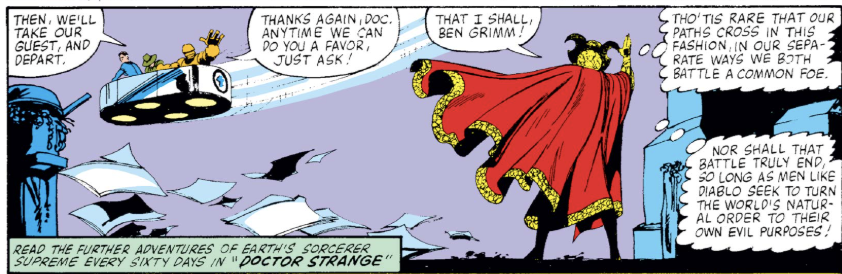
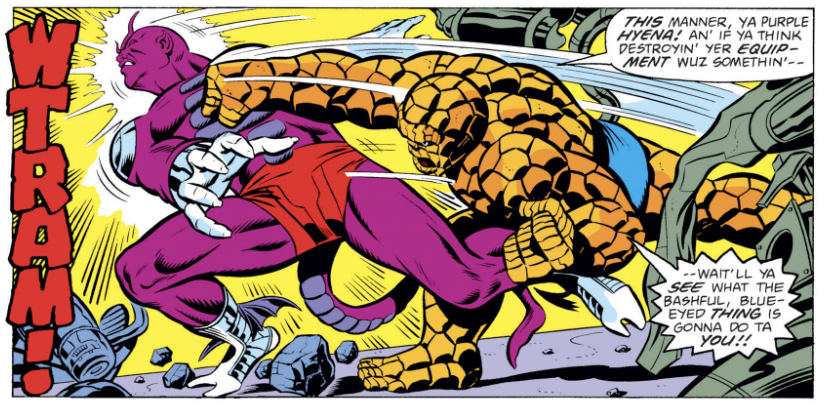
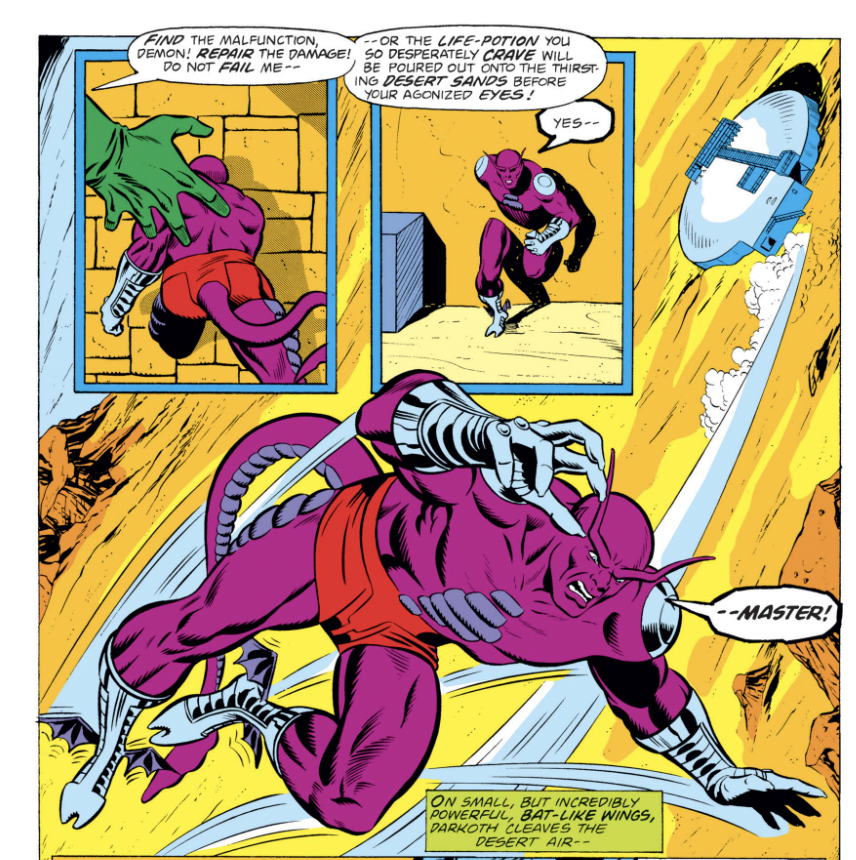
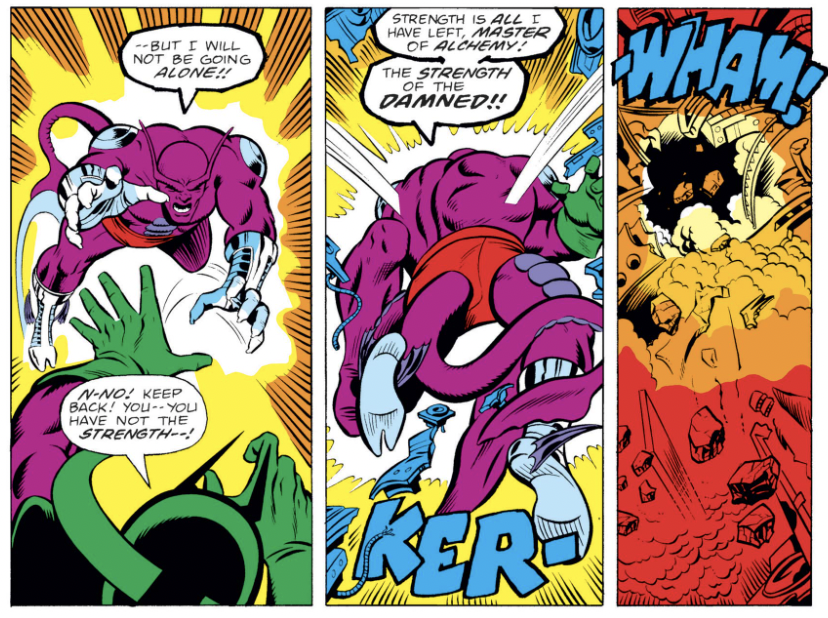
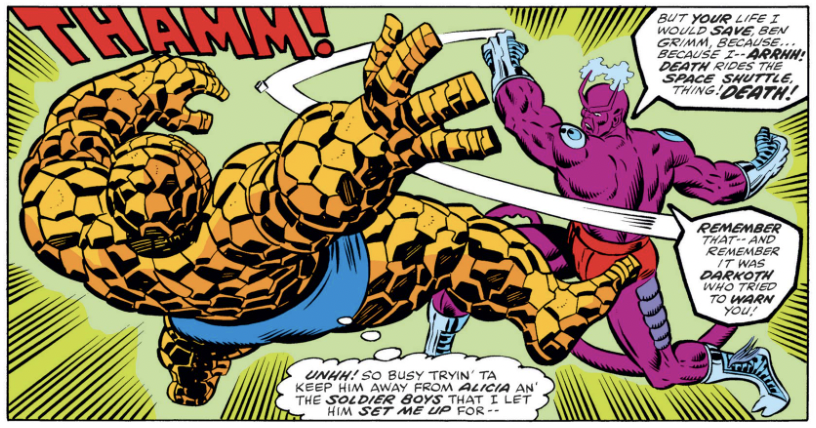
After surviving the crash of the Solar Shuttle, the Thing confronts Darkoth, who eventually overcomes a spell by Diablo and reveals to Ben he is his old friend Desmond Pitts. Ben then battles Diablo and is about to be killed by a solar cannon when Darkoth turns against Diablo, sacrificing himself to save Ben.
What’s going on here?
This comic efficiently wrap up the two-part Ben solo story while resolving the Darkoth storyline. If you didn’t think Darkoth was going to die in some noble fashion, then I guess you haven’t read many comic books. But despite its predictability, it’s a solid story and enhanced by the attractive Keith Pollard/ Dave Hunt artwork.
The next solo story, featuring Sue and the Sub-Mariner, is teased in a short cutaway, but other than that, the story is all Ben’s. No Reed or Johnny.
This the rare FF of this era not inked by Joe Sinnott but Hunt’s inks look great over Pollard’s pencils. Hunt is an interesting case; he seems like a true comic’s journeyman who has hundreds of credits as inker, letterer and colorist, and who spent a big chunk of his career on second- and third-tier titles like The Little Mermaid and Scooby-Doo. This is his second and last issue of the Fantastic Four.
Annette Kawecki is credited as the letterer, her first and only Fantastic Four credit. And George Perez returns to deliver an amazing cover.
What I liked
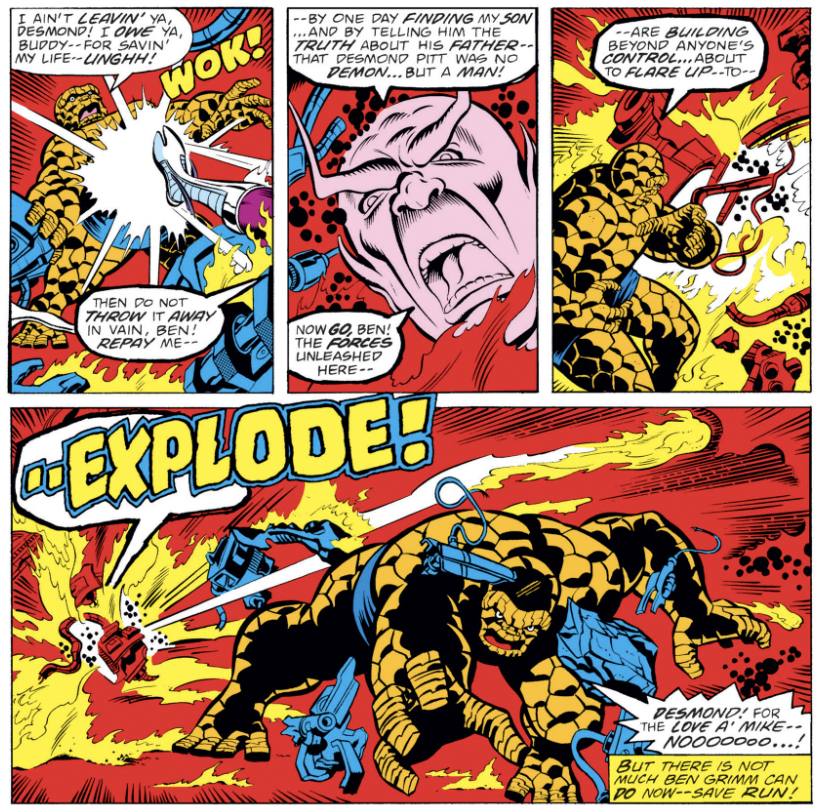
Even though we could see it coming from a mile away, there was a poignancy to Darkoth reclaiming his humanity by turning on Diablo, knowing it meant his death. Also note the great, over-the-top dialogue by Bill Mantlo, a master of purple prose.
And then, of course, comes his classically melodramatic death scene.
What I didn’t like
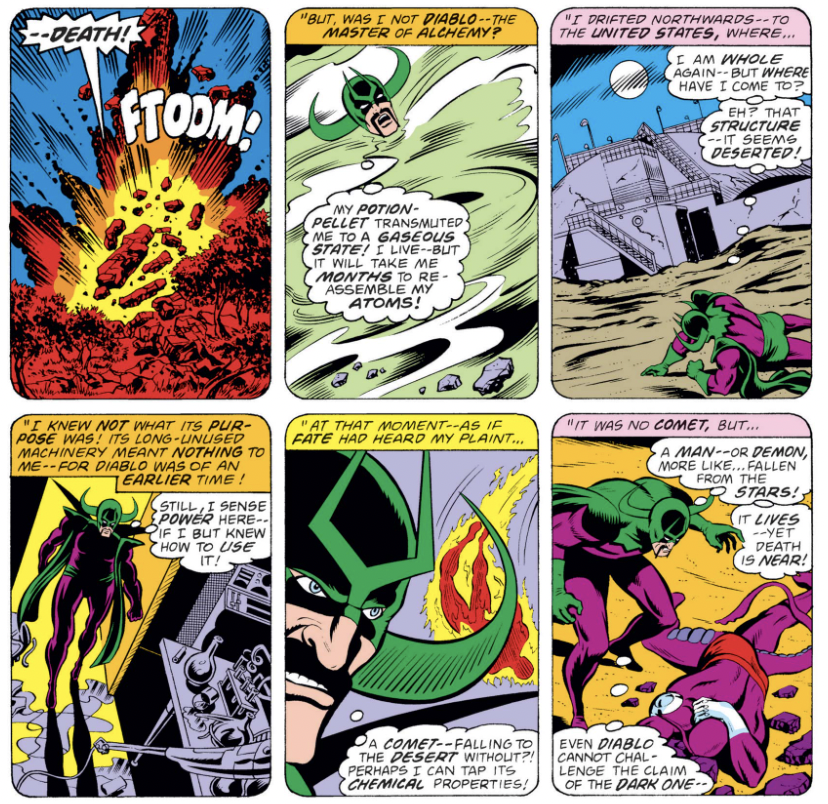
Even for a comic book, Diablo’s explanation of how he survived his seeming death and discovered Darkoth is hard to swallow.
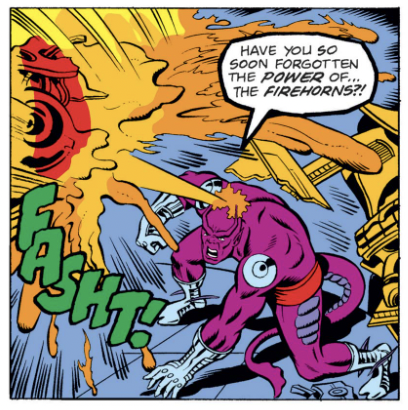
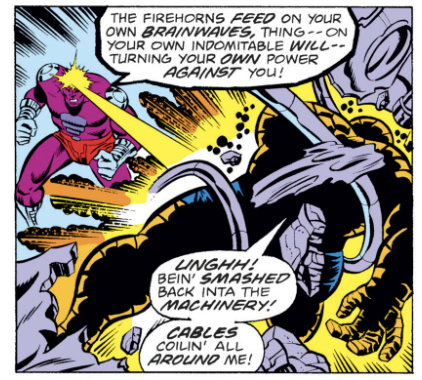
Also, these “firehorns” are dumb.
Anything else?
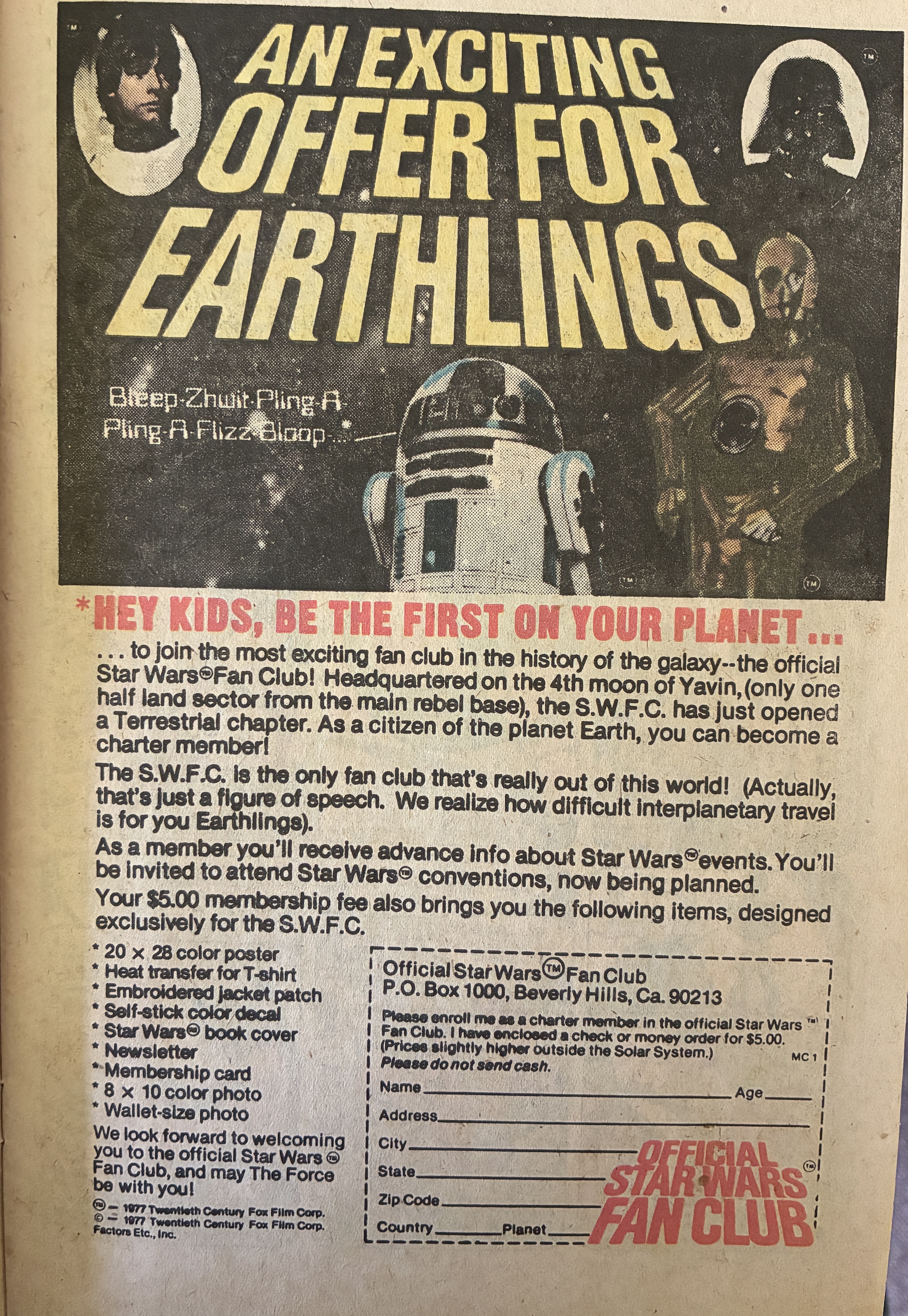
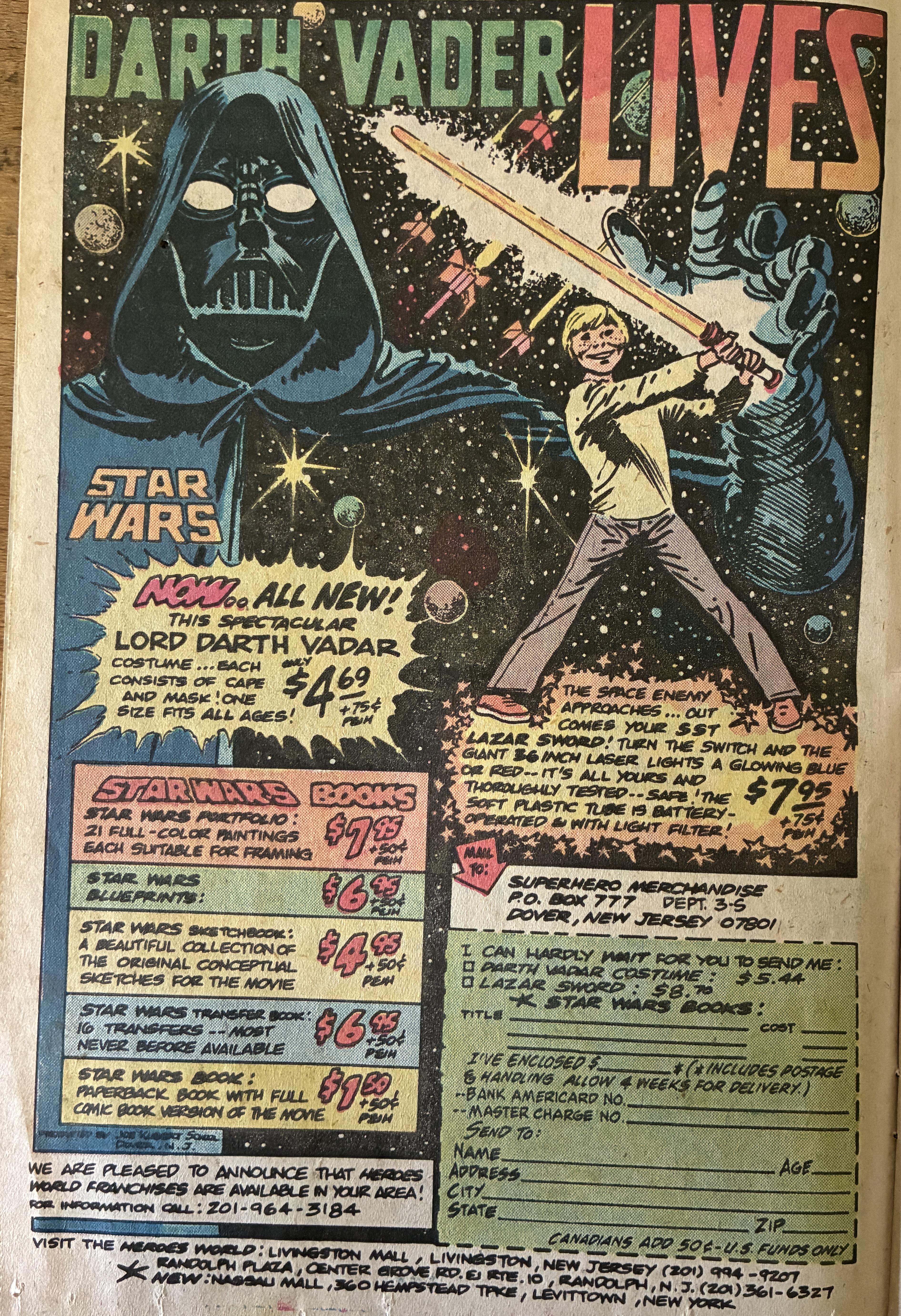
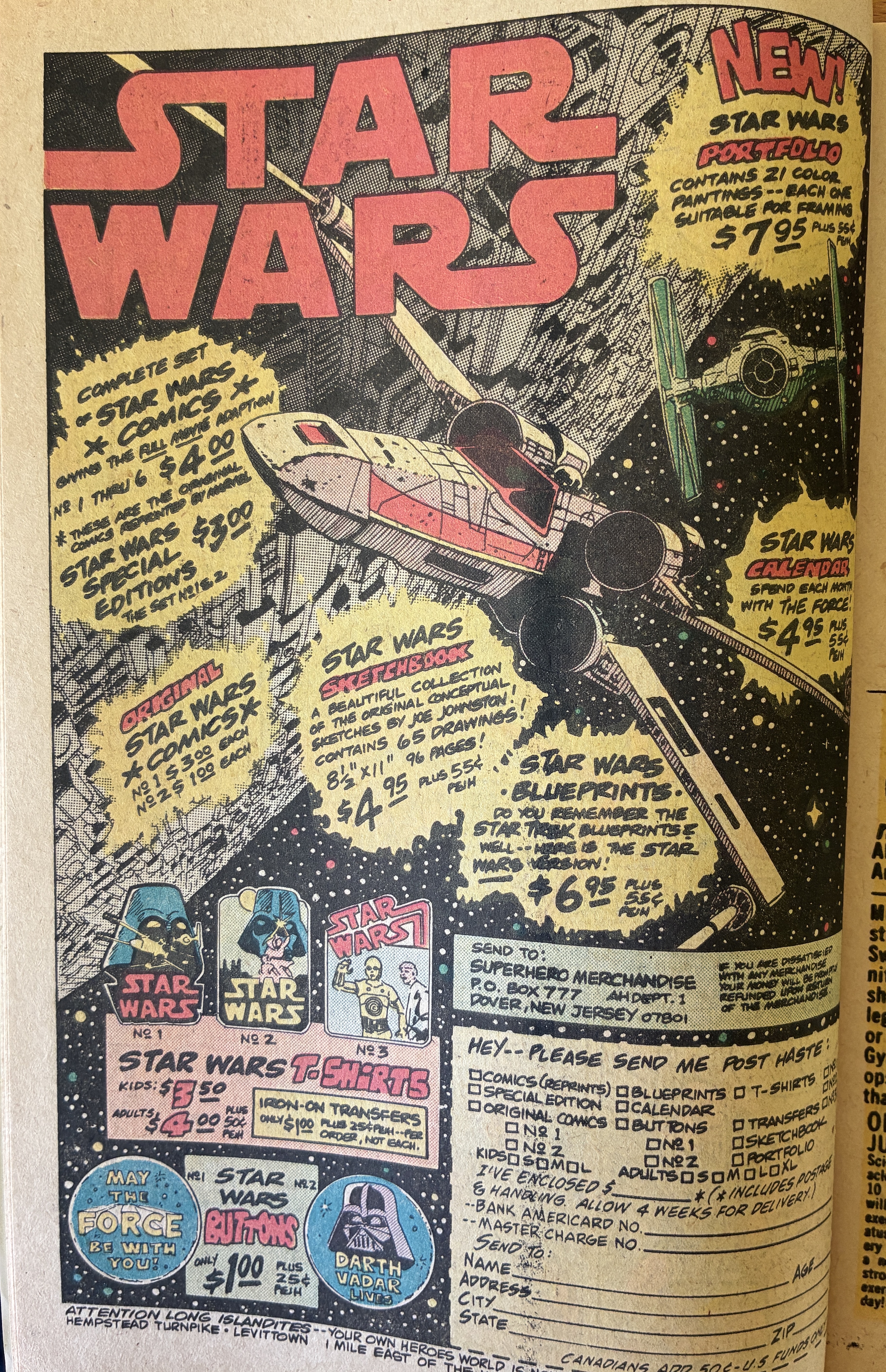
More Star Wars-related ads this month:
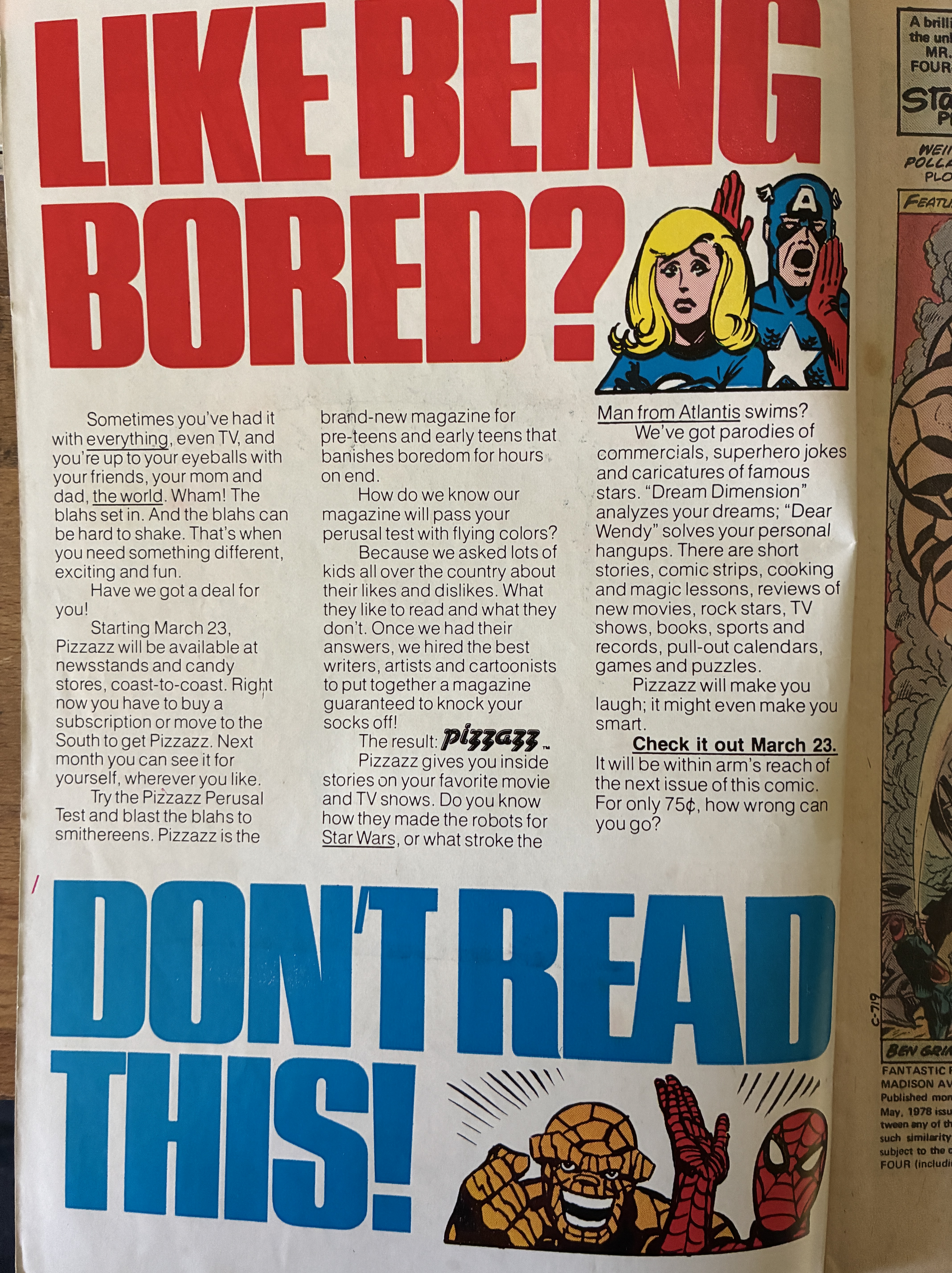
Plus some other interesting ads, including another odd one for Pizzaz. Again, I can’t imagine buying this magazine based on these ads.
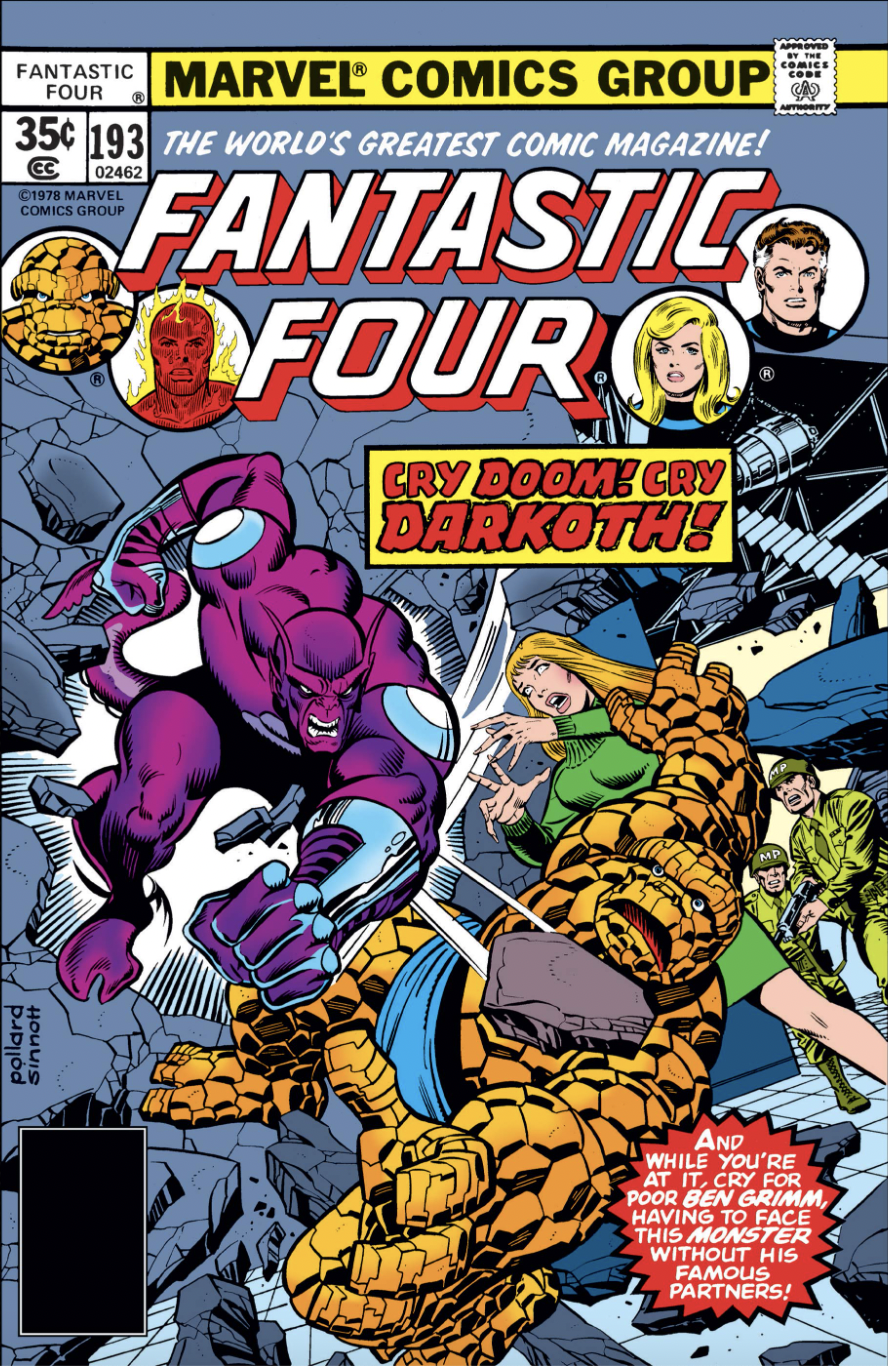
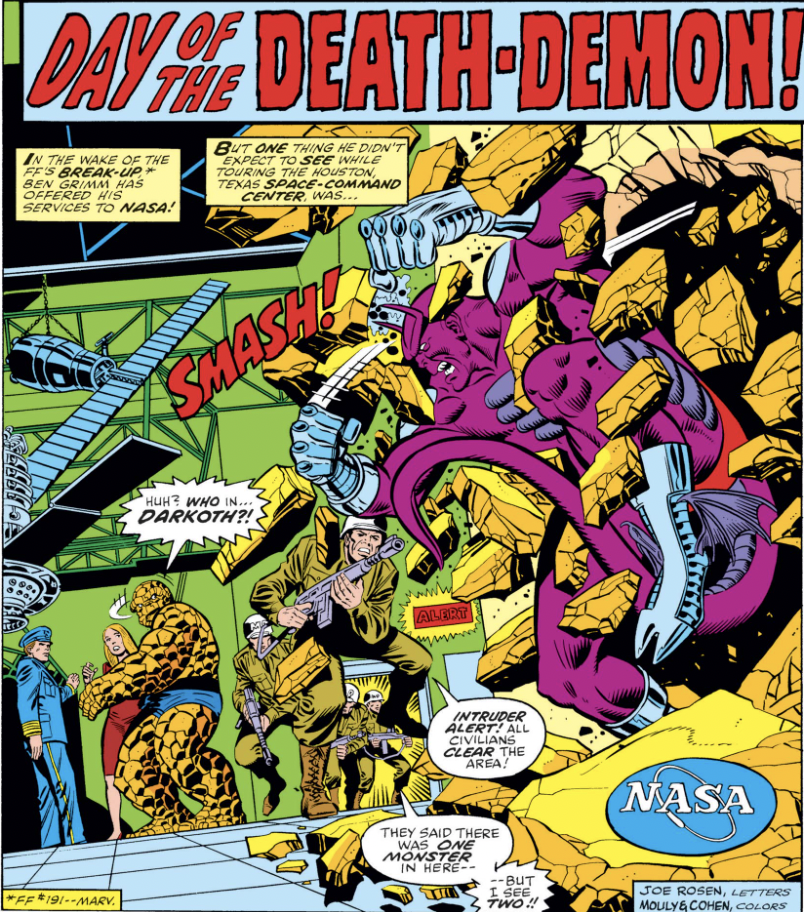
Fantastic Four 193 “Day of the Death-Demon!” Published January 1978 Plot: Len Wein and Keith Pollard Script: Bill Mantlo Pencils: Pollard Inks: Joe Sinnott Letters: Joe Rosen Colors: Françoise Mouly and Janice Cohen Editor: Marv Wolfman Cover: Pollard and Sinnott
Synopsis
After the breakup of the Fantastic Four, the Thing is lending his services to NASA as a test pilot. As he prepares for a space shuttle flight, the NASA facility is attacked by Darkoth, the cyborg demon created by Dr. Doom who was supposedly killed with Doom in issue 144. It’s later revealed that Darkoth was once Desmond Pitt, a former test pilot and friend of Ben’s who was accused of selling secrets to Latveria. Darkoth is now under the sway of Diablo, who picks up the pieces of a plot begun by Dr. Doom, who had sabotaged the plans of the space shuttle so it could be controlled by an outside agent. Diablo then attacks the shuttle while Ben is orbiting Earth, and Ben tries to land the craft before it explodes into flame upon crash landing.
What’s going on here?
The recent death of guitarist Ace Frehley (RIP) reminded me of an odd marketing stunt by Kiss. In 1978, the four members simultaneously released four solo albums, before reforming and releasing albums as a band again.
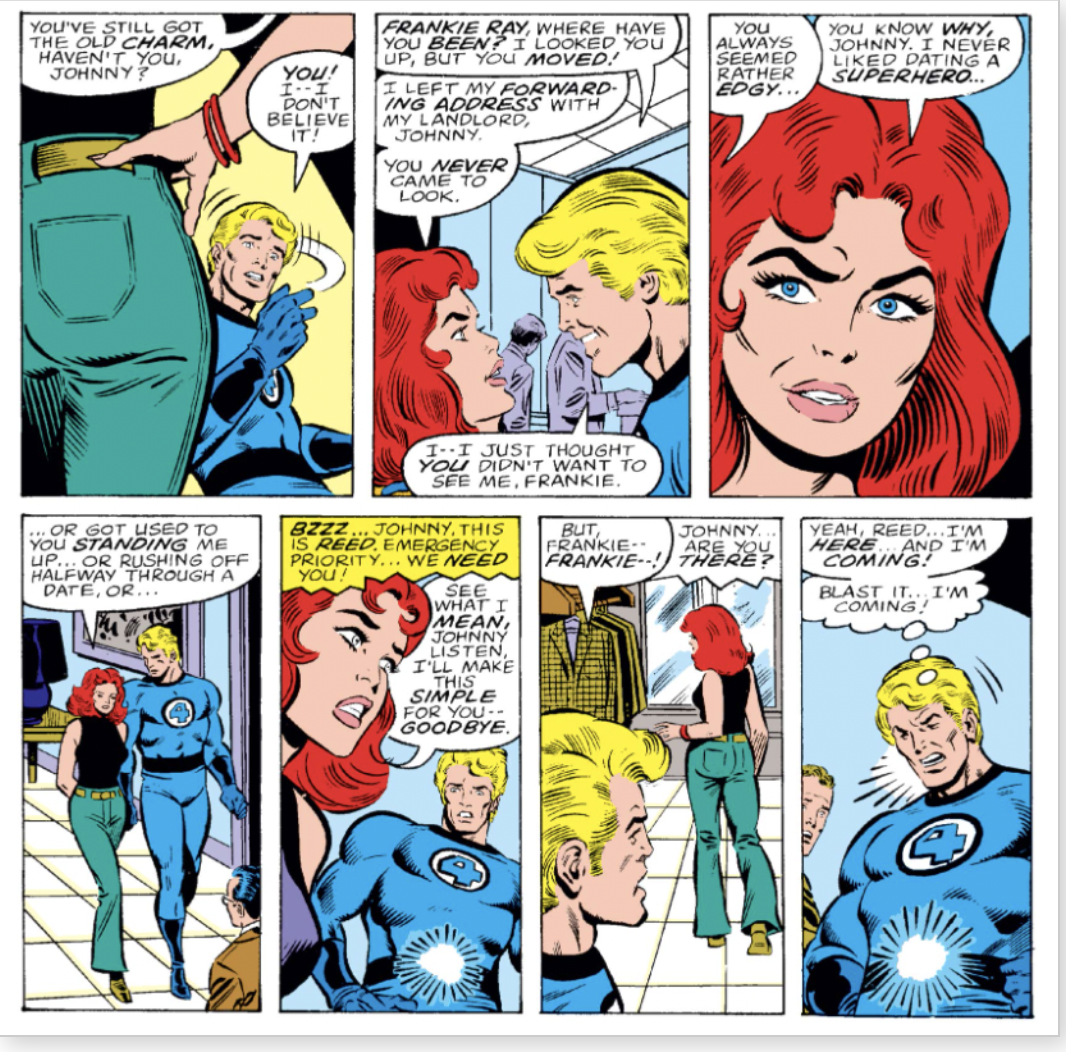
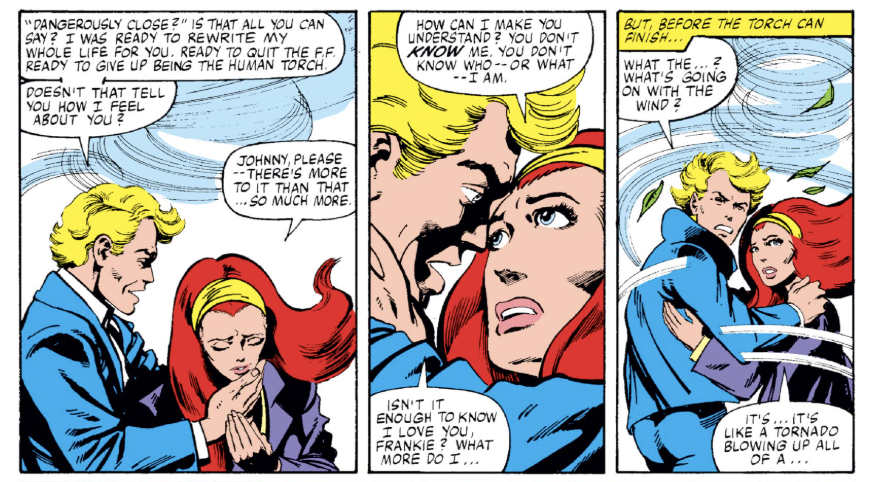
That feels a little like what’s going on during this period of the Fantastic Four. Ostensibly broken up (but, like Kiss, destined to regroup), the team members went off in four separate directions and are having four separate solo adventures. Last issue featured Johnny’s adventures in the wild west, and in that issue and this one, we are teased with glimpses into the current activities of Reed and Sue, which promise to blossom into their own solo stories before the team presumably gets back together before issue 200.
This issue features the return of Darkoth and a noir-ish mystery involving disgraced old friends and sinister plots. It doesn’t always work, but it’s an ambitious attempt and I give the writing troika of Len Wein, Keith Pollard and Bill Mantlo credit for trying it.
This issue marks the first of Pollard’s run on the Fantastic Four, and closes the door on George Perez’s all-too-short stint. Perez will return for two FF annuals, and will continue to draw the Avengers and Marvel Two-in-One before departing permanently for DC in 1980. Perez ultimately drew 17 issues of the FF over three years, and while their quality was uneven, they mark some of the best pencil work on the FF between the Kirby and Byrne runs.
Pollard is a solid artist, but rarely spectacular. I would slot him in a tier with Rich Buckler, Ron Frenz and Sal Buscema: reliable but not terribly exciting. He will work on the FF until issue 206, then have a second run in the late 1980s.
What I liked
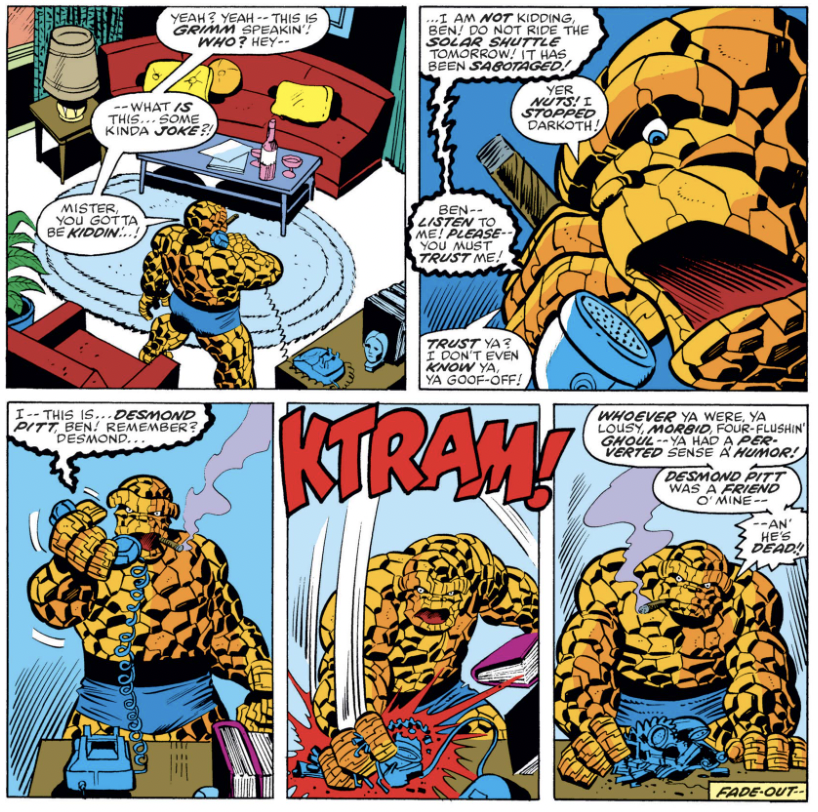
As mentioned, the Darkoth / Desmond Pitt storyline gives the story some depth, while also giving us some glimpses into Ben’s previous life as a test pilot. I enjoyed about the mystery unfolds, first with a mysterious phone call:
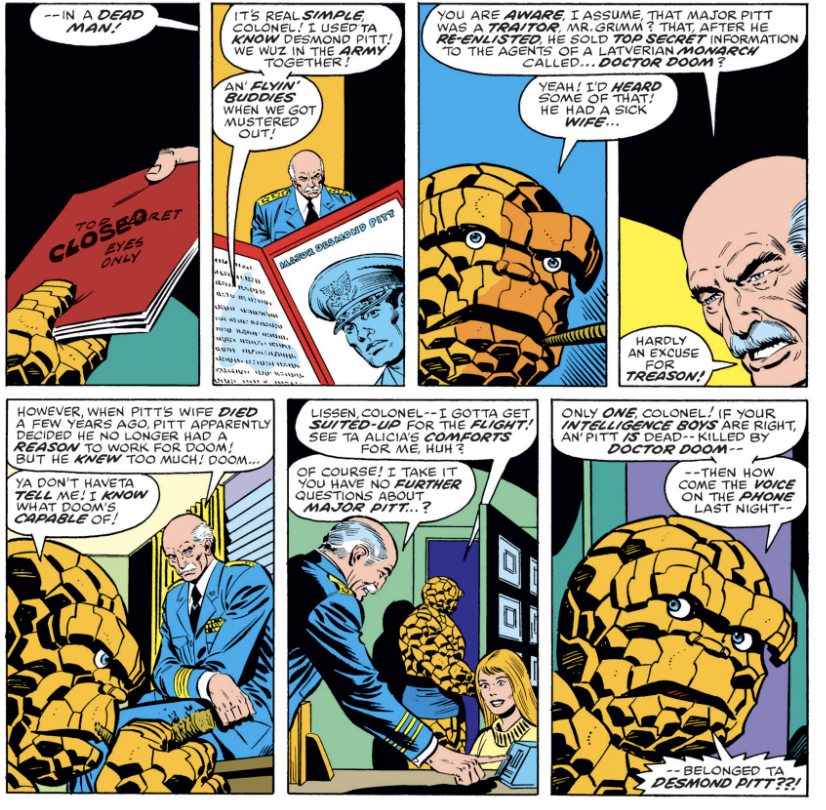
Then an investigation into Pitt’s disappearance:
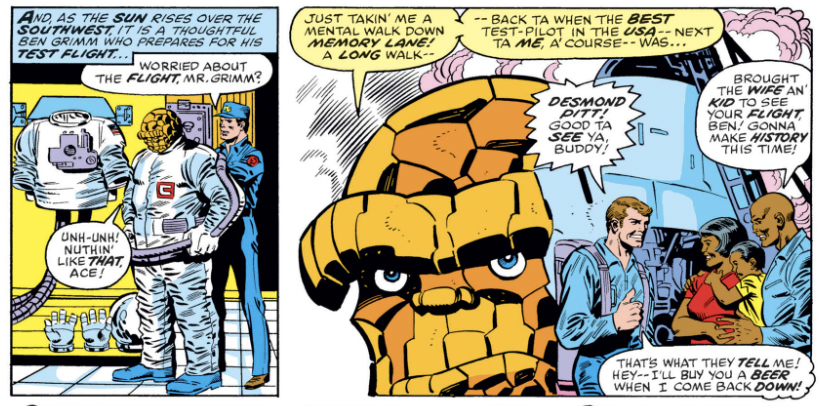
And then a flashback:
It’s of course one of those only-in-comic books coincidences that the man Doom turned into Darkoth happened to be an old friend of Ben’s, but it’s still a satisfying development.
I also liked seeing Ben in his element as a pilot, first kibitzing with ground control as Alicia proudly listens in …
… then trying to land a powerless space shuttle …
… a sequence which ends with this dramatic and alarming end to the comic:
What I didn’t like
Darkoth is revealed to be normal-sounding Desmond Pitt, and it’s clear he made the call to Ben, sounding like a normal guy. So then why does he spend the rest of the comic sounding like an Asgardian?
The comic opened in media res, with Darkoth bursting through a wall at NASA. I found it confusing, and I struggled to remember if I missed some issue or scene that had Ben at NASA. And the explanation of how Diablo was taking over Doom’s scene was hard to follow as well.
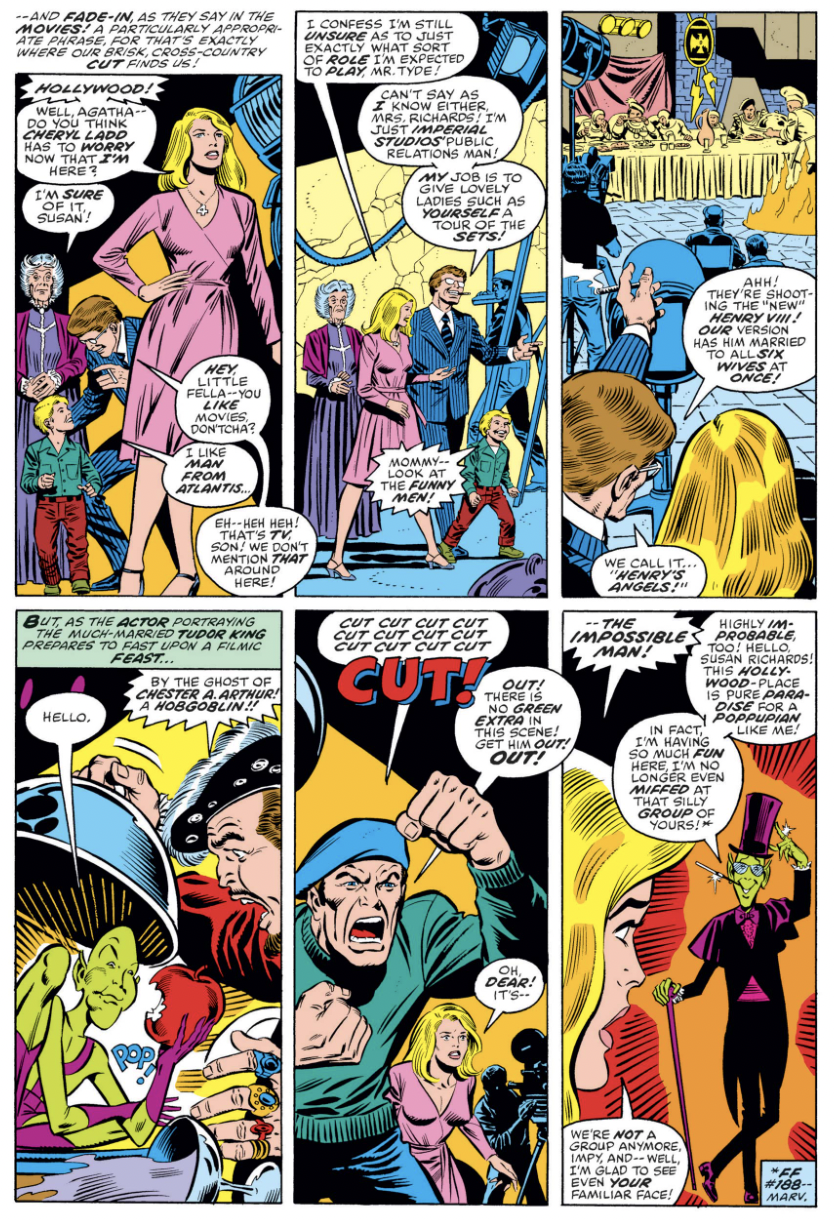
This sequence with Sue was a bit tedious. It didn’t really advance her story, but offered another lame joke about Hollywood. It also reintroduced the Impossible Man, with whom I thought we were finally done.
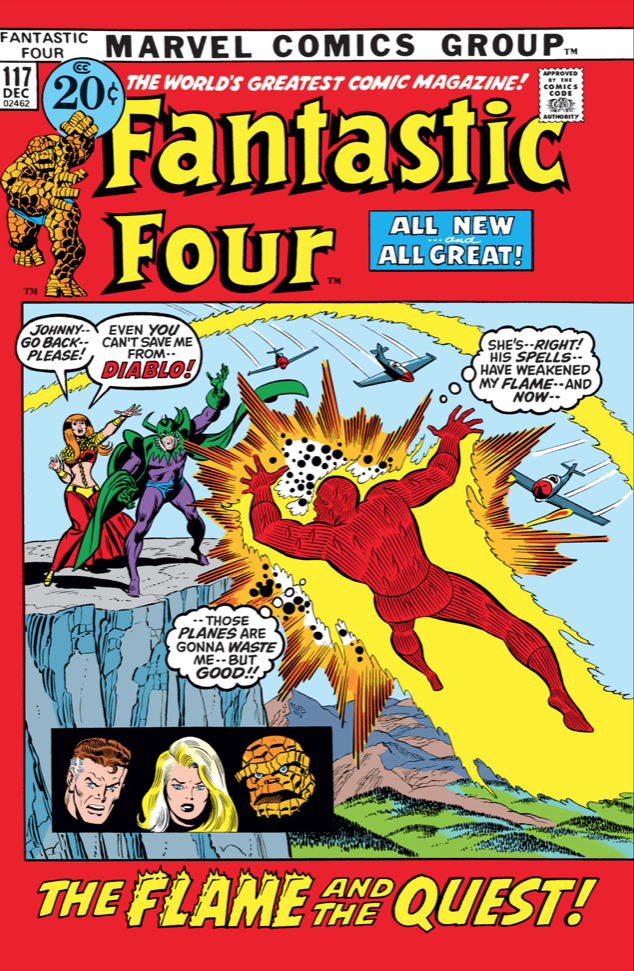
Fantastic Four 117 “The Flame and the Quest!” Published Sept. 1971 Writer: Archie Goodwin Pencils: John Buscema Inks: Joe Sinnott Letters: Sam Rosen Editor: Stan Lee Cover: Buscema and Sinnott
Synopsis
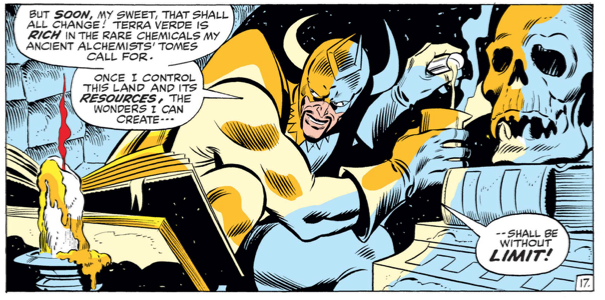
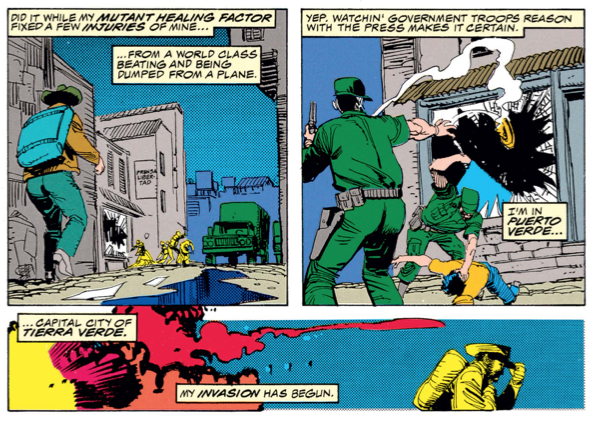
The Human Torch launches a desperate search for Crystal, and with the help of Agatha Harkness, discovers she has fallen under the control of Diablo, who is using her powers to take control of a Central American dictatorship.
What’s going on here
After the giant-sized extravaganza of last month, it makes sense to have an issue that allows the team and readers (and creators, presumably) a chance to catch their breath. There’s not a lot that’s notable in this issue. Johnny going on a crazed search for Crystal feels pretty familiar at this point, and we’re seeing a lot of Agatha Harkness lately.
Archie Goodwin returns as the writer and introduces Tierra Verde (called Terra Verde here), a stereotypical banana republic that makes a few appearances over the years, including in Goodwin’s own run on Wolverine in 1989.
On a personal note, this issue was published the day I was born in 1971. Happy birthday to me!
What I liked
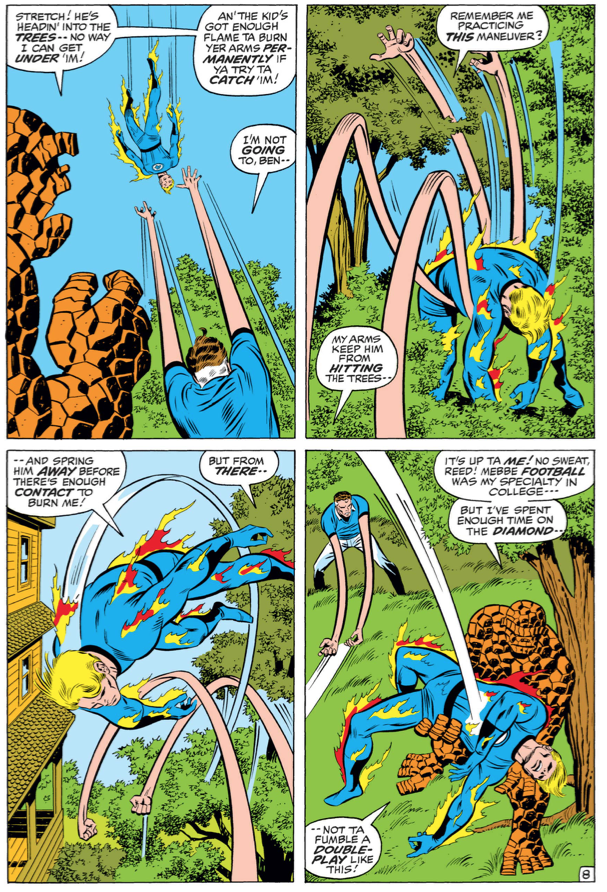
Diablo is a fun villain, and it’s good to see him back. Buscema delivers his usual excellent art, and the story hangs together well.
Here’s a fun sequence from Big John:
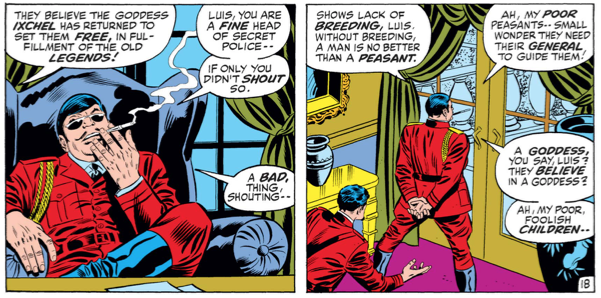
And while it’s a bit of a cliche, I liked the depiction of dictator General Robles and his lackey:
What I didn’t like
I really dislike this cover format. I better get used to it because it will be with us for another dozen issues or so.
Anything else?
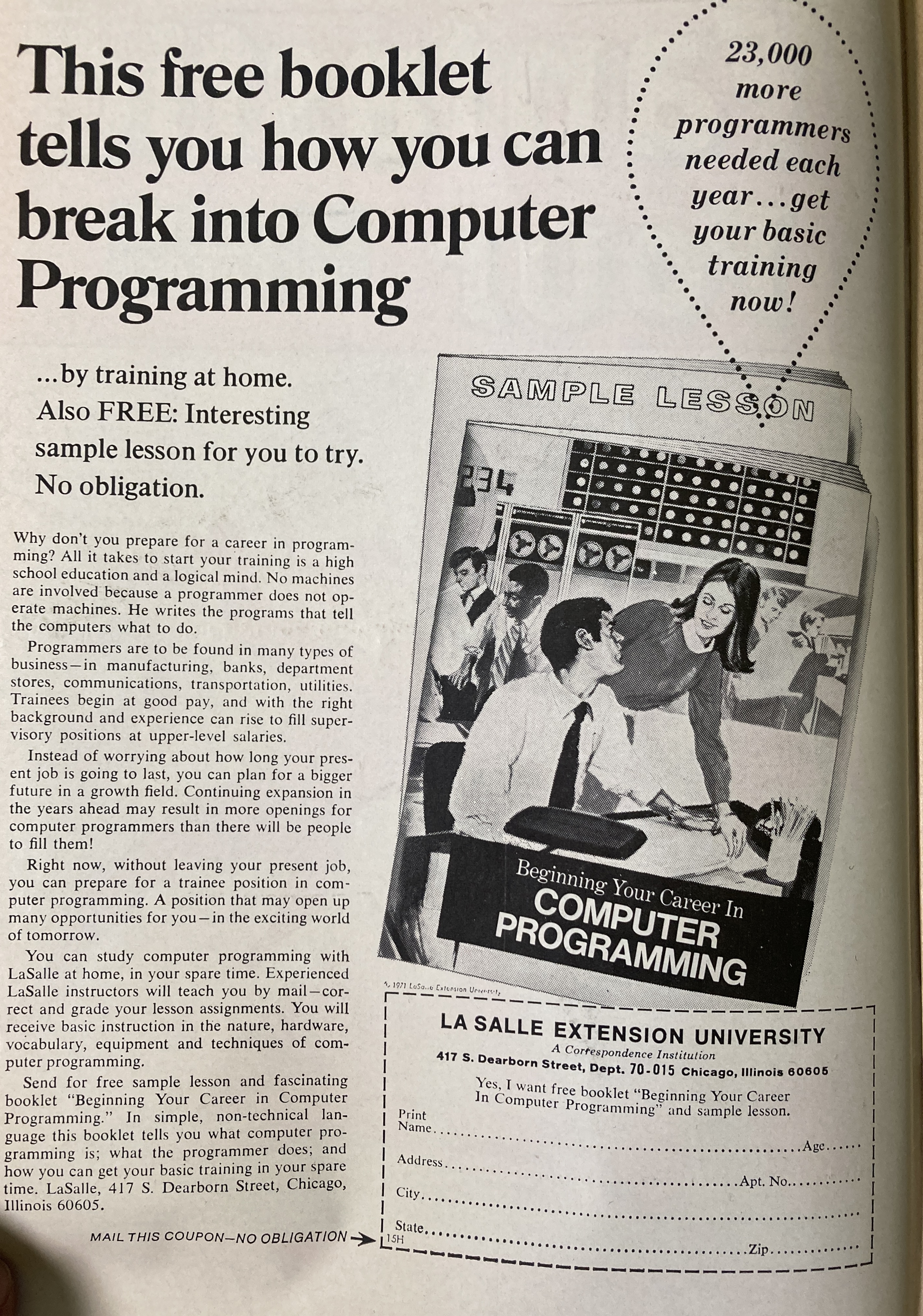
Study computer programming? I dunno, seems like a gimmick to me.
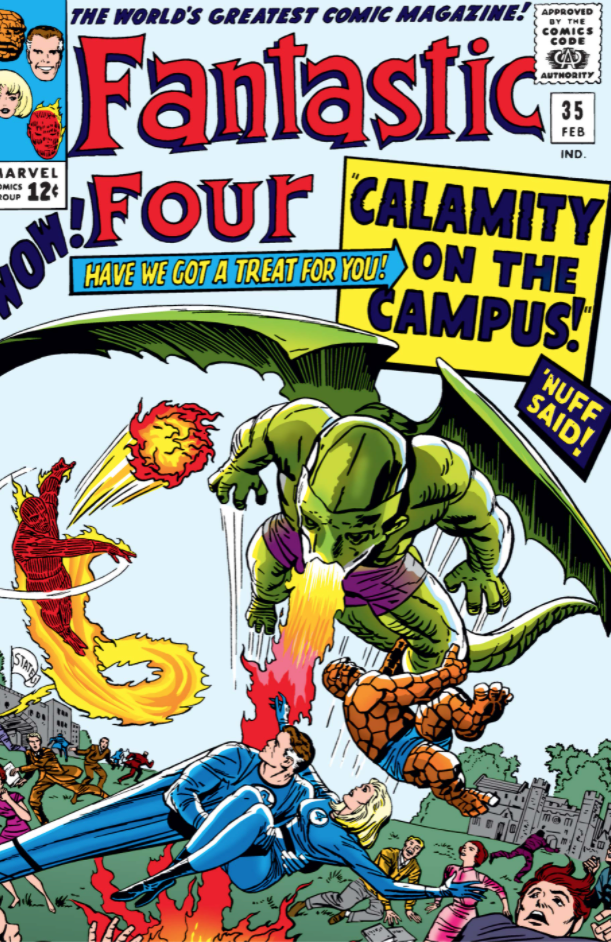
Fantastic Four 35 “Calamity on the Campus” Published Nov. 1964 Story: Stan Lee and Jack Kirby Script: Lee Pencils: Kirby Inks: Chic Stone Letters: Artie Simek Cover: Kirby and Dick Ayers
Synopsis
The comic opens on the campus of State University, the alma mater of Reed Richards and Ben Grimm, where Reed has been invited to give a lecture. Some hijinks on campus ensue as Ben and Sue tangle with the football team, and Reed learns that a Prof. Gilbert on campus is building “a creature more powerful than anything that lives—including the Fantastic Four.”
Meanwhile (although logically some time before the other events in the comic), in Transylvania, Diablo escapes the mountain under which he was buried in FF 30 and makes his way to New York in pursuit of the Fantastic Four. Once on campus at State U., he convinces Gilbert to let him animate his creature, which becomes Dragon Man.
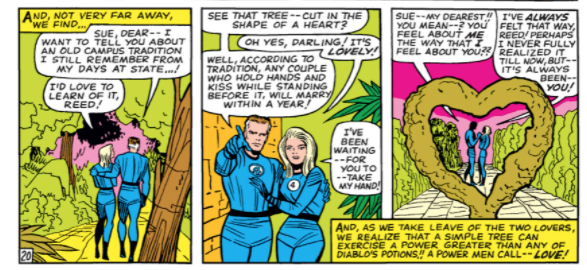
The Thing stumbles on the Gilbert and Diablo, and battles with Dragon Man, before the robot monster runs amok across campus. While Sue is able to subdue it with kindness, Diablo attacks the FF. Dragon Man now turns against Diablo, and both plunge into a lake and disappear. The story ends with Reed and Sue strolling down State U’s “lovers lane” and Reed kind-of, sort-of proposing to Sue.
What’s going on here?
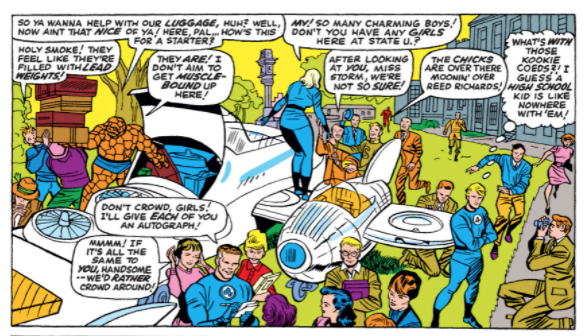
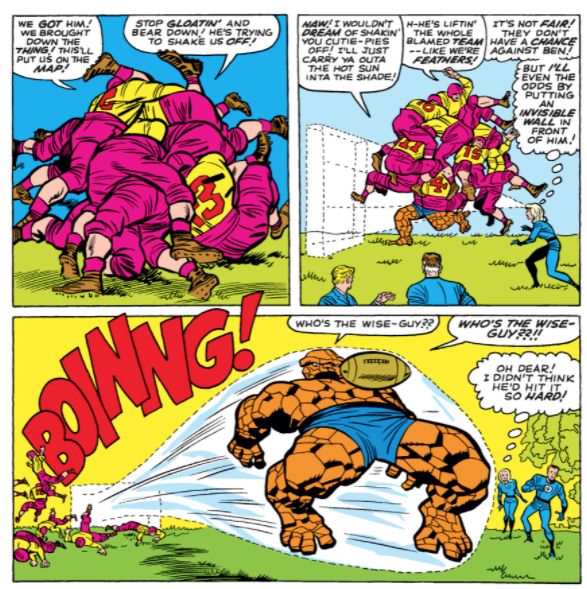
This is a fun issue, and Stan and Jack clearly enjoy the campus setting, with its swooning co-eds, tweedy professors and beefy football players. The FF comic book was gaining popularity among college students by this point, and it seems possible Stan and Jack were either inspired by the feedback they got from the students, or simply wanted to give some them college-based material. The story also reinforces Reed and Ben’s shared history as college roommates but interestingly, another former classmate, Victor Von Doom, isn’t mentioned.
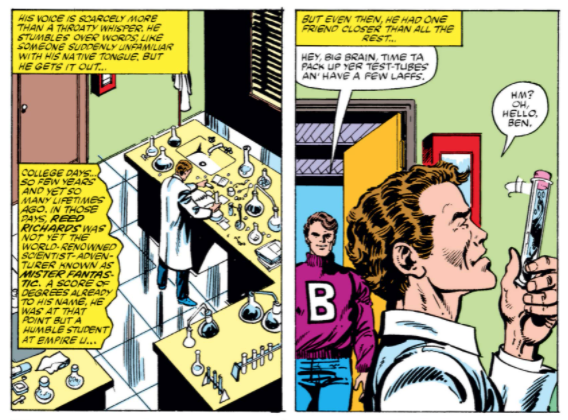
One puzzle that’s hard to unravel is where, exactly, did Reed and Ben, go to college? Here, in FF 35, it’s referred to as State University, and it appears to be a rural campus, with a lake and woods with a lover’s lane (some sources put it in Hegemans, New York). But later retellings of Reed and Ben’s origins put them on the campus of Empire University, or Empire State University. Here’s one mention of it, in The Thing 2, written by John Byrne:
The Thing 2, 1983, art by Ron Wilson and John Byrne
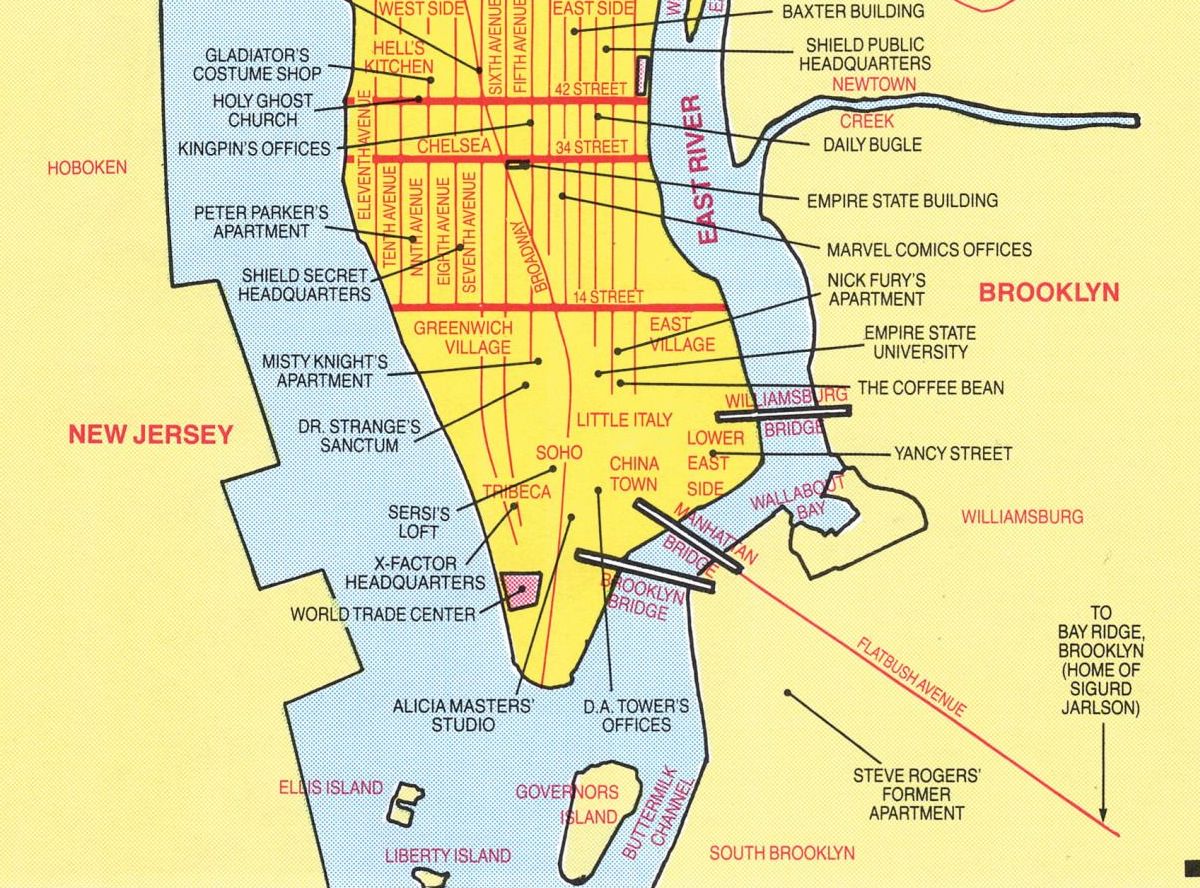
Empire State University plays a significant role in the Marvel Universe, chiefly as Peter Parker’s university both as a student, and a graduate assistant. So it would make sense that Reed and Ben went there, and that “State U.” is is just shorthand for “Empire State U.” Yet most depictions of Empire State U. place it it in the middle of Manhattan, making it an urban campus, and not at all the rural location of FF 35. The Official Handbook of the Marvel Universe puts it in the village, pretty much where New York University is in the real world:
Further confusing matters, the Handbook is inconsistent about where Reed and Ben attended college. Reed’s entry says it was State U. (among other institutions), while Ben’s says Empire State U.
The obvious, and unsatisfying, answer is that over the years writers have conflated the two universities, and since Empire State U. became a prominent part of the shared universe, it just made since to retcon away State U., although not every writer got the memo.
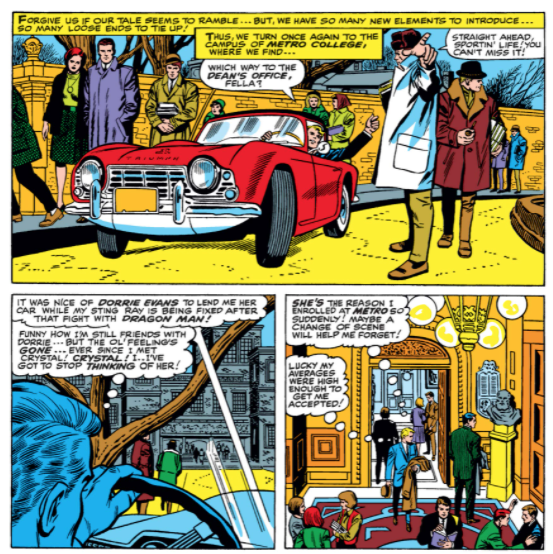
Just please don’t ask about Metro College, where Johnny begins classes in FF 50:
Introducing Dragon Man
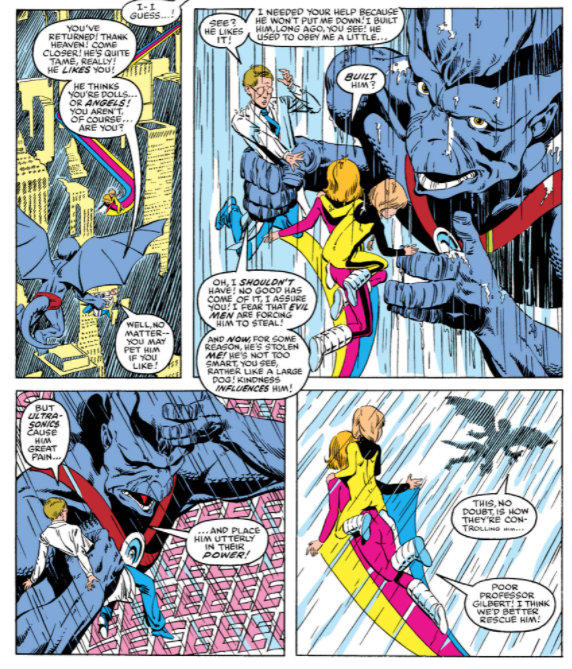
FF also features the return of Diablo, and the introduction of Dragon Man, who becomes a fixture in the Marvel Universe. It’s established in this issue that he (or it?) is not inherently evil, but does the bidding of whomever controls him. Over the next few decades that’s pretty much how he’s used, as a pawn of other villains. Here is is in Power Pack 6:
Power Pack 6 (1984), written by Louise Simonson, art by June Brigman and Bob Wiacek.
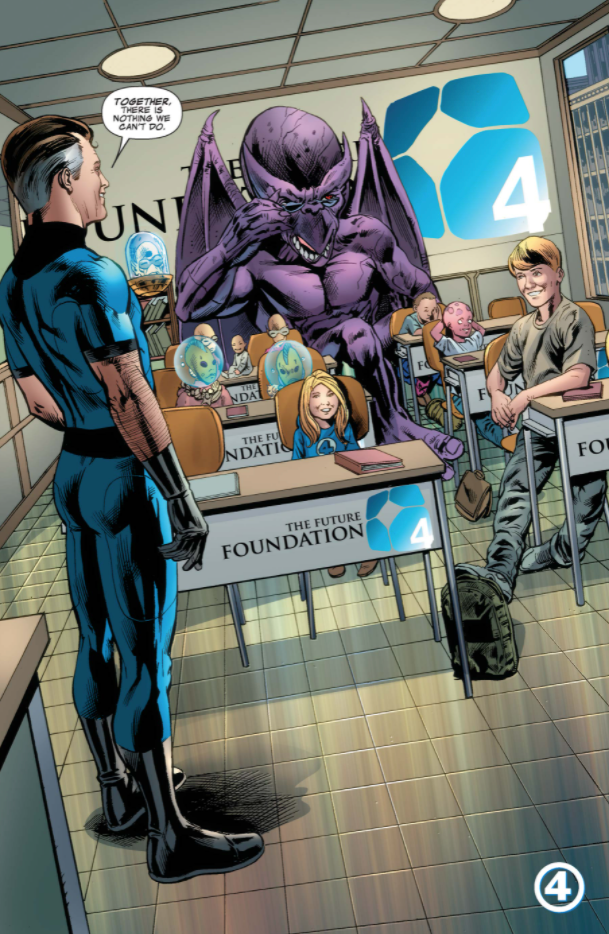
But much later, Dragon Man gets an intelligence upgrade, and joins the Future Foundation, the group of super-smart kids (and moloids and other creatures) founded by Reed.
Fantastic Four 579 (2010) written by Jonathan Hickman, art by Neil Edwards and Andrew Currie.
There, he becomes a sort of chaperone, keeping an eye on the kids, and developing some very urbane tastes. FF 22 (2011) Hickman, art by Andre Araujo
True love
Since Reed and Sue have been married for most of their comic-book existence (more than 50 years in real time), it’s hard in retrospect to imagine there was any suspense about the future of relationship. But Stan and Jack are determined to tease us.
Cameos
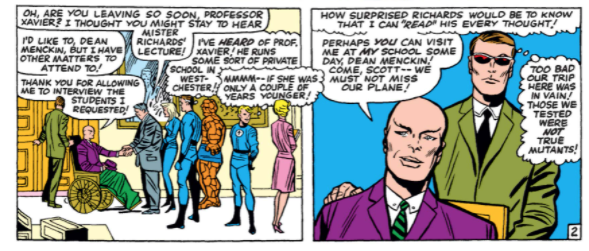
FF 35 also features some unannounced cameos, from Professor Xavier and Scott Summers:
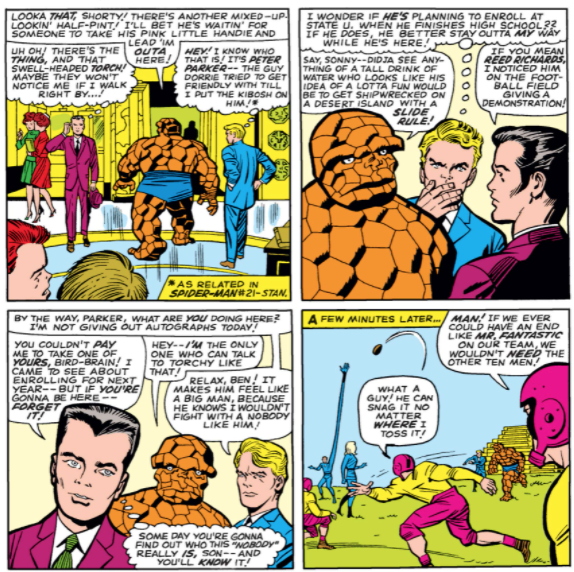
and from Peter Parker:
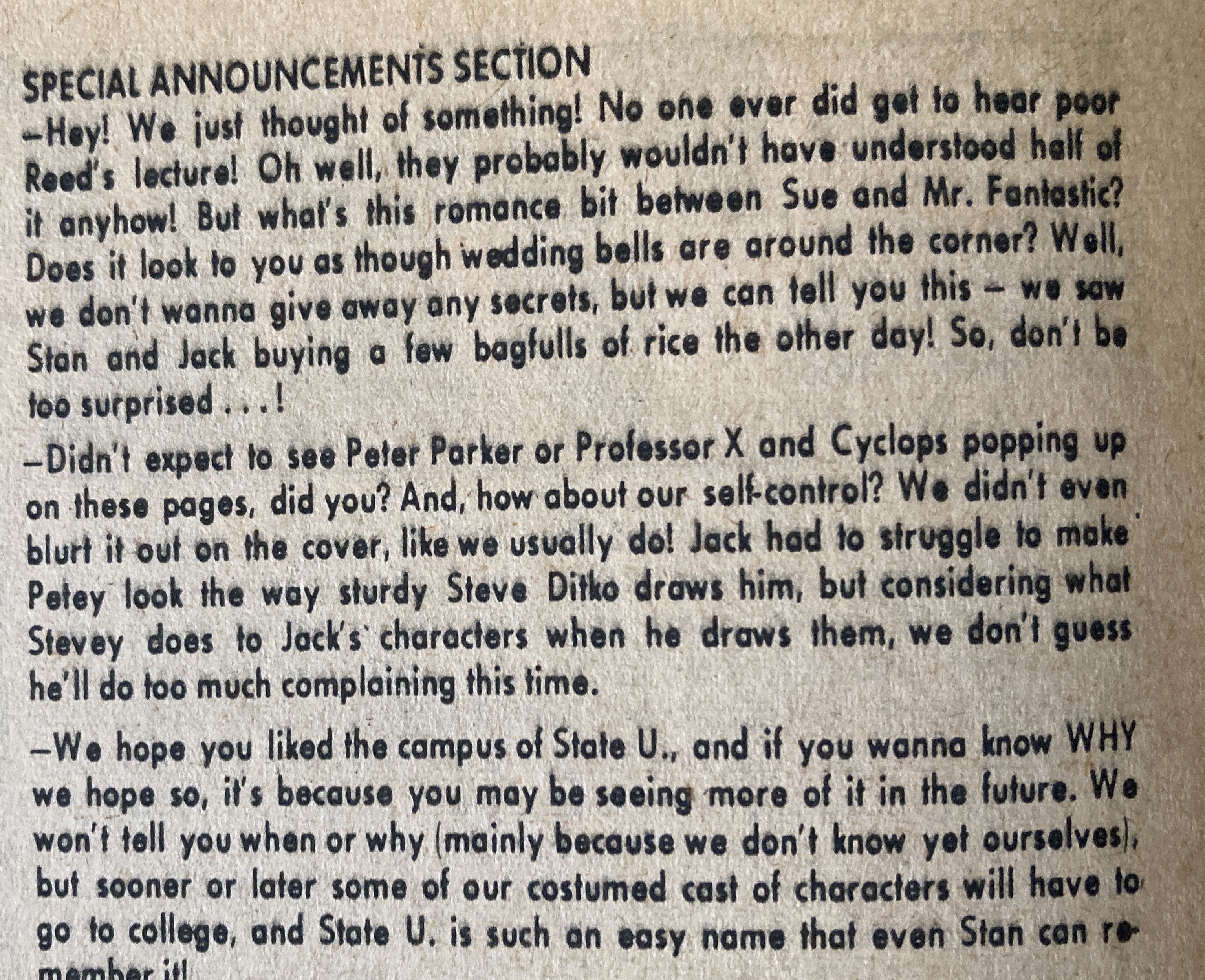
This is the sort of shared universe stuff that set Marvel apart in the Silver Age, and must have been so thrilling for fans to stumble across, particularly since their appearances were unannounced. Of course, Stan being Stan, he went ahead and took credit for that in the letters page:
Note the shade-throwing regarding Kirby and Ditko, and the irony of State U. being such an easy name to remember, given the aforementioned issues.
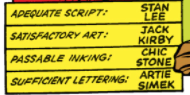
Krazy Kredits
Sort of downbeat this issue.
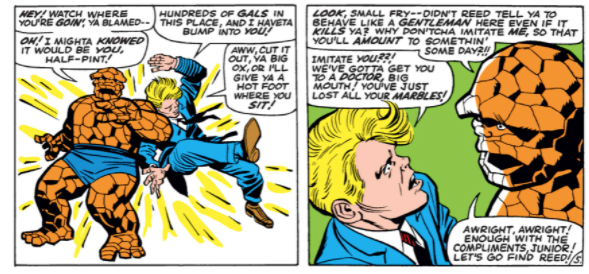
They’re fighting again
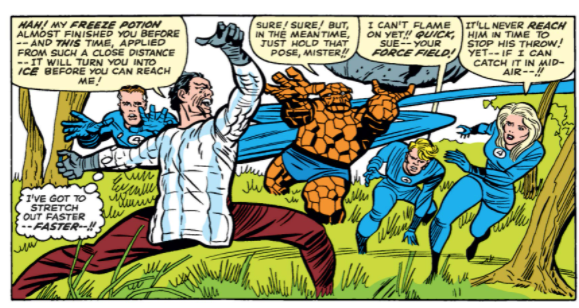
Not actual fisticuffs, but some verbal sparring. I think it counts.
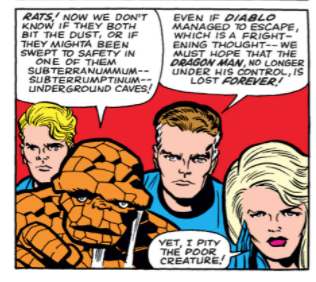
That’s a mouthful
I thought this was fun.
Dig That Kirby Krackle
Not too many gee-whiz panels, but still some nice work from the King:
House ad
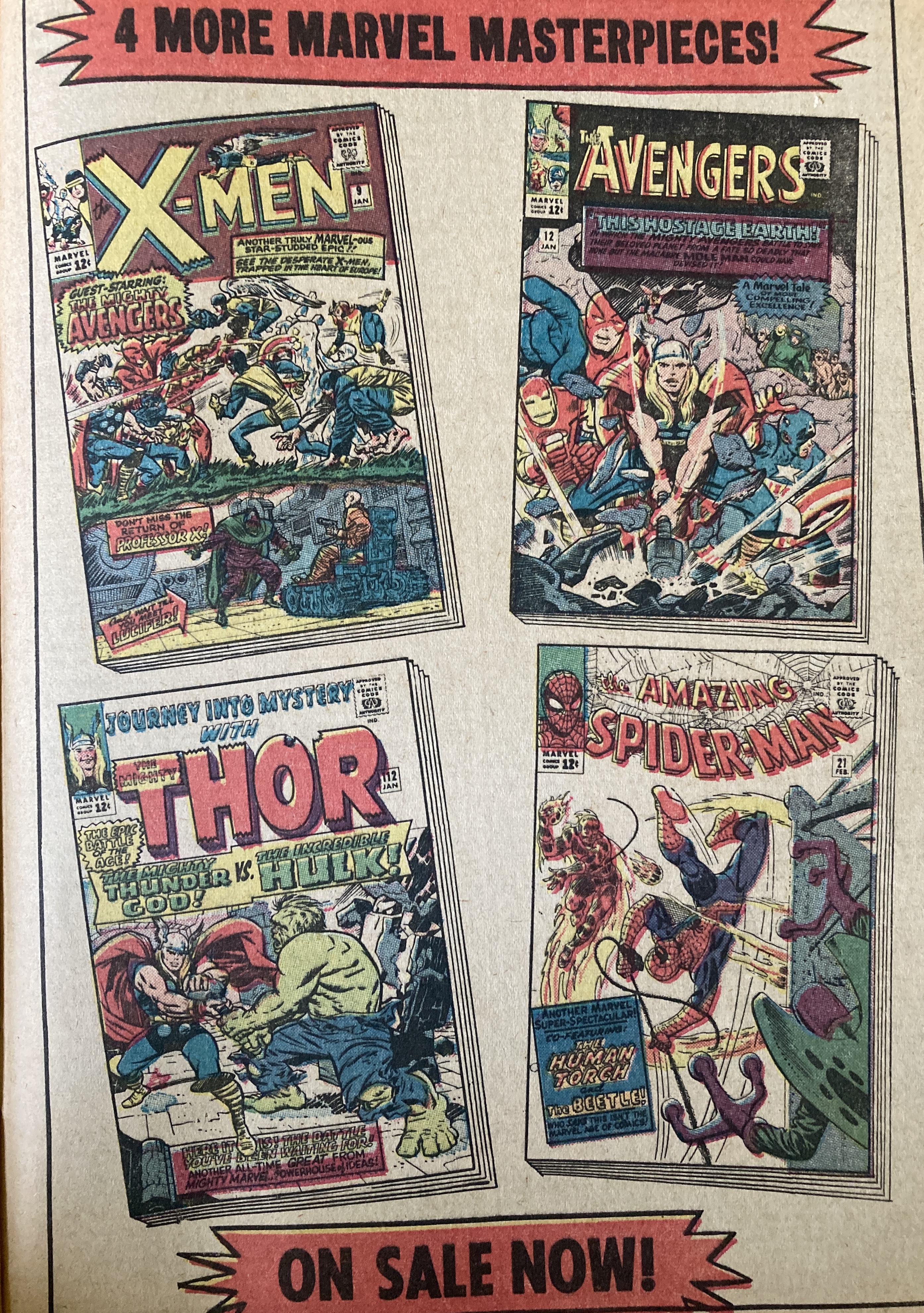
Speaking of shared-universe stories, cross-overs abound this month:
For sale
A mint (9.8) copy of FF 35 will run you about $6,750. Fine (6.0 is about $140. I bought a Very Good issue for $40.
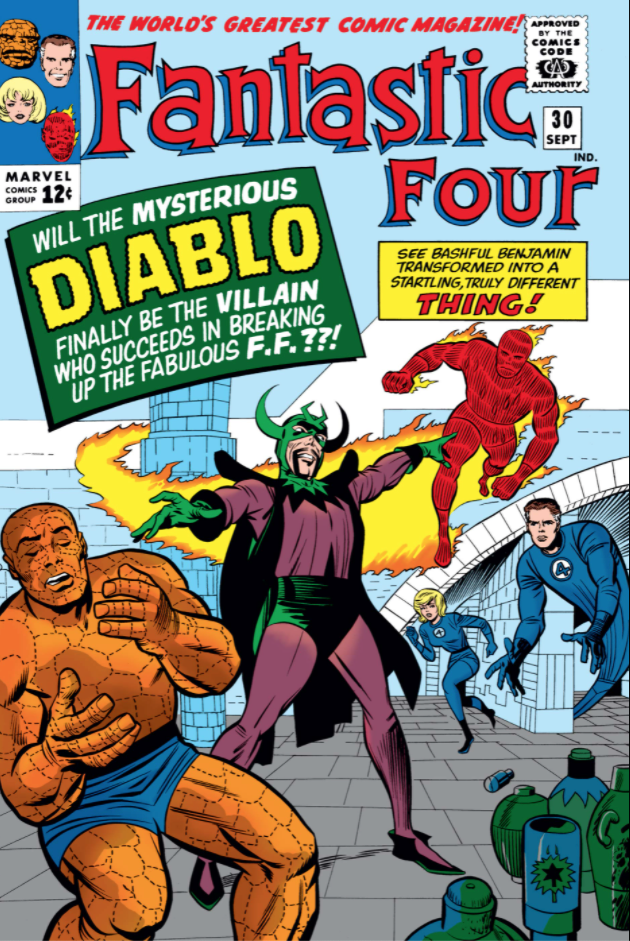
Fantastic Four 30 “The Dreaded Diablo” Published: June 1964 Story: Stan Lee & Jack Kirby Script: Lee Pencils: Kirby Inks: Chic Stone Letters: Art Simek Cover: Kirby & Stone
Synopsis
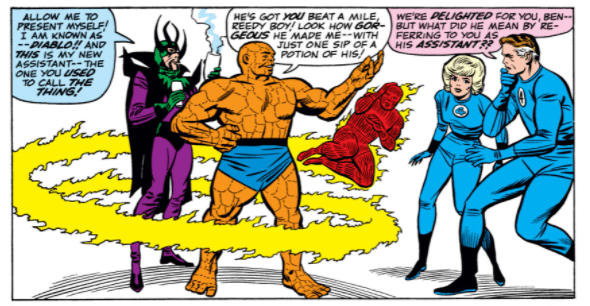
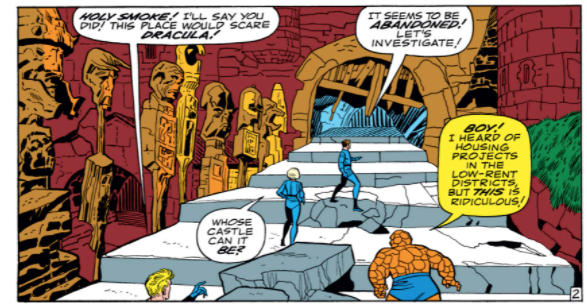
The Fantastic Four, lost while vacationing in Transylvania (don’t ask), stumble upon the castle of a centuries-old alchemist, Diablo. Before they enter, a local Baron warns them away, and invites the team to stay with him. In the middle of the night, the Thing is entranced, and frees Diablo from his crypt. The next day, the rest of the team discover Ben has been transformed by Diablo to something closer to his human form, and he has pledged his service to Diablo for a year. After a scuffle, the rest of the team leaves to plot its next move.
Soon, news of Diablo’s powers have reached the outside world, and he performs amazing feats, such as making barren deserts fertile. Meanwhile, Reed analyzes the formula Diablo used to transform Ben and realizes he’s a fraud. Ben, too, has a change of heart once he has reverted back to his old rocky self, but Diablo subdues him.
The FF launches an attack on Diablo’s castle, and after a battle with Diablo and his henchmen, discover Ben trapped in a glass-like cylinder. Unable to free him, the team is then captured by Diablo and also sealed in cylinders. Ben, however, finally escapes and defeats Diablo, chasing him back into his crypt. As Ben brings the castle down, the vibrations shatter the glass holding the rest of the team, and the four escape back into the Transylvania wilderness.
What’s going on here?
Fantastic Four 30 is pretty much wall-to-wall action. Like last month’s issue, it opens in media res, with the team already lost in Transylvania, and the entire issue takes place there. There’s no Baxter Building, no Alicia, and none of the normal set pieces. To the extent there’s any character building, we see Sue become more accomplished at using her powers in combat, and Ben, although tempted by the offer to return to normal, quickly comes to his senses and regrets his disloyalty.
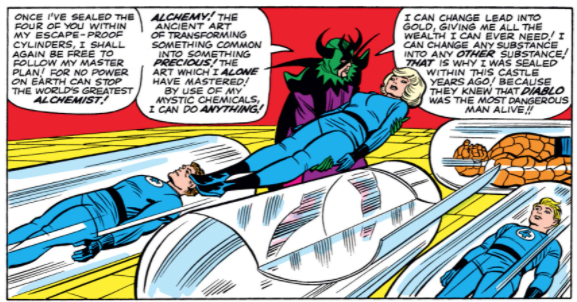
FF 30 also marks the debut of Diablo, a second or third-tied FF villain whose appearances are always fun. By making Diablo an alchemist, Jack and Stan are reaching back into the bag of quasi-historical tricks that sustained so many horror and mystery stories. Stuff like alchemy, fabled lost cities, mythic creatures, ancient heroes etc. consistently pop up over the years in the FF and elsewhere as creators hunt for stories. Diablo wasn’t the first villain to practice alchemy (here’s a list) but he’s one of the more prominent.
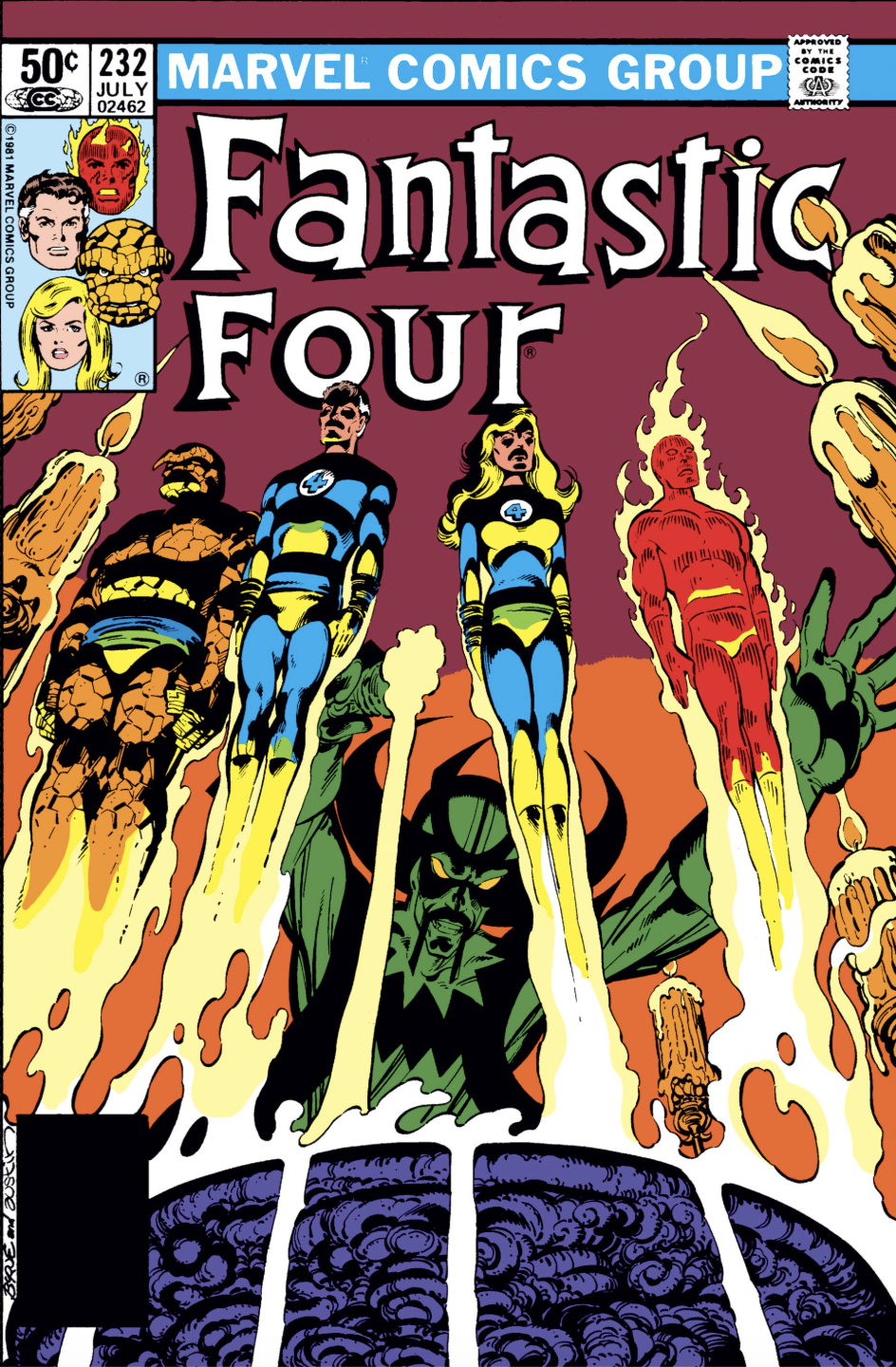
Interestingly, Diablo was the first villain John Byrne used in his landmark FF run of the 1980s, in FF 232, as a not-too-subtle signal that he was embracing the FF’s Lee/Kirby past (and if Diablo didn’t convince you Byrne was looking backward, the issue’s title should have).
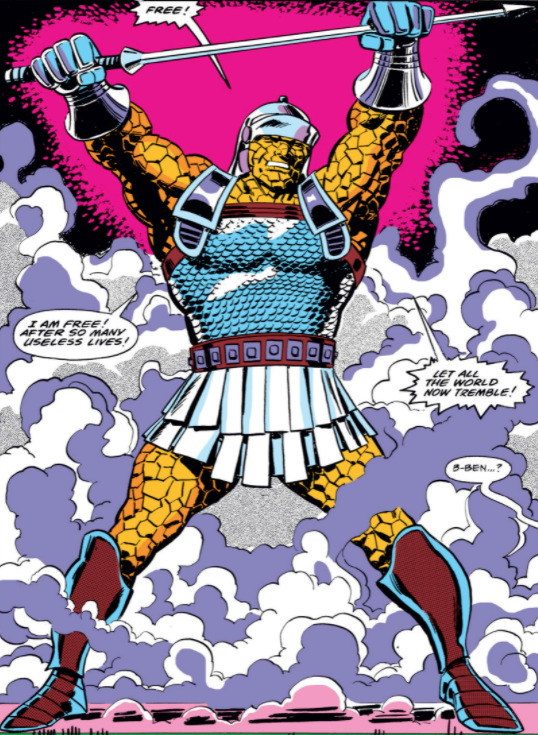
Also interesting is the version of the Thing Ben is transformed into by Diablo: essentially human in appearance, but with orange, rocky skin. Of the many various forms Ben has taken over the years, I’m only aware of seeing that specific one once, in The Thing 8, when Ben is transformed into the reincarnation of an ancient Egyptian warrior.
Thing 8 (1983) art by Ron Wilson and Hilary Barta
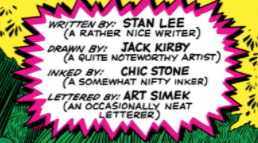
Krazy Kredits
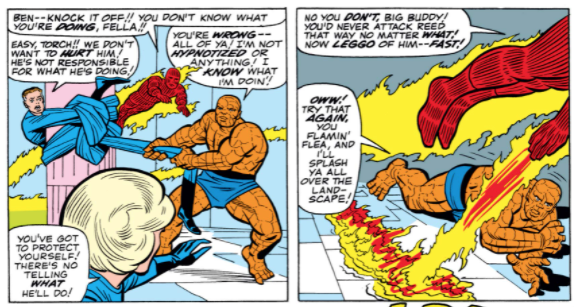
They’re fighting again
At least this time there’s a reason for it.
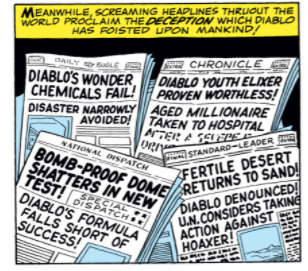
Read all about it
Print definitely isn’t dead in 1964.
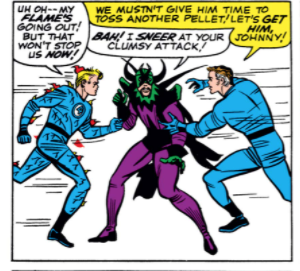
Great lines in villainy
Bah!
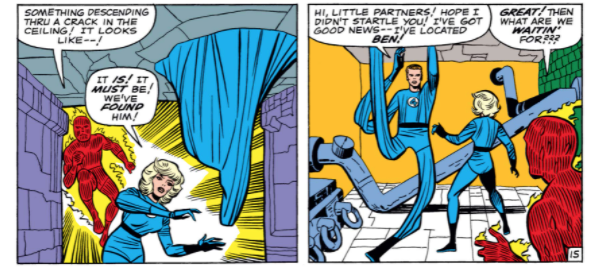
The incredible Mr. Fantastic
I like the way Reed sort of oozes out of the hole in the ceiling.
Weird science
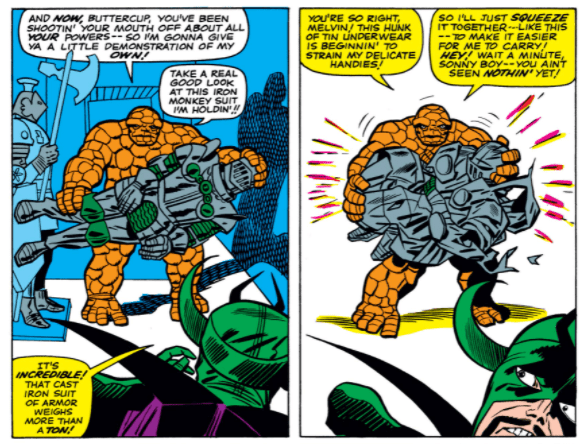
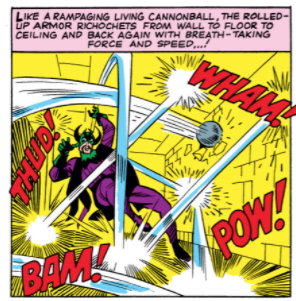
This is bizarre sequence. Ben grabs a suit of armor Diablo says weighs more than a ton (who can wear armor that weighs more than a ton?) Then, after smushing into a sphere, Ben manages to bounce it like it’s a tennis ball.
The sexist sixties
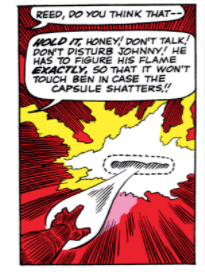
After telling Sue to shut up so she doesn’t distract the Torch, Reed yammers on while mansplaining.
Dig that Kirby Krackle
This is pretty awesome:
And so is this sequence:
And this one:
For sale
A mint (9.8) condition FF 30 is worth $23,000. A copy in fine (6.0) condition is a more reasonable $170.
Next issue: Time for FF Annual No. 2 and return of Dr. Doom!