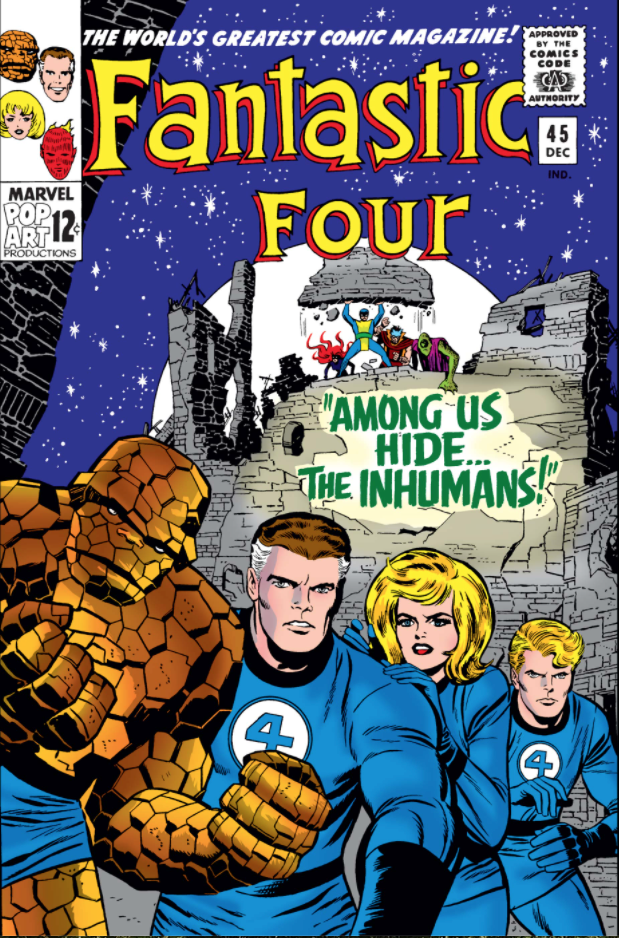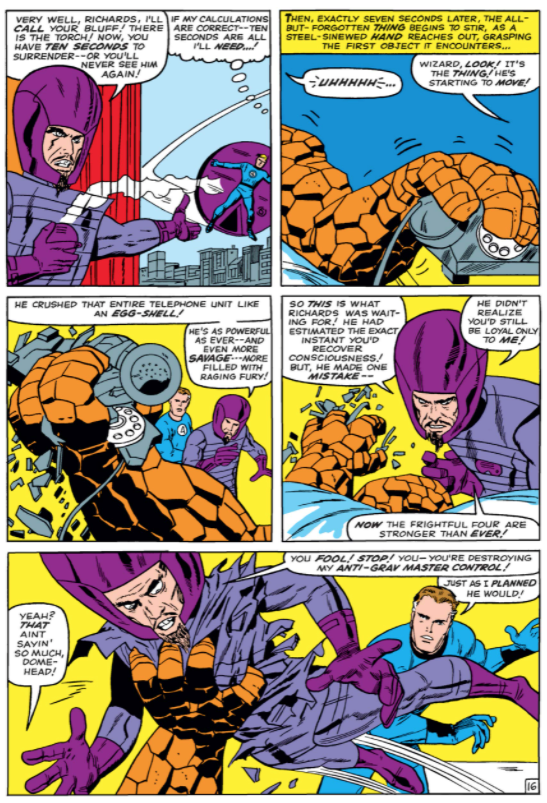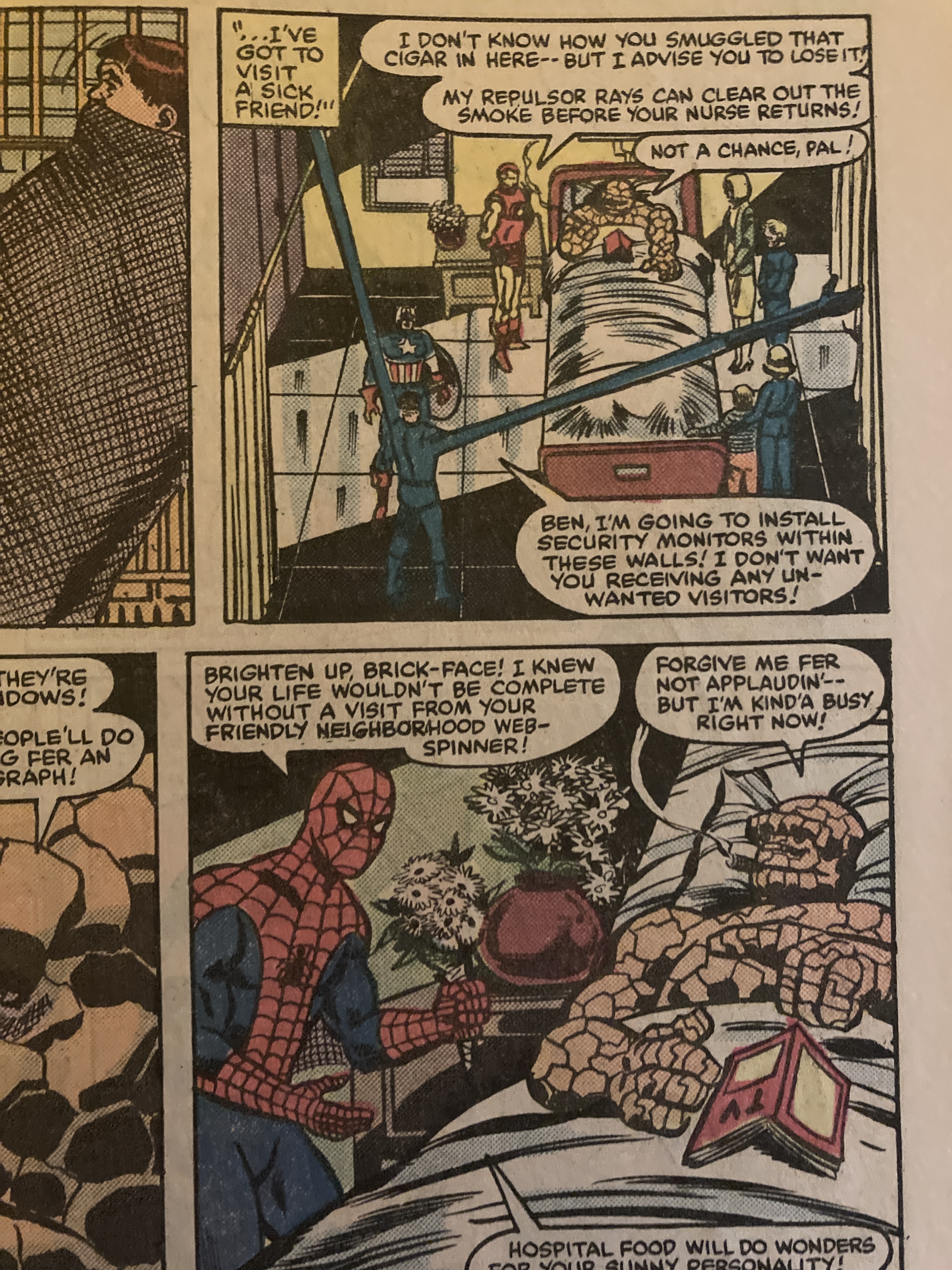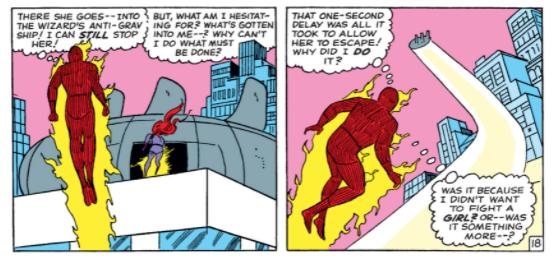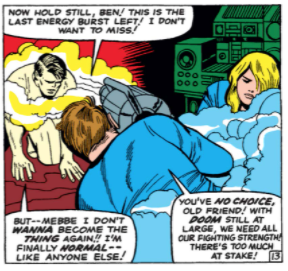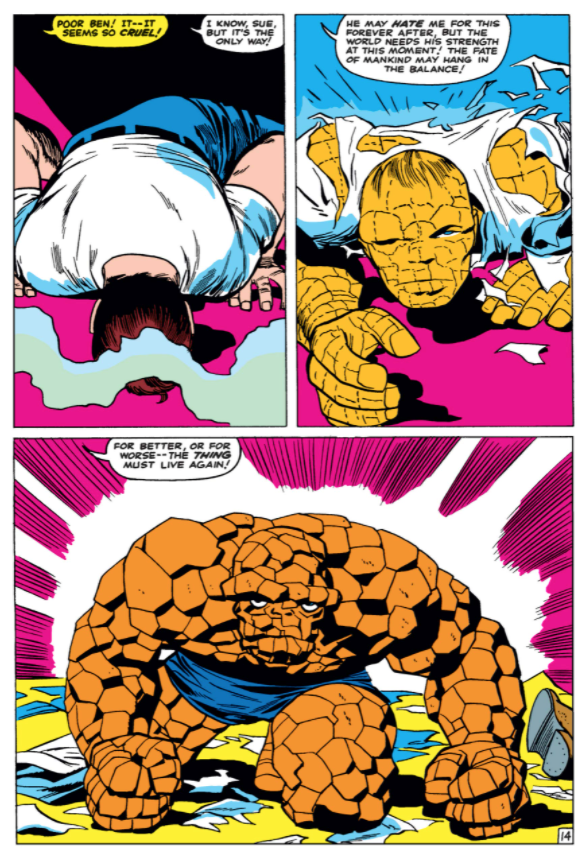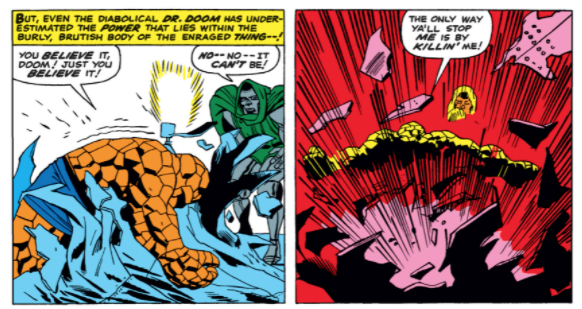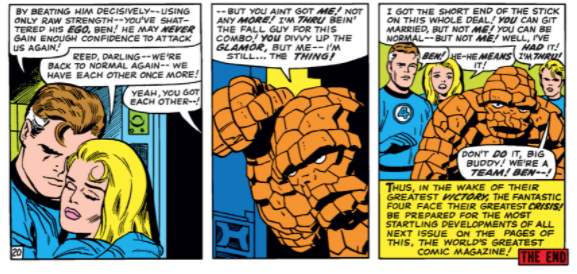
“The World’s Greatest Comic Magazine!” Fantastic Four No. 45

Tags

, , , , , ,

Fantastic Four 45
“Among Us Hide the Inhumans”
Published: Sept. 1965
Story: Stan Lee and Jack Kirby
Script: Lee
Pencils: Kirby
Inks: Joe Sinnott
Lettering: Artie Simek
Cover: Kirby and Sinnott

Programming note: Before we dive into a big issue, this post marks a full year of blogging about the Fantastic Four. We’ve covered 45 regular issues and three annuals. Not quite the 52 posts I was aiming for but not bad. If all goes according to plan, the next few months will cover some of the biggest stories in comic book history, then the rest of the year will wrap up most of the remaining Lee/Kirby FFs. That’s the idea, anyway. But I’m open to ideas: What do you want me to write about? Should I continue issue-by-issue? Should I cover the FF’s appearances in other comics? Is there something you want more of? Or less of? Drop a line in the comments if you have thoughts. They would be very welcome.

Synopsis

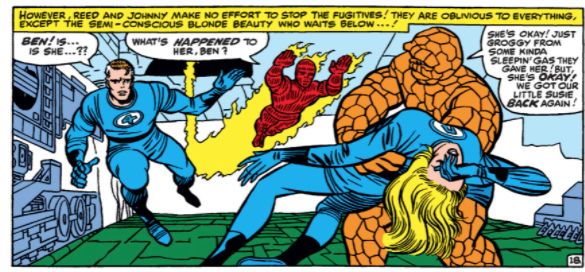
Fantastic Four 45 picks off where FF 44 left off, on the crumbling roof of a Manhattan building. Dragon Man has flown off with the Invisible Girl and Gorgon has abducted Medusa. After Mr. Fantastic, the Human Torch and the Thing are safely on the ground, Johnny flies after Dragon Man, who is eventually calmed by Sue and returns her peacefully to the Baxter Building.

A morose Johnny later takes a walk and finds himself in a deserted neighborhood where he encounters a young woman who disappears in a windstorm. After squabbling with the rest of the team, Johnny returns, and discovers the woman has powers. Mistaking him for a fellow Inhuman, she introduces herself as Crystal and Johnny then meets Lockjaw and Karnak. But when he is discovered by Medusa and Gorgon, the Inhumans try to imprison him. Johnny escapes and summons the rest of the Fantastic Four. The teams are about to square off when Black Bolt makes his entrance, ending the issue with another cliffhanger.
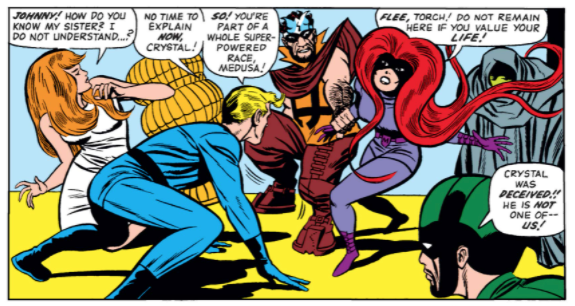
What’s going on here?

The introduction of the Inhumans is obviously the significant development in FF 45. They’ve been a major part of the Marvel universe ever since, appearing either in their own series or, more frequently, as guest stars in other books almost continuously since. Finding the backstory for the Inhumans has proven difficult, but at one point it seems they were destined for their own series before a change in plans led Stan and Jack to fold them into the FF. Did Stan and Jack have a full team of super characters in mind when they introduced Medusa in FF 36? It seems unlikely. Here’s Stan, in a 1967 radio interview he gave alongside Jack:

“I mean, we didn’t sit down one day and say let’s do a group of Inhumans and these are their names and we’ll present them in this fashion, as with everything we do. We just sort of stumble into them as we go along.”

Earlier in the interview, Stan explains the concept started with Gorgon:

“He started out as a villain. We liked him so much, I should say Jack liked him so much, that he kept using him. We figured he has to come from somewhere. We decided, let him come from some strange land over in Europe, where there are a whole group of people like him. And well, what else could you call them except the Inhumans. Then Jack had to create a whole bunch of Inhumans and I think he did a great job. All these characters are really very imaginative.

When it came to doing the leader, we decided, well, there was no need for them all to be villainous. And you’re right, I think we did have in mind that Black Bolt would eventually be a heroic type.”

It’s of course possible that Stan was talking out of turn, and Jack had it all mapped out, but it was a joint interview, and he didn’t contradict Stan.
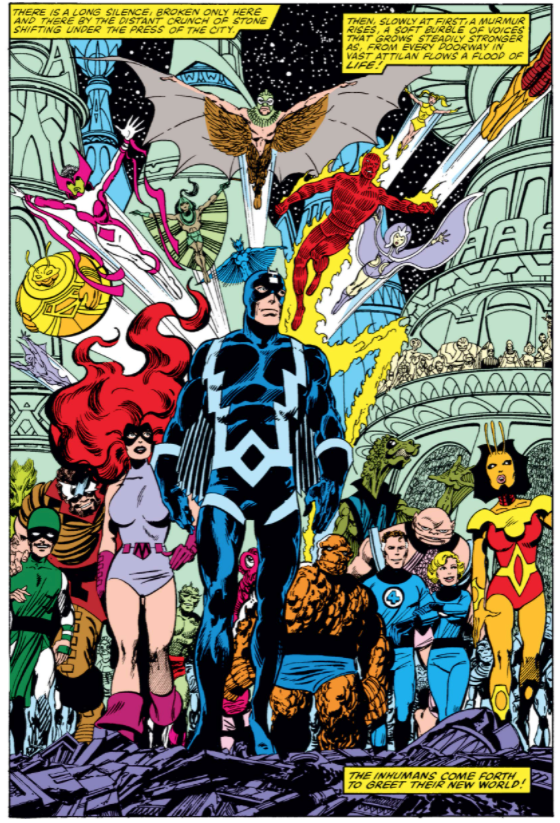
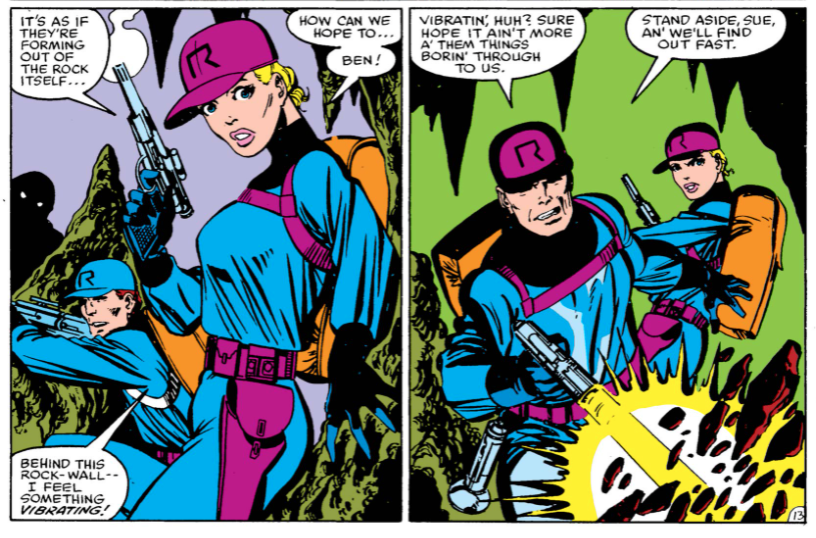
FF 240 (1981) Story, pencils and inks by John Byrne

Who’s the new guy?

The other big development in this issue—technically it was issue 44, but I goofed and forgot to mention it last week—is it marks the beginning of Joe Sinnott’s legendary run as inker. Sinnott inked FF 5, then starting with issue 44 goes on to ink the FF for 16 years until issue 231 in 1981, stopping only when John Byrne took over the book and inked himself. Then, after Byrne left in 1987, Sinnott inked the FF for another two years.

Sinnott’s inks help create the classic Kirby look. The lines are bolder, the shadows are deeper, the forms are more defined. His inks give the Thing his essential rockiness and give the Kirby Krackle its explosive energy.

His presence on the book for so many years after Kirby departed gave the FF a smooth, consistent appearance, although it could be argued that his inks smothered the unique qualities of some up-and-coming artists on the book like George Perez and Bill Sienkiewicz, who later flourished with other inkers.
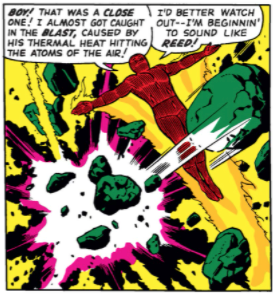
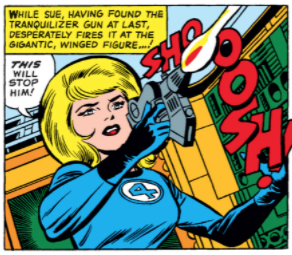
Meet the Inhumans

Medusa and Gorgon we already know. In FF 45 we are introduced to Crystal, who has the power to manipulate the four elements: fire, water, earth and air.
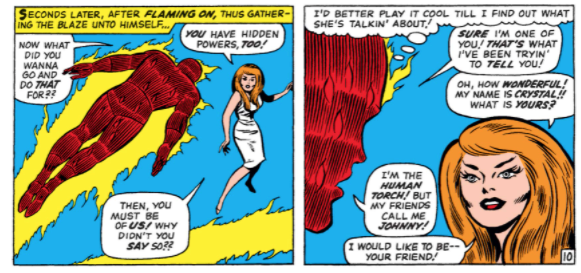
We soon meet Lockjaw, a giant dog with the ability to teleport:
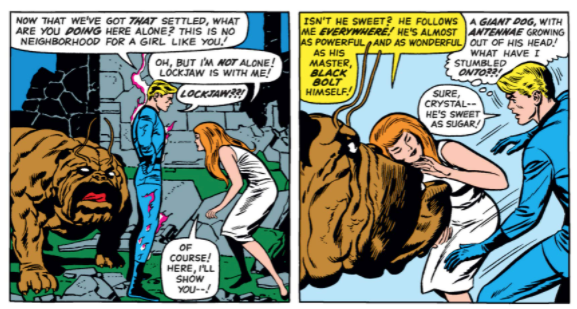
And Karnak, who can find the weakness in any substance:
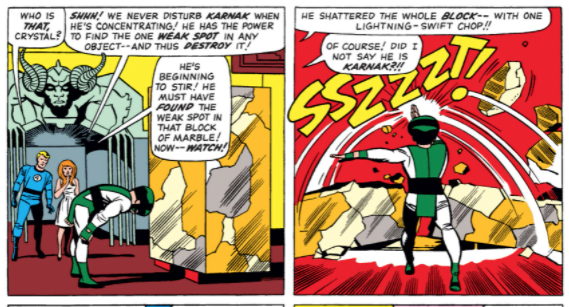
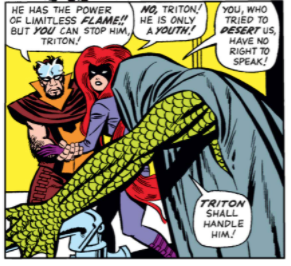
Triton, a water breather, is kept hidden, with the promise of a bigger reveal later:
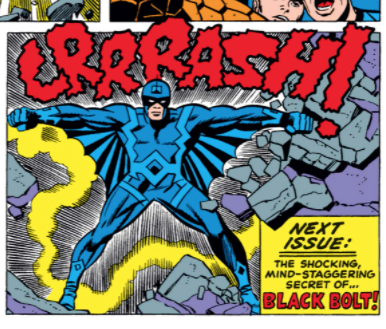
And lastly, Black Bolt makes a dramatic appearance at the end:
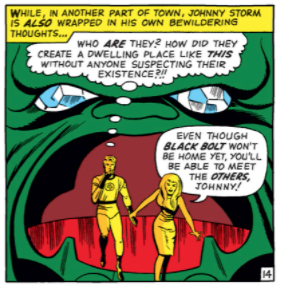
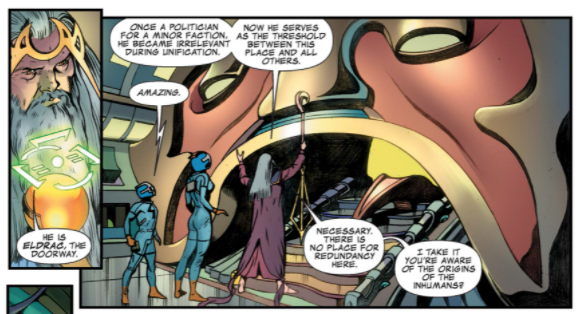
Plus, one more: While Stan and Jack almost certainly didnt intend it, the portal Johnny and Crystal travel through was retconned by Johnathan Hickman into Eldrac the Doorway, “once a politician.”
About Crystal

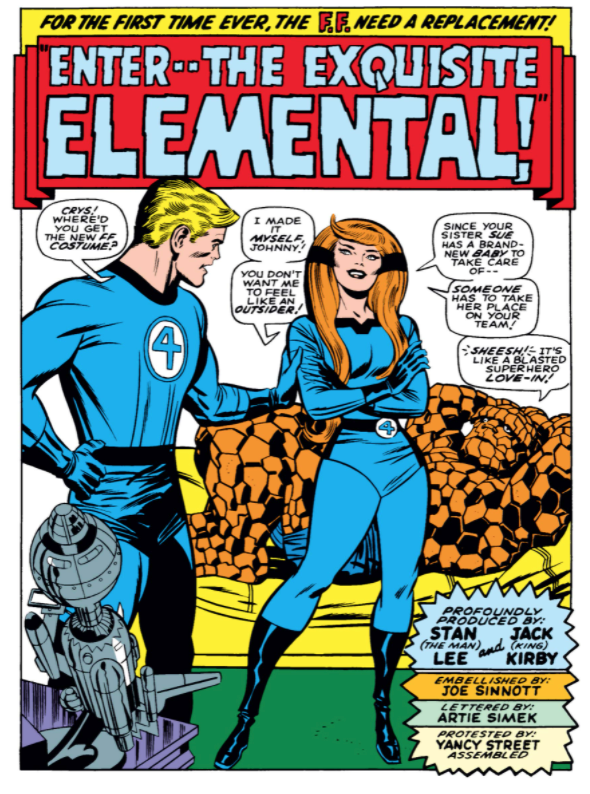
While all the Inhumans have an impact of the Fantastic Four, Crystal is the one perhaps most closely tied to the team. She becomes Johnny’s love interest, then, when Sue is on maternity leave, she officially joins the FF in issue 81:
She later falls in love with Pietro Maximoff, aka Quicksilver, an Avenger and son of Magneto. Johnny is not thrilled.
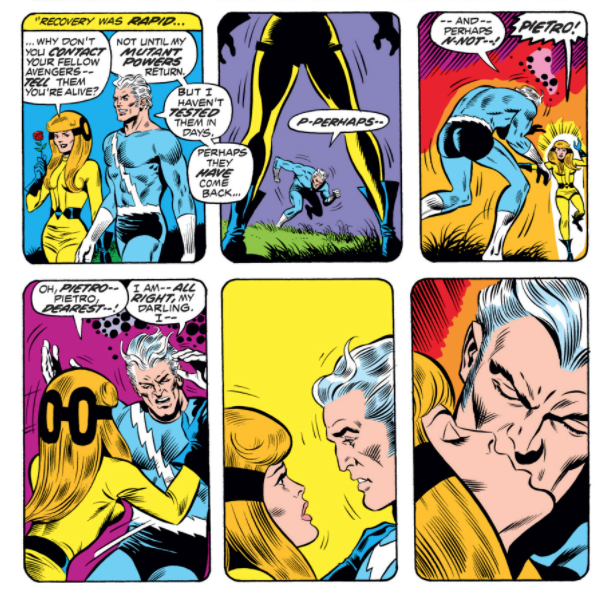
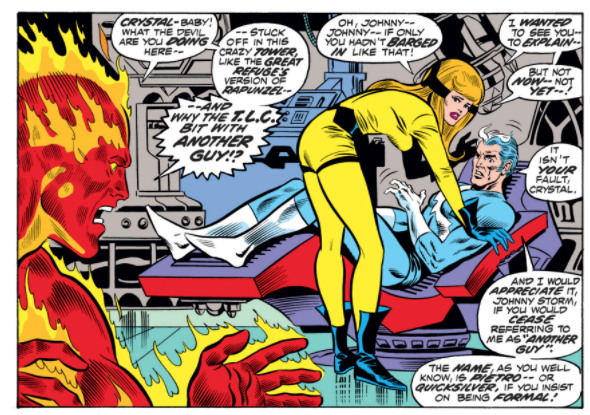
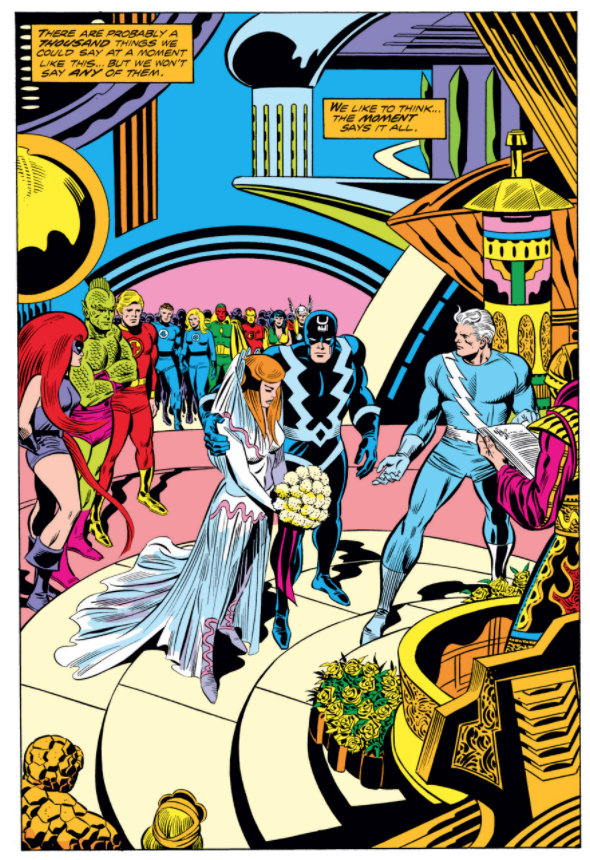
Crystal and Pietro eventually marry in FF 150 (as shown in this post) and Crystal gives birth to baby Luna, so named because she arrived just as the Inhuman city of Attilan was transported to the moon:
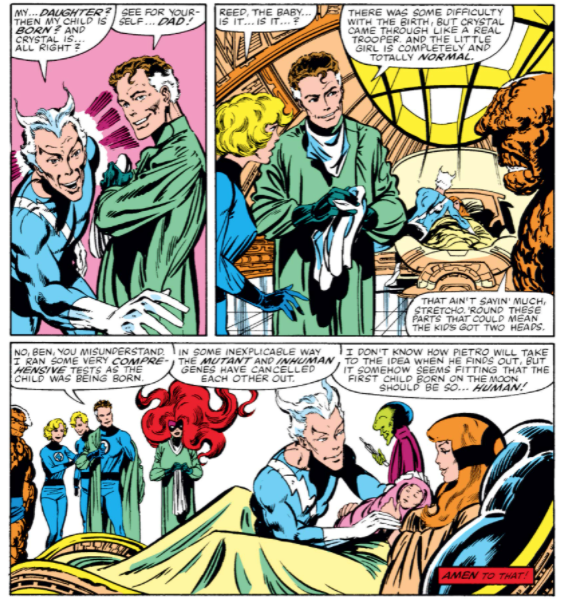
FF 240

Eventually, however, Quicksilver goes haywire and Crystal leaves him to join the Avengers
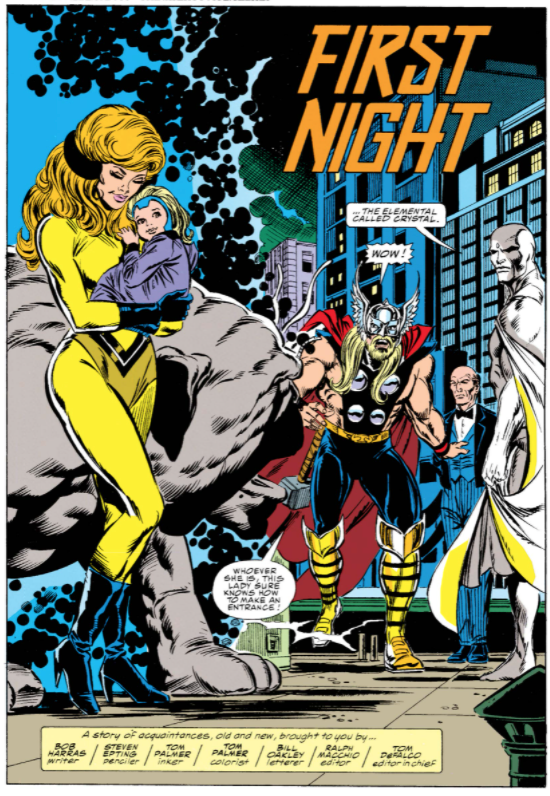
Avengers 343 (1992, story by Bob Harras, art by Steve Epting and Tom Palmer)

Crystal eventually reconciles with Quicksilver, but then he really goes off the deep end, and she ends things forever:
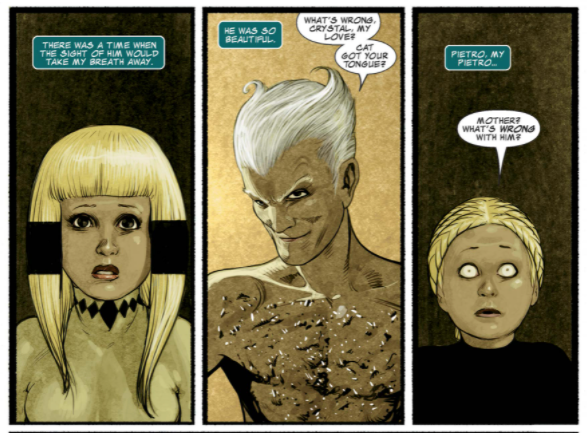
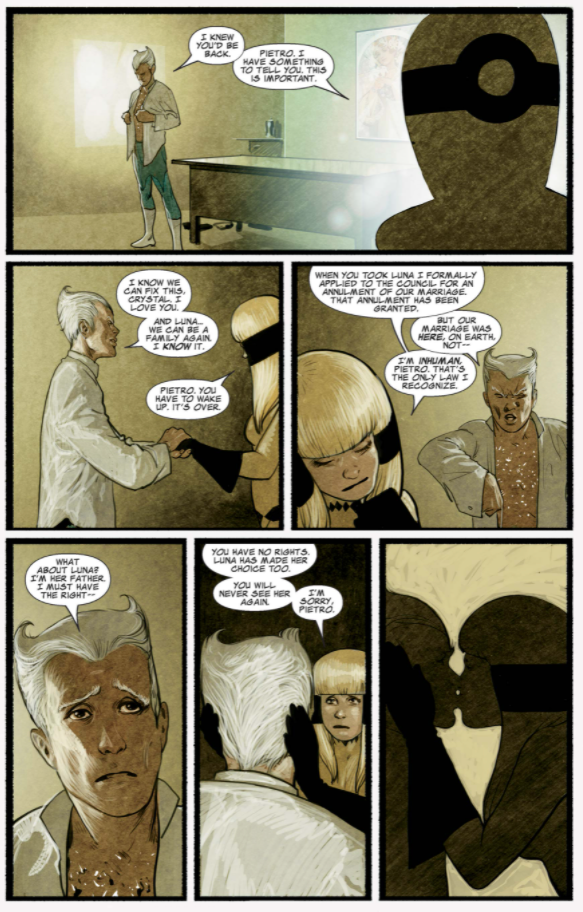
She finally winds up with Ronan the Accuser before she is forces to separate from him in a very complicated story by Johnathan Hickman:
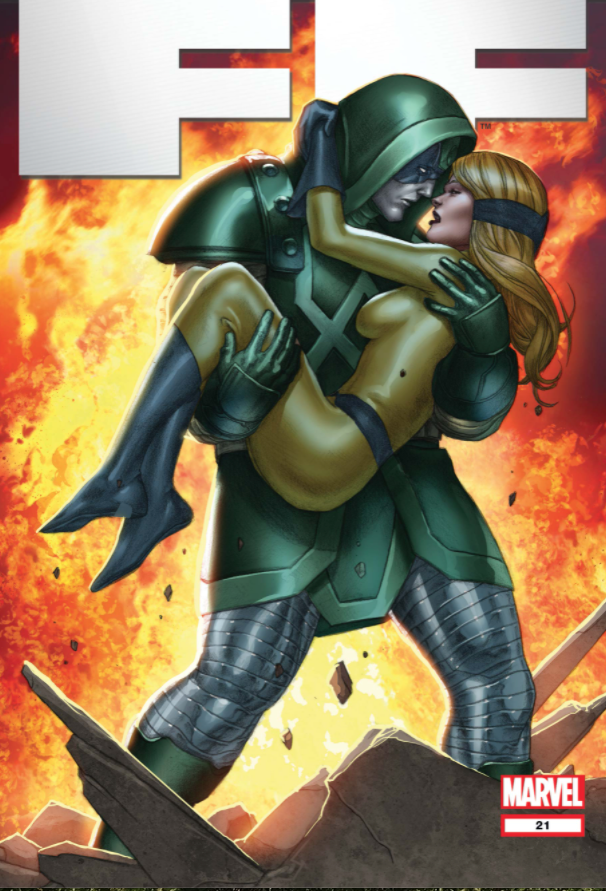
FF 21 (2012, cover art by Mike Choi)

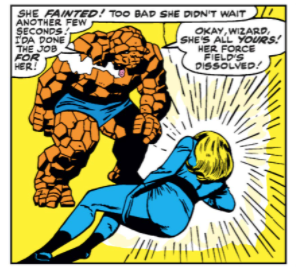
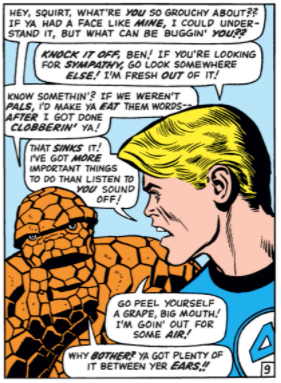
They’re fighting again

More like a battle of wits, but I’ll count it.
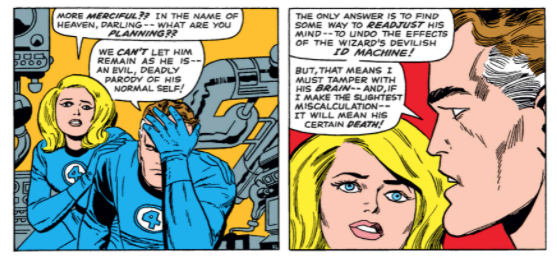
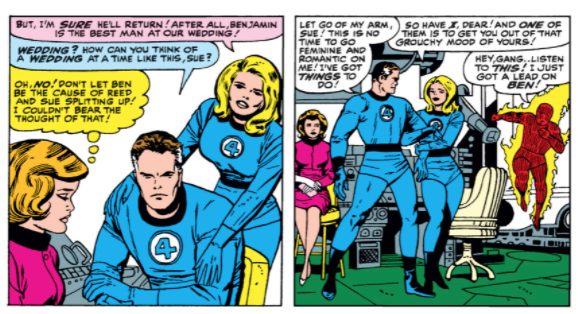
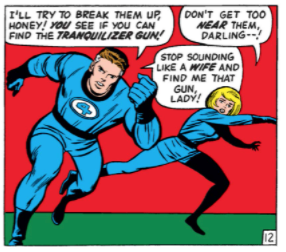
The sexist sixties
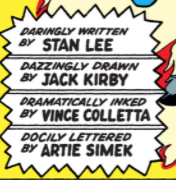
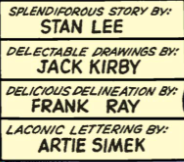
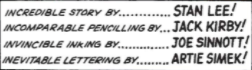
Crazy credits
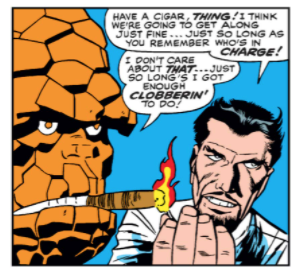
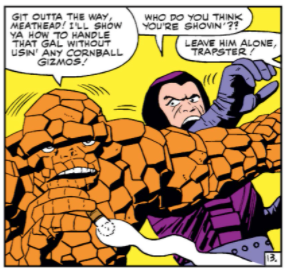
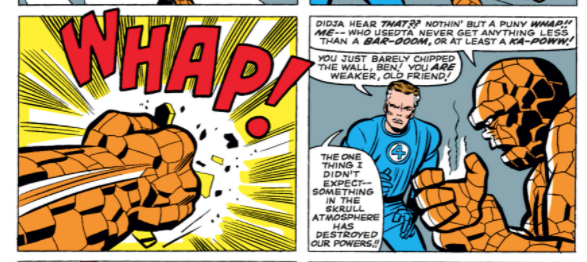
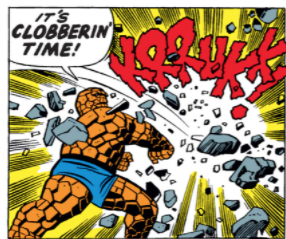
It’s Clobberin’ Time

This is the eight time Ben has said the magic words, by my count.
The incredible Mr. Fantastic

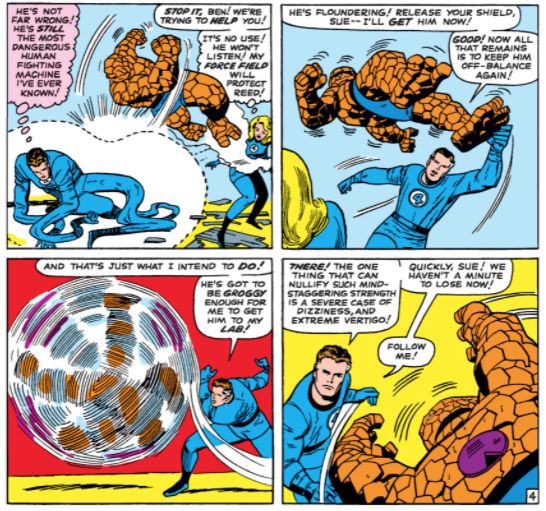
Why turn into a ball when when you can be a cube?
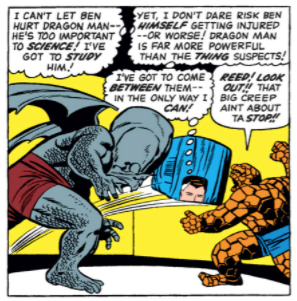
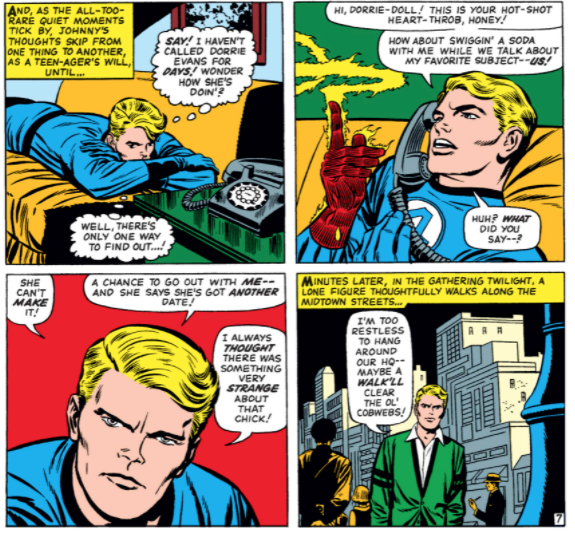
Teenage blues

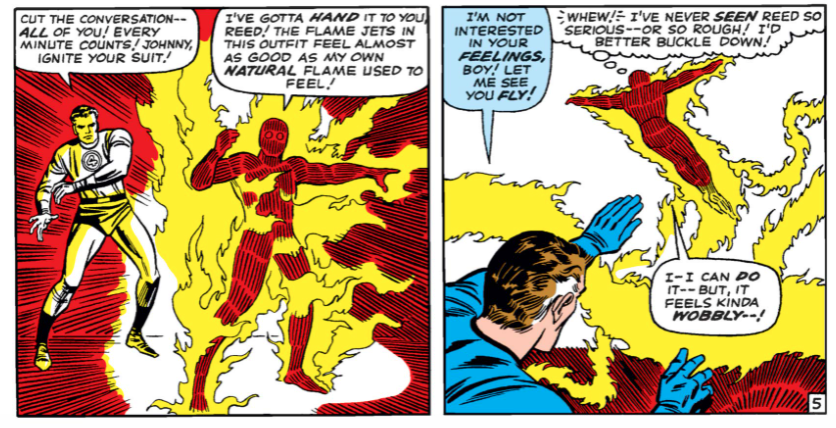
Just a great sequence by Stan, Jack and Joe of a moody Johnny
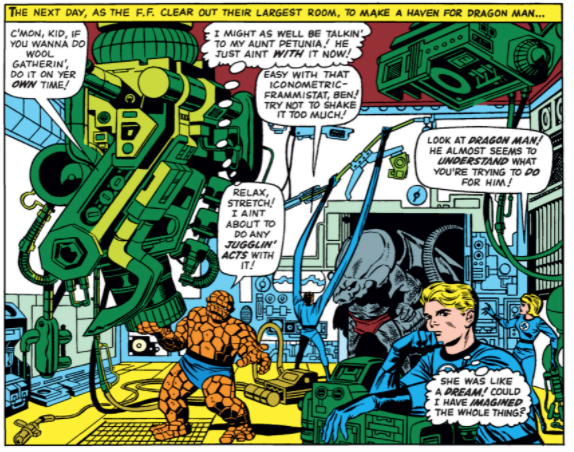
Weird science

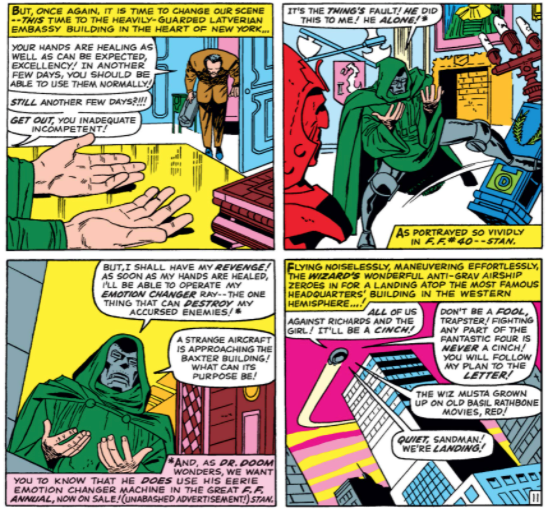
“Easy with that iconmetric frammistat”
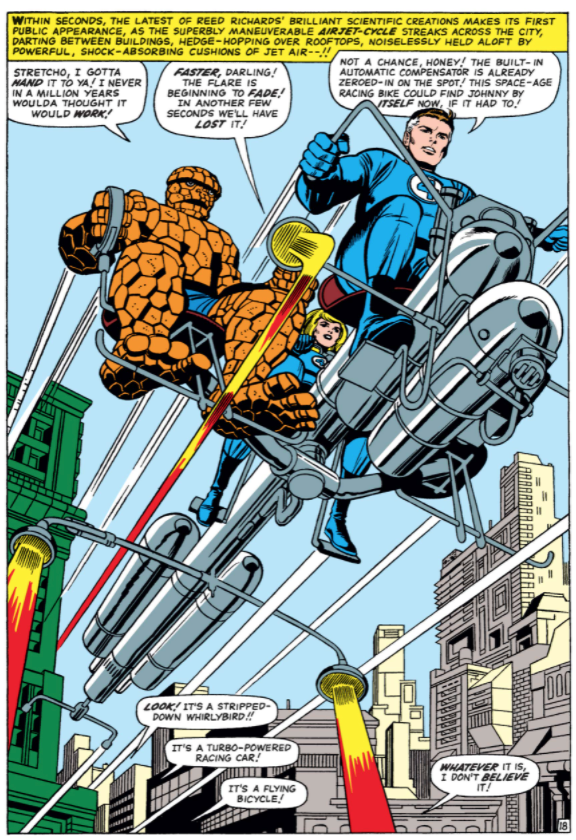
Dig That Kirby Krackle

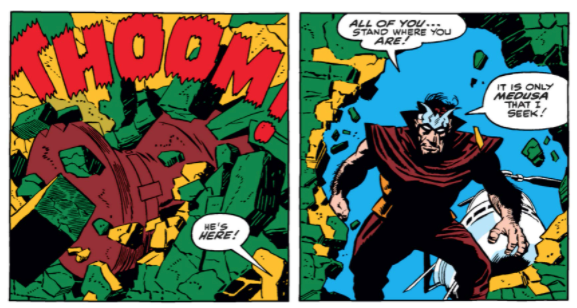
Just when you though this comic had everything, Jack gives us this:
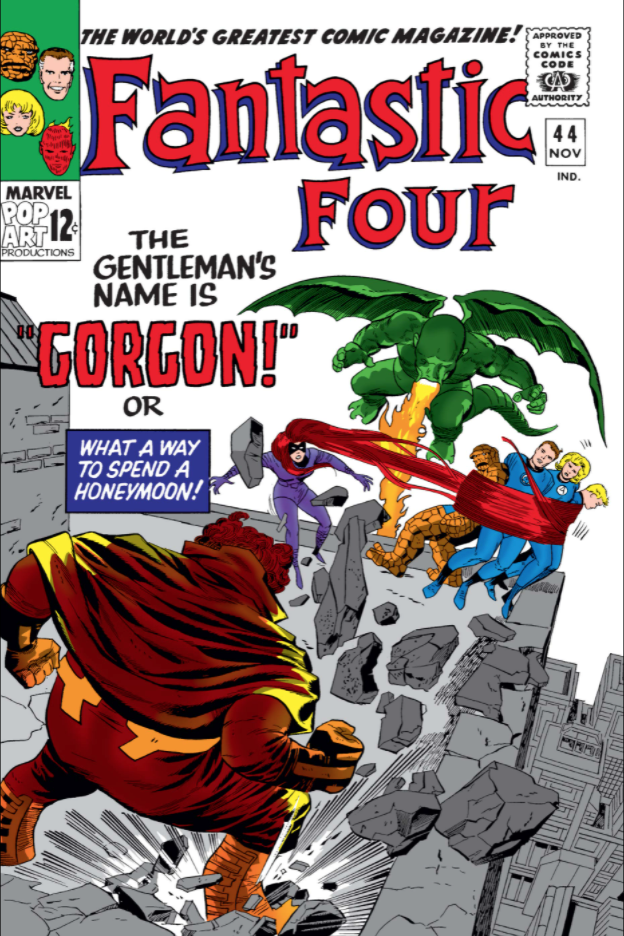
Next issue: The secret of Black Bolt!
“The World’s Greatest Comic Magazine!” Fantastic Four No. 44

Tags

, , , , , , , ,

Fantastic Four 44
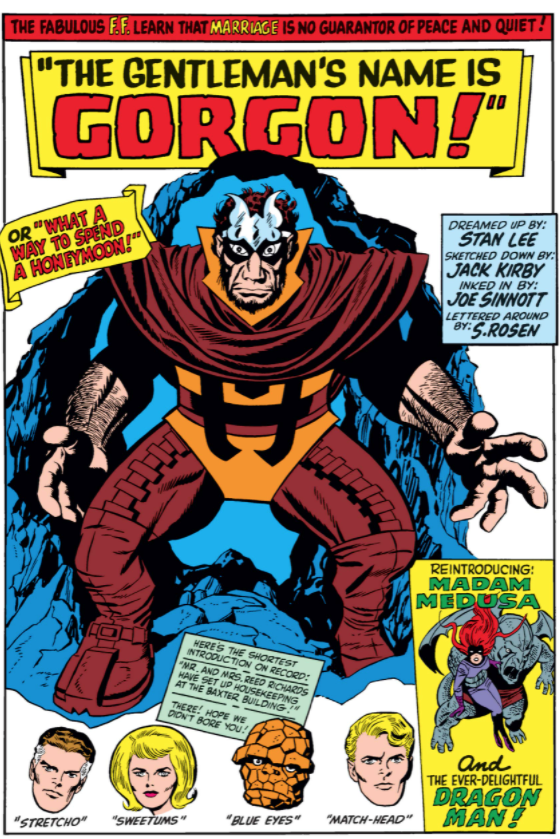
“The Gentleman’s Name is Gorgon!”
Published: Aug. 1965
Story: Stan Lee and Jack Kirby
Script: Lee
Pencils: Kirby
Inks: Joe Sinnott
Letters: Art Simek
Cover: Kirby and Vince Colletta

Synopsis

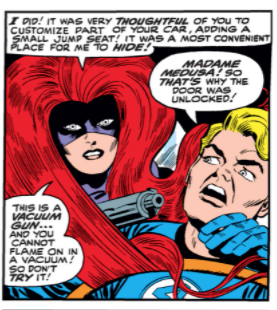
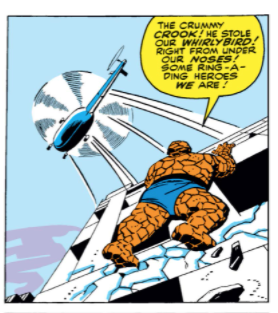
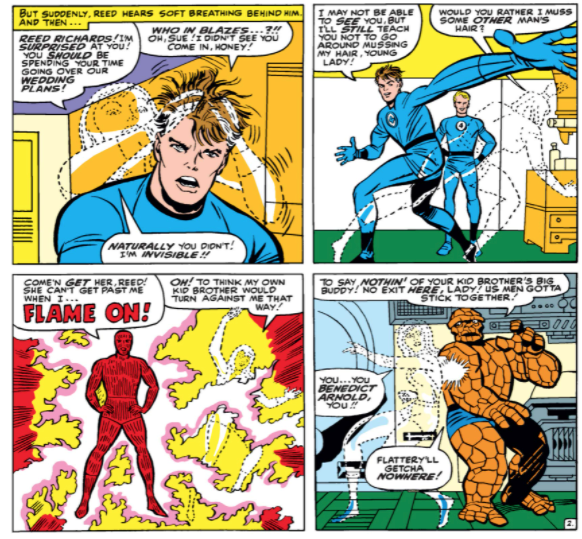
Following the marriage of Mr. Fantastic and the Invisible Girl (in FF Annual 3), the team is back at the Baxter Building where the Thing and Human Torch are growing bored of the new domesticity. Johnny takes off in his Corvette when he is carjacked by Madame Medusa, who threatens him with a “vacuum gun” and demands he help her escape Gorgon. Meanwhile, an unseen Gorgon uses his hooves to attack the Baxter Building, then steals the team’s helicopter.

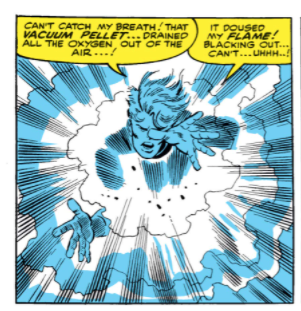
Medusa forces Johnny to drive her upstate, near the campus of State University, and when Johnny tries to escape, Medusa drains the air from him using the vacuum gun. Their scuffle awakens the dormant Dragon Man, last seen in FF 35, and when Gorgon arrives to capture Medusa, he and Dragon Man battle. Medusa and Dragon Man flee back to New York City, pursued by Johnny and Gorgon. Eventually all parties battle on the roof of city building. Gorgon demands the FF surrender Medusa or he will destroy the city when Dragon Man abducts the Invisible Girl. The issue ends with Gorgon bringing down the building around the rest of the FF.

What’s going on here?

Fantastic Four 44 kicks off a story arc that introduces the Inhumans, a major part of the Marvel universe for decades to come. It’s also the first comic in a 16-issue run that may be the most influential and creative stretches in all of comics. In these issues Stan and Jack introduce:

* The Inhumans: Black Bolt, Gorgon, Crystal, Karnak, Triton, Lockjaw, Maximus and their city of Attilan (all except Medusa, who first appeared in FF 36).
* The Silver Surfer
* Galactus
* Wyatt Wingfoot
* The Black Panther and Wakanda
* Klaw
* Prestor John

Plus they deliver one of the single best standalone stories (“This Man, This Monster” in issue 51) and arguably the best Dr. Doom story, when Doom steals the power cosmic from the Silver Surfer. Much more on all of this to come, of course!
The only comparable runs of similar length (about a year) I can think for their lasting significance in comics history are the Claremont/Byrne Uncanny X-Men from UXM 129-142 (which includes the Dark Phoenix Saga and Days of Future Past), and Green Lantern 76-89, the classic Denny O’Neil/Neal Adams run that brought contemporary issues to comics while introducing major characters. I’m sure I’m missing some, so feel free to drop your ideas in the comments.

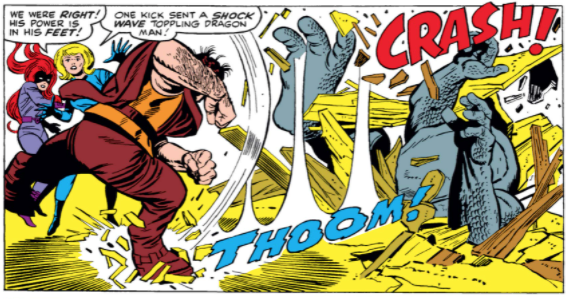
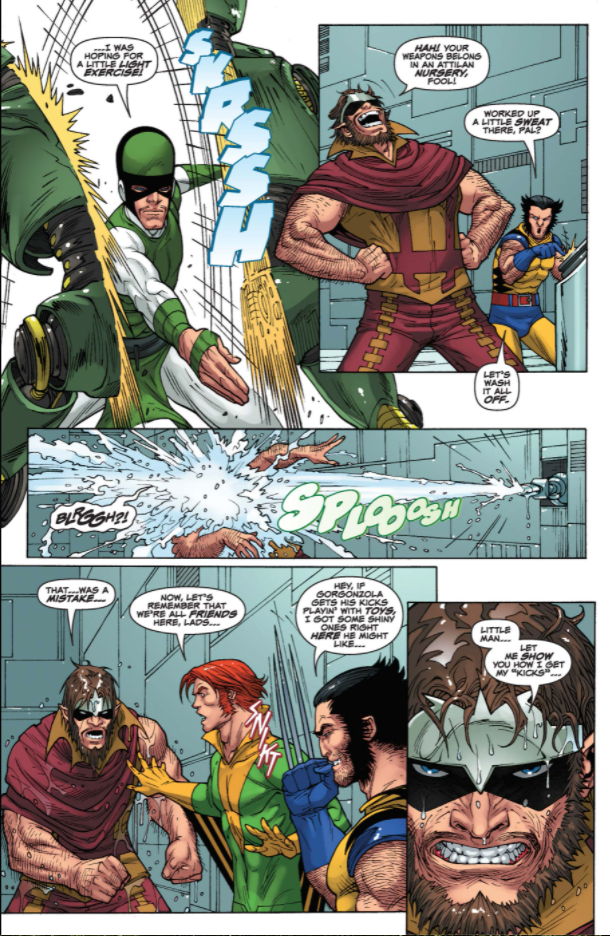
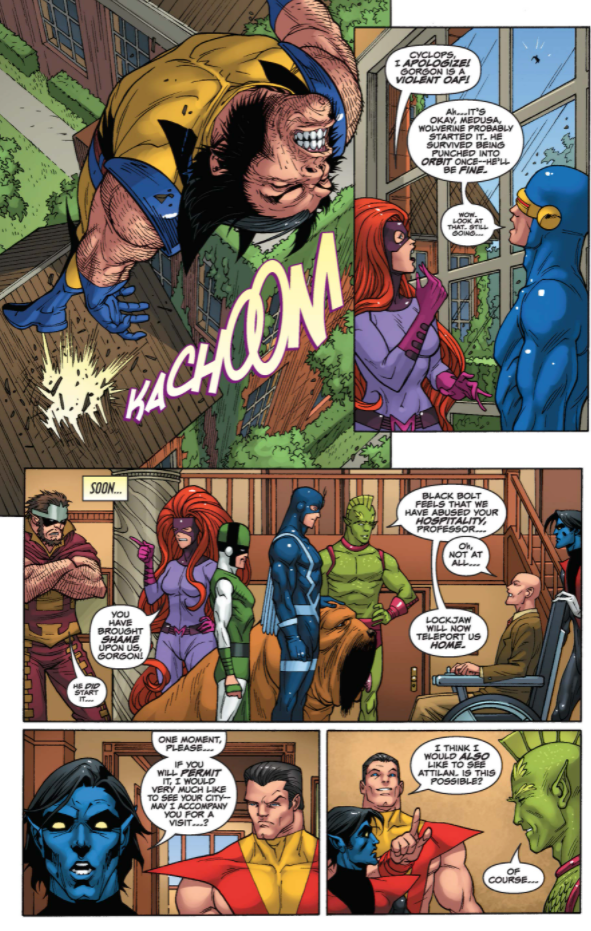
FF 44 also introduces Gorgon, who becomes a part of the Marvel firmament, but almost always as part of the Inhumans. In some ways, this might be a high point for Gorgon, as he appears both immensely powerful here and not in the shadow of his even more powerful cousin, Black Bolt. While he appears to be depowered over the years, he occasionally gets to strut his stuff, as in this fun sequence from Uncanny X-Men: First Class.

What’s in a name?

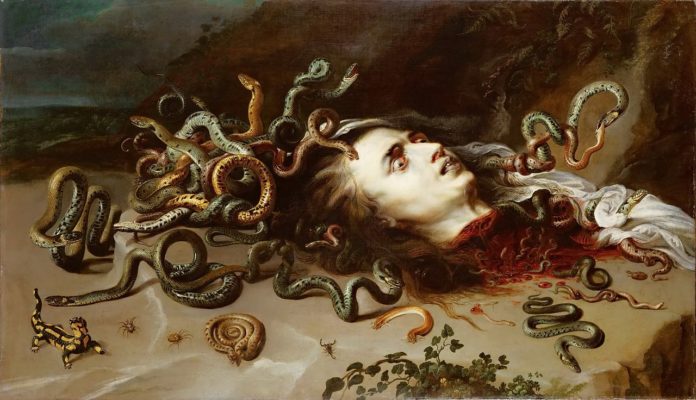
A gorgon in Greek mythology, was one of three snake haired women whose appearance could turn one to stone. One of the sisters was, of course Medusa, suggesting that if Stan and Jack knew their myths, they were’t overly concerned with the details.

The real Medusa, a gorgon (painting by Rubens)

Crazy Kredits

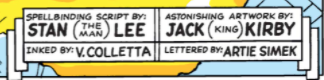
Not only does the creative team get goofy credits, but the FF gets nicknames.

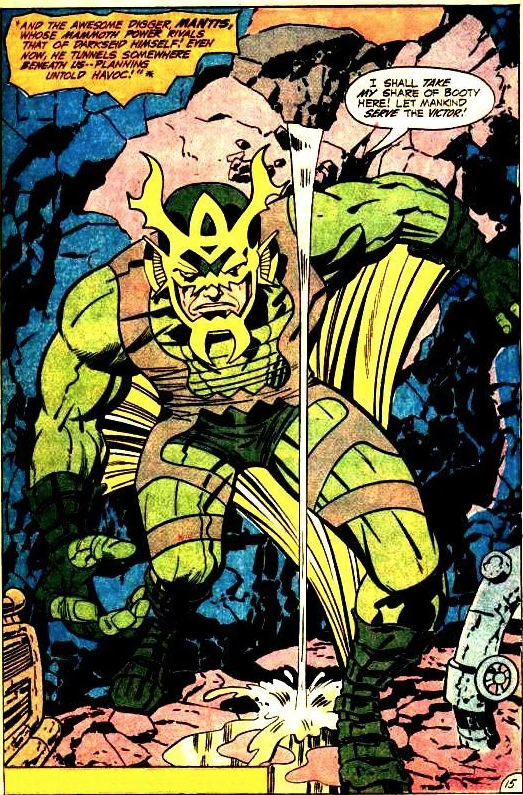
This image of Gorgon also foreshadows Mantis, a villain Jack created for DC about six years later:

The sexist sixties

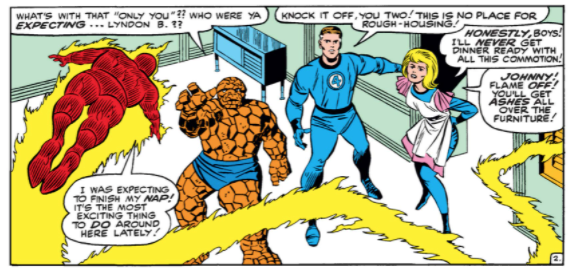
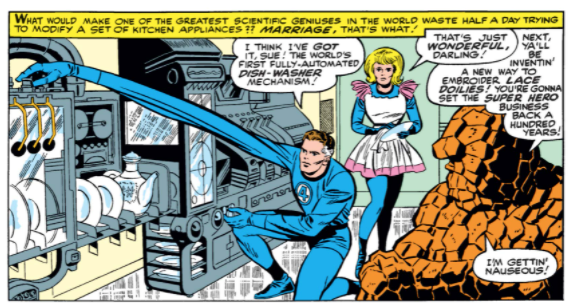
Sue is so determined to be a ’60s housewife, she’s wearing an apron.

Oops

Did Stan have to explain why Johnny’s Corvette Stingray has a backseat? It sure reads that way. Also: A vacuum gun!
We have a helicopter?

The FF has two Fantasticars, a Pogo plane, an ICBM, and apparently a helicopter.

Dig that Kirby Krackle

Some cool art in this issue.

Next issue: The rest of the Inhumans!

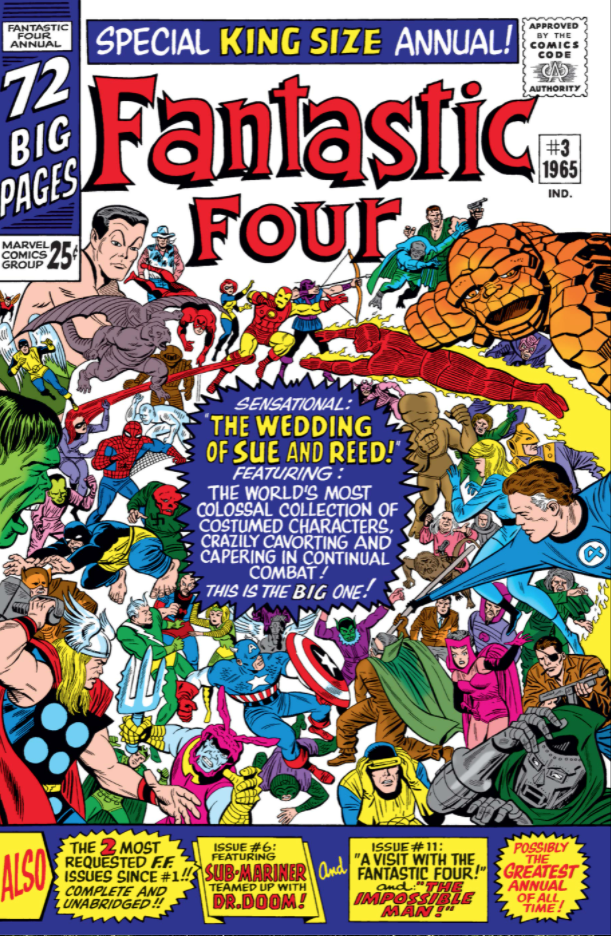
“The World’s Greatest Comic Magazine!” Fantastic Four Annual No. 3

Tags

, , , , , ,

Fantastic Four Annual 3
“Bedlam at the Baxter Building”
Published: July 1, 1965
Story: Stan Lee and Jack Kirby
Script: Lee
Pencils: Kirby
Inks: Vince Colletta
Letters: Arie Simek
Cover: Kirby and Mike Esposito

Note: Fantastic Four Annual includes one original story, which we will discuss here, and reprints three others, from FF 6 and FF 11.

Synopsis

The story opens with Dr. Doom reading about the planned wedding for Mr. Fantastic and the Invisible Girl. Seeing an opportunity to take his revenge, he deploys his “high-frequency emotion charger” to spur other villains into attacking the Fantastic Four.

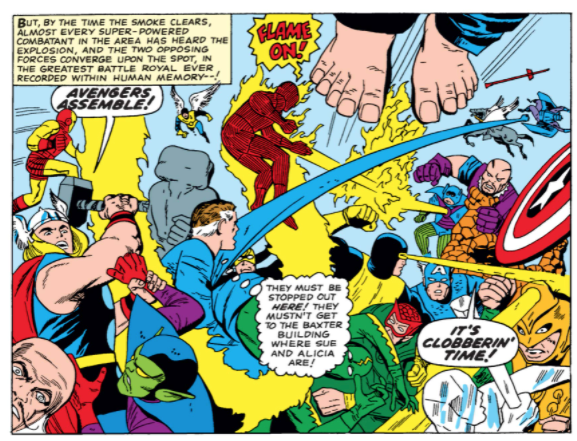
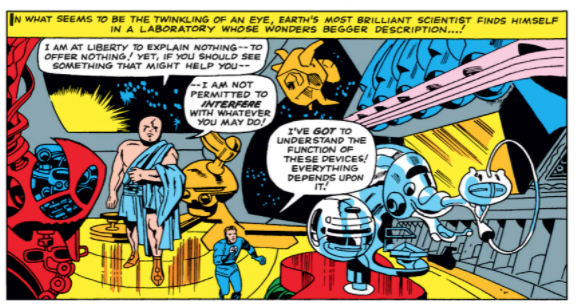
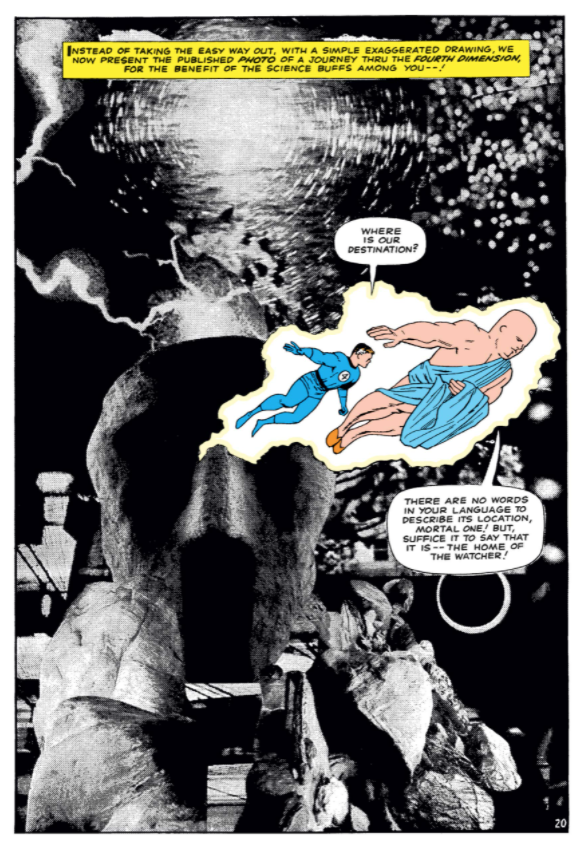
As the wedding guests arrive at the Baxter Building, an array of bad guys begin to attack, only to be beaten back by the FF’s guests, which include the X-Men, Dr. Strange, Daredevil, Spider-Man and the Avengers. Eventually the FF gets pulled into the fray, and the Watcher appears, whisking Reed off to his home on the Moon. In a very legalistic interpretation of non-interference, he says Reed can take any device he finds and use it on the villains. Reed selects a “sub-atomic time displacer” which sends the villains into the past with no memory of recent events.

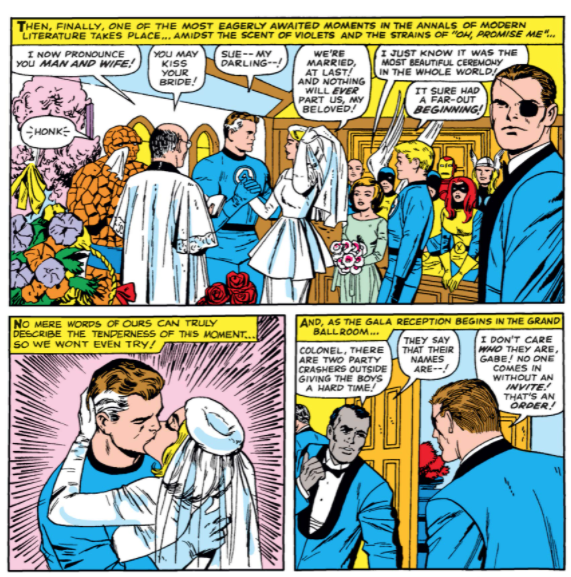
The story concludes with Reed and Sue’s much-anticipated wedding.

What’s going on here?

As far as stories go, this plot is about as thin as they get. Doom arranges for the villains to attack, we get about 15 pages of fun battle scenes as virtually every hero and villain in the nascent Marvel universe shows up, the Watcher swoops in to fix things, and we end up with a wedding. But a thin story doesn’t mean a boring story, and this comic is a lot of fun, as Stan and Jack clearly enjoy reaching into their bag of characters and throwing them all into the stew.

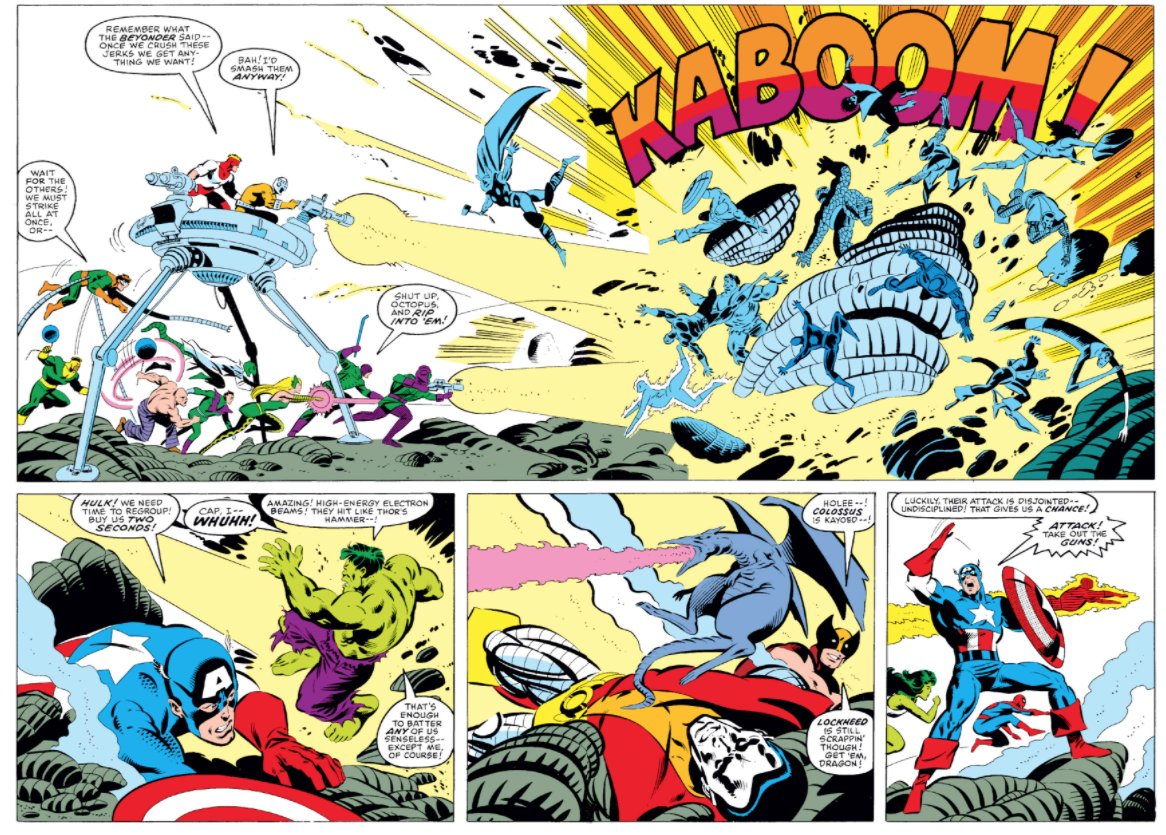
The basic concept—all the good guys vs. all the bad guys—will be repeated over the years, maybe most notably in 1984’s Secret Wars, which was a 12 issue series based pretty much on that premise and little else.

Marvel Super Heroes Secret Wars 2 (1984). Story by Jim Shooter, art by Mike Zeck and John Beatty

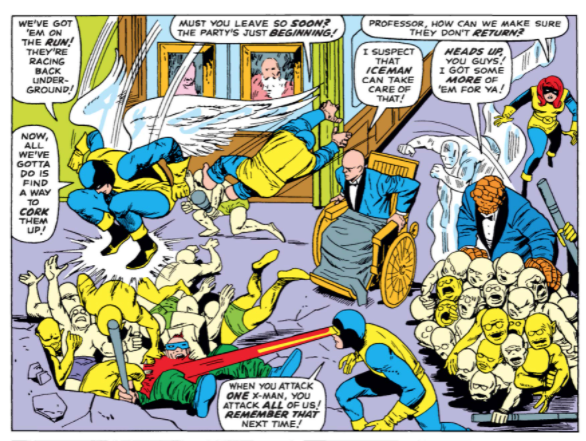
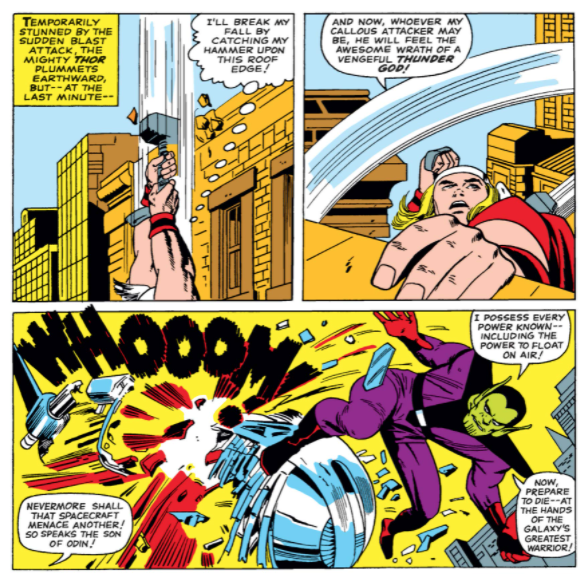
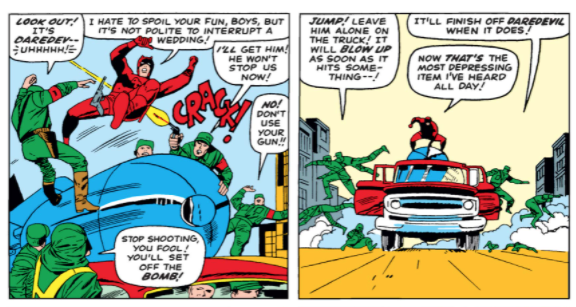
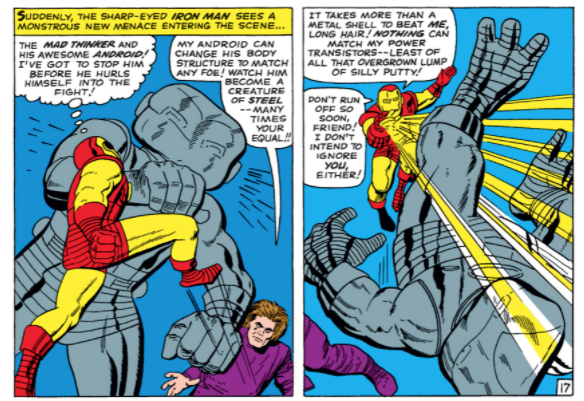
FF Annual 3 is also notable for mixing and matching heroes and villains, creating new pairings of combatants. For example, the X-men vs. the Mole Man:

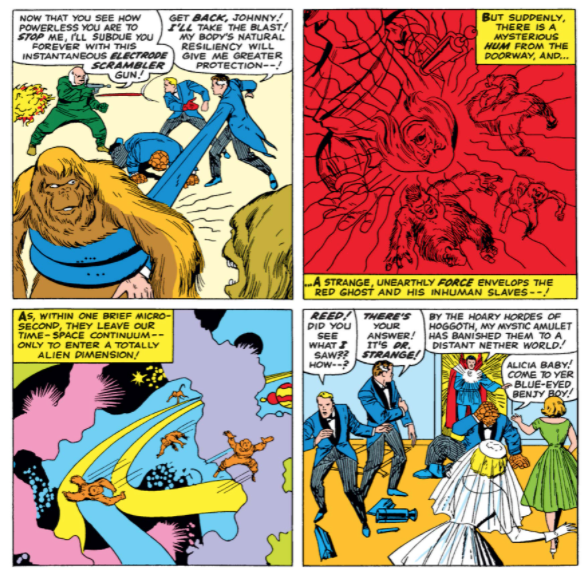
Or Dr. Strange vs. the Red Ghost and his Super Apes:

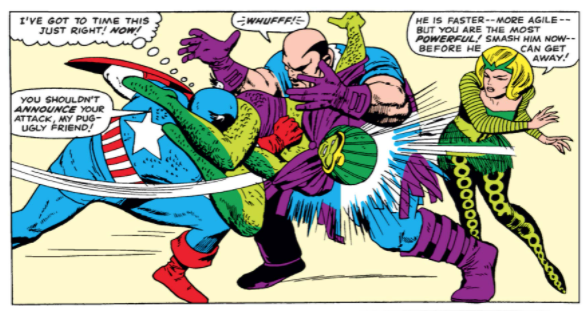
Or Captain America vs. Cobra, the Executioner and the Enchantress

Or Thor vs. the Super Skrull:

Or Daredevil vs. Hydra:

Or Iron-Man vs. the Awesome Android:

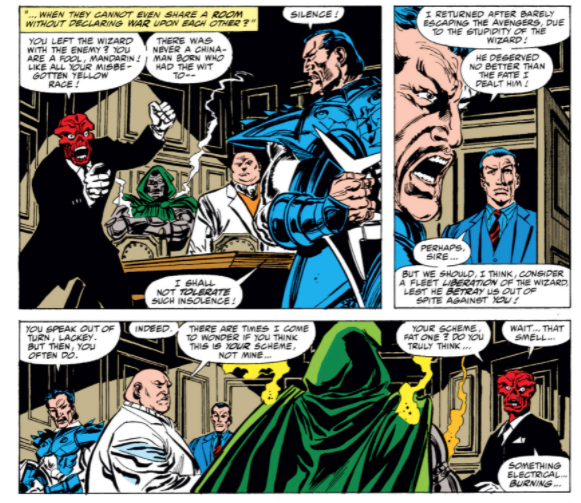
This kind of matching heroes against unfamiliar villains became the basis for another 1980s cross-over event, Acts of Vengeance, in which Marvel’s biggest bad guys arranged to fight each other’s traditional antagonists.

Avengers 313 (1989) Story by John Byrne, art by Paul Ryan and Tom Palmer

Wedding bells

The other notable event in FF Annual 3, of course, is Reed and Sue’s marriage. As far as I am aware, this is the first super-hero wedding in the modern Marvel era, and it sets the template for dozens of similar issues to come. They usually take place in an annual or anniversary issue, a wedding is planned, villains interfere, and the nuptials finally comes together at the end.

While there have been dozens of weddings with super heroes, two heroes marrying each other is less common, in part because there are so few female heroes (the male-male super hero wedding is way, way in the future, of course). Notable pairing include the Wasp and Yellowjacket, Green Arrow and Black Canary, the Vision and Scarlet Witch, and Luke Cage and Jessica Jones.

There are way too many super-hero weddings to list, but here’s a few that took place in the pages of the Fantastic Four:

The marriage of Crystal and Quicksilver in FF 150 (Crystal had been a de facto member of the FF for years):

FF 150 (1974, story by Gerry Conway, art by Rich Buckler and Joe Sinnott)

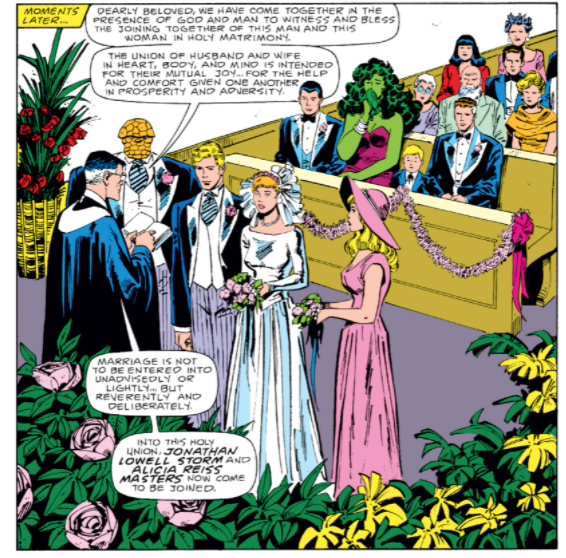
The marriage of Johnny Storm and Alicia Masters, later revealed to be Lyja the Skrull, in FF 300:

FF 300 (1987, story by Roger Stern, art by John and Sal Buscema)

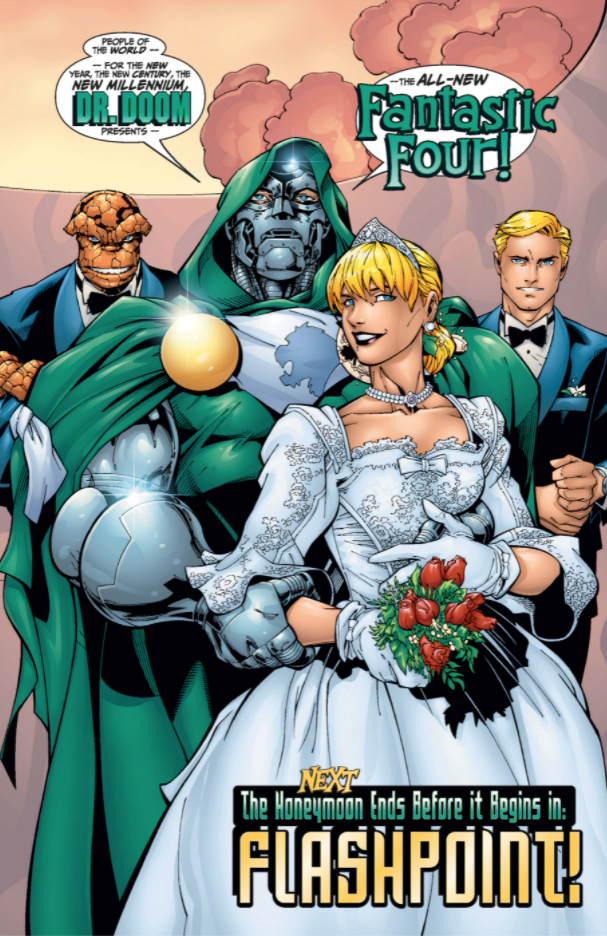
In FF 27 (Vol. 3), in a bizarre storyline, Sue marries Dr. Doom, who was actually Reed’s consciousness in Doom’s body:

FF 27 (Vol. 3) (2000, story by Chris Claremont, art by Salvador LaRocca and Art Thibert)

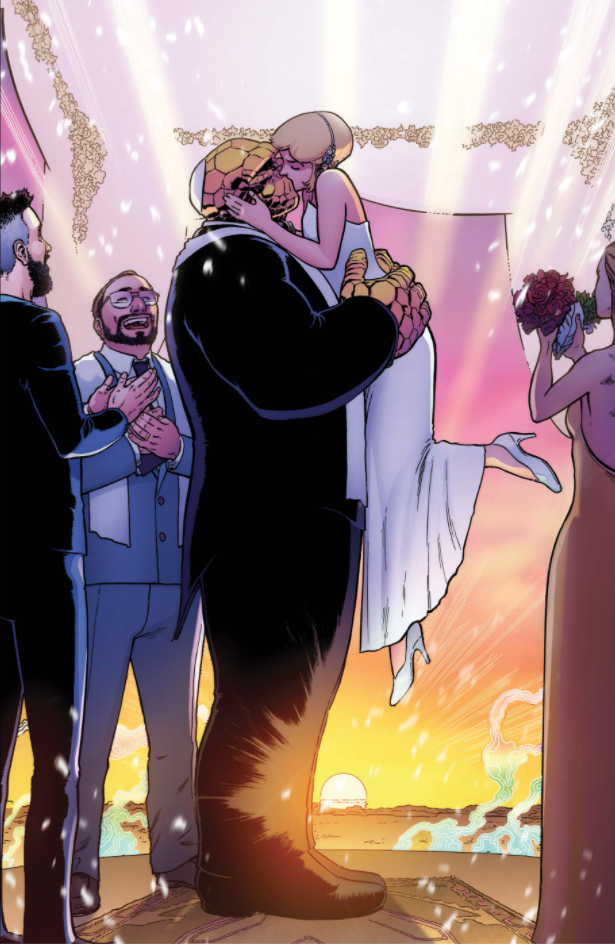
Lastly, Ben Grimm and the real Alicia finally married in FF 5 (vol. 6):

FF 5 (vol. 6) (2018, story by Dan Slott, art by Aaron Kuder)

Let’s talk about us

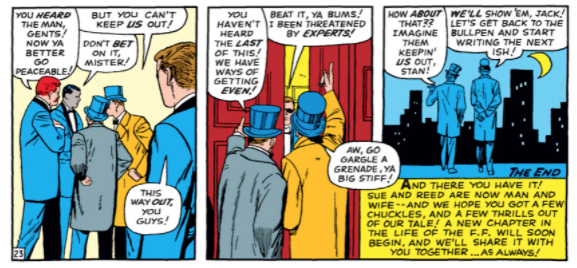
Stan and Jack, absent from these pages for a while, reappear as uninvited wedding guests:

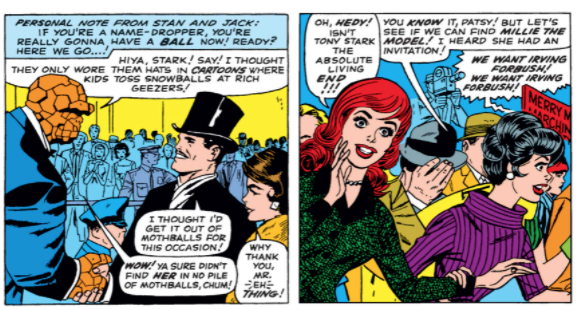
Also making a cameo was Patsy Walker and her friend Hedy, marking their first appearance in the Marvel universe. The star of teen romance comics dating from the 1940s, Patsy would later become the heroine Hellcat.

Who are these guys?

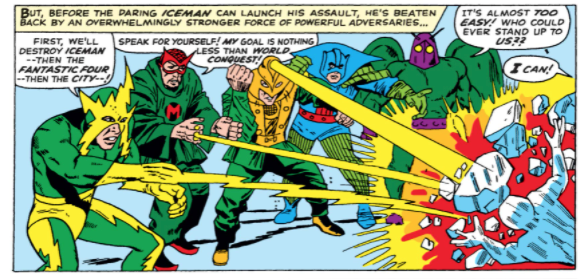
Stan and Jack dug deep to find some obscure villains. I believe the guy to the right of the Mandarin is the Unicorn, but I have no clue who is between him and the Beetle. Anyone out there know?

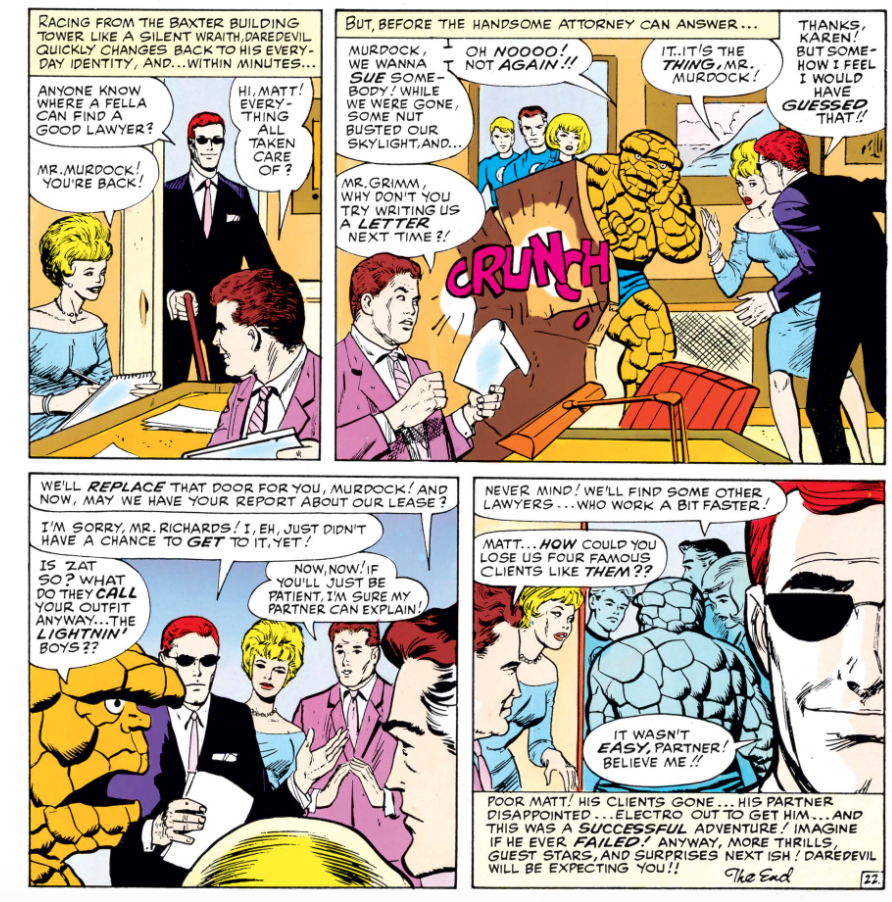
Call my lawyer

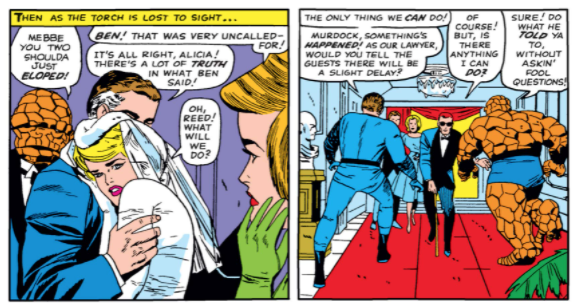
I hope Murdock & Nelson bill their usual rate for running errands like this.

Deus ex machina

Once again the Watcher makes a big deal out of his vow to not interfere while doing a lot of interfering.

Dig that Kirby Krackle

This issue features another Kirby Kollage

Next issue: The return of Medusa and introduction of the Inhumans!

(Edited to remove a reference to The wedding of Bouncing Boy and Duo damsel, which I somehow placed in the 60s, not the 70s)

“The World’s Greatest Comic Magazine” Fantastic Four No. 43

Tags

, , , , ,

Fantastic Four 43
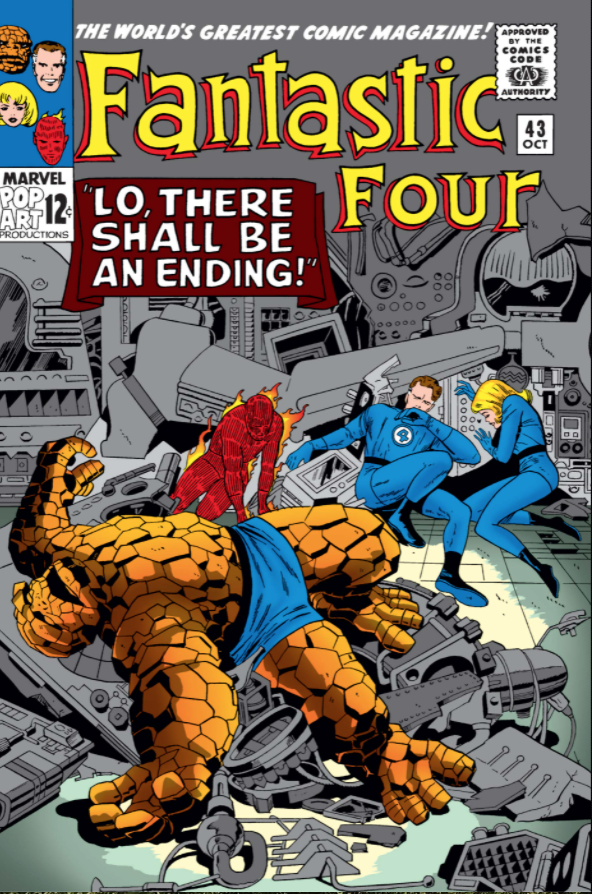
“Lo! There shall be an ending!”
Published: July 1965
Story: Stan Lee and Jack Kirby
Script: Lee
Pencils: Kirby
Inks: Vince Colletta
Letters: Art Simek
Cover: Kirby and Colletta

Programming note: This issue actually appeared on newsstands after Fantastic Four Annual 3, but for the sake of clarity, we’re going to tackle the issues in order of continuity and get to the annual next week.

Synopsis

Continuing a story arc that began six issues ago, in issue 38, Fantastic Four 43 picks up where the previous comic left off, with the Frightful Four pursuing Mr. Fantastic and the Invisible Girl. The Frightful Four has brainwashed the Thing, who Reed has subdued and captured with one of the Wizard’s antigravity disks, and the Human Torch, who is in pursuit of Reed and Sue. Reed and Sue escape, however, and the Wizard (and Reed) suspect the Human Torch of only pretending to be brainwashed. The villains realize Reed tampered with the brainwashing device, then re-capture Johnny.

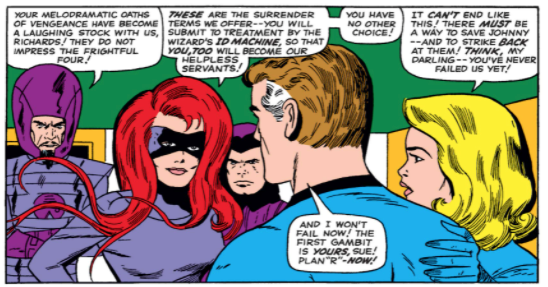
Meanwhile, back at the Baxter Building, Reed attempts to reverse the Thing’s brainwashing with a complicated and dangerous process that leaves Ben unconscious. The Frightful Four arrive and demand Reed and Sue undergo brainwashing, or the Torch—who is strapped to a giant antigravity disk—will be sent into space. Reed and Sue stall for time until Ben wakes and destroys the Wizard’s anti-gravity controls, freeing the Torch. The reunited team then quickly mops up the the Frightful Fours, save for Medusa, who escapes the Torch. The issues concludes with a reminder Reed and Sue are to be married soon.

What’s going on here?

The Frightful Four saga finally wraps up, ushering in the wedding of Reed and Sue, and setting the stage for a 18 issue run from FF 44 through 62 that is arguably the greatest single stretch of issues in comic book history (much more on that to come). In that context, the six-part Frightful Four/Doom/Frightful Four storyline can be seen as a trial run for more the more ambitious, multi-part stories to some.

This issue, despite Stan’s grandiose title, ends with more of a whimper than a bang. It’s not a bad resolution, and it concludes with Ben back in the fold after his time in the wilderness, but the stakes don’t feel particularly high here. The Frightful Four, ultimately, aren’t all that menacing, and despite beating the FF pretty soundly twice, there’s never any real doubt Reed will find a way to win.

FF 43 does feature a great sequence when Ben revives and it’s as yet unclear whether he has escaped the brain washing. Jack keeps us in the dark by not showing Ben’s face.

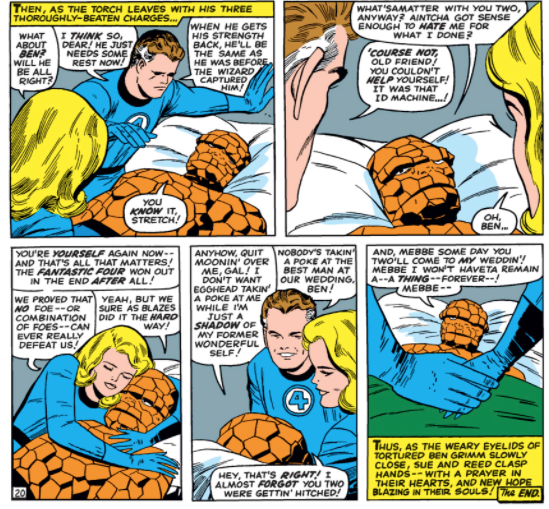
The issue ends with Reed and Sue standing around Ben’s bed, reunited but still with a hint of melancholy.

It’s far from the last time Ben ends up convalescing in bed, and reminded me up Marvel Two-in-One 96, where he spend the whole issue in bed as a brawl rages outside the hospital.

FF 43 also features an odd sequence, where Johnny flies off to capture Medusa, but pulls up short, then gets scolded by Reed.

It’s not entirely clear what’s going on here, and why Stan and Jack place so much emphasis on it, but it’s likely related to the upcoming developments for Medusa and the introduction of the Inhumans.

Lo down and dirty

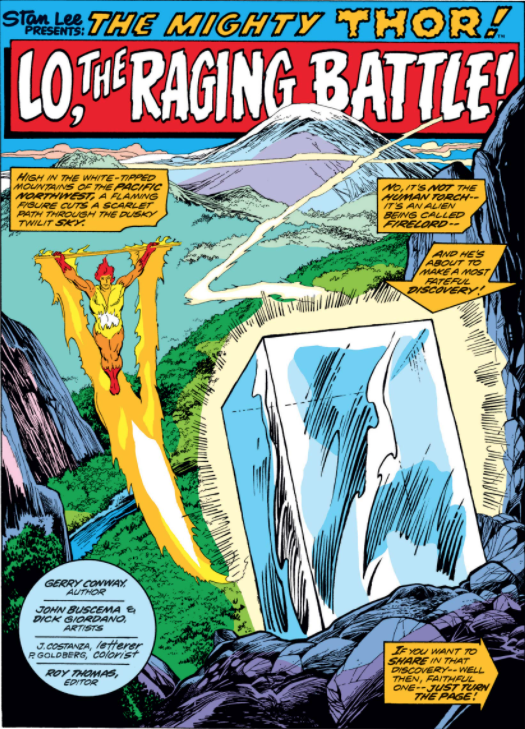
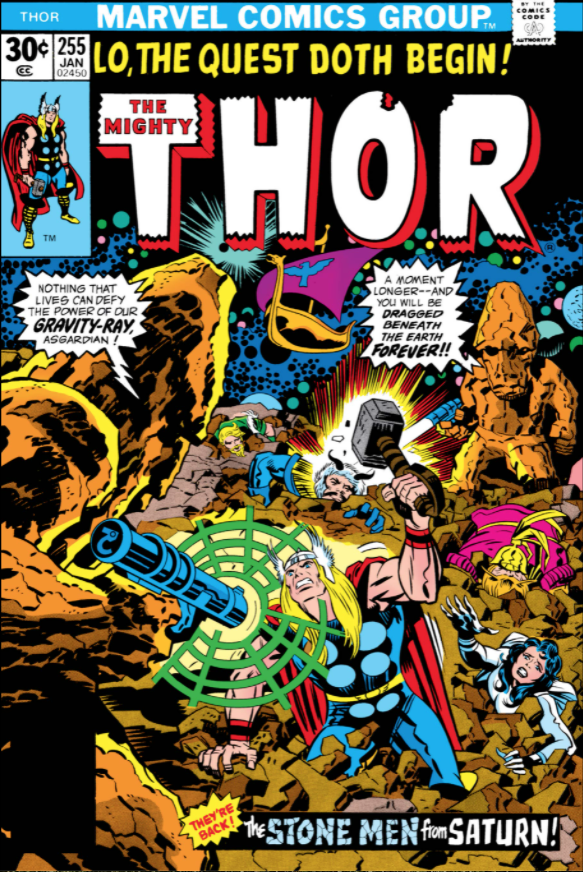
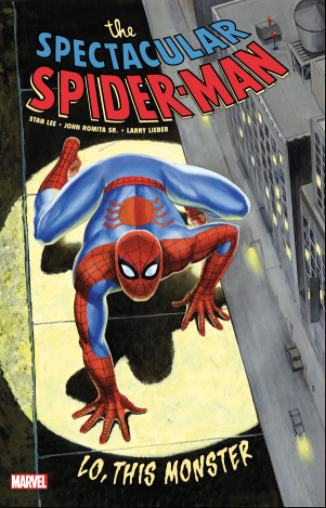
“Lo” is a word used very rarely, and mostly by Stan Lee (it’s both on the cover and the title of this issue). Lo is an Old English variant of “look” and to the extent it survives, it’s mostly in “lo and behold.” That doesn’t stop Stan from using it, of course, and it’s one of those archaic words and phrases he sprinkles into titles to ramp up the grandeur. There’s no easy way to track down all the uses of “lo” in Marvel comics but I found a few. Not surprisingly, they’re either by Stan or his acolytes, Roy Thomas and Gerry Conway.

They’re fighting again

Sort of a fun fight, too.

Krazy Kredits

Meanwhile

This might be the first time Stan and Jack have cut away from the action to set up a story in an upcoming issue. Here, they tease a Doom appearance in the annual.

Weird science

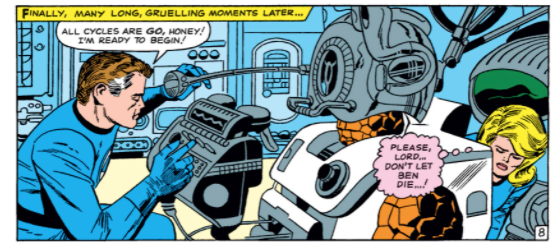
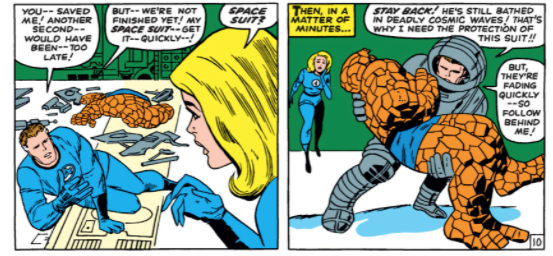
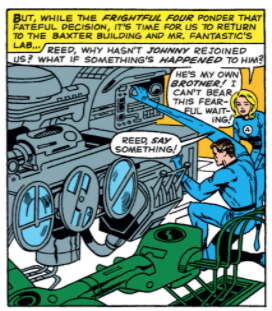
To reverse the Wizard’s brainwashing of Ben, Reed employs a machine that seems to leak both electricity and “deadly cosmic waves.” The whole thing is baffling and made me wonder why he didn’t just call Professor X or Dr. Strange to fix Ben’s noggin.

The sexist sixties

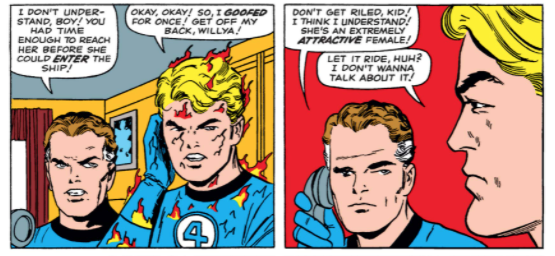
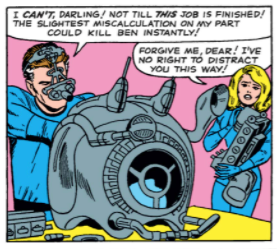
Sue has “no right” to distract Reed?

Dig that Kirby Krackle

Some cool panels that display Jack’s masterful of perspective for dramatic effect.

Next issue: FF Annual 3, and the marriage of Reed and Sue. What could possibly go wrong?

“The World’s Greatest Comic Magazine!” Fantastic Four No. 42

Tags

, , , , ,

Fantastic Four 42
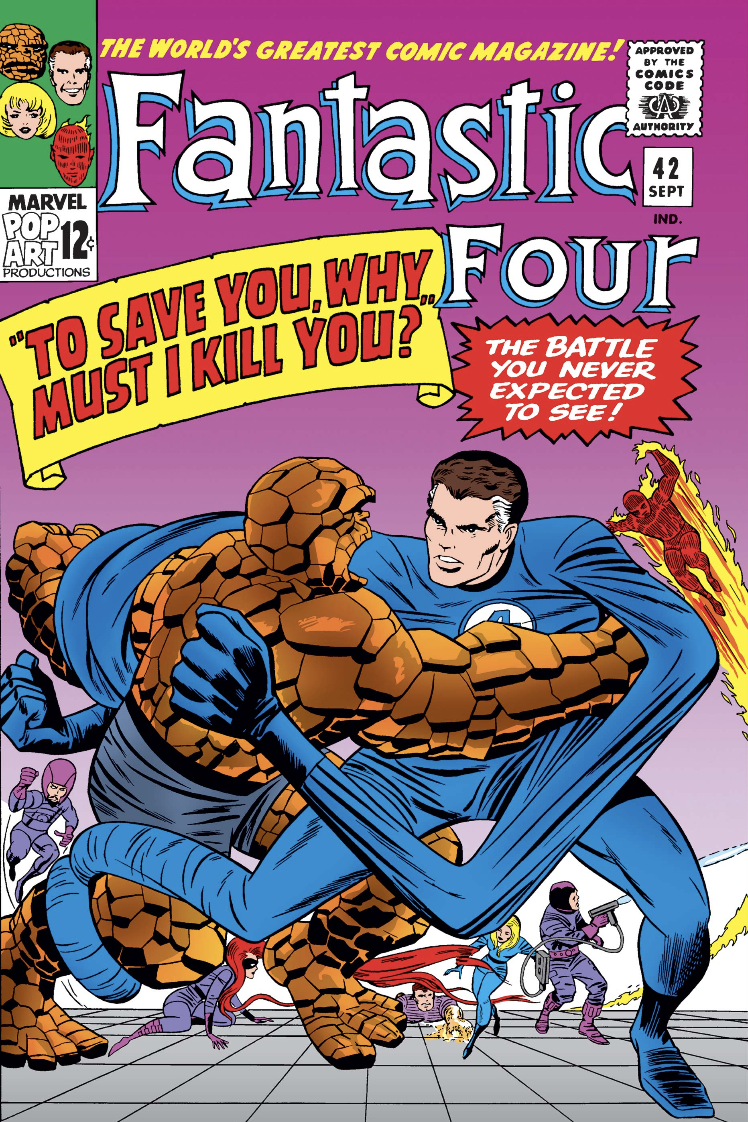
“To save you, why must I kill I you?”
Published June 1965
Story: Stan Lee and Jack Kirby
Script: Lee
Pencils: Kirby
Inks: Vince Colletta
Letters: Sam Rosen
Cover: Kirby and Sol Brodsky

Synopsis

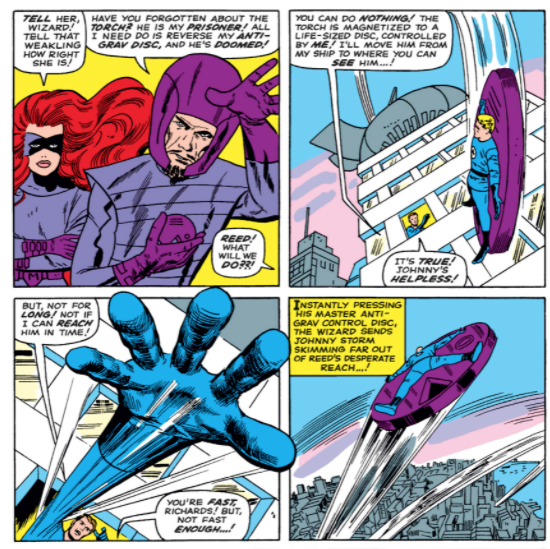
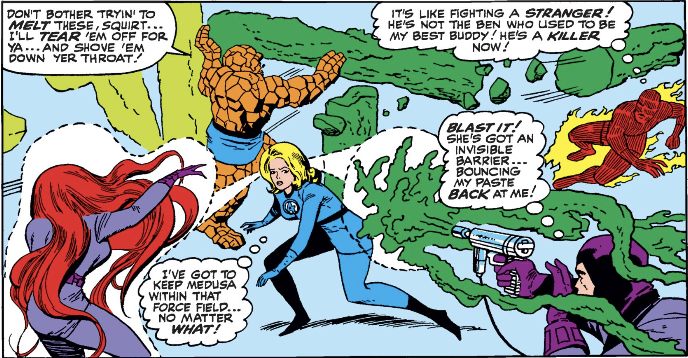
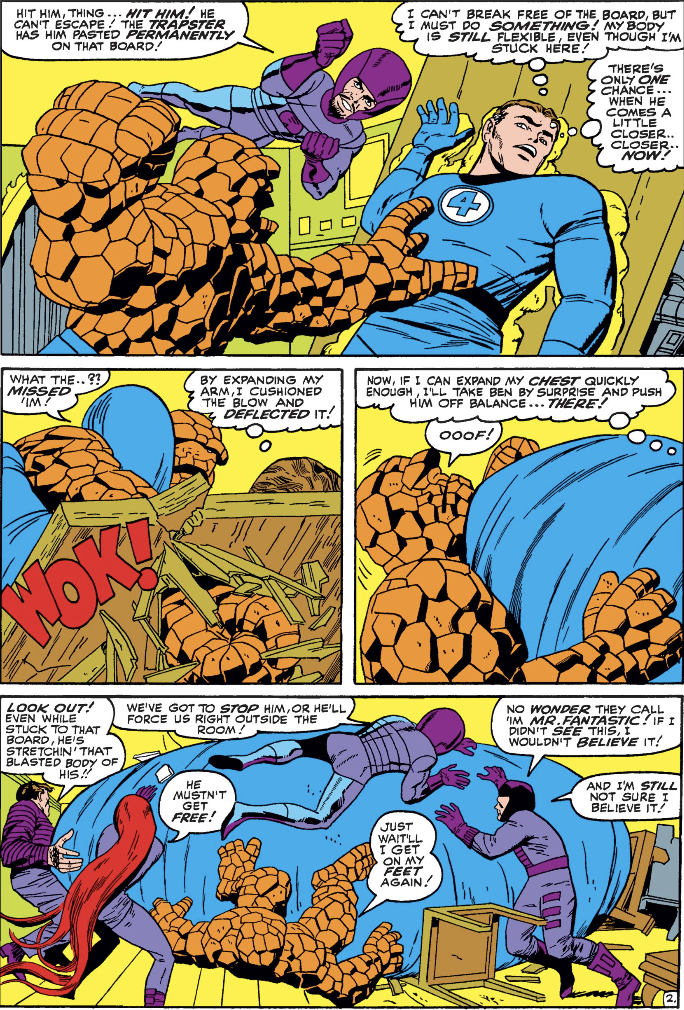
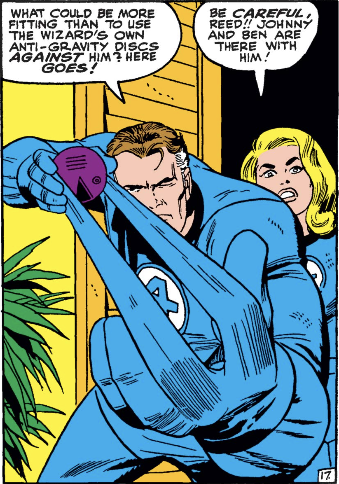
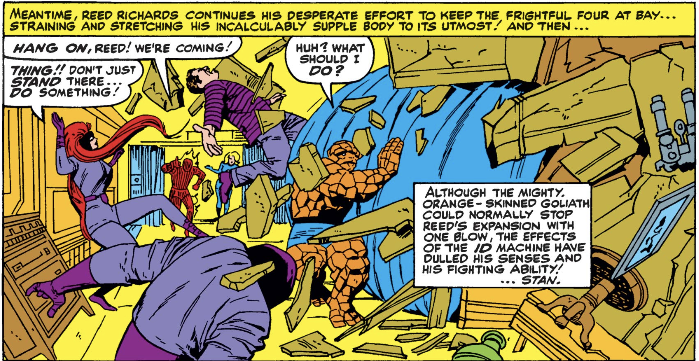
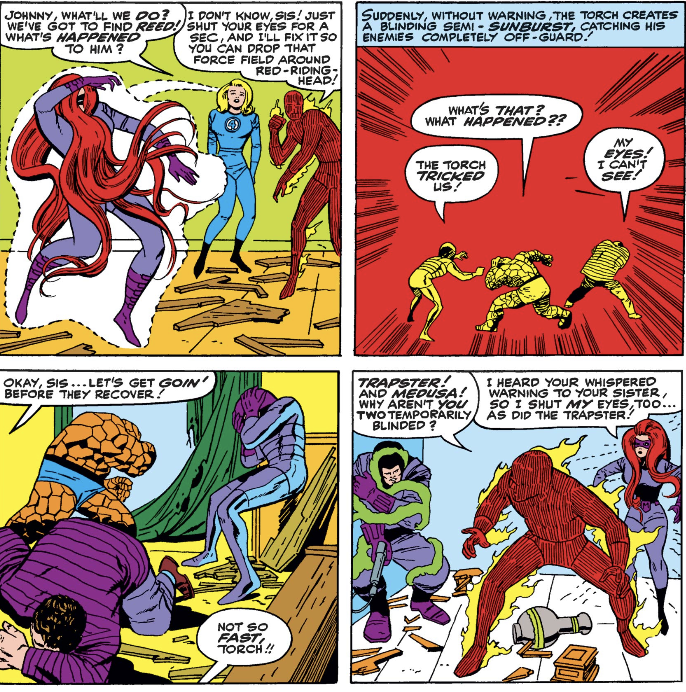
Fantastic Four 42 picks up where FF 41 left off, with the Frightful Four goading the brainwashed Thing into killing Mr. Fantastic, who is glued to a board. Unable to stretch his limbs, Reed inflates his chest to escape, eventually inducing Ben into destroying the board. The teams continue to battle, with Ben eventually capturing Reed and stuffing him into a jar (really). The Human Torch’s flames are doused when Medusa uses her hair to soak him, and he is captured and brainwashed by the Frightful Four. The Invisible Girl frees Reed, and the two use tear gas to flush the villains out of their lair. Reed then attaches the Wizard’s antigravity devices to Ben, rendering him helpless when the Torch attacks. The comics ends with another cliffhanger.

What’s going on here?

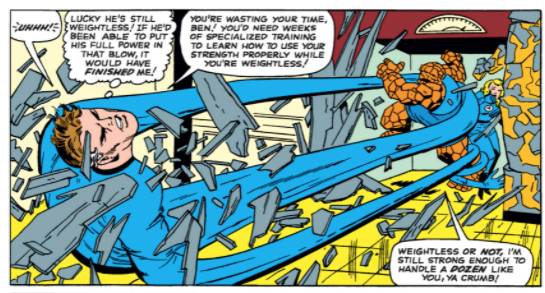
Fantastic Four 42 is wall-to-wall action. The fight that began in issue 41 continues all the way through 42 without conclusion (presumably that happens in the next issue) and with no digressions or cutaways for other stories. Further, virtually the entire story takes place in the Frightful Four’s house in New Jersey that gives the battle a claustrophobic intensity.

Also notable is Stan and Jack’s embrace of the multi-issue story arcs and the cliff-hanger ending. After nearly 40 issues of one-and-done comics (with two exceptions), we’re now on the fifth issue of an arc that began in issue 38, each ending with a cliffhanger. As discussed in a previous entry, I think it reflects Stan and Jack’s confidence that their now large and loyal body of fans that would seek out new issues. It might also be a sign that newsstands and drug stores, impressed with the Fantastic Four’s sales, were ordering them with sufficient regularity that the creators didn’t have to worry about readers not being able to find issues.

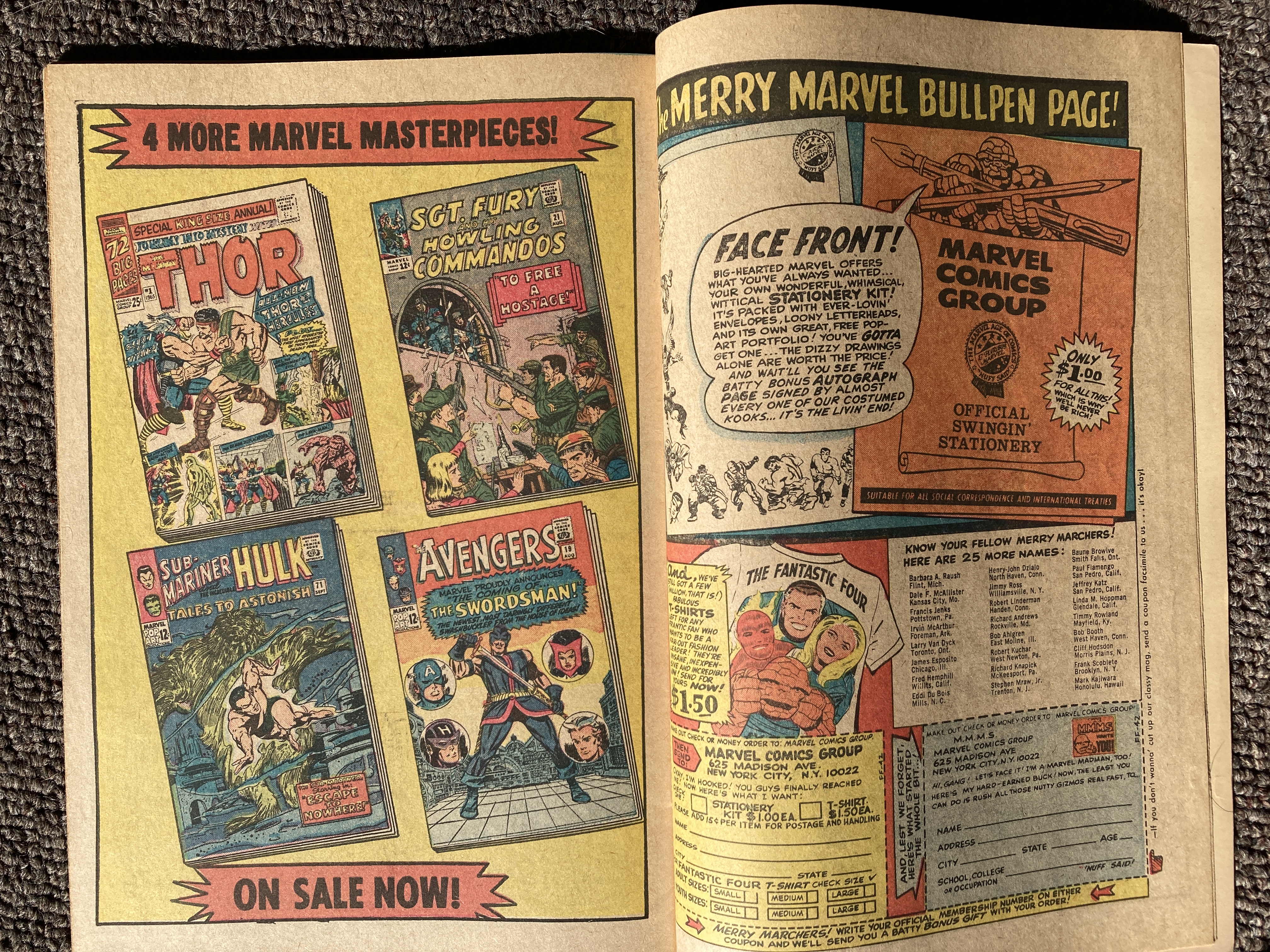
Fantastic Four 42 also happens to be an issue I own, which means we get to check out some non-story elements of the comic. First up, some house ads and the Bullpen Page:

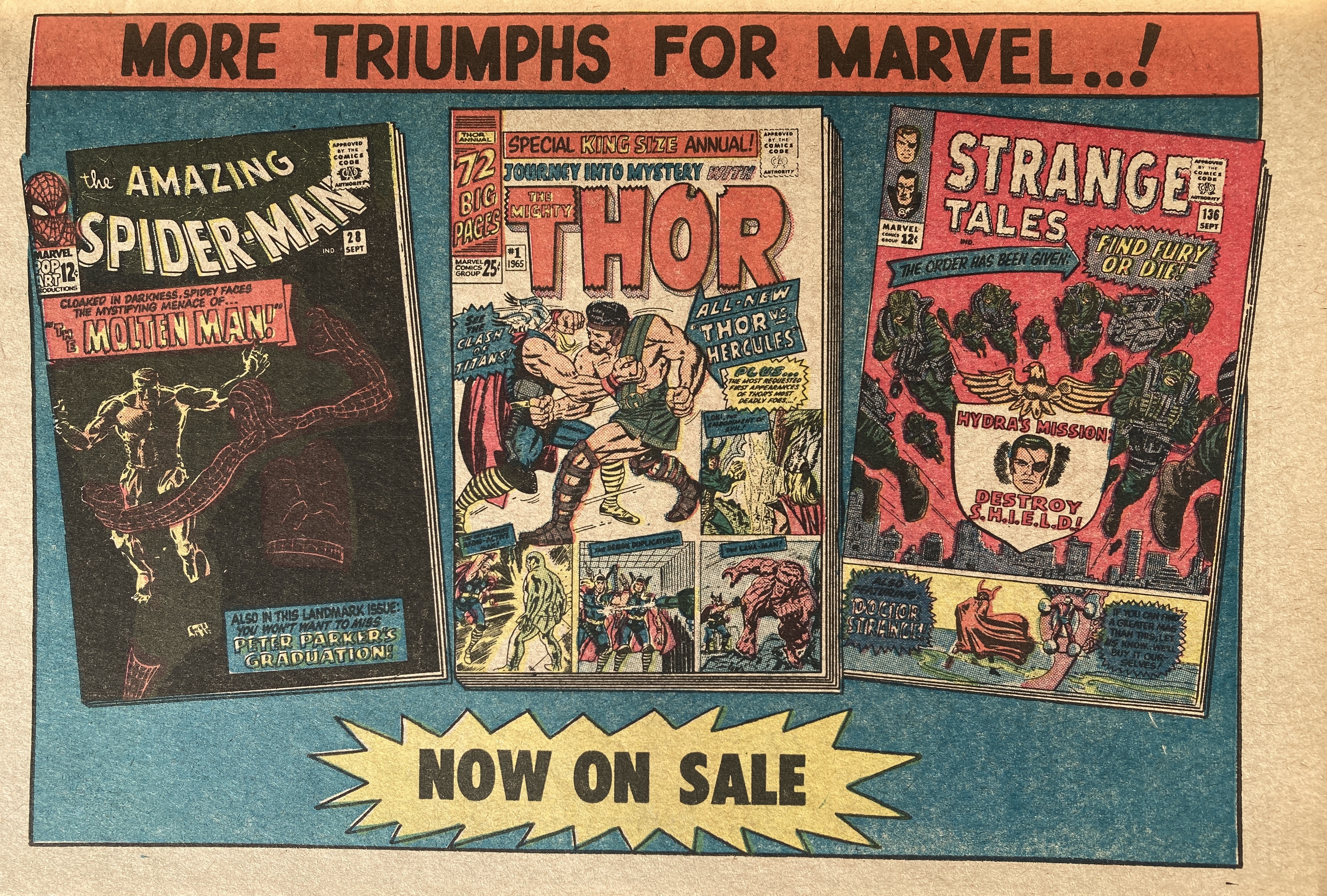
Another house ad (that Thor Annual was so good it was plugged twice!):

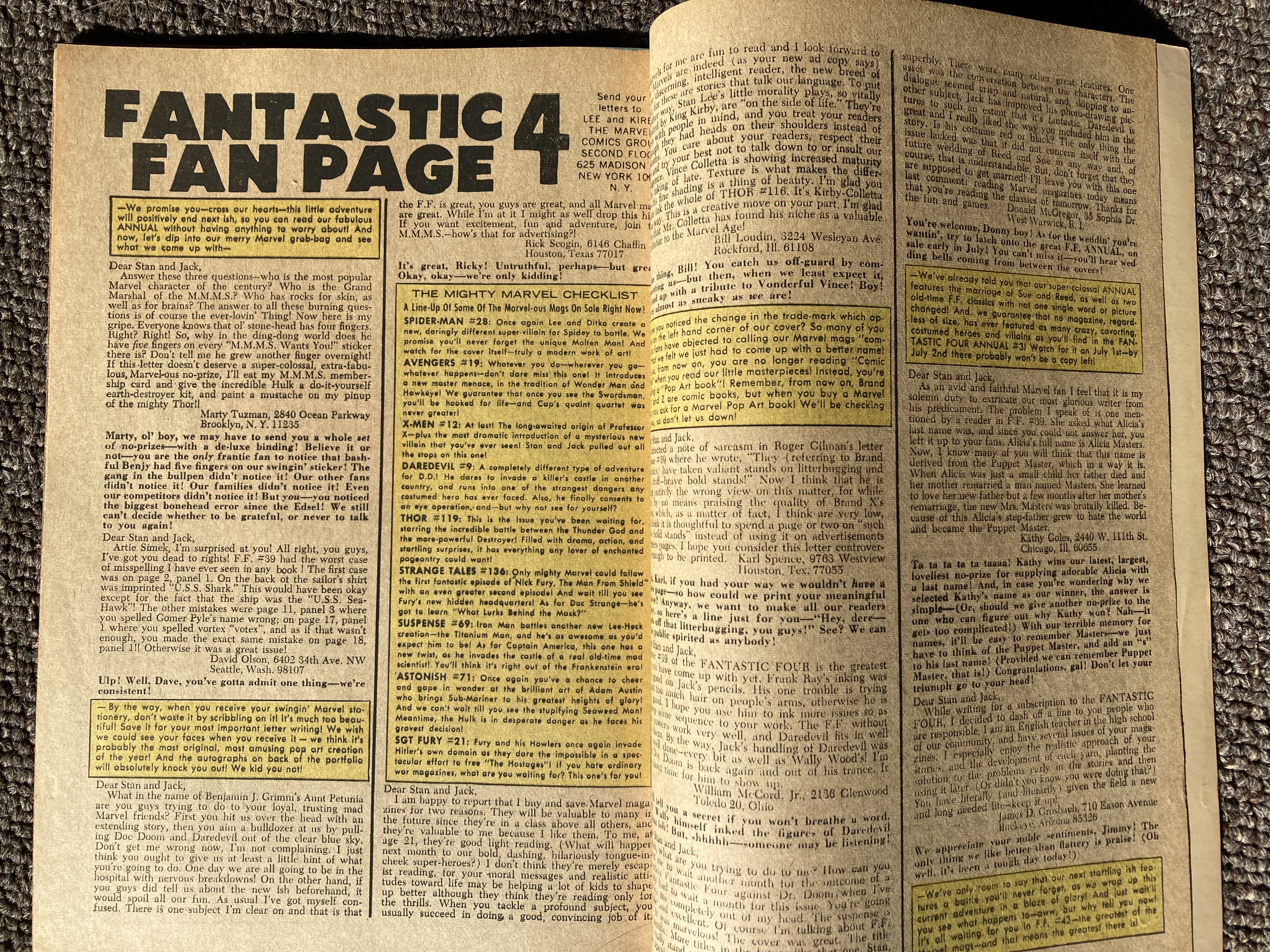
The letters page (two pages!). I learned here that a fan gave Alicia Masters her last name. No celebrity letters though.

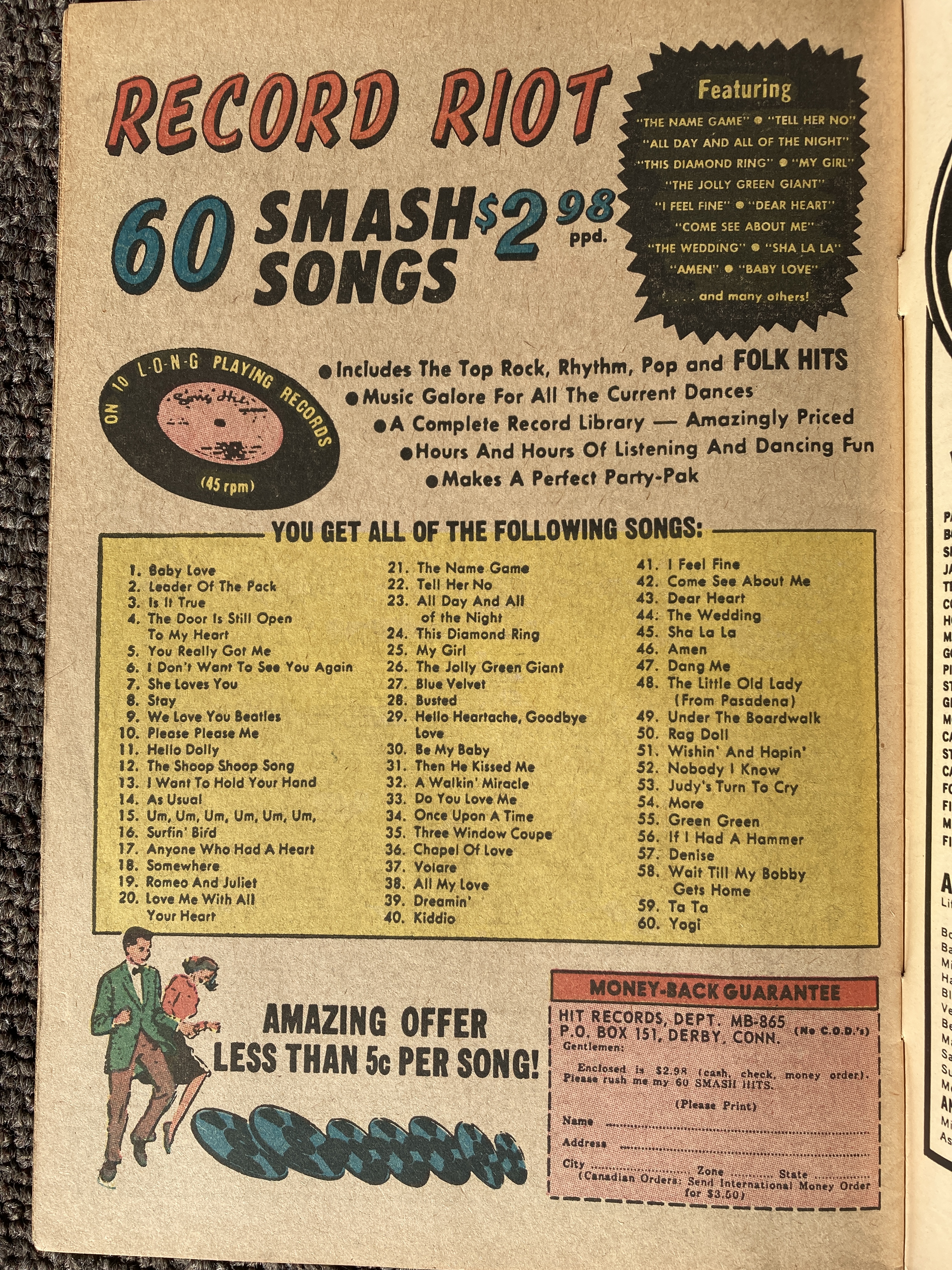
And finally a real ad. I could probably write a whole post dissecting this ad and what it says about popular music at this point of 1965.

The incredible Mr. Fantastic

There’s a lot of excellent stretching action in this comic. Here, Reed puffs up like a blowfish:

And here, he makes a slingshot out of his fingers:

Signed, Stan

Is this the first signed editors note? It can’t recall seeing this before.

Oops

Is this a goof? it looks like Stan might be covering for Jack to explain why Medusa and the Trapster aren’t incapacitated (either way, it’s pretty clunky writing):

Deus ex machina

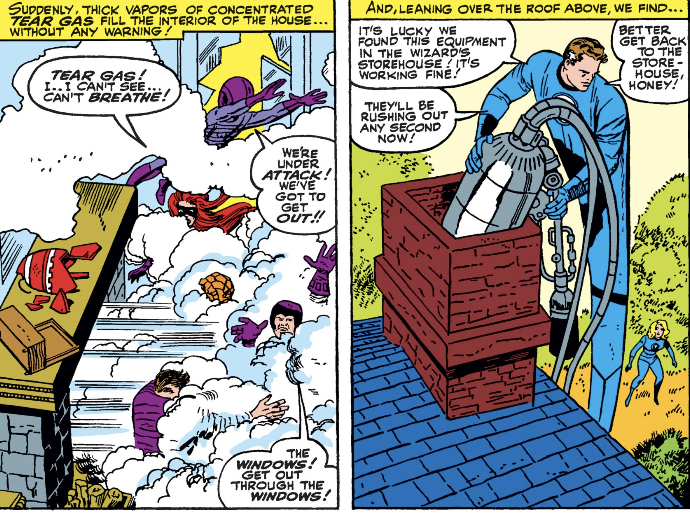
I guess if anyone is going to keep canisters of tear gas in their storage shed, it’s going to be a super villain.

The sixties are slightly less sexist

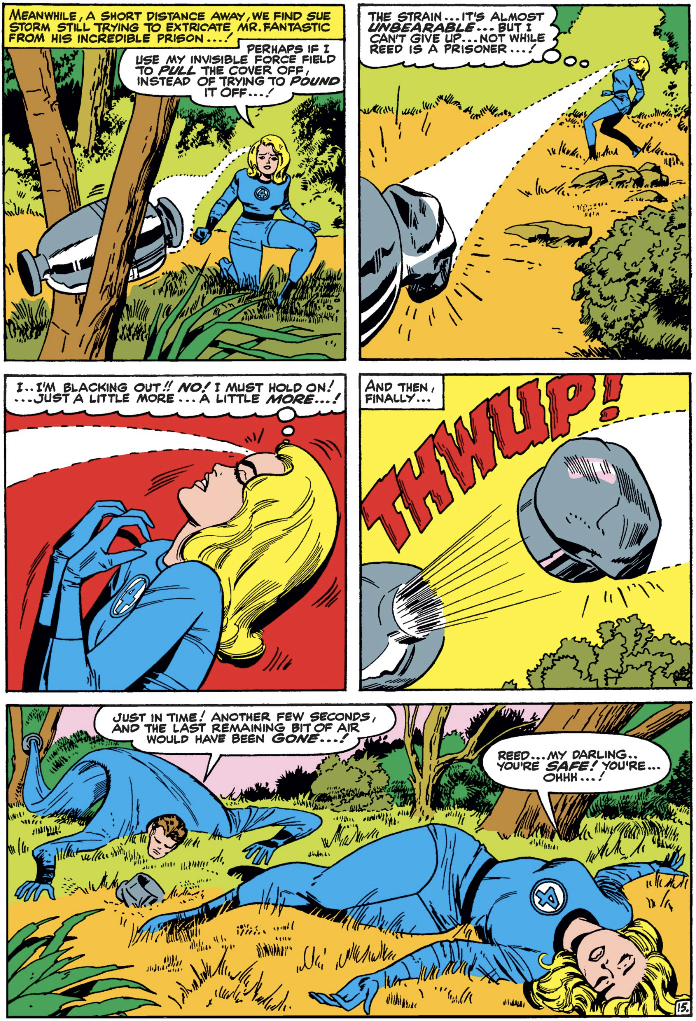
Sue rises to the occasion here, although opening a jar still wipes her out.

Dig that Kirby Krackle

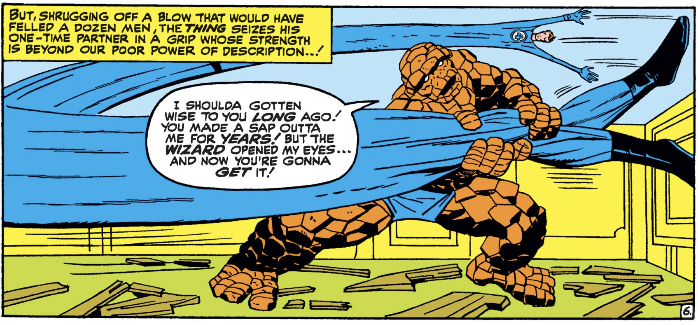
An all fight issue means fewer opportunities for Jack to really shine, but there’s some fun panels of Ben and Reed battling:

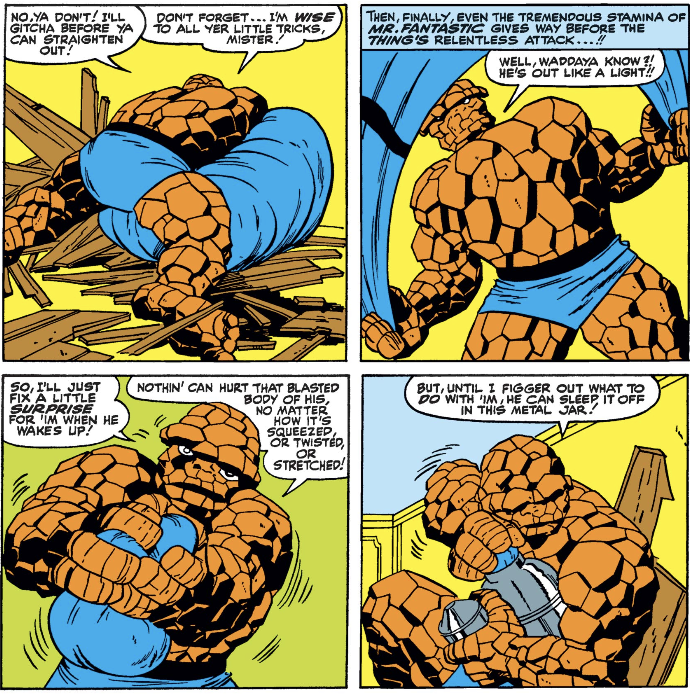
which eventually ends like so:

Next issue: The conclusion!

“The World’s Greatest Comic Magazine” Fantastic Four No. 41

Tags

, , , , ,

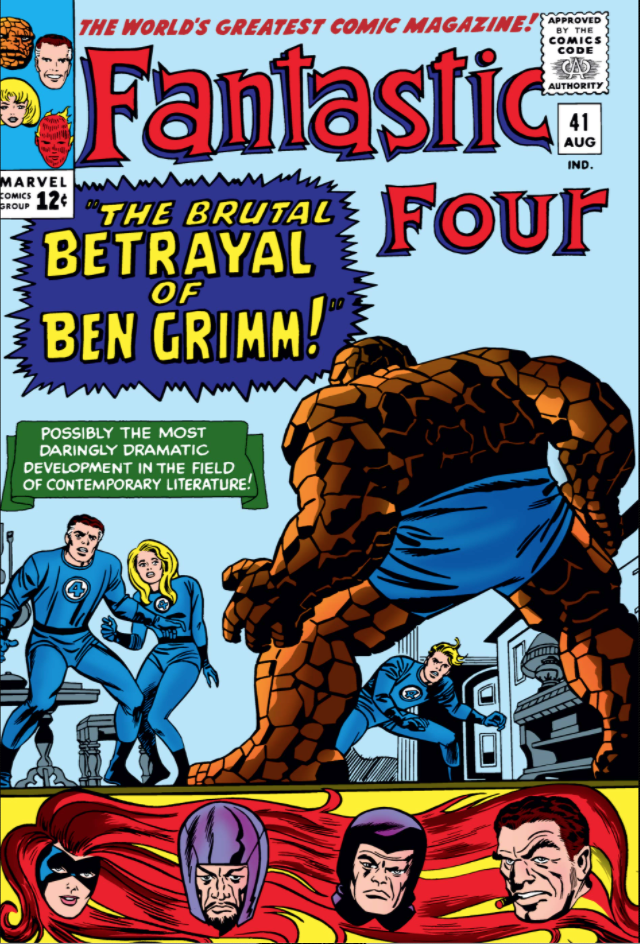
Fantastic Four 41
“The Brutal Betrayal of Ben Grimm”
Published: May 1965
Story: Stan Lee & Jack Kirby
Script: Lee
Pencils: Kirby
Inks: Vince Coletta
Letters: Sam Rosen or Art Simek
Cover: Kirby and Frank Giacoia

Synopsis

Continuing a new approach from Stan and Jack, Fantastic Four 41 picks up where FF 40 left off, and is the third consecutive issue to start this way. After Mr. Fantastic reverted Ben from his human form back into the Thing in order to defeat Dr. Doom, Ben, in the last panel of the previous issue, quits the team out of anger and frustration. FF 41 picks up with him leaving, even as the Human Torch beg him to reconsider. Exhausted after his battle with Doom, Ben collapses in the back of a pickup (“I dunno where this pickup is headed for .. but as long as its headed away from the Baxter Building it’s OK with me!”), and tumbles out on to a road in rural New Jersey. His sleeping form is then collected by the Frightful Four who—coincidentally!—are holed up in a house nearby. After much squabbling, the Frightful Four under the leadership of the Wizard manages to brainwash Ben.

Meanwhile, the rest of the team becomes worried and starts searching for Ben. After hearing he was spotted on a New Jersey road, the team investigates, and eventually comes to the house of the Frightful Four. The teams battle, and with the help of the Thing, the Frightful Four subdues the Fantastic Four. The issue ends with another cliff hanger, with the Frightful Four convincing the Thing to kill his former teammates.

What’s going on here?

This is an interesting issue, in part because it’s the opposite of the former standalone, one-and-done storytelling that pretty much dominated the first three years of the Fantastic Four. This is very much a serial narrative unfolding over multiple issues, centered on the Thing’s loyalties and identity. This isn’t the first time he’s wrestled between resenting Reed and the others for his monstrous form, and the sense of purpose and family he derives from the team—it was part of the first issue—but it’s the most developed exploration of the theme to date. And as we will see, it will return again and again.

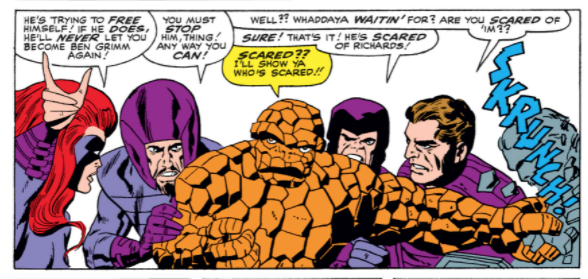
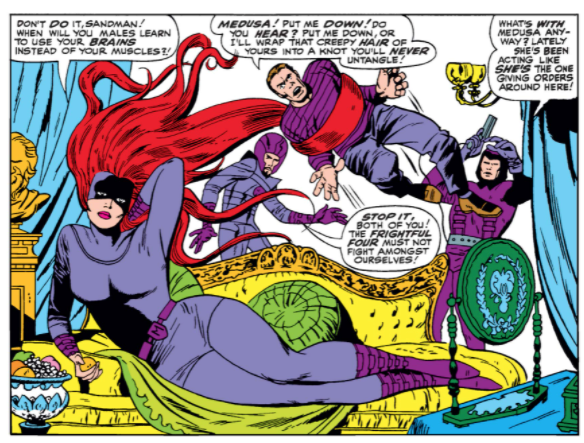
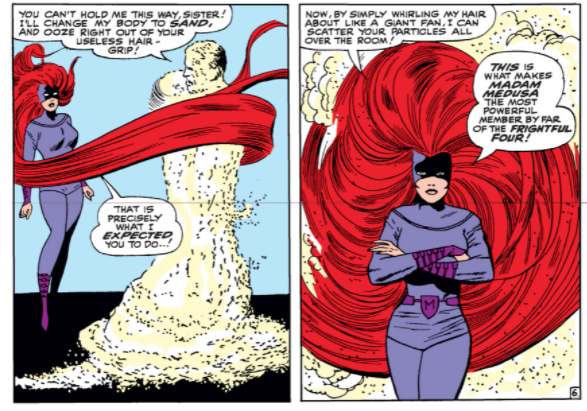
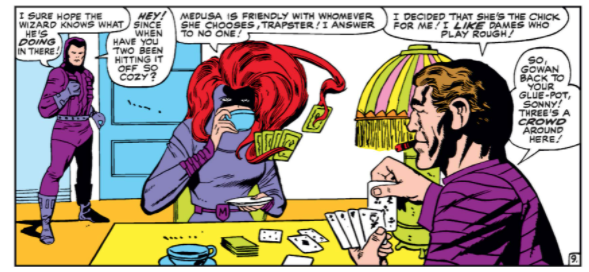
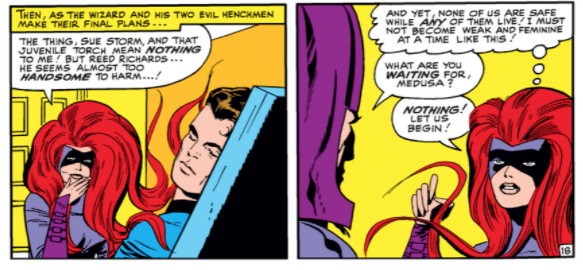
The story is also notable for its treatment of Medusa. Stan and Jack are clearly intrigued with her as a character, and have fun with her as she banters and battles with her teammates. This issue spends almost as much time with the Frightful Four as it does with the Fantastic Four, and Medusa is at the center of it all. I don’t know if at this point they had planned for her to become a hero and queen of the Inhumans, but it seems obvious she was meant for greater things.

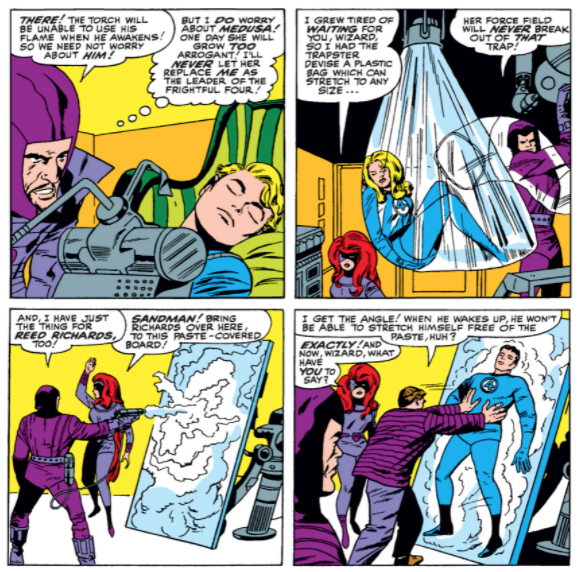
Incidentally, it’s never explained why she is wearing a mask. She doesn’t have a secret identity, so far as we know, and even if she did, I think the hair would be a giveaway. After bullying Sandman, they decided to hang out and play cards:

About those letters …

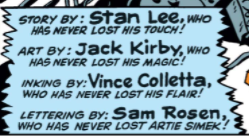
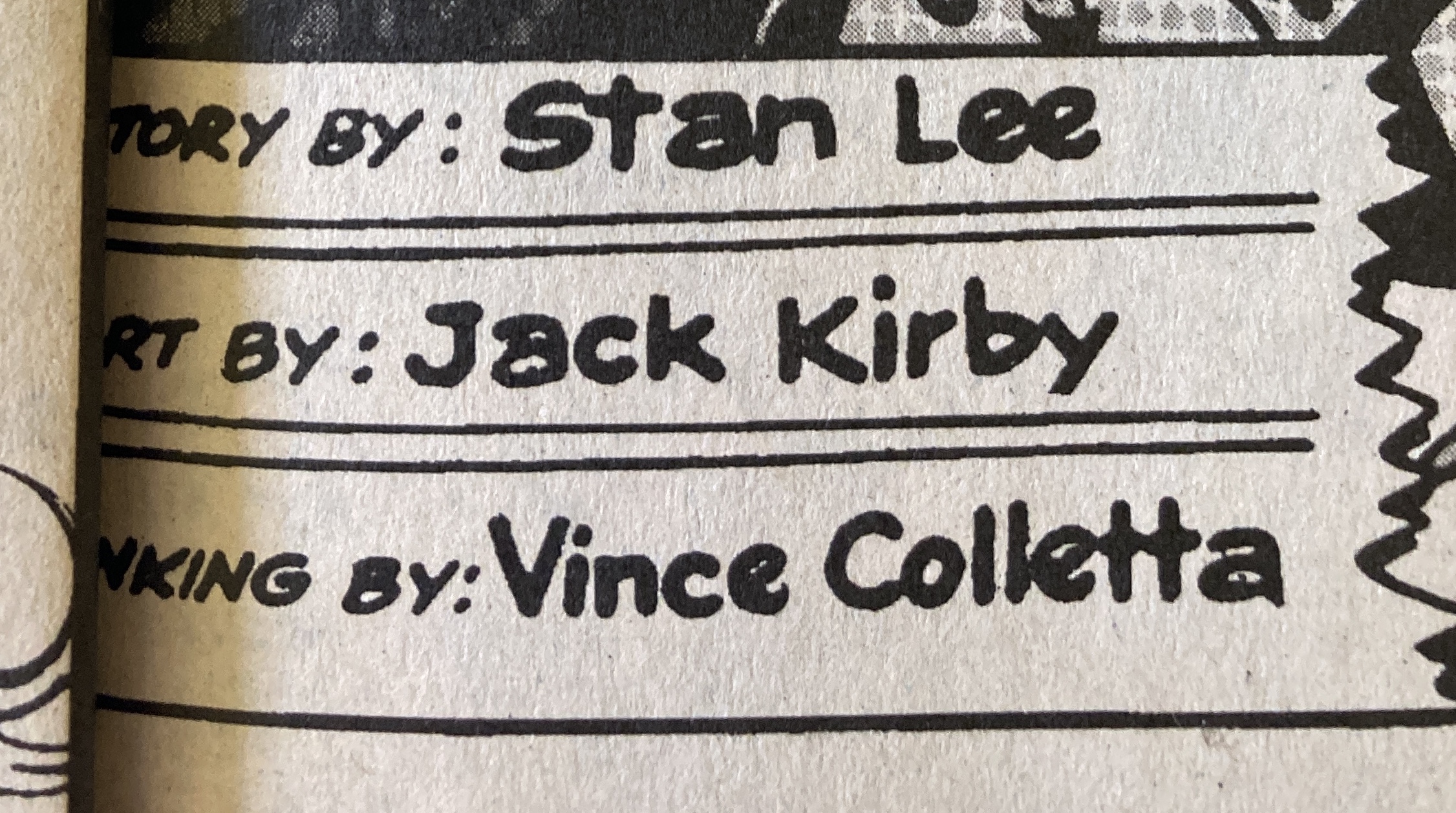
Who lettered FF 41? It’s either Artie Simek or Sam Rosen—between the two of them they lettered almost all of these early issues—but it’s not clear which one. While it’s not all that big a deal, the reason for the ambiguity is a bit mysterious.

The credits on the splash page of the version of FF 41 on Marvel Unlimited app are in the Krazy Kredits mode, and while it says Rosen is the letterer, Simek is mentioned:

But in the Marvel Essentials reprint from 2001, the credits are completely different (image taken by my phone camera), with no letterer listed:

What gives?

The Grand Comics Database and the Marvel Fandom wiki credits Rosen, but Mike’s Amazing World (usually my default for credits) doesn’t list either.

Unfortunately I don’t have the original issue, so I can’t check those credits. If anyone out there has it, I would love to know how it is credited. Also, I’m curious how the credits were treated in other reprints, like Marvel Masterworks, and the FF Omnibus (neither of which I have).

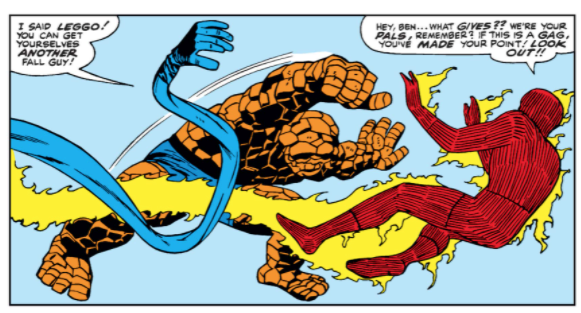
They’re fighting again

It’s been a few issues, but this time Ben is serious.

The sexist sixties

Even Medusa isn’t immune to Stan’s stereotyping of women.

Reed Richards is a jerk!

Plenty of sexism in these panels too, but Reed is really being awful.

Trapped

Once again, the FF are captured and each confined with a device to neutralize their powers. This is maybe the fourth or fifth time we’ve seen this device.

Don’t smoke, kids

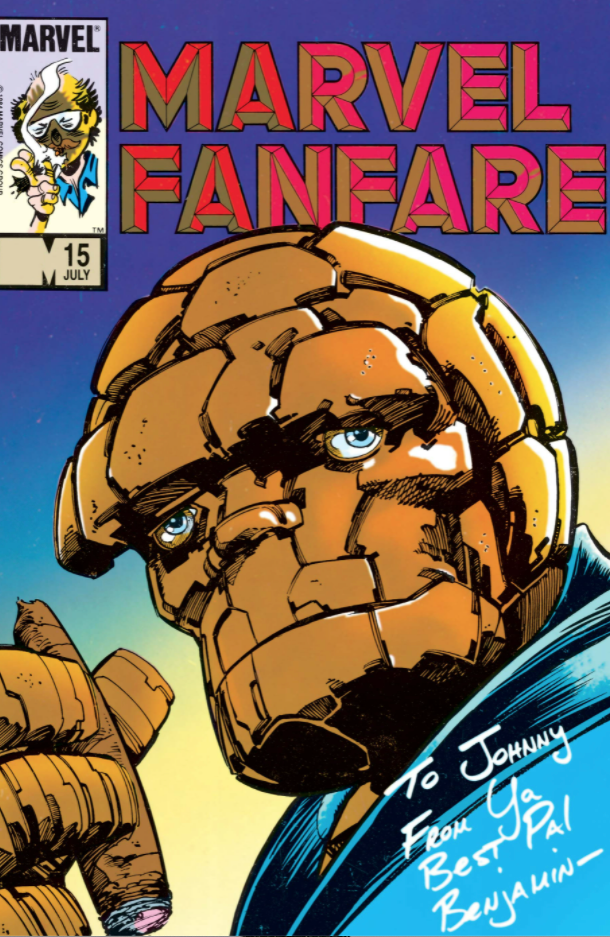
How do we know ben is brainwashed? He’s smoking a cigar!

Ben obviously smokes lots of cigars in future issues. I don’t know if this is his first taste of them, but it would be a fun project to go back through the first 40 issues to check. Meanwhile, here’s a great image of Ben with a stogie by the great Barry Windsor-Smith.

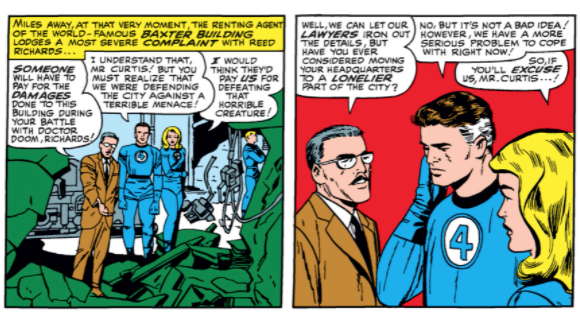
Real estate woes

The FF may not get their damage deposit back.

Hot roddin’

With the Fantasticar out of action, it makes sense for the FF uses alternative means of transportation. Why this was their only option isn’t explained.

Dig that Kirby Krackle

Sort of a subdued issue from the King (maybe due to the Colletta inks?) but this is a cool panel:

Next issue: The showdown with the Frightful Four!

“The World’s Greatest Comic Magazine” Fantastic Four No. 40

Tags

, , , , , ,

Fantastic Four 40
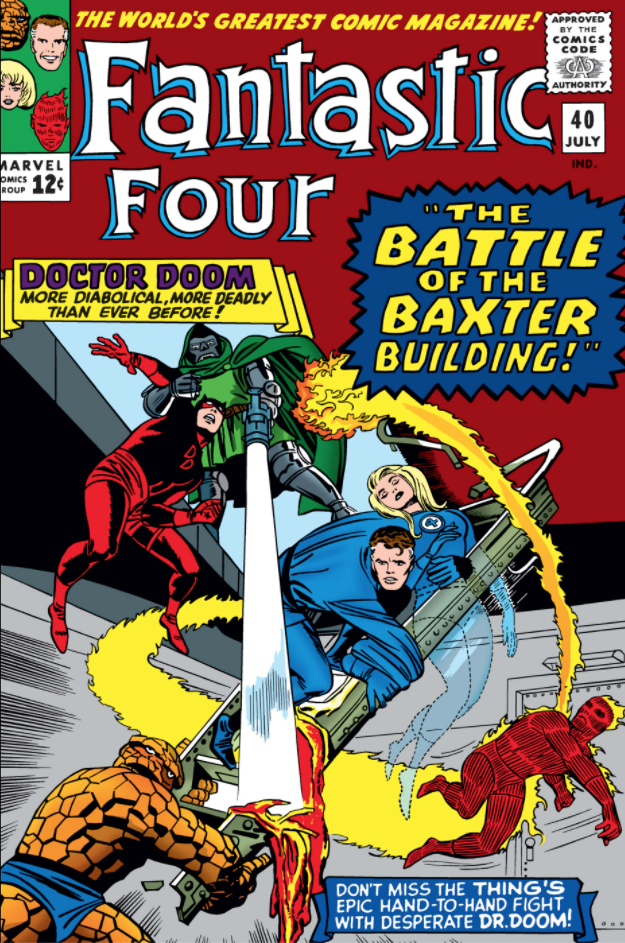
“The Battle of the Baxter Building”
Published: April 1965
Story: Stan Lee and Jack Kirby
Script: Lee
Pencils: Kirby:
Inks: Vince Colletta
Letters: Artie Simek
Cover: Kirby and Frank Giacoia

Synopsis

Fantastic Four 40 picks up where FF 39 left off, more or less, in one of the few multi-issue adventures so far. While Mr. Fantastic and Daredevil split up at the end of FF 39, now they’re working together again to battle Dr. Doom, who has taken control of the Baxter Building and is using Reed’s devices against the (literally) powerless team. While Daredevil acts as a distraction, Reed joins Johnny and Sue in evading the defenses in the Baxter Building lobby. They are eventually joined by Ben, in human, form and as Daredevil fights Doom, the team works their way up to the top of the building.

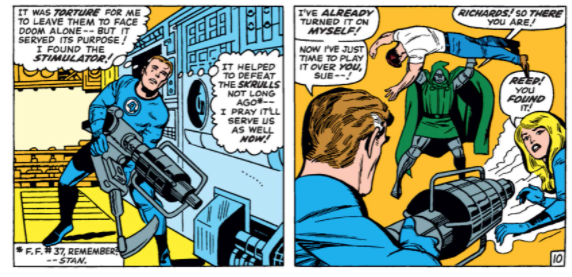
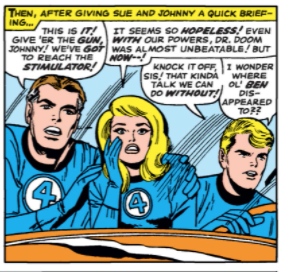
There Reed uses the power stimulator the team last used in fighting the Skulls, in FF 37, to re-power the team, including a reluctant Ben. One again the Thing, Ben then battles Doom single handedly, eventually tearing apart his armor. Before he can hurt or kill Doom, the rest of the team intervenes, and Doom slinks off in defeat. But as the rest of the team rejoices, a bitter Ben quits the team.

What’s going on here?

Another issue that’s pretty much wall-to-wall action, save for about three panels of character development at the end. There’s another (rare) guest appearance from Daredevil, but he fades into the background in the second half of the book. The Thing is really the star of this issue, and his battle with Doom takes up more than five pages. It’s another early version of a Thing-Doesn’t-Quit sequence, which becomes a defining part of Ben’s character. We saw a bit of it in FF 17, when Ben, in human form, penetrated Doom’s aircraft, and then in FF 25-26, when he fights the Hulk.

In this issue, Stan and Jack set up Ben’s story arc when Reed subjects him to the power stimulator, without giving him a choice in the matter.

His transformation is suitably dramatic, and Jack devotes a half splash to his return as the Thing:

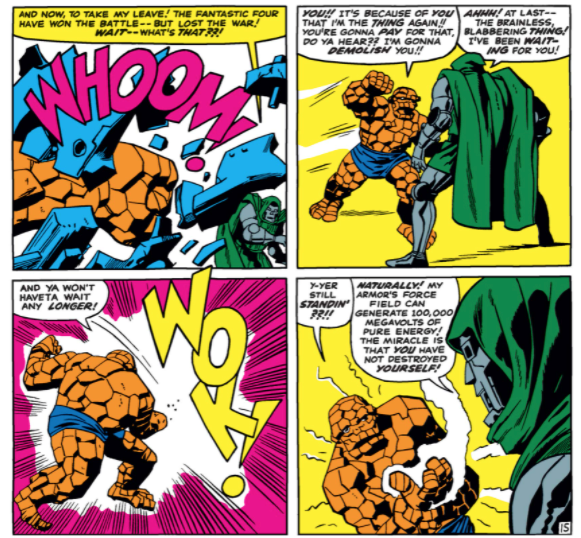
In the battle, we get some never-say-die from Ben:

Then, after he defeats Doom, he realizes what he has sacrificed and quits the team in disgust.

Deus Ex Machina

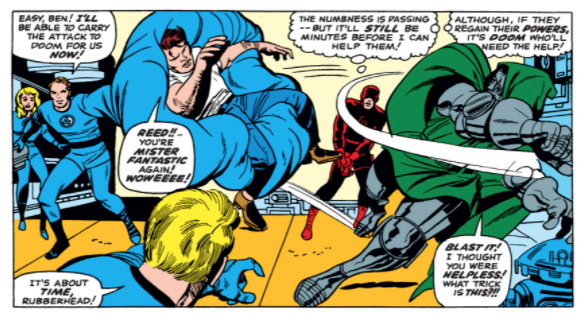
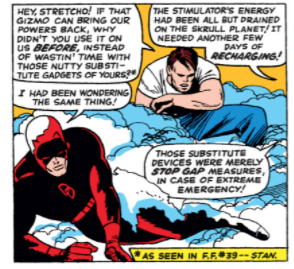
After all the angst last issue about the FF losing their powers, and Reed’s feverish attempts to reconstruct their power through artificial means, the are restored surprisingly easily. So easily, in fact, that Ben and Daredevil have the same questions we do.

Reed’s explanation falls a bit flat, too. If the stimulator was all they needed to regain their powers, why didn’t Reed just make a new one instead of building a Thing robot and a flaming flying suit for Johnny?

The sexist sixties

Sue is ready for her fainting couch again.

It’s (not) Clobbering Time!

Further evidence that his signature line really hasn’t been baked into Ben’s character yet. If ever there was a place to say it, it’s here:

Who’s the new guy?

Vince Colletta takes over the inking in this issue. Colletta is both of one comic’s most prolific inkers and most controversial, particularly for his sometimes slap-dash handling of Kirby’s work. It’s explained in great detail here. It’s hard to see a big drop off here from Franck Giacoia’s inks in the last issue, but we’re still just killing time before we get to Joe Sinnott.

Thicc Reed

Reed is noticeably buff in this issue. It’s not a particularly new development—Jack has been drawing him as a typically muscular super-hero for some time now—but it’s a pretty big departure from his tweedy, professorial look from the early issues.

Holy Billy Club, Daredevil!

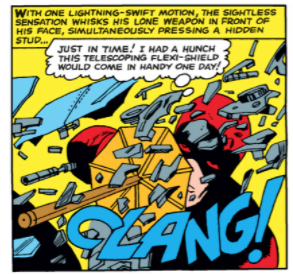
Daredevil’s billy club has more gadgets and gizmos that Silver Age Batman’s utility belt. In just this issue, it turns into a gun and a “telescoping flexi-shield.”

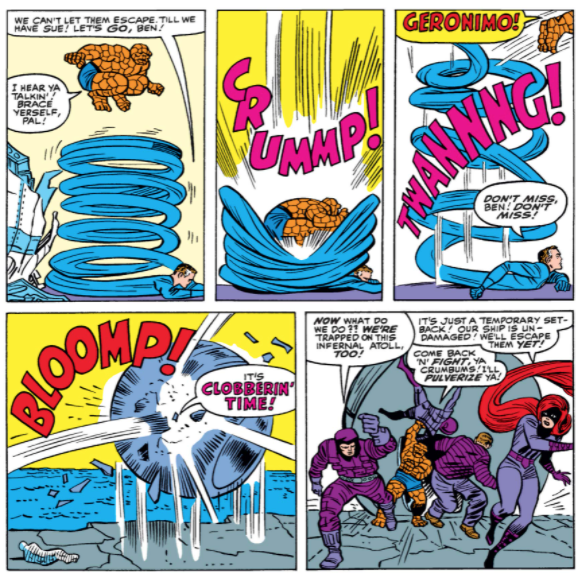
Twanggg!

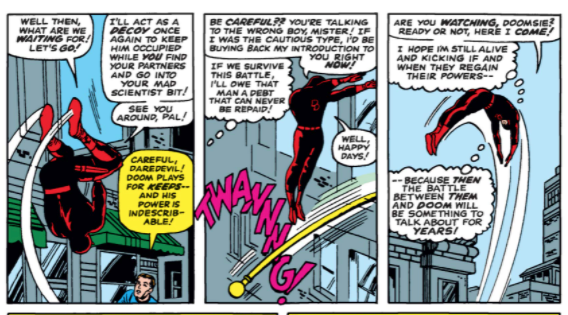
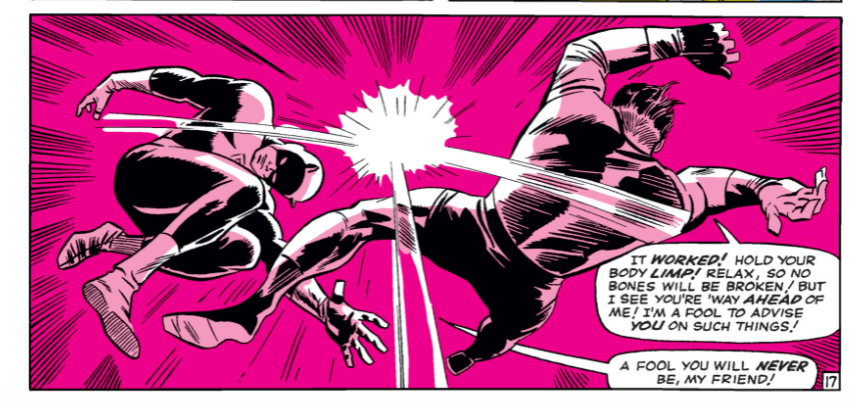
What could be more classically Daredevil than DD bouncing off of a flagpole?

Weird science

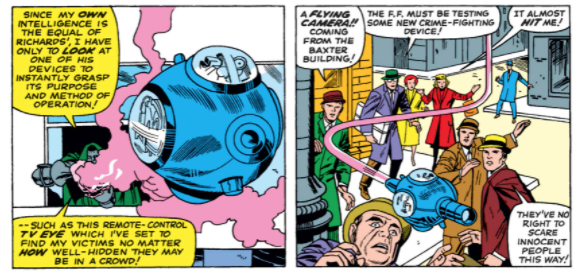
Reed invented … a drone.

Dig that Kirby Krackle

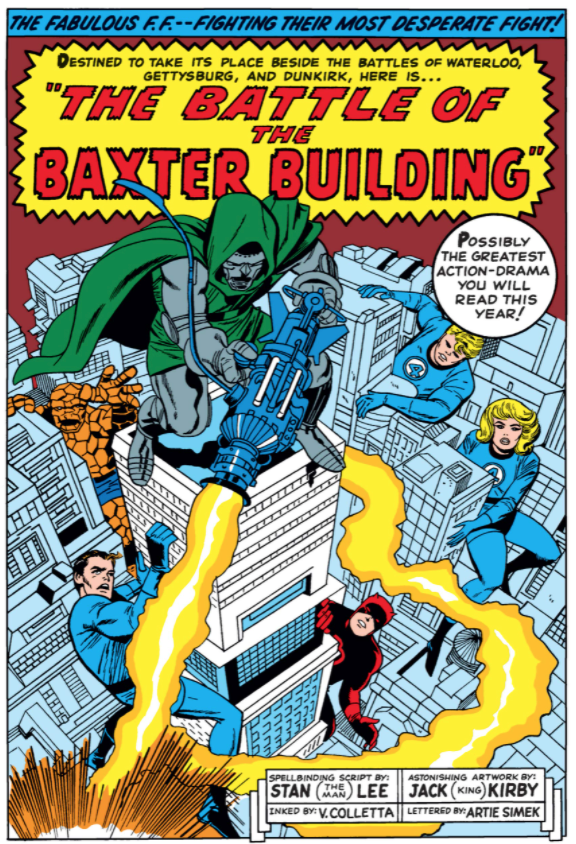
There is some great art in this issue, starting with the splash page (and check out Stan’s modest blurbing):

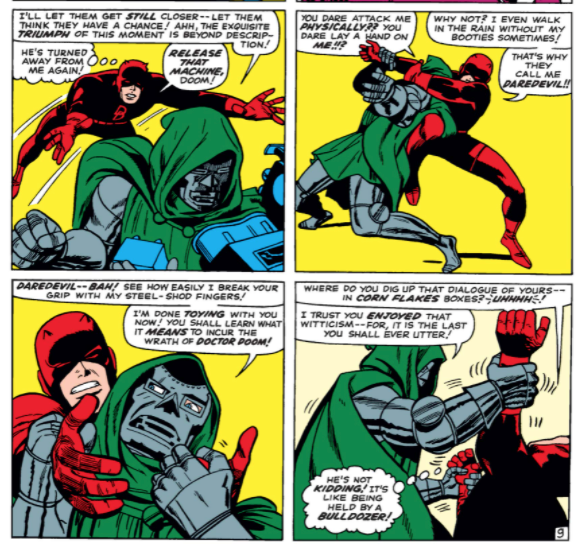
There are also some great fight scenes. Here’s DD vs. DD:

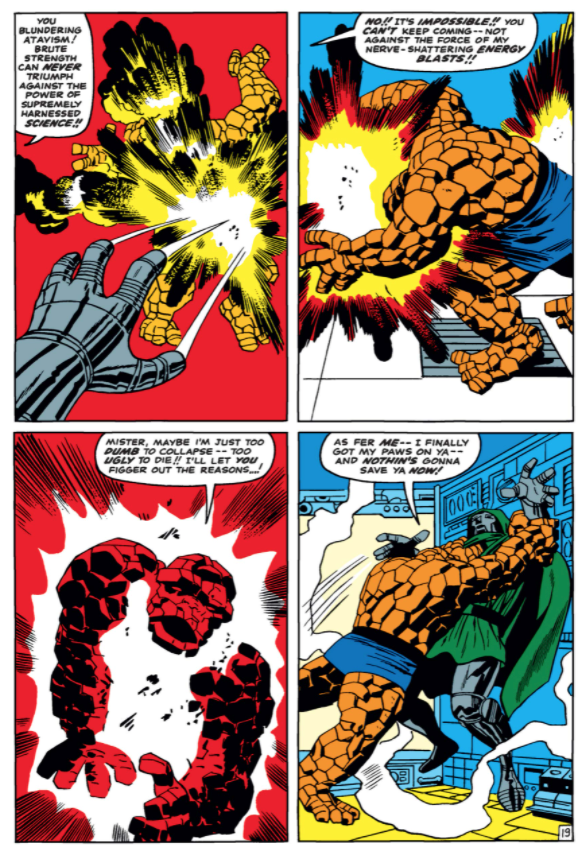
And Ben vs. Doom is just titanic:

Next issue: The return of the Frightful Four!

“The World’s Greatest Comic Magazine” Fantastic Four No. 39

Tags

, , , , , ,

Fantastic Four 39
“A Blind Man Shall Lead Them”
Published: March 1965
Story: Stan Lee and Jack Kirby
Script: Lee
Pencils: Kirby
Inks: Frank Giacoia (credited as Frank Ray)
Letters: Art Simek
Cover: Kirby and Chic Stone

Synopsis

Fantastic Four 39 picks up where FF 38 leaves of, after the detonation of the Frightful Four’s Q-Bomb leaves the FF floating unconscious on a raft and with the Thing reverted to human form. FF 39 opens with the team being rescued by a US Navy submarine, and realizing they have all lost their powers.

Back at the Baxter Building in New York, Reed builds devices to mimic the team’s lost powers, reasoning that the team will be vulnerable to its enemies if they were thought powerless. Meanwhile, in Latveria, a hypnotist causes Dr. Doom to remember being tricked by Mr. Fantastic into thinking he defeated the FF (as show in FF Annual 2). Doom vows revenge and flies to New York.

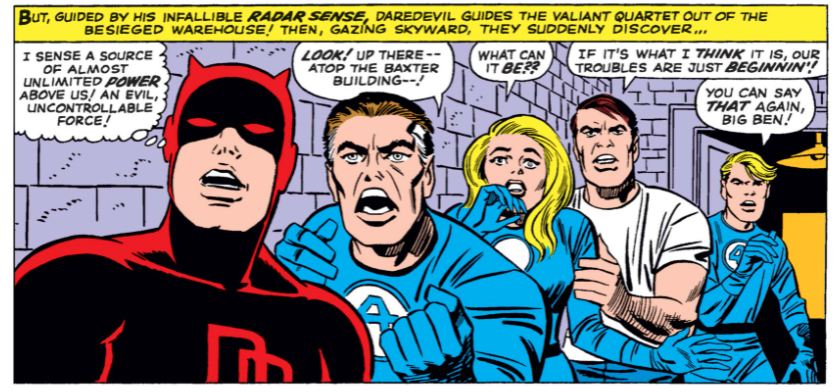
In New York, blind attorney Matt Murdock meets the FF at a warehouse where they are rehearsing their new devices. As Reed explains he wants Murdock to ensure the FF’s affairs are in order if something happens to them, the warehouse is attacked. Murdock quickly changes in his Daredevil costume and helps the FF evade the attacks from Doom, who has seized control of the Baxter Building and is using the FF’s devices against them. The FF scatters and Daredevil draws Doom’s fire on the streets of New York. The issue ends with another cliffhanger as the powerless FF plans their assault on the Baxter Building.

What’s going on here?

There’s a lot going on in FF 39, although not necessarily what you might expect. While readers of last issue’s cliff-hanger ending might have reasonably anticipated a showdown with the Frightful Four, those villains aren’t even mentioned. Instead, we’re off on a new adventure with Doom. The FF’s powerlessness is the big event in this issue, and it’s framed as a major disaster for the team, even for Ben who might otherwise be pretty happy not to be the Thing again. It sends Reed into a inventing frenzy, and gives Jack an opportunity to whip up some fun devices.

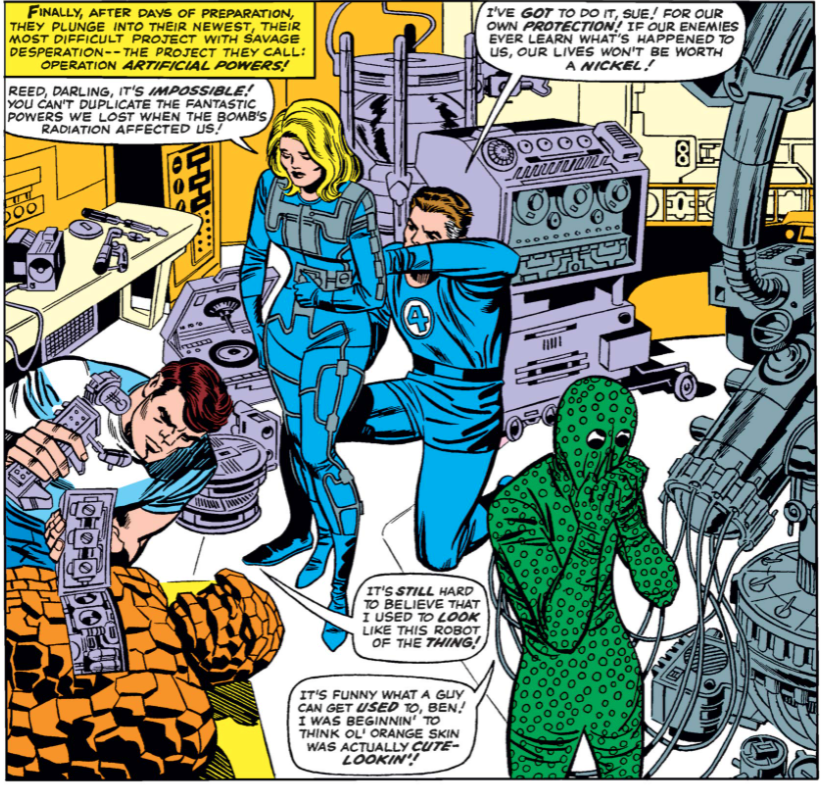
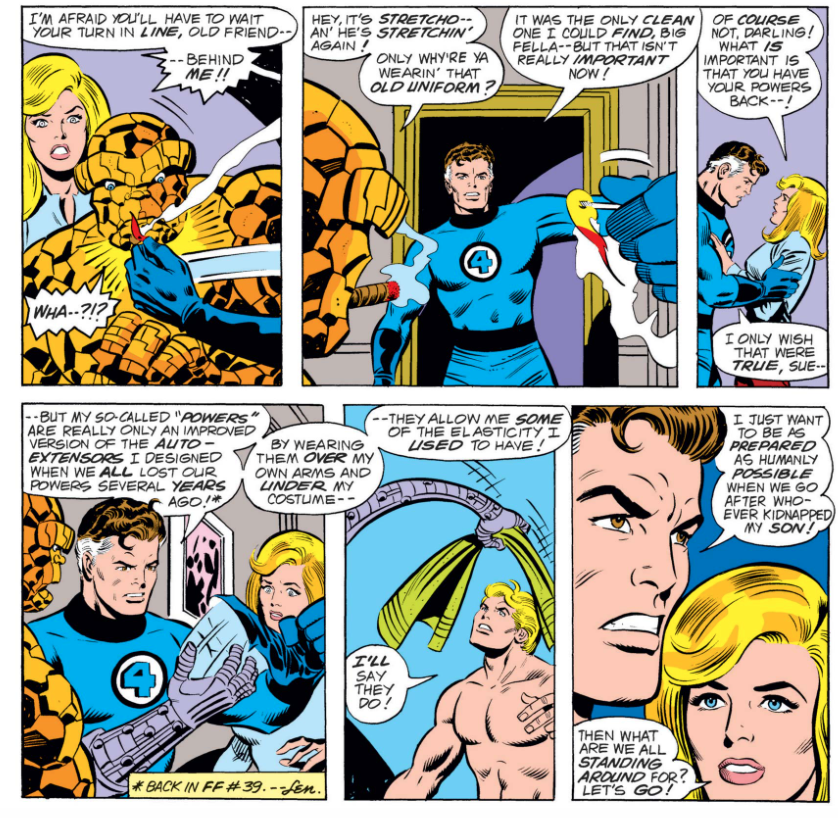
While the FF’s need for these mechanical powers is short lived (I assume!) Reed’s artificial, extendable arms reappear in FF 185, when he again has lost his powers.

FF 185, from 1977 (written by Len Wein, art by George Perez and Joe Sinnott)

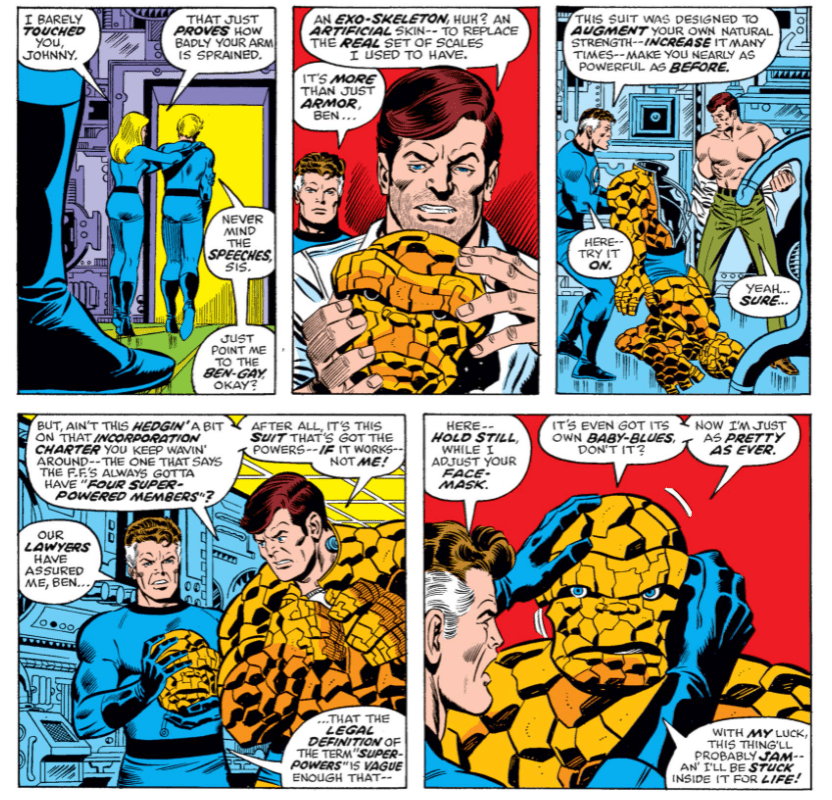
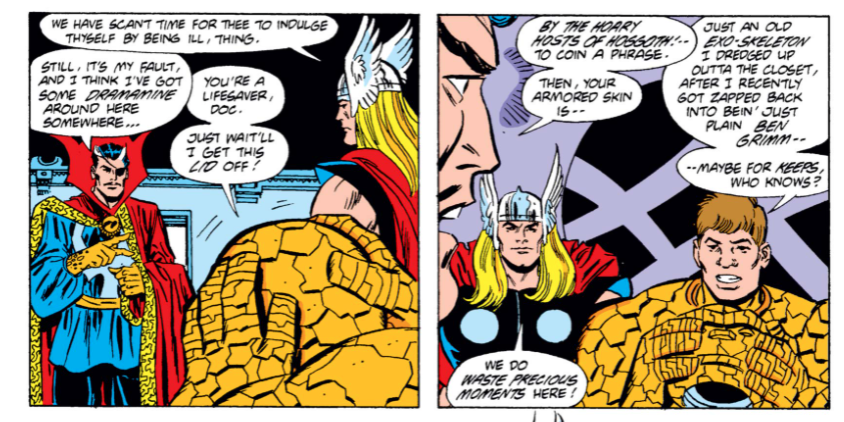
The Thing robot doesn’t reappear, but it’s a precursor of a Thing exo-skeleton worn by Ben and others on numerous occasions.

Thor Annual 14, 1989 (Roy Thomas/Al Milgrom/Don Heck)

At various points, all the members of the FF have lost their powers, although the only other time I am aware of them all being powerless was in a 1982 What If? by John Byrne, which imagines the team as a Challengers of the Unknown-type team of adventurers.

About that cover

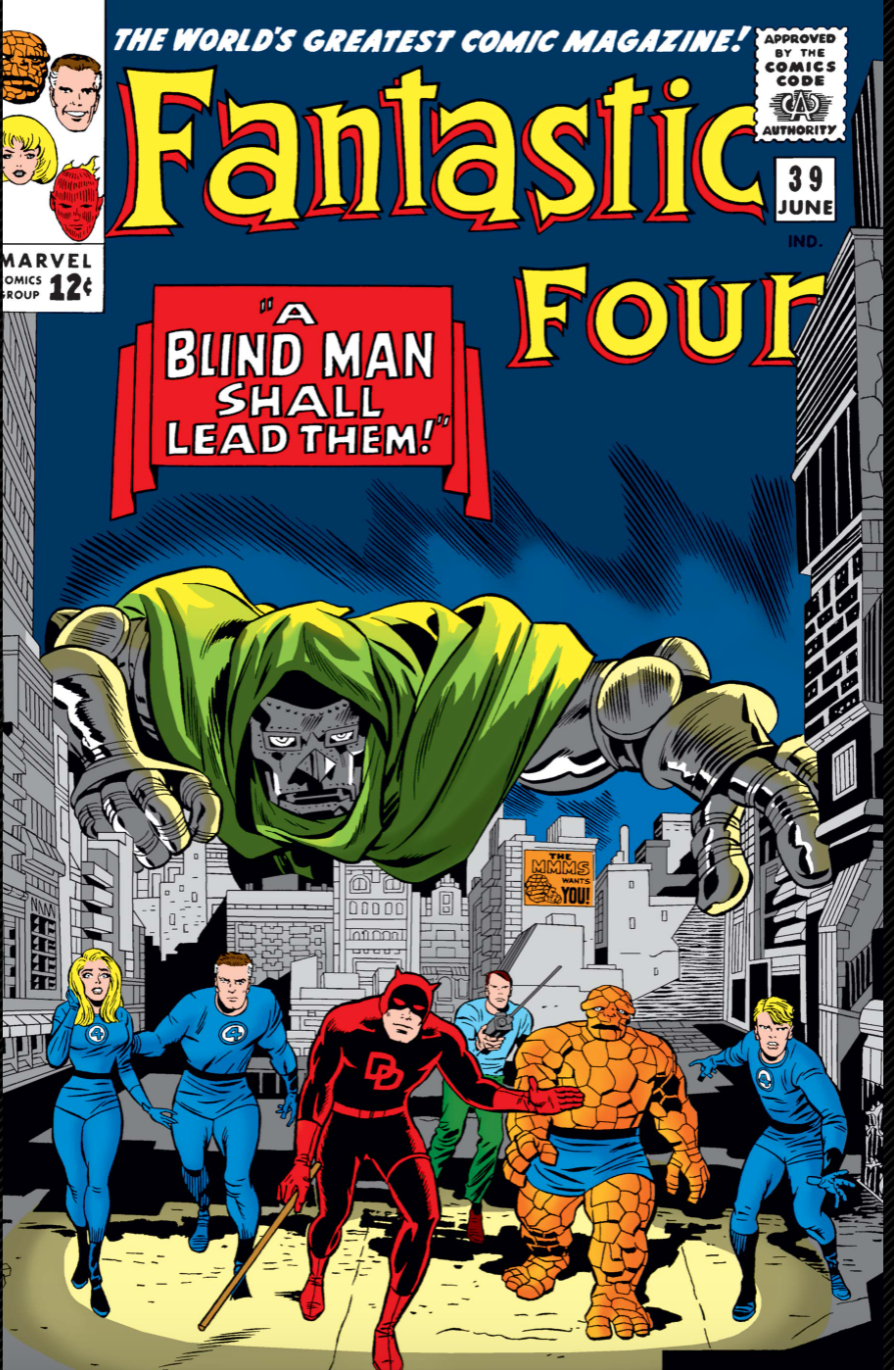
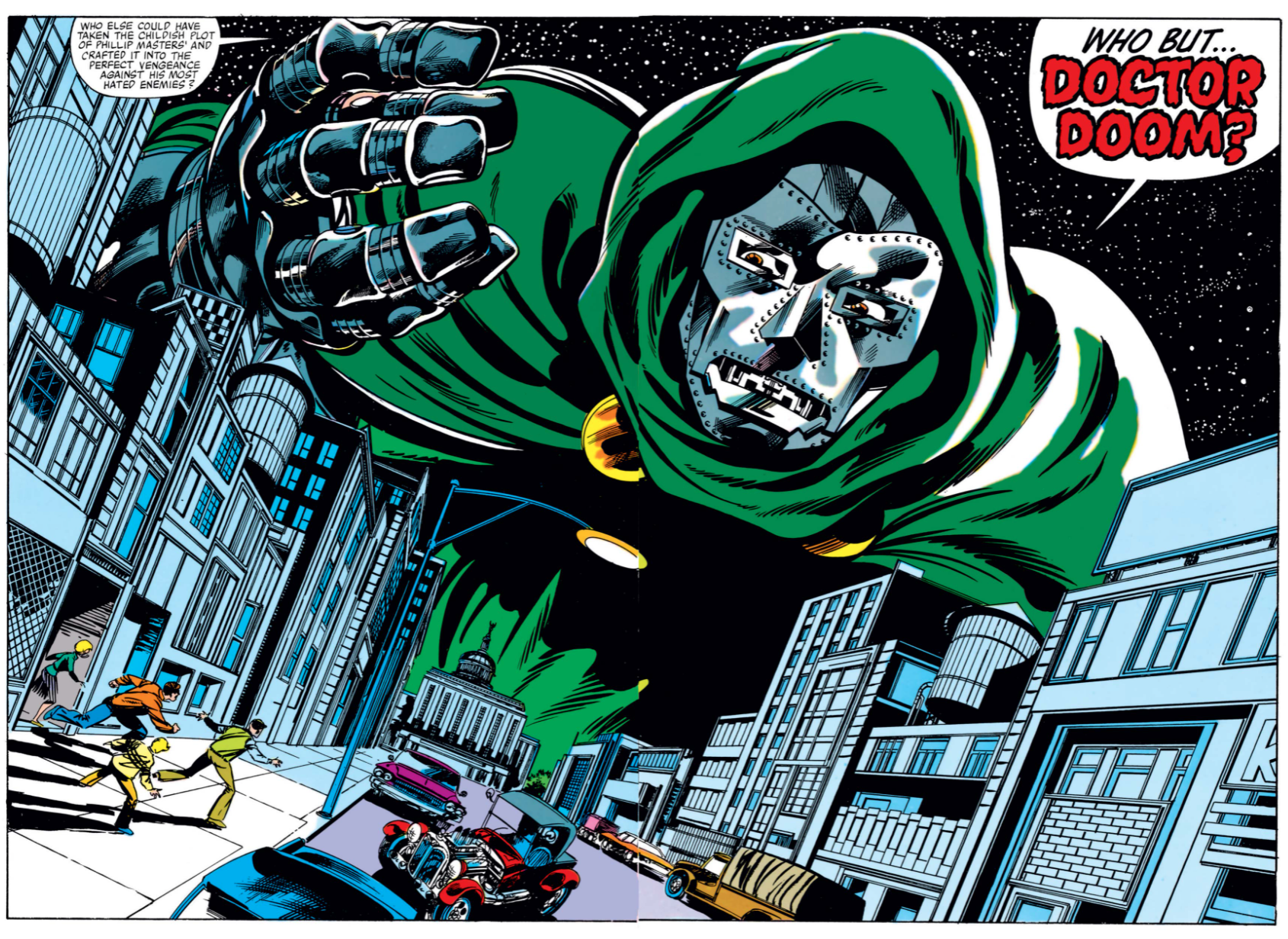
If the cover of FF 39 looks familiar, it’s because it’s been frequently homaged (or swiped, depending on how charitable you’re feeling). Here’s a handful of homages just with Doom (including one from Kirby himself):

And while it’s not a cover, this double-page splash from Byrne in FF 236 is a literal interpretation of the cover metaphor, since the FF in this issue has been reduced to tiny size.

Get me my lawyer

Daredevil makes a rare guest appearance in the FF. Unlike Spider-Man, who is in dozens of issues and eventually becomes a team member, DD shows up only sporadically. This appearance slots between Daredevil issues 6 and 7 and was doubtless an opportunity for Stan to goose DD’s sales. This is technically their second meeting, after Matt Murdock was hired at their lawyer in Daredevil 2.

Daredevil 2, 1964 (Lee/Orlando/Coletta)

Who’s the new guy?

FF features inks by Frank Giacoia, a longtime comic artist with credits that date from 1942 to 1987. He was a regular inker on Daredevil and later on Spider-Man but inked the FF only a few other times after this issue. Here he is credited as Frank Ray, which FF fans might recall is very similar to Frankie Raye, the name of the Human Torch’s girlfriend in the 1980s before she became Nova and a herald of Galactus. Is there a connection? Knowing John Byrne’s obsession with these early issues of the FF, I would bet on it.

Krazy Kredits

Reed Richards is a Jerk!

Reed doesn’t care about your feelings.

Dig that Kirby Krackle

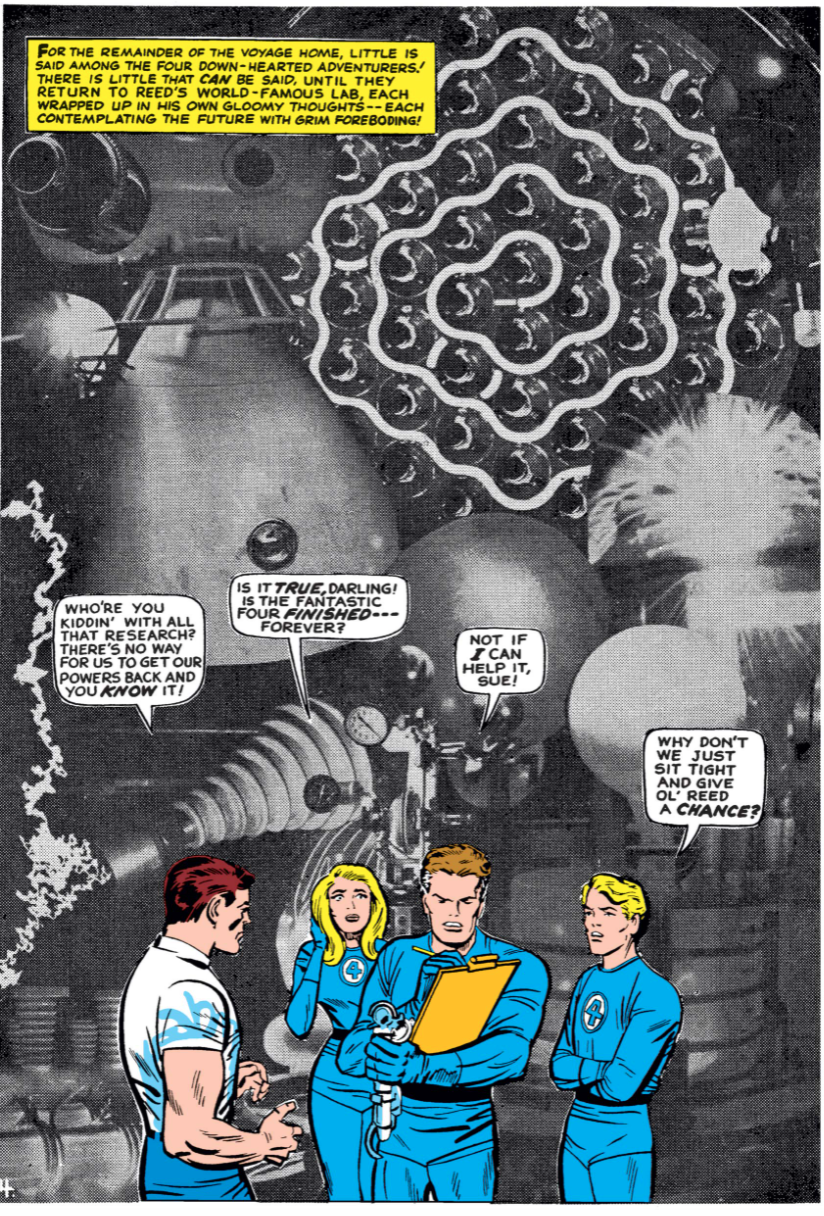
FF 39 features another photo collage, although I’m not sure this one is as successful as the previous, cosmic ones.

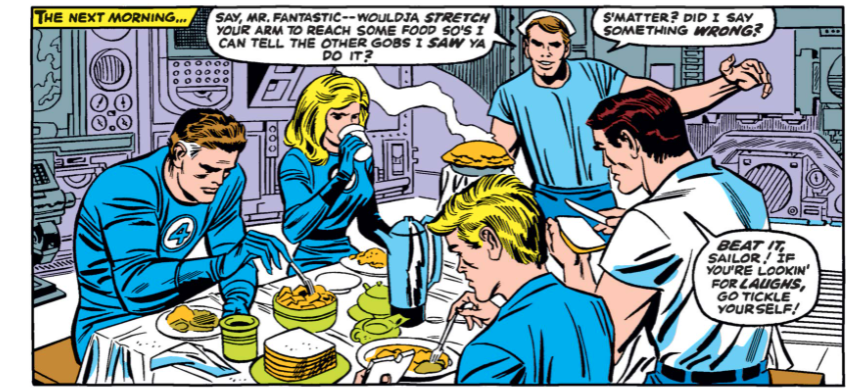
This is a great image of the FF after losing their powers. The body language says everything.

Another cool panel.

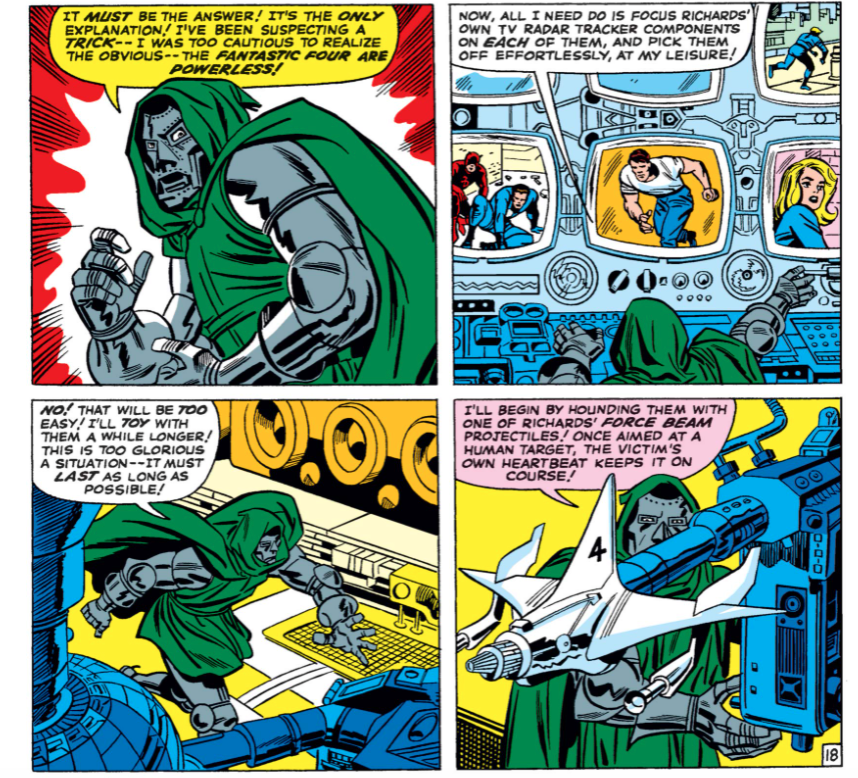
And Doom with Reed’s gizmos in the Baxter Building:


Next issue: The Battle for the Baxter Building!

“The World’s Greatest Comic Magazine” Fantastic Four No. 38

Tags

, , , , ,

Fantastic Four 38
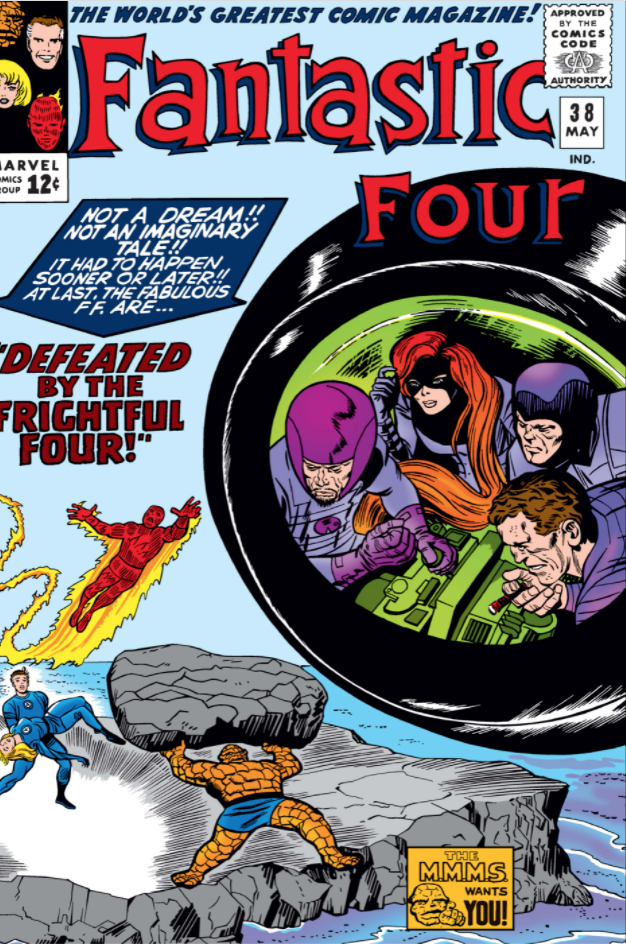
“Defeated by the Frightful Four”
Published Feb. 1965
Story: Stan Lee and Jack Kirby
Script: Lee
Pencils: Kirby
Inks: Chic Stone
Letters: Sam Rosen
Cover: Kirby and Stone

Synopsis

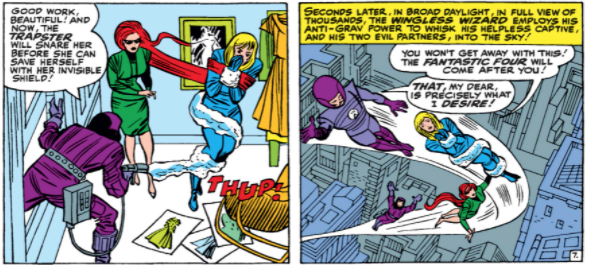
Fantastic Four 38 opens, as most issues do, with horseplay among the FF in the Baxter Building. We then cut to the Wizard, who is plotting the downfall of the FF with the rest of the Frightful Four. We return to Sue Storm, who is visiting a clothing boutique in advance of her wedding with Reed when she is taken hostage (yes, again) by Medusa and the rest of the Frightful Four.

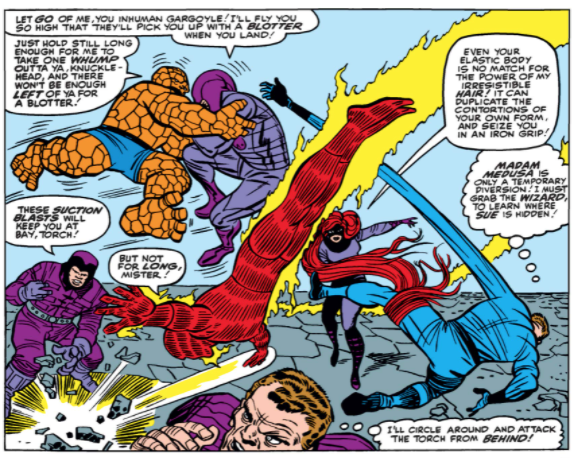
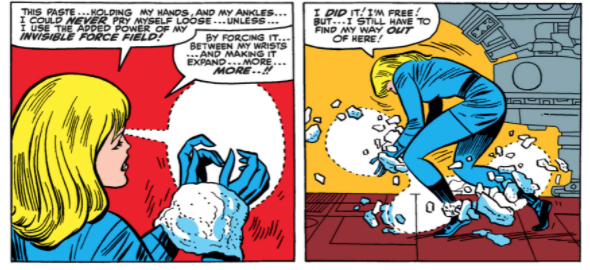
As the Frightful Four abducts her to a remote atoll, the Wizard reveals his plan to use her as bait for the rest of the team, who he will then kill with a “Q-Bomb.” A distraught Reed tracks the Wizard’s aircraft, and when it appears, the Human Torch pursues it before he is captured by the Trapster (formerly Paste Pot-Pete). Ben and Reed follow in the Pogo Plane to the atoll, where their plane is destroyed by the Trapster. The two teams battle, and while Sue frees herself and, with Johnny, is eventually rescued, the Frightful Four escape, detonating the bomb. In the last panel, the team appears to have survived thanks to the Invisible Girl’s force field, but the team is unconscious and Ben is returning to his human form.

What’s going on here?

Another slam-bang issue. There’s some fun hijinks in the beginning, but for the most part, this is an action-packed issue, leading to just the second cliff-hanger in the Fantastic Four to date (the last was in issue 25, when they battled the Hulk). It’s also the second appearance of the Frightful Four, who quickly become first-tier FF villains.

The comics is now at a sustained level of excellence. Even when the stories are silly, like last issue, the interplay between the characters and Kirby’s amazing art makes up for it. Stan and Jack are really hitting on all cylinders now, as we approach the mid-way point of their run and the legendary issues from about 44 to 60.

The sexist sixties

Sue is once again taken hostage or prisoner. By my count, that’s the 10th time in the first 38 issues (and two annuals) of the FF, so about once every four issues.

To her credit (I guess) she escapes on her own, but is so groggy she still needs rescuing.

Fun and games

This is a fun sequence, and is a great capsule introduction to the team, their powers, and their relationships with each other.

The Mighty Marvel Marching Society

For the second issue in a row, the Marvel fan club gets a shout-out on the cover.

That’s Mr. Trapster to you

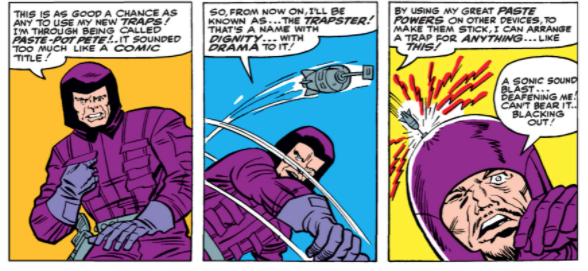
It finally dawns on him that Paste-Pot Pete is a ridiculous name.

It’s Clobberin’ Time

Just the fifth time Ben says it, but the second time in two issues. It’s becoming his signature. Also, it’s too bad that spring trick with Reed didn’t become a recurring feature like the X-Men’s Fastball Special.

Weird Science

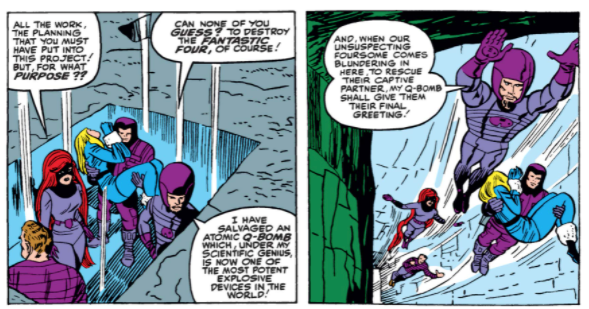
The Wizard has a Q-Bomb. What is a Q-Bomb? I have no idea, but apparently it’s an atomic bomb powered by quarks (maybe?)

(And yes, the Frightful Four are all dressed in purple)

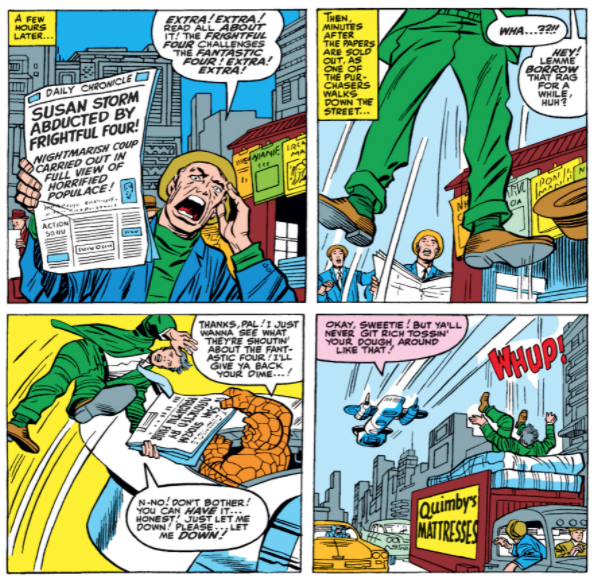
Read all about it

Once again, the power of print.

Dig that Kirby Krackle

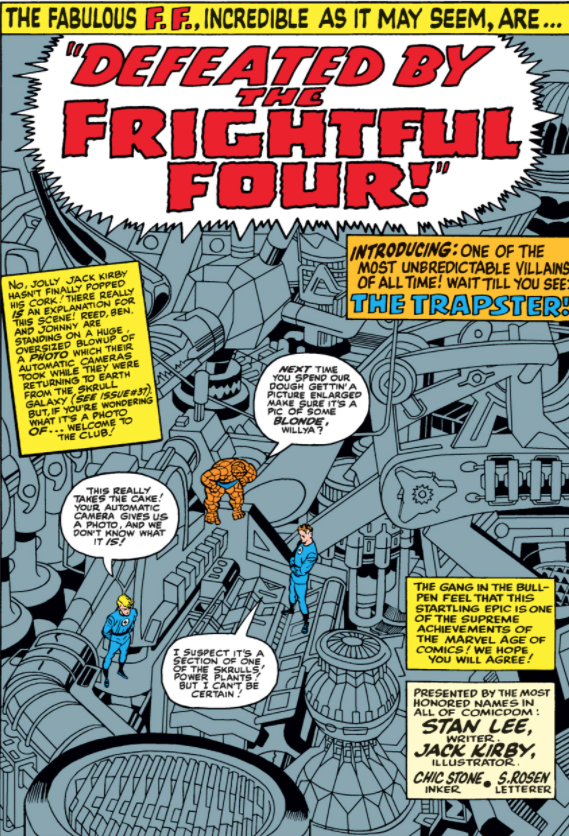
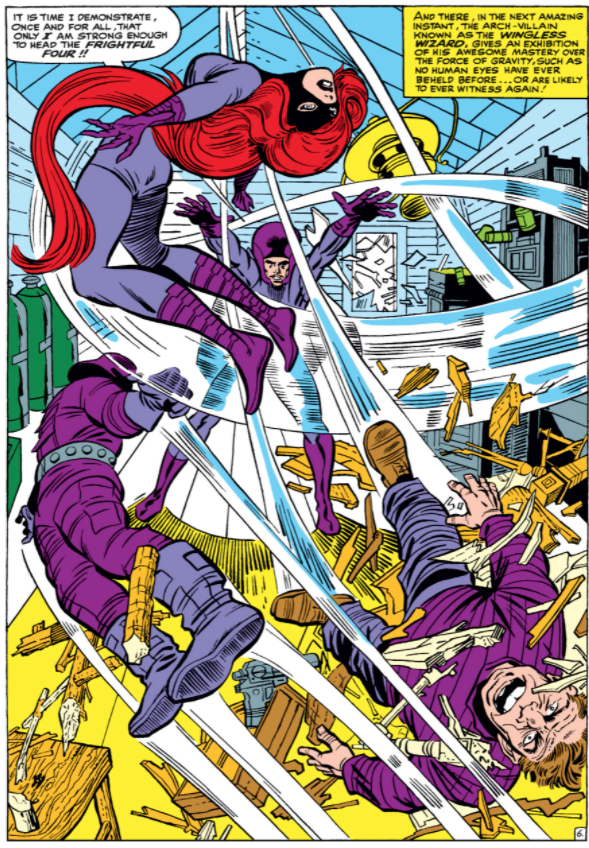
FF 38 features an astounding splash page, which unfortunately gets covered with too much copy.

Another great splash:

And this panel is pretty cool too:

Next issue: Dr. Doom— and Daredevil!

“The World’s Greatest Comic Magazine” Fantastic Four No. 37

Tags

, , , , ,

Fantastic Four 37
“Behold! A Distant Star”
Published: Jan. 1965
Story: Stan Lee and Jack Kirby
Script: Lee
Pencils: Kirby
Inks: Chic Stone
Letters: Artie Simek
Cover: Kirby and Stone

Synopsis

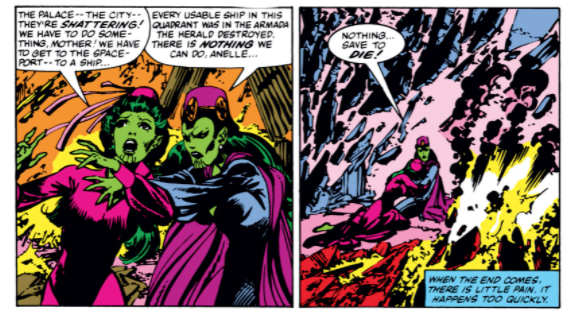
As usual, the issue opens with shenanigans at the Baxter Building, as Reed experiments with a Power-Ray that amplifies the Human Torch’s powers. The team is preparing for Reed and Sue’s wedding, but Sue confesses to Reed she is upset that her father, killed by the Skrulls in issue 32, remains unavenged. The story then cuts to the Skrull Princess Anelle and her betrothed, warlord Morrat, whom we learn was responsible for the death of Franklin Storm (and who happens to be a big jerk).

Back on Earth, Reed announces the team will travel to the Skrull home world to bring Franklin’s killers to justice, and using a Saturn rocket borrowed from NASA and outfitted with an engine of Reed’s invention, the team travels across the galaxy. There, after an initial encounter with the Skrulls, the team discovers the alien atmosphere has sapped their powers and they are captured by Morrat’s forces. Morrat schemes that once word of his conquest of the FF spreads, he will be able to unseat the emperor, Anelle’s father.

To prevent the team’s execution, Reed bargains with Morrat, promising to build him a weapon to make him all-powerful. When the rest of the team objects, Reed turns the weapon on them, restoring their powers (yes, you guessed it, it was the Power-Ray). Meanwhile, the emperor gets word of Morrat’s intentions and accuses him of treason. Morrat’s coup attempt fails, and he is killed by the Skrull army. Anelle is almost killed as well, but saved by the Invisible Girl’s forcefield. In gratitude, the emperor grants the FF a wish, and when they ask to know who killed Franklin Storm, the emperor reveals it was Morrat. The team the returns to Earth in time for a wedding rehearsal.

What’s going on here

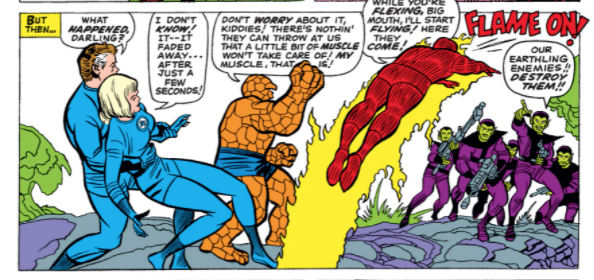
FF 37 is a quintessential Silver Age comic, in all its glorious absurdity. A story that today would be spooled out over six or eight issues—if not made into an event: “The FF invade the Skrull Homeworld!—is done and dusted in 21 pages. The insanity of the premise—as a romantic gesture, Reed decides to launch a cross-galactic invasion—is glossed over in a few panels. The mechanism—the FF borrow a rocket from NASA—is told in another single panel. Reed’s massive miscalculation—not anticipating the team would lose its powers in the Skrull Galaxy—is barely acknowledged.

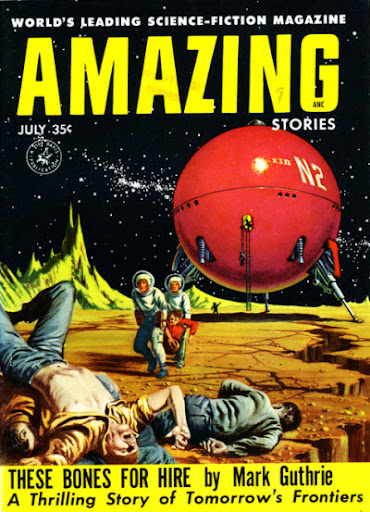
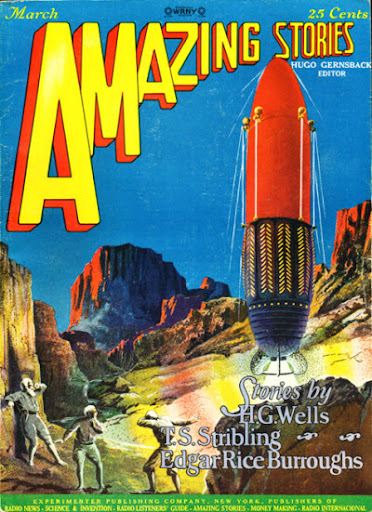
And yet, the story is incredibly fun. Kirby clearly has a blast drawing cool Skrull stuff, there’s lot’s of snappy banter, the subplot of Morrat’s betrayal creates some effective tension, and the Power-Ray reveal, although telegraphed a mile away, is still a satisfying twist.

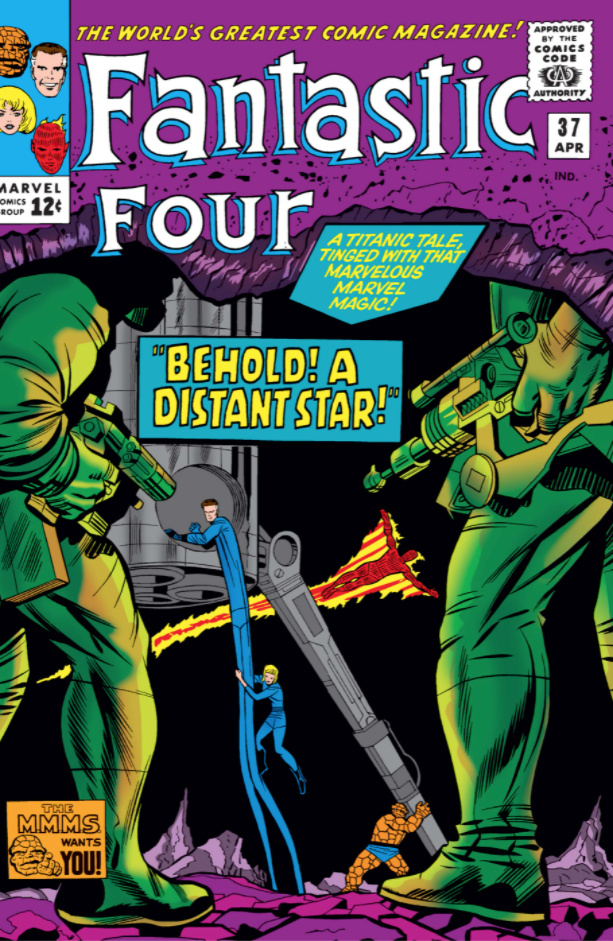
Adding to its appeal, the comic has a golden age of science fiction feel to it, from it’s lofty title (“Behold! A Distant Star”) to a terrific Kirby cover that feels like it belongs on the cover of Amazing Stories magazine. Compare it to the these covers:


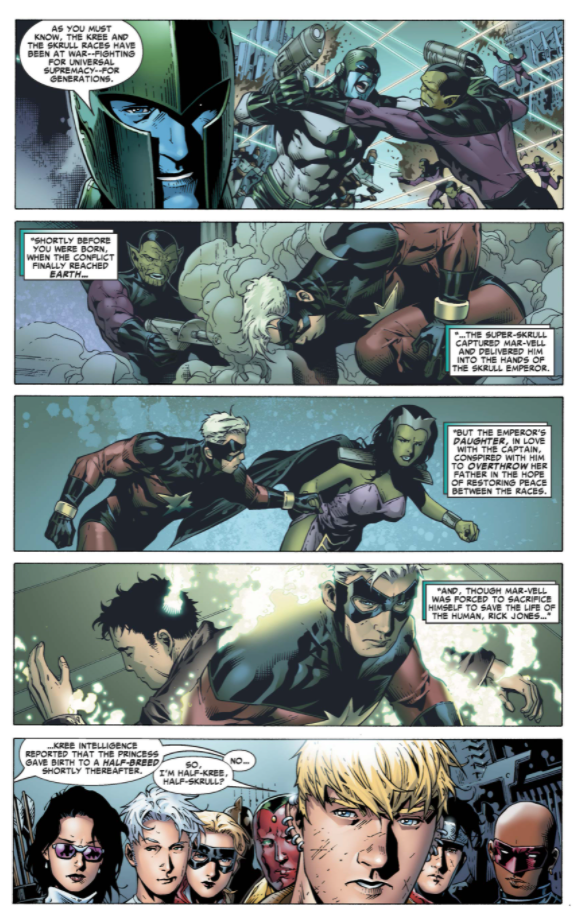
Fantastic Four 37 also adds the story of the Skrulls by introducing Princess Anelle as a member of the Skrull royal family. Princess Anelle becomes a significant figure, retconned into the lover of the Kree Mar-Vell, the first Captain Marvel. Together, they are the parents of Hulkling, a Young Avenger who later becomes emperor of both Kree and Skrull empires.

Unfortunately for Anelle, she missed all this, having died years earlier when Galactus devoured the Skrull home world in Fantastic Four 257.

Krazy Kredits

They’re back!

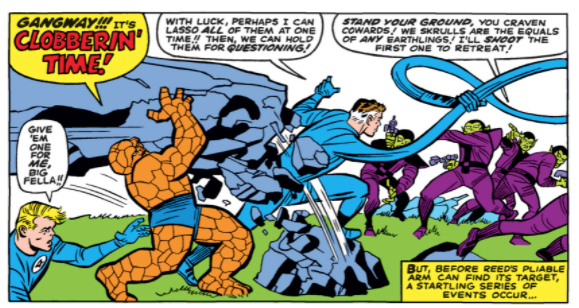
It’s Clobberin’ Time!

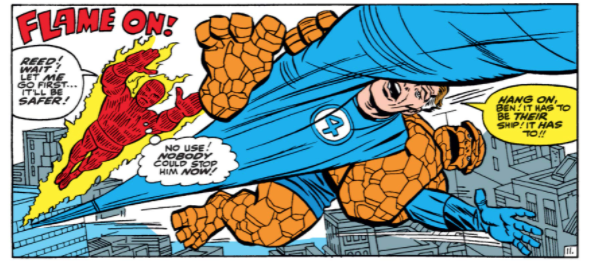
Also back after a few issues absence. This is still only the fourth or fifth time Ben has said the magic words.

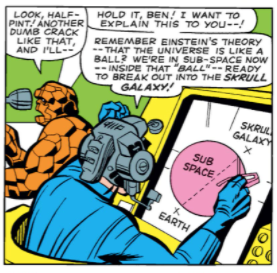
Weird science

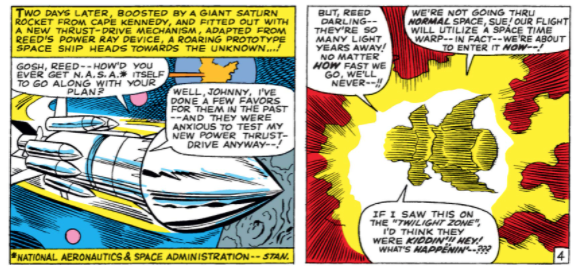
Reed explains intergalactic travel.

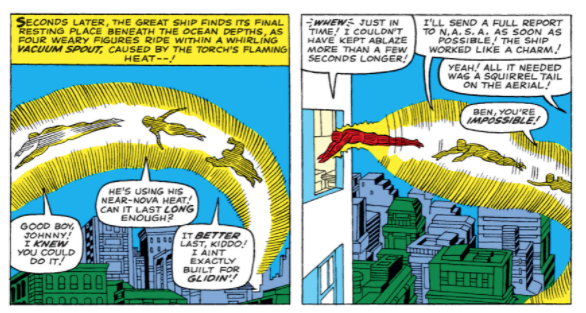
And here’s yet another new power of the Human Torch’s that shows up for one issue and then disappears.

Breaking the fourth wall

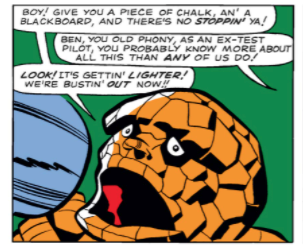
Ben seems to know sound effects in comics are words, not noises.

Speaking of Ben

He plays dumb a lot in this comic, so it’s nice when someone (probably Sue in this case) acknowledges he’s a lot more capable than he lets on.

Oops

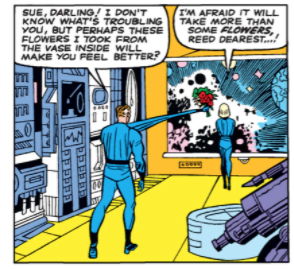
Looks like Stan had to explain where Reed got those flowers.

The sexist sixties

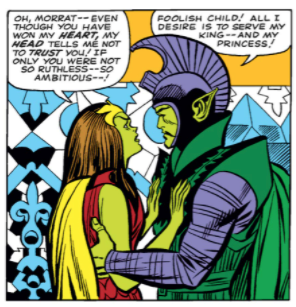
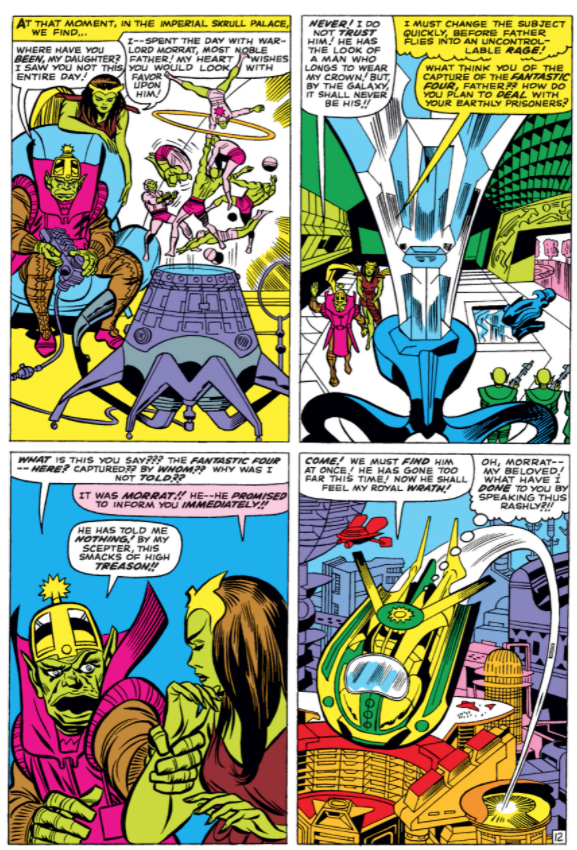
Sexism isn’t limited to earthlings.

Dig that Kirby Krackle
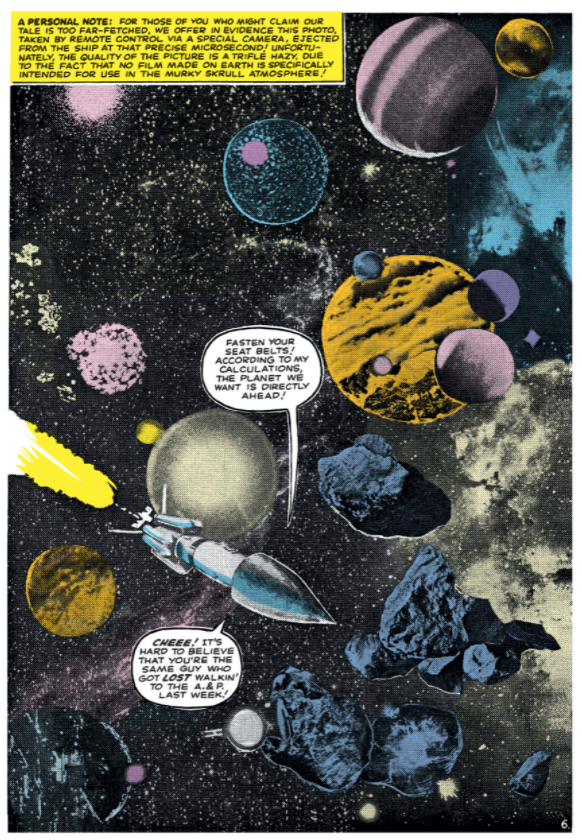
In this issue we get another full-page Kirby Kollage (complete with a note from Stan).

Plus we gets lots of fun alien stuff.

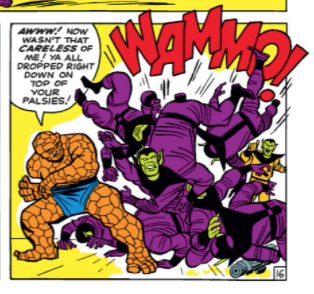
Also, for the first time that I have noticed, Jack’s sound effects are crossing the gutters between panels, which gives the action a more dynamic affect.

Next issue: The return of the Frightful Four!