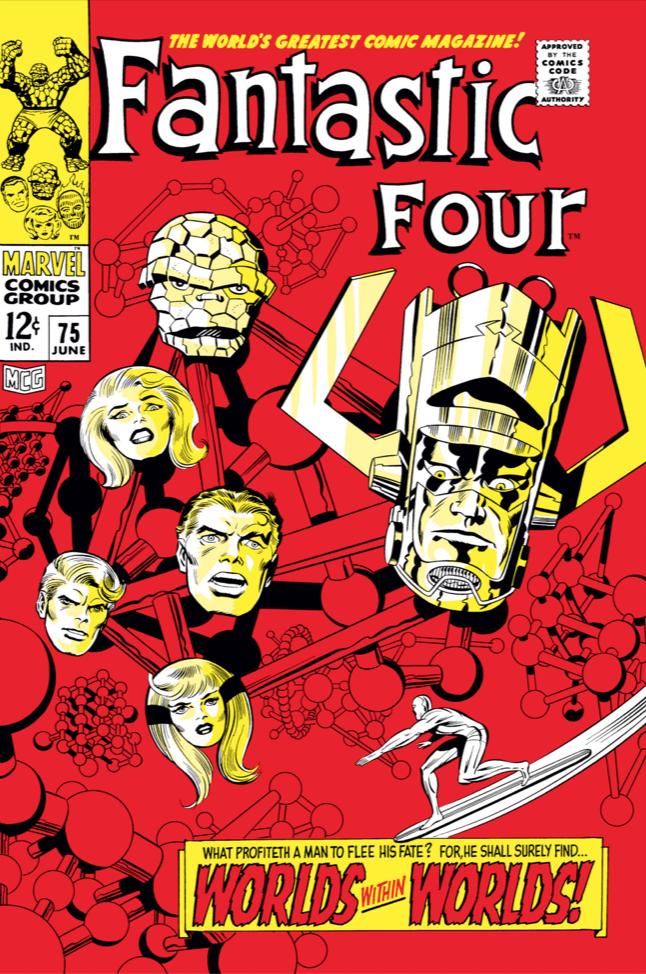
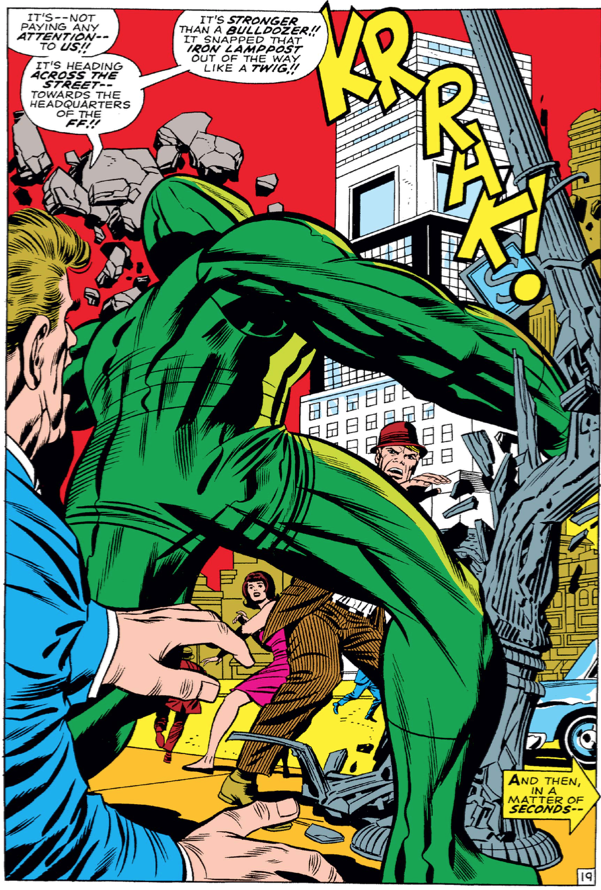
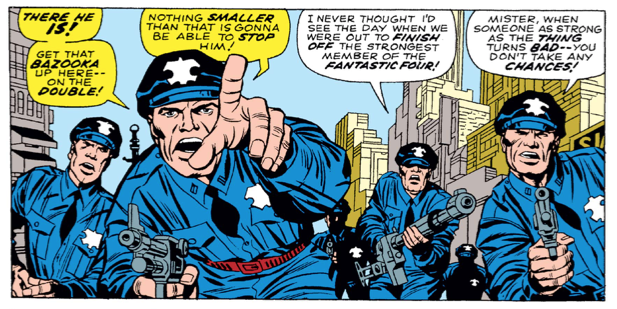
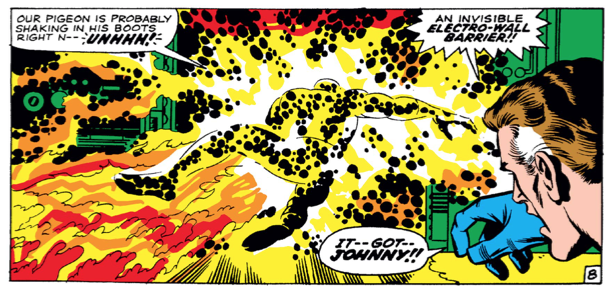
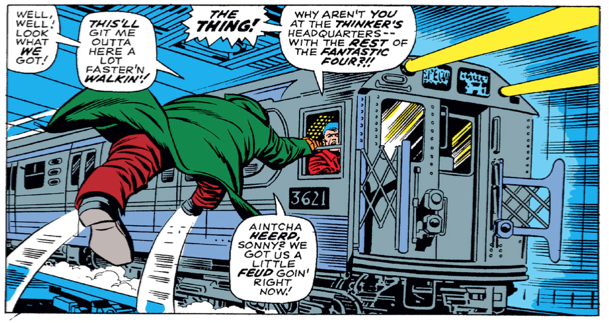
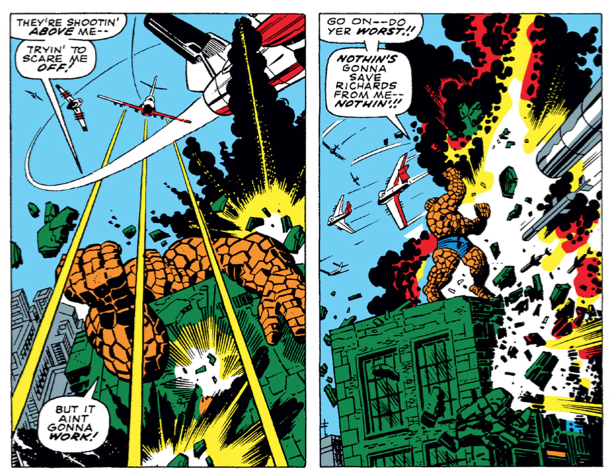
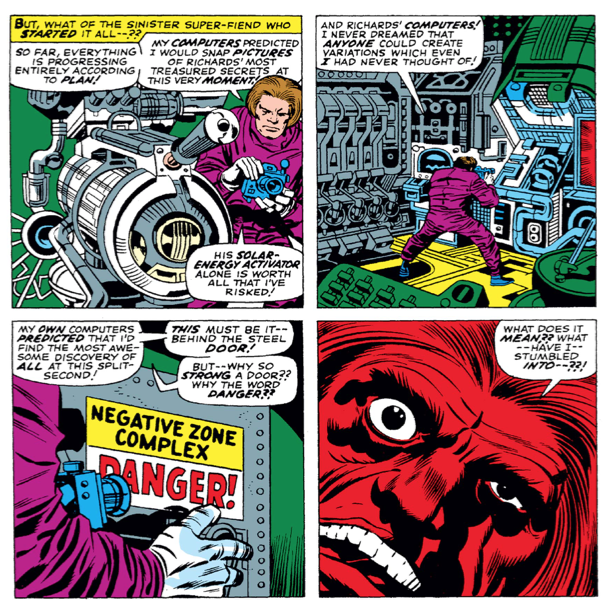
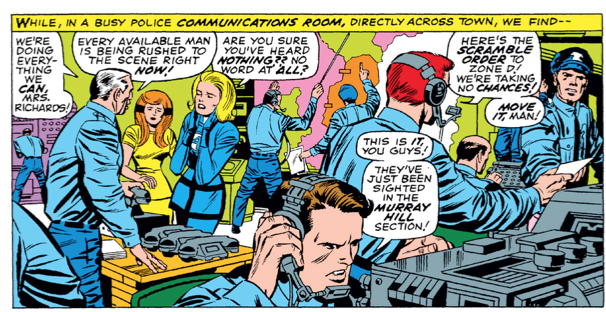
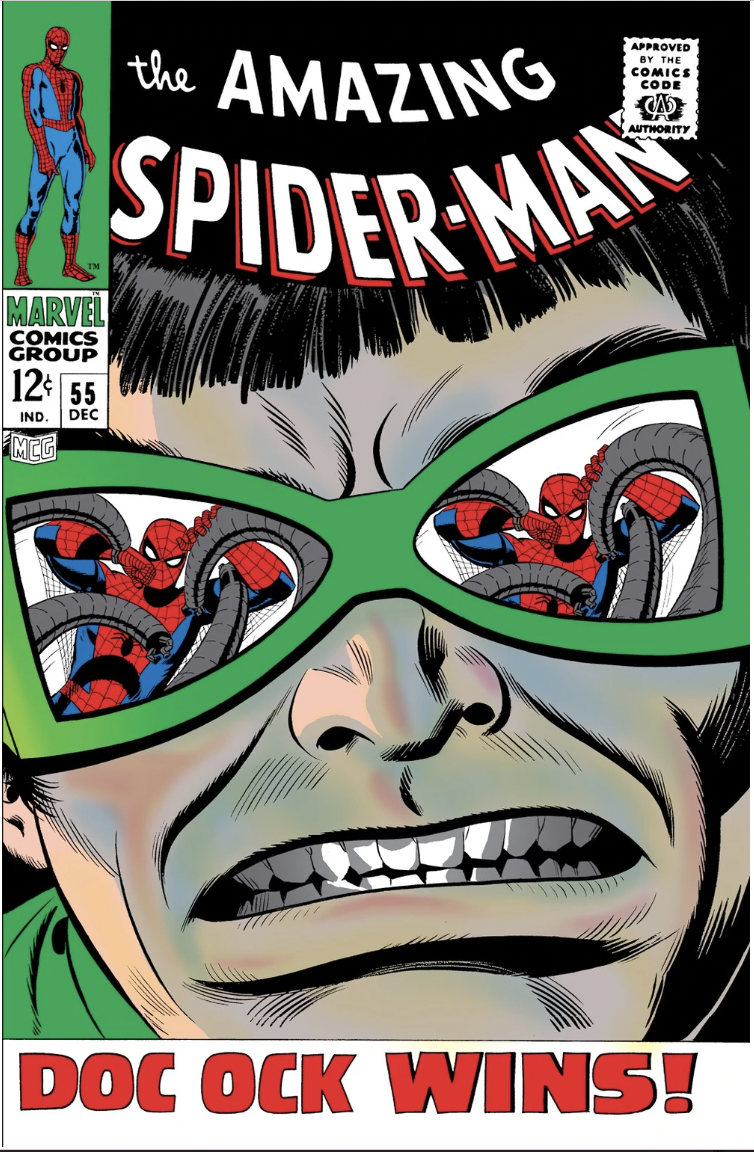
Fantastic Four 75 “Worlds Within Worlds!” Published: March 1968 Story: Stan Lee and Jack Kirby Script: Lee Pencils: Kirby Inks: Joe Sinnott Letters: Artie Simek Cover: Kirby and Sinnott
Synopsis
Fantastic Four 75 follows closely behind FF 74, when the team—minus the pregnant Invisible Girl—got wrapped up in Galactus’s quest to locate the missing Silver Surfer, his former herald, so that the Surfer could find new planets for him to consume. FF 75 opens with Mr. Fantastic, the Thing and the Human Torch on an unnamed island off the coast of New York City, waiting for Galactus’s next move.
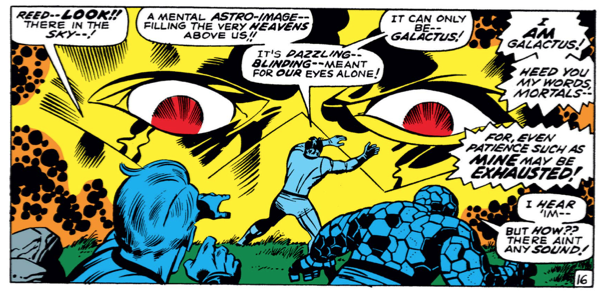
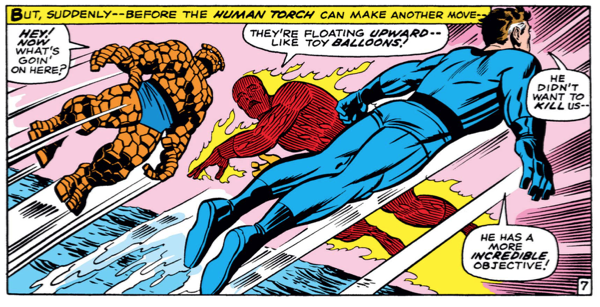
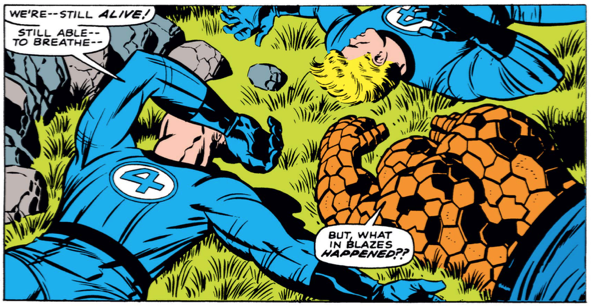
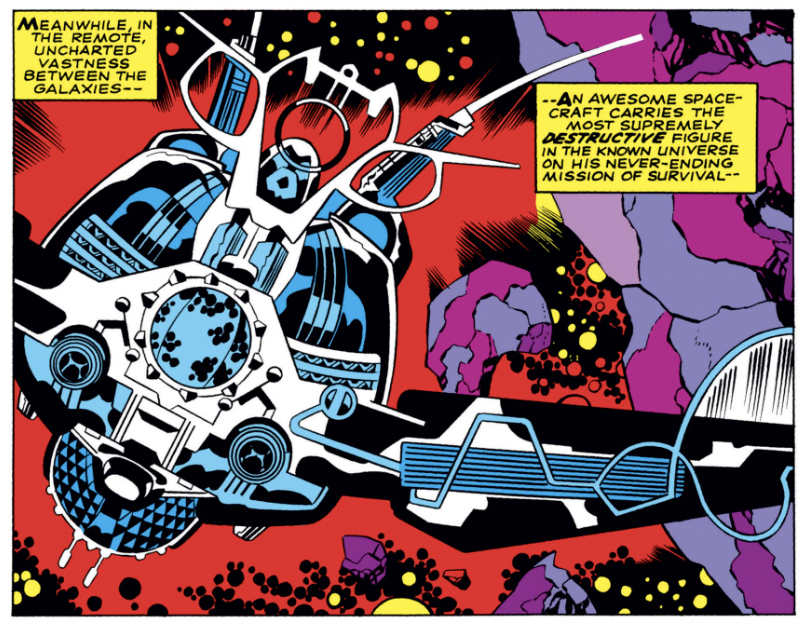
Galactus—still light years away on his space ship—initially destroys the island, then pulls the trio into space where they black out, before they are revived on the once-again intact island. The team then confronts doppelgängers of themselves created by Galactus, and after a long battle, finally defeat them by switching up opponents. Finally, when Galactus threatens to destroy Manhattan by dropping a massive meteor on it, Reed pledges to find the Surfer. The issue closes with the trio preparing to shrink into the mircoverse, where they suspect the Surfer has traveled.
What’s going on here?
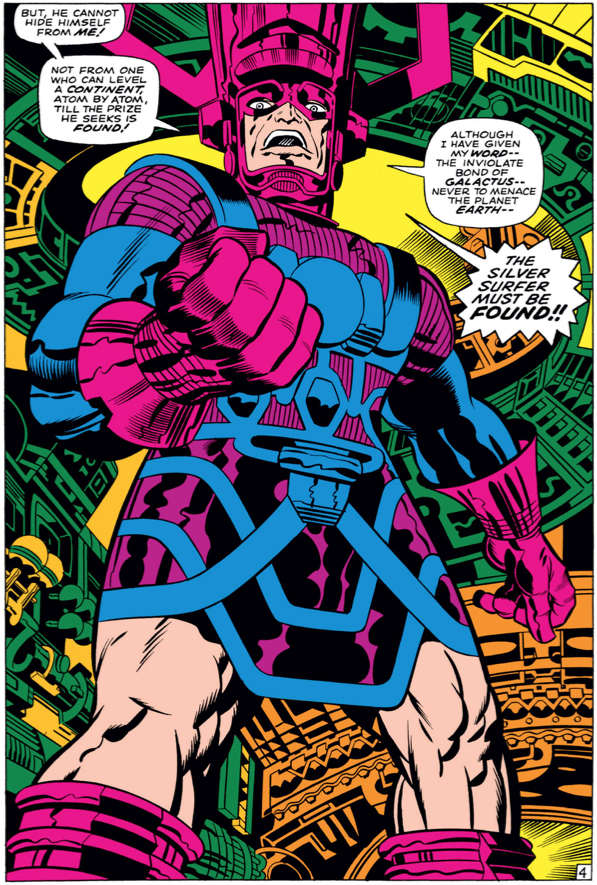
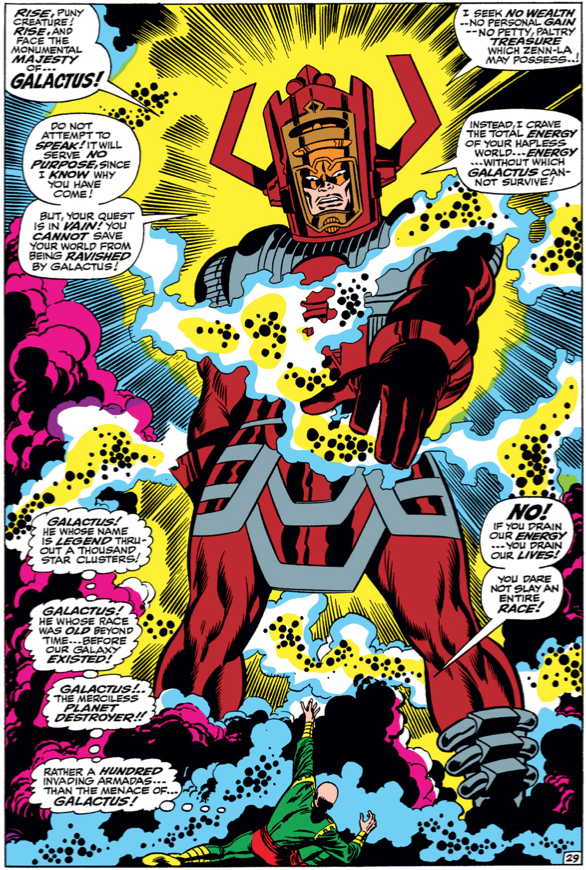
This is a fun issue, with high stakes, great action and some amazing gee-whiz Kirby art, although not all of it makes a lot of sense. It’s not really obvious that subjecting the FF to various trials was supposed to force them to give up the Surfer’s location—Galactus doesn’t make his demands known until after they fight the doppelgangers—and at any rate, it seems like killing them would not be an effective way to get information. Mostly it’s an opportunity to show off Galactus’s power, and have the three FF members fight evil versions of themselves.
The sequence with the FF being lifted into space, nearing death, then waking up on the ground is a particularly good one.
He wears short shorts
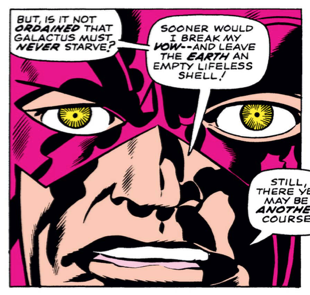
This might be Galactus’s last appearance in shorts:
By the time of his next appearance, in Silver Surfer 1 later that year (technically a flashback), he’s in long pants:
Silver Surfer 1 (19868, Lee/J. Buscema/Sinnott)
He’s also wearing long pants in his subsequent appearances in Thor, which Kirby drew.
The sexist sixties
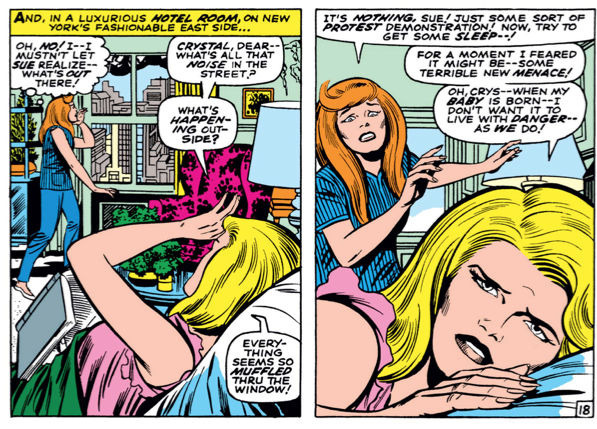
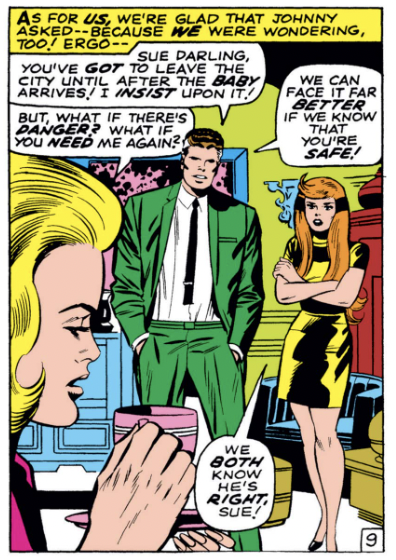
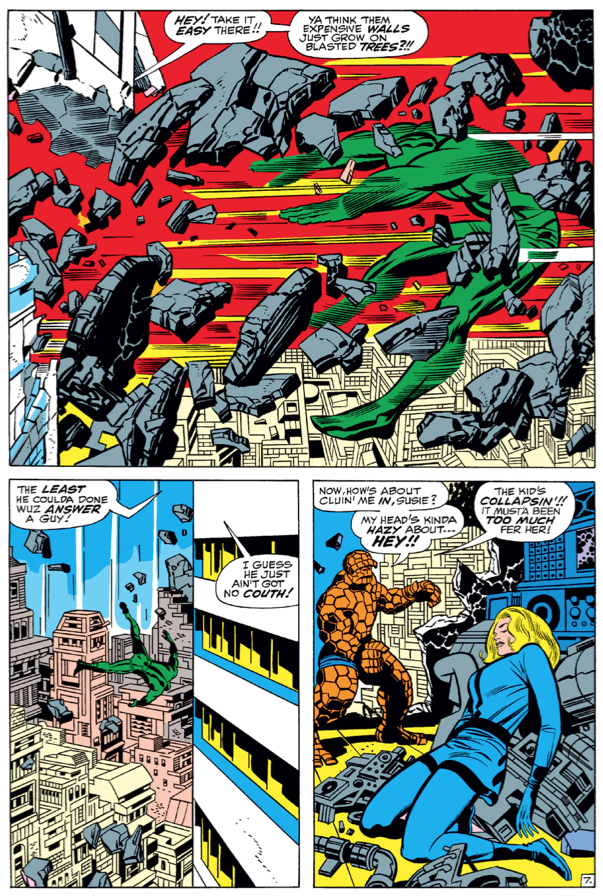
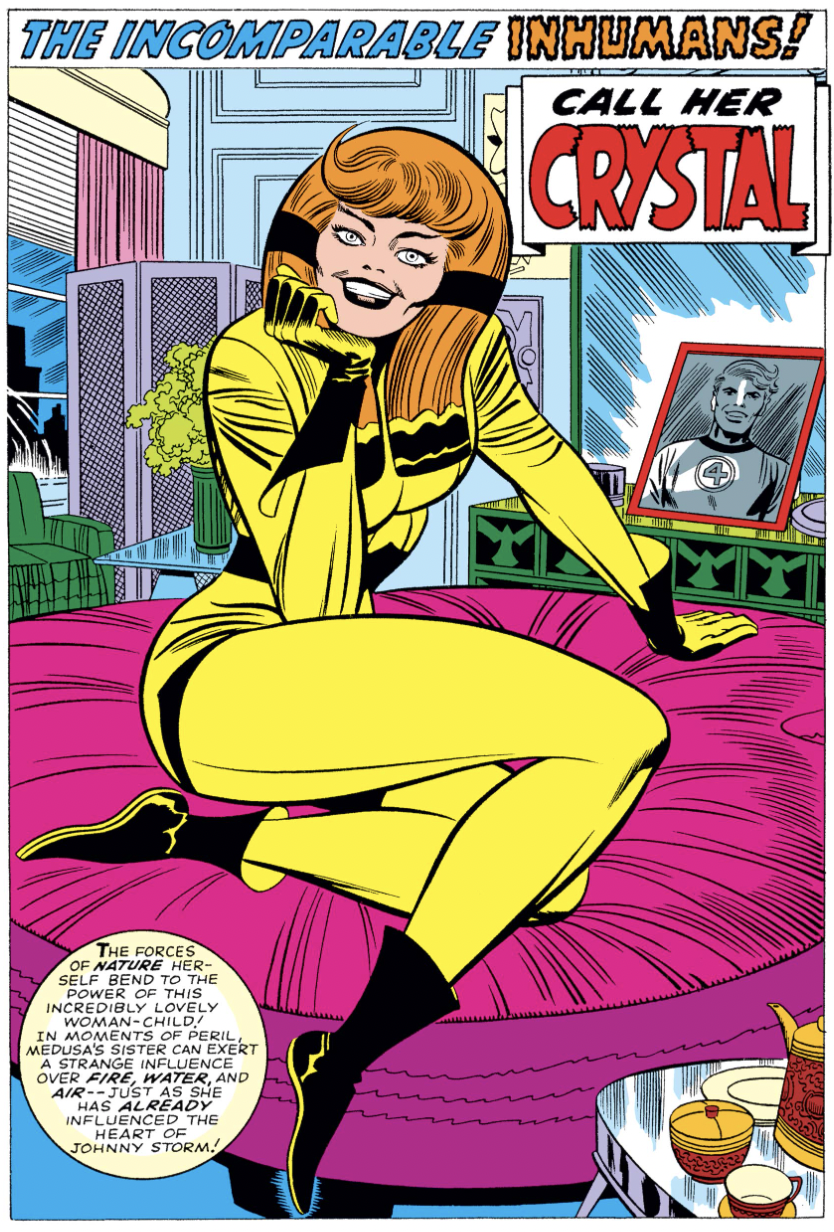
Once again, Sue is not just sidelined, but patronized as Crystal keeps her from learning her team is battling for their lives.
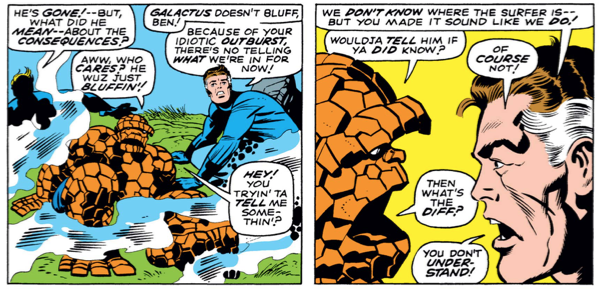
They’re fighting again
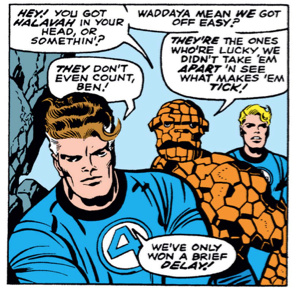
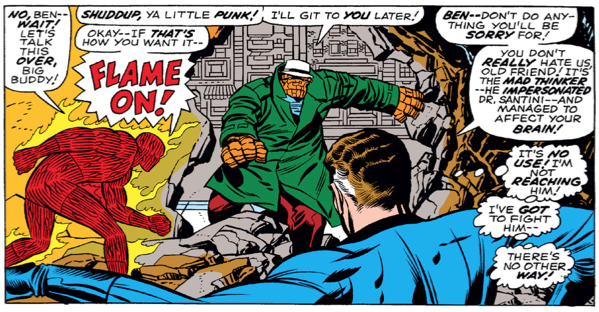
Technically they trade blows since they fight versions of themselves, but also in this spirited argument between Ben and Reed.
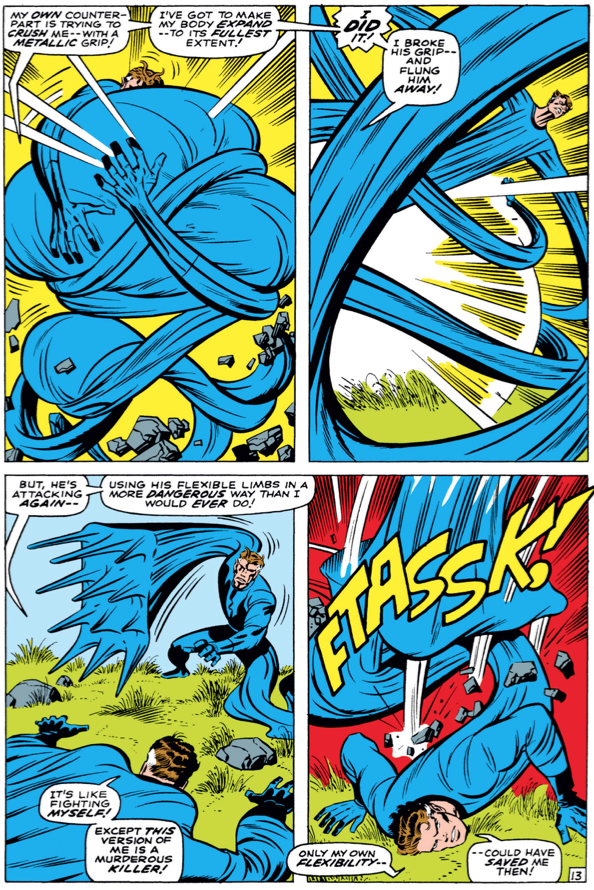
The incredible Mr. Fantastic
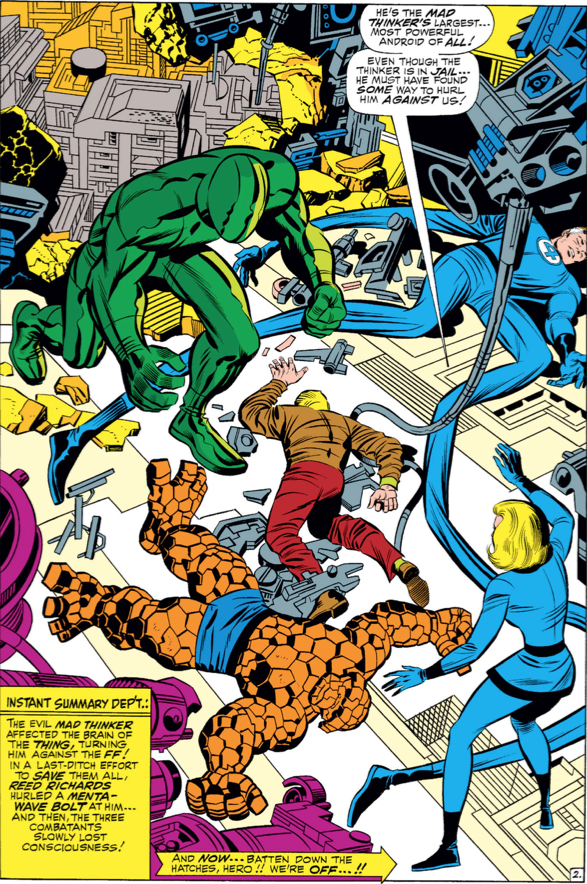
Reed vs. evil Reed
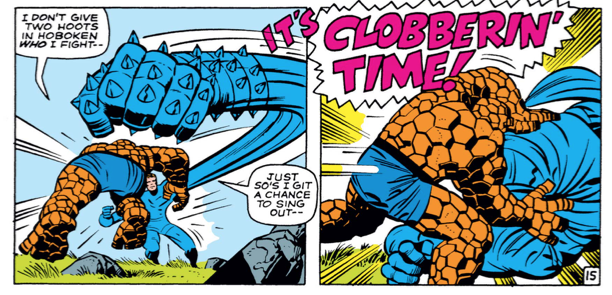
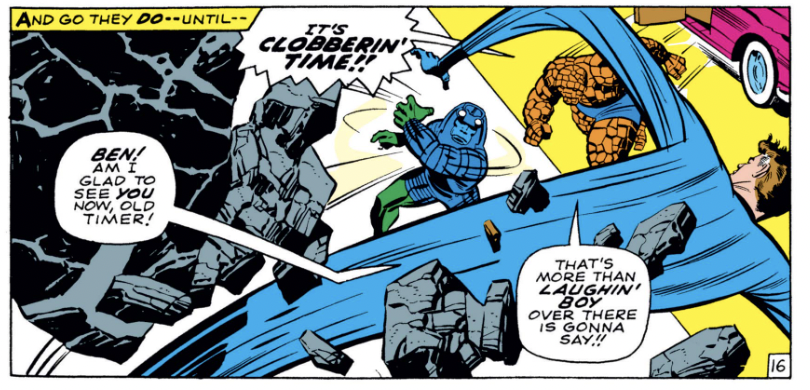
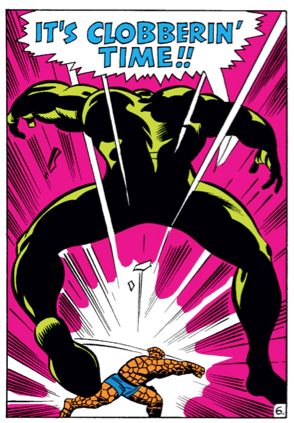
It’s Clobberin’ time
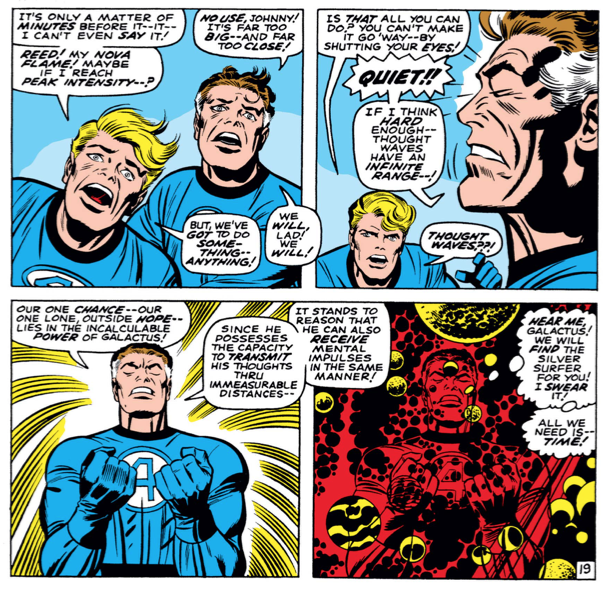
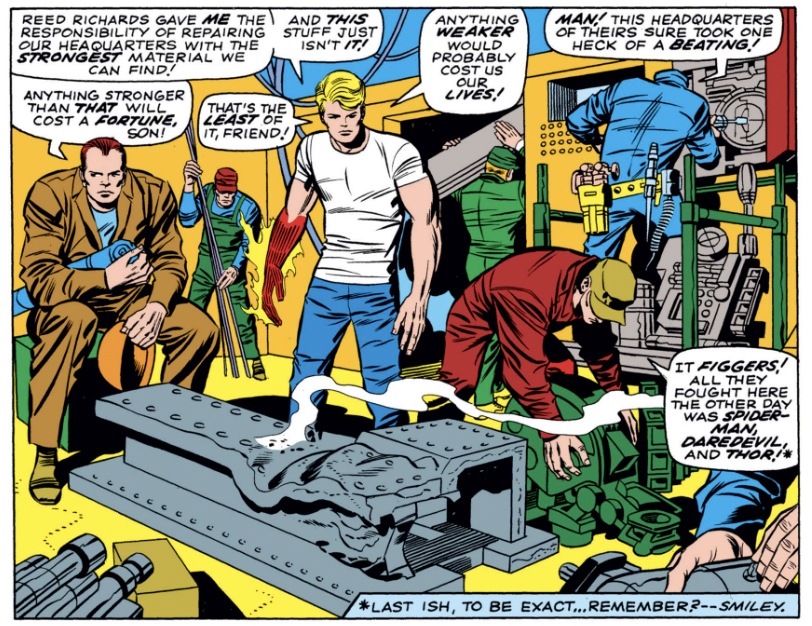
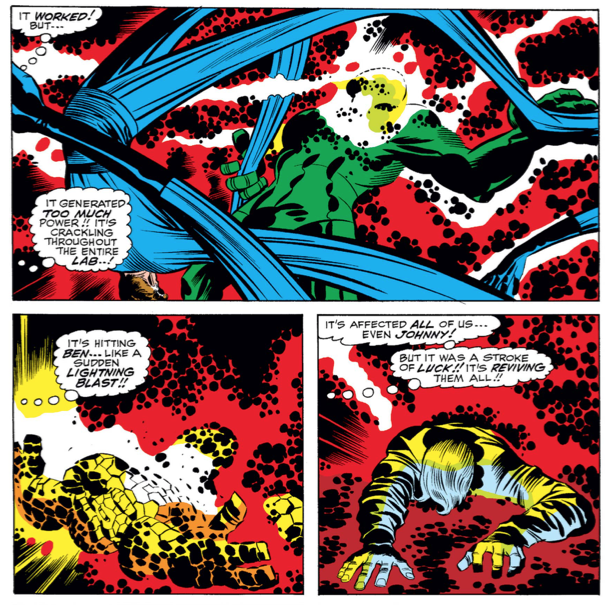
Weird science
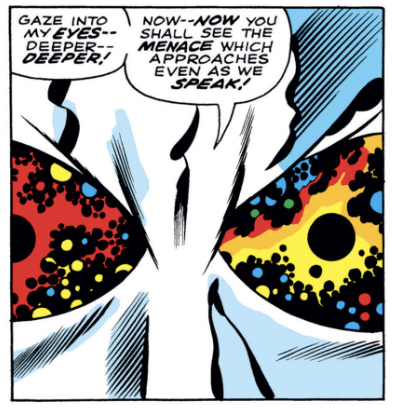
Johnny is as skeptical about Reed’s “thought waves” as the rest of us.
Say what?
Halavah, more commonly known as halva, is apparently a middle eastern desert made of sesame seeds and honey. It’s not at all clear why Ben is thinking about it here.
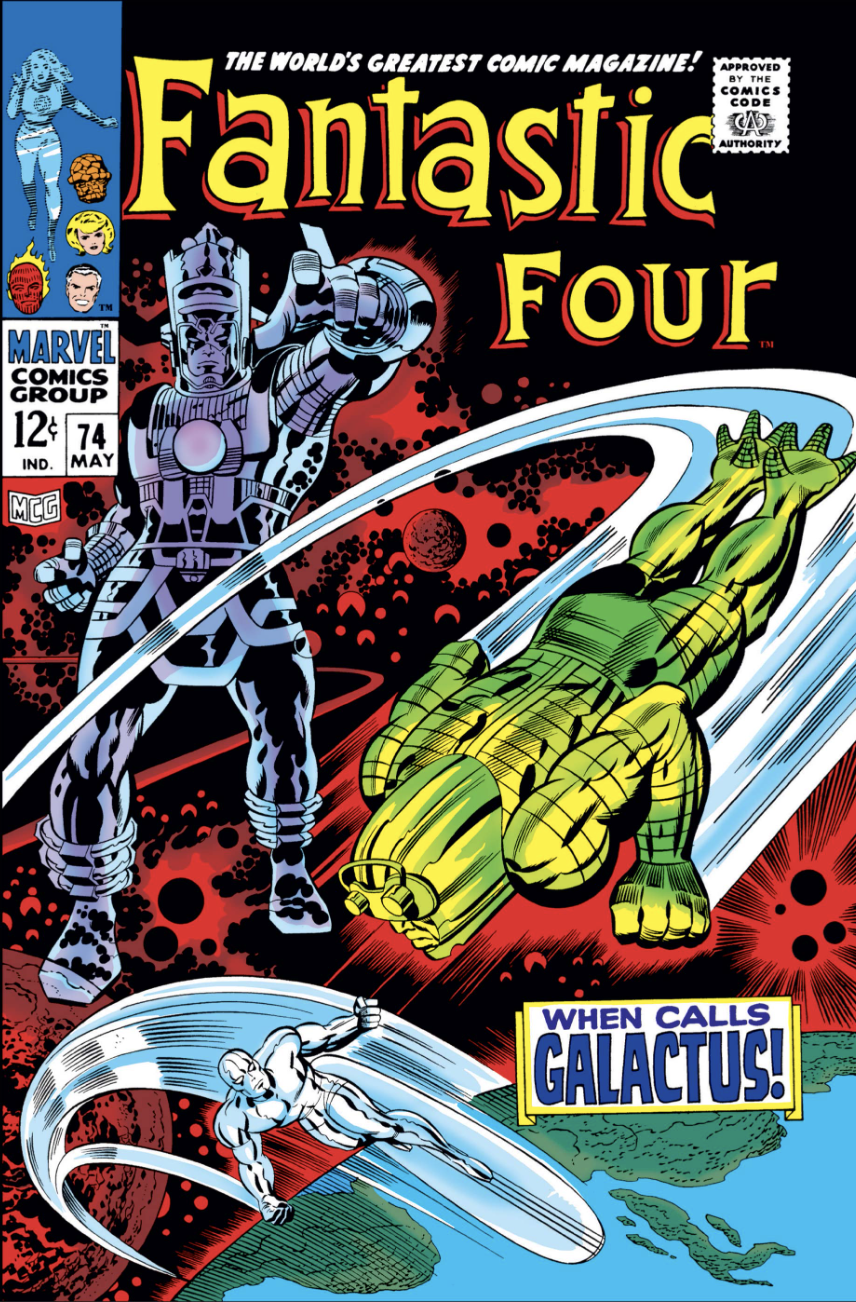
Fantastic Four 74 “When Calls Galactus!” Published Feb. 1968 Story: Stan Lee and Jack Kirby Script: Lee Pencils: Kirby Inks: Joe Sinnott Letters: Artie Simek Cover: Kirby and Sinnott
Synopsis
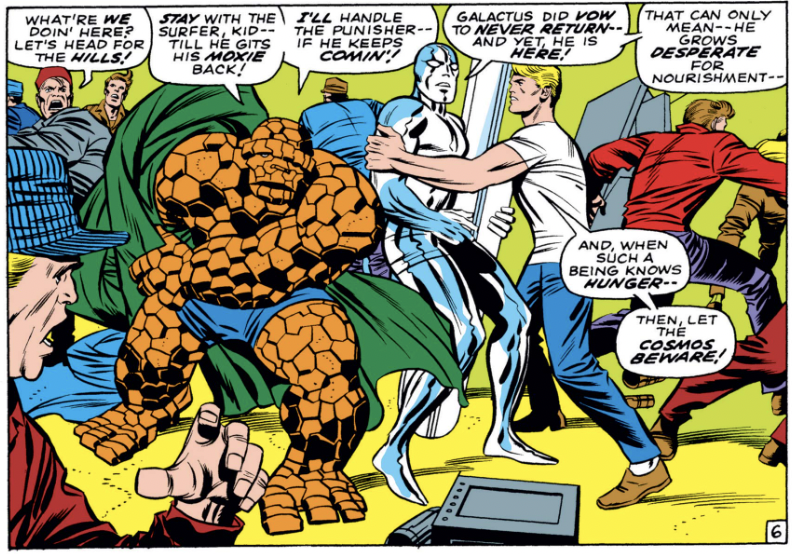
The Thing enters the apartment of his girlfriend, Alicia Masters, only to find the Silver Surfer there in a state of distress. When Ben, jealous, moves to confront the Surfer (in an echo of issue 55), he and Alicia explain the Surfer has been recalled by Galactus, indicating the planet-devourer must be desperate and that earth is in danger.
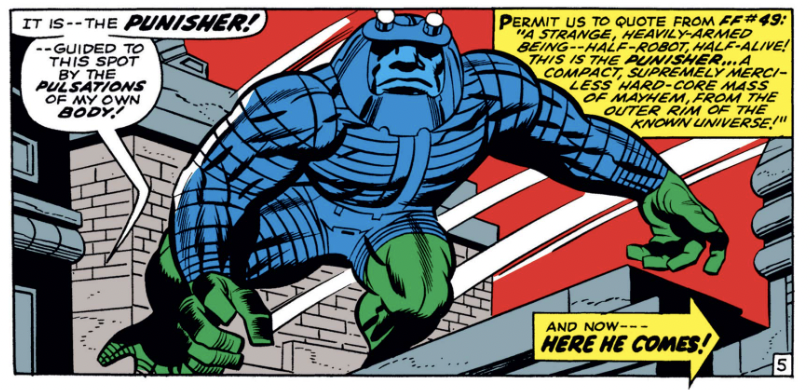
Galactus has sent the Punisher, the cyborg he used to attack the FF when he last visited earth, to bring back the Surfer. After blasting it with his cosmic power, the Surfer collapses and Ben and the Human Torch take on the Punisher, without much success
After again shunting the pregnant Invisible Girl aside, Mr. Fantastic joins the fight. The Punisher, however, vanishes, returning to its master in space, leaving the team to ponder Galactus’s next move.
What’s going on here?
Fantastic Four 74 is a place-setting issue, putting the pieces in place for a multi-issue arc, but it’s a pretty effective one. It reintroduces Galactus as an earth-destroying threat, and by once again using the Punisher as a foil, Stan and Jack emphasize Galactus’s power (if his minion can throttle the FF, what is Galactus capable of?)
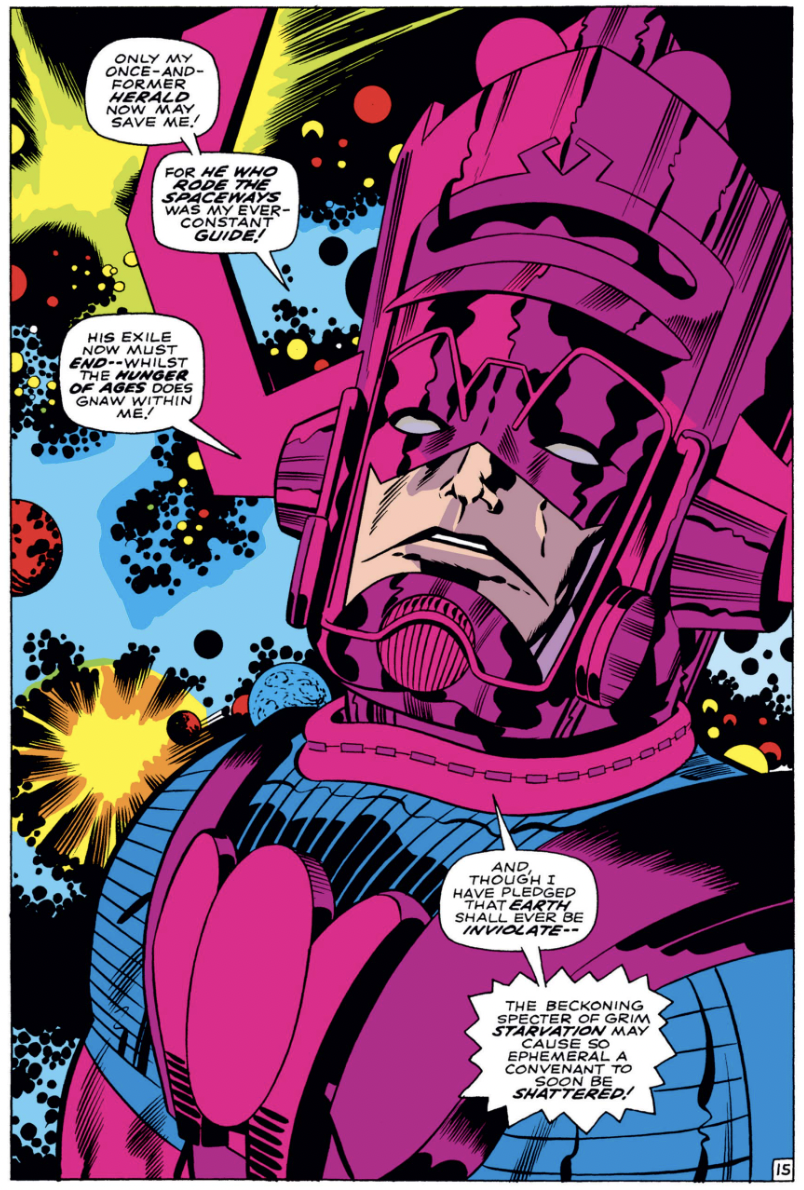
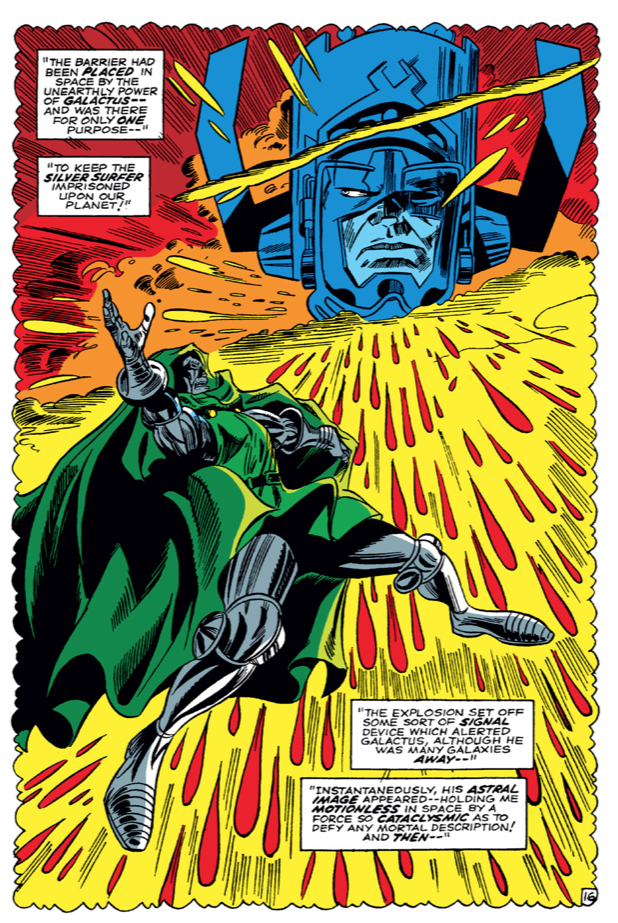
After his appearance in a flashback in Daredevil 37 (discussed last week), in Thor 134, and now here, Galactus is by now pretty thoroughly integrated into the the Marvel Universe. Stan and Jack apparently hadn’t planned that—they wanted him to appear sparingly, to maintain his grandeur—but Stan, listening to fan requests, decided to bring him back. As a result, we got epic splash pages like this:
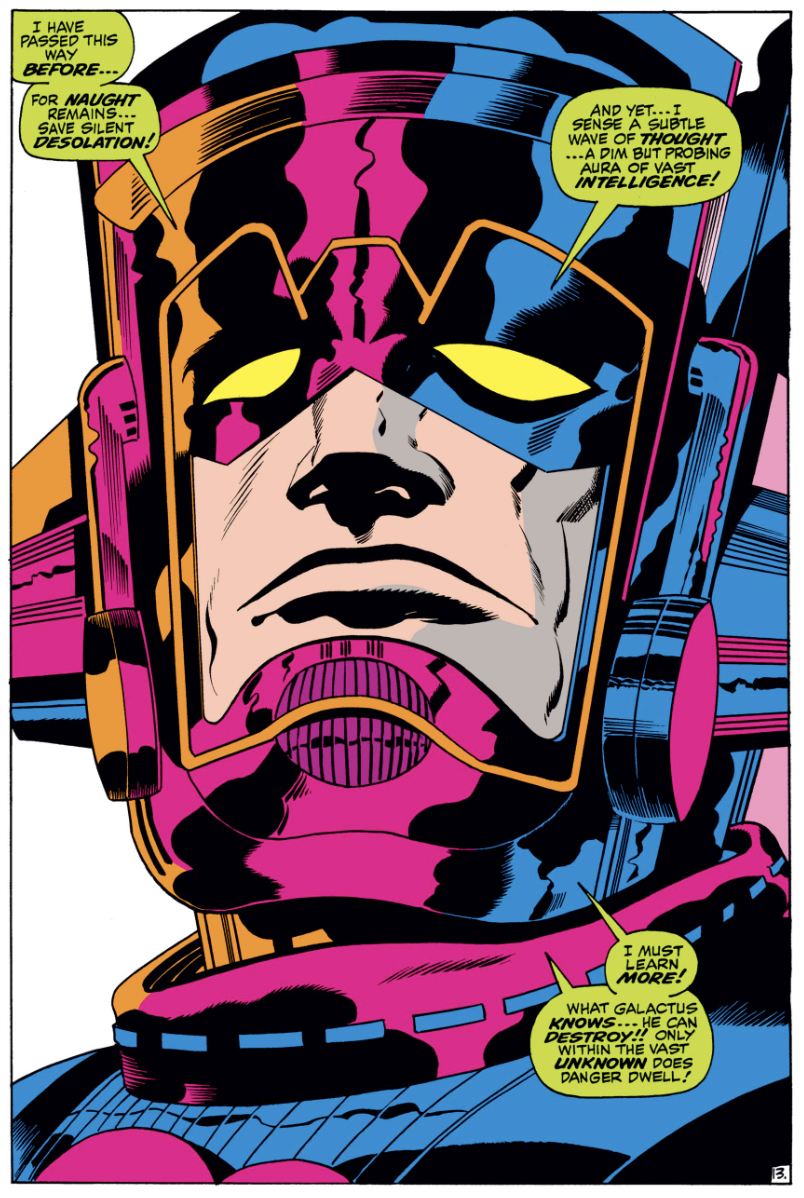
Incidentally, Jack liked that image so much he re-used it the next year, in Thor 160 (this time with inks by Vince Coletta):
About that name
The Punisher is a pretty cool concept.
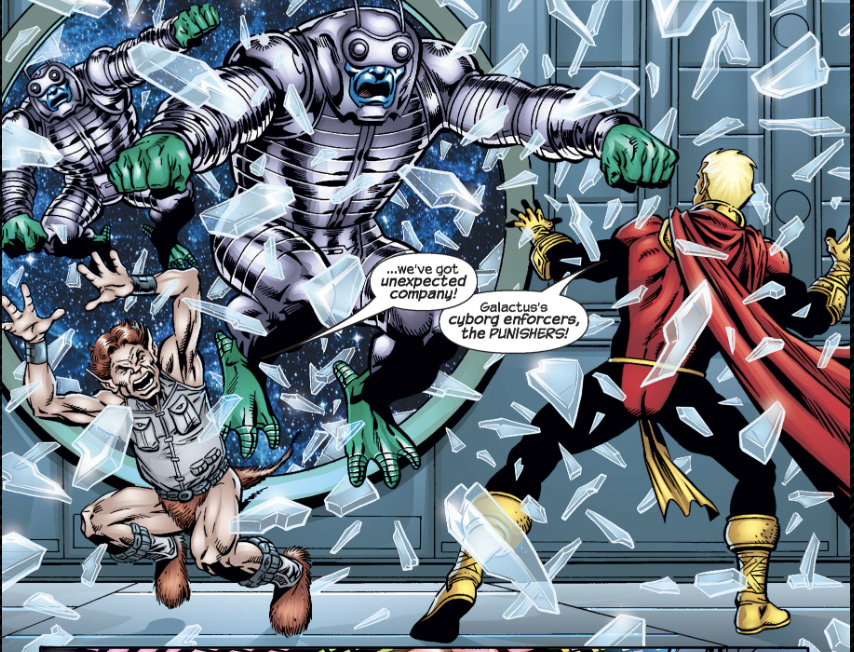
Unfortunately it shared a name with a lot more important Marvel character, which probably is one reason it appears so infrequently. Here it is Thanos 4, from 2003, by Jim Starlin and Al Milgrom.
The sexist sixties
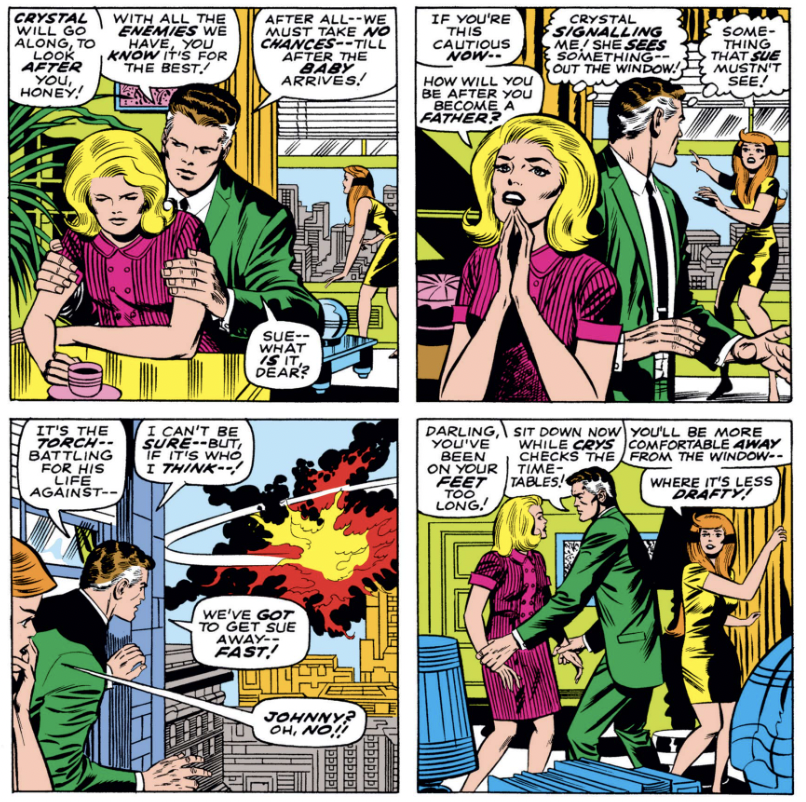
For the last few issues, Sue has been deliberately kept away from the action, ostensibly to protect her and her unborn baby. Her exclusion is taken to more ridiculous levels, when Reed won’t even tell her what’s going on and instead treats her like an invalid (and enlisting the similarly wasted Crystal to help him do his dirty work).
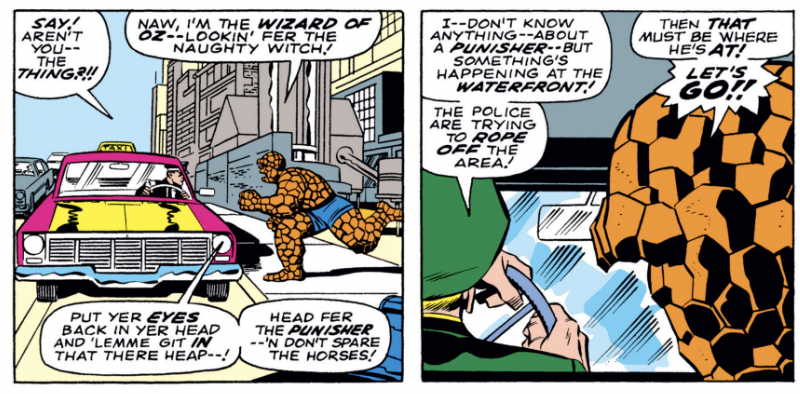
Follow that car!
Ben needs to take a cab to rejoin the action.
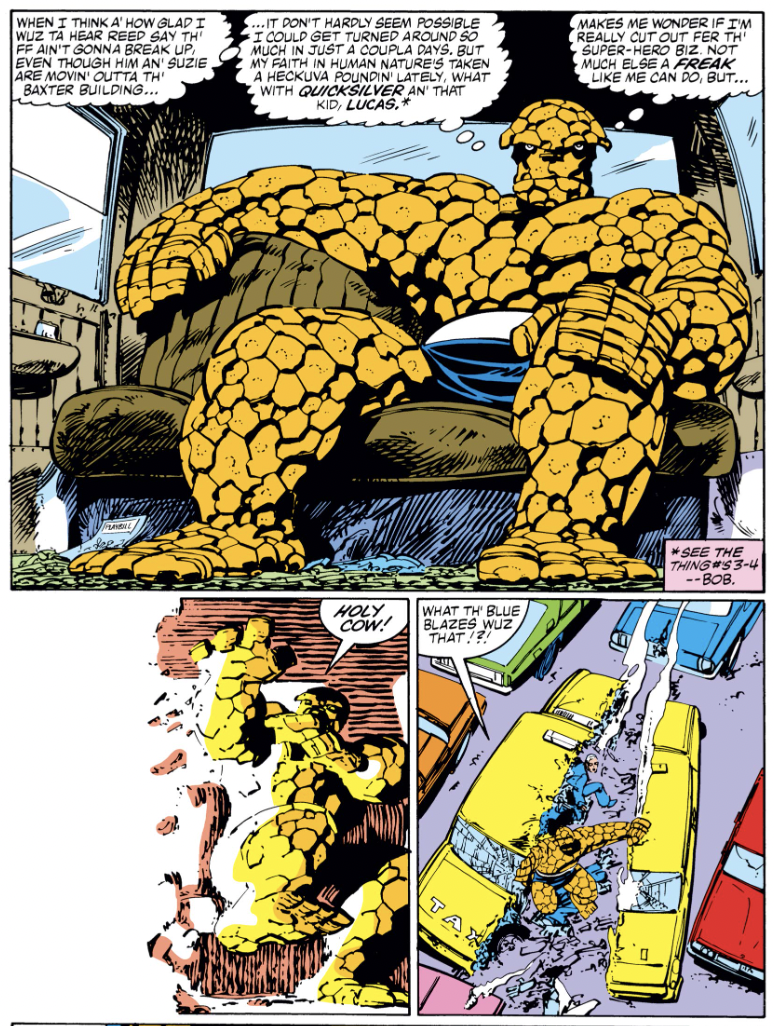
It reminded me of this dramatic scene when Ben was again in a cab, from Fantastic Four 259 (1883) by John Byrne.
Clobberin’ Time
Speaking of Ben, it’s been a few issues since we had one of these
He’s all grown up
Nice character developing scene here with the Torch, who is shown taking on more responsibilities despite still being a teenager. He too often gets written as a yahoo, and he has more maturity than that.
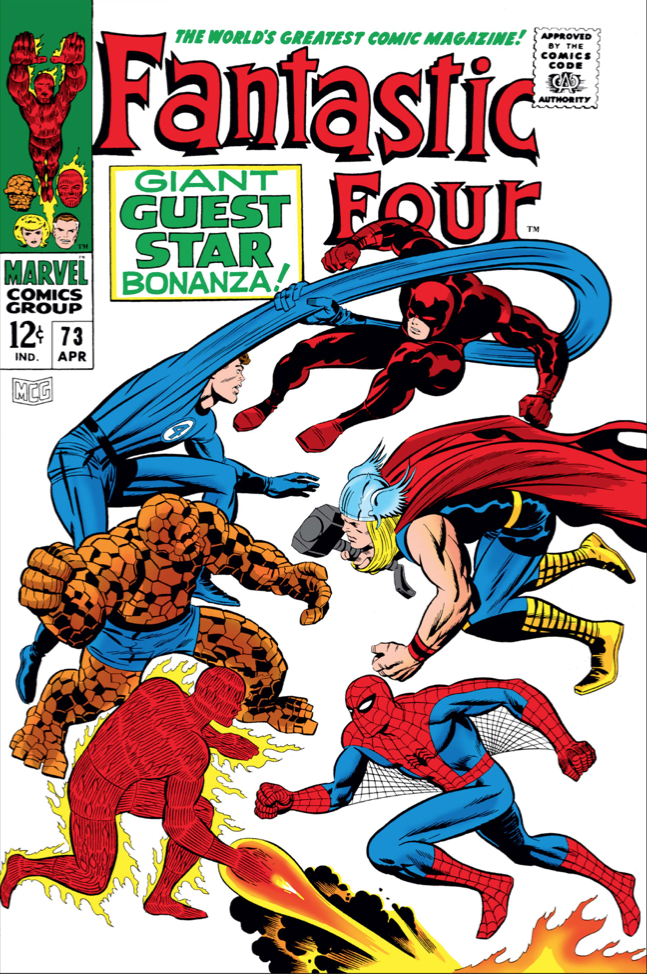
Fantastic Four 73 “The Flames of Battle…” Published: Jan. 1968 Story: Stan Lee and Jack Kirby Script: Lee Pencils: Kirby Inks: Joe Sinnott Letters: Artie Simek Cover: Kirby and Sinnott
Note: Apologies for missing last week. A family event intervened. I try to write these posts every weekend but unfortunately it’s not always possible.
Synopsis
Fantastic Four 73 follows not another FF issue but Daredevil 38, the first time the FF readers have needed to read another Marvel comic to keep track of an FF story.
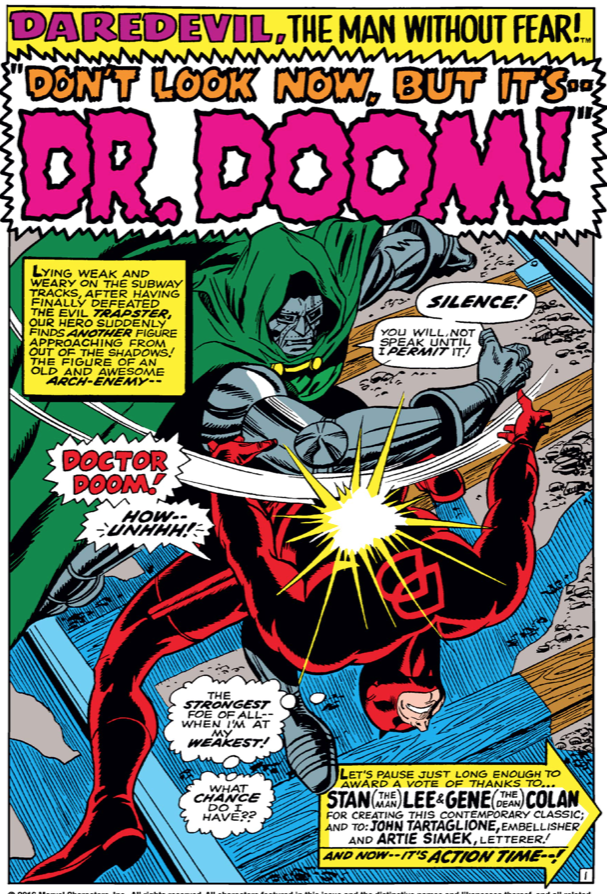
Daredevil 38 is the third issue of a convoluted arc that starts with Daredevil fighting the Trapster, who subdues the Invisible Girl and plants a bomb in the Baxter Building. Daredevil rescues the Sue and disposes of the bomb, then battles the Trapster. After taking a beating, Daredevil is dazed in the New York subway, where he is confronted by Dr. Doom.
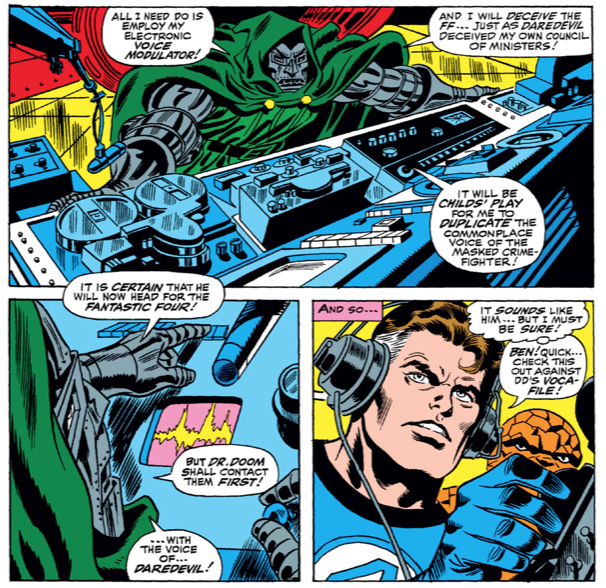
Doom captures Daredevil and eventually switches bodies with him, part of a plot to defeat the FF. Daredevil, in the body of Doom, uses a radio to warn the Fantastic Four of the switch, then orders Latveria to attack its neighboring countries. Doom quickly switches the bodies back to avoid a war, but uses a voice modulator to impersonate Daredevil and convince the FF that he is still in Daredevil’s body.
Daredevil 38, Stan Lee/Gene Colan/Frank Giacoia
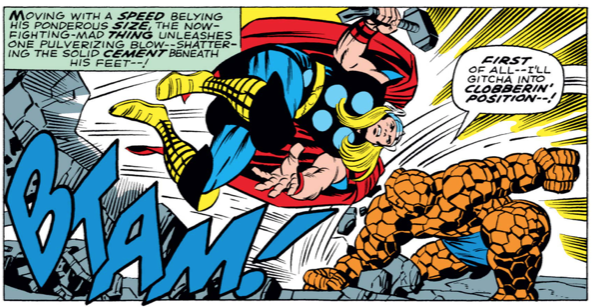
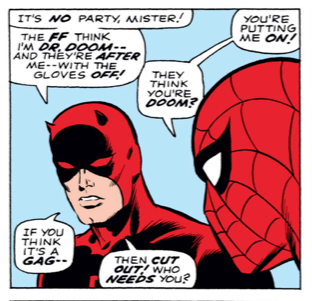
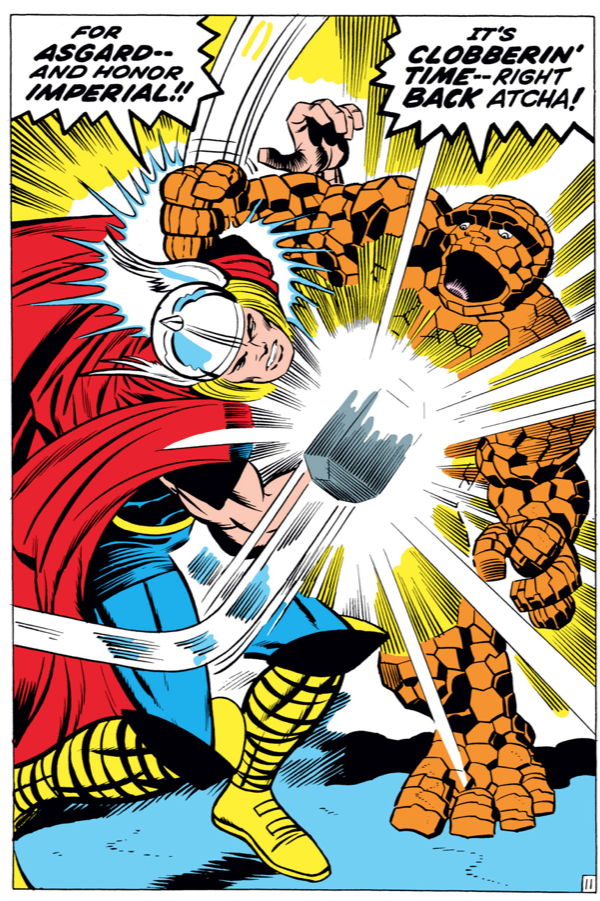
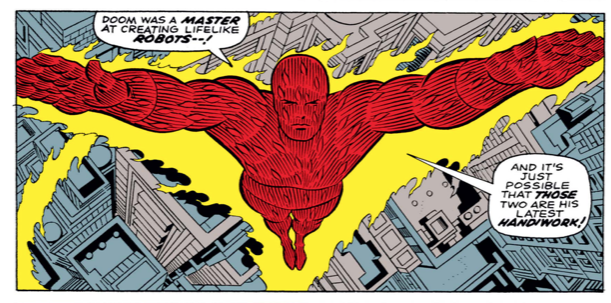
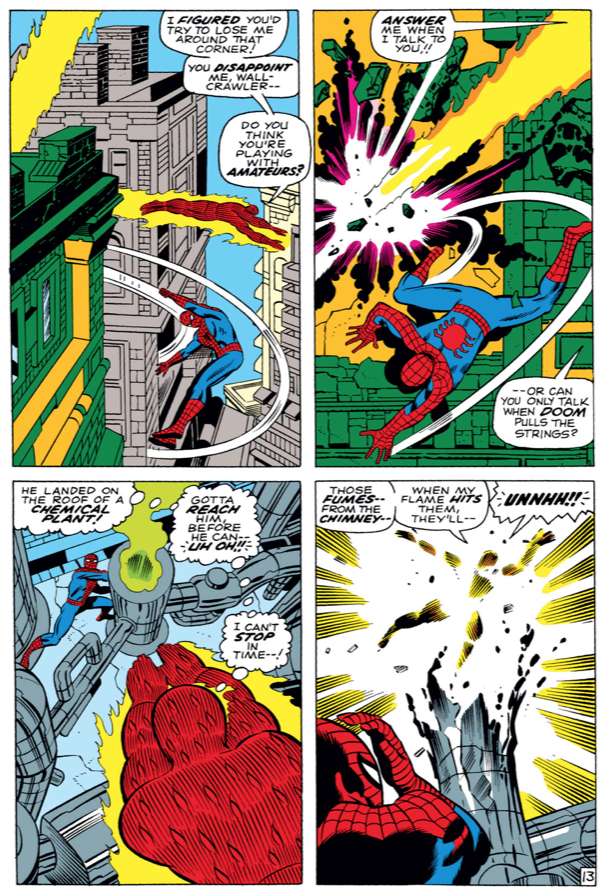
Fantastic Four 73, then, begins with the FF preparing to fight Daredevil, who they think still contains the consciousness of Doom. Daredevil tries to convince them he’s really himself, but the FF won’t hear it. After tangling with the Human Torch, Spider-Man arrives and realizes Daredevil will need reinforcements to take on the FF. He recruits Thor, who is dazed from a battle with Wrecker, and eventually the three heroes battle the FF, with Daredevil taking on Reed, Spidey fighting Johnny (for about the 100th time) and Thor battling the Thing (possibly for the first time).
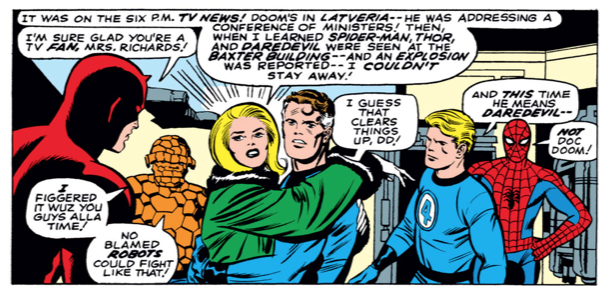
The fight finally ends when Sue intervenes, saying that she saw Doom in Latveria on the 6 pm news. Reed apologies and Daredevil says it’s no big deal.
What’s going on here?
This is a peculiar issue. No only does is it require readers to have read a few issues of Daredevil prior, but the plot is incredibly flimsy and contrived. Spider-Man and Thor are shoehorned into the comic with the weakest possible explanations—literally they were just passing by—and then serve no real purpose except to provide sparring partners for the FF. Usually in a superhero team-up situation, after they fight and they realize it was all a big misunderstanding, they join forces to go after the bad guy. Not here: Once Sue let’s them know it was a mistake, they all go their separate ways. Of course it’s fun to see the Thing battle Thor, or Reed fight Daredevil, but it would be a lot more satisfying if it was in a more coherent story.
Making it even more frustrating is that the Daredevil stories leading up to it are much more fun and interesting. Yes, the switching bodies is a bizarre plot device, but Lee explores how Daredevil would react to having sight again, and Doom’s confusion over Daredevil’s radar sense. We also get an explanation of how Doom—who, last time we saw him, had stolen the power of the Silver Surfer—survived running into Galactus’s barrier (Galactus, sensing it was not the Surfer, gently transported Doom to Latveria). And Gene Colan knocks it out of the park with his art.
Oops
Fantastic Four 73 also has a surprising number of errors and goofs. One obvious one: In one panel, Jack draws Daredevil’s mask so you can see his eyes, then changes back to his eye-covers (or whatever you want to call them) for the rest of the comic.
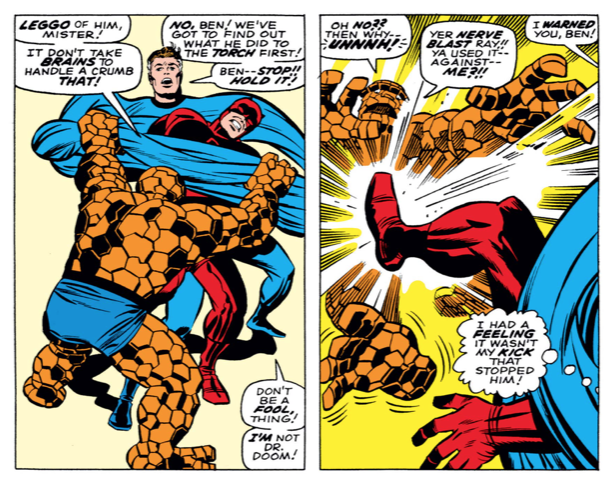
Here, it seems like Stan is writing around Jack’s art to explain how Daredevil could stun Ben with a kick. Stan’s explanation: Reed used a “nerve blast ray” on Ben.
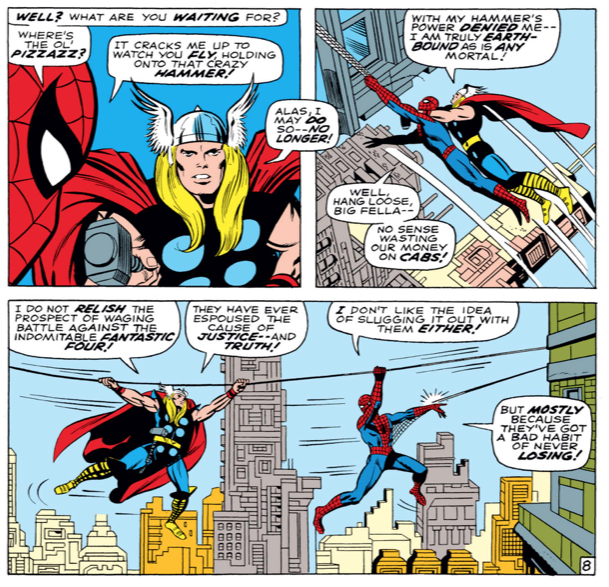
And perhaps most perplexing is how Thor is dealt with. His appearance apparently come between panels in Thor 150 (although there is no mention of it in the Thor comic), where he has apparently lost his powers. After he is recruited by Spider-Man, he can’t fly, and has to hitch a ride on Spidey’s webs. This is just weird:
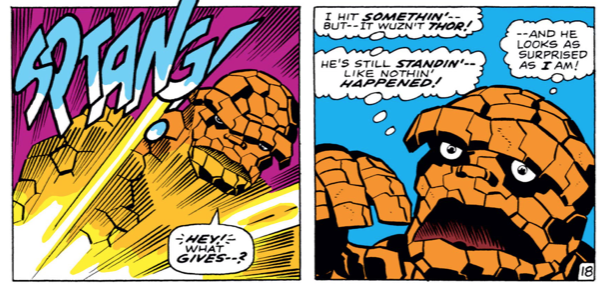
Then as he battles Ben, this happens:
No further explanation is provided, until the last page, when Ben say Thor hold him he had to fight the Wrecker. But we have no idea of what happened in the above sequence. Maybe a subsequent story has addressed it, but I’m not aware of it.
Weird science
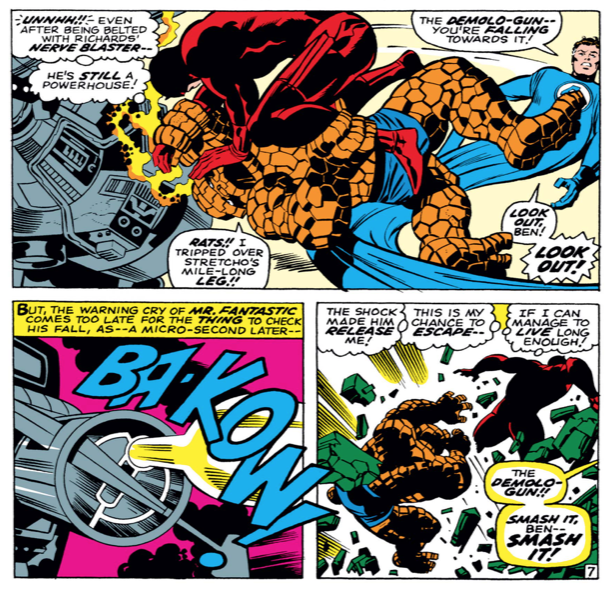
Along with the aforementioned “nerve blast ray,” there is also a “demolo-gun.” (And this isn’t the first time Reed has left extremely dangerous, and easily engaged, weapons lying around his lab).
It must be Israel Day
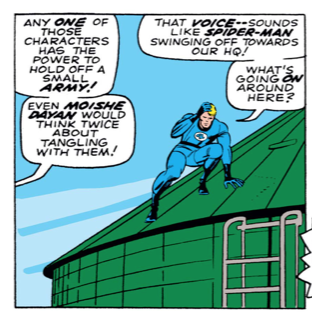
Spider-Man references Moshe Dayan, Israel’s minister of defense during 1967’s Six-Day War.
Fantastic Four 72 Published: December 1967 Story: Stan Lee and Jack Kirby Script: Lee Pencils: Kirby Inks: Joe Sinnott Letters: Sam Rosen Cover: Kirby and Sinnott
Synopsis
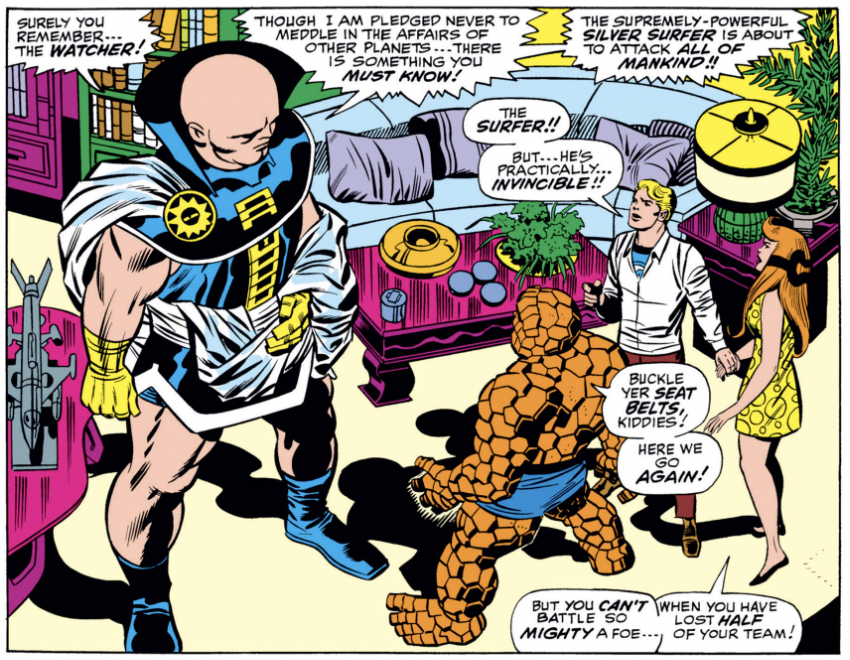
In the wake of last issue’s departure of Mr. Fantastic and the Invisible Girl from the team—prompted by Reed’s concerns about the pregnant Sue’s safety—the Thing, Human Torch and Crystal are moping around the Baxter Building, worried about their future. Suddenly, the Watcher appears—and once again violating his vow of non-interference—to warn them the Silver Surfer is on a rampage.
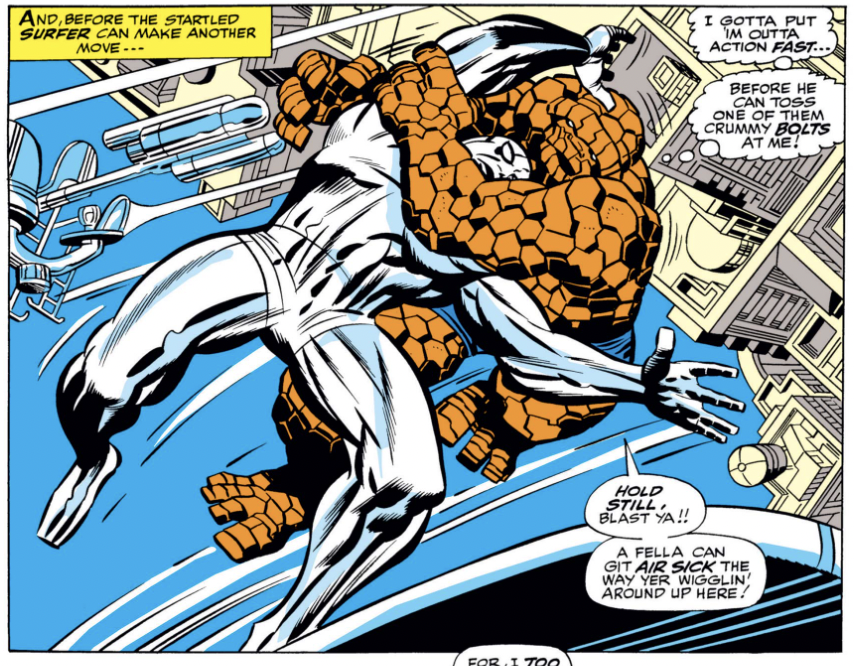
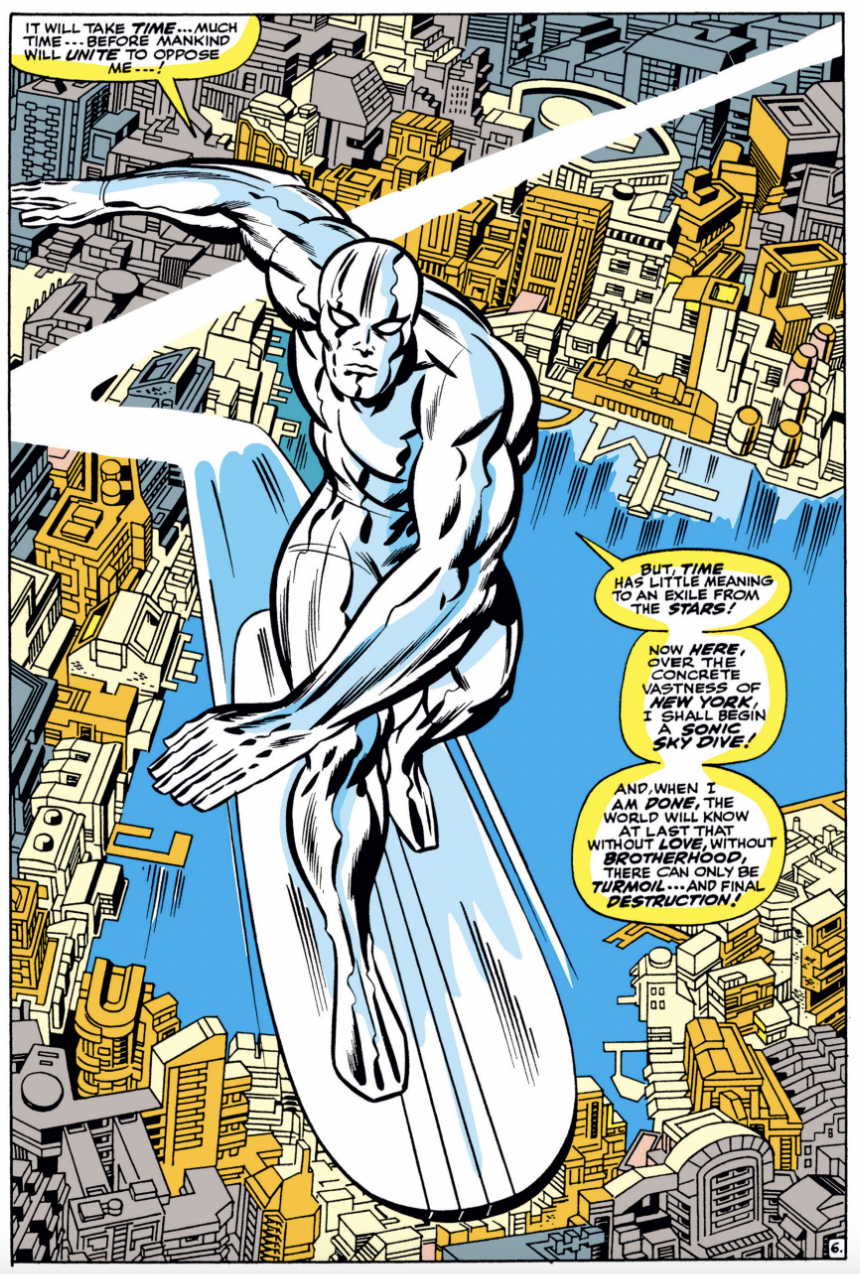
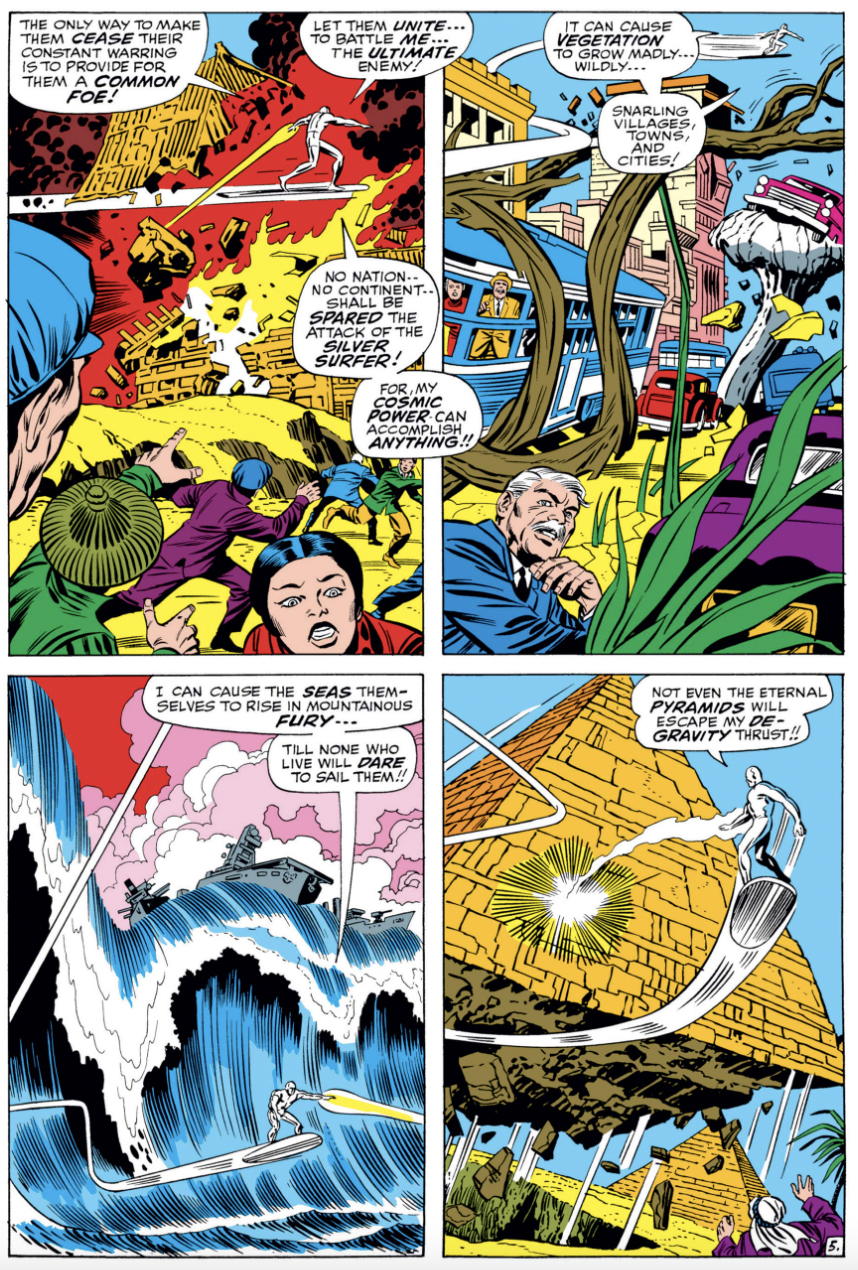
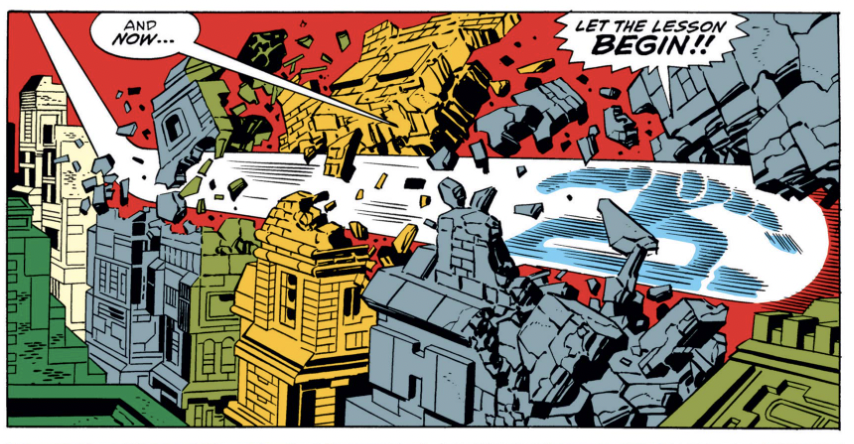
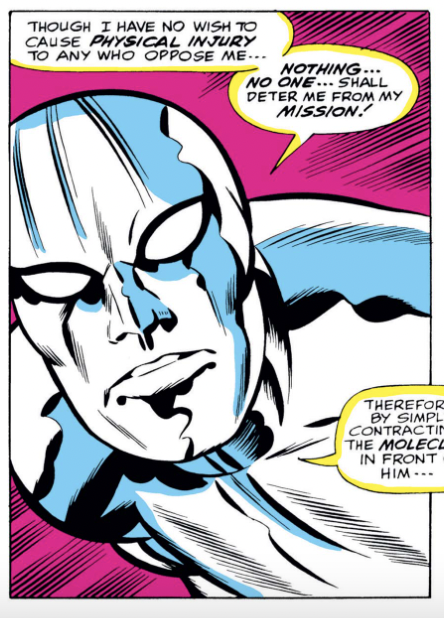
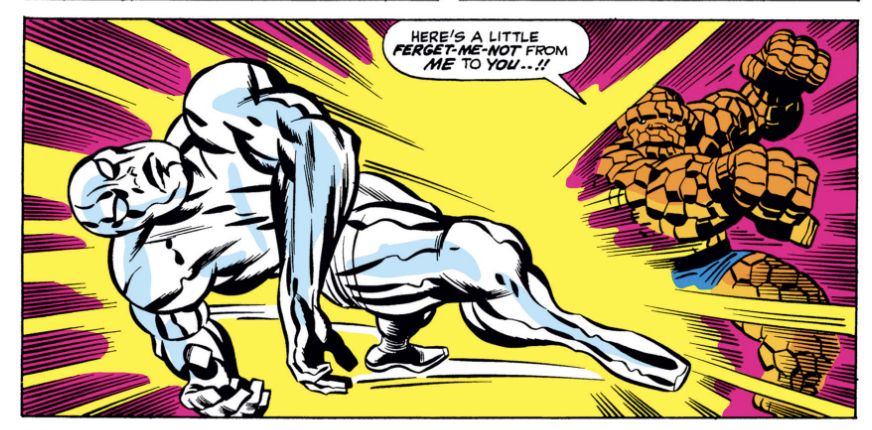
The Surfer, somehow how concluding the only hope for mankind is for it to unite around opposition to him, is destroying crops, levitating the Great Pyramids and flooding cities with tidal waves. When he arrives in New York, the Torch attacks him but he is quickly overwhelmed. Ben has better luck, engaging in a slugfest aboard the Surfer’s surfboard, but he too is defeated.
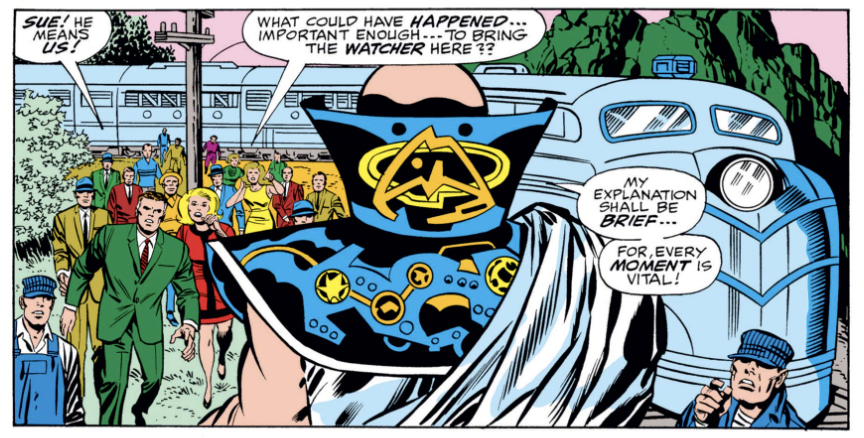
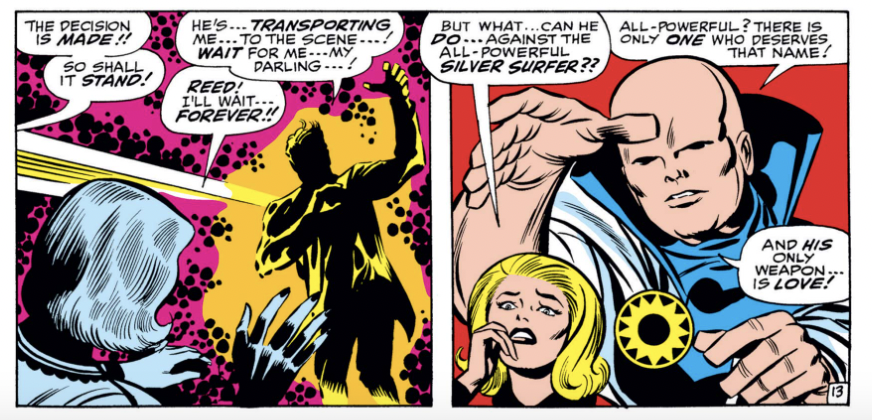
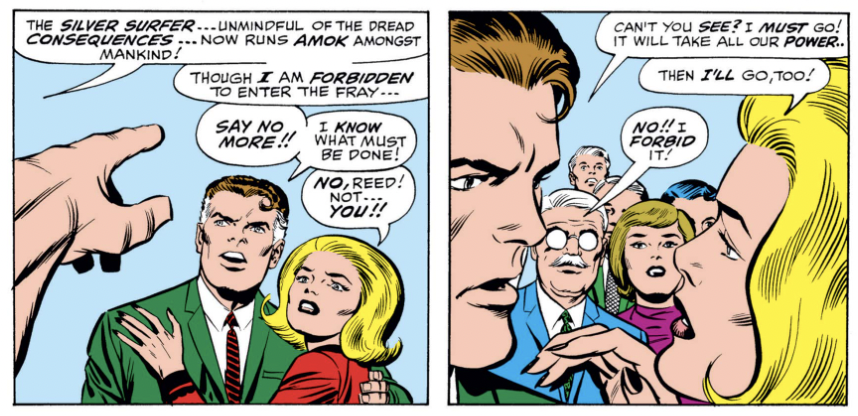
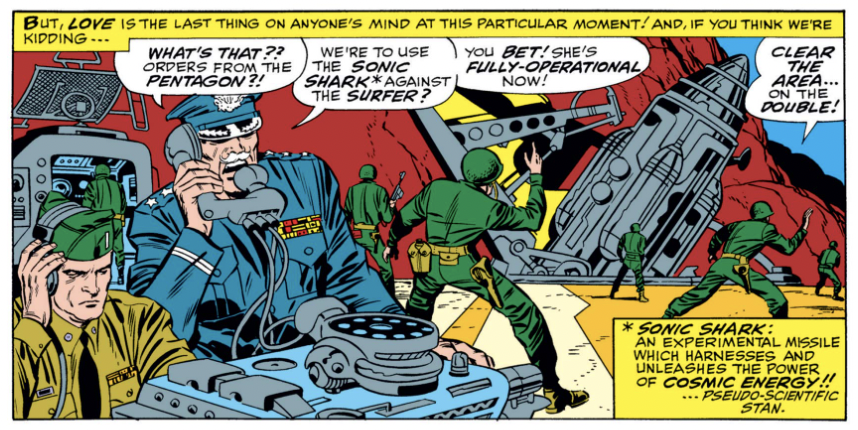
As the military prepares to launch its experimental sonic shark missile, the Watcher halts a train carrying Reed and Sue, and after Reed forbids Sue from joining him, Reed is whisked away.
Back in New York, Reed joins Ben and Johnny, and they pursue the Surfer in order to defend him from the missile, which uses “cosmic energy.” Johnny fails, but at the last minute Ben knocks it off course, where it explodes in the stratosphere. Weakened by the missile, the Surfer comes to his senses and apologies to the FF for his actions.
What’s going on here?
This is a fun one-and-done issue, maybe the best single-issue story since issue 51, the classic “This Man, This Monster.” FF 72 doesn’t have the pathos or drama of that story, but it has great pacing, compelling action and high-stakes. Interestingly, while the Surfer is nominally the villain, it’s really the US military that poses the greatest threat in this comic.
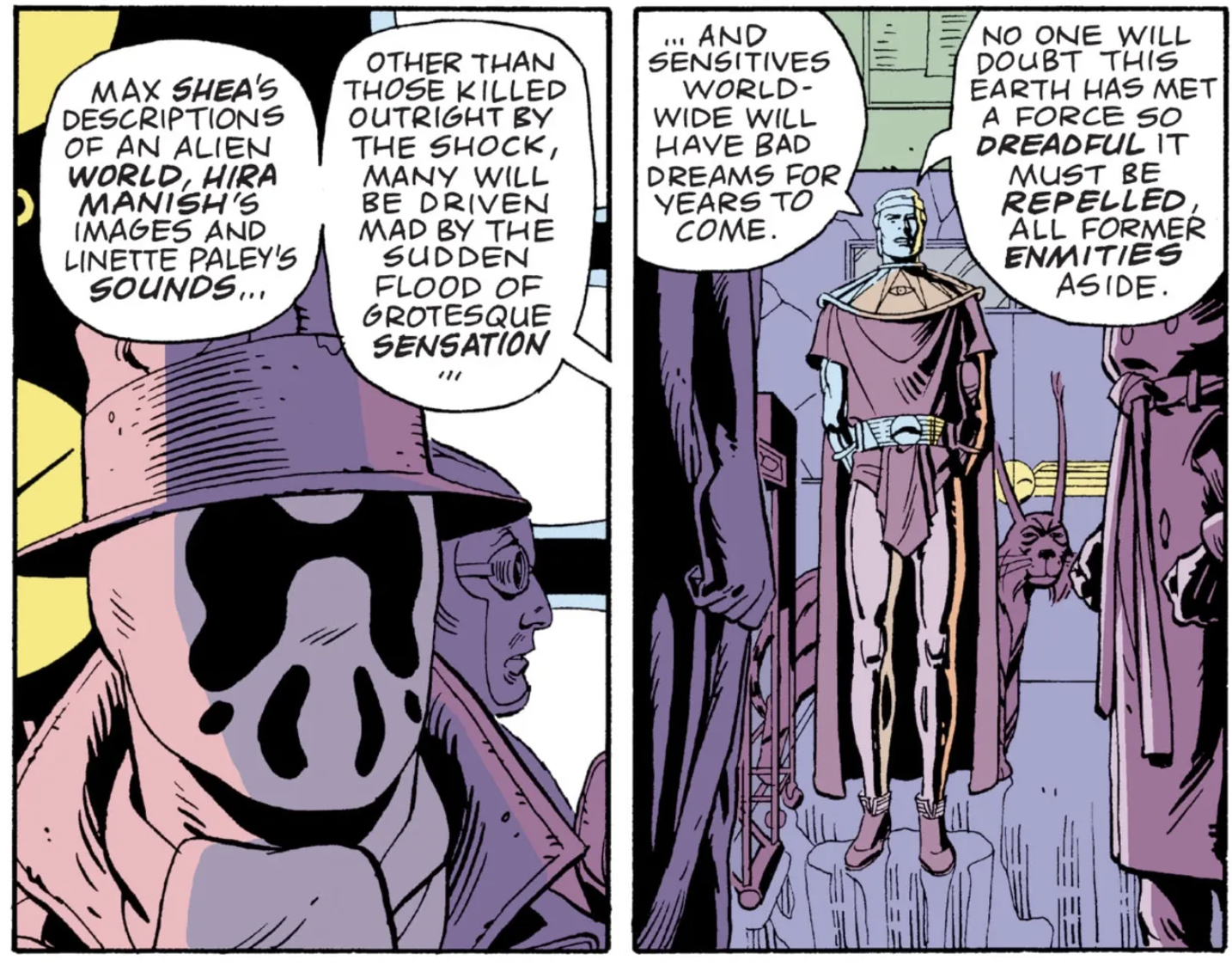
The Surfer’s big plan—by becoming a menace, mankind will unite around a common enemy—shows up in comics and science fiction from time to time. The immediate example I thought of was in Watchmen (spoiler warning!), where Ozymandias drops a giant fake squid-alien in New York to horrify the world and end the threat of nuclear war. I’m sure there are lots more examples.
Watchmen 12 (1987, Alan Moore/Dave Gibbons)
The Surfer’s swath of destruction is pretty extensive and, despite his noble intentions, might lead to some hard feelings about him by humanity. Yet I’m not aware of it ever coming up in subsequent issues, like Namor’s invasion of New York has been repeatedly held against him. Then again, I haven’t read many Surfer solo books, so if anyone out there knows, please let me know.
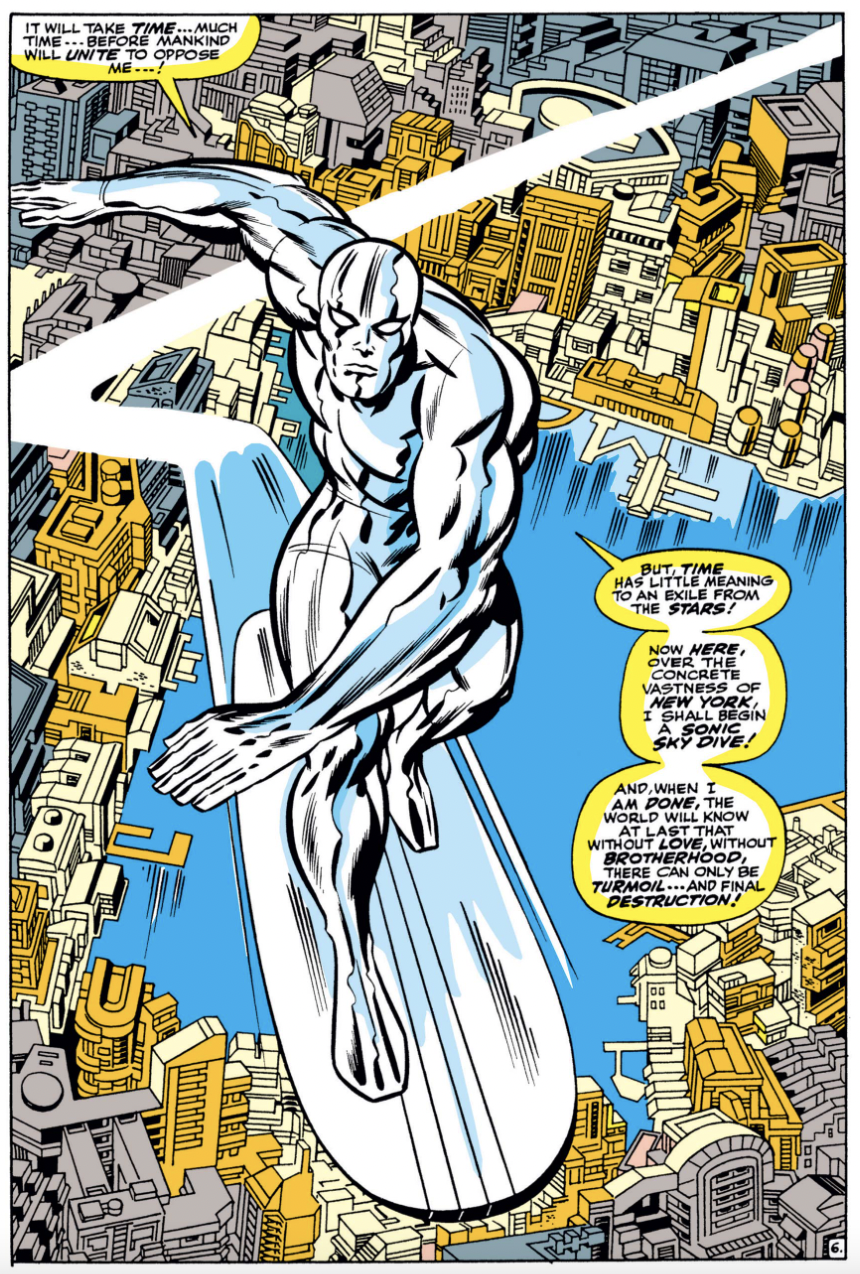
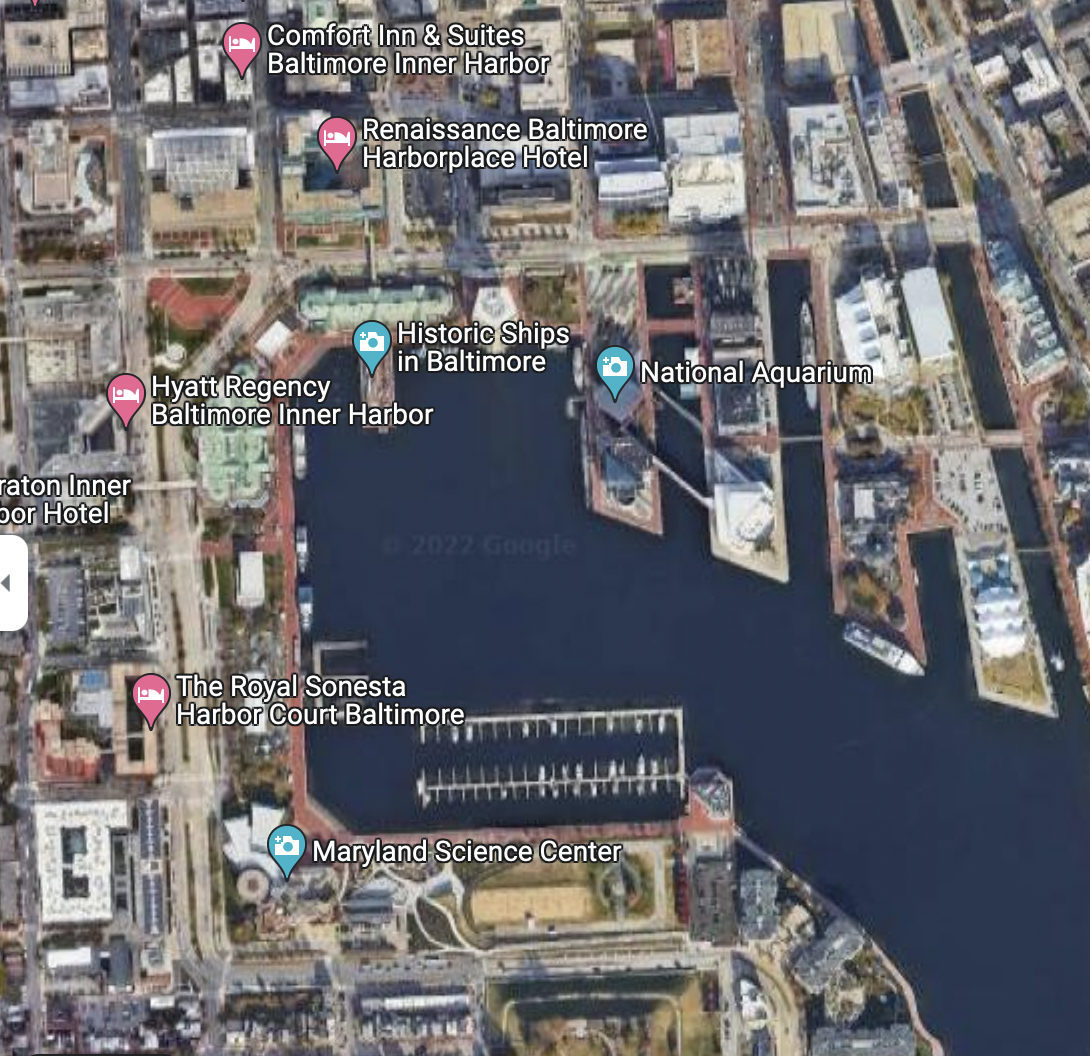
It’s not obviously clear what city the Surfer is flying over in that splash page, but it looks a lot like downtown Baltimore to me.
Keel hauled
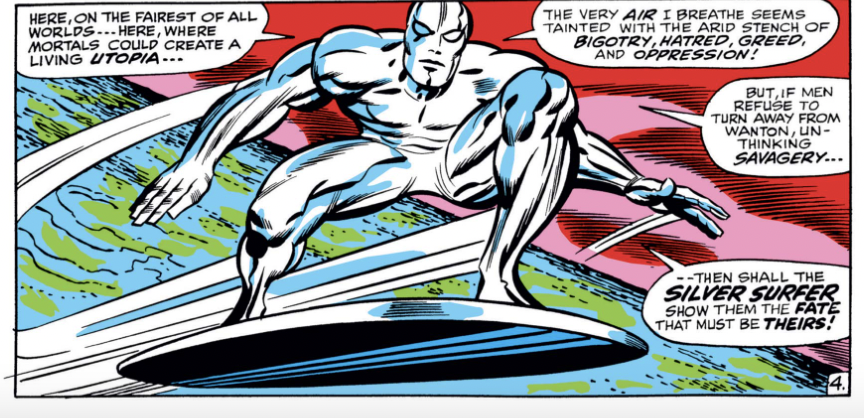
Readers of this blog know I tend to obsess about random details. One of which is whether the Surfer’s board has a keel, like a real surfboard (a subject I delve into in his first appearance). Jack originally drew his board with a keel, but here he is keel-less.
Watching the Watcher
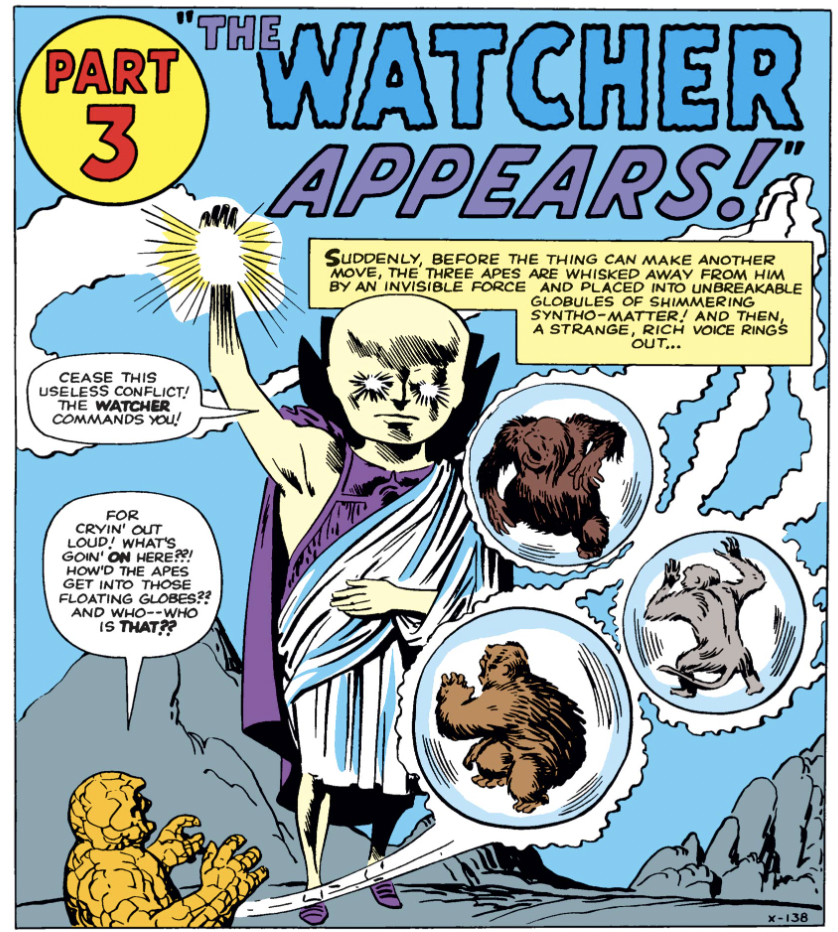
The watcher’s appearance also changes dramatically over Jack’s tenure on the FF. When he was introduced, he was much ore alien looking, with spindly limbs and a huge head. By issue 72, he’s drawn to more human proportions, and looks like he’s been hitting the gym.
Jack also upgraded his outfit. Check out the detail on the back of his tunic:
Also, just who is the Watcher referring to here? Jesus?
The sexist sixties
Once again, Sue is shunted aside by Reed. And Crystal is again completely absent from the action.
Weird science
The sonic-shark missile plays a pretty big role in this story for a device which is only explained in a footnote.
Dig that Kirby Krackle
I already posted a lot of great images, but here are a few more:
Also on the news stands
A Neal Adams hat trick was on sale December 1967:
Next issue: Dr. Doom, and guest stars Spider-Man, Daredevil and Thor!
Fantastic Four 71 “…And So It Ends!” Published: Nov. 1967 Story: Stan Lee and Jack Kirby Script: Lee Pencils: Kirby Inks: Joe Sinnott Letters: Sam Rosen Cover: Kirby and Sinnott
Synopsis
Picking up where Fantastic Four 70 leaves off, the Invisible Girl is alone, facing the Mad Thinker’s android while the rest of the team appear dead before her. Turning invisible, she manages to fire an “electra-force beam” at the android, and the discharge revives the rest of the team. The Thing awakens, and no longer under the influence of the Mad Thinker’s brain washing, takes on the android, knocking it through the wall and onto the street below.
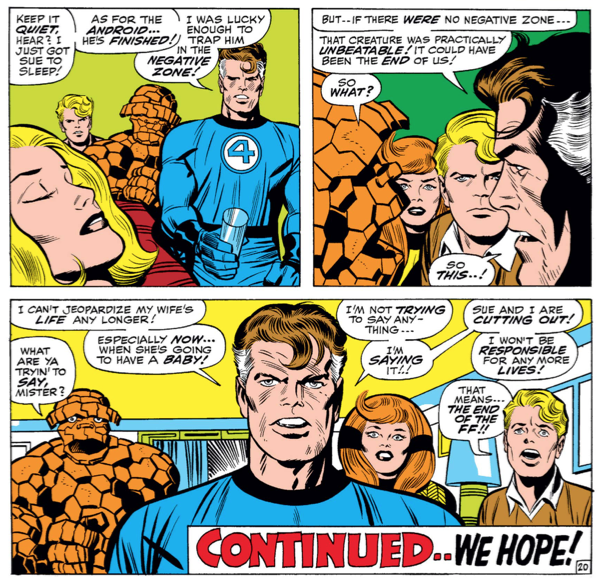
Now revived, Mr. Fantastic and the Human Torch, not aware of Ben’s transformation, attack him, but eventually they are convinced he has returned to normal and the team again battles the android, which has returned and quickly overpowers Ben and Johnny. All seems lost until Reed lures it into the Negative Zone, where it is lost presumably forever.
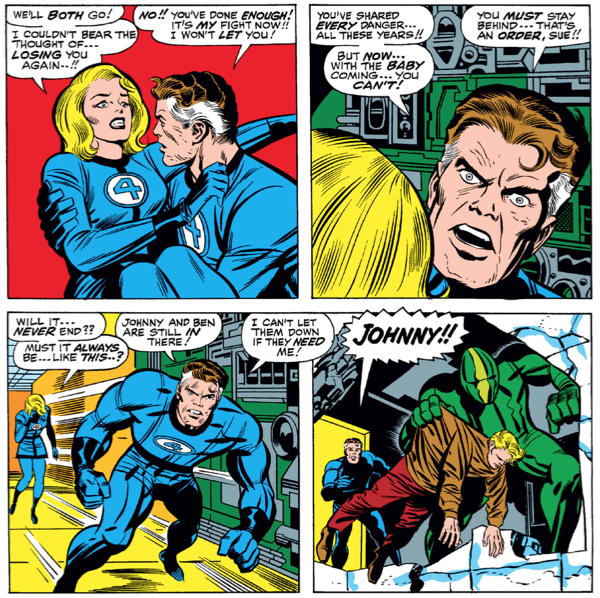
The issue concludes with Reed declaring the Fantastic Four is too dangerous for the pregnant Sue, and that they will leave the team, spelling the end of the FF.
What’s going on here?
After a slow start to this story arc, which relied heavily on the cliché of Ben turning against his team, it ends on a bang. This is another issue that is almost entirely action, and it delivers. The android is a ferocious opponent, and as in many classic FF battles, it’s Reed’s brains, not the team’s brawn, that saves the day.
The issue also puts the spotlight, even if briefly, on Sue, who was sidelined the previous three issues. While it doesn’t last long, she holds her own against the android, and buys time for the rest of the team.
But she is quickly shunted to the side again, keeping our run of sexist sixties entries intact:
The end of the Fantastic Four
Has any super hero team threatened to break up as often as the Fantastic Four? It is a recurring feature, perhaps because, as a family, a departure of a member or two seems to have much bigger consequences than say, for the Avengers or Justice League.
Of course, they never really break up for long (although recently they gave us reason to worry). Here are a few examples of team breakups:
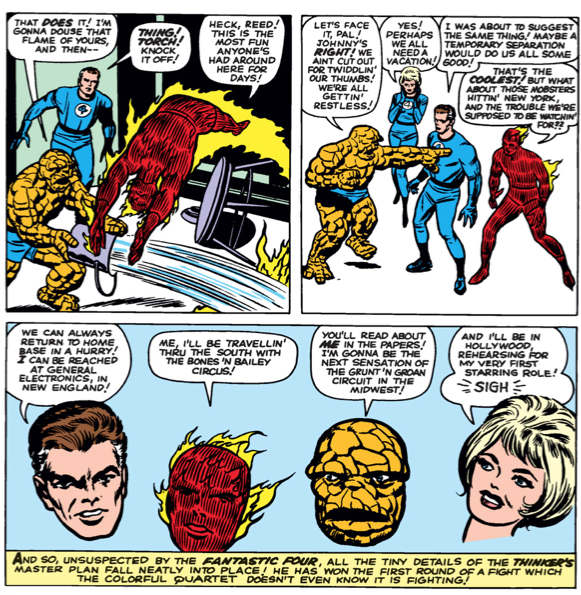
In Fantastic Four 15, the team splits up after the Thinker secretly (Zgives them all inducements to leave:
(Lee/Kirby/Ayers, 1963)
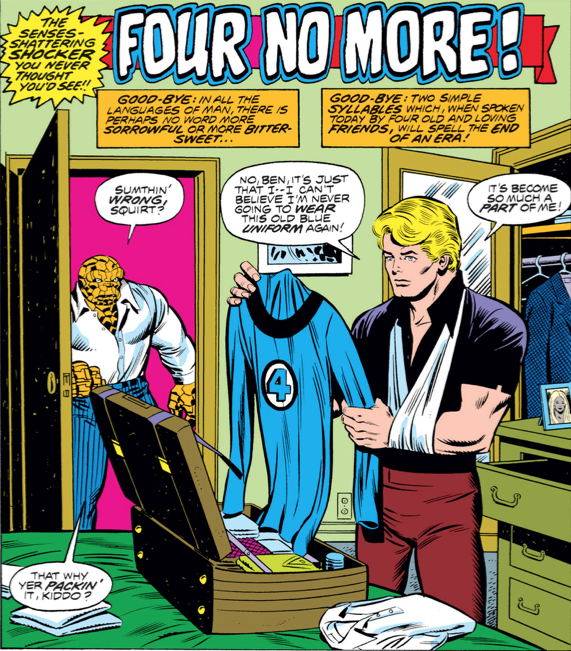
In Fantastic Four 188, Reed, who has lost his powers, declared he is leaving the team. Sue goes with him and in issue 190 (FF 189 was a reprint) Ben and Johnny deal with the consequences:
(Wein/G. Perez/ Sinnott, 1978)
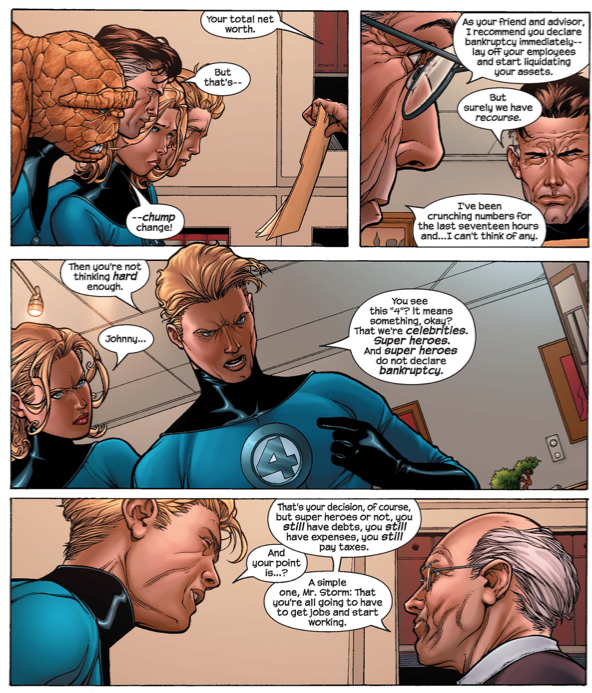
In Marvel Knights: 4, the team find out they’re broke, and splits up to find real jobs (I confess I found this story line totally implausible – in a world where even the most minor celebrity can mild their fame for decades, there’s now way the FF would ever need to work 9 to 5 jobs).
(Aguirre-Sacasa/McNiven/Morales, 2004)
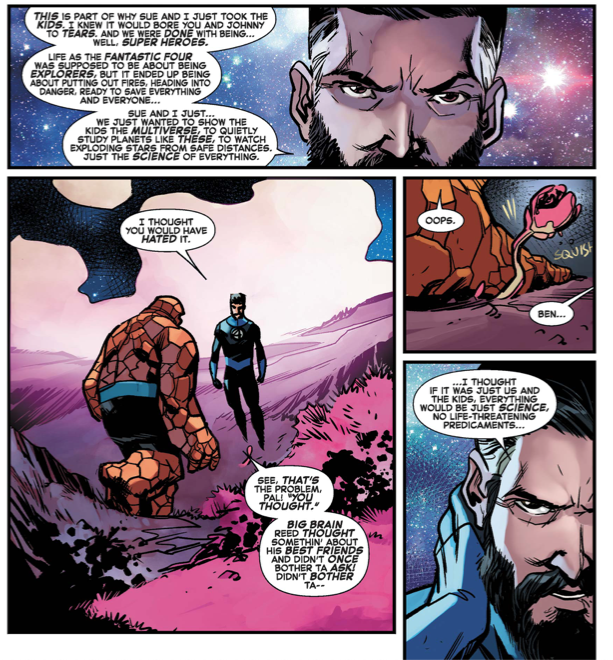
And most recently, in the wake of the Secret Wars II series, Reed, Sue and the kids voyaged in space while Ben and Johnny remained on earth, unaware of their fate (readers were also unaware, since Marvel’s corporate office canceled the FF for about three years in a fit of pique).
Here, in Marvel 2-in-One 11, Reed tries to explain to Ben why they left:
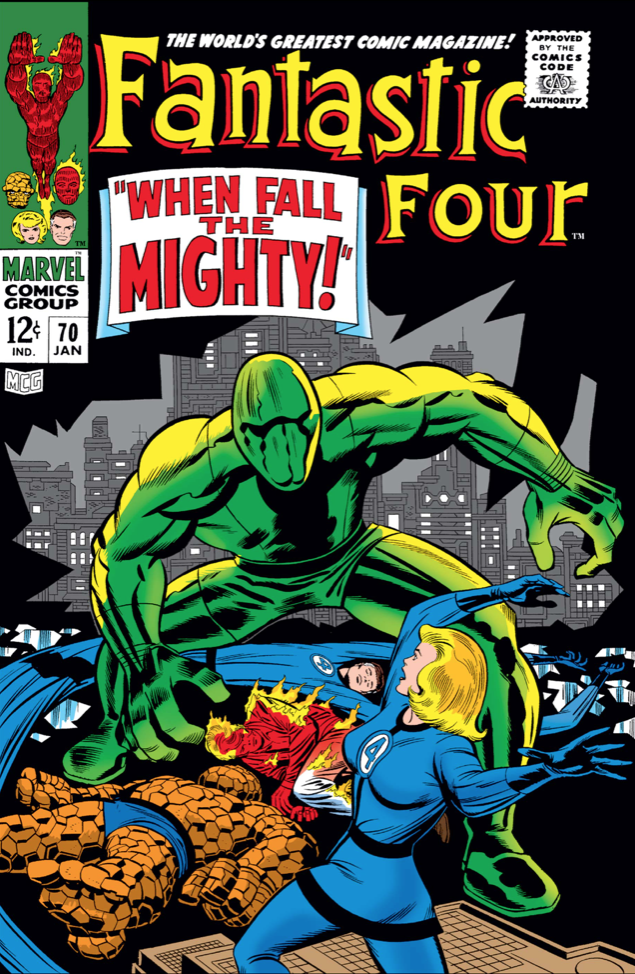
Fantastic Four 70 “When Fall the Mighty!” Published Oct. 1967 Story: Stan Lee and Jack Kirby Script: Lee Pencils: Kirby Inks: Joe Sinnott Letters: Art Simek Cover: Kirby and Sinnott
Synopsis
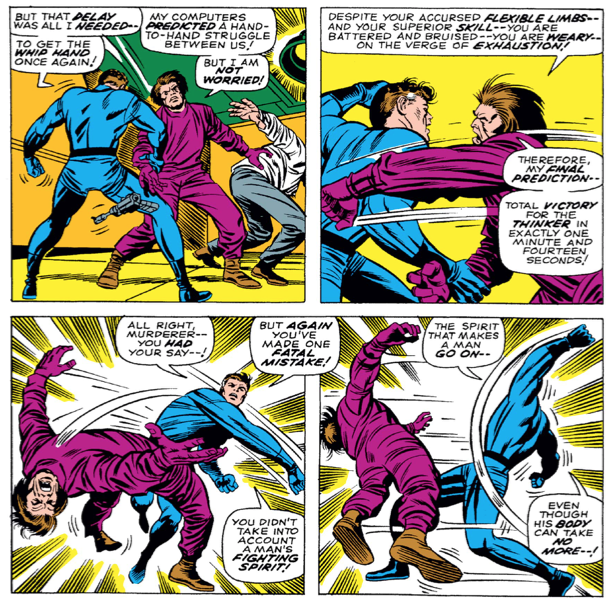
Picking up where Fantastic Four 69 left off, Mr. Fantastic, the Human Torch and a bunch of NYPD cops burst into the Mad Thinker’s hideout to rescue Dr. Santini, the scientist Reed recruited to try and revert the Thing to human form. After they navigate various androids and booby traps, Reed overcomes the Thinker and Santini is rescued.
Meanwhile, the Thing, who previously was brainwashed into seeking revenge against Reed by the Thinker, is still at large in New York. After evading the cops, he eventually make his way through the subway to find Reed and Johnny, where they battle on the city streets before Reed can lure him back to the Baxter Building. There, Ben subdues Johnny before attacking Reed.
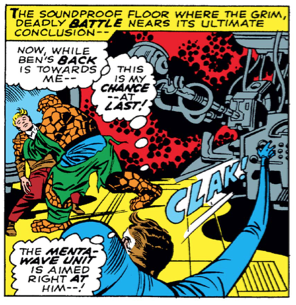
Now in prison, the Thinker uses a device in his wrist watch to trigger a new, 12-foot android to attack the FF. The issue concludes as Reed activates the “Menta-Wave Unit,” knocking out Ben, while the android bursts though the wall of the Baxter Building and the Invisible Girl, up to now sidelined, is left to confront the robot with the rest of the team unconscious.
What’s going on here?
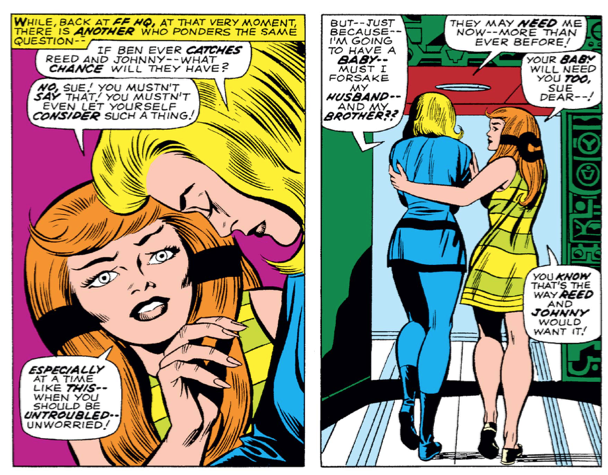
A continuation of a not-terribly-compelling story, FF 70 does pick up some momentum and ends on a genuinely suspenseful note (it’s probably no coincidence that the last panel of the comic was repurposed for the cover). It’s pretty much wall-to-wall action, and features a lot of Reed either battling the Mad Thinker or Ben. This is one of the issues of the FF that reads like “Reed Richards and the Fantastic Three,” with Ben playing the bad guy, Johnny mostly getting in trouble for not listening to Reed, and Sue almost totally absent. It seems pretty clear that both Stan and Jack see Reed as their stand-in—the mature, responsible father figure shepherding women and children—and this comic makes it really obvious.
The sexist sixties
As noted earlier, both Sue and Crystal have been sidelined by Reed and Johnny. Sue is pregnant, so there’s a certain old-fashioned logic there, but at this point it seems Stan and Jack don’t really know what to do with Crystal. Her role will expand in issues to come.
Weird science
As far as I am aware, this is the first appearance of the “meta-wave unit.”
Read all about it
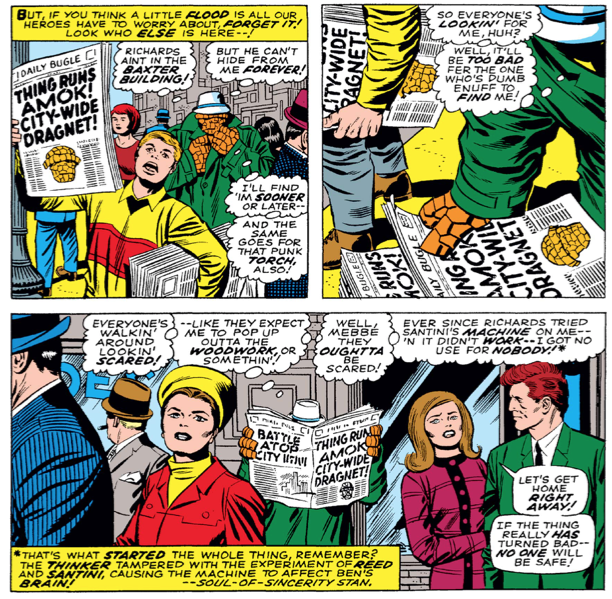
Newspapers again play a big role in the proceedings.
Crazy credits
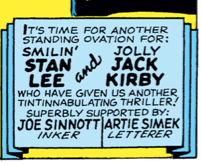
It’s been a while since we’ve had one of these worth running.
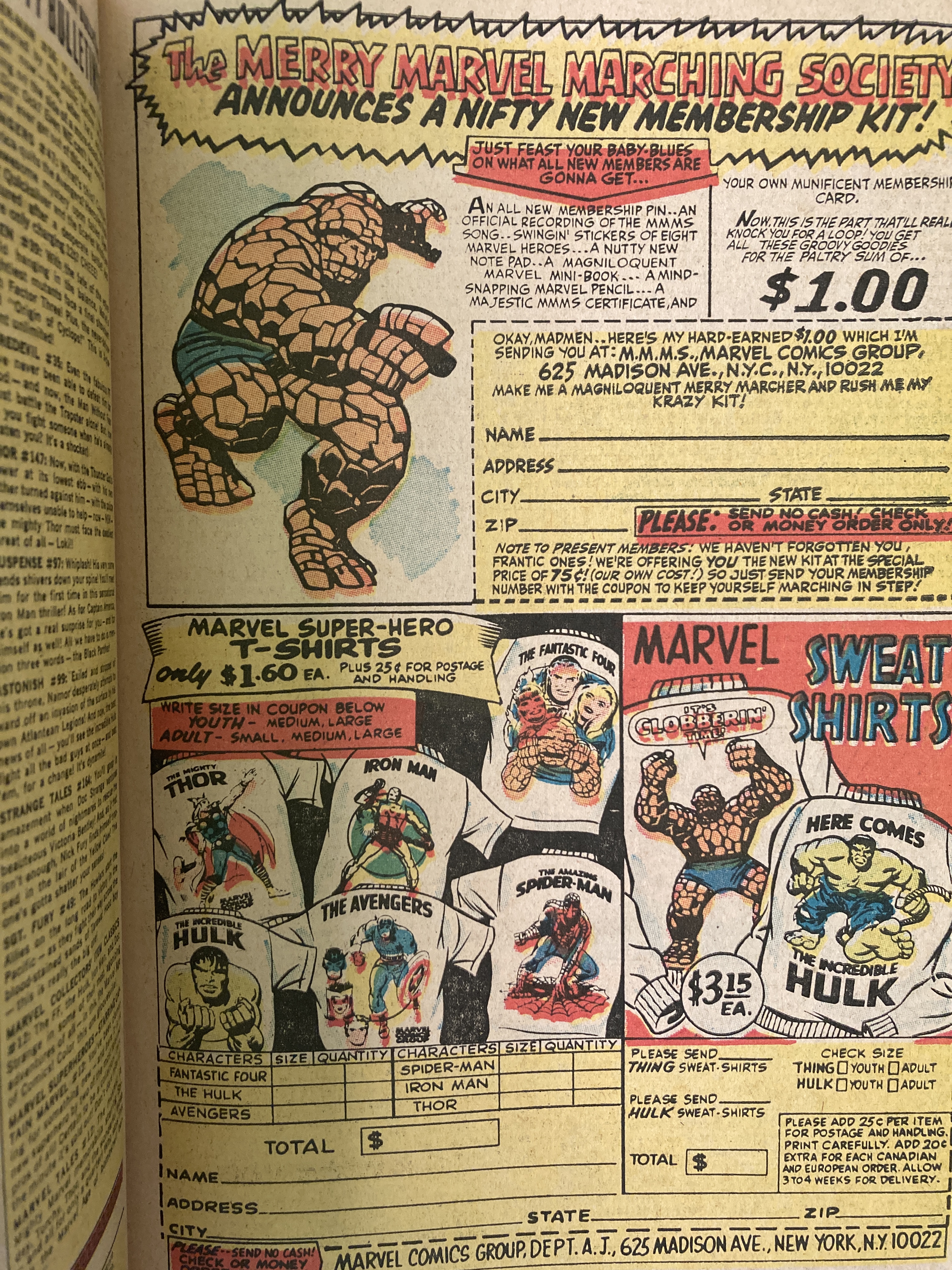
For sale
All kinds of stuff
Dig that Kirby Krackle
This week, one big panel …
… and a bunch of smaller ones:
Also on newsstands
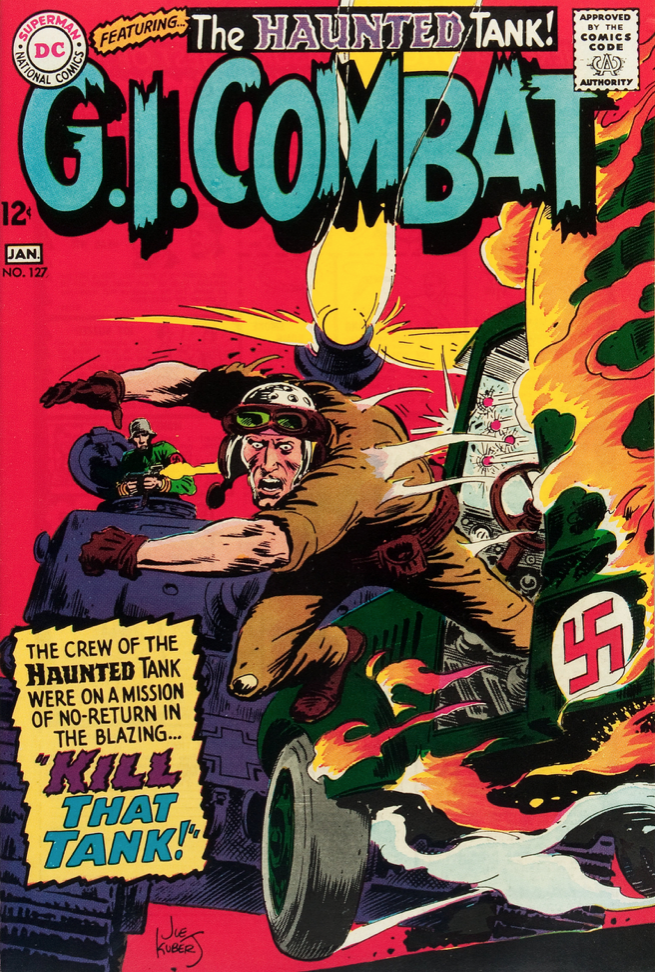
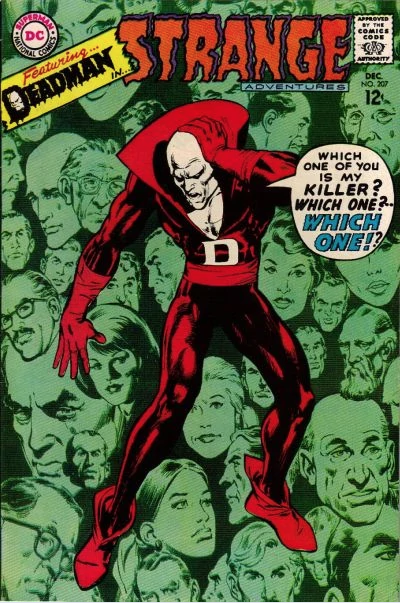
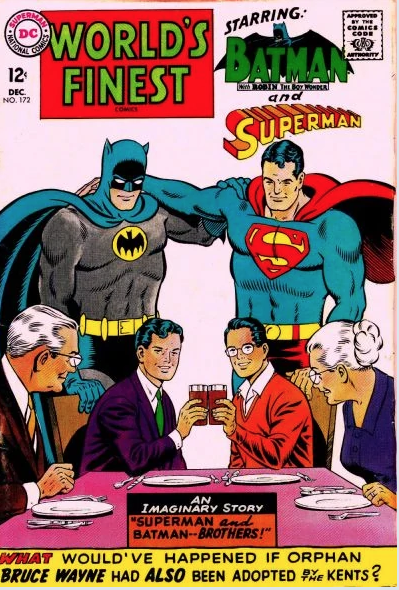
In October 1967. This week I’m going with an all DC lineup, with classic covers from Joe Kubert, Neal Adams and Curt Swan.
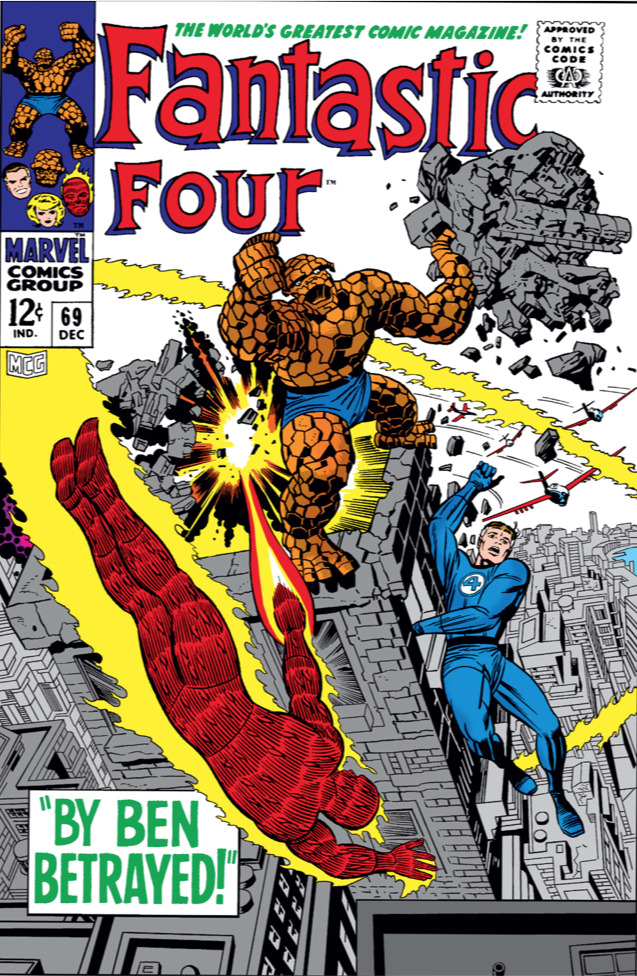
Fantastic Four 69 “By Ben Betrayed!” Published: Sept. 1967 Story: Stan Lee and Jack Kirby Script: Lee Pencils: Kirby Inks: Joe Sinnott Letters: Artie Simek Cover: Kirby and Sinnott
Synopsis
Fantastic Four 69 picks up where the last issue ends, with the Thing mind-controlled by “Dr. Santini,” a scientist recruited by Mr. Fantastic to help transform Ben into human form but actually the Mad Thinker in disguise. Ben immediately attacks Reed and goes on a rampage in first the Baxter Building, then on the streets of New York.
Meanwhile, the Mad Thinker takes advantage of the chaos to pilfer Reed’s secrets, and discovers the entrance to the Negative Zone. And we learn the real Santini is alive and imprisoned by the Thinker
Eventually the police and national guard are called on to stop Ben, and as the pressure to stop him grows, he steals a hat and coat and disappears into the city, vowing to destroy the FF.
What’s going on here?
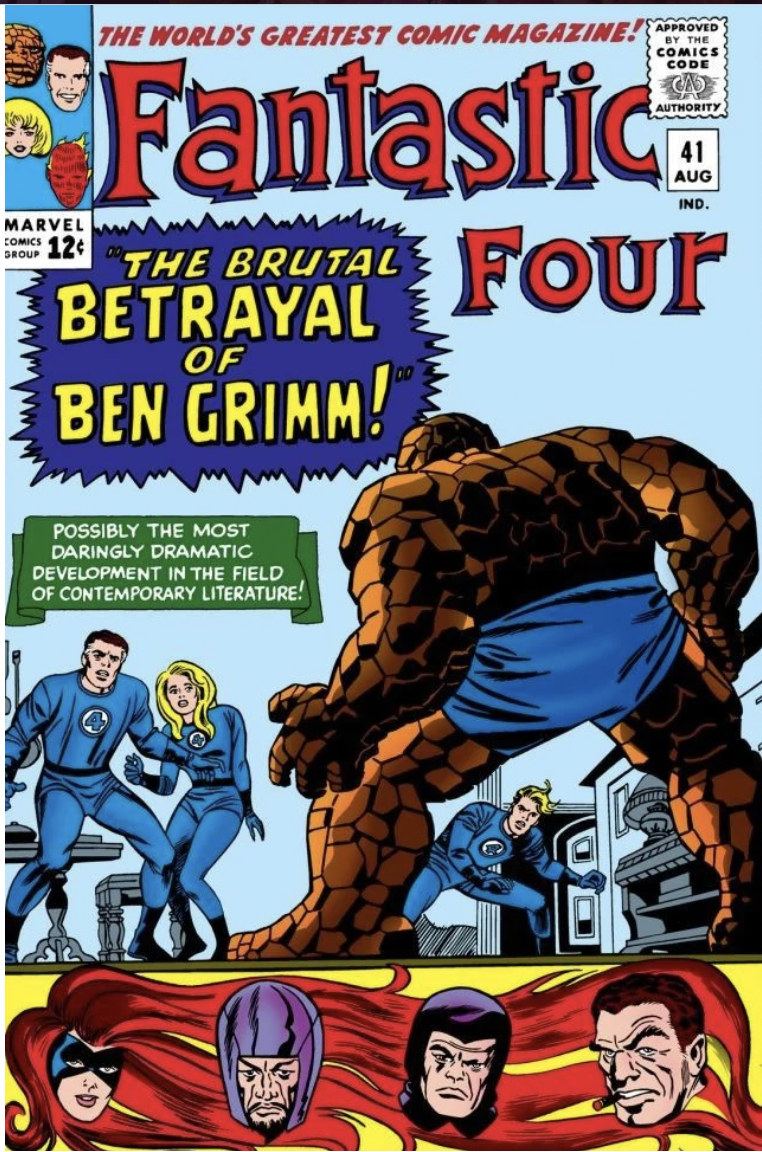
If Fantastic Four issues 44 to 60 represent the peak of the Lee/Kirby run, that means there is inevitably going to be some fall off—every peak is followed by a decline. Up until now, the decline hadn’t been steep – the Negative Zone and and Beehive story arcs were of a pretty high quality. But unfortunately these last two issues feel noticeably weaker. It’s not just that the story (so far) lacks much nuance or dimension—the Thinker exploits Ben’s simmering resentment toward Reed—but it’s that Stan and Jack deployed pretty much the same device in issues 40-42. In those issues, it was the Wizard who brainwashed Ben to attack the rest of the team, but the basic idea is the same. Even the titles are similar (“The Brutal Betrayal of Ben Grimm” vs. “By Ben Betrayed”).
Look, no one bats 1.000 and Stan and Jack’s average is better than most. It’s also notable that they never had a fill-in or inventory issue after almost six years, so maybe it’s to be expected their creativity would flag here and there. But there’s also something a bit sad about seeing a decline, because we know this run doesn’t last forever, and we are closer to the end than the beginning.
Weird science
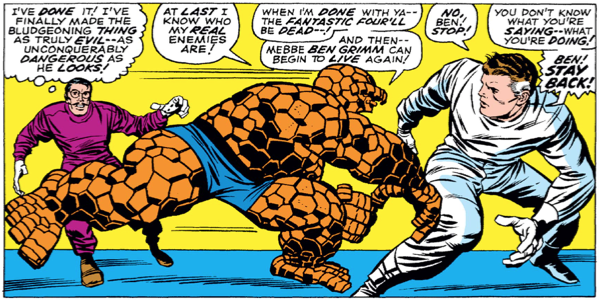
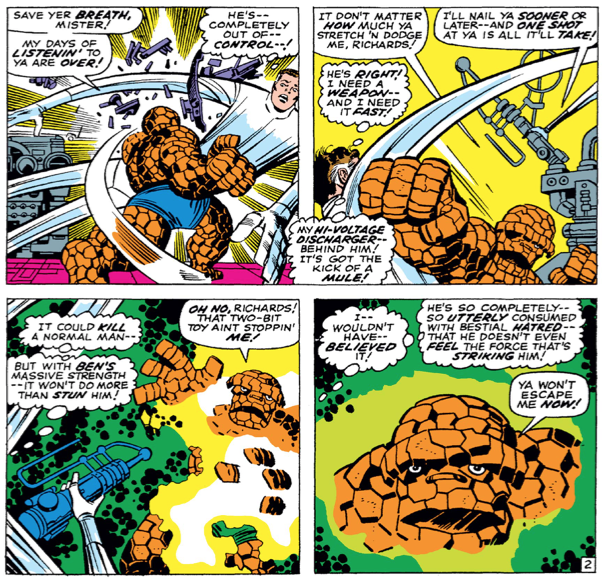
Not only does Reed have a “hi-voltage discharger” but the rest of the team knows all about it.
Incidentally, that’s an iconic image of the Torch. One of Jack’s best.
The sexist 60s
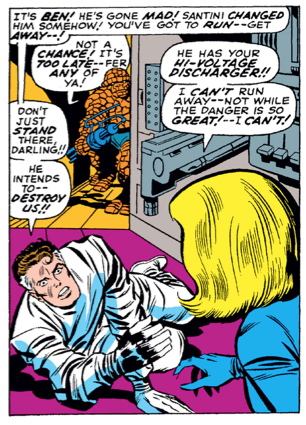
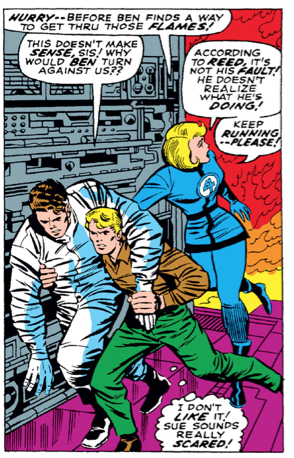
Now it’s not just Sue getting shunted aside, but Crystal as well, despite her pretty impressive powers.
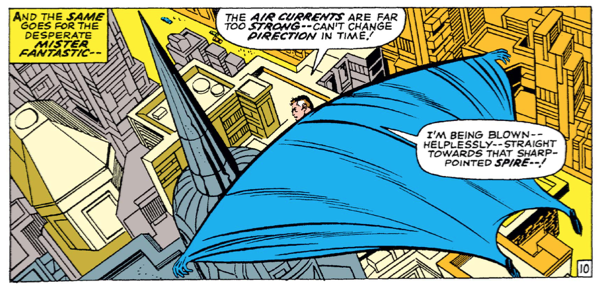
Urban renewal
I thought Ben would be more of a Jane Jacobs guy but he’s going full-on Robert Moses here.
The Incredible Mr. Fantastic
Sue’s new look
She was wearing a mini-skirt last issue, but now it appears she seems to have pants underneath.
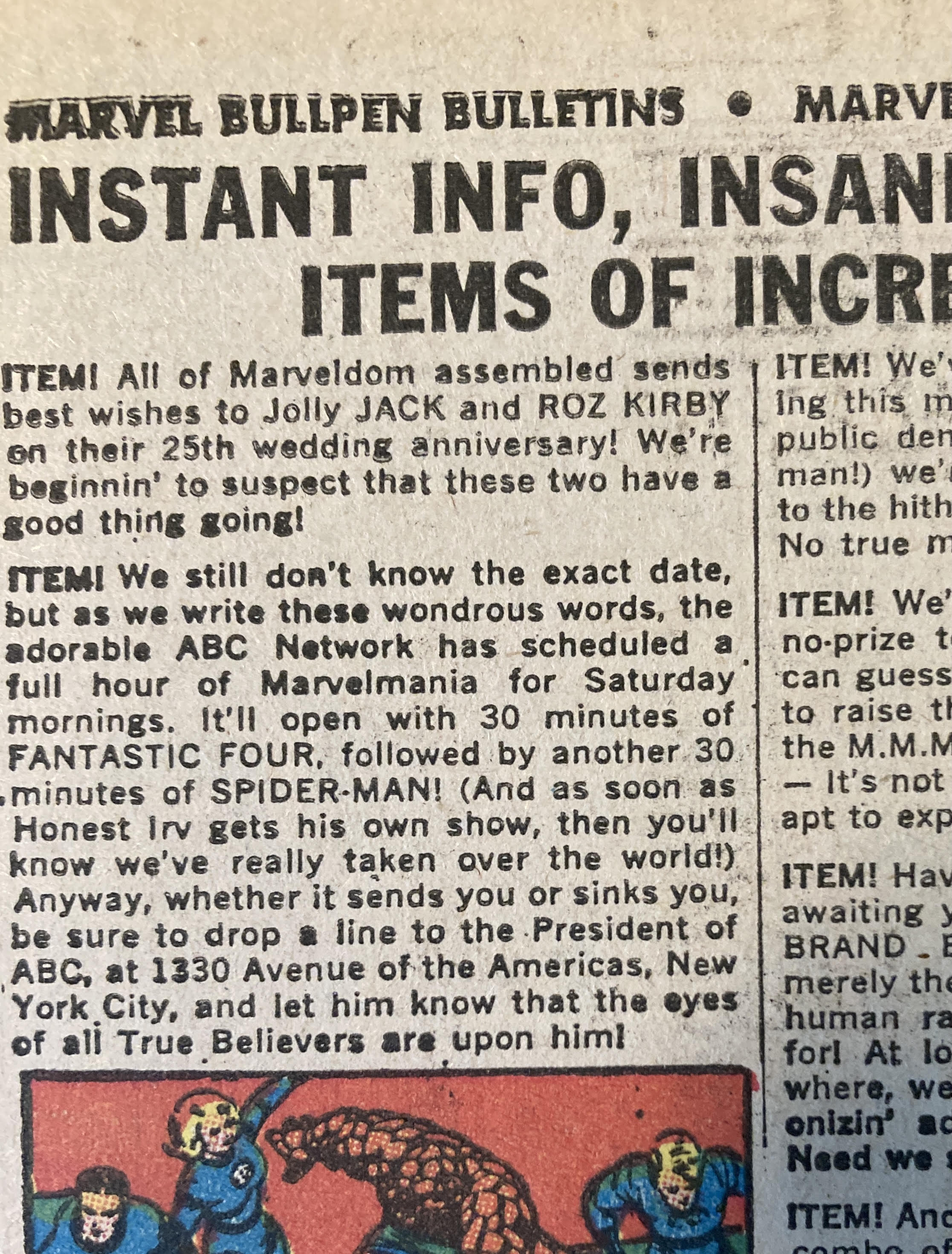
Happy anniversary!
It’s Jack and Roz’s 25th.
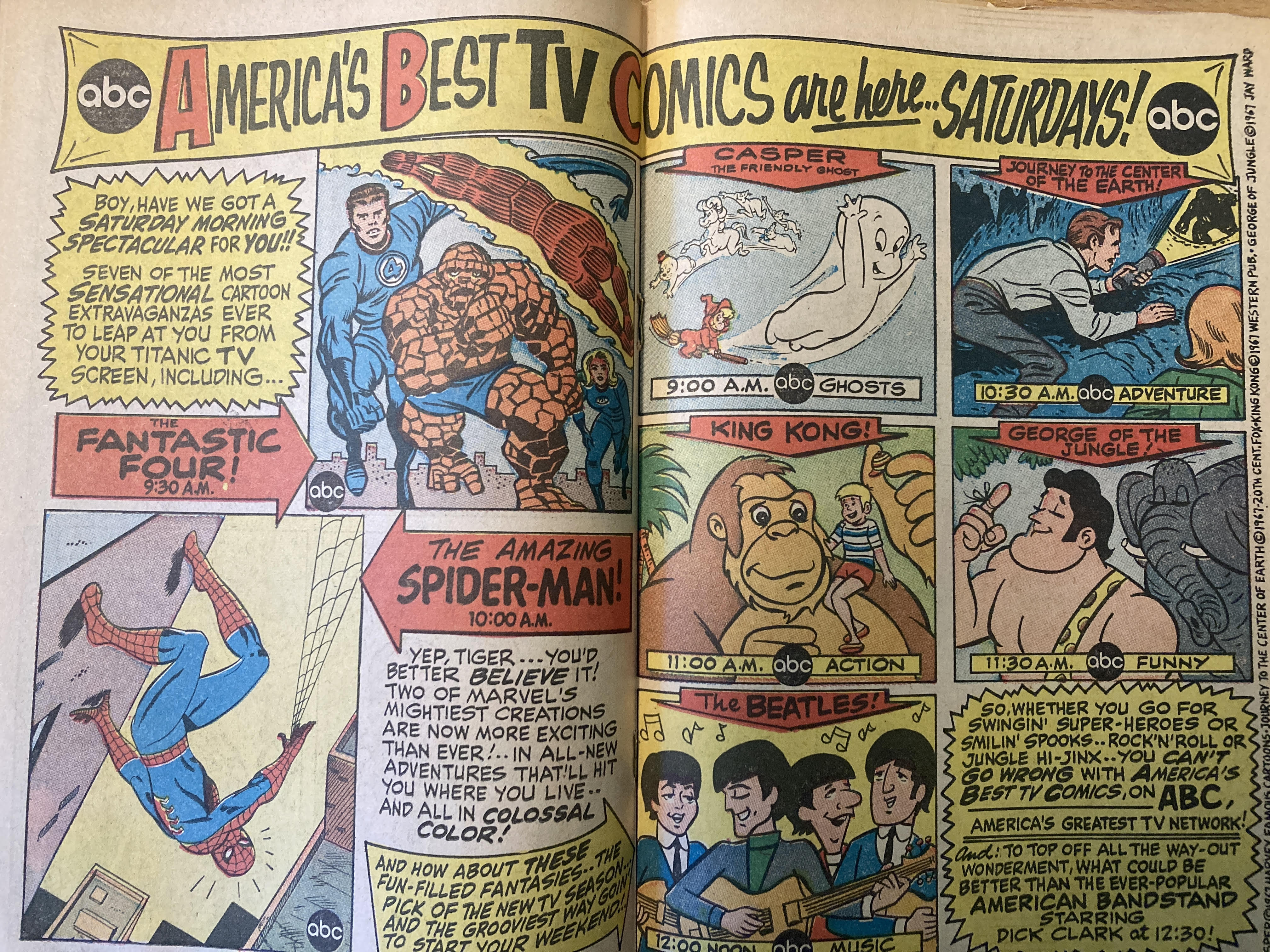
Cartoon time
Seems odd that they have to note the Spider-Man cartoon will be in color. Were black-and-white cartoons a thing?
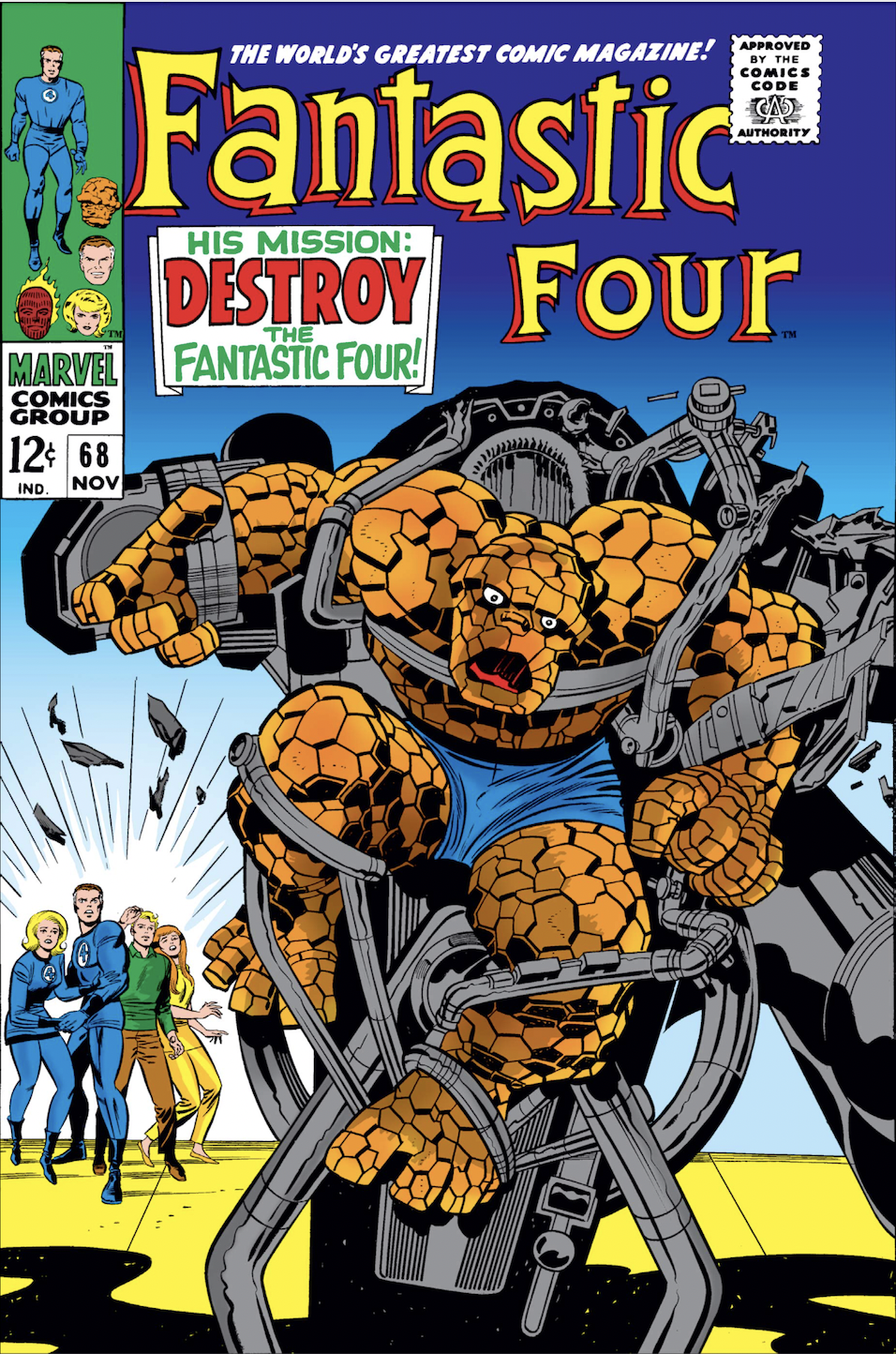
Fantastic Four 68 “His Mission: Destroy the Fantastic Four!” Published: Aug. 1967 Story: Stan Lee and Jack Kirby Script: Lee Pencils: Kirby Inks: Joe Sinnott Letters: Art Simek Cover: Kirby and Sinnott
Synopsis
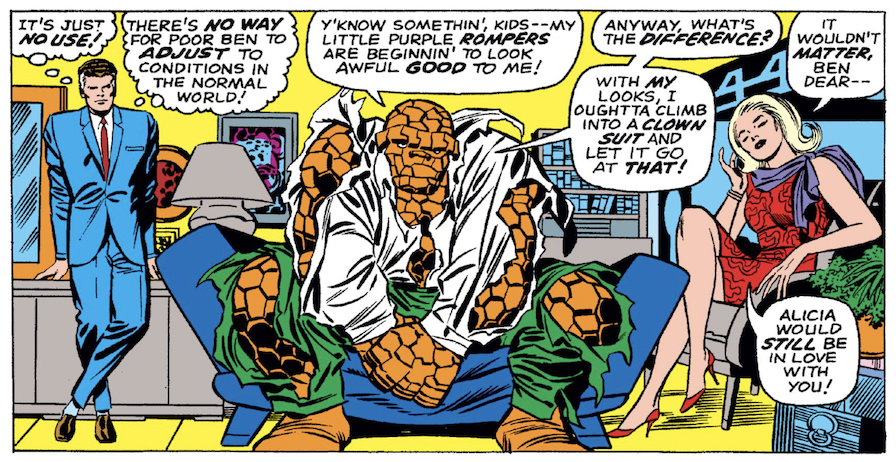
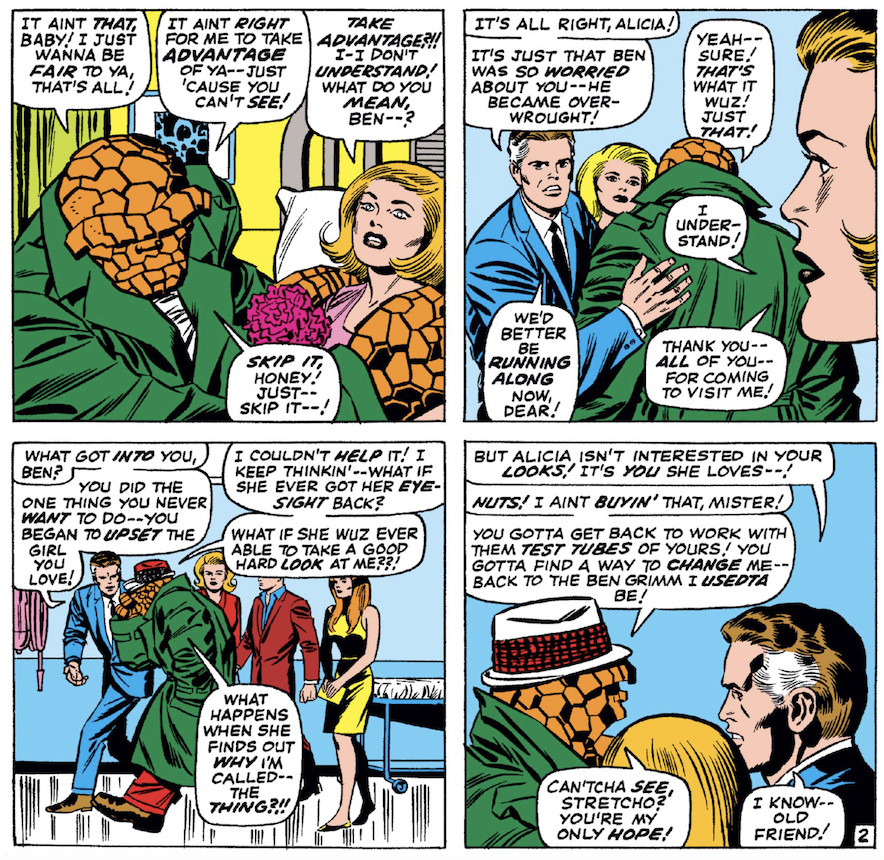
Fantastic Four 68 opens with the team visiting Alicia in her hospital room where she is recovering after ordeal of the previous issue (chronologically this story follows FF 67 , not FF Annual 5). The Thing has a moment of anguish about his appearance, and after some horseplay with the Invisible Girl and Mr. Fantastic in the Baxter Building, Reed renews his efforts to restore Ben’s human form.
Meanwhile, Dr. Santini, a chemist summoned by Reed to help with Ben’s case, is abducted by a mysterious villain who impersonates him to destroy the Fantastic Four. The villain is unnamed and shrouded in shadow but various hints suggest it’s the Mad Thinker.
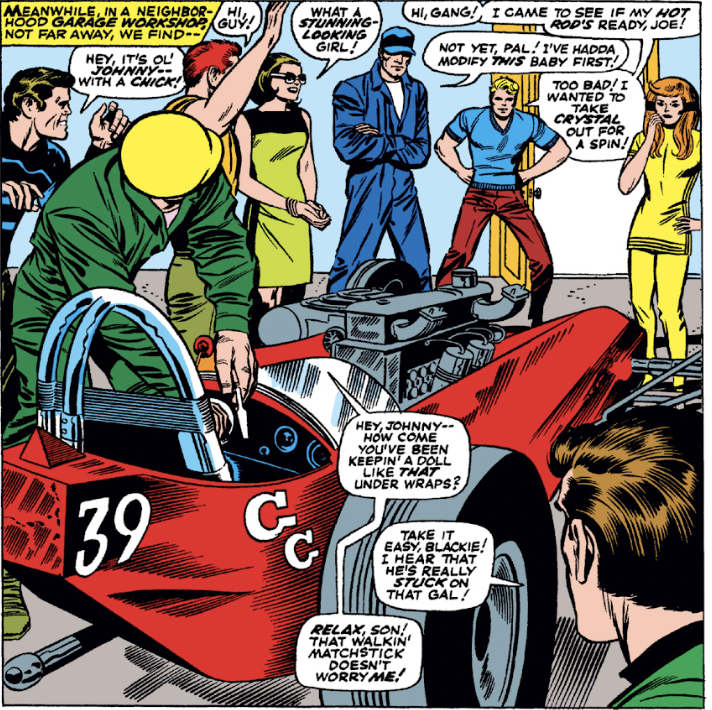
We also check in with the Human Torch, who introduces Crystal to his grease-monkey friends. When Johnny gets jealous when one hits on Crystal, she uses her elemental powers to chill them out.
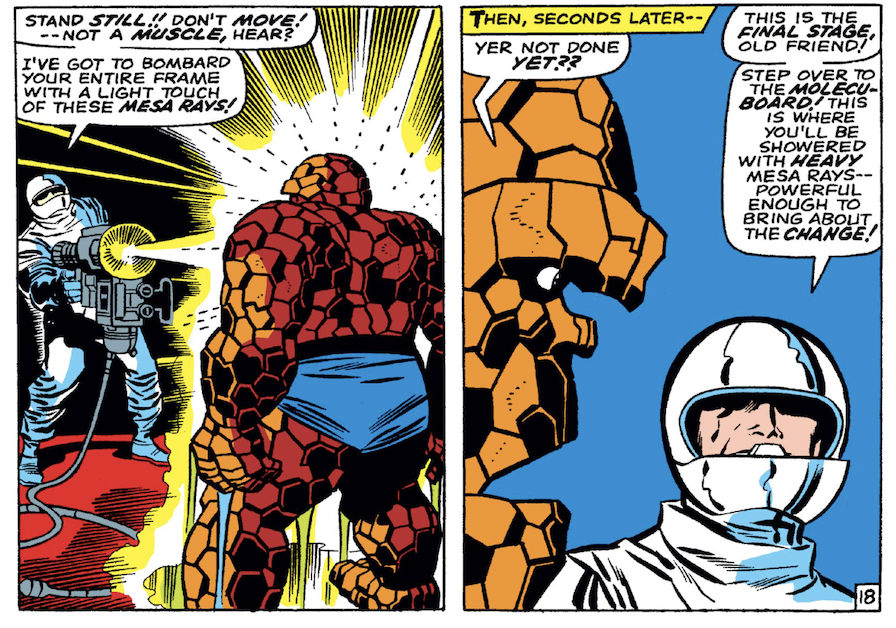
Back at the Baxter Building, Dr. Santini’s imposter arrives and begins to work with Reed to revert Ben to human form. When Ben is finally bombarded with “mesa rays,” his form is unchanged but because of the villain’s sabotages, his mind is altered. The story ends with an angry Ben menacing Reed.
What’s going on here?
After the events of the last two issues (and the annual), most of this issue feels a like a time out that allows the team and fans to catch their breath. Much of the story is devoted to the interplay between Reed, Sue and Ben, a reminder of their friendship, and that Reed and Sue are still newlyweds. We also get a reminder that Johnny is still a car-crazy teenager.
The story’s focus on Ben underscores that his transformation into the Thing—at the hands of his best friend—remains the core tension of the book. Stan and Jack arguably return to the theme too often, but his torment is what helps make him one of the most sympathetic, and beloved, characters in comics.
The sexist sixties
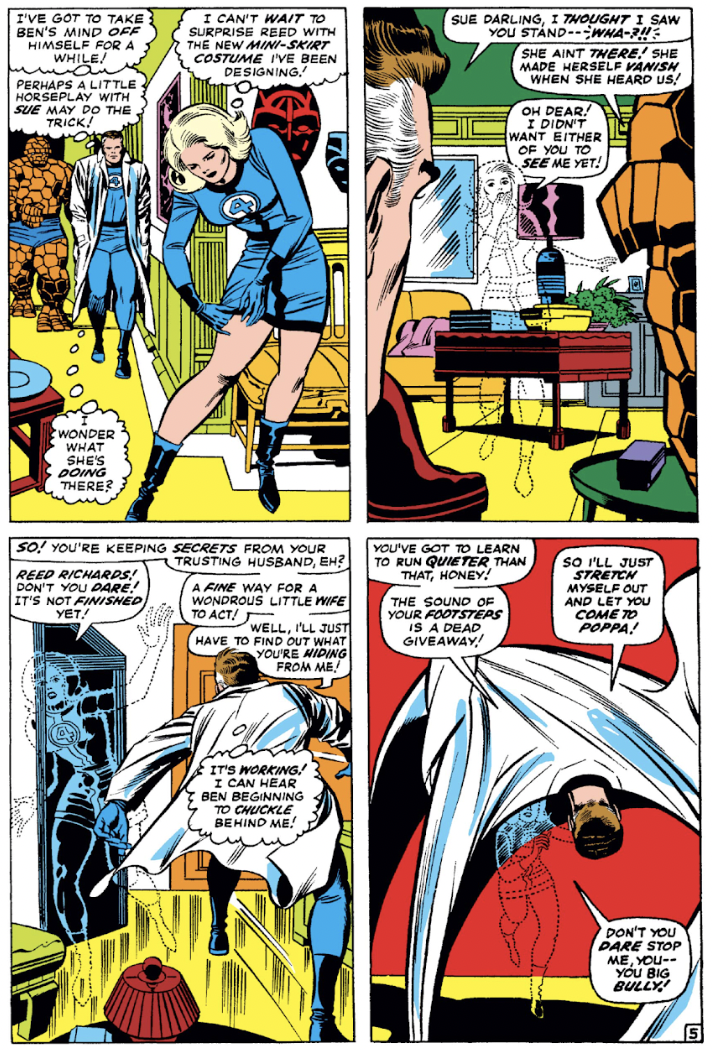
This sequence is actually sort of charming, and is a rare instance of Reed’s playfulness, but it does feel rooted in the sexist characterization of Sue as obsessed with her clothes and appearance.
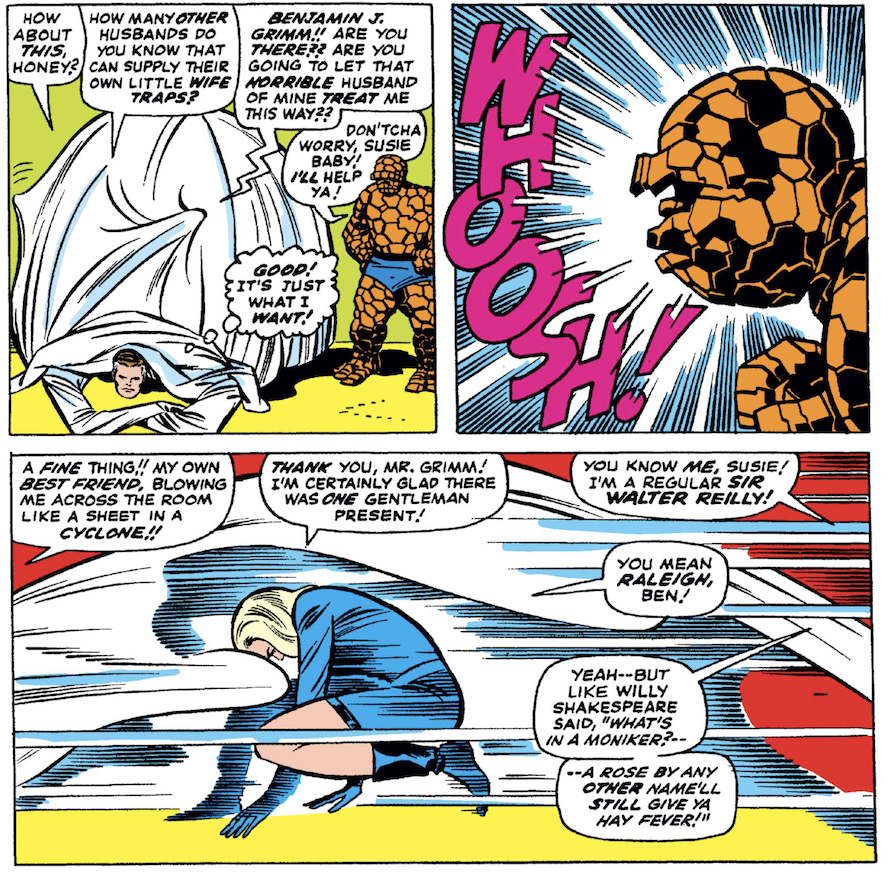
They’re fighting again
More from the same sequence as above:
Weird science
I got to get me some of those mesa rays
Dig that Kirby Krackle
There’s no big splash pages or collages in this issue but still lots of nice panels:
Fantastic Four Annual 5 Published Aug. 1967 Cover by Jack Kirby and Frank Giacoia
Story 1 “Divide .. And Conquer!” Story: Stan Lee and Kirby Inks: Joe Sinnott Letters: Sam Rosen
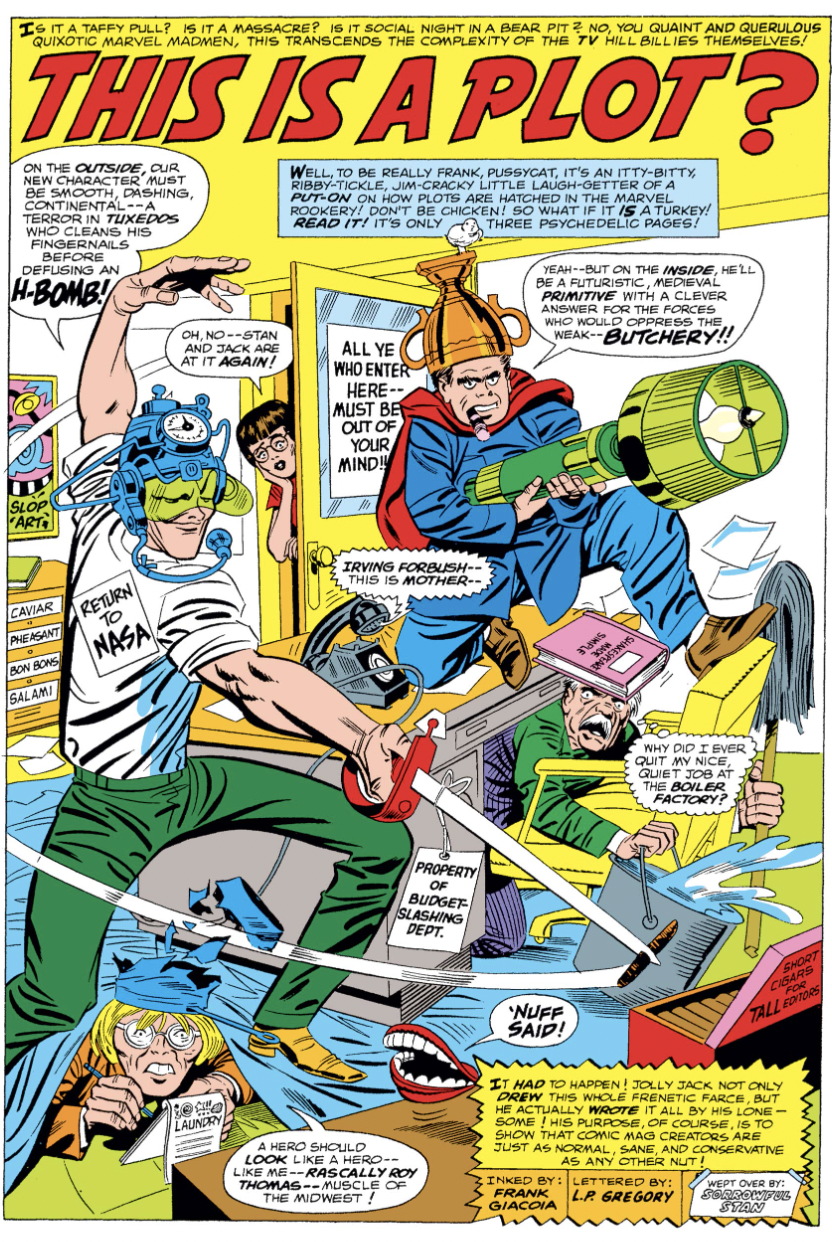
Story 2 “This is a Plot?” Story and Pencils: Kirby Inks: Giacoia Letters: Gaspar Saladino (credited to L.P. Gregory)
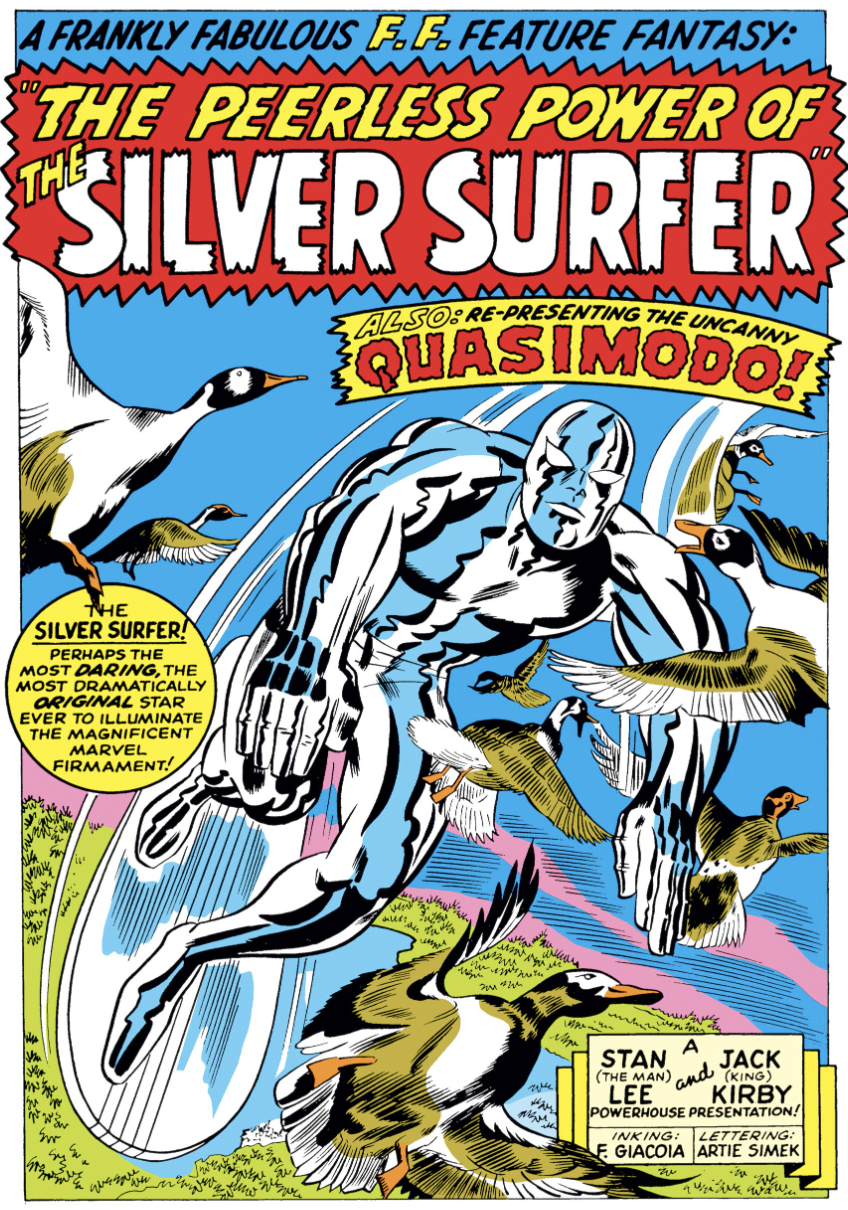
Story 3 “The Peerless Power of the Silver Surfer” Story: Lee and Kirby Inks: Giacoia Letters: Art Simek
There’s a lot to cover in this annual, which is jam-packed with three original stories and a bunch of great pinups. We’ll tackle them one at a time
I should note I’m calling it an annual, although it’s called a King-Size Special on the cover, because it’s numbered according to the FF annuals and because it’s generally listed as an annual. It gets confusing down the road, when a separate run of Giant-Size Specials were printed in the 1970s, most (but not all) reprinting material from earlier annuals.
“Divide .. And Conquer!” synopsis
This story opens in media res, with the Invisible Girl in Mr. Fantastic’s arms, surrounded by the rest of the team, Alicia Masters and Crystal. She’s fallen ill, and it’s soon revealed to be morning sickness: She’s pregnant, and the rest of the team rejoices.
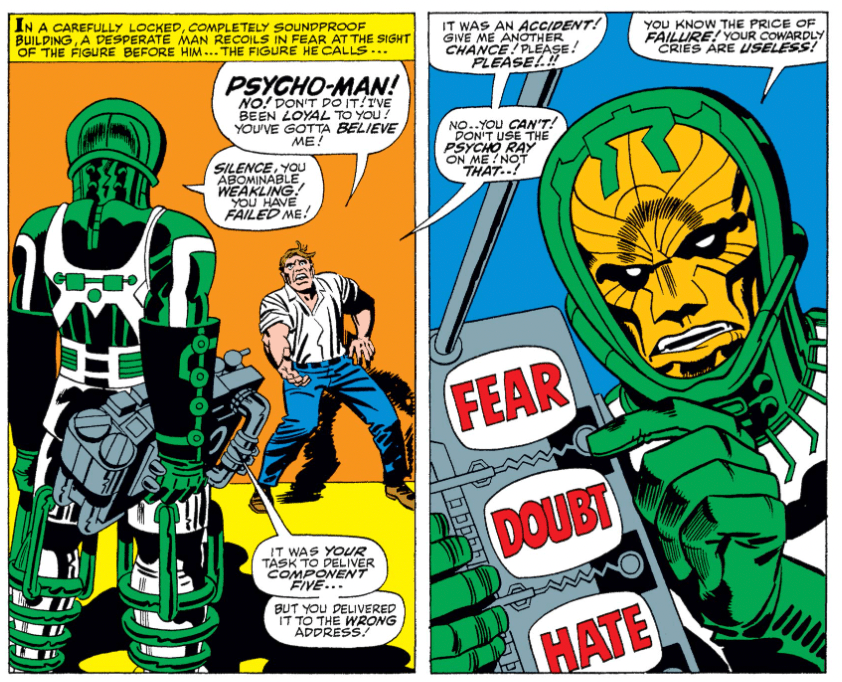
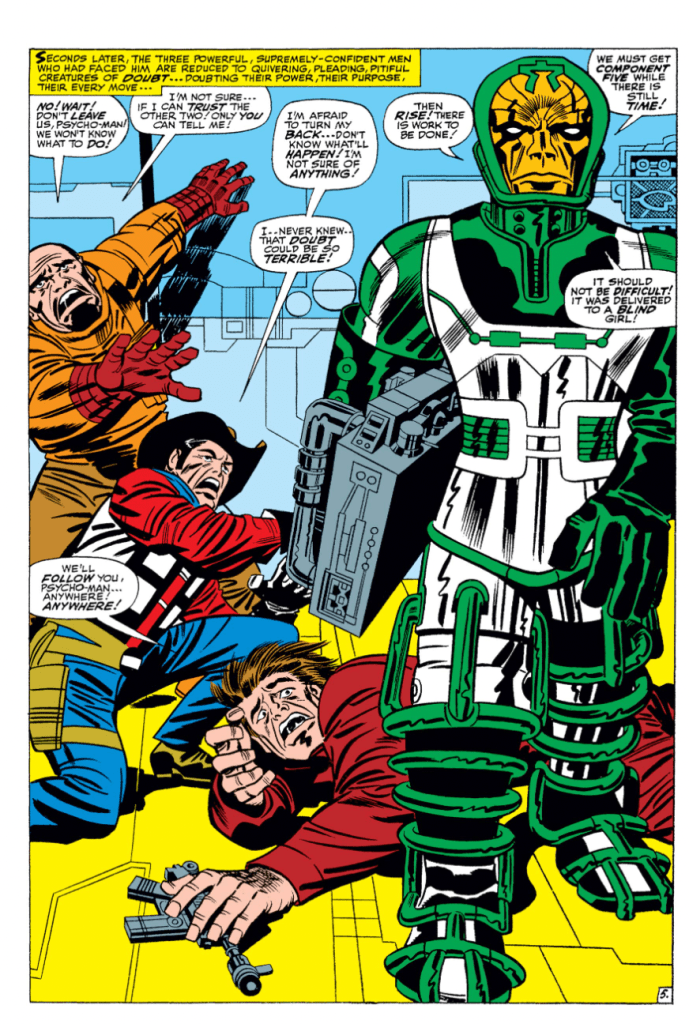
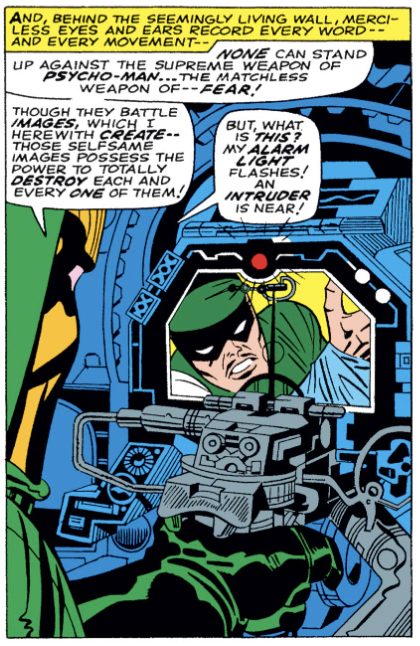
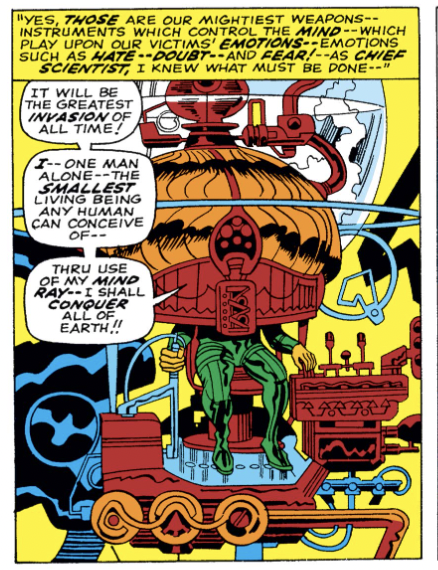
Meanwhile, a new villain soon unveiled as Psycho-Man is terrorizing a henchman who delivered “component five” to the wrong address. The package has been mistaken delivered to the home of Alicia Masters, and as she and the Thing try to make sense of it, he is attacked by Psycho-Man and his remaining henchmen. Psycho-Man uses his emotion-controlling powers to conjure a monster Ben fears, defeating him. The villains leave with the package.
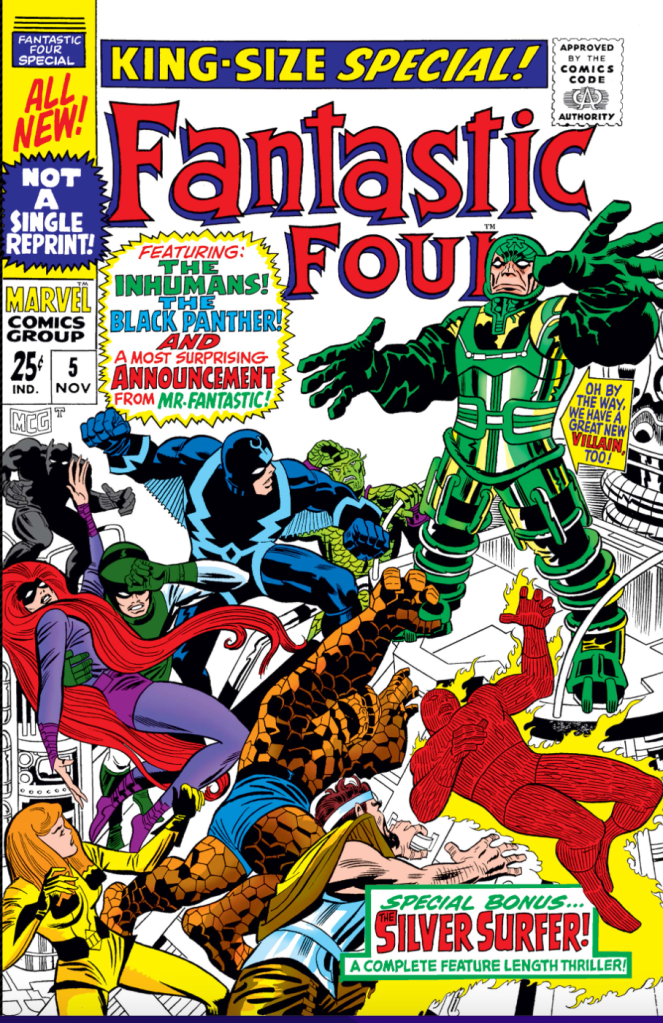
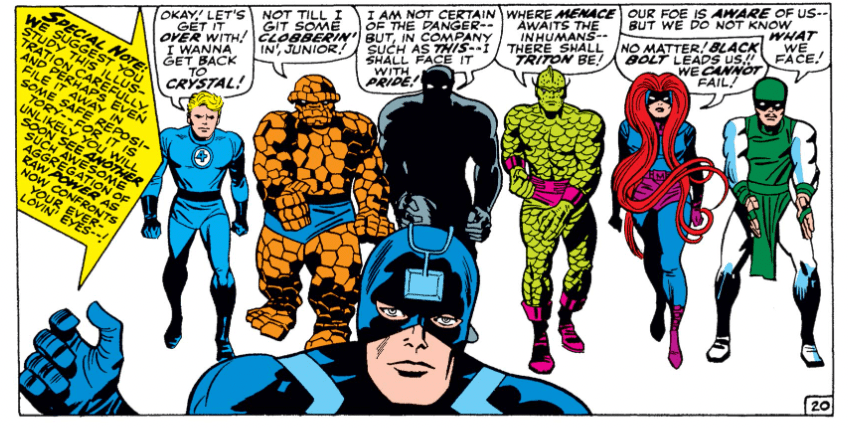
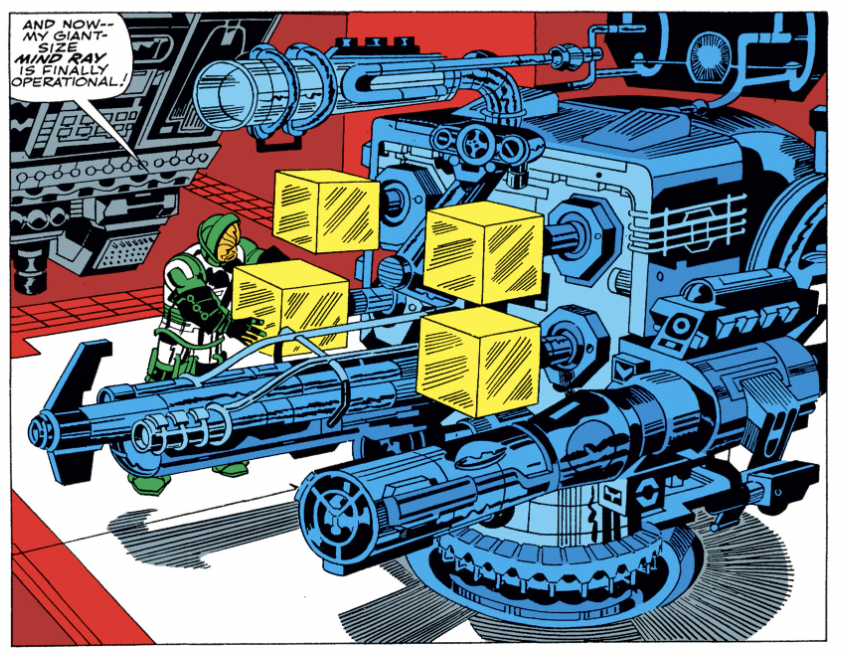
The story then jumps to a tropical island, which the Black Panther has just purchased. The Inhumans Black Bolt, Medusa and Karnak are also on the island, and after a brief fight between T’Challa and Karnak, they team up to investigate a source of danger sensed by Black Bolt. It is the lair of Psycho-Man, where he is building the Mind Ray, and the Inhumans and Black Panther start fighting his henchmen.
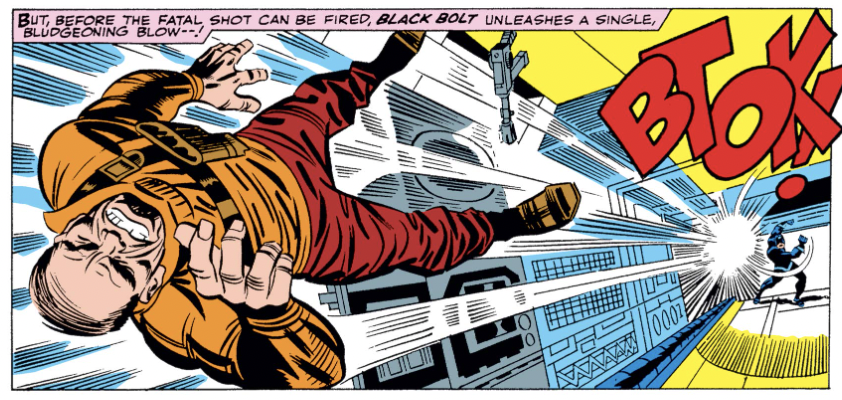
The Thing, the Human Torch and Triton the Inhuman then appear, teleported by Lockjaw (Reed and the pregnant Sue stay behind), and the heroes are confronted with various manifestations of fear and doubt created by Psycho-Man. Eventually, Gorgon, who had been scouting the island, arrives and uses his hoof-striking power to shatter the illusions. Black Bolt destroys the Mind Ray and as Psycho-Man explains his origin—he is from sub-atomica, a tiny realm within our own—and his plans to destroy the heroes, the Black Panther, who had been hidden in a tunnel, pounces. He defeats Psycho-Man, who disappears into the armor he no longer can animate.
What’s going on here?
A lot! This is a fun story with a paper-thin plot that hangs on a couple of implausible coincidences. First, Psycho-Man only comes to the attention of the Fantastic Four because his package was delivered to the home of Alicia (yet another time she has been a victim of real estate — first the Dragon Man crashed into her apartment in issue 47, and then in issue 49, the Silver Surfer collapses on her roof).
Secondly, the Inhumans just happen to stumble on to the island just bought by the Black Panther—it’s not ever really explained what they are doing there, but Gorgon later suggests they might be scouting for a new refuge—and together they just happen to stumble on the Psycho-Man’s lair.
Despite the improbabilities, it’s a fun story that feels a bit like a reunion, drawing together a bunch of heroes introduced over the last few years. And it continues a recent tradition of stuffing annuals with guest stars.
Who is this guy?
This is the introduction of Psycho-Man, a second-tier villain who shows up every 10 years or so, mostly in the Fantastic Four but also (appropriately enough) in the Micronauts, as well as Captain Marvel, the Silver Surfer and Spider-Man. One interesting aspect of Psycho-Man is that he’s from sub-atomica, the micro-dimension accessible only by shrinking. It’s not really obvious why he needs to be from there—he could have just as easily been from another planet or dimension—but it’s an interesting twist.
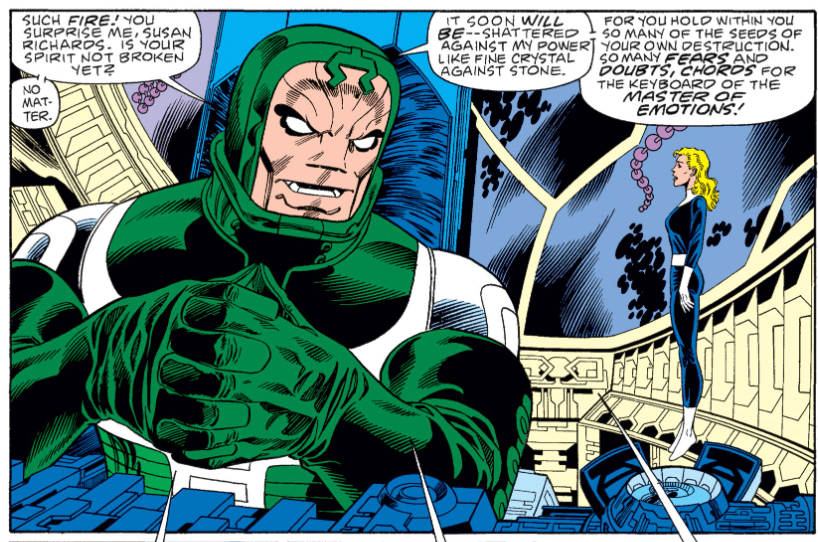
My first encounter with Psycho-Man was in a chilling (perhaps even sadistic) story arc involving the mental manipulation of the Invisible Woman from John Byrne:
Fantastic Four 283 (1985, Byrne/Ordway)
Big news!
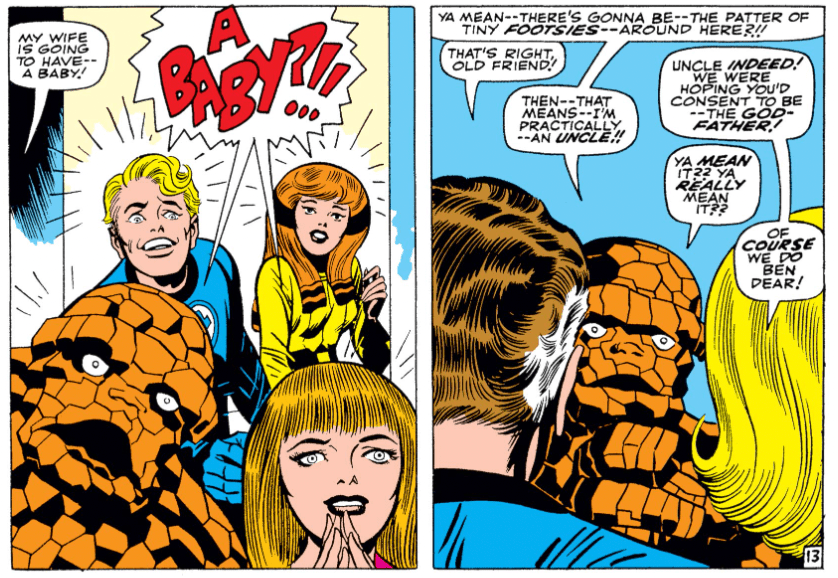
Annual 5 also marks the announcement that Sue is pregnant. It’s a fun scene when the rest of the team find out:
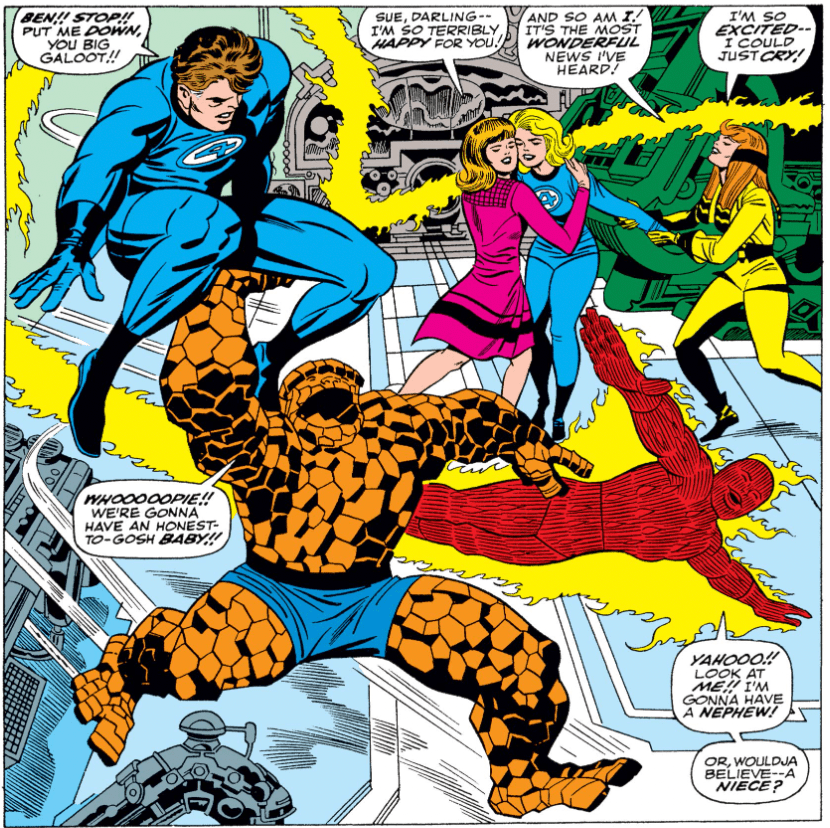
The baby turns out to be Franklin Richards, of course, who becomes a integral part of the Fantastic Four family, and later the team. He’s currently a mopey teenager in the current FF comic, but we occasionally get glimpses of his future as one of the most powerful characters in the universe.
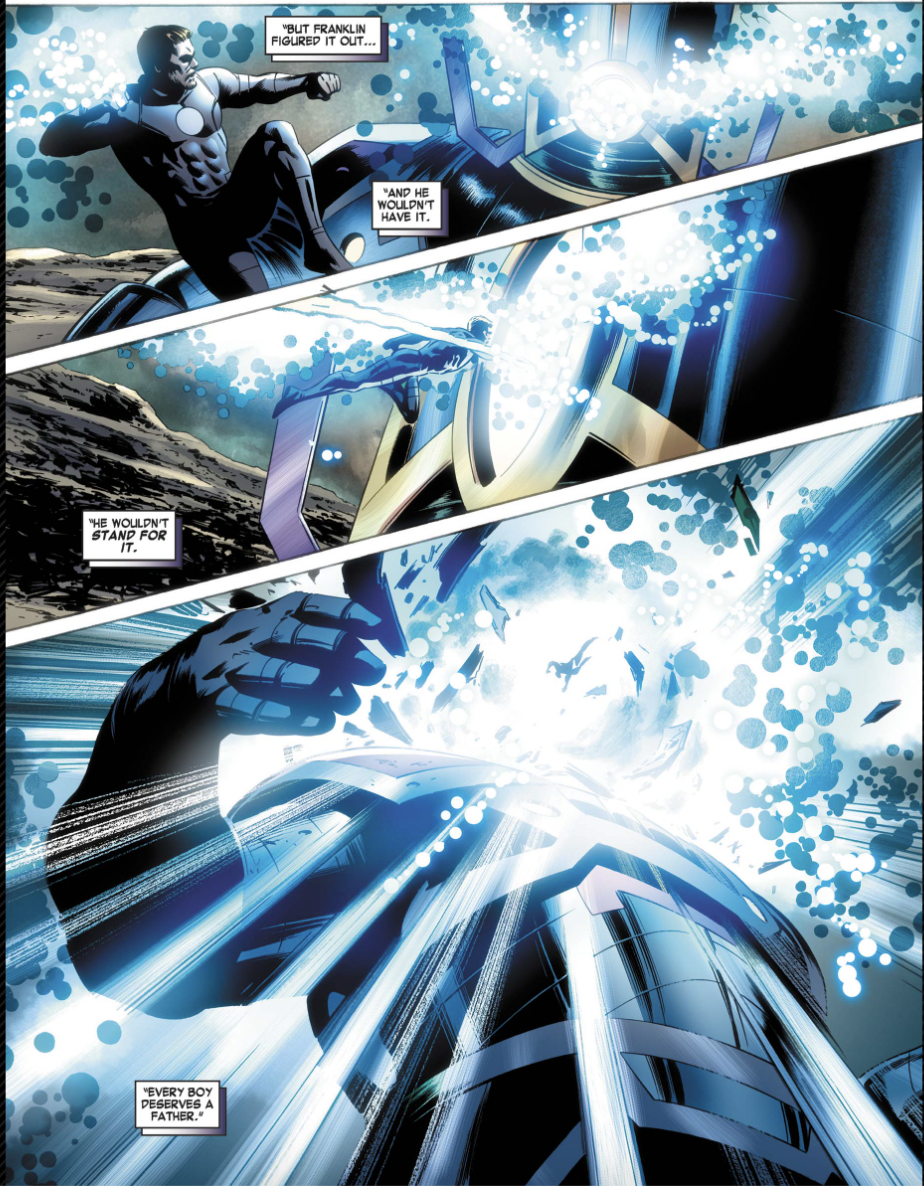
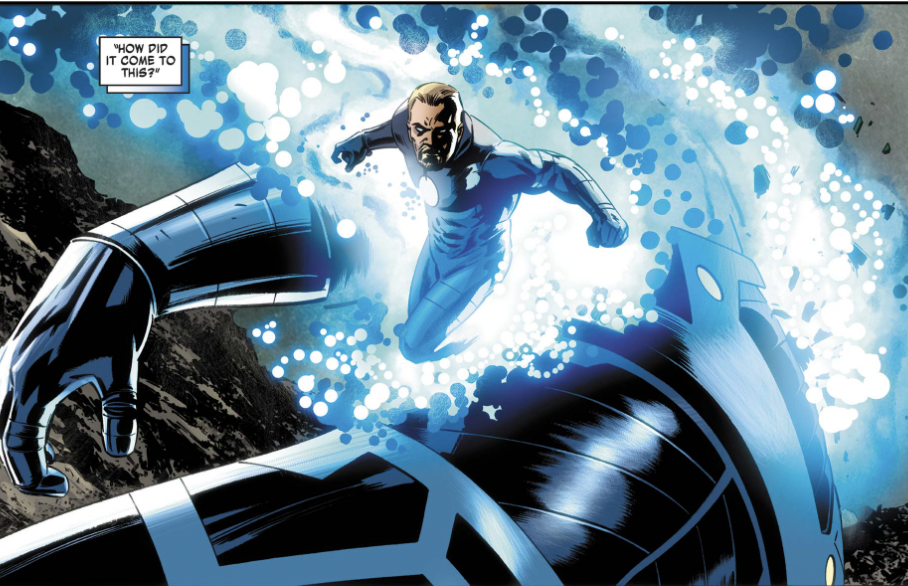
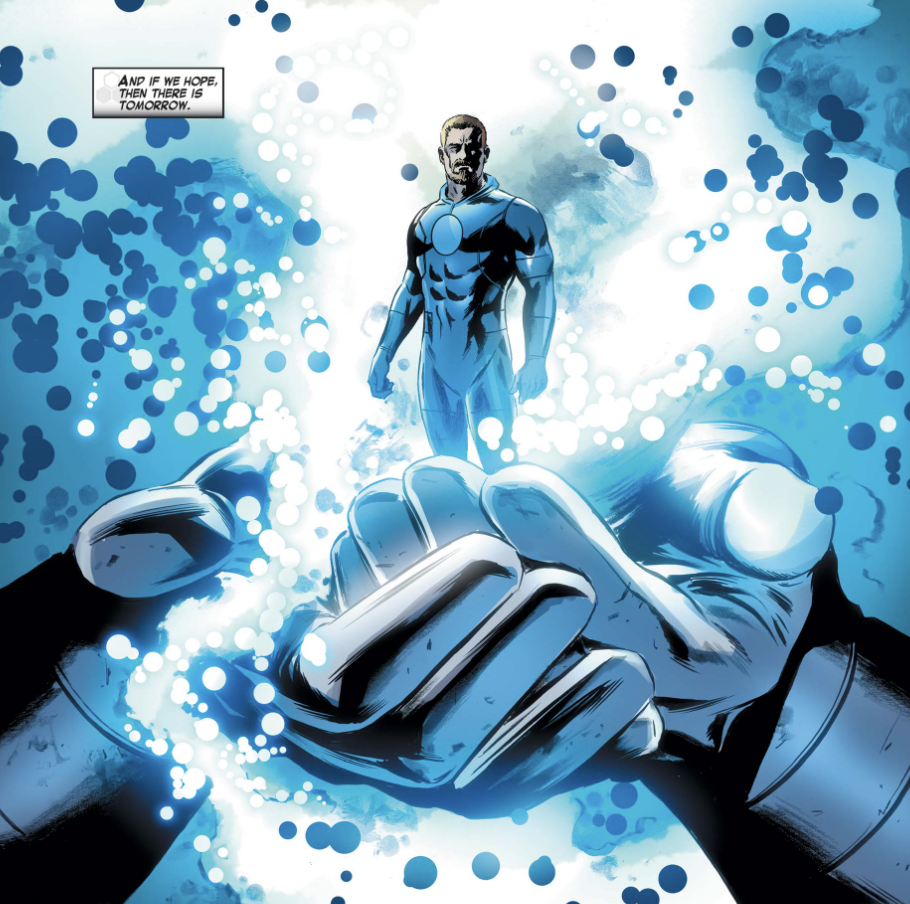
Here he is single handedly punching out a bunch of insane Celestials and resurrecting a dead Galactus in the climax of Jonathan Hickman brilliant arc (all from 2012’s Fantastic Four 604, with art by Steve Epting and Rick Magyar):
We’ll have much more to say about Franklin later —the kid ain’t even born yet.
“This is a plot?”
The second story is a goof: a madcap romp through the Marvel offices with Stan and Jack as they are pursued by fans. It’s full of gags and in-jokes designed to delight the ardent Marvel fan.
I hesitate to read too much into it, given how slight and silly it is, but it does suggest that Jack considered he and Stan to be equals and co-collaborators and that, at least to some degree, he enjoyed taking part in the myth-making engaged in by Stan.
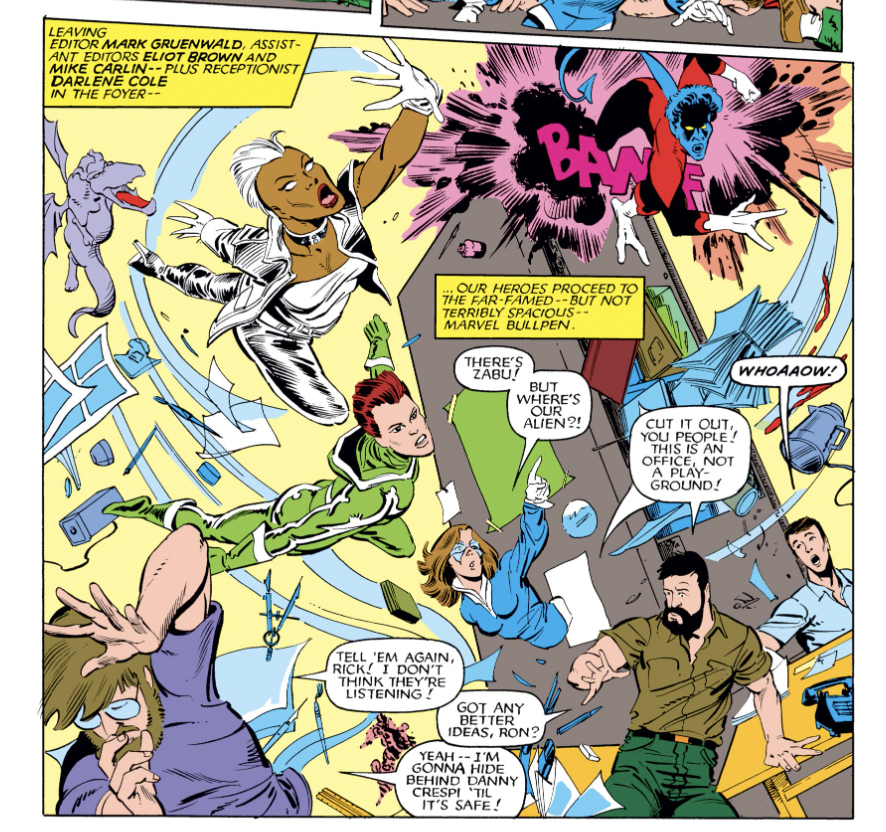
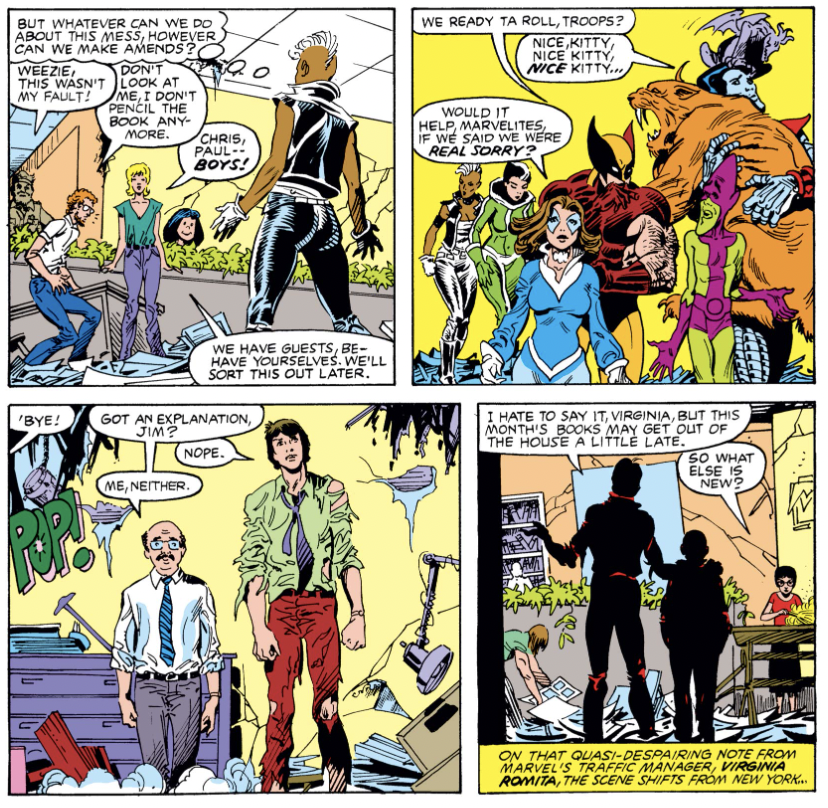
This sort of behind-the scenes story shows up occasionally, such as in Uncanny X-Men Annual 7, when the Impossible Man leads the X-Men on a scavenger hunt that includes the Marvel offices:
“The Peerless Power of the Silver Surfer”
Story three’s plot is also thin: The Silver Surfer hears the sentient computer Quasimodo, last seen in Annual 4, crying out in anguish as he is trapped in a machine. Using the power cosmic, the Surfer creates a new body for him, only for Quasimodo to lash out and attack him. The two battle before the Surfer imprisons Quasimodo as a statue on a clock tower.
The story is notable for two reasons. One, it’s an early Surfer story co-plotted by Kirby, and sort of hints at what Jack had in mind for the character. Two, the art is just stunning. Inked by Frank Giacoia, he really brings out the Surfer’s iridescence, and the effect is impressive.
In this story, Kirby also delivers what may be the ultimate Kirby Krackle panel as well. That’s a lot of dots!
But wait! There’s more!
FF Annual 5 also included an array of pinups, including one for every member of the Inhumans. Here are some of the best:
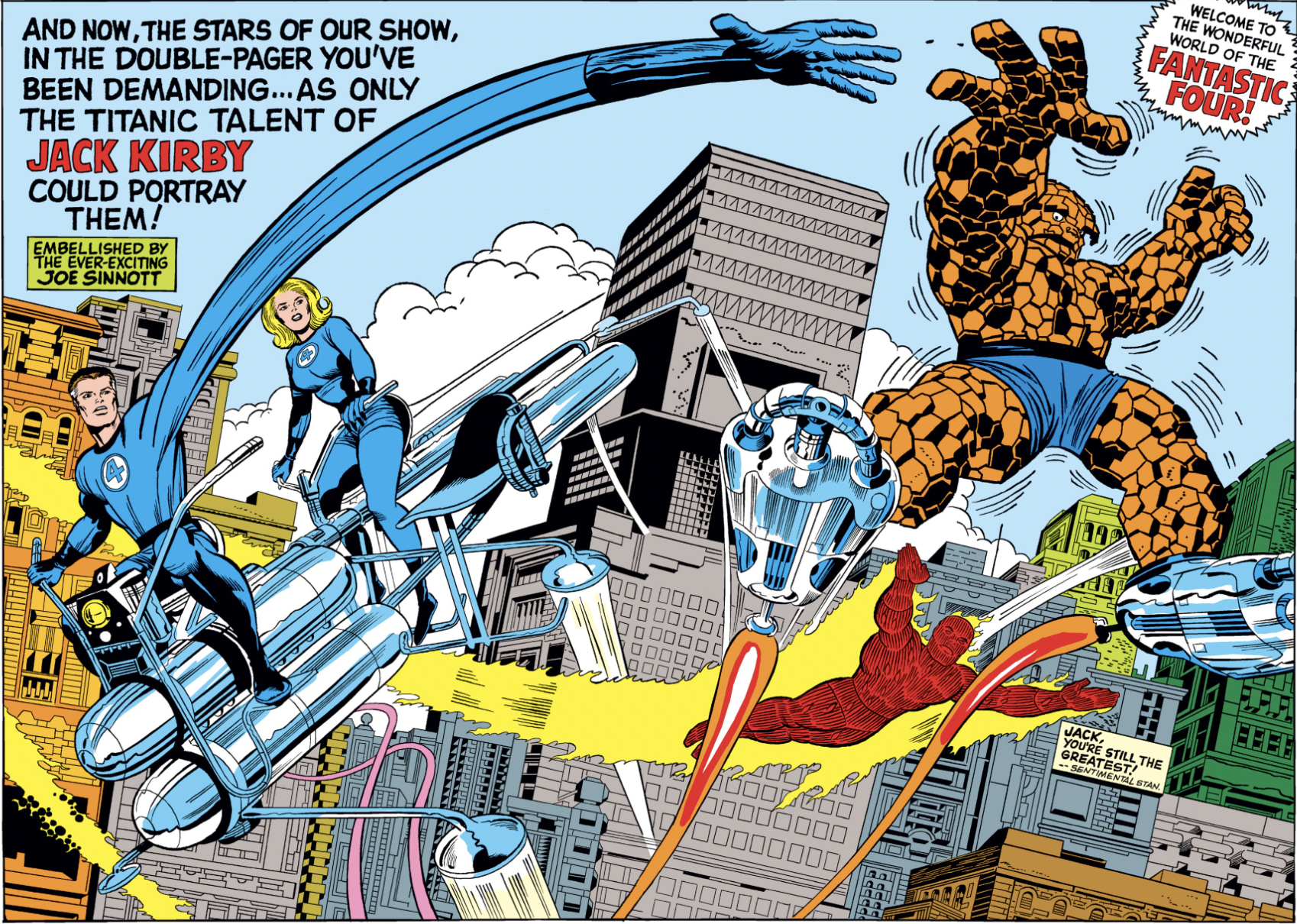
There’s also a great double-page splash of the FF:
Dig that Kirby Krackle
As if that wasn’t enough, Jack dropped gems all over this comic. Here are a few more:
Fantastic Four 67 “When Opens the Cocoon!” Published: July 1967 Script: Stan Lee Pencils: Jack Kirby Inks: Joe Sinnott Letters: Artie Simek Cover: Kirby and Sinnott
Synopsis
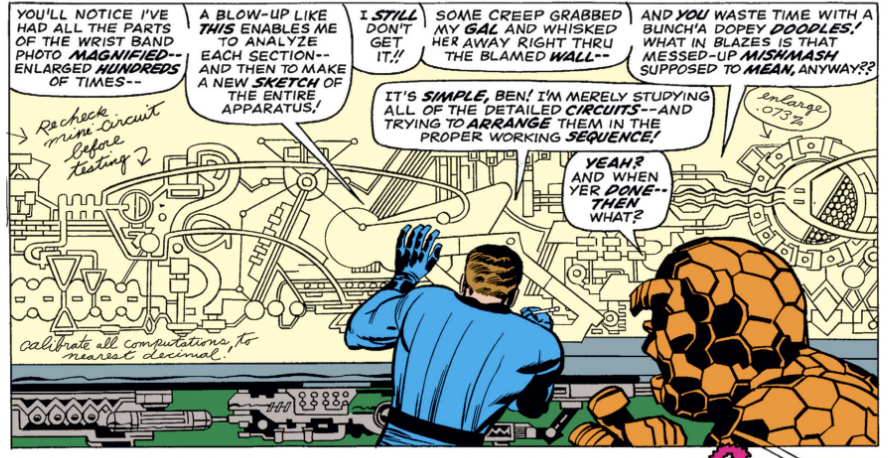
Picking up where last issue left off, Fantastic Four 67 begins with Mr. Fantastic building a replica of the wrist-band teleportation device used by the Beehive scientist who abducted Alicia Masters, as the Thing looks on and frets.
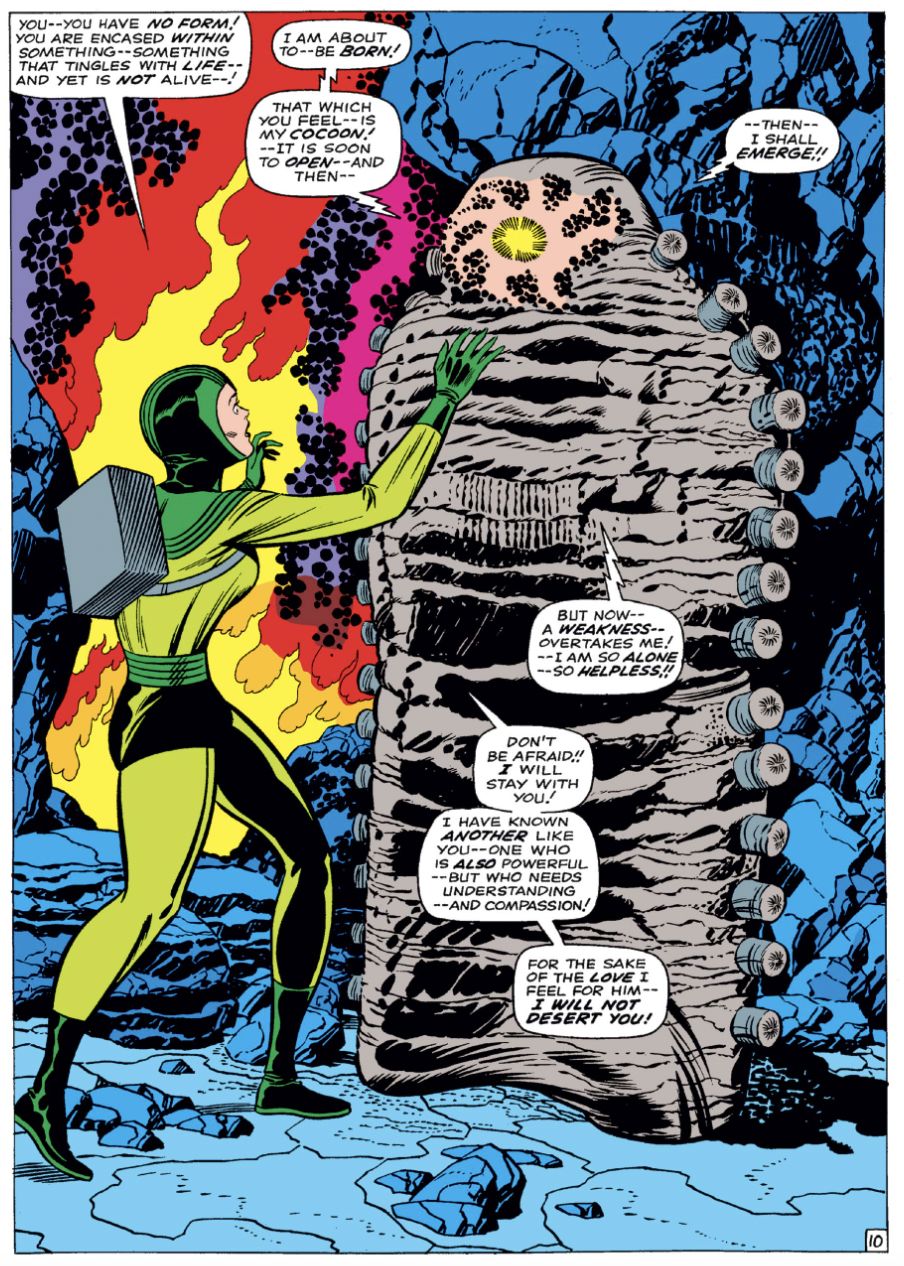
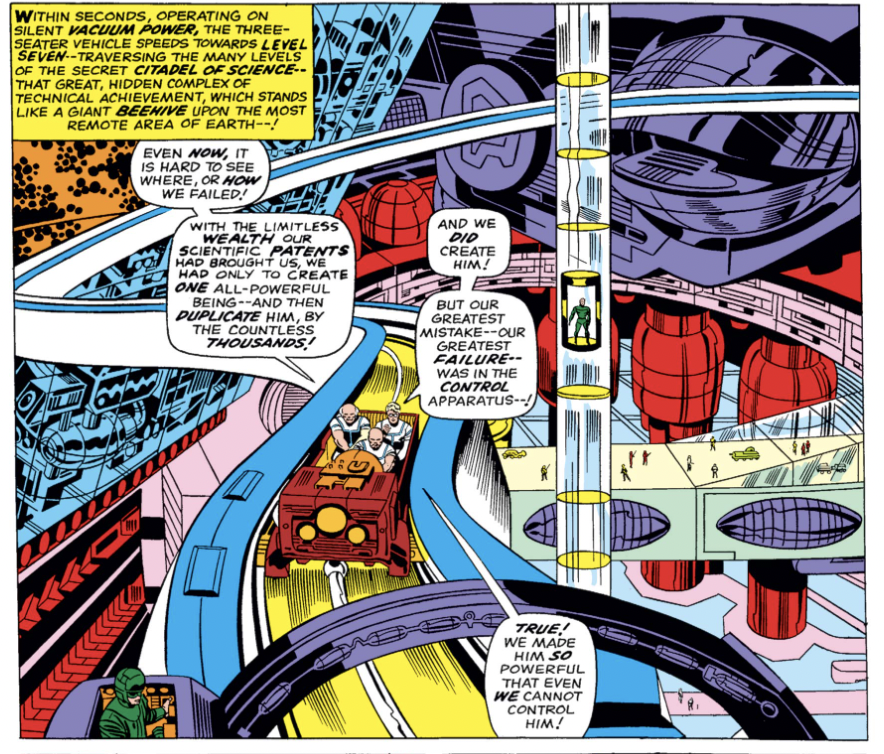
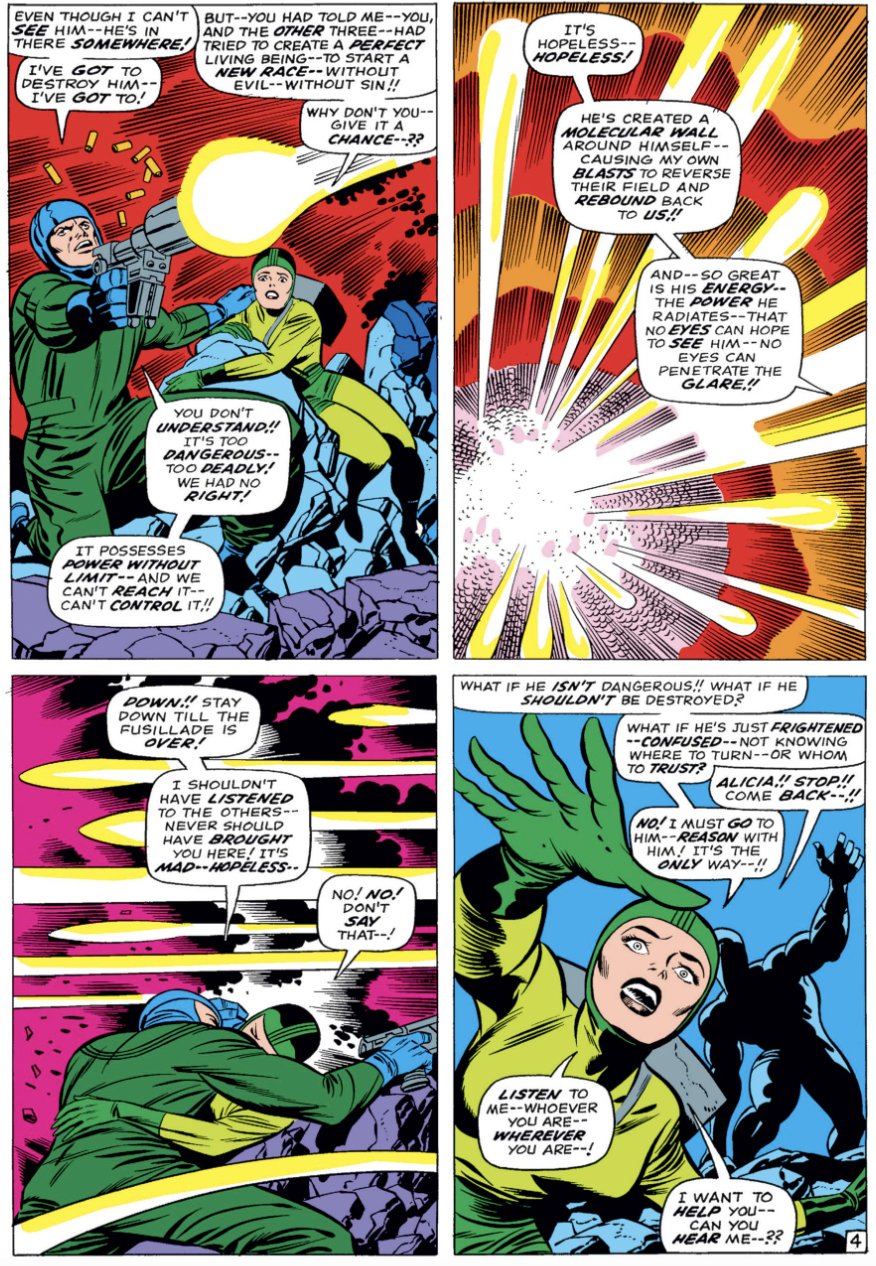
Meanwhile, in the caves beneath the Beehive, Alicia approaches the cocoon containing the life form created by the Beehive scientists (later called the Enclave) as Hamilton, one of the scientists, is trapped by tentacles. As she did with the Silver Surfer, Alicia senses the humanity within the creature and is drawn to it even while the other scientists scheme to launch it into space.
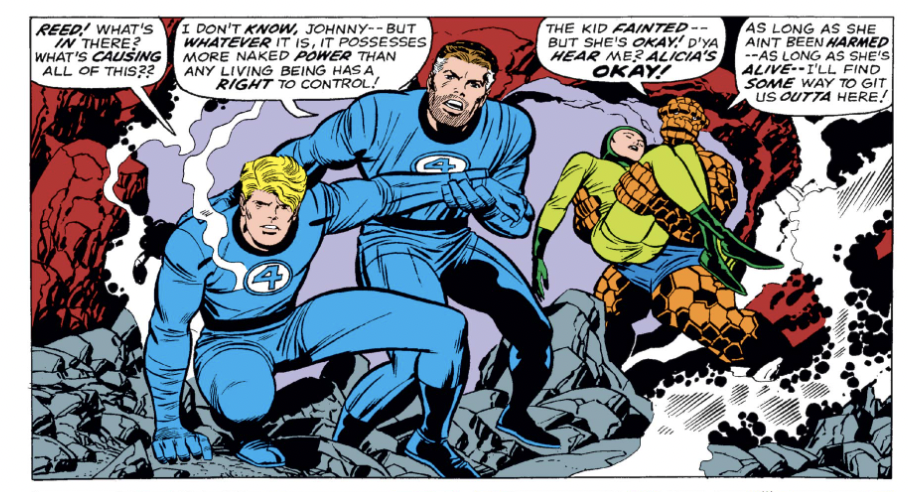
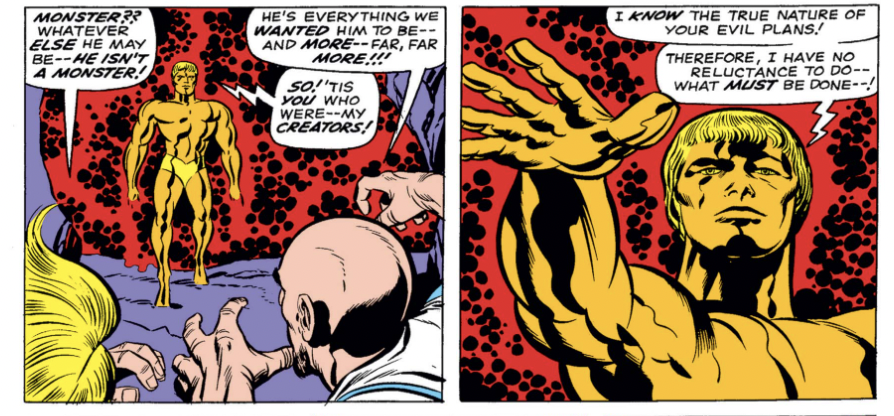
Back at the Baxter Building, a haggard Reed has finished his device, and (inexplicably) orders Sue and Crystal to remain behind while he, Ben and Johnny rescue Alicia. The three activate the device and step through the portal it creates. They fight their way through the Beehive, while Alicia and Hamilton confront the cocoon. As Hamilton confesses that he and the others planned to create a new race of human to rule over humanity, the creature in the cocoon lashes out with a burst of energy, killing him. Finally, the three members of the FF scoop up and Alicia and escape through the portal while the creature, later called Him, emerges and confronts the scientists that created him.
What’s going on here?
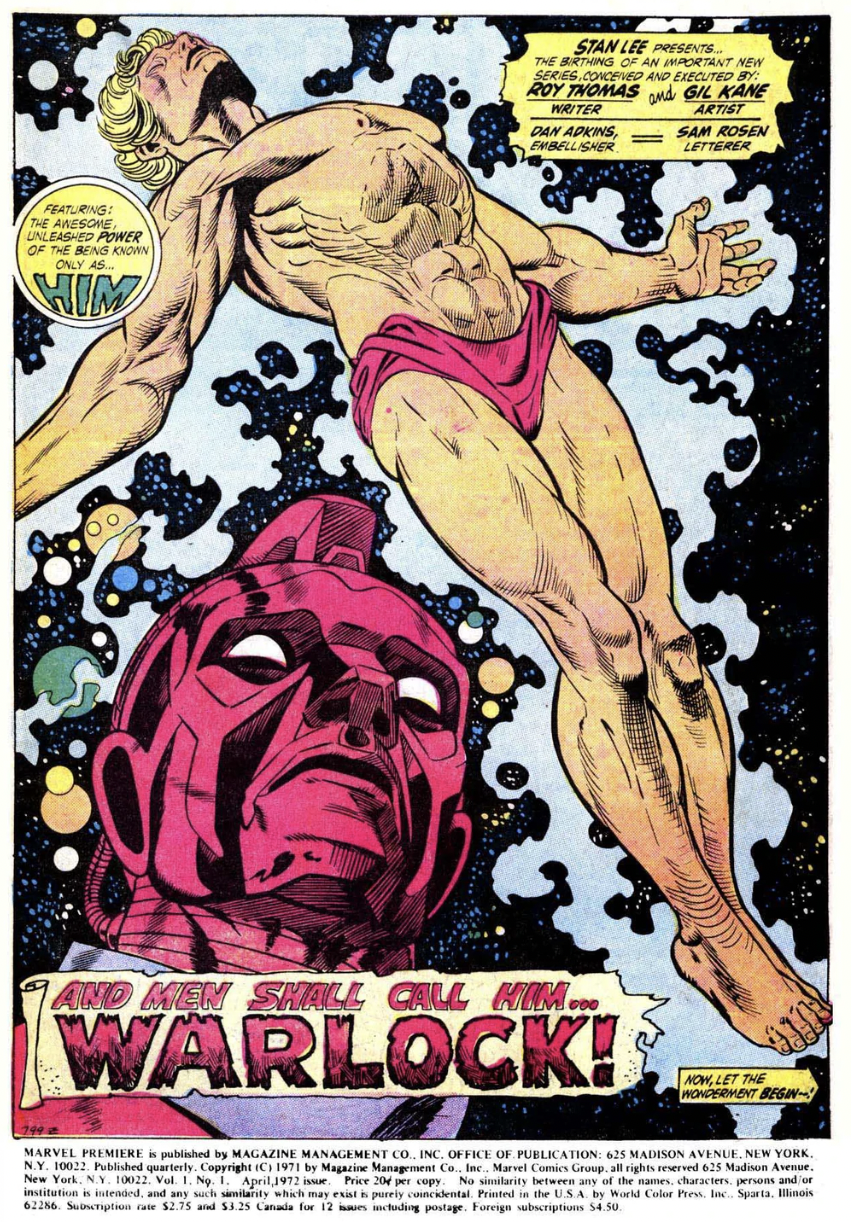
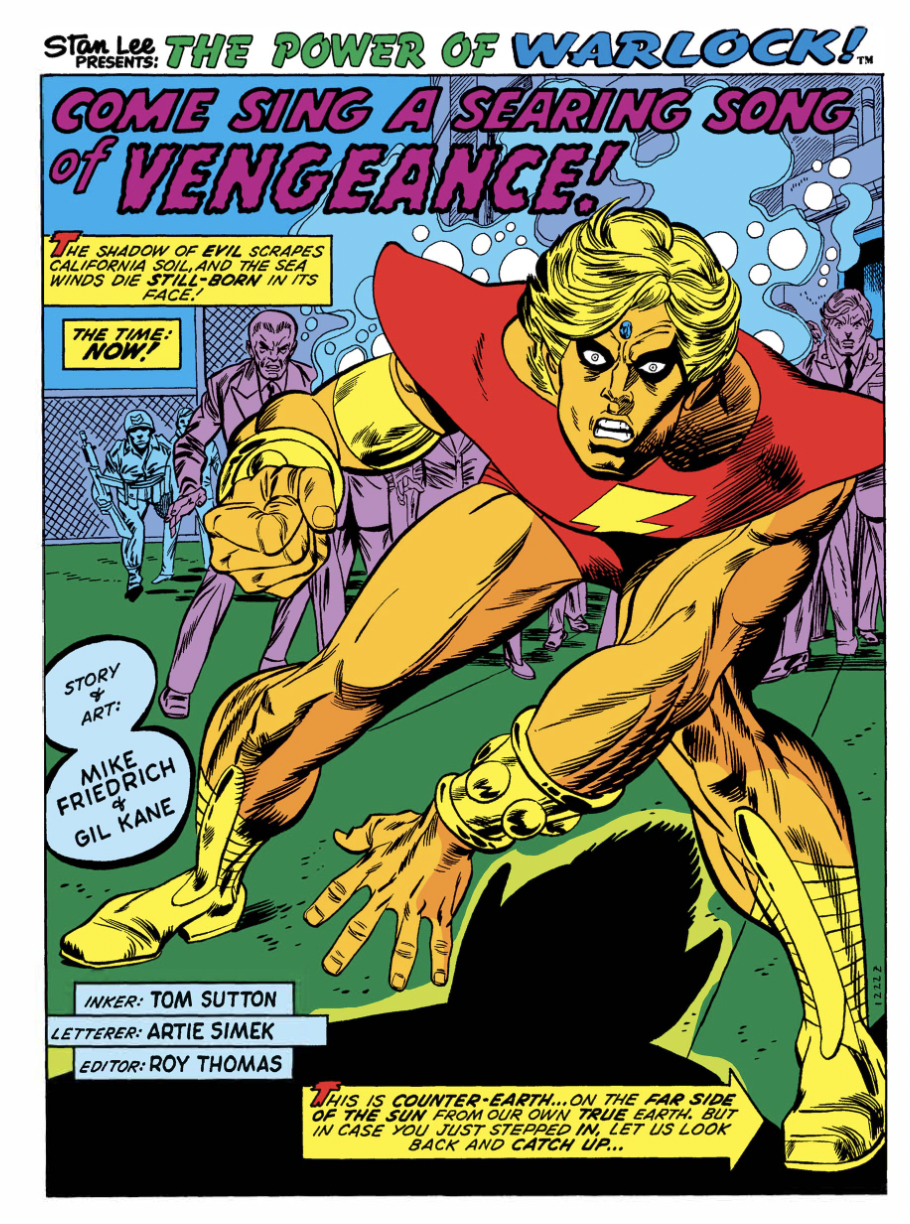
FF 67 is notable as the first appearance of Him—although he is never called that in the comic, just on the cover—who later is transformed into Adam Warlock by the High Evolutionary. According to Brian Cronin, in CBR, Kirby originally intended the scientists to be virtuous, and killed when their creation turned against them. Apparently it was Lee who made the scientists evil and their creation virtuous.
Since it’s hard to imagine the heroic Adam Warlock starting off as an evil monster, it was probably just as well.
I confess Warlock is a character I have rarely encountered as a reader or collector. By the early 1980s, when I first began reading comics, he had for several years essentially been retired, living inside the “soul gem,” one of the infinity stones. By the time he emerged for the Infinity Gauntlet and other subsequent stories, I had more or less moves on from comics. There’s no doubting, however, that he occupies a major role as one of Marvel’s cosmic heroes—maybe its most cosmic—and he’s expected to play a role in the upcoming Guardians of the Galaxy 3.
Marvel Premiere 1 (Gil Kane/ Dan Adkins)Warlock 4 (Kane/Tom Suttton)
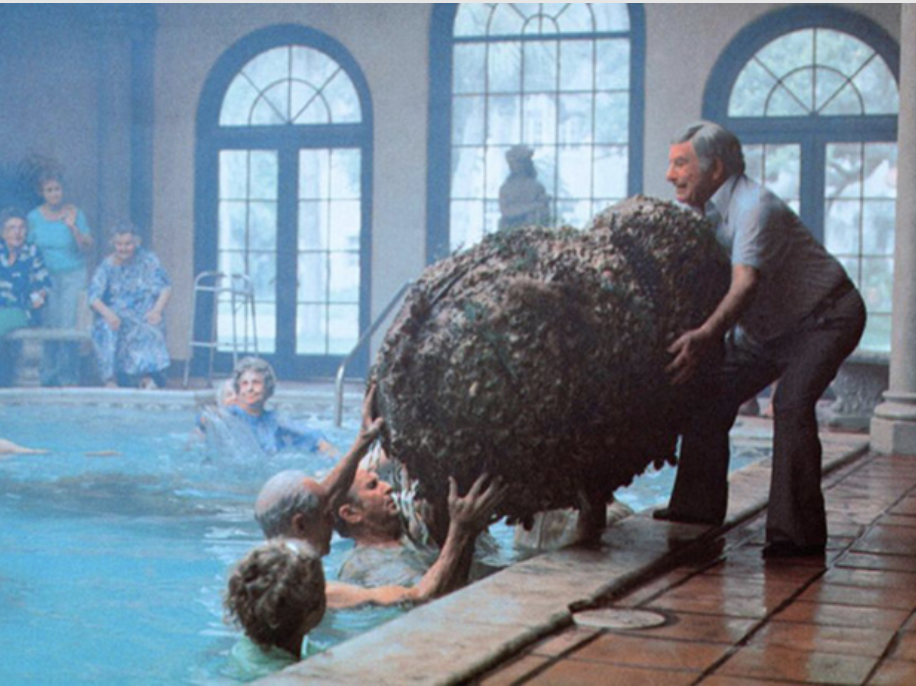
About that cocoon
It’s hard not to notice the similarity between the cocoon in FF 67 and those in the 1985 movie Cocoon.
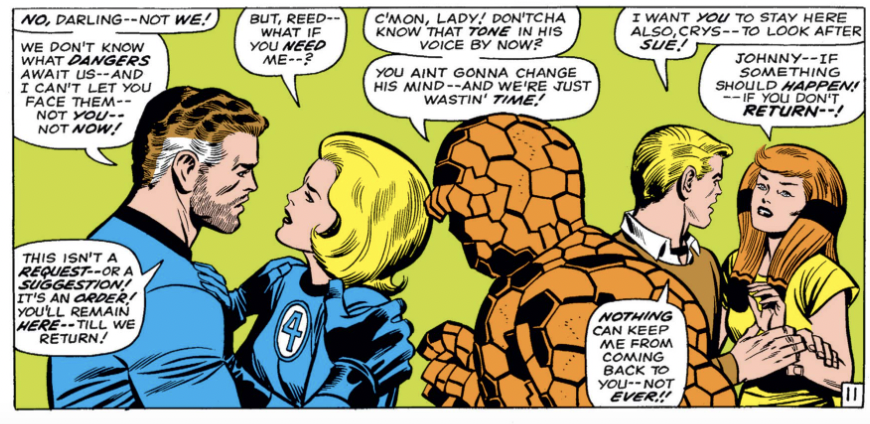
The sexist sixties
Reed’s behavior here seems particularly egregious. There’s no reason Sue shouldn’t accompany the rest of the team, and there’s even less reason for Crystal to stay behind to look after her.
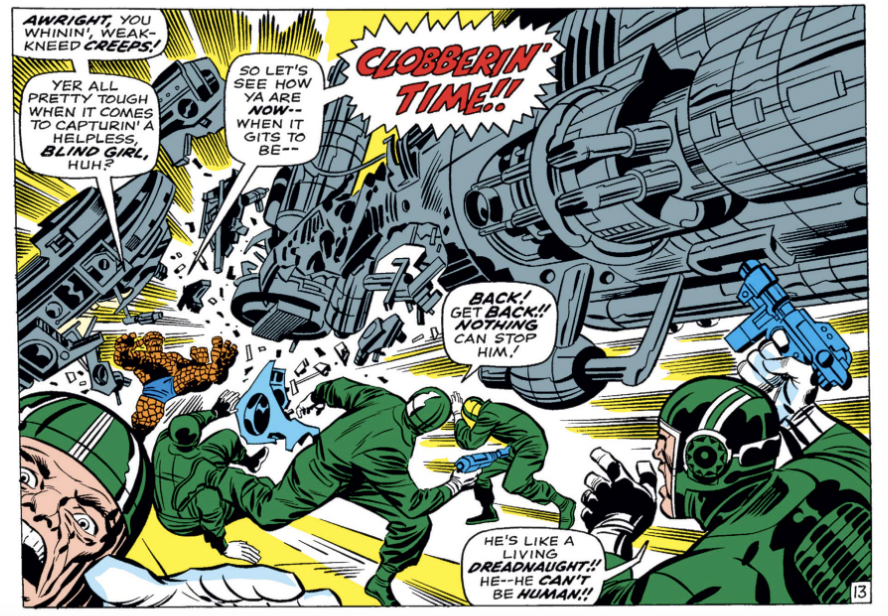
Clobberin’ time
Ben, worried sick about Alicia, is particularly motivated to clobber.
Stan the Man
Some goofiness from Stan, here:
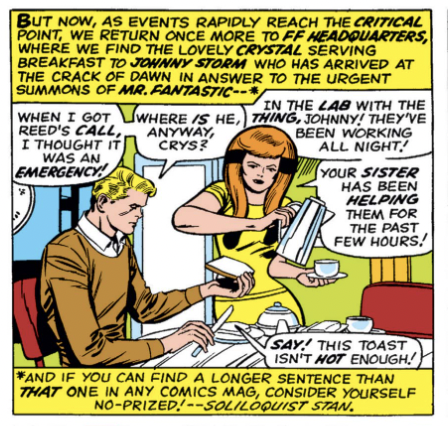
and with an Irving Forbush reference here:
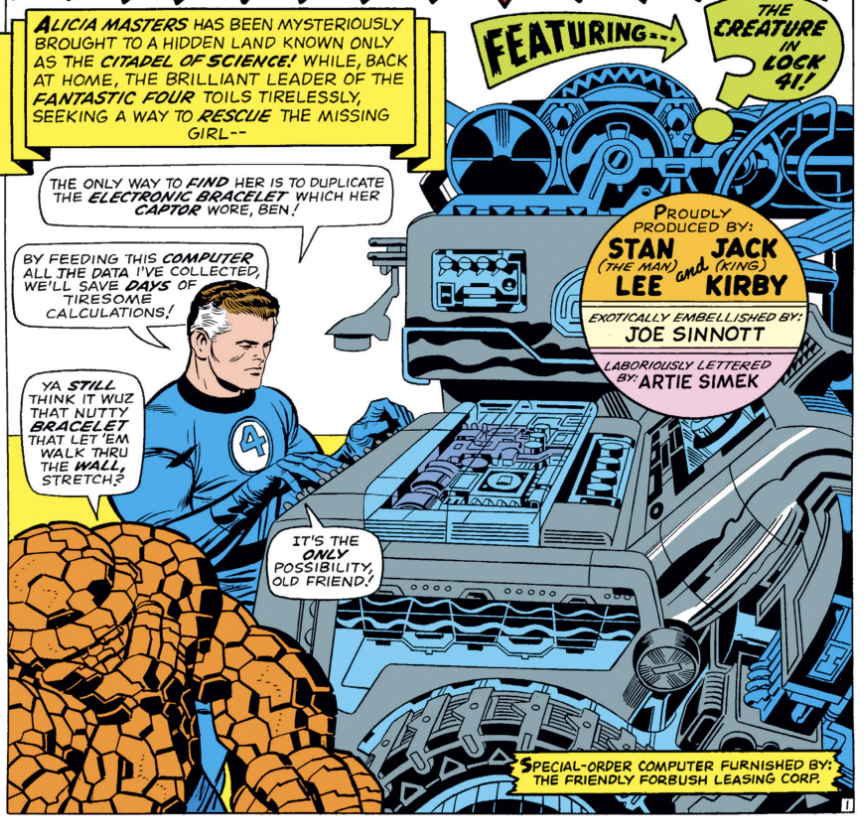
buried in this splash page image here:.
Five o’clock shadow
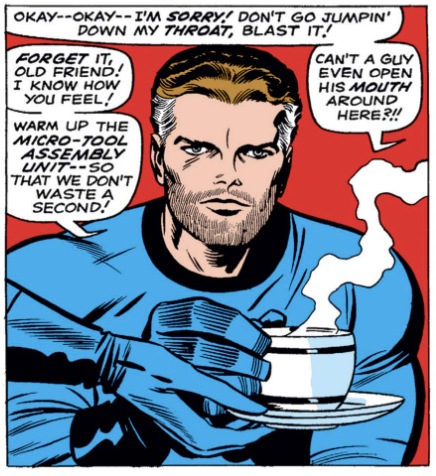
Reed is look pretty rough here (although it foreshadows the beard he’ll grow in about 600 issues from now)
Dig that Kirby Krackle
I love this schematic diagram:
and the evil scientists’ secret lair:
This whole page is pretty incredible:
Also on newsstands
In July 1967
Next issue: Fantastic Four Annual 5 and the Psycho-Man!