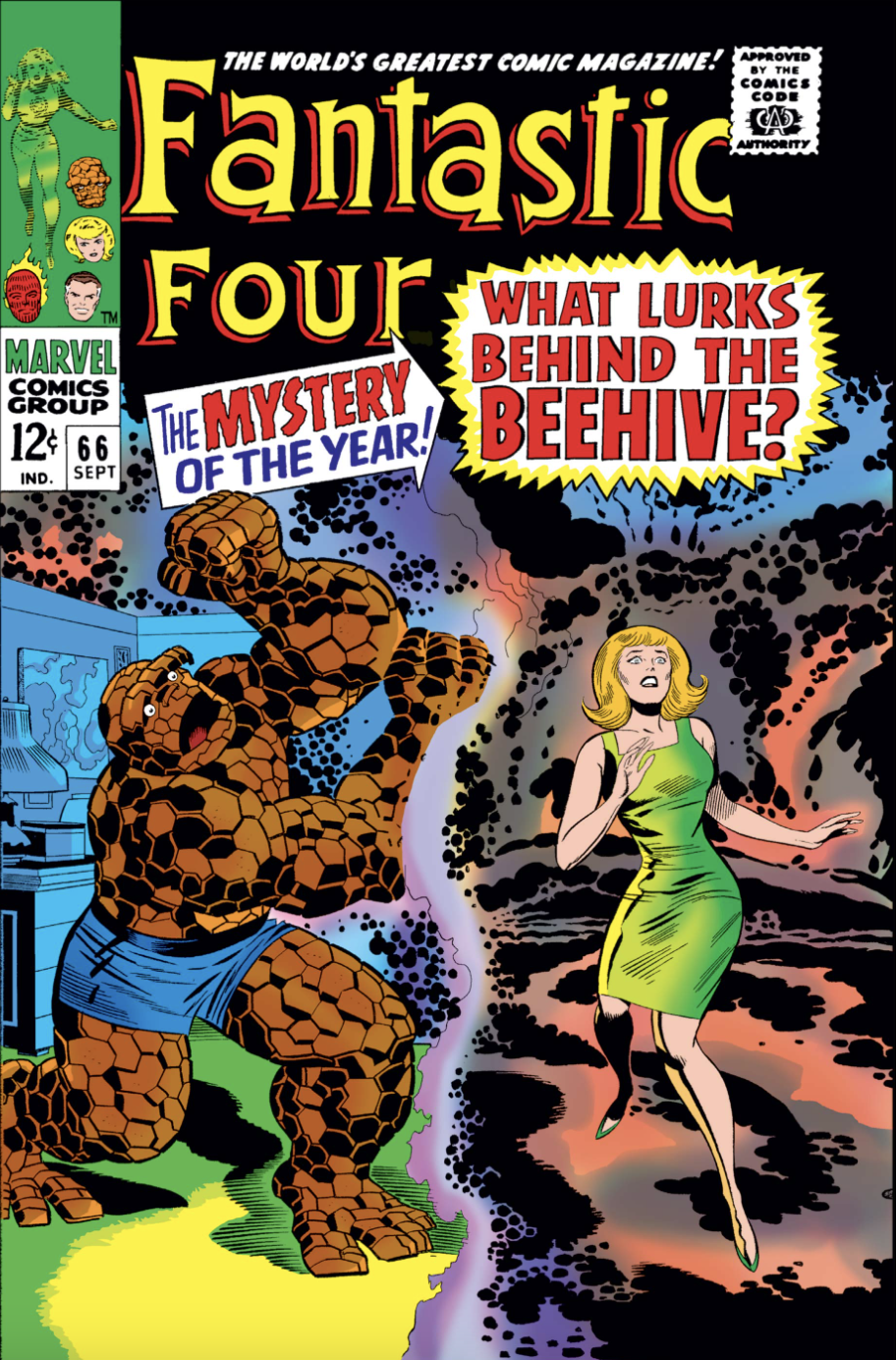
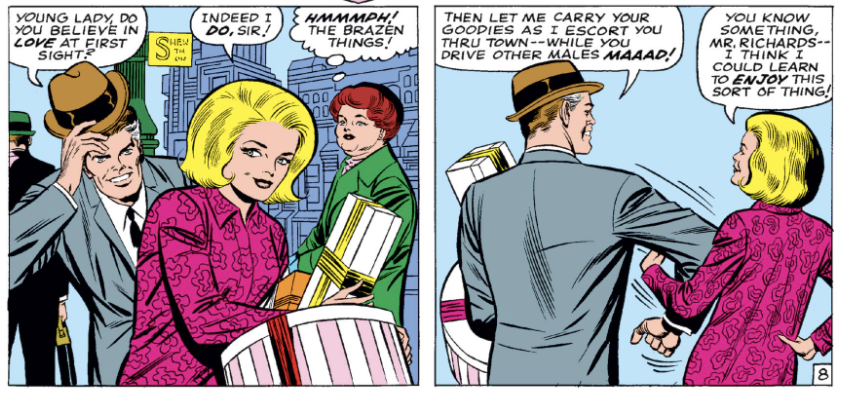
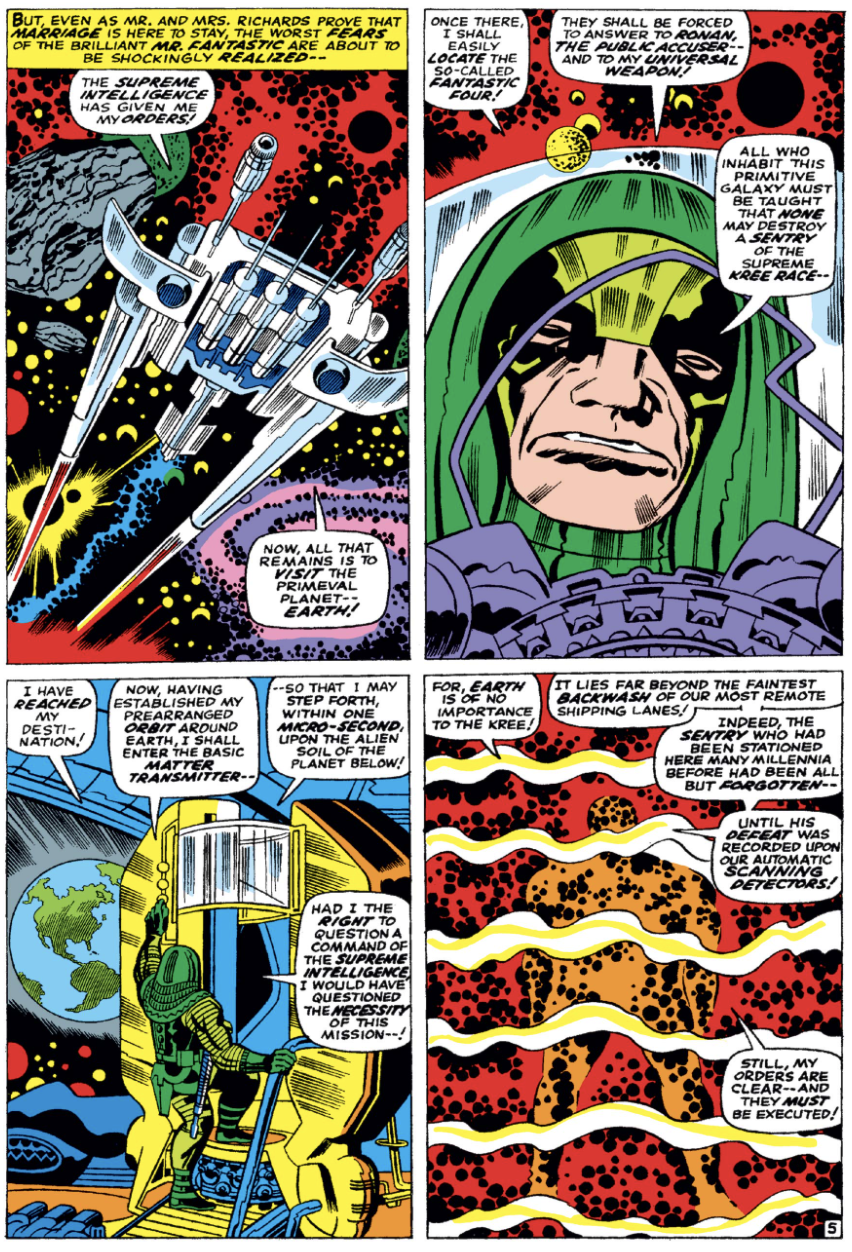
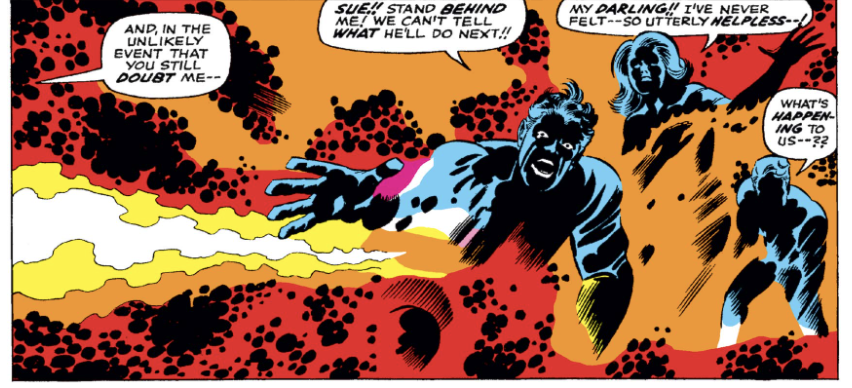
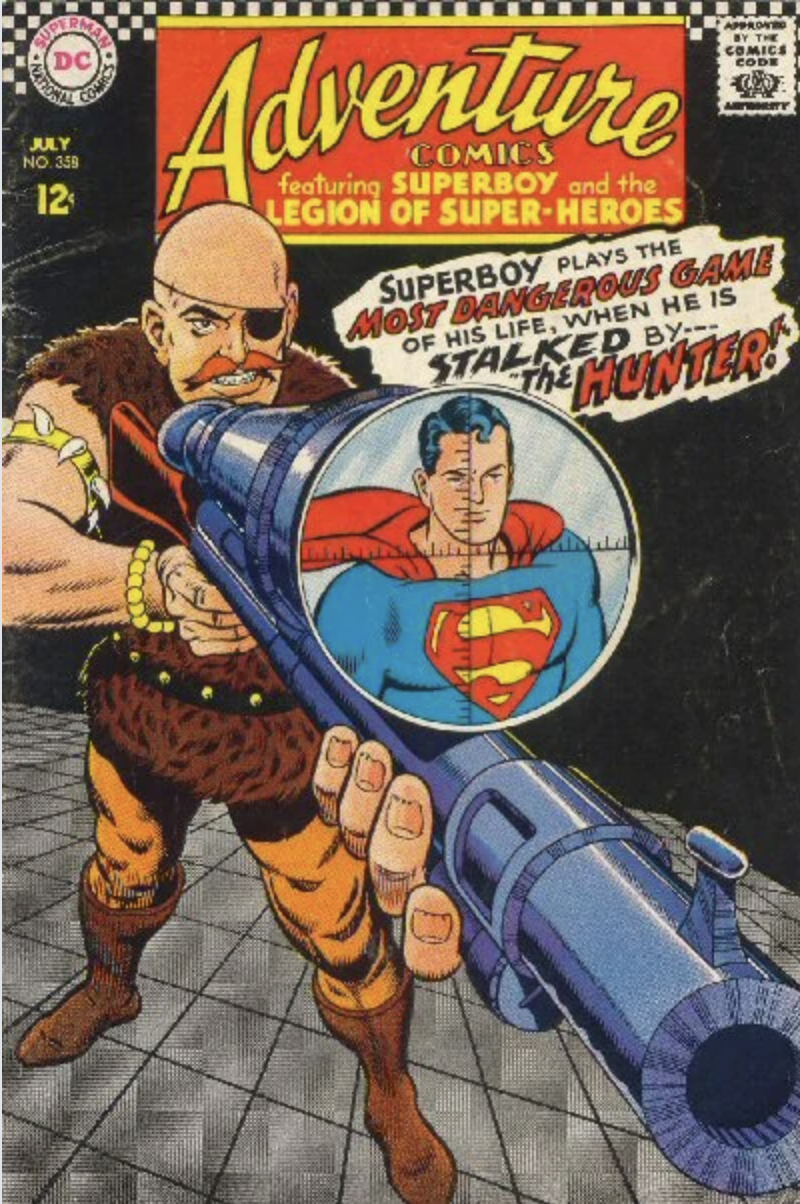
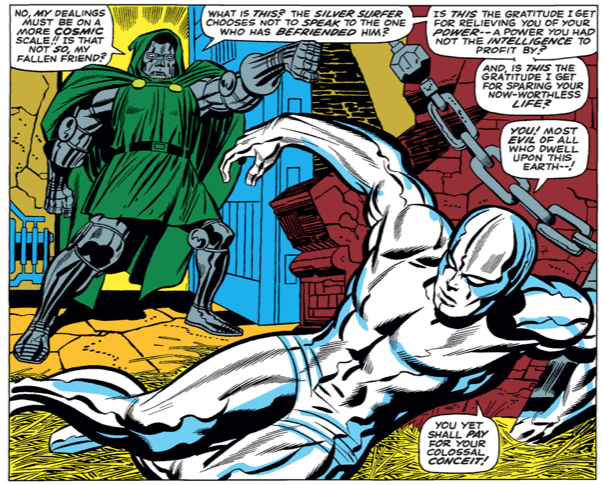
Fantastic Four 66 “What Lurks Behind the Beehive?” Published: June 1967 Story: Stan Lee and Jack Kirby Script: Lee Pencils: Kirby Inks: Joe Sinnott Letters: Artie Simek Cover: Kirby and Sinnott
Synopsis
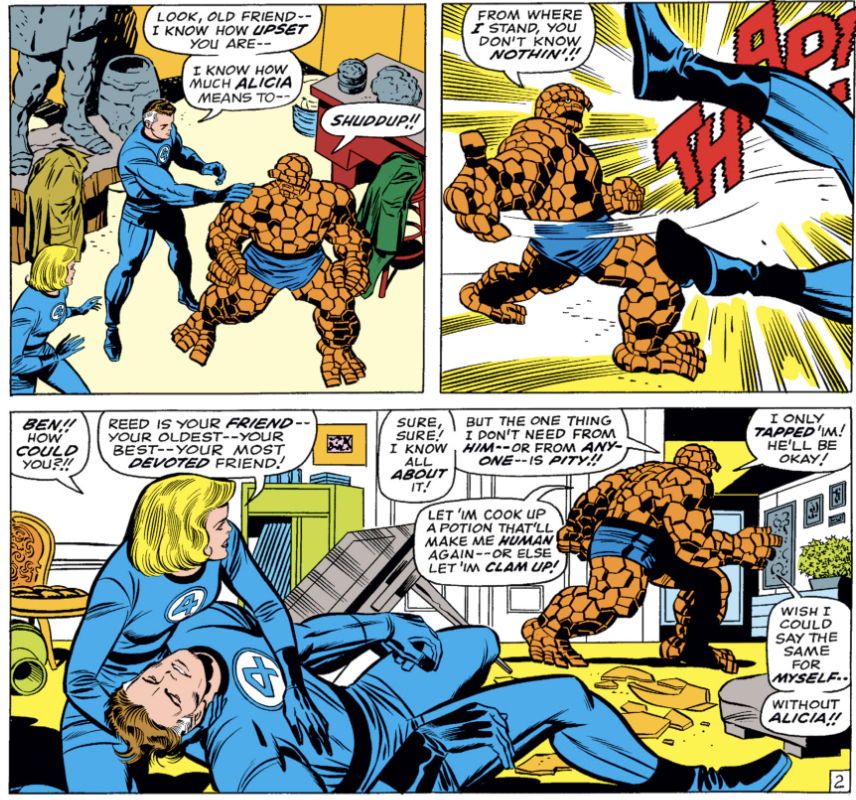
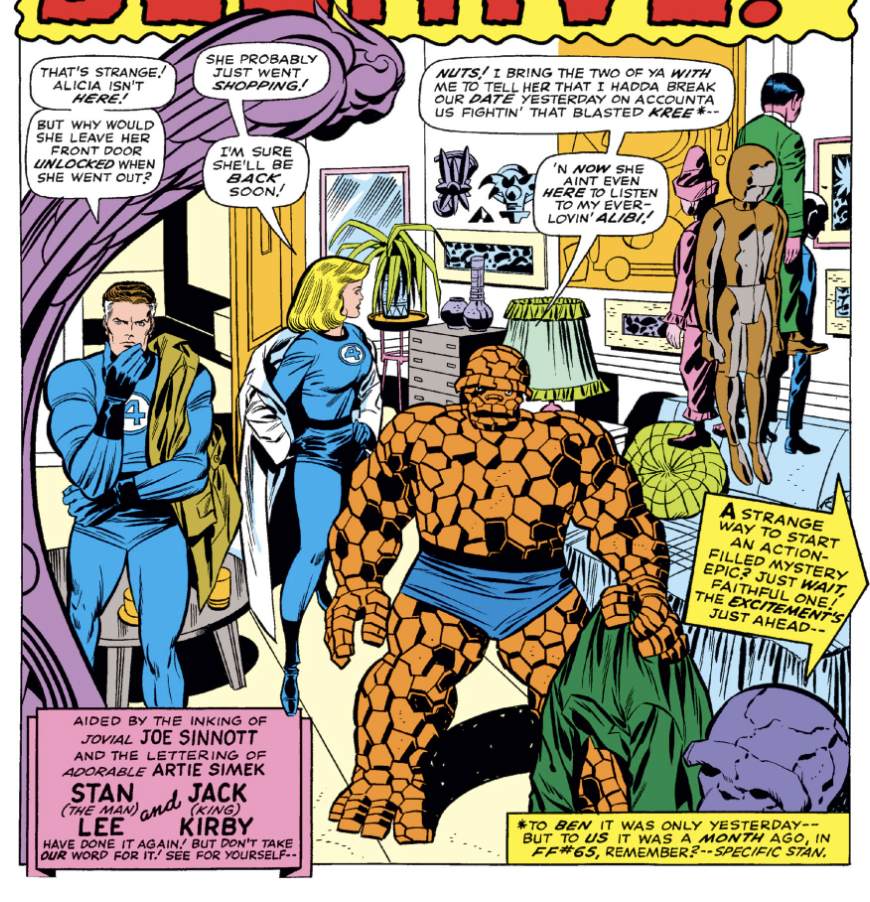
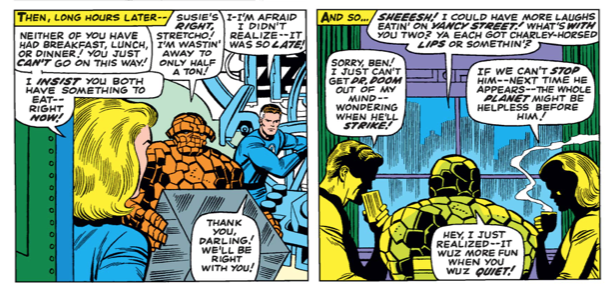
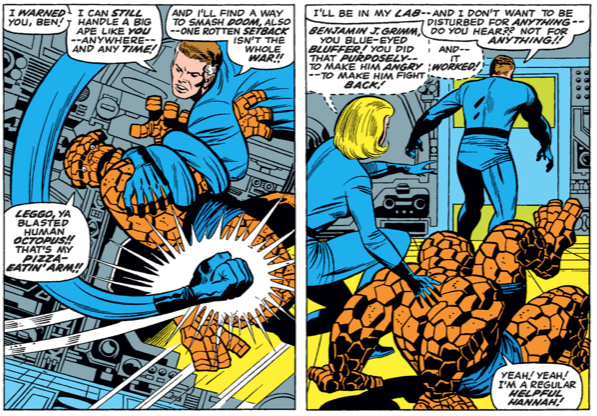
Fantastic Four 66 opens with the Thing, Mr. Fantastic and the Invisible Woman in the apartment of Alicia Masters, the girlfriend of the Thing who, unbeknowst to the FF, disappeared with a stranger in the last issue. A paranoid Ben suspects she might be with another man because he is so monstrous, and when Reed tries to console him, Ben lashes out and flees to Central Park, only to be cheered up by adoring fans.
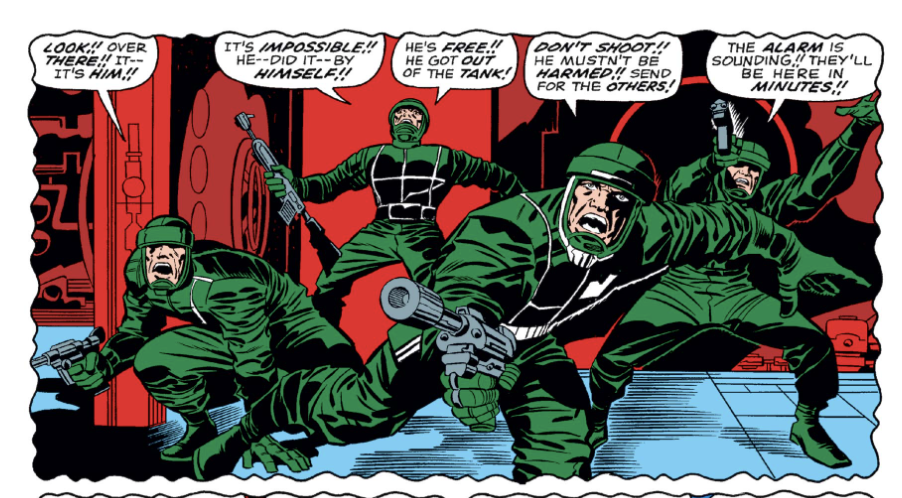
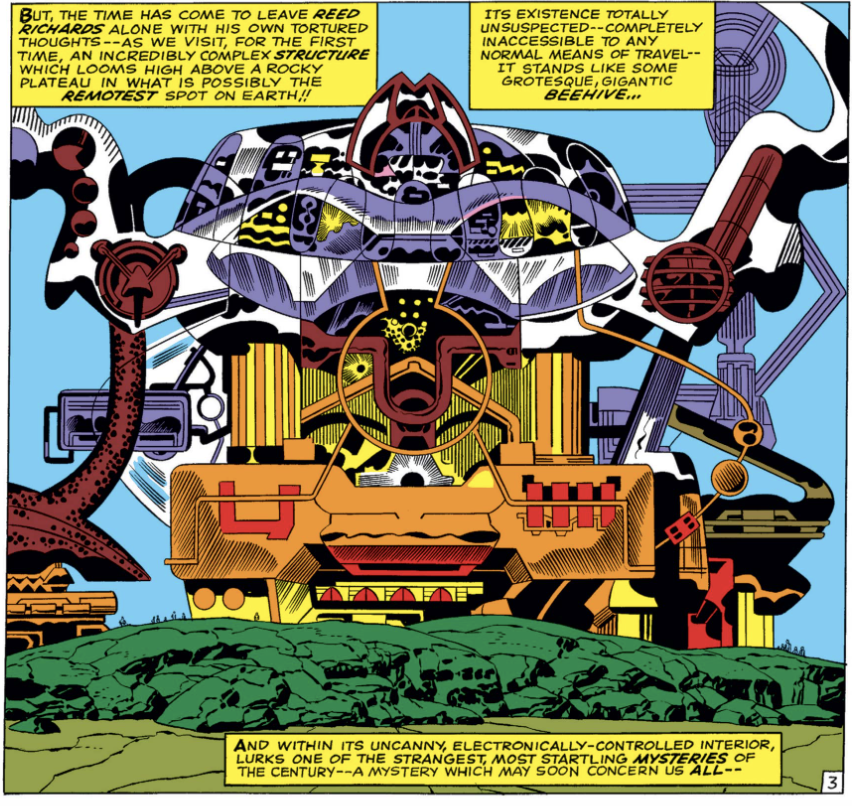
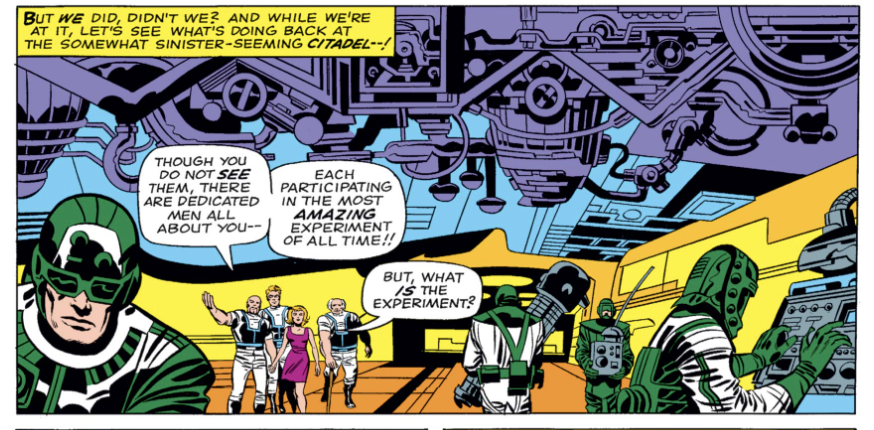
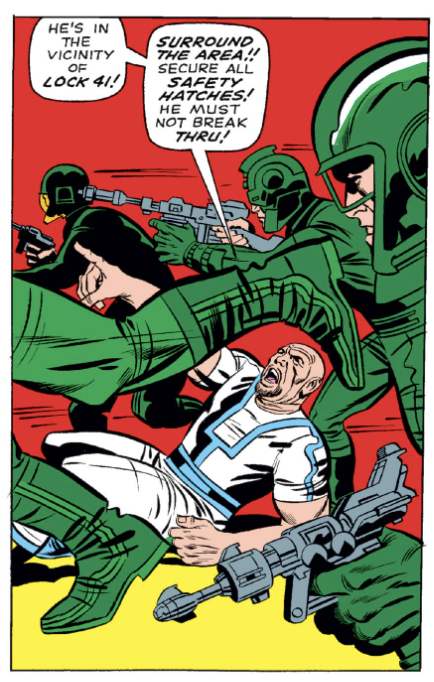
Meanwhile, Alicia has been summoned by a group of scientists in exile (later called the Enclave) whose headquarters resembles a beehive (sort of), giving the issue its title. They ask her to demonstrate her sculpting ability, then explain they been working to perfect humanity and have created a specimen in a “life-cell” tank. Their creation has now reached adulthood, but has escaped his container and now emits blinding light. The scientists want Alicia—who, being blind, is impervious to the light—to capture his image in clay for them.
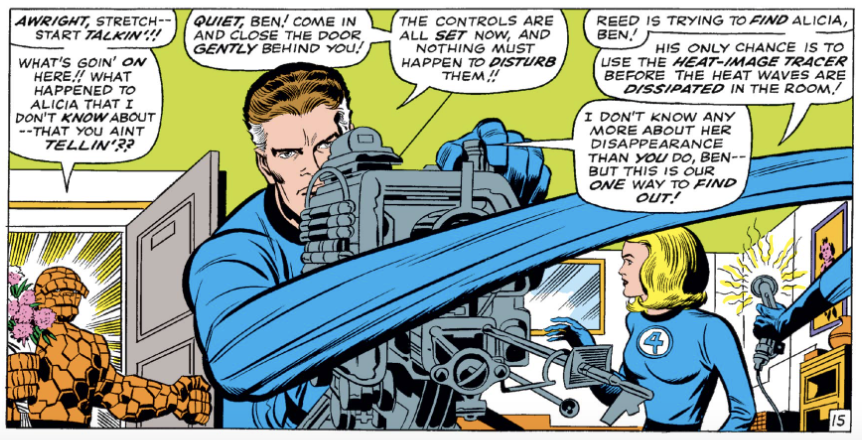
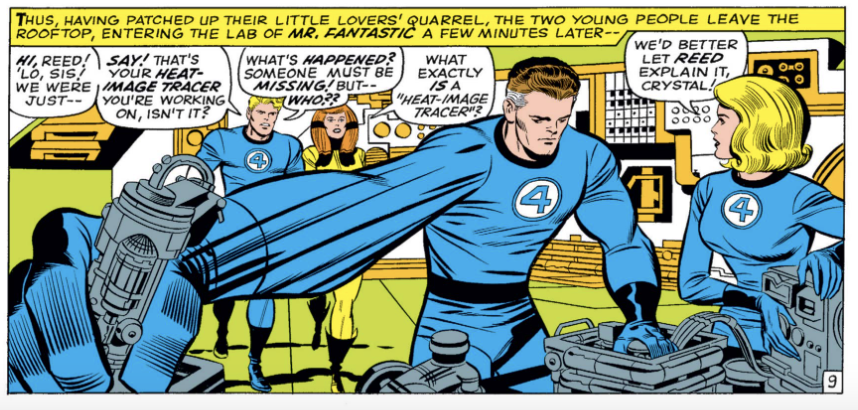
Back in New York, Reed uses his “heat image tracer” to capture Alicia last movements in her apartment, and its revealed she left with one of the Beehive scientists. The issue ends with Alicia and one of the scientists entering the chamber to confront the creation, while Reed and the rest of the FF vow to track her down.
What’s going on here?
FF 66 is a slightly unusual issue, but an enjoyable one. It’s almost entirely a place-setter for the issue to come, with very little that is resolved in this issue. There’s no real conflict, save the squabble between Reed and Ben, and it violates one of the cardinal rules of superhero comics in that there isn’t at least one fight. Nonetheless, the issue is pretty effective. The Enclave scientists are mysterious, their project is audacious and creepy, and the suspense—what have they created?—is genuine. The story reads like a classic work of adventure science fiction (which it is).
The story also centers Alicia, who shows more agency that normal. She’s still at the mercy of other directing her actions, but here she at least she’s able to demonstrate her sculpting abilities and her blindness doesn’t prevent her from venturing into the vault to confront the creature.
Who are these guys?
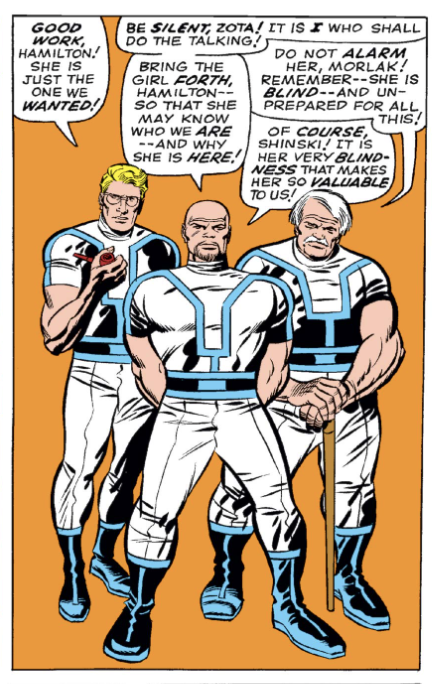
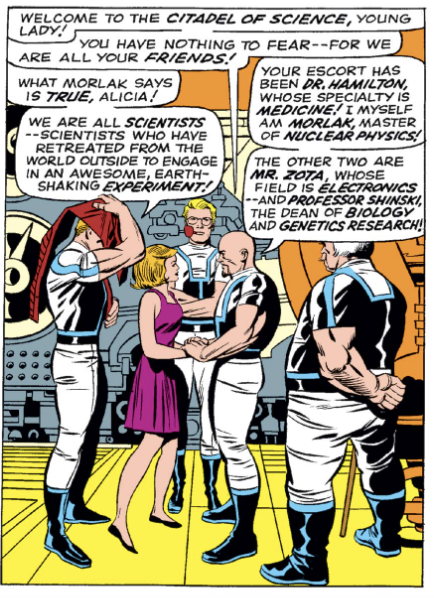
Helpfully, the bad guys tell us their names. Then, in the next panel, they do it again!
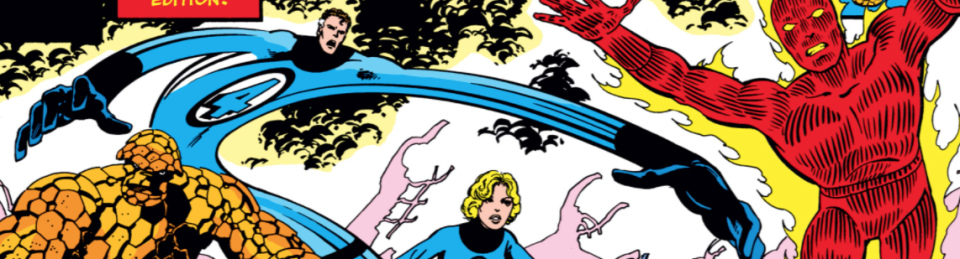
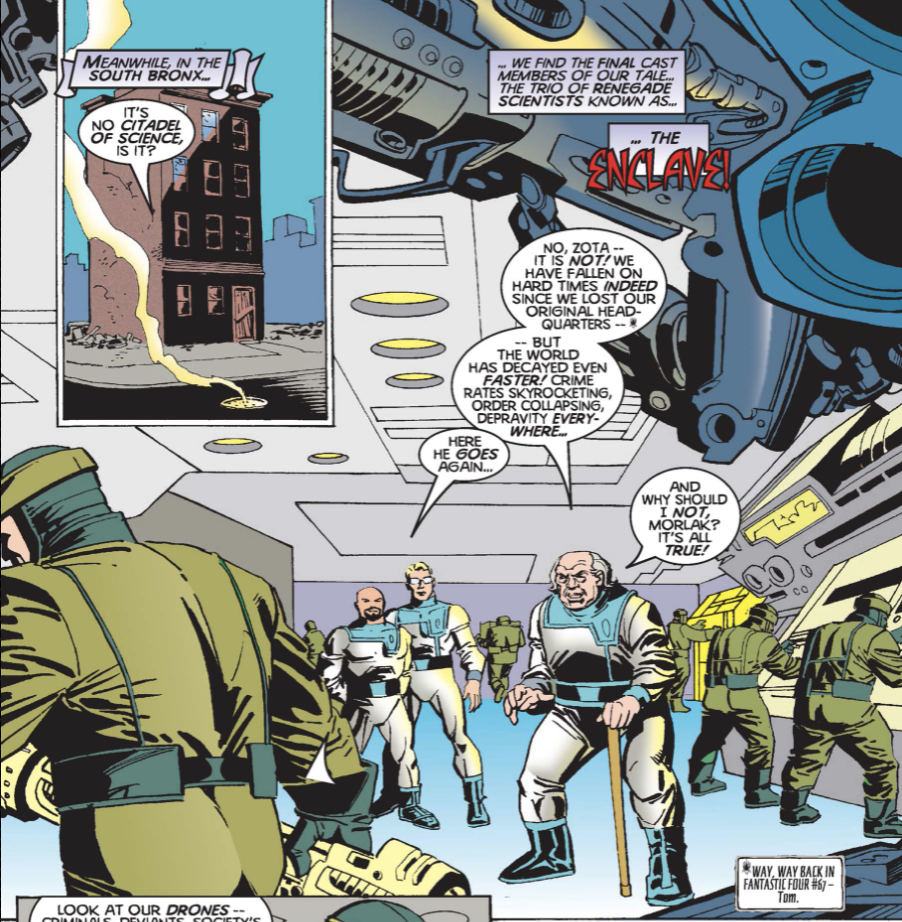
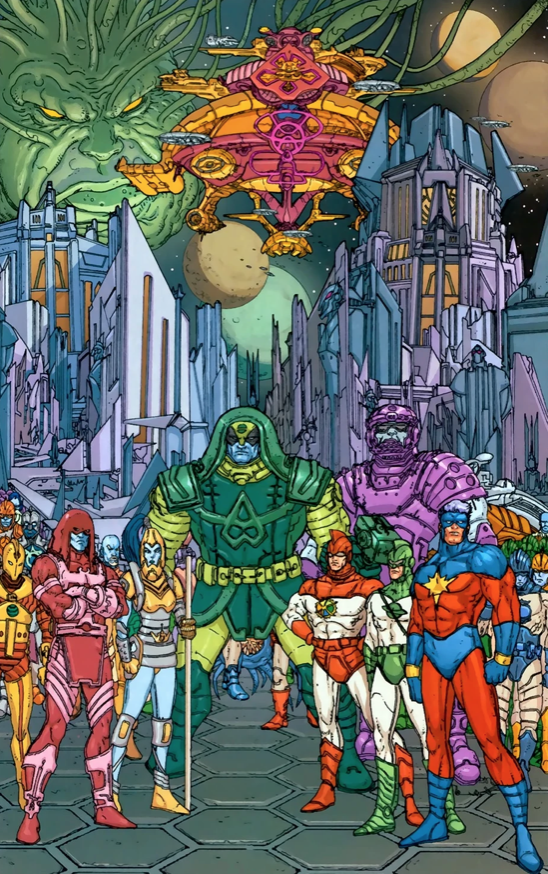
The Enclave reappear as manipulative villains over the years. A bunch of unimpressive looking white guys, they benefit significantly from the snazzy uniforms Kirby gives them. Here they are again in 1995:
Spider-Man Team-Up 7 (1995, Kurt Busiek, Sal Buscema and Dick Giordano)
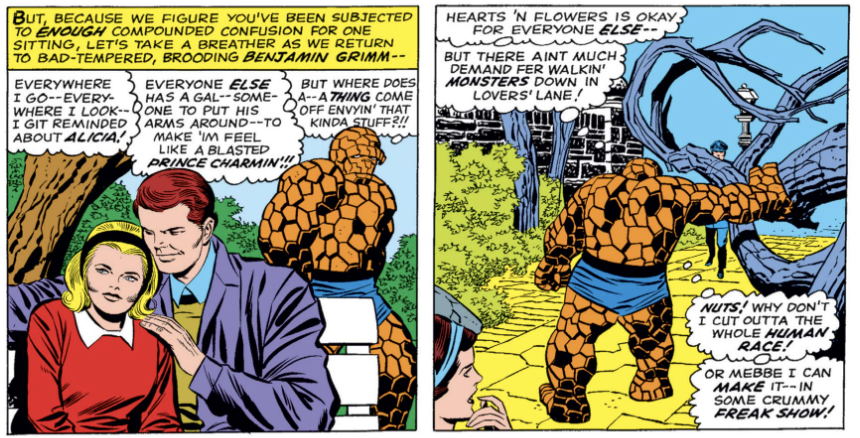
The agony of Ben Grimm
It’s been a while since we had Ben in full-on torment over his appearance. As is often the case, it’s his relationship with Alicia that pushes him over the edge.
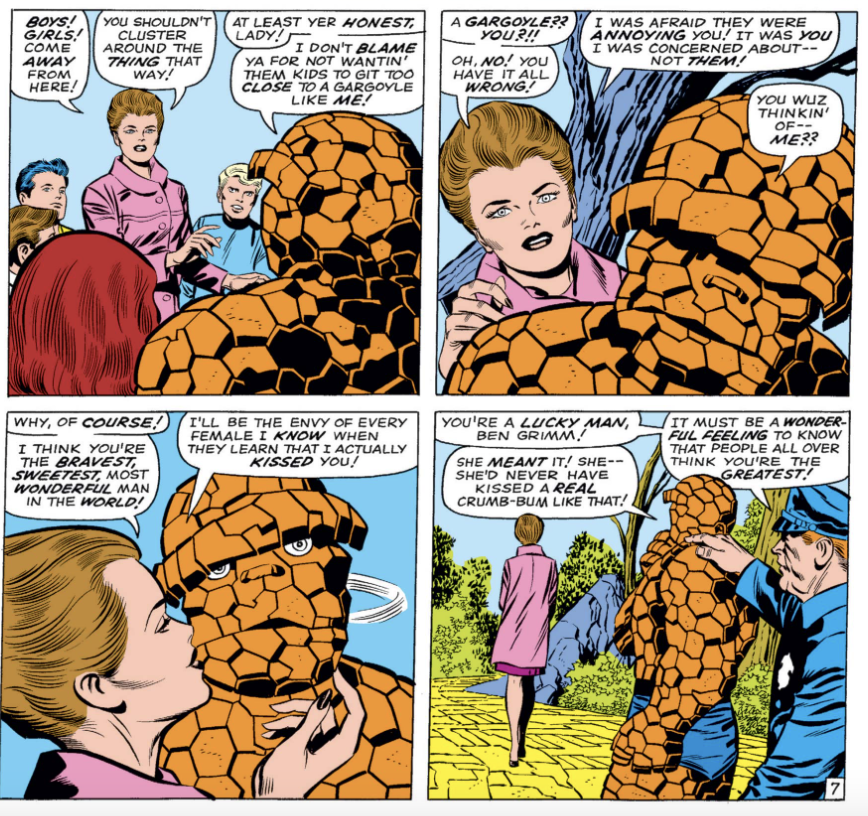
Unusually, in this issue he is comforted by strangers:
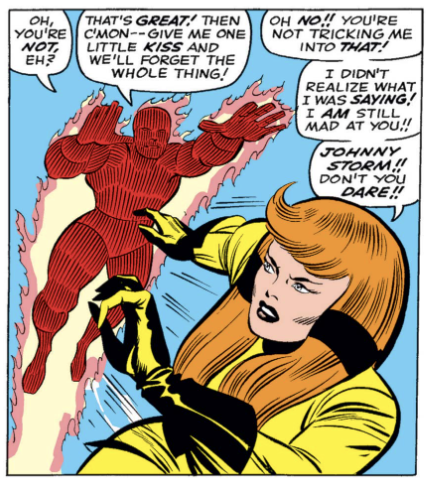
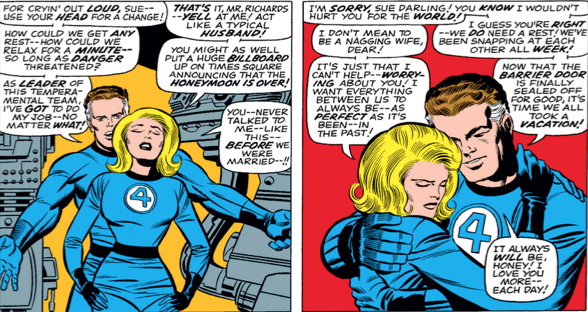
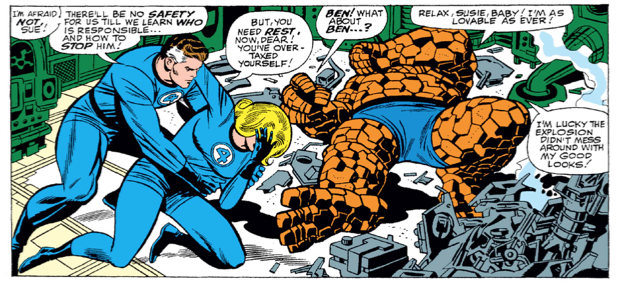
They’re fighting again
As discussed, the provocation this time is Ben’s frustrations and insecurity regarding Alicia
Weird science
The heat-image tracer!
Mid-century modern
I love how Alicia decorates her apartment.
Ladies and gentlemen, I give you Joe Sinnott
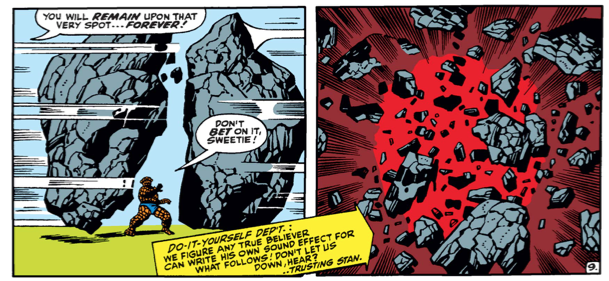
Dig that Kirby Krackle
Scientist bad guys gives Jack a lot of opportunity to draw the high-tech gizmos he loves.
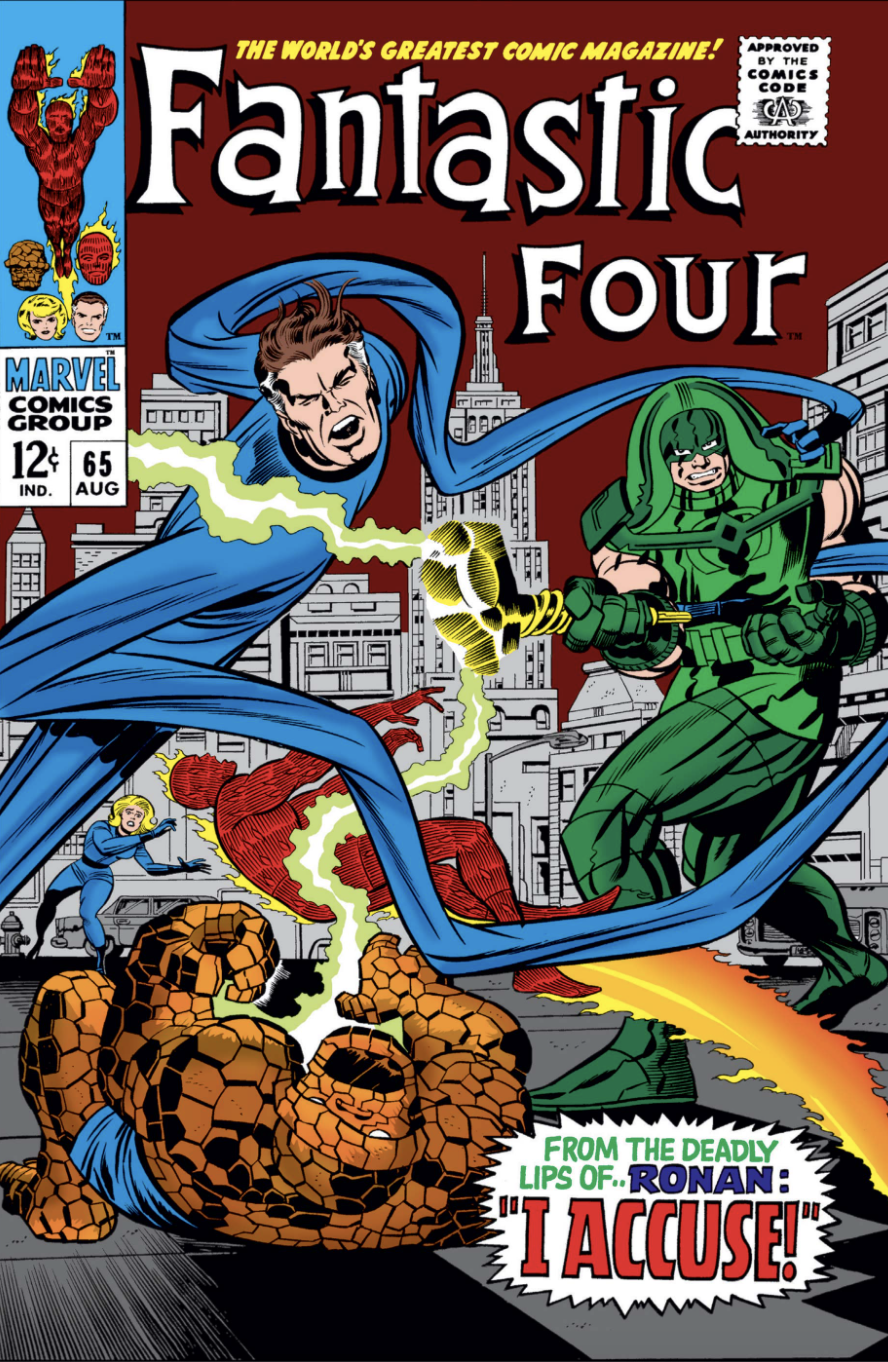
Fantastic Four 65 “..From Beyond This Planet Earth!” Published: May 1967 Story: Stan Lee and Jack Kirby Script: Lee Pencils: Kirby Inks: Joe Sinnott Letters: Artie Simek Cover: Kirby and Sinnott
Synopsis
Fantastic Four 65 begins in the midst of a dream, with the team held captive by the Kree’s Supreme Intelligence as punishment for destroying the Kree Sentry last issue. As the FF wakes up in the Baxter Building, they realize they’ve all had the same nightmare. After some hijinks, the team separates: Johnny goes joy-rising in a new hot rod with Crystal while Reed and Sue go out on a date. And in a subplot teasing the next issue, Alicia Masters is led away by a mysterious stranger with the power to travel through walls.
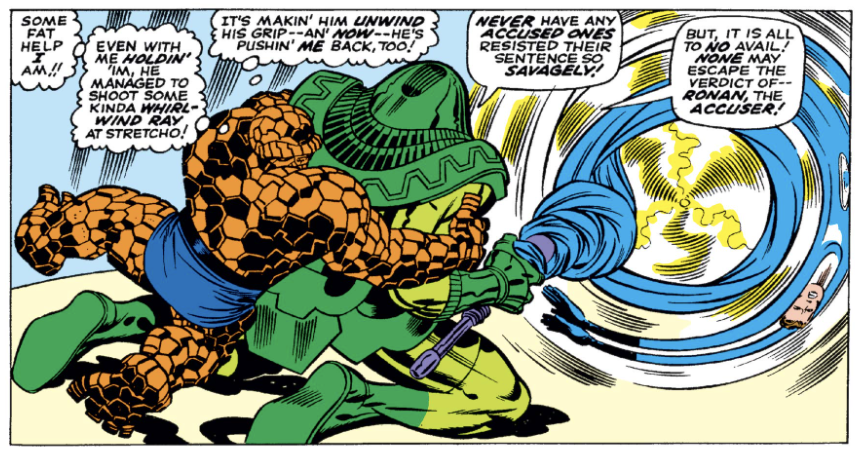
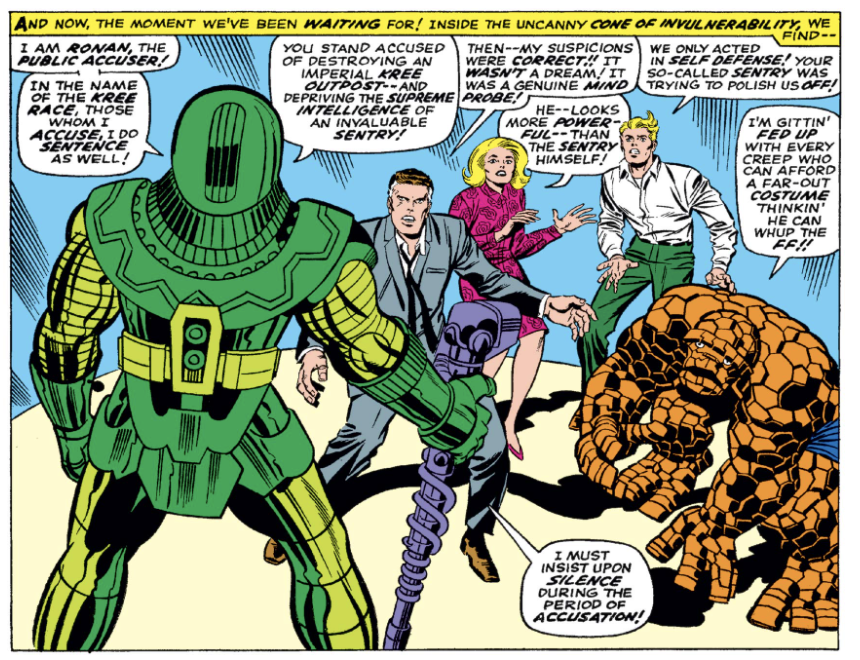
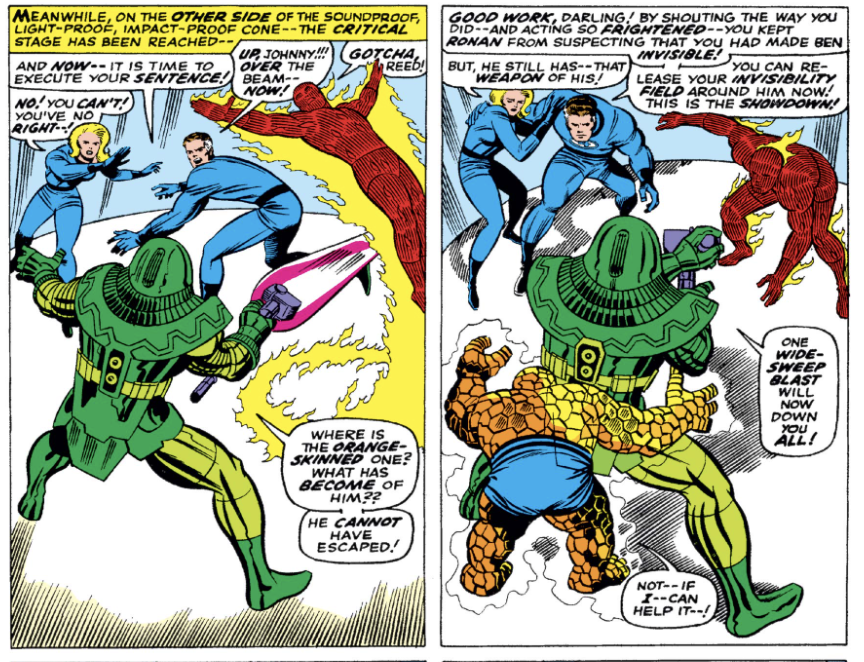
Meanwhile, Ronan the Accuser, dispatched by the Supreme Intelligence, arrives on Earth to exact revenge. The members of the FF disappear from their activities and are reassembled by Ronan under his “cone of inpenatrability” (sic) where he attempts to pronounce his sentence. The team fights back but he proves their equal using his club-like weapon. Eventually the team triumphs when Ronan disappears, after his weapon discharges while he was on top of it.
What’s going on here
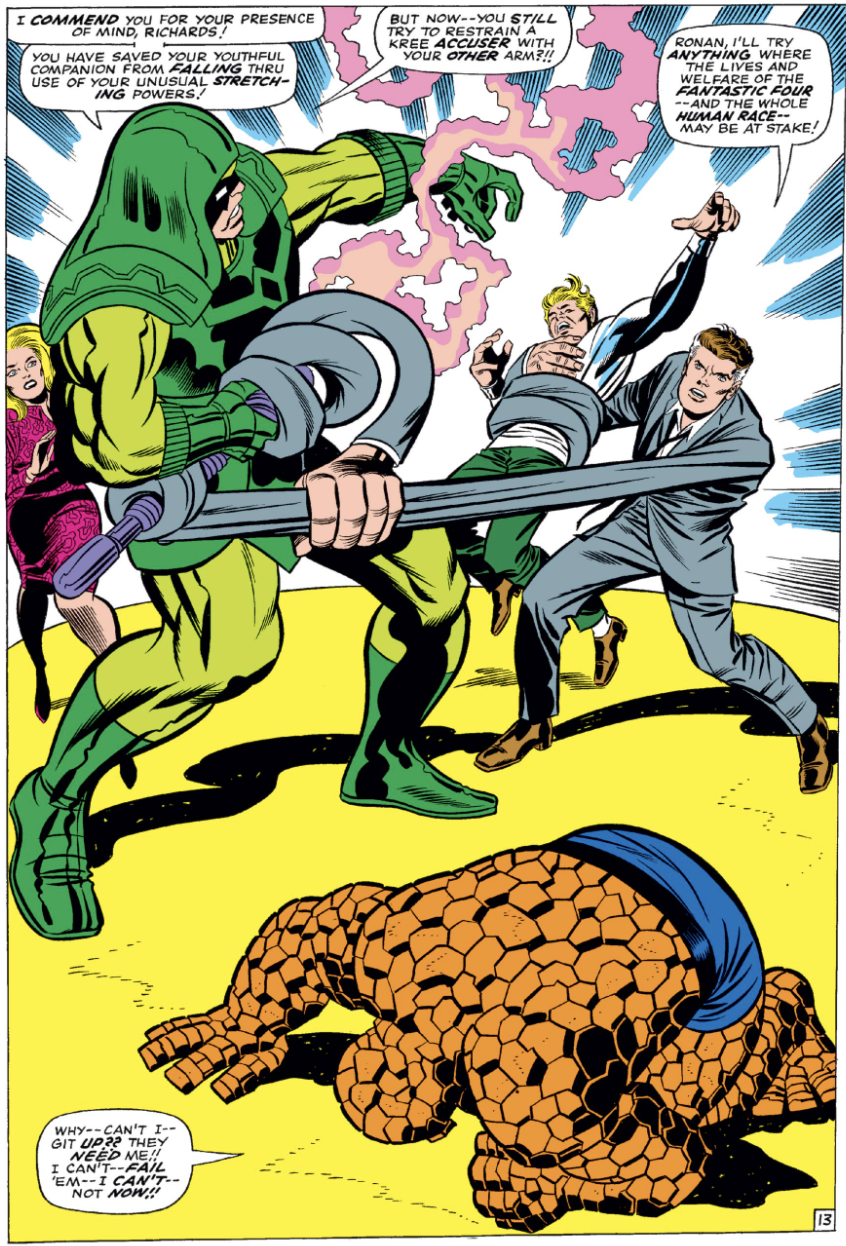
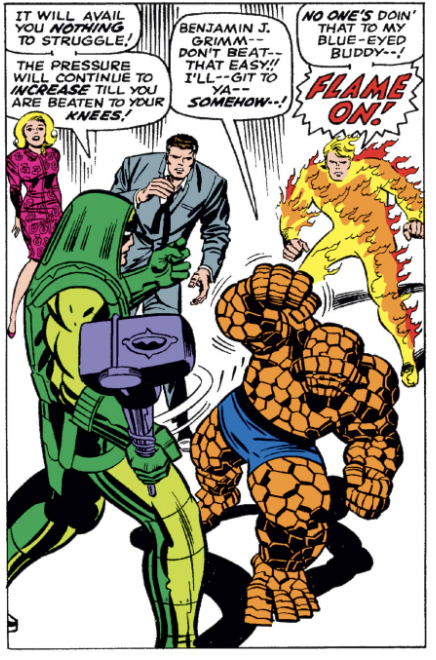
This is a bit of an odd comic. For the first time in what seems like many issues, the FF are at home and relaxing as civilians, and those pages flow easily. But when the FF is engaged with Ronan, the storytelling becomes cramped and off-key. Both the art and storytelling seem rushed and a bit sloppy. Take, for example, this splash page:
Normally a splash page is an opportunity for Kirby to cut loose, but here it’s just another panel. And Ronan’s dialogue—explaining what Reed is doing with his arms—seems oddly expository (also note the spelling of “thru”).
Another strange element that suggests Kirby was rushing: A number of panels, spread over several pages, are drawn from the same perspective, looking down from above Ronan’s right shoulder.
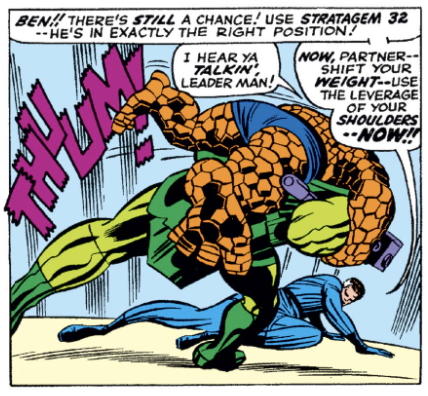
Another oddity: Reed directing Ben with a code for a maneuver. It’s something Cyclops used to do with the X-Men, but I don’t believe we’ve seen it in the Fantastic Four.
Who is this guy?
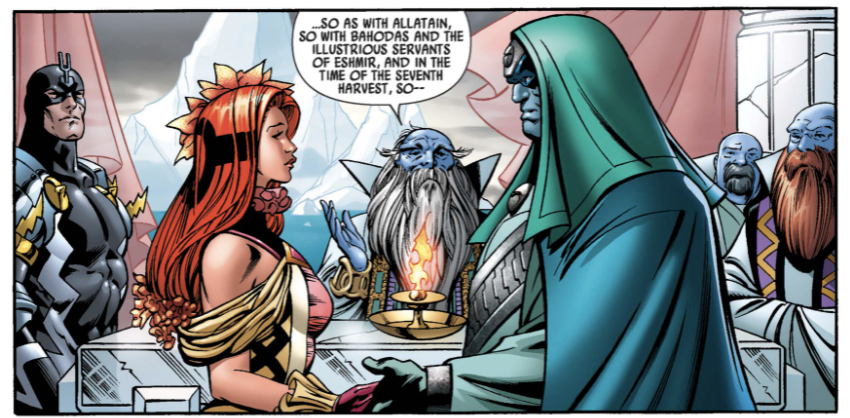
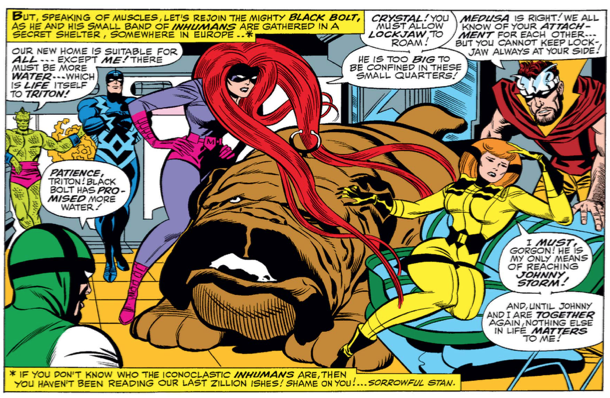
FF 65 marks the first appearance of Ronan the Accuser, who goes on to appear in dozens of of comics over the years. Notably, he is pink-skinned here, before later becoming blue skinned like most of the Kree. He spends his first decades as a bad guy before his story becomes more interesting with his arranged marriage to Crystal in the War of Kings miniseries. In a coincidence, Crystal is in this issue, although they didn’t encounter each other.
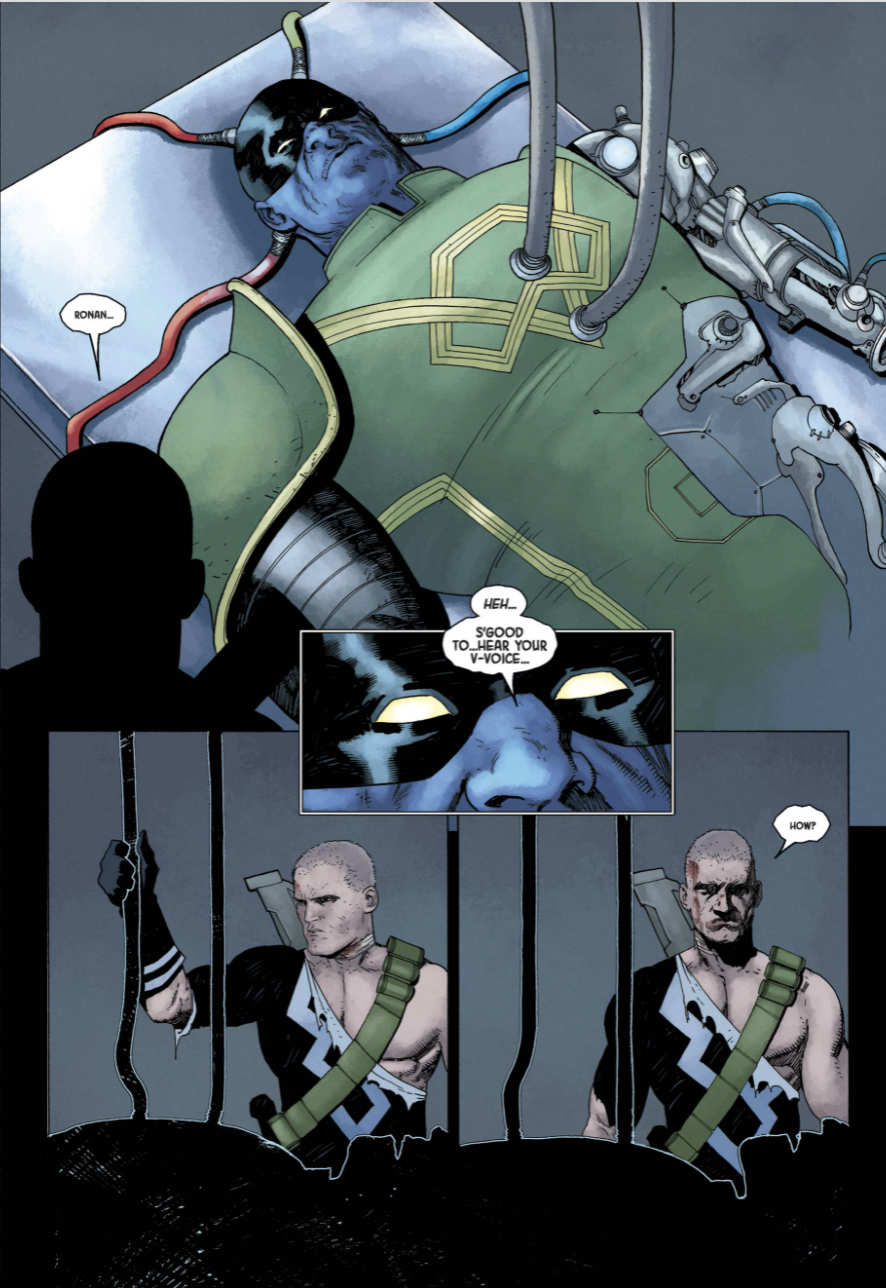
War of Kings 1 (2009, art by Paul Pelletier and Rick Magyar)
Despite the arranged nature of the wedding, the two fall in love, before they are separated in a deal struck between Black Bolt and the Supreme Intelligence. Eventually Ronan is captured and tortured by Kree fanatics before he is put out of his misery and killed by Black Bolt. Will he stay dead? Seems unlikely, but who knows.
Death of the Inhumans 3 (2018, Donny Cates and Ariel Olivetti)
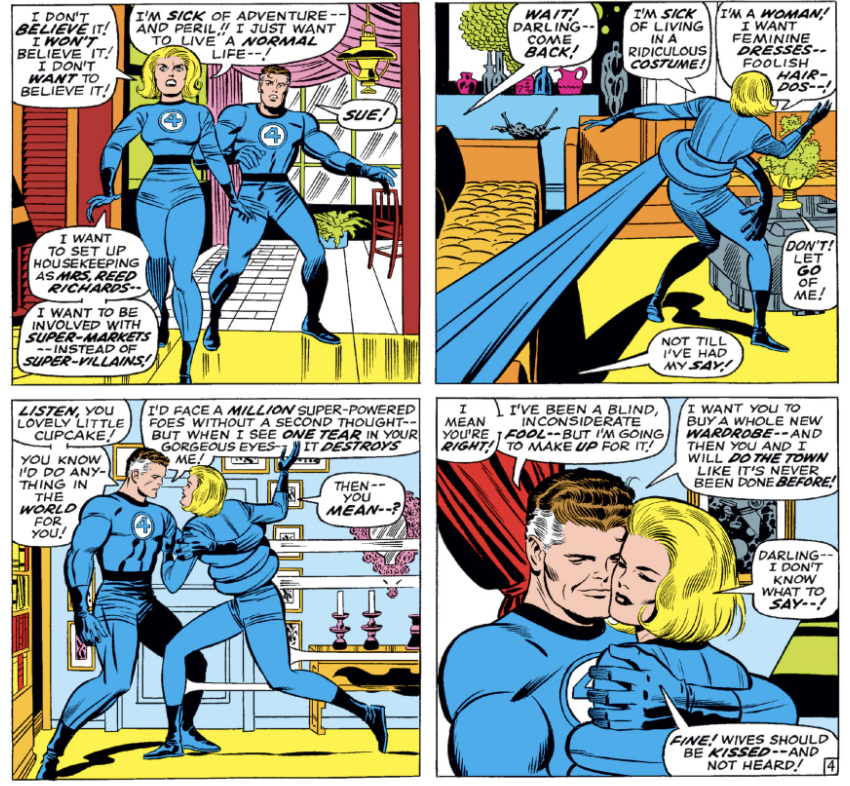
The sexist sixties
This sequence is really excruciating.
Word Power
Ronan really likes his adverbs.
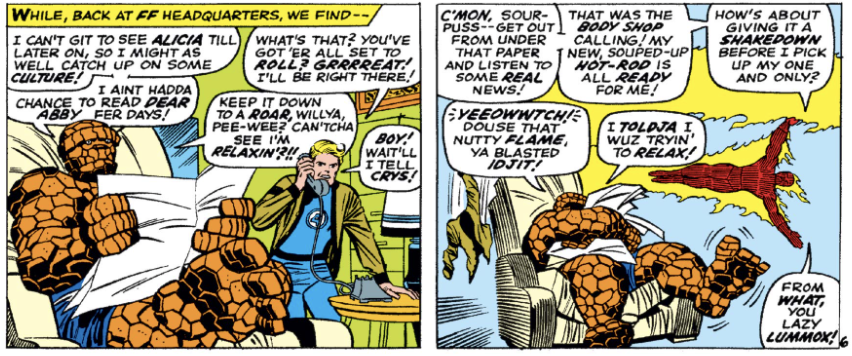
They’re fighting again
It’s been a long time since we’ve had one these.
What year is it?
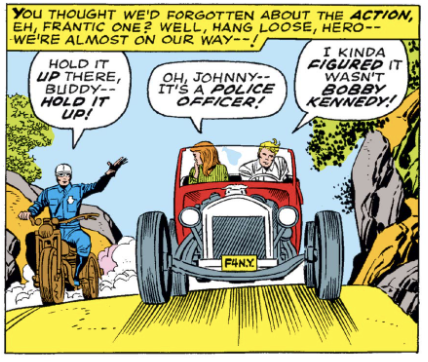
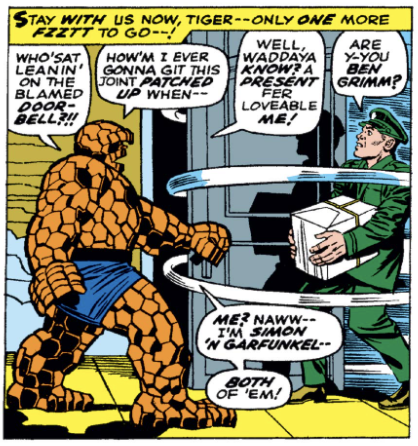
A couple of topical references in this issue, to Bobby Kennedy and Simon & Garfunkel (and check out Johnny’s vanity plate).
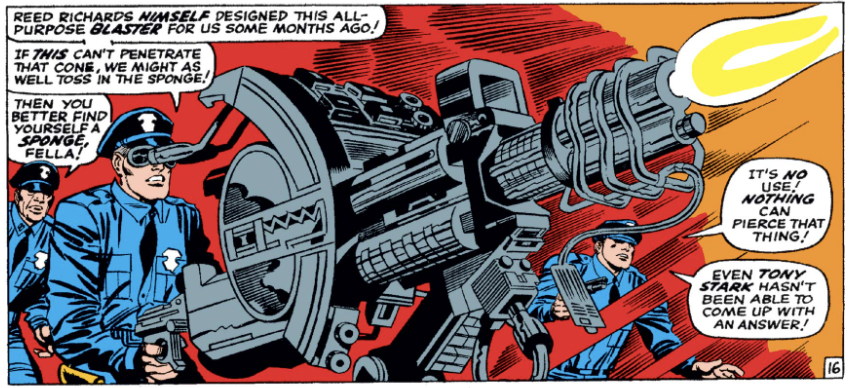
New York’s finest
Of course the cops have an “all-purpose blaster.” I’m sure they would never abuse it.
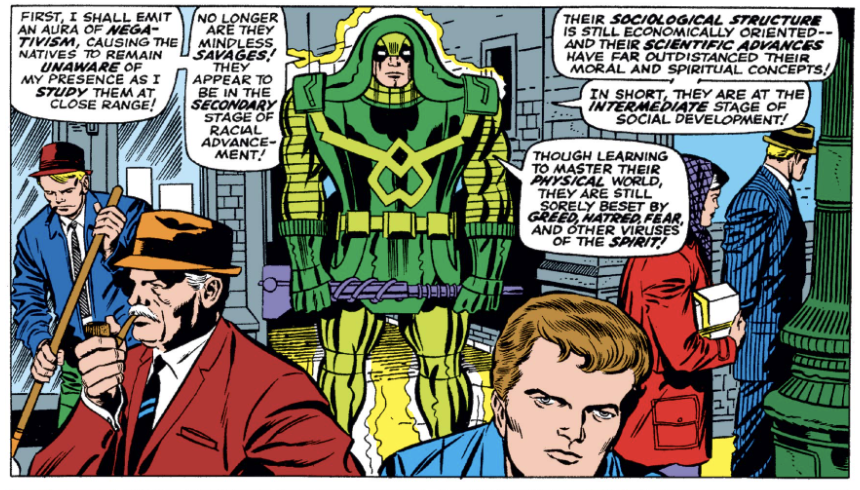
Weird Science
Ronan projects an “aura of negativism,” something my wife accuses me of doing on occasion.
Young Love
Panels like this are good reminder that Jack drew about a million issues of romance comics in the 1950s
Dig that Kirby Krackle
A pretty cool sequence of Ronan approaching Earth.
Also cool:
Also on Newsstands
In May 1967
Next issue: Alicia and the mystery of the Beehive!
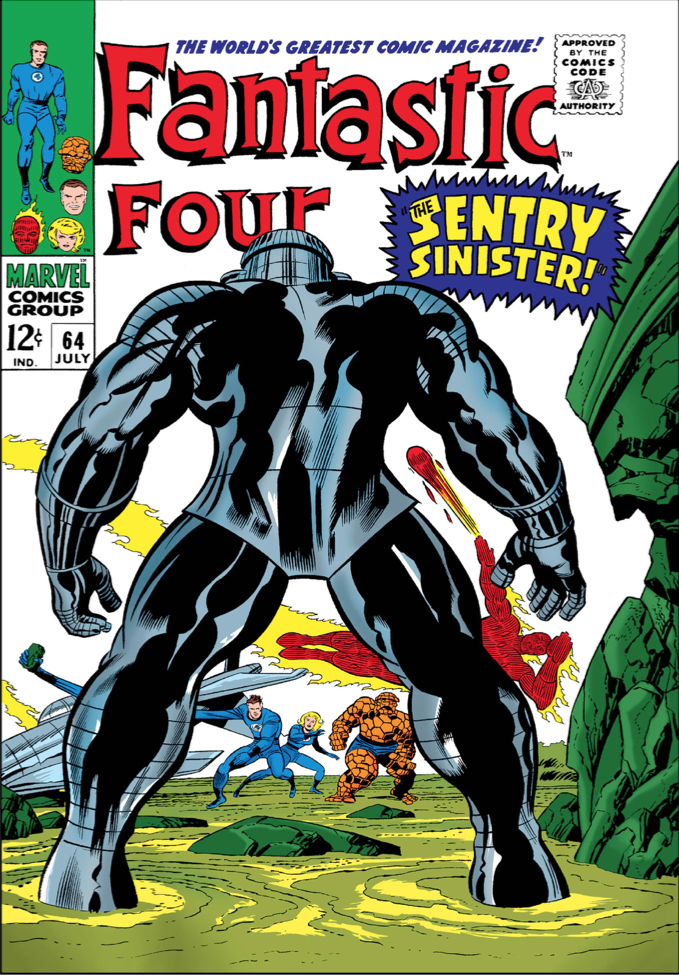
Fantastic Four 64 “The Sentry Sinister” Published: April 1967 Story: Stan Lee and Jack Kirby Script: Lee Pencils: Kirby Inks: Joe Sinnott Letters: Artie Simek Cover: Kirby and Sinnott
Synopsis
After their recent battle with Blastaar, the Fantastic Four decide to go on a vacation (minus the Human Torch, who wants to stay behind with Crystal). The Thing randomly selects an island in the South Pacific where, unbeknowst to the FF, an archaeologist has awakened a slumbering alien robot, a Sentry left by the Kree. As the FF approach the island in their pogo plane, they enter a “vibration field” and only the Invisible Girl’s force field protects the team.
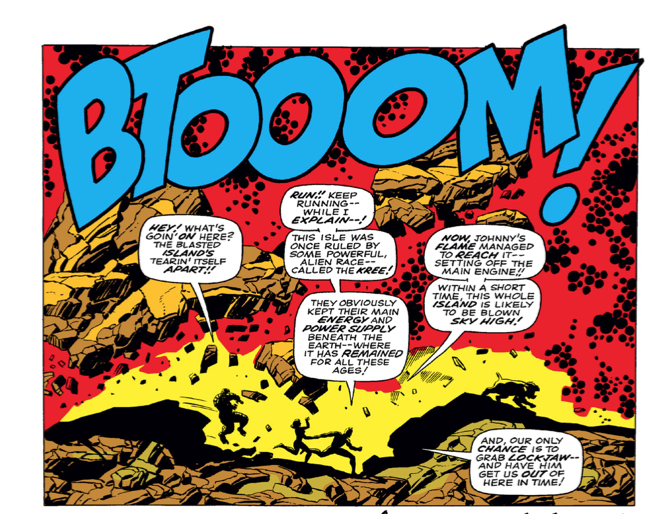
On the island, the three members battle the Sentry, which maintains it’s only following its orders to destroy the team, when Sue manages to send an emergency message to Johnny. Lockjaw teleports him to the island just in time to save the other members from a crushing tidal wave created by the robot. Johnny’s flame ignites a Kree power source and the team, along with the archeologist and his guide, teleport away from the island and the Sentry just as the island threatens to explode.
What’s going on here?
Aside from the creaky plot device of the Fantastic Four encountering trouble while on vacation (previously deployed in FF Annual 1), this is a brisk, well-told comic that balances some of the playful characterizations we have become familiar with compelling action and a villain the FF really are no match for.
Most notably, of course, FF 64 introduces the Kree, one of the three major alien empires in the Marvel Universe (along with the Skrull and Shi’ar) and maybe *the* most significant alien race in Marvel (I would even expand it to say in all of comics, except for the progeny of a little planet called Krypton).
The Kree-Skrull war is one of the most notable events in early Marvel history, the Kree created the Inhumans, Marvel’s original Captain Marvel was a renegade Kree, and Carol Danvers—first Ms. Marvel, then Binary, Warbird and now Captain Marvel—got her powers via the Kree. The new Ms. Marvel, Kamal Khan, became a hero indirectly via the Kree, since she was exposed to the Inhuman’s Terrigen Mists.
Kree stuff (art by Jorge Lucas).
In fact, the significance of the Kree is making me re-evaluate my unofficial designation of FF 44-60 as the highpoint of the Lee-Kirby creative partnership and extend it to FF 67, which would include not only the creation of the Kree but the realization of the Negative Zone as an alien dimension, and the introduction of Blastaar, Ronan the Accuser, the Supreme Intelligence and Him, later to become Adam Warlock (much more on all of that to come). It’s both evidence of Stan and Jack’s creative energies, and Marvel’s ability to take hold of good ideas and nourish them over the years, giving them new life again and again.
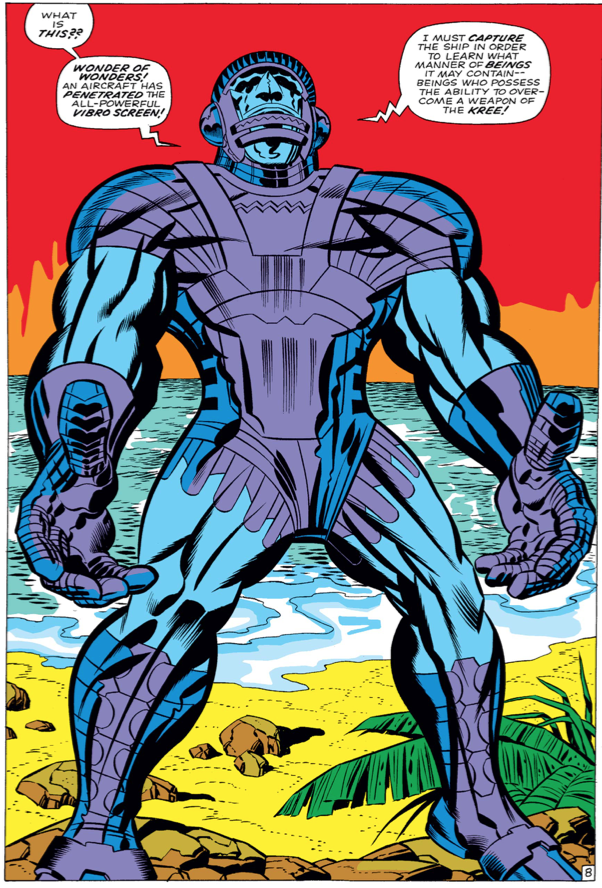
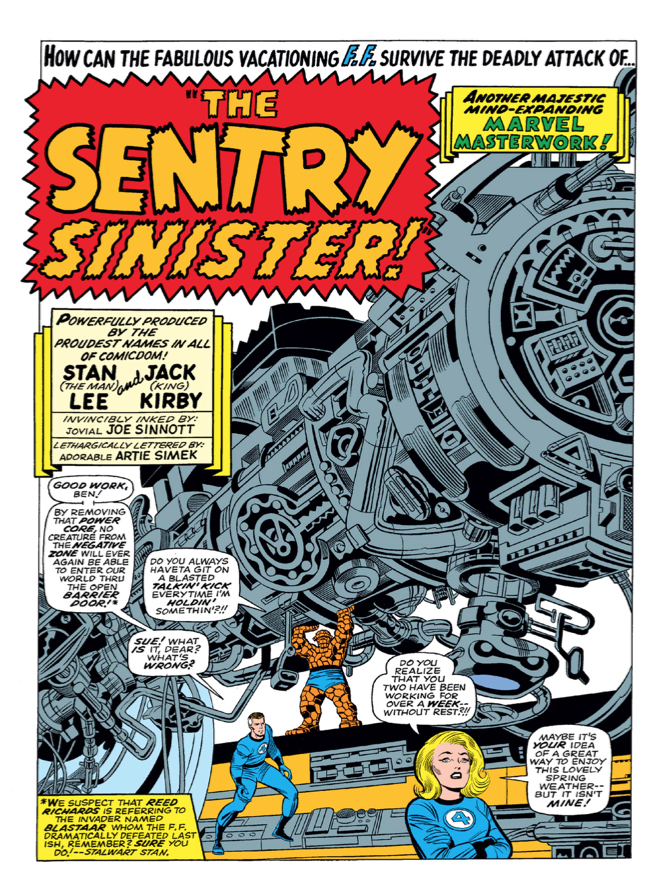
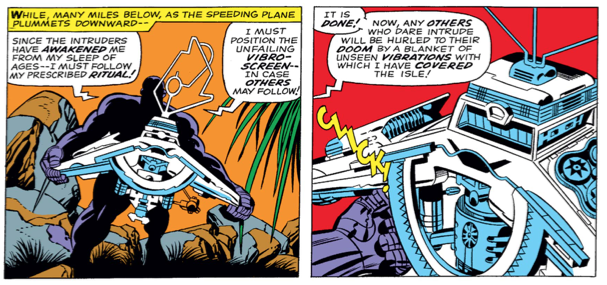
Interestingly, the antagonist in this issue, the Kree Sentry robot, sort of fades in importance as the actual Kree take shape. He’s sort of a stalking horse for the much bigger empire to come. But you wouldn’t know that from this issue, and this amazing Kirby splash page. And, it should be noted, he pretty much wipes the floor with the FF, who only escape by teleporting off the island.
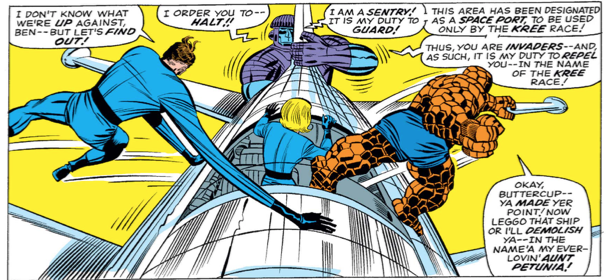
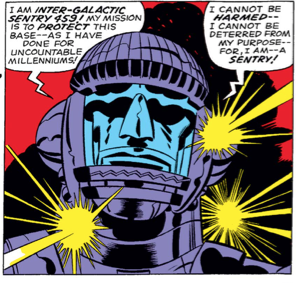
At one point the Sentry declares it is “no mere robot” and calls itself a living Sentry. Certainly, it’s vocabulary suggests it’s not from the robot-school of speaking. What mere robot uses so many adjectives?
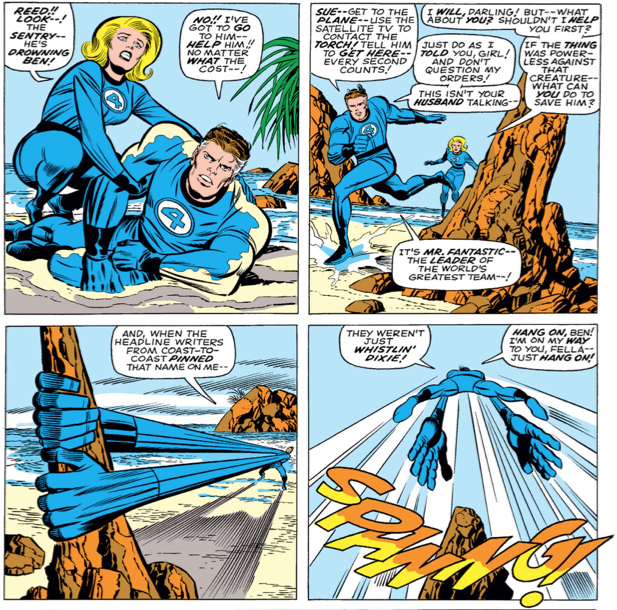
The sexist sixties
This is a pretty egregious issue for ’60s-style sexism, starting with Sue huffing over being ignored while Reed and Ben are working.
It gets worse when Reed barks orders at her during a battle (note: this could have been filed under the “Reed Richards is a Jerk” heading).
Further, Reed is engaged in some revisionist history when he claims it was headline writers that pinned the name “Mr. Fantastic” on him. Because if you’ve read FF No. 1, you’ll recall it was Reed who gave himself that moniker.
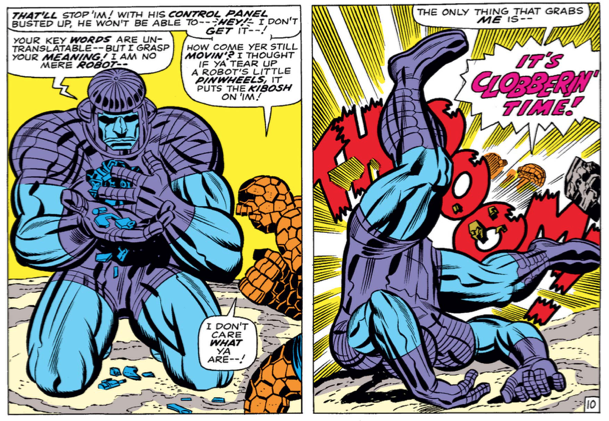
Clobberin’ Time
A pretty good one here, with the wind-up in one panel, and the pitch in the next:
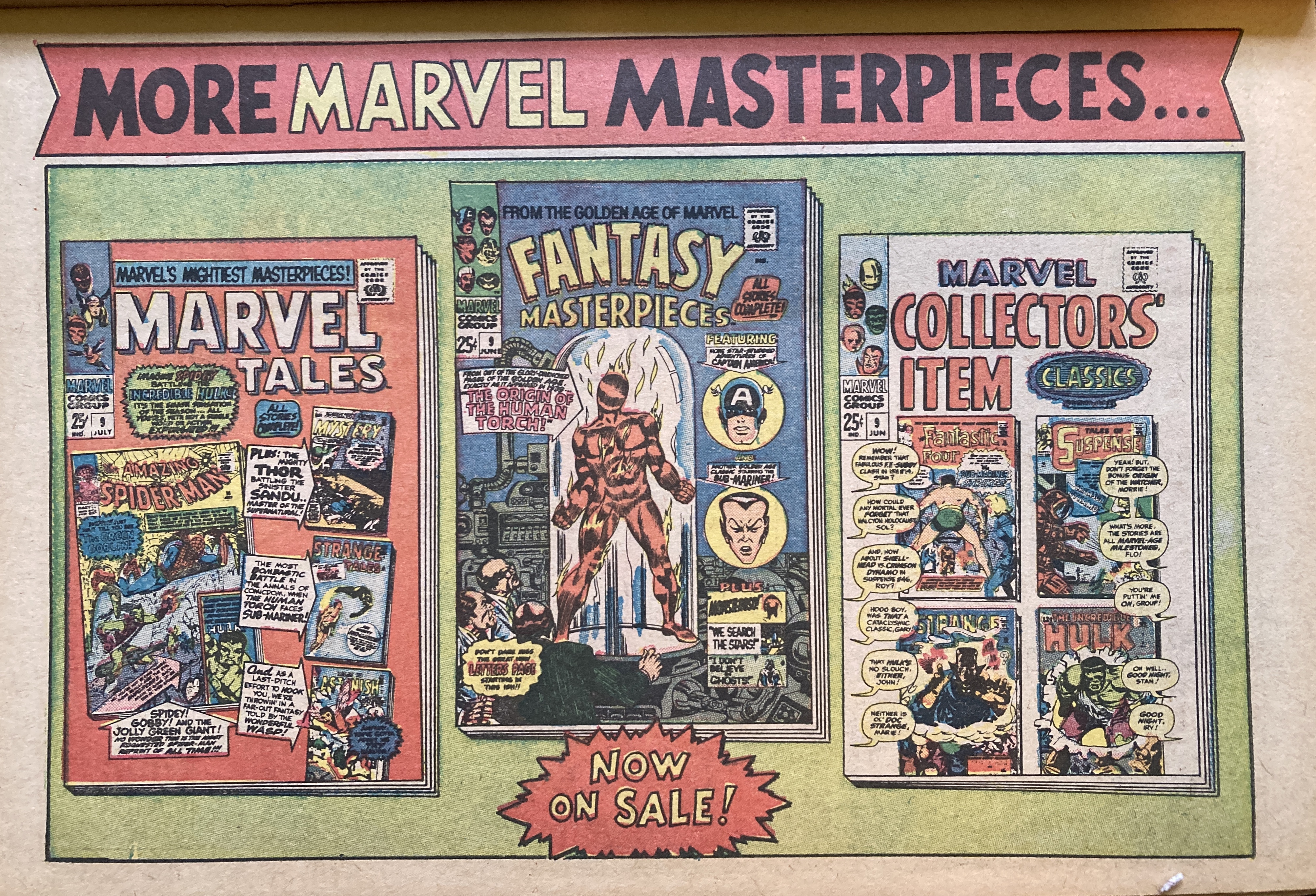
More Marvel Masterpieces
Interestingly, this house ad is plugging reprints, not new issues.
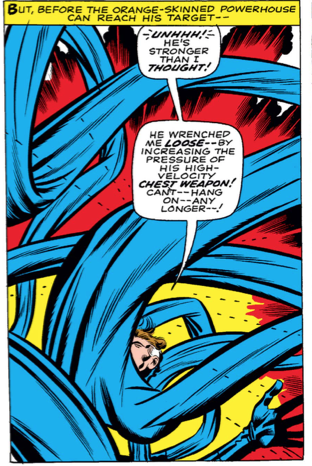
Dig that Kirby Krackle
Some cool stuff in this issue, starting with the awesome splash page:
More:
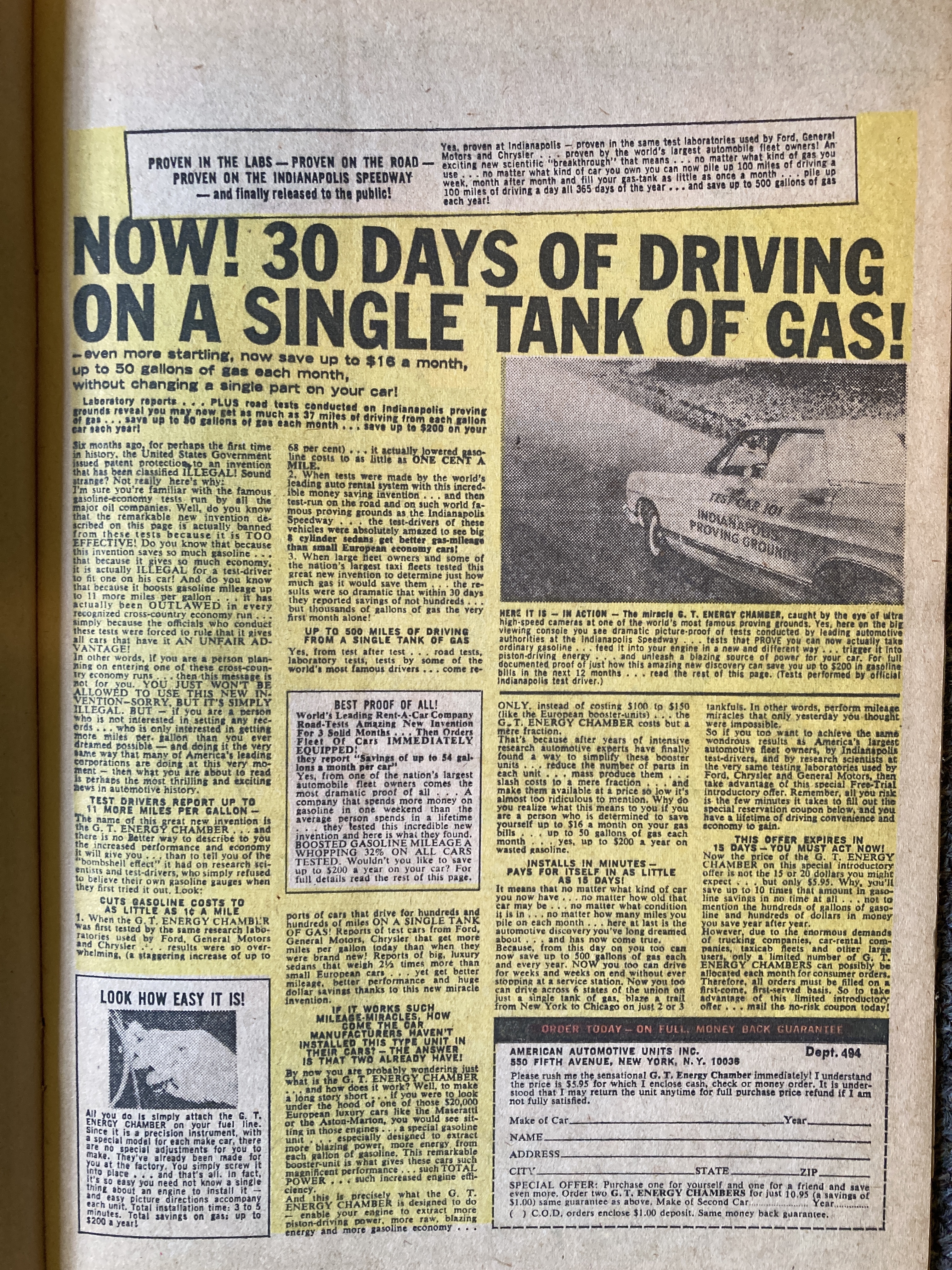
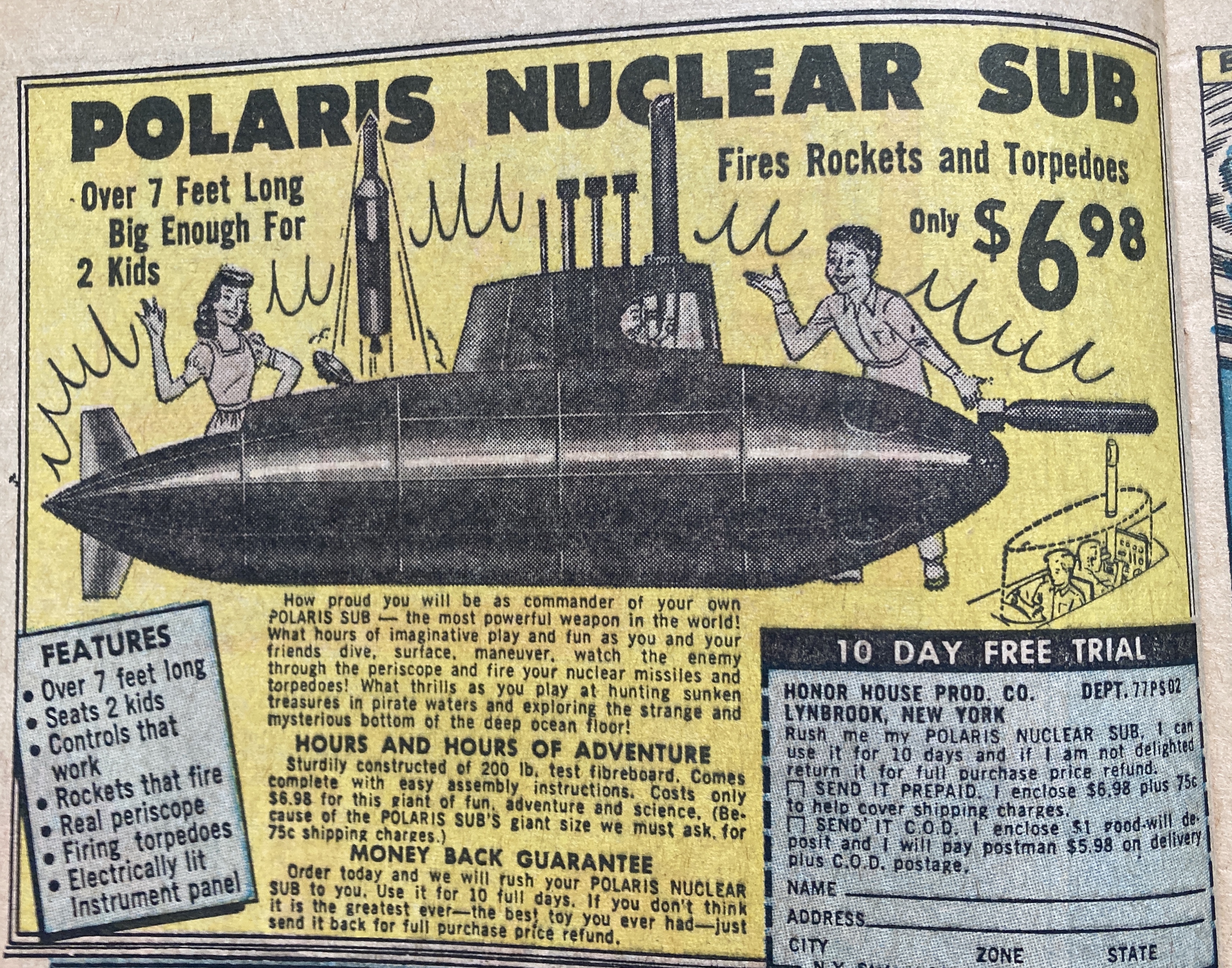
For sale
Someone tell Joe Biden we’ve found a way to cut the price of fuel
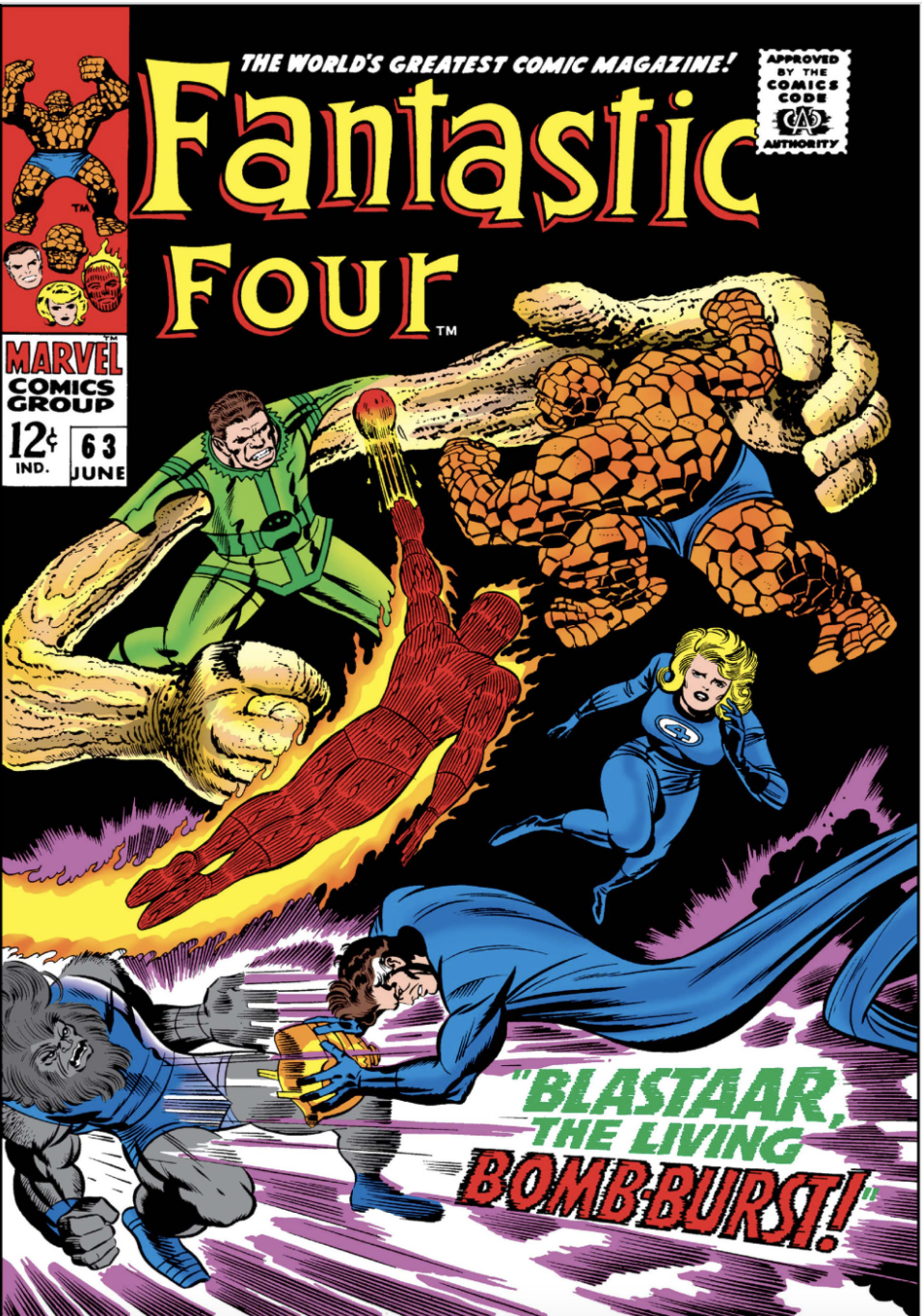
Fantastic Four 63 “Blastaar, the Living Bomb-Burst!” Published: March 1963 Story: Stan Lee and Jack Kirby Script: Lee Pencils: Kirby Inks: Joe Sinnott Letters: Sam Rosen Cover: Kirby and Sinnott
Synopsis
Fantastic Four 63 picks up where the previous issue left off, after the Inhuman Triton rescued Mr. Fantastic from the Negative Zone, allowing Blastaar to enter their dimension. Blastaar, now allied with the Sandman, uses his power to create an explosion on the roof to the Baxter Building, leading Triton to confront him.
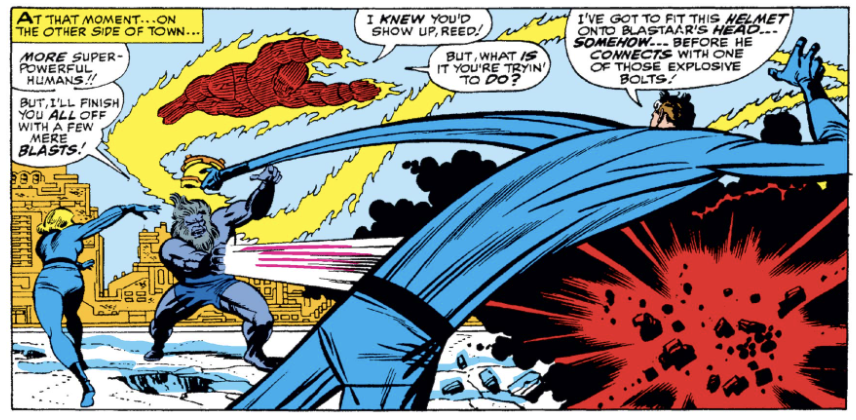
Blastaar defeats the Inhuman, and he and the Sandman then battle the Human Torch, who had been canoodling in a restaurant with his love interest Crystal, on the streets of Manhattan. The Thing soon joins the battle, but the Sandman traps him and dumps him into the river. Finally, Mr. Fantastic enters the fray with a helmet designed to negate Blastaar’s power. After further struggle, they eventually neutralize Blastaar while Ben disperses the Sandman in the river.
What’s going on here?
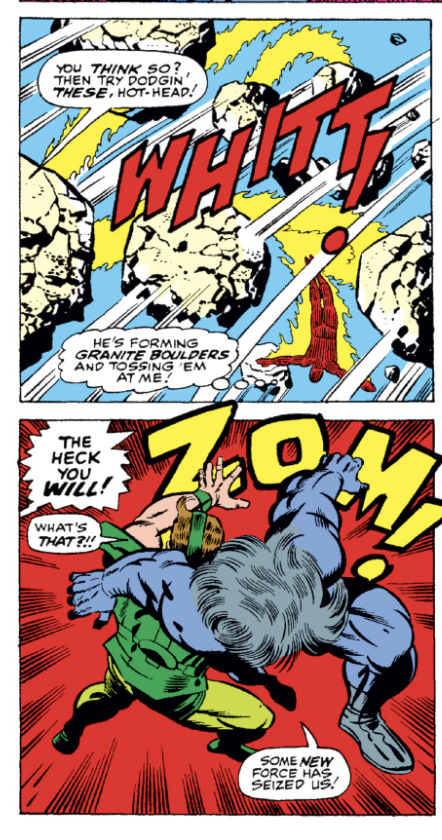
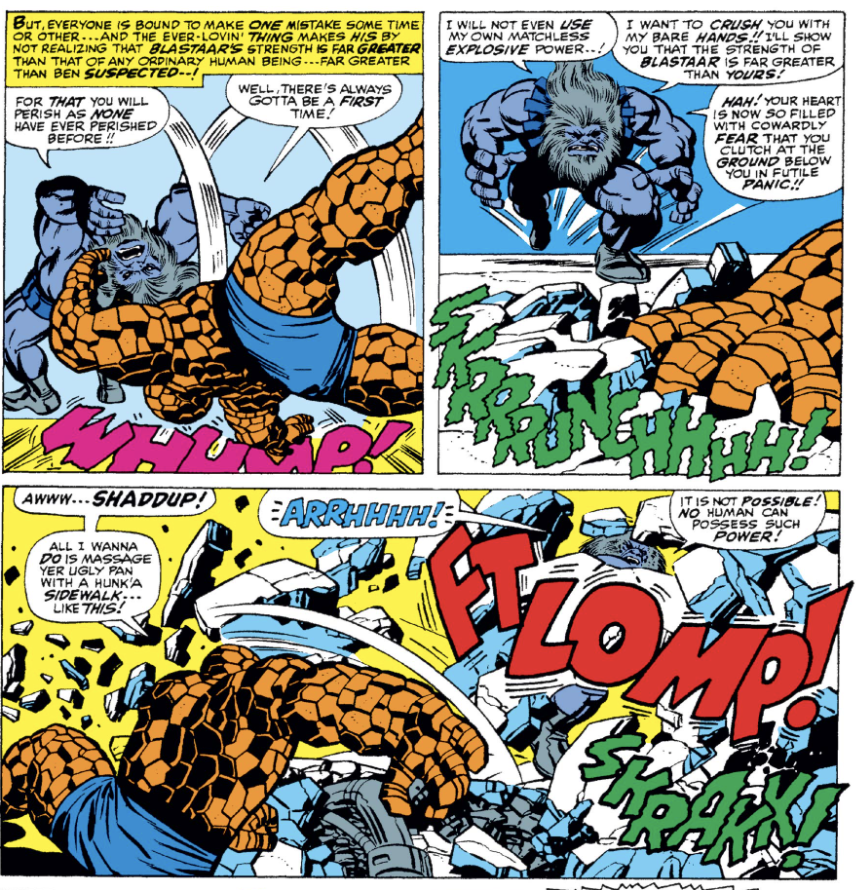
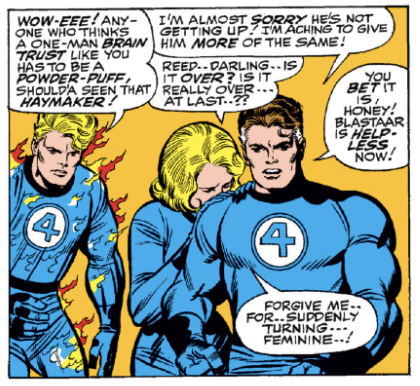
This is a fun, action-packed comic that’s pretty much one rollicking battle from the first page to the last. Unlike the last dozen or so issues, there’s no interludes updating us on the progress of the Inhumans or Johnny and Wyatt — those plot lines were effectively wrapped up last issue, and the team (plus Crystal) is intact. There are also no subplots or quiet moments, no family scenes in the Baxter Building or with Ben and Alicia, just a lot of fighting. The action is magnified with bigger-than-usual panels — many pages divided into just four panels, instead of the normal six. The FF would be a much-diminished comic if every issue was like this one, but every now and then it’s satisfying to seem them just cut loose for 22 pages.
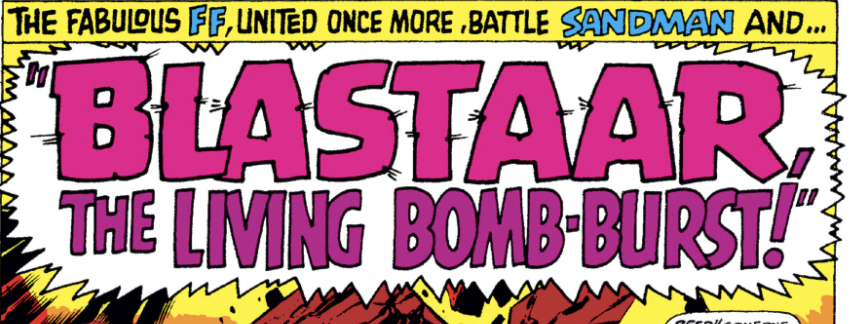
Starting with this issue, and in virtually every subsequent appearance, Blastaar is called “the living bomb-burst.” I had assumed a “bomb-burst” would be a thing readers were familiar with, but I never knew quite what it meant, and searching the internet reveals it’s actually not a common phrase. There’s the “bombs bursting in air” lyric from the Star-Spangled Banner, of course, and there’s an aerobatic maneuver called a bomb-burst, but otherwise it seems to be something Stan just invented.
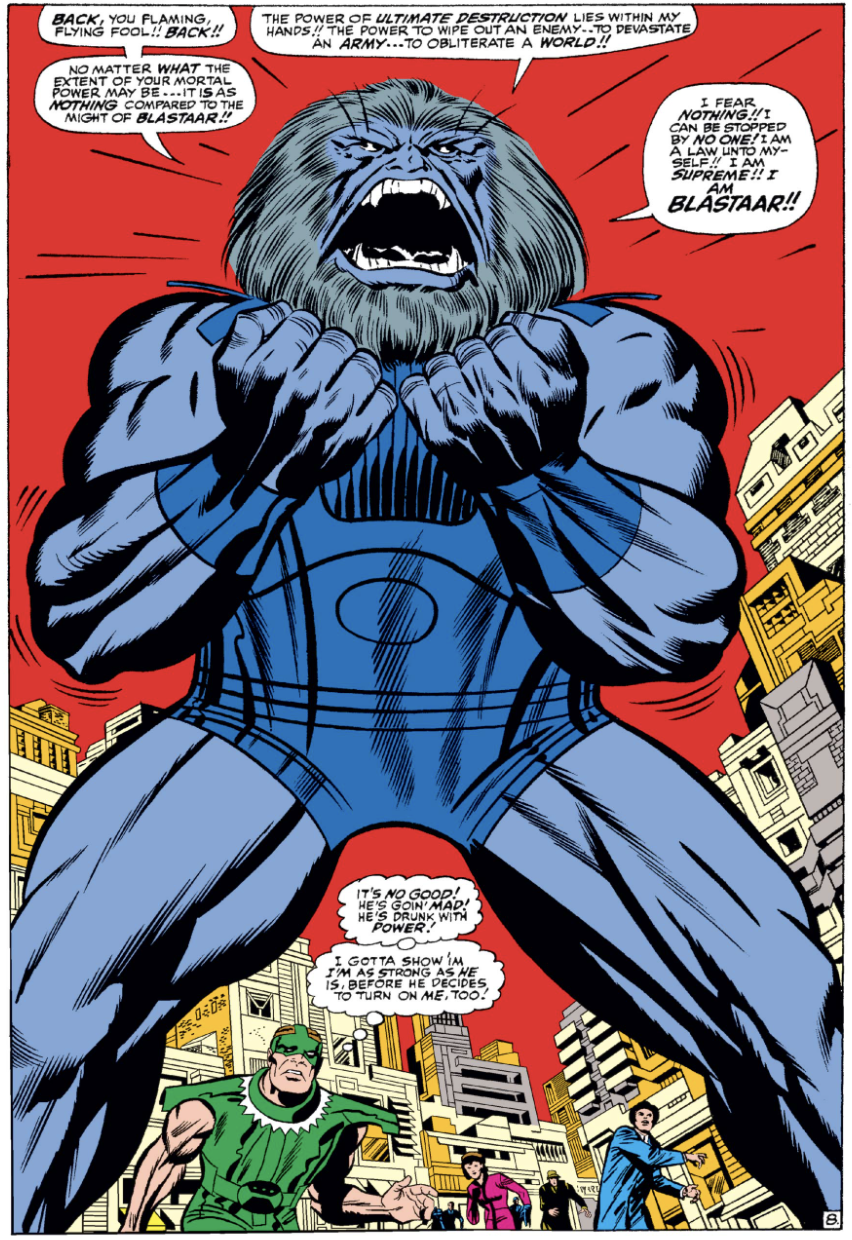
Perhaps intentionally, Blastaar is also highly bombastic, and rants and raves about his power in the best Marvel villain tradition. Maybe it has something to do with being from the Negative Zone, because Annihilus is also a very strong ranter-and-raver.
(Also, and there’s no delicate way to phrase this, it’s possible Blastaar is compensating for what appears to be his missing male genitalia. Or maybe his species just reproduces some other way).
Weird science
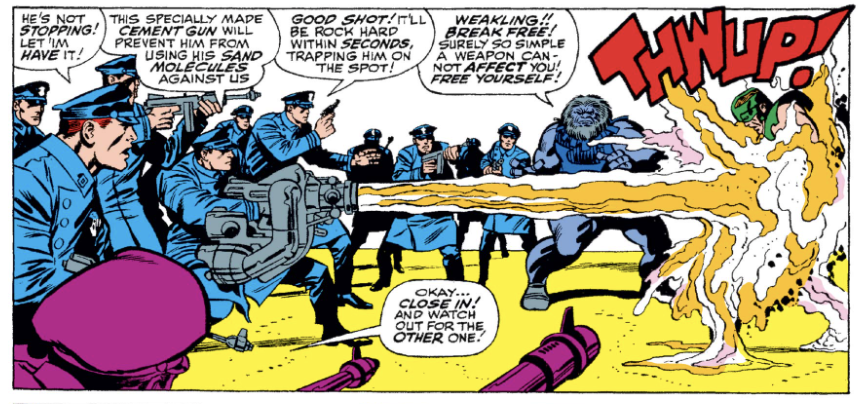
Naturally, the New York Police Department has a cement gun on hand.
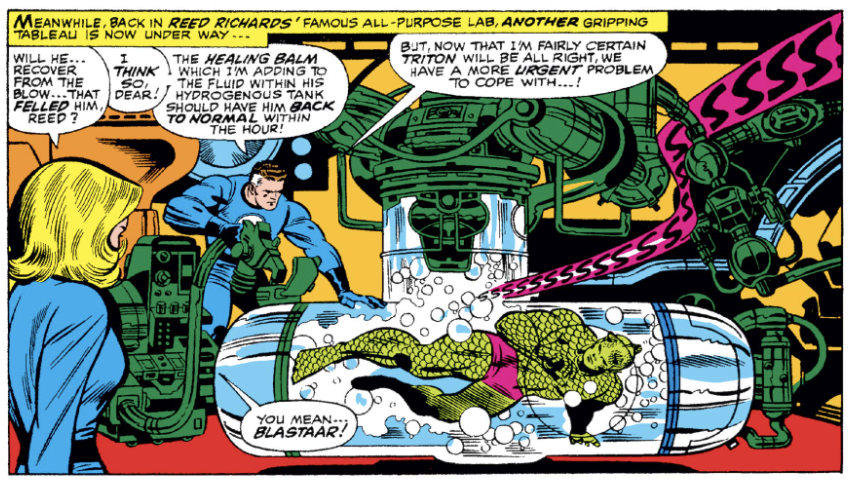
And Reed has “healing balms” at his disposal (and I’m not hydrogenous means what Reed thinks it means).
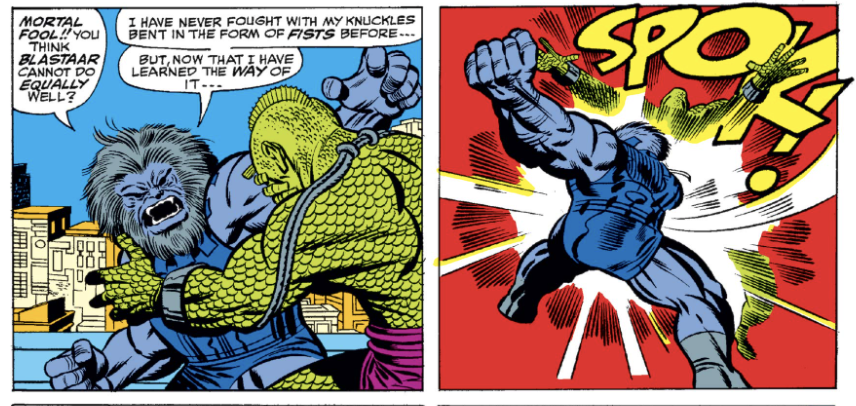
Fist fighting
Apparently boxing isn’t a sport in the Negative Zone
Bang! Pow!
There are some excellent sound effects in this comic.
The sexist sixties
Sue does virtually nothing in this issue except whimper and cringe.
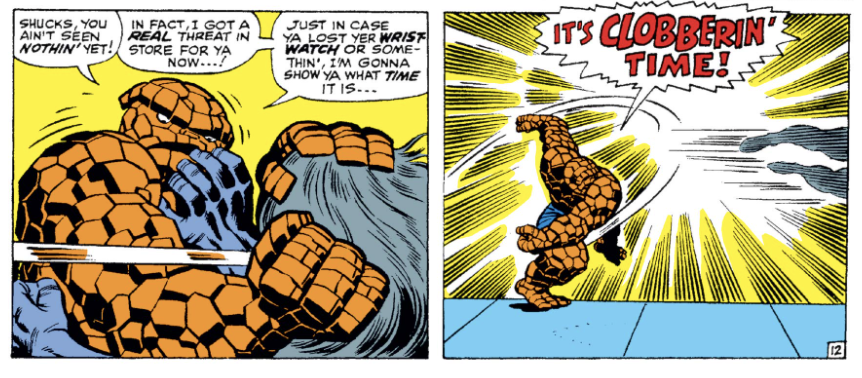
Clobberin’ Time
A very good set up and deliver from Mr. Grimm.
Dig that Kirby Krackle
This sequence with Triton fighting Blastaar is textbook Kirby (note the fist-fighting).
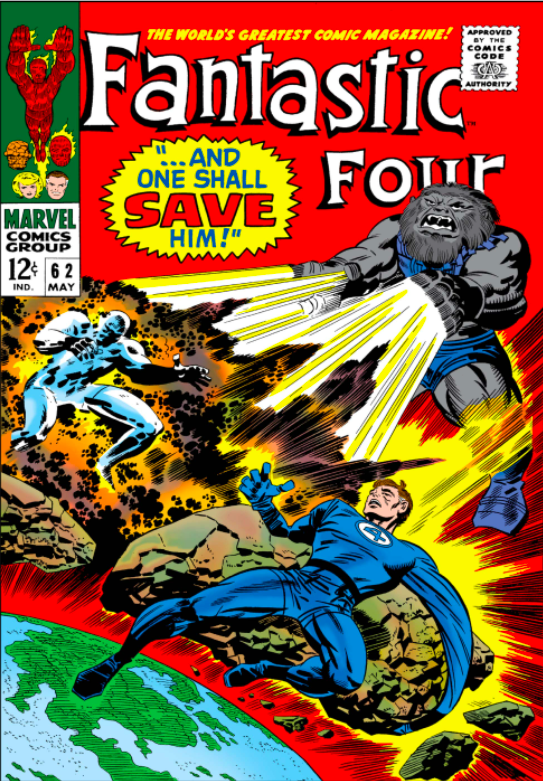
Fantastic Four 62 “And One Shall Save Him!” Published: Feb. 1967 Story: Stan Lee and Jack Kirby Script: Lee Pencils: Kirby Inks: Joe Sinnott Letters: Sam Rosen Cover: Kirby and Frank Giacoia
Synopsis
Fantastic Four 62 picks up where the last issue left off, with Mr. Fantastic tumbling through the Negative Zone toward the “exploding area” while the rest of the team watches helplessly through a scanner in the Baxter Building. The Inhuman Crystal and her teleporting dog Lockjaw then appear—Crystal has been looking for the Human Torch for about a dozen issues now—and she offers to help.
We then cut to a Mediterranean island where the rest of the Inhumans repel an invasion by a hostile army. Crystal arrives and explains the situation, and Black Bolt dispatches Triton to save Reed.
Back in the Negative Zone, a space craft drops off a menacing package near where Reed flounders, soon revealed to be the villain Blastaar. Triton then appears and rescues Reed, and as they return to our dimension, Blastaar sneaks in behind them. He is then confronted by the Sandman, who has been on the roof of the Baxter Building since the last issue, and they form an alliance. The issue concludes with the happy reunions of Reed and Sue and Johnny and Crystal.
What’s going on here?
A bit of an unsatisfying issue. For one, despite the promise of the cover, Blastaar —a major villain making his first appearance—doesn’t fight the FF in this issue. He appears, but there’s no confrontation—they don’t even intersect with each other. More significantly, the rescue of Reed is incredibly anticlimactic. Instead of Reed figuring out some scientific whammy, or Ben plunging into the Negative Zone after him, he’s rescued by Triton in a development that comes out of left field. And Triton just … goes and gets him. It’s explained that Triton’s ability to navigate the ocean depths makes him uniquely suited for this mission, but the rescue seems pretty straightforward. There’s no real drama or unusual heroics required.
The arrival of Crystal does serve to reunite her and Johnny, resolving their soap opera separation that began in issue 48. We also get a lot of Inhumans action, seemingly setting them up for their own series.
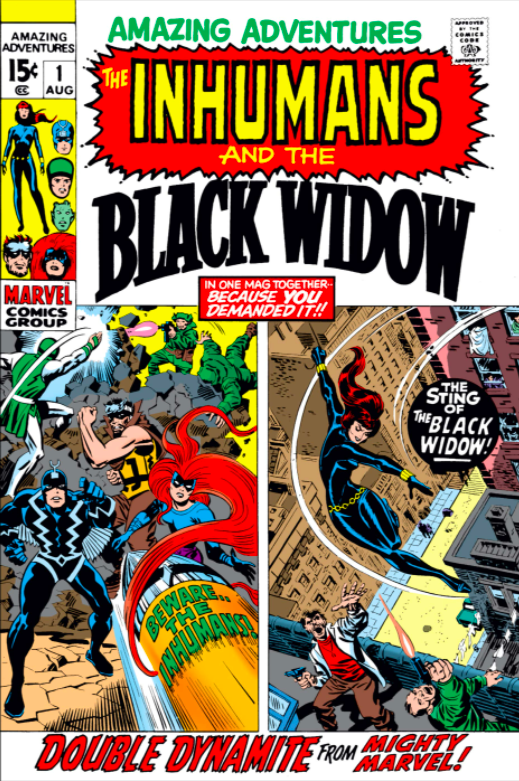
They didn’t get their own book until 1970, however, and even that they had to share with the Black Widow. As I recall, the mistreatment of the Inhumans was another factor that led to Jack leaving Marvel for DC.
Negative Zone
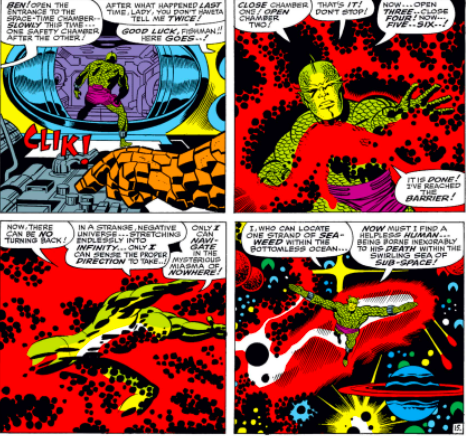
FF 62 also marks the first time the Negative Zone is really understood to be an alien dimension, complete with its own races and civilizations. Blastaar is he first villain to appear, but eventually we’ll be introduced to Annihillus, a first-tier bad guy.
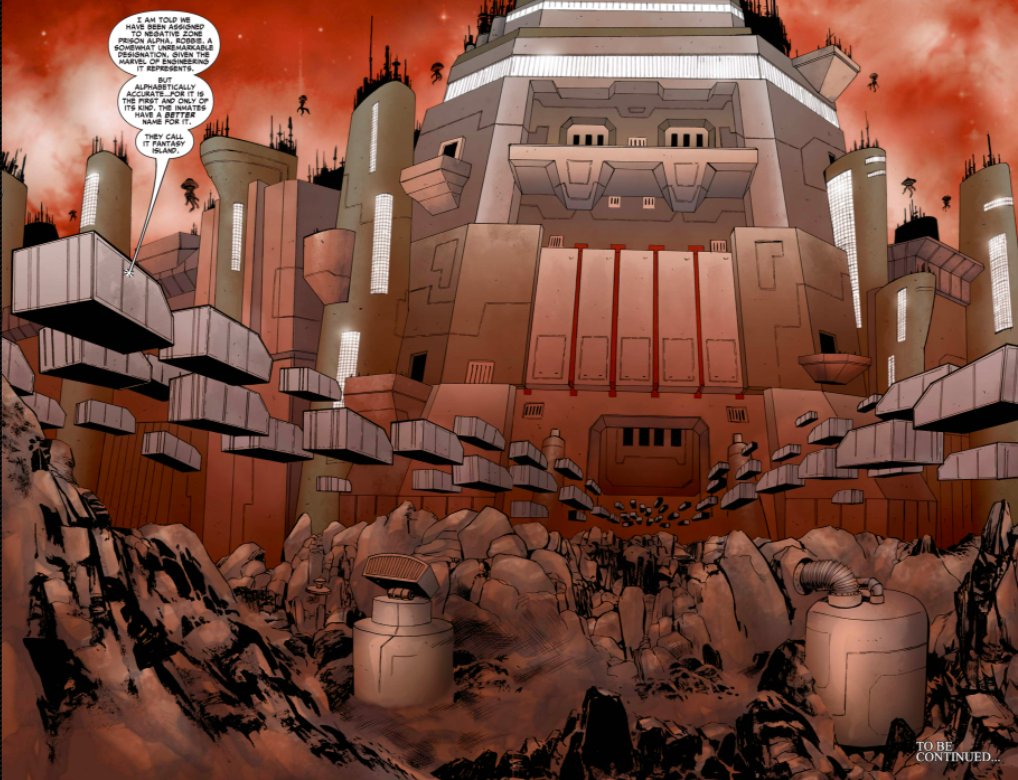
The Negative Zone becomes a major part of the FF’s mythos, and Reed and the FF are often either exploring it or using it place to store undesirables, such as when Reed created a prison there during the Civil War.
Civil War Front Line 5 (2006, Ramon Rachs and John Lucas)
Kirby Kollage
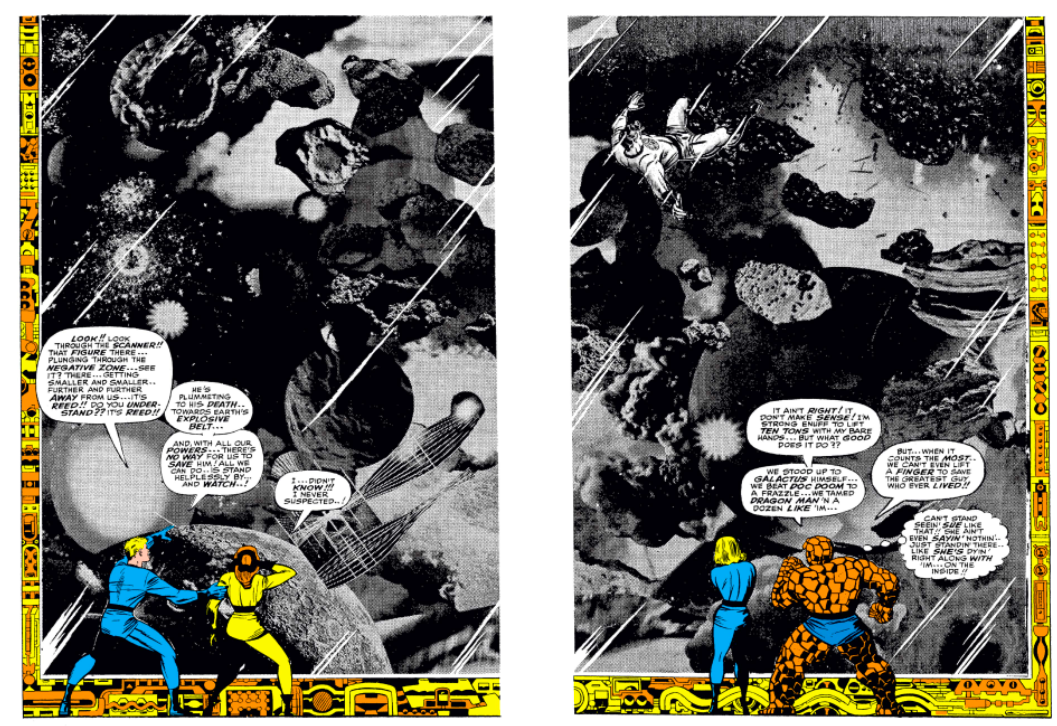
This is the first double-page splash in 62 issues of the Fantastic Four, and another amazing Kirby collage. Unfortunately I don’t have the tools to stitch the two pages together properly.
Welcome to a very belated round up of the 15 books I read in 2021 (honestly, I meant to do this in January). I fell way short of my goal of reading 24 books, or two a month, but as will be clear, I read some monstrously long books that put 24 out of reach. As I do every year, I try to mix up my reading, between fiction and non-fiction, sci-fi and literary fiction, classics and lesser known stuff. And as in years past, my reading was divided between books I have had on my list for years and books I chanced upon, many at our local library’s book sale. Over the last few years I have tried to be more deliberate about the diversity of the authors I read, with mixed success.
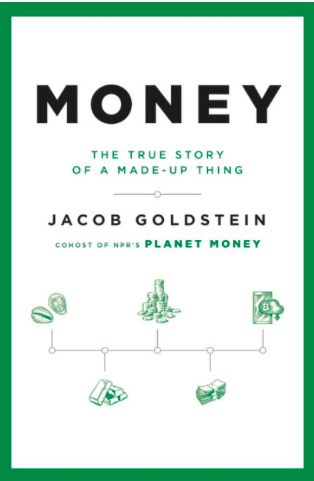
1, Money: The True Story of a Made Up Thing, by Jason Goldstein (2020)
This is a fun and fast tour through the history of money and finance by a guy I’ve know for years. Jake finds a lot of quirky details and anecdotes to enliven the subject, and goes deep into some corners of the financial world —the invention of money market funds, for example—that are often overlooked in discussions about the history of capitalism. Given the rise of crytocurrencies, Jake’s essential question—why do we believe in money?—seems extremely relevant
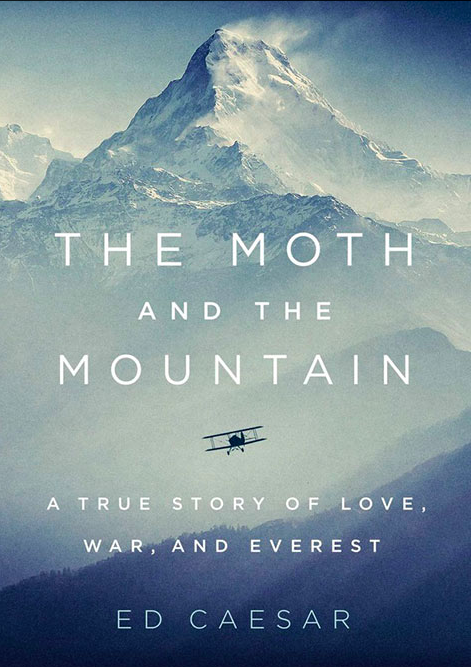
2, The Moth and the Mountain, by Ed Caesar (2020)
This was a Christmas present, and would appear to be just the sort of book I would go for, combining history, mountaineering and adventure. But the story, about Maurice Wilson, a World War I veteran fixated on flying to Nepal and climbing Everest, never is more than the sum of the parts. In part, it’s because Caesar struggles to pin down Wilson, an apparent flimflam man whose motivations always seem murky. And in part, because the most dramatic aspect of the story, the actual attempt to climb Everest, is basically undocumented, and so feels like a footnote to his story.
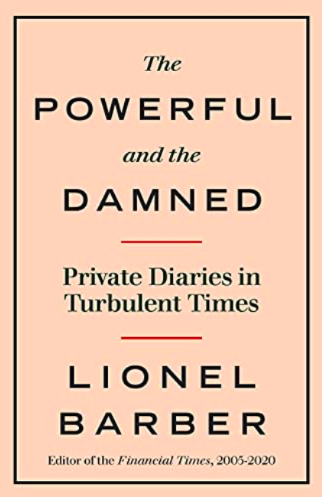
3, The Powerful and the Damned, by Lionel Barber (2020)
I realize now this is the third recent nonfiction release I read in a row, which is highly unusual for me. Usually there’s more variety in my choices, but I read this one for work, in preparation for an interview with Barber, which I wrote about for Quartz. It’s an engaging book, written by a professional name dropper who met and interviewed everyone from Donald Trump to Vladimir Putin and is happy to share his personal and sometimes snarky views about them all. Barber ran the Financial Times during the financial crisis and Brexit, but for media insiders, his accounts of the newspaper’s sale to Japan’s Nikkei might be of the most interest.
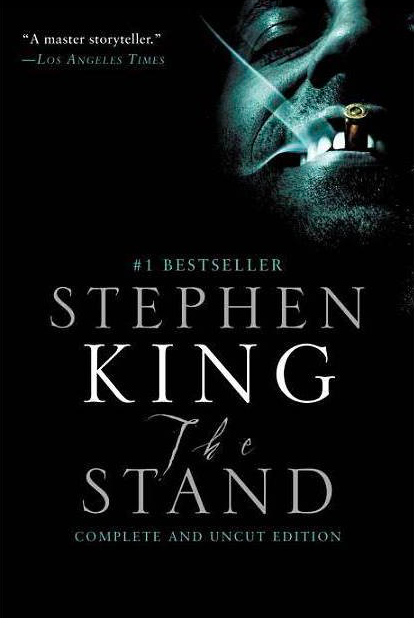
4, The Stand, by Stephen King (1978)
Reason one I didn’t reach 24 books last year was this 1,300 page monster. I am a late convert to King, and since I am more of a sci-fi guy then a horror fan, this was always high on my list to read. It didn’t disappoint, although it did ramble at times, and the King heroic archetype—the underestimated working-class white guy—feels a bit cliched at this point. Still, the rich character development, and the ambition and size of it all, made it an engrossing read.
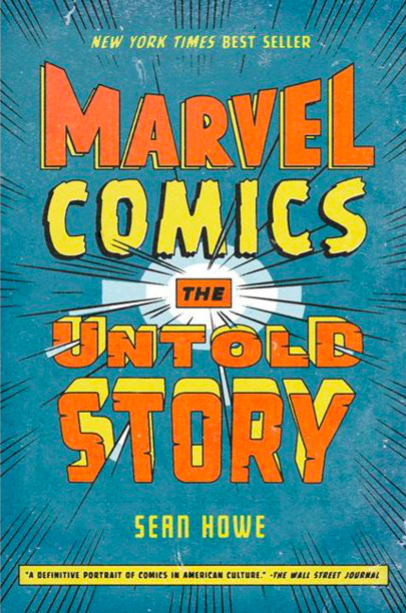
5, Marvel Comics: The Untold Story, by Sean Howe (2013)
As a lifelong comic book collector, it was a only a matter of time before I read this. There weren’t a lot of surprises in it for me, but it did fill in a lot of gaps in my understanding. Interestingly, this book is a business history more than a cultural history, and the big takeaway is the consistent shortsightedness of Marvel’s management. Whatever were triumphs of its artists and writers, they were despite, not because, of their bosses.
6, Never Let Me Go, by Kazuo Ishigiro (2006)
After the previous year’s disappointment reading Ishigiro’s The Buried Giant, I wasn’t quite ready to write him off. It was a good call, because this is a powerful, heartbreaking story. A slow burn, it begins as a deep dive into the lives of children at an English boarding school before revealing itself as a dystopian parable. It’s sad, thought-provoking and one of the best books I read last year.
7, Beyond the 100th Meridian, by Wallace Stegner (1953)
I bought this in Flagstaff on a family vacation to the Grand Canyon, in part because it’s about the Colorado river and the western landscape, and because I’ve never read anything about Stegner and always wanted to. It’s a biography of 19th century explore and scientist John Wesley Powell, and it’s really two books on one. The first half is about Powell’s expedition to float the length of the Colorado, which no one had done previously. The second is about his later career as a a government official with the US Geologic Survey, and the politics and policies that shaped the settling of the American west. The first part of the book was thrilling, the second was a bit wonky but deeply interesting as it explains a lot about why the US west looks the way it does today.
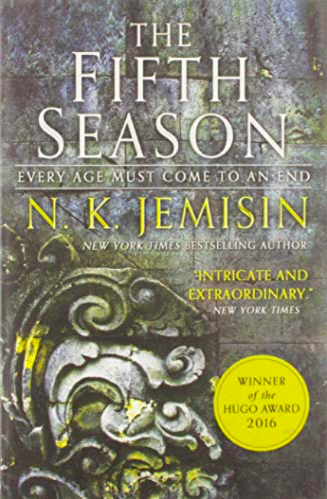
8, The Fifth Season, by N.K. Jeminson (2015)
“World building” is a bit of a science fiction cliché but there sure is a lot of it in this book. Jemison’s trilogy got a lot of attention, and most of it is deserved, as she describes a world where geologic events play a central role, and the mutants that can shape them are shunned and feared. There are some obvious metaphors about race, and a plot twist that wasn’t that hard to see coming, but in all a pretty satisfying read. I didn’t, however, feel compelled to read the rest of the trilogy. Maybe some day.
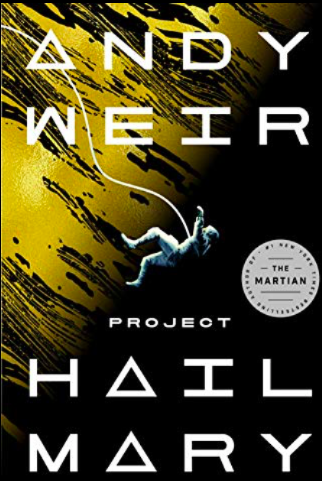
9, Project Hail Mary, by Andy Weir (2021)
My teenage son and I listened to this as a book on tape (yes, I am counting audio books) during a long road trip across the midwest and it felt like a great choice. Like in Weir’s The Martian, there’s a lot of hard science, but it’s offered in such a palatable way that it’s never a struggle and instead makes the outlandish plot almost convincing. The story, about a scientist battling an alien menace, is told as a series of digressions, which seemed like an unnecessarily complicated structure but on the whole the book is fast-paced fun and by the time we reach the end, surprisingly moving.
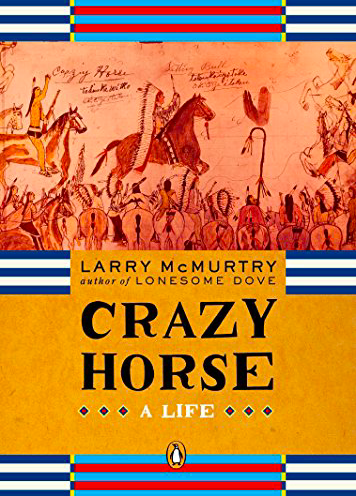
10, Crazy Horse, by Larry McMurtry (1999)
I picked this up at Mt. Rushmore, near the Crazy Horse monument. Not a lot is known about Crazy Horse, the Sioux warrior and mystic, and McMurtry, author of massive books like Lonesome Dove, wisely doesn’t try to pad out the story. Instead, we have a slim, spare, well-told account of Crazy Horse’s life at the end of a Native culture and the beginning of a genocide.
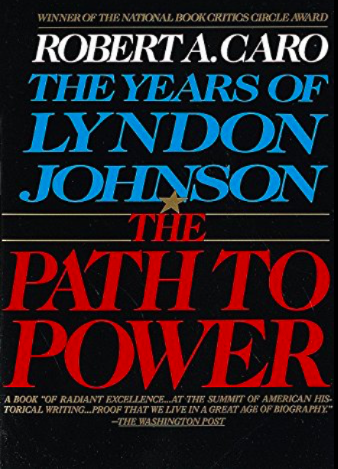
11, The Path to Power, by Robert Caro (1982)
The other monster I read in 2021, and probably by proudest reading accomplishment of the year, was the first volume in Caro’s biography of Lyndon Johnson. At some point, maybe after reading excerpts of Caro’s most recent book in the New Yorker, I vowed to read his LBJ series, one a year, until I was done (I’m currently reading the second). This first volume, which takes us up to LBJ’s first senate campaign in 1941, when he was about 30, is an amazing achievement of reporting and writing. Caro not only carefully unfolds every detail of LBJ’s early years, but spends whole chapters explaining the geology, economy and history of the Texas Hill Country from whence he came. Calling it the Sistine Chapel of journalism doesn’t seem like an exaggeration. It can be hard to read at times, not out of any fault of Caro’s, but because LBJ is so vile, amoral and unlikeable.
12, The Magician’s Assistant, by Ann Patchett (1997)
Ann Patchett wrote an amazing essay in the New Yorker about her three fathers (two are step-fathers) and after that I thought I would try her fiction. This books is unlike most books I read—it’s a quiet, contemporary story about a woman processing grief, in which most of the main characters are female—but I thoroughly enjoyed it. It took a little while to build up speed but the second half flies by.
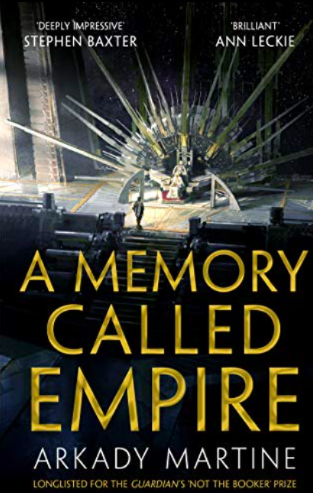
13, A Memory Called Empire, by Arkady Martine (2019)
More science fiction. If I recall, I picked this up as a free review copy that made its way to Quartz. It’s structured like an old-fashioned space opera with an intriguing premise, about a civilization that takes on the memories of their predecessors, and where verse and poetry have enormous cultural capital. Unfortunately, Martine (a nom de plume for Anna Linden Weller, a US historian) never really achieves escape velocity, and the plot, about an out-of-her-depth provincial ambassador in the empire’s capital solving a murder, seems to be mostly series of meetings and conferences before an obligatory action sequence ending.
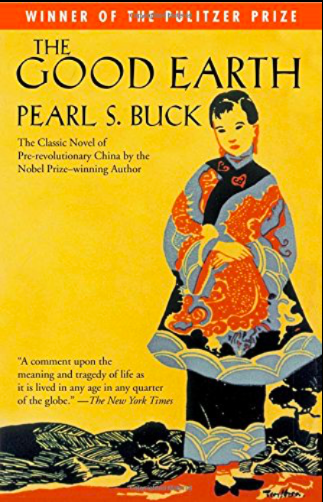
14, The Good Earth, by Pearl Buck (1931)
I picked this up at our local library’s book sale, mostly out of curiosity. It’s a book I knew mostly by reputation, but had never encountered it or had to read it in school (apparently that’s where many people encounter it). I thought it was fascinating. Written by the daughter of missionaries who grew up in rural China, it’s the story of a peasant who endures hardships and famine as he builds wealth and raises a family in an almost medieval society. Buck is sympathetic to Wang Lung but doesn’t romanticize him or his callous treatment of his wife and children. While dated in parts, the book still feels like a valuable window on an element of Chinese history and culture that seems relevant today.
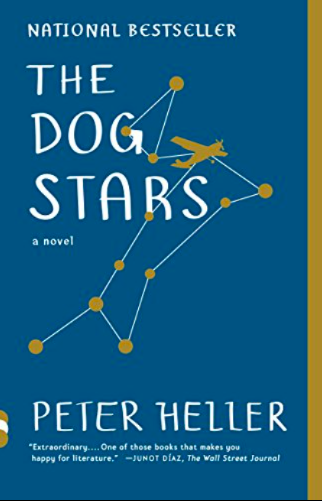
15, The Dog Stars, by Peter Heller (2012)
Another library-sale pick up. I would categorize this book as literary post-apocalyptic fiction, and include Station Eleven in the same category. This isn’t as good as Station Eleven, but it’s still pretty good, blending action and adventure with some beautiful nature writing and philosophizing about what it means to be alive. The plot concerns an amateur pilot who lost his wife and most everything else to a superflu, and now lives in a Colorado airport with his dog and a slightly terrifying survivalist. The story veers into cliches at times, and some plot developments are just too convenient, and at times the book made me wonder if I wasn’t really reading the treatment for a movie.
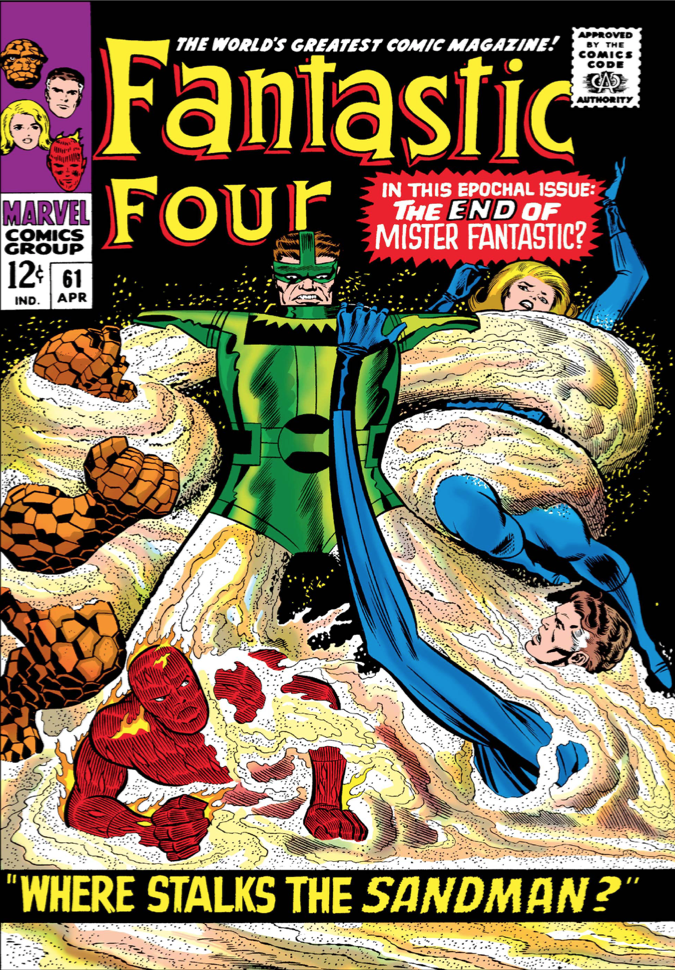
Fantastic Four 61 “Where Stalks the Sandman!” Published: January 1967 Story: Stan Lee and Jack Kirby Script: Lee Pencils: Kirby Inks: Joe Sinnott Letters: Sam Rosen Cover: Kirby and Sinnott
Synopsis
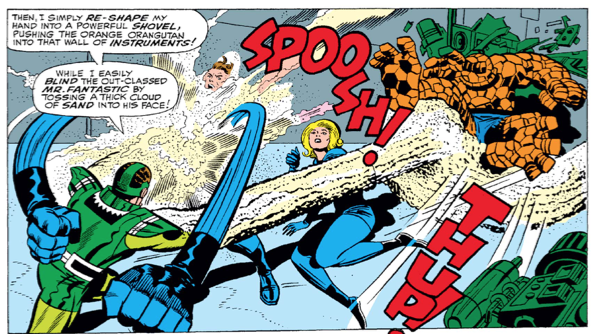
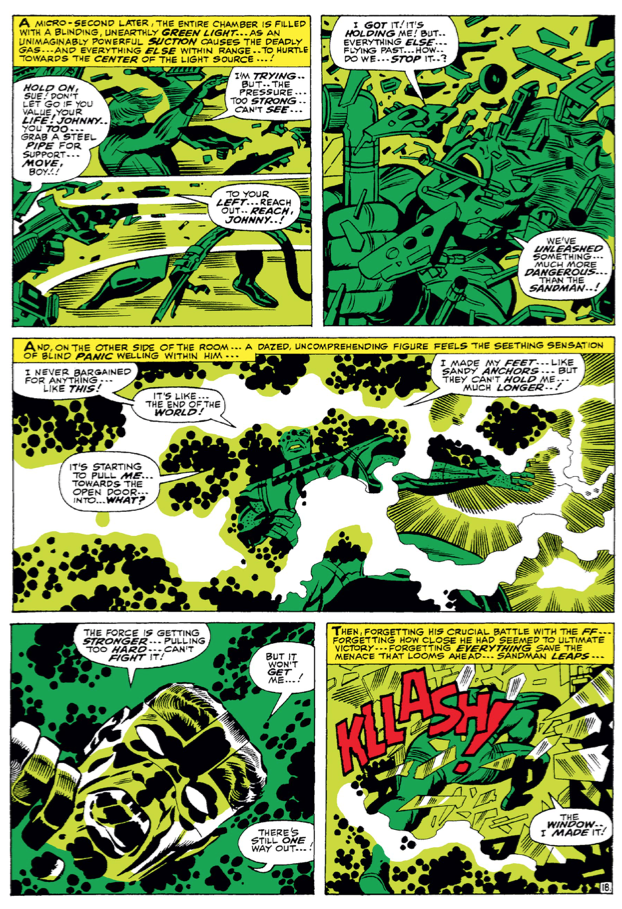
With the conclusion of the Doom/Surfer story arc in the last issue, Fantastic Four 61 starts off with a bang, as Mr. Fantastic, the Invisible Woman and the Thing are attacked by the equipment (the “atom igniter,” among other devices) in Reed’s lab. Eventually their antagonist is revealed to be the Sandman, who has turned the FF’s devices against them, although it’s never really explain how. The FF and the Sandman battle, and are eventually joined by the Human Torch.
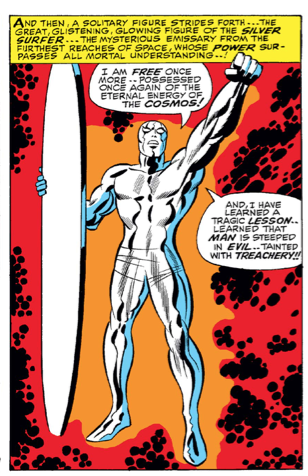
Meanwhile, in a pair of digressions, the Silver Surfer’s board returns to him with his powers, allowing him to escape Latveria, and the Inhuman Crystal teleports with Lockjaw to a Metro College football game in search of Johnny.
During the FF’s fight with the Sandman, the villain generates poisonous gasses. To escape, Reed opens the portal to the Negative Zone, and while Johnny and the Sandman escape, Reed is sucked into the other dimension. The issue end on a cliffhanger with Reed’s fate unknown.
What’s going on here?
This is an interesting issue. It starts off as a fairly pedestrian story, and one that felt a lot like issue 57, when the FF also fought the Sandman in the Baxter Building. But the story takes a surprising and dramatic turn when Reed opens the door to the Negative Zone and tumbles through, leading to a genuinely suspenseful ending and compelling pathos as the rest of the team watches him float away. The issue also has some stand-out pages from Kirby and Sinnott.
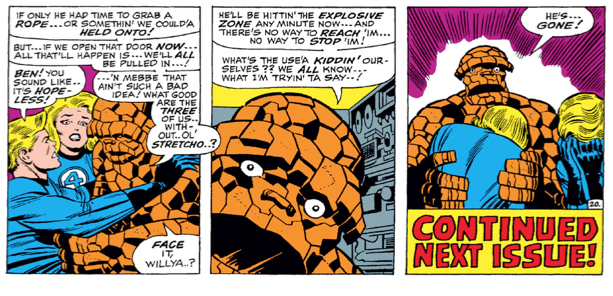
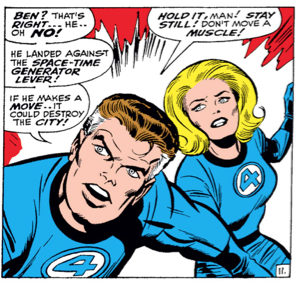
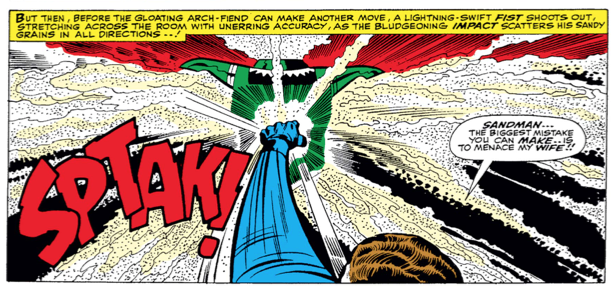
There are, of course, a whole lot of implausibilities in this issue, starting with how the Sandman, up until now a lunkhead, managed to hijack Reed’s devices. Then there’s the question why Reed’s devices are so vulnerable—at one point Sandman leans against a lever and threatens New York (this also happens to be an excel Joe Sinnott panel):
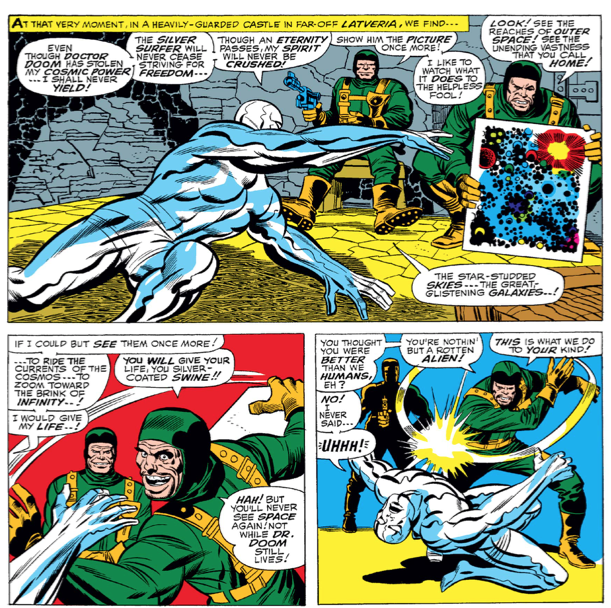
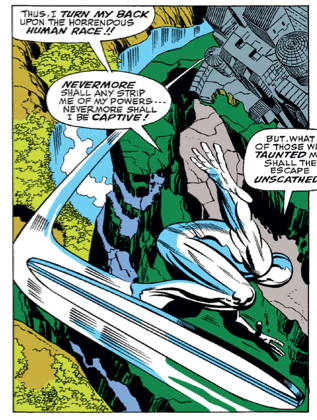
FF 61 also continues the almost sadistic torture of the Silver Surfer that began in issue 57. Oddly, while we saw his baord begin its return to him in the last issue, it didn’t arrive until this issue (“at that very moment”). The FF were able to fly across the Atlantic in the time his board crossed Latveria.
And like every issue for the last five or so, we have an obligatory Inhumans check-in. In this one, Crystal looks unusually curvy.
Who is that guy?
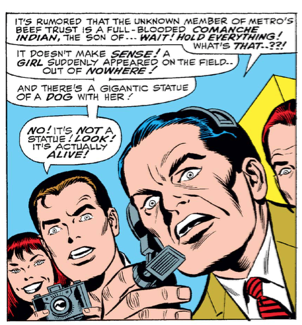
An unannounced (and unacknowledged) cameo from a certain Daily Bugle photographer.
Costume change
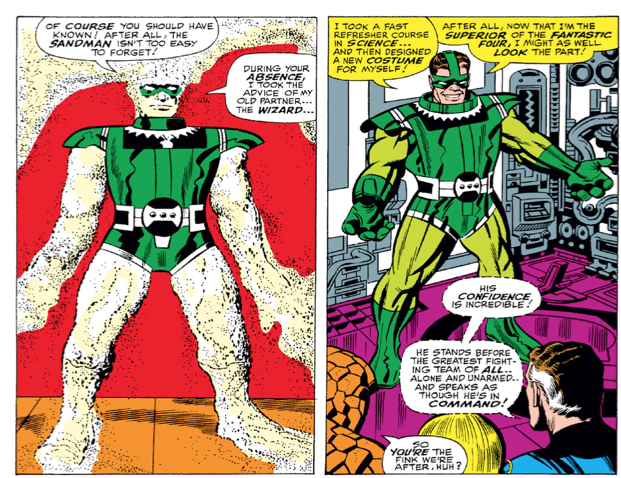
This issue also marks a new costume for the Sandman,a much more Kirby-esque getup than the striped shirt Steve Ditko gave him. You can almost sense Jack chafing at having to draw such a drab costume for some many issues up to now.
The sexist sixies
More gender-role conformity
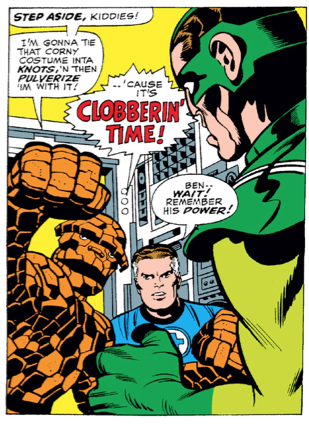
Clobberin’ Time
This is a pretty good one, with it’s own font and everything.
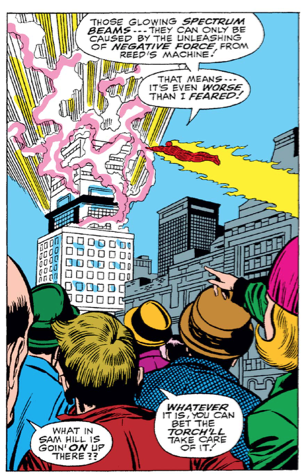
Weird science
Watch out for those spectrum beams!
Crazy credits
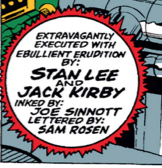
They’ve been pretty tame the last few issues, but we get a bit of flourish here.
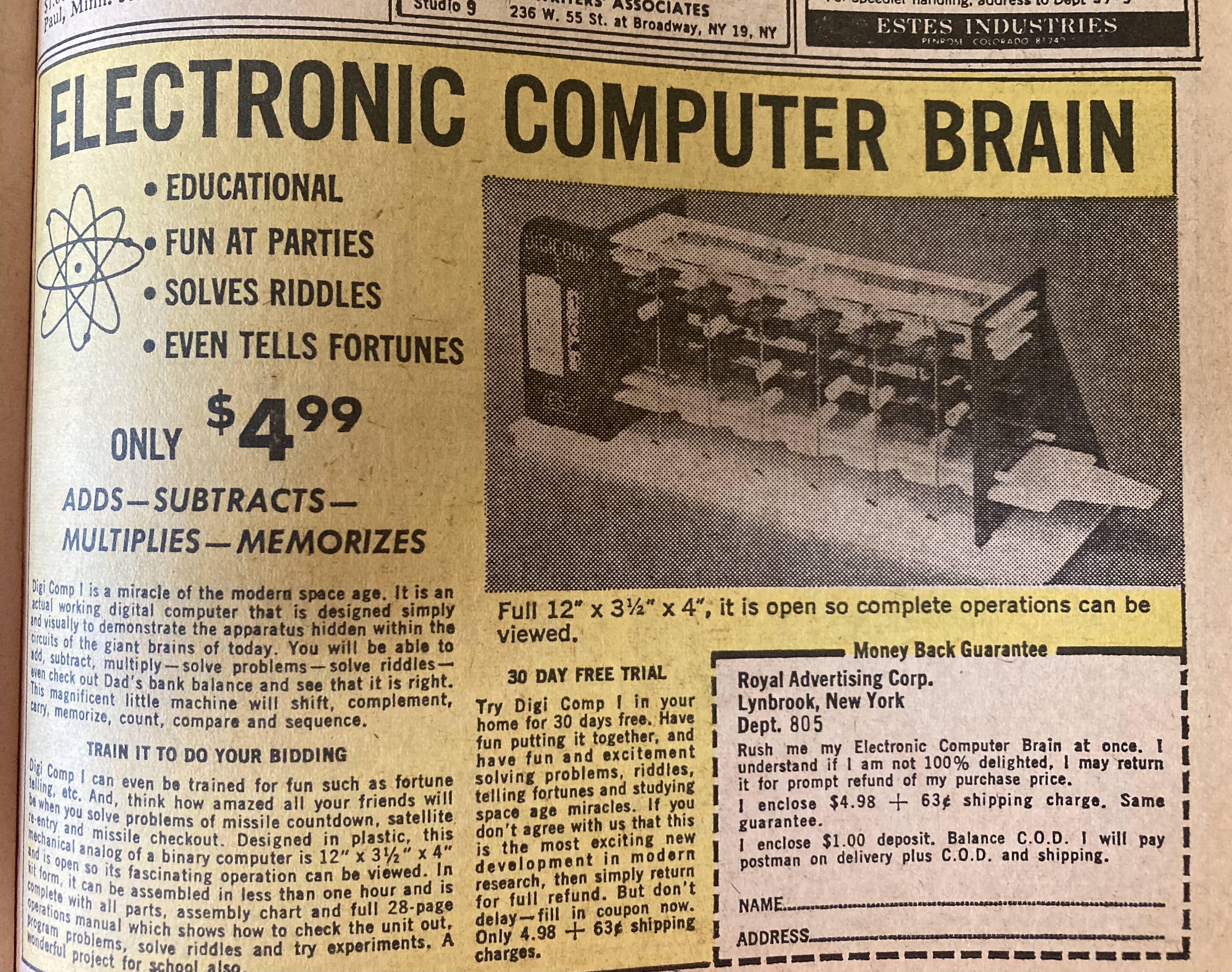
For sale
A computer for $4.99. It’s a great deal, because a similar device made by IBM in 1967 cost about $4 million.
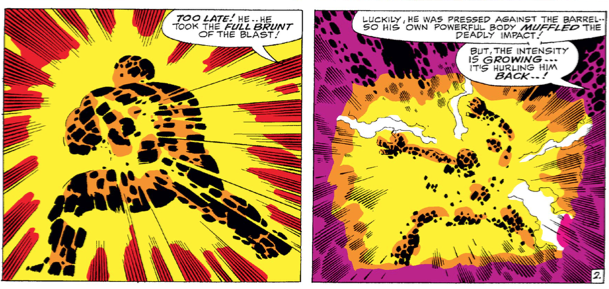
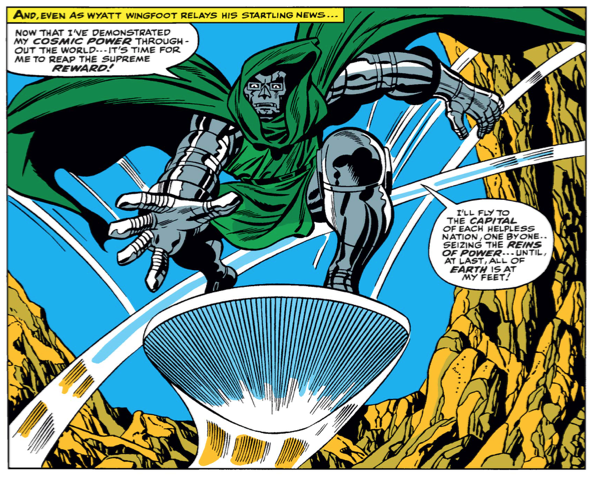
Dig that Kirby Krackle
So much awesomeness in this issue! Like this sequence:
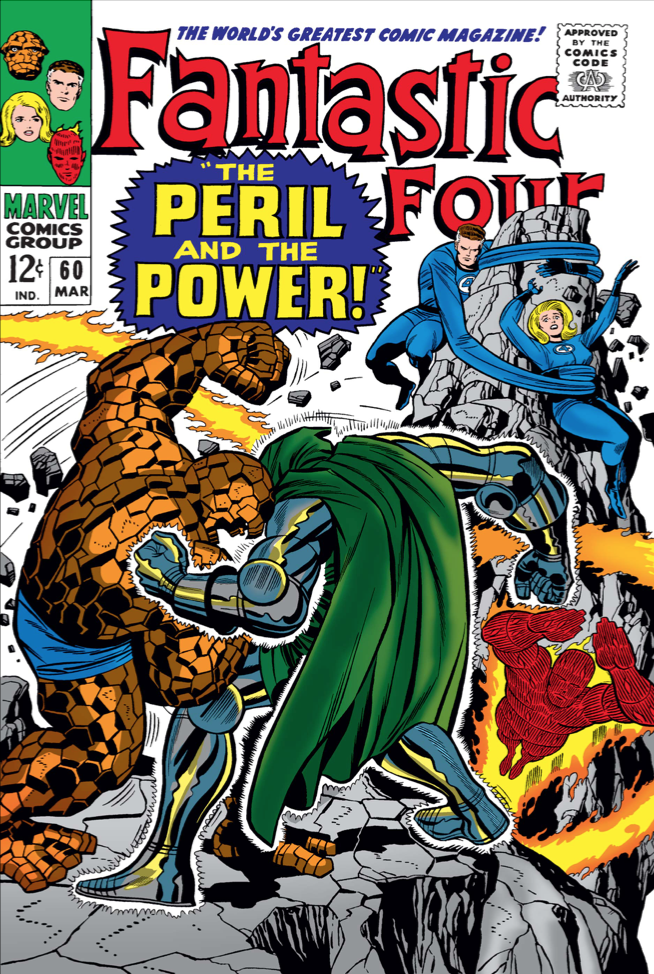
Fantastic Four 60 “The Peril and the Power!” Published: Dec. 1966 Story: Stan Lee and Jack Kirby Script: Lee Pencils: Kirby Inks: Joe Sinnott Letters: Sam Rosen Cover: Kirby and Sinnott
Synopsis
Fantastic Four 60 picks up where issue 59 left off, with Dr. Doom preparing to conquer Earth with the stolen power of the Silver Surfer. As the Thing rages in frustration, Mr. Fantastic urges patience as the Army is building a weapon he designed. But when Wyatt Wingfoot tells the team the Human Torch has gone after Doom on his own, the rest of the FF flies off in pursuit.
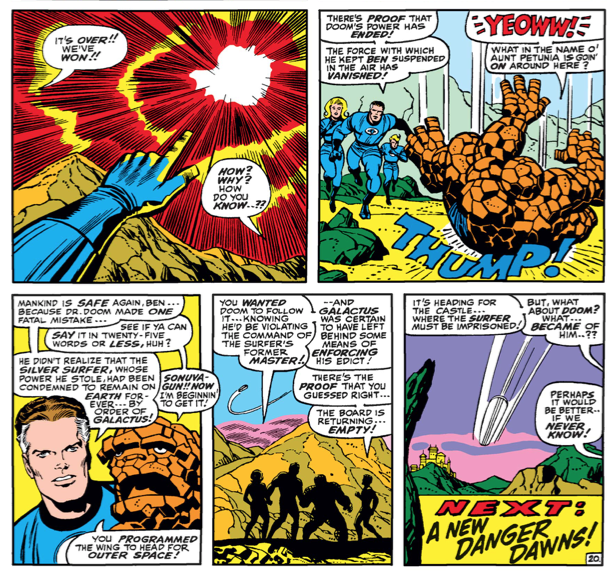
Johnny is defeated by Doom, and when the rest of the FF approach, he destroys their aircraft before battling the Thing in hand-to-hand combat. Doom and the FF then fight for most of the rest of the issue until Reed’s “anti-cosmic flying wing”—which we saw a glimpse of in the last issue—appears and stuns Doom. Doom then chases it into the stratosphere when he loses his powers, the result of the barrier Galactus placed around earth to prevent the Silver Surfer from escaping. This issue ends with the Surfer’s board heading back to the castle in Latveria where he was imprisoned.
What’s going on here?
FF 60 wraps up the four-issue arc start that started when Doom stole the Surfer’s powers in FF 57, and the 16 issue stretch, starting in FF 44 with the introduction of the Inhumans, that marks the apex of the Lee/Kirby run. To recap, in a bit more than a year, Stan and Jack introduced Gorgon, Crystal, Karnak, Triton, Lockjaw, Black Bolt, Maximus, Attilan, the Silver Surfer, Galactus, “the power cosmic”, the ultimate nullifier, Wyatt Wingfoot, Wakanda, the Black Panther, Klaw, Prester John, and Quasimodo, and along the way wrote FF 51, a one-shot many consider one of the greatest stand-alone comics of all time. It’s not that there weren’t great issues before and after, but every mountain has a peak, and FF 44-60 is Stan and Jack’s.
Given all that, FF 60 feels like a bit of a let down. The concept animating this arc—Doom stealing the Surfer’s power—is brilliant, and as I’ve said before, really cements Doom as a formidable villain. Up until this point he’d been crafty, but stealing the Surfer’s power added an element of ruthlessness and grandiosity that we’ll see again and again over the years. But the story’s end doesn’t live up to its beginning and middle: the business with the flying wing feels rushed, and when Doom is stripped of his powers, it happens basically off-camera and explained only in Reed’s narration.
The scene seems designed for a dramatic Kirby panel, with Doom crashing into Galactus’s barrier, so it’s a puzzle why we don’t see it. It’s possible Jack ran out of room to finish the story, something we have seen in earlier issues. Or maybe plans for another issue wrapping up the arc were dropped, meaning they had to cram the endinging into this one. In any event, it’s shame, because as a story-telling mechanism, it’s a great device: Doom, like Icarus, challenges the gods and is pushed for his hubris.
Who invited them?
FF 60 features a few odd cameo appearances. The Inhumans show up for a few panels, as the the royal family makes its way from its refuge. We’ve been following their story for a while now, so the subplot isn’t too surprising, but it is jarring when it appear in the middle of a the FF’s fight with Doom.
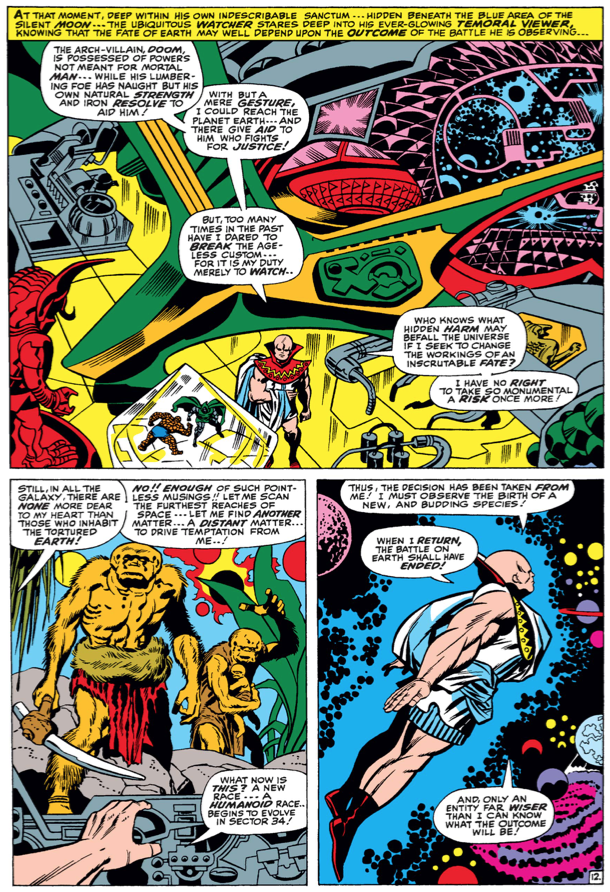
Stranger is the appearance of the Watcher, who observes the FF’s struggles, when (for once) obits his vow of non-interference and goes on to do something else. It’s a great excuse for Jack to draw some cosmic stuff but otherwise a peculiar insertion.
Hero time
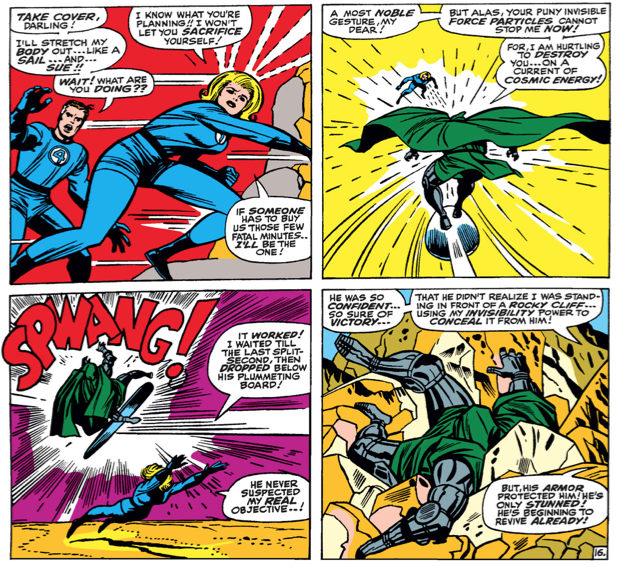
Since most of the issue features the FF fighting Doom, there’s chance for each of the four to get a moment in the spotlight. In a rarity, Sue gets to use her powers creatively, and she rises to the occasion to take on Doom here.
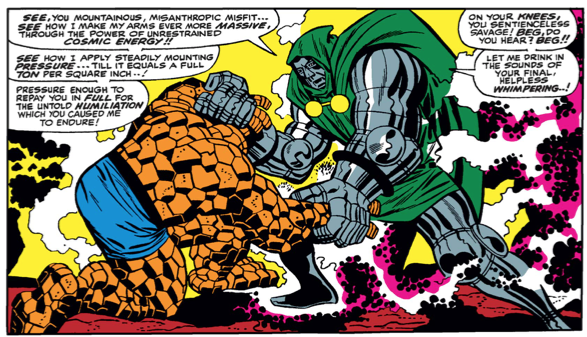
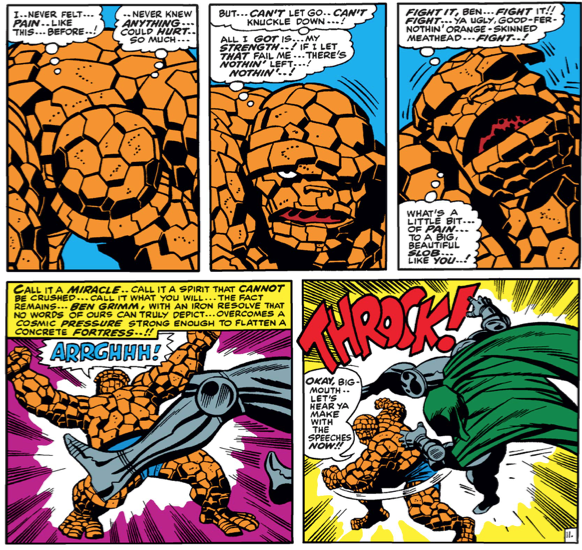
Ben also battles Doom, and it’s another opportunity to showcase his tenacity and resolve.
Plus, we get an excellent …
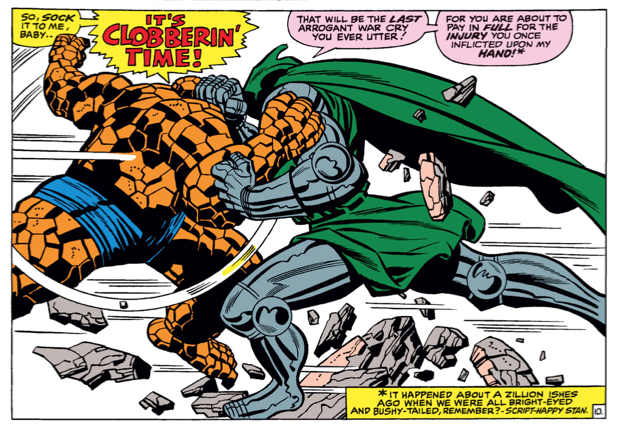
Clobberin’ Time
This is one of the best matches between story, art and catch phrase to date.
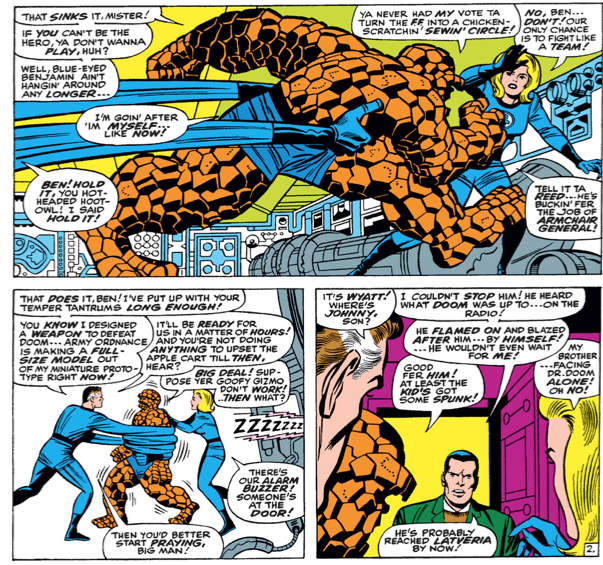
They’re fighting again
The sexist sixties
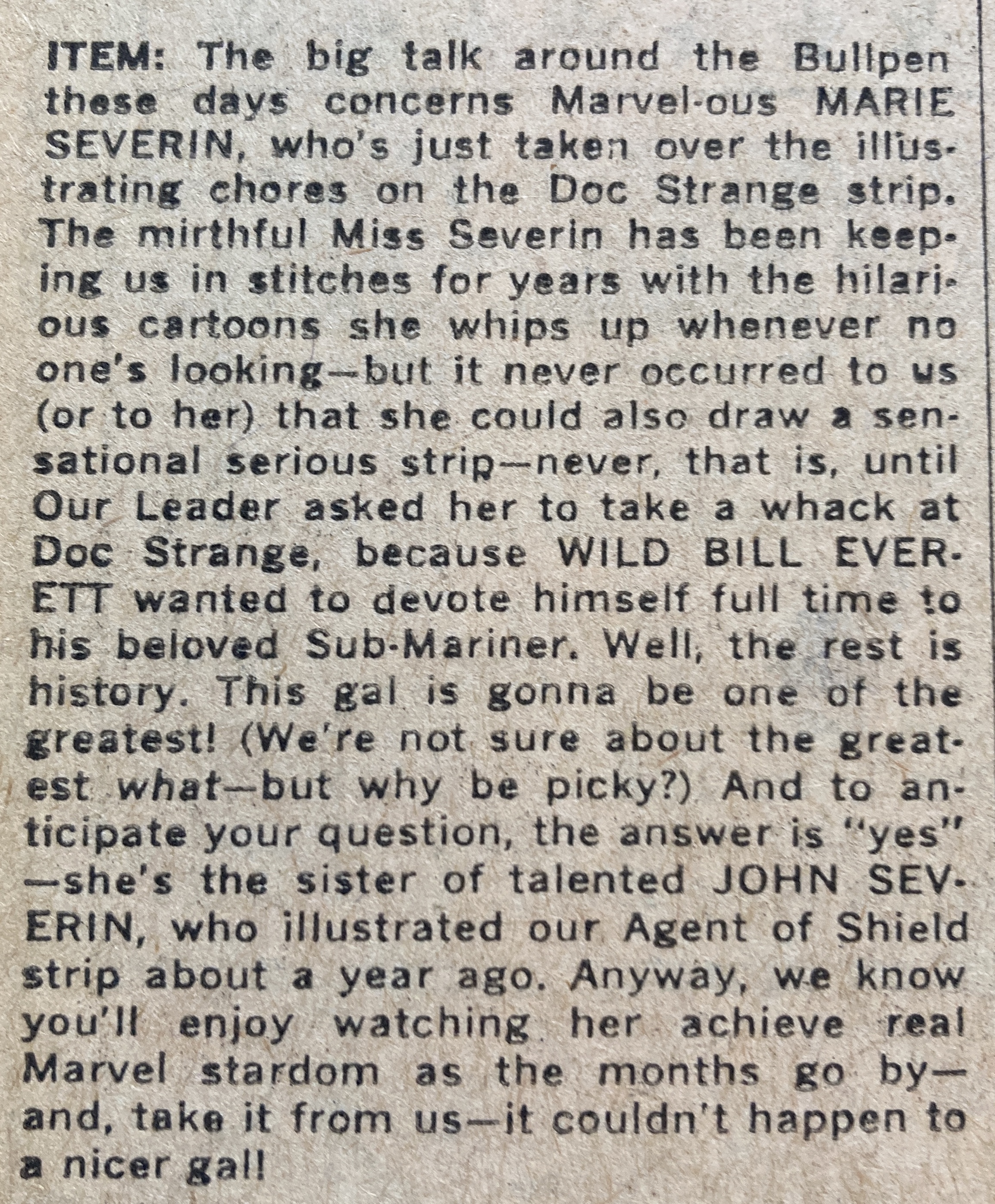
It was probably too much to ask for a whole issue without a woman being demeaned. Here, in the Bullpen Bulletins, Stan manages to belittle Marie Severin while trying to praise her.
Oops
Not sure if this is a legit goof, ad Jack forgot to add the sound effects, or if Stan and Jack were just having fun.
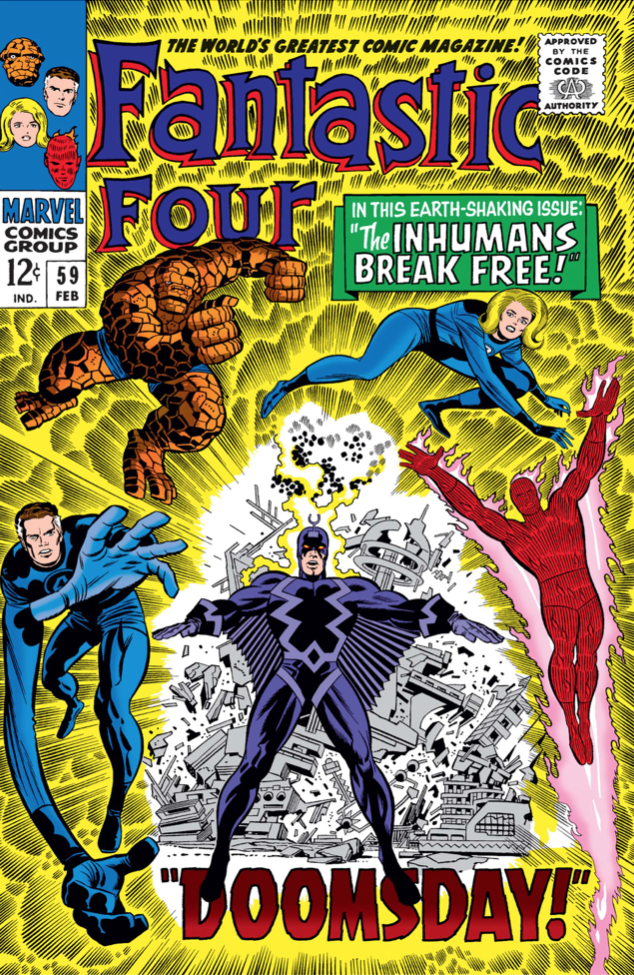
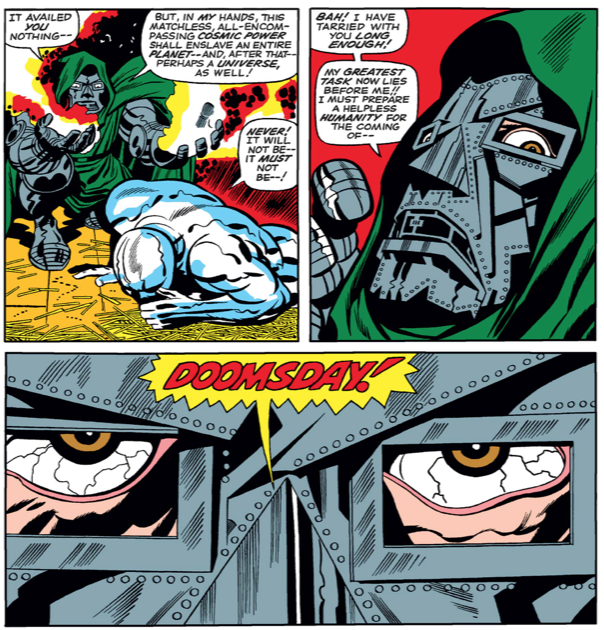
Fantastic Four 59 “Doomsday!” Published: Nov. 1966 Story: Stan Lee & Jack Kirby Script: Lee Pencils: Kirby Inks: Joe Sinnott Letters: Artie Simek Cover: Kirby & Sinnott
Synopsis
After Dr. Doom’s defeat of the Fantastic Four in the previous issue, FF 59 is another stage-setting comic, where a number of storylines are advanced without any reaching their climax.
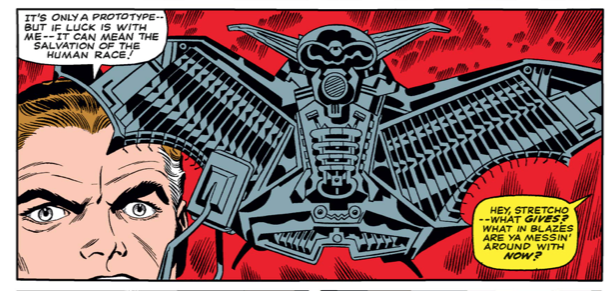
In the first, main thread, Mr. Fantastic, the Thing and the Invisible Girl are regrouping in the aftermath of Doom’s victory. Reed warns the nation’s of Earth to prepare for the menace of Doom, then, goaded by Ben, begins making plans to defeat him. Toward the end of the comic, we get a glimpse of what Reed’s working on: an explosive flying device that saps power from this it comment with.
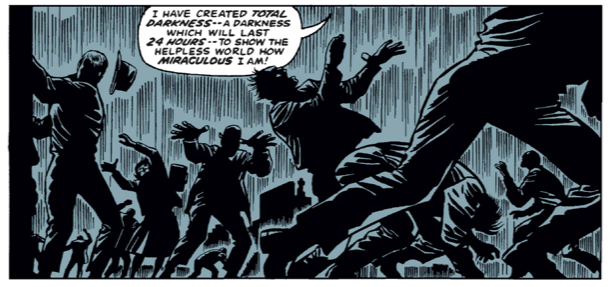
Meanwhile, Doom is plotting his conquest of Earth. He dismisses an attack by (presumably) the Soviet Union, taunts the helpless Silver Surfer, a prisoner in Latveria, then circles the globe displaying his power, for example, by throwing cities into darkness for 24 hours.
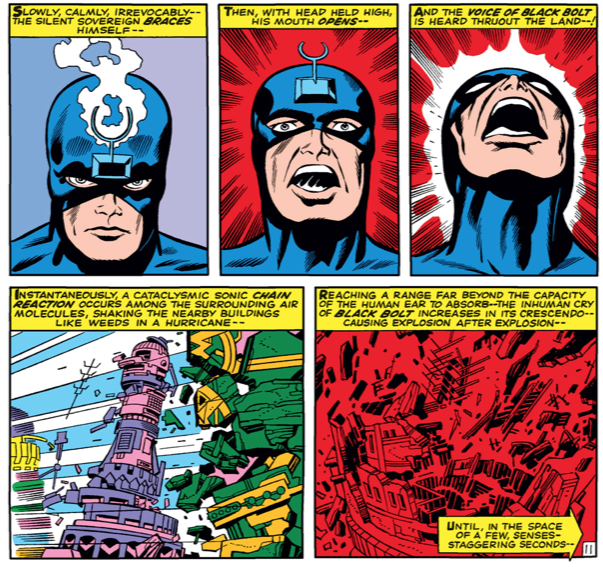
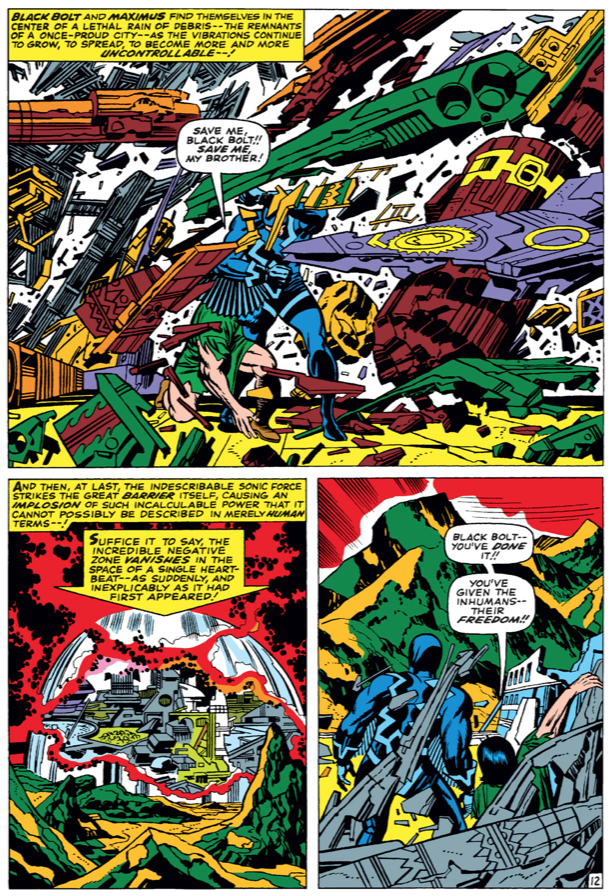
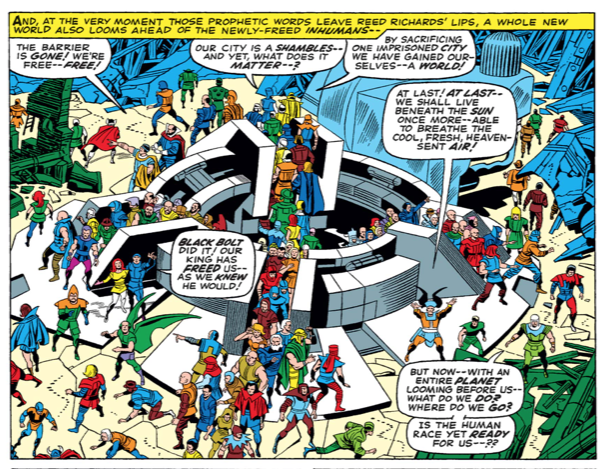
In the third storyline, the Inhumans, trapped in their city behind a negative zone barrier for many issues now, finally break free after Black Bolt uses his voice to destroy both the barrier and the city. The Inhuman royal family then travels to help Crystal reunite with Johnny Storm.
And in the last storyline, the Human Torch decides he alone has the power to take on Doom, and despite his misgivings, his friend Wyatt Wingfoot joins him on his quest.
What’s going on here
This is a transitional issue, but a good one, enhanced by some of the best art on this book to date. Lots of character is developed here: Ben’s needling of Reed is revealed to be more cunning than buffoonery, Doom’s mania becomes more apparent, the Surfer’s resolve becomes more clear, and we finally see Black Bolt cut loose with his power. It had been hinted at for a few issues now, but we now understand why he is silent, breadcrumbs first dropped all the way back in issue 46.
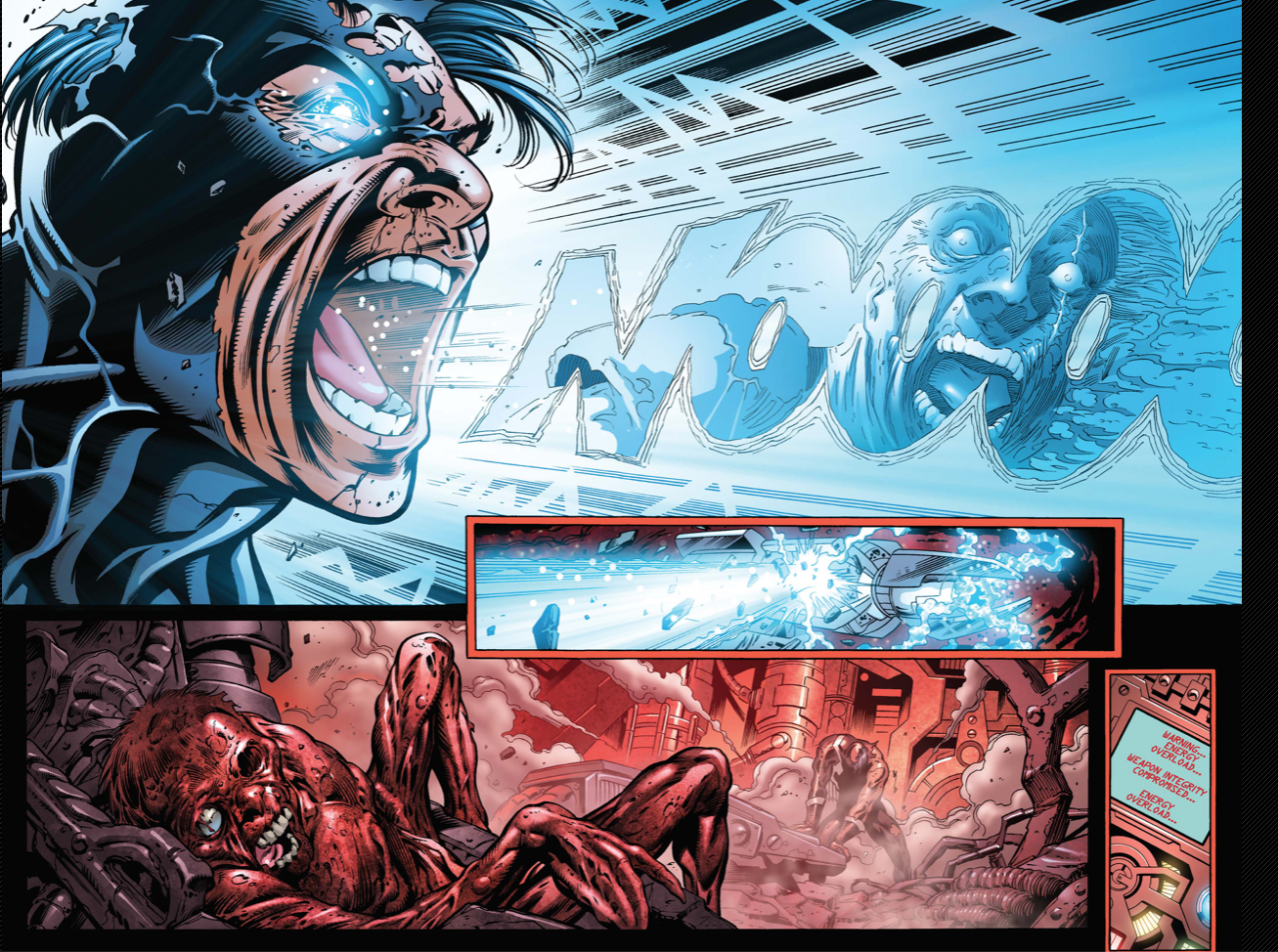
It’s always a big deal when Black Bolt uses his voice, and comic book writers have generally been pretty sparing with it. Here’s a pretty good run down in Comic Book Resources of 20 times he used his voice, including in 2009’s War of Kings, where he uses it to defeat Vulcan (the crazy brother Cyclops and Havok never knew they had—it’s a long story) and then detonate a Terrigen bomb which tears a hole in spacetime. That’s a not-untypical use case for Black Bolt’s voice.
War of Kings 6 (2009, Pelletier, Magyar & Hennessy)
The F-Team
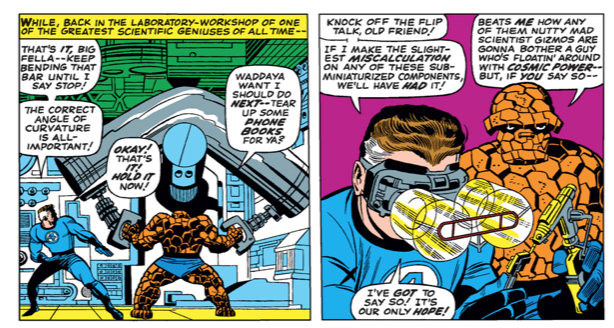
I may be dating myself here, but in the 1980s TV show The A-Team, there was invariably a sequence of rapid cuts where the team, having suffered some defeat, works energetically to build a device or hatch a plan to save the day as the theme music plays. That is what I thought of when Reed and Ben get busy working to defeat Doom.
The sexist sixties
Of course, while Reed and Ben are making their plans, Sue is in the kitchen, worrying.
They’re fighting again
It’s been a long time since we saw this kind of thing. It makes me nostalgic.
Red menace
Doom is attacked by .. it’s not exactly clear. It sure looks like the Soviet Union, but for some reason Stan is reluctant to say as much.
Ladies and gentlemen, Joe Sinnott
Every now and then Sinnott’s inks just jump out at me, like they do in this sequence
Weird science
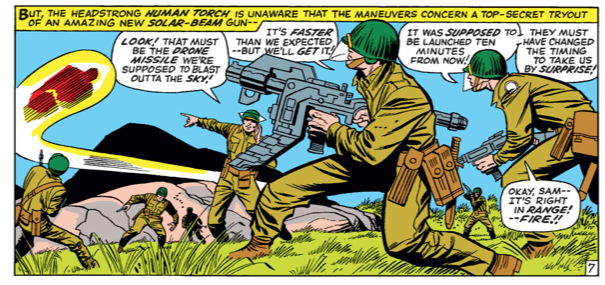
It’s “a solar-beam gun”
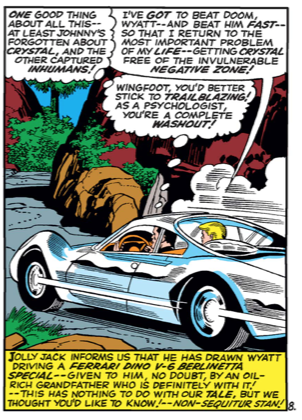
Nice ride
Johnny’s Ferrari is apparently courtesy of a rich grandfather. I don’t think we ever learn more about him.
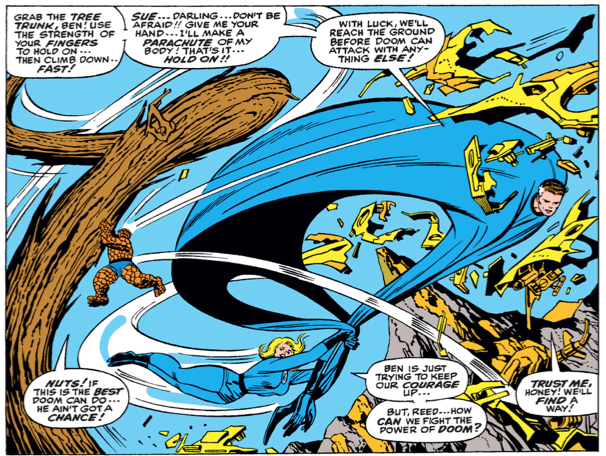
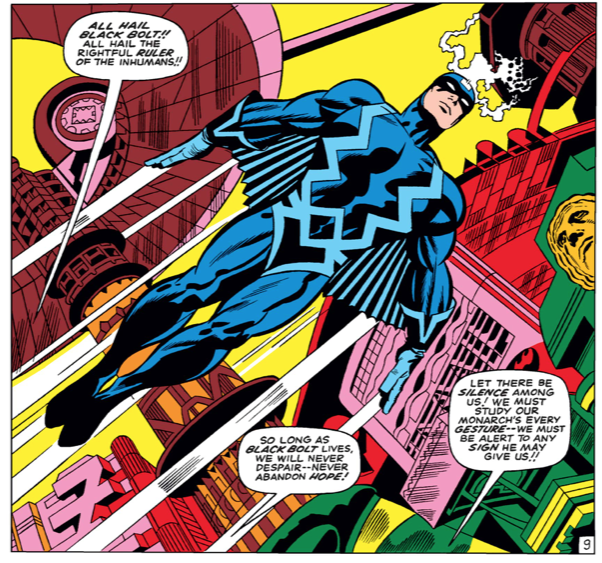
Dig that Kirby Krackle
This issue has so much great Kirby art that I could have picked something from virtually every page. I restrained myself, but it’s really an amazing issue.
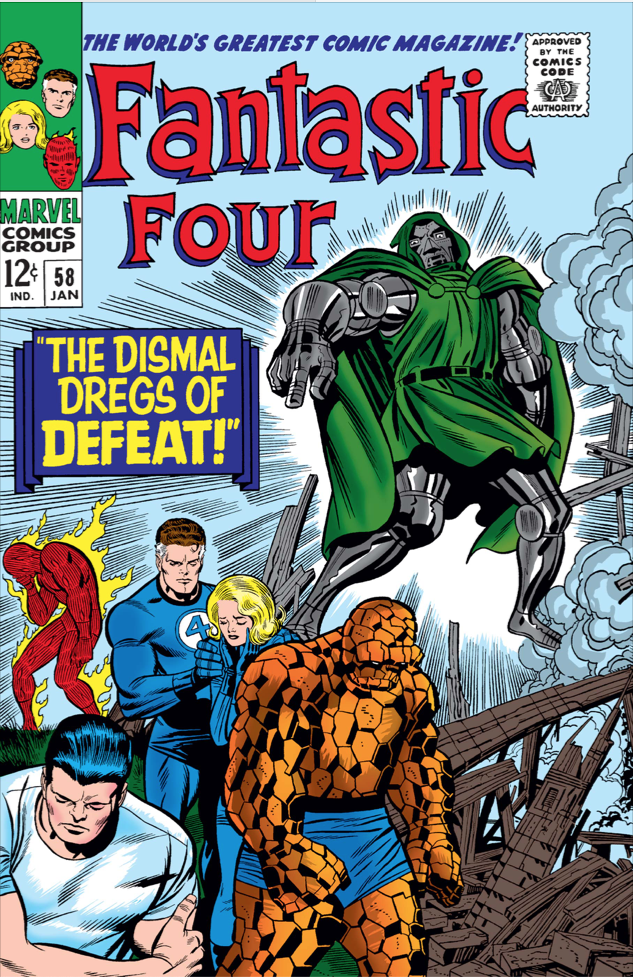
Fantastic Four 58 “The Dismal Dregs of Defeat!” Published: Oct. 1966 Story: Stan Lee and Jack Kirby Script: Lee Pencils: Kirby Inks: Joe Sinnott Letters: Artie Simek Cover: Kirby and Sinnott
Synopsis
For the second time in two issues, FF 58 opens in medias res, with an apparition of Dr. Doom appearing above the Baxter Building during a lightening storm. Mr. Fantastic dismisses is as a freak occurrence but the Things knows better, and has a premonition of something terrible happening. As soon as Reed and Sue depart for a weekend in the Hamptons, Ben is attacked by Dr. Doom, who has stolen the power of the Silver Surfer (as seen last issue). They battle, but Doom gets the better of Ben and leaves him frozen, statue-like, in Central Park.
Doom then attacks Reed and Sue in their Hampton’s cottage. They are soon joined by the Human Torch, who was teleported back to New York with Wyatt Wingfoot by Lockjaw. The Torch left Wyatt to rescue Ben while he takes on Doom. Soon Wyatt and Ben arrive as Johnny battles Doom but he too is beaten. As Doom gloats, Reed admits defeat, and Doom leaves them to suffer the humiliation of his victory.
What’s going on here?
This is an excellent comic, one of the best of the Lee/Kirby run to date (it’s also one I own, so we have letters and ads to check out!). It’s got a few things going for it: First, it’s the product of several issues of build-up, so we’ve been primed for something big. Second, as discussed in my last post, Doom stealing the Surfer’s powers really ratchets up the stakes, both in terms of Doom’s ruthlessness but also making him an even more formidable opponent. Third, the story is effectively paced, from the low-key opening and Ben’s ghost-story jitters, to the final, pitched fight in the Hamptons. Lastly, the FF is rarely beaten (more on that later), and Reed’s surrender signals a low point for the team. In all, it’s just a satisfying story that delivers a powerful punch.
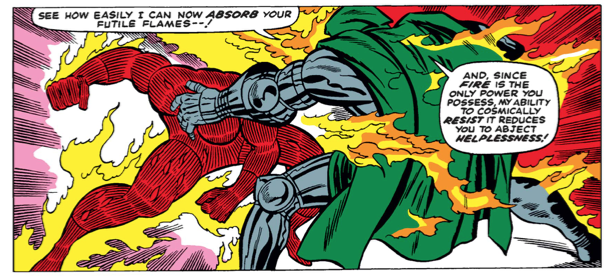
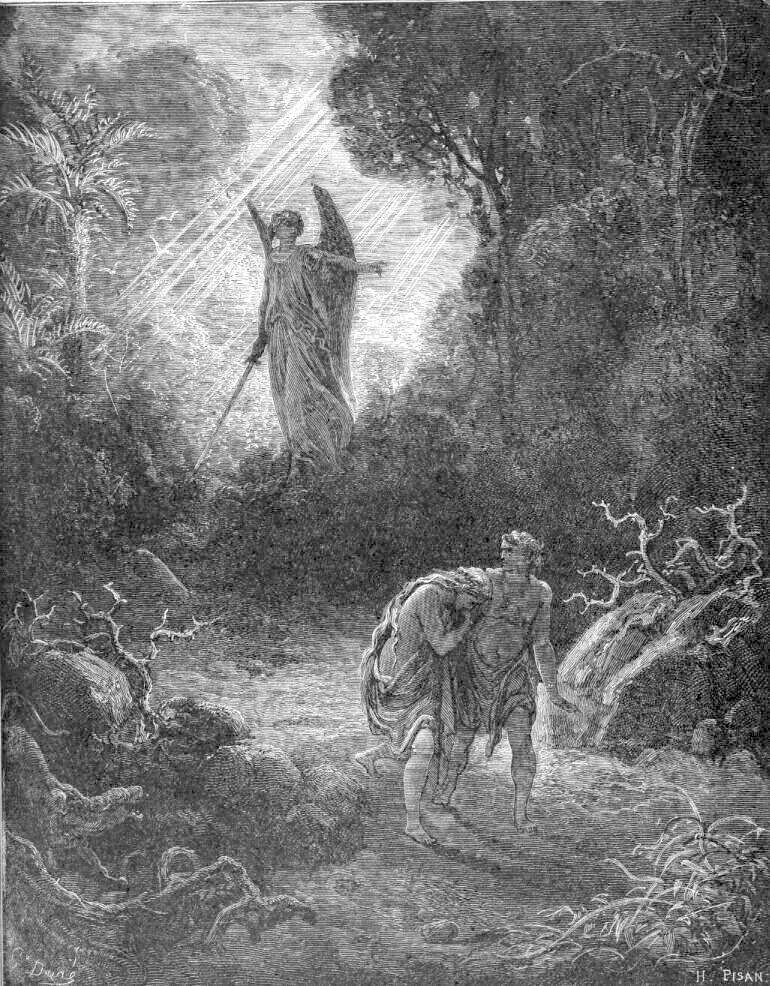
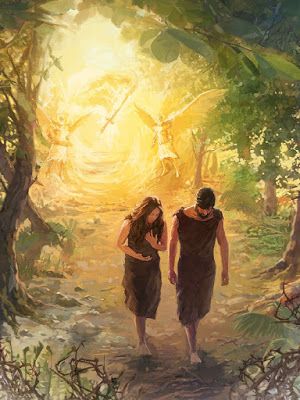
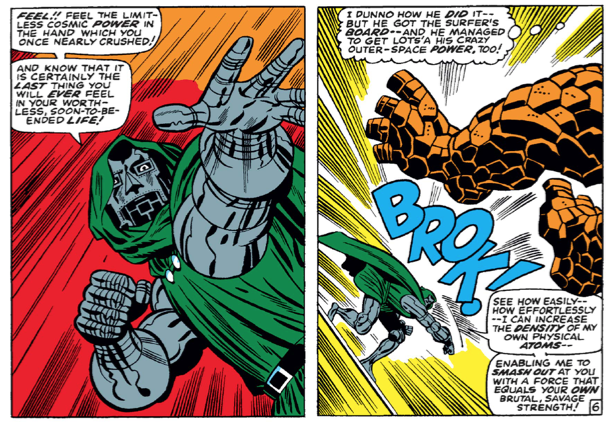
The cover does a great job of summarizing the book’s mood, with the FF humbled and Doom triumphant. Structurally, it reminds me of images of Adam and Even being cast out of the Garden of Eden. I don’t know if that was Jack’s inspiration but it has a similarly mournful quality.
Byrne Baby Byrne
It wouldn’t be a Stan and Jack FF issue if it wasn’t referenced by John Byrne at some point. In this case, issue 268 from 1984.
Weird science
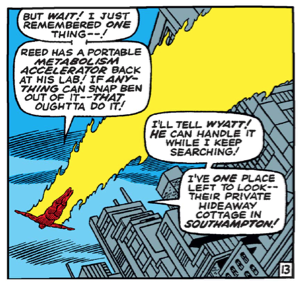
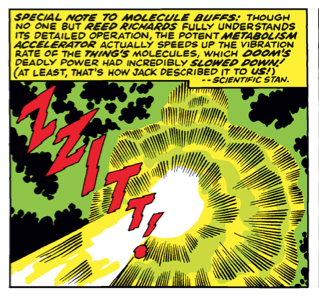
After Doom slows Ben’s metabolism to barely moving, he is freed by a “portable metabolism accelerator,” which Reed of course has just lying around. Doesn’t everybody?
Say what?
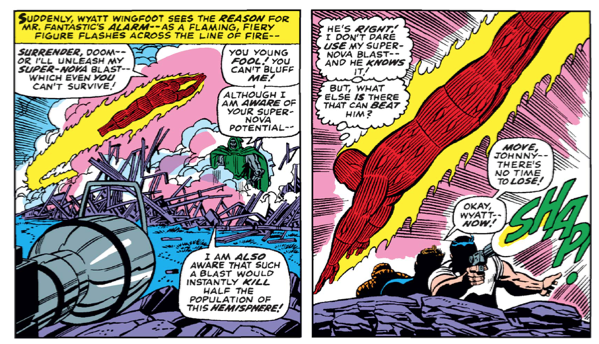
I knew Johnny’s super-nova blast was powerful but killing several billion people seems like a bit much.
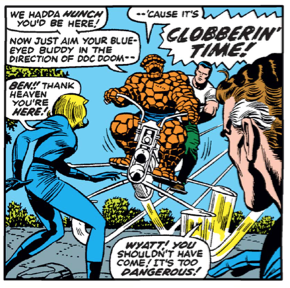
It’s Clobberin’ Time
That’s two issues in a row now.
Say what? (part 2)
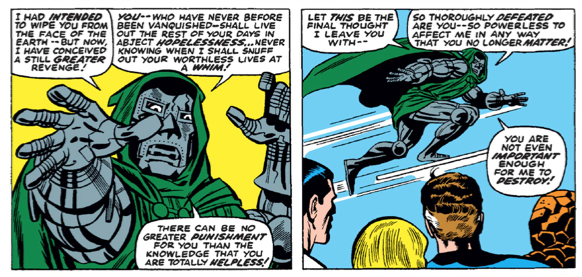
Doom says the FF have never been vanquished but he clearly missed Fantastic Four 38, when they got their asses kicked pretty thoroughly by the Frightful Four.
Oops
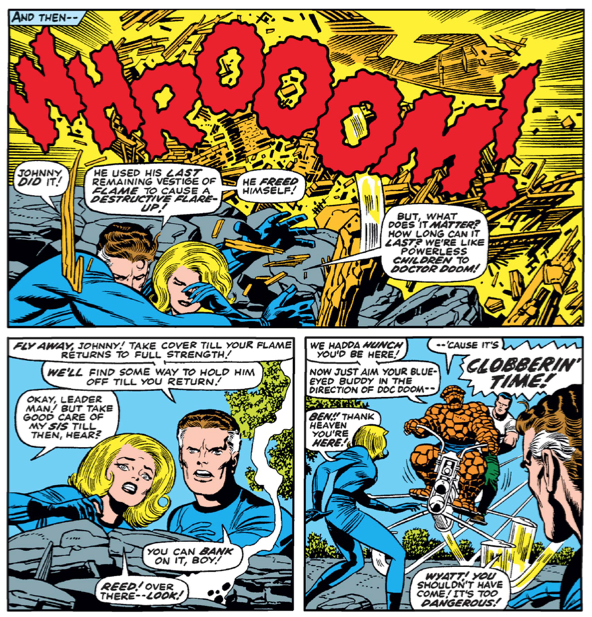
Speaking of goofs, here’s an odd panel where the Torch is entirely off-screen, as Stan apparently is trying to explain what happened to him in the previous panel.
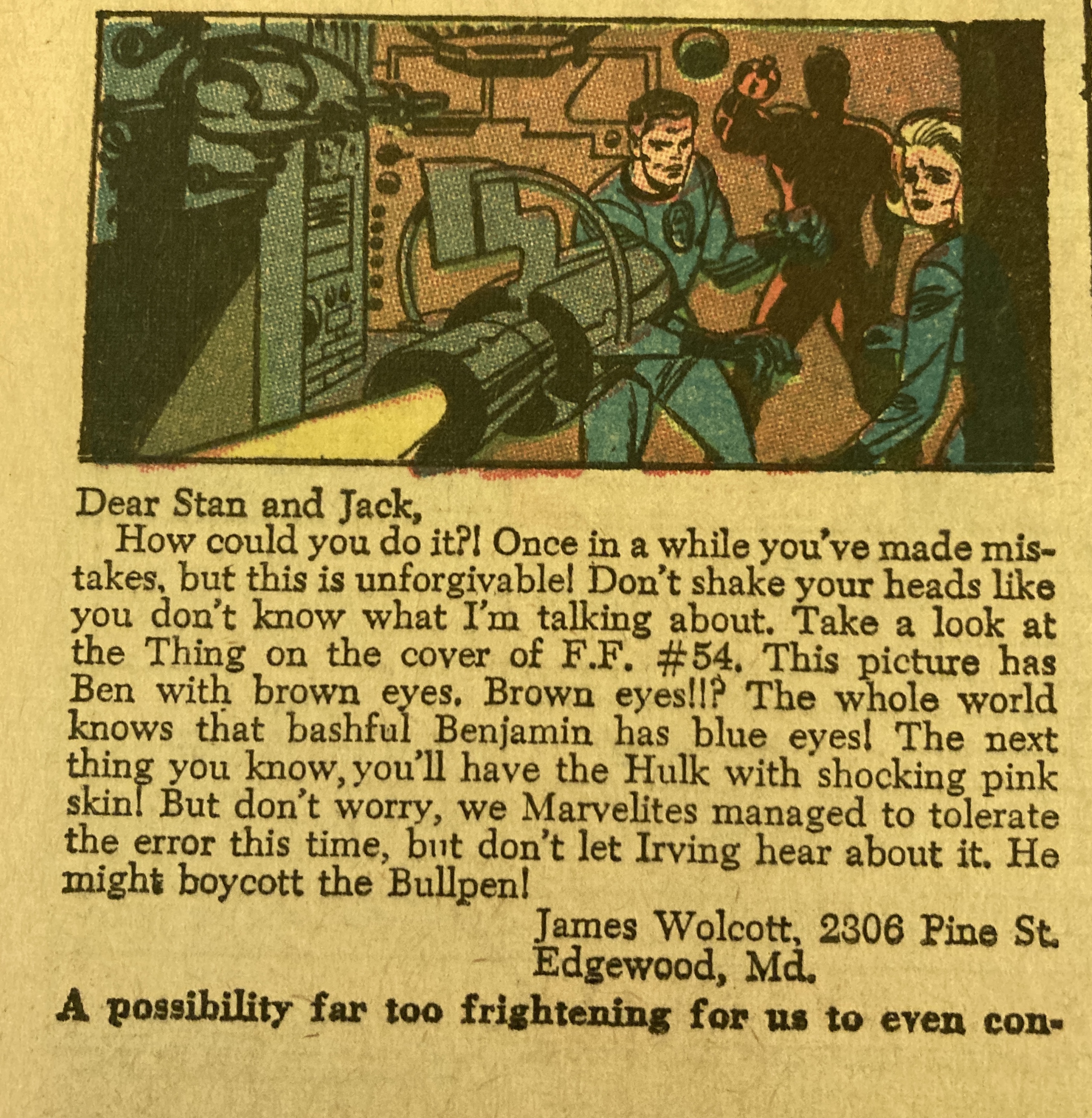
We get letters
The issue features one from cultural critic and Vanity Fair writer James Wolcott. How do I know it’s the same James Wolcott? He writes about it here.
For sale
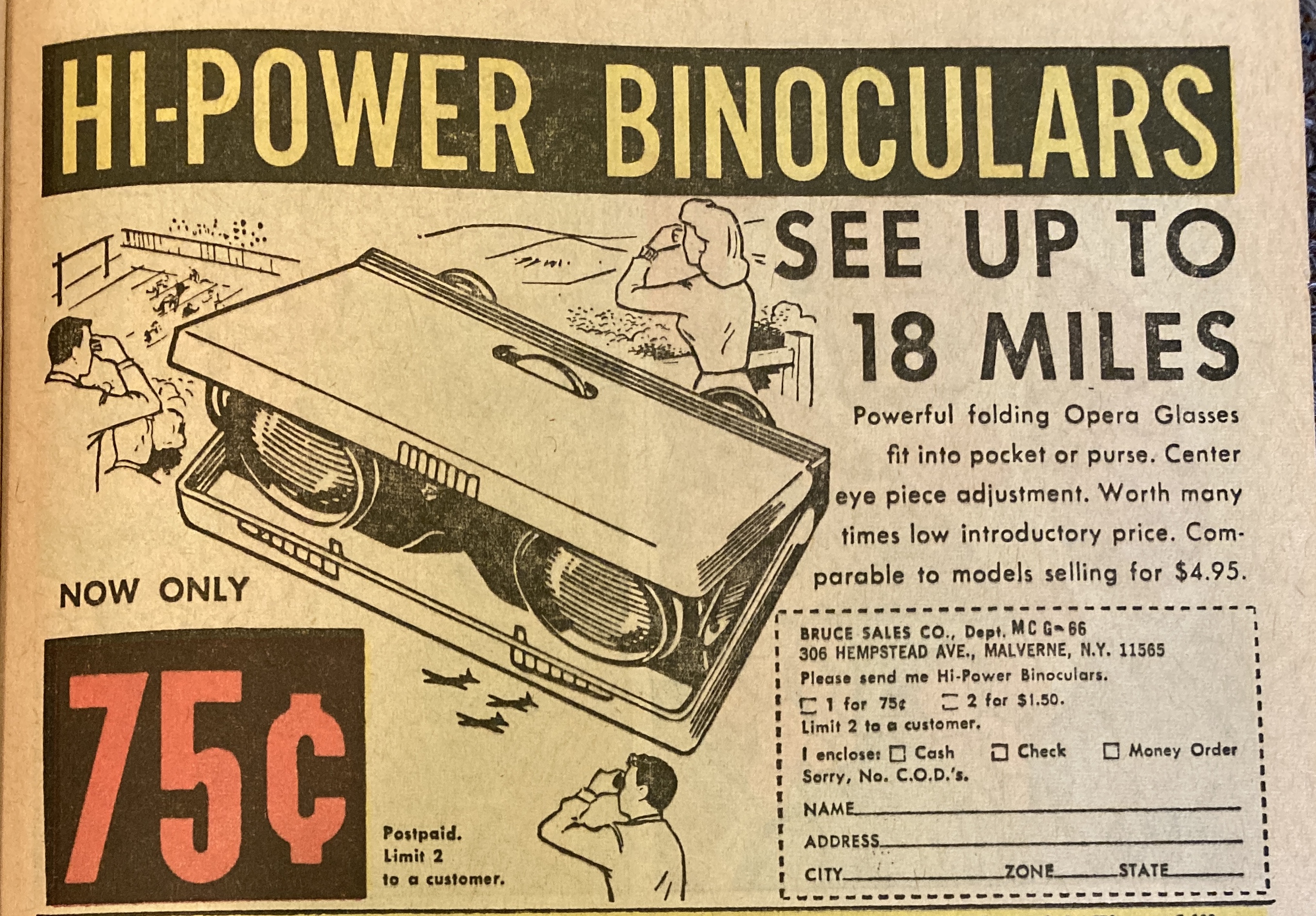
These binoculars can help you see up to 18 miles. It says so right here.
Dig that Kirby Krackle
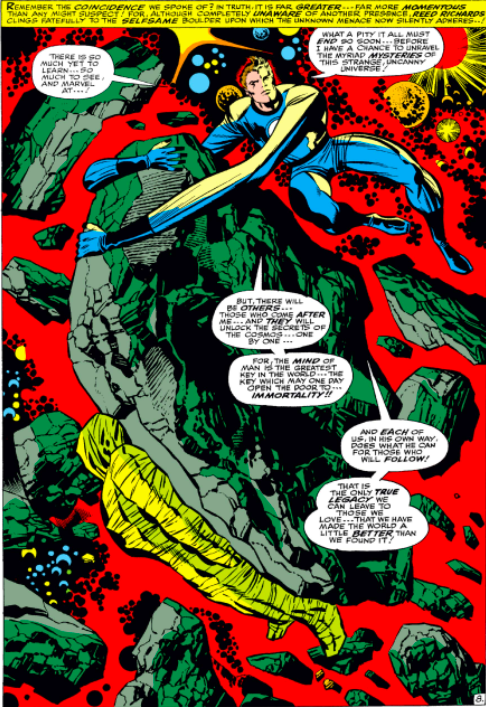
No splash pages this month but plenty of cool stuff, like this sequence