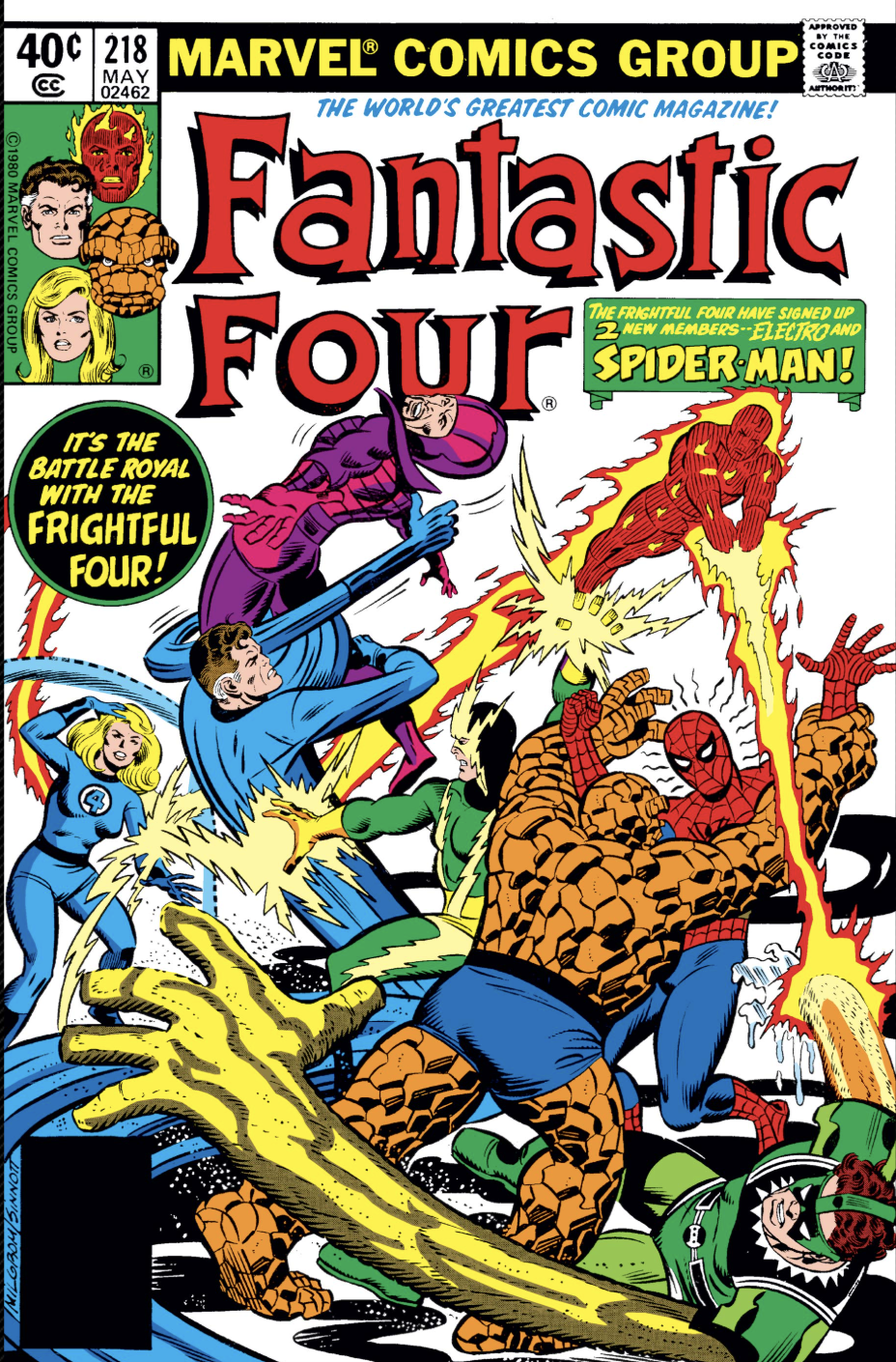
Fantastic Four 218 “When a Spider-Man Comes Calling!” Published February 1980 Writer: Bill Mantlo Pencils: John Byrne Inks: Joe Sinnott Letters: Jim Novak Colors: Ben Sean Editor: Jim Salicrup Cover: Al Milgrom and Joe Rubinstein
Synopsis
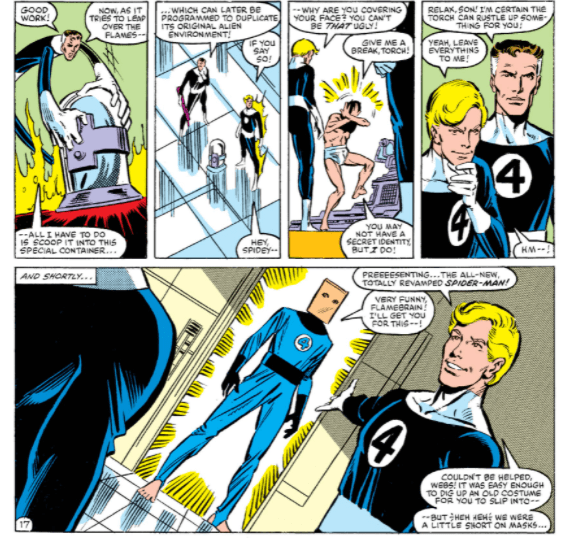
Disguised as Spider-Man, the Trapster infiltrates the Baxter Building and subdues the Human Torch and Thing before letting the rest of the Frightful Four in. After capturing the Invisible Girl, they corner Mr. Fantastic but Spider-Man, whom they had previously abducted, breaks free, and joins Reed in battling the bad guys. Soon, the rest of the FF join them in defeating the Frightful Four.
What’s going on here?
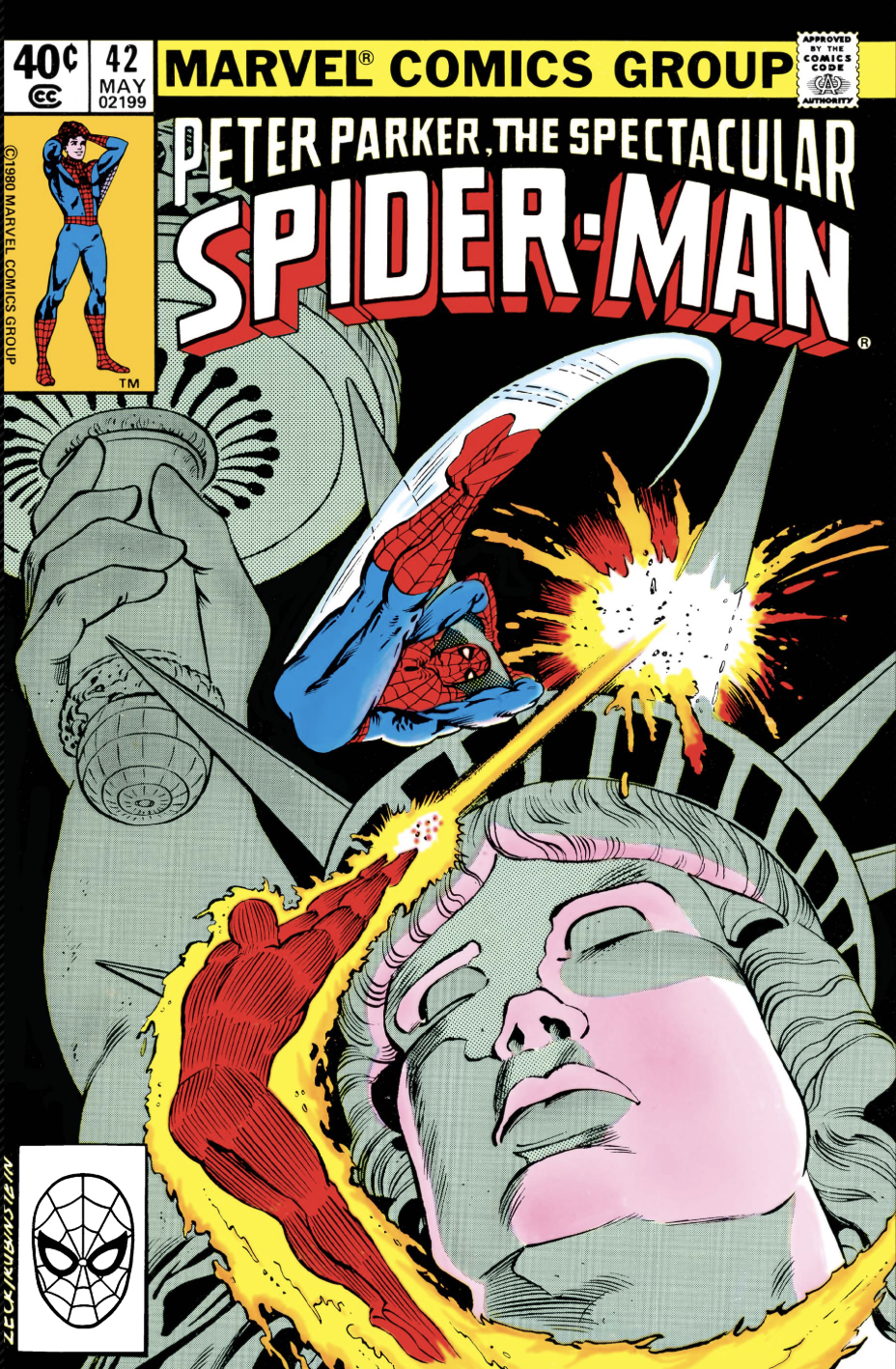
This is a pretty pedestrian comic, which is a sequel to an equally pedestrian comic, Peter Parker, the Spectacular Spider-Man 42, also written by Bill Mantlo. In that issue, The Frightful Four (who have added Electro to their ranks) lure Spider-Man into a trap by pretending to be the Human Torch. Now, with Spider-Man captured, they figure to use the same trick to take out the Fantastic Four.
That Peter Parker issue has a cool cover by Mike Zeck and Joe Rubinstein, but not much else going for it:
Overall, FF 218 is a very by-the-numbers story, in which the FF repel bad guys who invade the Baxter Building. We’ve seen probably a dozen variants of this plot over the last 200+ issues, and this one is as forgettable as most of the others.
What I liked
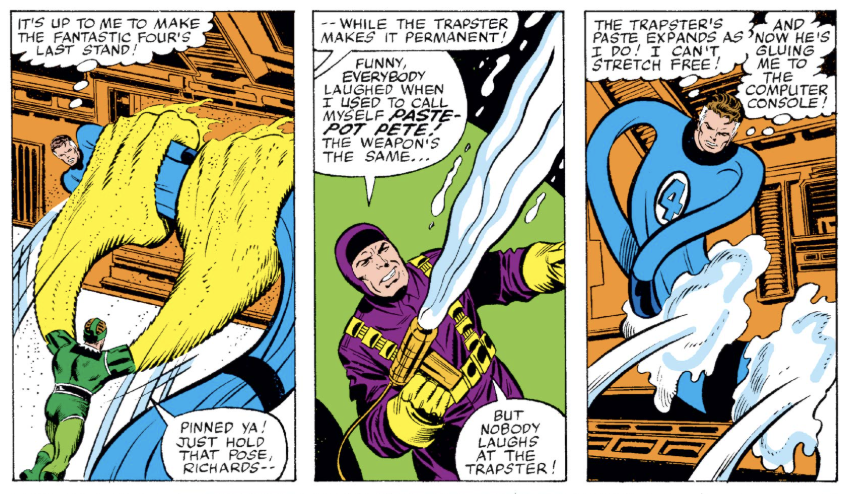
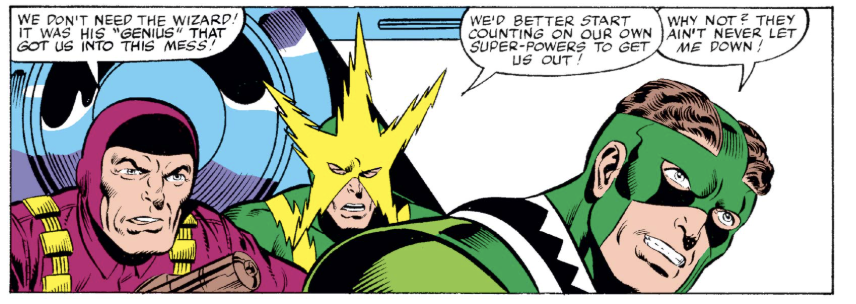
One fun aspect of the Frightful Four is their constant bickering, and Electro adds an even more curmudgeonly member. The Trapster gets most of the spotlight in this issue and is surprisingly effective at neutralizing half of the FF, even while holding a grudge at everyone who made fun of him when he was Paste Pot Pete.
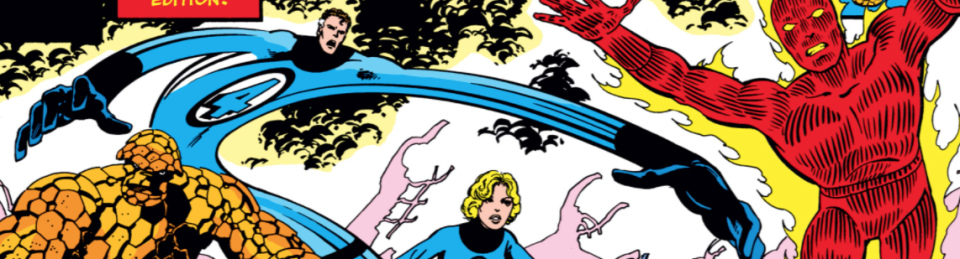
This is not a great issue for John Byrne, who must have provided only rough pencils for Joe Sinnott to finish, but I liked this image of three villains:
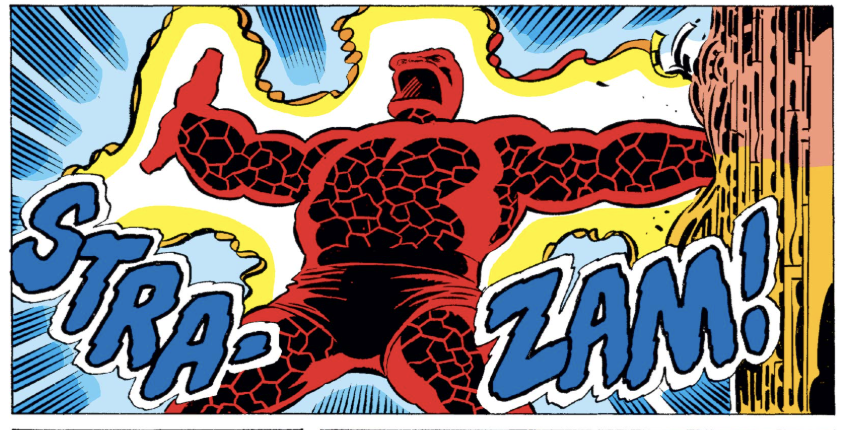
And this one of the Thing being electrocuted:
It’s been a while since we had some wacky credits. These are all building themed, since the splash page is of the Trapster ascending the Baxter Building dressed as Spidey. (It’s possible only New Yorkers would get the co-opted joke).
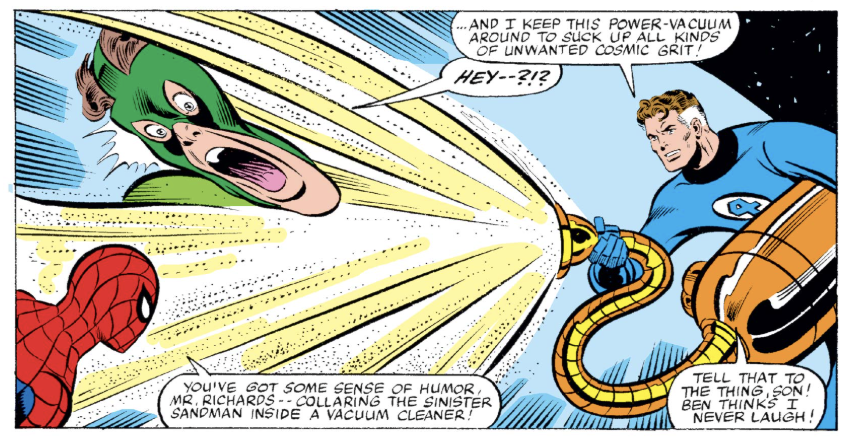
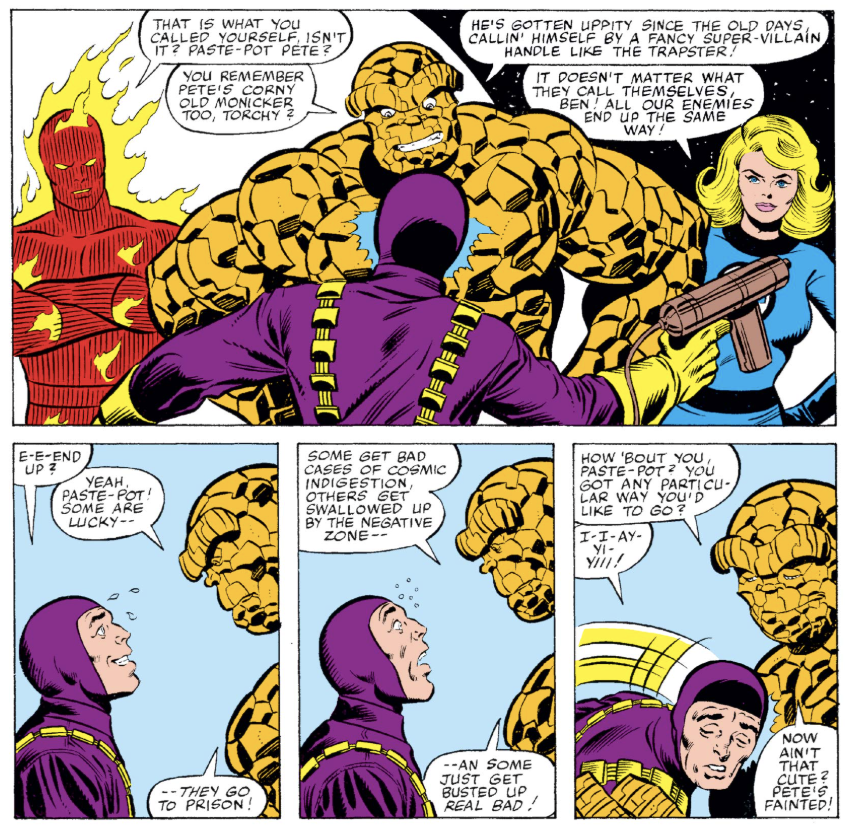
Lastly, this was a fun sequence:
What I didn’t like
I’ve already outlined my critiques of this issue. There’s nothing awful in it, just not much that’s worth celebrating. It feels a bit like Mantlo is stalling for time as the fill-in guy, stretching out his Spider-Man story before the new creative team takes over next issue.
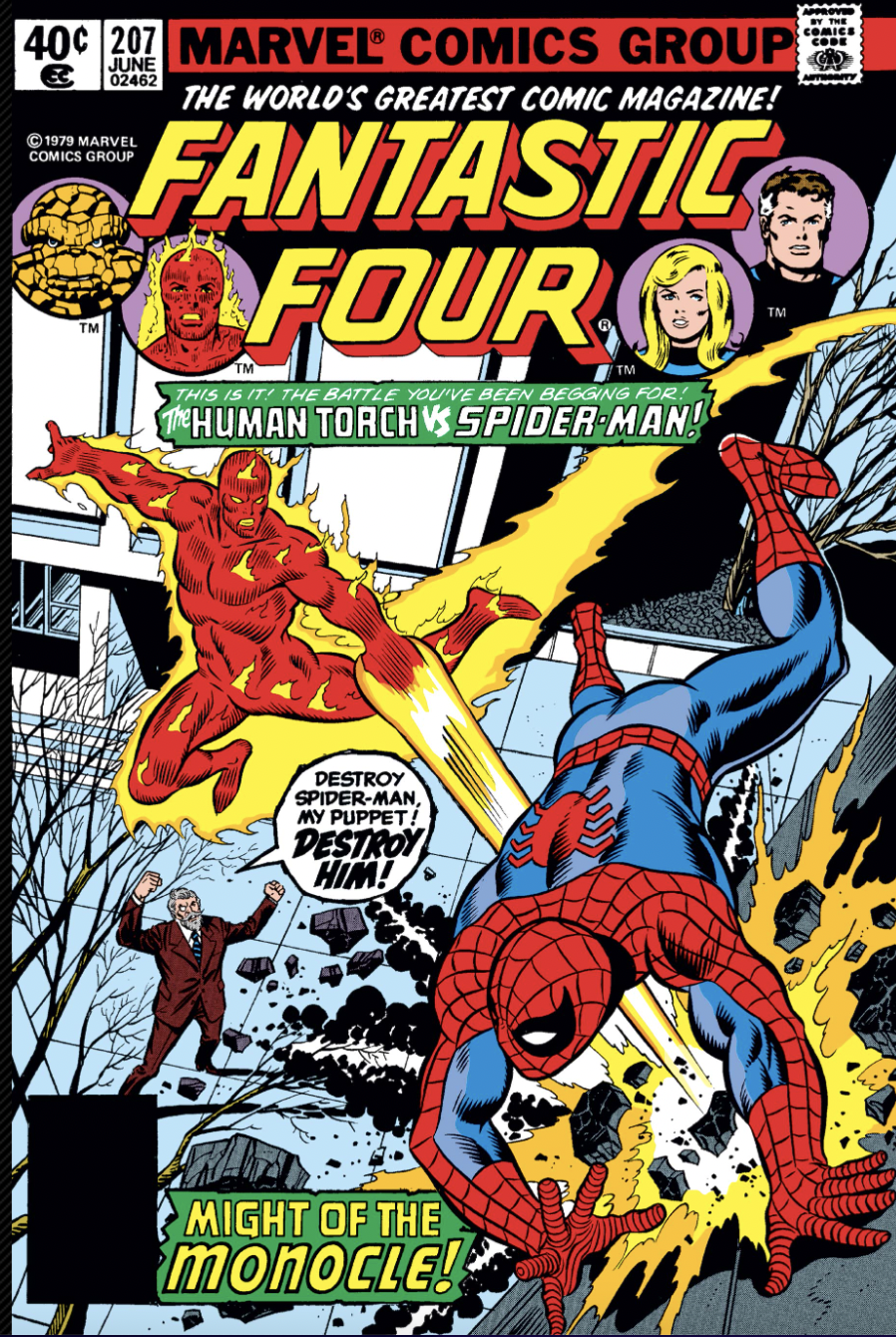
Fantastic Four 207 “Might of the Monocle!” Published March 1979 Writer: Marv Wolfman Pencils: Sal Buscema Inks: Joe Sinnott Letters: John Costanza Colors: Ben Sean Editor: Wolfman Cover: Keith Pollard and Sinnott
Synopsis
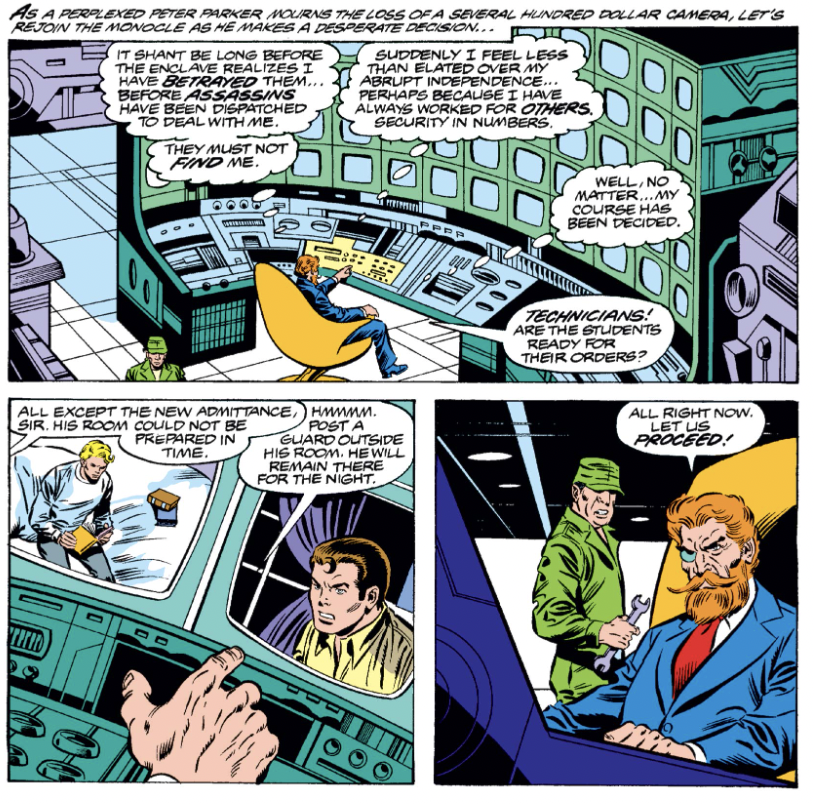
Hypnotized by the Monocle, the Human Torch and rest of the students at the elite Security College are forced to steal items of value to be used for world domination by the secretive Enclave, the employer of the Monocle. Meanwhile, news photographer Peter Parker gets an assignment to infiltrate Security College and take photos. Once there, he realized something is up and as Spider-Man, follows the hypnotized students to an army depot. Spider-Man rescues the soldiers from the mob of students and hypnotized Torch, and then, back in the dorms, enlists Johnny to take on the Monocle, who has broken with the Enclave and is working on a plot of his own. The Monocle briefly hypnotizes Johnny again and he fights Spidey, but comes to his senses. Neither is able to stop the Monocle from escaping and the Enclave plots its revenge in a scheme that involves kidnapping Medusa of the Inhumans.
What’s going on here?
This issue resolves the Torch/Monocle storyline and just as last issue featured the rest of the Fantastic Four with no mention of the Torch, this issue has no mention of the rest of the FF and is devoted solely to the Torch.
Except that’s not really true, since the issue’s real star is Spider-Man, with the Torch in a supporting role. In fact the comic feels more like an issue of Marvel Team-Up than the Fantastic Four, perhaps because Marv Wolfman has spent the last year writing Amazing Spider-Man along with the FF.
Also contributing the Spider-Mannish feel of the comic are the guest pencils of Sal Buscema, who had just finished a long run on Spectacular Spider-Man and will go on to draw Spidey for the next 30 years or so. Buscema recently passed away and while he was never one of my favorites, his career was legendary and he was without a doubt, along with his brother John, an indispensable pillar of Marvel in the 1970s, 80s and 90s.
Buscema picked up this issue because of the departure of Keith Pollard, who moved on to pencil Thor. Pollard, who is generally underrated, will return to the FF in about 100 issues. Buscema will draw the next issue as well before stepping aside for John Byrne, in the first of his stints on the FF.
As a story, FF 207 is perfectly adequate. Nothing too exciting, nothing too disappointing.
What I liked
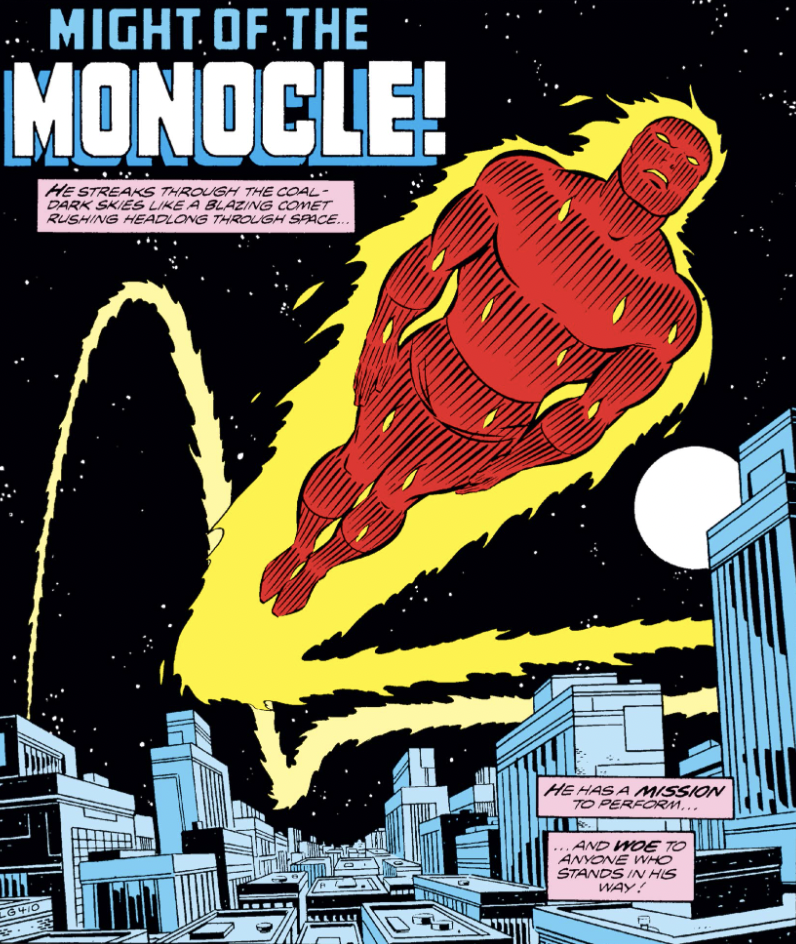
Buscema certainly knows how to draw comics, and this is a great splash page. The bold, san-serif title gives it power, even if “Might of the Monocle” seems a little ridiculous.
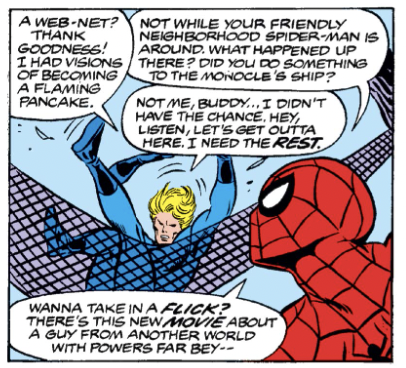
The Spidey/Torch banter is fun, and I liked this reference to Superman.
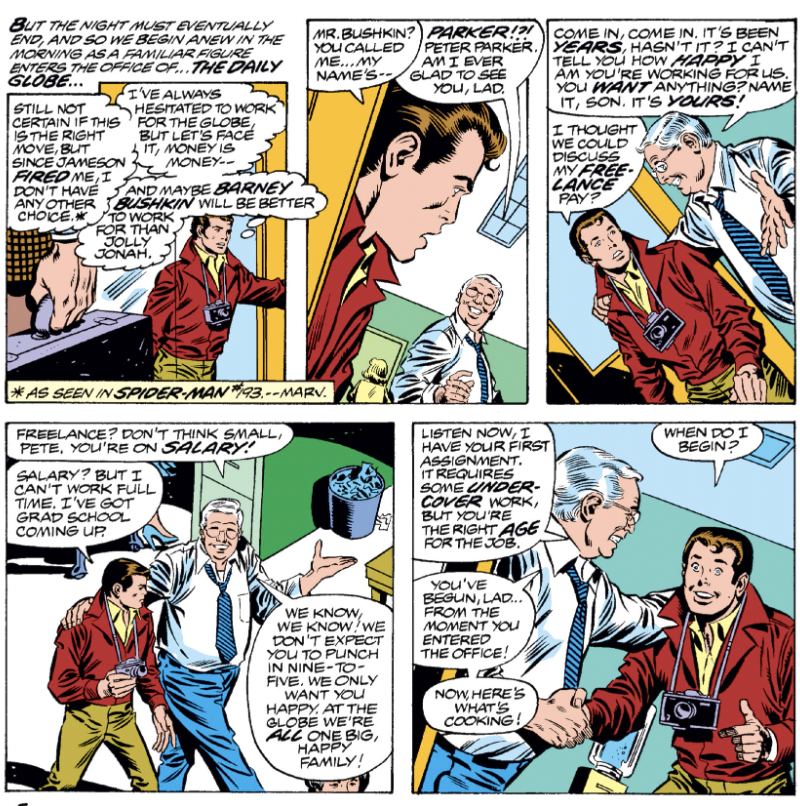
As I mentioned, it’s basically a Spider-Man comic, but that’s OK. Here, Peter Parker finally catches a break, which is always worth celebrating:
What I didn’t like
The cover seems to think comics readers are desperate to see the Torch and Spider-Man fight before, as if they haven’t done this a million times before.
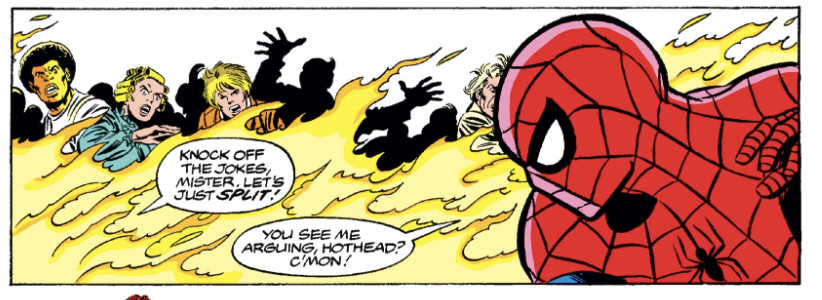
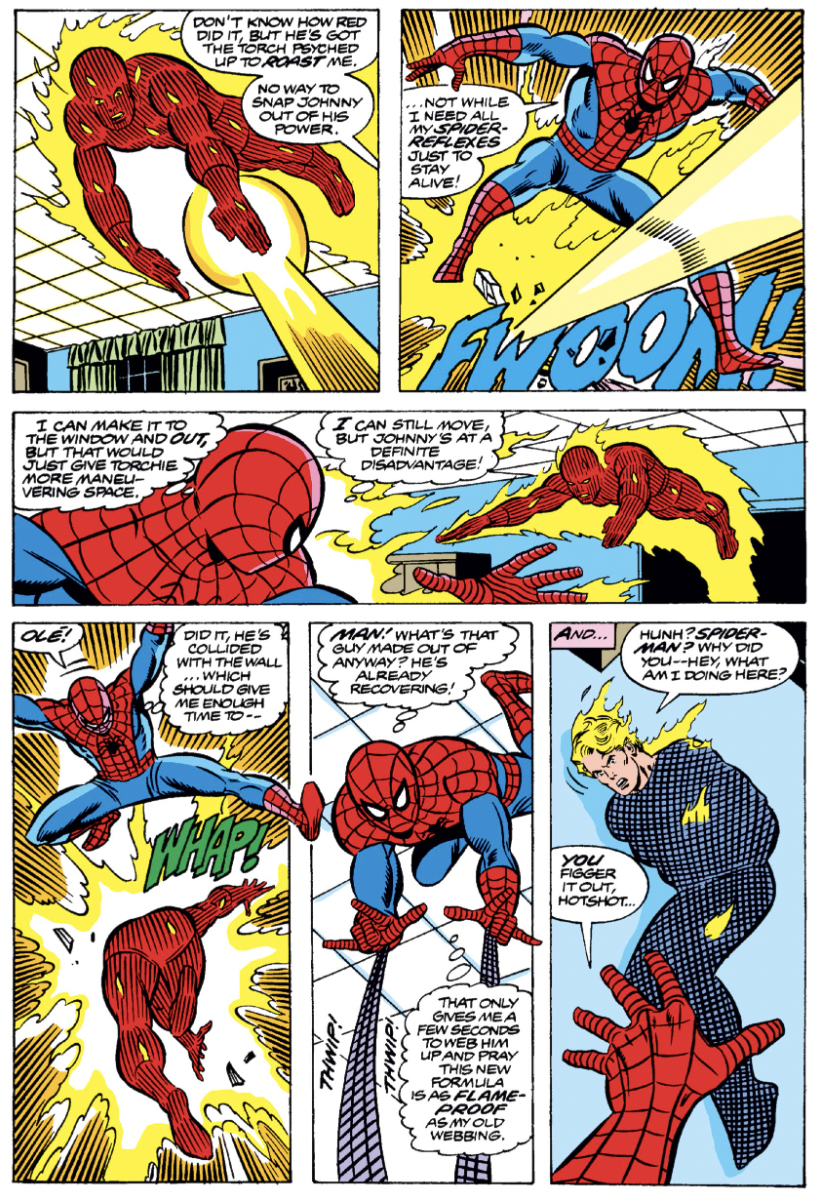
And ironically, when it comes time for the two to tangle, it’s over in a single page. Here’s the whole “battle:”
And one plot hole bugged me: Peter Parker is on campus ostensibly to meet the headmaster. He’s not the son of any one powerful or connected, so how does he end up in a dorm room that night?
Anything else?
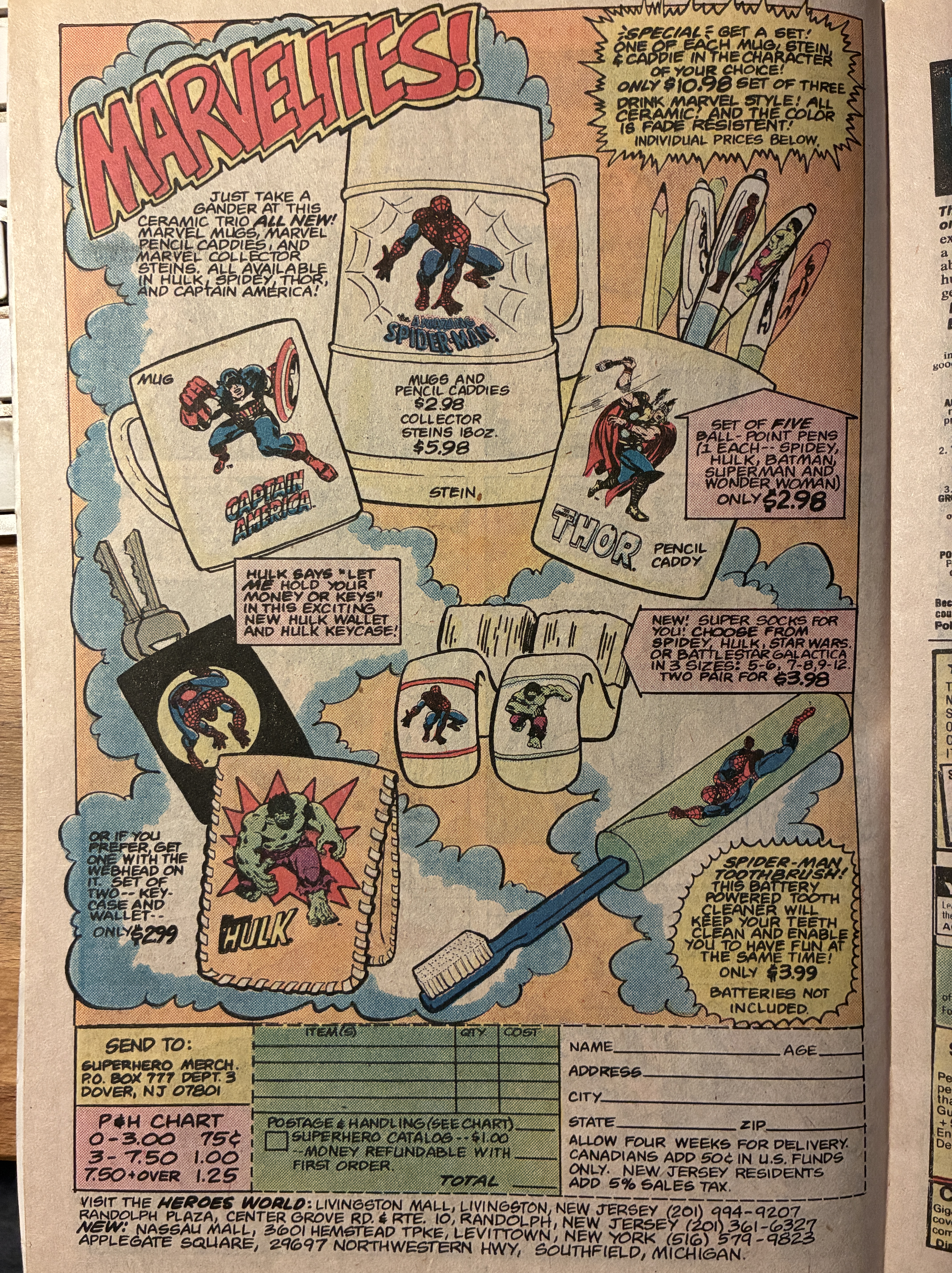
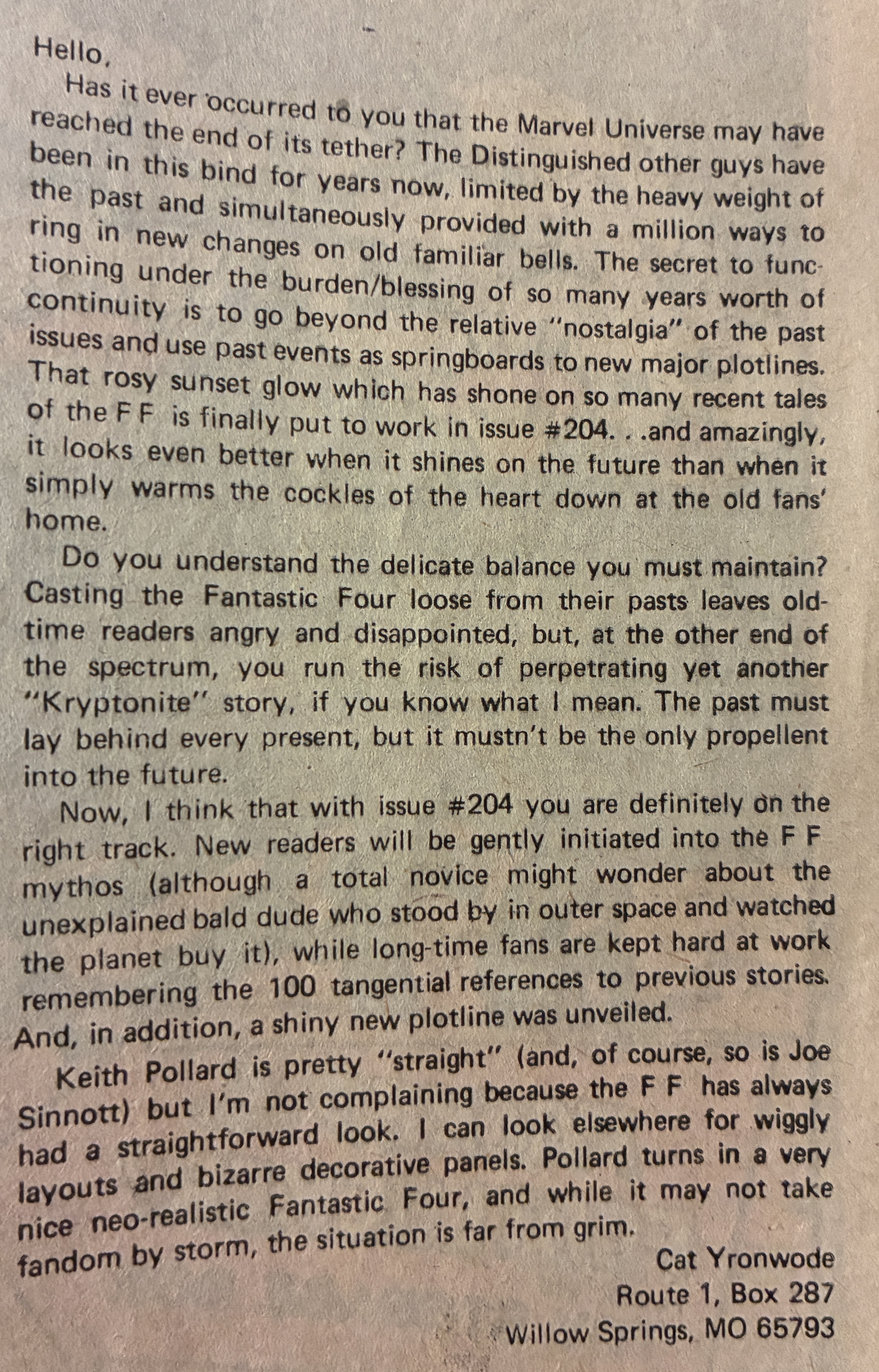
Some fun ads, and another perceptive letter from future Eclipse editor-in-chief Cat Yronwode.
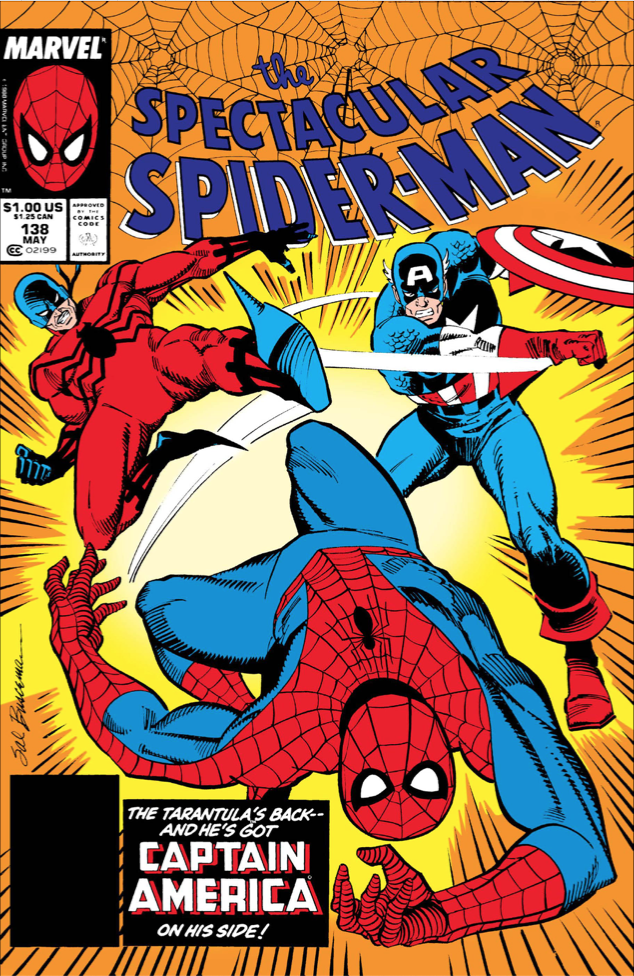
The Spectacular Spider-Man 138 “Night of the Flag!” Published Jan. 1988 Story: Gerry Conway Art: Sal Buscema Letters: Rick Parker Colors: Bob Sharen Cover: Our Pal Sal
Synopsis
Captain America partners with Tarantula to bring Spider-Man to justice after he aided a woman suspected of terrorism in Tarantula’s home nation.
What’s going on here?
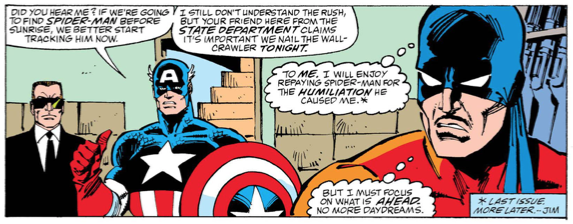
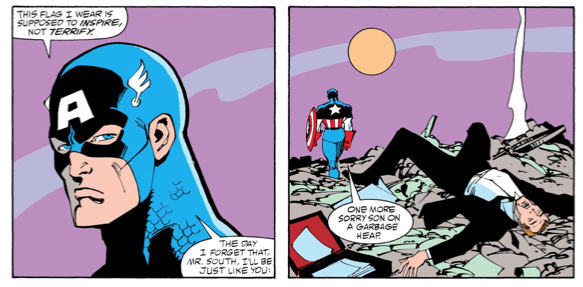
This is the second half of a two-part story, and at times Spider-Man feels like a guest star in his own comic. The story focuses on Tarantula, a vicious thug, and his uneasy alliance with Captain America. It’s never said outright, but this is the John Walker version of Cap, an authoritarian happy to do the government’s bidding, which explains why he’s willing to work with Tarantula. Regular readers of Marvel in 1988 probably would have known that automatically, but after 35 years it took me a while to figure it out.
The story and art are by two old pros, Gerry Conway and Sal Buscema, and the issue has a sturdy, predictable feel to it. There’s some heavy-handed editorializing about the plight of immigrants, a sub-plot featuring Robbie Robertson and Tombstone and a page or two of Peter Parker and MJ, now happily married. At the end, Spidey cheats death to beat the bad guy and Walker-Cap has a moment of moral clarity.
What I liked
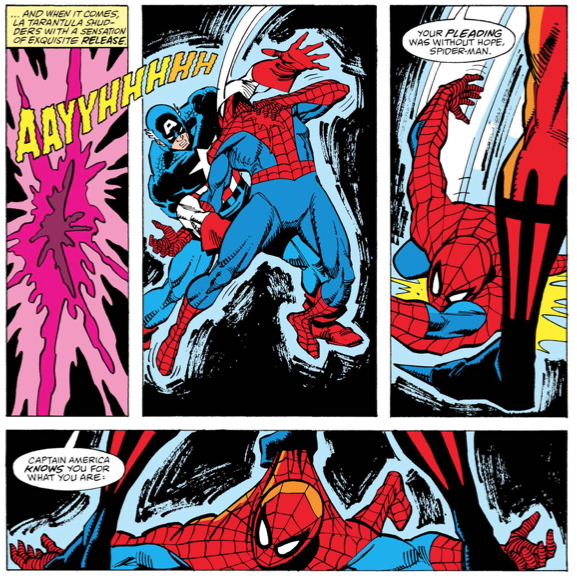
I confess that Sal is my second favorite of the Buscema brothers. I’ve generally found his pencils to be workmanlike and the faces on his women always look pained. There’s some of that in this comic but he also inked the issue, and it makes a big difference (I don’t know if I can remember another issue he both penciled and inked.) The opening sequence, a Tarantula revenge fantasy, is dramatically inked, and we get glimpses of what Buscema might be capable of if he hadn’t been chained to Marvel’s production engine for decades.
What I didn’t like
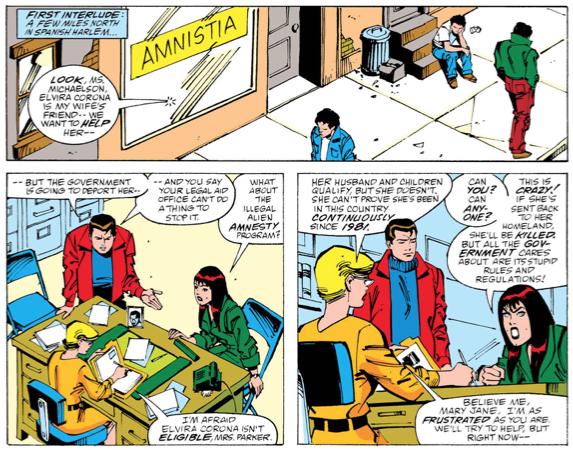
Conway’s social-justice message about the flawed immigration system is well-intentioned but feels clumsy. In this issue, at least, we don’t have any sense of these migrants as people, just as victims. Plus, calling them “illegals” as a bit cringey in 2023. (Note MJ’s Buscema-face in the third panel below).
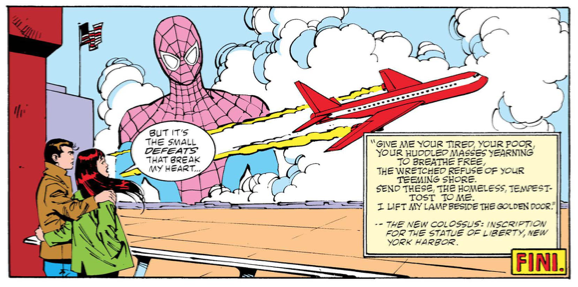
And just in case you didn’t get the message, Gerry and Sal thoughtfully include Emma Lazarus’s poem from the Statue of Liberty at the end.
Also, at some point this comic stopped being called “Peter Parker, the Spectacular Spider-Man” in favor of a simpler name. I’m not sure I approve.
Fantastic Four 73 “The Flames of Battle…” Published: Jan. 1968 Story: Stan Lee and Jack Kirby Script: Lee Pencils: Kirby Inks: Joe Sinnott Letters: Artie Simek Cover: Kirby and Sinnott
Note: Apologies for missing last week. A family event intervened. I try to write these posts every weekend but unfortunately it’s not always possible.
Synopsis
Fantastic Four 73 follows not another FF issue but Daredevil 38, the first time the FF readers have needed to read another Marvel comic to keep track of an FF story.
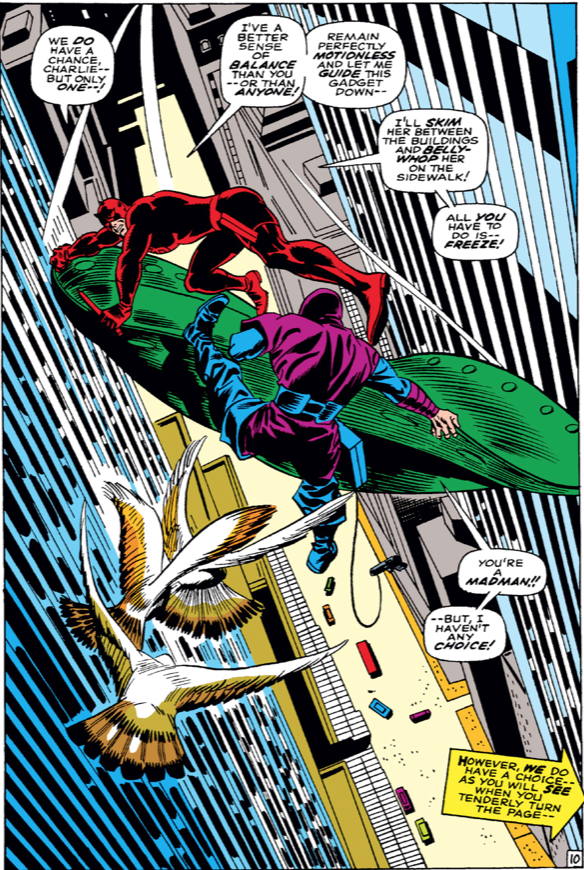
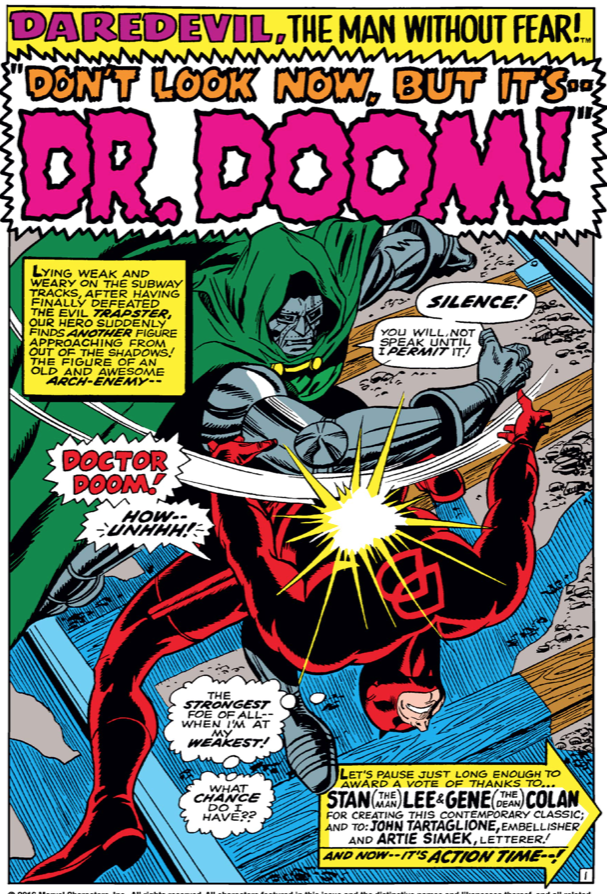
Daredevil 38 is the third issue of a convoluted arc that starts with Daredevil fighting the Trapster, who subdues the Invisible Girl and plants a bomb in the Baxter Building. Daredevil rescues the Sue and disposes of the bomb, then battles the Trapster. After taking a beating, Daredevil is dazed in the New York subway, where he is confronted by Dr. Doom.
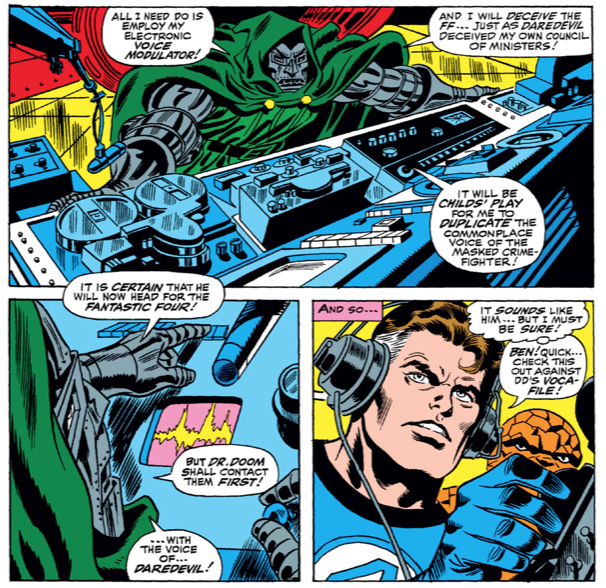
Doom captures Daredevil and eventually switches bodies with him, part of a plot to defeat the FF. Daredevil, in the body of Doom, uses a radio to warn the Fantastic Four of the switch, then orders Latveria to attack its neighboring countries. Doom quickly switches the bodies back to avoid a war, but uses a voice modulator to impersonate Daredevil and convince the FF that he is still in Daredevil’s body.
Daredevil 38, Stan Lee/Gene Colan/Frank Giacoia
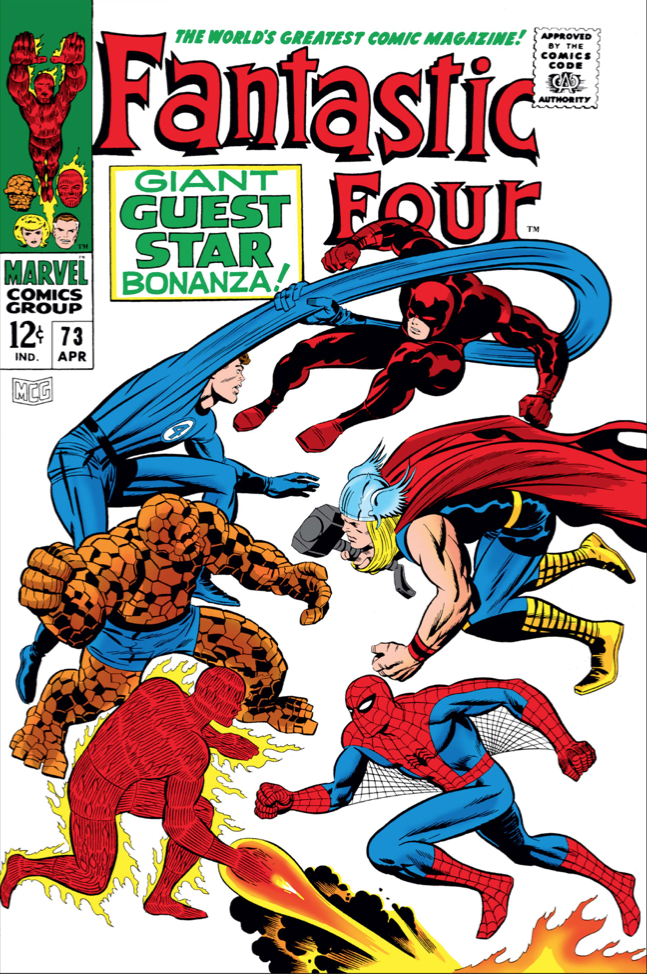
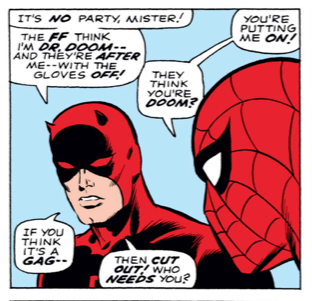
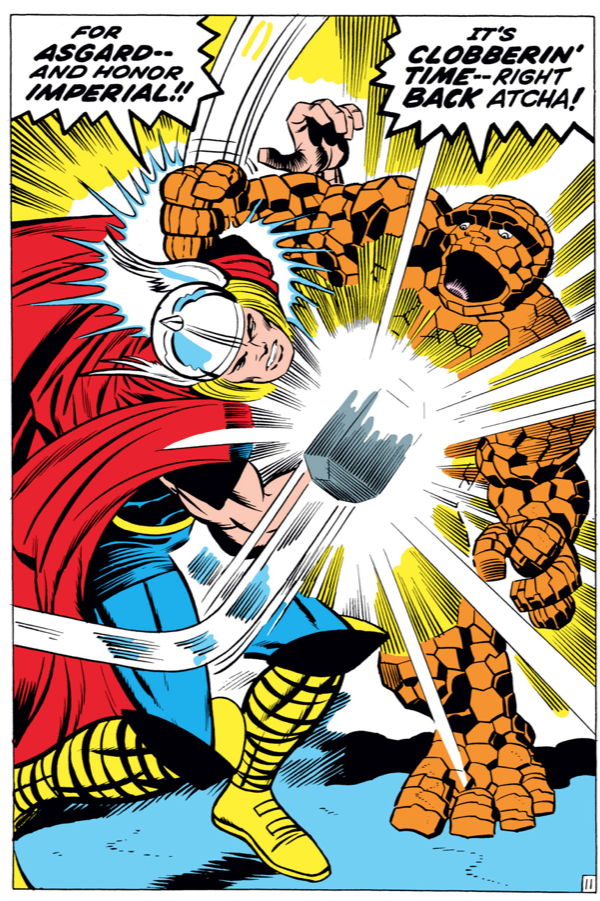
Fantastic Four 73, then, begins with the FF preparing to fight Daredevil, who they think still contains the consciousness of Doom. Daredevil tries to convince them he’s really himself, but the FF won’t hear it. After tangling with the Human Torch, Spider-Man arrives and realizes Daredevil will need reinforcements to take on the FF. He recruits Thor, who is dazed from a battle with Wrecker, and eventually the three heroes battle the FF, with Daredevil taking on Reed, Spidey fighting Johnny (for about the 100th time) and Thor battling the Thing (possibly for the first time).
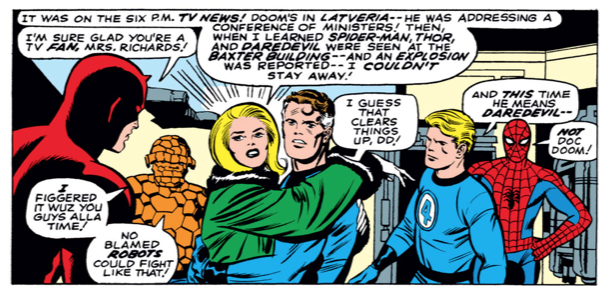
The fight finally ends when Sue intervenes, saying that she saw Doom in Latveria on the 6 pm news. Reed apologies and Daredevil says it’s no big deal.
What’s going on here?
This is a peculiar issue. No only does is it require readers to have read a few issues of Daredevil prior, but the plot is incredibly flimsy and contrived. Spider-Man and Thor are shoehorned into the comic with the weakest possible explanations—literally they were just passing by—and then serve no real purpose except to provide sparring partners for the FF. Usually in a superhero team-up situation, after they fight and they realize it was all a big misunderstanding, they join forces to go after the bad guy. Not here: Once Sue let’s them know it was a mistake, they all go their separate ways. Of course it’s fun to see the Thing battle Thor, or Reed fight Daredevil, but it would be a lot more satisfying if it was in a more coherent story.
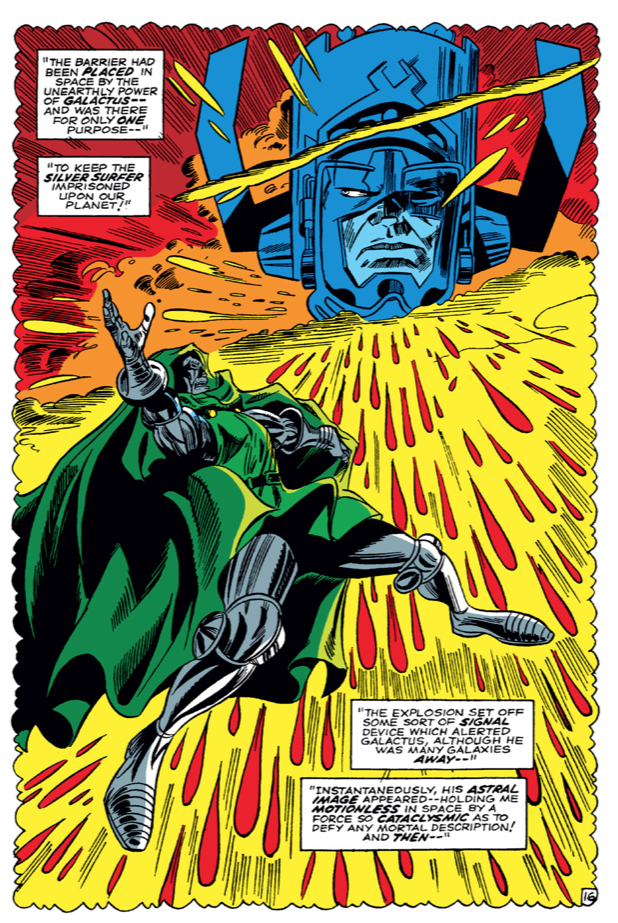
Making it even more frustrating is that the Daredevil stories leading up to it are much more fun and interesting. Yes, the switching bodies is a bizarre plot device, but Lee explores how Daredevil would react to having sight again, and Doom’s confusion over Daredevil’s radar sense. We also get an explanation of how Doom—who, last time we saw him, had stolen the power of the Silver Surfer—survived running into Galactus’s barrier (Galactus, sensing it was not the Surfer, gently transported Doom to Latveria). And Gene Colan knocks it out of the park with his art.
Oops
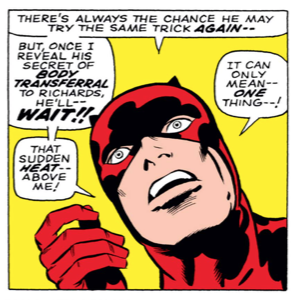
Fantastic Four 73 also has a surprising number of errors and goofs. One obvious one: In one panel, Jack draws Daredevil’s mask so you can see his eyes, then changes back to his eye-covers (or whatever you want to call them) for the rest of the comic.
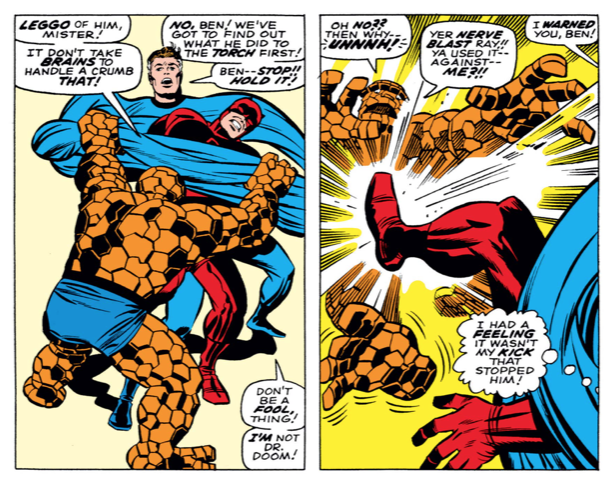
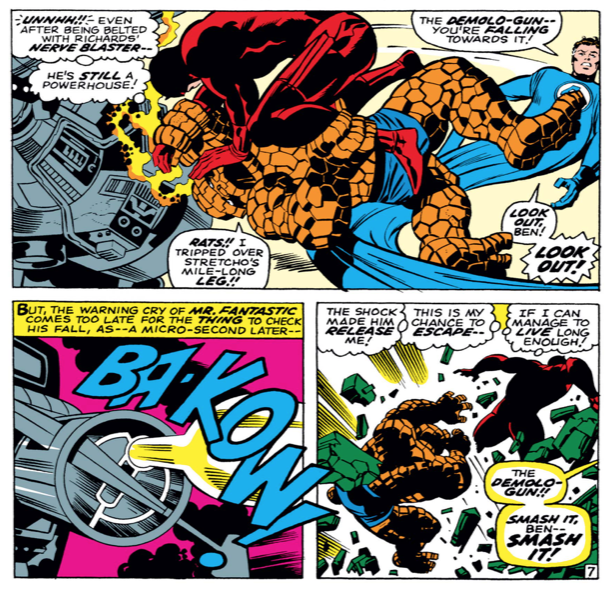
Here, it seems like Stan is writing around Jack’s art to explain how Daredevil could stun Ben with a kick. Stan’s explanation: Reed used a “nerve blast ray” on Ben.
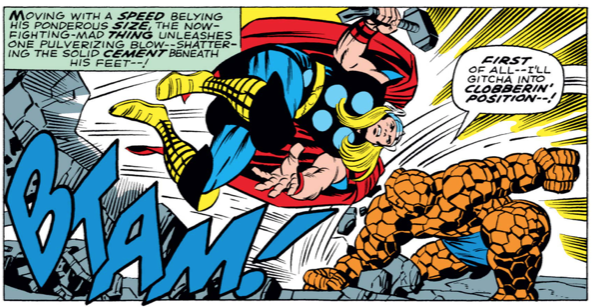
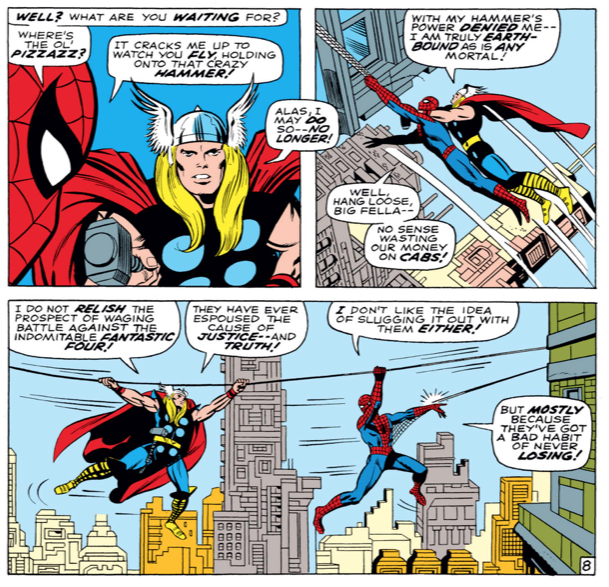
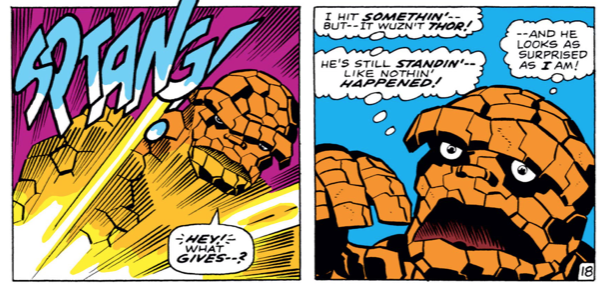
And perhaps most perplexing is how Thor is dealt with. His appearance apparently come between panels in Thor 150 (although there is no mention of it in the Thor comic), where he has apparently lost his powers. After he is recruited by Spider-Man, he can’t fly, and has to hitch a ride on Spidey’s webs. This is just weird:
Then as he battles Ben, this happens:
No further explanation is provided, until the last page, when Ben say Thor hold him he had to fight the Wrecker. But we have no idea of what happened in the above sequence. Maybe a subsequent story has addressed it, but I’m not aware of it.
Weird science
Along with the aforementioned “nerve blast ray,” there is also a “demolo-gun.” (And this isn’t the first time Reed has left extremely dangerous, and easily engaged, weapons lying around his lab).
It must be Israel Day
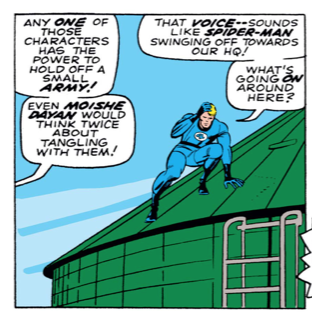
Spider-Man references Moshe Dayan, Israel’s minister of defense during 1967’s Six-Day War.
“The Sub-Mariner versus the Human Race” (main story) Story: Stan Lee and Jack Kirby Pencils: Kirby Script: Lee Inks: Dick Ayers Letters: Art Simek
“The Fabulous Fantastic Four Meet Spider-Man” (second story) Story: Lee Pencils: Kirby Inks: Steve Ditko Letters: Ray Holloway
Cover: Kirby and Ayers
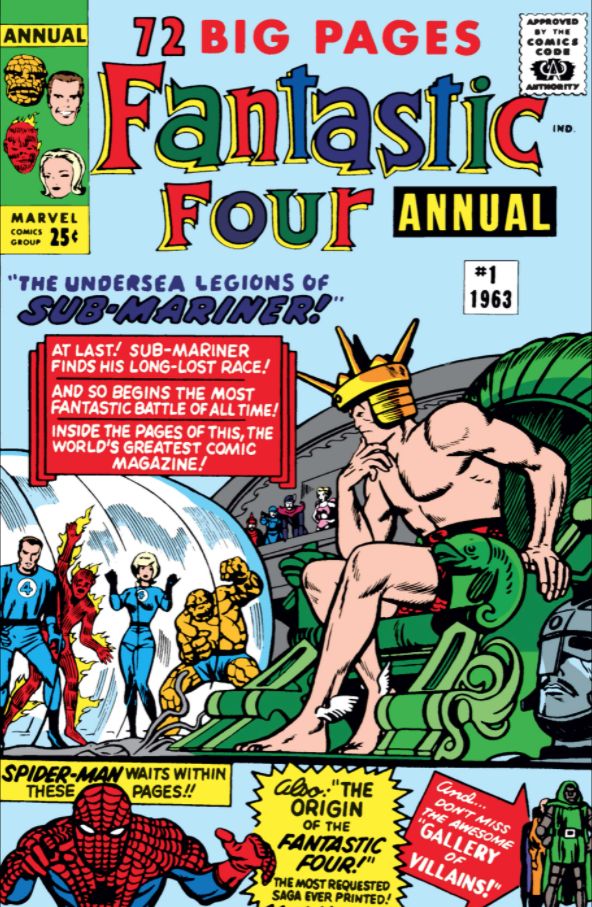
Buckle up everyone, because we’ve got a lot to cover in the Fantastic Four’s first annual. It features two stories, both loaded with historic significance, a gallery of pin-ups, and a handful of assorted extras, all of which are worth looking at.
But first, the main event:
Synopsis
The story begins under the ocean, in Atlantis, which Namor the Sub-Mariner has finally rediscovered and where he is now crowned as ruler. We meet Dorma, his love interest, and Krang, a rival. Meanwhile, in New York, the Fantastic Four plan a cruise vacation in part to investigate the sighting of sea monsters. While at sea, the team is captured by Namor (the sea monsters were a lure), who informs the team the surface world can no longer encroach on his ocean kingdom, and releases the FF to spread the word.
Reed summons an emergency session of the United Nations, and introduces Dr. G. W. Falton, who explains the history of homo mermanus, the water-breathing off shot of humans, their civilization, and the birth of Namor. When Reed declares humanity must fight Atlantis, Falton reveals himself to be Namor in disguise, and then launches an invasion of New York.
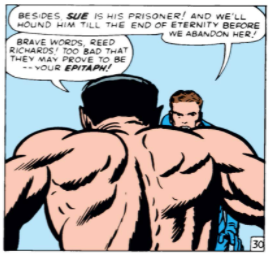
New York is soon overwhelmed by Atlanteans, but Reed invents a device that evaporates the water in the their helmets, sending them back to the sea. Defeated, Namor abducts the Invisible Girl after a scuffle with the FF, and brings her to Atlantis. The rest of the FF pursues, and while Namor and the team battle, Dorma realizes Namor is in love with Sue and floods her chamber. Sue nearly drowns, and Namor calls off his fight with the FF to take Sue to a hospital on land. When he returns to the ocean, the city of Atlantis is deserted as his people have abandoned him.
What’s going on here?
This is the first annual of the modern Marvel era, but apparently not Marvel’s first annual. While investigating the history of Marvel’s annuals is an exercise in frustration, the lack of explanation in this issue suggests readers were used to them. Initially Marvel used its annuals to tell big stories or for big events like Reed and Sue’s wedding (spoiler!). Later, they became used for Marvel’s interminable cross-over events. While they were once reliably published one a year (annually, you might say) they’ve since become much more erratic. The FF reached 27 annuals before the first series was rebooted in 1998 (though some were reprints).
This first story has a lot going on. Most importantly it tells the story of Namor, his people, and his birth to an Atlantean princess and a human sea captain. Namor has now appeared in five stories in the FF’s first two years, as many as Dr. Doom, and with this annual he’s given more dimension and background. Notably, he’s also identified as by G.W. Falton (really Namor in disguise) “the first known mutant,” a tag line which Marvel used to advertise Namor’s solo book in later, mutant-crazed years.
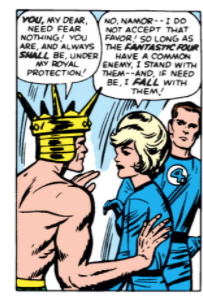
The story also moves Namor from villain closer to hero, or at least, anti-hero. Despite his new-found leadership of Atlantis, it doesn’t appear his heart is really in the invasion of earth, and he’s still clearly smitten with Sue. And while Sue remains Namor-curious, she seems to realize her future is with Reed and the team.
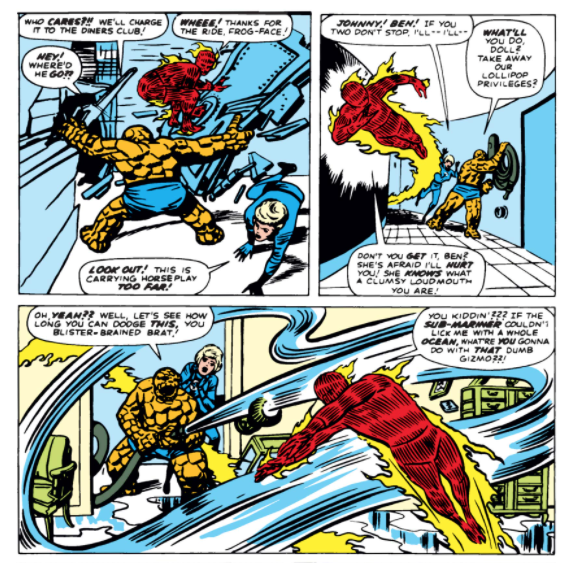
The annual just has a ton of action as Stan and Jack take advantage of the extra space to stretch out. The regular jokey fight between Ben and Johnny, usually just a panel or two each issue, covers more than two pages. The team also battles Namor twice, each time for several pages.
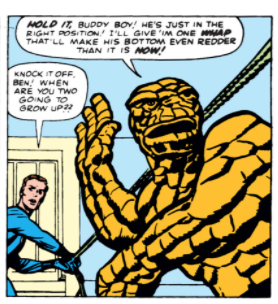
They’re fighting
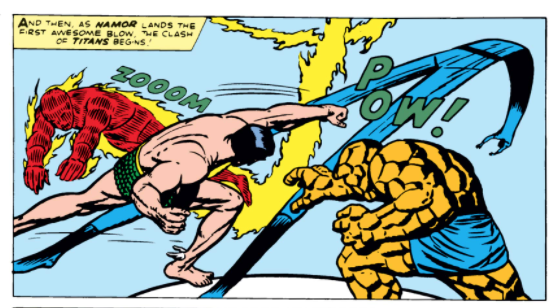
As noted above, this is a big brawl.
The sexist sixties
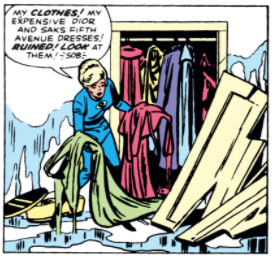
The real victim of Ben and Johnny’s fight? Sue’s dresses.
The Amazing Mr. Fantastic
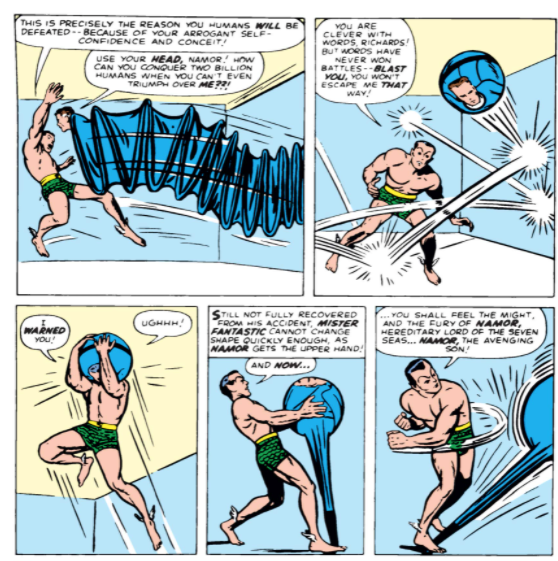
Reed gets to show off a bit while fighting Namor
Operator
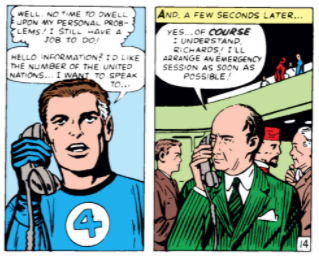
Reed never wrote down the number for the United Nations.
Red Menace
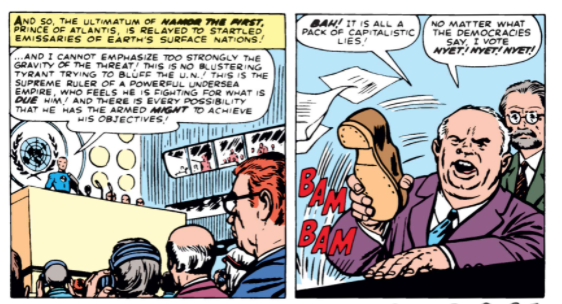
Khrushchev makes his second appearance in the FF. For those keeping score, that’s Khrushchev 2, JFK 1.
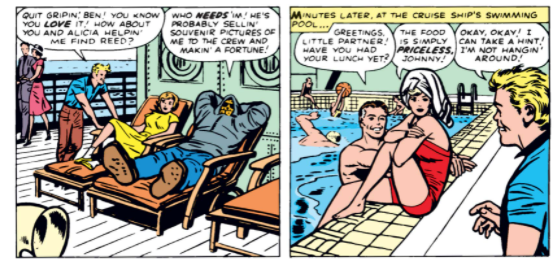
Vacation!
Ooops
Very odd drawing of Ben here by Jack. If I didn’t know better, I’d say he looked like Pepe the Frog.
Kirby Krackle
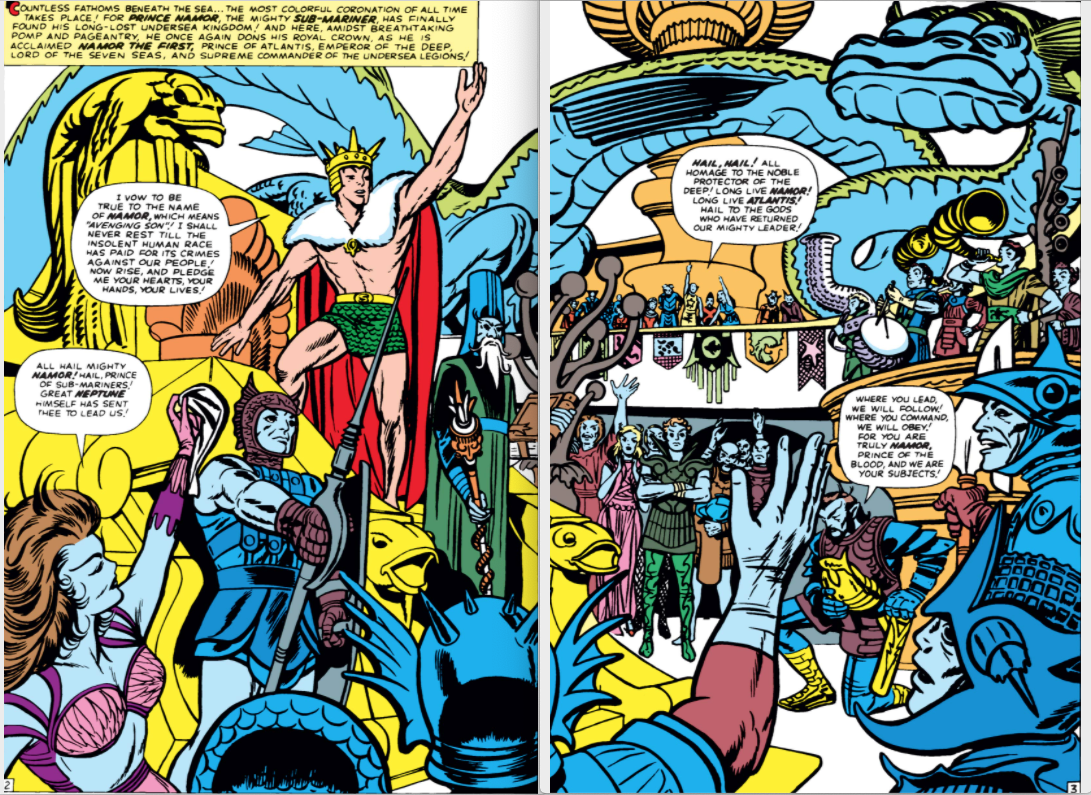
Kack makes up for his stumble with all sorts of cool images, particularly in this double-page spread of Atlantis, the only double-page spread in the FF to date.
Also this is a pretty excellent view of Namor. A swimmer’s body, indeed.
But wait, there’s more!
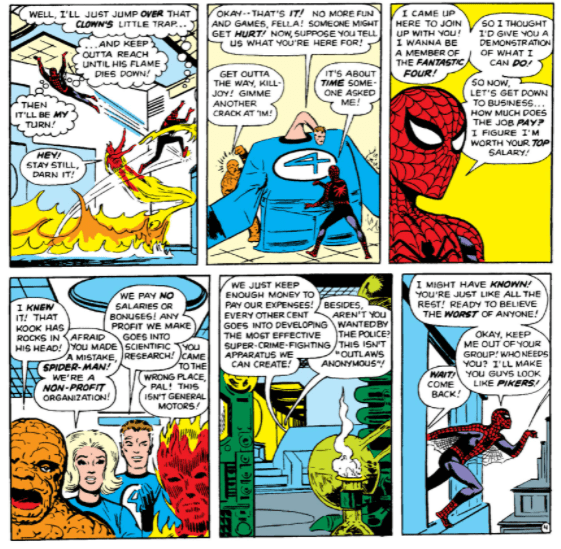
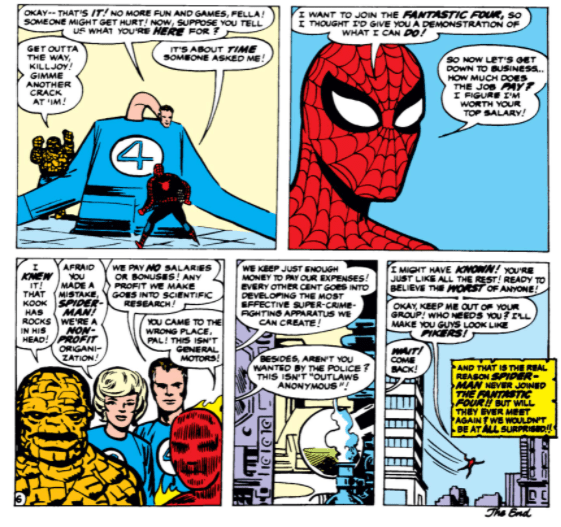
The second story is an odd one – it’s an expanded version of the FF’s first meeting with Spider-Man, which appeared as part of a larger story in Amazing Spider-Man 1, published a few months earlier.
There’s not much to it: Spider-man, very new to the super-heroing business, breaks into the Baxter Building and fights the FF, hoping to prove his value with the expectation they will hire him. When he finds out there’s no money in being an FF member, he sulks off. While the version in ASM 1 was drawn by Ditko, this one was drawn by Kirby with Ditko’s inks. The dialogue and the layouts are basically the same, but the art is very different. See for yourself:
ASM 1 (Ditko)
FF Annual 1 (Kirby/Ditko)
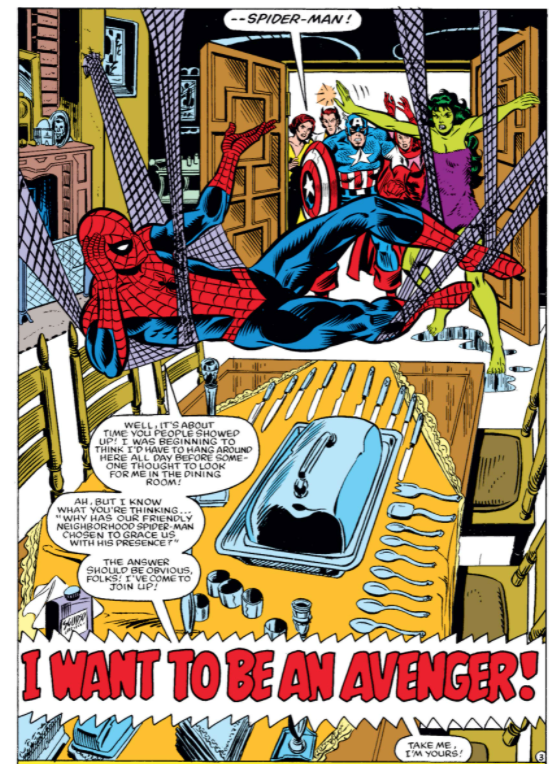
Spider-Man tried the same trick decades later with the Avengers, breaking into Avengers Mansion and asking for a job. It didn’t work out then, either. (Much later, of course, he ended up as a member of both teams).
Avengers 236 (Milgrom/ Sinnott)
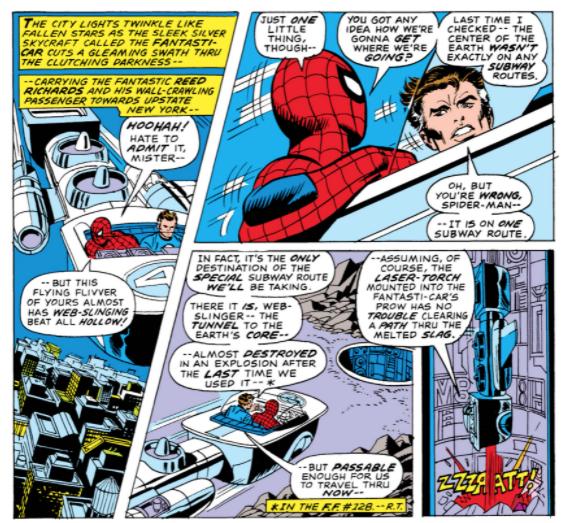
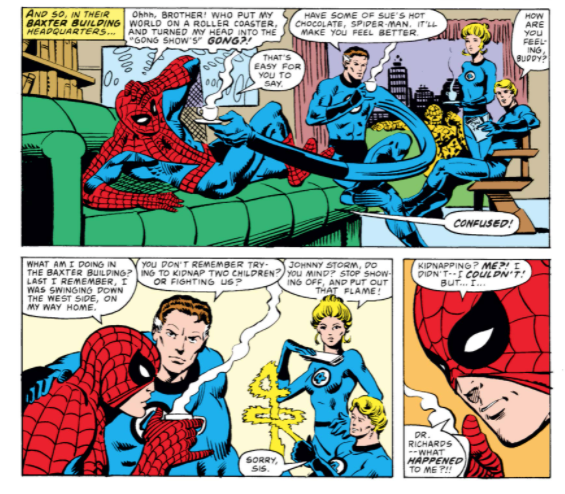
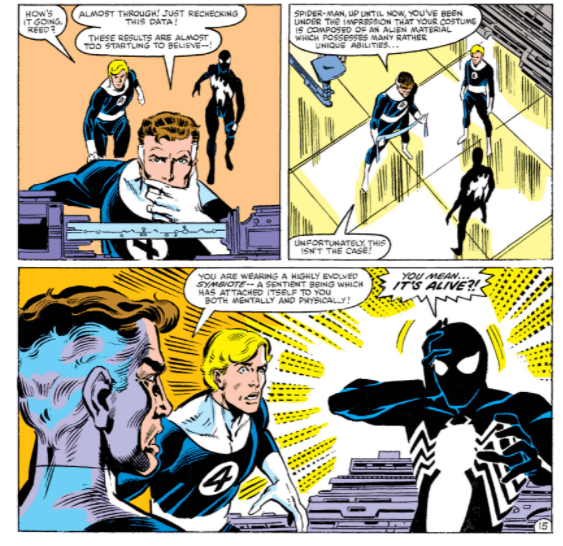
While Spidey’s initial meeting with the FF was an inauspicious one, it was the first of many encounters that led to a deep friendship between Peter Parker and the FF. They have appeared in so many issues together it would be impossible to list them all but here are some notable ones:
From Marvel Team-Up 17
Art by Gil Kane and “many hands”
From Marvel Team-Up 100
Art by Frank Miller and Bob Wiacek
From Amazing Spider-Man 258
ASM 258 (Frenz/ Rubinstein)
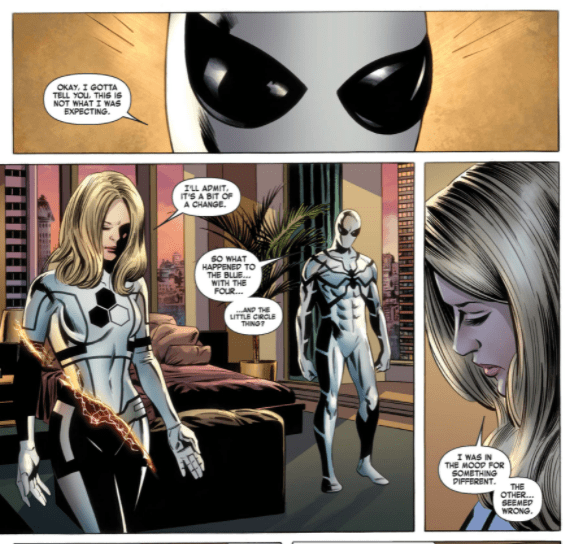
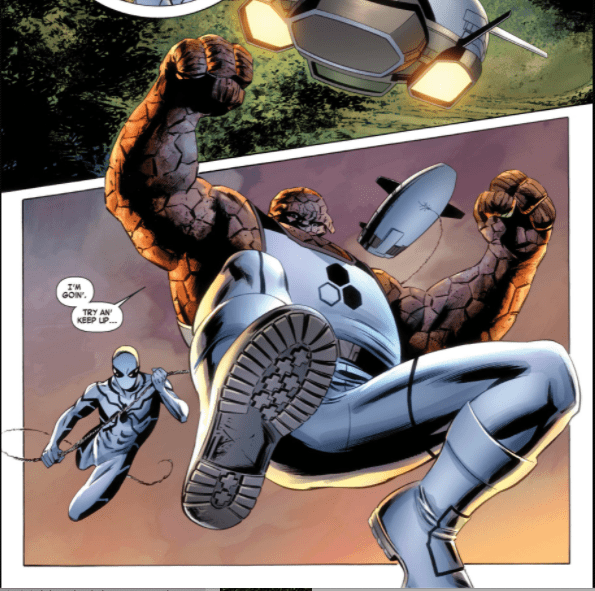
And much more recently, from 2011 ‘s FF 1, when Peter joined the team after Johnny was believed dead:
FF1 Epting/Mounts
We’re still not done!
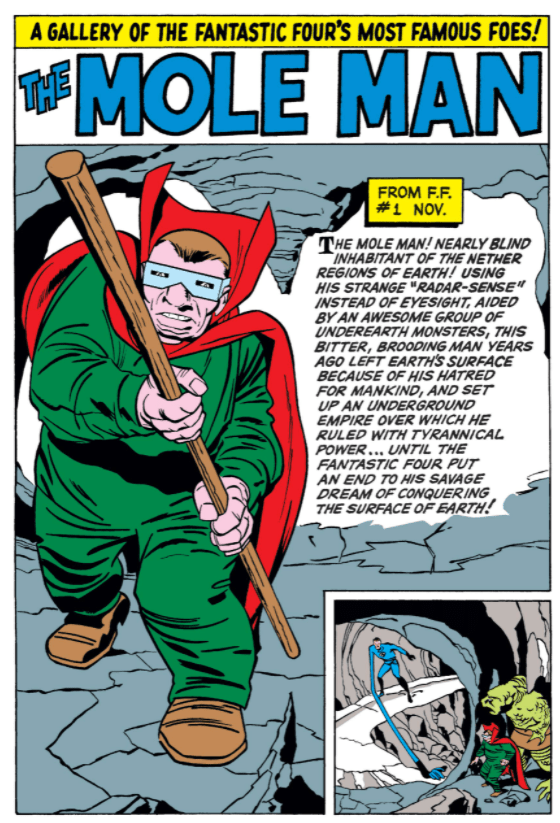
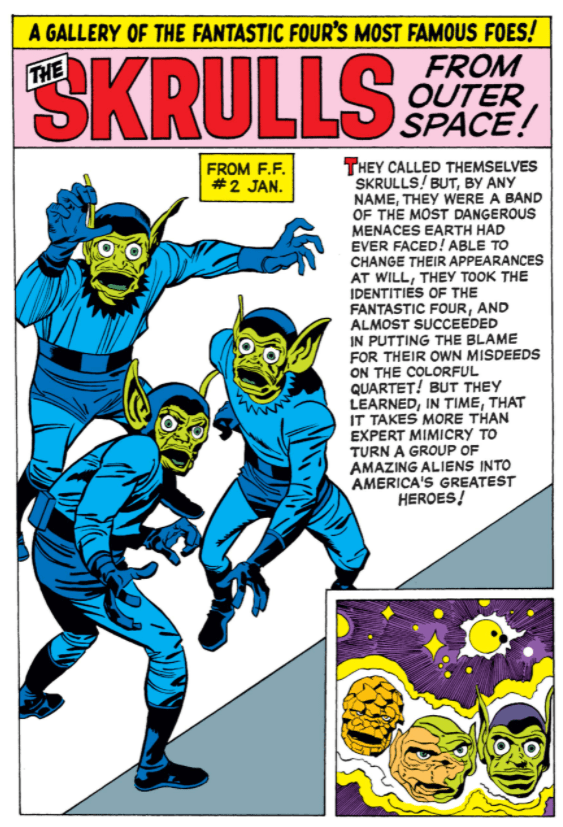
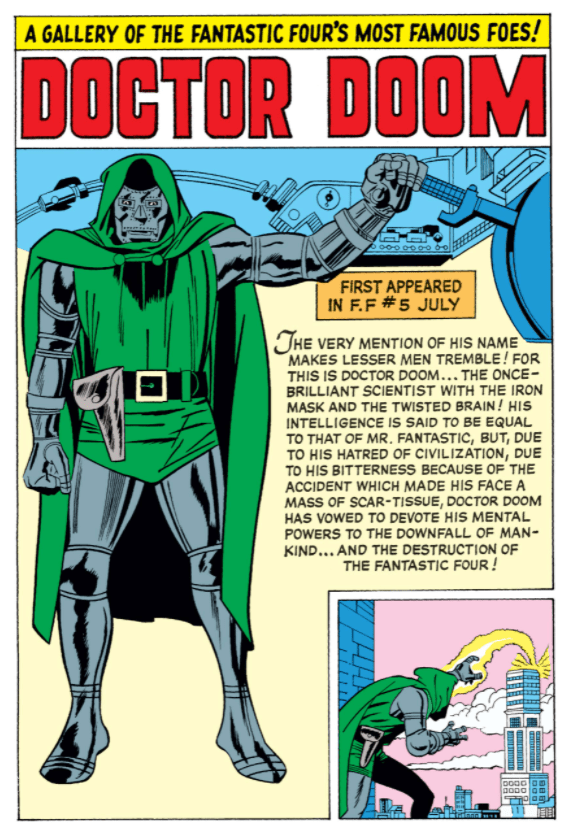
Fantastic Four Annual 1 included a series of pin-ups of the FF’s foes. Interestingly, while many—like the Mole Man and the Mad Thinker— had only appeared one, their presence in the gallery suggested Stan and Jack had long-term plans for them.
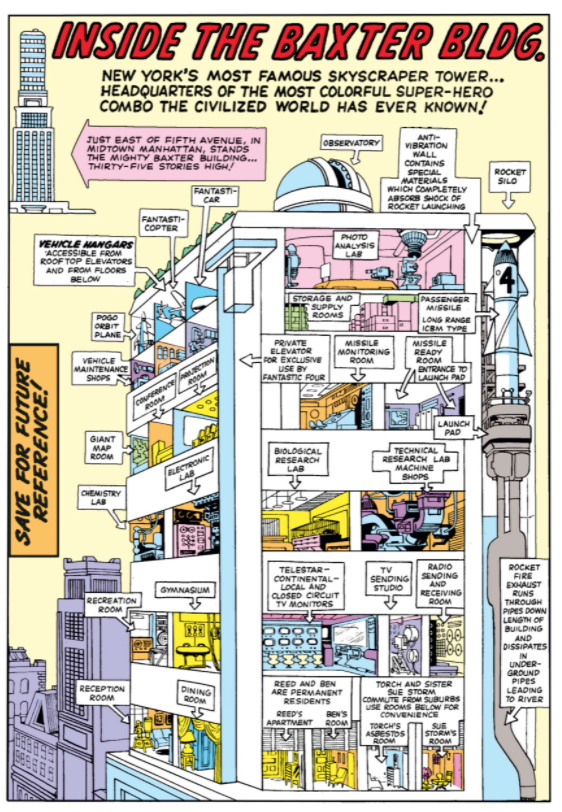
The annual also included a cutaway drawing of the Baxter Building, the third such illustration of the FF’s headquarters so far. Each one is a little more detailed, and this one includes an interesting tidbit about Sue and Johnny still living at home and commuting in from the suburbs.
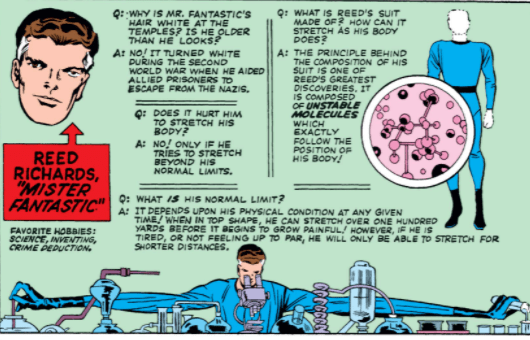
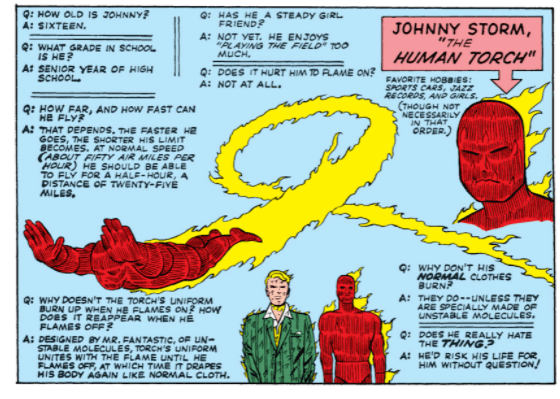
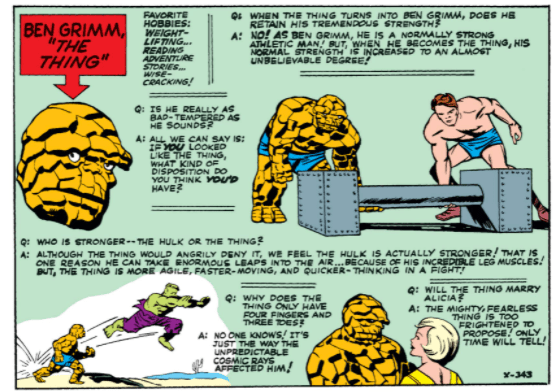
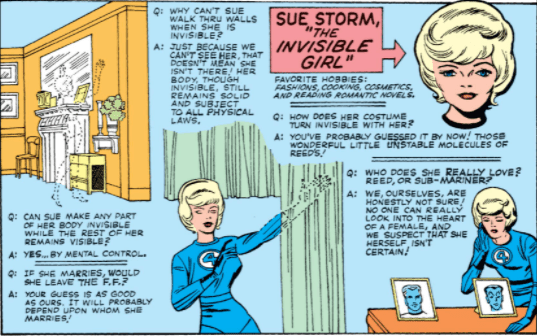
Lastly, each of the FF was the subject of a Q&A section that attempted to answer readers’ questions about the team. For example, we learn why Reed is grey at the temples, that Johnny is just 16, and that while the Hulk is stronger than the Thing, Ben is a more wily fighter. Alas, much of Sue’s Q&A is dedicated to her love life.
For sale
A mint version (9.8) of FF Annual 1 should cost you around $46,000.