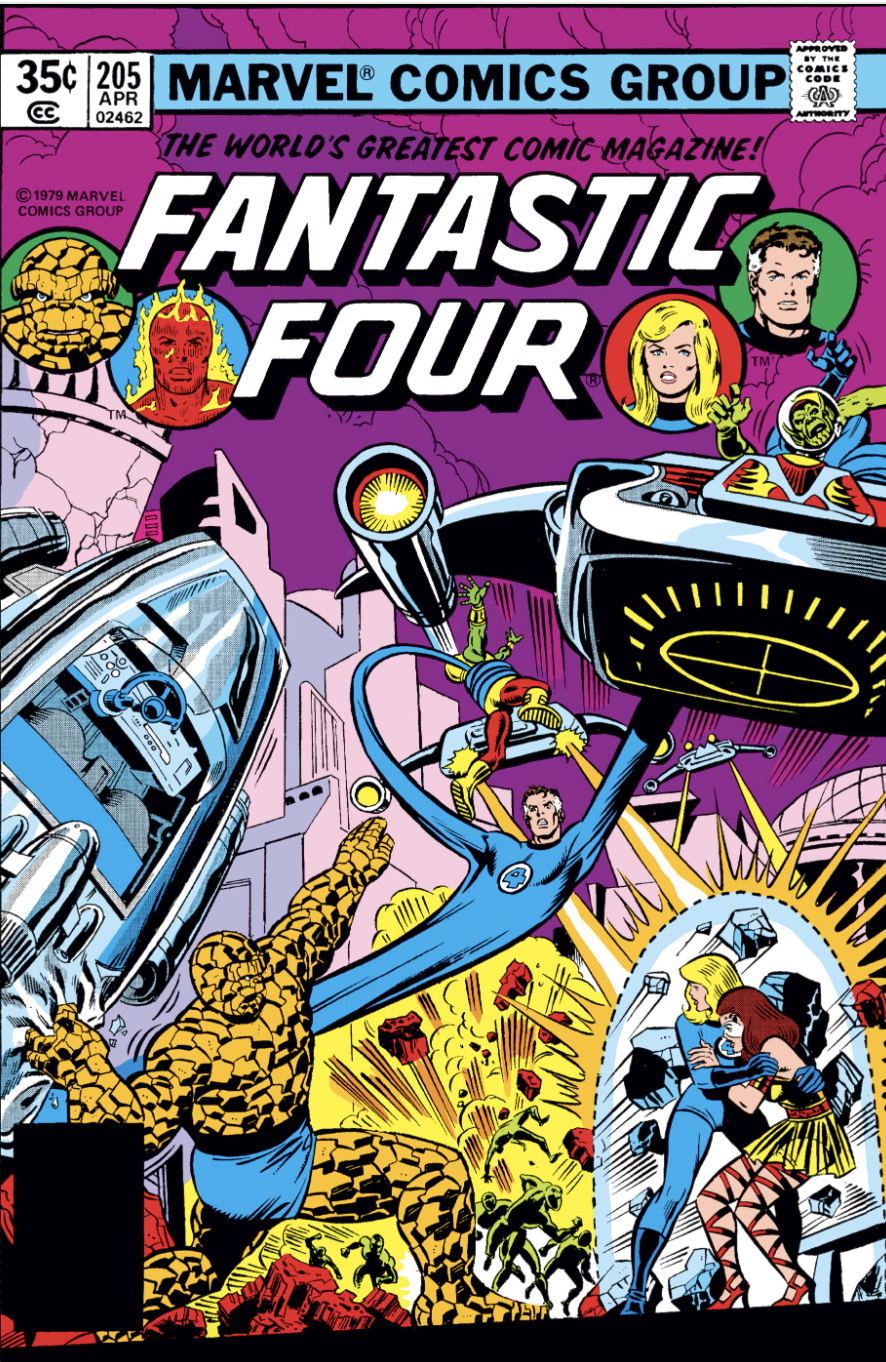
Fantastic Four 205 “When World’s Die!” Published January 1979 Writer: Marv Wolfman Pencils: Keith Pollard Inks: Joe Sinnott Letters: Jim Novak Colors: Glynis Wein Editor: Wolfman Cover: Pollard and Sinnott
Synopsis
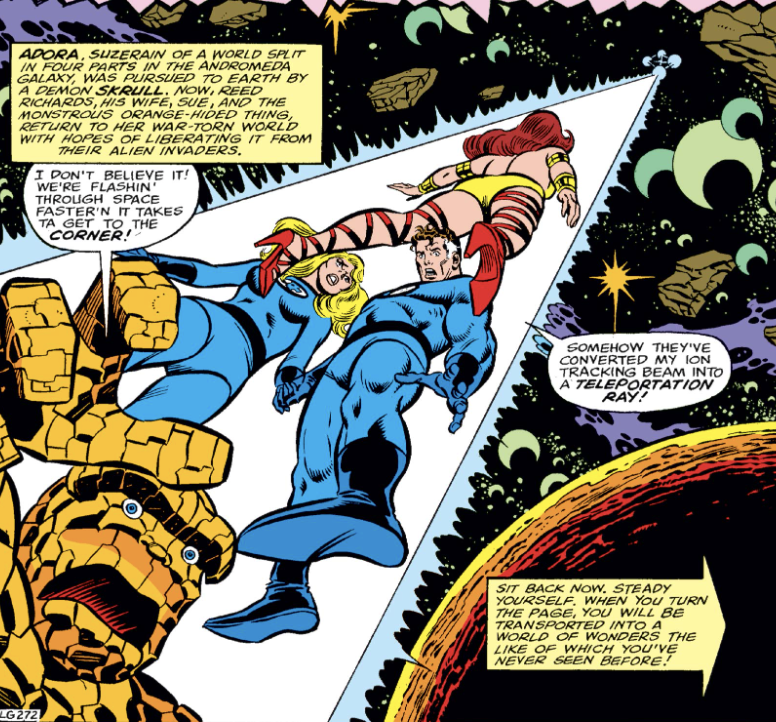
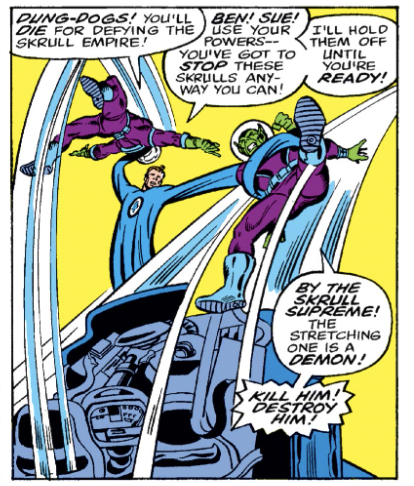
Mr. Fantastic, the Invisible Girl and the Thing travel by “teleportation ray” to the Andromeda Galaxy where Xandar is attacked by the Skulls. The FF battle on the side of the Xandarians before they are captured by the Skulls. Meanwhile, back on Earth, the Human Torch is hypnotized, along with other students at his new colleges, as part of some nefarious scheme of the Monocle and his unknown employer.
What’s going on here?
This comic does a capable job of advancing the two storylines that were kicked off in the previous issue. The main story is very much a space opera, with the Fantastic Four as players in the bigger struggle between Skulls and Xandar.
The fact that the FF are on Xandar came as a surprise, since it was never mentioned in the first issue. I confess I am not a reader of Nova, so I wasn’t familiar with the planet’s unique set-up, but I did think the soldiers looked suspiciously Nova-like. For a comic published in the era where it was assumed every issue was someone’s first, omitting the name of the planet seems like a big goof, and yet another reason why writer’s shouldn’t be their own editors.
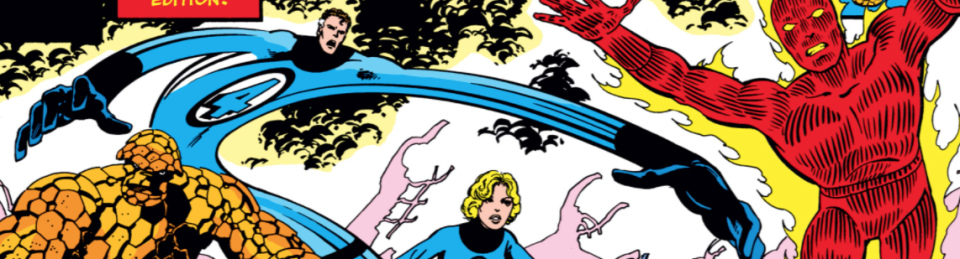
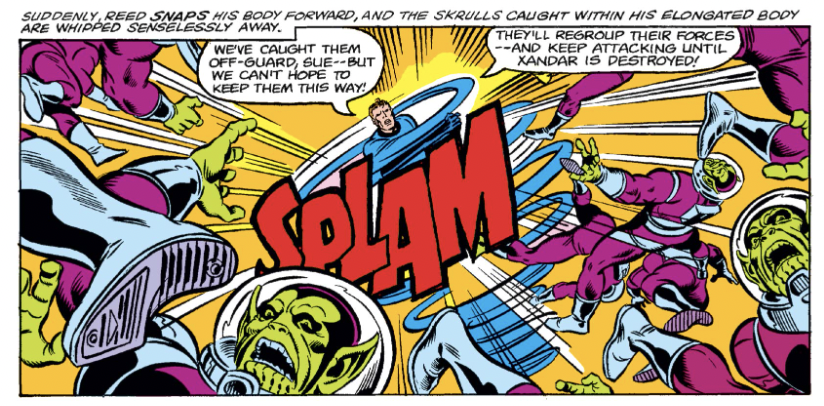
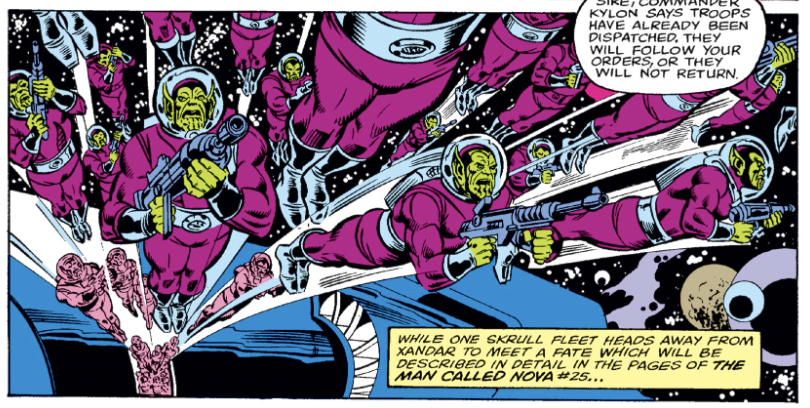
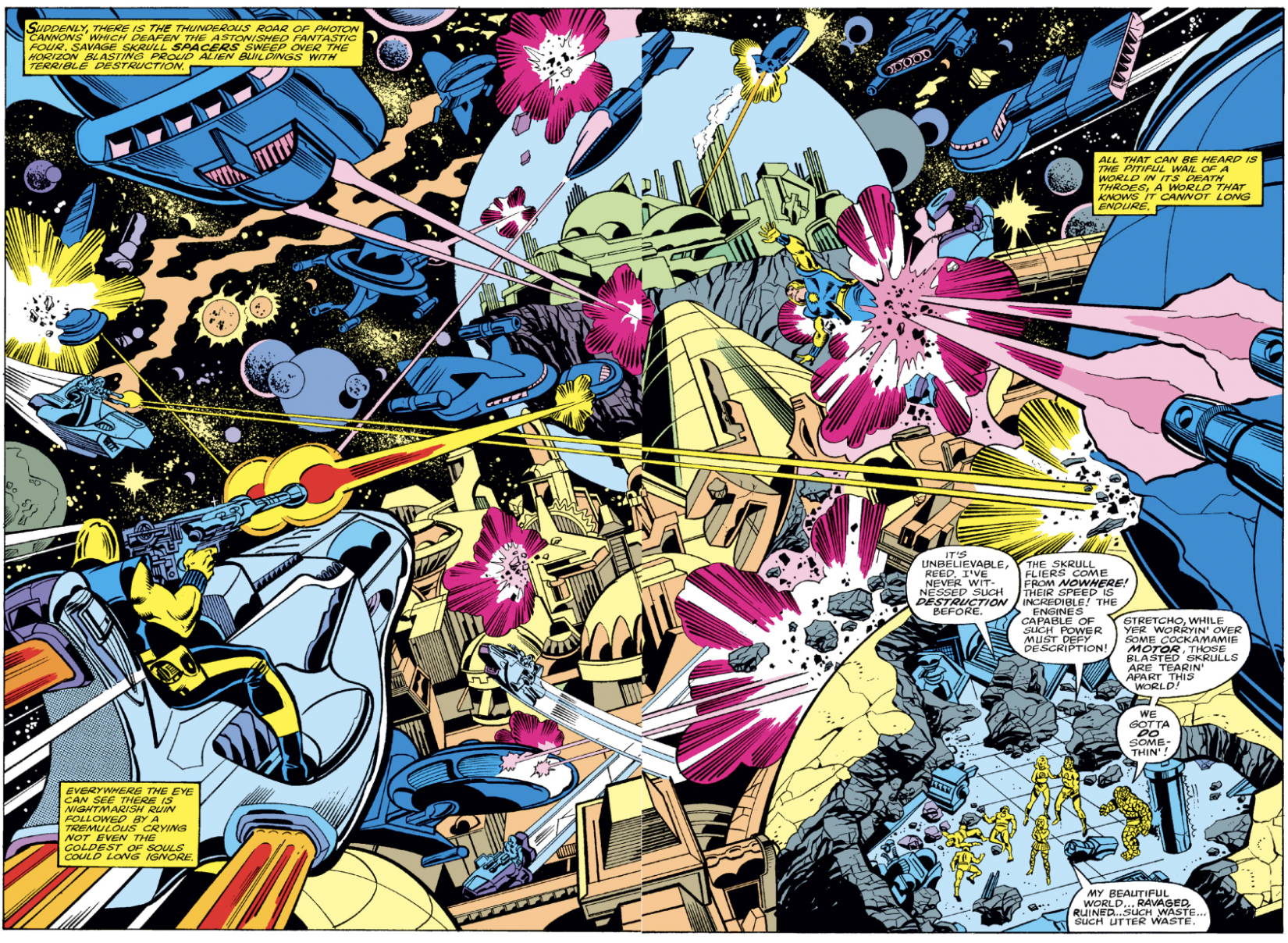
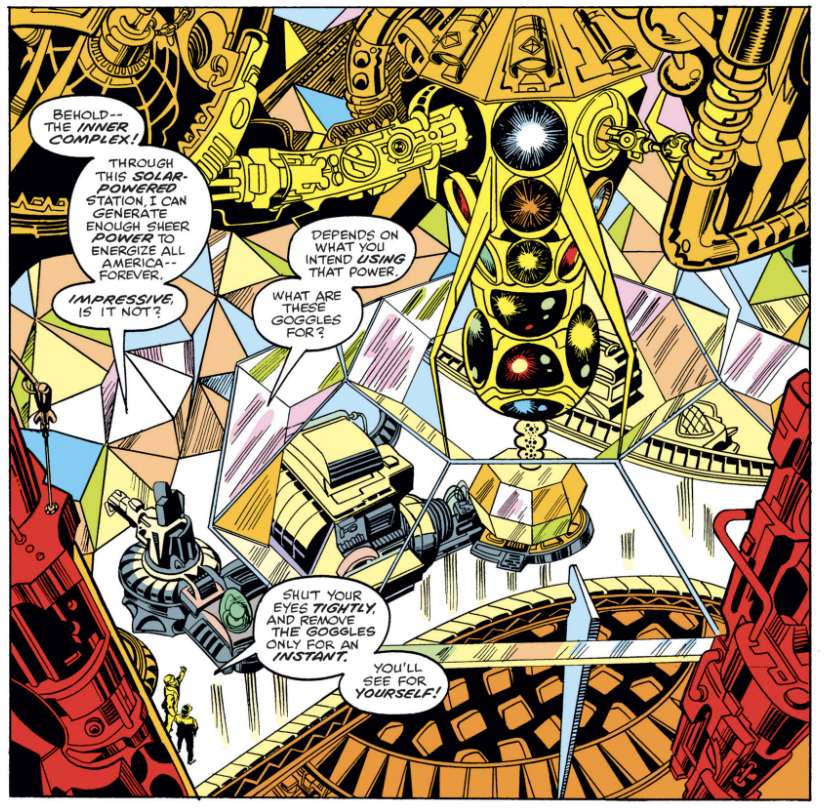
While Wolfman’s story hums along, the star is really Keith Pollard, who delivers some incredible images, including a stunning double-page spread, which needs to be seen in a comic to really do it justice. With each issue, my appreciation for Pollard grows. Like John Buscema, he seems very comfortable within the official house style, as established by Kirby and policed by Sinnott, yet brings a flair for storytelling and dynamic panel designs.
What I liked
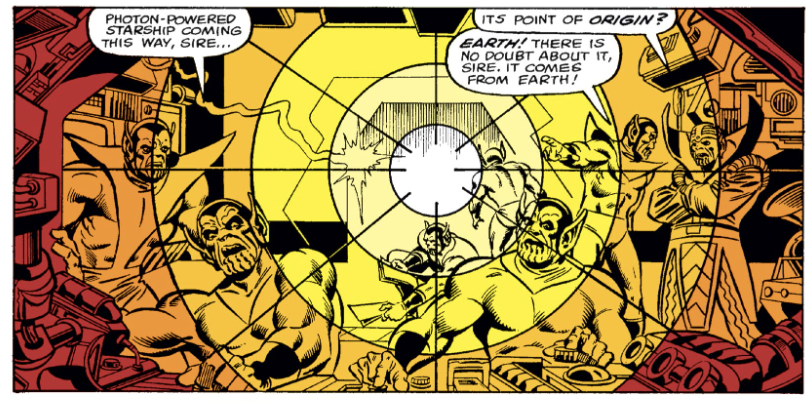
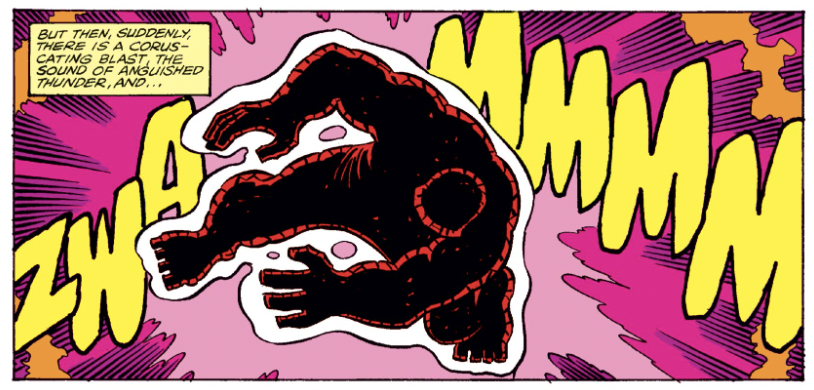
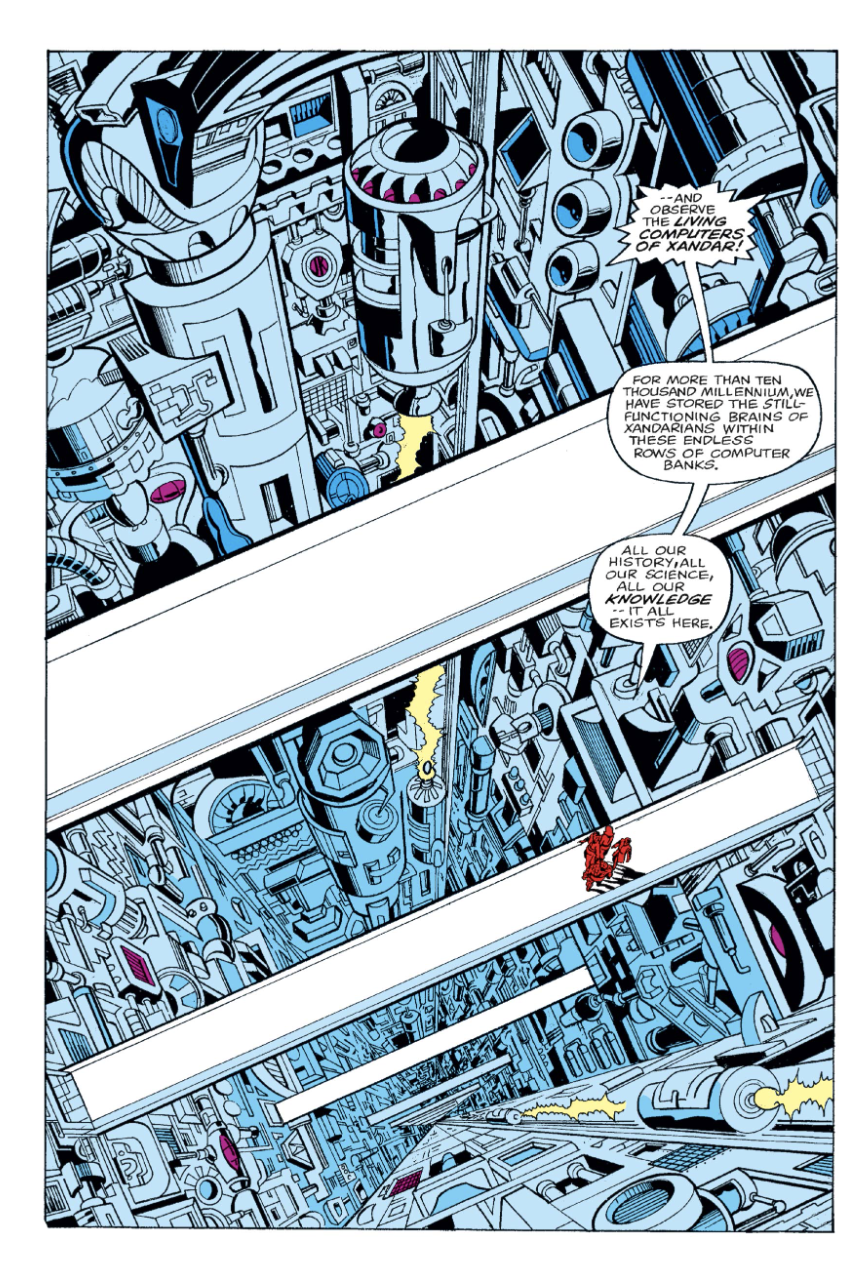
Here’s some more Pollard:
What I didn’t like
There are a number of odd elements in this comic, such as the narrator’s description of Ben as a “monstrous orange-hided Thing.”
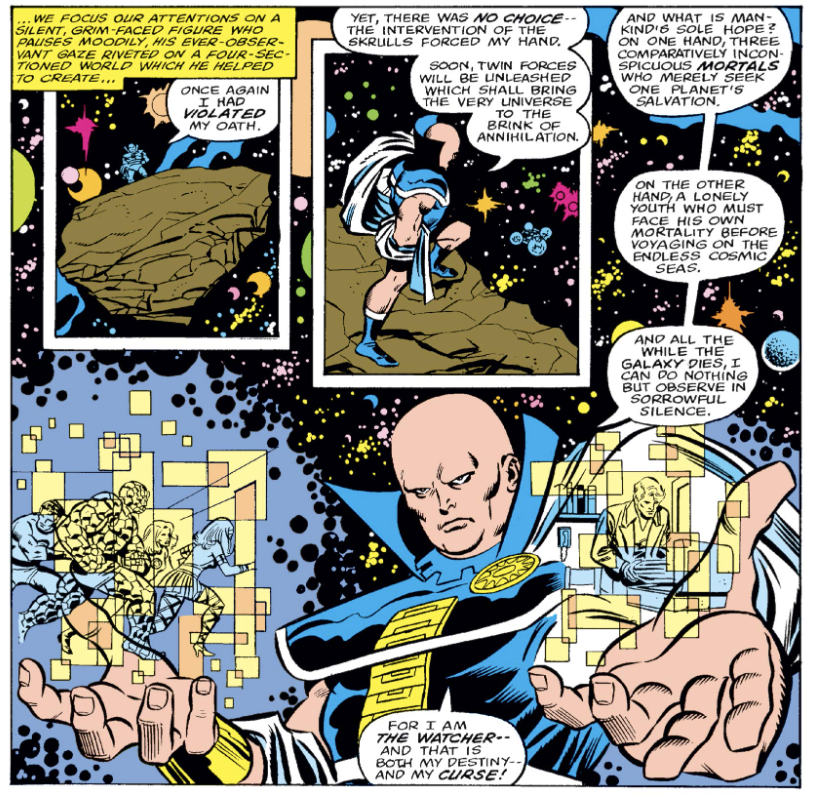
The Watcher shows up and, of course, violates his oath. has there been a comic where he actually honors his oath? I would never lend that guy money because his word is just no good.
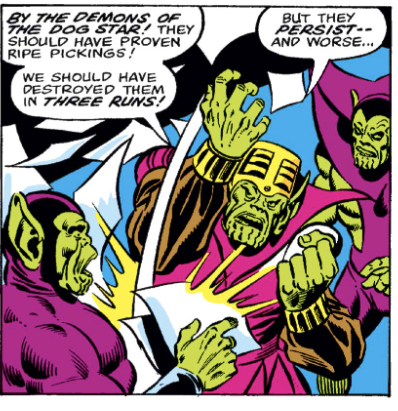
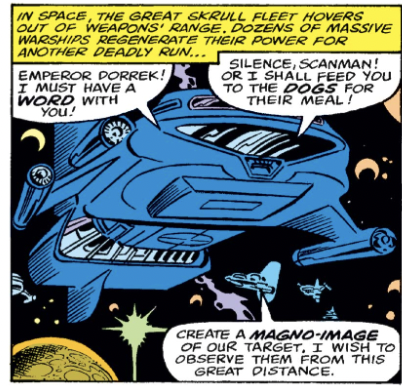
For an alien race, the Skulls seem very obsessed with dogs. Do they even have dogs?
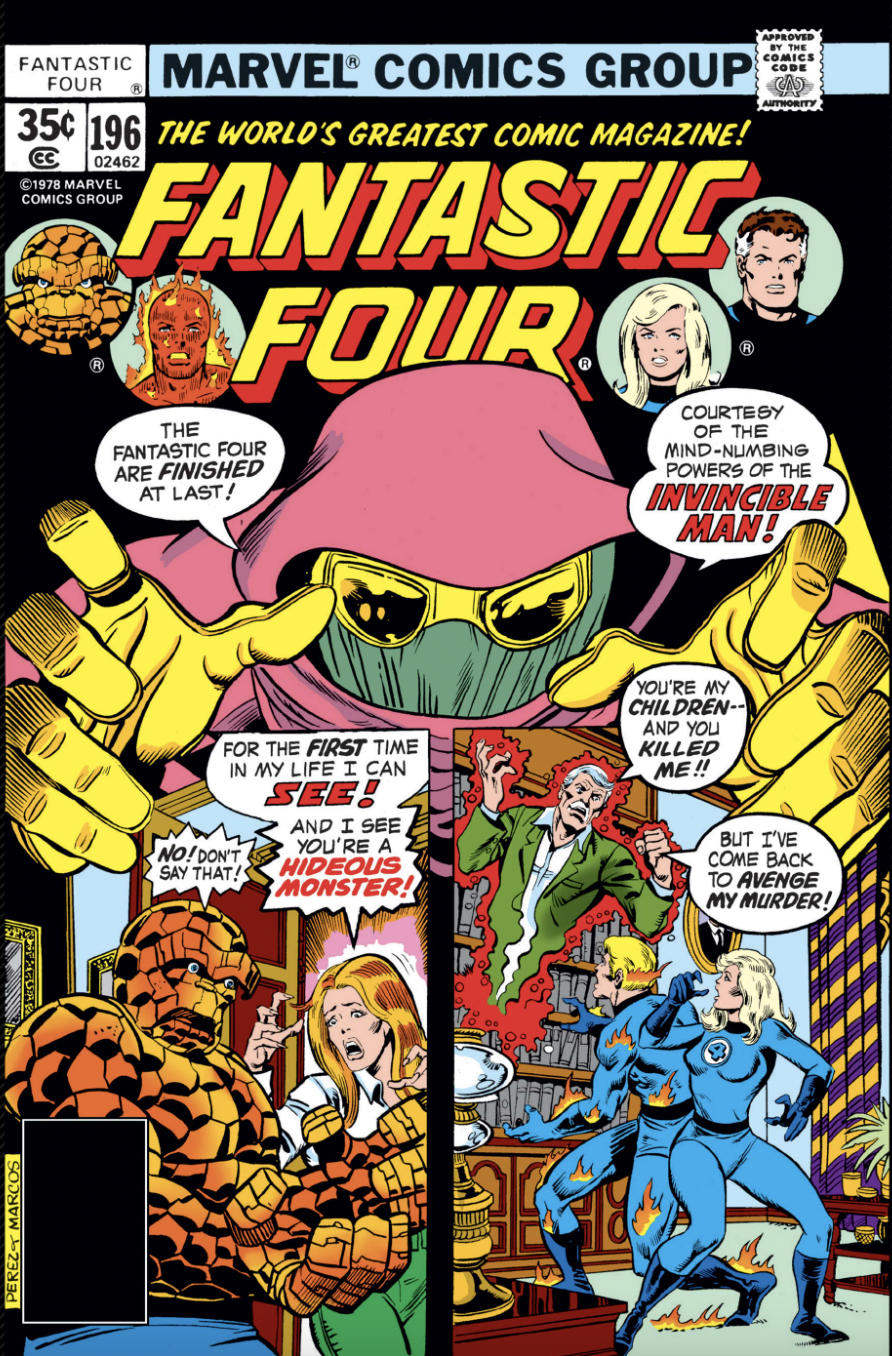
Fantastic Four 196 “Who In The World Is The Invincible Man?” Published April 1978 Writer: Marv Wolfman Layouts: Keith Pollard Finishes: Pablo Marcos Letters: Joe Rosen Colors: Glynis Wein Editors: Marv Wolfman and Jim Shooter Cover: George Perez and Pablo Marcos
Synopsis
The Thing and the Human Torch join the Invisible Girl, Franklin and Agatha Harkness in Los Angeles, where they are confronted by what appears to be the Invincible Man, and are overcome by his mental powers. They are imprisoned by the same mysterious evil-doers who have captured Mr. Fantastic, who was in fact the man in the Invincible Man’s disguise. The team, reunited in a prison cell, manages to escape, only to discover their captor is Dr. Doom.
What’s going on here?
One drawback to this exercise of retroactively reviewing comics published 50 years ago is it’s hard to gauge the impact of certain plot developments. In this issue, we learn on the last page that Dr. Doom is the mysterious villain behind Reed’s abduction. Unfortunately, I knew this was coming, so there wasn’t much suspense of me. But I imagine it was a big surprise for at least some readers at the time. If so, it would ratchet up a very good comic into an excellent one.
This is the first appearance of Doom in the FF since issue 157, an eternity by the standards of today, when he appears about every dozen or so issues. His intentions at this point are still pretty murky and the plot is confusing but I think it’s safe to assume it will all build up to a big conclusion in issue 200.
The Invincible Man is a bit of an oddity, since there never really was an Invincible Man. It started off as an identity created by the Super-Skrull who was masquerading as Sue and Johnny’s father, back in issue 32. Then we have this appropriation of the Invincible Man identity by a hypnotized Reed. And in issue 287, Doom — in the body of Norman McArthur — again uses the Invincible Man identity.
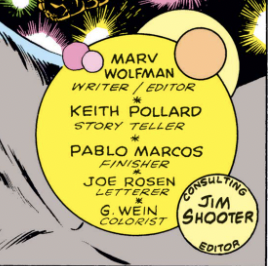
Like last issue, the art is by Keith Pollard, who seems to be just doing layouts, and Pablo Marcos, whose finishes are dynamic and fun. This issue also has an interesting credit: Jim Shooter, as “consulting editor.” Shooter had recently taken over as Marvel editor-in-chief, ending a half decade of dysfunction and ushering in a period of growth and stability. Shooter, who passed away this year, wasn’t universally beloved but it’s hard to argue with his success.
What I liked
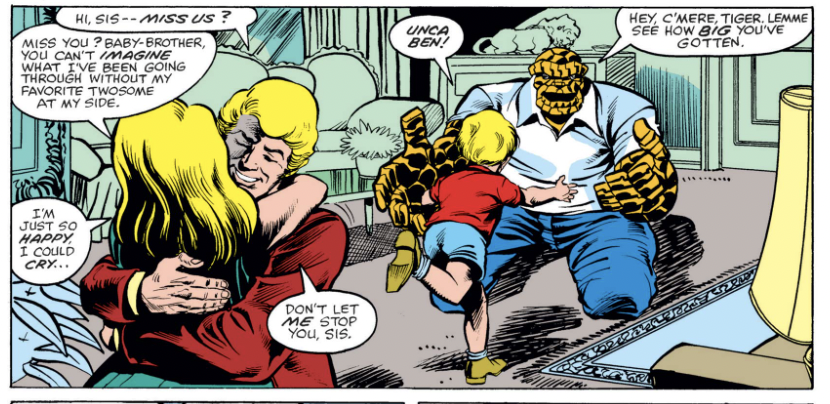
Sue and Franklin’s reunion with Ben and Johnny is touching and well written by Marv Wolfman.
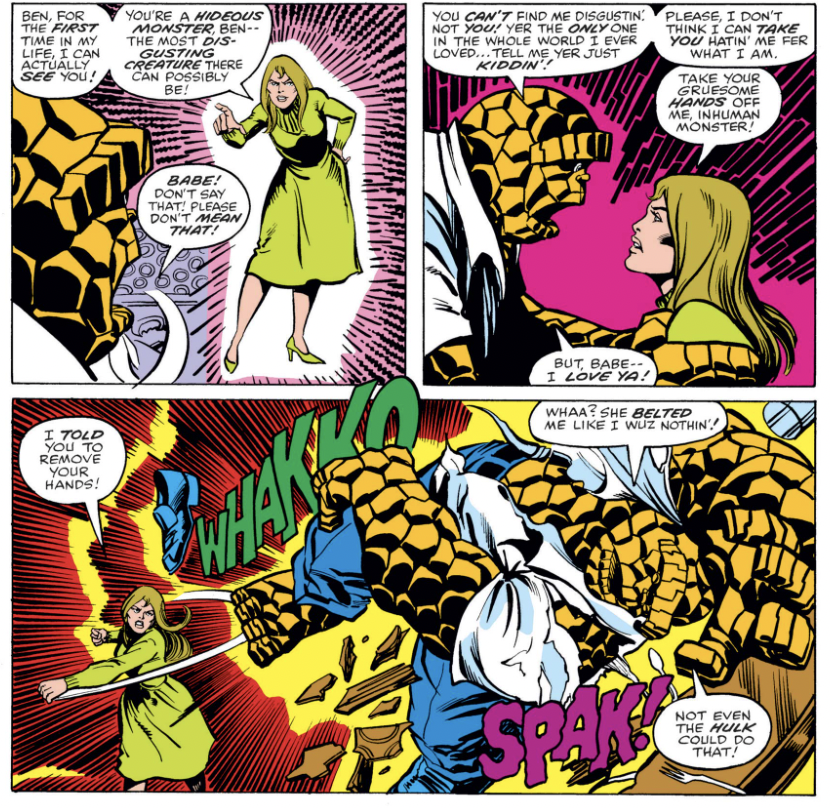
I liked this sequence of a phantom Alicia beating the snot out of Ben.
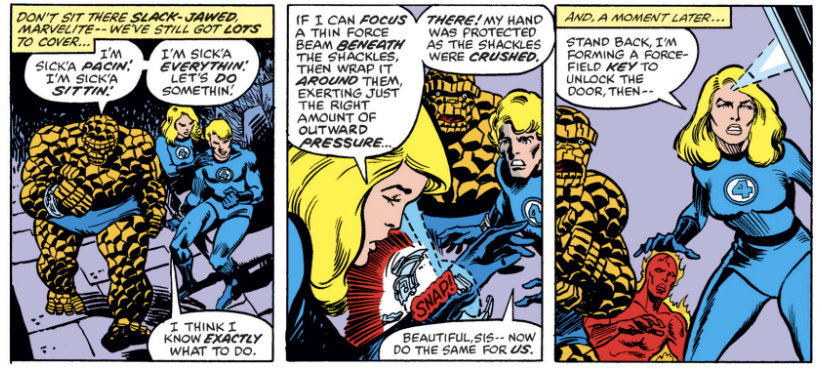
Wolfman seems to be continuing Len Wein’s project of powering up Sue, expanding the use of her powers and making her more of an asset. It’s a welcome change.
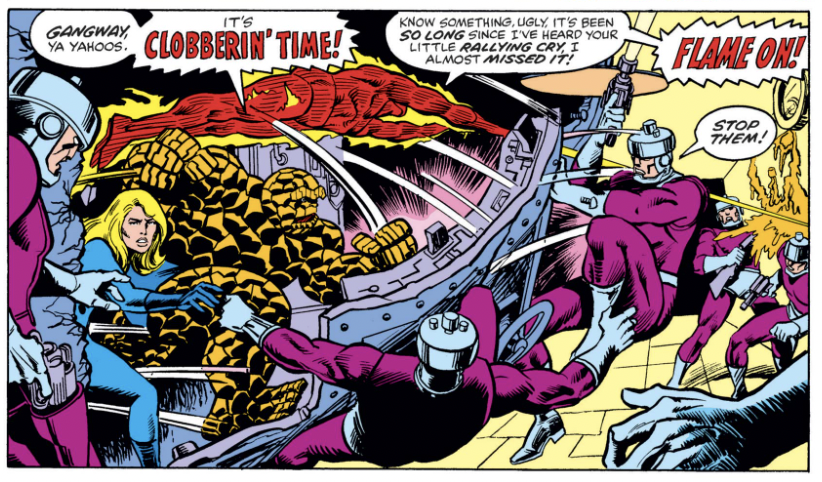
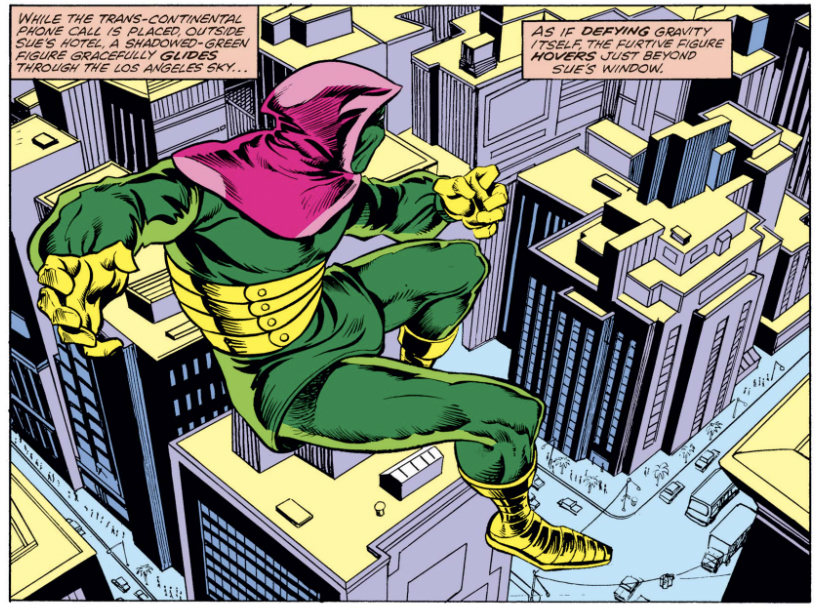
As mentioned, the Pollard/ Marcos combination is very successful. Here’s an example:
and another:
What I didn’t like
Wolfman seems obsessed with all thing Hollywood, and as in the previous issue, is eager to beat this horse to death. What starts of as mildly amusing quickly becomes tedious, especially his running gag of the FF being mistaken for other celebrities.
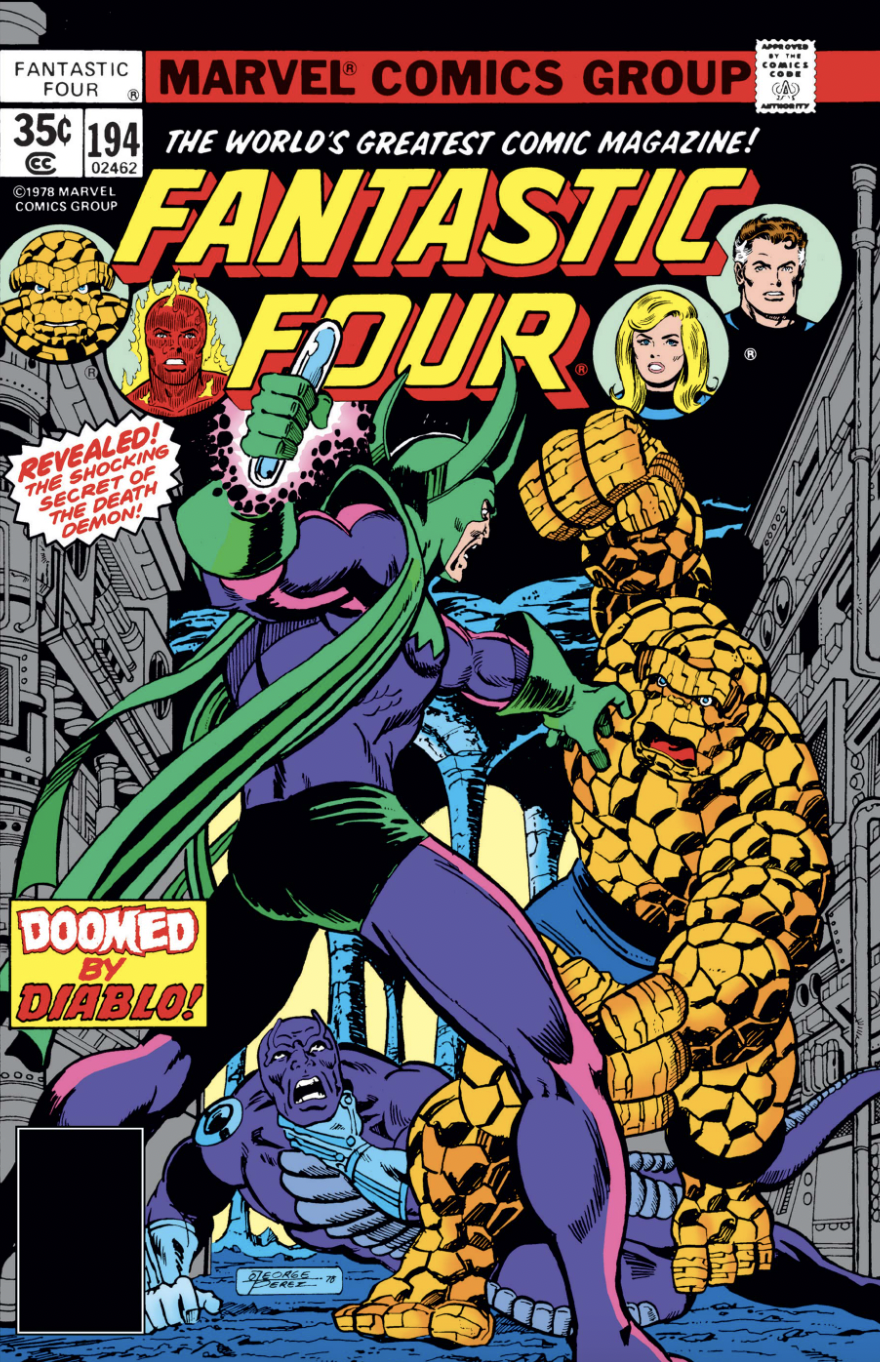
Fantastic Four 194 “Vengeance Is Mine!” Published February 1978 Plot: Len Wein & Keith Pollard Script: Bill Mantlo Pencils: Pollard Inks: Dave Hunt Letters: Annette Kawecki Colors: George Roussos Editor: Marv Wolfman Cover: George Perez
Synopsis
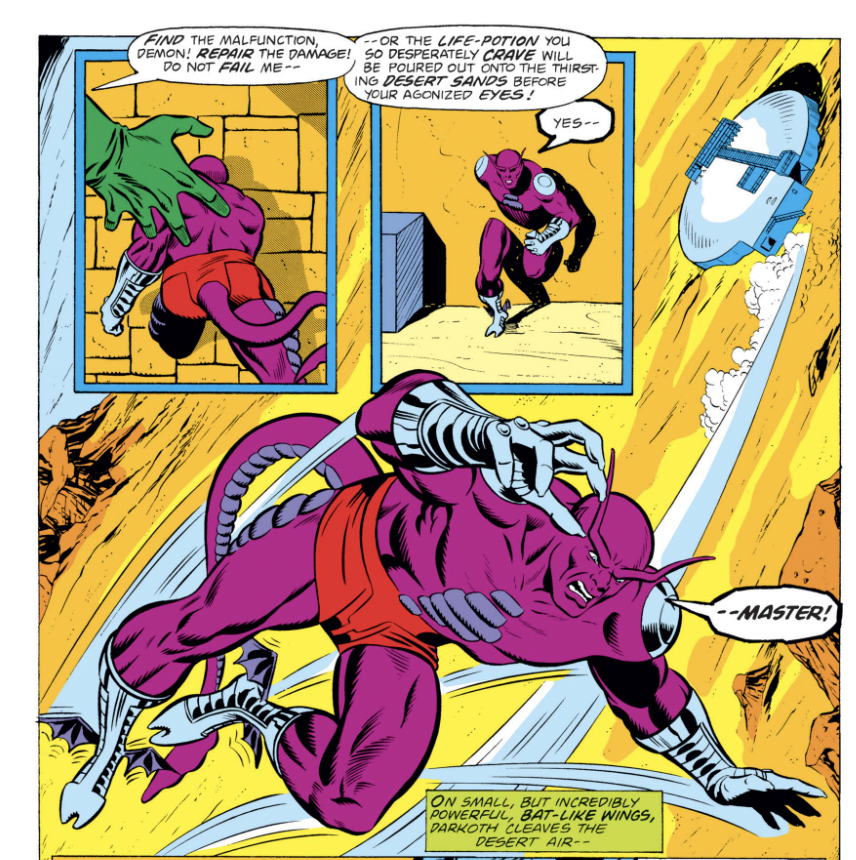
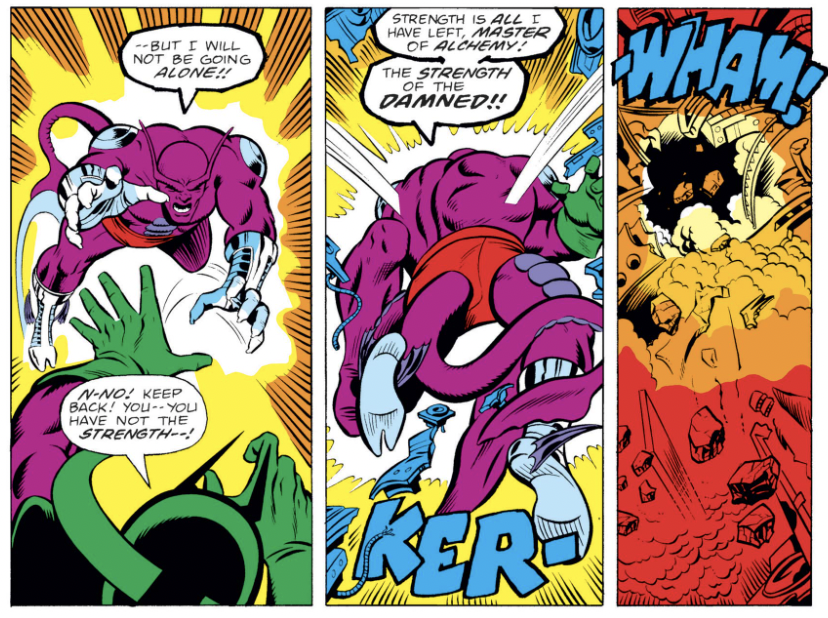
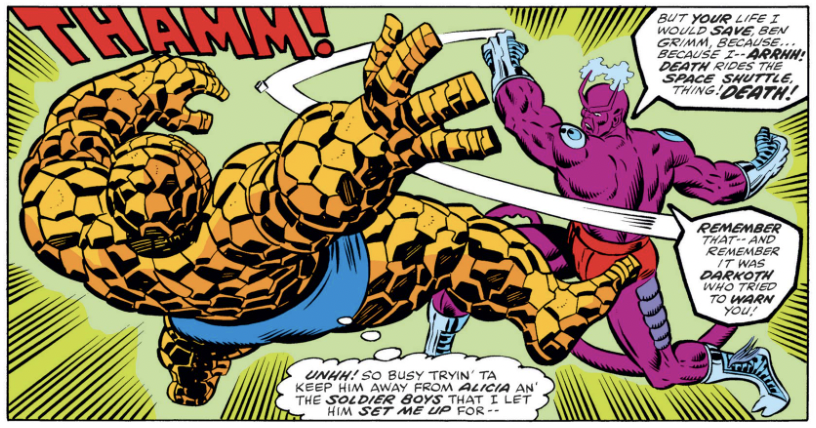
After surviving the crash of the Solar Shuttle, the Thing confronts Darkoth, who eventually overcomes a spell by Diablo and reveals to Ben he is his old friend Desmond Pitts. Ben then battles Diablo and is about to be killed by a solar cannon when Darkoth turns against Diablo, sacrificing himself to save Ben.
What’s going on here?
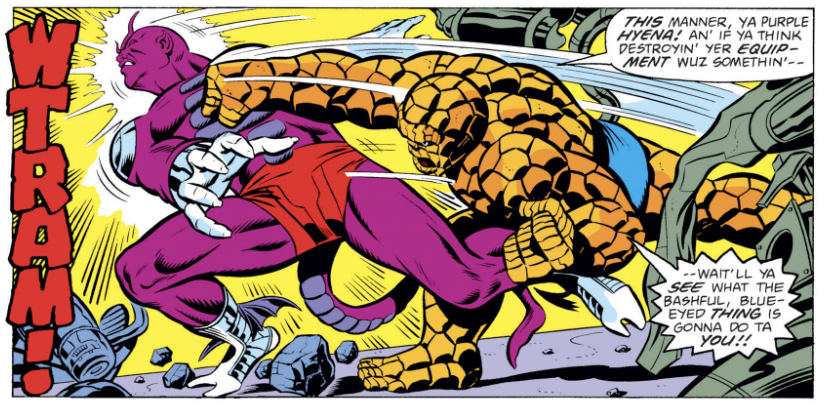
This comic efficiently wrap up the two-part Ben solo story while resolving the Darkoth storyline. If you didn’t think Darkoth was going to die in some noble fashion, then I guess you haven’t read many comic books. But despite its predictability, it’s a solid story and enhanced by the attractive Keith Pollard/ Dave Hunt artwork.
The next solo story, featuring Sue and the Sub-Mariner, is teased in a short cutaway, but other than that, the story is all Ben’s. No Reed or Johnny.
This the rare FF of this era not inked by Joe Sinnott but Hunt’s inks look great over Pollard’s pencils. Hunt is an interesting case; he seems like a true comic’s journeyman who has hundreds of credits as inker, letterer and colorist, and who spent a big chunk of his career on second- and third-tier titles like The Little Mermaid and Scooby-Doo. This is his second and last issue of the Fantastic Four.
Annette Kawecki is credited as the letterer, her first and only Fantastic Four credit. And George Perez returns to deliver an amazing cover.
What I liked
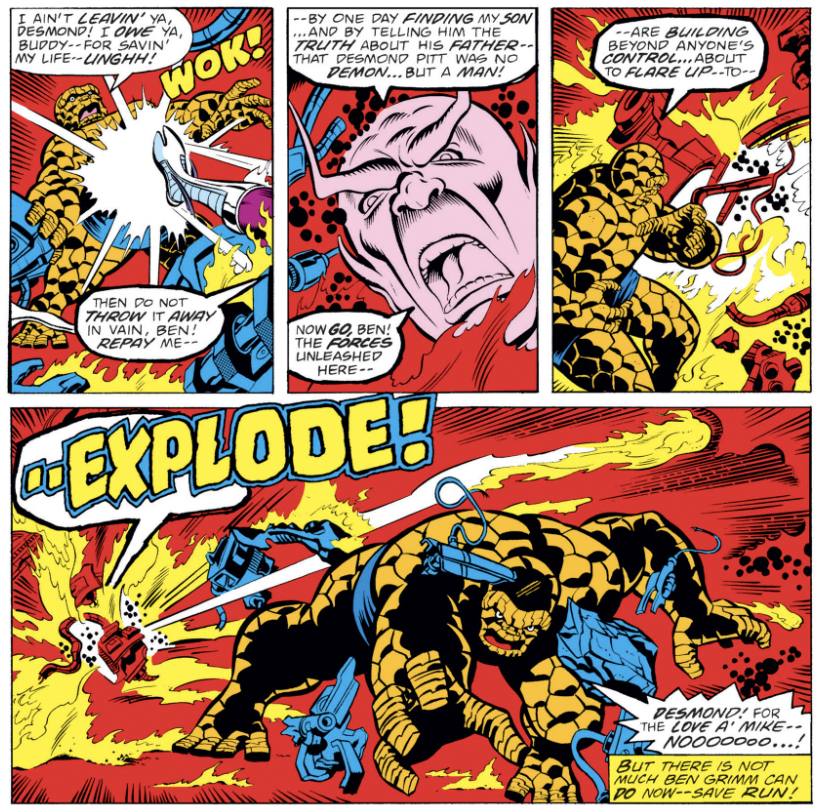
Even though we could see it coming from a mile away, there was a poignancy to Darkoth reclaiming his humanity by turning on Diablo, knowing it meant his death. Also note the great, over-the-top dialogue by Bill Mantlo, a master of purple prose.
And then, of course, comes his classically melodramatic death scene.
What I didn’t like
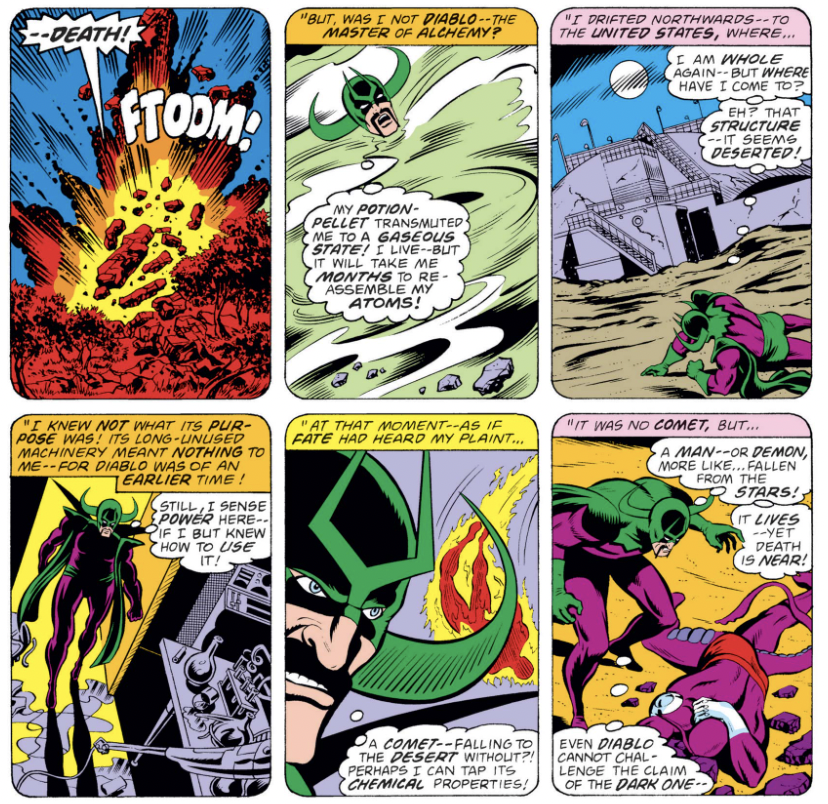
Even for a comic book, Diablo’s explanation of how he survived his seeming death and discovered Darkoth is hard to swallow.
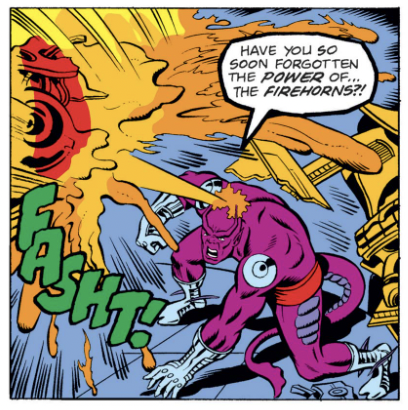
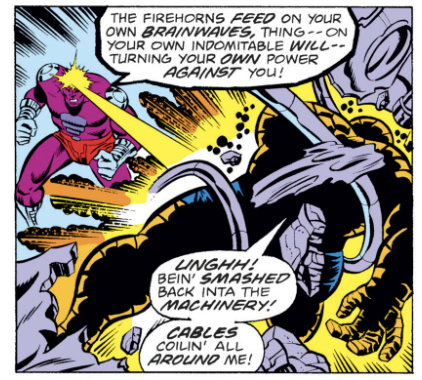
Also, these “firehorns” are dumb.
Anything else?
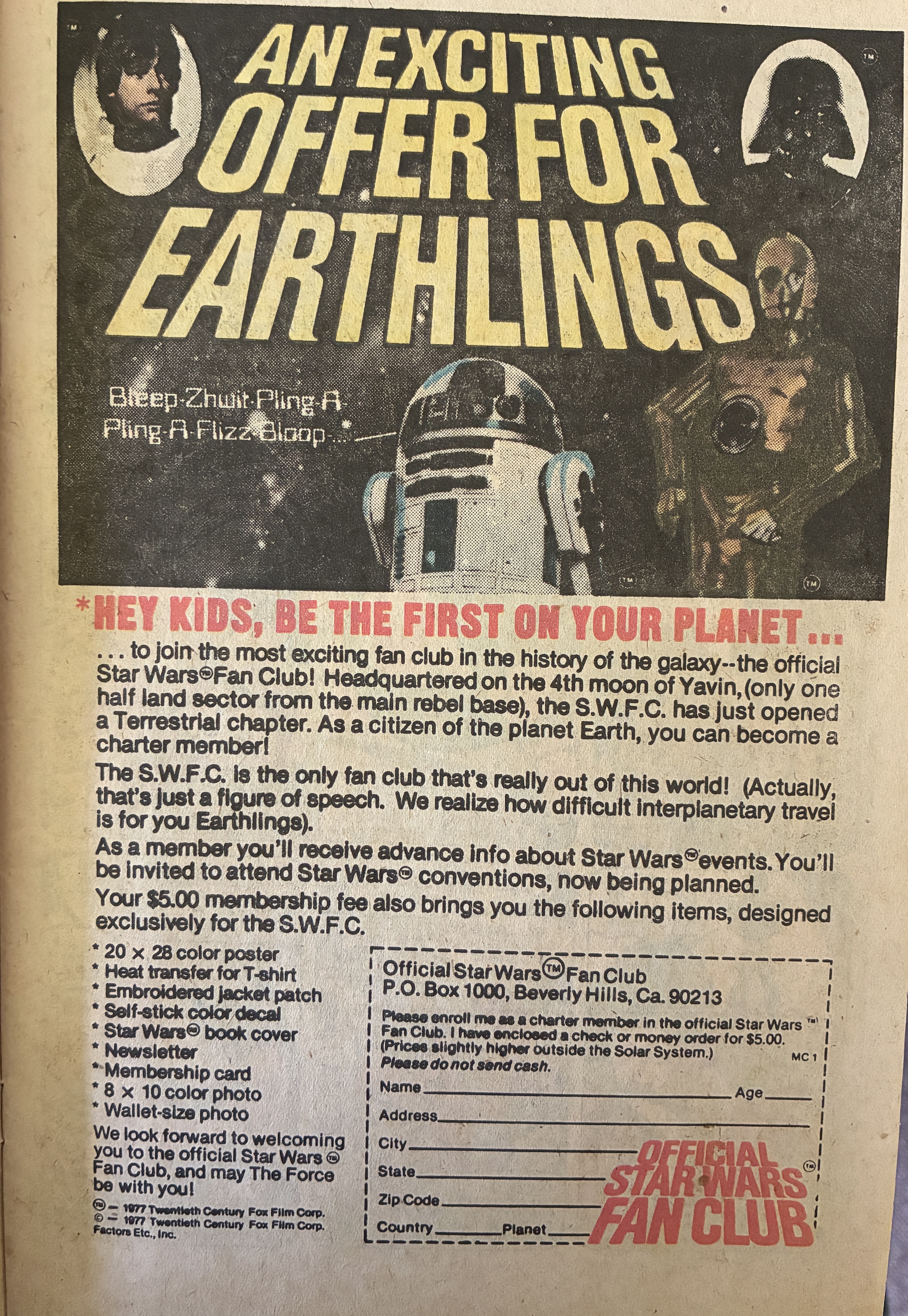
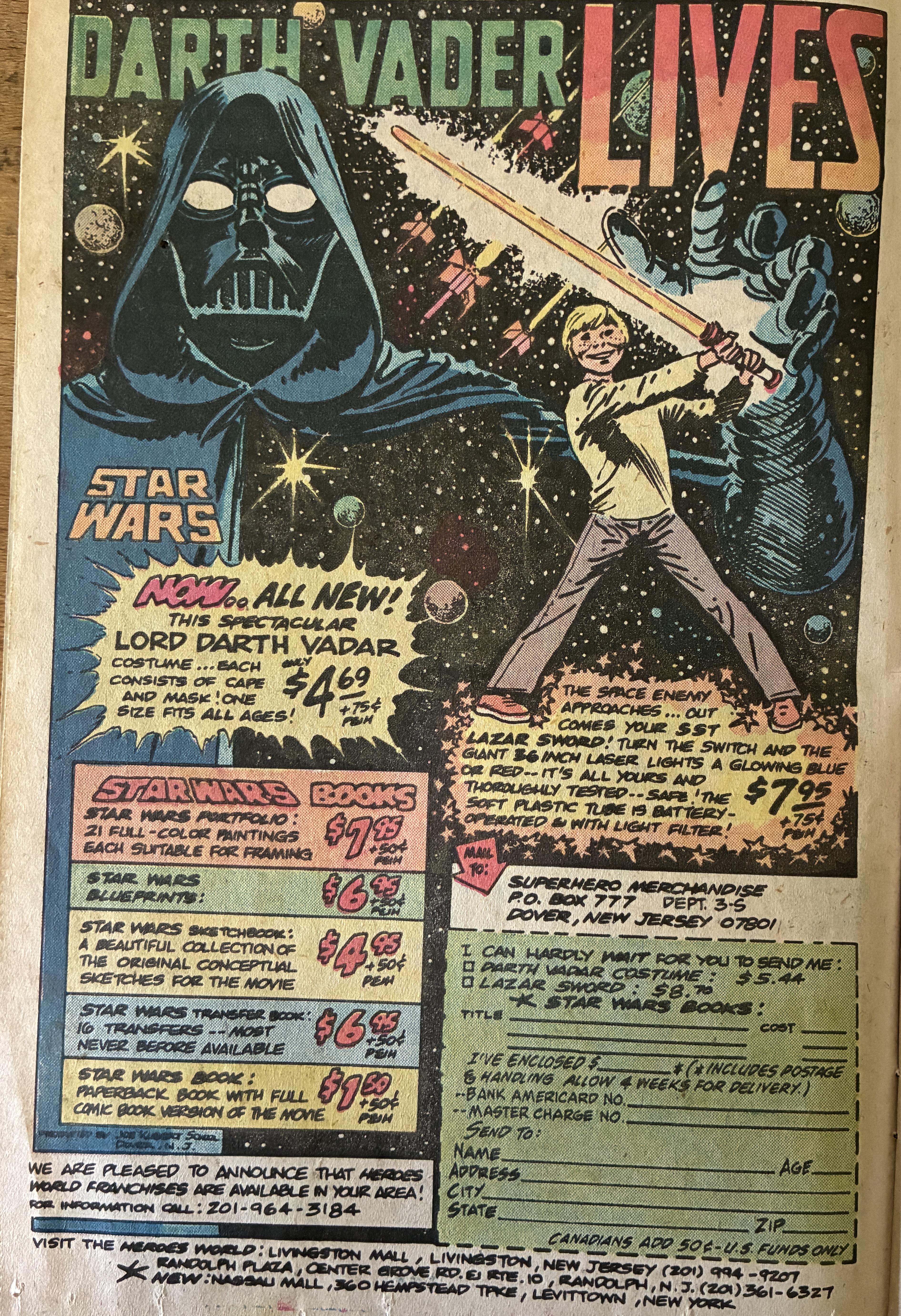
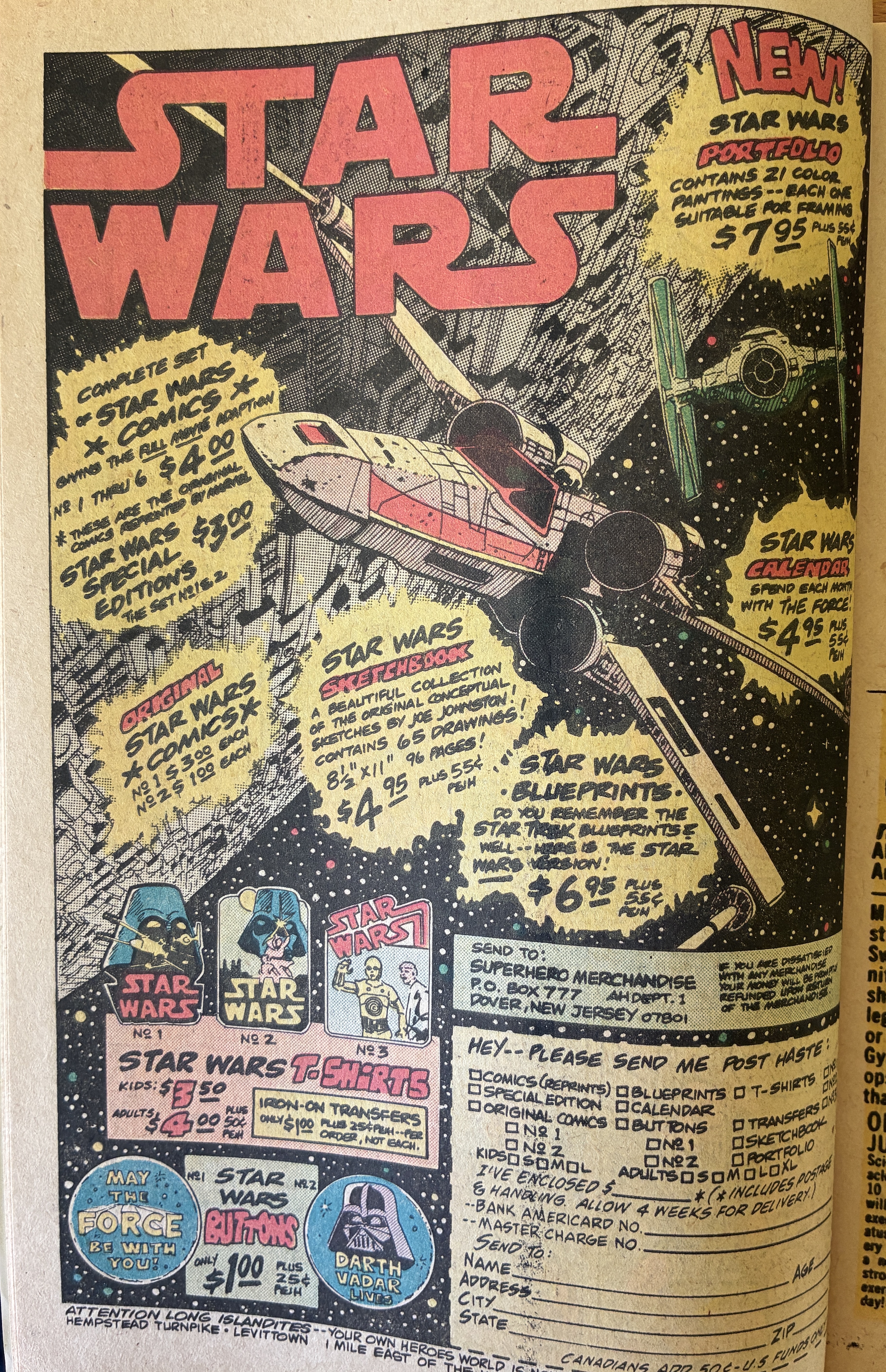
More Star Wars-related ads this month:
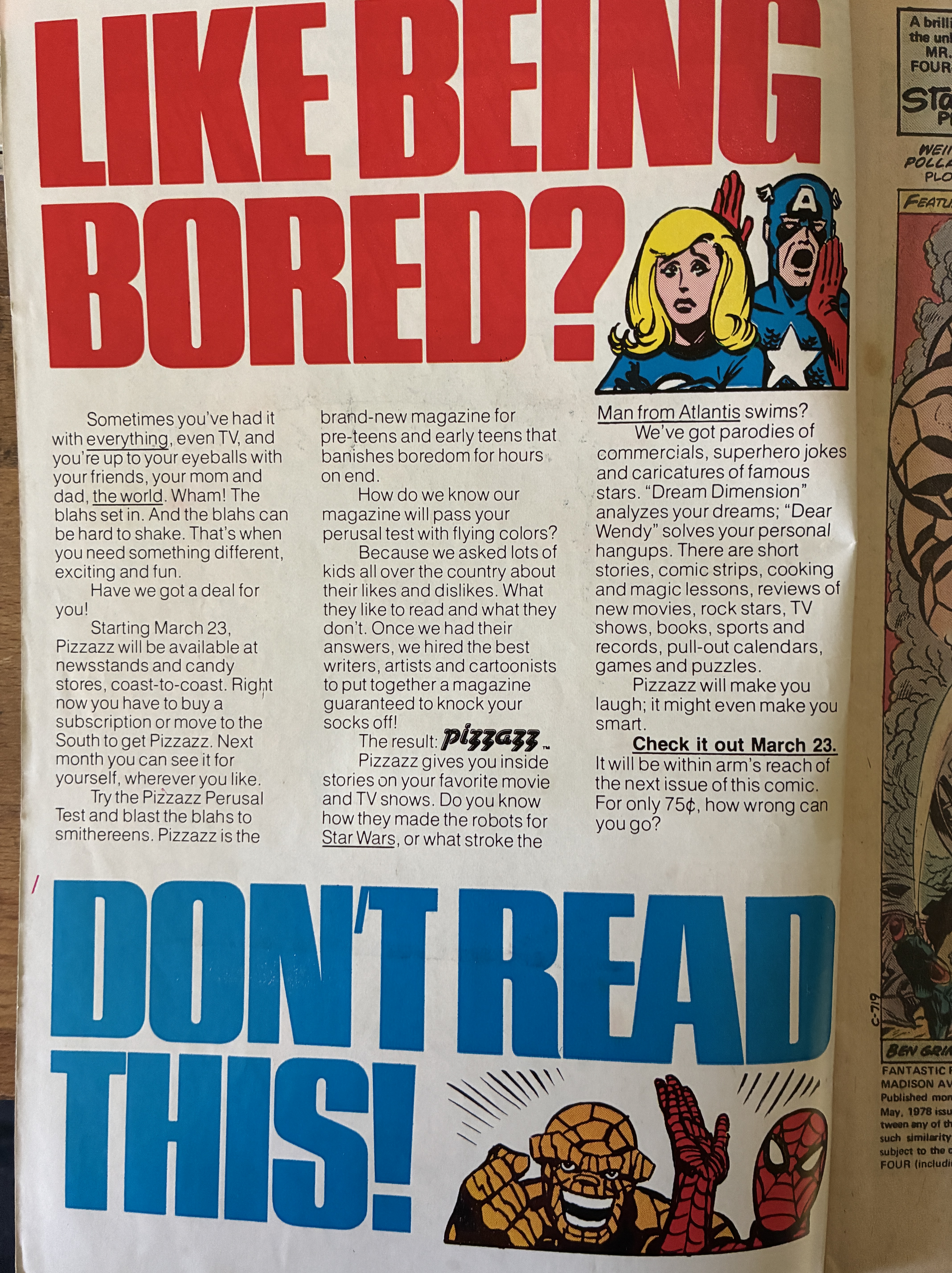
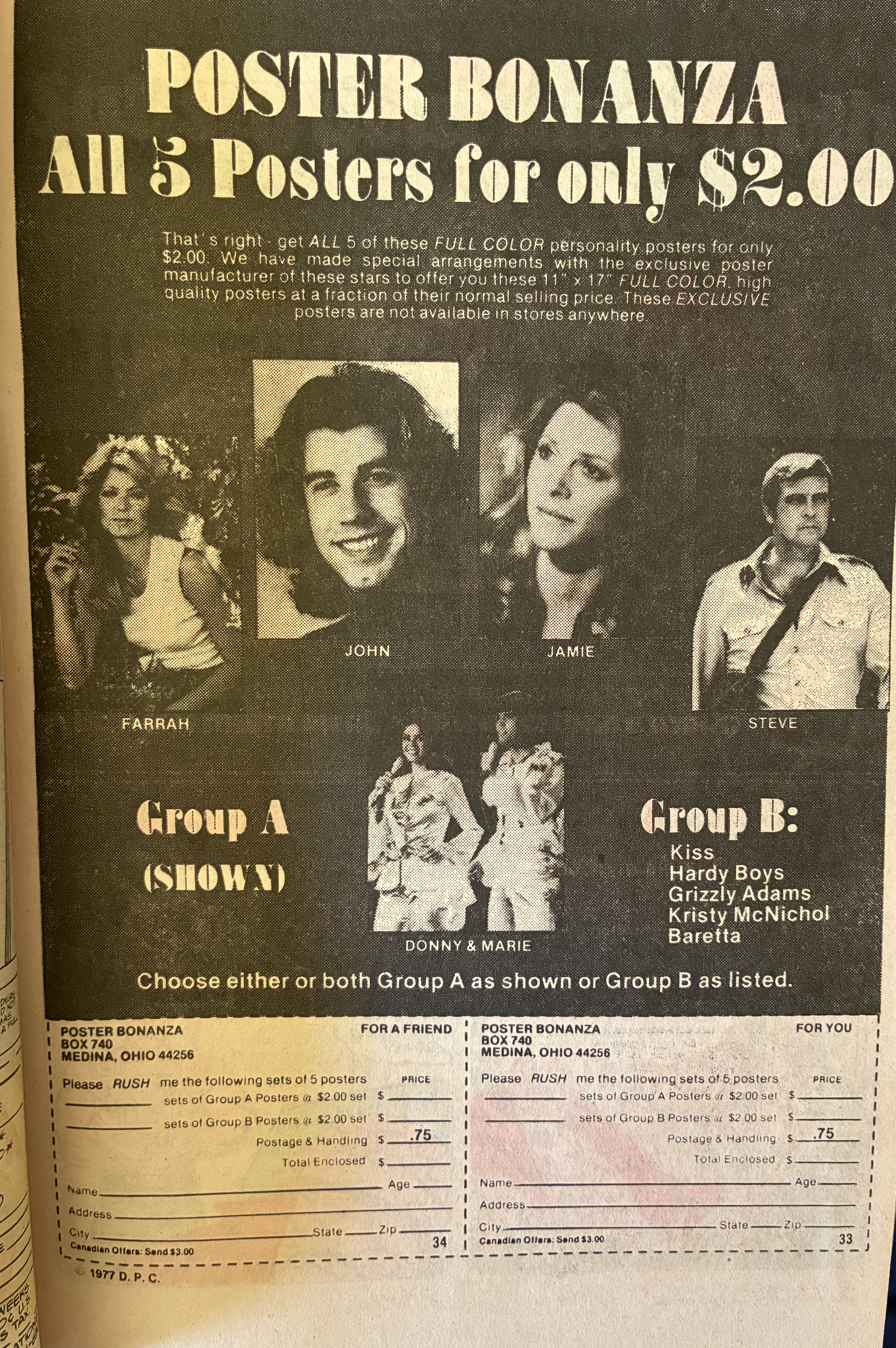
Plus some other interesting ads, including another odd one for Pizzaz. Again, I can’t imagine buying this magazine based on these ads.
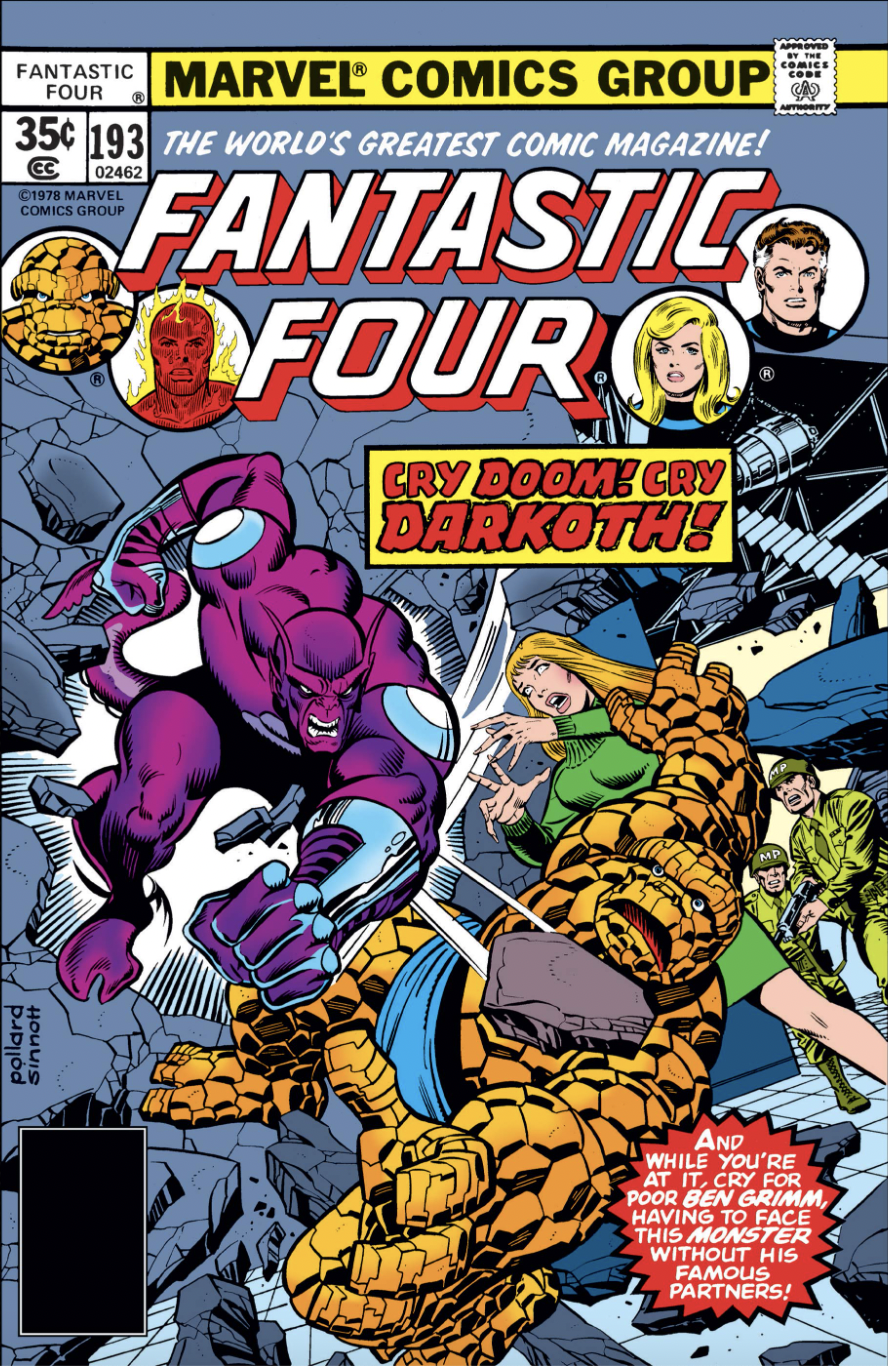
Fantastic Four 193 “Day of the Death-Demon!” Published January 1978 Plot: Len Wein and Keith Pollard Script: Bill Mantlo Pencils: Pollard Inks: Joe Sinnott Letters: Joe Rosen Colors: Françoise Mouly and Janice Cohen Editor: Marv Wolfman Cover: Pollard and Sinnott
Synopsis
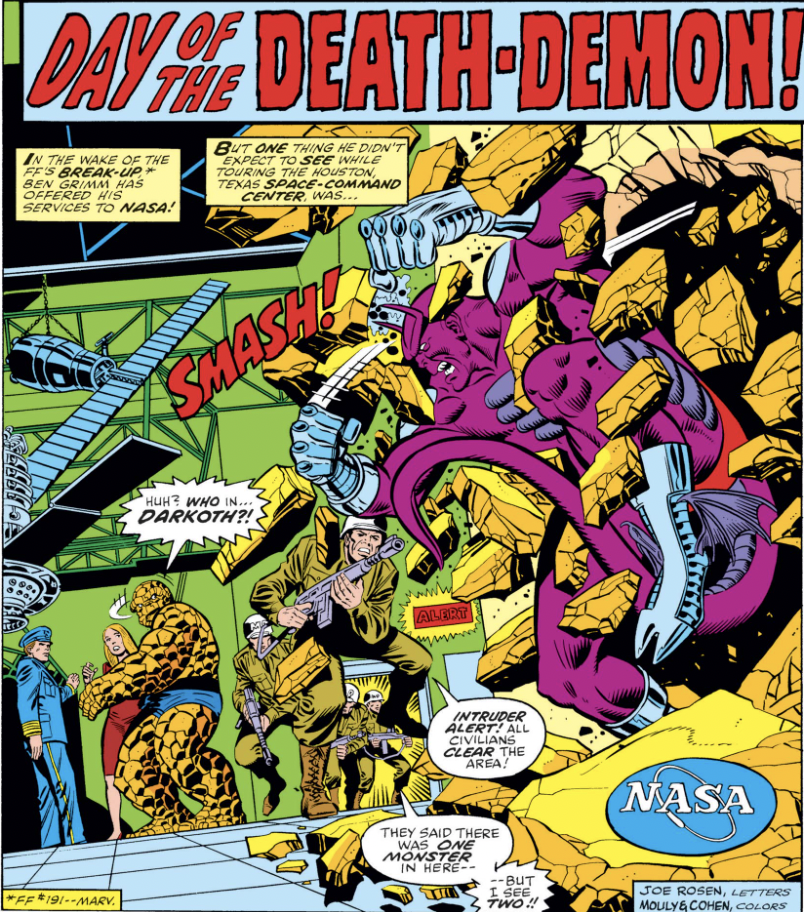
After the breakup of the Fantastic Four, the Thing is lending his services to NASA as a test pilot. As he prepares for a space shuttle flight, the NASA facility is attacked by Darkoth, the cyborg demon created by Dr. Doom who was supposedly killed with Doom in issue 144. It’s later revealed that Darkoth was once Desmond Pitt, a former test pilot and friend of Ben’s who was accused of selling secrets to Latveria. Darkoth is now under the sway of Diablo, who picks up the pieces of a plot begun by Dr. Doom, who had sabotaged the plans of the space shuttle so it could be controlled by an outside agent. Diablo then attacks the shuttle while Ben is orbiting Earth, and Ben tries to land the craft before it explodes into flame upon crash landing.
What’s going on here?
The recent death of guitarist Ace Frehley (RIP) reminded me of an odd marketing stunt by Kiss. In 1978, the four members simultaneously released four solo albums, before reforming and releasing albums as a band again.
That feels a little like what’s going on during this period of the Fantastic Four. Ostensibly broken up (but, like Kiss, destined to regroup), the team members went off in four separate directions and are having four separate solo adventures. Last issue featured Johnny’s adventures in the wild west, and in that issue and this one, we are teased with glimpses into the current activities of Reed and Sue, which promise to blossom into their own solo stories before the team presumably gets back together before issue 200.
This issue features the return of Darkoth and a noir-ish mystery involving disgraced old friends and sinister plots. It doesn’t always work, but it’s an ambitious attempt and I give the writing troika of Len Wein, Keith Pollard and Bill Mantlo credit for trying it.
This issue marks the first of Pollard’s run on the Fantastic Four, and closes the door on George Perez’s all-too-short stint. Perez will return for two FF annuals, and will continue to draw the Avengers and Marvel Two-in-One before departing permanently for DC in 1980. Perez ultimately drew 17 issues of the FF over three years, and while their quality was uneven, they mark some of the best pencil work on the FF between the Kirby and Byrne runs.
Pollard is a solid artist, but rarely spectacular. I would slot him in a tier with Rich Buckler, Ron Frenz and Sal Buscema: reliable but not terribly exciting. He will work on the FF until issue 206, then have a second run in the late 1980s.
What I liked
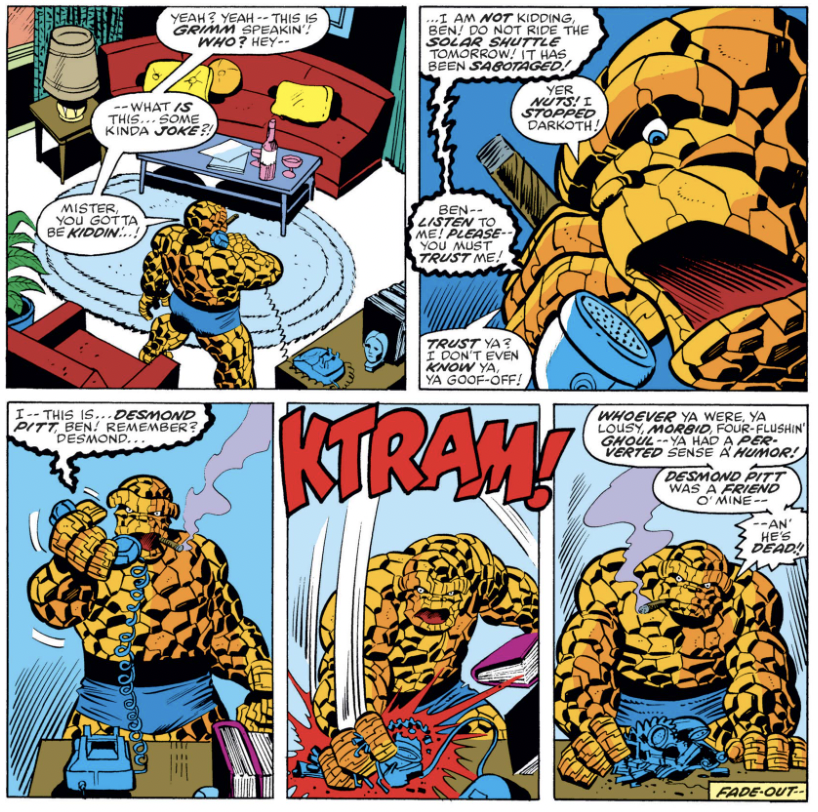
As mentioned, the Darkoth / Desmond Pitt storyline gives the story some depth, while also giving us some glimpses into Ben’s previous life as a test pilot. I enjoyed about the mystery unfolds, first with a mysterious phone call:
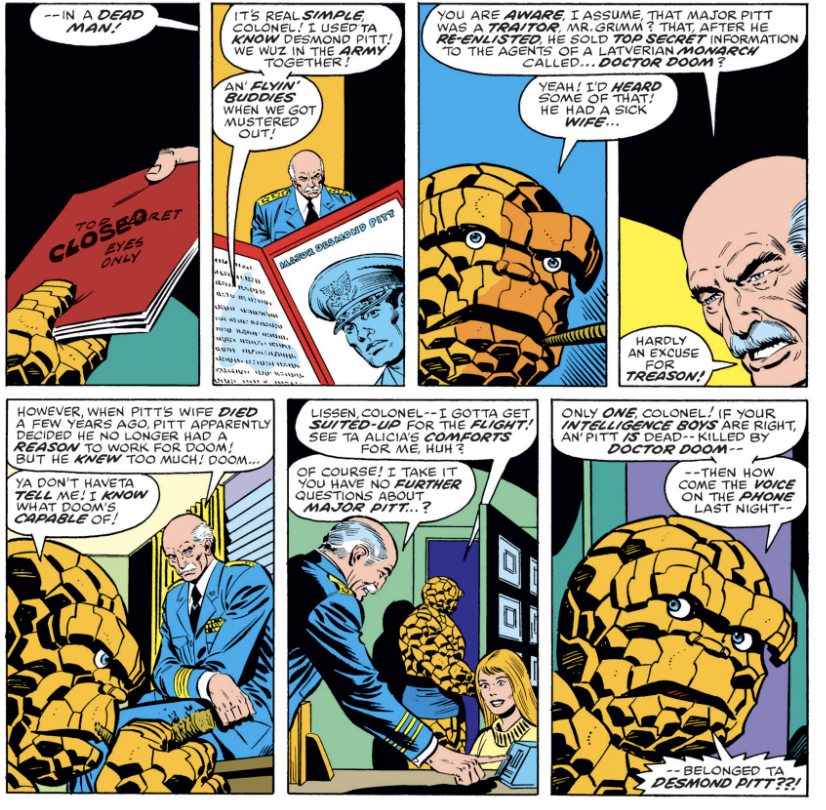
Then an investigation into Pitt’s disappearance:
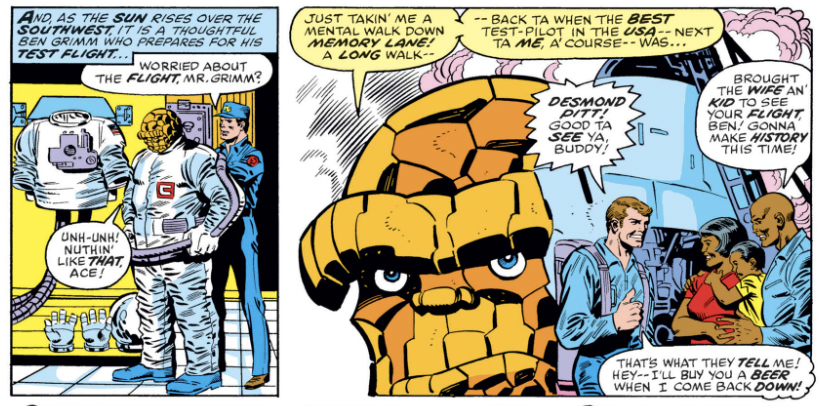
And then a flashback:
It’s of course one of those only-in-comic books coincidences that the man Doom turned into Darkoth happened to be an old friend of Ben’s, but it’s still a satisfying development.
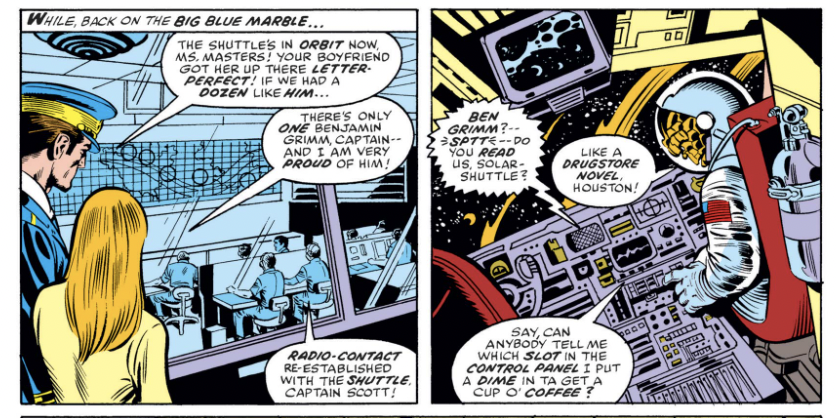
I also liked seeing Ben in his element as a pilot, first kibitzing with ground control as Alicia proudly listens in …
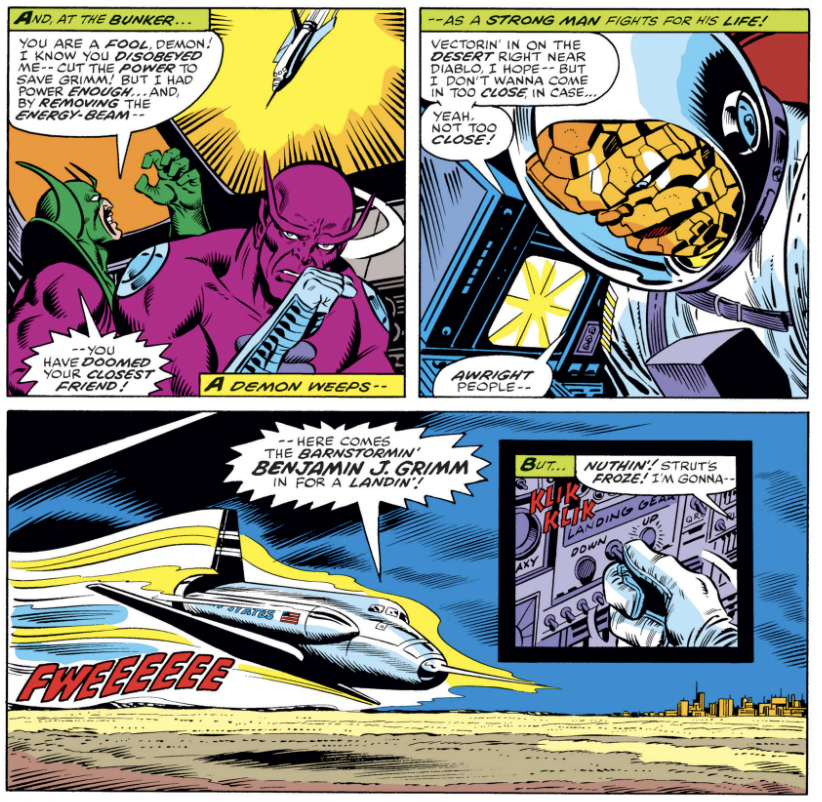
… then trying to land a powerless space shuttle …
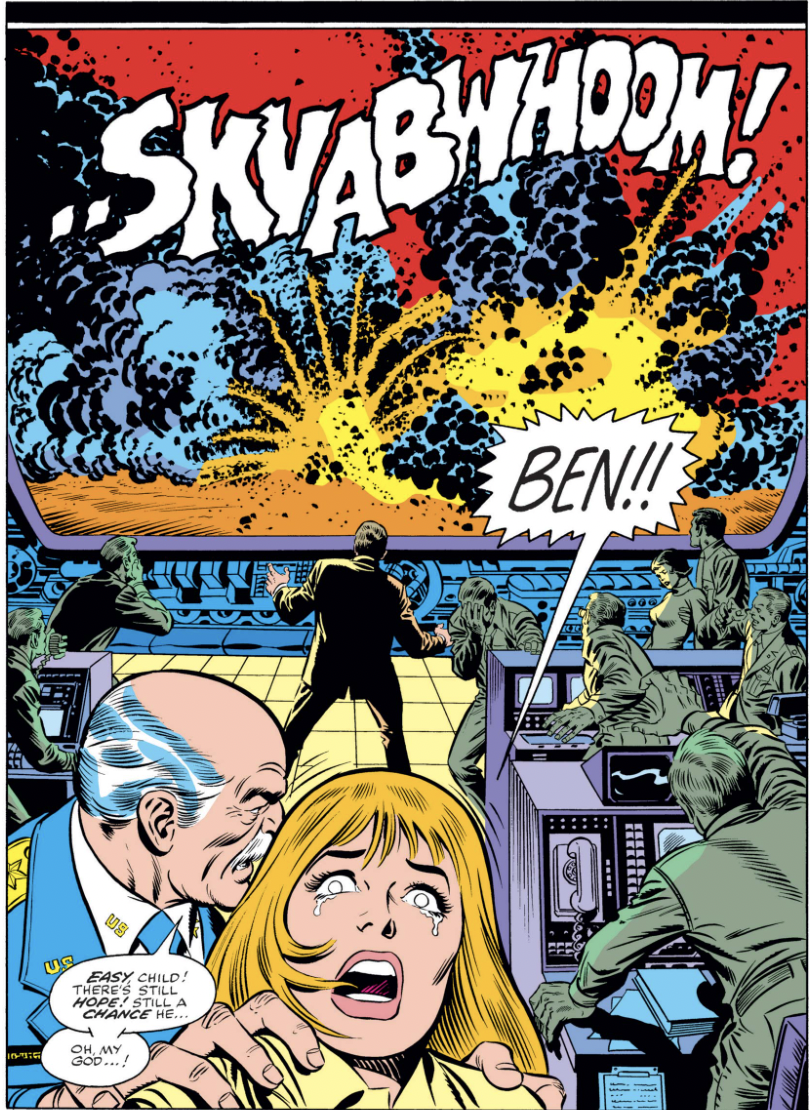
… a sequence which ends with this dramatic and alarming end to the comic:
What I didn’t like
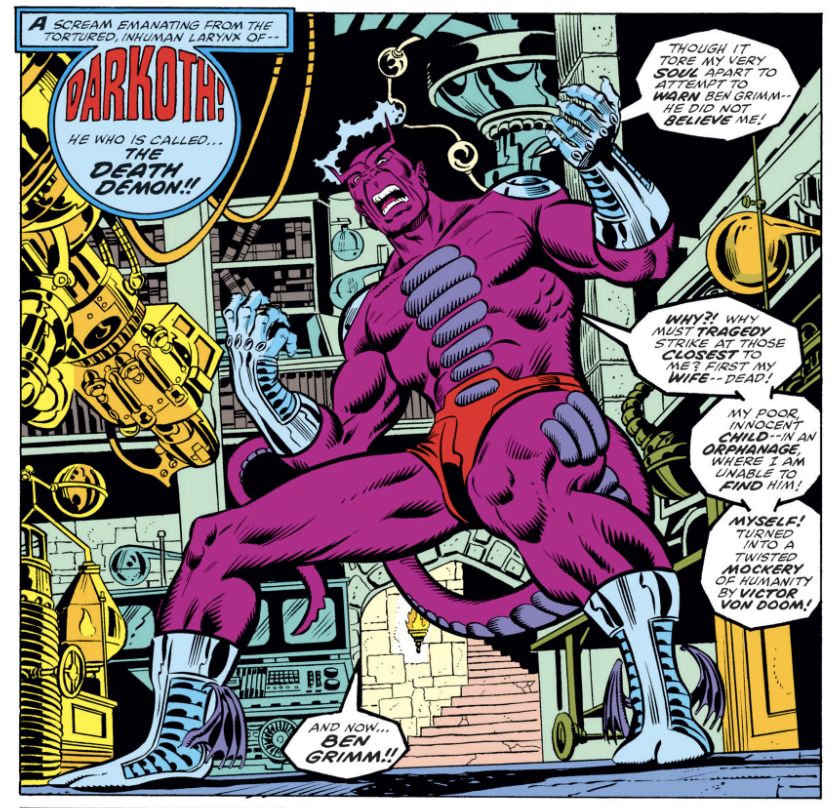
Darkoth is revealed to be normal-sounding Desmond Pitt, and it’s clear he made the call to Ben, sounding like a normal guy. So then why does he spend the rest of the comic sounding like an Asgardian?
The comic opened in media res, with Darkoth bursting through a wall at NASA. I found it confusing, and I struggled to remember if I missed some issue or scene that had Ben at NASA. And the explanation of how Diablo was taking over Doom’s scene was hard to follow as well.
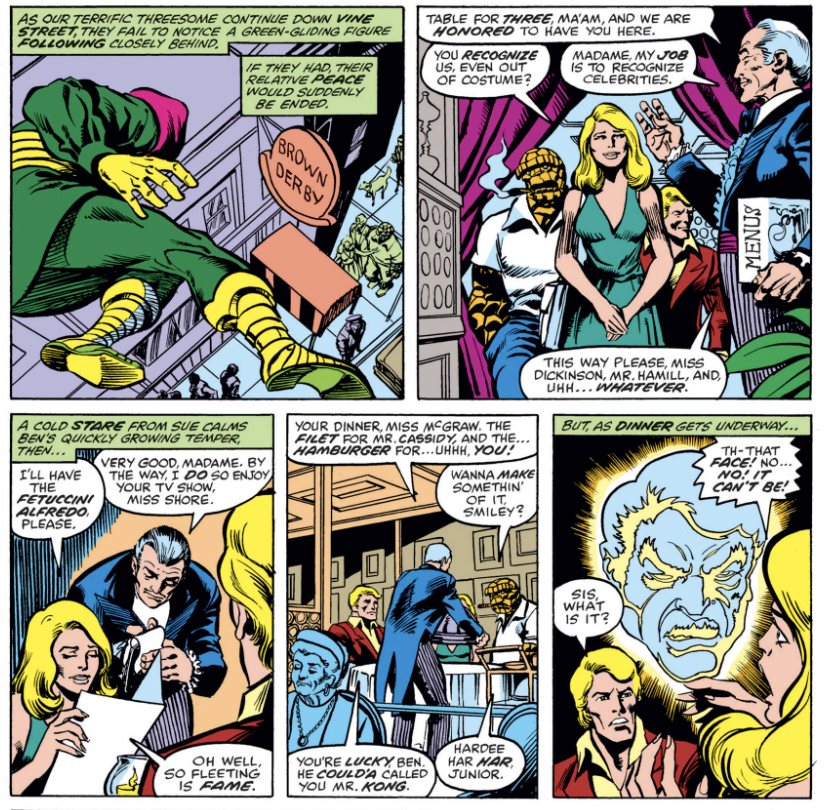
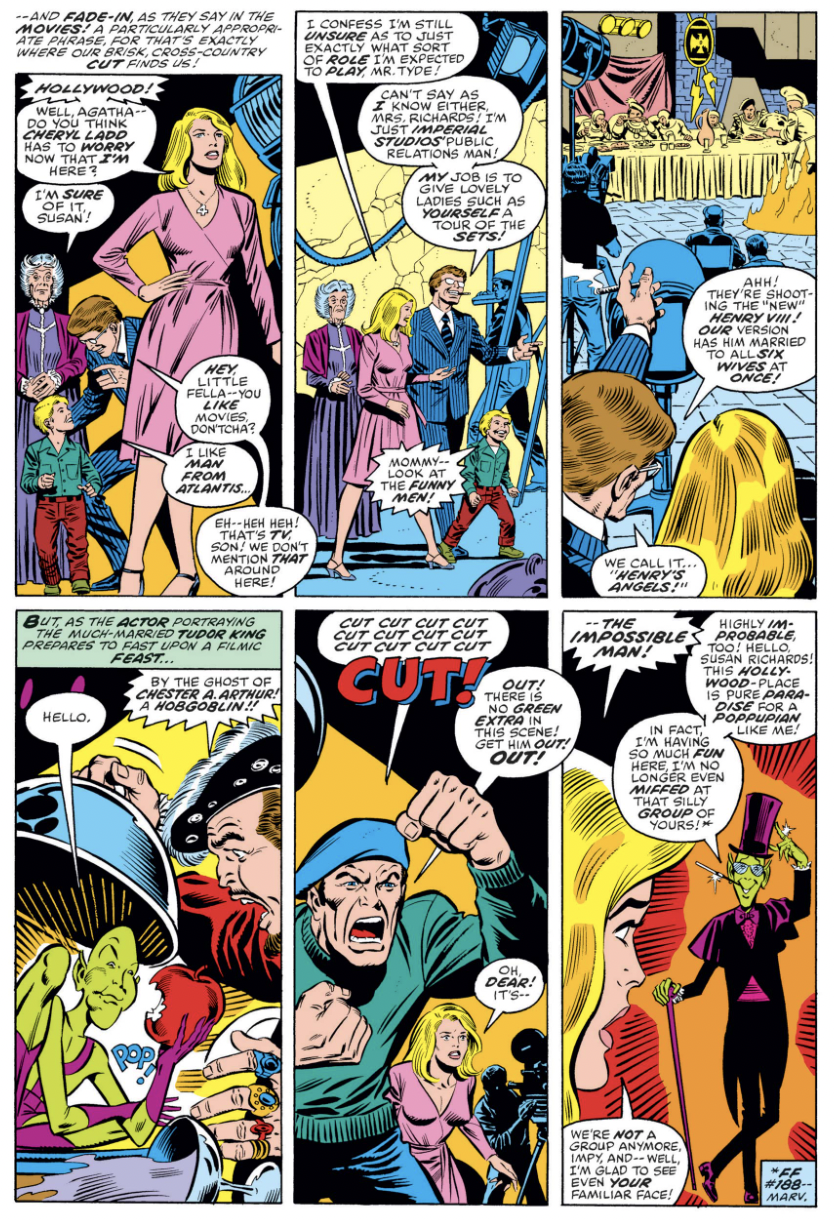
This sequence with Sue was a bit tedious. It didn’t really advance her story, but offered another lame joke about Hollywood. It also reintroduced the Impossible Man, with whom I thought we were finally done.
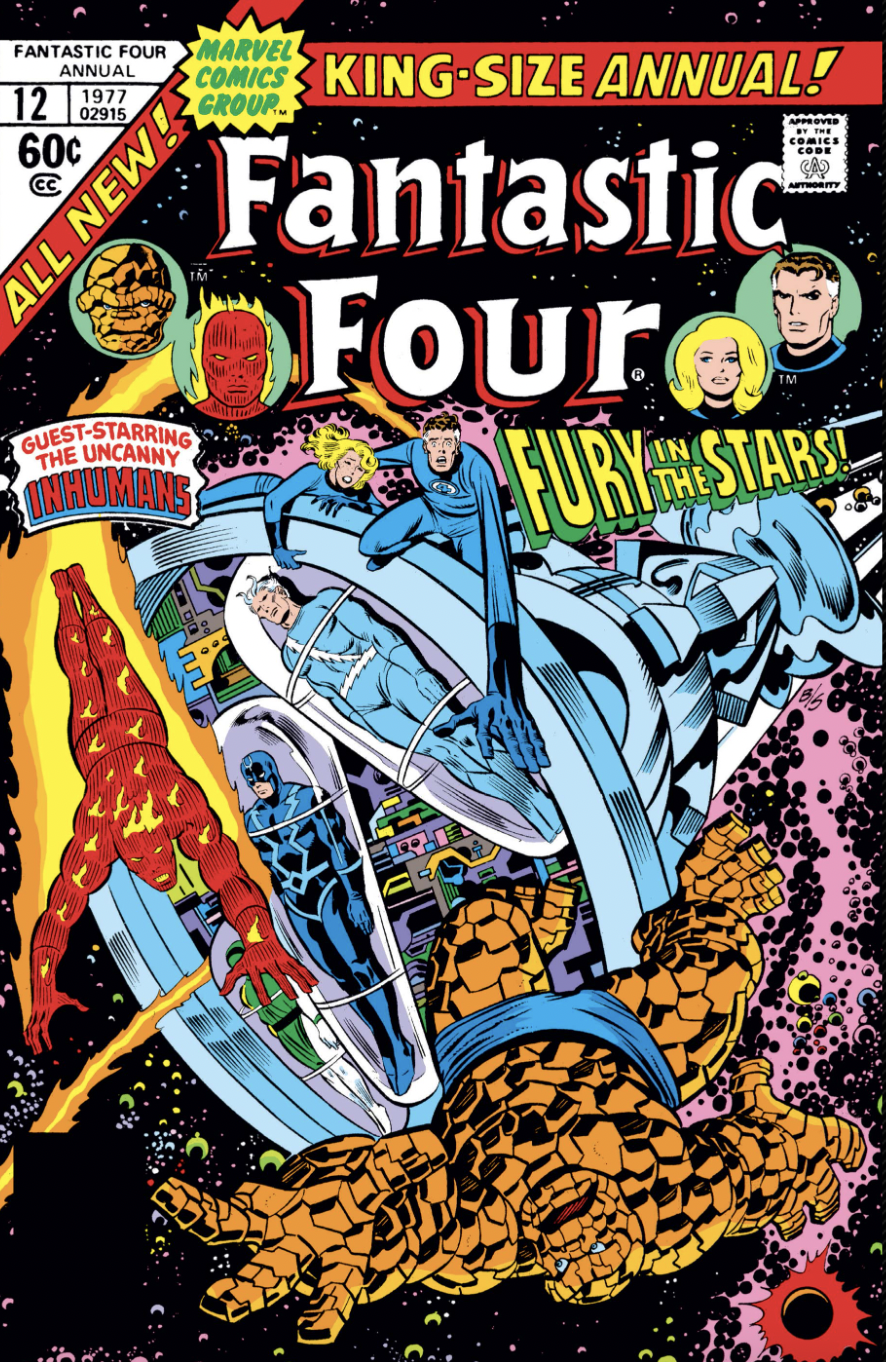
Fantastic Four Annual 12 “The End of the Inhumans … and the Fantastic Four!” Published October 1976 Writer: Marv Wolfman Pencils: Bob Hall and Keith Pollard Inks: Bob Wiacek Letters: John Costanza Colors: Glynis Wein Editor: Wolfman Cover: John Buscema and Joe Sinnott
Synopsis
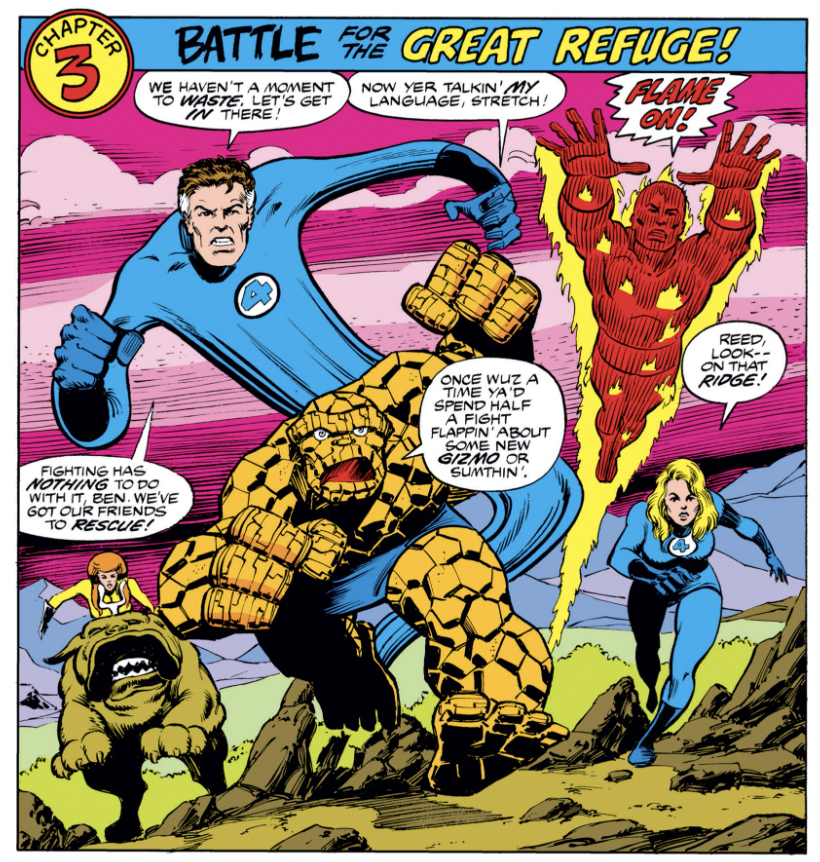
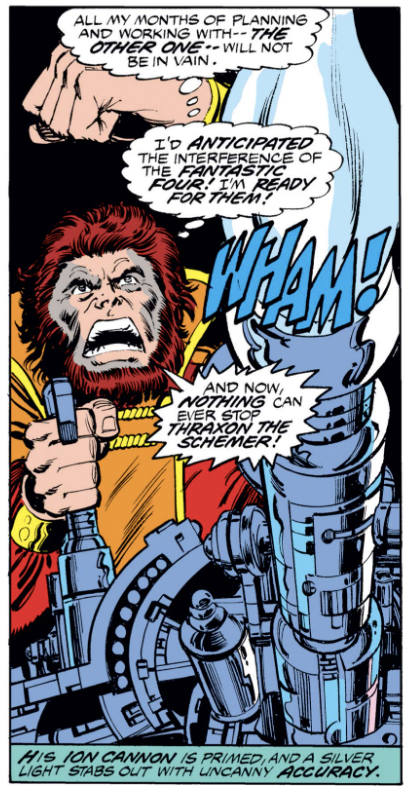
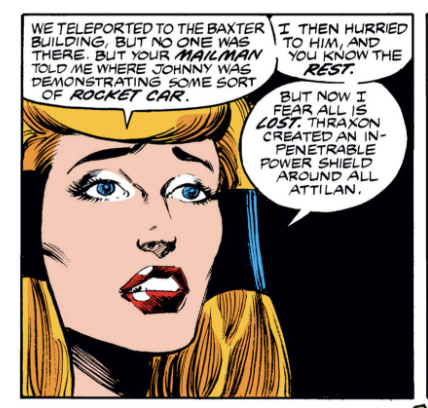
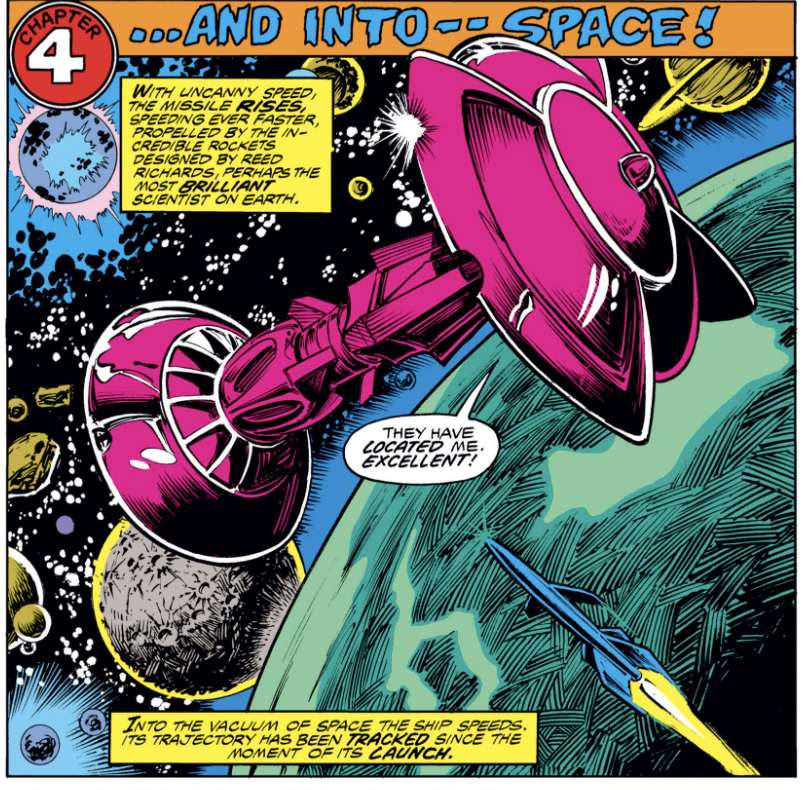
The Fantastic Four are summoned from their leisure activities — Johnny is racing a car, the rest are in Hollywood supervising a movie — by Crystal and Lockjaw, who report the rest of the Inhuman royal family have been captured and the Atillan has become a fortress. The FF eventually overcome the would-be ruler, Thraxon the Schemer (yes, that’s what he calls himself), only to discover he is a pawn of a much greater power, the Sphinx. The Sphinx, an ancient Egyptian wizard who is now immortal, requires Black Bolt’s powers to conquer Earth, and is holding the Inhumans aboard a spaceship. The FF travel to space and are helpless against the Sphinx, but in the melee, Lockjaw frees the Inhumans and Black Bolt defeats the villain in one-on-one combat.
What’s going on here?
This annual is very much a mixed bag. It contains some fun moments and characterizations, and the art is interesting, but the story is padded out with unnecessary fights and flashbacks and some truly painful attempts at topical humor. The story, written and edited by Marv Wolfman, comes in at 48 pages, yet somehow feels much longer. It’s a good example of why writers shouldn’t be their own editors.
The story falls out of the FF’s current continuity, and since Reed can stretch without apparent issue, it probably takes place a good deal earlier than the events in the main title, where the FF have broken up due to Reed’s loss of his powers. The villain, the Sphinx, is an attempt at a new big bad guy but he’s not very convincing, in part because his name and costume are both pretty silly. He debuted in Nova 6, also written by Wolfman, and will pop up every once in a while. He never becomes a top tier FF villain, and frankly, his ancient Egyptian evil schtick was handled much better by Louie Simonson a decade later with Apocalypse.
The pencils are credited to both Bob Hall and Keith Pollard, and it’s hard to tease out who did what (Incidentally, I’ve met Bob Hall at a few conventions and had him draw sketches for me. A very gracious man). Bob Wiacek handled the inks and they look much different — thicker and rougher —than the more refined lines I associate him with from his X-Men run. Still, the art has its moments and between the three artists I see echoes of Kirby and Gil Kane:
What I liked
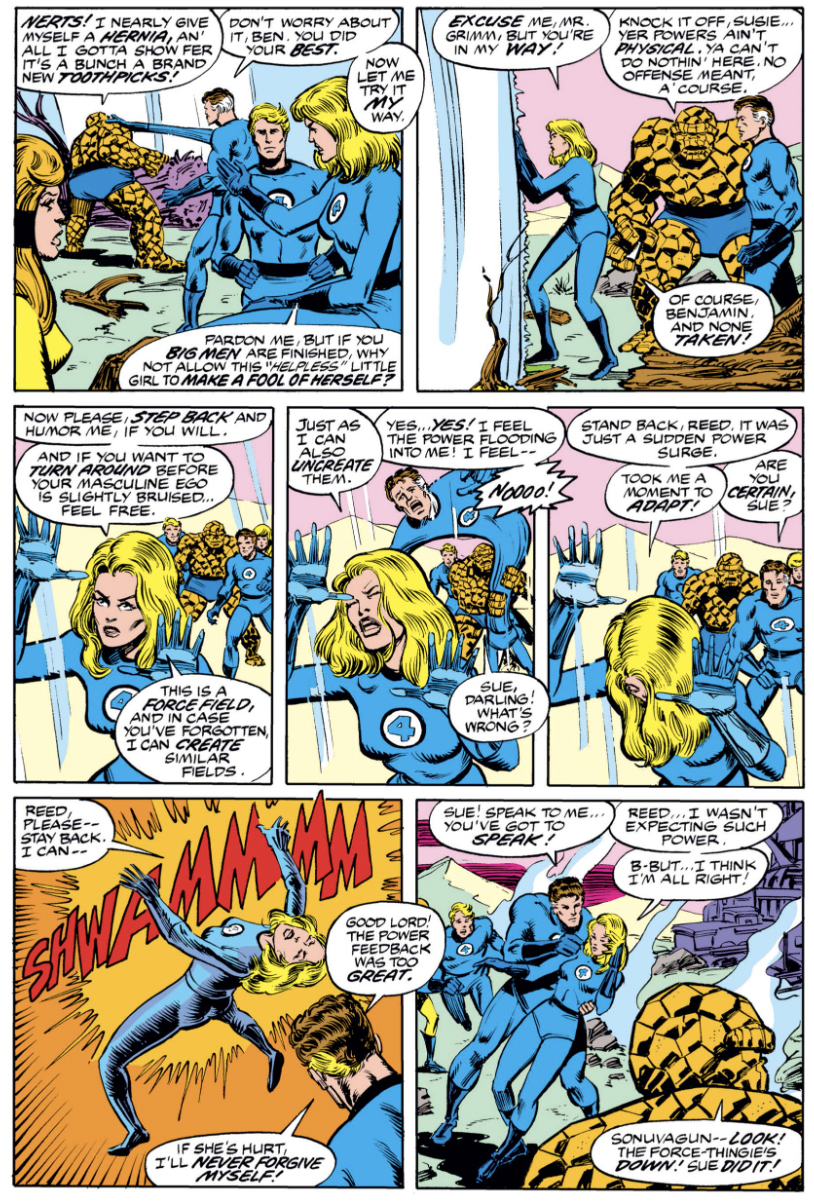
Like his close friend Len Wein, Wolfman seems determined to elevate Sue’s usage as a member of the Fantastic Four. This page is a pretty good demonstration of how she’s been upgraded, both in her attitude toward her teammates and in her powers:
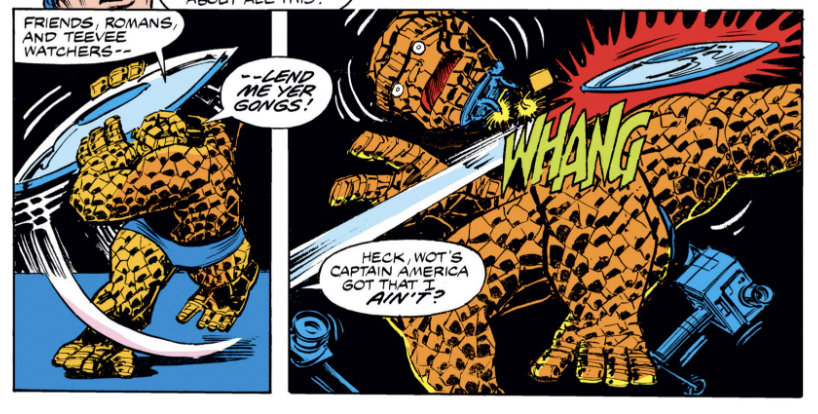
As I’ll get to later, the FF’s Hollywood sequence, where they fight a robot version of the Thing designed for a movie, is beyond tedious. But using the Gong Show’s gong as a weapon is a fun idea.
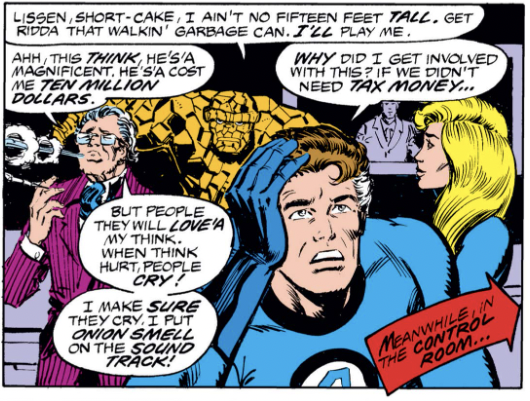
As anyone how follows this account on Twitter knows, I am perturbed by artists who draw the Thing as a giant. Here, Ben makes the same point:
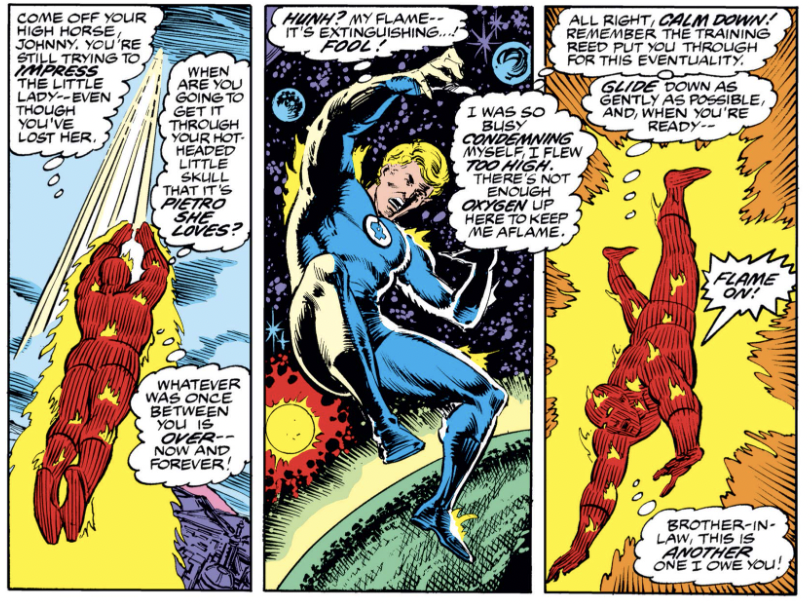
There were a few good sequences that featured a maturing Johnny reconciling with Crystal being married to Quicksilver. Here, he combines some introspection with commentary about his powers:
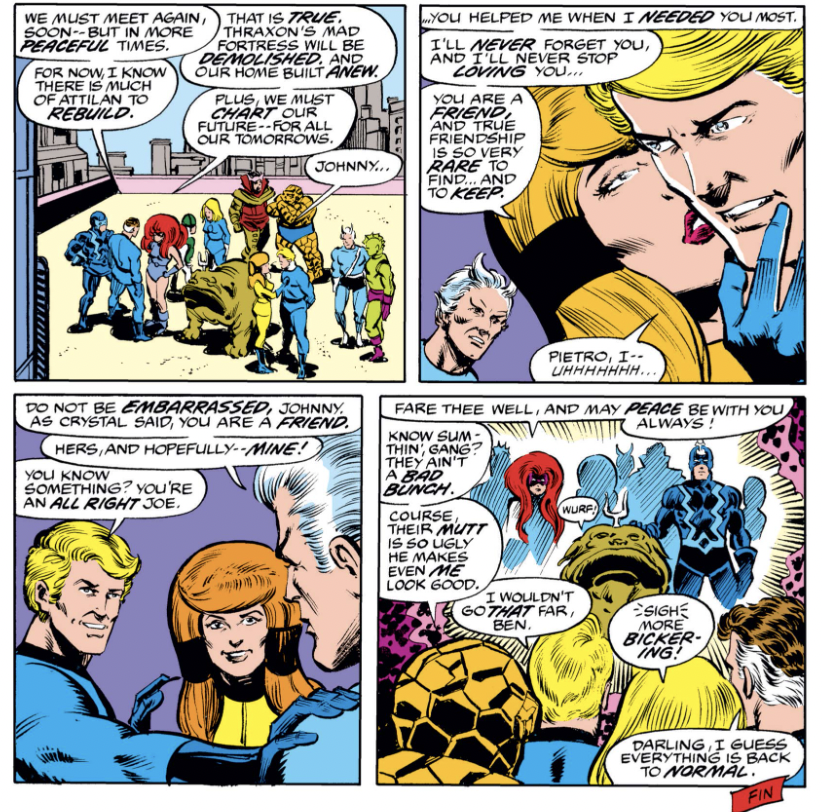
And here, we see three adults acting like adults (it won’t last):
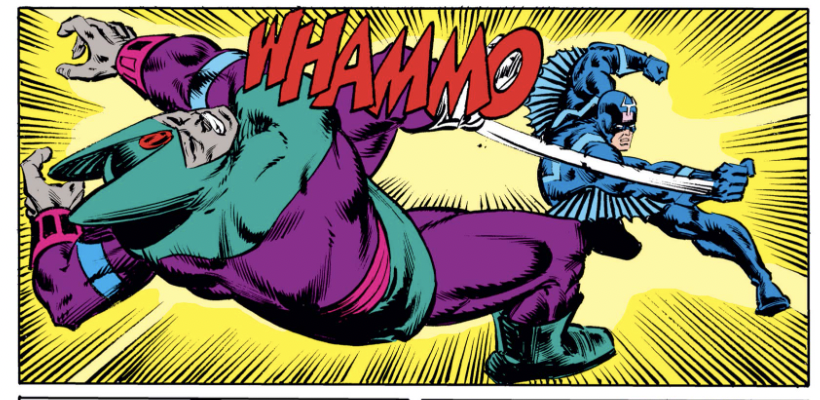
I did like the sequence of Black Bolt wailing on the Sphinx. It really establishes him as a true heavy weight, given that the four members of the FF could barely touch the Sphinx:
What I didn’t like
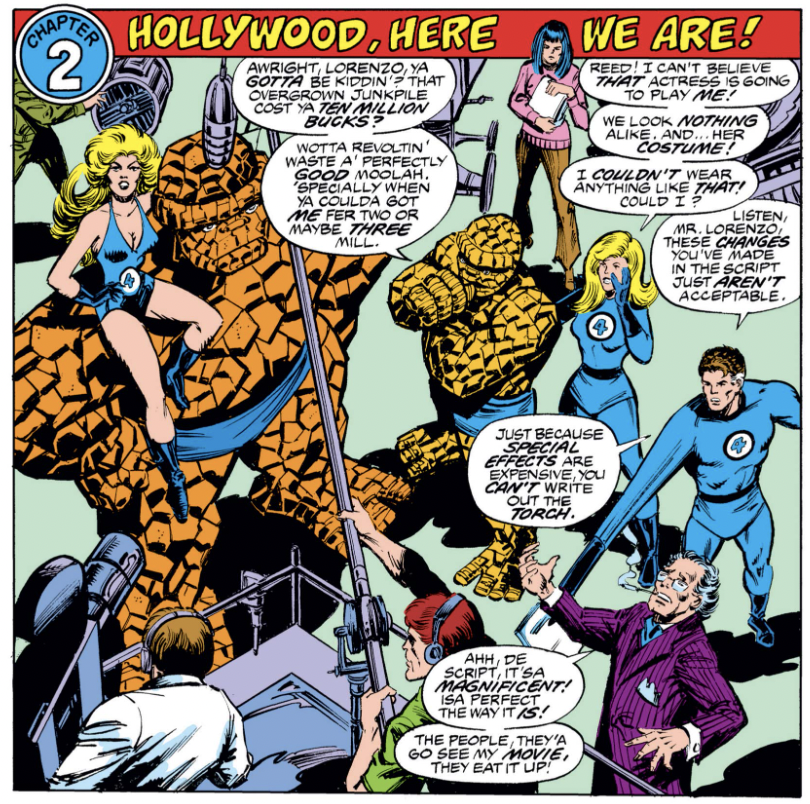
As mentioned, the Hollywood sequence is long, silly and feels engineered to pad the page count. The conceit is a heavily accented Italian producer — I assume a Dino DiLaurentis parody — is making a movie about the FF, which they agree to for “tax money.”
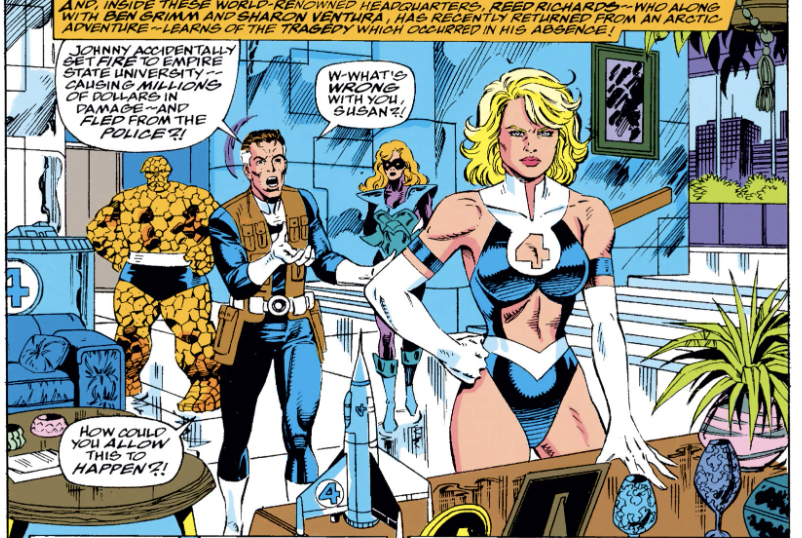
Sue’s comment about never wearing “anything like that” is sadly ironic, given what was to come.
(FF 374, by Tom DeFalco, Paul Ryan and Danny Bulanadi)
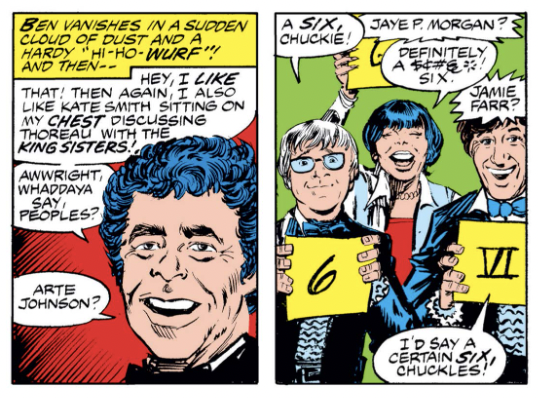
As if if couldn’t get more inane, the Thing’s fight with the robot Thing crashes into the set of the Gong Show, producing lots of unfunny jokes about a show that wasn’t particularly funny. The effect is a bit like an unsuccessful MAD magazine parody.
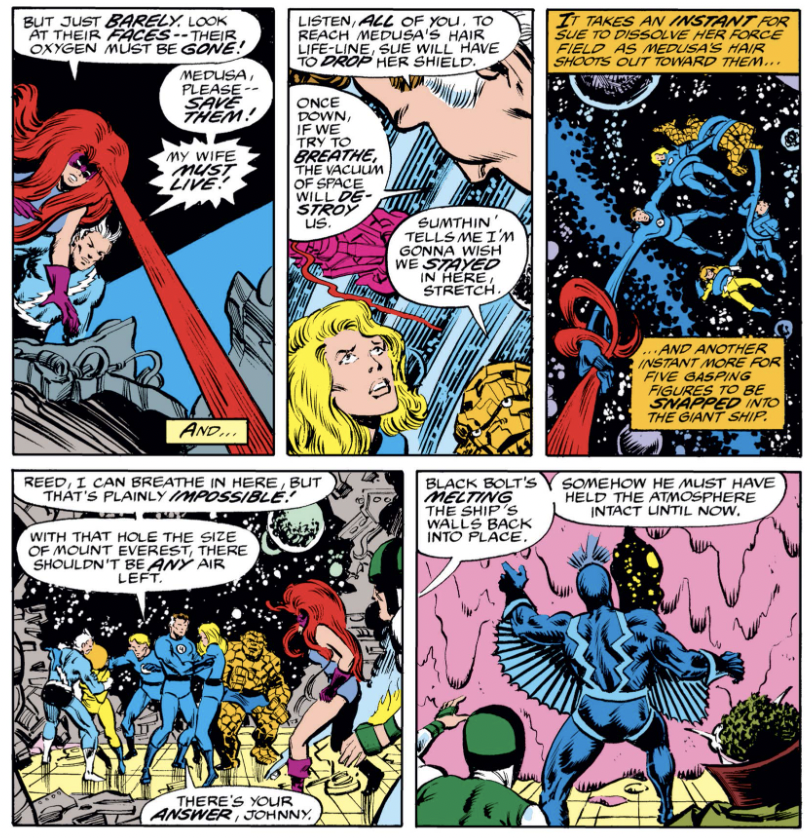
There are several instances in this comic of holes being blown through the walls of a space ship and people being sucked outside, and everyone surviving just fine. I’m sure Wolfman knew better, but didn’t want to take the effort to make it plausible.
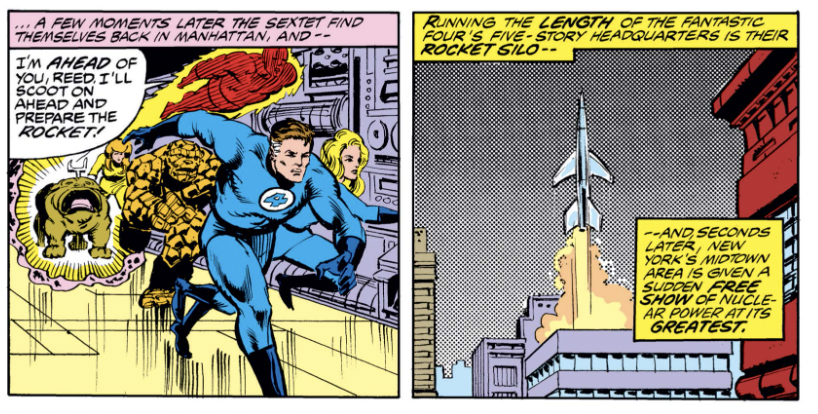
Lastly, the FF’s pogo plane is nuclear powered? In midtown Manhattan?
Anything else?
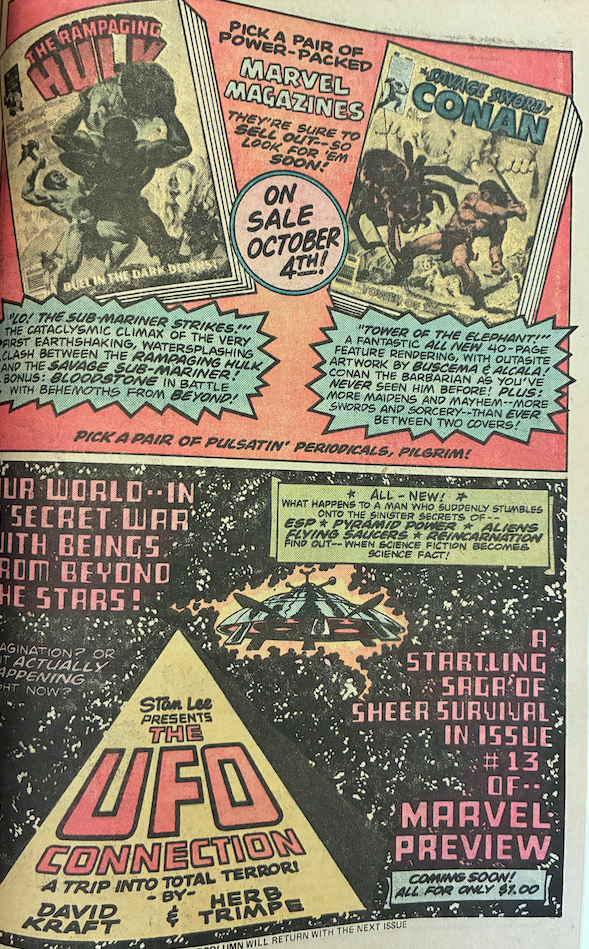
House ads. I’ve never heard of The UFO Connection.
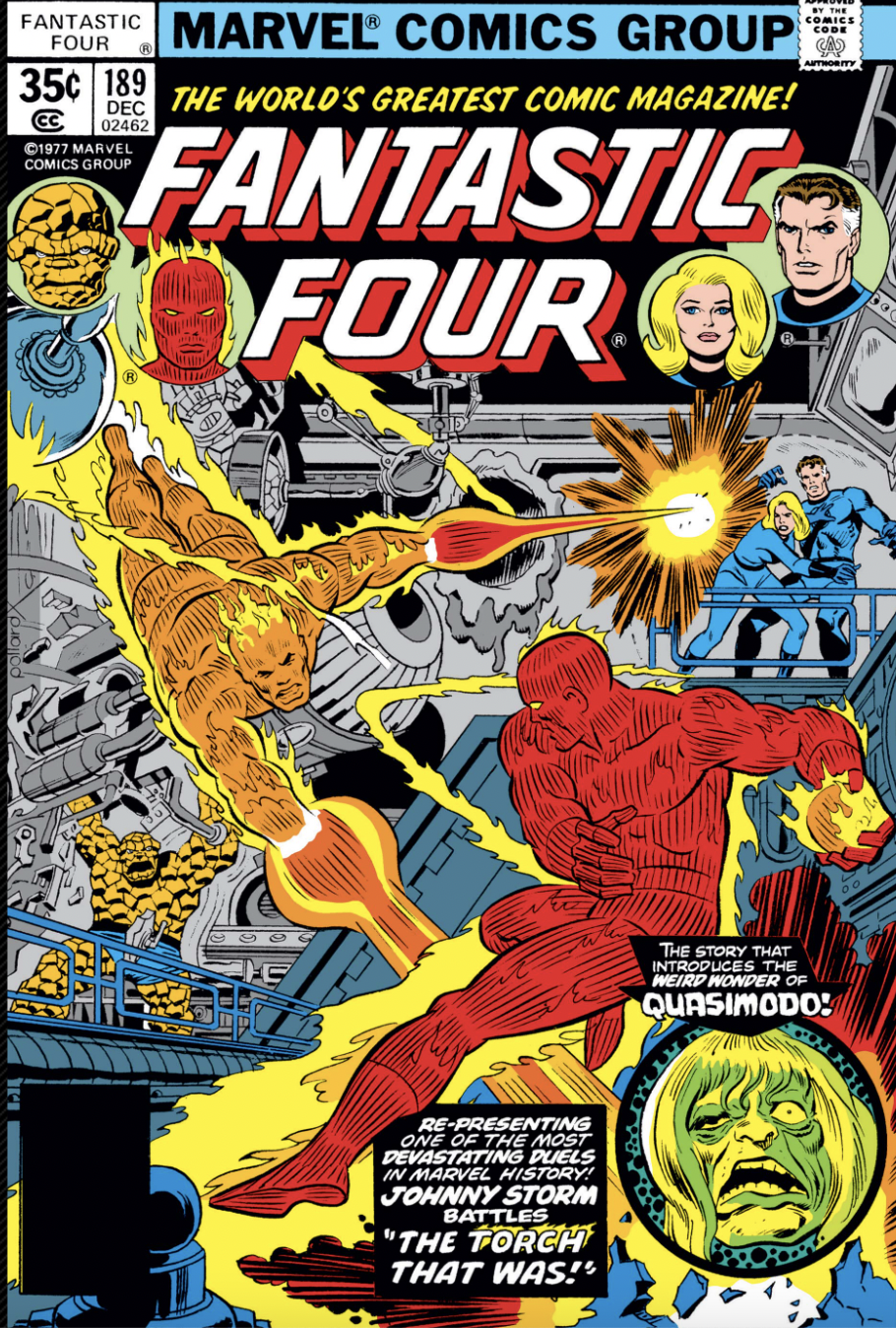
Fantastic Four 189 “The Torch That Was!” Published Sept. 1977 Story: Stan Lee and Jack Kirby Pencils: Kirby Script: Lee Inks: Joe Sinnott Letters: Rosen Cover: Keith Pollard and Frank Giacoia
What’s going on here?
Fantastic Four 189 is a reprint of FF Annual 4 from 1966. It’s a fine comic book, featuring the original Human Torch, which I discussed at length here. It’s notable here for two reasons: It’s yet another sign of the chaos and lack of organization at Marvel as they cycled through editors in the late 1970s. And the cover is by Keith Pollard (in an homage to Kirby), making his Fantastic Four debut. He would go on to draw many more issues .
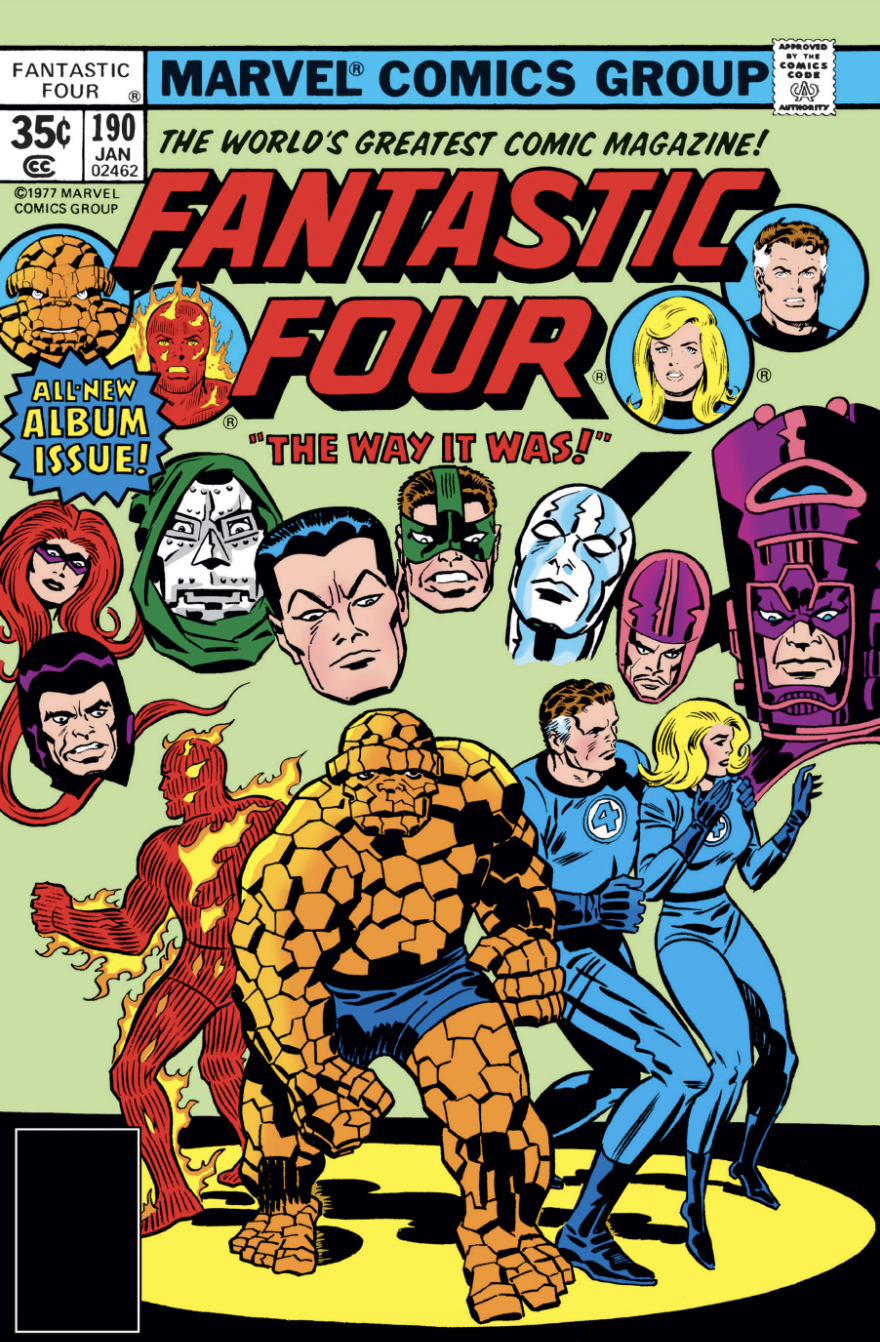
Fantastic Four 190 “The Way it Was” Published Oct. 1977 Writer: Marv Wolfman Pencils: Sal Buscema Inks: Tony Dezuniga Letters: John Costanza Colors: Glynis Wein Editor: Wolfman Cover: Kirby and Giacoia
Synopsis
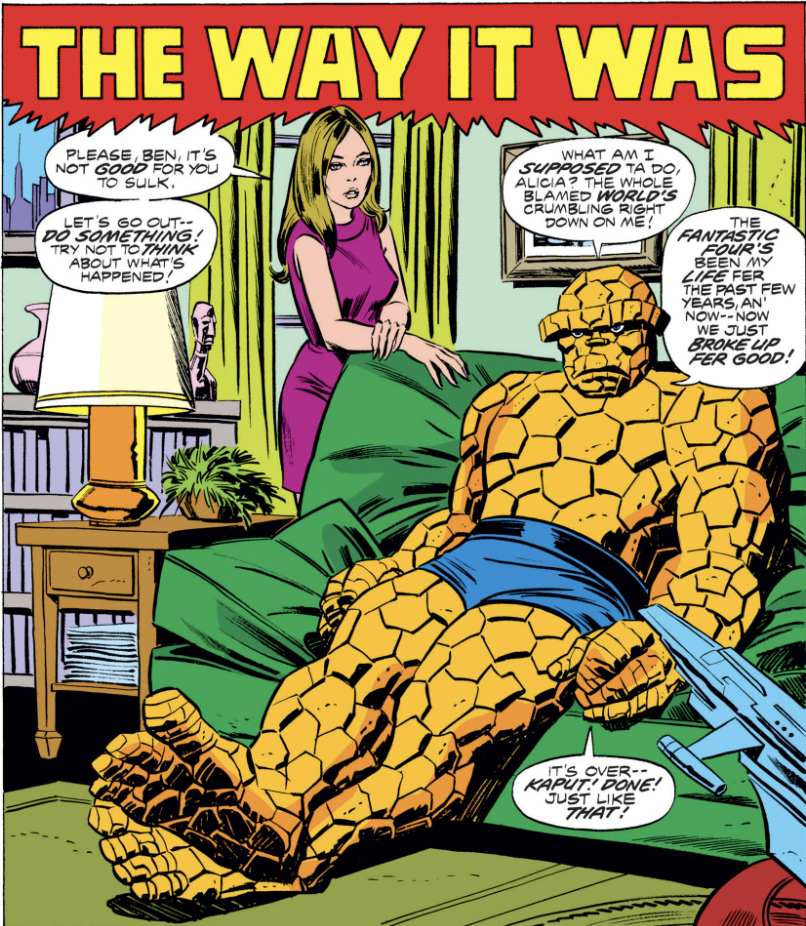
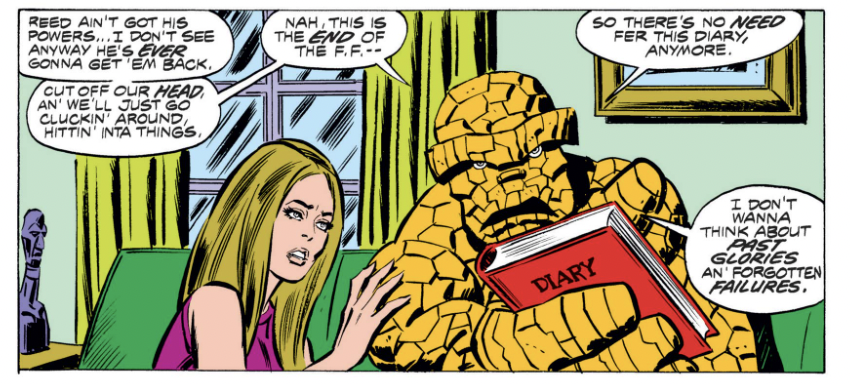
A dejected Thing, sorrowful over the latest break-up of the Fantastic Four, reminisces about the team’s history with Alicia Masters.
What’s going on here?
This is another anomalous issue which also can be best explained by the lack of leadership at Marvel. Len Wein, after delaying his start on the FF for several months, is now missing for two issues. The last was addressed with a reprint and this one is an odd type of fill-in issue, basically one long flashback. It’s not exactly an inventory story, since it fits into the FF’s continuity, but it doesn’t advance the story and it probably was hammered out quickly by writer/editor Marv Wolfman with a stack of back issues. (This is also Wolfman’s first work on the FF; he’ll go on to have a run of his own in a year or two). It feels a bit like Uncanny X-Men 138, a long long flashback as Cyclops says farewell after the death of Jean Grey, but that one was at least written and drawn by Chris Claremont and John Byrne.
Here, Sal Buscema jumps into deliver perfectly adequate work, befitting his status as Marvel’s ultimate journeyman, and Jack Kirby draws the cover (a pretty lack-luster one, if I’m being honest). In a side note that surely only interests me, this may be the first FF issue without an exclamation point in the title.
This comic probably had some value for new readers but it didn’t do much for me.
Anything else?
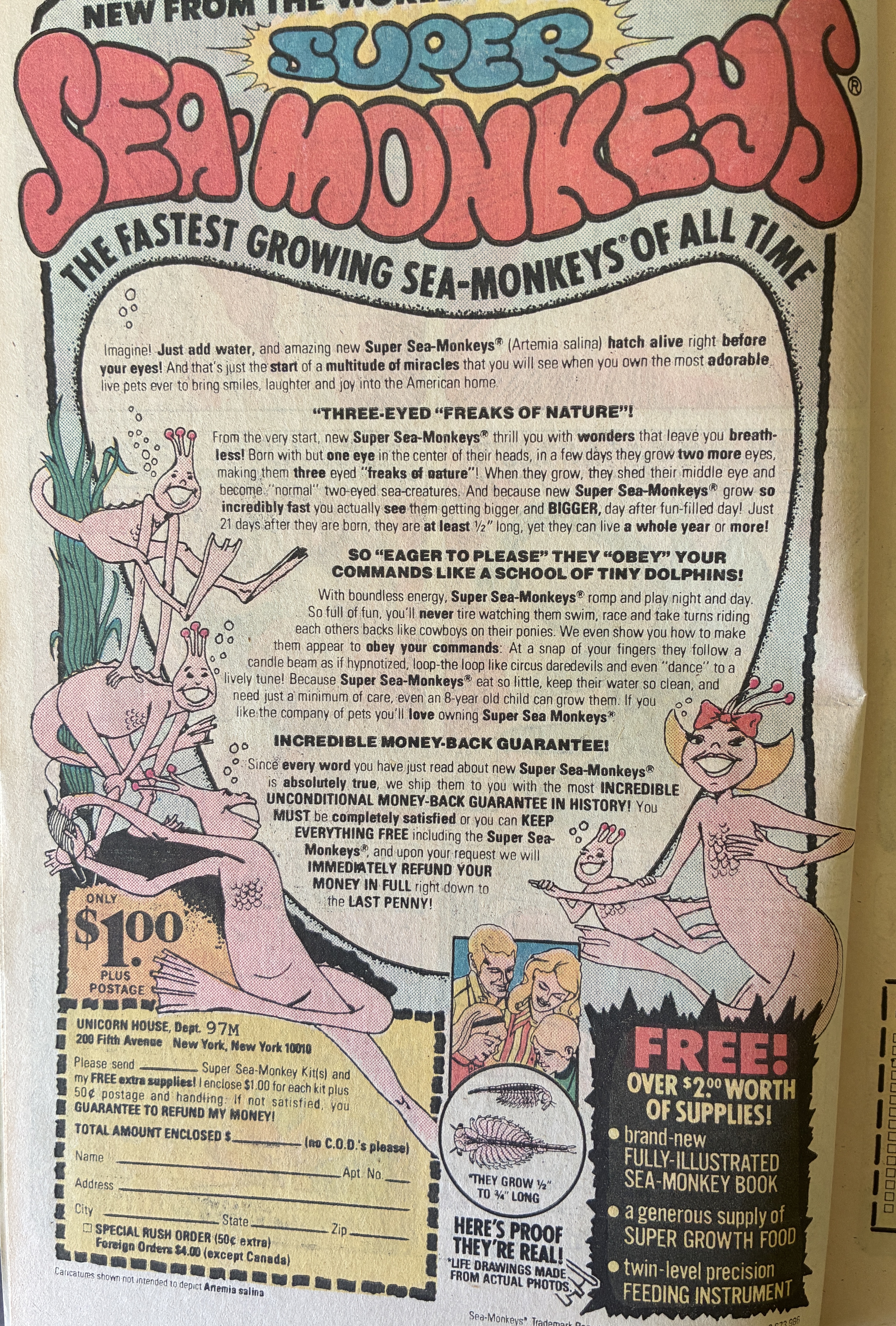
There were some fun ads, including the first for Sea-Monkeys, a stable of comics for years (iirc, they are actually brine shrimp).