• About Percival Henry

Percival Henry: The Fantastic Four and more

~ Blogging the Fantastic Four issue by issue (plus whatever else grabs my attention)

Percival Henry: The Fantastic Four and more

Tag Archives: Fantastic Four

“The World’s Greatest Comic Magazine!” Fantastic Four No. 50

08 Tuesday Feb 2022

Posted by percivalhenry in The World's Greatest Comic Magazine

≈ 1 Comment

Tags

1966, Fantastic Four, galactus, jack Kirby, Silver Surfer, Stan Lee, Wyatt Wingfoot

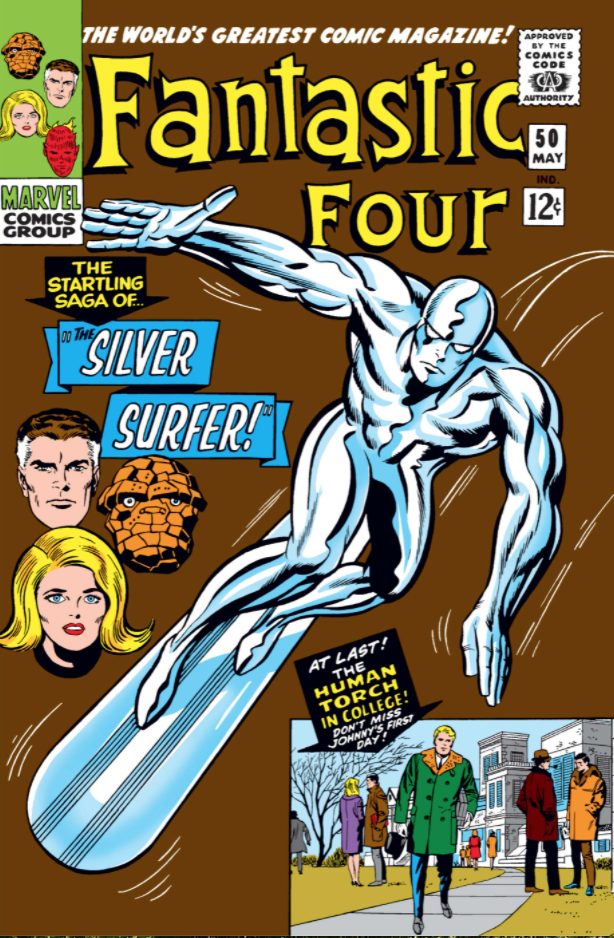
Fantastic Four 50
“The Startling Saga of the Silver Surfer”
Published: Feb. 1966
Story: Stan Lee and Jack Kirby
Script: Lee
Pencils: Kirby
Inks: Joe Sinnott
Letters: Same Rosen
Cover: Kirby and Sinnott

Synopsis

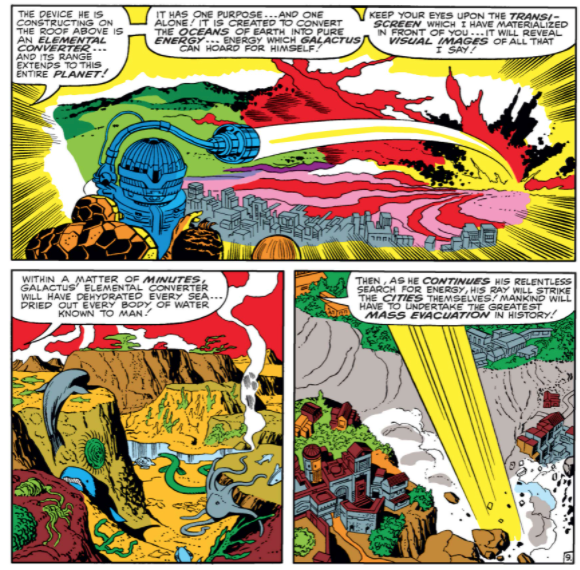
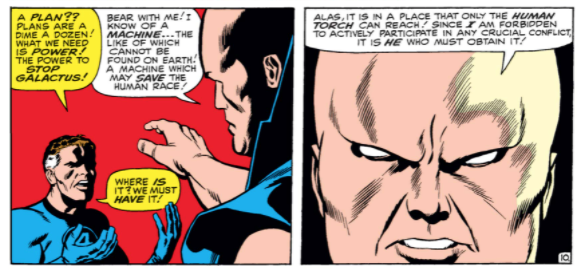
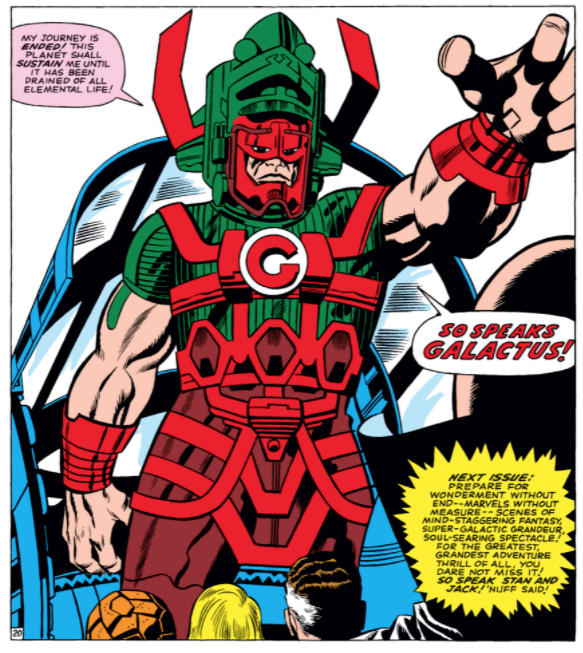
Fantastic Four 50 picks up where issue 49 left off. The Silver Surfer, having the value of humantity revealed to him by Alicia Masters last issue, confronts his master, Galactus, who is preparing to drain the earth of its energy. As the Surfer and Galactus battle, the Watcher reveals his plans for the Human Torch to Mr. Fantastic, the Invisible Girl and the Thing. When the Torch arrives from his voyage across the cosmos, he delivers the Ultimate Nullifier to the Watcher. Reed then uses it to threaten Galactus with the destruction of the universe if he doesn’t abandon his plans to consume earth. Galactus concedes, but before he leaves earth, he strips the Surfer of his ability to travel through space.

As the FF dust themselves off, Alicia shows up to praise the Surfer for helping save the world, leaving Ben jealous and despondent.

FF 50 then pivots to a series of vignettes that set up future stories. The first introduces a nameless bald villain who, after reading news accounts of the FF’s victory, announces plans to destroy the FF. The second concerns an over-the-hill college football coach and his inability to rein in his hot-headed star quarterback. Finally, Johnny enrolls at Metro College, where he meets his new roommate, Wyatt Wingfoot, while still pining away for the Inhuman, Crystal.

What’s going on here?

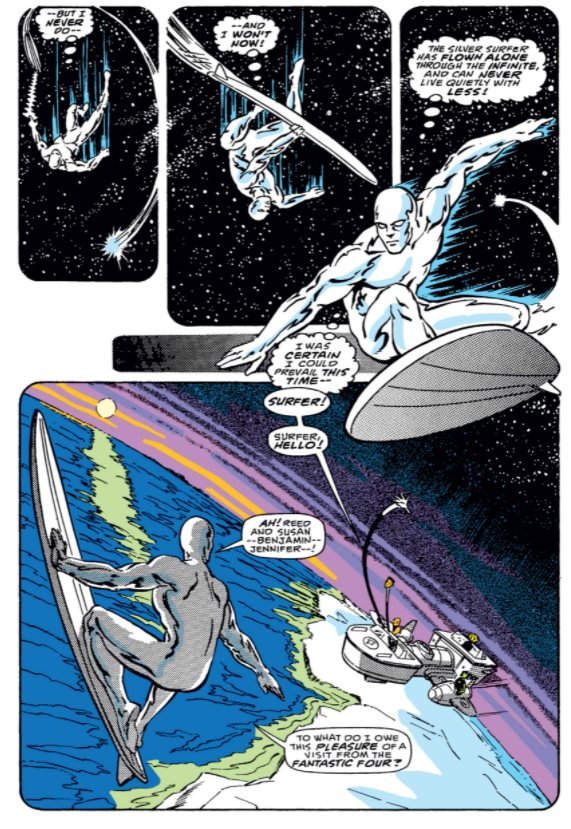
This is a busy comic, and not just because of the epic resolution of the Galactus storyline. In another peculiar pacing decision similar to issue 48, the main narrative essentially ends halfway through the comic, with the rest of the issues devoted to subplots and foreshadowing. A contemporary comic would use all the space available for the main tale—if there’s ever a story deserving of a space-consuming double-page splash, this was it—and sprinkle the foreshadowing elements throughout the comic. As it is, the reader is raised to the crescendo of the FF’s triumph over Galactus, only to be handed a mystifying story about a football coach.

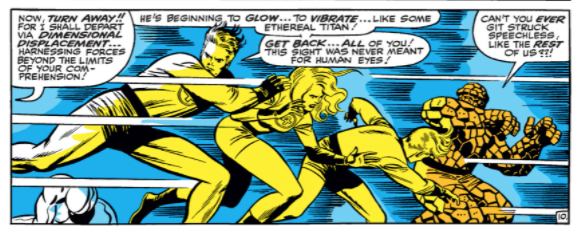
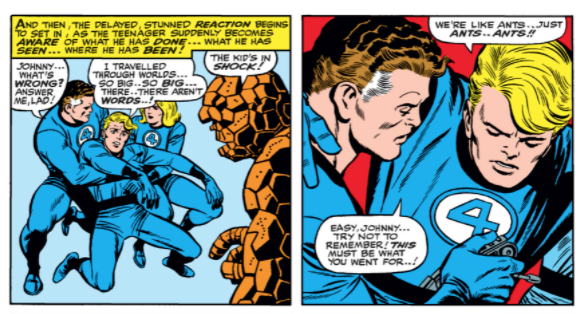
The climax of the Galactus arc, as brief as it is, gives Stan and Jack another opportunity to stretch their cosmic muscles. They make it clear here that larger forces are at work, and the Fantastic Four are mostly bystanders. Unlike most villains, Galactus isn’t defeated by Reed outwitting him or whipping up some gizmo, but by the Watcher’s machinations. Even Johnny, the ostensible hero of the story, is overcome by the scale of the universe and pretty much wrecked by his trip across the universe.
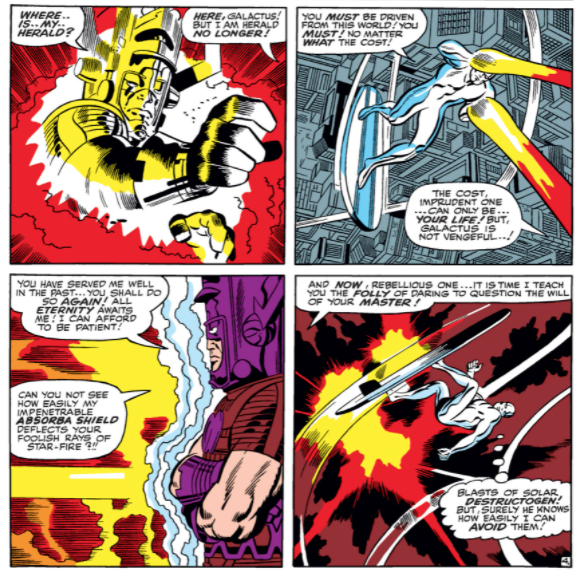
If the FF are secondary characters in their own comic, it’s also because the story of the Silver Surfer is so dramatic. After Alicia reconnects Norrin Rad to his lost humanity, he turns on Galactus to defend the earth. Galactus is surprisingly chill about the betrayal, at several points telling the Surfer how much he likes and respects him, and basically telling the Surfer he’s going through a phase.
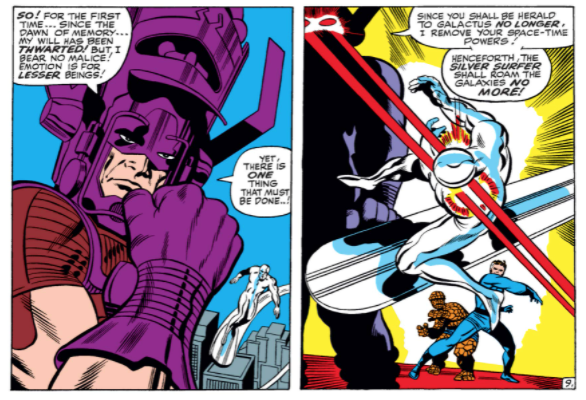
Galactus claims he bears the Surfer and FF no malice, but still he strips the Surfer of his space-faring powers. It’s not obvious if at this point Stan and Jack anticipated the Surfer having his own series, but keeping him trapped on earth was a useful plot device when his solo book eventually launched.
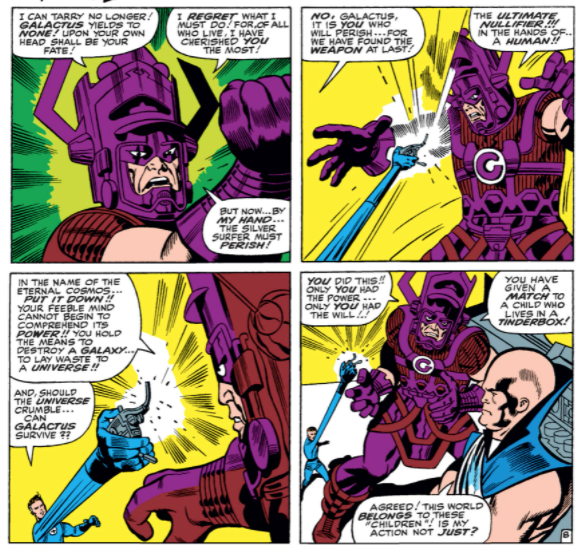
The Ultimate Nullifier serves as a convenient deus ex machina that solves the problem of Galactus. It reappears on occasion over the course of Marvel’s history, usually in a story with some big stakes.

What’s up with Ben?

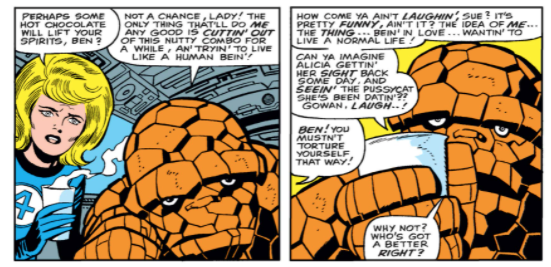
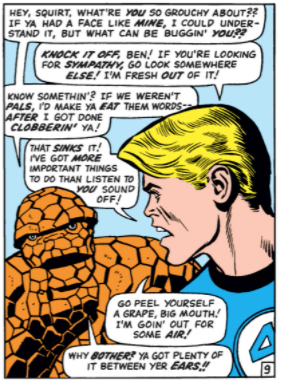
Ben has been his usual melancholic self over the past few issues—he had an introspective sequence when the FF was in Atillan—but it kicks into overdrive in FF 50. First, there’s this revealing “kidding-not-kidding” exchange with Sue, where he explains how he uses humor to deflect his trauma.
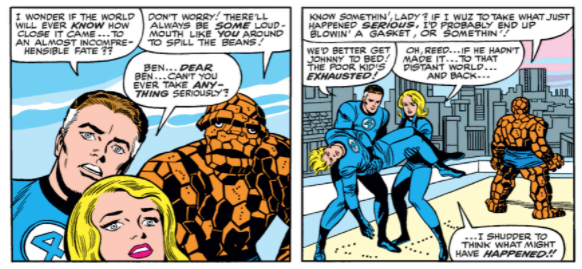
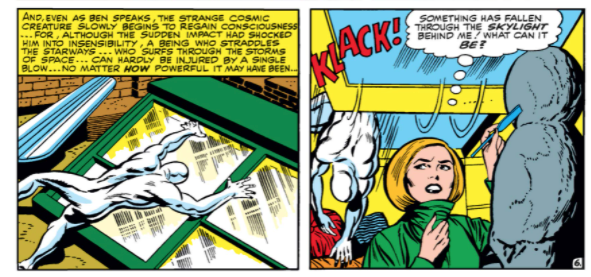
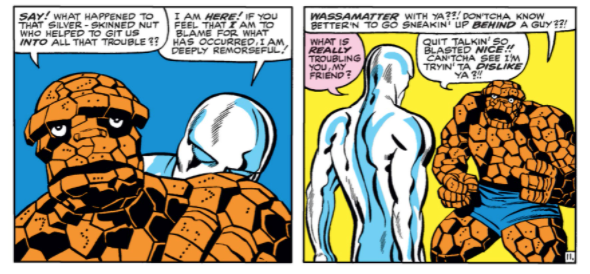
Then the Silver Surfer, who barely knows him, senses something is amiss.
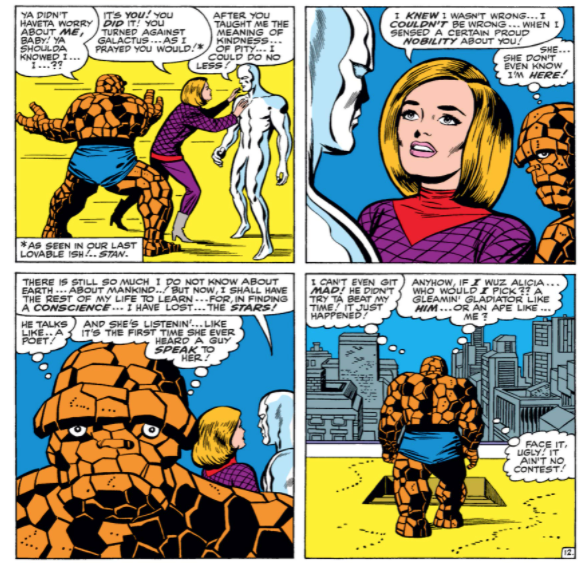
That’s followed by Ben’s jealous reaction to Alicia greeting the Surfer, as Ben’s insecurity about his appearance kicks overwhelms him.
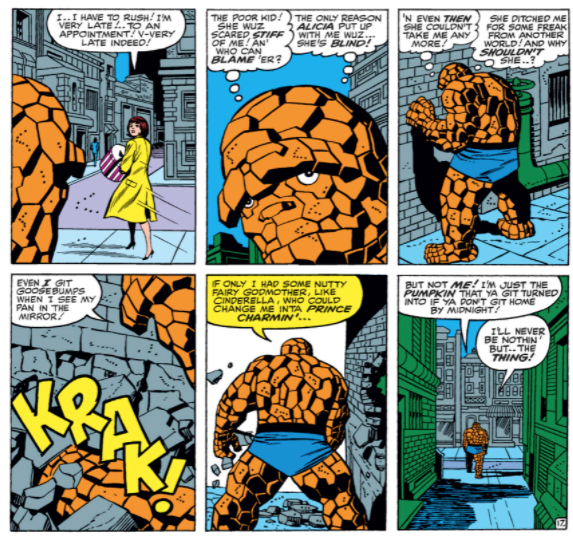
Finally, as Ben wanders the streets of New York, he startles a woman, sending him down a spiral of self-pity that will play out next issue.
Who’s the new guy?

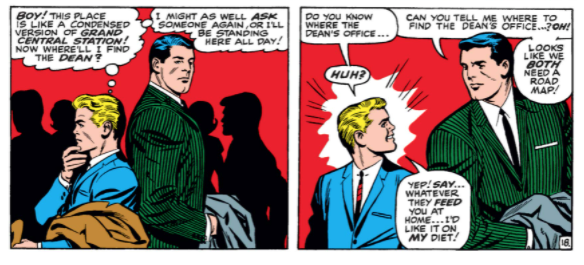
As if there wasn’t enough going on, FF 50 introduces Wyatt Wingfoot, a longstanding supporting character and, notably, a Native American character who isn’t reduced to a bundle of cliche and stereotypes. Here, he and Johnny meet cute.
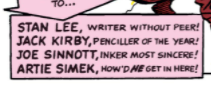
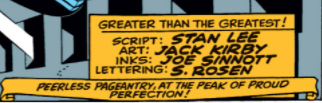
Crazy Credits

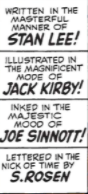
The usual modesty
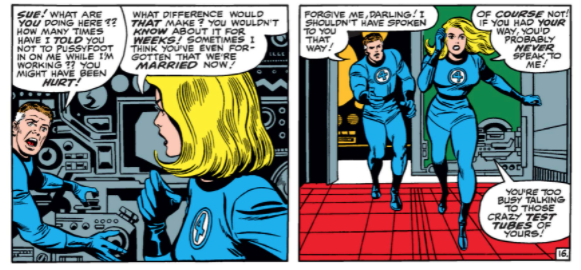
The sexist sixties

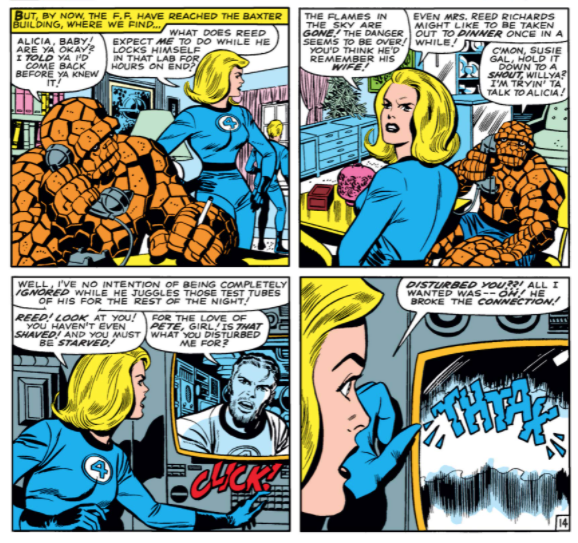
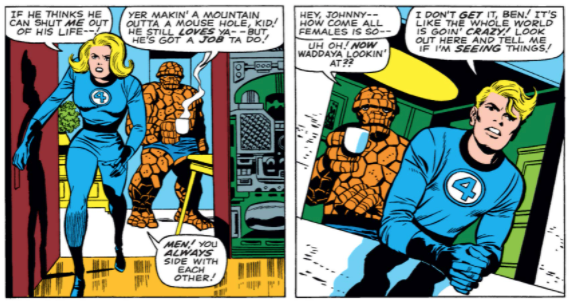
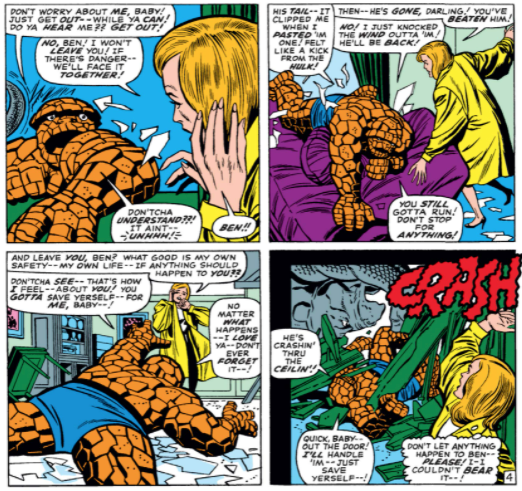
Again, another sequence of Sue stamping her feet because Reed isn’t paying her enough attention. At least Reed apologizes.

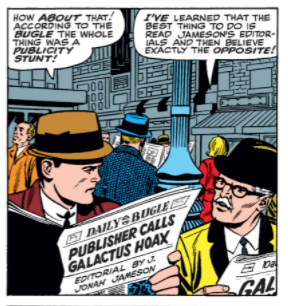
Read all about it

A nice connected-universe swipe at J. Jonah Jameson here.

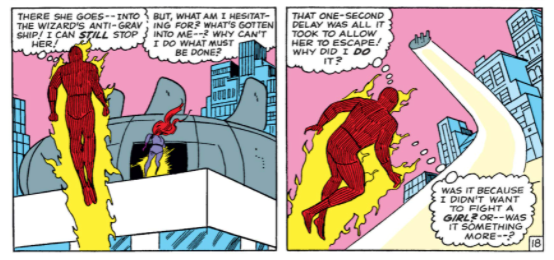
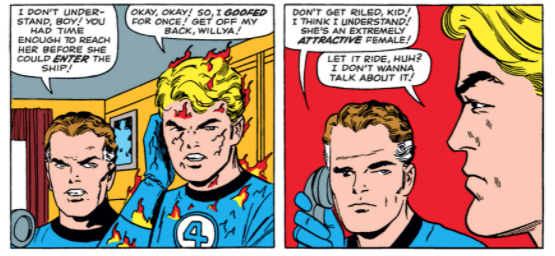
Dig that Kirby Krackle

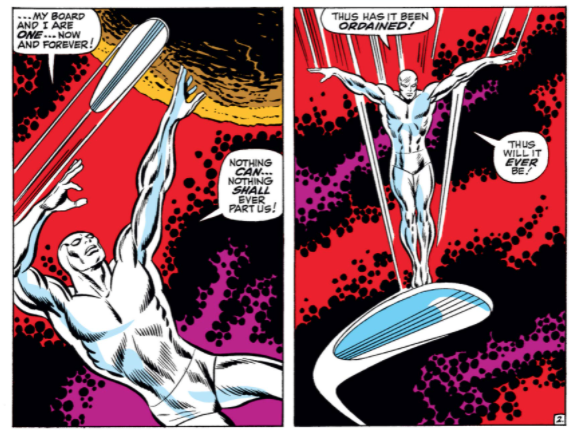
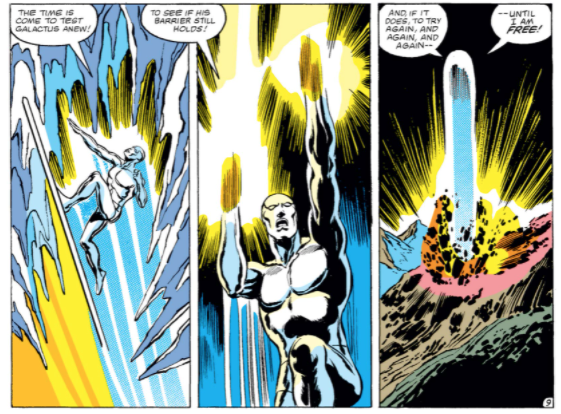
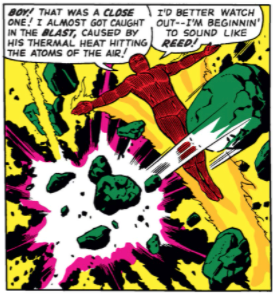
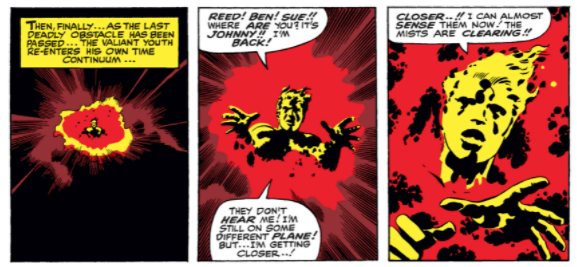
After using this silly phrase for 50+ blog posts, we finally get some genuine Kirby Krackle. For the uninitiated, Kirby Krackle are the black dots Jack uses to illustrate the release of energy. A trademark effect of the King’s, it hasn’t really appeared until this issue. Now we can, indeed, dig that Krackle.
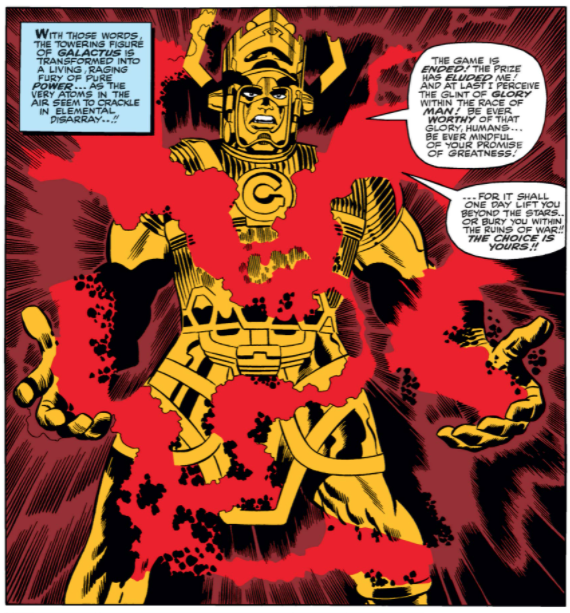
Here’s some more:
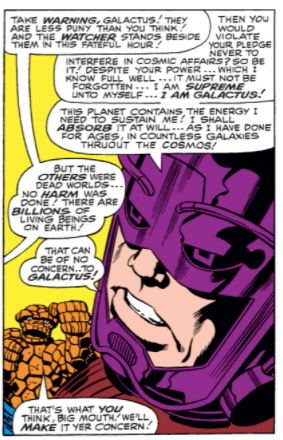
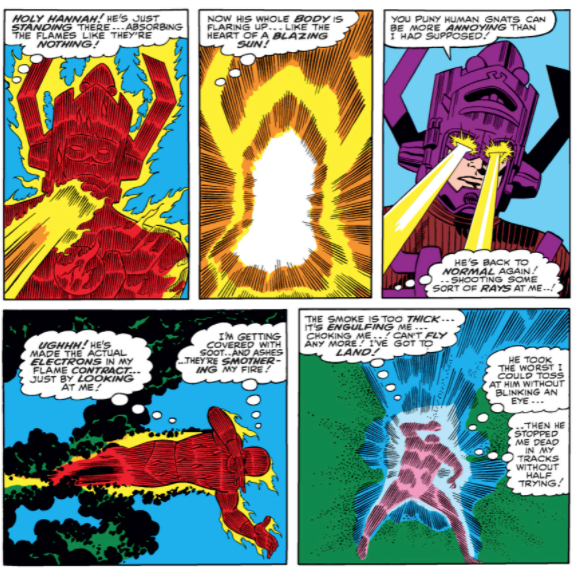
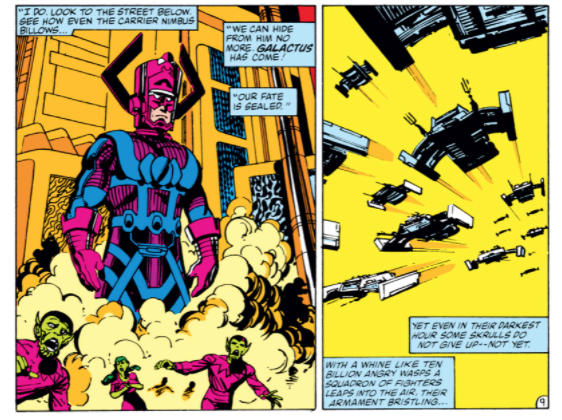
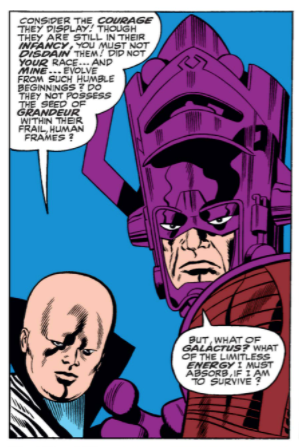
We also get a great panel of Galactus giving the ol’ stink-eye.
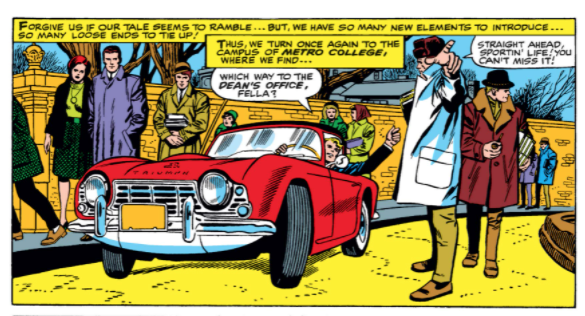
And Johnny tooling around campus in a sweet set of wheels.
Next issue: This man, This Monster!
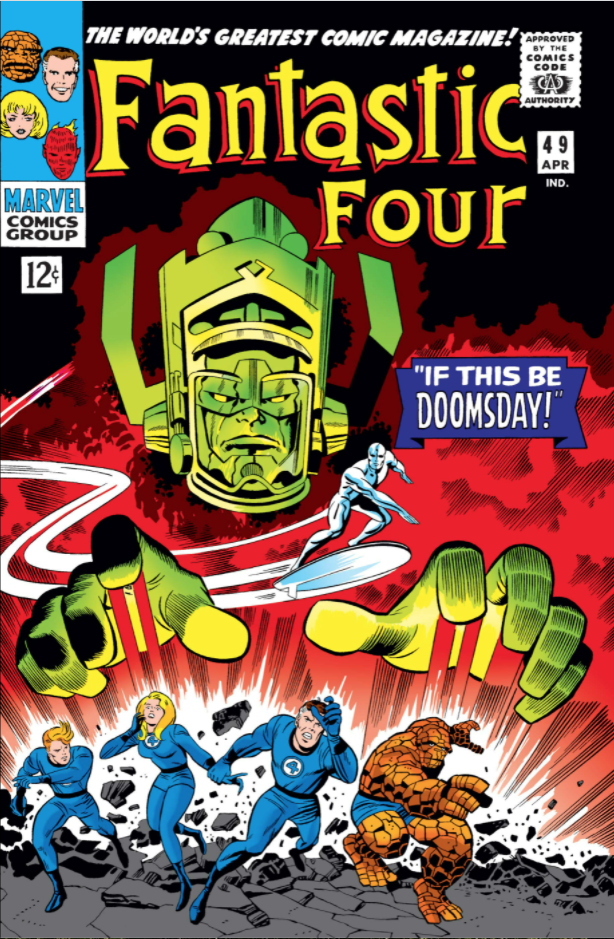
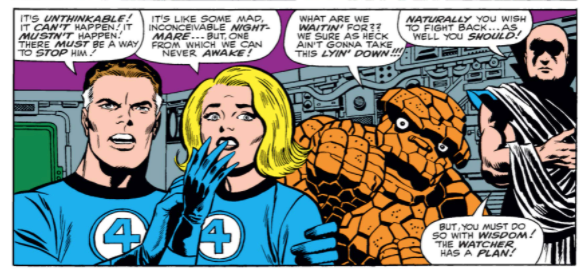
“The World’s Greatest Comic Magazine!” Fantastic Four No. 49

30 Sunday Jan 2022

Posted by percivalhenry in The World's Greatest Comic Magazine

≈ 2 Comments

Tags

1966, Fantastic Four, Fantastic Four 49, galactus, jack Kirby, Silver Surfer, Stan Lee

Fantastic Four 49
“If This Be Doomsday!”
Published: Jan. 1966
Story: Stan Lee and Jack Kirby
Script: Lee
Pencils: Kirby
Inks: Joe Sinnott
Letters: Sam Rosen
Cover: Kirby and Sinnott

Synopsis

Fantastic Four 49 picks up where issue 48 left off, after Galactus makes his entrance, intent on draining earth of its energies. The Watcher urges Galactus to reconsider, and the FF confront him, but to no avail and he begins assembling his earth-energy-sucking machine on top of the Baxter Building.

Meanwhile, the Silver Surfer, reeling from his fight with the Thing, landed on the roof of Alicia Masters’ building. She nurses him back to health and begins to awaken him to the possibility earth might be worth saving.

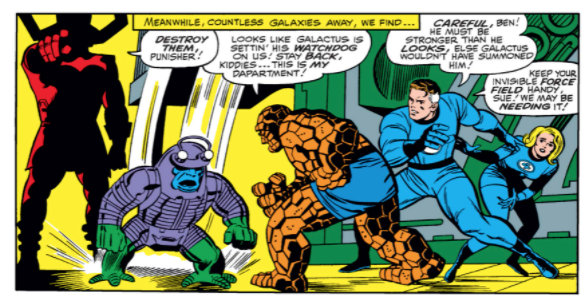
After regrouping, the Fantastic Four again engage Galactus, save for Johnny, whom the Watcher singles out for a mission. As the rest of the team fight the Punisher, a creature Galactus dispatches to deal with vermin, Johnny travels through space and time to arrive at Galactus’s enormous space station.

Back on earth, as Galactus prepares to drain the earth’s energies, Alicia appeals to the Silver Surfer’s lost humanity and convinces him to confront Galactus to save the earth. The issue ends with the Watcher warning the reader that the Surfer may disrupt his own plans and doom the earth.


What’s going on here?

FF 49 is everything you want a Fantastic Four comic to be. It’s arguably the high point of the Lee/ Kirby partnership, and showcases both at the peak of their powers (aided significantly by Joe Sinnott’s inks, of course). In Galactus, Stan finally has an antagonist worthy of his bombast and grandiosity. After years of trying to convince us Diablo or the Thinker were threats to humanity, In Galactus Stan has a villain that lives up to his over-wrought writing. And in the Surfer, he has an alien hero who can philosophize while speaking in the lofty, faux-Shakespearian tones Stan loves so much.

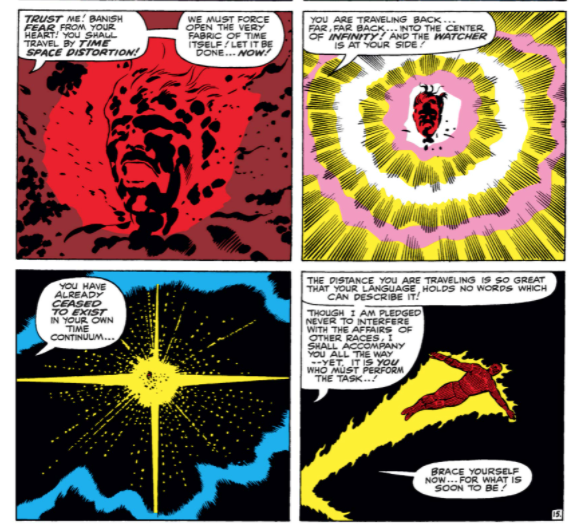
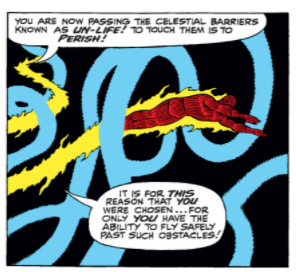
Kirby rises to the occasion too. The story’s huge sweep and cosmic overtones gives him the freedom to produce amazing character designs for Galactus and the Punisher, an eye-popping panel of Galactus’s space station—it’s so big that planets orbit it—and stunning visual effects of Johnny confronting Galactus and traveling through space.

The whole story just feels big—big in its scope, big in its stakes, and big in its ambition

Who is this guy?

While Galactus technically made his first appearance last issue, this is really his debut. We don’t yet get the full story (more on his origin in a bit) but we get the basics, and the basics are more than enough: He’s a cosmic being of incredible power who is sustained by draining planets of their essence. Interestingly, while he has appeared in countless comics over the years, unlike other characters, he has changed very little. His costume design has remained essentially the same, and while his role in the Marvel universe has been explained and put into context, he acts pretty much as he does in his first appearance: traveling the universe looking for planets to consume.

The traditional account of Galactus’s invention is that Stan, searching for a story idea, said “let’s have them fight god.” Mark Evanier, in his biography Kirby: King of Comics, disputes that narrative and instead offers two alternative ideas. One is that Jack wanted to upend the conventional science fiction idea that if aliens arrived, they would engage with humans and exchange technology. What if they didn’t care about humans? Jack wondered, according to Evanier. What if they just wanted to eat our planet? The other idea reflects Kirby’s growing disillusionment with Marvel and the business of comics. In this interpretation, Galactus is a hostile company buying up smaller firms and draining them dry. (In the letters pages, readers projected a Vietnam metaphor on the story, with Galactus acting as hostile communist forces and the Silver Surfer as the US coming to the rescue of South Vietnam).

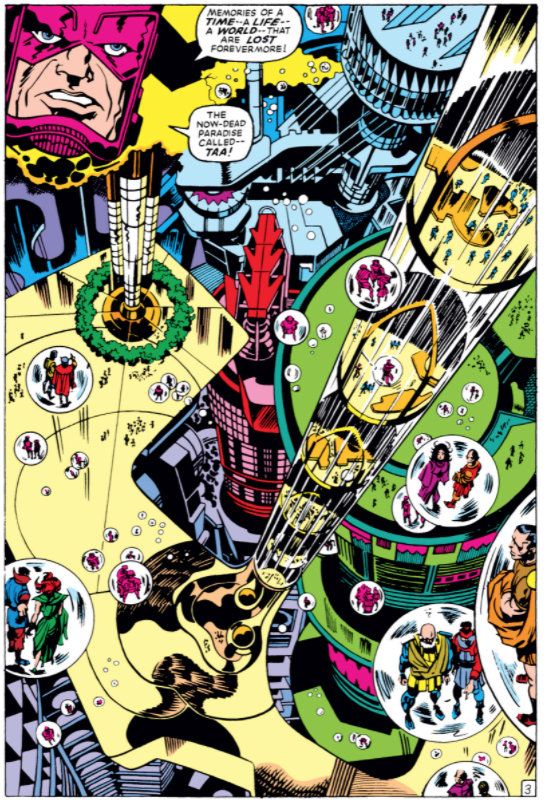
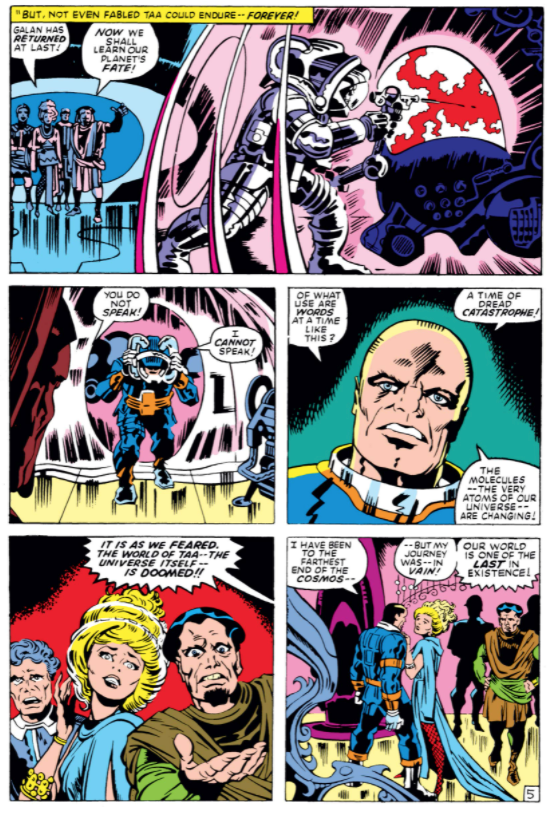
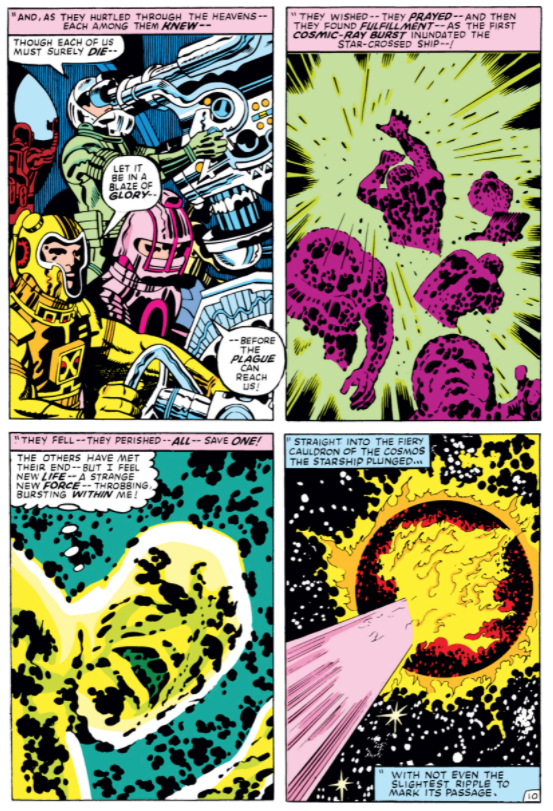
Galactus’s origin is relatively uncomplicated. In the original telling, revealed in a back-up story by Stan and Jack in Thor 169, Galactus was originally Galan, a citizen of an advanced planet called Taa. The planet is facing extinction by a plague, so Galan and three others decide to die as explorers and head into Taa’s sun. Galan survives and is eventually transformed into Galactus (as Brian Cronin notes in his Comics Should Be Good blog, this sounds like a mash-up of Superman and the FF’s origins.)

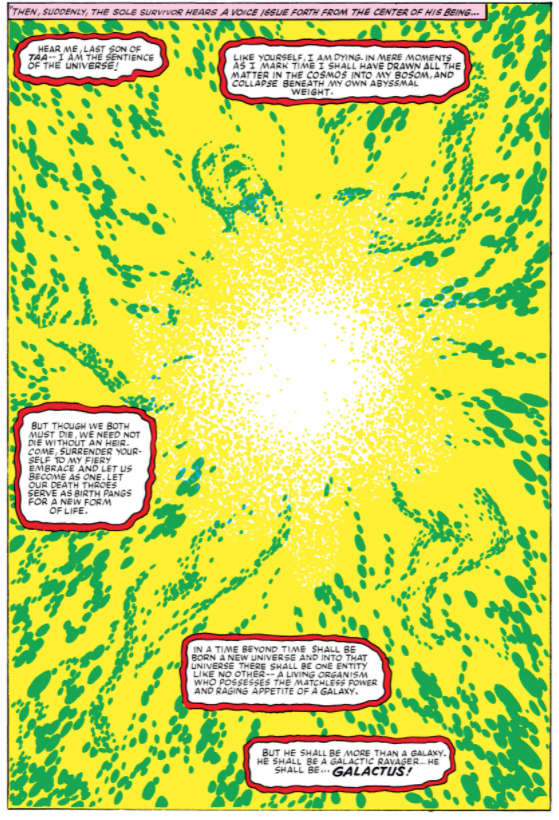
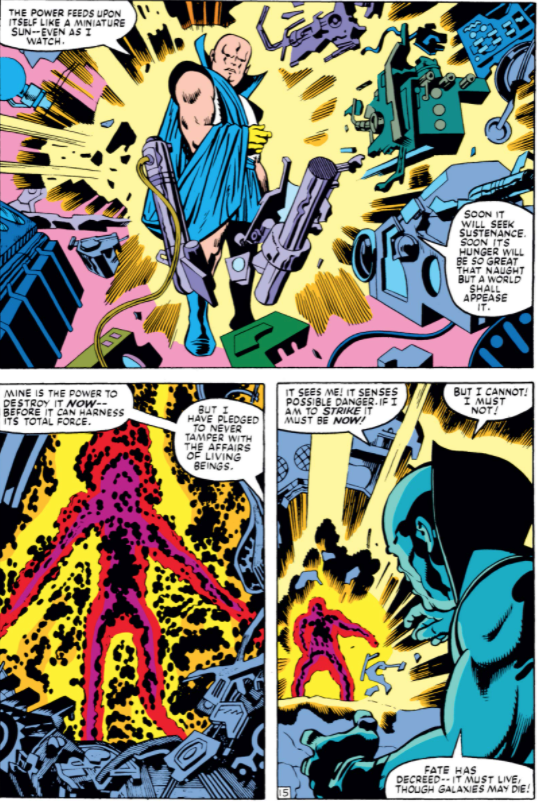
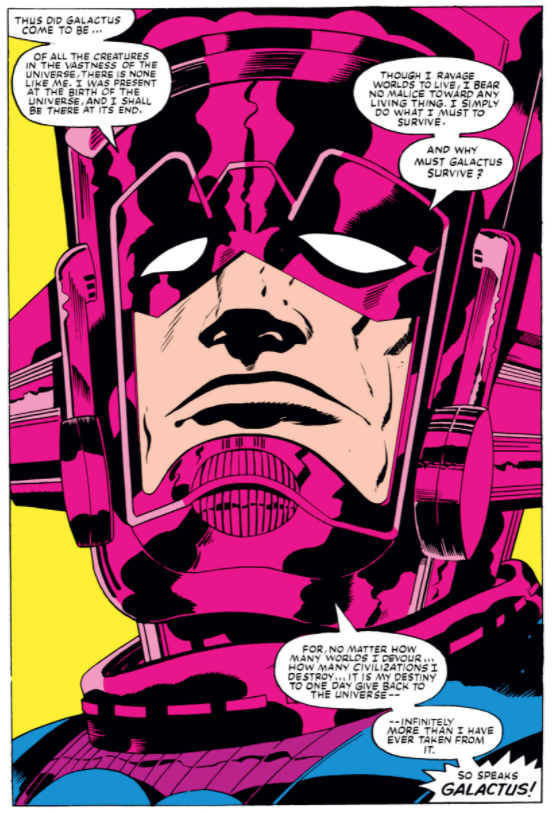
A few decades later, Marvel editor Mark Gruenwald decided to revamp Galactus’s origins. Instead of merely the last survivor of a planet, he became the last survivor of a universe, and he emerged from the Big Bang. Gruenwald basically took the Stan and Jack story, wrote over some of it with some new pages by John Byrne and Ron Wilson, and republished it in 1983 as Super-Villain Classics 1. Here are some relevant pages:

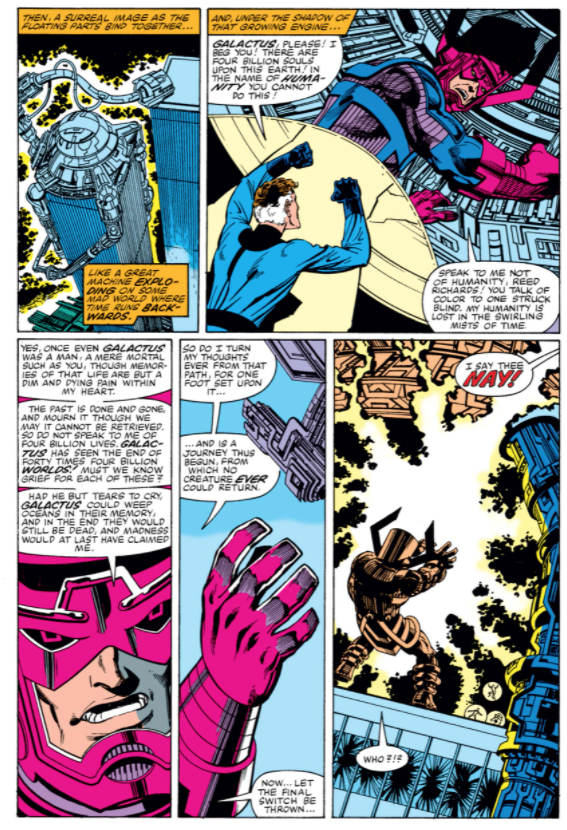
The notable thing about this origin is that establishes Galactus as a cosmic entity, a force of nature and not merely a villain, despite the destruction he causes. That tension became a major storyline during Byrne’s FF run, when Reed Richards begs Galactus to spare earth in FF 243, and Galactus basically says, “nothing personal, it’s just business.”

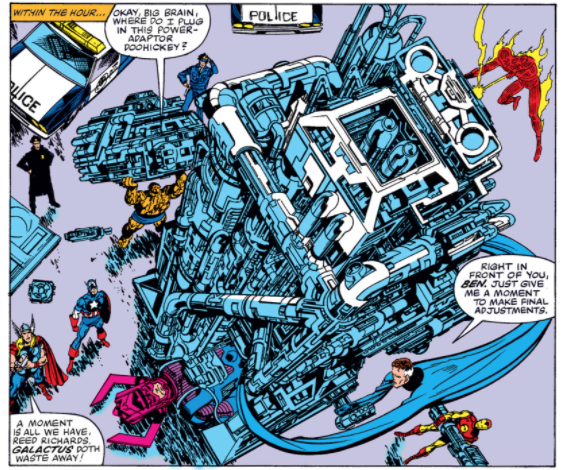
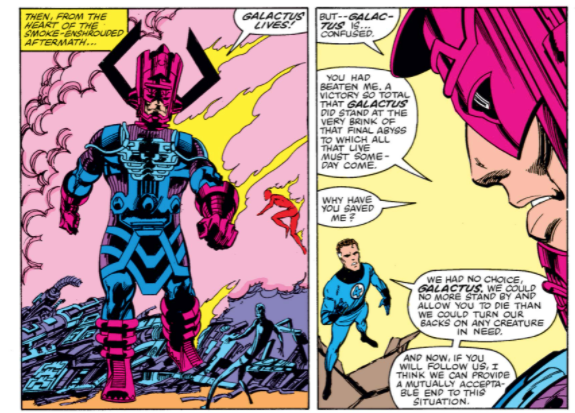
Reed, with the help of the Avengers, then saves Galactus’s life in FF 244, arguing they had a moral responsibility to prevent the death of a living thing.

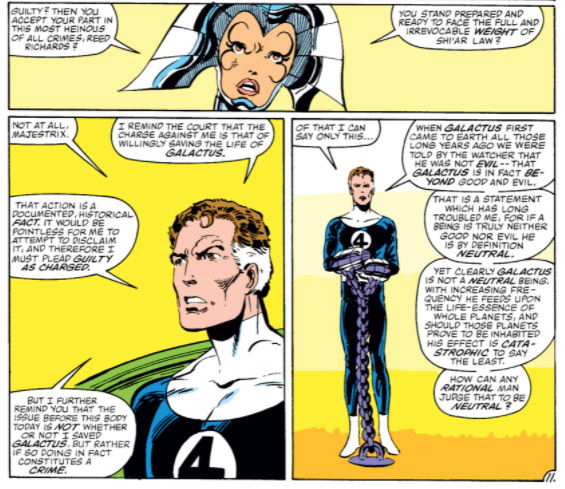
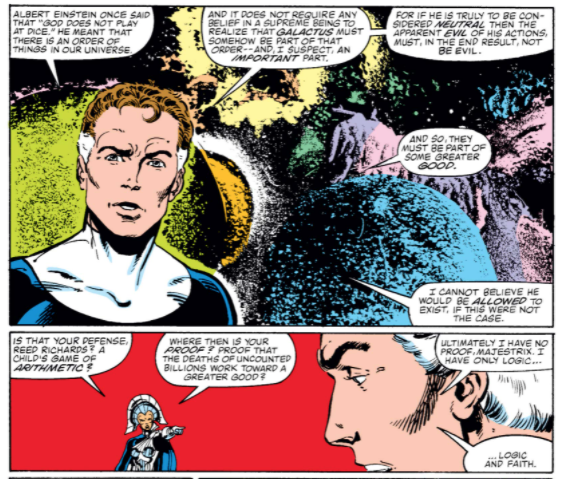
Noble as it was, that decision didn’t sit well with the survivors of the worlds Galactus destroyed, and in FF 262 Reed is summoned to be tried for his crime of saving Galactus. Through Reed, Byrne makes the case of Galactus’s importance in the universe:

There’s a lot more to it, but it serves to anchor Galactus as a unique force in the Marvel universe. On a personal note, FF 262 was the third FF comic I ever read. My 12-year-old mind was blown.

About that outfit

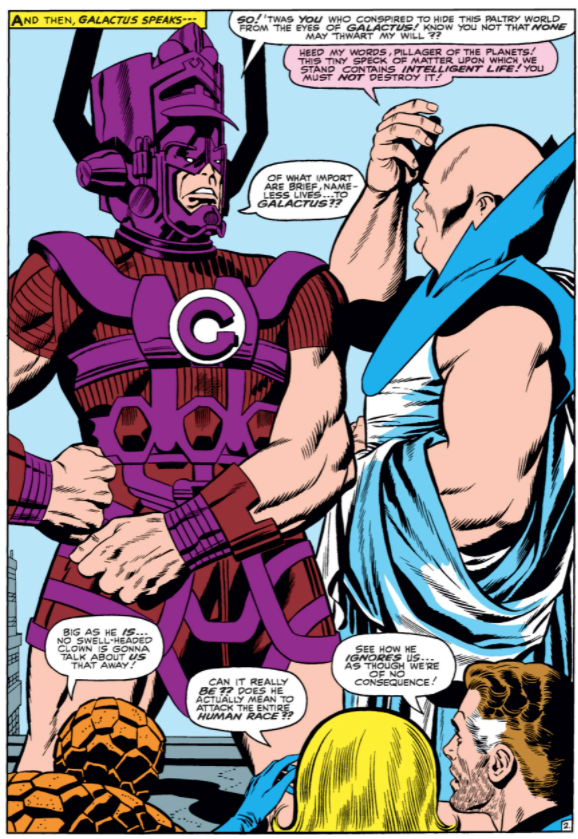
In his first appearance, Kirby has Galactus wearing shorts with a big G on his chest:


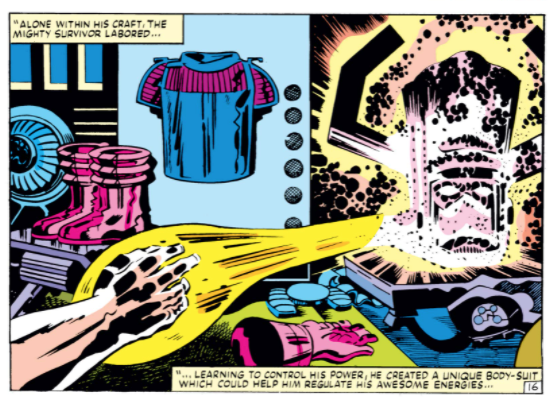
Fortunately, he soon put on long pants and got rid of the G, but his appearance, with the elaborate headgear has remained pretty much the same ever since. Yet despite its visual appeal, it’s not obvious why he’s dressed that way, given that he is a cosmic force and not a run-of-the-mill bad guy. The Lee / Kirby origin in Thor provides one answer: He was given that outfit by a Watcher, who witnessed his emergence from his incubator and created “a unique body-suit which would help him regulate his awesome energies.”

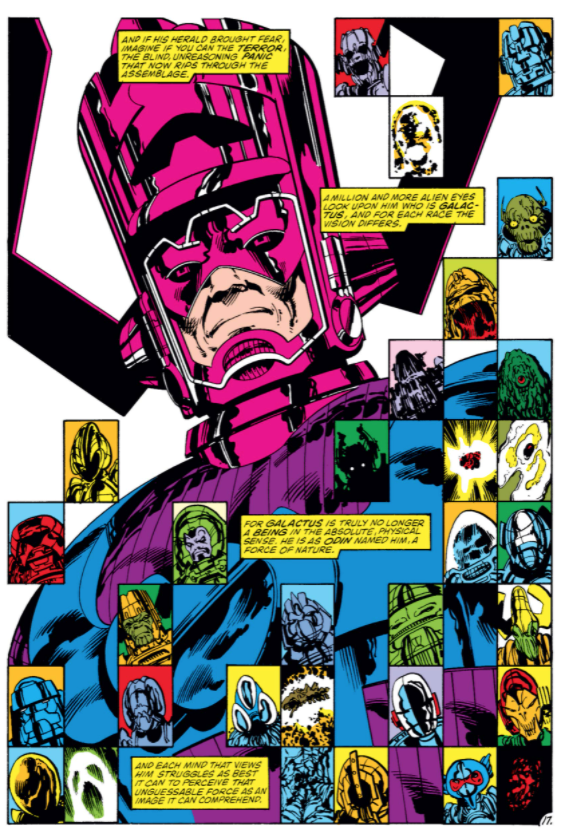
Later, Byrne in FF 262, suggests only humans see Galactus as humanoid, and that he appears to other alien races in whatever form they take (I never much liked this explanation, since he’s never depicted as anything other than humanoid, and it makes more sense to me that he’s human-like because Galan of Taa was also human-like). It’s a pretty cool page though.


Wrong guy

Whaddya mean there’s another Punisher?

That sounds familiar

On his cosmic voyage, the Human Torch passed through “celestial barriers known as un-life” which sounds a lot like ‘anti-life,” a concept that became a big part of the Fourth World mythos Jack created at DC about five years later.

About that vow

On several occasions the Watcher references his vow not to interfere in human affairs while busily interfering in human affairs

Prime real estate

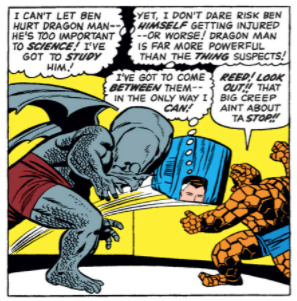
A few issues ago, Dragon Man crashed into Alicia’s apartment while fighting Ben and Johnny. Now, the Silver Surfer just happens to land on her roof.

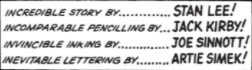
Crazy credits

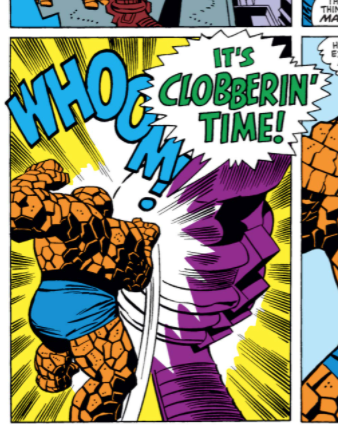
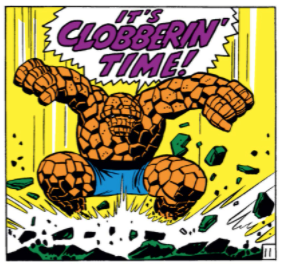
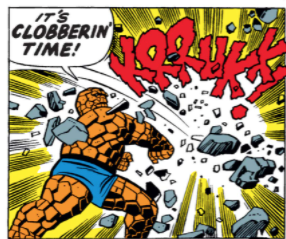
It’s clobberin’ time

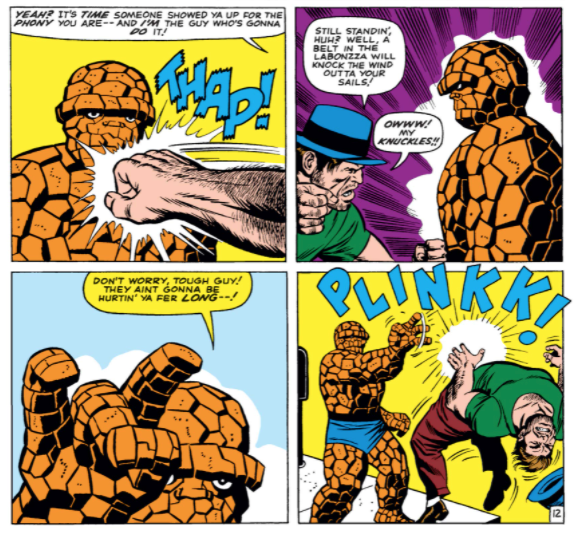
One of the more ineffective attempts to clobber from Ben


Dig that Kirby Krackle

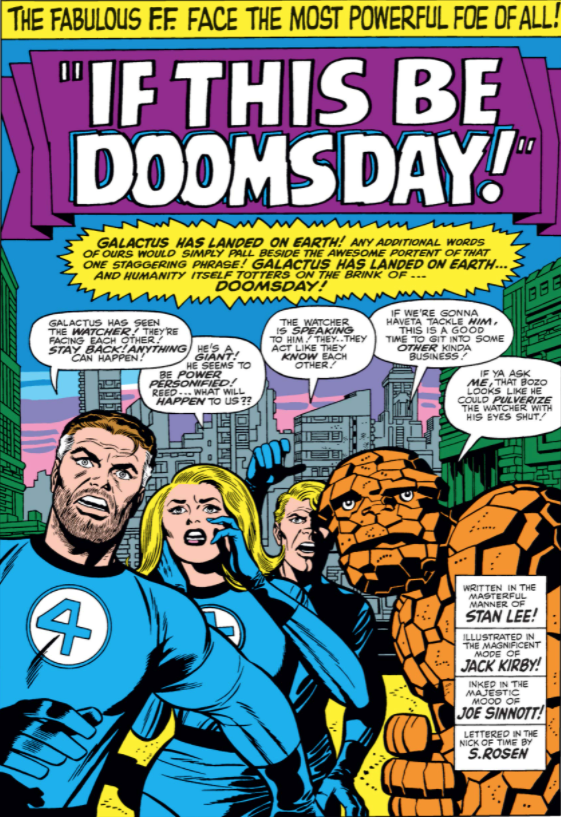
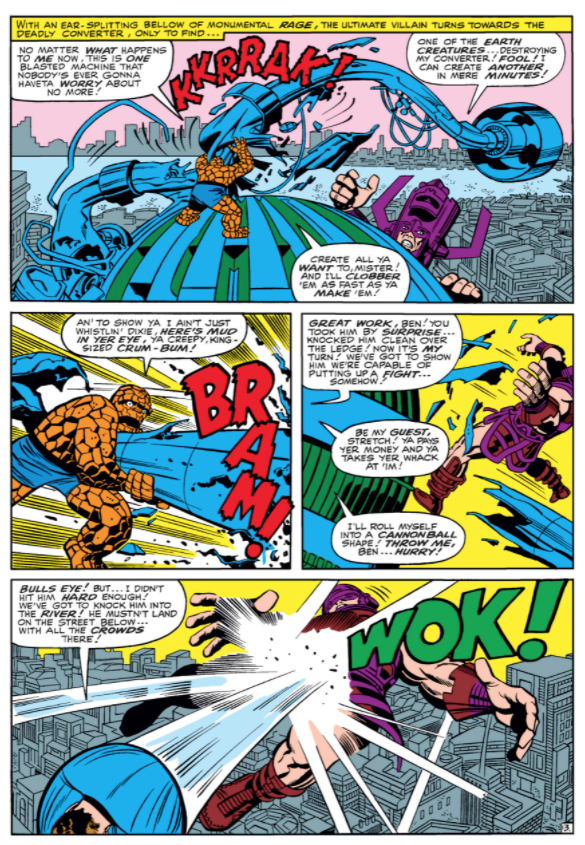
There’s a lot to choose from in this issue, but here are a few stand-out pages and panels, starting with the amazing splash page:


A very cool sequence:


And another amazing page:


Next issue: The conclusion of the Galactus trilogy!

“The World’s Greatest Comic Magazine!” Fantastic Four No. 48

23 Sunday Jan 2022

Posted by percivalhenry in The World's Greatest Comic Magazine

≈ 4 Comments

Tags

1965, Black Bolt, Fantastic Four, Fantastic Four 48, galactus, Inhumans, jack Kirby, Silver Surfer, Stan Lee, Watcher

Fantastic Four 48
“The Coming of Galactus!”
Published: Dec. 1965
Story: Stan Lee and Jack Kirby
Script: Lee
Pencils: Kirby
Inks: Joe Sinnott
Letters: Artie Simek
Cover: Kirby and Sinnott

Synopsis

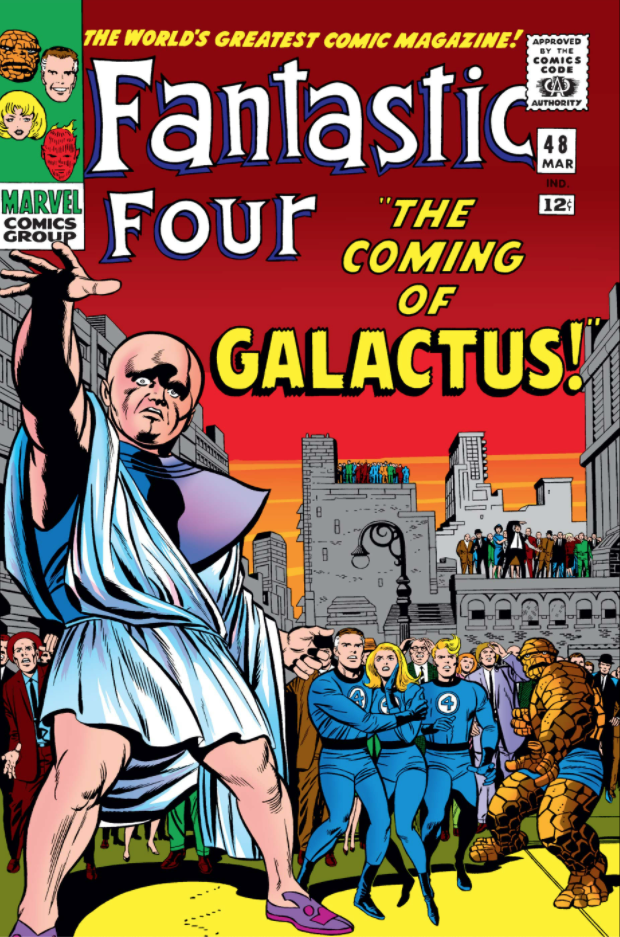
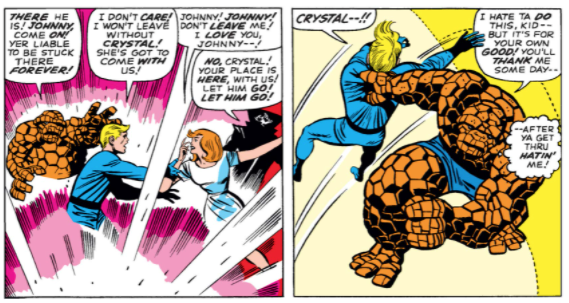
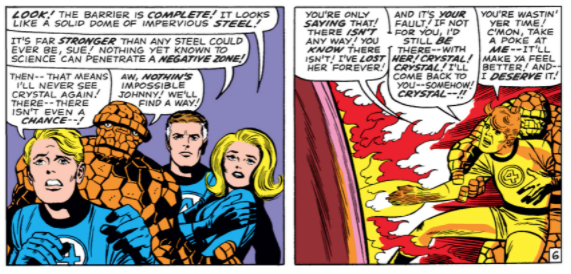
As has been the pattern or the last dozen issues, Fantastic Four 48 picks up where FF 47 left off. The team is in Attilan, the city of the Inhumans, and Maximus has set off his Atmo-Gun, intending to destroy humanity so the Inhumans can rule the earth. Black Bolt, who last issue wrested his crown back from his brother Maximus, confronts him and knocks him silly. Medusa explains to Maximus his plan was doomed because the Inhumans are still human despite their powers, and a device that spares Inhumans would also spare humans. In a last gasp, Maximus reverses the charge on his Atmo-Gun, generating a “negative zone” — a term that should sound familiar—around Attilan. The Invisible Girl creates a force field which allows the FF to pass through the zone and escape but the Inhumans are trapped behind it, leaving the Human Torch distraught when he is separated from Crystal.

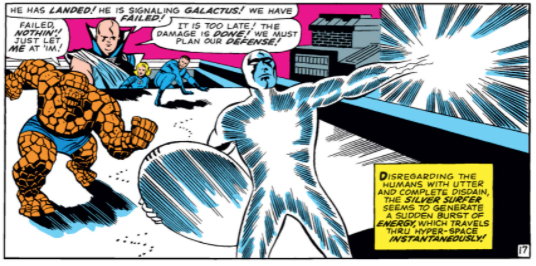
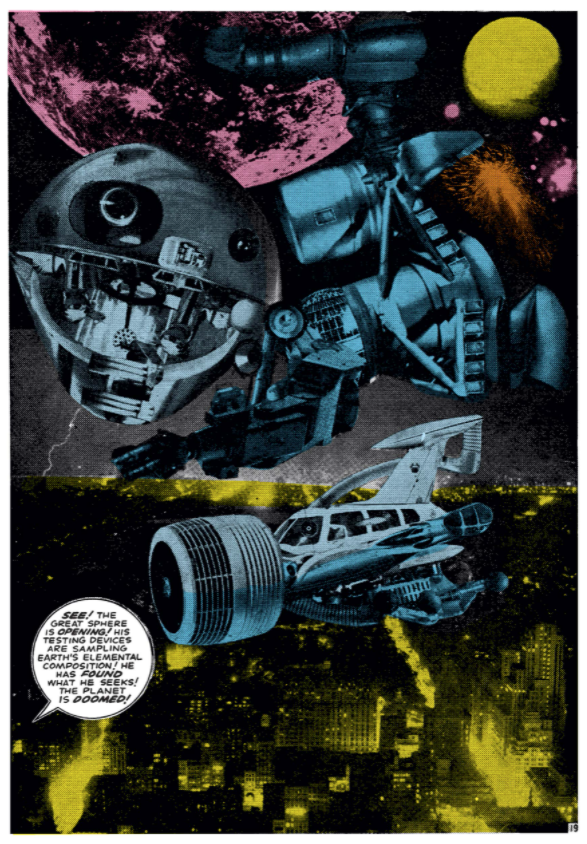
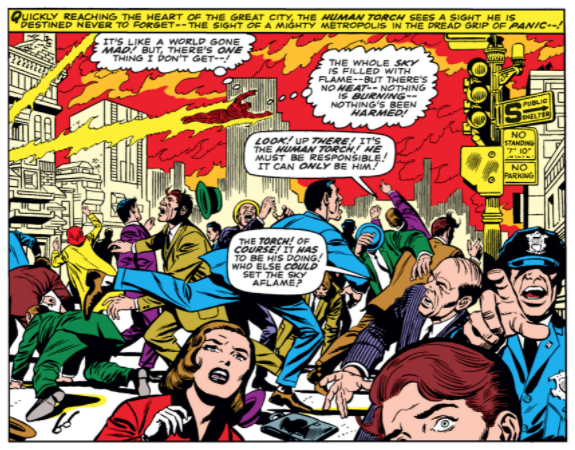
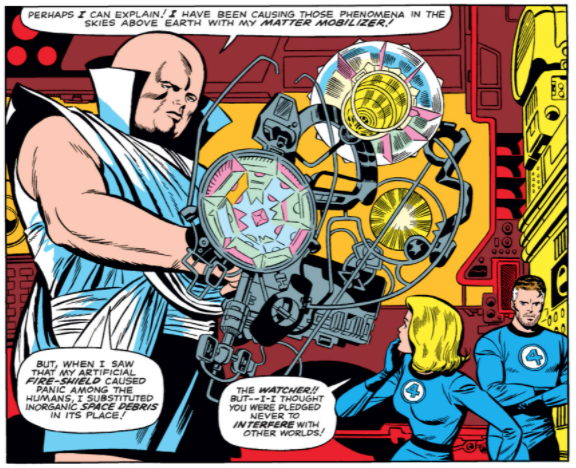
Meanwhile, as the FF return to New York, we are introduced to the Silver Surfer as he glides through space, and are warned that he is a harbinger of Galactus. Back in New York, the skies are aflame, and panicking New Yorkers blame the Human Torch. The flames disappear, only to be replaced by “space debris.” The Watcher appears, and explains these effects are his doing in order to disguise the earth from the Silver Surfer. The Surfer then arrives and sends a signal to space before The Thing clobbers him. The signal summons Galactus, who emerges from his ship and announces his intentions to drain the earth of “all elemental life.” The issue ends with the cliff hanger.

What’s going on here?

FF 48 marks the beginning of the Galactus trilogy, arguably the apex of the Lee and Kirby run on the Fantastic Four. But oddly, before we can start this epic story, we need to resolve the last story, the FF’s adventure with the Inhumans. I’m not sure why Stan and Jack constructed the comic this way, but it’s strange that it’s divided into two stories.

The Inhumans portion of the comic establishes Maximus as the royal family’s principle antagonist, creates a bit of romantic drama between Black Bolt and Medusa, and ramps up the star-crossed-lovers theme between Johnny and Crystal. All good stuff, but it’s sort of forgettable compared to the rest of the comic, which introduces two major Marvel figures: the Silver Surfer, and Galactus. We’ll deal with Galactus in our next post, because there’s a lot to say about the Surfer.

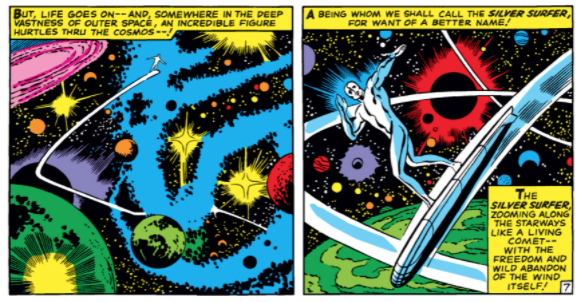
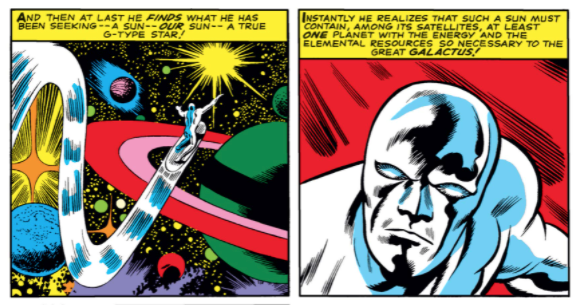
The Surfer’s first appearance.

Who is this guy?

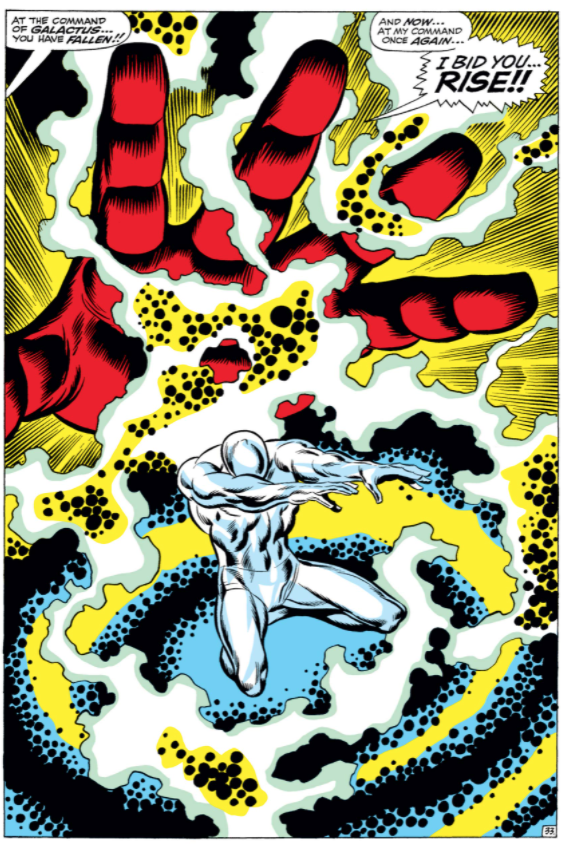
The Silver Surfer was one of Jack Kirby’s prized creations, and a source of major tension between him and Stan Lee, one which helped lead to Kirby’s departure from Marvel. According to Mark Evanier in his biography Kirby: King of Comics, Jack created him without any involvement from Stan Lee, who first encountered the Surfer when he saw the penciled pages of FF 48. Allegedly upon seeing him, Stan said “Jack, this time you’ve gone too far.” But Lee soon fell in love with the character, and it’s not hard to see why, given his penchant for grandiloquent soliloquies. Stan soon launched a Surfer solo book to be drawn by new Marvel star John Buscema, and gave the Surfer an origin very different from the one what Jack had in mind, leaving Jack frustrated and angry. According to Evanier “his idea had been taken from him in every possible sense.”

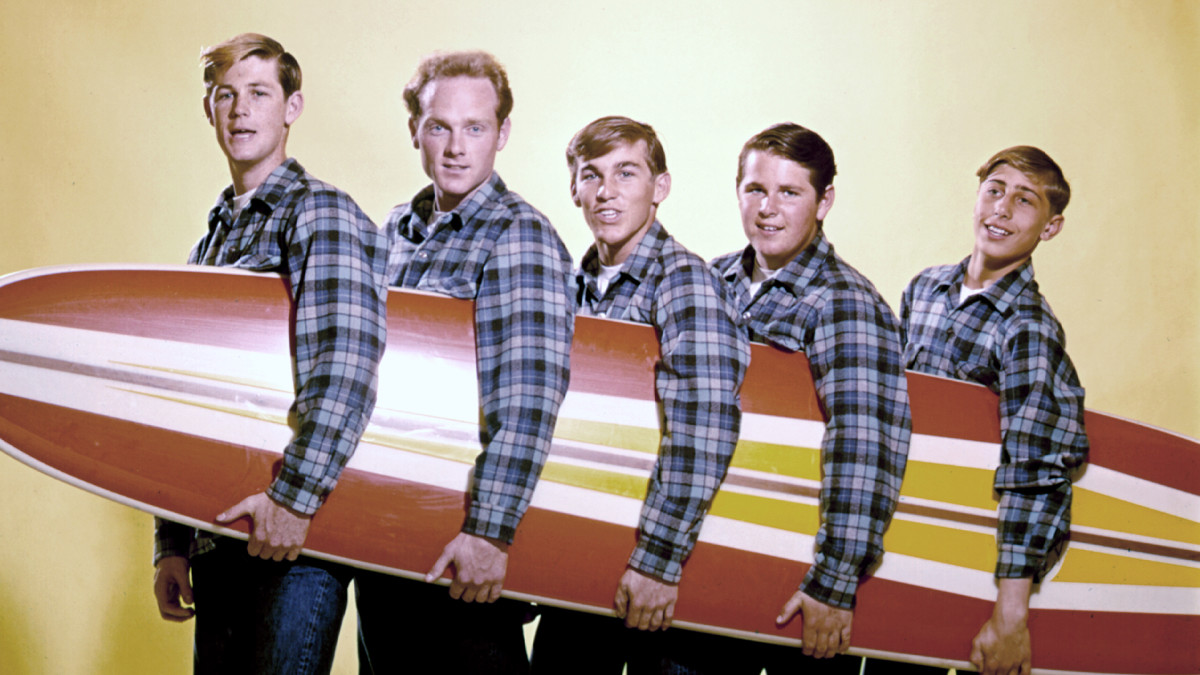
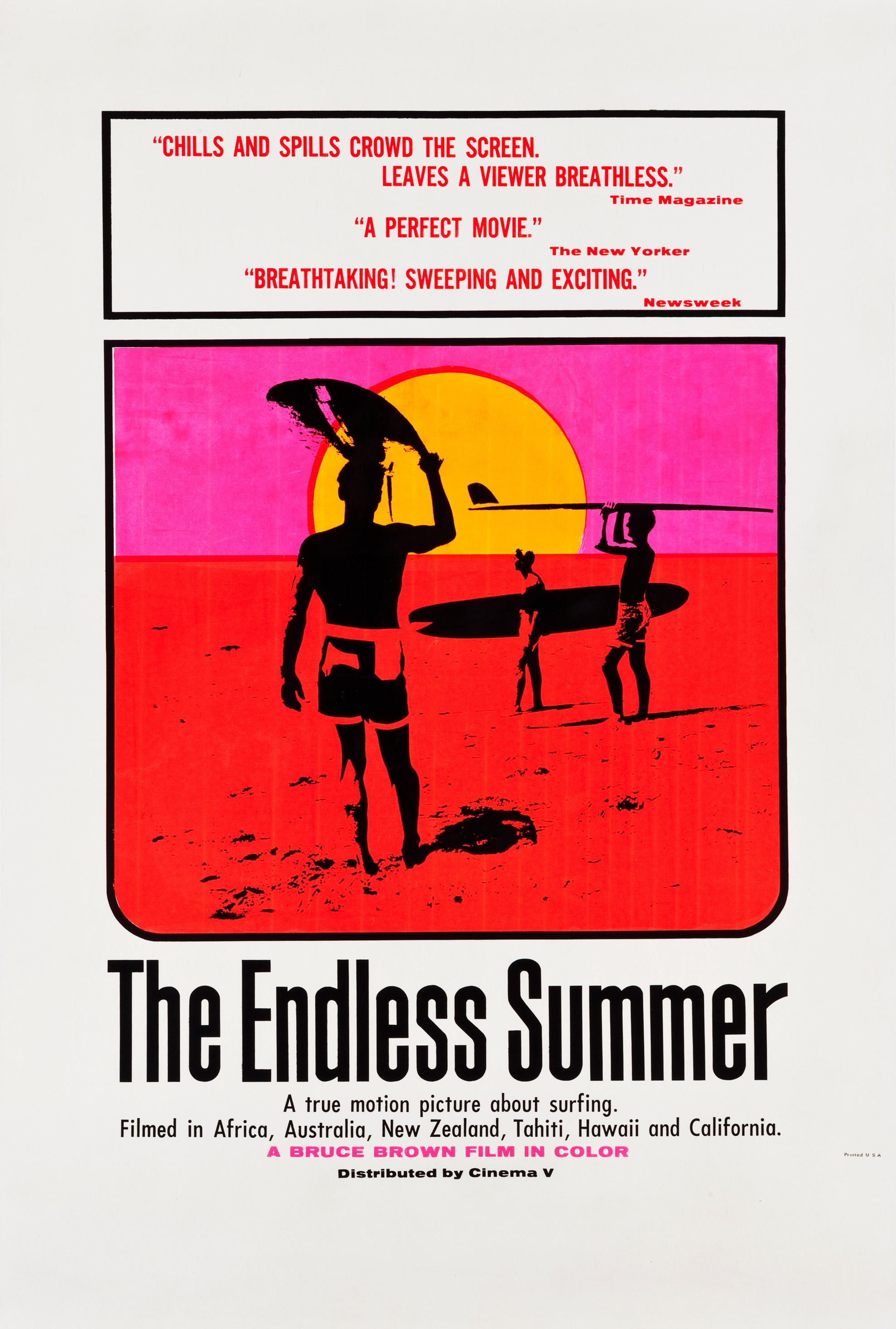
So why a surfer? Evanier doesn’t say what inspired Jack to put Galactus’s herald on a surfboard, but it probably has to with the general interest in surfing as a sport in the early to-mid 1960s. Surf music was charting, with the Beach Boys and Jan and Dean were churning out hits like “Surf City” and “Surfin’ USA,” and beach party movies, which often featured surfing, starring Frankie Avalon and Annette Funicello were in the theaters. The next year, The Endless Summer, a surfing documentary, would come out. Clearly surfing was in the zeitgeist.

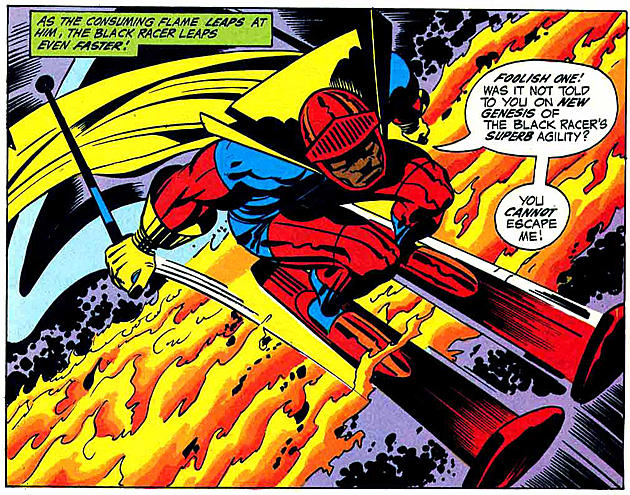
Jack would reach into the same bag of tricks a few years later when he was at DC and created the Black Racer, a member of the New Gods who acts sort of like a herald of death. By then, ski racing was popular, after Jean-Claude Killy’s star turn in the 1968 Olympics and the release of 1969’s Downhill Racer, a movie starring Robert Redford.

But while the design of the Surfer was abstract and elegant enough so that he only looked like he was surfing through space and not an actual surfer, Black Racer is far more literal and, I would argue, far less successful of a design.

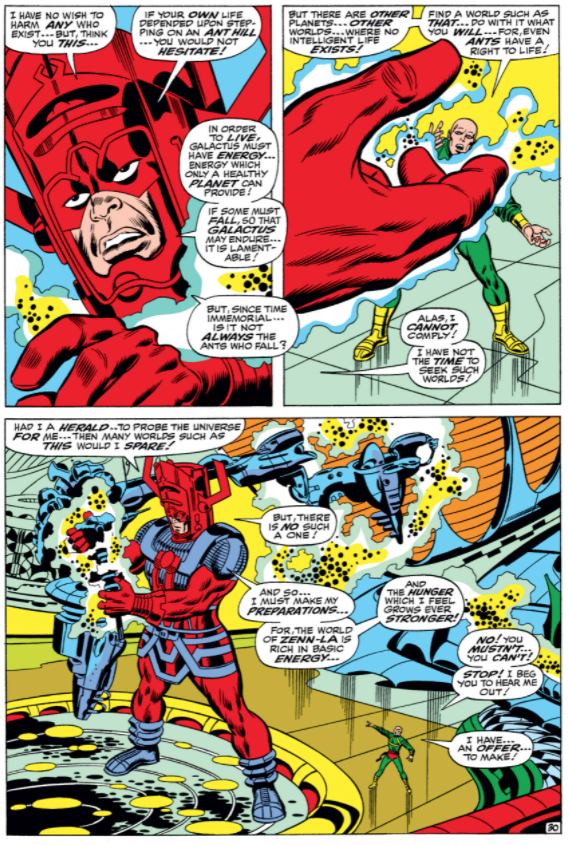
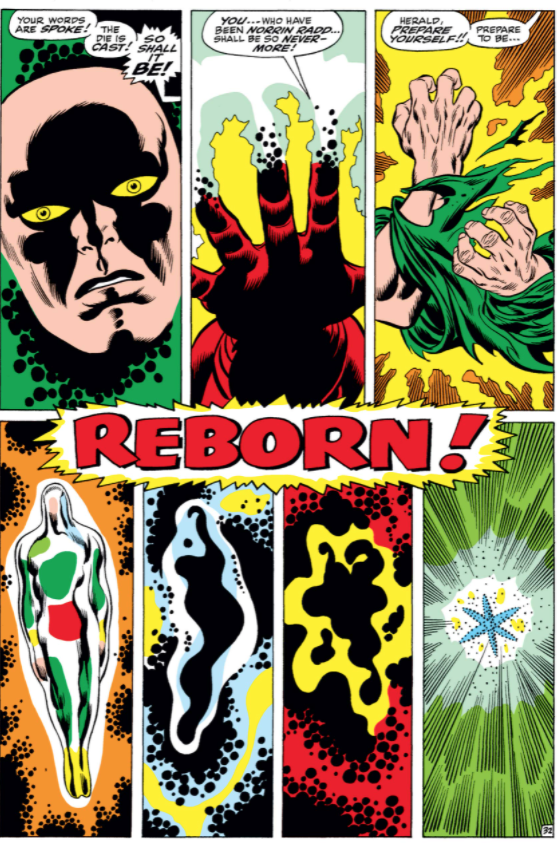
About that origin

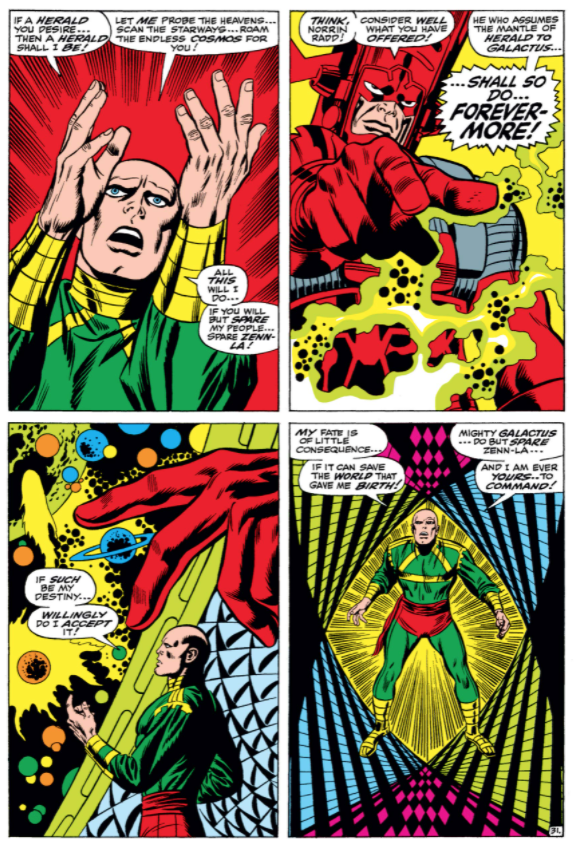
According to Evanier, Jack envisioned the Surfer as a being of pure energy who had never been human, and thus needs emotions like love explained to him. But in the origin Stan told in 1968’s Silver Surfer 1, the Surfer was once an (alien) man, Norrin Radd, who pledges himself to Galactus in order to spare his home world, Zenn-La, and his love, Shalla-Bal. The theme of the Surfer’s sacrifice and lost humanity is a powerful one and gives writers lots to chew on over the years. Here are the relevant pages from Silver Surfer 1. (And while John Buscema might be cast as a bad guy in Stan’s dispute with Jack, he probably had no say in it and there’s no denying how gorgeous his art is, here inked by Joe Sinnott).

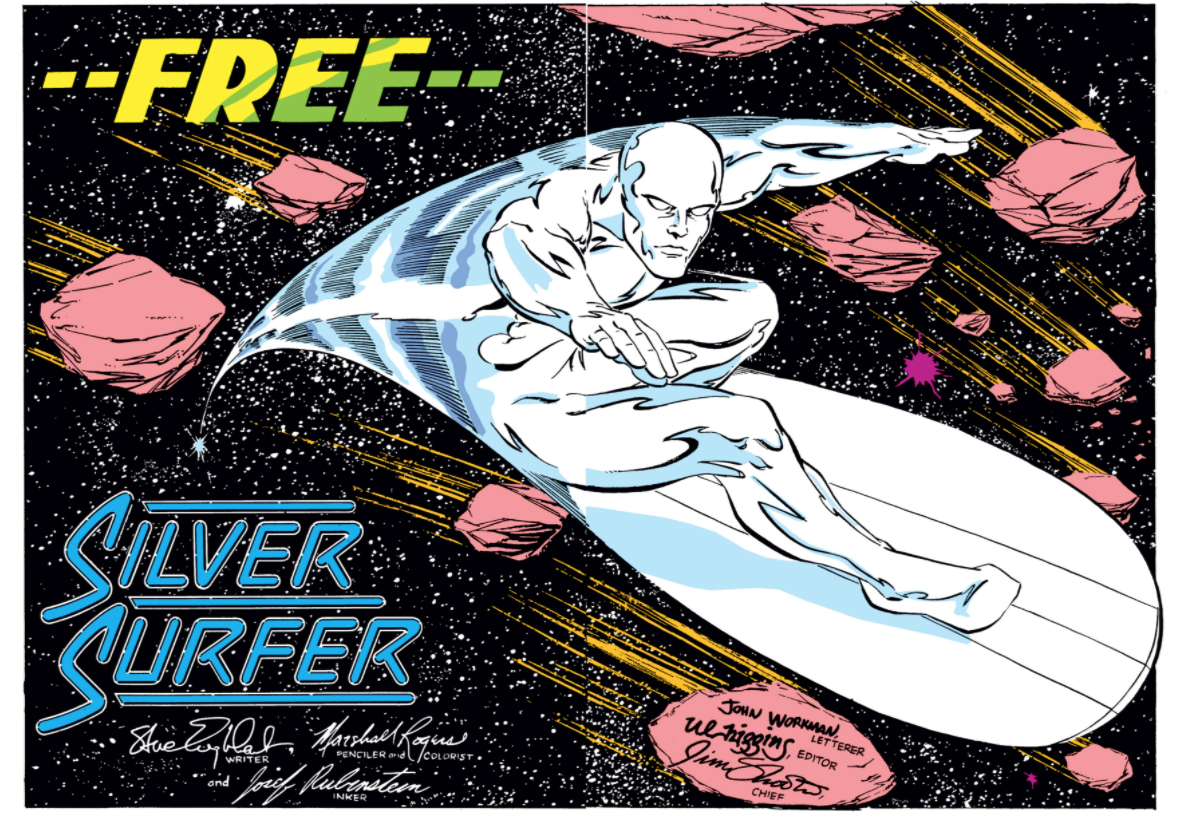
Over the years, the Silver Surfer has attracted some of the comic world’s best and brightest creators. Here he is drawn by Marshall Rogers and inked by Joe Rubenstein in his 1987 solo series:

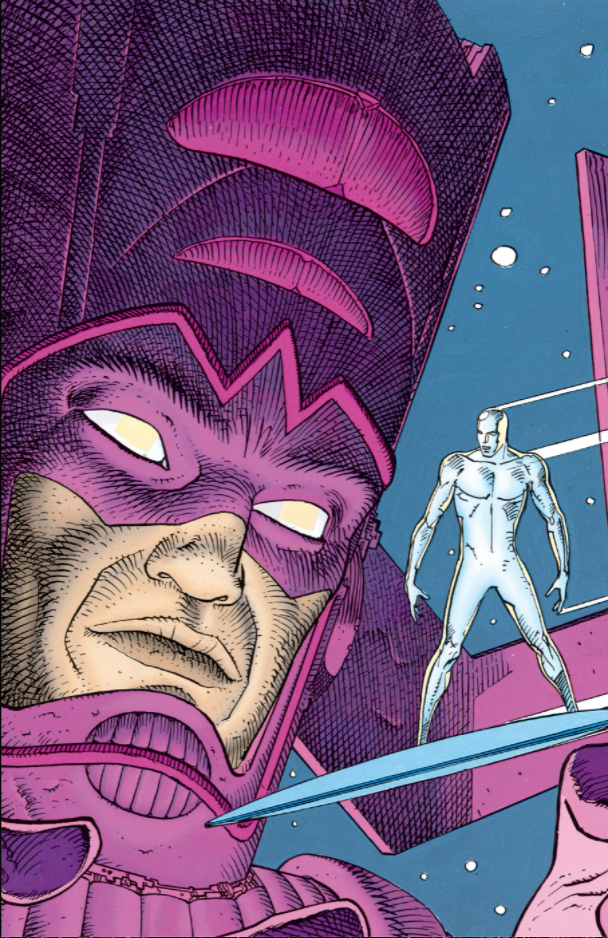
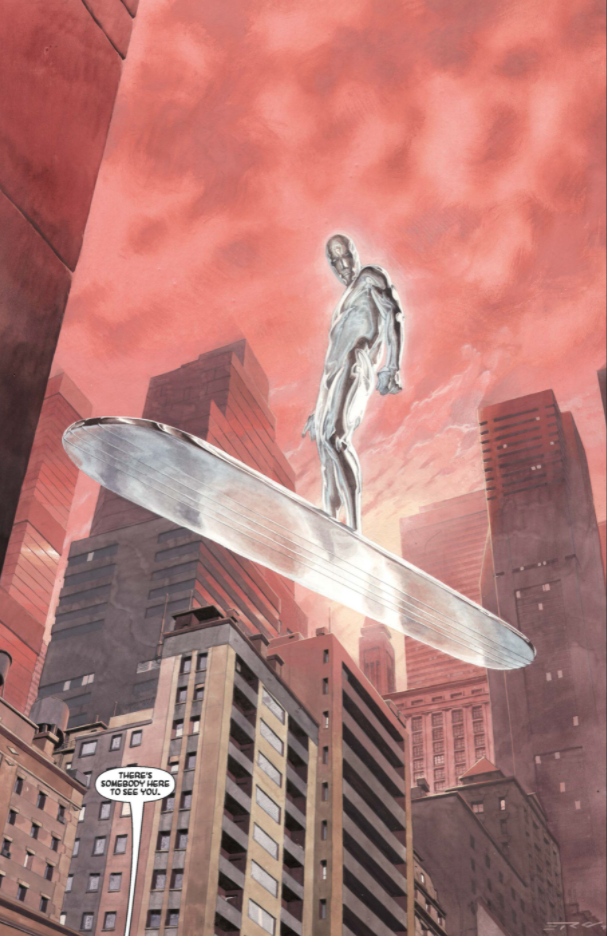
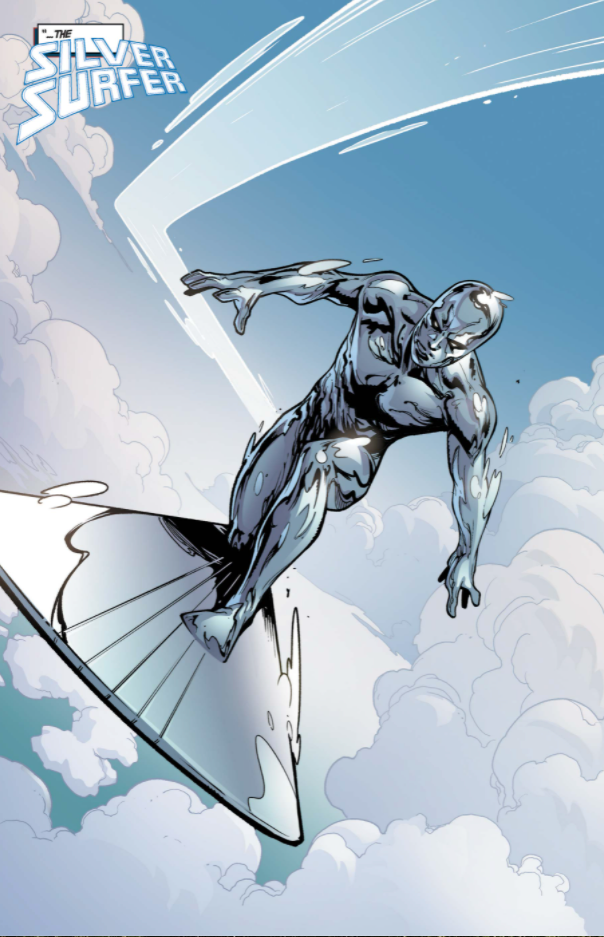
And drawn by Moebius, Esad Ribic, and Francesco Manna:

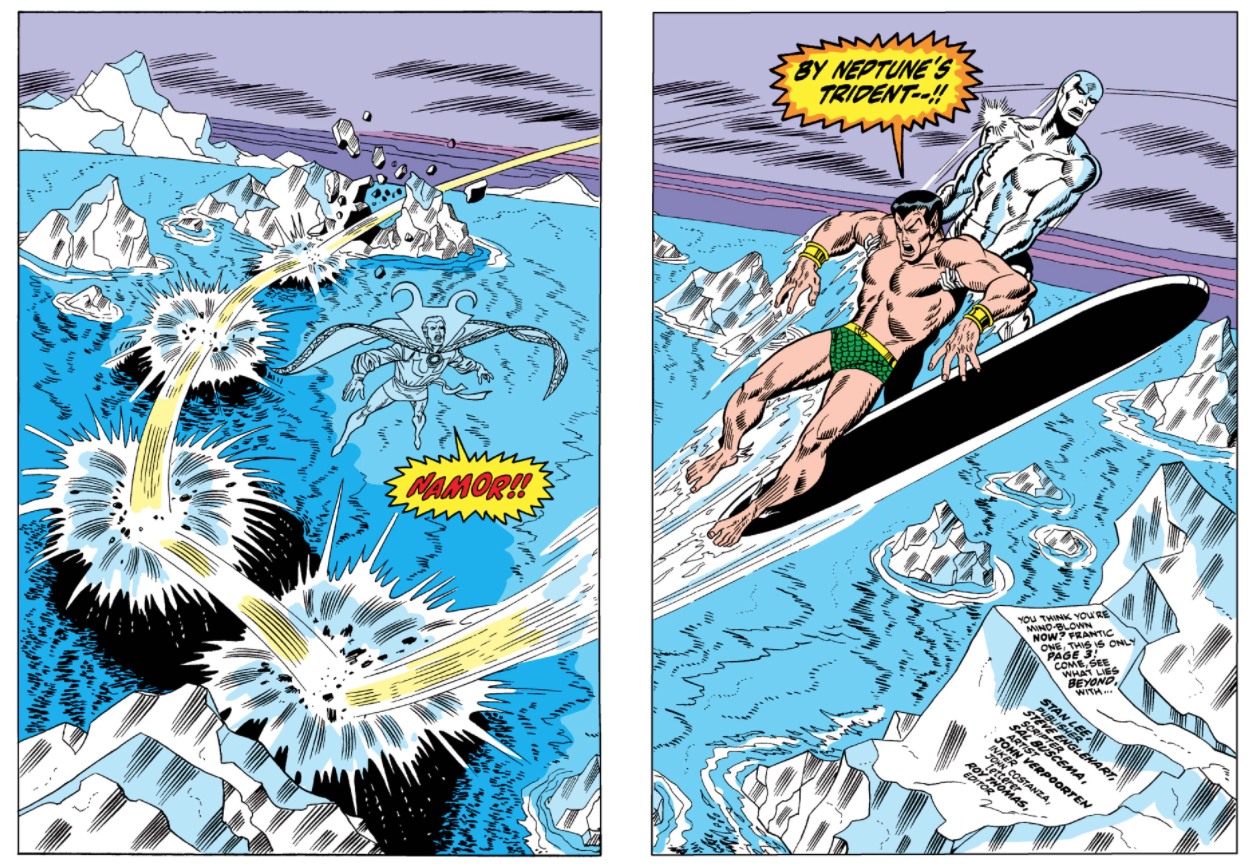
Along with starring in several of his own solo series, he also was an on-again-off-again member of the Defenders:

The Defenders 2 (1972, story by Steve Englehart, art by Sal Buscema and John Verporten)

My first real encounter with the Silver Surfer came in John Byrne’s Fantastic Four 260, a comic I have discussed before as igniting my interest in comics in general and the Fantastic Four in particular. Here, he battles Terrax, another former herald of Galactus given new life by Dr. Doom. There was something incredibly cool about the Surfer, who is as unadorned and sleek as a hood ornament, and both bristling with power and noble in his restraint. Reader, I was hooked.

Keel hauled

One aspect of the Surfer’s design I’ve always been curious about is whether his surfboard should have a keel. According to Kirby and Rogers, it does:

Silver Surfer 2 (1987, Englehart/Rogers/Rubinstein)

Byrne and Buscema are in the no-keel camp:

Silver Surfer 2 (1968, Buscema/Sinnott)
Silver Surfer 1 (1982, Lee/Byrne/Palmer)

Personally, I prefer a no-keel look, since the keel makes it look too literally like a surf board. It’s not – there are no ocean waves in space.

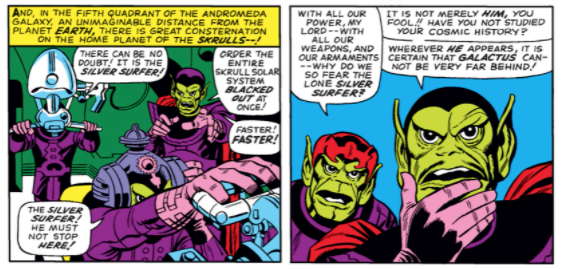
One last detail about the Surfer: He is introduced to readers by the Skrulls, who fear he might alert Galactus to their homeworld. Byrne, always a student of the Lee/Kirby issues, returns to that idea decades later when he has Galactus consume the Skrull’s planet.

FF 257 (1983, Byrne)

Crazy Credits

Young love

Johnny takes his separation from Crystal hard, which is weird since they barely know each other.

The sexist sixties

Sue’s pouting and histrionics aren’t quite as bad in tis issue as last, but it’s still pretty bad (and is Ben smoking a cigarette in the first panel?)


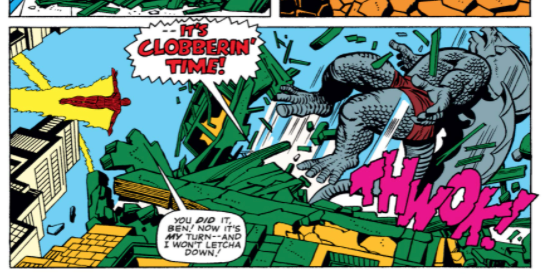
Clobberin’ Time

It’s starting to be a regular occurance now (this is No. 10 by my count).

Feats of strength

It’s been long time since we’ve had one of these sequences of Ben showing off his strength. They used to be in almost every issue.


Dig that Kirby Krackle!

As if this issue didn’t have enough going on, we get a Kirby Kollage as Galactus arrives on earth:

Nu Yawk, Nu Yawk:

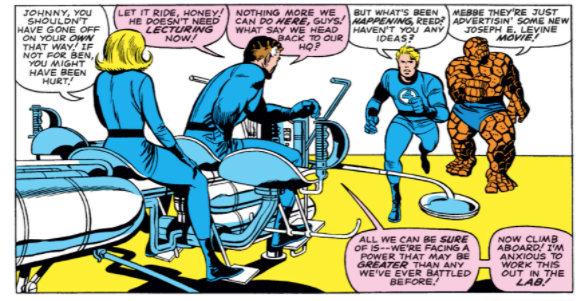
Another very cool panel (Joseph Levine was a Hollywood producer behind bombastic adventure movies like Hercules):

The Watcher, looking buff:

And oh yeah, this guy:

Next issue: Galactus! (duh)

“The World’s Greatest Comic Magazine!” Fantastic Four No. 47

17 Monday Jan 2022

Posted by percivalhenry in The World's Greatest Comic Magazine

≈ 1 Comment

Tags

1965, Fantastic Four, Fantastic Four 47, Inhumans, jack Kirby, Stan Lee

Fantastic Four 47
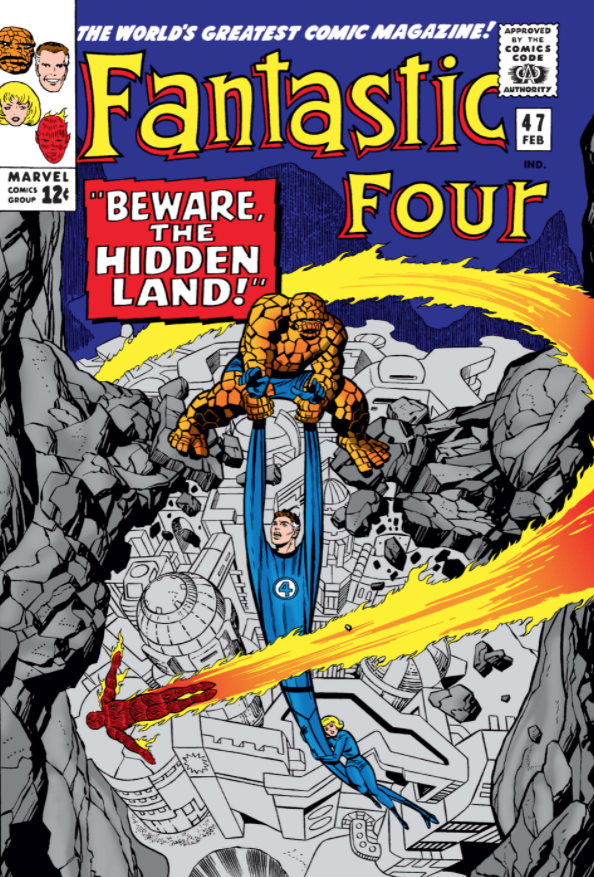
“Beware the Hidden Land!”
Published Nov. 1965
Story: Stan Lee and Jack Kirby
Script: Lee
Pencils: Kirby
Inks: Joe Sinnott
Letters: Artie Simek
Cover: Kirby and Sinnott

Synopsis

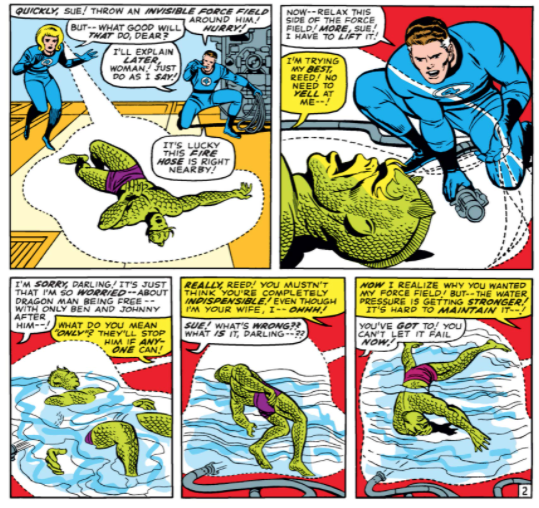
Fantastic Four 47 picks up where FF 46 left off (once very unusual, the cliff-hanger ending is becoming the rule in the Fantastic Four). Dragon Man has escaped the Seeker and is on a rampage but before the team can pursue him, they need to attend to Triton, the fish-like Inhuman who is dying without water. Mr. Fantastic orders the Thing and the Human Torch to pursue Dragon Man, then instructs the Invisible Girl to enclose Triton in a forcefield, which he fills with water. Ben and Johnny eventually subdue Dragon Man, but not before the creature almost destroys the studio of Alicia Masters, Ben’s girlfriend.

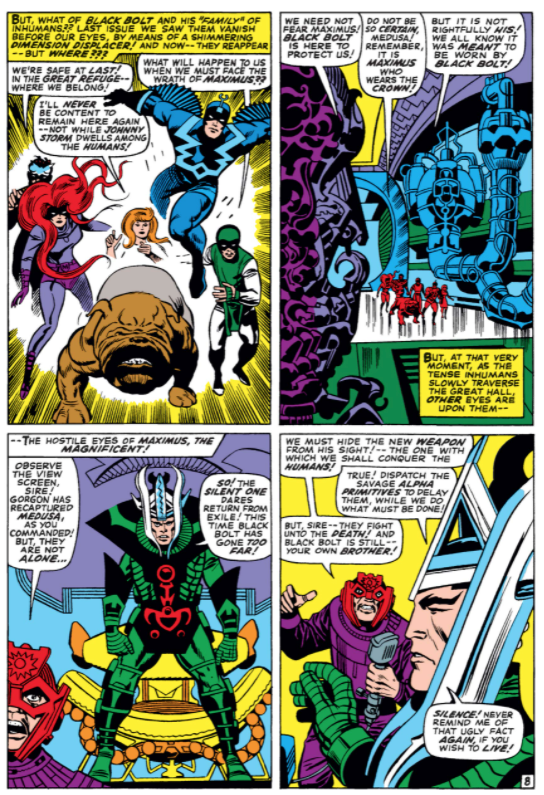
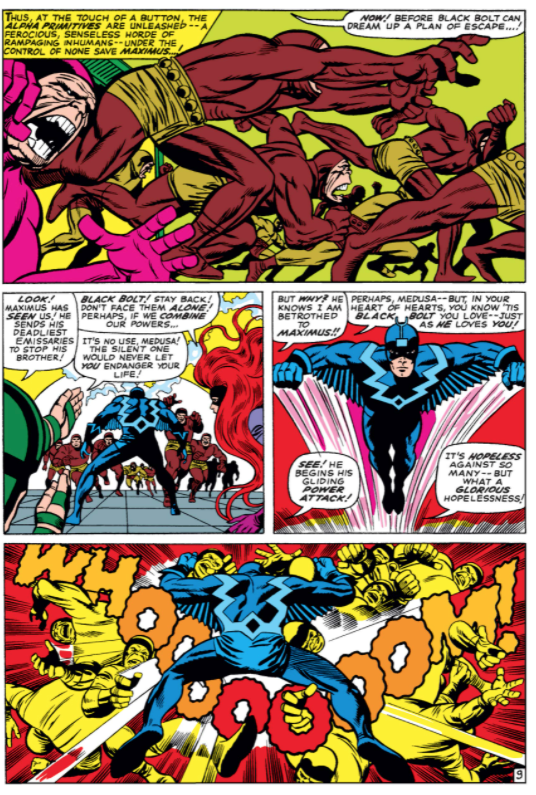
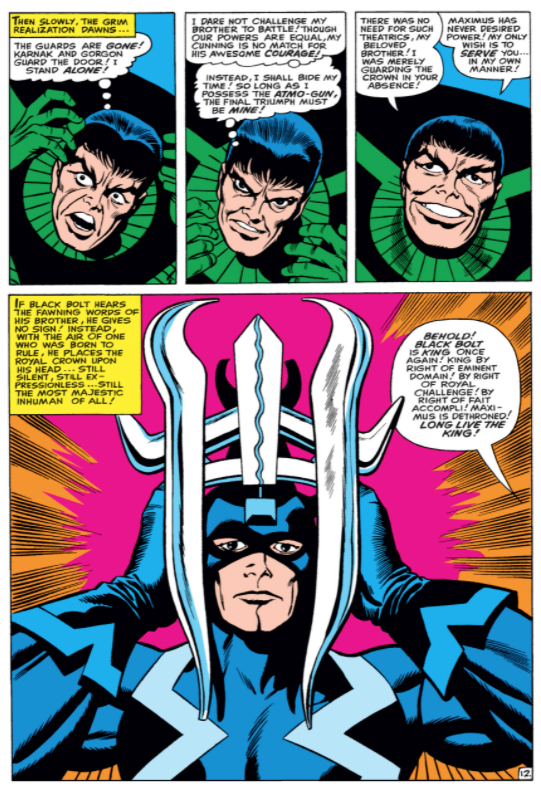
Meanwhile, the rest of the Inhumans teleport back to the Andes and their hidden city of Attilan (called only “the Great Refuge” here) where it is revealed that Maximus, Black Bolt’s brother, has usurped the throne and dispatched the Seeker to capture the Inhuman royal family. After Maximus orders the ape-like Alpha Primatives to attack the royal family, Black Bolt eventually wrests the crown back from Maximus.

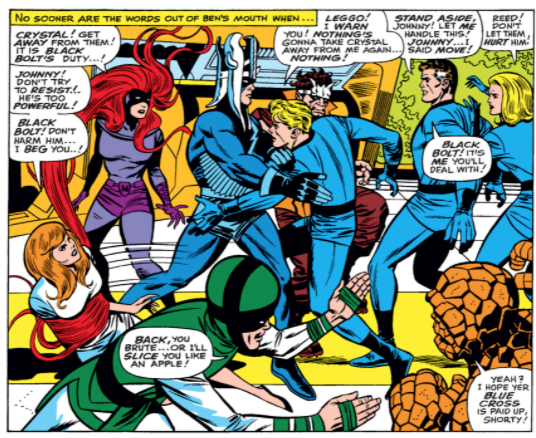
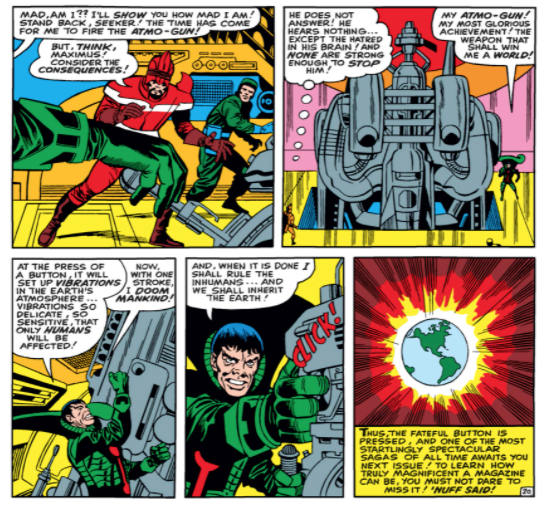
The Fantastic Four arrive, having tracked the Seeker, and confront Black Bolt, who demands the team leave. As the groups debate, the issue ends with Maximus preparing to fire his “Atmo-Gun” which promises to destroy mankind, leaving the earth to the Inhumans.


What’s going on here?

Fantastic Four 47 is a frustrating issue. It features some of the most outstanding Kirby art to date (the influence of Joe Sinnott is really apparent), a story jammed with plot and sub-plots, but also some of the most egregiously sexist characterizations in the comic so far. The depiction of Sue is almost unreadable, and Reed’s treatment of her is equally painful.

Let’s start with Reed barking orders at a flummoxed Sue, who seems incapable of understanding her own powers:

Then, as Sue suggests the Inhumans can tend to their own affairs, Reed shuts her down.

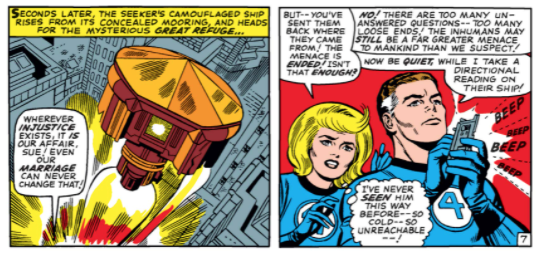
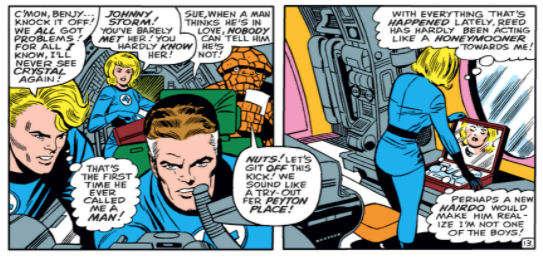
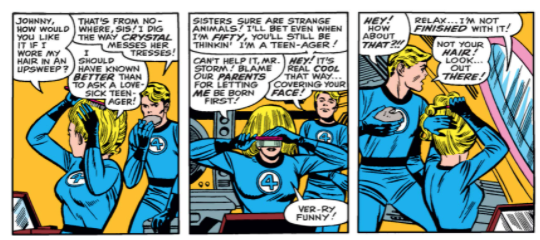
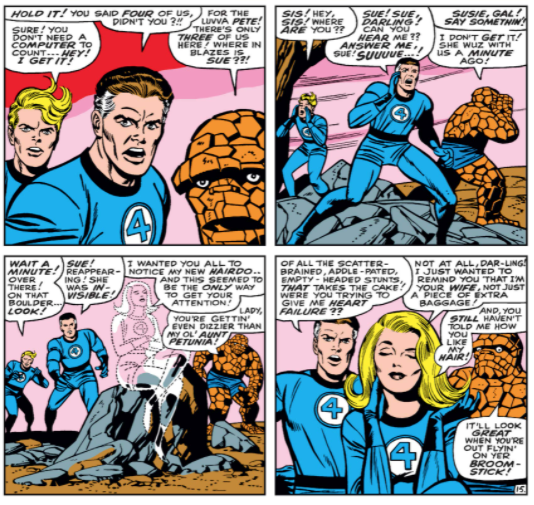
Later, as the Fantastic Four flies to Attilan, Sue attends to … her hair.

Which leads to this excruciating sequence:

And finally, once again Reed needs to tell Sue how to use her powers:

And if there was any worry that it was just Sue who was written like this, here’s Alicia—allegedly an accomplished sculptor with a life of her own—pining away for Ben:

It’s hard to understand where the treatment of Sue is coming from, other than it being just a particularly sexist product of its era. Frustratingly, in the previous dozen or so issues, Stan and Jack had written her having more agency and mastery over her powers, but it all seems to revert back to idiotic stereotypes in FF 47.

Elsewhere …

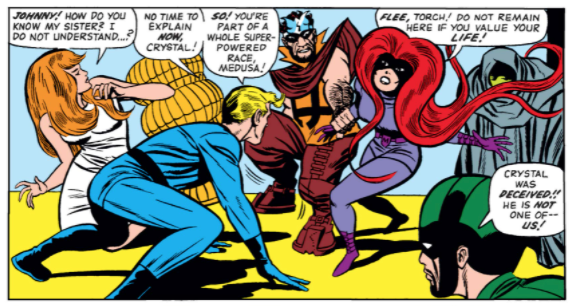
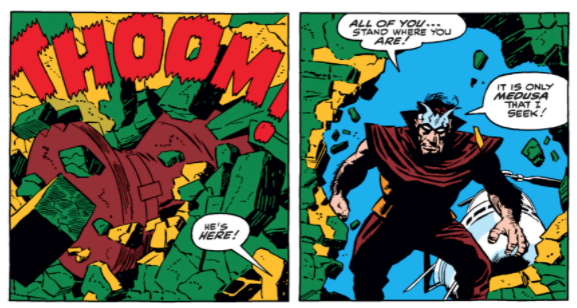
Fantastic Four 47 further elaborates on the Inhumans and the dynamics within the royal family. We are introduced to Maximus, and he’s revealed to be the real villain. Confusingly, a flunky of his says it was Maximus who ordered Gorgon to capture Medusa in issue 44, when it seemed obvious that he was working on behalf of Black Bolt to reunite her with the royal family.

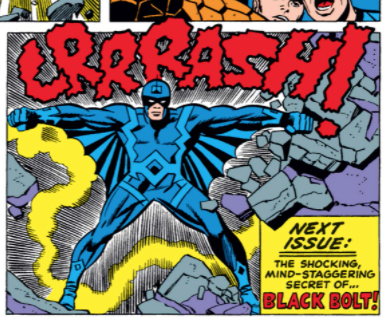
Also, Maximus refers to an “accident” that left Black Bolt speechless and left unable to rule, an explanation which is eventually retconned away when the power of Black Bolt’s voice becomes the reason for his silence (his voice’s power isn’t revealed until FF 54, and his silence is more fully explained in the Thor backup stories).

Crazy Credits

Subtle but clever.

Star-crossed lovers

Ben and Alicia’s relationship is also given some attention in Fantastic Four 47, as Ben is desperate to save her as Dragon Man threatens to destroy her building. They make their feelings for each other known thusly:

Leading to more anguish from Ben later in the story, as he return to a familiar theme- his lost humanity.

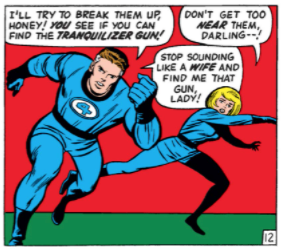
Those crazy kids

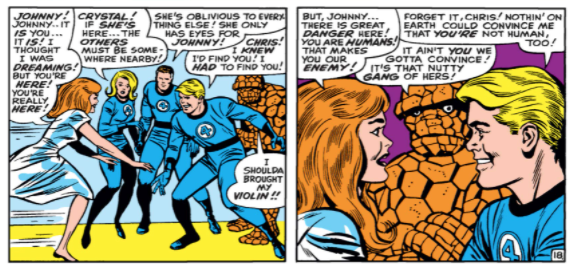
Meanwhile, Ben isn’t the only one with relationship issues, as Johnny and Crystal reunite (oddly, her nickname is written here as “Chris” and not “Crys”).

Oops

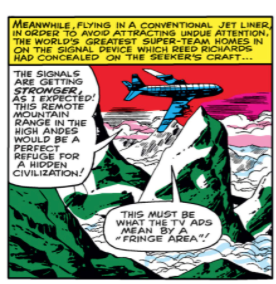
Why are the FF flying a commercial jet instead of their Fantasticar, their Pogo Plane or their ICBM? Stan supplies an explanation, but I’m guessing Jack just forgot.

It’s Clobbberin’ Time

Ben is starting to say the magic words more frequently. This is the ninth time, by my count.


Weird Science

Beware the Atmo-Gun!

Dig That Kirby Krackle

Jack (with an assist from Sinnott) delivers some of the most dynamic pages yet. Here are a few:


Next issue: The resolution of the Inhumans sage, and the beginning of a little story featuring some guys called Galactus and the Silver Surfer!
“The World’s Greatest Comic Magazine!” Fantastic Four No. 46

14 Friday Jan 2022

Posted by percivalhenry in The World's Greatest Comic Magazine

≈ Leave a comment

Tags

1965, Black Bolt, Fantastic Four, Fantastic Four 46, Inhumans, jack Kirby, Stan Lee

Fantastic Four 46
“Those who would destroy us!”
Published: Oct. 1965
Story: Stan Lee and Jack Kirby
Script: Lee
Pencils: Kirby
Inks: Joe Sinnott
Letters: Artie Simek
Cover: Kirby and Sinnott

Synopsis

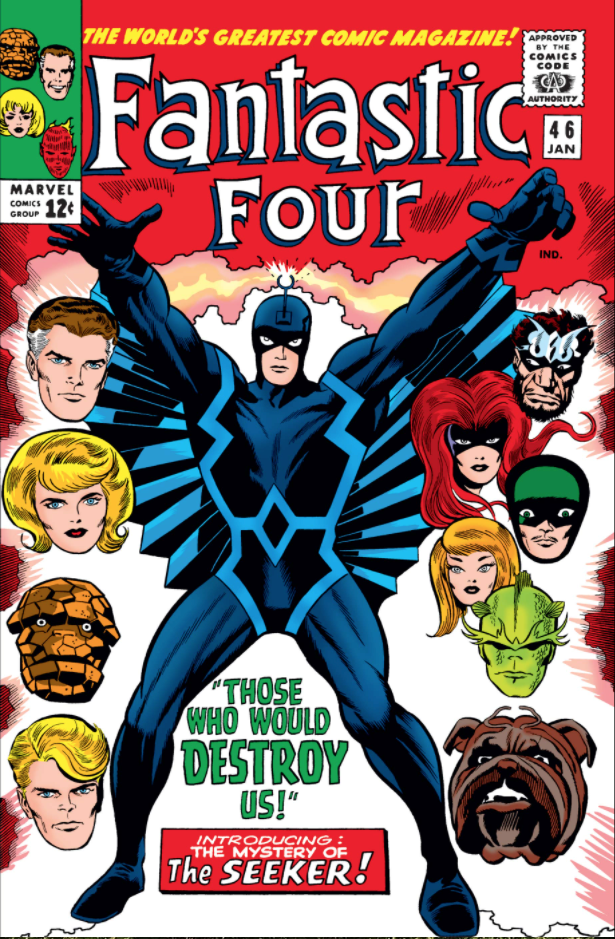
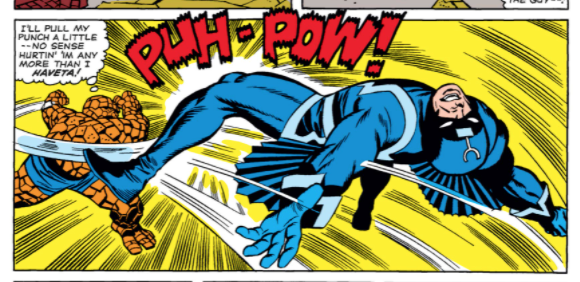
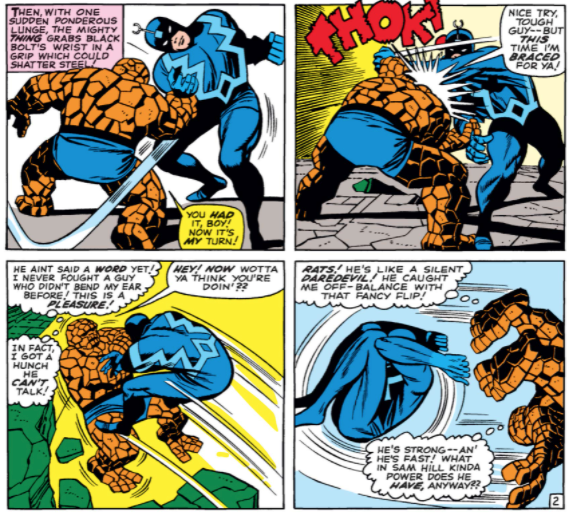
Fantastic Four 46 picks up where FF 45 leaves off, with the team battling the Inhumans on the roof of a New York City building. Black Bolt, leader of the Inhumans makes his appearance, and he and the Thing battle to a virtual standstill. Meanwhile, the Inhuman Triton is revealed to be a scaly fish creature who need a protective suit of water. When it ruptures, he flees to the nearby river.

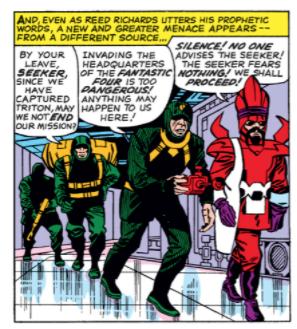
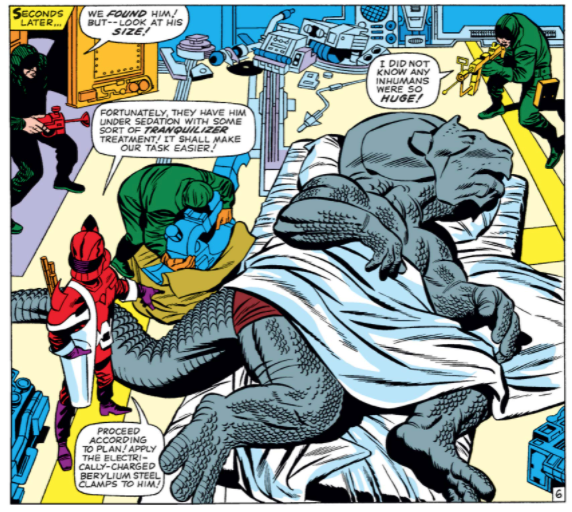
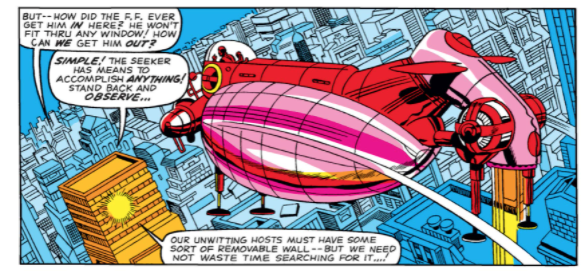
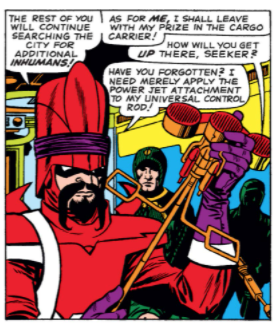
As the teams fight, a new character called the Seeker leads a team of henchmen into the Baxter Building in search of the Inhumans. He instead discover the sedated Dragon Man, and mistaking him for an Inhuman, abducts him via his aircraft.

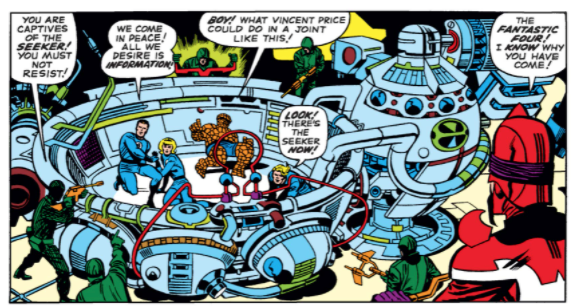
Black Bolt depletes his power fighting the Thing, and when the Inhumans can’t find Triton, they realize the Seeker has caught up to them. Using Lockjaw’s power, they teleport away, and after the Fantastic Four discovers Dragon Man is missing, they track the Seeker to his hideout, where he has imprisoned Dragon Man and Triton. The Seeker reveals the origins of the Inhumans (more on that in a bit) then Dragon Man wakes up, escapes his shackles and flees, while shattering the water-filled globe that contained Triton. The issue ends with Dragon Man running amok in New York.

What’s going on here?

More Inhuman action and the introduction of Black Bolt!
Black Bolt’s most salient quality is that he’s mute. Sure, he’s strong enough to battle the Thing, but his silence is what sets him apart from other characters. We’ll learn later that it’s because of the destructive power of his voice, but most of the time he’s a leader who can’t speak. In a world where there’s often a great deal of talk without much action, Black Bolt is cast as the opposite, the king who acts without talking. I doubt Stan and Jack meant Black Bolt to serve as a jab at anyone in particular, but probably as a blanket commentary on bloviating politicians as a class. The strong-yet-silent leader is a seductive concept, although one that works a lot better in comic books, where most conflicts are resolved with fists and not dialogue.

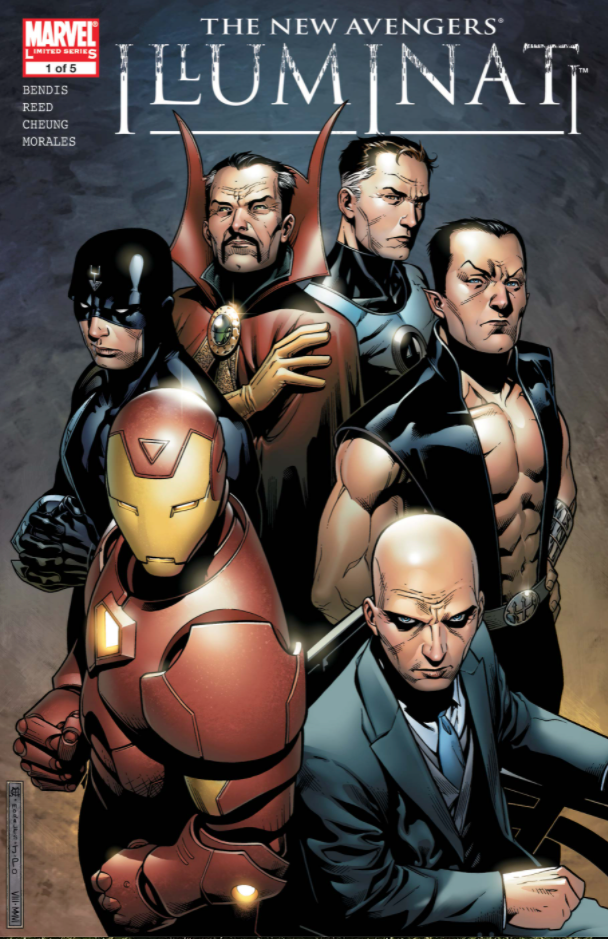
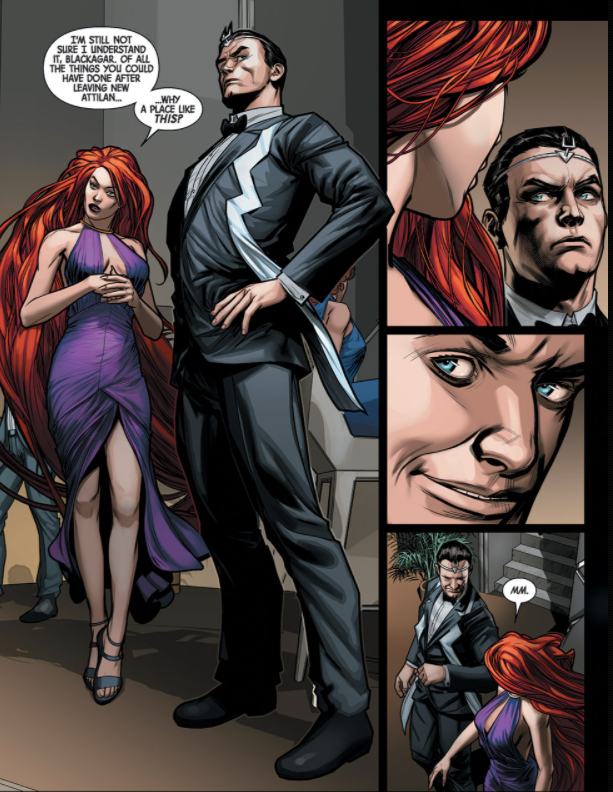
Black Bolt—whose full name was later retconned, painfully, into Blackagar Boltagon— occupies an interesting place in comics. As leaders of the Inhumans, he holds an important role, and is highly enough regarded enough, for example, to be part of the Illuminati, one of the six super heroes who dictate events in the Marvel Universe (according to writer Brian Bendis, anyway). Yet because he’s mute, he’s always been a cypher. His thoughts and intentions are always relayed through other characters, and he rarely is even given thought bubbles. What are his hopes and dreams? Who knows? It’s hard to think of another comic hero so prominent about whom we know so little.

Cover by Jim Cheung

About that mask

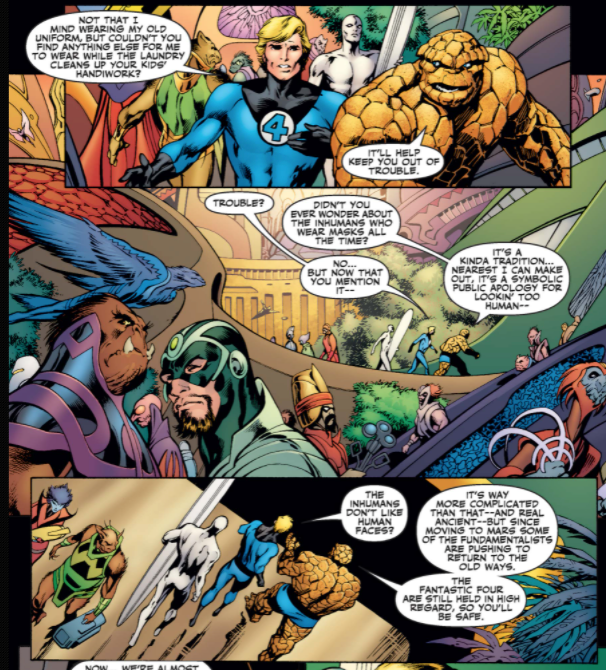
When the Inhumans were introduced, they almost all wore masks. While some have lost their’s over the years, Black Bolt almost always wears his. There’s no obvious reason in-story that’s ever given for his mask- it’s not like he was a secret identity to protect, or hideous scars to cover. Tracking down an image of Black Bolt’s actual face is surprisingly difficult, but here’s at least one instance, from 2015’s Uncanny Inhumans:

Uncanny Inhumans 20 (2015, story by Charles Soule, art by Brandon Peterson)

The best explanation of why members of the Inhuman royal family wear masks was provided by the great writer and artist Alan Davis, in his mini-series Fantastic Four: The End. It takes place in the team’s future, and Ben and Alicia are living with the Inhumans on Mars. It comes down to a tension about the appearance of the Inhumans, and the role of the transfarmative terrigen mists in their culture.

Fantastic Four: The End 3 (2006, story and pencils by Alan Davis, inks by Mark Farmer)


Who are these guys?

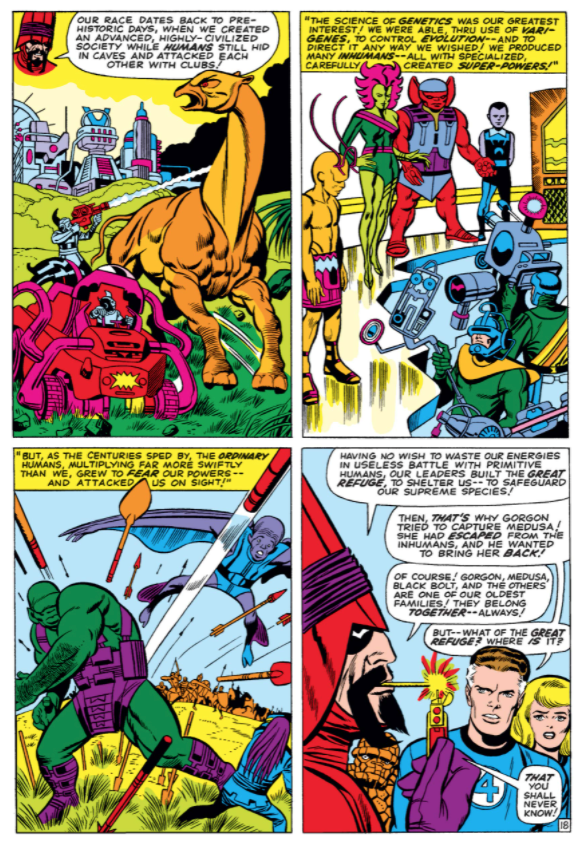
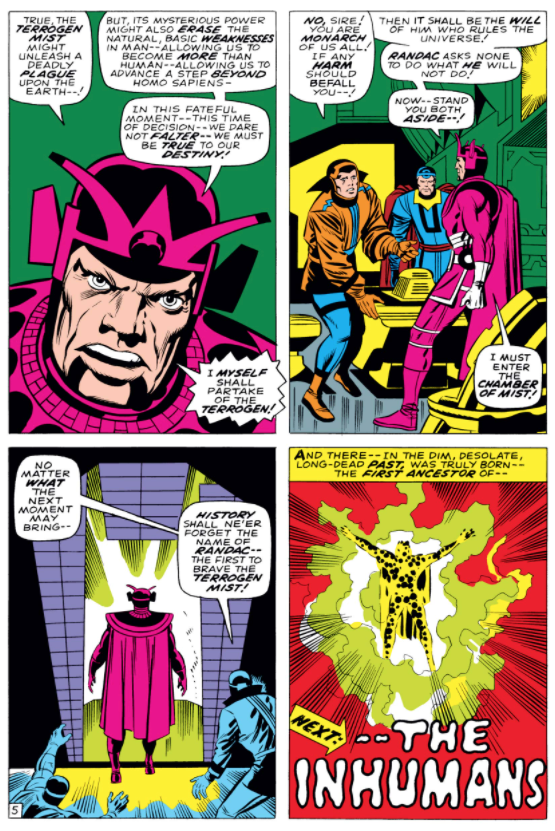
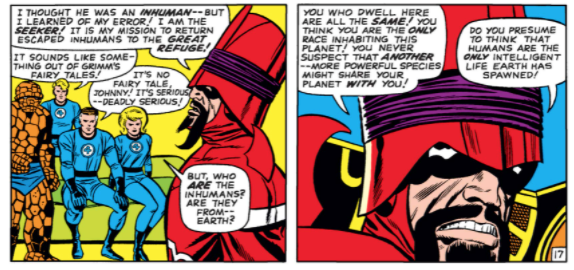
FF 46 also includes a brief origin of the Inhumans, courtesy of the Seeker.

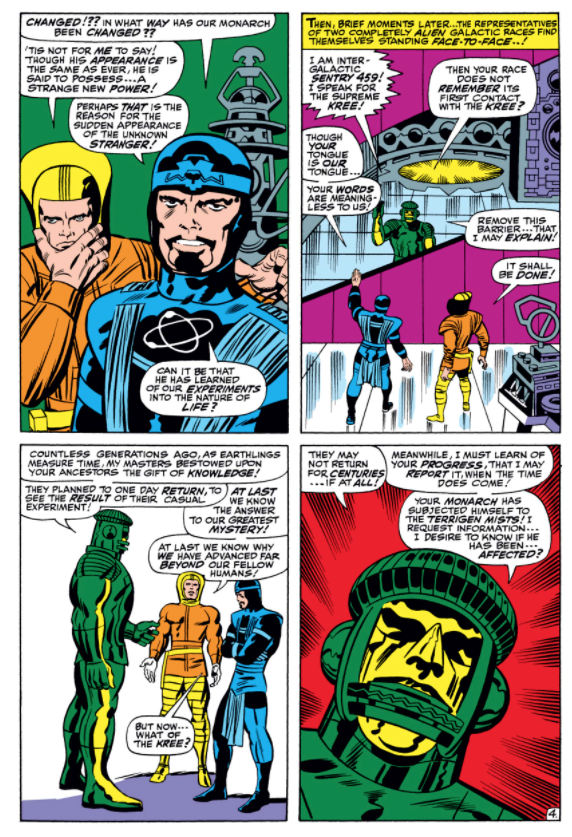
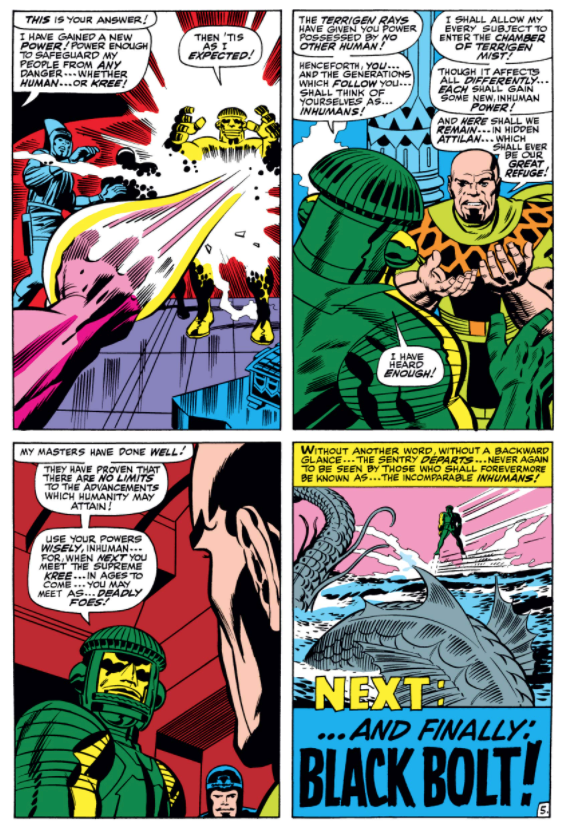
The origin omits a critical detail (or more likely, Stan and Jack hadn’t come up with it yet), which is that the Inhumans were an experiment of the Kree, an alien race that will be introduced in Fantastic Four 65. Eventually a much longer origin is unspooled as a back-up story in Thor 146-152 (of all places), published in 1967-68. Here are some key panels that explain the role of the Kree (the whole story is gorgeous, with peak Kirby/ Sinnott art).

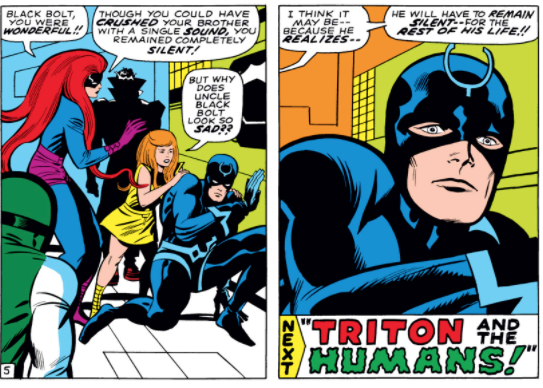
The Thor stories also delve into how Black Bolt became king of the Inhumans, and include this poignant sequence:

The Seeker

The Seeker is the heavy in this issue. In later stories he is named as Kadlec, a viceroy under a previous ruler of the Inhumans and given a bit of a back story. Although he never becomes a much more than a footnote in Inhumans history, he looks great here.

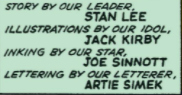
Crazy Credits
A bit more subdued this month.


Weird science

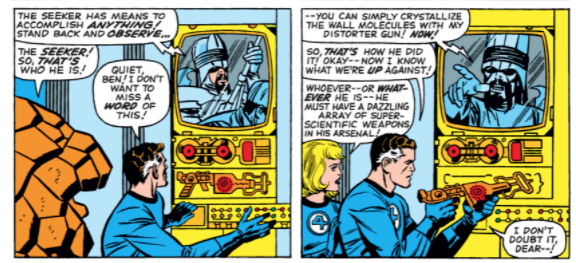
Reed invents … the security camera and VCR?

Dig that Kirby Krackle

Some cool stuff from Jack, including a slumbering Dragon Man…

… the Seeker’s airship …

.. and whatever this is!

Next issue: The conclusion of the Inhumans saga!

“The World’s Greatest Comic Magazine!” Fantastic Four No. 45

02 Sunday Jan 2022

Posted by percivalhenry in The World's Greatest Comic Magazine

≈ 1 Comment

Tags

1965, Crystal, Fantastic Four, Inhumans, jack Kirby, Joe Sinnnott, Stan Lee

Fantastic Four 45
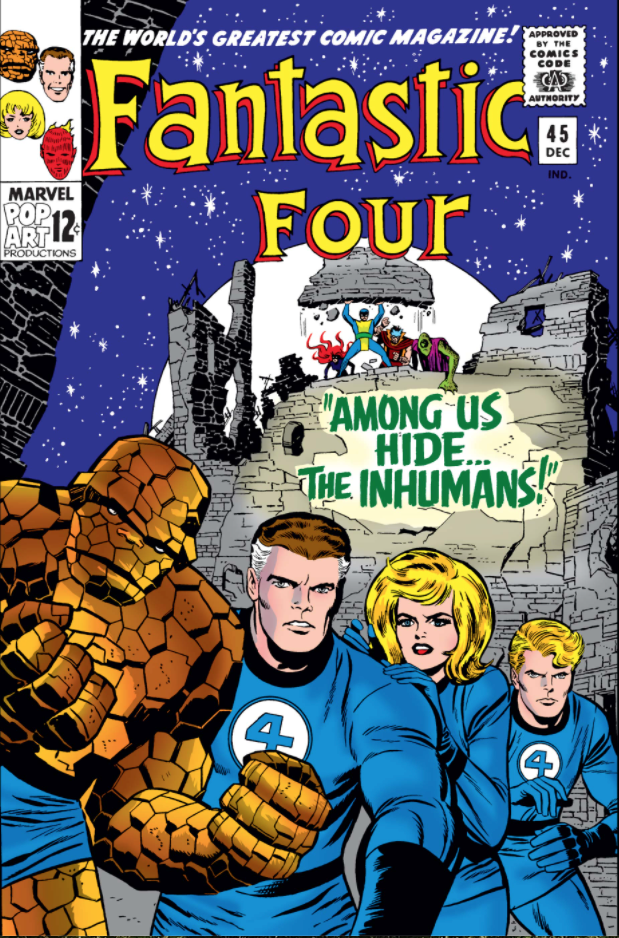
“Among Us Hide the Inhumans”
Published: Sept. 1965
Story: Stan Lee and Jack Kirby
Script: Lee
Pencils: Kirby
Inks: Joe Sinnott
Lettering: Artie Simek
Cover: Kirby and Sinnott

Programming note: Before we dive into a big issue, this post marks a full year of blogging about the Fantastic Four. We’ve covered 45 regular issues and three annuals. Not quite the 52 posts I was aiming for but not bad. If all goes according to plan, the next few months will cover some of the biggest stories in comic book history, then the rest of the year will wrap up most of the remaining Lee/Kirby FFs. That’s the idea, anyway. But I’m open to ideas: What do you want me to write about? Should I continue issue-by-issue? Should I cover the FF’s appearances in other comics? Is there something you want more of? Or less of? Drop a line in the comments if you have thoughts. They would be very welcome.

Synopsis

Fantastic Four 45 picks off where FF 44 left off, on the crumbling roof of a Manhattan building. Dragon Man has flown off with the Invisible Girl and Gorgon has abducted Medusa. After Mr. Fantastic, the Human Torch and the Thing are safely on the ground, Johnny flies after Dragon Man, who is eventually calmed by Sue and returns her peacefully to the Baxter Building.

A morose Johnny later takes a walk and finds himself in a deserted neighborhood where he encounters a young woman who disappears in a windstorm. After squabbling with the rest of the team, Johnny returns, and discovers the woman has powers. Mistaking him for a fellow Inhuman, she introduces herself as Crystal and Johnny then meets Lockjaw and Karnak. But when he is discovered by Medusa and Gorgon, the Inhumans try to imprison him. Johnny escapes and summons the rest of the Fantastic Four. The teams are about to square off when Black Bolt makes his entrance, ending the issue with another cliffhanger.

What’s going on here?

The introduction of the Inhumans is obviously the significant development in FF 45. They’ve been a major part of the Marvel universe ever since, appearing either in their own series or, more frequently, as guest stars in other books almost continuously since. Finding the backstory for the Inhumans has proven difficult, but at one point it seems they were destined for their own series before a change in plans led Stan and Jack to fold them into the FF. Did Stan and Jack have a full team of super characters in mind when they introduced Medusa in FF 36? It seems unlikely. Here’s Stan, in a 1967 radio interview he gave alongside Jack:

“I mean, we didn’t sit down one day and say let’s do a group of Inhumans and these are their names and we’ll present them in this fashion, as with everything we do. We just sort of stumble into them as we go along.”

Earlier in the interview, Stan explains the concept started with Gorgon:

“He started out as a villain. We liked him so much, I should say Jack liked him so much, that he kept using him. We figured he has to come from somewhere. We decided, let him come from some strange land over in Europe, where there are a whole group of people like him. And well, what else could you call them except the Inhumans. Then Jack had to create a whole bunch of Inhumans and I think he did a great job. All these characters are really very imaginative.

When it came to doing the leader, we decided, well, there was no need for them all to be villainous. And you’re right, I think we did have in mind that Black Bolt would eventually be a heroic type.”

It’s of course possible that Stan was talking out of turn, and Jack had it all mapped out, but it was a joint interview, and he didn’t contradict Stan.

FF 240 (1981) Story, pencils and inks by John Byrne

Who’s the new guy?

The other big development in this issue—technically it was issue 44, but I goofed and forgot to mention it last week—is it marks the beginning of Joe Sinnott’s legendary run as inker. Sinnott inked FF 5, then starting with issue 44 goes on to ink the FF for 16 years until issue 231 in 1981, stopping only when John Byrne took over the book and inked himself. Then, after Byrne left in 1987, Sinnott inked the FF for another two years.

Sinnott’s inks help create the classic Kirby look. The lines are bolder, the shadows are deeper, the forms are more defined. His inks give the Thing his essential rockiness and give the Kirby Krackle its explosive energy.

His presence on the book for so many years after Kirby departed gave the FF a smooth, consistent appearance, although it could be argued that his inks smothered the unique qualities of some up-and-coming artists on the book like George Perez and Bill Sienkiewicz, who later flourished with other inkers.

Meet the Inhumans

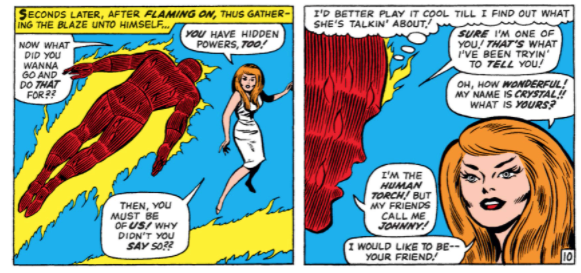
Medusa and Gorgon we already know. In FF 45 we are introduced to Crystal, who has the power to manipulate the four elements: fire, water, earth and air.

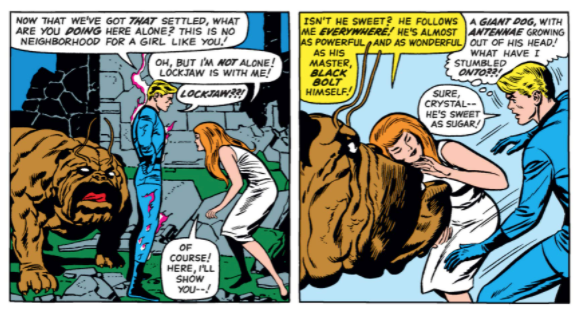
We soon meet Lockjaw, a giant dog with the ability to teleport:

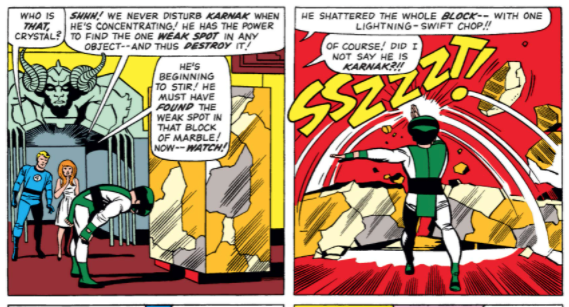
And Karnak, who can find the weakness in any substance:

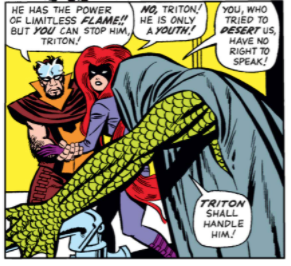
Triton, a water breather, is kept hidden, with the promise of a bigger reveal later:

And lastly, Black Bolt makes a dramatic appearance at the end:

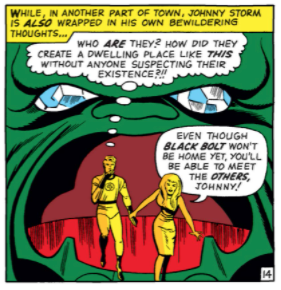
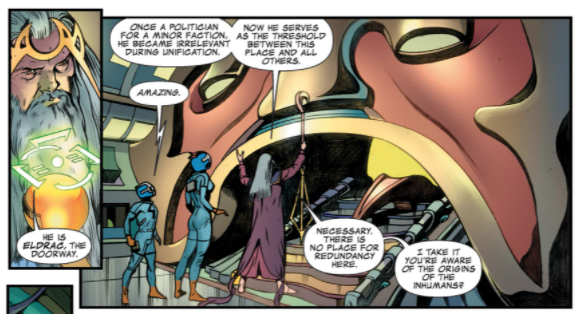
Plus, one more: While Stan and Jack almost certainly didnt intend it, the portal Johnny and Crystal travel through was retconned by Johnathan Hickman into Eldrac the Doorway, “once a politician.”

FF 577 (2010, story by Hickman, art by Dale Eaglesham)

About Crystal

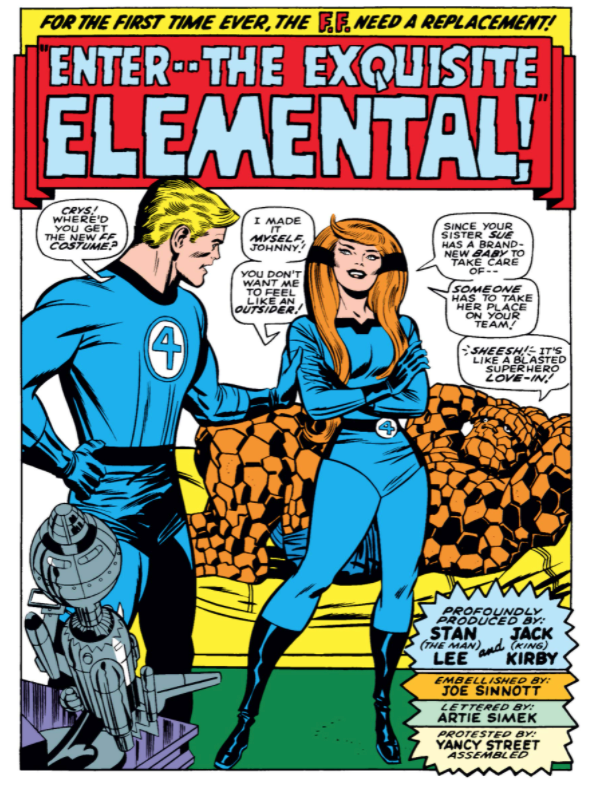
While all the Inhumans have an impact of the Fantastic Four, Crystal is the one perhaps most closely tied to the team. She becomes Johnny’s love interest, then, when Sue is on maternity leave, she officially joins the FF in issue 81:

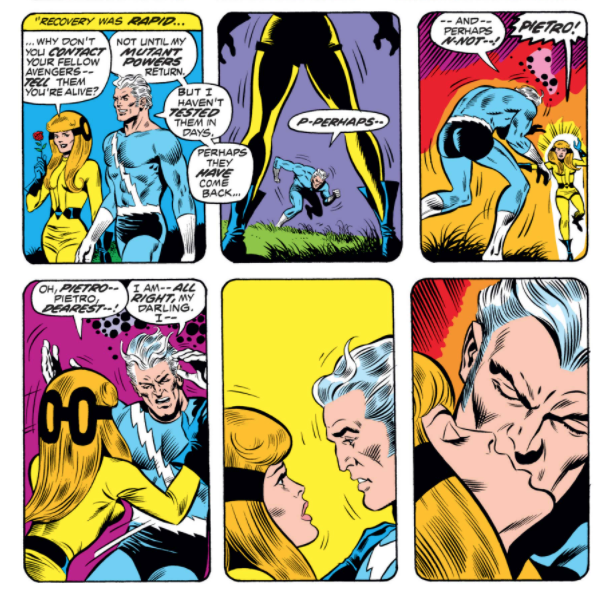
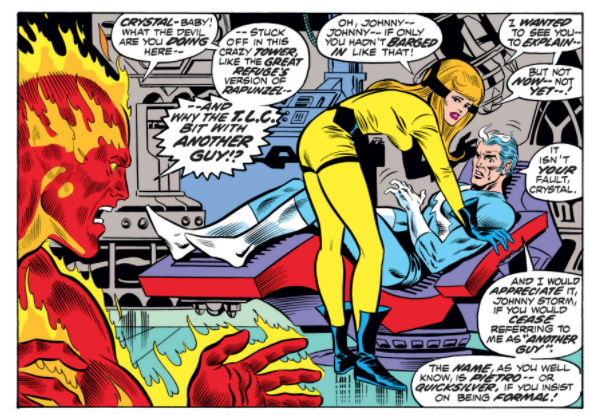
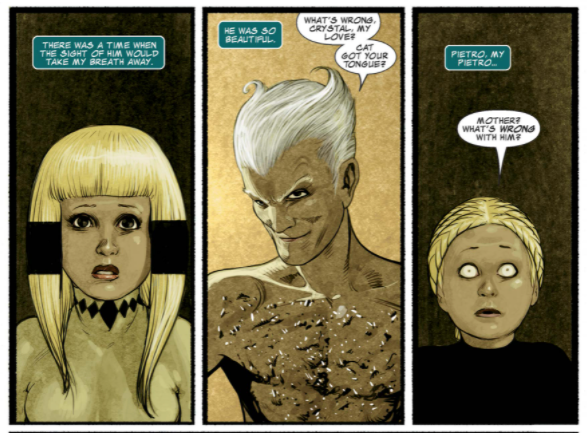
She later falls in love with Pietro Maximoff, aka Quicksilver, an Avenger and son of Magneto. Johnny is not thrilled.

FF 131 (1973, story by Roy Thomas, art by Ross Andru and Joe Sinnott)

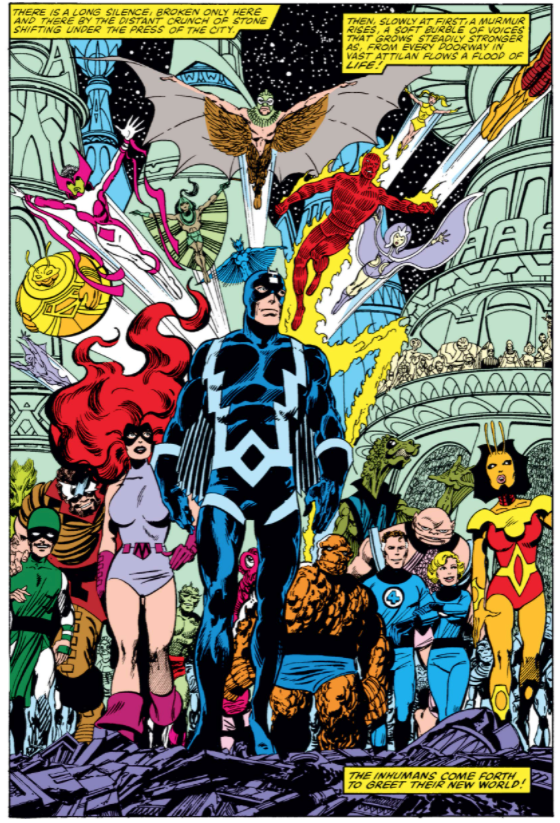
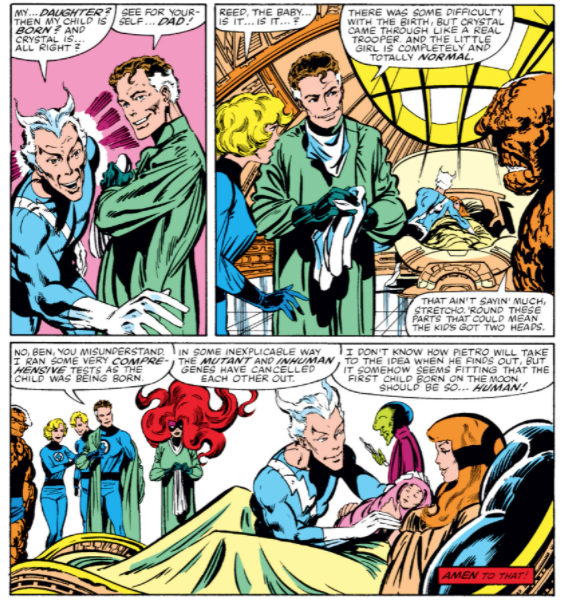
Crystal and Pietro eventually marry in FF 150 (as shown in this post) and Crystal gives birth to baby Luna, so named because she arrived just as the Inhuman city of Attilan was transported to the moon:

FF 240

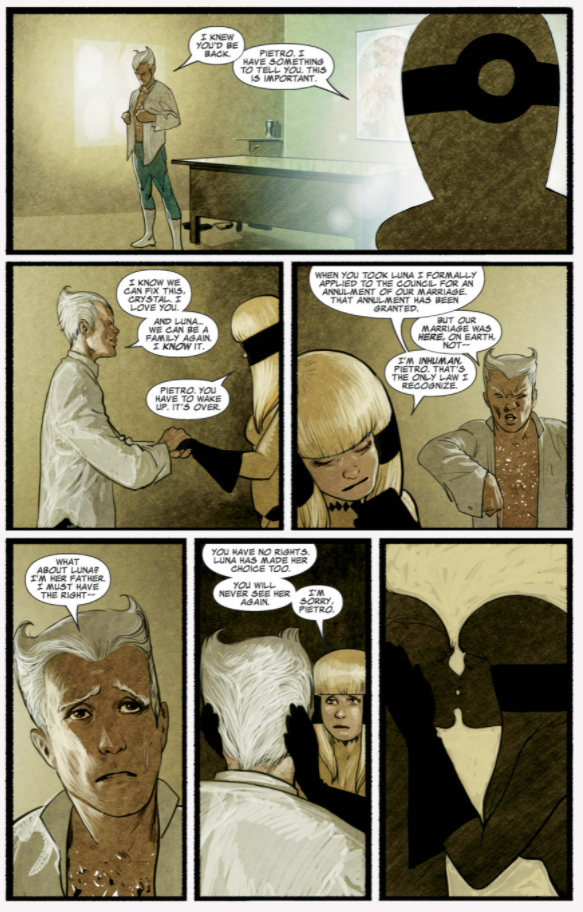
Eventually, however, Quicksilver goes haywire and Crystal leaves him to join the Avengers
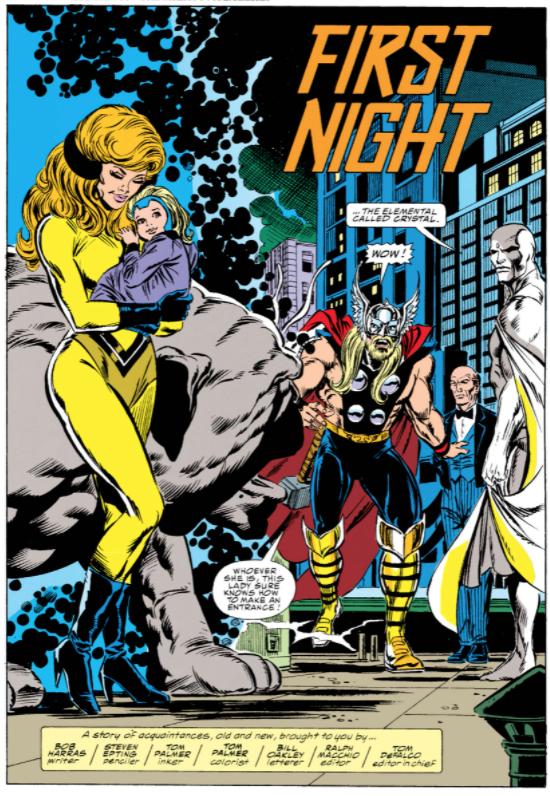
Avengers 343 (1992, story by Bob Harras, art by Steve Epting and Tom Palmer)

Crystal eventually reconciles with Quicksilver, but then he really goes off the deep end, and she ends things forever:

Silent War 3 (2007, story by David Hine, art by Frazer Irving)

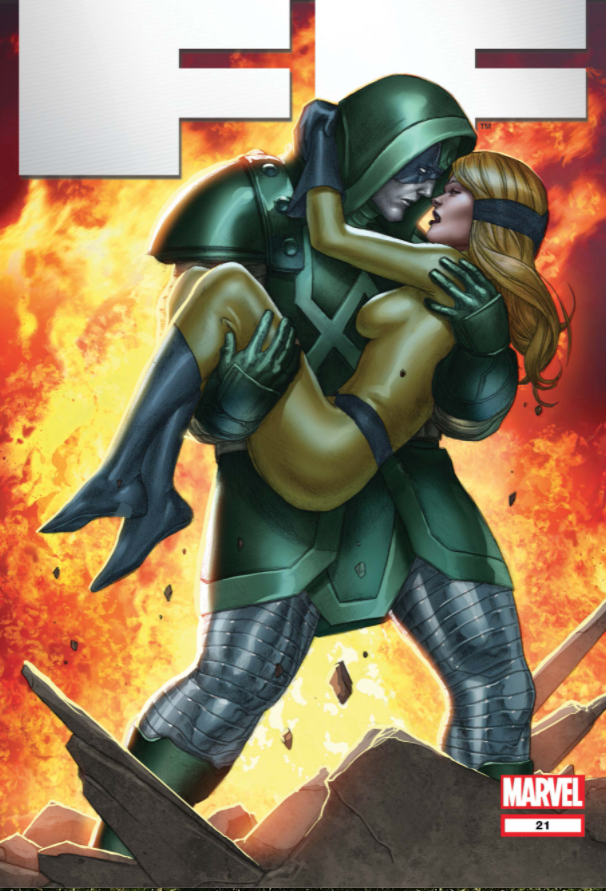
She finally winds up with Ronan the Accuser before she is forces to separate from him in a very complicated story by Johnathan Hickman:

FF 21 (2012, cover art by Mike Choi)

They’re fighting again

More like a battle of wits, but I’ll count it.

The sexist sixties

Crazy credits

It’s Clobberin’ Time

This is the eight time Ben has said the magic words, by my count.

The incredible Mr. Fantastic

Why turn into a ball when when you can be a cube?

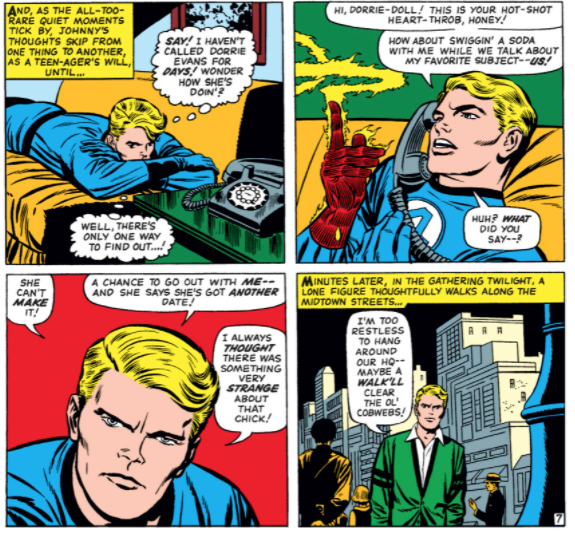
Teenage blues

Just a great sequence by Stan, Jack and Joe of a moody Johnny

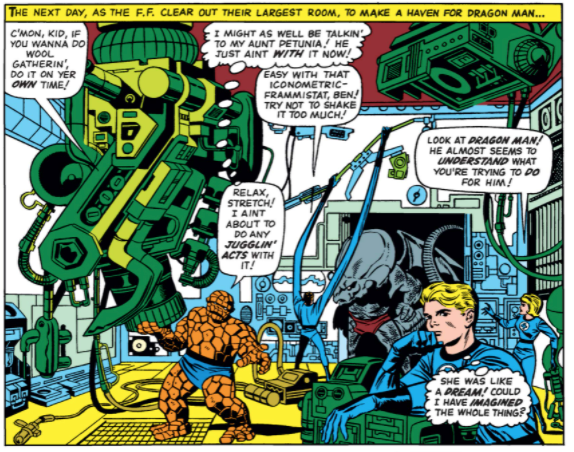
Weird science

“Easy with that iconmetric frammistat”

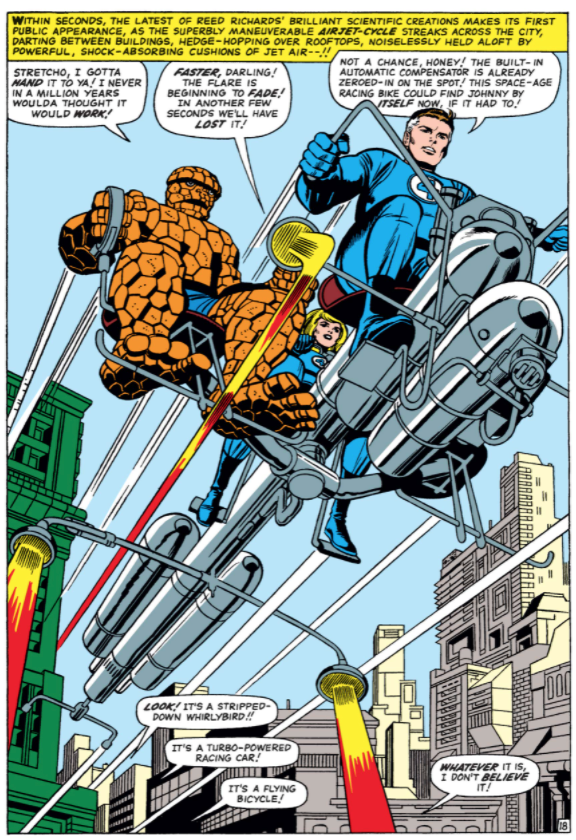
Dig That Kirby Krackle

Just when you though this comic had everything, Jack gives us this:

Next issue: The secret of Black Bolt!

“The World’s Greatest Comic Magazine!” Fantastic Four No. 44

24 Friday Dec 2021

Posted by percivalhenry in The World's Greatest Comic Magazine

≈ 1 Comment

Tags

1965, Dragon Man, Fantastic Four, Fantastic Four 44, Gorgon, Inhumans, jack Kirby, Medusa, Stan Lee

Fantastic Four 44
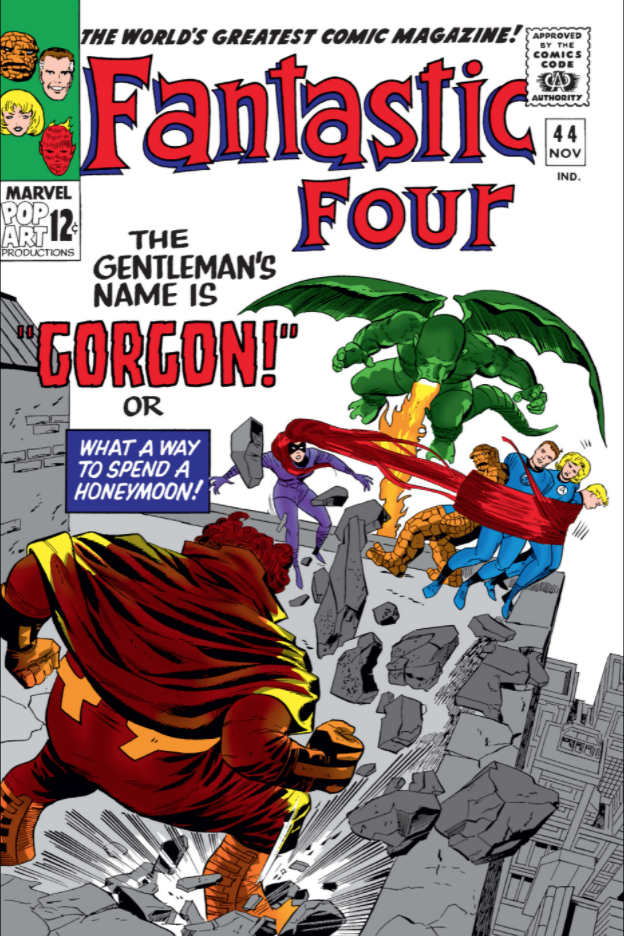
“The Gentleman’s Name is Gorgon!”
Published: Aug. 1965
Story: Stan Lee and Jack Kirby
Script: Lee
Pencils: Kirby
Inks: Joe Sinnott
Letters: Art Simek
Cover: Kirby and Vince Colletta

Synopsis

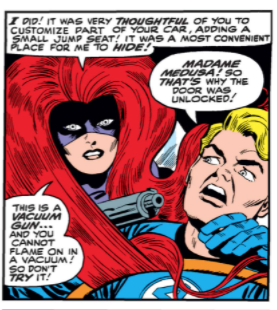
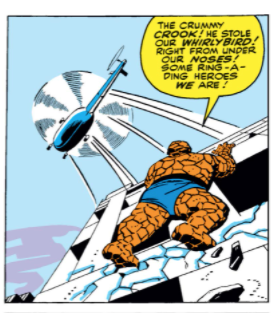
Following the marriage of Mr. Fantastic and the Invisible Girl (in FF Annual 3), the team is back at the Baxter Building where the Thing and Human Torch are growing bored of the new domesticity. Johnny takes off in his Corvette when he is carjacked by Madame Medusa, who threatens him with a “vacuum gun” and demands he help her escape Gorgon. Meanwhile, an unseen Gorgon uses his hooves to attack the Baxter Building, then steals the team’s helicopter.

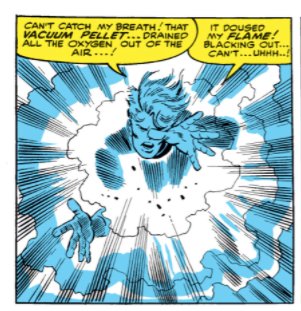
Medusa forces Johnny to drive her upstate, near the campus of State University, and when Johnny tries to escape, Medusa drains the air from him using the vacuum gun. Their scuffle awakens the dormant Dragon Man, last seen in FF 35, and when Gorgon arrives to capture Medusa, he and Dragon Man battle. Medusa and Dragon Man flee back to New York City, pursued by Johnny and Gorgon. Eventually all parties battle on the roof of city building. Gorgon demands the FF surrender Medusa or he will destroy the city when Dragon Man abducts the Invisible Girl. The issue ends with Gorgon bringing down the building around the rest of the FF.

What’s going on here?

Fantastic Four 44 kicks off a story arc that introduces the Inhumans, a major part of the Marvel universe for decades to come. It’s also the first comic in a 16-issue run that may be the most influential and creative stretches in all of comics. In these issues Stan and Jack introduce:

* The Inhumans: Black Bolt, Gorgon, Crystal, Karnak, Triton, Lockjaw, Maximus and their city of Attilan (all except Medusa, who first appeared in FF 36).
* The Silver Surfer
* Galactus
* Wyatt Wingfoot
* The Black Panther and Wakanda
* Klaw
* Prestor John

Plus they deliver one of the single best standalone stories (“This Man, This Monster” in issue 51) and arguably the best Dr. Doom story, when Doom steals the power cosmic from the Silver Surfer. Much more on all of this to come, of course!

The only comparable runs of similar length (about a year) I can think for their lasting significance in comics history are the Claremont/Byrne Uncanny X-Men from UXM 129-142 (which includes the Dark Phoenix Saga and Days of Future Past), and Green Lantern 76-89, the classic Denny O’Neil/Neal Adams run that brought contemporary issues to comics while introducing major characters. I’m sure I’m missing some, so feel free to drop your ideas in the comments.

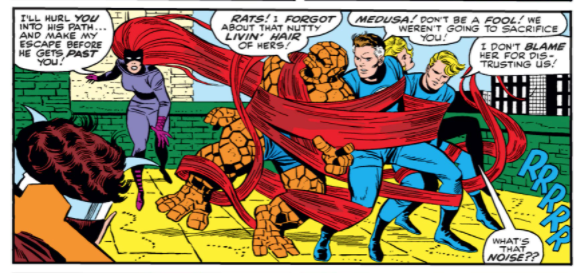
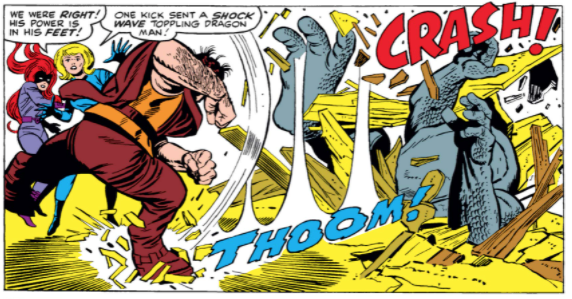
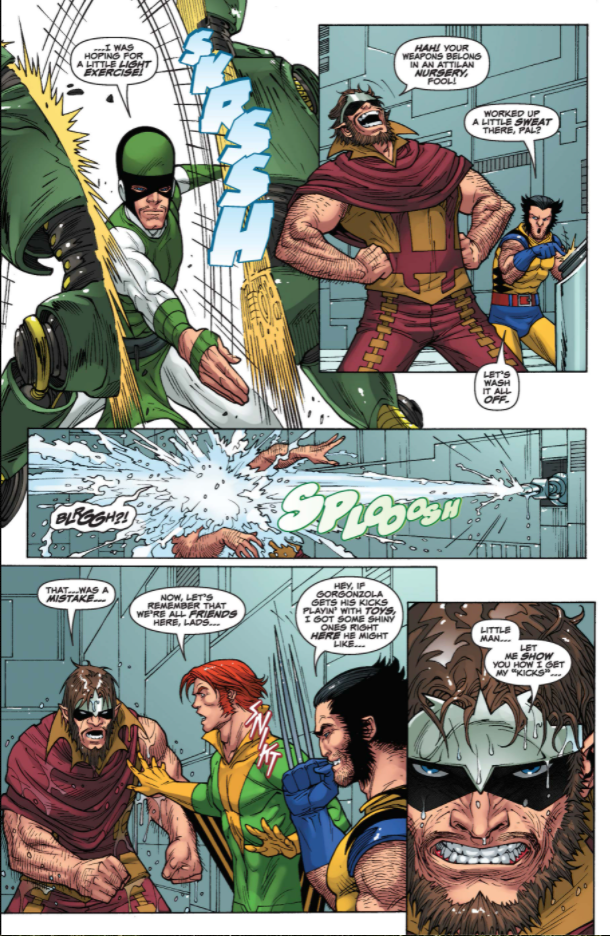
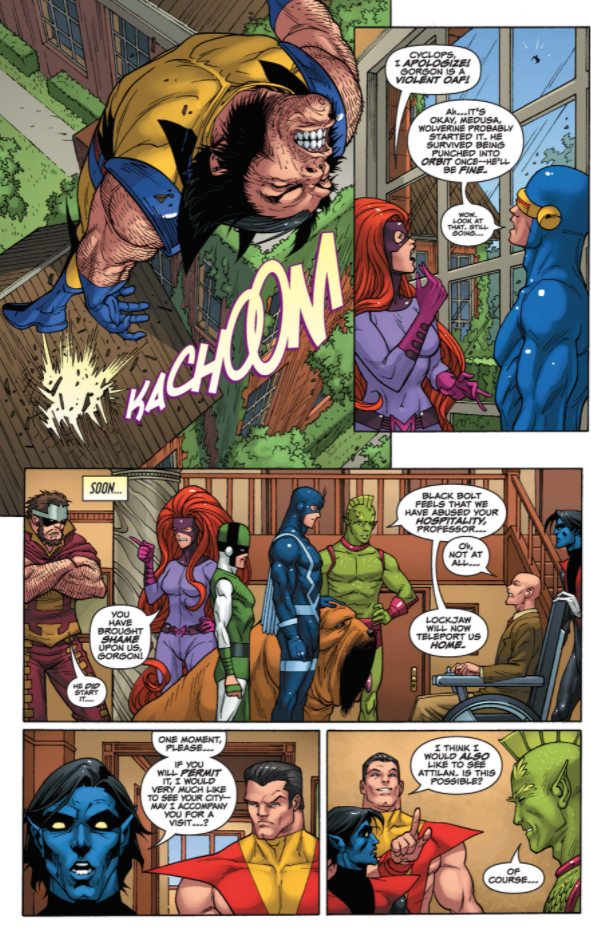
FF 44 also introduces Gorgon, who becomes a part of the Marvel firmament, but almost always as part of the Inhumans. In some ways, this might be a high point for Gorgon, as he appears both immensely powerful here and not in the shadow of his even more powerful cousin, Black Bolt. While he appears to be depowered over the years, he occasionally gets to strut his stuff, as in this fun sequence from Uncanny X-Men: First Class.

Uncanny X-Men: First Class 1, (2009, story by Scott Gray, art by Roger Cruz)

What’s in a name?

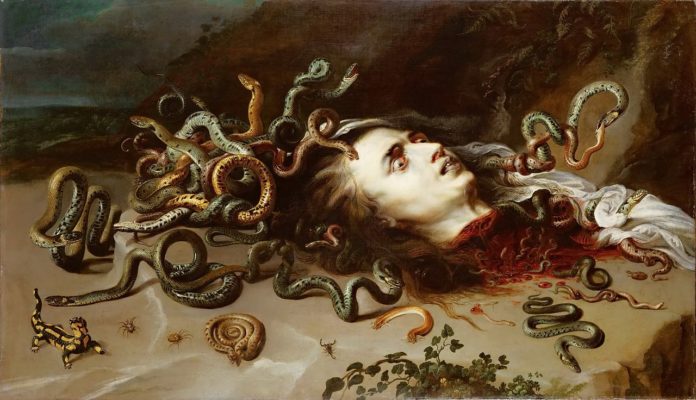
A gorgon in Greek mythology, was one of three snake haired women whose appearance could turn one to stone. One of the sisters was, of course Medusa, suggesting that if Stan and Jack knew their myths, they were’t overly concerned with the details.

The real Medusa, a gorgon (painting by Rubens)

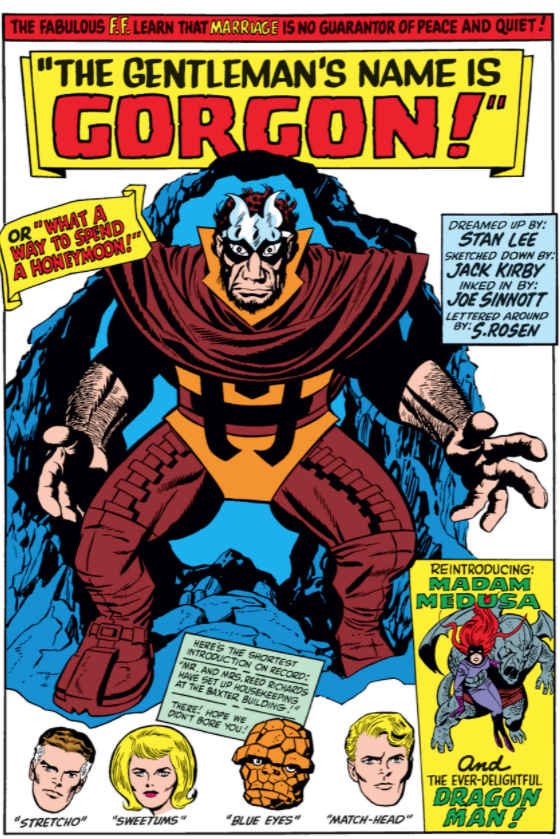
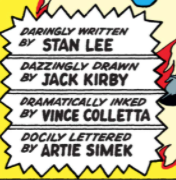
Crazy Kredits

Not only does the creative team get goofy credits, but the FF gets nicknames.

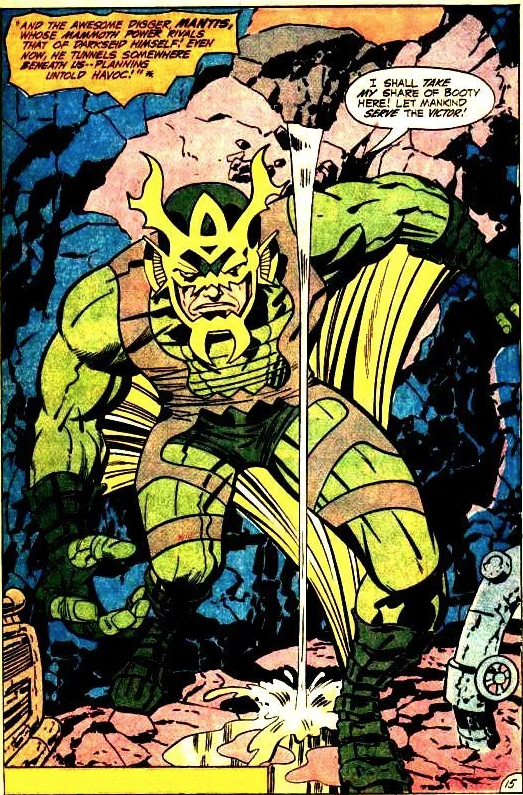
This image of Gorgon also foreshadows Mantis, a villain Jack created for DC about six years later:

The sexist sixties

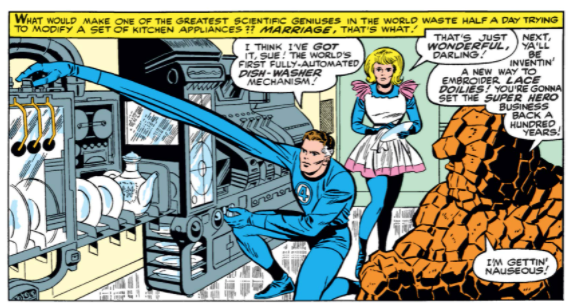
Sue is so determined to be a ’60s housewife, she’s wearing an apron.

Oops

Did Stan have to explain why Johnny’s Corvette Stingray has a backseat? It sure reads that way. Also: A vacuum gun!

We have a helicopter?

The FF has two Fantasticars, a Pogo plane, an ICBM, and apparently a helicopter.

Dig that Kirby Krackle

Some cool art in this issue.

Next issue: The rest of the Inhumans!

“The World’s Greatest Comic Magazine!” Fantastic Four Annual No. 3

19 Sunday Dec 2021

Posted by percivalhenry in The World's Greatest Comic Magazine

≈ 3 Comments

Tags

1965, Dr. Doom, Fantastic Four, Fantastic Four Annual 3, jack Kirby, Stan Lee, wedding

Fantastic Four Annual 3
“Bedlam at the Baxter Building”
Published: July 1, 1965
Story: Stan Lee and Jack Kirby
Script: Lee
Pencils: Kirby
Inks: Vince Colletta
Letters: Arie Simek
Cover: Kirby and Mike Esposito

Note: Fantastic Four Annual includes one original story, which we will discuss here, and reprints three others, from FF 6 and FF 11.

Synopsis

The story opens with Dr. Doom reading about the planned wedding for Mr. Fantastic and the Invisible Girl. Seeing an opportunity to take his revenge, he deploys his “high-frequency emotion charger” to spur other villains into attacking the Fantastic Four.

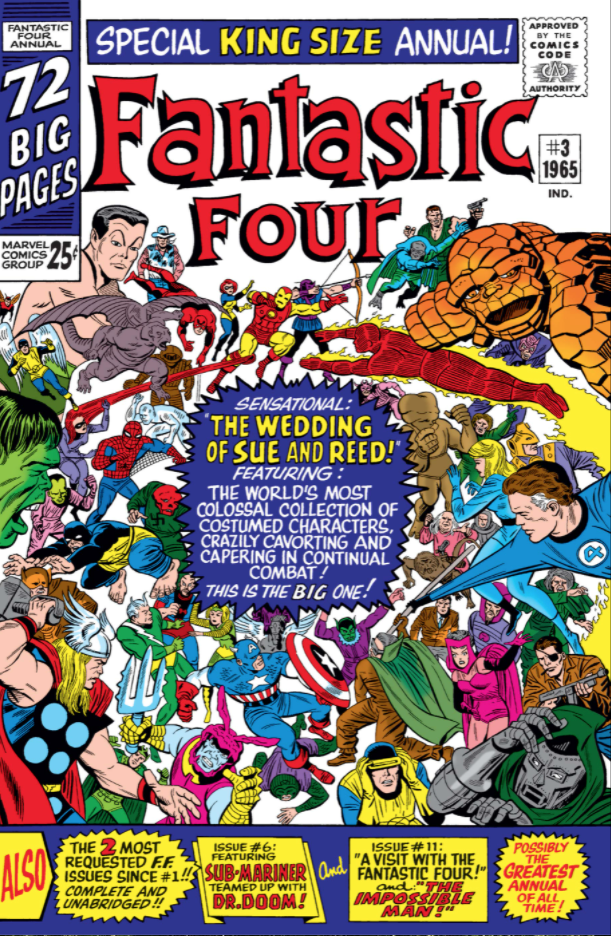
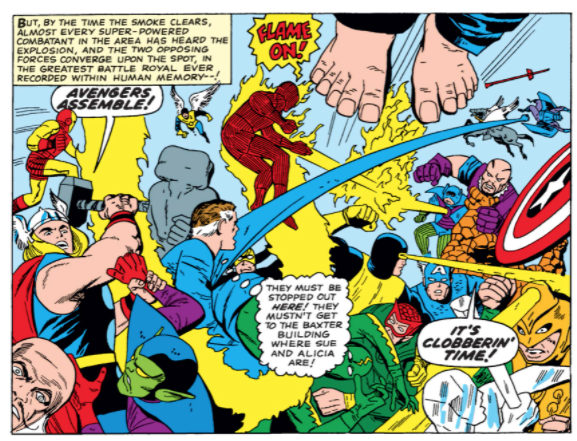
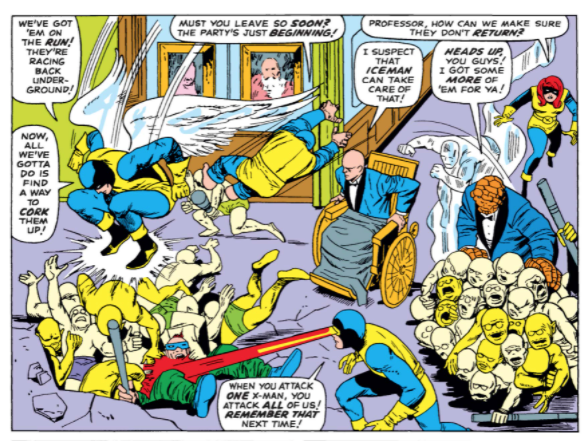
As the wedding guests arrive at the Baxter Building, an array of bad guys begin to attack, only to be beaten back by the FF’s guests, which include the X-Men, Dr. Strange, Daredevil, Spider-Man and the Avengers. Eventually the FF gets pulled into the fray, and the Watcher appears, whisking Reed off to his home on the Moon. In a very legalistic interpretation of non-interference, he says Reed can take any device he finds and use it on the villains. Reed selects a “sub-atomic time displacer” which sends the villains into the past with no memory of recent events.

The story concludes with Reed and Sue’s much-anticipated wedding.

What’s going on here?

As far as stories go, this plot is about as thin as they get. Doom arranges for the villains to attack, we get about 15 pages of fun battle scenes as virtually every hero and villain in the nascent Marvel universe shows up, the Watcher swoops in to fix things, and we end up with a wedding. But a thin story doesn’t mean a boring story, and this comic is a lot of fun, as Stan and Jack clearly enjoy reaching into their bag of characters and throwing them all into the stew.

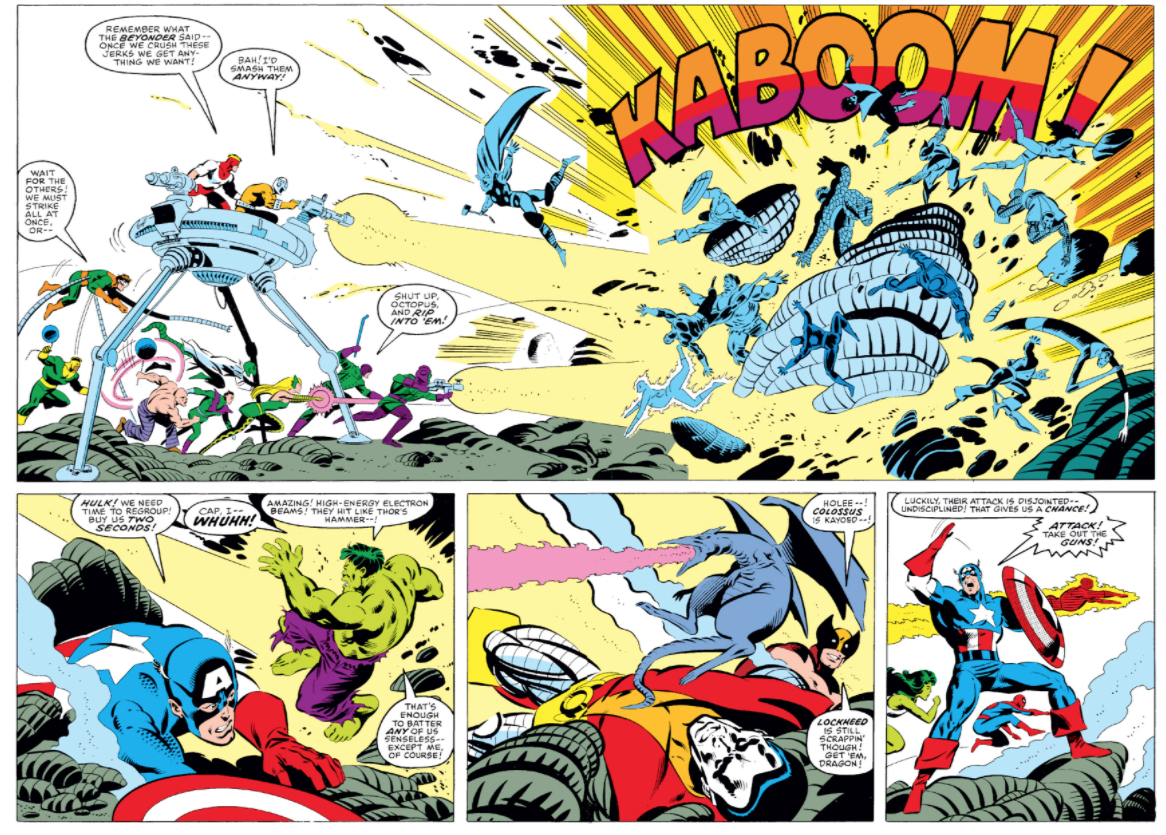
The basic concept—all the good guys vs. all the bad guys—will be repeated over the years, maybe most notably in 1984’s Secret Wars, which was a 12 issue series based pretty much on that premise and little else.

Marvel Super Heroes Secret Wars 2 (1984). Story by Jim Shooter, art by Mike Zeck and John Beatty

FF Annual 3 is also notable for mixing and matching heroes and villains, creating new pairings of combatants. For example, the X-men vs. the Mole Man:

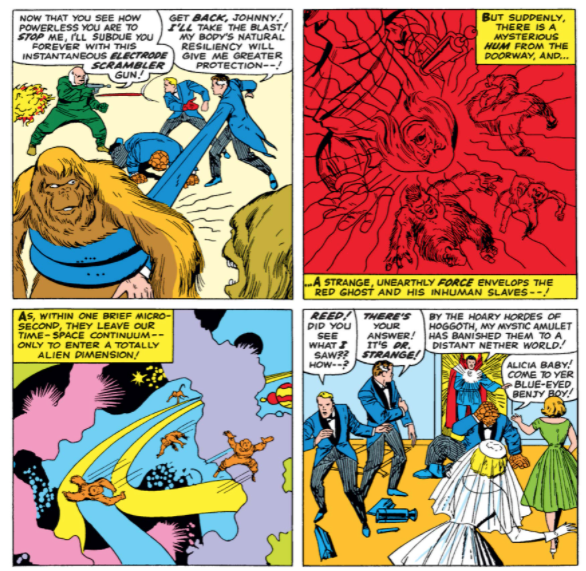
Or Dr. Strange vs. the Red Ghost and his Super Apes:

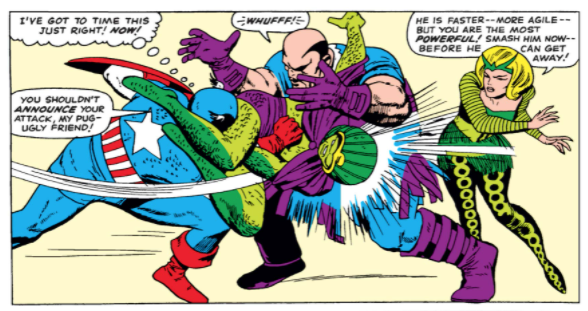
Or Captain America vs. Cobra, the Executioner and the Enchantress

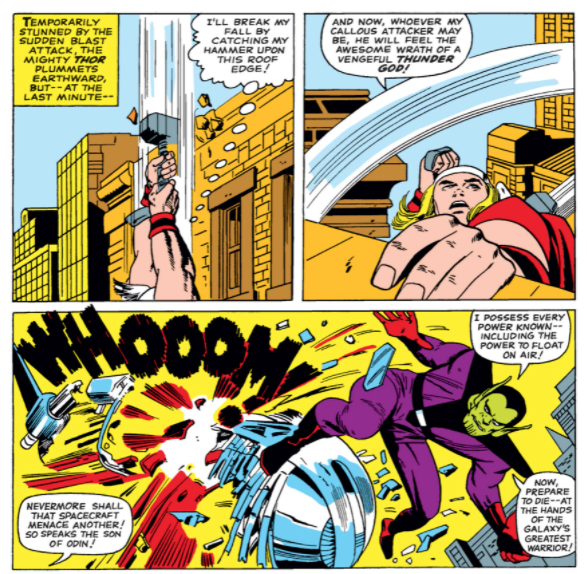
Or Thor vs. the Super Skrull:

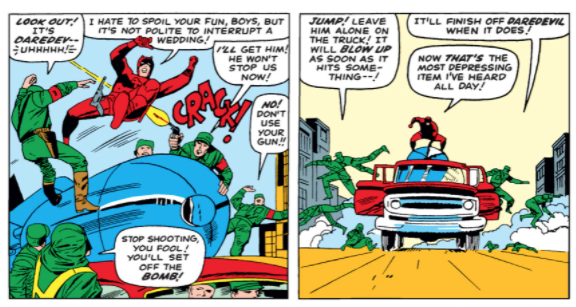
Or Daredevil vs. Hydra:

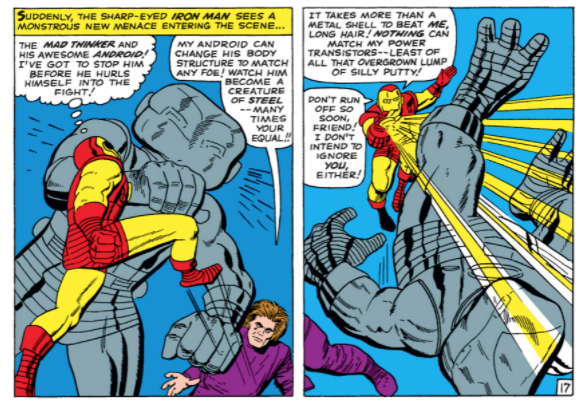
Or Iron-Man vs. the Awesome Android:

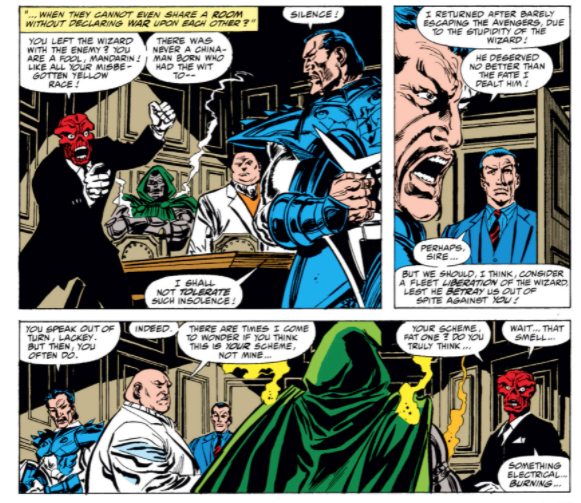
This kind of matching heroes against unfamiliar villains became the basis for another 1980s cross-over event, Acts of Vengeance, in which Marvel’s biggest bad guys arranged to fight each other’s traditional antagonists.

Avengers 313 (1989) Story by John Byrne, art by Paul Ryan and Tom Palmer

Wedding bells

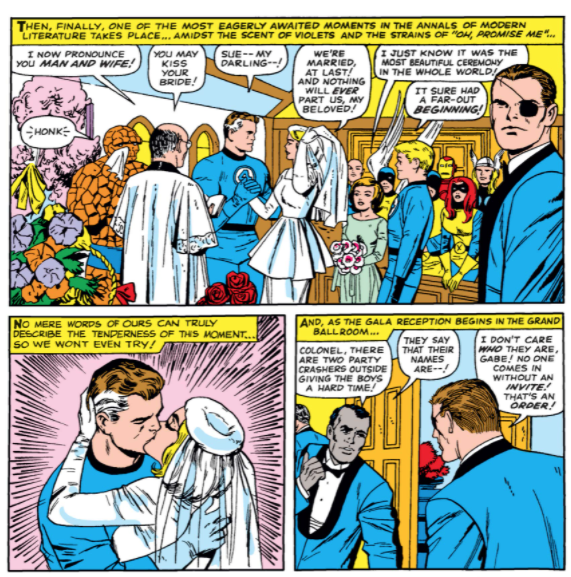
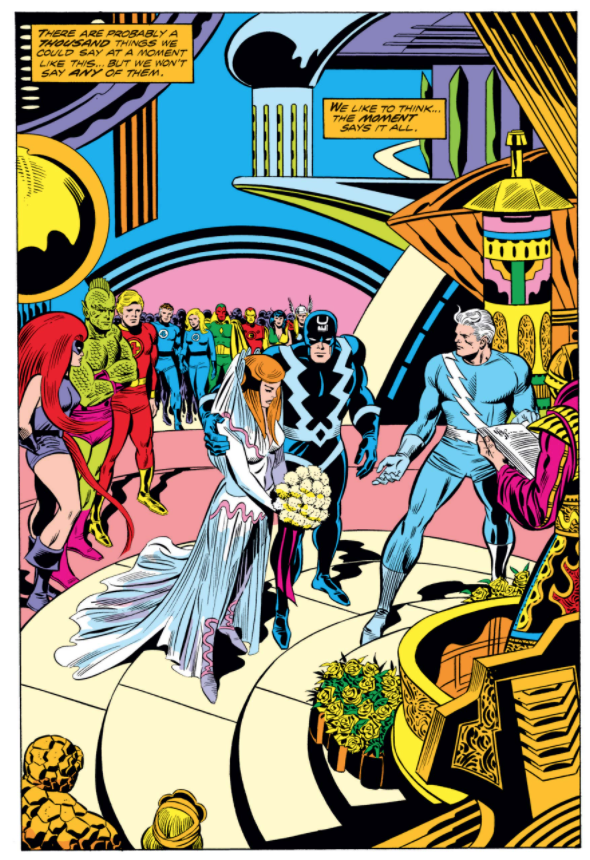
The other notable event in FF Annual 3, of course, is Reed and Sue’s marriage. As far as I am aware, this is the first super-hero wedding in the modern Marvel era, and it sets the template for dozens of similar issues to come. They usually take place in an annual or anniversary issue, a wedding is planned, villains interfere, and the nuptials finally comes together at the end.

While there have been dozens of weddings with super heroes, two heroes marrying each other is less common, in part because there are so few female heroes (the male-male super hero wedding is way, way in the future, of course). Notable pairing include the Wasp and Yellowjacket, Green Arrow and Black Canary, the Vision and Scarlet Witch, and Luke Cage and Jessica Jones.

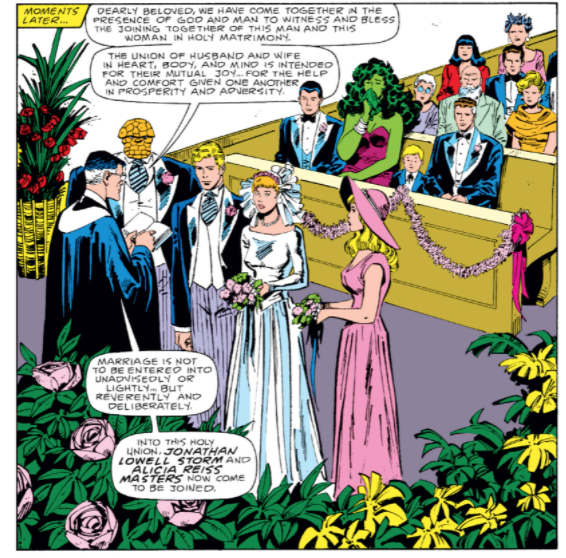
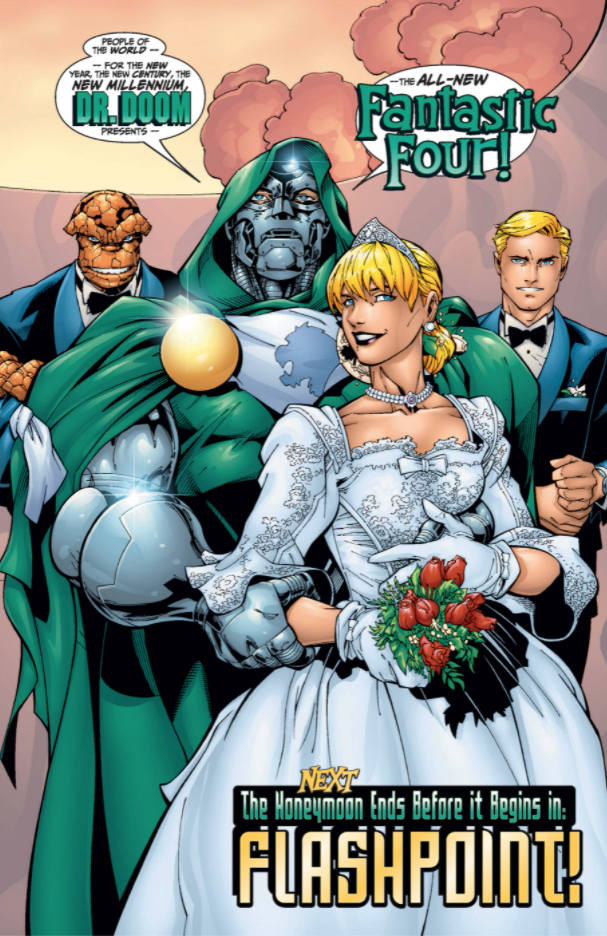
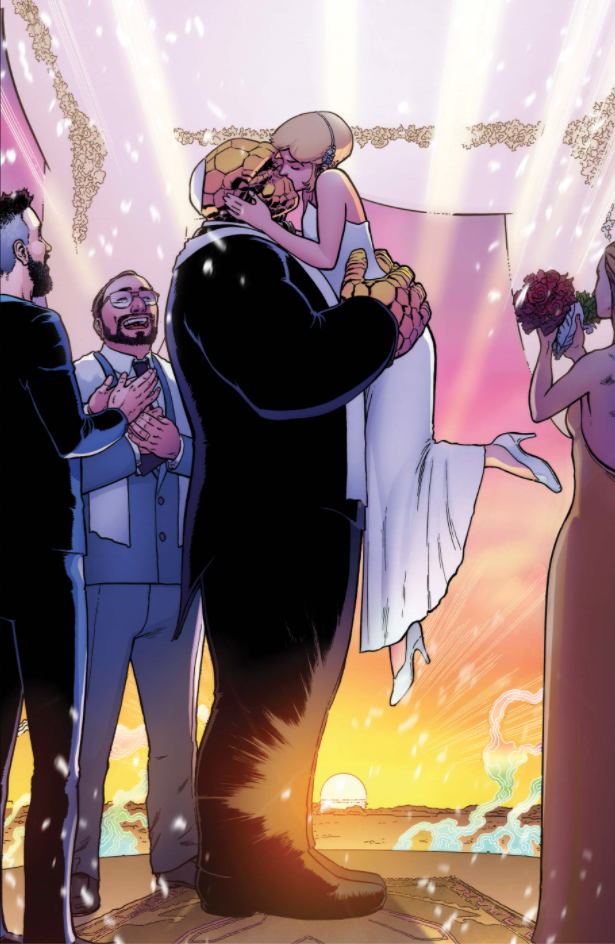
There are way too many super-hero weddings to list, but here’s a few that took place in the pages of the Fantastic Four:

The marriage of Crystal and Quicksilver in FF 150 (Crystal had been a de facto member of the FF for years):

FF 150 (1974, story by Gerry Conway, art by Rich Buckler and Joe Sinnott)

The marriage of Johnny Storm and Alicia Masters, later revealed to be Lyja the Skrull, in FF 300:

FF 300 (1987, story by Roger Stern, art by John and Sal Buscema)

In FF 27 (Vol. 3), in a bizarre storyline, Sue marries Dr. Doom, who was actually Reed’s consciousness in Doom’s body:

FF 27 (Vol. 3) (2000, story by Chris Claremont, art by Salvador LaRocca and Art Thibert)

Lastly, Ben Grimm and the real Alicia finally married in FF 5 (vol. 6):

FF 5 (vol. 6) (2018, story by Dan Slott, art by Aaron Kuder)

Let’s talk about us

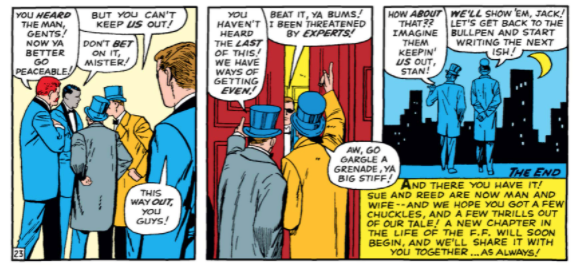
Stan and Jack, absent from these pages for a while, reappear as uninvited wedding guests:

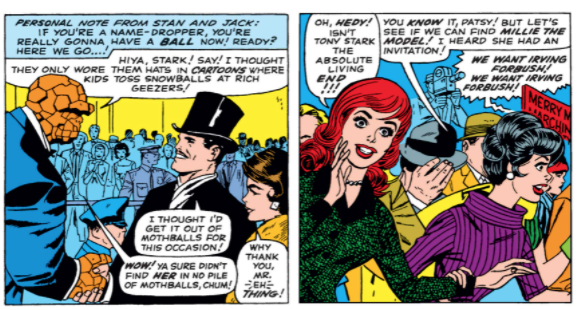
Also making a cameo was Patsy Walker and her friend Hedy, marking their first appearance in the Marvel universe. The star of teen romance comics dating from the 1940s, Patsy would later become the heroine Hellcat.

Who are these guys?

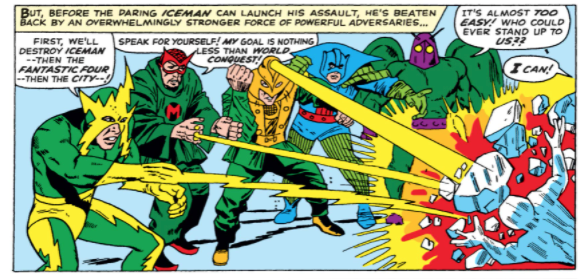
Stan and Jack dug deep to find some obscure villains. I believe the guy to the right of the Mandarin is the Unicorn, but I have no clue who is between him and the Beetle. Anyone out there know?

Call my lawyer

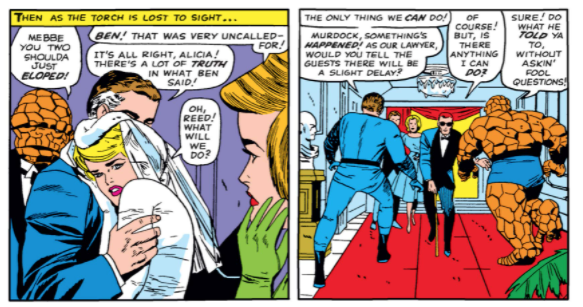
I hope Murdock & Nelson bill their usual rate for running errands like this.

Deus ex machina

Once again the Watcher makes a big deal out of his vow to not interfere while doing a lot of interfering.

Dig that Kirby Krackle

This issue features another Kirby Kollage

Next issue: The return of Medusa and introduction of the Inhumans!

(Edited to remove a reference to The wedding of Bouncing Boy and Duo damsel, which I somehow placed in the 60s, not the 70s)

“The World’s Greatest Comic Magazine” Fantastic Four No. 43

12 Sunday Dec 2021

Posted by percivalhenry in The World's Greatest Comic Magazine

≈ Leave a comment

Tags

1965, Fantastic Four, Fantastic Four 43, Frightful Four, jack Kirby, Stan Lee

Fantastic Four 43
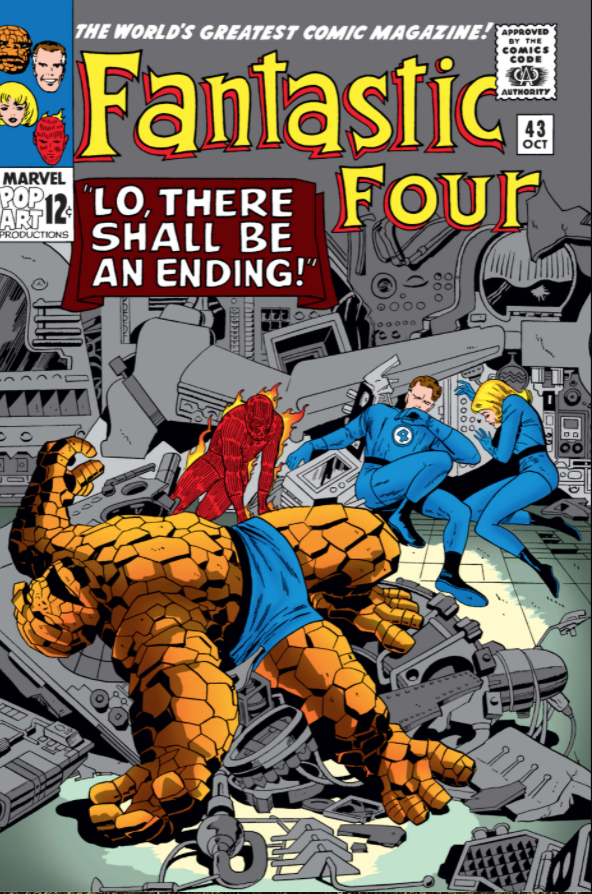
“Lo! There shall be an ending!”
Published: July 1965
Story: Stan Lee and Jack Kirby
Script: Lee
Pencils: Kirby
Inks: Vince Colletta
Letters: Art Simek
Cover: Kirby and Colletta

Programming note: This issue actually appeared on newsstands after Fantastic Four Annual 3, but for the sake of clarity, we’re going to tackle the issues in order of continuity and get to the annual next week.

Synopsis

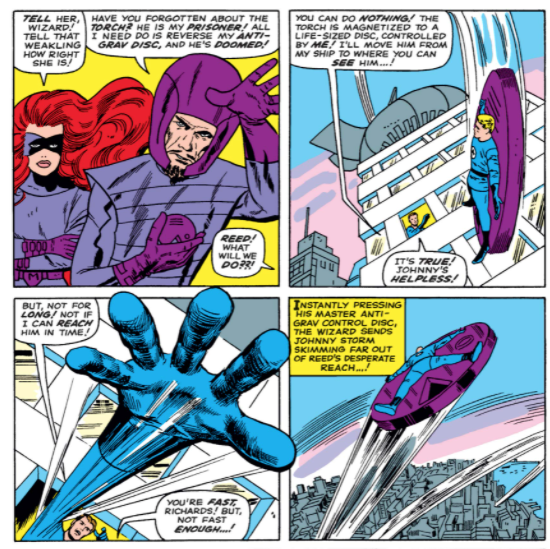
Continuing a story arc that began six issues ago, in issue 38, Fantastic Four 43 picks up where the previous comic left off, with the Frightful Four pursuing Mr. Fantastic and the Invisible Girl. The Frightful Four has brainwashed the Thing, who Reed has subdued and captured with one of the Wizard’s antigravity disks, and the Human Torch, who is in pursuit of Reed and Sue. Reed and Sue escape, however, and the Wizard (and Reed) suspect the Human Torch of only pretending to be brainwashed. The villains realize Reed tampered with the brainwashing device, then re-capture Johnny.

Meanwhile, back at the Baxter Building, Reed attempts to reverse the Thing’s brainwashing with a complicated and dangerous process that leaves Ben unconscious. The Frightful Four arrive and demand Reed and Sue undergo brainwashing, or the Torch—who is strapped to a giant antigravity disk—will be sent into space. Reed and Sue stall for time until Ben wakes and destroys the Wizard’s anti-gravity controls, freeing the Torch. The reunited team then quickly mops up the the Frightful Fours, save for Medusa, who escapes the Torch. The issues concludes with a reminder Reed and Sue are to be married soon.

What’s going on here?

The Frightful Four saga finally wraps up, ushering in the wedding of Reed and Sue, and setting the stage for a 18 issue run from FF 44 through 62 that is arguably the greatest single stretch of issues in comic book history (much more on that to come). In that context, the six-part Frightful Four/Doom/Frightful Four storyline can be seen as a trial run for more the more ambitious, multi-part stories to some.

This issue, despite Stan’s grandiose title, ends with more of a whimper than a bang. It’s not a bad resolution, and it concludes with Ben back in the fold after his time in the wilderness, but the stakes don’t feel particularly high here. The Frightful Four, ultimately, aren’t all that menacing, and despite beating the FF pretty soundly twice, there’s never any real doubt Reed will find a way to win.

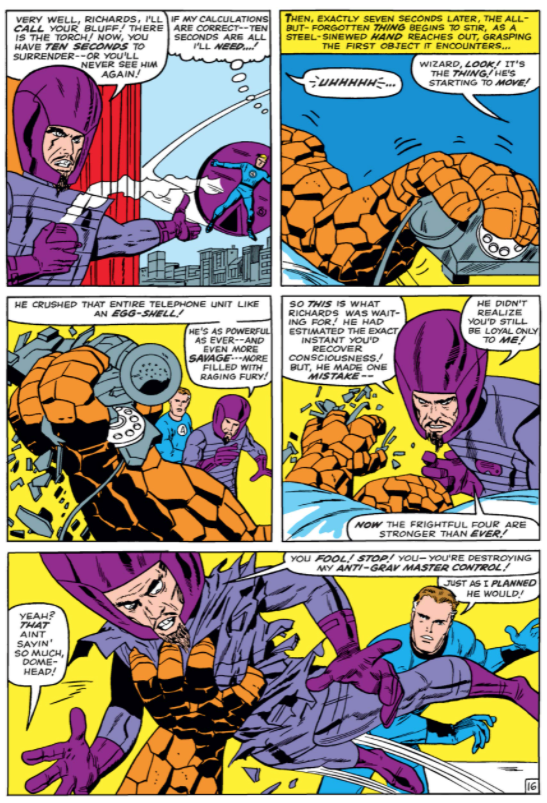
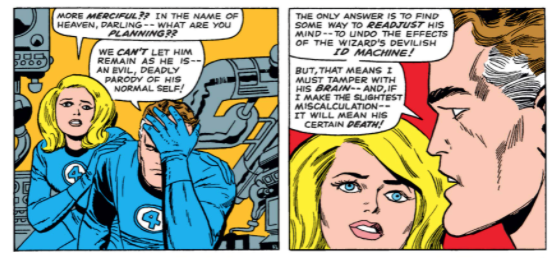
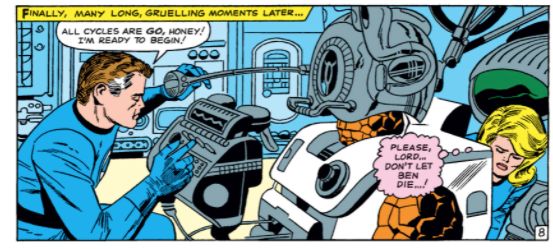
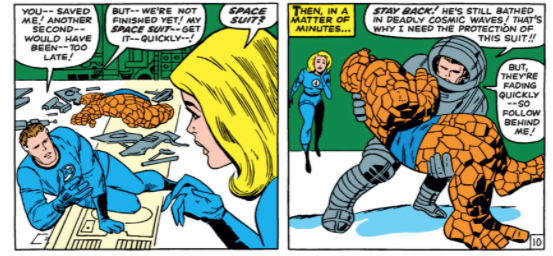
FF 43 does feature a great sequence when Ben revives and it’s as yet unclear whether he has escaped the brain washing. Jack keeps us in the dark by not showing Ben’s face.

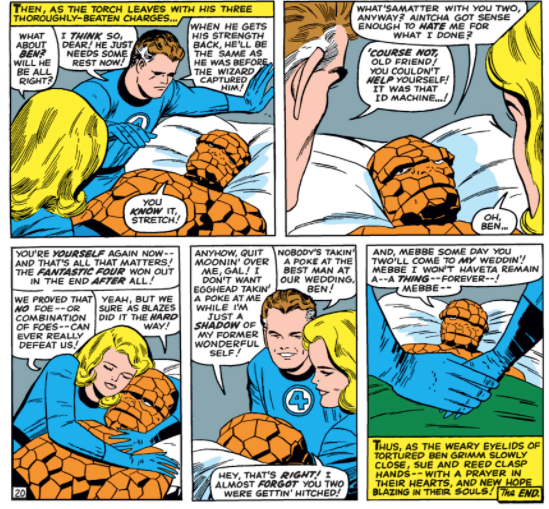
The issue ends with Reed and Sue standing around Ben’s bed, reunited but still with a hint of melancholy.

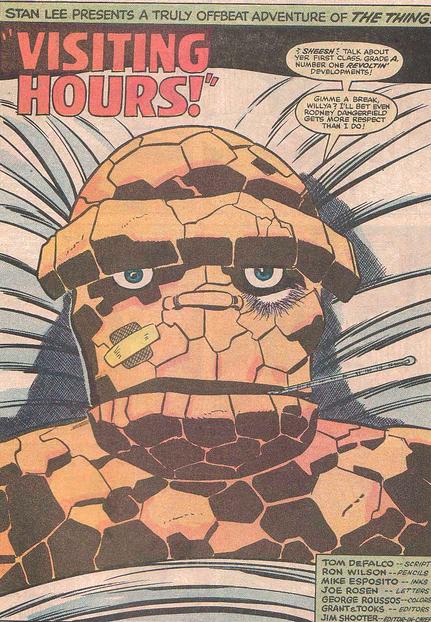
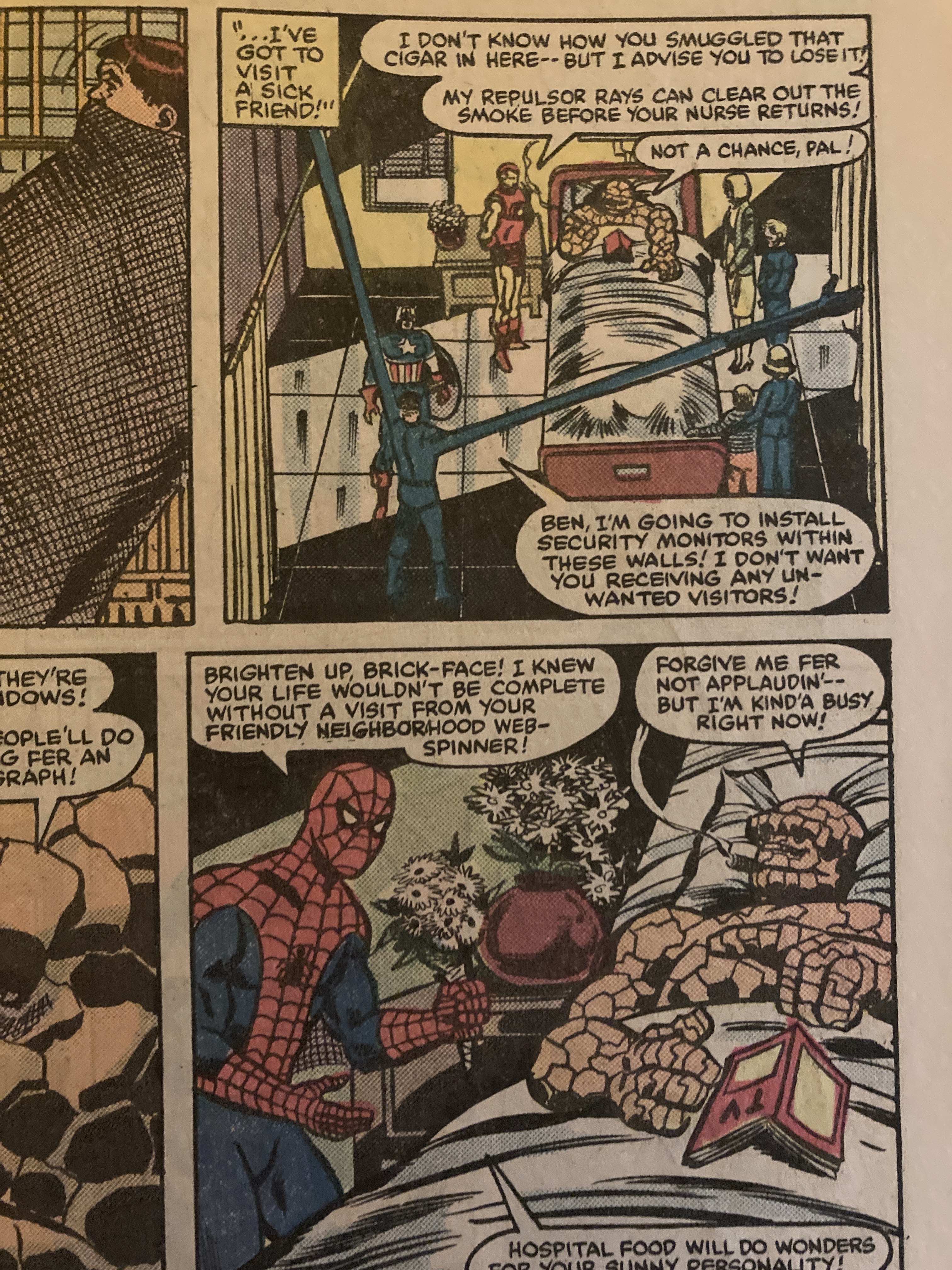
It’s far from the last time Ben ends up convalescing in bed, and reminded me up Marvel Two-in-One 96, where he spend the whole issue in bed as a brawl rages outside the hospital.

Marvel Two-in-One 96 (1982), Ron Wilson/Mike Esposito

FF 43 also features an odd sequence, where Johnny flies off to capture Medusa, but pulls up short, then gets scolded by Reed.

It’s not entirely clear what’s going on here, and why Stan and Jack place so much emphasis on it, but it’s likely related to the upcoming developments for Medusa and the introduction of the Inhumans.

Lo down and dirty

“Lo” is a word used very rarely, and mostly by Stan Lee (it’s both on the cover and the title of this issue). Lo is an Old English variant of “look” and to the extent it survives, it’s mostly in “lo and behold.” That doesn’t stop Stan from using it, of course, and it’s one of those archaic words and phrases he sprinkles into titles to ramp up the grandeur. There’s no easy way to track down all the uses of “lo” in Marvel comics but I found a few. Not surprisingly, they’re either by Stan or his acolytes, Roy Thomas and Gerry Conway.

They’re fighting again

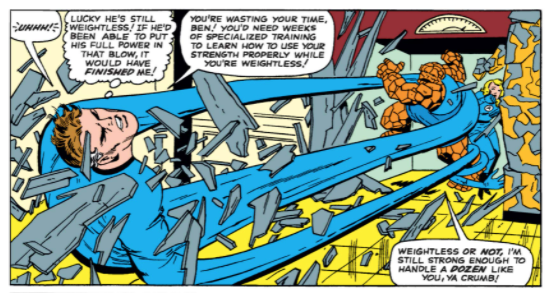
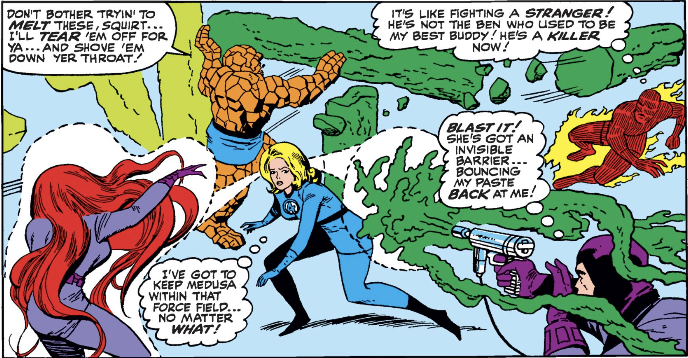
Sort of a fun fight, too.

Krazy Kredits

Meanwhile

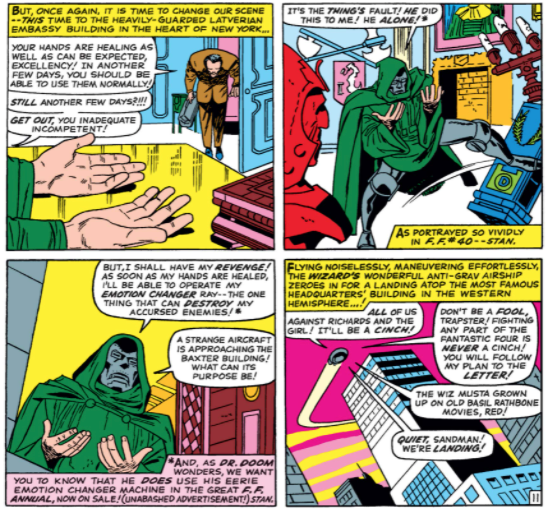
This might be the first time Stan and Jack have cut away from the action to set up a story in an upcoming issue. Here, they tease a Doom appearance in the annual.

Weird science

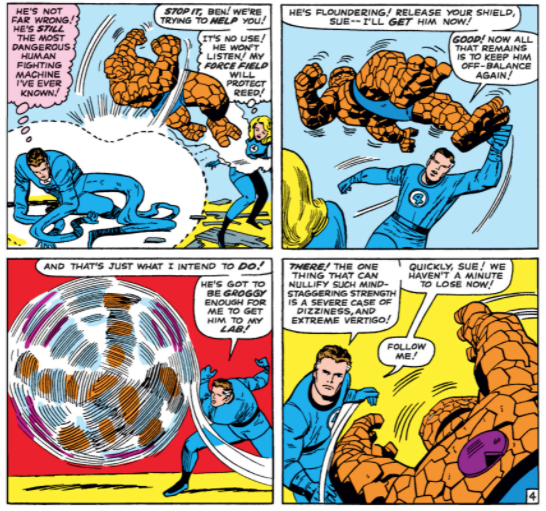
To reverse the Wizard’s brainwashing of Ben, Reed employs a machine that seems to leak both electricity and “deadly cosmic waves.” The whole thing is baffling and made me wonder why he didn’t just call Professor X or Dr. Strange to fix Ben’s noggin.

The sexist sixties

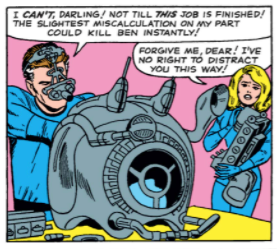
Sue has “no right” to distract Reed?

Dig that Kirby Krackle

Some cool panels that display Jack’s masterful of perspective for dramatic effect.

Next issue: FF Annual 3, and the marriage of Reed and Sue. What could possibly go wrong?

“The World’s Greatest Comic Magazine!” Fantastic Four No. 42

04 Saturday Dec 2021

Posted by percivalhenry in The World's Greatest Comic Magazine

≈ 1 Comment

Tags

1965, Fantastic Four, Fantastic Four 42, Frightful Four, jack Kirby, Stan Lee

Fantastic Four 42
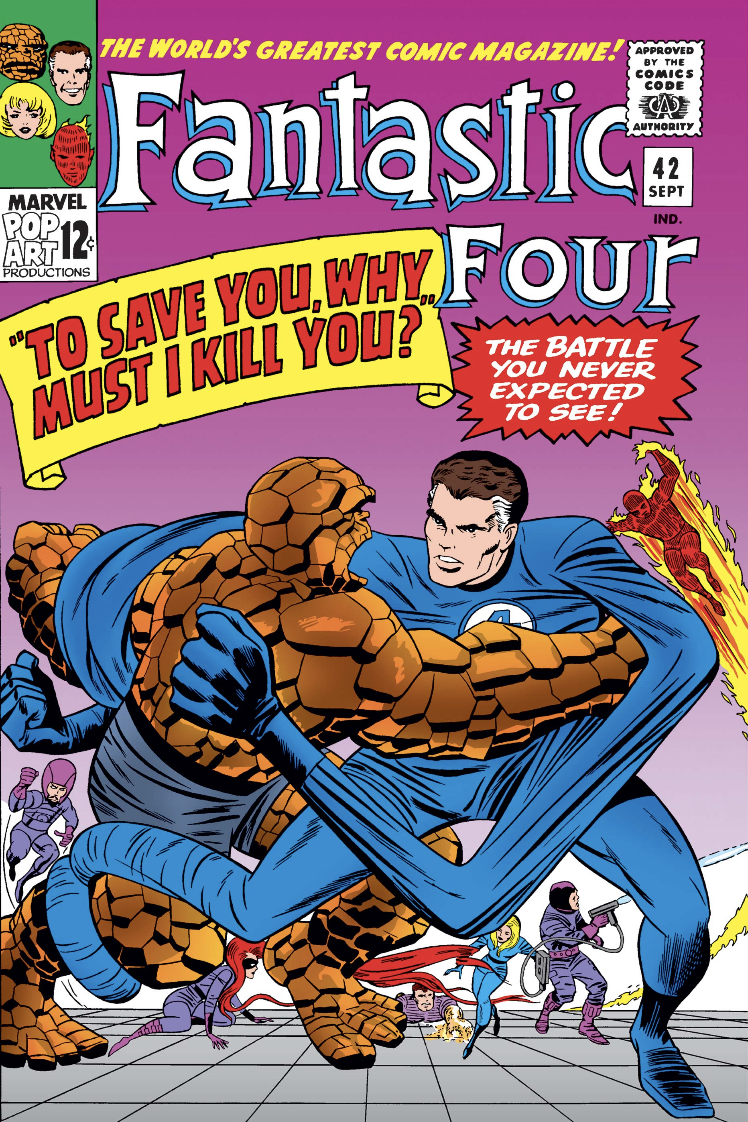
“To save you, why must I kill I you?”
Published June 1965
Story: Stan Lee and Jack Kirby
Script: Lee
Pencils: Kirby
Inks: Vince Colletta
Letters: Sam Rosen
Cover: Kirby and Sol Brodsky

Synopsis

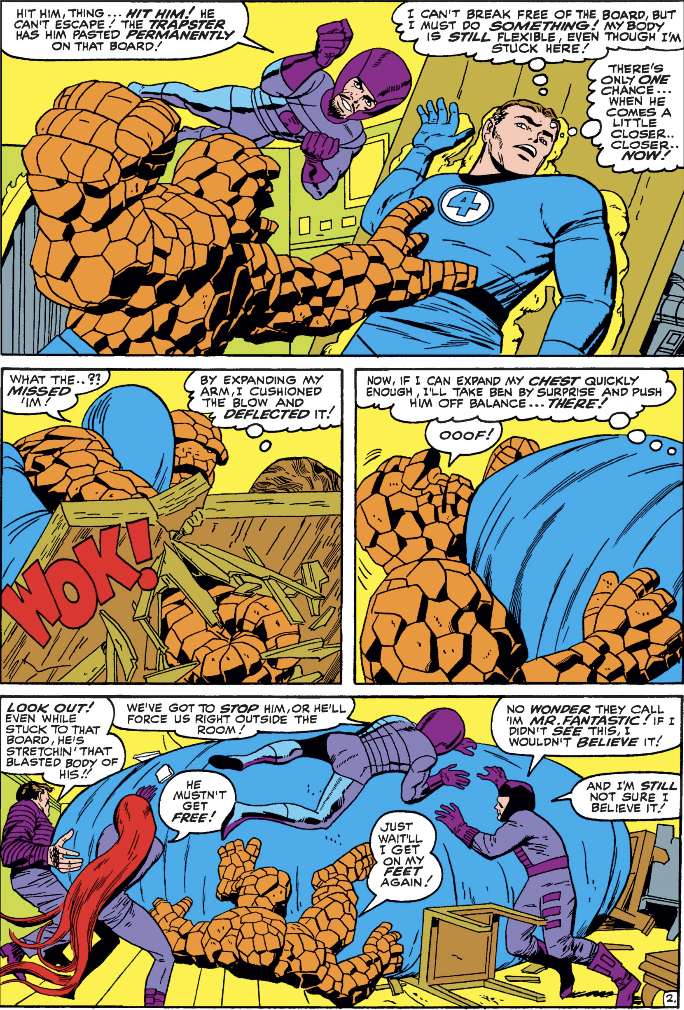
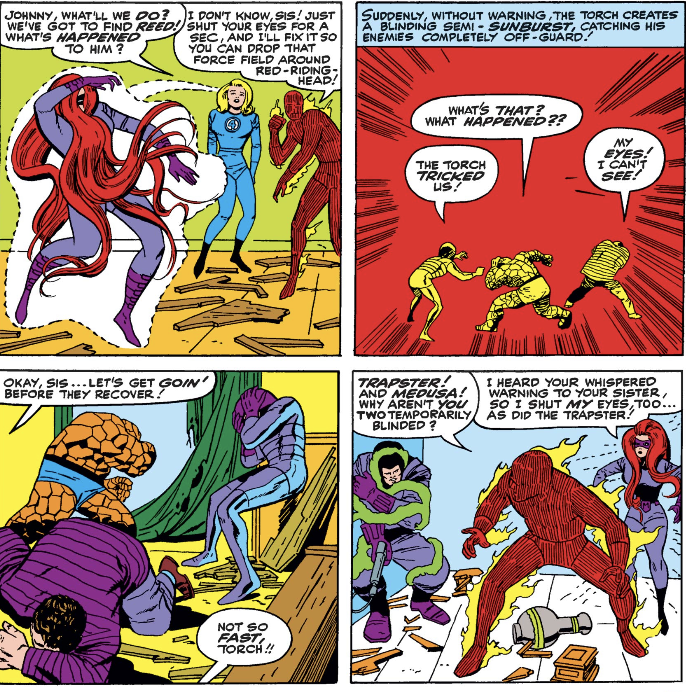
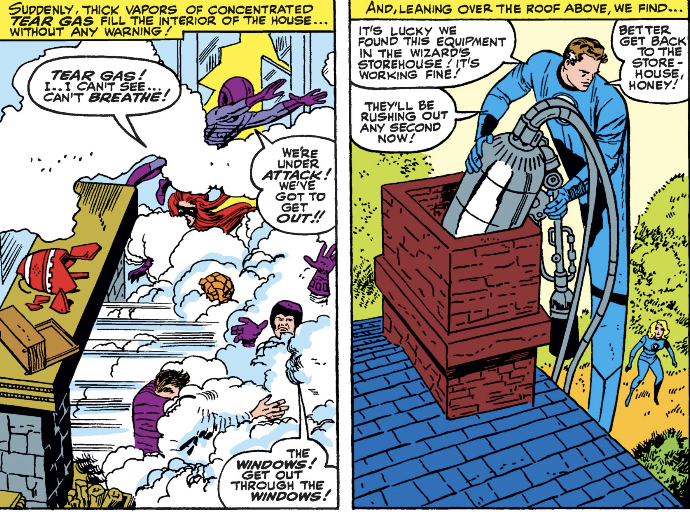
Fantastic Four 42 picks up where FF 41 left off, with the Frightful Four goading the brainwashed Thing into killing Mr. Fantastic, who is glued to a board. Unable to stretch his limbs, Reed inflates his chest to escape, eventually inducing Ben into destroying the board. The teams continue to battle, with Ben eventually capturing Reed and stuffing him into a jar (really). The Human Torch’s flames are doused when Medusa uses her hair to soak him, and he is captured and brainwashed by the Frightful Four. The Invisible Girl frees Reed, and the two use tear gas to flush the villains out of their lair. Reed then attaches the Wizard’s antigravity devices to Ben, rendering him helpless when the Torch attacks. The comics ends with another cliffhanger.

What’s going on here?

Fantastic Four 42 is wall-to-wall action. The fight that began in issue 41 continues all the way through 42 without conclusion (presumably that happens in the next issue) and with no digressions or cutaways for other stories. Further, virtually the entire story takes place in the Frightful Four’s house in New Jersey that gives the battle a claustrophobic intensity.

Also notable is Stan and Jack’s embrace of the multi-issue story arcs and the cliff-hanger ending. After nearly 40 issues of one-and-done comics (with two exceptions), we’re now on the fifth issue of an arc that began in issue 38, each ending with a cliffhanger. As discussed in a previous entry, I think it reflects Stan and Jack’s confidence that their now large and loyal body of fans that would seek out new issues. It might also be a sign that newsstands and drug stores, impressed with the Fantastic Four’s sales, were ordering them with sufficient regularity that the creators didn’t have to worry about readers not being able to find issues.

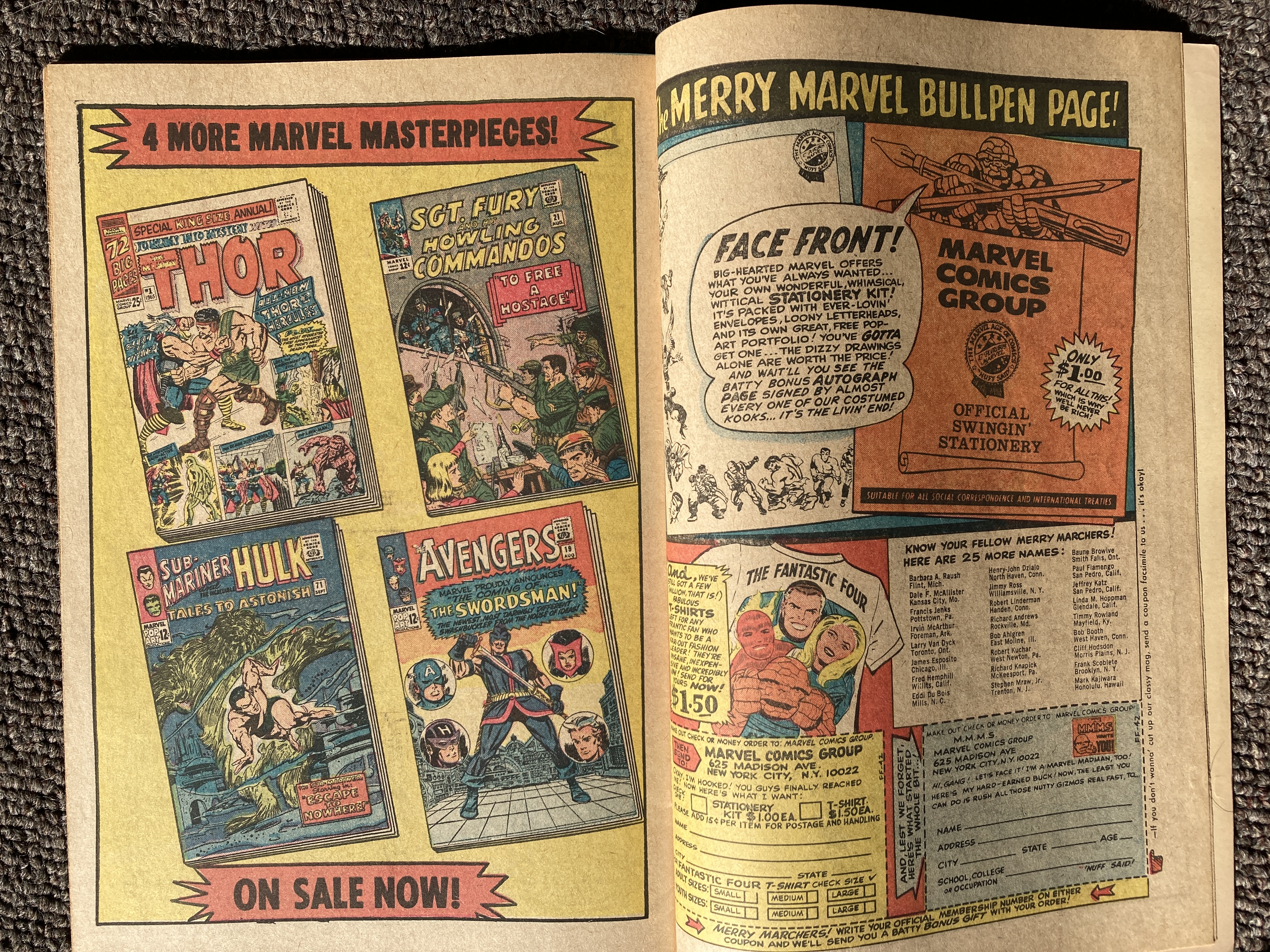
Fantastic Four 42 also happens to be an issue I own, which means we get to check out some non-story elements of the comic. First up, some house ads and the Bullpen Page:

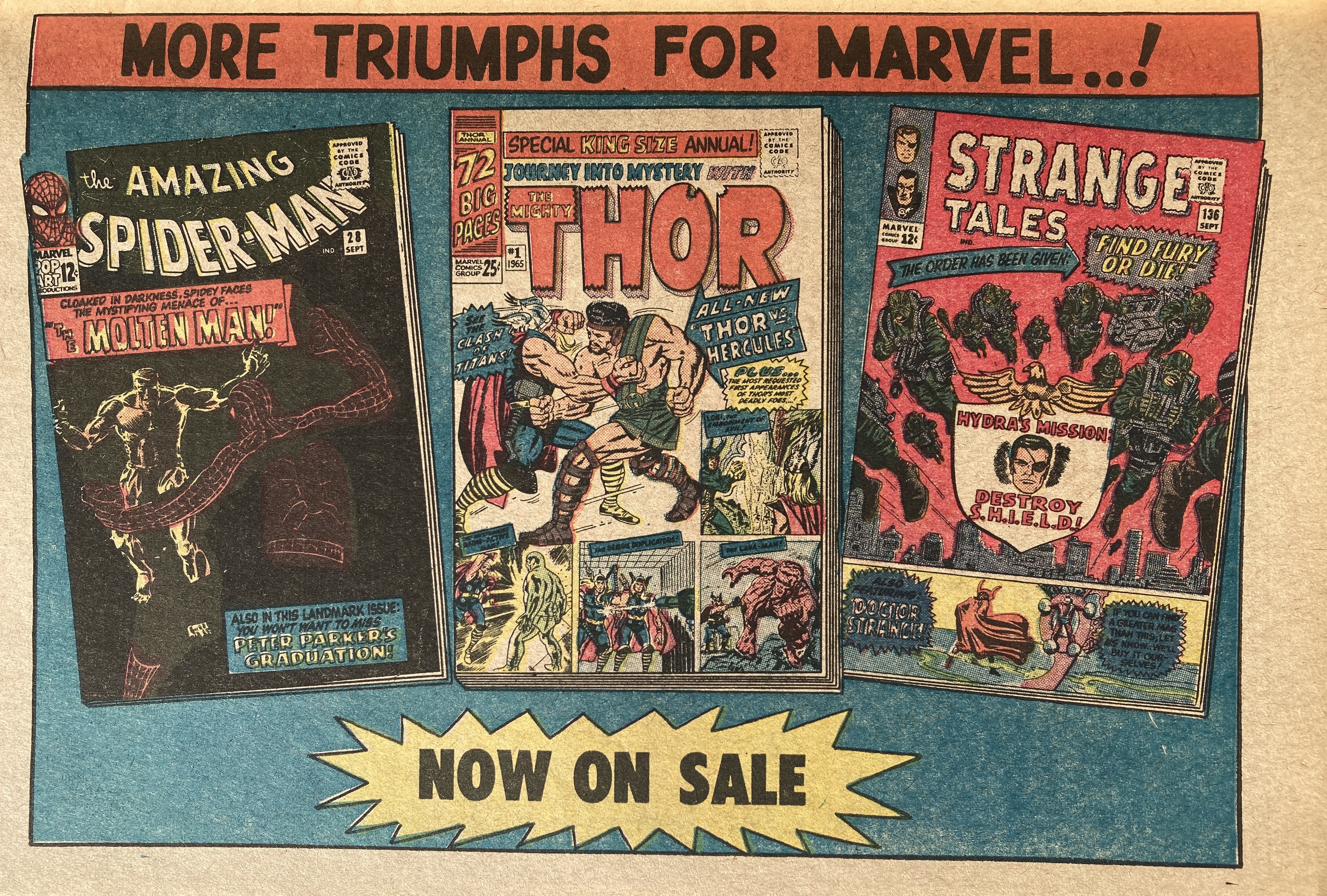
Another house ad (that Thor Annual was so good it was plugged twice!):

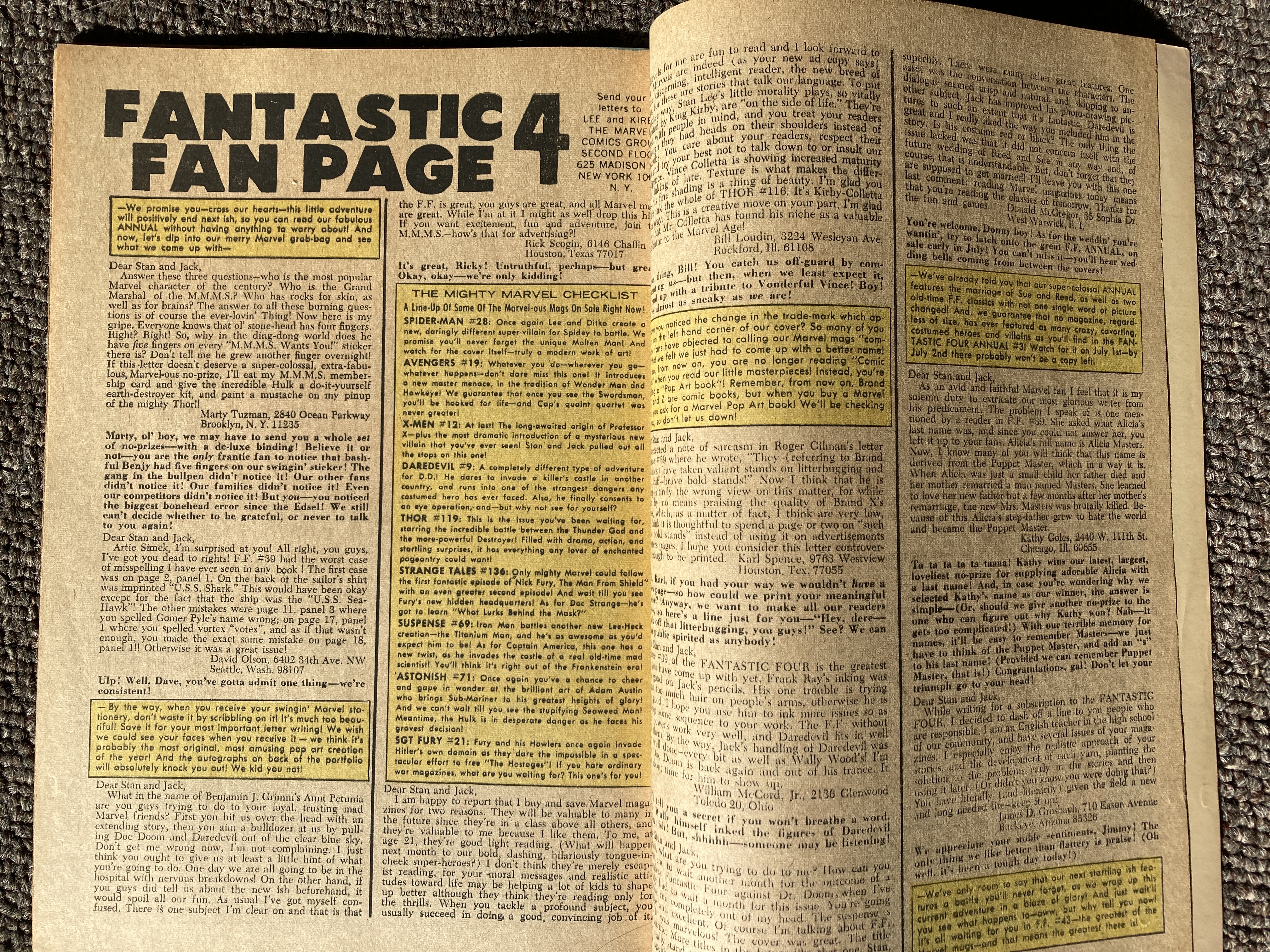
The letters page (two pages!). I learned here that a fan gave Alicia Masters her last name. No celebrity letters though.

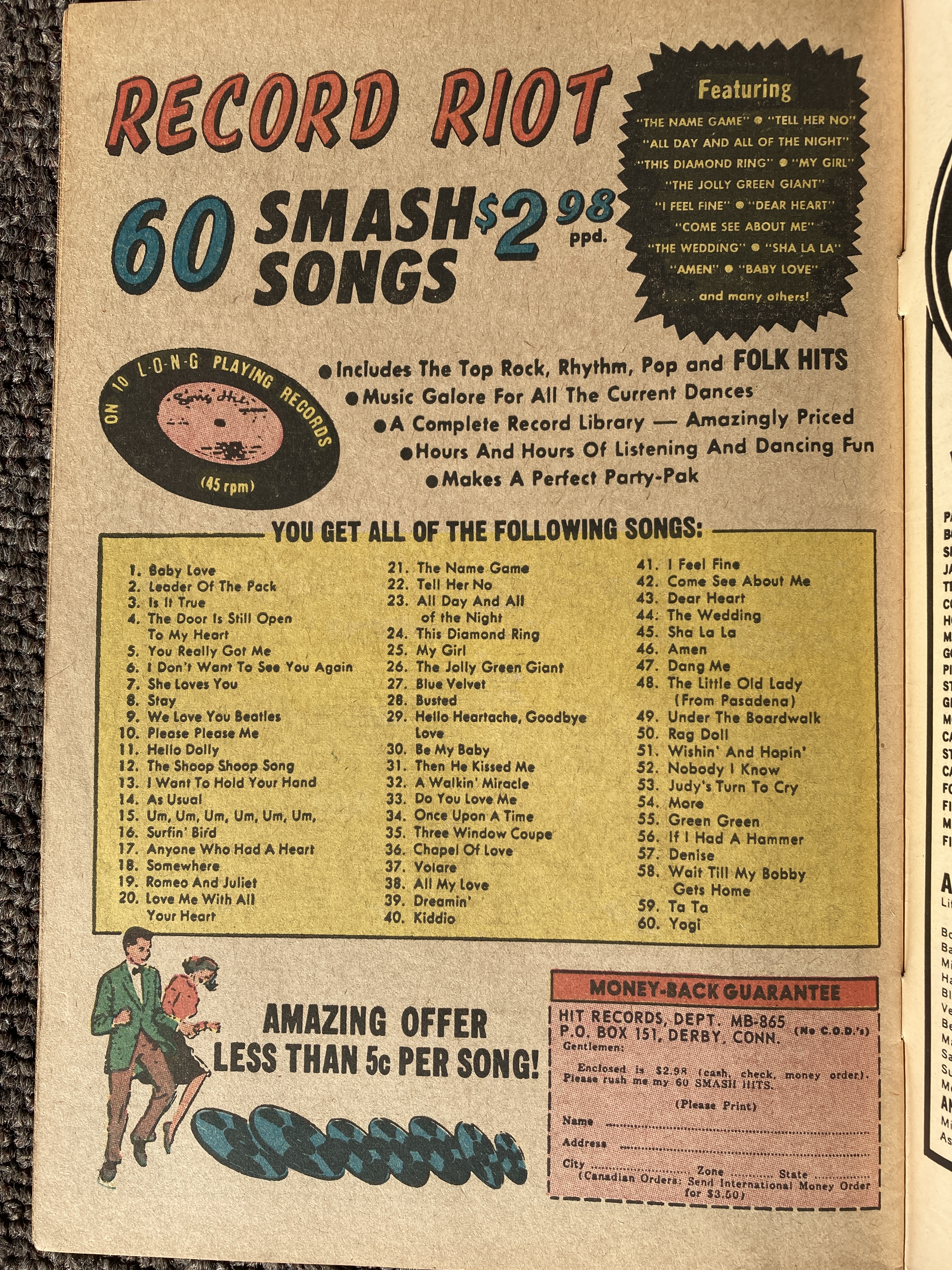
And finally a real ad. I could probably write a whole post dissecting this ad and what it says about popular music at this point of 1965.

The incredible Mr. Fantastic

There’s a lot of excellent stretching action in this comic. Here, Reed puffs up like a blowfish:

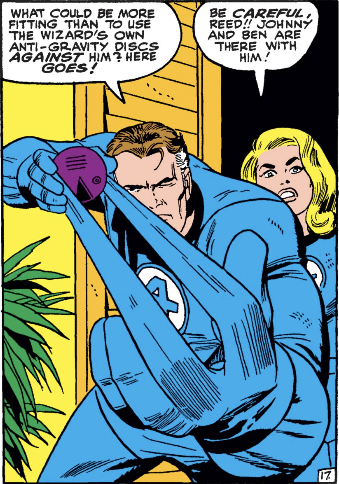
And here, he makes a slingshot out of his fingers:

Signed, Stan

Is this the first signed editors note? It can’t recall seeing this before.

Oops

Is this a goof? it looks like Stan might be covering for Jack to explain why Medusa and the Trapster aren’t incapacitated (either way, it’s pretty clunky writing):

Deus ex machina

I guess if anyone is going to keep canisters of tear gas in their storage shed, it’s going to be a super villain.

The sixties are slightly less sexist

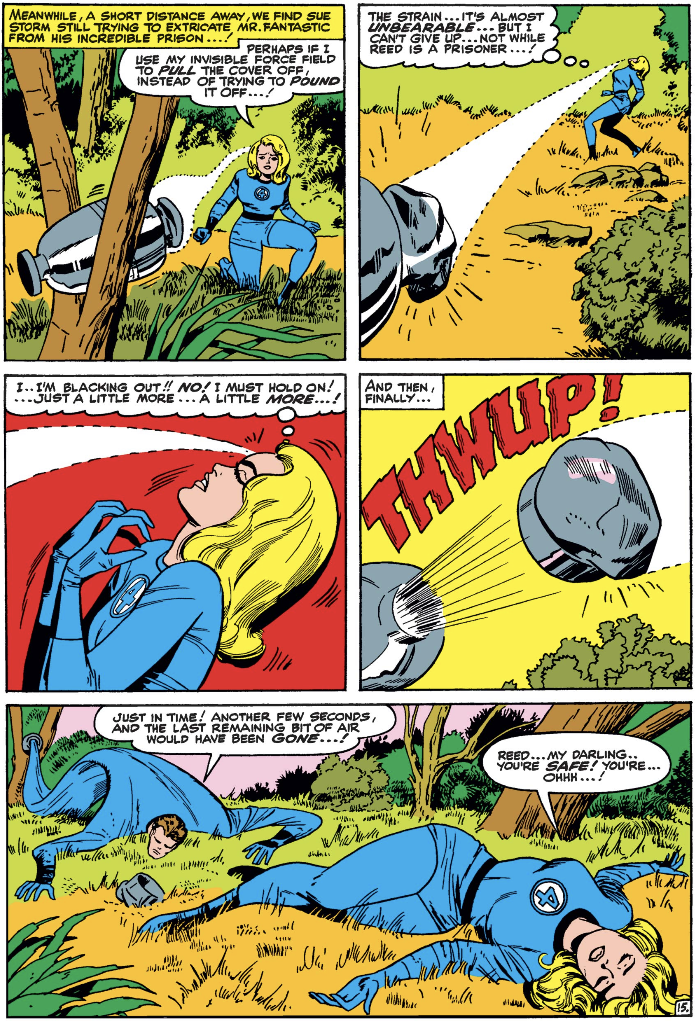
Sue rises to the occasion here, although opening a jar still wipes her out.

Dig that Kirby Krackle

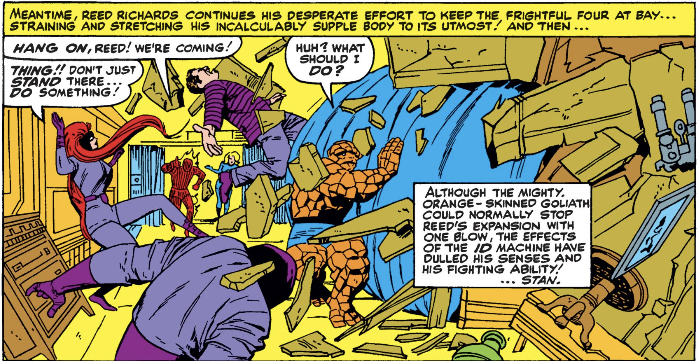
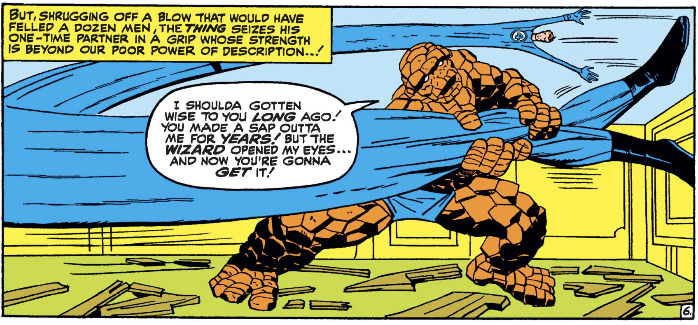
An all fight issue means fewer opportunities for Jack to really shine, but there’s some fun panels of Ben and Reed battling:

which eventually ends like so:

Next issue: The conclusion!

← Older posts
Newer posts →
  • “The World’s Greatest Comic Magazine!” Fantastic Four Annual No. 16
  • “The World’s Greatest Comic Magazine!” Fantastic Four No. 235
  • “The World’s Greatest Comic Magazine!” Fantastic Four No. 234
  • “The World’s Greatest Comic Magazine!” Fantastic Four No. 233
  • “The World’s Greatest Comic Magazine!” Fantastic Four No. 232
  • October 2026
  • September 2026
  • August 2026
  • July 2026
  • June 2026
  • May 2026
  • April 2026
  • March 2026
  • February 2026
  • January 2026
  • December 2025
  • November 2025
  • October 2025
  • September 2025
  • August 2025
  • July 2025
  • June 2025
  • May 2025
  • April 2025
  • March 2025
  • February 2025
  • January 2025
  • December 2024
  • November 2024
  • October 2024
  • September 2024
  • August 2024
  • July 2024
  • June 2024
  • May 2024
  • April 2024
  • March 2024
  • February 2024
  • January 2024
  • December 2023
  • November 2023
  • September 2023
  • July 2023
  • June 2023
  • May 2023
  • April 2023
  • March 2023
  • February 2023
  • January 2023
  • December 2022
  • November 2022
  • October 2022
  • September 2022
  • August 2022
  • July 2022
  • June 2022
  • May 2022
  • April 2022
  • March 2022
  • February 2022
  • January 2022
  • December 2021
  • November 2021
  • October 2021
  • September 2021
  • August 2021
  • July 2021
  • June 2021
  • May 2021
  • April 2021
  • March 2021
  • February 2021
  • January 2021
  • December 2020
  • February 2018
  • May 2016
  • February 2016
  • January 2016
  • December 2015
  • November 2015
  • October 2015
  • September 2015
  • August 2015
  • July 2015
  • April 2015
  • March 2015
  • January 2015
  • December 2014
  • November 2014
  • October 2014
  • September 2014
  • August 2014
  • June 2014
  • May 2014
  • April 2014
  • March 2014
  • February 2014
“The World’s Greatest Comic Magazine!” Fantastic Four Annual No. 16

“The World’s Greatest Comic Magazine!” Fantastic Four Annual No. 16

percivalhenry's avatar by percivalhenry October 19, 2026
“The World’s Greatest Comic Magazine!” Fantastic Four No. 235

“The World’s Greatest Comic Magazine!” Fantastic Four No. 235

percivalhenry's avatar by percivalhenry October 12, 2026
“The World’s Greatest Comic Magazine!” Fantastic Four No. 234

“The World’s Greatest Comic Magazine!” Fantastic Four No. 234

percivalhenry's avatar by percivalhenry October 4, 2026
“The World’s Greatest Comic Magazine!” Fantastic Four No. 233

“The World’s Greatest Comic Magazine!” Fantastic Four No. 233

percivalhenry's avatar by percivalhenry September 26, 2026
“The World’s Greatest Comic Magazine!” Fantastic Four No. 232

“The World’s Greatest Comic Magazine!” Fantastic Four No. 232

percivalhenry's avatar by percivalhenry September 20, 2026
“The World’s Greatest Comic Magazine!” Fantastic Four No. 231

“The World’s Greatest Comic Magazine!” Fantastic Four No. 231

percivalhenry's avatar by percivalhenry September 13, 2026

Blog at WordPress.com.

  • Subscribe Subscribed
    Percival Henry: The Fantastic Four and more
    Join 75 other subscribers

    Have a WordPress.com account? Log in now.

  • Percival Henry: The Fantastic Four and more
    View site in Reader
    Manage subscriptionsSign upLog in
    Report this content
    Collapse this bar
Loading Comments...