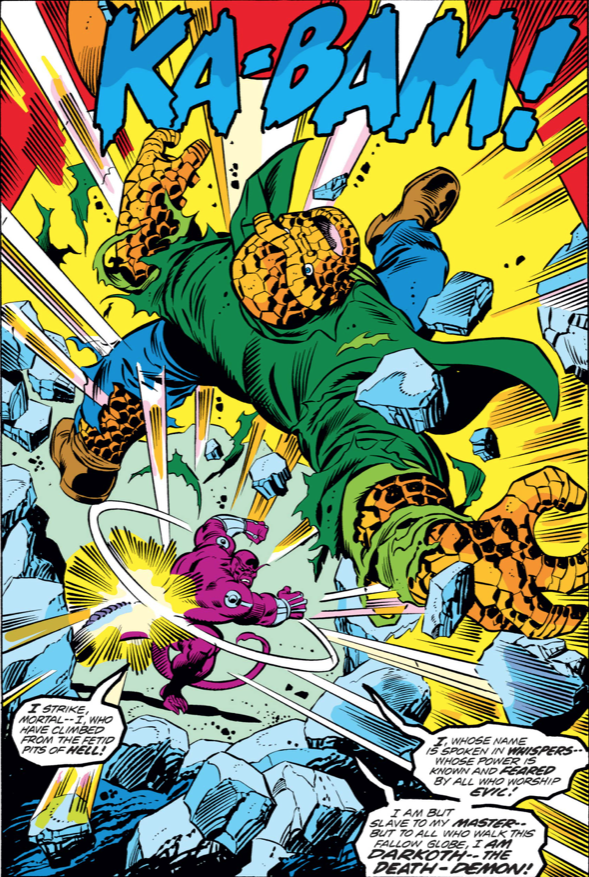
• About Percival Henry

Percival Henry: The Fantastic Four and more

~ Blogging the Fantastic Four issue by issue (plus whatever else grabs my attention)

Percival Henry: The Fantastic Four and more

Author Archives: percivalhenry

“The World’s Greatest Comic Magazine!” Fantastic Four No. 135

23 Sunday Jun 2024

Posted by percivalhenry in The World's Greatest Comic Magazine

≈ Leave a comment

Tags

1973, Dragon Man, Fantastic Four, Fantastic Four 135, Gerry Conway, John Buscema

Fantastic Four 135
“The Eternity Machine”
Published: March 1973
Writer: Gerry Conway
Breakdowns: John Buscema
Finishes: Joe Sinnott
Letterer: Artie Simek
Colors: Petra Goldberg
Editor: Roy Thomas
Cover: Buscema and Michel Esposito

Synopsis

The Fantastic Four are trapped by Gregory Gideon, who reveals his plan to drain the powers of Mr. Fantastic, the Invisible Girl and their son Franklin to counter his radiation poisoning and rule the world. Thanks to new member Medusa, the team escapes their imprisonment and beats Gideon by turning Dragon Man against him.


What’s going on here?

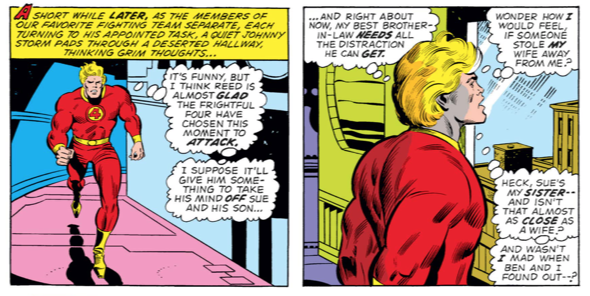
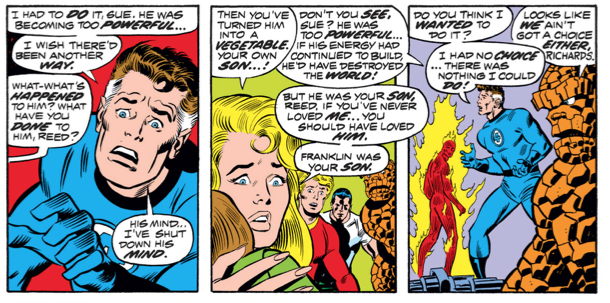
This is a fairly straightforward story, wrapping up a two-part arc while introducing some new sub-plots. Probably the biggest development isn’t a development at all, but the continuation of Sue’s estrangement from Reed. Despite both being captured with their son, at the conclusion of the issue Sue has no interest in reconciling with Reed.


It’s a poignant and effective ending, maybe even more so given writer Gerry Conway was just 20 years old when he wrote this comic. In a 2016 interview, Conway discusses his relative immaturity during this period and how he did his best to mask it as a writer. He concedes he wasn’t always successful, and we’ll see some of that toward the end of his Fantastic Four run. But for a writer barely out of his teens, he handled the strains in Reed and Sue’s marriage with surprising deftness.

What I liked

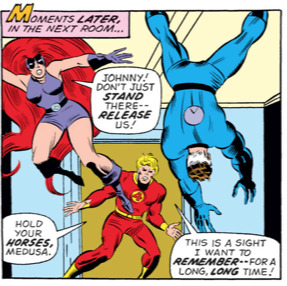
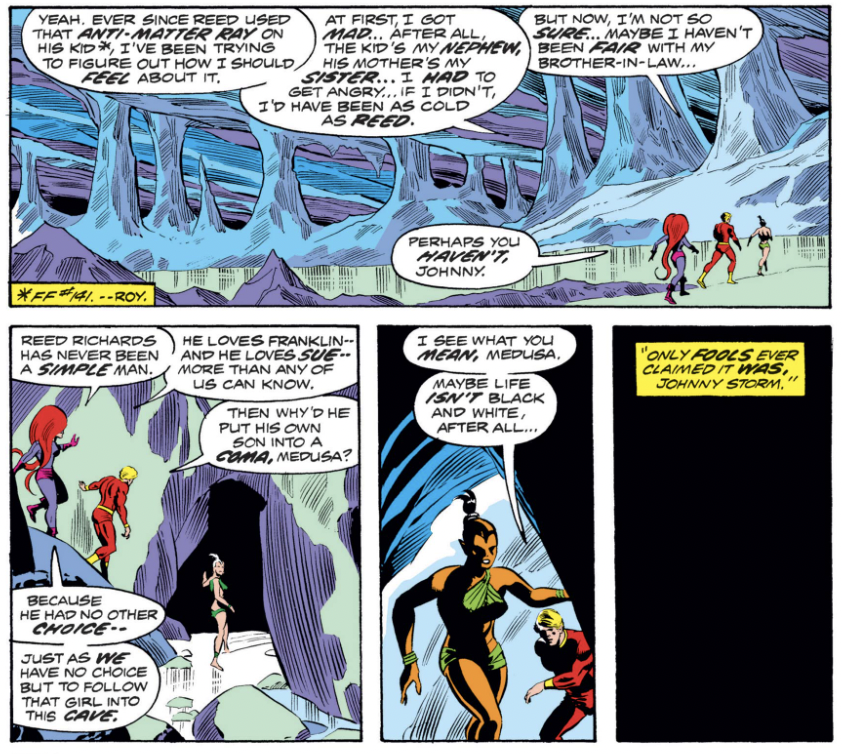
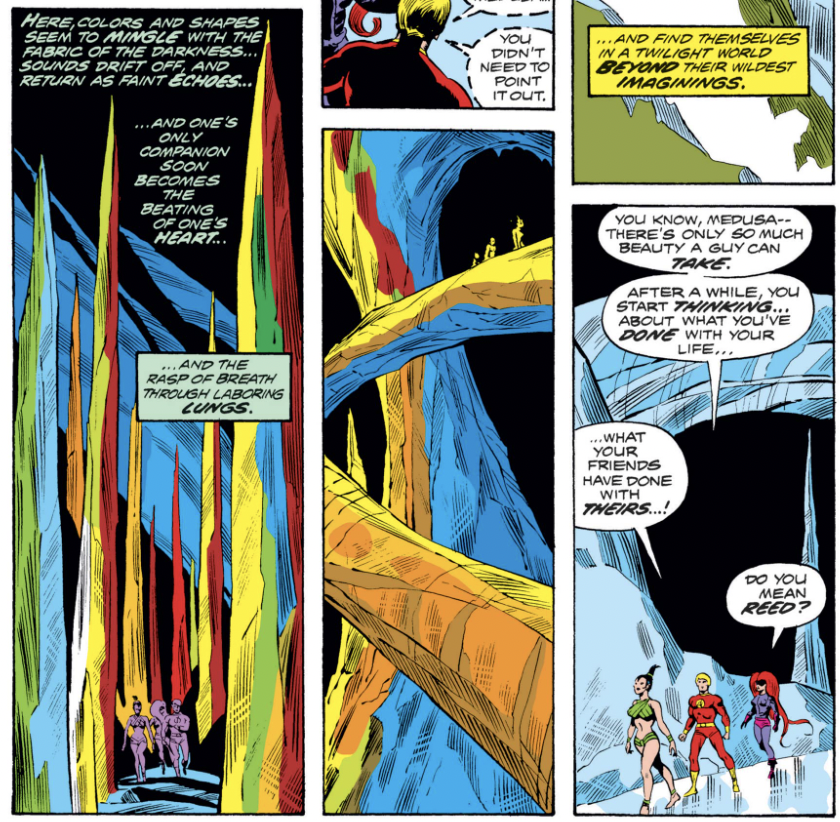
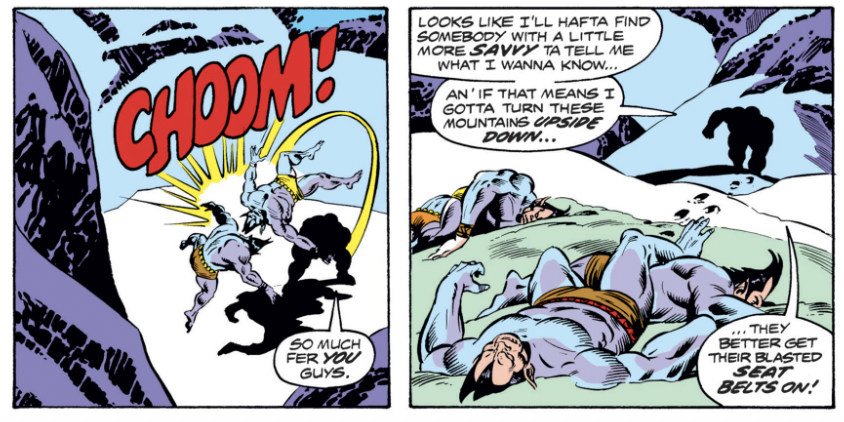
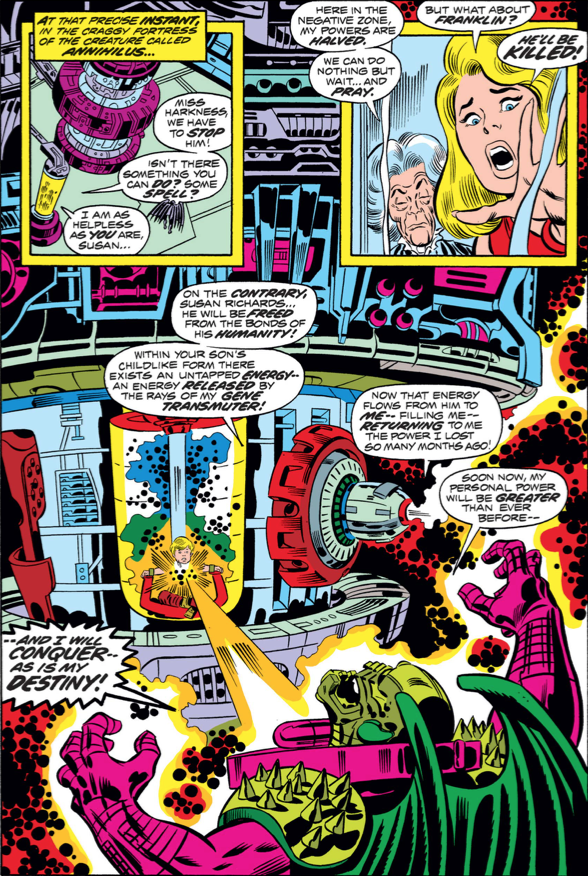
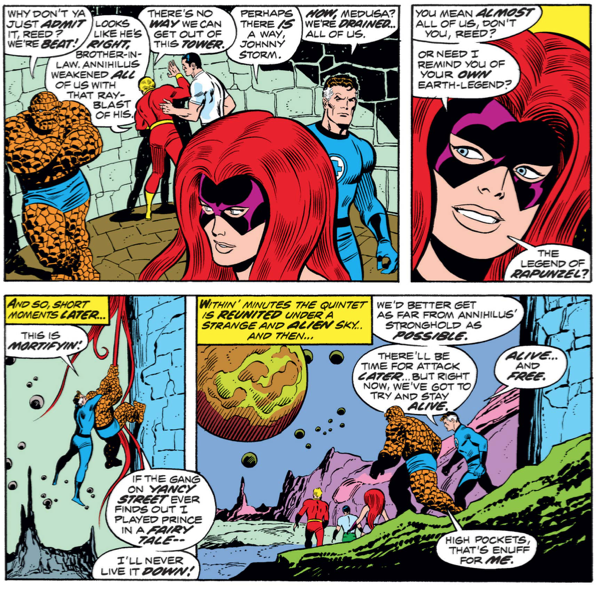
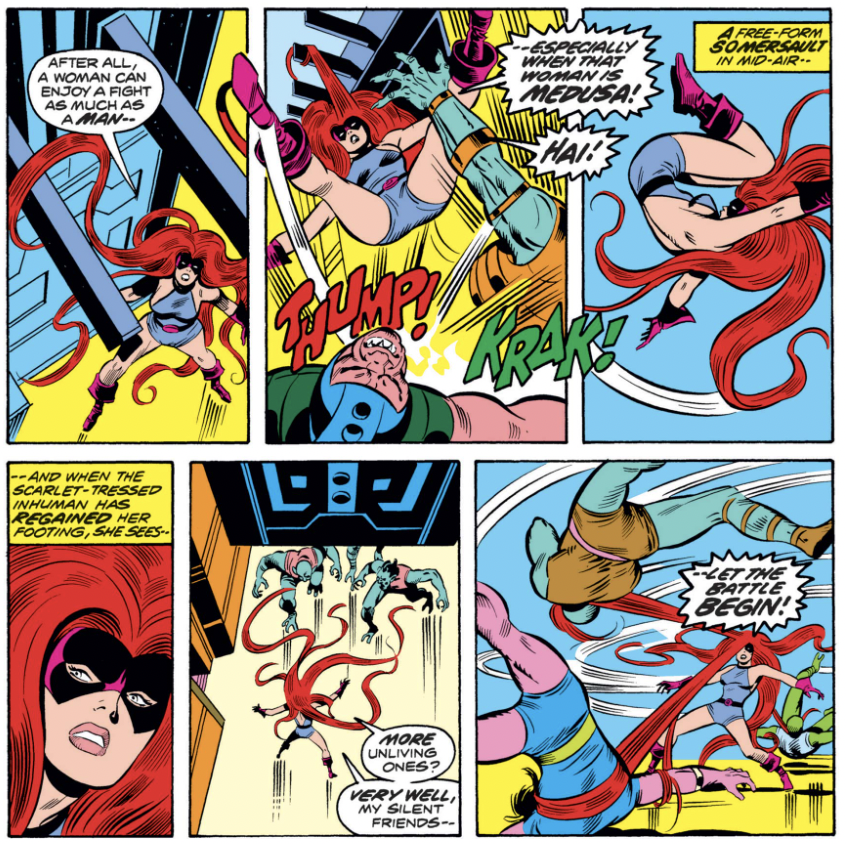
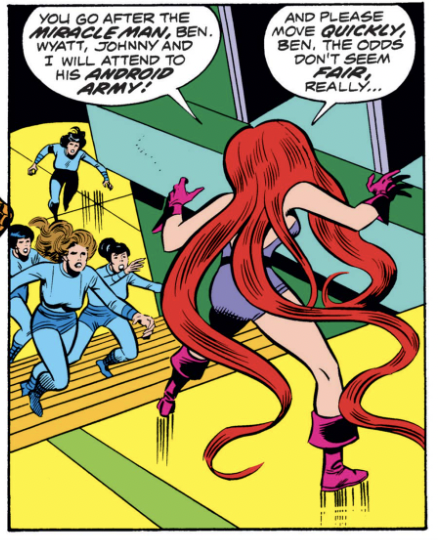
Another notable development is the emergence of Medusa—finally—as a useful member of the team. I’ve been surprised that, as the newest member of the team, she’s been relegated to the background, but in FF 135 she plays a key role in breaking herself, Ben and Johnny out of their imprisonment, then in removing a device that allowed Gideon to control Dragon Man. I would still welcome a story that focused on her and her decision to leave the Inhumans, but this is progress.

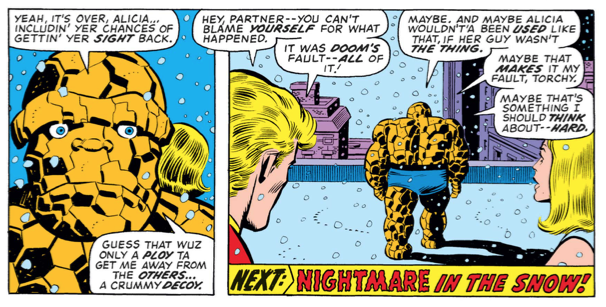
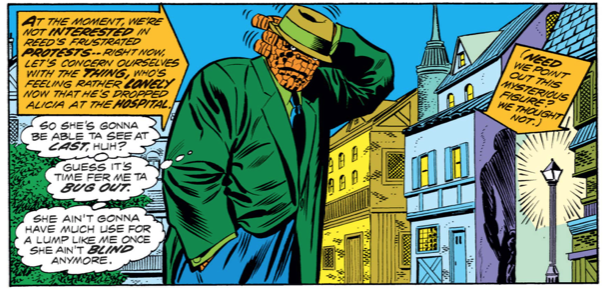
There’s also a nice interlude of Alicia pining away for Ben. It doesn’t seem to be furthering any plot point, but serves to remind us Ben’s life extends beyond the team.

This may be the first time we’ve seen Alicia crafting images of Ben. That becomes a pretty standard feature—at one point almost every appearance shows her surrounded by her sculptures of Ben and other heroes—but this is the first I recall seeing it. If anyone knows of an earlier appearance of this trope, let me know.

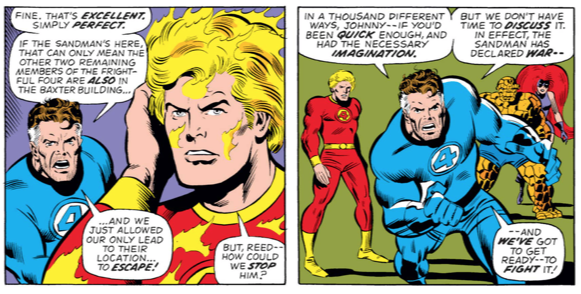
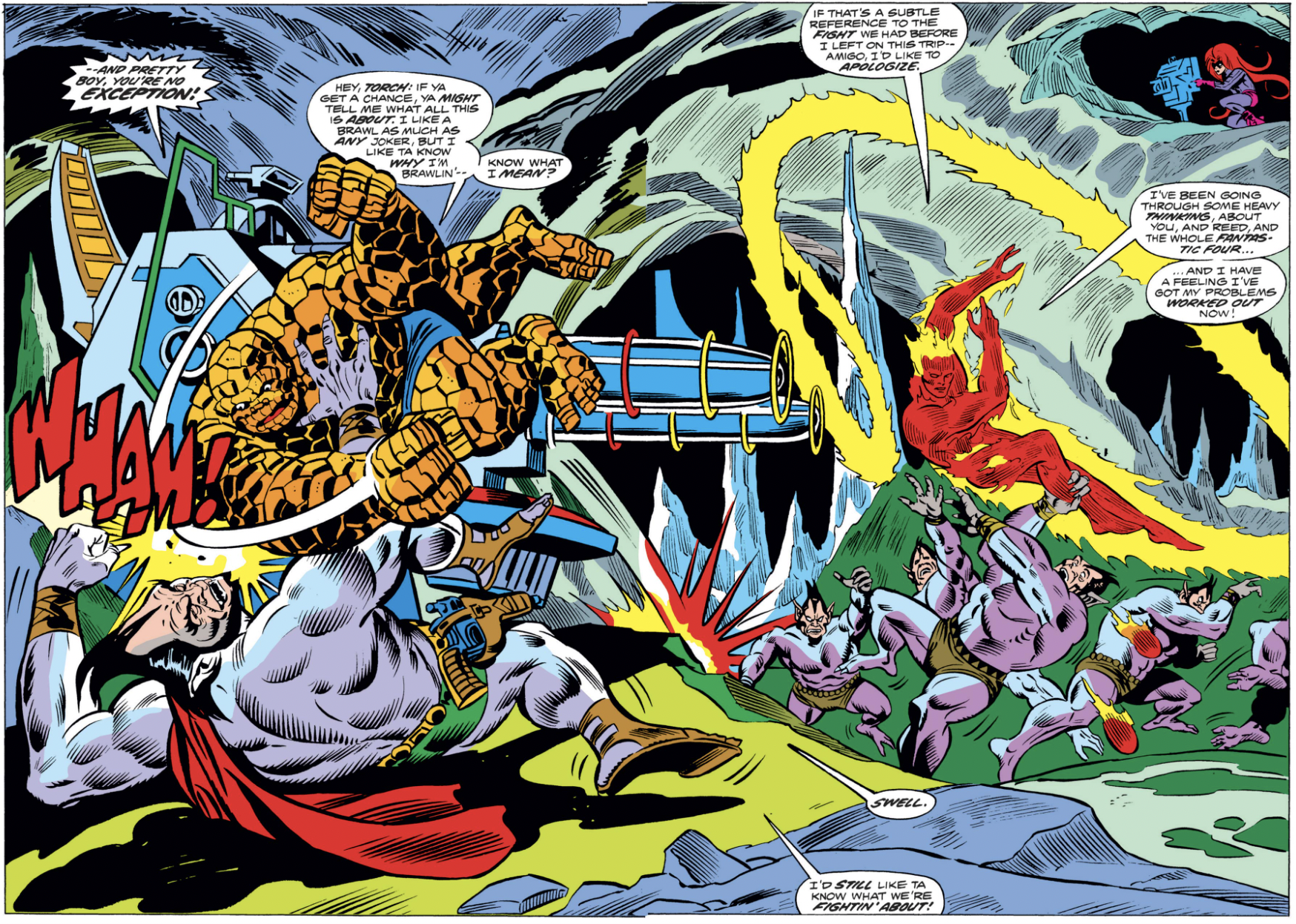
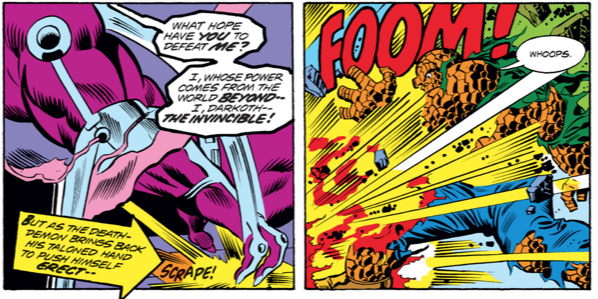
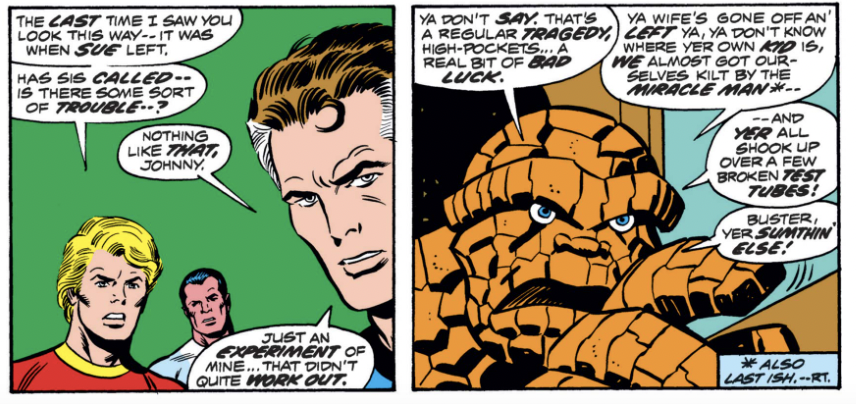
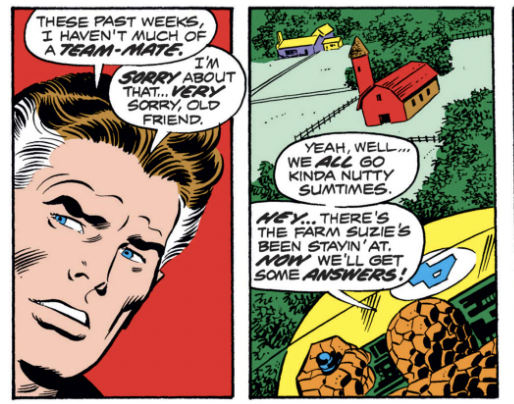
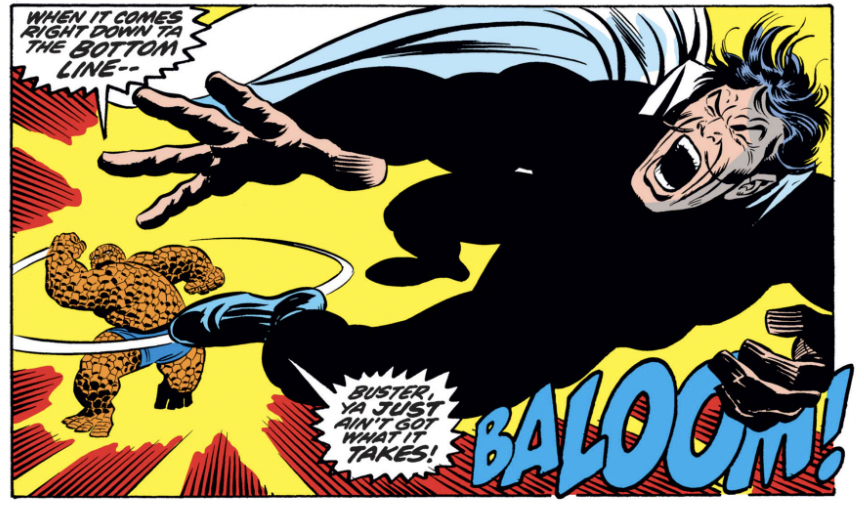
Also, I liked this exchange between Gideon and a salty Ben.


What I didn’t like

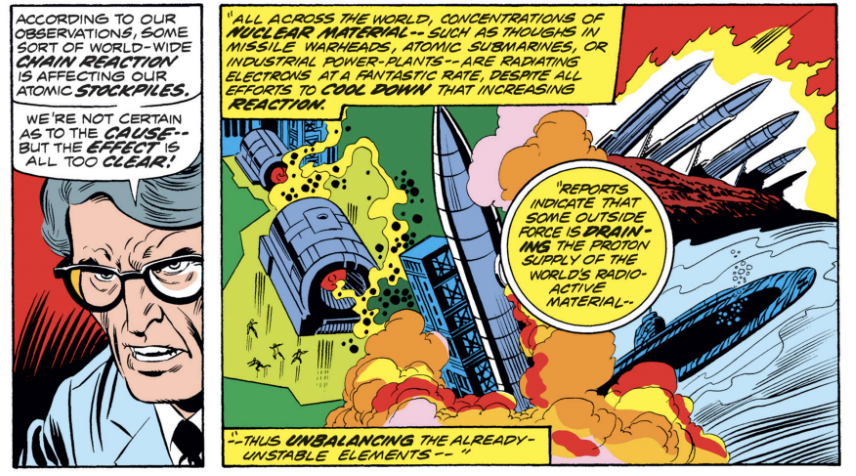
The backstory explaining Gideon’s turn from remorseful rich guy to super villain was truly absurd. His private pilot somehow flew them into a nuclear test site, killing his wife, and giving Gideon and his son radiation poisoning that would kill them in two years. The solution? Stealing the energy of half the Fantastic Four!
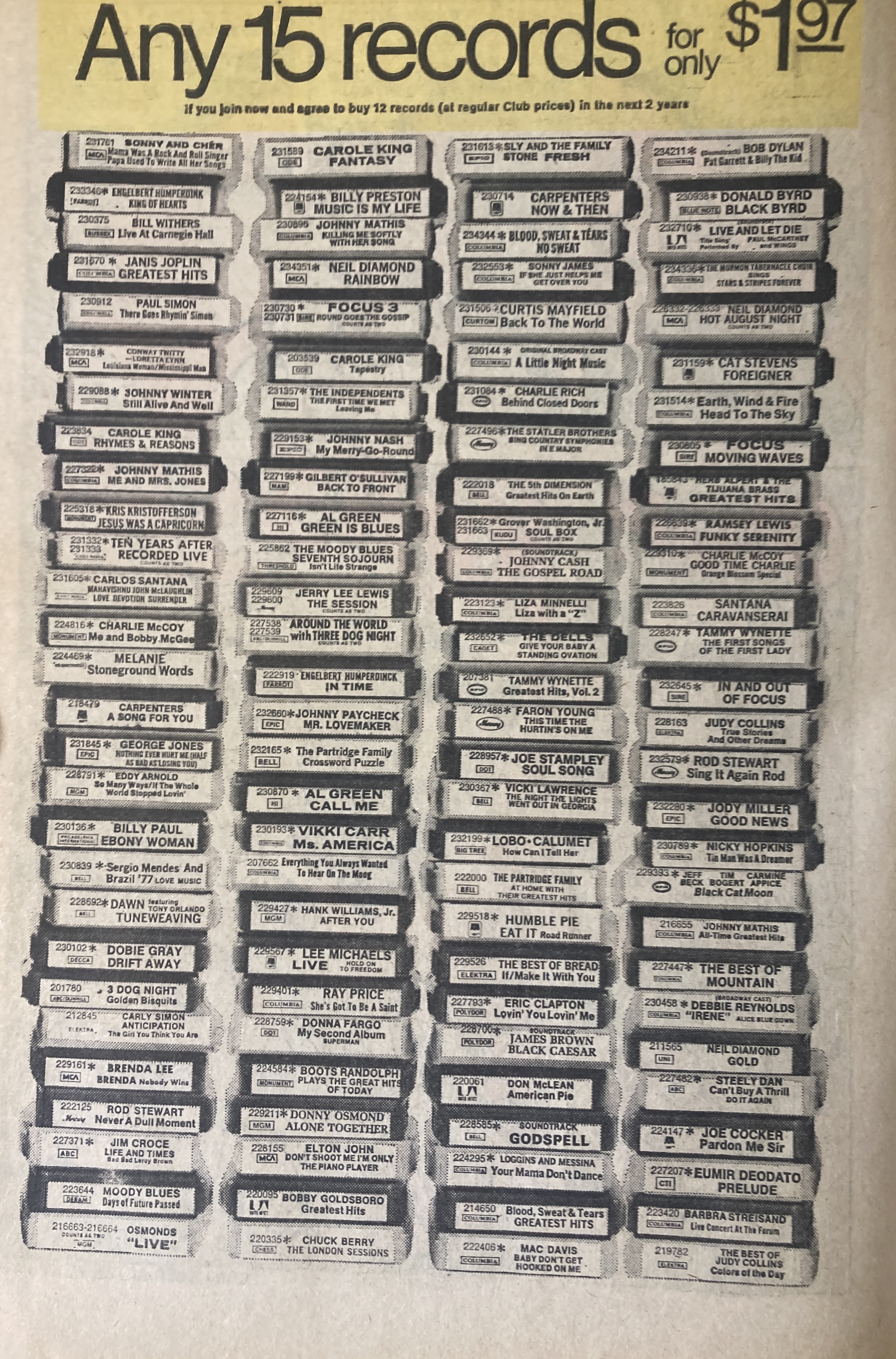
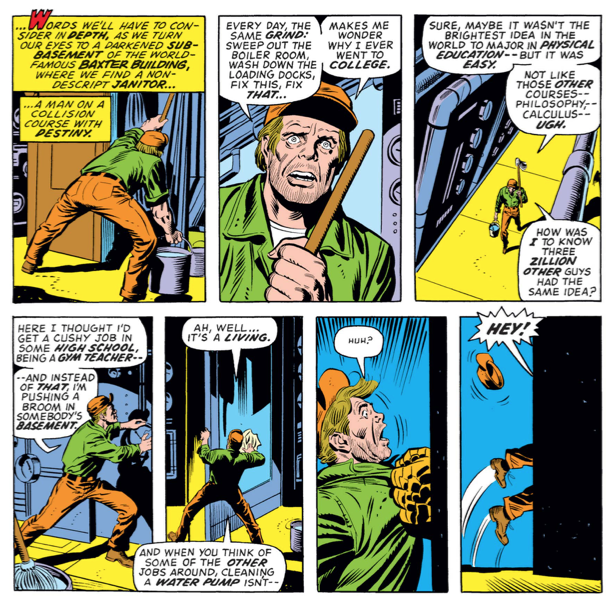
Also, a new subplot is introduced, when a mysterious, muscular man entering the FF’s Baxter Building headquarters. But what happened to last issues’s subplot, of Agatha Harkness’s missing house? Hopefully they tie together, or I fear we are entering Claremontian territory of subplots mushrooming without resolution.

Overall

A solid effort.

“The World’s Greatest Comic Magazine!” Fantastic Four No. 134

15 Saturday Jun 2024

Posted by percivalhenry in The World's Greatest Comic Magazine

≈ 2 Comments

Tags

Dragon Man, Fantastic Four, Fantastic Four 134, Gerry Conway, John Buscema, Marvel comics

Fantastic Four 134
“A Dragon Stalks The Skies!”
Published: Feb. 1973
Script: Gerry Conway
Pencils: John Buscema
Inks: Joe Sinnott
Colors: Dave Hunt
Letters: Artie Simek
Editor: Roy Thomas
Cover: Buscema and Sinnott

Synopsis

While the new-look Fantastic Four investigates Agatha Harkness’s missing home, the Invisible Girl and Franklin are abducted by Dragon Man, who is under the control of Gregory Gideon, the world’s richest man. When the rest of the FF attempt to rescue Sue and Franklin, Gideon subdues them and takes them prisoner.


What’s going on here?

Gerry Conway is credited as the sole writer of this issue—albeit as “scripter— although a previous letters page says he is working from a Roy Thomas plot. Thomas’s influence seems obvious, since the villain is a minor figure summoned from obscurity, a very Thomasian trope. In this case, the bad guy is Gregory Gideon, who last appeared 100 issues ago in FF 34, and was then called the richest man in the world (and who, in passing, was said to have owned the Baxter Building). In FF 34, after attempting to defeat the FF to win a bet, Gideon is remorseful and the issue concludes with him renouncing his fortune and vowing to spend time with his wife and son.


It’s fair to say that his redemption didn’t take, because in FF 134 he is a raving megalomaniac. (The relationship with the son doesn’t seem much improved, either).


By the end of the issue he’s gone full-blown Lex Luthor, complete with a battle suit. But despite his transformation into a standard super villain, he never appears after the conclusion of this arc.


What I liked

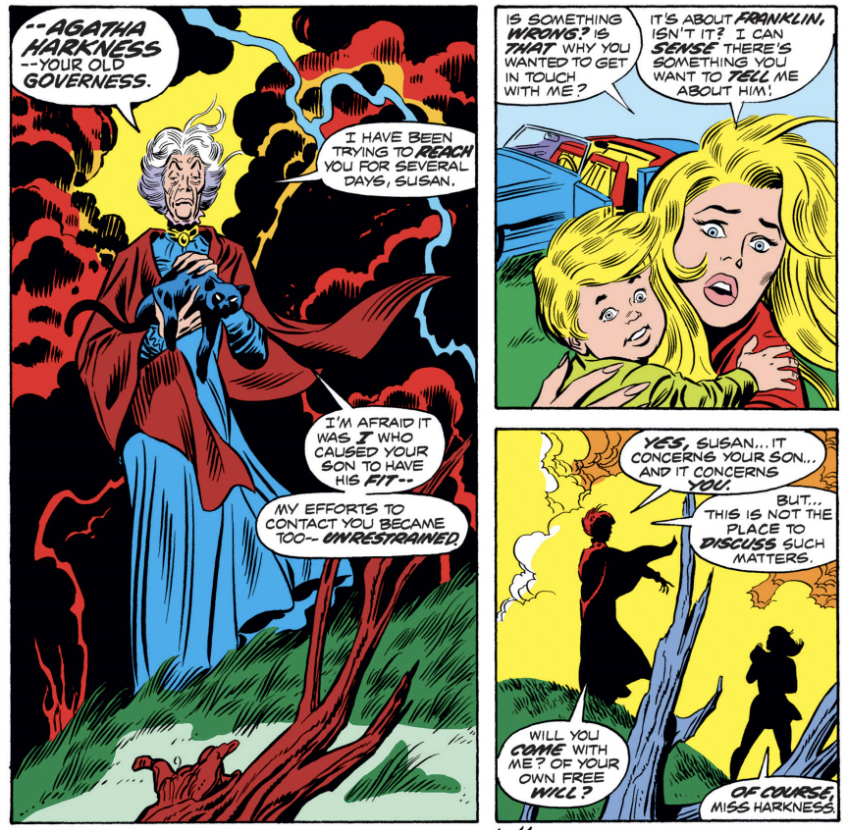
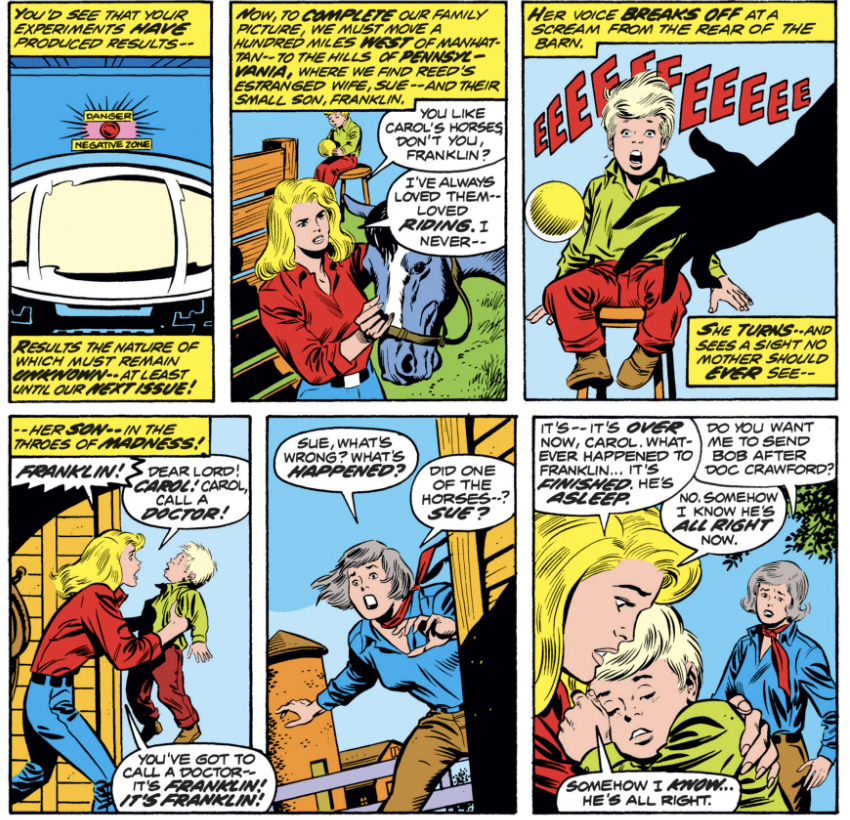
This is another place-setting issue and as such, there are some fun interludes and bits of character development. For example, Sue and Franklin are shown visiting Sue’s childhood friend Carol Landers, and her husband, Bob, on a farm in Pennsylvania. I’d never encountered the characters before but apparently they hang around for about a dozen issues before fading away. (If they appeared today, there is a 100% chance that one of them would have developed powers within 10 issues).

Note the reminder about Franklin’s powers, a plot point which will only become more prominent from here. Also note the horse is named Zelda, which happens to be the name of my dog.

Another odd appearance is of Dorrie Evans, the Human Torch’s girlfriend in the early days of the FF, and now a rebound target after his breakup with Crystal. If they had Facebook in 1973 he might have avoided this awkwardness.


I’m also a sucker for building diagrams and cutaways. Not sure why John Buscema felt one was necessary here; maybe he was just a sucker for them too.


What I didn’t like

On an otherwise great cover, Franklin’s hair is red. Oops.

The issue opens en media res, with the FF examining a crater where Agatha Harkness’s home used to sit. The disappearance of your witch-nanny’s home seems like a big deal! But by the third page it’s basically forgotten and never referenced again. I assume Conway will back to it, but the sequence felt very abrupt and odd.


Medusa has been on the team for about a week and she already seems to know an awful lot about their history.


Also, I didn’t much care for how Gideon’s henchmen subdued Ben and Medusa so easily. It should take more than one panel to knock out the Thing.


Overall

A satisfying comic book.

“The World’s Greatest Comic Magazine” Fantastic Four No. 133

08 Saturday Jun 2024

Posted by percivalhenry in The World's Greatest Comic Magazine

≈ Leave a comment

Tags

Fantastic Four, Fantastic Four 133, Gerry Conway, Ramona Fradon, Thundra

Fantastic Four 133
“Thundra at Dawn”
Published Jan. 1973
Plotter: Roy Thomas
Scripter: Gerry Conway
Pencils: Ramona Fradon
Inker: Joe Sinnott
Letters: John Constanza
Colors: Stan Goldberg
Editor: Thomas
Cover: John Buscema and Sinnott

Synopsis

In a plot engineered by the Frightful Four, Thundra challenges the Thing to a duel at Shea Stadium, and kidnaps Alicia Masters to ensure he accepts the challenge. Thundra is on the verge of killing Ben when Mr. Fantastic momentarily returns the Thing to his human form, leading Thundra to abandon the fight.


What’s going on here?

This is a consequential issue! It features a new writer and a new penciler (and a kinda sorta new colorist), and the first issue of the new-look FF, with Medusa stepping in for the Invisible Girl.

Probably the most notable debut is that of Ramona Fradon as penciler. Fradon, who passed away in February at age 97, was a comic industry legend, with her first credit in 1949 and was drawing commissions up until last year (I was on her commission list at the end). By 1973, she was an established veteran with years of drawing Aquaman under her belt. FF 133 was her only work on the Fantastic Four and, it seems, the only time a female artist has penciled an issue of the Fantastic Four’s flagship title. Joanna Estep drew something called “100th Anniversary Special: Fantastic Four 100” in 2014, and there have been a number of women who colored the FF, but as far as I can tell, Fradon was the only woman in 70 years to pencil the comic. If I’m missing someone, let me know!

Her fill-in issue, along with Ross Andru’s on issue, 131 was announced in the letters page a few months earlier, and I don’t think it’s a coincidence this issue featured Thundra, a female villain. Here’s a look at Fradon’s distinct style.

She also wasn’t afraid to go big:


This issue also marks the debut of Gerry Conway as a Fantastic Four writer. Thomas is credited as the plotter, with Conway as scripter, but by next issue Conway takes over and writes the book for the next few years. Conway had been in the industry for a few years at this point and established himself as an incredibly prolific writer. The month FF 133 came out, Conway was credited with writing six comics, including the Amazing Spider-Man and Thor.

Also appearing in the credits for the first time is colorist Stan Goldberg (who doesn’t appear to be related to Petra Goldberg, who colored the last few issues). Stan Goldberg’s name may be appearing for the first time, but he was the main Marvel colorist in the 1960s, and probably colored dozens of issues of the Fantastic Four during the Kirby years well before Marvel began crediting colorists. You can read more about him here.


Within just a few issues, the creative team behind the Fantastic Four has now almost completely turned over, with inker Joe Sinnott the only constant. John Buscema will return, but we’ve entered a period of relative instability in FF writers and artists. Recall, that until issue 114 the FF had only ONE writer (or two, depending on how you divide the labor between Jack and Stan) and through issue 130, there had been only three pencilers. We’ve now had four (or five) writers and five pencilers, and there will be many more over the next decade. It really isn’t until the start of the John Byrne era with FF 232 in 1981 that the creative team remains stable for more than a dozen issues at a time. How does all this flux affect the story telling? We’ll find out.

What I liked

As a story, FF 133 is pretty much standard fare, although there was some healthy character development as Reed processes Sue leaving the team and Johnny mourns his breakup with Crystal.

Fradon’s pencils are a refreshing change. I enjoyed her extensive crowd shots, and I can only assume they are populated with people she knows. Is anyone recognizable?

I also liked the cameo appearances from other heroes. As mentioned recently, after lots of crossovers with other Marvel characters in the mid-60s, the FF began to feel isolated from the rest of the Marvel universe. It makes sense that Conway, who was by now writing half of Marvel’s comics, and Thomas, who writing the other half, would be the ones to integrate them back into the mainstream.

What I didn’t like

Reed’s use of the ray gun to return Ben to human form feels very deus ex machina. It’s not previewed nor hinted at, and given all the drama over the years surrounding Reed’s inability to reverse Ben’s transformation, this device comes and goes without much discussion.


Medusa barely appears in this issue. It’s an odd choice, given that it’s an opportunity to introduce her as the newest member of the FF, and probably related to Conway taking the reins. I’m also wondering why Medusa is wearing her mask when she is out enjoying New Year’s Eve festivities with the rest of the team. I guess it’s an Inhuman thing?

Anything else?

Pinning this comic’s date to New Year’s Eve 1972 is unusually specific. Comic writers generally like to keep dates vague, to give themselves more flexibility. And it presents a problem for advocates of the Marvel sliding timescale theory, which basically means everything in Marvel’s history slides forward in time, which is why Peter Parker is in his 30s in 2024, and not his 70s. Byrne suggested the events of Fantastic Four 1 took place seven years before his run (which was 20 years after FF 1), and the current FF issues by Ryan North feels like they take place about 20 years after FF 1. When an issue is clearly taking place in 1972, that’s harder to reconcile with the sliding timeline.

Overall

A fun comic, with plenty for comic book historians to chew on.

“The World’s Greatest Comic Magazine!” Fantastic Four No. 132

01 Saturday Jun 2024

Posted by percivalhenry in The World's Greatest Comic Magazine

≈ Leave a comment

Tags

1972, Fantastic Four, Fantastic Four 132, Inhumans, John Buscema, Roy Thomas

Fantastic Four 132
“Omega: The Ultimate Enemy!”
Published December 1972
Writer: Roy Thomas
Pencils: John Buscema
Inks: Joe Sinnott
Letters: John Constanza
Colors: Petra Goldberg
Editor: Thomas
Cover: Jim Steranko and Frank Giacoia

Synopsis

The Fantastic Four (minus the Invisible Girl), Quicksilver and the Inhuman royal family confront the monstrous Omega, later revealed to be the personification of the Inhumans’ racial animus toward the Alpha Primitive underclass. The comic ends with Medusa joining the FF to replace Sue, and Johnny and Crystal breaking up.


What’s going on here

There’s a lot of action and angst in this comic, but the biggest developments come at the end. Medusa joins the team —or to be accurate, declares she is joining the team — in an arrangement that lasts more than 20 issues, a surprisingly long time. Again, it was another decision by Roy Thomas to shake up the status quo he inherited from Stan and inject some new dynamics into the team. Medusa also uses an Inhuman device to generate new costumes for herself and Johnny (Ben passes and when it’s aimed at Reed, nothing changes, which is mildly amusing).

The other major development is the official end of the romance between Crystal and Johnny after approximately 70 issues. Johnny’s obsession with Crystal frequently propelled his character and FF stories, to the point here it seems he had no other interests or character traits. Yet another example of Roy shedding the past for something new.

The cover was by Jim Steranko, with inks by Frank Giacoia, the last, and I think weakest, of the three covers he did to spell John Busecma.

There was also slight change to the interior art, flagged in a letters column an issue or two back: Instead of doing fun pencils, starting in this issue Buscema would be doing rough breakdowns, with Sinnott doing finishes. Since Sinnott had a pretty assertive inking style anyway, I’m not sure how much difference it makes. The change was made to give Buscema time to also draw Conan the Barbarian, giving him four regular books a month (the FF, Conan, Thor and a monster comic, which varied).

What I liked

The break-up of Johnny and Crystal was handed with admirable subtlety. Johnny clearly got his anger out last issue, so by the time Crystal tells him its over, he puts on a brave face and even mentions rekindling things with long-forgotten Dorrie Evans. But the final panel says everything. All in all, a pretty mature ending to a significant relationship.


What I didn’t like

In my blog post dealing with the last issue, I took Roy to task for seemingly siding with the Inhumans in their fight to put down the revolt of the Alpha Primatives, their servant class. Given that Roy has skewered South Africa’s apartheid regime in issue 119, championing the oppressors seemed inconsistent at best.

I should have given Roy more credit, because in the end, the Inhumans are shown the error of their ways. Omega, the villain, is powered by the Inhumans’ guilt and racial hatred — it’s not entirely clear which — toward the Alpha Primatives, channeled by a device constructed by Maximus the Mad. But while Roy’s sentiments are laudable, the effort feels ham-handed and falls flat.


First, leaving aside the implausibility of a machine that turns racial animosity into a living thing, Omega is designed just like a standard super villain, complete with a mask. There’s nothing about him or his powers that suggest his origin or purpose.

Secondly, Reed discovers the secret by eavesdropping on Maximus, who just happens to be ranting about his plan while leaning outside his window. It’s too convenient and not ingenious enough for Reed. And thirdly, of course Maximus is behind it all. If there’s an Inhumans’ story, Maximus is the bad guy. It’s predictable and boring.

Lastly, nothing seems to change. The Alpha Primatives return underground and the Inhumans go on being the superior race. Maybe we’ll learn more about how Inhuman society evolves in future comics but at the end of this issue, all that happens is that Inhumans feel a bit guilty.


Also, is there a word missing on the cover? “Until Last Destroy You?” I’m sure someone could win a No-Prize explaining that away.


Anything else?

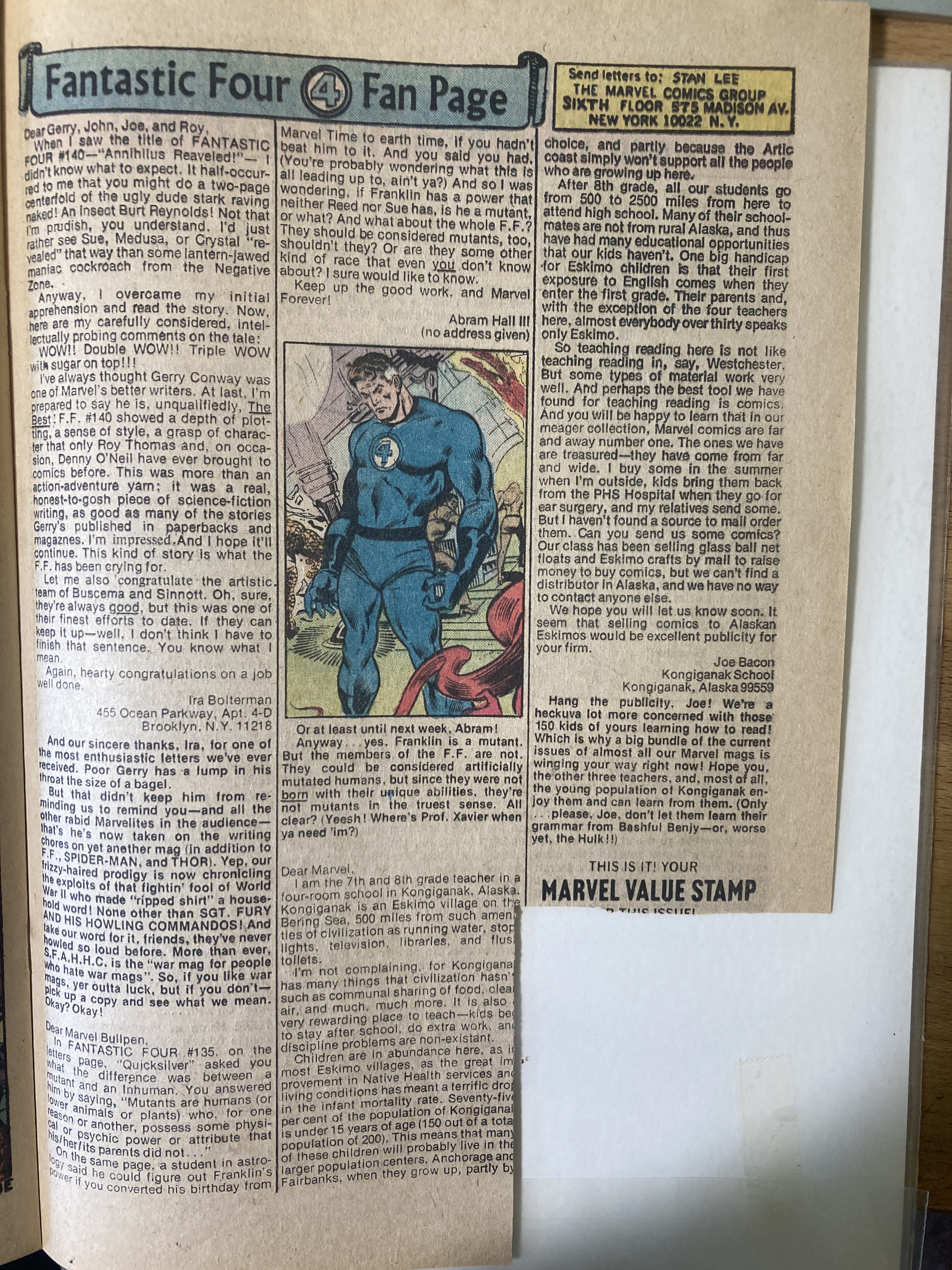
Fun letter comparing the FF to the Beatles. Who is Allen Klein in this analogy?


Overall

A valiant effort that falls short

So Random! Captain America 293

26 Sunday May 2024

Posted by percivalhenry in So Random!

≈ Leave a comment

Tags

1984, Captain America, Marvel

Captain America 293
“Field of Vision!”
Publisher: Marvel
Published: January 1984
Writer: J.M. DeMatteis
Pencils: Paul Neary
Inks: Eduardo Barreto
Letters: Diana Albers
Colors: Bob Sharen
Editor: Mark Gruenwald


Editor’s note: It’s been a while since I did one of these, so as a refresher: In So Random! posts, I pick a comic more or at less at random from my collection to re-read and analyze.

Synopsis

As Captain America tries to reconcile Bernie Rosenthal’s marriage proposal with his feelings for former love interest Sharon Carter, the villains Mother Superior, Baron Zemo and the Red Skull conspire to get their revenge on Cap. They transform Cap’s pacifist friend Dave Cox into the Slayer, who ambushes Cap and his sidekick, Nomad.

What’s going on here?

Captain America 293 came out pretty early in my collecting days, and about the time of the first Secret Wars series. J. M. DeMatteis was still writing the book and his plots were dark and intricate, particularly compared to his successor, Mark Gruenwald (RIP), who had a much more light-hearted take on Cap.

This would be a tough comic for a new reader to jump into, since so much of the story involves the back stories of Baron Zemo and Dave Cox (and Sharon Carter), but the plot moves along, and there’s plenty of action to go along with the introspection. The art by Neary and Barreto is serviceable, although it never really soars.

What I liked


I liked this scene of Cap dropping into to visit an old friend out of the blue, and disrupting his domestic life. We then get some revealing panels about Cap discussing his love life with Dave, and (oddly) skipping stones from his knees.

In group books like the Avengers, Cap tends to take on a larger-than-life quality, as he serves not just as a leader but a symbol of the American Way. But successfully written, in his own book at least, Steve Rogers is very much a human who is wrestling with his personal life. (Batman suffers from similar problems as a character who can be more symbol than person).

What I didn’t like

DeMatteis’s writing tends toward the purple and overwraught, particularly in the sequences with Zemo and Mother Superior. Consider this elaborate double page splash that attempts to sum up the history of human evil, for example:


Also, the Slayer concept feels vaguely ridiculous, and continues a longtime comic trope of taking civilian characters and making them heroes or villains. I much prefer it when ordinary people remain ordinary.


Anything else?

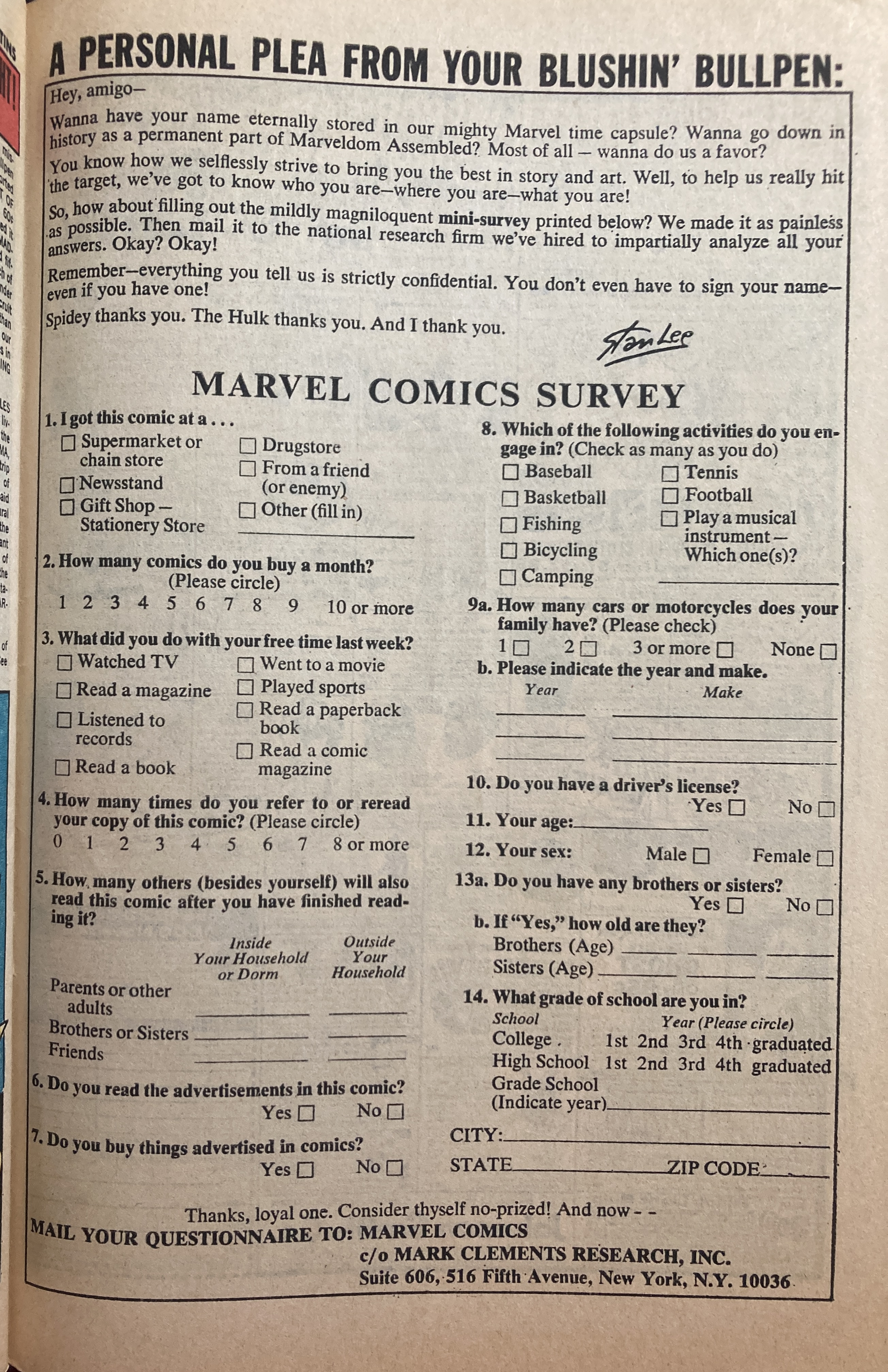
I always enjoyed these Q & As they ran in the letter pages of the books Gruenwald edited. This one was inspired by a recent Cap arc where he wound up in a post-apocalyptic future with Deathlok.


Overall

Standard mid-80s Marvel fare

“The World’s Greatest Comic Magazine!” Fantastic Four No. 131

25 Saturday May 2024

Posted by percivalhenry in The World's Greatest Comic Magazine

≈ Leave a comment

Tags

1972, Fantastic Four, Fantastic Four 131, Inhumans, Roy Thomas

Fantastic Four 131
“Revolt in Paradise!”
Published Nov. 1972
Writer: Roy Thomas
Pencils: Ross Andru
Inks: Joe Sinnott
Letters: John Costanza
Colors: Petra Goldberg
Editor: Thomas
Cover: Jim Steranko and Sinnott

Synopsis

The Human Torch discovers his erstwhile girlfriend Crystal in a romance with the ex-Avenger Quicksilver. Before they can hash it out, the Inhuman stronghold of Attilan is rocked by tremors, and the Alpha Primatives, a race of worker drones, revolt against their overlords.

What’s going on here?

This is another interesting issue. The big development, and one I genuinely didn’t expect, is the reveal of Crystal and Quicksilver’s relationship. Of course, I knew it was coming at some point—their marriage was a major fixture of Marvel comics in the 80s— but since Roy left no clues that this was impending, it took me by surprise (more on this later).

This issue is also notable in that it’s penciled by Ross Andru, who is amazingly just the fourth artist to pencil the FF in 131 issues (after Jack Kirby, John Romita and John Buscema). Andru had been around a long time at this point — his first credits were in 1951, and I think it’s fair to say he’s a bit of a journeyman, although he would go on to have a long and distinguished run on Amazing Spider-Man. This is the only issue of the FF he drew, and was a fill-in issue. Big John was back in the saddle by the next issue (although 133 is also a fill-in). Also, note that is the second of three Steranko covers.


What I liked

The Johnny /Crystal / Quicksilver love triangle is a fun plot twist that accomplishes a couple of things. One, it ties the FF more closely to the rest of the Marvel Universe. Save for about 20 issues in the mid 1960s, when almost every Marvel hero made a guest appearance in the Fantastic Four, the FF have been relatively isolated from other Marvel heroes. The appearance of Quicksilver is a reminder they inhabit the same universe as the Avengers (and the X-Men), and it makes sense that it’s Roy Thomas who cross-pollinated these comics, since at this point he had written all three.

Two, it helps establish the template of Johnny Storm as forever unlucky in love. Crystal may be Johnny’s first romance that fizzled (not counting high school crush Dorrie Evans) but she’s far from the last. Others love interests have included Frankie Raye (who became Nova), Lyja the Skrull (whom he thought was Alicia Masters), Namorita, and most recently Sky, the winged alien. After 60 years, his romantic woes have now become such a part of his character that I wonder if any writer would be willing to have him permanently settle down.

What I didn’t like


While the Crystal / Pietro relationship is a welcome addition, as far as I can tell, it comes out of nowhere. This comic refers to Avengers 104, as if it explains the beginning of the relationship, but Crystal does not appear there. In that comic, Quicksilver battles a Sentinel while attempting to rescue his sister, the Scarlet Witch, and is left injured in the Sentinels’ lair by the other Avengers , who don’t know he’s there.

An end note promises that readers will learn his fate in the next issue, but Avengers 105 is Steve Englehart’s first issue, and he takes the comic off in another direction. It’s not until FF 131, which was published five months later, that Crystal’s rescue of Pietro is shown (and is described as a random event).

My guess is that Thomas wanted to resolve his Pietro arc, and saw an opportunity to make life interesting for Johnny at the same time. But if his appearance in this issue surprised me, I can only imagine how FF readers on 1972 must have felt.


Thomas’s handling of the Alpha Primatives is a bit peculiar, too. It’s pretty clear they are subjugated race who live underground and serve as slaves to their Inhuman masters. When they revolt, it’s not depicted as a heroic uprising, but more like an insurrection that needs to be put down. That dynamic is a pretty strong contrast to issue 119, where Thomas very successfully wrote about he evils of apartheid. We’ll see how he handles the Alpha primitives revolt in the next issue.

Anything else

Not one but two letters from future comic writers in this issue: Mike W. Barr (Camelot 3000, Batman and the Outsiders, among others) and Charles “Chuck” Dixon (Punisher, Detective Comics, among others).


Overall

An excellent comic with some issues.

“The World’s Greatest Comic Magazine!” Fantastic Four No. 130

18 Saturday May 2024

Posted by percivalhenry in The World's Greatest Comic Magazine

≈ Leave a comment

Tags

1972, comics, Fantastic Four, Fantastic Four 130, John Buscema, Marvel, marvel-comics, Roy Thomas

Fantastic Four 130
“Battleground: The Baxter Building!”
Published Oct. 1972
Writer: Roy Thomas
Pencils: John Buscema
Inks: Joe Sinnott
Letters: Artie Simek
Colors: Petra Goldberg
Editor: Thomas
Cover: Jim Steranko and Sinnott

Synopsis

After subduing the Thing and Meduasa, the Frightful Four—reconstituted with Thundra—take on the rest of the Fantastic Four, minus the Human Torch, in the Baxter Building and are saved only by the awakening of Franklin’s powers. In the aftermath, Sue declares she is leaving the team. Meanwhile, in the Himalayas, the Torch confronts the Inhumans, where a secret concerning Crystal is revealed to him.


What’s going on here?

This is a jam-packed issue, with big developments in the story, and some smaller ones outside it. From an amateur-comic-historian’s perspective, it’s notable for being the first Fantastic Four issue to credit a colorist, in this case, Petra Goldberg.

The history of comic book coloring is complicated, and the technology evolves dramatically over time. But my understanding is that in the 60s, 70s and 80s, the colorist would identify what colors were needed (always a combination of cyan, magenta, yellow and black) and where they would go. They would make notes on the art (or actually color copies of the pages) that would then be used by a color separator at the printer as a guide. Because of the limitations of the process—at most, only 64 possible colors are available—and because the colorist didn’t directly work on the art like a penciler and inker, it seems they were viewed less like artists and more like technicians. Hence, they were not credited. (A pretty good explanation of all this can be found in this Comic Tropes video).

I don’t think it’s a coincidence that this changed soon after Roy Thomas became editor. Thomas also instituted an “editor” credit—here used for himself—and seemed more interested than Stan Lee in assigning proper credit where it was due (a longtime issue with Stan that we know came to haunt him).

Recall, the first issues of the Fantastic Four had no credits all, just the signatures of Stan Lee and Jack Kirby. And when credits first appeared, they were very scant and presented almost as an after thought (this is FF 10):

By FF 130, the credits for all the main creators were in place and they pretty much remained this way for decades. Note Stan Lee’s presenting credit is now his signature. That began with the previous month’s issues, and I neglected to mention it.


Also notable is that Jim Steranko penciled the cover for this issue (which is probably why the Sandman looks so much like Nick Fury). I’m not sure it’s a particularly great cover, but anything by Steranko is worth paying attention to. This is the first of three covers he did for the Fantastic Four, and are the only things he ever did with the FF during his short career.

What I liked

A big—but not the biggest—in-comic event in FF 130 is Sue’s decision to leave the team. This has been brewing for a few issues, and through Thomas’s writing she has voiced her displeasure with Reed and his constant demands that she be sidelined to look after Franklin.

Here, she again raises those objections and he again tries to shut her down:


It finally boils over in the last page, featuring more jerk-like behavior from Reed:


Obviously, this doesn’t stick and she eventually returns. But her departure feels like a significant milestone in the development of Sue’s character, and, perhaps, in Thomas’s repudiation of the status quo he inherited from Stan. Thomas has been writing Reed pretty much the same way Stan and Jack did for a decade, but only under Thomas did Sue finally say, enough.

Speaking of gender dynamics, I also liked how Thomas played with cliches and stereotypes through Thundra, the Femizon from another dimension where women dominate men. Here, she picks up Ben like a doll:


Or here, where she refers to “men and children:”


Thomas also created an interesting and suspenseful sidebar with the Human Torch and Crystal. I legitimately have no idea what he sees here (we have to wait until next issue):


The Inhuman subplot is another example of Thomas’s skill as a storyteller. There’s an awful lot going in in the main plot, yet he’s able to jump out and devote a few meaningful pages to the Johnny/Crystal dynamic that builds character and sets up future arcs, all without distracting from the bigger story. Further evidence that the FF is in very good hands.

Oh, and I would remiss if I didn’t point out this jaw-dropping splash page from Big John. It doesn’t have a big impact on the plot, but it seems like it’s a fun opportunity for him to flex his Kirby muscles.


What I didn’t like

The biggest in-story development in FF 130 is the awakening of Franklin’s powers. Although hinted at a few issues ago, this is the first real manifestation of them.

In the bounds of this issue, it’s fine and I imagine for readers at the time, it must have been pretty cool. But it opened the door for decades of stories about Franklin’s powers that, on the whole, have been unsatisfying, confusing and distracting. No two writers seem to agree what to do with Franklin, and while some have embraced him as a mutant with god-like powers—Jonathan Hickman had him creating whole universes—others would be happier if he was just a kid. Dan Slott depowered him and Ryan North has a goofy retcon that has him using his powers one day a year.

I am sure Thomas didn’t know the can of worms he was opening up here, but the does-he -or doesn’t-he nature of Franklin’s powers been a perennially frustrating aspect of the Fantastic Four

Also, thumbs down for the story title—”Battleground: Baxter Building”—a combination of words which has been used probably a dozen times.

Anything else?

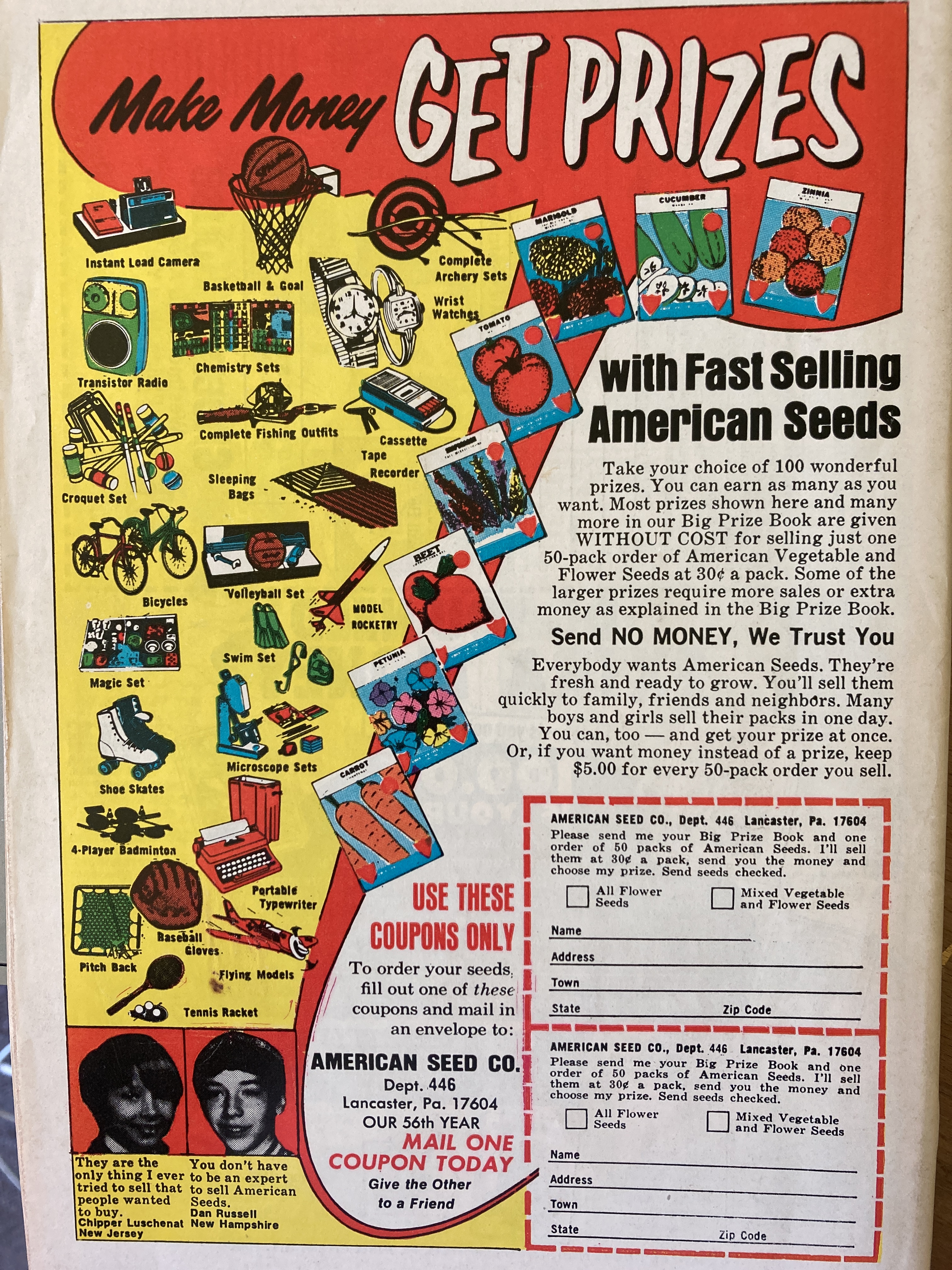
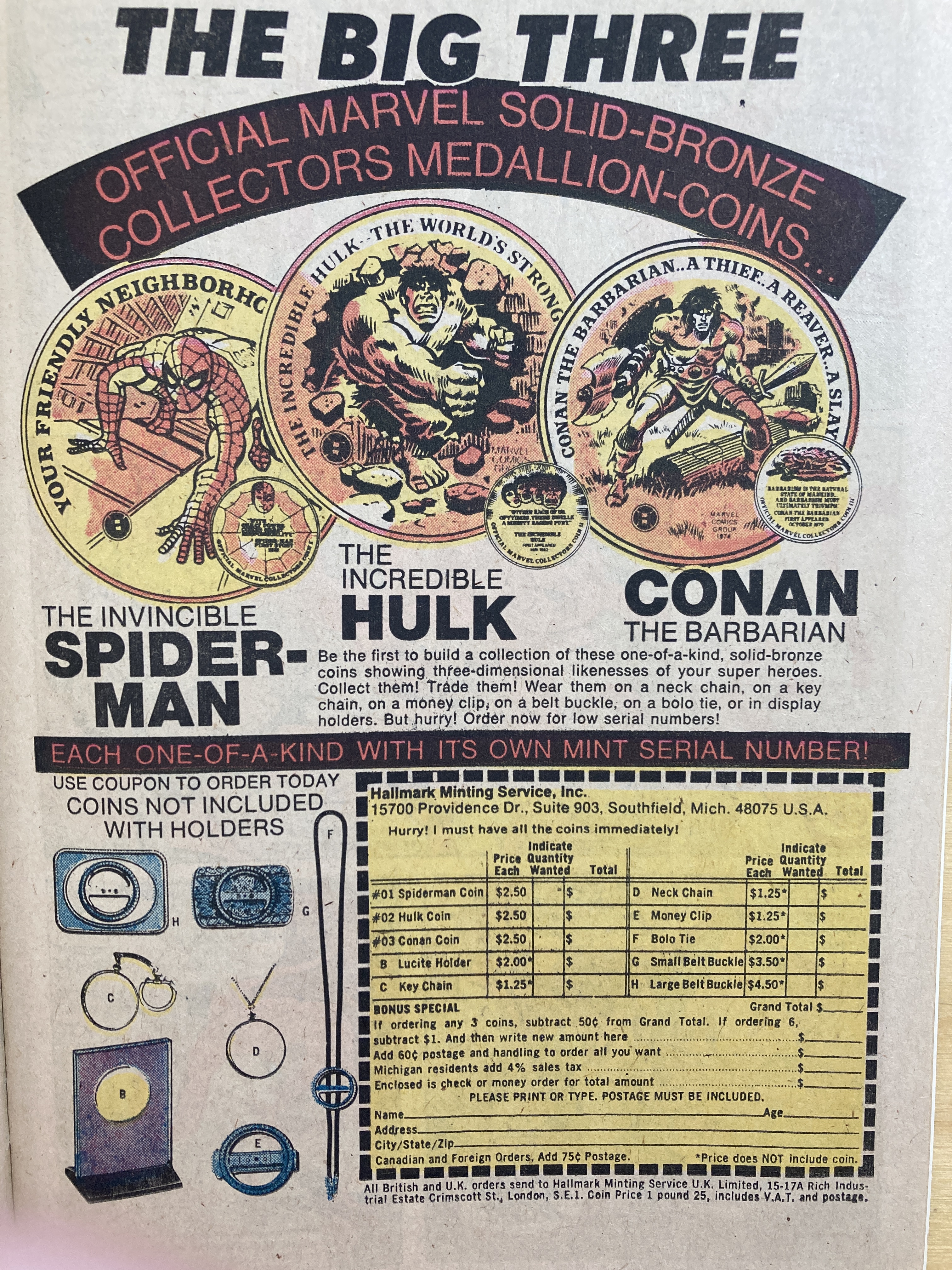
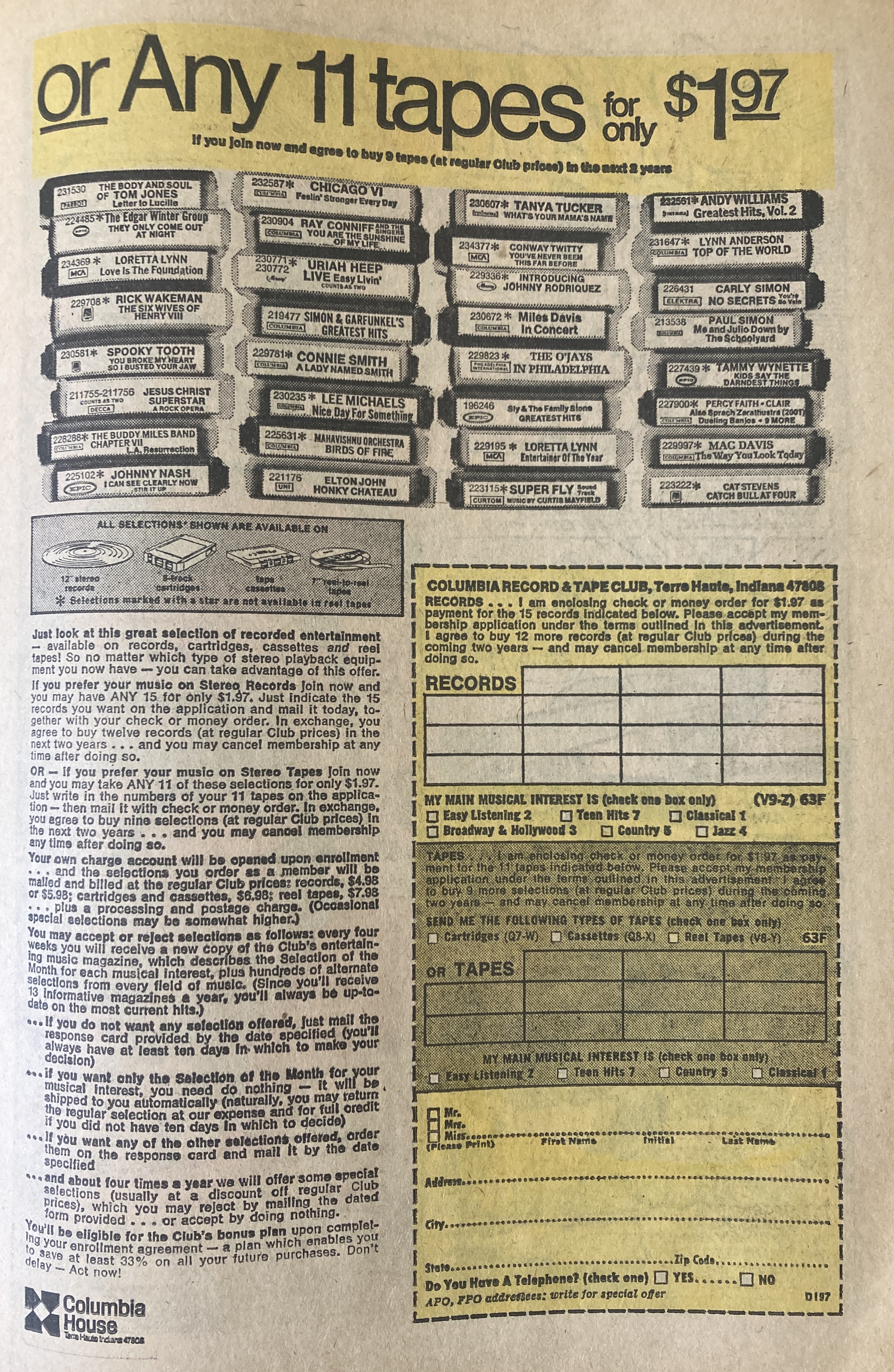
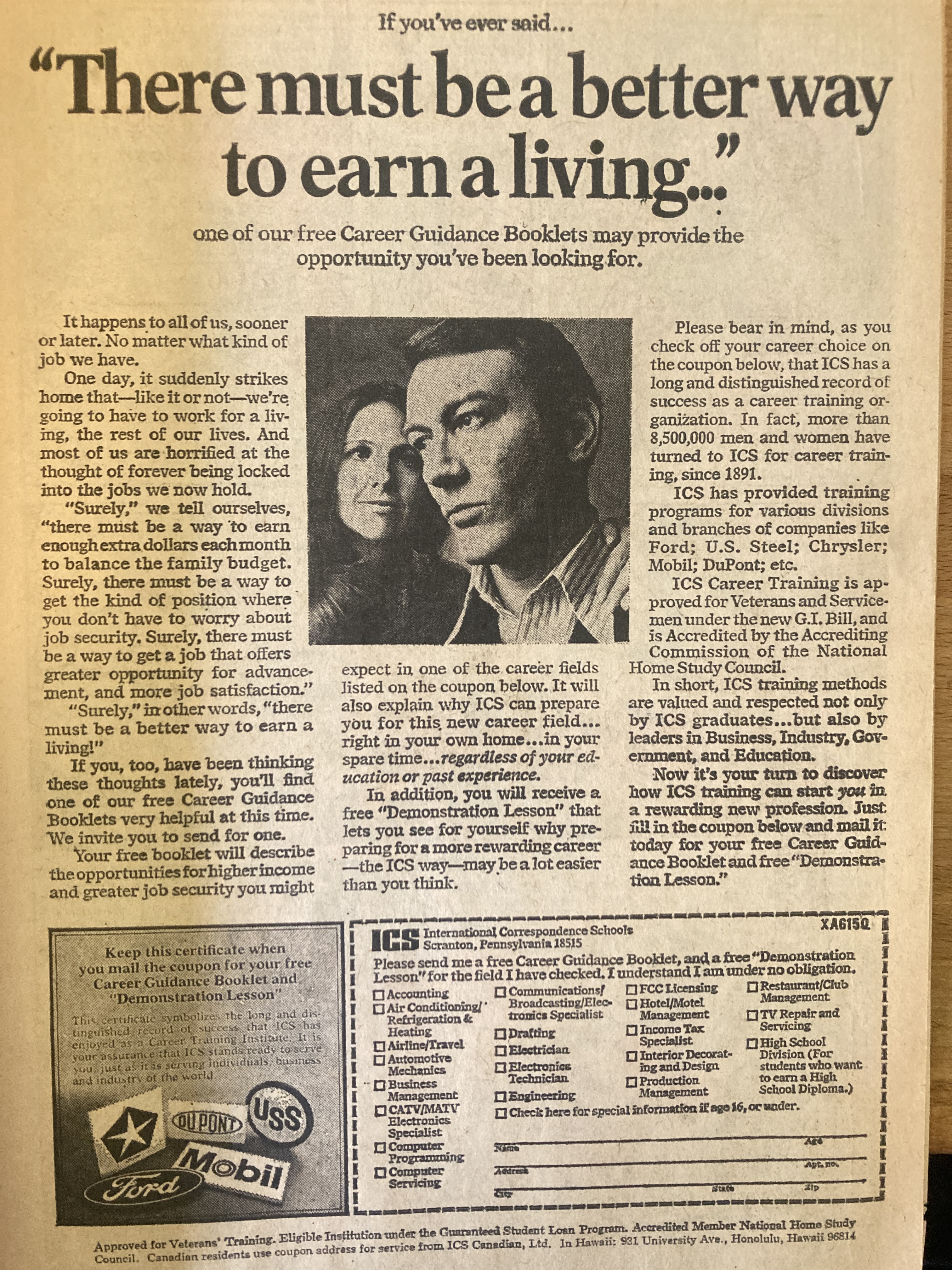
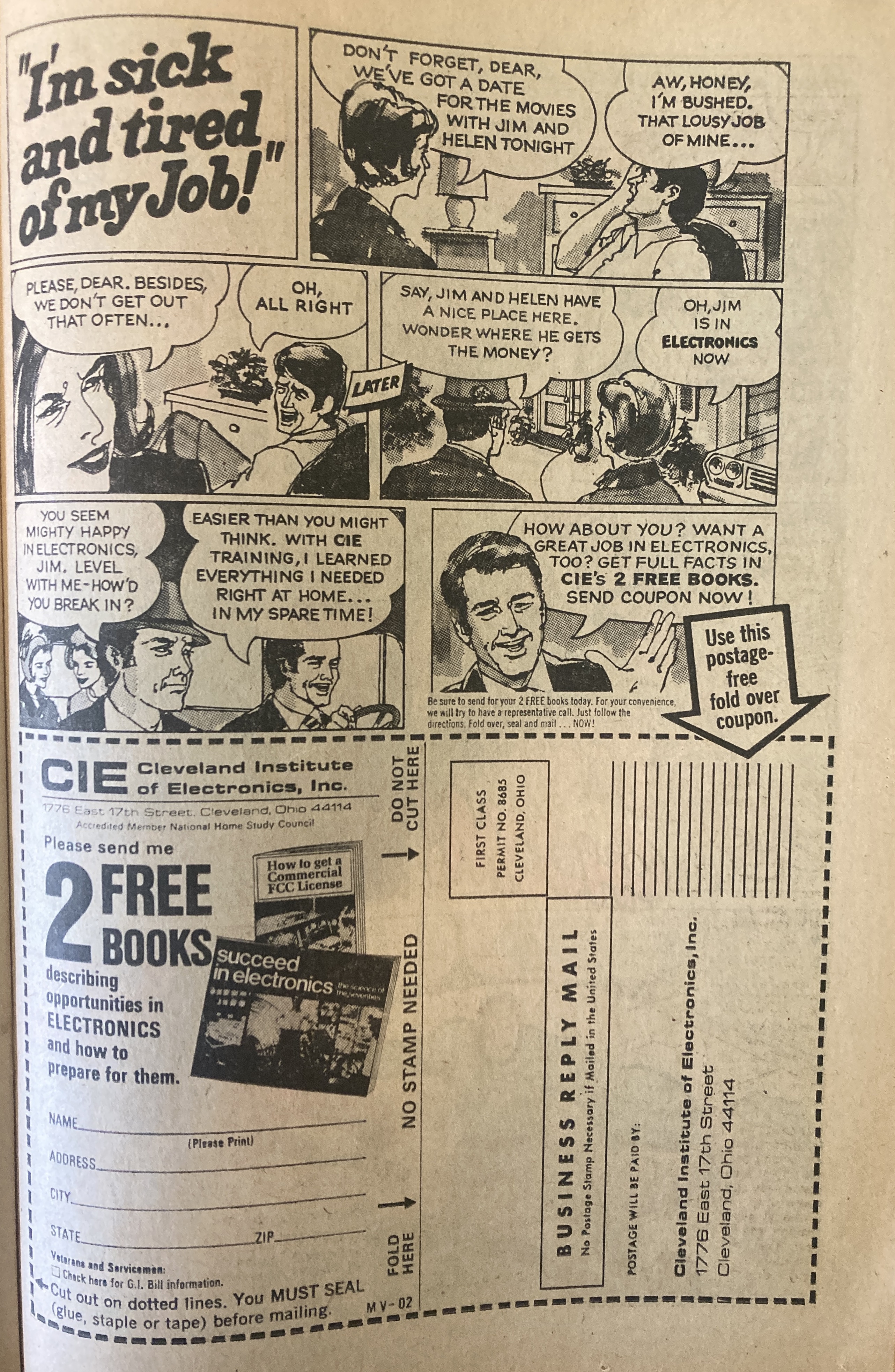
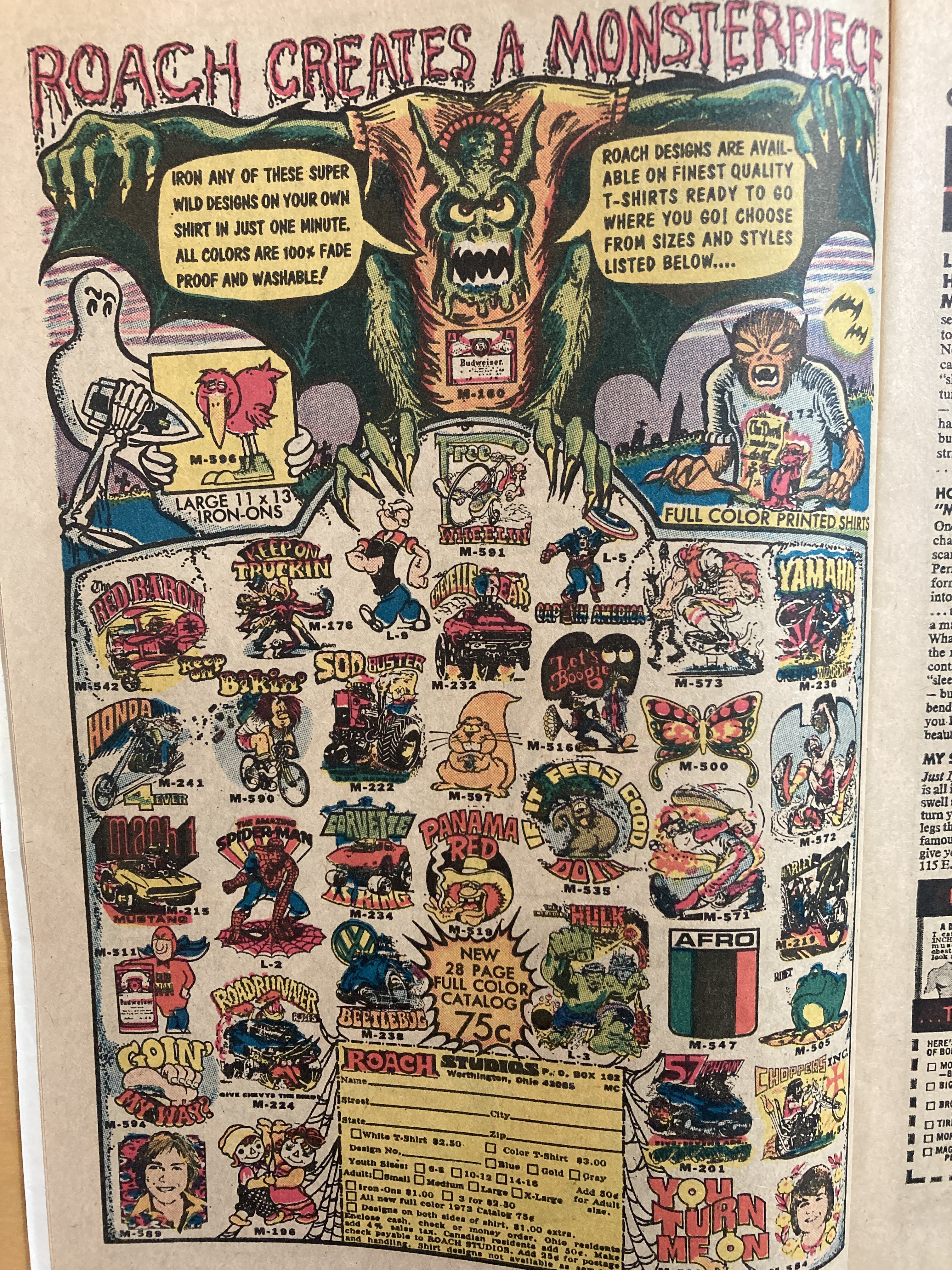
Some more ads for cool toys:


Overall

An excellent comic. Roy’s best to date.

“The World’s Greatest Comic Magazine!” Fantastic Four No. 129

11 Saturday May 2024

Posted by percivalhenry in The World's Greatest Comic Magazine

≈ Leave a comment

Tags

1972, Fantastic Four, Fantastic Four 129, John Buscema, Roy Thomas, Thundra

Fantastic Four 129
“The Frightful Four .. Plus One!”
Published Sept. 1972
Writer: Roy Thomas
Pencils: John Buscema
Inks: Joe Sinnott
Letters: Artie Simek
Editor: Thomas
Cover: Buscema and Frank Giacoia

Synopsis

Intending to marry Crystal, the Human Torch leaves the team for the Great Refuge and is captured by Inhumans. Meanwhile, The Thing is ambushed by the Frightful Four and while one-time member Medusa comes to his aid, Thundra, a new member, attacks.


What’s going on here

Fantastic Four 129 is probably most notable for the introduction of Thundra, the powerful, seven-foot warrior from an alternate Earrh called Femizonia. As a character she’s part Wonder Woman, part Big Barda and part pandering to the women’s liberation movement of the 1970s. As befits Thomas, her backstory is long and elaborate, and will unspool over the next few years as she becomes a semi-regular character in the Fantastic Four during this era. More recently she goes on to have a big role in the Hulk.

From a design perspective, she’s pretty cool looking and her presence adds an interesting dimension to the FF, where gender norms have been enforced by the very macho male members and the very feminine Sue and Crystal.


Speaking of Sue, her liberation under Thomas’s writing is becoming more pronounced. In two sequences, she puts Reed in his place in a way that would been unheard of in a Stan Lee-written book.

Here, she lets Johnny escape the team to join Crystal:

(I love the look on Reed’s face)

And here, she lets Reed knows what she thinks of his priorities while Ben looks on in amazement:


What I liked

I don’t pay Joe Sinnott’s inks enough attention and I should. I love this panel, which is obviously enhanced by the colors (at this point Marvel wasn’t naming colorists so I have no one to credit).


And this Buscema panel is wonderfully Kirby-esque:


What I didn’t like

Ben’s fight with the Frightful Four felt a bit too by-the-numbers, and the appearance of Medusa didn’t make much sense (and is not explained). Is it just a coincidence a former member of the Frightful For shows up just when Ben needs her help to fight them? Is her appearance related to Johnny’s trip to the Inhumans? Who can say?

Anything else?

The letters page is devoted entirely to one very long, tortured letter summing up the Stan Lee ear, by a writer named Tim Allen. Unclear if it’s the Tool Time guy.


Overall

Another solid effort from Roy, John and Joe.

“The World’s Greatest Comic Magazine!” Fantastic Four No. 128

05 Sunday May 2024

Posted by percivalhenry in The World's Greatest Comic Magazine

≈ Leave a comment

Tags

1972, Fantastic Four, Fantastic Four 128, John Buscema, Mole Man, Roy Thomas

Fantastic Four 128
“Death in a Dark and Lonely Place!”
Published Aug. 1972
Writer: Roy Thomas
Pencils: John Buscema
Inks: Joe Sinnott
Letters: Artie Simek
Editor: Thomas
Cover: Buscema and Sinnott

Synopsis

After Mr. Fantastic realizes the monster attacking the team is actually the Thing, whose appearance was temporarily transformed, the team regroups to confront the Mole Man, only to be captured and apparently defeated. But the Mole Man is betrayed by his erstwhile lover, Kala, and the team is able to escape his underground kingdom.


What’s going on here?

This is solid follow-up and conclusion to the story Thomas launched in the previous issue, and augers well for the rest of his run on the comic. The story has a fun and surprising twists, it’s well paced and there’s some nice characterization. No big developments, but that’s OK.

What distinguishes FF 128 isn’t the story but an insert—four pages of pinups on glossy paper (the same as used for the cover) drawn and by John Buscema (the inker is uncredited but it looks like Sinnott to me). They’re not included the online version of the comic, so I’ve photographed them:


As a kid reading the FF in 1972, I would have been pretty jazzed to see these in the middle of an otherwise ordinary comic. As a reader in 2024, they’re an interesting snapshot into who and what Marvel thought was important to depict. Leaving aside the decision not to include the FF, there’s no Agatha Harkness or Franklin, or Black Panther or Wyatt Wingfoot. The Mole Man and Frightful Four get prominent billing, but that could be because they’re appearing in this issue (Moley) or nest issue (the Frightful Four).

On the letter page, an editor’s note explains the pinups are to make up for raising the price of the comic to 20 cents, although the price hike took place a year earlier. There’s a convoluted explanation involving Nixon, but read for yourself:


What I liked

Roy does a nice job with interactions between our lead characters, including this revealing exchange between Ben and Sue:


Or this, between Sue and Reed, which continues their debate about Sue’s role on the team that started last issue:


I also liked the plot twist toward the end. It wasn’t too surprising that the beautiful and evil Kala would turn against the Mole Man in favor of handsome Tyrannus (a long-lived Roman Emperor trapped underground and who appeared as the Mole Man’s slave briefly last issue). It was surprising, however, when Tyrannus in turn double crossed Kala, and giving the Mole Man reason to free the FF.


That twist, of course, leave the Mole Man jilted at the altar, setting up this satisfying and sympathetic ending sequence.


In the current run of the Fantastic Four, writer Ryan North has Reed deploying his stretching powers in novel (and occasionally grotesque) ways. But as we learn in FF 128, creative used of Reed’s powers are not new. (Also interesting is Reed’s dialogue throughout the comics – Roy has definitely loosened him up).


What I didn’t like

If Roy has a weakness, it’s a tendency to lapse into purple prose, as he does here in this otherwise cool looking flashback splash page. Pro tip: Avoid writing in the second person if at all possible.


Anything else?

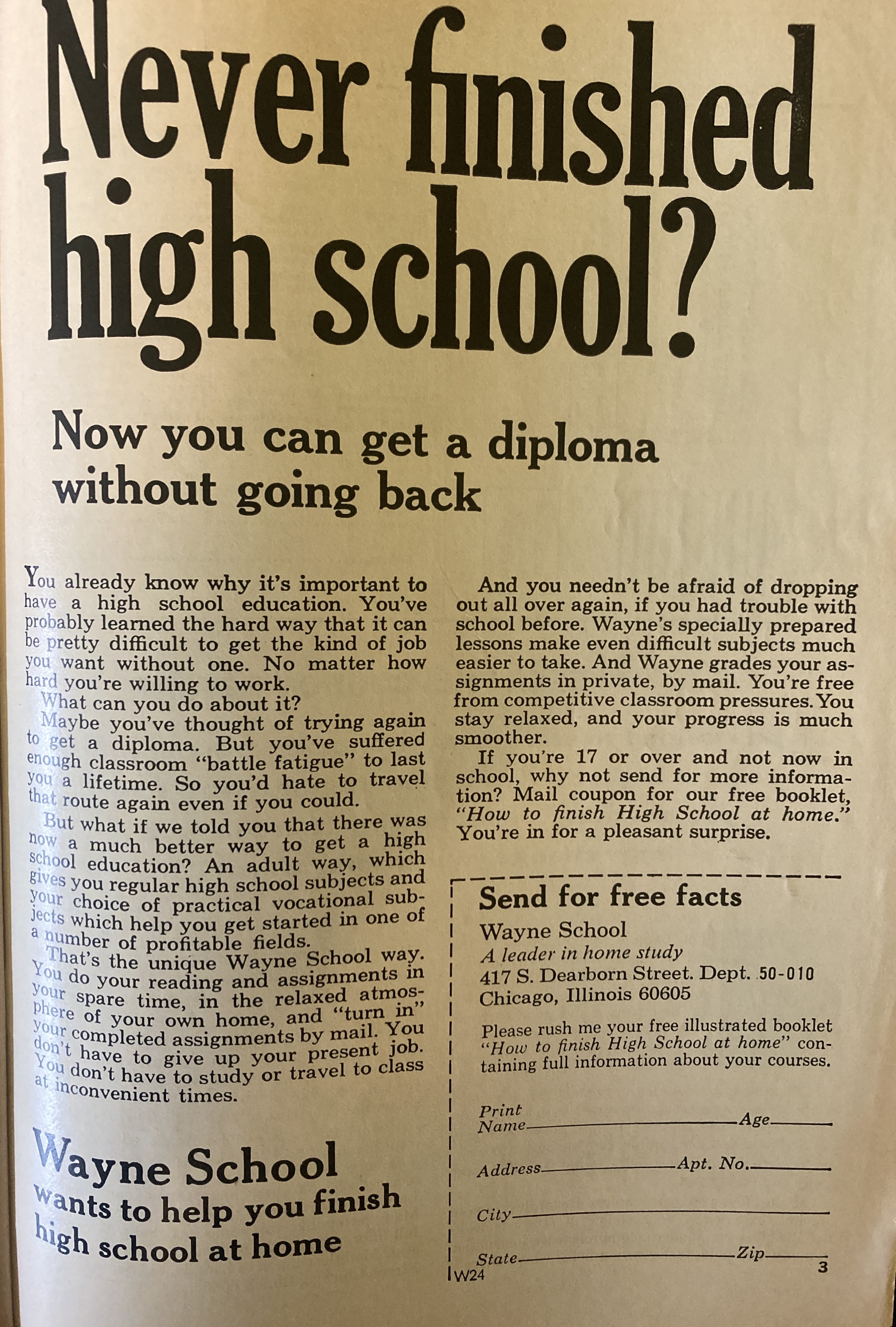
Some more intriguing ads. The fake beard-and-mustache kit—from the Masculiner Co., no less!—is particularly fascinating. Apparently you could mail in a sample of your own hair and they would match the color. Did anyone ever do that?


Overall

An excellent comic.

“The World’s Greatest Comic Magazine!” Fantastic Four No. 127

28 Sunday Apr 2024

Posted by percivalhenry in The World's Greatest Comic Magazine

≈ Leave a comment

Tags

1972, Fantastic Four, Fantastic Four 127, Mole Man, Roy Thomas

Fantastic Four 127
“Where the Sun Dares Not Shine!”
Published July 1972
Writer: Roy Thomas
Penciler: John Buscema
Inker: Joe Sinnott
Letterer: Artie Simek
Editor: Thomas
Cover: Buscema and Sinnott

Synopsis

In pursuit of a cure for Alicia Masters’s blindness, the Thing enters the subterranean world of the Mole Man, where he encounters Kala, an Atlantean princess and the Mole Man’s paramour. They capture Ben, and change his appearance into that of a hairy monster, leading the rest of the Fantastic Four to attack him.


What’s going on here

Even though Fantastic Four 127 is technically Roy Thomas’s third as writer, it feels like the first issue where he really seizes the reins and makes it his own. It’s full of Thomas-ian flourishes—the purple prose with its highfalutin’ references to ancient Greece, the call-backs to obscure older comics (in this case, Tales of Suspense 43), the sometimes excruciating interior monologues.

It’s also a pretty good story. On a mission to help Alicia, Ben is lured into complacency by the mysterious Kala, and is blindsided by her and the Mole Man. Thomas also ratchets up the stakes by having the Mole Man and Kala launch a plot against the surface world. His version of the Mole Man isn’t just a misunderstood outcast, but a truly evil villain who plans to kill 3 billion surface dwellers. The story is well paced, contains some fun surprises and ends with a satisfying cliff hanger.


What I liked

After showing some growth as a character over the past few years, Sue backslid into her whimpering helpmate status in Stan’s most recent run, as he (via Reed) sidelined her to protect Franklin. Here, Roy seems to be making a statement about Sue’s role on the team:


This is a great sequence from Big John:


There are also a lot of fun touches throughout the comic, such as this byplay in the editor’s notes between Roy and Stan en français.

Along with a sweet scene of domestic bliss, there is some clever dialogue from Reed here:

And it’s been while since we heard these magic words:


What I didn’t like

As mentioned above, Roy has a predilection toward pompous verbosity and anguished interior monologues. We get all of that and more here:


Overall

A promising start to the Thomas era.

← Older posts
Newer posts →
  • “The World’s Greatest Comic Magazine!” Fantastic Four Annual No. 15
  • “The World’s Greatest Comic Magazine!” Fantastic Four No. 223
  • “The World’s Greatest Comic Magazine!” Fantastic Four No. 222
  • “The World’s Greatest Comic Magazine!” Fantastic Four No. 221
  • “The World’s Greatest Comic Magazine!” Fantastic Four No. 220
  • July 2026
  • June 2026
  • May 2026
  • April 2026
  • March 2026
  • February 2026
  • January 2026
  • December 2025
  • November 2025
  • October 2025
  • September 2025
  • August 2025
  • July 2025
  • June 2025
  • May 2025
  • April 2025
  • March 2025
  • February 2025
  • January 2025
  • December 2024
  • November 2024
  • October 2024
  • September 2024
  • August 2024
  • July 2024
  • June 2024
  • May 2024
  • April 2024
  • March 2024
  • February 2024
  • January 2024
  • December 2023
  • November 2023
  • September 2023
  • July 2023
  • June 2023
  • May 2023
  • April 2023
  • March 2023
  • February 2023
  • January 2023
  • December 2022
  • November 2022
  • October 2022
  • September 2022
  • August 2022
  • July 2022
  • June 2022
  • May 2022
  • April 2022
  • March 2022
  • February 2022
  • January 2022
  • December 2021
  • November 2021
  • October 2021
  • September 2021
  • August 2021
  • July 2021
  • June 2021
  • May 2021
  • April 2021
  • March 2021
  • February 2021
  • January 2021
  • December 2020
  • February 2018
  • May 2016
  • February 2016
  • January 2016
  • December 2015
  • November 2015
  • October 2015
  • September 2015
  • August 2015
  • July 2015
  • April 2015
  • March 2015
  • January 2015
  • December 2014
  • November 2014
  • October 2014
  • September 2014
  • August 2014
  • June 2014
  • May 2014
  • April 2014
  • March 2014
  • February 2014
  • July 2026
  • June 2026
  • May 2026
  • April 2026
  • March 2026
  • February 2026
  • January 2026
  • December 2025
  • November 2025
  • October 2025
  • September 2025
  • August 2025
  • July 2025
  • June 2025
  • May 2025
  • April 2025
  • March 2025
  • February 2025
  • January 2025
  • December 2024
  • November 2024
  • October 2024
  • September 2024
  • August 2024
  • July 2024
  • June 2024
  • May 2024
  • April 2024
  • March 2024
  • February 2024
  • January 2024
  • December 2023
  • November 2023
  • September 2023
  • July 2023
  • June 2023
  • May 2023
  • April 2023
  • March 2023
  • February 2023
  • January 2023
  • December 2022
  • November 2022
  • October 2022
  • September 2022
  • August 2022
  • July 2022
  • June 2022
  • May 2022
  • April 2022
  • March 2022
  • February 2022
  • January 2022
  • December 2021
  • November 2021
  • October 2021
  • September 2021
  • August 2021
  • July 2021
  • June 2021
  • May 2021
  • April 2021
  • March 2021
  • February 2021
  • January 2021
  • December 2020
  • February 2018
  • May 2016
  • February 2016
  • January 2016
  • December 2015
  • November 2015
  • October 2015
  • September 2015
  • August 2015
  • July 2015
  • April 2015
  • March 2015
  • January 2015
  • December 2014
  • November 2014
  • October 2014
  • September 2014
  • August 2014
  • June 2014
  • May 2014
  • April 2014
  • March 2014
  • February 2014
“The World’s Greatest Comic Magazine!” Fantastic Four Annual No. 15

“The World’s Greatest Comic Magazine!” Fantastic Four Annual No. 15

percivalhenry's avatar by percivalhenry July 18, 2026
“The World’s Greatest Comic Magazine!” Fantastic Four No. 223

“The World’s Greatest Comic Magazine!” Fantastic Four No. 223

percivalhenry's avatar by percivalhenry July 14, 2026
“The World’s Greatest Comic Magazine!” Fantastic Four No. 222

“The World’s Greatest Comic Magazine!” Fantastic Four No. 222

percivalhenry's avatar by percivalhenry July 5, 2026
“The World’s Greatest Comic Magazine!” Fantastic Four No. 221

“The World’s Greatest Comic Magazine!” Fantastic Four No. 221

percivalhenry's avatar by percivalhenry June 25, 2026
“The World’s Greatest Comic Magazine!” Fantastic Four No. 220

“The World’s Greatest Comic Magazine!” Fantastic Four No. 220

percivalhenry's avatar by percivalhenry June 15, 2026
“The World’s Greatest Comic Magazine!” Fantastic Four No. 219

“The World’s Greatest Comic Magazine!” Fantastic Four No. 219

percivalhenry's avatar by percivalhenry June 7, 2026

Blog at WordPress.com.

  • Subscribe Subscribed
    • Percival Henry: The Fantastic Four and more
    • Join 74 other subscribers
    • Already have a WordPress.com account? Log in now.
    • Percival Henry: The Fantastic Four and more
    • Subscribe Subscribed
    • Sign up
    • Log in
    • Report this content
    • View site in Reader
    • Manage subscriptions
    • Collapse this bar
Loading Comments...