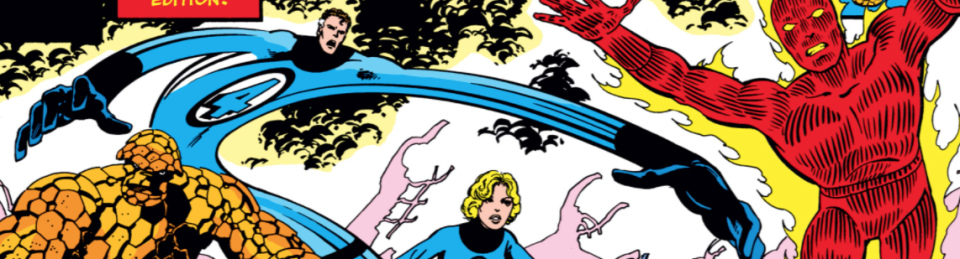
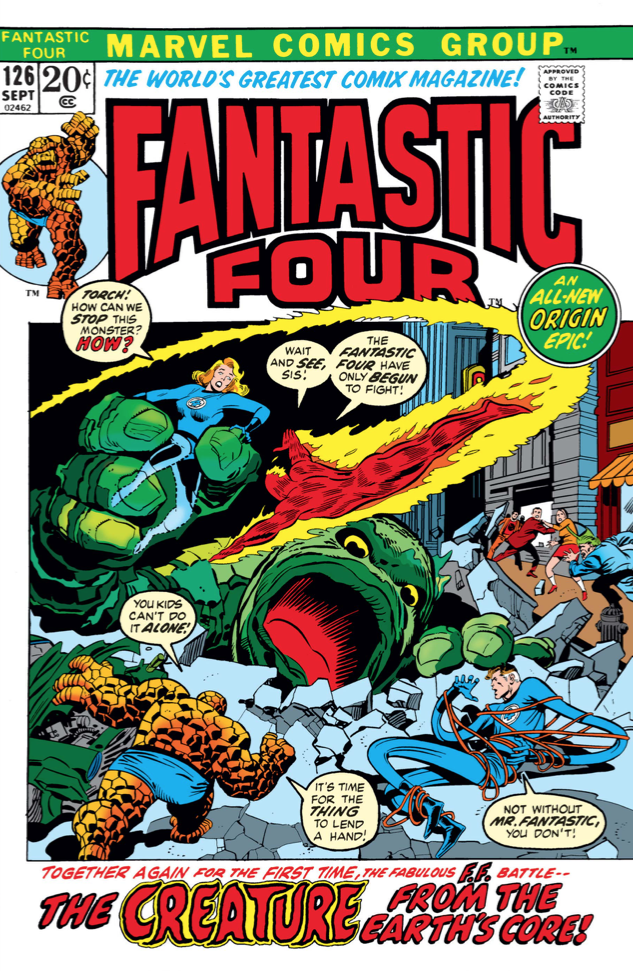
“The World’s Greatest Comic Magazine!” Fantastic Four No. 126

Tags

, , , , , ,

Fantastic Four 126
“The Way It Began!”
Published June 1972
Writer: Roy Thomas
Pencils: John Buscema
Inks: Joe Sinnott
Letters: John Costanza
Editor: Thomas
Cover: Buscema and Sinnott

Synopsis

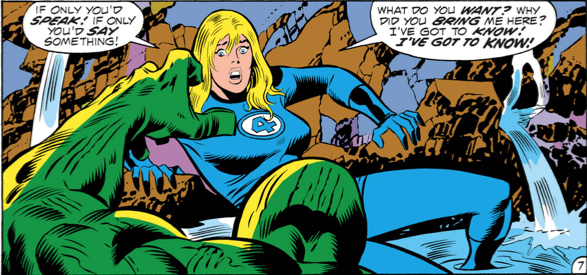
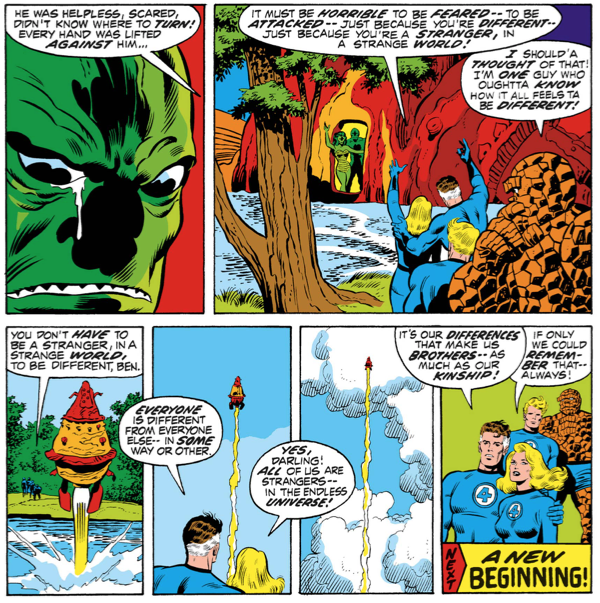
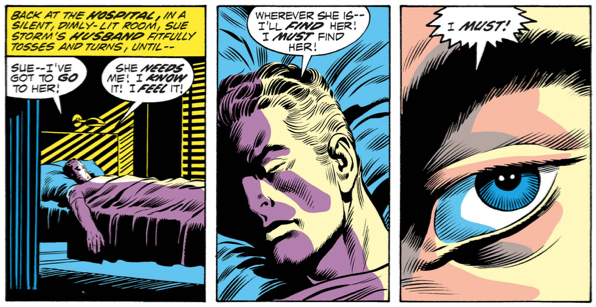
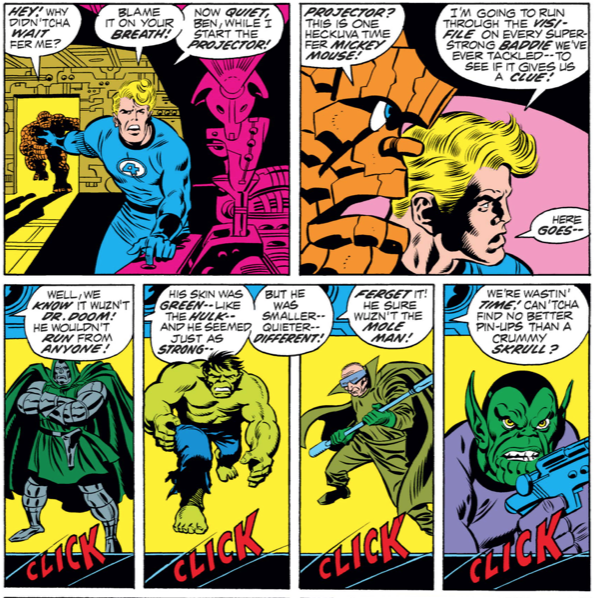
After squabbling with the Human Torch, the Thing uses a thought projector invented by Mr. Fantastic to revisit the origins of the Fantastic Four, and ends up resolved to force the Mole Man —the first villain they fought—to give sight to his blind girlfriend, Alicia Masters.
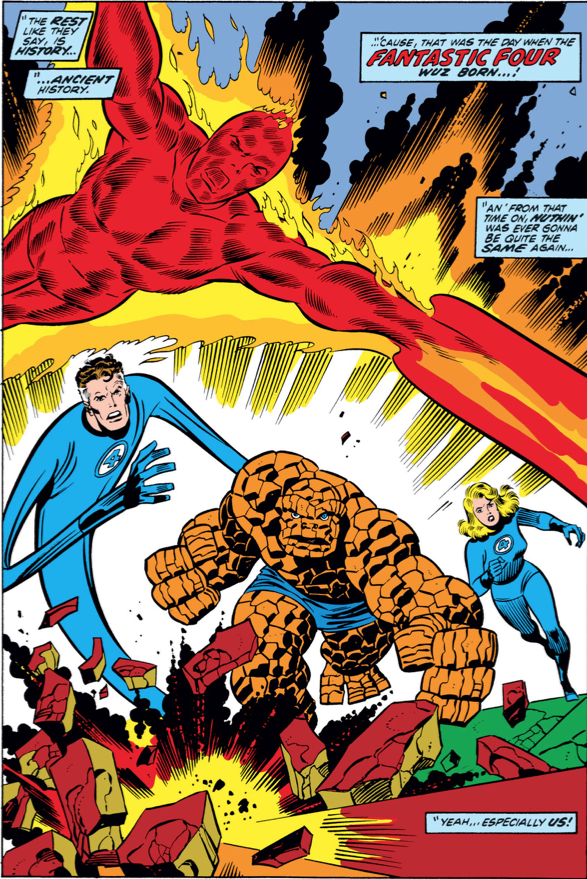

What’s going on here?

This is an interesting issue, for a few reasons. It’s the first issue after Stan Lee’s official departure from the FF—an occasion marked both in the Bullpen Bulletins and in a separate note on the letter’s page—and Roy Thomas’s first after officially taking the helm (although he wrote FF 119). Stan and Roy use the change as an opportunity to retell the origin of the Fantastic Four, in the longest re-cap of their origin to date. For modern readers, it might seem like a waste of an issue but we’re used to the immediate availability of back issues, either through reprints or online. New Fantastic Four readers in the early 1970s had fewer options to read FF 1 (although it had been reprinted in a few annuals by this point) and after a decade of comics, it made sense to reset the origin.

It also allows John Buscema a chance to put his spin on Jack Kirby’s classic story. He’s pretty faithful to the original, although there are a few tweaks, like modernizing Sue’s haircut.

Here is Jack’s:
And here’s Big John’s version of the same scene:
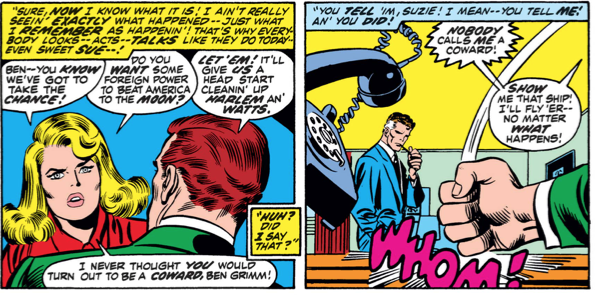
Probably the biggest difference is in how Buscema draws Ben, updating his original, lumpy look to the more familiar rocky version. Again, here’s FF 1:
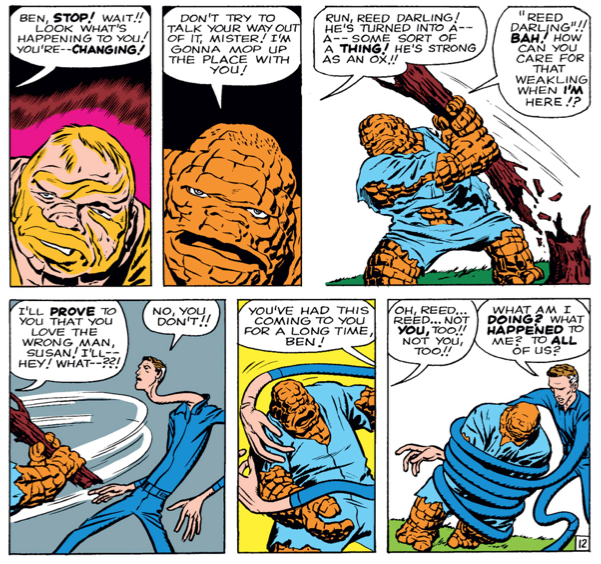
And FF 126:
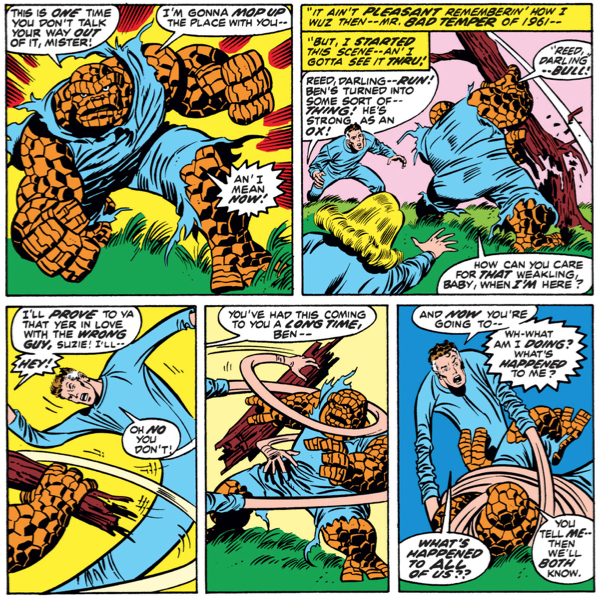
Roy also tweaks the dialogue a bit to make Ben’s style of speech more consistent with what we’re used to, but by and large it’s pretty similar.

Along with the recap of the origin (and both the original and a subsequent battle with the Mole Man, setting the stage for Ben’s quest), the issue also strikes a lot of familiar notes that seem designed reestablish the FF’s status quo. There’s a Ben and Johnny fight, which was once almost a mandatory feature. There’s an appearance from Alicia, and a reminder she’s blind. There’s Reed and Sue wondering about their future with the team now that they have a child. In all, it reads like jumping off place for new readers, and a new writer.

A few other items of note:

* The credits now say “Stan Lee presents” and Roy is credited as both writer and editor.
* The cover now says “The World’s Greatest Comix Magazine!” I don’t know the basis for the change, and it lasted only until issue 131, but it’s a bit odd.
* I realize I never addressed the change in the logo, which happened in issue 119. Just another sign of the changin’ times. Marvel will use this logo until issue 160 and doesn’t return to the classic ’60s logo until issue 218 (although it’s used for annuals).

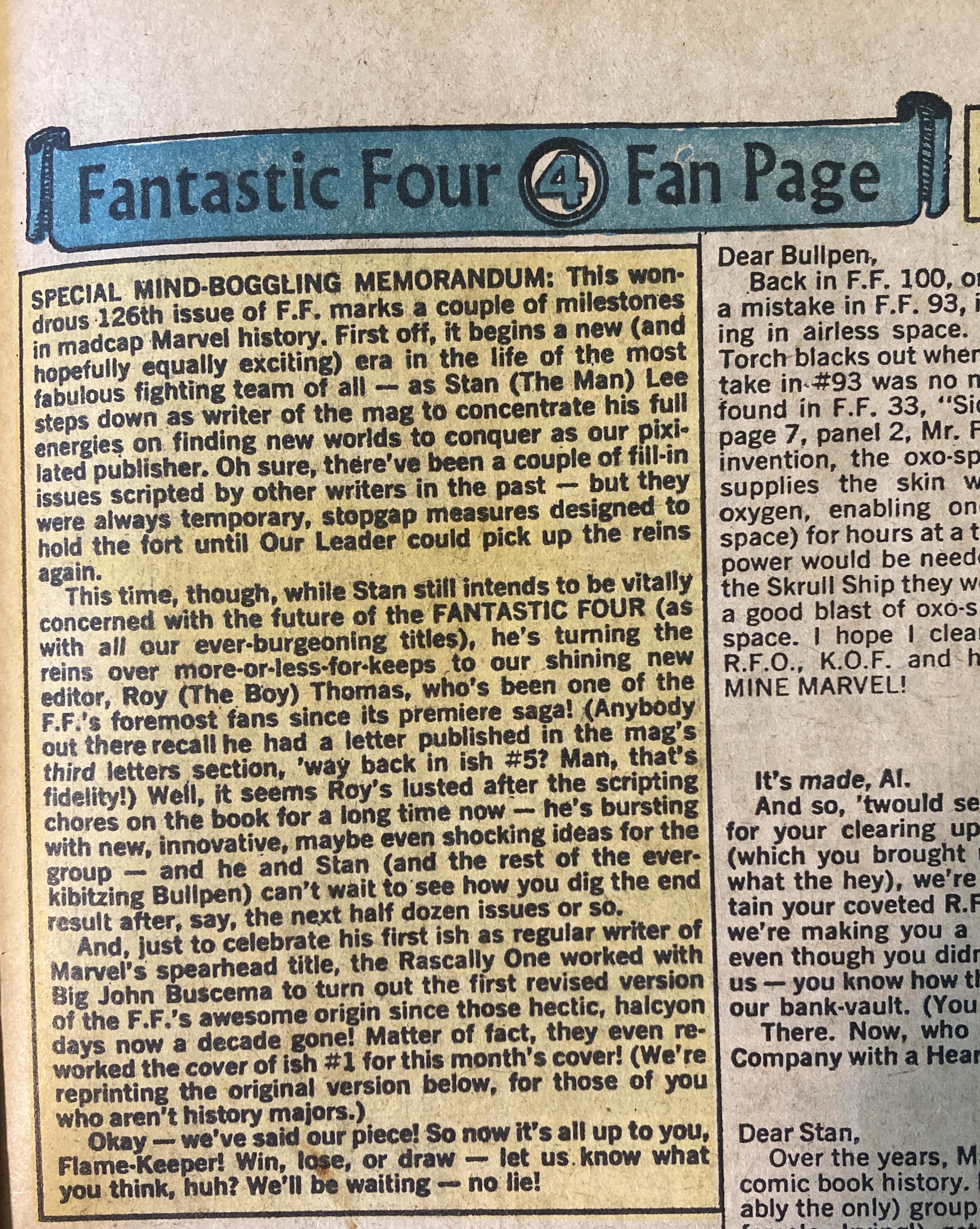
Here is the note introducing Roy as writer on the letter page:

What I liked

I generally liked Buscema’s recap of the origin, and particularly his take on Jack’s classic cover for FF 1. That cover has been the subject of many homages over the years (some of which I get into in my recap of that issue here) and I assume this is the first. There is still no explanation of who tied up Reed. There is also a great splash page (seen above).

What I didn’t like

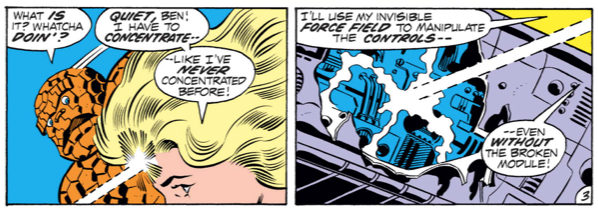
While it’s an interesting issue, I’m not sure it’s a particularly good issue. Roy tries to weave the lengthy flashback into the story, but it’s not really coherent, and the thought projector as a plot device feels unnecessary and clumsy. Leaping ahead from the FF’s first battle with the Moleman to one that took places in issues 88 and 89 also feels awkward and manufactured to set up the next issue.

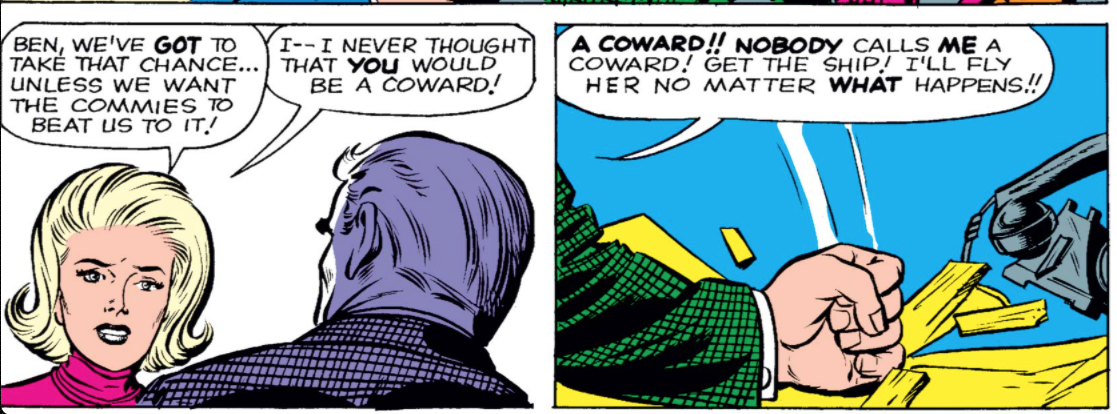
Also, it’s not really clear Roy has a grasp on Ben’s character, as evidenced by this sequence:
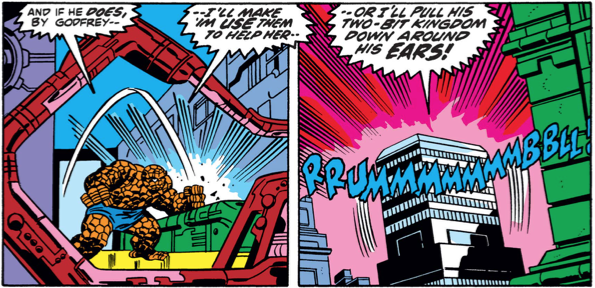
(who is Godfrey?)

Anything else?

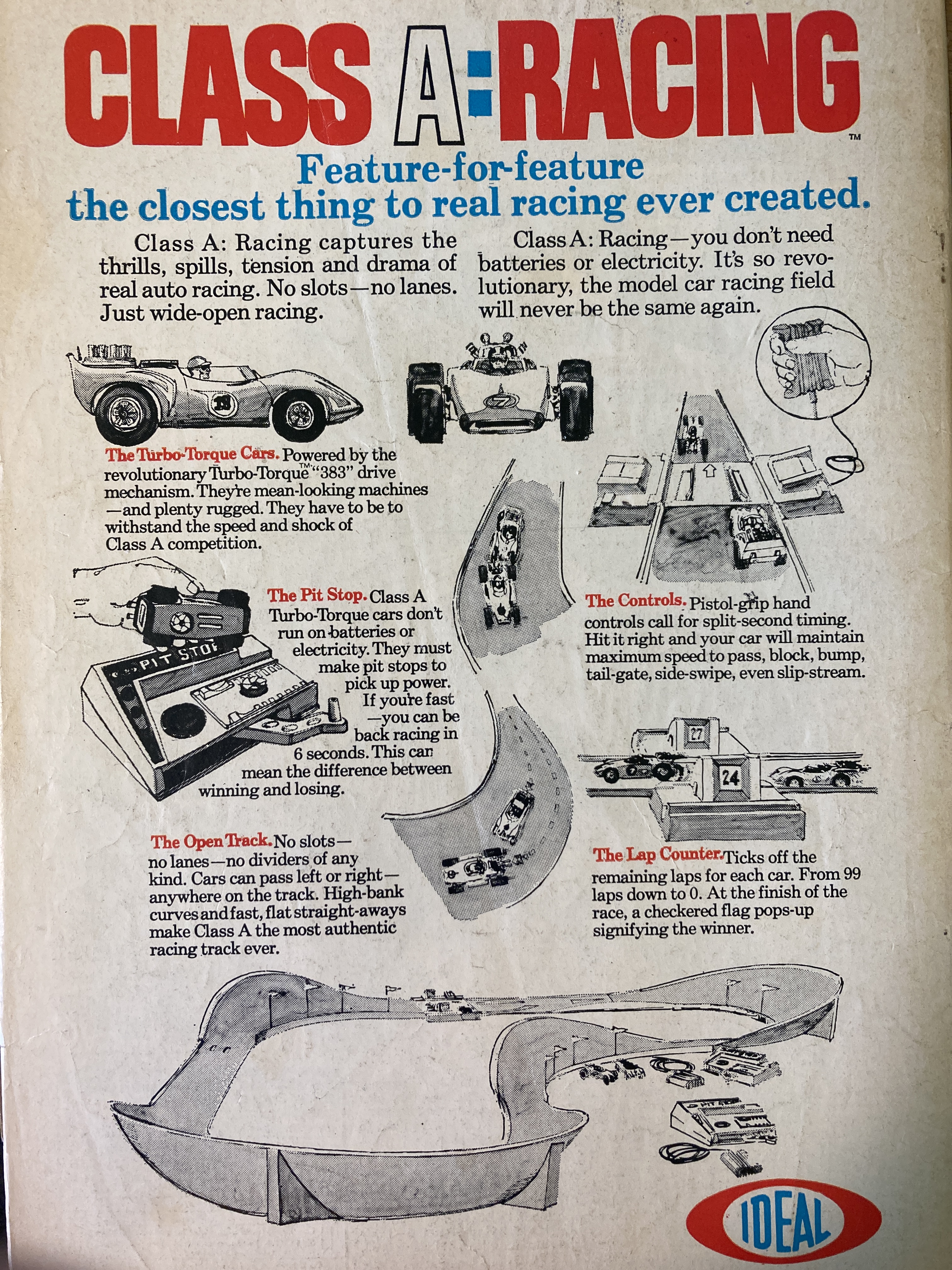
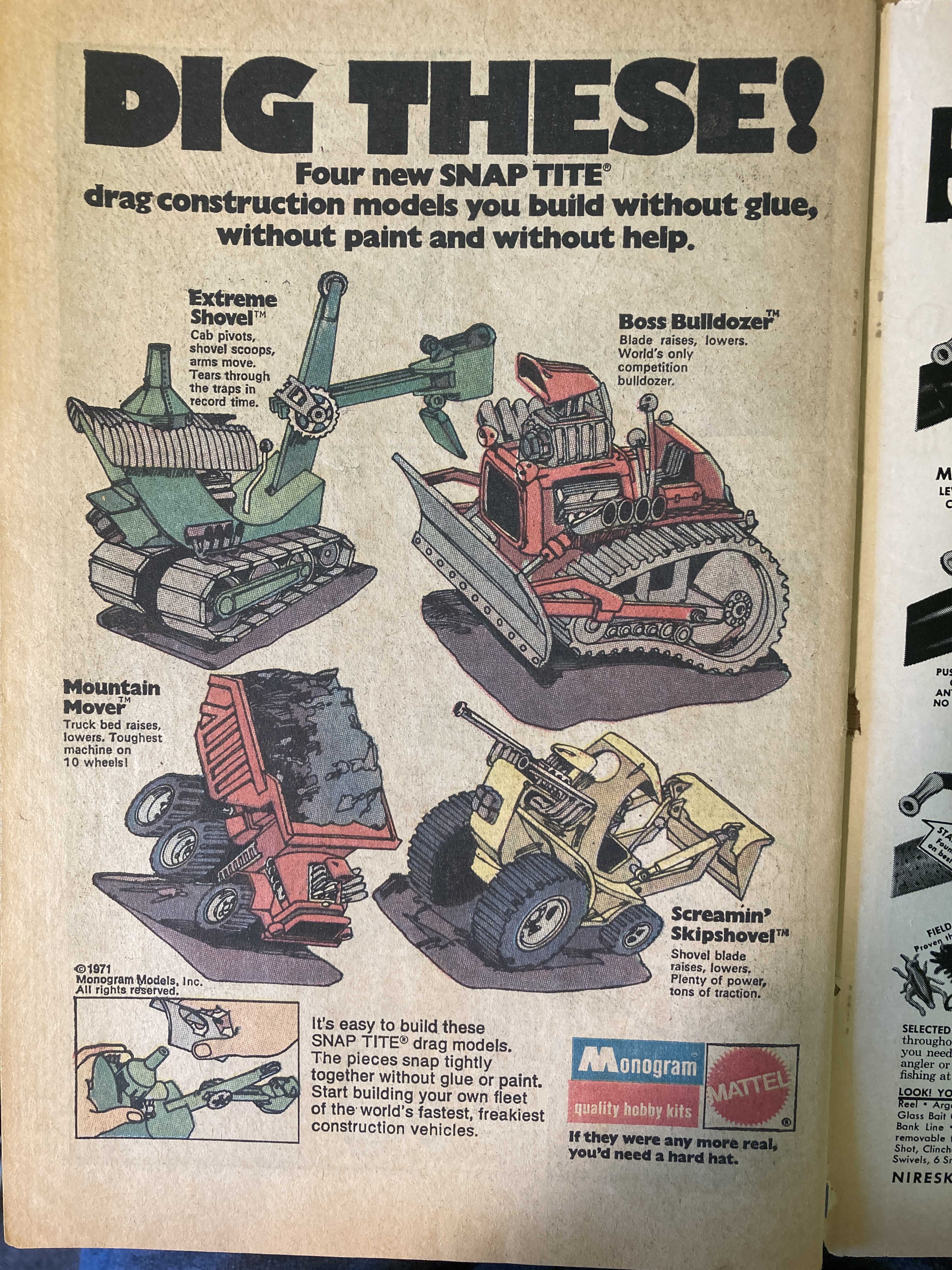
Ads for some neat-o toys in this issue:

Overall

An issue probably of more value to readers in 1972 than today
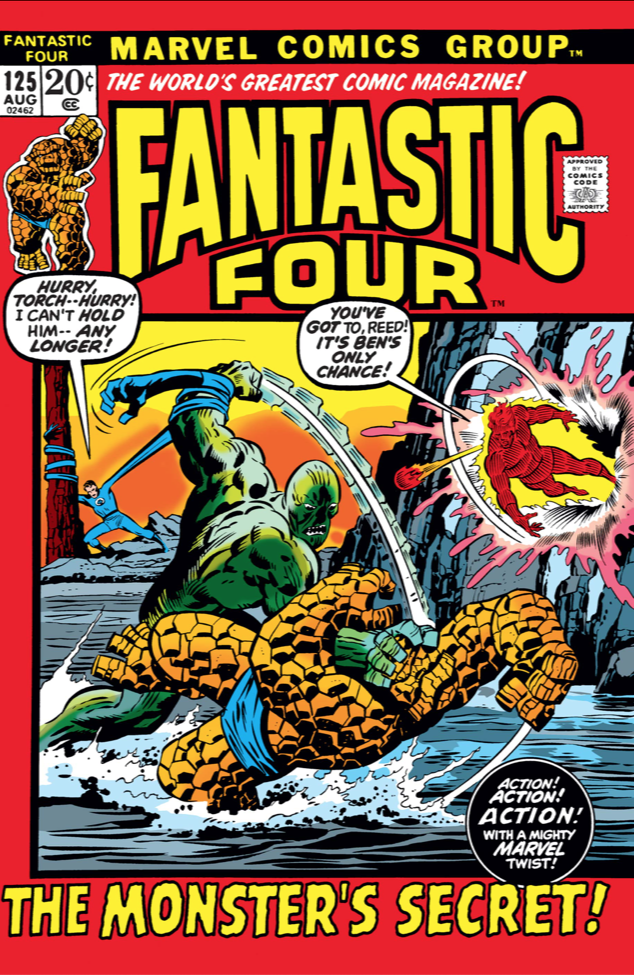
“The World’s Greatest Comic Magazine!” Fantastic Four No. 125

Tags

, , , ,

Fantastic Four 125
“The Monster’s Secret!”
Published: May 1972
Writer: Stan Lee
Pencils John Buscema
Inks: Joe Sinnott
Letters: John Costanza
Cover: Buscema and and Sinnott

Synopsis

The rest of the Fantastic Four attempts to rescue Sue from the underwater creature before it’s revealed it was never actually a threat.


What’s going on here

This is Stan Lee’s last issue as a regular writer of the Fantastic Four and it’s an unfortunately lackluster note to end on. The story feels thin and padded with unnecessary digressions, while the central question about the creature’s intentions for with Sue doesn’t have much tension since we know from the creature’s previous appearance that it’s a harmless alien. As a result, the twist at the end—the creature returned to cure its mate of a virus acquired on earth—felt sort of predictable. The final note, with the FF urging us to respect our differences, may be heartfelt but feels hokey. It’s the sort of earnest closing message Stan used early in the FF and by now feels sort of tired.

It’s probably worth pausing a moment to appreciate Stan’s amazing run as writer of the Fantastic Four. Between issue 1 and 125, he wrote, co-wrote or scripted (by my count) 119 regular issues and six annuals. That’s an impressive run for anyone, much less someone also writing a half dozen other comics and serving as editor and pitch-man for the entire line.

Trying to apportion credit for the Fantastic Four’s greatness between Stan and Jack Kirby feels like a fool’s errand. The (deserved) push to properly recognize Jack for his work at Marvel has unfortunately created a backlash diminishing Stan’s contributions (and it doesn’t help that Stan was part of the management of a company that cheated Jack of his due). According to some revisionist histories, Stan merely rubber stamped Jack’s stories. But I think it’s inarguable that for all of Jack’s genius, there would be no Fantastic Four as he know it without Stan as well.

From my perspective, it was a true partnership, where the sum of their contributions was greater than the whole. The Fantastic Four did tail off in the years after Jack left, but it was uneven during his last years on the book as well. And in many of the comics Stan wrote on his own or with John Buscema—particularly the recently concluded Air-Walker/ Galactus saga— there’s enough of the old FF energy to indicate it wasn’t Jack alone. And Jack’s work at DC is proof that he benefitted enormously from Stan’s scripting.

Today, Stan’s legacy is so tied up in his identity as the public face of Marvel, his cameos in the movies, and the ugly fights over copyrights, it’s easy to lose sight that, at his core, he was a damn good comic creator.

What I liked

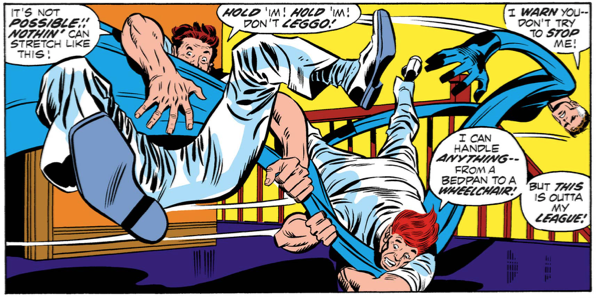
Big John turns in his usual excellent work. I particularly liked this sequence:


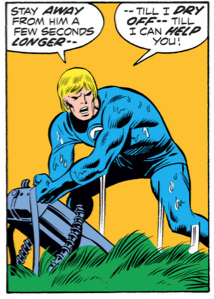
And wet Johnny:


What I didn’t like

As mentioned above, the comic felt padded with a lot of filler. Reed escaping his doctors took up two pages. Ben finding transportation took another two pages. The story probably could have been told in one issue without losing much story and gaining some pace.


Overall

A muted milestone

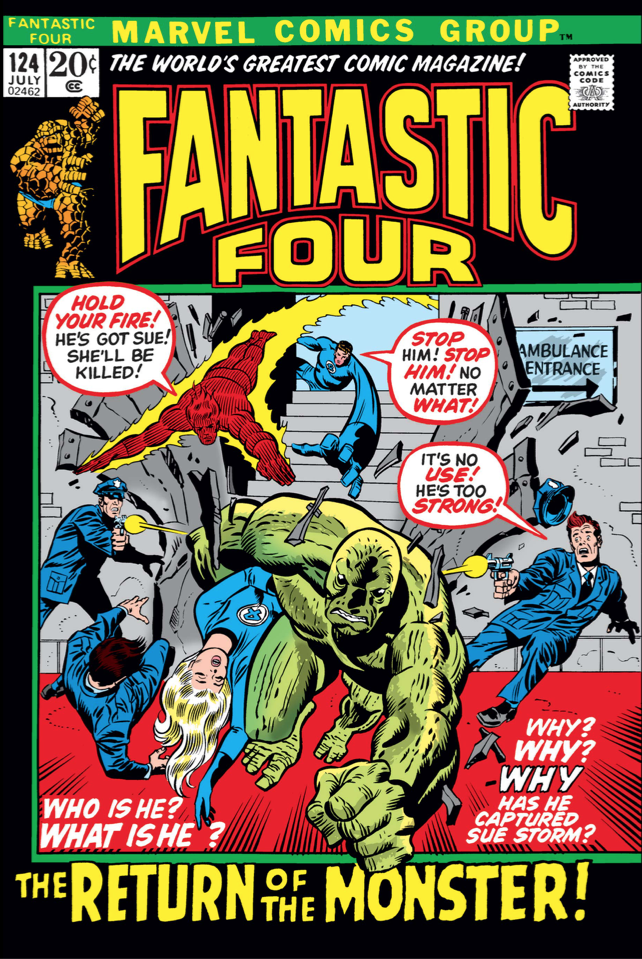
“The World’s Greatest Comic Magazine!” Fantastic Four No. 124

Tags

, , , ,

Fantastic Four 124
“The Return of the Monster!”
Published April 1972
Story: Stan Lee
Pencils: John Buscema
Inks: Joe Sinnott
Letters: John Constanza
Cover: Buscema and Sinnott

Synopsis

Mr. Fantastic, exhausted from the travails of the last few issues, takes ill and is rushed to a hospital, where a monster lurks and abducts the Invisible Girl.


What’s going on here?

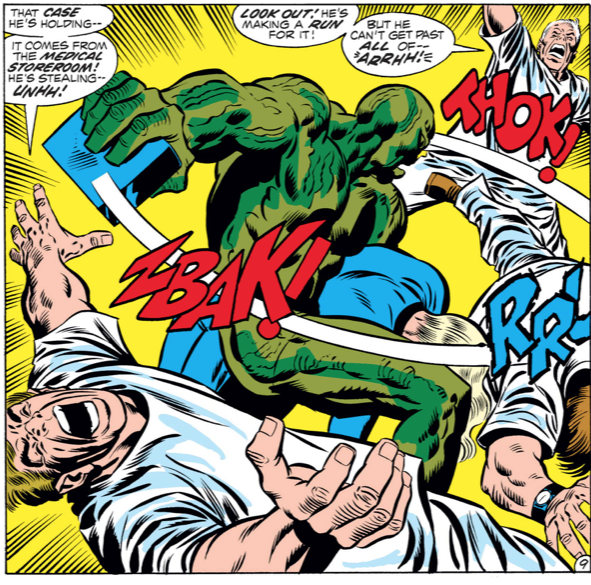
This is a busy, and slightly peculiar issue. It opens in the middle of the action—mise en scene, if you’re fancy—with the Fantasti-Car about to crash because Reed has passed out. Simply landing the car takes up about four pages, and much of the rest of the issue takes place in or around the hospital. The villain is of course the creature first introduced in issue 97, and while that was a fun, one-and-done story, there was nothing so compelling about the creature—really, a misunderstood alien modeled on the Creature from the Black Lagoon—that demanded it be brought back. The easiest explanation is that Stan, near the end of his active writing career, was bereft of ideas, and so reached back to an older story for one.

Still, despite feeling like a retread, there’s some interesting things going on in FF 124. Reed is virtually absent, since he’s unconscious in a hospital bed, so the other members are asked to propel the story in ways normally performed by Reed. There’s a fun sequence, for example, where Johnny plays detective and tries to identify the hostile monster using the FF’s equivalent of the Bat-Computer. It’s also a nice reminder that, after a decade of comics, the FF has it’s own rich history and rogue’s gallery.


Oddly, despite much of the comic devoted to the FF unraveling the riddle of the monster, the readers knows all along who it is from the cover and title.

What I liked

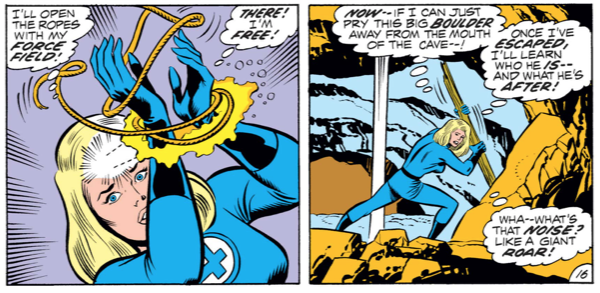
As mentioned, each of the non-Reed characters gets a a chance to shine in this issue. Sue, particularly, uses her powers in some new and interesting ways, such as repairing the crashing Fantasti-Car on the fly:

Or breaking out of her bindings:

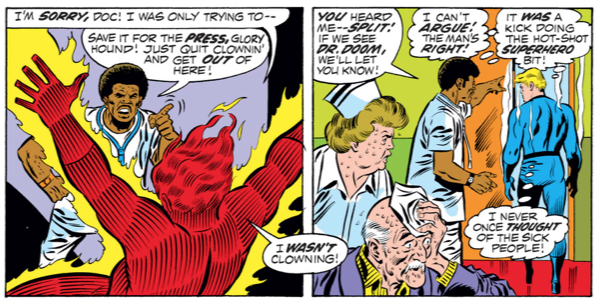
There’s an interesting sequence where Johnny is humbled by a doctor after terrifying patients by flying around the hospital with his flame on:


It looks like Buscema is trying something new as he draws Johnny, giving him a more distinctly human appearance when he’s in his flaming form.


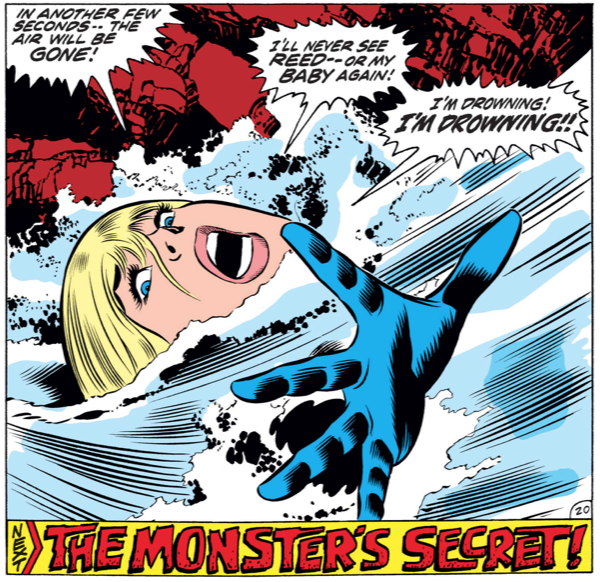
I also like the classic cliff-hanger ending, with Sue caught in a flooding cave:

And this Kirby-esque panel of Reed in the hospital.

What I didn’t like

When I first began this blog, I started tracking how many times Sue was taken hostage. I stopped counting after Fantastic Four 38, when the count had reached 10. It’s one of Stan’s oldest and most tiresome cliches, and unfortunately he revives it again here.


Also, I’m not a fan of plots that depend on the most unlikely of coincidences. The hospital were Reed is taken just happens to be haunted by a creature the FF once confronted on a tropical island?


Anything else?

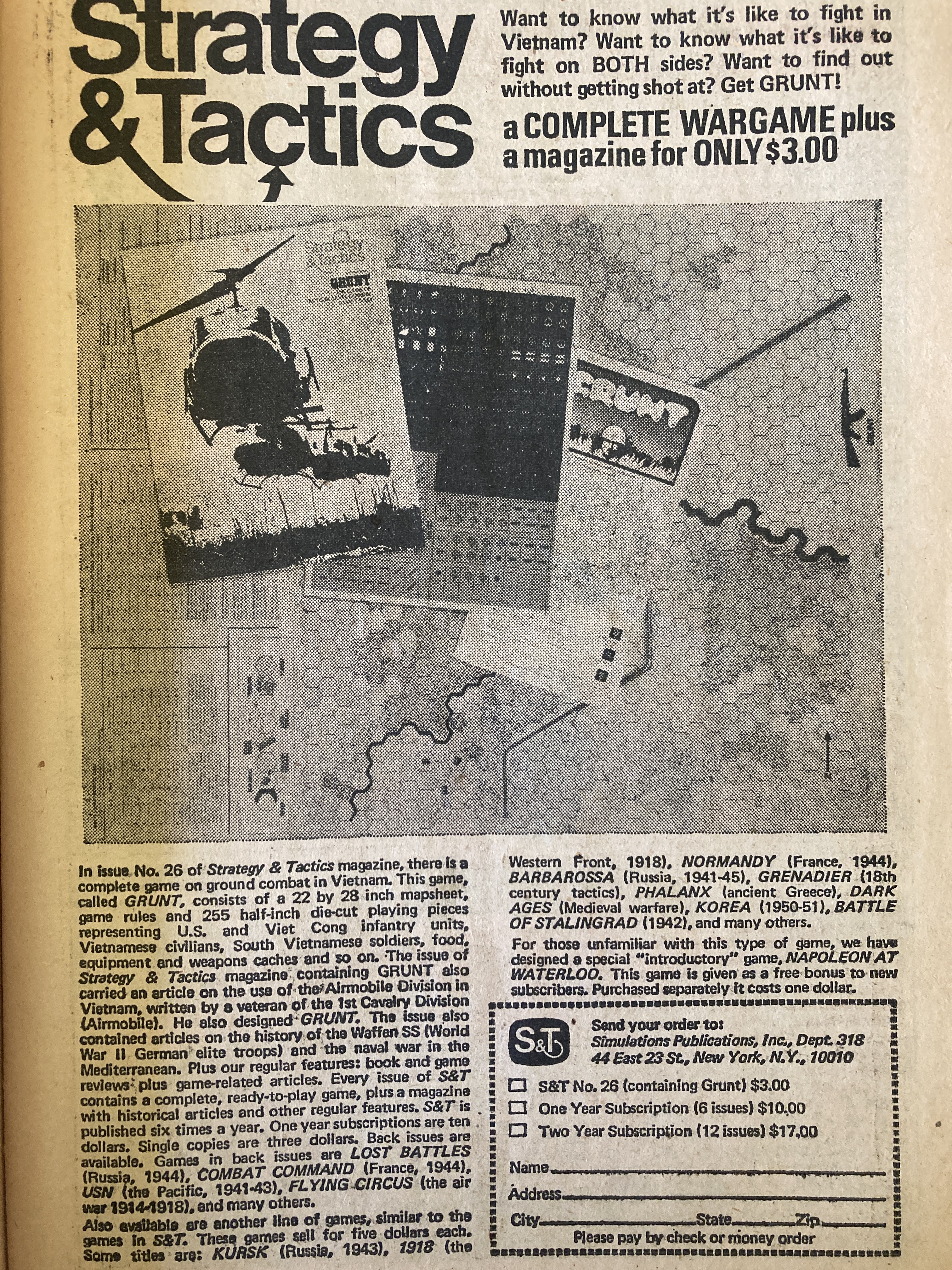
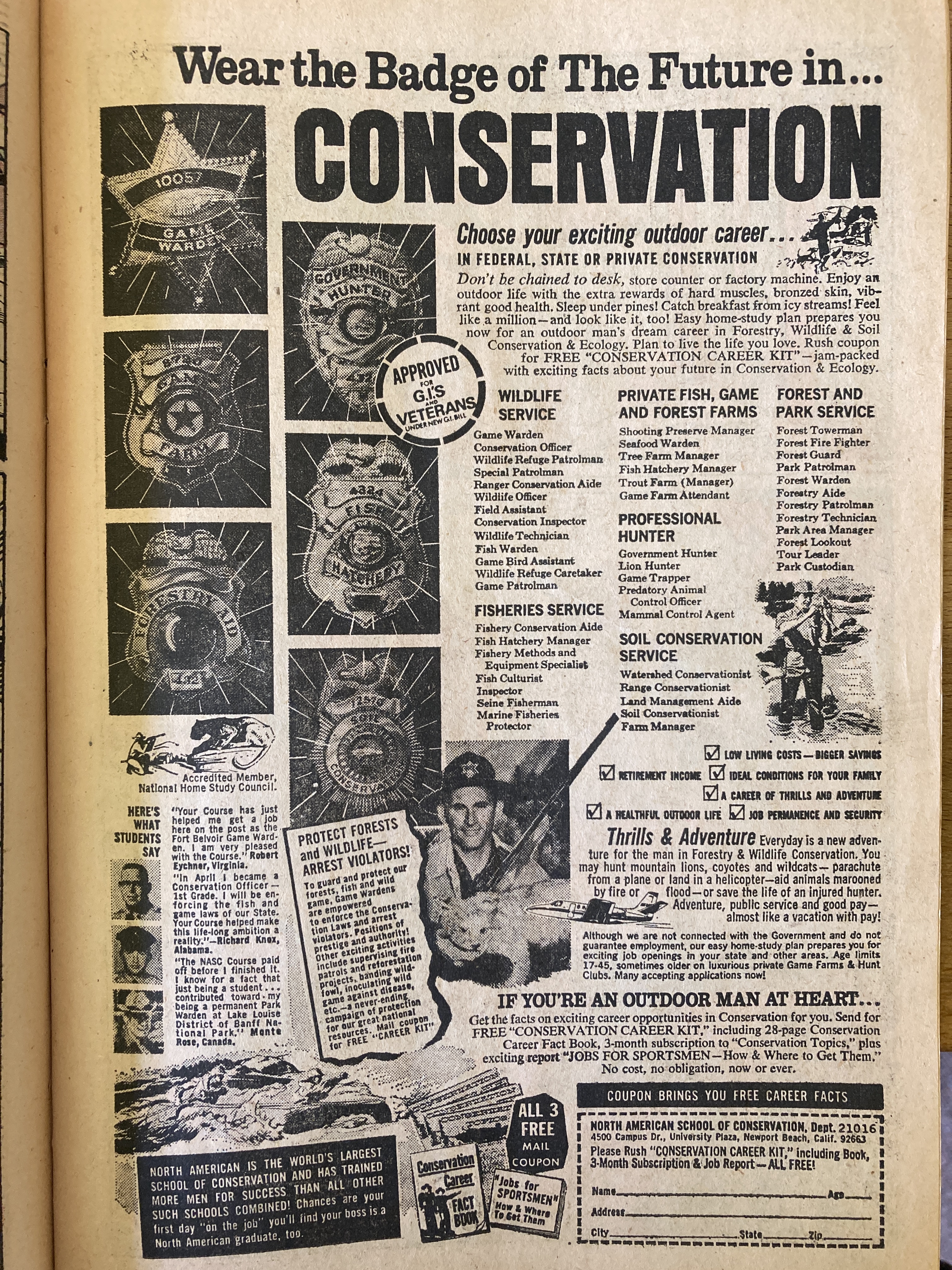
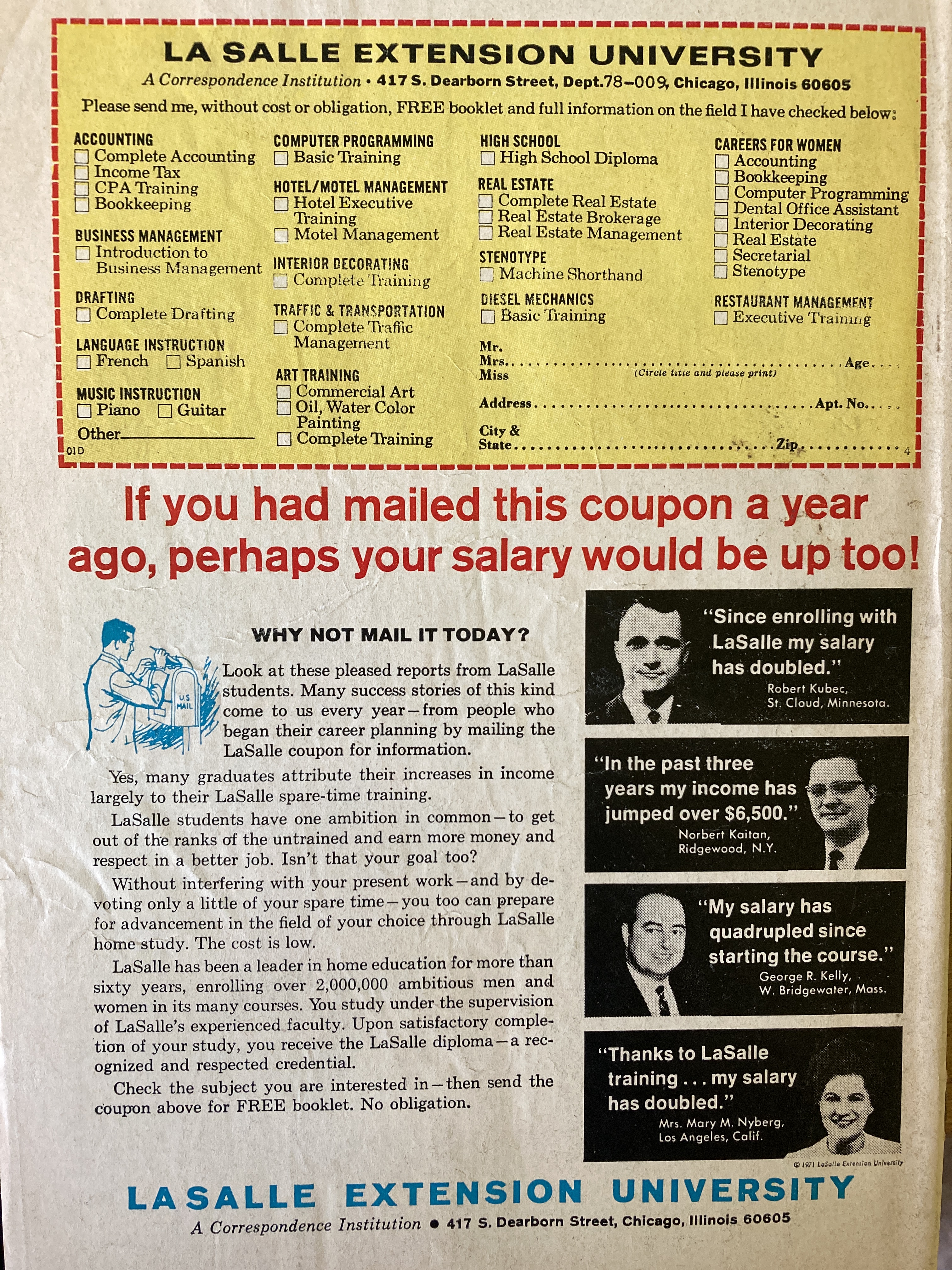
A bunch of ads that seemed pitched at an older reader. The Vietnam-themed game seems strange, given the war was still raging in 1972.


Overall

Generally a fine issue, marred by the sexist treatment of Sue.

“The World’s Greatest Comic Magazine!” Fantastic Four No. 123

Tags

, , , , , ,

Fantastic Four 123
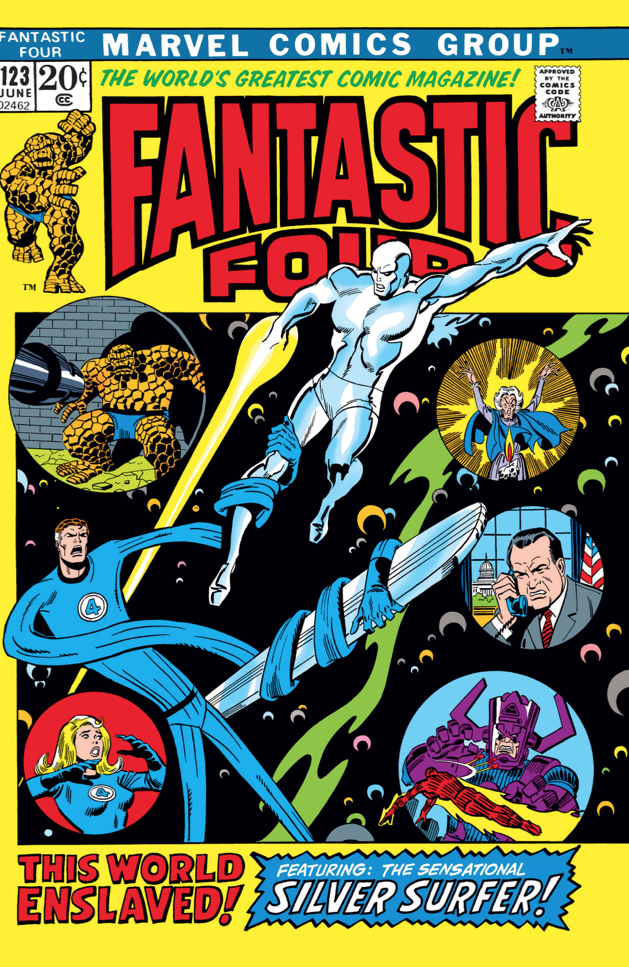
“This World Enslaved!”
Published March 1972
Story: Stan Lee
Pencils: John Buscema
Inks: Joe Sinnott
Letters: Jon Costanza (credited as Jon Costa)
Cover: Sal Buscema

Synopsis

After Galactus delivers his ultimatum—either the Silver Surfer becomes his herald again or he will destroy the Earth—Mr. Fantastic counters with a threat to destroy Galactus’s spaceship, stranding him on Earth. Galactus calls his bluff and Reed returns Galactus’s ship, but when the Surfer attempts to follow him into space, Reed stops him, leading the U.S. military to intervene and almost fatally wounding Reed. While the Thing and Torch battle the army, Reed, with the help of Agatha Harkness, broadcasts a message around the world that he has has tricked Galactus, rigging his spaceship to send him to the Negative Zone, where his deal with the Surfer doesn’t apply.


What’s going on here?

This issue wraps up the latest Galactus arc in a perhaps less-than-satisfying way (more on that later). As befitting a big, climactic issue, it includes a number of guest stars, like the Surfer and Agatha Harkness, and yet it feels, given all that’s at stake, that other heroes should appear. I’m not sure where the Avengers are at this point, but the potential end of the world seems like something that would interest them.

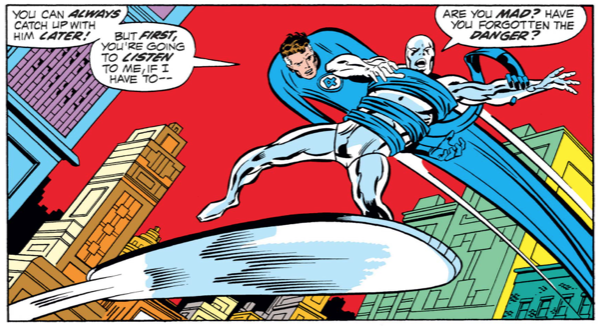
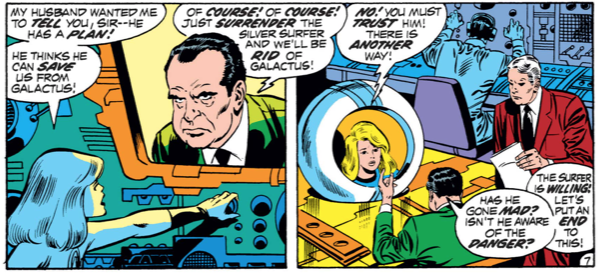
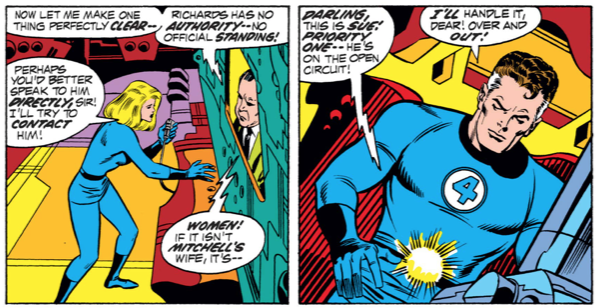
Perhaps the most intriguing guest appearance is that of Richard Nixon, who is unnamed but obviously himself, making references to John Mitchell, Henry Kissinger and his reelection.

There’s a long history of U.S. presidents appearing in comics, and I could devote an entire blog post to tracking them down. Sometimes they are generic old white men, and sometimes they seem to resemble whomever is president at the time. Few, however, are as specific as this representation of Nixon.

(One small detail of interest: in the second panel above, there’s a typo in the printed comic, and it reads “he on the open circuit” which is corrected in the digital comic, which I used here).

There are also some creators making their first contributions to the Fantastic Four. After a few years at DC, Jon Costanza joined Marvel in late 1971, and starting with this issue, becomes a semi-regular letterer of the FF. Probably more significantly, FF 123’s cover is drawn by Sal Buscema, Big John’s younger brother. Sal began working in comics in 1968, but this is first work on the Fantastic Four. He later does a few fill-in issues and will become the regular FF penciler for a brief stretch in 1986. While I’ve never loved Sal Buscema’s style, it’s hard not to admire his productivity and longevity. And I do like his extra-shiny version of the Surfer on what’s otherwise a very busy cover.

What I liked

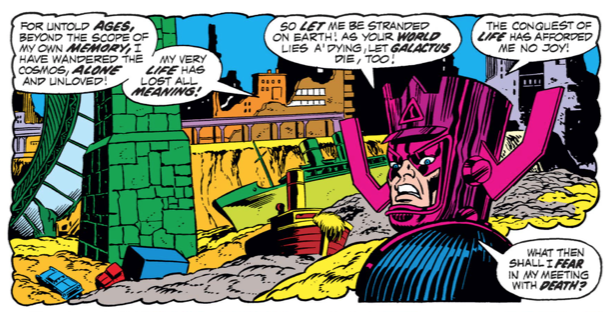
This entire Air Walker / Galactus / Surfer arc has a fun, throw-back feel. An appearance of Galactus makes any comic feel important, and in this issue we get more insight into his psyche. He’s not just a villain intent on destruction, but a weary agent of the universe who can’t control his own destiny.


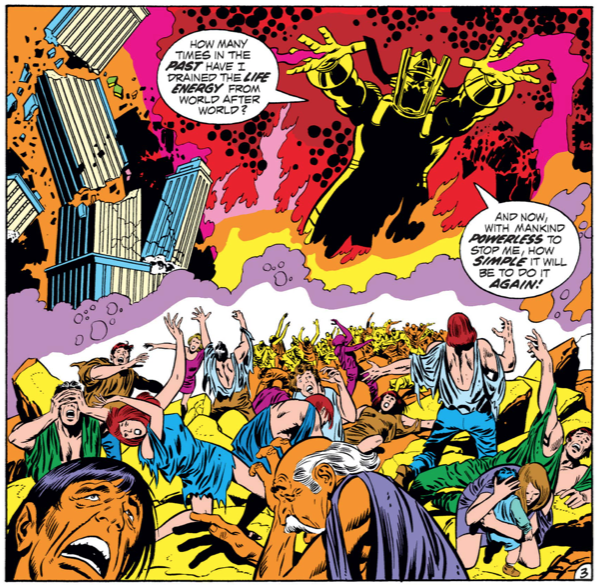
We’re also treated to some harrowing images of what Galactus’s consumption of Earth might look like.


What I didn’t like

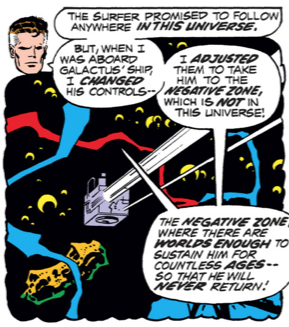
Like a lot of Fantastic Four epics, the climax to this story feels rushed, and this one feels particularly half-baked. Reed appears to have saved the Earth with a bit of legal trickery, based on the Surfer’s pledge to follow Galactus “in this universe,” creating a loophole so Reed can send Galactus to the Negative Zone, where he’s not bound by the agreement. Left unclear, of course, is why Galactus would feel obliged to honor a deal whose spirit is so obviously violated by Reed. Did we miss the panel where contracts were signed and notarized? Will some court enforce it? I suppose Reed (and Stan) could argue that since Galactus violated his pledge to leave the Surfer alone, then he’s just getting what he deserves, but it feels weak.

And all this leaves aside the issue of how Reed altered Galactus’s ship to enter the Negative Zone, something we previously thought could only be achieved through a portal in the Baxter Building.


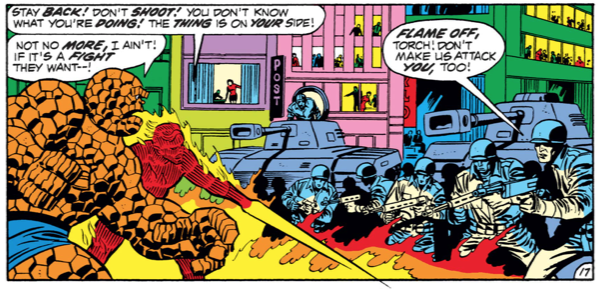
The comic also digresses into an off fight between the military and the Fantastic Four. It’s distracting and while it creates the opportunity for Reed to be shot by a panicky soldier, and then saved by the Surfer, none it feels very necessary or serves to advance the story.


Anything else?

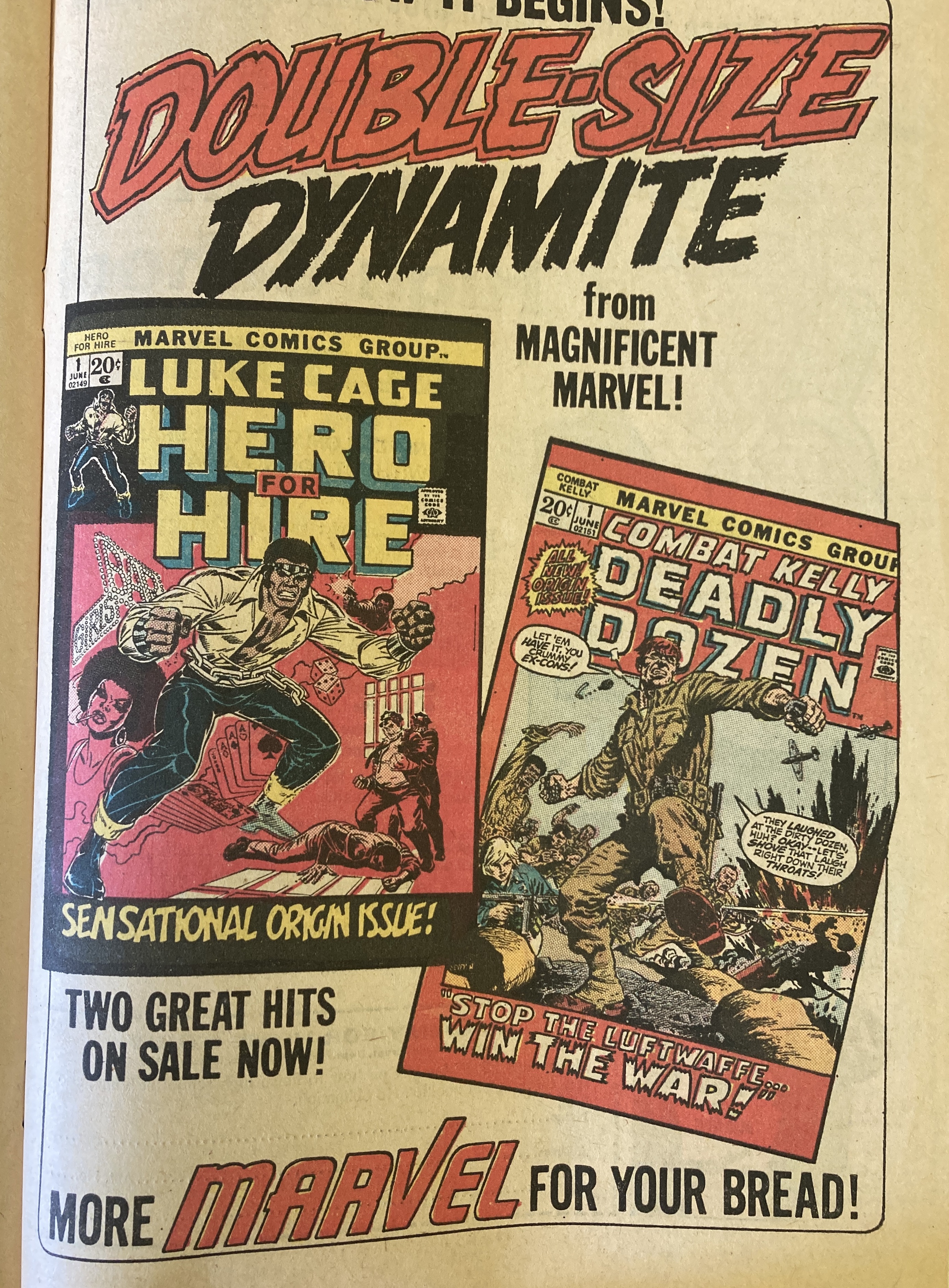
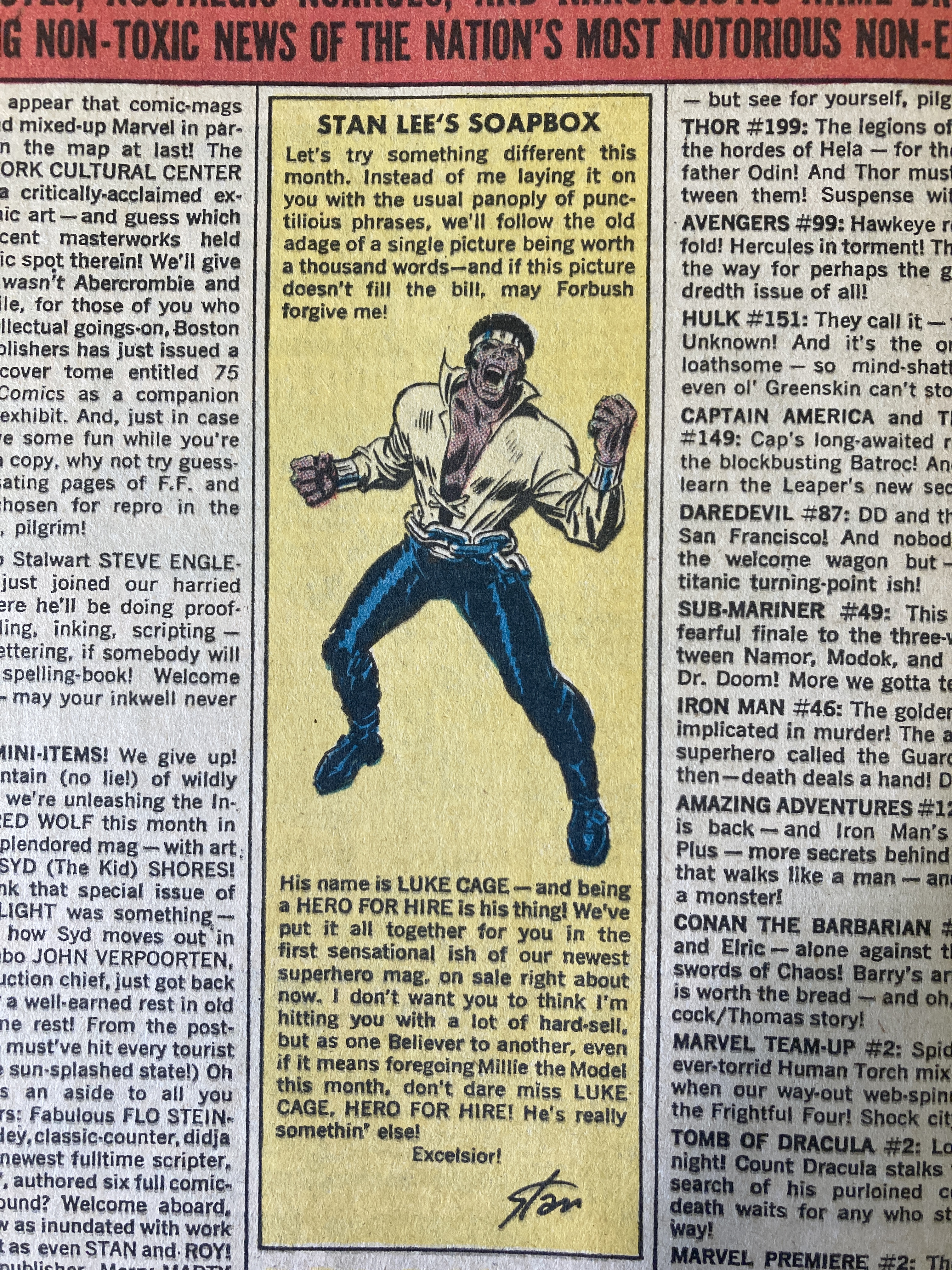
I liked this house ad: More Marvel for your Bread!

(I’d never heard of Combat Kelly and his Dirty Dozen before. Apparently it was a reboot of a 1950s war comic but it only lasted nine issues in its second incarnation). Luke Cage had a bit more success.


Overall

A bit of a let down.

“The World’s Greatest Comic Magazine!” Fantastic Four No. 122

Tags

, , , , ,

Fantastic Four 122
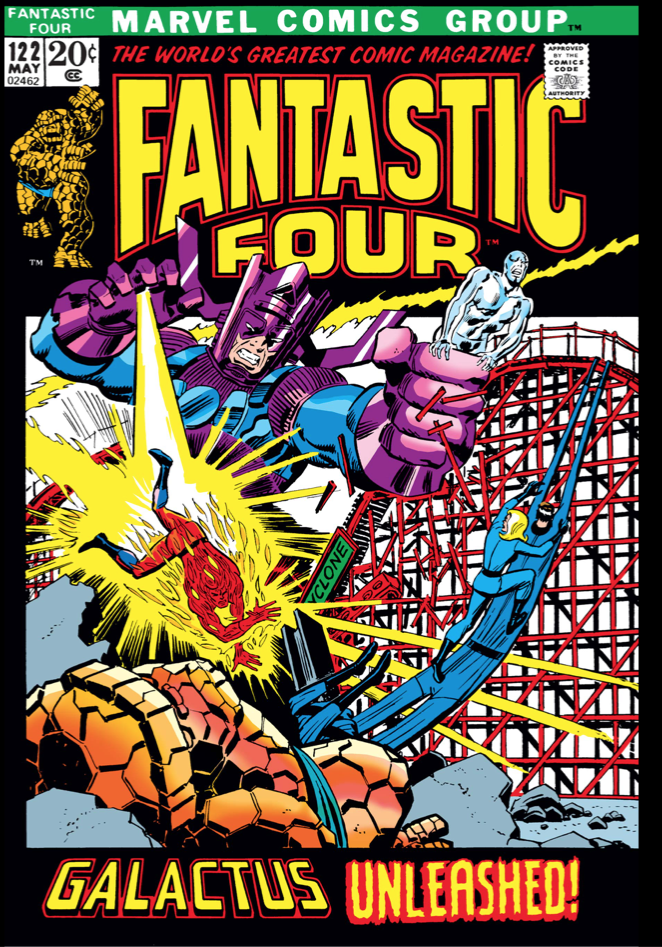
“Galactus Unleashed!”
Published Feb. 1972
Story: Stan Lee & John Buscema
Script: Lee
Pencils: Buscema
Inks: Joe Sinnott
Letters: Artie Simek
Cover: Buscema and John Romita Sr.

Synopsis

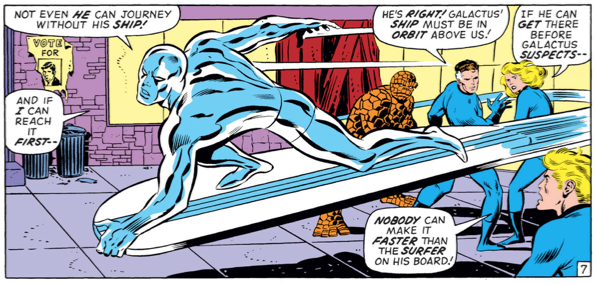
The Fantastic Four and the Silver Surfer battle Galactus, who demands the Surfer rejoin him as his herald or he will destroy Earth. In response, Reed travels to space to capture Galactus’s ship.


What’s going on here

This is an old-school, action-packed comic, with high stakes and lots of drama. I have some quibbles (see below) but on the whole this feels like a return to form for the Fantastic Four after an uneven period following the departure of Kirby. Galactus is a great villain, and his need for the Surfer to be his herald again gives at least a plausible reason for his to return to Earth after promising to spare it.

What I liked

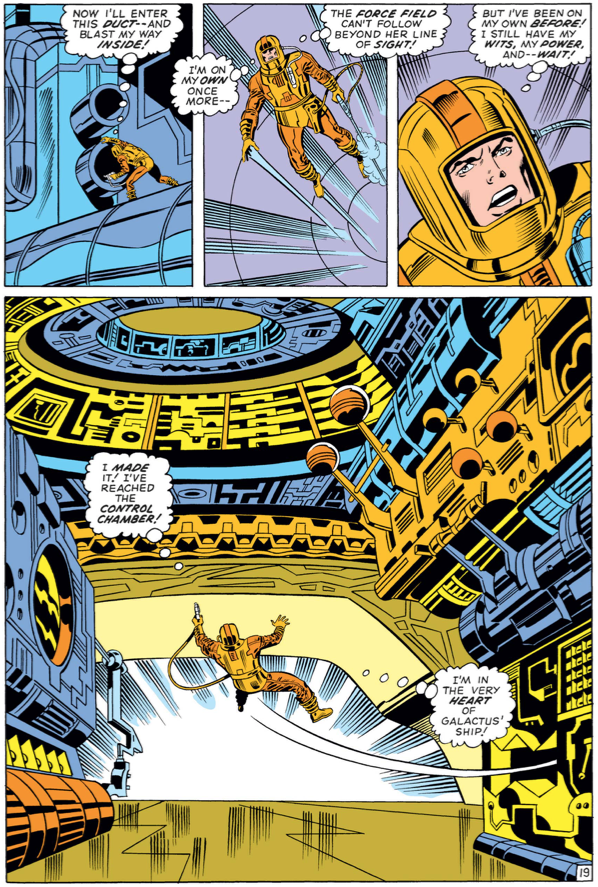
After some predictable fighting sequences, the comic shifts into high gear when Reed travels into space to capture Galactus’s space ship. Bucesma gets to stretch his Kirby muscles, and the sequence has a great mix of wonder and tension.


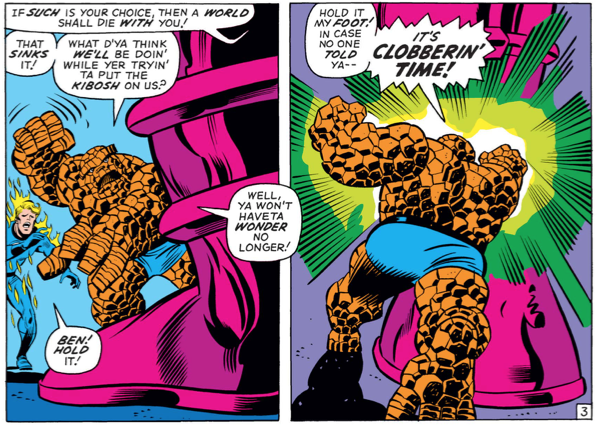
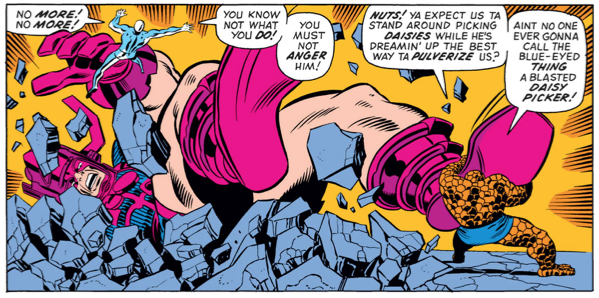
I also liked this sequence, which is both a testament to the Thing’s power and a bit ridiculous (punching a foot?)


What I didn’t like

The Air-Walker robot, the focus of the last two issues, seems to have been dropped as a plot line. It seems like an elaborate ruse of Galactus’s to draw out the Surfer, and it’s begging for additional explanation.

Also, I recognize the FF has to try to stop Galactus, but — in my view — he should be too powerful to bother having to fight back, hence deploying the Punisher android in earlier appearances. Here, he not only scraps with the Fantastic Four but Ben knocks him off his feet. It serves to diminish what should be a character above physical confrontation.


Further, Galactus should wear long pants. At least they removed the G from his chest.

Lastly, calling the Silver Surfer “whitey” just sounds weird, especially since he’s, you know, silver.


Anything else?

The month marks the debut of Luke Cage, a future member of the FF (very briefly).


Overall

Comics done right!

“The World’ s Greatest Comic Magazine!” Fantastic Four No. 121

Tags

, , , , ,

Fantastic Four 121
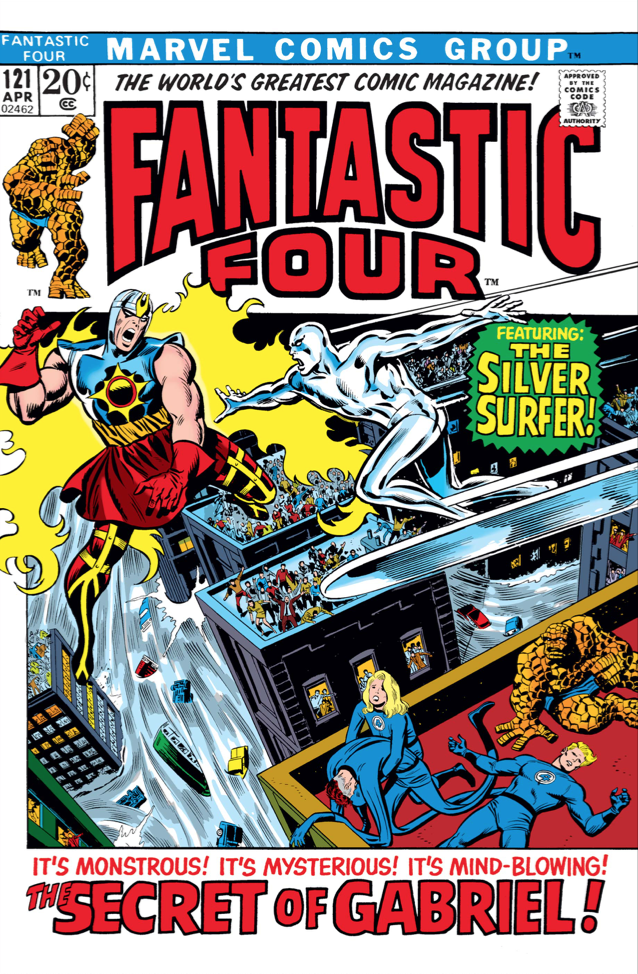
“The Mysterious Mind Blowing Secret of Gabriel!”
Published: Jan. 1972
Story: Stan Lee & John Buscema
Script: Lee
Pencils: Buscema
Inks: Joe Sinnott
Letters: Sam Rosen
Cover: Buscema and Sinnott

Synopsis

The Air-Walker turns humanity against the Fantastic Four, whose effort to battle him are futile, before admitting he was only attempting to lure the Silver Surfer. After the Surfer beats him and reveals him to be a robot, Galactus makes a dramatic appearance.


What’s going on here?

After last issue’s long build up, FF 121 delivers some pay off. There’s a long fight with Air-Walker, some not-too-subtle commentary about religious fanaticism by Stan, a dramatic appearance from the Silver Surfer and two big twists: Air-Walker is a robot, and he was doing the bidding of Galactus. Unfortunately, most comic readers today know Air-Walker as a herald of Galactus (information I first received from the Official Handbook of the Marvel Universe circa 1983) , but I imagine for a reader in 1972 this would have come as a shocking revelation. Mind-blowing, even (to quote the comic’s title). At this point, Stan may be close to the end of his days as a regular comic writer, but he shows here he’s still got something on his fastball.
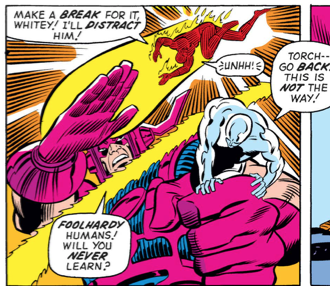

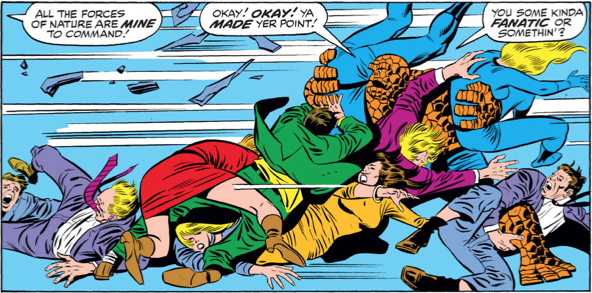
Along with the aforementioned plot twists, I did like Stan’s injection of social commentary into the New Yorkers reaction of Gabriel. It’s pretty clear what Stan thinks of zealotry.


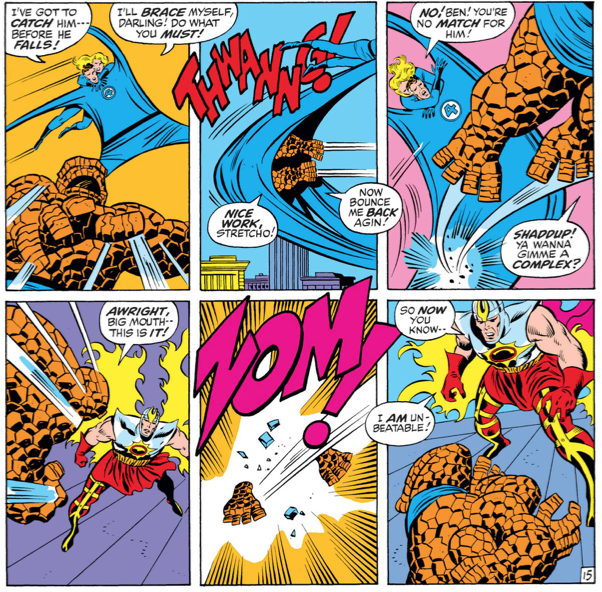
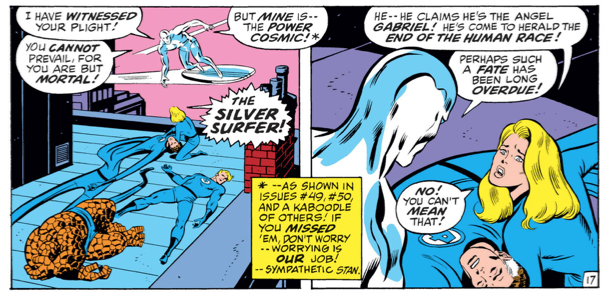
There are some great Buscema panels, like this one:


As well as some fun sound effects (which I think would be done by Buscema, not Sam Rosen, the letterer):


What I didn’t like

This issue suffers from the same sluggish pacing of a lot of Stan’s Fantastic Four comics. The FF spend an awful long time either fighting Air-Walker, running away from Air-Walker or escaping New Yorkers doing Air-Walker’s bidding, and so the appearance of the Silver Surfer is jammed into the last few pages. When he arrives to save the day, it’s a tiny panel and he’s about half an inch high. Surely this dramatic scene merits at least a half splash?


Anything else?

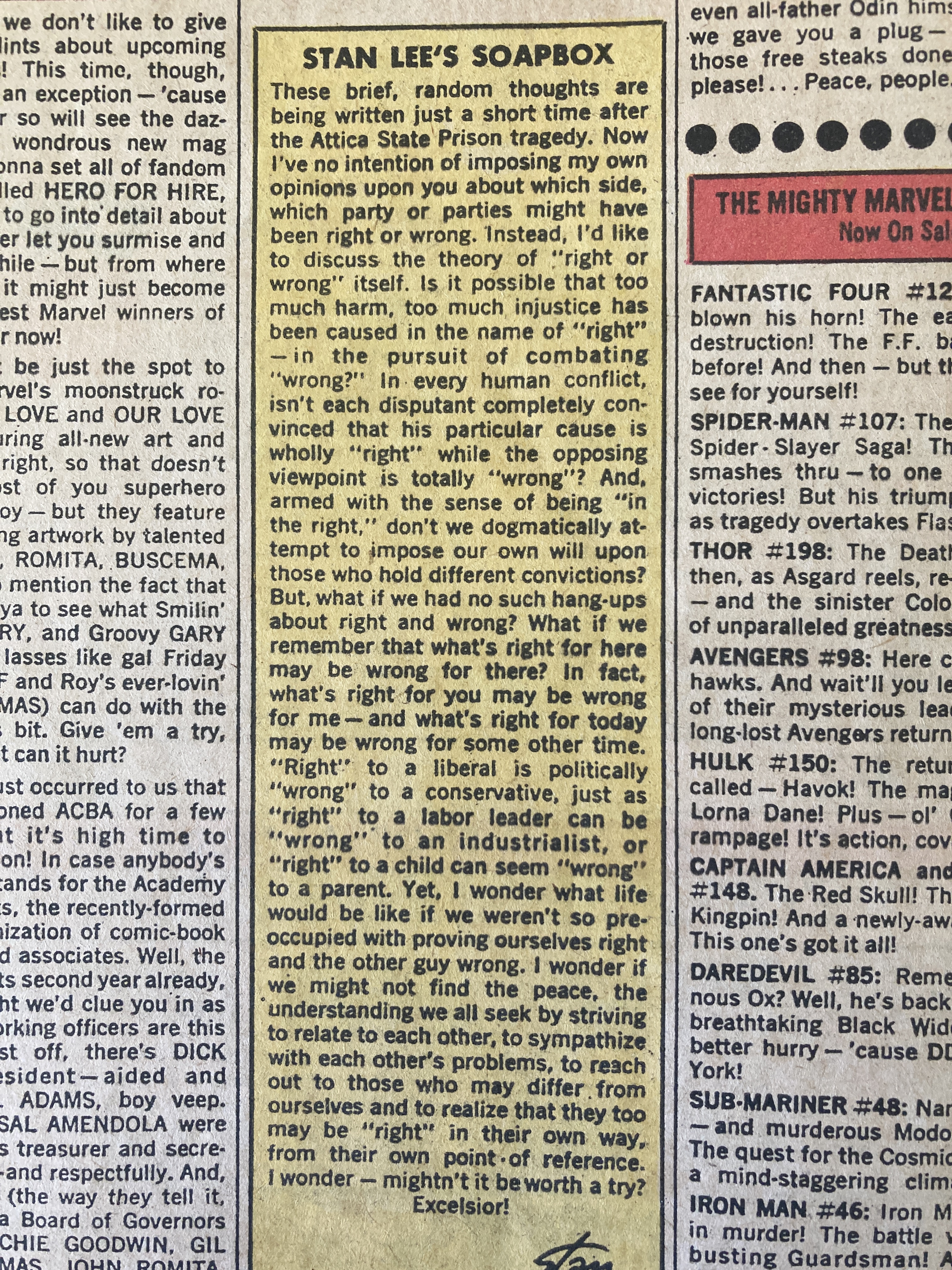
In his soap box, Stan take on another fun subject: the Attica prison riots!


Overall

Not bad, not bad at all

“The World’s Greatest Comic Magazine!” Fantastic Four No. 120

Tags

, , , ,

Fantastic Four 120
“The Horror That Walks On Air!”
Published Dec. 1971
Story: Stan Lee and John Buscema
Script: Lee
Pencils: Buscema
Inks: Joe Sinnott
Cover: Buscema and Frank Giacoia

Synopsis

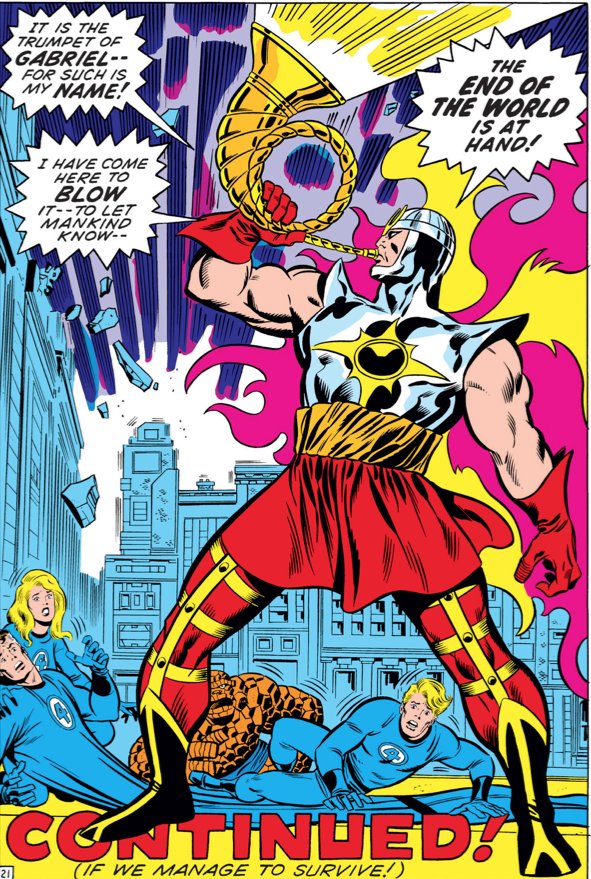
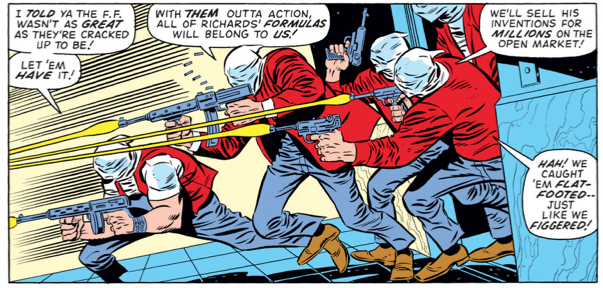
After dispatching a band of thugs who invade the Baxter Building, the Fantastic Four confront the Air-Walker, who warns the end of the world is at hand.


What’s going on here?

I’ve been looking forward to this comic for a while. While it’s not revealed in this issue, Air-Walker is a herald of Galactus, and of the main heralds from 60s, 70s and 80s (basically the Silver Surfer, Firelord, Terrax and Nova), he’s the one I’m least familiar with. He eventually gets a long and complicated back story, which I won’t get into here.

Most of the issue, however, is devoted to establishing Air-Walker as a massive threat, and it feels a bit like over-kill. He does very little except float around, and only displays his powers after he’s attacked. Only in the final panel do we really get hint of his menace. Given the build up, the next few issues better deliver.


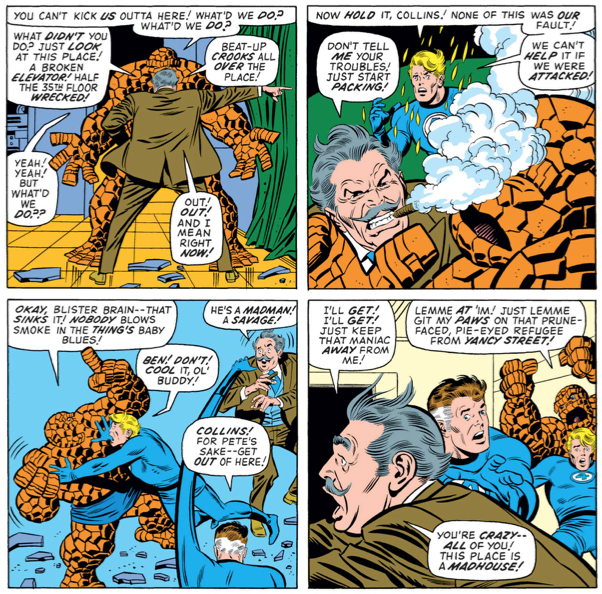
The other big development in FF 120, which helps explains the long, breathless introduction of Air-Walker, is the return of Stan Lee as writer. After a few issues of Archie Goodwin, and one by Roy Thomas, Stan is back in the saddle for what will be his final stint as lead writer of the FF. The issue feels a lot like a classic Stan and Jack issue, with lots of one-liners and wise cracks from Ben, and comic set-pieces like another squabble with the landlord.

Interestingly, Stan shares writing credits with Buscema here, like he did with Jack. My sense is that, as with Kirby, Stan gave Big John a loose plot, let him work out the details, and then added the script, in the classic Marvel Method. With the other writers, I’m guessing John had less say in the story.

The issue also features the introduction of a new inker, John Sinnott. I’m kidding. It’s clearly an error.


What I liked

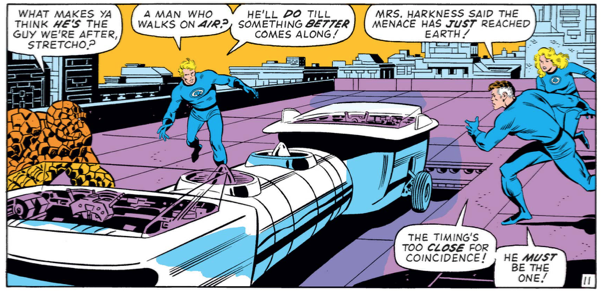
More great Buscema art, including this panel:


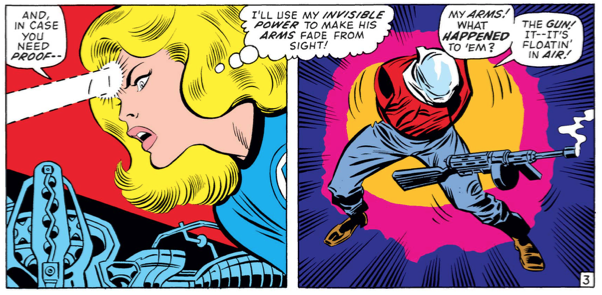
I liked this use of Sue’s powers (although wouldn’t the bad guy know he was holding the gun?)

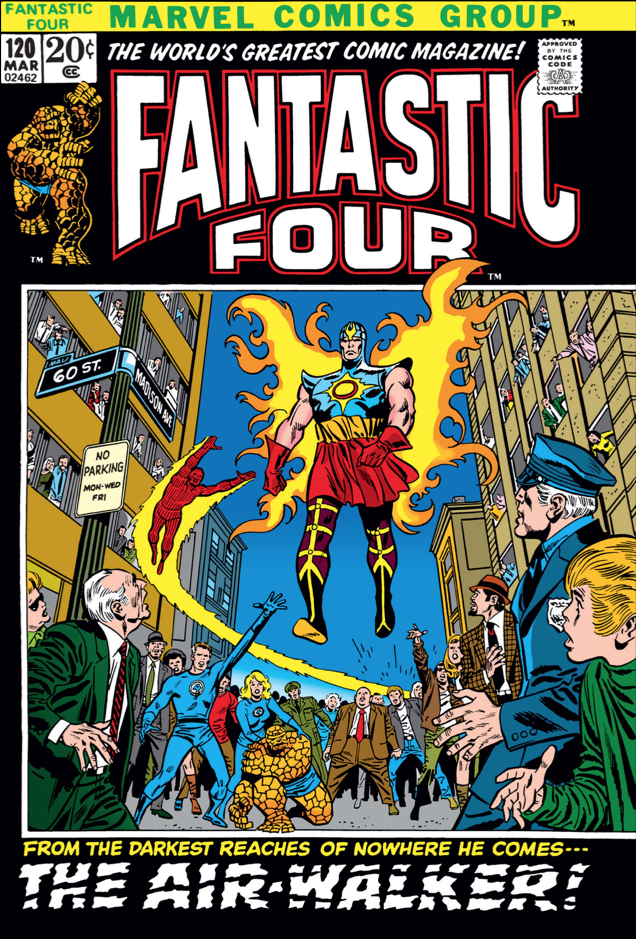
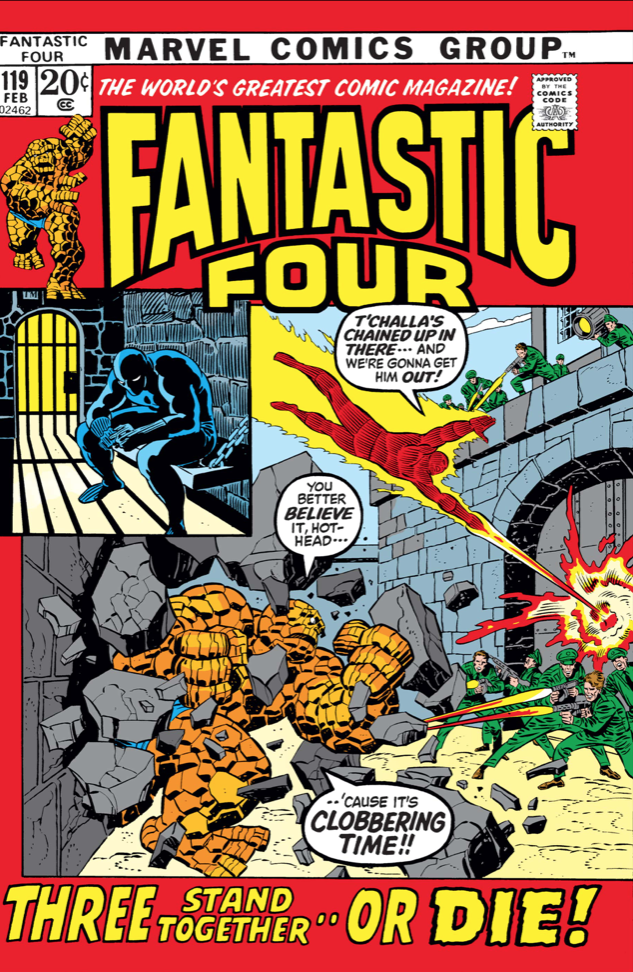
And while I still loathe this cover format, this one looked pretty good.


What I didn’t like

As mentioned, there’s a lot of set up in this issue without much pay off (yet). And the sub-plot / shtick with the FF’s landlord remains tedious.


Overall

I’m reserving judgement until we see how this Air-Walker arc plays out.

“The World’s Greatest Comic Magazine!” Fantastic Four No. 119

Tags

, , , ,

Fantastic Four 119
“Three Stood Together!”
Published: November 1971
Writer: Roy Thomas
Pencils: John Buscema
Inks: Joe Sinnott
Letters: Artie Simek
Editor: Stan Lee
Cover: Buscema and Sinnott

Synopsis

The Thing and Human Torch rescue the Black Panther from a white supremacist prison before all three tangle with Klaw.


What’s going on here?

This is an interesting issue, for a few, interrelated reasons. The main development is that it’s Roy Thomas’s first time writing the FF. By this point in his career, Thomas had been writing a range of Marvel comics, including the X-Men and Avengers, and was Stan’s right-hand man in many ways. He goes on to have his own run on the Fantastic Four but this was a standalone issue for him.

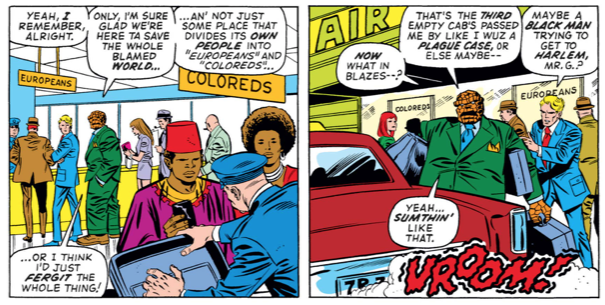
Thomas’s story is surprisingly topical, as Ben and Johnny are summoned to “Rudyarda”—perhaps named after Rudyard Kipling?—a white-supremacist nation bordering Wakanda and clearly modeled after South Africa. Ben and Johnny are offended by the country’s official racism, and it’s brought up several times over the course of the story.

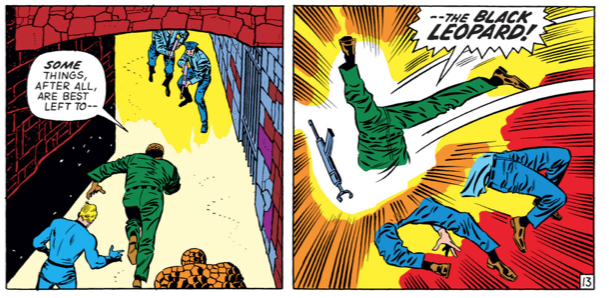
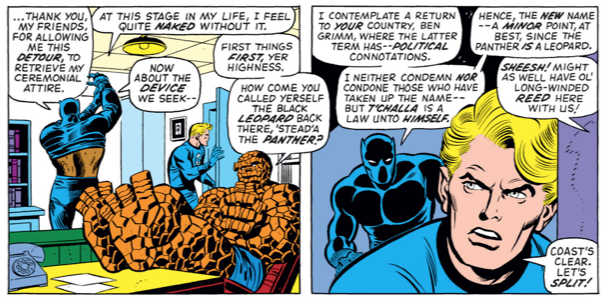
Speaking of current events, this issue also marks a name change for the Black Panther to “the Black Leopard,” specifically to avoid confusion with the activist group in the US. It didn’t last long.

What I liked

There’s a gritty, contemporary quality to the story that’s unusual in the FF, and it’s either to Stan’s credit that he allowed Thomas to take the comic in a new direction—much as he did with Archie Goodwin last issue—or he simply wasn’t paying attention. Either way, it’s feels fresh, which is a good thing after a decade of FF comics.


What I didn’t like

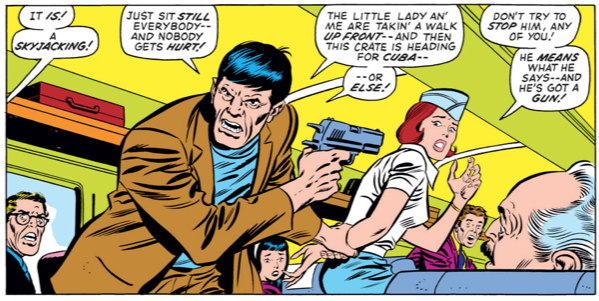
Ben and Johnny take a commercial jet to Rudyarda, which doesn’t make a lot of sense given the fleet at the FF’s disposal, except it sets up a skyjacking scene. The sequence doesn’t add anything to the story—although it allows Thomas to slip in another topical reference—and it takes up space that could be better used elsewhere.

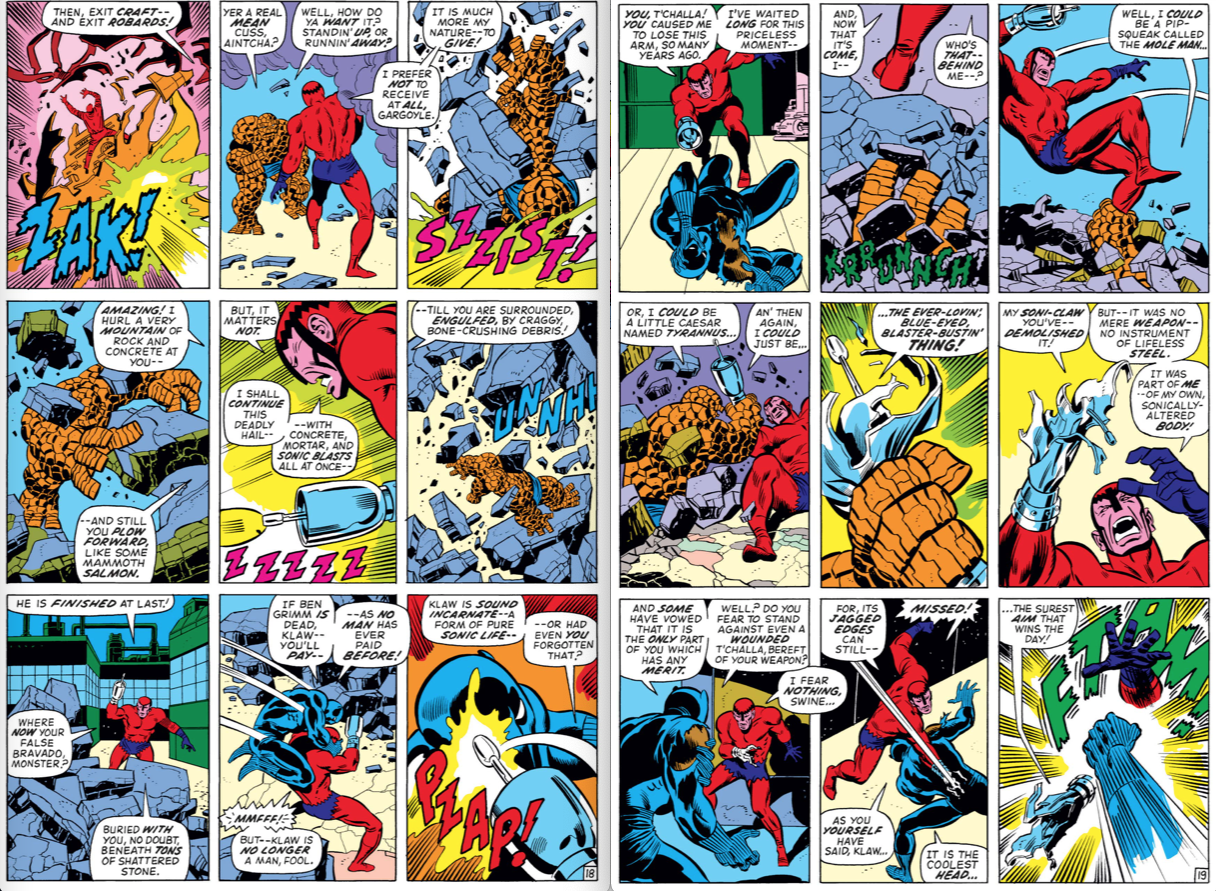
Those two pages could have been used, for example, to give the climactic fight with Klaw some breathing room. As printed, Buscema crammed 18 panels into two facing pages, creating a visual overload that is begging for more space.

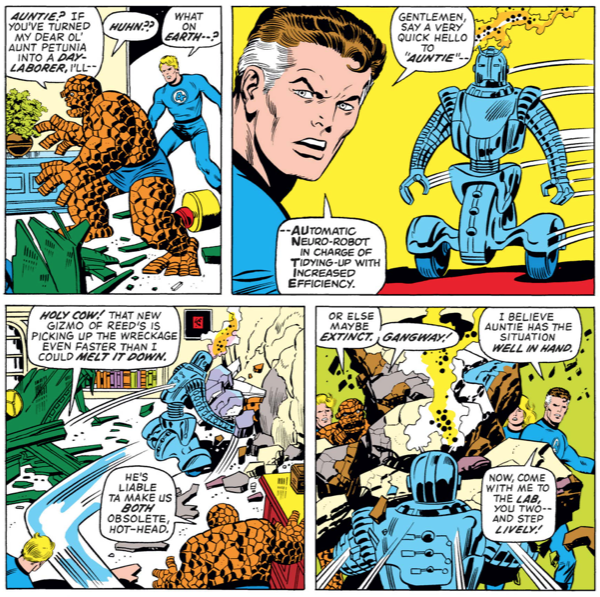
The story also opens with yet another silly fight between Ben and Johnny, and ends with the introduction of this monstrosity, which is clearly paving the way for the dreaded H.E.R.B.I.E. Thankfully, A.U.N.T.I.E. only appears in this one issue. I wish I could say the same about H.E.R.B.I.E.


Also, that cover is terrible. Yuck.

Anything else?

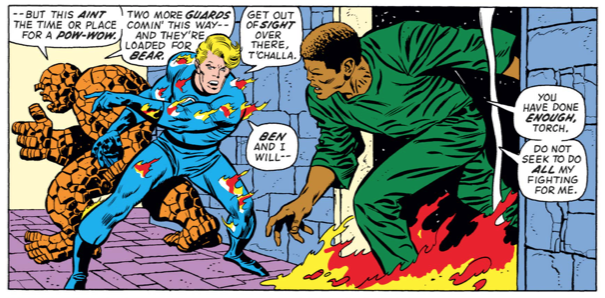
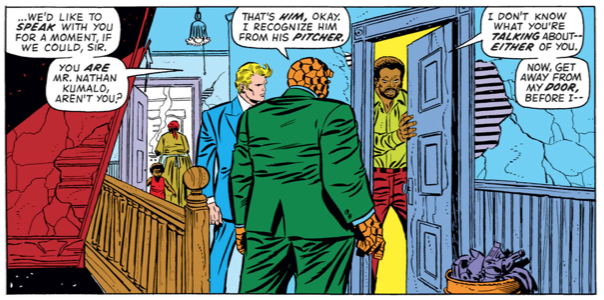
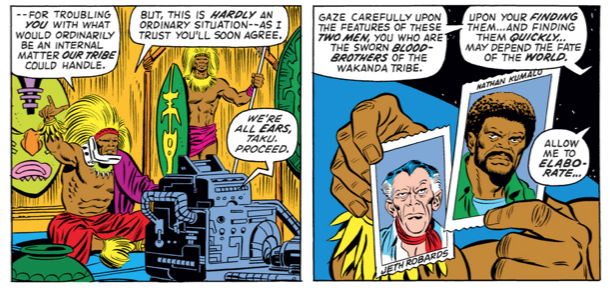
This seems to be a goof, either on the part of Thomas’s script or Simek’s lettering. But it’s pretty clear from the story these thugs are blood enemies of Wakanda, not blood brothers.


Overall

Definitely an interesting comic book.

“The World’s Greatest Comic Magazine!” Fantastic Four No. 118

Tags

, , ,

Fantastic Four 118
“Thunder in the Ruins” and “What Mad World?”
Published Oct. 1971
Writer: Archie Goodwin
Pencils: John Buscema
Inks: Jim Mooney
Letters: Sam Rosen
Editor: Stan Lee
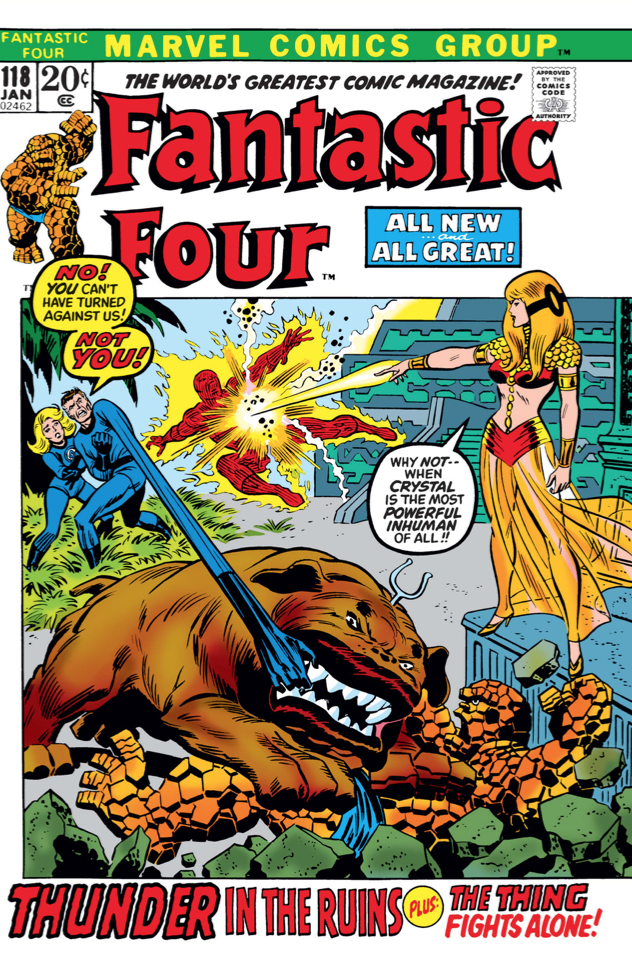
Cover Buscema and John Verpoorten

Synopsis

The Human Torch fights to free Crystal from the mind-control of Diablo, whose scheme to use the Inhuman to take control of a Central American dictatorship is thwarted when the rest of the Fantastic Four arrive. Plus, in a back-up story, Ben Grimm is teleported by Lockjaw to an alternate universe, where he meets another Thing.

What’s going on here?

This is an interesting comic. The main story resolves the Diablo/Terra Verde/Crystal story that began last issue. It’s fine so far as it goes, but there’s nothing particularly interesting happening. Crystal is reunited with Johnny, but we’ll see how long that lasts.

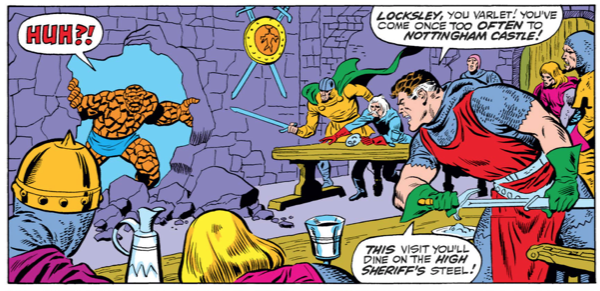
Much more intriguing is the back-up story, where the Thing is teleported by Lockjaw to another reality, not something I was aware could happen. There, Ben lands in a sort of West World-type amusement park created by the Thing of that world, where all the robot villains have the face of Reed. I’m reluctant to give away too much, because it’s there’s a twist that I don’t want to spoil, but it’s a smart, short story that reads like a prototype of What If?, which would debut in 1977.

It’s been a long time since there’s been a backup in a regular-sized FF issue (maybe not since FF 10). I have no idea how it came about but I assume it’s the influence of Archie Goodwin, who came to Marvel from Warren Publishing, where he wrote dozens of stories in Eerie and Creepy magazines. Horror and science fiction were nothing new to him. If the backup was indeed Goodwin’s idea, it’s heartening to see that Stan was relaxed enough about his co-creation to allow Goodwin to experiment with new ideas. It’s also a good reminder that here’s nothing new about multiverse stories. They may be the flavor of the month in the movies, but they’ve been around since at least 1961 and Flash 123.

Also of note, this issue features the Fantastic Four debut of Jim Mooney on inks, who is filling for Joe Sinnott. Mooney was a comic lifer, whose first credit was a story in Mystery Men Comics in 1940, and who was still drawing and inking as last as 2000. This is his only work on the FF as far as I can tell, and he seems to be following Sinnott’s lead.

What I liked

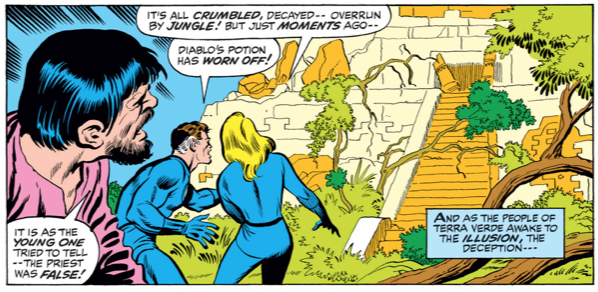
Buscema delivers another steady performance. Nothing too flashy, but more well constructed story-telling. Here’s a good sequence:


What I didn’t like

Nothing? That seems sort of lame, but nothing jumps out as flawed or problematic. As frequent readers know, I am not shy about pointing out faults, either.

Anything else?

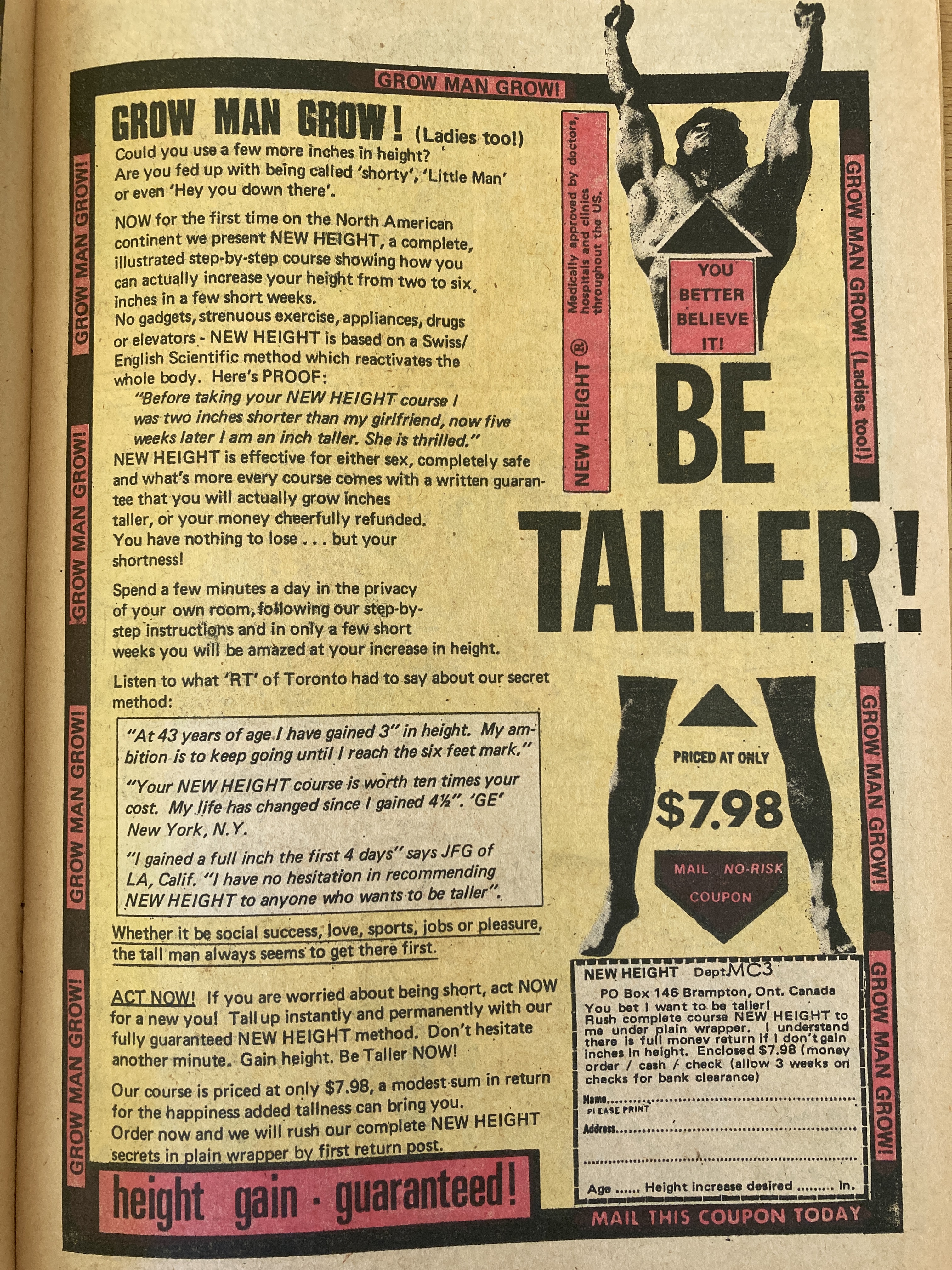
Some interesting ads. The height one is creepy.


Overall

Better than average, thanks to the back-up story,

“The World’s Greatest Comic Magazine!” Fantastic Four No. 117

Tags

, , ,

Fantastic Four 117
“The Flame and the Quest!”
Published Sept. 1971
Writer: Archie Goodwin
Pencils: John Buscema
Inks: Joe Sinnott
Letters: Sam Rosen
Editor: Stan Lee
Cover: Buscema and Sinnott

Synopsis

The Human Torch launches a desperate search for Crystal, and with the help of Agatha Harkness, discovers she has fallen under the control of Diablo, who is using her powers to take control of a Central American dictatorship.


What’s going on here

After the giant-sized extravaganza of last month, it makes sense to have an issue that allows the team and readers (and creators, presumably) a chance to catch their breath. There’s not a lot that’s notable in this issue. Johnny going on a crazed search for Crystal feels pretty familiar at this point, and we’re seeing a lot of Agatha Harkness lately.

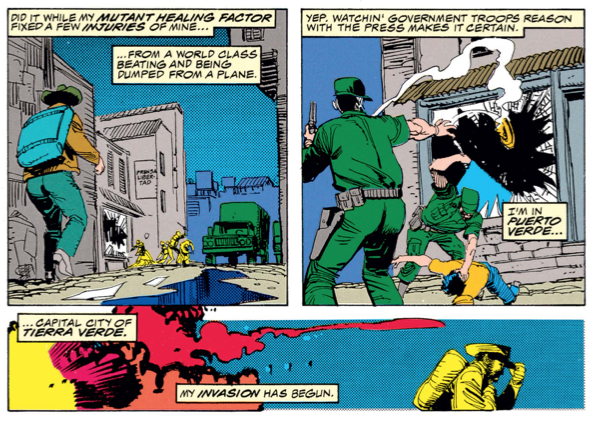
Archie Goodwin returns as the writer and introduces Tierra Verde (called Terra Verde here), a stereotypical banana republic that makes a few appearances over the years, including in Goodwin’s own run on Wolverine in 1989.


On a personal note, this issue was published the day I was born in 1971. Happy birthday to me!
What I liked

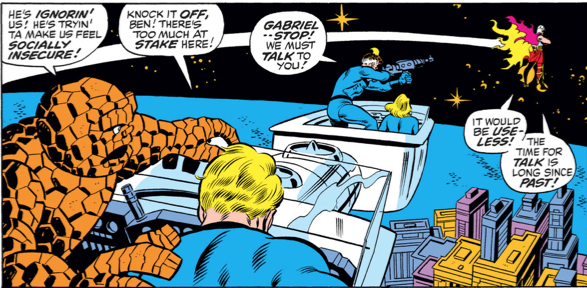
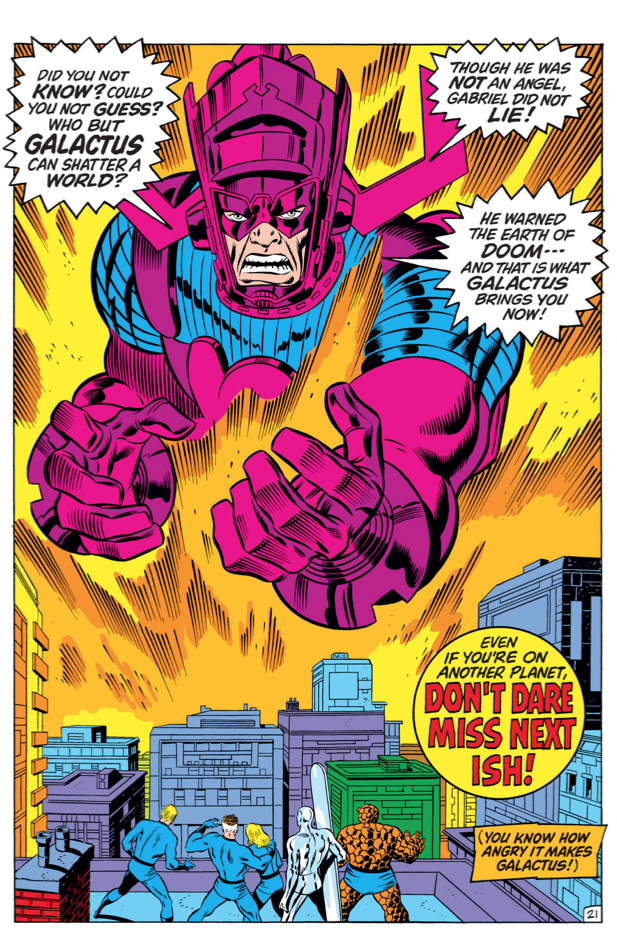
Diablo is a fun villain, and it’s good to see him back. Buscema delivers his usual excellent art, and the story hangs together well.
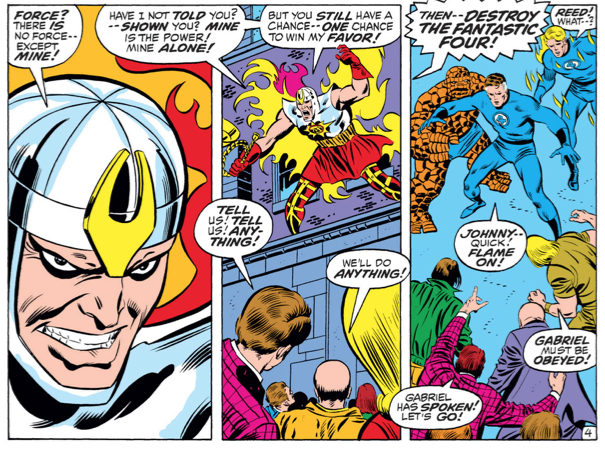
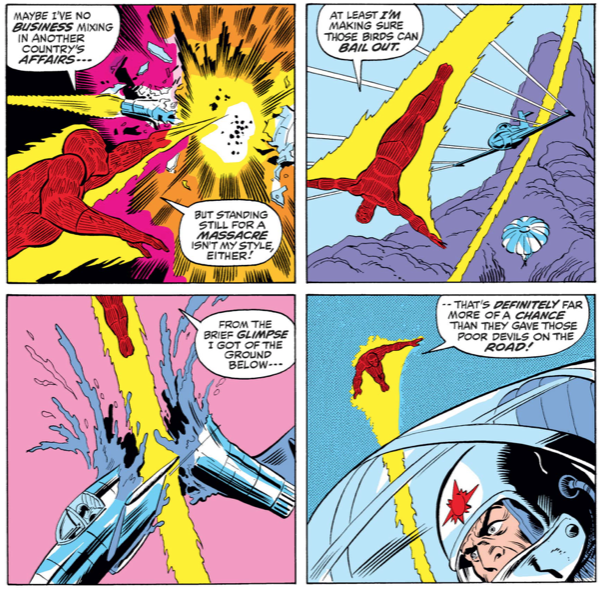
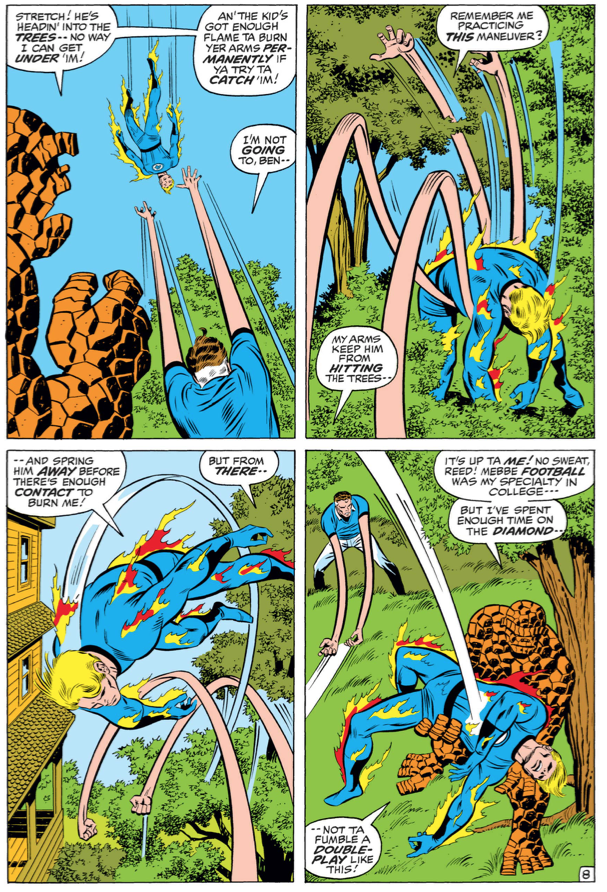
Here’s a fun sequence from Big John:


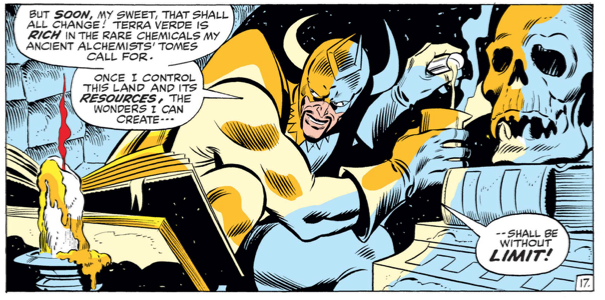
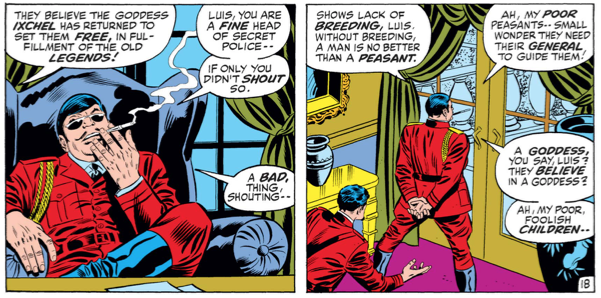
And while it’s a bit of a cliche, I liked the depiction of dictator General Robles and his lackey:


What I didn’t like

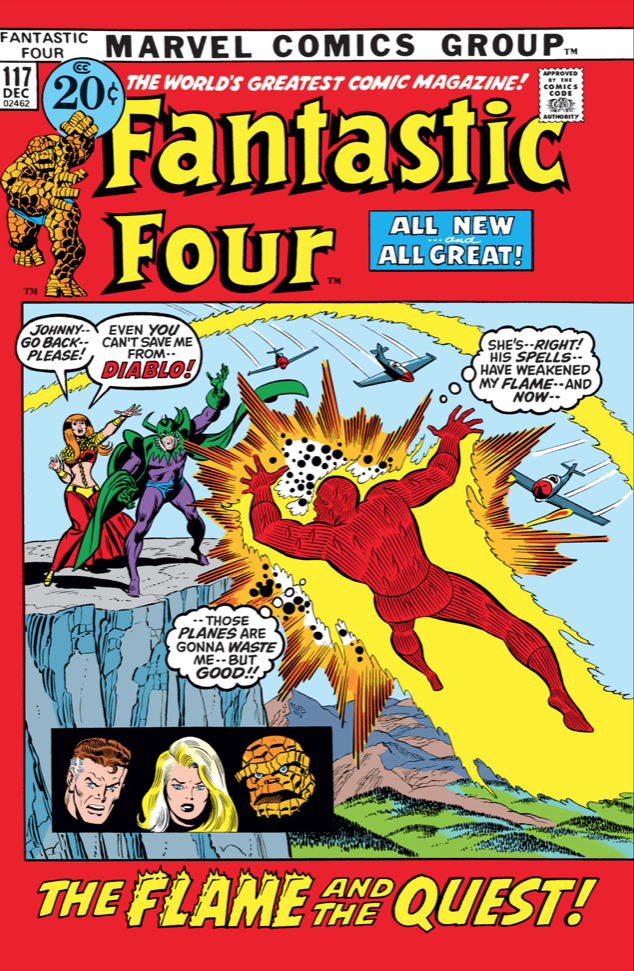
I really dislike this cover format. I better get used to it because it will be with us for another dozen issues or so.

Anything else?

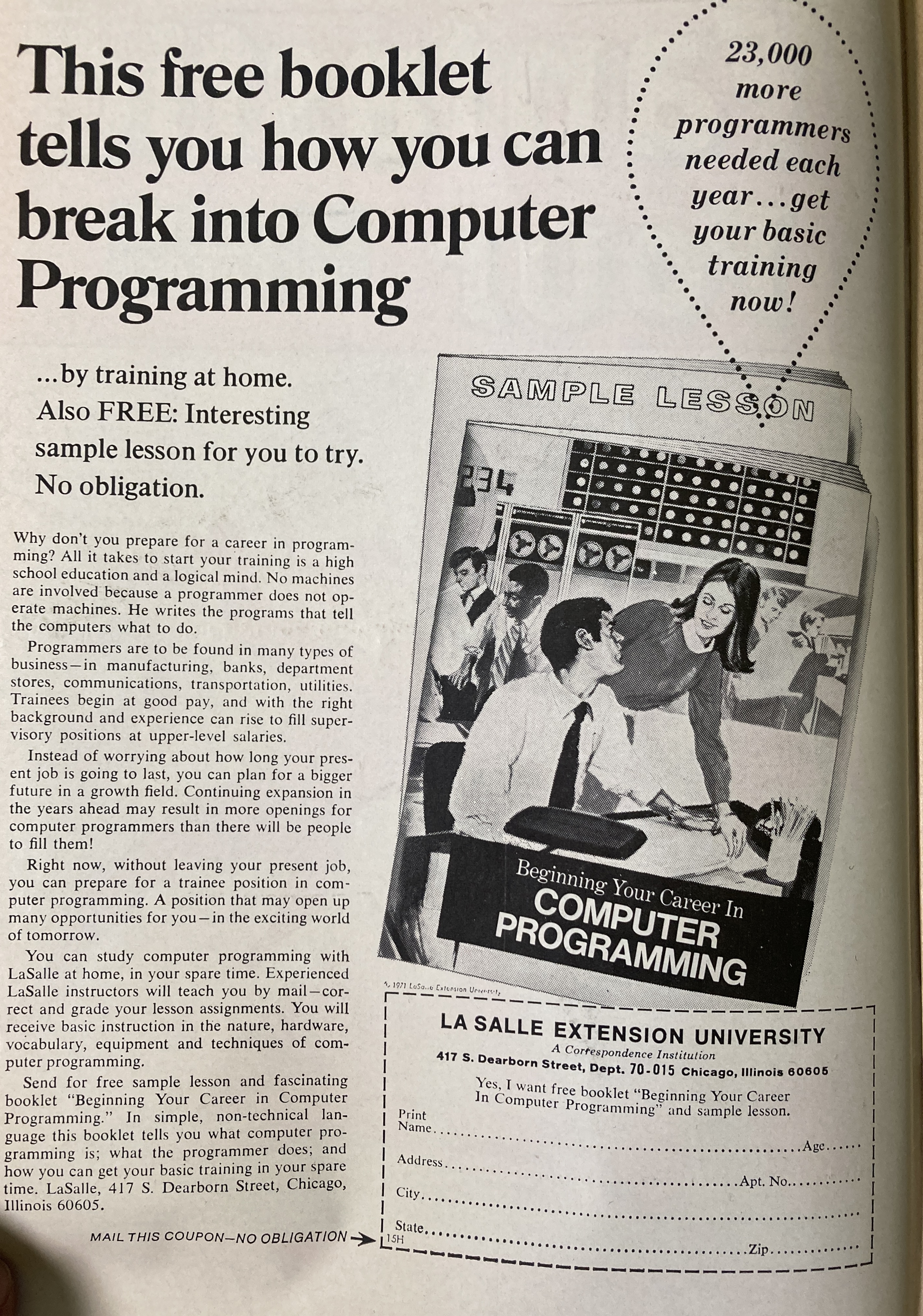
Study computer programming? I dunno, seems like a gimmick to me.


Overall

A perfectly serviceable issue.