• About Percival Henry

Percival Henry: The Fantastic Four and more

~ Blogging the Fantastic Four issue by issue (plus whatever else grabs my attention)

Percival Henry: The Fantastic Four and more

Tag Archives: 1972

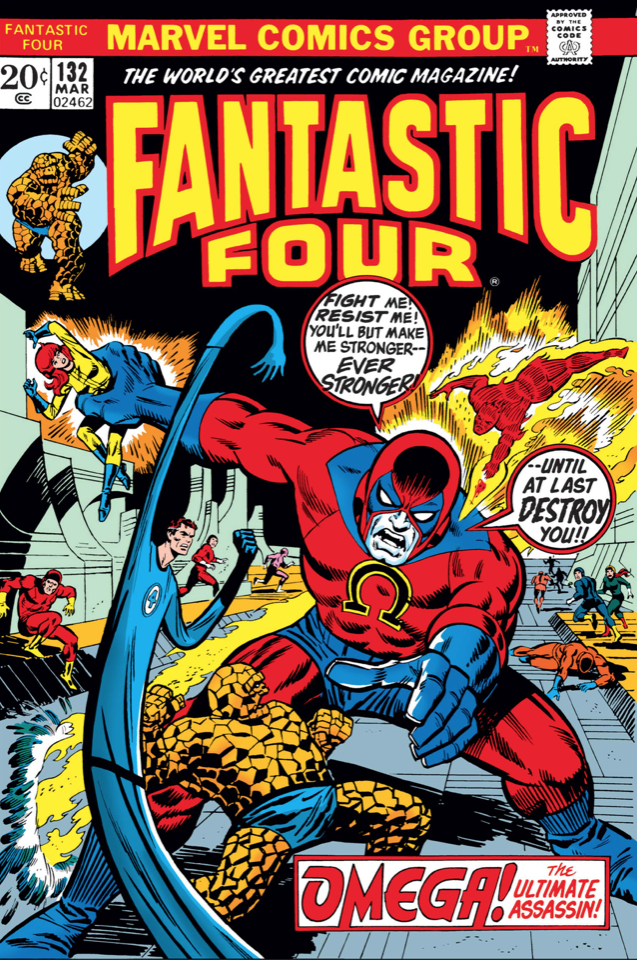
“The World’s Greatest Comic Magazine!” Fantastic Four No. 132

01 Saturday Jun 2024

Posted by percivalhenry in The World's Greatest Comic Magazine

≈ Leave a comment

Tags

1972, Fantastic Four, Fantastic Four 132, Inhumans, John Buscema, Roy Thomas

Fantastic Four 132
“Omega: The Ultimate Enemy!”
Published December 1972
Writer: Roy Thomas
Pencils: John Buscema
Inks: Joe Sinnott
Letters: John Constanza
Colors: Petra Goldberg
Editor: Thomas
Cover: Jim Steranko and Frank Giacoia

Synopsis

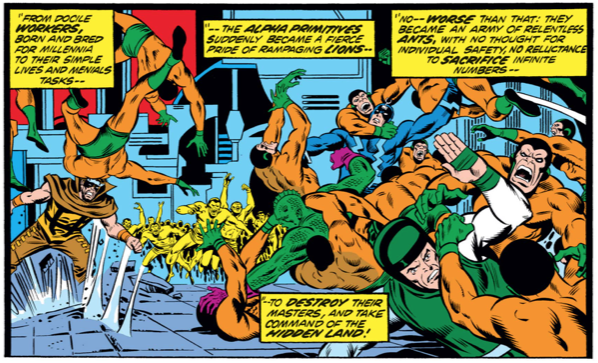
The Fantastic Four (minus the Invisible Girl), Quicksilver and the Inhuman royal family confront the monstrous Omega, later revealed to be the personification of the Inhumans’ racial animus toward the Alpha Primitive underclass. The comic ends with Medusa joining the FF to replace Sue, and Johnny and Crystal breaking up.

What’s going on here

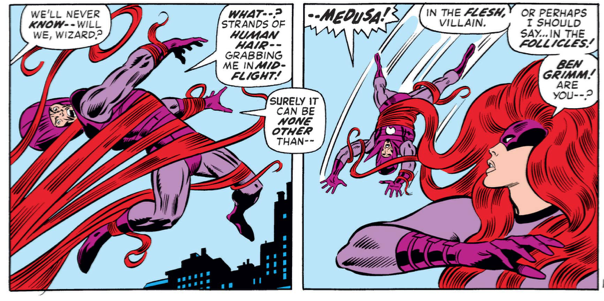
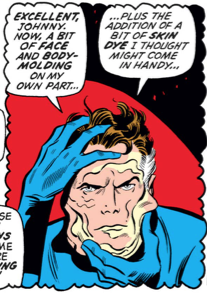
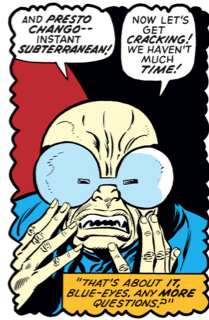
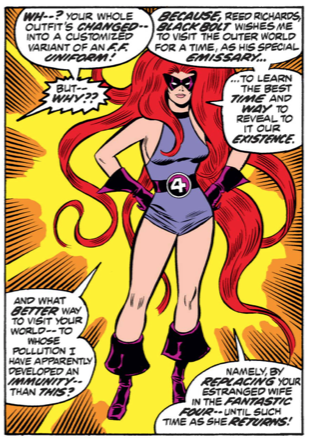
There’s a lot of action and angst in this comic, but the biggest developments come at the end. Medusa joins the team —or to be accurate, declares she is joining the team — in an arrangement that lasts more than 20 issues, a surprisingly long time. Again, it was another decision by Roy Thomas to shake up the status quo he inherited from Stan and inject some new dynamics into the team. Medusa also uses an Inhuman device to generate new costumes for herself and Johnny (Ben passes and when it’s aimed at Reed, nothing changes, which is mildly amusing).
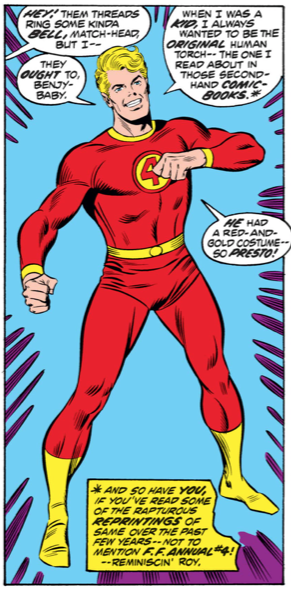
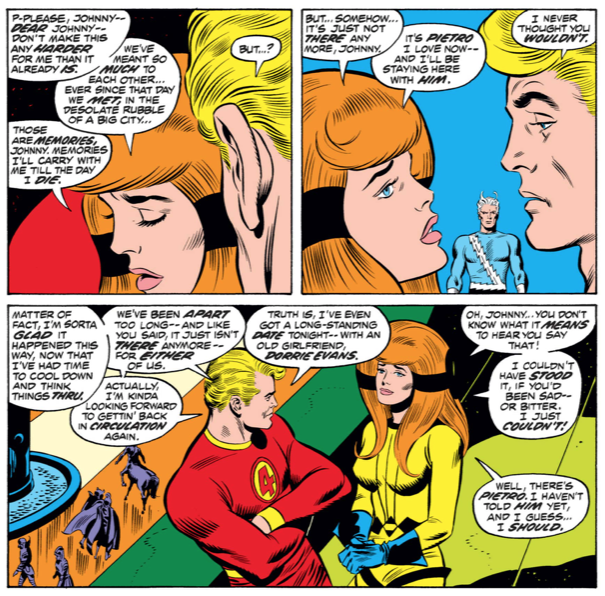
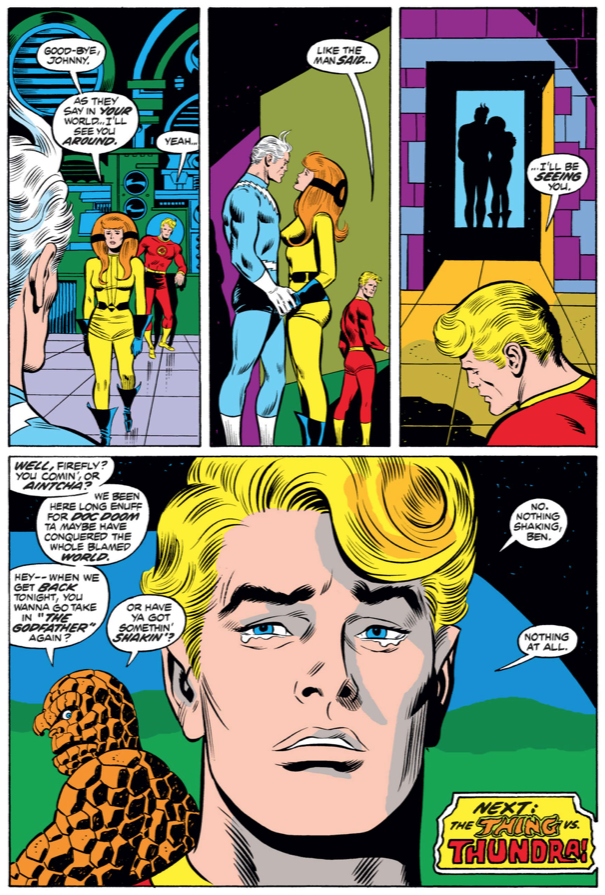
The other major development is the official end of the romance between Crystal and Johnny after approximately 70 issues. Johnny’s obsession with Crystal frequently propelled his character and FF stories, to the point here it seems he had no other interests or character traits. Yet another example of Roy shedding the past for something new.

The cover was by Jim Steranko, with inks by Frank Giacoia, the last, and I think weakest, of the three covers he did to spell John Busecma.

There was also slight change to the interior art, flagged in a letters column an issue or two back: Instead of doing fun pencils, starting in this issue Buscema would be doing rough breakdowns, with Sinnott doing finishes. Since Sinnott had a pretty assertive inking style anyway, I’m not sure how much difference it makes. The change was made to give Buscema time to also draw Conan the Barbarian, giving him four regular books a month (the FF, Conan, Thor and a monster comic, which varied).

What I liked

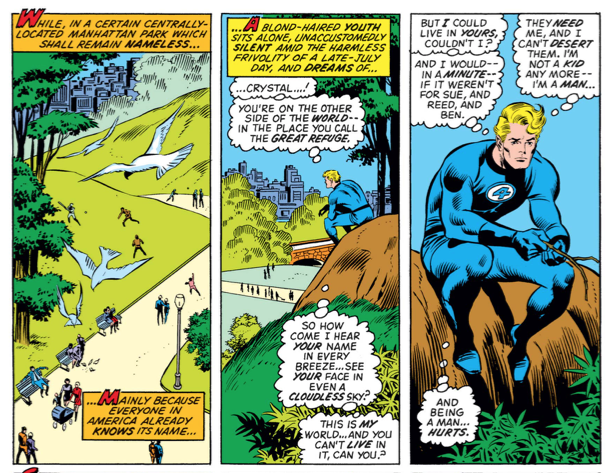
The break-up of Johnny and Crystal was handed with admirable subtlety. Johnny clearly got his anger out last issue, so by the time Crystal tells him its over, he puts on a brave face and even mentions rekindling things with long-forgotten Dorrie Evans. But the final panel says everything. All in all, a pretty mature ending to a significant relationship.
What I didn’t like

In my blog post dealing with the last issue, I took Roy to task for seemingly siding with the Inhumans in their fight to put down the revolt of the Alpha Primatives, their servant class. Given that Roy has skewered South Africa’s apartheid regime in issue 119, championing the oppressors seemed inconsistent at best.

I should have given Roy more credit, because in the end, the Inhumans are shown the error of their ways. Omega, the villain, is powered by the Inhumans’ guilt and racial hatred — it’s not entirely clear which — toward the Alpha Primatives, channeled by a device constructed by Maximus the Mad. But while Roy’s sentiments are laudable, the effort feels ham-handed and falls flat.
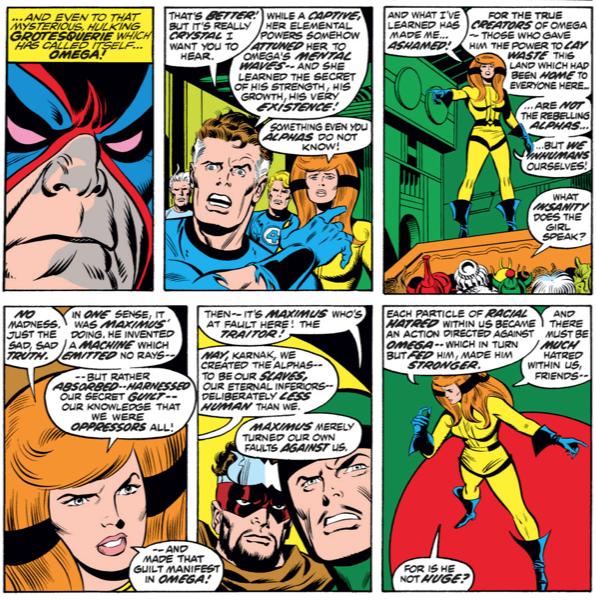

First, leaving aside the implausibility of a machine that turns racial animosity into a living thing, Omega is designed just like a standard super villain, complete with a mask. There’s nothing about him or his powers that suggest his origin or purpose.

Secondly, Reed discovers the secret by eavesdropping on Maximus, who just happens to be ranting about his plan while leaning outside his window. It’s too convenient and not ingenious enough for Reed. And thirdly, of course Maximus is behind it all. If there’s an Inhumans’ story, Maximus is the bad guy. It’s predictable and boring.

Lastly, nothing seems to change. The Alpha Primatives return underground and the Inhumans go on being the superior race. Maybe we’ll learn more about how Inhuman society evolves in future comics but at the end of this issue, all that happens is that Inhumans feel a bit guilty.
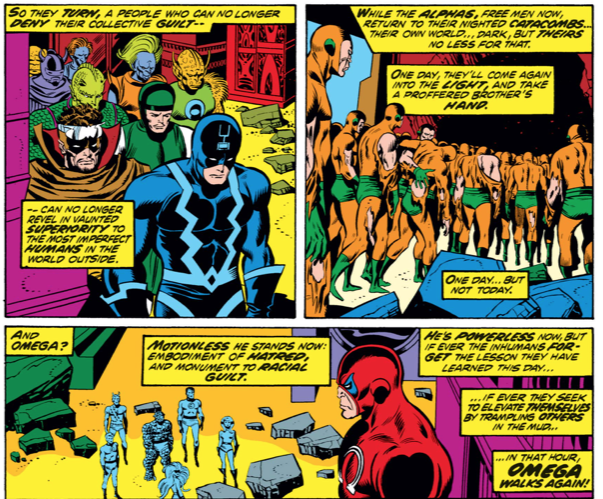

Also, is there a word missing on the cover? “Until Last Destroy You?” I’m sure someone could win a No-Prize explaining that away.


Anything else?

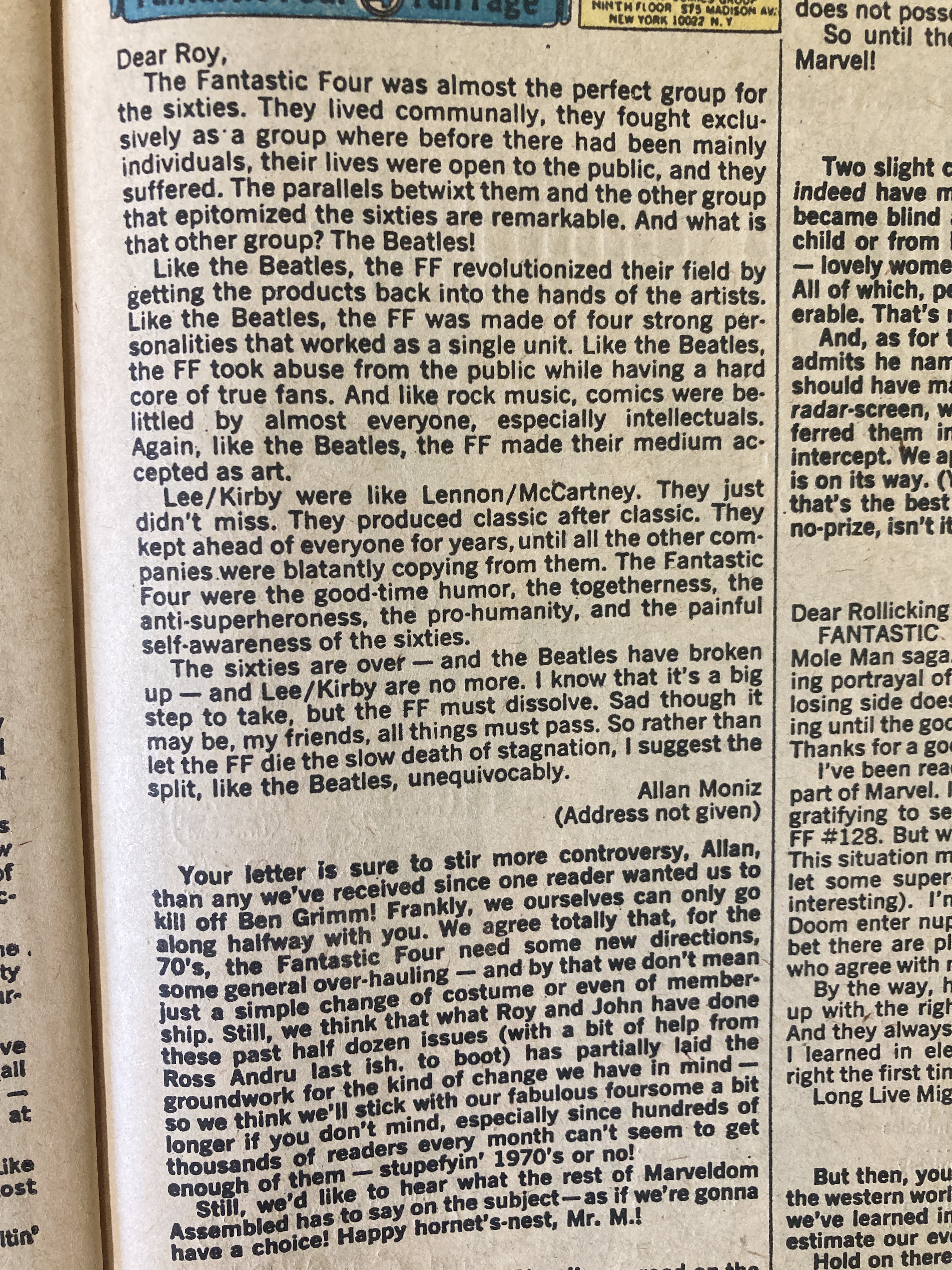
Fun letter comparing the FF to the Beatles. Who is Allen Klein in this analogy?

Overall

A valiant effort that falls short
“The World’s Greatest Comic Magazine!” Fantastic Four No. 131

25 Saturday May 2024

Posted by percivalhenry in The World's Greatest Comic Magazine

≈ Leave a comment

Tags

1972, Fantastic Four, Fantastic Four 131, Inhumans, Roy Thomas

Fantastic Four 131
“Revolt in Paradise!”
Published Nov. 1972
Writer: Roy Thomas
Pencils: Ross Andru
Inks: Joe Sinnott
Letters: John Costanza
Colors: Petra Goldberg
Editor: Thomas
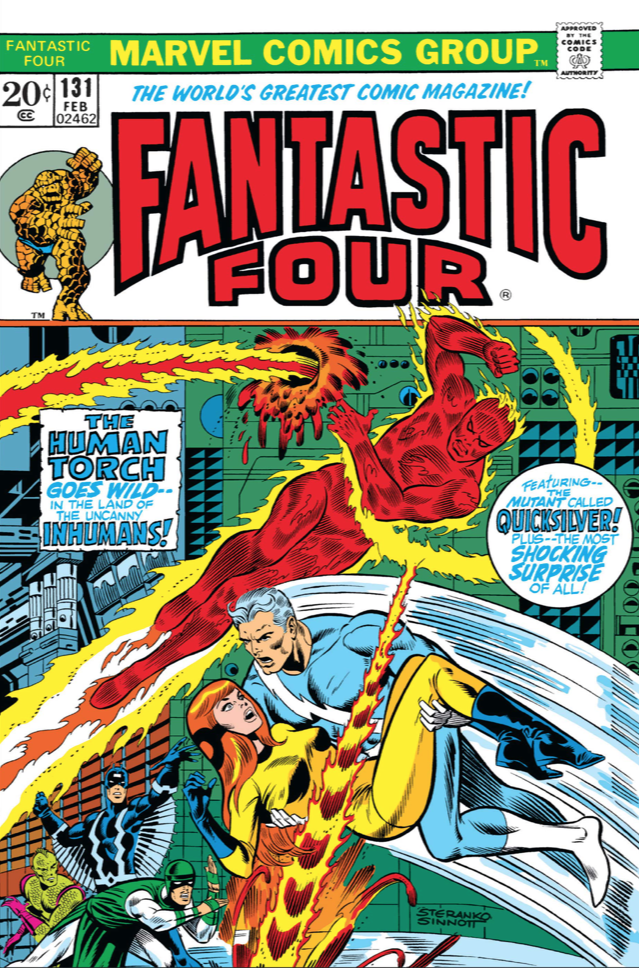
Cover: Jim Steranko and Sinnott

Synopsis

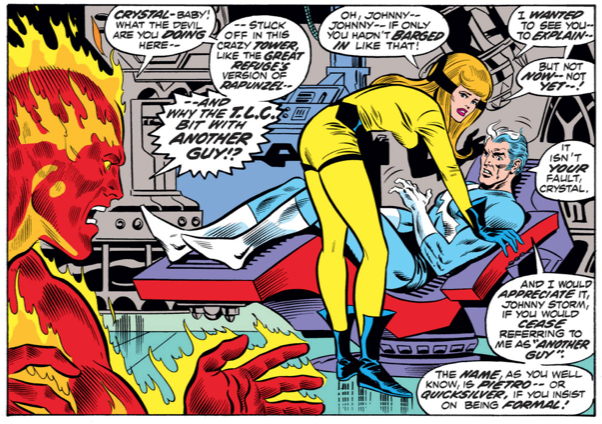
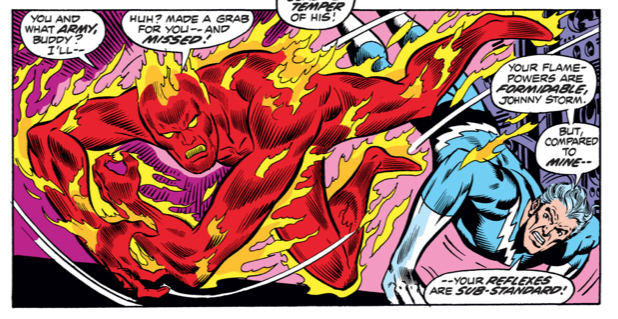
The Human Torch discovers his erstwhile girlfriend Crystal in a romance with the ex-Avenger Quicksilver. Before they can hash it out, the Inhuman stronghold of Attilan is rocked by tremors, and the Alpha Primatives, a race of worker drones, revolt against their overlords.

What’s going on here?

This is another interesting issue. The big development, and one I genuinely didn’t expect, is the reveal of Crystal and Quicksilver’s relationship. Of course, I knew it was coming at some point—their marriage was a major fixture of Marvel comics in the 80s— but since Roy left no clues that this was impending, it took me by surprise (more on this later).

This issue is also notable in that it’s penciled by Ross Andru, who is amazingly just the fourth artist to pencil the FF in 131 issues (after Jack Kirby, John Romita and John Buscema). Andru had been around a long time at this point — his first credits were in 1951, and I think it’s fair to say he’s a bit of a journeyman, although he would go on to have a long and distinguished run on Amazing Spider-Man. This is the only issue of the FF he drew, and was a fill-in issue. Big John was back in the saddle by the next issue (although 133 is also a fill-in). Also, note that is the second of three Steranko covers.


What I liked

The Johnny /Crystal / Quicksilver love triangle is a fun plot twist that accomplishes a couple of things. One, it ties the FF more closely to the rest of the Marvel Universe. Save for about 20 issues in the mid 1960s, when almost every Marvel hero made a guest appearance in the Fantastic Four, the FF have been relatively isolated from other Marvel heroes. The appearance of Quicksilver is a reminder they inhabit the same universe as the Avengers (and the X-Men), and it makes sense that it’s Roy Thomas who cross-pollinated these comics, since at this point he had written all three.

Two, it helps establish the template of Johnny Storm as forever unlucky in love. Crystal may be Johnny’s first romance that fizzled (not counting high school crush Dorrie Evans) but she’s far from the last. Others love interests have included Frankie Raye (who became Nova), Lyja the Skrull (whom he thought was Alicia Masters), Namorita, and most recently Sky, the winged alien. After 60 years, his romantic woes have now become such a part of his character that I wonder if any writer would be willing to have him permanently settle down.

What I didn’t like


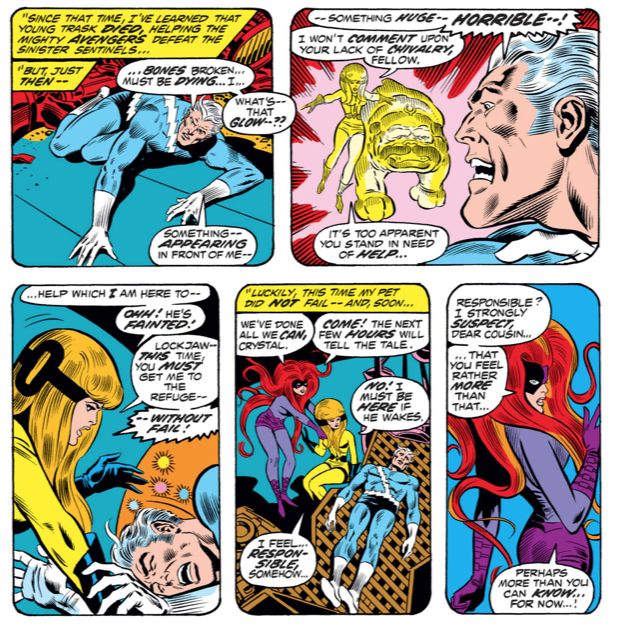
While the Crystal / Pietro relationship is a welcome addition, as far as I can tell, it comes out of nowhere. This comic refers to Avengers 104, as if it explains the beginning of the relationship, but Crystal does not appear there. In that comic, Quicksilver battles a Sentinel while attempting to rescue his sister, the Scarlet Witch, and is left injured in the Sentinels’ lair by the other Avengers , who don’t know he’s there.

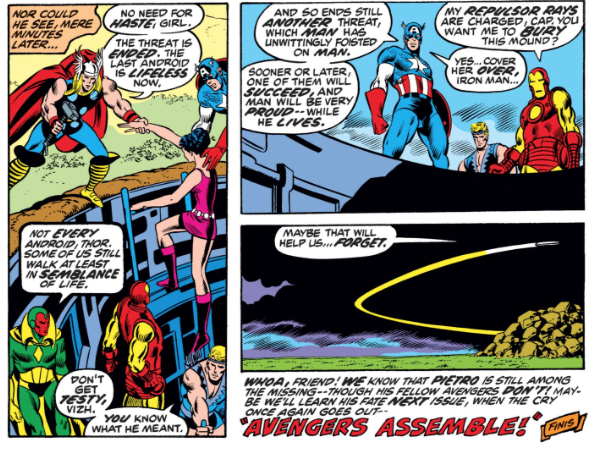
An end note promises that readers will learn his fate in the next issue, but Avengers 105 is Steve Englehart’s first issue, and he takes the comic off in another direction. It’s not until FF 131, which was published five months later, that Crystal’s rescue of Pietro is shown (and is described as a random event).

My guess is that Thomas wanted to resolve his Pietro arc, and saw an opportunity to make life interesting for Johnny at the same time. But if his appearance in this issue surprised me, I can only imagine how FF readers on 1972 must have felt.


Thomas’s handling of the Alpha Primatives is a bit peculiar, too. It’s pretty clear they are subjugated race who live underground and serve as slaves to their Inhuman masters. When they revolt, it’s not depicted as a heroic uprising, but more like an insurrection that needs to be put down. That dynamic is a pretty strong contrast to issue 119, where Thomas very successfully wrote about he evils of apartheid. We’ll see how he handles the Alpha primitives revolt in the next issue.

Anything else

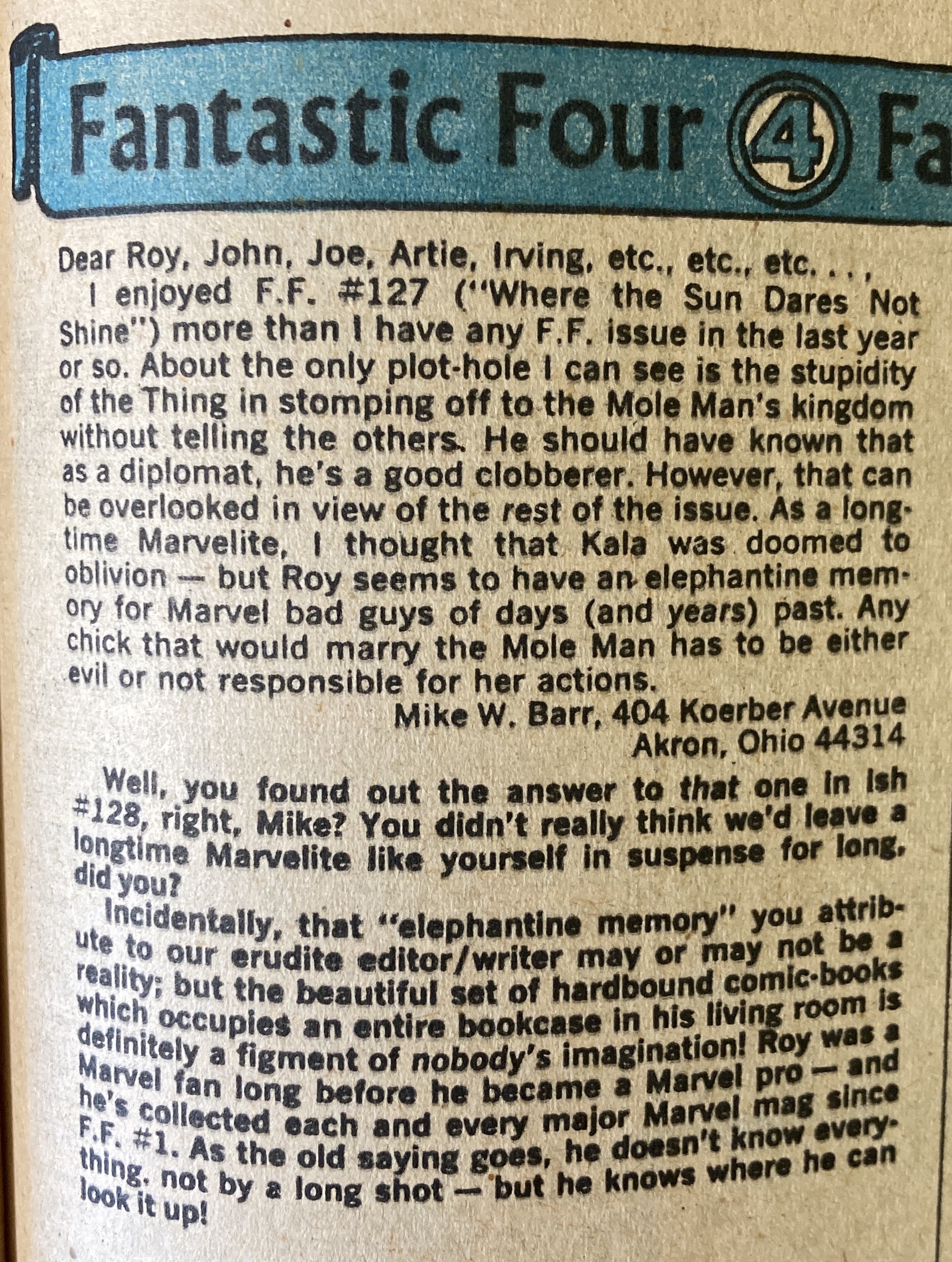
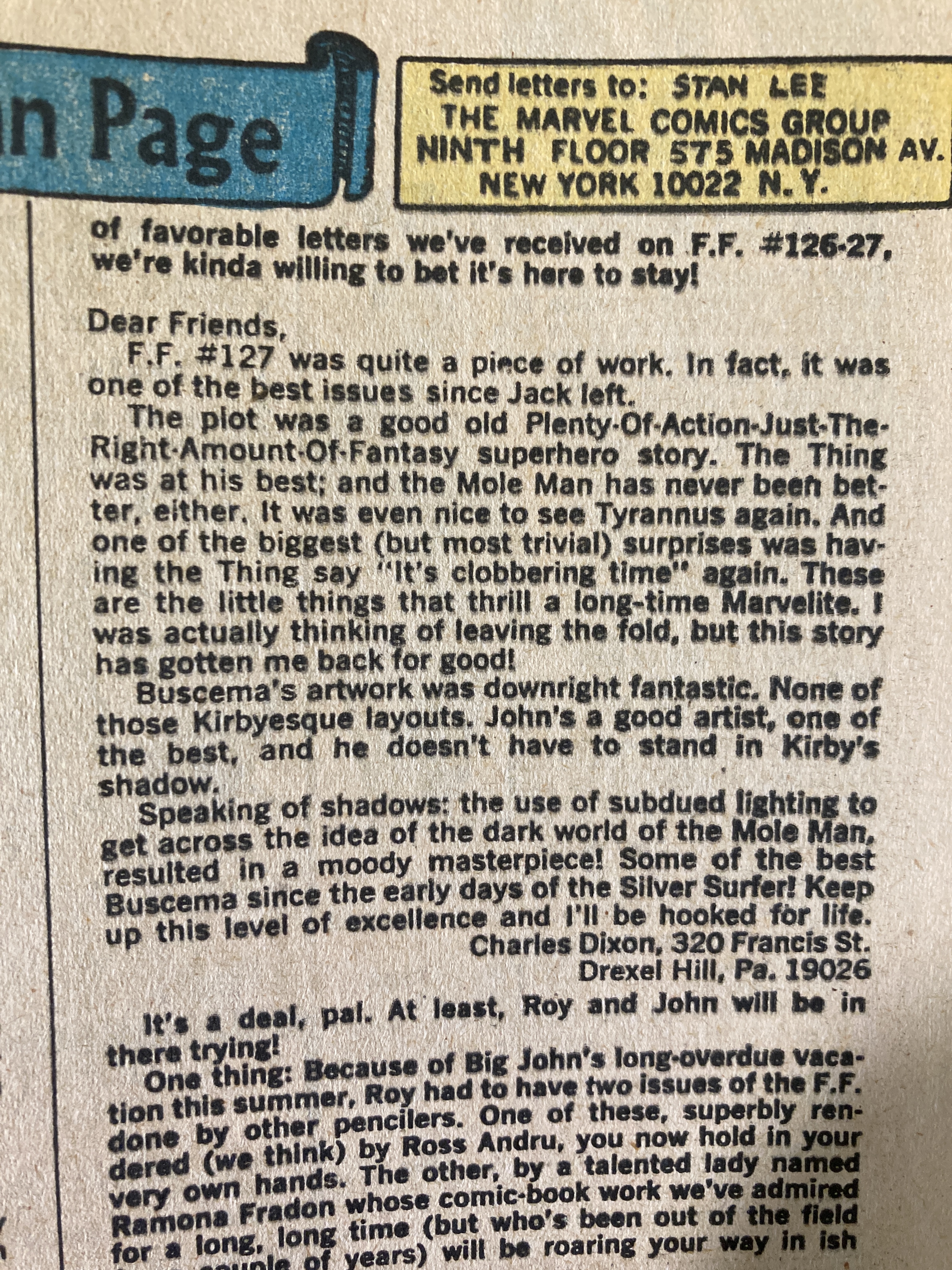
Not one but two letters from future comic writers in this issue: Mike W. Barr (Camelot 3000, Batman and the Outsiders, among others) and Charles “Chuck” Dixon (Punisher, Detective Comics, among others).


Overall

An excellent comic with some issues.

“The World’s Greatest Comic Magazine!” Fantastic Four No. 130

18 Saturday May 2024

Posted by percivalhenry in The World's Greatest Comic Magazine

≈ Leave a comment

Tags

1972, comics, Fantastic Four, Fantastic Four 130, John Buscema, Marvel, marvel-comics, Roy Thomas

Fantastic Four 130
“Battleground: The Baxter Building!”
Published Oct. 1972
Writer: Roy Thomas
Pencils: John Buscema
Inks: Joe Sinnott
Letters: Artie Simek
Colors: Petra Goldberg
Editor: Thomas
Cover: Jim Steranko and Sinnott

Synopsis

After subduing the Thing and Meduasa, the Frightful Four—reconstituted with Thundra—take on the rest of the Fantastic Four, minus the Human Torch, in the Baxter Building and are saved only by the awakening of Franklin’s powers. In the aftermath, Sue declares she is leaving the team. Meanwhile, in the Himalayas, the Torch confronts the Inhumans, where a secret concerning Crystal is revealed to him.


What’s going on here?

This is a jam-packed issue, with big developments in the story, and some smaller ones outside it. From an amateur-comic-historian’s perspective, it’s notable for being the first Fantastic Four issue to credit a colorist, in this case, Petra Goldberg.

The history of comic book coloring is complicated, and the technology evolves dramatically over time. But my understanding is that in the 60s, 70s and 80s, the colorist would identify what colors were needed (always a combination of cyan, magenta, yellow and black) and where they would go. They would make notes on the art (or actually color copies of the pages) that would then be used by a color separator at the printer as a guide. Because of the limitations of the process—at most, only 64 possible colors are available—and because the colorist didn’t directly work on the art like a penciler and inker, it seems they were viewed less like artists and more like technicians. Hence, they were not credited. (A pretty good explanation of all this can be found in this Comic Tropes video).

I don’t think it’s a coincidence that this changed soon after Roy Thomas became editor. Thomas also instituted an “editor” credit—here used for himself—and seemed more interested than Stan Lee in assigning proper credit where it was due (a longtime issue with Stan that we know came to haunt him).

Recall, the first issues of the Fantastic Four had no credits all, just the signatures of Stan Lee and Jack Kirby. And when credits first appeared, they were very scant and presented almost as an after thought (this is FF 10):

By FF 130, the credits for all the main creators were in place and they pretty much remained this way for decades. Note Stan Lee’s presenting credit is now his signature. That began with the previous month’s issues, and I neglected to mention it.


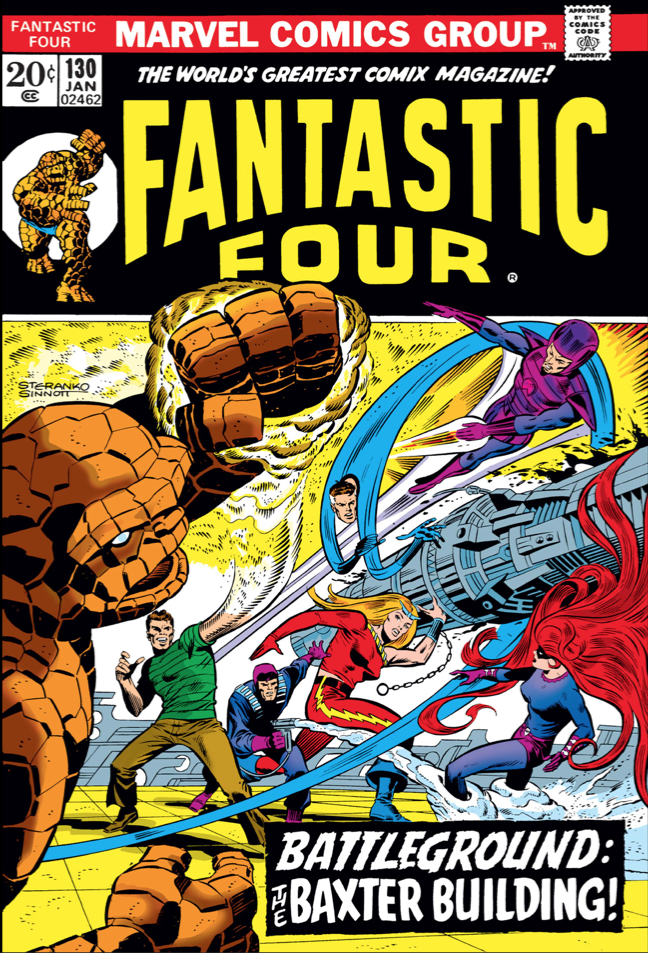
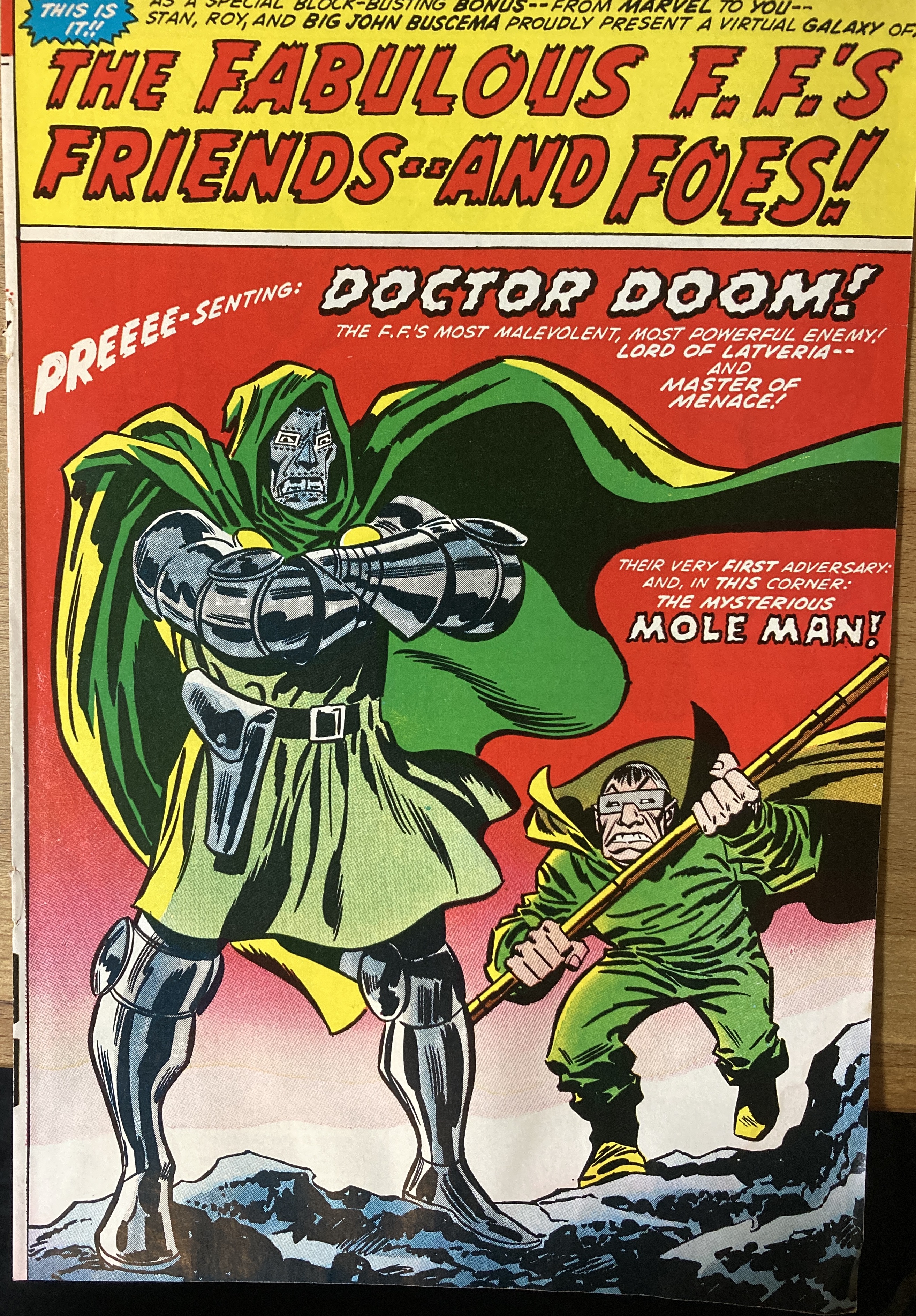
Also notable is that Jim Steranko penciled the cover for this issue (which is probably why the Sandman looks so much like Nick Fury). I’m not sure it’s a particularly great cover, but anything by Steranko is worth paying attention to. This is the first of three covers he did for the Fantastic Four, and are the only things he ever did with the FF during his short career.
What I liked

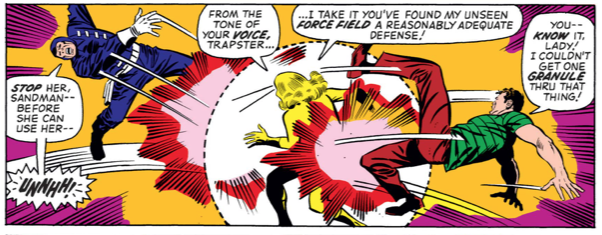
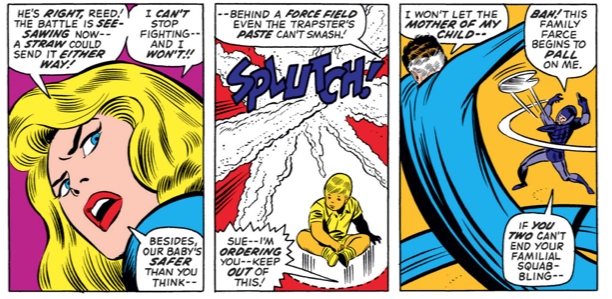
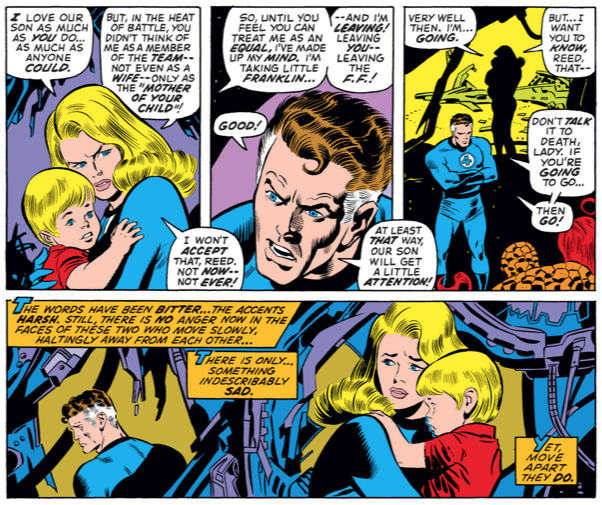
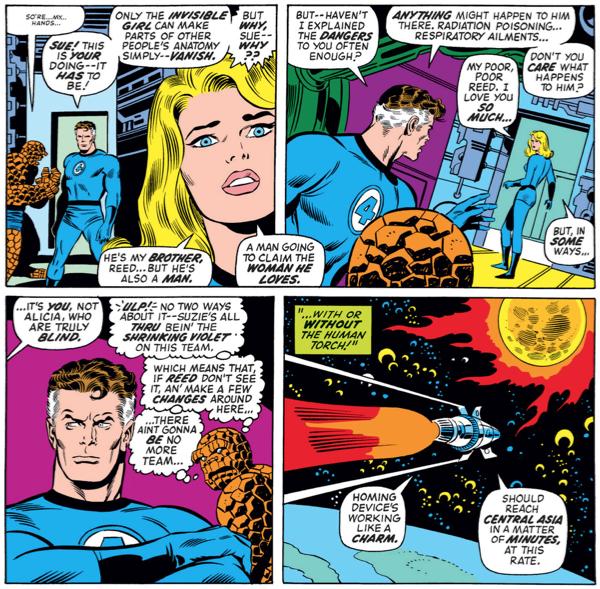
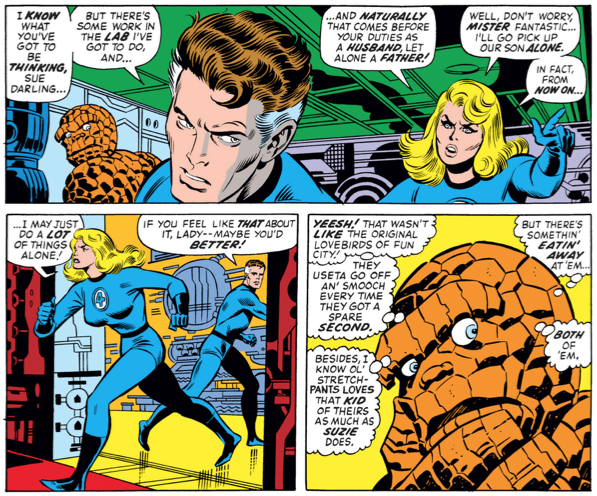
A big—but not the biggest—in-comic event in FF 130 is Sue’s decision to leave the team. This has been brewing for a few issues, and through Thomas’s writing she has voiced her displeasure with Reed and his constant demands that she be sidelined to look after Franklin.

Here, she again raises those objections and he again tries to shut her down:


It finally boils over in the last page, featuring more jerk-like behavior from Reed:


Obviously, this doesn’t stick and she eventually returns. But her departure feels like a significant milestone in the development of Sue’s character, and, perhaps, in Thomas’s repudiation of the status quo he inherited from Stan. Thomas has been writing Reed pretty much the same way Stan and Jack did for a decade, but only under Thomas did Sue finally say, enough.

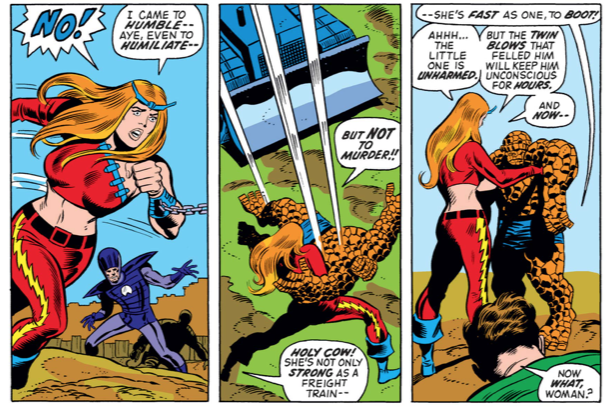
Speaking of gender dynamics, I also liked how Thomas played with cliches and stereotypes through Thundra, the Femizon from another dimension where women dominate men. Here, she picks up Ben like a doll:


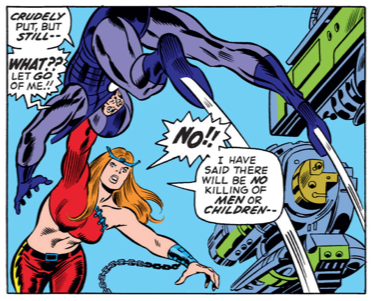
Or here, where she refers to “men and children:”


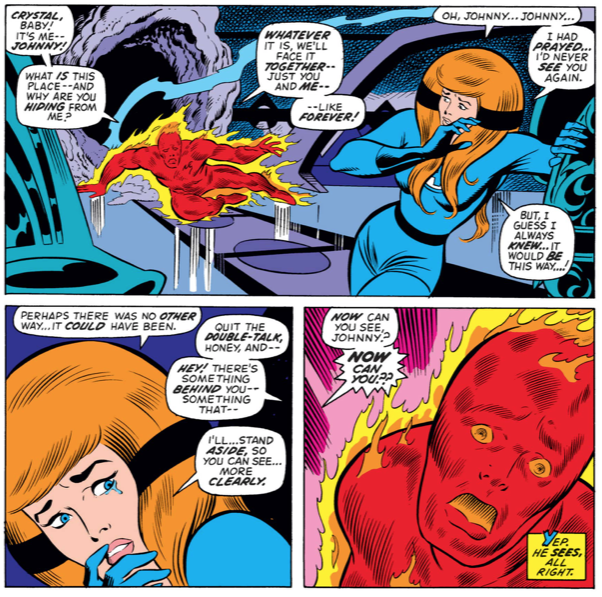
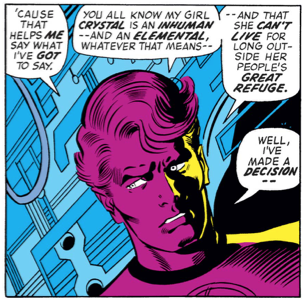
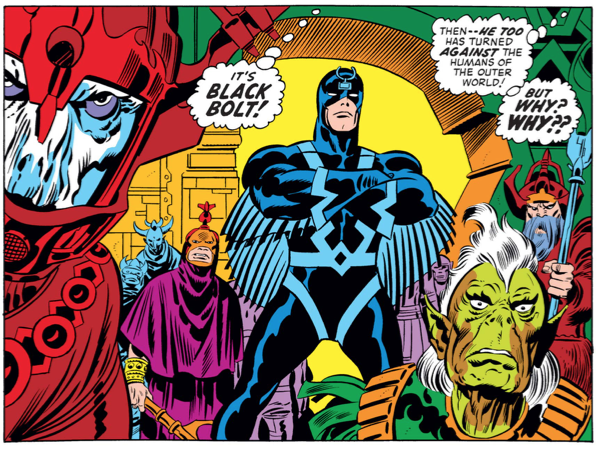
Thomas also created an interesting and suspenseful sidebar with the Human Torch and Crystal. I legitimately have no idea what he sees here (we have to wait until next issue):


The Inhuman subplot is another example of Thomas’s skill as a storyteller. There’s an awful lot going in in the main plot, yet he’s able to jump out and devote a few meaningful pages to the Johnny/Crystal dynamic that builds character and sets up future arcs, all without distracting from the bigger story. Further evidence that the FF is in very good hands.

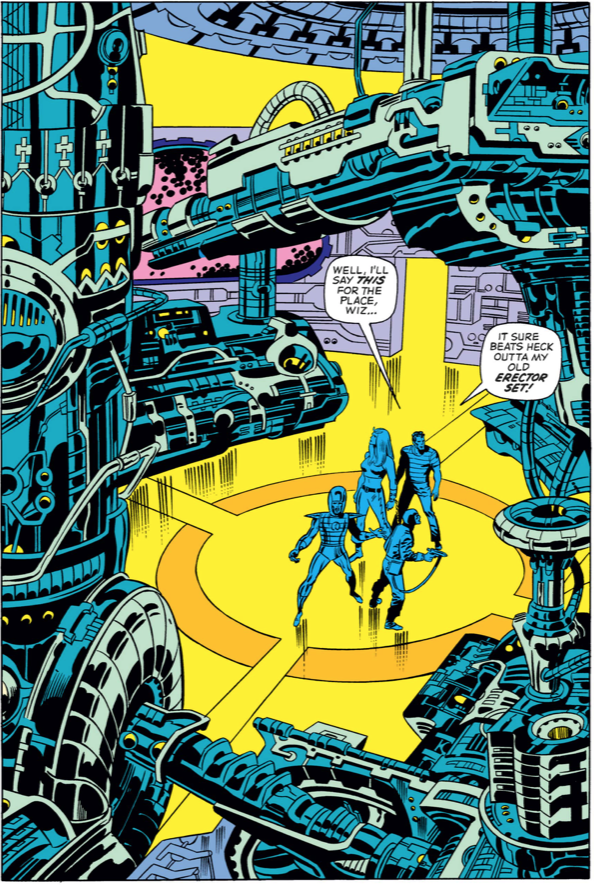
Oh, and I would remiss if I didn’t point out this jaw-dropping splash page from Big John. It doesn’t have a big impact on the plot, but it seems like it’s a fun opportunity for him to flex his Kirby muscles.


What I didn’t like

The biggest in-story development in FF 130 is the awakening of Franklin’s powers. Although hinted at a few issues ago, this is the first real manifestation of them.

In the bounds of this issue, it’s fine and I imagine for readers at the time, it must have been pretty cool. But it opened the door for decades of stories about Franklin’s powers that, on the whole, have been unsatisfying, confusing and distracting. No two writers seem to agree what to do with Franklin, and while some have embraced him as a mutant with god-like powers—Jonathan Hickman had him creating whole universes—others would be happier if he was just a kid. Dan Slott depowered him and Ryan North has a goofy retcon that has him using his powers one day a year.

I am sure Thomas didn’t know the can of worms he was opening up here, but the does-he -or doesn’t-he nature of Franklin’s powers been a perennially frustrating aspect of the Fantastic Four

Also, thumbs down for the story title—”Battleground: Baxter Building”—a combination of words which has been used probably a dozen times.

Anything else?

Some more ads for cool toys:


Overall

An excellent comic. Roy’s best to date.

“The World’s Greatest Comic Magazine!” Fantastic Four No. 129

11 Saturday May 2024

Posted by percivalhenry in The World's Greatest Comic Magazine

≈ Leave a comment

Tags

1972, Fantastic Four, Fantastic Four 129, John Buscema, Roy Thomas, Thundra

Fantastic Four 129
“The Frightful Four .. Plus One!”
Published Sept. 1972
Writer: Roy Thomas
Pencils: John Buscema
Inks: Joe Sinnott
Letters: Artie Simek
Editor: Thomas
Cover: Buscema and Frank Giacoia

Synopsis

Intending to marry Crystal, the Human Torch leaves the team for the Great Refuge and is captured by Inhumans. Meanwhile, The Thing is ambushed by the Frightful Four and while one-time member Medusa comes to his aid, Thundra, a new member, attacks.


What’s going on here

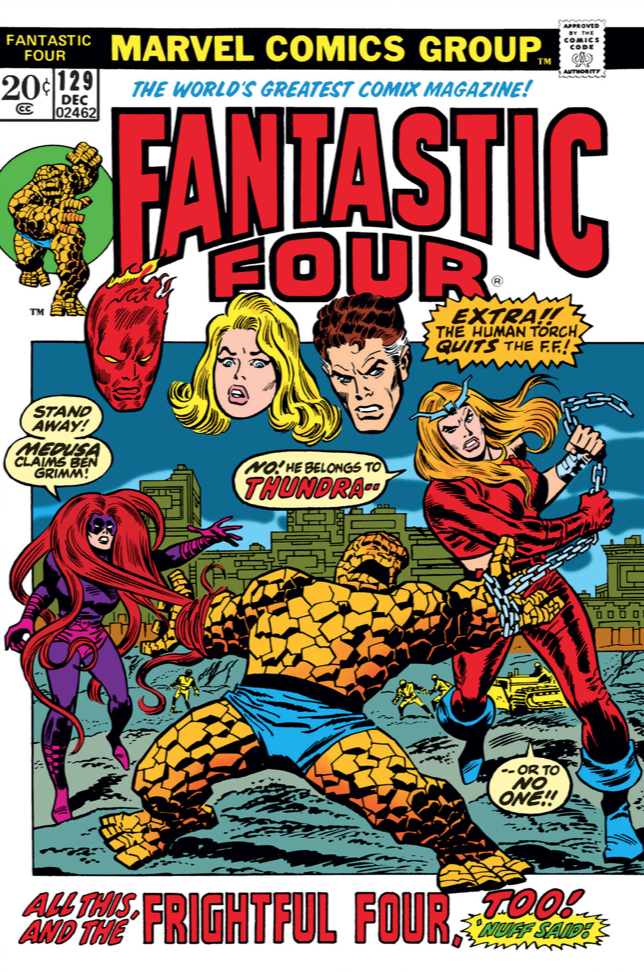
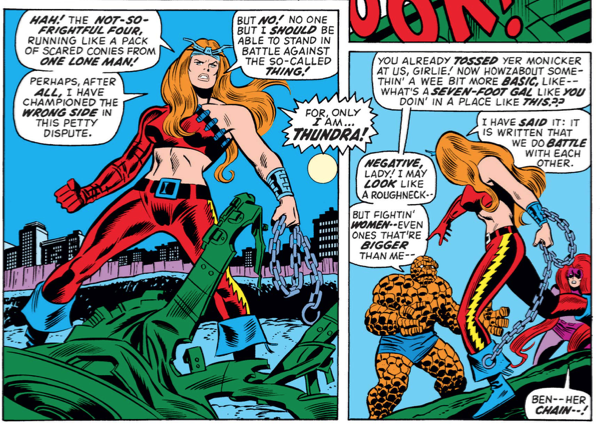
Fantastic Four 129 is probably most notable for the introduction of Thundra, the powerful, seven-foot warrior from an alternate Earrh called Femizonia. As a character she’s part Wonder Woman, part Big Barda and part pandering to the women’s liberation movement of the 1970s. As befits Thomas, her backstory is long and elaborate, and will unspool over the next few years as she becomes a semi-regular character in the Fantastic Four during this era. More recently she goes on to have a big role in the Hulk.

From a design perspective, she’s pretty cool looking and her presence adds an interesting dimension to the FF, where gender norms have been enforced by the very macho male members and the very feminine Sue and Crystal.


Speaking of Sue, her liberation under Thomas’s writing is becoming more pronounced. In two sequences, she puts Reed in his place in a way that would been unheard of in a Stan Lee-written book.

Here, she lets Johnny escape the team to join Crystal:

(I love the look on Reed’s face)

And here, she lets Reed knows what she thinks of his priorities while Ben looks on in amazement:


What I liked

I don’t pay Joe Sinnott’s inks enough attention and I should. I love this panel, which is obviously enhanced by the colors (at this point Marvel wasn’t naming colorists so I have no one to credit).


And this Buscema panel is wonderfully Kirby-esque:


What I didn’t like

Ben’s fight with the Frightful Four felt a bit too by-the-numbers, and the appearance of Medusa didn’t make much sense (and is not explained). Is it just a coincidence a former member of the Frightful For shows up just when Ben needs her help to fight them? Is her appearance related to Johnny’s trip to the Inhumans? Who can say?

Anything else?

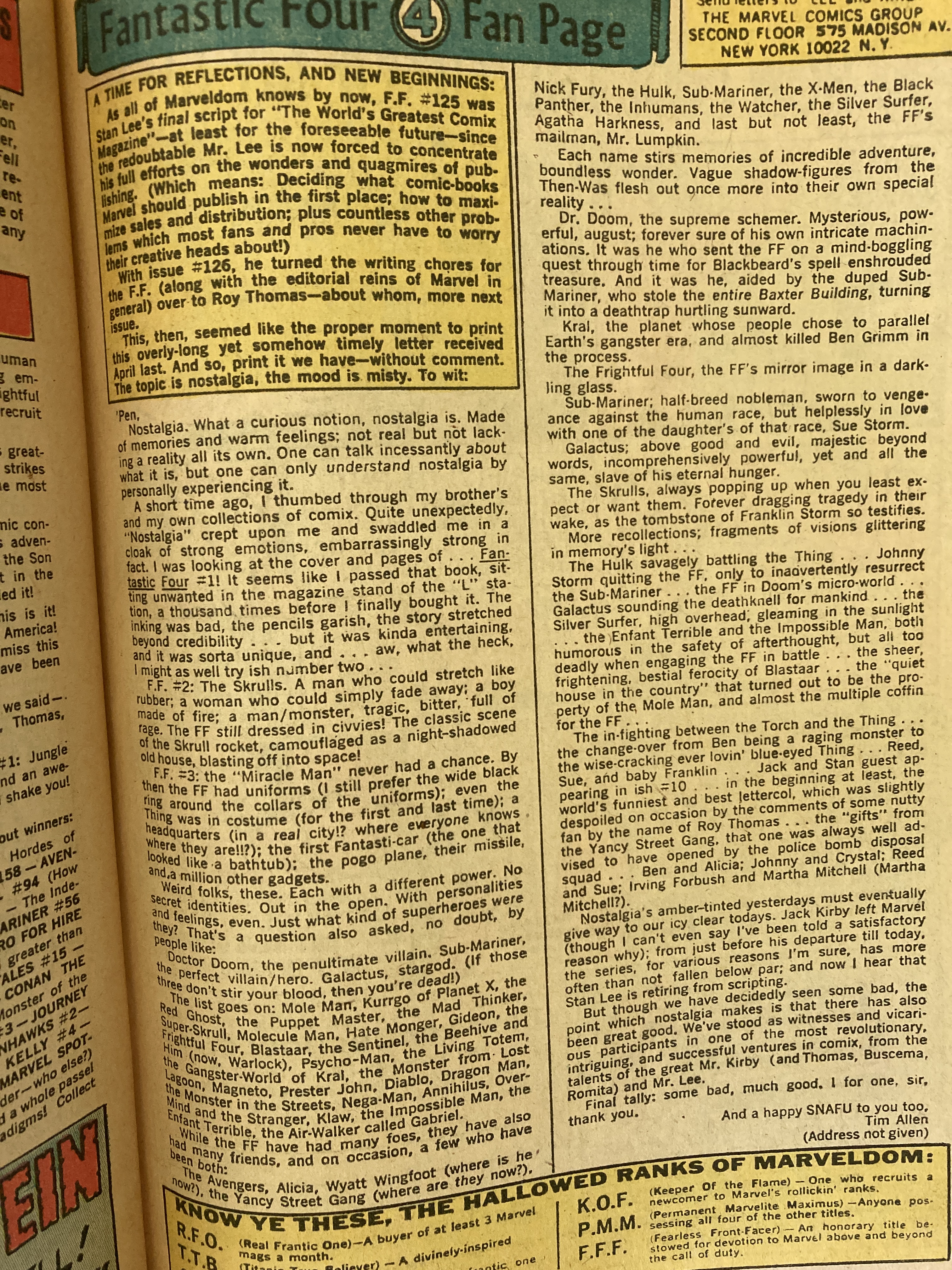
The letters page is devoted entirely to one very long, tortured letter summing up the Stan Lee ear, by a writer named Tim Allen. Unclear if it’s the Tool Time guy.


Overall

Another solid effort from Roy, John and Joe.
“The World’s Greatest Comic Magazine!” Fantastic Four No. 128

05 Sunday May 2024

Posted by percivalhenry in The World's Greatest Comic Magazine

≈ Leave a comment

Tags

1972, Fantastic Four, Fantastic Four 128, John Buscema, Mole Man, Roy Thomas

Fantastic Four 128
“Death in a Dark and Lonely Place!”
Published Aug. 1972
Writer: Roy Thomas
Pencils: John Buscema
Inks: Joe Sinnott
Letters: Artie Simek
Editor: Thomas
Cover: Buscema and Sinnott

Synopsis

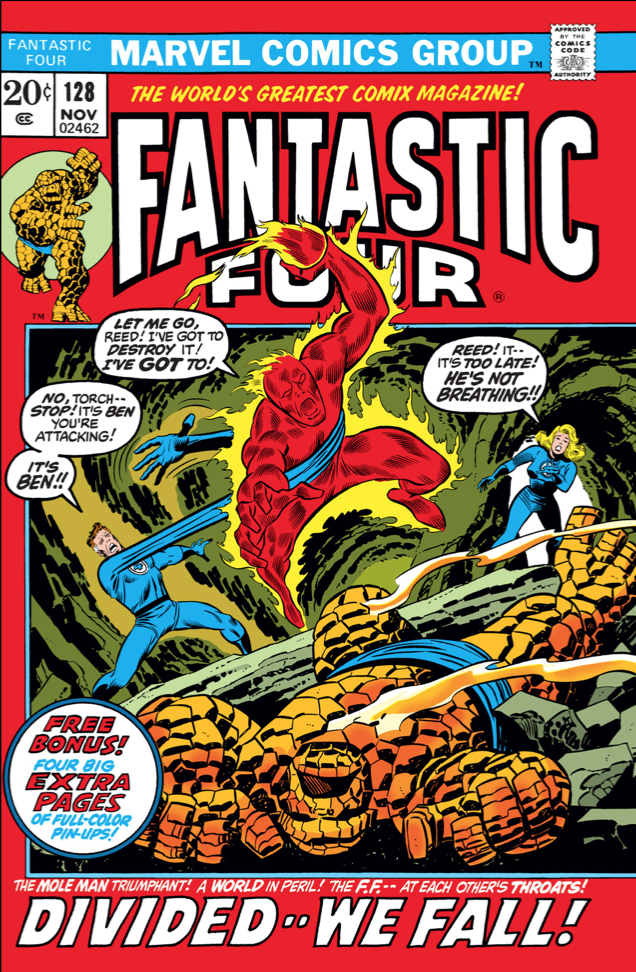
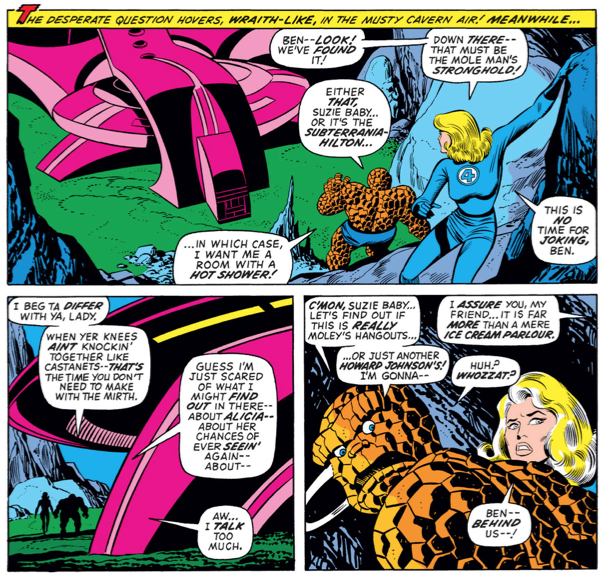
After Mr. Fantastic realizes the monster attacking the team is actually the Thing, whose appearance was temporarily transformed, the team regroups to confront the Mole Man, only to be captured and apparently defeated. But the Mole Man is betrayed by his erstwhile lover, Kala, and the team is able to escape his underground kingdom.


What’s going on here?

This is solid follow-up and conclusion to the story Thomas launched in the previous issue, and augers well for the rest of his run on the comic. The story has a fun and surprising twists, it’s well paced and there’s some nice characterization. No big developments, but that’s OK.

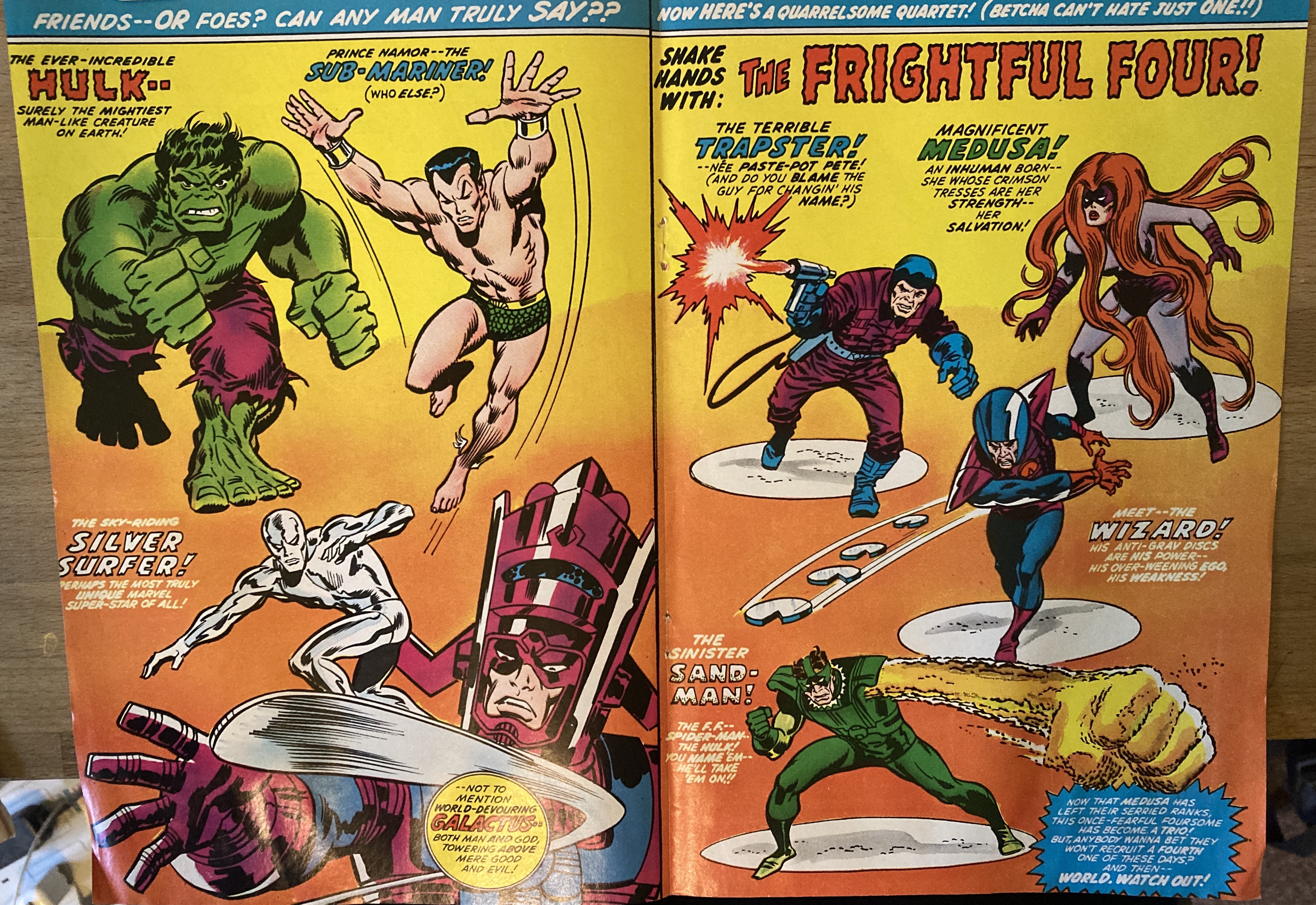
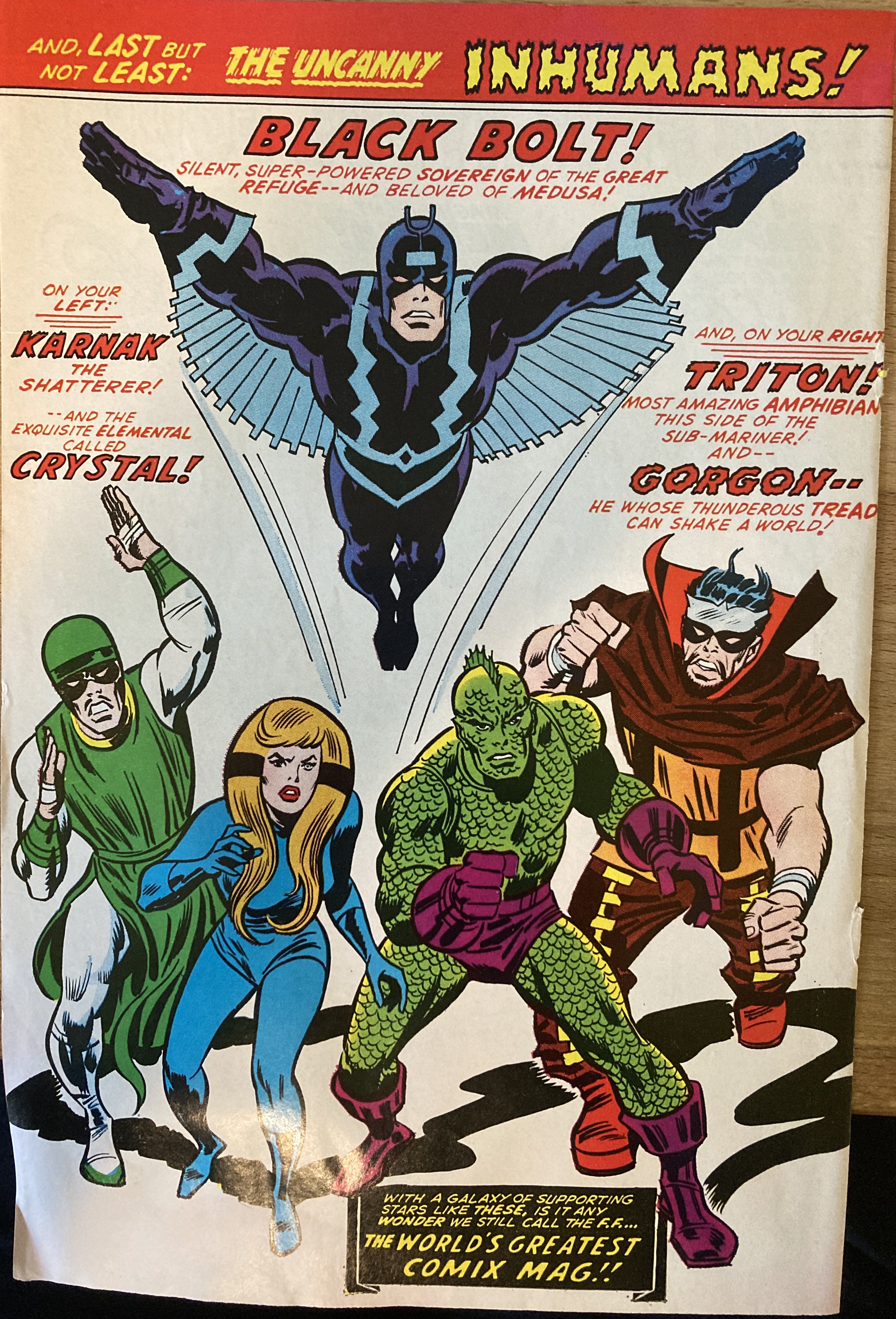
What distinguishes FF 128 isn’t the story but an insert—four pages of pinups on glossy paper (the same as used for the cover) drawn and by John Buscema (the inker is uncredited but it looks like Sinnott to me). They’re not included the online version of the comic, so I’ve photographed them:


As a kid reading the FF in 1972, I would have been pretty jazzed to see these in the middle of an otherwise ordinary comic. As a reader in 2024, they’re an interesting snapshot into who and what Marvel thought was important to depict. Leaving aside the decision not to include the FF, there’s no Agatha Harkness or Franklin, or Black Panther or Wyatt Wingfoot. The Mole Man and Frightful Four get prominent billing, but that could be because they’re appearing in this issue (Moley) or nest issue (the Frightful Four).

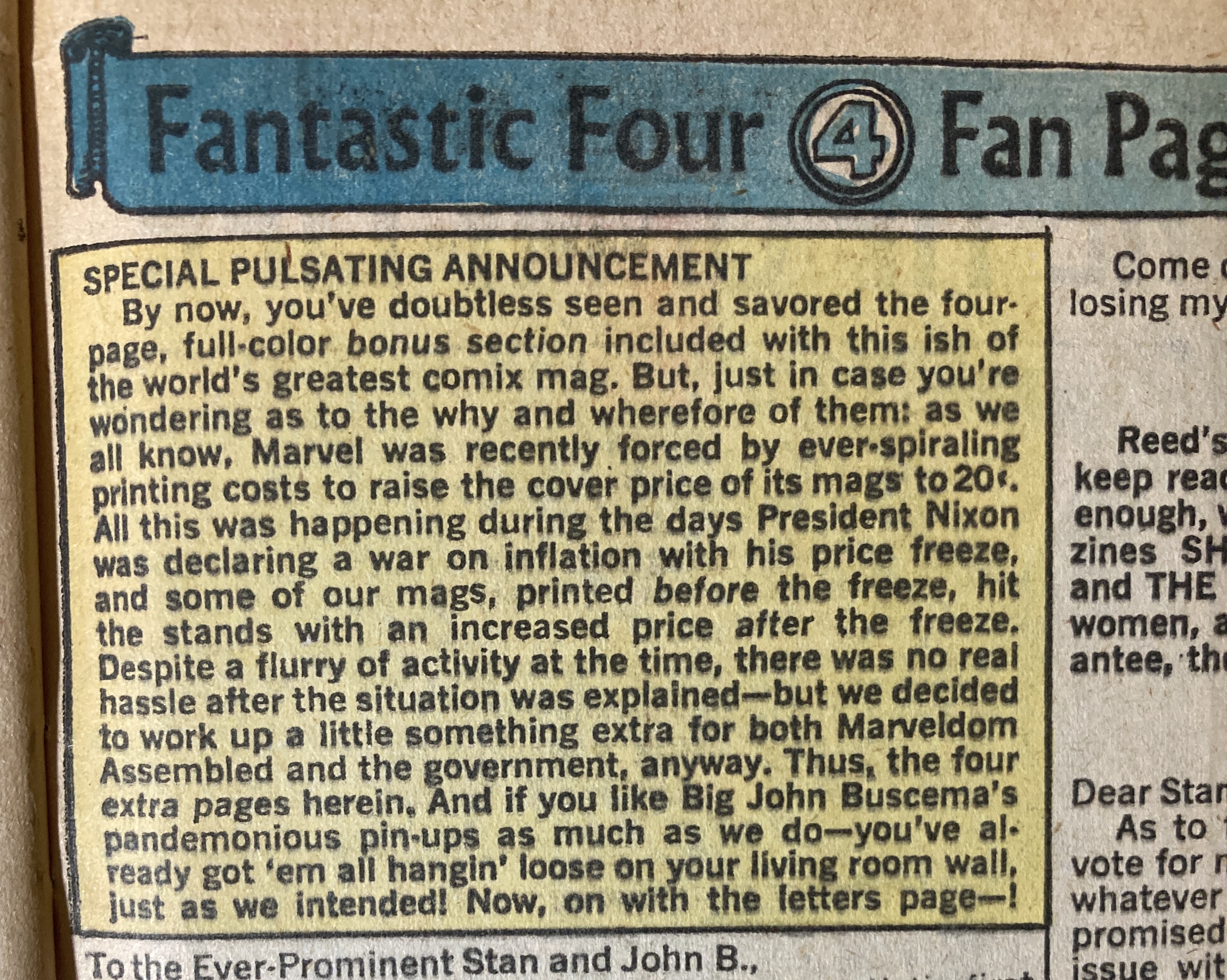
On the letter page, an editor’s note explains the pinups are to make up for raising the price of the comic to 20 cents, although the price hike took place a year earlier. There’s a convoluted explanation involving Nixon, but read for yourself:


What I liked

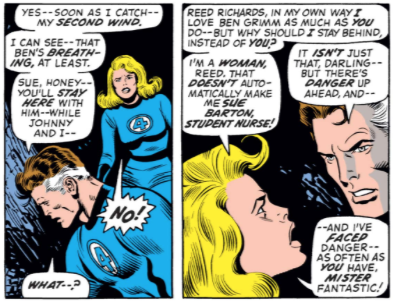
Roy does a nice job with interactions between our lead characters, including this revealing exchange between Ben and Sue:


Or this, between Sue and Reed, which continues their debate about Sue’s role on the team that started last issue:


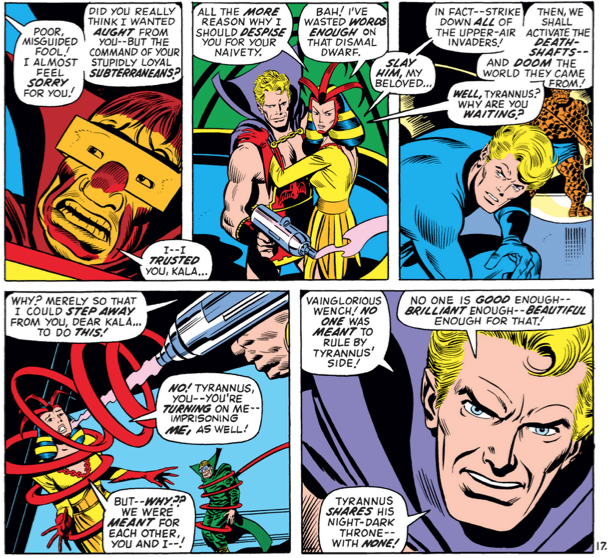
I also liked the plot twist toward the end. It wasn’t too surprising that the beautiful and evil Kala would turn against the Mole Man in favor of handsome Tyrannus (a long-lived Roman Emperor trapped underground and who appeared as the Mole Man’s slave briefly last issue). It was surprising, however, when Tyrannus in turn double crossed Kala, and giving the Mole Man reason to free the FF.


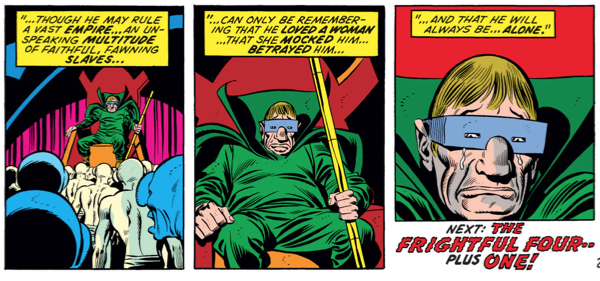
That twist, of course, leave the Mole Man jilted at the altar, setting up this satisfying and sympathetic ending sequence.


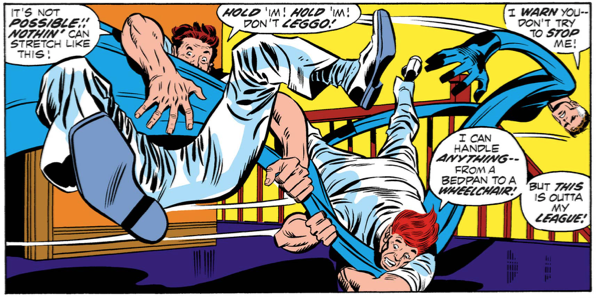
In the current run of the Fantastic Four, writer Ryan North has Reed deploying his stretching powers in novel (and occasionally grotesque) ways. But as we learn in FF 128, creative used of Reed’s powers are not new. (Also interesting is Reed’s dialogue throughout the comics – Roy has definitely loosened him up).


What I didn’t like

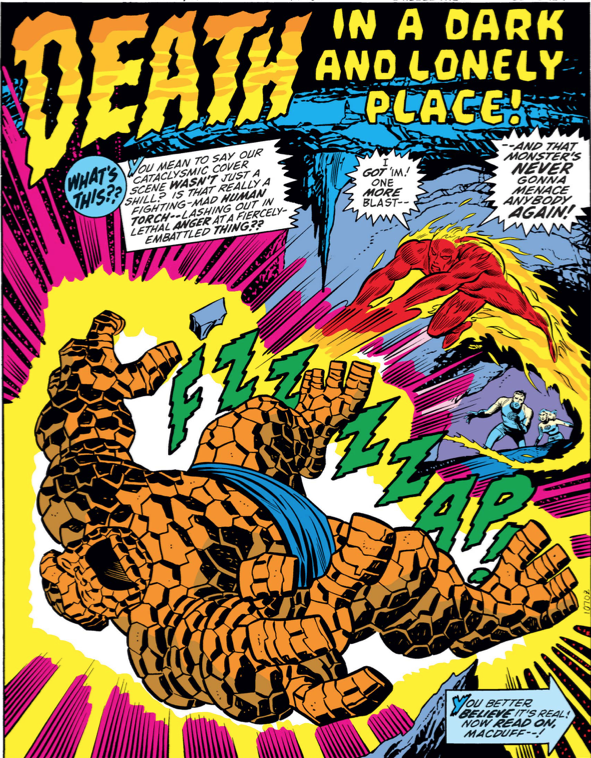
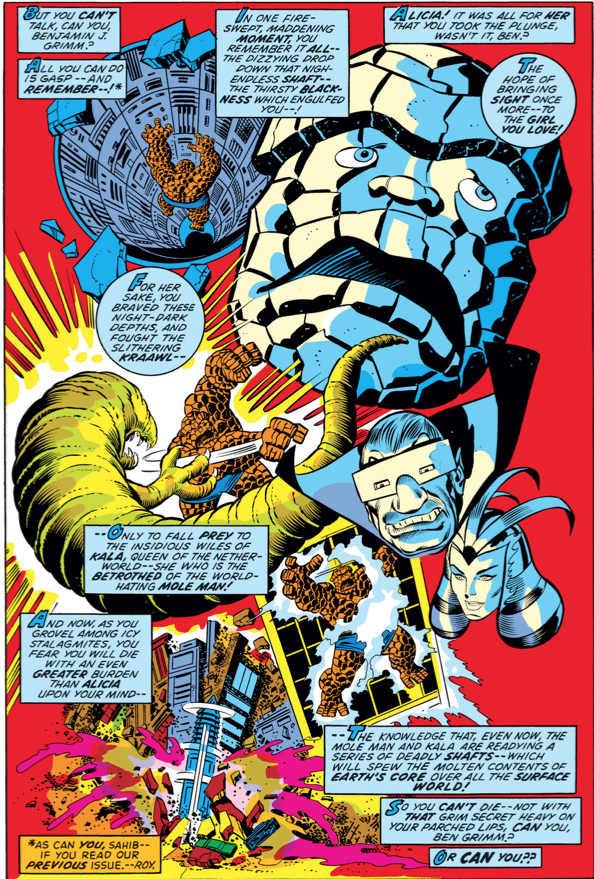
If Roy has a weakness, it’s a tendency to lapse into purple prose, as he does here in this otherwise cool looking flashback splash page. Pro tip: Avoid writing in the second person if at all possible.


Anything else?

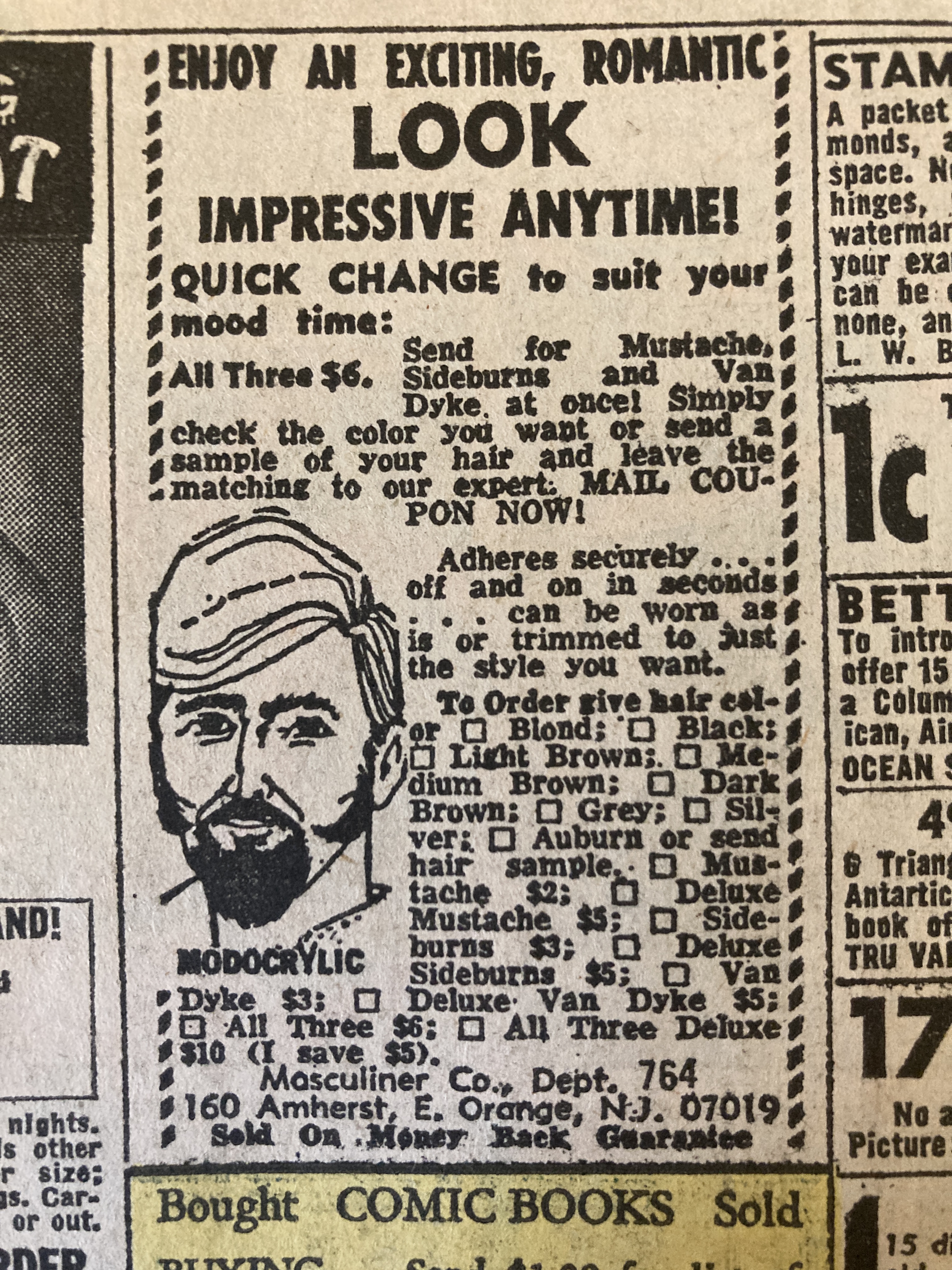
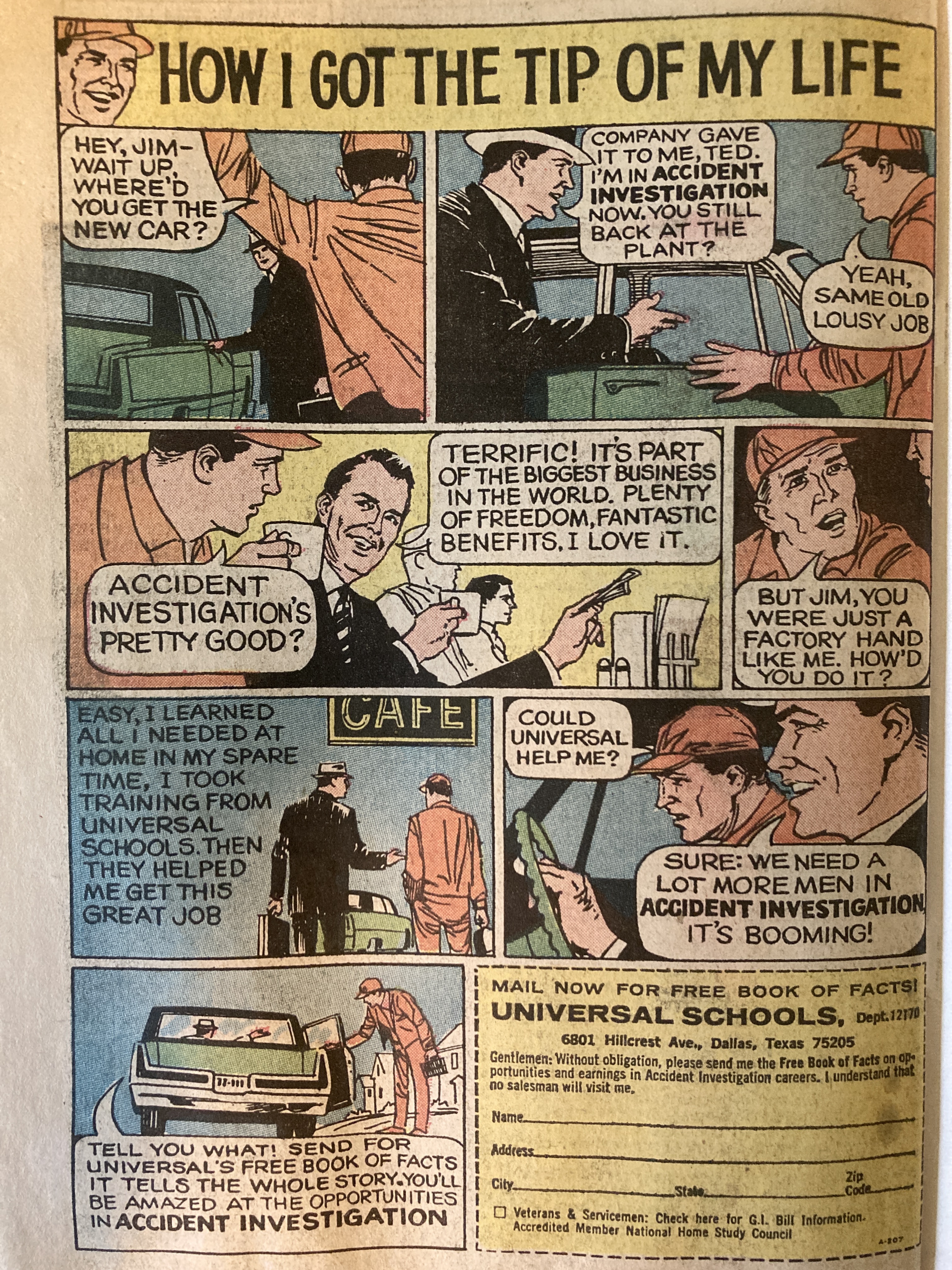
Some more intriguing ads. The fake beard-and-mustache kit—from the Masculiner Co., no less!—is particularly fascinating. Apparently you could mail in a sample of your own hair and they would match the color. Did anyone ever do that?


Overall

An excellent comic.

“The World’s Greatest Comic Magazine!” Fantastic Four No. 127

28 Sunday Apr 2024

Posted by percivalhenry in The World's Greatest Comic Magazine

≈ Leave a comment

Tags

1972, Fantastic Four, Fantastic Four 127, Mole Man, Roy Thomas

Fantastic Four 127
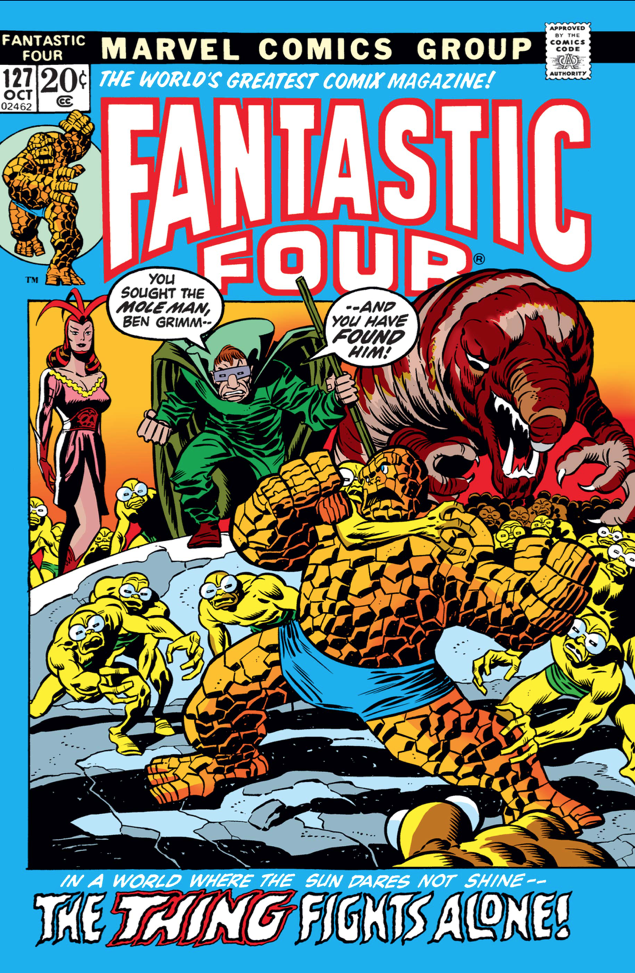
“Where the Sun Dares Not Shine!”
Published July 1972
Writer: Roy Thomas
Penciler: John Buscema
Inker: Joe Sinnott
Letterer: Artie Simek
Editor: Thomas
Cover: Buscema and Sinnott

Synopsis

In pursuit of a cure for Alicia Masters’s blindness, the Thing enters the subterranean world of the Mole Man, where he encounters Kala, an Atlantean princess and the Mole Man’s paramour. They capture Ben, and change his appearance into that of a hairy monster, leading the rest of the Fantastic Four to attack him.


What’s going on here

Even though Fantastic Four 127 is technically Roy Thomas’s third as writer, it feels like the first issue where he really seizes the reins and makes it his own. It’s full of Thomas-ian flourishes—the purple prose with its highfalutin’ references to ancient Greece, the call-backs to obscure older comics (in this case, Tales of Suspense 43), the sometimes excruciating interior monologues.

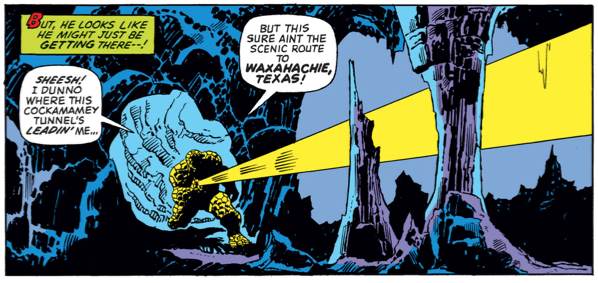
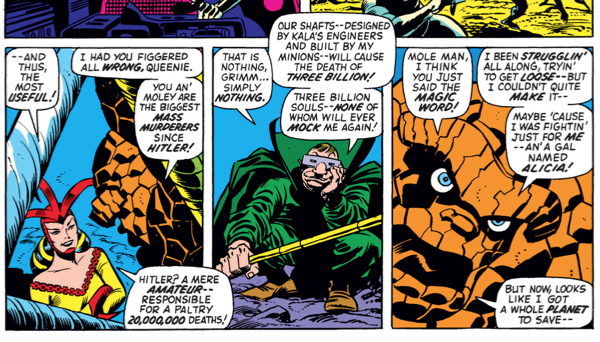
It’s also a pretty good story. On a mission to help Alicia, Ben is lured into complacency by the mysterious Kala, and is blindsided by her and the Mole Man. Thomas also ratchets up the stakes by having the Mole Man and Kala launch a plot against the surface world. His version of the Mole Man isn’t just a misunderstood outcast, but a truly evil villain who plans to kill 3 billion surface dwellers. The story is well paced, contains some fun surprises and ends with a satisfying cliff hanger.


What I liked

After showing some growth as a character over the past few years, Sue backslid into her whimpering helpmate status in Stan’s most recent run, as he (via Reed) sidelined her to protect Franklin. Here, Roy seems to be making a statement about Sue’s role on the team:


This is a great sequence from Big John:


There are also a lot of fun touches throughout the comic, such as this byplay in the editor’s notes between Roy and Stan en français.

Along with a sweet scene of domestic bliss, there is some clever dialogue from Reed here:

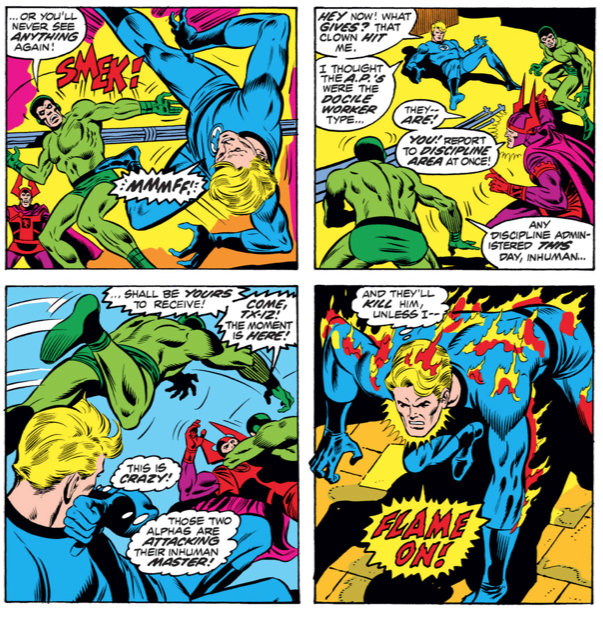
And it’s been while since we heard these magic words:


What I didn’t like

As mentioned above, Roy has a predilection toward pompous verbosity and anguished interior monologues. We get all of that and more here:


Overall

A promising start to the Thomas era.
“The World’s Greatest Comic Magazine!” Fantastic Four No. 126
26 Friday Apr 2024

Posted by percivalhenry in The World's Greatest Comic Magazine

≈ Leave a comment

Tags

1972, Fantastic Four, Fantastic Four 126, John Buscema, Mole Man, Roy Thomas, Stan Lee

Fantastic Four 126
“The Way It Began!”
Published June 1972
Writer: Roy Thomas
Pencils: John Buscema
Inks: Joe Sinnott
Letters: John Costanza
Editor: Thomas
Cover: Buscema and Sinnott

Synopsis

After squabbling with the Human Torch, the Thing uses a thought projector invented by Mr. Fantastic to revisit the origins of the Fantastic Four, and ends up resolved to force the Mole Man —the first villain they fought—to give sight to his blind girlfriend, Alicia Masters.


What’s going on here?

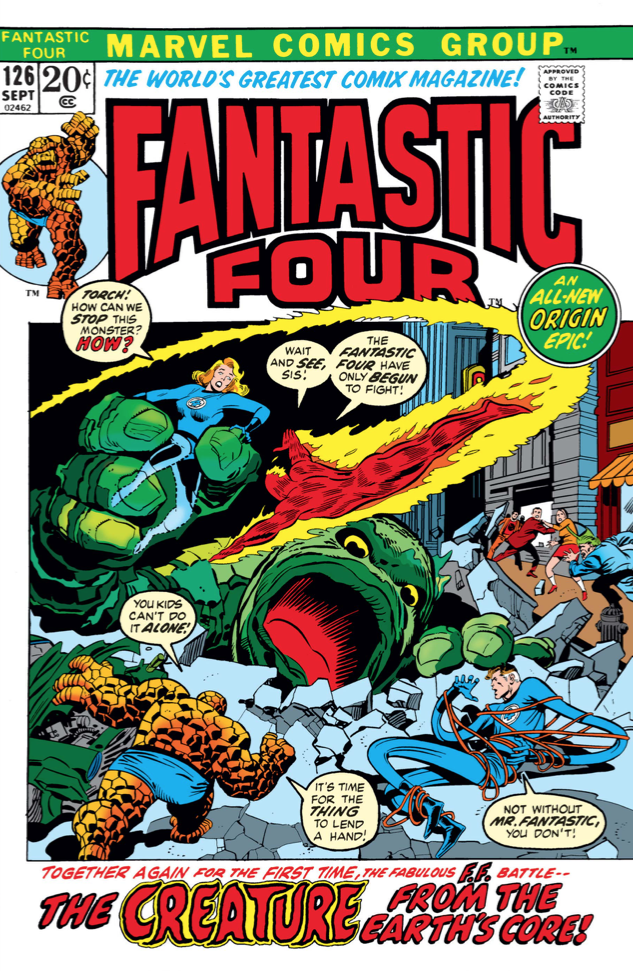
This is an interesting issue, for a few reasons. It’s the first issue after Stan Lee’s official departure from the FF—an occasion marked both in the Bullpen Bulletins and in a separate note on the letter’s page—and Roy Thomas’s first after officially taking the helm (although he wrote FF 119). Stan and Roy use the change as an opportunity to retell the origin of the Fantastic Four, in the longest re-cap of their origin to date. For modern readers, it might seem like a waste of an issue but we’re used to the immediate availability of back issues, either through reprints or online. New Fantastic Four readers in the early 1970s had fewer options to read FF 1 (although it had been reprinted in a few annuals by this point) and after a decade of comics, it made sense to reset the origin.

It also allows John Buscema a chance to put his spin on Jack Kirby’s classic story. He’s pretty faithful to the original, although there are a few tweaks, like modernizing Sue’s haircut.

Here is Jack’s:

And here’s Big John’s version of the same scene:

Probably the biggest difference is in how Buscema draws Ben, updating his original, lumpy look to the more familiar rocky version. Again, here’s FF 1:

And FF 126:

Roy also tweaks the dialogue a bit to make Ben’s style of speech more consistent with what we’re used to, but by and large it’s pretty similar.

Along with the recap of the origin (and both the original and a subsequent battle with the Mole Man, setting the stage for Ben’s quest), the issue also strikes a lot of familiar notes that seem designed reestablish the FF’s status quo. There’s a Ben and Johnny fight, which was once almost a mandatory feature. There’s an appearance from Alicia, and a reminder she’s blind. There’s Reed and Sue wondering about their future with the team now that they have a child. In all, it reads like jumping off place for new readers, and a new writer.

A few other items of note:

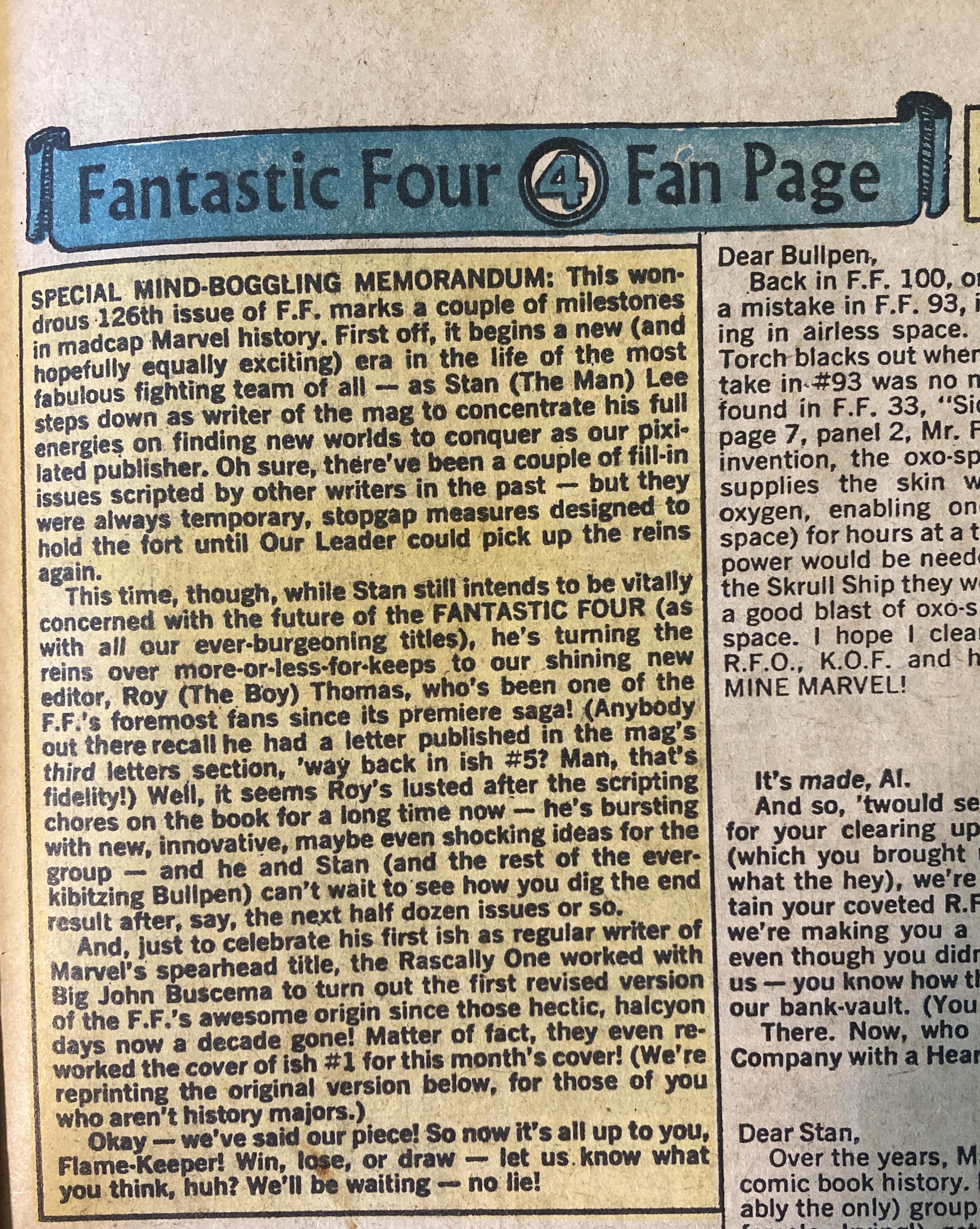
* The credits now say “Stan Lee presents” and Roy is credited as both writer and editor.
* The cover now says “The World’s Greatest Comix Magazine!” I don’t know the basis for the change, and it lasted only until issue 131, but it’s a bit odd.
* I realize I never addressed the change in the logo, which happened in issue 119. Just another sign of the changin’ times. Marvel will use this logo until issue 160 and doesn’t return to the classic ’60s logo until issue 218 (although it’s used for annuals).

Here is the note introducing Roy as writer on the letter page:


What I liked

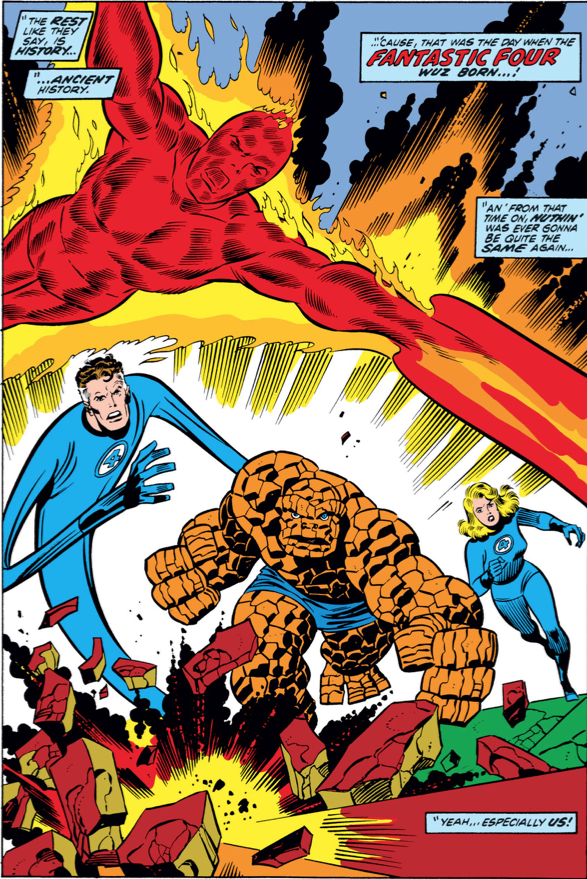
I generally liked Buscema’s recap of the origin, and particularly his take on Jack’s classic cover for FF 1. That cover has been the subject of many homages over the years (some of which I get into in my recap of that issue here) and I assume this is the first. There is still no explanation of who tied up Reed. There is also a great splash page (seen above).

What I didn’t like

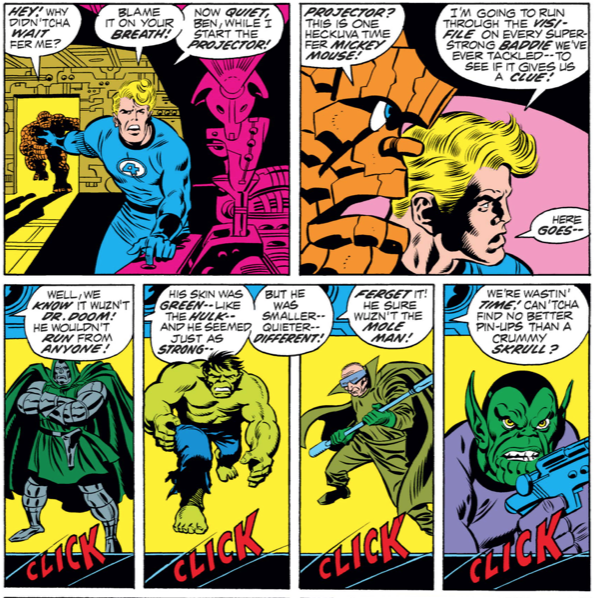
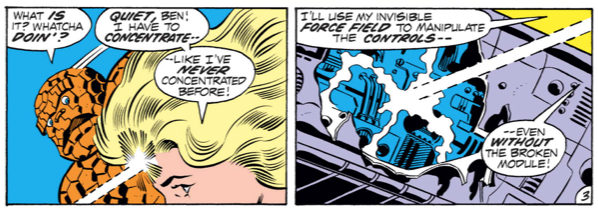
While it’s an interesting issue, I’m not sure it’s a particularly good issue. Roy tries to weave the lengthy flashback into the story, but it’s not really coherent, and the thought projector as a plot device feels unnecessary and clumsy. Leaping ahead from the FF’s first battle with the Moleman to one that took places in issues 88 and 89 also feels awkward and manufactured to set up the next issue.

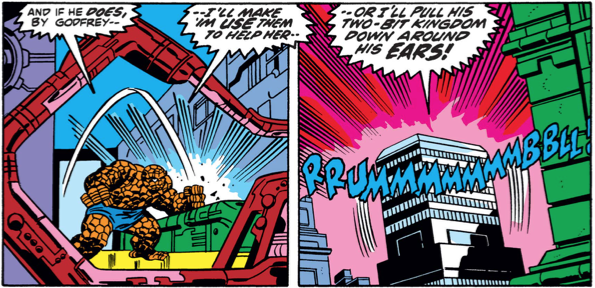
Also, it’s not really clear Roy has a grasp on Ben’s character, as evidenced by this sequence:

(who is Godfrey?)

Anything else?

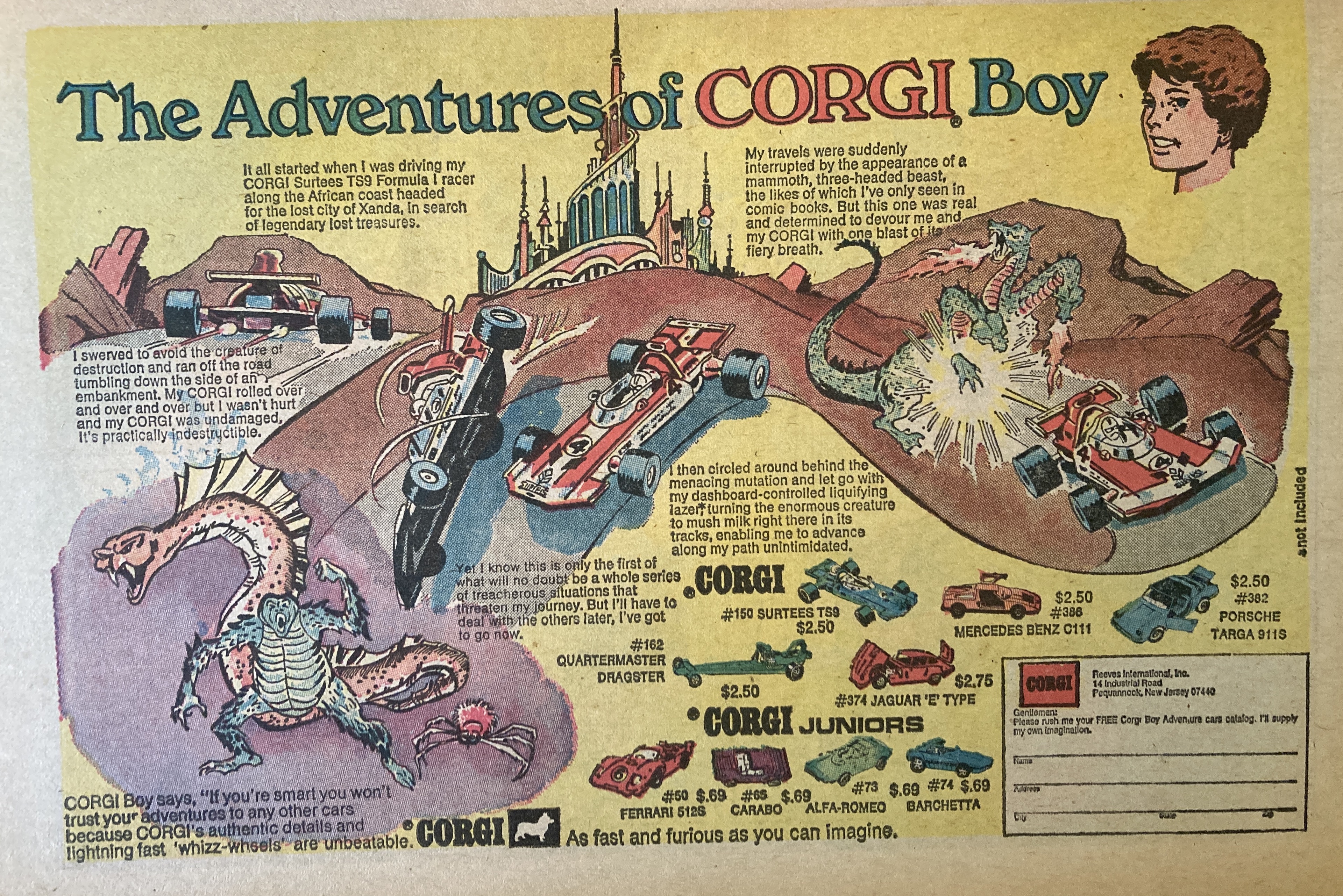
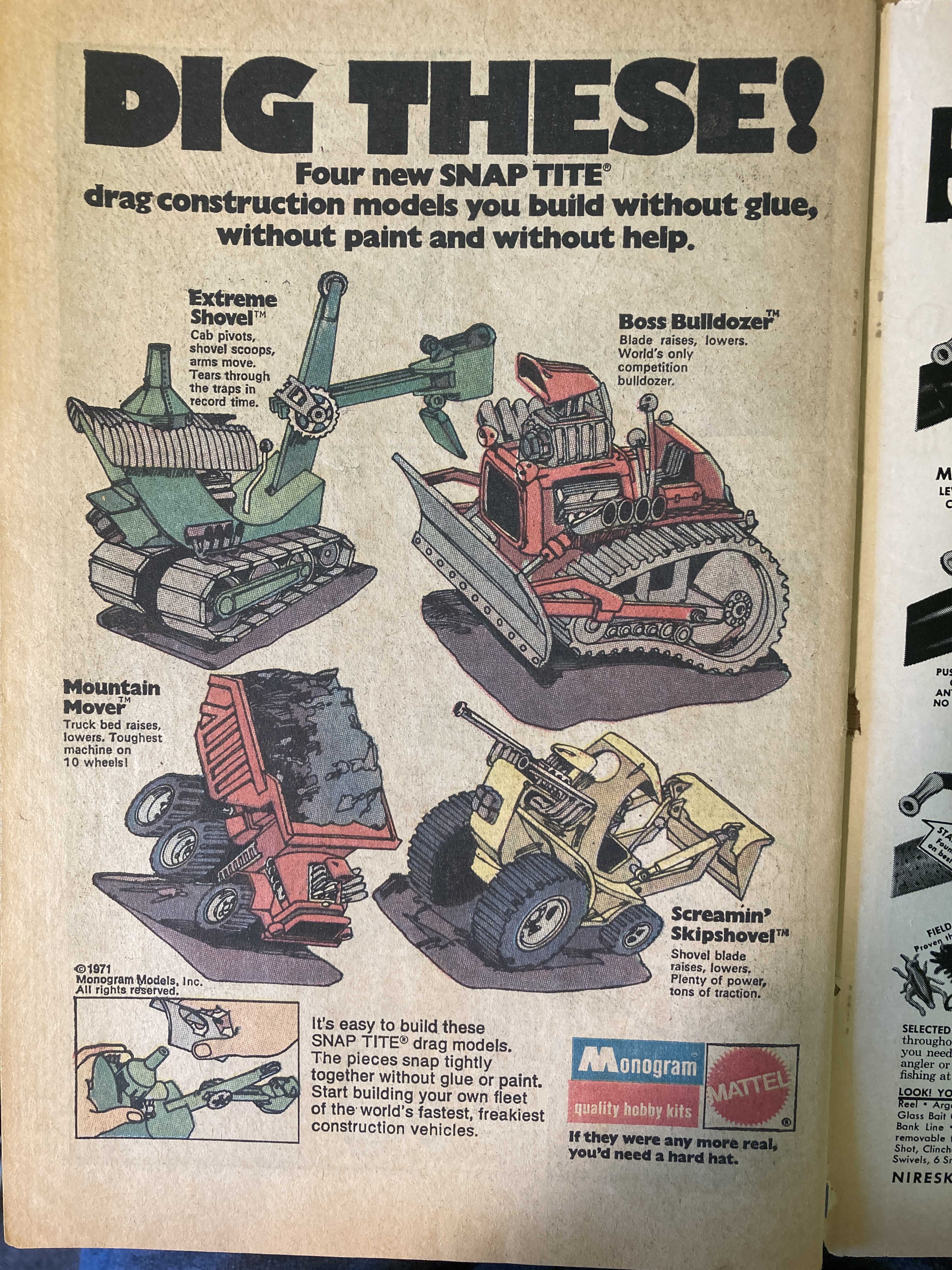
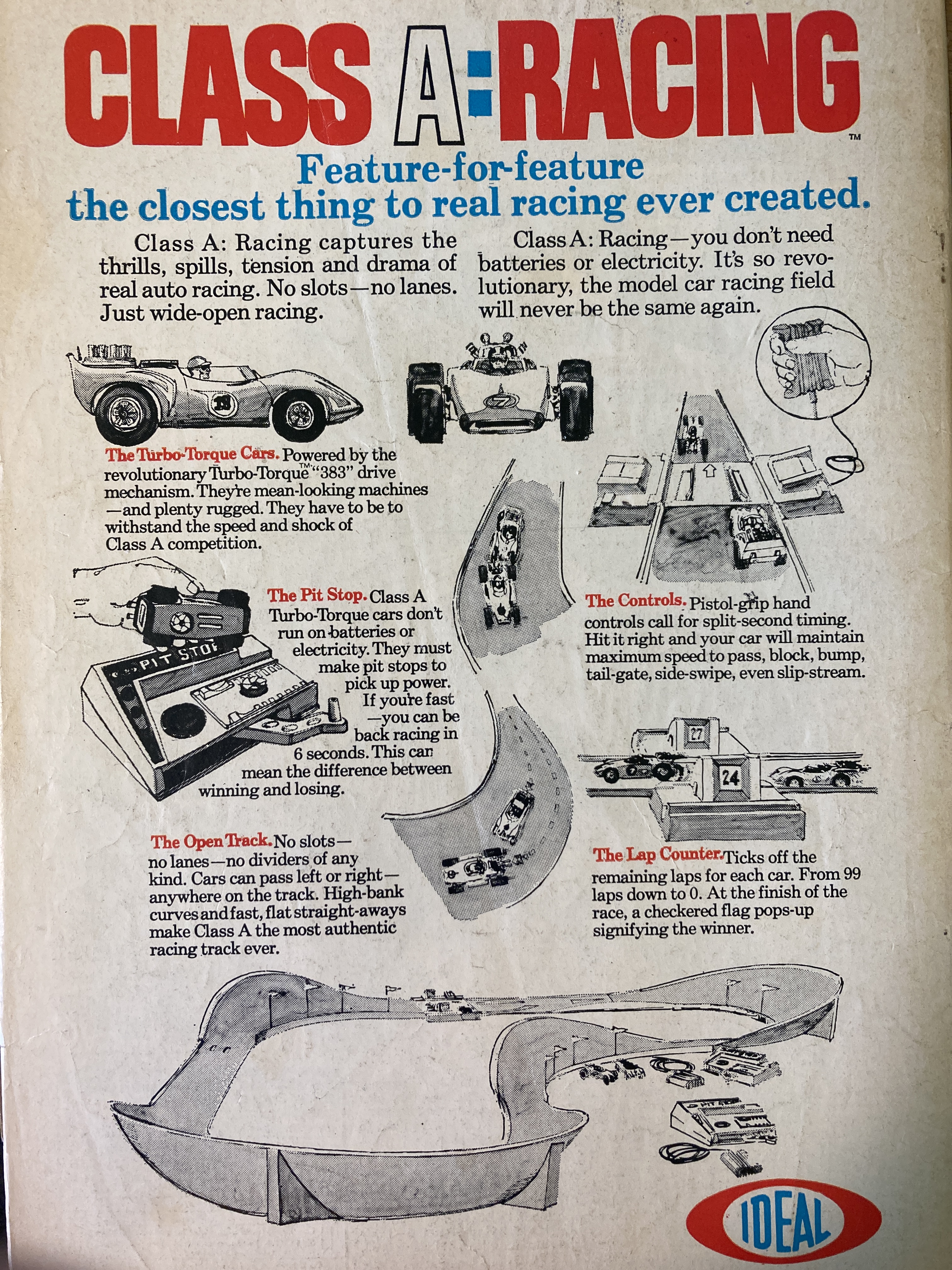
Ads for some neat-o toys in this issue:


Overall

An issue probably of more value to readers in 1972 than today

“The World’s Greatest Comic Magazine!” Fantastic Four No. 125

16 Tuesday Apr 2024

Posted by percivalhenry in The World's Greatest Comic Magazine

≈ Leave a comment

Tags

1972, Fantastic Four, Fantastic Four 125, John Buscema, Stan Lee

Fantastic Four 125
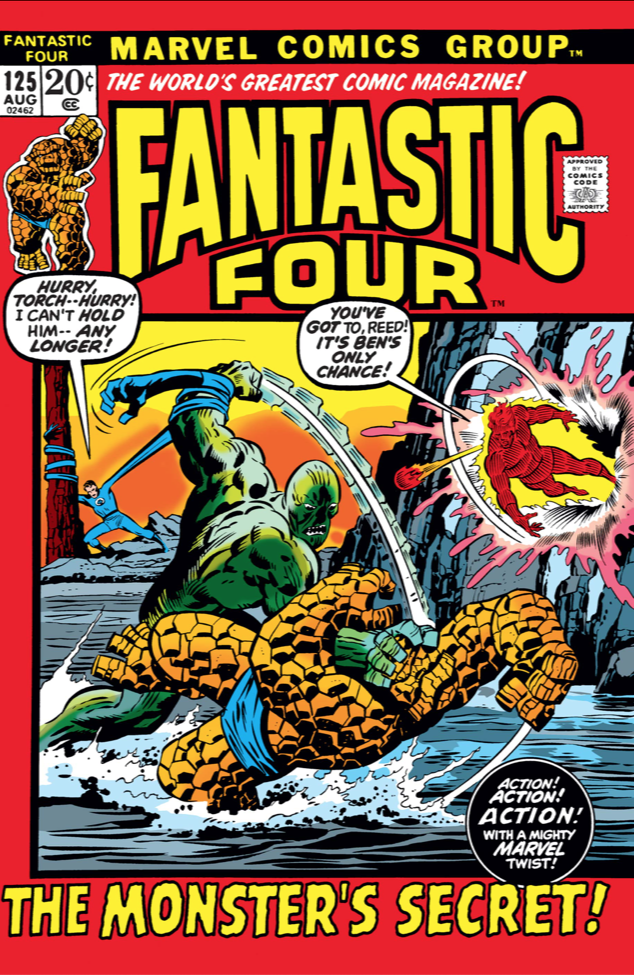
“The Monster’s Secret!”
Published: May 1972
Writer: Stan Lee
Pencils John Buscema
Inks: Joe Sinnott
Letters: John Costanza
Cover: Buscema and and Sinnott

Synopsis

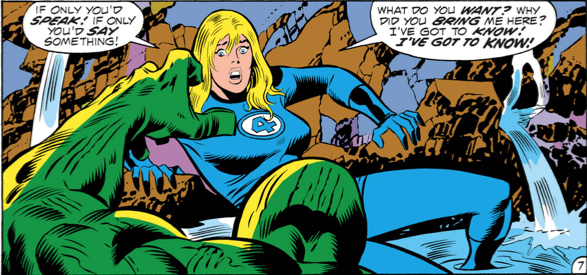
The rest of the Fantastic Four attempts to rescue Sue from the underwater creature before it’s revealed it was never actually a threat.


What’s going on here

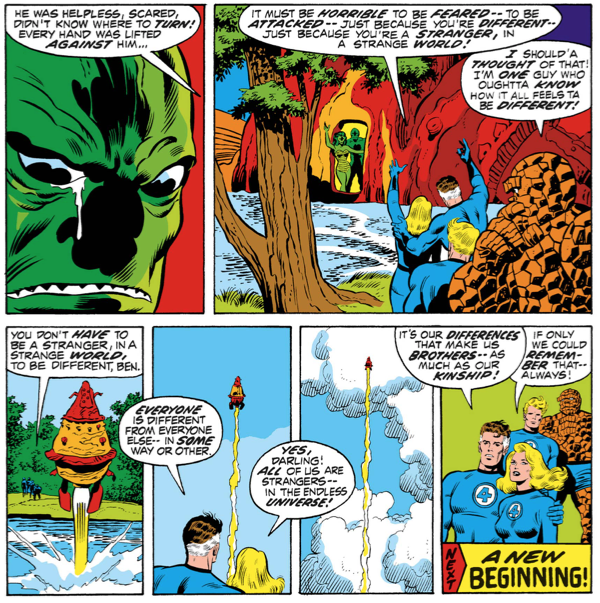
This is Stan Lee’s last issue as a regular writer of the Fantastic Four and it’s an unfortunately lackluster note to end on. The story feels thin and padded with unnecessary digressions, while the central question about the creature’s intentions for with Sue doesn’t have much tension since we know from the creature’s previous appearance that it’s a harmless alien. As a result, the twist at the end—the creature returned to cure its mate of a virus acquired on earth—felt sort of predictable. The final note, with the FF urging us to respect our differences, may be heartfelt but feels hokey. It’s the sort of earnest closing message Stan used early in the FF and by now feels sort of tired.

It’s probably worth pausing a moment to appreciate Stan’s amazing run as writer of the Fantastic Four. Between issue 1 and 125, he wrote, co-wrote or scripted (by my count) 119 regular issues and six annuals. That’s an impressive run for anyone, much less someone also writing a half dozen other comics and serving as editor and pitch-man for the entire line.

Trying to apportion credit for the Fantastic Four’s greatness between Stan and Jack Kirby feels like a fool’s errand. The (deserved) push to properly recognize Jack for his work at Marvel has unfortunately created a backlash diminishing Stan’s contributions (and it doesn’t help that Stan was part of the management of a company that cheated Jack of his due). According to some revisionist histories, Stan merely rubber stamped Jack’s stories. But I think it’s inarguable that for all of Jack’s genius, there would be no Fantastic Four as he know it without Stan as well.

From my perspective, it was a true partnership, where the sum of their contributions was greater than the whole. The Fantastic Four did tail off in the years after Jack left, but it was uneven during his last years on the book as well. And in many of the comics Stan wrote on his own or with John Buscema—particularly the recently concluded Air-Walker/ Galactus saga— there’s enough of the old FF energy to indicate it wasn’t Jack alone. And Jack’s work at DC is proof that he benefitted enormously from Stan’s scripting.

Today, Stan’s legacy is so tied up in his identity as the public face of Marvel, his cameos in the movies, and the ugly fights over copyrights, it’s easy to lose sight that, at his core, he was a damn good comic creator.

What I liked

Big John turns in his usual excellent work. I particularly liked this sequence:


And wet Johnny:


What I didn’t like

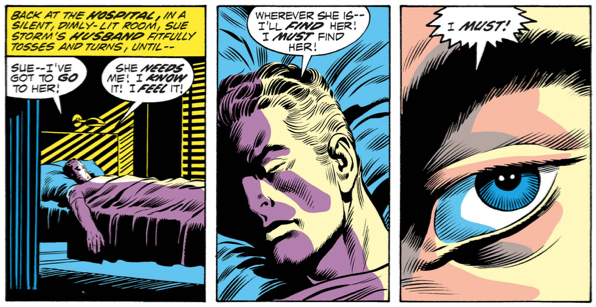
As mentioned above, the comic felt padded with a lot of filler. Reed escaping his doctors took up two pages. Ben finding transportation took another two pages. The story probably could have been told in one issue without losing much story and gaining some pace.


Overall

A muted milestone

“The World’s Greatest Comic Magazine!” Fantastic Four No. 124

06 Saturday Apr 2024

Posted by percivalhenry in The World's Greatest Comic Magazine

≈ Leave a comment

Tags

1972, Fantastic Four, Fantastic Four 124, John Buscema, Stan Lee

Fantastic Four 124
“The Return of the Monster!”
Published April 1972
Story: Stan Lee
Pencils: John Buscema
Inks: Joe Sinnott
Letters: John Constanza
Cover: Buscema and Sinnott

Synopsis

Mr. Fantastic, exhausted from the travails of the last few issues, takes ill and is rushed to a hospital, where a monster lurks and abducts the Invisible Girl.


What’s going on here?

This is a busy, and slightly peculiar issue. It opens in the middle of the action—mise en scene, if you’re fancy—with the Fantasti-Car about to crash because Reed has passed out. Simply landing the car takes up about four pages, and much of the rest of the issue takes place in or around the hospital. The villain is of course the creature first introduced in issue 97, and while that was a fun, one-and-done story, there was nothing so compelling about the creature—really, a misunderstood alien modeled on the Creature from the Black Lagoon—that demanded it be brought back. The easiest explanation is that Stan, near the end of his active writing career, was bereft of ideas, and so reached back to an older story for one.

Still, despite feeling like a retread, there’s some interesting things going on in FF 124. Reed is virtually absent, since he’s unconscious in a hospital bed, so the other members are asked to propel the story in ways normally performed by Reed. There’s a fun sequence, for example, where Johnny plays detective and tries to identify the hostile monster using the FF’s equivalent of the Bat-Computer. It’s also a nice reminder that, after a decade of comics, the FF has it’s own rich history and rogue’s gallery.


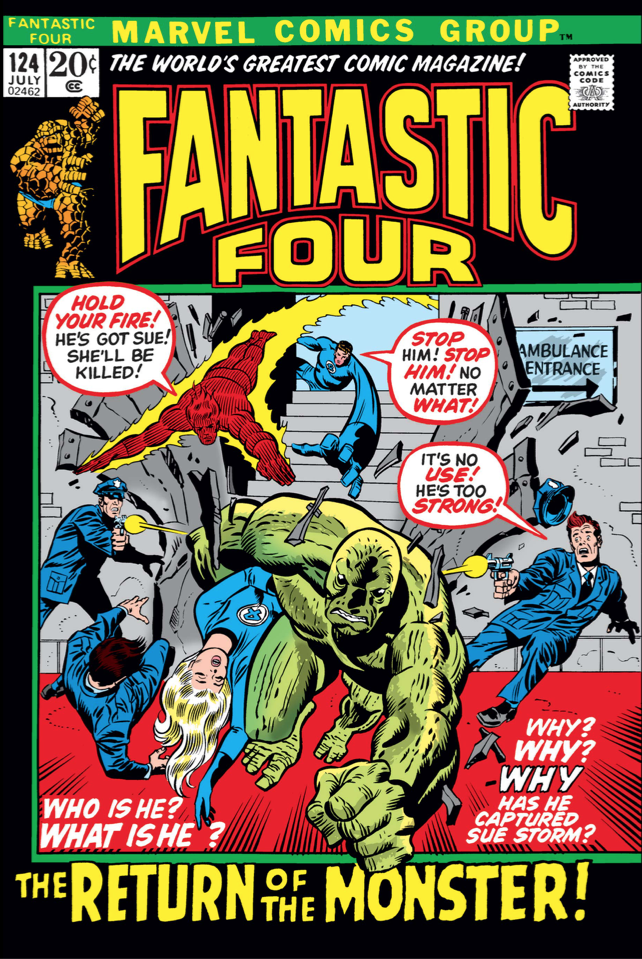
Oddly, despite much of the comic devoted to the FF unraveling the riddle of the monster, the readers knows all along who it is from the cover and title.

What I liked

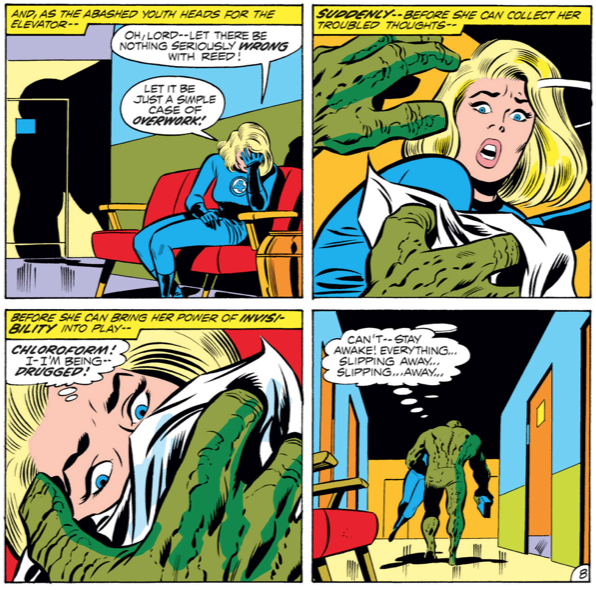
As mentioned, each of the non-Reed characters gets a a chance to shine in this issue. Sue, particularly, uses her powers in some new and interesting ways, such as repairing the crashing Fantasti-Car on the fly:

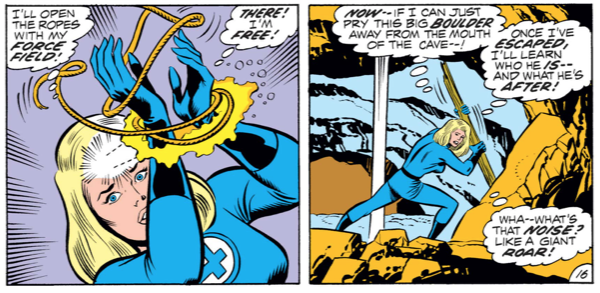
Or breaking out of her bindings:

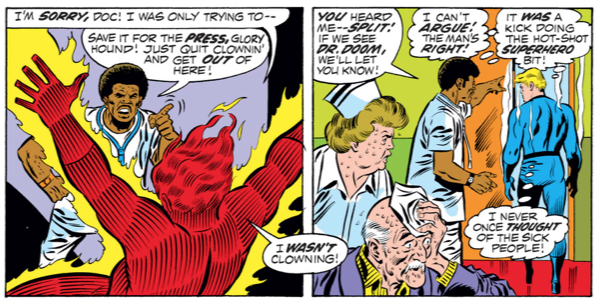
There’s an interesting sequence where Johnny is humbled by a doctor after terrifying patients by flying around the hospital with his flame on:


It looks like Buscema is trying something new as he draws Johnny, giving him a more distinctly human appearance when he’s in his flaming form.


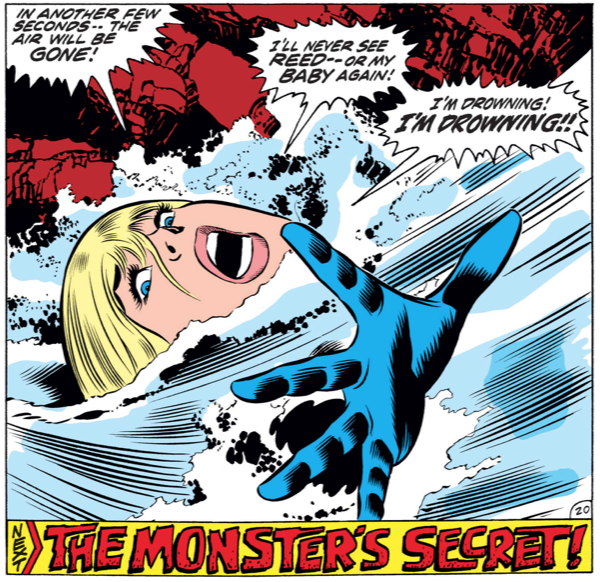
I also like the classic cliff-hanger ending, with Sue caught in a flooding cave:

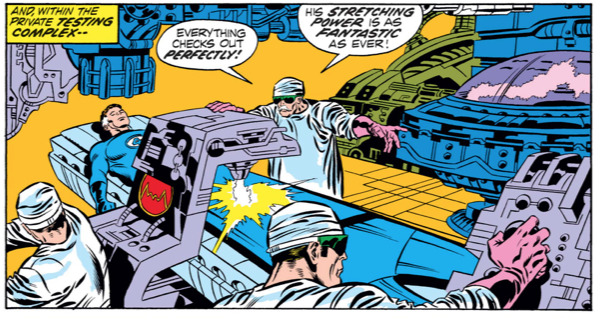
And this Kirby-esque panel of Reed in the hospital.

What I didn’t like

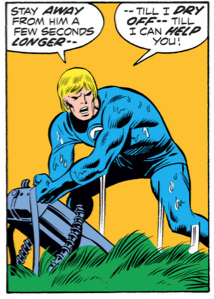
When I first began this blog, I started tracking how many times Sue was taken hostage. I stopped counting after Fantastic Four 38, when the count had reached 10. It’s one of Stan’s oldest and most tiresome cliches, and unfortunately he revives it again here.


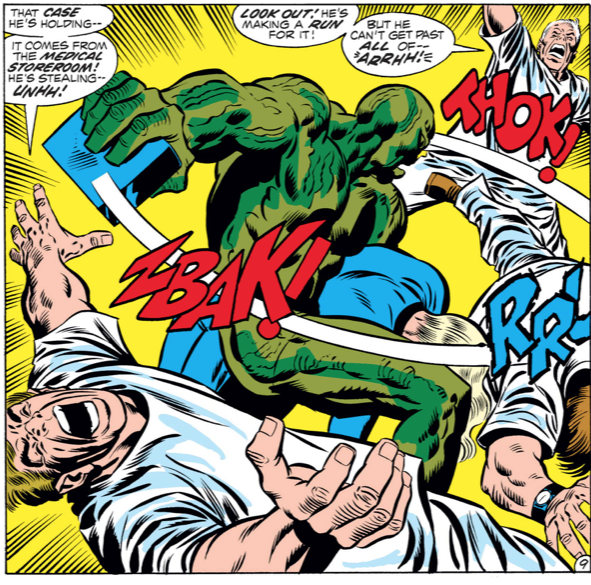
Also, I’m not a fan of plots that depend on the most unlikely of coincidences. The hospital were Reed is taken just happens to be haunted by a creature the FF once confronted on a tropical island?


Anything else?

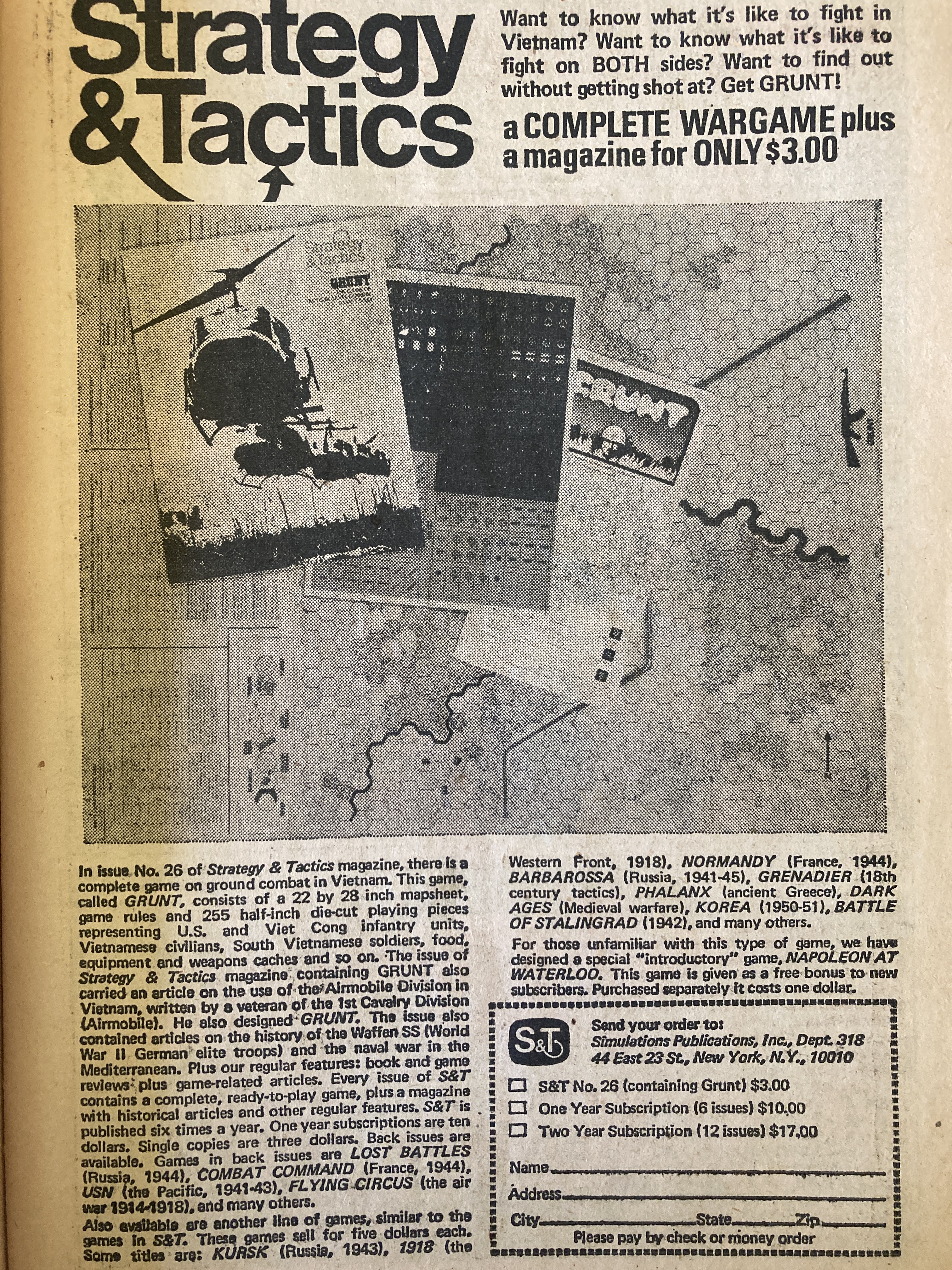
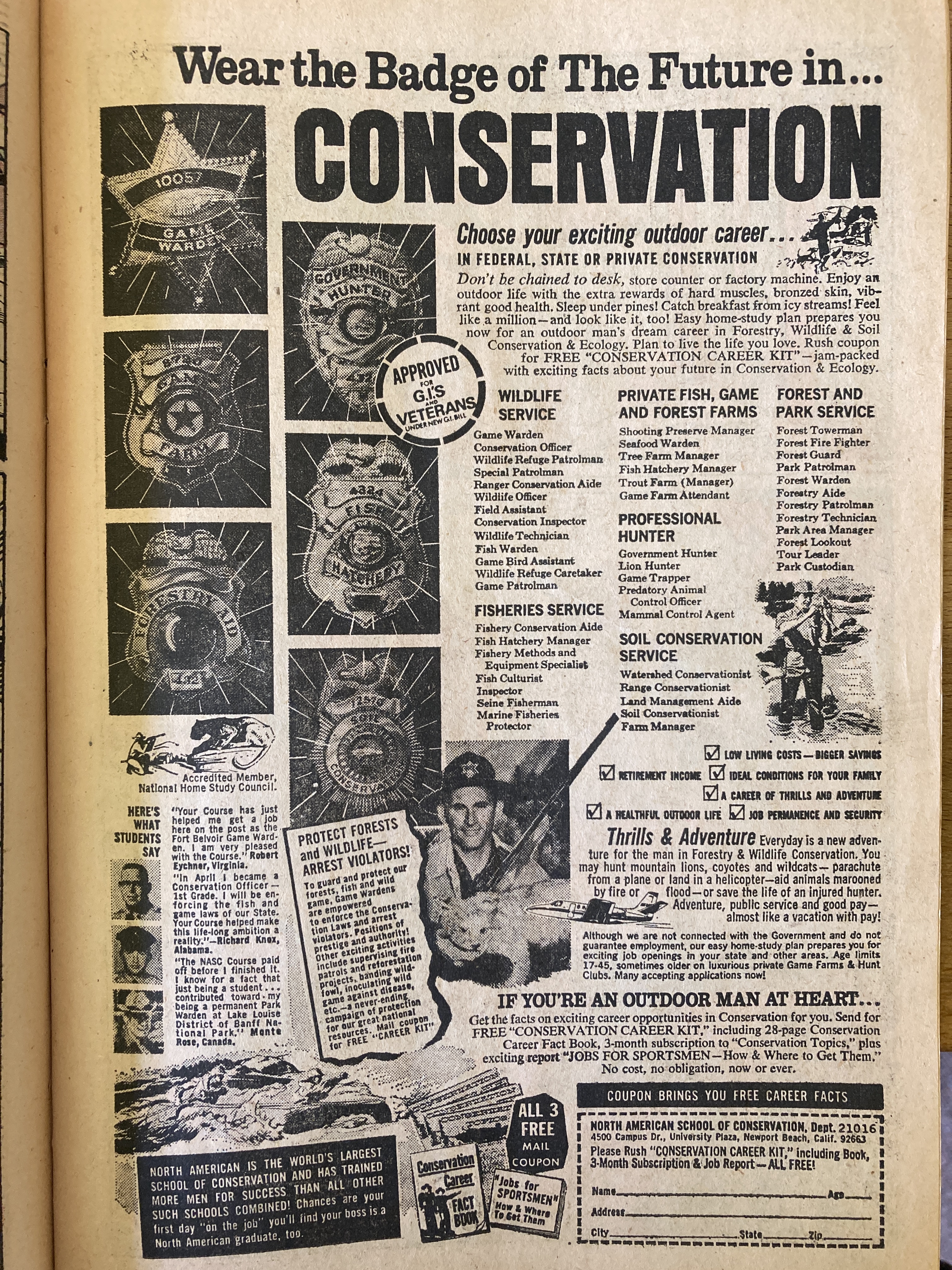
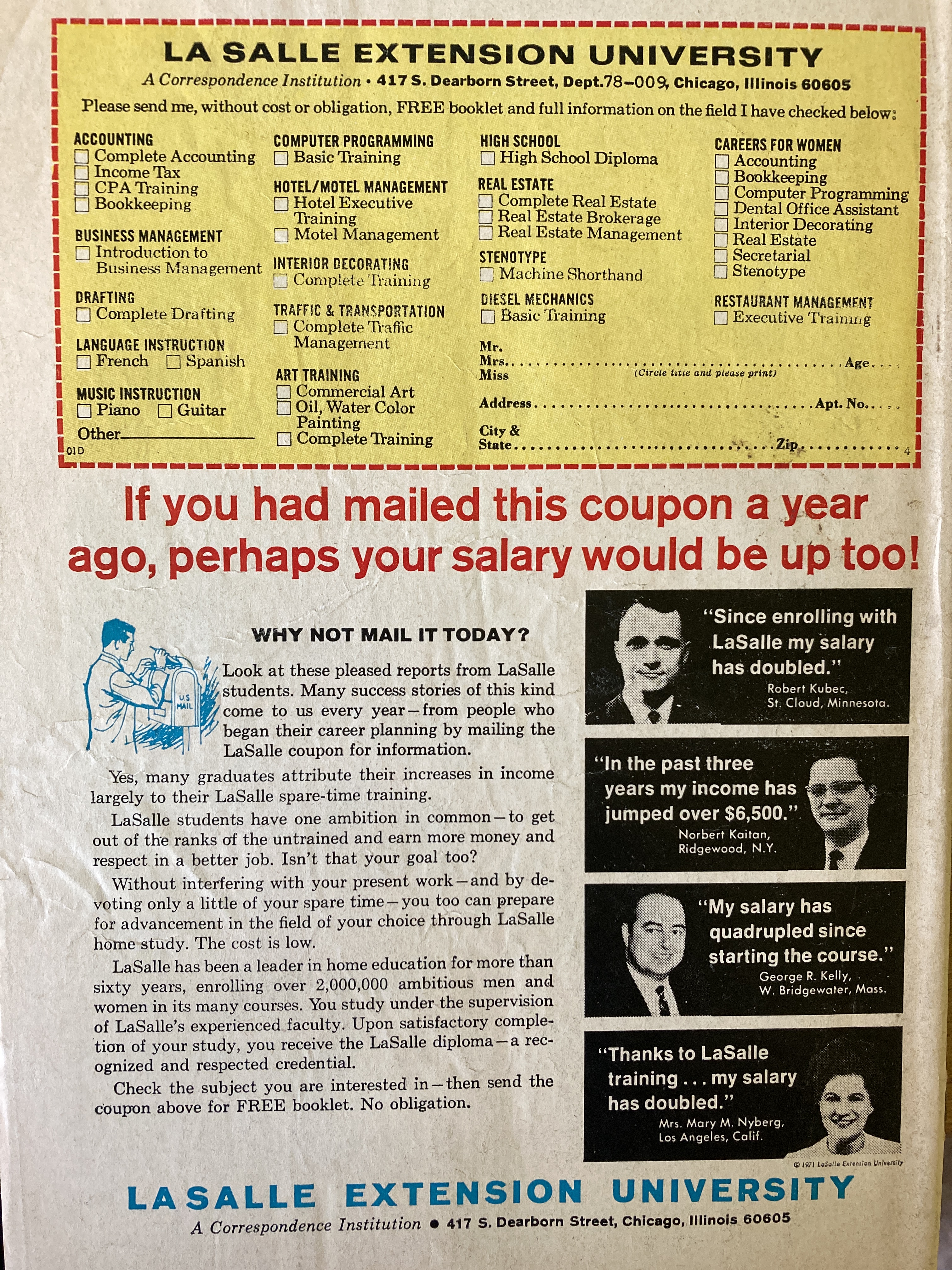
A bunch of ads that seemed pitched at an older reader. The Vietnam-themed game seems strange, given the war was still raging in 1972.


Overall

Generally a fine issue, marred by the sexist treatment of Sue.

“The World’s Greatest Comic Magazine!” Fantastic Four No. 123

30 Saturday Mar 2024

Posted by percivalhenry in Uncategorized

≈ Leave a comment

Tags

1972, Fantastic Four, Fantastic Four 123, galactus, John Buscema, Silver Surfer, Stan Lee

Fantastic Four 123
“This World Enslaved!”
Published March 1972
Story: Stan Lee
Pencils: John Buscema
Inks: Joe Sinnott
Letters: Jon Costanza (credited as Jon Costa)
Cover: Sal Buscema

Synopsis

After Galactus delivers his ultimatum—either the Silver Surfer becomes his herald again or he will destroy the Earth—Mr. Fantastic counters with a threat to destroy Galactus’s spaceship, stranding him on Earth. Galactus calls his bluff and Reed returns Galactus’s ship, but when the Surfer attempts to follow him into space, Reed stops him, leading the U.S. military to intervene and almost fatally wounding Reed. While the Thing and Torch battle the army, Reed, with the help of Agatha Harkness, broadcasts a message around the world that he has has tricked Galactus, rigging his spaceship to send him to the Negative Zone, where his deal with the Surfer doesn’t apply.


What’s going on here?

This issue wraps up the latest Galactus arc in a perhaps less-than-satisfying way (more on that later). As befitting a big, climactic issue, it includes a number of guest stars, like the Surfer and Agatha Harkness, and yet it feels, given all that’s at stake, that other heroes should appear. I’m not sure where the Avengers are at this point, but the potential end of the world seems like something that would interest them.

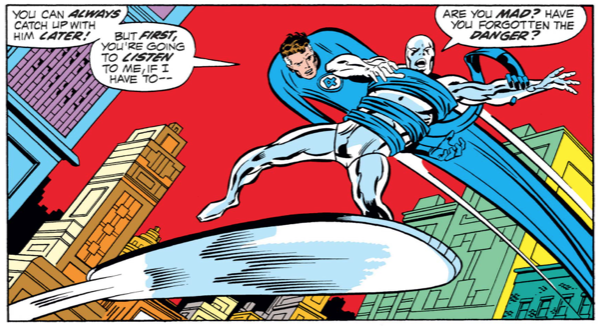
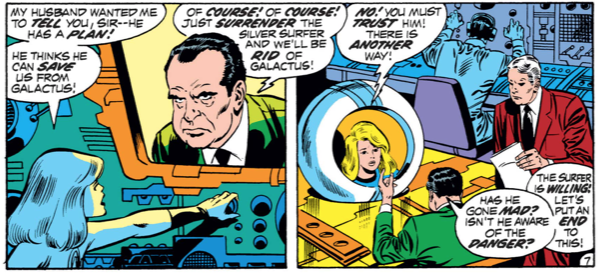
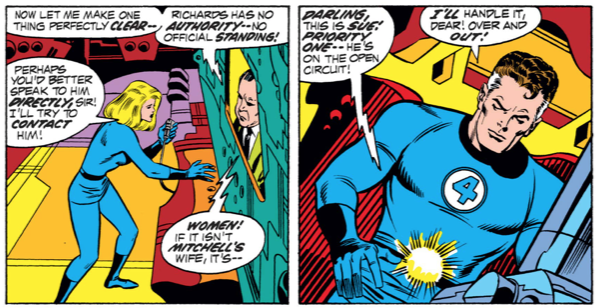
Perhaps the most intriguing guest appearance is that of Richard Nixon, who is unnamed but obviously himself, making references to John Mitchell, Henry Kissinger and his reelection.

There’s a long history of U.S. presidents appearing in comics, and I could devote an entire blog post to tracking them down. Sometimes they are generic old white men, and sometimes they seem to resemble whomever is president at the time. Few, however, are as specific as this representation of Nixon.

(One small detail of interest: in the second panel above, there’s a typo in the printed comic, and it reads “he on the open circuit” which is corrected in the digital comic, which I used here).

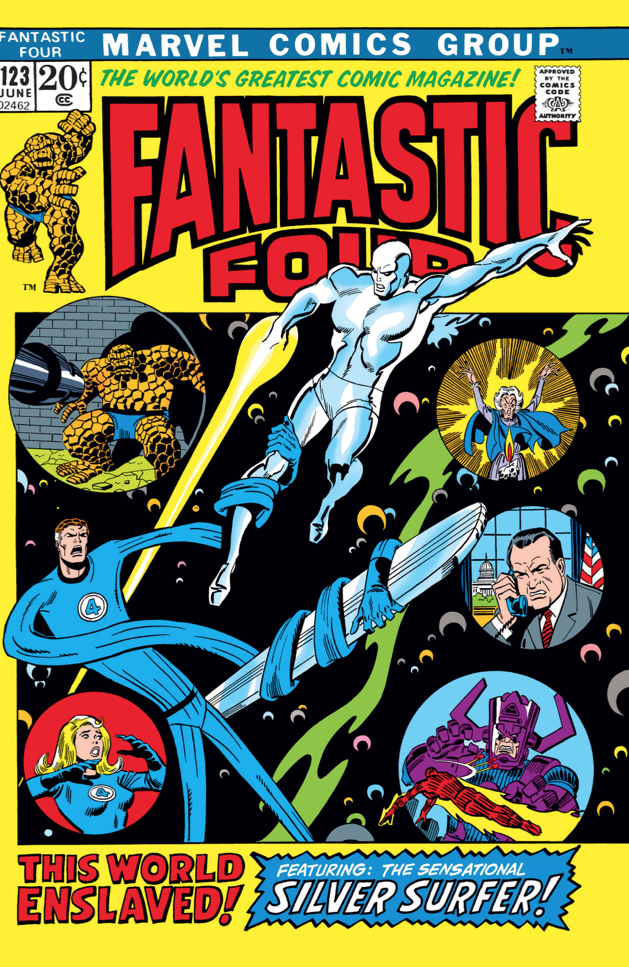
There are also some creators making their first contributions to the Fantastic Four. After a few years at DC, Jon Costanza joined Marvel in late 1971, and starting with this issue, becomes a semi-regular letterer of the FF. Probably more significantly, FF 123’s cover is drawn by Sal Buscema, Big John’s younger brother. Sal began working in comics in 1968, but this is first work on the Fantastic Four. He later does a few fill-in issues and will become the regular FF penciler for a brief stretch in 1986. While I’ve never loved Sal Buscema’s style, it’s hard not to admire his productivity and longevity. And I do like his extra-shiny version of the Surfer on what’s otherwise a very busy cover.

What I liked

This entire Air Walker / Galactus / Surfer arc has a fun, throw-back feel. An appearance of Galactus makes any comic feel important, and in this issue we get more insight into his psyche. He’s not just a villain intent on destruction, but a weary agent of the universe who can’t control his own destiny.


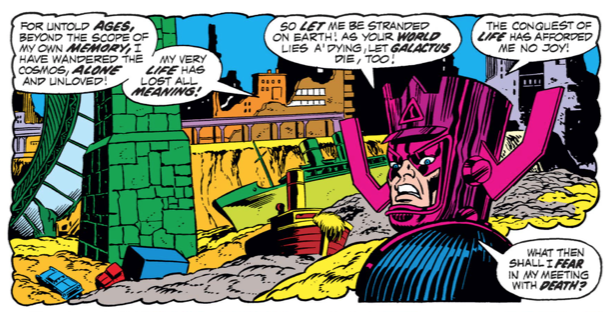
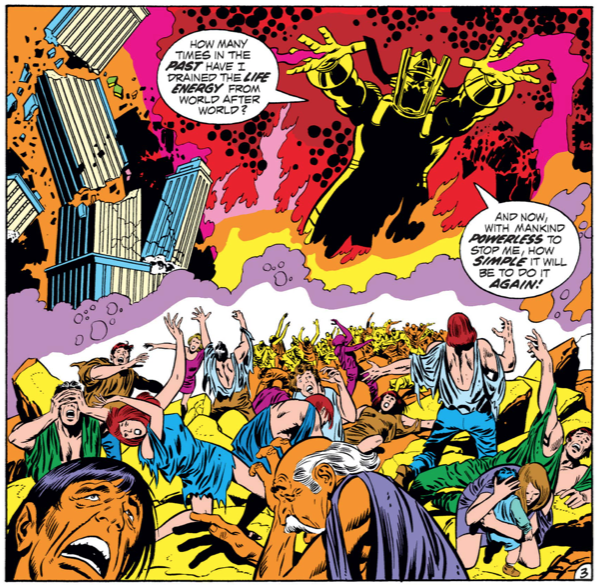
We’re also treated to some harrowing images of what Galactus’s consumption of Earth might look like.


What I didn’t like

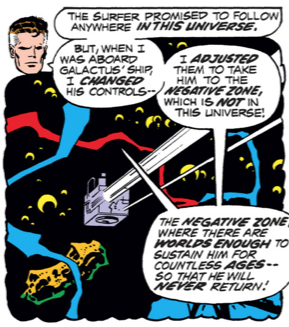
Like a lot of Fantastic Four epics, the climax to this story feels rushed, and this one feels particularly half-baked. Reed appears to have saved the Earth with a bit of legal trickery, based on the Surfer’s pledge to follow Galactus “in this universe,” creating a loophole so Reed can send Galactus to the Negative Zone, where he’s not bound by the agreement. Left unclear, of course, is why Galactus would feel obliged to honor a deal whose spirit is so obviously violated by Reed. Did we miss the panel where contracts were signed and notarized? Will some court enforce it? I suppose Reed (and Stan) could argue that since Galactus violated his pledge to leave the Surfer alone, then he’s just getting what he deserves, but it feels weak.

And all this leaves aside the issue of how Reed altered Galactus’s ship to enter the Negative Zone, something we previously thought could only be achieved through a portal in the Baxter Building.


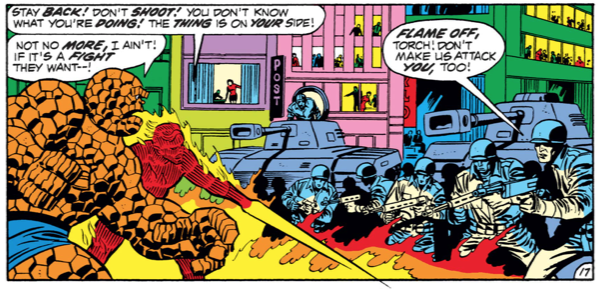
The comic also digresses into an off fight between the military and the Fantastic Four. It’s distracting and while it creates the opportunity for Reed to be shot by a panicky soldier, and then saved by the Surfer, none it feels very necessary or serves to advance the story.


Anything else?

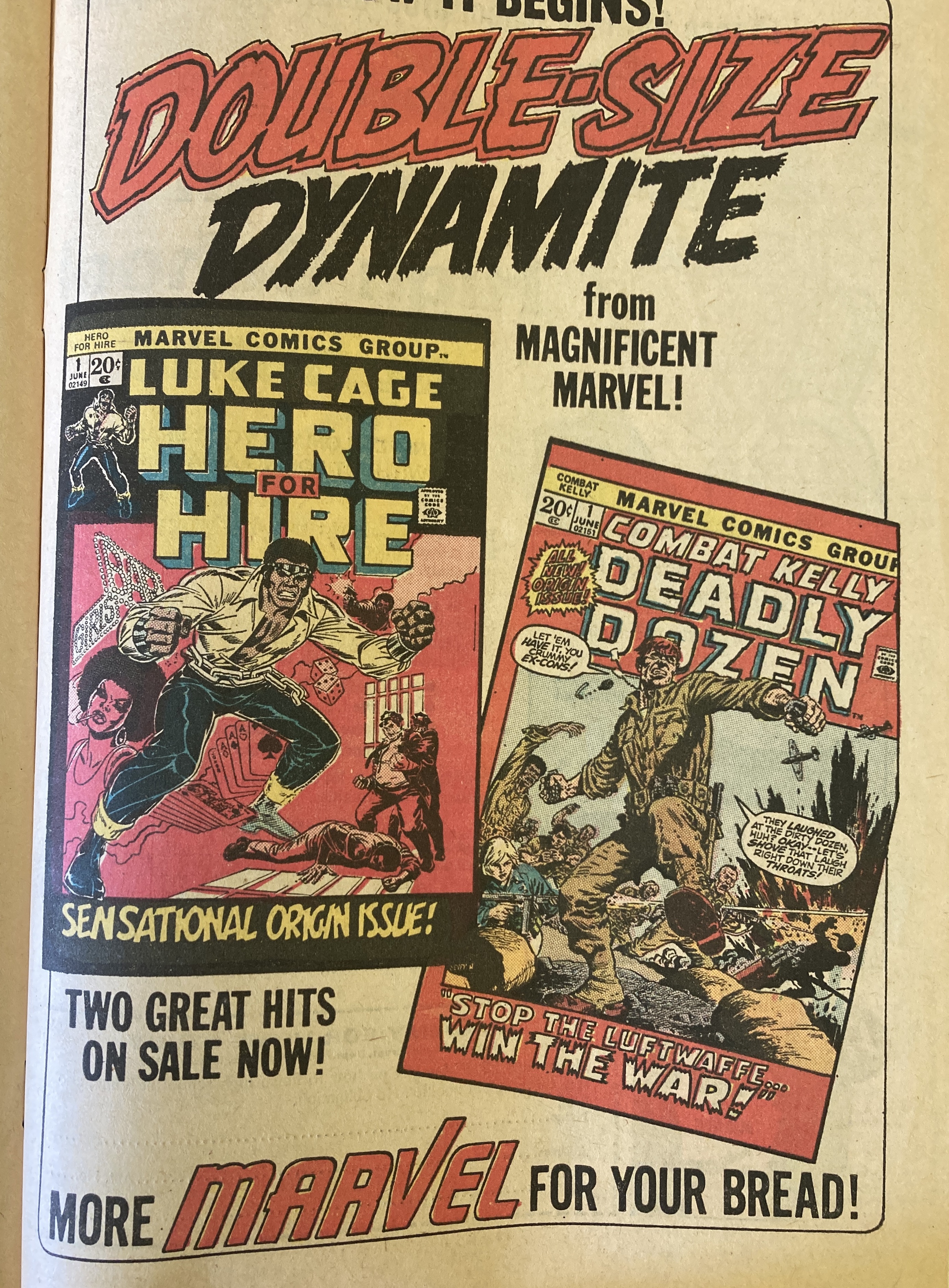
I liked this house ad: More Marvel for your Bread!

(I’d never heard of Combat Kelly and his Dirty Dozen before. Apparently it was a reboot of a 1950s war comic but it only lasted nine issues in its second incarnation). Luke Cage had a bit more success.


Overall

A bit of a let down.

← Older posts
  • “The World’s Greatest Comic Magazine!” Fantastic Four Annual No. 15
  • “The World’s Greatest Comic Magazine!” Fantastic Four No. 223
  • “The World’s Greatest Comic Magazine!” Fantastic Four No. 222
  • “The World’s Greatest Comic Magazine!” Fantastic Four No. 221
  • “The World’s Greatest Comic Magazine!” Fantastic Four No. 220
  • July 2026
  • June 2026
  • May 2026
  • April 2026
  • March 2026
  • February 2026
  • January 2026
  • December 2025
  • November 2025
  • October 2025
  • September 2025
  • August 2025
  • July 2025
  • June 2025
  • May 2025
  • April 2025
  • March 2025
  • February 2025
  • January 2025
  • December 2024
  • November 2024
  • October 2024
  • September 2024
  • August 2024
  • July 2024
  • June 2024
  • May 2024
  • April 2024
  • March 2024
  • February 2024
  • January 2024
  • December 2023
  • November 2023
  • September 2023
  • July 2023
  • June 2023
  • May 2023
  • April 2023
  • March 2023
  • February 2023
  • January 2023
  • December 2022
  • November 2022
  • October 2022
  • September 2022
  • August 2022
  • July 2022
  • June 2022
  • May 2022
  • April 2022
  • March 2022
  • February 2022
  • January 2022
  • December 2021
  • November 2021
  • October 2021
  • September 2021
  • August 2021
  • July 2021
  • June 2021
  • May 2021
  • April 2021
  • March 2021
  • February 2021
  • January 2021
  • December 2020
  • February 2018
  • May 2016
  • February 2016
  • January 2016
  • December 2015
  • November 2015
  • October 2015
  • September 2015
  • August 2015
  • July 2015
  • April 2015
  • March 2015
  • January 2015
  • December 2014
  • November 2014
  • October 2014
  • September 2014
  • August 2014
  • June 2014
  • May 2014
  • April 2014
  • March 2014
  • February 2014
  • July 2026
  • June 2026
  • May 2026
  • April 2026
  • March 2026
  • February 2026
  • January 2026
  • December 2025
  • November 2025
  • October 2025
  • September 2025
  • August 2025
  • July 2025
  • June 2025
  • May 2025
  • April 2025
  • March 2025
  • February 2025
  • January 2025
  • December 2024
  • November 2024
  • October 2024
  • September 2024
  • August 2024
  • July 2024
  • June 2024
  • May 2024
  • April 2024
  • March 2024
  • February 2024
  • January 2024
  • December 2023
  • November 2023
  • September 2023
  • July 2023
  • June 2023
  • May 2023
  • April 2023
  • March 2023
  • February 2023
  • January 2023
  • December 2022
  • November 2022
  • October 2022
  • September 2022
  • August 2022
  • July 2022
  • June 2022
  • May 2022
  • April 2022
  • March 2022
  • February 2022
  • January 2022
  • December 2021
  • November 2021
  • October 2021
  • September 2021
  • August 2021
  • July 2021
  • June 2021
  • May 2021
  • April 2021
  • March 2021
  • February 2021
  • January 2021
  • December 2020
  • February 2018
  • May 2016
  • February 2016
  • January 2016
  • December 2015
  • November 2015
  • October 2015
  • September 2015
  • August 2015
  • July 2015
  • April 2015
  • March 2015
  • January 2015
  • December 2014
  • November 2014
  • October 2014
  • September 2014
  • August 2014
  • June 2014
  • May 2014
  • April 2014
  • March 2014
  • February 2014
“The World’s Greatest Comic Magazine!” Fantastic Four Annual No. 15

“The World’s Greatest Comic Magazine!” Fantastic Four Annual No. 15

percivalhenry's avatar by percivalhenry July 18, 2026
“The World’s Greatest Comic Magazine!” Fantastic Four No. 223

“The World’s Greatest Comic Magazine!” Fantastic Four No. 223

percivalhenry's avatar by percivalhenry July 14, 2026
“The World’s Greatest Comic Magazine!” Fantastic Four No. 222

“The World’s Greatest Comic Magazine!” Fantastic Four No. 222

percivalhenry's avatar by percivalhenry July 5, 2026
“The World’s Greatest Comic Magazine!” Fantastic Four No. 221

“The World’s Greatest Comic Magazine!” Fantastic Four No. 221

percivalhenry's avatar by percivalhenry June 25, 2026
“The World’s Greatest Comic Magazine!” Fantastic Four No. 220

“The World’s Greatest Comic Magazine!” Fantastic Four No. 220

percivalhenry's avatar by percivalhenry June 15, 2026
“The World’s Greatest Comic Magazine!” Fantastic Four No. 219

“The World’s Greatest Comic Magazine!” Fantastic Four No. 219

percivalhenry's avatar by percivalhenry June 7, 2026

Blog at WordPress.com.

  • Subscribe Subscribed
    • Percival Henry: The Fantastic Four and more
    • Join 74 other subscribers
    • Already have a WordPress.com account? Log in now.
    • Percival Henry: The Fantastic Four and more
    • Subscribe Subscribed
    • Sign up
    • Log in
    • Report this content
    • View site in Reader
    • Manage subscriptions
    • Collapse this bar

Loading Comments...