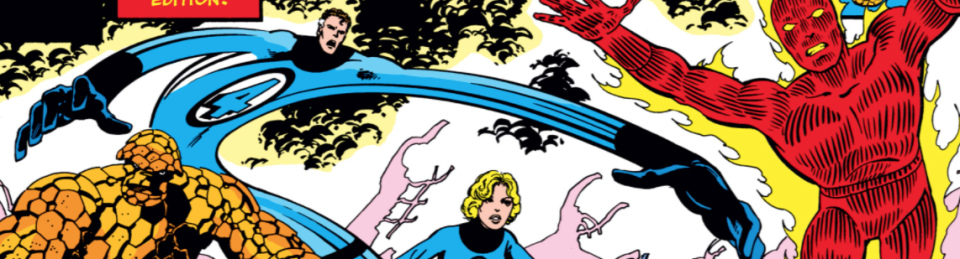
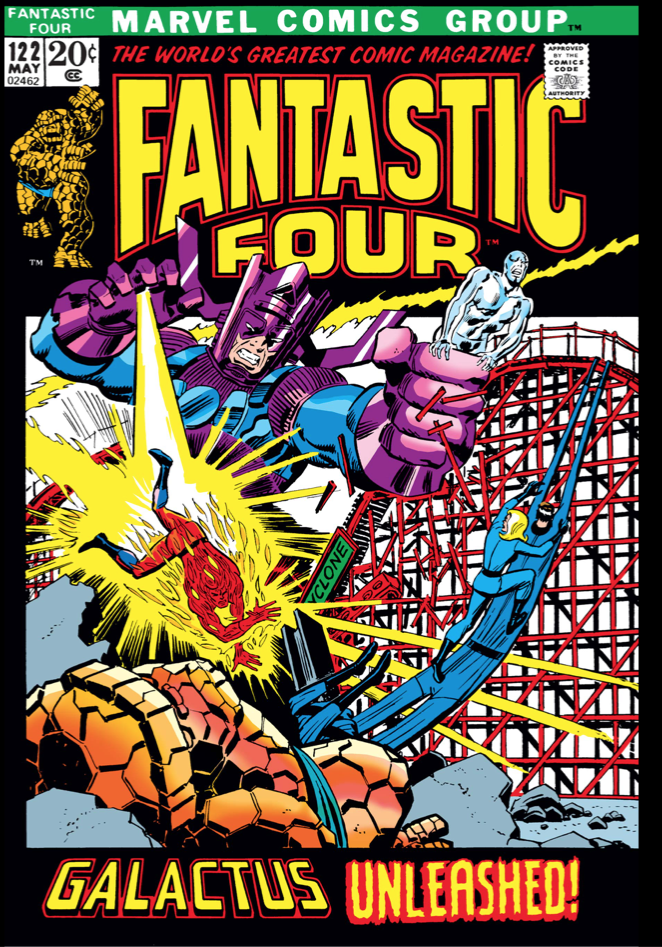
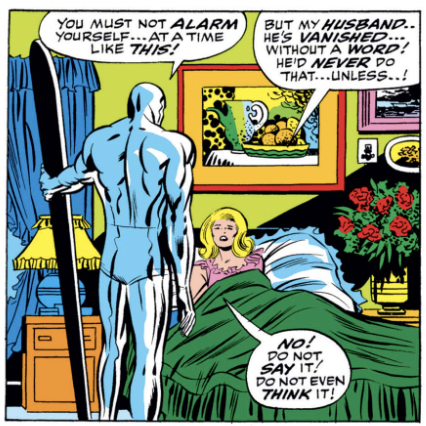
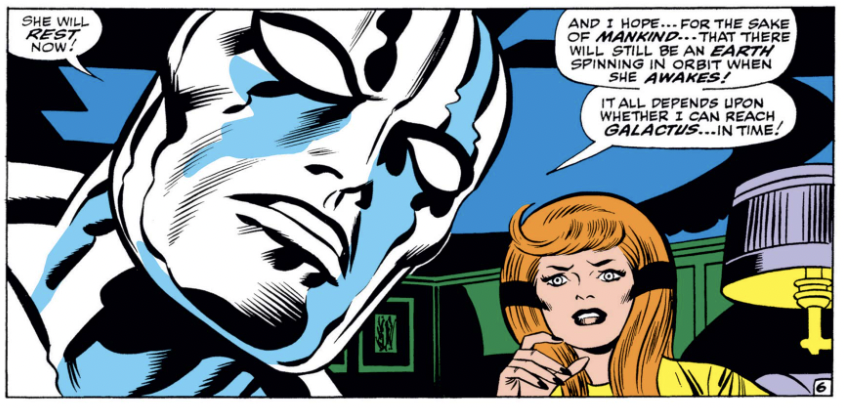
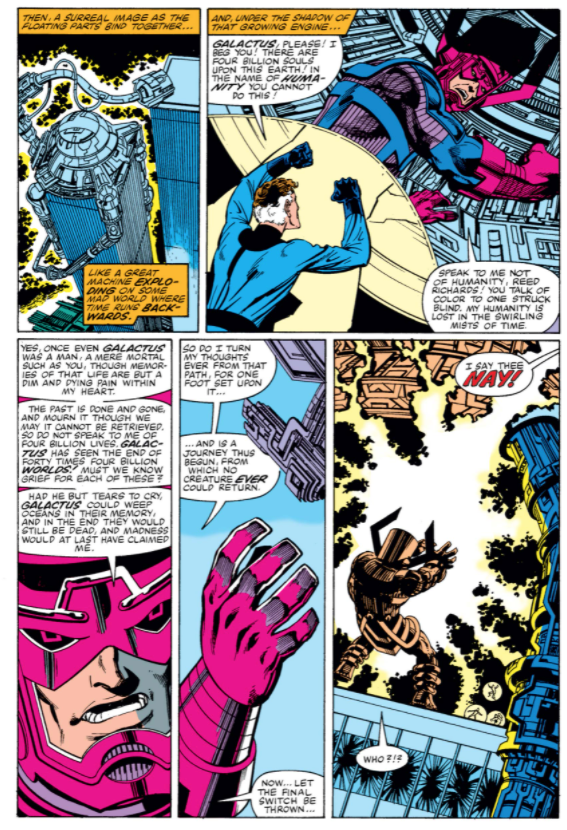
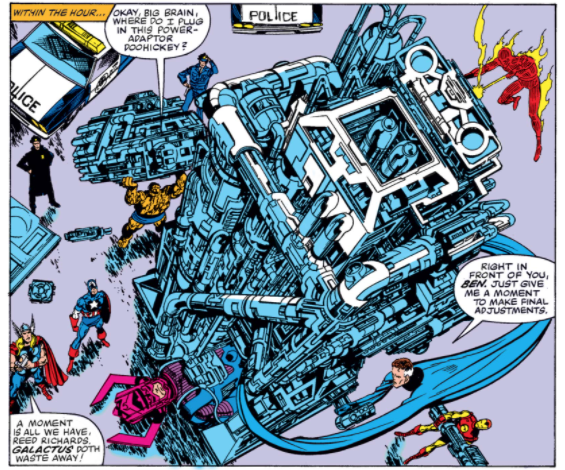
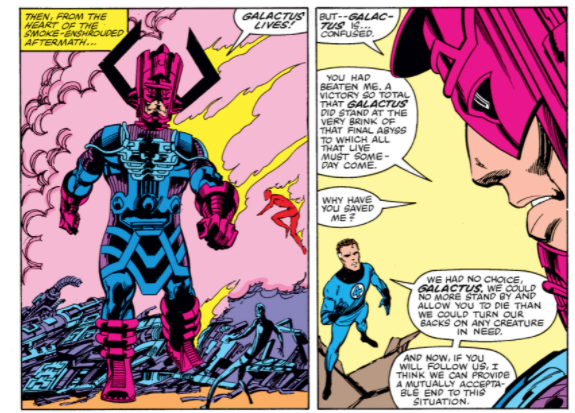
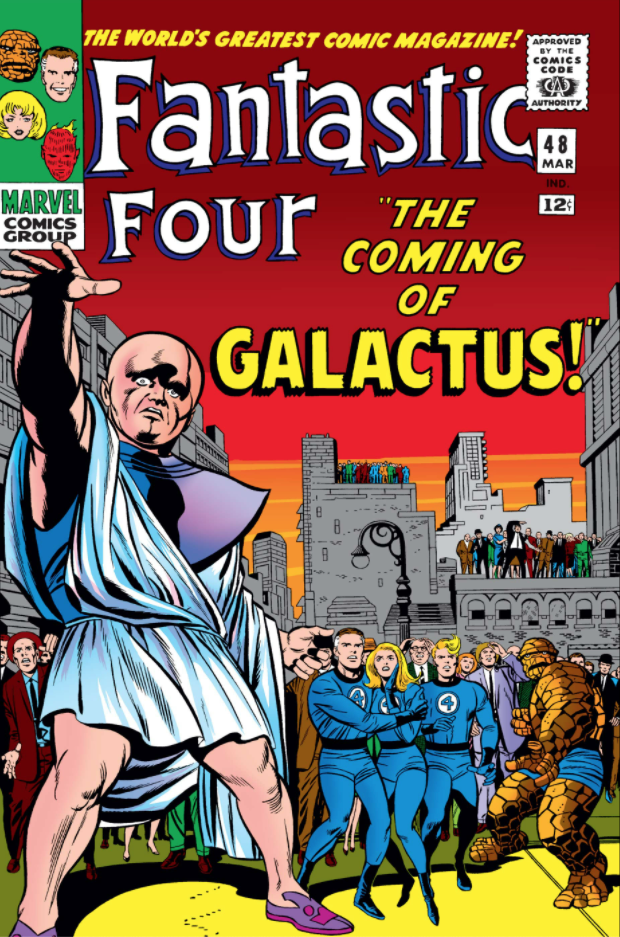
Fantastic Four 122 “Galactus Unleashed!” Published Feb. 1972 Story: Stan Lee & John Buscema Script: Lee Pencils: Buscema Inks: Joe Sinnott Letters: Artie Simek Cover: Buscema and John Romita Sr.
Synopsis
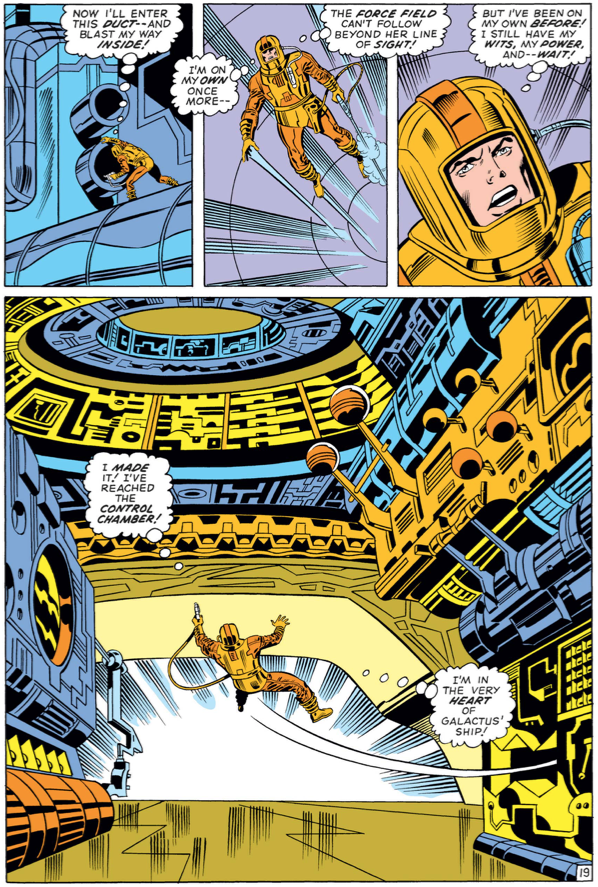
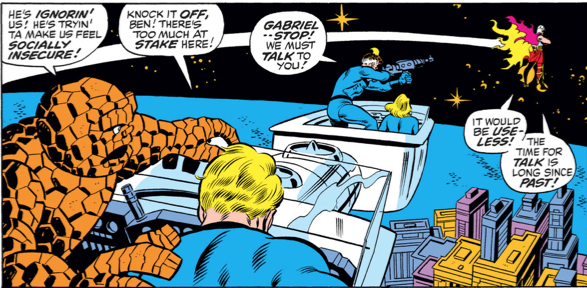
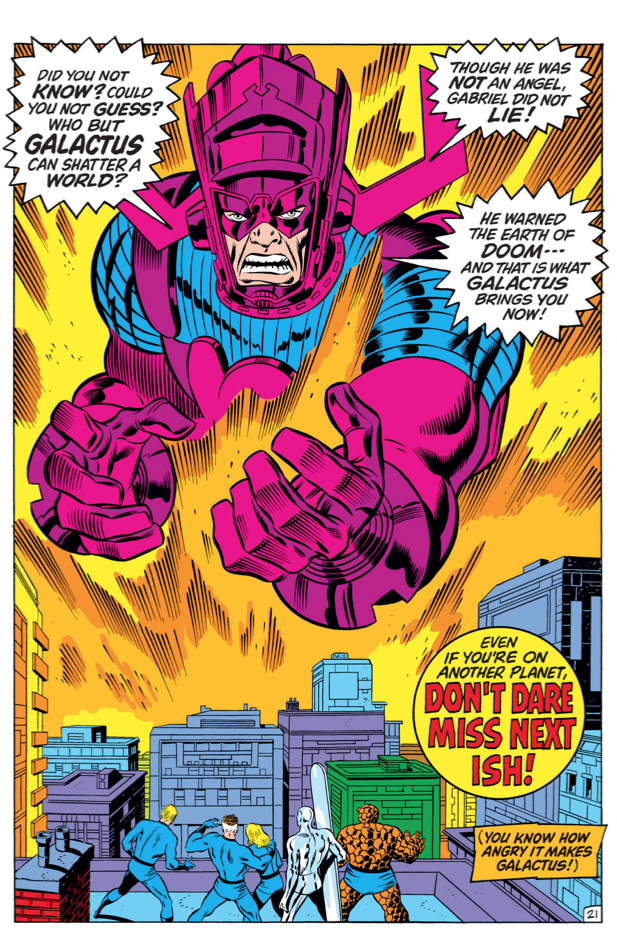
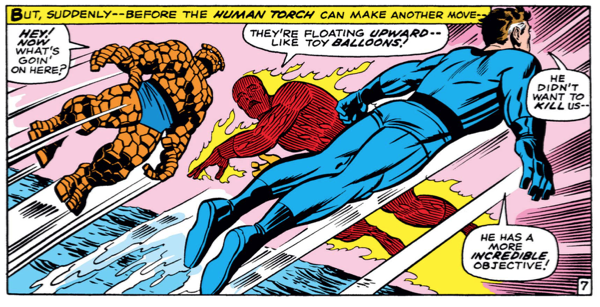
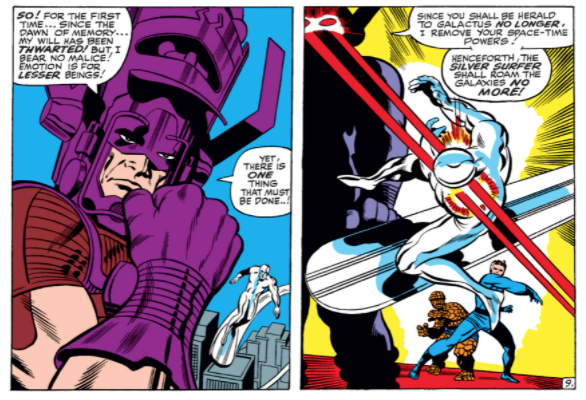
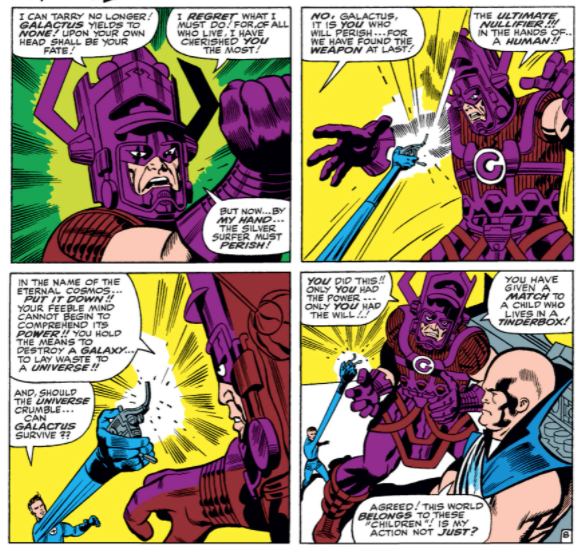
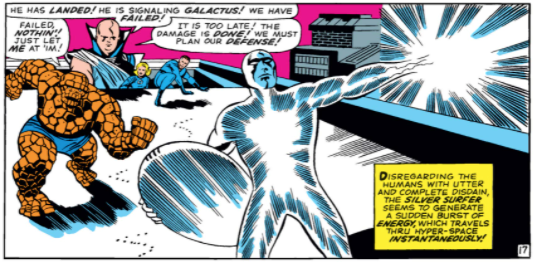
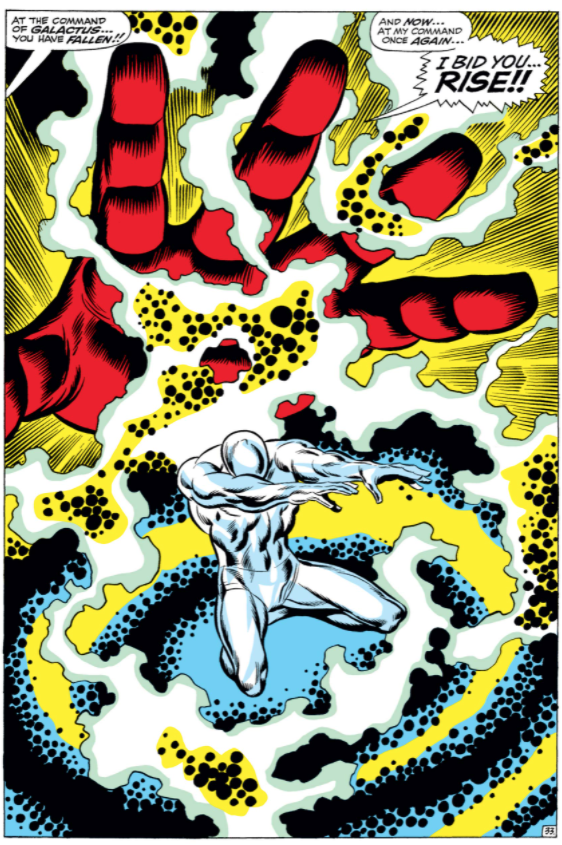
The Fantastic Four and the Silver Surfer battle Galactus, who demands the Surfer rejoin him as his herald or he will destroy Earth. In response, Reed travels to space to capture Galactus’s ship.
What’s going on here
This is an old-school, action-packed comic, with high stakes and lots of drama. I have some quibbles (see below) but on the whole this feels like a return to form for the Fantastic Four after an uneven period following the departure of Kirby. Galactus is a great villain, and his need for the Surfer to be his herald again gives at least a plausible reason for his to return to Earth after promising to spare it.
What I liked
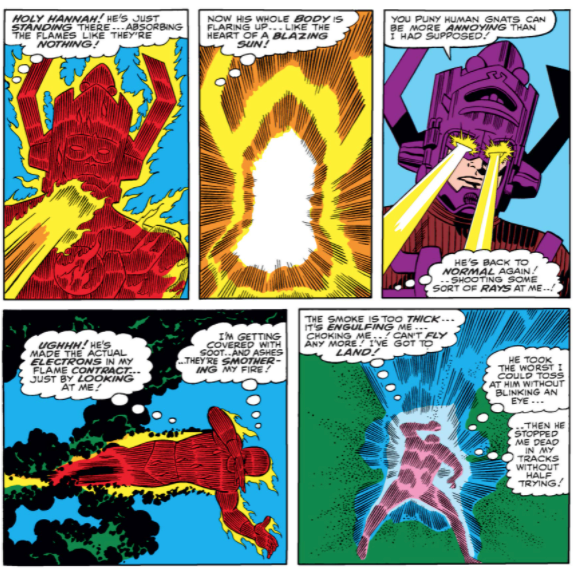
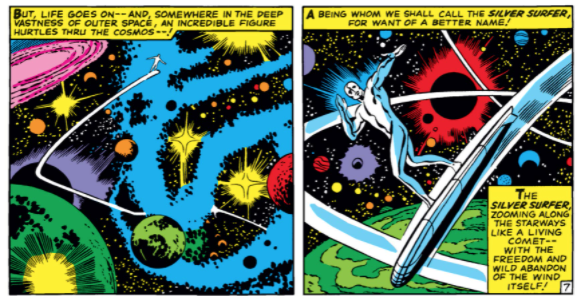
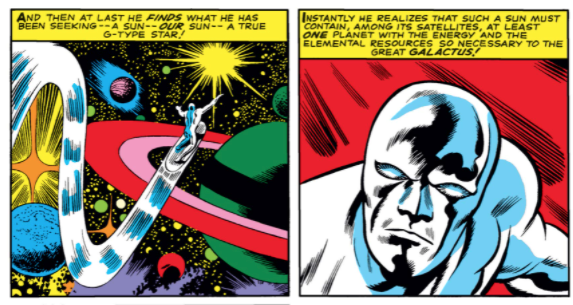
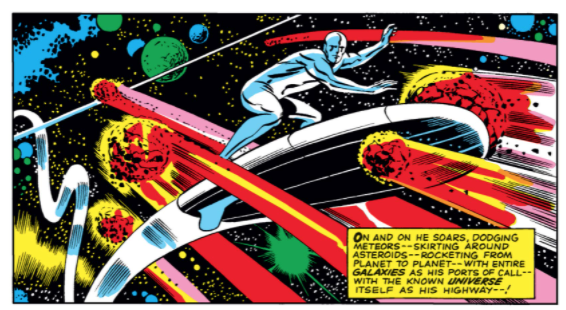
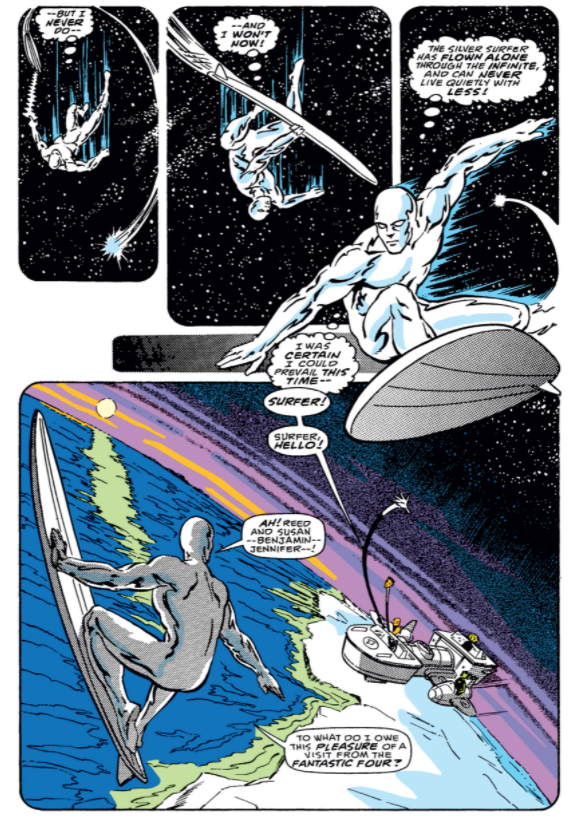
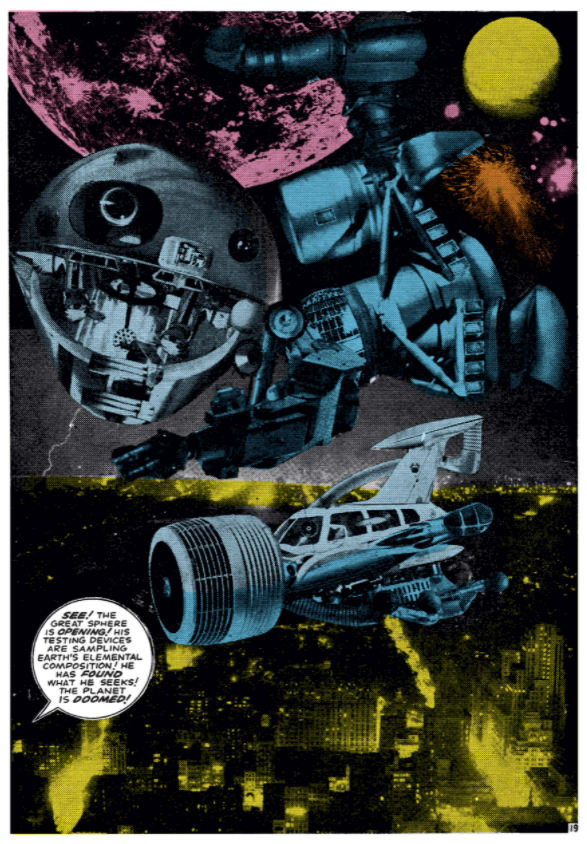
After some predictable fighting sequences, the comic shifts into high gear when Reed travels into space to capture Galactus’s space ship. Bucesma gets to stretch his Kirby muscles, and the sequence has a great mix of wonder and tension.
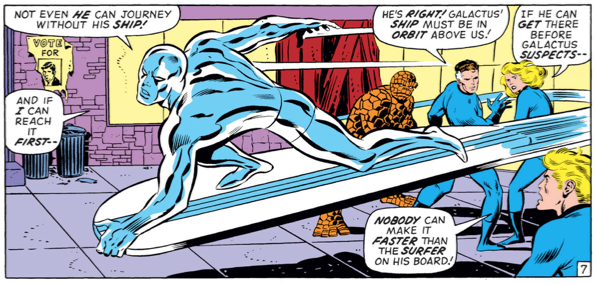
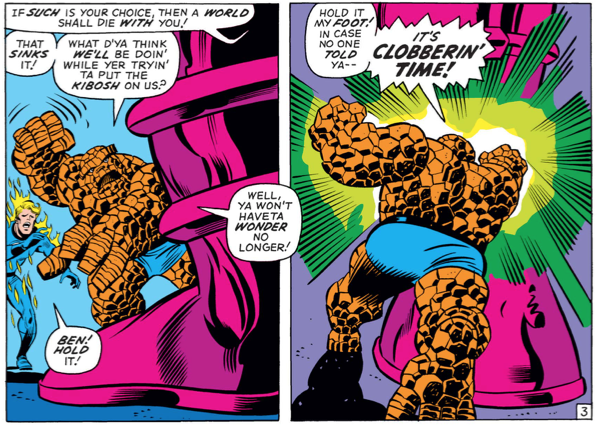
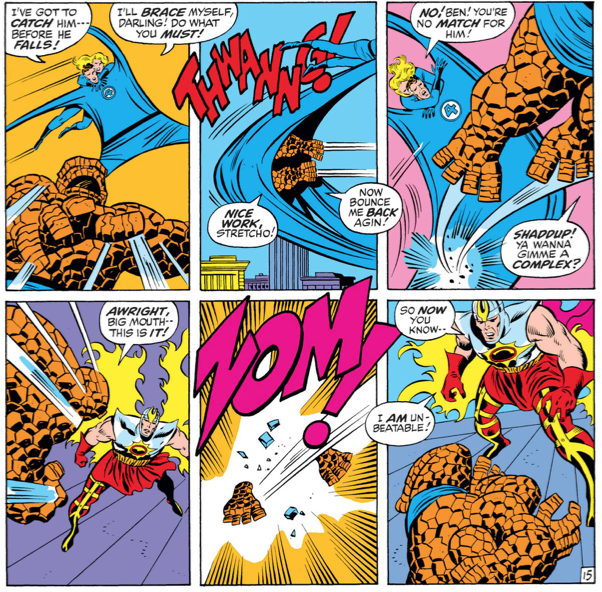
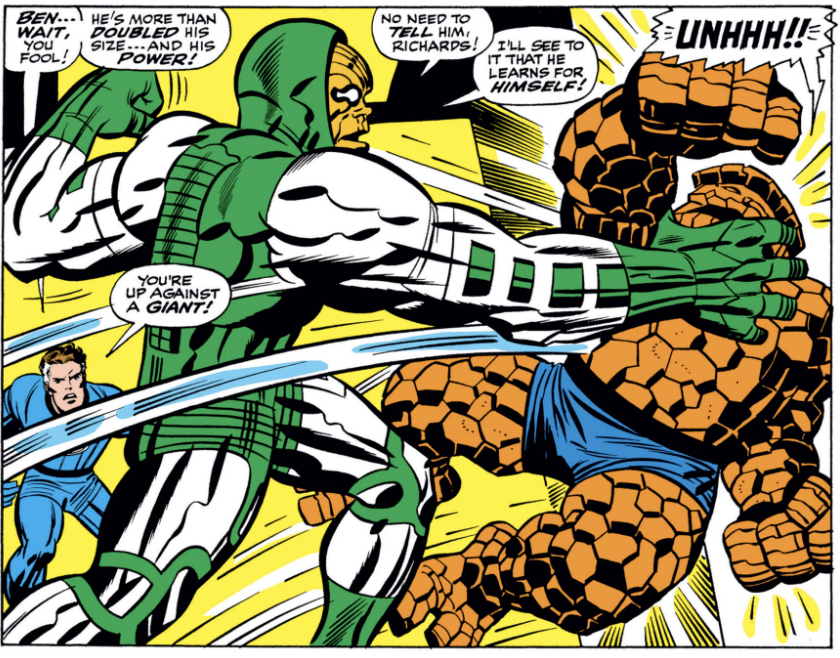
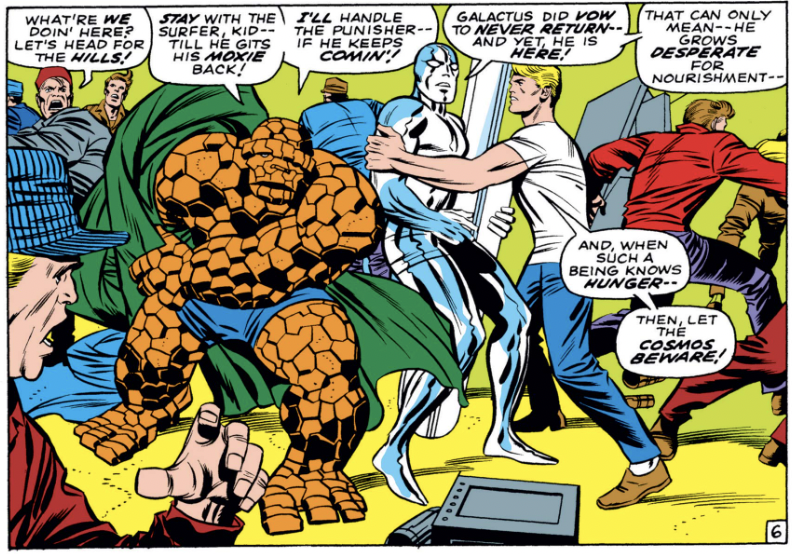
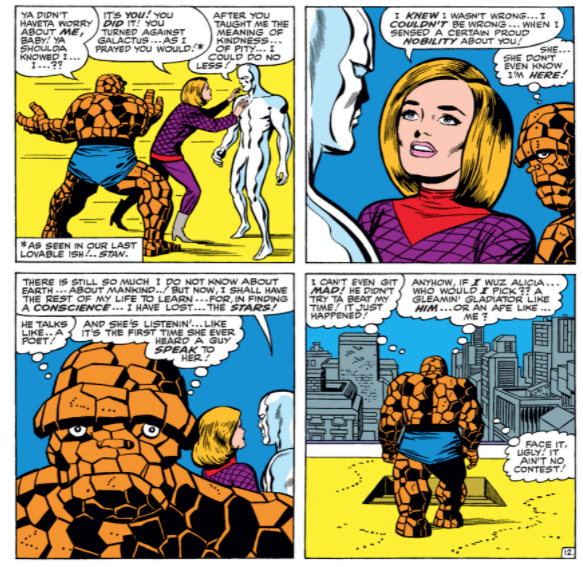
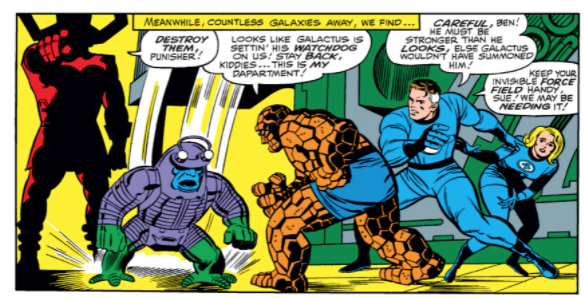
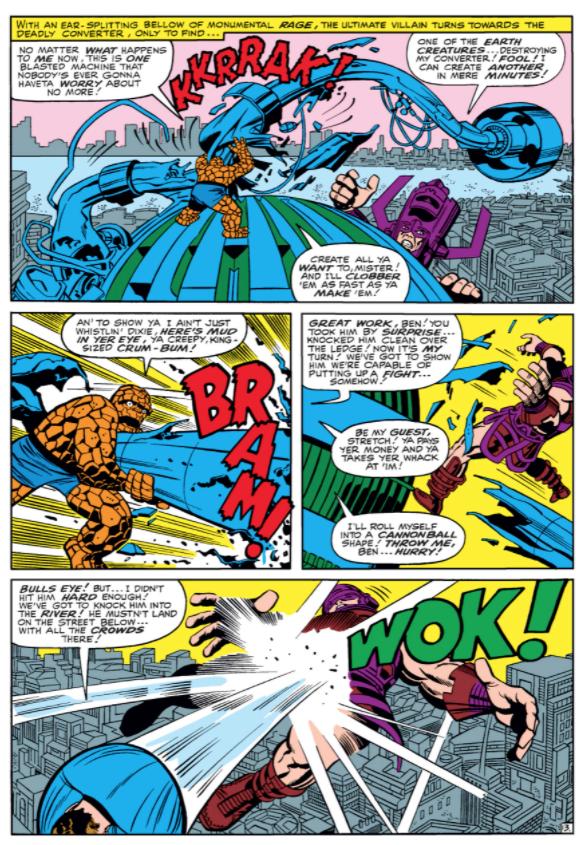
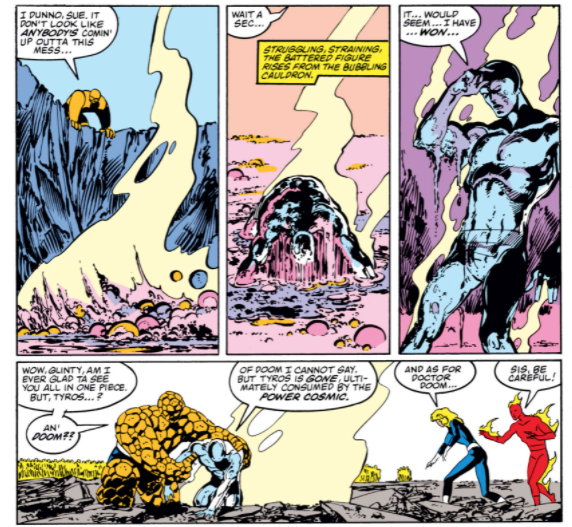
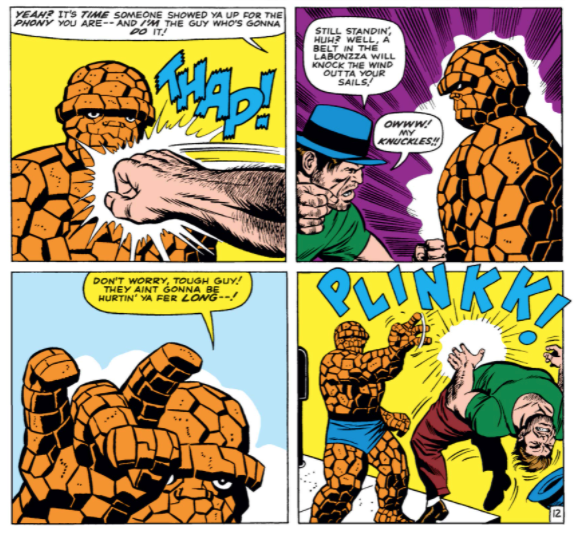
I also liked this sequence, which is both a testament to the Thing’s power and a bit ridiculous (punching a foot?)
What I didn’t like
The Air-Walker robot, the focus of the last two issues, seems to have been dropped as a plot line. It seems like an elaborate ruse of Galactus’s to draw out the Surfer, and it’s begging for additional explanation.
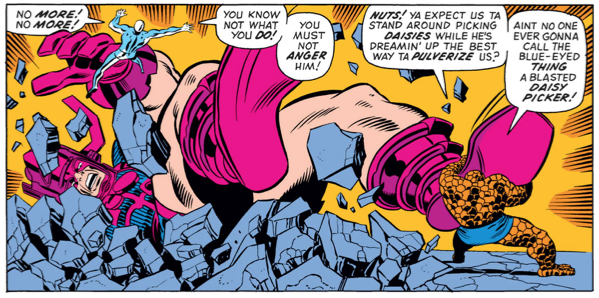
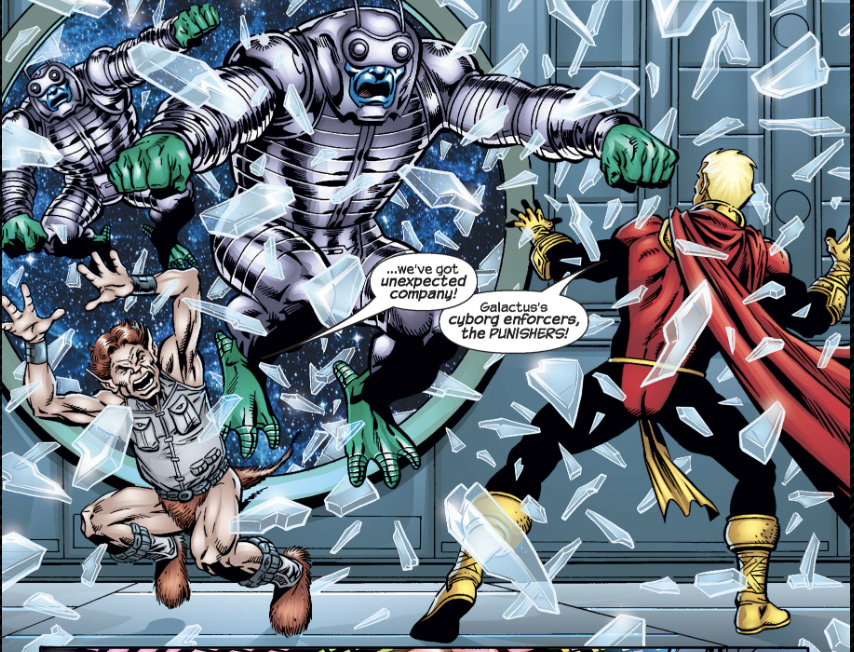
Also, I recognize the FF has to try to stop Galactus, but — in my view — he should be too powerful to bother having to fight back, hence deploying the Punisher android in earlier appearances. Here, he not only scraps with the Fantastic Four but Ben knocks him off his feet. It serves to diminish what should be a character above physical confrontation.
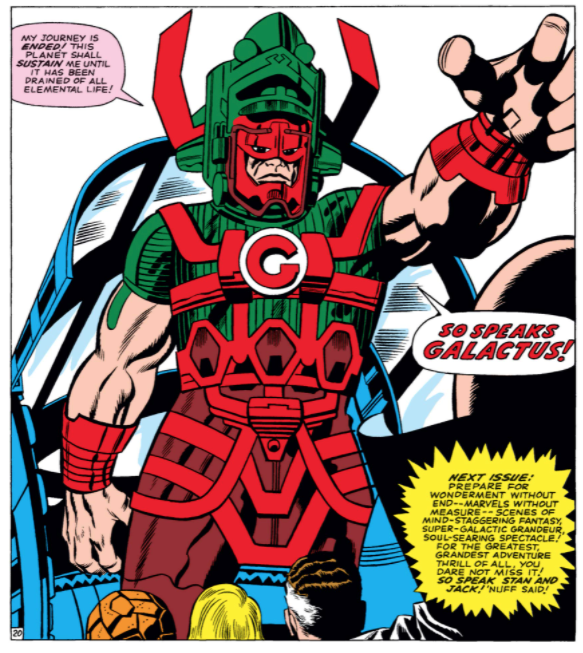
Further, Galactus should wear long pants. At least they removed the G from his chest.
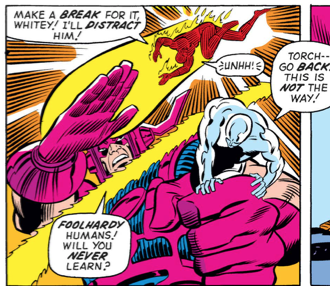
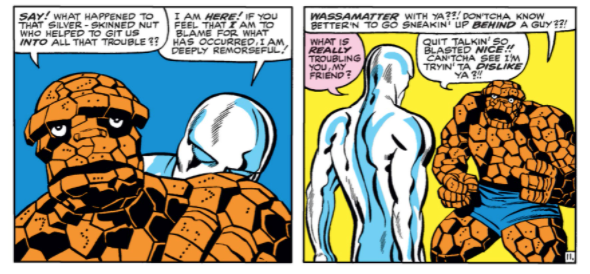
Lastly, calling the Silver Surfer “whitey” just sounds weird, especially since he’s, you know, silver.
Anything else?
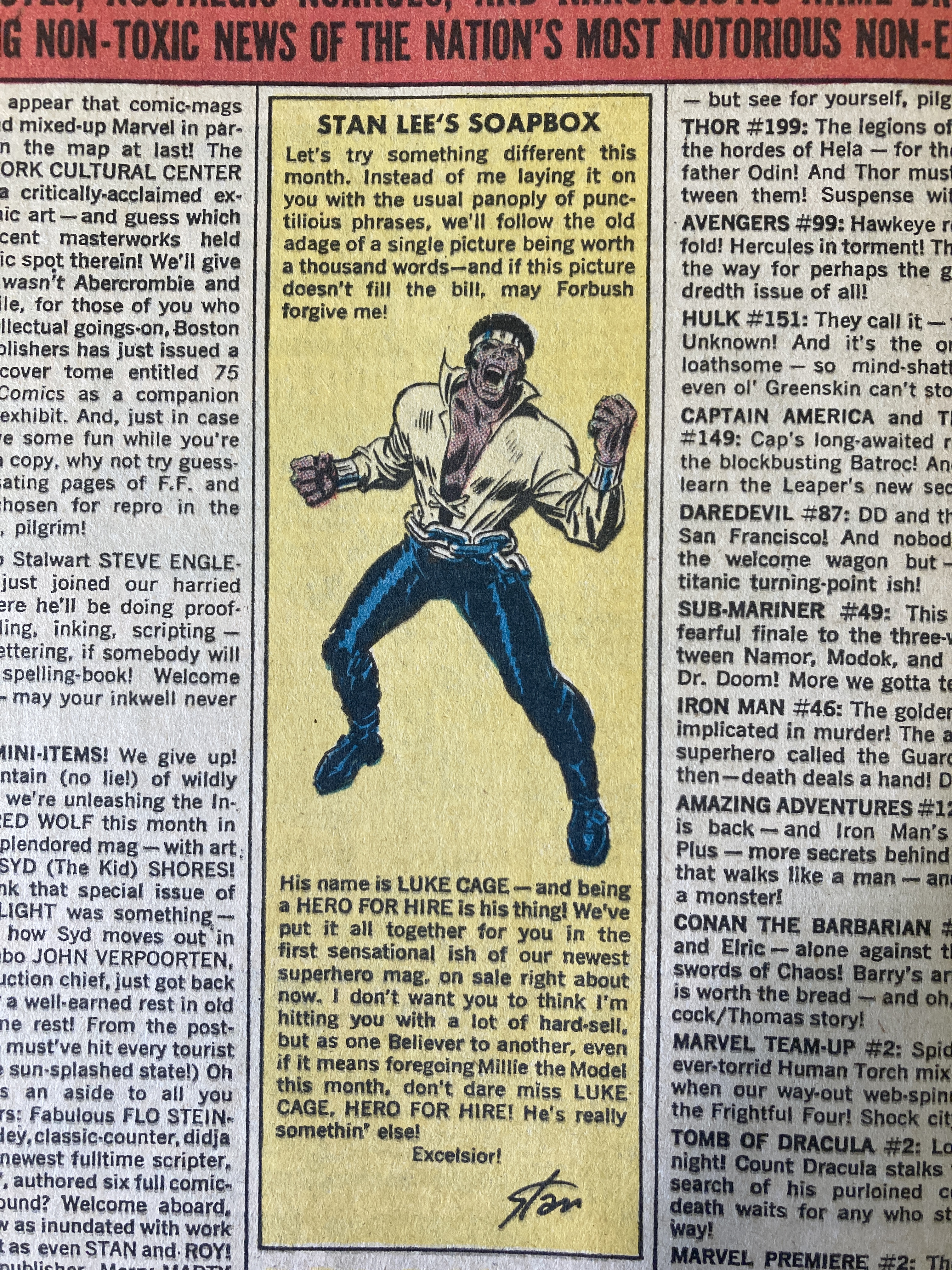
The month marks the debut of Luke Cage, a future member of the FF (very briefly).
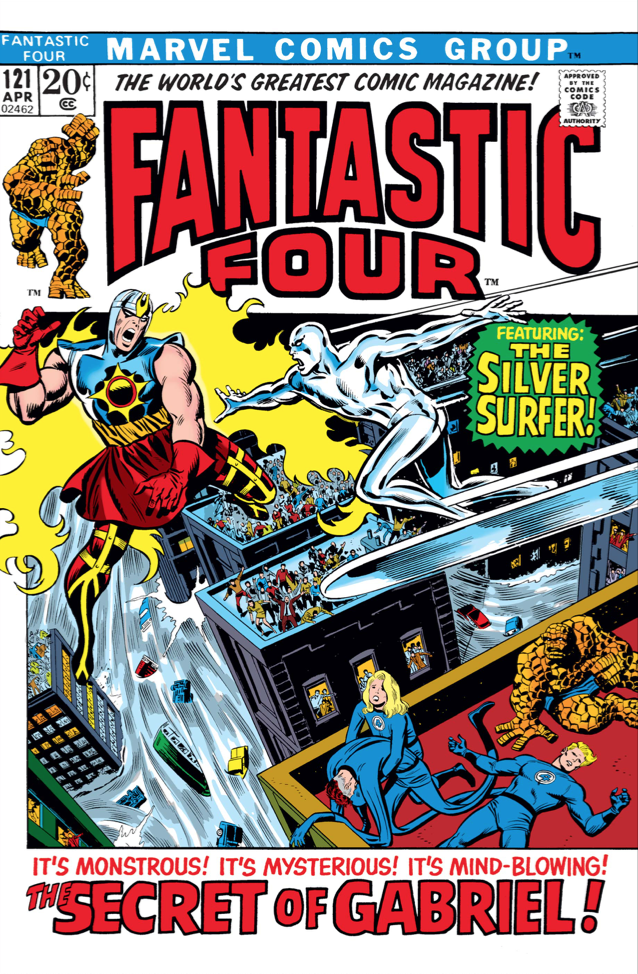
Fantastic Four 121 “The Mysterious Mind Blowing Secret of Gabriel!” Published: Jan. 1972 Story: Stan Lee & John Buscema Script: Lee Pencils: Buscema Inks: Joe Sinnott Letters: Sam Rosen Cover: Buscema and Sinnott
Synopsis
The Air-Walker turns humanity against the Fantastic Four, whose effort to battle him are futile, before admitting he was only attempting to lure the Silver Surfer. After the Surfer beats him and reveals him to be a robot, Galactus makes a dramatic appearance.
What’s going on here?
After last issue’s long build up, FF 121 delivers some pay off. There’s a long fight with Air-Walker, some not-too-subtle commentary about religious fanaticism by Stan, a dramatic appearance from the Silver Surfer and two big twists: Air-Walker is a robot, and he was doing the bidding of Galactus. Unfortunately, most comic readers today know Air-Walker as a herald of Galactus (information I first received from the Official Handbook of the Marvel Universe circa 1983) , but I imagine for a reader in 1972 this would have come as a shocking revelation. Mind-blowing, even (to quote the comic’s title). At this point, Stan may be close to the end of his days as a regular comic writer, but he shows here he’s still got something on his fastball.
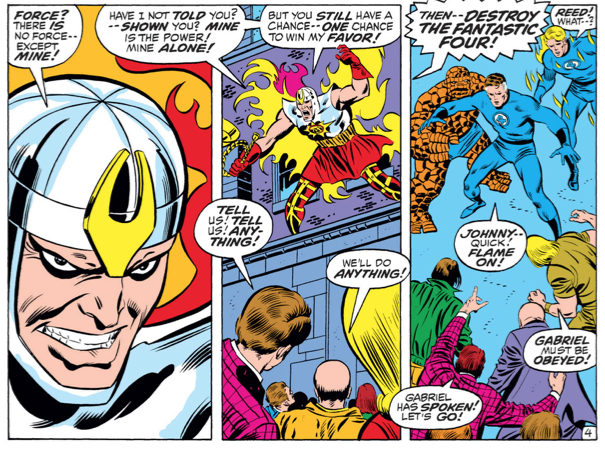
Along with the aforementioned plot twists, I did like Stan’s injection of social commentary into the New Yorkers reaction of Gabriel. It’s pretty clear what Stan thinks of zealotry.
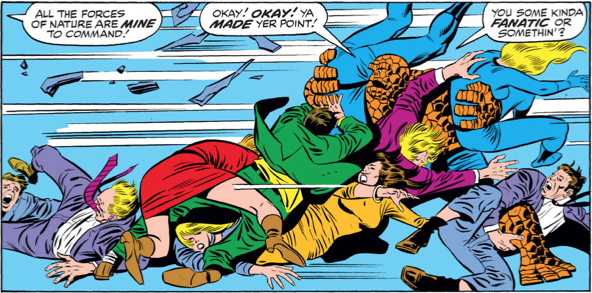
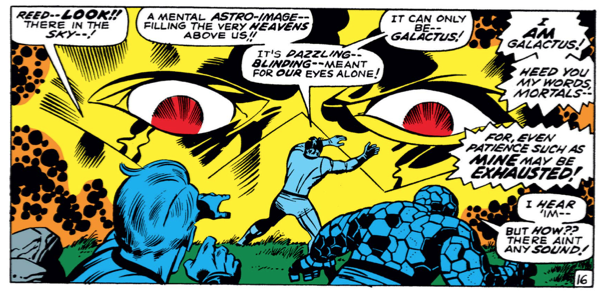
There are some great Buscema panels, like this one:
As well as some fun sound effects (which I think would be done by Buscema, not Sam Rosen, the letterer):
What I didn’t like
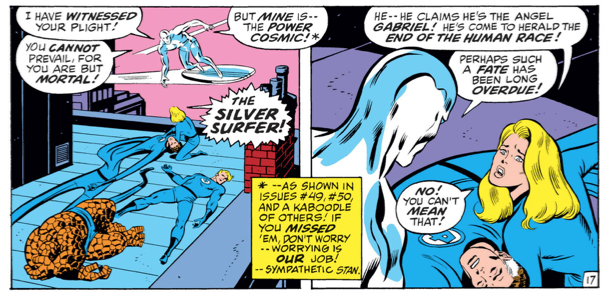
This issue suffers from the same sluggish pacing of a lot of Stan’s Fantastic Four comics. The FF spend an awful long time either fighting Air-Walker, running away from Air-Walker or escaping New Yorkers doing Air-Walker’s bidding, and so the appearance of the Silver Surfer is jammed into the last few pages. When he arrives to save the day, it’s a tiny panel and he’s about half an inch high. Surely this dramatic scene merits at least a half splash?
Anything else?
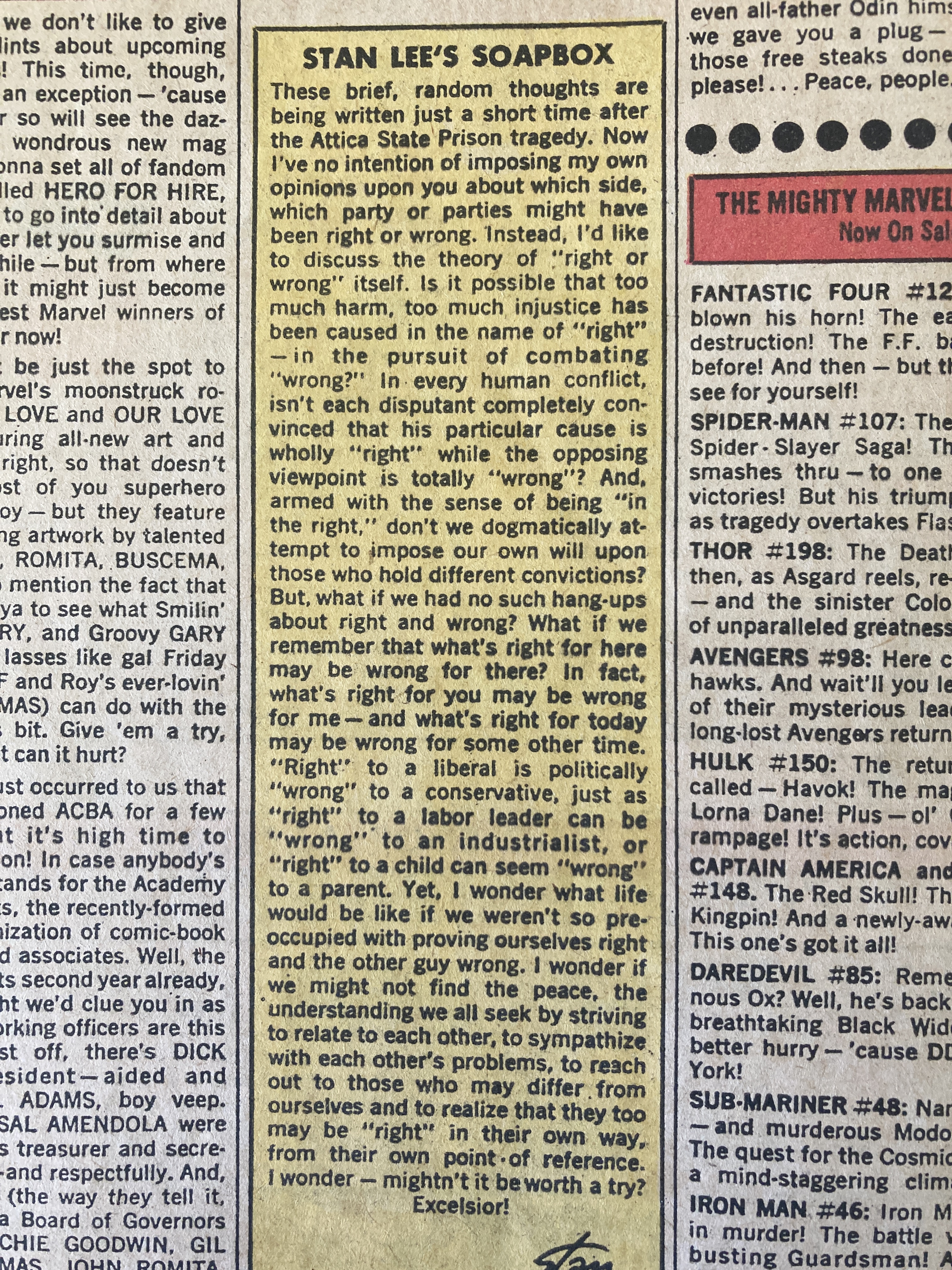
In his soap box, Stan take on another fun subject: the Attica prison riots!
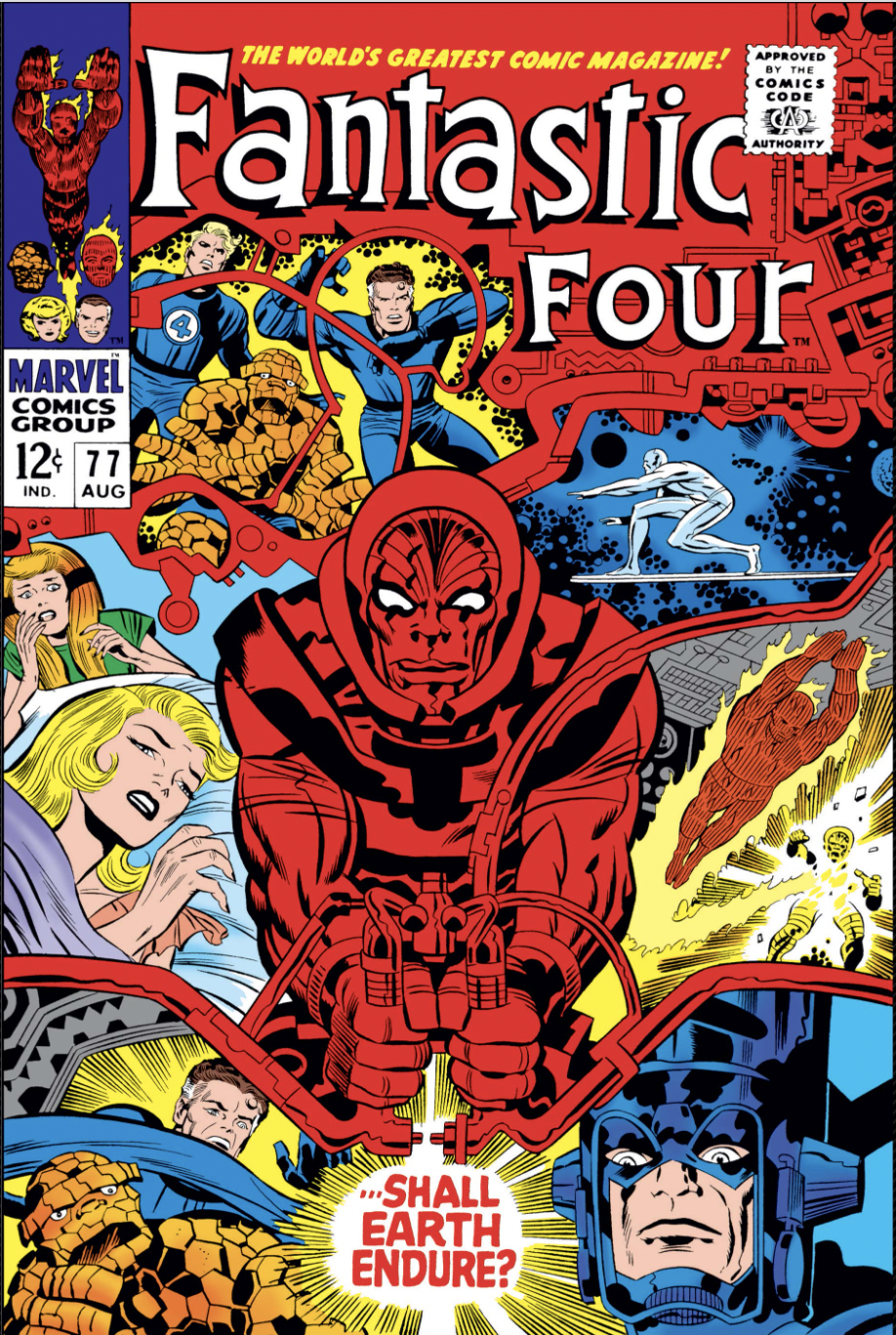
Fantastic Four 77 “Shall Earth Endure?” Published: May 1968 Story: Stan Lee and Jack Kirby Script: Lee Pencils: Kirby Inks: Joe Sinnott Letters: Sam Rosen Cover: Kirby and Sinnott
Synopsis
The three male members of the Fantastic Four are in the Microverse, where in the last issue they persuaded the Silver Surfer to return to Galactus and spare the earth by finding him another planet to consume. The FF, minus the soon-to-give-birth Invisible Girl, remained behind to pursue the Psycho-Man, and in the opening pages of FF 77, they are whisked via teleportation to the villain’s headquarters. There, they confront him only to discover they were fighting an illusion created by his emotion warping powers.
Meanwhile, the Silver Surfer has returned to the earth’s dimension, and flies across space to convince Galactus to spare the earth. Galactus commands the Surfer to find him another planet to consume, which he somehow is able to do quickly. But when the Surfer asks to be released from his imprisonment on earth, Galactus refuses, saying he needs to be able to find him.
Back in the microverse, the FF fight first a giant version of the Psycho-Man, then one in armor outfitted with weaponry. The FF eventually triumph when the Thing collapses his headquarters around the Psycho-Man, trapping him. But Mr. Fantastic orders him freed, explaining they need him to return to earth since they have been teleported away from their Reducta-craft. Reed tells the Psycho-Man that Galactus threatens his universe as well, and when he examines Reed’s mind and sees he’s telling the truth, returns the FF to their dimension to battle Galactus.
What’s going on here?
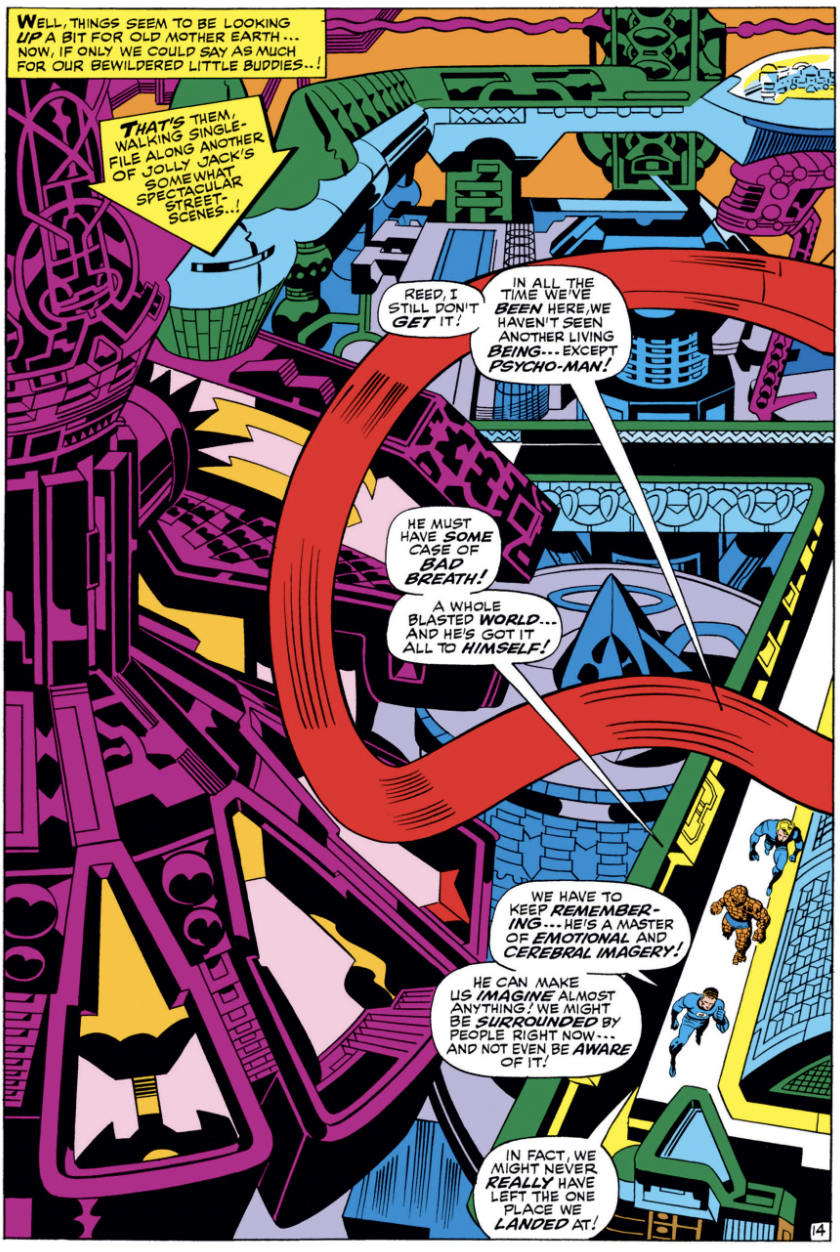
This issue concludes the four-issue Galactus/Pyscho-Man arc and unfortunately it ends with a fizzle, not a bang. The story’s problems started last issue, when Reed tells the team they need to remain behind to end the menace of the Psycho-Man. But how he intended to do that is never clear, and even when they have trapped him, it’s not clear what the next move was supposed to be—arrest him? murder him? The confusion about their purpose in the microverse speaks to the general aimlessness of the issue. The Surfer’s reunion with Galactus is unsatisfying and anti-climactic—he finds him new planet to consume in what seems like minutes—and the FF’s confrontation with the Psycho-Man ends with Reed sheepishly needing him to give the team a ride home.
On the plus side, Kirby is on the top of his game in this issue.
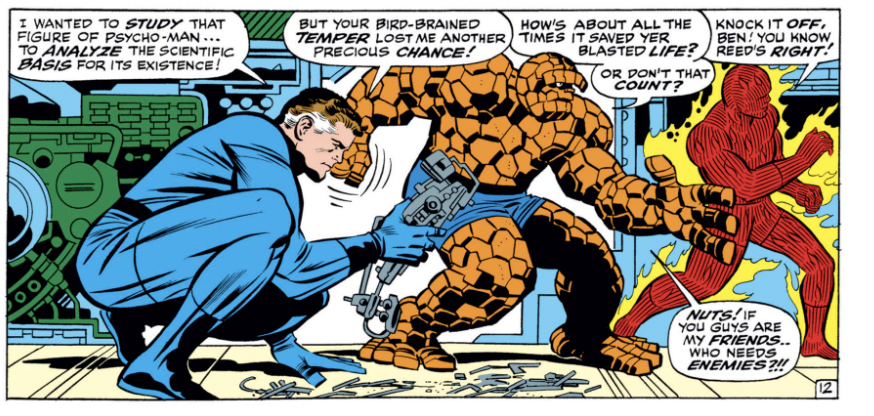
They’re fighting again
When I first read this panel, I assumed the Psycho-Man was using his mood altering powers to pit the team against each other. Nope, just their usual bickering.
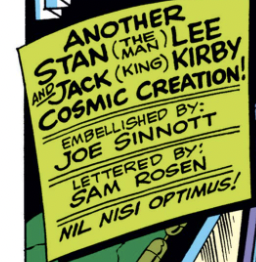
Crazy Credits
Nil Nisi Optimus translates from latin as “nothing but the best is good enough.” If only that were true.
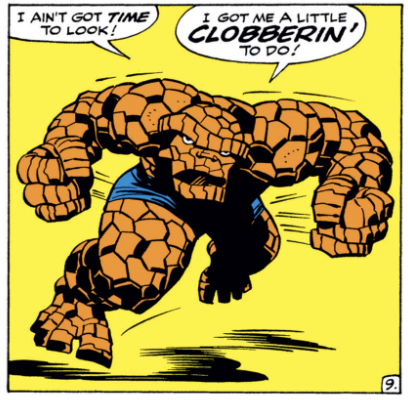
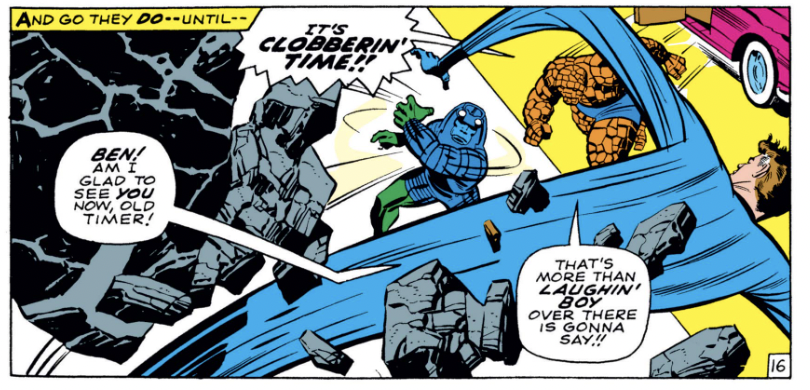
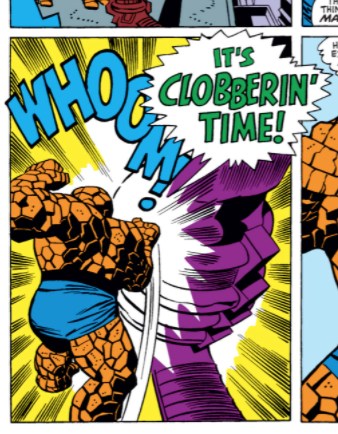
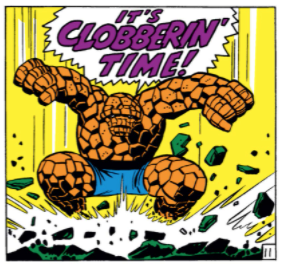
It’s Clobberin’ Time
Well, sort of.
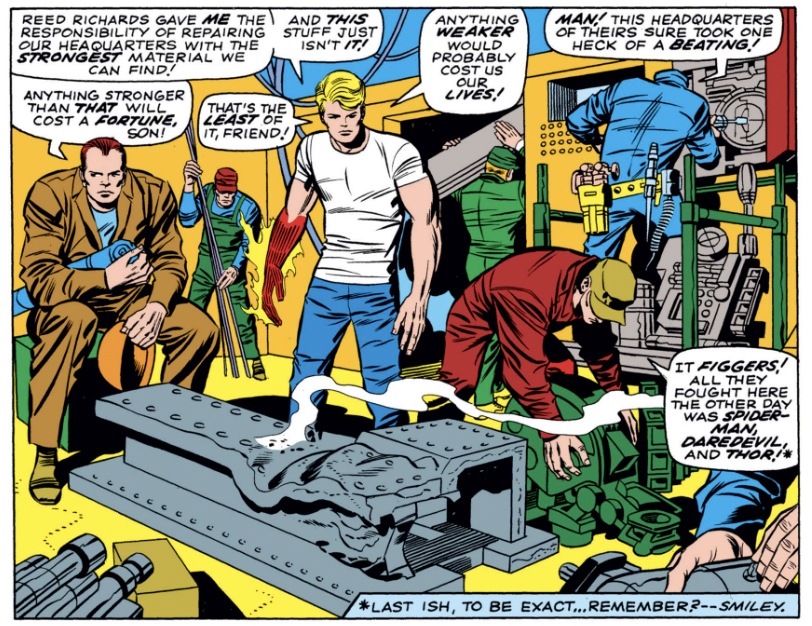
Mid-century Modern
More Baxter Building interior decor. Is that a Cezanne?
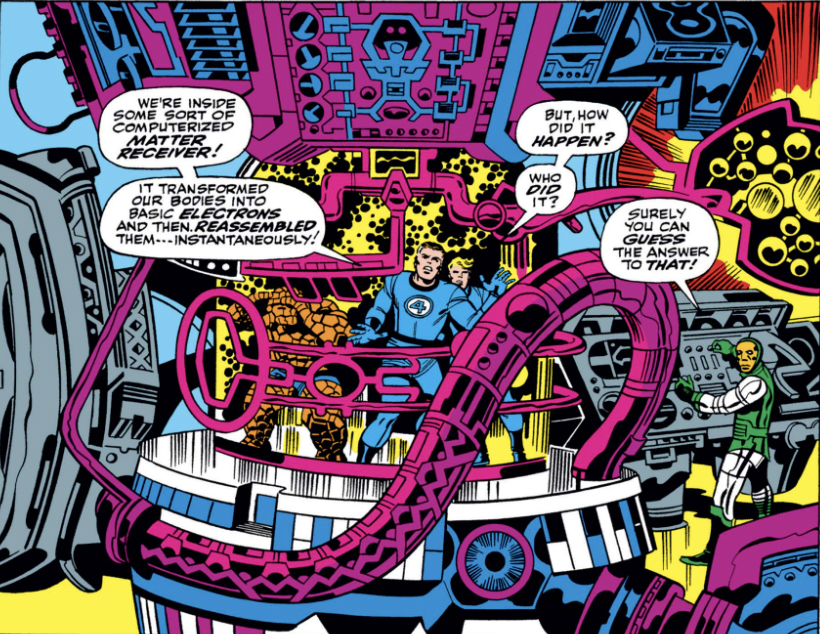
Weird science
Why, yes, it is a computerized matter receiver.
Ladies and gentlemen, Joe Sinnott:
A master at work.
Dig that Kirby Krackle
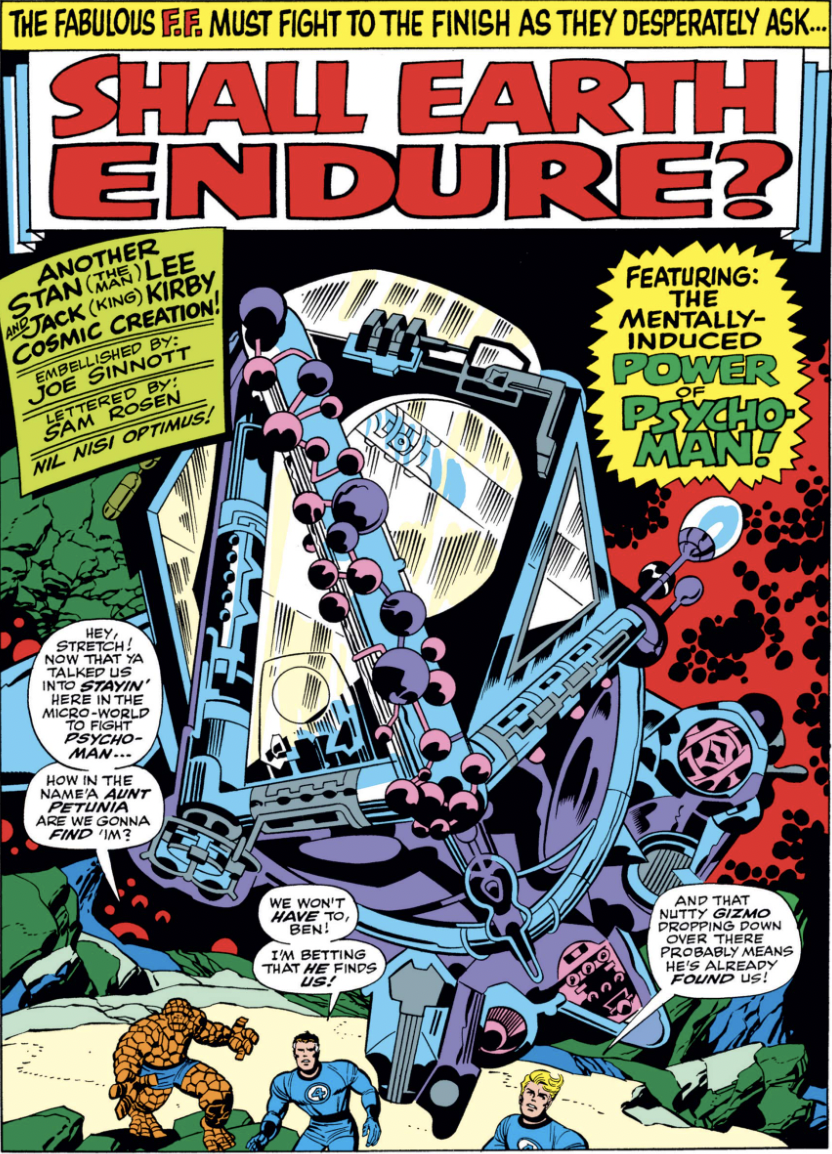
Some great splash pages in this issue. Like this one:
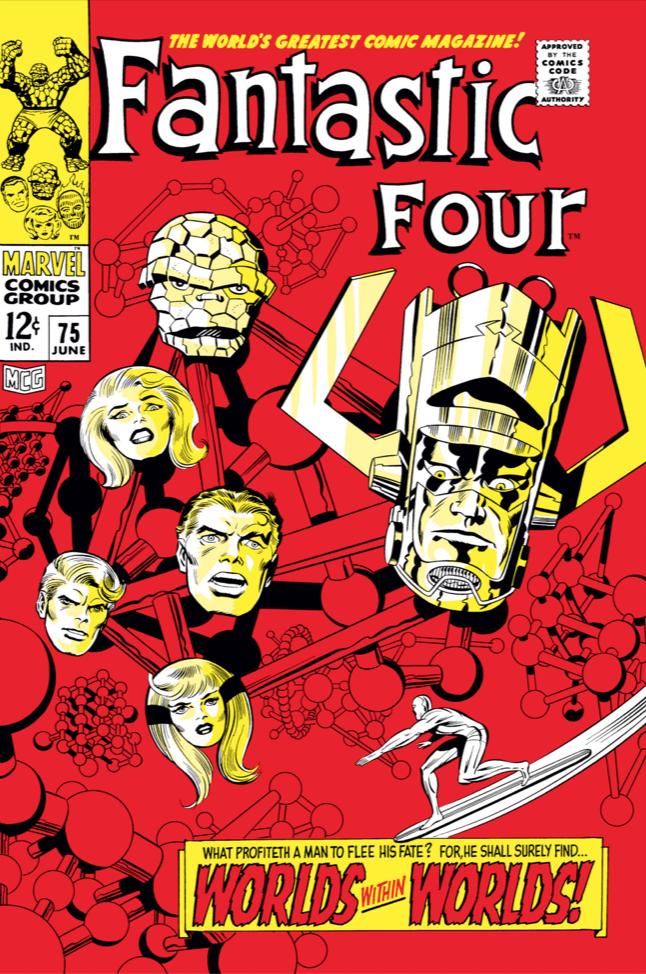
Fantastic Four 75 “Worlds Within Worlds!” Published: March 1968 Story: Stan Lee and Jack Kirby Script: Lee Pencils: Kirby Inks: Joe Sinnott Letters: Artie Simek Cover: Kirby and Sinnott
Synopsis
Fantastic Four 75 follows closely behind FF 74, when the team—minus the pregnant Invisible Girl—got wrapped up in Galactus’s quest to locate the missing Silver Surfer, his former herald, so that the Surfer could find new planets for him to consume. FF 75 opens with Mr. Fantastic, the Thing and the Human Torch on an unnamed island off the coast of New York City, waiting for Galactus’s next move.
Galactus—still light years away on his space ship—initially destroys the island, then pulls the trio into space where they black out, before they are revived on the once-again intact island. The team then confronts doppelgängers of themselves created by Galactus, and after a long battle, finally defeat them by switching up opponents. Finally, when Galactus threatens to destroy Manhattan by dropping a massive meteor on it, Reed pledges to find the Surfer. The issue closes with the trio preparing to shrink into the mircoverse, where they suspect the Surfer has traveled.
What’s going on here?
This is a fun issue, with high stakes, great action and some amazing gee-whiz Kirby art, although not all of it makes a lot of sense. It’s not really obvious that subjecting the FF to various trials was supposed to force them to give up the Surfer’s location—Galactus doesn’t make his demands known until after they fight the doppelgangers—and at any rate, it seems like killing them would not be an effective way to get information. Mostly it’s an opportunity to show off Galactus’s power, and have the three FF members fight evil versions of themselves.
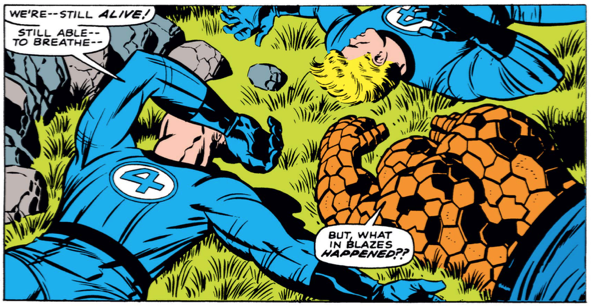
The sequence with the FF being lifted into space, nearing death, then waking up on the ground is a particularly good one.
He wears short shorts
This might be Galactus’s last appearance in shorts:
By the time of his next appearance, in Silver Surfer 1 later that year (technically a flashback), he’s in long pants:
Silver Surfer 1 (19868, Lee/J. Buscema/Sinnott)
He’s also wearing long pants in his subsequent appearances in Thor, which Kirby drew.
The sexist sixties
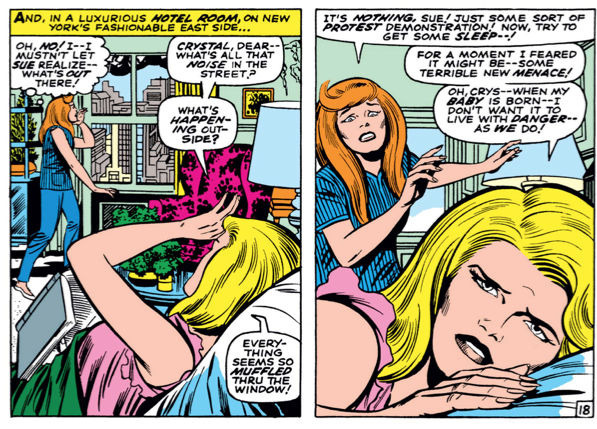
Once again, Sue is not just sidelined, but patronized as Crystal keeps her from learning her team is battling for their lives.
They’re fighting again
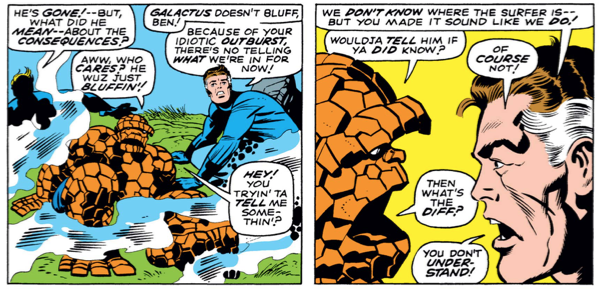
Technically they trade blows since they fight versions of themselves, but also in this spirited argument between Ben and Reed.
The incredible Mr. Fantastic
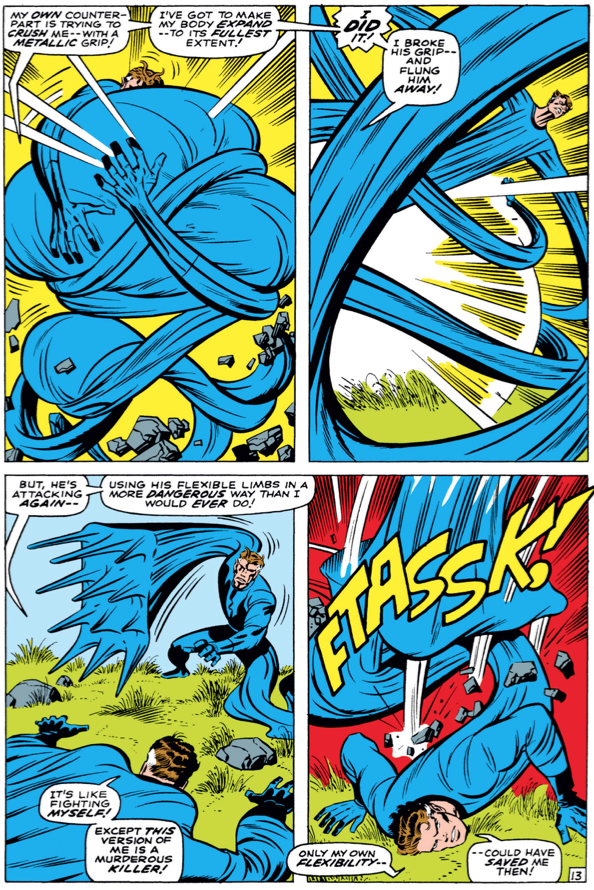
Reed vs. evil Reed
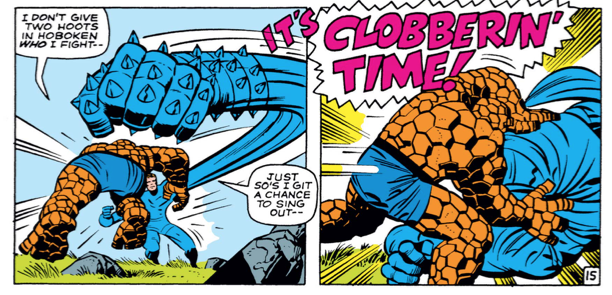
It’s Clobberin’ time
Weird science
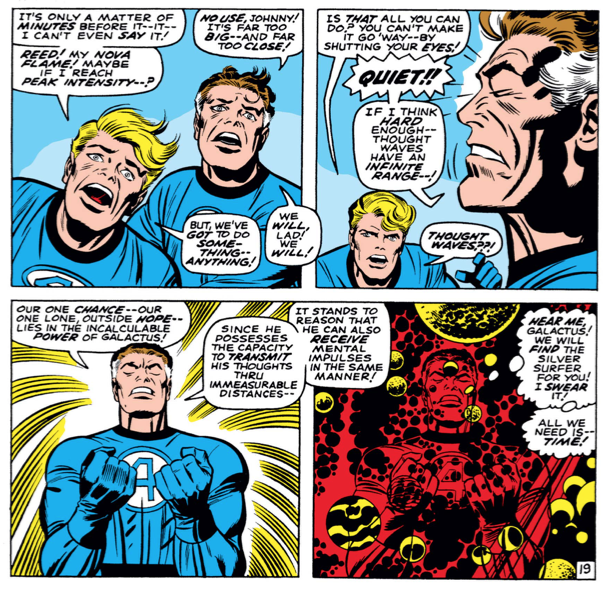
Johnny is as skeptical about Reed’s “thought waves” as the rest of us.
Say what?
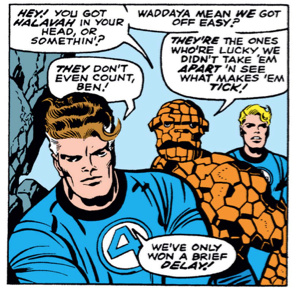
Halavah, more commonly known as halva, is apparently a middle eastern desert made of sesame seeds and honey. It’s not at all clear why Ben is thinking about it here.
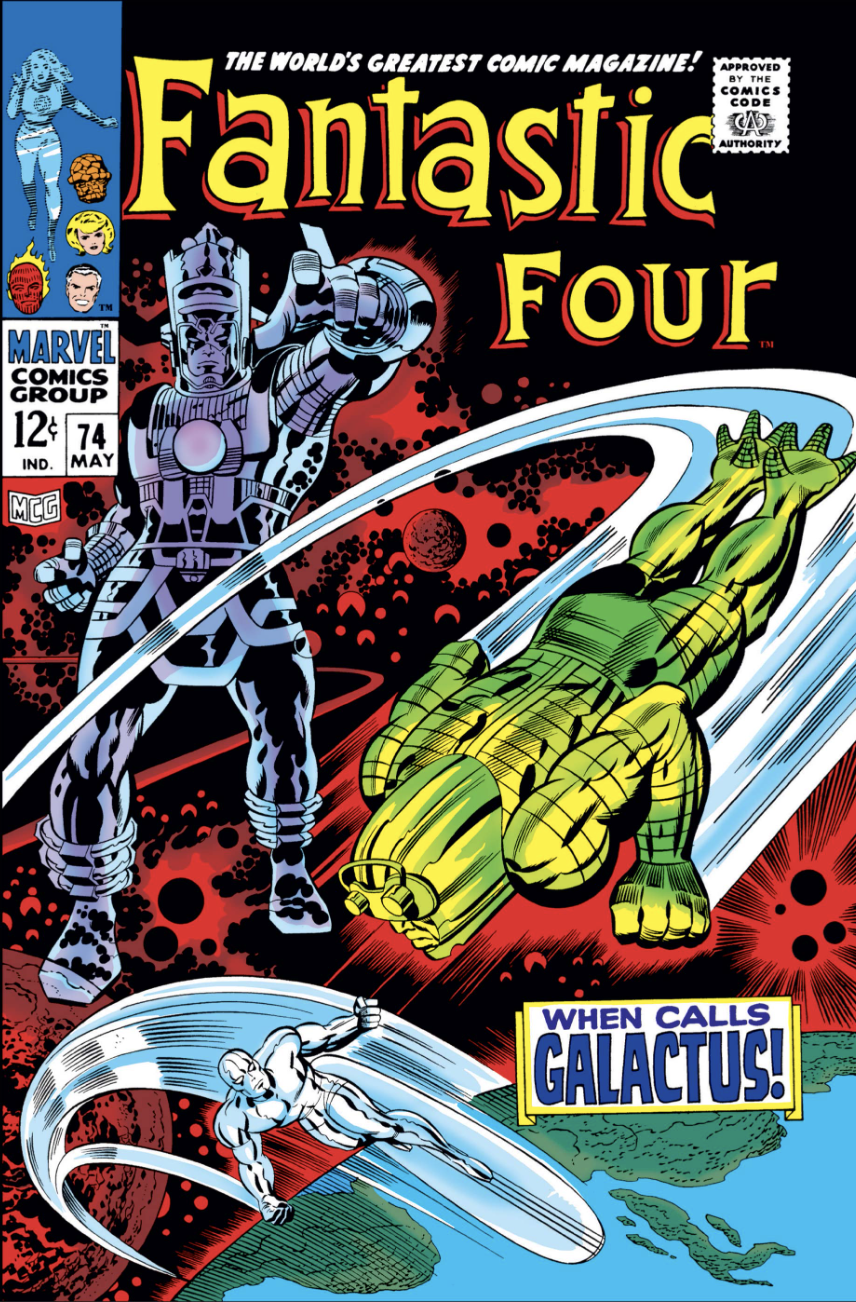
Fantastic Four 74 “When Calls Galactus!” Published Feb. 1968 Story: Stan Lee and Jack Kirby Script: Lee Pencils: Kirby Inks: Joe Sinnott Letters: Artie Simek Cover: Kirby and Sinnott
Synopsis
The Thing enters the apartment of his girlfriend, Alicia Masters, only to find the Silver Surfer there in a state of distress. When Ben, jealous, moves to confront the Surfer (in an echo of issue 55), he and Alicia explain the Surfer has been recalled by Galactus, indicating the planet-devourer must be desperate and that earth is in danger.
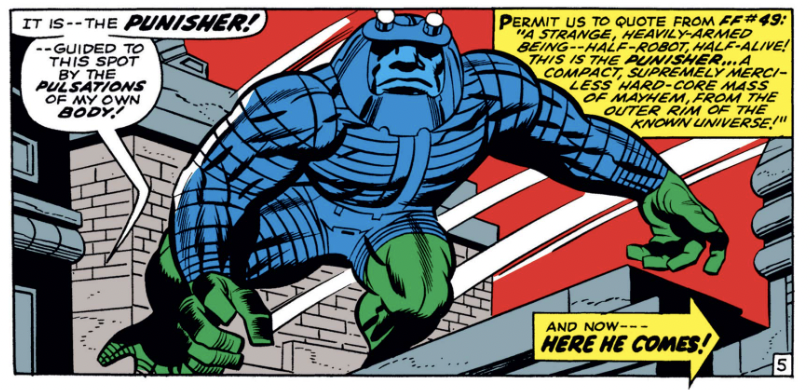
Galactus has sent the Punisher, the cyborg he used to attack the FF when he last visited earth, to bring back the Surfer. After blasting it with his cosmic power, the Surfer collapses and Ben and the Human Torch take on the Punisher, without much success
After again shunting the pregnant Invisible Girl aside, Mr. Fantastic joins the fight. The Punisher, however, vanishes, returning to its master in space, leaving the team to ponder Galactus’s next move.
What’s going on here?
Fantastic Four 74 is a place-setting issue, putting the pieces in place for a multi-issue arc, but it’s a pretty effective one. It reintroduces Galactus as an earth-destroying threat, and by once again using the Punisher as a foil, Stan and Jack emphasize Galactus’s power (if his minion can throttle the FF, what is Galactus capable of?)
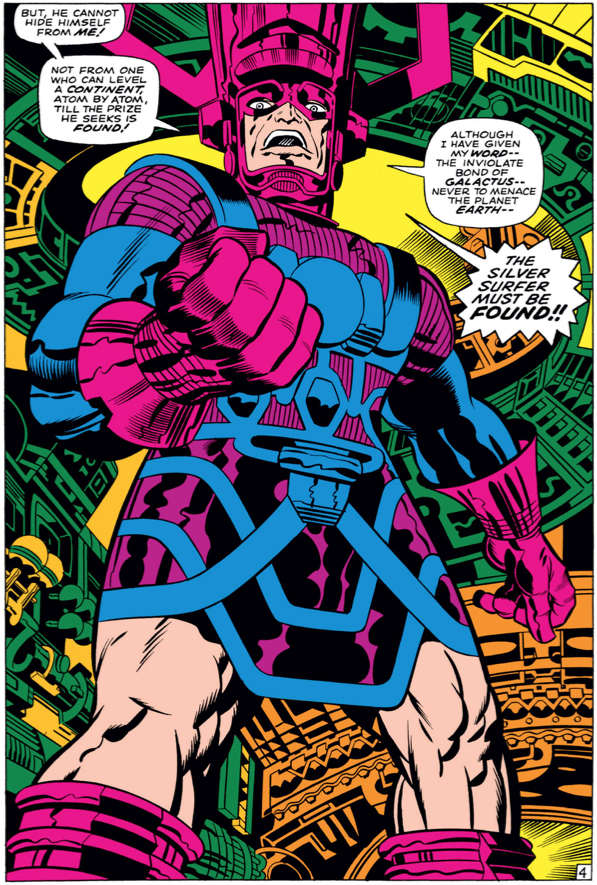
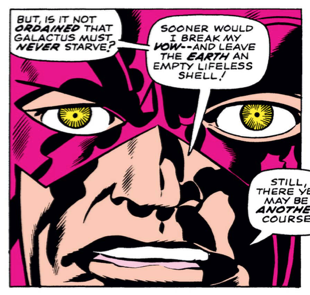
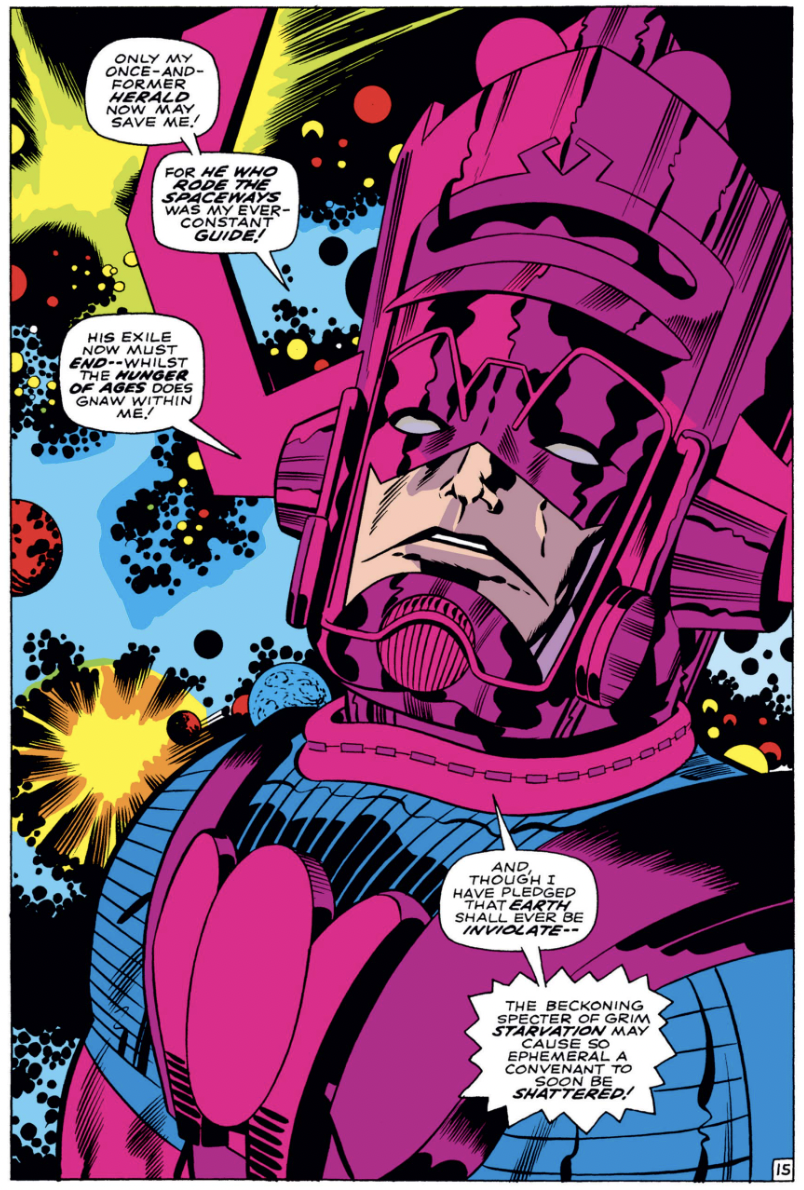
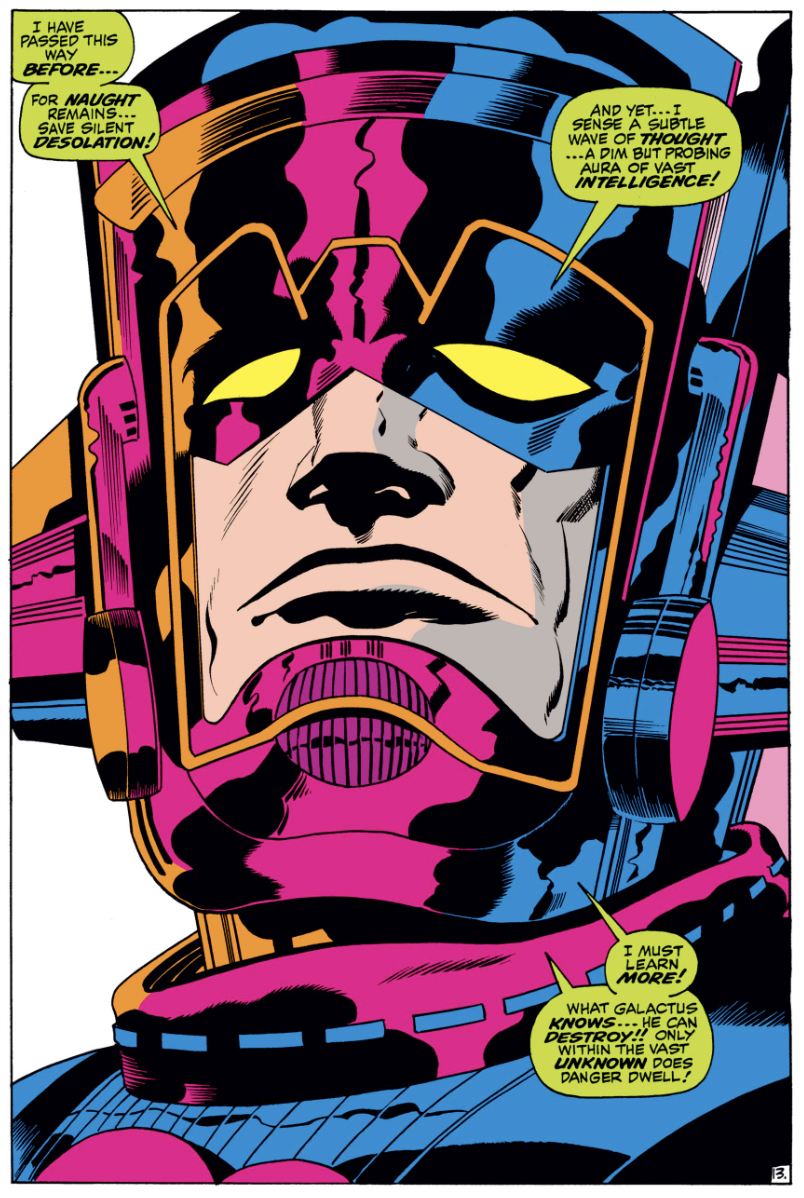
After his appearance in a flashback in Daredevil 37 (discussed last week), in Thor 134, and now here, Galactus is by now pretty thoroughly integrated into the the Marvel Universe. Stan and Jack apparently hadn’t planned that—they wanted him to appear sparingly, to maintain his grandeur—but Stan, listening to fan requests, decided to bring him back. As a result, we got epic splash pages like this:
Incidentally, Jack liked that image so much he re-used it the next year, in Thor 160 (this time with inks by Vince Coletta):
About that name
The Punisher is a pretty cool concept.
Unfortunately it shared a name with a lot more important Marvel character, which probably is one reason it appears so infrequently. Here it is Thanos 4, from 2003, by Jim Starlin and Al Milgrom.
The sexist sixties
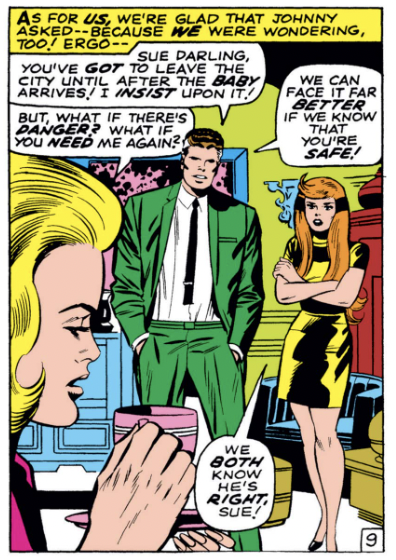
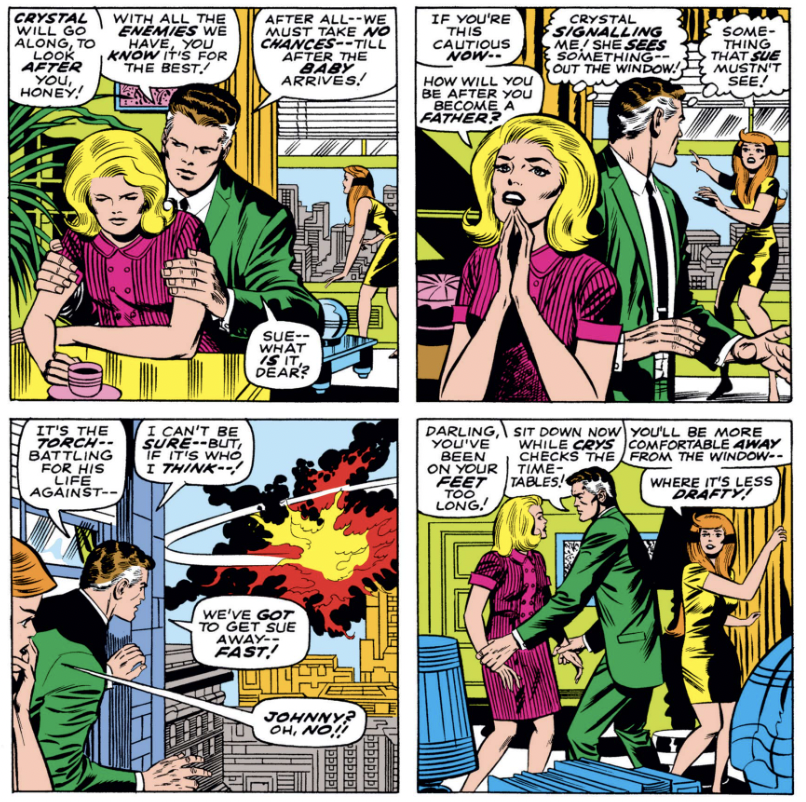
For the last few issues, Sue has been deliberately kept away from the action, ostensibly to protect her and her unborn baby. Her exclusion is taken to more ridiculous levels, when Reed won’t even tell her what’s going on and instead treats her like an invalid (and enlisting the similarly wasted Crystal to help him do his dirty work).
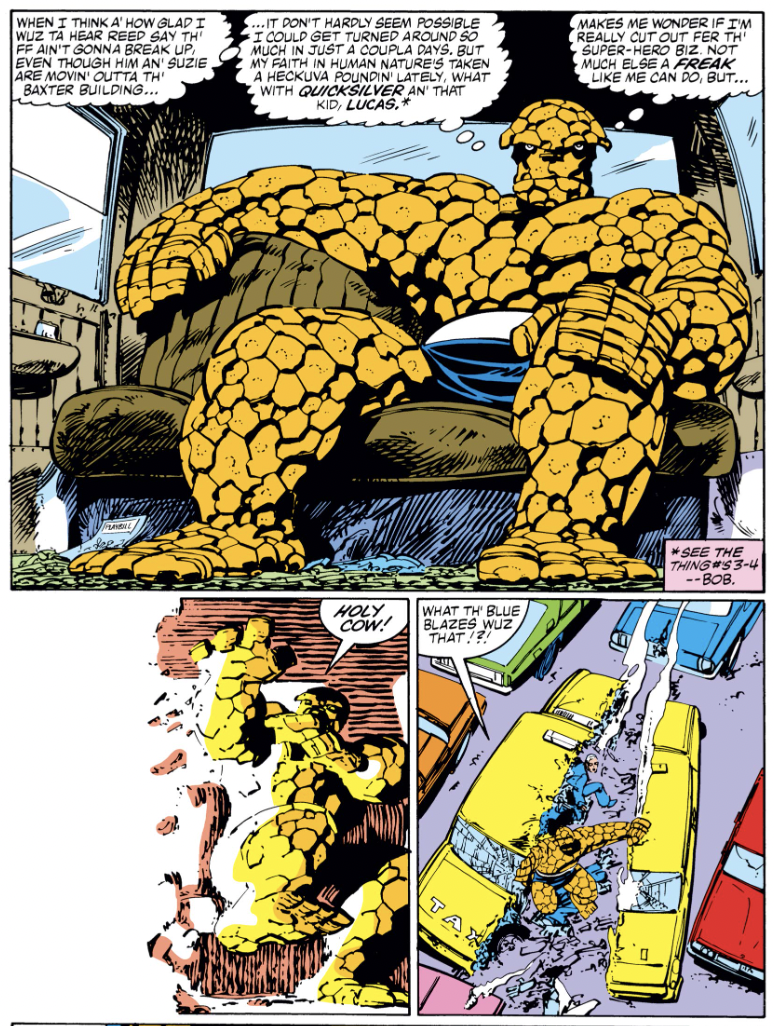
Follow that car!
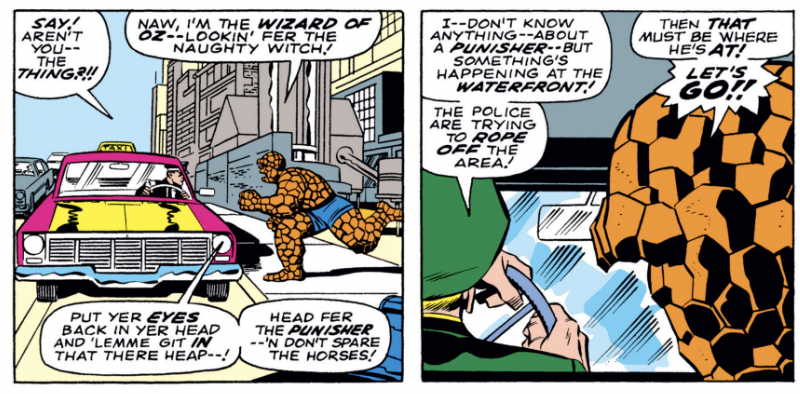
Ben needs to take a cab to rejoin the action.
It reminded me of this dramatic scene when Ben was again in a cab, from Fantastic Four 259 (1883) by John Byrne.
Clobberin’ Time
Speaking of Ben, it’s been a few issues since we had one of these
He’s all grown up
Nice character developing scene here with the Torch, who is shown taking on more responsibilities despite still being a teenager. He too often gets written as a yahoo, and he has more maturity than that.
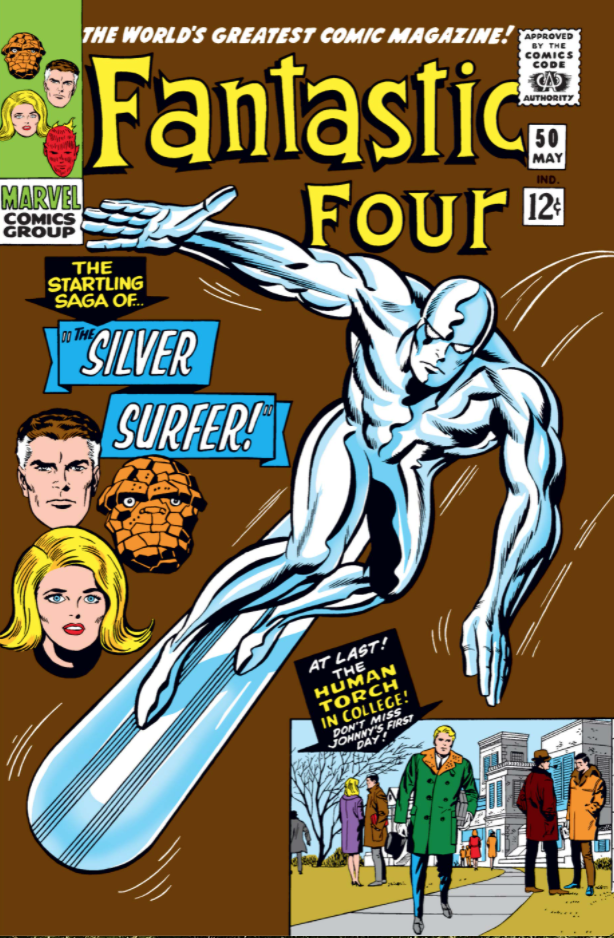
Fantastic Four 50 “The Startling Saga of the Silver Surfer” Published: Feb. 1966 Story: Stan Lee and Jack Kirby Script: Lee Pencils: Kirby Inks: Joe Sinnott Letters: Same Rosen Cover: Kirby and Sinnott
Synopsis
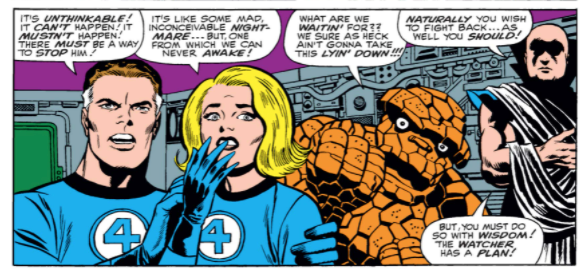
Fantastic Four 50 picks up where issue 49 left off. The Silver Surfer, having the value of humantity revealed to him by Alicia Masters last issue, confronts his master, Galactus, who is preparing to drain the earth of its energy. As the Surfer and Galactus battle, the Watcher reveals his plans for the Human Torch to Mr. Fantastic, the Invisible Girl and the Thing. When the Torch arrives from his voyage across the cosmos, he delivers the Ultimate Nullifier to the Watcher. Reed then uses it to threaten Galactus with the destruction of the universe if he doesn’t abandon his plans to consume earth. Galactus concedes, but before he leaves earth, he strips the Surfer of his ability to travel through space.
As the FF dust themselves off, Alicia shows up to praise the Surfer for helping save the world, leaving Ben jealous and despondent.
FF 50 then pivots to a series of vignettes that set up future stories. The first introduces a nameless bald villain who, after reading news accounts of the FF’s victory, announces plans to destroy the FF. The second concerns an over-the-hill college football coach and his inability to rein in his hot-headed star quarterback. Finally, Johnny enrolls at Metro College, where he meets his new roommate, Wyatt Wingfoot, while still pining away for the Inhuman, Crystal.
What’s going on here?
This is a busy comic, and not just because of the epic resolution of the Galactus storyline. In another peculiar pacing decision similar to issue 48, the main narrative essentially ends halfway through the comic, with the rest of the issues devoted to subplots and foreshadowing. A contemporary comic would use all the space available for the main tale—if there’s ever a story deserving of a space-consuming double-page splash, this was it—and sprinkle the foreshadowing elements throughout the comic. As it is, the reader is raised to the crescendo of the FF’s triumph over Galactus, only to be handed a mystifying story about a football coach.
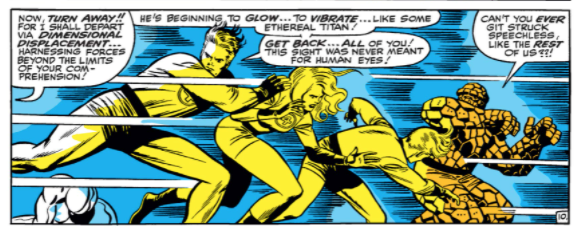
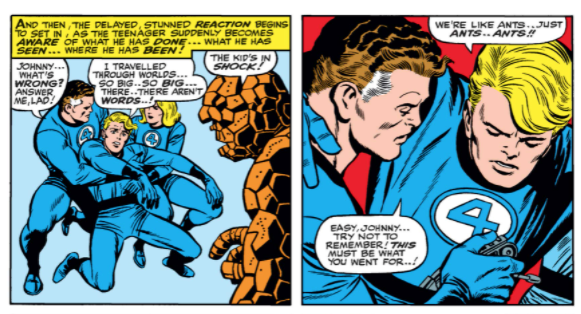
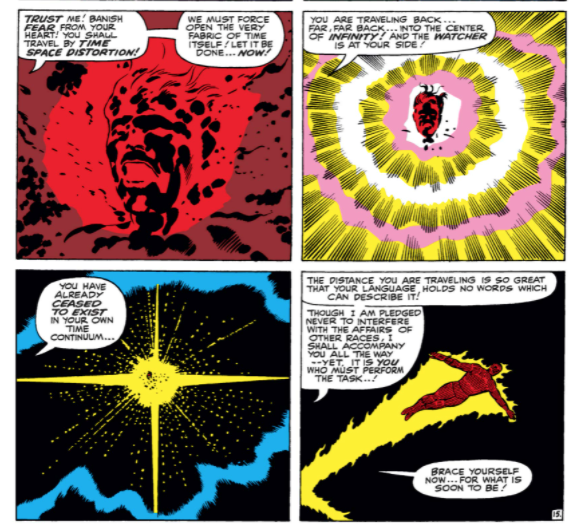
The climax of the Galactus arc, as brief as it is, gives Stan and Jack another opportunity to stretch their cosmic muscles. They make it clear here that larger forces are at work, and the Fantastic Four are mostly bystanders. Unlike most villains, Galactus isn’t defeated by Reed outwitting him or whipping up some gizmo, but by the Watcher’s machinations. Even Johnny, the ostensible hero of the story, is overcome by the scale of the universe and pretty much wrecked by his trip across the universe.
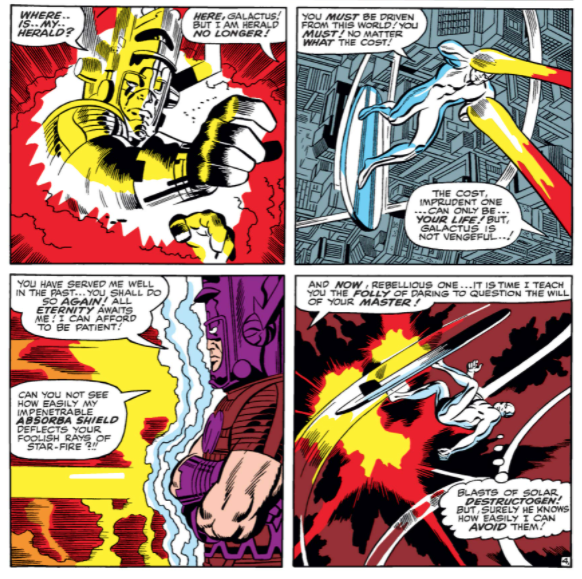
If the FF are secondary characters in their own comic, it’s also because the story of the Silver Surfer is so dramatic. After Alicia reconnects Norrin Rad to his lost humanity, he turns on Galactus to defend the earth. Galactus is surprisingly chill about the betrayal, at several points telling the Surfer how much he likes and respects him, and basically telling the Surfer he’s going through a phase.
Galactus claims he bears the Surfer and FF no malice, but still he strips the Surfer of his space-faring powers. It’s not obvious if at this point Stan and Jack anticipated the Surfer having his own series, but keeping him trapped on earth was a useful plot device when his solo book eventually launched.
The Ultimate Nullifier serves as a convenient deus ex machina that solves the problem of Galactus. It reappears on occasion over the course of Marvel’s history, usually in a story with some big stakes.
What’s up with Ben?
Ben has been his usual melancholic self over the past few issues—he had an introspective sequence when the FF was in Atillan—but it kicks into overdrive in FF 50. First, there’s this revealing “kidding-not-kidding” exchange with Sue, where he explains how he uses humor to deflect his trauma.
Then the Silver Surfer, who barely knows him, senses something is amiss.
That’s followed by Ben’s jealous reaction to Alicia greeting the Surfer, as Ben’s insecurity about his appearance kicks overwhelms him.
Finally, as Ben wanders the streets of New York, he startles a woman, sending him down a spiral of self-pity that will play out next issue.
Who’s the new guy?
As if there wasn’t enough going on, FF 50 introduces Wyatt Wingfoot, a longstanding supporting character and, notably, a Native American character who isn’t reduced to a bundle of cliche and stereotypes. Here, he and Johnny meet cute.
Crazy Credits
The usual modesty
The sexist sixties
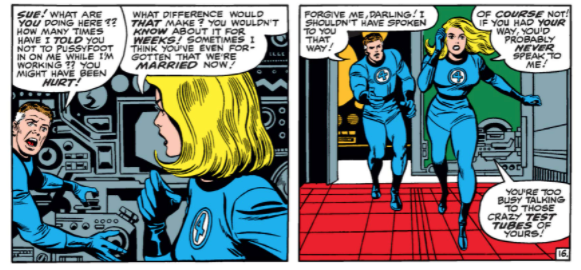
Again, another sequence of Sue stamping her feet because Reed isn’t paying her enough attention. At least Reed apologizes.
Read all about it
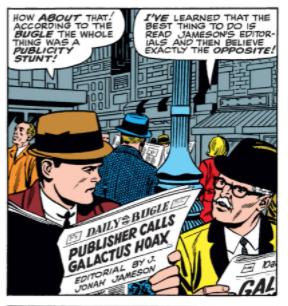
A nice connected-universe swipe at J. Jonah Jameson here.
Dig that Kirby Krackle
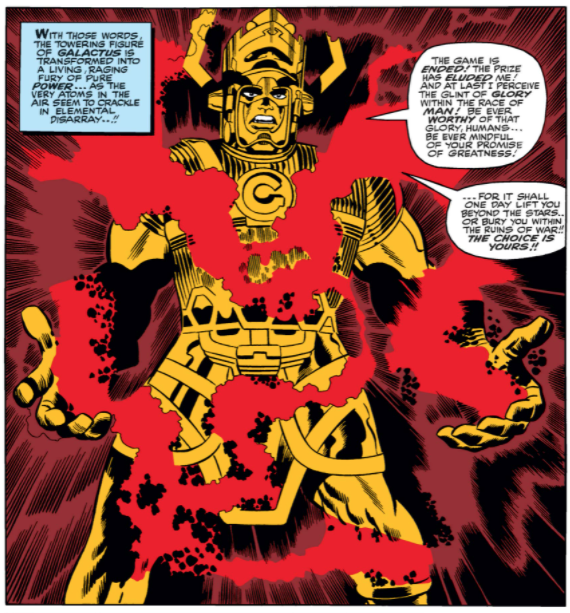
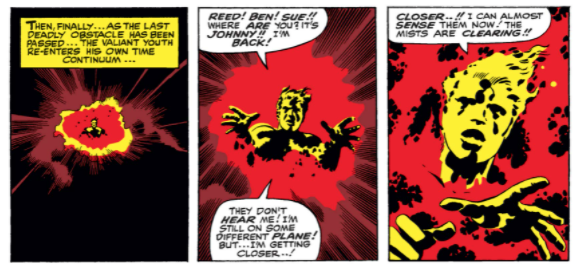
After using this silly phrase for 50+ blog posts, we finally get some genuine Kirby Krackle. For the uninitiated, Kirby Krackle are the black dots Jack uses to illustrate the release of energy. A trademark effect of the King’s, it hasn’t really appeared until this issue. Now we can, indeed, dig that Krackle.
Here’s some more:
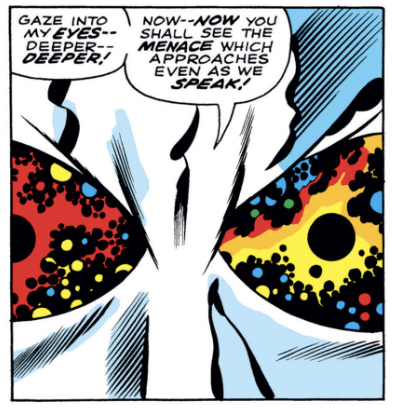
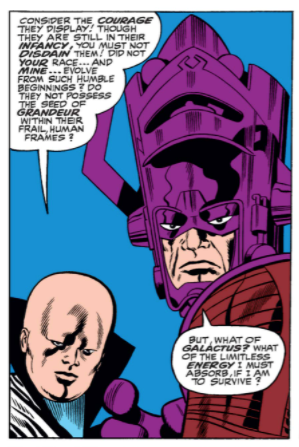
We also get a great panel of Galactus giving the ol’ stink-eye.
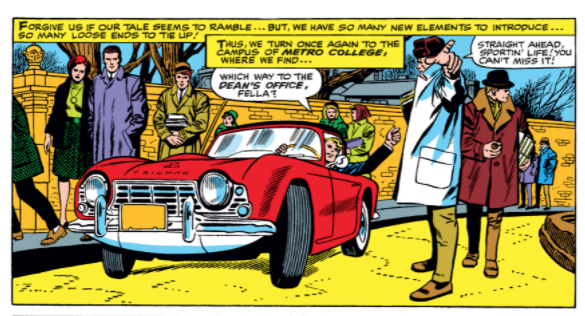
And Johnny tooling around campus in a sweet set of wheels.
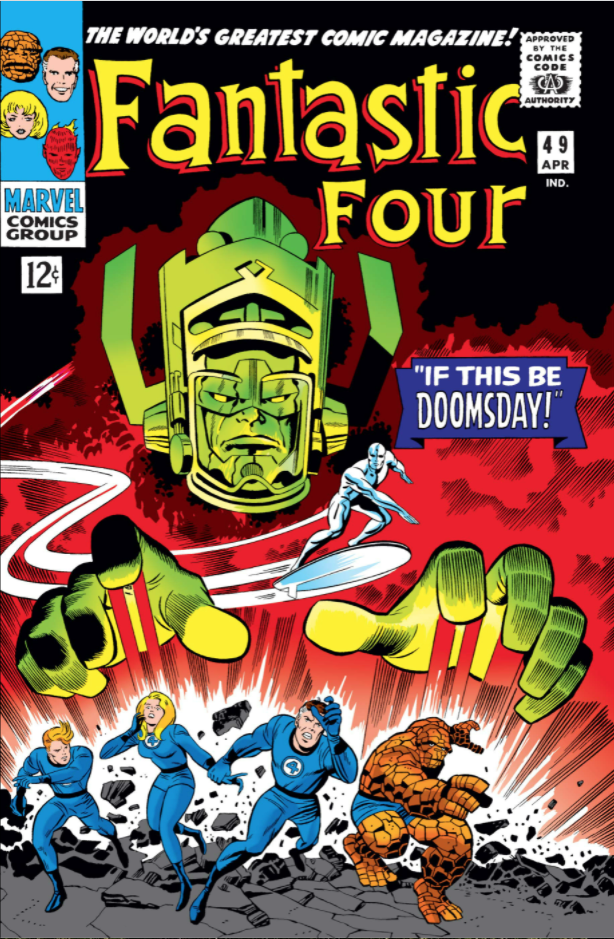
Fantastic Four 49 “If This Be Doomsday!” Published: Jan. 1966 Story: Stan Lee and Jack Kirby Script: Lee Pencils: Kirby Inks: Joe Sinnott Letters: Sam Rosen Cover: Kirby and Sinnott
Synopsis
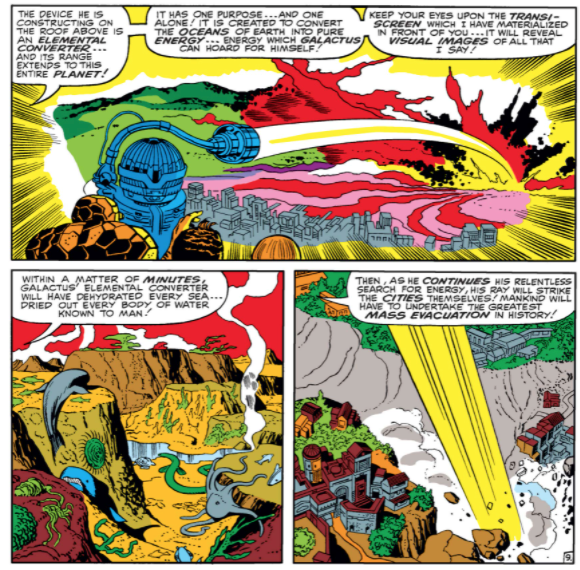
Fantastic Four 49 picks up where issue 48 left off, after Galactus makes his entrance, intent on draining earth of its energies. The Watcher urges Galactus to reconsider, and the FF confront him, but to no avail and he begins assembling his earth-energy-sucking machine on top of the Baxter Building.
Meanwhile, the Silver Surfer, reeling from his fight with the Thing, landed on the roof of Alicia Masters’ building. She nurses him back to health and begins to awaken him to the possibility earth might be worth saving.
After regrouping, the Fantastic Four again engage Galactus, save for Johnny, whom the Watcher singles out for a mission. As the rest of the team fight the Punisher, a creature Galactus dispatches to deal with vermin, Johnny travels through space and time to arrive at Galactus’s enormous space station.
Back on earth, as Galactus prepares to drain the earth’s energies, Alicia appeals to the Silver Surfer’s lost humanity and convinces him to confront Galactus to save the earth. The issue ends with the Watcher warning the reader that the Surfer may disrupt his own plans and doom the earth.
What’s going on here?
FF 49 is everything you want a Fantastic Four comic to be. It’s arguably the high point of the Lee/ Kirby partnership, and showcases both at the peak of their powers (aided significantly by Joe Sinnott’s inks, of course). In Galactus, Stan finally has an antagonist worthy of his bombast and grandiosity. After years of trying to convince us Diablo or the Thinker were threats to humanity, In Galactus Stan has a villain that lives up to his over-wrought writing. And in the Surfer, he has an alien hero who can philosophize while speaking in the lofty, faux-Shakespearian tones Stan loves so much.
Kirby rises to the occasion too. The story’s huge sweep and cosmic overtones gives him the freedom to produce amazing character designs for Galactus and the Punisher, an eye-popping panel of Galactus’s space station—it’s so big that planets orbit it—and stunning visual effects of Johnny confronting Galactus and traveling through space.
The whole story just feels big—big in its scope, big in its stakes, and big in its ambition
Who is this guy?
While Galactus technically made his first appearance last issue, this is really his debut. We don’t yet get the full story (more on his origin in a bit) but we get the basics, and the basics are more than enough: He’s a cosmic being of incredible power who is sustained by draining planets of their essence. Interestingly, while he has appeared in countless comics over the years, unlike other characters, he has changed very little. His costume design has remained essentially the same, and while his role in the Marvel universe has been explained and put into context, he acts pretty much as he does in his first appearance: traveling the universe looking for planets to consume.
The traditional account of Galactus’s invention is that Stan, searching for a story idea, said “let’s have them fight god.” Mark Evanier, in his biography Kirby: King of Comics, disputes that narrative and instead offers two alternative ideas. One is that Jack wanted to upend the conventional science fiction idea that if aliens arrived, they would engage with humans and exchange technology. What if they didn’t care about humans? Jack wondered, according to Evanier. What if they just wanted to eat our planet? The other idea reflects Kirby’s growing disillusionment with Marvel and the business of comics. In this interpretation, Galactus is a hostile company buying up smaller firms and draining them dry. (In the letters pages, readers projected a Vietnam metaphor on the story, with Galactus acting as hostile communist forces and the Silver Surfer as the US coming to the rescue of South Vietnam).
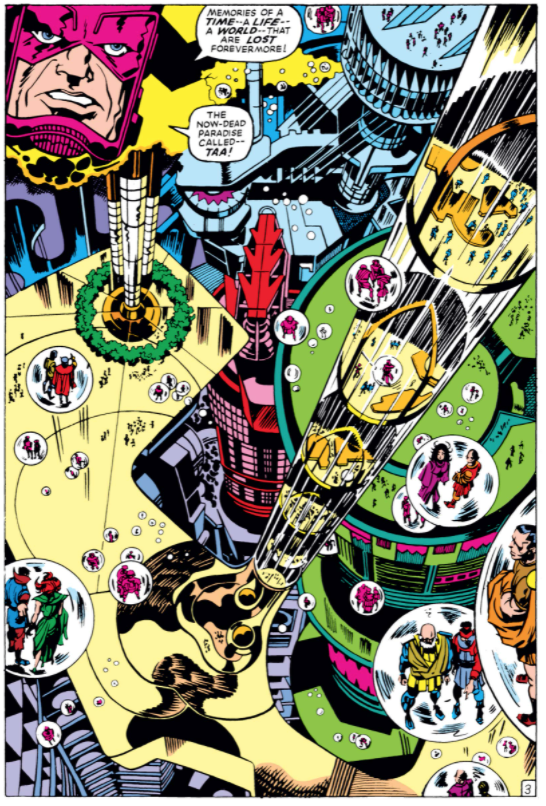
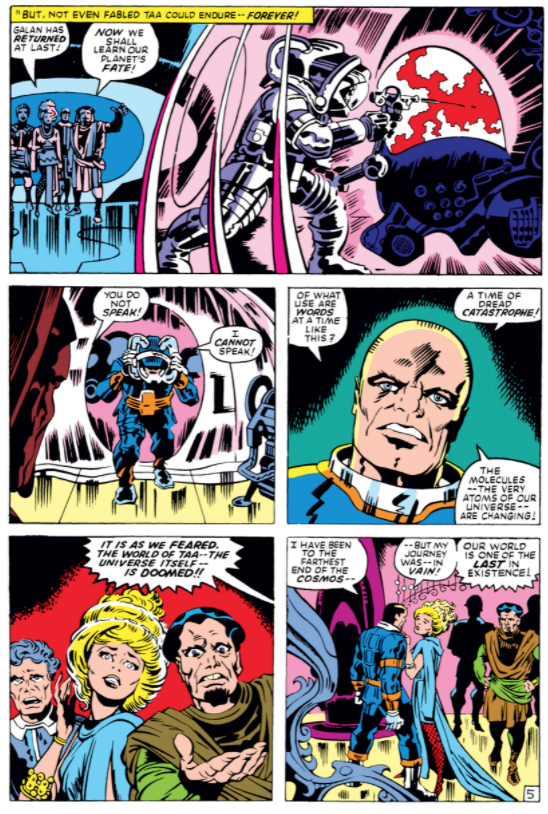
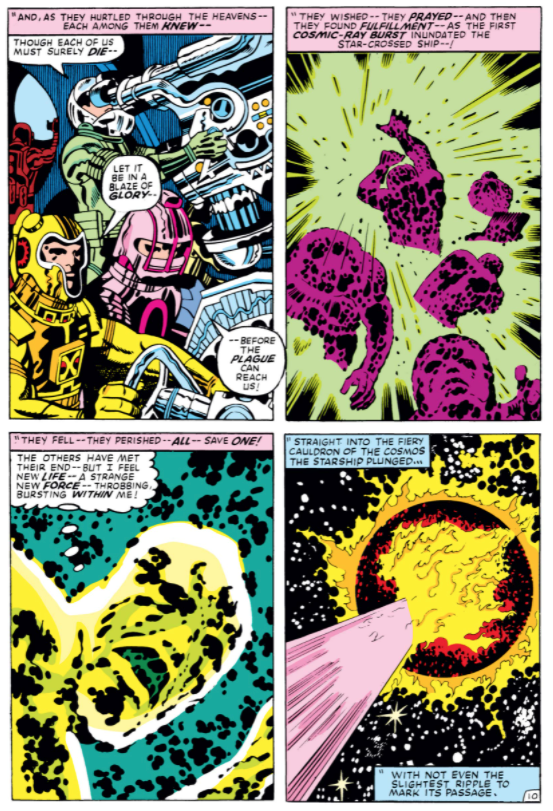
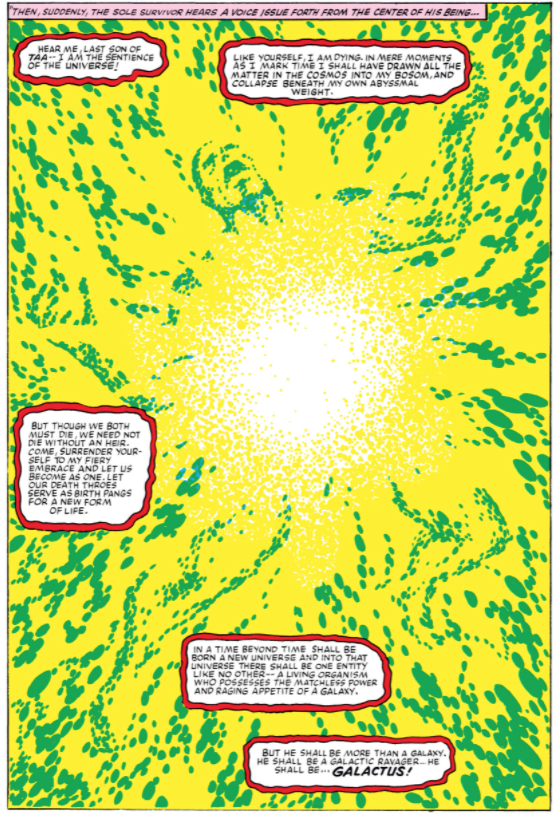
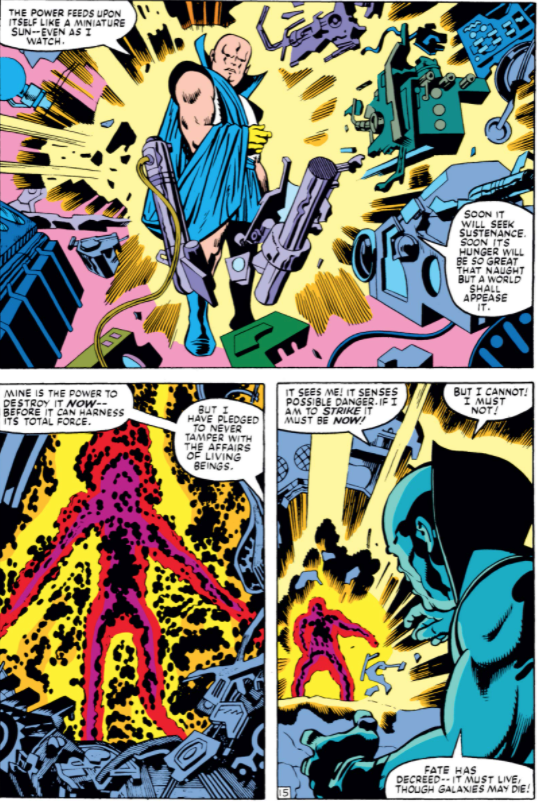
Galactus’s origin is relatively uncomplicated. In the original telling, revealed in a back-up story by Stan and Jack in Thor 169, Galactus was originally Galan, a citizen of an advanced planet called Taa. The planet is facing extinction by a plague, so Galan and three others decide to die as explorers and head into Taa’s sun. Galan survives and is eventually transformed into Galactus (as Brian Cronin notes in his Comics Should Be Good blog, this sounds like a mash-up of Superman and the FF’s origins.)
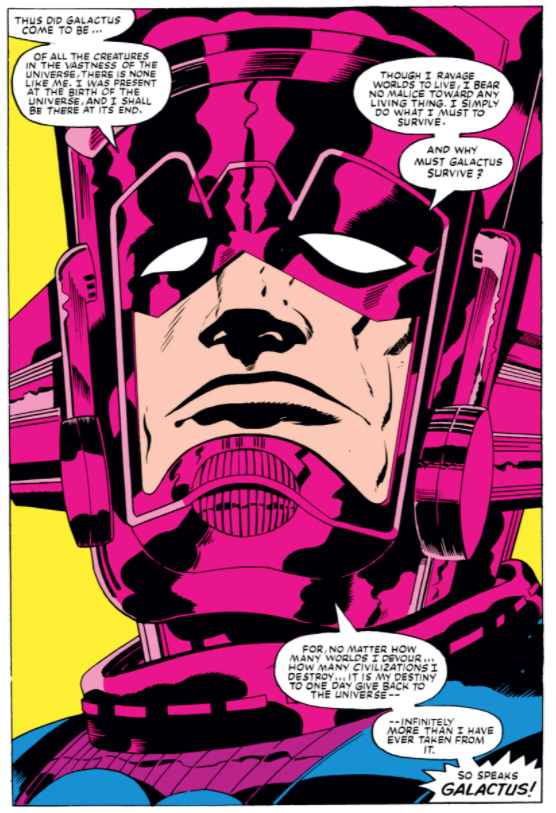
A few decades later, Marvel editor Mark Gruenwald decided to revamp Galactus’s origins. Instead of merely the last survivor of a planet, he became the last survivor of a universe, and he emerged from the Big Bang. Gruenwald basically took the Stan and Jack story, wrote over some of it with some new pages by John Byrne and Ron Wilson, and republished it in 1983 as Super-Villain Classics 1. Here are some relevant pages:
The notable thing about this origin is that establishes Galactus as a cosmic entity, a force of nature and not merely a villain, despite the destruction he causes. That tension became a major storyline during Byrne’s FF run, when Reed Richards begs Galactus to spare earth in FF 243, and Galactus basically says, “nothing personal, it’s just business.”
Reed, with the help of the Avengers, then saves Galactus’s life in FF 244, arguing they had a moral responsibility to prevent the death of a living thing.
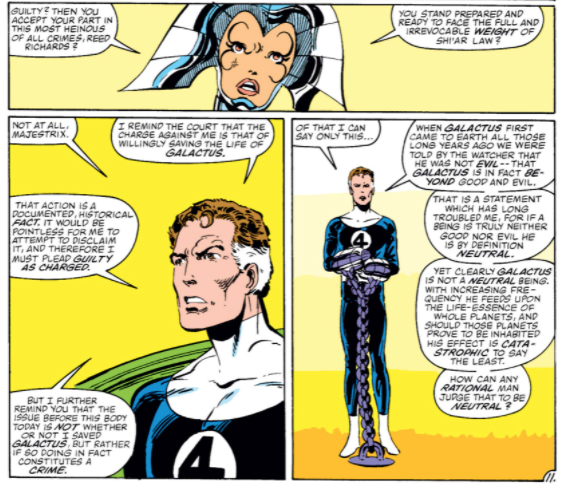
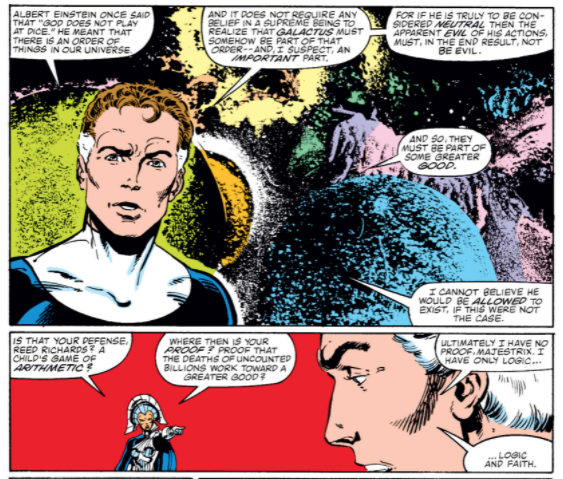
Noble as it was, that decision didn’t sit well with the survivors of the worlds Galactus destroyed, and in FF 262 Reed is summoned to be tried for his crime of saving Galactus. Through Reed, Byrne makes the case of Galactus’s importance in the universe:
There’s a lot more to it, but it serves to anchor Galactus as a unique force in the Marvel universe. On a personal note, FF 262 was the third FF comic I ever read. My 12-year-old mind was blown.
About that outfit
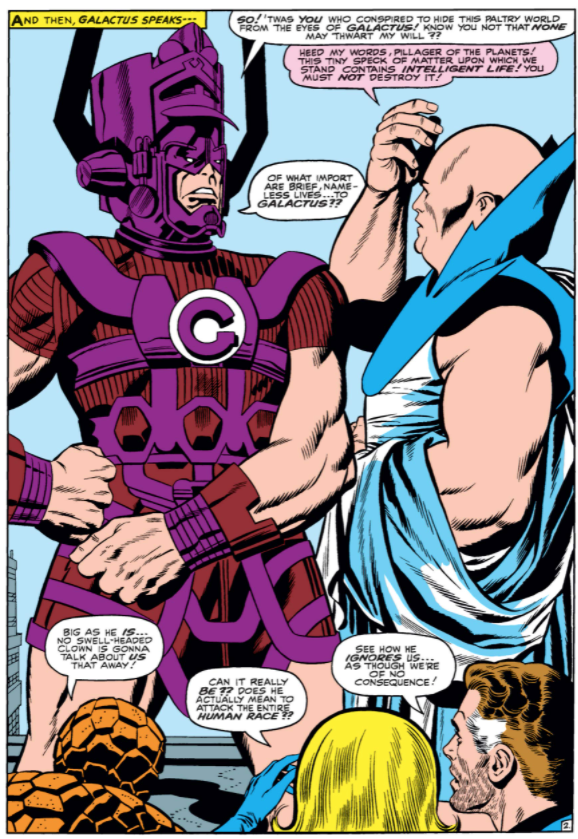
In his first appearance, Kirby has Galactus wearing shorts with a big G on his chest:
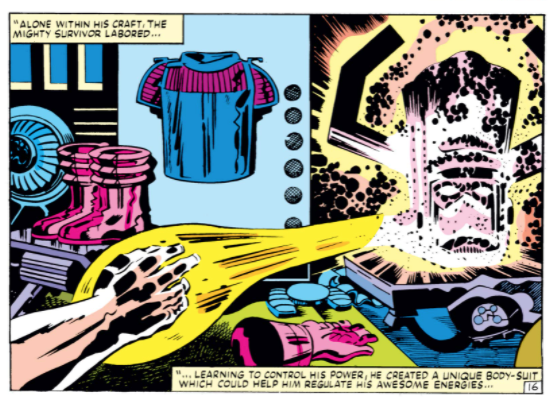
Fortunately, he soon put on long pants and got rid of the G, but his appearance, with the elaborate headgear has remained pretty much the same ever since. Yet despite its visual appeal, it’s not obvious why he’s dressed that way, given that he is a cosmic force and not a run-of-the-mill bad guy. The Lee / Kirby origin in Thor provides one answer: He was given that outfit by a Watcher, who witnessed his emergence from his incubator and created “a unique body-suit which would help him regulate his awesome energies.”
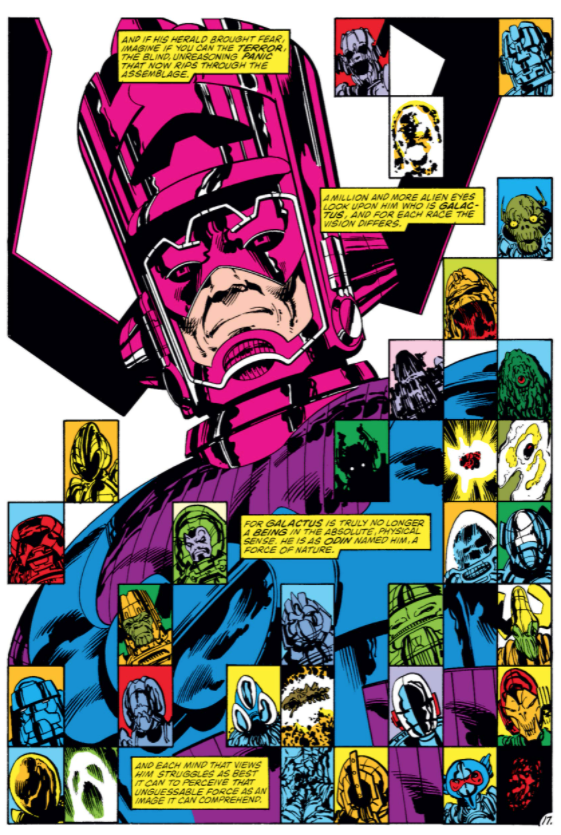
Later, Byrne in FF 262, suggests only humans see Galactus as humanoid, and that he appears to other alien races in whatever form they take (I never much liked this explanation, since he’s never depicted as anything other than humanoid, and it makes more sense to me that he’s human-like because Galan of Taa was also human-like). It’s a pretty cool page though.
Wrong guy
Whaddya mean there’s another Punisher?
That sounds familiar
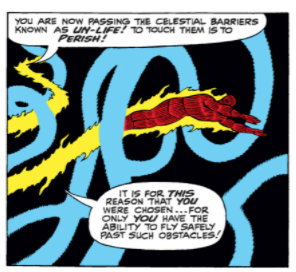
On his cosmic voyage, the Human Torch passed through “celestial barriers known as un-life” which sounds a lot like ‘anti-life,” a concept that became a big part of the Fourth World mythos Jack created at DC about five years later.
About that vow
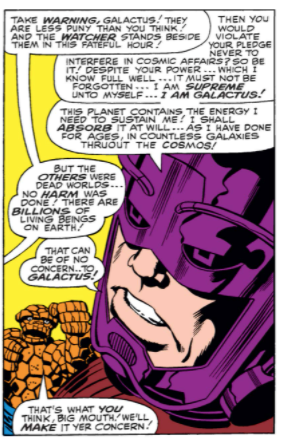
On several occasions the Watcher references his vow not to interfere in human affairs while busily interfering in human affairs
Prime real estate
A few issues ago, Dragon Man crashed into Alicia’s apartment while fighting Ben and Johnny. Now, the Silver Surfer just happens to land on her roof.
Crazy credits
It’s clobberin’ time
One of the more ineffective attempts to clobber from Ben
Dig that Kirby Krackle
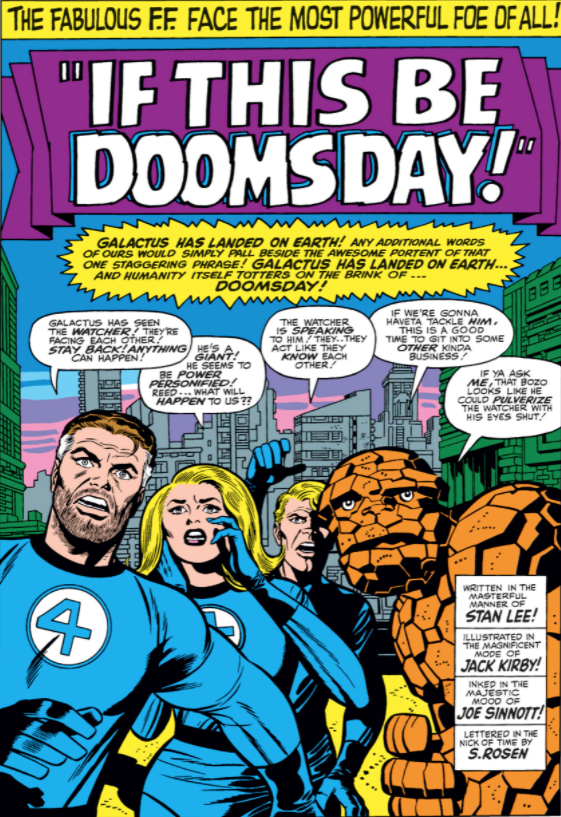
There’s a lot to choose from in this issue, but here are a few stand-out pages and panels, starting with the amazing splash page:
A very cool sequence:
And another amazing page:
Nextissue: The conclusion of the Galactus trilogy!
Fantastic Four 48 “The Coming of Galactus!” Published: Dec. 1965 Story: Stan Lee and Jack Kirby Script: Lee Pencils: Kirby Inks: Joe Sinnott Letters: Artie Simek Cover: Kirby and Sinnott
Synopsis
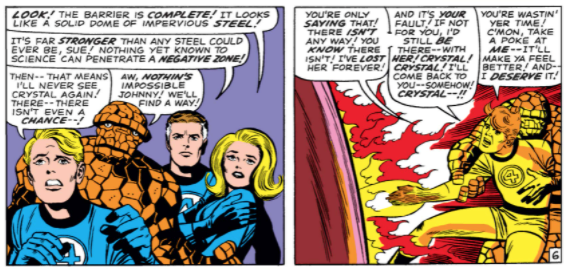
As has been the pattern or the last dozen issues, Fantastic Four 48 picks up where FF 47 left off. The team is in Attilan, the city of the Inhumans, and Maximus has set off his Atmo-Gun, intending to destroy humanity so the Inhumans can rule the earth. Black Bolt, who last issue wrested his crown back from his brother Maximus, confronts him and knocks him silly. Medusa explains to Maximus his plan was doomed because the Inhumans are still human despite their powers, and a device that spares Inhumans would also spare humans. In a last gasp, Maximus reverses the charge on his Atmo-Gun, generating a “negative zone” — a term that should sound familiar—around Attilan. The Invisible Girl creates a force field which allows the FF to pass through the zone and escape but the Inhumans are trapped behind it, leaving the Human Torch distraught when he is separated from Crystal.
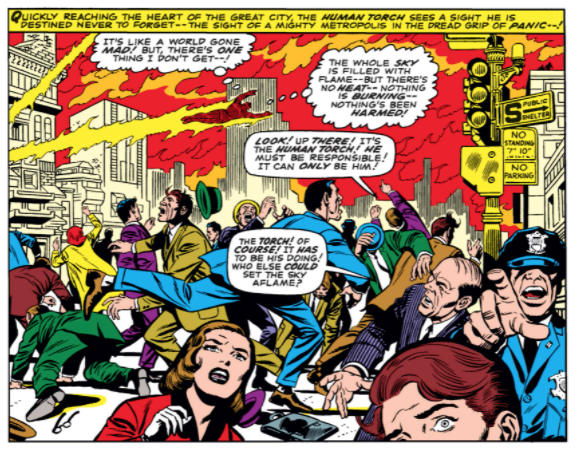
Meanwhile, as the FF return to New York, we are introduced to the Silver Surfer as he glides through space, and are warned that he is a harbinger of Galactus. Back in New York, the skies are aflame, and panicking New Yorkers blame the Human Torch. The flames disappear, only to be replaced by “space debris.” The Watcher appears, and explains these effects are his doing in order to disguise the earth from the Silver Surfer. The Surfer then arrives and sends a signal to space before The Thing clobbers him. The signal summons Galactus, who emerges from his ship and announces his intentions to drain the earth of “all elemental life.” The issue ends with the cliff hanger.
What’s going on here?
FF 48 marks the beginning of the Galactus trilogy, arguably the apex of the Lee and Kirby run on the Fantastic Four. But oddly, before we can start this epic story, we need to resolve the last story, the FF’s adventure with the Inhumans. I’m not sure why Stan and Jack constructed the comic this way, but it’s strange that it’s divided into two stories.
The Inhumans portion of the comic establishes Maximus as the royal family’s principle antagonist, creates a bit of romantic drama between Black Bolt and Medusa, and ramps up the star-crossed-lovers theme between Johnny and Crystal. All good stuff, but it’s sort of forgettable compared to the rest of the comic, which introduces two major Marvel figures: the Silver Surfer, and Galactus. We’ll deal with Galactus in our next post, because there’s a lot to say about the Surfer.
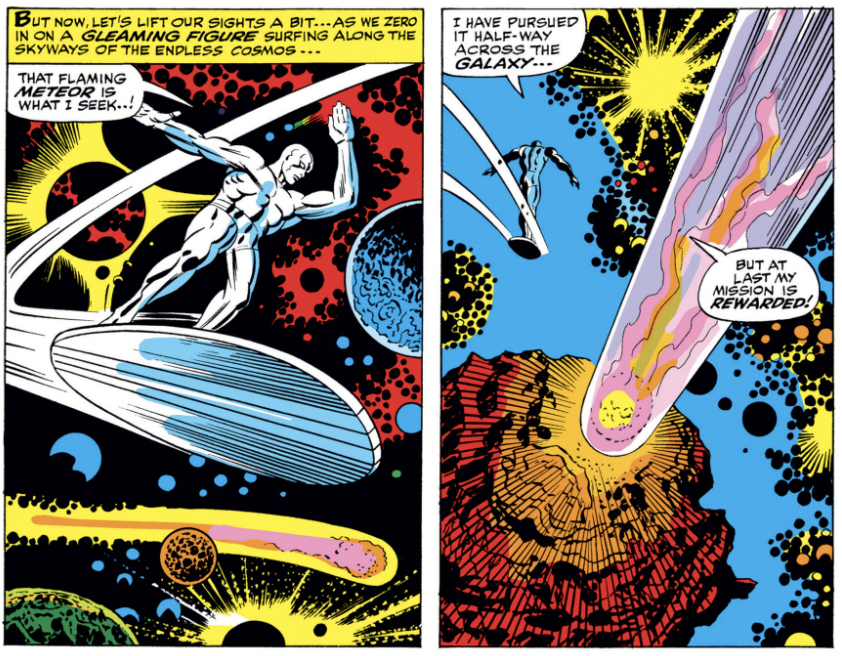
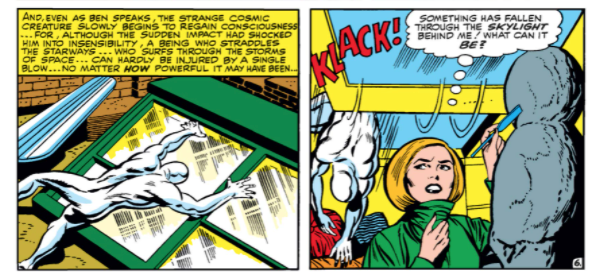
The Surfer’s first appearance.
Who is this guy?
The Silver Surfer was one of Jack Kirby’s prized creations, and a source of major tension between him and Stan Lee, one which helped lead to Kirby’s departure from Marvel. According to Mark Evanier in his biography Kirby: King of Comics, Jack created him without any involvement from Stan Lee, who first encountered the Surfer when he saw the penciled pages of FF 48. Allegedly upon seeing him, Stan said “Jack, this time you’ve gone too far.” But Lee soon fell in love with the character, and it’s not hard to see why, given his penchant for grandiloquent soliloquies. Stan soon launched a Surfer solo book to be drawn by new Marvel star John Buscema, and gave the Surfer an origin very different from the one what Jack had in mind, leaving Jack frustrated and angry. According to Evanier “his idea had been taken from him in every possible sense.”
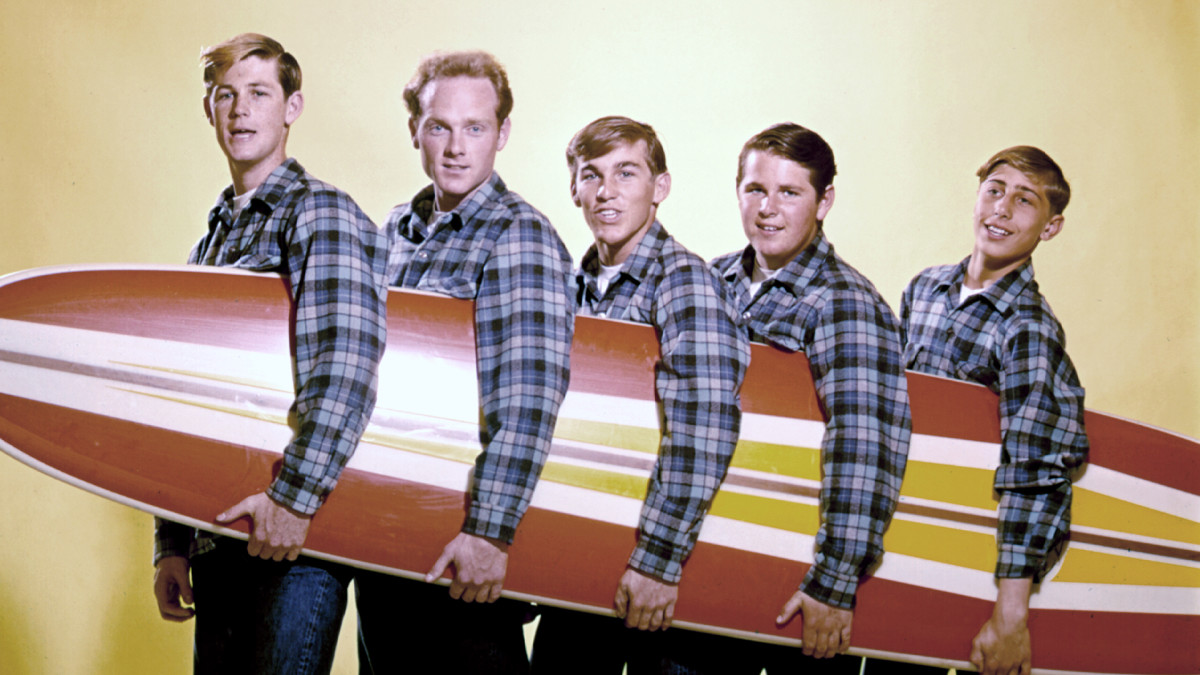
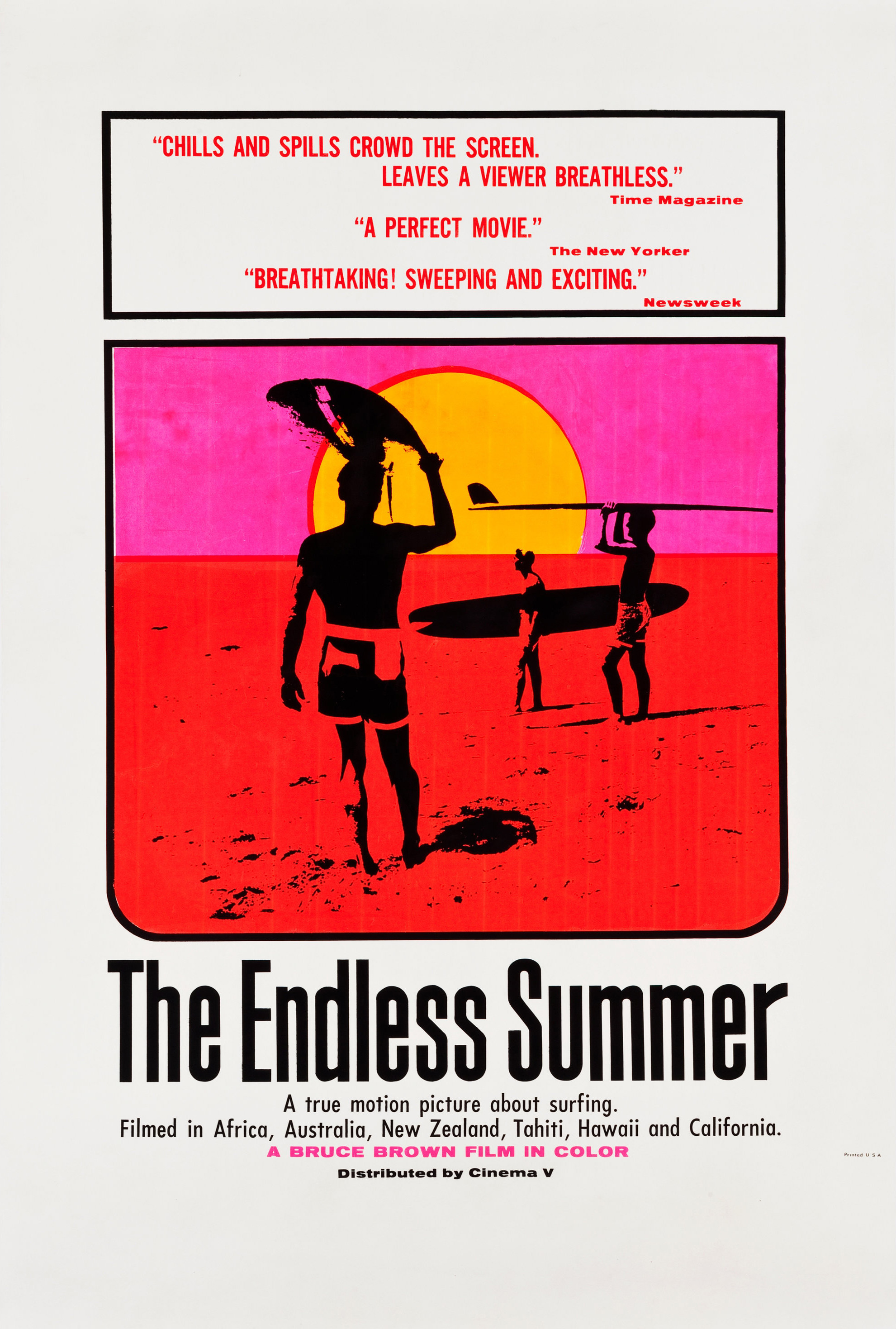
So why a surfer? Evanier doesn’t say what inspired Jack to put Galactus’s herald on a surfboard, but it probably has to with the general interest in surfing as a sport in the early to-mid 1960s. Surf music was charting, with the Beach Boys and Jan and Dean were churning out hits like “Surf City” and “Surfin’ USA,” and beach party movies, which often featured surfing, starring Frankie Avalon and Annette Funicello were in the theaters. The next year, The Endless Summer, a surfing documentary, would come out. Clearly surfing was in the zeitgeist.
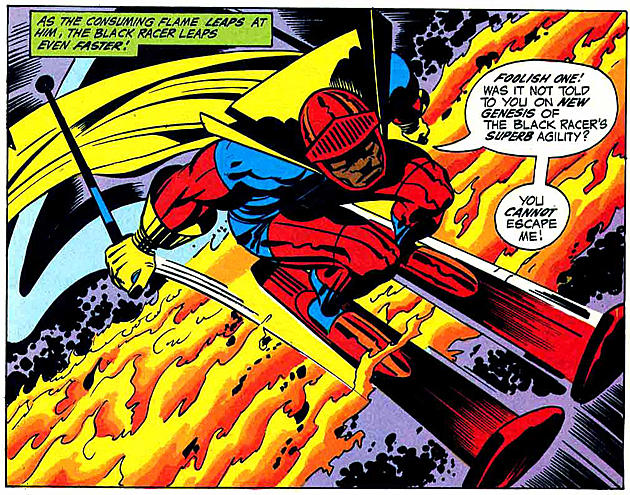
Jack would reach into the same bag of tricks a few years later when he was at DC and created the Black Racer, a member of the New Gods who acts sort of like a herald of death. By then, ski racing was popular, after Jean-Claude Killy’s star turn in the 1968 Olympics and the release of 1969’s Downhill Racer, a movie starring Robert Redford.
But while the design of the Surfer was abstract and elegant enough so that he only looked like he was surfing through space and not an actual surfer, Black Racer is far more literal and, I would argue, far less successful of a design.
About that origin
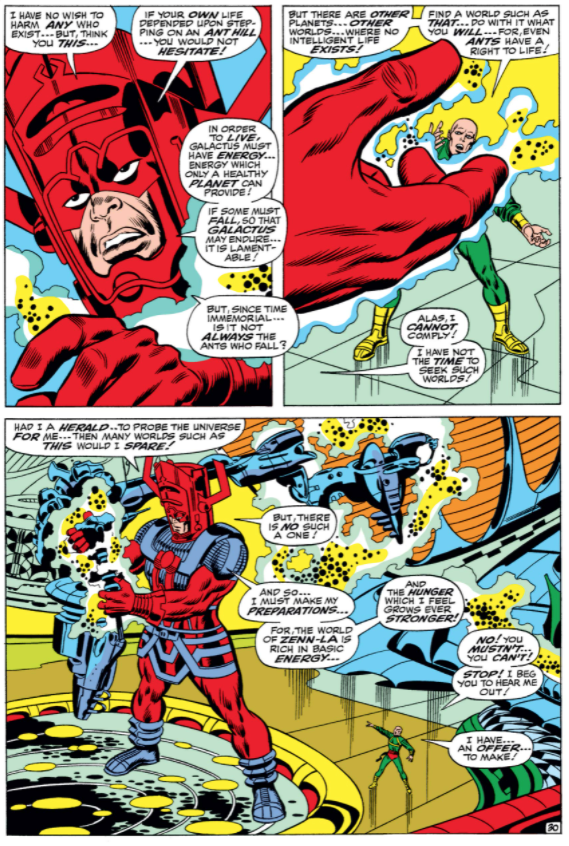
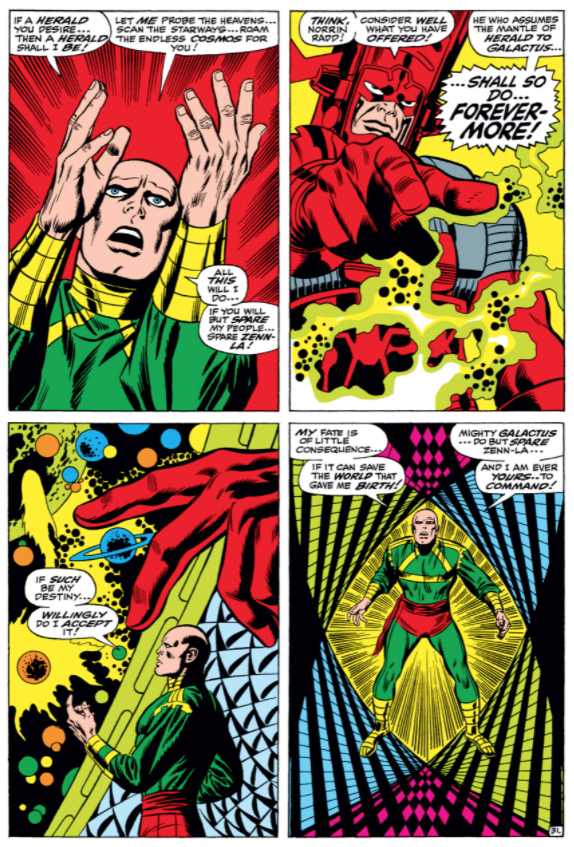
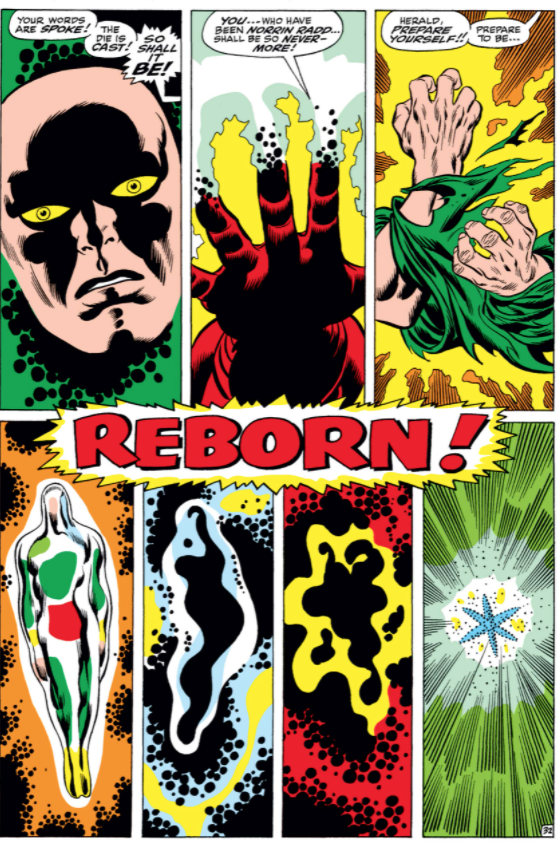
According to Evanier, Jack envisioned the Surfer as a being of pure energy who had never been human, and thus needs emotions like love explained to him. But in the origin Stan told in 1968’s Silver Surfer 1, the Surfer was once an (alien) man, Norrin Radd, who pledges himself to Galactus in order to spare his home world, Zenn-La, and his love, Shalla-Bal. The theme of the Surfer’s sacrifice and lost humanity is a powerful one and gives writers lots to chew on over the years. Here are the relevant pages from Silver Surfer 1. (And while John Buscema might be cast as a bad guy in Stan’s dispute with Jack, he probably had no say in it and there’s no denying how gorgeous his art is, here inked by Joe Sinnott).
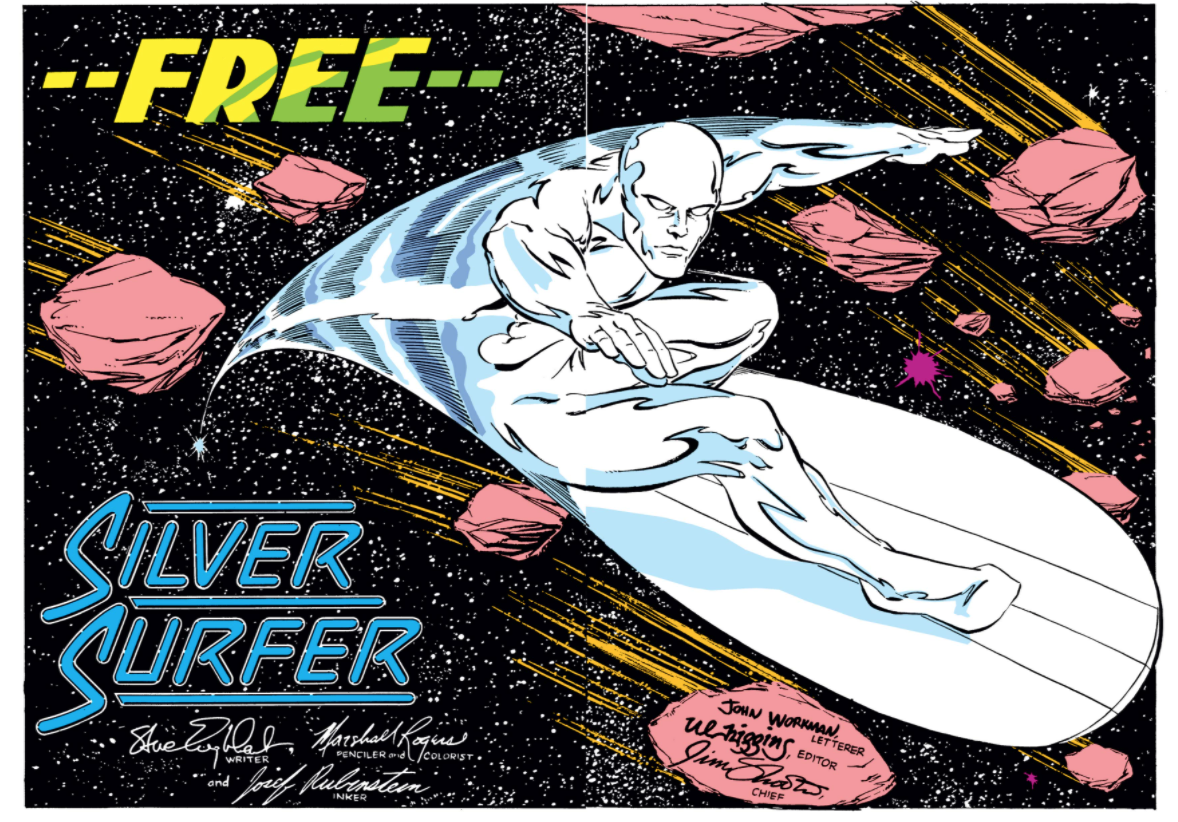
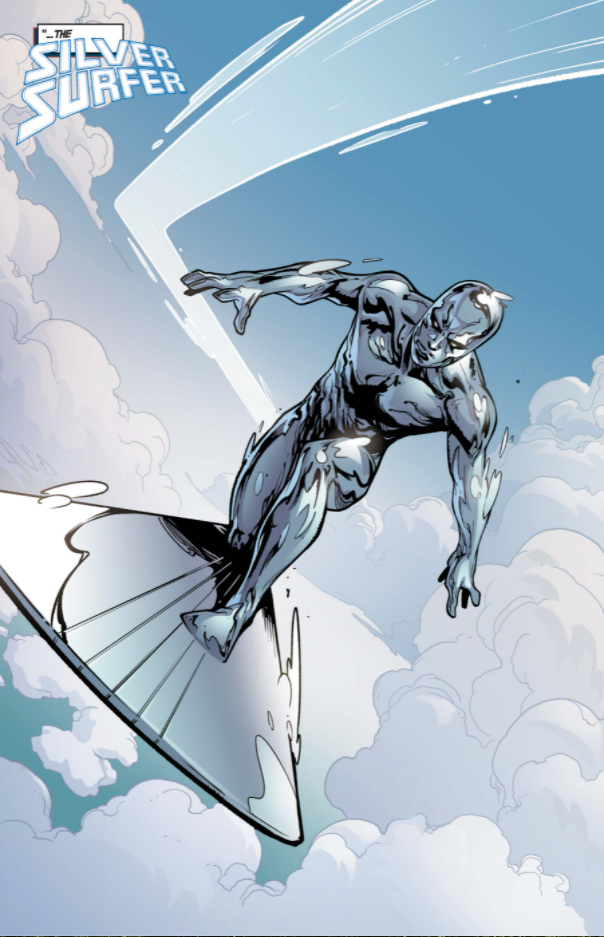
Over the years, the Silver Surfer has attracted some of the comic world’s best and brightest creators. Here he is drawn by Marshall Rogers and inked by Joe Rubenstein in his 1987 solo series:
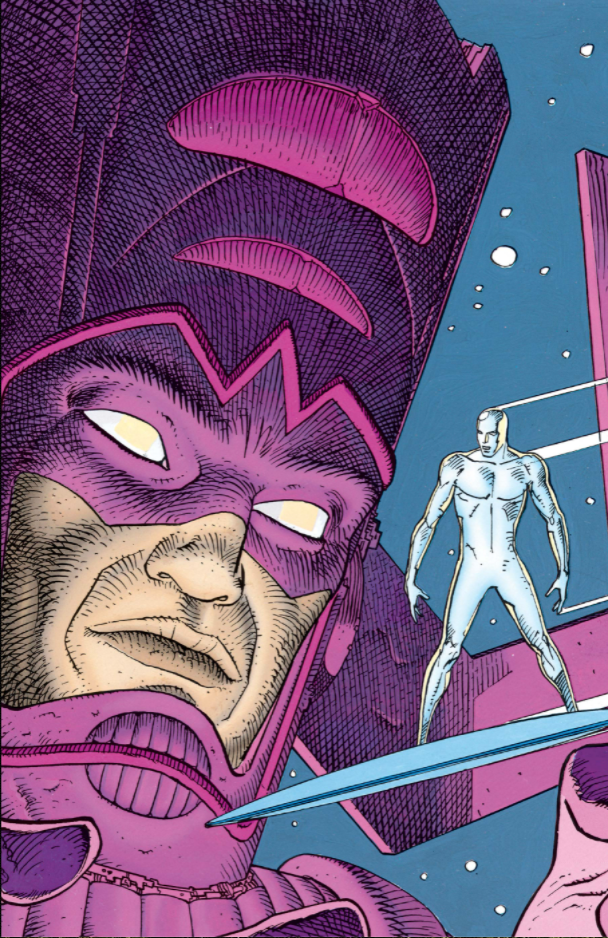
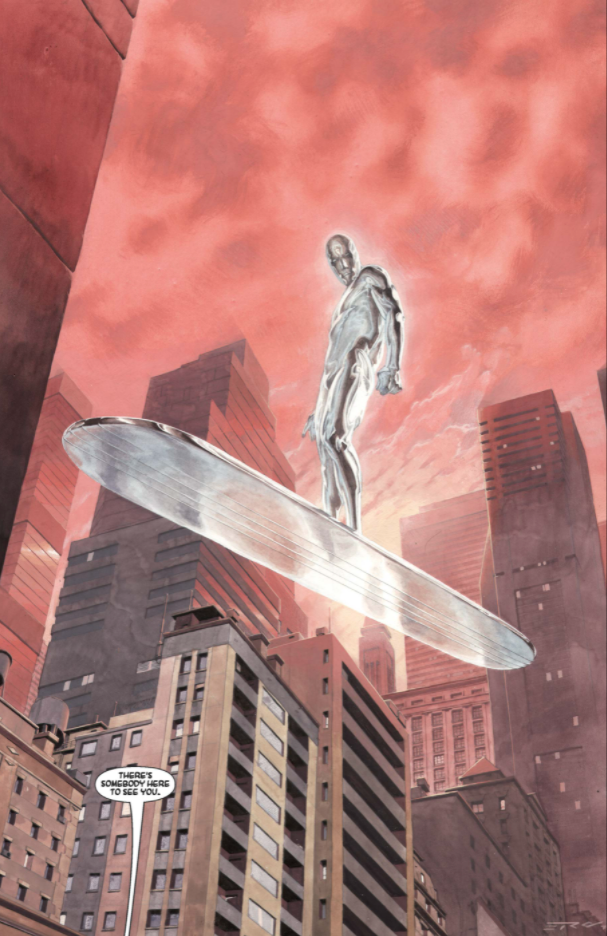
And drawn by Moebius, Esad Ribic, and Francesco Manna:
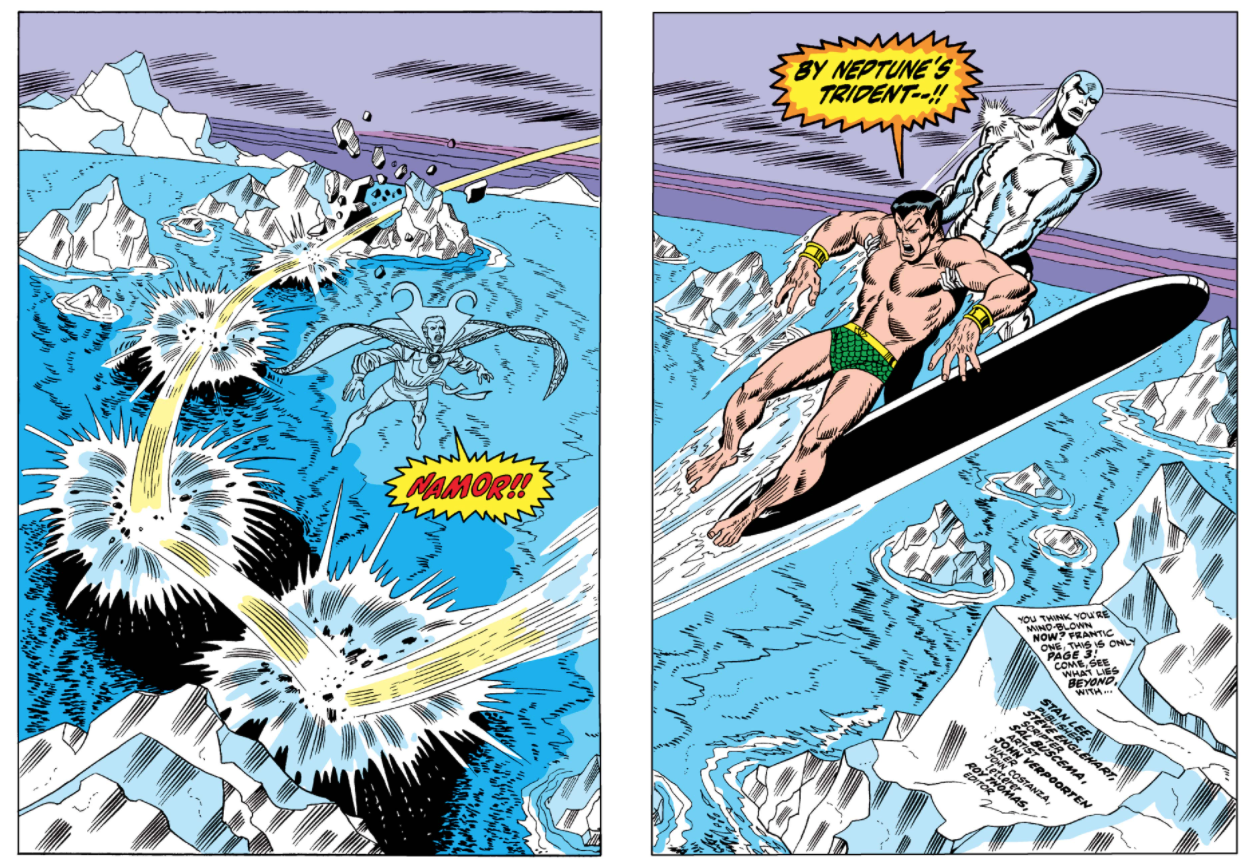
Along with starring in several of his own solo series, he also was an on-again-off-again member of the Defenders:
The Defenders 2 (1972, story by Steve Englehart, art by Sal Buscema and John Verporten)
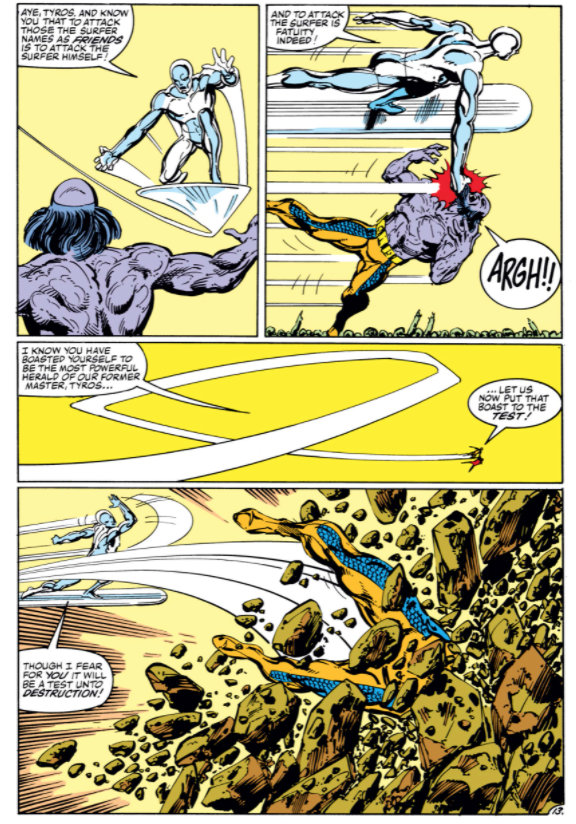
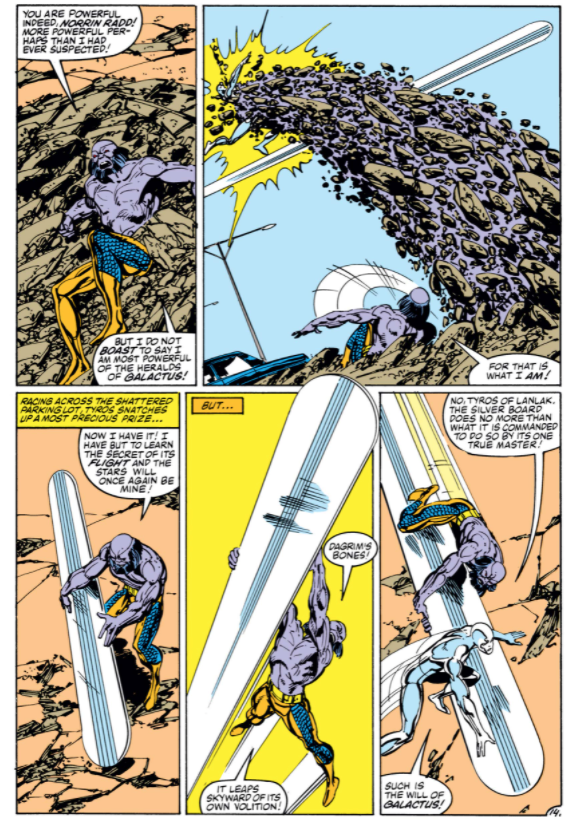
My first real encounter with the Silver Surfer came in John Byrne’s Fantastic Four 260, a comic I have discussed before as igniting my interest in comics in general and the Fantastic Four in particular. Here, he battles Terrax, another former herald of Galactus given new life by Dr. Doom. There was something incredibly cool about the Surfer, who is as unadorned and sleek as a hood ornament, and both bristling with power and noble in his restraint. Reader, I was hooked.
Keel hauled
One aspect of the Surfer’s design I’ve always been curious about is whether his surfboard should have a keel. According to Kirby and Rogers, it does:
Personally, I prefer a no-keel look, since the keel makes it look too literally like a surf board. It’s not – there are no ocean waves in space.
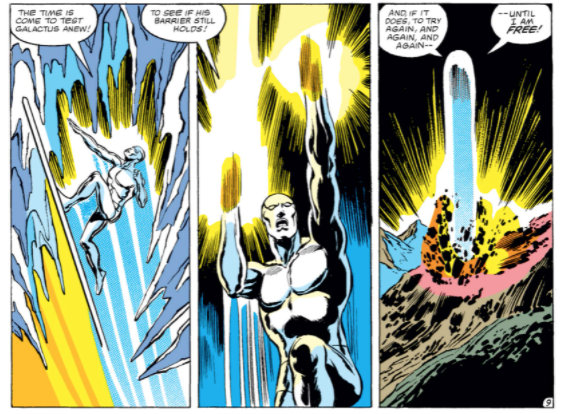
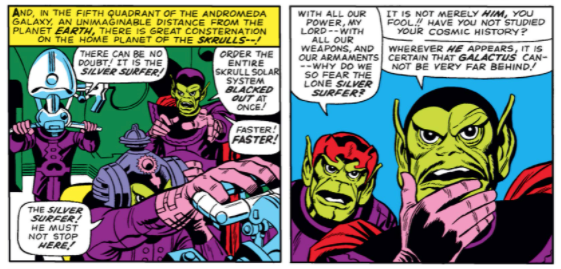
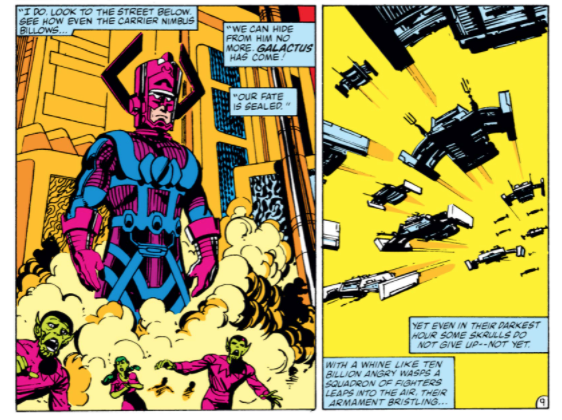
One last detail about the Surfer: He is introduced to readers by the Skrulls, who fear he might alert Galactus to their homeworld. Byrne, always a student of the Lee/Kirby issues, returns to that idea decades later when he has Galactus consume the Skrull’s planet.
FF 257 (1983, Byrne)
Crazy Credits
Young love
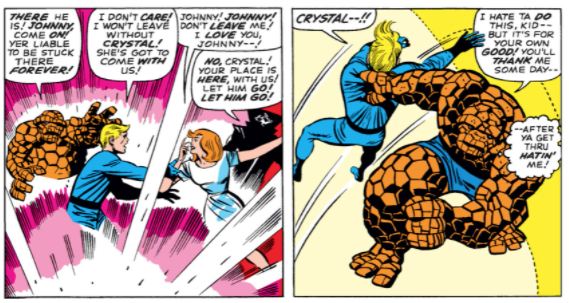
Johnny takes his separation from Crystal hard, which is weird since they barely know each other.
The sexist sixties
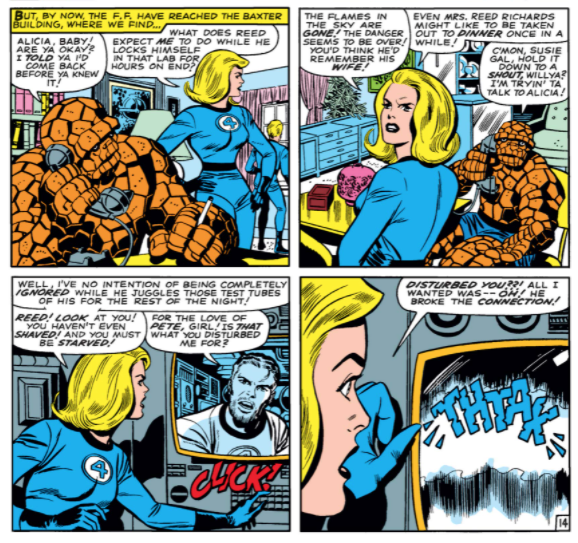
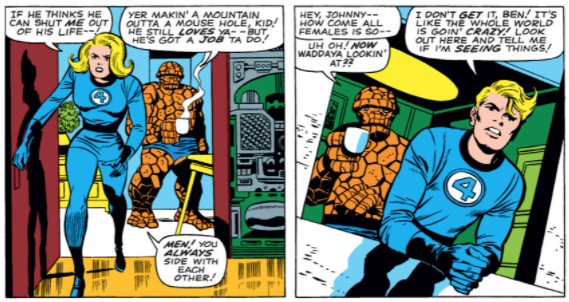
Sue’s pouting and histrionics aren’t quite as bad in tis issue as last, but it’s still pretty bad (and is Ben smoking a cigarette in the first panel?)
Clobberin’ Time
It’s starting to be a regular occurance now (this is No. 10 by my count).
Feats of strength
It’s been long time since we’ve had one of these sequences of Ben showing off his strength. They used to be in almost every issue.
Dig that Kirby Krackle!
As if this issue didn’t have enough going on, we get a Kirby Kollage as Galactus arrives on earth:
Nu Yawk, Nu Yawk:
Another very cool panel (Joseph Levine was a Hollywood producer behind bombastic adventure movies like Hercules):