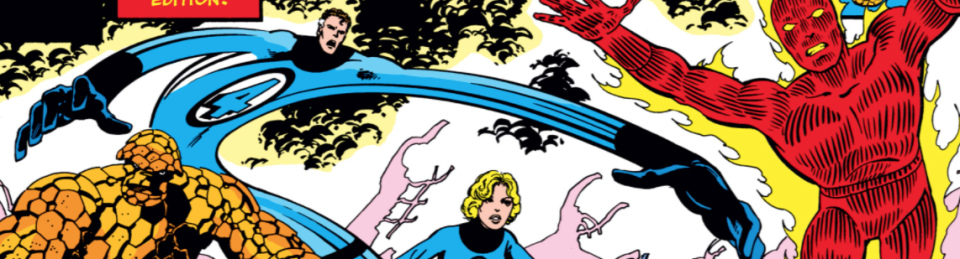
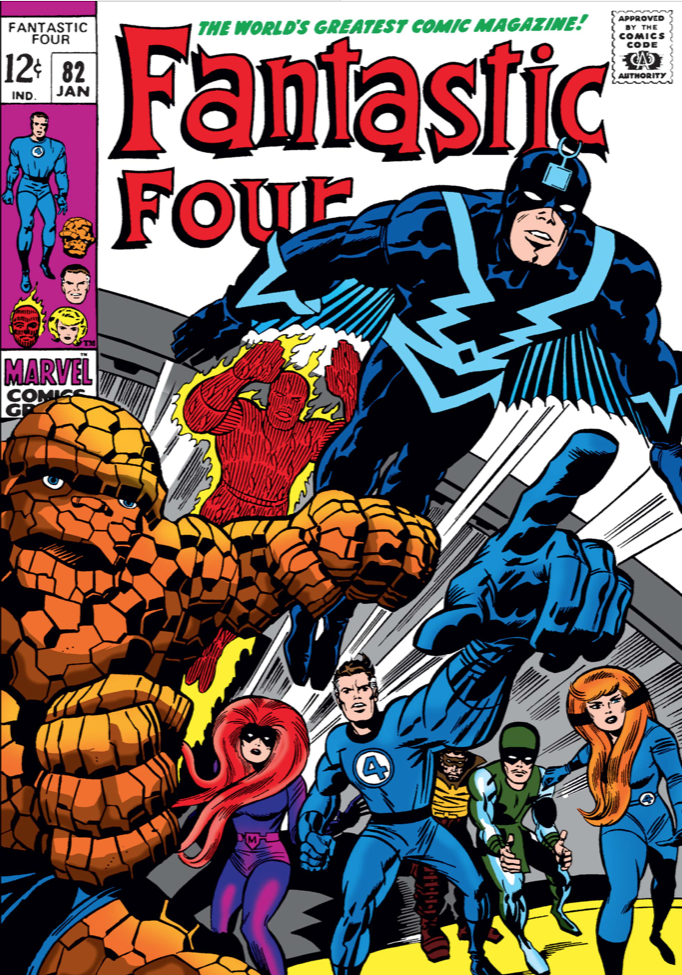
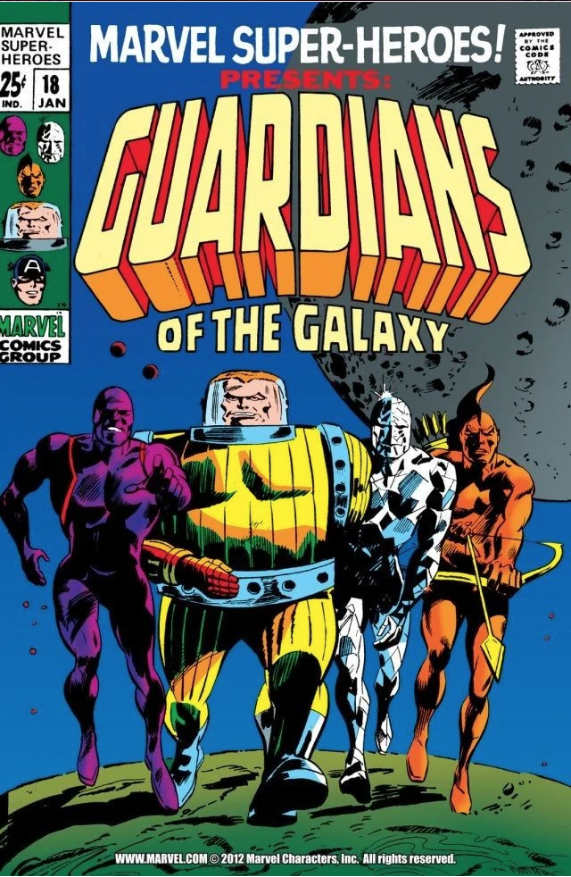
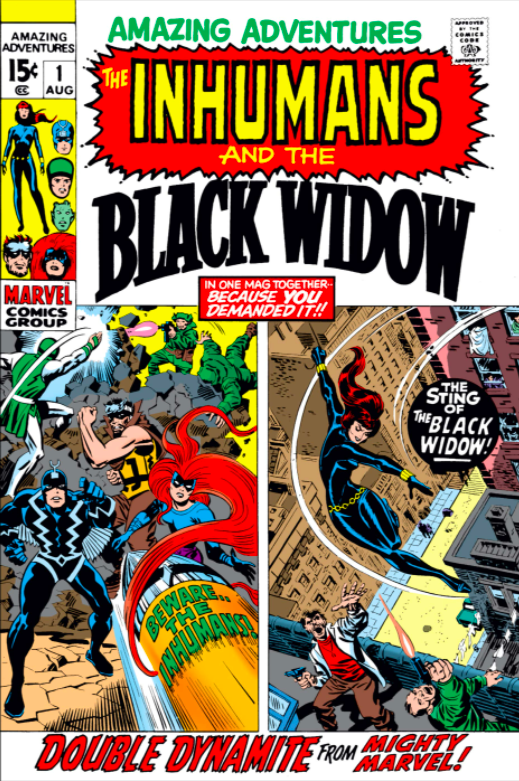
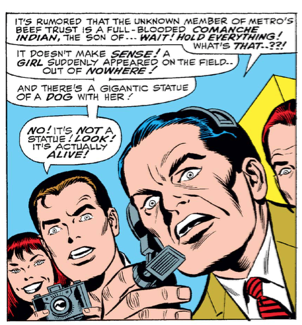
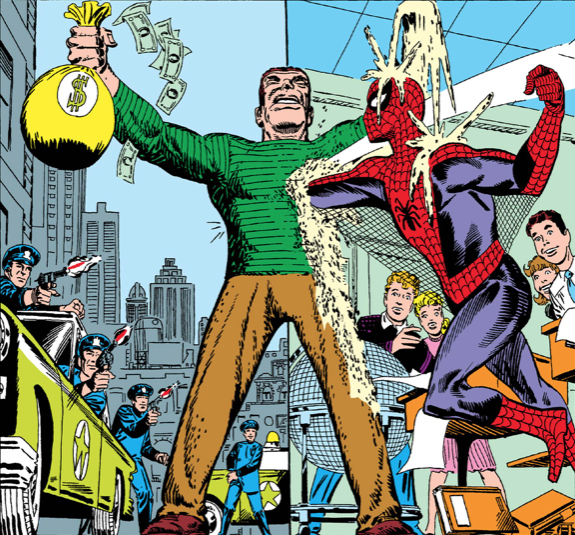
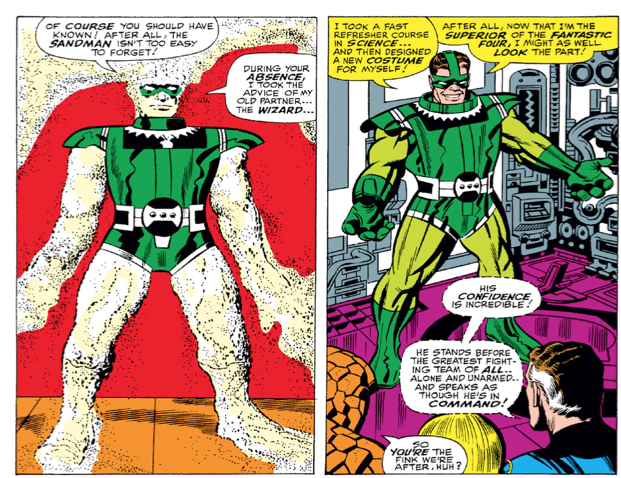
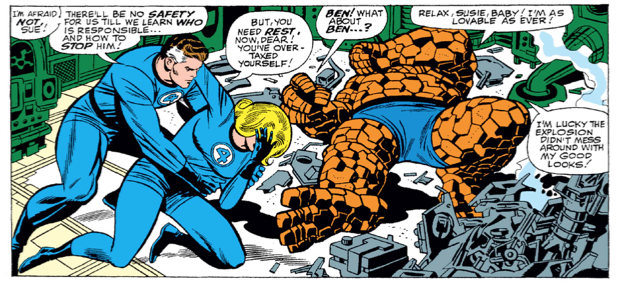
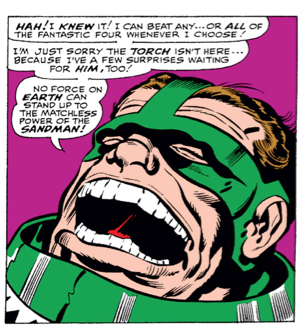
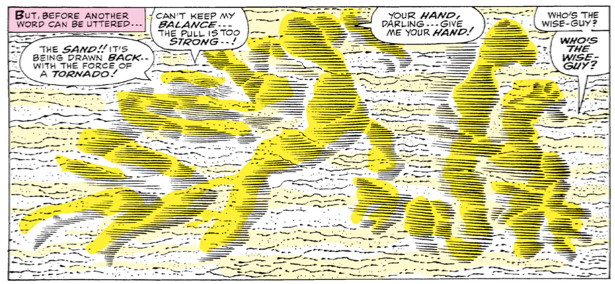
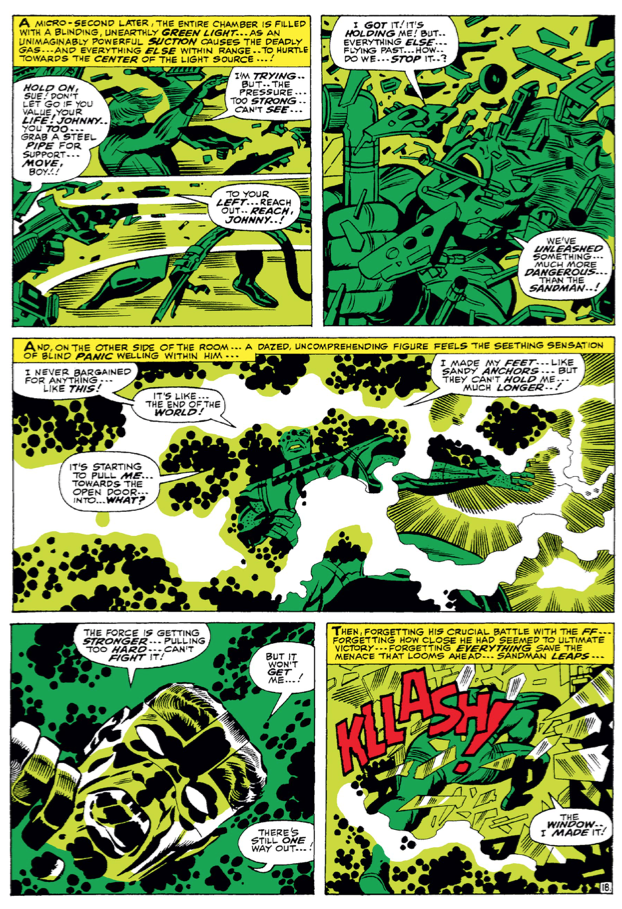
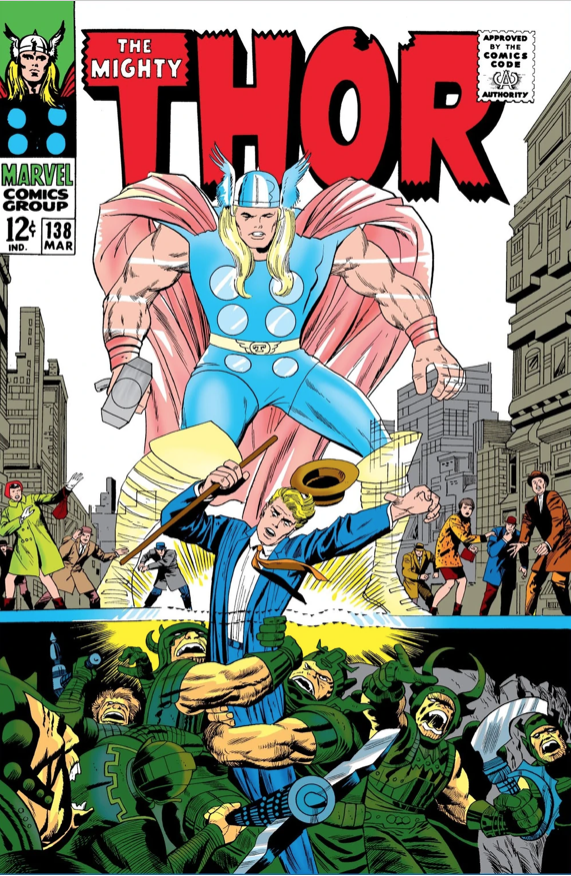
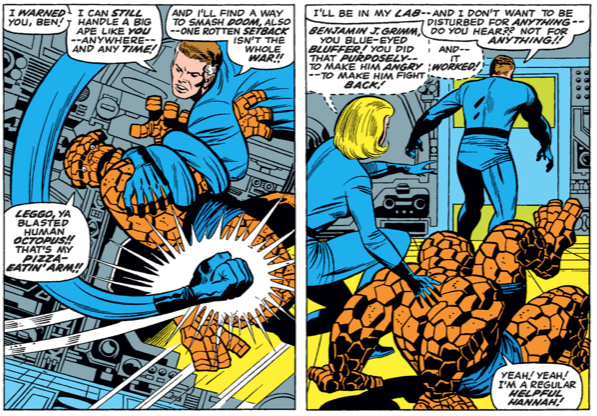
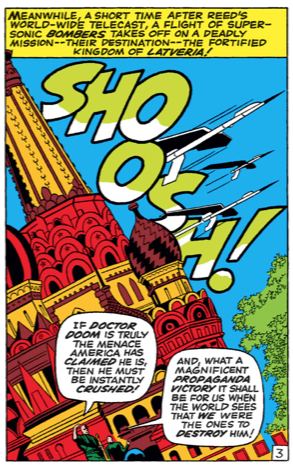
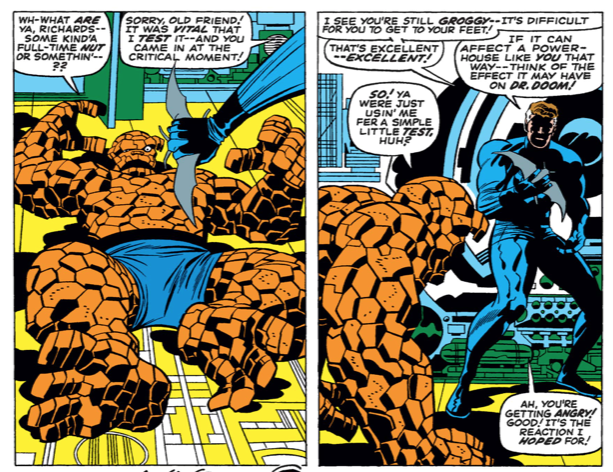
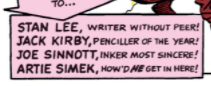
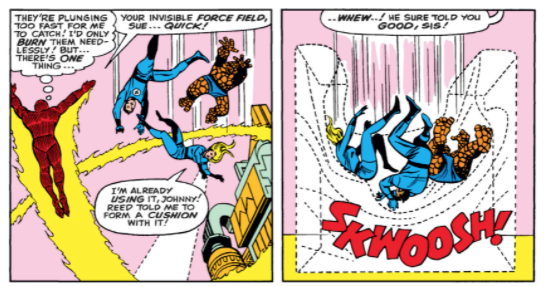
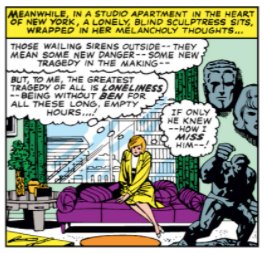
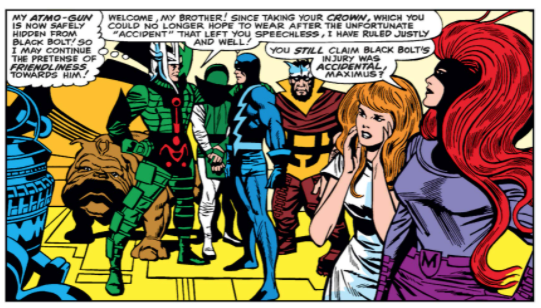
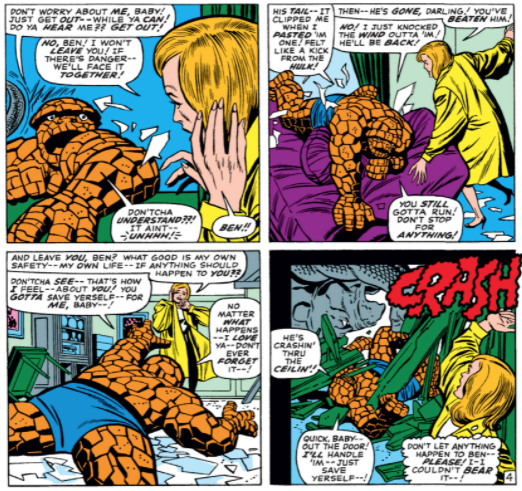
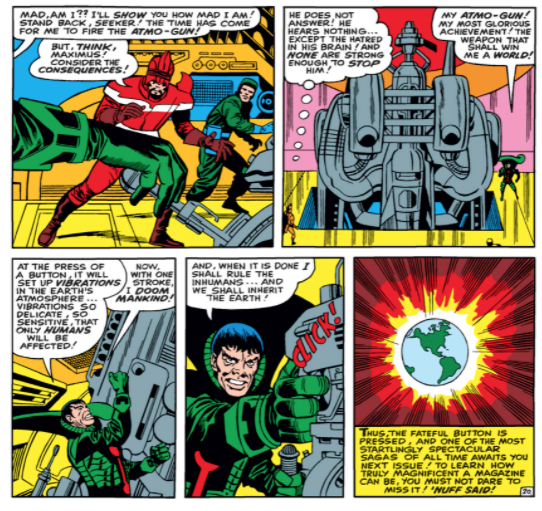
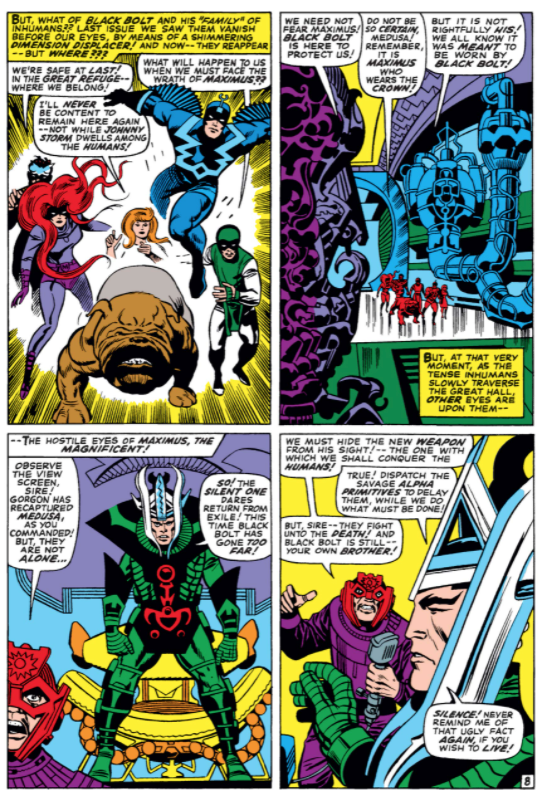
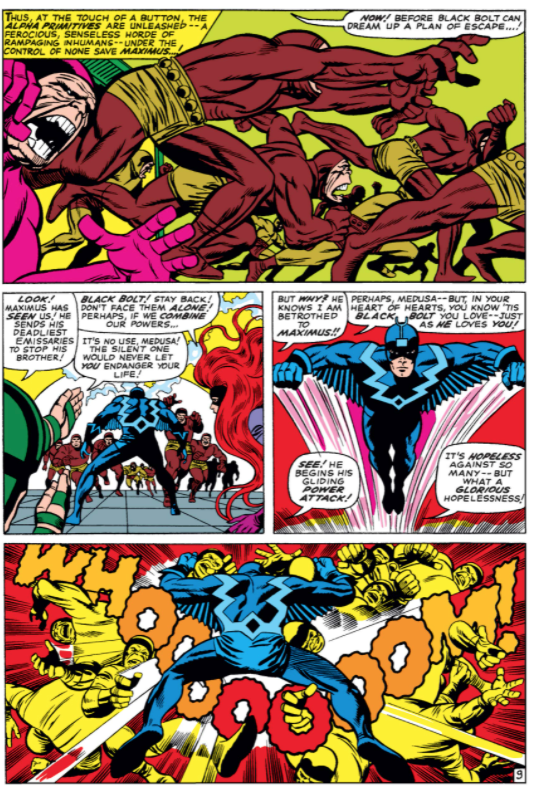
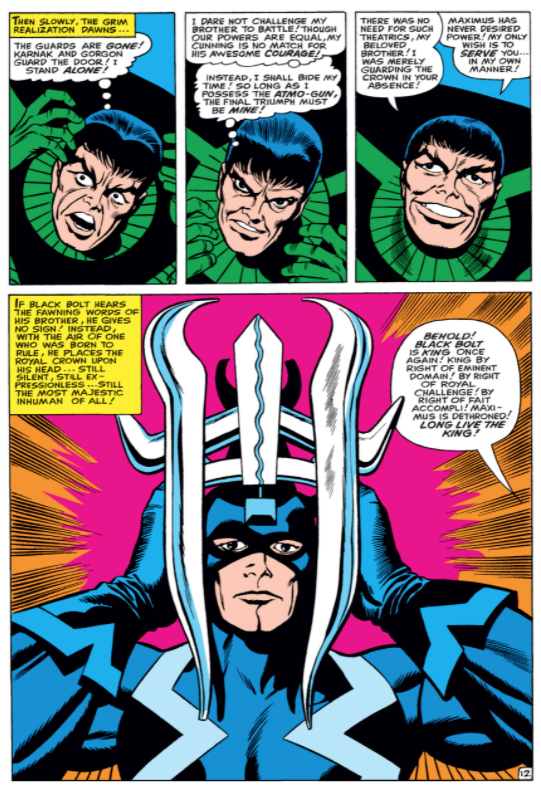
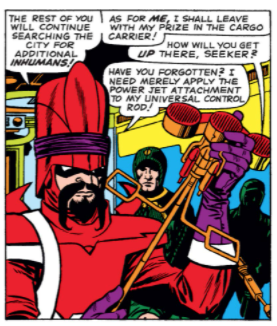
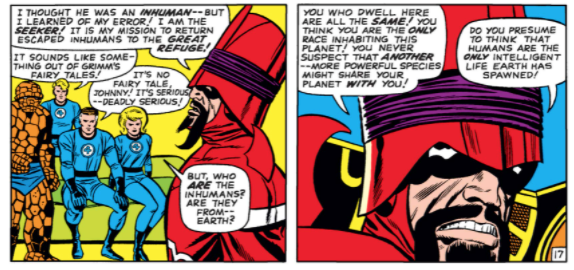
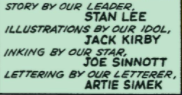
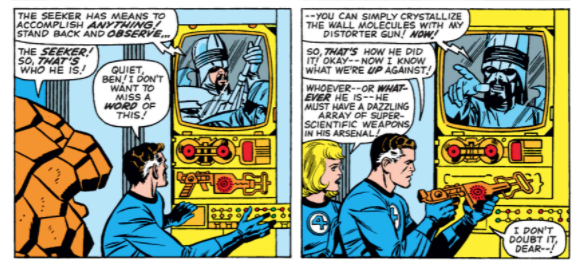
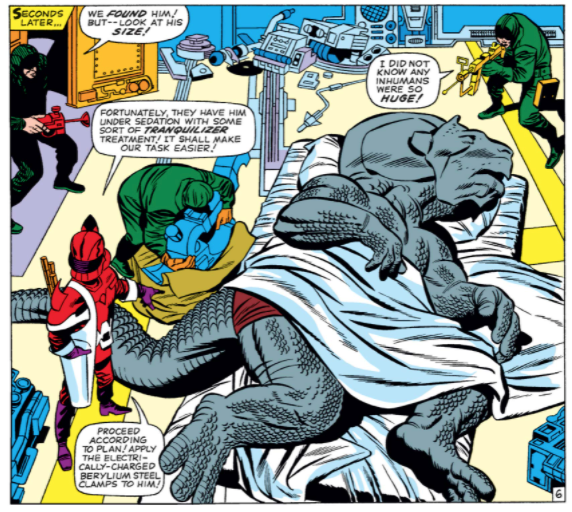
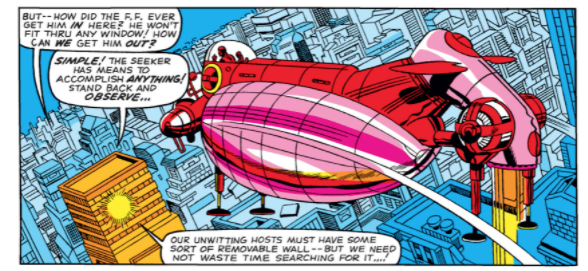
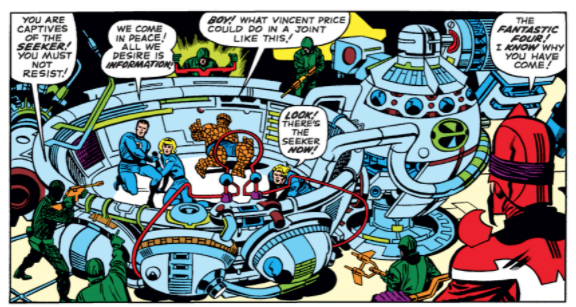
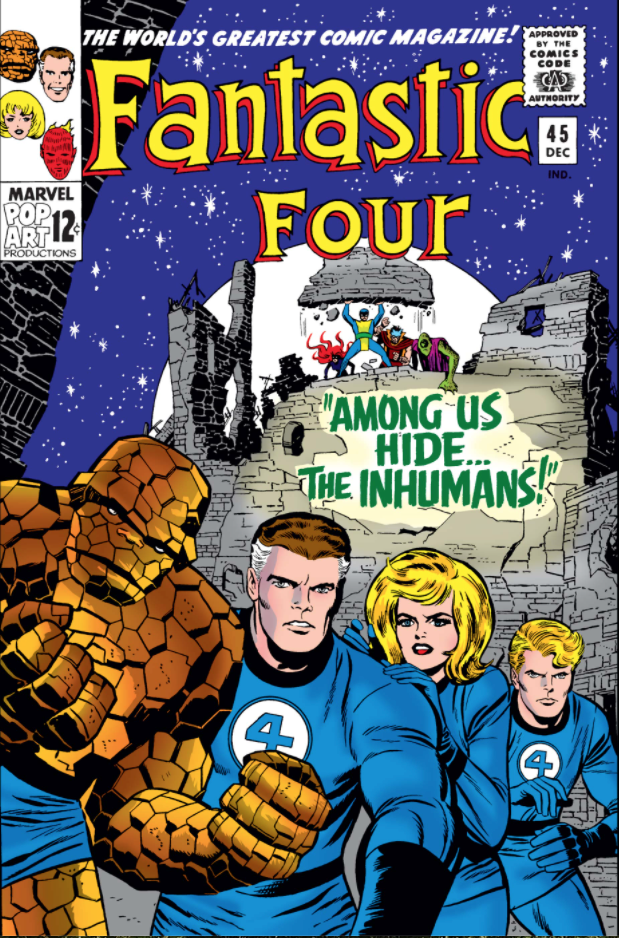
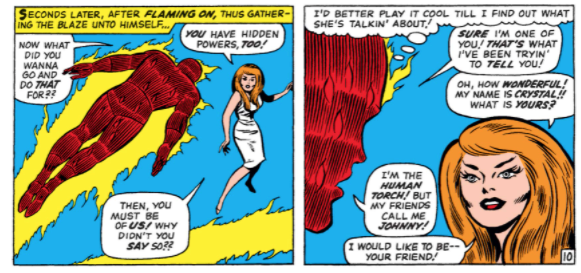
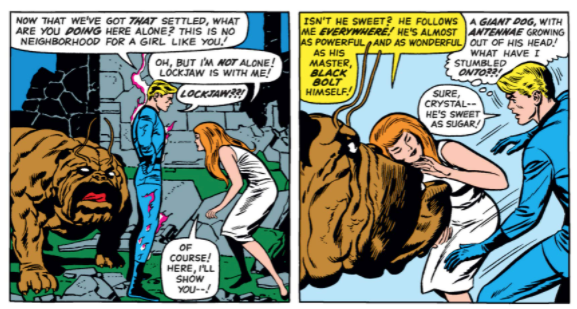
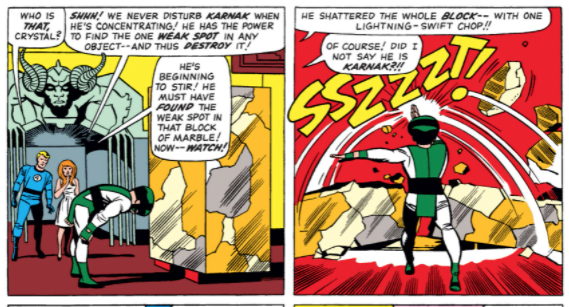
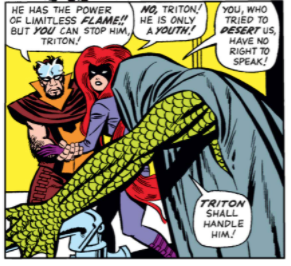
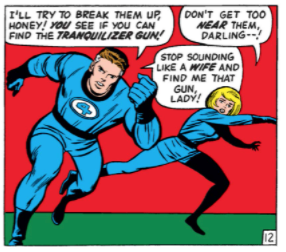
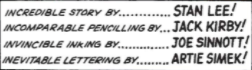
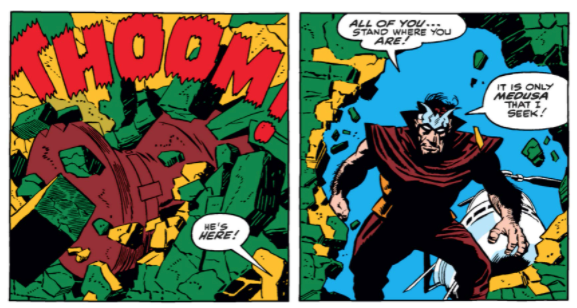
Fantastic Four 82 “The Mark of the .. Madman!” Publiched Oct. 1968 Story: Stan Lee and Jack Kirby Script: Lee Pencils: Kirby Inks: Joe Sinnott Letters: Artie Simek Cover: Kirby and Sinnott
Synopsis
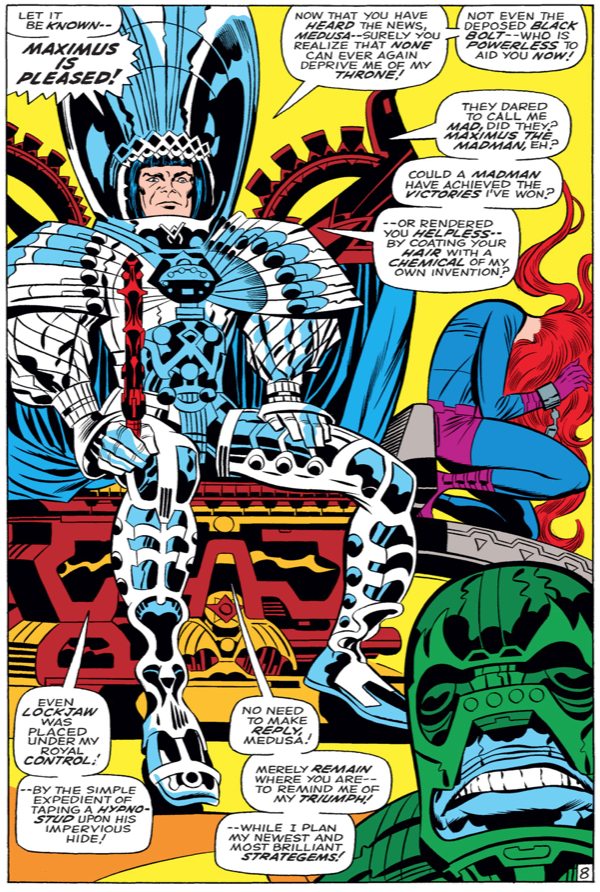
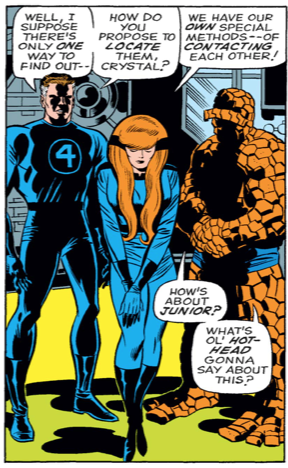
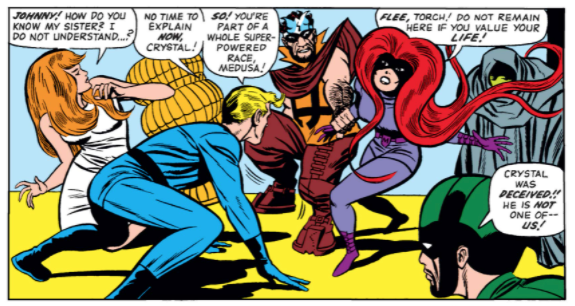
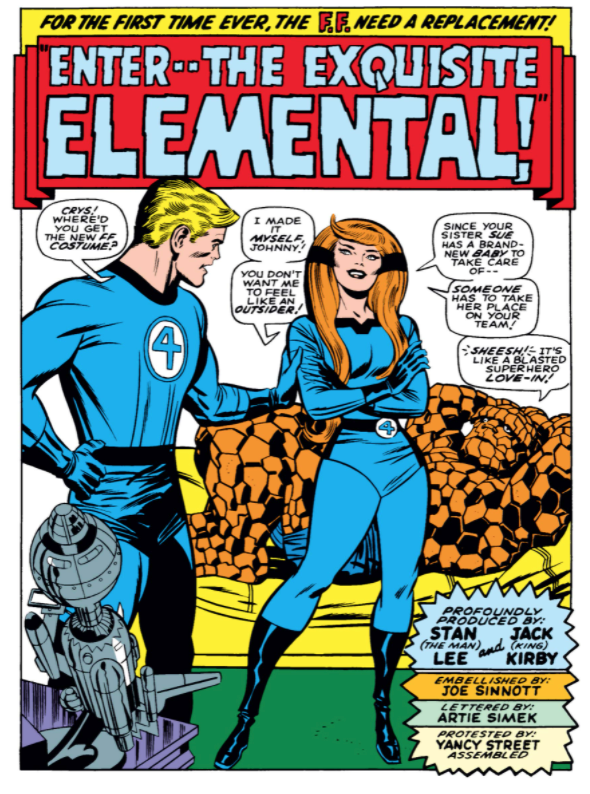
With Crystal now a member of the Fantastic Four—filling in for the Invisible Woman, who recently gave birth—she tells the rest of the team she needs to secure permission from her family, the Inhumans. But as soon as she speaks it, Lockjaw teleports into the Baxter Building, followed by a horde of Alpha Primatives who capture her and disappear with her and Lockjaw. Back at the Inhumans Great Refuge (still not called Attilan), Crystal discovers Maximus the Mad has subdued the rest of the Inhuman Royal family via his “hypno-potions,” and capturing Crystal was his final blow.
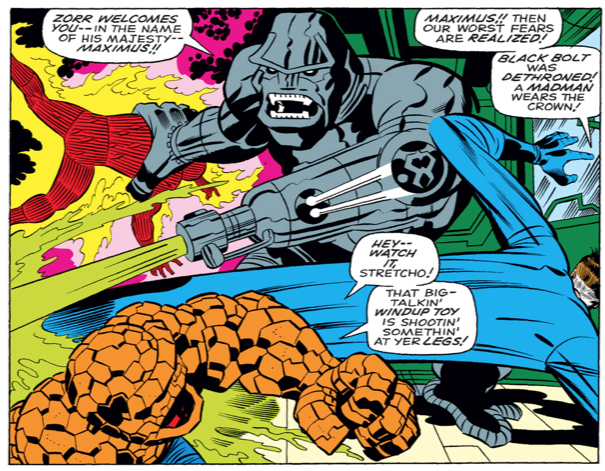
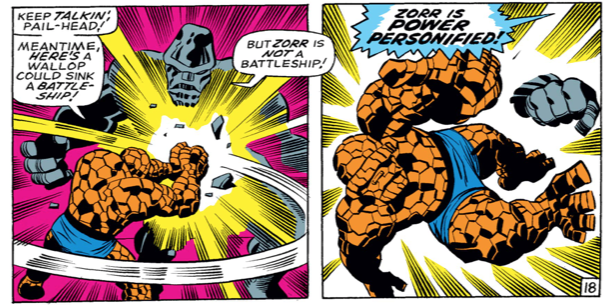
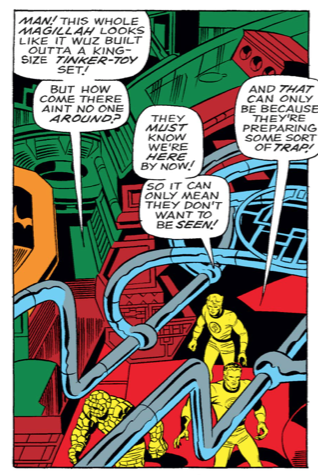
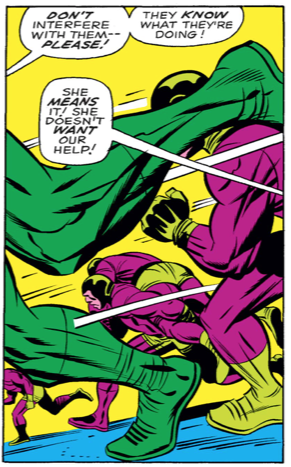
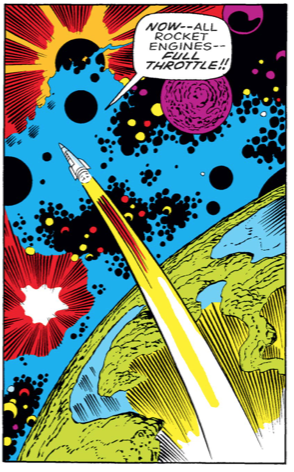
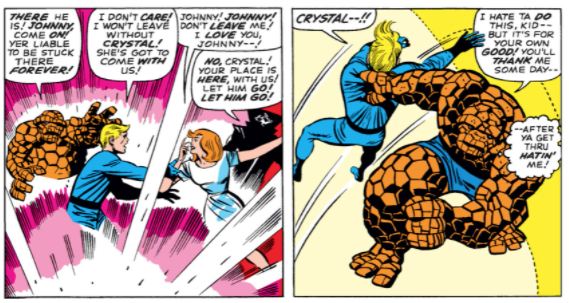
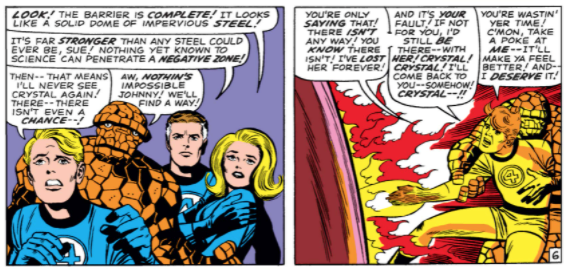
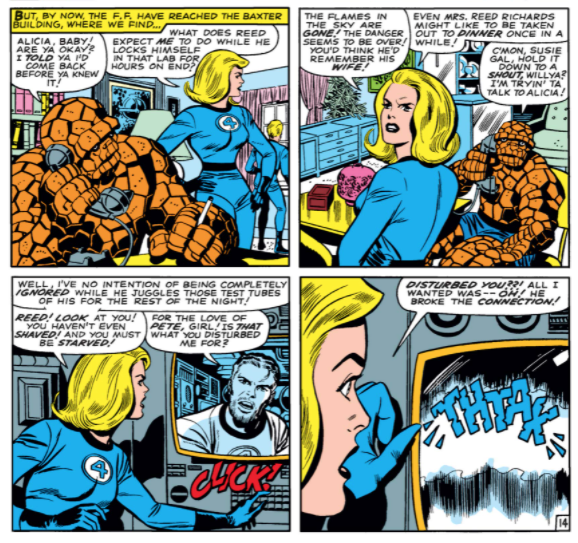
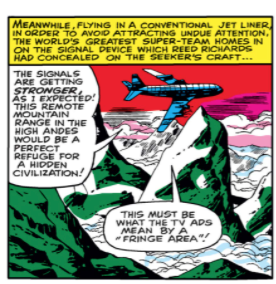
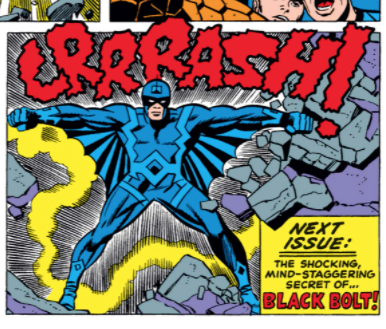
Meanwhile, the three male members of the FF pursue Crystal via the FF’s ICBM, and once they arrive in the Himalayas, they are first trapped in a chamber by Maximus, then attacked, and eventually subdued by a robot called Zorr. The issue ends with Maximus planning to conquer the rest of the Earth. (For what’s it’s worth, the scene on the cover appears no where in the comic).
What’s going on here?
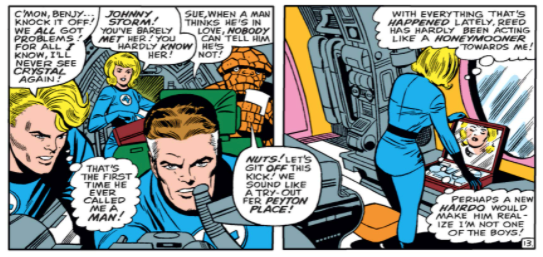
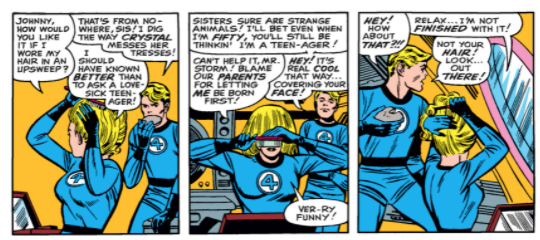
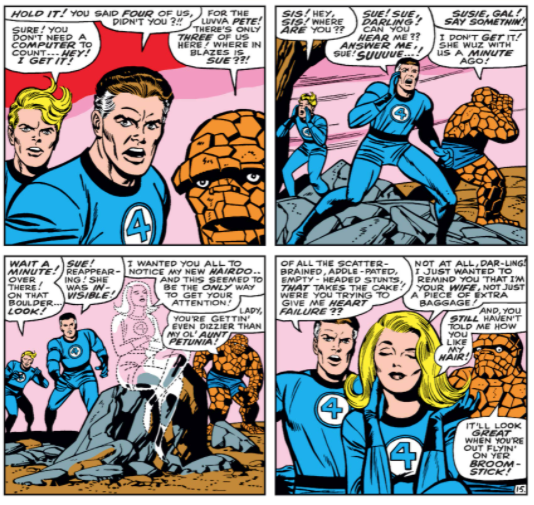
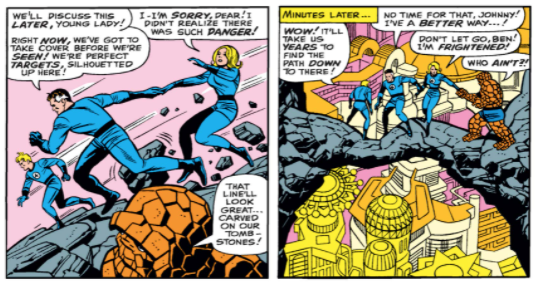
This is a fairly straightforward adventure comic that feels somewhat predictable. It features the return of the Inhumans, so naturally the villain is Maximus, and of course his plan is conquering the world. For the second issue in a row, Sue (and her still unnamed) baby are noticeably absent. I get why Stan and Jack wouldn’t want to bog down a comic with too much domesticity, but part of the FF’s appeal is it’s focus on family. Surely checking in on Sue and her new baby once wouldn’t be too much to ask?
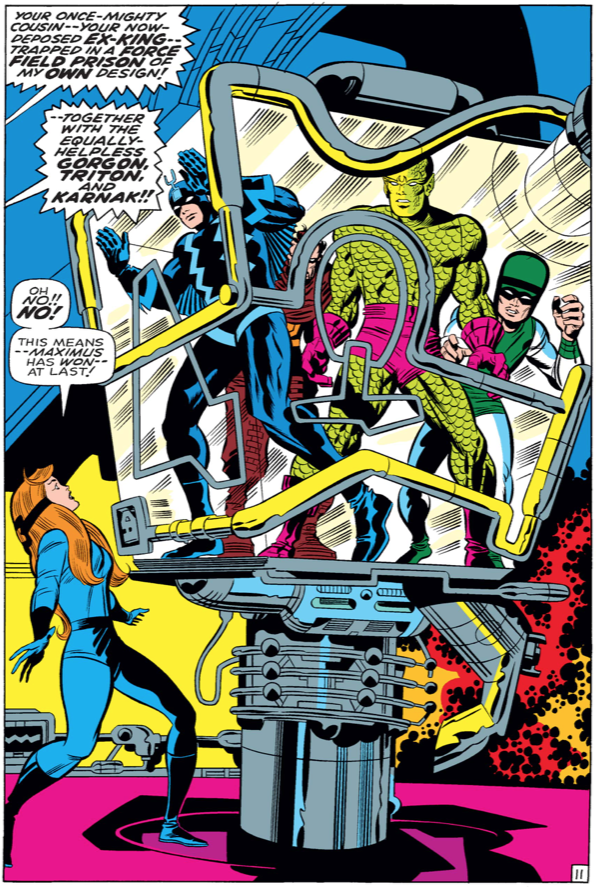
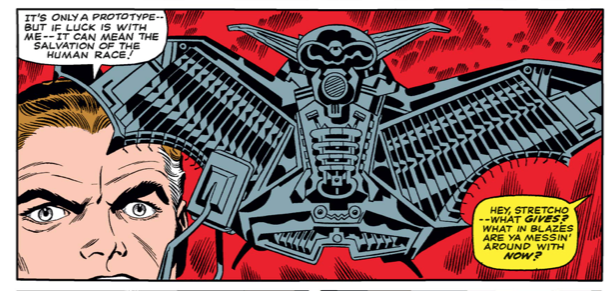
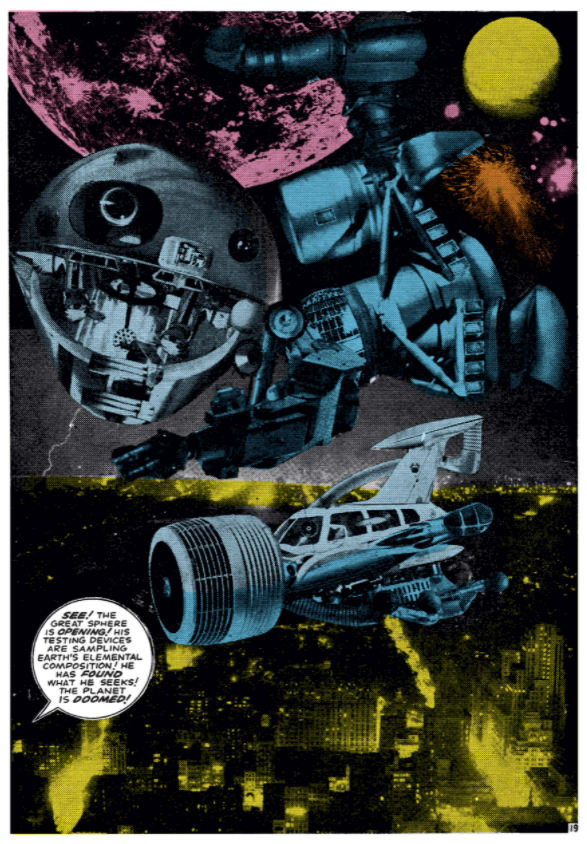
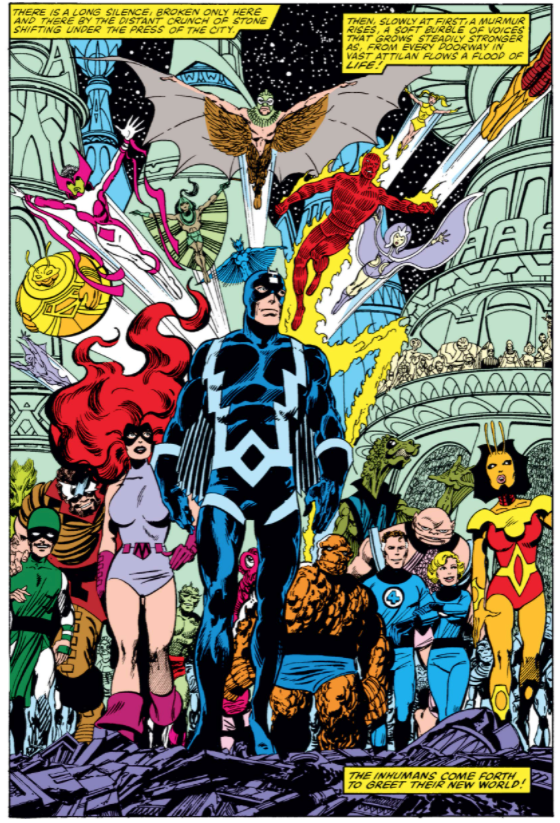
If anything helps this comic rise about the average, it’s Jack’s great pencils and layouts. The art looks better than ever, and as we enter the final quarter of his run on the FF, he’s clearly letting his art air out. There’s more four- and even two-panel pages, and more splash pages, including two in this issue. It wasn’t uncommon to go many issues without a single splash page (aside from the opening page) and now they’re a regular feature.
I’m not a robot
Zorr is yet another very human-like robot the FF have fought in the last dozen or so issues. Along with the Kree Sentry, there was also Galactus’s Punisher, and the Thinker’s Android Man. All had very human-like speech patterns and behaviors (aside from the Punisher, but that was specifically described as half creature, half machine). It’s not clear if this is just a coincidence, or a conscious decision by Stan and Jack, but seems worth noting.
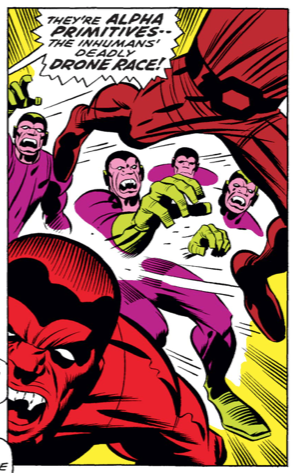
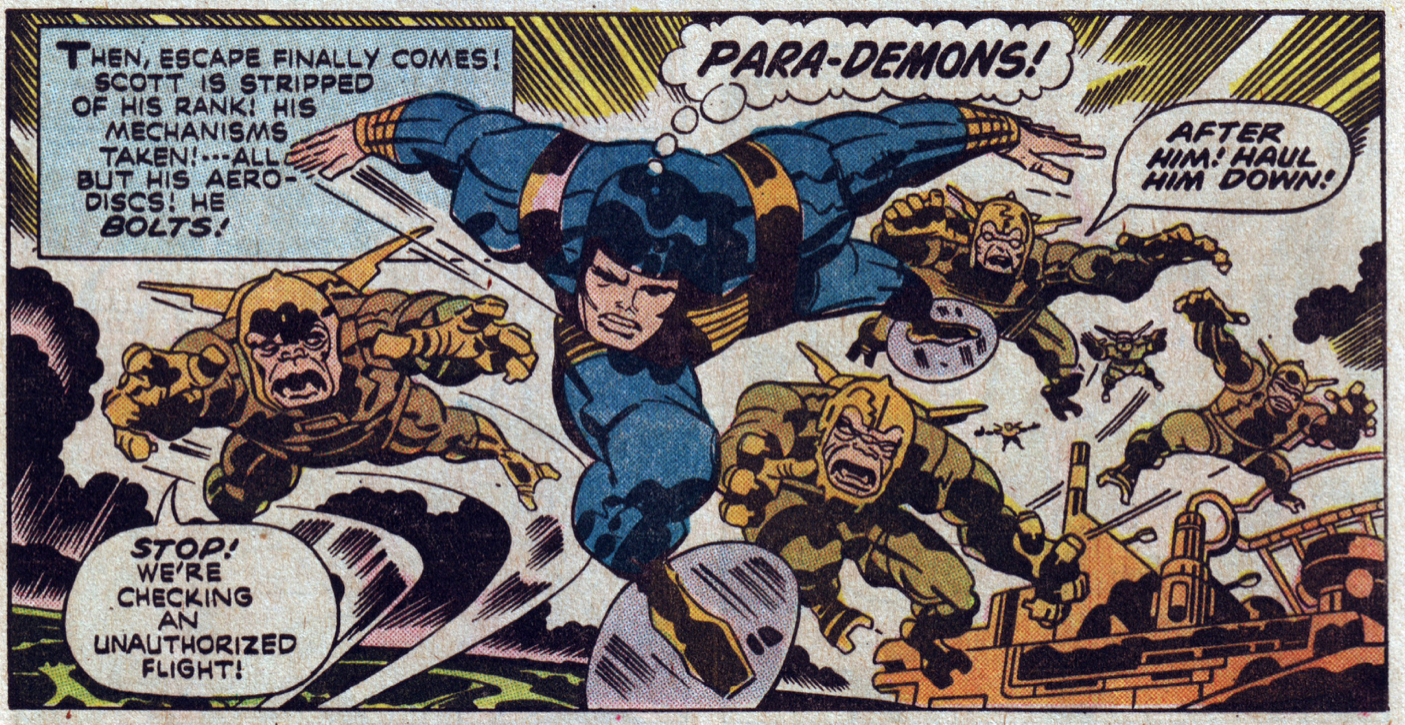
These guys look familiar
The Inhuman Alpha Primatives here look a lot like the Parademons Jack would create in a few years when he jumped to DC.
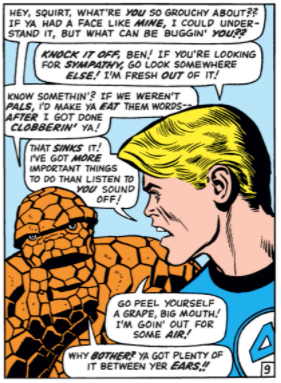
Oy vey
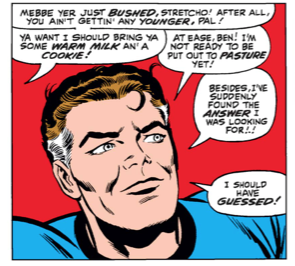
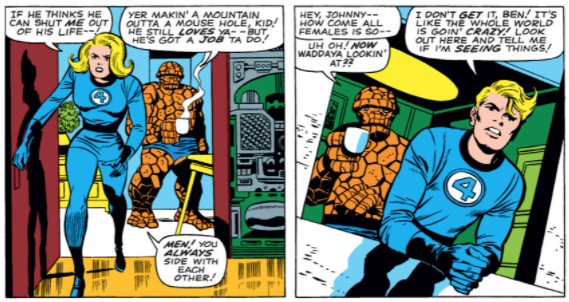
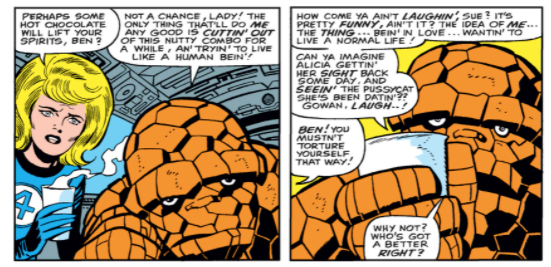
Another very specifically Jewish reference from Ben (a megillah is literally a scroll from the Book of Esther). Ben wasn’t explicitly identified as Jewish until much layer (not until in 2002). but he was the character that most resembled Jack (both grew up on the Lower East Side etc) and it made sense that Ben to sounds like a New York Jew, whether or not Stan and Jack intended to make him Jewish.
Who?
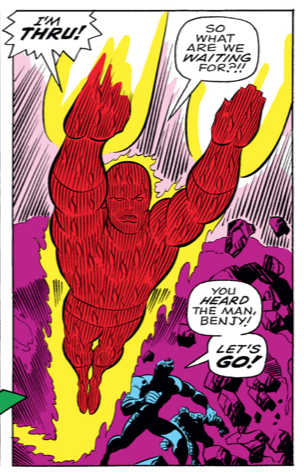
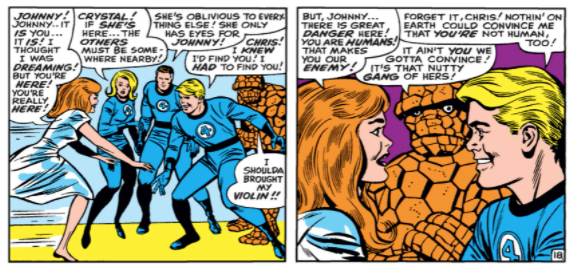
Reed calls Ben “Benjy” here. Which seems like a mistake.
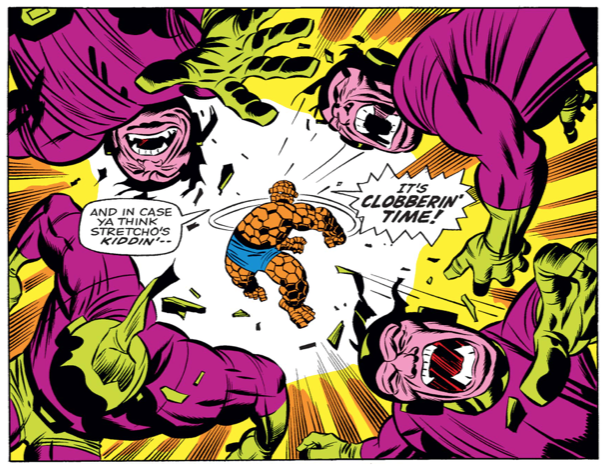
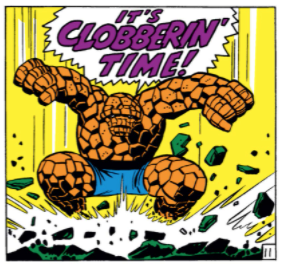
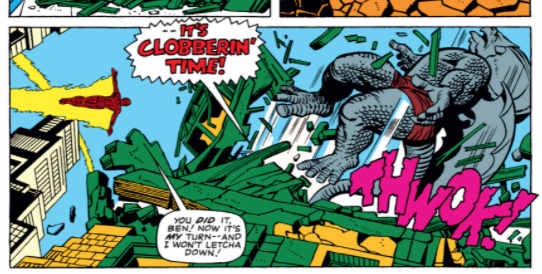
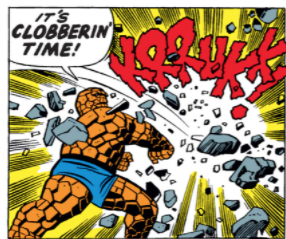
It’s Clobberin’ Time
A pretty good one, at that.
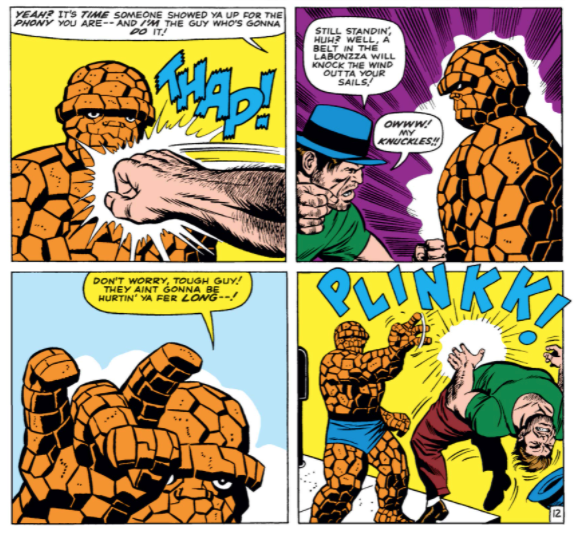
Ladies and gentleman, I give you Joe Sinnott
More great inks from the master.
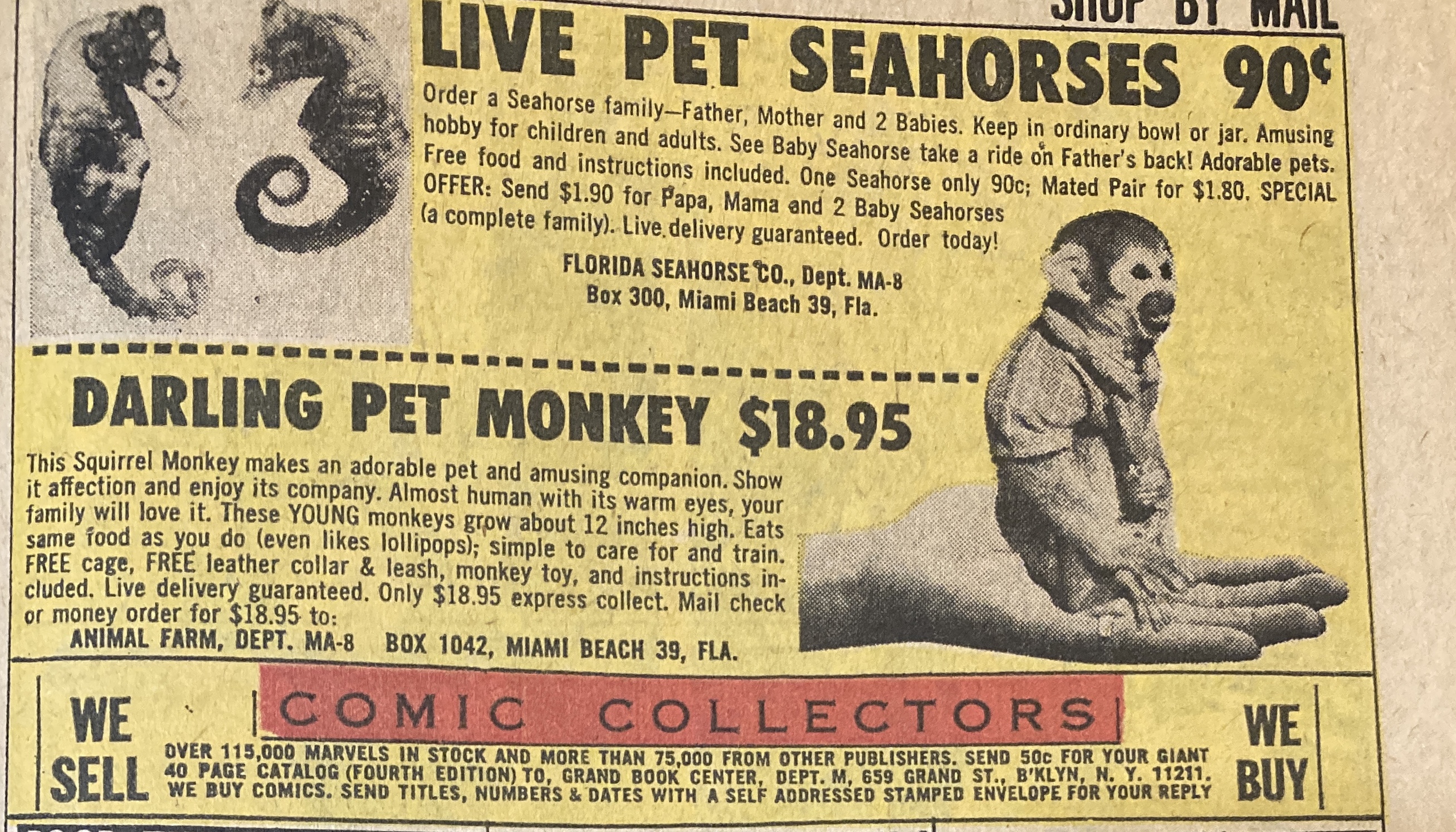
For sale
Live monkeys? Seriously?
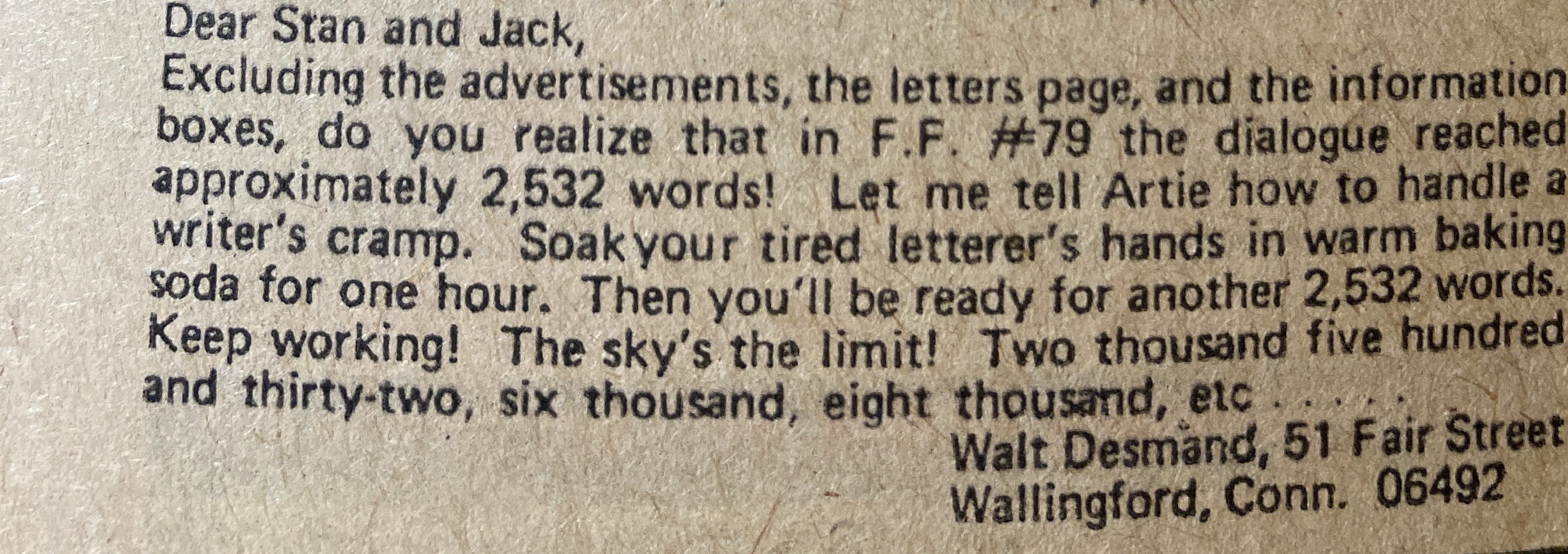
We get letters
Someone had too much time on their hands
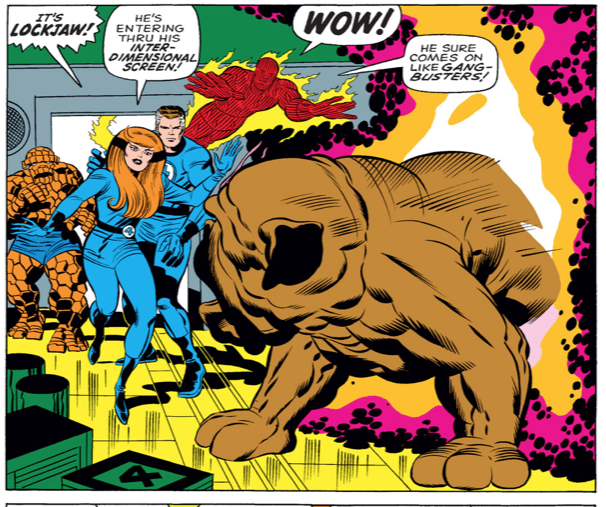
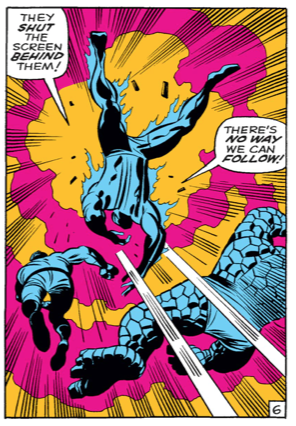
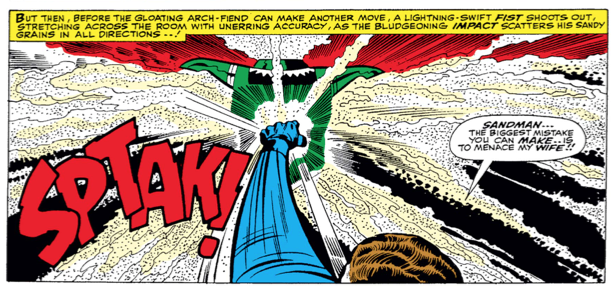
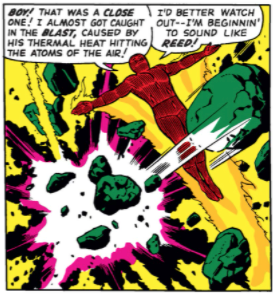
Dig that Kirby Krackle
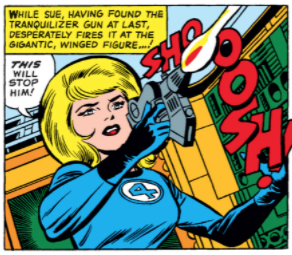
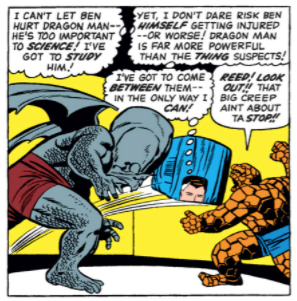
Along with the great splash pages, there are some impressive smaller panels.
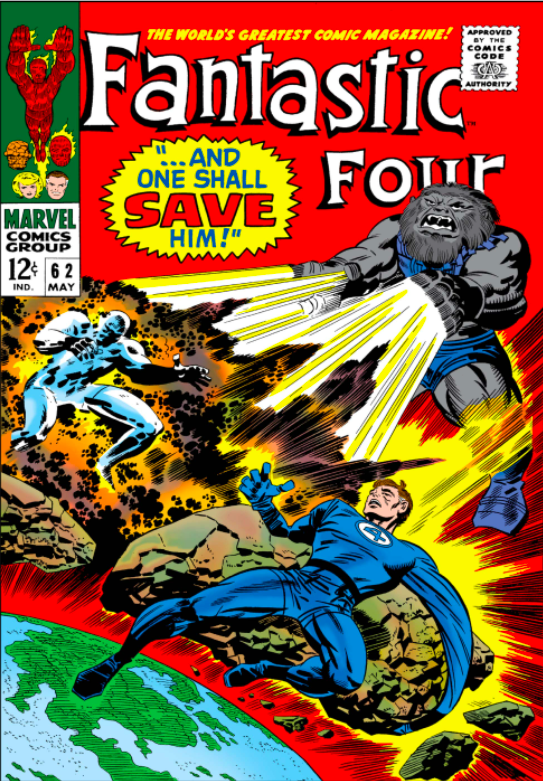
Fantastic Four 62 “And One Shall Save Him!” Published: Feb. 1967 Story: Stan Lee and Jack Kirby Script: Lee Pencils: Kirby Inks: Joe Sinnott Letters: Sam Rosen Cover: Kirby and Frank Giacoia
Synopsis
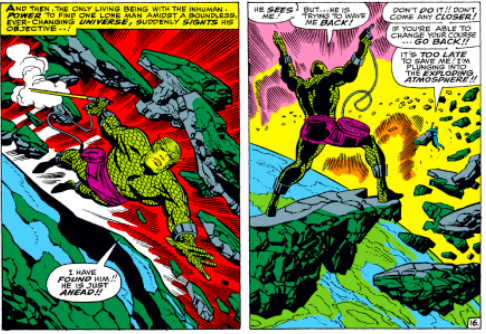
Fantastic Four 62 picks up where the last issue left off, with Mr. Fantastic tumbling through the Negative Zone toward the “exploding area” while the rest of the team watches helplessly through a scanner in the Baxter Building. The Inhuman Crystal and her teleporting dog Lockjaw then appear—Crystal has been looking for the Human Torch for about a dozen issues now—and she offers to help.
We then cut to a Mediterranean island where the rest of the Inhumans repel an invasion by a hostile army. Crystal arrives and explains the situation, and Black Bolt dispatches Triton to save Reed.
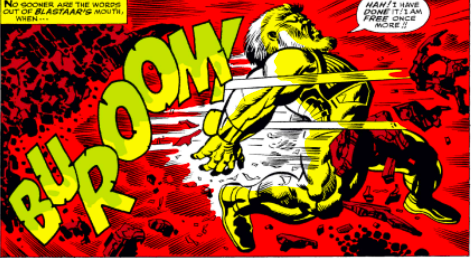
Back in the Negative Zone, a space craft drops off a menacing package near where Reed flounders, soon revealed to be the villain Blastaar. Triton then appears and rescues Reed, and as they return to our dimension, Blastaar sneaks in behind them. He is then confronted by the Sandman, who has been on the roof of the Baxter Building since the last issue, and they form an alliance. The issue concludes with the happy reunions of Reed and Sue and Johnny and Crystal.
What’s going on here?
A bit of an unsatisfying issue. For one, despite the promise of the cover, Blastaar —a major villain making his first appearance—doesn’t fight the FF in this issue. He appears, but there’s no confrontation—they don’t even intersect with each other. More significantly, the rescue of Reed is incredibly anticlimactic. Instead of Reed figuring out some scientific whammy, or Ben plunging into the Negative Zone after him, he’s rescued by Triton in a development that comes out of left field. And Triton just … goes and gets him. It’s explained that Triton’s ability to navigate the ocean depths makes him uniquely suited for this mission, but the rescue seems pretty straightforward. There’s no real drama or unusual heroics required.
The arrival of Crystal does serve to reunite her and Johnny, resolving their soap opera separation that began in issue 48. We also get a lot of Inhumans action, seemingly setting them up for their own series.
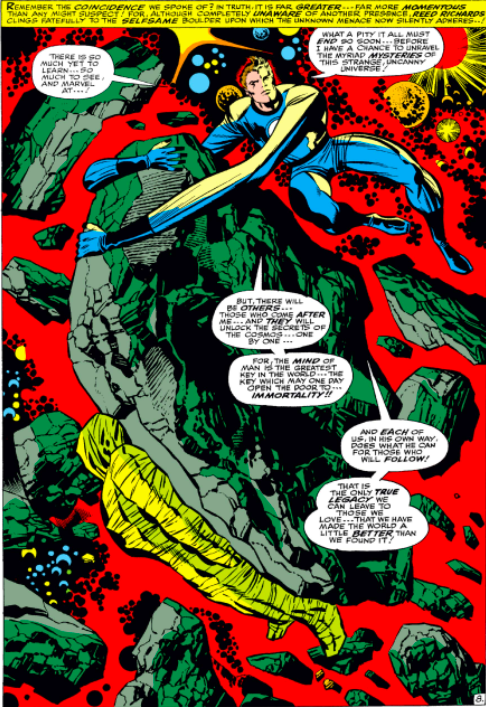
They didn’t get their own book until 1970, however, and even that they had to share with the Black Widow. As I recall, the mistreatment of the Inhumans was another factor that led to Jack leaving Marvel for DC.
Negative Zone
FF 62 also marks the first time the Negative Zone is really understood to be an alien dimension, complete with its own races and civilizations. Blastaar is he first villain to appear, but eventually we’ll be introduced to Annihillus, a first-tier bad guy.
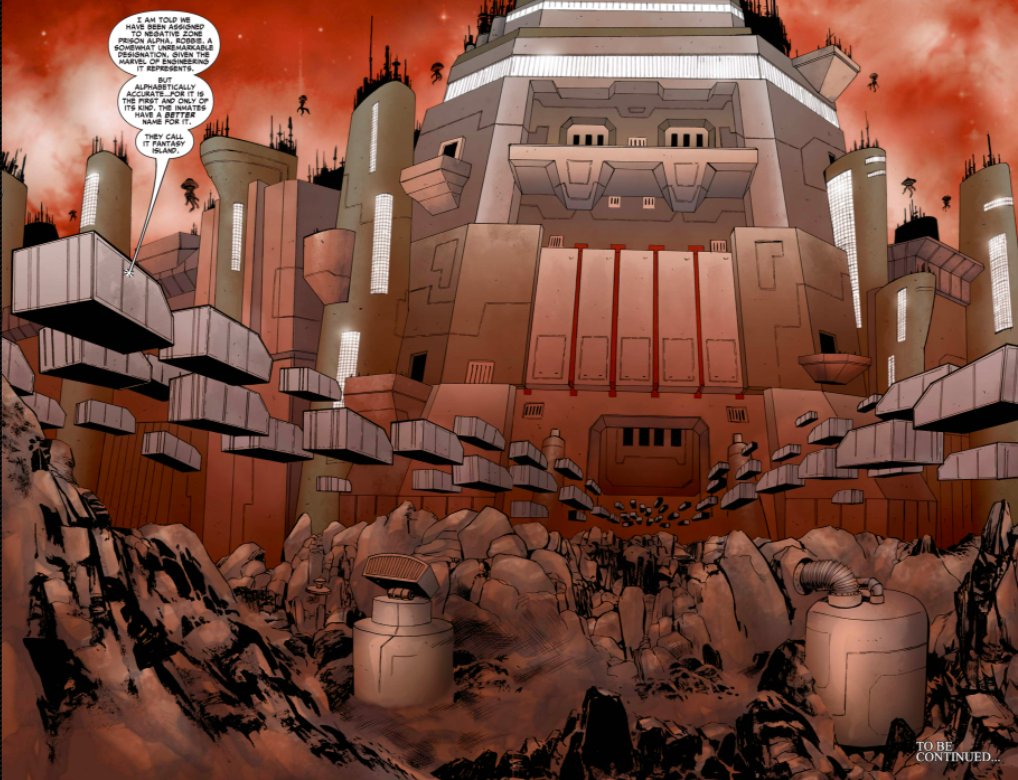
The Negative Zone becomes a major part of the FF’s mythos, and Reed and the FF are often either exploring it or using it place to store undesirables, such as when Reed created a prison there during the Civil War.
Civil War Front Line 5 (2006, Ramon Rachs and John Lucas)
Kirby Kollage
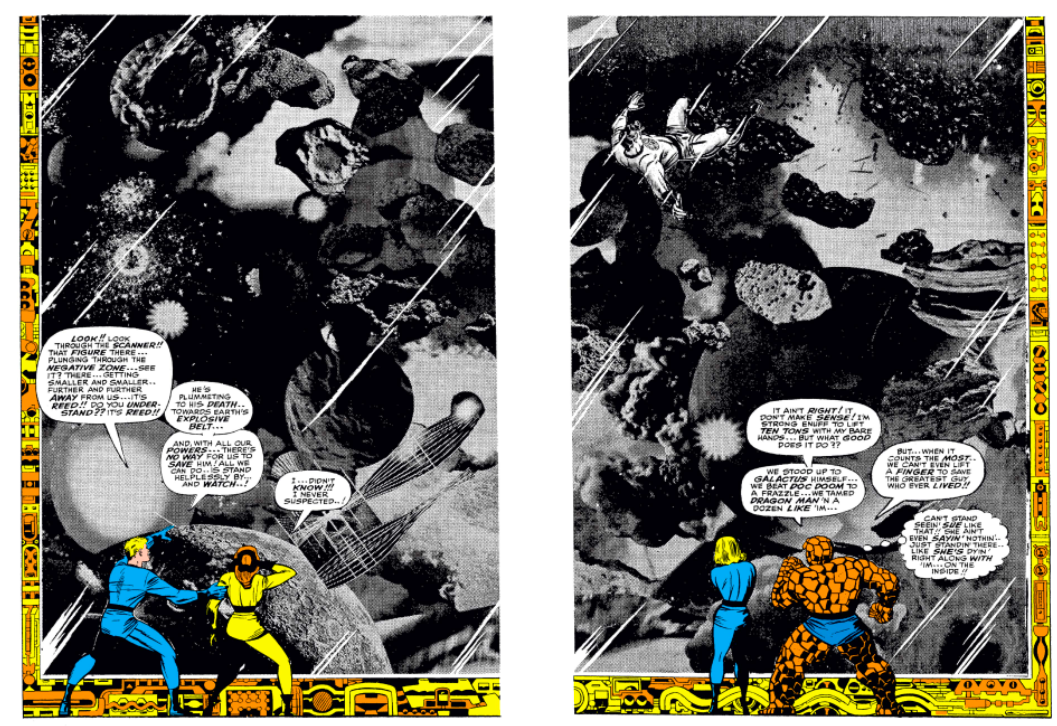
This is the first double-page splash in 62 issues of the Fantastic Four, and another amazing Kirby collage. Unfortunately I don’t have the tools to stitch the two pages together properly.
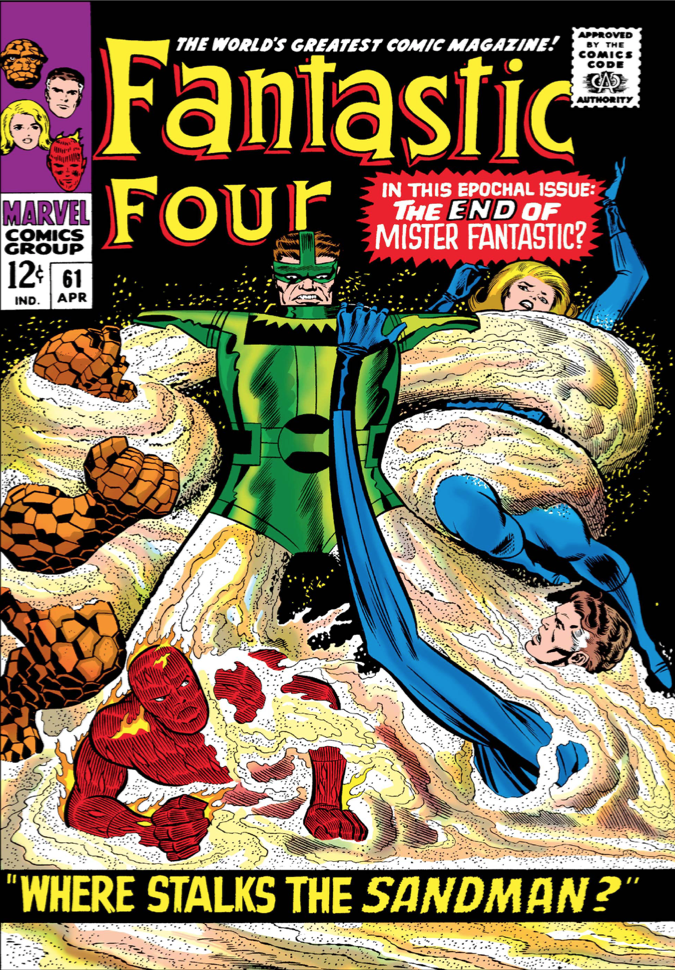
Fantastic Four 61 “Where Stalks the Sandman!” Published: January 1967 Story: Stan Lee and Jack Kirby Script: Lee Pencils: Kirby Inks: Joe Sinnott Letters: Sam Rosen Cover: Kirby and Sinnott
Synopsis
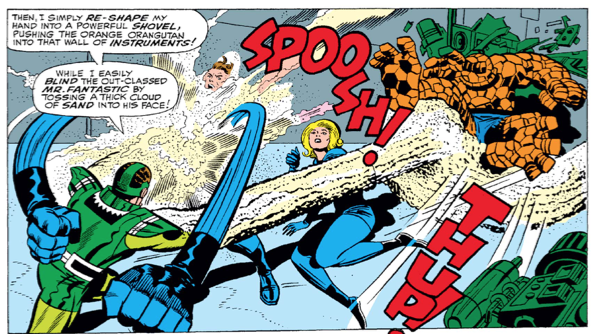
With the conclusion of the Doom/Surfer story arc in the last issue, Fantastic Four 61 starts off with a bang, as Mr. Fantastic, the Invisible Woman and the Thing are attacked by the equipment (the “atom igniter,” among other devices) in Reed’s lab. Eventually their antagonist is revealed to be the Sandman, who has turned the FF’s devices against them, although it’s never really explain how. The FF and the Sandman battle, and are eventually joined by the Human Torch.
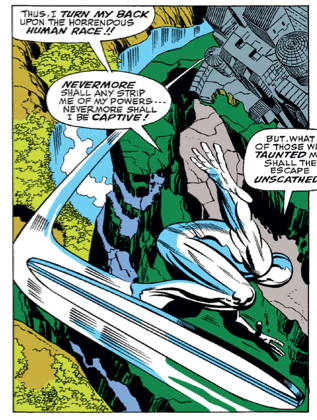
Meanwhile, in a pair of digressions, the Silver Surfer’s board returns to him with his powers, allowing him to escape Latveria, and the Inhuman Crystal teleports with Lockjaw to a Metro College football game in search of Johnny.
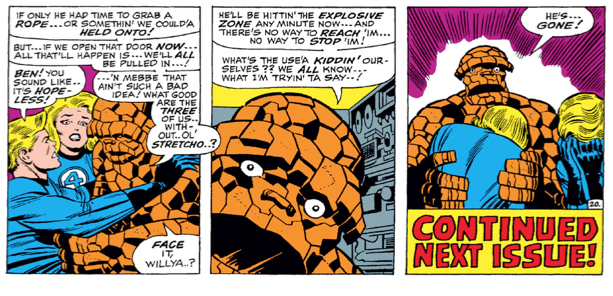
During the FF’s fight with the Sandman, the villain generates poisonous gasses. To escape, Reed opens the portal to the Negative Zone, and while Johnny and the Sandman escape, Reed is sucked into the other dimension. The issue end on a cliffhanger with Reed’s fate unknown.
What’s going on here?
This is an interesting issue. It starts off as a fairly pedestrian story, and one that felt a lot like issue 57, when the FF also fought the Sandman in the Baxter Building. But the story takes a surprising and dramatic turn when Reed opens the door to the Negative Zone and tumbles through, leading to a genuinely suspenseful ending and compelling pathos as the rest of the team watches him float away. The issue also has some stand-out pages from Kirby and Sinnott.
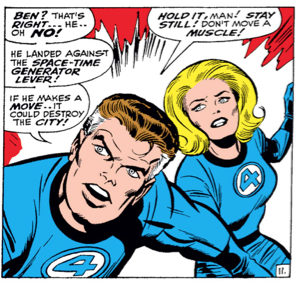
There are, of course, a whole lot of implausibilities in this issue, starting with how the Sandman, up until now a lunkhead, managed to hijack Reed’s devices. Then there’s the question why Reed’s devices are so vulnerable—at one point Sandman leans against a lever and threatens New York (this also happens to be an excel Joe Sinnott panel):
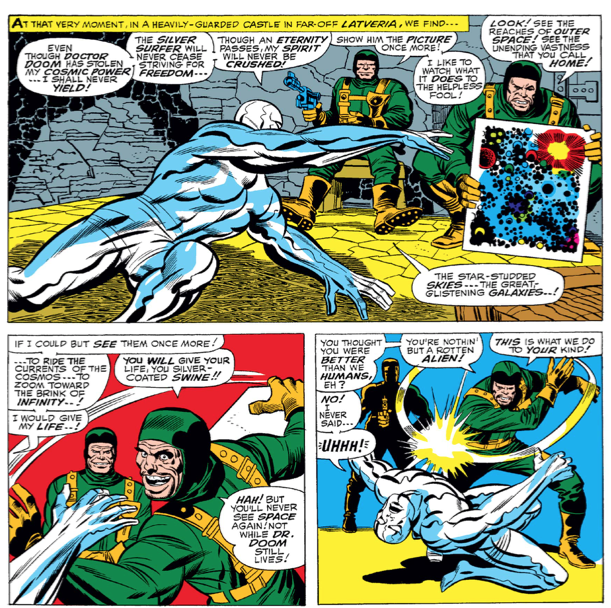
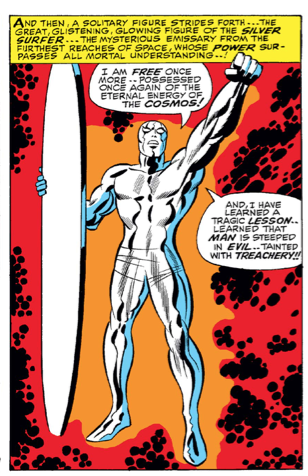
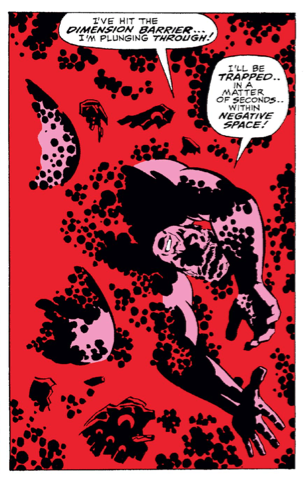
FF 61 also continues the almost sadistic torture of the Silver Surfer that began in issue 57. Oddly, while we saw his baord begin its return to him in the last issue, it didn’t arrive until this issue (“at that very moment”). The FF were able to fly across the Atlantic in the time his board crossed Latveria.
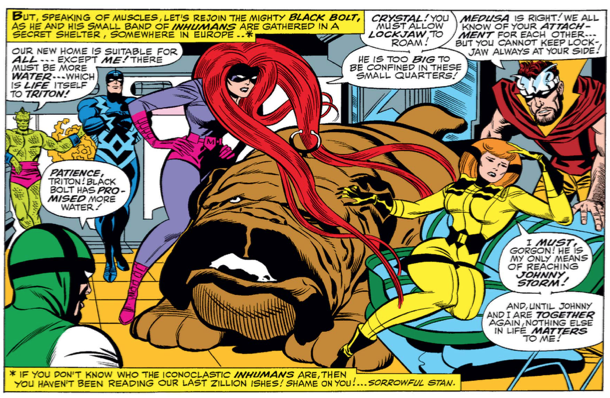
And like every issue for the last five or so, we have an obligatory Inhumans check-in. In this one, Crystal looks unusually curvy.
Who is that guy?
An unannounced (and unacknowledged) cameo from a certain Daily Bugle photographer.
Costume change
This issue also marks a new costume for the Sandman,a much more Kirby-esque getup than the striped shirt Steve Ditko gave him. You can almost sense Jack chafing at having to draw such a drab costume for some many issues up to now.
The sexist sixies
More gender-role conformity
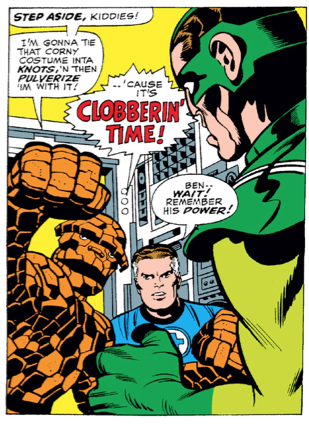
Clobberin’ Time
This is a pretty good one, with it’s own font and everything.
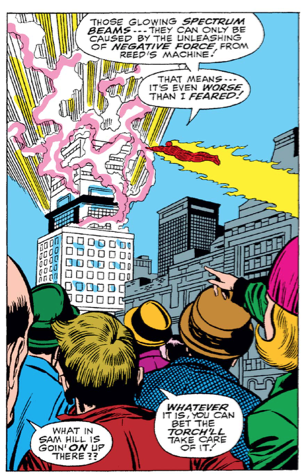
Weird science
Watch out for those spectrum beams!
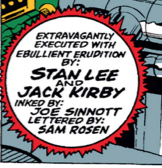
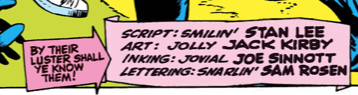
Crazy credits
They’ve been pretty tame the last few issues, but we get a bit of flourish here.
For sale
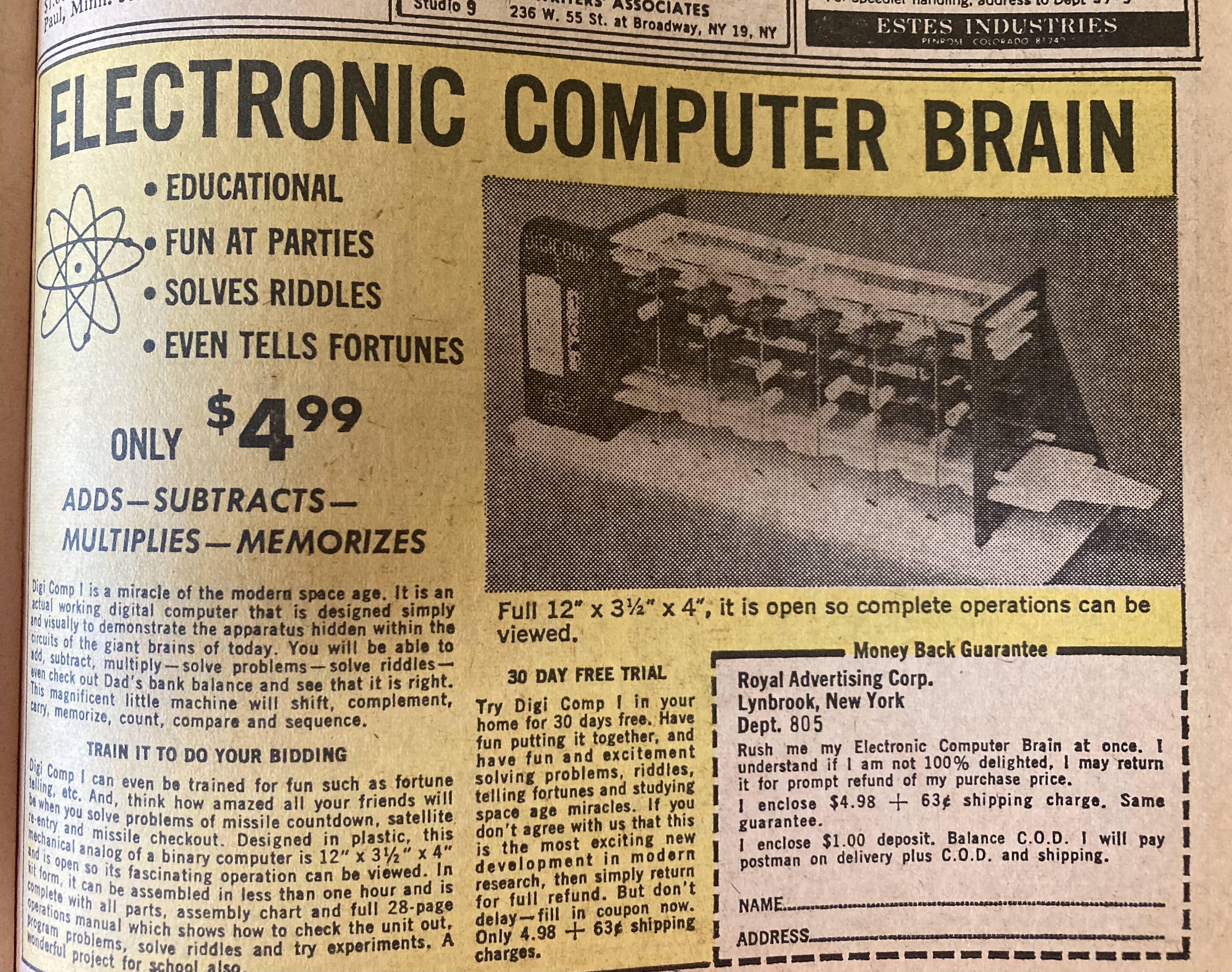
A computer for $4.99. It’s a great deal, because a similar device made by IBM in 1967 cost about $4 million.
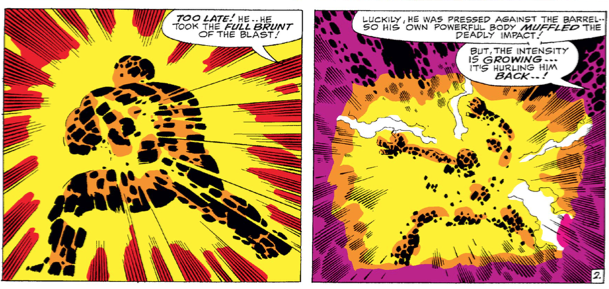
Dig that Kirby Krackle
So much awesomeness in this issue! Like this sequence:
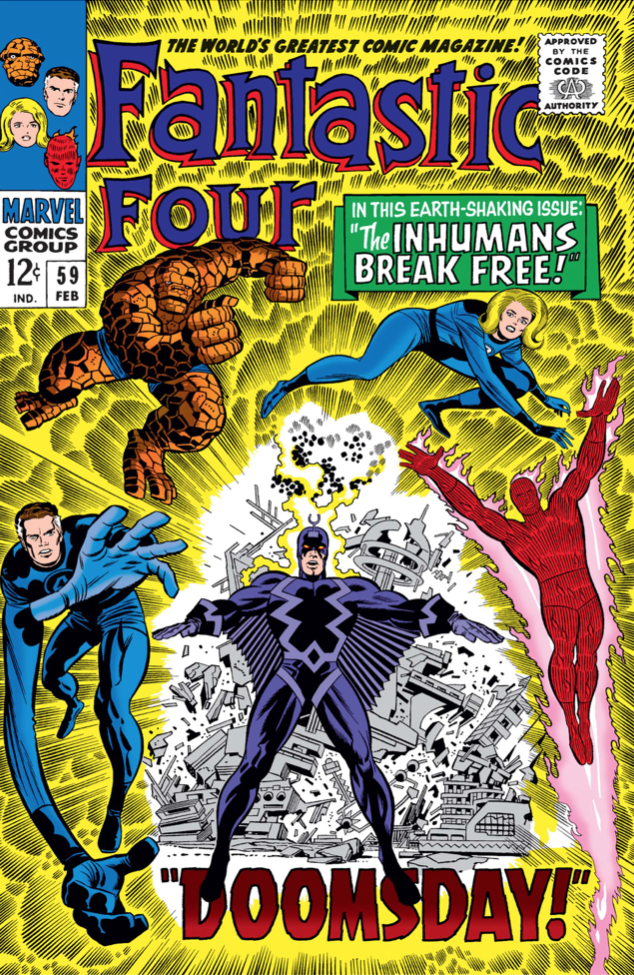
Fantastic Four 59 “Doomsday!” Published: Nov. 1966 Story: Stan Lee & Jack Kirby Script: Lee Pencils: Kirby Inks: Joe Sinnott Letters: Artie Simek Cover: Kirby & Sinnott
Synopsis
After Dr. Doom’s defeat of the Fantastic Four in the previous issue, FF 59 is another stage-setting comic, where a number of storylines are advanced without any reaching their climax.
In the first, main thread, Mr. Fantastic, the Thing and the Invisible Girl are regrouping in the aftermath of Doom’s victory. Reed warns the nation’s of Earth to prepare for the menace of Doom, then, goaded by Ben, begins making plans to defeat him. Toward the end of the comic, we get a glimpse of what Reed’s working on: an explosive flying device that saps power from this it comment with.
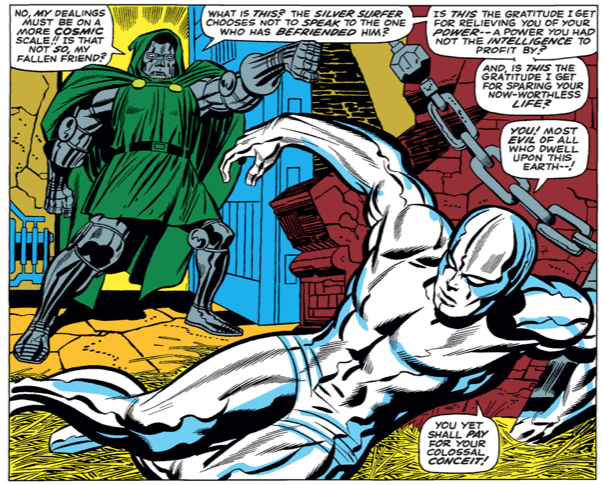
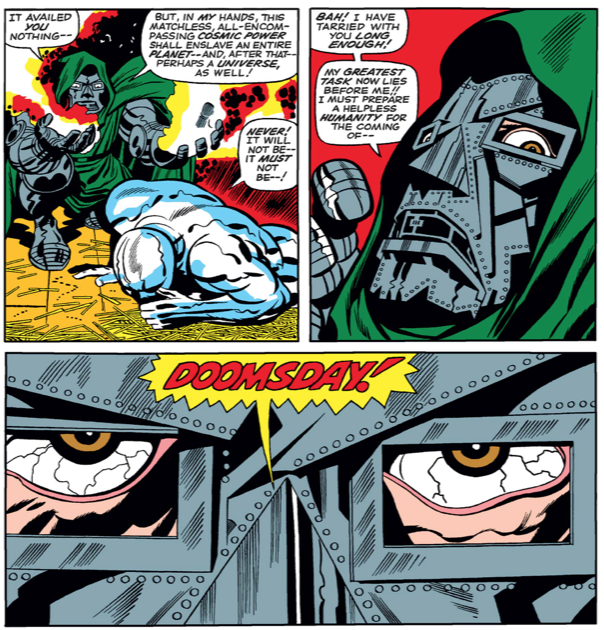
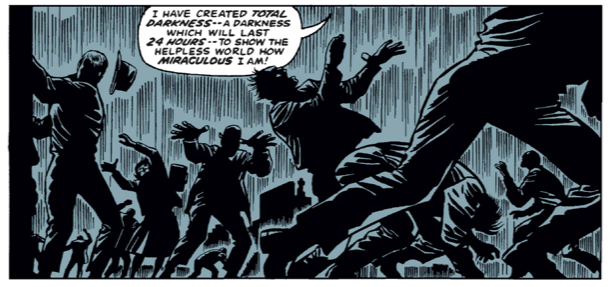
Meanwhile, Doom is plotting his conquest of Earth. He dismisses an attack by (presumably) the Soviet Union, taunts the helpless Silver Surfer, a prisoner in Latveria, then circles the globe displaying his power, for example, by throwing cities into darkness for 24 hours.
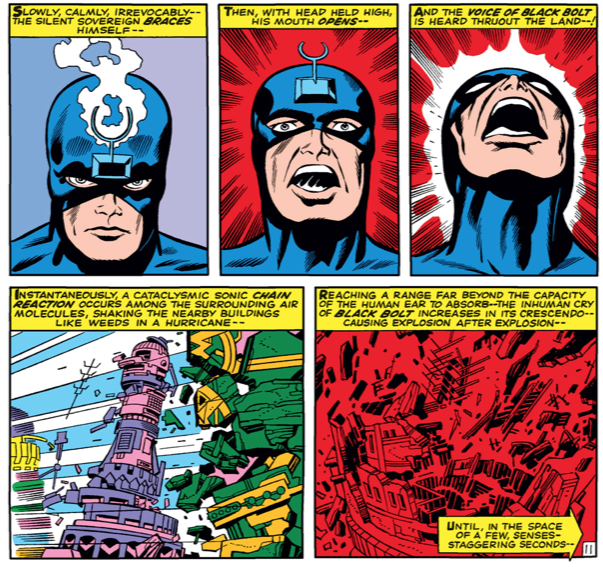
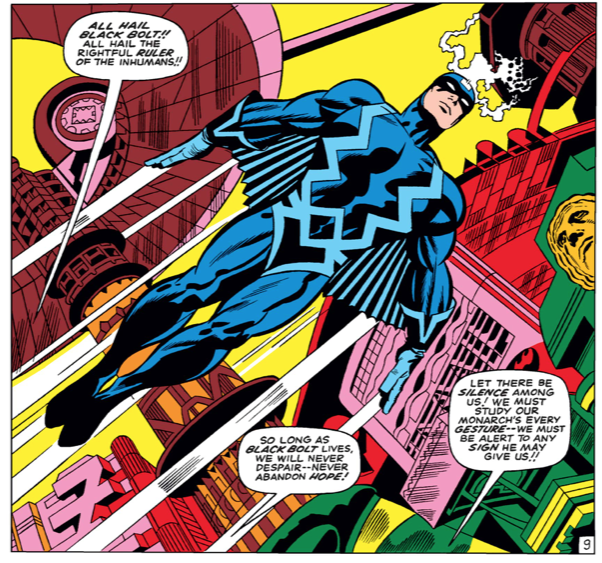
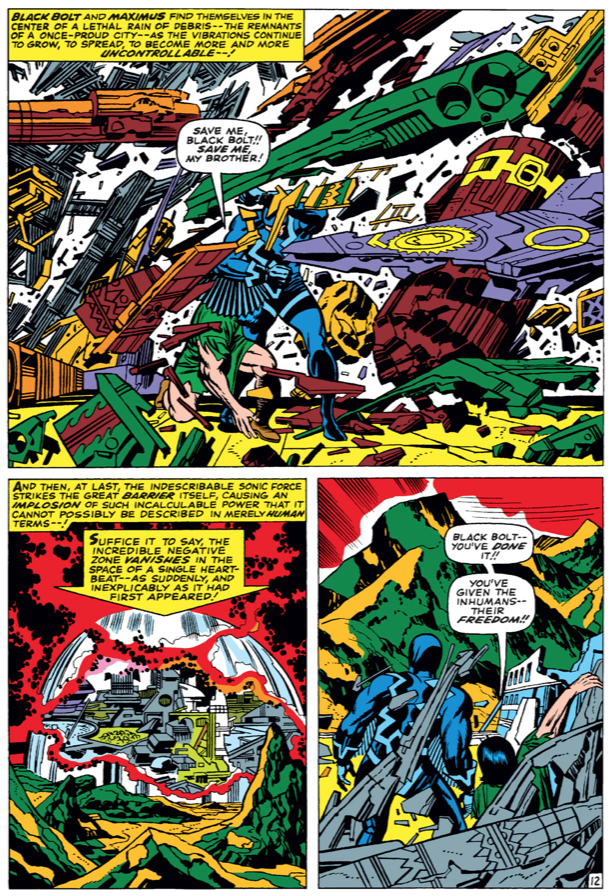
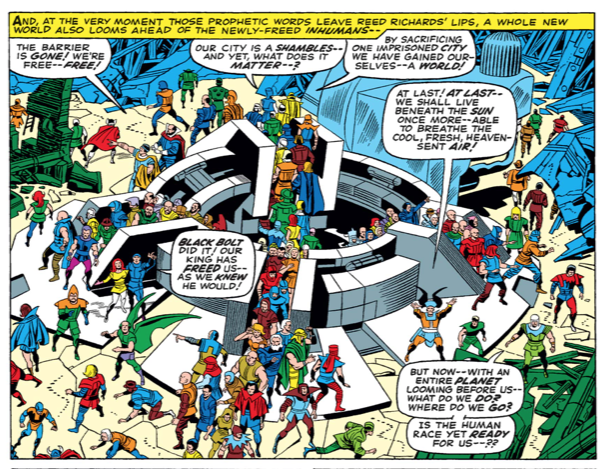
In the third storyline, the Inhumans, trapped in their city behind a negative zone barrier for many issues now, finally break free after Black Bolt uses his voice to destroy both the barrier and the city. The Inhuman royal family then travels to help Crystal reunite with Johnny Storm.
And in the last storyline, the Human Torch decides he alone has the power to take on Doom, and despite his misgivings, his friend Wyatt Wingfoot joins him on his quest.
What’s going on here
This is a transitional issue, but a good one, enhanced by some of the best art on this book to date. Lots of character is developed here: Ben’s needling of Reed is revealed to be more cunning than buffoonery, Doom’s mania becomes more apparent, the Surfer’s resolve becomes more clear, and we finally see Black Bolt cut loose with his power. It had been hinted at for a few issues now, but we now understand why he is silent, breadcrumbs first dropped all the way back in issue 46.
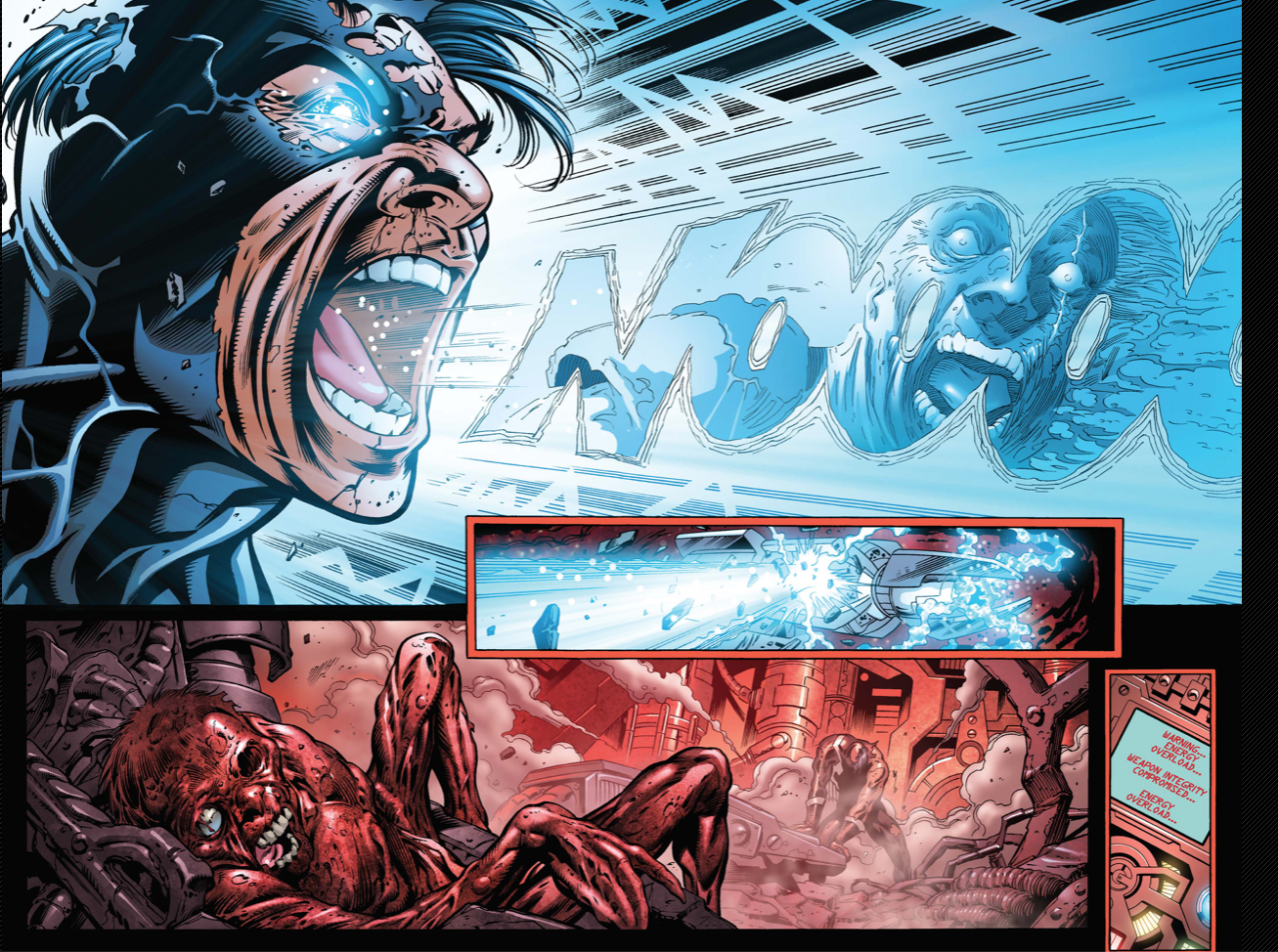
It’s always a big deal when Black Bolt uses his voice, and comic book writers have generally been pretty sparing with it. Here’s a pretty good run down in Comic Book Resources of 20 times he used his voice, including in 2009’s War of Kings, where he uses it to defeat Vulcan (the crazy brother Cyclops and Havok never knew they had—it’s a long story) and then detonate a Terrigen bomb which tears a hole in spacetime. That’s a not-untypical use case for Black Bolt’s voice.
War of Kings 6 (2009, Pelletier, Magyar & Hennessy)
The F-Team
I may be dating myself here, but in the 1980s TV show The A-Team, there was invariably a sequence of rapid cuts where the team, having suffered some defeat, works energetically to build a device or hatch a plan to save the day as the theme music plays. That is what I thought of when Reed and Ben get busy working to defeat Doom.
The sexist sixties
Of course, while Reed and Ben are making their plans, Sue is in the kitchen, worrying.
They’re fighting again
It’s been a long time since we saw this kind of thing. It makes me nostalgic.
Red menace
Doom is attacked by .. it’s not exactly clear. It sure looks like the Soviet Union, but for some reason Stan is reluctant to say as much.
Ladies and gentlemen, Joe Sinnott
Every now and then Sinnott’s inks just jump out at me, like they do in this sequence
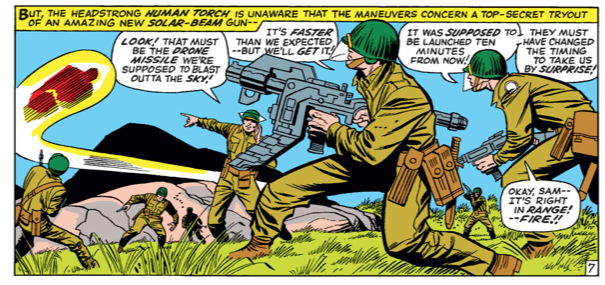
Weird science
It’s “a solar-beam gun”
Nice ride
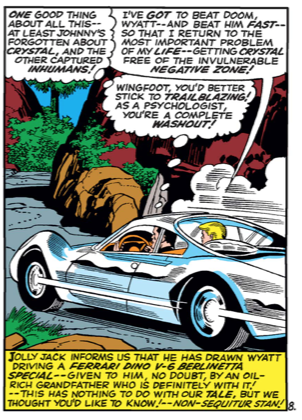
Johnny’s Ferrari is apparently courtesy of a rich grandfather. I don’t think we ever learn more about him.
Dig that Kirby Krackle
This issue has so much great Kirby art that I could have picked something from virtually every page. I restrained myself, but it’s really an amazing issue.
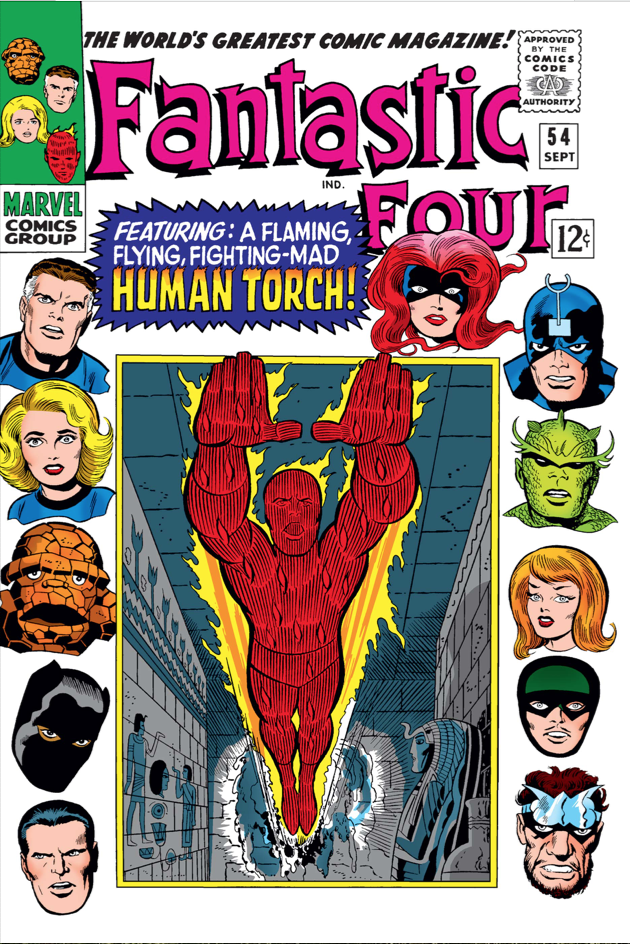
Fantastic Four 54 “Whosoever Find the Evil Eye ..!” Published June 1966 Story: Stan Lee and Jack Kirby Script: Lee Pencils: Kirby Inks: Joe Sinnott Letters: Sam Rosen Cover: Kirby and Sinnott
Synopsis
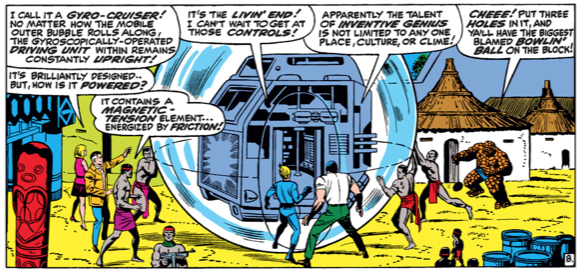
Fantastic Four 54 opens with the FF still in Wakanda, where they relax by playing baseball with the Black Panther. The Human Torch is plagued by visions of Crystal, the Inhuman trapped by the negative zone within her city of Attilan, and as the team prepares to leave Africa, he declares he will return to Attilan to try and free her. T’Challa makes him gift of a special gyroscopic vehicle, and Wyatt Wingfoot joins the Torch on his quest.
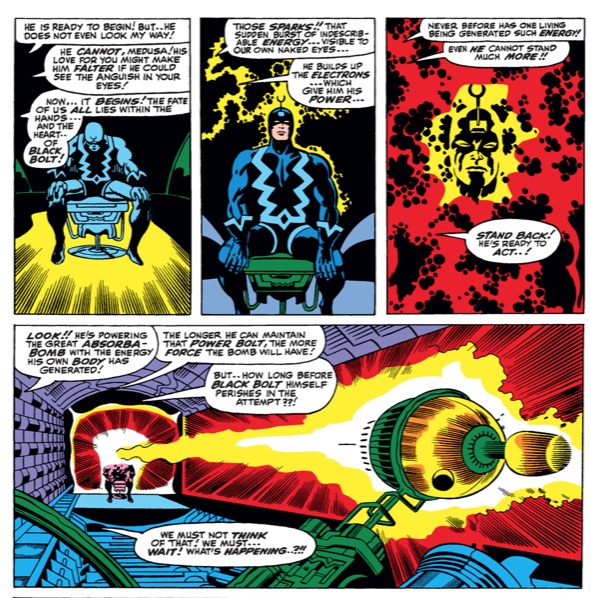
Meanwhile, in Attilan, the Inhumans are still trying to escape and the royal family attempts to coax Maximus the Mad—now truly insane—to reveal the secret of the negative zone. Running out of options Black Bolt enters the “cyclo-electronic chamber,” where he uses his power to energize the “asorba-bomb” in order to break through the barrier. The pressure is so great Black Bolt screams for the first time.
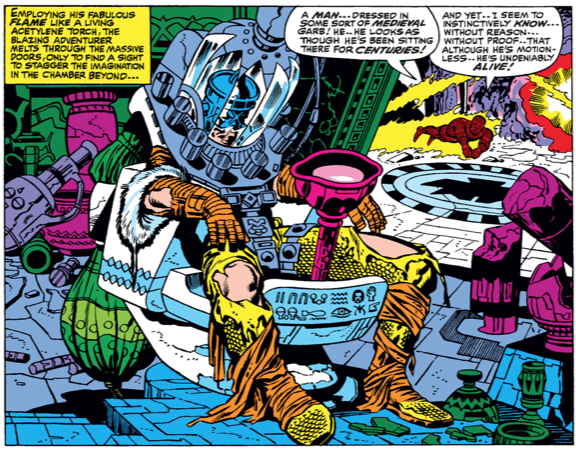
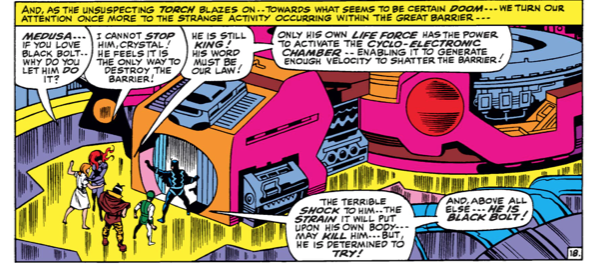
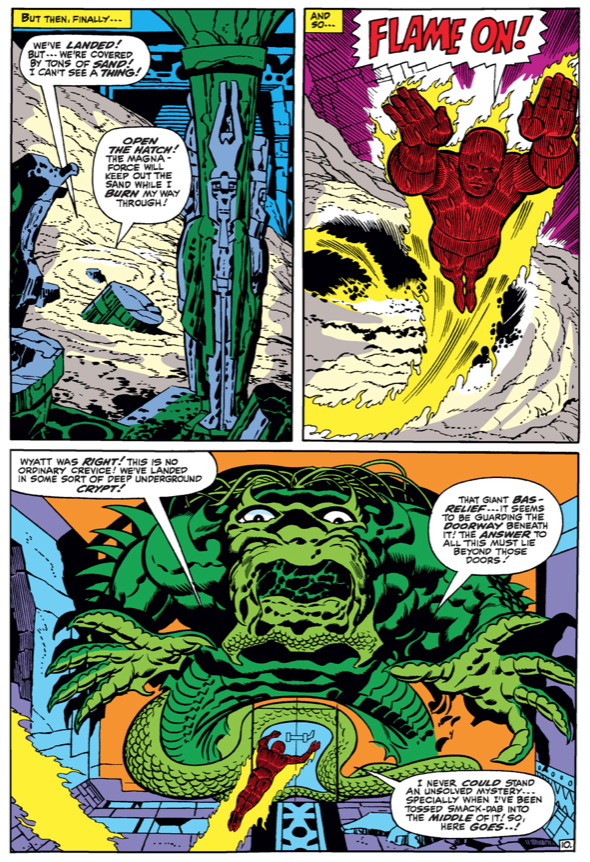
Johnny and Wyatt, traveling north through the African desert in the Wakandan vehicle, plunge through a crevice and land deep below the surface in a crypt that reveals a slumbering figure in armor. He awakens and tells the pair he is Prester John, who served Richard the Lionhearted during his crusades and afterward traveled the world before discovering Avalon, where he was given a powerful weapon called the Evil Eye. Johnny, realizing the device could be used to free Crystal and the Inhumans, steals it before Prester John can warn him it will exploded in his hands. As the Torch flees, Wyatt shoots the Evil Eye out of his hands, saving Johnny but leaving him despondent.
What’s going on here?
A lot! This comic is jammed packed, and one of the best issues to date. We get the FF enjoying some downtime, which builds their characters while simultaneously deepening our understanding of T’Challa and Wakanda. The Human Torch’s torment over Crystal, now well-established with several mentions over the last few issues, gives the story some emotional depth and drives the plot. The Inhumans arc becomes more complex as they develop into heroes, and the debut of Prester John adds an element of science fiction fantasy. Tying together the issue is some fantastic art from Jack and Joe Sinnott. The whole issue is busy, fun and very satisfying.
Who is this guy?
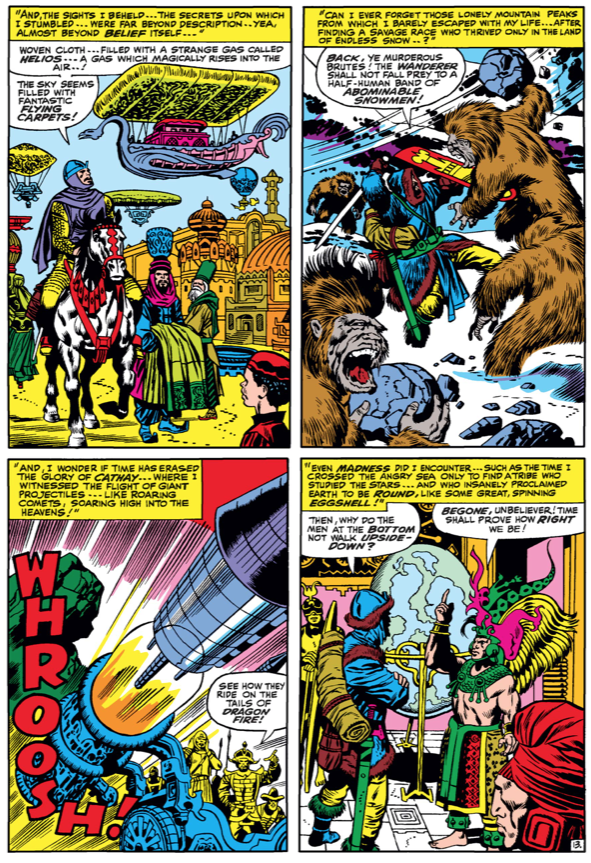
As with Thor, Hercules, the Black Knight and many other characters, Stan and Jack plucked the name and some basic facts about Prester John from mythology. Prester John was said to be a Christian king, descended from one of the three Magi, who ruled in a far-off kingdom in Asia or Africa. He was supposed to come to the aid of the Crusaders, but never arrived.
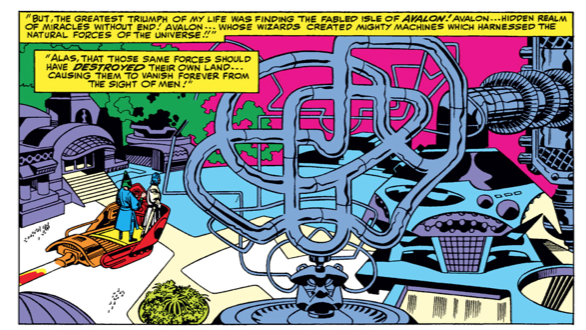
In Stan and Jack’s telling, he was instead an ally of Richard the Lionhearted, and at the conclusion of the crusade, traveled the world before finding Avalon, normally a fixture of Arthurian legend and not normally associated with the Crusaders. Apparently, for Stan and Jack, if it was old and English, it was good enough. It does give Jack an excuse to draw this awesomeness:
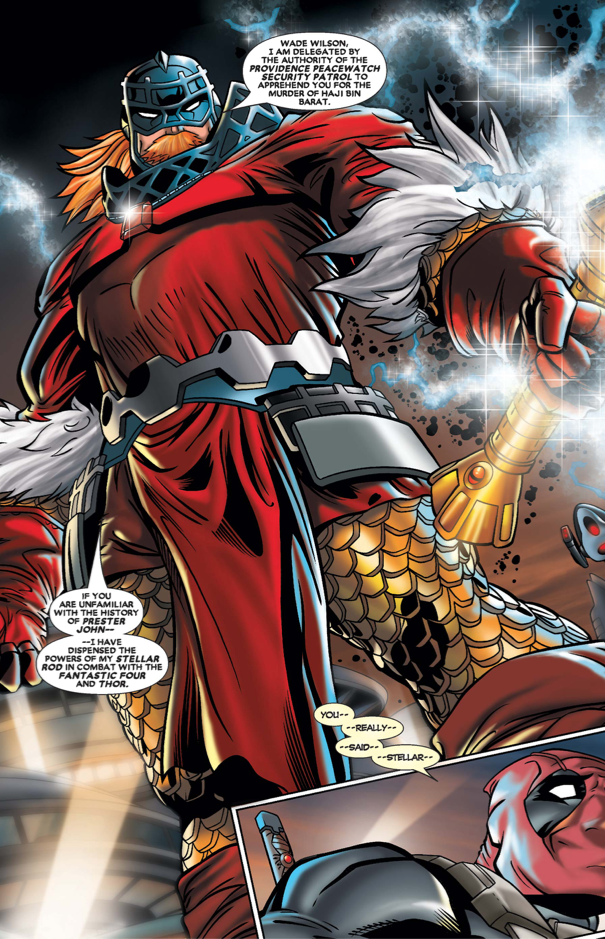
Prester John never is a major Marvel figure but he pops up a few times over the years in Thor and Defenders comics, and—bizarrely—in Deadpool & Cable:
Deadpool & Cable 14 (2004, art by Patch Zircher)
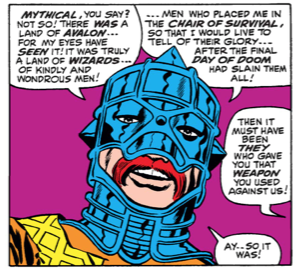
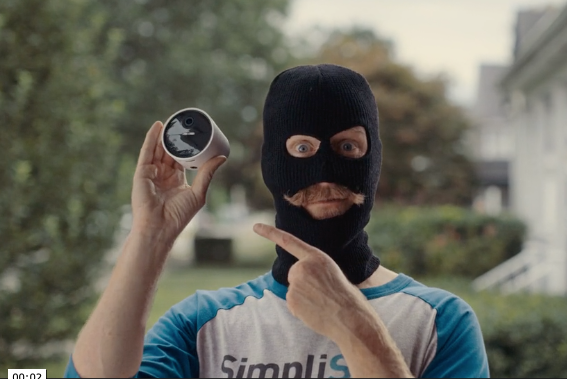
And is it just me, or does Jack’s version of Prester John look like the guy in those adds for Simplisafe home security systems?
Batter up
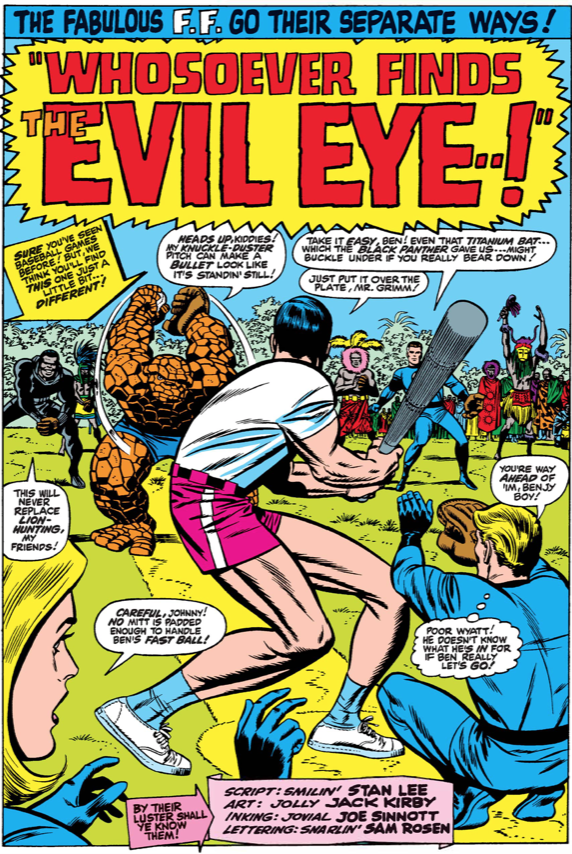
FF 54 opens with the Fantastic Four, Wyatt and the Black Panther playing baseball in Wakanda:
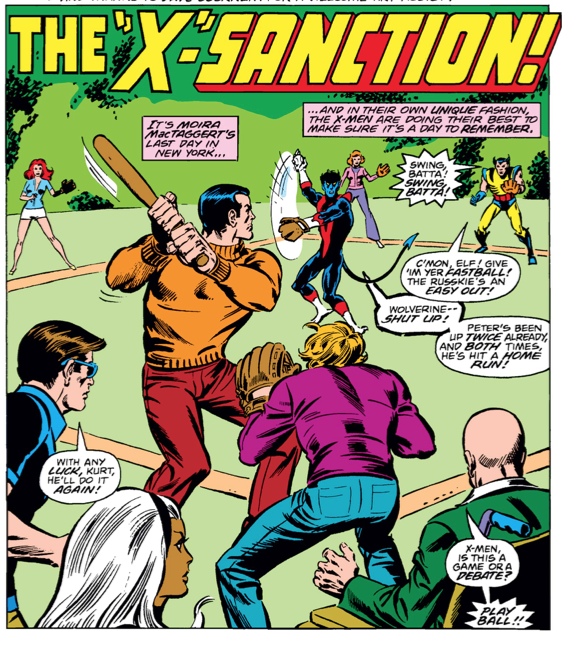
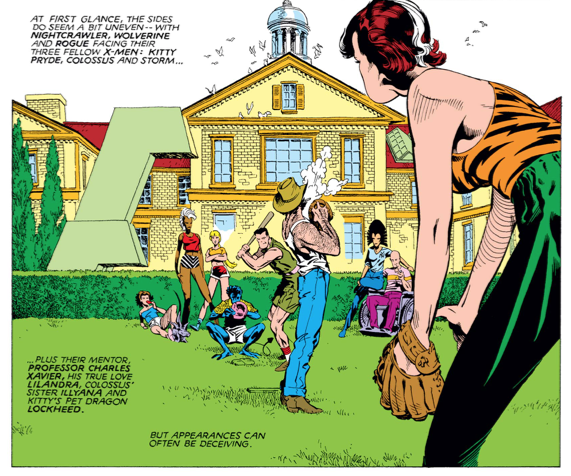
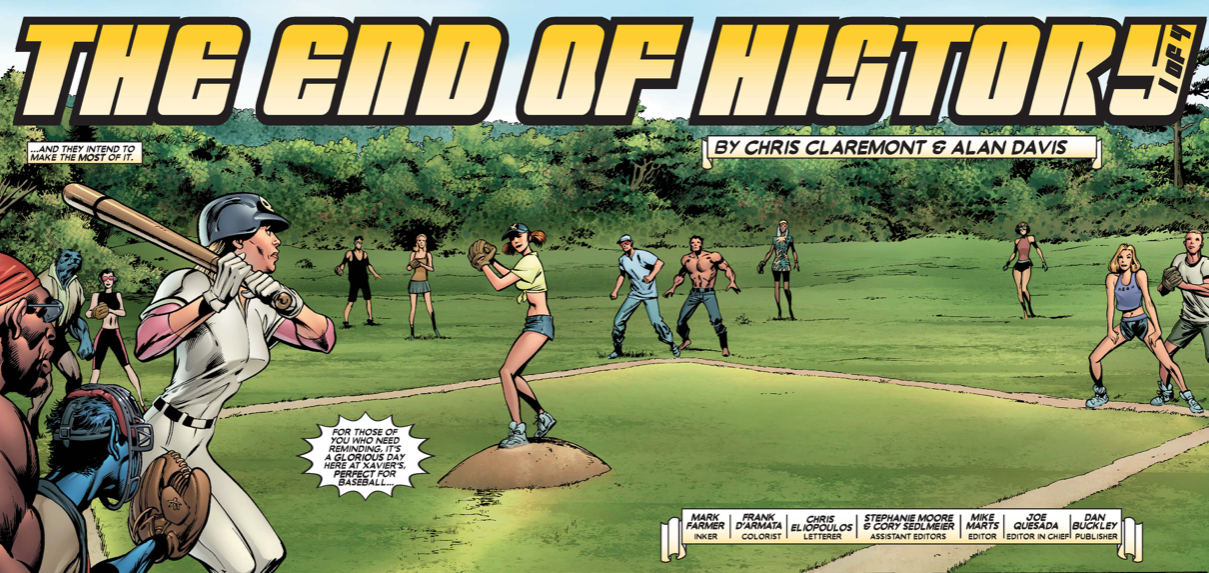
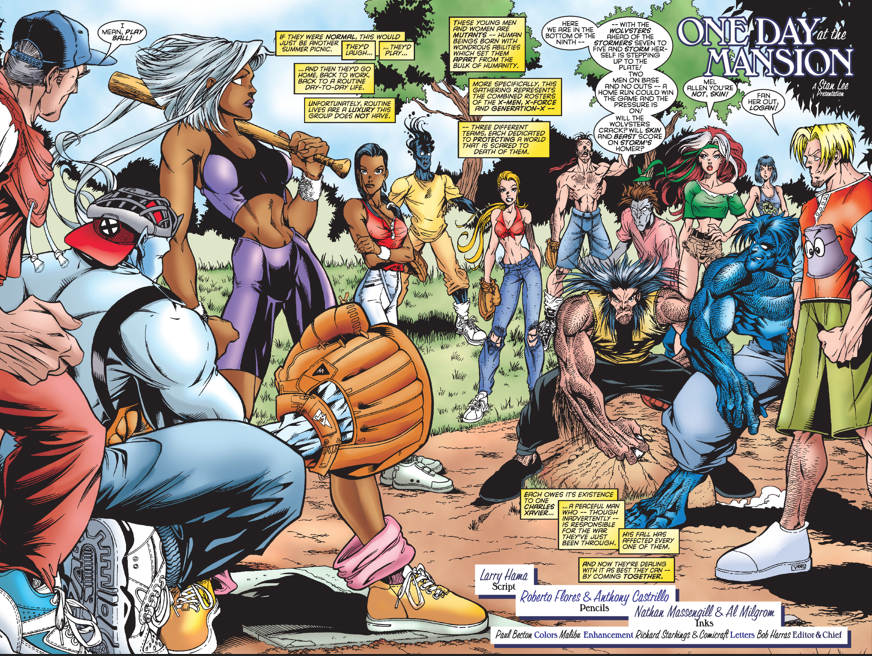
If you think a splash page of a super team playing baseball looks familiar, well, that’s because you’ve seen it many times in the ages of the X-men and related X-books. Here are a few examples from over four decades:
Uncanny X-men 110 (1978, art by Tony DeZuniga)Uncxanny X-Men Annual 7 (1983, art by Michael Golden)Uncanny X-Men 444 (2004, art by Alan Davis and Mark Farmer)X-Men ’96 (1996, art by Flores/Castrillo/Masssengill/Milgrom
I don’t know if Chris Claremont, the man behind many of these X-Men, ever acknowledged that he was borrowing from FF 54 but given how influential the Lee/Kirby FF run was to all of Marvel, perhaps it was just assumed.
Crazy Credits
Weird Science
If you think Wakandan science is strange …
… you should check out what the Inhumans are up to.
The sixties are sexist
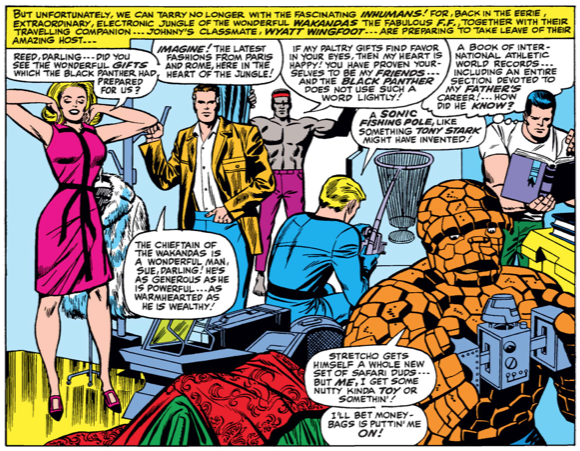
Ok, maybe this one is a bit unfair. While Sue gets new dresses as a gift from the Wakanadans—reinforcing the narrative that she only cares about clothes and her appearance—it appears that Reed gets a new outfit too. And Sue does look great here. (Note the further development of Wyatt’s backstory here).
Dig that Kirby Krackle
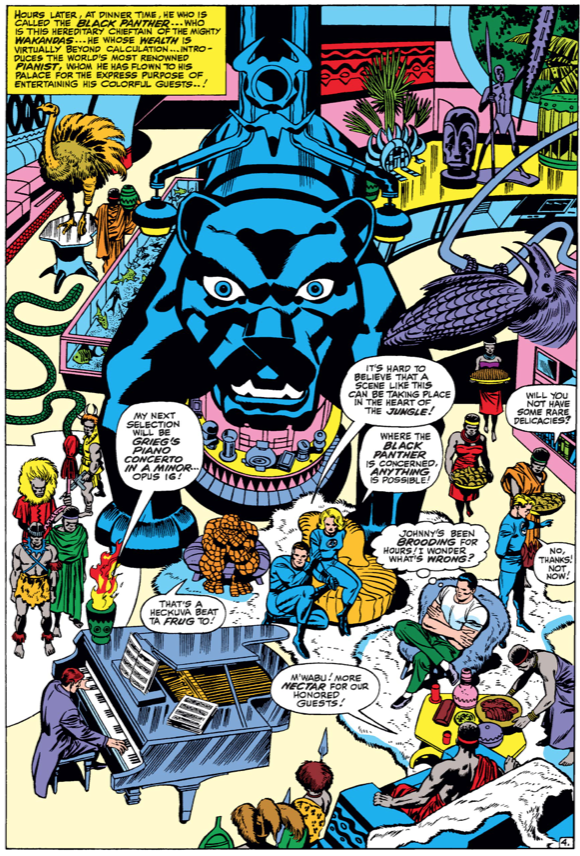
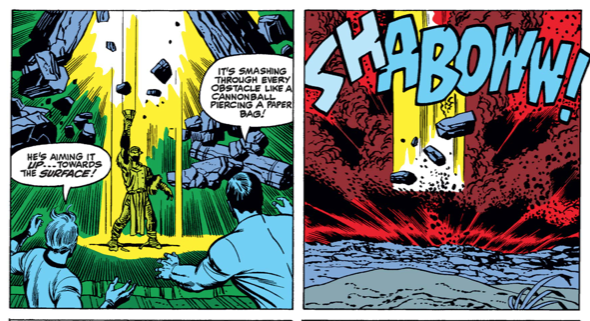
Really, the entire issue is great, and here are too many panels to choose from (I’ve added as many above as I could). But if I had to pick just a few:
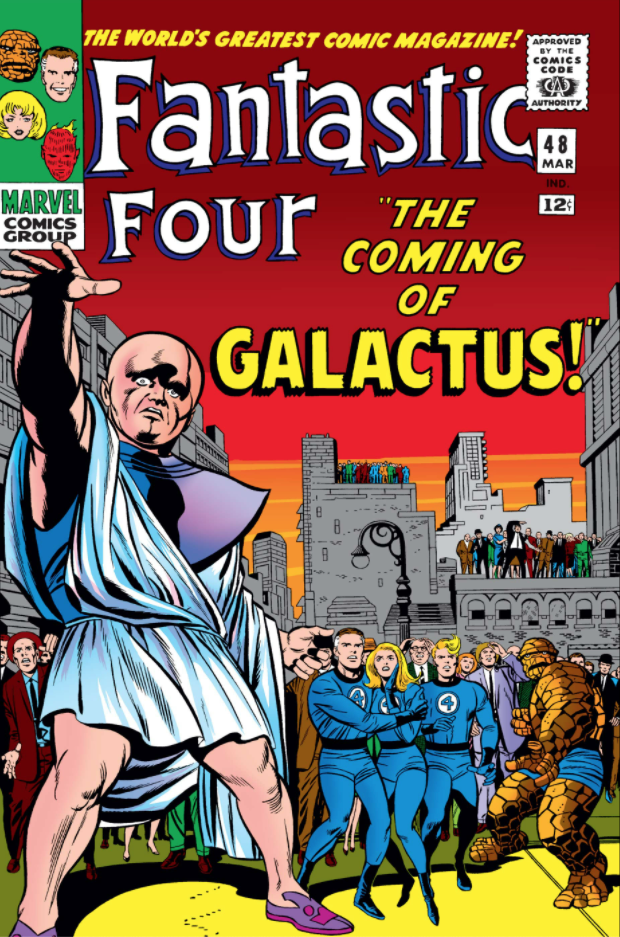
Fantastic Four 48 “The Coming of Galactus!” Published: Dec. 1965 Story: Stan Lee and Jack Kirby Script: Lee Pencils: Kirby Inks: Joe Sinnott Letters: Artie Simek Cover: Kirby and Sinnott
Synopsis
As has been the pattern or the last dozen issues, Fantastic Four 48 picks up where FF 47 left off. The team is in Attilan, the city of the Inhumans, and Maximus has set off his Atmo-Gun, intending to destroy humanity so the Inhumans can rule the earth. Black Bolt, who last issue wrested his crown back from his brother Maximus, confronts him and knocks him silly. Medusa explains to Maximus his plan was doomed because the Inhumans are still human despite their powers, and a device that spares Inhumans would also spare humans. In a last gasp, Maximus reverses the charge on his Atmo-Gun, generating a “negative zone” — a term that should sound familiar—around Attilan. The Invisible Girl creates a force field which allows the FF to pass through the zone and escape but the Inhumans are trapped behind it, leaving the Human Torch distraught when he is separated from Crystal.
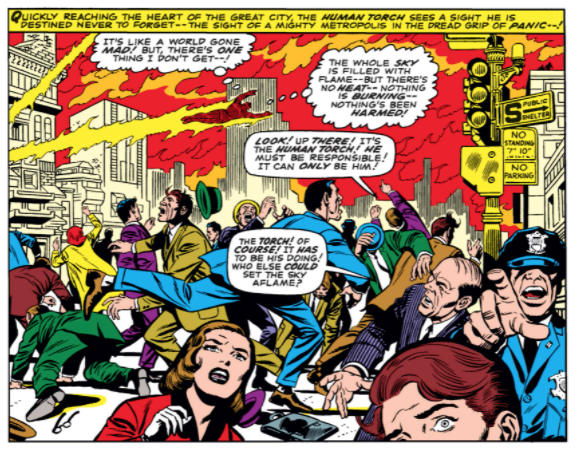
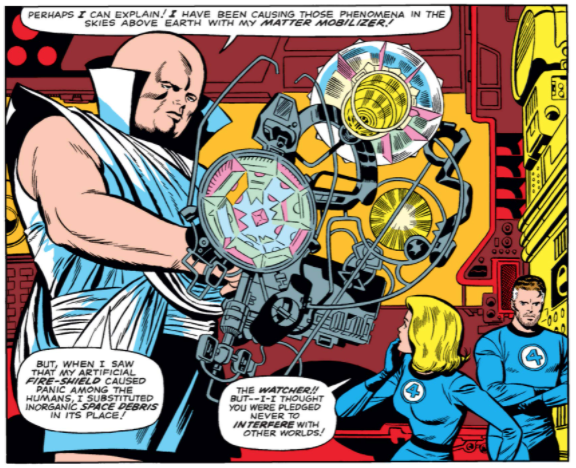
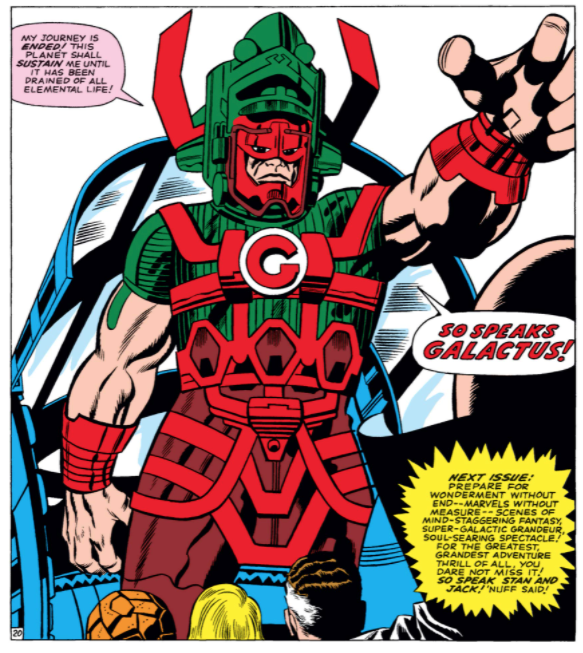
Meanwhile, as the FF return to New York, we are introduced to the Silver Surfer as he glides through space, and are warned that he is a harbinger of Galactus. Back in New York, the skies are aflame, and panicking New Yorkers blame the Human Torch. The flames disappear, only to be replaced by “space debris.” The Watcher appears, and explains these effects are his doing in order to disguise the earth from the Silver Surfer. The Surfer then arrives and sends a signal to space before The Thing clobbers him. The signal summons Galactus, who emerges from his ship and announces his intentions to drain the earth of “all elemental life.” The issue ends with the cliff hanger.
What’s going on here?
FF 48 marks the beginning of the Galactus trilogy, arguably the apex of the Lee and Kirby run on the Fantastic Four. But oddly, before we can start this epic story, we need to resolve the last story, the FF’s adventure with the Inhumans. I’m not sure why Stan and Jack constructed the comic this way, but it’s strange that it’s divided into two stories.
The Inhumans portion of the comic establishes Maximus as the royal family’s principle antagonist, creates a bit of romantic drama between Black Bolt and Medusa, and ramps up the star-crossed-lovers theme between Johnny and Crystal. All good stuff, but it’s sort of forgettable compared to the rest of the comic, which introduces two major Marvel figures: the Silver Surfer, and Galactus. We’ll deal with Galactus in our next post, because there’s a lot to say about the Surfer.
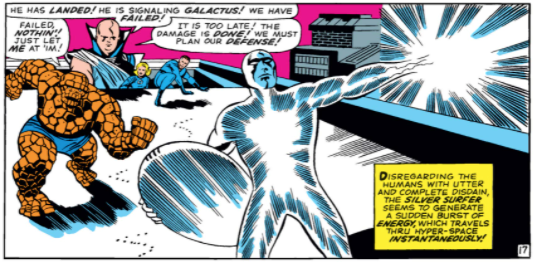
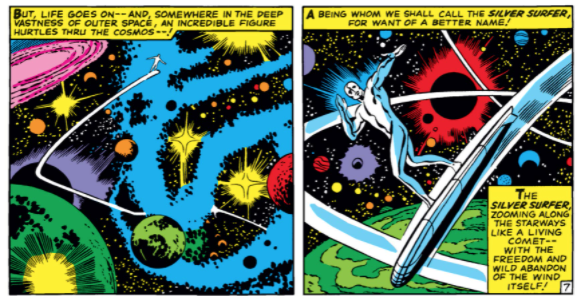
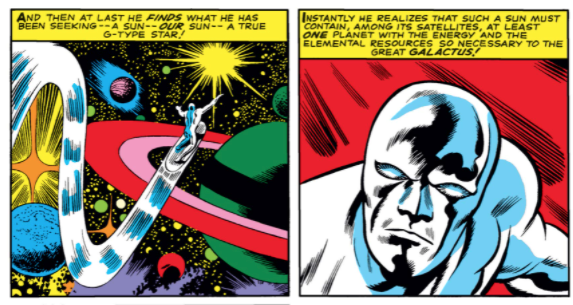
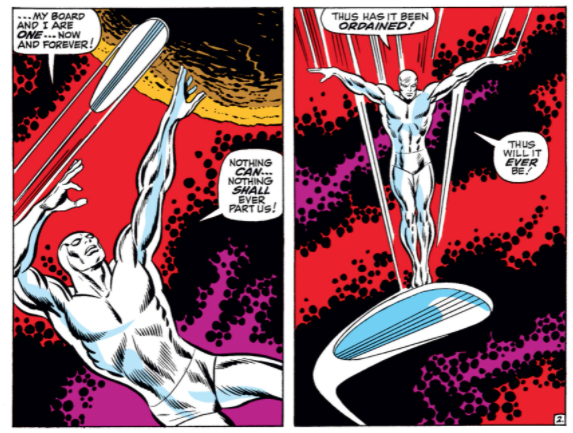
The Surfer’s first appearance.
Who is this guy?
The Silver Surfer was one of Jack Kirby’s prized creations, and a source of major tension between him and Stan Lee, one which helped lead to Kirby’s departure from Marvel. According to Mark Evanier in his biography Kirby: King of Comics, Jack created him without any involvement from Stan Lee, who first encountered the Surfer when he saw the penciled pages of FF 48. Allegedly upon seeing him, Stan said “Jack, this time you’ve gone too far.” But Lee soon fell in love with the character, and it’s not hard to see why, given his penchant for grandiloquent soliloquies. Stan soon launched a Surfer solo book to be drawn by new Marvel star John Buscema, and gave the Surfer an origin very different from the one what Jack had in mind, leaving Jack frustrated and angry. According to Evanier “his idea had been taken from him in every possible sense.”
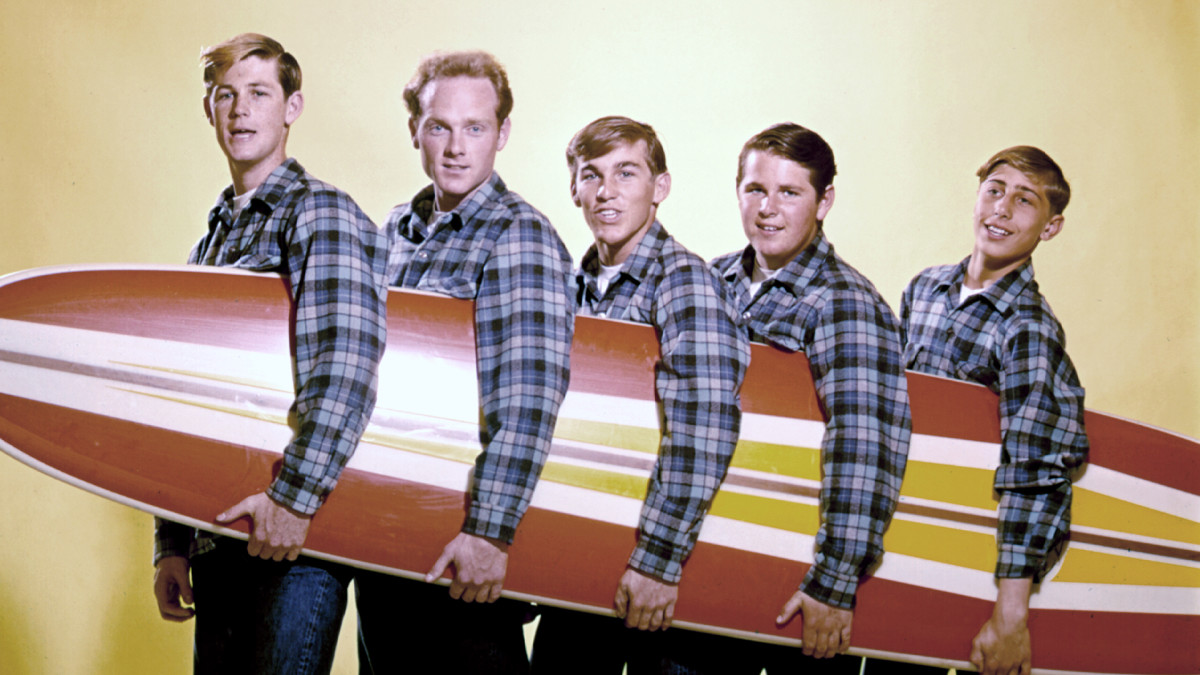
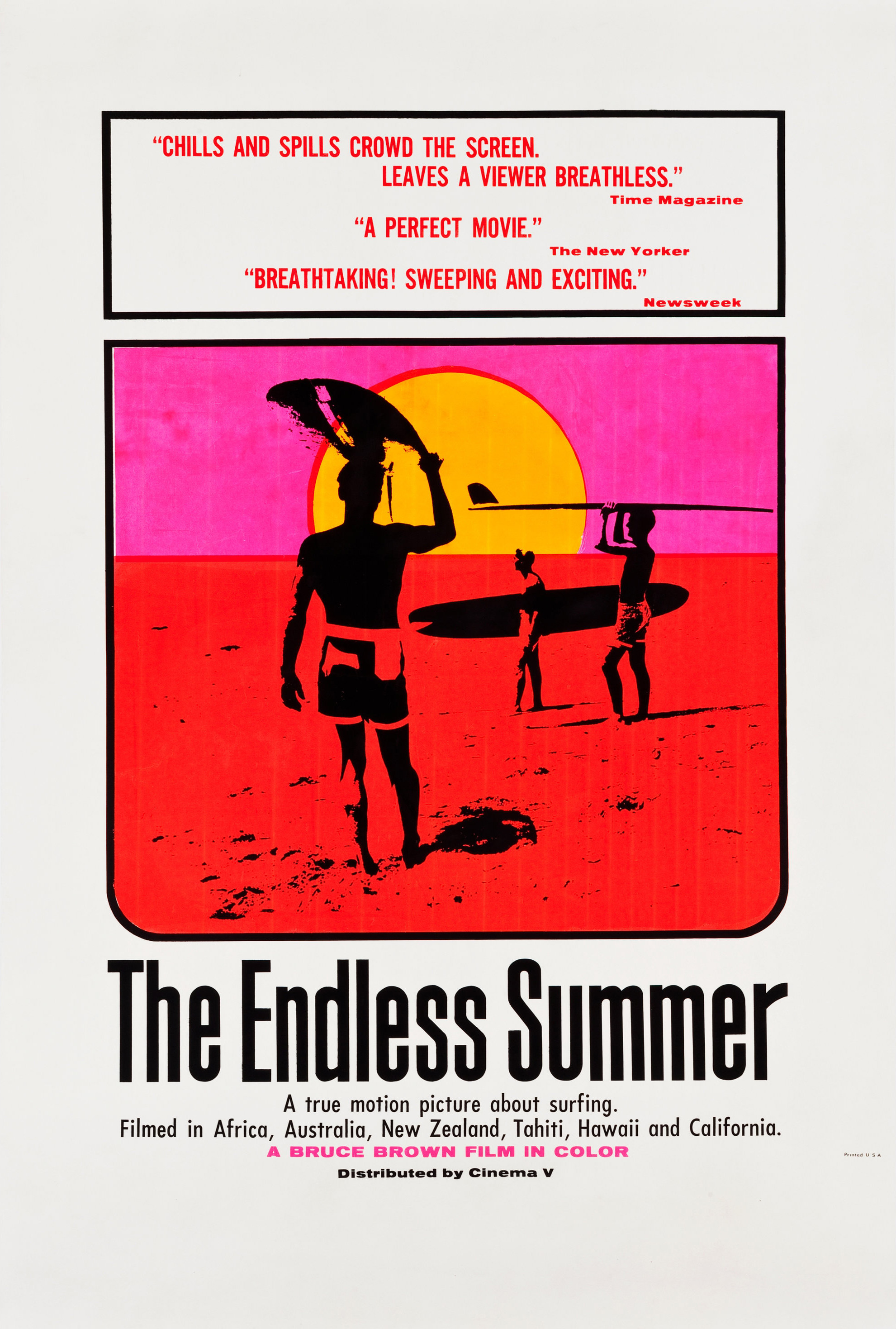
So why a surfer? Evanier doesn’t say what inspired Jack to put Galactus’s herald on a surfboard, but it probably has to with the general interest in surfing as a sport in the early to-mid 1960s. Surf music was charting, with the Beach Boys and Jan and Dean were churning out hits like “Surf City” and “Surfin’ USA,” and beach party movies, which often featured surfing, starring Frankie Avalon and Annette Funicello were in the theaters. The next year, The Endless Summer, a surfing documentary, would come out. Clearly surfing was in the zeitgeist.
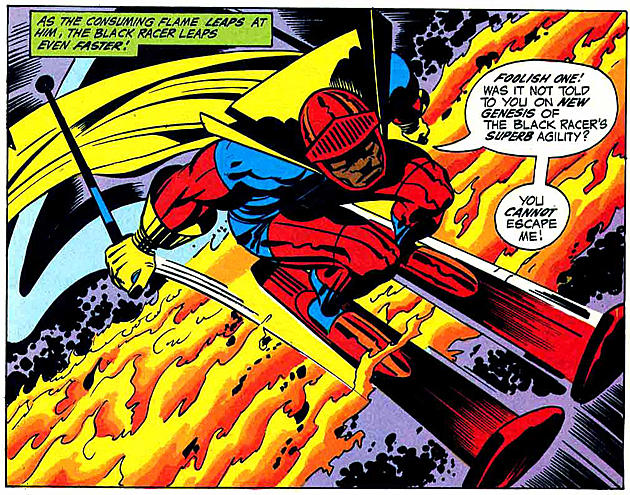
Jack would reach into the same bag of tricks a few years later when he was at DC and created the Black Racer, a member of the New Gods who acts sort of like a herald of death. By then, ski racing was popular, after Jean-Claude Killy’s star turn in the 1968 Olympics and the release of 1969’s Downhill Racer, a movie starring Robert Redford.
But while the design of the Surfer was abstract and elegant enough so that he only looked like he was surfing through space and not an actual surfer, Black Racer is far more literal and, I would argue, far less successful of a design.
About that origin
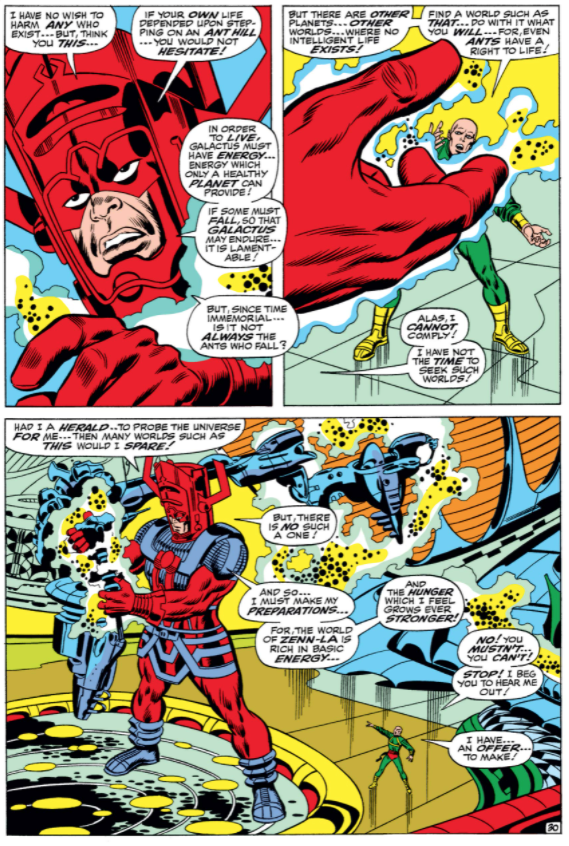
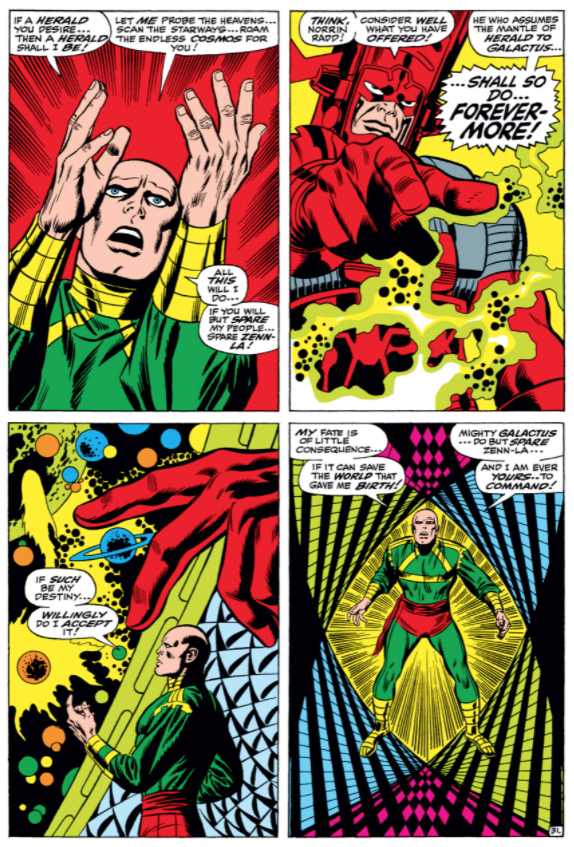
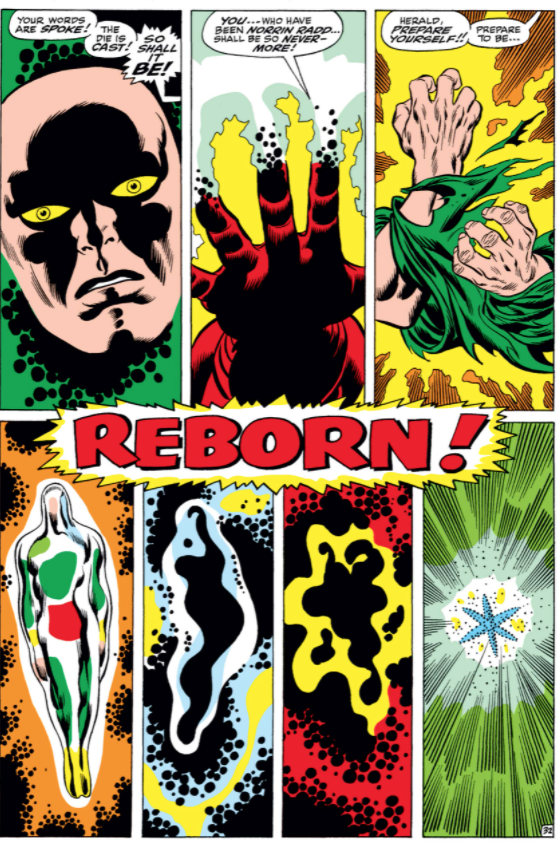
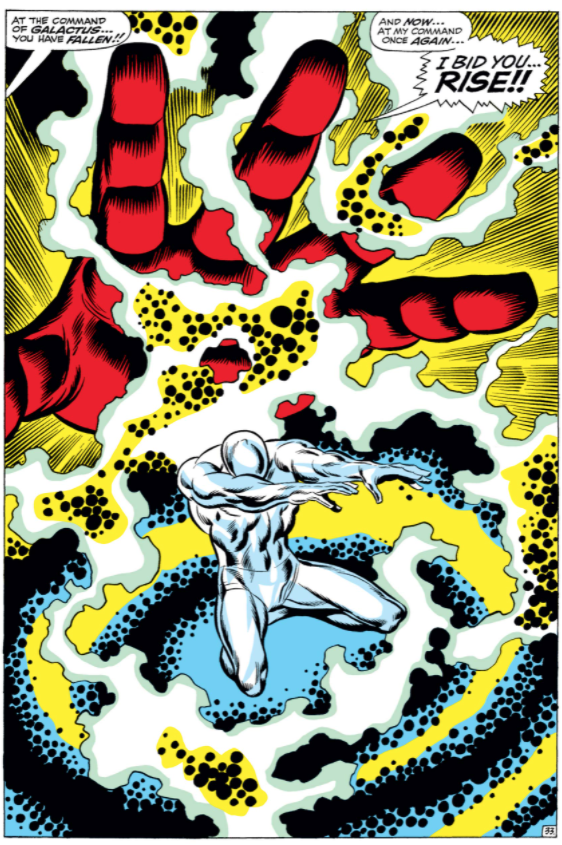
According to Evanier, Jack envisioned the Surfer as a being of pure energy who had never been human, and thus needs emotions like love explained to him. But in the origin Stan told in 1968’s Silver Surfer 1, the Surfer was once an (alien) man, Norrin Radd, who pledges himself to Galactus in order to spare his home world, Zenn-La, and his love, Shalla-Bal. The theme of the Surfer’s sacrifice and lost humanity is a powerful one and gives writers lots to chew on over the years. Here are the relevant pages from Silver Surfer 1. (And while John Buscema might be cast as a bad guy in Stan’s dispute with Jack, he probably had no say in it and there’s no denying how gorgeous his art is, here inked by Joe Sinnott).
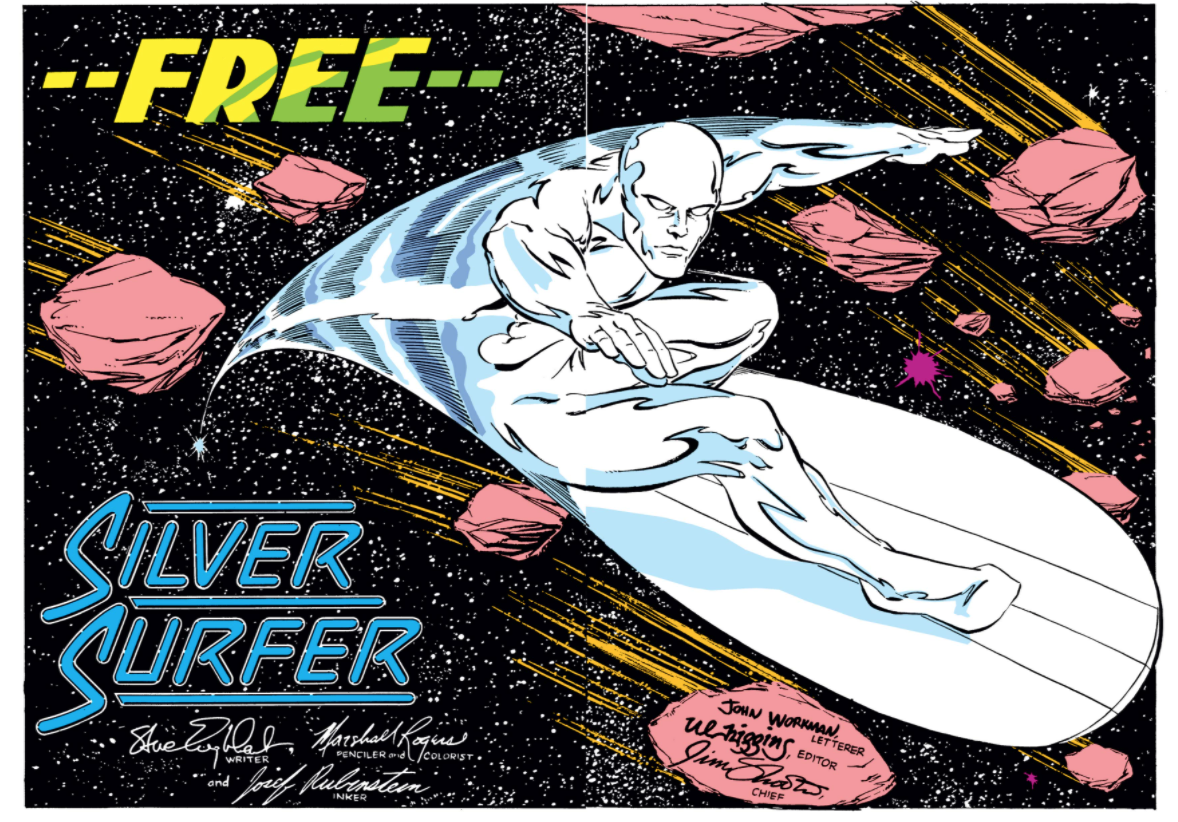
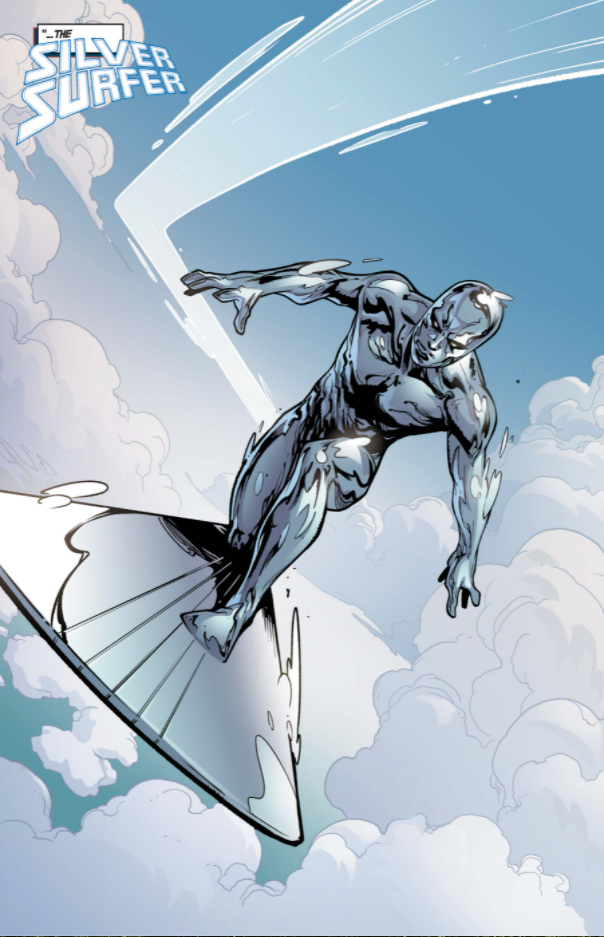
Over the years, the Silver Surfer has attracted some of the comic world’s best and brightest creators. Here he is drawn by Marshall Rogers and inked by Joe Rubenstein in his 1987 solo series:
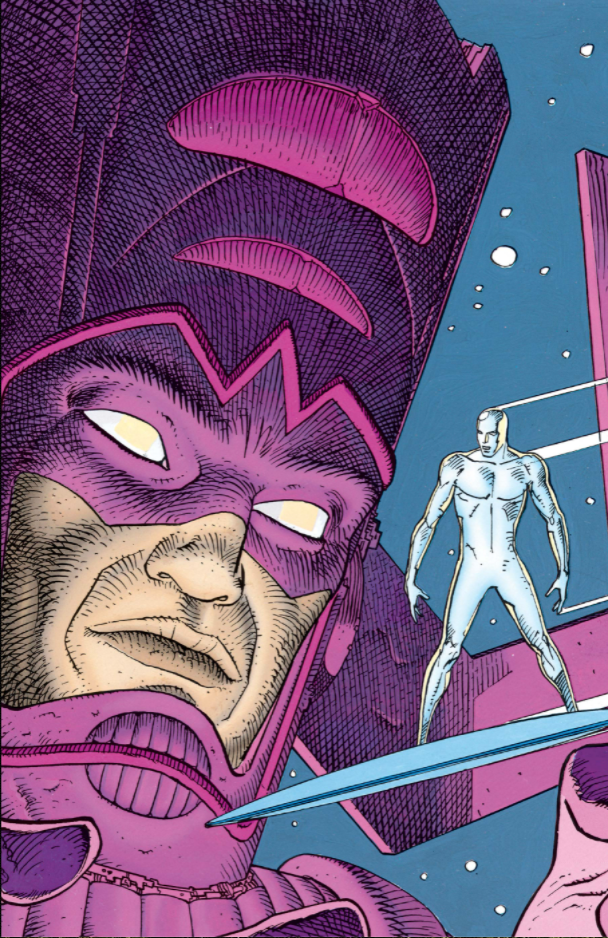
And drawn by Moebius, Esad Ribic, and Francesco Manna:
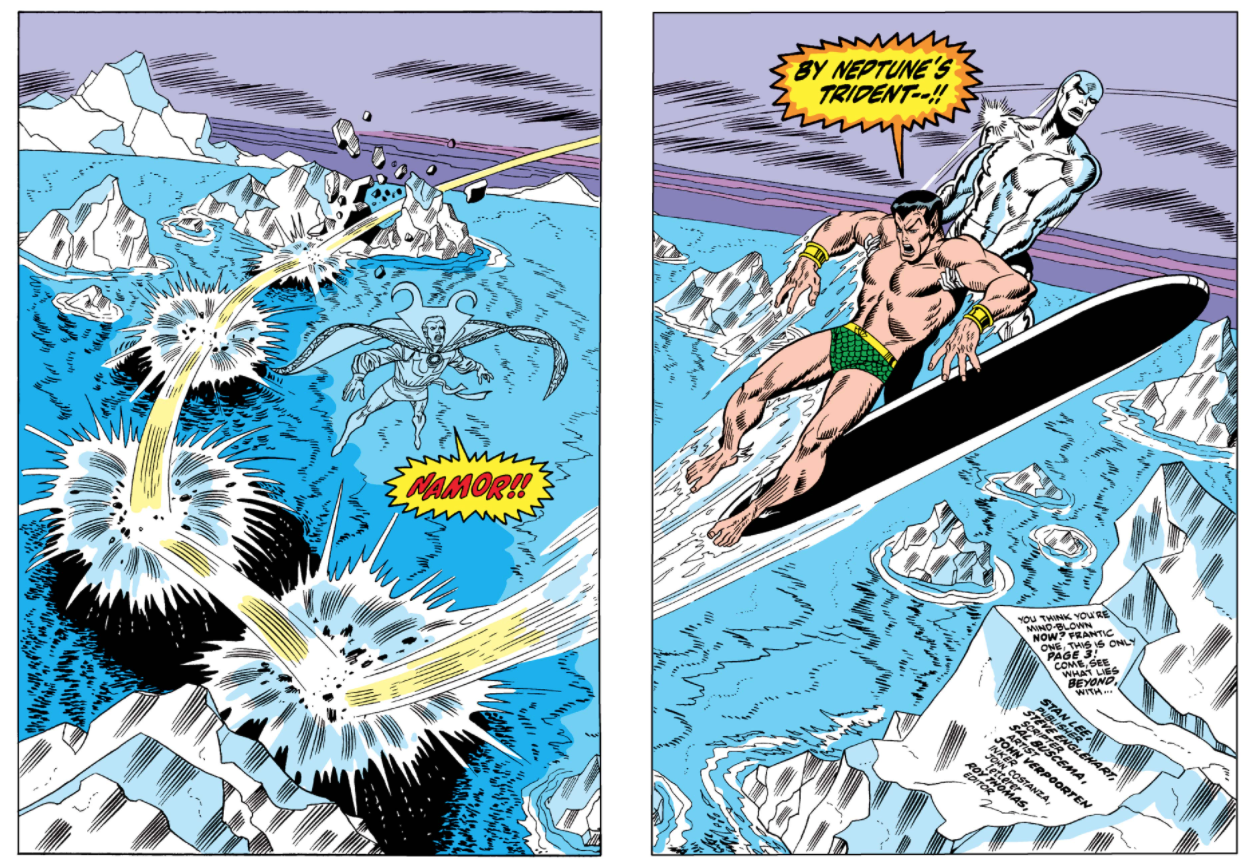
Along with starring in several of his own solo series, he also was an on-again-off-again member of the Defenders:
The Defenders 2 (1972, story by Steve Englehart, art by Sal Buscema and John Verporten)
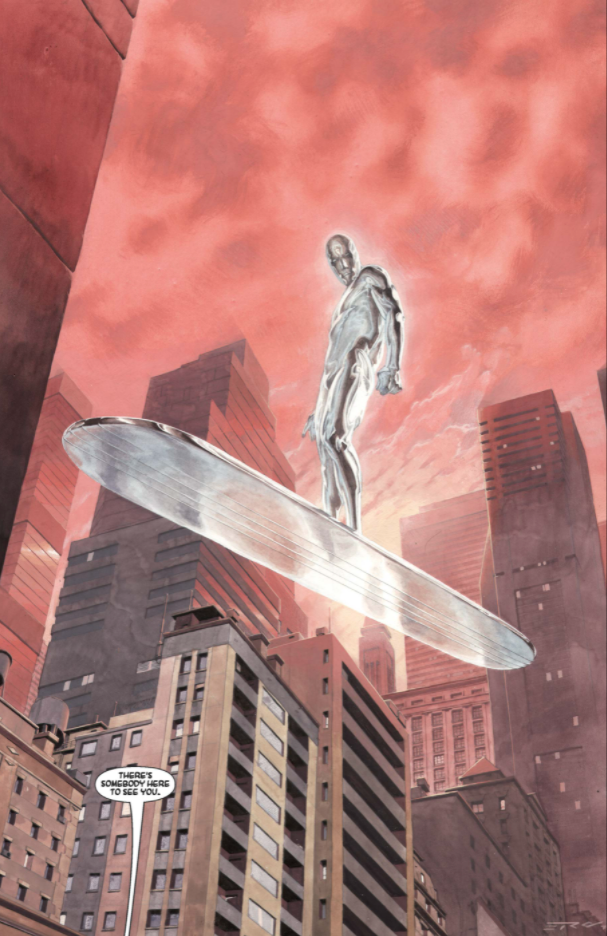
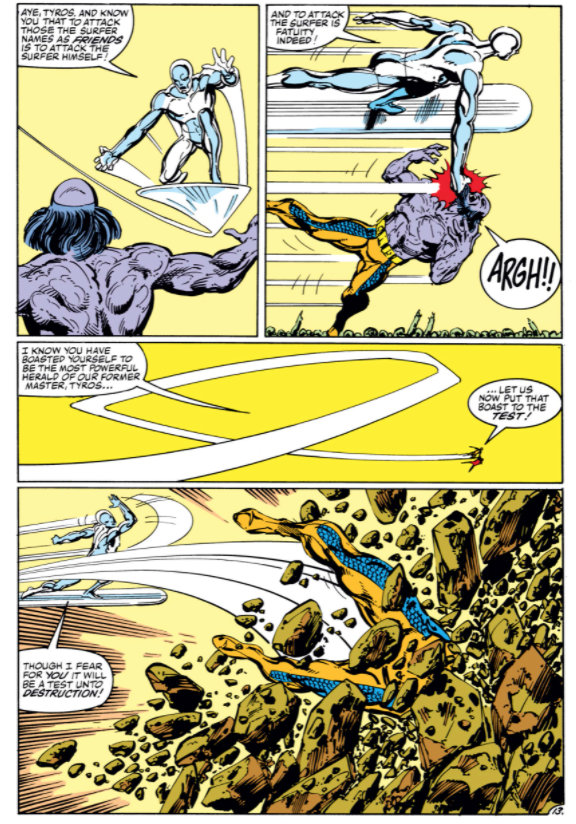
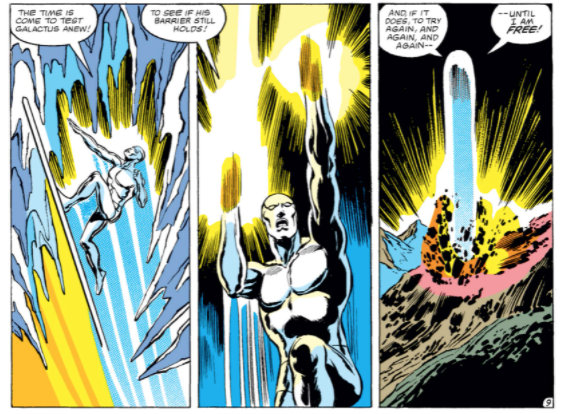
My first real encounter with the Silver Surfer came in John Byrne’s Fantastic Four 260, a comic I have discussed before as igniting my interest in comics in general and the Fantastic Four in particular. Here, he battles Terrax, another former herald of Galactus given new life by Dr. Doom. There was something incredibly cool about the Surfer, who is as unadorned and sleek as a hood ornament, and both bristling with power and noble in his restraint. Reader, I was hooked.
Keel hauled
One aspect of the Surfer’s design I’ve always been curious about is whether his surfboard should have a keel. According to Kirby and Rogers, it does:
Personally, I prefer a no-keel look, since the keel makes it look too literally like a surf board. It’s not – there are no ocean waves in space.
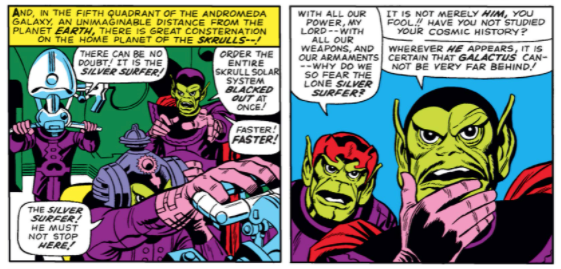
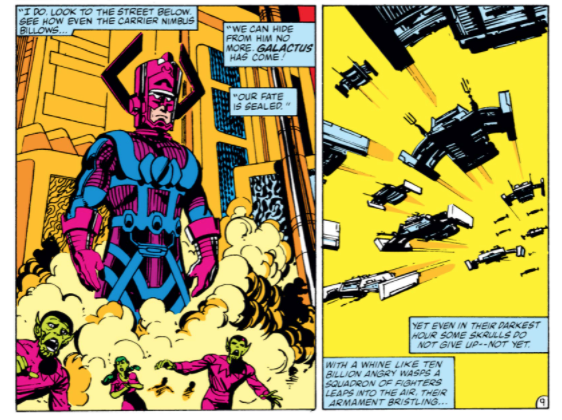
One last detail about the Surfer: He is introduced to readers by the Skrulls, who fear he might alert Galactus to their homeworld. Byrne, always a student of the Lee/Kirby issues, returns to that idea decades later when he has Galactus consume the Skrull’s planet.
FF 257 (1983, Byrne)
Crazy Credits
Young love
Johnny takes his separation from Crystal hard, which is weird since they barely know each other.
The sexist sixties
Sue’s pouting and histrionics aren’t quite as bad in tis issue as last, but it’s still pretty bad (and is Ben smoking a cigarette in the first panel?)
Clobberin’ Time
It’s starting to be a regular occurance now (this is No. 10 by my count).
Feats of strength
It’s been long time since we’ve had one of these sequences of Ben showing off his strength. They used to be in almost every issue.
Dig that Kirby Krackle!
As if this issue didn’t have enough going on, we get a Kirby Kollage as Galactus arrives on earth:
Nu Yawk, Nu Yawk:
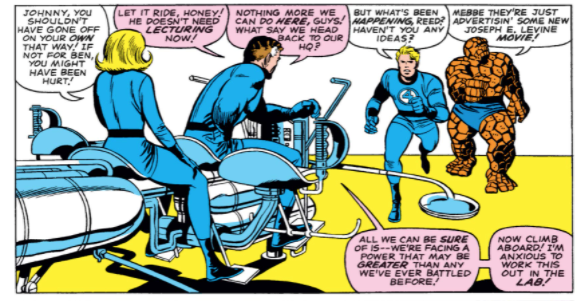
Another very cool panel (Joseph Levine was a Hollywood producer behind bombastic adventure movies like Hercules):
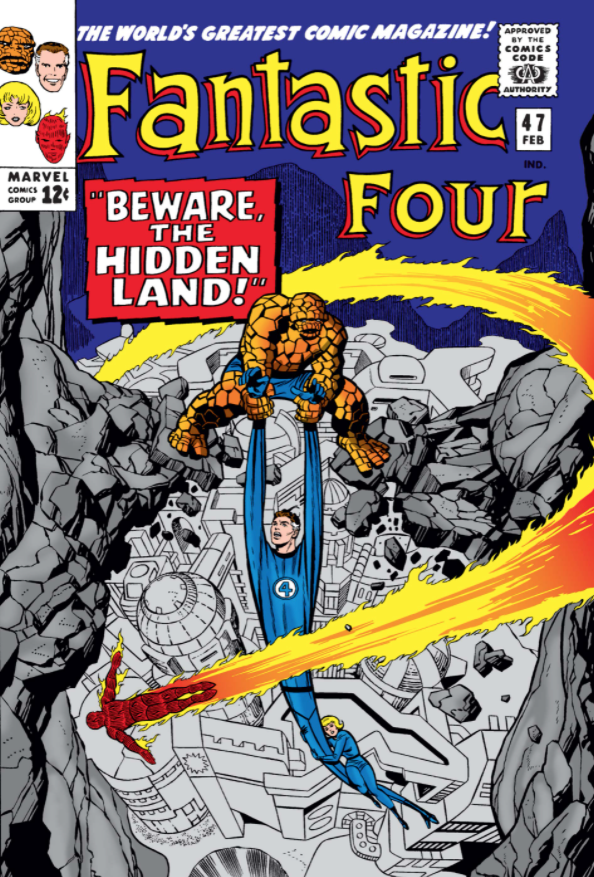
Fantastic Four 47 “Beware the Hidden Land!” Published Nov. 1965 Story: Stan Lee and Jack Kirby Script: Lee Pencils: Kirby Inks: Joe Sinnott Letters: Artie Simek Cover: Kirby and Sinnott
Synopsis
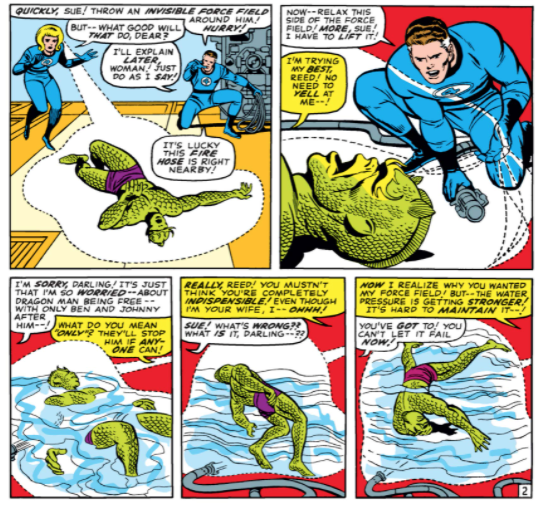
Fantastic Four 47 picks up where FF 46 left off (once very unusual, the cliff-hanger ending is becoming the rule in the Fantastic Four). Dragon Man has escaped the Seeker and is on a rampage but before the team can pursue him, they need to attend to Triton, the fish-like Inhuman who is dying without water. Mr. Fantastic orders the Thing and the Human Torch to pursue Dragon Man, then instructs the Invisible Girl to enclose Triton in a forcefield, which he fills with water. Ben and Johnny eventually subdue Dragon Man, but not before the creature almost destroys the studio of Alicia Masters, Ben’s girlfriend.
Meanwhile, the rest of the Inhumans teleport back to the Andes and their hidden city of Attilan (called only “the Great Refuge” here) where it is revealed that Maximus, Black Bolt’s brother, has usurped the throne and dispatched the Seeker to capture the Inhuman royal family. After Maximus orders the ape-like Alpha Primatives to attack the royal family, Black Bolt eventually wrests the crown back from Maximus.
The Fantastic Four arrive, having tracked the Seeker, and confront Black Bolt, who demands the team leave. As the groups debate, the issue ends with Maximus preparing to fire his “Atmo-Gun” which promises to destroy mankind, leaving the earth to the Inhumans.
What’s going on here?
Fantastic Four 47 is a frustrating issue. It features some of the most outstanding Kirby art to date (the influence of Joe Sinnott is really apparent), a story jammed with plot and sub-plots, but also some of the most egregiously sexist characterizations in the comic so far. The depiction of Sue is almost unreadable, and Reed’s treatment of her is equally painful.
Let’s start with Reed barking orders at a flummoxed Sue, who seems incapable of understanding her own powers:
Then, as Sue suggests the Inhumans can tend to their own affairs, Reed shuts her down.
Later, as the Fantastic Four flies to Attilan, Sue attends to … her hair.
Which leads to this excruciating sequence:
And finally, once again Reed needs to tell Sue how to use her powers:
And if there was any worry that it was just Sue who was written like this, here’s Alicia—allegedly an accomplished sculptor with a life of her own—pining away for Ben:
It’s hard to understand where the treatment of Sue is coming from, other than it being just a particularly sexist product of its era. Frustratingly, in the previous dozen or so issues, Stan and Jack had written her having more agency and mastery over her powers, but it all seems to revert back to idiotic stereotypes in FF 47.
Elsewhere …
Fantastic Four 47 further elaborates on the Inhumans and the dynamics within the royal family. We are introduced to Maximus, and he’s revealed to be the real villain. Confusingly, a flunky of his says it was Maximus who ordered Gorgon to capture Medusa in issue 44, when it seemed obvious that he was working on behalf of Black Bolt to reunite her with the royal family.
Also, Maximus refers to an “accident” that left Black Bolt speechless and left unable to rule, an explanation which is eventually retconned away when the power of Black Bolt’s voice becomes the reason for his silence (his voice’s power isn’t revealed until FF 54, and his silence is more fully explained in the Thor backup stories).
Crazy Credits
Subtle but clever.
Star-crossed lovers
Ben and Alicia’s relationship is also given some attention in Fantastic Four 47, as Ben is desperate to save her as Dragon Man threatens to destroy her building. They make their feelings for each other known thusly:
Leading to more anguish from Ben later in the story, as he return to a familiar theme- his lost humanity.
Those crazy kids
Meanwhile, Ben isn’t the only one with relationship issues, as Johnny and Crystal reunite (oddly, her nickname is written here as “Chris” and not “Crys”).
Oops
Why are the FF flying a commercial jet instead of their Fantasticar, their Pogo Plane or their ICBM? Stan supplies an explanation, but I’m guessing Jack just forgot.
It’s Clobbberin’ Time
Ben is starting to say the magic words more frequently. This is the ninth time, by my count.
Weird Science
Beware the Atmo-Gun!
Dig That Kirby Krackle
Jack (with an assist from Sinnott) delivers some of the most dynamic pages yet. Here are a few:
Next issue: The resolution of the Inhumans sage, and the beginning of a little story featuring some guys called Galactus and the Silver Surfer!
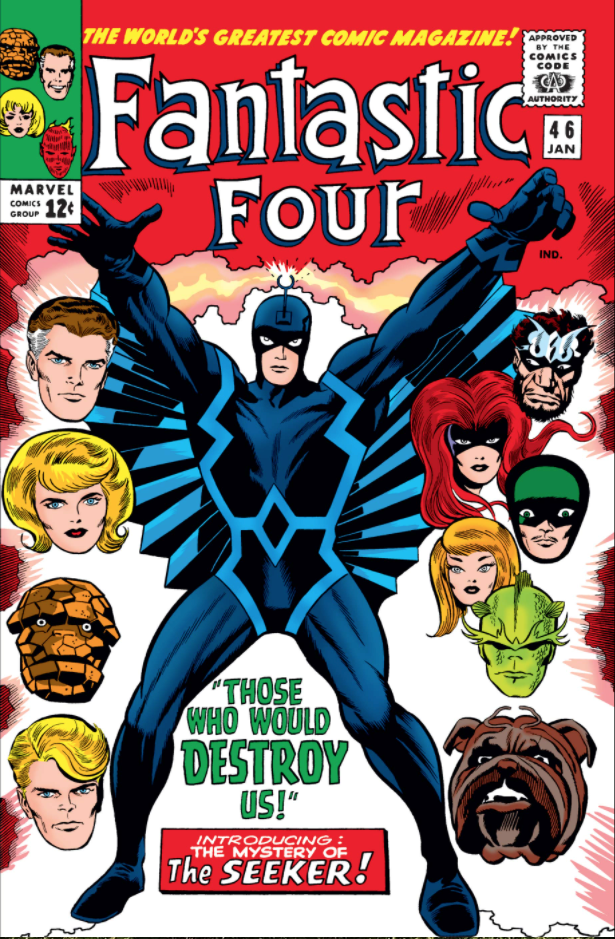
Fantastic Four 46 “Those who would destroy us!” Published: Oct. 1965 Story: Stan Lee and Jack Kirby Script: Lee Pencils: Kirby Inks: Joe Sinnott Letters: Artie Simek Cover: Kirby and Sinnott
Synopsis
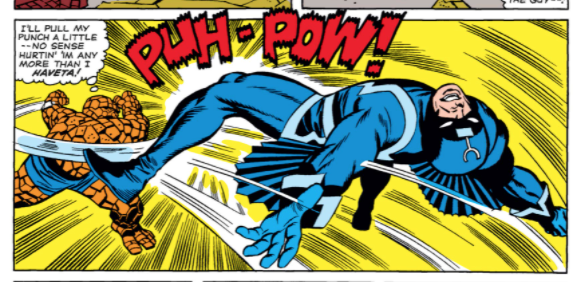
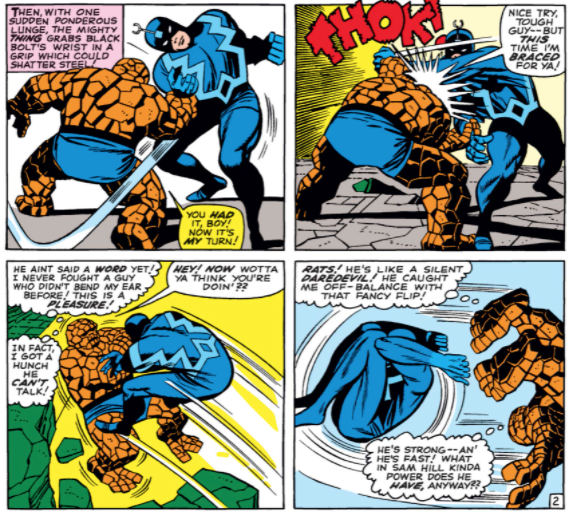
Fantastic Four 46 picks up where FF 45 leaves off, with the team battling the Inhumans on the roof of a New York City building. Black Bolt, leader of the Inhumans makes his appearance, and he and the Thing battle to a virtual standstill. Meanwhile, the Inhuman Triton is revealed to be a scaly fish creature who need a protective suit of water. When it ruptures, he flees to the nearby river.
As the teams fight, a new character called the Seeker leads a team of henchmen into the Baxter Building in search of the Inhumans. He instead discover the sedated Dragon Man, and mistaking him for an Inhuman, abducts him via his aircraft.
Black Bolt depletes his power fighting the Thing, and when the Inhumans can’t find Triton, they realize the Seeker has caught up to them. Using Lockjaw’s power, they teleport away, and after the Fantastic Four discovers Dragon Man is missing, they track the Seeker to his hideout, where he has imprisoned Dragon Man and Triton. The Seeker reveals the origins of the Inhumans (more on that in a bit) then Dragon Man wakes up, escapes his shackles and flees, while shattering the water-filled globe that contained Triton. The issue ends with Dragon Man running amok in New York.
What’s going on here?
More Inhuman action and the introduction of Black Bolt!
Black Bolt’s most salient quality is that he’s mute. Sure, he’s strong enough to battle the Thing, but his silence is what sets him apart from other characters. We’ll learn later that it’s because of the destructive power of his voice, but most of the time he’s a leader who can’t speak. In a world where there’s often a great deal of talk without much action, Black Bolt is cast as the opposite, the king who acts without talking. I doubt Stan and Jack meant Black Bolt to serve as a jab at anyone in particular, but probably as a blanket commentary on bloviating politicians as a class. The strong-yet-silent leader is a seductive concept, although one that works a lot better in comic books, where most conflicts are resolved with fists and not dialogue.
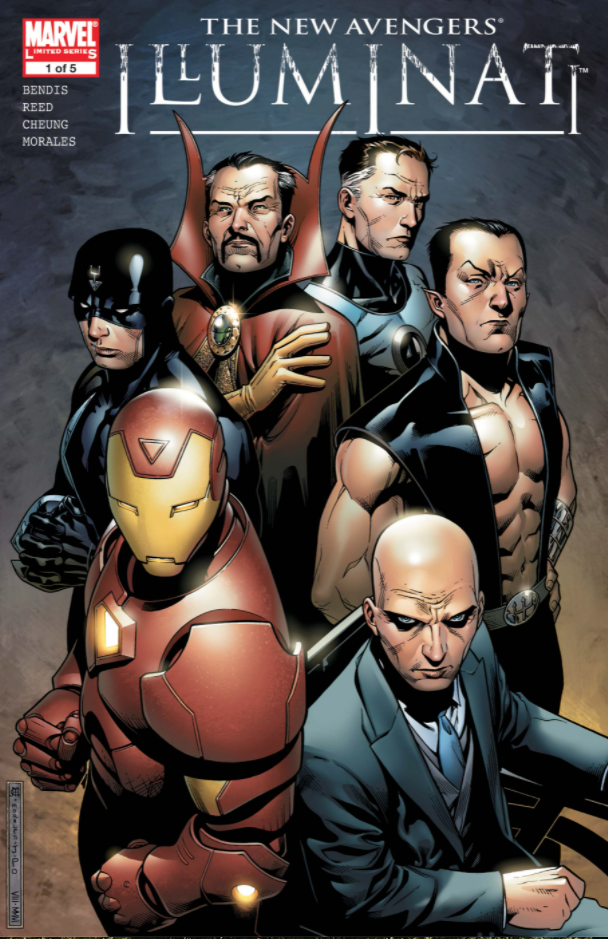
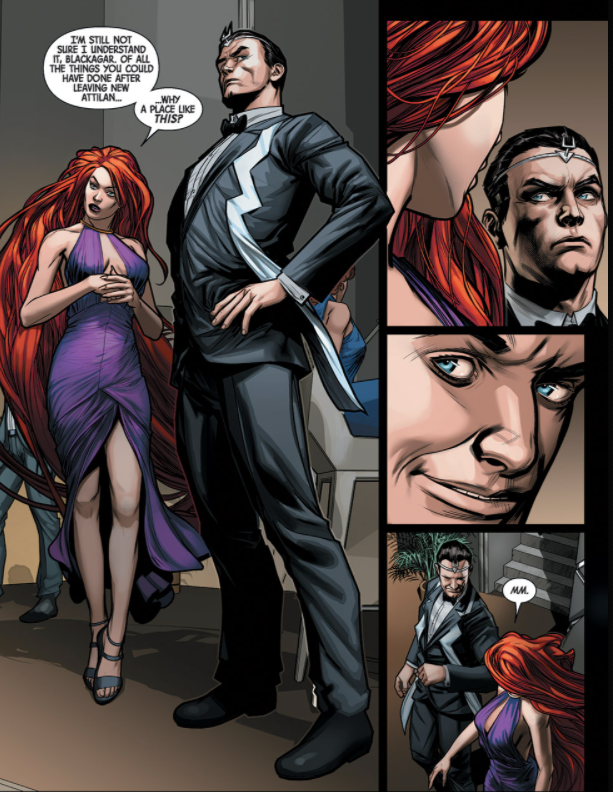
Black Bolt—whose full name was later retconned, painfully, into Blackagar Boltagon— occupies an interesting place in comics. As leaders of the Inhumans, he holds an important role, and is highly enough regarded enough, for example, to be part of the Illuminati, one of the six super heroes who dictate events in the Marvel Universe (according to writer Brian Bendis, anyway). Yet because he’s mute, he’s always been a cypher. His thoughts and intentions are always relayed through other characters, and he rarely is even given thought bubbles. What are his hopes and dreams? Who knows? It’s hard to think of another comic hero so prominent about whom we know so little.
Cover by Jim Cheung
About that mask
When the Inhumans were introduced, they almost all wore masks. While some have lost their’s over the years, Black Bolt almost always wears his. There’s no obvious reason in-story that’s ever given for his mask- it’s not like he was a secret identity to protect, or hideous scars to cover. Tracking down an image of Black Bolt’s actual face is surprisingly difficult, but here’s at least one instance, from 2015’s Uncanny Inhumans:
Uncanny Inhumans 20 (2015, story by Charles Soule, art by Brandon Peterson)
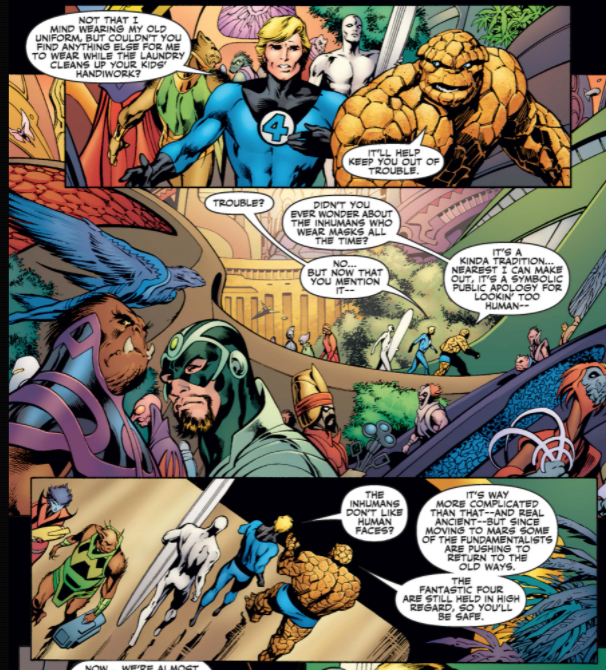
The best explanation of why members of the Inhuman royal family wear masks was provided by the great writer and artist Alan Davis, in his mini-series Fantastic Four: The End. It takes place in the team’s future, and Ben and Alicia are living with the Inhumans on Mars. It comes down to a tension about the appearance of the Inhumans, and the role of the transfarmative terrigen mists in their culture.
Fantastic Four: The End 3 (2006, story and pencils by Alan Davis, inks by Mark Farmer)
Who are these guys?
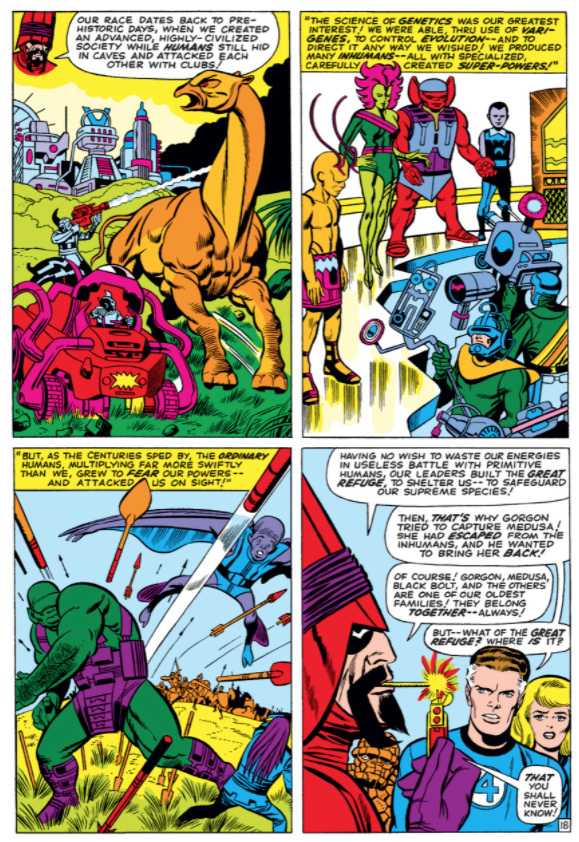
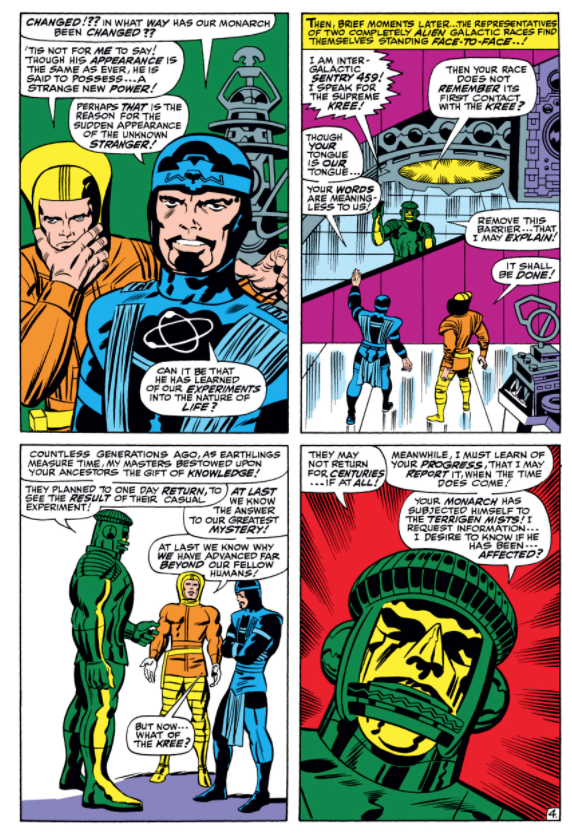
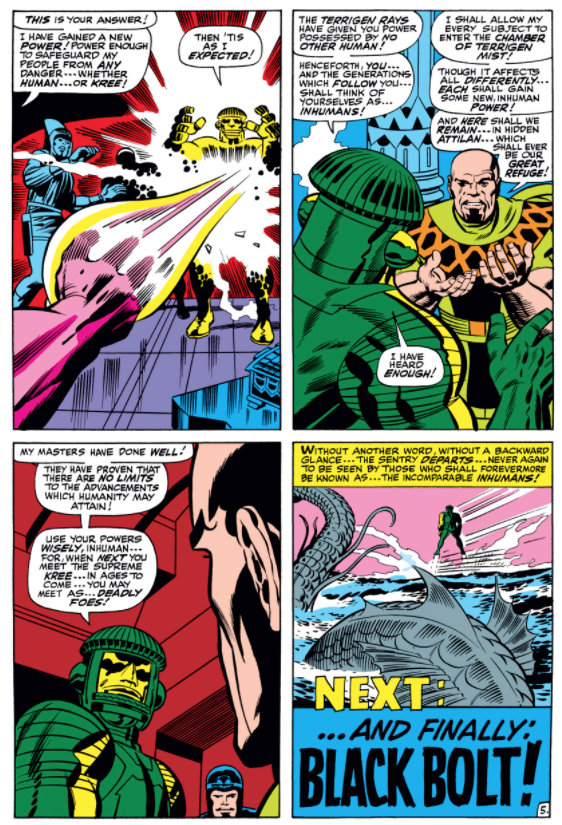
FF 46 also includes a brief origin of the Inhumans, courtesy of the Seeker.
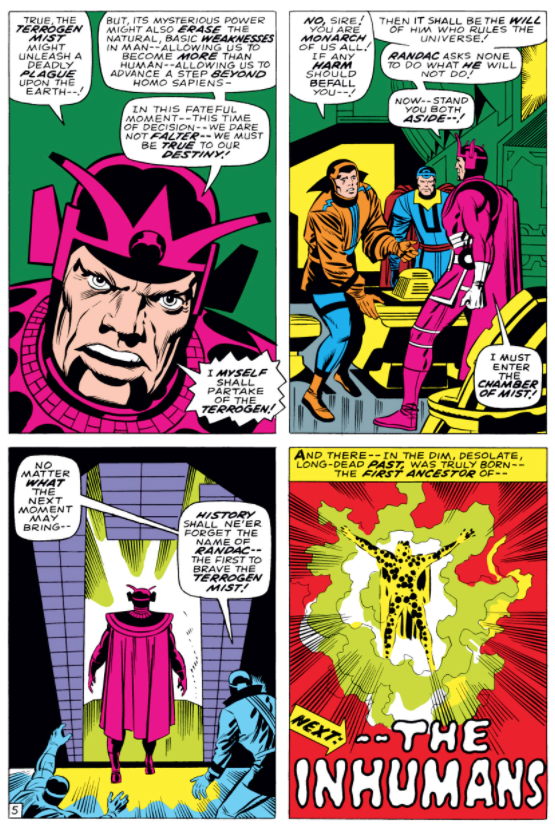
The origin omits a critical detail (or more likely, Stan and Jack hadn’t come up with it yet), which is that the Inhumans were an experiment of the Kree, an alien race that will be introduced in Fantastic Four 65. Eventually a much longer origin is unspooled as a back-up story in Thor 146-152 (of all places), published in 1967-68. Here are some key panels that explain the role of the Kree (the whole story is gorgeous, with peak Kirby/ Sinnott art).
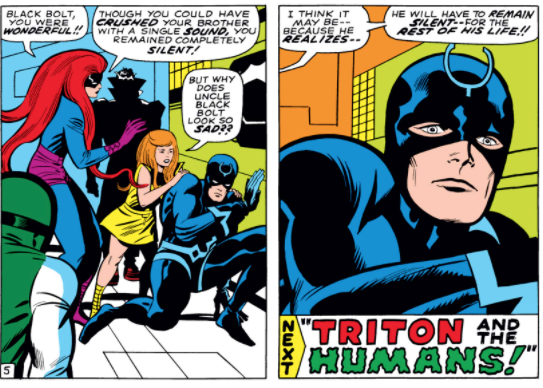
The Thor stories also delve into how Black Bolt became king of the Inhumans, and include this poignant sequence:
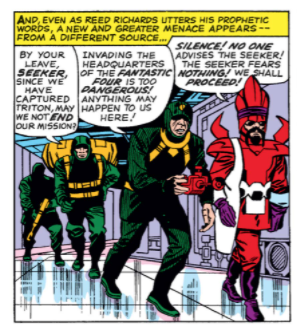
The Seeker
The Seeker is the heavy in this issue. In later stories he is named as Kadlec, a viceroy under a previous ruler of the Inhumans and given a bit of a back story. Although he never becomes a much more than a footnote in Inhumans history, he looks great here.
Crazy Credits A bit more subdued this month.
Weird science
Reed invents … the security camera and VCR?
Dig that Kirby Krackle
Some cool stuff from Jack, including a slumbering Dragon Man…
Fantastic Four 45 “Among Us Hide the Inhumans” Published: Sept. 1965 Story: Stan Lee and Jack Kirby Script: Lee Pencils: Kirby Inks: Joe Sinnott Lettering: Artie Simek Cover: Kirby and Sinnott
Programming note: Before we dive into a big issue, this post marks a full year of blogging about the Fantastic Four. We’ve covered 45 regular issues and three annuals. Not quite the 52 posts I was aiming for but not bad. If all goes according to plan, the next few months will cover some of the biggest stories in comic book history, then the rest of the year will wrap up most of the remaining Lee/Kirby FFs. That’s the idea, anyway. But I’m open to ideas: What do you want me to write about? Should I continue issue-by-issue? Should I cover the FF’s appearances in other comics? Is there something you want more of? Or less of? Drop a line in the comments if you have thoughts. They would be very welcome.
Synopsis
Fantastic Four 45 picks off where FF 44 left off, on the crumbling roof of a Manhattan building. Dragon Man has flown off with the Invisible Girl and Gorgon has abducted Medusa. After Mr. Fantastic, the Human Torch and the Thing are safely on the ground, Johnny flies after Dragon Man, who is eventually calmed by Sue and returns her peacefully to the Baxter Building.
A morose Johnny later takes a walk and finds himself in a deserted neighborhood where he encounters a young woman who disappears in a windstorm. After squabbling with the rest of the team, Johnny returns, and discovers the woman has powers. Mistaking him for a fellow Inhuman, she introduces herself as Crystal and Johnny then meets Lockjaw and Karnak. But when he is discovered by Medusa and Gorgon, the Inhumans try to imprison him. Johnny escapes and summons the rest of the Fantastic Four. The teams are about to square off when Black Bolt makes his entrance, ending the issue with another cliffhanger.
What’s going on here?
The introduction of the Inhumans is obviously the significant development in FF 45. They’ve been a major part of the Marvel universe ever since, appearing either in their own series or, more frequently, as guest stars in other books almost continuously since. Finding the backstory for the Inhumans has proven difficult, but at one point it seems they were destined for their own series before a change in plans led Stan and Jack to fold them into the FF. Did Stan and Jack have a full team of super characters in mind when they introduced Medusa in FF 36? It seems unlikely. Here’s Stan, in a 1967 radio interview he gave alongside Jack:
“I mean, we didn’t sit down one day and say let’s do a group of Inhumans and these are their names and we’ll present them in this fashion, as with everything we do. We just sort of stumble into them as we go along.”
Earlier in the interview, Stan explains the concept started with Gorgon:
“He started out as a villain. We liked him so much, I should say Jack liked him so much, that he kept using him. We figured he has to come from somewhere. We decided, let him come from some strange land over in Europe, where there are a whole group of people like him. And well, what else could you call them except the Inhumans. Then Jack had to create a whole bunch of Inhumans and I think he did a great job. All these characters are really very imaginative.
When it came to doing the leader, we decided, well, there was no need for them all to be villainous. And you’re right, I think we did have in mind that Black Bolt would eventually be a heroic type.”
It’s of course possible that Stan was talking out of turn, and Jack had it all mapped out, but it was a joint interview, and he didn’t contradict Stan.
FF 240 (1981) Story, pencils and inks by John Byrne
Who’s the new guy?
The other big development in this issue—technically it was issue 44, but I goofed and forgot to mention it last week—is it marks the beginning of Joe Sinnott’s legendary run as inker. Sinnott inked FF 5, then starting with issue 44 goes on to ink the FF for 16 years until issue 231 in 1981, stopping only when John Byrne took over the book and inked himself. Then, after Byrne left in 1987, Sinnott inked the FF for another two years.
Sinnott’s inks help create the classic Kirby look. The lines are bolder, the shadows are deeper, the forms are more defined. His inks give the Thing his essential rockiness and give the Kirby Krackle its explosive energy.
His presence on the book for so many years after Kirby departed gave the FF a smooth, consistent appearance, although it could be argued that his inks smothered the unique qualities of some up-and-coming artists on the book like George Perez and Bill Sienkiewicz, who later flourished with other inkers.
Meet the Inhumans
Medusa and Gorgon we already know. In FF 45 we are introduced to Crystal, who has the power to manipulate the four elements: fire, water, earth and air.
We soon meet Lockjaw, a giant dog with the ability to teleport:
And Karnak, who can find the weakness in any substance:
Triton, a water breather, is kept hidden, with the promise of a bigger reveal later:
And lastly, Black Bolt makes a dramatic appearance at the end:
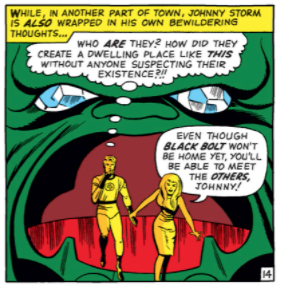
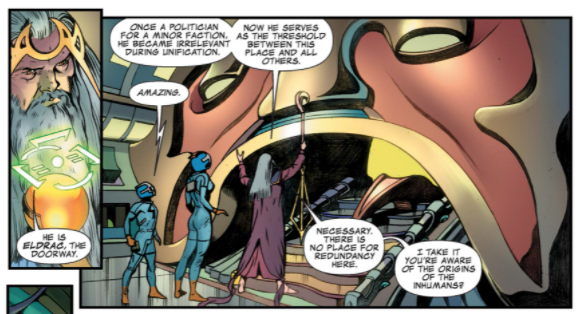
Plus, one more: While Stan and Jack almost certainly didnt intend it, the portal Johnny and Crystal travel through was retconned by Johnathan Hickman into Eldrac the Doorway, “once a politician.”
FF 577 (2010, story by Hickman, art by Dale Eaglesham)
About Crystal
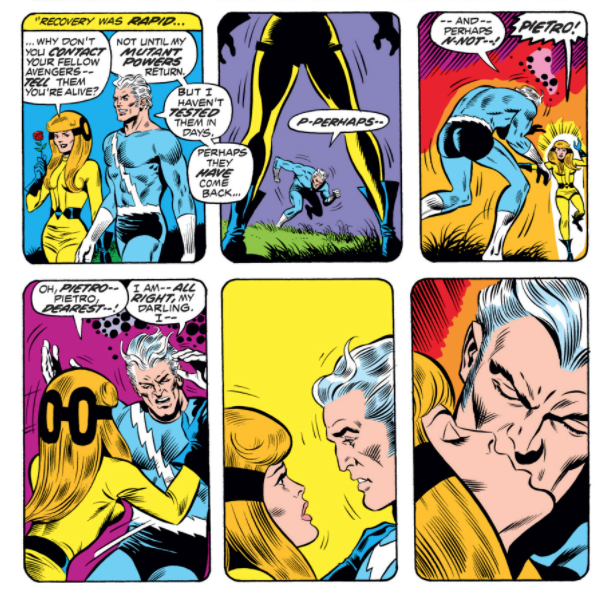
While all the Inhumans have an impact of the Fantastic Four, Crystal is the one perhaps most closely tied to the team. She becomes Johnny’s love interest, then, when Sue is on maternity leave, she officially joins the FF in issue 81:
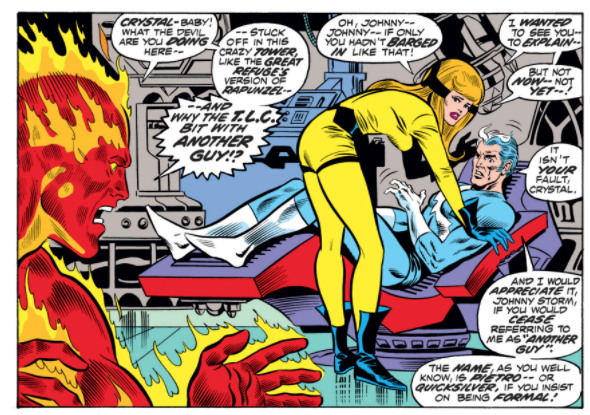
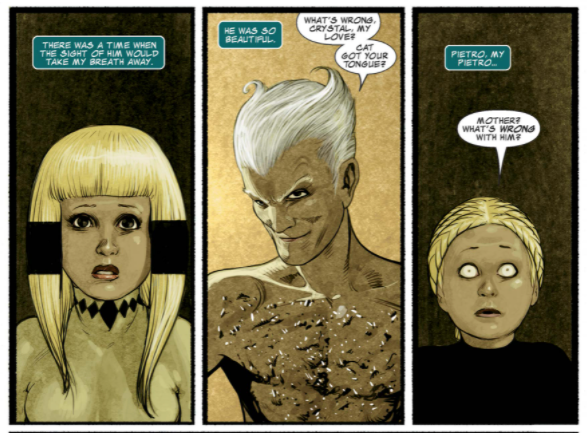
She later falls in love with Pietro Maximoff, aka Quicksilver, an Avenger and son of Magneto. Johnny is not thrilled.
FF 131 (1973, story by Roy Thomas, art by Ross Andru and Joe Sinnott)
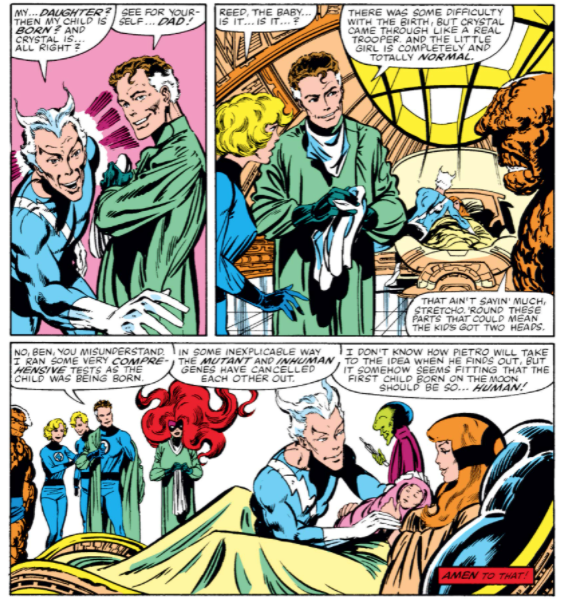
Crystal and Pietro eventually marry in FF 150 (as shown in this post) and Crystal gives birth to baby Luna, so named because she arrived just as the Inhuman city of Attilan was transported to the moon:
FF 240
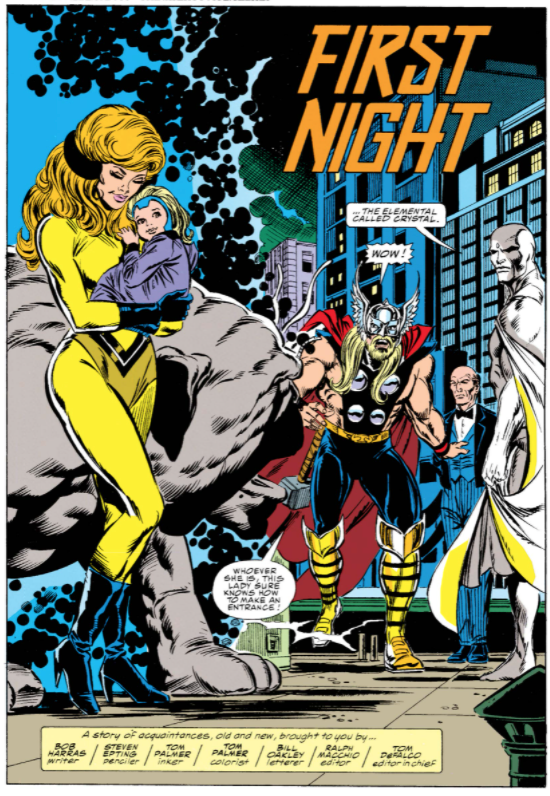
Eventually, however, Quicksilver goes haywire and Crystal leaves him to join the AvengersAvengers 343 (1992, story by Bob Harras, art by Steve Epting and Tom Palmer)
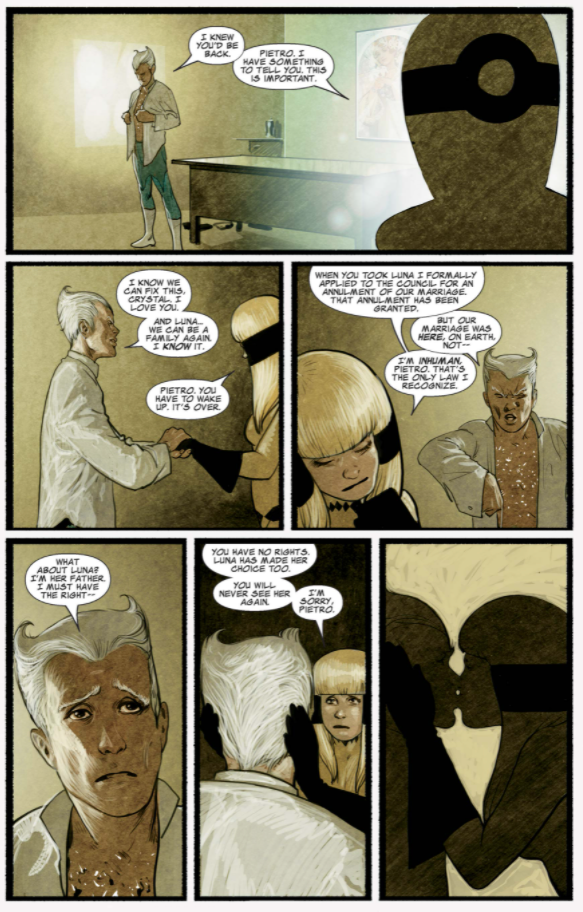
Crystal eventually reconciles with Quicksilver, but then he really goes off the deep end, and she ends things forever:
Silent War 3 (2007, story by David Hine, art by Frazer Irving)
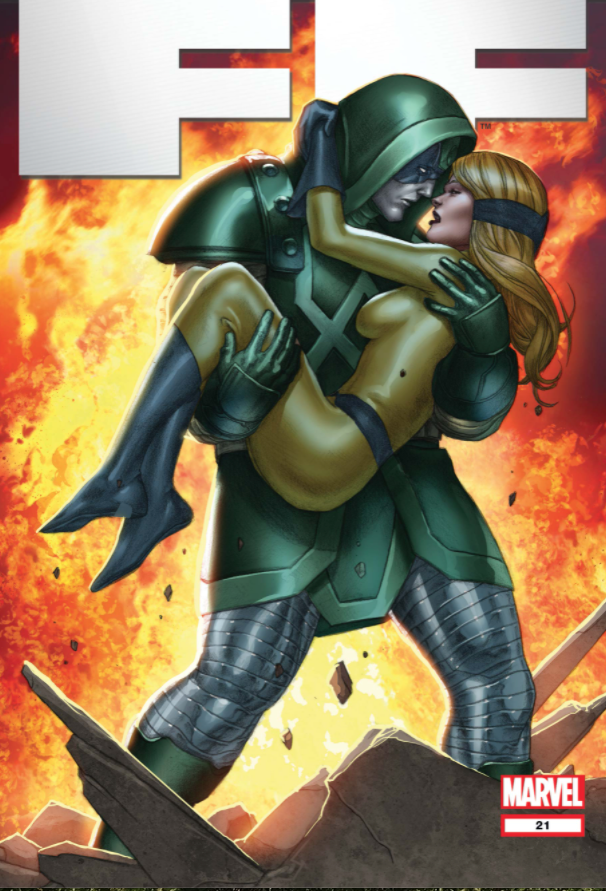
She finally winds up with Ronan the Accuser before she is forces to separate from him in a very complicated story by Johnathan Hickman:
FF 21 (2012, cover art by Mike Choi)
They’re fighting again
More like a battle of wits, but I’ll count it.
The sexist sixties
Crazy credits
It’s Clobberin’ Time
This is the eight time Ben has said the magic words, by my count.
The incredible Mr. Fantastic
Why turn into a ball when when you can be a cube?
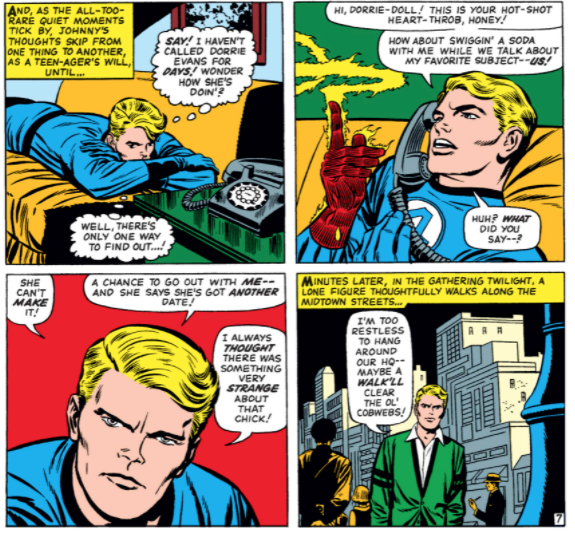
Teenage blues
Just a great sequence by Stan, Jack and Joe of a moody Johnny
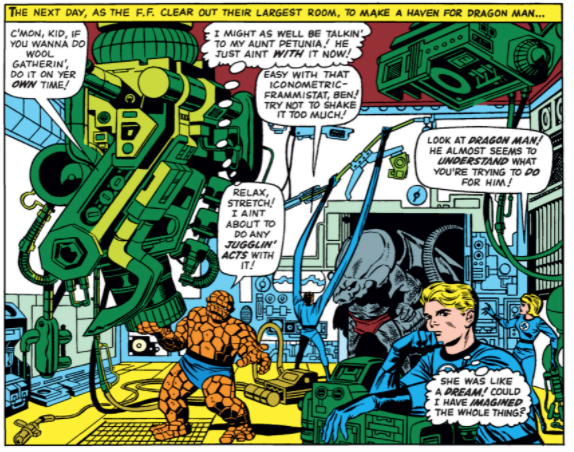
Weird science
“Easy with that iconmetric frammistat”
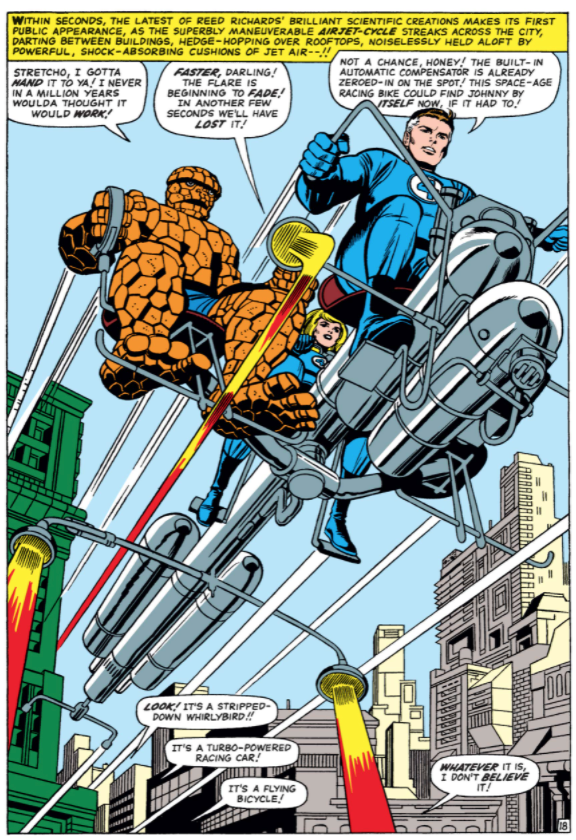
Dig That Kirby Krackle
Just when you though this comic had everything, Jack gives us this:
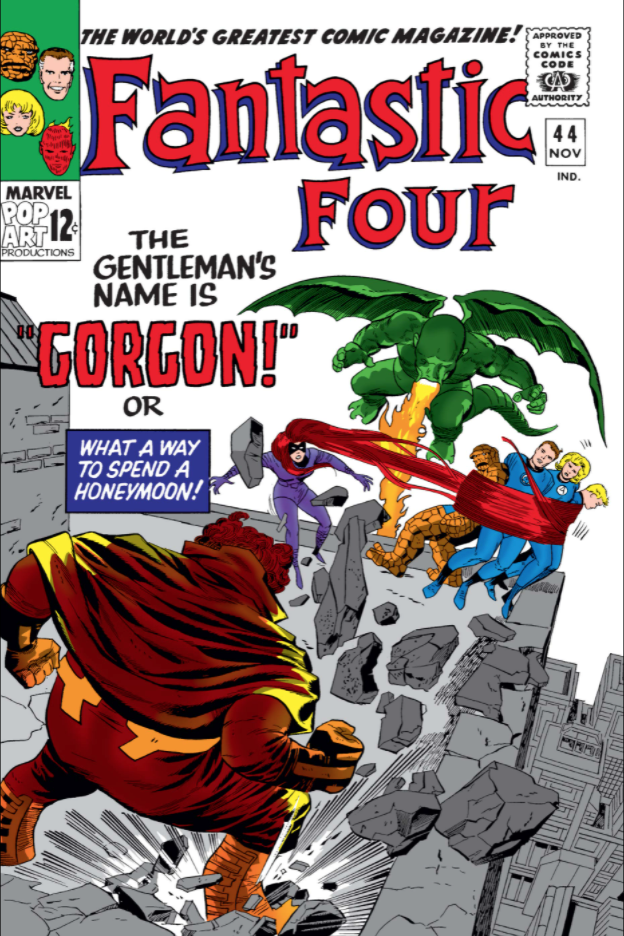
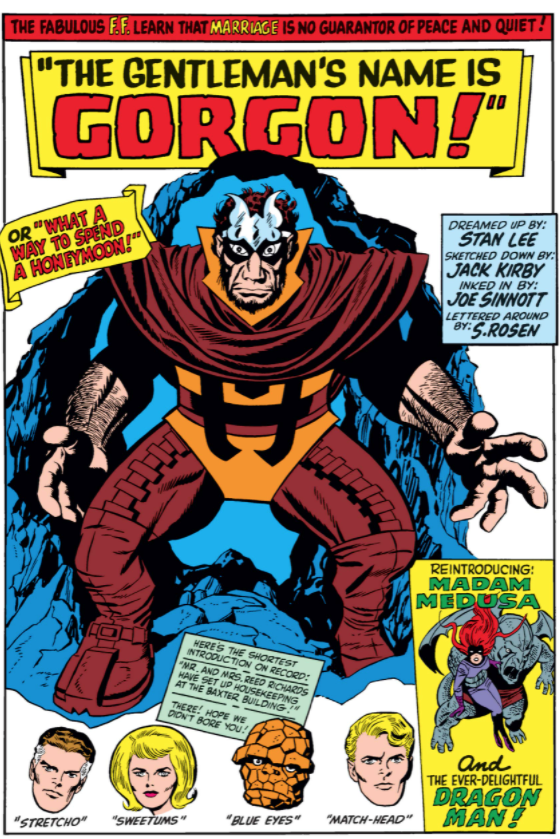
Fantastic Four 44 “The Gentleman’s Name is Gorgon!” Published: Aug. 1965 Story: Stan Lee and Jack Kirby Script: Lee Pencils: Kirby Inks: Joe Sinnott Letters: Art Simek Cover: Kirby and Vince Colletta
Synopsis
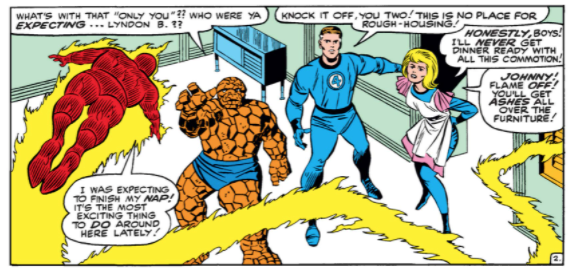
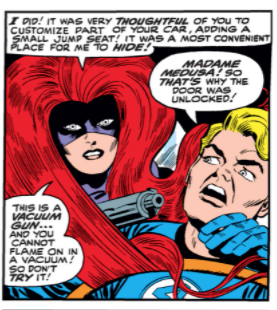
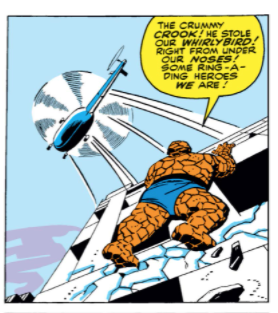
Following the marriage of Mr. Fantastic and the Invisible Girl (in FF Annual 3), the team is back at the Baxter Building where the Thing and Human Torch are growing bored of the new domesticity. Johnny takes off in his Corvette when he is carjacked by Madame Medusa, who threatens him with a “vacuum gun” and demands he help her escape Gorgon. Meanwhile, an unseen Gorgon uses his hooves to attack the Baxter Building, then steals the team’s helicopter.
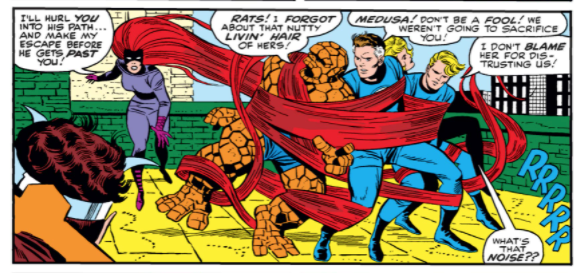
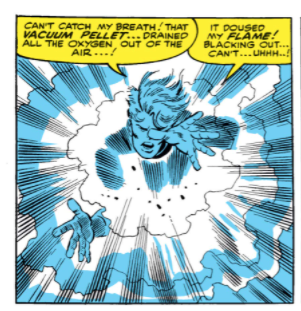
Medusa forces Johnny to drive her upstate, near the campus of State University, and when Johnny tries to escape, Medusa drains the air from him using the vacuum gun. Their scuffle awakens the dormant Dragon Man, last seen in FF 35, and when Gorgon arrives to capture Medusa, he and Dragon Man battle. Medusa and Dragon Man flee back to New York City, pursued by Johnny and Gorgon. Eventually all parties battle on the roof of city building. Gorgon demands the FF surrender Medusa or he will destroy the city when Dragon Man abducts the Invisible Girl. The issue ends with Gorgon bringing down the building around the rest of the FF.
What’s going on here?
Fantastic Four 44 kicks off a story arc that introduces the Inhumans, a major part of the Marvel universe for decades to come. It’s also the first comic in a 16-issue run that may be the most influential and creative stretches in all of comics. In these issues Stan and Jack introduce:
* The Inhumans: Black Bolt, Gorgon, Crystal, Karnak, Triton, Lockjaw, Maximus and their city of Attilan (all except Medusa, who first appeared in FF 36). * The Silver Surfer * Galactus * Wyatt Wingfoot * The Black Panther and Wakanda * Klaw * Prestor John
Plus they deliver one of the single best standalone stories (“This Man, This Monster” in issue 51) and arguably the best Dr. Doom story, when Doom steals the power cosmic from the Silver Surfer. Much more on all of this to come, of course!
The only comparable runs of similar length (about a year) I can think for their lasting significance in comics history are the Claremont/Byrne Uncanny X-Men from UXM 129-142 (which includes the Dark Phoenix Saga and Days of Future Past), and Green Lantern 76-89, the classic Denny O’Neil/Neal Adams run that brought contemporary issues to comics while introducing major characters. I’m sure I’m missing some, so feel free to drop your ideas in the comments.
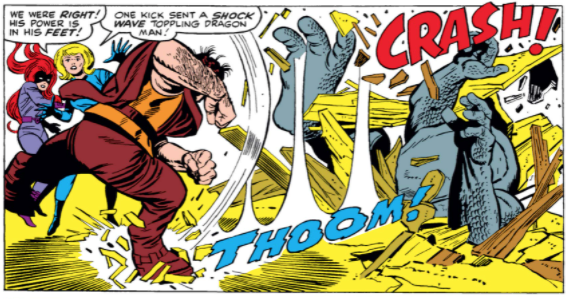
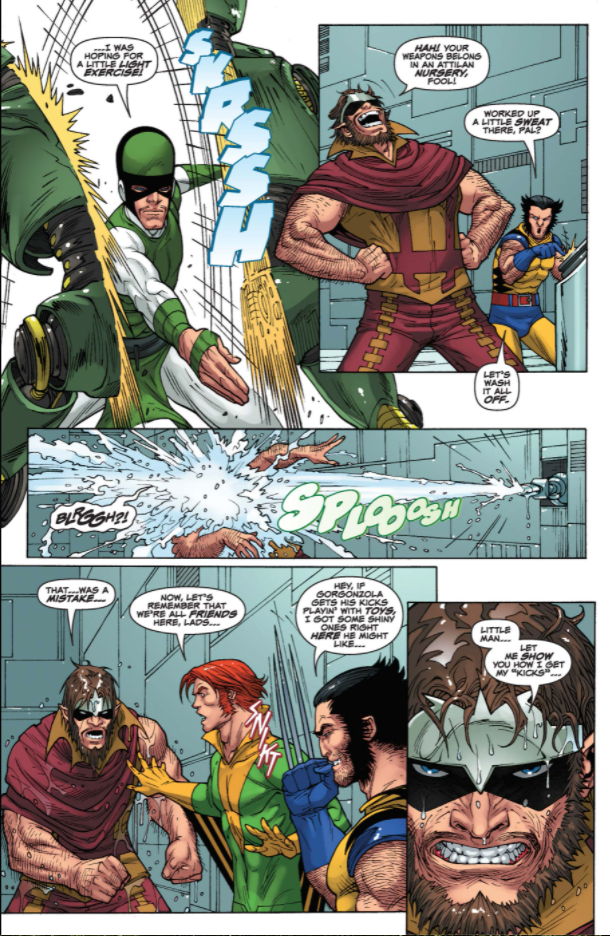
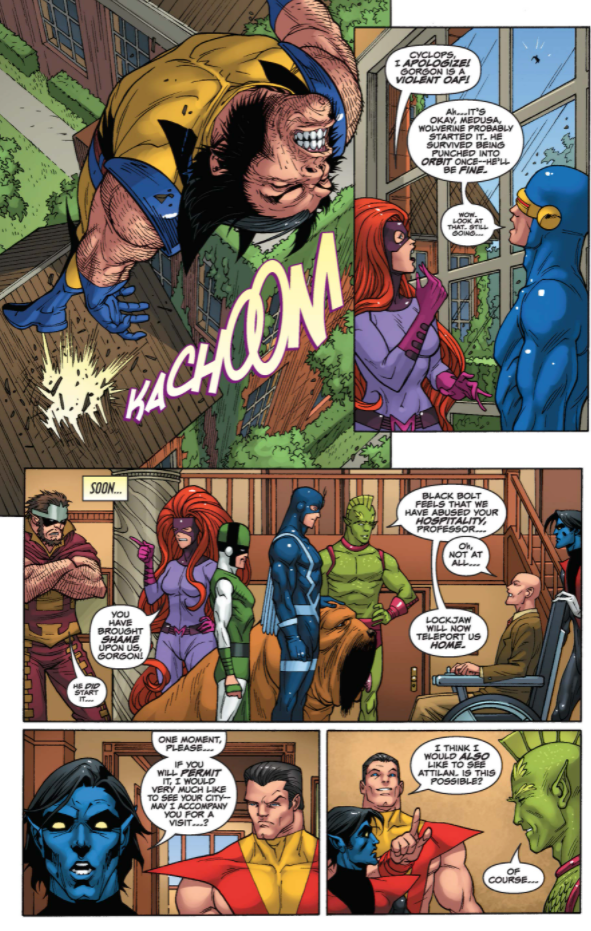
FF 44 also introduces Gorgon, who becomes a part of the Marvel firmament, but almost always as part of the Inhumans. In some ways, this might be a high point for Gorgon, as he appears both immensely powerful here and not in the shadow of his even more powerful cousin, Black Bolt. While he appears to be depowered over the years, he occasionally gets to strut his stuff, as in this fun sequence from Uncanny X-Men: First Class.
Uncanny X-Men: First Class 1, (2009, story by Scott Gray, art by Roger Cruz)
What’s in a name?
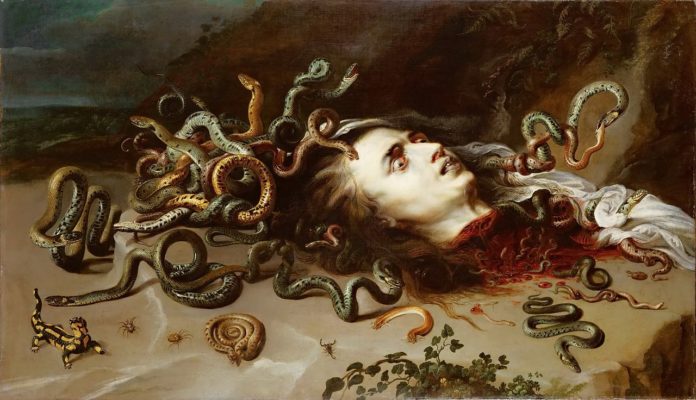
A gorgon in Greek mythology, was one of three snake haired women whose appearance could turn one to stone. One of the sisters was, of course Medusa, suggesting that if Stan and Jack knew their myths, they were’t overly concerned with the details.
The real Medusa, a gorgon (painting by Rubens)
Crazy Kredits
Not only does the creative team get goofy credits, but the FF gets nicknames.
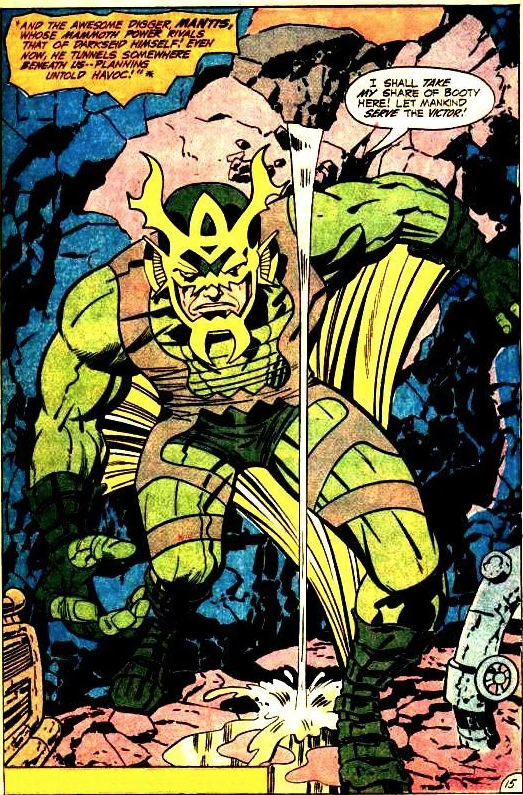
This image of Gorgon also foreshadows Mantis, a villain Jack created for DC about six years later:
The sexist sixties
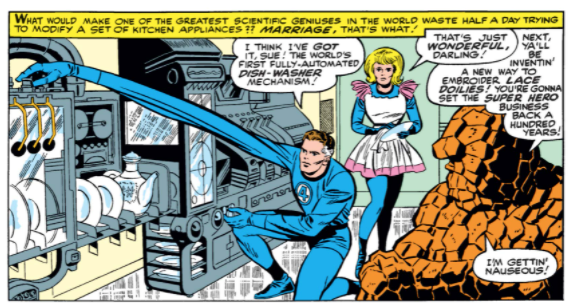
Sue is so determined to be a ’60s housewife, she’s wearing an apron.
Oops
Did Stan have to explain why Johnny’s Corvette Stingray has a backseat? It sure reads that way. Also: A vacuum gun!
We have a helicopter?
The FF has two Fantasticars, a Pogo plane, an ICBM, and apparently a helicopter.