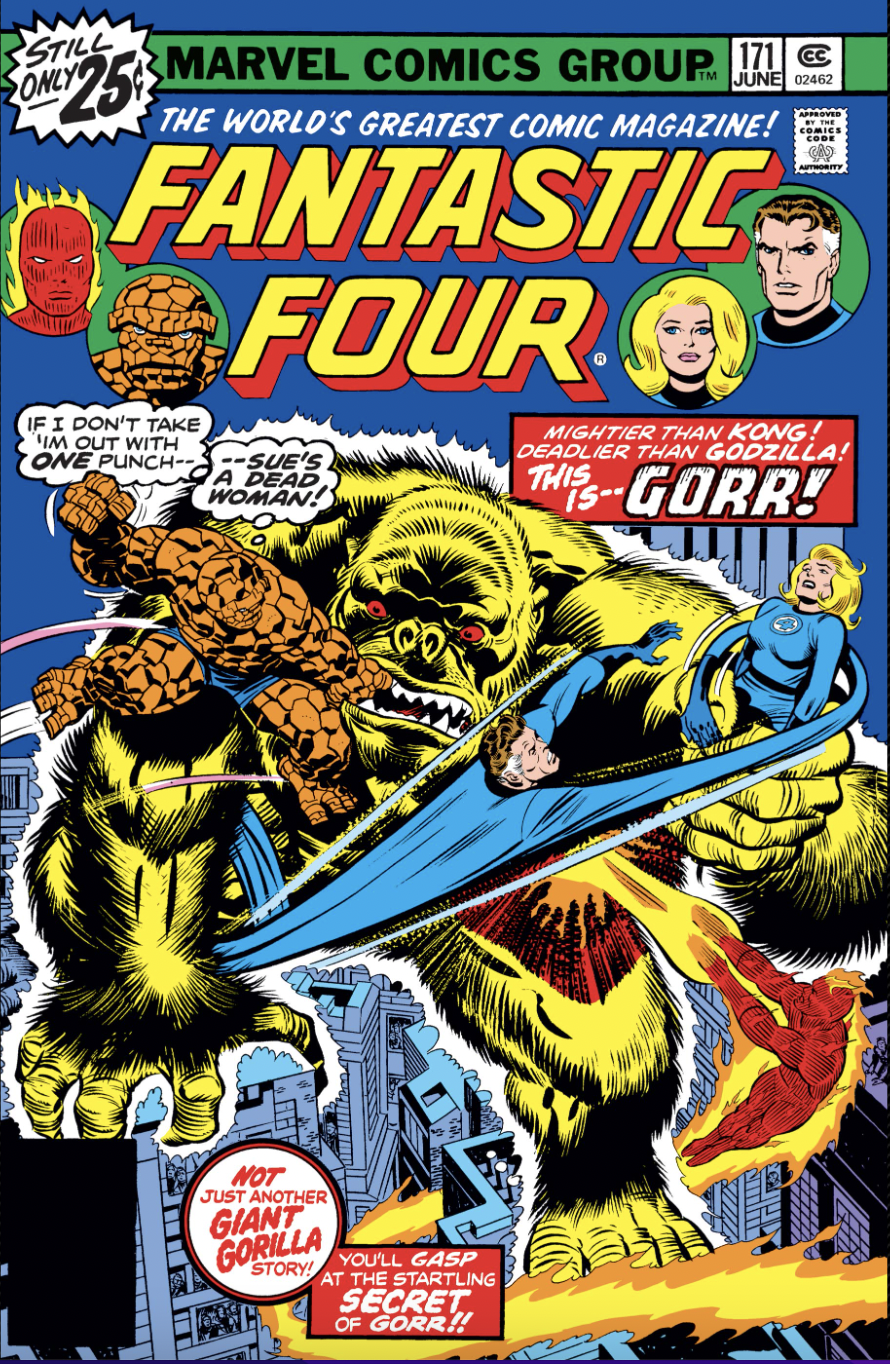
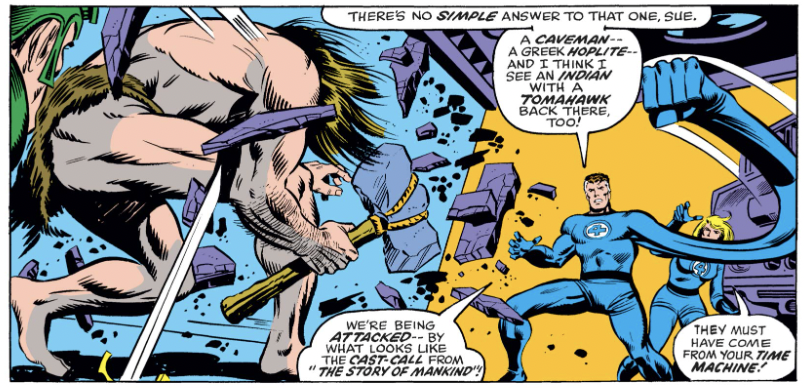
Fantastic Four 171 “Death is a Golden Gorilla!” Published March 1976 Writer: Roy Thomas Pencils : Rich Buckler and George Perez Inks: Joe Sinnott Letters: Joe Rosen Colors: Phil Rachelson Editor: Thomas Cover: Jack Kirby and Sinnott
Editor’s note: This issue came out a few weeks after Fantastic Four Annual 11, so these reviews are out of order, but I’ll get to the annual soon, I promise.
Synopsis
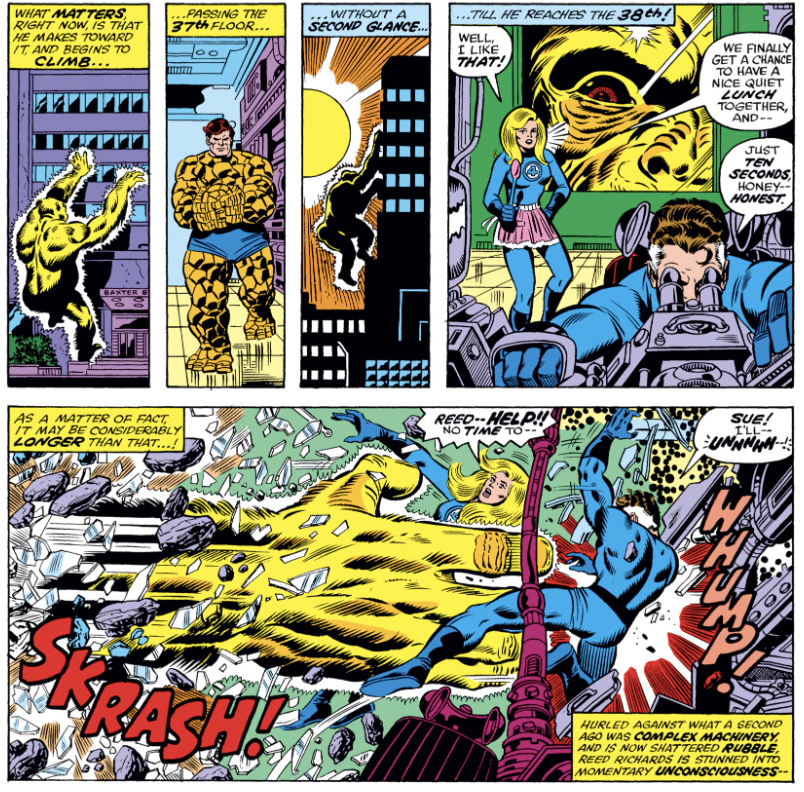
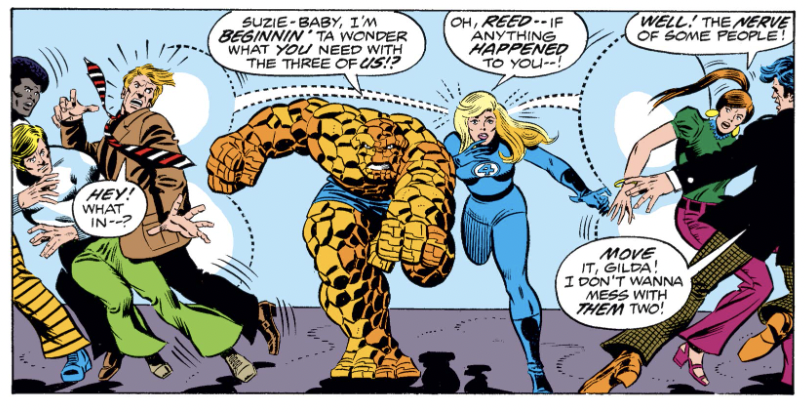
The story opens in the Baxter Building where a de-powered Ben is getting used to his new exoskeleton while the Invisible Girl expands her powers in a training session. Meanwhile, Johnny and his new girlfriend, Frankie, stroll through Central Park discussing his future away from the Fantastic Four when a spaceship lands and a glowing yellow gorilla emerges. The gorilla quickly growing in size and climbs the Baxter Building, where it grabs the Sue. The FF battle the monster and after it is defeated, it reveals it can speak, and that it came to Earth seeking help combating Galactus.
What’s going on here?
This issue isn’t as bad as I anticipated, given the cover and subject. It’s not great, but it could have been so much worse. As an FF story goes, it follows the formula laid down by Stan and Jack: hi-jinx in the Baxter Building are followed by the team battling some threat. Unfortunately, in this issue, the threat is pretty ridiculous, and despite all the King Kong jokes, still feels like a King Kong rip-off, right down to Sue playing Fay Wray.
The story is redeemed a bit by the twist at the end, and by the interpersonal dramas, between Ben and Reed, Ben and Sue, and Johnny and Frankie. George Perez does a solid job on art, although the first three pages are by Rich Buckler.
The cover is by Jack Kirby, although it’s pretty hard to tell.
What I liked
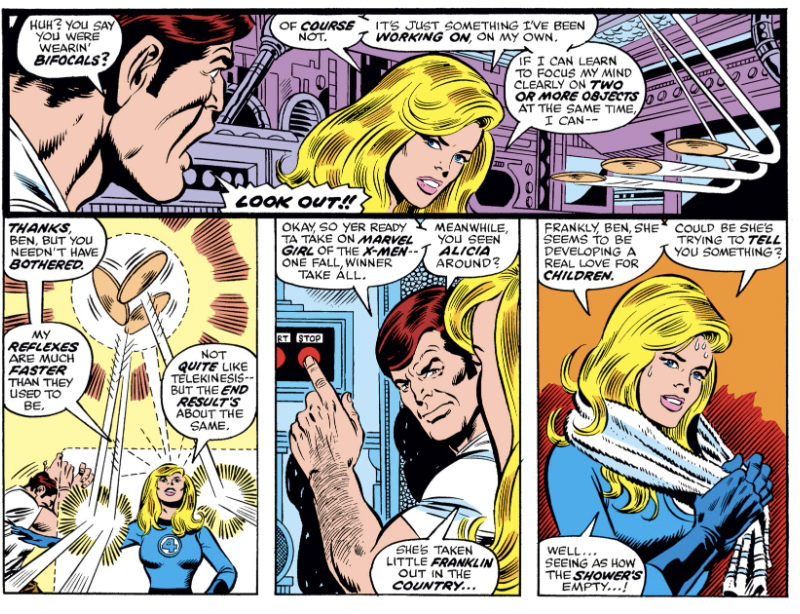
This exchange between Ben and Sue was interesting. Here, she explains how her powers are more than just invisibility and force fields, and that it’s closer to telekinesis, a long-overdue expansion of her abilities. There’s also a poignant suggestion about Ben and Alicia one day having kids, something that takes almost 50 more years.
Sue’s line about taking a shower is a bit oddly timed.
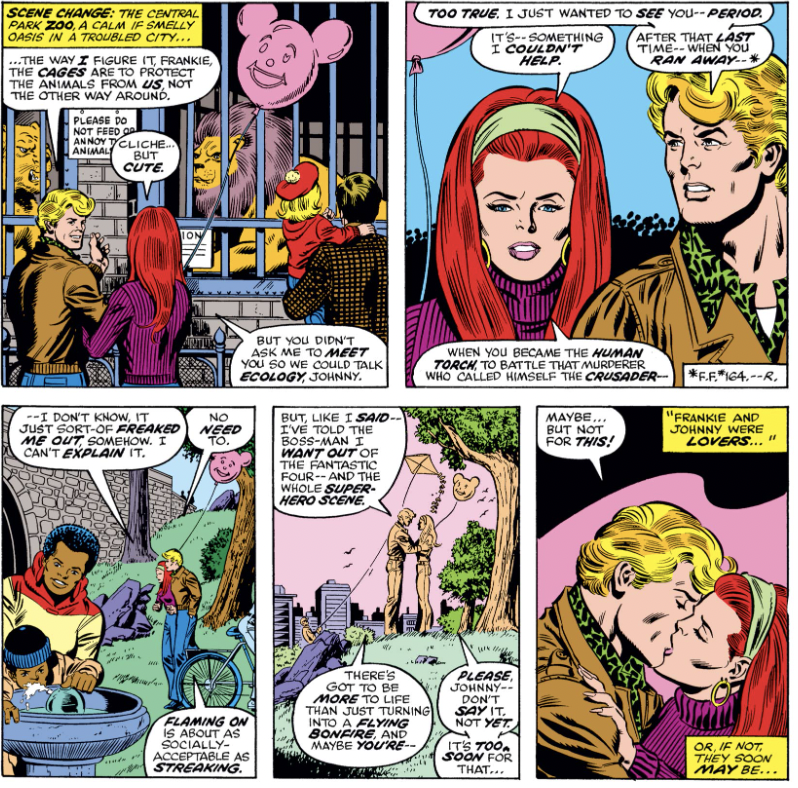
I also liked the exploration of Johnny’s relationship with Frankie (the line about the old Central Park zoo being smelly was dead on):
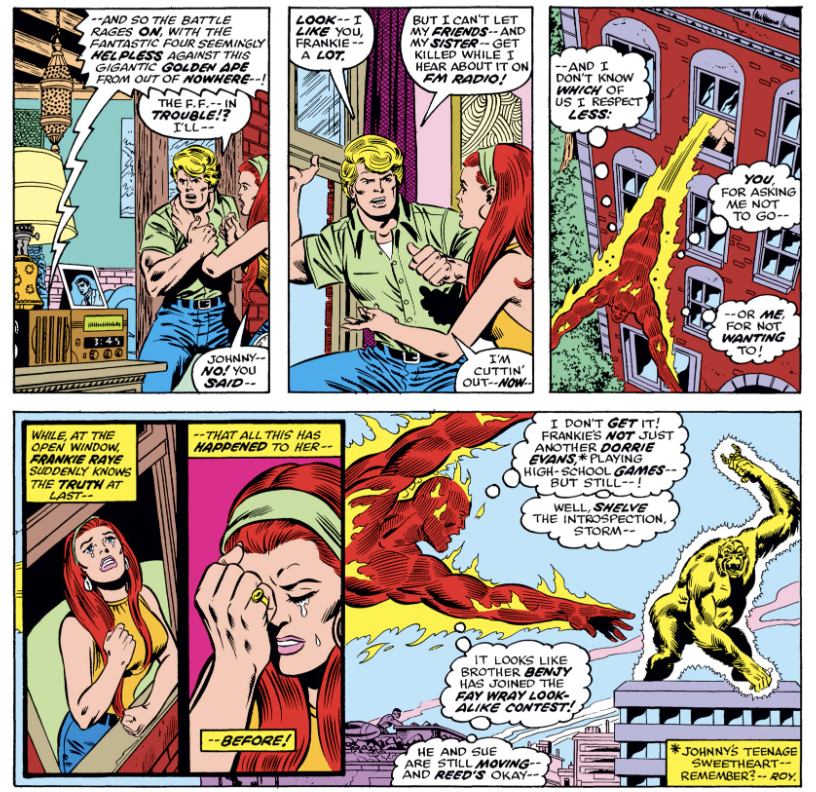
And here we get a peek at Johnny’s inner turmoil, and a hint about Frankie’s background:
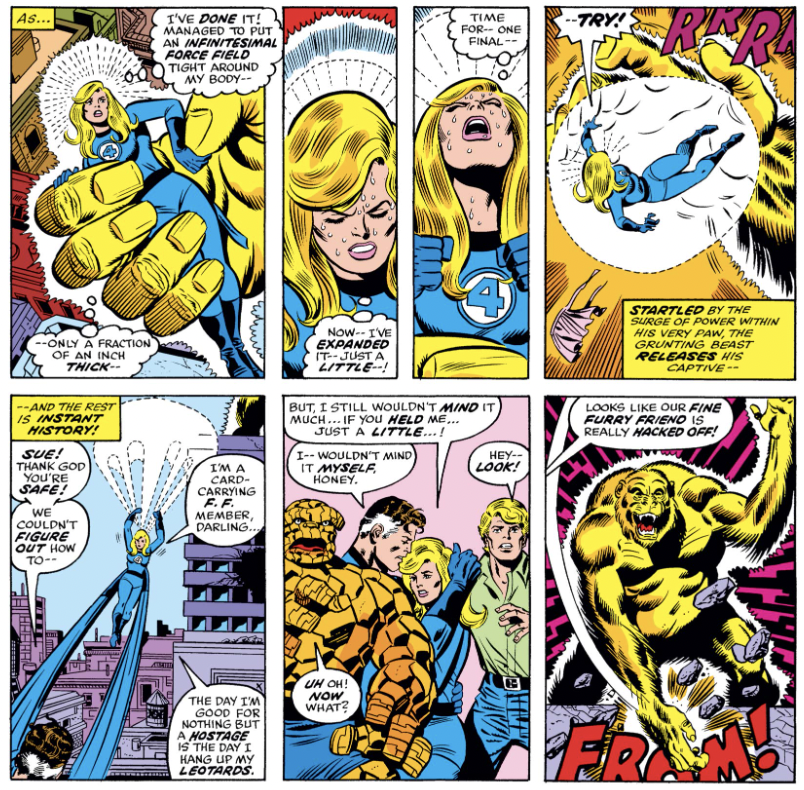
Here, Sue uses her expanded powers while making a crack about all the times she was held hostage in the early days of the FF (more than a dozen times, by my count):
What I didn’t like
Besides the giant gold glowing gorilla?
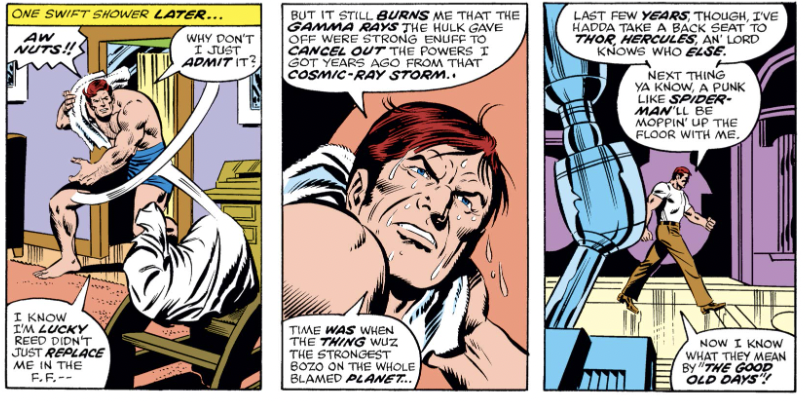
I also didn’t like Ben grousing about his loss of powers. With the exoskeleton, he’s got the best of both worlds. He should be happy while it lasts (because of course it won’t):
Fantastic Four 170 “A Sky-Full Of Fear! Published Feb. 1976 Writer: Roy Thomas Pencils: George Perez Inks: Joe Sinnott Letters: Joe Rosen Colors: Phil Rache Editor: Thomas Cover: Ed Hannigan and Sinnott
Synopsis
Mr. Fantastic reveals to Ben that the replica Thing is an exoskeleton which will allow him to resume his place on the team. After testing the suit by battling Reed, the two fly off to confront Phillip Masters, aka the Puppet Master, whom they include has been controlling Power Man, the team’s newest member. Meanwhile, Alicia Masters is confronting her step-father in prison when he is broken out by the mind-controlled Power Man, who takes Alicia hostage. Ben and Reed intercept them in mid-air and Ben battles Luke on the speeding Fantasti-Car. The conflict ends when the Puppet Master’s clay idol of Luke falls into the river and loses its power over him.
What’s going on here?
This is one of the best issues in a long time. Often Fantastic Four story arcs start out full of promise but fizzle out when Stan Lee or Roy Thomas couldn’t stick the landing. This one is the opposite: a storyline that began feeling like a gimmick — Red hiring Luke Cage to fill in for Ben — concludes with a very satisfying comic, full of action (but not too much), character development, and an ending that makes sense. Of course, all of this is helped by the return of George Perez, who delivers probably his best issue of the FF to date, with his trademark innovative page designs and dynamic action.
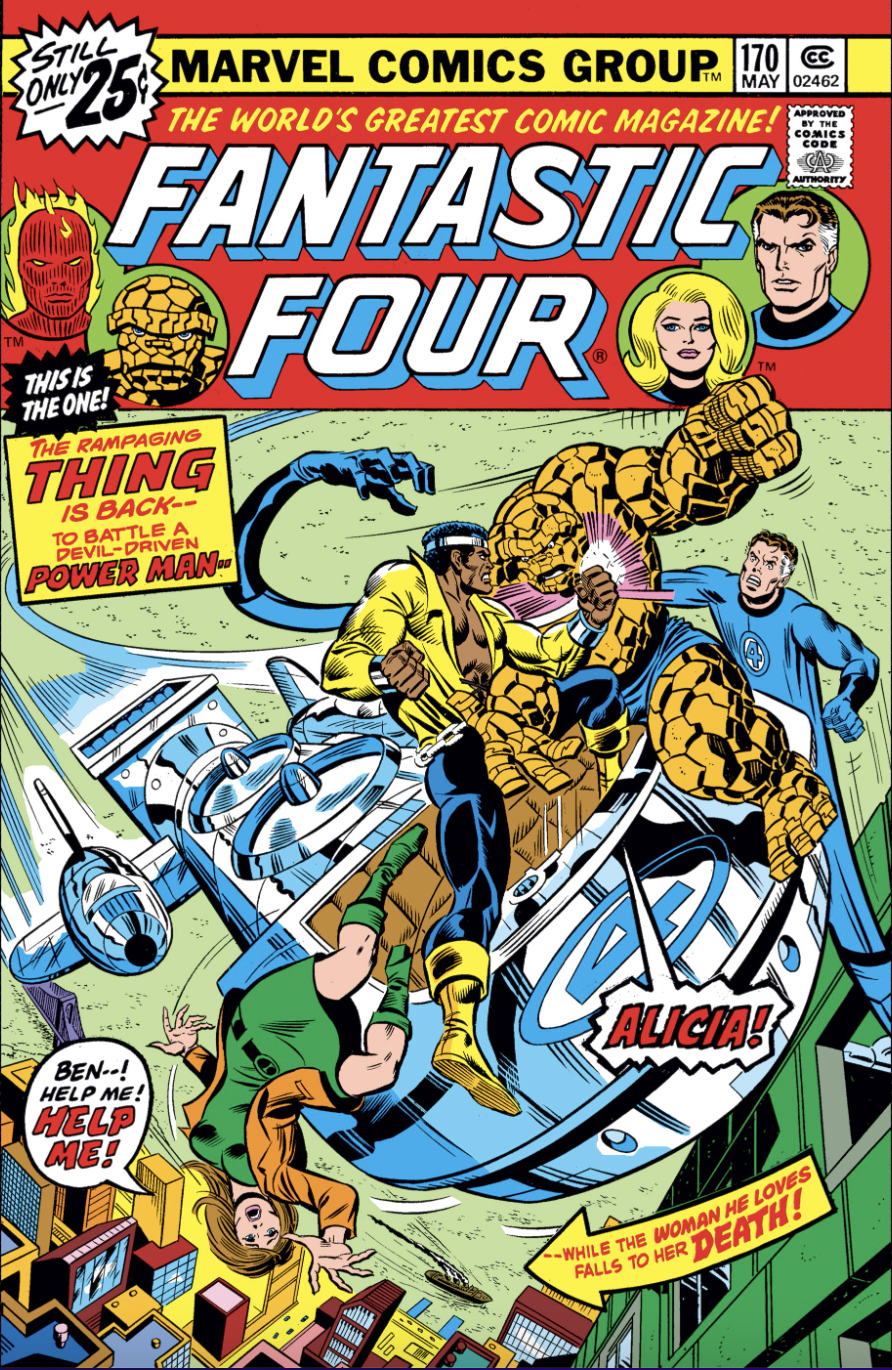
Also of note is the Fantastic Four debut of cover artist Ed Hannigan, with his first and, as far as I can tell, only work on the FF. Does anyone else think Luke as two left feet on the cover?
What I liked
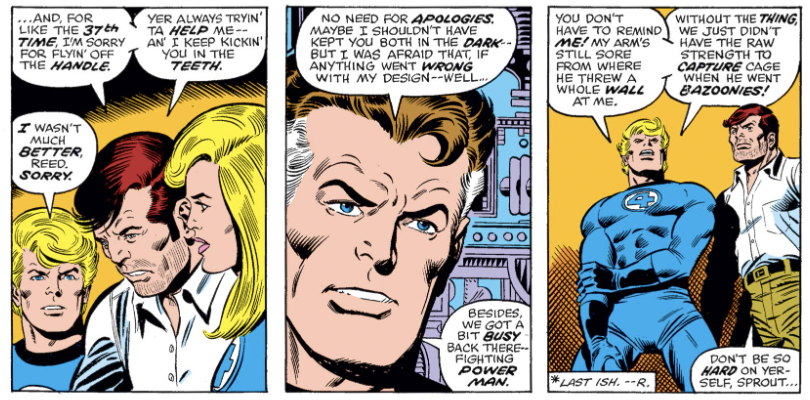
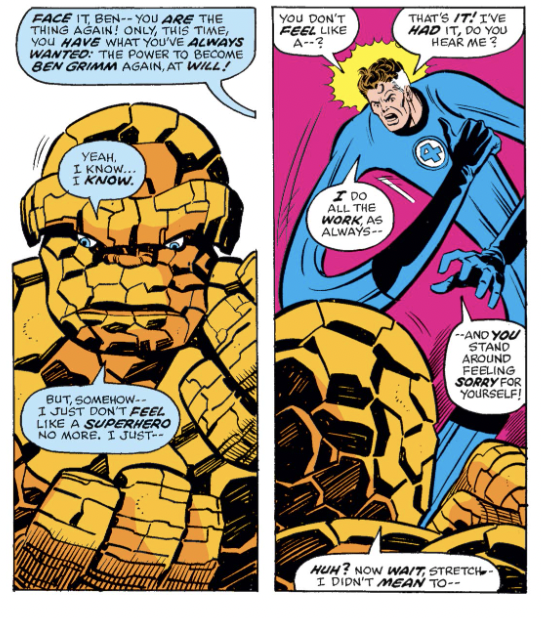
Ben and Reed are really the stars of this comic, and we are treated to lot of interplay between them. First, Ben apologizes for thinking Reed was replacing him with an extra-dimensional Thing:
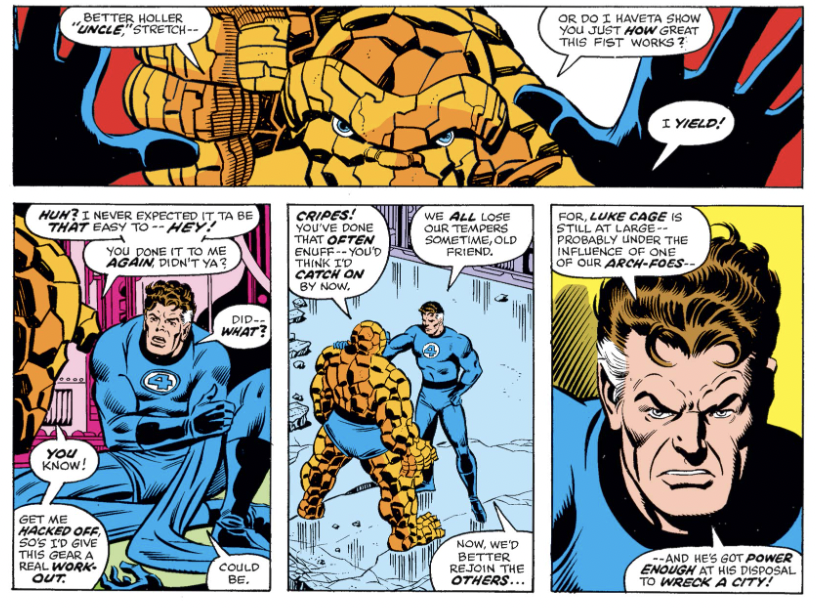
Then Reed loses his cool when Ben starts sulking again:
After a short fight, Reed gives up:
Did Reed goad Ben into a scrap to test the exoskeleton, or did he just lose his patience? I love the ambiguity in Reed’s non-answer.
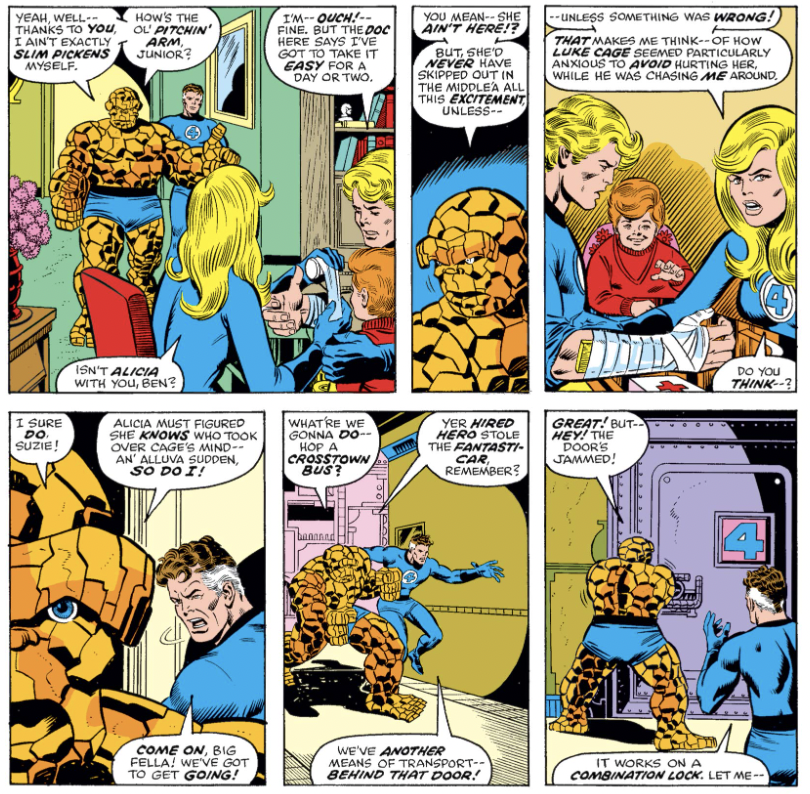
I also liked the FF’s teamwork in puzzling out the Puppet Master was behind Luke’s actions:
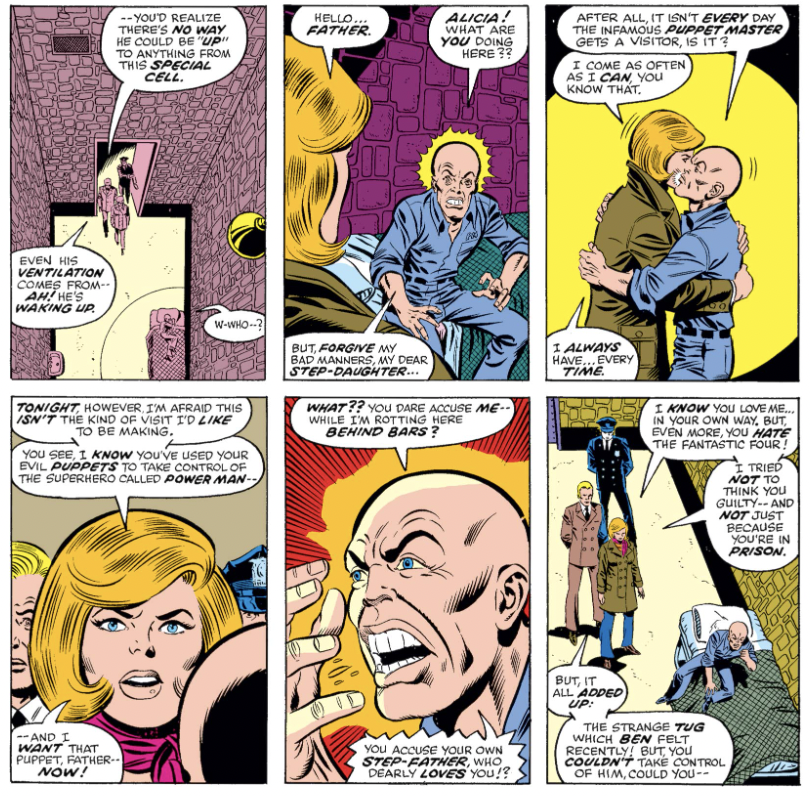
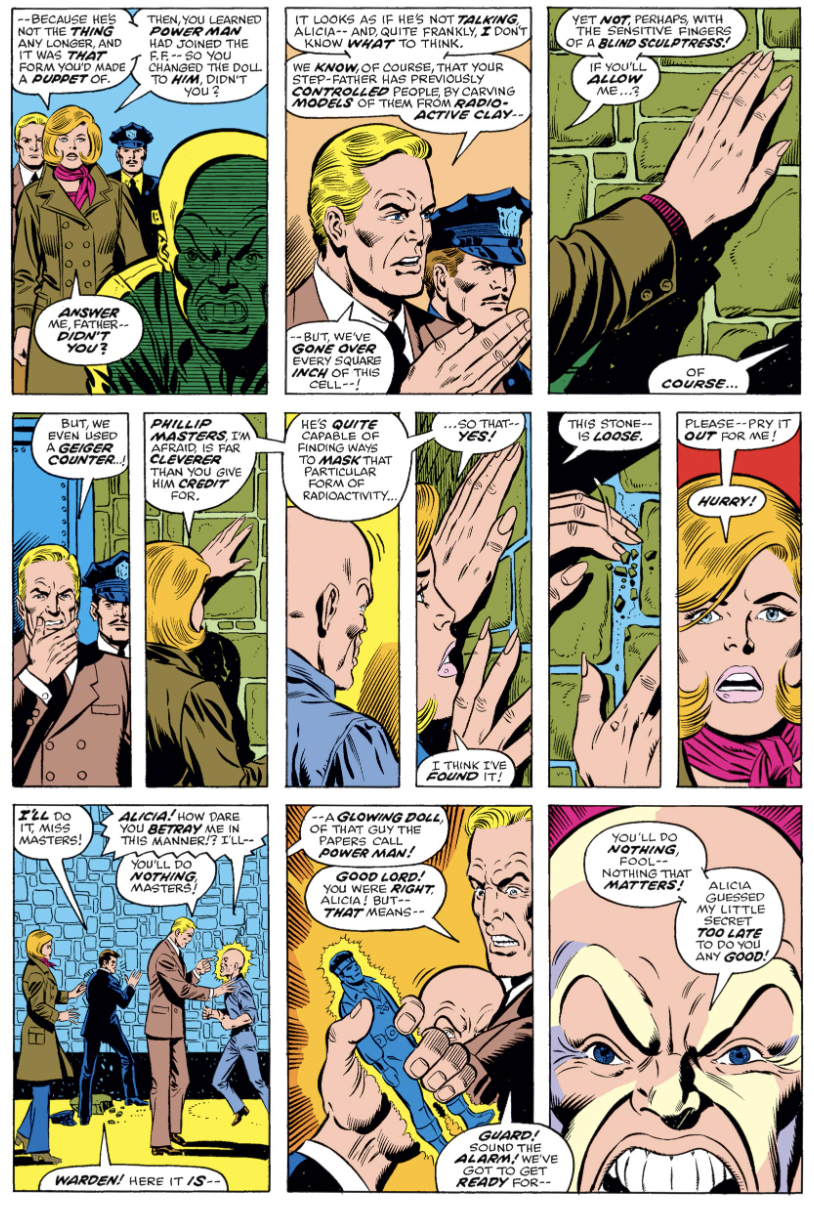
And I loved how Alicia took control, confronting her father and using her sensitive touch to detect where he hid the Power Man figurine:
This sequence continues with a masterful, 12-panel page from Perez. It’s stuffed with activity but never feels crowded:
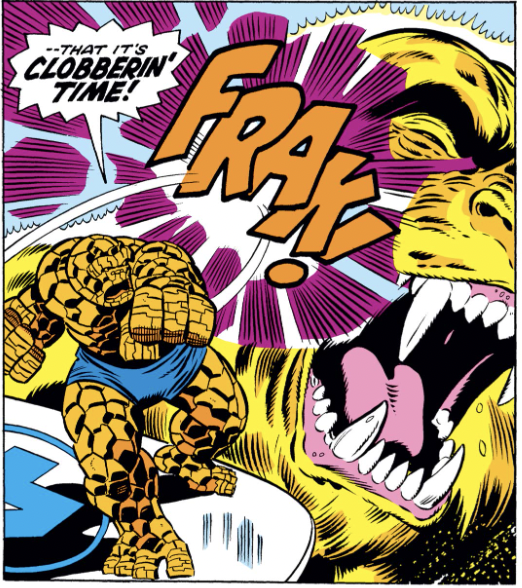
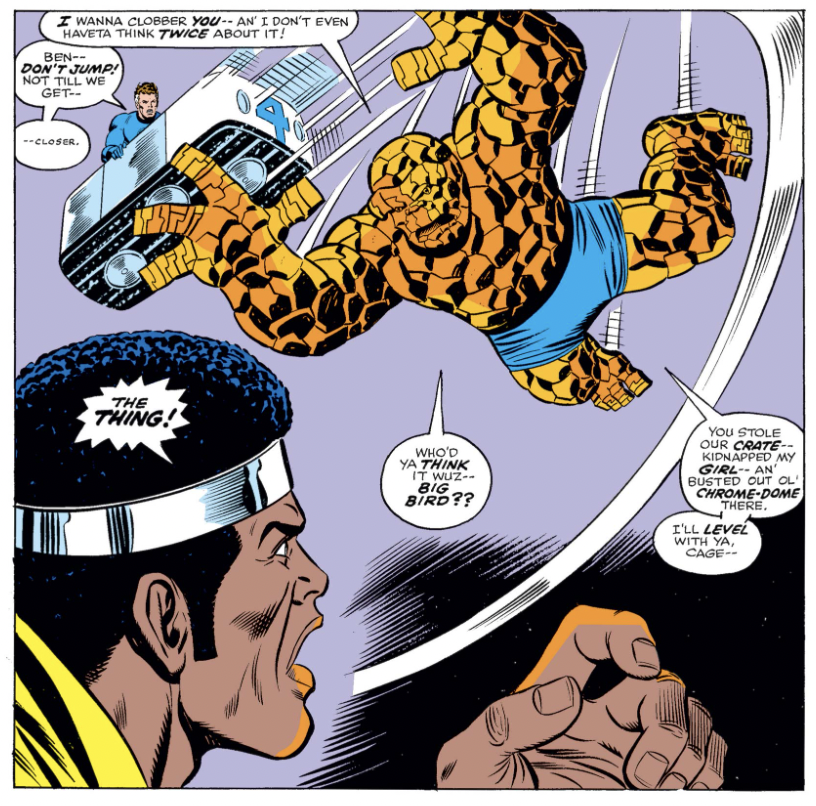
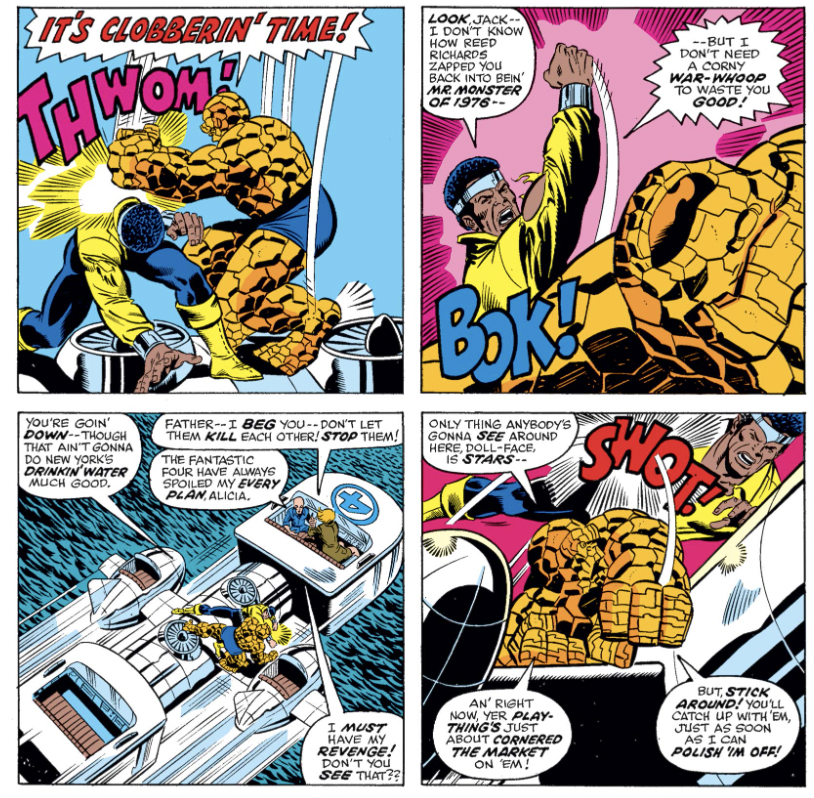
I also enjoyed the fight atop the Fantasti-car. Perez does a great job of conveying the precariousness of their position while Thomas supplied some fun dialogue (calling “It’s Clobberin’ Time” a corny war-whoop is just harsh).
What I didn’t like
Not much. Sue is shuffled off out of the action without any explanation, with the assumption being she needs to look after Franklin. Not great, but at least Alicia got some attention. Also, the fight between Reed and Ben seemed silly and like a bit of unnecessary padding. But I’m picking nits — this is a very good comic book.
Anything else
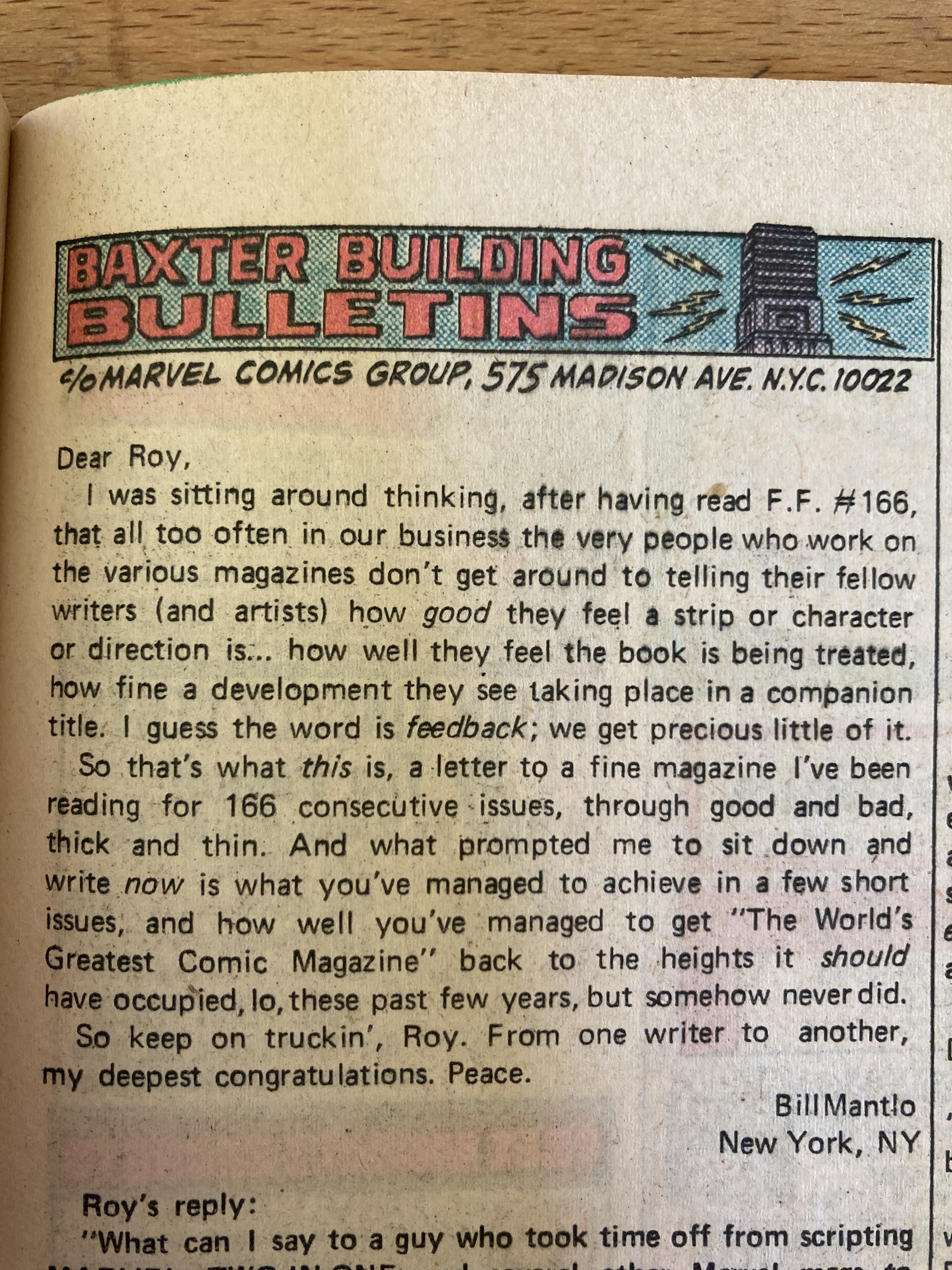
A letter from Bill Mantlo, already a prolific writer for Marvel at this point but who still wrote a fan letter. Mantlo left comics in the 1990s to become a lawyer, then suffered a horrible accident that left his severely disabled. You can read more about his life and accident in an article here.
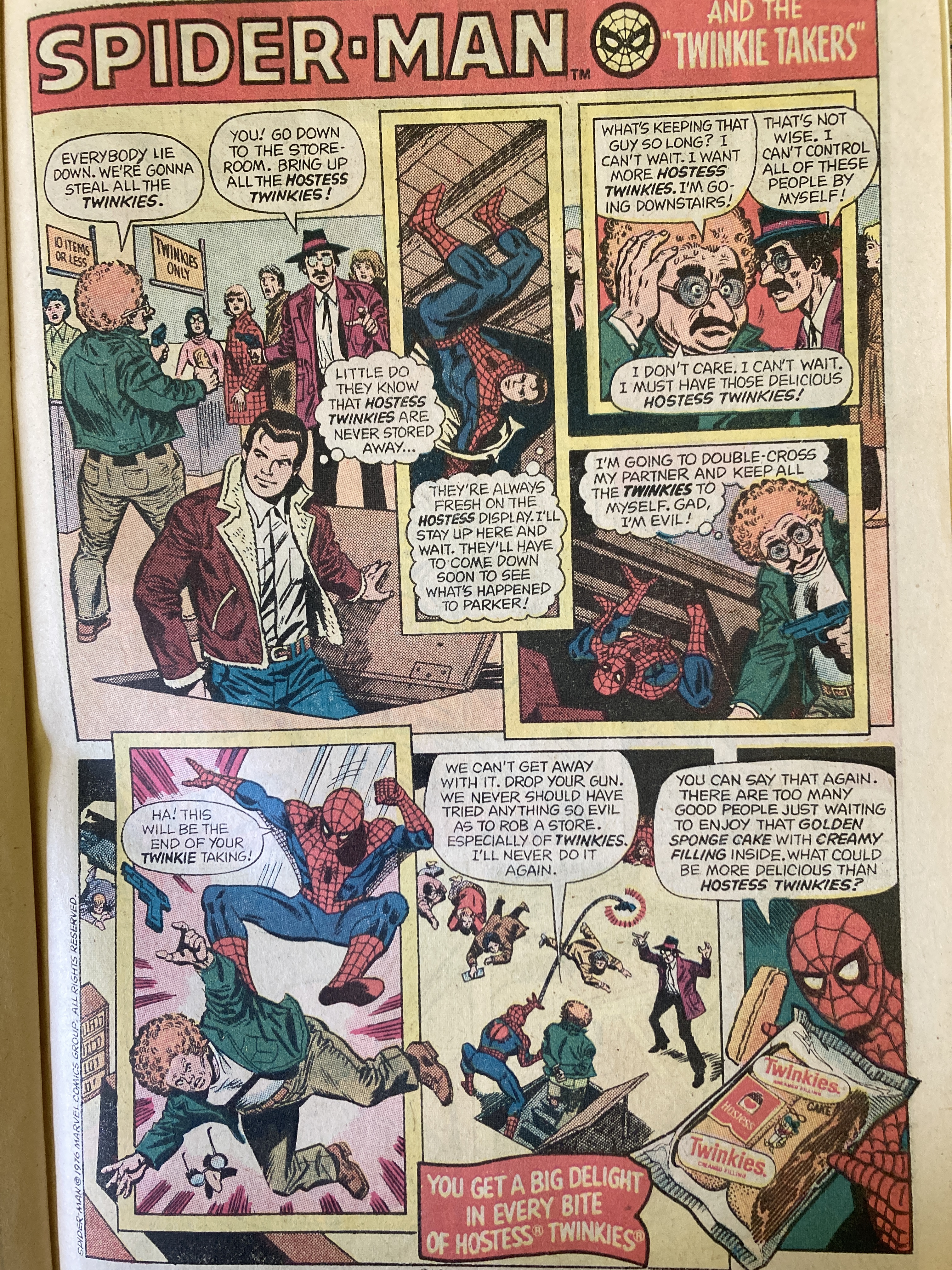
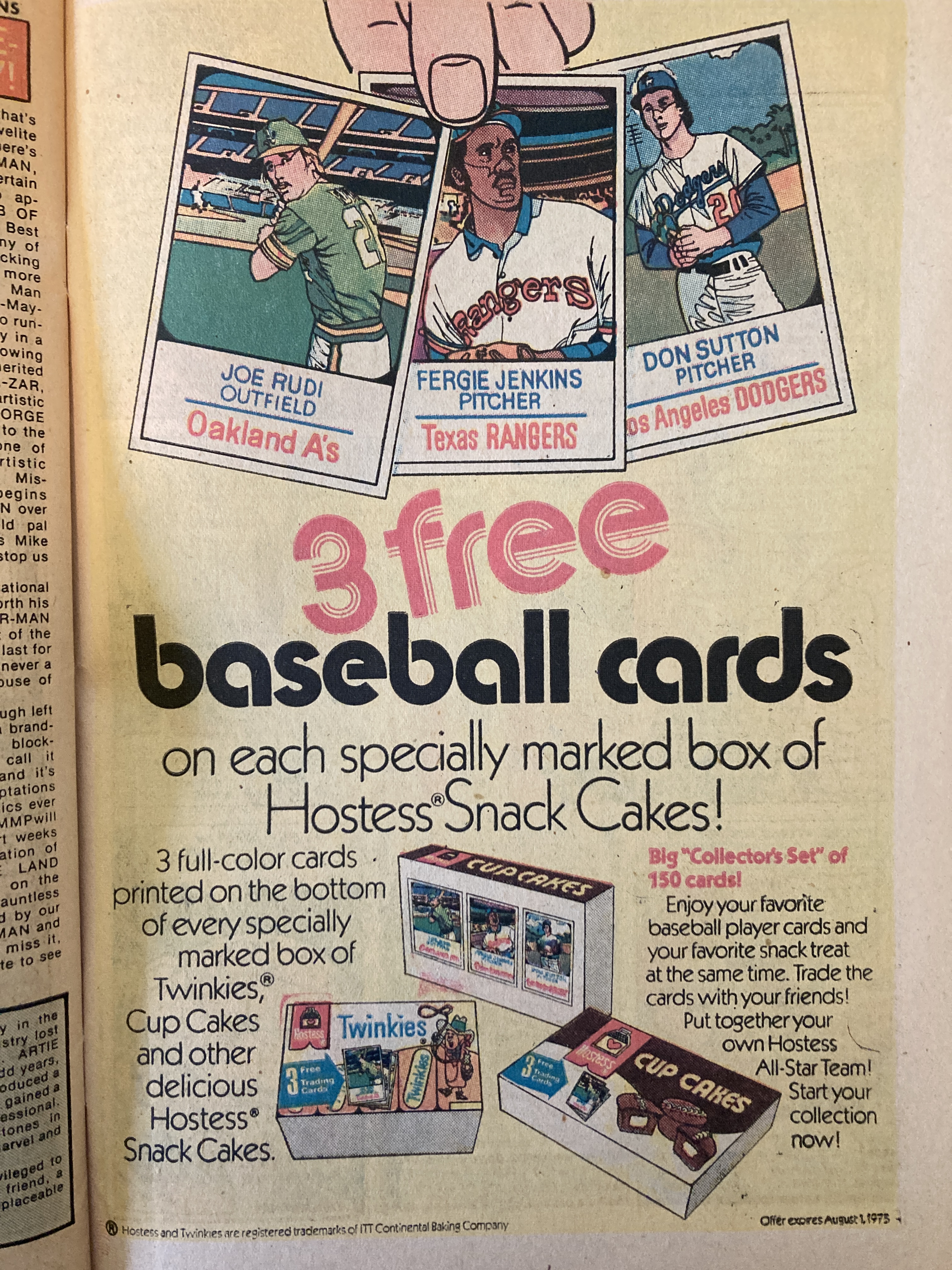
Also, Twinkies! is this the first of the long-running Hostess ads? It might be.
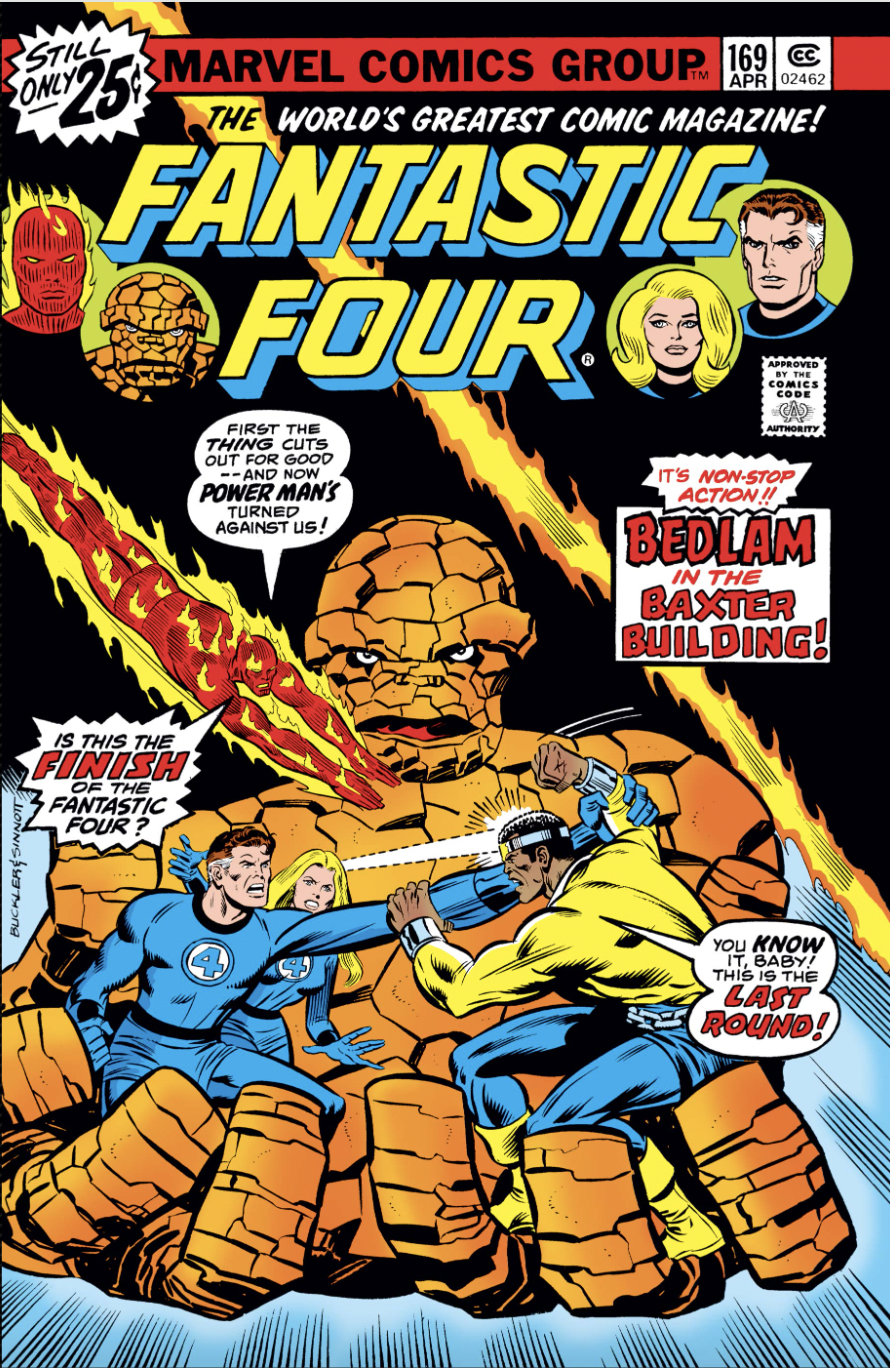
Fantastic Four 169 “Five Characters in Search of a Madman!” Published January 1976 Writer: Roy Thomas Pencils: Rich Buckler Inks: Joe Sinnott Letters: John Costanza Colors: Phil Rachelson Editor: Thomas Cover: Buckler and Sinnott
Synopsis
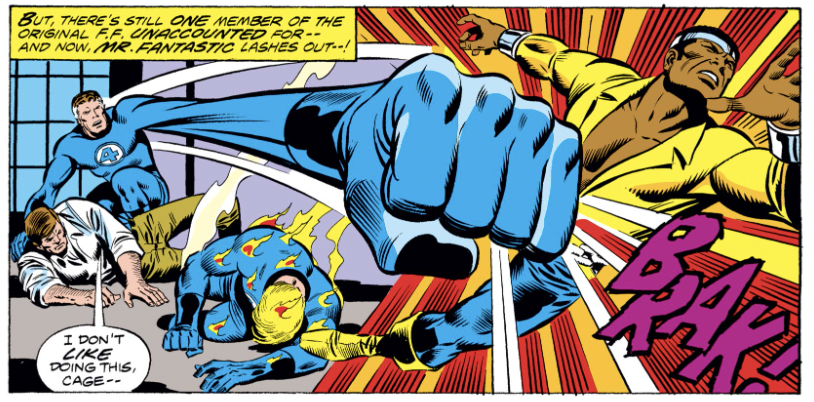
Ben Grimm, still adjusting to no longer being the Thing, gets tangled up in a bar fight before he’s rescued by Mr. Fantastic and the Human Torch. Meanwhile, Power Man — the FF’s newest member — kibitzes with the Invisible Woman and Alicia Masters before he falls under the mind-control of an unknown bad guy and attacks Sue. He battles Sue and the rest of the FF before fleeing in a Fantasti-car. The issue ends with Reed showing Ben a life-size replica of the Thing.
What’s going on here?
This comic continues an arc about a de-powered Thing began last issue and is on the whole a lot more successful. Ben is still struggling with his new reality, but instead of picking needless fights like last issue, he is instead vents his frustration in a bar brawl not of his making. And Power Man’s heel turn make sense when we’re reminded of the clues dropped by Roy Thomas last issue. There’s also some interesting character development, between Ben’s brooding introspection and Sue’s chit-chat with Luke.
This issue also marks the end of Rich Buckler’s first run on the FF (he’ll return to draw another half-dozen issues in the last eighties). Buckler’s work on the FF was generally solid, with some high points and few duds. Of the three main pencil artists on the FF to this point — Jack Kirby, John Buscema and Buckler — he’s clearly the weakest, but thanks to Joe Sinnott’s steady inks, the book never diverged far from the standard set by Kirby.
What I liked
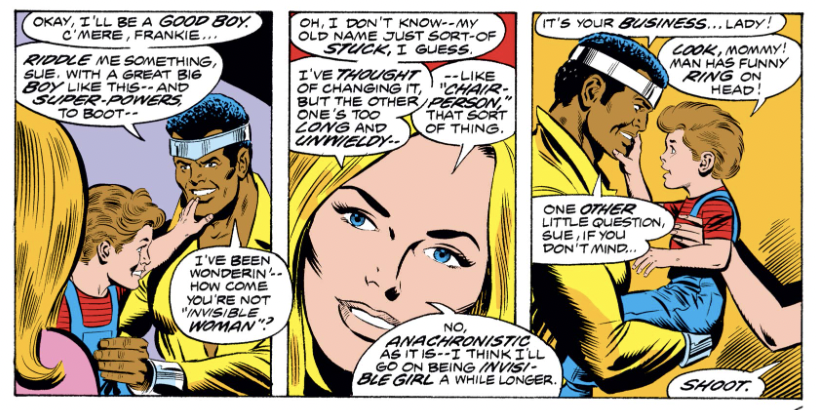
Regular readers of this blog know I have complained about Sue’s treatment under Stan Lee and Gerry Conway. Thomas has expanded her powers and slowly added depth to her character. Here, she provides an answer to a question many readers probably have about her name:
She eventually changes her name to Invisible Woman in issue 284.
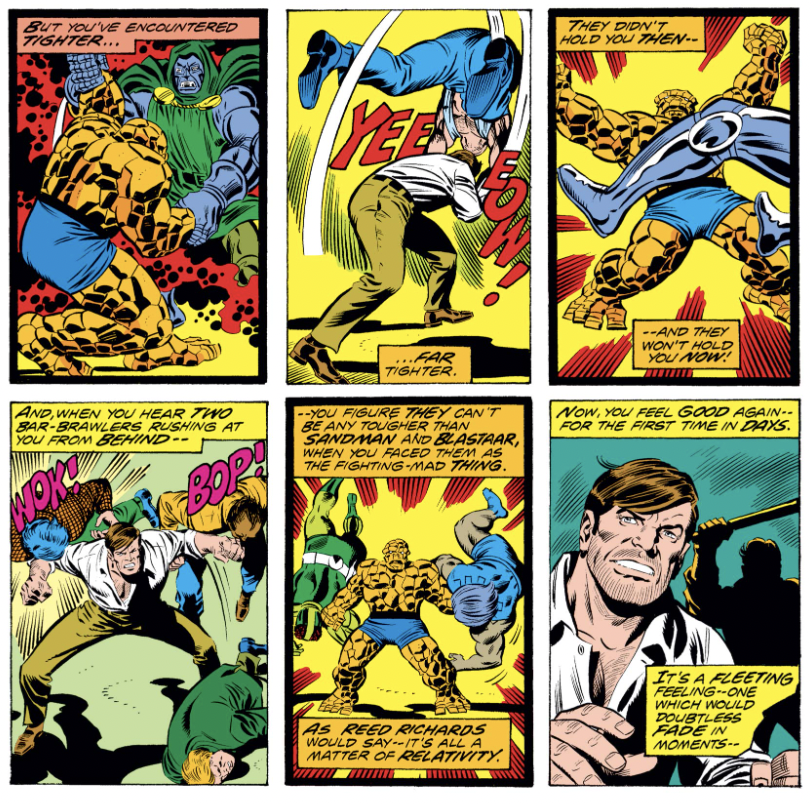
I also liked how Thomas and Buckler alternate Ben’s flashbacks to fighting as the Thing with his present barroom brawl:
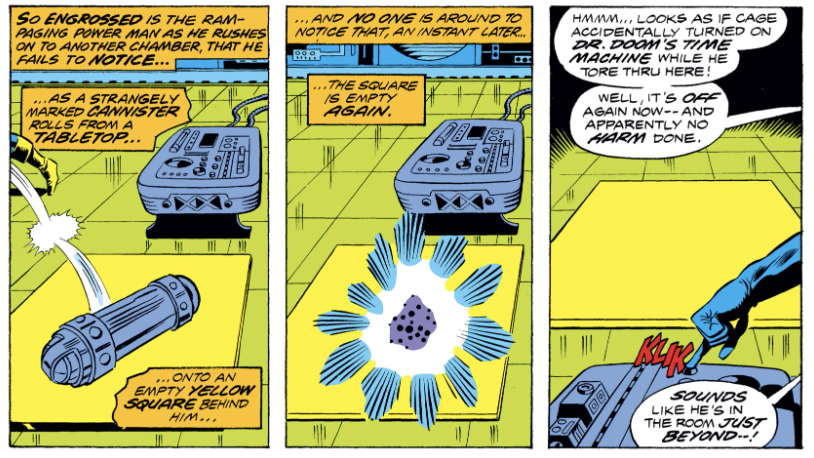
I also liked this tease of future (or maybe past) mayhem involving Dr. Doom’s time machine:
What I didn’t like
Thomas is up to his old tricks again, with heavy-handed narration and a title that seems designed to show off that he went to college (it’s a play on Pirandello’s “Six Characters in Search of an Author”) without making much sense.
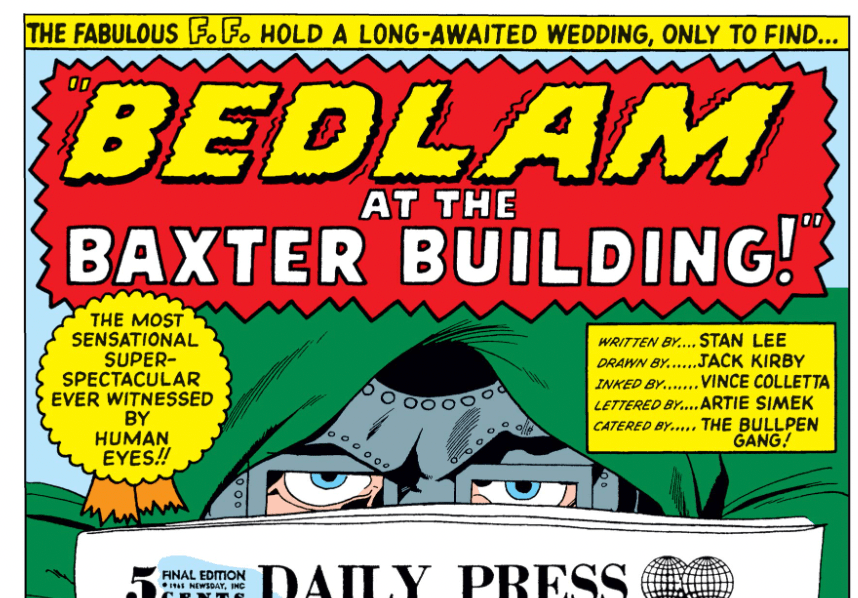
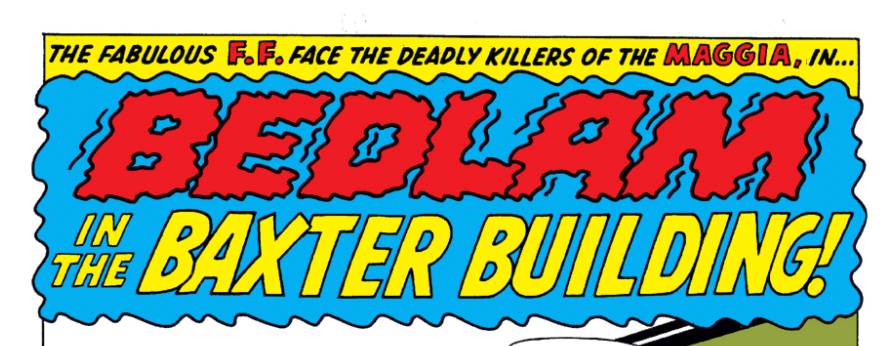
He also rolled out the cliched “Bedlam in the Baxter Building” blurb on the cover, reprising a title used for Fantastic Four Annual 3 and FF 101.
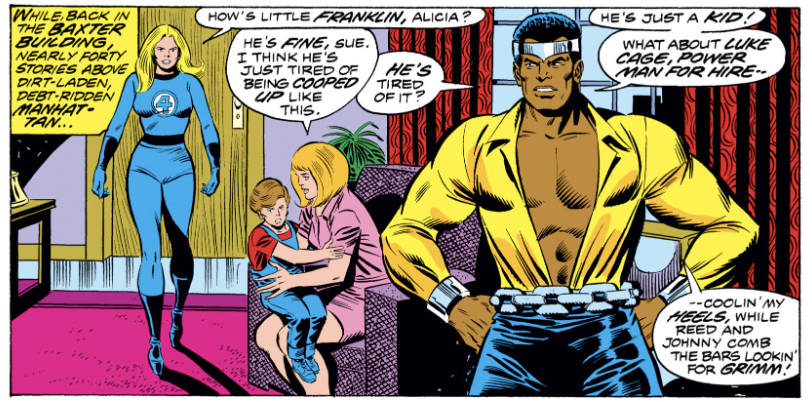
Also, Thomas is a good enough writer to avoid this silly introduction for Luke. Maybe Luke should give his resume while he’s reciting his title.
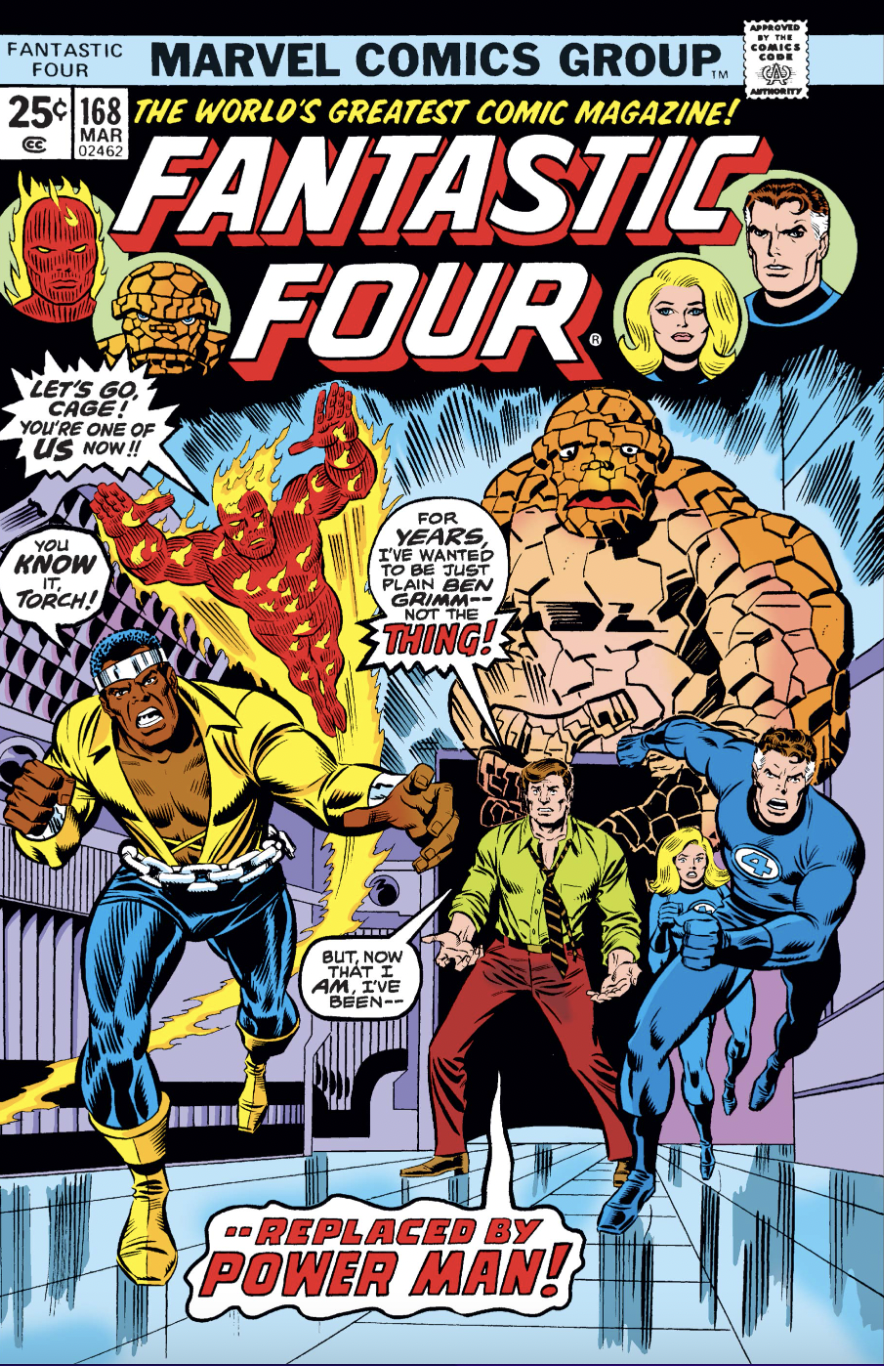
Fantastic Four 168 “Where Have All The Powers Gone?” Published December 1975 Writer: Roy Thomas Pencils: Rich Buckler Inks: Joe Sinnott Letters: Joe Rosen Colors: Phil Rachelson Editor: Thomas Cover: Bucker and Sinnott
Synopsis
As Ben Grimm struggles with his adjustment to being human again, Mr. Fantastic tells him he’s hired Power Man to replace him on the roster, noting that the FF’s charter requires four super-powered heroes on the team. Ben does not take this well, and when the team goes on a mission to confront the Wrecker, he gets underfoot and needs to be rescued by Power Man and the rest of the team.
What’s going on here?
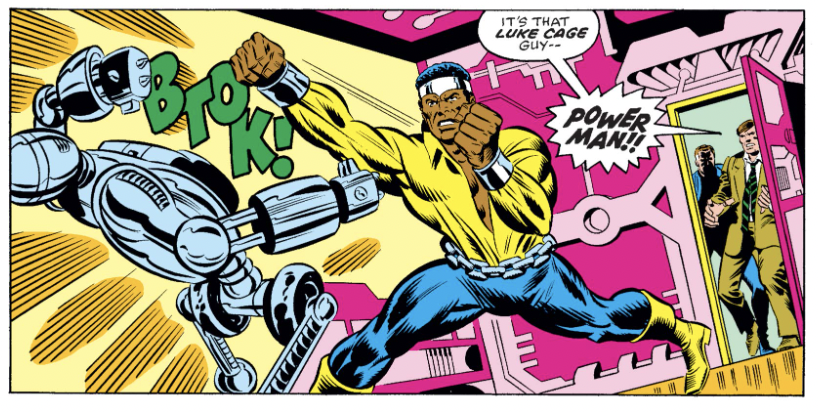
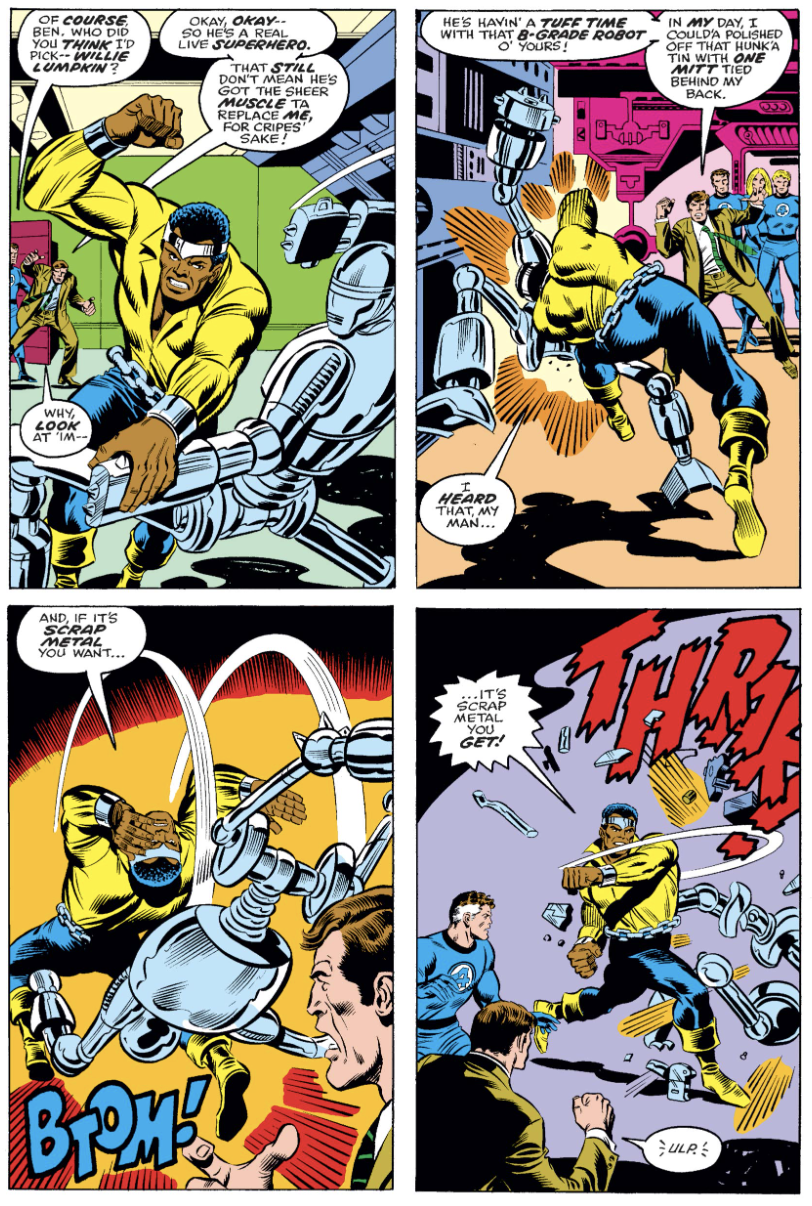
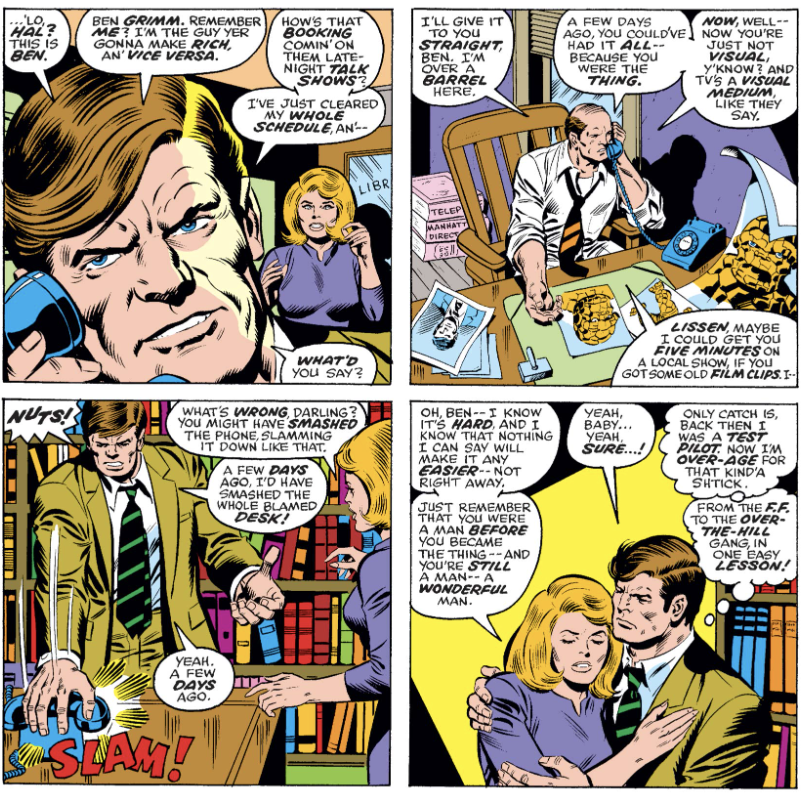
This is a notable issue for one big, obvious reason — Luke Cage joins the Fantastic Four! And while the story doesn’t live up to its potential, it’s still worth considering that Cage is just the third member of the team outside the Core Four, following Crystal and Medusa. He’s also the first person of color on the team. Unfortunately, he’s really only on the team to serve as a foil for Ben, and he’s dropped into the comic without any lead up or context. It would have been fun to tell the story from his perspective, and to see his reaction when Reed first approaches him, but we don’t get any of that. We don’t even get a “Sweet Christmas!” But we do get a lot of Ben’s being a boor.
Cage was an interesting choice for fill-in. To a certain degree, it makes sense, since he’s literally hero for hire. But he doesn’t have a history with the team, like Spider-man or even Daredevil, and I’m not aware of them ever crossing paths before. I’m guessing Cage is there to give him a bit of exposure and bump up sales of his own comic.
What I liked
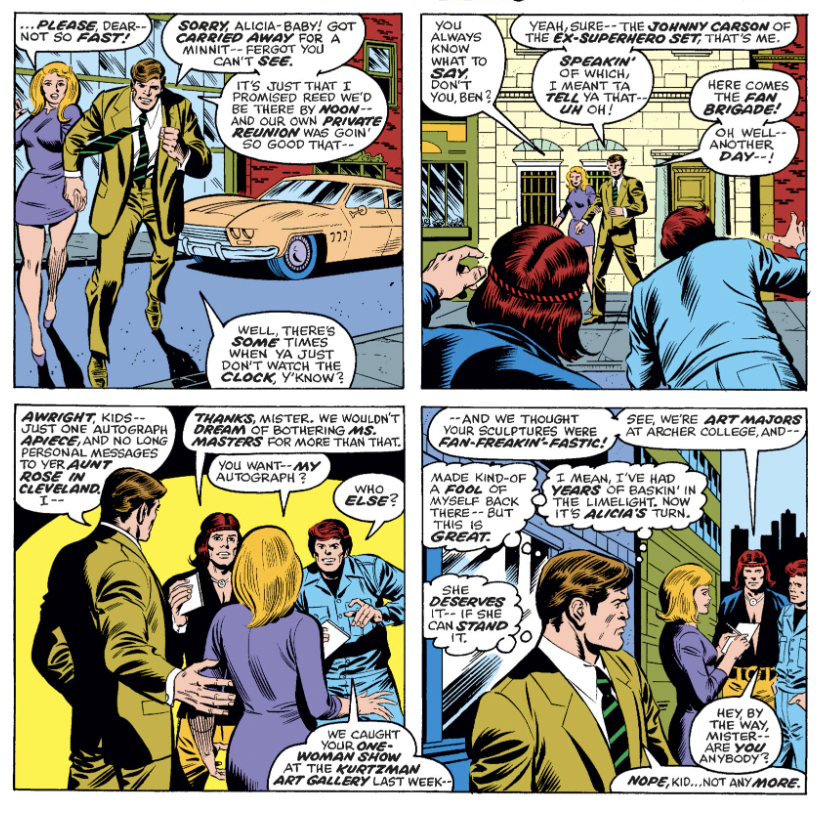
The comic is at its best when we’re in the company of Ben and Alicia, who are clearly enjoying Ben’s return to human form. (A more provocative writer would have had Alicia become pregnant while Ben was human, which would have created an interesting dynamic. Maybe someone could write a What If?). It’s fun seeing Ben step back and let Alicia enjoy meeting her fans (and note the reference to comic creator Harvey Kurtzman).
After four issues of art from George Perez, Rich Buckler is back, and while he’s not in the same league as Perez, he does a fine job here. The contrast between Perez’s layouts, with pages crammed with panels an intricate backgrounds, and Buckler’s simpler approach is pretty jarring.
What I didn’t like
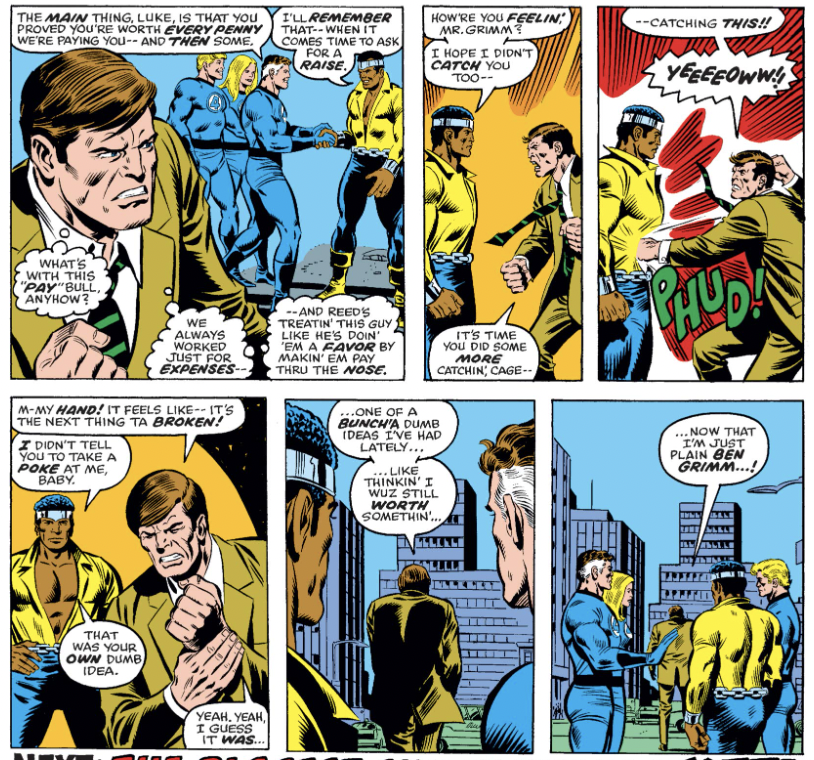
The entire issue is wrapped around Ben’s inability to adjust to no longer being the Thing. And while some of that is understandable — he’s no longer the idol of millions etc — it does start to feel like whining. For most of the last 167 issues he’s complained about being trapped in a monster’s body, and now he wishes he was the Thing again? The story (and Ben) would have been better served with more balance, and including more of his and Alicia’s joy. Unfortunately, he spends most of the issue acting like a self-pitying jerk, and the confrontation with the Wrecker serves no purpose other than to pit Ben against cage.
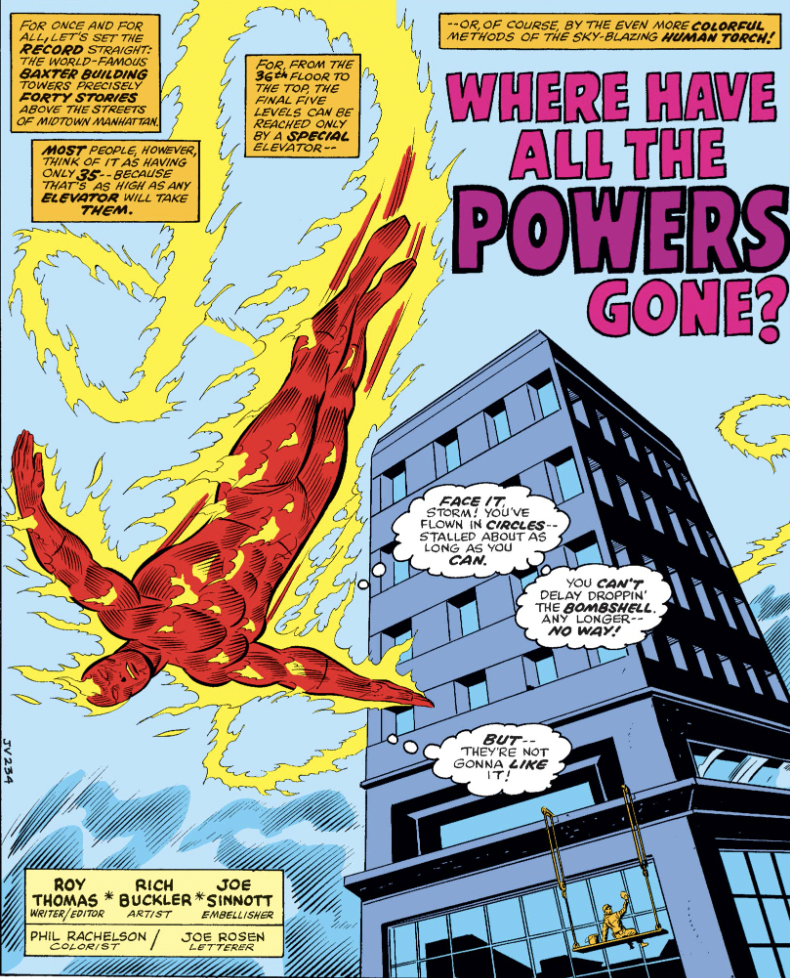
I’m not sure how many times the Baxter Building has been depicted in the Fantastic Four, but surely Buckler could have consulted one before drawing this splash page. Unless Thomas retroactively decided it was the Baxter Building after Buckler handed in the page. (Note the story title is a punny reference to a popular folk song):
Anything else?
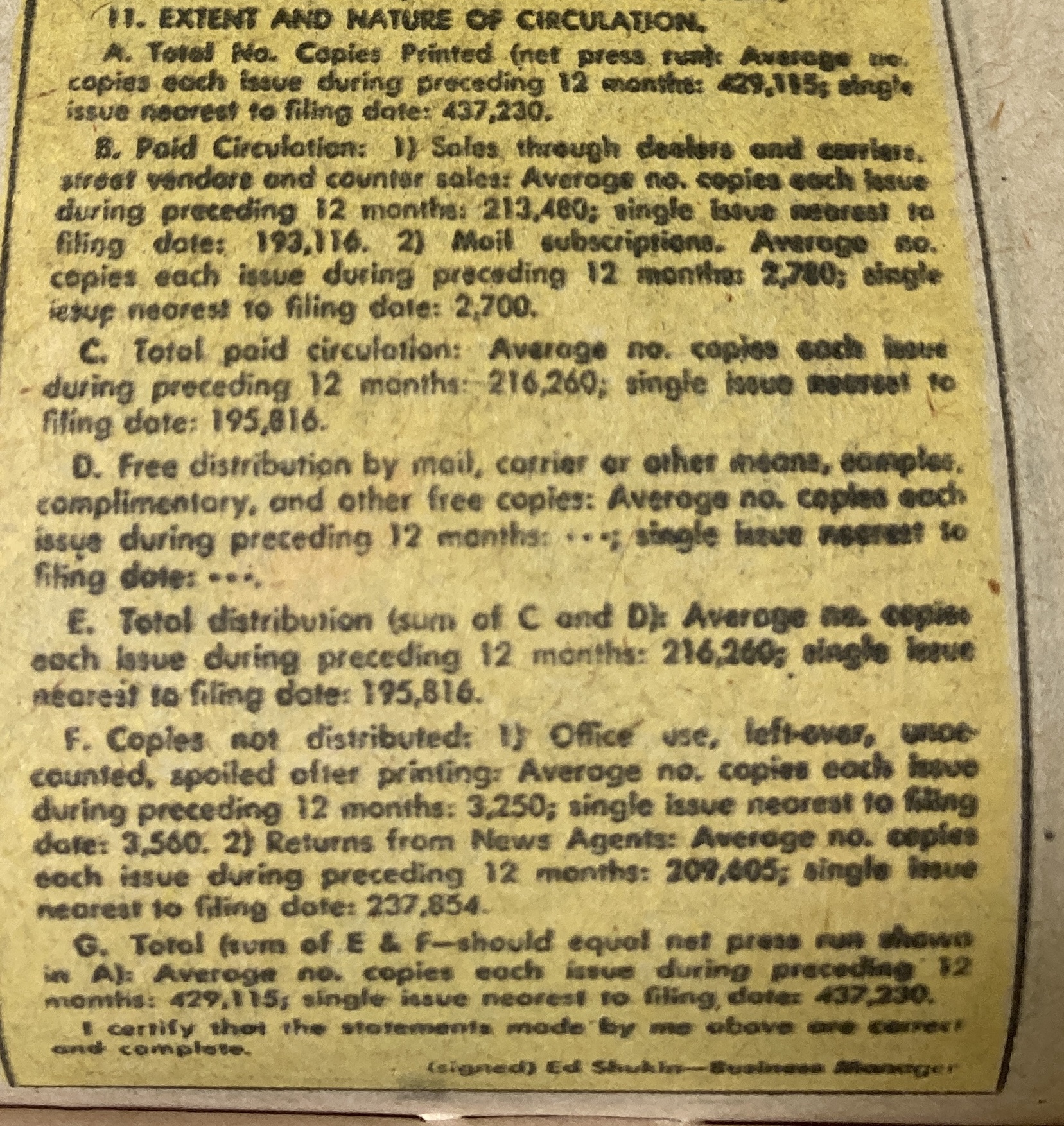
The letters page included the annual statement of circulation. Twelve month average is about 216,000 (it’s amazing how many issues get returned).
Overall
A landmark issue that doesn’t live up to its potential
Fantastic Four 167 “Titans Two!” Published November 1975 Writer: Roy Thomas Pencils: George Perez Inks: Joe Sinnott Letters: Joe Rosen Colors: Phil Rachelson Editor: Thomas Cover: Jack Kirby and Joe Sinnott
Synopsis
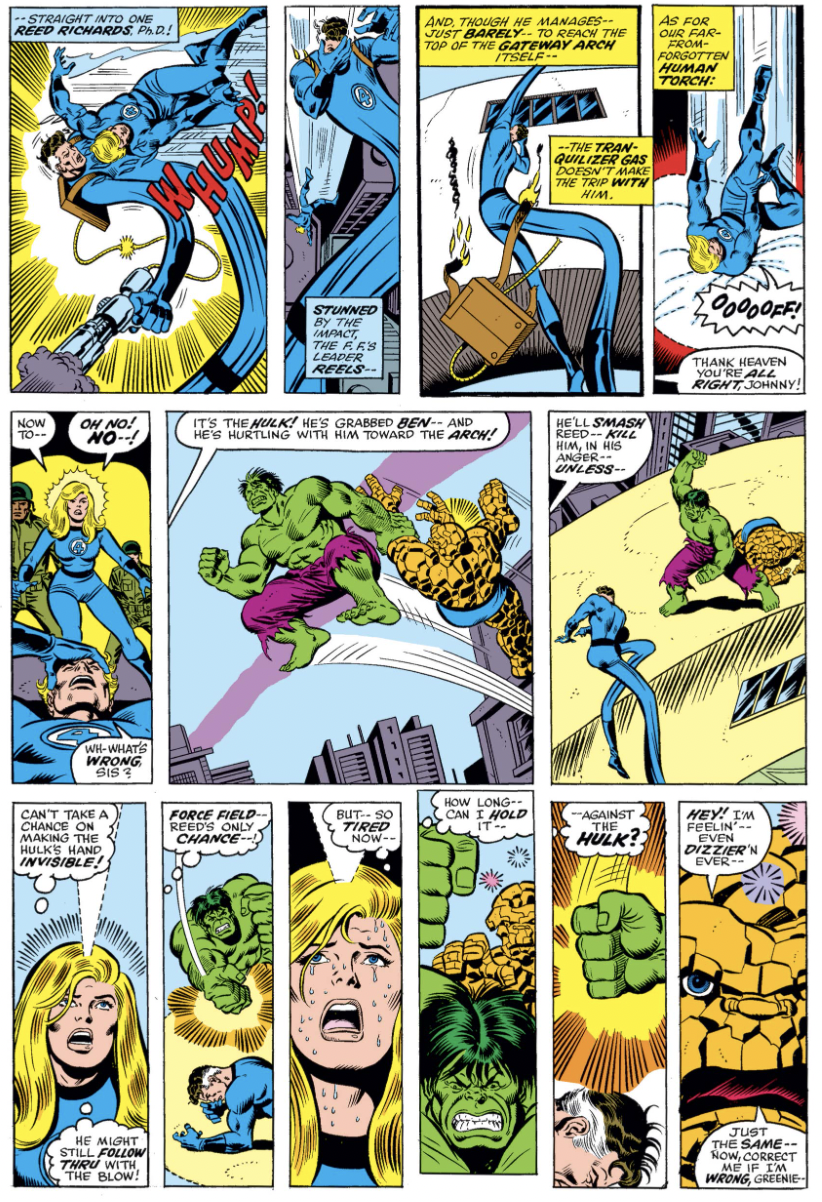
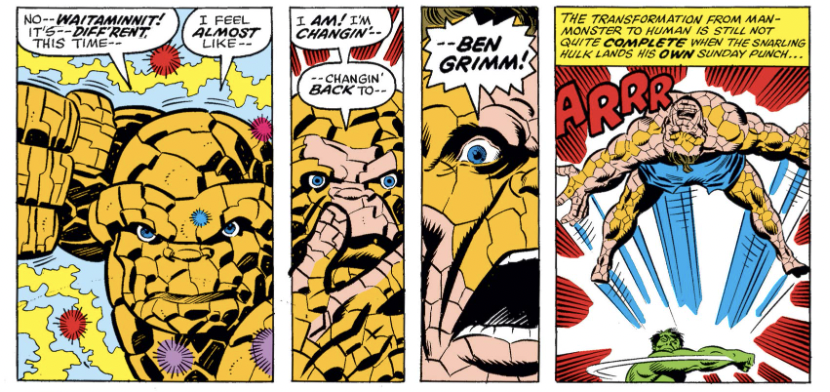
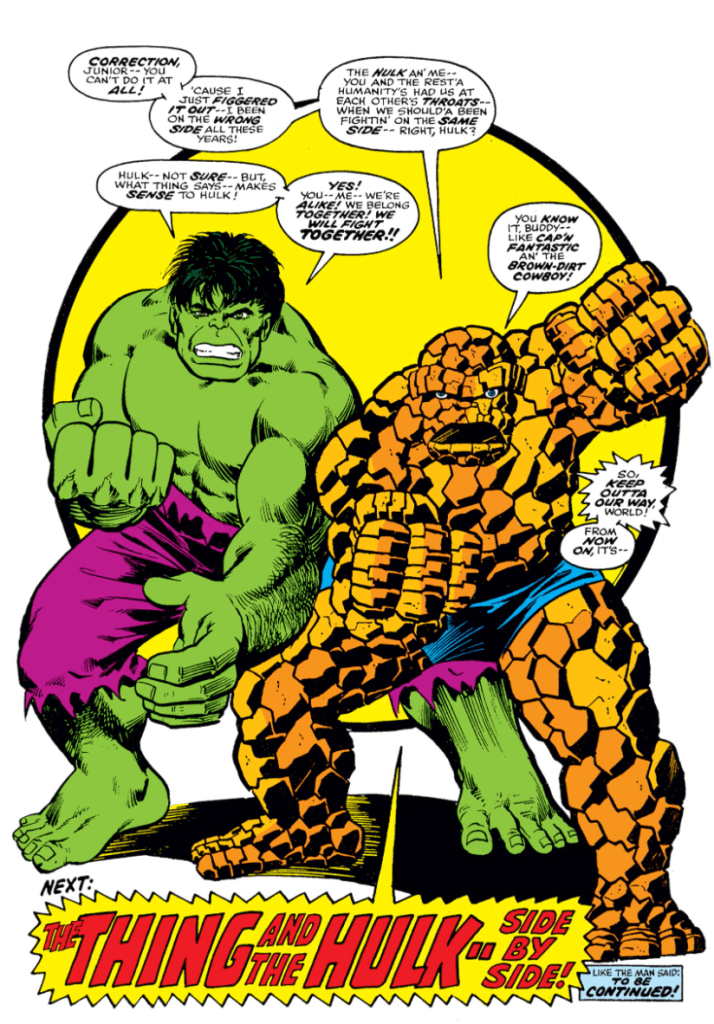
After the Thing frees the Hulk from the military’s device, the two escape in an aircraft, heading toward St. Louis. The Hulk demands they alight at the Gateway Arch, where they are eventually attacked by the rest of the Fantastic Four. When he sees his teammates in danger, Ben sides with them agains the Hulk but suddenly begins to change into his human form, a result of exposure to the Hulk’s gamma radiation. He is easily defeated by the Hulk, who escapes.
What’s going on here?
This is a pretty unsatisfying end to a two-part story that had a lot of promise toward the end of last issue, where Ben realizes he and the Hulk are both monsters. The Thing alludes to that solidarity at a few places in the issue, but Roy Thomas doesn’t do much with it and it doesn’t take much for Ben to switch sides again. Thomas instead inserts a subplot of the Thing growing weak and dizzy in the Hulk’s presence, which eventually leads to him becoming human again. None of it makes much sense, and the two-issue arc feels very gimmicky, as it reads mostly as an excuse to shoehorn the Hulk into an FF comic (more guest stars will appear next issue, further evidence that Marvel was trying to goose the FF’s sales).
Joe Sinnott returns to ink George Perez, and it’s a big improvement over Vince Colletta, last month’s inker, although Sinnott can still overpower Perez at times (most times, really).
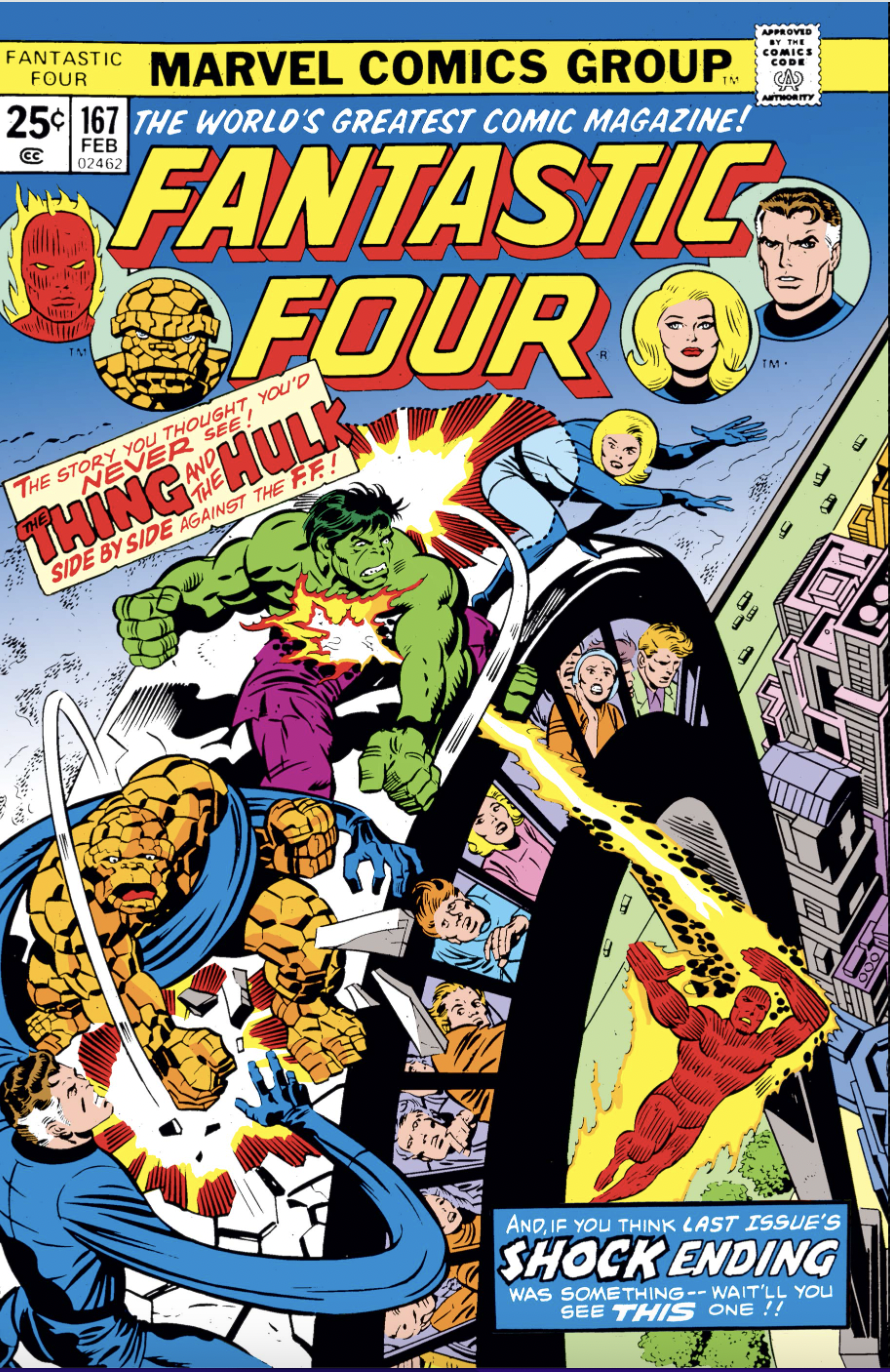
And speaking of over-powered, Jack Kirby’s pencils are unrecognizable on the cover under Sinnott’s inks. On closer examination I can see touches of Kirby — Reed’s legs, Sue’s posture, the faces of the spectators — but it’s certainly not obvious.
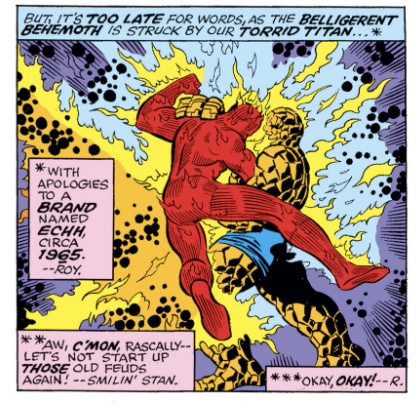
There’s also more inside-baseball in the issue, this time in the form of back-and-forth editor’s notes between Roy and Stan. I’m not sure what they are referencing — Branch Ecch was always code for DC, but who is the Torrid Titan (circa 1965)? — but this sort of thing always endeared me to Marvel when I was a young reader.
What I liked
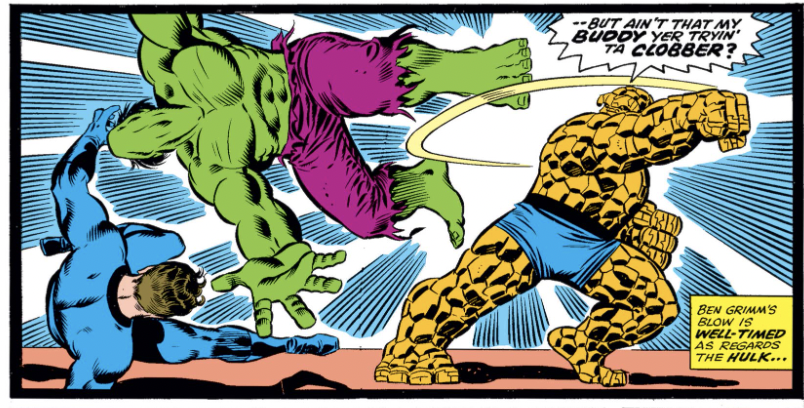
There are some fun Perez sequences in this comic, like this one:
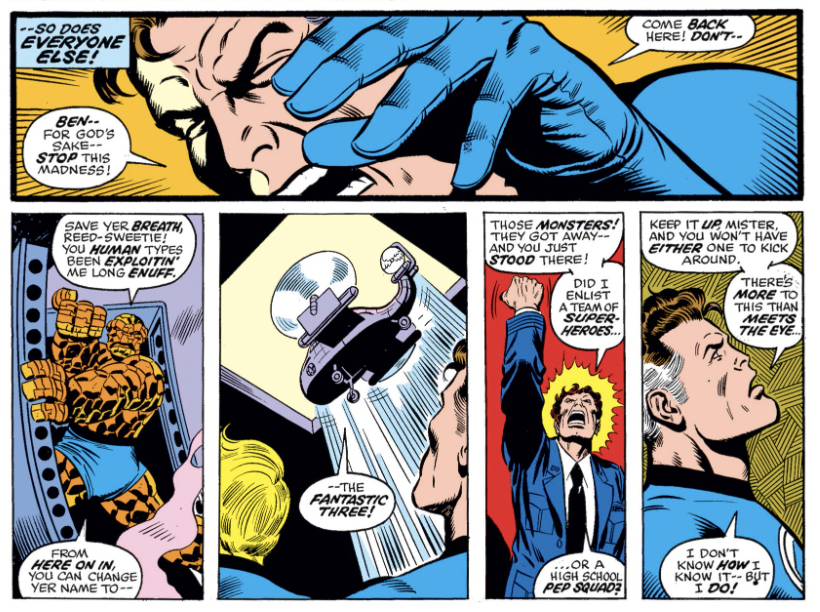
And this amazing page, with 13 — count ’em, 13! — panels:
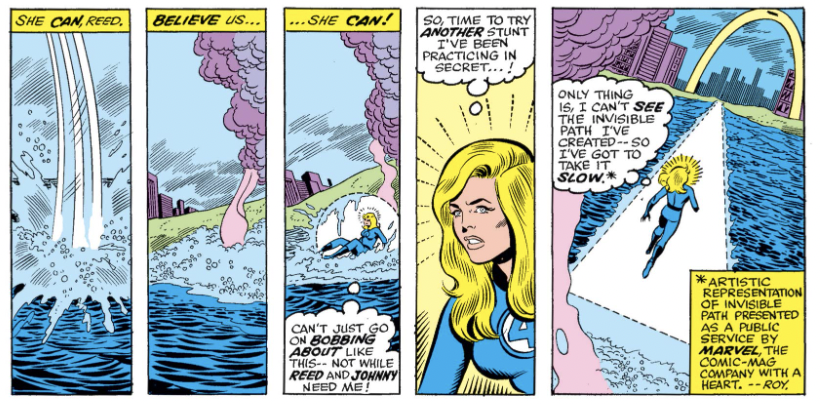
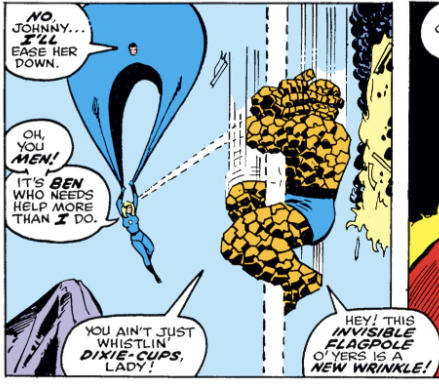
Now that Sue’s powers are beefed up, she is shown using them in more interesting ways, like so (and note the footnote):
What I didn’t like
Ben changing into his human form is hard to understand since A, Ben’s powers didn’t come from gamma rays and B, he’s been exposed to the Hulk before. I don’t know if this comes up again, but it sure seems like it would be an easy way to cure Ben of his monstrous form. It’s yet another unexpected curveball thrown at Ben that doesn’t seem based in much from a story or scientific standpoint.
Anything else?
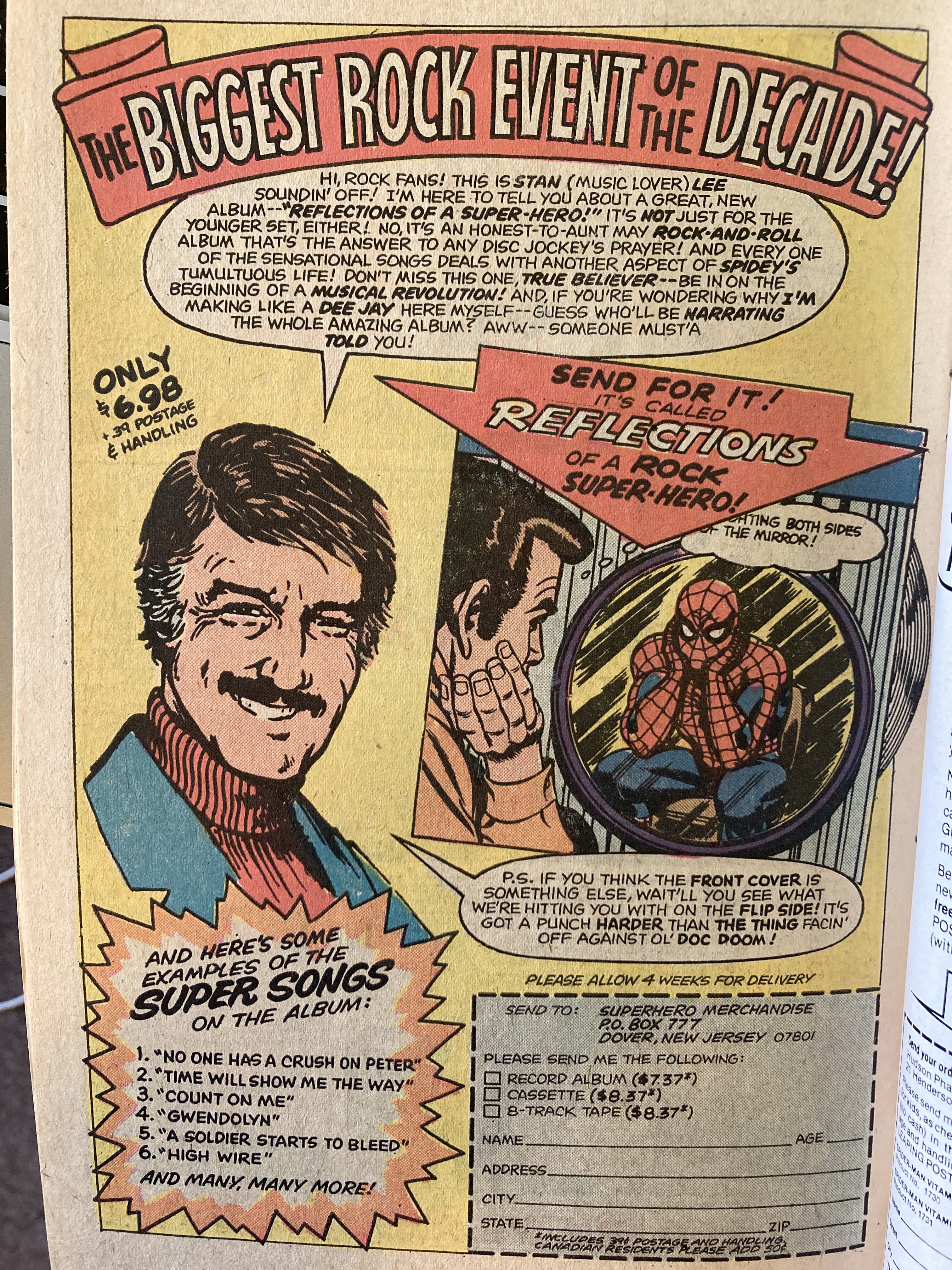
I don’t even know where to begin with this house ad:
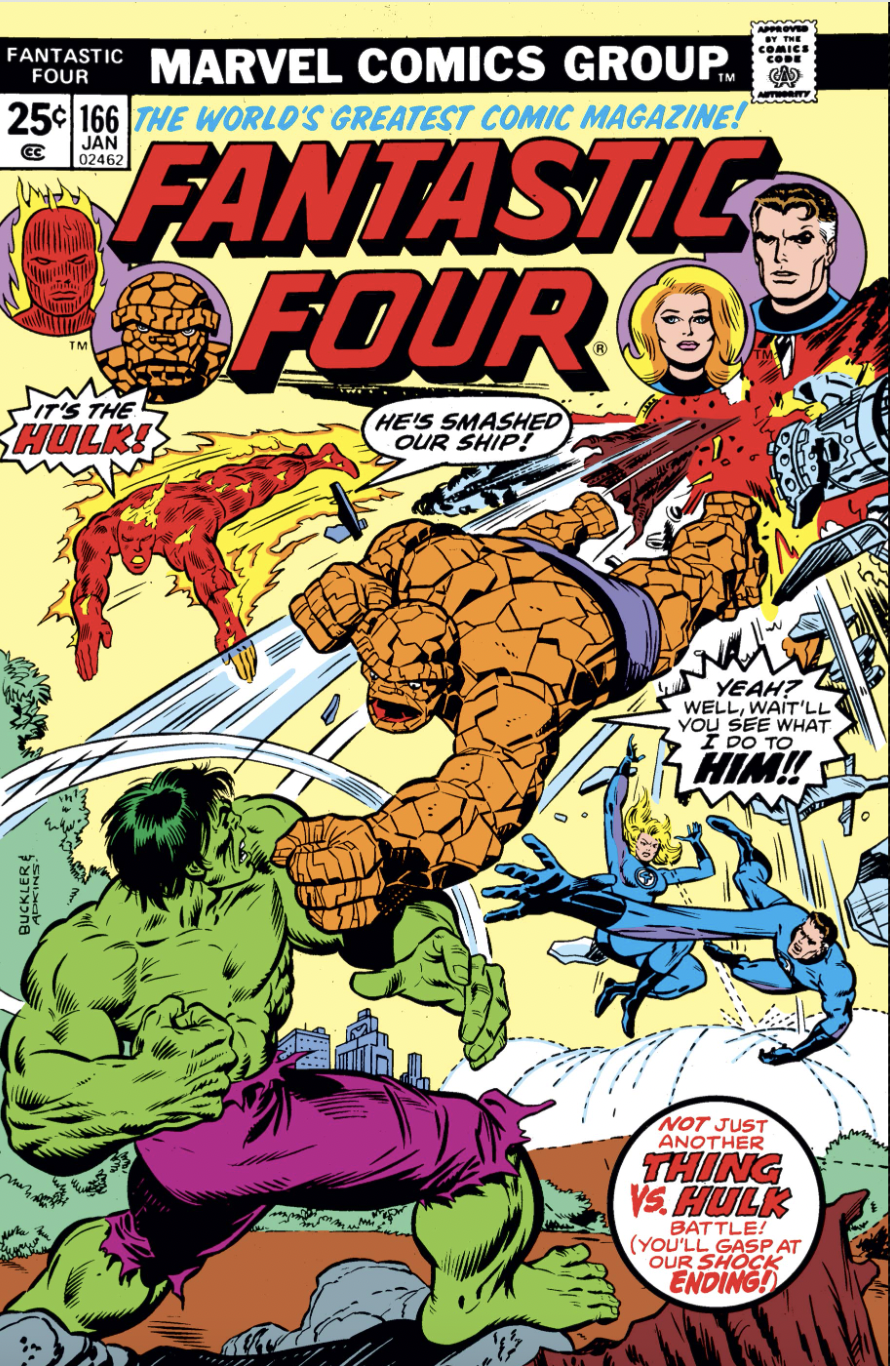
Fantastic Four 166 “If It’s Tuesday, This Must Be The Hulk!” Published October 1975 Writer: Roy Thomas Pencils: George Perez Inks: Vince Colletta Letters: Joe Rosen Colors: Phil Rachelson Editor: Thomas Cover: Rich Buckler and Dan Adkins
Synopsis
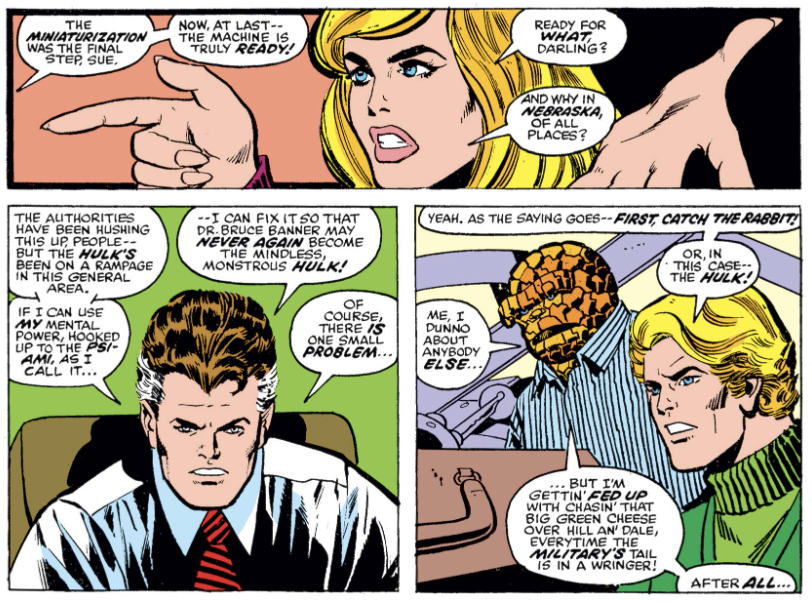
At the behest of the military, the Fantastic Four are flying west to find the Hulk, whom Mr. Fantastic thinks he can prevent from transforming from Bruce Banner with a device of his invention. Their plane is damaged by the Hulk, and after the FF help with an emergency landing, the team eventually captures the Hulk and helps the military secure him. But when it’s clear the authorities aren’t releasing Banner to the FF as agreed, the Thing frees him and joins the Hulk to fight the military.
What’s going on here?
This a bit of an odd issue. The mission to end Banner’s transformations into the Hulk seems to come out of nowhere, and it feels more like an opportunity to get the Hulk on the cover than to tell a good story. The story is padded out with a long sequence of the FF rescuing the plane (and with two pages for letters) but it picks up toward the end.
What’s most alarming about this comic are the inks of Vince Colletta, who is filling in for the Joe Sinnott. Colletta is infamous among comic book fans for butchering Jack Kirby’s work on Thor (it’s well documented here), and he’s accused of taking shortcuts and even erasing details that would take too long to ink. I always felt the criticism was probably over the top, given the passions Kirby evokes in his fans, and that Colletta was a journeyman professional who was doing a job as best he knew how (he is credited with working on more than 1,600 comics over the length of his 40+ year career).
But he does George Perez no favors in this comic. There is a distinct lack of Perez’s signature detail, and his faces look frozen and static. Here’s a good example:
It’s almost unrecognizable as Perez, and even though this is early in Perez’s career, we saw in the last two issues (inked by Sinnott) that many of his characteristics were apparent even at this stage.
In last month’s letters page there was an explanation that regular FF penciler Rich Buckler was unavailable for some reason, and that Perez was pressed into service. It’s possible he had to rush to complete this issue, and was only able to do layouts, leaving emergency inker Colletta the task of finishes. (The padded story and the double letter page would support that theory). In any event, the art in this comic is an unfortunate disappointment after the brilliant FF debut of Perez in the last two issues.
And one footnote: the cover by Buckler was inked by Dan Adkins, a longtime comics inker doing his first work on the Fantastic Four.
What I liked
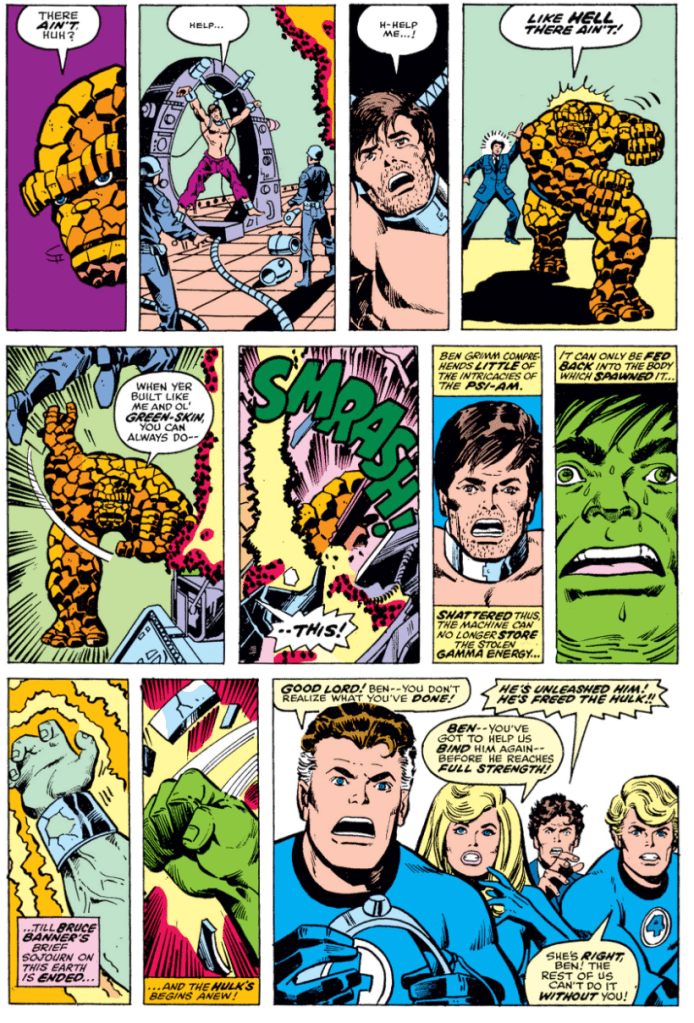
Despite the shaky premise, the story becomes a good one as the plot develops and Ben’s outrage over the treatment of the Hulk — in his eyes, a fellow monster — at the hands of the military builds from a simmer to boil. His decision to free Banner is genuinely surprising. This is a pretty dramatic sequence, enhanced by Perez’s layouts, which build from an 11-panel page (!) to a great splash:
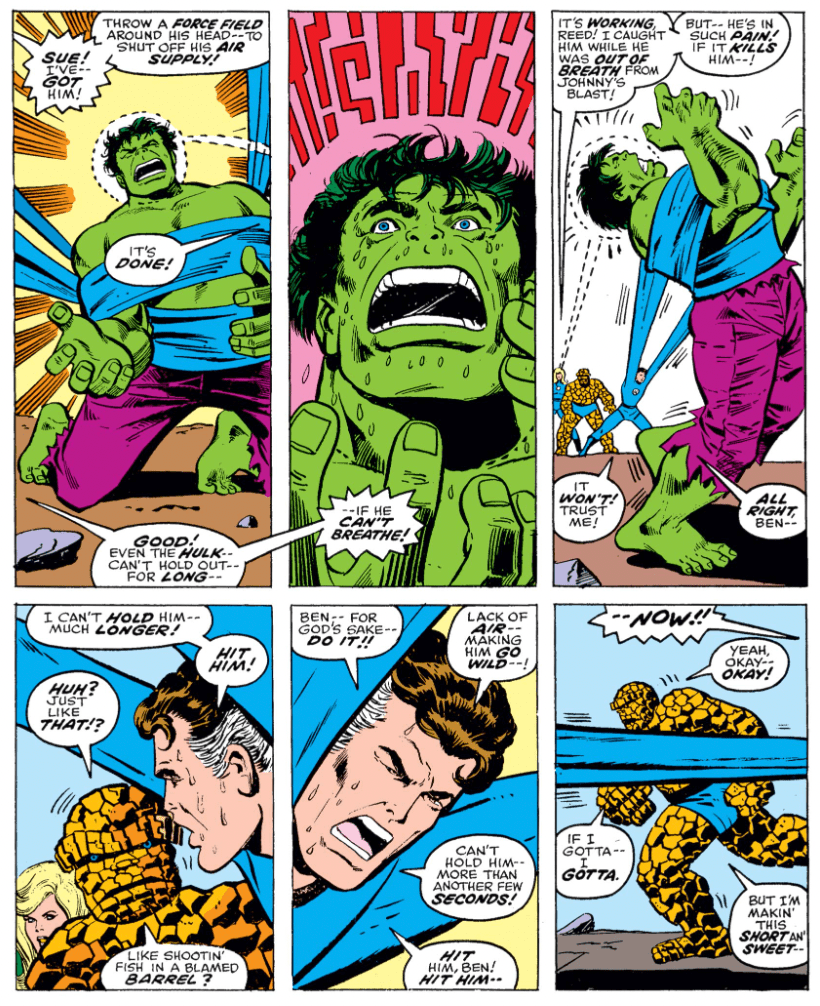
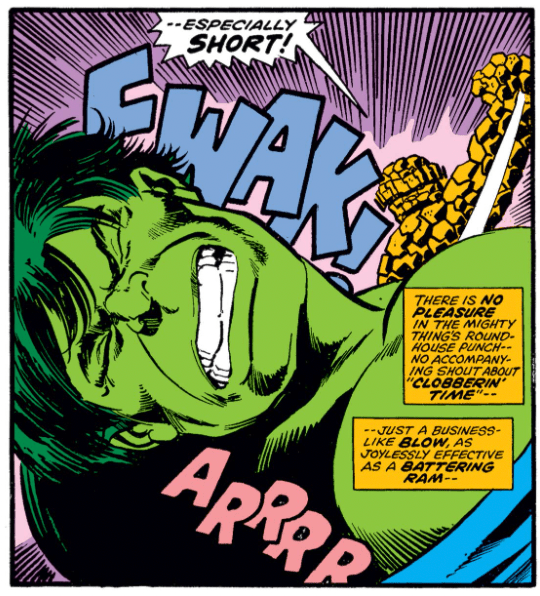
I also liked how matter-of-factly the FF defeated the Hulk. Granted, the Hulk in this comics isn’t the absurdly over-powered creature he has since become, but it was fun to see them work together as a smooth and efficient team, and where Sue plays a leading role.
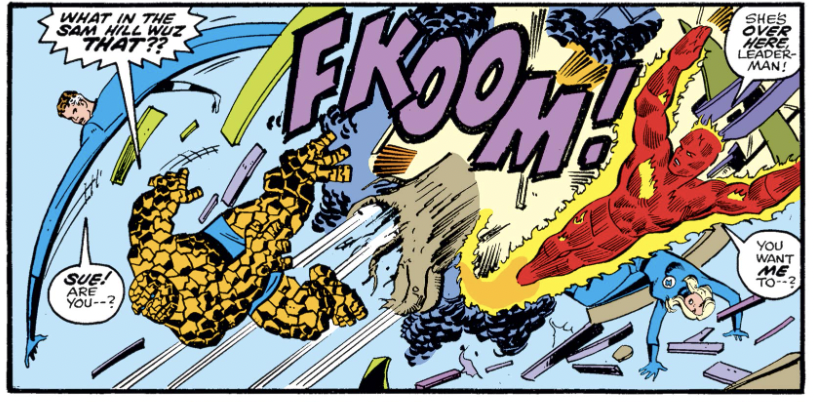
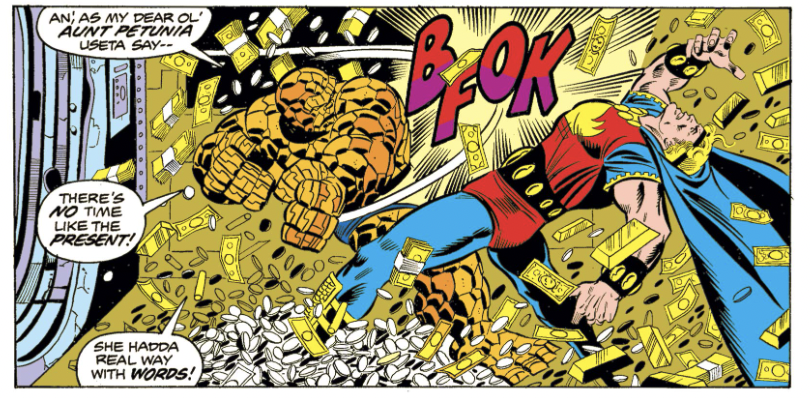
And speaking of Sue, this was a fun exchange (this panel follows the “Fkoom!” panel higher up in this post):
What I didn’t like
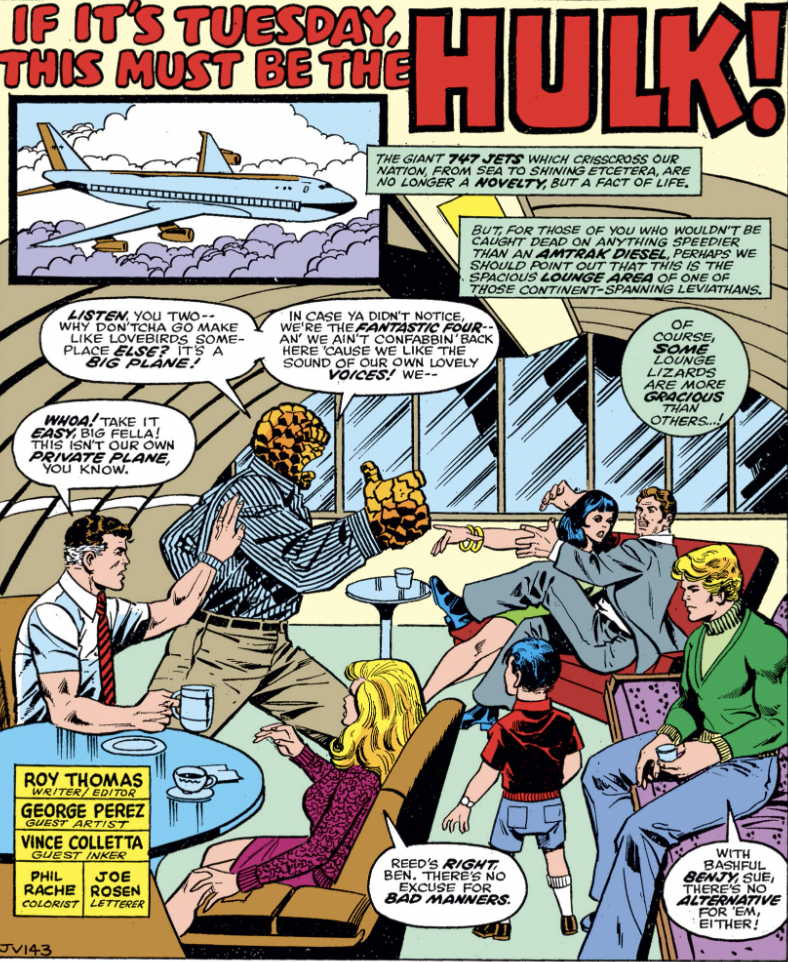
As mentioned earlier, this story feels padded and contrived, never more so than in the opening sequence, where the FF are flying in a commercial airline — it’s not explained why they’re not in one of their own planes — which just happens to be accidentally clipped by the Hulk. It’s all a set up for the FF to land the plane, but it really serves no narrative purpose. Also, there are some really ungainly poses in this panel (and whose kid is that?).
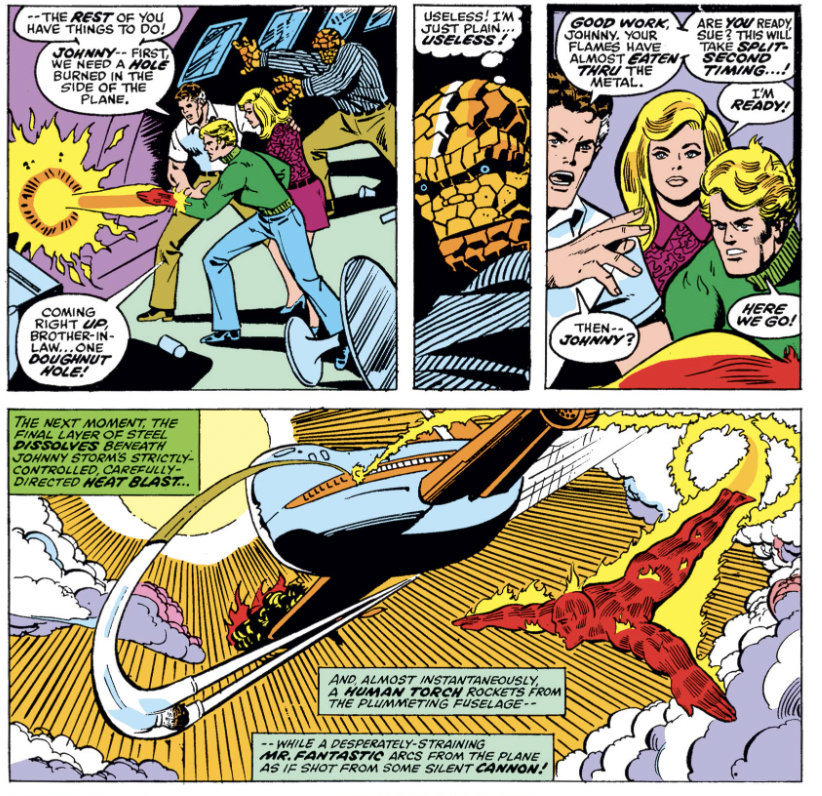
When the FF scramble to rescue the crashing plane, Reed directs Johnny to burn a hole in he fuselage so they can exit the plane. But why not just open a door?
Fantastic Four 165 “The Light of Other Worlds!” Published September 1975 Writer: Roy Thomas Pencils: George Perez Inks: Joe Sinnott Letters: John Costanza Colors: Petra Goldberg Editor: Thomas Cover: Ron Wilson and Joe Sinnott
Synopsis
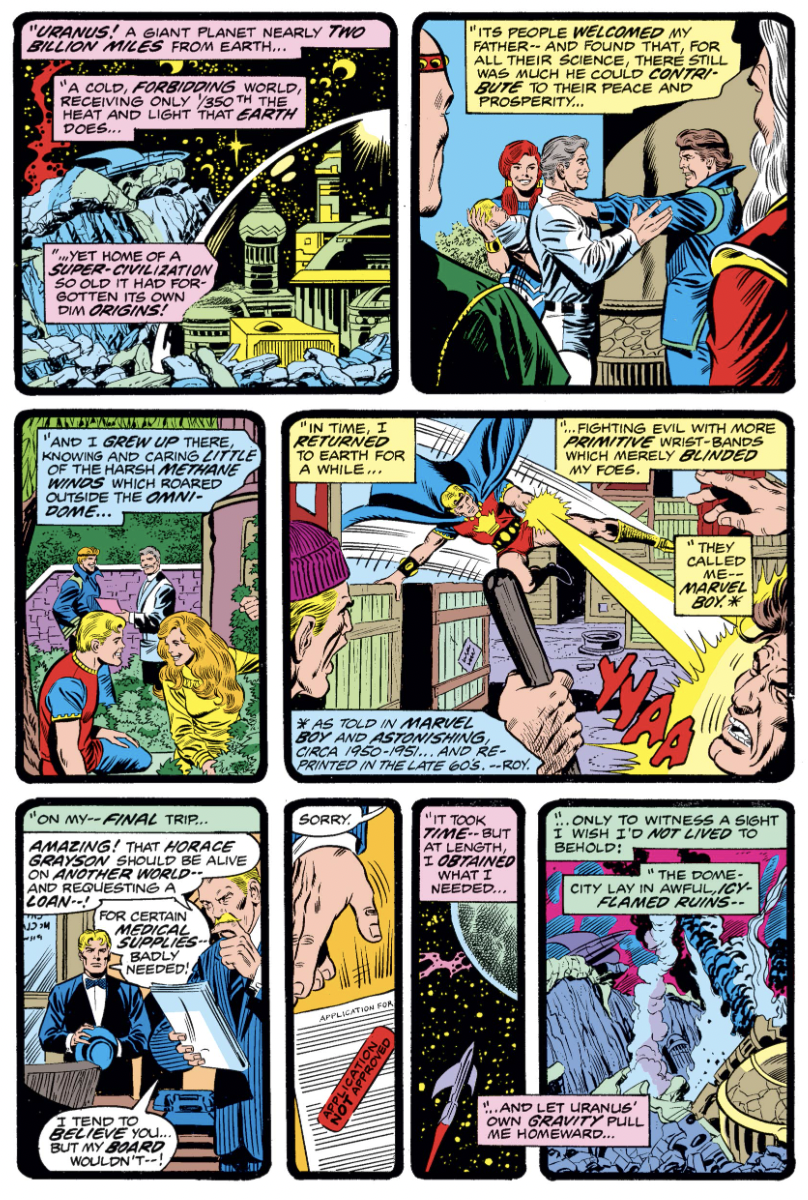
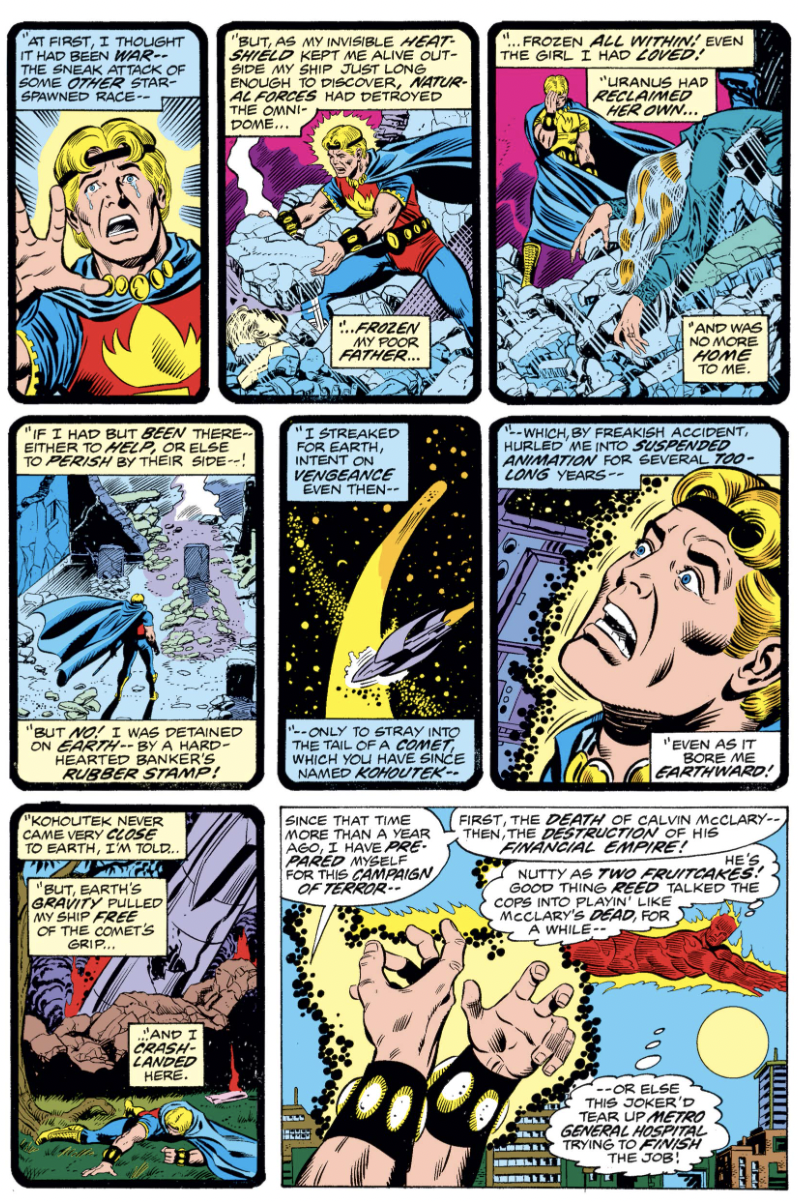
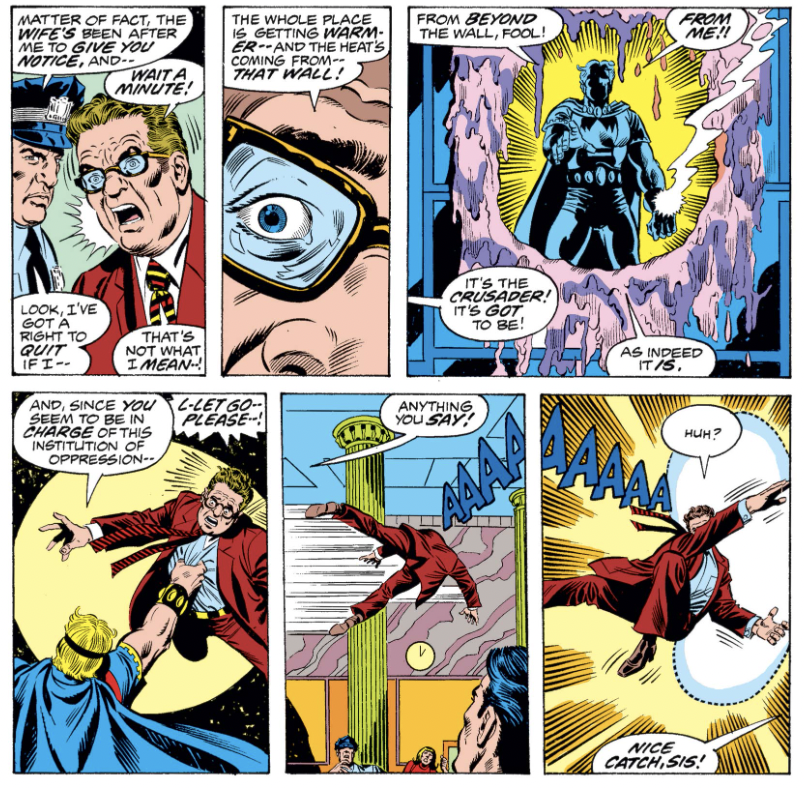
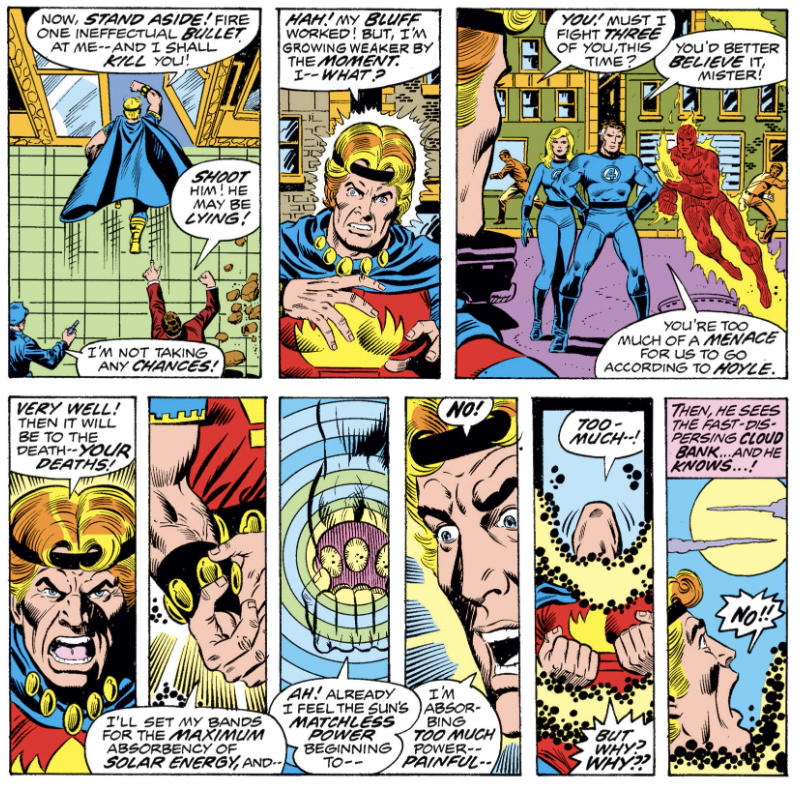
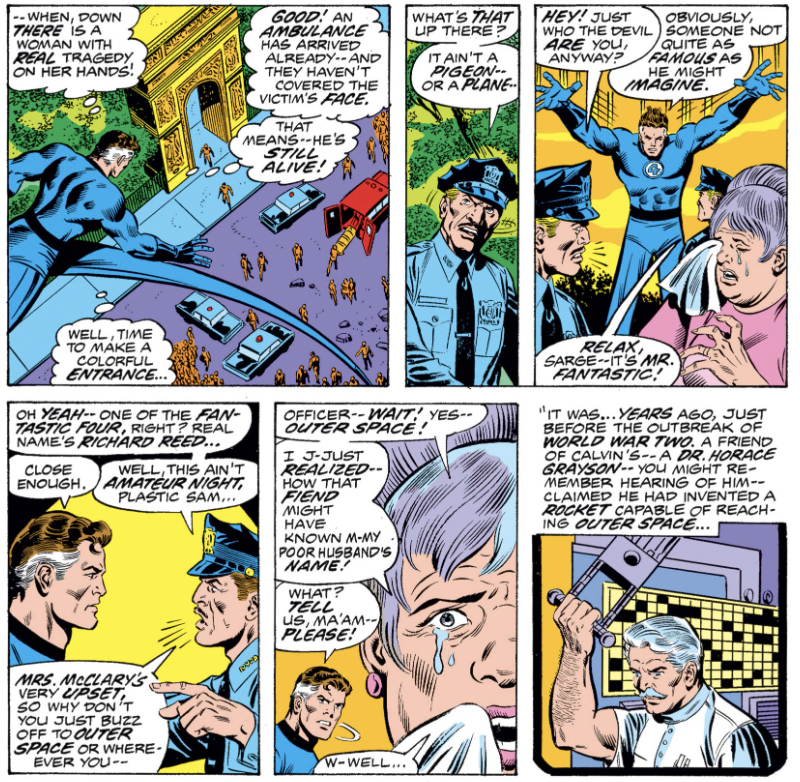
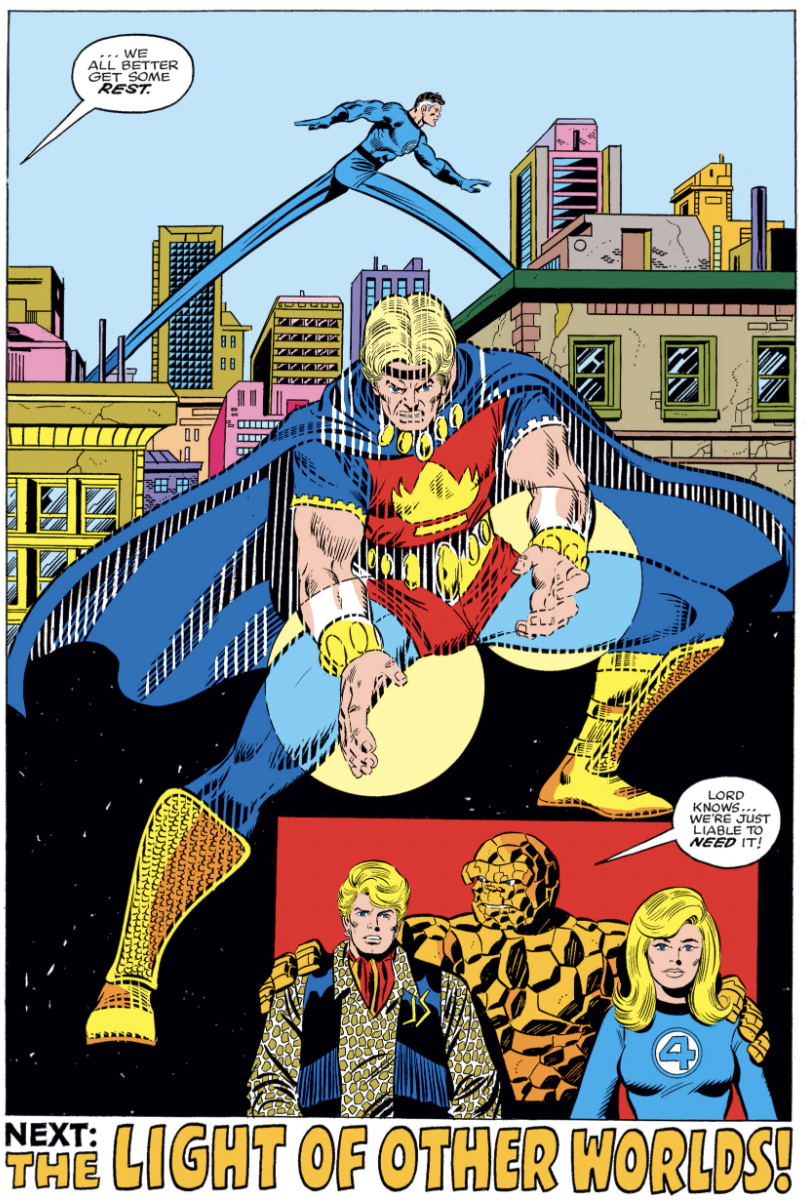
Mr. Fantastic begins investigating the Crusader, who defeated the Human Torch last issue and has been on a rampage, destroying banks across New York City. When he attacks a branch in the Bronx, the FF confront him and he reveals he was once the golden age hero Marvel Boy and is now enacted revenge on the banks that prevented him from saving the people of his home world, Uranus (really). Reed deduces his powers are light-generated, and by blotting out the sun the FF are able to defeat him.
What’s going on here
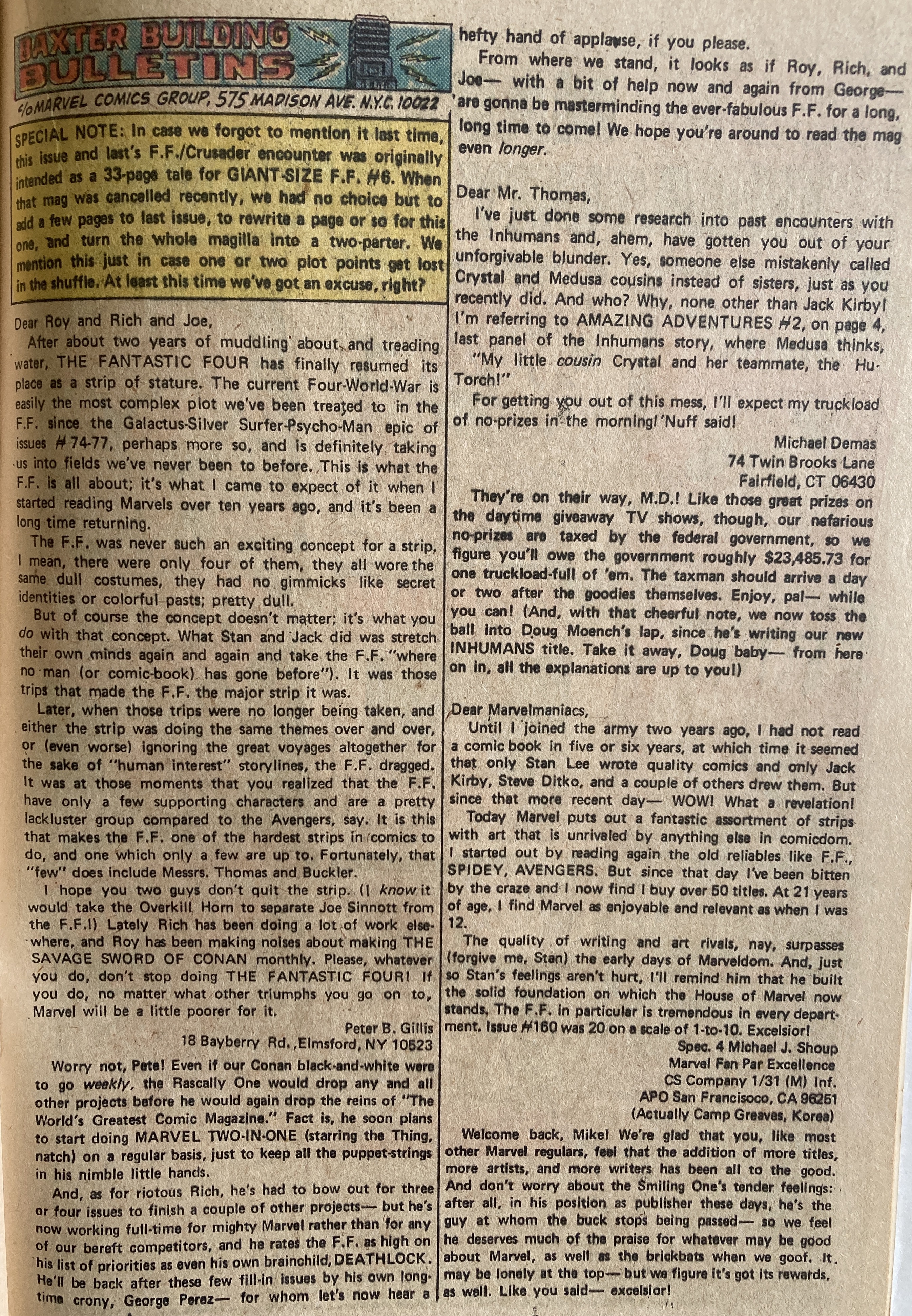
While not quite as tightly paced as the last issue, this comic is a satisfying conclusion to the Crusader story. In the letters page, it is revealed this two-part story was originally intended to be a a single-issue story in Giant-Size Fantastic Four 6, but when that series was canceled, the story was split into two with a few pages added (interestingly, they chose not to simply make it an annual). The note apologies for any dropped plot points — I didn’t detect any— but this issue does feel padded, with a climactic fight scene that lasts longer than it really needs to.
Roy Thomas provides a lengthy and convoluted origin of the Crusader, whose campaign against the banks makes him sound like a super-powered Luigi Mangione. It’s all pretty ridiculous, and it’s clear the Crusader is only in this comics because of Thomas’s affection for obscure characters from the golden and silver ages.
(This origin would eventually be retconned away, and the Crusader is now an Eternal named Thelius who believed himself to be Marvel Boy).
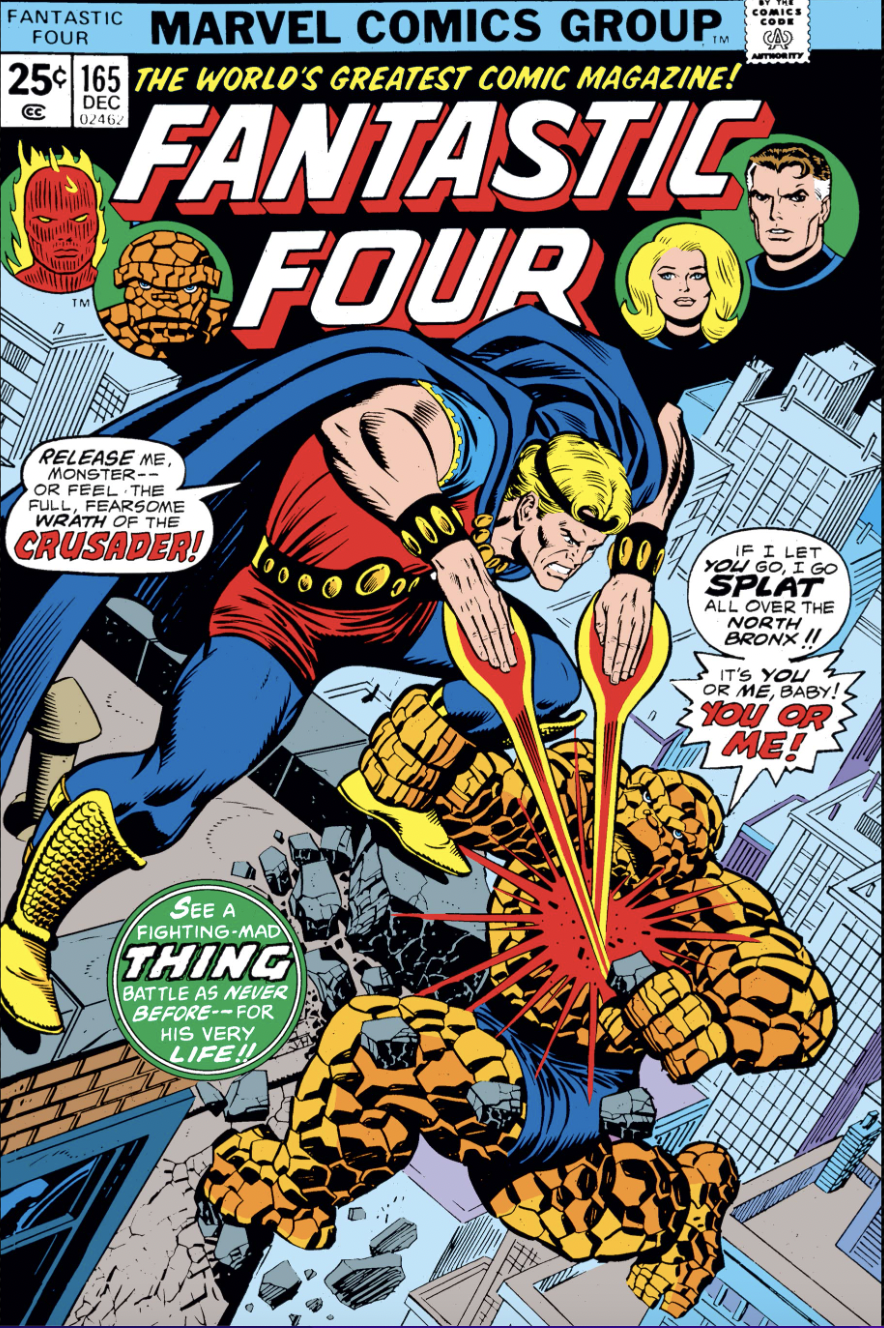
George Perez is back on art duty, and like last issue, he adds his characteristic attention to detail and masterful use of panels. The cover is by Ron Wilson, with Joe Snnott’s inks. At this point Wilson had been around for a few years but this is his first work on the FF. He would go on to draw dozens of issues of Marvel Two-in-One and its successor book, The Thing, becoming one of the definitive pencilers of Benjamin J. Grimm. As far as I can tell, he is the first Black artist to work on an issue of the FF and he would later go on to draw some fill-in issues. The cover is unfortunately marred by some very silly dialogue (and what exactly is the North Bronx? Riverdale? Co-Op City? Van Cortland Park?)
What I liked
Perez again does some great work. I particularly enjoyed this sequence:
And this one, which is a great example of how he uses tiny panels to amazing effect:
Thomas again pokes some fun at the Distinguished Competition in this sequence:
What I didn’t like
As seen above, the Crusader speaks in absurdly grandiloquent phrases (to the extent that Johnny actually makes fun of him at one point). Nothing about his character suggests he’s a former hero from Earth, or that he was any doubts or hesitation about what he’s doing. He’s unfortunately paper-thin as a villain, and Thomas squanders the opportunity to delve into his background to create an interesting resolution to the story. He really could have been any of a number of anonymous bad guys.
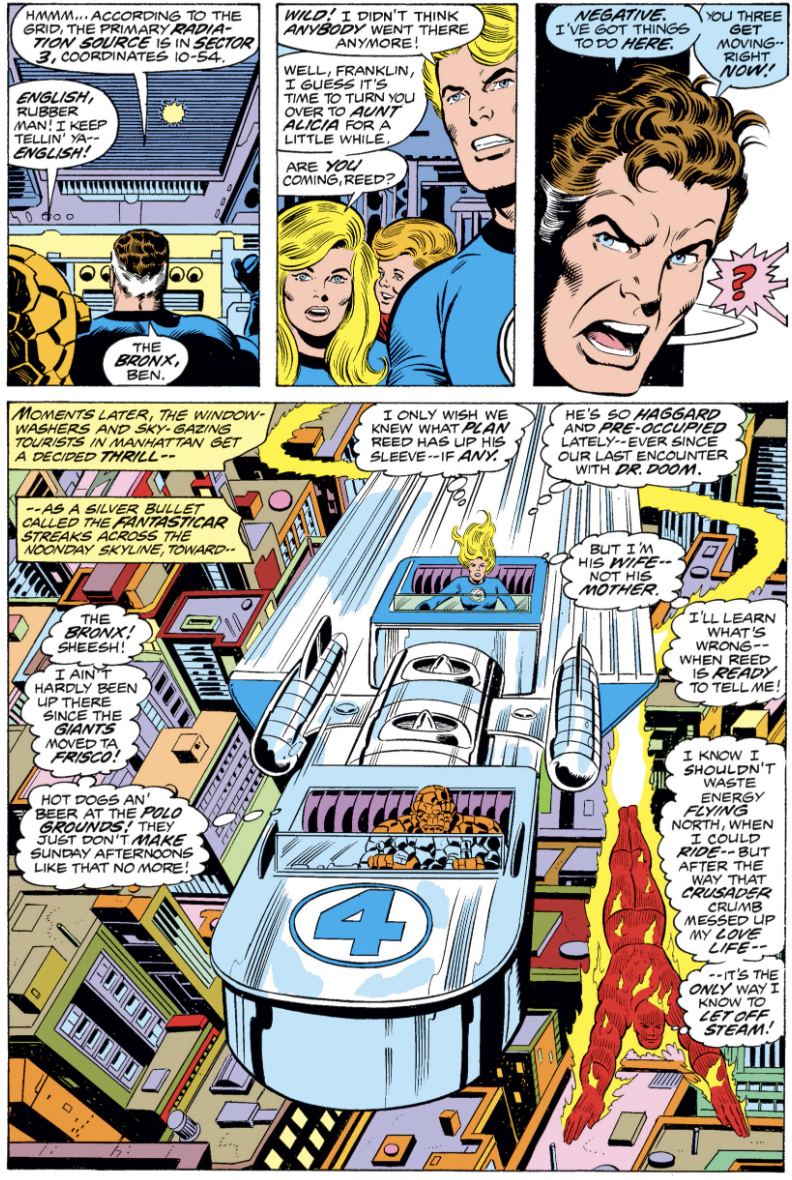
Also, this page is just weird, both for Johnny’s off-hand disregard of the Bronx, a borough where 2 million people live, and for Ben’s bizarre recollection that he went to Giants baseball games there. As virtually anyone who lived in New York at that point would know, the Polo Grounds were in upper Manhattan. Thomas’s Missouri origins were never more apparent. Perez does draw a snazzy Fantasticar, though.
Anything else?
There’s another letter from longtime comics creator Peter B. Gillis in this issue, just three years before he has his first credit as a Captain America writer. Also on the page is the editor’s note about why the story was was split in two, and the explanation of why Rich Buckler didn’t draw it. The anonymous author of the response to Gillis — probably Thomas — was wrong about one thing: Buckler wasn’t around for a long time to come. He would go on to draw just two more issues before Perez took over more or less full-time.
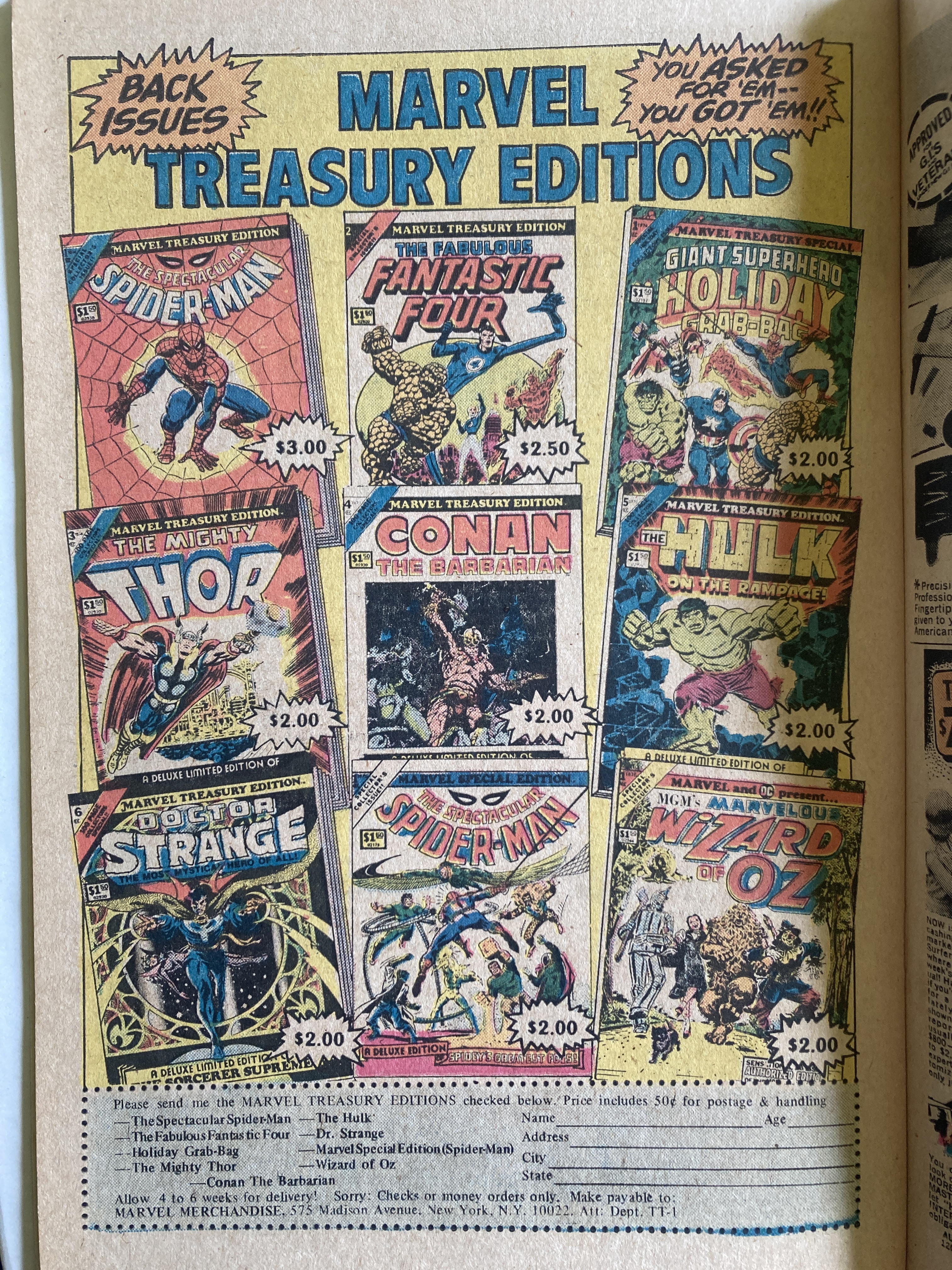
There is also a fun ad for Marvel’s Treasury Editions. Just in case anyone is worried I dropped the ball, the FF’s Treasury Edition contains only reprints.
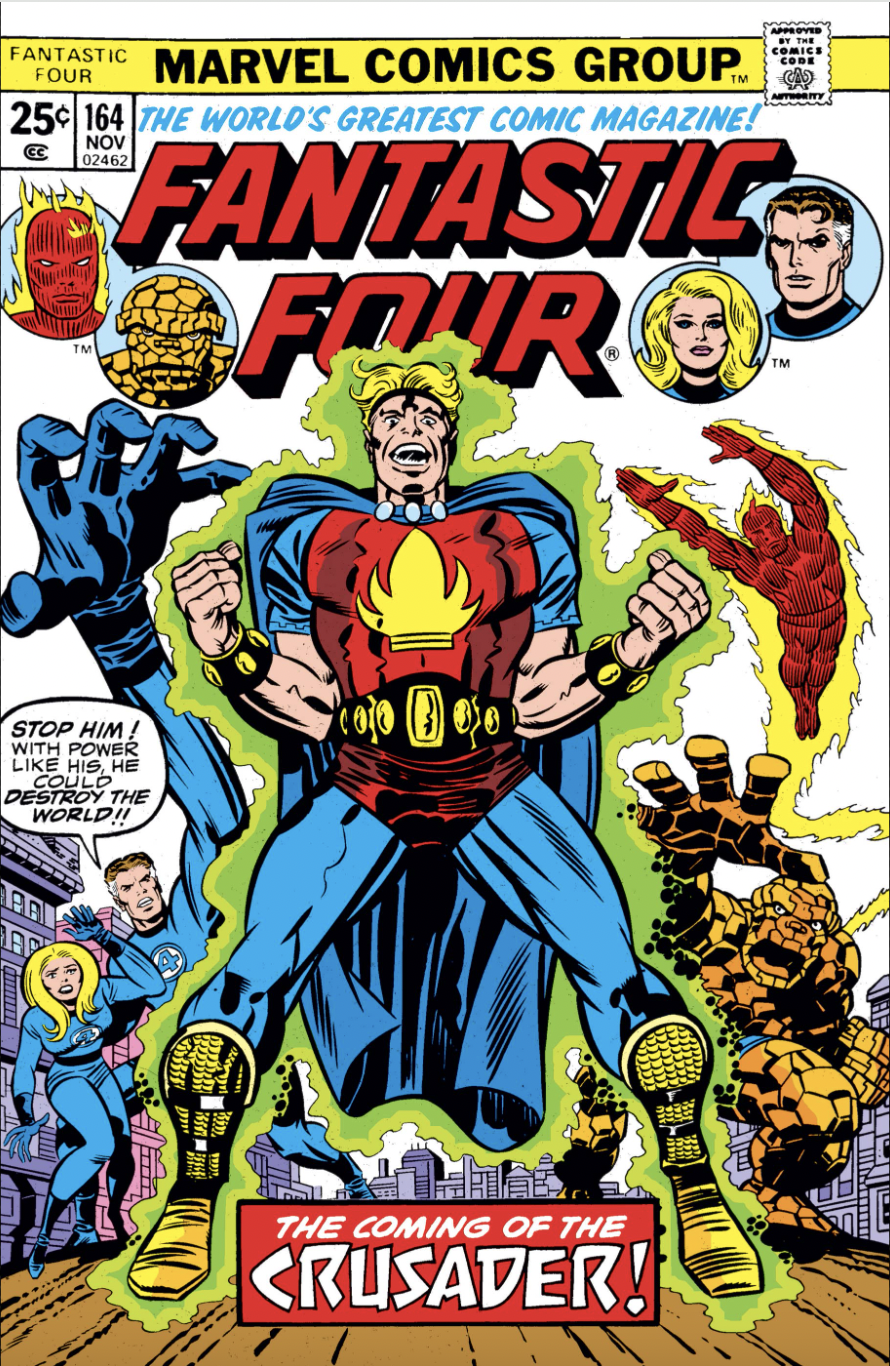
Fantastic Four 164 “The Crusader Syndrome!” Published Aug. 1975 Writer: Roy Thomas Pencils: George Perez Inker: Joe Sinnott Letters: John Costanza Colors: Petra Goldberg Editor: Thomas Cover: Jack Kirby (yes, that Jack Kirby) and Sinnott
Synopsis
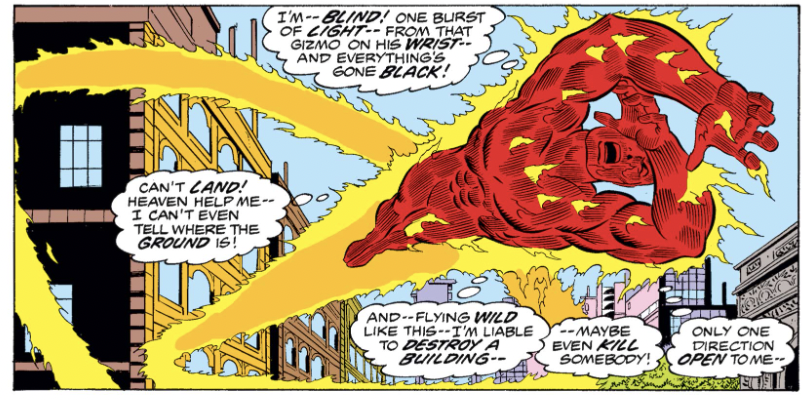
The Fantastic Four experiments with the Invisible Woman’s recently expanded powers, then Johnny goes on a date with Frankie Raye, only to encounter the Crusader, a new villain. The Crusader battles and defeats the Human Torch, who is rescued by the rest of the FF.
What’s going on here?
There’s a lot to discuss in this issue, so get comfortable. First, it’s arguably the best issue since the end of the Lee / Kirby run. Not just for its notable artists, which we will get to, but it’s a perfectly told and paced story. Roy Thomas opens with the usual Baxter Building shenanigans, introduces new character developments, injects fun familial banter, builds up to a real battle (one which the Torch loses), and ends the story gracefully. It’s not earth-shattering, but it’s a model of how Fantastic Four comics should be told and such a departure from the last issue — one of the worst of the era— that it’s amazing the same man wrote both.
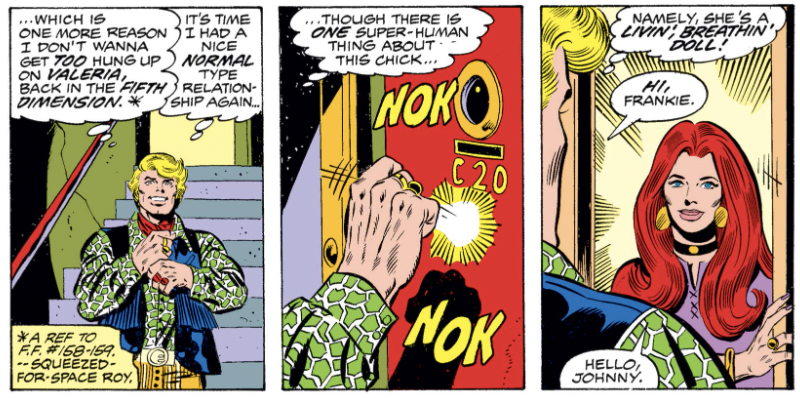
Secondly, it’s a story of firsts. This issue marks the first appearance of Frankie Raye, who becomes Johnny’s girlfriend and, eventually, Nova, a Herald of Galactus. (I suppose it’s a sign of the ’70s that they met at a singles bar, and that Frankie doesn’t even know his last name before agreeing to go a date). It’s also the first appearance of the quantum bands, worn here by the Crusader, that end up on the arms of Quasar, a hero who would go to join the Avengers and star in his own comic.
This issue is also notably the first with a Jack Kirby cover since his departure from the FF after issue 102. In the five years between, Kirby went to DC and invented Darkseid, Apokolips, Mr. Miracle, Big Barda, the Forever People, Kamandi, O.M.A.C. and host of other characters and concepts. When DC canceled the Fourth World books, a frustrated Kirby looked for a way back to Marvel, and received a deal that gave him what he really wanted: control over his own content. (you can read more about it here). Along with writing and drawing Captain America, the Black Panther and the Eternals, he also did a number of covers for other books, including several for his former comic, the Fantastic Four.
And of course, this is the first issue drawn by George Perez, one of the greatest artists to work on the Fantastic Four and a giant of the industry. Just 21 at this point, Perez began his career as an assistant to Rich Buckler, and had drawn about a dozen comics for Marvel— mostly kung-fu or monster comics — before getting a shot at the Fantastic Four. While he was billed as a guest artist in FF 164, he drew the next two issues as well and remained a steady presence on the book for the next several years, drawing about 20 issues, including annuals, in all.
Joe Sinnott was still the inker and while it can be argued he overwhelmed his pencilers, he ensured a uniform look to the characters from Kirby through Buscema and Buckler to Perez (and beyond). But Perez’s individual style is apparent if you know where to look. Some of his trademarks are already apparent, such as panels set within larger panels, and action sequences told across many smaller panels. While nine panels on a page are lot for most artists (and six was standard) Perez could push it to 10, as on this page, or even 12.
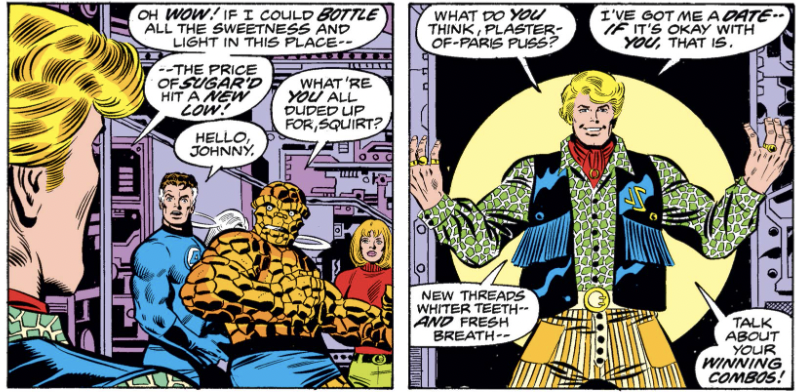
Perez also loved incredibly detailed clothing and costumes, much to the chagrin of artists that followed and had to use his designs. Here is Johnny in a new set of duds (which Perez said he modeled after the attire of a South Bronx pimp from his childhood):
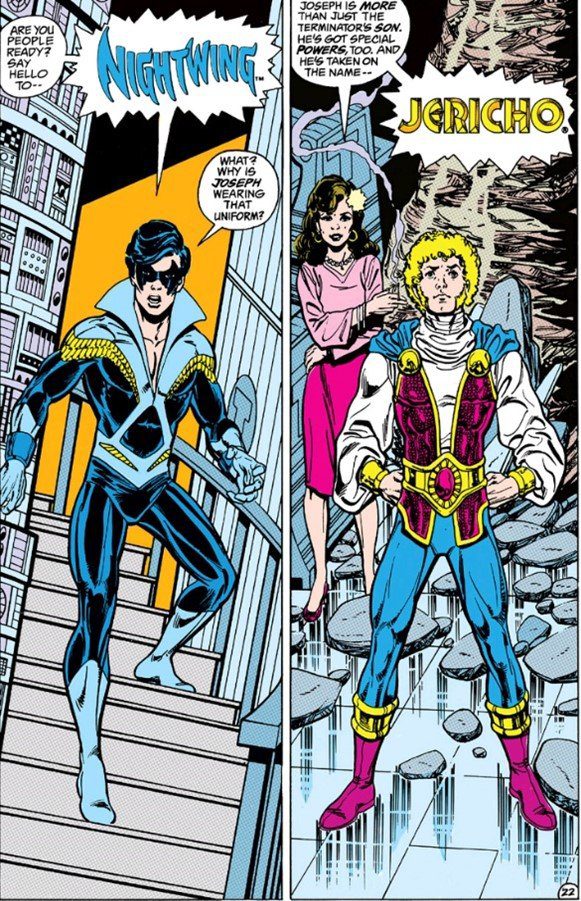
The panel reminded me of an iconic page from the New Teen Titans Perez drew about a decade later (and which surely gave subsequent pencilers nightmares):
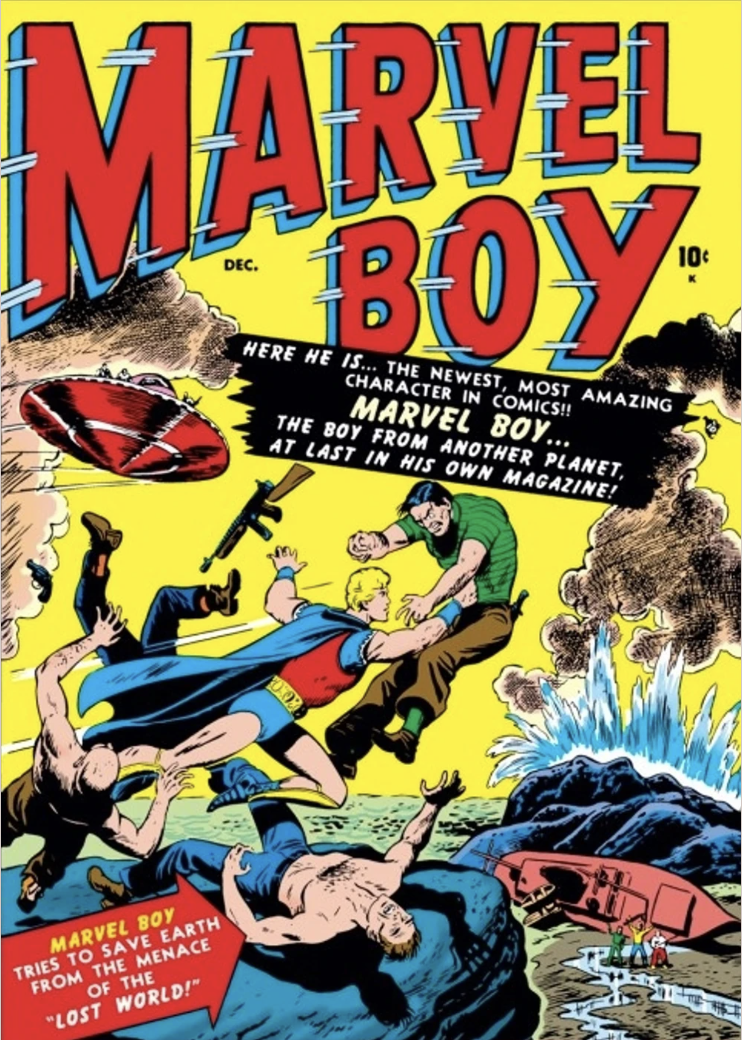
Lastly, the story features a notable Thomasian tic: the mining of older comics for characters and ideas. The Crusader is revealed in the next issue to be Marvel Boy, a Golden Age character who was raised on Uranus and received great powers there (this origin is later ret-conned away in a 2000s series, Agents of Atlas).
What I liked
Along with all of the above, the issue is a coming-out for a new version of the Invisible Girl, whose powers have been increased since they are amplified by the thunder-horn of Xemu, a would-be world conquerer from the Fifth Dimension (this all went down in issue 159). This development is long overdue and very welcome.
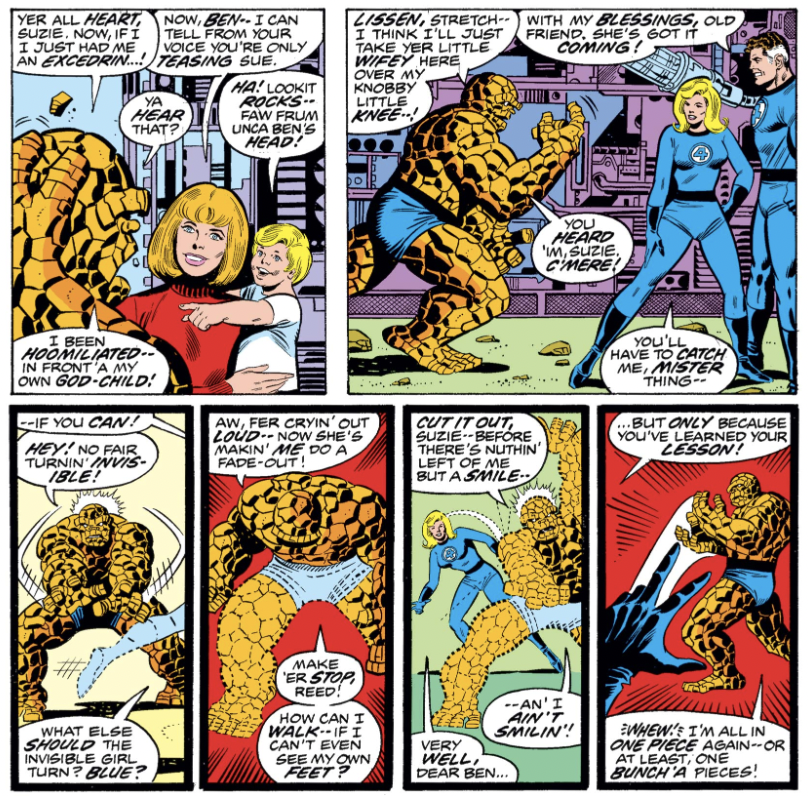
In a series of sequences, she first befuddles Ben during training exercises (also, this may be the first time we see Franklin speaking) …
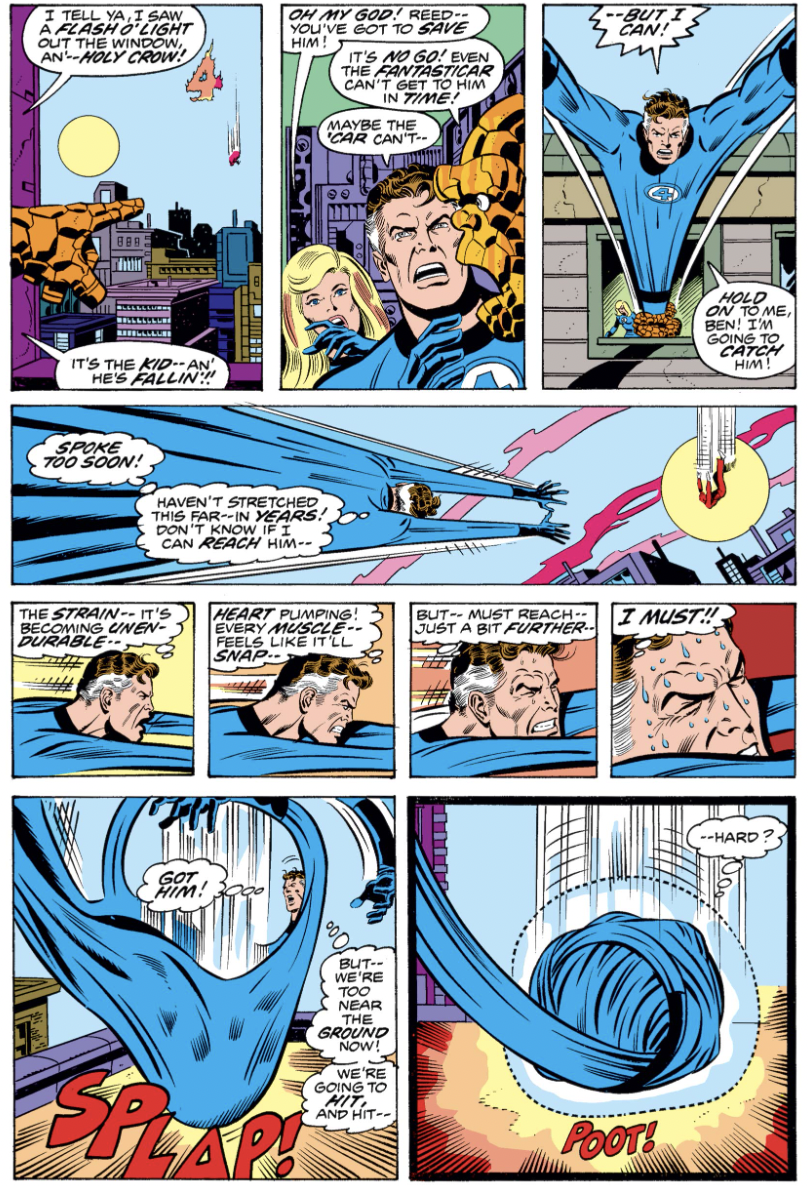
… then uses her force fields to save Reed, then to bring her and Ben to a soft landing and to hold back the crowds. Ben is impressed.
And if I haven’t said enough about Perez’s art, here’s a great splash page that concludes the comic:
What I didn’t like
There’s not much to dislike. The Crusader comes across as just another chest-thumping villain that spouts cliches, although he has a vicious streak. As usual, Thomas over-narrates the comic, at one point instructing readers on the proper pronunciation of Greenwich
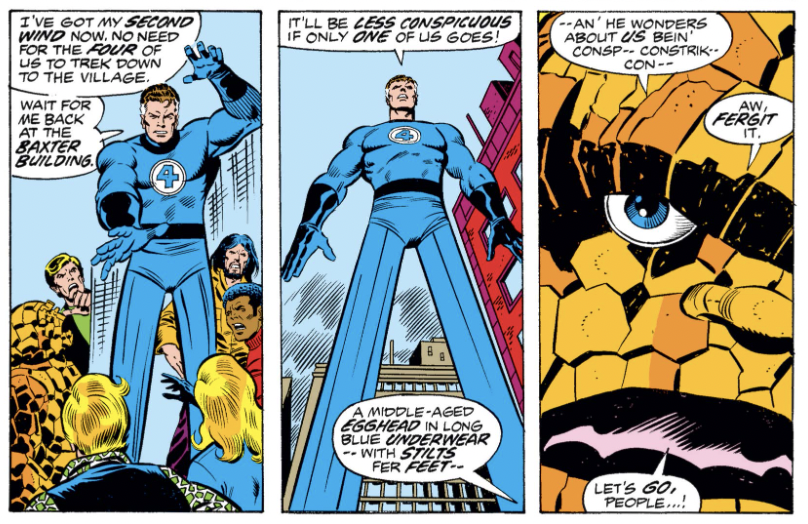
And the ending is a bit puzzling, with Reed striding off across the city alone, to somehow not attract attention. Nor is it clear what he needs to do in the village.
Anything else?
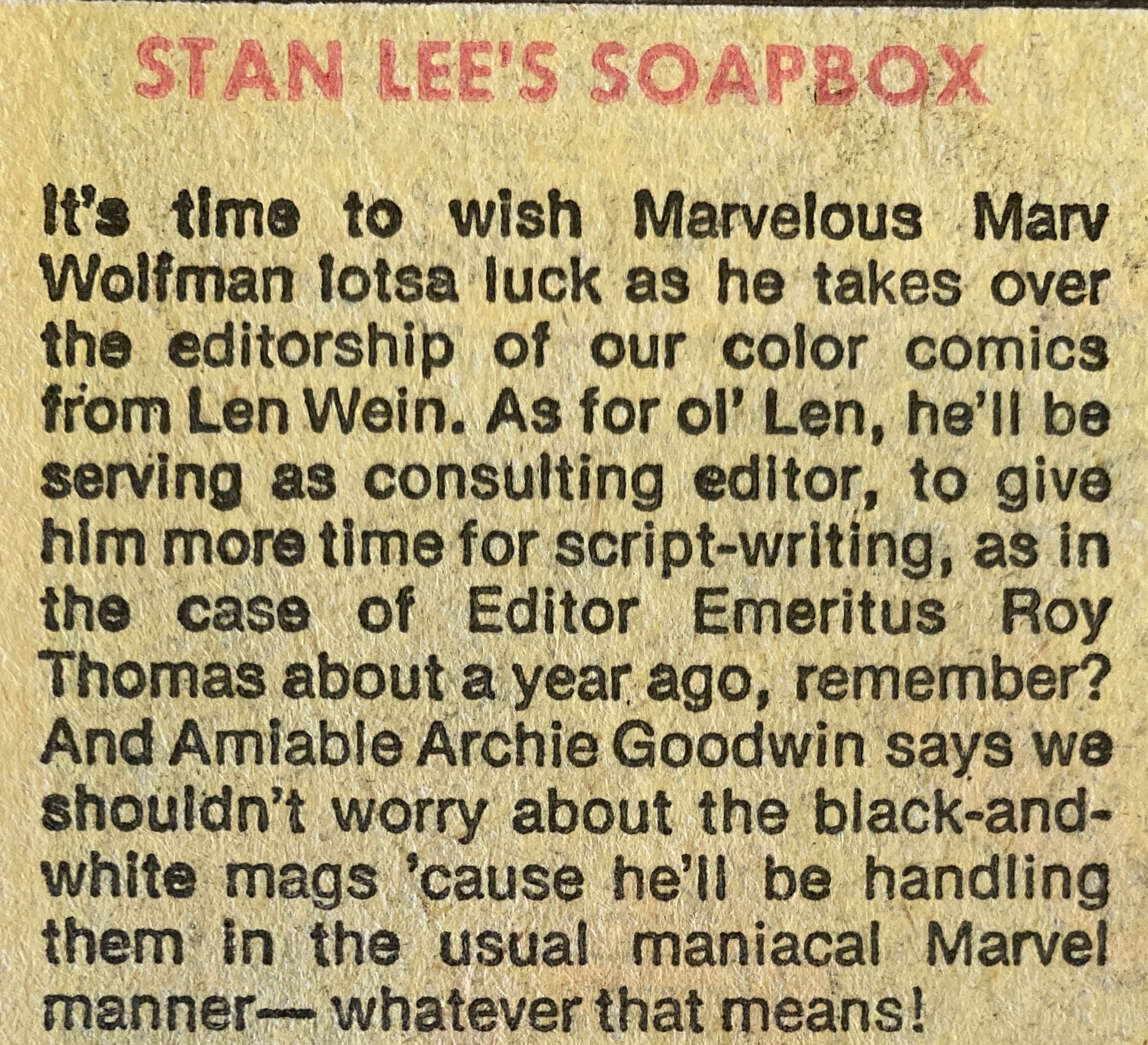
The Bullpen Bulletins announce yet another change in editor at Marvel, with Marv Wolfman taking over for Len Wein. As mentioned before, this a period in which Marvel will have six editors-in-chief in five years, leading to a sense of general instability and chaos. There was a lot of creative ferment at Marvel during this era but a lot of slop, too.
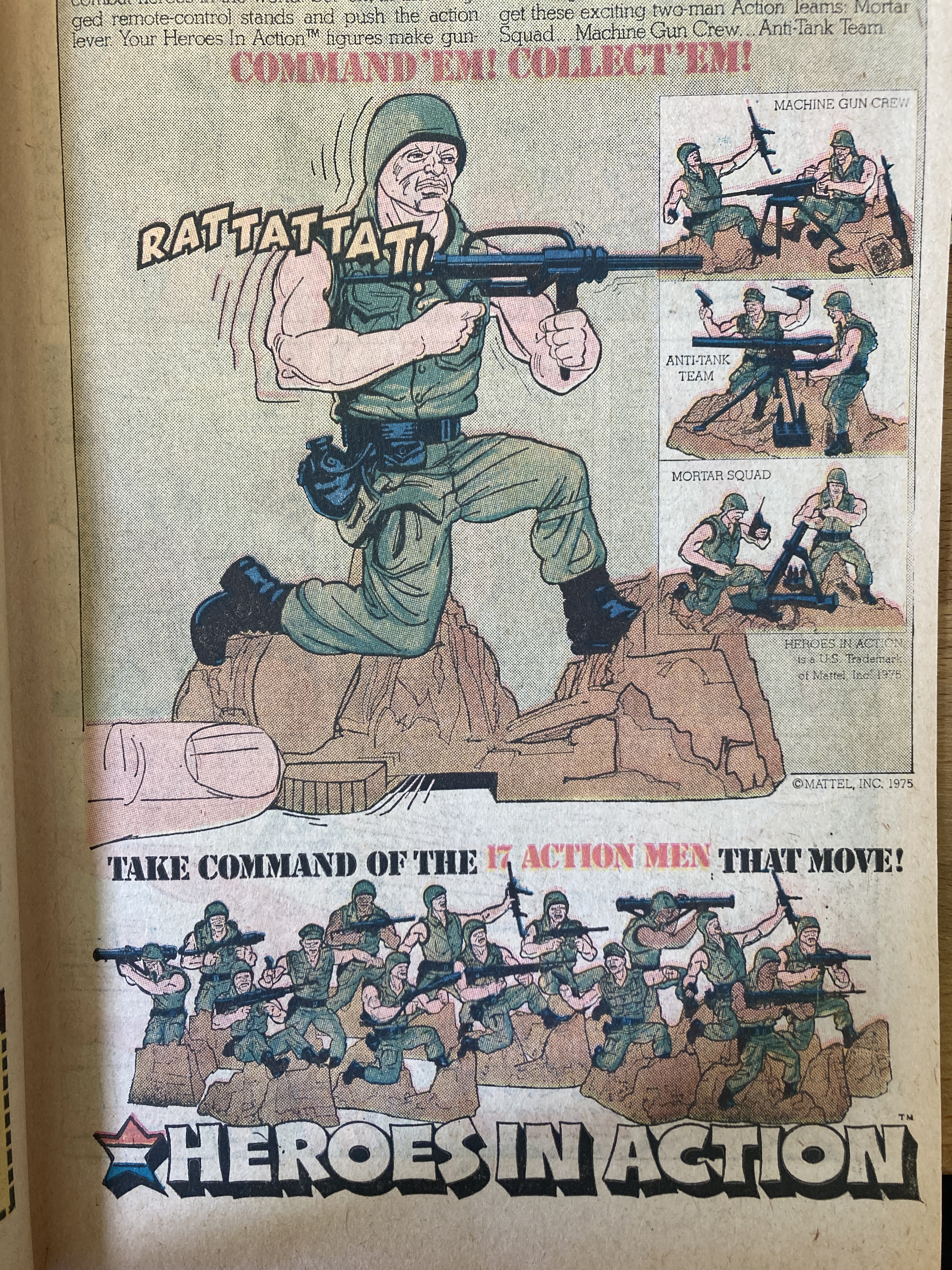
I don’t think I’ve seen this ad, or these toys, before. Sort of a proto-G.I. Joe.
Fantastic Four 163 “Finale!” Published July 1975 Writer: Roy Thomas Pencils: Rich Buckler Inks: Joe Sinnott Letters: Joe Rosen Colors: Don Warfield Editor: Thomas Cover: Bucker and Sinnott
Synopsis
In hyperspace, the Thing battles Arkon’s champion Gaard, who is trying to prevent Ben from closing a window that would allow a nuclear war on three realities to power Arkon’s world. Meanwhile, Johnny and Reed Richards from an alternative Earth, whom in that world became the Thing, battle and defeat Arkon. With the help of Mr. Fantastic, Ben defeats Gaard, who is revealed to be a mind-controlled Johnny Storm of that world.
What’s going on here?
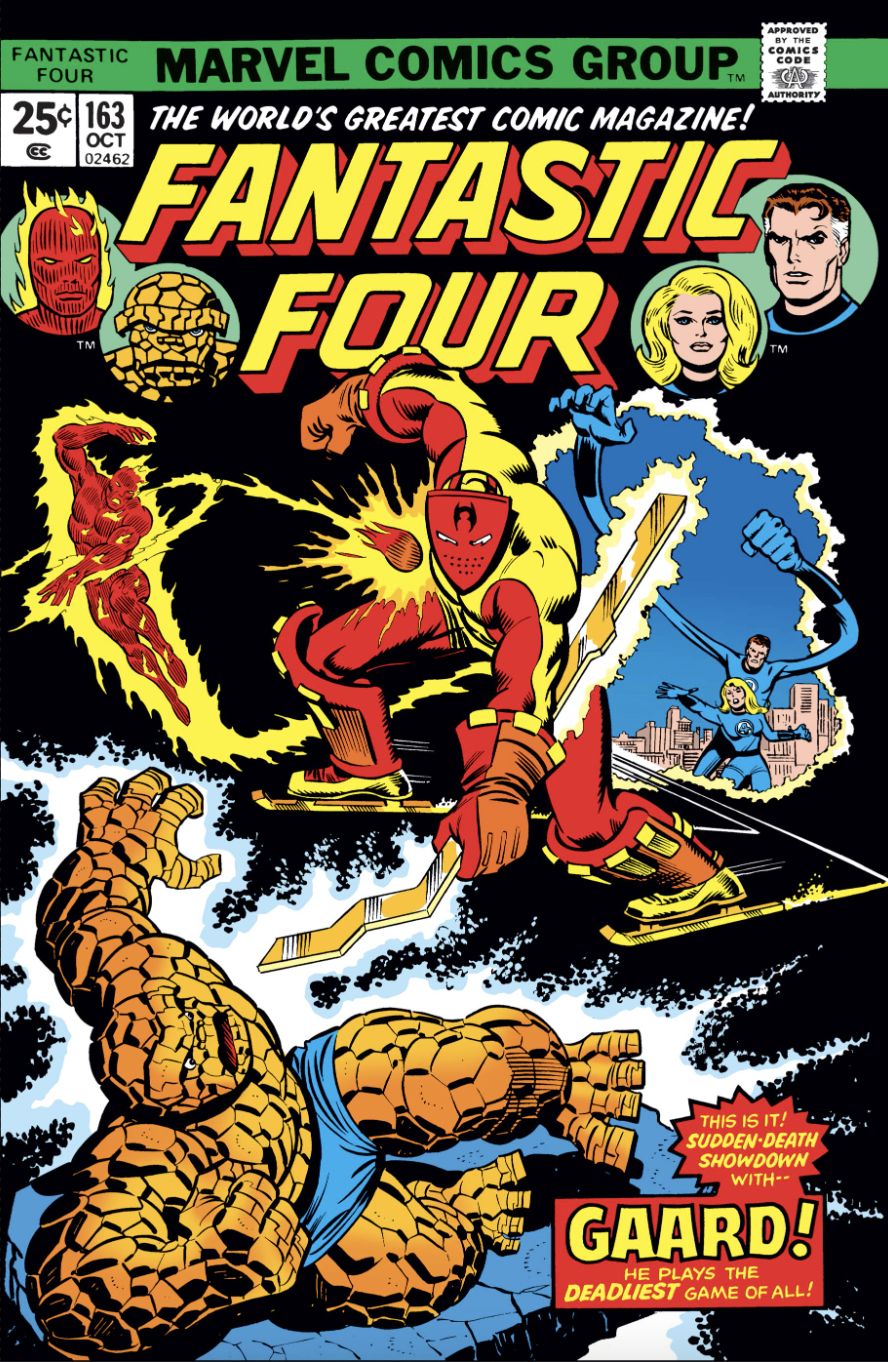
When I first began this blog, I was eager to read through the legendary Lee / Kirby run, and to revisit the Byrne run, my first introduction to the Fantastic Four. But I was apprehensive about the issues in between, from FF 103 to 231, which — despite the work of stellar artists like John Buscema and George Perez — seemed like a repository of a lot of mediocre dreck. And symbolic of that mediocrity to me was Gaard, a villain I knew only from the cover but that seemed utterly ridiculous and unworthy of the grandeur of the Fantastic Four. The team that battled Dr. Doom and Galactus is now fighting an outer-space hockey goalie? Seriously?
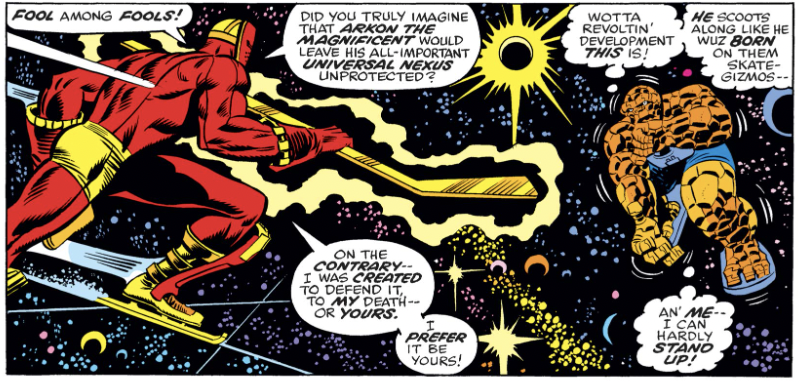
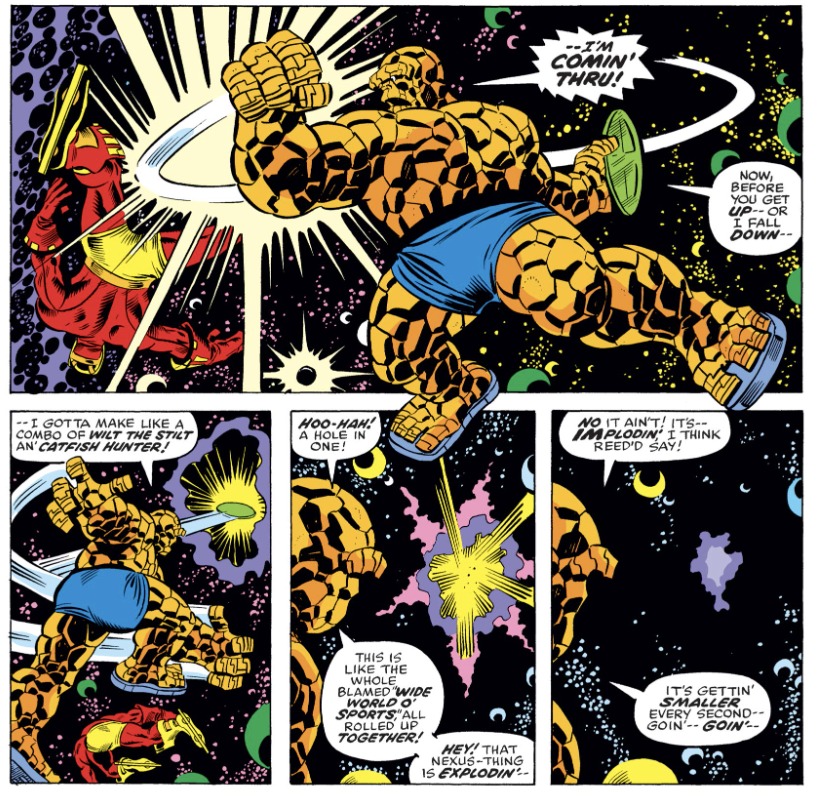
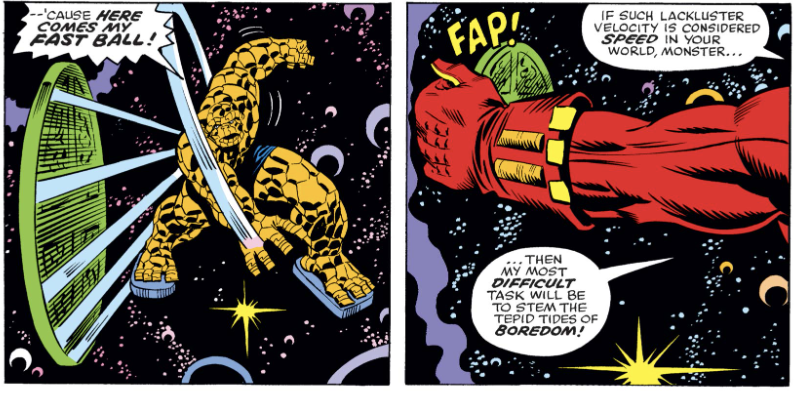
After reading this comic, my worst fears were confirmed. This is, in fact, a pretty lame issue and Gaard is silly concept, an apparent ripoff of the Silver Surfer and Black Racer, two Jack Kirby-designed characters that travel through space with sports-like apparatus. As Gaard fights Ben, there are sports-adjacent references aplenty, from Ben having to wear skate-like devices to move through hyperspace to the puck-like gizmo he needs to hurtle through Gaard’s “goal.” The sportsball nature of it all is summed up here:
I couldn’t find any documentation about the creation of Gaard, just a comment in a blog that Roy Thomas intended him as a parody of Black Racer and that he later regretted using such a silly concept in a story with a heavier tone. Which make sense, but it’s unfortunate because up until this comic, the four-issue arc was actually pretty fun, with a zillion of Thomas’s ideas colliding and heading toward what could have been a satisfying ending. But the result is an anti-climactic finish that feels slapped together, with both Reed and Sue on the sidelines, Johnny and Earth-2 Reed defeating Arkon without too much trouble and, as seen above, the nexus closing with a whimper.
My only hope is that this comic is the low point of the stretch between Lee / Kirby and Byrne, and everything from here is an improvement.
One more note: Don Warfield is credited as colorist, his first and as far as I can tell, last Fantastic Four credit.
What I liked
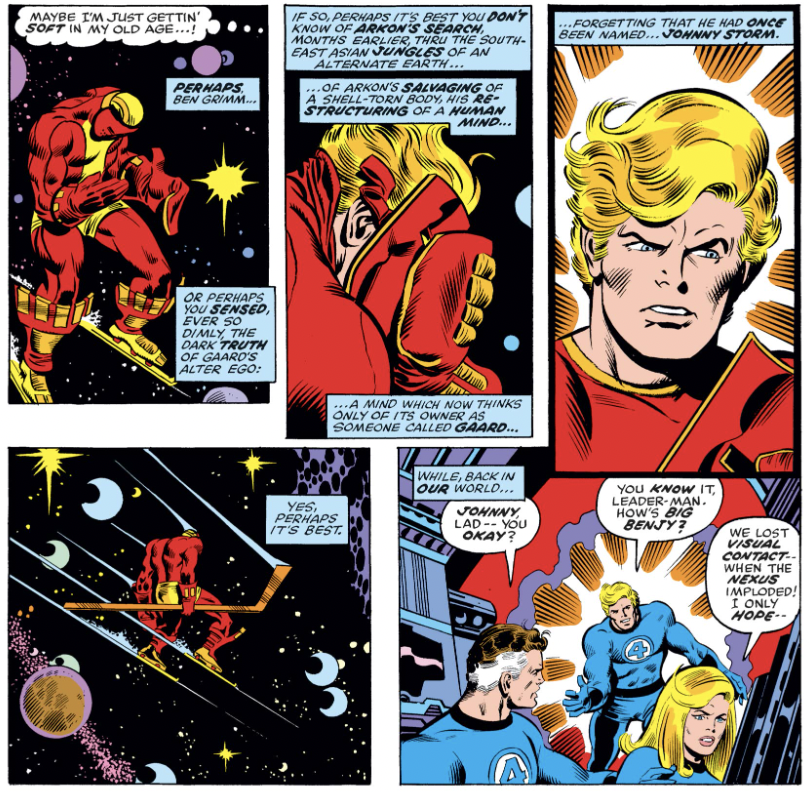
Gaard’s dialogue is just completely over the top and bombastic. Not sure where he learned to talk like this, particularly if he’s that Earth’s version of Johnny.
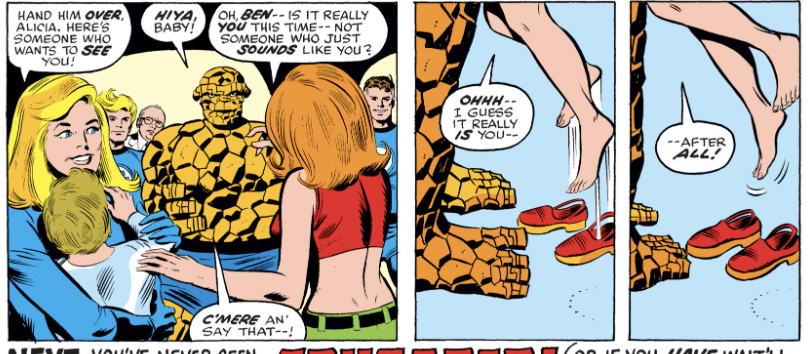
This reunion between Ben and Alicia was sweet and fun.
What I didn’t like
Alongside the aforementioned Gaard nonsense is the question of his identity, which is hinted at by both Ben and Gaard as they battle, but ultimately plays no role in the outcome, and is instead a meaningless footnote. (Gaard would later remerge as the super-powered villain Vangaard in Fantastic Force, a 1990s FF spinoff that I know virtually nothing about.)
The defeat of Arkon is also perfunctory and unsatisfying. As a character, Arkon never seems fully developed and in this story appears to be like a King knockoff dressed as a barbarian.
Anything else?
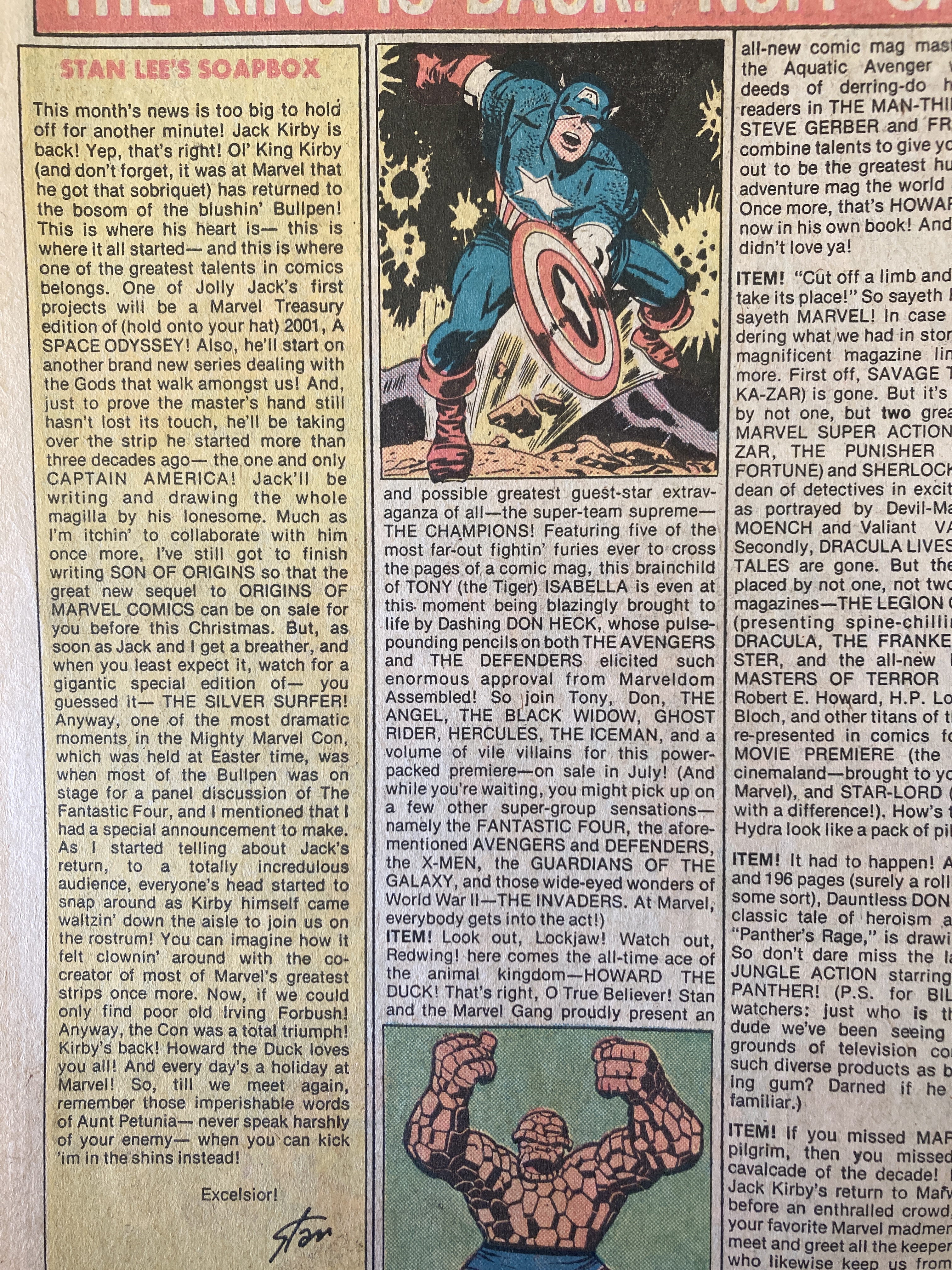
A lengthy note in Bullpen Bulletins announced the return of Jack Kirby to Marvel. It says nothing about where he went or why he returned, which is perhaps to be expected, but hints at the creation of the Eternals and notes Kirby will be taking over Captain America.
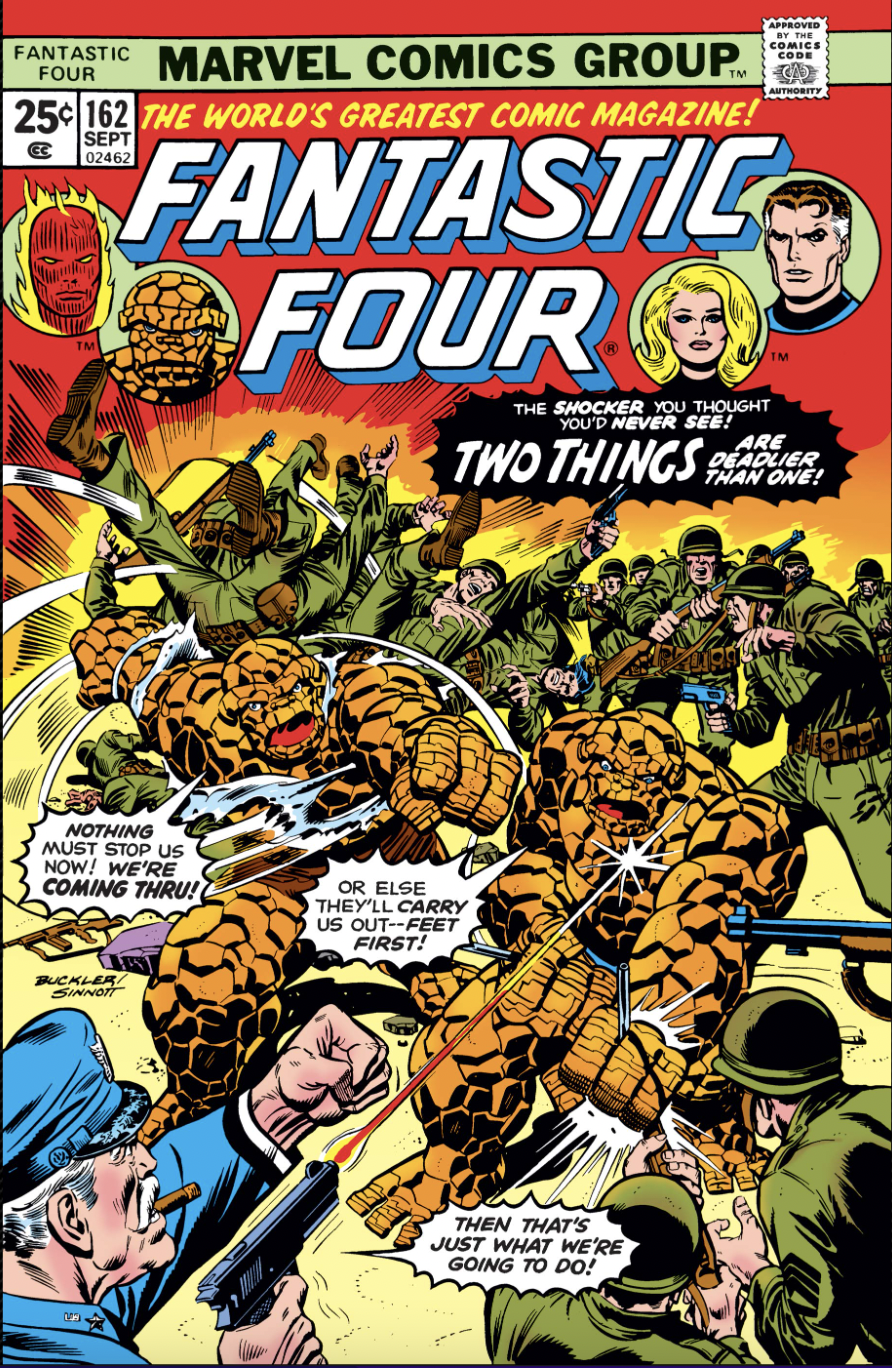
Fantastic Four 162 “The Shape Of Things To Come!” Published: June 1975 Writer: Roy Thomas Pencils: Rich Buckler Inks: Joe Sinnott Letters: Joe Rosen Colors: Phil Rachelson Editor: Thomas Cover: Buckler and Sinnott
Synopsis
The conflict between three dimensions, which began last issue, escalates and it is revealed that Arkon, the barbarian ruler of yet another dimension, used the apparent businessman Mr. Devoor to goad the three into a nuclear war that will power his planet. The Fantastic Four averts a major inter-dimensional conflict and, following a plan devised by Mr. Fantastic, prepare to thwart Arkon’s plans.
What’s going on here?
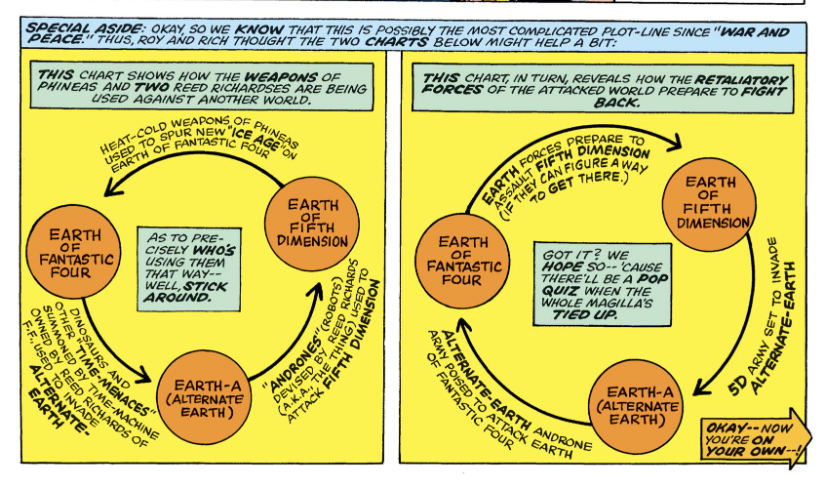
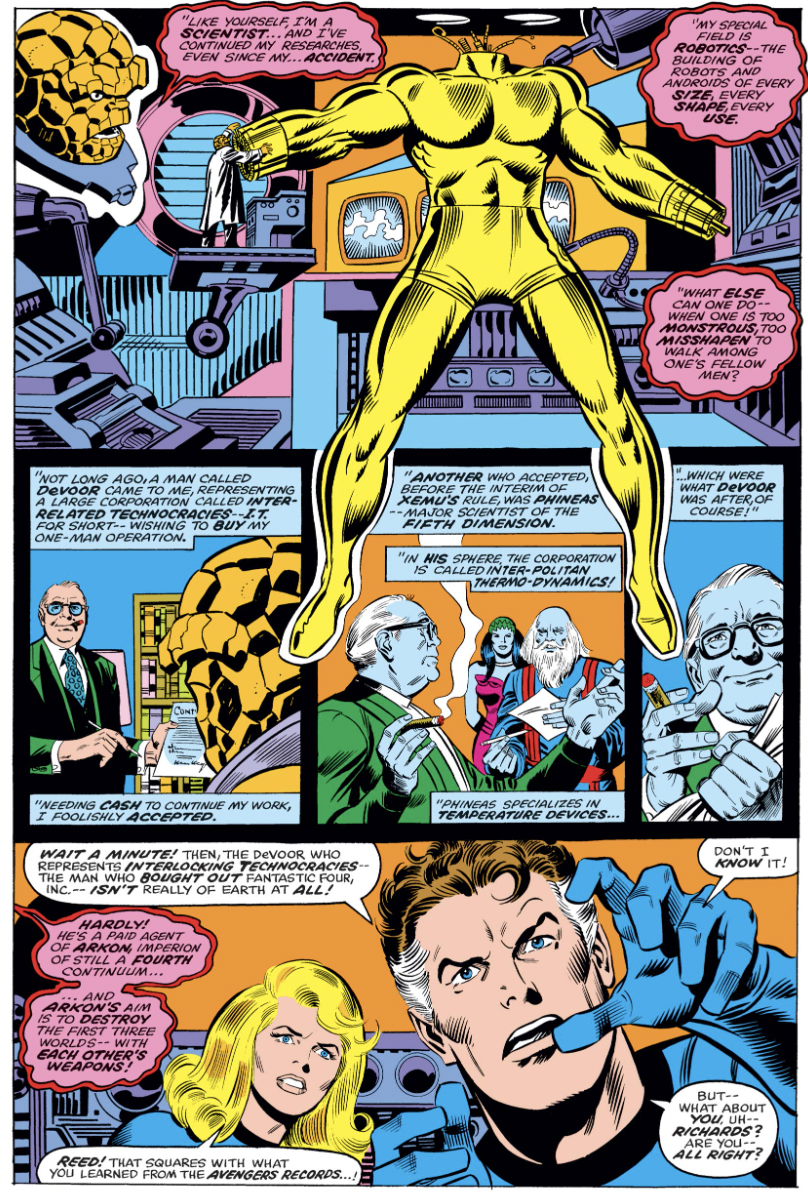
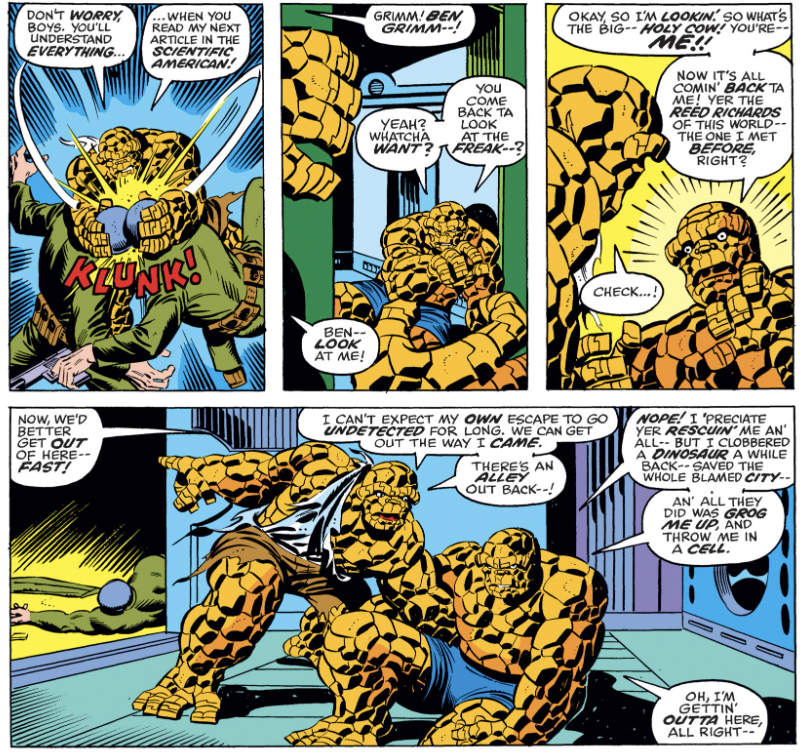
After introducing a bewildering number of plot elements over the last two issues, Roy Thomas finally allows things to gel. The story is still convoluted and relies on a lot of coincidences and unlikely occurrences (such as when the Human Torch leads an invading army across dimension, it just happens to arrive on the same Manhattan block as the two Things) but the basic outlines are at least clear. Thomas recognized the mess he created and provides a pair of diagrams to explain the story, something I don’t think I’ve seeing a comic before:
(and as someone who has read both, this is more complicated than War and Peace)
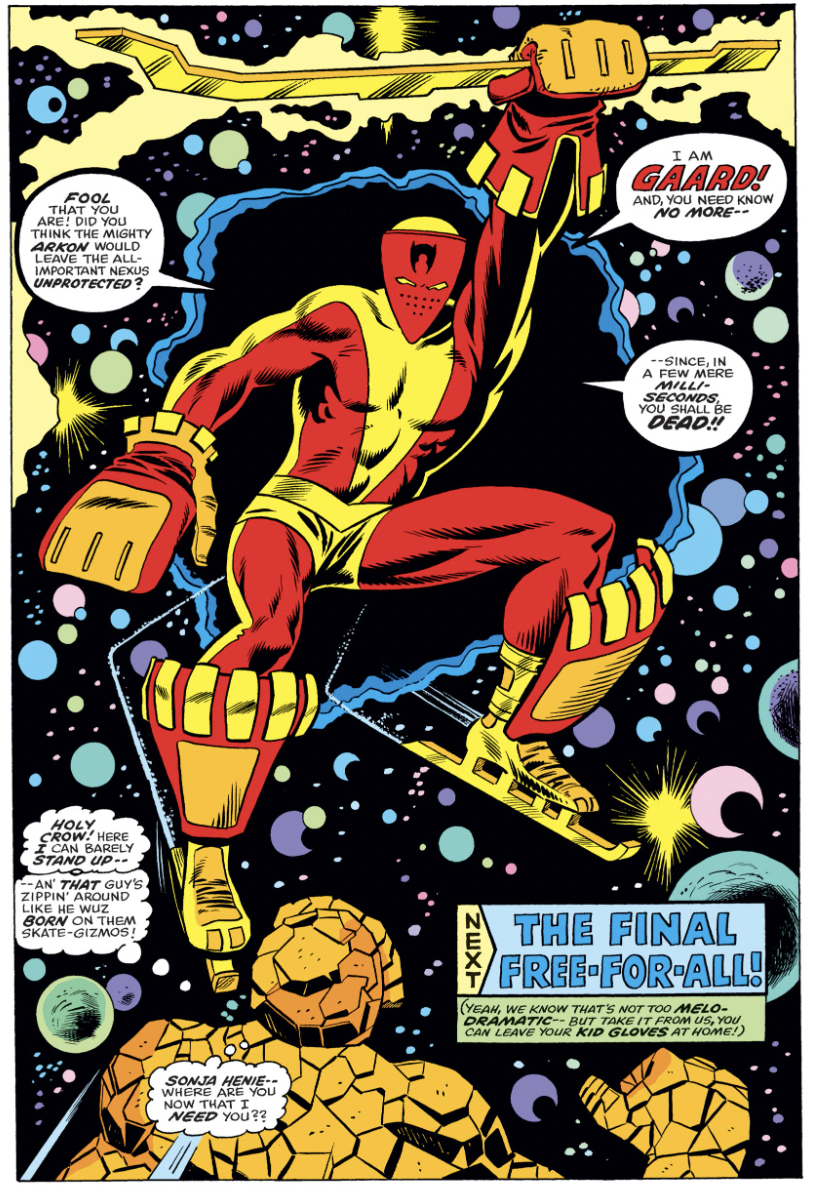
The comic concludes with a preview of the next issue’s villain, the one and only Gaard. I’ll have a lot more to say about Gaard next week, but here’s a peek:
Yes, he’s dressed like a hockey goalie. And yes, Ben makes a reference to Sonja Henie, the Norwegian ice skating Olympian and movie actress.
New credit alert: “Phil Rache” is credited as the colorist on this issue, his first on the Fantastic Four. His full name is Phil Rachelson — I assume it was trimmed for space—and he worked for both Marvel and DC from 1974 to 1981.
What I liked
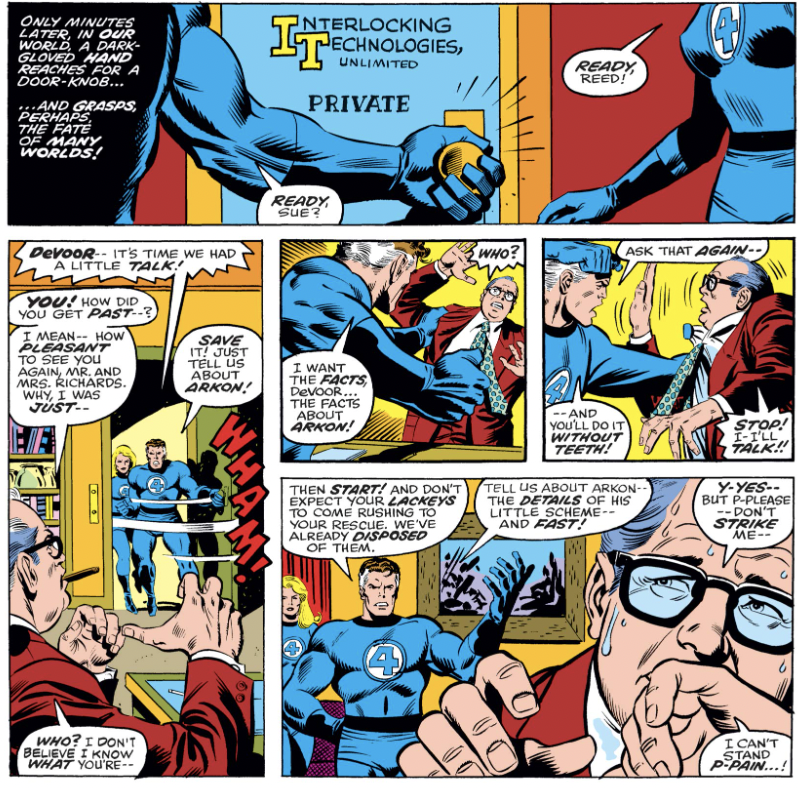
Thomas does a lot of work in the comic to explain his intricate plot. Not all of it makes much sense, but I did like this detail, that on three dimensions Mr. Devoor used three companies with different names but the same initials (although Reed actually goofs on the name of one, which should be Interlocking Technologies):
I also liked the concept of a meeting of the two Things, one Reed Richards and the other Ben Grimm:
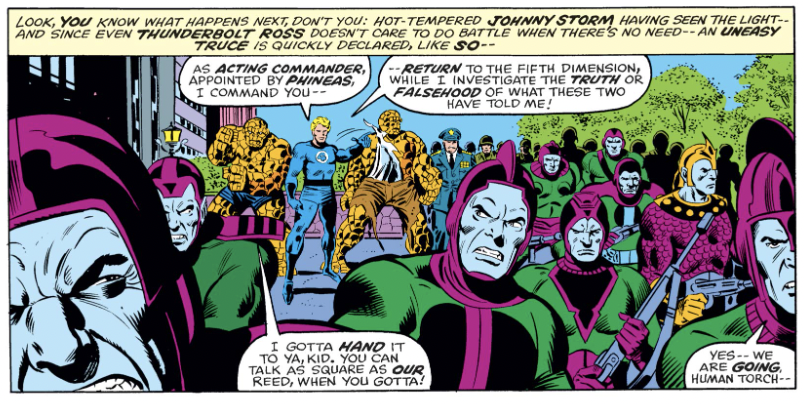
And this was an amusing interaction between Ben and Johnny, who has assumed the mantle of leader of the Fifth Dimension’s army:
What I didn’t like
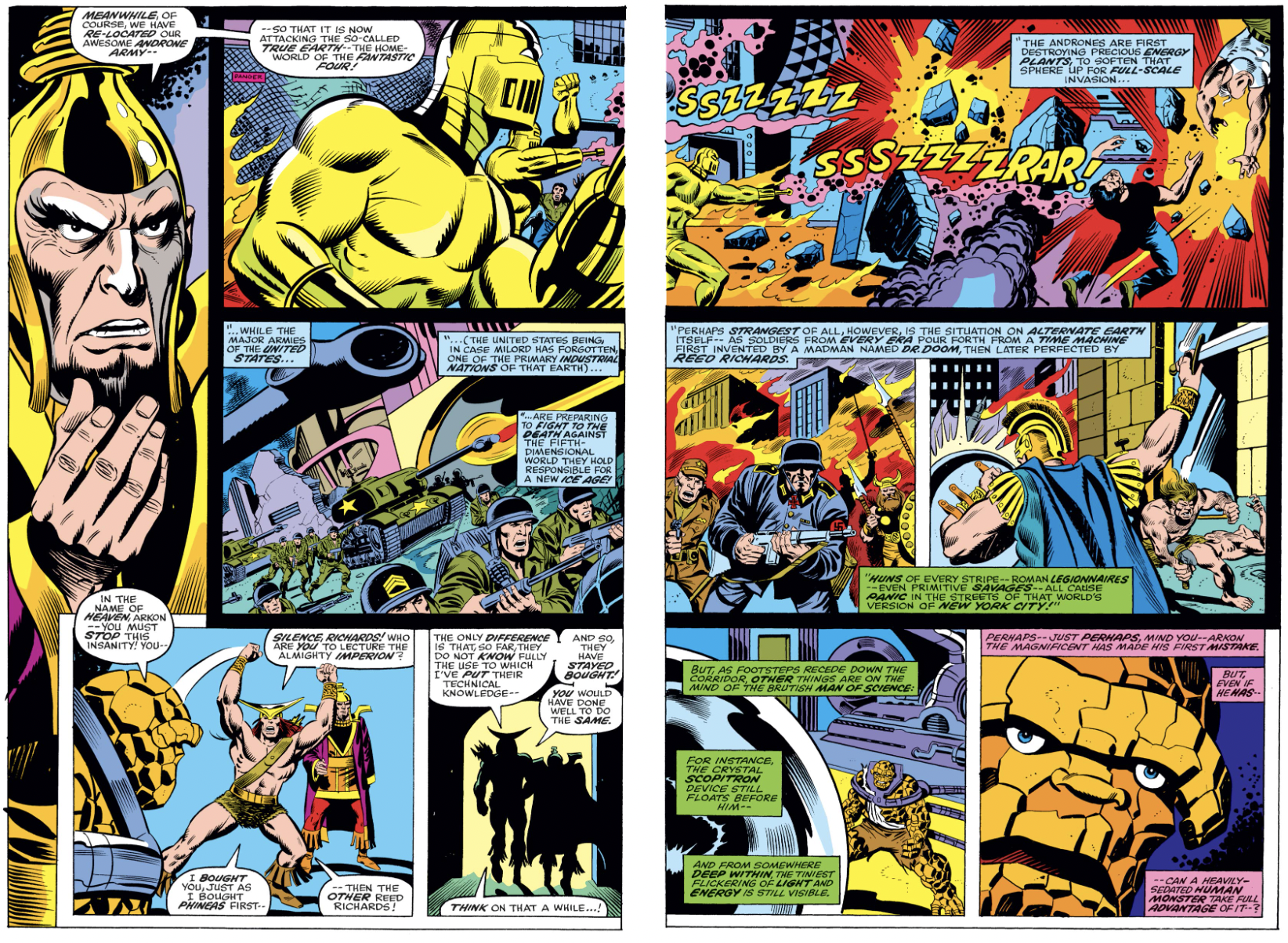
There is a lot of exposition in the comic, including over this double-paged spread:
Reed acts surprisingly thuggish here:
Anything else?
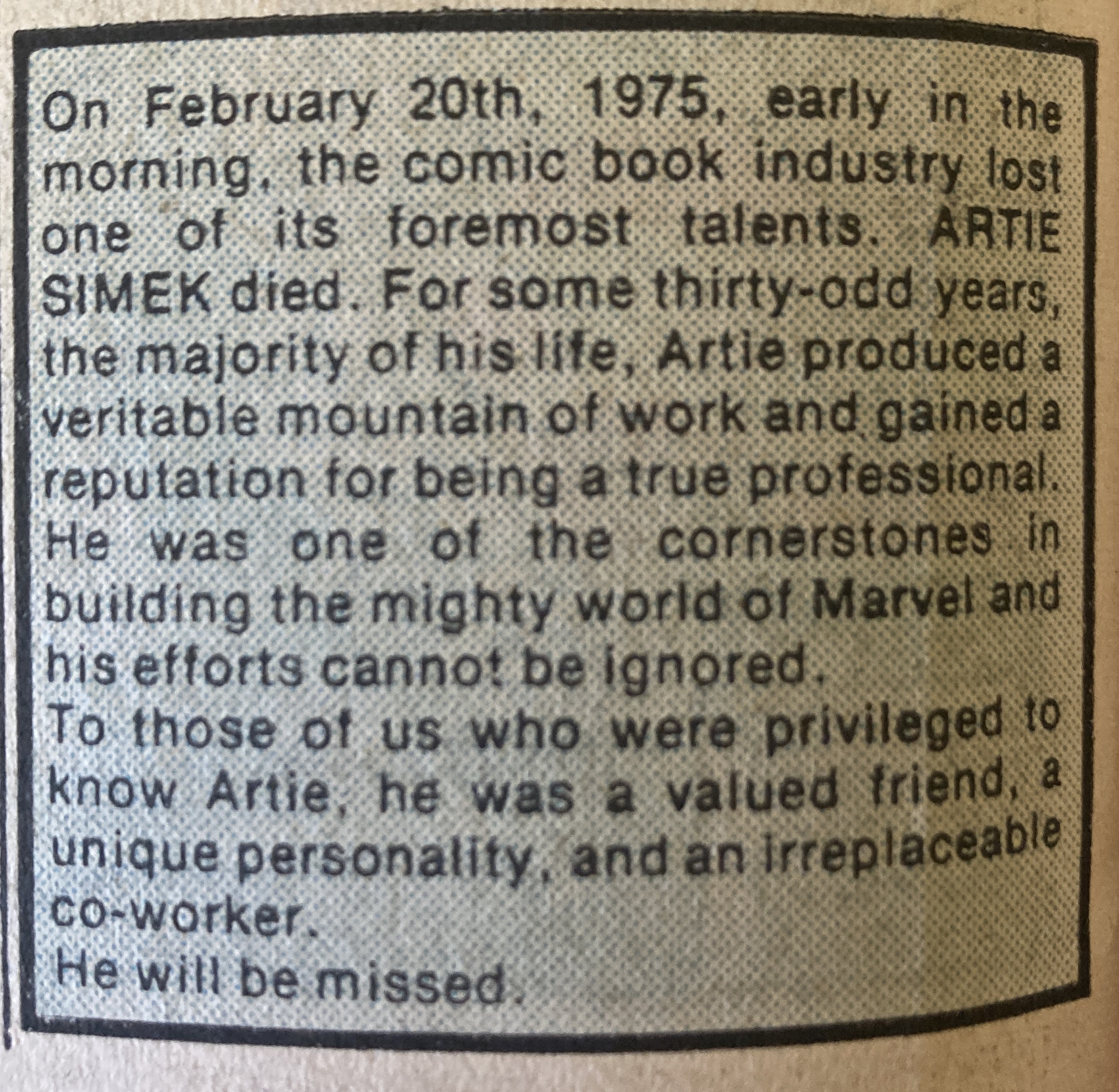
A somber note in the Bullpen Bulletins about the passing of Artie Simek, who lettered dozens of issues of the FF:
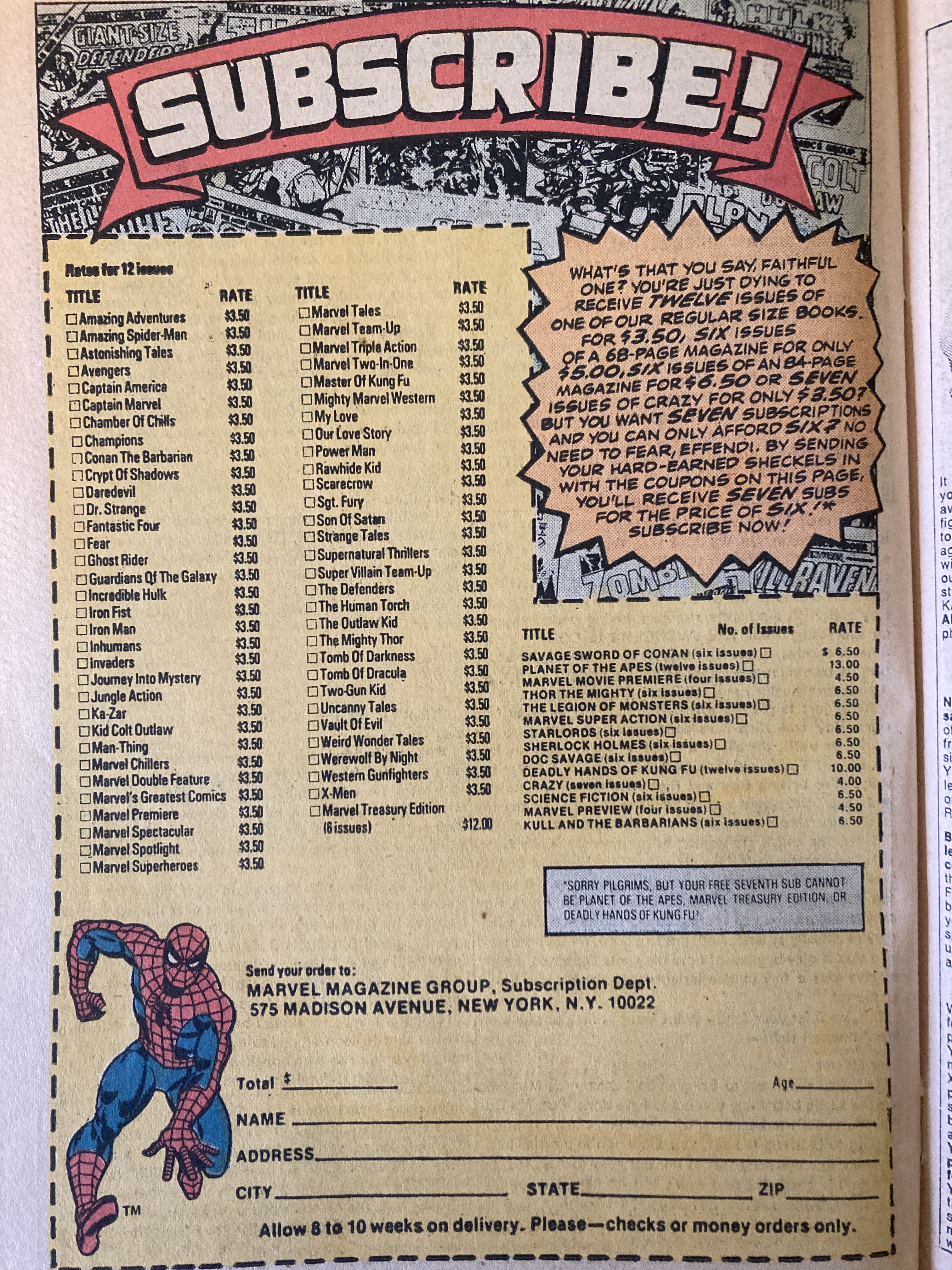
This house ad for subscriptions reveals just how many books Marvel was publishing at the time. No wonder these comics feel like barely controlled chaos. It’s also interesting how many horror, war, western and romance comics were being published (also, can you imagine waiting 10 weeks for the delivery of your first comic?):
These are interesting choices for baseball players, especially since there are 150 in the set. Was Joe Rudi that big a star in 1975?