• About Percival Henry

Percival Henry: The Fantastic Four and more

~ Blogging the Fantastic Four issue by issue (plus whatever else grabs my attention)

Percival Henry: The Fantastic Four and more

Tag Archives: 1975

“The World’s Greatest Comic Magazine!” Fantastic Four No. 168

30 Sunday Mar 2025

Posted by percivalhenry in The World's Greatest Comic Magazine

≈ Leave a comment

Tags

1975, Fantastic Four, Fantastic Four 168, Luke Cage, Power Man, Rich Buckler, Roy Thomas

Fantastic Four 168
“Where Have All The Powers Gone?”
Published December 1975
Writer: Roy Thomas
Pencils: Rich Buckler
Inks: Joe Sinnott
Letters: Joe Rosen
Colors: Phil Rachelson
Editor: Thomas
Cover: Bucker and Sinnott

Synopsis

As Ben Grimm struggles with his adjustment to being human again, Mr. Fantastic tells him he’s hired Power Man to replace him on the roster, noting that the FF’s charter requires four super-powered heroes on the team. Ben does not take this well, and when the team goes on a mission to confront the Wrecker, he gets underfoot and needs to be rescued by Power Man and the rest of the team.
What’s going on here?

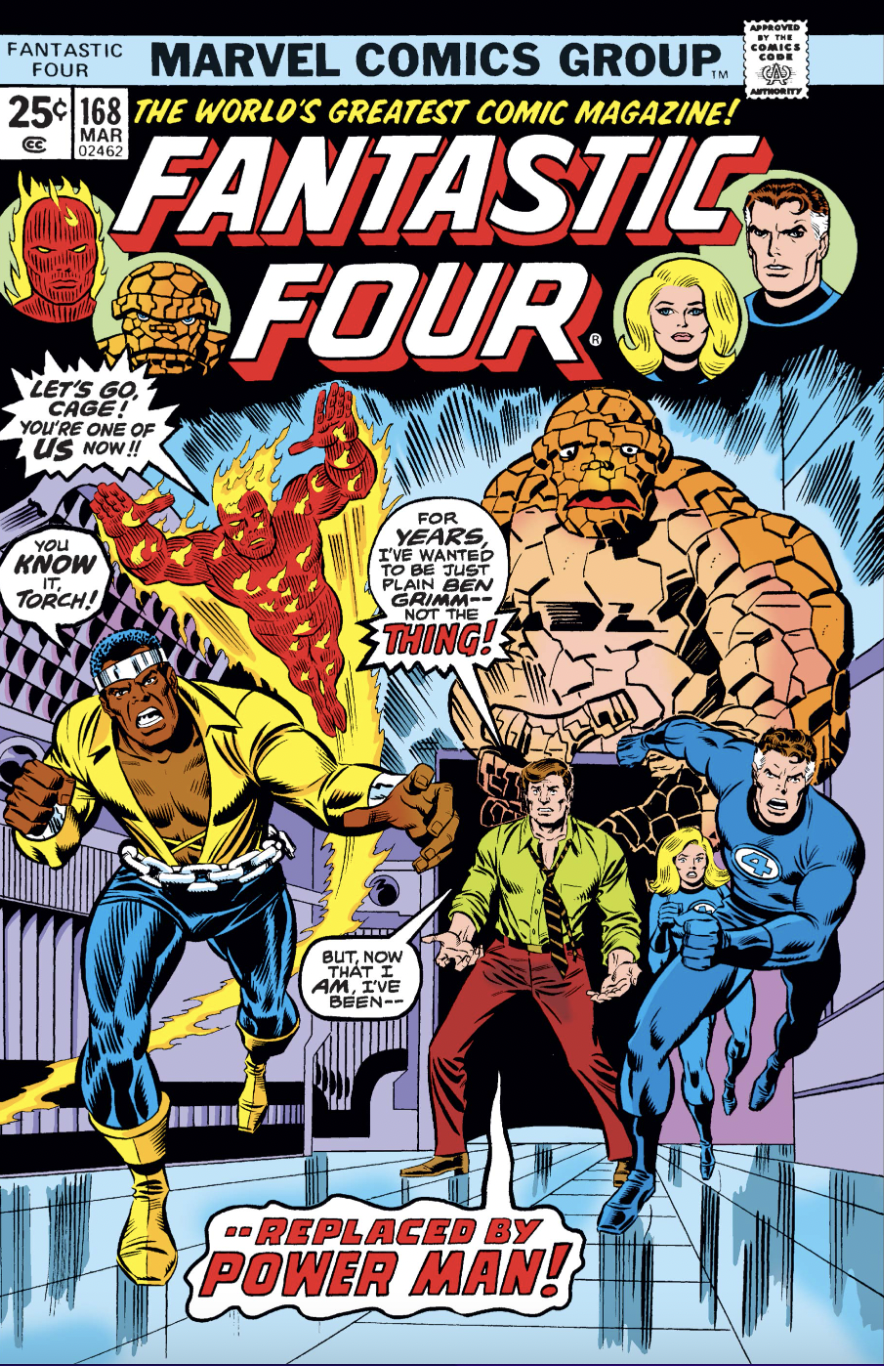
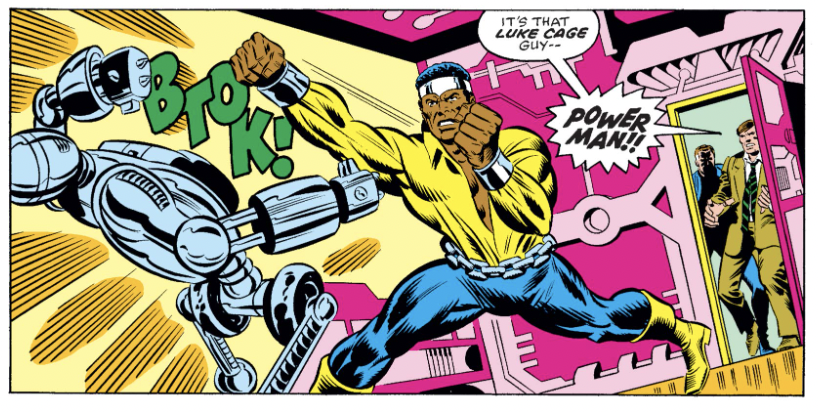
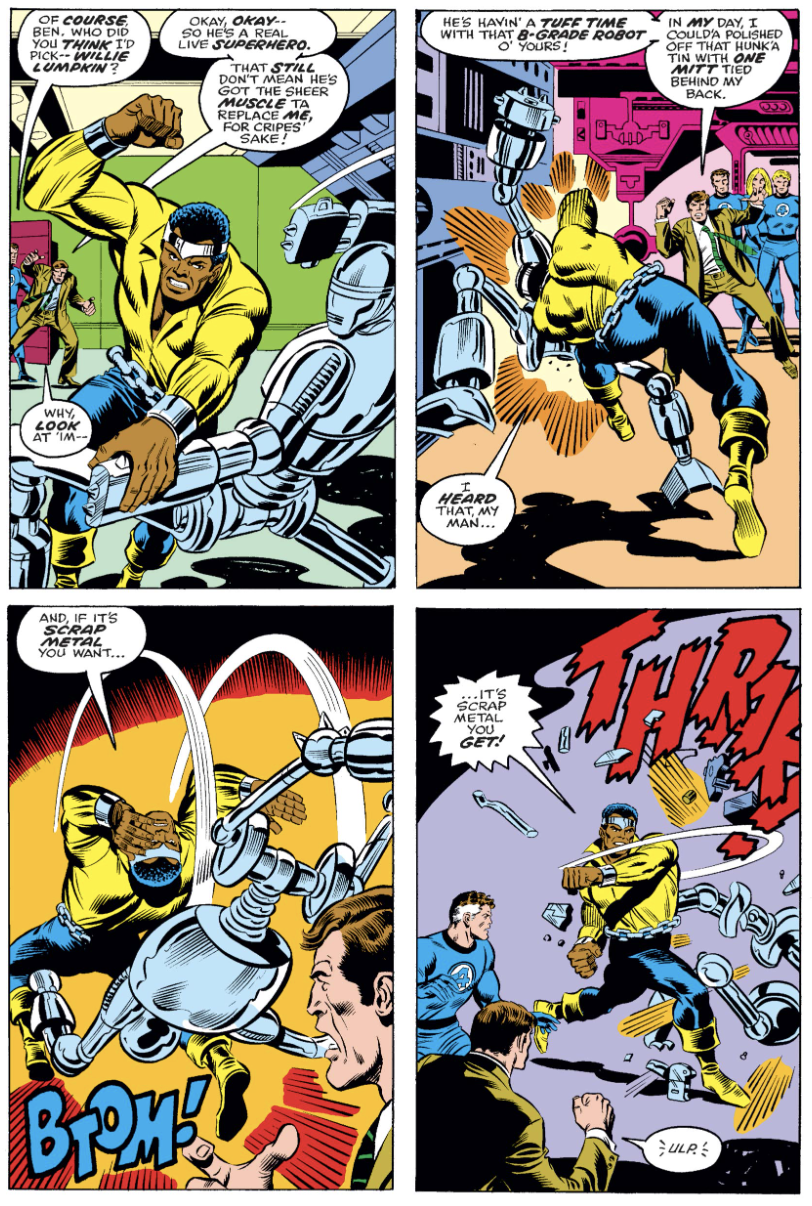
This is a notable issue for one big, obvious reason — Luke Cage joins the Fantastic Four! And while the story doesn’t live up to its potential, it’s still worth considering that Cage is just the third member of the team outside the Core Four, following Crystal and Medusa. He’s also the first person of color on the team. Unfortunately, he’s really only on the team to serve as a foil for Ben, and he’s dropped into the comic without any lead up or context. It would have been fun to tell the story from his perspective, and to see his reaction when Reed first approaches him, but we don’t get any of that. We don’t even get a “Sweet Christmas!” But we do get a lot of Ben’s being a boor.

Cage was an interesting choice for fill-in. To a certain degree, it makes sense, since he’s literally hero for hire. But he doesn’t have a history with the team, like Spider-man or even Daredevil, and I’m not aware of them ever crossing paths before. I’m guessing Cage is there to give him a bit of exposure and bump up sales of his own comic.


What I liked

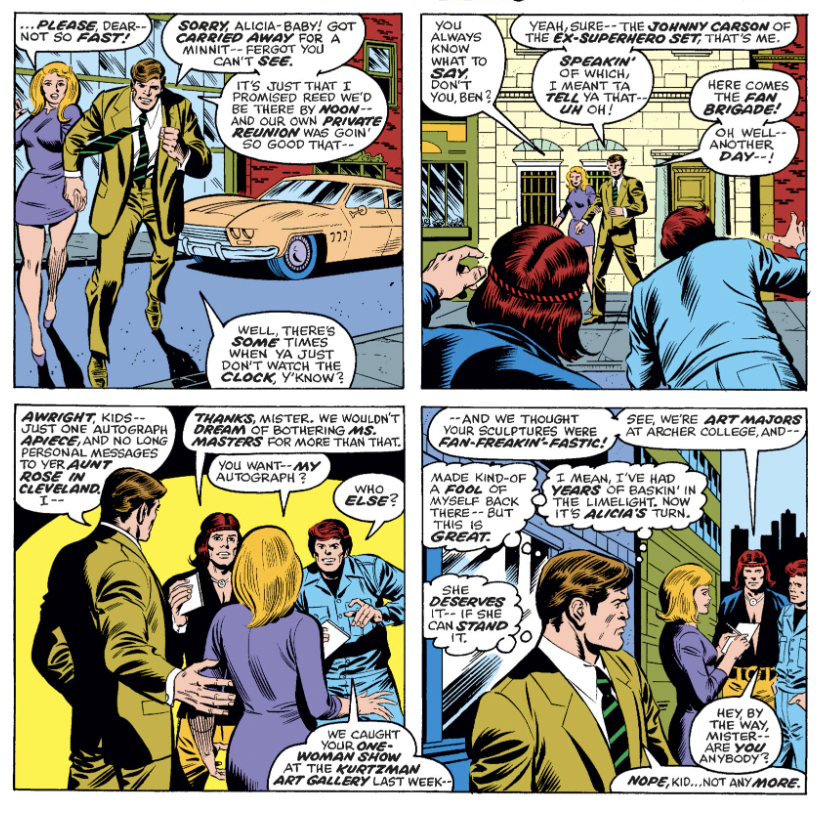
The comic is at its best when we’re in the company of Ben and Alicia, who are clearly enjoying Ben’s return to human form. (A more provocative writer would have had Alicia become pregnant while Ben was human, which would have created an interesting dynamic. Maybe someone could write a What If?). It’s fun seeing Ben step back and let Alicia enjoy meeting her fans (and note the reference to comic creator Harvey Kurtzman).

After four issues of art from George Perez, Rich Buckler is back, and while he’s not in the same league as Perez, he does a fine job here. The contrast between Perez’s layouts, with pages crammed with panels an intricate backgrounds, and Buckler’s simpler approach is pretty jarring.

What I didn’t like

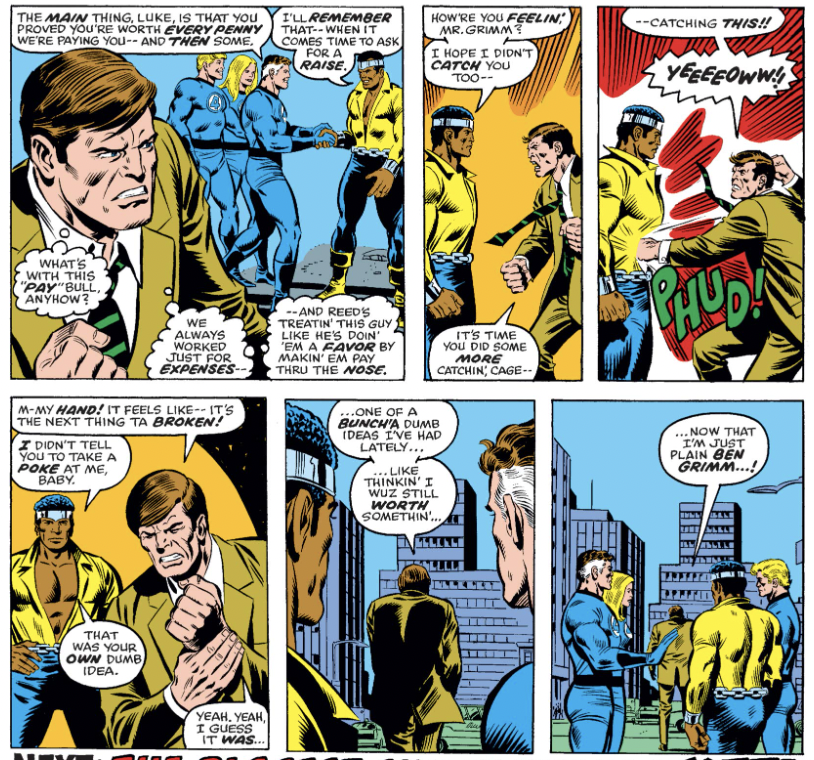
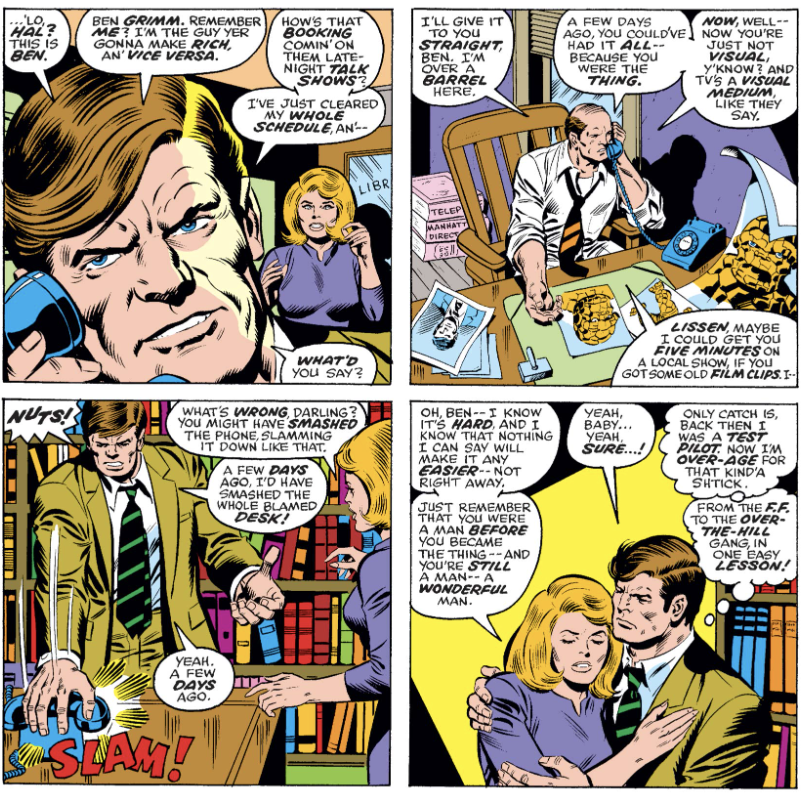
The entire issue is wrapped around Ben’s inability to adjust to no longer being the Thing. And while some of that is understandable — he’s no longer the idol of millions etc — it does start to feel like whining. For most of the last 167 issues he’s complained about being trapped in a monster’s body, and now he wishes he was the Thing again? The story (and Ben) would have been better served with more balance, and including more of his and Alicia’s joy. Unfortunately, he spends most of the issue acting like a self-pitying jerk, and the confrontation with the Wrecker serves no purpose other than to pit Ben against cage.

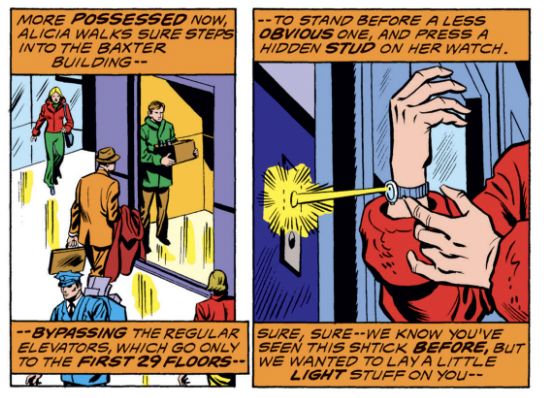
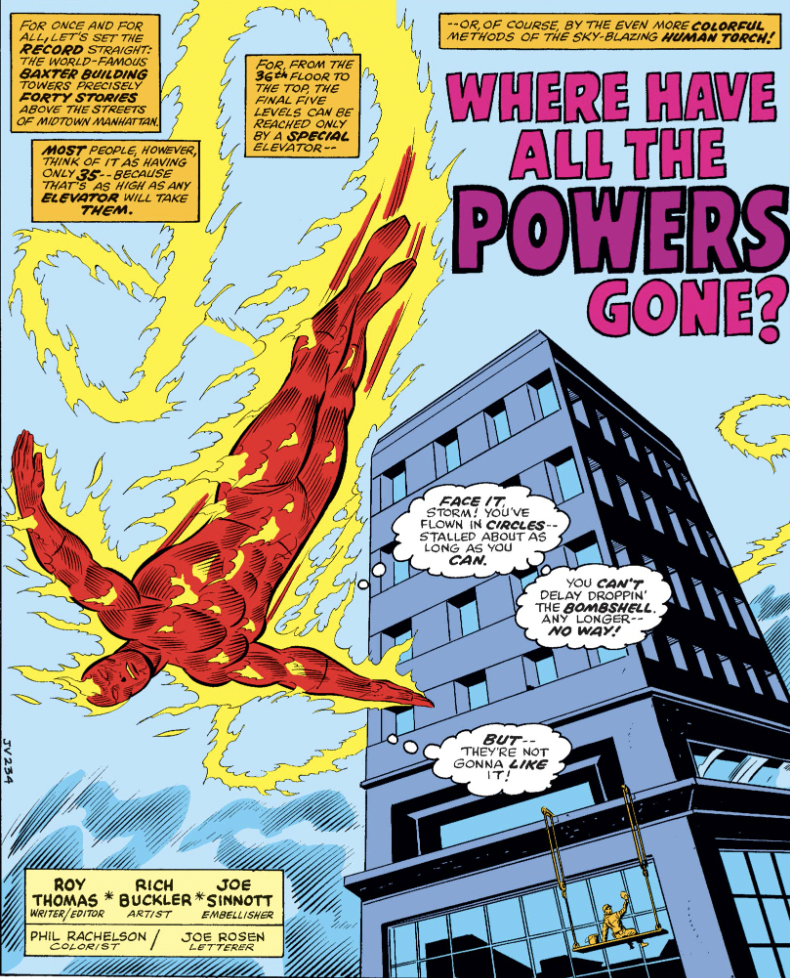
I’m not sure how many times the Baxter Building has been depicted in the Fantastic Four, but surely Buckler could have consulted one before drawing this splash page. Unless Thomas retroactively decided it was the Baxter Building after Buckler handed in the page. (Note the story title is a punny reference to a popular folk song):

Anything else?

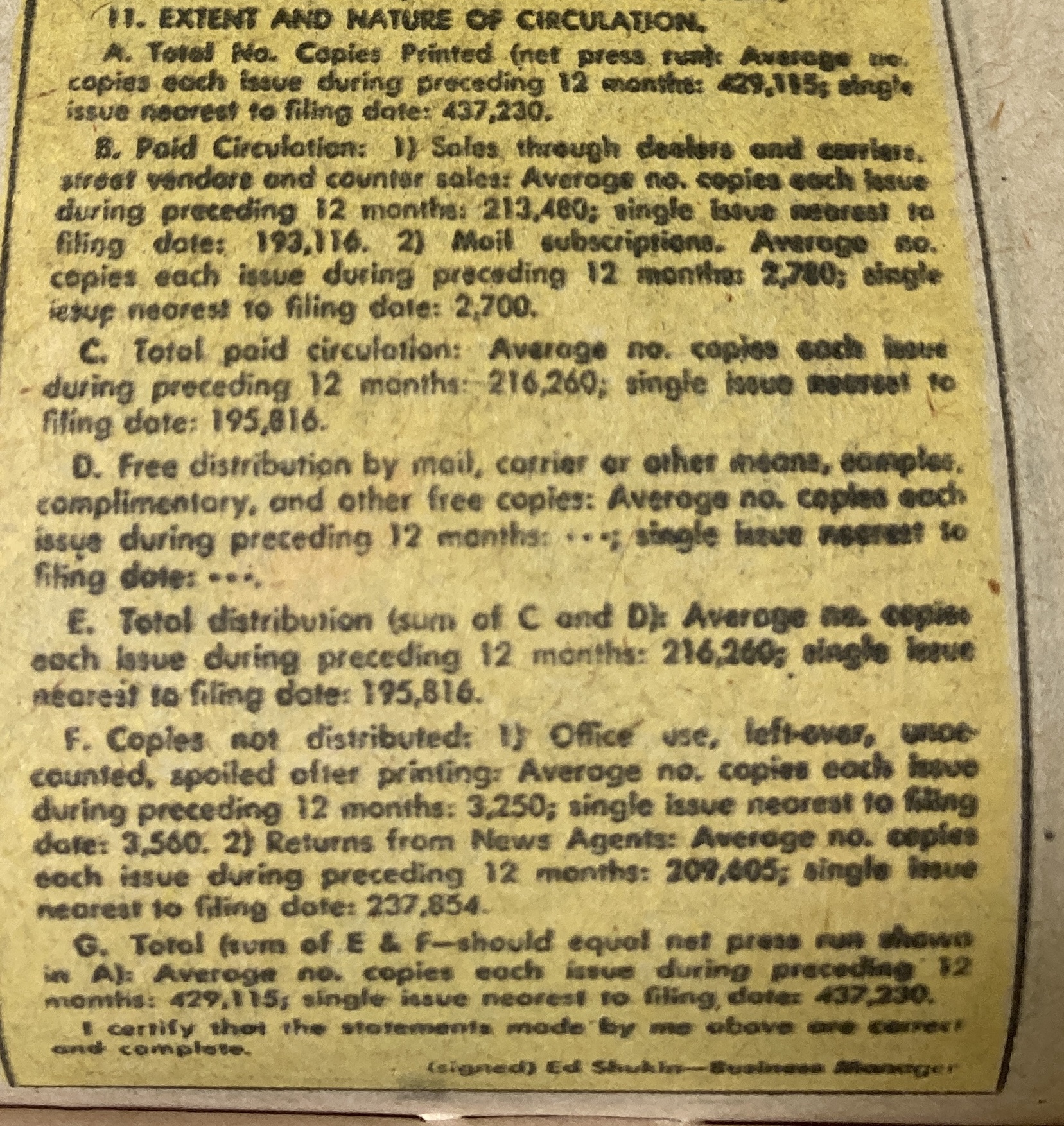
The letters page included the annual statement of circulation. Twelve month average is about 216,000 (it’s amazing how many issues get returned).

Overall

A landmark issue that doesn’t live up to its potential
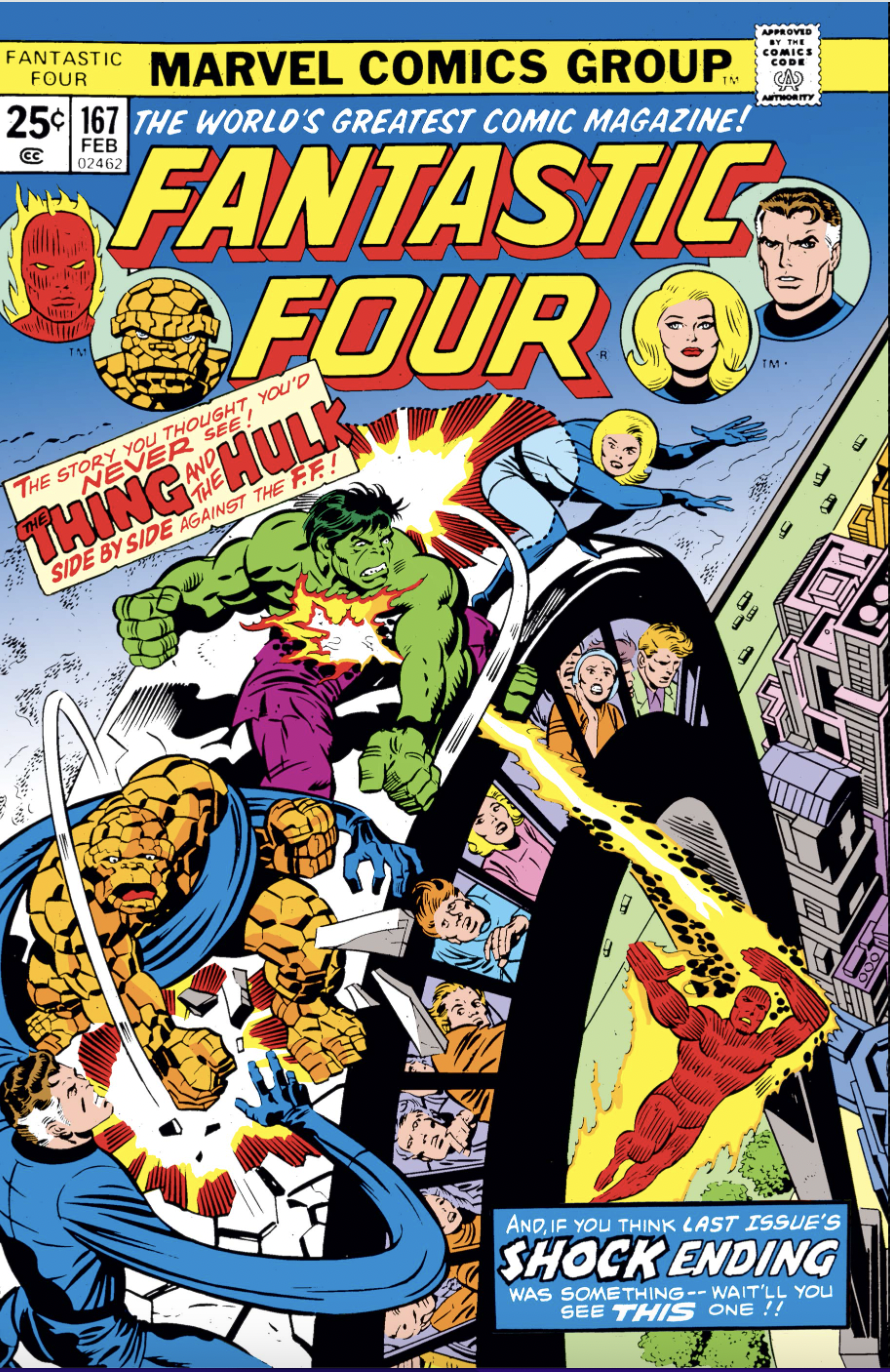
“The World’s Greatest Comic Magazine!” Fantastic Four No. 167

23 Sunday Mar 2025

Posted by percivalhenry in The World's Greatest Comic Magazine

≈ 2 Comments

Tags

1975, Fantastic Four, Fantastic Four 167, George Perez, jack Kirby, Roy Thomas, Stan Lee, The Hulk

Fantastic Four 167
“Titans Two!”
Published November 1975
Writer: Roy Thomas
Pencils: George Perez
Inks: Joe Sinnott
Letters: Joe Rosen
Colors: Phil Rachelson
Editor: Thomas
Cover: Jack Kirby and Joe Sinnott

Synopsis

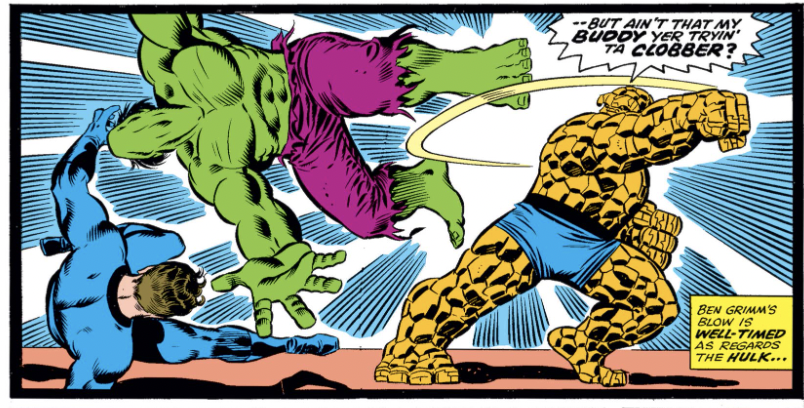
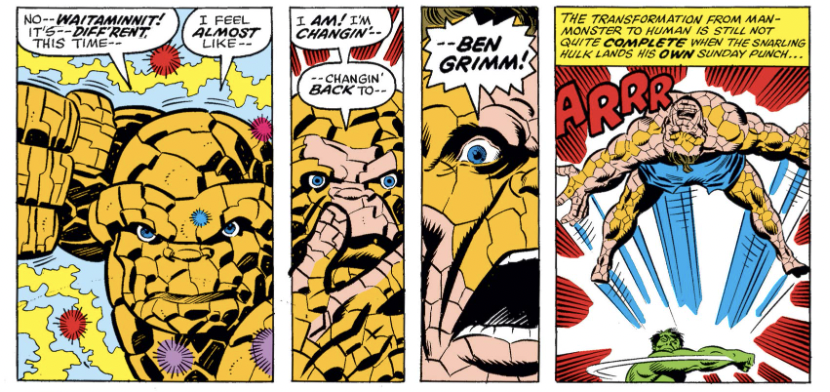
After the Thing frees the Hulk from the military’s device, the two escape in an aircraft, heading toward St. Louis. The Hulk demands they alight at the Gateway Arch, where they are eventually attacked by the rest of the Fantastic Four. When he sees his teammates in danger, Ben sides with them agains the Hulk but suddenly begins to change into his human form, a result of exposure to the Hulk’s gamma radiation. He is easily defeated by the Hulk, who escapes.

What’s going on here?

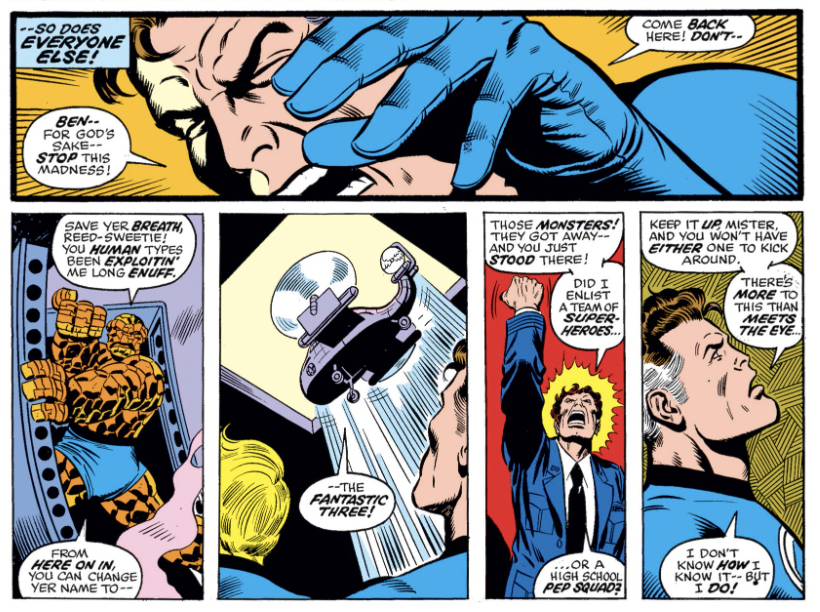
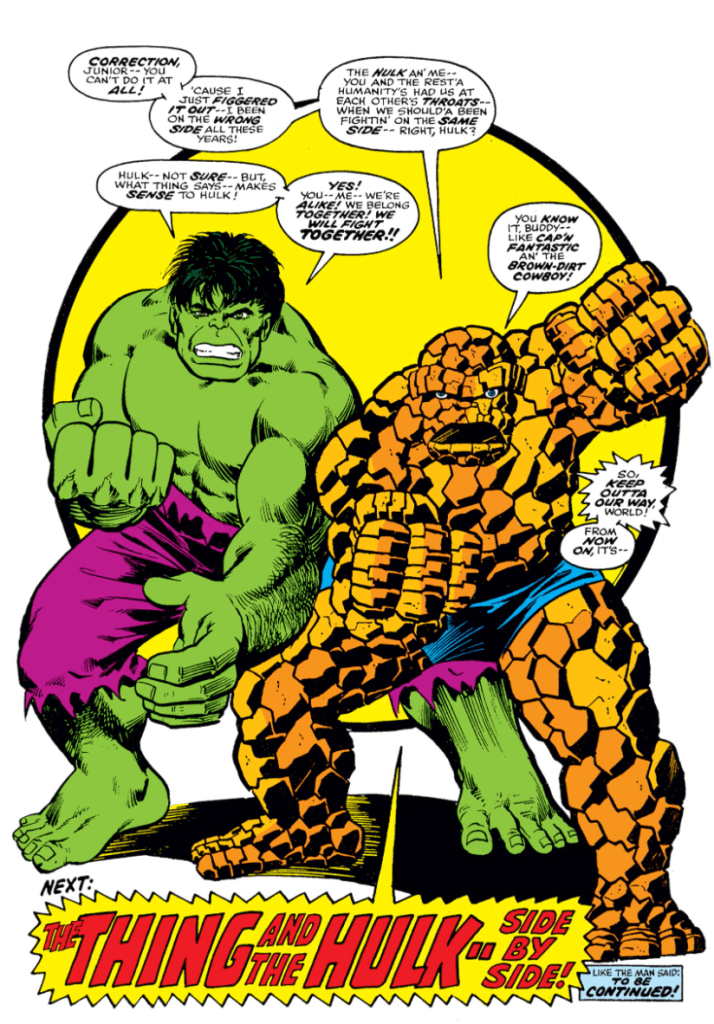
This is a pretty unsatisfying end to a two-part story that had a lot of promise toward the end of last issue, where Ben realizes he and the Hulk are both monsters. The Thing alludes to that solidarity at a few places in the issue, but Roy Thomas doesn’t do much with it and it doesn’t take much for Ben to switch sides again. Thomas instead inserts a subplot of the Thing growing weak and dizzy in the Hulk’s presence, which eventually leads to him becoming human again. None of it makes much sense, and the two-issue arc feels very gimmicky, as it reads mostly as an excuse to shoehorn the Hulk into an FF comic (more guest stars will appear next issue, further evidence that Marvel was trying to goose the FF’s sales).

Joe Sinnott returns to ink George Perez, and it’s a big improvement over Vince Colletta, last month’s inker, although Sinnott can still overpower Perez at times (most times, really).

And speaking of over-powered, Jack Kirby’s pencils are unrecognizable on the cover under Sinnott’s inks. On closer examination I can see touches of Kirby — Reed’s legs, Sue’s posture, the faces of the spectators — but it’s certainly not obvious.

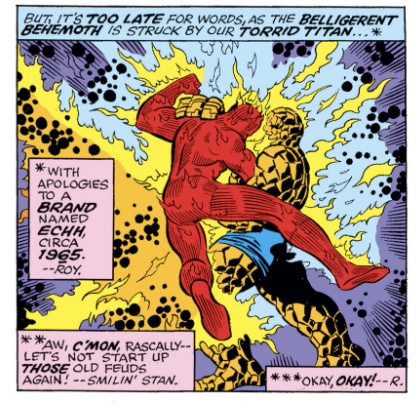
There’s also more inside-baseball in the issue, this time in the form of back-and-forth editor’s notes between Roy and Stan. I’m not sure what they are referencing — Branch Ecch was always code for DC, but who is the Torrid Titan (circa 1965)? — but this sort of thing always endeared me to Marvel when I was a young reader.

What I liked

There are some fun Perez sequences in this comic, like this one:

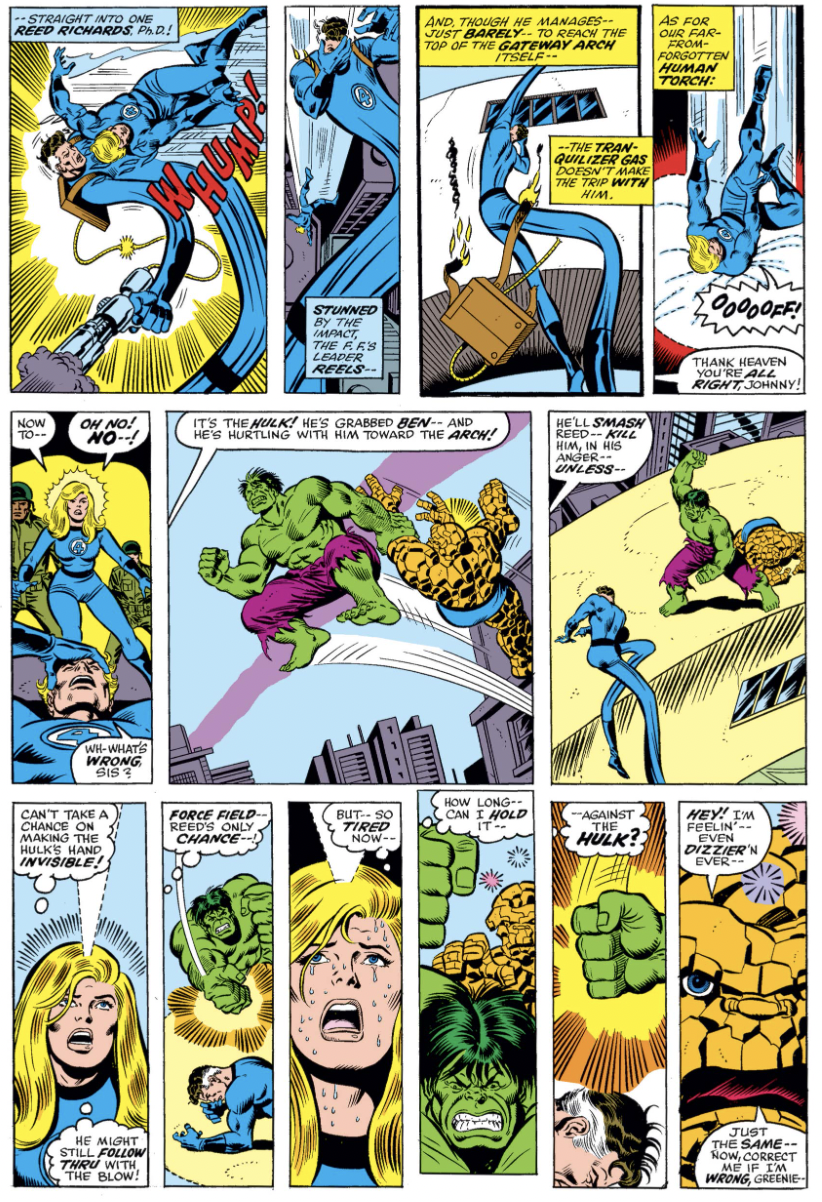
And this amazing page, with 13 — count ’em, 13! — panels:

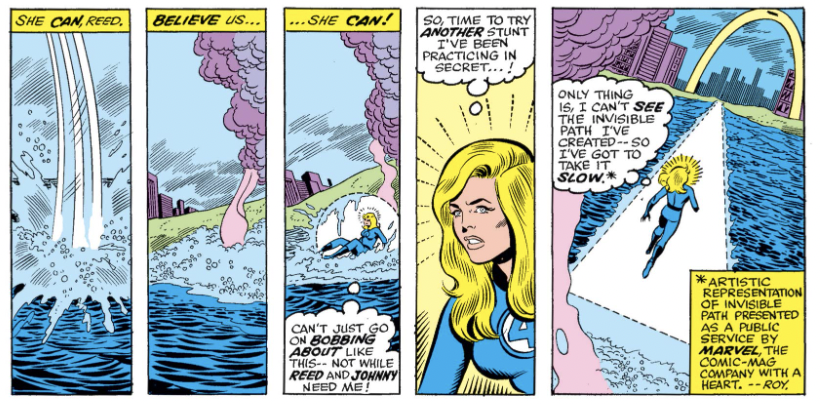
Now that Sue’s powers are beefed up, she is shown using them in more interesting ways, like so (and note the footnote):


What I didn’t like

Ben changing into his human form is hard to understand since A, Ben’s powers didn’t come from gamma rays and B, he’s been exposed to the Hulk before. I don’t know if this comes up again, but it sure seems like it would be an easy way to cure Ben of his monstrous form. It’s yet another unexpected curveball thrown at Ben that doesn’t seem based in much from a story or scientific standpoint.


Anything else?

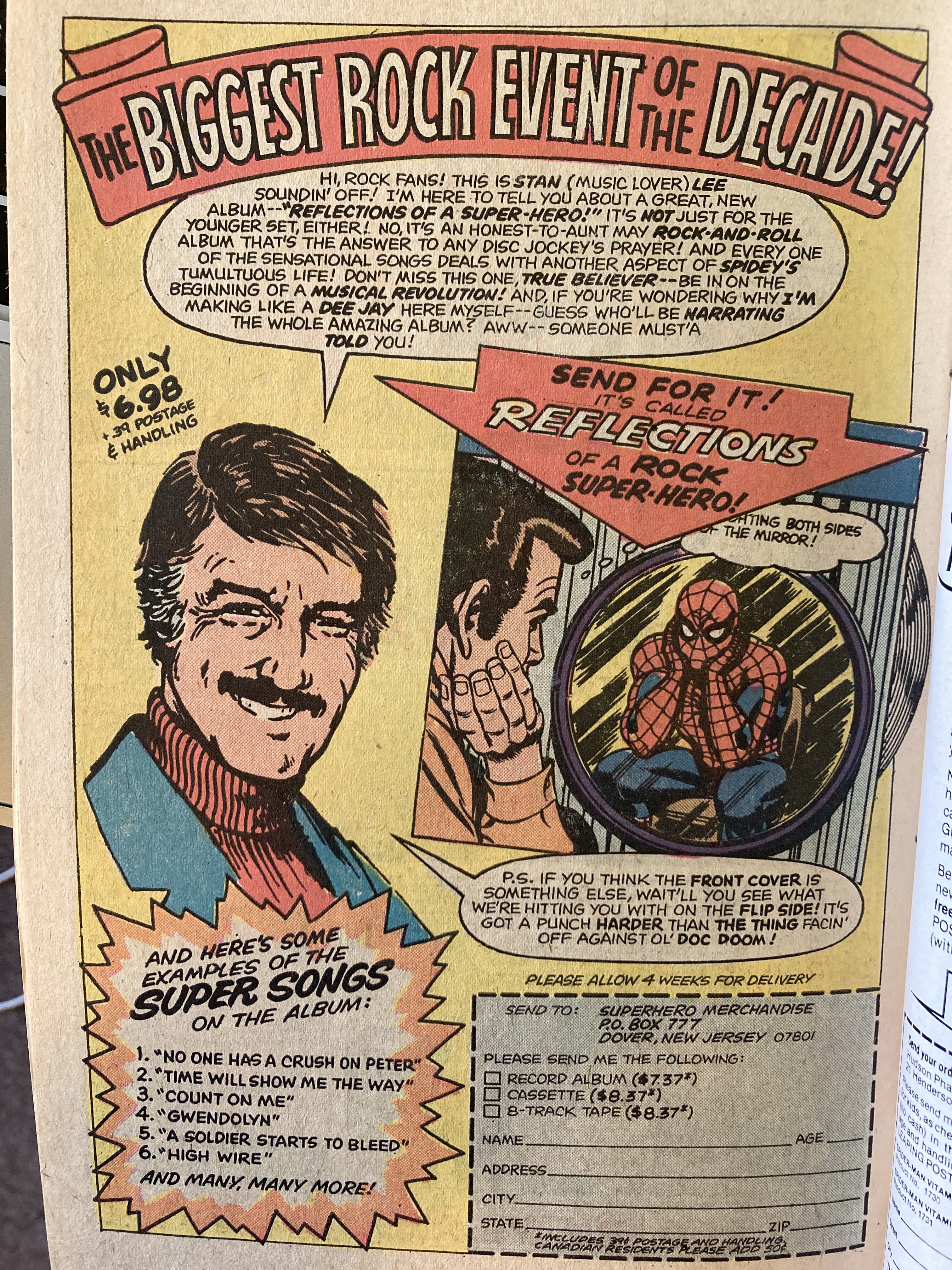
I don’t even know where to begin with this house ad:


Overall

Meh

“The World’s Greatest Comic Magazine!” Fantastic Four No. 166

16 Sunday Mar 2025

Posted by percivalhenry in The World's Greatest Comic Magazine

≈ Leave a comment

Tags

1975, Fantastic Four, Fantastic Four 166, George Perez, Marvel comics, Roy Thomas, The Hulk, Vince Colletta

Fantastic Four 166
“If It’s Tuesday, This Must Be The Hulk!”
Published October 1975
Writer: Roy Thomas
Pencils: George Perez
Inks: Vince Colletta
Letters: Joe Rosen
Colors: Phil Rachelson
Editor: Thomas
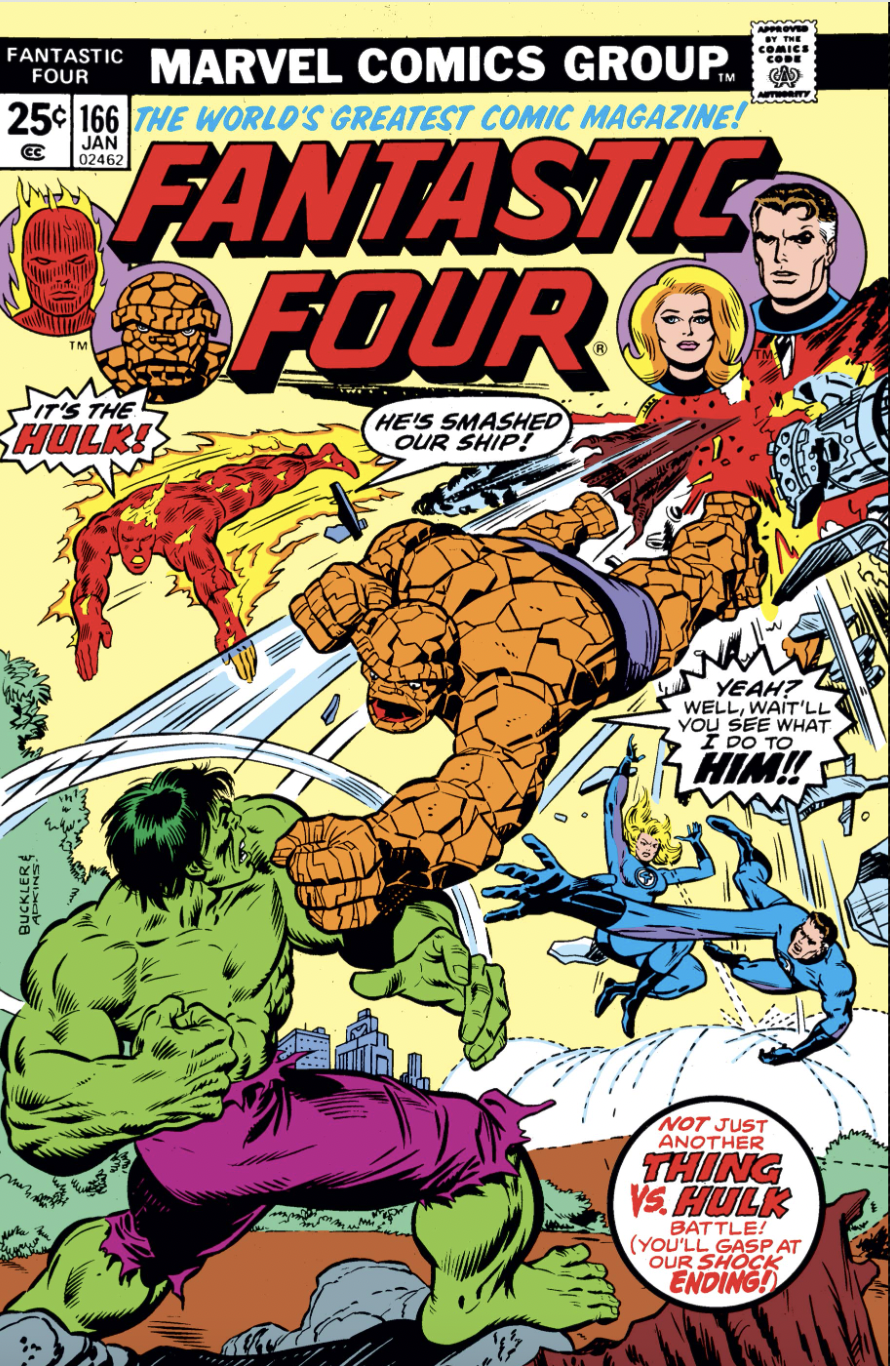
Cover: Rich Buckler and Dan Adkins

Synopsis

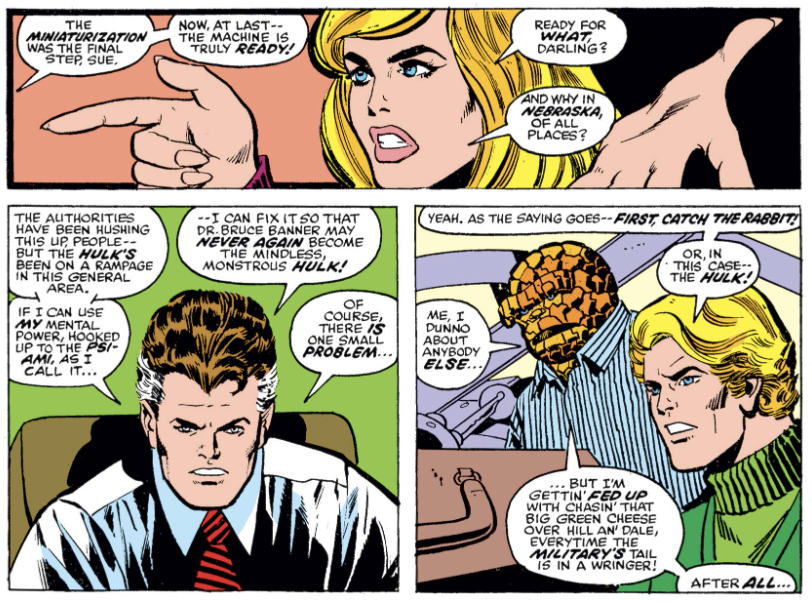
At the behest of the military, the Fantastic Four are flying west to find the Hulk, whom Mr. Fantastic thinks he can prevent from transforming from Bruce Banner with a device of his invention. Their plane is damaged by the Hulk, and after the FF help with an emergency landing, the team eventually captures the Hulk and helps the military secure him. But when it’s clear the authorities aren’t releasing Banner to the FF as agreed, the Thing frees him and joins the Hulk to fight the military.


What’s going on here?

This a bit of an odd issue. The mission to end Banner’s transformations into the Hulk seems to come out of nowhere, and it feels more like an opportunity to get the Hulk on the cover than to tell a good story. The story is padded out with a long sequence of the FF rescuing the plane (and with two pages for letters) but it picks up toward the end.

What’s most alarming about this comic are the inks of Vince Colletta, who is filling in for the Joe Sinnott. Colletta is infamous among comic book fans for butchering Jack Kirby’s work on Thor (it’s well documented here), and he’s accused of taking shortcuts and even erasing details that would take too long to ink. I always felt the criticism was probably over the top, given the passions Kirby evokes in his fans, and that Colletta was a journeyman professional who was doing a job as best he knew how (he is credited with working on more than 1,600 comics over the length of his 40+ year career).

But he does George Perez no favors in this comic. There is a distinct lack of Perez’s signature detail, and his faces look frozen and static. Here’s a good example:

It’s almost unrecognizable as Perez, and even though this is early in Perez’s career, we saw in the last two issues (inked by Sinnott) that many of his characteristics were apparent even at this stage.

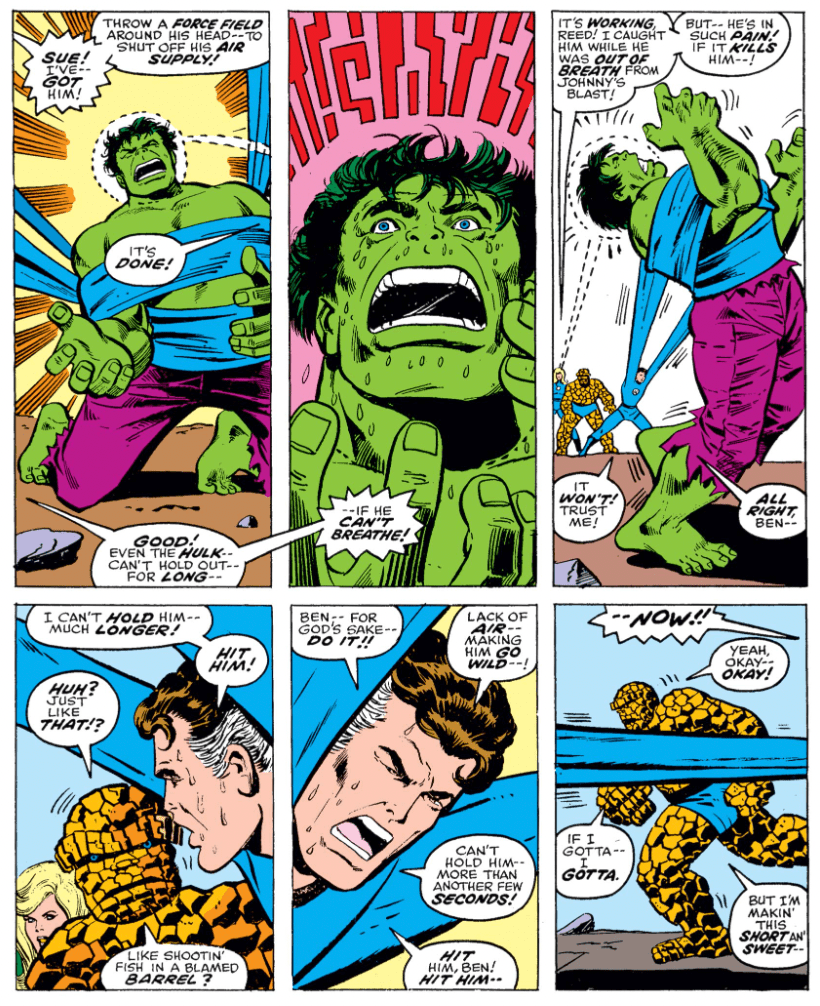
In last month’s letters page there was an explanation that regular FF penciler Rich Buckler was unavailable for some reason, and that Perez was pressed into service. It’s possible he had to rush to complete this issue, and was only able to do layouts, leaving emergency inker Colletta the task of finishes. (The padded story and the double letter page would support that theory). In any event, the art in this comic is an unfortunate disappointment after the brilliant FF debut of Perez in the last two issues.

And one footnote: the cover by Buckler was inked by Dan Adkins, a longtime comics inker doing his first work on the Fantastic Four.

What I liked

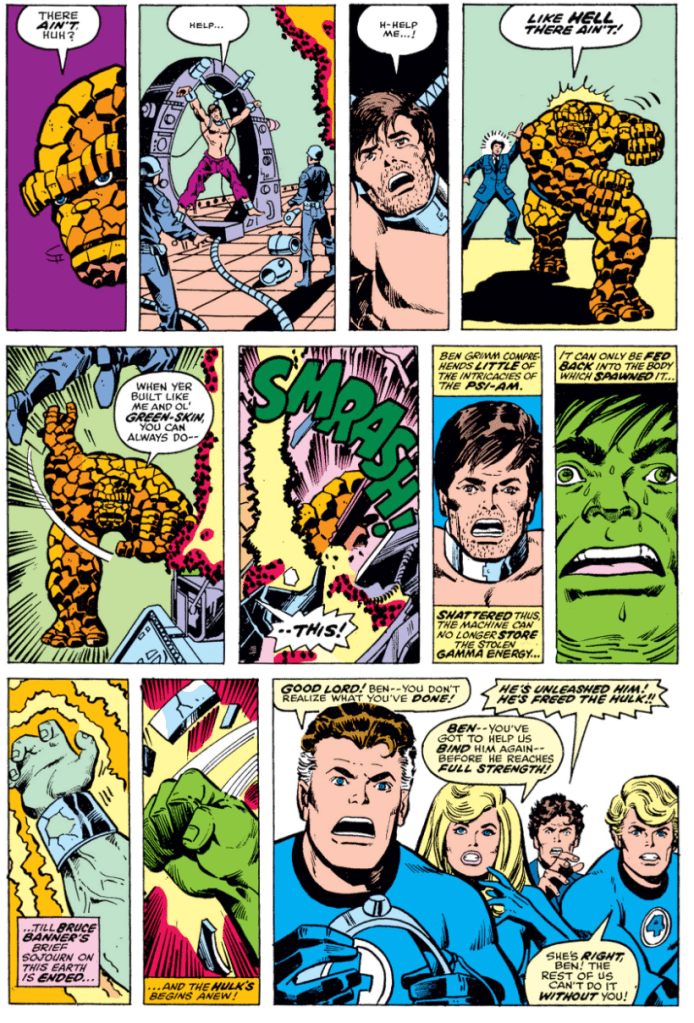
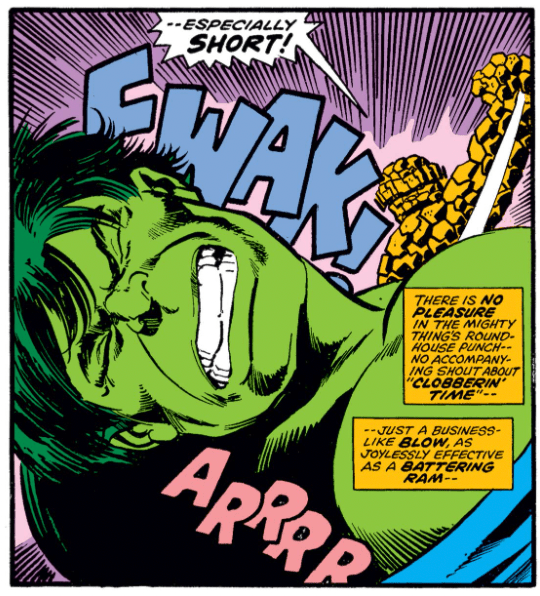
Despite the shaky premise, the story becomes a good one as the plot develops and Ben’s outrage over the treatment of the Hulk — in his eyes, a fellow monster — at the hands of the military builds from a simmer to boil. His decision to free Banner is genuinely surprising. This is a pretty dramatic sequence, enhanced by Perez’s layouts, which build from an 11-panel page (!) to a great splash:


I also liked how matter-of-factly the FF defeated the Hulk. Granted, the Hulk in this comics isn’t the absurdly over-powered creature he has since become, but it was fun to see them work together as a smooth and efficient team, and where Sue plays a leading role.


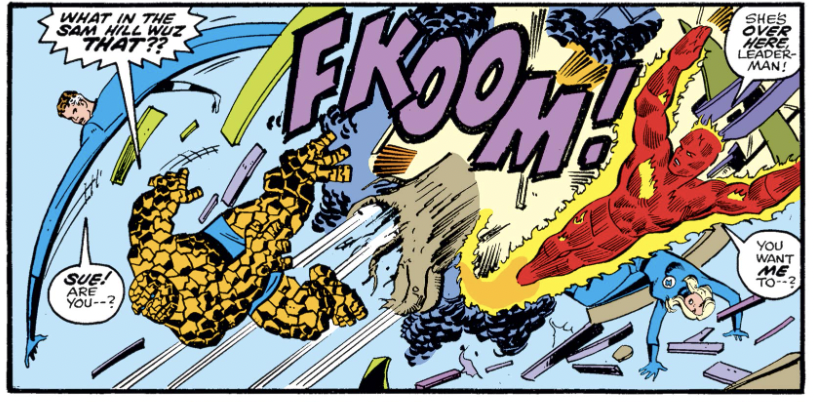
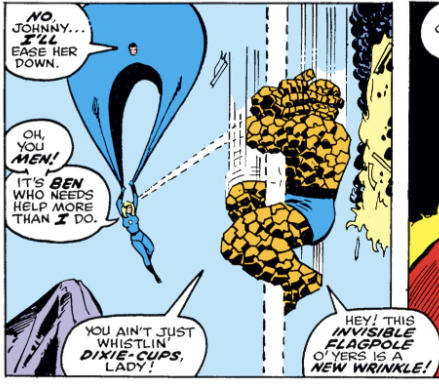
And speaking of Sue, this was a fun exchange (this panel follows the “Fkoom!” panel higher up in this post):


What I didn’t like

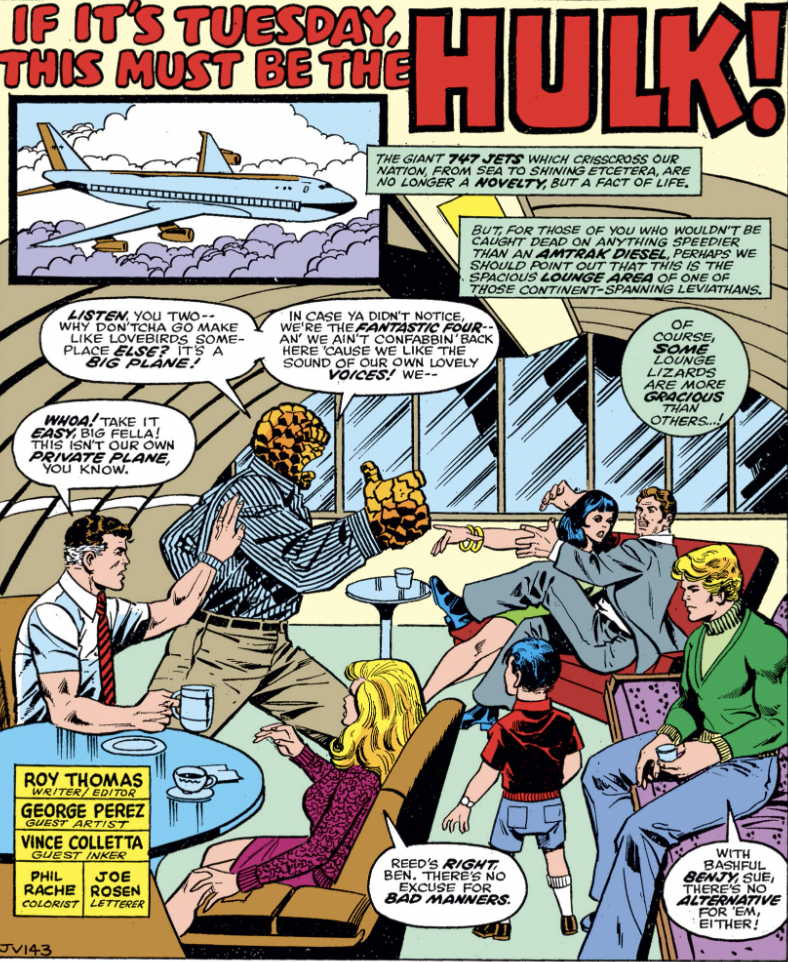
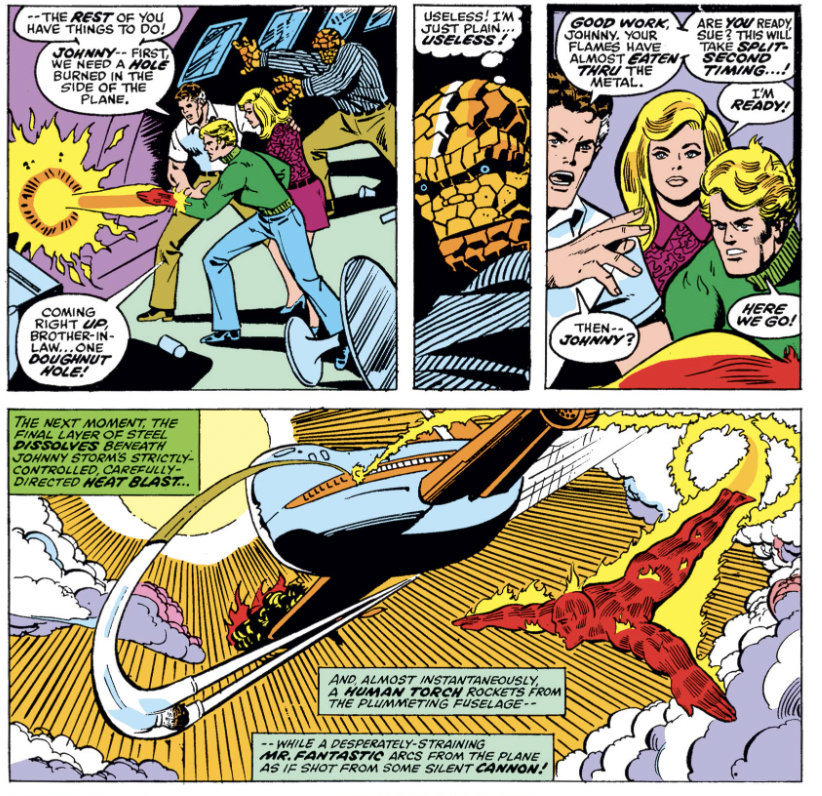
As mentioned earlier, this story feels padded and contrived, never more so than in the opening sequence, where the FF are flying in a commercial airline — it’s not explained why they’re not in one of their own planes — which just happens to be accidentally clipped by the Hulk. It’s all a set up for the FF to land the plane, but it really serves no narrative purpose. Also, there are some really ungainly poses in this panel (and whose kid is that?).


When the FF scramble to rescue the crashing plane, Reed directs Johnny to burn a hole in he fuselage so they can exit the plane. But why not just open a door?


Overall

A bit of a mess

“The World’s Greatest Comic Magazine!” Fantastic Four No. 165

09 Sunday Mar 2025

Posted by percivalhenry in The World's Greatest Comic Magazine

≈ Leave a comment

Tags

1975, Fantastic Four, Fantastic Four 165, George Perez, Marvel comics, Roy Thomas

Fantastic Four 165
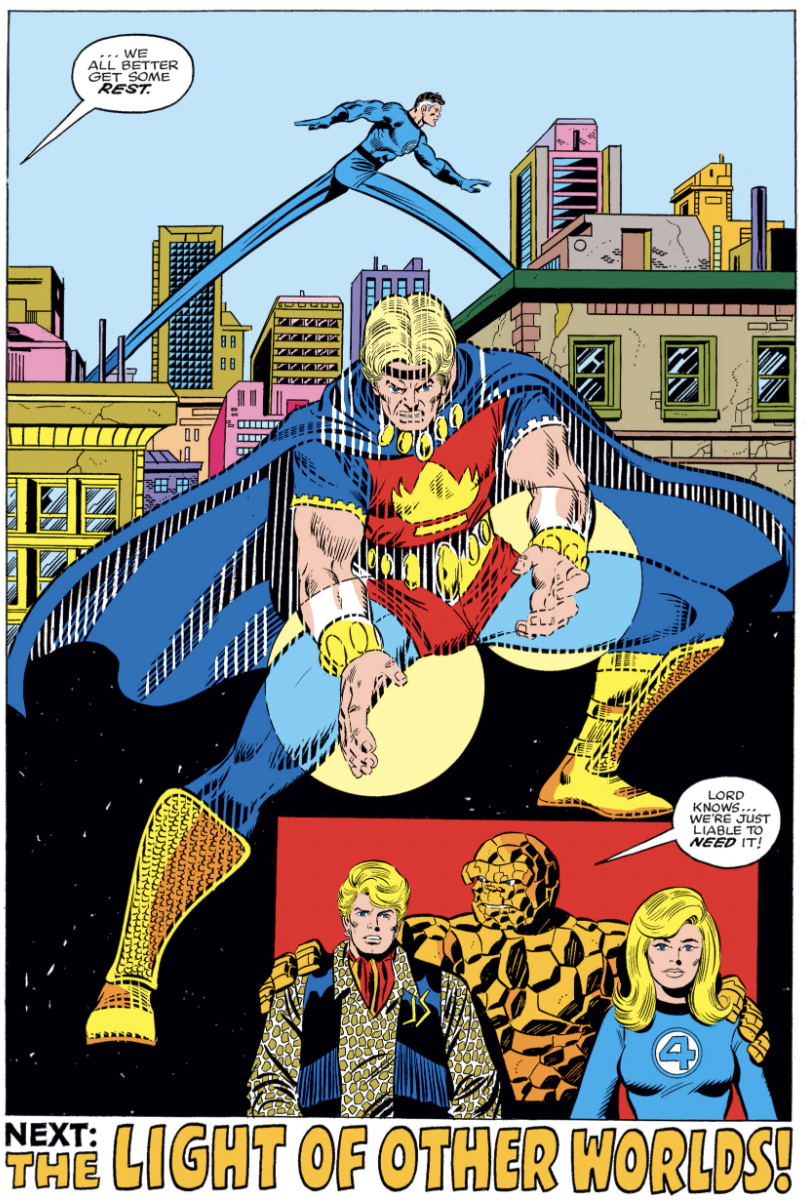
“The Light of Other Worlds!”
Published September 1975
Writer: Roy Thomas
Pencils: George Perez
Inks: Joe Sinnott
Letters: John Costanza
Colors: Petra Goldberg
Editor: Thomas
Cover: Ron Wilson and Joe Sinnott

Synopsis

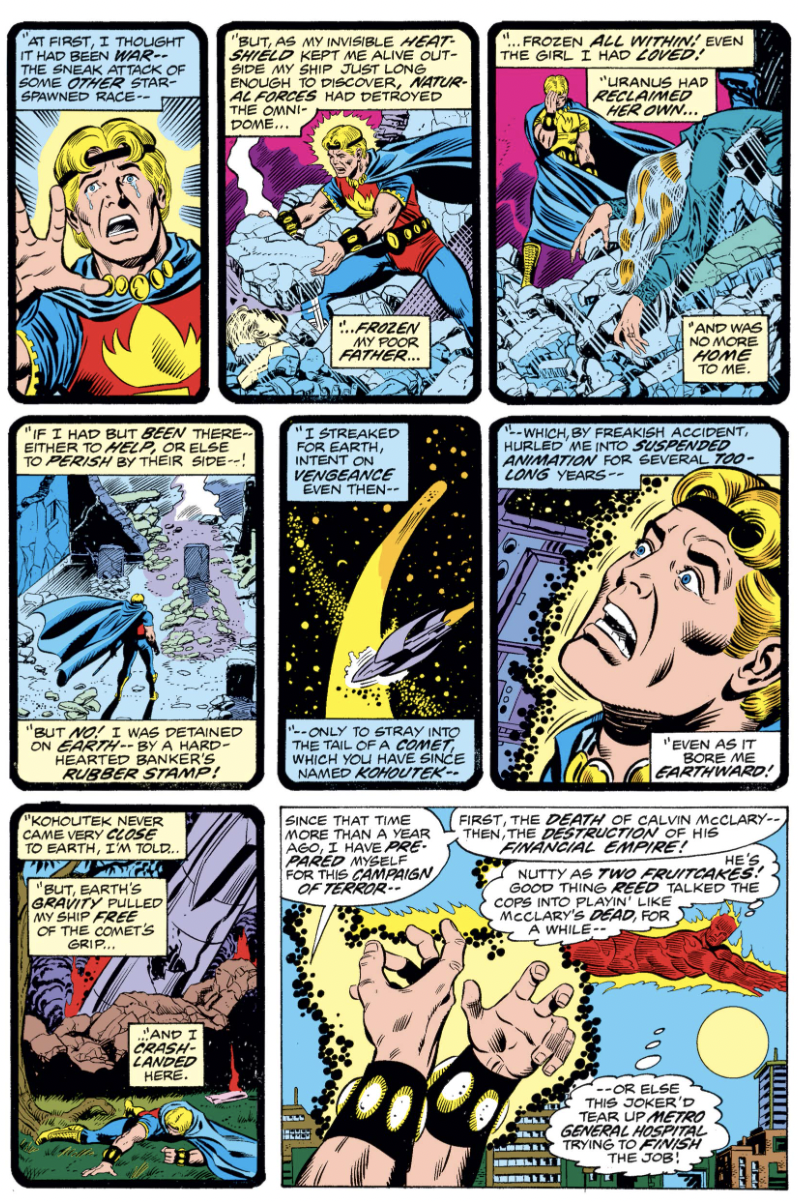
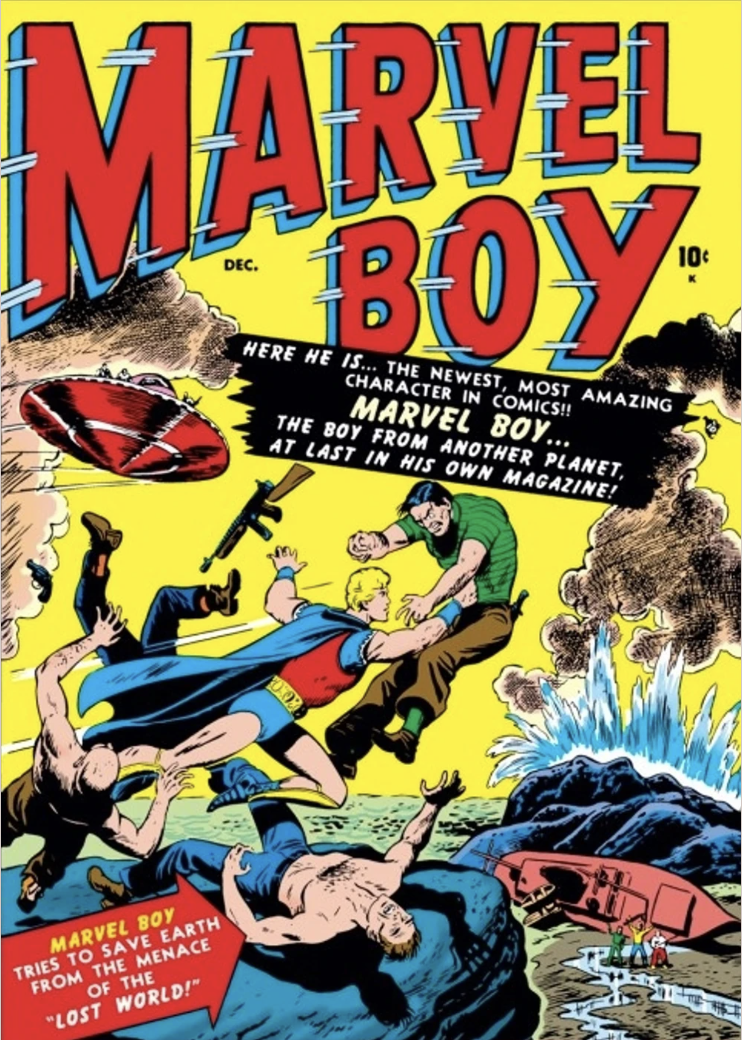
Mr. Fantastic begins investigating the Crusader, who defeated the Human Torch last issue and has been on a rampage, destroying banks across New York City. When he attacks a branch in the Bronx, the FF confront him and he reveals he was once the golden age hero Marvel Boy and is now enacted revenge on the banks that prevented him from saving the people of his home world, Uranus (really). Reed deduces his powers are light-generated, and by blotting out the sun the FF are able to defeat him.


What’s going on here

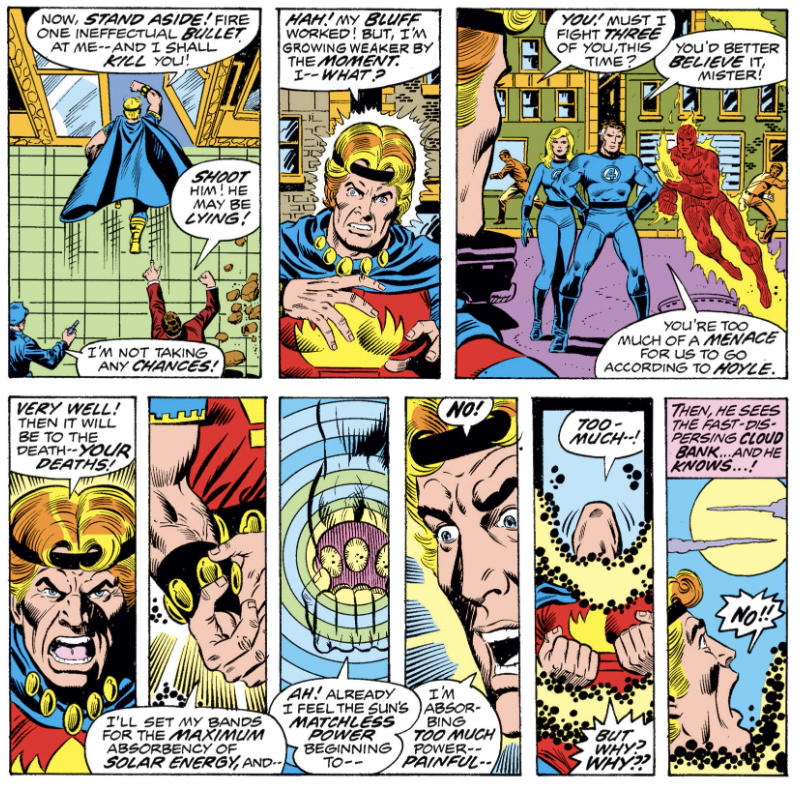
While not quite as tightly paced as the last issue, this comic is a satisfying conclusion to the Crusader story. In the letters page, it is revealed this two-part story was originally intended to be a a single-issue story in Giant-Size Fantastic Four 6, but when that series was canceled, the story was split into two with a few pages added (interestingly, they chose not to simply make it an annual). The note apologies for any dropped plot points — I didn’t detect any— but this issue does feel padded, with a climactic fight scene that lasts longer than it really needs to.

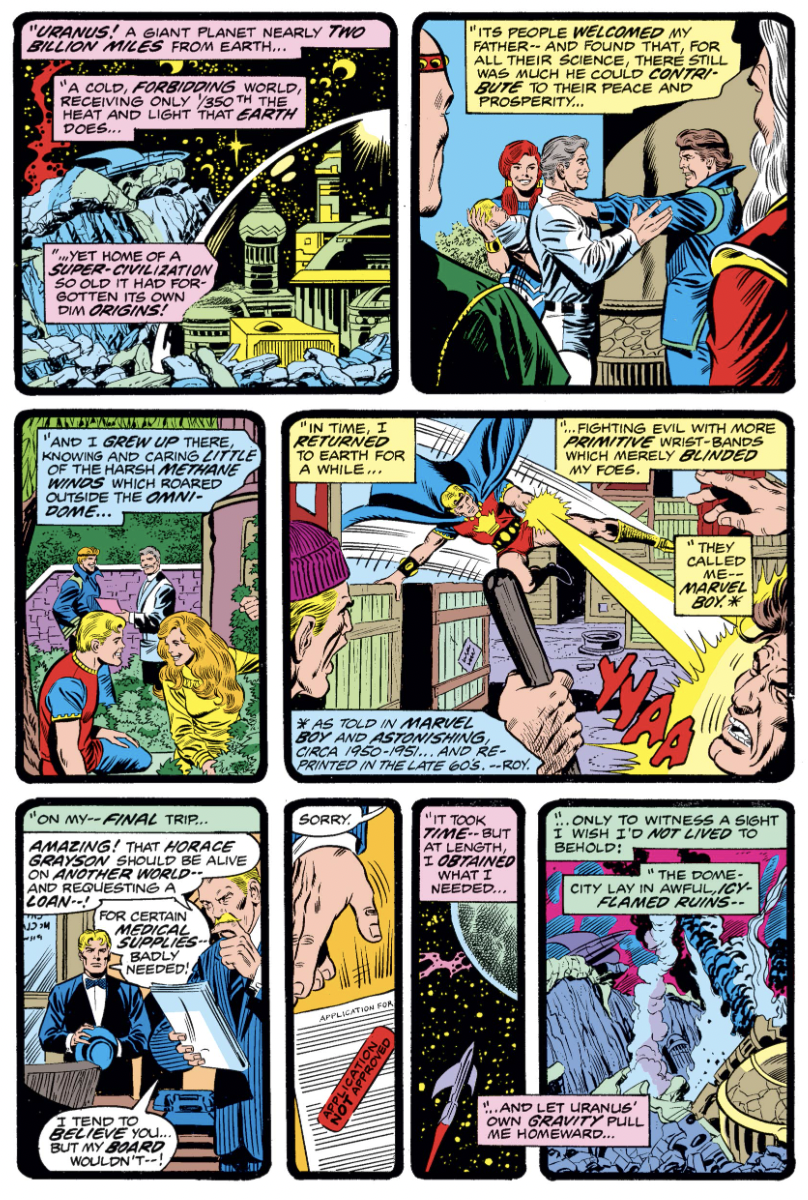
Roy Thomas provides a lengthy and convoluted origin of the Crusader, whose campaign against the banks makes him sound like a super-powered Luigi Mangione. It’s all pretty ridiculous, and it’s clear the Crusader is only in this comics because of Thomas’s affection for obscure characters from the golden and silver ages.

(This origin would eventually be retconned away, and the Crusader is now an Eternal named Thelius who believed himself to be Marvel Boy).

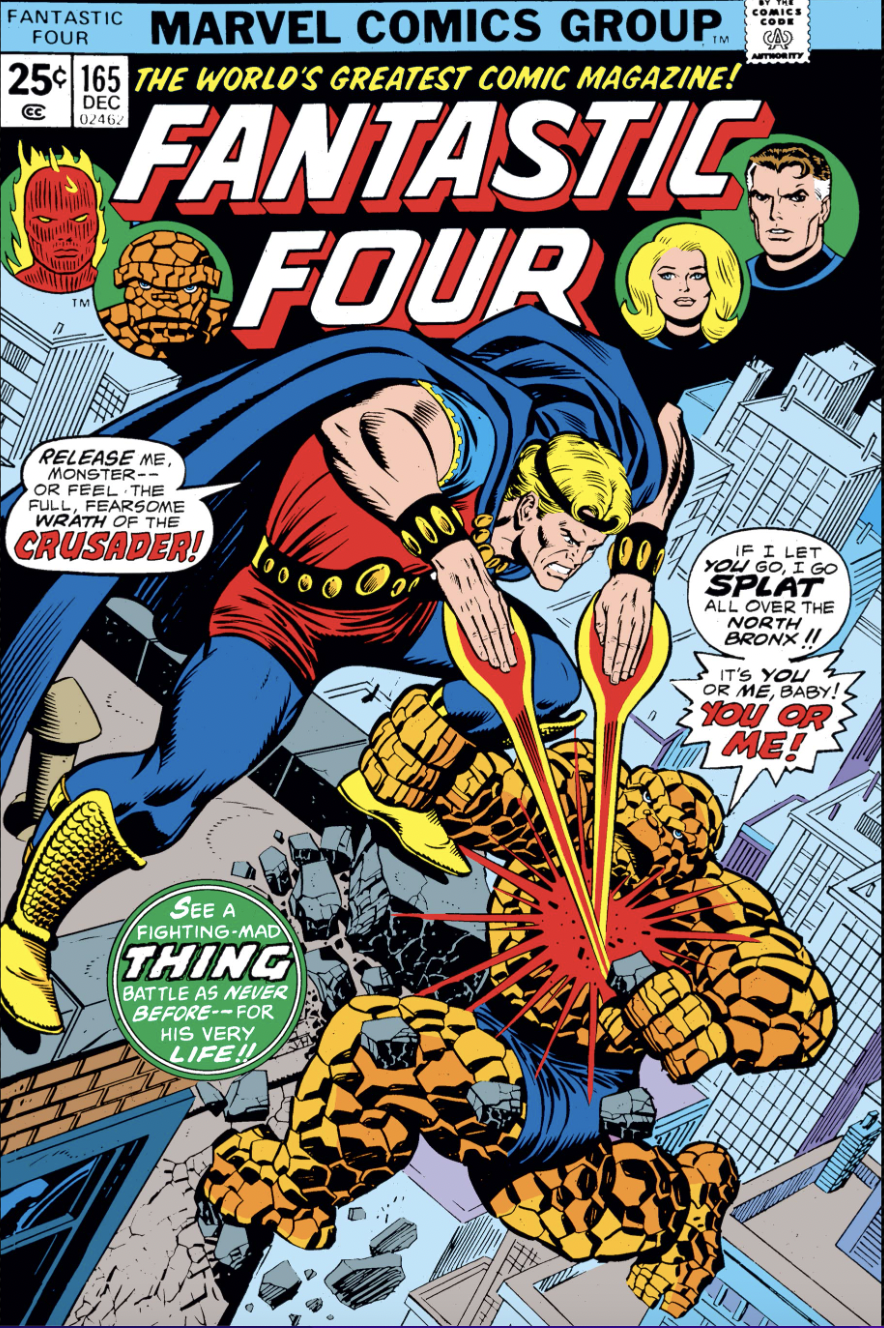
George Perez is back on art duty, and like last issue, he adds his characteristic attention to detail and masterful use of panels. The cover is by Ron Wilson, with Joe Snnott’s inks. At this point Wilson had been around for a few years but this is his first work on the FF. He would go on to draw dozens of issues of Marvel Two-in-One and its successor book, The Thing, becoming one of the definitive pencilers of Benjamin J. Grimm. As far as I can tell, he is the first Black artist to work on an issue of the FF and he would later go on to draw some fill-in issues. The cover is unfortunately marred by some very silly dialogue (and what exactly is the North Bronx? Riverdale? Co-Op City? Van Cortland Park?)


What I liked

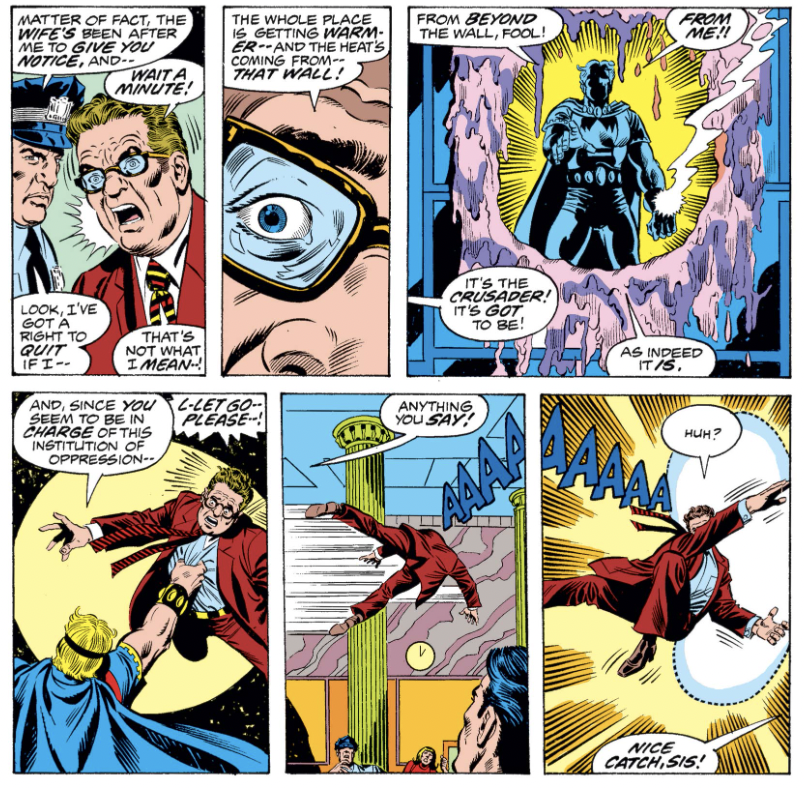
Perez again does some great work. I particularly enjoyed this sequence:


And this one, which is a great example of how he uses tiny panels to amazing effect:


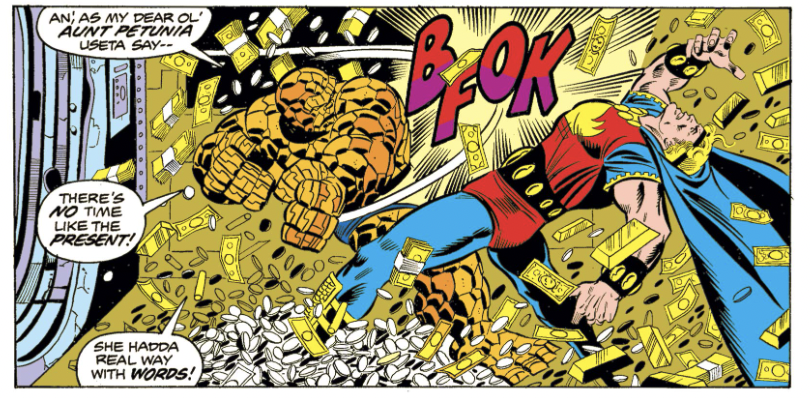
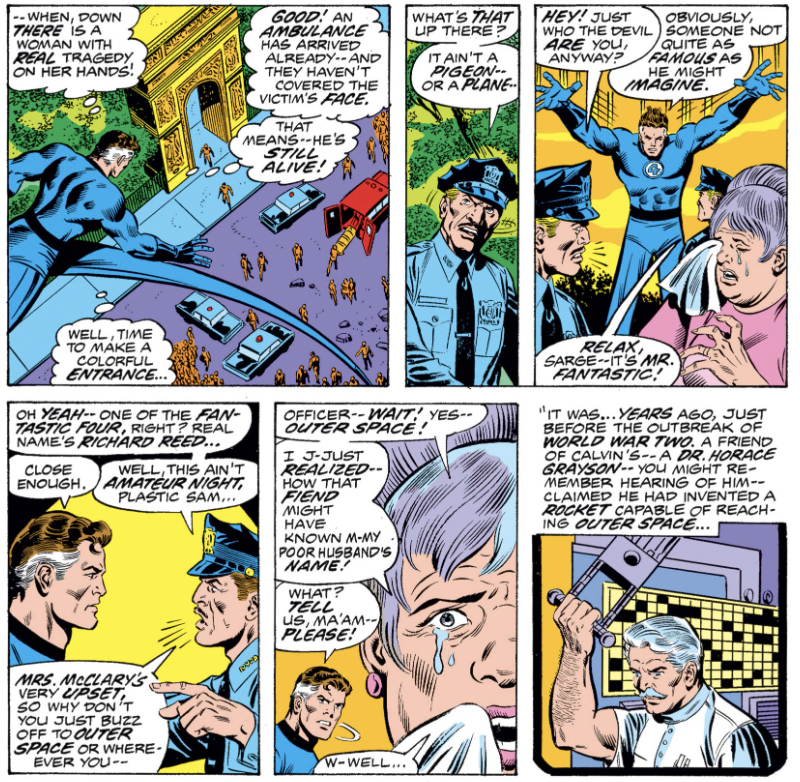
Thomas again pokes some fun at the Distinguished Competition in this sequence:


What I didn’t like

As seen above, the Crusader speaks in absurdly grandiloquent phrases (to the extent that Johnny actually makes fun of him at one point). Nothing about his character suggests he’s a former hero from Earth, or that he was any doubts or hesitation about what he’s doing. He’s unfortunately paper-thin as a villain, and Thomas squanders the opportunity to delve into his background to create an interesting resolution to the story. He really could have been any of a number of anonymous bad guys.

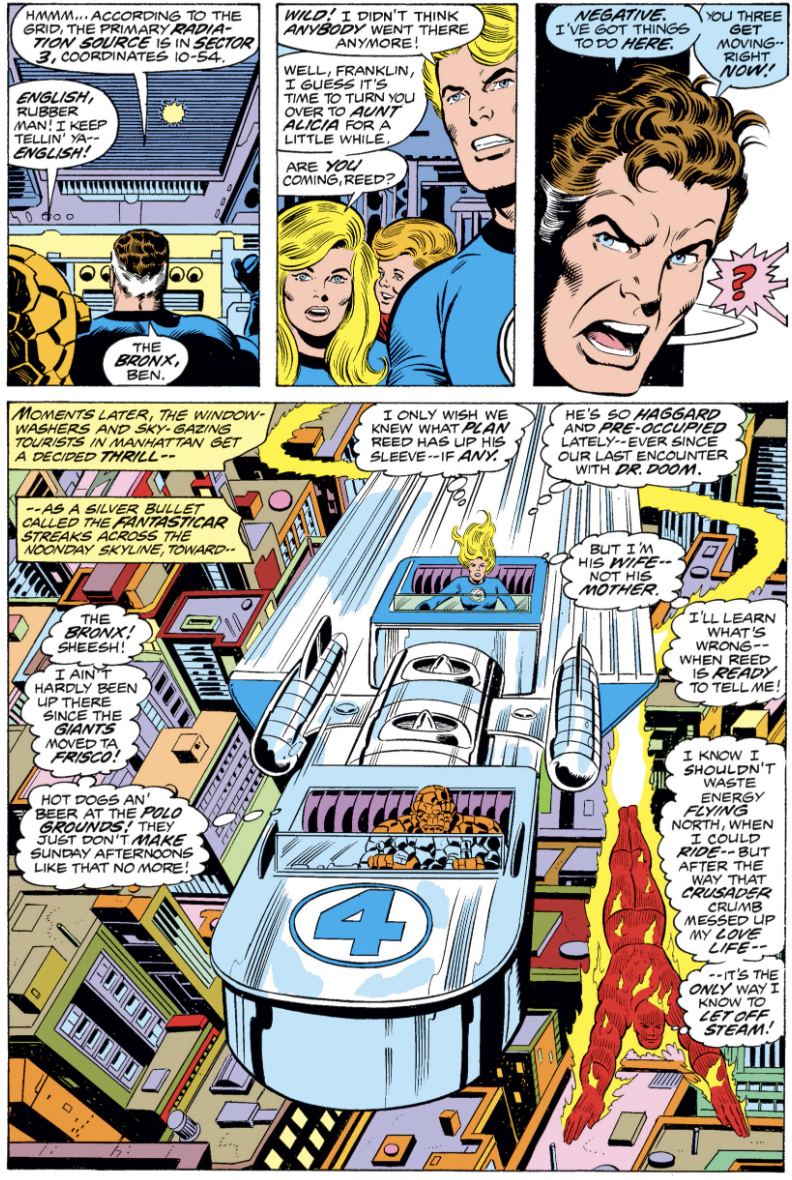
Also, this page is just weird, both for Johnny’s off-hand disregard of the Bronx, a borough where 2 million people live, and for Ben’s bizarre recollection that he went to Giants baseball games there. As virtually anyone who lived in New York at that point would know, the Polo Grounds were in upper Manhattan. Thomas’s Missouri origins were never more apparent. Perez does draw a snazzy Fantasticar, though.


Anything else?

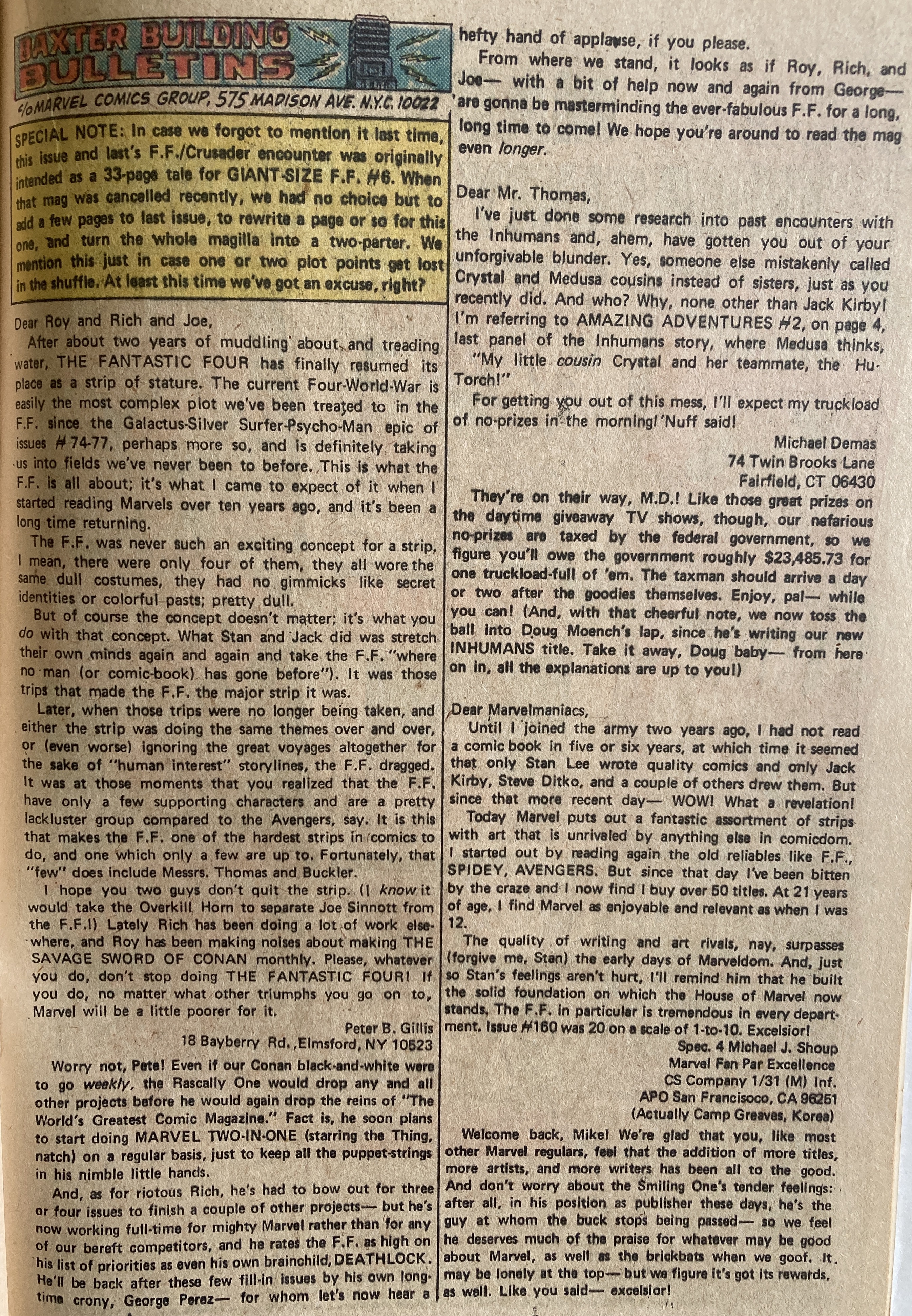
There’s another letter from longtime comics creator Peter B. Gillis in this issue, just three years before he has his first credit as a Captain America writer. Also on the page is the editor’s note about why the story was was split in two, and the explanation of why Rich Buckler didn’t draw it. The anonymous author of the response to Gillis — probably Thomas — was wrong about one thing: Buckler wasn’t around for a long time to come. He would go on to draw just two more issues before Perez took over more or less full-time.


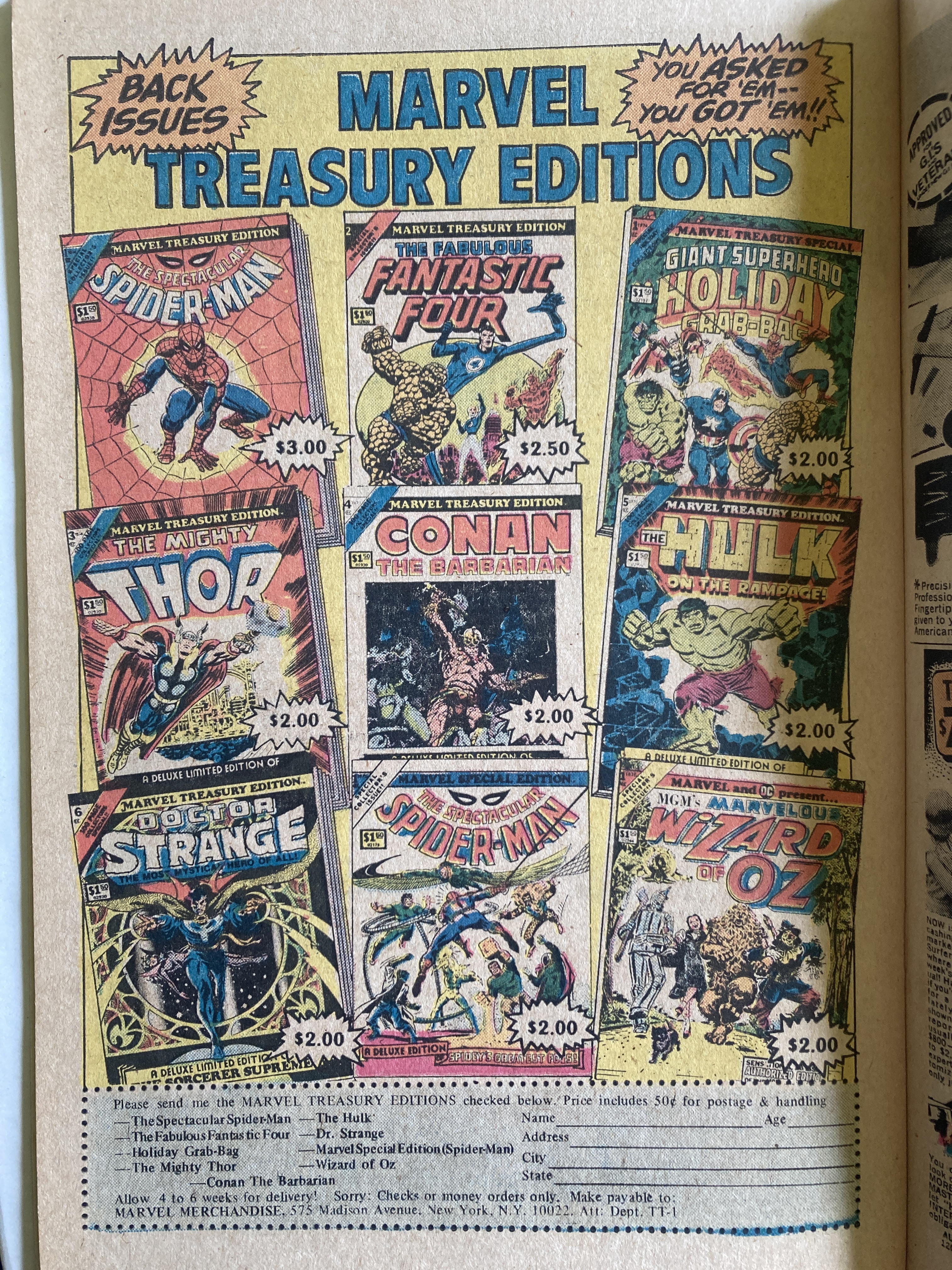
There is also a fun ad for Marvel’s Treasury Editions. Just in case anyone is worried I dropped the ball, the FF’s Treasury Edition contains only reprints.


Overall

Solid comic book storytelling

“The World’s Greatest Comic Magazine!” Fantastic Four No. 164

03 Monday Mar 2025

Posted by percivalhenry in The World's Greatest Comic Magazine

≈ Leave a comment

Tags

1975, Fantastic Four, Fantastic Four 164, George Perez, Roy Thomas

Fantastic Four 164
“The Crusader Syndrome!”
Published Aug. 1975
Writer: Roy Thomas
Pencils: George Perez
Inker: Joe Sinnott
Letters: John Costanza
Colors: Petra Goldberg
Editor: Thomas
Cover: Jack Kirby (yes, that Jack Kirby) and Sinnott

Synopsis

The Fantastic Four experiments with the Invisible Woman’s recently expanded powers, then Johnny goes on a date with Frankie Raye, only to encounter the Crusader, a new villain. The Crusader battles and defeats the Human Torch, who is rescued by the rest of the FF.


What’s going on here?

There’s a lot to discuss in this issue, so get comfortable. First, it’s arguably the best issue since the end of the Lee / Kirby run. Not just for its notable artists, which we will get to, but it’s a perfectly told and paced story. Roy Thomas opens with the usual Baxter Building shenanigans, introduces new character developments, injects fun familial banter, builds up to a real battle (one which the Torch loses), and ends the story gracefully. It’s not earth-shattering, but it’s a model of how Fantastic Four comics should be told and such a departure from the last issue — one of the worst of the era— that it’s amazing the same man wrote both.

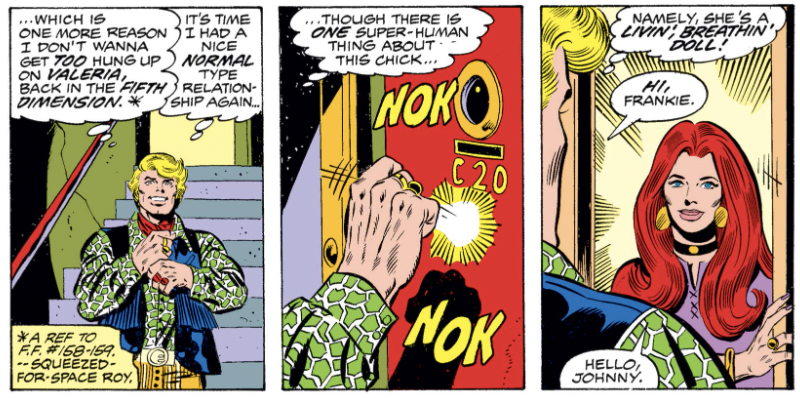
Secondly, it’s a story of firsts. This issue marks the first appearance of Frankie Raye, who becomes Johnny’s girlfriend and, eventually, Nova, a Herald of Galactus. (I suppose it’s a sign of the ’70s that they met at a singles bar, and that Frankie doesn’t even know his last name before agreeing to go a date). It’s also the first appearance of the quantum bands, worn here by the Crusader, that end up on the arms of Quasar, a hero who would go to join the Avengers and star in his own comic.


This issue is also notably the first with a Jack Kirby cover since his departure from the FF after issue 102. In the five years between, Kirby went to DC and invented Darkseid, Apokolips, Mr. Miracle, Big Barda, the Forever People, Kamandi, O.M.A.C. and host of other characters and concepts. When DC canceled the Fourth World books, a frustrated Kirby looked for a way back to Marvel, and received a deal that gave him what he really wanted: control over his own content. (you can read more about it here). Along with writing and drawing Captain America, the Black Panther and the Eternals, he also did a number of covers for other books, including several for his former comic, the Fantastic Four.

And of course, this is the first issue drawn by George Perez, one of the greatest artists to work on the Fantastic Four and a giant of the industry. Just 21 at this point, Perez began his career as an assistant to Rich Buckler, and had drawn about a dozen comics for Marvel— mostly kung-fu or monster comics — before getting a shot at the Fantastic Four. While he was billed as a guest artist in FF 164, he drew the next two issues as well and remained a steady presence on the book for the next several years, drawing about 20 issues, including annuals, in all.

Joe Sinnott was still the inker and while it can be argued he overwhelmed his pencilers, he ensured a uniform look to the characters from Kirby through Buscema and Buckler to Perez (and beyond). But Perez’s individual style is apparent if you know where to look. Some of his trademarks are already apparent, such as panels set within larger panels, and action sequences told across many smaller panels. While nine panels on a page are lot for most artists (and six was standard) Perez could push it to 10, as on this page, or even 12.


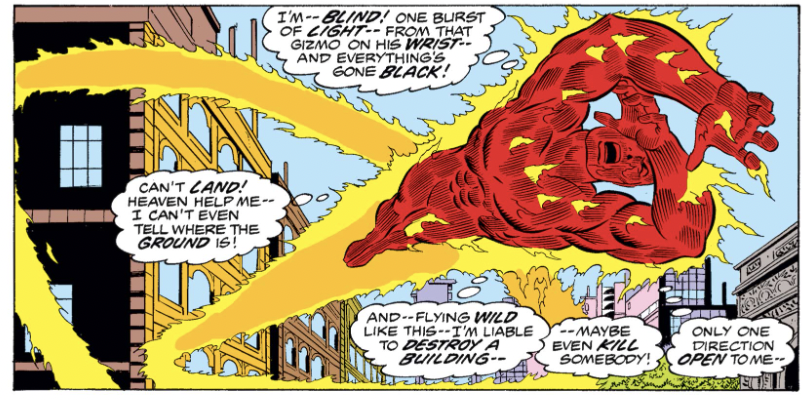
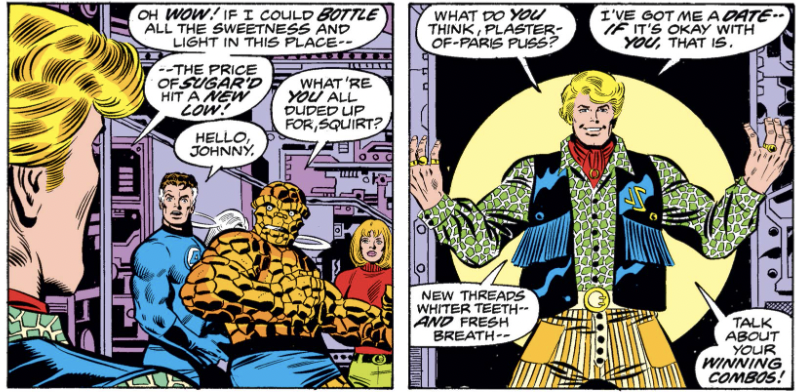
Perez also loved incredibly detailed clothing and costumes, much to the chagrin of artists that followed and had to use his designs. Here is Johnny in a new set of duds (which Perez said he modeled after the attire of a South Bronx pimp from his childhood):


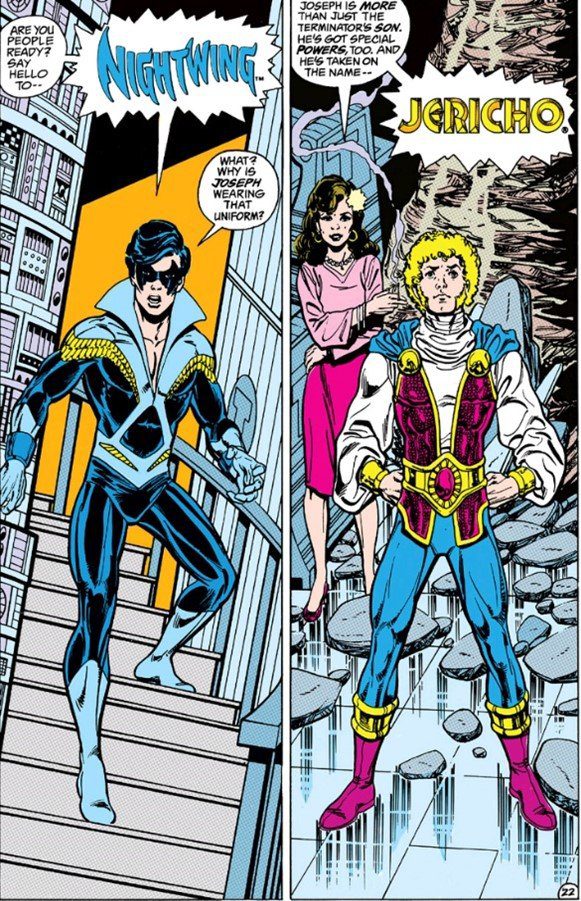
The panel reminded me of an iconic page from the New Teen Titans Perez drew about a decade later (and which surely gave subsequent pencilers nightmares):


Lastly, the story features a notable Thomasian tic: the mining of older comics for characters and ideas. The Crusader is revealed in the next issue to be Marvel Boy, a Golden Age character who was raised on Uranus and received great powers there (this origin is later ret-conned away in a 2000s series, Agents of Atlas).


What I liked

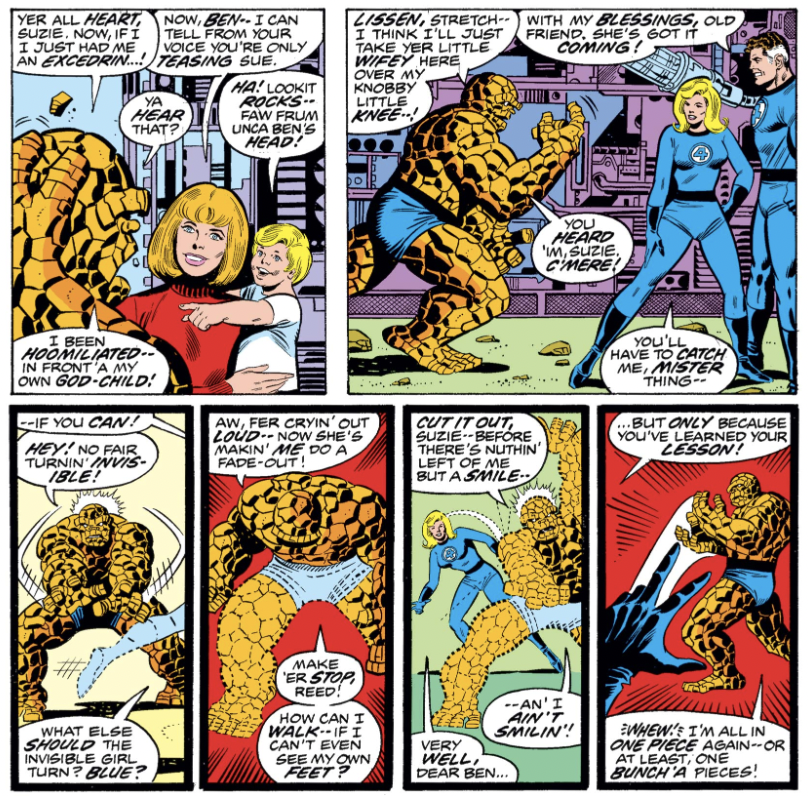
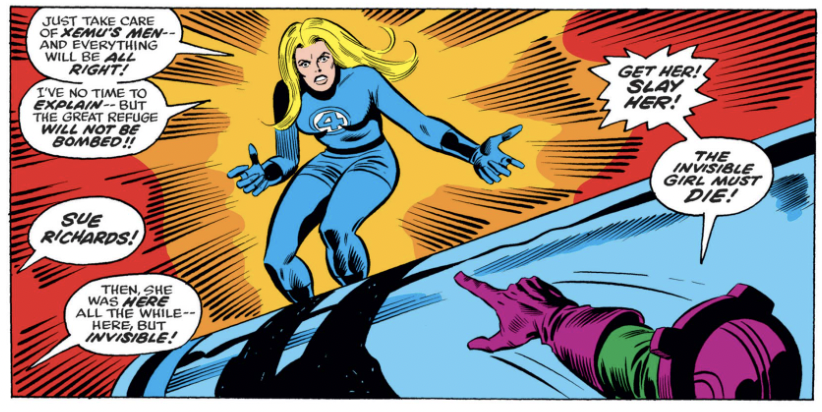
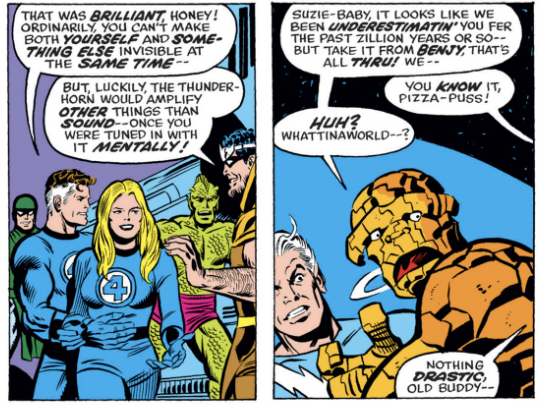
Along with all of the above, the issue is a coming-out for a new version of the Invisible Girl, whose powers have been increased since they are amplified by the thunder-horn of Xemu, a would-be world conquerer from the Fifth Dimension (this all went down in issue 159). This development is long overdue and very welcome.

In a series of sequences, she first befuddles Ben during training exercises (also, this may be the first time we see Franklin speaking) …


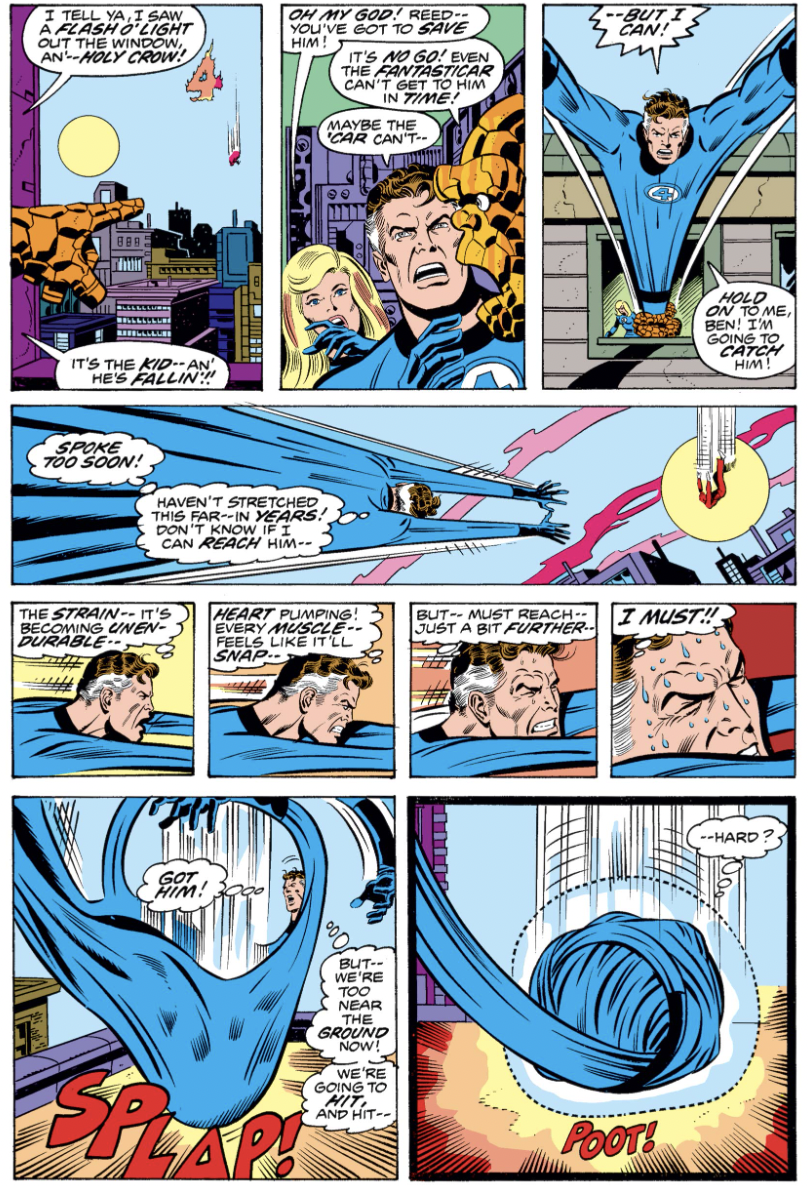
… then uses her force fields to save Reed, then to bring her and Ben to a soft landing and to hold back the crowds. Ben is impressed.

And if I haven’t said enough about Perez’s art, here’s a great splash page that concludes the comic:


What I didn’t like

There’s not much to dislike. The Crusader comes across as just another chest-thumping villain that spouts cliches, although he has a vicious streak. As usual, Thomas over-narrates the comic, at one point instructing readers on the proper pronunciation of Greenwich

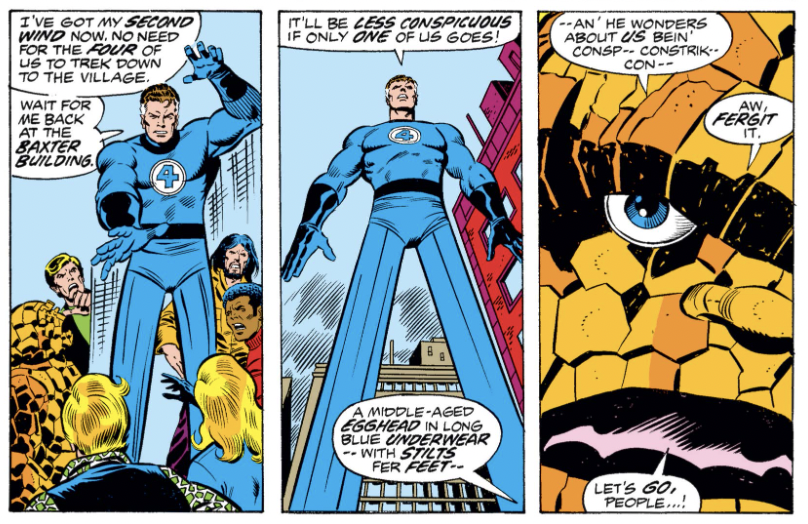
And the ending is a bit puzzling, with Reed striding off across the city alone, to somehow not attract attention. Nor is it clear what he needs to do in the village.


Anything else?

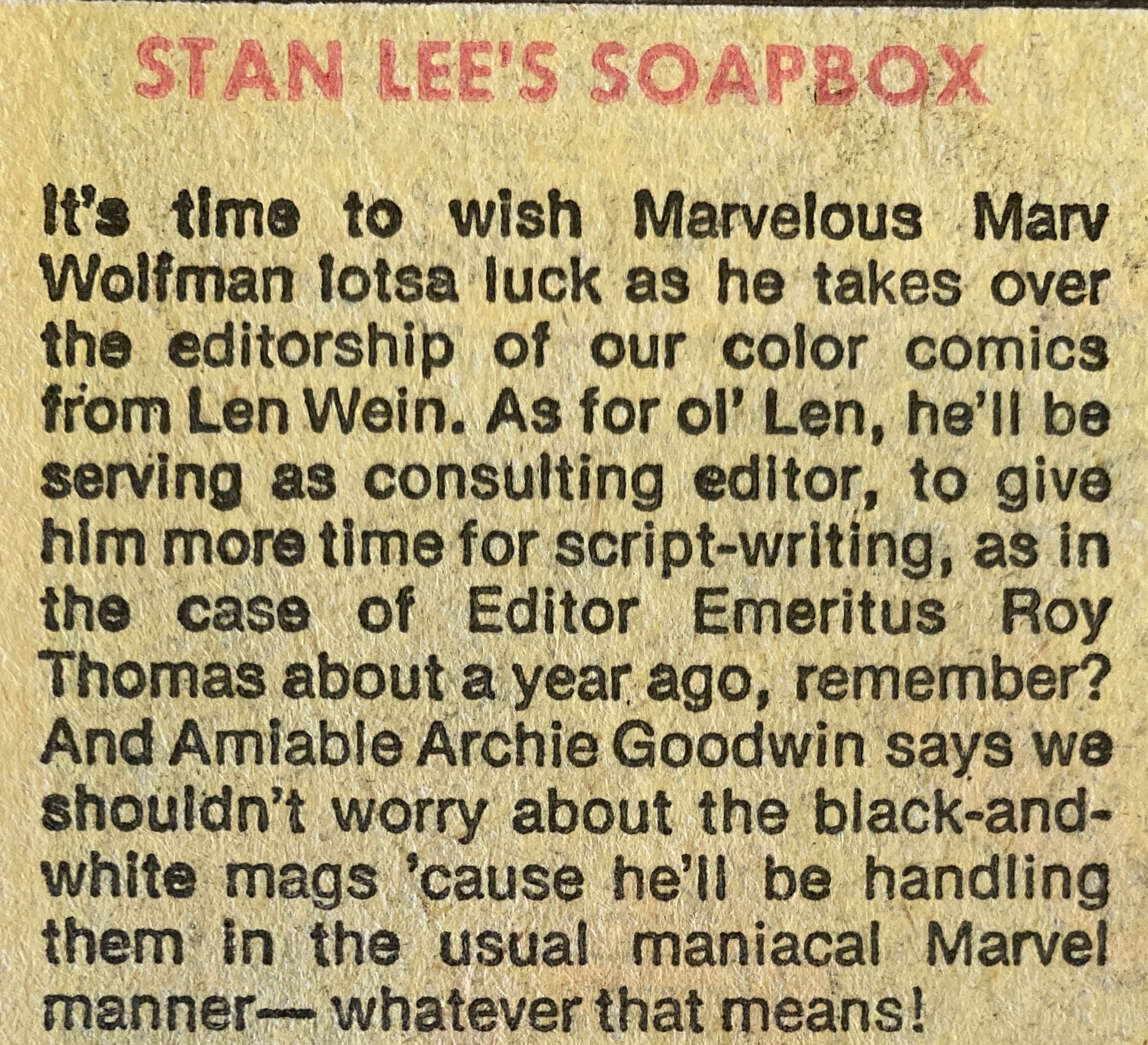
The Bullpen Bulletins announce yet another change in editor at Marvel, with Marv Wolfman taking over for Len Wein. As mentioned before, this a period in which Marvel will have six editors-in-chief in five years, leading to a sense of general instability and chaos. There was a lot of creative ferment at Marvel during this era but a lot of slop, too.


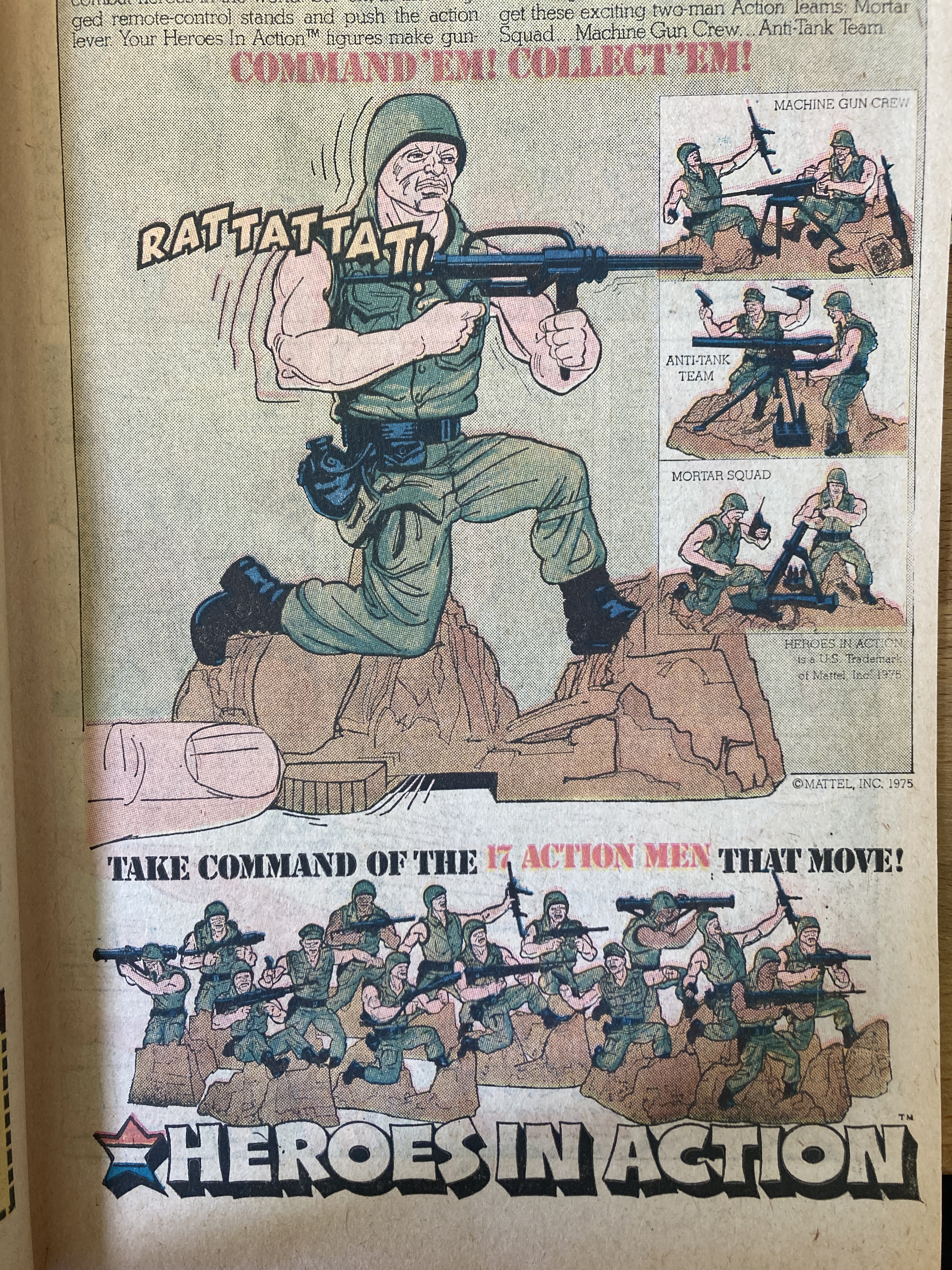
I don’t think I’ve seen this ad, or these toys, before. Sort of a proto-G.I. Joe.


Overall

The best Fantastic Four comic in a long time

“The World’s Greatest Comic Magazine!” Fantastic Four No. 163

23 Sunday Feb 2025

Posted by percivalhenry in The World's Greatest Comic Magazine

≈ Leave a comment

Tags

1975, Fantastic Four, Fantastic Four 163, Gaard, Marvel comics, Roy Thomas

Fantastic Four 163
“Finale!”
Published July 1975
Writer: Roy Thomas
Pencils: Rich Buckler
Inks: Joe Sinnott
Letters: Joe Rosen
Colors: Don Warfield
Editor: Thomas
Cover: Bucker and Sinnott

Synopsis

In hyperspace, the Thing battles Arkon’s champion Gaard, who is trying to prevent Ben from closing a window that would allow a nuclear war on three realities to power Arkon’s world. Meanwhile, Johnny and Reed Richards from an alternative Earth, whom in that world became the Thing, battle and defeat Arkon. With the help of Mr. Fantastic, Ben defeats Gaard, who is revealed to be a mind-controlled Johnny Storm of that world.


What’s going on here?

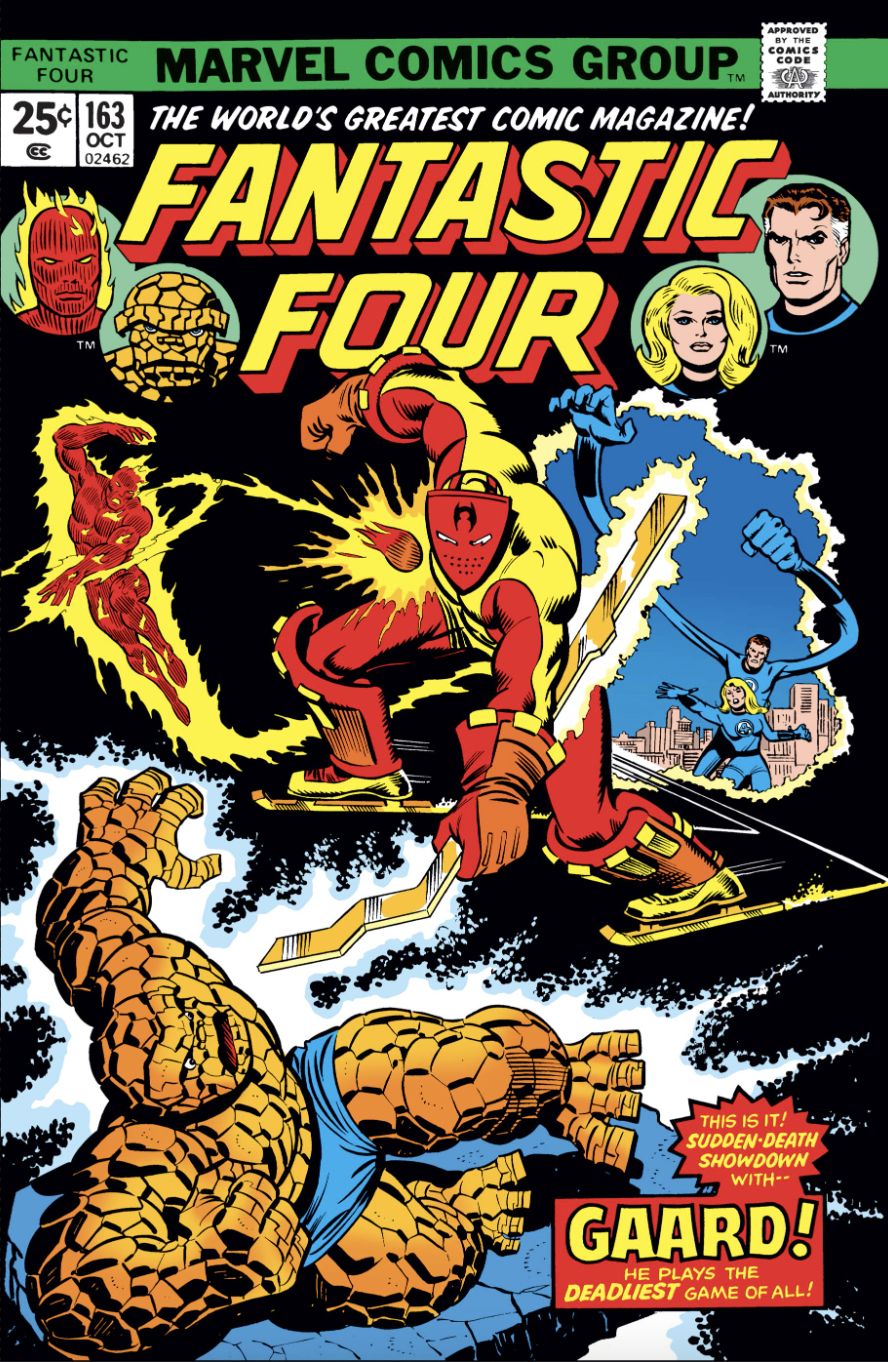
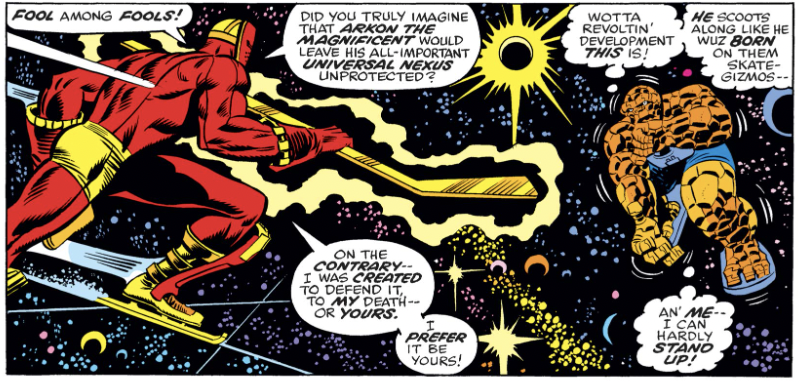
When I first began this blog, I was eager to read through the legendary Lee / Kirby run, and to revisit the Byrne run, my first introduction to the Fantastic Four. But I was apprehensive about the issues in between, from FF 103 to 231, which — despite the work of stellar artists like John Buscema and George Perez — seemed like a repository of a lot of mediocre dreck. And symbolic of that mediocrity to me was Gaard, a villain I knew only from the cover but that seemed utterly ridiculous and unworthy of the grandeur of the Fantastic Four. The team that battled Dr. Doom and Galactus is now fighting an outer-space hockey goalie? Seriously?

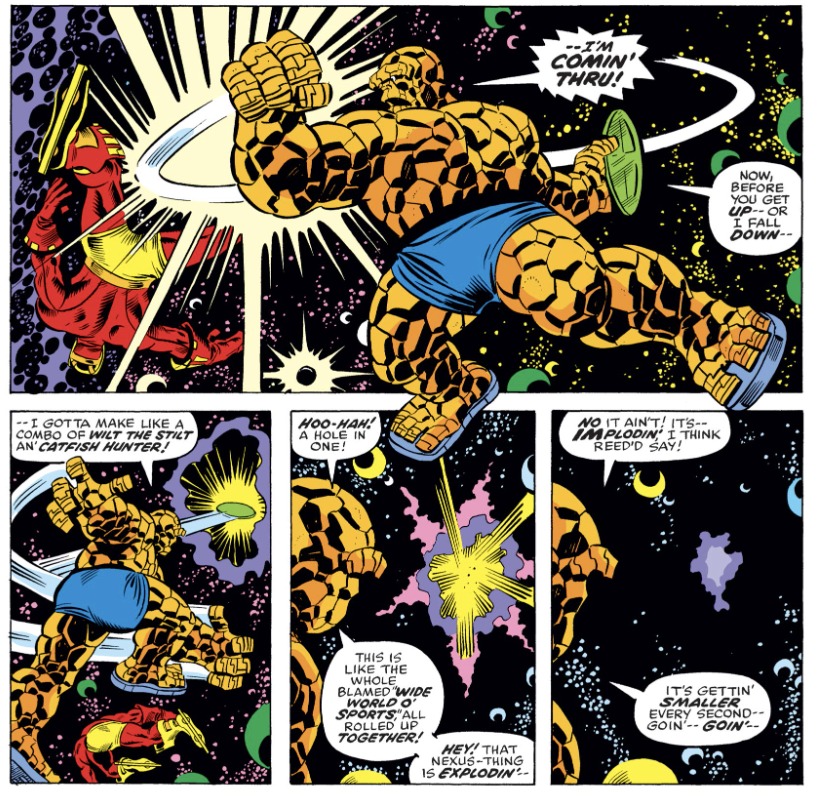
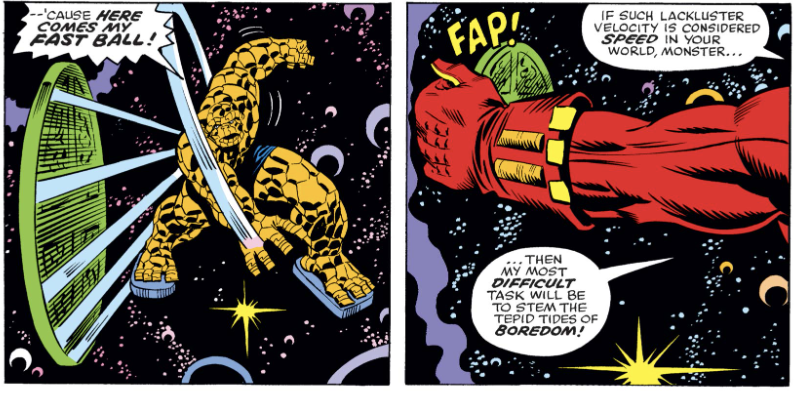
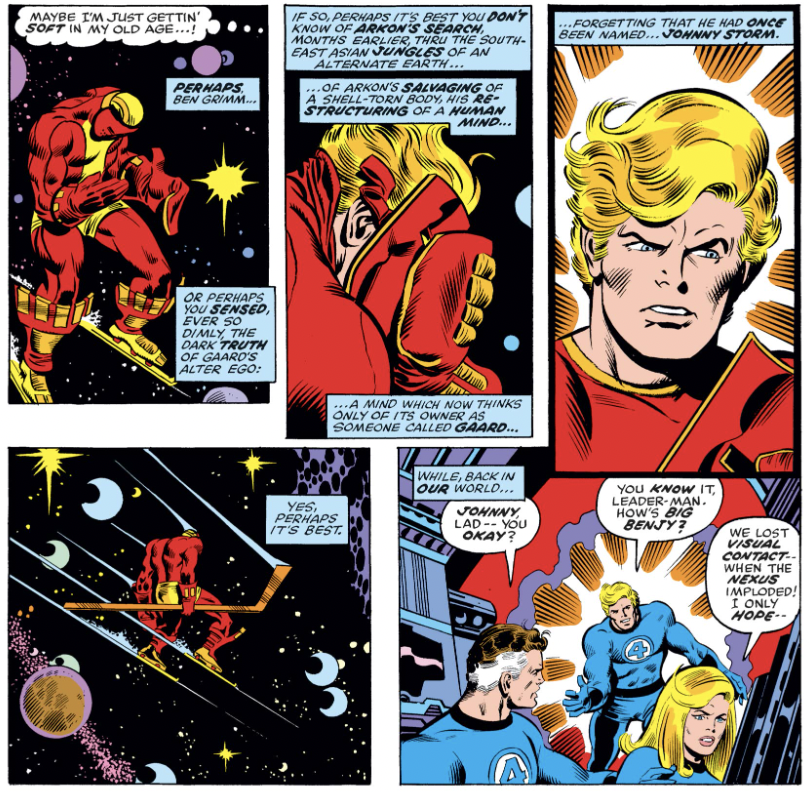
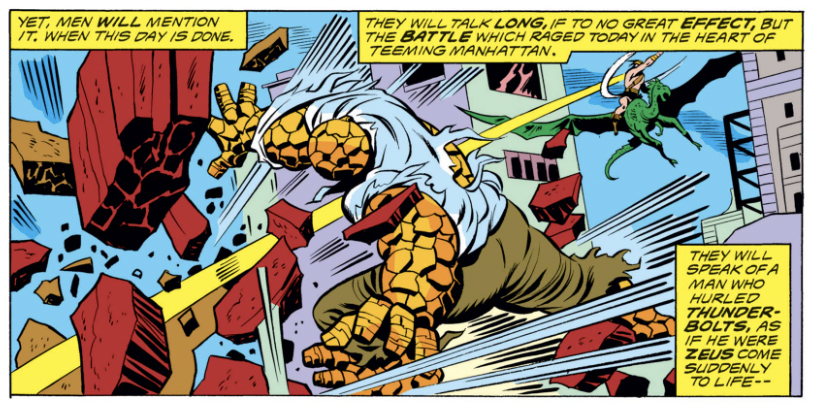
After reading this comic, my worst fears were confirmed. This is, in fact, a pretty lame issue and Gaard is silly concept, an apparent ripoff of the Silver Surfer and Black Racer, two Jack Kirby-designed characters that travel through space with sports-like apparatus. As Gaard fights Ben, there are sports-adjacent references aplenty, from Ben having to wear skate-like devices to move through hyperspace to the puck-like gizmo he needs to hurtle through Gaard’s “goal.” The sportsball nature of it all is summed up here:

I couldn’t find any documentation about the creation of Gaard, just a comment in a blog that Roy Thomas intended him as a parody of Black Racer and that he later regretted using such a silly concept in a story with a heavier tone. Which make sense, but it’s unfortunate because up until this comic, the four-issue arc was actually pretty fun, with a zillion of Thomas’s ideas colliding and heading toward what could have been a satisfying ending. But the result is an anti-climactic finish that feels slapped together, with both Reed and Sue on the sidelines, Johnny and Earth-2 Reed defeating Arkon without too much trouble and, as seen above, the nexus closing with a whimper.

My only hope is that this comic is the low point of the stretch between Lee / Kirby and Byrne, and everything from here is an improvement.

One more note: Don Warfield is credited as colorist, his first and as far as I can tell, last Fantastic Four credit.

What I liked

Gaard’s dialogue is just completely over the top and bombastic. Not sure where he learned to talk like this, particularly if he’s that Earth’s version of Johnny.


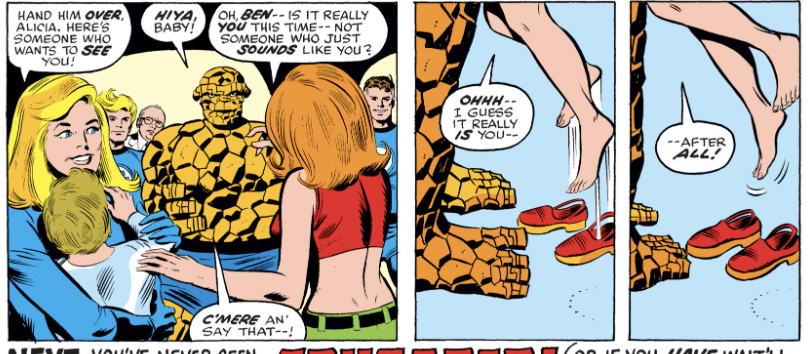
This reunion between Ben and Alicia was sweet and fun.


What I didn’t like

Alongside the aforementioned Gaard nonsense is the question of his identity, which is hinted at by both Ben and Gaard as they battle, but ultimately plays no role in the outcome, and is instead a meaningless footnote. (Gaard would later remerge as the super-powered villain Vangaard in Fantastic Force, a 1990s FF spinoff that I know virtually nothing about.)


The defeat of Arkon is also perfunctory and unsatisfying. As a character, Arkon never seems fully developed and in this story appears to be like a King knockoff dressed as a barbarian.

Anything else?

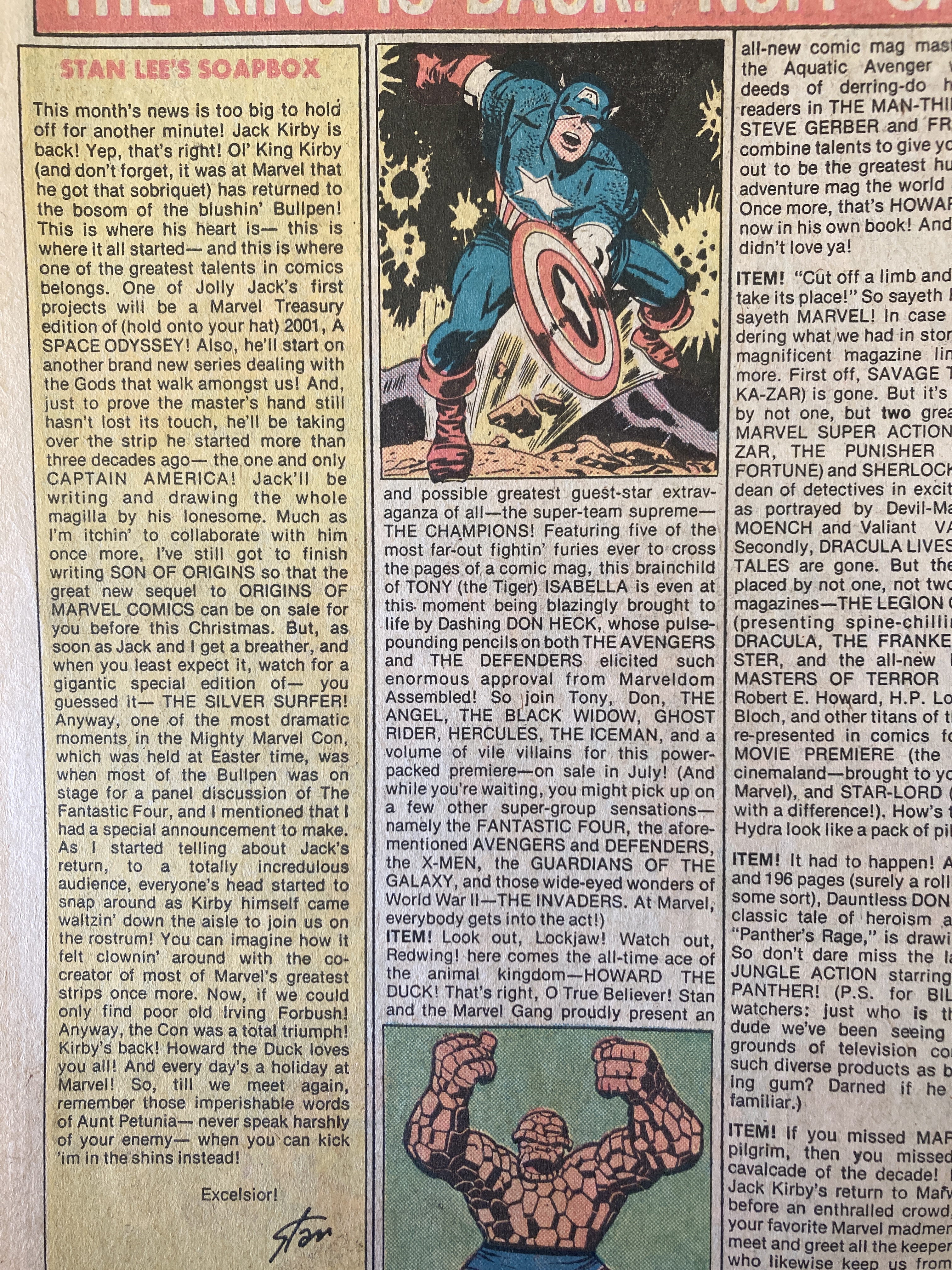
A lengthy note in Bullpen Bulletins announced the return of Jack Kirby to Marvel. It says nothing about where he went or why he returned, which is perhaps to be expected, but hints at the creation of the Eternals and notes Kirby will be taking over Captain America.


Overall

Disappointing on multiple levels

“The World’s Greatest Comic Magazine!” Fantastic Four No. 162

15 Saturday Feb 2025

Posted by percivalhenry in The World's Greatest Comic Magazine

≈ Leave a comment

Tags

1975, Fantastic Four, Fantastic Four 162, Marvel comics, Roy Thomas

Fantastic Four 162
“The Shape Of Things To Come!”
Published: June 1975
Writer: Roy Thomas
Pencils: Rich Buckler
Inks: Joe Sinnott
Letters: Joe Rosen
Colors: Phil Rachelson
Editor: Thomas
Cover: Buckler and Sinnott

Synopsis

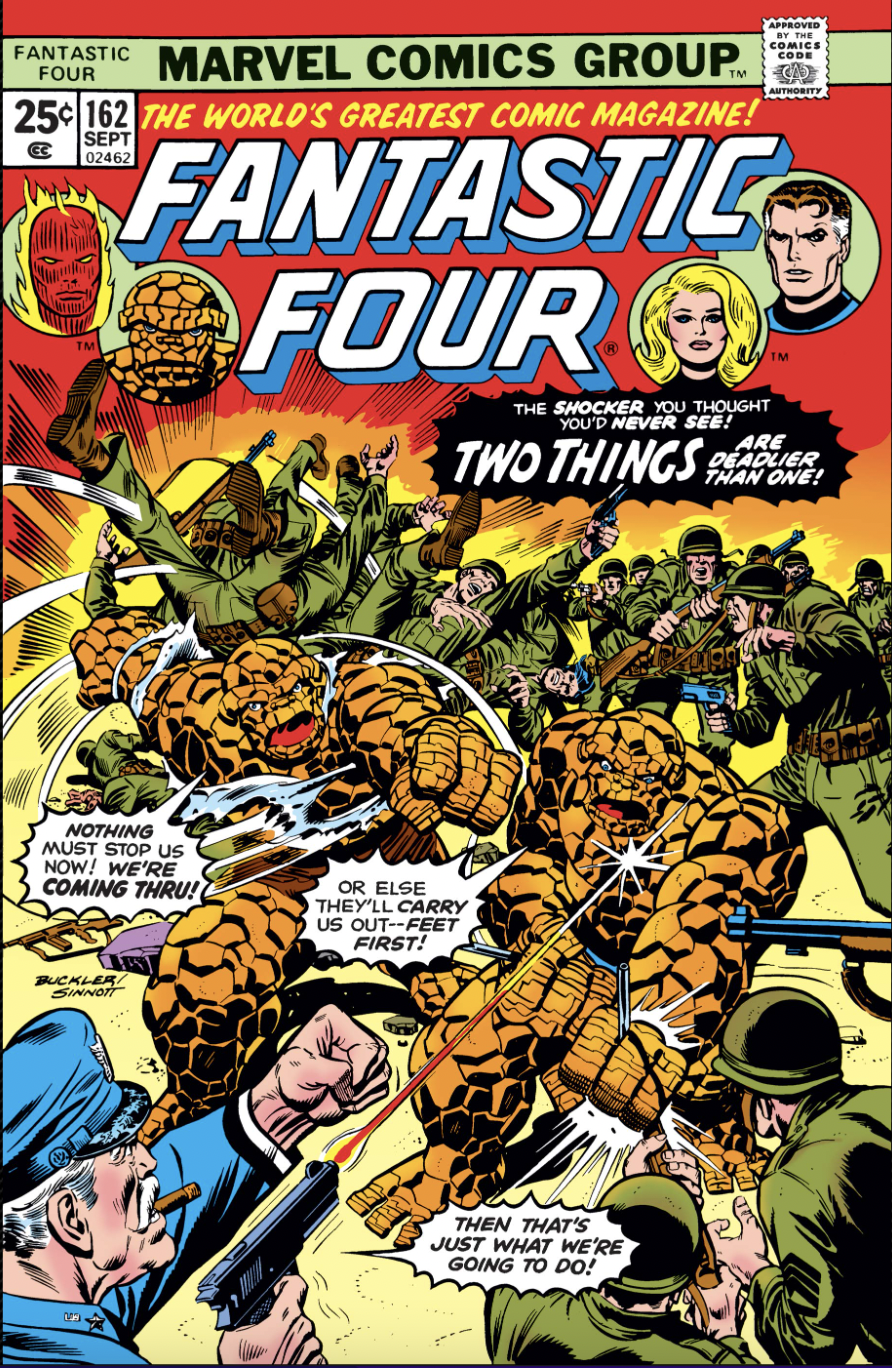
The conflict between three dimensions, which began last issue, escalates and it is revealed that Arkon, the barbarian ruler of yet another dimension, used the apparent businessman Mr. Devoor to goad the three into a nuclear war that will power his planet. The Fantastic Four averts a major inter-dimensional conflict and, following a plan devised by Mr. Fantastic, prepare to thwart Arkon’s plans.


What’s going on here?

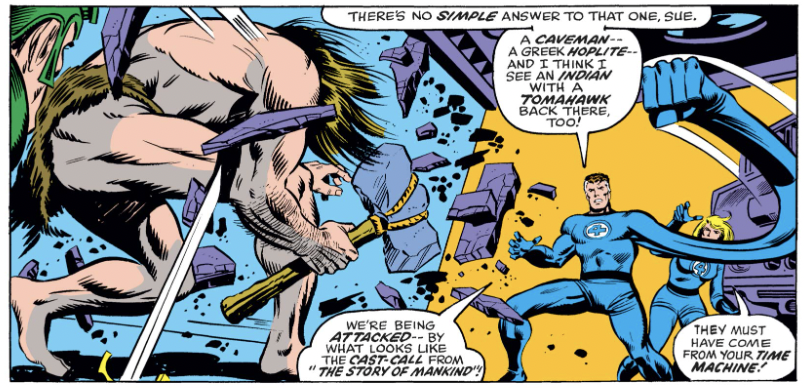
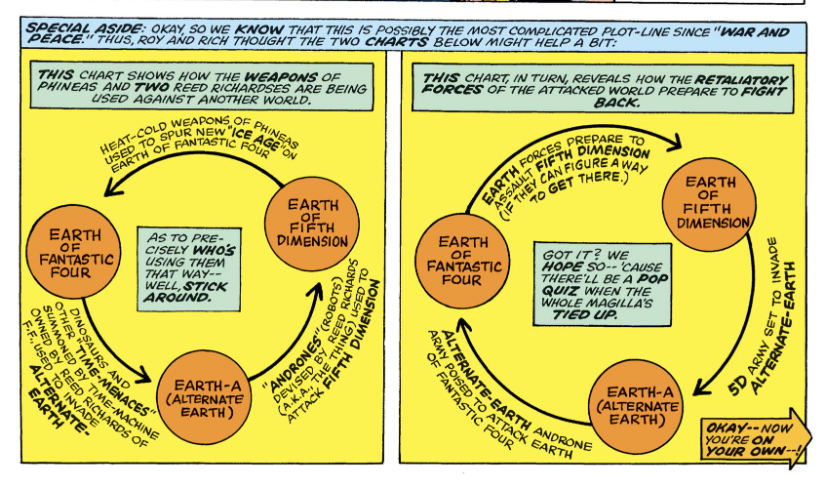
After introducing a bewildering number of plot elements over the last two issues, Roy Thomas finally allows things to gel. The story is still convoluted and relies on a lot of coincidences and unlikely occurrences (such as when the Human Torch leads an invading army across dimension, it just happens to arrive on the same Manhattan block as the two Things) but the basic outlines are at least clear. Thomas recognized the mess he created and provides a pair of diagrams to explain the story, something I don’t think I’ve seeing a comic before:

(and as someone who has read both, this is more complicated than War and Peace)

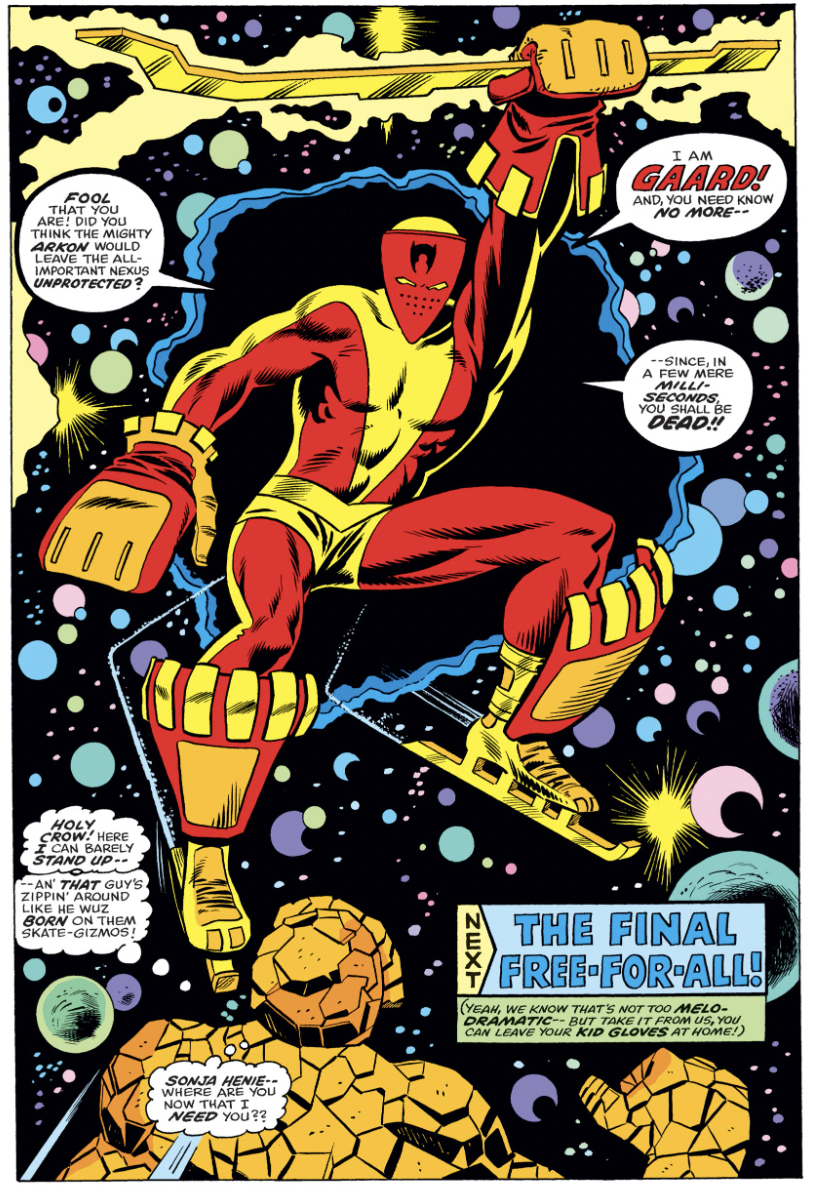
The comic concludes with a preview of the next issue’s villain, the one and only Gaard. I’ll have a lot more to say about Gaard next week, but here’s a peek:

Yes, he’s dressed like a hockey goalie. And yes, Ben makes a reference to Sonja Henie, the Norwegian ice skating Olympian and movie actress.

New credit alert: “Phil Rache” is credited as the colorist on this issue, his first on the Fantastic Four. His full name is Phil Rachelson — I assume it was trimmed for space—and he worked for both Marvel and DC from 1974 to 1981.


What I liked

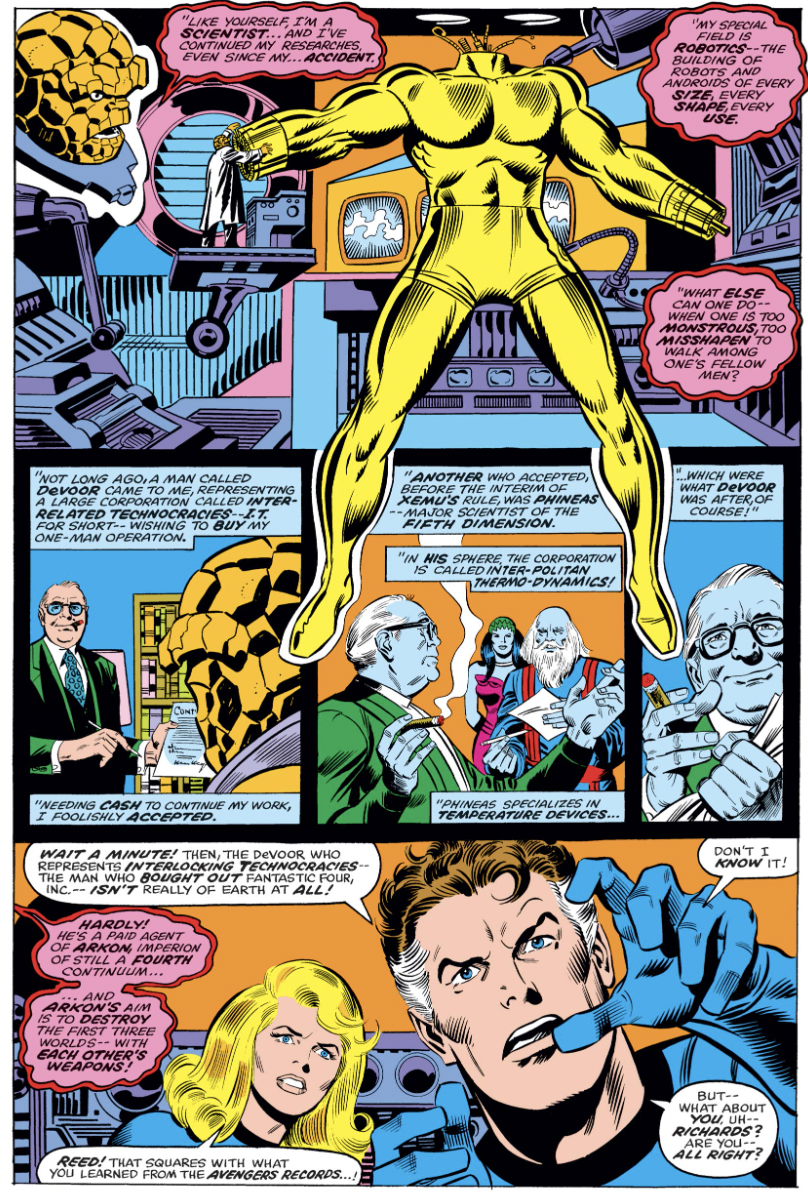
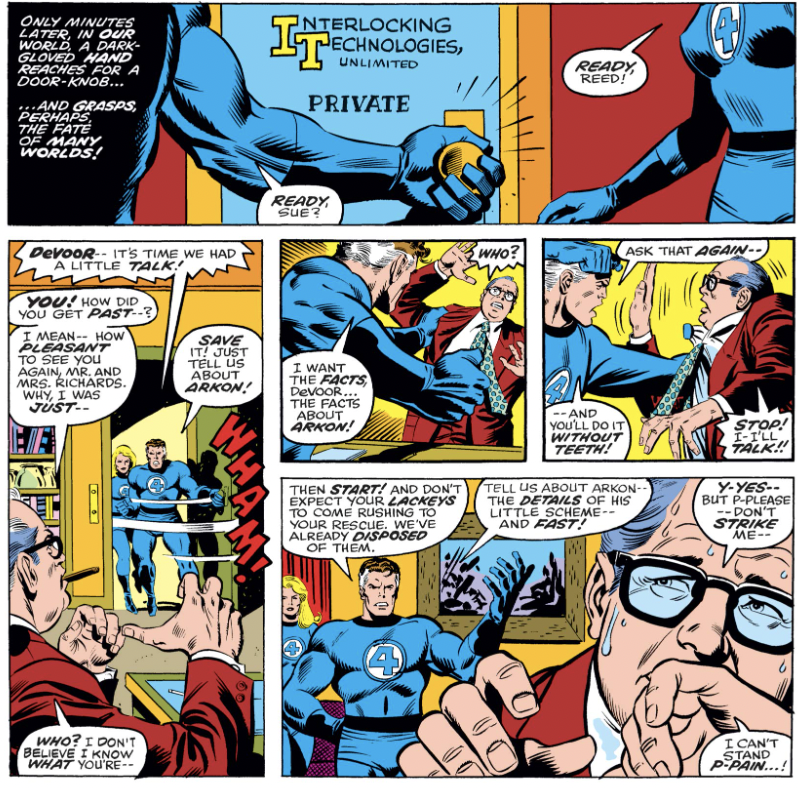
Thomas does a lot of work in the comic to explain his intricate plot. Not all of it makes much sense, but I did like this detail, that on three dimensions Mr. Devoor used three companies with different names but the same initials (although Reed actually goofs on the name of one, which should be Interlocking Technologies):


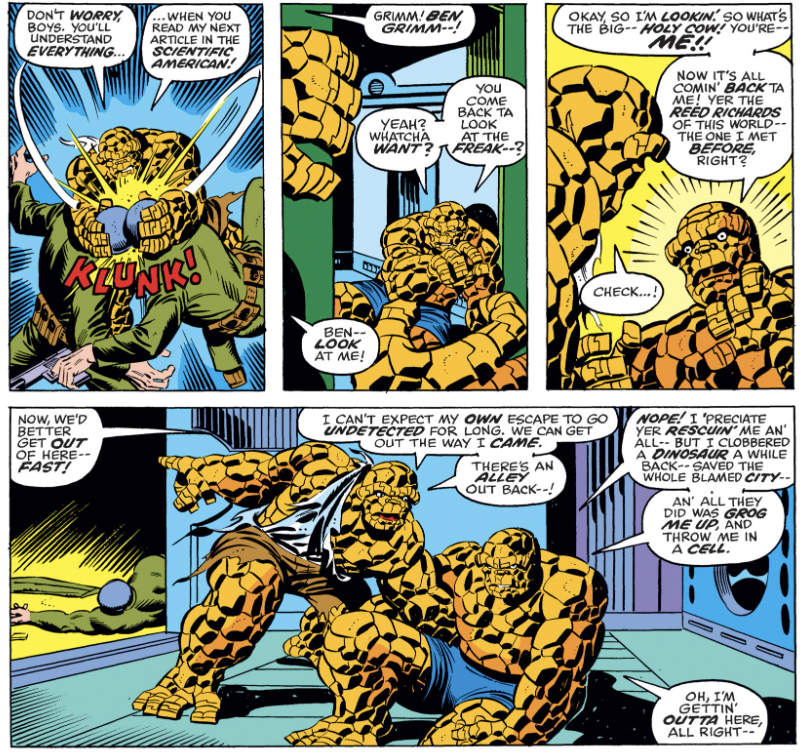
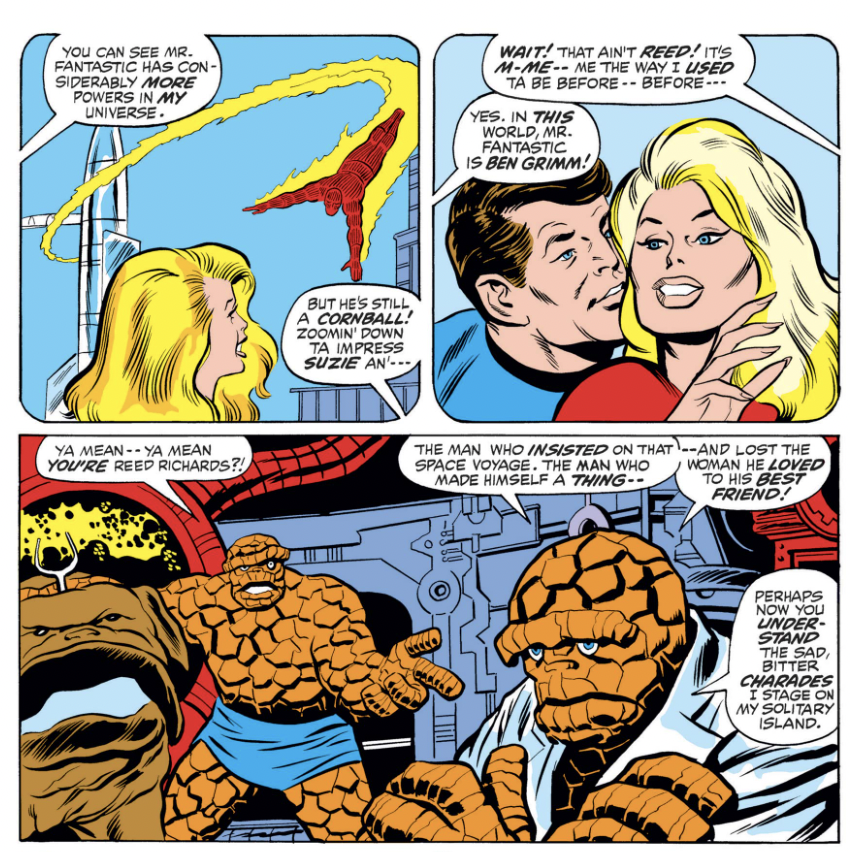
I also liked the concept of a meeting of the two Things, one Reed Richards and the other Ben Grimm:


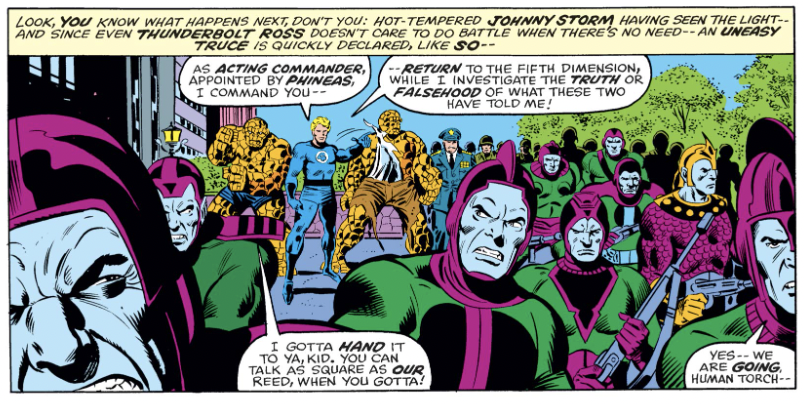
And this was an amusing interaction between Ben and Johnny, who has assumed the mantle of leader of the Fifth Dimension’s army:


What I didn’t like

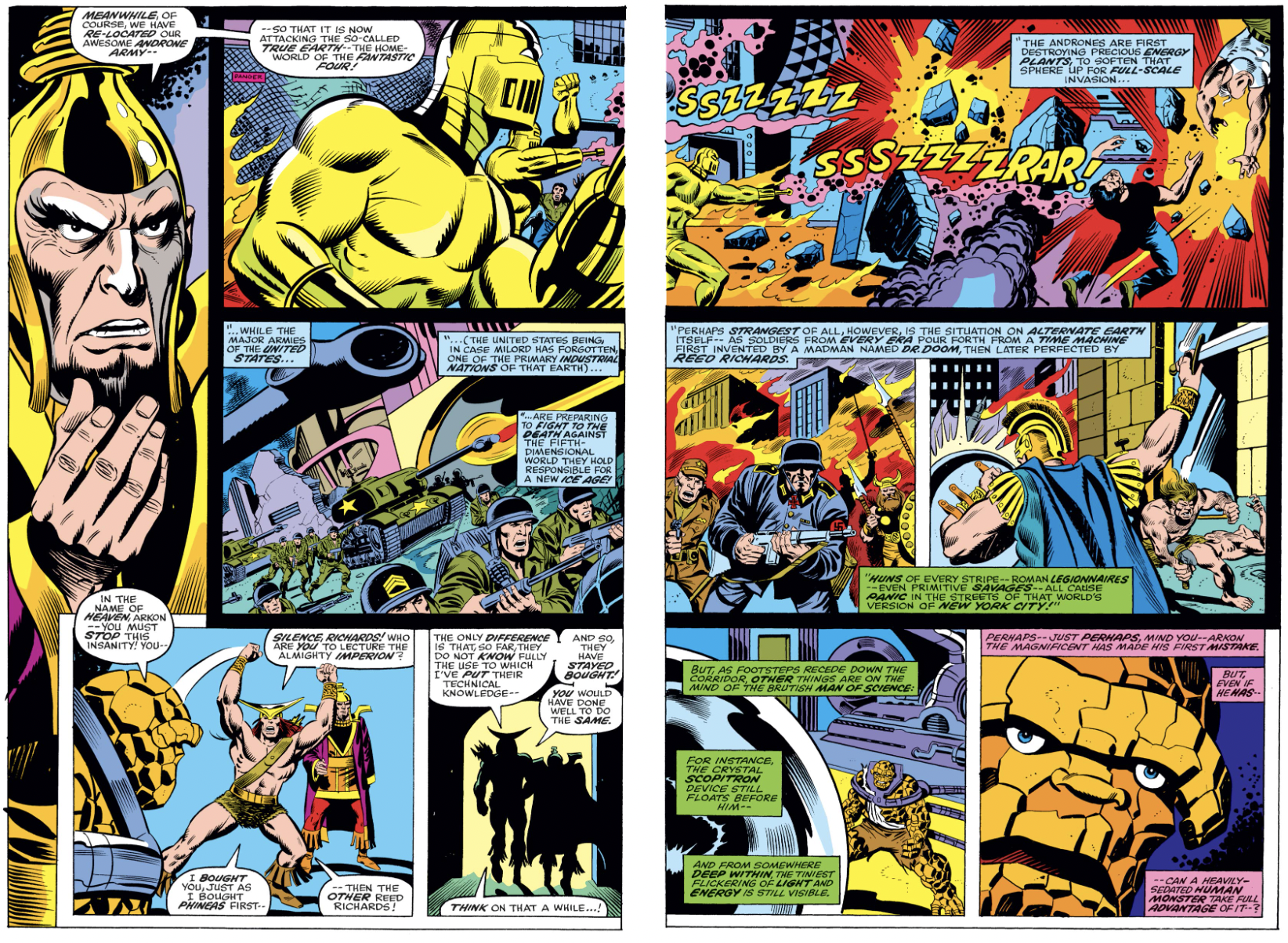
There is a lot of exposition in the comic, including over this double-paged spread:


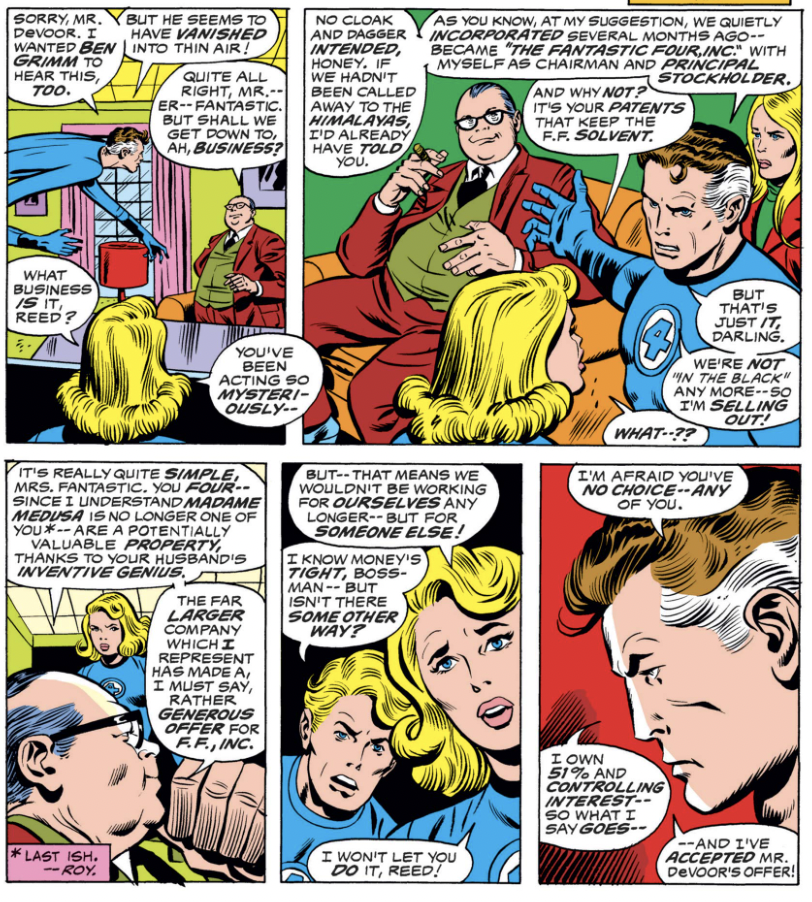
Reed acts surprisingly thuggish here:


Anything else?

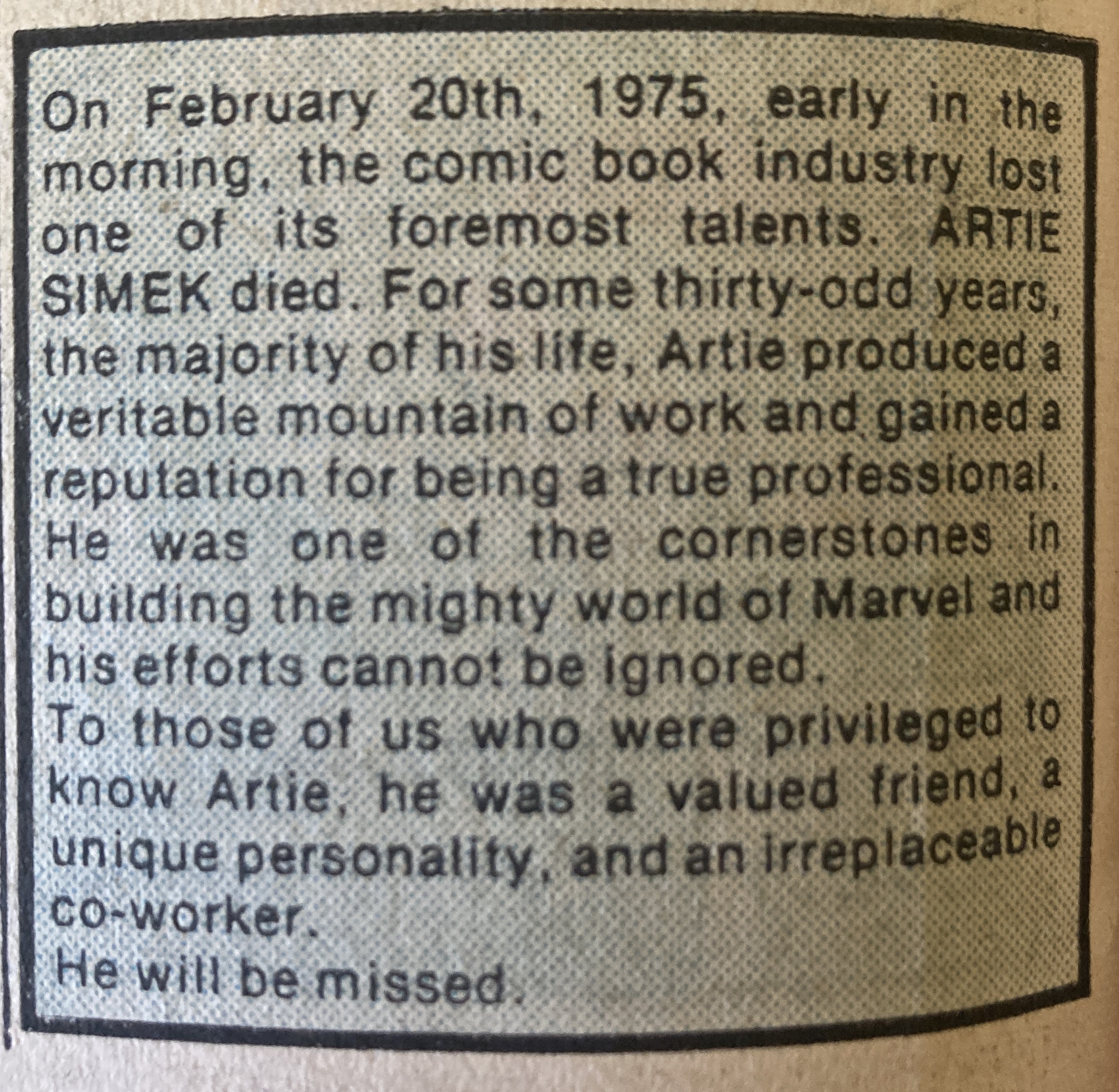
A somber note in the Bullpen Bulletins about the passing of Artie Simek, who lettered dozens of issues of the FF:


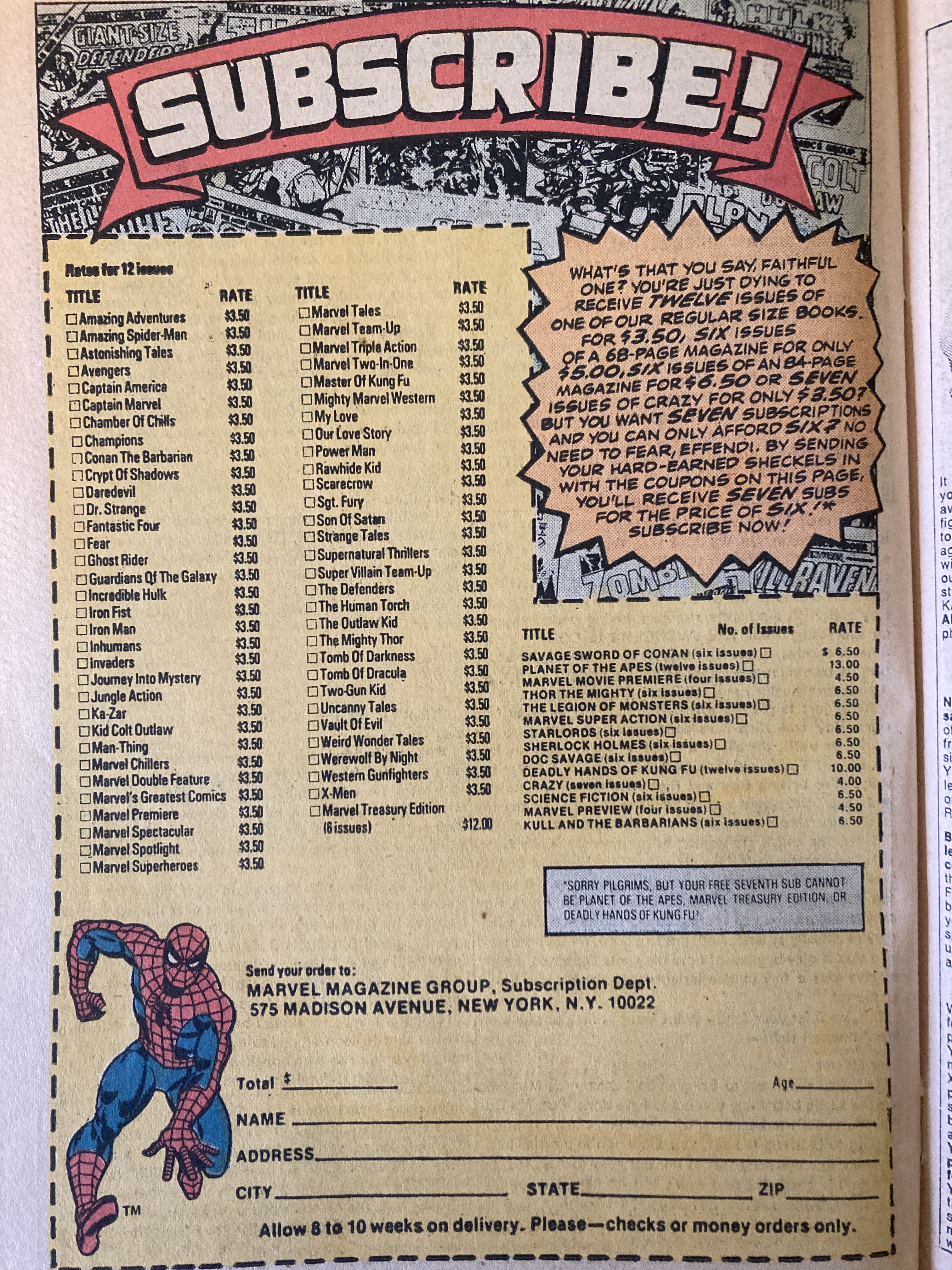
This house ad for subscriptions reveals just how many books Marvel was publishing at the time. No wonder these comics feel like barely controlled chaos. It’s also interesting how many horror, war, western and romance comics were being published (also, can you imagine waiting 10 weeks for the delivery of your first comic?):


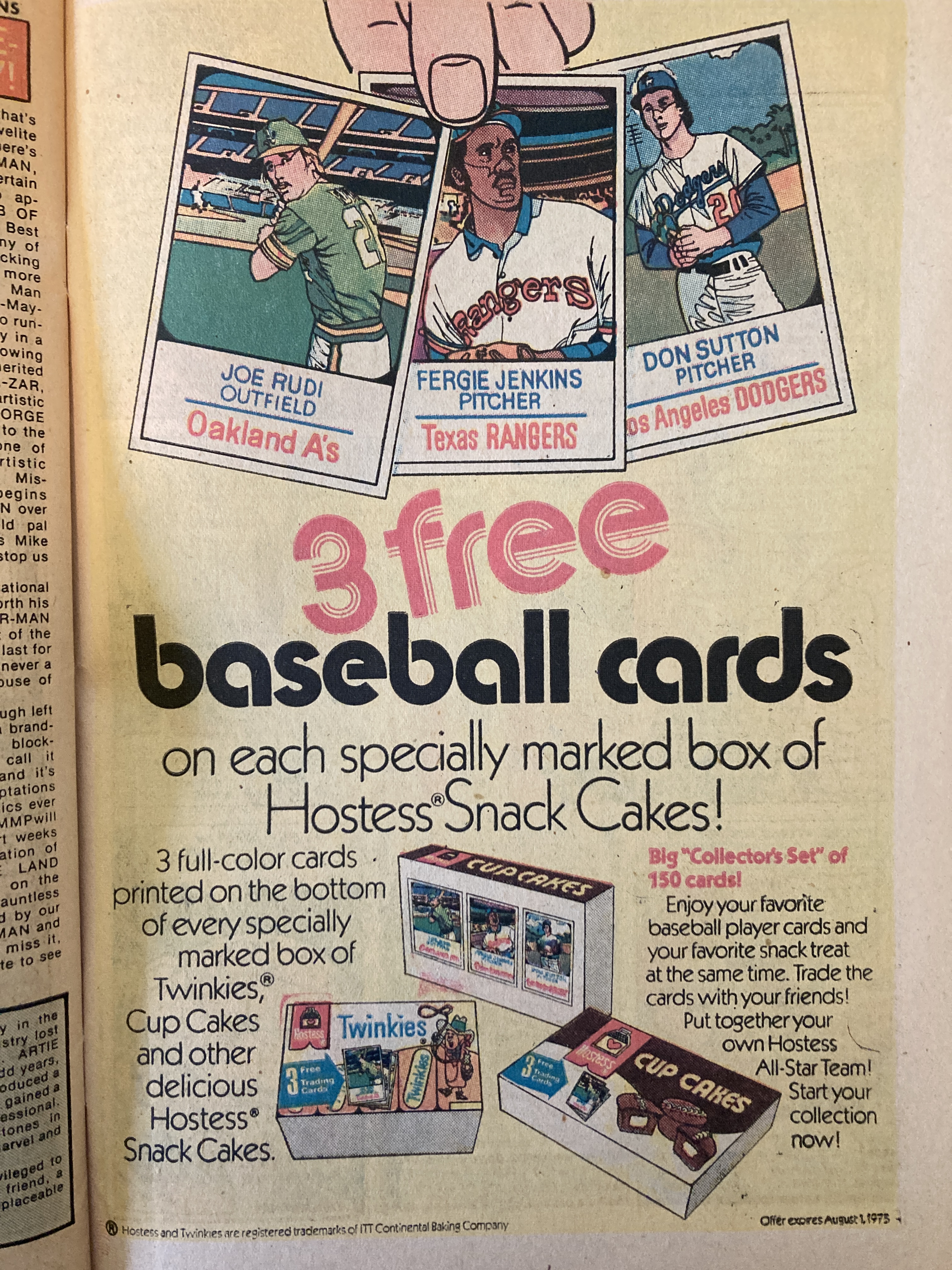
These are interesting choices for baseball players, especially since there are 150 in the set. Was Joe Rudi that big a star in 1975?


Overall

A bit of a mess, but fun

“The World’s Greatest Comic Magazine!” Fantastic Four No. 161

09 Sunday Feb 2025

Posted by percivalhenry in The World's Greatest Comic Magazine

≈ Leave a comment

Tags

1975, Fantastic Four, Fantastic Four 161, Marvel comics, Rich Buckler, Roy Thomas

Fantastic Four 161
“All The World Wars At Once!”
Published May 1975
Writer: Roy Thomas
Pencils: Rich Buckler
Inks: Joe Sinnott
Letters: Joe Rosen
Colors: Glynis Wein
Editor: Thomas
Cover: Buckler and Sinnott

Synopsis

The comic opens with Mr. Fantastic testing his powers, and concluding they are fading, thus limiting his value to the team. The Human Torch, frustrated with Reed’s decision to sell the FF’s company, journeys to the Fifth Dimension to reunite with Valeria, only to be sucked into a battle with giant robots, apparently created by Reed Richards. Meanwhile, the Thing, on an Earth in another dimension, battles dinosaurs before he is subdued by the Ben Grimm of that Earth. Back on the primary earth (or Earth 1 or Earth 616 if you prefer) Reed and Sue prepare for an invasion from the Fifth Dimension, seemingly led by Johnny.


What’s going on here?

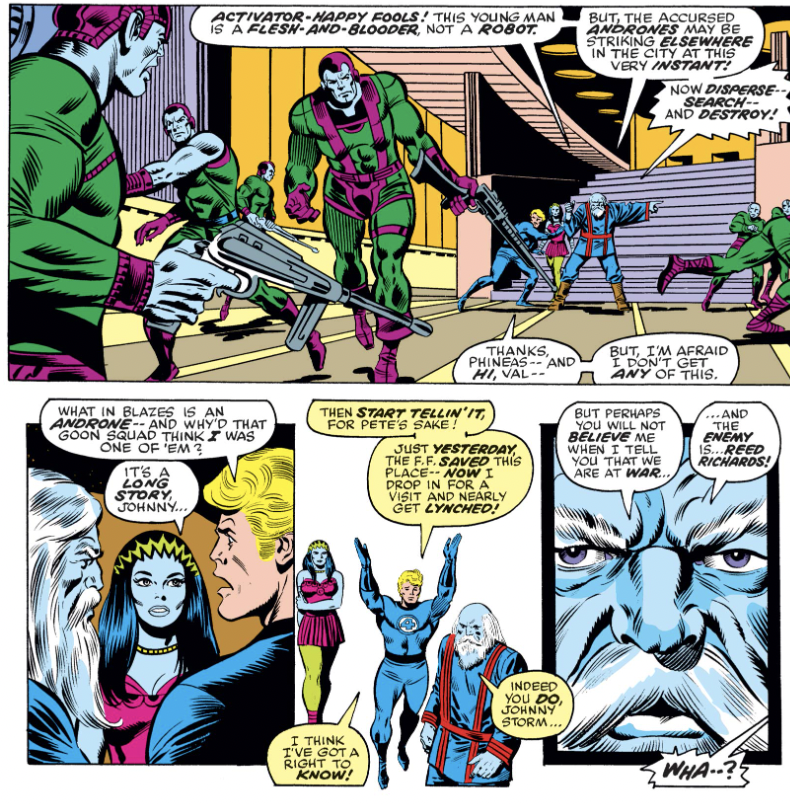
Just when I thought the last issue was peak Roy Thomas, he goes even further. Instead of a story spanning two dimensions, he has now added a third (confusingly called the Fifth Dimension), and each seems to be in conflict with another. Arkon, whom we might have expected to be the primary villain of this arc, has disappeared and the bad guy now seems to be the Reed Richards of the alternate Earth, who is that Earth’s Thing and has apparently sent giant robots to conquer the Fifth Dimension.

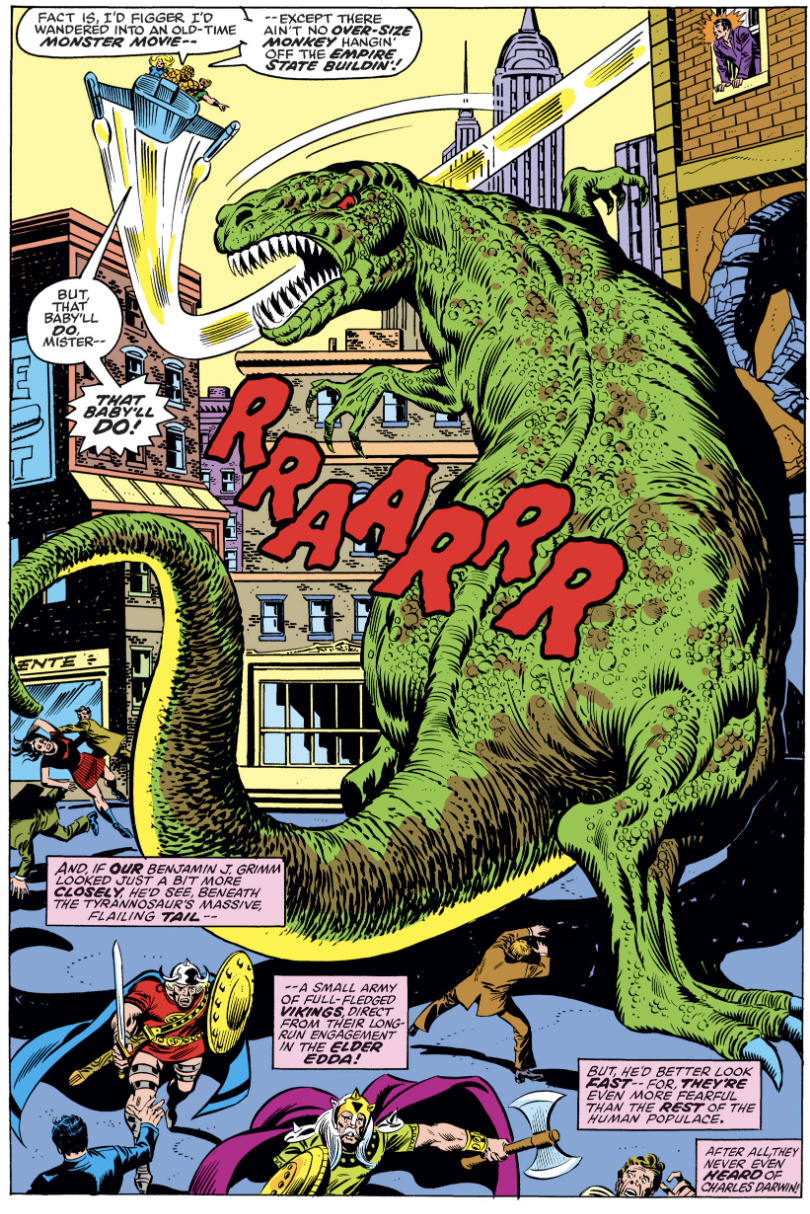
The comic is at times confusing — particularly since it backs into the story after a lengthy, seemingly unrelated opening sequence concerning Reed and his powers — but its complexity gives it a welcome richness and it’s crammed with ideas that will reappear in comics again and again. The scene of dinosaurs and vikings running amok, for example, feels like something directly out of Crisis on Infinite Earths, a comic which won’t come out for another 10 years. And the extra-dimensional, evil doppelgänger of a hero is now a recurring device, from Dark Beast to The Maker.


Thomas being Thomas, he can’t help but show off his erudition by dropping a reference to the Elder Edda. He also drops in some snide references to the Distinguished Competition, certainly not knowing he would be working for DC in seven years.


What I liked

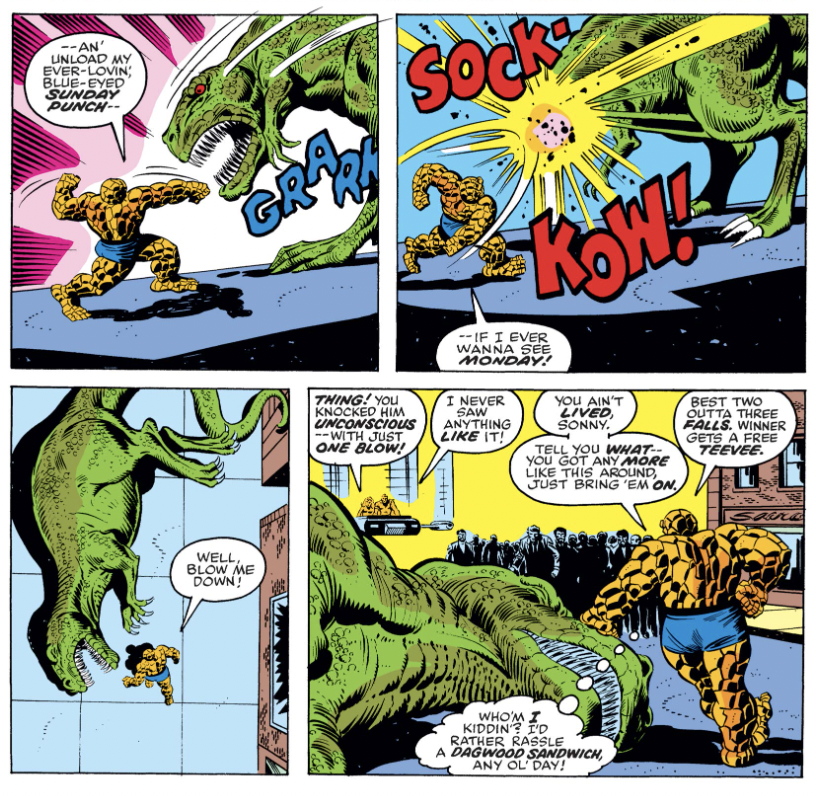
Along with the aforementioned depth of storytelling from Thomas, it seems Rich Buckler has upped his game. After a few uninspiring issues, his layouts in this comic are more dynamic, and show an imaginative use of perspective and angles. Here’s a simple sequence with four panels, all with different perspectives that help tell the story:

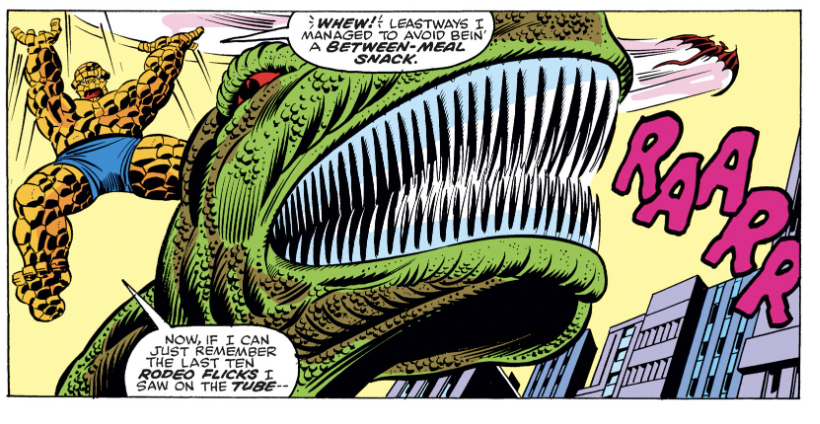
Here’s another one (also, note how different the dinosaur’s teeth look from the cover):


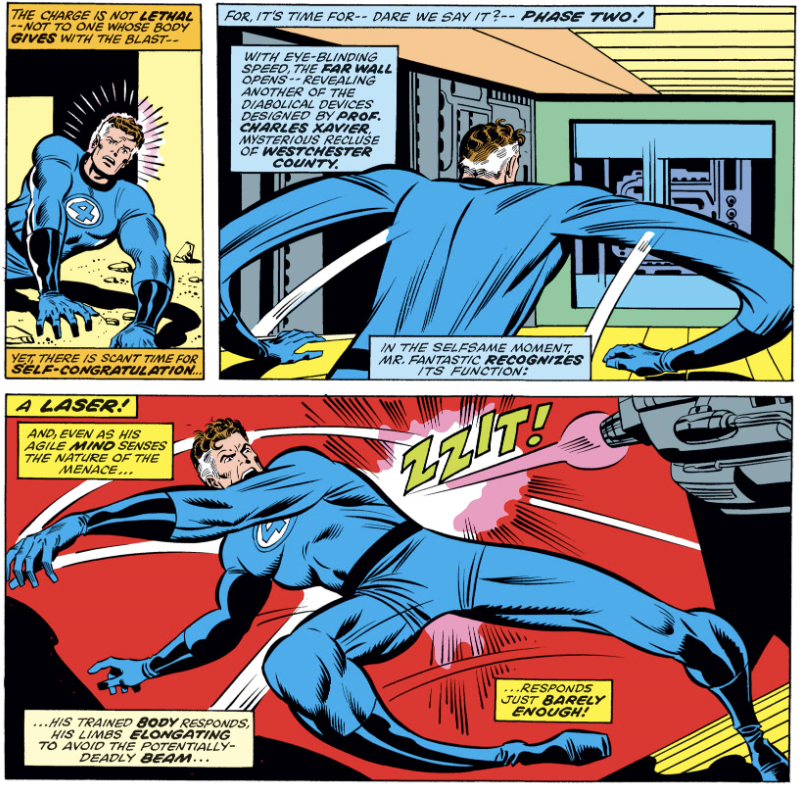
As mentioned last issue, Thomas has been pulling the FF closer to the rest of the Marvel universe. Here’s another example, where he references Professor X (and frankly, the whole opening sequence, with Mr. Fantastic testing himself in his version of the Danger Room, would have felt at home in an X-Men comic):


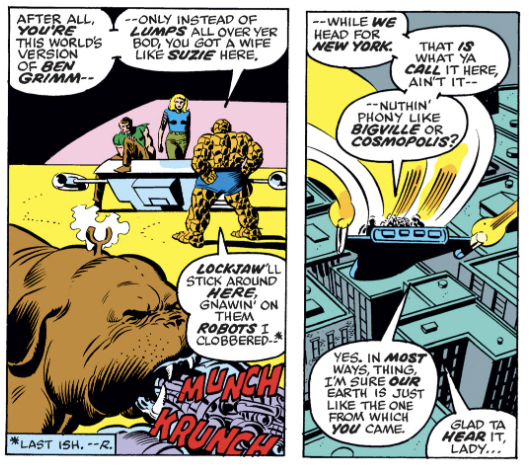
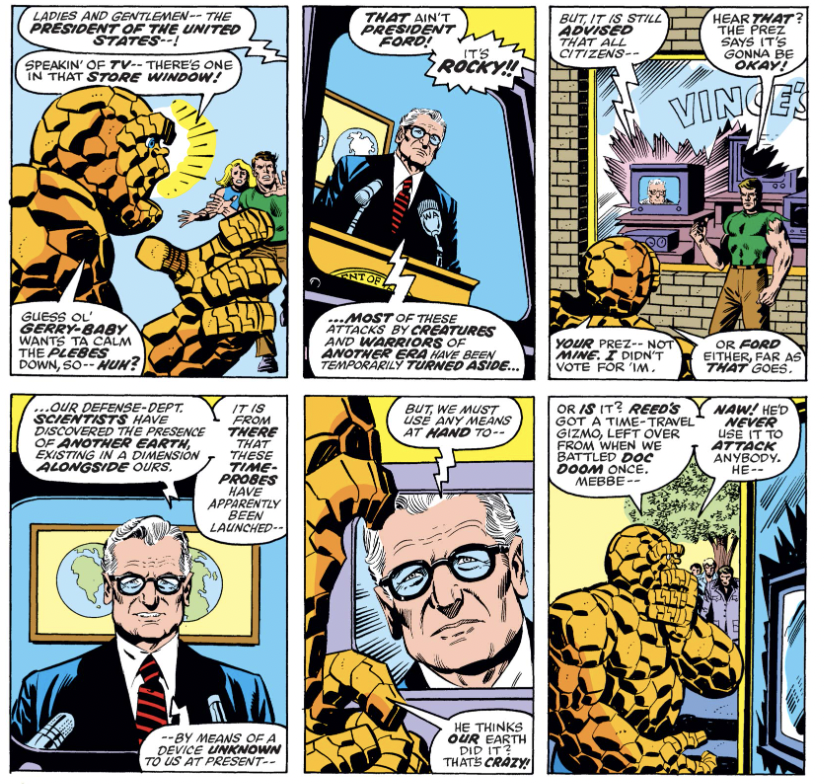
There’s some interesting political commentary too, with Nelson Rockefeller president of Earth 2 (I’m just going to call it that). Rockefeller was vice president when this comic was published in 1975, having been appointed to the position by President Gerald Ford after he assumed the presidency when Nixon resigned. Ben’s comment about not voting for Rockefeller or Ford for president of Earth 2 is a bit odd, since no one voted for them on Earth 1 either (or maybe that’s his point).


What I didn’t like

Sue is back on the team, but her role now, as in years past, mostly seems to be fretting. And Reed is again lying to her to protect her.


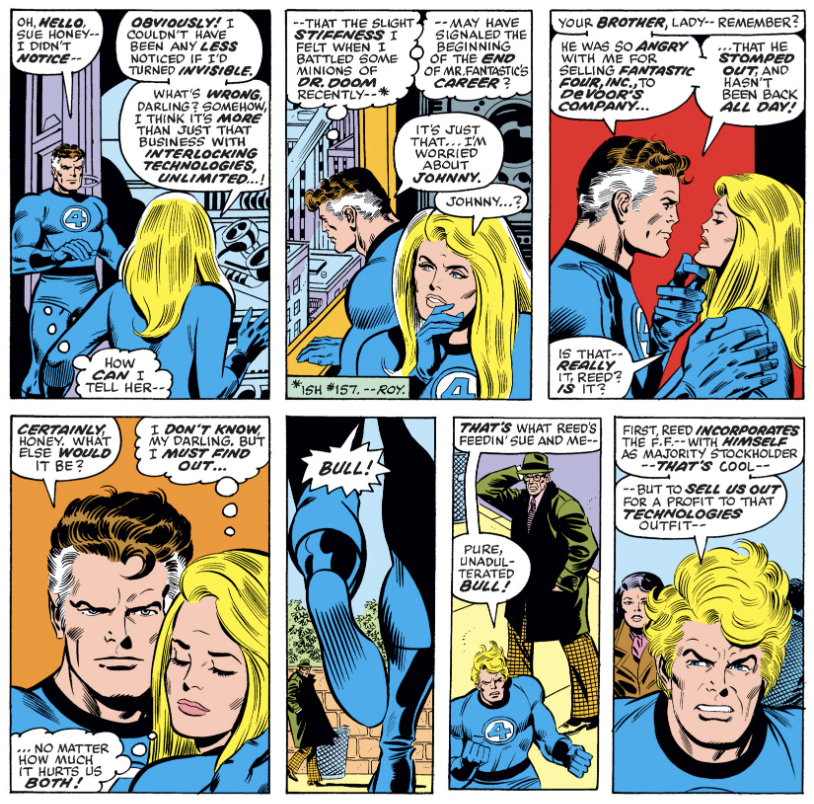
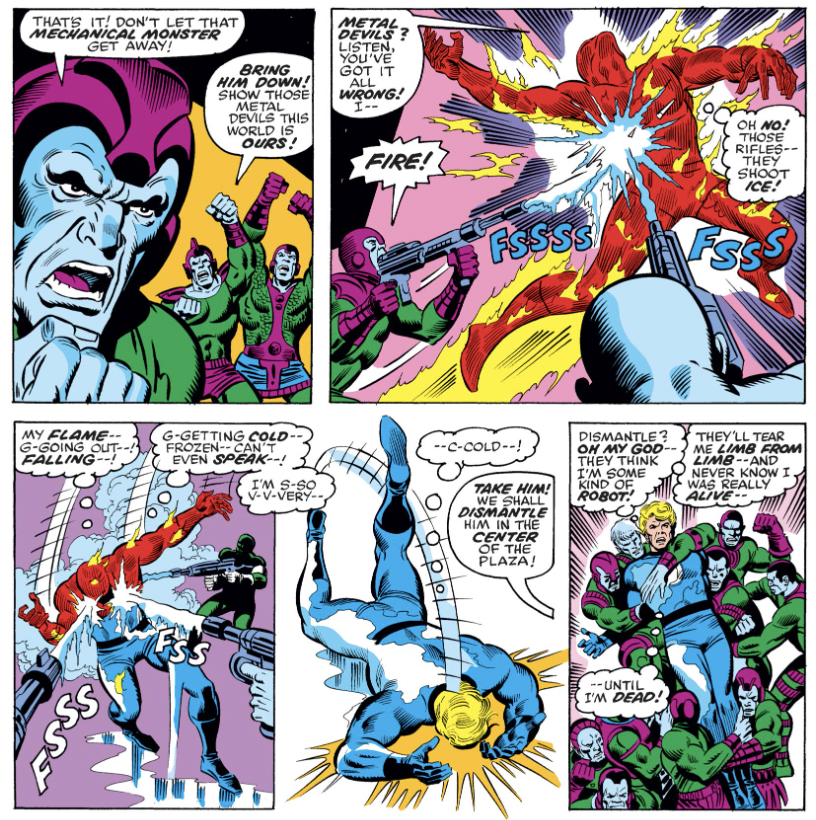
When Johnny is attacked in the Fifth Dimension, the guards there just happen to have rifles that shoot … ice. Pretty convenient.


Anything else?

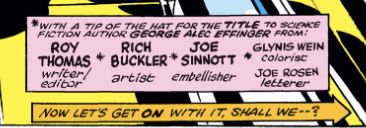
The story’s title was borrowed from a short science-fiction story by George Alec Effinger, which is credited by Thomas. I’m not familiar with Effinger’s work, but he was active and prolific from the 70s through the 90s, and wrote some stories for Marvel’s horror magazines in 1972.


Overall

More Thomasian fun

“The World’s Greatest Comic Magazine!” Fantastic Four No. 160

02 Sunday Feb 2025

Posted by percivalhenry in The World's Greatest Comic Magazine

≈ Leave a comment

Tags

1975, Fantastic Four, Fantastic Four 160, John Buscema, Marvel comics, Roy Thomas

Fantastic Four 160
“In One World and Out the Other!”
Published April 1975
Writer: Roy Thomas
Pencils: John Buscema
Inks: Chic Stone
Letters: Raymond Holloway
Colors: Janice Cohen
Editor: Thomas
Cover: Gil Kane and Al Milgrom

Synopsis

The issue opens with Arkon, a barbarian warrior from another dimension, and the Thing battling in midtown Manhattan, but Alicia Masters discovers that this Thing is not the man she knows. Back at the Baxter Building, the Ben Grimm of this Earth summons Lockjaw to teleport him to the dimension where the other Thing originated. There, after battling robot monsters and encountering a human version of himself, he discovers he is on the alternate Earth he visited in FF 118, one where Reed Richards became the Thing. Meanwhile, on our Earth, Mr. Fantastic announces plans to sell the Fantastic Four’s holding company over the objections of his teammates, a move that is somehow connected to the alternate Earth.


What’s going on here?

This issue is jam packed, and there’s a lot to discuss. The bottom line, however, is that it’s a really good comic — fun, interesting and suspenseful, the way Fantastic Four comics should be. It’s also irrefutably a Roy Thomas creation, and bears lots of his signatures: an intricate plot, dimension hopping, call-backs to older comics and his insufferable narration. For me, the ultimate validation of this comic is that I was eager to read the next one.

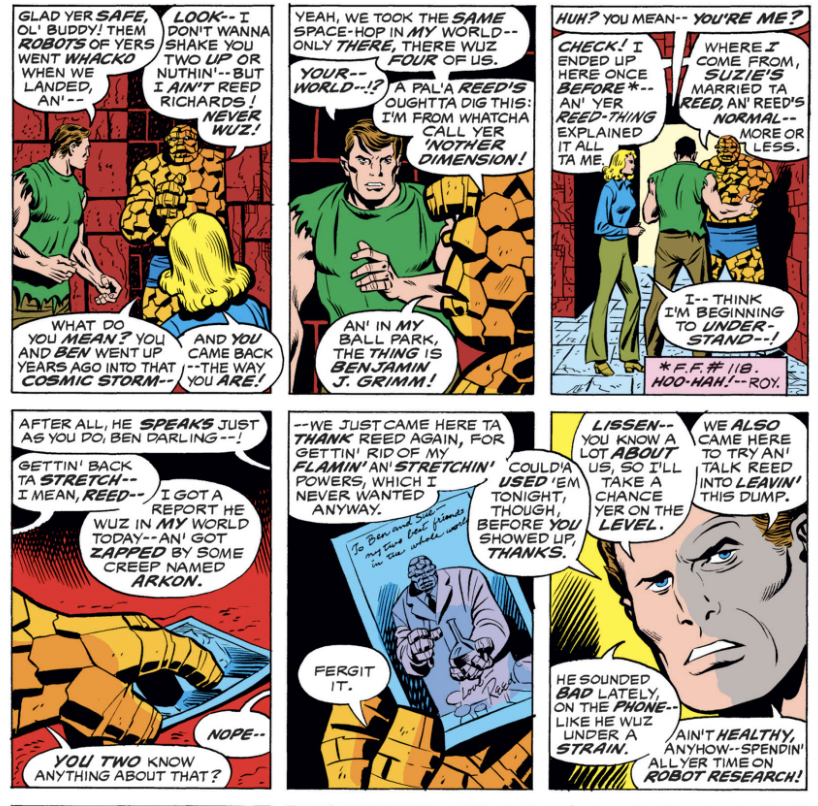
The length of my synopsis above signals the story’s complexity. While a Gerry Conway plot could be summarized in a sentence or two, Thomas’s takes four. The story begin abruptly, and confusingly, with the Thing (so far as we know) battling Arkon, an Avengers villain created by Thomas, and another indication of how Thomas is drawing the FF closer to the rest of the Marvel universe. In another call-back, he then takes Ben to an alternate universe created during Archie Goodwin’s brief run running the comic in one of the most imaginative (and shortest) FF stories, one in which only Ben and Reed took the ill-fated rocket trip, and where Reed becomes the Thing.


All of it is complicated by Reed’s surprising decision to sell the FF’s holding company. The move takes the comic into the world of business and finance, a category of subplot which rarely works out but here seems to hold together. Also, Reed giving himself controlling interest seems on brand for his depictions from this era.

Also of note is the return of John Buscema, here inked by Chic Stone, as artist. It’s only a one-issue fill in, and since Buscema’s work here looks rushed, I’m guessing it was a last-minute thing. Another new credit: Raymond Holloway as letterer, his first and last time lettering the FF, although he worked at Marvel for two decades. As far as I am aware, Holloway is the first Black creator to have a Fantastic Four credit, and you can read a bit more about him here.

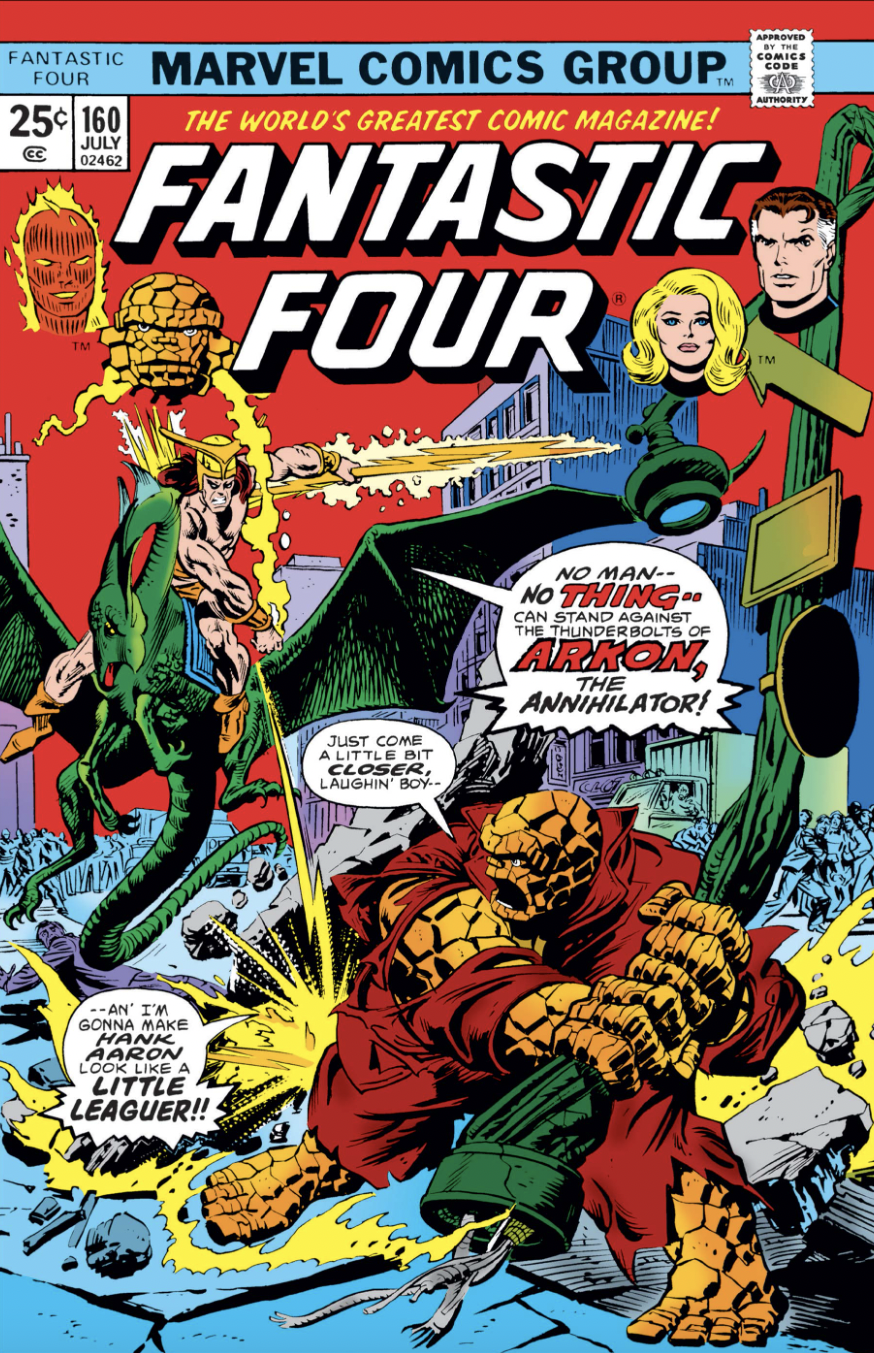
Lastly, the cover is by Gil Kane and Al Milgrom. The Hank Aaron reference is an interesting one; by the spring of 1975 Aaron had passed Babe Ruth as baseball’s all-time hime run hitter, and was a big enough star that he could be mentioned on the cover of comic book. While some racist fans mourned the dethroning of the Babe, Ben Grimm clearly wasn’t one of them (and it’s maybe worth noting the Thing on this cover is definitely Ben, not Reed, a bit of misdirection).


What I liked

Thomas has a lot of fun writing Ben, and he imbues him with an intelligence that some other writers ignore in favor of his wise cracking or woe-is-me pathos. This is the version of Ben that is on display in Marvel Two-in-One, the comic he starred in with a guest for 100 issues.

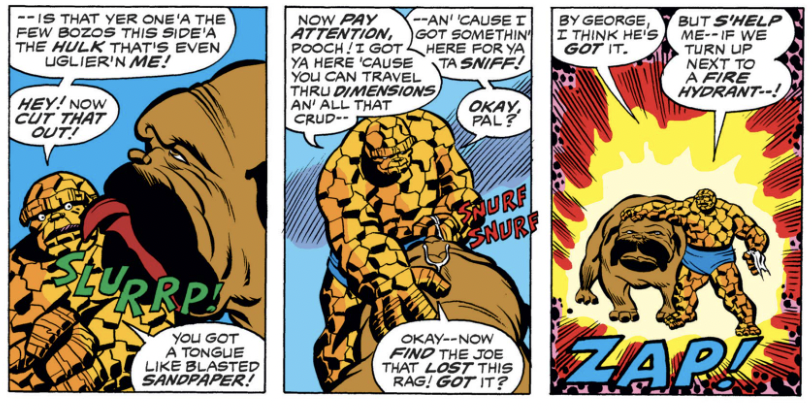
Here, Ben goofs around with Lockjaw:


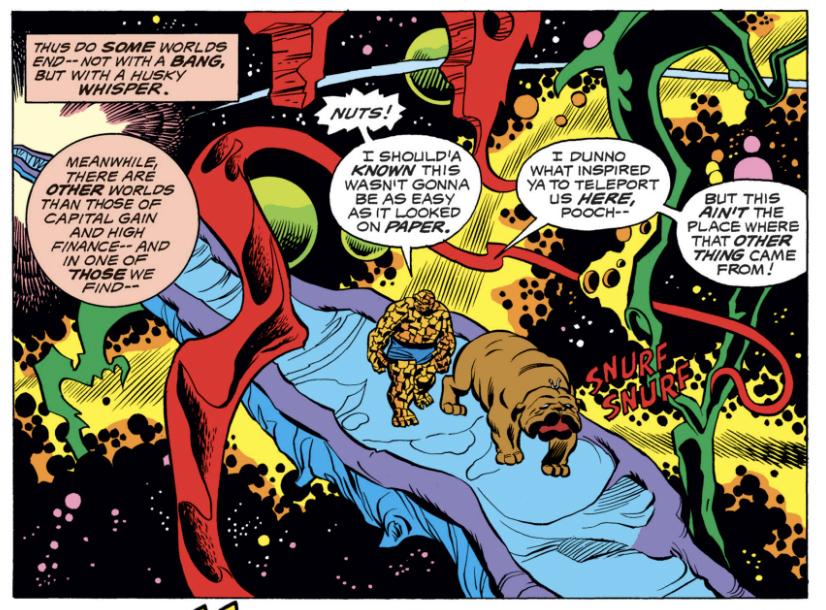
For some reason, Lockjaw first teleports them to a Ditko-esque dimension, which looks cool but has little to do the story:


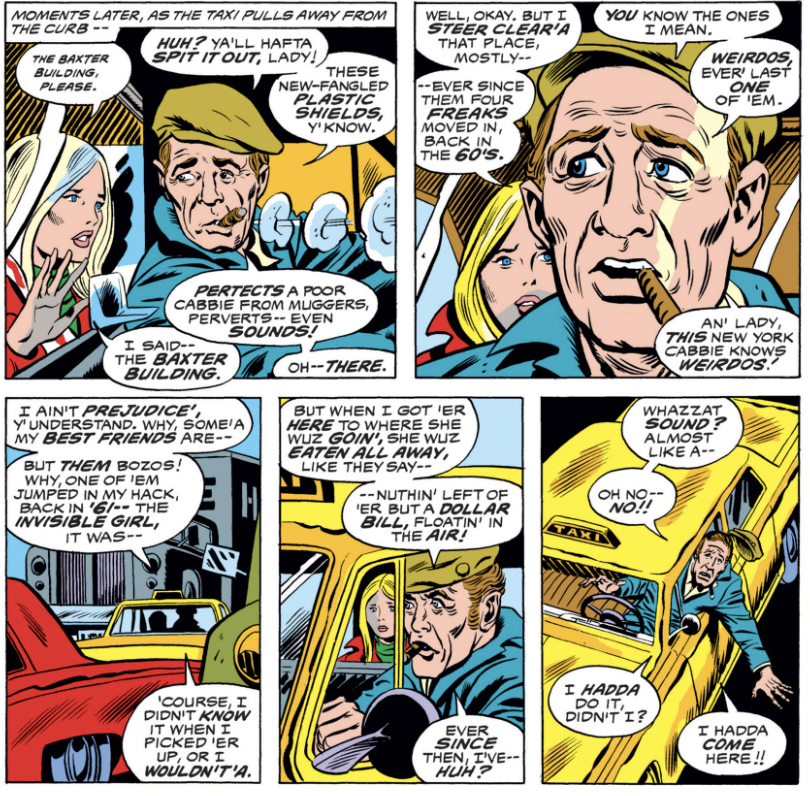
Another fun Thomasian flourish was Alicia’s interaction with a cabbie who is spooked to go near the Baxter Building:


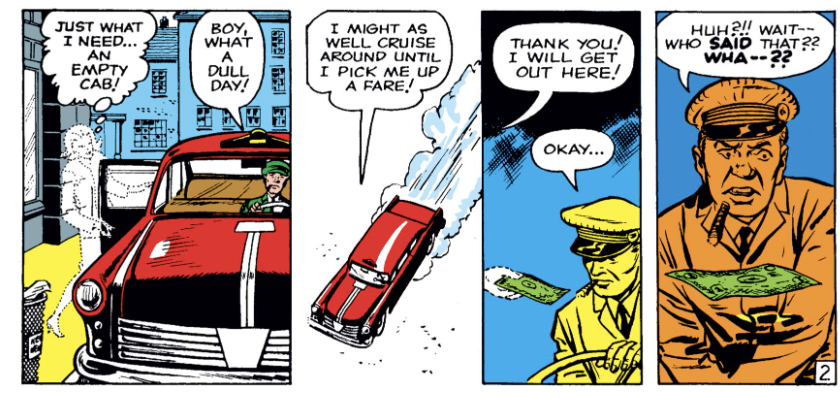
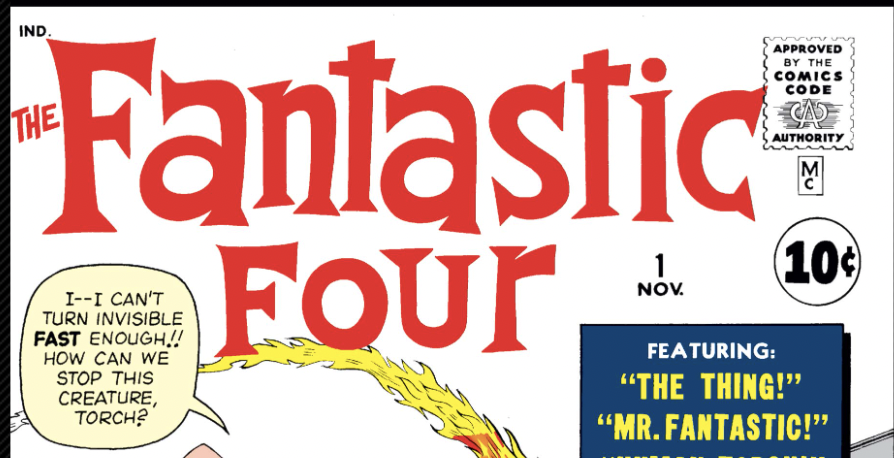
The cabbie, of course, is referring to this sequence all the way back in Fantastic Four 1, and the introduction of the Invisible Girl (he dressed a little better in 1961):


What I didn’t like

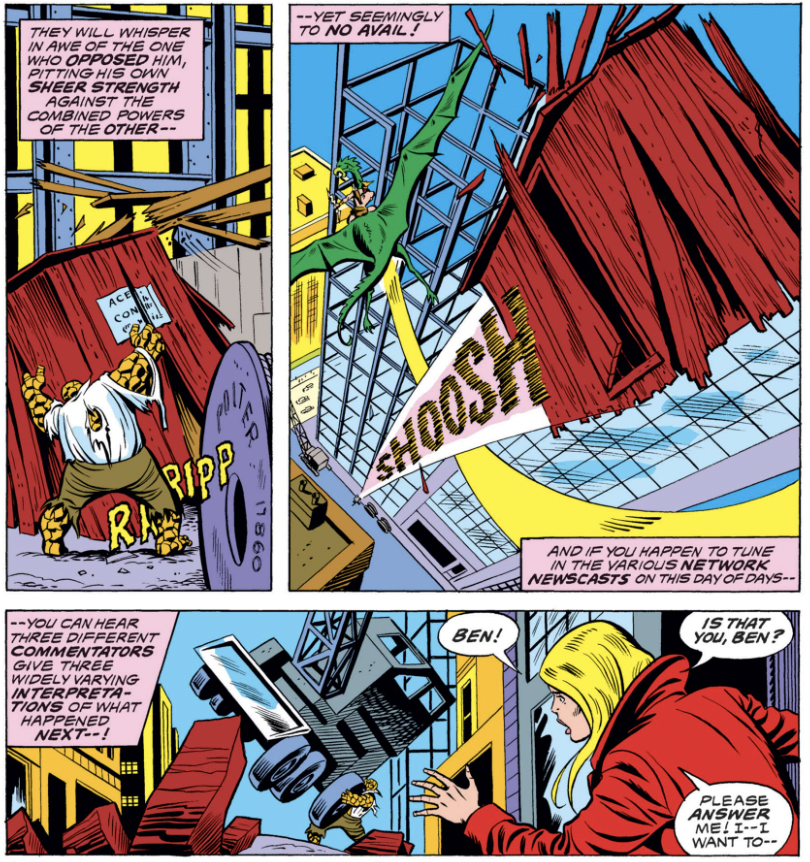
As always, Thomas is in love with the sound of his own voice (figuratively speaking) and his self-referential narration can get very annoying. Here, for whatever reason, he seems to be making some commentary about the evening TV news:

And here, more unnecessary patter:


Thomas’s intricate, science fiction plots require a lot of explanation, which often means lots of expository dialogue. In some cases, it just about crowds out the art, as in these panels:


Anything else?


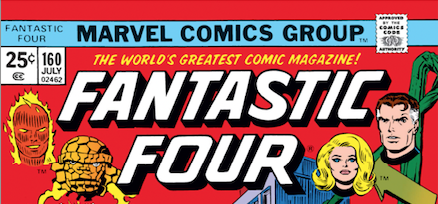
In perhaps another sign that Thomas wanted a break from the Conway era, this issue debuts a new Fantastic Four cover logo, just the third in the book’s history.

The first, of course, is the classic 60s logo, designed by Sal Brodsky:


According to longtime comic scholar Mark Evanier, via Todd Klein’s blog, it was inspired by the 1959 Twilight Zone TV show logo and which captured the spirit Stan Lee wanted in the comic.


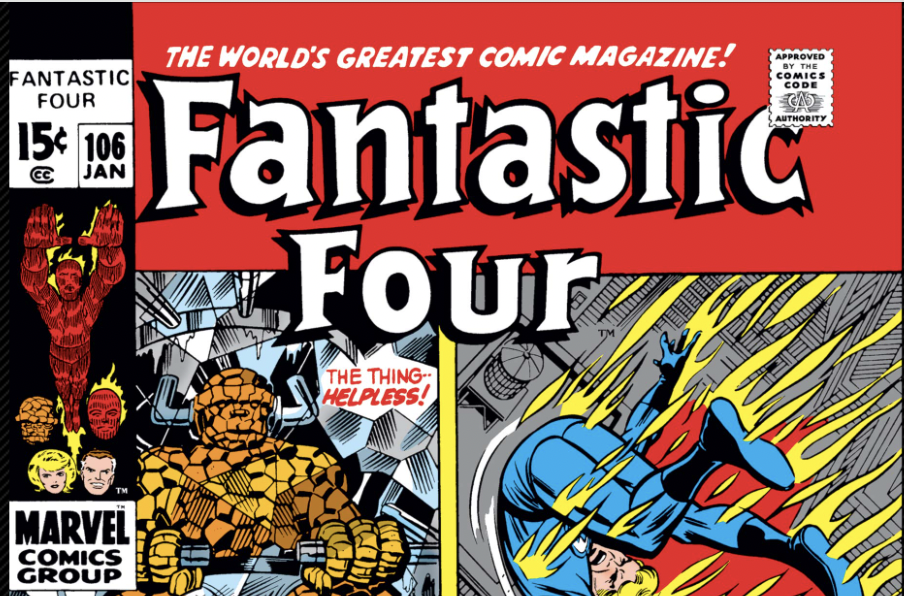
That FF logo was modified slightly, in part to accommodate the iconic Marvel corner box, which first appeared on the cover of FF 14. By the early 70s, it’s blockier and with shadow, and the letters don’t have the same zany flair, but it’s still recognizably the same.


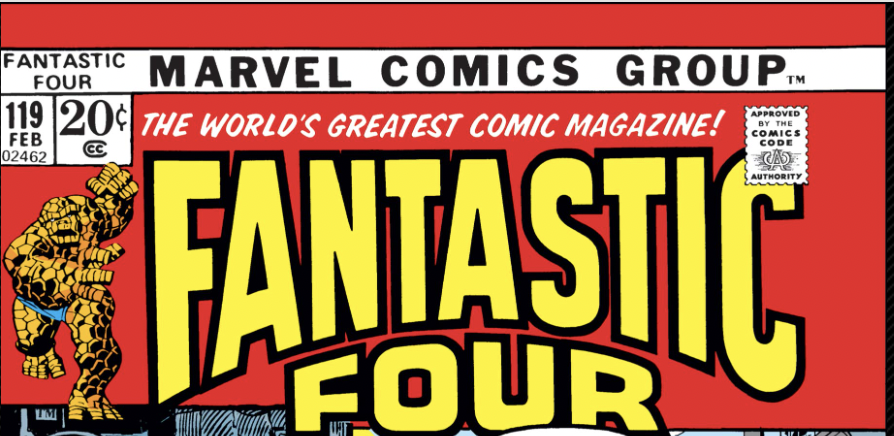
But that logo was dropped altogether in issue 119, in favor of a blockier logo that perhaps was a better fit for the new cover style which fit the art into a box (and which, for the record, I hated).


The new logo, which will last until issue 218, when it will revert back to the 60s logo, is an improvement over the previous one and has a zingy, sci-fi quality to it. It’s biggest departure, however, is dropping the corer box in far of four portraits of the FF (and maybe Marvel waited for Medusa to leave the team so it could include the original four on the logo).


Also, some fun ads in this comic.

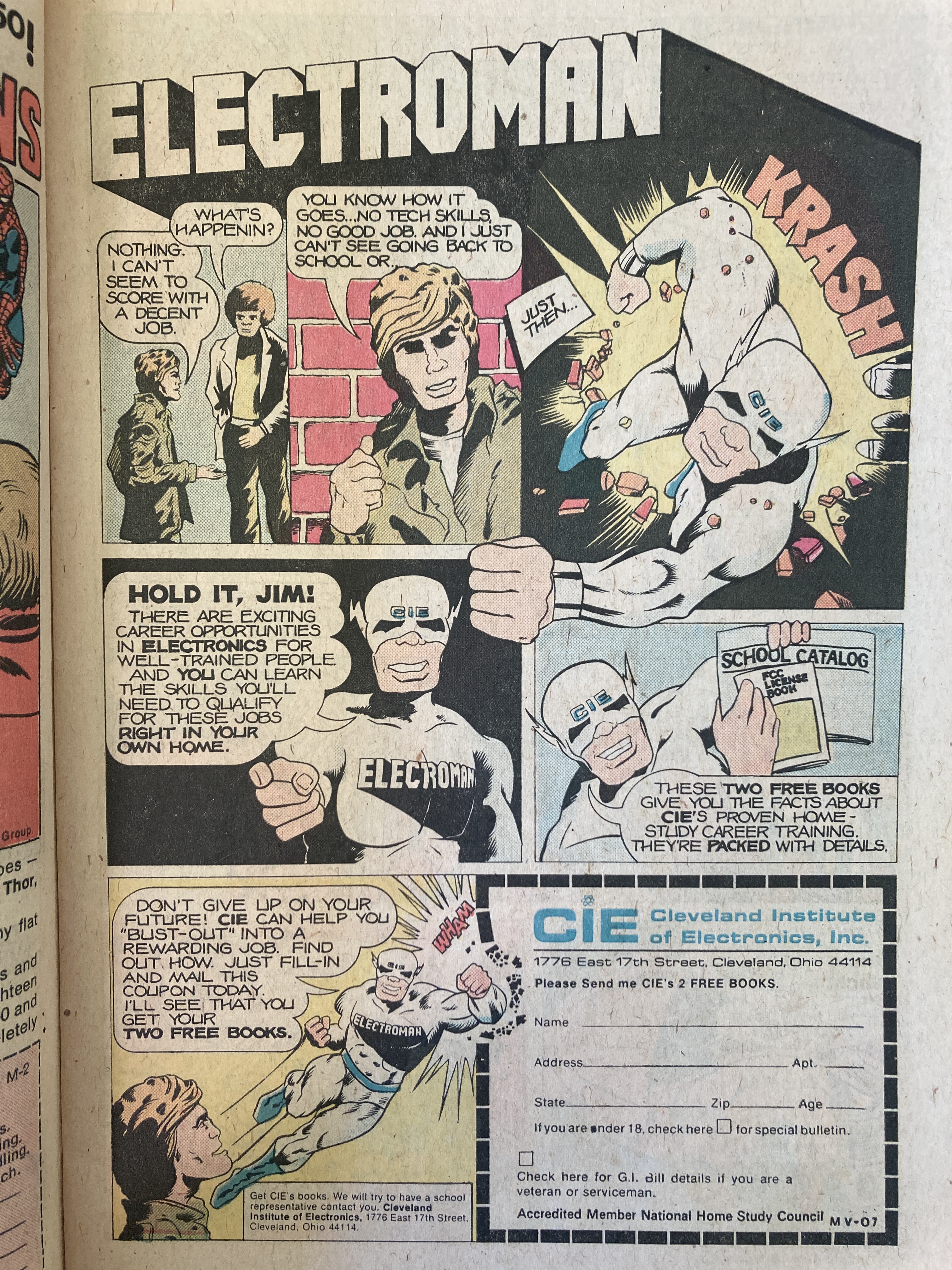
Electroman wants to get you a job! (I wonder if any artist will admit to drawing this)


And is there anything more ’70s than custom van-interior upholstering?


Overall

Comics like they should be!

“The World’s Greatest Comic Magazine!” Fantastic Four No. 159

26 Sunday Jan 2025

Posted by percivalhenry in The World's Greatest Comic Magazine

≈ Leave a comment

Tags

1975, Fantastic Four, Fantastic Four 159, Inhumans, Marvel comics, Roy Thomas

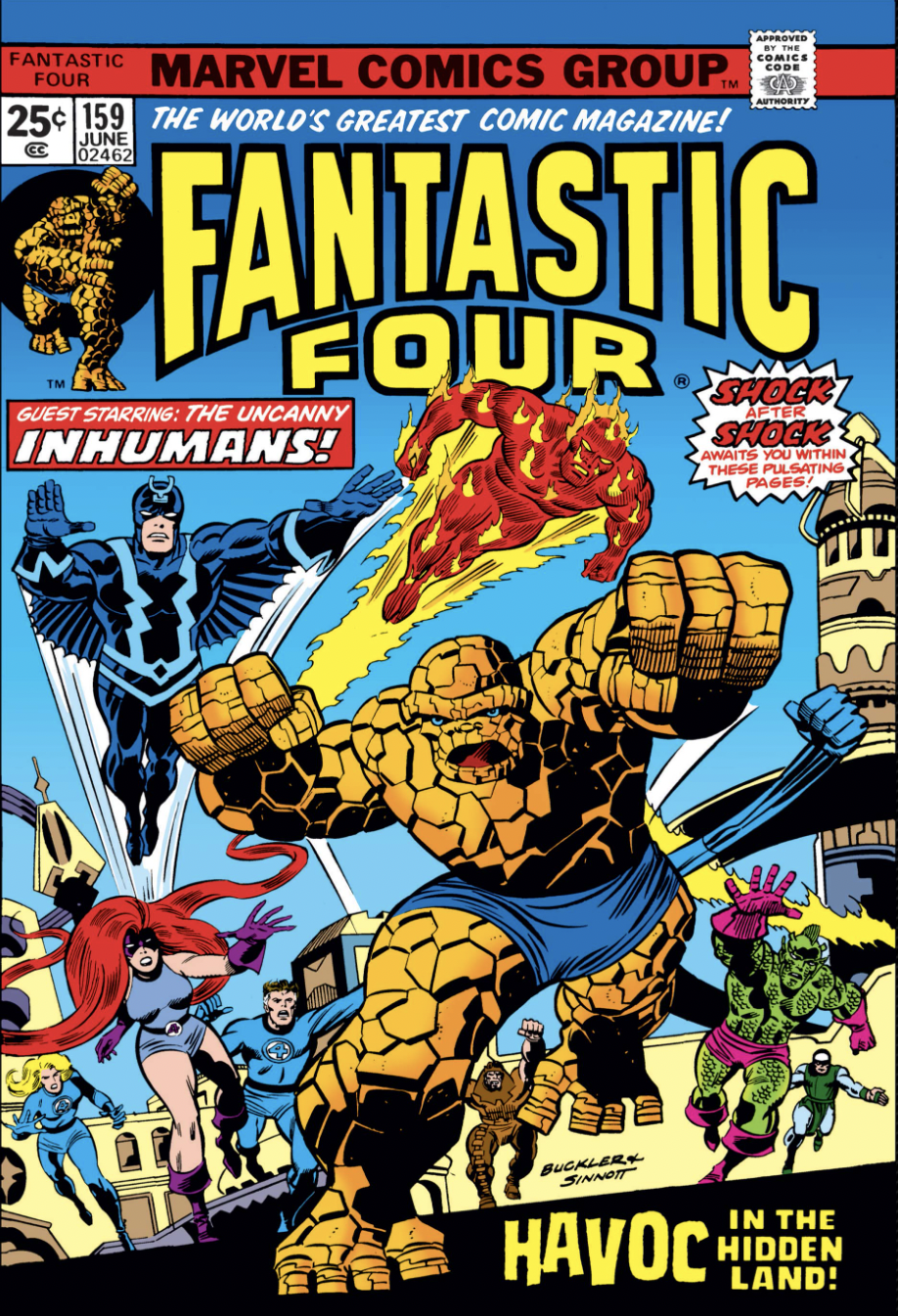
Fantastic Four 159
“Havoc in the Hidden Land!”
Published March 1975
Writer: Roy Thomas
Pencils: Rich Buckler
Inks: Joe Sinnott
Letters: Joseph Rosen
Colors: Janice Cohen
Editor: Thomas
Cover: Buckler and Sinnott

Synopsis

With Quicksilver, the Fantastic Four — minus the Invisible Girl, who was forbidden to come — travel to the Hidden Land in the Himalayas to rescue the Inhumans, where they are immediately captured by Xemu, the tyrant from the Fifth Dimension. In captivity, Johnny is reunited with Valeria, a princess from the Fifth Dimension he last encountered years ago. To force Black Bolt to power his sonic cannon, Xemu both threatens Medusa and tries to provoke an air strike by China. His plan is foiled by the Invisible Girl, who stowed aboard and used her powers to disguise the Hidden Land from the Chinese air force. The rest of the team and the Inhumans, freed by Triton, subdue Xemu and return him to the Fifth Dimension.


What’s going on here?

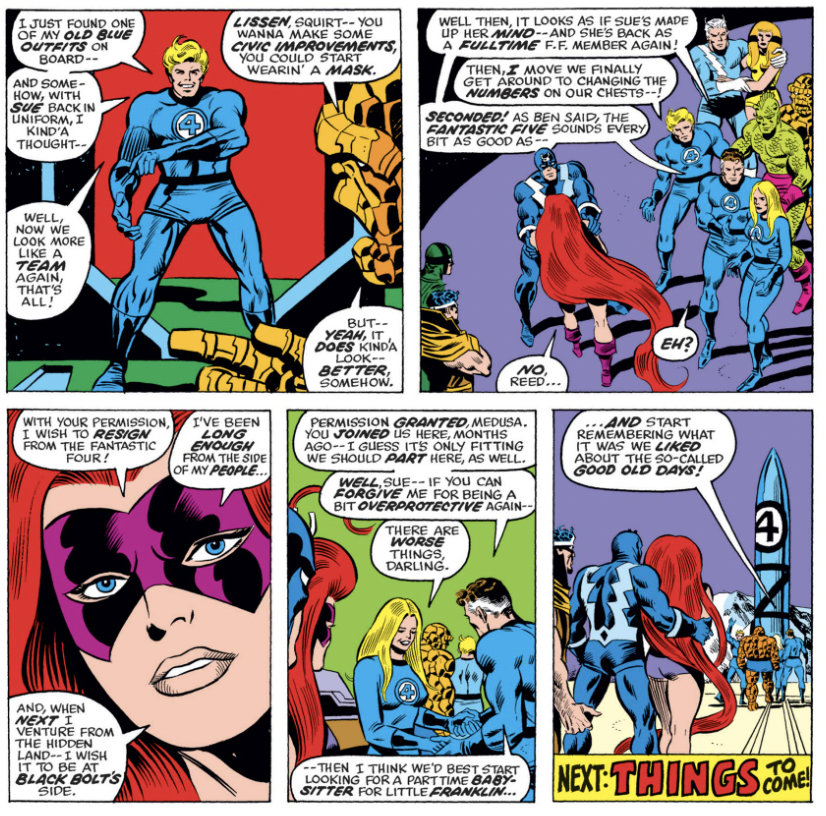
With this issue, Roy Thomas really puts his stamp on the Fantastic Four, undoing a slew of changes that had been introduced over Gerry Conway’s tenure as writer. Most notable is the return of the Invisible Girl as a member of the team. But Thomas also gives Johnny back his old blue uniform and dismisses Medusa from the team — both on the same page — reversing two changes to the FF that added little and distracted from their unified, familial nature that makes the team unique.
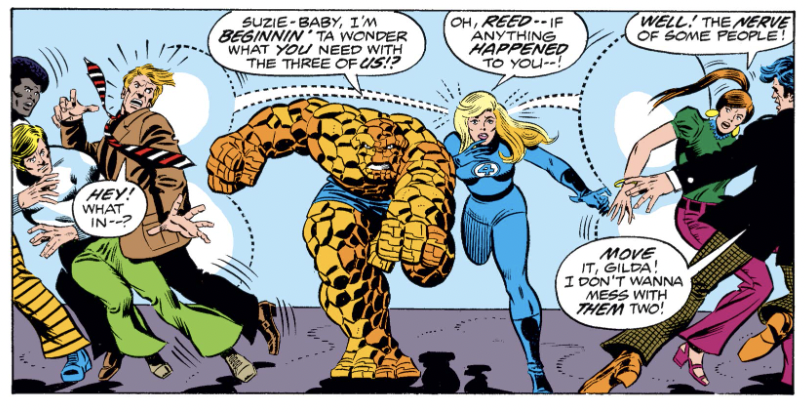
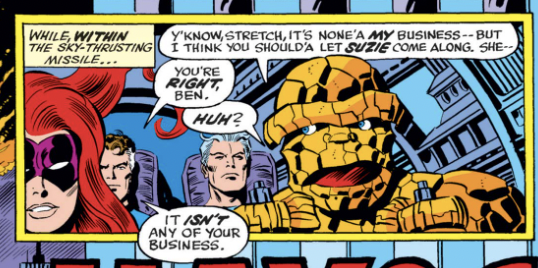
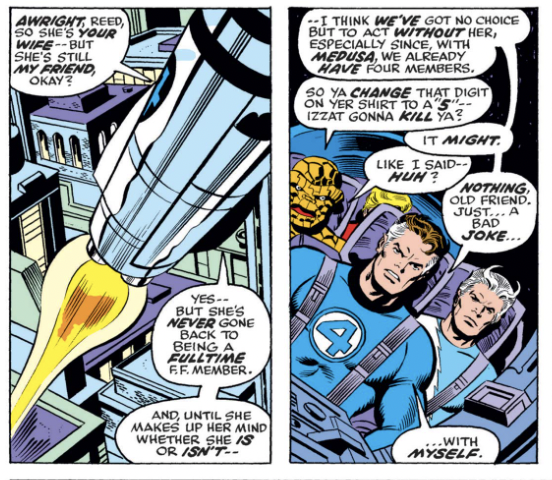
Readers of this blog know I have been very critical of the treatment of Medusa, who never found her place on the team, and especially of Sue, who spent the last two-plus years shunted aside, figuratively and sometimes literally. Sue’s diminished status is nothing new, of course, and was a fixture of the Lee / Kirby era. Her treatment surely reflected the sexism of the time, but her more recent exclusion from the team was perhaps also the result of an inability by Conway (who, remember, was in his early 20s) to imagine a role for a young mother on a superhero team. In the comics, her exclusion was justified by Reed being over-protective, and in some revealing dialogue early in FF 159, Ben makes the case she should join them, perhaps another case of Thomas using the characters to argue with other FF writers.

At this point in the comics I was resigned to yet another issue without Sue, and was genuinely surprised when she not only appeared, but saved the day with new and expanded powers. Thomas, it seems, was as frustrated with Sue’s marginalization as this fan.


And like a Gilbert & Sullivan operetta, all is wrapped up and forgiven in the last few panels.

What I liked

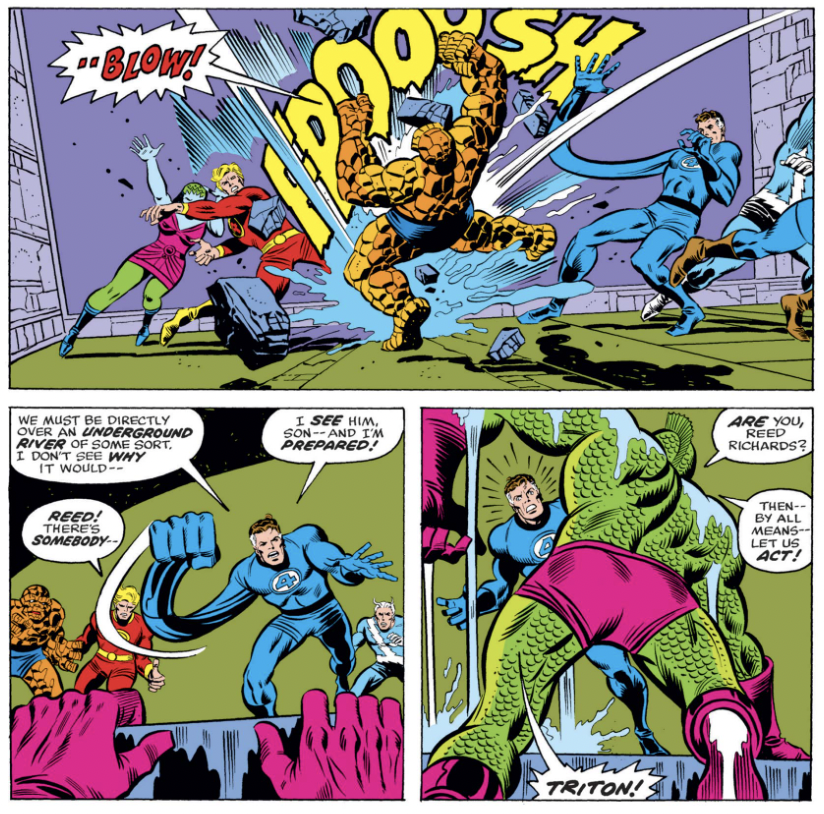
I loved Sue’s dramatic re-emergence, but Thomas also managed to surprise me with the sequence where the FF are imprisoned. This is a pretty familiar situation, and they usually use some aspect of their powers to escape, but here they are rescued by Triton, whose absence was explained last issue. This was another twist I didn’t see coming.


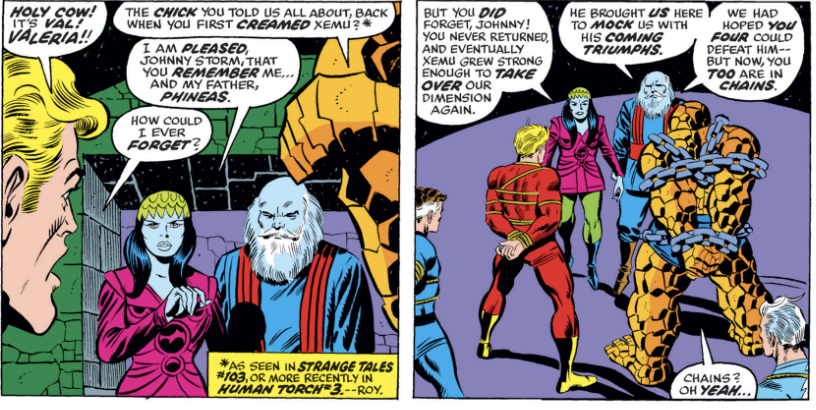
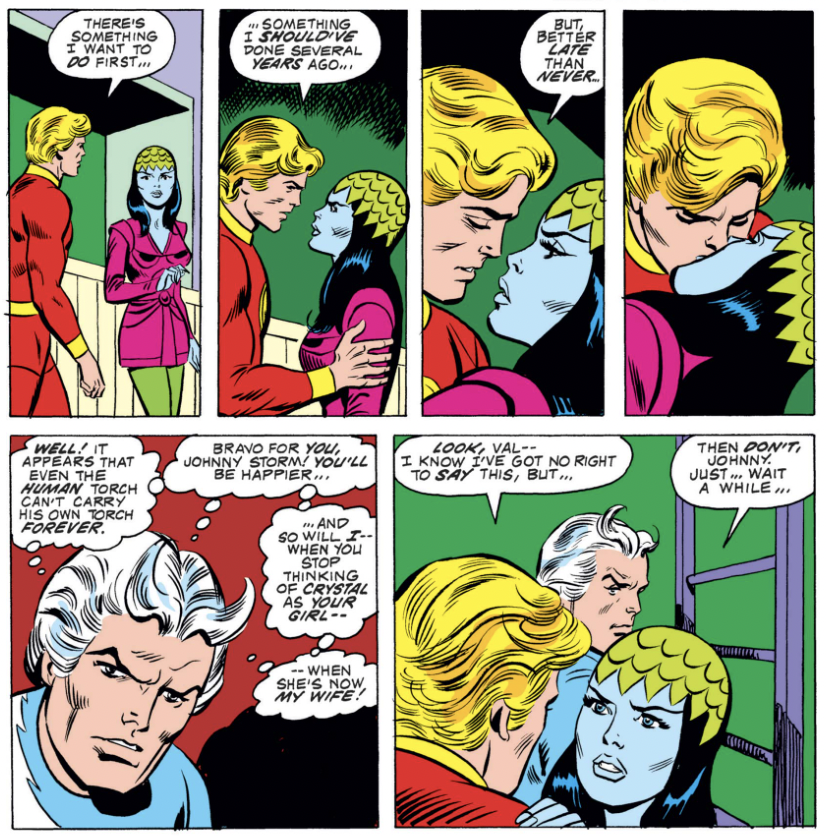
Thomas leans into soap opera by reintroducing Valeria, the alien princess Johnny had a dalliance with years ago and — as is his wont — jilted. I like how she reminded him that he ghosted her.


I’m not sure Valeria is the right woman for Johnny and history will prove she is not, but I like that Thomas is trying to make a clean break with Crystal and that mopey storyline.

What I didn’t like

Despite the many positive aspects of this comic, it’s plot was pretty lackluster and by-the-numbers. The FF are captured by an evil-doer, it all looks hopeless, they escape and save the day. This story was at times incoherent, in part because of Xemu’s dimension-hopping, but it was mostly forgettable.
Rich Buckler’s art looks rushed and unimaginative in this issue, which doesn’t help matters.

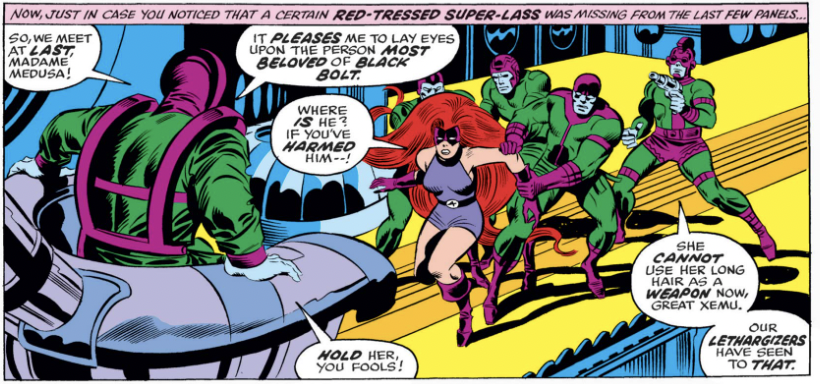
Also, what is a “lethargizer?”


About that name

“Valeria” is a familiar name to Fantastic Four fans, and the character in FF 159 is one of three to share it. She’s also the first, since her first appearance in 1962’s Strange Tales 103 predates the appearance of Victor Von Doom’s first true love, a Latverian woman named Valeria, who is first mentioned in 1969’s Marvel Super-Heroes 20. It is that Valeria who is the namesake of Valeria Richards, the daughter of Reed and Sue who was delivered by Doom and who claimed the right to name her.

Marvel Super-Heroes 20 was written by Larry Leiber (Stan’s brother) and I don’t know whether he was aware of the previous Valeria, who seemed like a throwaway character until she was resuscitated by Thomas. It is possible both characters were named after Valerie Barclay, a comic book inker who worked at Marvel (then Timely) in the 1950 who was described by artist Allen Bellman as “an exquisitely beautiful young lady.”


Overall

A very welcome return makes up for a dull story.

← Older posts
  • “The World’s Greatest Comic Magazine!” Fantastic Four Annual No. 15
  • “The World’s Greatest Comic Magazine!” Fantastic Four No. 223
  • “The World’s Greatest Comic Magazine!” Fantastic Four No. 222
  • “The World’s Greatest Comic Magazine!” Fantastic Four No. 221
  • “The World’s Greatest Comic Magazine!” Fantastic Four No. 220
  • July 2026
  • June 2026
  • May 2026
  • April 2026
  • March 2026
  • February 2026
  • January 2026
  • December 2025
  • November 2025
  • October 2025
  • September 2025
  • August 2025
  • July 2025
  • June 2025
  • May 2025
  • April 2025
  • March 2025
  • February 2025
  • January 2025
  • December 2024
  • November 2024
  • October 2024
  • September 2024
  • August 2024
  • July 2024
  • June 2024
  • May 2024
  • April 2024
  • March 2024
  • February 2024
  • January 2024
  • December 2023
  • November 2023
  • September 2023
  • July 2023
  • June 2023
  • May 2023
  • April 2023
  • March 2023
  • February 2023
  • January 2023
  • December 2022
  • November 2022
  • October 2022
  • September 2022
  • August 2022
  • July 2022
  • June 2022
  • May 2022
  • April 2022
  • March 2022
  • February 2022
  • January 2022
  • December 2021
  • November 2021
  • October 2021
  • September 2021
  • August 2021
  • July 2021
  • June 2021
  • May 2021
  • April 2021
  • March 2021
  • February 2021
  • January 2021
  • December 2020
  • February 2018
  • May 2016
  • February 2016
  • January 2016
  • December 2015
  • November 2015
  • October 2015
  • September 2015
  • August 2015
  • July 2015
  • April 2015
  • March 2015
  • January 2015
  • December 2014
  • November 2014
  • October 2014
  • September 2014
  • August 2014
  • June 2014
  • May 2014
  • April 2014
  • March 2014
  • February 2014
  • July 2026
  • June 2026
  • May 2026
  • April 2026
  • March 2026
  • February 2026
  • January 2026
  • December 2025
  • November 2025
  • October 2025
  • September 2025
  • August 2025
  • July 2025
  • June 2025
  • May 2025
  • April 2025
  • March 2025
  • February 2025
  • January 2025
  • December 2024
  • November 2024
  • October 2024
  • September 2024
  • August 2024
  • July 2024
  • June 2024
  • May 2024
  • April 2024
  • March 2024
  • February 2024
  • January 2024
  • December 2023
  • November 2023
  • September 2023
  • July 2023
  • June 2023
  • May 2023
  • April 2023
  • March 2023
  • February 2023
  • January 2023
  • December 2022
  • November 2022
  • October 2022
  • September 2022
  • August 2022
  • July 2022
  • June 2022
  • May 2022
  • April 2022
  • March 2022
  • February 2022
  • January 2022
  • December 2021
  • November 2021
  • October 2021
  • September 2021
  • August 2021
  • July 2021
  • June 2021
  • May 2021
  • April 2021
  • March 2021
  • February 2021
  • January 2021
  • December 2020
  • February 2018
  • May 2016
  • February 2016
  • January 2016
  • December 2015
  • November 2015
  • October 2015
  • September 2015
  • August 2015
  • July 2015
  • April 2015
  • March 2015
  • January 2015
  • December 2014
  • November 2014
  • October 2014
  • September 2014
  • August 2014
  • June 2014
  • May 2014
  • April 2014
  • March 2014
  • February 2014
“The World’s Greatest Comic Magazine!” Fantastic Four Annual No. 15

“The World’s Greatest Comic Magazine!” Fantastic Four Annual No. 15

percivalhenry's avatar by percivalhenry July 18, 2026
“The World’s Greatest Comic Magazine!” Fantastic Four No. 223

“The World’s Greatest Comic Magazine!” Fantastic Four No. 223

percivalhenry's avatar by percivalhenry July 14, 2026
“The World’s Greatest Comic Magazine!” Fantastic Four No. 222

“The World’s Greatest Comic Magazine!” Fantastic Four No. 222

percivalhenry's avatar by percivalhenry July 5, 2026
“The World’s Greatest Comic Magazine!” Fantastic Four No. 221

“The World’s Greatest Comic Magazine!” Fantastic Four No. 221

percivalhenry's avatar by percivalhenry June 25, 2026
“The World’s Greatest Comic Magazine!” Fantastic Four No. 220

“The World’s Greatest Comic Magazine!” Fantastic Four No. 220

percivalhenry's avatar by percivalhenry June 15, 2026
“The World’s Greatest Comic Magazine!” Fantastic Four No. 219

“The World’s Greatest Comic Magazine!” Fantastic Four No. 219

percivalhenry's avatar by percivalhenry June 7, 2026

Blog at WordPress.com.

  • Subscribe Subscribed
    • Percival Henry: The Fantastic Four and more
    • Join 74 other subscribers
    • Already have a WordPress.com account? Log in now.
    • Percival Henry: The Fantastic Four and more
    • Subscribe Subscribed
    • Sign up
    • Log in
    • Report this content
    • View site in Reader
    • Manage subscriptions
    • Collapse this bar

Loading Comments...