• About Percival Henry

Percival Henry: The Fantastic Four and more

~ Blogging the Fantastic Four issue by issue (plus whatever else grabs my attention)

Percival Henry: The Fantastic Four and more

Tag Archives: Roy Thomas

“The World’s Greatest Comic Magazine!” Fantastic Four No. 161

09 Sunday Feb 2025

Posted by percivalhenry in The World's Greatest Comic Magazine

≈ Leave a comment

Tags

1975, Fantastic Four, Fantastic Four 161, Marvel comics, Rich Buckler, Roy Thomas

Fantastic Four 161
“All The World Wars At Once!”
Published May 1975
Writer: Roy Thomas
Pencils: Rich Buckler
Inks: Joe Sinnott
Letters: Joe Rosen
Colors: Glynis Wein
Editor: Thomas
Cover: Buckler and Sinnott

Synopsis

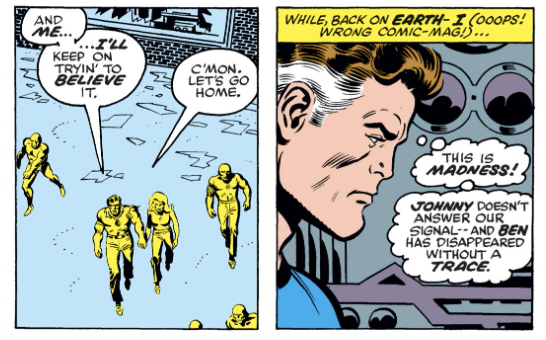
The comic opens with Mr. Fantastic testing his powers, and concluding they are fading, thus limiting his value to the team. The Human Torch, frustrated with Reed’s decision to sell the FF’s company, journeys to the Fifth Dimension to reunite with Valeria, only to be sucked into a battle with giant robots, apparently created by Reed Richards. Meanwhile, the Thing, on an Earth in another dimension, battles dinosaurs before he is subdued by the Ben Grimm of that Earth. Back on the primary earth (or Earth 1 or Earth 616 if you prefer) Reed and Sue prepare for an invasion from the Fifth Dimension, seemingly led by Johnny.

What’s going on here?

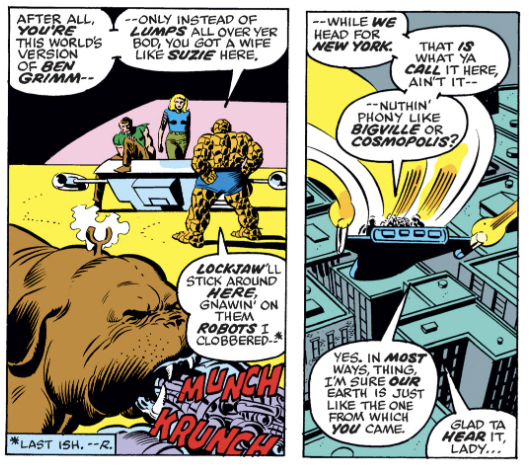
Just when I thought the last issue was peak Roy Thomas, he goes even further. Instead of a story spanning two dimensions, he has now added a third (confusingly called the Fifth Dimension), and each seems to be in conflict with another. Arkon, whom we might have expected to be the primary villain of this arc, has disappeared and the bad guy now seems to be the Reed Richards of the alternate Earth, who is that Earth’s Thing and has apparently sent giant robots to conquer the Fifth Dimension.

The comic is at times confusing — particularly since it backs into the story after a lengthy, seemingly unrelated opening sequence concerning Reed and his powers — but its complexity gives it a welcome richness and it’s crammed with ideas that will reappear in comics again and again. The scene of dinosaurs and vikings running amok, for example, feels like something directly out of Crisis on Infinite Earths, a comic which won’t come out for another 10 years. And the extra-dimensional, evil doppelgänger of a hero is now a recurring device, from Dark Beast to The Maker.
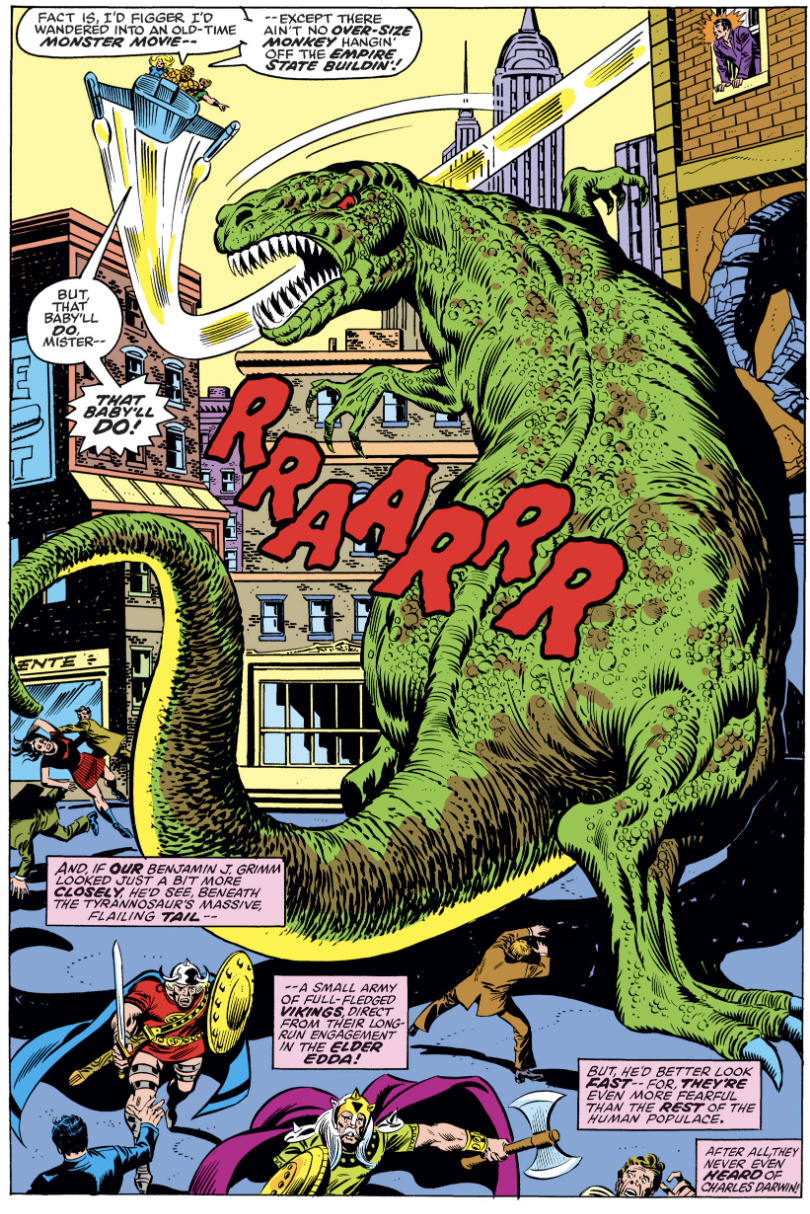

Thomas being Thomas, he can’t help but show off his erudition by dropping a reference to the Elder Edda. He also drops in some snide references to the Distinguished Competition, certainly not knowing he would be working for DC in seven years.
What I liked

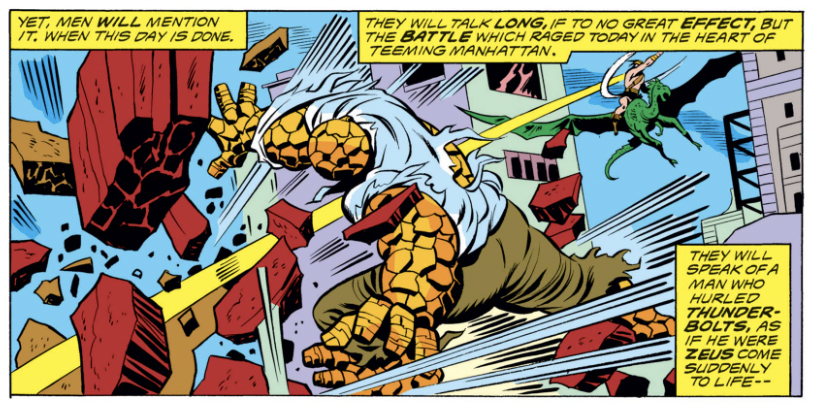
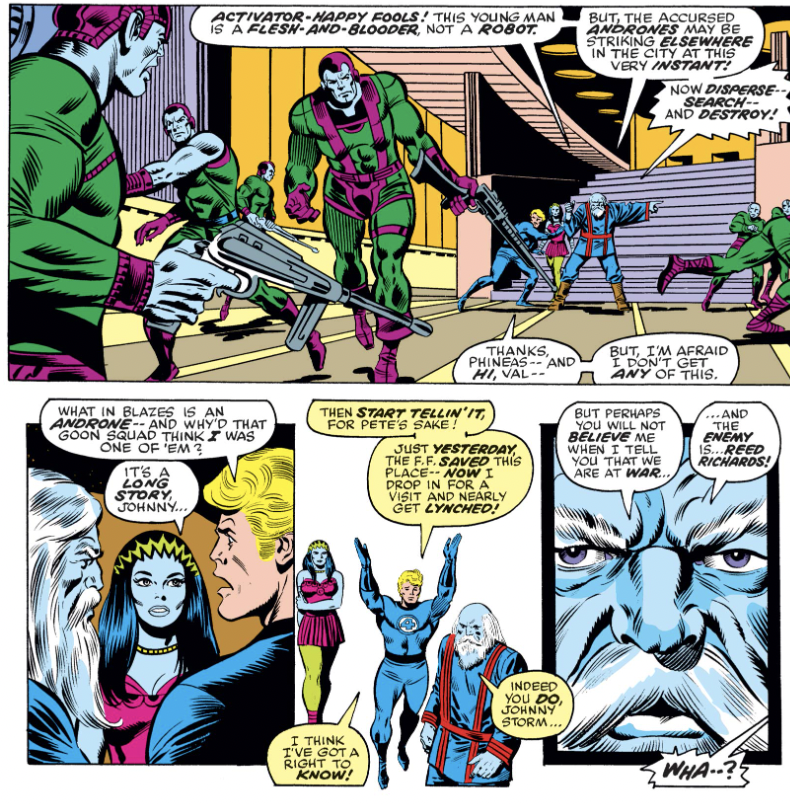
Along with the aforementioned depth of storytelling from Thomas, it seems Rich Buckler has upped his game. After a few uninspiring issues, his layouts in this comic are more dynamic, and show an imaginative use of perspective and angles. Here’s a simple sequence with four panels, all with different perspectives that help tell the story:
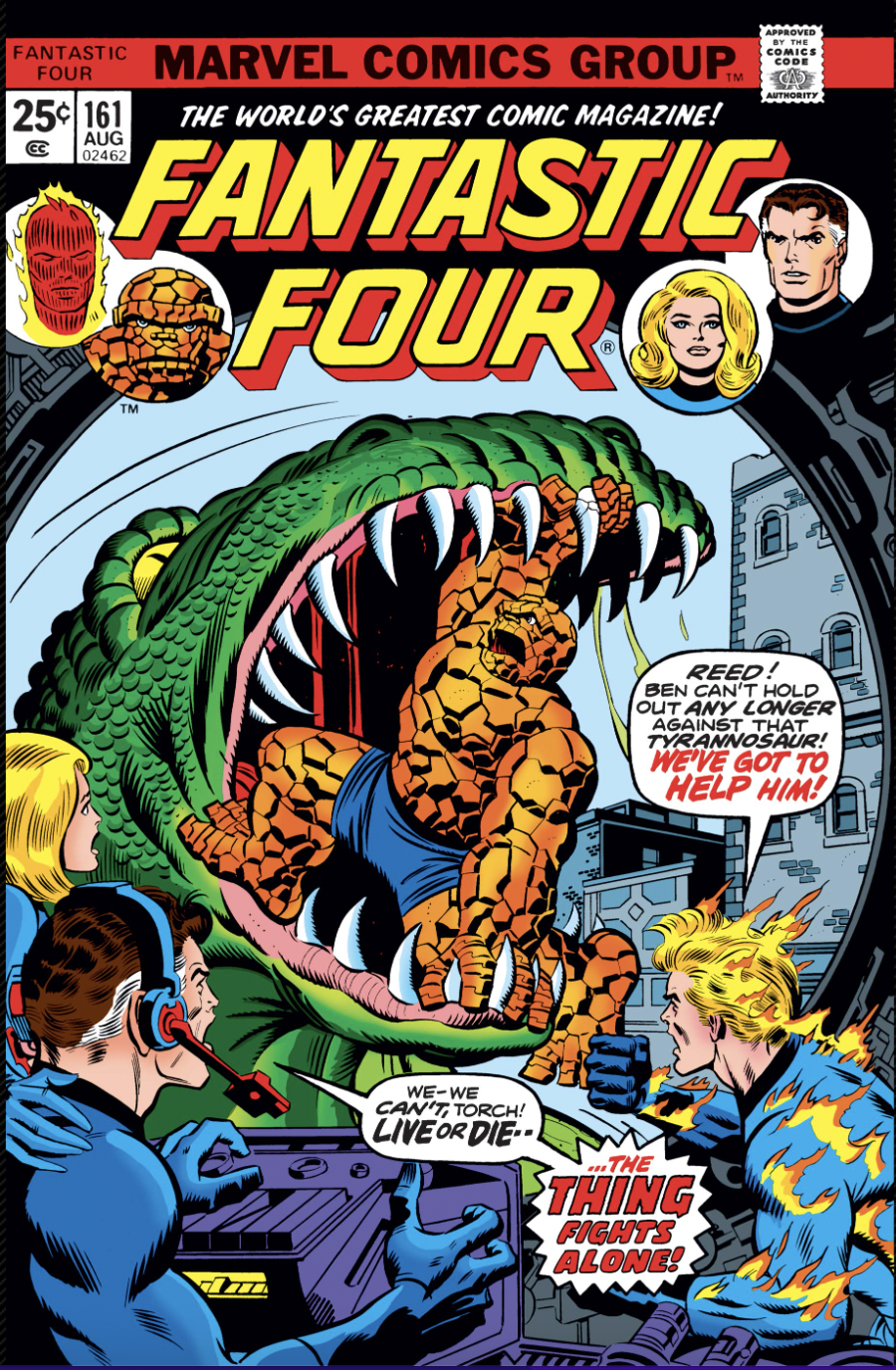
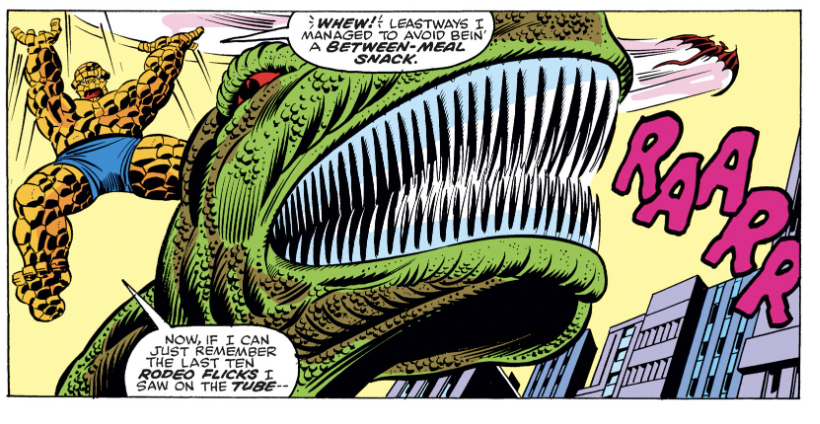
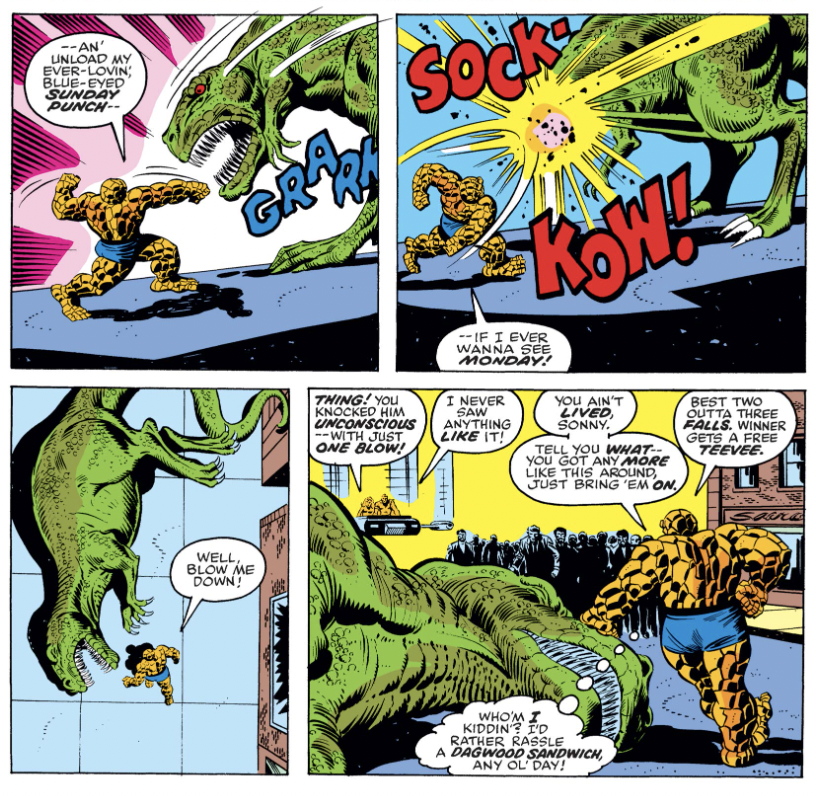
Here’s another one (also, note how different the dinosaur’s teeth look from the cover):

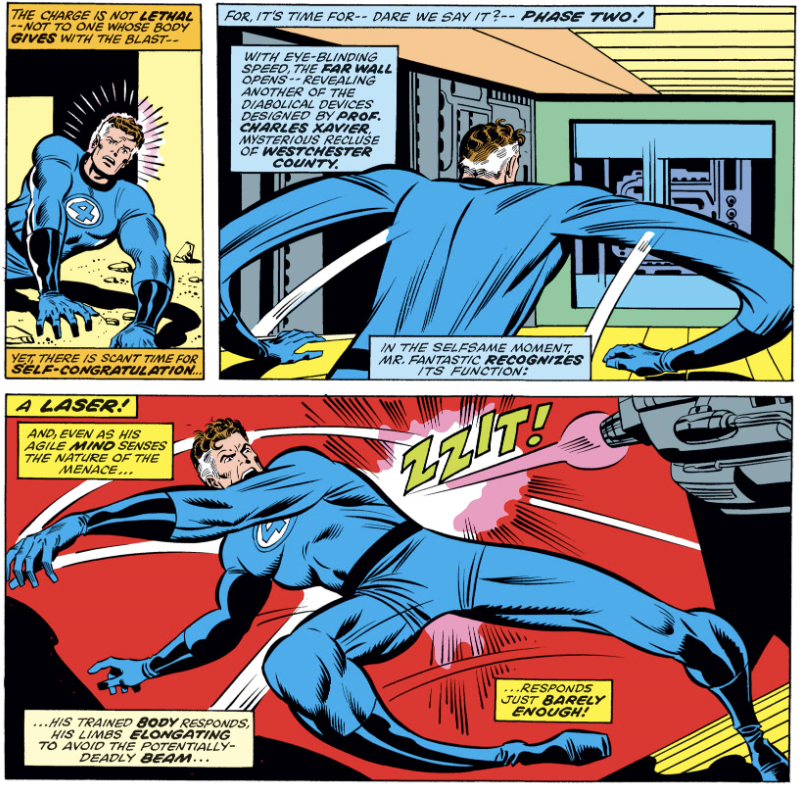
As mentioned last issue, Thomas has been pulling the FF closer to the rest of the Marvel universe. Here’s another example, where he references Professor X (and frankly, the whole opening sequence, with Mr. Fantastic testing himself in his version of the Danger Room, would have felt at home in an X-Men comic):

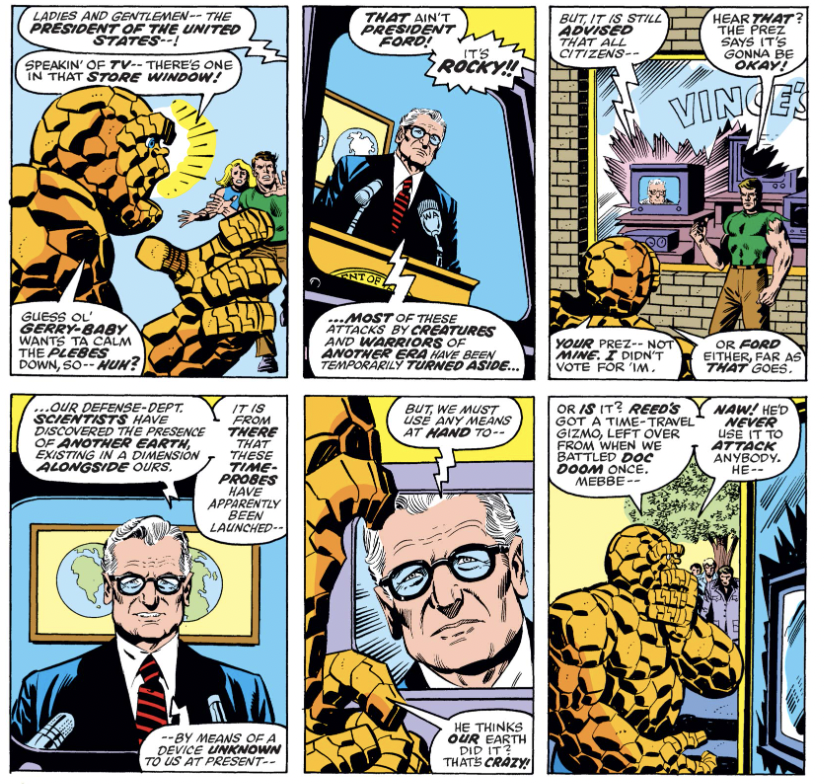
There’s some interesting political commentary too, with Nelson Rockefeller president of Earth 2 (I’m just going to call it that). Rockefeller was vice president when this comic was published in 1975, having been appointed to the position by President Gerald Ford after he assumed the presidency when Nixon resigned. Ben’s comment about not voting for Rockefeller or Ford for president of Earth 2 is a bit odd, since no one voted for them on Earth 1 either (or maybe that’s his point).

What I didn’t like

Sue is back on the team, but her role now, as in years past, mostly seems to be fretting. And Reed is again lying to her to protect her.
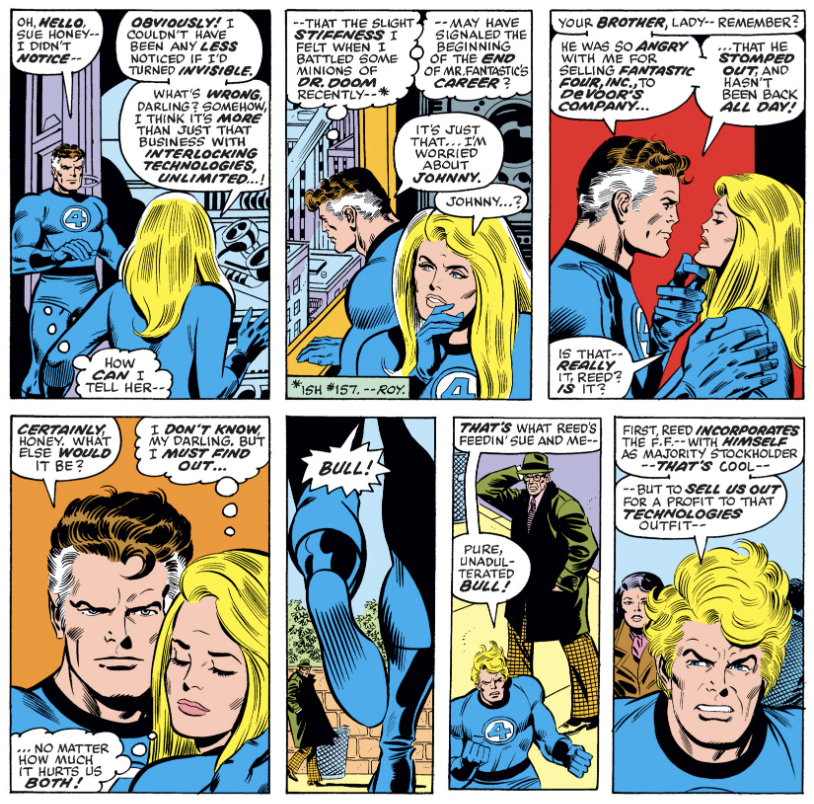

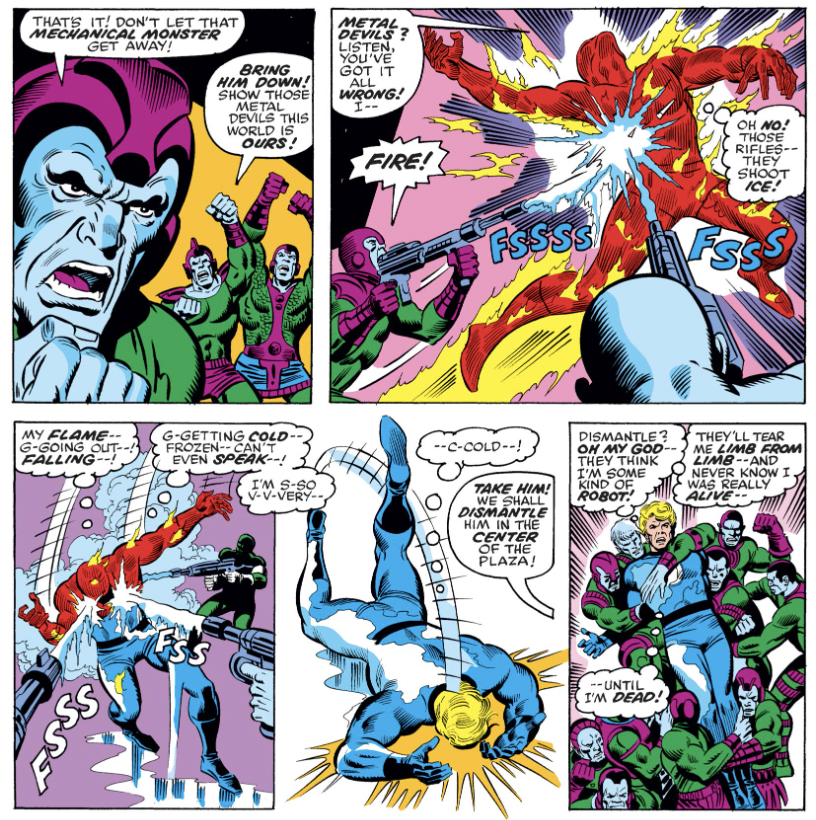
When Johnny is attacked in the Fifth Dimension, the guards there just happen to have rifles that shoot … ice. Pretty convenient.

Anything else?

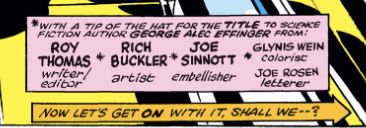
The story’s title was borrowed from a short science-fiction story by George Alec Effinger, which is credited by Thomas. I’m not familiar with Effinger’s work, but he was active and prolific from the 70s through the 90s, and wrote some stories for Marvel’s horror magazines in 1972.

Overall

More Thomasian fun
“The World’s Greatest Comic Magazine!” Fantastic Four No. 160

02 Sunday Feb 2025

Posted by percivalhenry in The World's Greatest Comic Magazine

≈ Leave a comment

Tags

1975, Fantastic Four, Fantastic Four 160, John Buscema, Marvel comics, Roy Thomas

Fantastic Four 160
“In One World and Out the Other!”
Published April 1975
Writer: Roy Thomas
Pencils: John Buscema
Inks: Chic Stone
Letters: Raymond Holloway
Colors: Janice Cohen
Editor: Thomas
Cover: Gil Kane and Al Milgrom

Synopsis

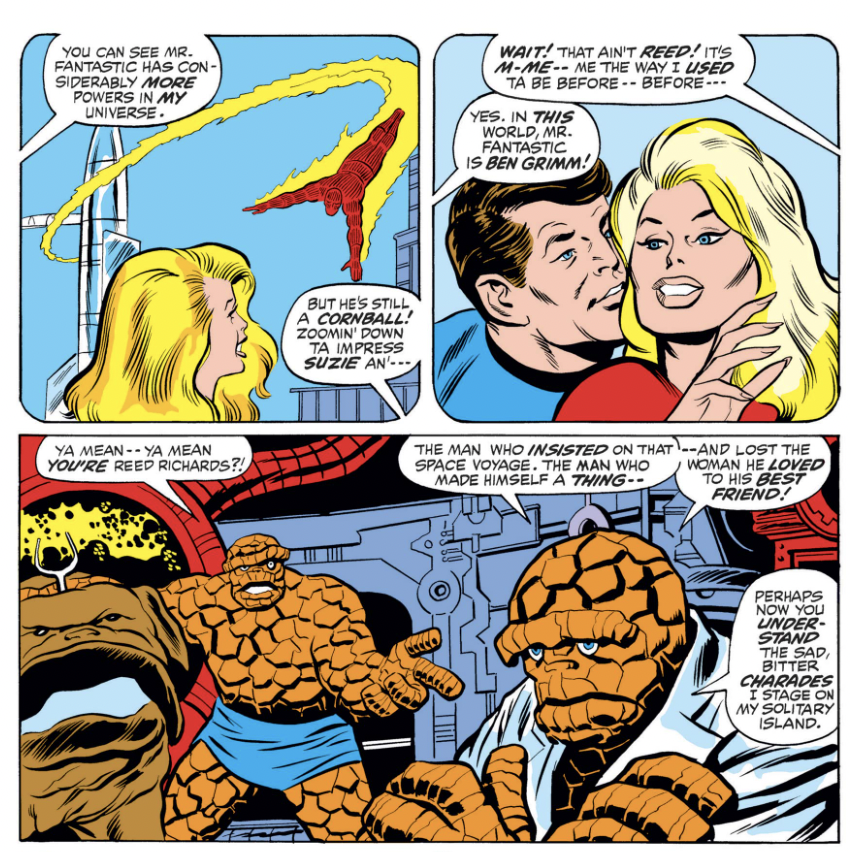
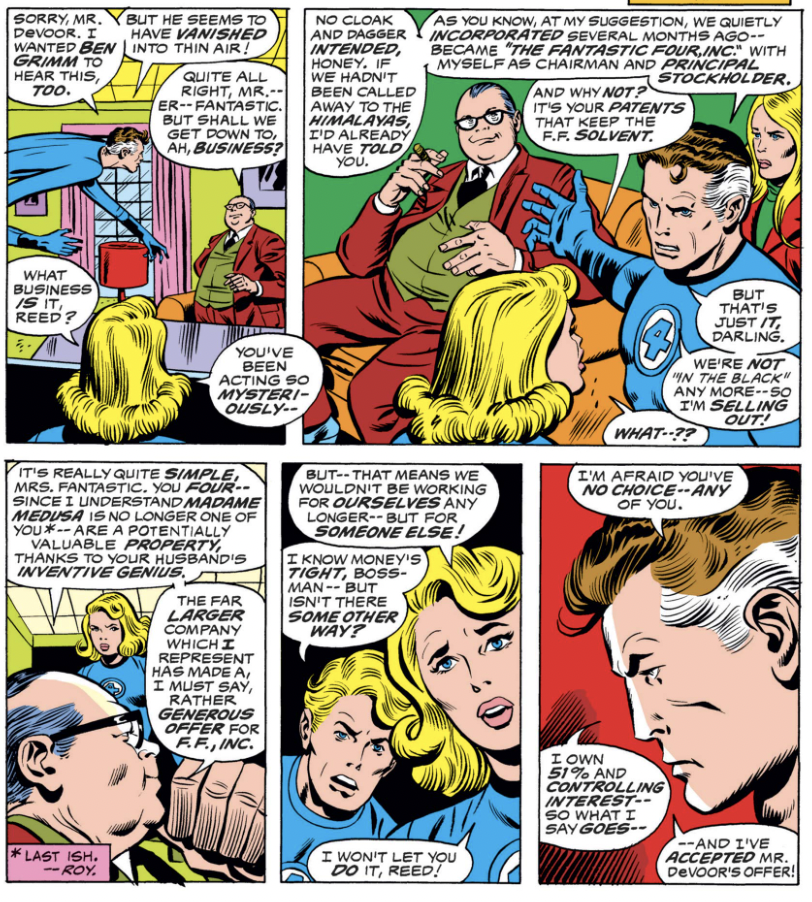
The issue opens with Arkon, a barbarian warrior from another dimension, and the Thing battling in midtown Manhattan, but Alicia Masters discovers that this Thing is not the man she knows. Back at the Baxter Building, the Ben Grimm of this Earth summons Lockjaw to teleport him to the dimension where the other Thing originated. There, after battling robot monsters and encountering a human version of himself, he discovers he is on the alternate Earth he visited in FF 118, one where Reed Richards became the Thing. Meanwhile, on our Earth, Mr. Fantastic announces plans to sell the Fantastic Four’s holding company over the objections of his teammates, a move that is somehow connected to the alternate Earth.


What’s going on here?

This issue is jam packed, and there’s a lot to discuss. The bottom line, however, is that it’s a really good comic — fun, interesting and suspenseful, the way Fantastic Four comics should be. It’s also irrefutably a Roy Thomas creation, and bears lots of his signatures: an intricate plot, dimension hopping, call-backs to older comics and his insufferable narration. For me, the ultimate validation of this comic is that I was eager to read the next one.

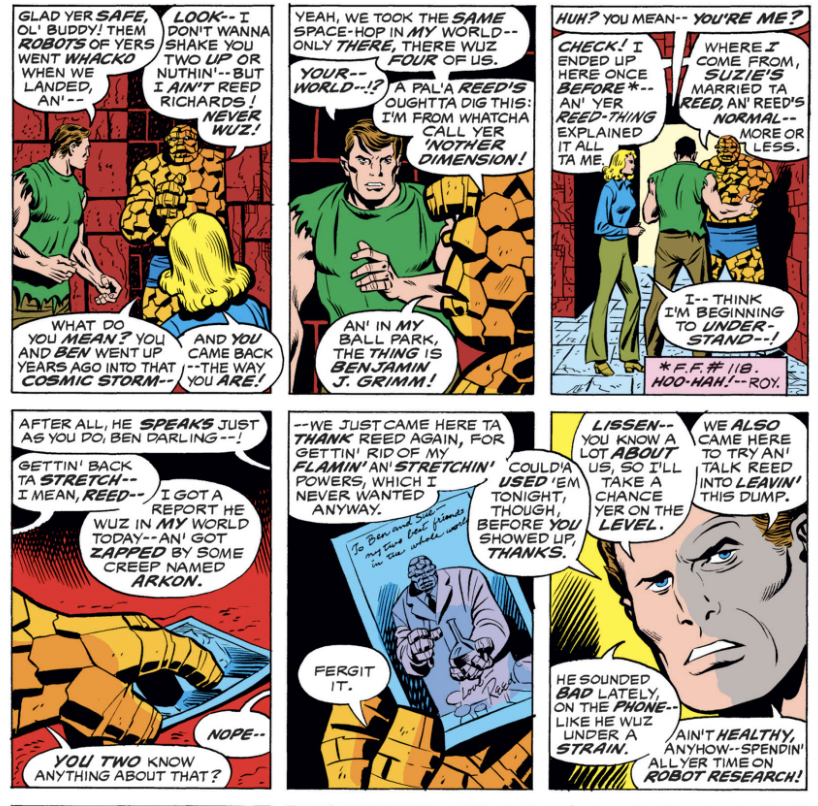
The length of my synopsis above signals the story’s complexity. While a Gerry Conway plot could be summarized in a sentence or two, Thomas’s takes four. The story begin abruptly, and confusingly, with the Thing (so far as we know) battling Arkon, an Avengers villain created by Thomas, and another indication of how Thomas is drawing the FF closer to the rest of the Marvel universe. In another call-back, he then takes Ben to an alternate universe created during Archie Goodwin’s brief run running the comic in one of the most imaginative (and shortest) FF stories, one in which only Ben and Reed took the ill-fated rocket trip, and where Reed becomes the Thing.


All of it is complicated by Reed’s surprising decision to sell the FF’s holding company. The move takes the comic into the world of business and finance, a category of subplot which rarely works out but here seems to hold together. Also, Reed giving himself controlling interest seems on brand for his depictions from this era.

Also of note is the return of John Buscema, here inked by Chic Stone, as artist. It’s only a one-issue fill in, and since Buscema’s work here looks rushed, I’m guessing it was a last-minute thing. Another new credit: Raymond Holloway as letterer, his first and last time lettering the FF, although he worked at Marvel for two decades. As far as I am aware, Holloway is the first Black creator to have a Fantastic Four credit, and you can read a bit more about him here.

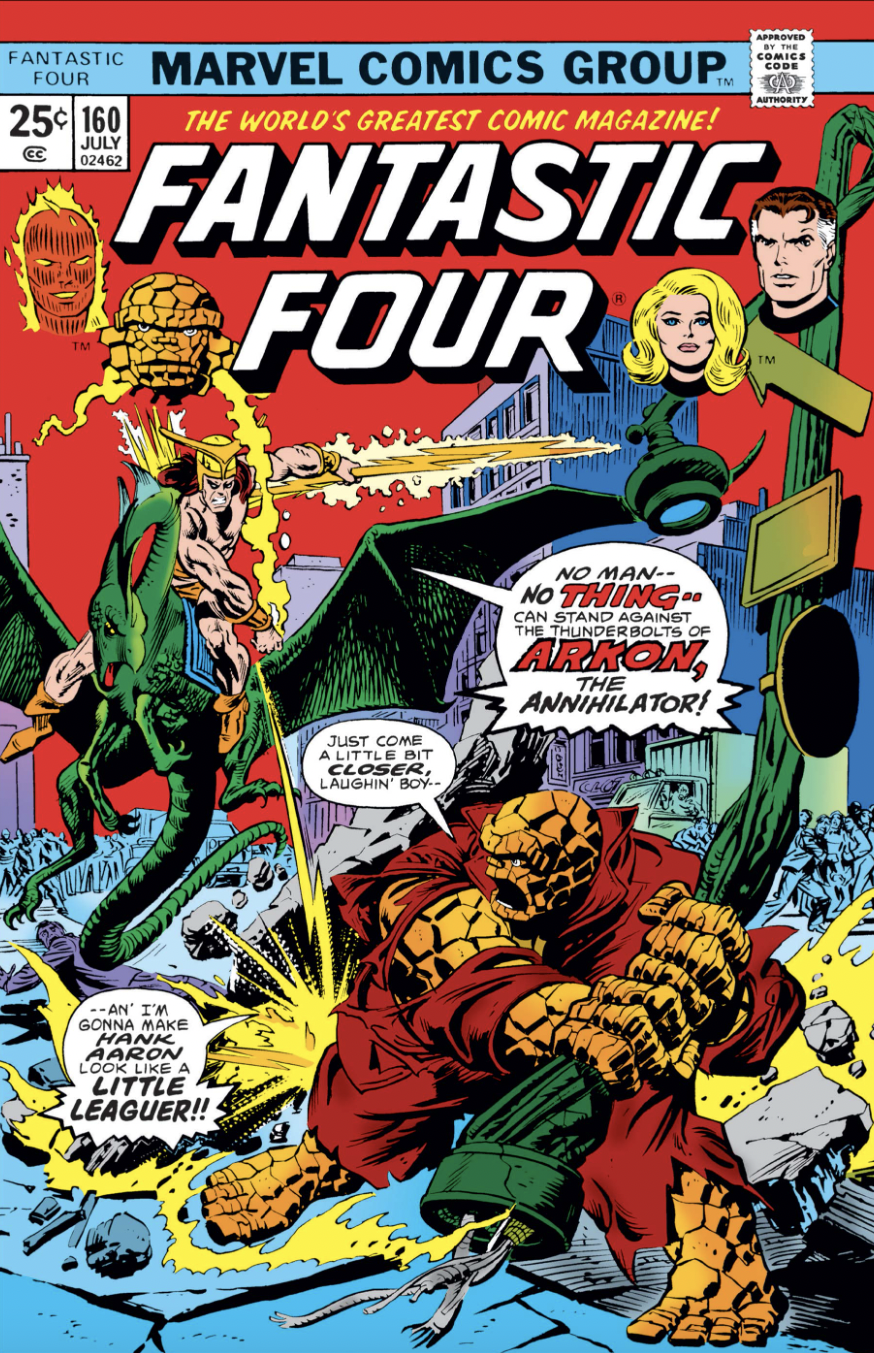
Lastly, the cover is by Gil Kane and Al Milgrom. The Hank Aaron reference is an interesting one; by the spring of 1975 Aaron had passed Babe Ruth as baseball’s all-time hime run hitter, and was a big enough star that he could be mentioned on the cover of comic book. While some racist fans mourned the dethroning of the Babe, Ben Grimm clearly wasn’t one of them (and it’s maybe worth noting the Thing on this cover is definitely Ben, not Reed, a bit of misdirection).


What I liked

Thomas has a lot of fun writing Ben, and he imbues him with an intelligence that some other writers ignore in favor of his wise cracking or woe-is-me pathos. This is the version of Ben that is on display in Marvel Two-in-One, the comic he starred in with a guest for 100 issues.
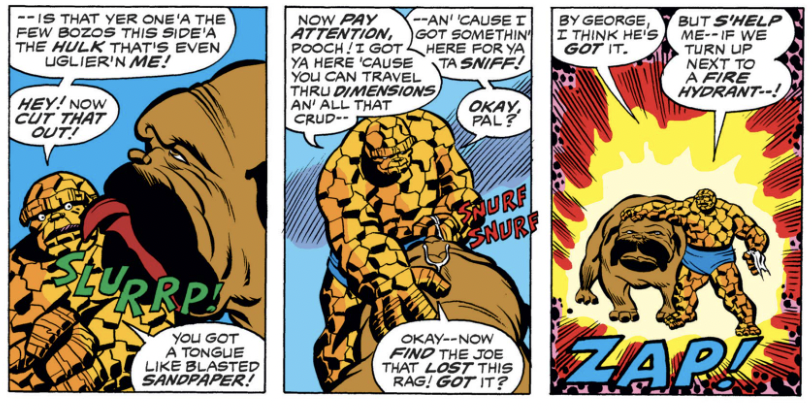
Here, Ben goofs around with Lockjaw:


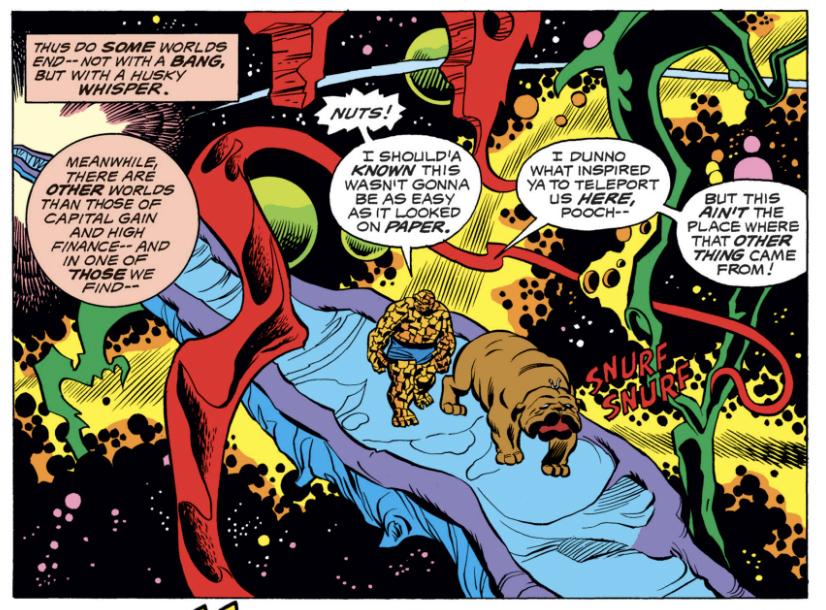
For some reason, Lockjaw first teleports them to a Ditko-esque dimension, which looks cool but has little to do the story:


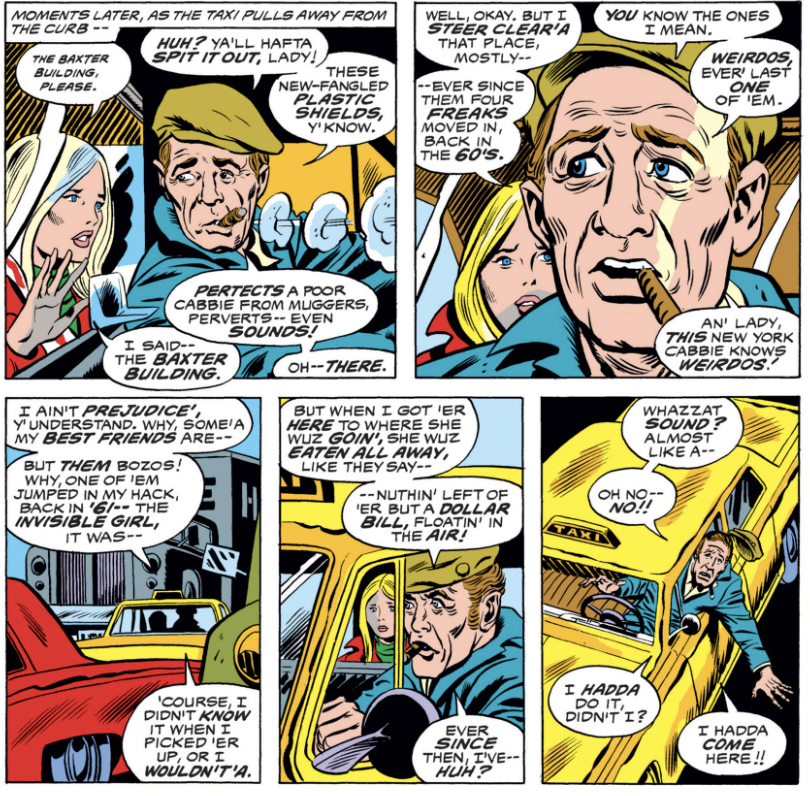
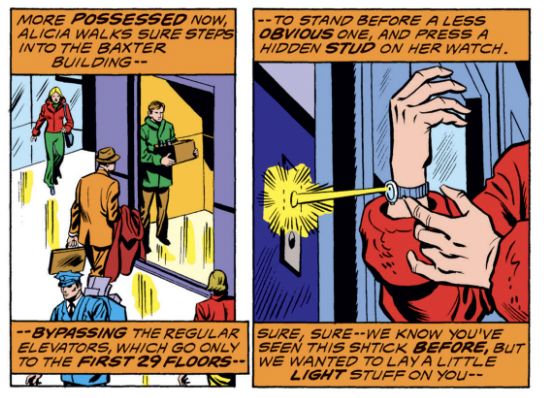
Another fun Thomasian flourish was Alicia’s interaction with a cabbie who is spooked to go near the Baxter Building:

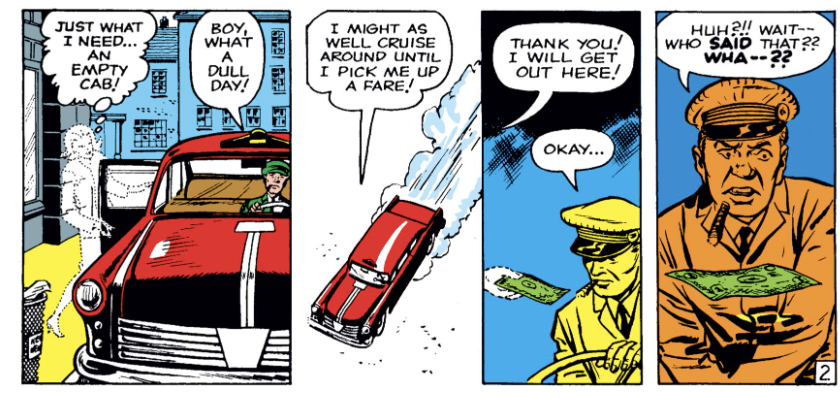
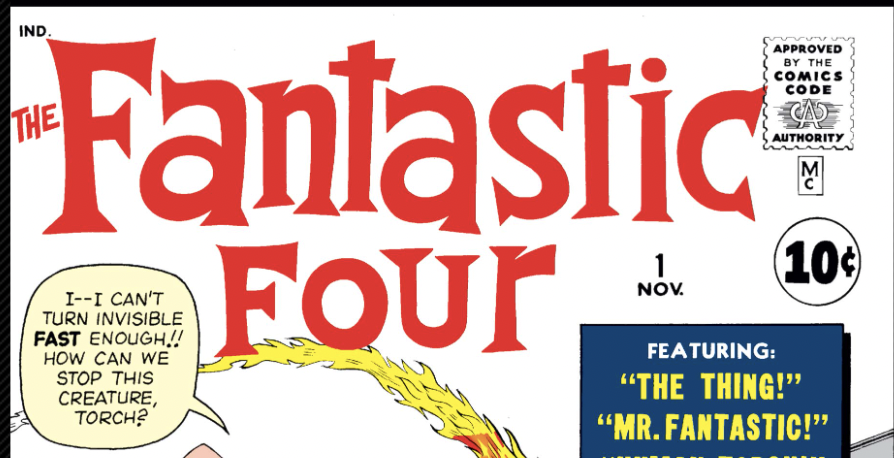
The cabbie, of course, is referring to this sequence all the way back in Fantastic Four 1, and the introduction of the Invisible Girl (he dressed a little better in 1961):


What I didn’t like

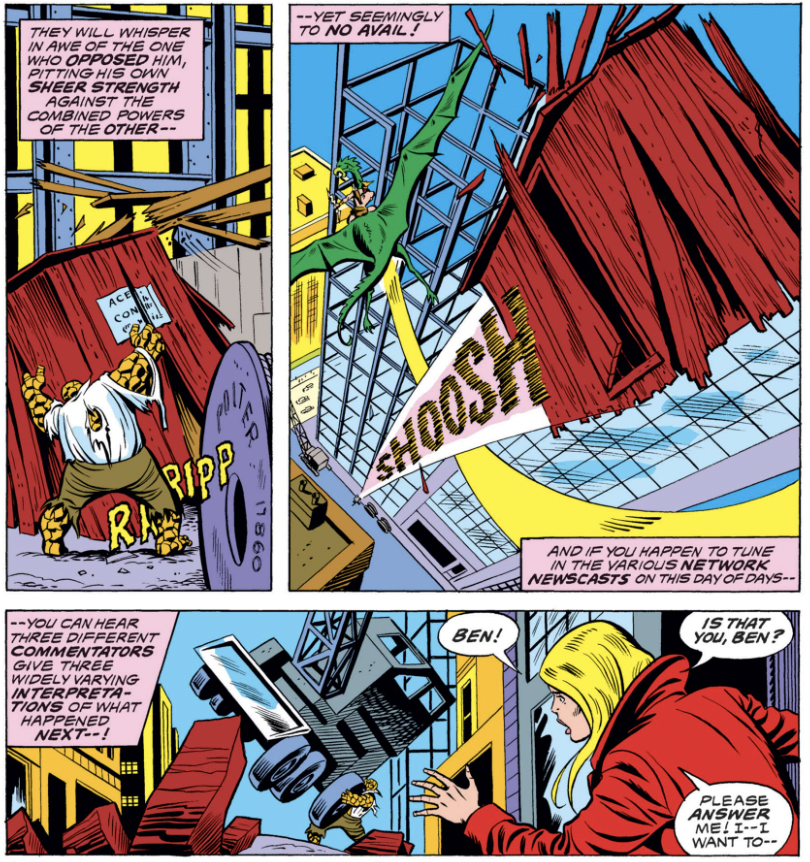
As always, Thomas is in love with the sound of his own voice (figuratively speaking) and his self-referential narration can get very annoying. Here, for whatever reason, he seems to be making some commentary about the evening TV news:


And here, more unnecessary patter:


Thomas’s intricate, science fiction plots require a lot of explanation, which often means lots of expository dialogue. In some cases, it just about crowds out the art, as in these panels:


Anything else?


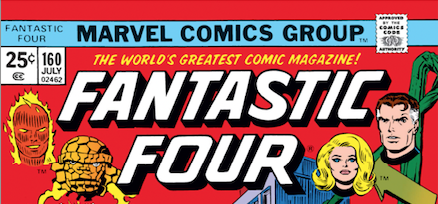
In perhaps another sign that Thomas wanted a break from the Conway era, this issue debuts a new Fantastic Four cover logo, just the third in the book’s history.

The first, of course, is the classic 60s logo, designed by Sal Brodsky:


According to longtime comic scholar Mark Evanier, via Todd Klein’s blog, it was inspired by the 1959 Twilight Zone TV show logo and which captured the spirit Stan Lee wanted in the comic.


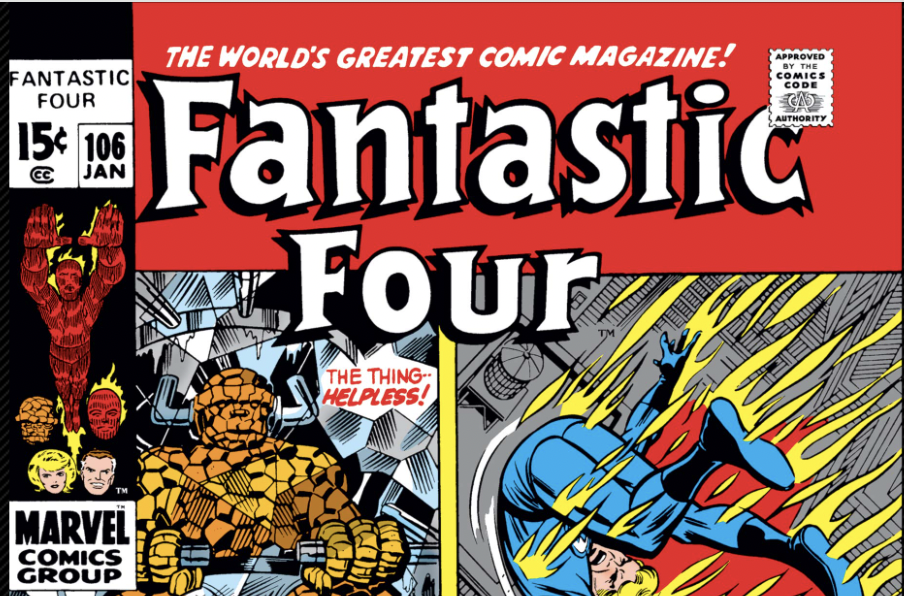
That FF logo was modified slightly, in part to accommodate the iconic Marvel corner box, which first appeared on the cover of FF 14. By the early 70s, it’s blockier and with shadow, and the letters don’t have the same zany flair, but it’s still recognizably the same.


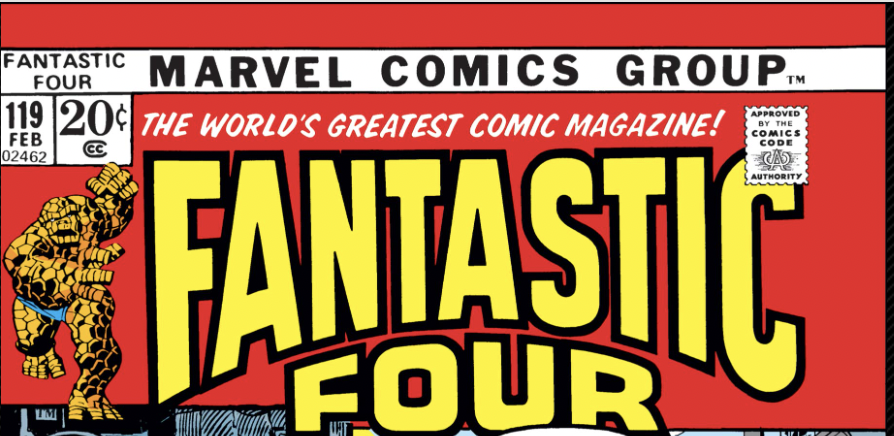
But that logo was dropped altogether in issue 119, in favor of a blockier logo that perhaps was a better fit for the new cover style which fit the art into a box (and which, for the record, I hated).


The new logo, which will last until issue 218, when it will revert back to the 60s logo, is an improvement over the previous one and has a zingy, sci-fi quality to it. It’s biggest departure, however, is dropping the corer box in far of four portraits of the FF (and maybe Marvel waited for Medusa to leave the team so it could include the original four on the logo).


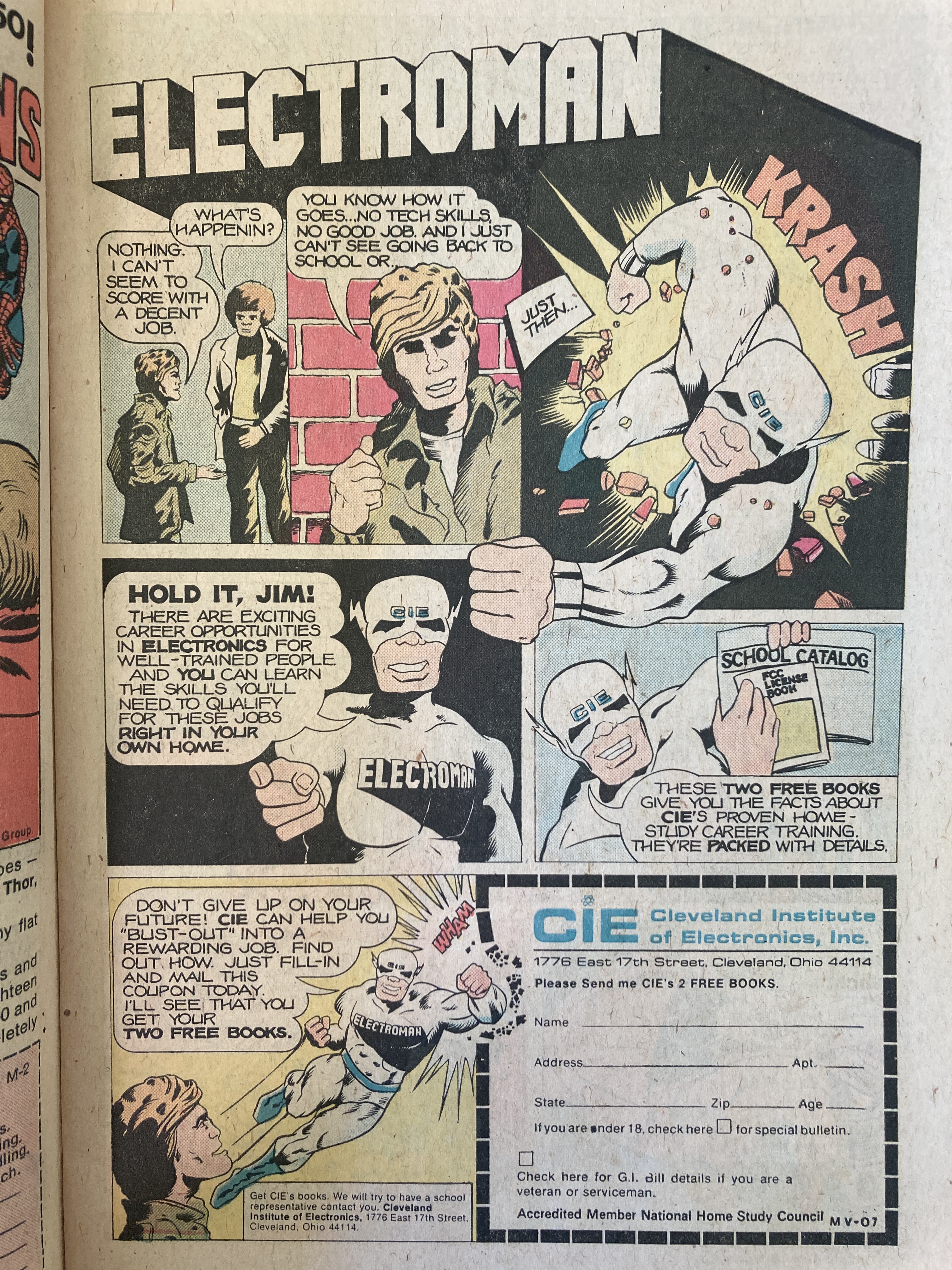
Also, some fun ads in this comic.
Electroman wants to get you a job! (I wonder if any artist will admit to drawing this)


And is there anything more ’70s than custom van-interior upholstering?


Overall

Comics like they should be!

“The World’s Greatest Comic Magazine!” Fantastic Four No. 159

26 Sunday Jan 2025

Posted by percivalhenry in The World's Greatest Comic Magazine

≈ Leave a comment

Tags

1975, Fantastic Four, Fantastic Four 159, Inhumans, Marvel comics, Roy Thomas

Fantastic Four 159
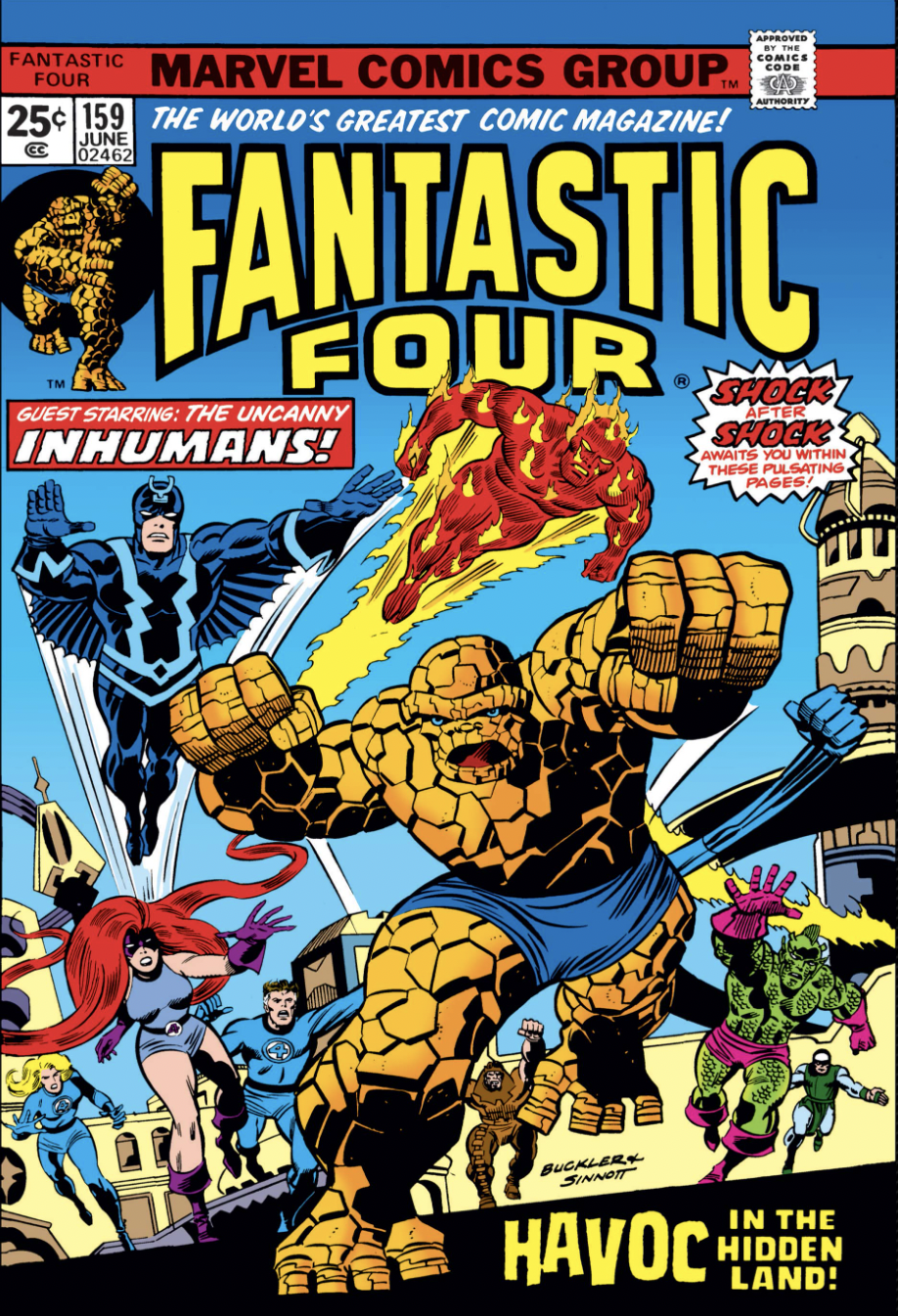
“Havoc in the Hidden Land!”
Published March 1975
Writer: Roy Thomas
Pencils: Rich Buckler
Inks: Joe Sinnott
Letters: Joseph Rosen
Colors: Janice Cohen
Editor: Thomas
Cover: Buckler and Sinnott

Synopsis

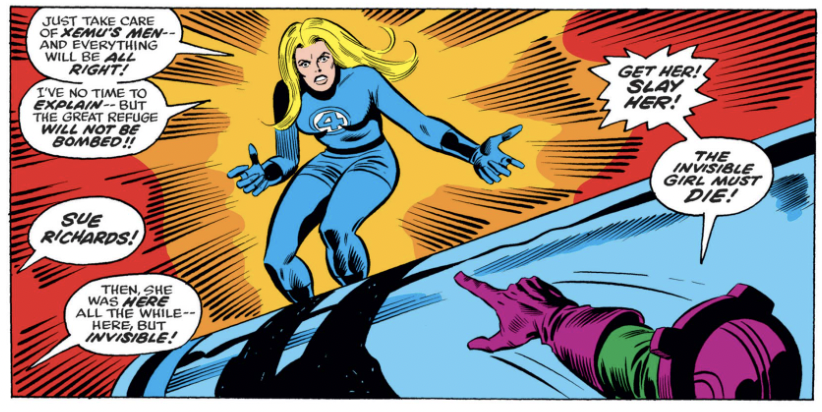
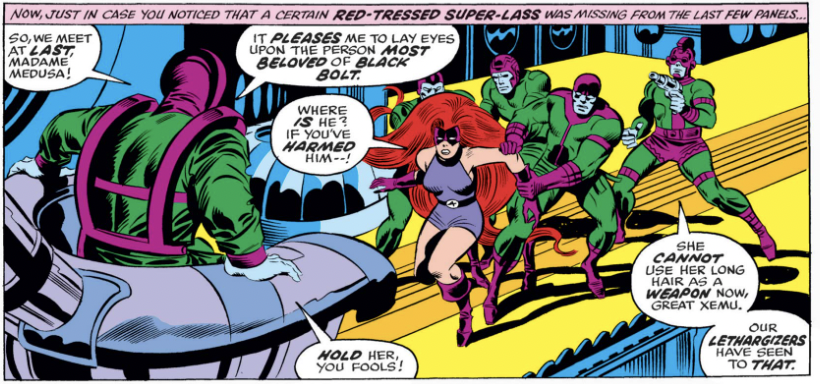
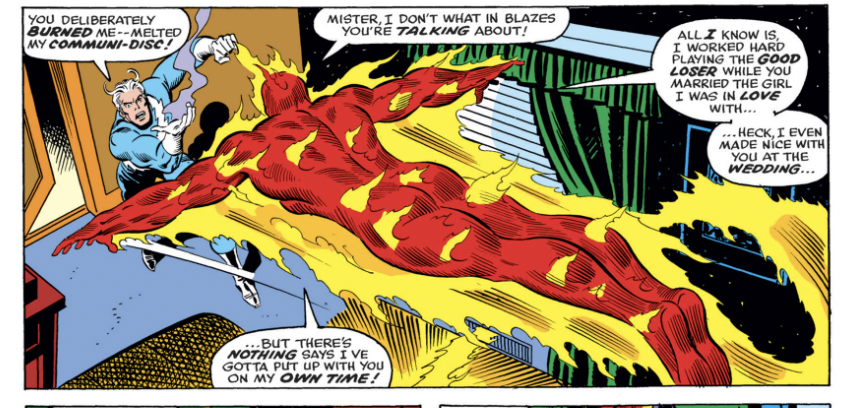
With Quicksilver, the Fantastic Four — minus the Invisible Girl, who was forbidden to come — travel to the Hidden Land in the Himalayas to rescue the Inhumans, where they are immediately captured by Xemu, the tyrant from the Fifth Dimension. In captivity, Johnny is reunited with Valeria, a princess from the Fifth Dimension he last encountered years ago. To force Black Bolt to power his sonic cannon, Xemu both threatens Medusa and tries to provoke an air strike by China. His plan is foiled by the Invisible Girl, who stowed aboard and used her powers to disguise the Hidden Land from the Chinese air force. The rest of the team and the Inhumans, freed by Triton, subdue Xemu and return him to the Fifth Dimension.


What’s going on here?

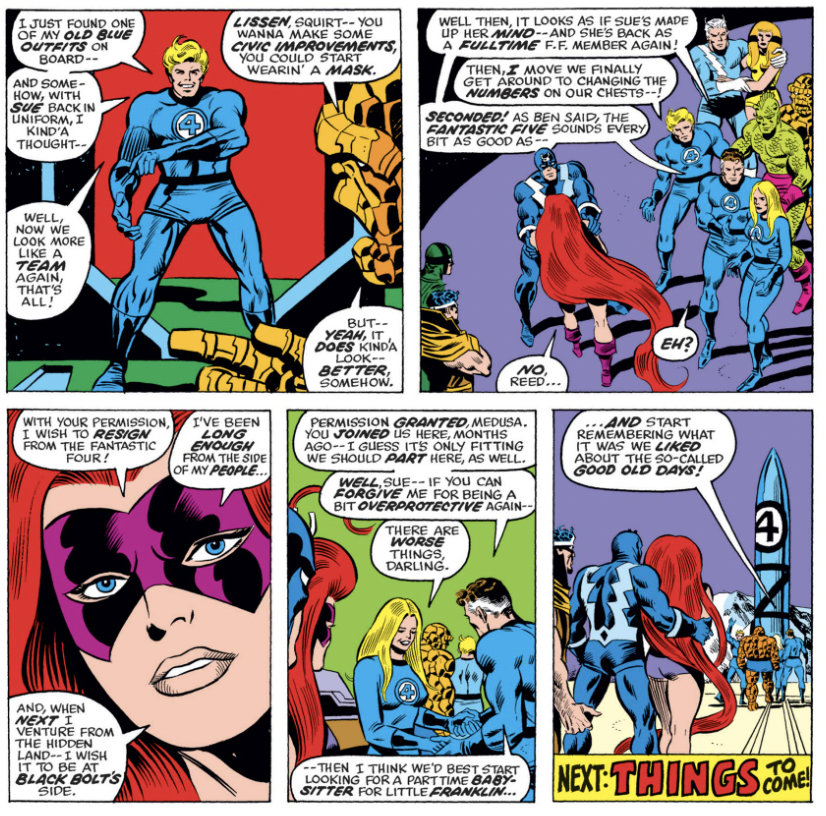
With this issue, Roy Thomas really puts his stamp on the Fantastic Four, undoing a slew of changes that had been introduced over Gerry Conway’s tenure as writer. Most notable is the return of the Invisible Girl as a member of the team. But Thomas also gives Johnny back his old blue uniform and dismisses Medusa from the team — both on the same page — reversing two changes to the FF that added little and distracted from their unified, familial nature that makes the team unique.

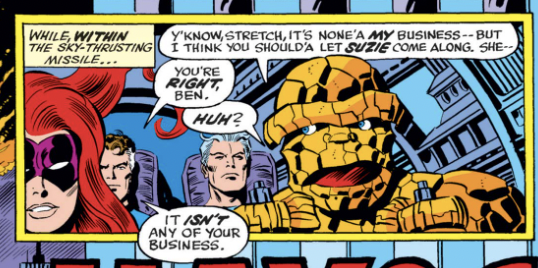
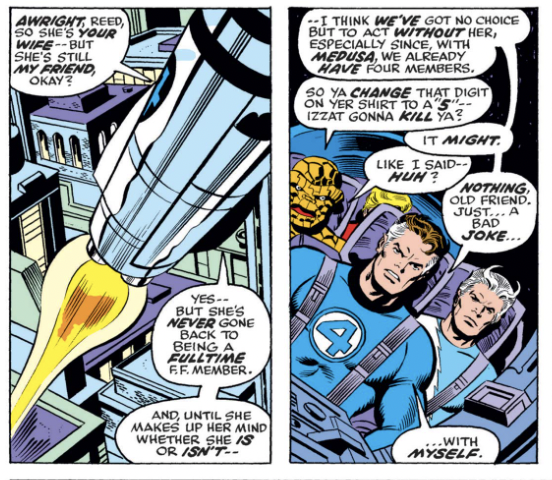
Readers of this blog know I have been very critical of the treatment of Medusa, who never found her place on the team, and especially of Sue, who spent the last two-plus years shunted aside, figuratively and sometimes literally. Sue’s diminished status is nothing new, of course, and was a fixture of the Lee / Kirby era. Her treatment surely reflected the sexism of the time, but her more recent exclusion from the team was perhaps also the result of an inability by Conway (who, remember, was in his early 20s) to imagine a role for a young mother on a superhero team. In the comics, her exclusion was justified by Reed being over-protective, and in some revealing dialogue early in FF 159, Ben makes the case she should join them, perhaps another case of Thomas using the characters to argue with other FF writers.


At this point in the comics I was resigned to yet another issue without Sue, and was genuinely surprised when she not only appeared, but saved the day with new and expanded powers. Thomas, it seems, was as frustrated with Sue’s marginalization as this fan.


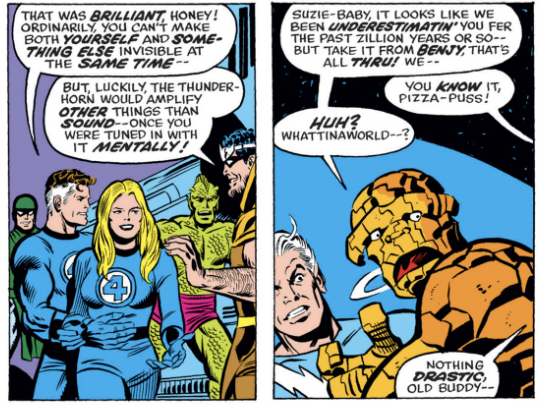
And like a Gilbert & Sullivan operetta, all is wrapped up and forgiven in the last few panels.


What I liked

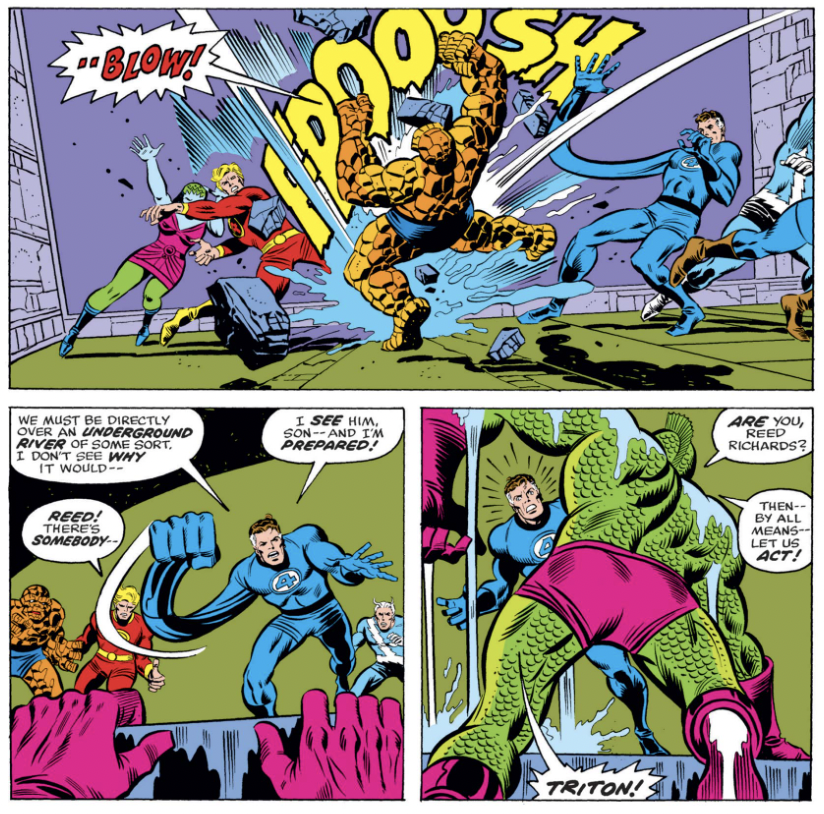
I loved Sue’s dramatic re-emergence, but Thomas also managed to surprise me with the sequence where the FF are imprisoned. This is a pretty familiar situation, and they usually use some aspect of their powers to escape, but here they are rescued by Triton, whose absence was explained last issue. This was another twist I didn’t see coming.


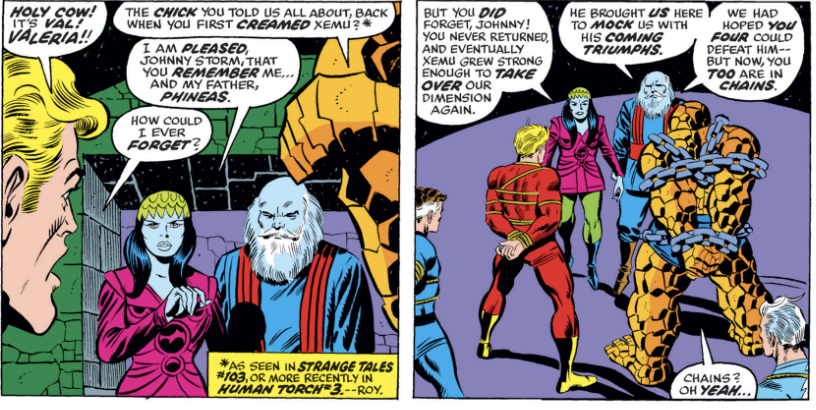
Thomas leans into soap opera by reintroducing Valeria, the alien princess Johnny had a dalliance with years ago and — as is his wont — jilted. I like how she reminded him that he ghosted her.


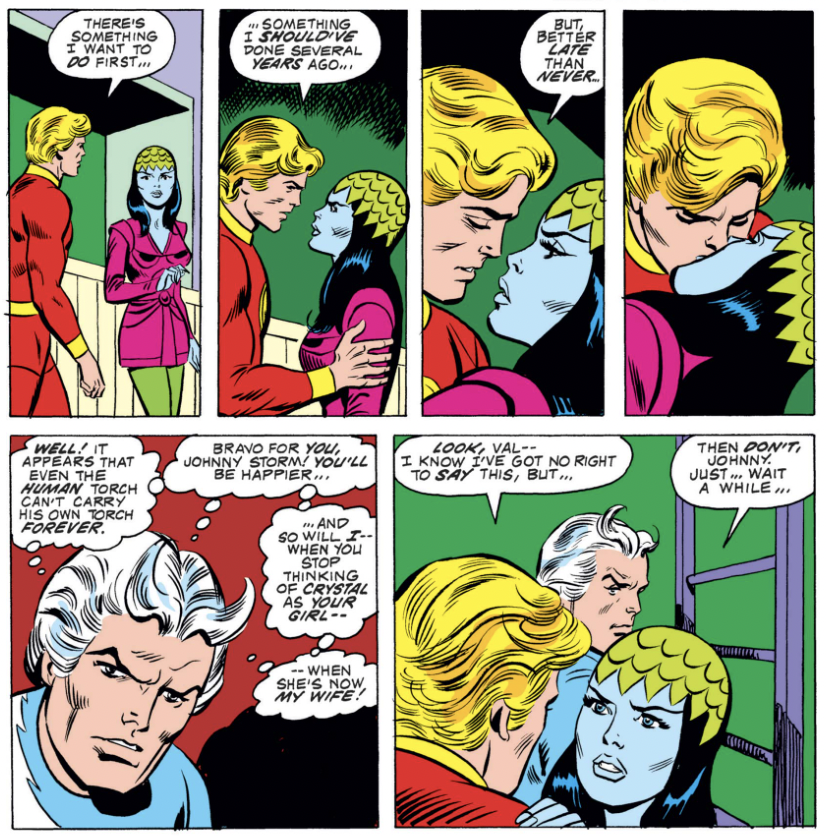
I’m not sure Valeria is the right woman for Johnny and history will prove she is not, but I like that Thomas is trying to make a clean break with Crystal and that mopey storyline.


What I didn’t like

Despite the many positive aspects of this comic, it’s plot was pretty lackluster and by-the-numbers. The FF are captured by an evil-doer, it all looks hopeless, they escape and save the day. This story was at times incoherent, in part because of Xemu’s dimension-hopping, but it was mostly forgettable.

Rich Buckler’s art looks rushed and unimaginative in this issue, which doesn’t help matters.

Also, what is a “lethargizer?”


About that name

“Valeria” is a familiar name to Fantastic Four fans, and the character in FF 159 is one of three to share it. She’s also the first, since her first appearance in 1962’s Strange Tales 103 predates the appearance of Victor Von Doom’s first true love, a Latverian woman named Valeria, who is first mentioned in 1969’s Marvel Super-Heroes 20. It is that Valeria who is the namesake of Valeria Richards, the daughter of Reed and Sue who was delivered by Doom and who claimed the right to name her.

Marvel Super-Heroes 20 was written by Larry Leiber (Stan’s brother) and I don’t know whether he was aware of the previous Valeria, who seemed like a throwaway character until she was resuscitated by Thomas. It is possible both characters were named after Valerie Barclay, a comic book inker who worked at Marvel (then Timely) in the 1950 who was described by artist Allen Bellman as “an exquisitely beautiful young lady.”


Overall

A very welcome return makes up for a dull story.

“The World’s Greatest Comic Magazine!” Fantastic Four No. 158

19 Sunday Jan 2025

Posted by percivalhenry in The World's Greatest Comic Magazine

≈ 2 Comments

Tags

Fantastic Four, Fantastic Four 158, Inhumans, Marvel comics, Rich Buckler, Roy Thomas

Fantastic Four 158
“Invasion From the 5th (count it, 5th!) Dimension!”
Published Feb. 1975
Writer: Roy Thomas
Pencils: Rich Buckler
Inks: Joe Sinnott
Letters: Joe Rosen
Colors: Janice Cohen
Editor: Thomas
Cover: Buckler and Al Milgrom

Synopsis

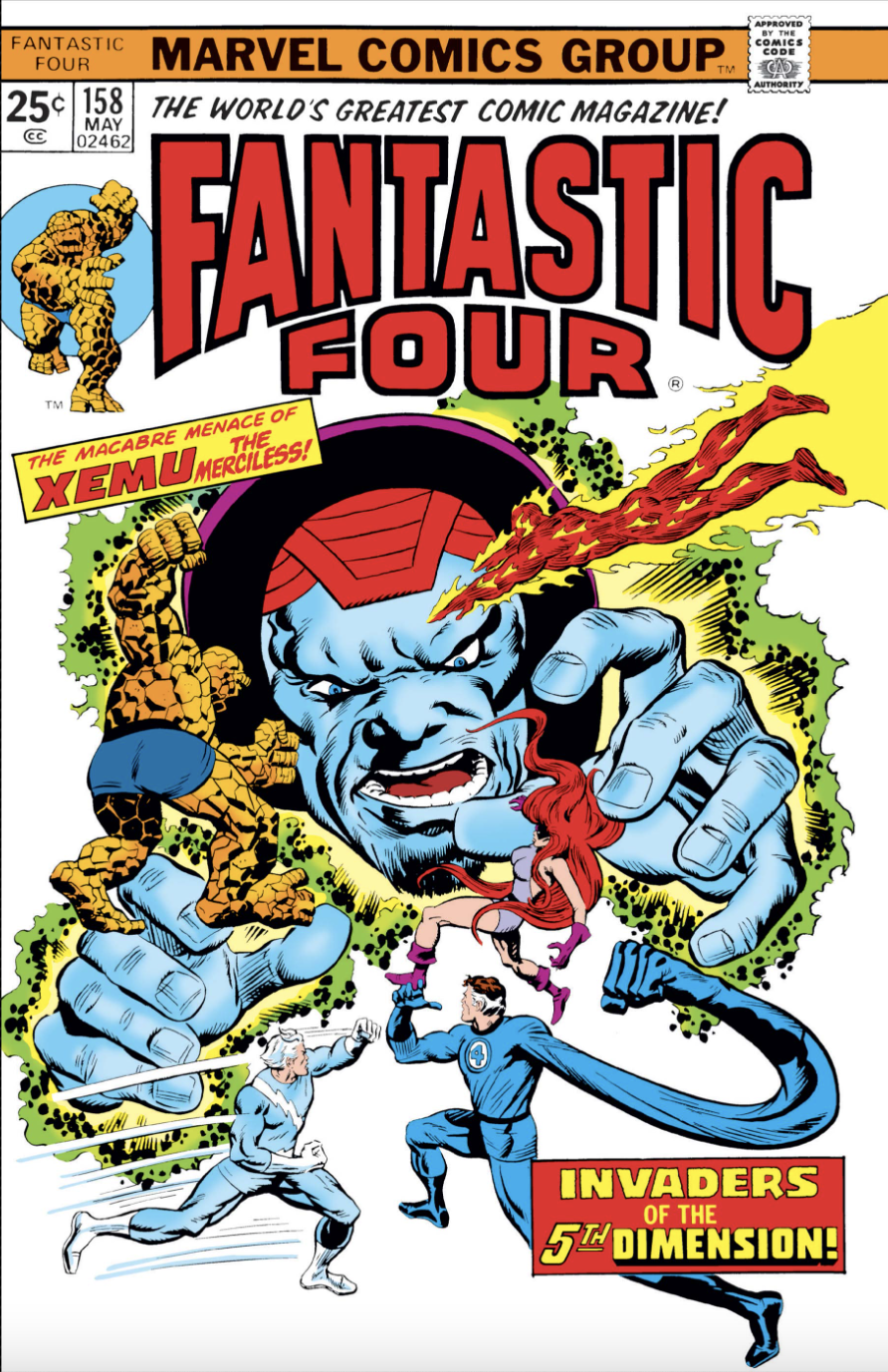
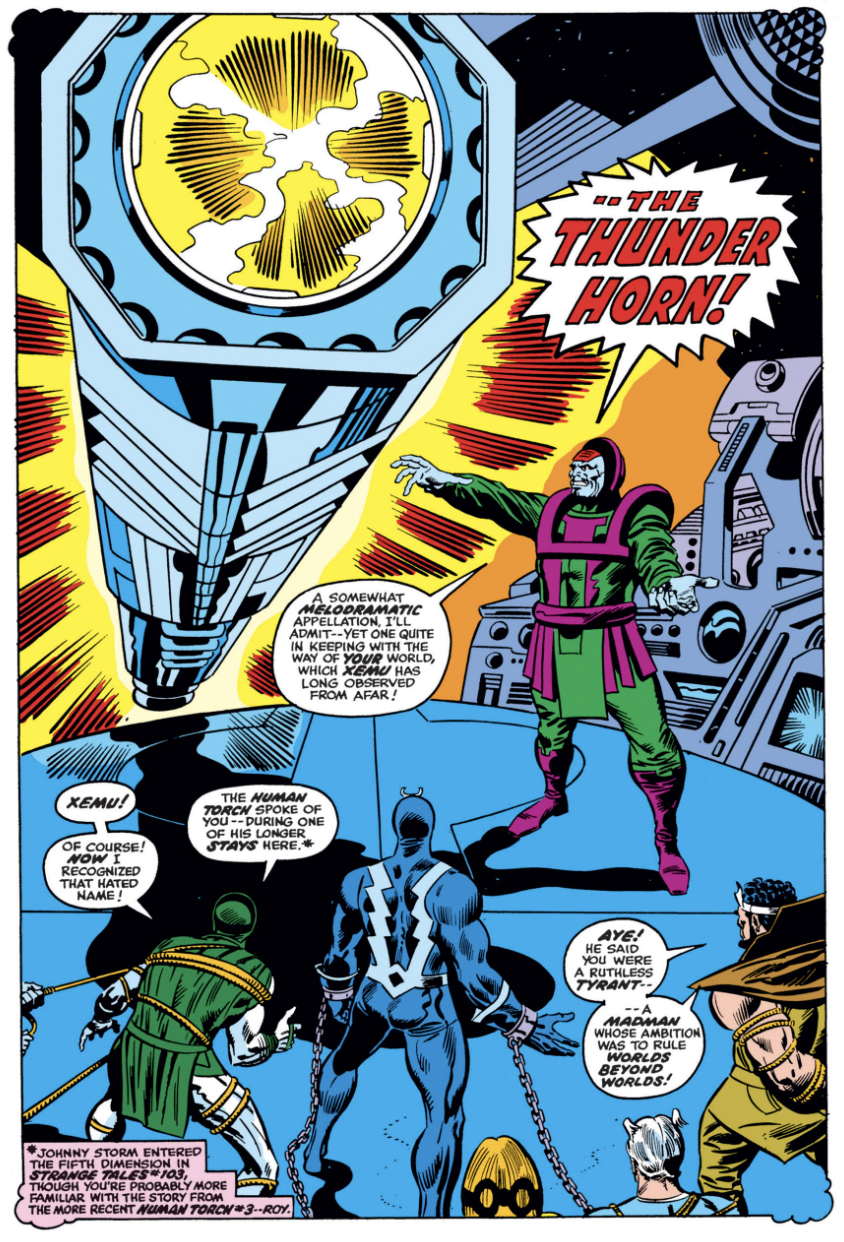
Quicksilver is teleported from Atillan, home of the Inhumans, to New York to summon Medusa home. After a brief scuffle with the Human Torch, he explains Atillan has been invaded by Xemu, a tyrant from the Fifth Dimension, and plans to use Black Bolt’s voice to power his Thunder Horn, thereby conquering Earth (Medusa is required to coerce Black But to use his powers thusly). The issue ends with the Fantastic Four vowing to end this menace and taking off in their ICBM for Atillan.


What’s going here

There’s a lot to like in this issue, one of the best in many years. It also has an interesting origin, which may or may not explain why it’s better than other recent issues: According to an answer to a letter in this issue, this story was originally created for Giant-Size Fantastic Four 5, but penciler Rich Buckler ran afoul of “personal problems” and was unable to complete the story slated for FF 158. As a result, they chopped this story in two, with the second half to run in FF 159 while Giant-Size FF 5 became a fill-in issue. Whew!

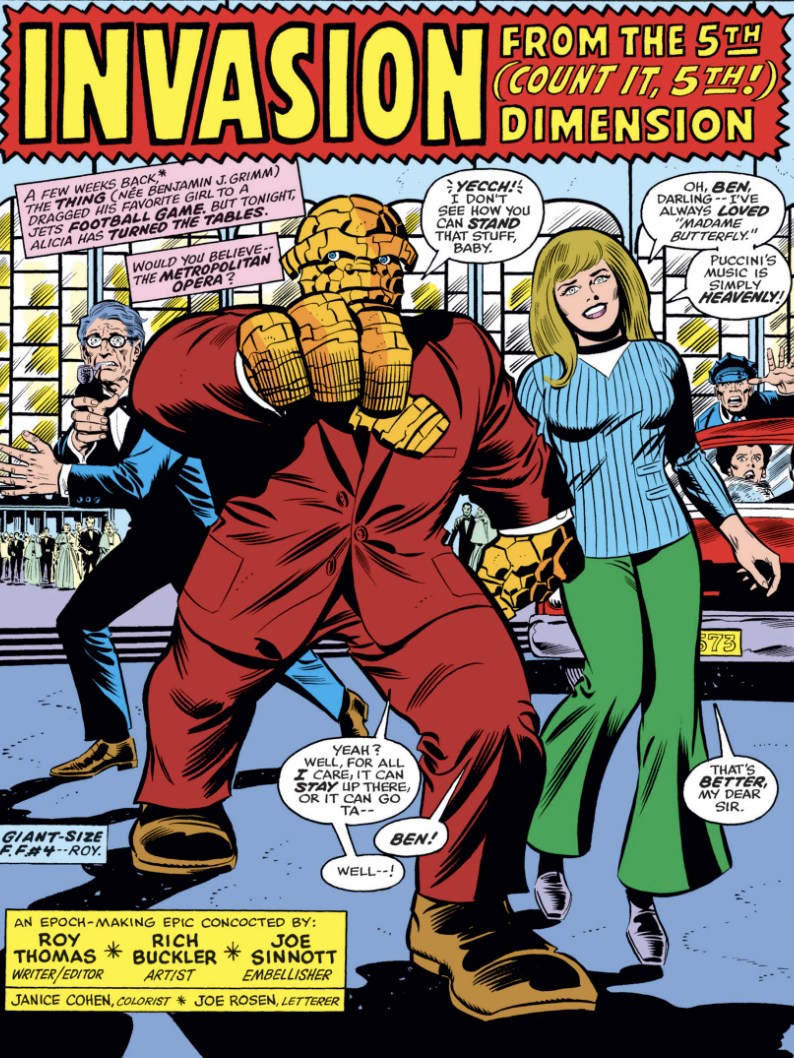
Fantastic Four FF 158 reads like Roy Thomas at the peak of his powers. The story has lots of fun touches and bits of characterization, there’s an obligatory call back to an obscure comic, and he gets to show off his erudition as Ben and Alicia discuss Puccini’s Madama Butterfly. More importantly, while the plot structure is a pretty familiar one to FF readers, it’s suspenseful, well-paced and moves along briskly.
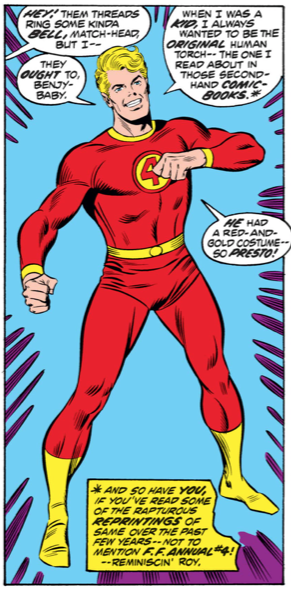
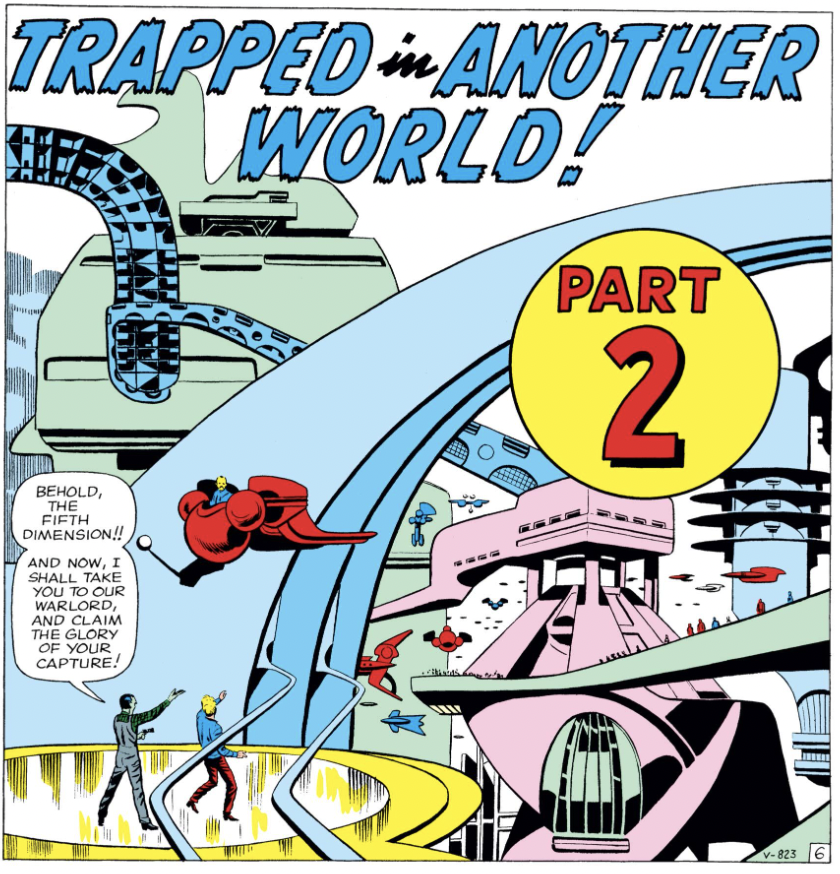
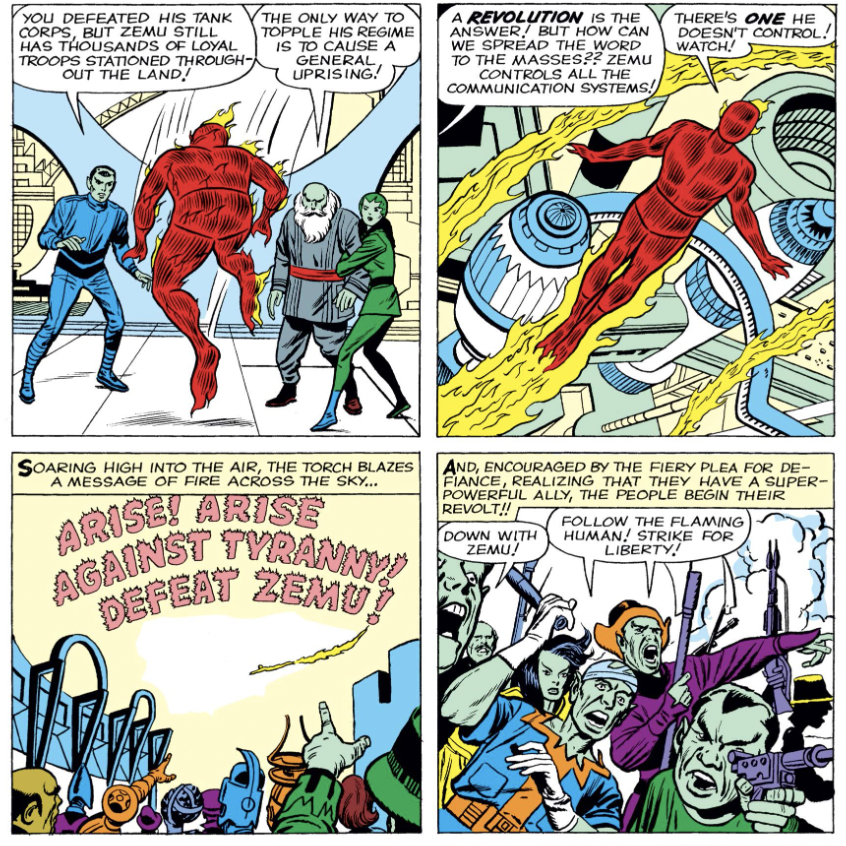
As Thomas notes in an editor’s note, Xemu and his Fifth Dimension first appeared in Strange Tales 103 from 1962 (although he was called Zemu back then), and you couldn’t not imagine a more Silver-age-ish comic than this. It has wonderful pencils from Jack Kirby, and is inked by Dick Ayers


Teenage Johnny investigates houses sinking into the muck on Long Island, discovers it’s an alien plot, is abducted to the Fifth Dimension, is taken prisoner, escapes with the help of sympathetic locals, starts a war, leads an uprising that liberate the planet, and returns home — all in 14 pages!

It’s clear Thomas has a lot of affection for this era of storytelling and he returns to it over and over throughout his career.


What I liked

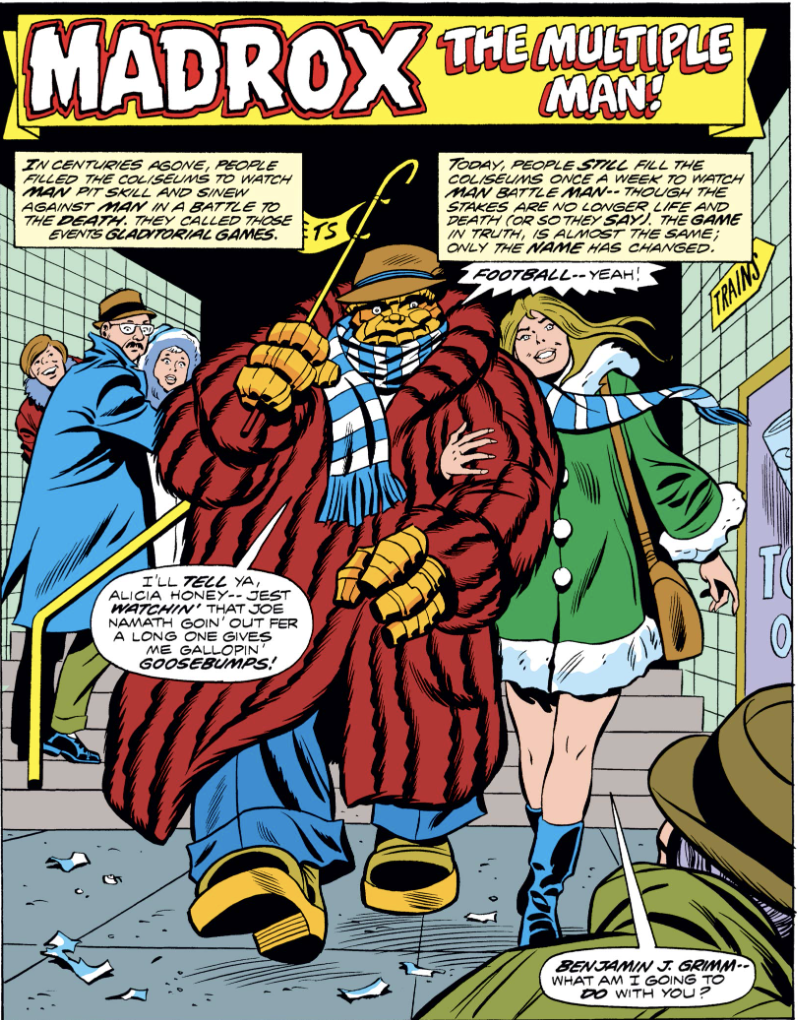
The opening sequence, when Ben and Alicia are leaving the opera, was well handled, with the right amount of humor and genuine affection between the two. I liked how the splash page was a riff on the splash page from Giant-Size FF 4 (and recall how this story was originally supposed to be in GSFF 5), with Alicia turning the tables on ben and taking him to the opera. I also liked how Thomas poked fun at the silliness of the Fifth Dimension conceit in the title.
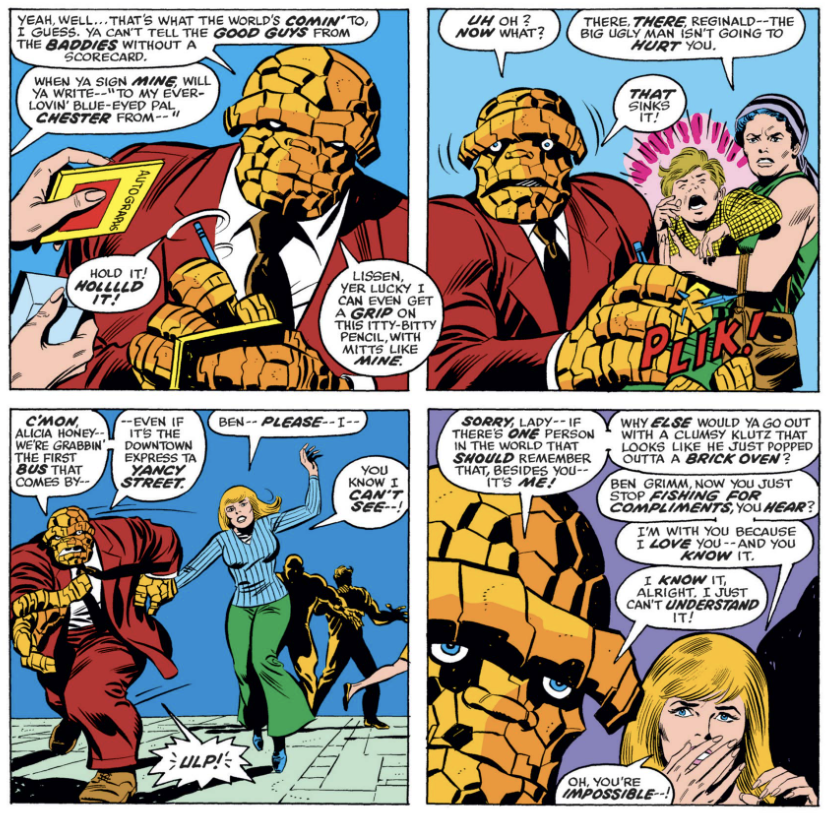
The fun banter between Ben and Alicia continues, and when Ben falls into his familiar woe-is-me routine, Alicia harmlessly bats it aside, recognizing it’s Ben’s schtick.

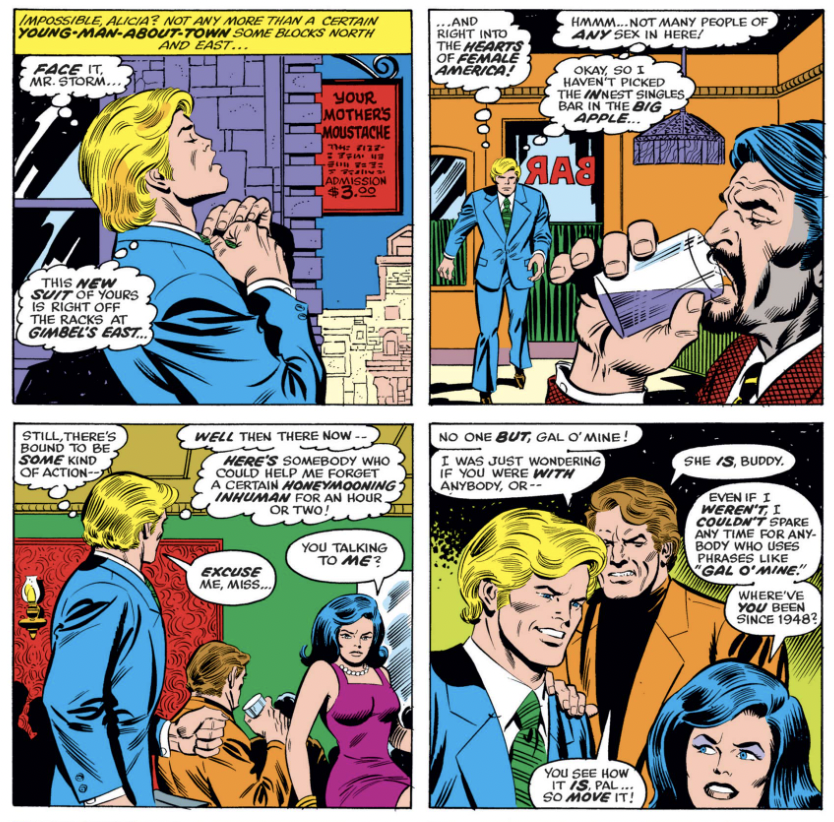
Thomas checks in on the rest of the FF as well. Johnny heads to a single bar, looking to, well, get laid. I love how the woman mocks his lingo, another subtle dig by Thomas at how dated Johnny’s slang was when written by Stan Lee.


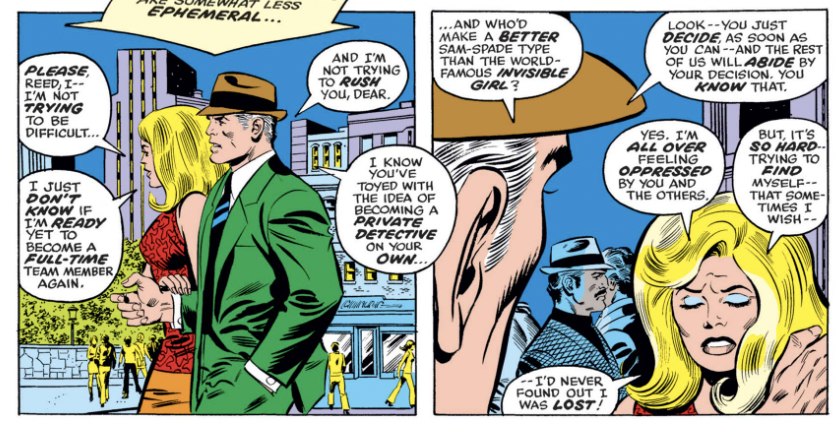
Then we have a brief interlude with Reed and Sue — Sue’s first appearance in many issues. This is the first I’ve heard of Sue becoming a private detective, and I don’t know if anything became of it but it’s a great idea for a comic (she was later retconned as a super-spy who does missions for Nick Fury in the 2019 Invisible Woman mini-series, which is sort of a similar idea).


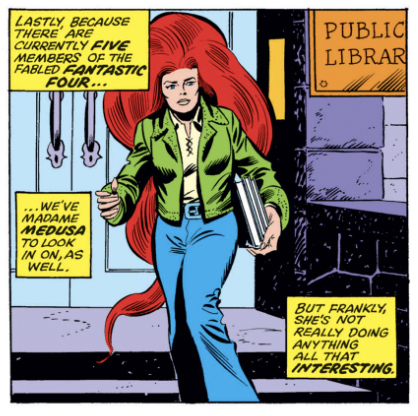
Lastly, we get a panel of Medusa, which seems to tell us what Thomas thinks of her as as story-telling material and which I suspect is a prelude to her leaving the FF.


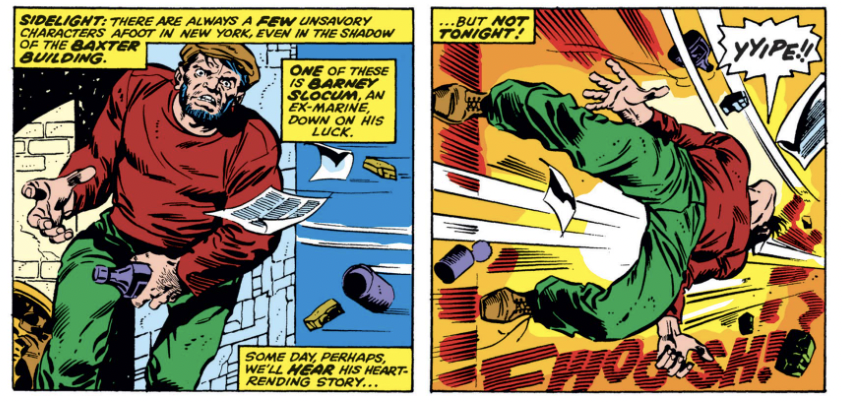
And, randomly, Thomas introduces Barney Slocum, who lasts all of two panels. (I would not be surprised if Thomas resurrected him decades in the future as a new villain).


What I didn’t like

While Thomas seems to be having fun digging up Xemu, he’s a pretty tired concept, and he feels like a cross between Ming the Merciless and Xemnu, the Hulk villain. And his Thunder Horn seems lot like the Climate Cannon the evil Ternak planned to use to subjugate humanity in FF 145. (At least Xemu acknowledges it’s a silly name)


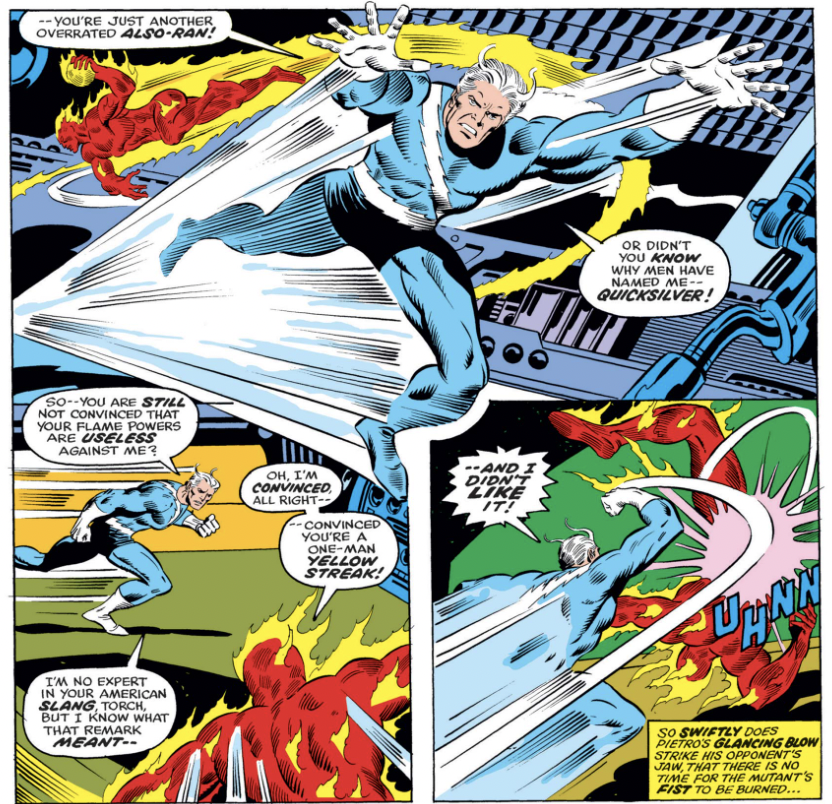
The fight between Johnny and Quicksilver felt pro forma and obligatory, but it was less forced since these two have real beef and it was over fast.


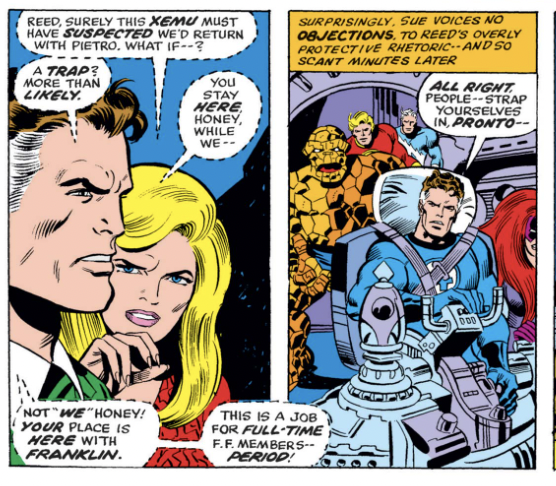
And just as Sue finally reappears, she is shunted aside one again:


Anything else?

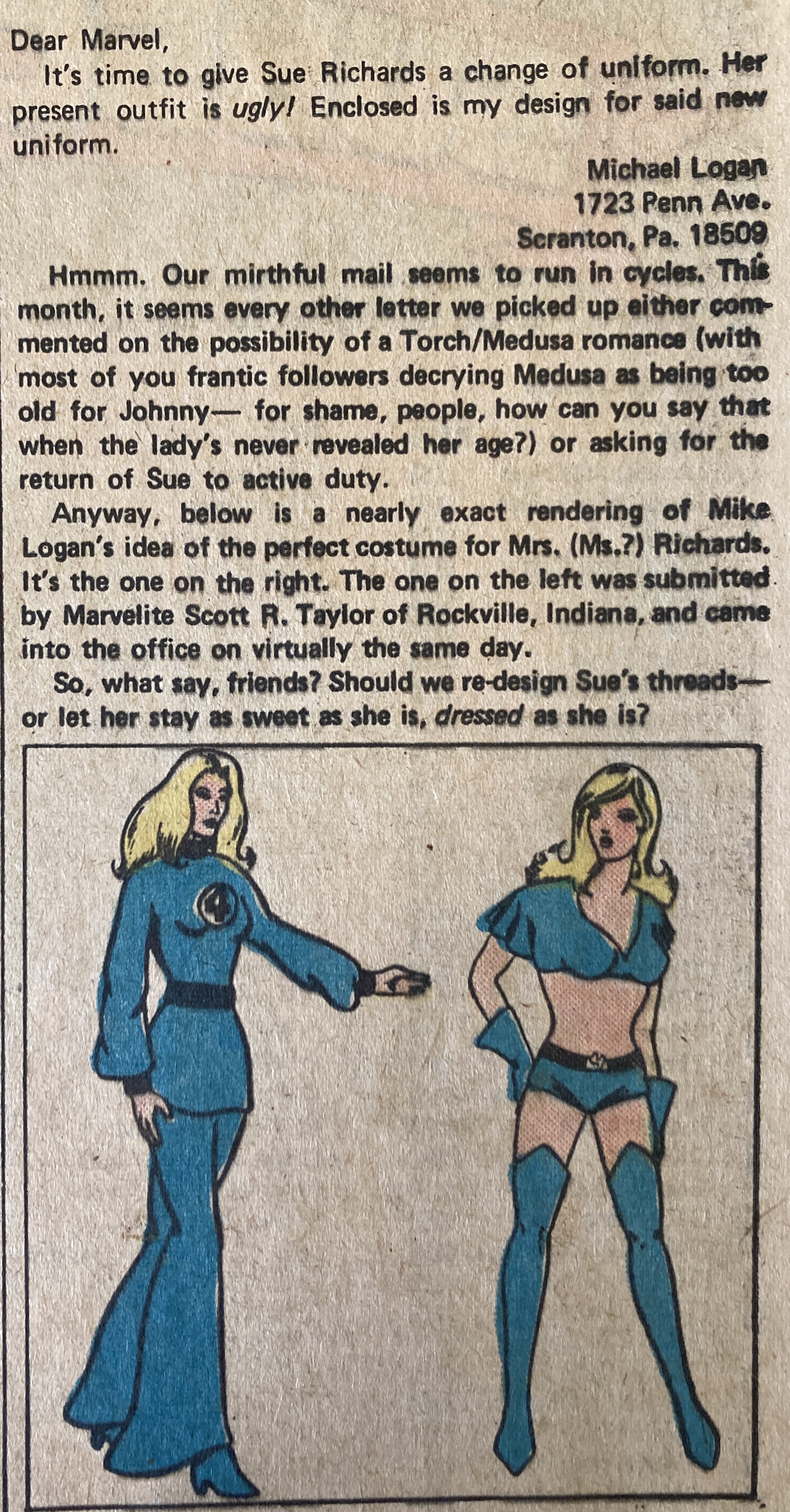
Some letter writers suggested some new outfits for Sue:


They wouldn’t be her worst look …


Overall

Fun!

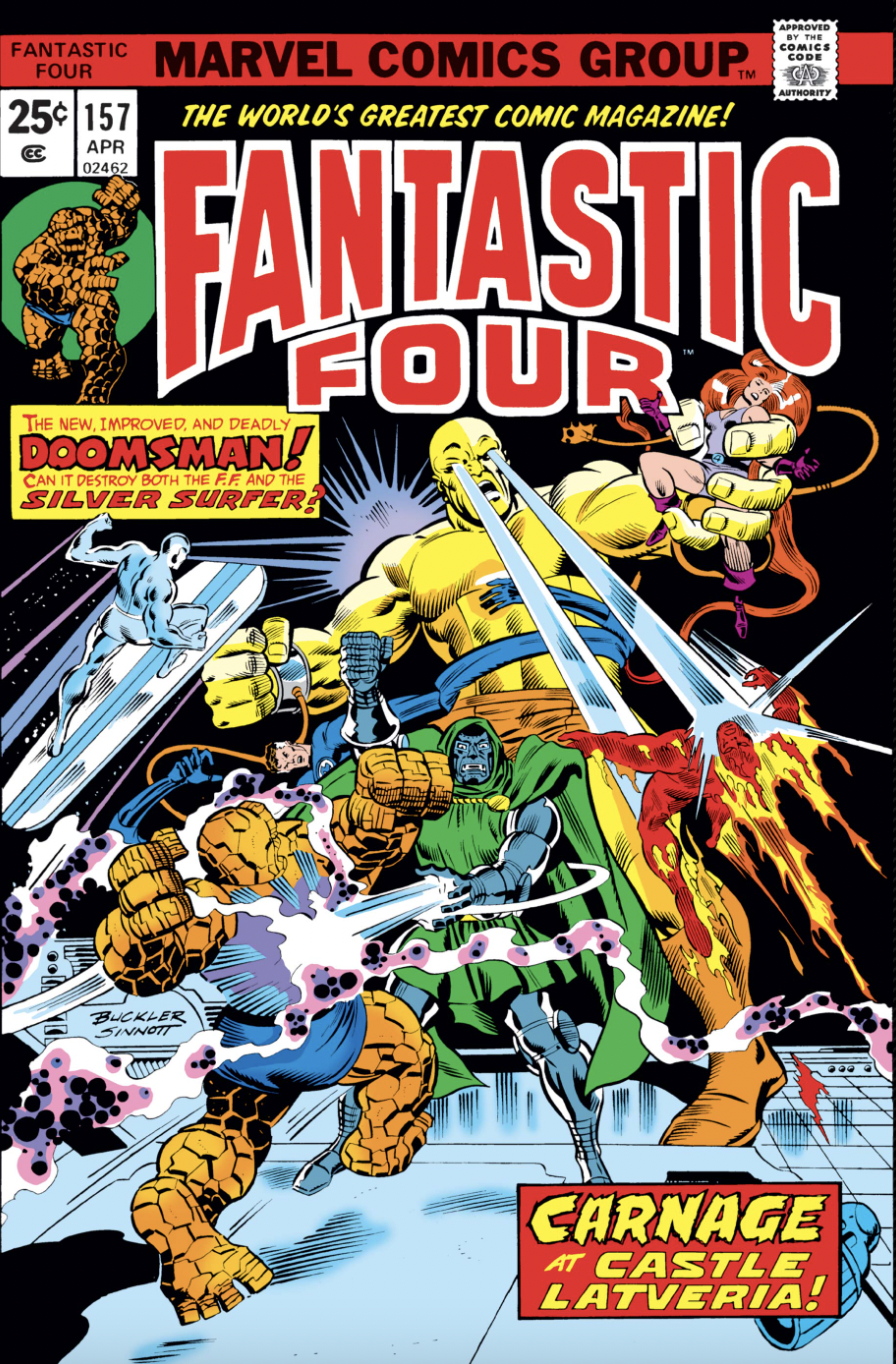
“The World’s Greatest Comic Magazine!” Fantastic Four No. 157

05 Sunday Jan 2025

Posted by percivalhenry in The World's Greatest Comic Magazine

≈ Leave a comment

Tags

1975, Dr. Doom, Fantastic Four, Fantastic Four 157, John Buscema, Marvel comics, Roy Thomas

Fantastic Four 157
“The Endgame Cometh!”
Published January 1975
Writers: Roy Thomas and Len Wein
Pencils: Rich Buckler
Inks: Joe Sinnott
Letters: Joe Rosen
Colors: Petra Goldberg
Editor: Thomas
Cover: Bucker and Sinnott

Synopsis

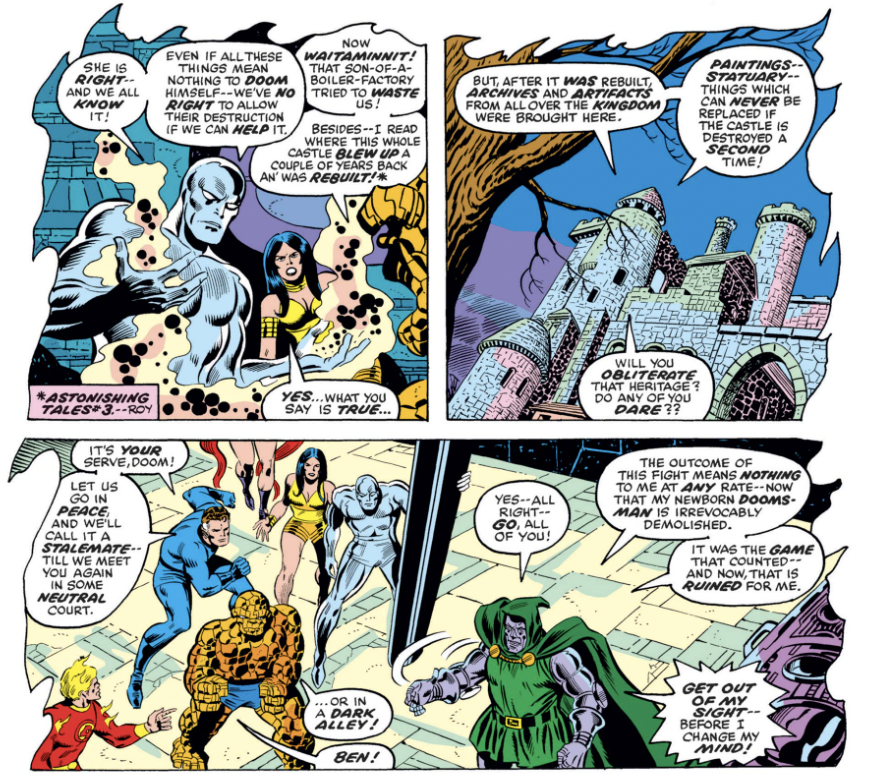
Trapped in Dr. Doom’s castle, the Fantastic Four battle Doomsman II, an android imbued with the Silver Surfer’s power. Meanwhile, the Silver Surfer’s lost lover is revealed to be a Latverian peasant girl, Helena, brainwashed by Doom into believing she is Shalla-Bal. The Surfer then joins the FF to defeat Doomsman, and they are about to go to battle with Doom himself when Helena begs them to spare Doom’s castle from destruction. The issue ends with the demon Mephisto, the Surfer’s nemesis, revealing that Helena was Shalla-Bal all long, put on earth to torment the Surfer.


What’s going on here?

This is Roy Thomas’s first full issue in his return gig as the Fantastic Four’s writer, and as if to announce he’s back, he’s crafted a classically complicated Thomasian story, full of odd tangents, obscure references and callbacks to plot points from earlier comics.

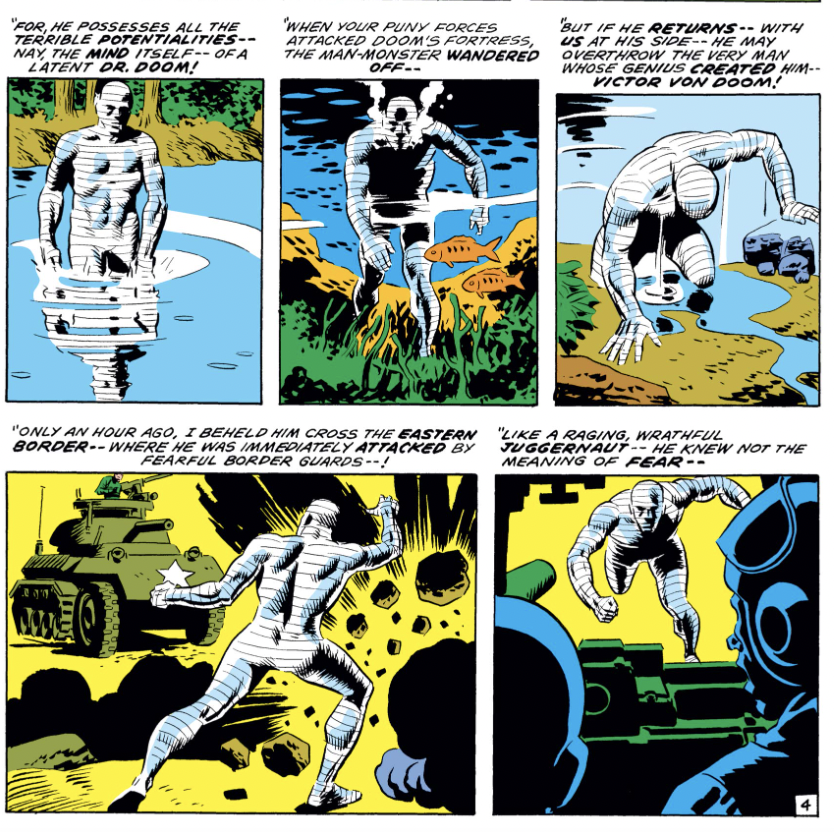
A big chunk of this comic’s backstory was told in Astonishing Tales 1-3, a complicated story by Thomas from 1970 that explains how Doom created the first Doomsman using cosmic rays and his own brain waves and lost control of it (the art is by the legendary Wally Wood).


The story also references Giant-Size Super Villain Team-Up 1, a comic on sale at the same as FF 157 (also by Thomas), that among other things explains how Doom survived his seeming death in FF 144 (he crashed to the ocean and was rescued by the Sub-Mariner).

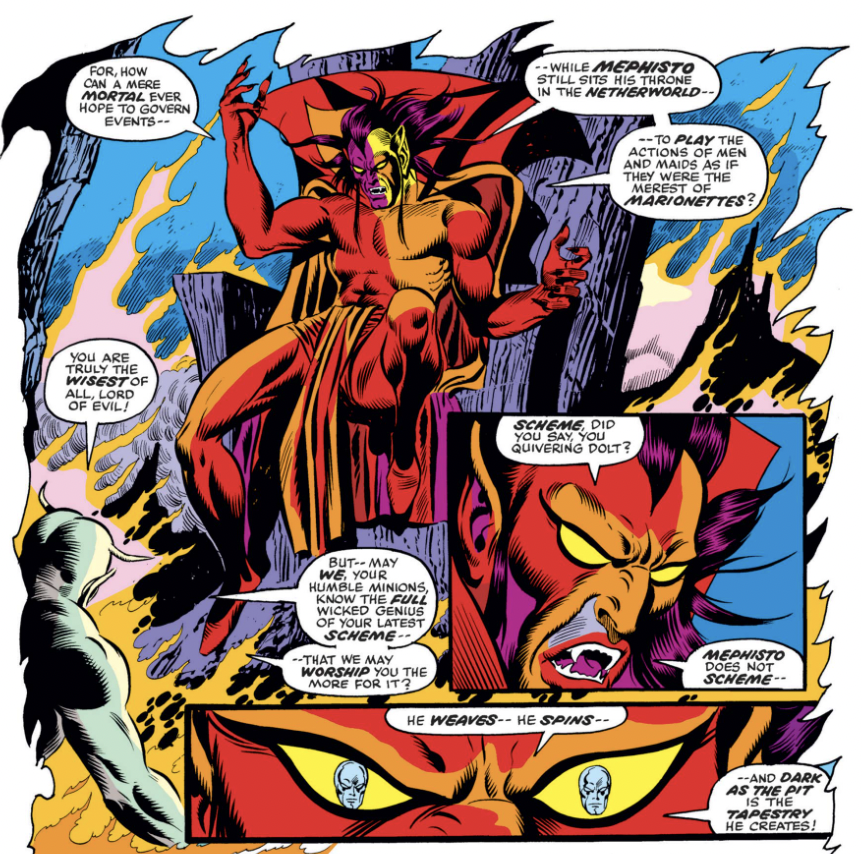
The last scene in FF 157, featuring Mephisto chewing the scenery, is basically pulled from the Silver Surfer’s own comic and I don’t recall him ever appearing in the FF prior to this comic.

There’s not a lot of explanation in FF 157 about any of these plot points, and the assumption is readers would have read these other comics. If all you read was the Fantastic Four, you’d be baffled by these goings on. It’s also reminder of how tightly woven Marvel stories were back then and how much emphasis Thomas placed on continuity. (It also makes me glad I have a subscription to Marvel Unlimited).

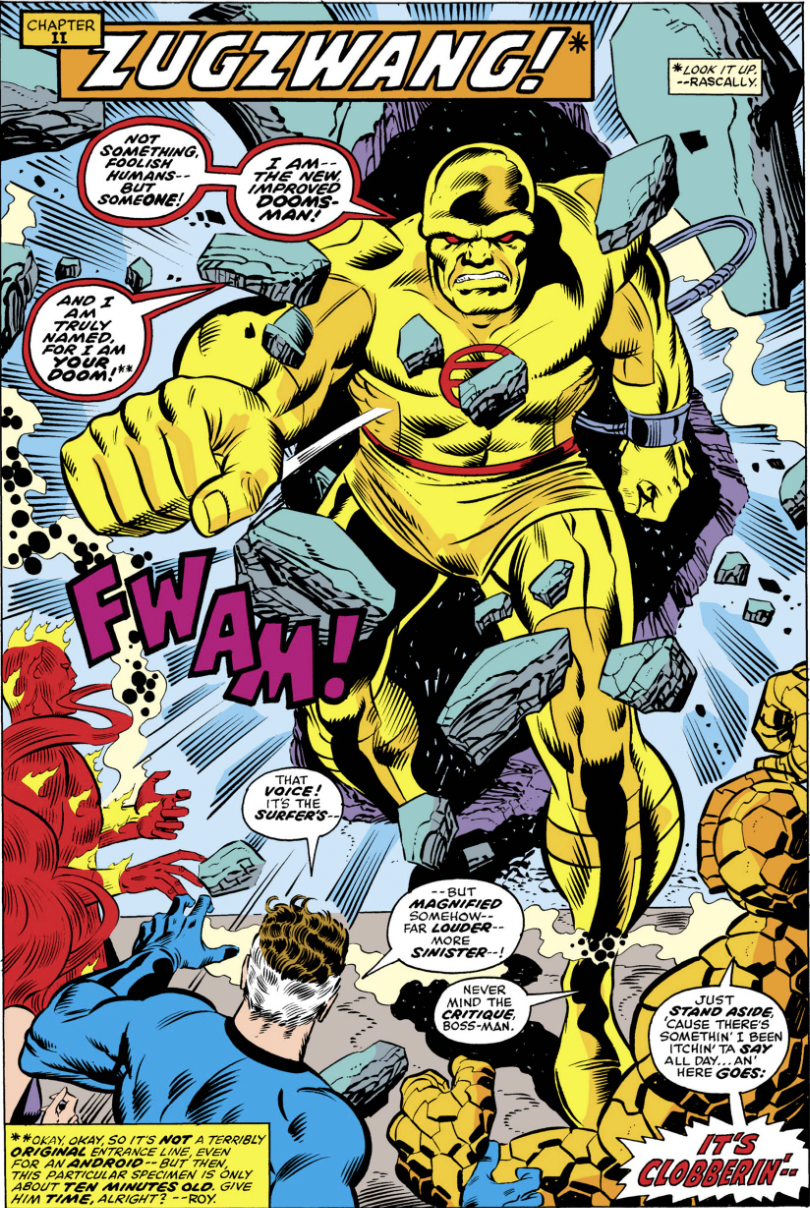
Lastly, another example of Thomas’s zany storytelling: titling a chapter of the comic “Zugzwang!” with no explanation. (It’s a German term used in chess, a play on the chess metaphor in the comic’s title). And self-referential footnotes mocking his own writing.


What I liked

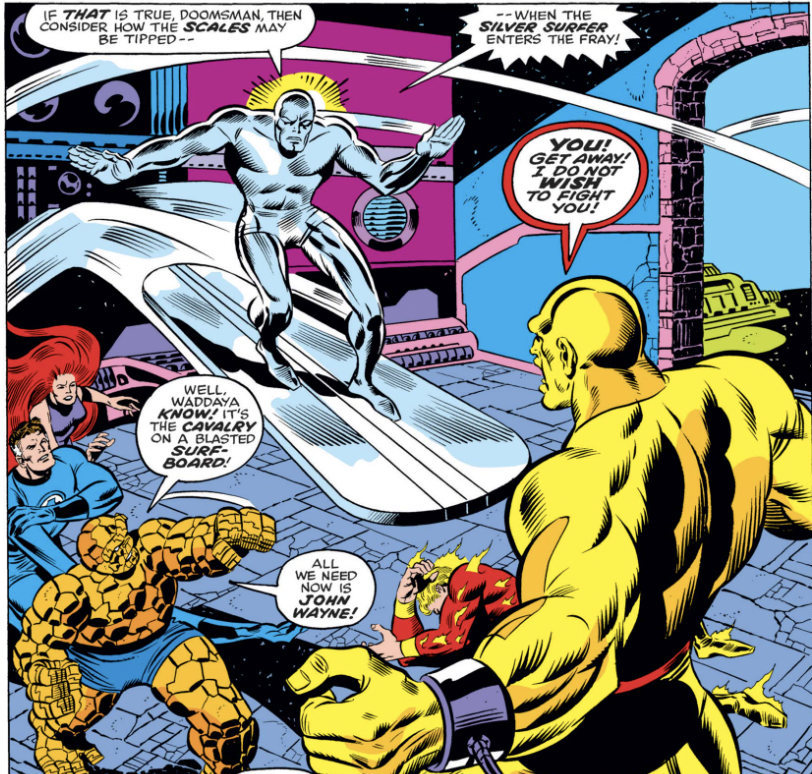
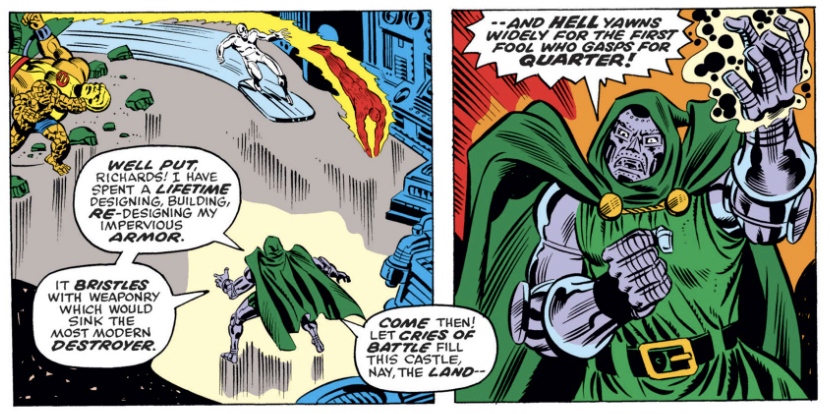
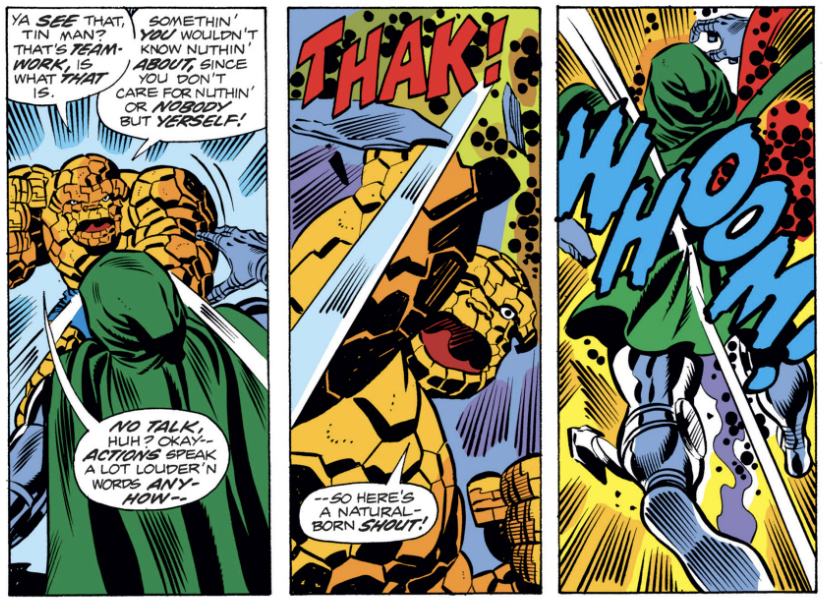
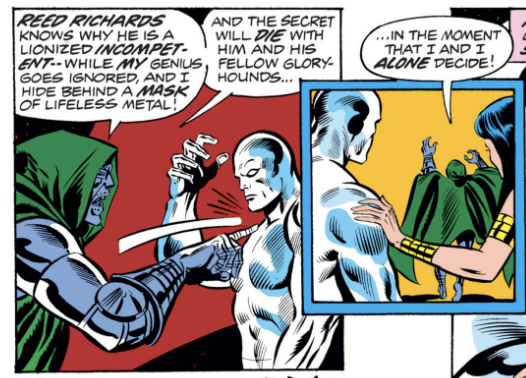
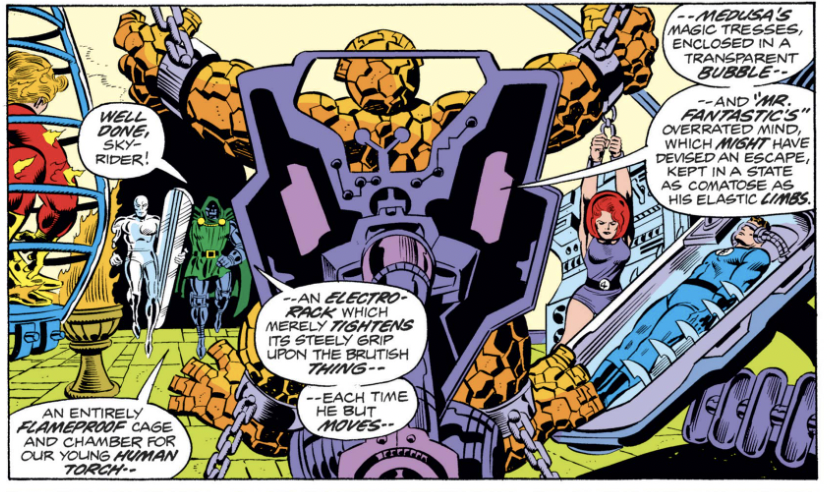
This was a fun comic, despite all its weird intricacies and jarring transitions. Thomas clearly loves writing Doom, and gives him some great, preposterous lines:


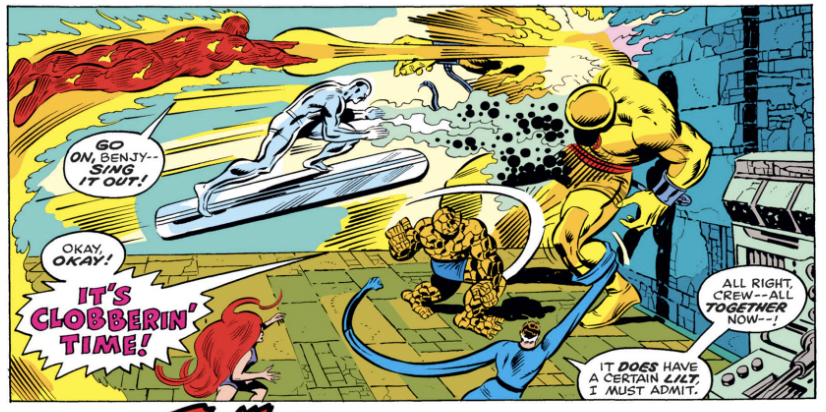
I also liked this byplay between Ben and Reed, revealing a more playful side to Mr. Fantastic.


What I didn’t like

Once again, there is no mention, much less an appearance, of Sue Richards or Franklin. And Medusa barely factors into the story at all.

The initial ending is painfully anticlimactic and hard to swallow. The FF and Doom agree not to battle to preserve the Royal Latverian treasures? This in a comic where wide swathes of New York are frequently destroyed in the FF’s battles?


The disappointment is somewhat blunted by the strange Mephisto coda, but his appearance is such a non sequitur it’s hard to know what to make of it. Again, if readers weren’t paying attention to the Surfer’s title, it would be utterly confusing.


Anything else?

This reference didn’t age well.


Overall

A Thomasian rollercoaster

“The World’s Greatest Comic Magazine!” Fantastic Four No. 156

01 Wednesday Jan 2025

Posted by percivalhenry in The World's Greatest Comic Magazine

≈ Leave a comment

Tags

1974, Dr. Doom, Fantastic Four, Fantastic Four 156, Marvel comics, Roy Thomas, Silver Surfer

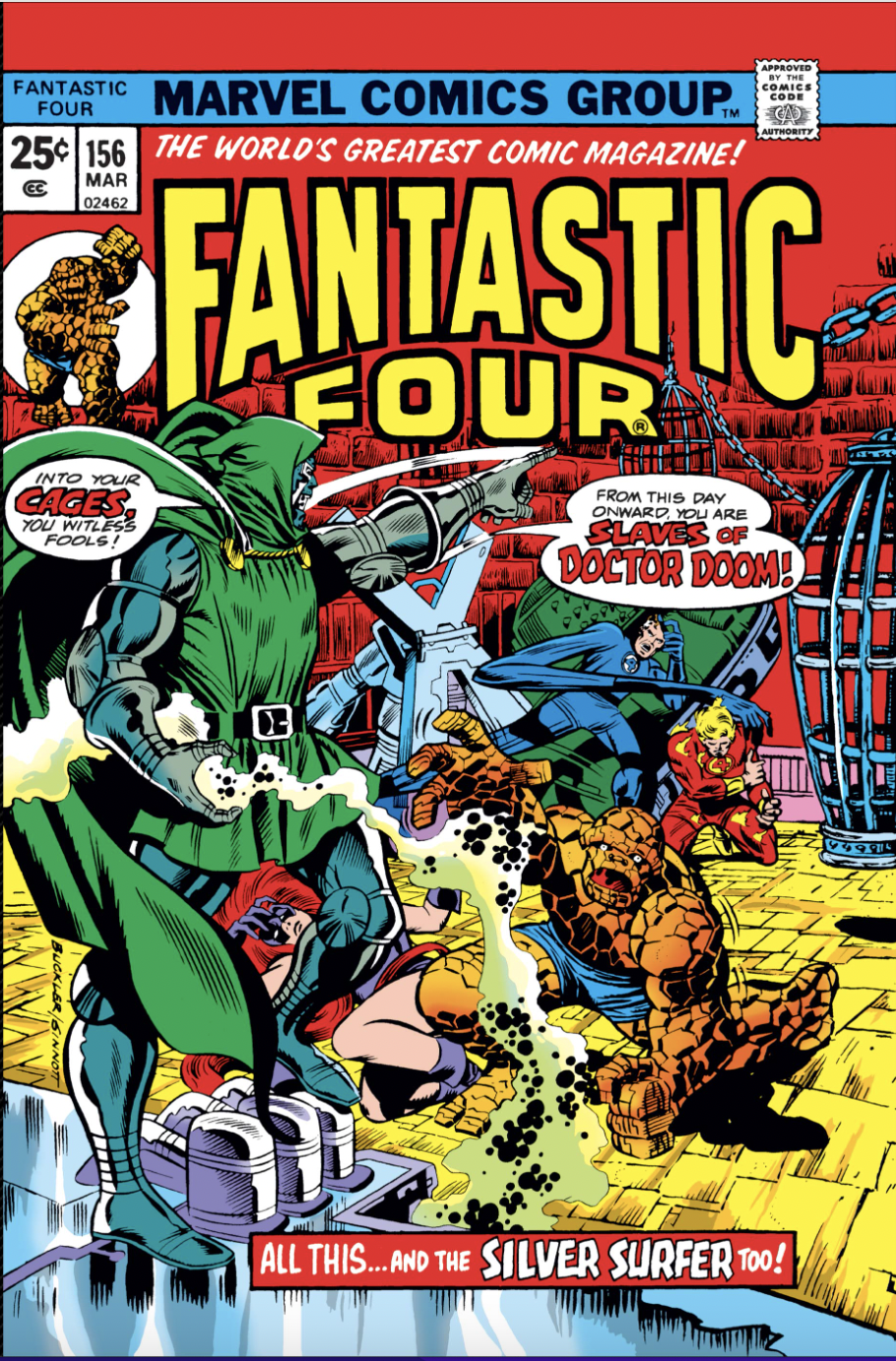
Fantastic Four 156
“Middle Game!”
Published December 1974
Writers: Len Wein and Roy Thomas
Pencils: Rich Buckler
Inks: Joe Sinnott
Letters: John Costanza
Colors: Janice Cohen
Editors: Wein and Thomas
Cover: Bucker and Sinnott

Synopsis

To rescue his beloved Shalla-Bal, the Silver Surfer hypnotizes the Fantastic Four and delivers them to Dr. Doom, who further humiliates him. The FF, who submitted to the Surfer’s hypnotism to infiltrate Doom’s castle, break free of their confinement and defeat an army of Doom’s androids while Doom plans his next move.


What’s going on here?

This is the second of three comics in this arc (hence the story’s title) and a big improvement over the first one. It’s not great: there’s still a lot of purple prose, Doom’s ranting begins to get repetitive, and the FF-are-trapped-in-individual-cages plot device has become a cliché at this point. But the story is suspenseful — we really don’t know what Doom’s intentions are — and the action sequences are a lot of fun. Hopefully the conclusion of the story maintains the momentum of this one.

The credits for this issue are a bit odd, with Len Wein and Roy Thomas both credited as both writers and editors, but a note in the letters page explains that Wein intended to write the entire arc but stepped down to replace Thomas as editor. Thomas, slated to become the new regular writer, picked up the story halfway through. The Bullpen Bulletins further explains that Thomas is now “editor emeritus” (a lofty title for someone who just turned 34) while Wein is now running the show. This begins a chaotic period where Marvel went through five editor-in-chiefs in four years: Wein (1974-75), Marv Wolfman (1975-76), Gerry Conway (1976), Archie Goodwin (1976-78)and finally Jim Shooter, who took over in 1978 and restored some stability to the company.

What I liked

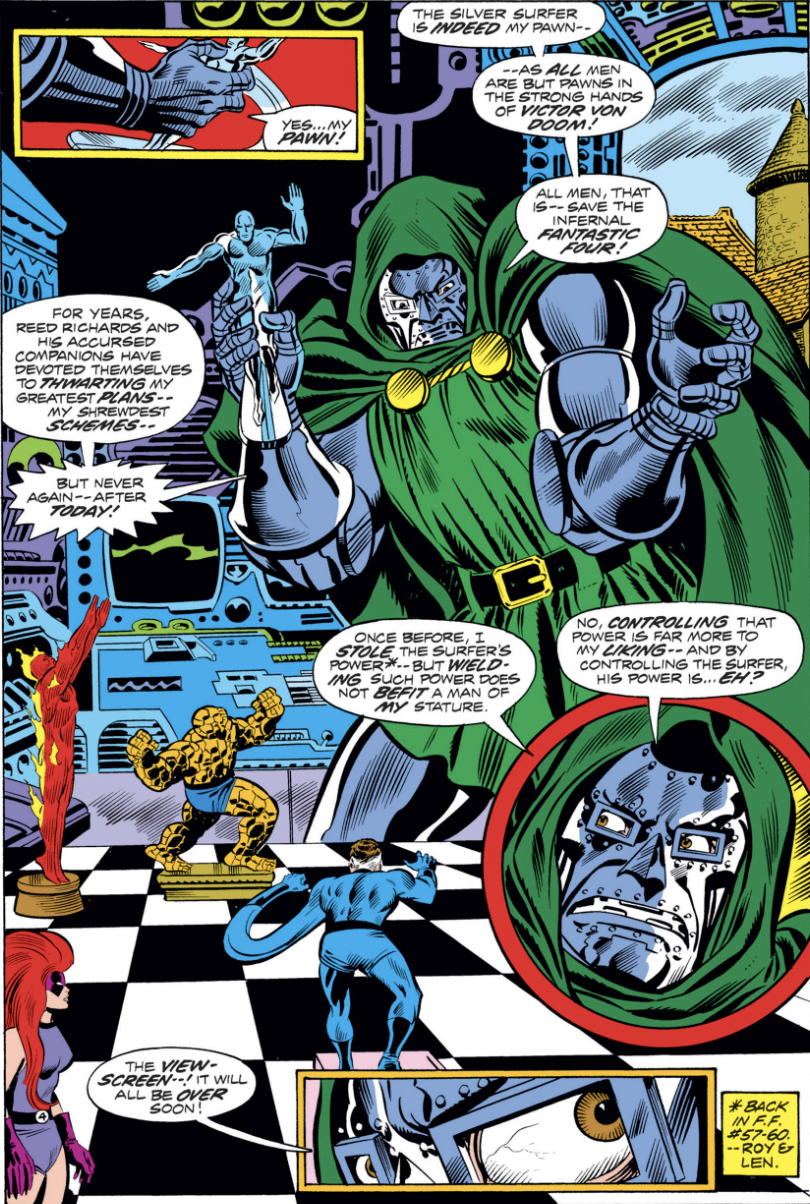
There’s some big, bold art from Rich Buckler, who seems to have gotten his mojo back, at least for this comic. This is a classic Doom splash page:


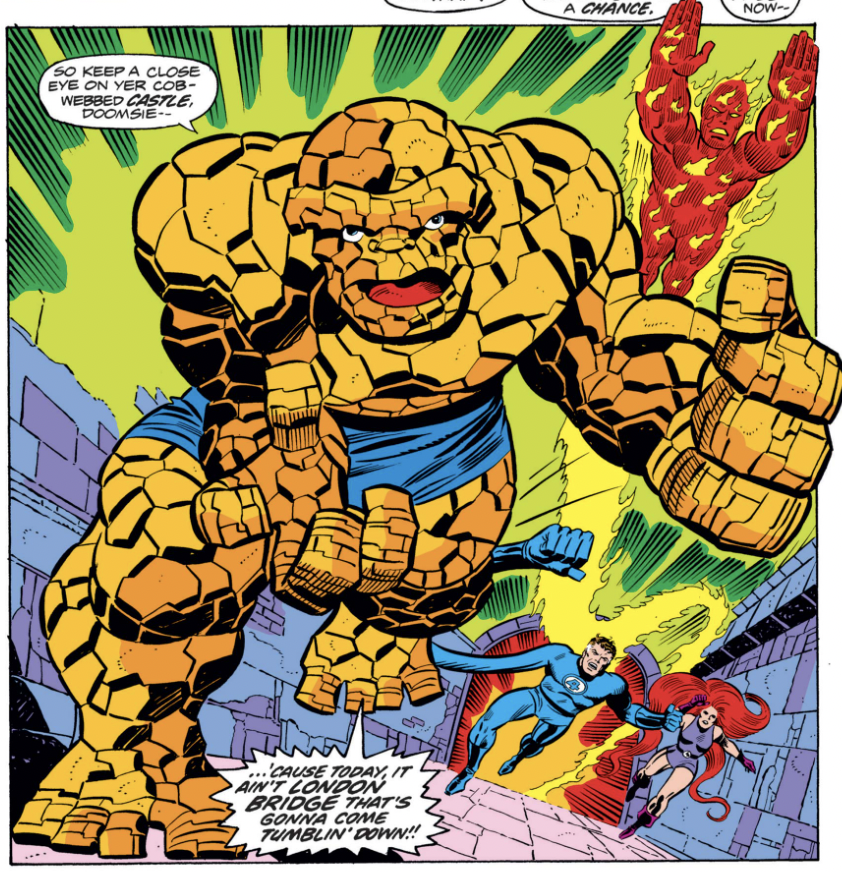
And I liked this action sequence:


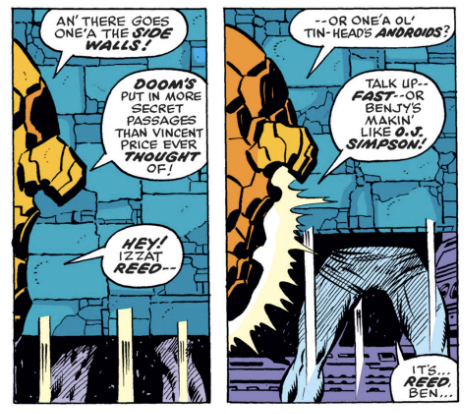
Hidden in all of Doom’s scenery chewing, there was also this intriguing nugget of backstory, hinting at some unknown motivation for his hatred of Reed. I don’t know what he’s referring to, and I hope it’s revealed in the next issue:


What I didn’t like

As mentioned above, confining the FF in cages designed to counter their powers has probably been employed in half a dozen issues by now. At least in this one Ben and Johnny note how easy it was to escape.


Anything else?

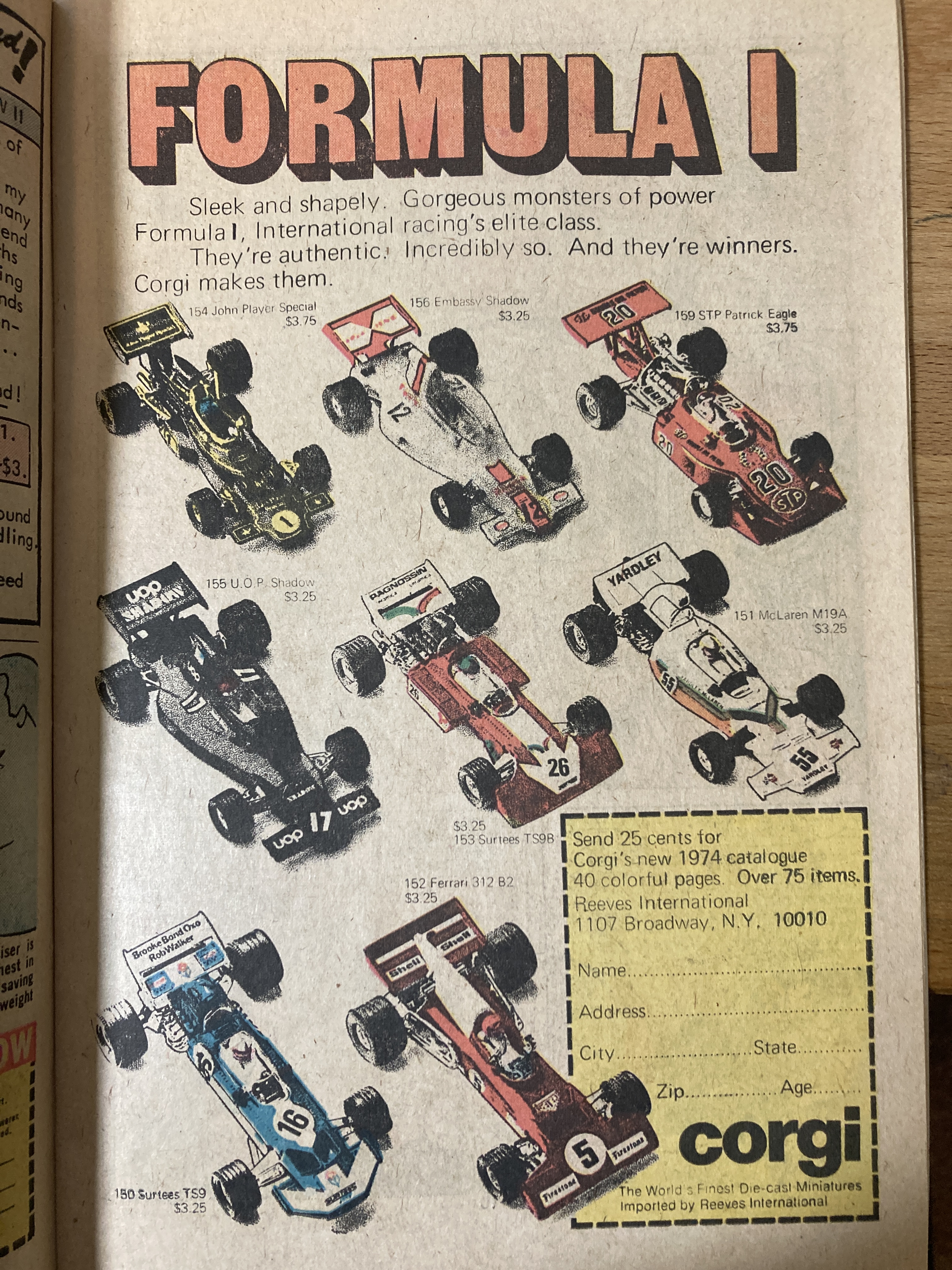
This ad was cool. I wonder if I can still get these cars?


Overall

A marked improvement from last issue

“The World’s Greatest Comic Magazine!” Fantastic Four No. 138

13 Saturday Jul 2024

Posted by percivalhenry in The World's Greatest Comic Magazine

≈ Leave a comment

Tags

1973, Fantastic Four, Fantastic Four 138, John Buscema, Marvel comics, Roy Thomas

Fantastic Four 138
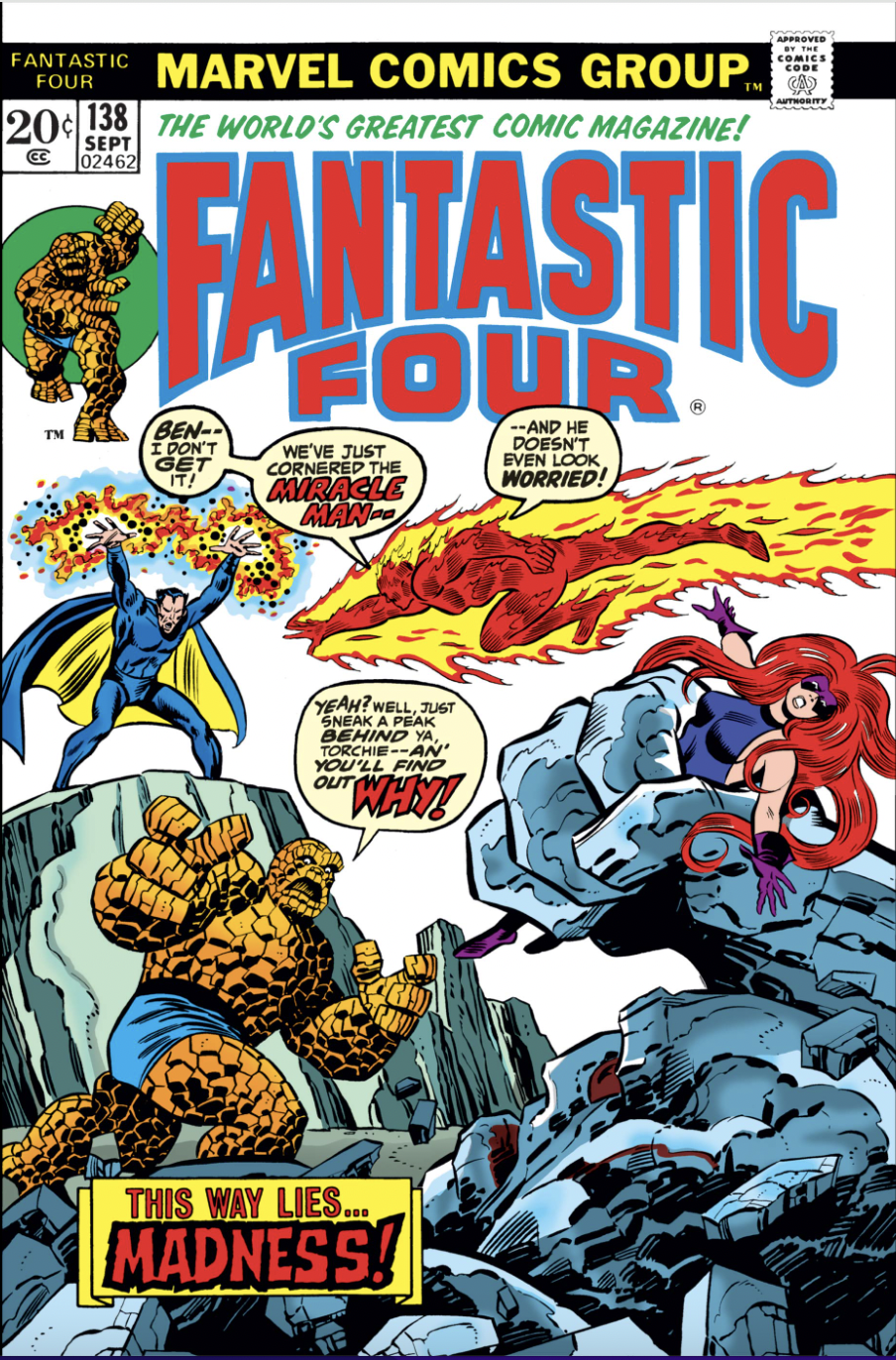
“Madness is … the Miracle Man!”
Published June 1973
Plot: Roy Thomas
Script: Gerry Conway
Pencils: John Buscema
Inks: Joe Sinnott
Letters: John Costanza
Colors: Petra Goldberg
Editor: Thomas
Cover: Buscema and Sinnott

NB: This issue came out after Fantastic Four Annual 10 (technically “King-Size Fantastic Four 10”) but since it consists of reprints of annuals 3 and 4, it didn’t seem worth posting about.

Synopsis

Wyatt Wingfoot reappears and asks the Fantastic Four to help with an emergency on his Oklahoma reservation. There, the team — minus Mr. Fantastic, who remained in New York — is attacked by the Miracle Man, who has discovered new powers.


What’s going on here?

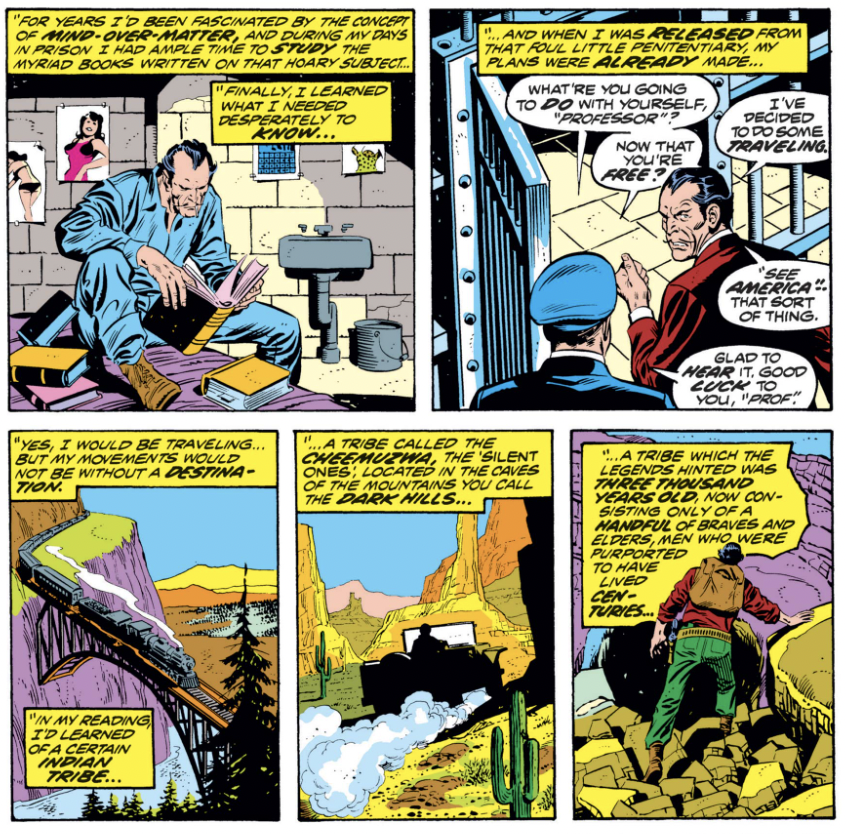
This story is very similar to the Gregory Gideon arc of a few issues ago. Basically, Roy Thomas unearths an obscure villain from the early Lee/ Kirby run (in this case, the Miracle Man debuted all the way back in FF 3), gives him new powers and sets him on world domination. It’s not really clear why Thomas needs to dredge up an old character vs. create a new one – he spends so much time explaining how the Miracle Man got his powers he might as well gave invented a similar villain from scratch. Plus, there’s something odd about this former stage magician cavorting about the mesas of Oklahoma.

The positive side of Thomas’s dredging up the past is the return of Wingfoot, last seen in issue 80. Wingfoot is a fun sidekick who, despite his many appearances over the years, has never suffered the fate of so many supporting characters and been given super powers. I hope I didnt jinx him.

Otherwise the story is unremarkable. There’s some classic comic book treatment of Native Americans as noble, spiritual primitives, and a few bits of nice character moments for Ben, Johnny, Reed and Alicia. Medusa is again basically sidelined into uselessness and Sue and Franklin don’t appear at all. The story does resolve one odd subplot introduced back in issue 134 and then dropped (and surely forgotten by most readers): the mysterious muscular figure entering the Baxter Building was Wingfoot.


What I liked

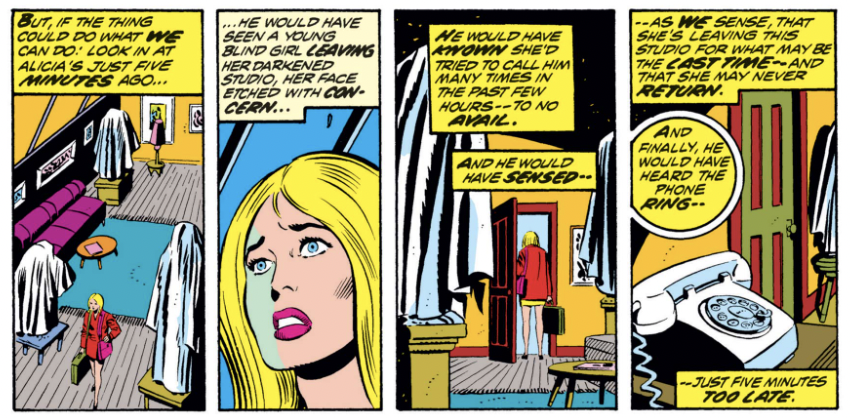
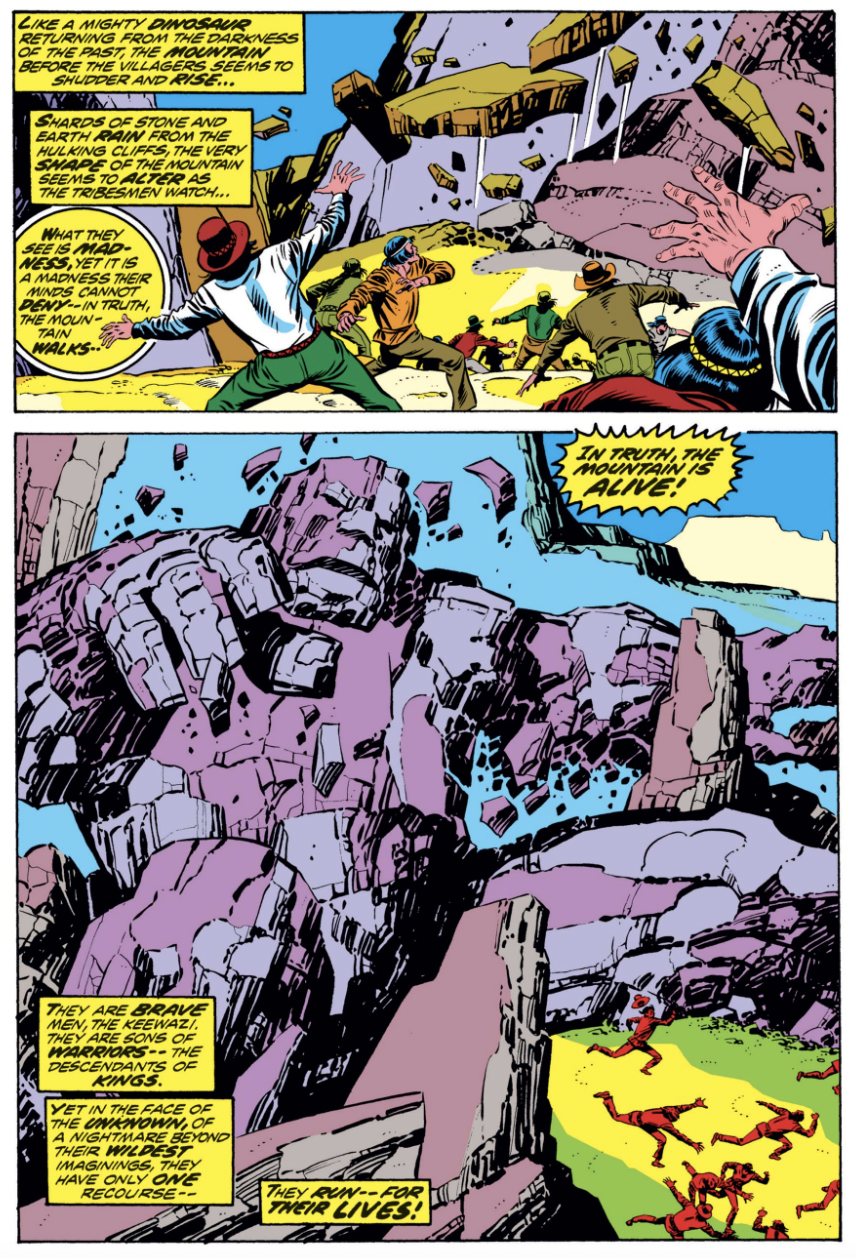
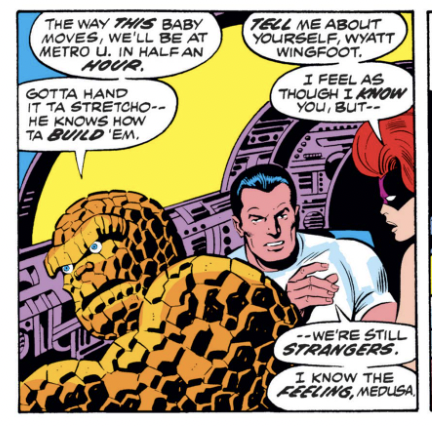
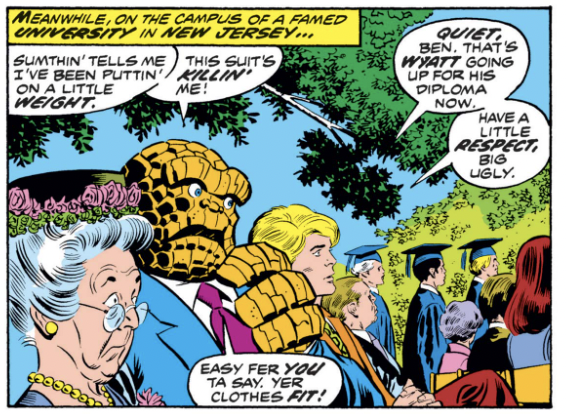
I’ve been critical of Thomas and Conway for stories that have been either absurd (the last two issues) or pedestrian, but to give credit where credit is due, this issue is well plotted and paced. It has a classic slow opening, with the FF in the Baxter Building, includes a nice scene at Metro University (last seen in issue 62), and builds to an action-filled climax without rushing to the end like so many Lee/Kirby stories. And as mentioned above, we get some character-focused scenes like this one:


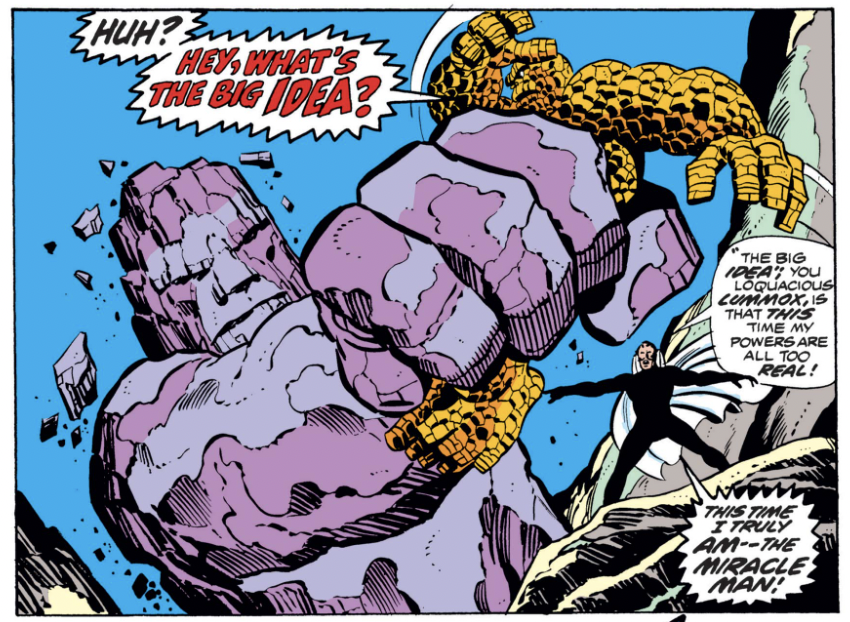
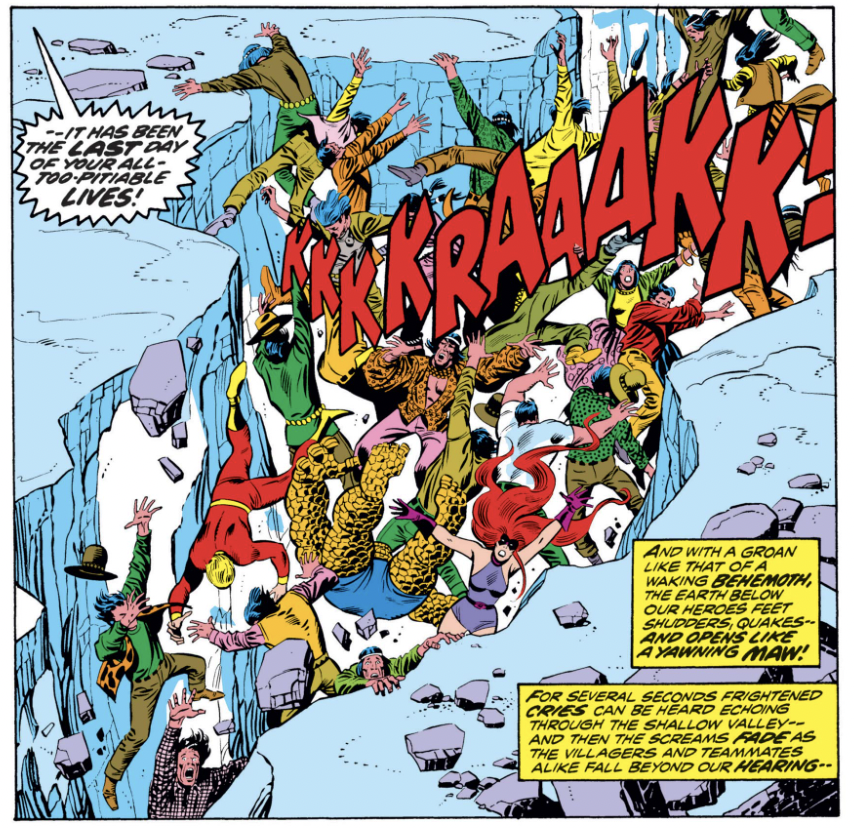
There’s also some slam-bang Buscema art in this issue, like these panels:

And this one:


What I didn’t like

I will admit upfront this is picking nits, and maybe I only care because I am fascinated by geography, but the travel times in this issue don’t add up.

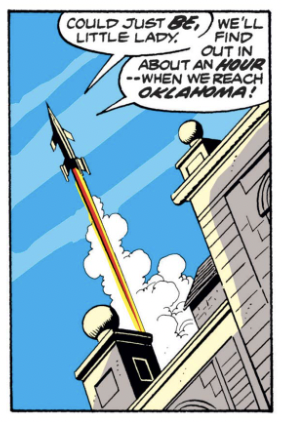
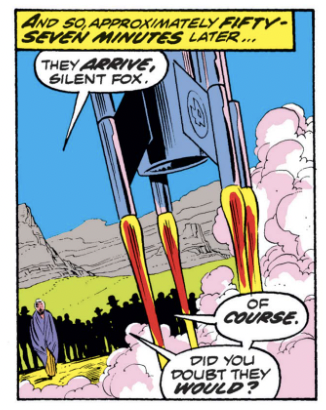
On the first part of the journey, the FF travel by Pogo Plane from New York to Metro University, which is established as somewhere in New Jersey (it’s an odd name for a NJ college but no matter). Ben says the trip will take half an hour.

Then, on the second part to Oklahoma, the trip takes 57 minutes.

I will accept there is some time lost in taking off and landing, and maybe there is congestion in the New York New Jersey airspace, but even the farthest corner of New Jersey is just 124 miles from Manhattan. From there it’s 1,100 miles to the nearest corner of Oklahoma! It shouldn’t take just twice as long to travel 10 times as far!

Ok, geography rant over.

Anything else?

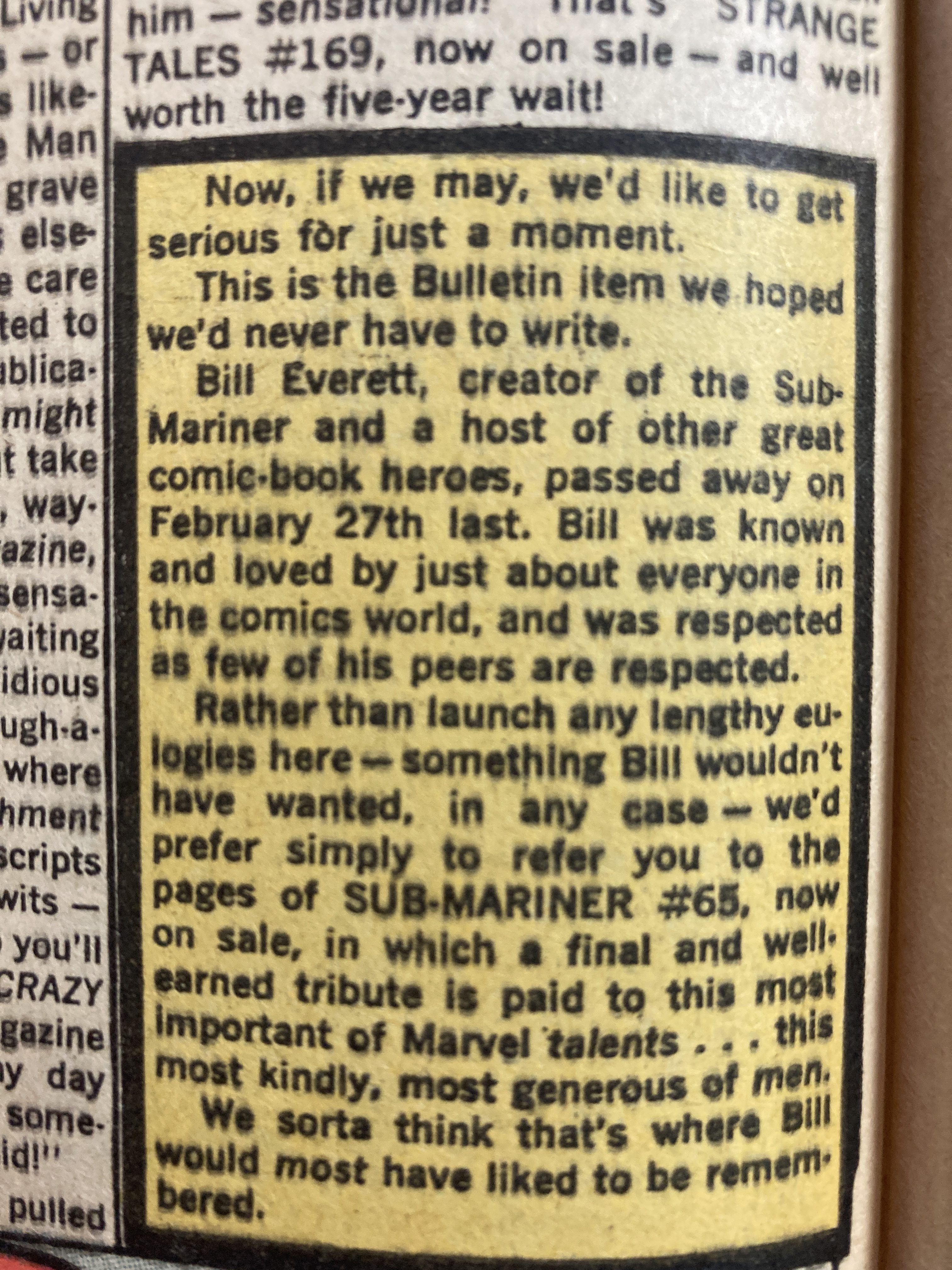
There is a nice tribute to Bill Everett, creator of the Sub-Mariner, in the Bullpen Bulletins. Oddly, this issue appeared in June, five months after he died.


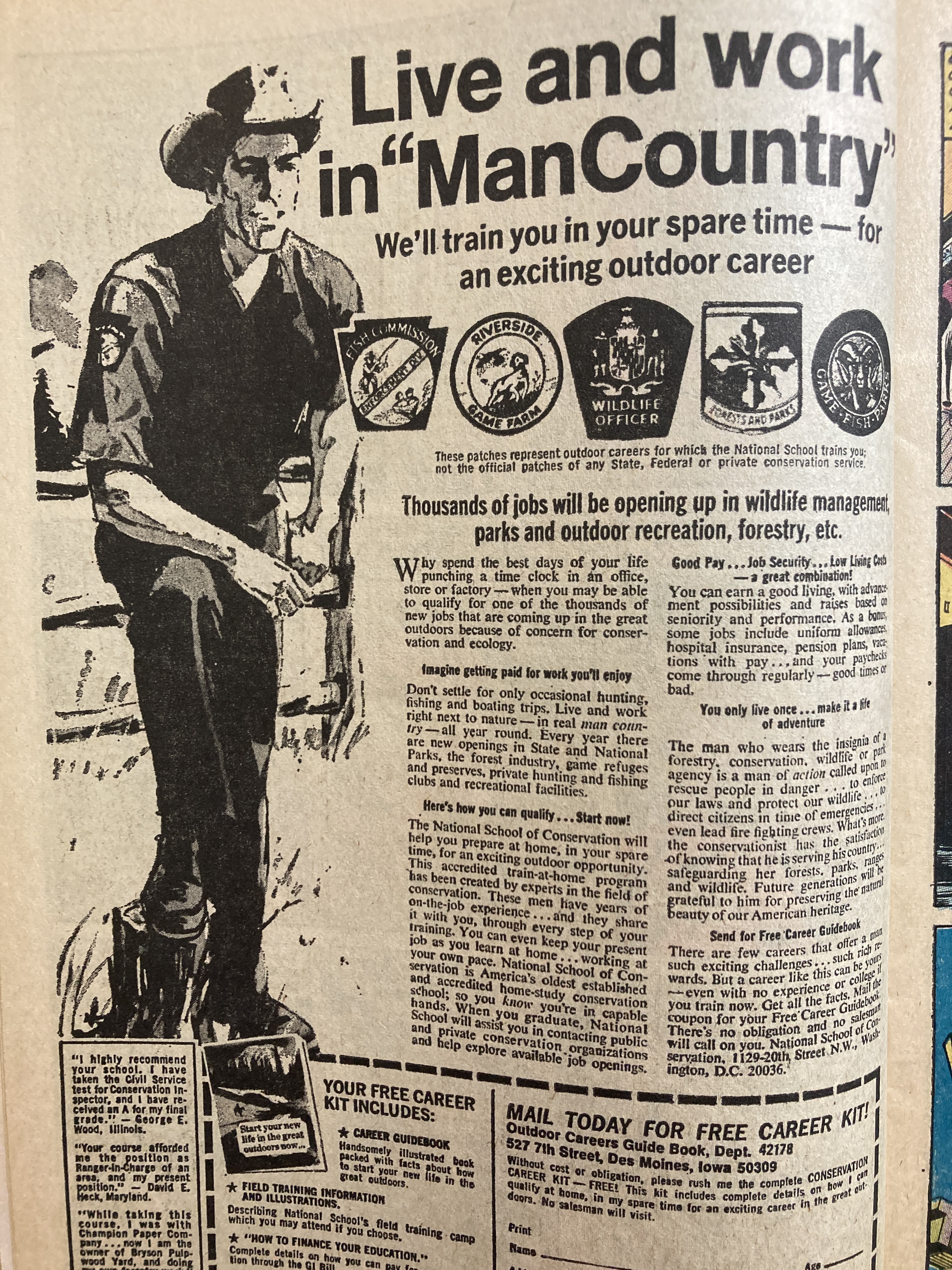
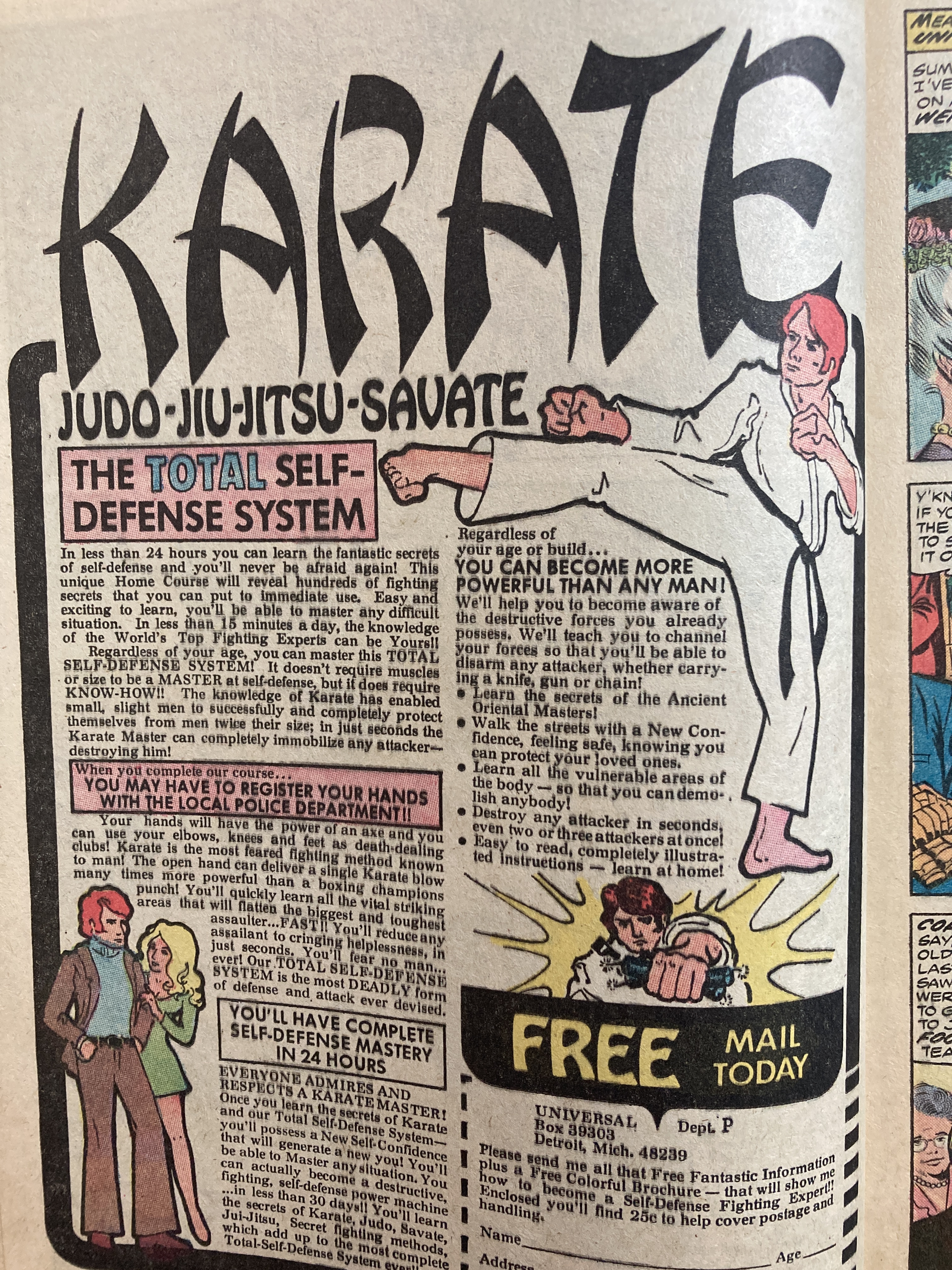
Some excellent ads in this issue. I love how the karate ad warns that, after completing the course, you may have to register your hands with the local police department. “May” is doing a lot of work there.

As per usual with comic ads, they seem designed to appeal to the (apparently low) self-esteem of the comic reader.


Overall

Nice rebound from the last two issues.

“The World’s Greatest Comic Magazine!” Fantastic Four No. 137

06 Saturday Jul 2024

Posted by percivalhenry in The World's Greatest Comic Magazine

≈ Leave a comment

Tags

1973, Fantastic Four, Fantastic Four 137, John Buscema, Marvel, Roy Thomas

Fantastic Four 137
“Rumble on Planet 3”
Published May 1973
Plot: Roy Thomas
Script: Gerry Conway
Pencils: John Buscema
Inks: Joe Sinnott
Letters: Artie Simek
Colors Glynis Wein
Editor: Thomas
Cover: Buscema & Sinnott

Synopsis

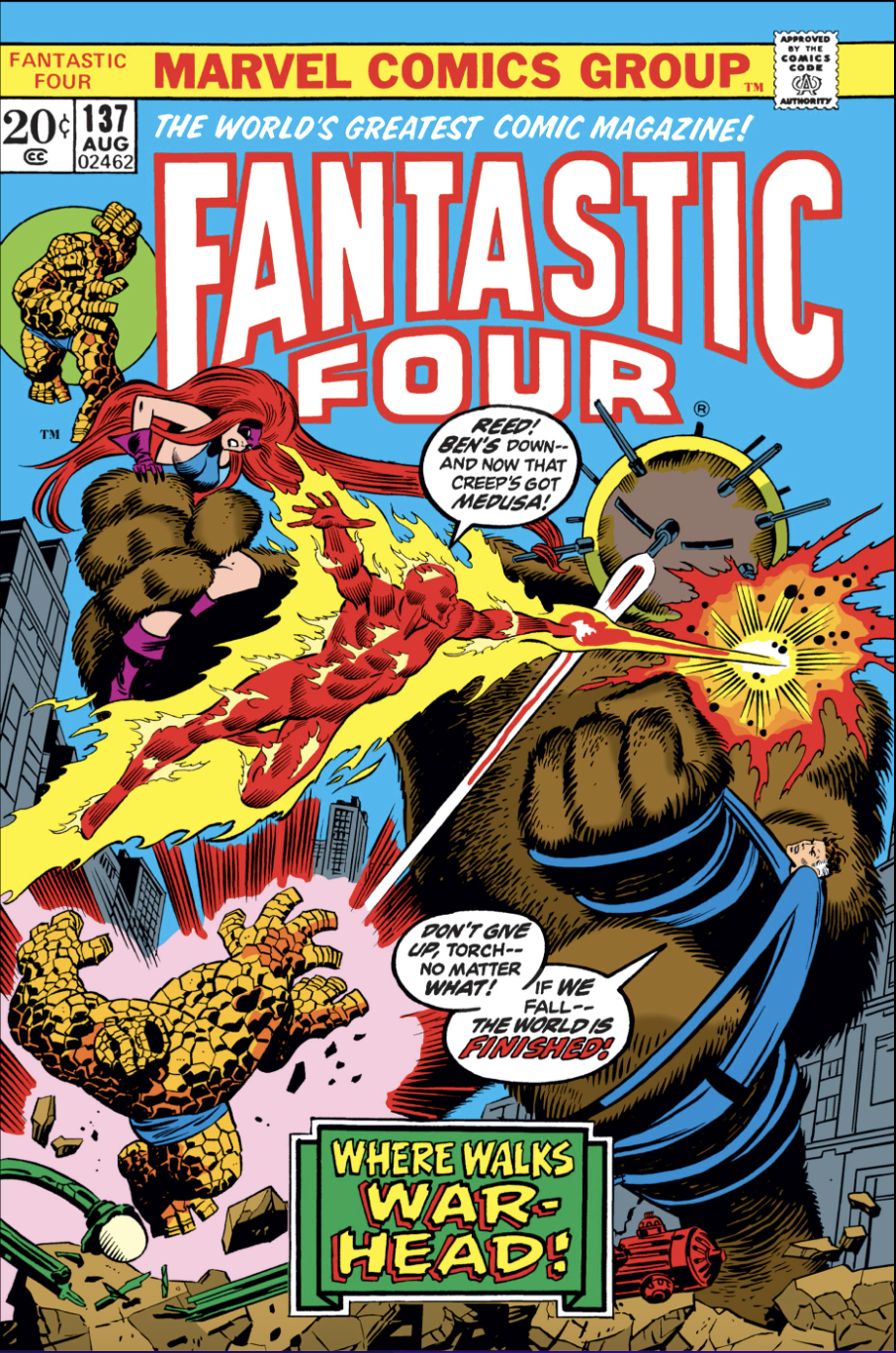
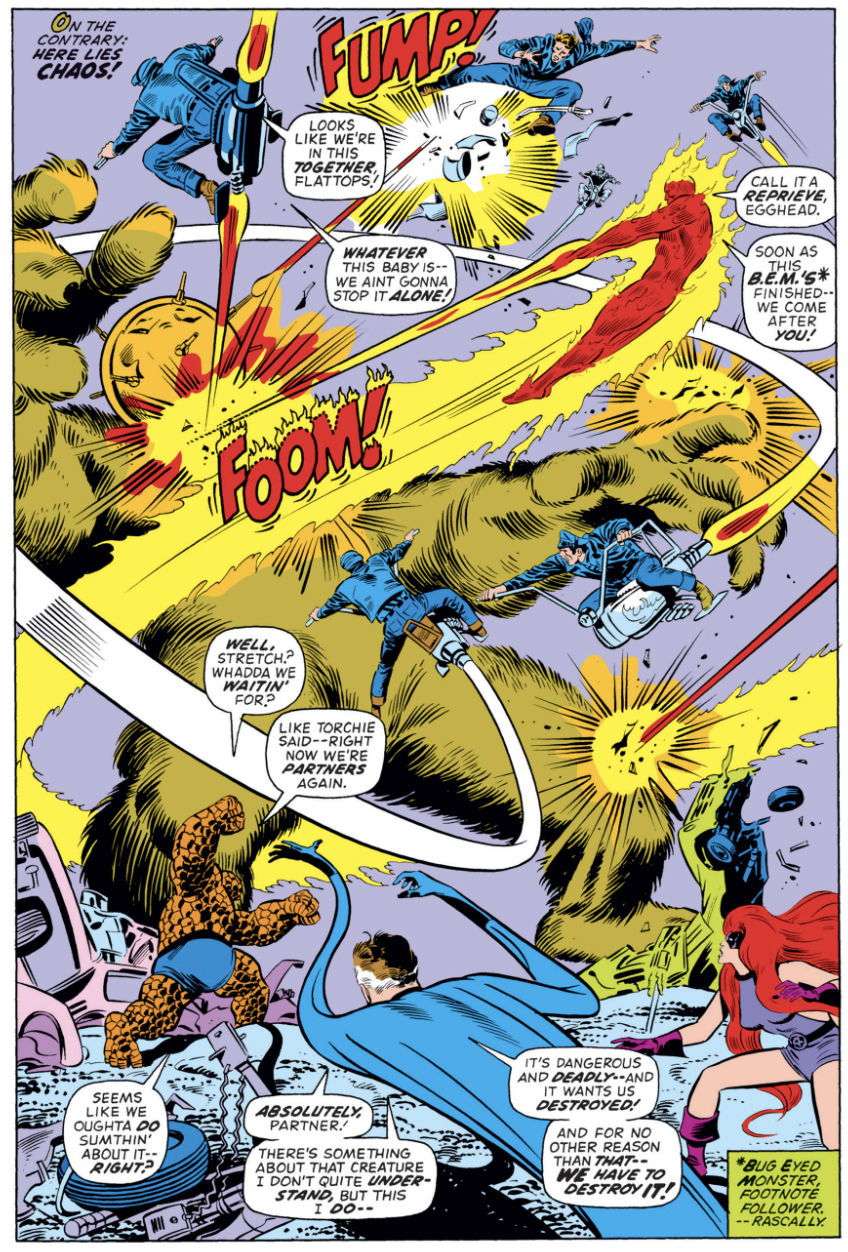
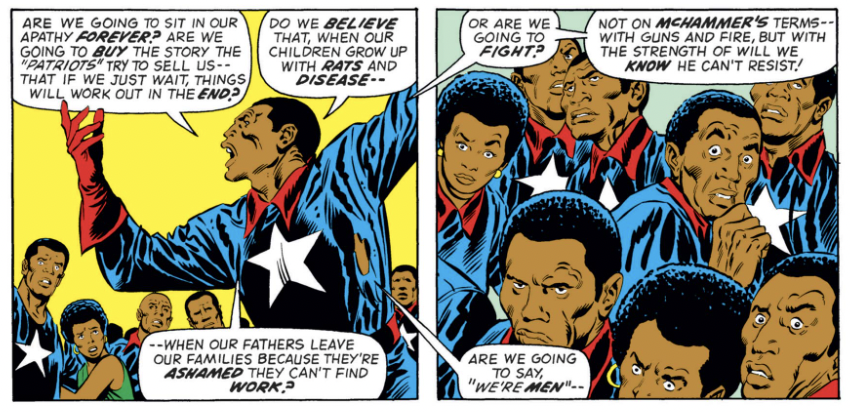
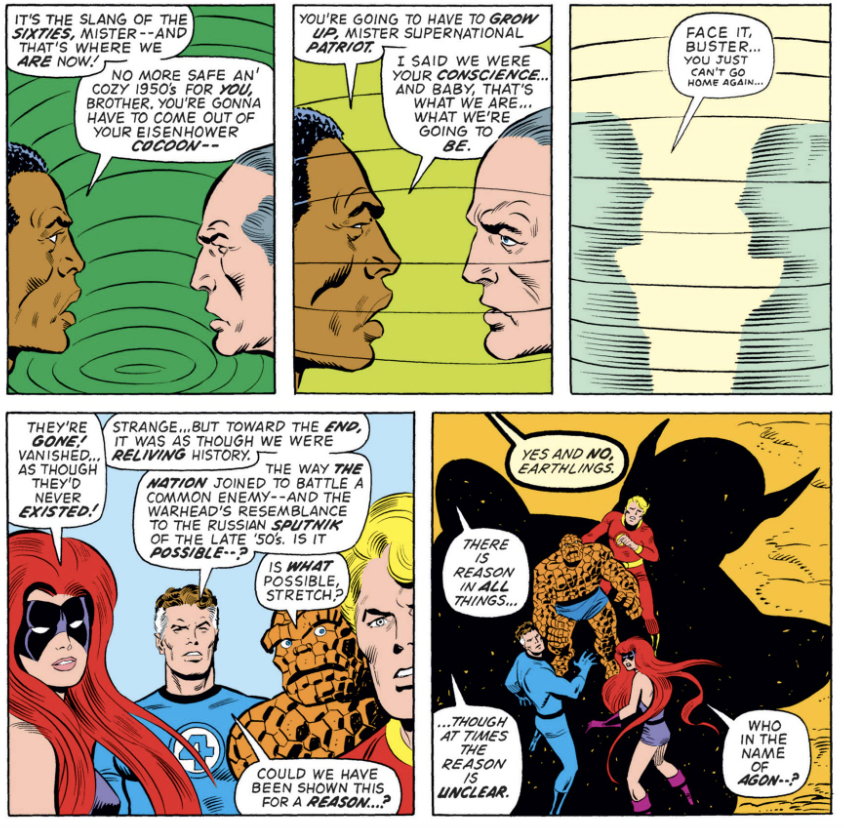
In the alternate, 1950s-themed world created by the Shaper of Worlds, the members of the Fantastic Four clash, then join together to battle the Warhead, a monster created by the Shaper. When both 50s factions — the “youthies” and “patriots” — are confronted by newly politicized African-Americans of the 1960s, the ’50s construct dissolves. The Shaper admits he made a big mistake choosing Slugger Johnson as the vehicle for his powers, and restores the world back to the 70s.


What’s going on here?

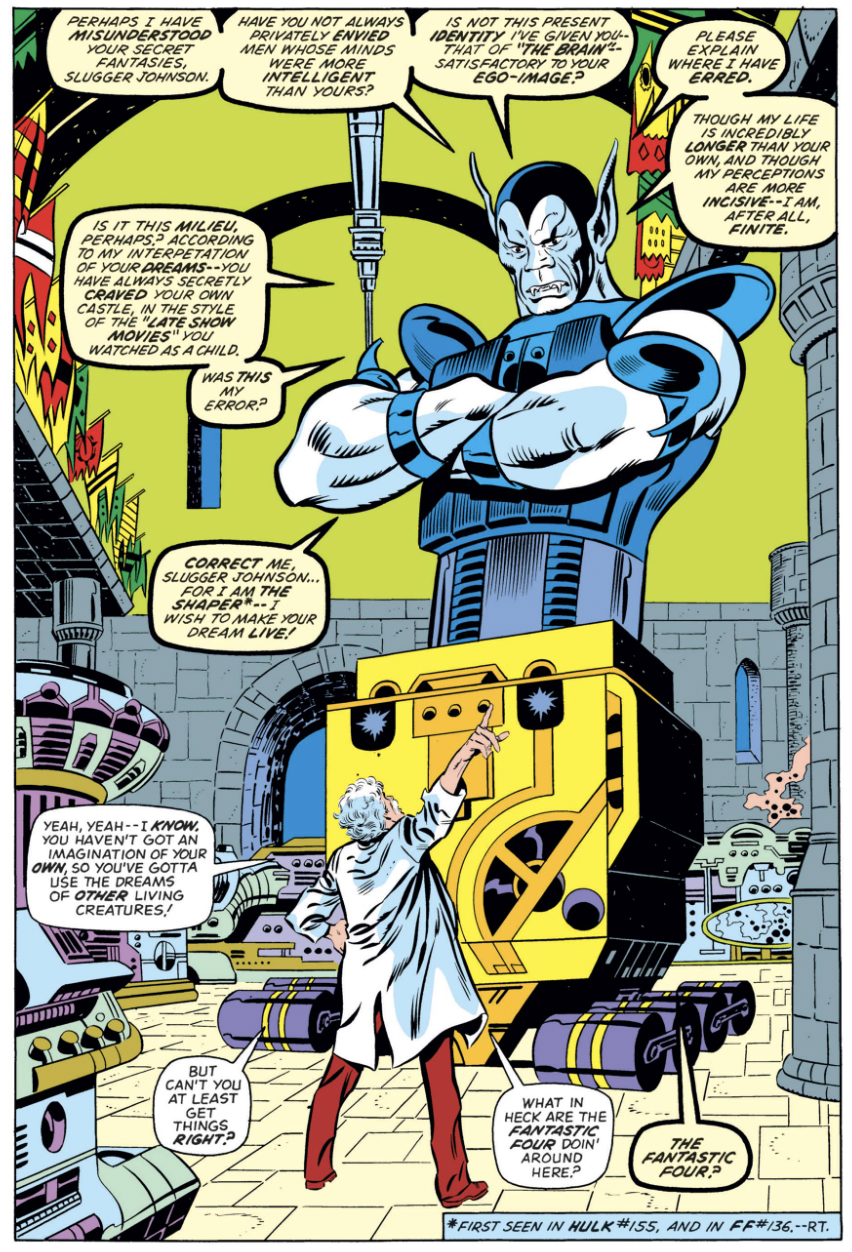
Fantastic Four 137 plays out the barely-intelligible string of last issue, filling in some blanks — we learn that The Brain is actually Slugger, who is intended to resemble Albert Einstein (he doesn’t) — while doubling down on its ham-handed analysis of mid-century sociology. The best thing about this two-issue arc is that it’s over, and seems to have left little mark on the FF or Marvel. One exception: Thomas Gideon, the orphaned son of Gregory Gideon, is whisked off by the Shaper to later become Glorian, who has a long run as a minor Hulk and Silver Surfer character.

One other note: This is the first issue of the Fantastic Four colored by Glynis Wein, who went on to have a long career, with more than 1,000 coloring credits. At this point she was married to comic writer Len Wein, but after their divorce she would return to her maiden name, Glynis Oliver.

What I liked

I’m generally a fan of splash pages, and there’s a few in this issue.


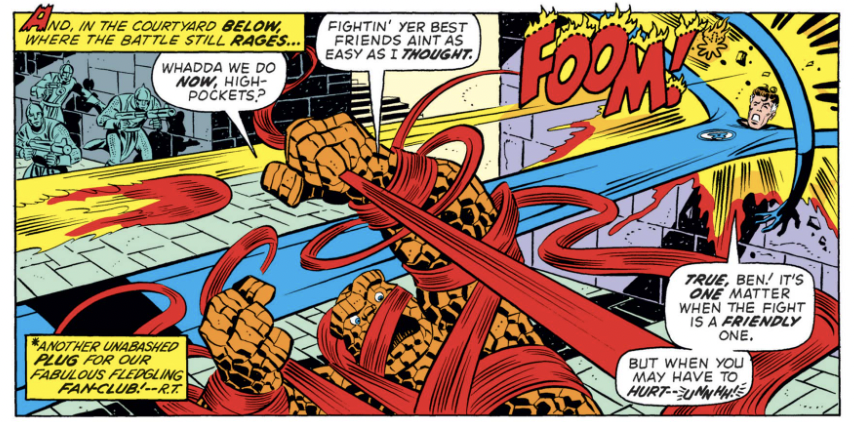
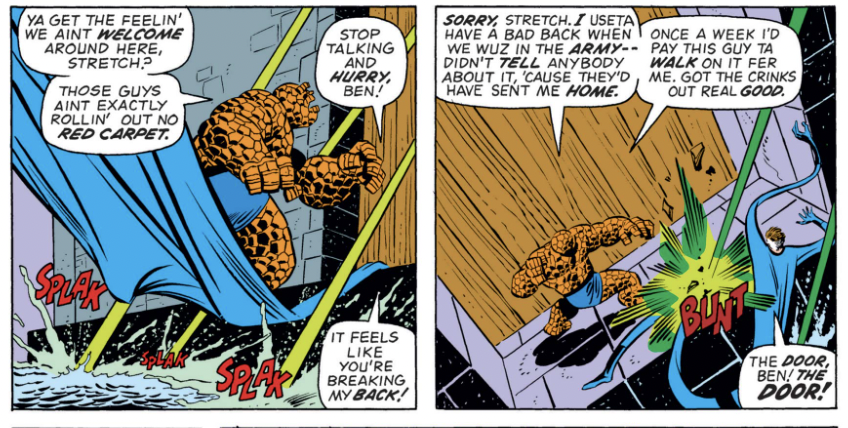
I also liked this sequence of Reed and Ben kibitzing:


What I didn’t like

As with last issue, the story makes little sense, and ultimately feels like a silly and pointless exercise in clumsy cultural anthropology. Thomas and Conway compound their simplistic youths-vs.-olds of the 50s dynamic by introducing the Civil Rights struggle of the 60s (which actually began in the 40s). No doubt it was well intentioned, but in the absence of a coherent story it feels preachy and naive.


This new development somehow destablizes the Shaper’s entire project, until it fades away.


None of it makes much sense, and the Shaper acknowledges as much, telling us “the reason is unclear.” Which is another way of saying Thomas and Conway wrote themselves into a corner and had no way out. The hope is this arc was an aberration but knowing some of the stories in the next few years, I can predict more cringe to come.

Also, Warhead is one of the ugliest comic creature designs I’ve ever seen.

Overall

Good riddance

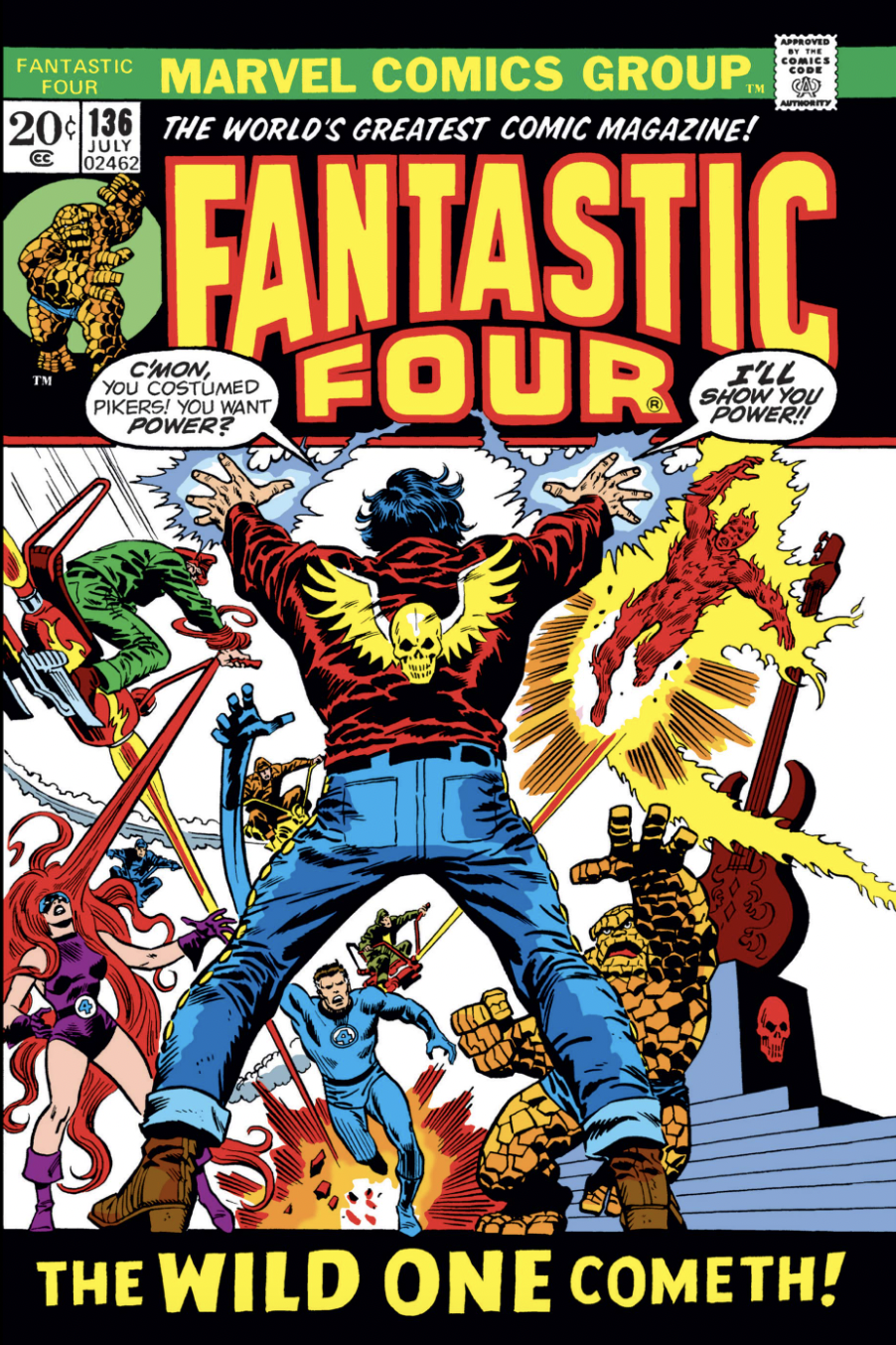
“The World’s Greatest Comic Magazine!” Fantastic Four No. 136

04 Thursday Jul 2024

Posted by percivalhenry in The World's Greatest Comic Magazine

≈ 1 Comment

Tags

1973, Fantastic Four, Fantastic Four 136, John Buscema, Marvel, marvel-comics, Roy Thomas

Fantastic Four 136
“Rock Around the Cosmos!”
Published April 1973
Plot: Roy Thomas
Script: Gerry Conway
Breakdowns: John Buscema
Finishes: Joe Sinnott
Letters: Artie Simek
Colors: Stan Goldberg
Editor: Thomas
Cover: Buscema and Frank Giacoia

Synopsis

In the aftermath of last issue’s battle, Slugger Johnson, a henchman of Gregory Godfrey who mourns for his lost youth in the 1950s, is imbued with atomic powers and identified by the Shaper of Worlds as a vehicle for its reality-bending visions. The Fantastic Four are then thrust into what appears to be a parallel universe oriented around 1950s culture, where youths battle elders, with Mr. Fantastic and the Thing on side and Medusa and the Human Torch on the other. Both pairs are brainwashed by rival camps and dispatched to retrieve a weapon from a mysterious figure called The Brain.


What’s going on here?

Where to begin? If there was proof that this was now Roy Thomas’s comic, look no further. A cynic might say this is what happens when a comic’s writer is also the editor, because this issue desperately needed editing.

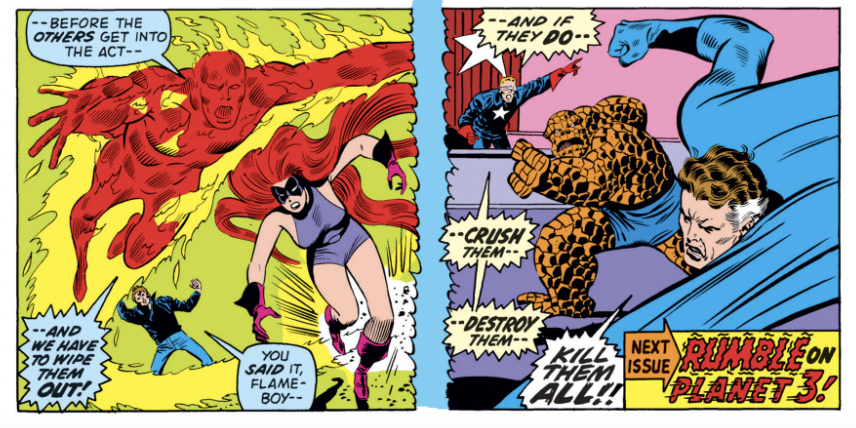
At its core, FF 136 is a multiverse story, a speciality of Thomas’s, who gave us the Squadron Supreme in the Avengers two years earlier, and who later would spin DC’s Earth 2 Justice Society into a multi-generational epic. Here, the alternate earth aspect isn’t mentioned explicitly, but it’s pretty obvious what’s going on, and the tag line previewing the next issue makes it clear.


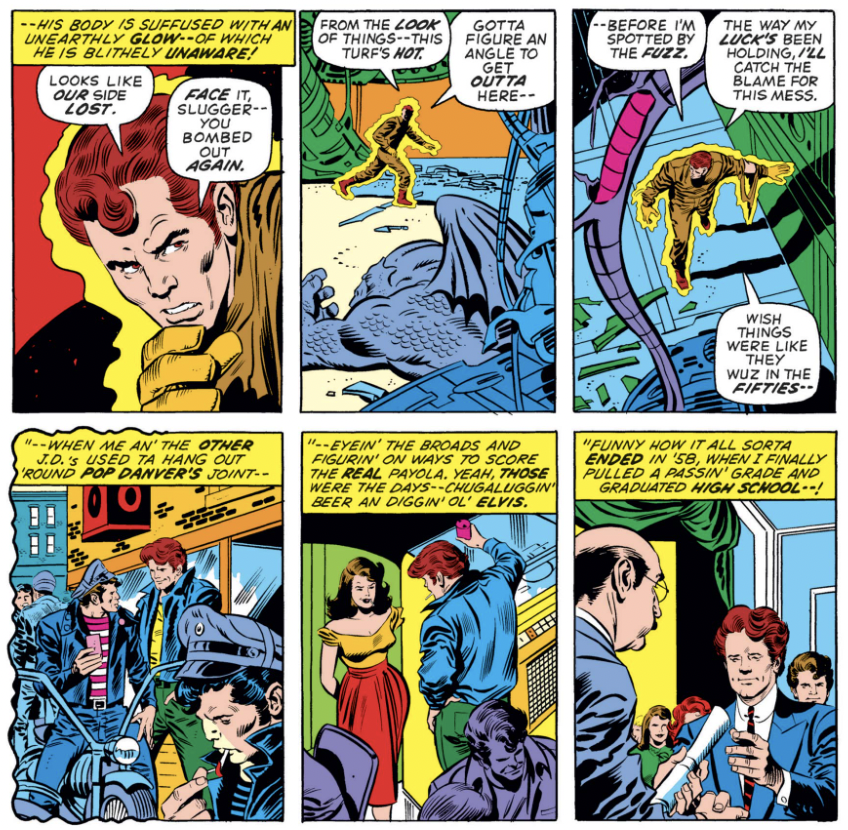
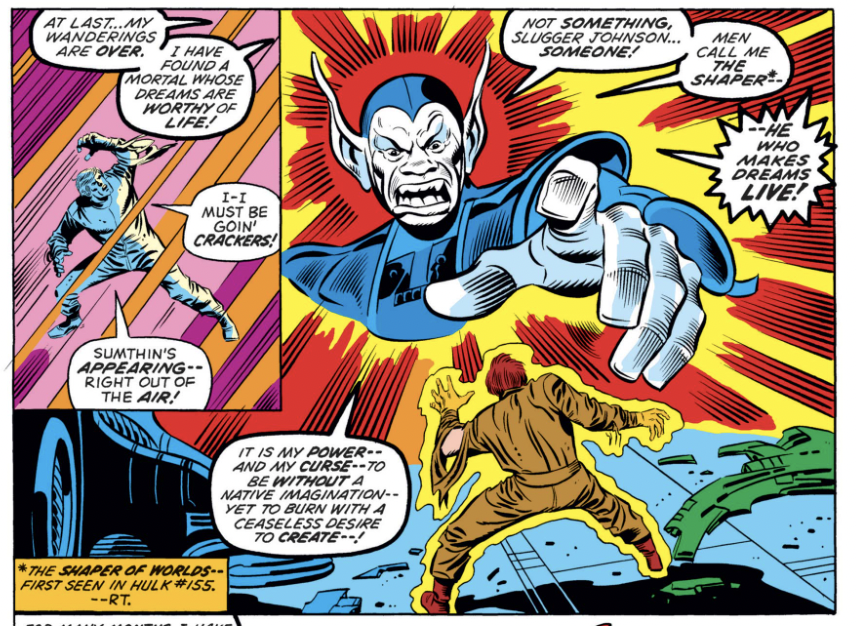
The defining nature of this alternate earth is that it is rooted in a caricatured vision of the 1950s, one drawn from the psyche for Slugger Johnson by the Shaper of Worlds. As we learn early on, Slugger really loved the 50s:


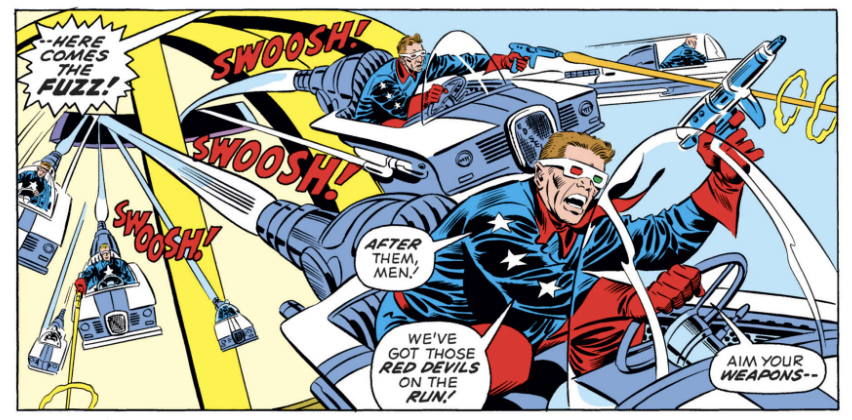
This painful 50s slang permeates the issue, and it seems clear that scripter Gerry Conway, who was born in 1952, learned it from watching B-movies on TV. What’s less clear is what lesson Thomas, who plotted the comics, wants us to draw from this extremely clumsy story. Is Thomas, born in 1940 and raised in the 50s, nostalgic for the era and its romanticized narratives of bikers rebellion and the birth of rock n’ roll? Or is he poking fun of that nostalgia? Is he using the excesses of the 50s youth culture to critique 60s youth culture? Is he hip? or is he square? Unfortunately, the story is so muddled it’s hard to know.

The presence of the Shaper of World’s is further evidence of the Thomasian drift of the Fantastic Four. Initially a Hulk villain created by Archie Goodwin the previous year, the Shaper is a Cosmic Cube brought to life by the Skrulls, and a character I know almost nothing about prior to this issue. But Thomas loves to play with characters from other comics, the more obscure the better, and a reality-bending cosmic creature is right up his alley. It’s fair to say Stan never would have dreamt of using it.


What I liked

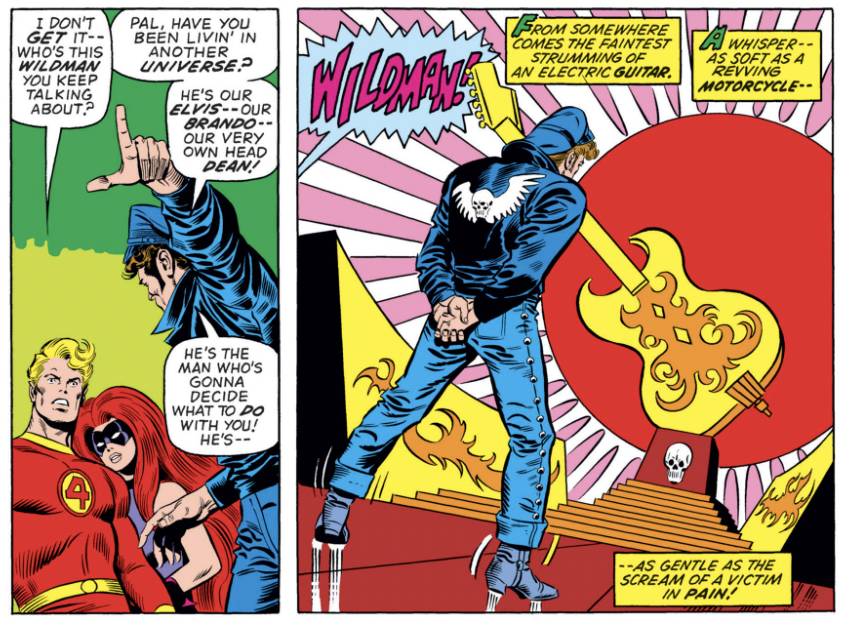
Despite its extreme goofiness, I admired how hard Thomas and Conway lean into the 50s conceit. Here is Slugger Johnson reintroduced as Wildman:


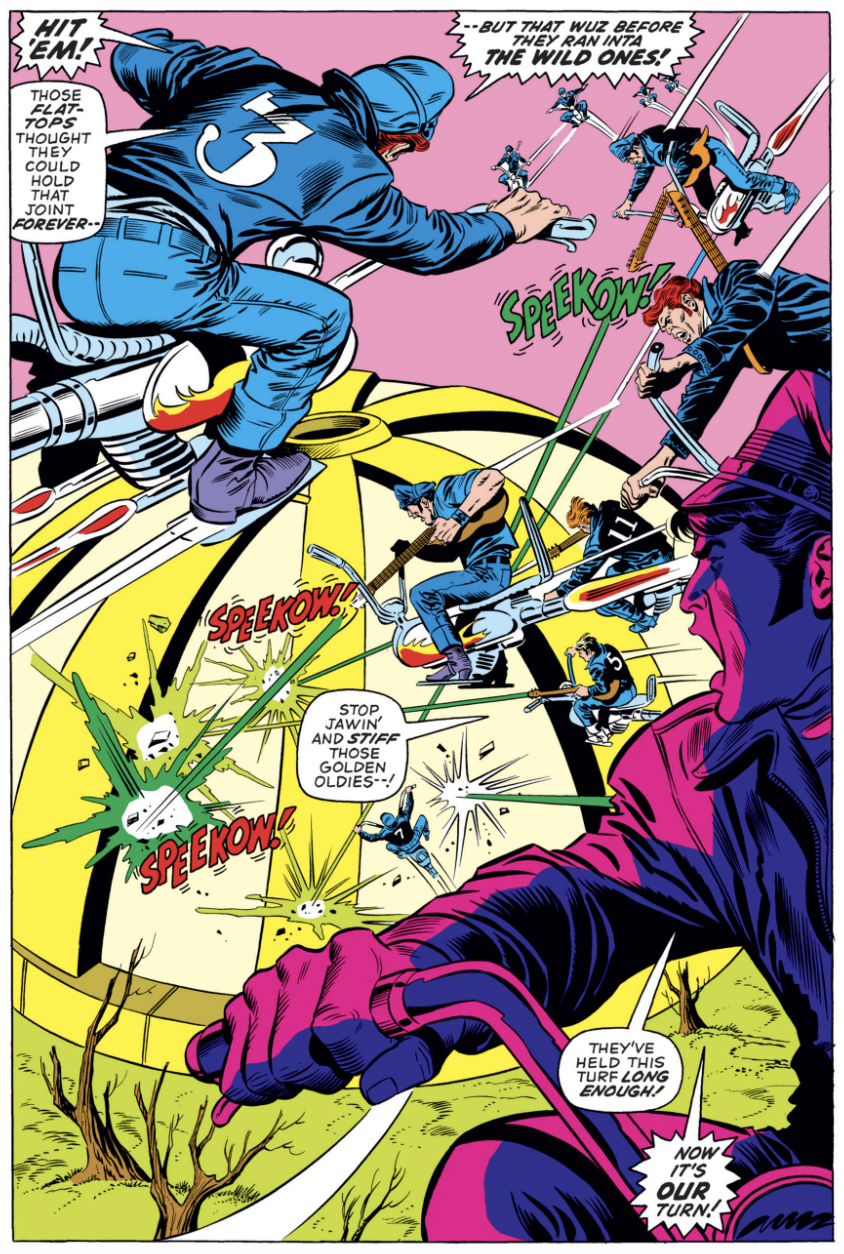
Buscema and Sinnott also deliver a socko splash page that introduces the 50s gangsters:


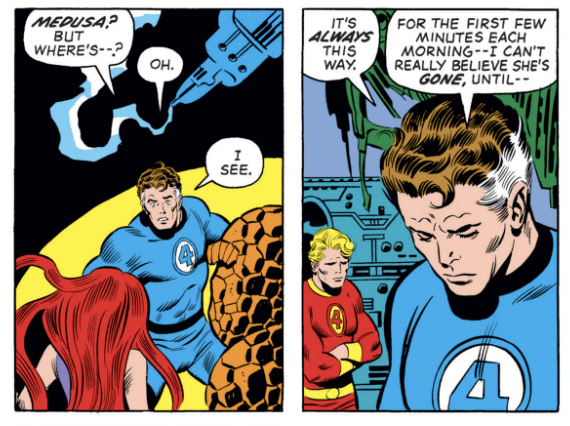
And before the silliness started, there was a touching sequence where Reed awakens from unconsciousness and imagines Medusa is Sue:


What I didn’t like

If it wasn’t obvious, this comic is an incoherent mess. The alternate earth plot is confusing and it’s never clear if Johnny and Medusa are in their right minds or not, since they attack Ben and Reed, then seem their normal selves. (And why is Medusa on the side of the youths? She’s a married Inhuman queen, hardly a teenager.)

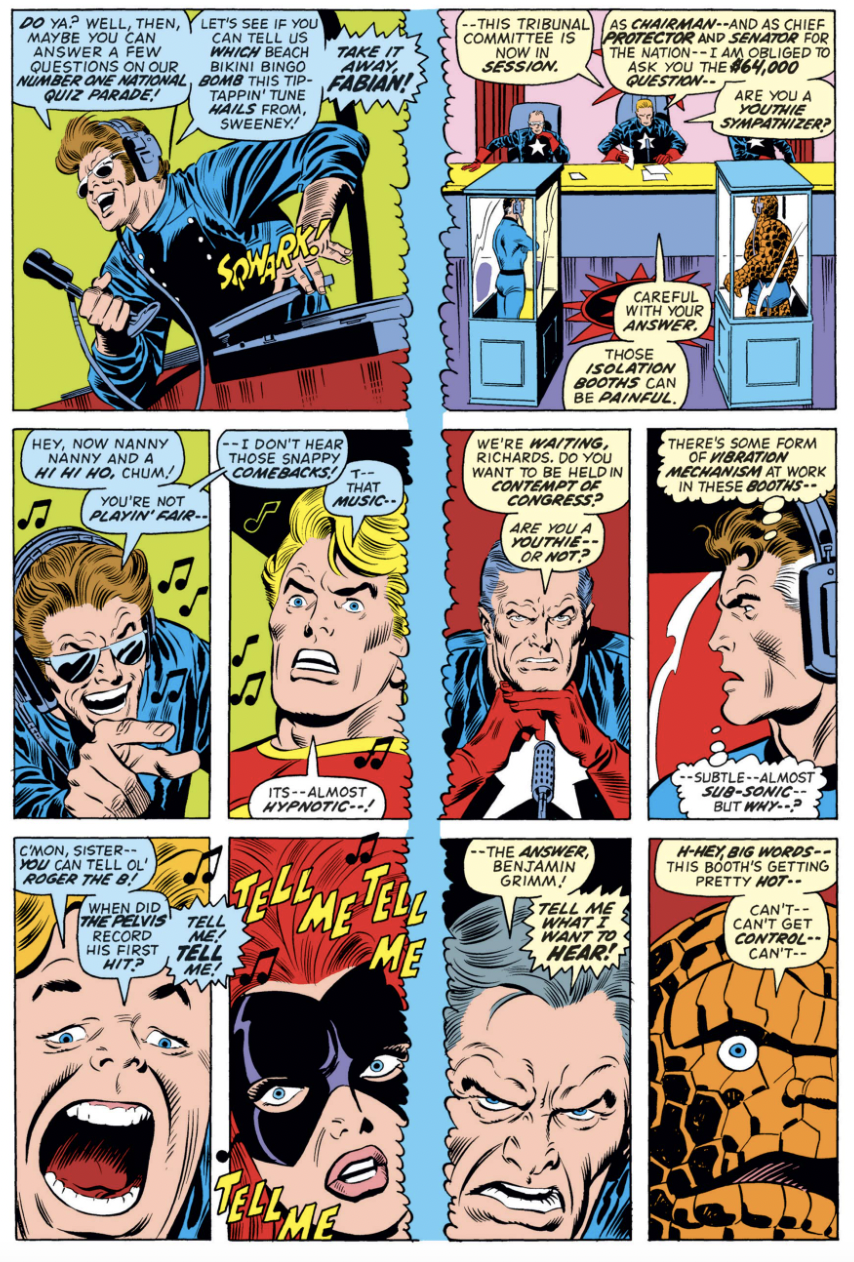
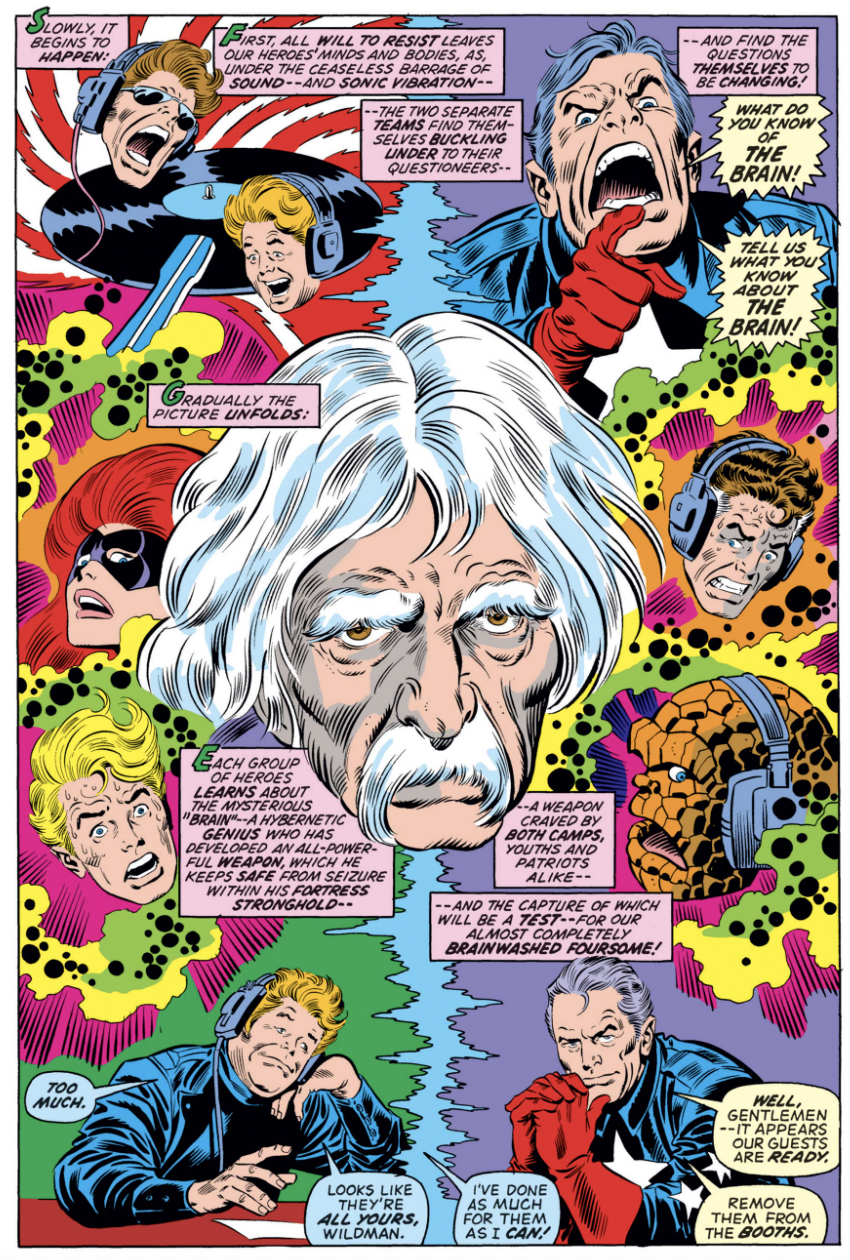
Then, instead of letting the jumbled story gel, Thomas and Conway shake it up again by introducing another character, The Brain, who we meet in this kaleidoscopic sequence:


I can’t imagine a kid picking up this comic as his or her first issue of the FF and making heads or tails of it.

Anything else?

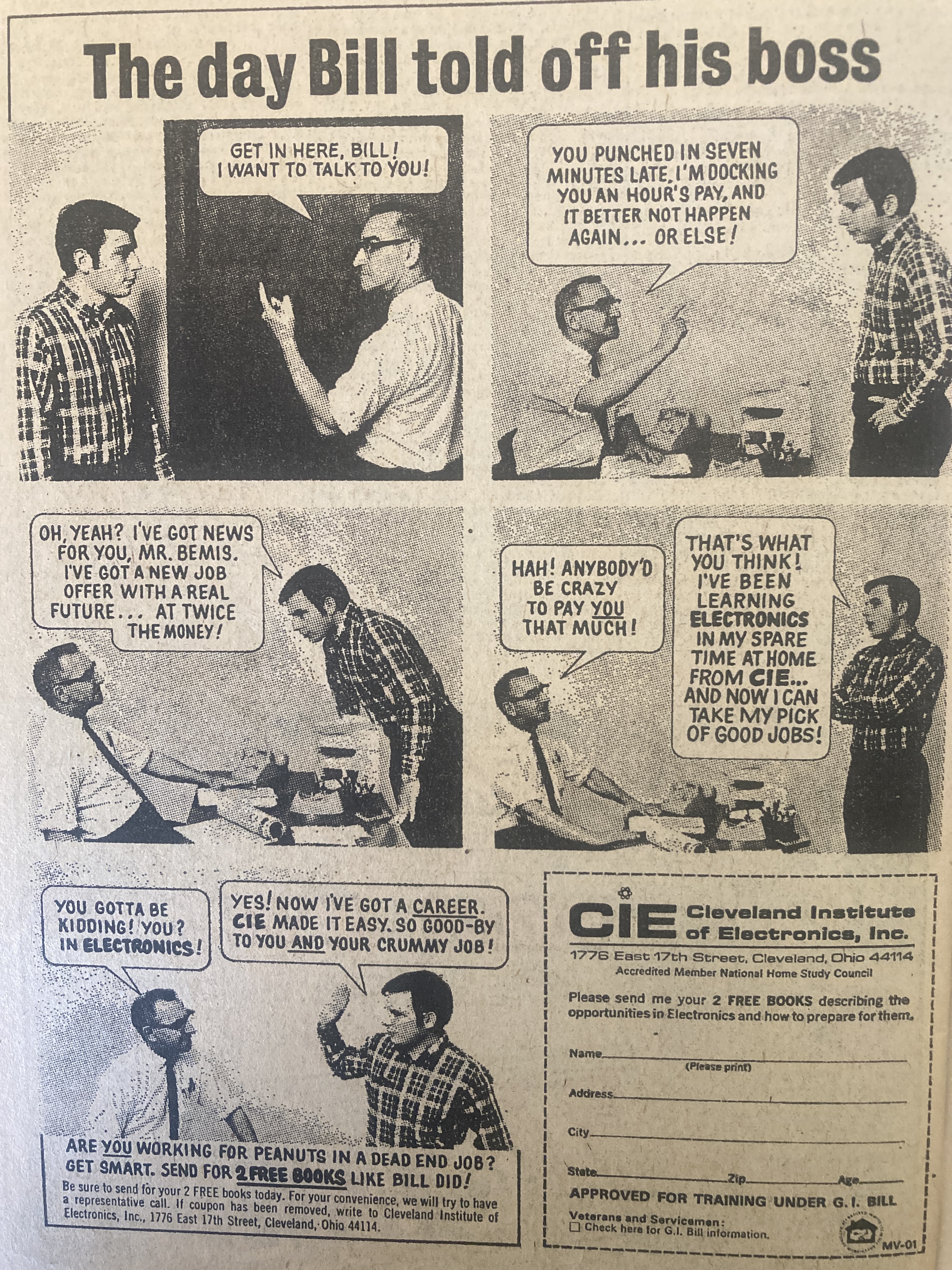
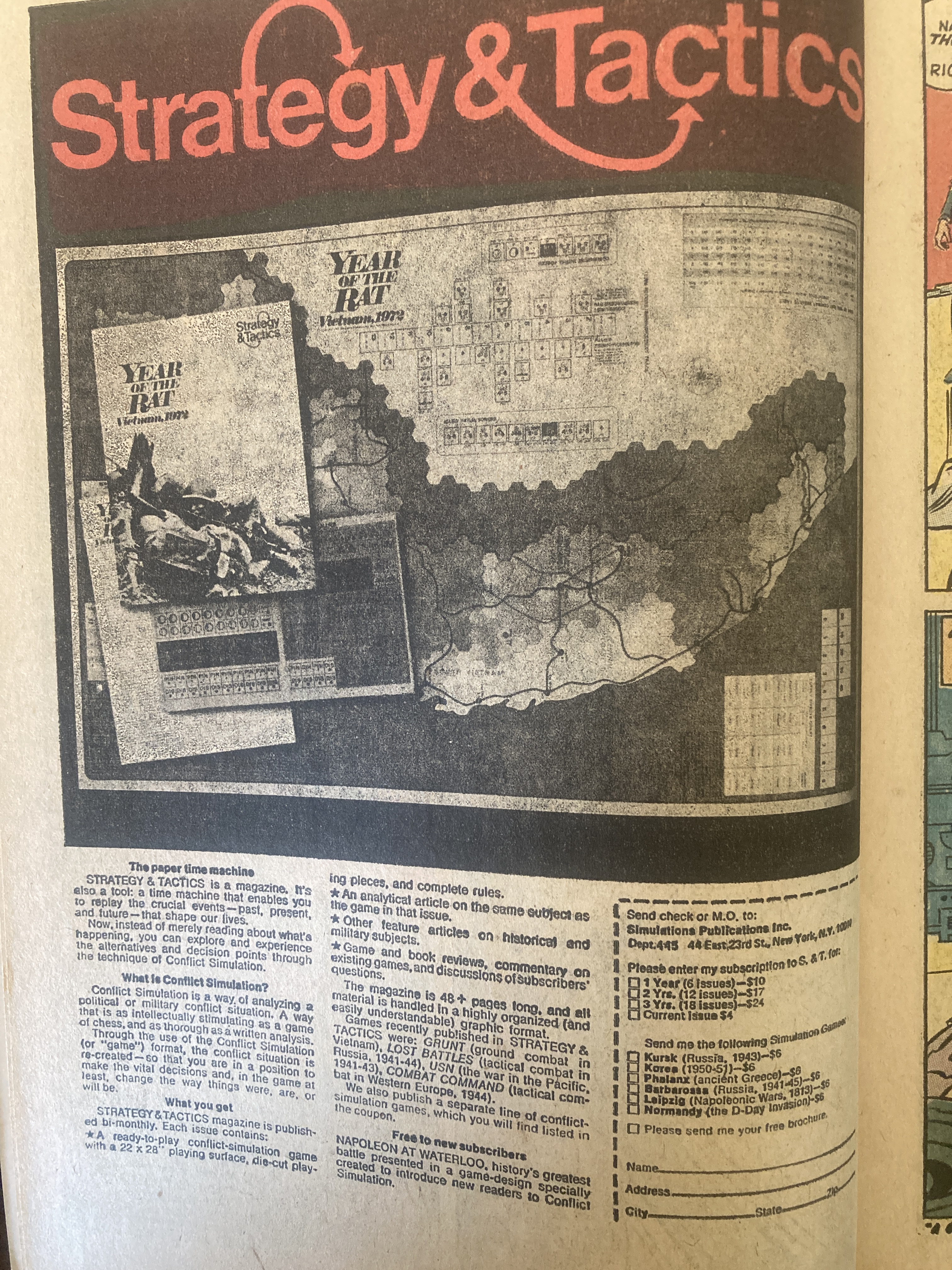
Some interesting ads in this issue. A fumetti-style ad for an anti-authoritarian trade school, and a pretty cool looking role playing magazine.


Overall

For Fantastic Four or Roy Thomas completionists only

“The World’s Greatest Comic Magazine!” Fantastic Four No. 132

01 Saturday Jun 2024

Posted by percivalhenry in The World's Greatest Comic Magazine

≈ Leave a comment

Tags

1972, Fantastic Four, Fantastic Four 132, Inhumans, John Buscema, Roy Thomas

Fantastic Four 132
“Omega: The Ultimate Enemy!”
Published December 1972
Writer: Roy Thomas
Pencils: John Buscema
Inks: Joe Sinnott
Letters: John Constanza
Colors: Petra Goldberg
Editor: Thomas
Cover: Jim Steranko and Frank Giacoia

Synopsis

The Fantastic Four (minus the Invisible Girl), Quicksilver and the Inhuman royal family confront the monstrous Omega, later revealed to be the personification of the Inhumans’ racial animus toward the Alpha Primitive underclass. The comic ends with Medusa joining the FF to replace Sue, and Johnny and Crystal breaking up.


What’s going on here

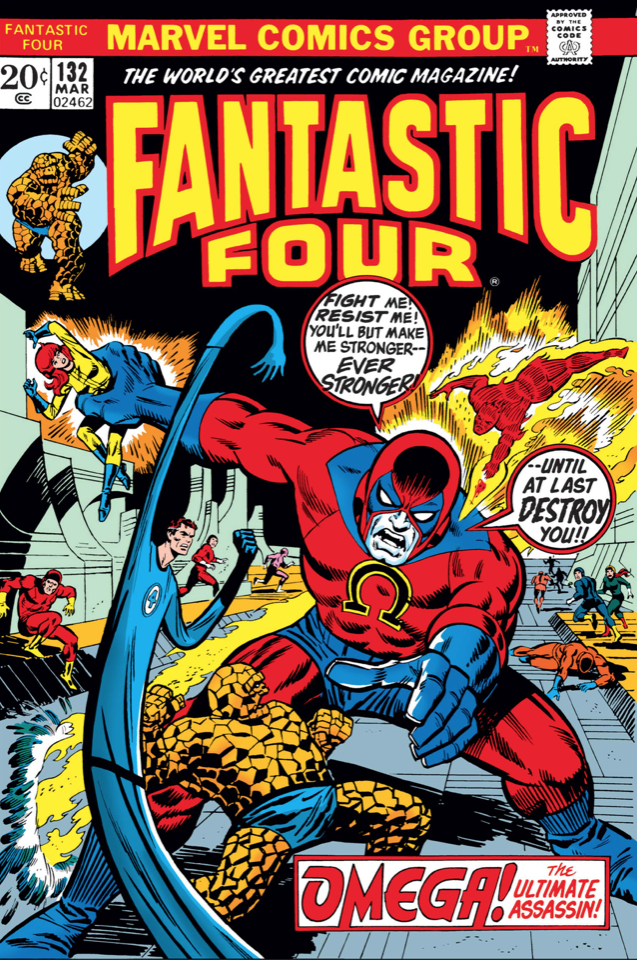
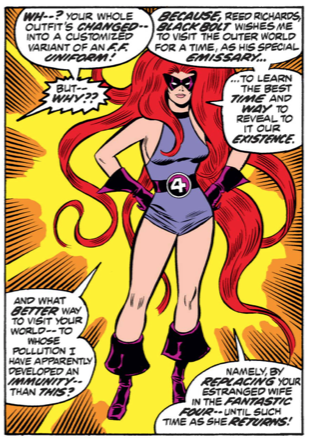
There’s a lot of action and angst in this comic, but the biggest developments come at the end. Medusa joins the team —or to be accurate, declares she is joining the team — in an arrangement that lasts more than 20 issues, a surprisingly long time. Again, it was another decision by Roy Thomas to shake up the status quo he inherited from Stan and inject some new dynamics into the team. Medusa also uses an Inhuman device to generate new costumes for herself and Johnny (Ben passes and when it’s aimed at Reed, nothing changes, which is mildly amusing).

The other major development is the official end of the romance between Crystal and Johnny after approximately 70 issues. Johnny’s obsession with Crystal frequently propelled his character and FF stories, to the point here it seems he had no other interests or character traits. Yet another example of Roy shedding the past for something new.

The cover was by Jim Steranko, with inks by Frank Giacoia, the last, and I think weakest, of the three covers he did to spell John Busecma.

There was also slight change to the interior art, flagged in a letters column an issue or two back: Instead of doing fun pencils, starting in this issue Buscema would be doing rough breakdowns, with Sinnott doing finishes. Since Sinnott had a pretty assertive inking style anyway, I’m not sure how much difference it makes. The change was made to give Buscema time to also draw Conan the Barbarian, giving him four regular books a month (the FF, Conan, Thor and a monster comic, which varied).

What I liked

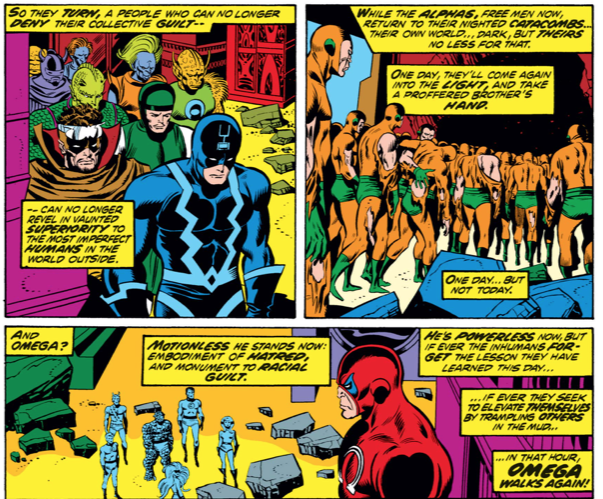
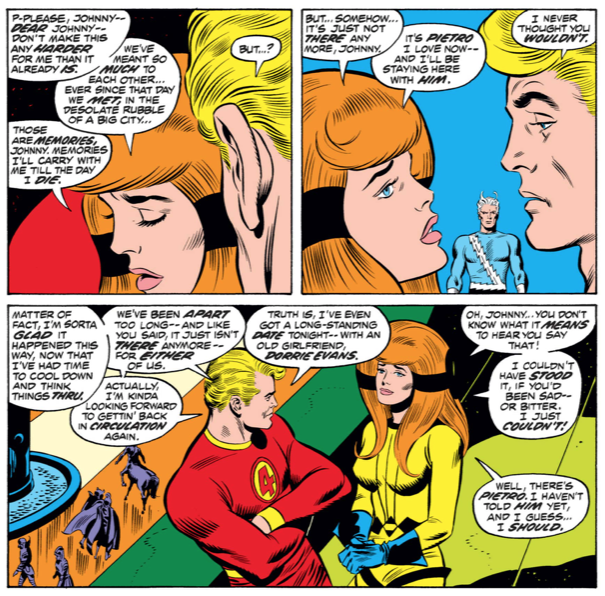
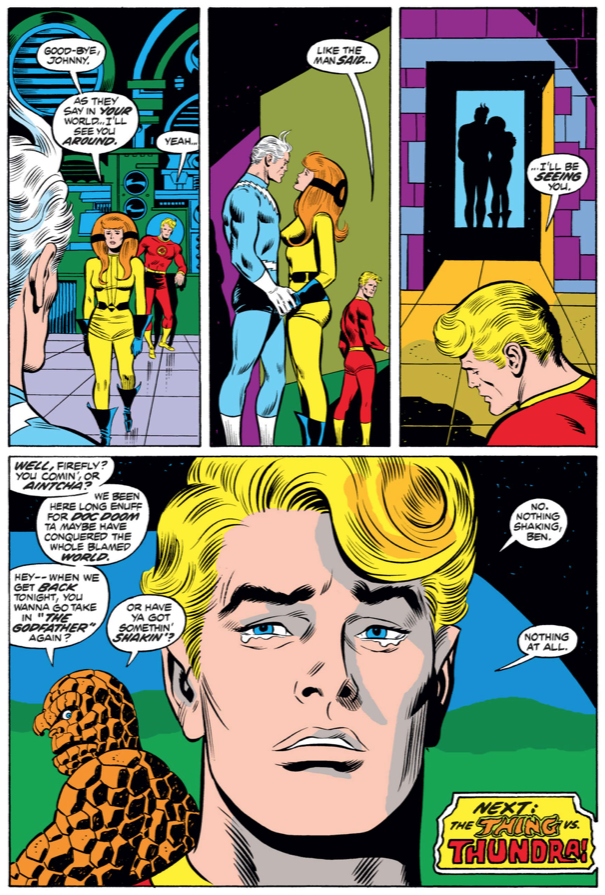
The break-up of Johnny and Crystal was handed with admirable subtlety. Johnny clearly got his anger out last issue, so by the time Crystal tells him its over, he puts on a brave face and even mentions rekindling things with long-forgotten Dorrie Evans. But the final panel says everything. All in all, a pretty mature ending to a significant relationship.


What I didn’t like

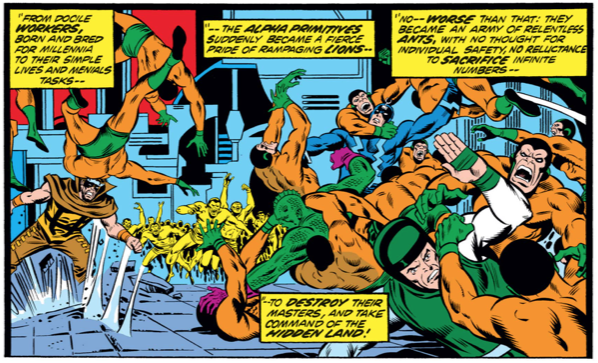
In my blog post dealing with the last issue, I took Roy to task for seemingly siding with the Inhumans in their fight to put down the revolt of the Alpha Primatives, their servant class. Given that Roy has skewered South Africa’s apartheid regime in issue 119, championing the oppressors seemed inconsistent at best.

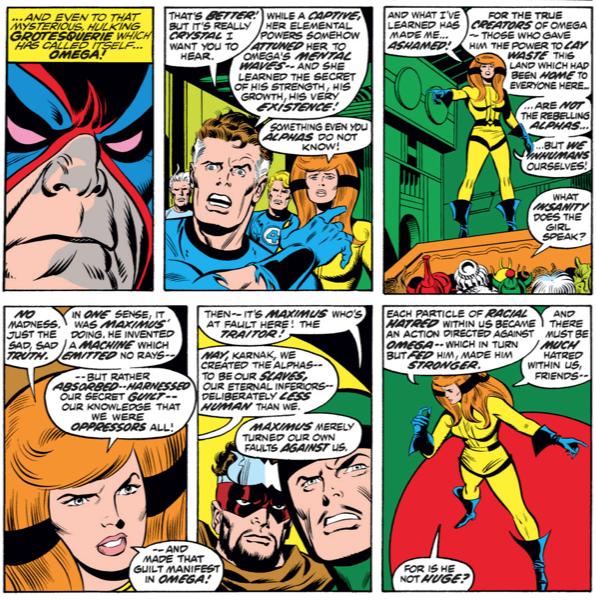
I should have given Roy more credit, because in the end, the Inhumans are shown the error of their ways. Omega, the villain, is powered by the Inhumans’ guilt and racial hatred — it’s not entirely clear which — toward the Alpha Primatives, channeled by a device constructed by Maximus the Mad. But while Roy’s sentiments are laudable, the effort feels ham-handed and falls flat.


First, leaving aside the implausibility of a machine that turns racial animosity into a living thing, Omega is designed just like a standard super villain, complete with a mask. There’s nothing about him or his powers that suggest his origin or purpose.

Secondly, Reed discovers the secret by eavesdropping on Maximus, who just happens to be ranting about his plan while leaning outside his window. It’s too convenient and not ingenious enough for Reed. And thirdly, of course Maximus is behind it all. If there’s an Inhumans’ story, Maximus is the bad guy. It’s predictable and boring.

Lastly, nothing seems to change. The Alpha Primatives return underground and the Inhumans go on being the superior race. Maybe we’ll learn more about how Inhuman society evolves in future comics but at the end of this issue, all that happens is that Inhumans feel a bit guilty.


Also, is there a word missing on the cover? “Until Last Destroy You?” I’m sure someone could win a No-Prize explaining that away.


Anything else?

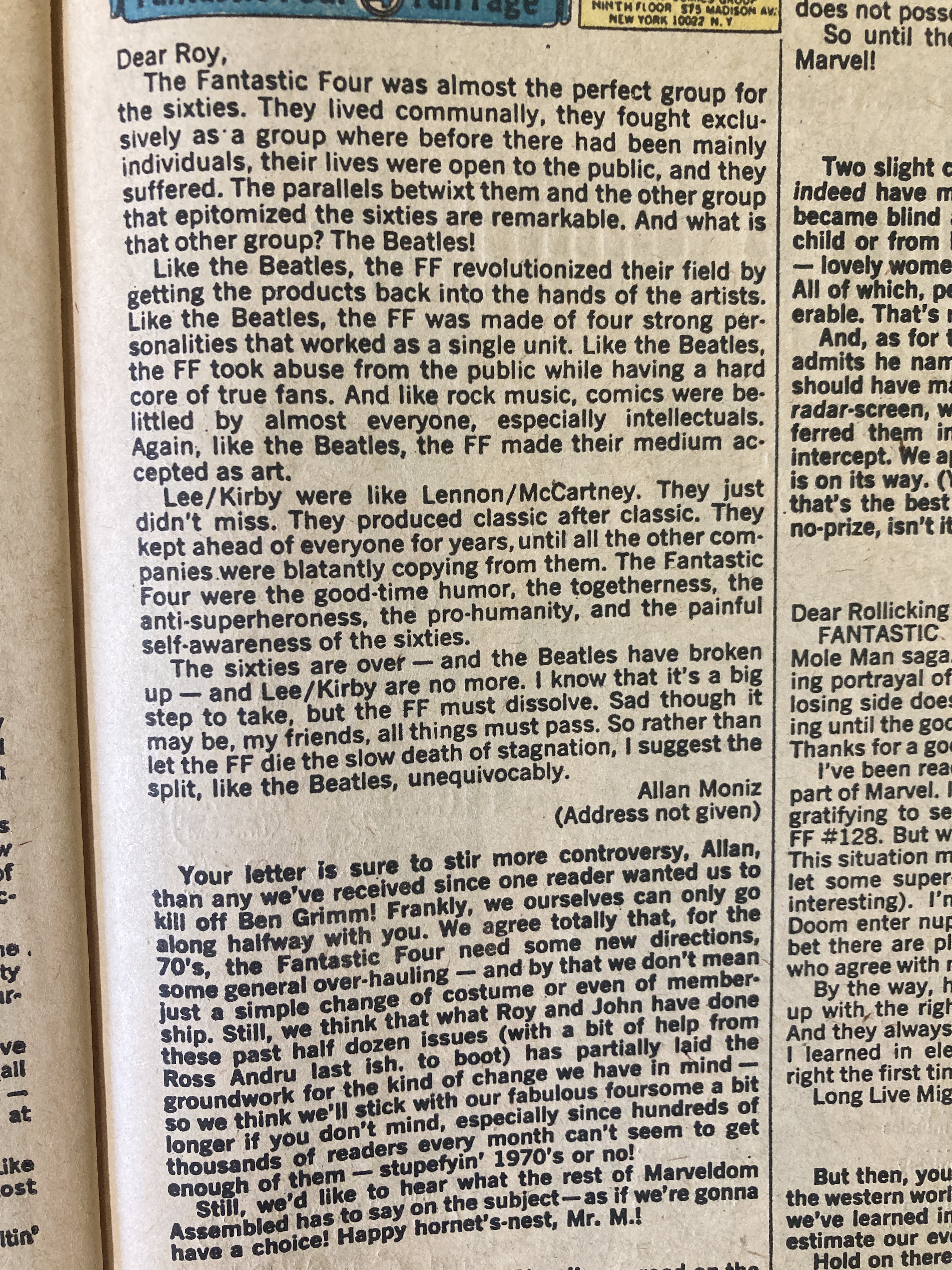
Fun letter comparing the FF to the Beatles. Who is Allen Klein in this analogy?


Overall

A valiant effort that falls short

← Older posts
Newer posts →
  • “The World’s Greatest Comic Magazine!” Fantastic Four Annual No. 15
  • “The World’s Greatest Comic Magazine!” Fantastic Four No. 223
  • “The World’s Greatest Comic Magazine!” Fantastic Four No. 222
  • “The World’s Greatest Comic Magazine!” Fantastic Four No. 221
  • “The World’s Greatest Comic Magazine!” Fantastic Four No. 220
  • July 2026
  • June 2026
  • May 2026
  • April 2026
  • March 2026
  • February 2026
  • January 2026
  • December 2025
  • November 2025
  • October 2025
  • September 2025
  • August 2025
  • July 2025
  • June 2025
  • May 2025
  • April 2025
  • March 2025
  • February 2025
  • January 2025
  • December 2024
  • November 2024
  • October 2024
  • September 2024
  • August 2024
  • July 2024
  • June 2024
  • May 2024
  • April 2024
  • March 2024
  • February 2024
  • January 2024
  • December 2023
  • November 2023
  • September 2023
  • July 2023
  • June 2023
  • May 2023
  • April 2023
  • March 2023
  • February 2023
  • January 2023
  • December 2022
  • November 2022
  • October 2022
  • September 2022
  • August 2022
  • July 2022
  • June 2022
  • May 2022
  • April 2022
  • March 2022
  • February 2022
  • January 2022
  • December 2021
  • November 2021
  • October 2021
  • September 2021
  • August 2021
  • July 2021
  • June 2021
  • May 2021
  • April 2021
  • March 2021
  • February 2021
  • January 2021
  • December 2020
  • February 2018
  • May 2016
  • February 2016
  • January 2016
  • December 2015
  • November 2015
  • October 2015
  • September 2015
  • August 2015
  • July 2015
  • April 2015
  • March 2015
  • January 2015
  • December 2014
  • November 2014
  • October 2014
  • September 2014
  • August 2014
  • June 2014
  • May 2014
  • April 2014
  • March 2014
  • February 2014
  • July 2026
  • June 2026
  • May 2026
  • April 2026
  • March 2026
  • February 2026
  • January 2026
  • December 2025
  • November 2025
  • October 2025
  • September 2025
  • August 2025
  • July 2025
  • June 2025
  • May 2025
  • April 2025
  • March 2025
  • February 2025
  • January 2025
  • December 2024
  • November 2024
  • October 2024
  • September 2024
  • August 2024
  • July 2024
  • June 2024
  • May 2024
  • April 2024
  • March 2024
  • February 2024
  • January 2024
  • December 2023
  • November 2023
  • September 2023
  • July 2023
  • June 2023
  • May 2023
  • April 2023
  • March 2023
  • February 2023
  • January 2023
  • December 2022
  • November 2022
  • October 2022
  • September 2022
  • August 2022
  • July 2022
  • June 2022
  • May 2022
  • April 2022
  • March 2022
  • February 2022
  • January 2022
  • December 2021
  • November 2021
  • October 2021
  • September 2021
  • August 2021
  • July 2021
  • June 2021
  • May 2021
  • April 2021
  • March 2021
  • February 2021
  • January 2021
  • December 2020
  • February 2018
  • May 2016
  • February 2016
  • January 2016
  • December 2015
  • November 2015
  • October 2015
  • September 2015
  • August 2015
  • July 2015
  • April 2015
  • March 2015
  • January 2015
  • December 2014
  • November 2014
  • October 2014
  • September 2014
  • August 2014
  • June 2014
  • May 2014
  • April 2014
  • March 2014
  • February 2014
“The World’s Greatest Comic Magazine!” Fantastic Four Annual No. 15

“The World’s Greatest Comic Magazine!” Fantastic Four Annual No. 15

percivalhenry's avatar by percivalhenry July 18, 2026
“The World’s Greatest Comic Magazine!” Fantastic Four No. 223

“The World’s Greatest Comic Magazine!” Fantastic Four No. 223

percivalhenry's avatar by percivalhenry July 14, 2026
“The World’s Greatest Comic Magazine!” Fantastic Four No. 222

“The World’s Greatest Comic Magazine!” Fantastic Four No. 222

percivalhenry's avatar by percivalhenry July 5, 2026
“The World’s Greatest Comic Magazine!” Fantastic Four No. 221

“The World’s Greatest Comic Magazine!” Fantastic Four No. 221

percivalhenry's avatar by percivalhenry June 25, 2026
“The World’s Greatest Comic Magazine!” Fantastic Four No. 220

“The World’s Greatest Comic Magazine!” Fantastic Four No. 220

percivalhenry's avatar by percivalhenry June 15, 2026
“The World’s Greatest Comic Magazine!” Fantastic Four No. 219

“The World’s Greatest Comic Magazine!” Fantastic Four No. 219

percivalhenry's avatar by percivalhenry June 7, 2026

Blog at WordPress.com.

  • Subscribe Subscribed
    • Percival Henry: The Fantastic Four and more
    • Join 74 other subscribers
    • Already have a WordPress.com account? Log in now.
    • Percival Henry: The Fantastic Four and more
    • Subscribe Subscribed
    • Sign up
    • Log in
    • Report this content
    • View site in Reader
    • Manage subscriptions
    • Collapse this bar
Loading Comments...