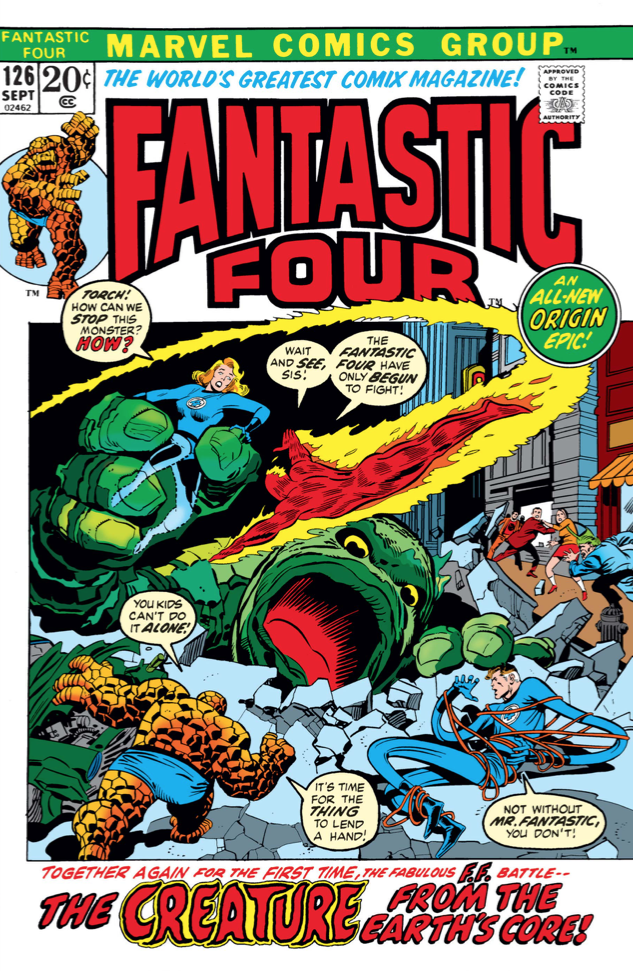
• About Percival Henry

Percival Henry: The Fantastic Four and more

~ Blogging the Fantastic Four issue by issue (plus whatever else grabs my attention)

Percival Henry: The Fantastic Four and more

Author Archives: percivalhenry

“The World’s Greatest Comic Magazine!” Fantastic Four No. 116

12 Monday Feb 2024

Posted by percivalhenry in The World's Greatest Comic Magazine

≈ Leave a comment

Tags

Dr. Doom, Fantastic Four, Fantastic Four 116, John Buscema, Over-mind, Stan Lee

Fantastic Four 116
“The Alien, the Ally and .. Armageddon!”
Published: Aug. 1971
Writer: Archie Goodwin
Pencils: John Buscema
Inks: Joe Sinnott
Letters: Artie Simek
Editor: Stan Lee
Cover Buscema and Sinnott

Synopsis

After the Thing and Human Torch are defeated by the Over-Mind, the Invisible Girl recruits Dr. Doom to the fight. They are overmatched, but when all seems lost, the Stranger appears to save the day.


What’s going on here?

This is a big issue, so let’s get to it!

First, this is literally a big comic: it’s 48 pages long, the first issue of the FF that’s longer than normal (not counting annuals). According to the Bullpen Bulletins, this is in honor of the 10th anniversary of the creation of the Marvel Universe (marked by the 1961 publication of Fantastic Four 1) and all Marvel comics this month are extra-sized (a quick scan confirms this to be true). The price is also bumped up, to 25 cents from 15 cents, and while the comics return to normal size after this month, the price stays elevated, at 20 cents. Sneaky!

Second, this a very good comic. It’s not great, for reasons I will get to, but it definitely justifies it’s extra length. Yes, the story wraps up the Over-Mind arc, which has been perculating for four issues now, but story-wise, the biggest development is Sue’s recruitment of Doom as an ally. In so doing, it fundamentally changed the FF’s relationship with Doom.

Readers of the Fantastic Four today are accustomed to Doom as a frenemy of the FF. In recent years he’s become a de facto uncle to Reed and Sue’s daughter, Valeria (after serving as her midwife), he came to their aid to help repulse an attack of Mad celestials, and the FF were invited to Doom’s wedding. Doom also had a run of trying to be a good guy. But for readers in 1972, who only knew Doom as a fiendish villain, this must have come as a shock. The depiction of Doom here reveals his courage and sense of honor, and provides a much richer, nuanced version of the character.
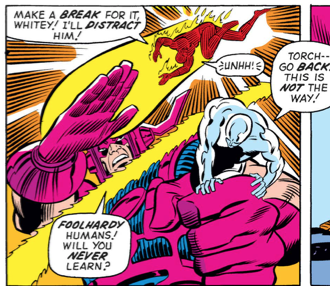
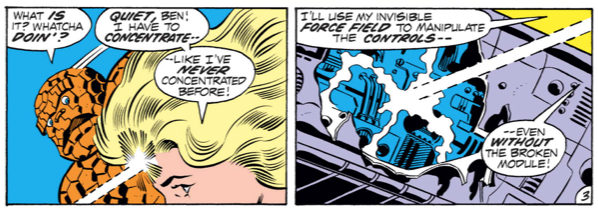
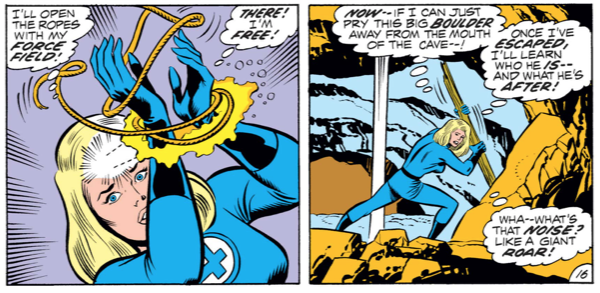
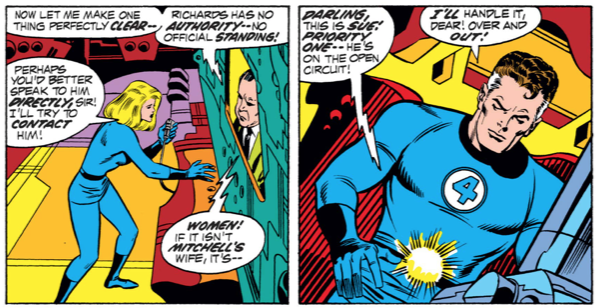
As written by Goodwin, Sue’s manipulation of Doom here is masterful, and I love Buscema’s shot of Sue turning her back. This whole sequence is perfect.

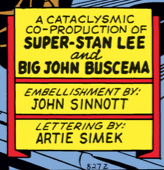
Lastly, it’s significant that Stan is credited here as “editor.” It’s the first time there has been an editor credit for the FF and to my reading it symbolizes Stan’s new, elevated status. Yes, he will come back to write, but adopting the title of editor implies a more detached, supervisory role.


What I liked

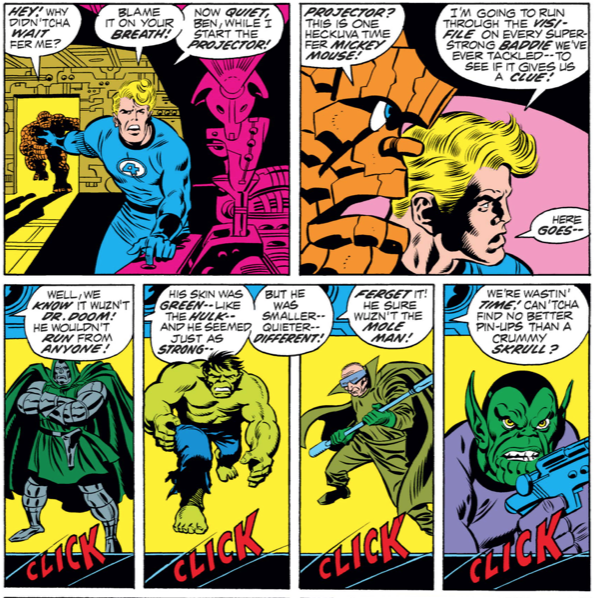
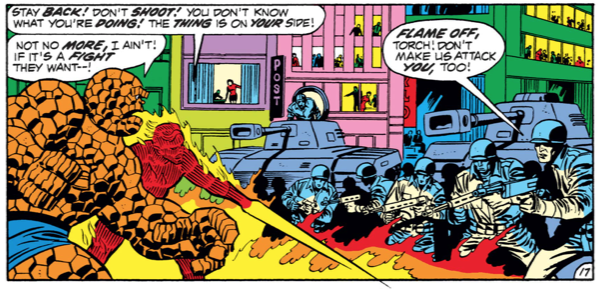
There’s a lot to like in this comic. Along with the aforementioned Doom plot, the story is well-paced and structured, with action sequences balanced by scenes of Sue’s agonizing and Ben and Johnny searching for Reed. Too often we see the two fighting or bickering; it’s refreshing to see them working as friends and teammates (plus, I love that last panel).

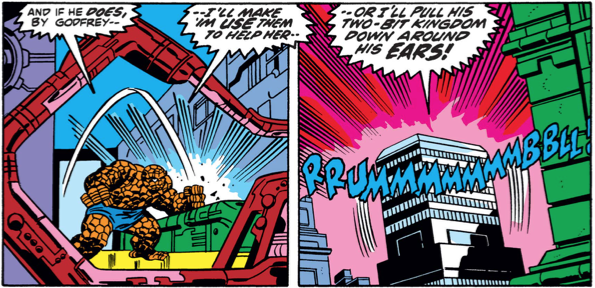
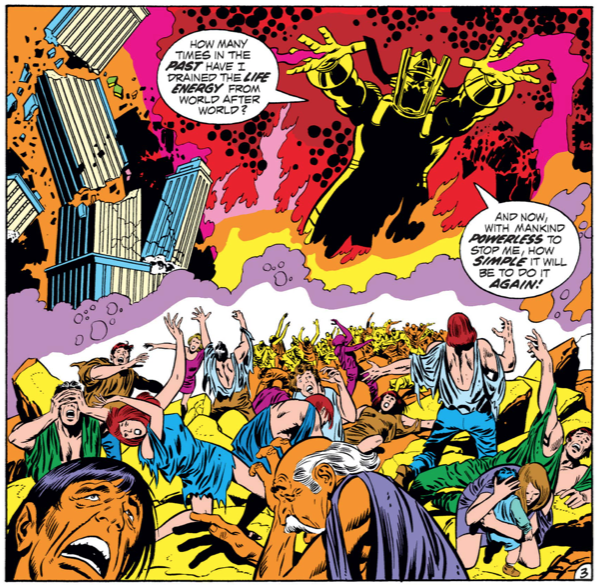
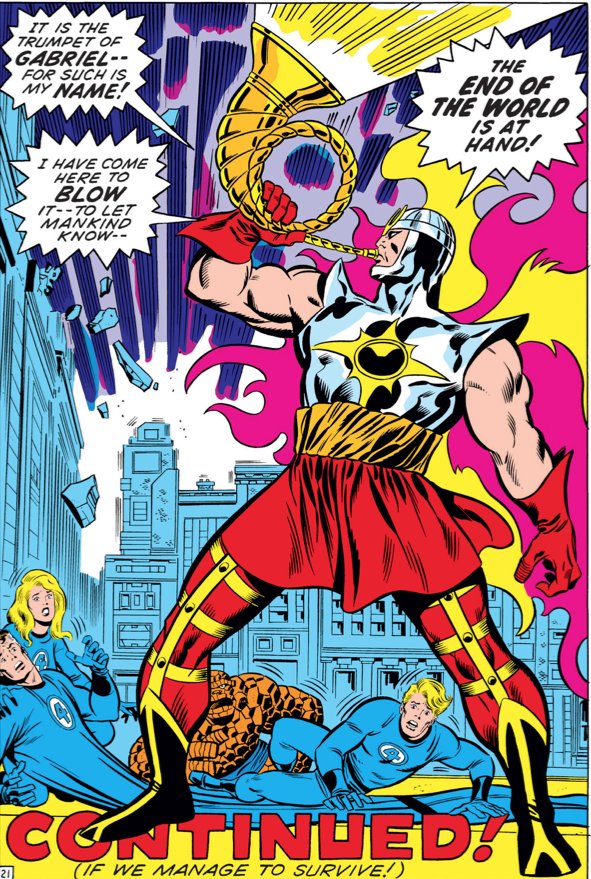
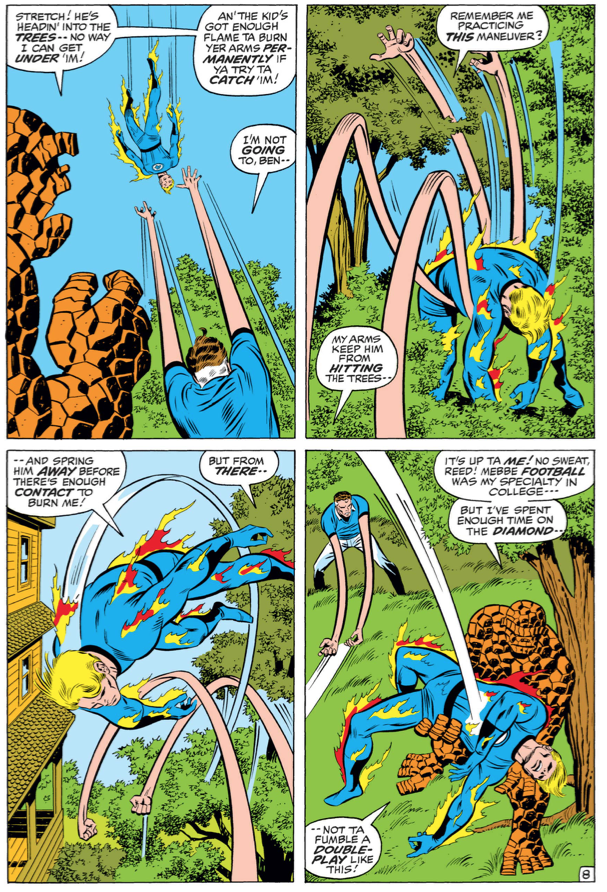
The comic’s extra length allows Buscema to stretch out, and we get some big panels and splash pages that befit the big action. Here’s a good one:

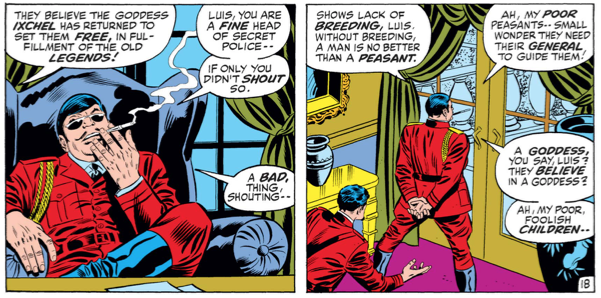
We also get some great insults from the Over-Mind, who’s superior intellect clearly gives him a way with words. Along with the above — “gross bumbling insects!” — check out the following:


What I didn’t like

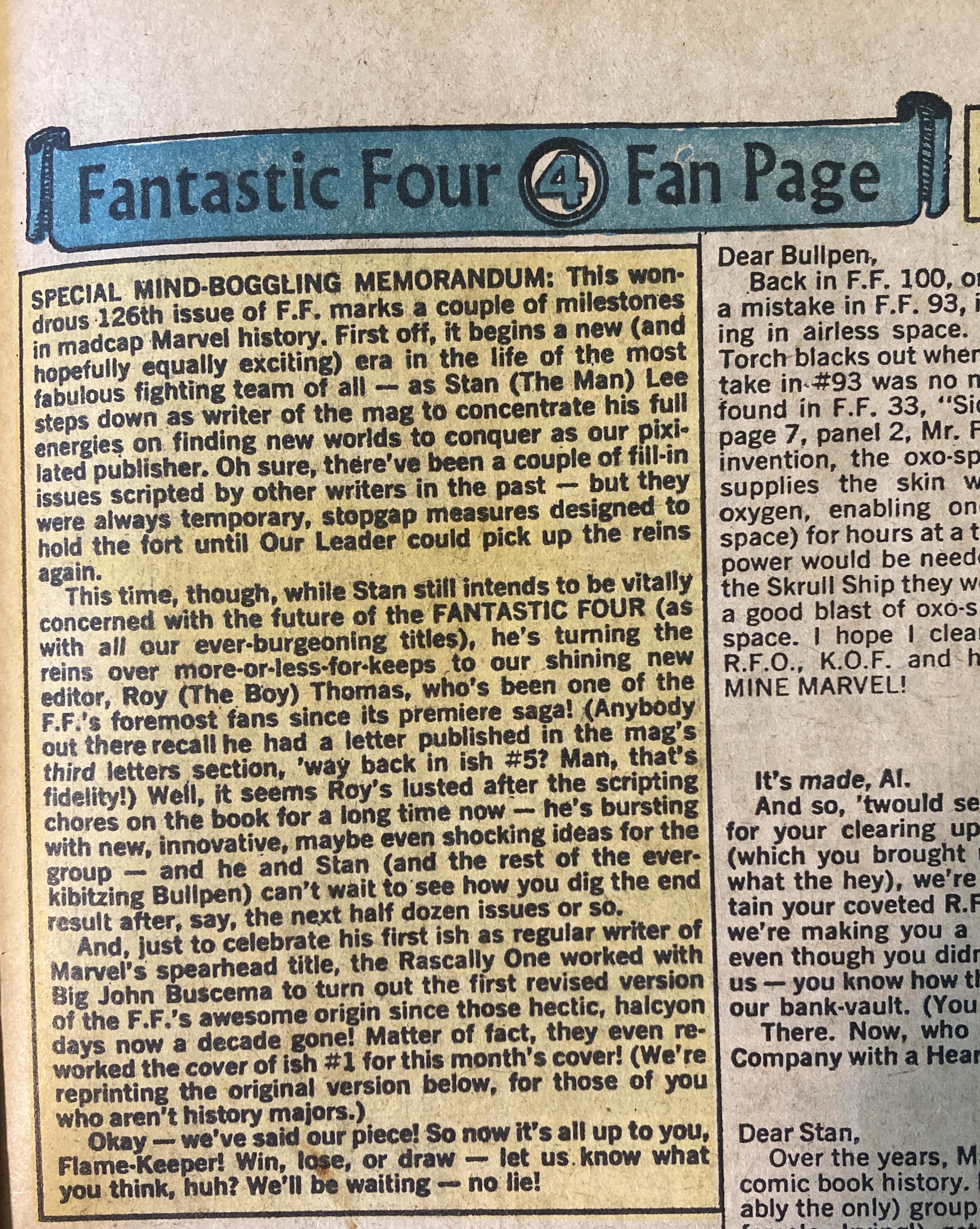
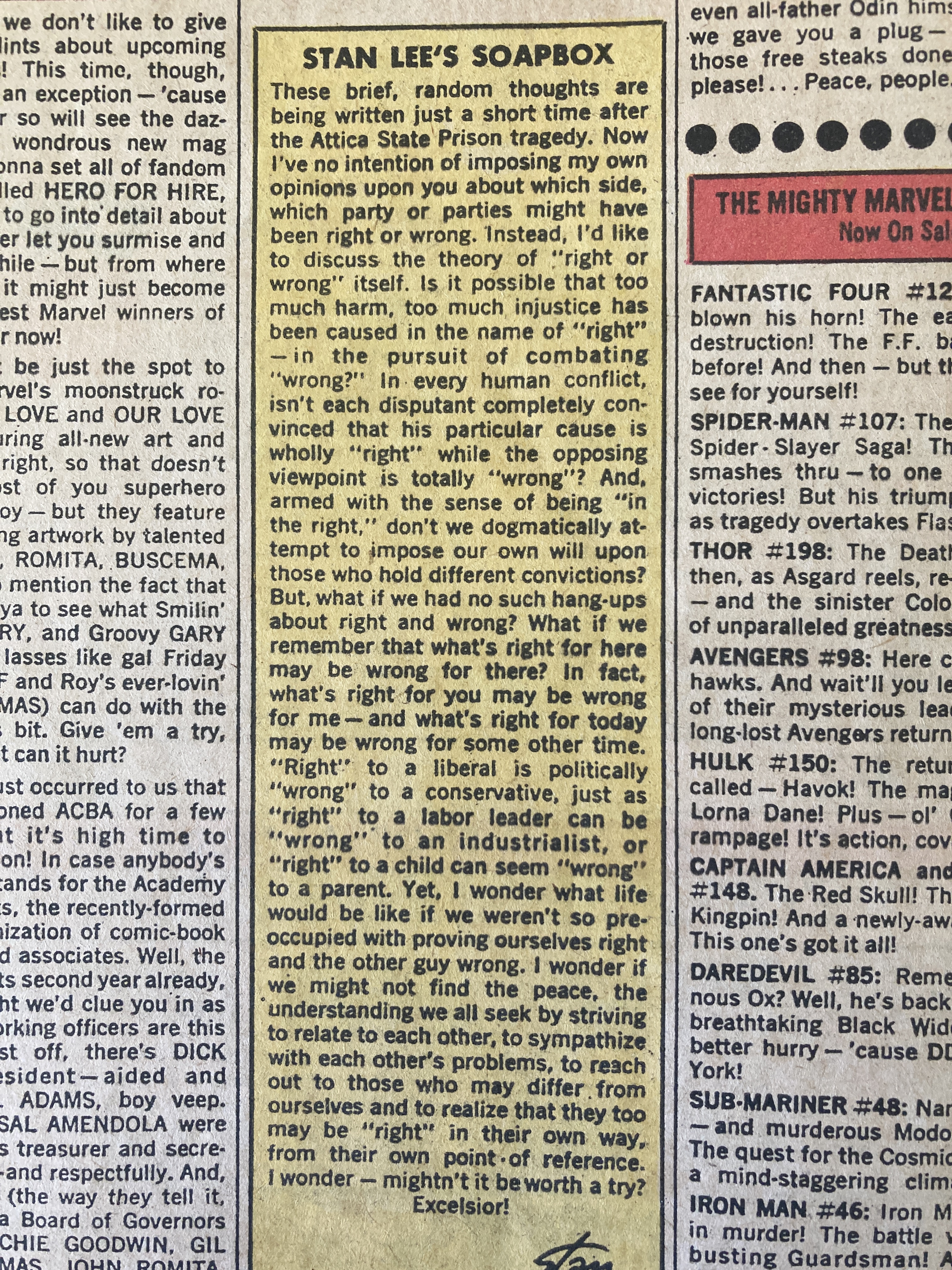
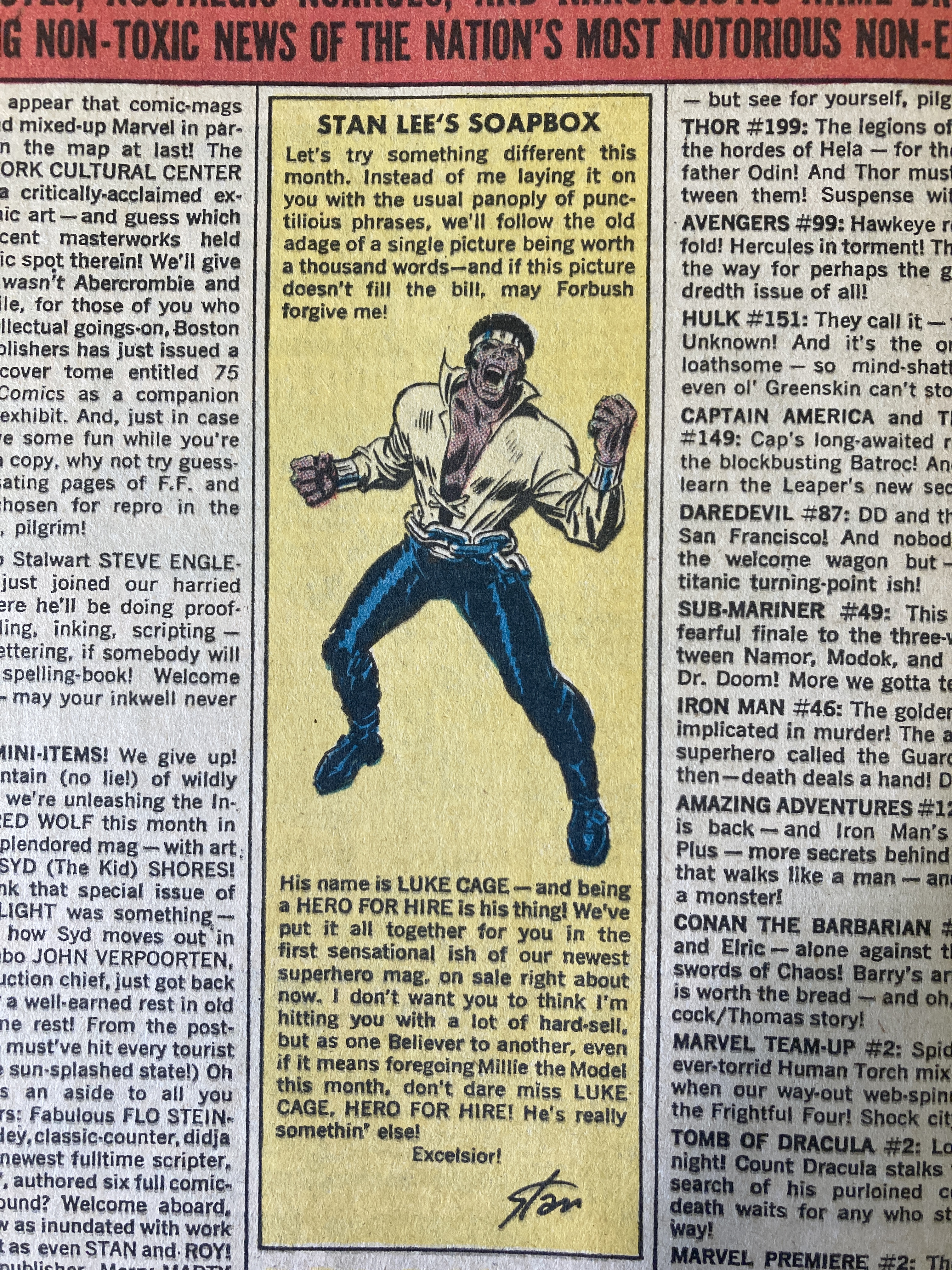
The comic’s big flaw, and what make it ineligible to considered a great story, is the bizarre, deus ex machina appearance of the Stranger at the end to defeat the Over-Mind. While the character had been in a few other comics since his introduction in X-Men 11, this is his first time in a Fantastic Four comic, and readers could understandably be puzzled about who he was. Stan’s note doesn’t exactly help:

The Stranger explains that, just as the Over-Mind represents the sum of a billion minds from his planet, he is the collection of a billion minds from Gigantus, another, bigger planet, and is therefore more powerful. He reduces the Over-Mind to tiny size, in essence exiling him to the microverse.

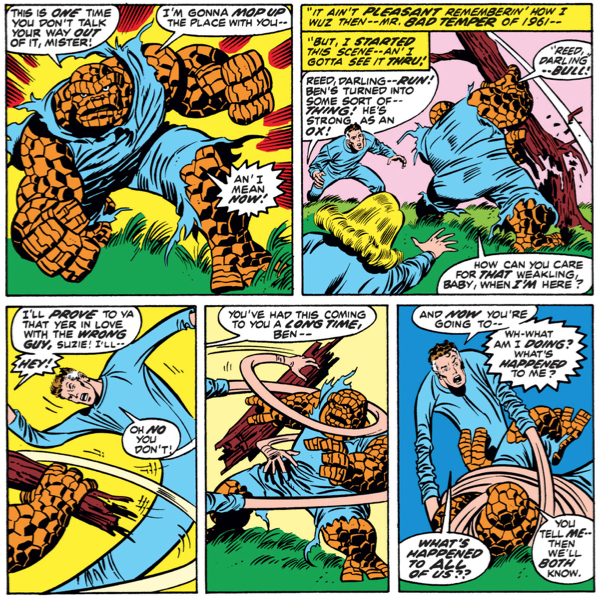
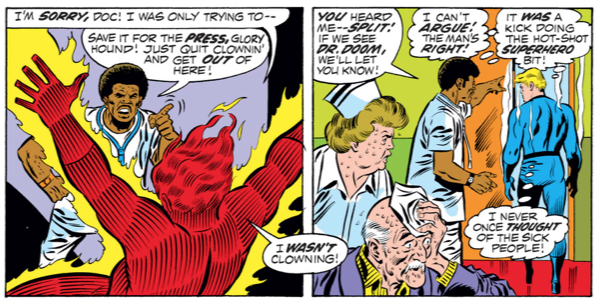
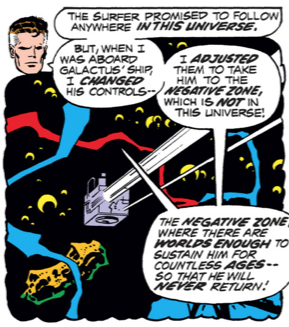
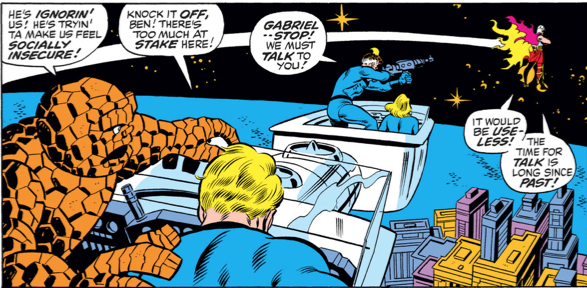
From a story-telling perspective, this denouement makes little sense, and readers no doubt felt cheated that in a story where the FF and Doom teamed up to defeat the ultimate threat, they had little to do with the outcome. Perhaps anticipating their frustration—or perhaps critiquing a plot handed to him by Stan—Goodwin lets the Torch vocalize how silly this all seems:


Also, this issue marks the beginning of a new cover format, where the art is reduced to about two-thirds of the cover. It looks terrible but fortunately only lasts about 20 issues.

Anything else?

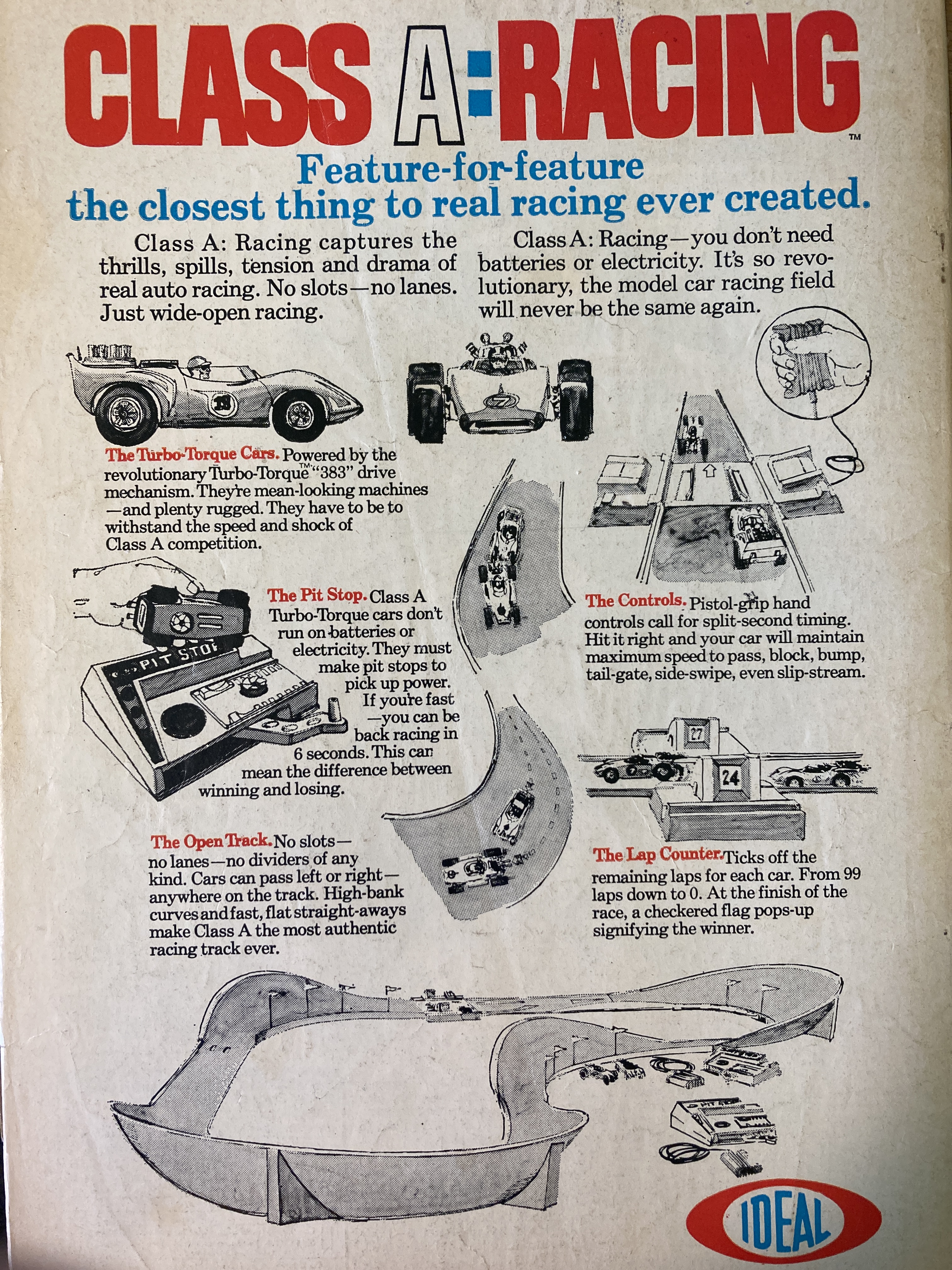
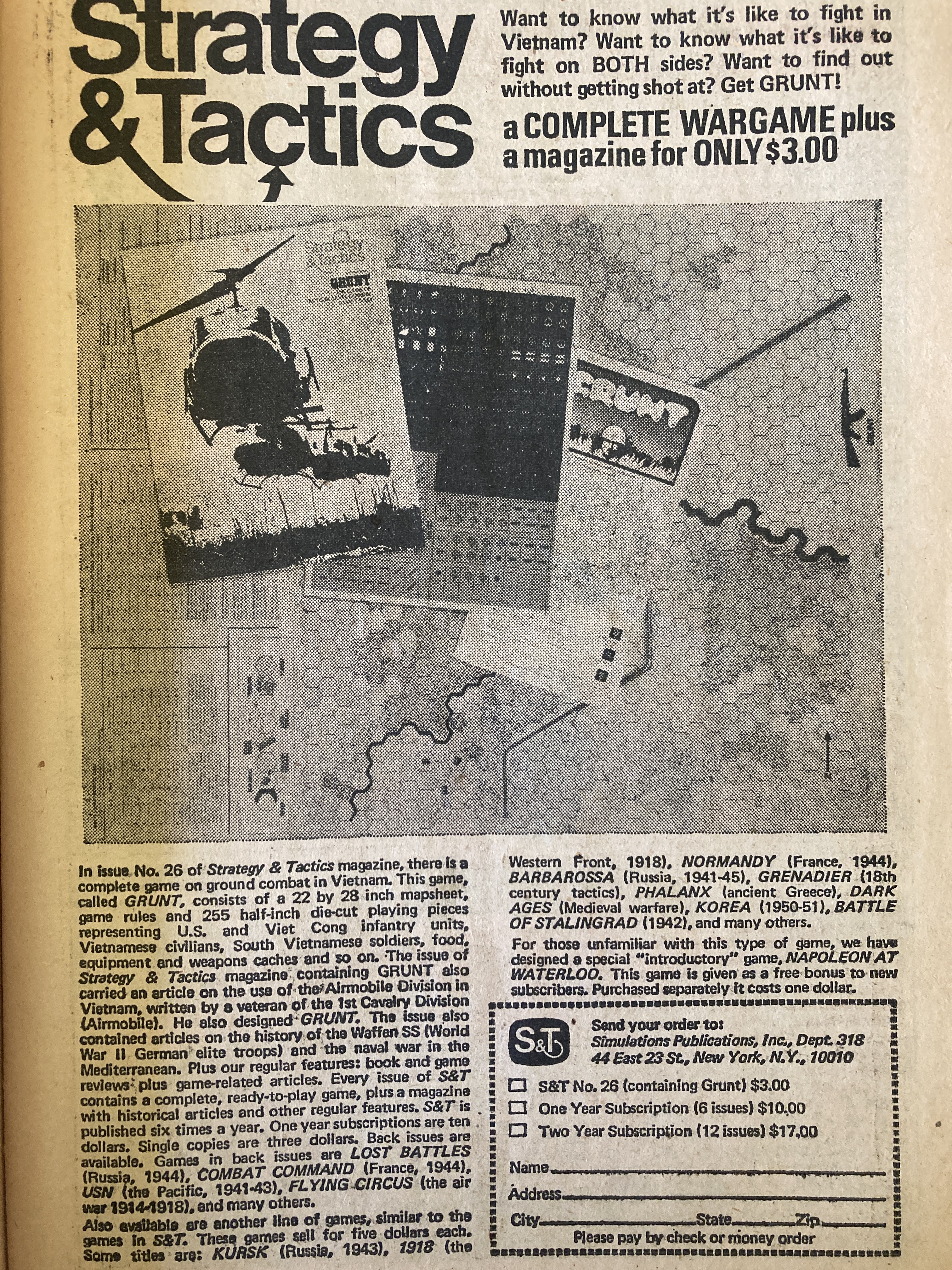
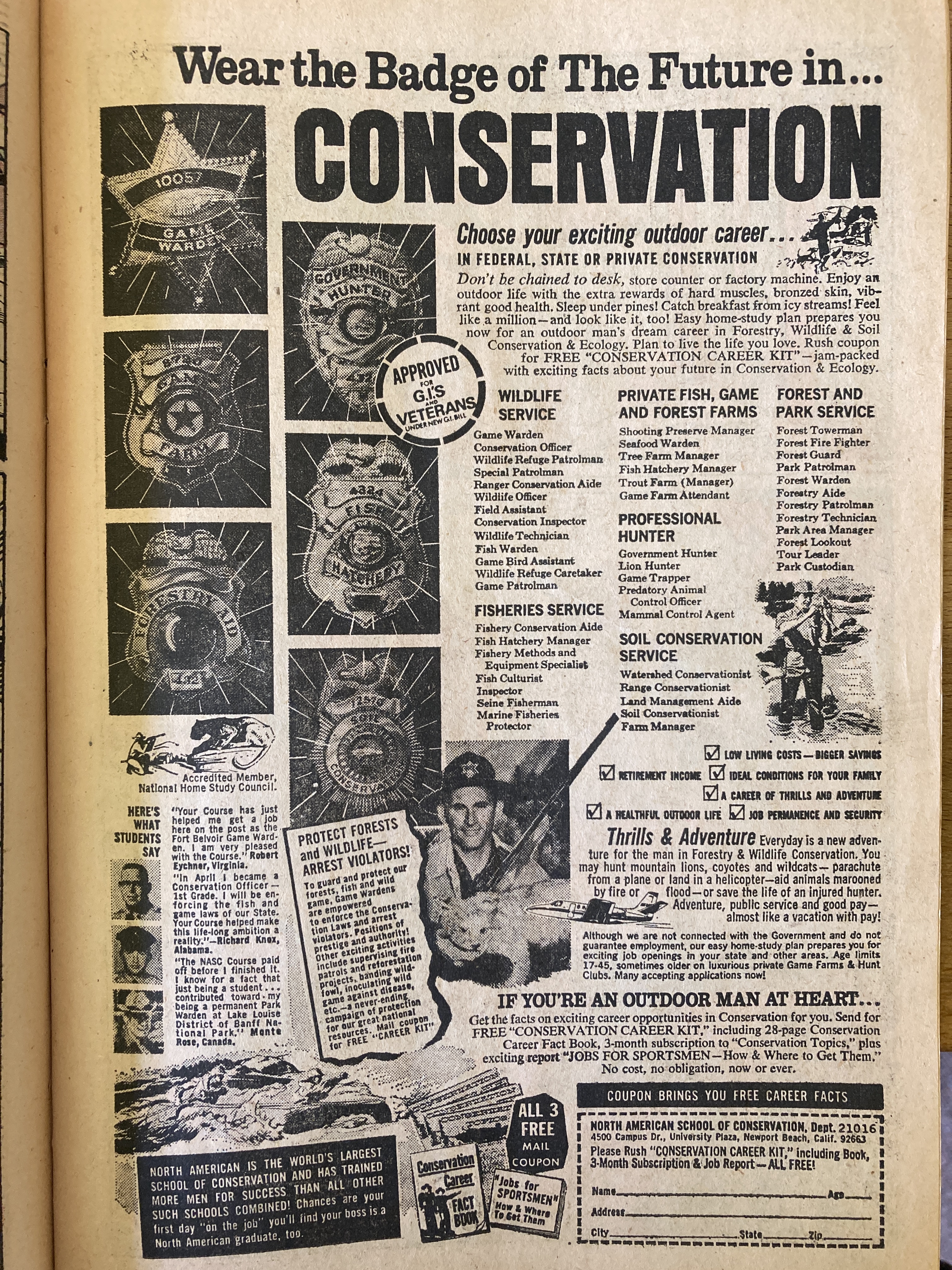
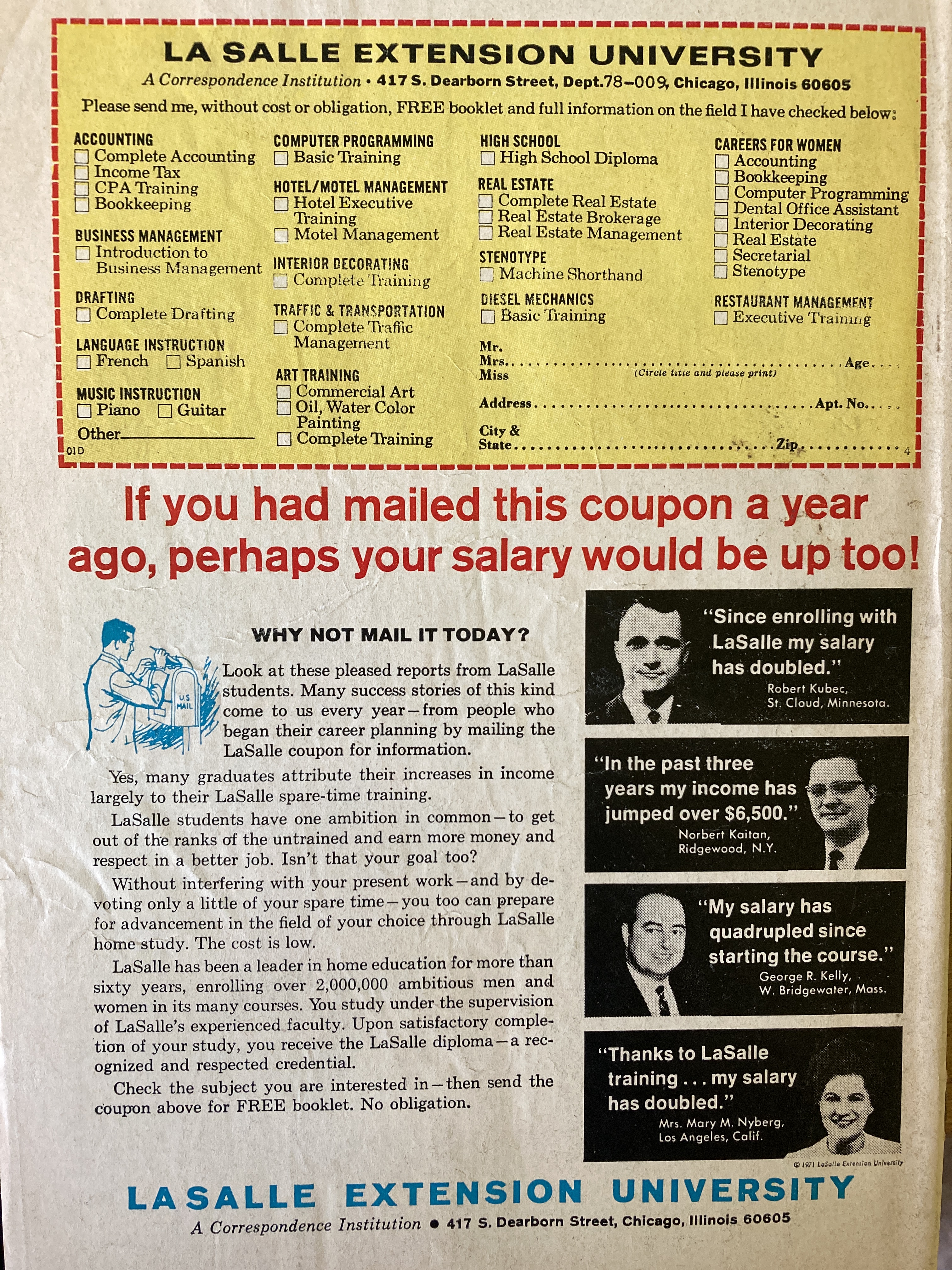
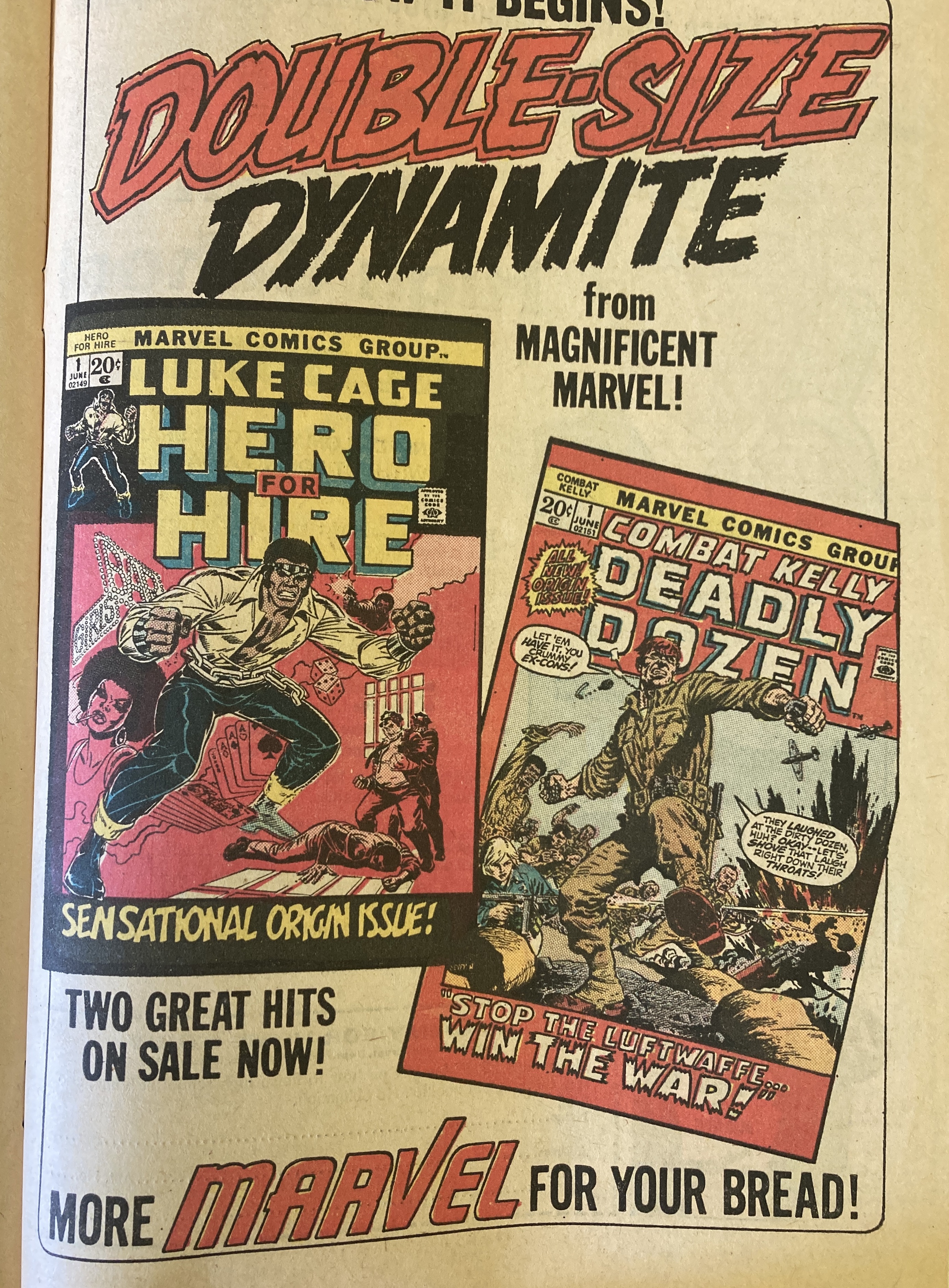
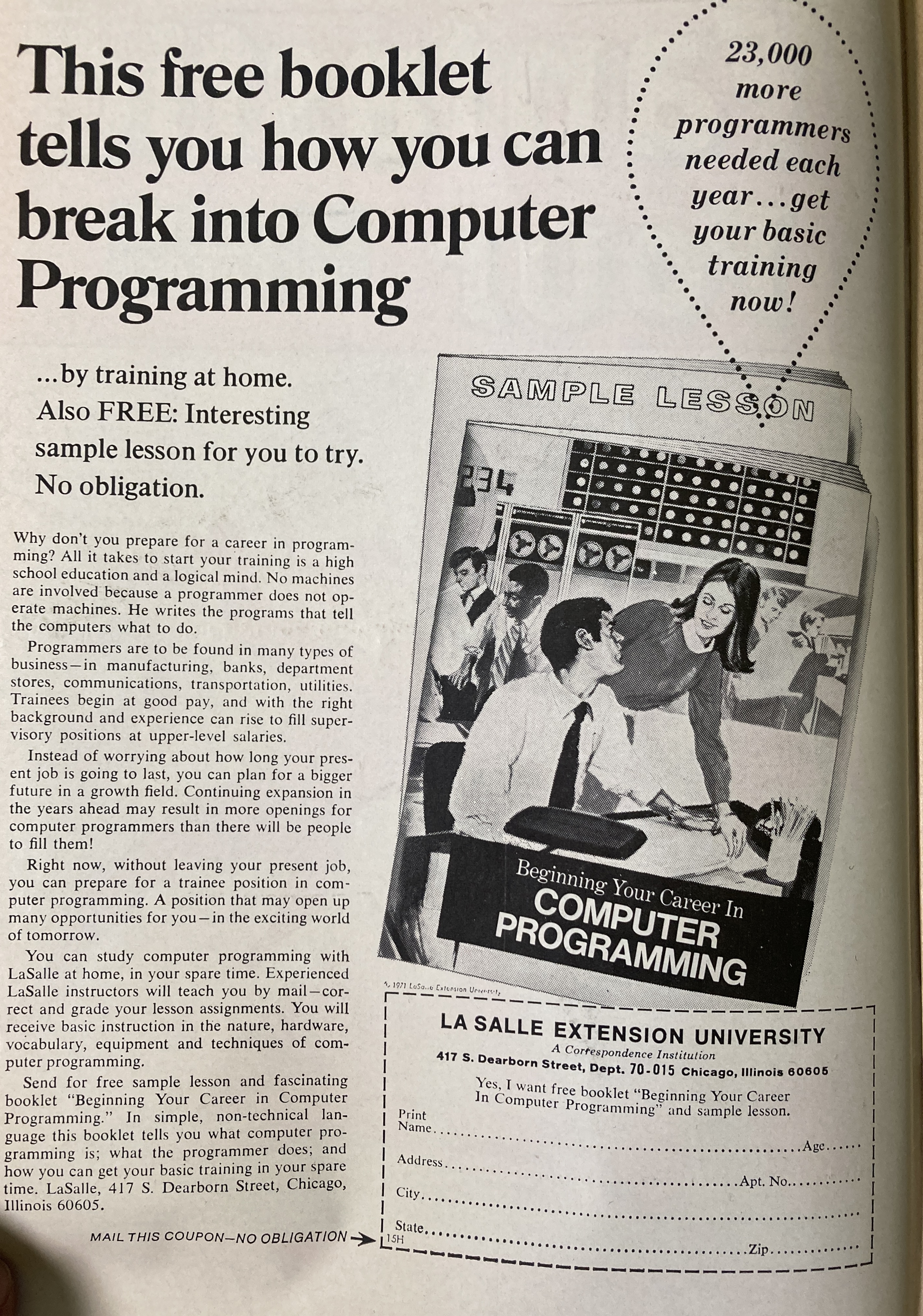
Some interesting ads, neither which seems aimed at young teenage comic readers.

Also, a letter from Bob Rozakis, who would go to write about a million comics for DC, including the underrated ‘Mazing Man.


Overall

A fun comic. A shame about the ending.

“The World’s Greatest Comic Magazine!” Fantastic Four No. 115

03 Saturday Feb 2024

Posted by percivalhenry in The World's Greatest Comic Magazine

≈ Leave a comment

Tags

1971, Fantastic Four, Fantastic Four 115, John Buscema, Over-mind, Stan Lee

Fantastic Four 115
“The Secret of the Eternals”
Published: July 1971
Plot: Stan Lee
Script: Archie Goodwin
Pencils: John Buscema
Inks: Joe Sinnott
Letters: Artie Simex
Cover: Buscema and Frank Giacoia

Note: Apologies for the delay in posting this. I was dealing with an illness that unfortunately made everything else, even the Fantastic Four, take a back seat. I’m doing much better now and should be back on track.

Second note: Between Fantastic Four 114 and 115, Fantastic Four Annual 9 was published (technically it was a King-Size Special, but they used those terms interchangeably back then). Since it just consisted of reprints of older stories, I’ve decided not to re-cap it here.

Synopsis

After the Watcher gives the (lengthy) history of the Over-Mind, Reed turns on the rest of the Fantastic Four, under the control of the villain.


What’s going on here

This is very much a transitional issue, basically setting the stage for a climactic showdown with the Over-Mind. The bulk of the story is devoted to the history of the Eternals, the Over-Mind’s alien race (and kind -of, sort-of related to the Eternals that would come later; see the post for FF 114). The story gives John Buscema an opportunity to stretch his muscles, and it’s a fun, if sort of loopy, sequence.

The big development of FF 115 is that it’s the first issue of the Fantastic Four in which the writing isn’t credited to Stan Lee or Jack Kirby. While Stan gets a plotting credit, the script is by Archie Goodwin, a comic veteran at this point who would go on to a many-decades long career at Marvel and DC. Oddly, Goodwin wasn’t the first choice for scripting, but apparently Roy Thomas was busy elsewhere.

It’s not clear why this note was necessary, since readers had no reason to expect Thomas to be scripting the story.

Elsewhere in the comic, in the Bullpen Bulletins, Thomas makes it clear why he’s so busy: Stan is taking some time off. Hey, everyone needs a break once in a while. As it turns out, Stan’s hiatus from the FF will last about 10 issues, but he does return.


What I liked

Buscema’s art in this issue is really epic as he illustrates the history os the Eternals. Here’s a few choice panels:

And for those of you partial to Buscema’s work on Conan the Barbarian, this panel should feel familiar:


What I didn’t like

The fight between Reed and the rest of the FF was pretty inane. The lowlight was this sequence, where he defeats Ben by … ticking him?


Overall

A fine issue

“The World’s Greatest Comic Magazine!” Fantastic Four No. 114

13 Saturday Jan 2024

Posted by percivalhenry in The World's Greatest Comic Magazine

≈ Leave a comment

Tags

1971, Fantastic Four, Fantastic Four 114, John Buscema, Marvel, Over-mind, Stan Lee

Fantastic Four 114
“But Who Shall Stop the Over-Mind?”
Published: June 1971
Writer: Stan Lee
Pencils: John Buscema
Inks: Frank Giacoia
Letters: Sam Rosen
Cover: Buscema and Giacoia

Synopsis

Out on bail from their arrest by the NYPD and facing eviction, the Fantastic Four confront the Over-Mind, only to have the fight erased from their memories by his mental powers. To help provide answers, Agatha Harkness contacts the Watcher.

What’s going on here?

This is a much more satisfying issue than the last, as the Over-Mind developed into a formidable foe with an interesting backstory. There are some plot holes, but overall the story moves briskly, the fight is well designed, and the sequence with Agatha Harkness is appropriately creepy.

What I liked

It’s the best issue from John Buscema to date, and maybe not a coincidence that it’s the first not inked by Joe Sinnott: Frank Giacoia inked this issue, presumably filling in. There’s no arguing Sinnott’s power and style, but Giacoia has a lighter touch, which perhaps lets Buscema’s style emerge more clearly. Here’s a panel I really liked:

And this sequence:


What I didn’t like

As mentioned, there are some plot holes. In this issue, the Over-Mind apparently encounters the FF for the first time, yet at the close of last issue we saw him manipulating the mayor to have the FF arrested. Also, there’s an oddly discordant note, when, in the midst of their eviction drama, Ben gets a package with a stink bomb from the Yancy Street Gang. Rather than lighten the mood, it just seems like an annoying distraction.

There’s also the continuing nonsense of the FF’s eviction. Comics and stories about business rarely mix well, and this is no exception. There’s a dozen reasons why the landlord’s actions don’t make sense, and while maybe the average FF reader of 1971 didn’t know them, this sub-plot all seems farfetched. (Yes, I know it’s a comic based on far-fetched events, which is why real-world subjects like commercial real estate law are better left outside its pages).


Anything else?

This issue kind-of, sort-of introduced the Eternals to the Marvel universe, as the Over-Mind discusses that he is following their commands. Initially these Eternals were not connected to the Eternals later introduced by Jack Kirby in his 1976 return to Marvel (these were instead supposed to be the “Eternals of Eyung”) but they were later retconned to be another branch of the Eternals, also created by the Celestials. It’s all deeply confusing, and had no real impact on this story.


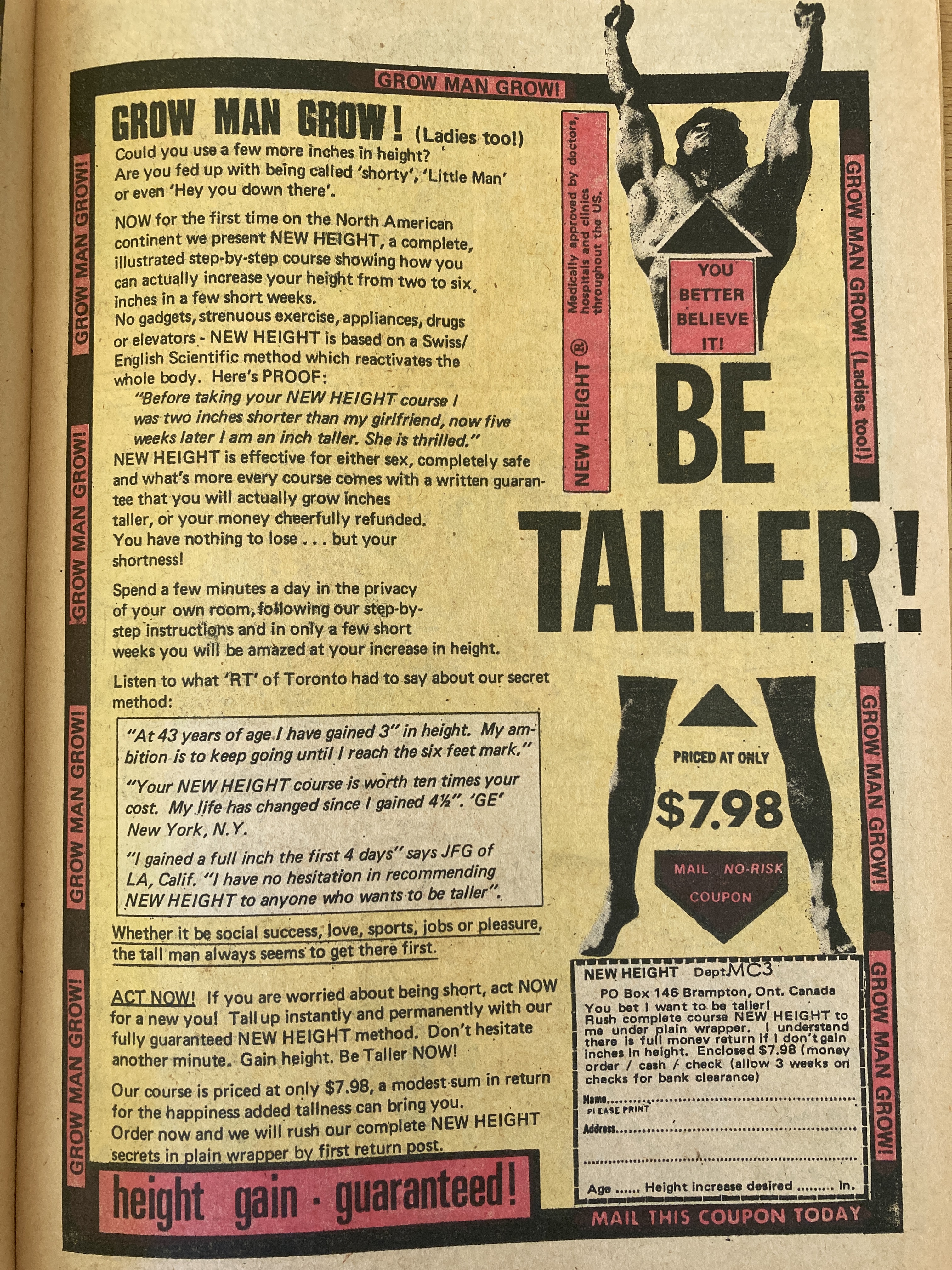
Also, some fun ads in this issue, including one with a muscle-man who looks suspiciously like a former governor of California:

Overall

Solid!

2023: My Year in Books

09 Tuesday Jan 2024

Posted by percivalhenry in Books

≈ Leave a comment

Tags

Year in Books

(Note: If you frequent this blog just for Fantastic Four content, you may want to skip this post. While my personal blog has largely been devoted to my issue-by-issue recaps of the Fantastic Four, I still use it for occasional posts like this.)

As in years past, I set myself a goal of reading 24 books this year. And for the first time, I surpassed it, reading 28. There were a few reasons, but a big one is I consciously read a lot of short science fiction books between (and sometimes as I read) longer books as a change of pace. I was aided by a February trip to Powell’s in Portland (maybe the best book store in the country) where I scooped up a lot of used books. Also, like last year, I served as a judge for a business book contest, so I read a bunch of those, and like last year, I traveled overseas, which both gave me reason to read about my destination (Japan) and a lot of time on planes and trains to read.

What follows the books in the order I read them. I’ve done my best to include images of the edition of the book I actually read, but in some cases that’s not possible. On to the books:

1, 11/22/63, by Stephen King (2012), 849 pages

I’m a late convert to King, having abandoned my youthful snobbery, and what I’ve read, I’ve mostly enjoyed. He has certain identifiable tics—all his heroes seem to be under-estimated white guys in their mid-to-late 30s, for example, and the supernatural mechanisms driving the story are often irrelevant to the plot—but in this case that didn’t detract from what was a big, fun read. I’m not a big Kennedy-assassination guy, but King did an impressive amount of research into Lee Harvey Oswald and makes compelling the days, weeks and months in Dallas preceding Nov. 22. He fully immerses us in the America of the last 50s and early 60s and we feel genuine pangs of regret that we can’t stay there.

2, The Ghost, by Robert Harris (2008), 400 pages

This is the second Harris book I’ve read, after Fatherland last year, and by comparison it’s nowhere near as good. While I recall enjoying it, I have almost no recollection of the plot, unlike Fatherland, which is much more fresh in my mind despite my having read it six months earlier. This book concerns a ghost writer who gets pulled into a political conspiracy after agreeing to write the memoirs of a British prime minister. Fun but disposable.

3, The Women in the Dunes, by Kobo Abe (1956), 239 pages

This is the first of the books I read in preparation for our trip to Japan. Regarded as a classic of post-war Japanese literature, it’s a strange, highly stylized novel about a school teacher who falls into a pit on a remote beach and ends up trapped there with a woman who lives in a house surrounded by sand. It operates as an extended allegory and is compared to work by Kafka and Camus. I can’t say I loved it but it was definitely memorable and contains some provocative ideas.

4. The Puppet Masters, by Robert Heinlein (1951), 347 pages.

Heinlein is a giant of mid-century science fiction, and as a young teen I loved his “juveniles,” books written for younger readers. I’ve found his more adult-oriented books hit-or-miss—his reactionary politics and sexism can get tedious—but books like The Moon is a Harsh Mistress are amazing and I’m always tempted to find another great one. The Puppet Masters is sort of in-between, a plot with adult themes and concepts but written early enough not to be too laden with his ideological hangups.

The plot is reminiscent of Invasion of the Body Snatchers, though it was written six years earlier, and involves alien invaders who seek conquest through mind control, a very Cold War theme. It features a typically scrappy Heinlein hero and his beautiful-yet-docile female partner, who through wit and bravado save the day against all odds.

5, Tau Zero, by Poul Anderson, (1970), 208 pages

A thin book I picked up at Powell’s, Tau Zero is at its best an ambitious exploration of Einsteinian physics: What would happen to relative time if a manned space ship approached the speed of light? The story hinges on a spaceship of Earth’s best and brightest seeking to colonize a new planet before things go awry. The plot is at times breathtaking as Anderson explores huge concepts in engineering and cosmology. His grasp of writing and characterization, however, don’t match his science, and the crew of the ship often read like cardboard cut-outs of people. When I explained the book to my teenage son, he said “it sounds more like a thought experiment” and as usual he was right.

6, The Wind-Up Bird Chronicle, by Haruki Marukami (1994), 603 pages

A great deal has been written about The Wind-Up Bird Chronicle, a sprawling and surreal novel set in 1990s Tokyo with significant flashbacks to wartime Manchuria, and this is hardly the format to fully explore its complexities. I found it fascinating and compelling, as well as frustrating and puzzling. I’m not sure how well it prepared me for a trip to Japan, but I’m glad I read it.

7, The Left Hand of Darkness, by Ursula K. LeGuin (1969), 330 pages

Another Powell’s pickup, this book has gotten a lot attention lately for its depiction of a gender-fluid offshoot of humanity. That’s just one of the many imaginative aspects of this book, however, which involves a human ambassador on a frozen planet involved in complicated diplomatic maneuvers. I don’t think I’ve read anything by LeGuin since the Earthsea books I read as a teen and I was very impressed. In some ways this book is the opposite of Poul Anderson’s: sophisticated writing and character building, with only a passing interest in the science.

8, Hirohito and the Making of Modern Japan, by Herbert Bix (2000), 688 pages.

This comprehensive biography is all the more impressive considering how much material about Emperor Hirohito’s life and activities was off-limits to scholars when it was written. Despite that handicap, Bix paints a full picture of a man raised from boyhood to consider himself a god, and how the cult of the emperor led to Japan’s militaristic expansion and Pearl Harbor. Bix rejects the conventional narrative that Hirohito was a helpless bystander to his generals during World War II, and argues he had much more control over Japanese war-making than either Japanese or U.S. authorities were willing to admit.

9, Ringworld, by Larry Niven (1970), 288 pages.

Another science fiction classic, Ringworld combines extraordinary concepts with playful writing and imaginative world building. The plot deals with an expedition of humans and aliens to a solar system dominated by a vast ring that circles a sun. It’s unfortunately marred by the sexism that’s endemic of sci fi from this era, but on the whole it’s a fun adventure with some big ideas.

10, Last Year, by Robert Charles Wilson (2016), 351 pages

Robert Charles Wilson is a terrific science fiction author who doesn’t seem to get the attention he deserves. Last Year works from a fun premise about time-traveling tourists from roughly our present who visit the wild west of the 1870s, written from the perspective of a local hired to be a security guard. As in previous books of his I’ve read, Wilson pays a lot of attention to the people who populate Last Year and while the plot isn’t very memorable, his lead character very much is.

11, Path Lit By Lightning, by David Maranssis (2022), 574 pages

This biography of Jim Thorpe was a present from my wife and for that reason and others I wish I liked it more. For those unaware, Thorpe has a claim on being the greatest athlete ever—a college football legend, he won the decathlon and pentathlon at the 1912 Olympics, then played professional baseball for almost a decade—and his life story as an uprooted Native American ticks all the boxes for a compelling biography. Yet somehow this book was less than the sum of its parts.

One reason is that Thorpe wasn’t particularly introspective and left no interesting journal or letters, and Maraniss struggles to imbue him with much personality or agency. Another reason, one that may be specific to me and my interests, is that Maraniss gives very short shrift to Thorpe’s track and field exploits. While Thorpe’s football career gets chapters of attention, Maraniss breezes through Thorpe’s Olympic performance in a few pages and seems generally uninterested in the sport.

The book comes most alive when Maraniss documents the shabby treatment of Native Americans in that era, and the exploitative nature of the Carlisle Indian Industrial School where Thorpe spent most of his youth. It’s a largely forgotten and ugly chapter of US history and Maraniss deserves credit for examining it.

12, Murder Your Darlings, by Roy Peter Clark (2020), 315 pages

Roy Peter Clark is a much-respected instructor and coach of writing for journalists and I bought this copy from him at a conference for business journalists at the Poynter Institute in St. Petersburg, Florida, where he teaches. It’s full of useful advice and helpful ways to think about writing, but it probably works best as a something you dip into now and then when looking for inspiration, vs. a book you plow through start to finish, as I did. (The title refers to the need for writers to excise phrases they particularly love in the interest of improving their prose).

13, Artificial Condition, by Martha Wells (2018), 158 pages

This slim book is the second in Wells’ Murderbot series, about a sentient bodyguard robot who throws off its shackles and escapes servitude. I liked the first one better but this was still a fast and fun narrative-packed read.

14, From Doon With Death, by Ruth Rendell (1964), 181 pages

In the middle of a much longer book (see below) I was eager for something short and distracting, so I pulled this more or less at random from my parents’ bookshelf. I don’t read a lot of mysteries and this one, a police procedural set in the British countryside, wasn’t really the sort of thing I would gravitate to. Still, I was taken by Rendell’s writing, which is so spare and unadorned that it’s almost haiku-like.

15, Strange Adventures, by Tom King, Mitch Gerards and Evan Shaner (2020)

My general policy is not to include the many comics I read in this annual list, but I continue to make an exception for those written by Tom King, who masterfully reimagines established superheroes in new and often disturbing ways and whose books are novelistic in their scope and ambition. In this case, he takes Adam Strange, a pulpy DC character from the 1960s, and envelopes him in a complicated swirl of diplomacy, politics, family, war and deceit. The story, which collects 12 individual comics, doesn’t apologize for being a superhero story, yet feels alarmingly contemporary in its cynical view of the world. The amazing art by Gerards and Shaner, who alternate scenes based on where they sit in the story’s chronology, adds a dimension unique to comics. Some comic purists hate how King drags their childhood heroes into the adult world but I find it exhilarating.

16, Master of the Senate, by Robert Caro (2002), 1050 pages

I set a goal of reading one volume of Caro’s LBJ biography a year and three years in, I’m still on pace. It’s hard to say which of the three is the best—they are all extraordinary—but this book is the first to deal with Johnson as a national figure, chronicling his rapid rise from Senate freshman to majority leader and a pivotal player in first bottling up, then slowly passing, civil rights legislation. It’s also an in-depth exploration of how political power works in the Senate, and in the country more broadly, and includes rich portraits of men (and it’s mostly men) like Richard Russell and Hubert Humphrey whom Johnson climbs over on his ascent to the top. Its lessons are relevant today and it should be required reading for anyone interested in national politics.
17, Beyond the Trees, by Adam Shoalts (2019), 316 pages

I picked this up in a bookstore in Montreal and it’s the sort of book that typically appeals to me: a solo adventurer venturing across a remote landscape. Plus, I’ve actually spent time in the Canadian arctic. But it didn’t quite work for me. Shoalts, a graduate student and travel writer, attempts to hike and (mostly) paddle across Canada’s far north in the few months when the lakes and rivers are free of ice. Yet that narrow window means he has to travel almost continuously, and so there is very little time for exploration or adventure outside of his journey. Nothing much happens except his relentless paddling, and because he’s so well prepared and single minded, there’s little suspense or excitement. I hate to fault Shoalts for not being reckless or taking unnecessary chances, but it would have enlivened his book..

18, In Patagonia, by Bruce Chatwin (1977), 202 pages

By coincidence, another travel book. Decades ago, I read Chatwin’s Songlines, about his travels in the Australian outlook, and his accounts about how the aborigines thought about their world, and how utterly different it is from a Western concept, had a big impact on me. Chatwin’s trip to South America has a similar feel, as he examines the historical and natural peculiarities of this very remote place, yet it didn’t resonate in nearly the same way. In part, it’s because the Patagonians he encounters are still descendants of Europeans, and share a Western outlook. But it’s also because Chatwin’s basic schtick—a young, world-weary Englishman who coolly observes the locals before heading home—sits a lot differently now than it did when I read the Songlines in the early 1990s.

19, These are the Plunderers, by Gretchen Morgenson and Joshua Rosner (2023), 324 pages

This was the first of the four business books I read for a contest, and the worst. The subject—how private equity ruins almost everything it touches while enriching a few—is more than worthy of a book, but it deserves better than this attempt. The authors—who include former Times business columnist Gretchen Morgenson, who should know better—have assembled a grab bag of facts and anecdotes that are slapdash and unorganized. It lurches from a history of Leon Black and Apollo to separate accounts about Blackstone and KKR, full of invective about their predations but with little that feels like real insight. The while thing felt polemical and very familiar to anyone who has paid any attention to the last 30 years of the business world.

20, Mickey7, by Edward Ashton (2022), 311 pages

My son gave me this book for a birthday present and I read it while taking a break from a much more ponderous business book (see below). It was a fun, engrossing read, about a ne’er-do-well who signs up for hazardous work on a space mission with the understanding that he could be killed and restored to life as a clone (this happens seven times, hence the title). I suppose there are some big ideas here about the nature of consciousness and the self, but mostly it was a goofy lark. I recommend it.
21, Built From the Fire, by Victor Luckerson (2022), 492 pages

Nominally a business book, this is a richly reported history of Tulsa’s Greenwood District, sometimes called “Black Wall Street,” which was burned to the ground by white rioters in 1921 and slowly rebuilt. At the narrative and moral center of the story is the Goodwin family, which owned a newspaper and practiced law, and it’s as much their history as one of their neighborhood. The work that went into writing this book is impressive—there are more than 100 pages of end-notes—but the detail can feel overwhelming, particularly in the last section which is concerned with current events in Tulsa. The book probably could have ended in the 1970s, when Greenwood fell victim to misguided urban redevelopment efforts, and lost 150 pages but none of its power.

22, Unscripted, by James Stewart and Rachel Abrams (2023), 349 pages

This is classic, old-school business storytelling from Jim Stewart, whose class I took in J-School, and Rachel Abrams. Intricately reported and unsparing in its tawdry details, this book tells of the messy battle to succeed Sumner Redstone and his Viacom media empire. There is almost no one in this book who emerges looking good, and the bad behavior, particularly of Redstone’s two parasitic mistresses who turn him against his family, is vile. Unfortunately, the book never really rises above its material to make a more interesting point, and at the end it just feels voyeuristic and gossipy.

23, Yellen, by Jon Hilsenrath (2022), 324 pages

This was the fourth book I read for the contest and I thought the best (although Built from the Fire won). It’s not flashy, but a patient chronicle of the rise of Janet Yellen from nerdy Brooklyn school girl to one of the most important people on the planet. It’s also a carefully explained history of the last 50 years of macroeconomics, digestible enough for a beginner yet detailed enough to be interesting for more informed readers. Yellen and her husband, Nobel Prize-winning economist George Akerlof, had a front-row seat, and were participants, in most of the major discussions that have shaped modern economics. If you wanted to understand how the global economy got to be where it is in 2024, this book would be a good place to start.

24, Glory Road, by Robert Heinlein (1964), 277 pages

Another attempt to rediscover the Heinlein that I loved, this one was a disaster. All of Heinlein’s vices are on display in this book: the heavy-handed moralizing, the absurd sexism, the stereotypical hero. The plot concerns a former G.I. loafing around Europe who is pulled into an extra-dimensional fantasy adventure by a magical space princess with amazing breasts. Escapades ensue. I was very tempted to abandon it halfway through but pushed through out of sense of duty. One strange twist: deep into the book I encountered phrases and details that I dimly recall reading before, evidence this wasn’t the first time I read Glory Road. My subconsciousness must have suppressed the memory.
25, The Cold Millions, by Jess Walter (2021), 244 pages

Jess Walter is an old friend (we both worked for the same newspaper, though not at the same time) and I felt guilty for not reading his most recent novel until now. Luckily for me, the book is excellent which sparing me the discomfort of having to write something unkind. Set in-turn-of-the-century Spokane, when the city was awash in money from mining and timber, and in desperate men looking for work, it follows a young hobo caught in a swirl of union organizing, anarchism and plutocracy. It’s a gripping read, beautifully written and fully invested in the past it brings to vivid life.

26, The Blue World, by Jack Vance (1966), 180 pages

Another work of mid-century science fiction, this one is fortunately much better than the last. Both a fun adventure and sophisticated allegory, The Blue Planet takes place on a watery world, inhabited by descendants of a crashed space ship who have reverted to a pre-modern civilization. The hero takes issue with his society’s obeisance to a destructive sea monster, setting in motion a series of events with profound consequences. Vance is an under-recognized master and the Blue World is enlivened by his colorful style and anachronistic wordplay, as well his clever world building. I really enjoyed this book.

27, Golden Hill, by Francis Spufford (2016), 344 pages

Maybe the best book I read this year, Golden Hill was smart, funny, tragic and deeply moving. Set in 1749 New York, still English but not quite England, it follows a young man recently arrived with a mysterious past and more mysterious future. There’s adventure, suspense, romance, and lust, and it all moves along briskly. The book’s language and mores feel authentic to the age, but its themes are very modern, and it includes some genuine surprises. Highly recommended.

28, The Age of Grief, by Jane Smiley (1980), 180 pages

One of my reading goals every year is to tackle some of the books I’ve owned for years, sometimes decades. This book was, I believe, was the last one assigned in a college class on American literature (we read stuff like Theodore Dreiser and Frank Norris) and for whatever reason I never read it but have dutifully kept it with me for 30 years. I suspect one reason I avoided it is the title and cover image (they don’t exactly promise a fun read), as well as my aversion to short story collections. But it was short enough to fit into the last week of the year, and I was glad I finally took the plunge. The stories are sharply realized glimpses into modern life, populated by flawed but sympathetic middle-class Americans full of feelings but often unable to express them. The title novella, about married dentists, doesn’t have much actual grief, but lots of sadness, and the best story, about a rural Christmas with overbearing relatives, felt painfully true.

That’s it. That’s the list.

For completeness sake, I’ll note here I started two other books but didn’t finish them. One, Six Four, a Japanese detective novel by Hideo Yokahama, got lost between Tokyo and New York while I was halfway through it. The other, Too Like the Lightning, a newish science fiction novel by Ada Palmer, I found pretentious and dull, and gave up after about 100 pages

“The World’s Greatest Comic Magazine!” Fantastic Four No. 113

06 Saturday Jan 2024

Posted by percivalhenry in The World's Greatest Comic Magazine

≈ Leave a comment

Tags

1971, Fantastic Four, Fantastic Four 113

Fantastic Four 113
“The Power of .. the Over-Mind!”
Published: May 1971
Story: Stan Lee
Pencils: John Buscema
Inks: Joe Sinnott
Letters: Artie Simek
Cover: Buscema and John Verpoorten

Synopsis

The Fantastic Four race to save the life of the Thing after his battle with the Hulk while they receive foreboding warnings about a new foe, the Over-Mind.


What’s going on here?

I confess I was looking forward to the issue, because I’ve always been curious about the Over-Mind. He’s a villain that has faded into obscurity but seemed to be a prominent Bronze age bad guy, so he represented a blank spot on my mental FF map. Sadly, despite a lot of build up in this issue—and a starring role on the cover—he only appears in the last few panels, so I will reserve judgment until next issue.

Instead we get a pretty scattered plot in which the FF fight cops, rescue Ben, race around New York in a plane and confront the mayor (who looks a lot like John Lindsay). There’s enough goofiness in the storytelling that it’s pretty clear Stan’s attention is elsewhere, and he appears to be just mailing it in.


What I liked

As noted earlier, Big John Buscema is really hitting his stride and while Joe Sinnott still gives the art a Kirby-esque touch, it’s clearly Buscema’s book now. I liked this sequence with Reed showing off his powers (although it was a pretty inane scene, story-wise):


This sequence with Johnny does a great job of illustrating his turmoil:

We even get a splash page of the Watcher (who looks nothing like Kirby’s versions but still comes with Kirby Krackle):

What I didn’t like

Not only is the plot disjointed and aimless, the characters act in ways that can only be described as stupid and/or sloppy. Reed forgets that Ben’s thick skin means he can’t hear a heartbeat? Johnny jumps out of a window and forgets to flame on? Ben no longer cares about turning human? Reed needs to send a smoke signal, and not a flare? Maybe this will all be explained next issue as the malign influence of the Over-Mind, but otherwise it seems bizarre.


Then there’s this odd image of Reed walking down his own arms:


And what would be an appearance of the Watcher if he didn’t violate his oath?


Overall

Pretty weak sauce

“The World’s Greatest Comic Magazine!” Fantastic Four No. 112

22 Friday Dec 2023

Posted by percivalhenry in The World's Greatest Comic Magazine

≈ Leave a comment

Tags

Fantastic Four, Fantastic Four 112, Hulk, John Buscema, Stan Lee

Fantastic Four 112
“Battle of the Behemoths!”
Published: April 1971
Writer: Stan Lee
Pencils: John Buscema
Inks: Joe Sinnott
Letters: Sam Rosen
Cover: Buscema and Frank Giacoia

Synopsis

As the Thing battles the Hulk in mid-town Manhattan, Reed and Johnny work frantically to find a cure for Ben’s mind-altered state.


What’s going on here

For some, this is an iconic comic and could be viewed as the real launching point of the Bronze-era FF. It’s the third fight between the Hulk and Thing (the others coming in FF 12 and 24-25) and to date the most sustained slugfest between the two. The cover is an absolute classic, and all those elements together combine to make it prized by collectors (it sells for five to 10 times more than the surrounding issues).

Unfortunately, I’m not sure the story lives up to the issue’s reputation. As mentioned previously, the conflict with the Hulk comes out of nowhere (Reed summons Bruce Banner in the closing panels of last issue) and there’s almost nothing at stake here. Ben and the Hulk are fighting for the sake of fighting, and while it’s a fun brawl that take up essentially the entire issue, it begins to feel repetitive. The real tension in the story is between Reed and Johnny arguing about how to save Ben—Reed accuses Johnny of being a hot head, Johnny accuses Reed of lacking urgency—and that conflict feels pretty familiar.


What I liked

It’s hard to deny the power in Big John’s layouts of the fight scenes. No one really does it better.


I also liked this quieter, almost ethereal scene with Sue and Agatha Harkness.


What I didn’t like

While the story as a whole is pretty lackluster, the end is really disappointing. Ben is distracted by Alicia, the Hulk knocks him out (and disappeared as abruptly as he arrives) and Reed and Johnny arrive too late. It just feels anticlimactic.


Anything else?

FF 112 features an Irving Forbush cameo (or maybe one of his distinguished ancestors).


Overall

You can’t judge a book by its cover.

“The World’s Greatest Comic Magazine!” Fantastic Four No. 111

16 Saturday Dec 2023

Posted by percivalhenry in The World's Greatest Comic Magazine

≈ Leave a comment

Tags

Fantastic Four, Fantastic Four 112, Hulk, John Buscema, Stan Lee

Fantastic Four 111
“The Thing Amok!”
Published: March 1971
Story: Stan Lee & John Buscema
Pencils: Buscema
Inks: Joe Sinnott
Letters: Sam Rosen
Cover: Buscema & John Verpoorten

Synopsis

Ben, his mind affected by his new ability to change to human form, goes on a rampage throughout Manhattan as Johnny tries to keep up. Finally, Reed calls in Bruce Banner to help, only for the Hulk to appear and confront Ben.


What’s going on here?

This is very much a table-setting issue, preparing us for the big confrontation with the Hulk next month, but it’s still pretty effective. As discussed earlier, the groundwork for Ben’s descent was laid over many issues, so it feels organic and earned. It’s not the first time we’ve seen a plot centered around the Thing turning against his teammates (and won’t be the last) but the mechanism for this is more interesting than mind control or sorcery. It’s quite plausible that on some level, were Ben to lose the humanity and compassion that makes him, he would act this way. He has reason to be angry!

There’s also some good foreshadowing of trouble to come with baby Franklin, and again, it’s being spooned out methodically.


What I liked

This feels like the first FF issue where John Buscema is the recognizable artist I’m familiar with. The previous few issues felt like he was either trying to mimic Kirby or Joe Sinnott’s inks overpowered his penciled, but here we see some great Buscema panels.

These crowd scenes are fun. Hardhats on one side, hippies on the other.


There is a great quiet page of Reed, first with Sue, then contemplating how he again failed Ben. We have so many pages of Reed acting like a bullying blowhard that this display of his human side feels refreshing and necessary.


Also, J. Jonah Jameson shows up again, this time with pesky Bugle photographer.


What I didn’t like

The appearance of the Hulk feels really abrupt, the opposite of the slow-boil that got us to this issue. Within seven panels, we go from Reed summoning Bruce Banner to the Thing and Hulk about to fight.


I confess I get annoyed with every interaction the FF has with their landlord (and any other real-world business issue). Maybe I know too much about commercial real estate but it always feels clumsy and unrealistic. I’m pretty sure the FF have lawyers to deal with this sort of thing.


Anything else?

The kid how bought this comic in 1971 took the idea of a check list seriously:


Overall

Steady as she goes.

“The World’s Greatest Comic Magazine!” Fantastic Four No. 110

09 Saturday Dec 2023

Posted by percivalhenry in The World's Greatest Comic Magazine

≈ Leave a comment

Tags

Fantastic Four, Fantastic Four 110, John Buscema, Stan Lee

Fantastic Four 110
“One From Four Leaves Three!”
Published: Feb. 1971
Story: Stan Lee
Pencils: John Buscema
Inks: Joe Sinnott
Letters: Mike Stevens
Cover: Buscema and Sinnott

Synopsis

A desperate Fantastic Four tries to rescue Reed from the Negative Zone, and all seems lost until a spell from Agatha Harkness saves him. Meanwhile, Ben is becoming more truculent, likely a result of his new ability to change his appearance, and quits the team.


What’s going on here?

This is an an excellent issue, the best yet of the post-Kirby era. The pacing is taut, the suspense is high and there are no wasted panels. Reed genuinely seems screwed and while his rescue by Agatha feels a bit deus ex machina, it’s not like she was invented for this issue, and her capabilities were established many issues ago. The business with Ben’s increasingly aggressive and belligerent attitude was unnerving and well-handled. We know, of course, it will lead to him losing his ability to become human, and it’s to Stan’s credit that he’s unfolding it gradually.

This issue marks the lettering debut of Mike Stevens, the first FF letterer not named Sam Rosen or Artie Simek in 110 issues. It’s also his last FF lettering job, and according to Mike’s Amazing World, he only lettered 16 comics in his career.

FF 110 is also infamous for a printing error, where the magenta and cyan were mixed up on the cover, creating a green team in purple suits. The misprinted issues were recalled, and now sell at a premium ($585 for a 3.0 version, vs. $25 for the standard issue).


What I liked

The cover, for one. It’s great. Also, Big John Buscema gives us an amazing Kirby-inspired collage splash page:


There’s also a fun cameo from J. Jonah Jameson and Robbie Robertson. I think Jonah has appeared in an FF issue before, but I’m not sure. But it’s always fun to see different strands of the Marvel universe braided together.


What I didn’t like

Um, nothing? I know, usually I can find something, but this was a wonderful comic. (OK the title is a bit silly. We can all do math, Stan).

Anything else?

This stationary set looks cool. I wonder if any are still out there on eBay.


Overall

10/10. A grade A comic book.

“The World’s Greatest Comic Magazine!” Fantastic Four No. 109

02 Saturday Dec 2023

Posted by percivalhenry in The World's Greatest Comic Magazine

≈ Leave a comment

Tags

1971, Annhilus, Fantastic Four, Fantastic Four 109, Stan Lee

Fantastic Four 109
“Death in the Negative Zone!”
Published: Jan. 1971
Writer: Stan Lee
Penciler: John Buscema
Inks: Joe Sinnott
Letters: Sam Rosen
Cover: Buscema and Sinnott

Synopsis

Reed, Ben and Johnny pursue Janus, the Nega-Man, into the Negative Zone to prevent him from helping Annihilus destroy Earth. While they succeed, Reed is left behind in the Negative Zone.


What’s going on here?

This is a fun comic, and big improvement from the mess of last issue. The pace is brisk, the stakes are high and Ben’s banter is zinging. The Buscema/ Sinnott combo really clicks, as well. The story does feel vaguely familiar, probably because so many Negative Zone stories have the same elements, but all in all it reads like a Fantastic Four comic should.

What I liked

Annhilus is a great villain, and Stan let’s him shine here, with the right mixture of grandiosity and nastiness. In a great and creepy sequence, Reed doesn’t hold back about the threat he poses (never mind that in future issues Annihilus comes to Earth and none of this stuff happens):


I also liked this sequence with Sue, which captures the dilemma faced by modern women everywhere:


These ads were cool (I kind of want a Bug Bomb now):


What I didn’t like

I have never understood Annhilus’s title, “The Living Death that Walks.” If the death is alive, the walking part is sort of implied. Plus, Annihilus has wings! He doesn’t need to walk!


On a more personal note, someone took a pair of scissors to my copy of this issue and did unspeakable violence to it:


Anything else?

The statement of circulation shows the FF is averaging about 519,000 issues a month. That’s roughly 10 times what a decent selling comic averages these days.


Overall

A fine comic book

“The World’s Greatest Comic Magazine!” Fantastic Four No. 108

26 Sunday Nov 2023

Posted by percivalhenry in The World's Greatest Comic Magazine

≈ Leave a comment

Tags

1970, Fantastic Four, Fantastic Four 108, jack Kirby, John Buscema, Stan Lee

Fantastic Four 108
“The Monstrous Mystery of the Nega-Man!”
Published: Dec. 1970
Story: Stan Lee
Pencils: Jack Kirby, John Buscema and John Romita
Inks: Joe Sinnott
Letters: Sam Rosen
Cover: Buscema and John Verpoorten

Synopsis

In a lengthy flashback, Reed reveals the origin of Janus, the Nega-Man, a former colleague who tapped the power of the Negative Zone to heal an injury only to divide into good and evil versions of himself.


What’s going on here?

Jack’s back! Well, sort of. The comic’s pencils are credited to Jack Kirby, and quite a bit of the comic is drawn by him. But there’s a lot of John Buscema in here, too. It’s pretty clear from reading the story that Marvel decided to salvage some unpublished artwork by Kirby, using it in a flashback device to explain the origin of the new villain, Janus. In his blog, longtime Marvel editor Tom Brevoort confirms as much, explaining the Kirby sequences were intended for FF 102, but Stan Lee, unsatisfied with the story, set them aside. This was taking place in the weeks prior to Jack’s departure for DC, so there may have been some bad blood involved as well. It makes sense the ever-parsimonious Stan would find a way to reuse those Kirby pages, even if they are shoe-horned into a story that makes little sense.


What I liked

The Kirby art! Duh. This may not be peak Kirby, but it’s a reminder of what we lost when Jack decamped for DC. Check out this awesome panel:


Also, after years of cataloging all the times Sue is slighted by Reed, here’s a rare example of Reed actually taking her on a mission (not that she gets to do much, but baby steps):


What I didn’t like

The story is unfortunately incoherent. The flashback structure doesn’t help, adding a layer of complexity to an convoluted story, but the way the ploy unfolds is just a mess to begin with. The story does end with a tease of an appearance of Annihilus in the next issue, so here’s hoping things get back on track.

Anything else?

Here’s some more Kirby art:


Overall

A melancholy reminder of what was

← Older posts
Newer posts →
  • “The World’s Greatest Comic Magazine!” Fantastic Four Annual No. 15
  • “The World’s Greatest Comic Magazine!” Fantastic Four No. 223
  • “The World’s Greatest Comic Magazine!” Fantastic Four No. 222
  • “The World’s Greatest Comic Magazine!” Fantastic Four No. 221
  • “The World’s Greatest Comic Magazine!” Fantastic Four No. 220
  • July 2026
  • June 2026
  • May 2026
  • April 2026
  • March 2026
  • February 2026
  • January 2026
  • December 2025
  • November 2025
  • October 2025
  • September 2025
  • August 2025
  • July 2025
  • June 2025
  • May 2025
  • April 2025
  • March 2025
  • February 2025
  • January 2025
  • December 2024
  • November 2024
  • October 2024
  • September 2024
  • August 2024
  • July 2024
  • June 2024
  • May 2024
  • April 2024
  • March 2024
  • February 2024
  • January 2024
  • December 2023
  • November 2023
  • September 2023
  • July 2023
  • June 2023
  • May 2023
  • April 2023
  • March 2023
  • February 2023
  • January 2023
  • December 2022
  • November 2022
  • October 2022
  • September 2022
  • August 2022
  • July 2022
  • June 2022
  • May 2022
  • April 2022
  • March 2022
  • February 2022
  • January 2022
  • December 2021
  • November 2021
  • October 2021
  • September 2021
  • August 2021
  • July 2021
  • June 2021
  • May 2021
  • April 2021
  • March 2021
  • February 2021
  • January 2021
  • December 2020
  • February 2018
  • May 2016
  • February 2016
  • January 2016
  • December 2015
  • November 2015
  • October 2015
  • September 2015
  • August 2015
  • July 2015
  • April 2015
  • March 2015
  • January 2015
  • December 2014
  • November 2014
  • October 2014
  • September 2014
  • August 2014
  • June 2014
  • May 2014
  • April 2014
  • March 2014
  • February 2014
  • July 2026
  • June 2026
  • May 2026
  • April 2026
  • March 2026
  • February 2026
  • January 2026
  • December 2025
  • November 2025
  • October 2025
  • September 2025
  • August 2025
  • July 2025
  • June 2025
  • May 2025
  • April 2025
  • March 2025
  • February 2025
  • January 2025
  • December 2024
  • November 2024
  • October 2024
  • September 2024
  • August 2024
  • July 2024
  • June 2024
  • May 2024
  • April 2024
  • March 2024
  • February 2024
  • January 2024
  • December 2023
  • November 2023
  • September 2023
  • July 2023
  • June 2023
  • May 2023
  • April 2023
  • March 2023
  • February 2023
  • January 2023
  • December 2022
  • November 2022
  • October 2022
  • September 2022
  • August 2022
  • July 2022
  • June 2022
  • May 2022
  • April 2022
  • March 2022
  • February 2022
  • January 2022
  • December 2021
  • November 2021
  • October 2021
  • September 2021
  • August 2021
  • July 2021
  • June 2021
  • May 2021
  • April 2021
  • March 2021
  • February 2021
  • January 2021
  • December 2020
  • February 2018
  • May 2016
  • February 2016
  • January 2016
  • December 2015
  • November 2015
  • October 2015
  • September 2015
  • August 2015
  • July 2015
  • April 2015
  • March 2015
  • January 2015
  • December 2014
  • November 2014
  • October 2014
  • September 2014
  • August 2014
  • June 2014
  • May 2014
  • April 2014
  • March 2014
  • February 2014
“The World’s Greatest Comic Magazine!” Fantastic Four Annual No. 15

“The World’s Greatest Comic Magazine!” Fantastic Four Annual No. 15

percivalhenry's avatar by percivalhenry July 18, 2026
“The World’s Greatest Comic Magazine!” Fantastic Four No. 223

“The World’s Greatest Comic Magazine!” Fantastic Four No. 223

percivalhenry's avatar by percivalhenry July 14, 2026
“The World’s Greatest Comic Magazine!” Fantastic Four No. 222

“The World’s Greatest Comic Magazine!” Fantastic Four No. 222

percivalhenry's avatar by percivalhenry July 5, 2026
“The World’s Greatest Comic Magazine!” Fantastic Four No. 221

“The World’s Greatest Comic Magazine!” Fantastic Four No. 221

percivalhenry's avatar by percivalhenry June 25, 2026
“The World’s Greatest Comic Magazine!” Fantastic Four No. 220

“The World’s Greatest Comic Magazine!” Fantastic Four No. 220

percivalhenry's avatar by percivalhenry June 15, 2026
“The World’s Greatest Comic Magazine!” Fantastic Four No. 219

“The World’s Greatest Comic Magazine!” Fantastic Four No. 219

percivalhenry's avatar by percivalhenry June 7, 2026

Blog at WordPress.com.

  • Subscribe Subscribed
    • Percival Henry: The Fantastic Four and more
    • Join 74 other subscribers
    • Already have a WordPress.com account? Log in now.
    • Percival Henry: The Fantastic Four and more
    • Subscribe Subscribed
    • Sign up
    • Log in
    • Report this content
    • View site in Reader
    • Manage subscriptions
    • Collapse this bar
Loading Comments...