• About Percival Henry

Percival Henry: The Fantastic Four and more

~ Blogging the Fantastic Four issue by issue (plus whatever else grabs my attention)

Percival Henry: The Fantastic Four and more

Tag Archives: Marvel comics

“The World’s Greatest Comic Magazine!” Fantastic Four 181

20 Sunday Jul 2025

Posted by percivalhenry in The World's Greatest Comic Magazine

≈ Leave a comment

Tags

1977, Annihilus, Fantastic Four, Fantastic Four 181, Marvel comics, negative Zone, Roy Thomas

Fantastic Four 181
“Side By Side with … Annihilus??”
Published January 1977
Writer: Roy Thomas
Pencils: Ron Wilson
Inks: Joe Sinnott
Letters: Joe Rosen
Colors: George Roussos
Editor: Thomas
Cover: Jack Kirby and Sinnott

Editor’s note: The previous issue, FF 180, was a reprint of FF 101, so this comic picks up the story from issue 179

Synopsis

Mr. Fantastic, exiled to the Negative Zone by his evil doppelgänger, is attacked by Annihilus, who eventually admits he needs Reed’s help in defeating the Mad Thinker, who is attempting to conquer the Negative Zone. The rest of the issue is taken up by various subplots which are either advanced or introduced, and will be discussed below.


What’s going on here

This is very much a place-setting issue, with the main storyline — Reed in the Negative Zone —inching along, and a whole of space is devoted to four other narratives. This issue also happens to be Roy Thomas’s last as writer, and in an editor’s note he almost gleefully announces he is handing over this mess to his successor, Len Wein (and in fact next issue is written by four writers). Thomas, who wrote 32 issues of the title in the 1970s, won’t return to the FF until 1995, when he writes something called Fantastic Four Unlimited.

Thomas finishes his run as the writer with, to date, the second or third longest tenure writing the FF, depending how you want to count Stan Lee’s solo writing efforts. Not counting annuals and the like, here is how it breaks down (occasionally two writers are given credit for the same story):

Stan Lee and Jack Kirby: 102 issues
Thomas: 32 issues
Lee solo: 11 issues
Gerry Conway: 20 issues
Len Wein: 3 issues
Archie Goodwin: 3 issues
Tony Isabella and Bill Mantlo: one each

The art was again handled by Ron Wilson, who does a workman-like job filling for George Perez. It’s unclear if the editor’s note announcing Perez’s absence is meant to be taken seriously.


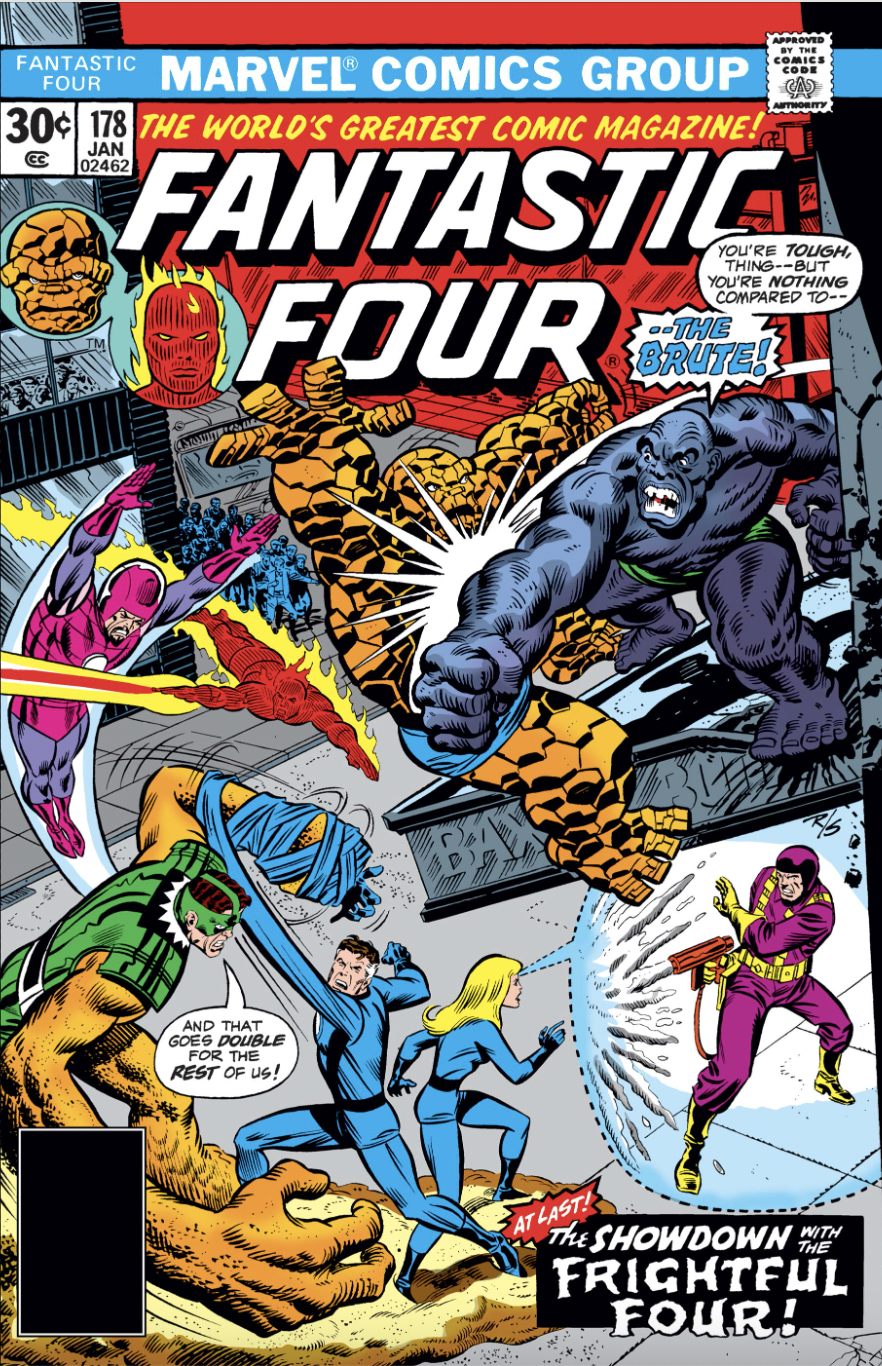
The cover, by Jack Kirby and Joe Sinnott, is pretty generic, probably because they used the story-specific one last issue.


What I liked and didn’t like

Instead of my usual likes and dislikes commentary, I’m going to discuss the various plots in this issue in order of my interest in them:

1, The Creepy Evil Reed

This storyline continues to give me the willies, as an evil Reed is sharing a home (and bed) with Sue. At least in this issue she realizes it’s not really her husband, but it’s definitely an icky idea.


2, Reed in the Negative Zone

Despite the absurdity of its various elements (Annihilus just happens to stumble upon Reed floating on a rock in the middle of nowhere), a villain needing Reed’s help is an intriguing concept. The monster animated by the Mad Thinker looks pretty lame though.


3, Agatha and Franklin

This came out of nowhere. While Sue visits Alicia, who is babysitting Franklin, to discuss her suspicions about Reed, Agatha Harkness appears and kidnaps Franklin for reasons unknown. Sue then sets off in pursuit. I suspect this will tie into a Salem’s Seven story coming later, but we’ll see. Either way, it’s unsettling.

4, About that robot …

Much of this issue is devoted to Ben — with the eventual help of Tigra, Thundra and the Impossible Man — retrieving from the ocean the bank-robbing robot he defeated in issue 179. The heroes then fight the military which the claims the robot for their own, then relent when they discover there’s more to the robot than meets the eye. I don’t know where this is going, but at least the robot now has a backstory.


5, Frankie and Johnny

Johnny once again acts like a jerk around women. Maybe it’s because I know how this relationship ends, but it’s not all that interesting to me.


Anything else?

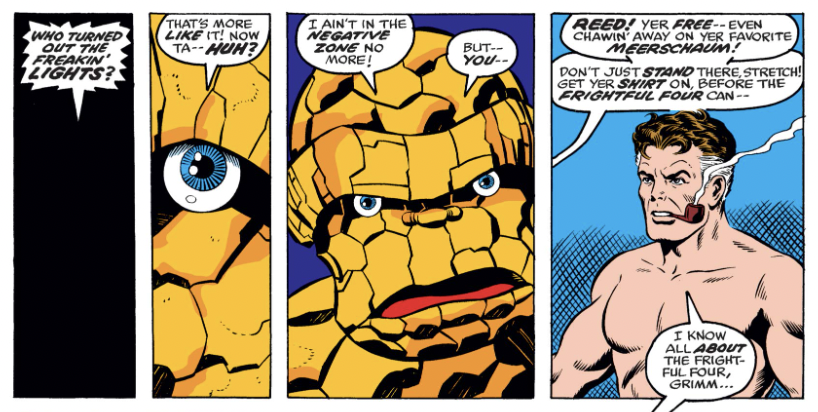
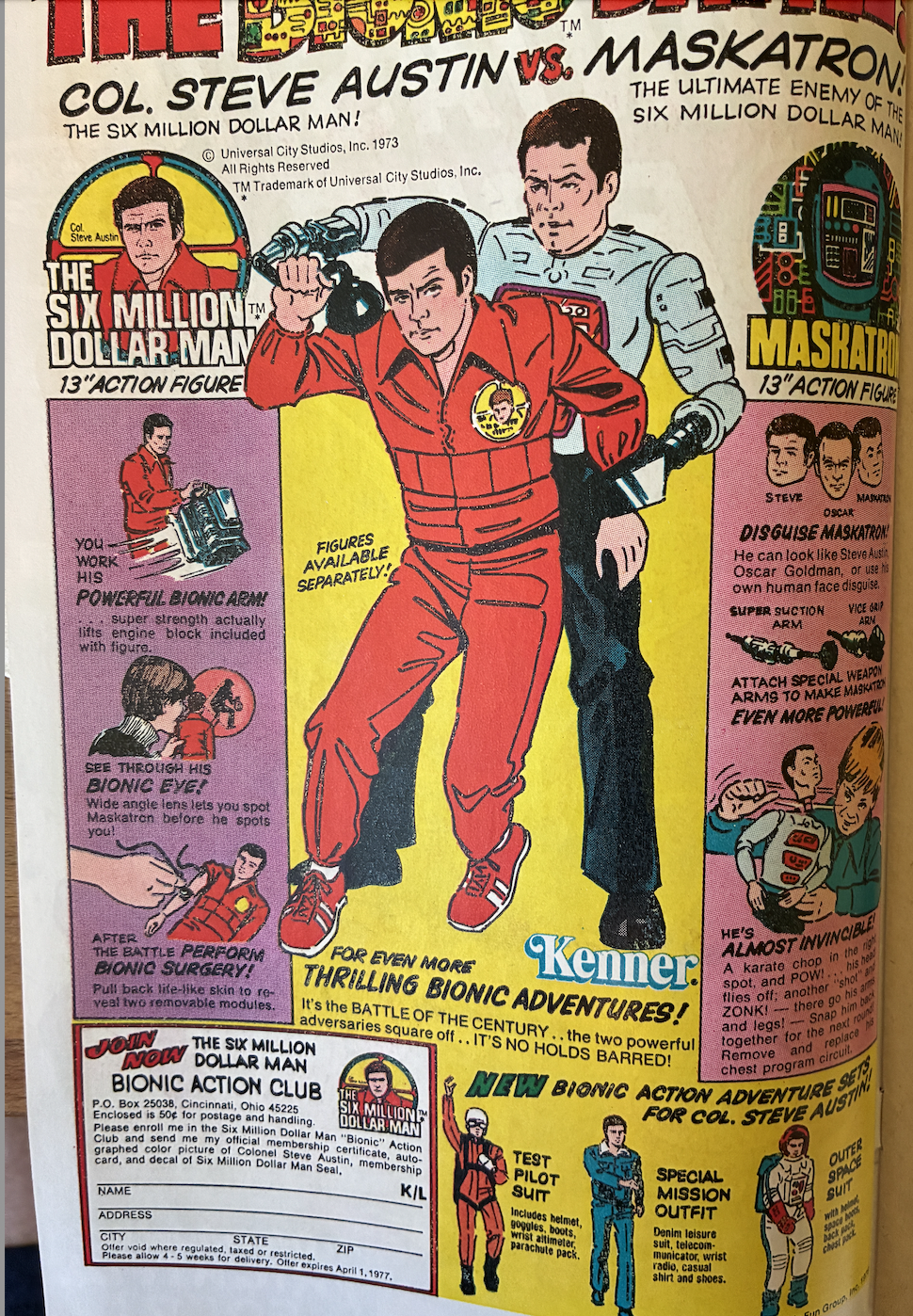
This is the first ad for a movie I recall seeing in the Fantastic Four (also, this comic came out in January, a full year before King Kong would debut). They will appear more often in the years that follow.


Overall

A lot of spinning plates

“The World’s Greatest Comic Magazine!” Fantastic Four No. 179

13 Sunday Jul 2025

Posted by percivalhenry in The World's Greatest Comic Magazine

≈ Leave a comment

Tags

1976, Fantastic Four, Fantastic Four 179, Gerry Conway, Marvel comics, negative Zone, Ron Wilson, Roy Thomas

Fantastic Four 179
“A Robinson Crusoe in the Negative Zone!”
Published November 1976
Writers: Roy Thomas/ Gerry Conway
Pencils: Ron Wilson
Inks: Joe Sinnott
Letters: Joe Rosen
Colors: George Roussos
Editor: Thomas
Cover: Al Milgrom and Sinnott

Editor’s note: Apologies for the two week absence. It’s summer vacation season!

Synopsis

While Mr. Fantastic is trapped in the Negative Zone, his evil doppleganger infiltrates the Fantastic Four. Tigra—who is hanging around the team along with Thundra and the Impossible Man—has her suspicions, but before she can reveal them to the Thing, the two fight and defeat a giant bank-robbing robot. The comic ends with Reed about to confront Annihilus in the Negative Zone.


What’s going on here?

This is an odd issue, one that interupts the momentum of the recent arc and contains a lot of character development and banter but not much plot. That may be because of the divided authorship, with Gerry Conway returning to plot the comic. The battle with the robot — called Metalloid on the cover but never identified in the issue — seems to serve no real purpose other than to insert an obligatory fight scene, although it may play a larger role in the next few issues. What stands out is the interactions between Johnny, Tigra, Thundra and Ben, and Ben’s obvious discomfort at being an object of attraction. Also of note is the very creepy dynamic between Sue and the imposter Reed.

The credits for this issue are peculiar:

This was Conway’s first FF credit since issue 152. For this month alone, Conway is credited with writing eight (!) comics for two companies: Ms Marvel 2, Ghost Rider 22, Superman 308, Avengers 156, Defenders 44, Iron Man 95 and Spectacular Spider-Man 3, along with this issue of the FF. Why they called on the busiest man in comics to plot this issue doesn’t make much sense, but from the lack of coherent story it’s pretty clear Conway was overstretched.

This issue also marks the Fantastic Four debut of Ron Wilson, who handled the pencils. Wilson would only draw a handful of FF issues, but would have a very long run drawing the Thing in Marvel Two-in-One and the Thing’s subsequent solo book. The cover was drawn by Al Milgrom, using a very Kirby-esque design. Milgrom inked an earlier issue but this is his first FF cover.

What I liked

The scenes of the FF hanging out with their guests are genuinely fun. Johnny flirting with Tigra, Tigra swatting him down, Thundra’s pursuit of Ben, and Ben’s unease with her.

(What’s unclear is who among the writers speaks Yiddish, or if any readers understodd the reference to the “whole magilla.”)

The team then adjourns to watch the Bionic Woman:


This is a great splash page from Wilson:


What I didn’t like:

It’s implied that the imposter Reed sleeps with Sue, which today can only be understood as rape. It’s not exactly swept under the rug here, but the magnitude of the crime isn’t made clear, either. We’ll see if it’s addressed more fully in subsequent issues:


Less seriously, there’s a bit too much fourth-wall breaking by Thomas:


And this reference to Bruce Wayne wasn’t very subtle (or in character for Reed):


Lastly, this is pretty silly. Flint can create a spark, but it’s a stone and doesn’t burn:


Anything else?

Here’s a look at the Marvel masthead, the first time I recall seeing this printed:

Lots of familiar names.

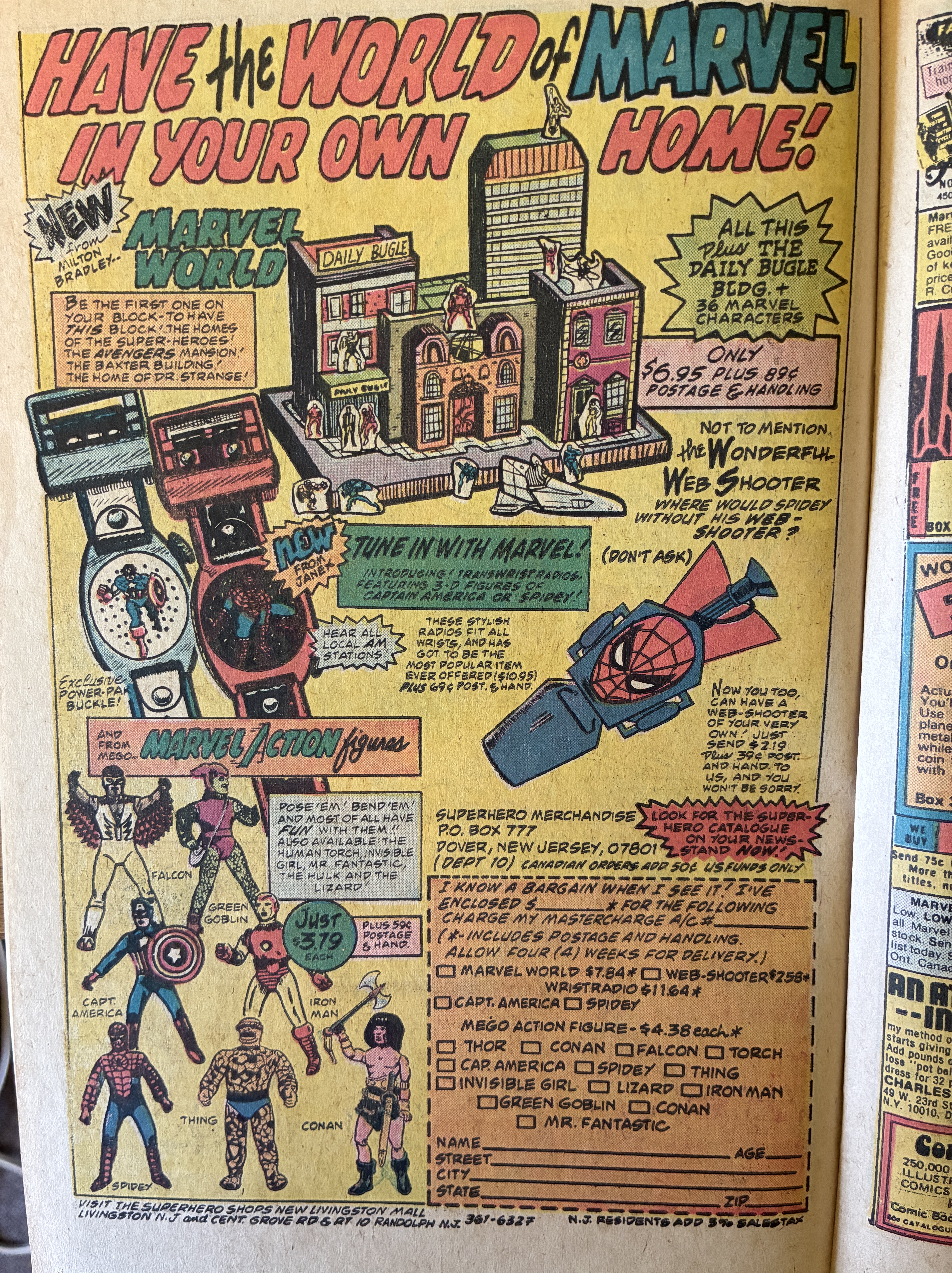
This is a cool looking toy:


Overall

A decidedly mixed bag


“The World’s Greatest Comic Magazine!” Fantastic Four No. 178

22 Sunday Jun 2025

Posted by percivalhenry in The World's Greatest Comic Magazine

≈ Leave a comment

Tags

1976, Fantastic Four, Fantastic Four 178, Frightful Four, George Perez, Marvel comics, Roy Thomas

Fantastic Four 178
“Call My Killer — The Brute!”
Published October 1976
Writer: Roy Thomas
Pencils: George Perez
Inks: David Hunt
Letters: Joe Rosen
Colors: Hunt
Editor: Thomas
Cover: John Romita and Joe Sinnott

Synopsis

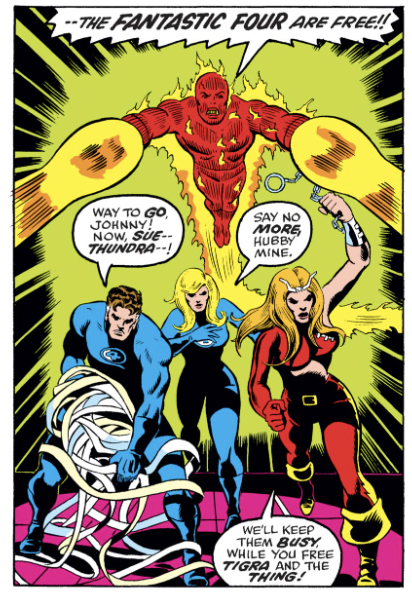
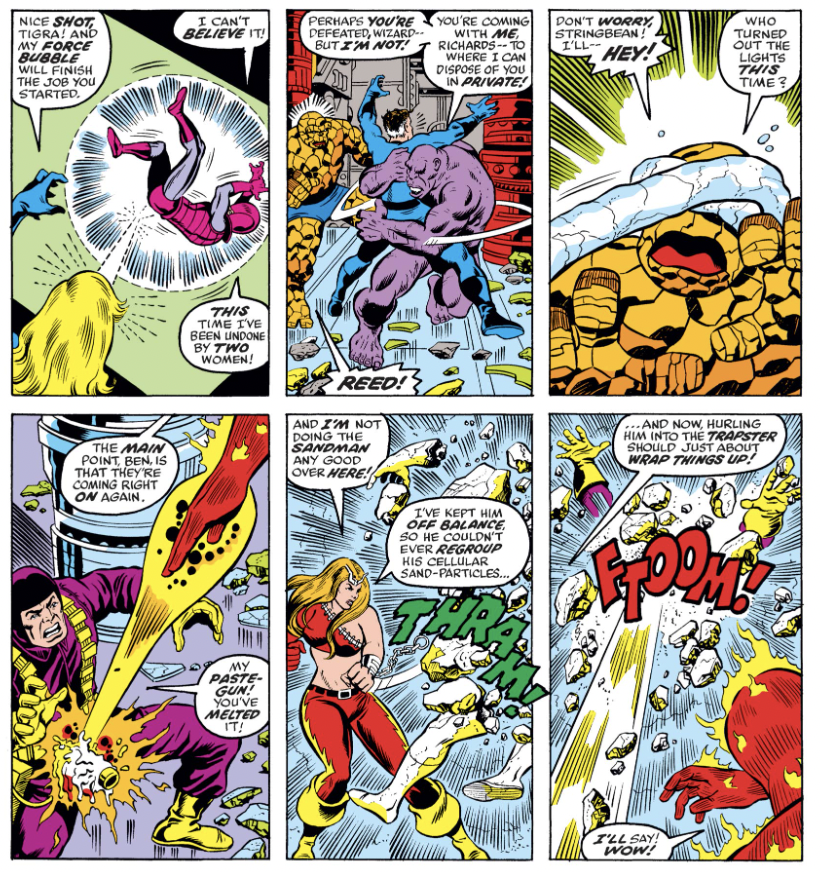
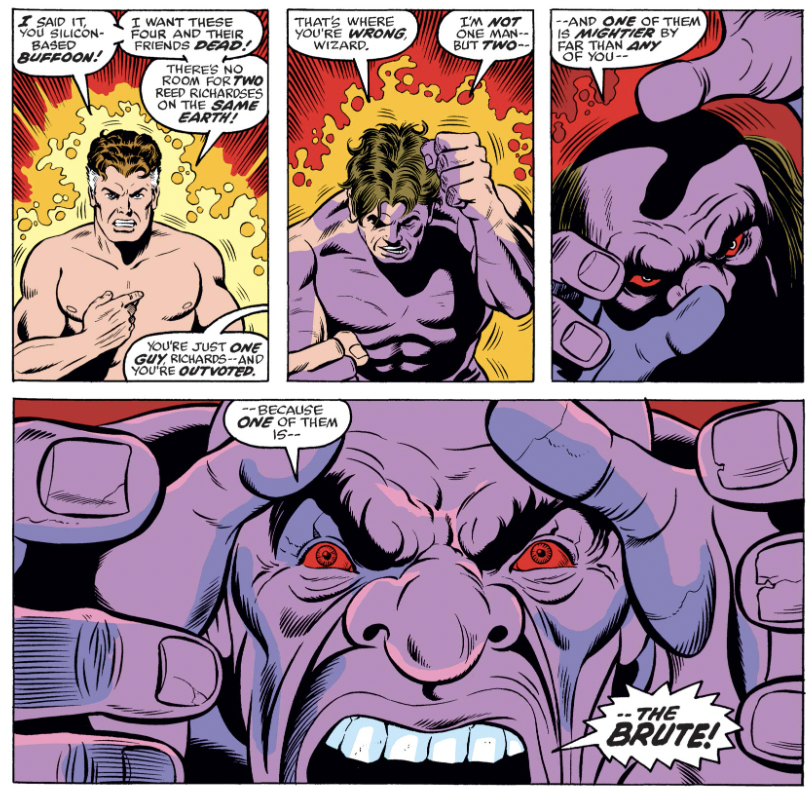
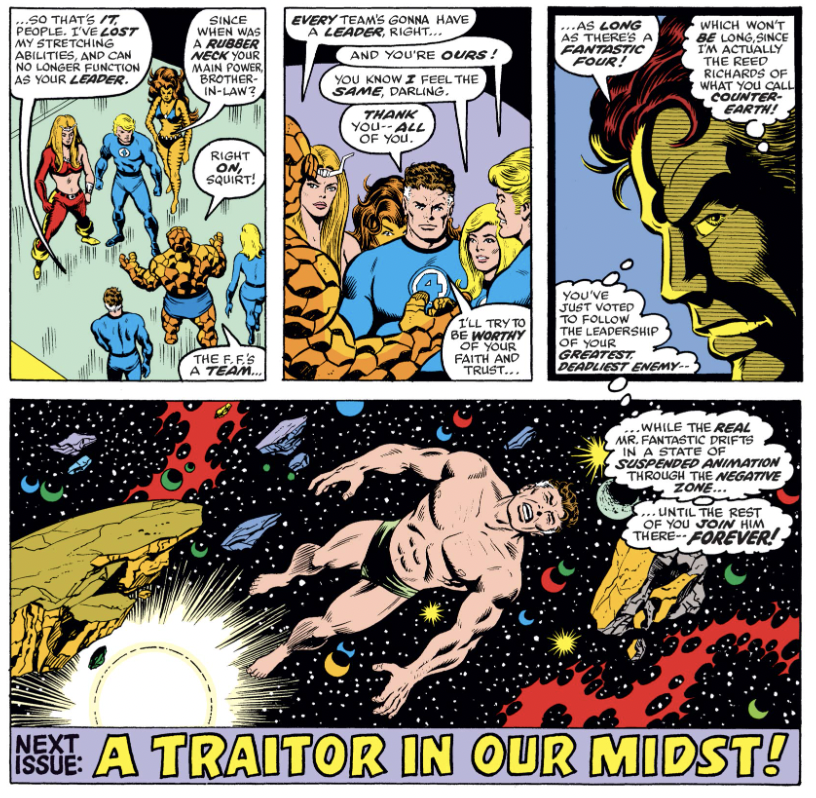
The Thing is retrieved from the Negative Zone and captured by the Frightful Four alongside the rest of the Fantastic Four, Tigra and Thundra. The villains announce a billion dollar ransom for the team, but the city of New York is unable to deliver and the team faces death when the Impossible Man coincidentally pulls the plug on the Baxter Building’s power, freeing the heroes. They defeat the Frightful Four and the evil Reed Richards of Counter-Earth is apparently exiled to the Negative Zone — but it is revealed that it’s the real Reed, and the evil Reed has secretly infiltrated the Fantastic Four.


What’s going on here?

If last issue was an example of a successfully whimsical issue, this one is a successful return to classic adventure storytelling. There are some gags, but it’s mostly a taut, action-packed issue that delivers on the implicit promise of all Fantastic Four comics. The evil Reed / Brute plot creates suspense and the rest of the Frightful Four are just menacing enough to be compelling villains. Roy Thomas has struggled to stick the ending of his previous multi-part story arcs—which unfortunately tend to end with a whimper, not a bang—but I’m hopeful the payoff of this one will match the buildup.

This issue again features excellent George Perez pencils, and unusually, he’s inked not by Joe Sinnott but Dave Hunt (who also colored this issue). For better or worse, Sinnott had been inking the FF for more than a decade by this point and no matter the penciler, he brought a uniform, consistent look to the comic. Under Hunt’s inks, Perez’s pencils look lighter and crisper, and it’s a preview of what we will come to see from him on New Teen Titans, where he was inked by Romeo Tanghal.

I’m not that familiar with Hunt, who had a 30-year career as an inker, letterer and colorist. He seems like a classic comic journeyman. Also of note is the return of John Romita as cover artist (inked by Sinnott). He was then serving as Marvel’s art director, and I suspect he came to the rescue as an emergency fill-in.

What I liked

There’s a great fight scene in this comic, brilliantly choreographed by Perez, with the Fantastic Four and Frightful Four trading partners. It’s a lot of fun.


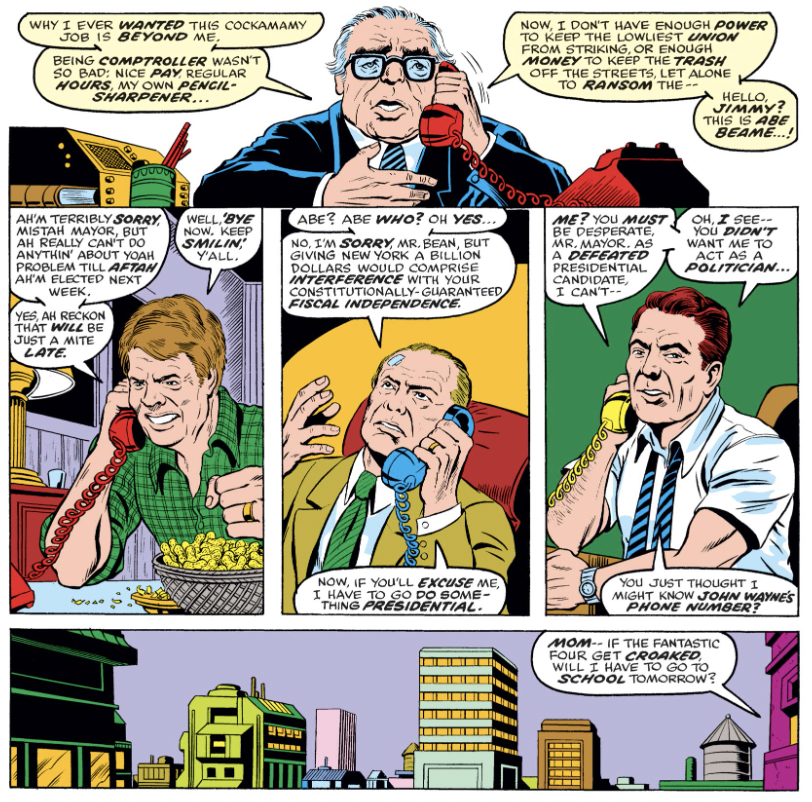
This issue also featured an amusing tour of politicians responding to the Frightful Four’s ransom demands. Often real politicians in comics are only alluded to but here it’s quite explicitly Abe Beame who is the mayor. The others are pretty obvious too. Ford’s comment is a reference to Washington’s refusal to bail out New York in 1975 (“Ford to City: Drop Dead”). Note this issue came out the weeks before the 1976 presidential election.


As mentioned, the business with evil Reed-slash-the Brute is pretty effective. This is a powerful sequence from Perez:


And while the switcheroo at the end was a bit predictable, it lends itself to a nice cliffhanger:


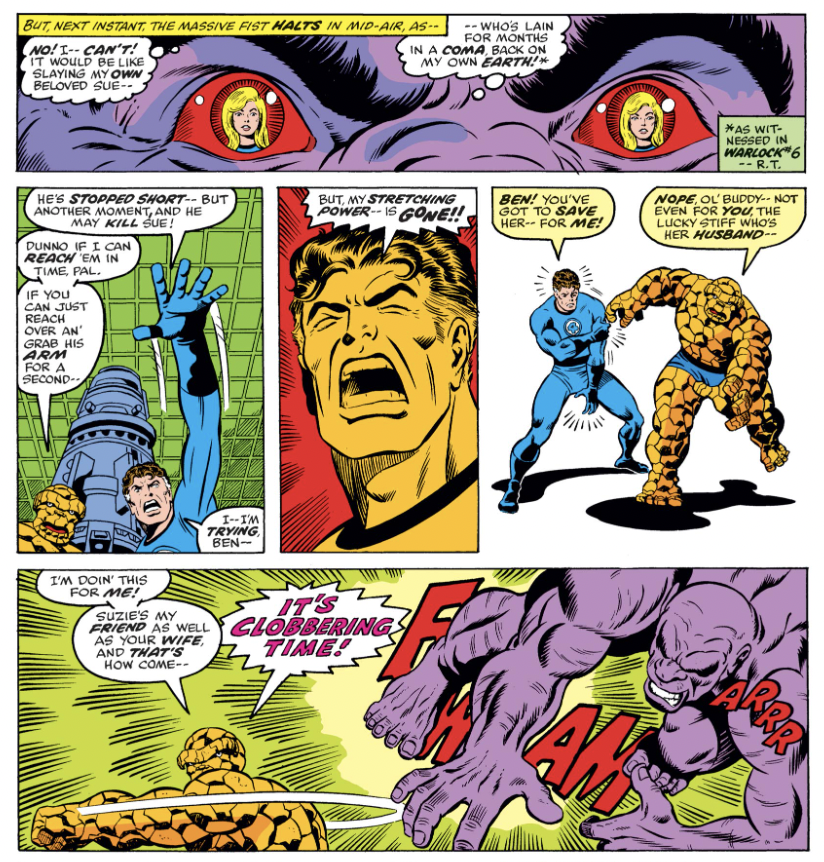
And I really liked this exchange between Ben and Reed, which reveals the family dynamic that’s at the core of the FF:


What I didn’t like

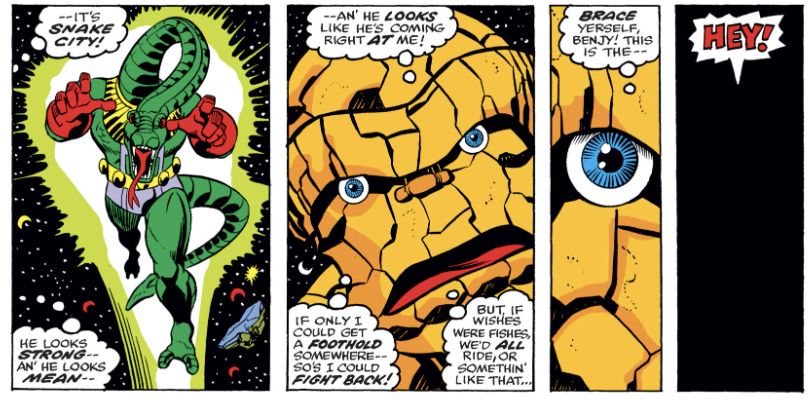
The issue opens with Ben drifting in the Negative Zone, but is instantly transported back to the Baxter Building with no real explanation. It suggests Thomas didn’t really have a plan after last issue and was making it up as he went along.


Anything else?

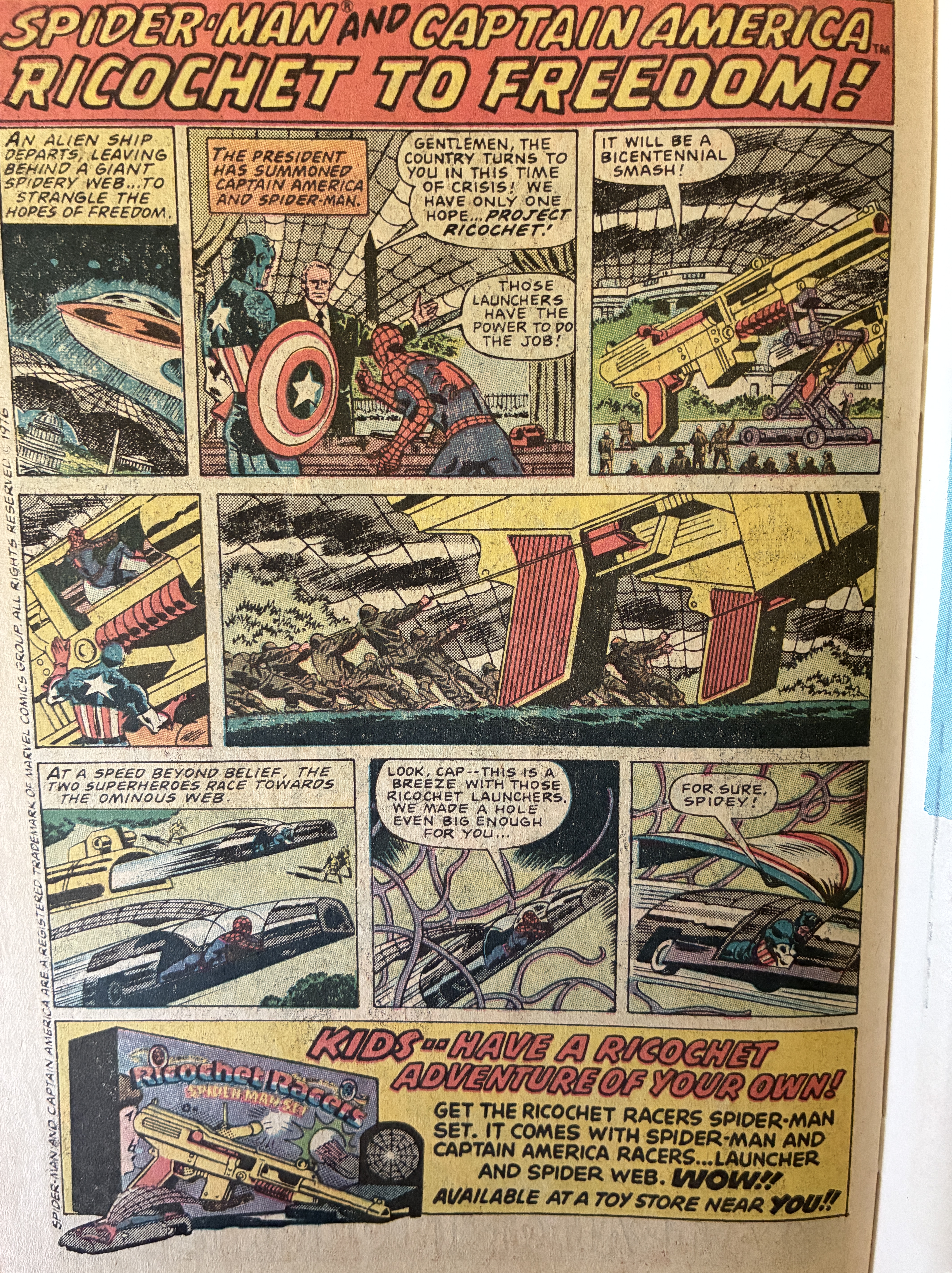
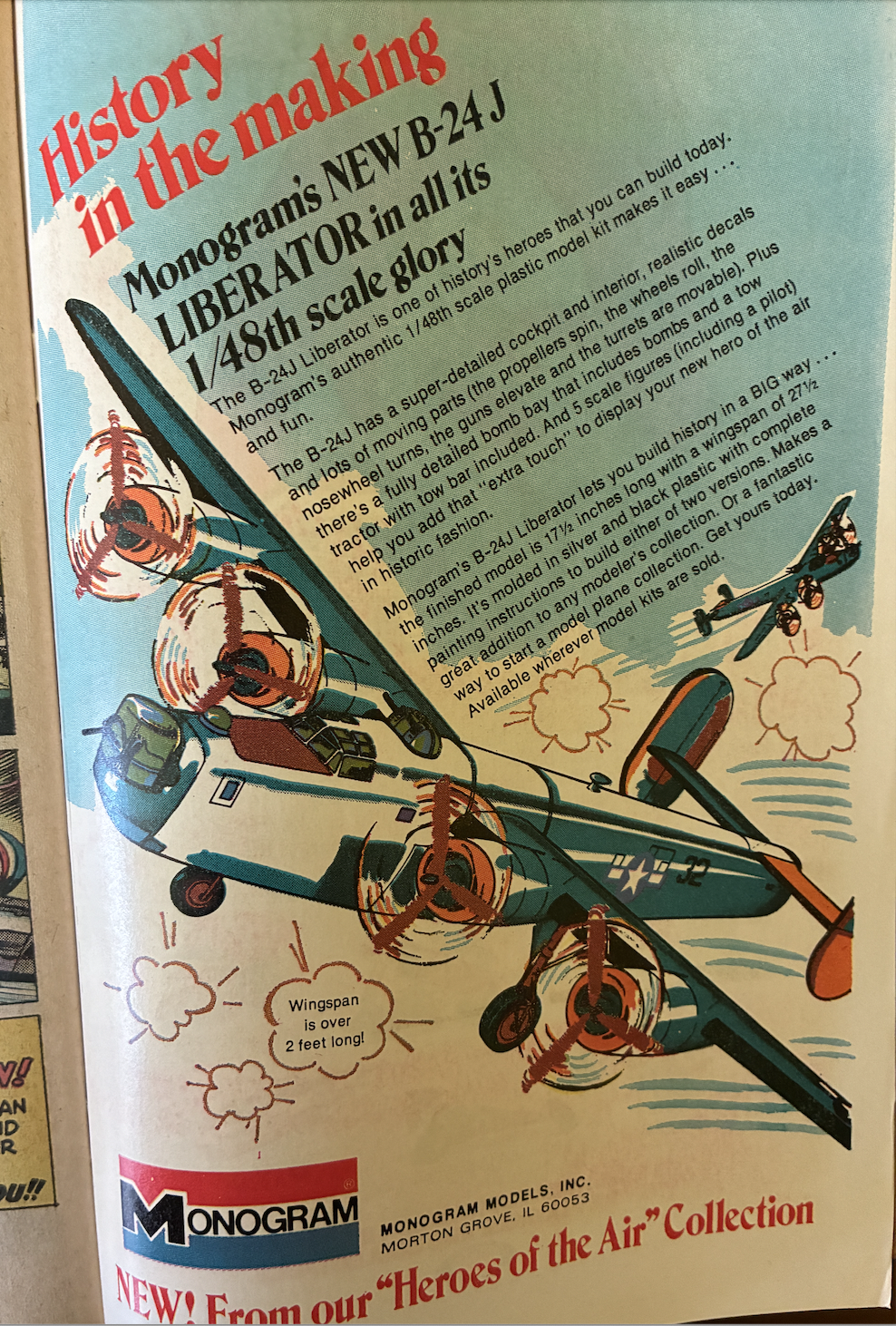
Some fun ads in this comic:


Overall

An excellent Fantastic Four comic book

“The World’s Greatest Comic Magazine!” Fantastic Four Annual No. 11

01 Sunday Jun 2025

Posted by percivalhenry in The World's Greatest Comic Magazine

≈ Leave a comment

Tags

1976, Fantastic Four, Fantastic Four Annual 11, Invaders, John Buscema, Marvel comics, Namor, Roy Thomas

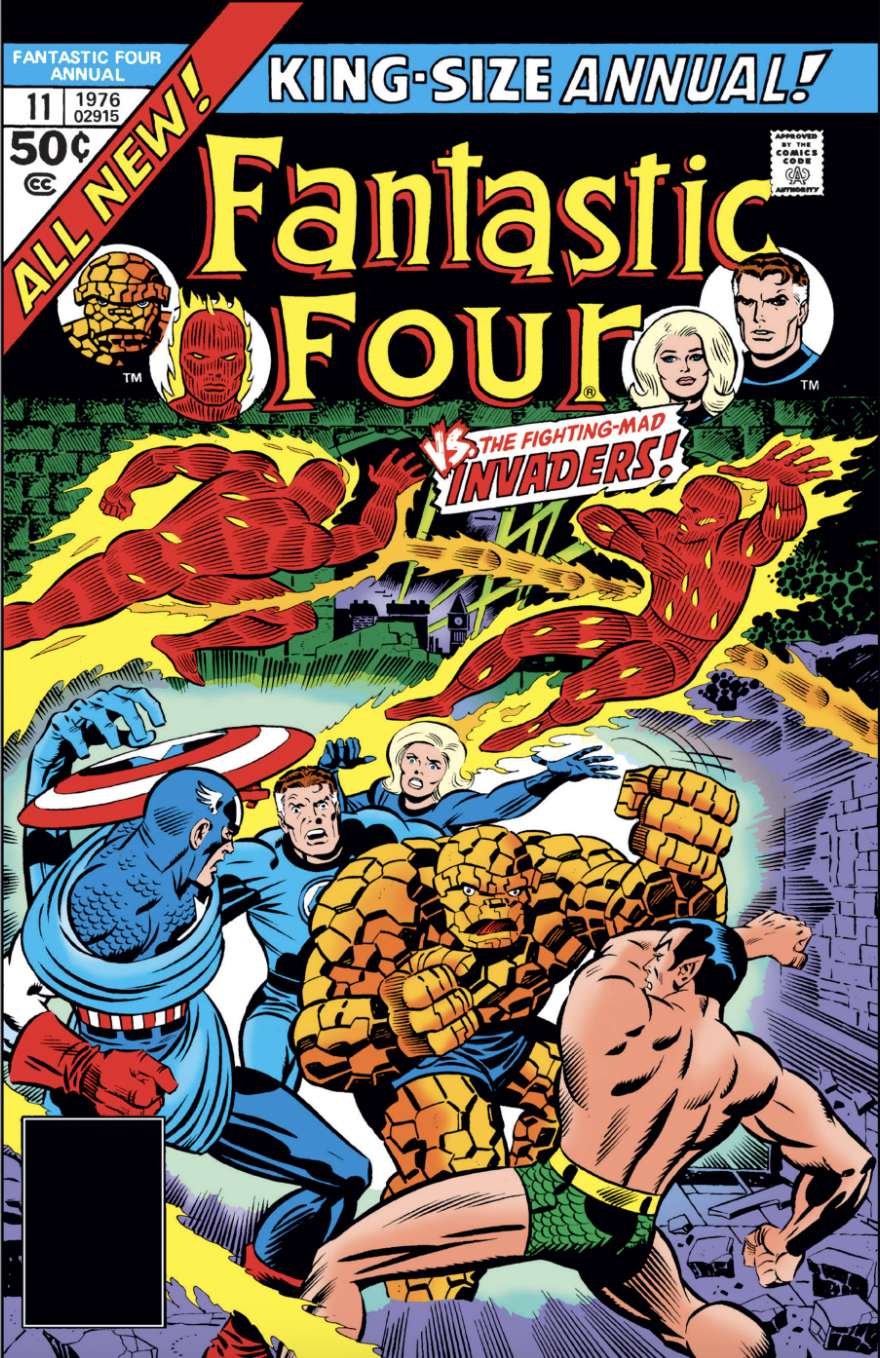
Fantastic Four Annual 11
“And Now Then the Invaders!”
Published March 1976
Writer: Roy Thomas
Pencils: John Buscema
Inks: Sam Grainger
Letters: Joe Rosen
Colors: Phil Rachelson
Editor: Thomas
Cover: Jack Kirby and Joe Sinnott

Editor’s note: As I mentioned a while back, I am tackling this annual out of order, since it appeared after issue 170 and the end of the Power Man story arc. It’s basically a standalone story so it’s

Synopsis

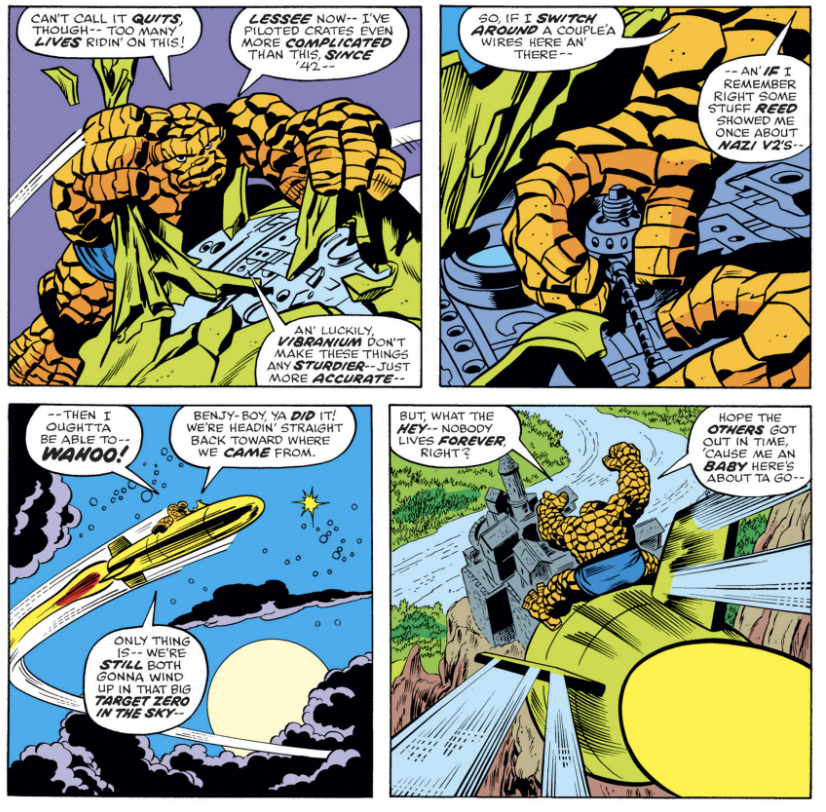
After a training exercise in the Baxter Building, the Fantastic Four discovers they accidentally triggered Dr. Doom’s time machine, and sent back a sample of vibranium to 1942 Germany. As a result, the Nazis were able to build more accurate rockets and conquer the world. The FF travel back in time and joins the WW II super hero team The Invaders to storm Baron Zemo’s castle and thwart his plan to launch the souped up missiles at London. After recovering the vibranium and restoring history, the team returns but the Thing realizes not all the vibranium made it back.


What’s going on here?

This is a fun but uneven comic with a lot to unpack. Notably, it’s the first FF annual with new content since the great Fantastic Four Annual 6 way back in 1968 (there were some Giant-Size FF’s that served the purpose of annuals, although they appeared quarterly).

It’s also the first time the FF encounters the Invaders, a team invented by Roy Thomas that ret-conned a number of World War II-era heroes into a super team. (He may have based his idea on the All-Winners Squad, a Golden-Age comic with some of the same members, but that was released in 1946, after the war). The Invaders debuted in its own comic in 1975 and given all the times the FF comic was used goose the sales of other Marvel titles, it’s probably not too surprising Thomas engineered a cross-over between the two titles.

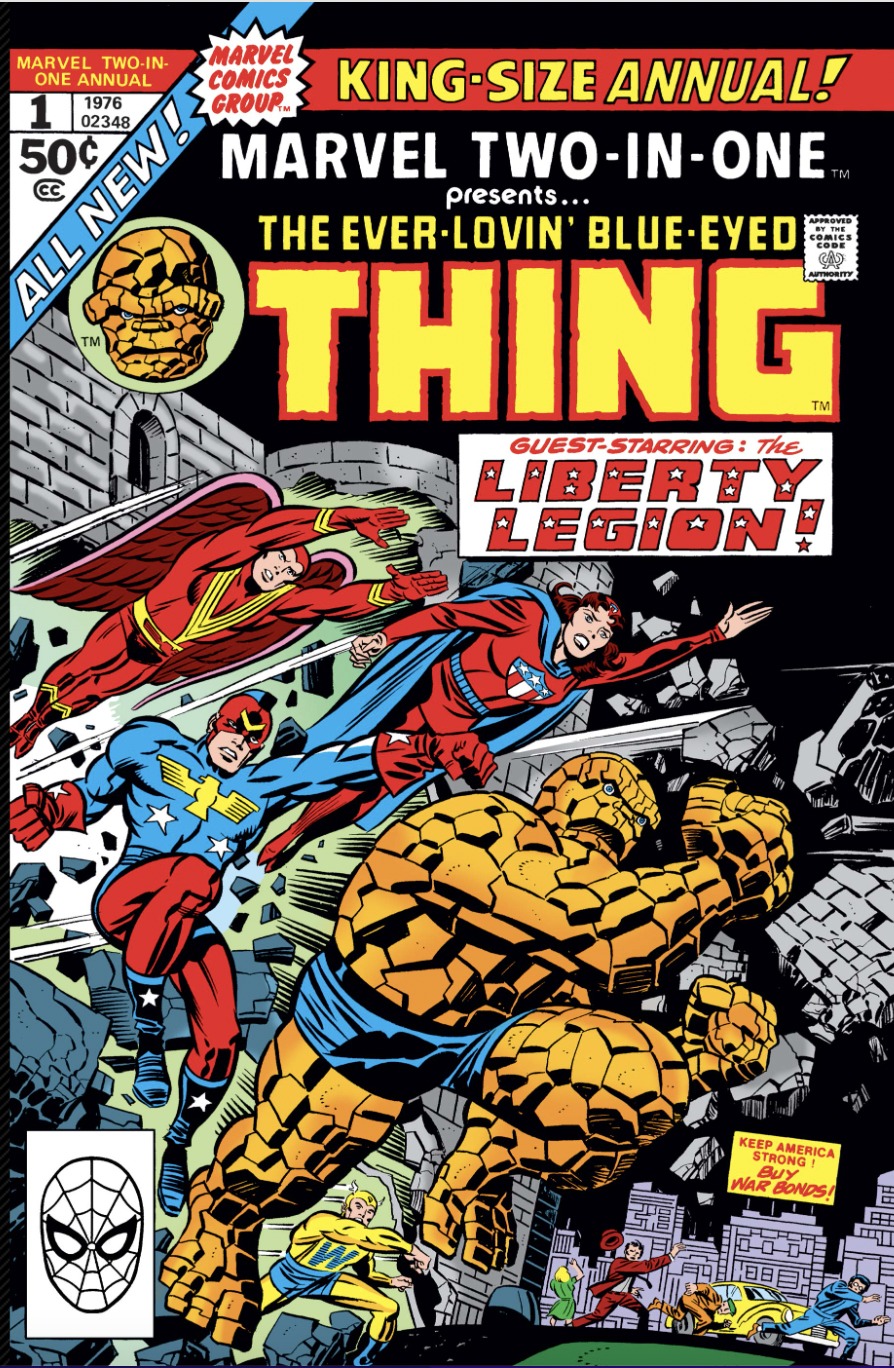
Thomas had a decades-long fascination with World War II super heroes. Along with the Invaders, he created the Liberty Legion, a sort of B-team led by Bucky that appeared in Marvel Premier. Later, at DC in 1981, he created the All-Star Squadron, a massive team that spun out of the Justice Society and contained just about every Golden Age DC character. Also at DC he created Young All-Stars, a post-crisis version of the All-Star Squadron (which theoretically no longer existed).

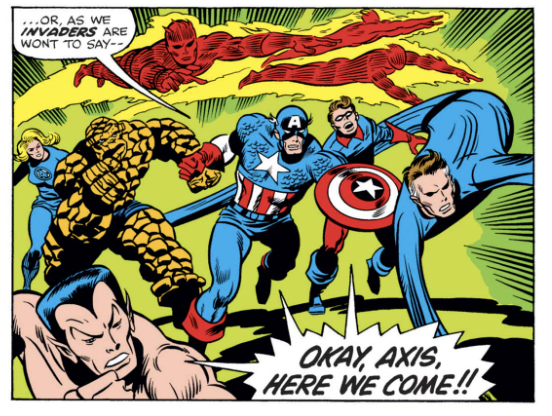
In typical Thomas-ian form, Fantastic Four Annual 11 is more convoluted than it needs to be, with lots of exposition and obscure call backs. But it’s also a rollicking read, with clever nods to the paradoxes of time travel and to the novelty of the FF reuniting with characters like Namor and the original Human torch.

In a twist, the story ends on a bit of cliff-hanger, when Ben learns that he has to go back to World War II, a story which takes place in Marvel Two-In-One Annual 1 and features the Liberty Legion.


Fantastic Four Annual 11 is also the first and only work on the FF by inker Sam Grainger, over John Buscema’s pencils. Grainger, who had a two-decade career on titles from Charlton, Marvel, DC and First comics, does serviceable work here. The cover is by Jack Kirby and Joe Sinnott.

What I liked

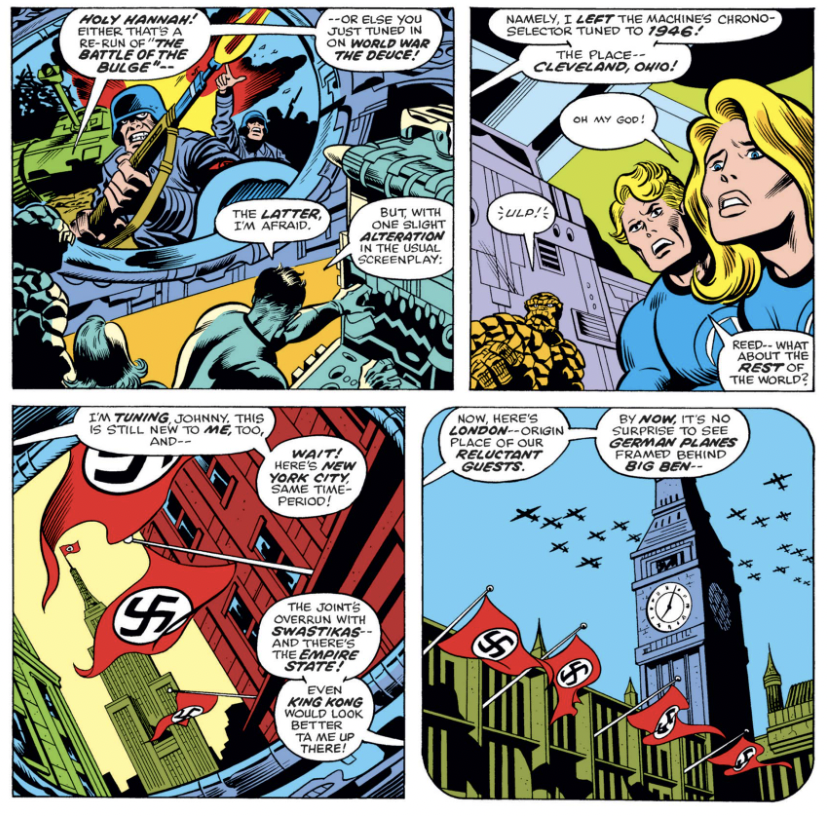
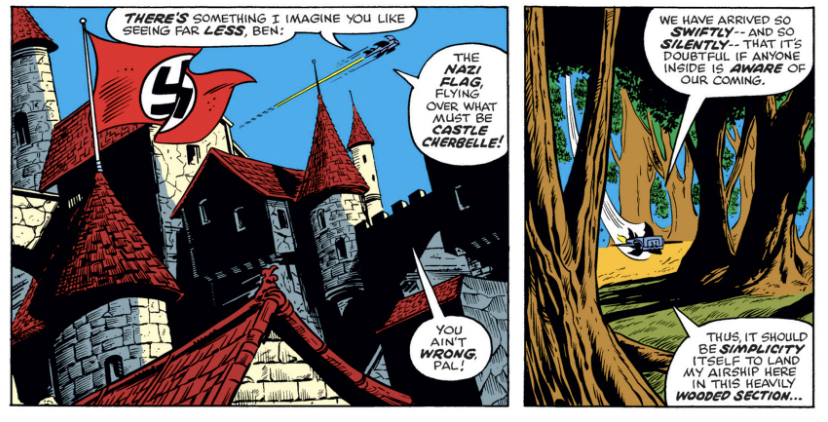
As a concept, the story works well. While the details are a little hard to swallow — the FF just happens to knock a tube of vibranium onto the time machine and they just happen to accidentally trigger it and send the tube back to 1942 where it just happens tp fall into the hands of Nazi scientists— the premise is fun. The idea that all Germany needed was more precise rockets with which to defeat Britain, and that vibranium was the one missing ingredient, is an intriguing one and nuanced enough to make the story more effective. It’s another entry in the long line of “What if Hitler won?” future histories covered by authors ranging from Len Deighton to Phillip K. Dick. The panels of the swastikas hanging in New York and London are chilling:


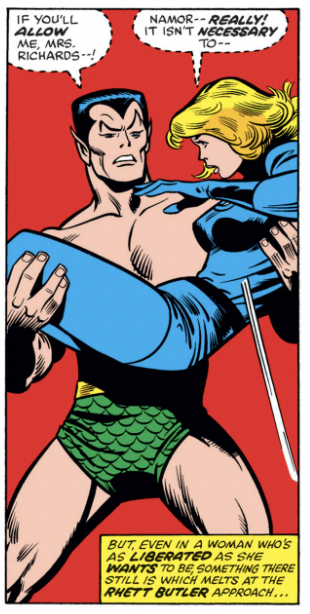
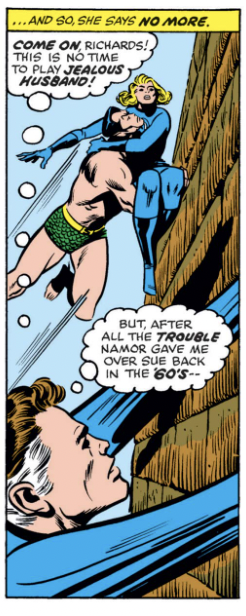
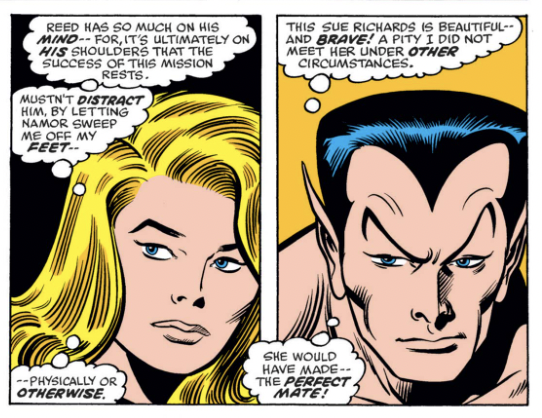
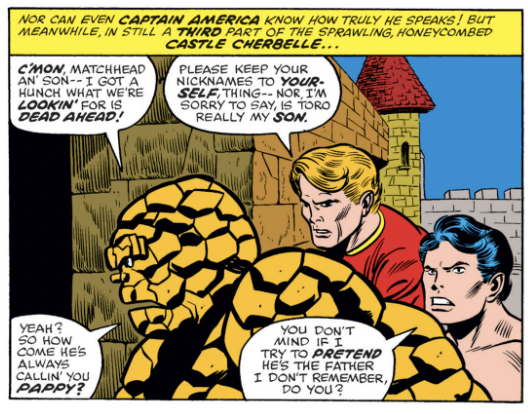
The story also reunites Sue and Namor, leading to some uncomfortable moments for Reed:


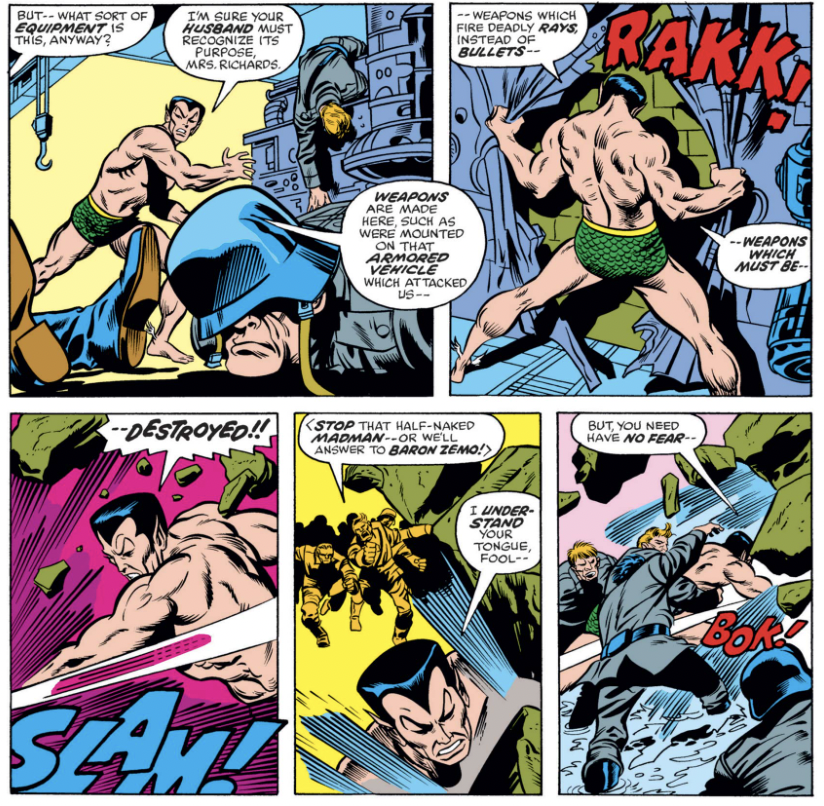
I also liked this sequence of Namor going all-out against the Nazis:


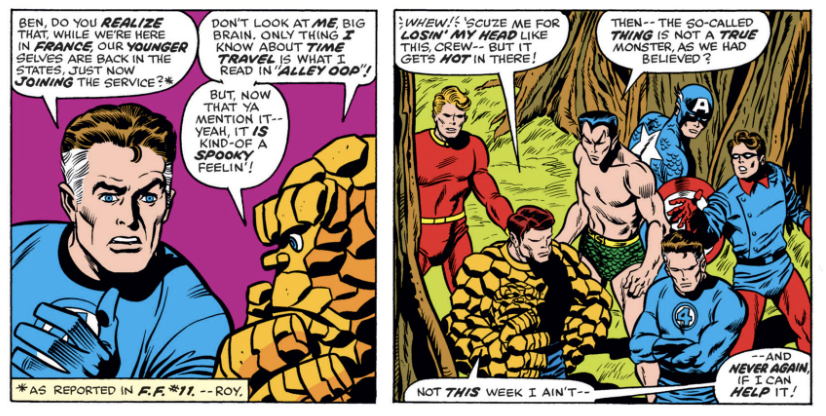
There is a lot of banter in this comic, some better than others. I liked this exchange between Ben and Reed, and Ben’s comments are poignant, given what we know is to come (note how different Reed looks when he isn’t inked by Joe Sinnott). “Alley Oop” was a newspaper comic strip.


This climactic sequence was ridiculous but fun.


This is a nice series of panels from Big John Buscema:


What I didn’t like:

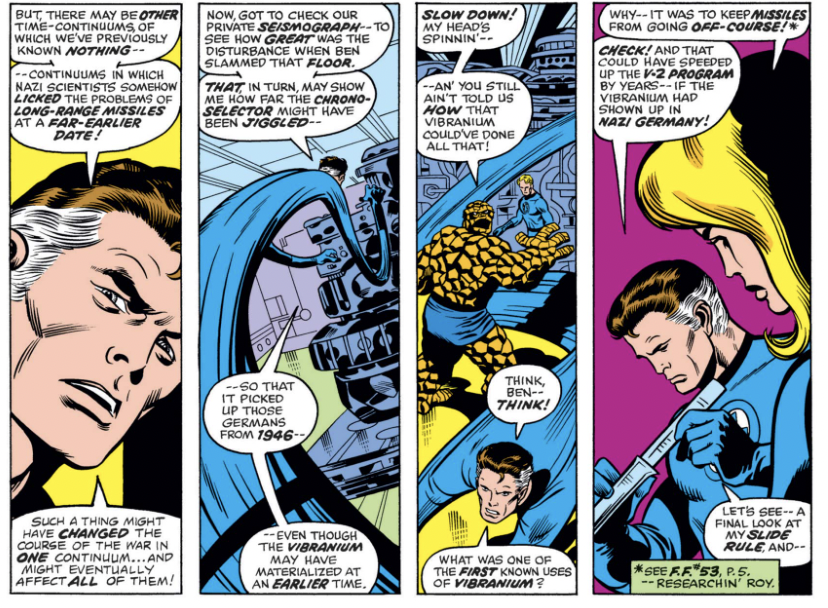
There is a lot of heavy-handed explanation in this comic. This sequence is an example:


This was weird and awkward:

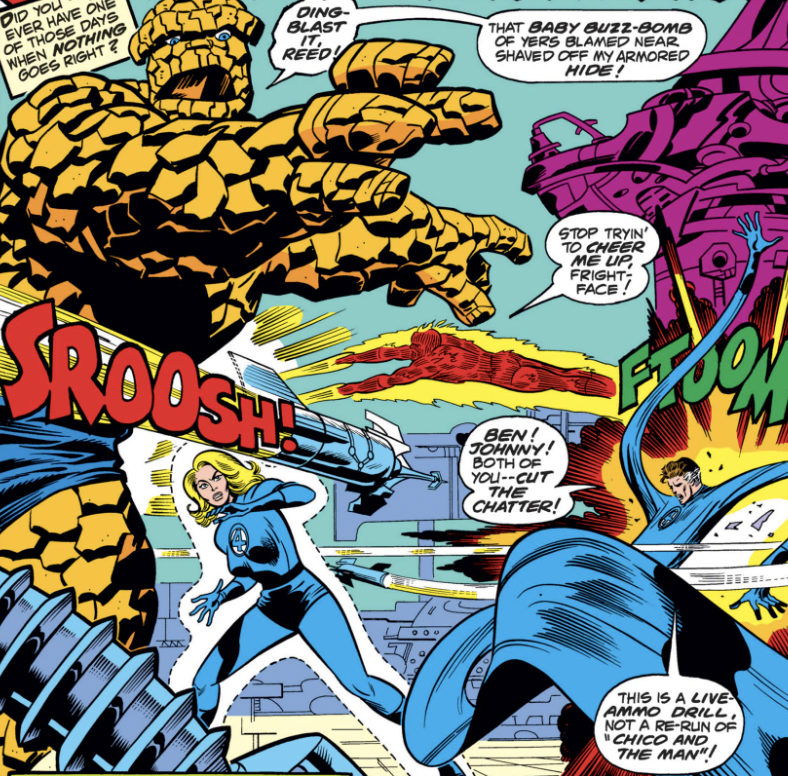
As I mention, not all banter is successful. Does Reed really watch Chico and the Man?


Anything else?

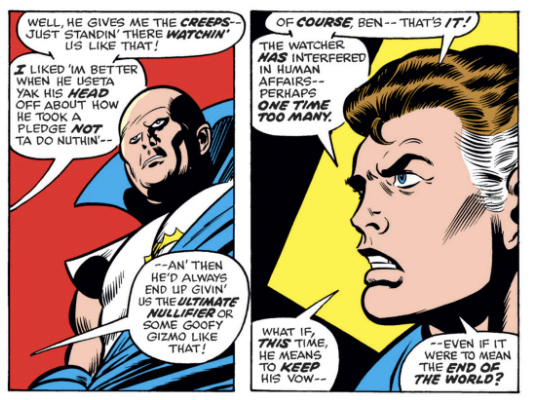
There are a few instances where Thomas seems to be poking fun. Here, Ben expresses what we all think about the Watcher, who seems to break his vow of non-interference more often than he upholds it:


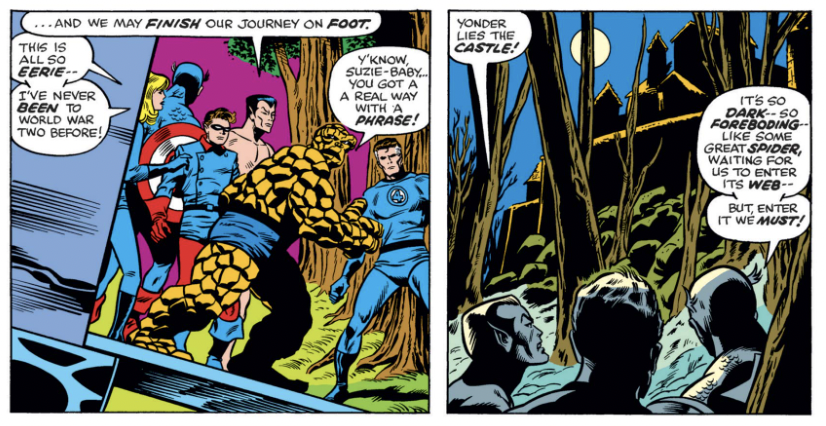
And here, alongside a totally inane comment from Sue, Namor seems to echo a line made famous by Tony Curtis, “Yondah lies the castle of my faddah” (although that appears to be an urban myth – Curtis never said that line).


Overall

A surpisingly satisfying comic

“The World’s Greatest Comic Magazine!” Fantastic Four No. 175

26 Monday May 2025

Posted by percivalhenry in The World's Greatest Comic Magazine

≈ Leave a comment

Tags

1976, Fantastic Four, Fantastic Four 175, galactus, jack Kirby, John Buscema, Marvel comics, Roy Thomas

Fantastic Four 175
“When Giants Walk the Sky!”
Published July 1976
Writer: Roy Thomas
Pencils: John Buscema
Inks: Buscema
Letters: Joe Rosen
Colors: Jan Cohen
Editor: Thomas
Cover: Jack Kirby and Joe Sinnott

Synopsis

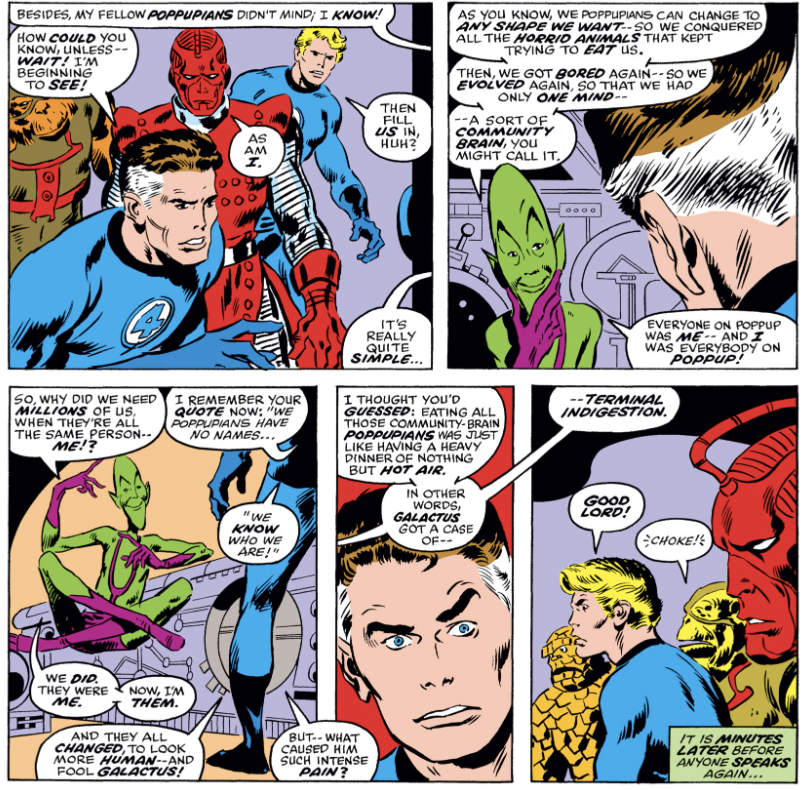
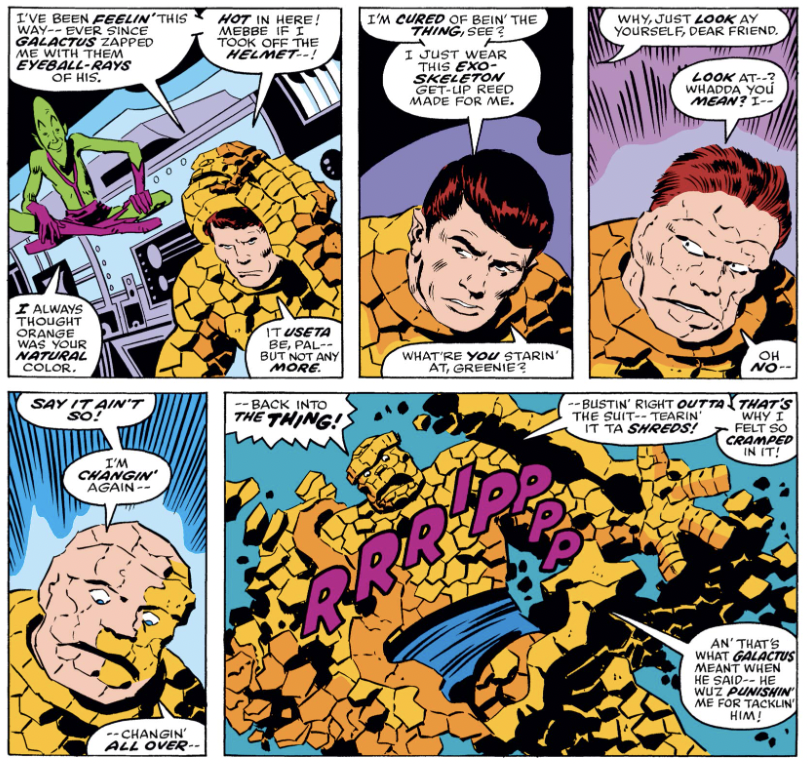
The High Evolutionary, with the help of the Fantastic Four, attempt to stop Galactus from devouring Counter Earth. At the last moment, the Invisible Girl seemingly appears and offers Galactus a new world, one she has just returned from. Galactus agrees, but after consuming it, becomes incapacitated and the High Evolutionary de-volves him to a state of pure energy. The Invisible Girl is revealed to the the Impossible Man, who offered his own planet Poppup to Galactus because his people’s shared consciousness means they had no need for a planet. The real Invisible Girl returns and lastly, Ben Grimm reverts to his Thing form, a result of Galactus zapping him with cosmic energy.


What’s going on here

This issue is very much a mixed bag. There’s some clever ideas here and the long-awaited confrontation between the High Evolutionary and Galactus begins on a strong note, but like many of Roy Thomas’s arcs, it fizzles out anti-climactically. The Impossible Man reveal feels too deus ex machina (although it’s totally in keeping with Thomas’s love of obscure call-backs) and the idea his people would sacrifice their planet makes little sense. Unlike the stories of the Lee / Kirby era, where Reed would whip up some solution to save the day, Thomas delivers another storyline where the FF are reduced to spectators as events swirl around them.

One note on the art: John Buscema handles both pencils and inks, filling in for Joe Sinnott. As a result, his characters look a bit more Busecma-esque (in fact, in some places they look as if they were drawn by Sal Buscema, John’s younger brother). Check out the close up of Reed below.


I was surprised to learn this was only the second appearance of the Impossible Man, a character so annoying it feels like he’s always showing up. Marvel’s version of Mr. Mxyptlk — another insufferable character — he first appeared way back in FF 11, and will hang around for the next several issues. I will try to keep an open mind but I am dreading these stories.

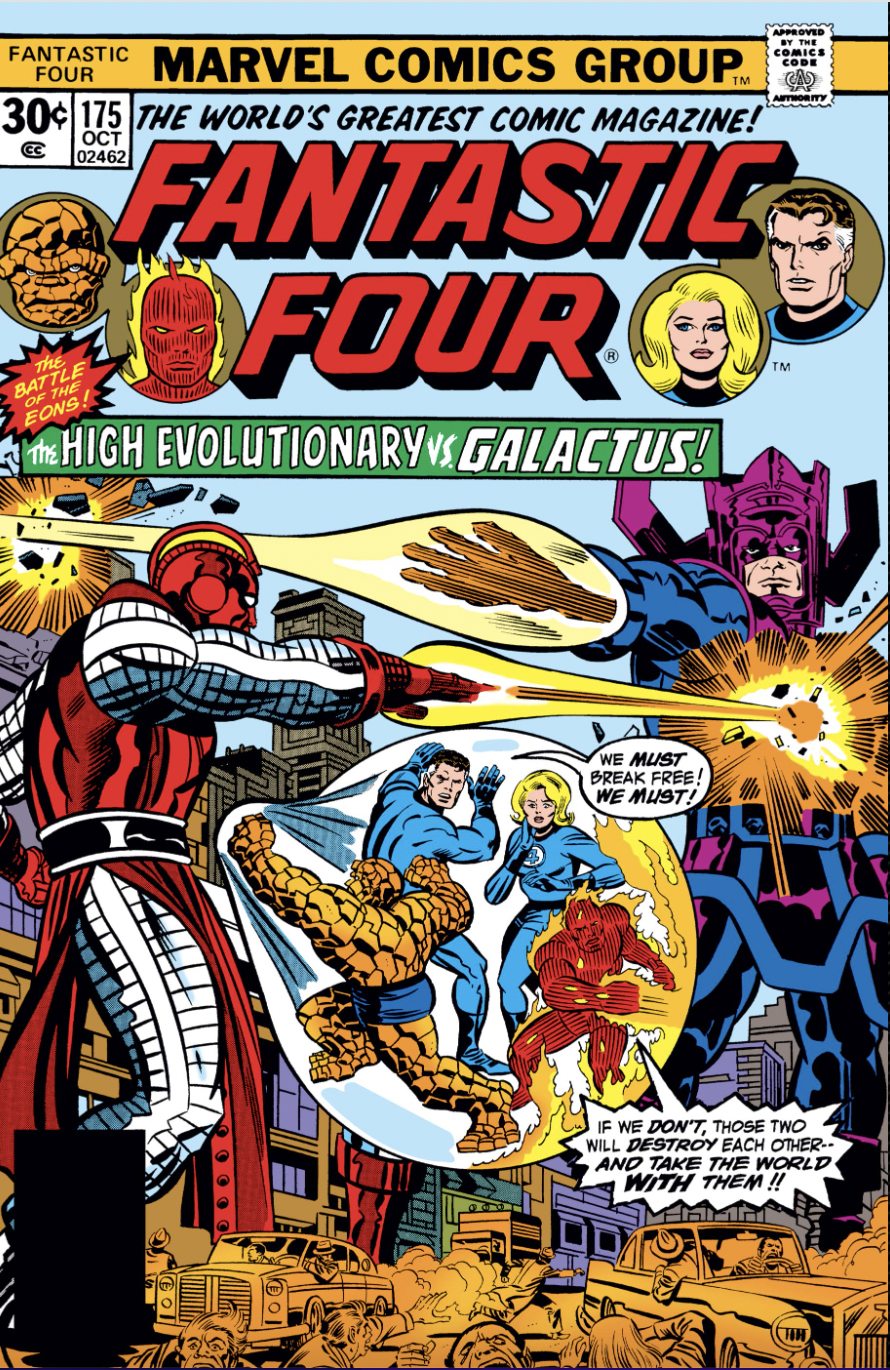
Kirby and Joe Sinnott return for the cover, which is stronger than their last few.


What I liked

Ben’s reversion back to his Thing form at the hands of Galactus was well done. Ben wasn’t going to remain in the exoskeleton forever, and if Thomas needed a mechanism to change him back, the wrath of Galactus feels like a good choice.


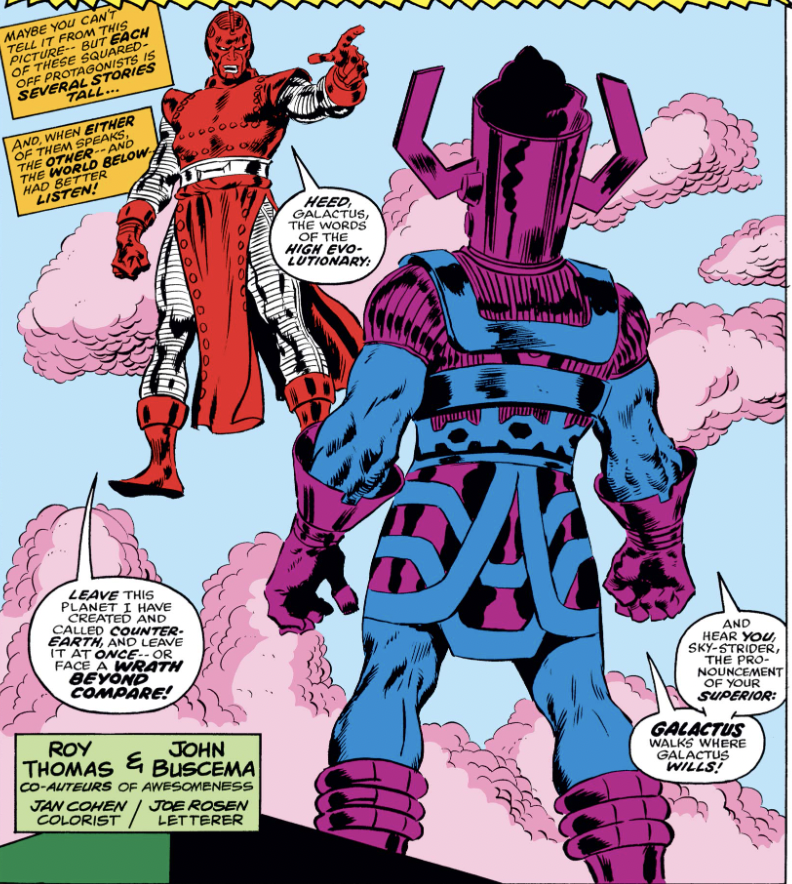
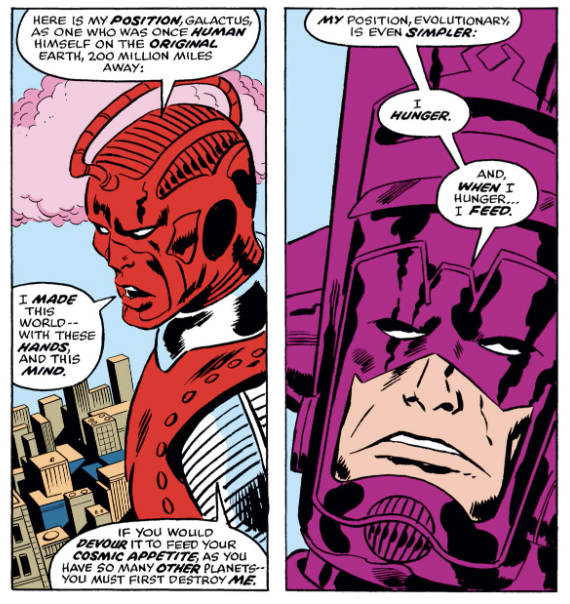
I also liked the posturing and pompous boasting between the High Evolutionary and Galactus. This was the clash this arc promised, but besides a few panels, didn’t really deliver.


What I didn’t like

I’ve detailed my bigger complaints with this issue above, but here are few other nits to pick:

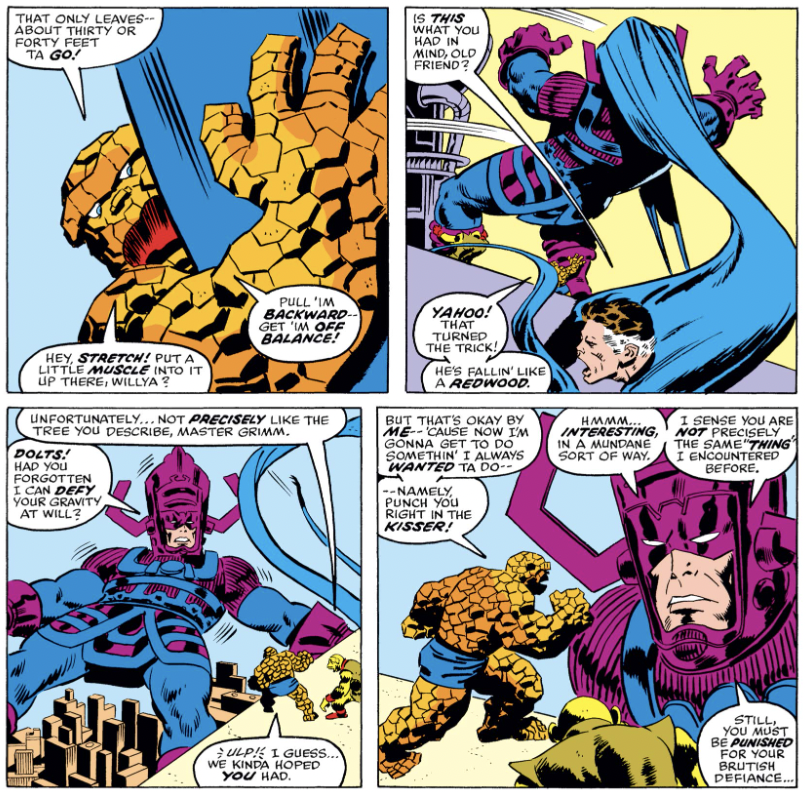
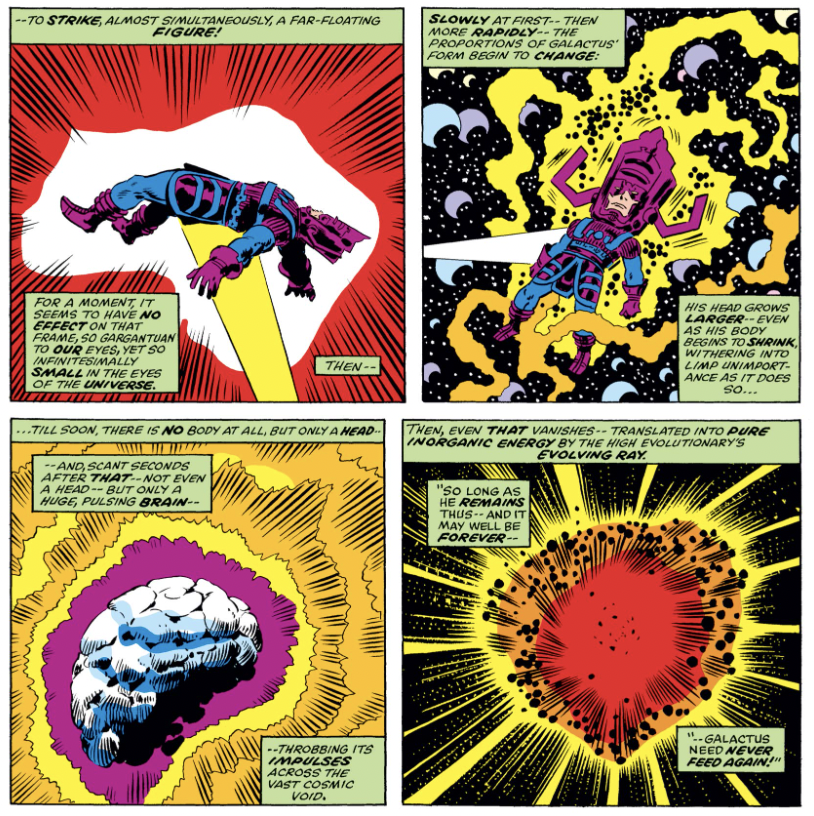
As I’ve mentioned, I hate it when writers force Galactus into physical fights with lesser foes. He should be above such things.


The devolution of Galactus was also peculiar. It’s an interesting way to remove him from the board (although of course it won’t be permanent) but I’m not sure it’s very successful.


Anything else?

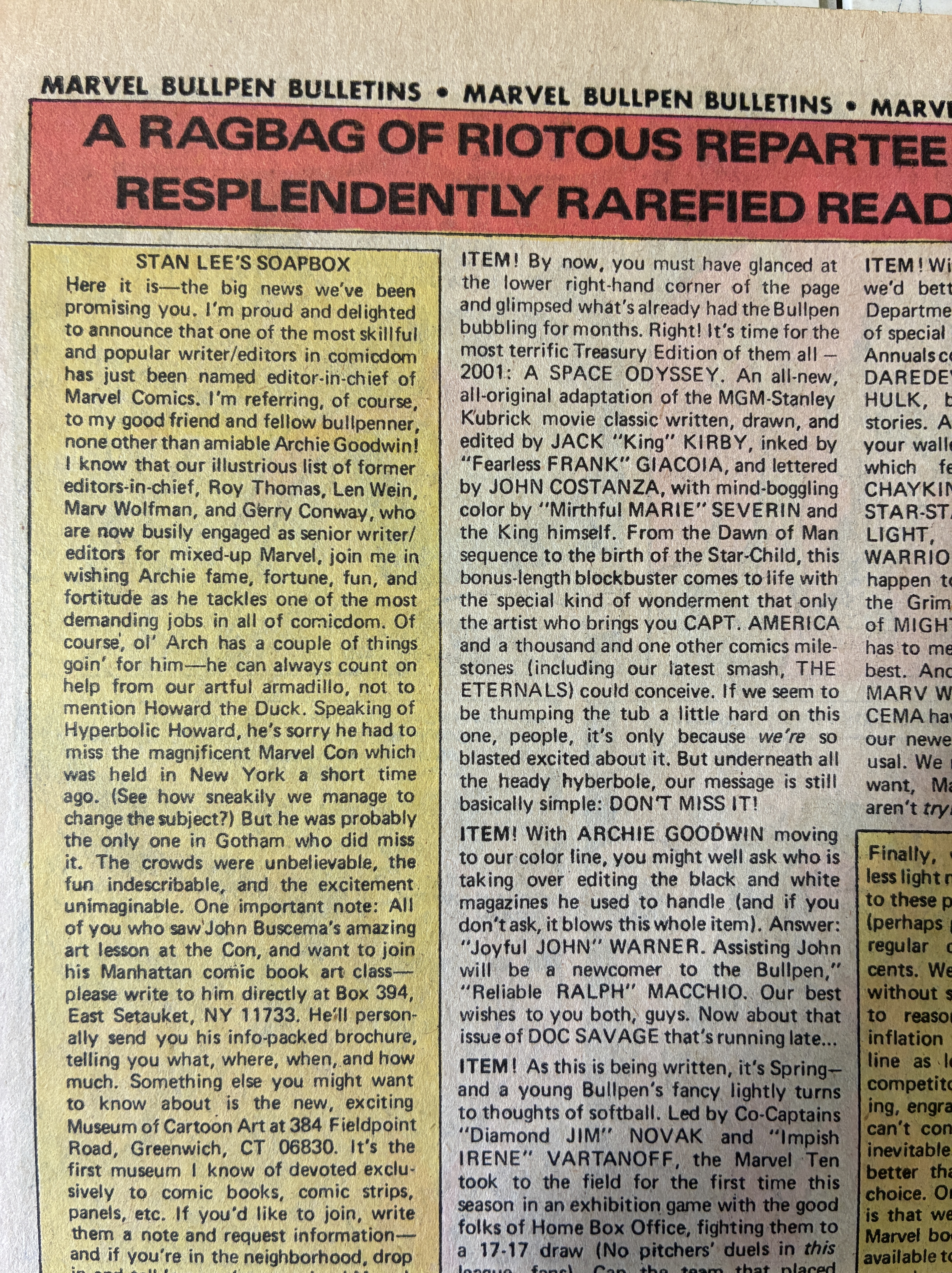
Here’s a Bullpen Bulletin notice that Archie Goodwin is taking over as editor, the fifth in four years in an era that led to lots of instability in the comics. This run of editors reminds me of late Rome, where emperors were crowned and deposed every few months.

Goodwin would last two years before he was replaced by Jim Shooter, who will hold the job for a decade and put his own stamp, for better or worse, on Marvel and comics in general.


Overall

A disappointing conclusion to a fun arc.

“The World’s Greatest Comic Magazine!” Fantastic Four No. 171

20 Sunday Apr 2025

Posted by percivalhenry in The World's Greatest Comic Magazine

≈ Leave a comment

Tags

1976, Fantastic Four, George Perez, Marvel comics, Roy Thomas

Fantastic Four 171
“Death is a Golden Gorilla!”
Published March 1976
Writer: Roy Thomas
Pencils : Rich Buckler and George Perez
Inks: Joe Sinnott
Letters: Joe Rosen
Colors: Phil Rachelson
Editor: Thomas
Cover: Jack Kirby and Sinnott

Editor’s note: This issue came out a few weeks after Fantastic Four Annual 11, so these reviews are out of order, but I’ll get to the annual soon, I promise.

Synopsis

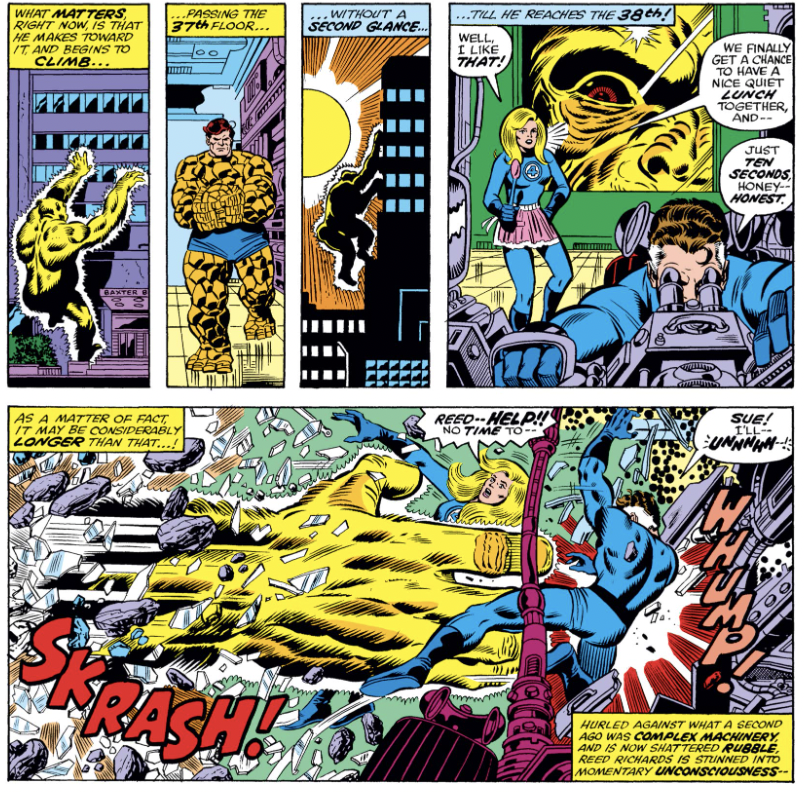
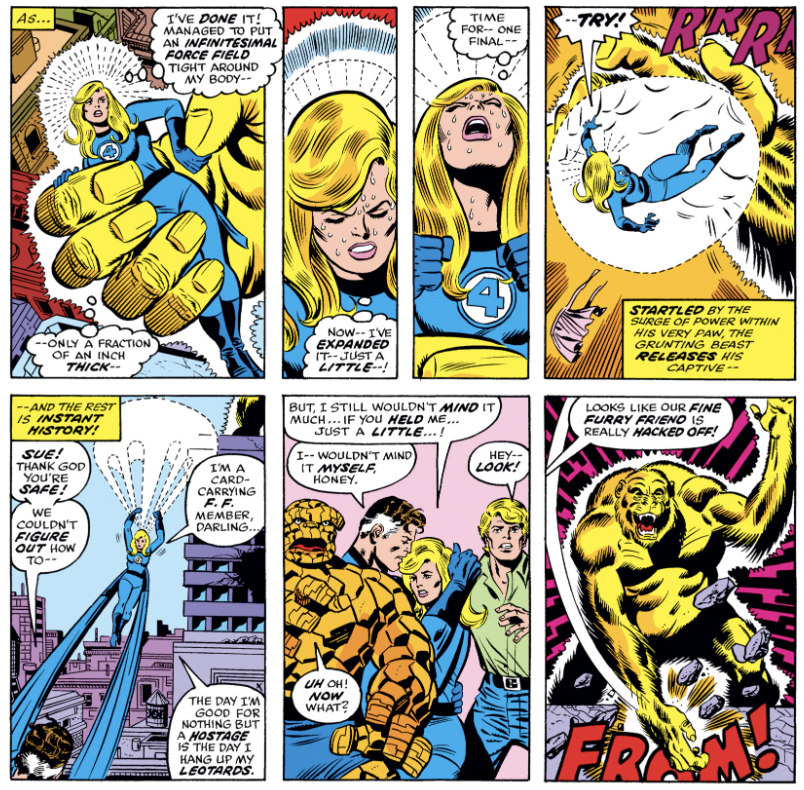
The story opens in the Baxter Building where a de-powered Ben is getting used to his new exoskeleton while the Invisible Girl expands her powers in a training session. Meanwhile, Johnny and his new girlfriend, Frankie, stroll through Central Park discussing his future away from the Fantastic Four when a spaceship lands and a glowing yellow gorilla emerges. The gorilla quickly growing in size and climbs the Baxter Building, where it grabs the Sue. The FF battle the monster and after it is defeated, it reveals it can speak, and that it came to Earth seeking help combating Galactus.


What’s going on here?

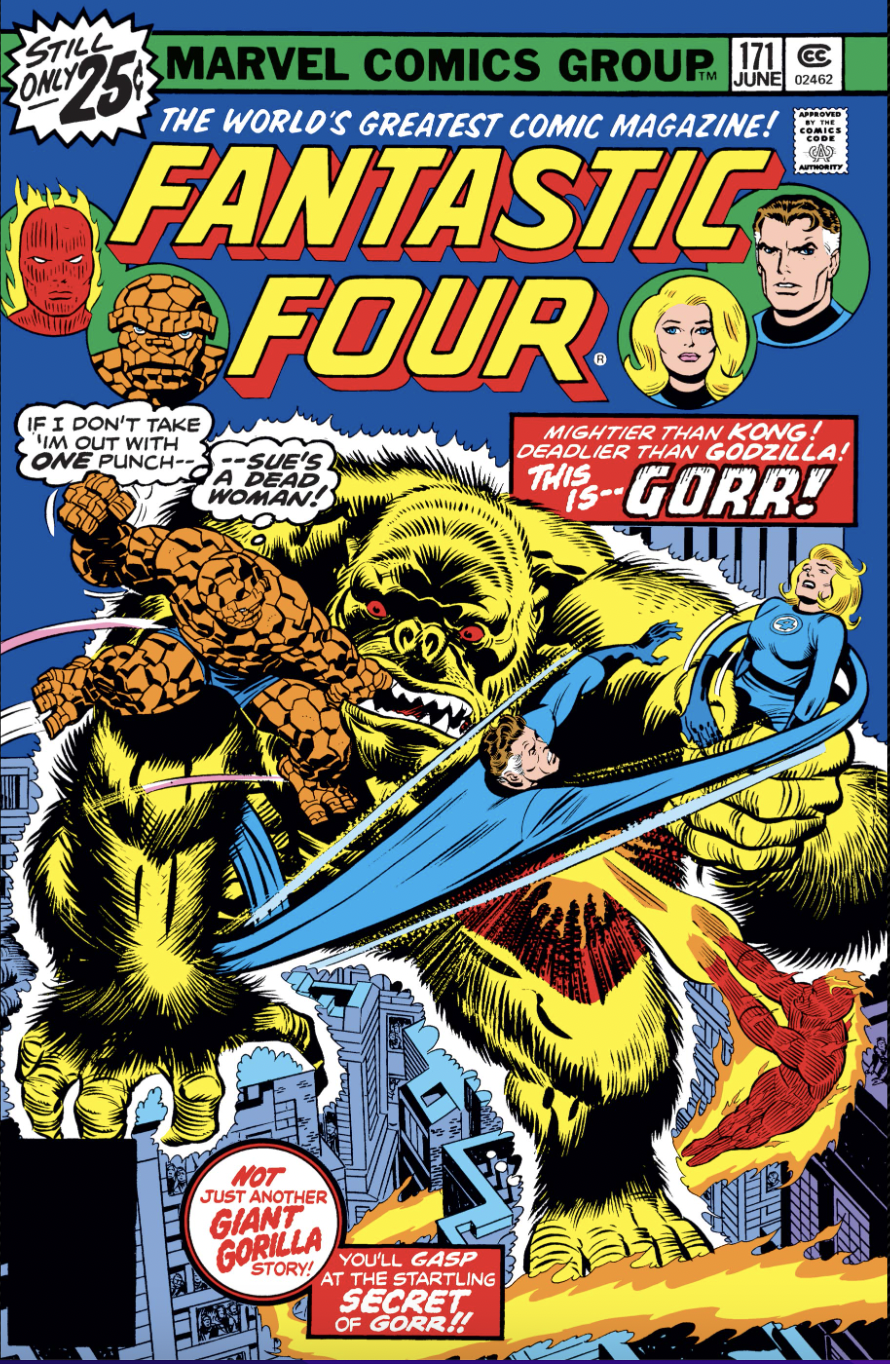
This issue isn’t as bad as I anticipated, given the cover and subject. It’s not great, but it could have been so much worse. As an FF story goes, it follows the formula laid down by Stan and Jack: hi-jinx in the Baxter Building are followed by the team battling some threat. Unfortunately, in this issue, the threat is pretty ridiculous, and despite all the King Kong jokes, still feels like a King Kong rip-off, right down to Sue playing Fay Wray.


The story is redeemed a bit by the twist at the end, and by the interpersonal dramas, between Ben and Reed, Ben and Sue, and Johnny and Frankie. George Perez does a solid job on art, although the first three pages are by Rich Buckler.

The cover is by Jack Kirby, although it’s pretty hard to tell.

What I liked

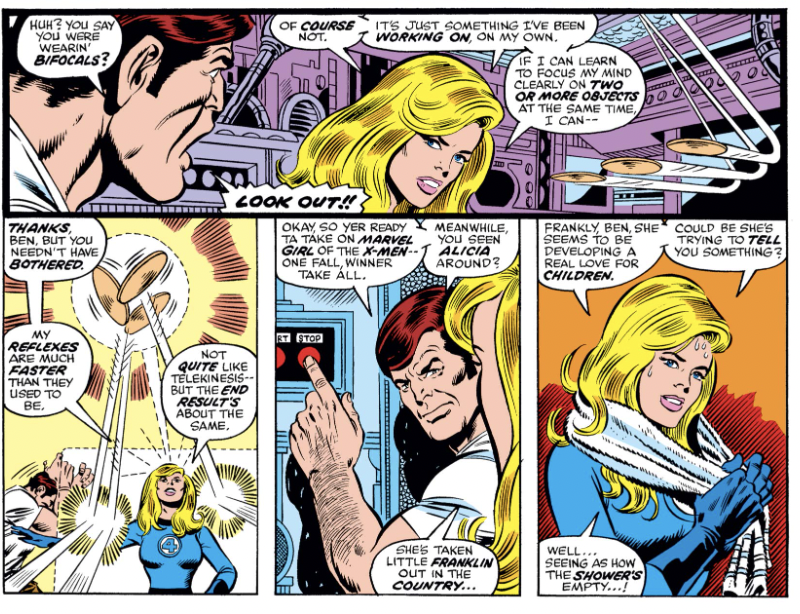
This exchange between Ben and Sue was interesting. Here, she explains how her powers are more than just invisibility and force fields, and that it’s closer to telekinesis, a long-overdue expansion of her abilities. There’s also a poignant suggestion about Ben and Alicia one day having kids, something that takes almost 50 more years.

Sue’s line about taking a shower is a bit oddly timed.

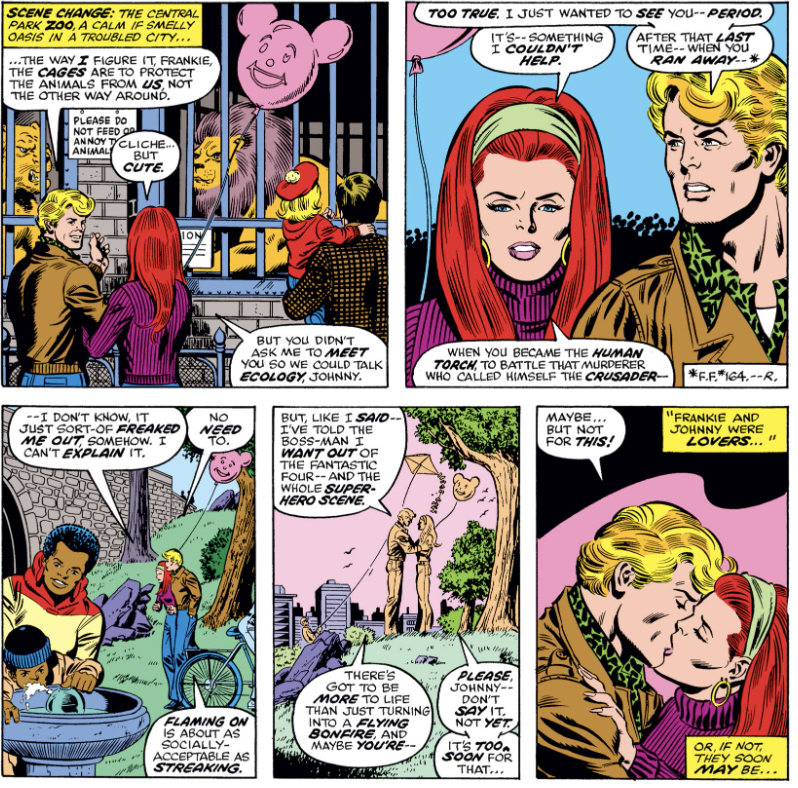
I also liked the exploration of Johnny’s relationship with Frankie (the line about the old Central Park zoo being smelly was dead on):

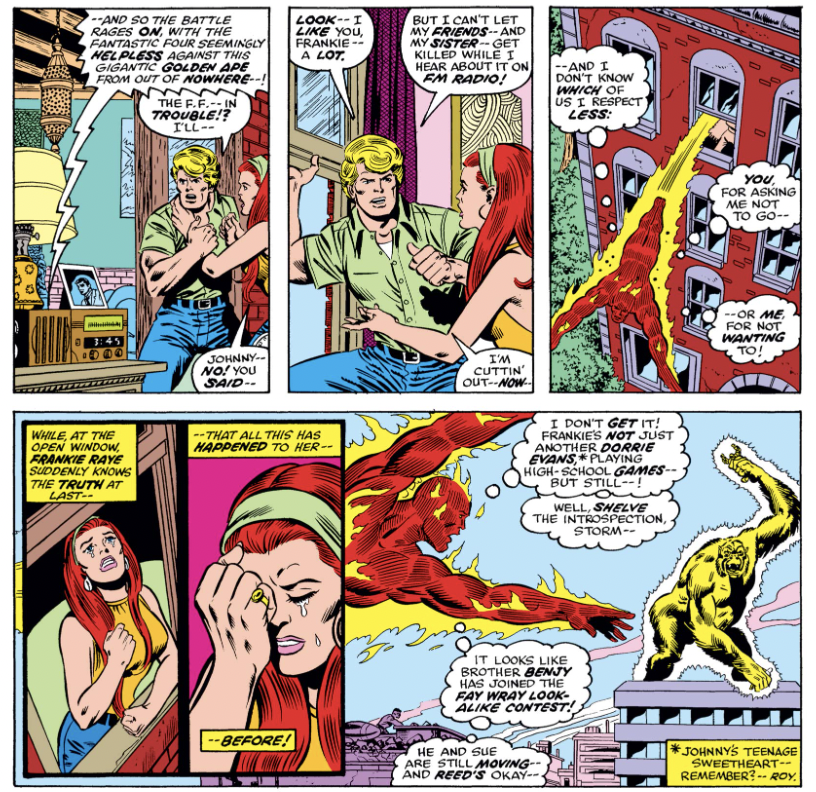
And here we get a peek at Johnny’s inner turmoil, and a hint about Frankie’s background:


Here, Sue uses her expanded powers while making a crack about all the times she was held hostage in the early days of the FF (more than a dozen times, by my count):


What I didn’t like

Besides the giant gold glowing gorilla?

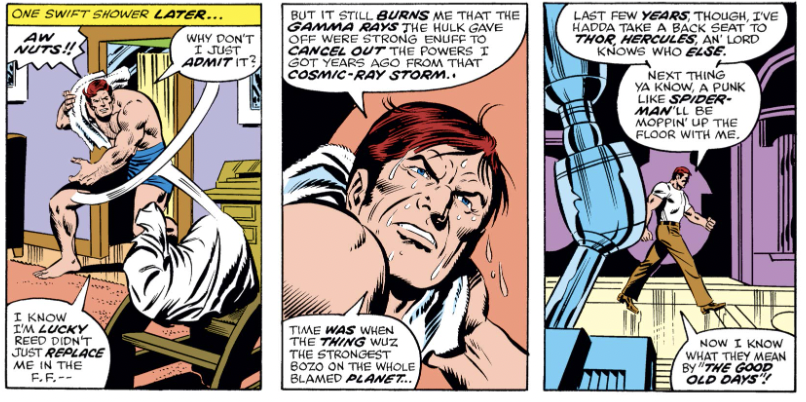
I also didn’t like Ben grousing about his loss of powers. With the exoskeleton, he’s got the best of both worlds. He should be happy while it lasts (because of course it won’t):


Overall

Meh.

“The World’s Greatest Comic Magazine!” Fantastic Four No. 166

16 Sunday Mar 2025

Posted by percivalhenry in The World's Greatest Comic Magazine

≈ Leave a comment

Tags

1975, Fantastic Four, Fantastic Four 166, George Perez, Marvel comics, Roy Thomas, The Hulk, Vince Colletta

Fantastic Four 166
“If It’s Tuesday, This Must Be The Hulk!”
Published October 1975
Writer: Roy Thomas
Pencils: George Perez
Inks: Vince Colletta
Letters: Joe Rosen
Colors: Phil Rachelson
Editor: Thomas
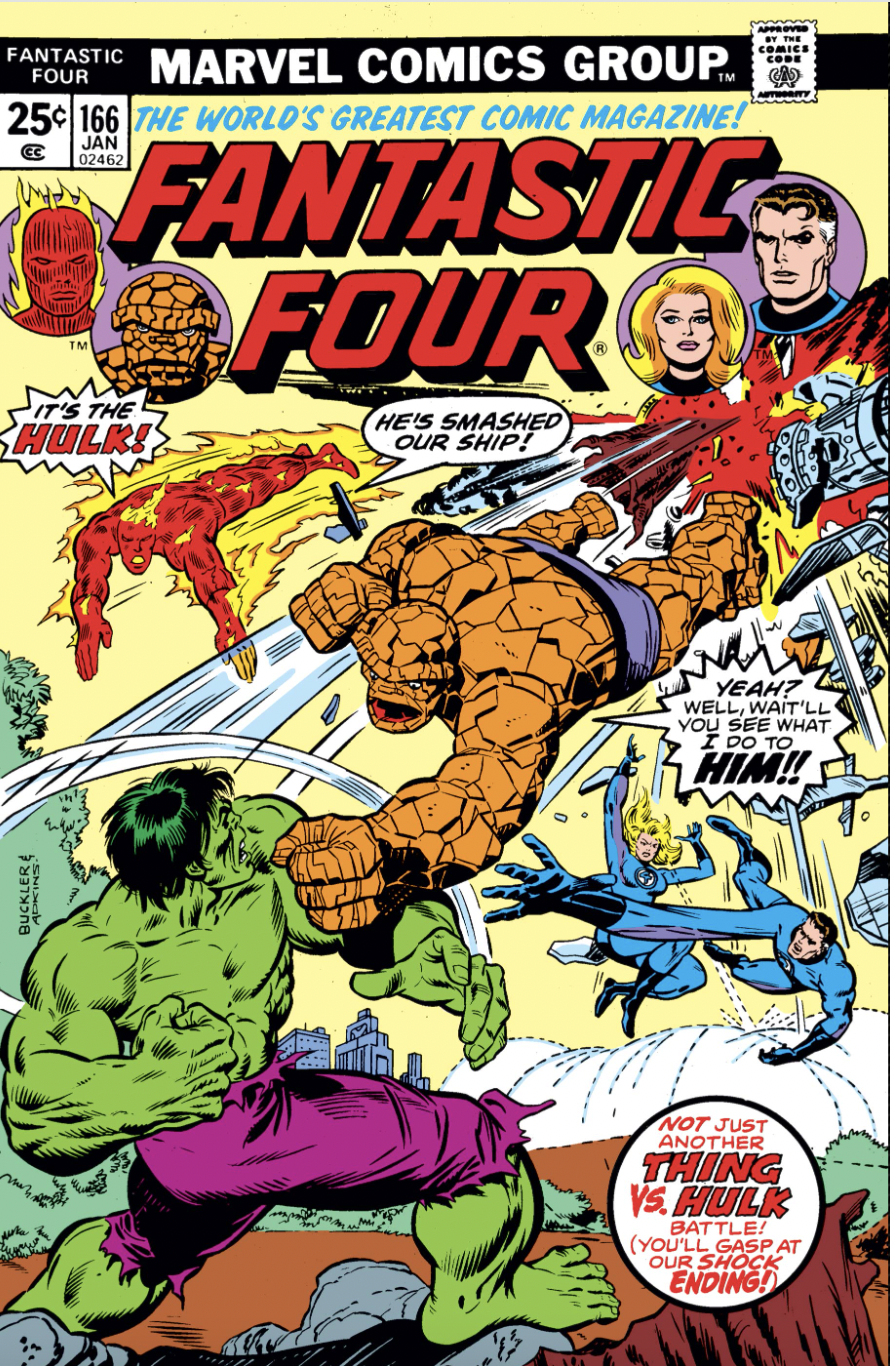
Cover: Rich Buckler and Dan Adkins

Synopsis

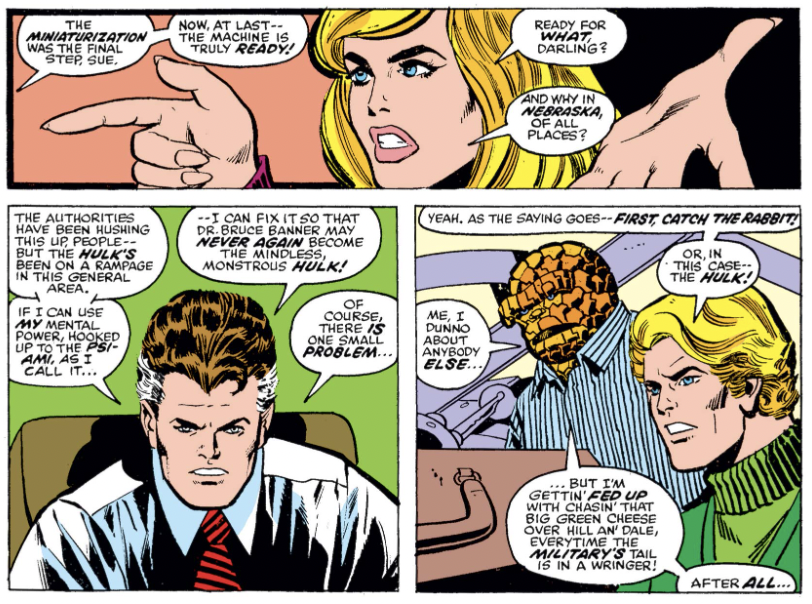
At the behest of the military, the Fantastic Four are flying west to find the Hulk, whom Mr. Fantastic thinks he can prevent from transforming from Bruce Banner with a device of his invention. Their plane is damaged by the Hulk, and after the FF help with an emergency landing, the team eventually captures the Hulk and helps the military secure him. But when it’s clear the authorities aren’t releasing Banner to the FF as agreed, the Thing frees him and joins the Hulk to fight the military.


What’s going on here?

This a bit of an odd issue. The mission to end Banner’s transformations into the Hulk seems to come out of nowhere, and it feels more like an opportunity to get the Hulk on the cover than to tell a good story. The story is padded out with a long sequence of the FF rescuing the plane (and with two pages for letters) but it picks up toward the end.

What’s most alarming about this comic are the inks of Vince Colletta, who is filling in for the Joe Sinnott. Colletta is infamous among comic book fans for butchering Jack Kirby’s work on Thor (it’s well documented here), and he’s accused of taking shortcuts and even erasing details that would take too long to ink. I always felt the criticism was probably over the top, given the passions Kirby evokes in his fans, and that Colletta was a journeyman professional who was doing a job as best he knew how (he is credited with working on more than 1,600 comics over the length of his 40+ year career).

But he does George Perez no favors in this comic. There is a distinct lack of Perez’s signature detail, and his faces look frozen and static. Here’s a good example:

It’s almost unrecognizable as Perez, and even though this is early in Perez’s career, we saw in the last two issues (inked by Sinnott) that many of his characteristics were apparent even at this stage.

In last month’s letters page there was an explanation that regular FF penciler Rich Buckler was unavailable for some reason, and that Perez was pressed into service. It’s possible he had to rush to complete this issue, and was only able to do layouts, leaving emergency inker Colletta the task of finishes. (The padded story and the double letter page would support that theory). In any event, the art in this comic is an unfortunate disappointment after the brilliant FF debut of Perez in the last two issues.

And one footnote: the cover by Buckler was inked by Dan Adkins, a longtime comics inker doing his first work on the Fantastic Four.

What I liked

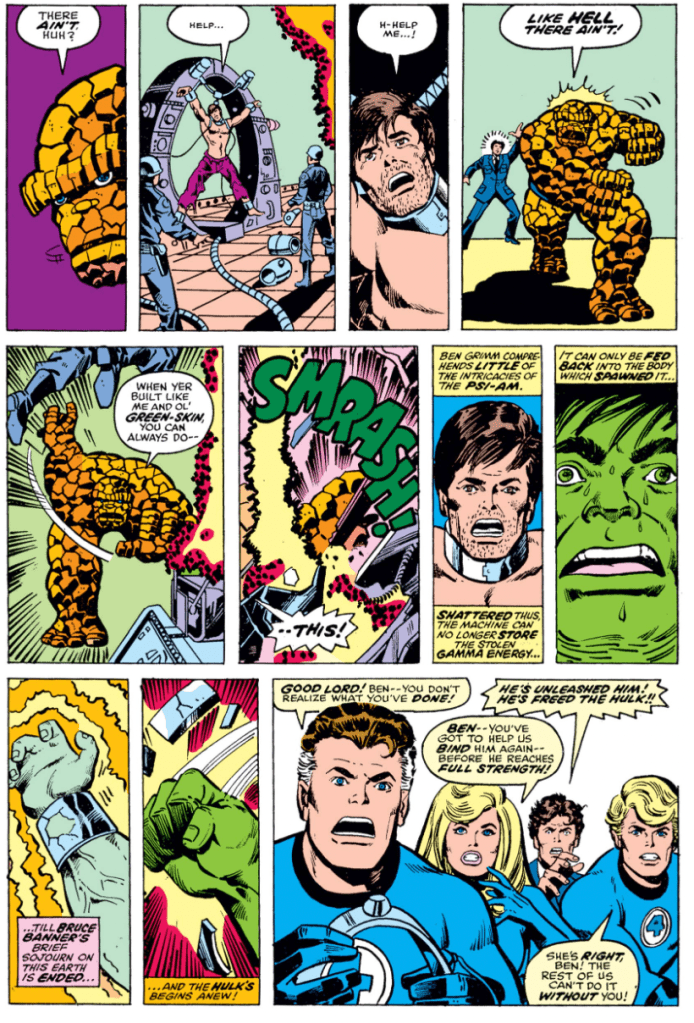
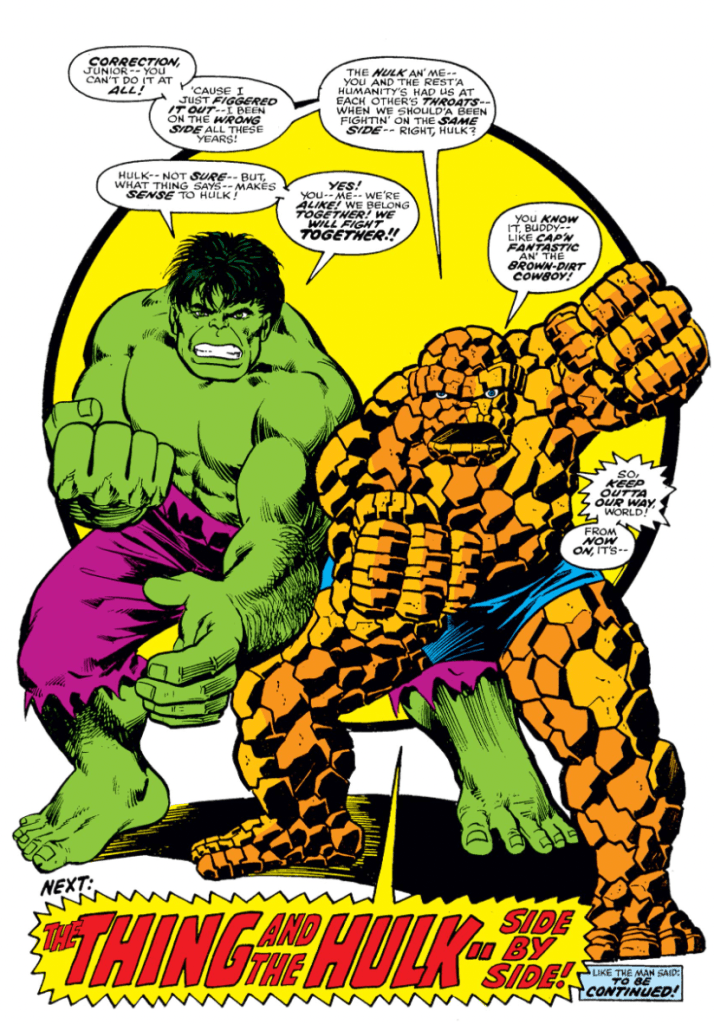
Despite the shaky premise, the story becomes a good one as the plot develops and Ben’s outrage over the treatment of the Hulk — in his eyes, a fellow monster — at the hands of the military builds from a simmer to boil. His decision to free Banner is genuinely surprising. This is a pretty dramatic sequence, enhanced by Perez’s layouts, which build from an 11-panel page (!) to a great splash:


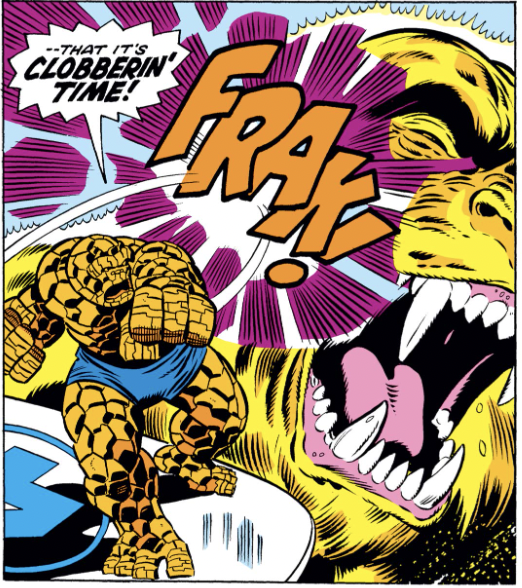
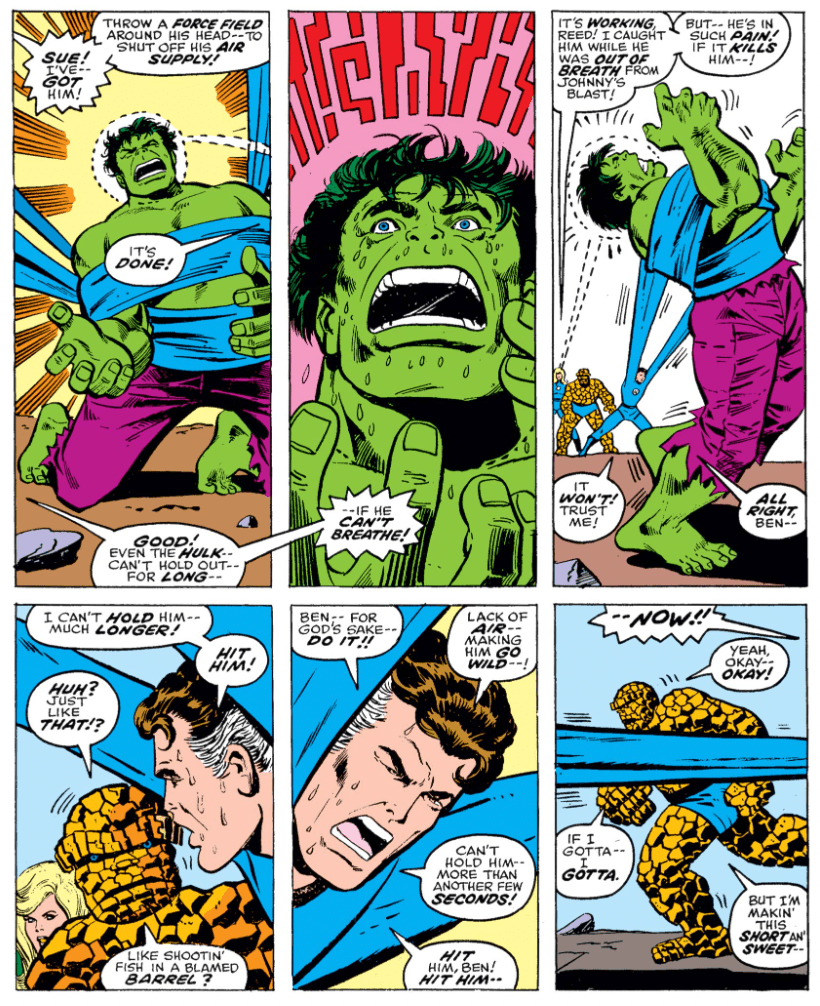
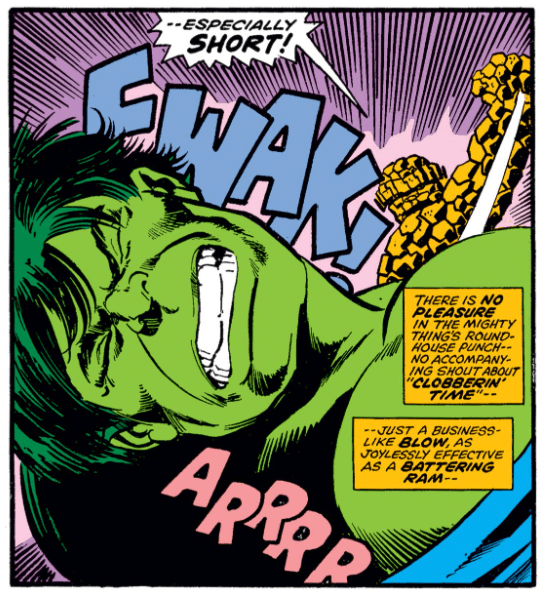
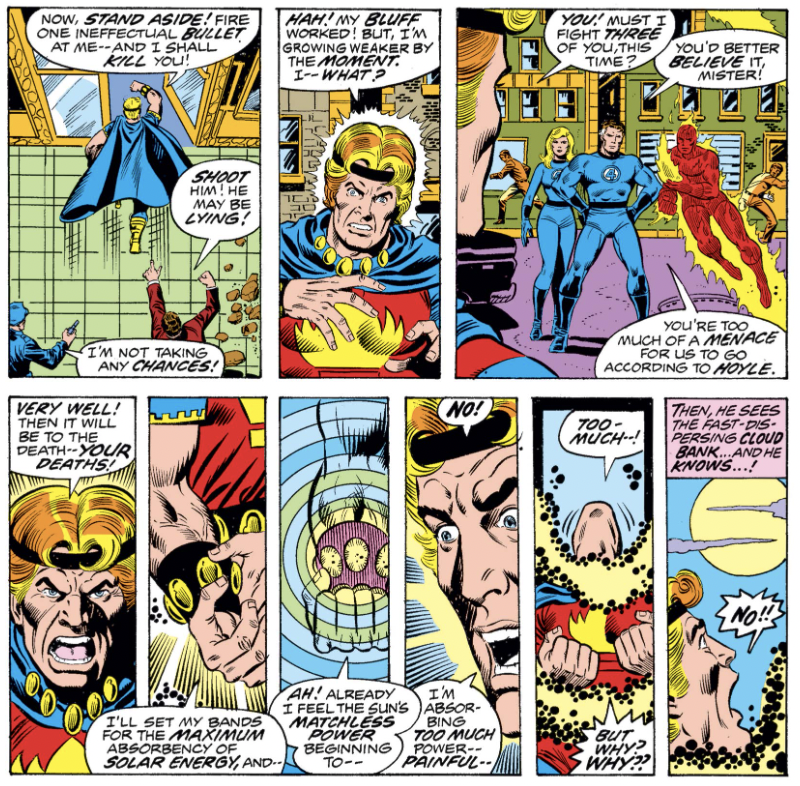
I also liked how matter-of-factly the FF defeated the Hulk. Granted, the Hulk in this comics isn’t the absurdly over-powered creature he has since become, but it was fun to see them work together as a smooth and efficient team, and where Sue plays a leading role.


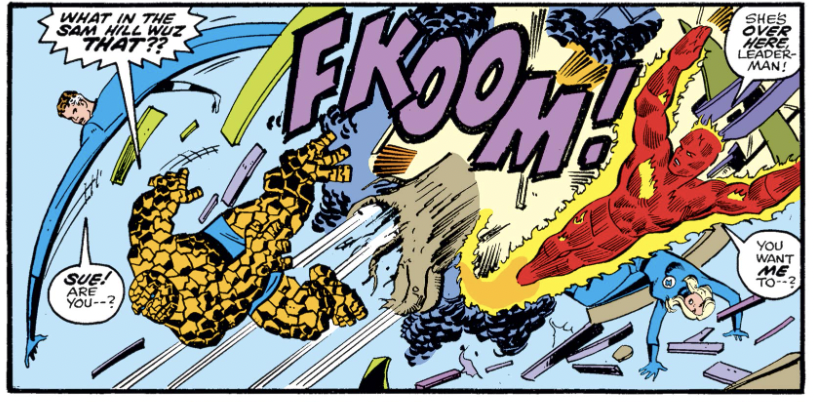
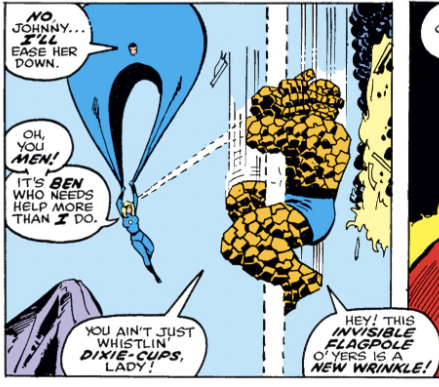
And speaking of Sue, this was a fun exchange (this panel follows the “Fkoom!” panel higher up in this post):


What I didn’t like

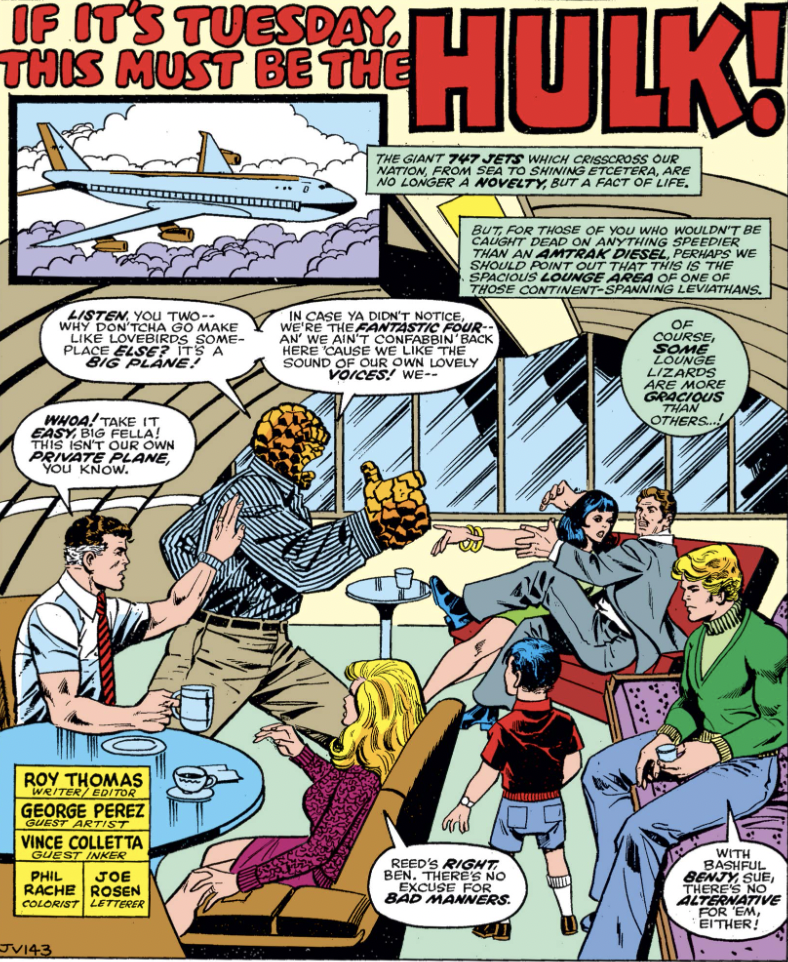
As mentioned earlier, this story feels padded and contrived, never more so than in the opening sequence, where the FF are flying in a commercial airline — it’s not explained why they’re not in one of their own planes — which just happens to be accidentally clipped by the Hulk. It’s all a set up for the FF to land the plane, but it really serves no narrative purpose. Also, there are some really ungainly poses in this panel (and whose kid is that?).


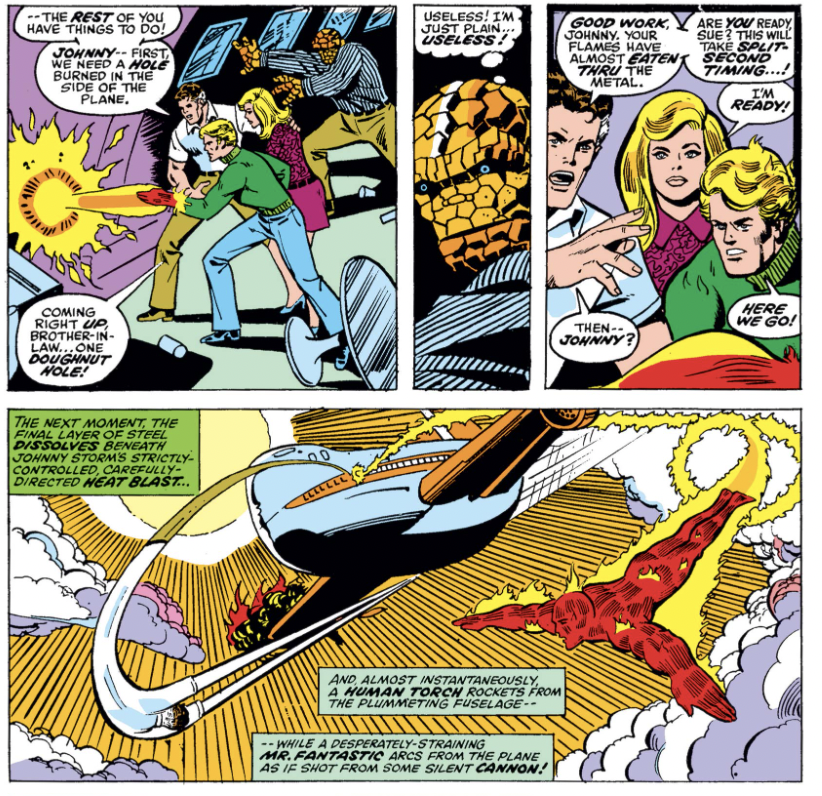
When the FF scramble to rescue the crashing plane, Reed directs Johnny to burn a hole in he fuselage so they can exit the plane. But why not just open a door?


Overall

A bit of a mess

“The World’s Greatest Comic Magazine!” Fantastic Four No. 165

09 Sunday Mar 2025

Posted by percivalhenry in The World's Greatest Comic Magazine

≈ Leave a comment

Tags

1975, Fantastic Four, Fantastic Four 165, George Perez, Marvel comics, Roy Thomas

Fantastic Four 165
“The Light of Other Worlds!”
Published September 1975
Writer: Roy Thomas
Pencils: George Perez
Inks: Joe Sinnott
Letters: John Costanza
Colors: Petra Goldberg
Editor: Thomas
Cover: Ron Wilson and Joe Sinnott

Synopsis

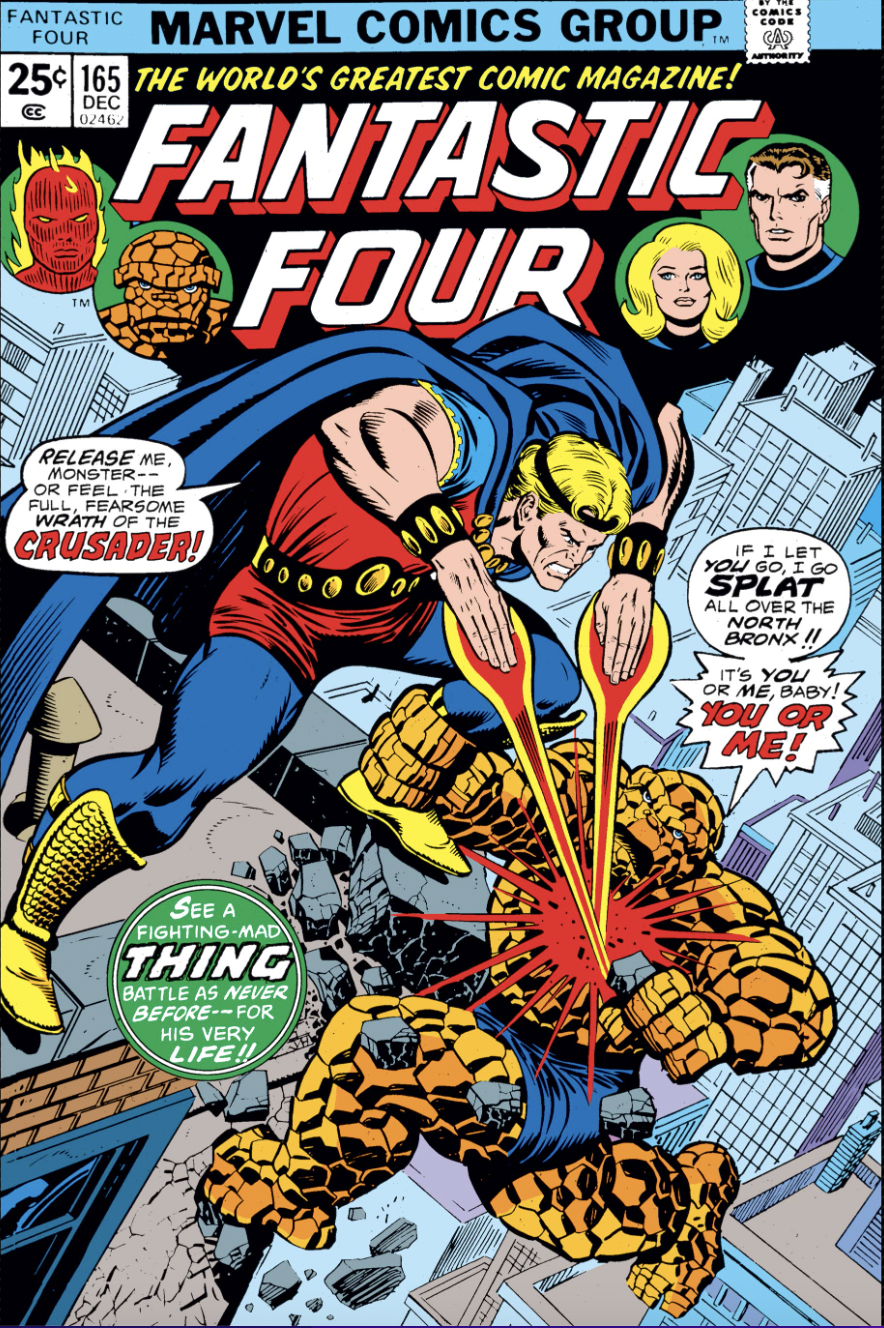
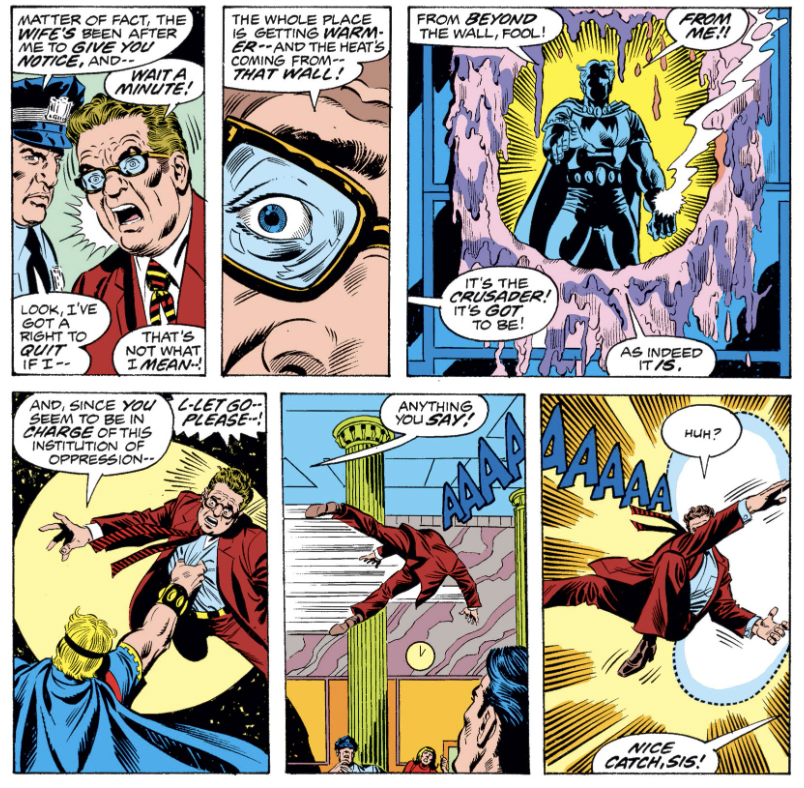
Mr. Fantastic begins investigating the Crusader, who defeated the Human Torch last issue and has been on a rampage, destroying banks across New York City. When he attacks a branch in the Bronx, the FF confront him and he reveals he was once the golden age hero Marvel Boy and is now enacted revenge on the banks that prevented him from saving the people of his home world, Uranus (really). Reed deduces his powers are light-generated, and by blotting out the sun the FF are able to defeat him.


What’s going on here

While not quite as tightly paced as the last issue, this comic is a satisfying conclusion to the Crusader story. In the letters page, it is revealed this two-part story was originally intended to be a a single-issue story in Giant-Size Fantastic Four 6, but when that series was canceled, the story was split into two with a few pages added (interestingly, they chose not to simply make it an annual). The note apologies for any dropped plot points — I didn’t detect any— but this issue does feel padded, with a climactic fight scene that lasts longer than it really needs to.

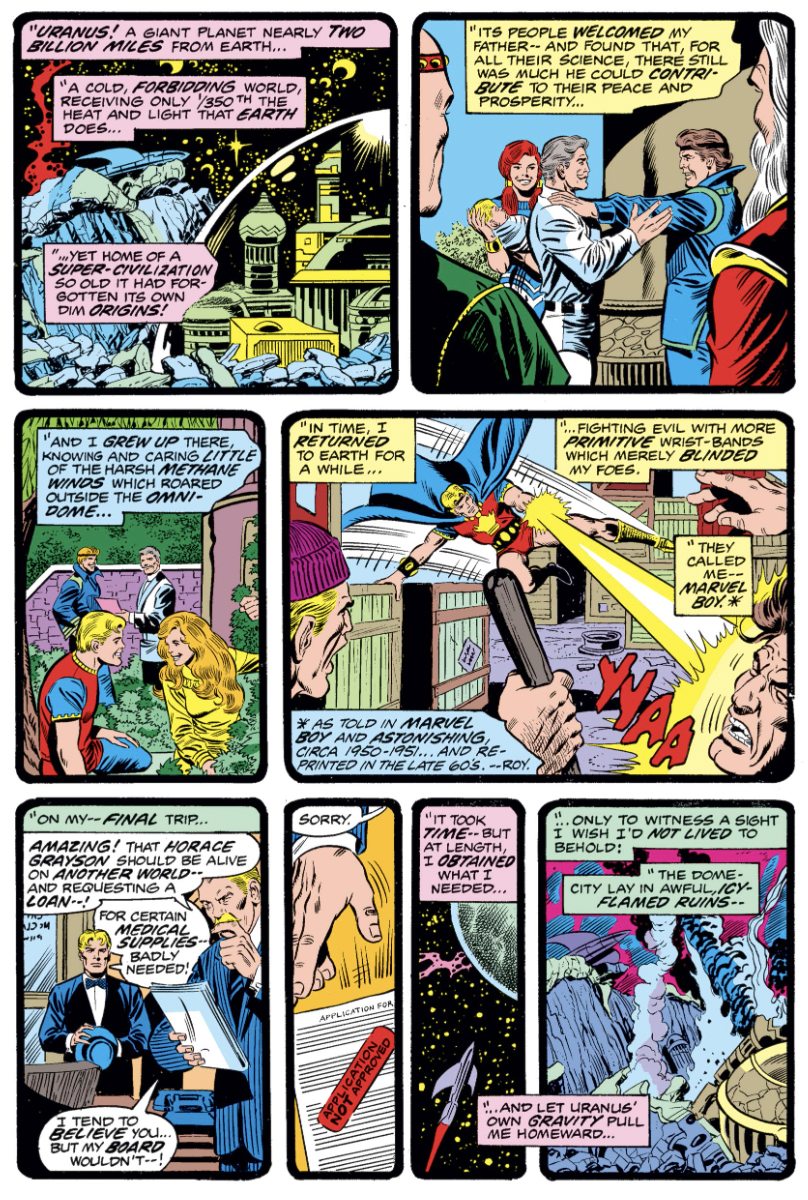
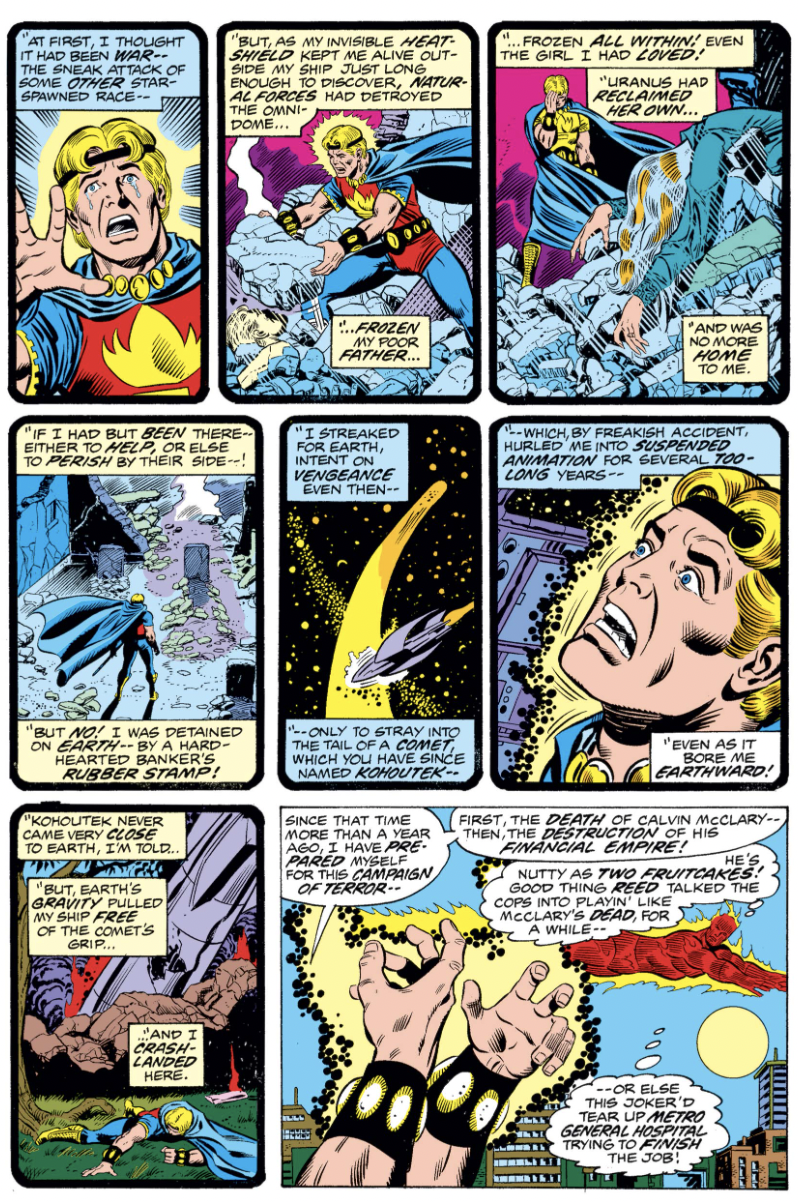
Roy Thomas provides a lengthy and convoluted origin of the Crusader, whose campaign against the banks makes him sound like a super-powered Luigi Mangione. It’s all pretty ridiculous, and it’s clear the Crusader is only in this comics because of Thomas’s affection for obscure characters from the golden and silver ages.

(This origin would eventually be retconned away, and the Crusader is now an Eternal named Thelius who believed himself to be Marvel Boy).

George Perez is back on art duty, and like last issue, he adds his characteristic attention to detail and masterful use of panels. The cover is by Ron Wilson, with Joe Snnott’s inks. At this point Wilson had been around for a few years but this is his first work on the FF. He would go on to draw dozens of issues of Marvel Two-in-One and its successor book, The Thing, becoming one of the definitive pencilers of Benjamin J. Grimm. As far as I can tell, he is the first Black artist to work on an issue of the FF and he would later go on to draw some fill-in issues. The cover is unfortunately marred by some very silly dialogue (and what exactly is the North Bronx? Riverdale? Co-Op City? Van Cortland Park?)


What I liked

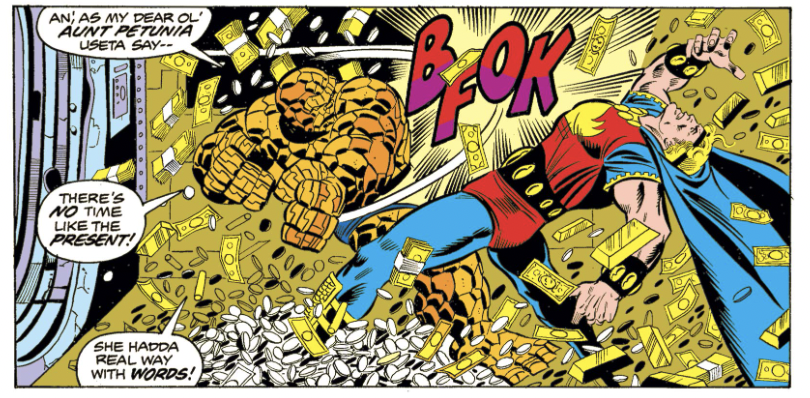
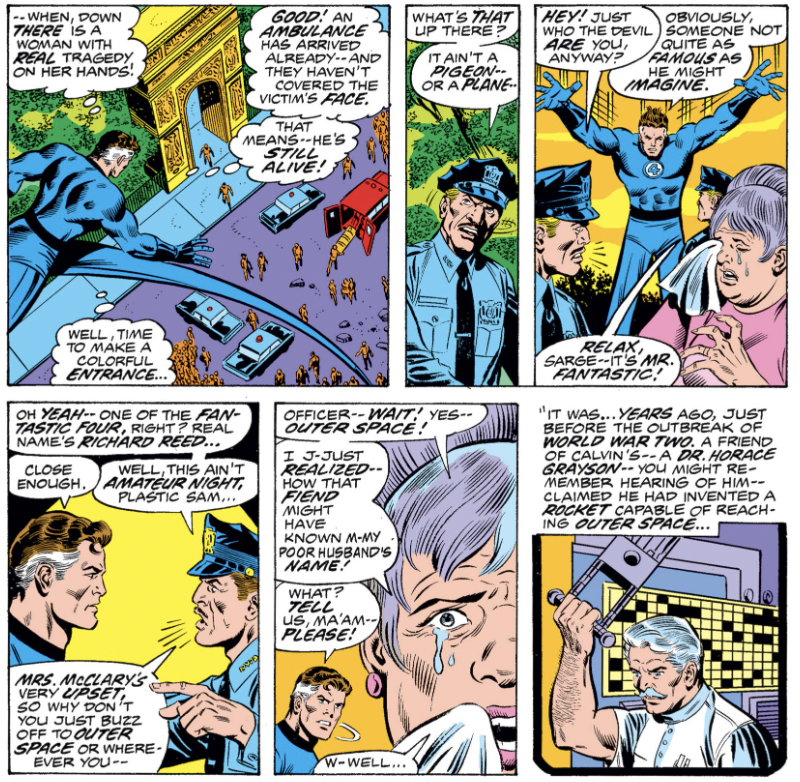
Perez again does some great work. I particularly enjoyed this sequence:


And this one, which is a great example of how he uses tiny panels to amazing effect:


Thomas again pokes some fun at the Distinguished Competition in this sequence:


What I didn’t like

As seen above, the Crusader speaks in absurdly grandiloquent phrases (to the extent that Johnny actually makes fun of him at one point). Nothing about his character suggests he’s a former hero from Earth, or that he was any doubts or hesitation about what he’s doing. He’s unfortunately paper-thin as a villain, and Thomas squanders the opportunity to delve into his background to create an interesting resolution to the story. He really could have been any of a number of anonymous bad guys.

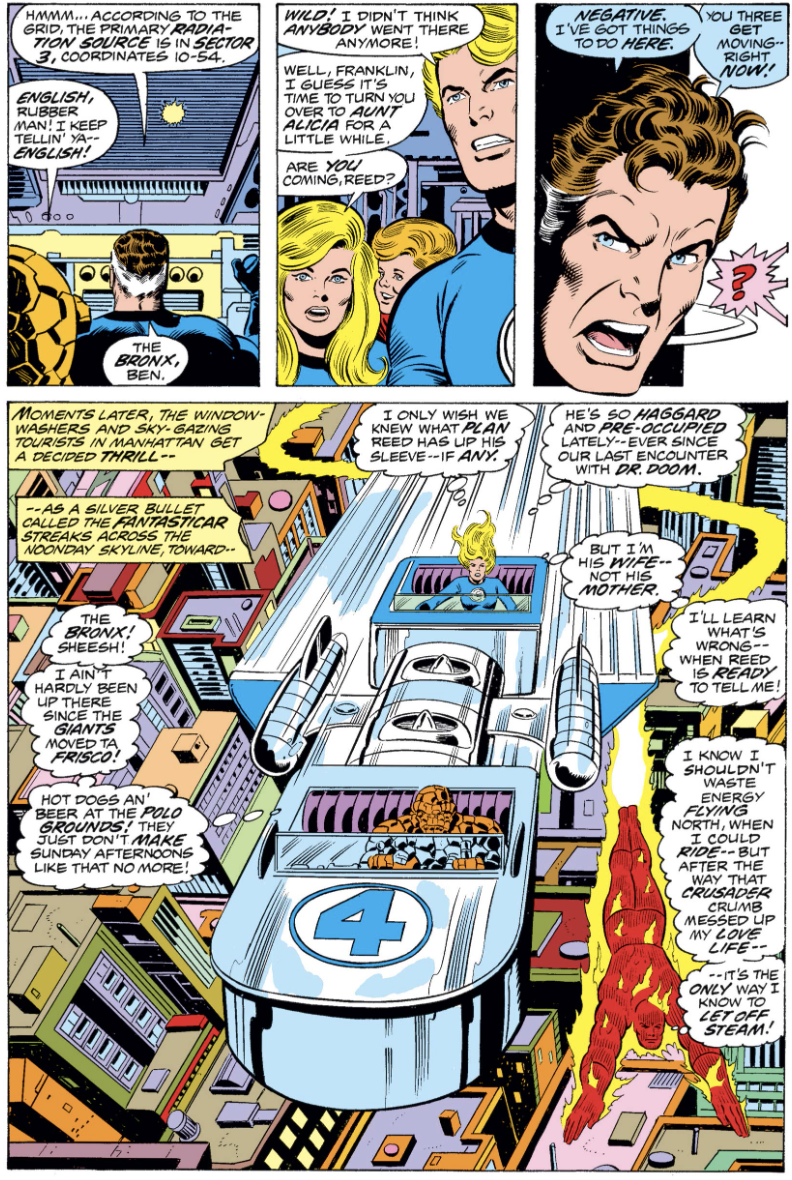
Also, this page is just weird, both for Johnny’s off-hand disregard of the Bronx, a borough where 2 million people live, and for Ben’s bizarre recollection that he went to Giants baseball games there. As virtually anyone who lived in New York at that point would know, the Polo Grounds were in upper Manhattan. Thomas’s Missouri origins were never more apparent. Perez does draw a snazzy Fantasticar, though.


Anything else?

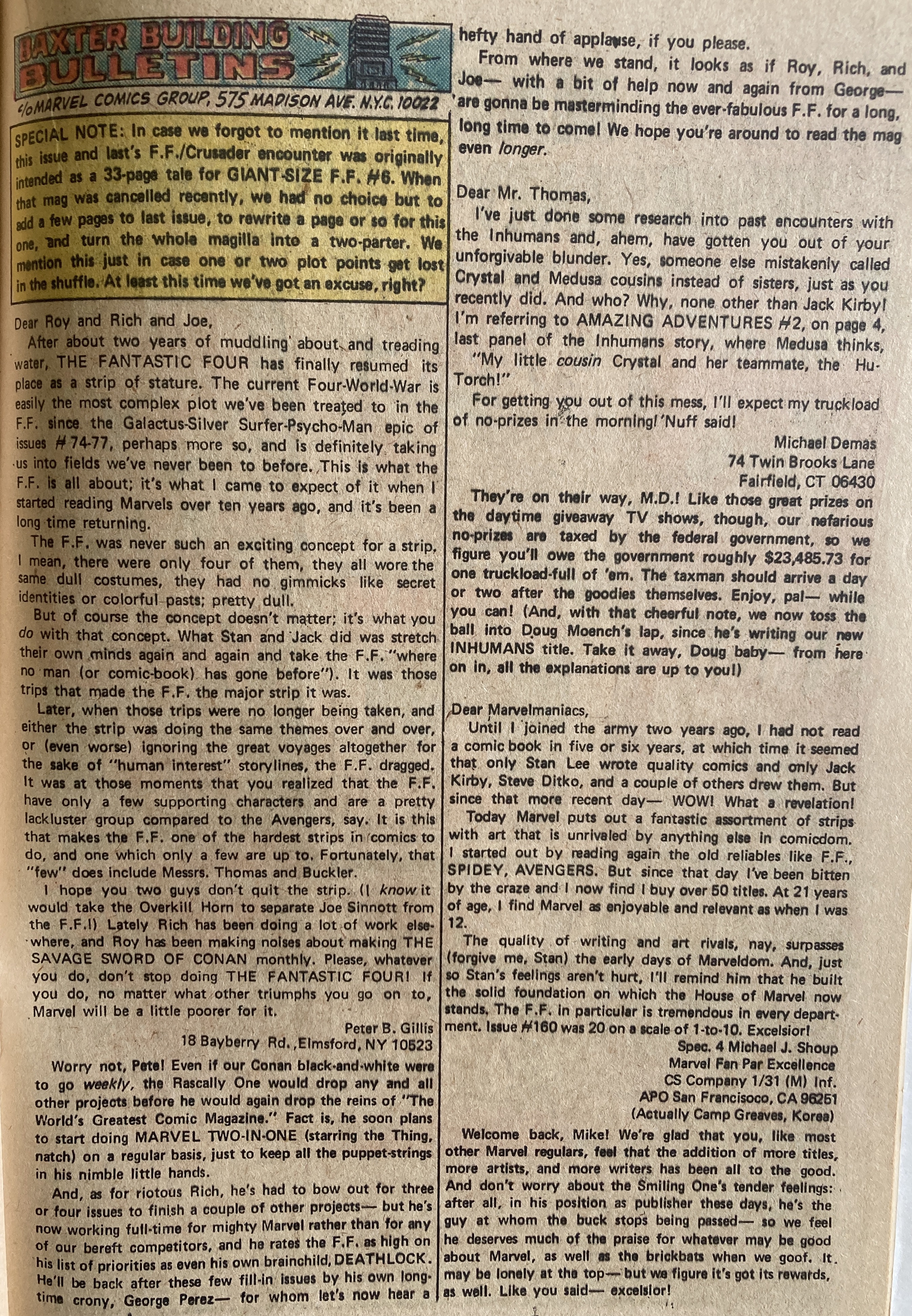
There’s another letter from longtime comics creator Peter B. Gillis in this issue, just three years before he has his first credit as a Captain America writer. Also on the page is the editor’s note about why the story was was split in two, and the explanation of why Rich Buckler didn’t draw it. The anonymous author of the response to Gillis — probably Thomas — was wrong about one thing: Buckler wasn’t around for a long time to come. He would go on to draw just two more issues before Perez took over more or less full-time.


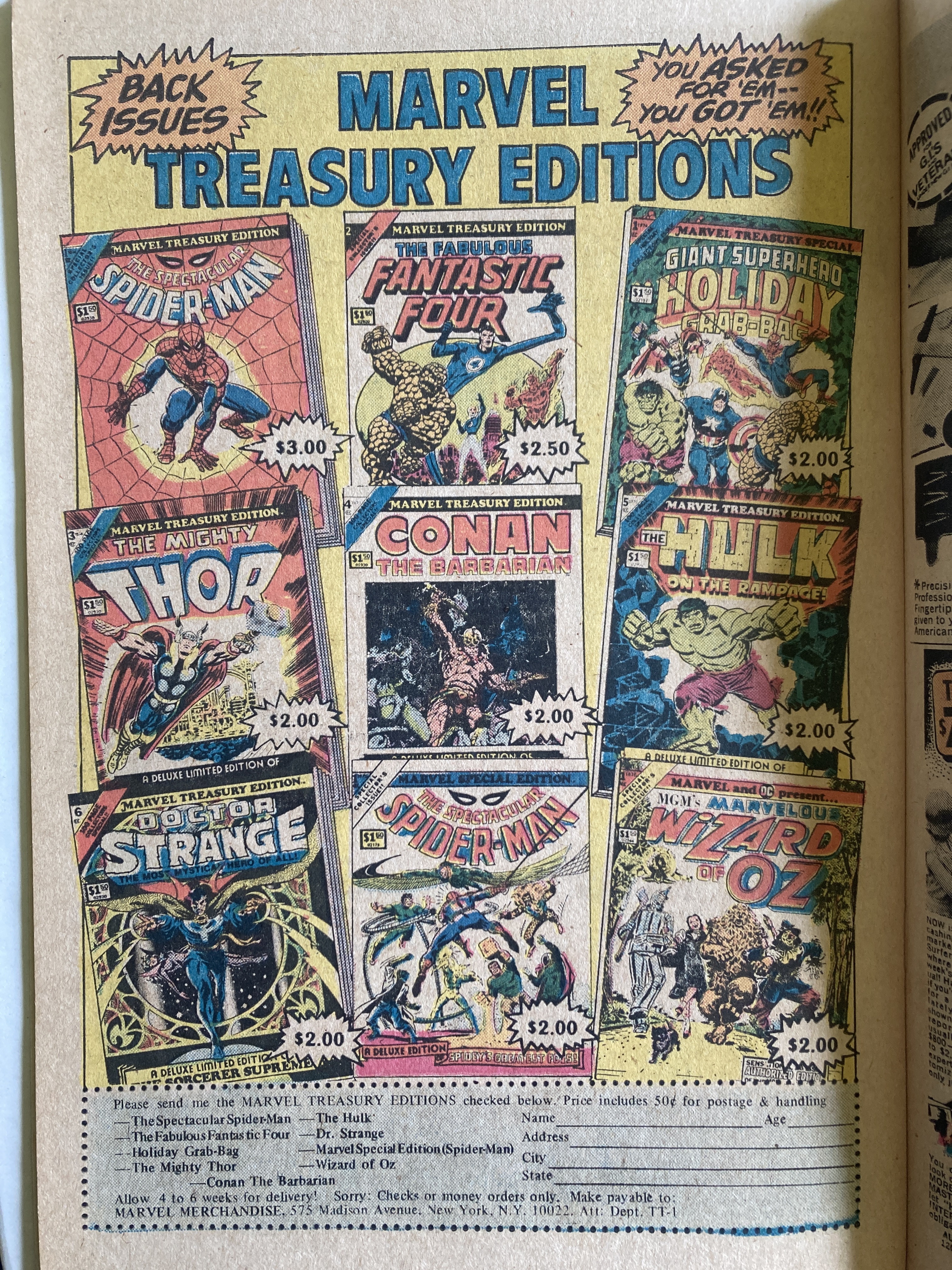
There is also a fun ad for Marvel’s Treasury Editions. Just in case anyone is worried I dropped the ball, the FF’s Treasury Edition contains only reprints.


Overall

Solid comic book storytelling

“The World’s Greatest Comic Magazine!” Fantastic Four No. 163

23 Sunday Feb 2025

Posted by percivalhenry in The World's Greatest Comic Magazine

≈ 1 Comment

Tags

1975, Fantastic Four, Fantastic Four 163, Gaard, Marvel comics, Roy Thomas

Fantastic Four 163
“Finale!”
Published July 1975
Writer: Roy Thomas
Pencils: Rich Buckler
Inks: Joe Sinnott
Letters: Joe Rosen
Colors: Don Warfield
Editor: Thomas
Cover: Bucker and Sinnott

Synopsis

In hyperspace, the Thing battles Arkon’s champion Gaard, who is trying to prevent Ben from closing a window that would allow a nuclear war on three realities to power Arkon’s world. Meanwhile, Johnny and Reed Richards from an alternative Earth, whom in that world became the Thing, battle and defeat Arkon. With the help of Mr. Fantastic, Ben defeats Gaard, who is revealed to be a mind-controlled Johnny Storm of that world.


What’s going on here?

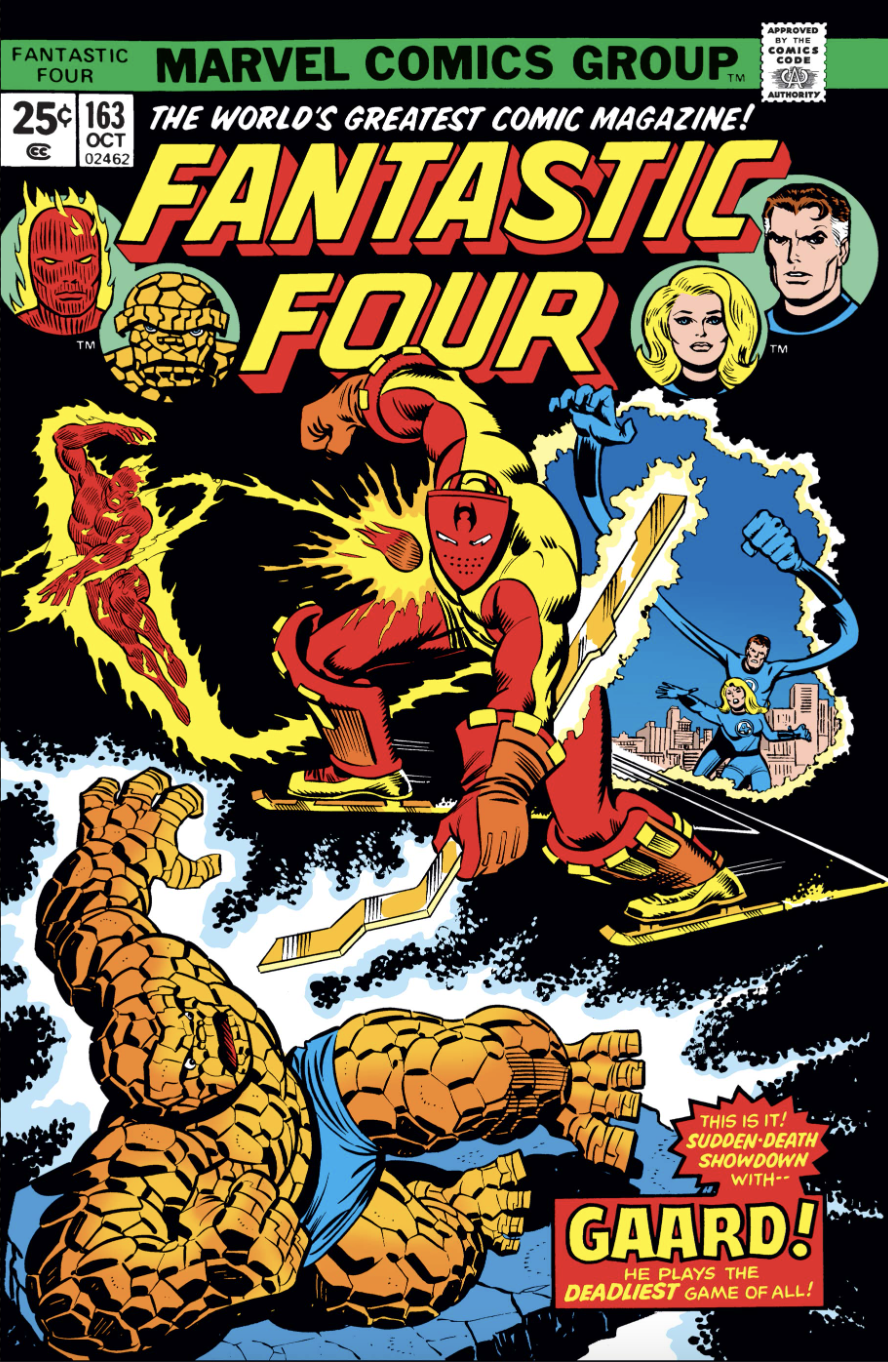
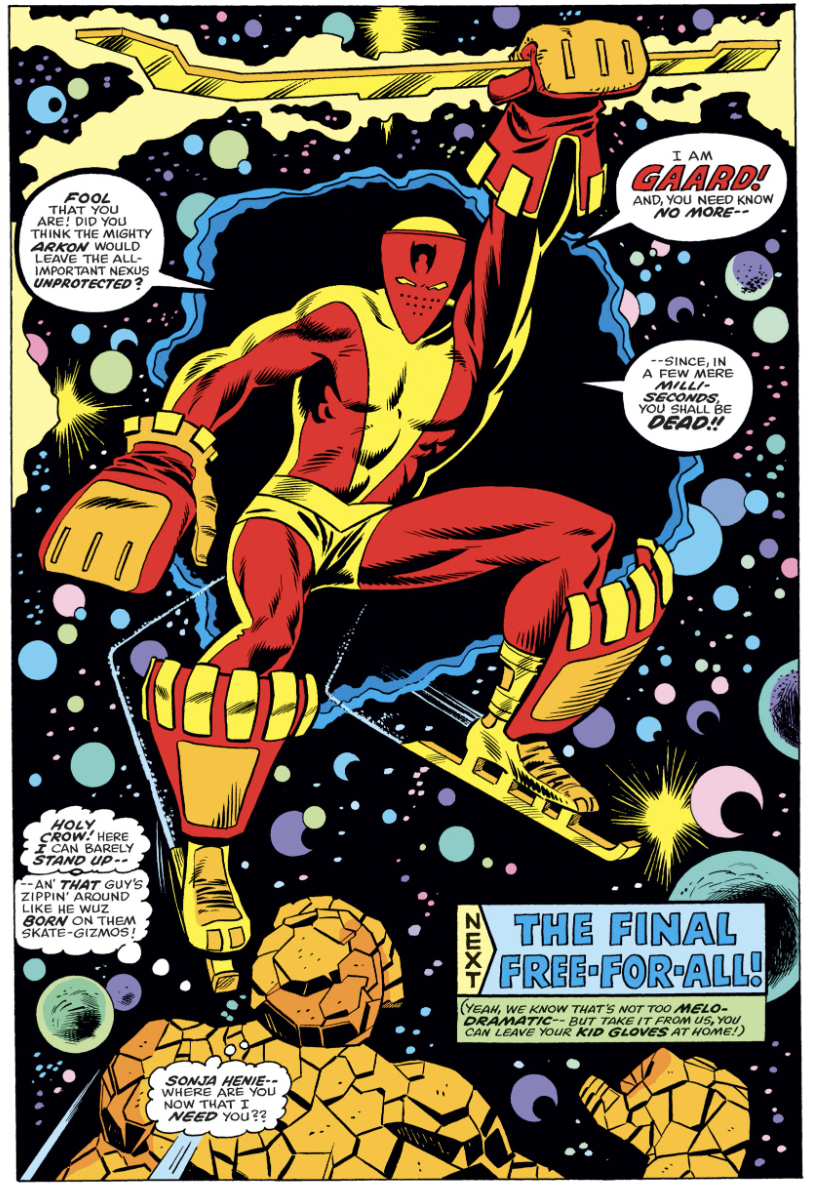
When I first began this blog, I was eager to read through the legendary Lee / Kirby run, and to revisit the Byrne run, my first introduction to the Fantastic Four. But I was apprehensive about the issues in between, from FF 103 to 231, which — despite the work of stellar artists like John Buscema and George Perez — seemed like a repository of a lot of mediocre dreck. And symbolic of that mediocrity to me was Gaard, a villain I knew only from the cover but that seemed utterly ridiculous and unworthy of the grandeur of the Fantastic Four. The team that battled Dr. Doom and Galactus is now fighting an outer-space hockey goalie? Seriously?

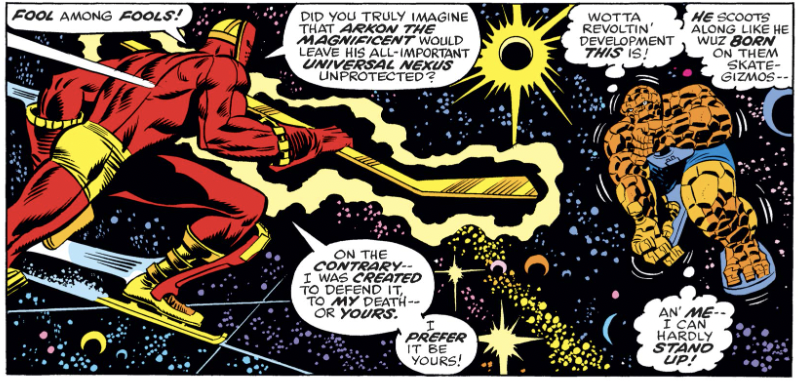
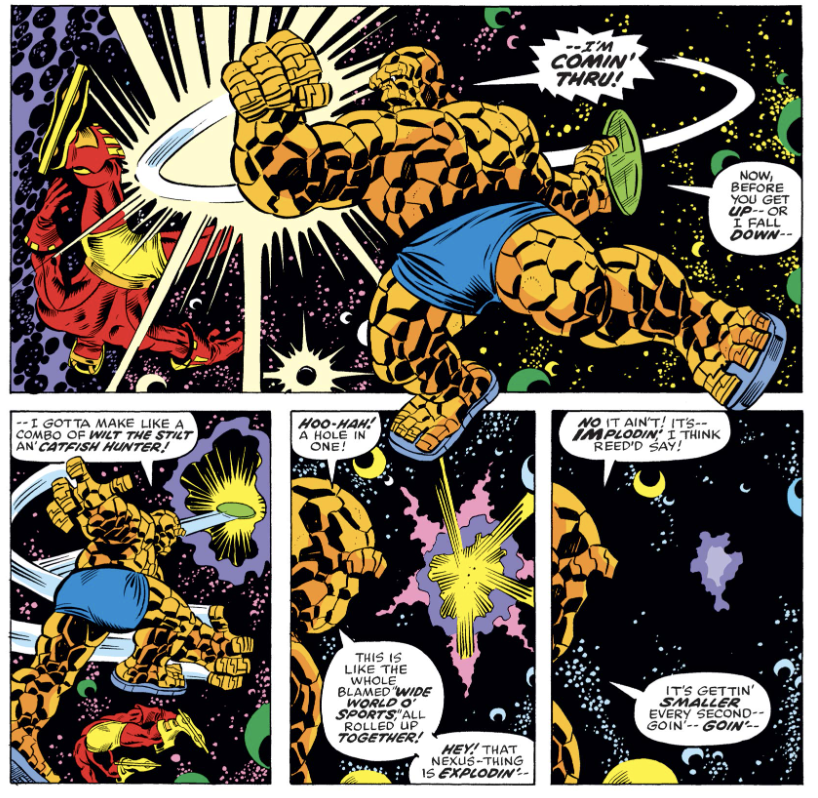
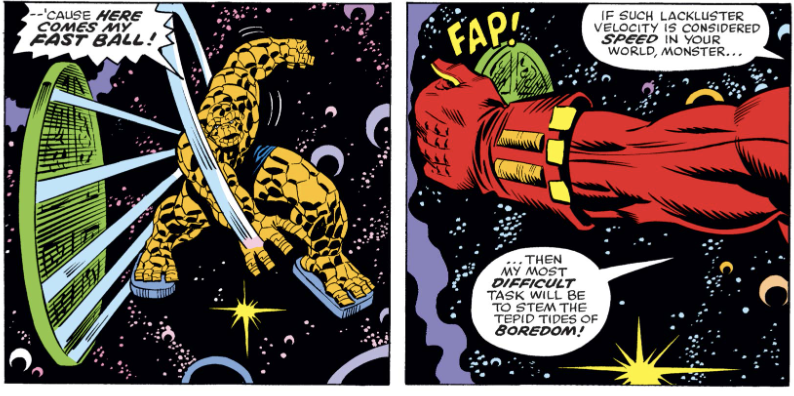
After reading this comic, my worst fears were confirmed. This is, in fact, a pretty lame issue and Gaard is silly concept, an apparent ripoff of the Silver Surfer and Black Racer, two Jack Kirby-designed characters that travel through space with sports-like apparatus. As Gaard fights Ben, there are sports-adjacent references aplenty, from Ben having to wear skate-like devices to move through hyperspace to the puck-like gizmo he needs to hurtle through Gaard’s “goal.” The sportsball nature of it all is summed up here:

I couldn’t find any documentation about the creation of Gaard, just a comment in a blog that Roy Thomas intended him as a parody of Black Racer and that he later regretted using such a silly concept in a story with a heavier tone. Which make sense, but it’s unfortunate because up until this comic, the four-issue arc was actually pretty fun, with a zillion of Thomas’s ideas colliding and heading toward what could have been a satisfying ending. But the result is an anti-climactic finish that feels slapped together, with both Reed and Sue on the sidelines, Johnny and Earth-2 Reed defeating Arkon without too much trouble and, as seen above, the nexus closing with a whimper.

My only hope is that this comic is the low point of the stretch between Lee / Kirby and Byrne, and everything from here is an improvement.

One more note: Don Warfield is credited as colorist, his first and as far as I can tell, last Fantastic Four credit.

What I liked

Gaard’s dialogue is just completely over the top and bombastic. Not sure where he learned to talk like this, particularly if he’s that Earth’s version of Johnny.


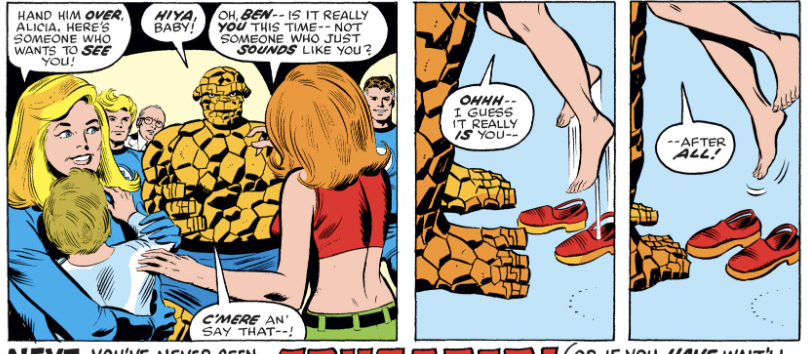
This reunion between Ben and Alicia was sweet and fun.


What I didn’t like

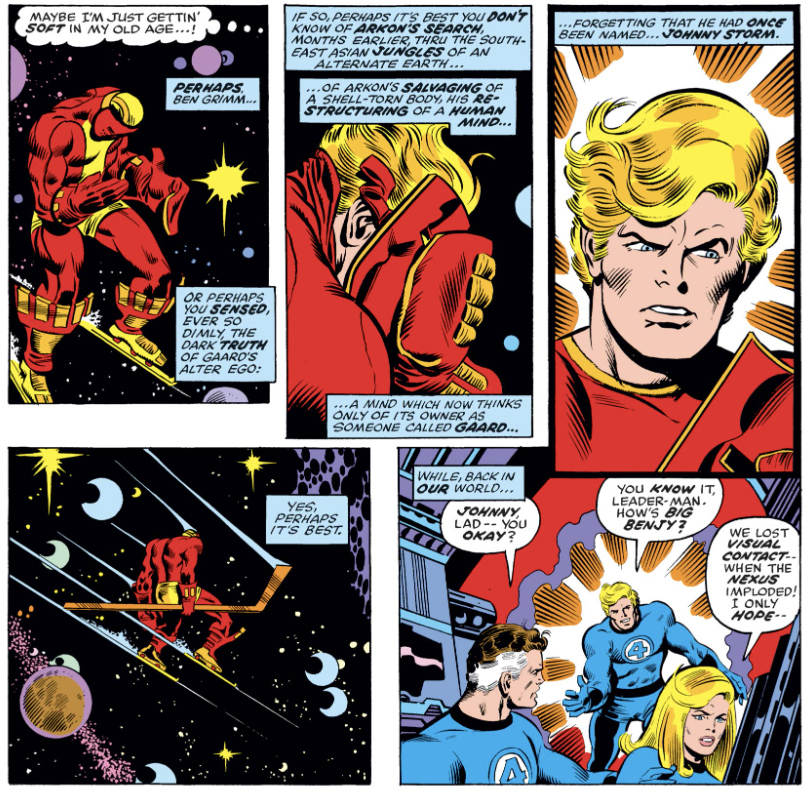
Alongside the aforementioned Gaard nonsense is the question of his identity, which is hinted at by both Ben and Gaard as they battle, but ultimately plays no role in the outcome, and is instead a meaningless footnote. (Gaard would later remerge as the super-powered villain Vangaard in Fantastic Force, a 1990s FF spinoff that I know virtually nothing about.)


The defeat of Arkon is also perfunctory and unsatisfying. As a character, Arkon never seems fully developed and in this story appears to be like a King knockoff dressed as a barbarian.

Anything else?

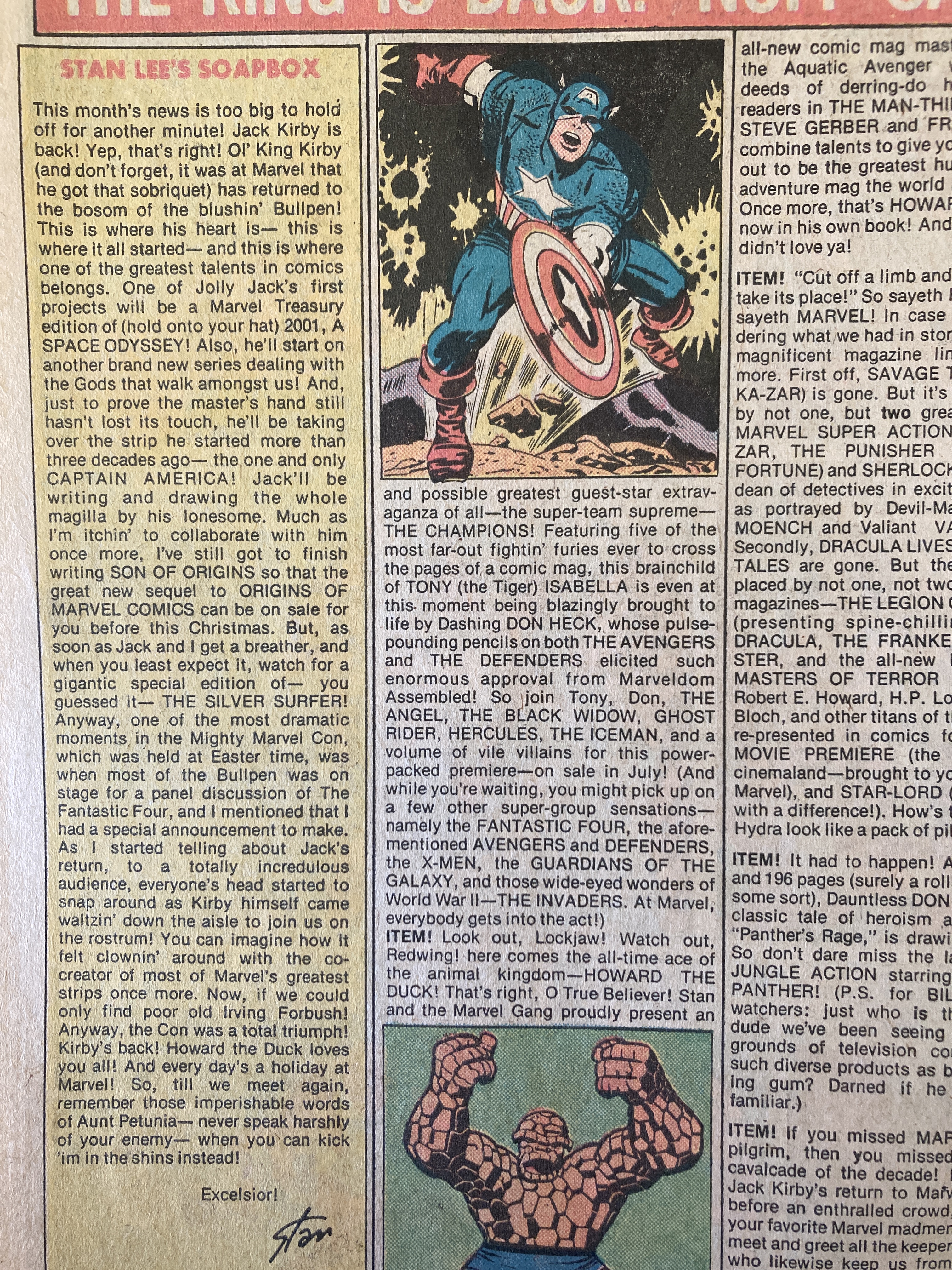
A lengthy note in Bullpen Bulletins announced the return of Jack Kirby to Marvel. It says nothing about where he went or why he returned, which is perhaps to be expected, but hints at the creation of the Eternals and notes Kirby will be taking over Captain America.


Overall

Disappointing on multiple levels

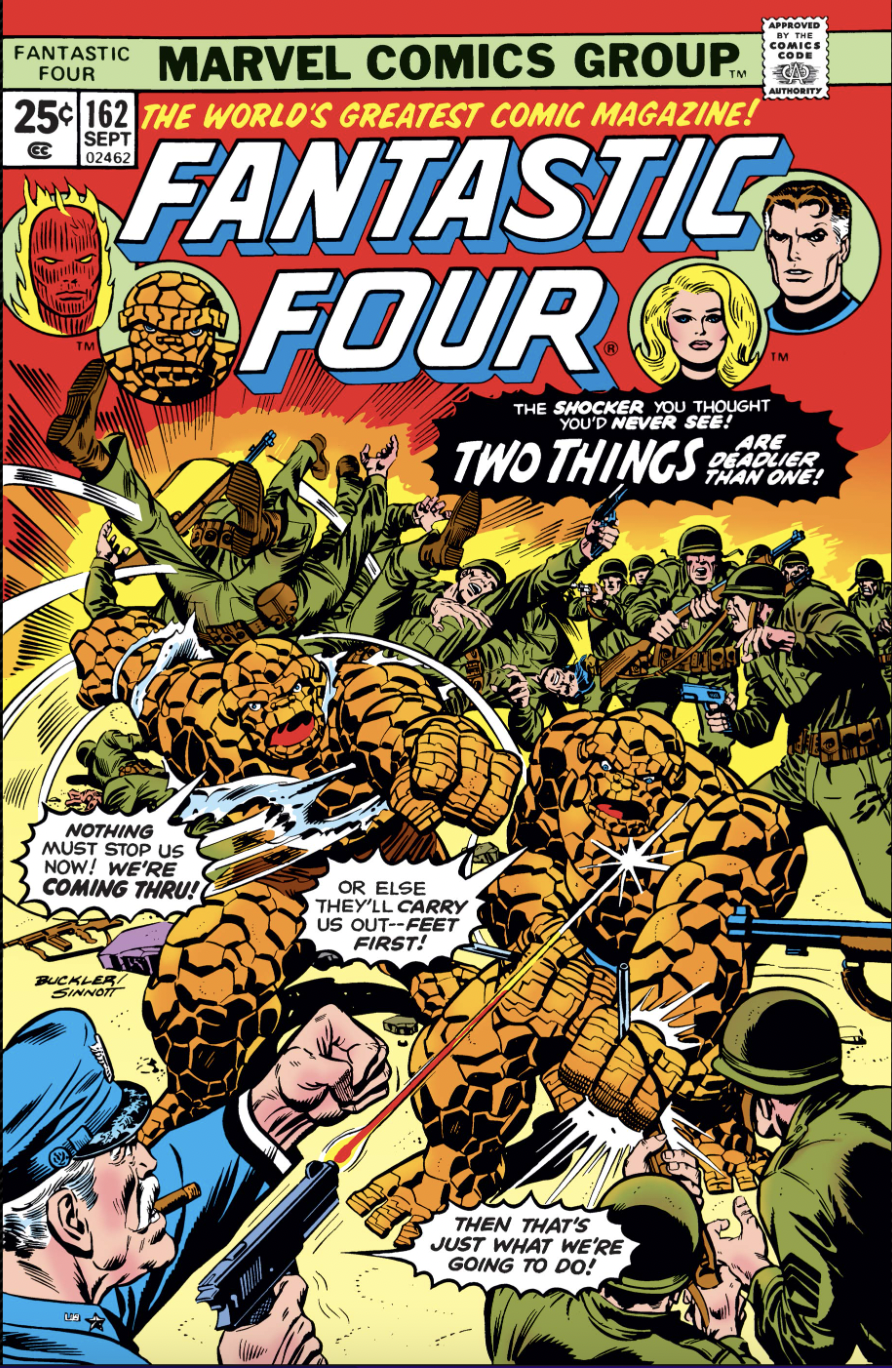
“The World’s Greatest Comic Magazine!” Fantastic Four No. 162

15 Saturday Feb 2025

Posted by percivalhenry in The World's Greatest Comic Magazine

≈ Leave a comment

Tags

1975, Fantastic Four, Fantastic Four 162, Marvel comics, Roy Thomas

Fantastic Four 162
“The Shape Of Things To Come!”
Published: June 1975
Writer: Roy Thomas
Pencils: Rich Buckler
Inks: Joe Sinnott
Letters: Joe Rosen
Colors: Phil Rachelson
Editor: Thomas
Cover: Buckler and Sinnott

Synopsis

The conflict between three dimensions, which began last issue, escalates and it is revealed that Arkon, the barbarian ruler of yet another dimension, used the apparent businessman Mr. Devoor to goad the three into a nuclear war that will power his planet. The Fantastic Four averts a major inter-dimensional conflict and, following a plan devised by Mr. Fantastic, prepare to thwart Arkon’s plans.

What’s going on here?

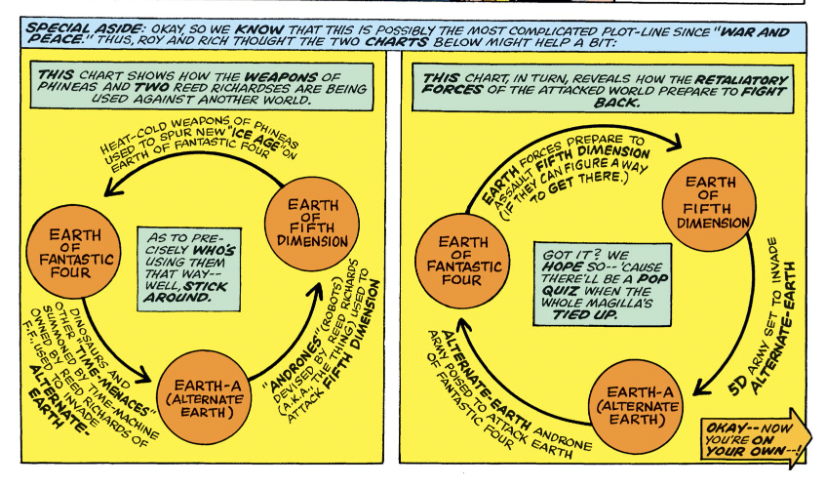
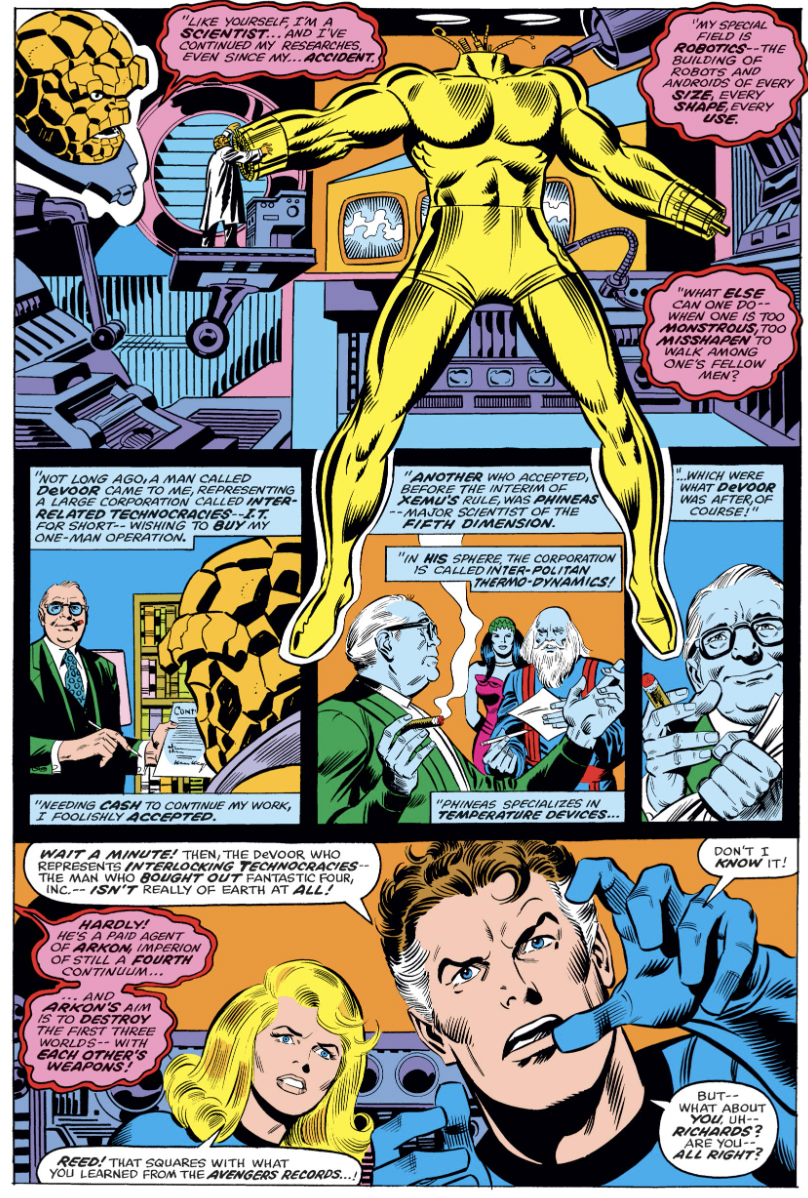
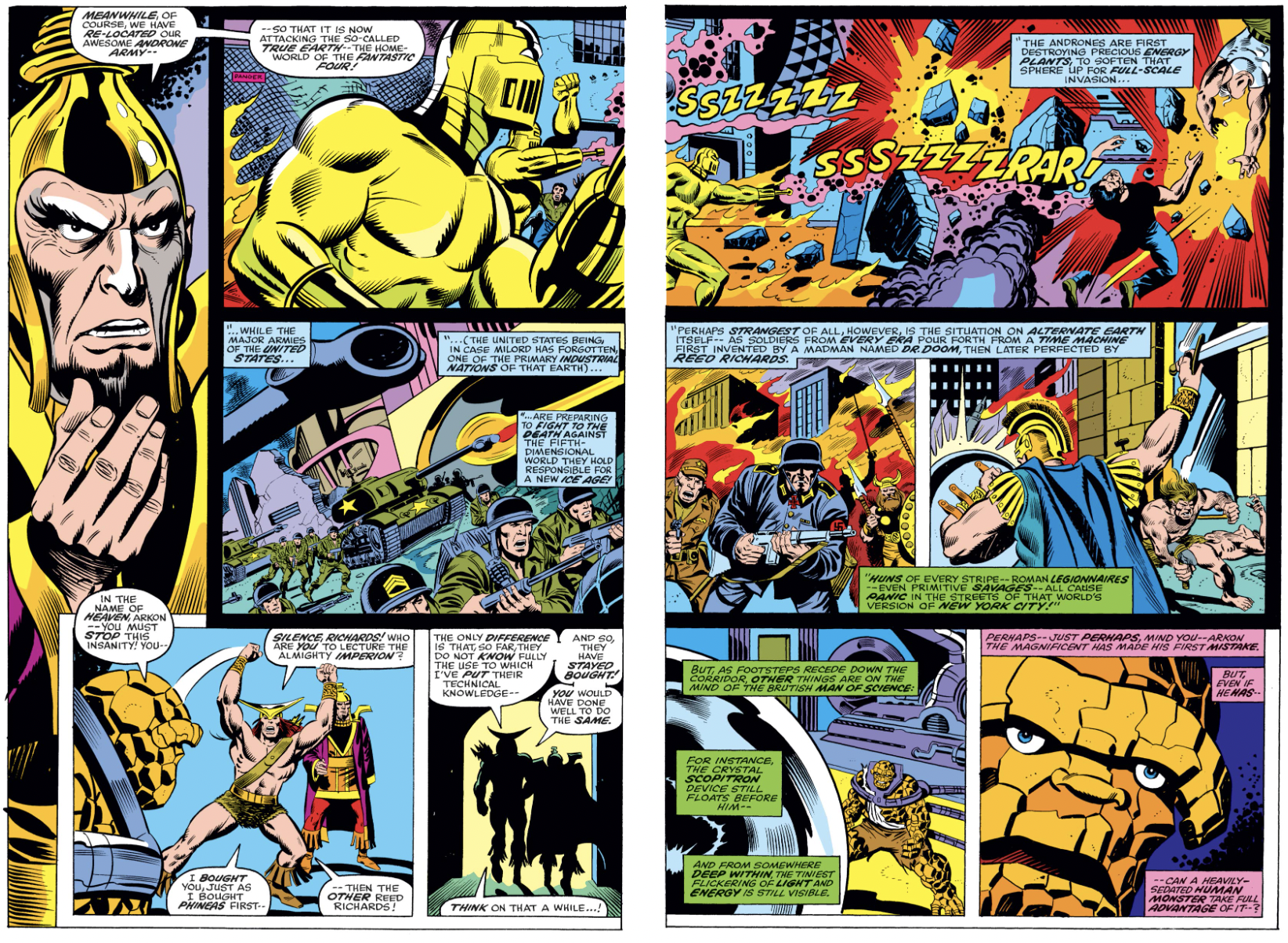
After introducing a bewildering number of plot elements over the last two issues, Roy Thomas finally allows things to gel. The story is still convoluted and relies on a lot of coincidences and unlikely occurrences (such as when the Human Torch leads an invading army across dimension, it just happens to arrive on the same Manhattan block as the two Things) but the basic outlines are at least clear. Thomas recognized the mess he created and provides a pair of diagrams to explain the story, something I don’t think I’ve seeing a comic before:
(and as someone who has read both, this is more complicated than War and Peace)

The comic concludes with a preview of the next issue’s villain, the one and only Gaard. I’ll have a lot more to say about Gaard next week, but here’s a peek:

Yes, he’s dressed like a hockey goalie. And yes, Ben makes a reference to Sonja Henie, the Norwegian ice skating Olympian and movie actress.

New credit alert: “Phil Rache” is credited as the colorist on this issue, his first on the Fantastic Four. His full name is Phil Rachelson — I assume it was trimmed for space—and he worked for both Marvel and DC from 1974 to 1981.


What I liked

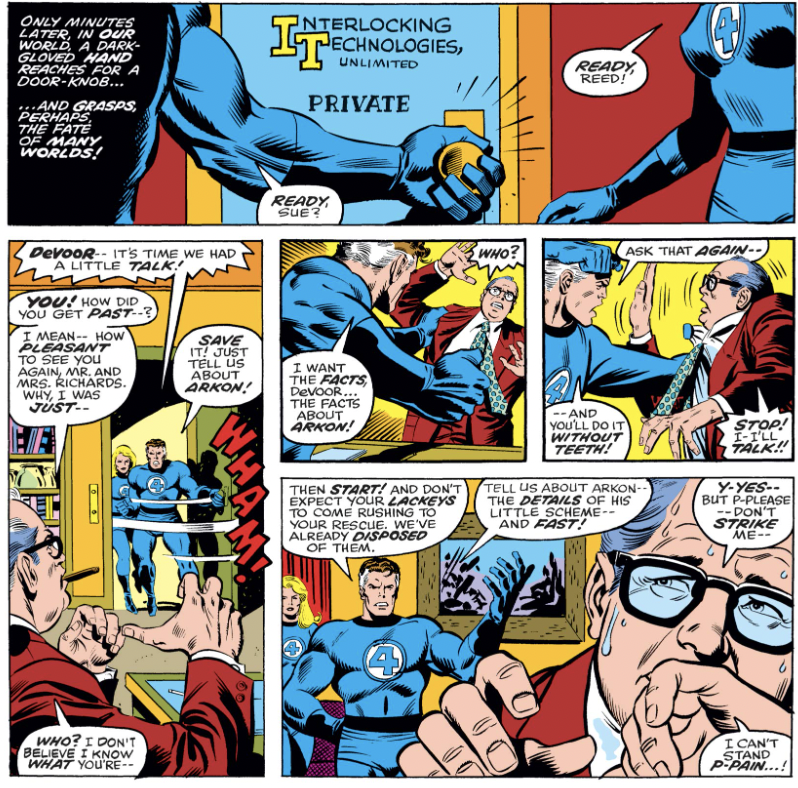
Thomas does a lot of work in the comic to explain his intricate plot. Not all of it makes much sense, but I did like this detail, that on three dimensions Mr. Devoor used three companies with different names but the same initials (although Reed actually goofs on the name of one, which should be Interlocking Technologies):


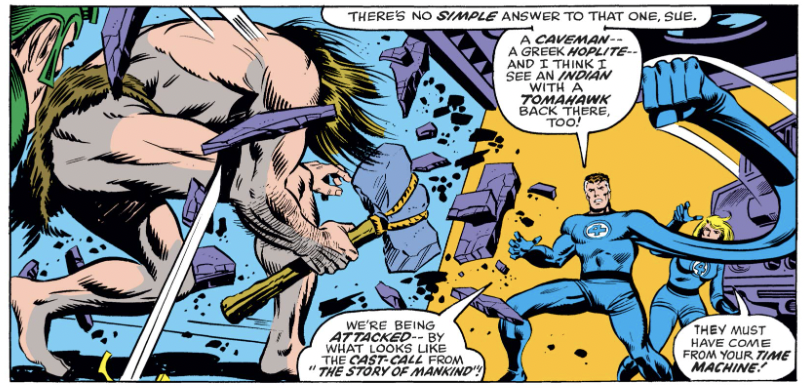
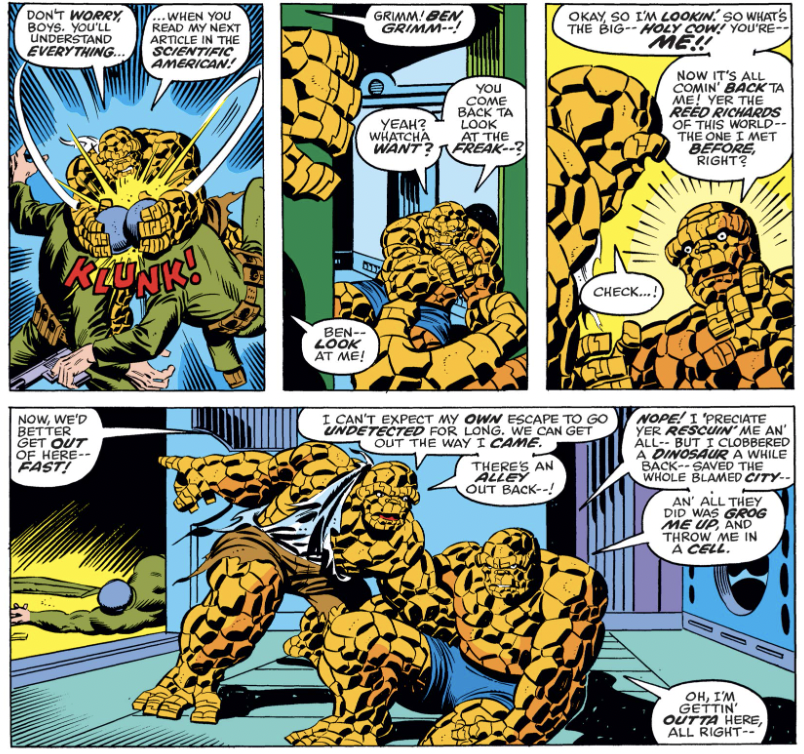
I also liked the concept of a meeting of the two Things, one Reed Richards and the other Ben Grimm:


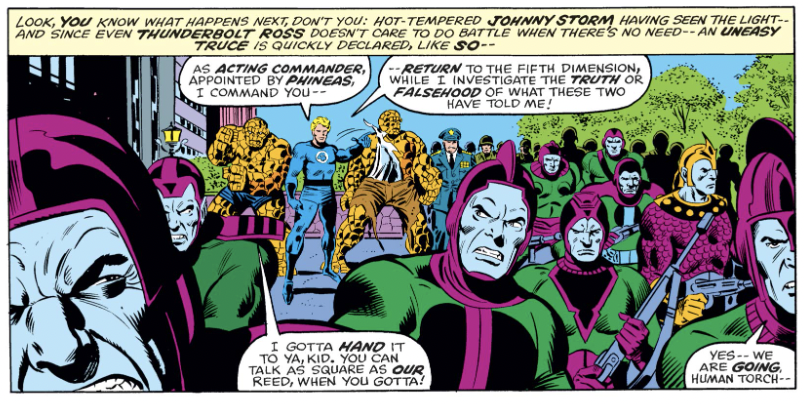
And this was an amusing interaction between Ben and Johnny, who has assumed the mantle of leader of the Fifth Dimension’s army:


What I didn’t like

There is a lot of exposition in the comic, including over this double-paged spread:


Reed acts surprisingly thuggish here:


Anything else?

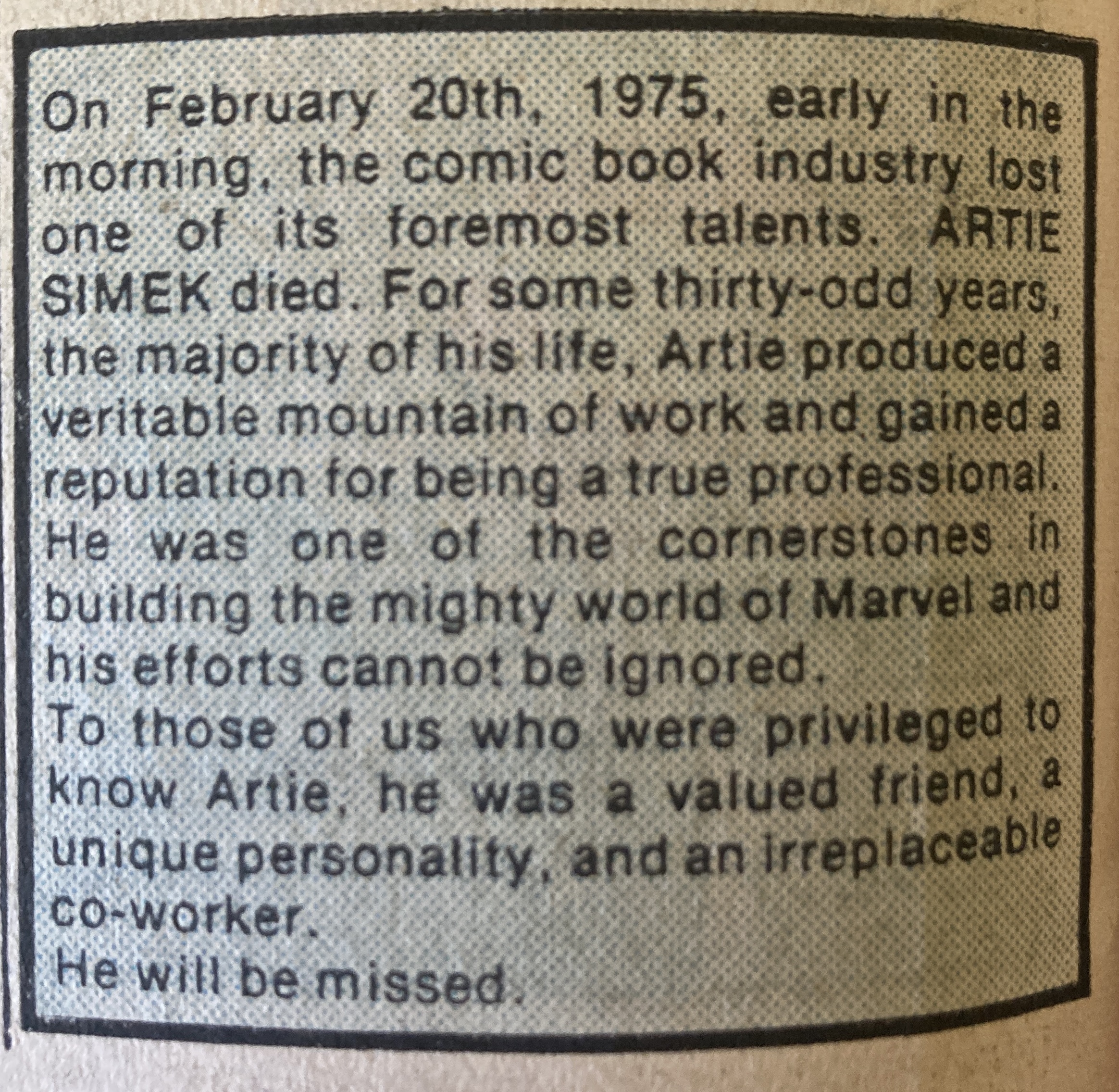
A somber note in the Bullpen Bulletins about the passing of Artie Simek, who lettered dozens of issues of the FF:


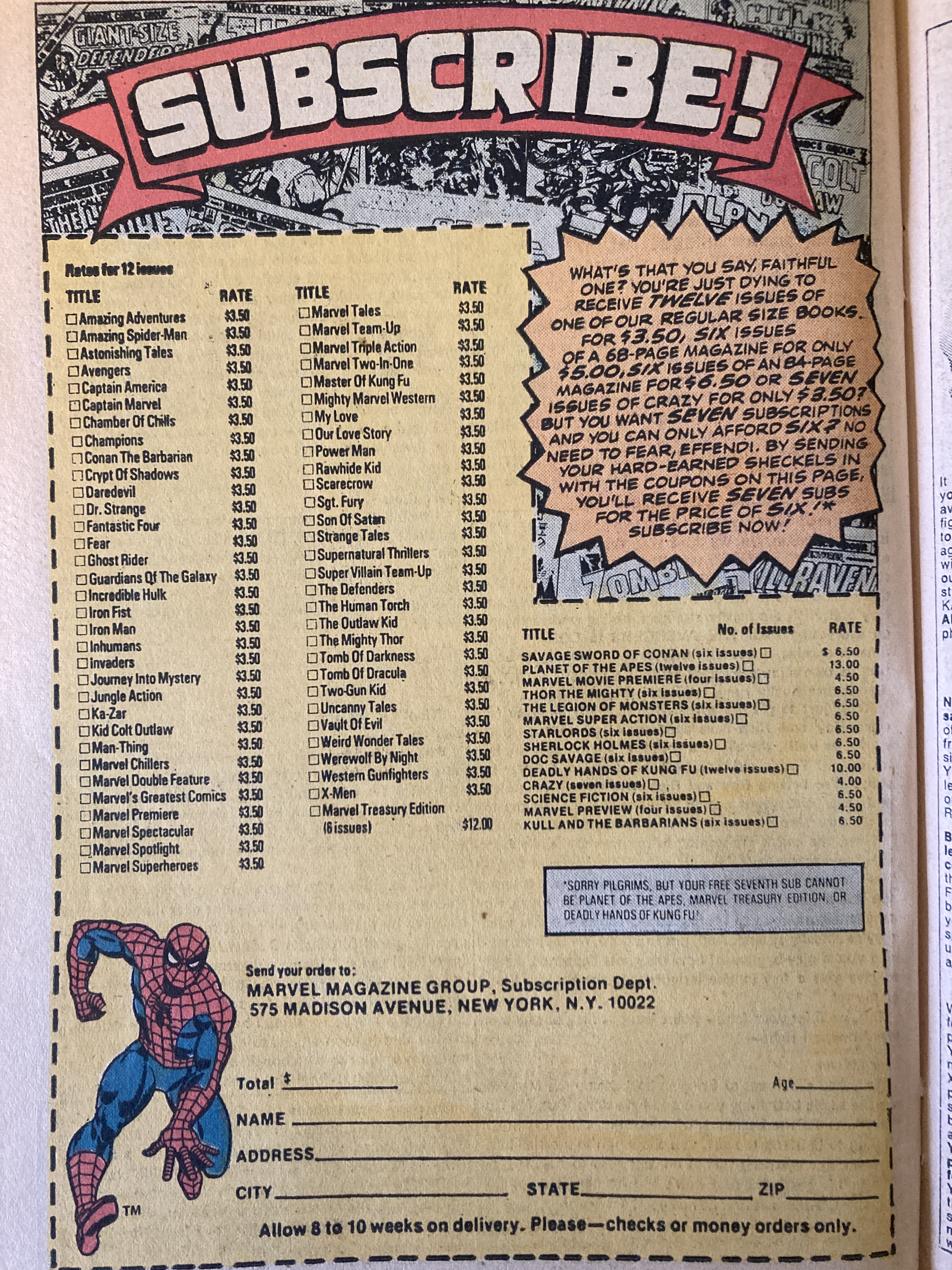
This house ad for subscriptions reveals just how many books Marvel was publishing at the time. No wonder these comics feel like barely controlled chaos. It’s also interesting how many horror, war, western and romance comics were being published (also, can you imagine waiting 10 weeks for the delivery of your first comic?):


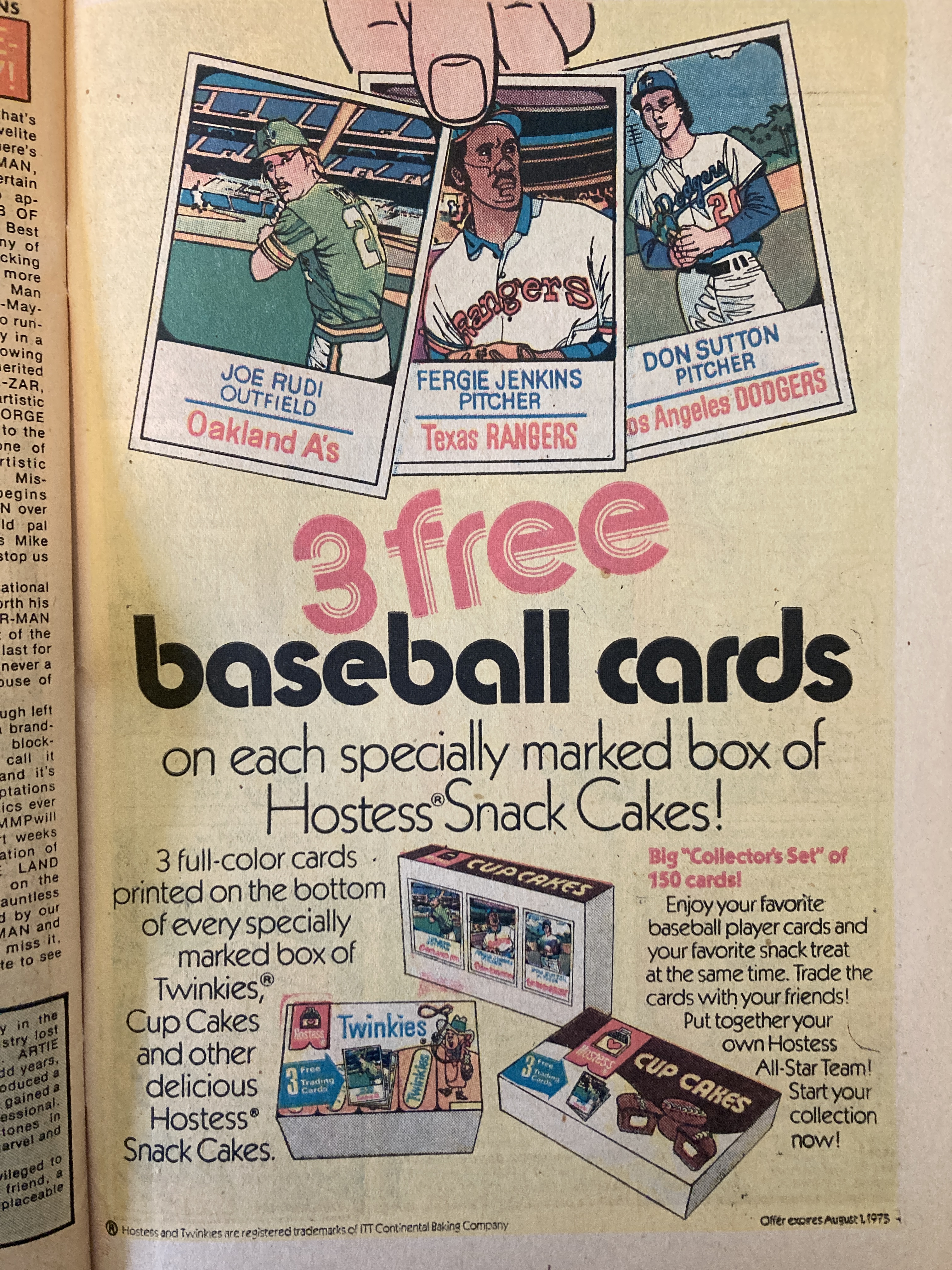
These are interesting choices for baseball players, especially since there are 150 in the set. Was Joe Rudi that big a star in 1975?


Overall

A bit of a mess, but fun

← Older posts
Newer posts →
  • “The World’s Greatest Comic Magazine!” Fantastic Four Annual No. 16
  • “The World’s Greatest Comic Magazine!” Fantastic Four No. 235
  • “The World’s Greatest Comic Magazine!” Fantastic Four No. 234
  • “The World’s Greatest Comic Magazine!” Fantastic Four No. 233
  • “The World’s Greatest Comic Magazine!” Fantastic Four No. 232
  • October 2026
  • September 2026
  • August 2026
  • July 2026
  • June 2026
  • May 2026
  • April 2026
  • March 2026
  • February 2026
  • January 2026
  • December 2025
  • November 2025
  • October 2025
  • September 2025
  • August 2025
  • July 2025
  • June 2025
  • May 2025
  • April 2025
  • March 2025
  • February 2025
  • January 2025
  • December 2024
  • November 2024
  • October 2024
  • September 2024
  • August 2024
  • July 2024
  • June 2024
  • May 2024
  • April 2024
  • March 2024
  • February 2024
  • January 2024
  • December 2023
  • November 2023
  • September 2023
  • July 2023
  • June 2023
  • May 2023
  • April 2023
  • March 2023
  • February 2023
  • January 2023
  • December 2022
  • November 2022
  • October 2022
  • September 2022
  • August 2022
  • July 2022
  • June 2022
  • May 2022
  • April 2022
  • March 2022
  • February 2022
  • January 2022
  • December 2021
  • November 2021
  • October 2021
  • September 2021
  • August 2021
  • July 2021
  • June 2021
  • May 2021
  • April 2021
  • March 2021
  • February 2021
  • January 2021
  • December 2020
  • February 2018
  • May 2016
  • February 2016
  • January 2016
  • December 2015
  • November 2015
  • October 2015
  • September 2015
  • August 2015
  • July 2015
  • April 2015
  • March 2015
  • January 2015
  • December 2014
  • November 2014
  • October 2014
  • September 2014
  • August 2014
  • June 2014
  • May 2014
  • April 2014
  • March 2014
  • February 2014
“The World’s Greatest Comic Magazine!” Fantastic Four Annual No. 16

“The World’s Greatest Comic Magazine!” Fantastic Four Annual No. 16

percivalhenry's avatar by percivalhenry October 19, 2026
“The World’s Greatest Comic Magazine!” Fantastic Four No. 235

“The World’s Greatest Comic Magazine!” Fantastic Four No. 235

percivalhenry's avatar by percivalhenry October 12, 2026
“The World’s Greatest Comic Magazine!” Fantastic Four No. 234

“The World’s Greatest Comic Magazine!” Fantastic Four No. 234

percivalhenry's avatar by percivalhenry October 4, 2026
“The World’s Greatest Comic Magazine!” Fantastic Four No. 233

“The World’s Greatest Comic Magazine!” Fantastic Four No. 233

percivalhenry's avatar by percivalhenry September 26, 2026
“The World’s Greatest Comic Magazine!” Fantastic Four No. 232

“The World’s Greatest Comic Magazine!” Fantastic Four No. 232

percivalhenry's avatar by percivalhenry September 20, 2026
“The World’s Greatest Comic Magazine!” Fantastic Four No. 231

“The World’s Greatest Comic Magazine!” Fantastic Four No. 231

percivalhenry's avatar by percivalhenry September 13, 2026

Blog at WordPress.com.

  • Subscribe Subscribed
    Percival Henry: The Fantastic Four and more
    Join 75 other subscribers

    Have a WordPress.com account? Log in now.

  • Percival Henry: The Fantastic Four and more
    View site in Reader
    Manage subscriptionsSign upLog in
    Report this content
    Collapse this bar
Loading Comments...