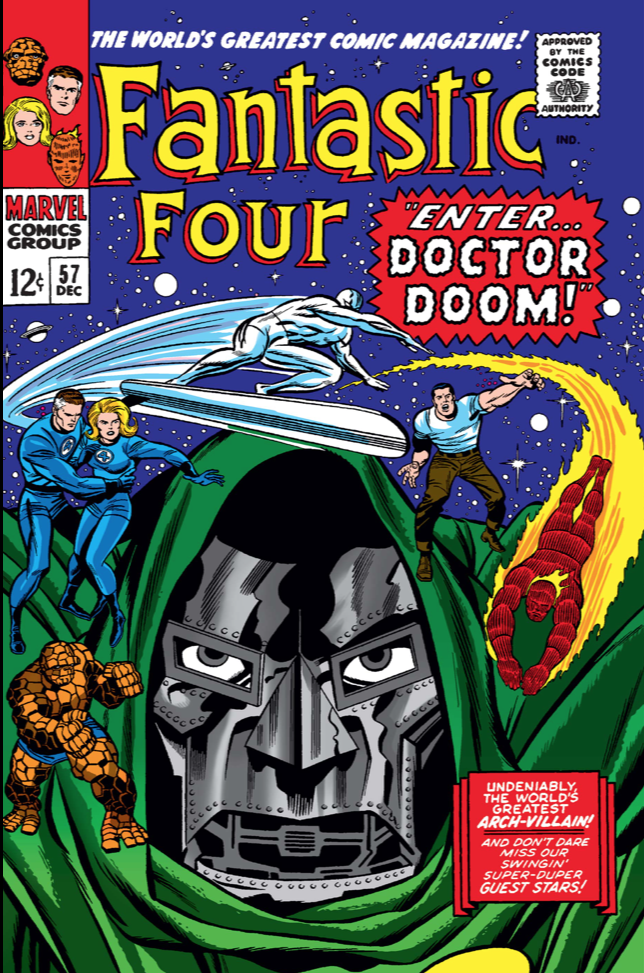
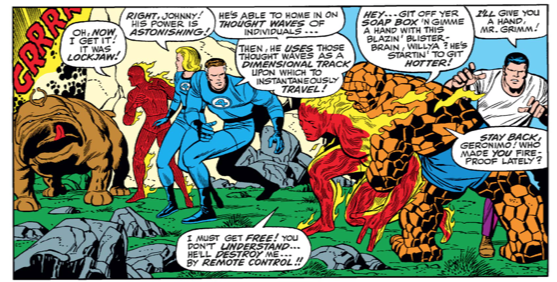
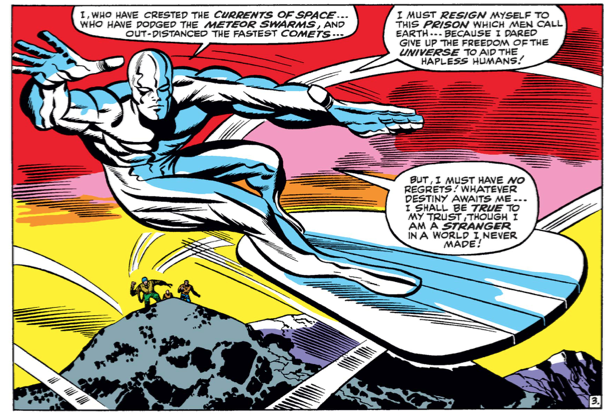
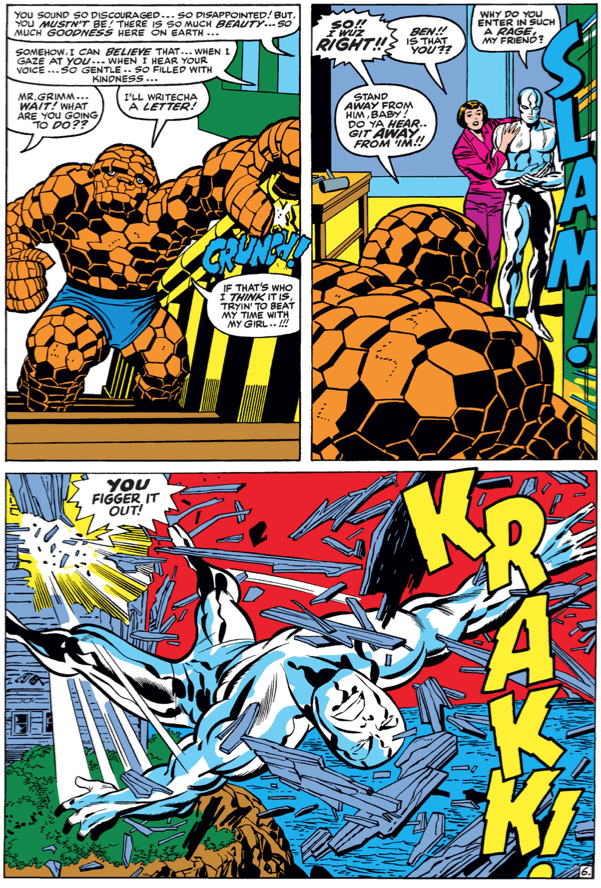
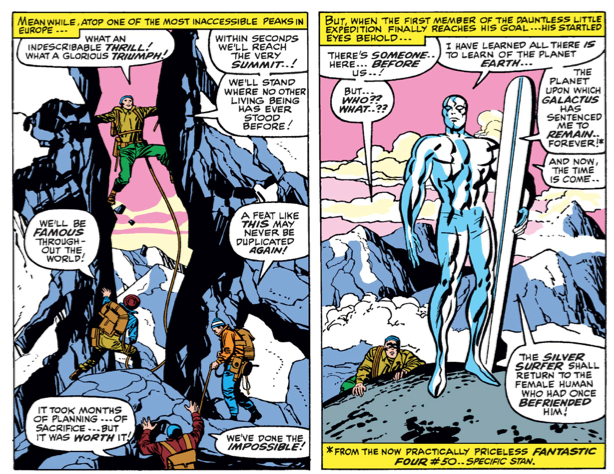
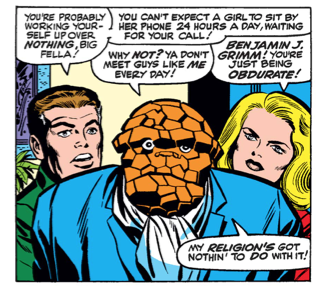
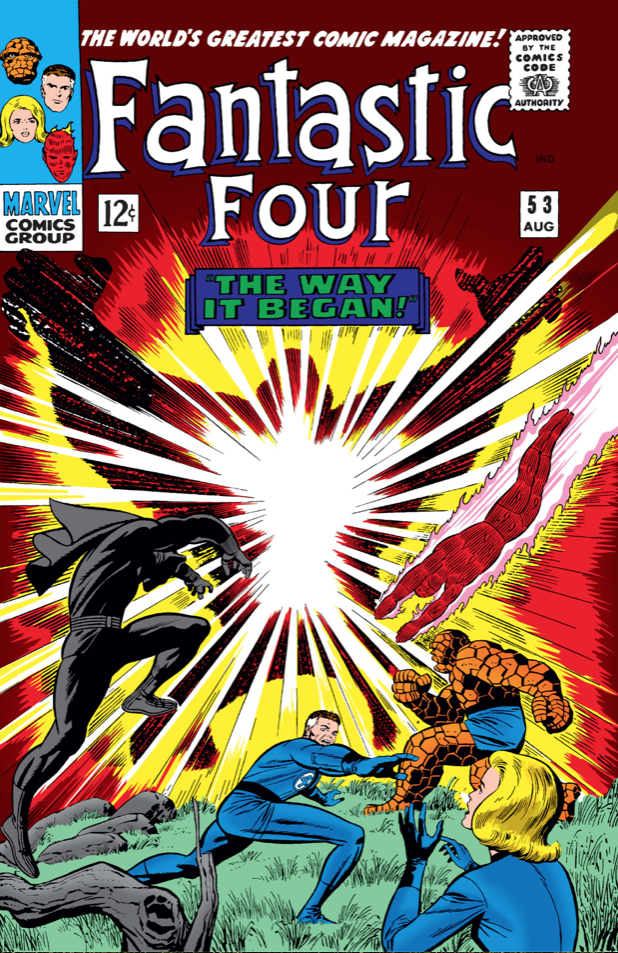
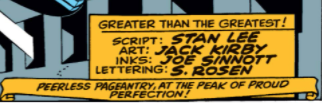
Fantastic Four 57 “Enter Dr. Doom!” Published: Sept. 1966 Story: Stan Lee and Jack Kirby Script: Lee Pencils: Kirby Inks: Joe Sinnott Letters: Art Simek Cover: Kirby and Sinnott
Synopsis
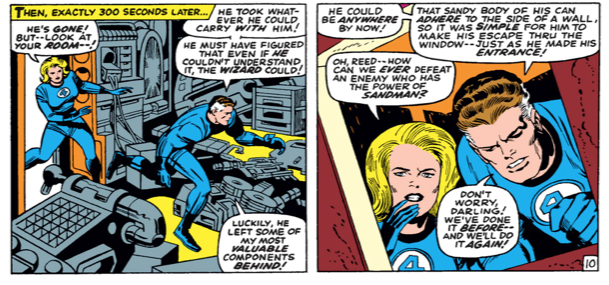
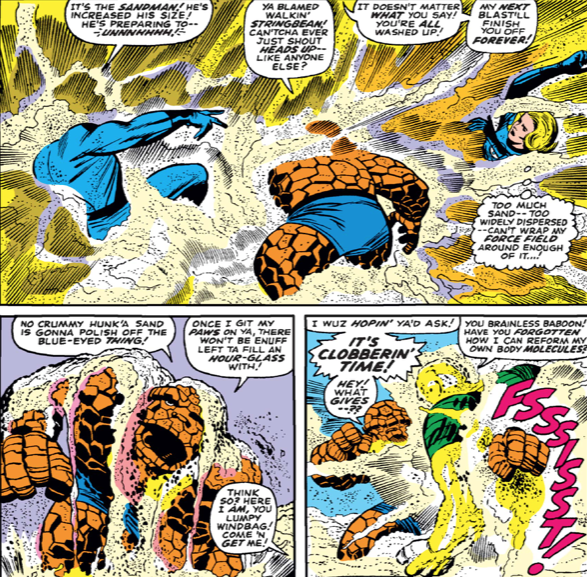
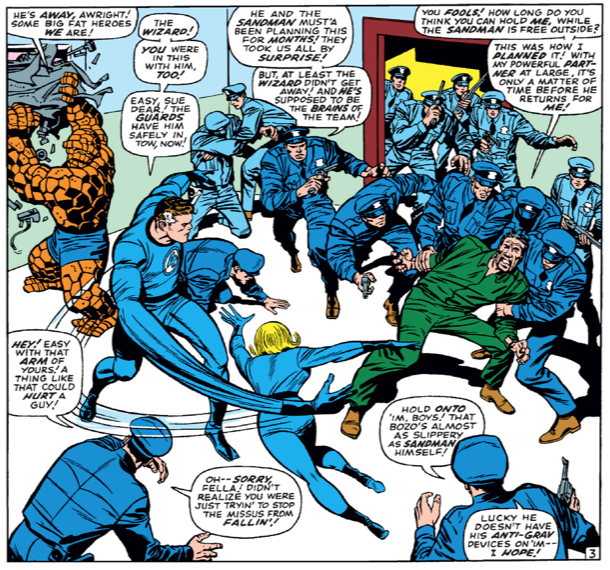
The main story begins in the middle of the action (in medias res, if you want to be fancy), with the Fantastic Four (minus the Human Torch) fighting the Sandman and Wizard in a prison, as the Thing explains the team were summoned to the prison under a ruse. The Wizard is easily subdued but Sandman escapes. He eventually resurfaces at the Baxter Building, where Reed and Sue fight him (the Thing is off looking for him at this point) and eventually chase him away.
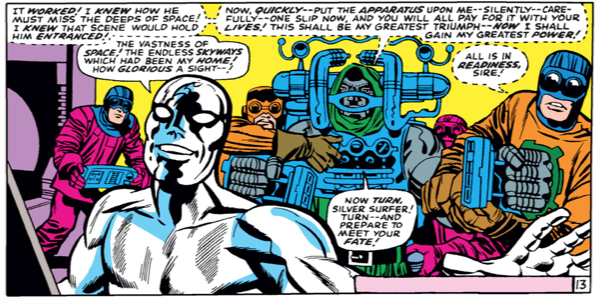
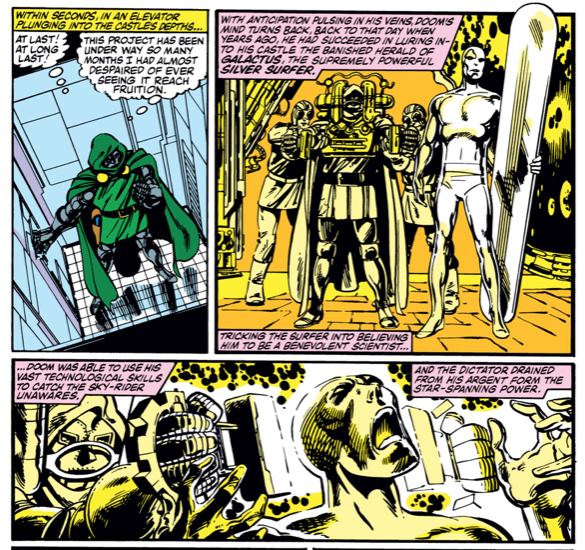
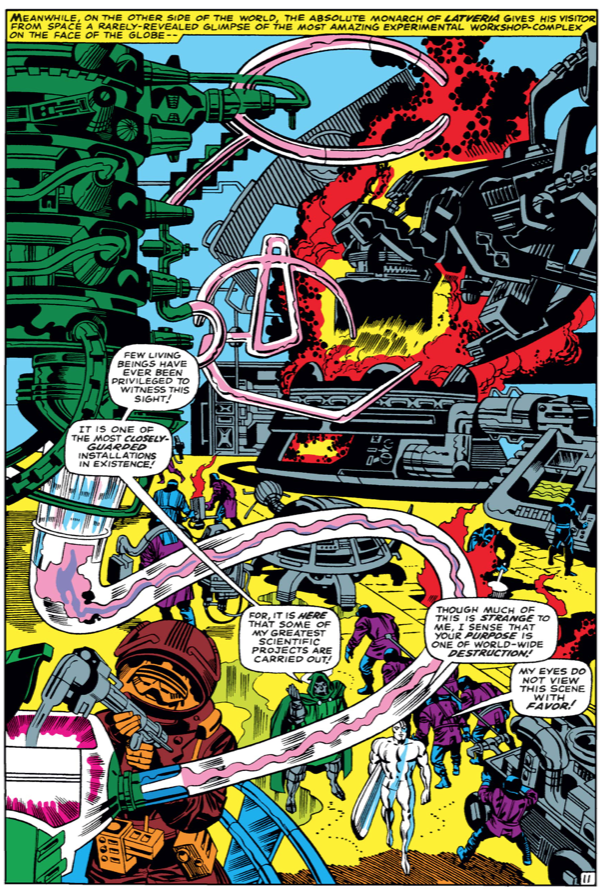
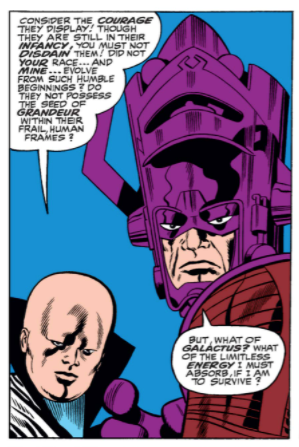
That plot line alternates with another, in which Dr. Doom lured the Silver Surfer to his castle in Latveria. After asking the Surfer to demonstrate his powers, Doom traps him in a devices that siphons his cosmic power to Doom.
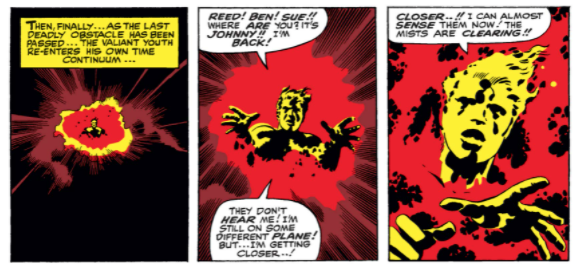
Lastly, two other sub-plots are advanced: Johnny and Wyatt continue to teleport around the universe with Lockjaw—this time landing on a planet filled with monstrous creatures before escaping—and in the Inhuman’s city of Attilan, Black Bolt shows signs of life while Maximus the Mad reveals that he could speak the entire time (the powers of his voice has yet to be revealed).
What’s going on here?
Fantastic Four 57 is very much a transitional issue, as Stan and Jack continue to move their chess pieces around in advance of some bigger events. The only traditional story in this issue—one with a beginning, middle and end—concerns the fight with Sandman, and despite some nifty Kirby art, it feels like filler (and it can’t really be said to have a beginning, since it opens in the middle of the action). After seeing the FF fight Galactus, it’s hard to get too worked up about the Sandman.
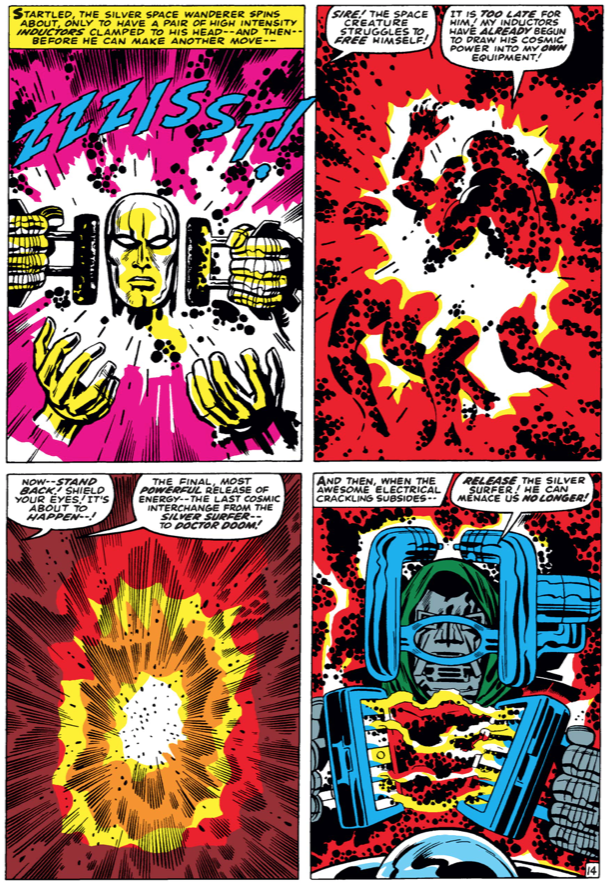
The centerpiece is of FF 57 is the interaction between Doom and the Surfer. Doom is at his most duplicitous, lulling the Surfer into believing he is a benevolent monarch, then cruelly clamping him in a device that steals his power. It could be argued that this scene is where Doom really makes the leap from a generic bad guy into a truly fearsome villain. Certainly, nothing up to this point suggests he was capable of a plot as ambitious or nefarious as this.
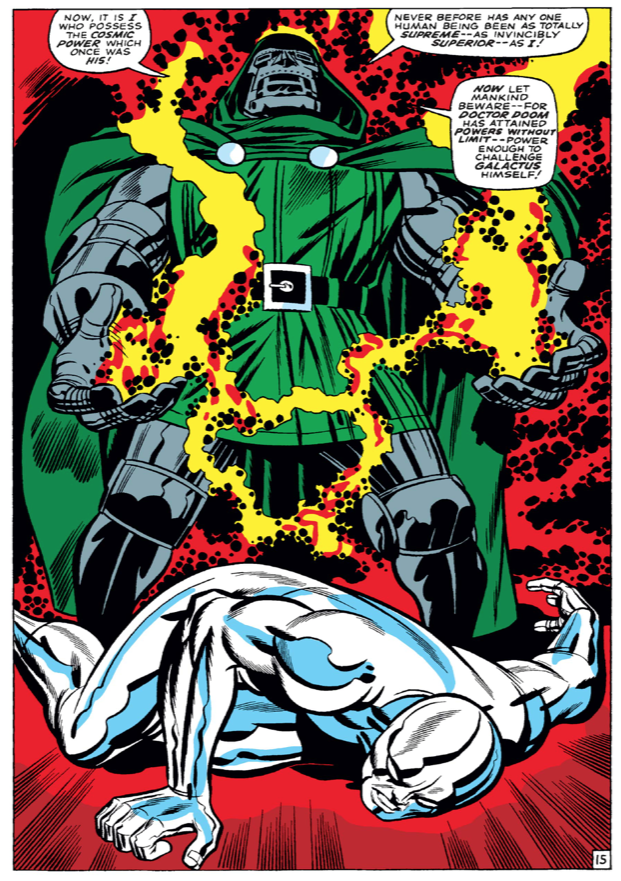
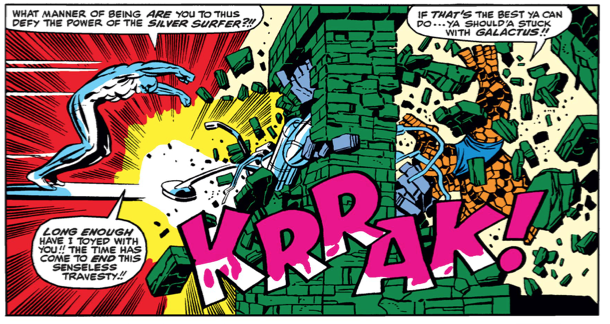
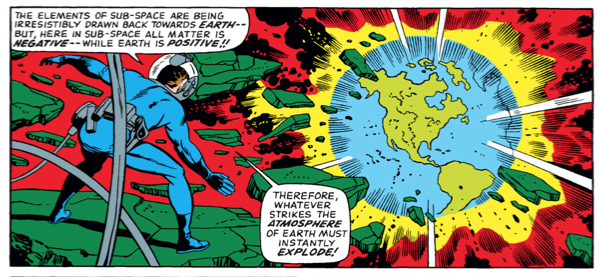
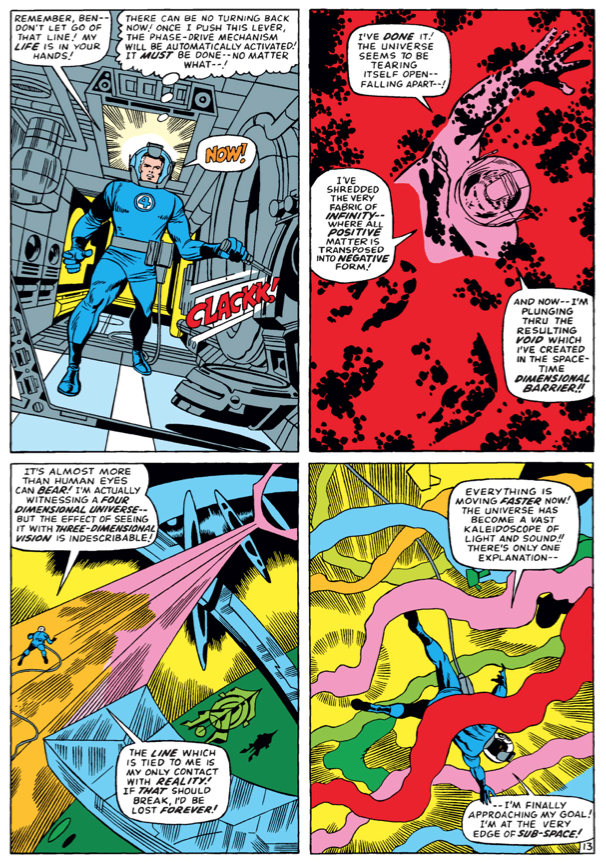
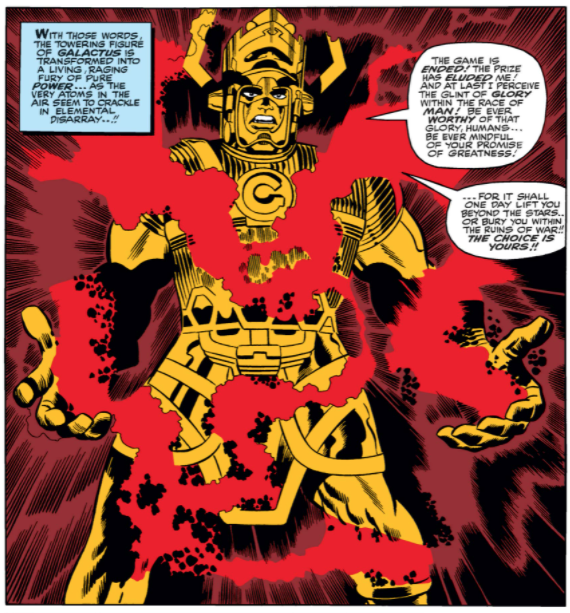
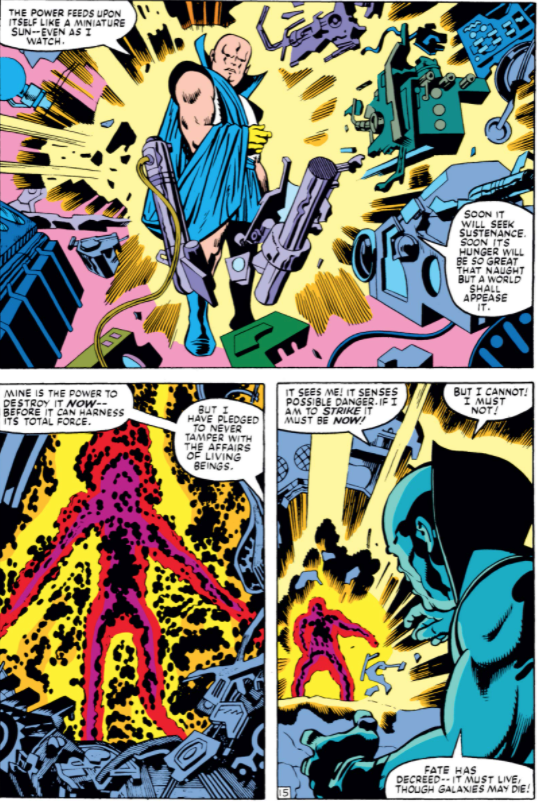
It’s also an opportunity for Jack (and Joe Sinnott) to go absolutely nuts with the Kirby Krackle:
Years later John Byrne recreated this sequence in a flashback in 1983’s FF 258 when Doom once again tried to harness the power of a herald of Galactus, but in that case it was Terrax, not the Silver Surfer.
The sexist sixties
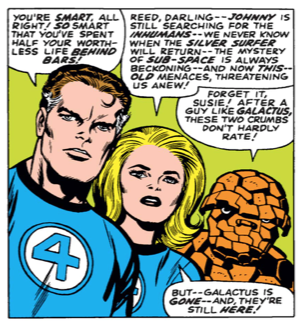
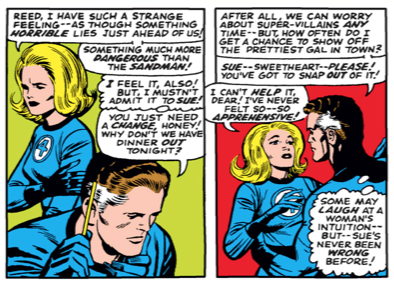
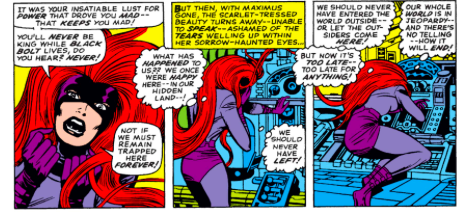
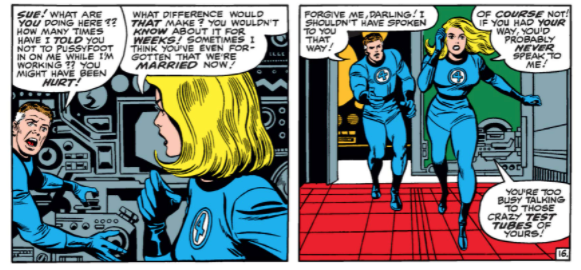
There’s some strange stuff going on with Sue in this issue. Early on, as the FF are recapturing the Wizard, she gives a very grim assessment of the FF’s status quo.
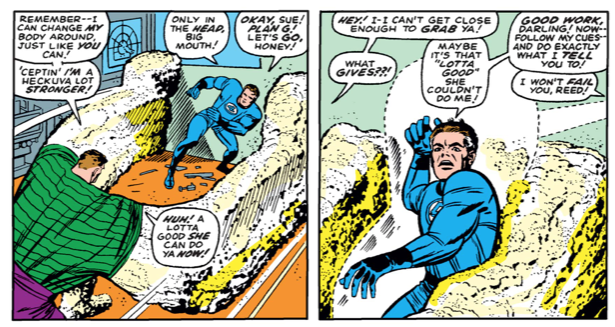
We then get a fairly typical sequence of Reed barking orders and Sue following them faithfully: Followed by some more worrying and fretting. Every time Stan and Jack’s characterization of Sue seems to have turned a corner, she reverts back to the wingeing, cringing dish towel. Blech.
The incredible Mr. Fantastic
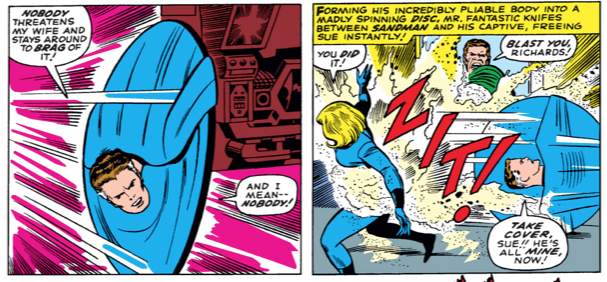
A fun sequence:
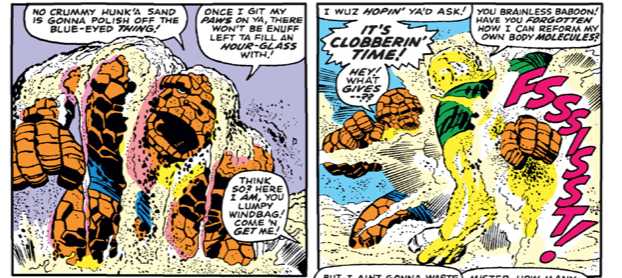
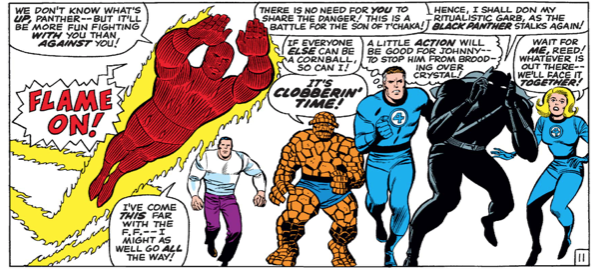
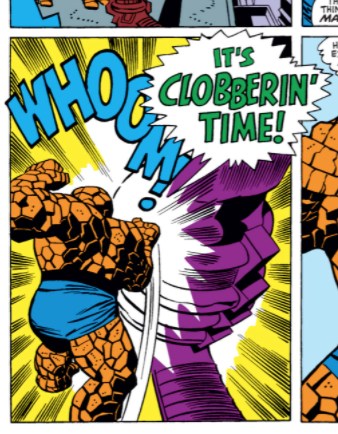
It’s Clobberin’ Time
It’s been a few issues since we got one of these.
Let’s talk about us
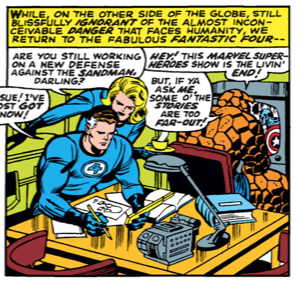
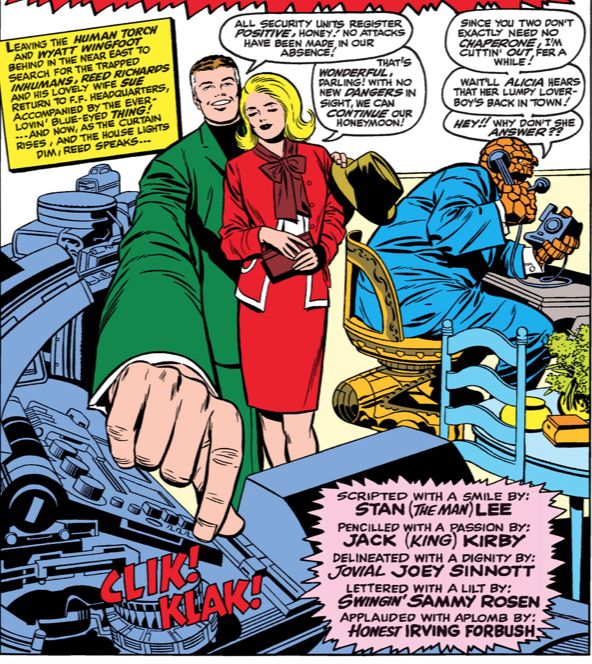
Ben is watching “The Marvel Super Heroes Show,” a short-lived animated series that ran in syndication in 1966. The stories were taken directly from comics, and the animators used the original art by Kirby, Steve Ditko and Don Heck. You can check it out here.
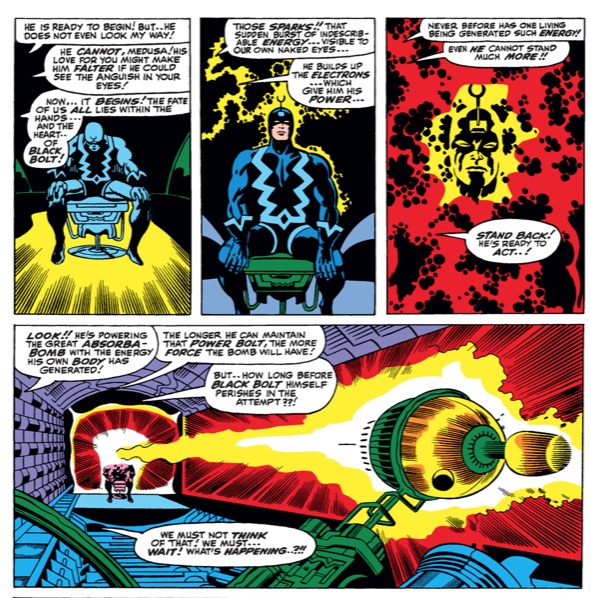
Dig that Kirby Krackle
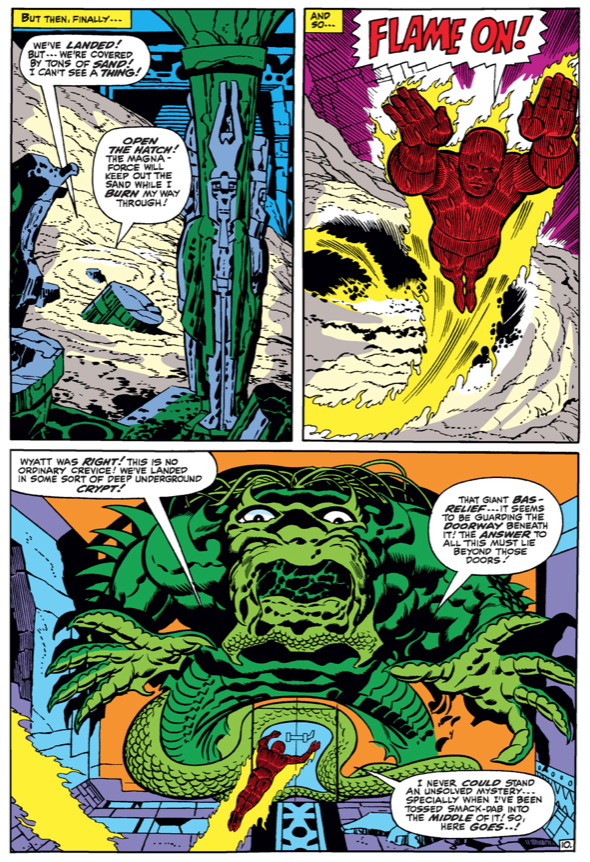
Lots of cool stuff in this issue, starting with this sandy sequence:
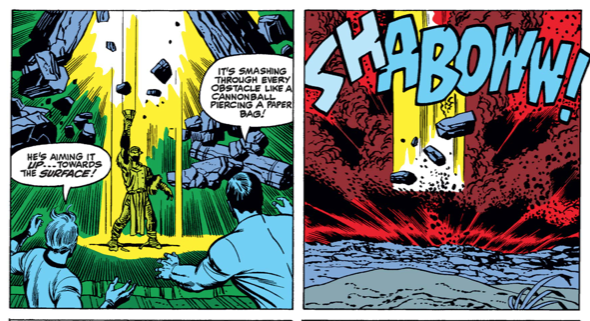
And this (there’s a bit of an oops in this panel, with Stan using the guard to explain what Reed’s doing):
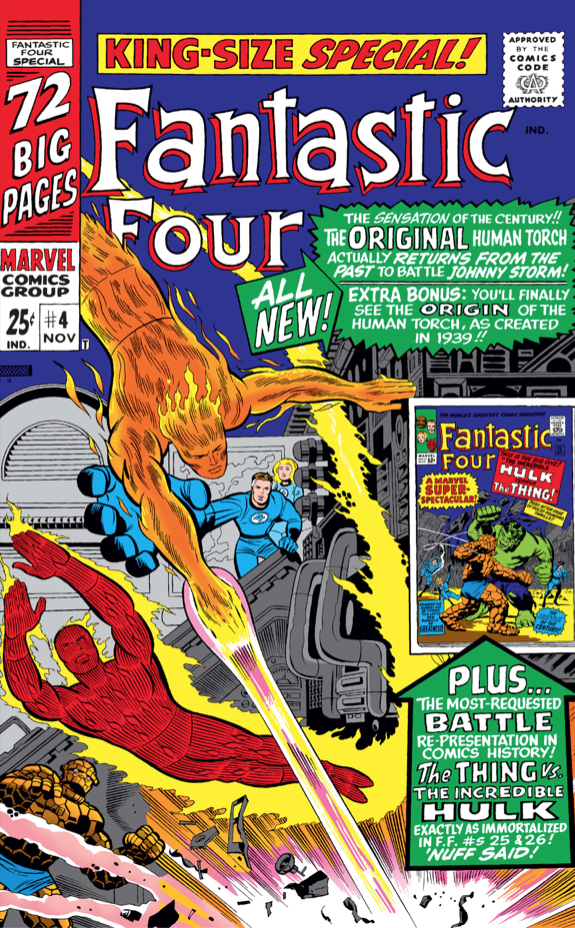
Fantastic Four Annual 4 “The Torch That Was!” Published: August 1966 Story: Stan Lee & Jack Kirby Script: Lee Pencils: Kirby Inks: Joe Sinnott Letters: Sam Rosen Cover: Kirby and Sinnott
(Note: Fantastic Four Annual 4 came out a week before FF 56, but follows it chronologically, which is why I’m writing about after issue 56. The annual also included reprints of FF 25 and 26).
Synopsis
The Fantastic Four’s fourth annual opens like many issues, with the FF hanging around the Baxter Building reading fan mail. The Human Torch and Wyatt Wingfoot suddenly appear, teleported by Lockjaw from the Himalayas, where they had sought to rescue Crystal and the Inhumans. Johnny, despondent that his efforts to find Crystal failed, flies to the desert to experiment with his powers.
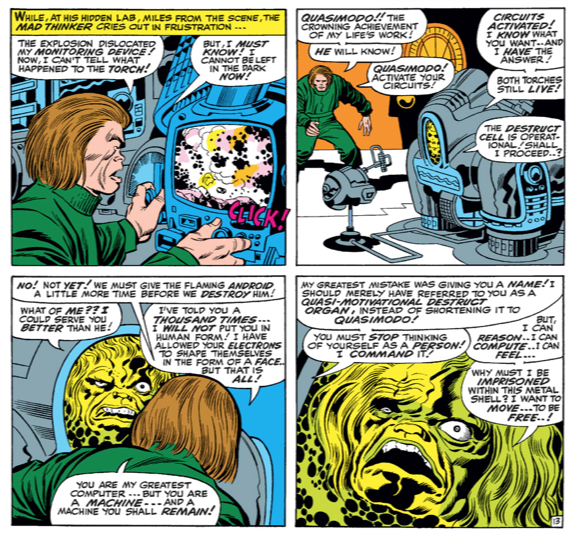
Meanwhile the Mad Thinker, last seen in issue 28, has a new scheme: reviving the original Human Torch, the android knows as Jim Hammond. Threatening him with destruction via Quasimodo, a sentient computer, the Thinker sends the original Torch to battle the Johnny Storm. The two fight to a standstill when the rest of the FF arrive, teleported by Lockjaw. Lockjaw then teleports them all to the Thinker’s lair, where the original Torch turns on the Thinker and is rendered inert by Quasimodo. The Thinker escapes and Lockjaw teleports Johnny and Wyatt back to find the Inhumans.
What’s going on here?
The story in FF Annual 4 isn’t particularly momentous—it’s not a wedding or birth issue, like many annuals—but it does feature the return of a Marvel golden age character. Similar to Stan and Jack’s revival of the Sub-Mariner, way back in FF 4, they retroactively insert Jim Hammond into the Marvel universe, tying the golden age to the present.
While Jim Hammond never plays as prominent a role as Namor, he occupies an interesting place in Marvel continuity.
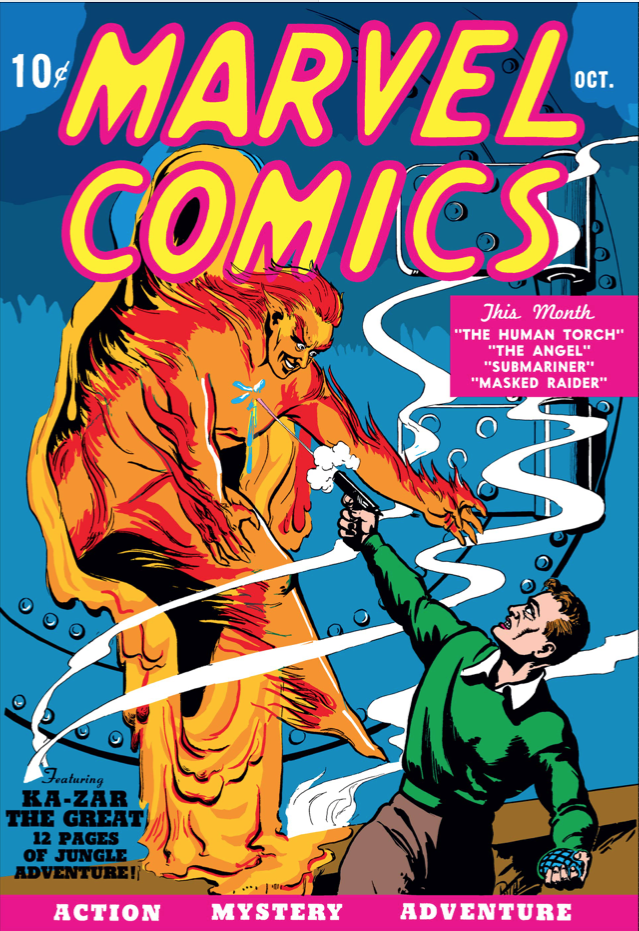
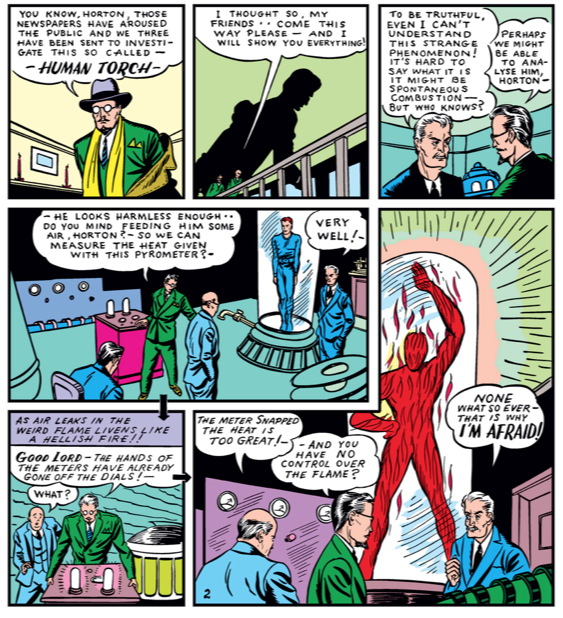
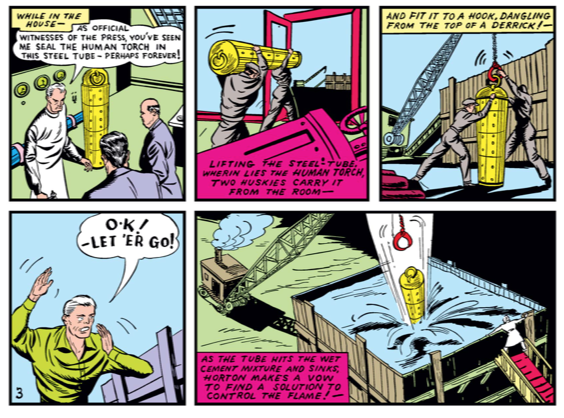
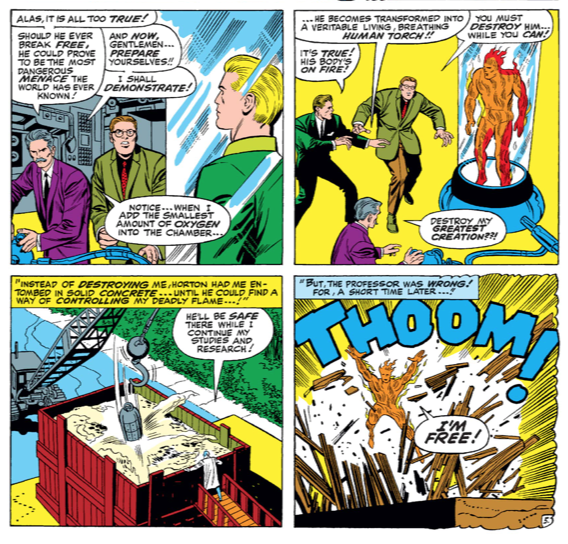
He first appeared in Marvel Comics 1, in 1939, as one of the earliest super heroes. Stan and Jack recap his origin in the annual, and are fairly faithful to Carl Burgos’s original version. Here Burgos describes his invention by Prof. Phineas Horton:
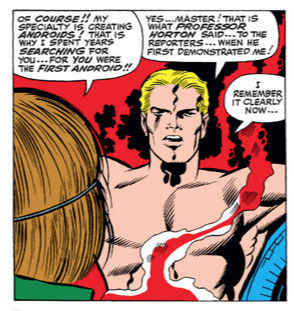
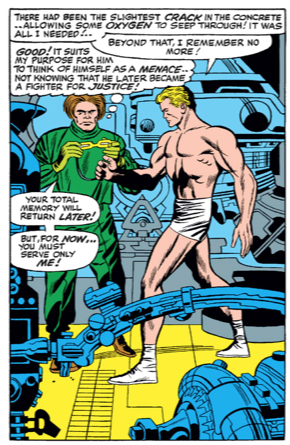
Here it is as told by Stan and Jack:
As drawn by Kirby, Jim Hammond looks like a Greek god (and I guess why not, since he’s a robot, he can look like anything).
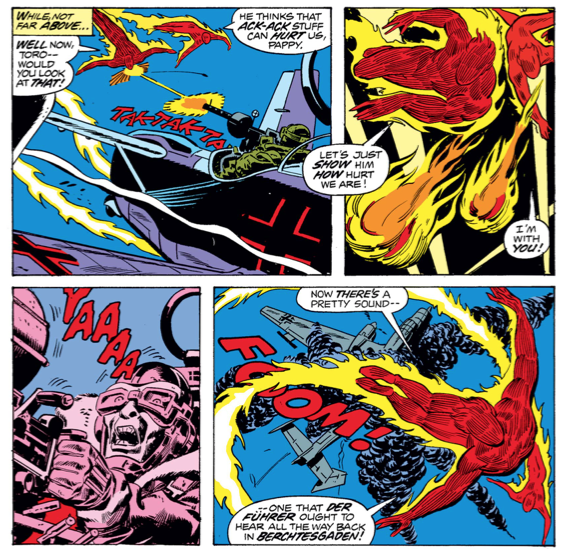
The Human Torch fought crime and Nazis in the 1940s and essentially disappears after the golden age. He was later ret-conned into the Invaders, a WWII era super hero team, along with his sidekick, Toro.
Invaders 1 (1975, by Thomas,Robbins and Colletta).
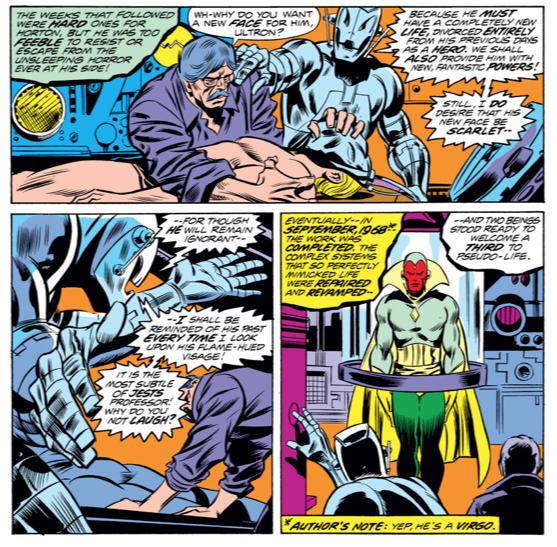
After his appearance and apparent destruction in FF Annual 4, it was generally established that the Human Torch’s body was used by the robot Ultron and transformed into the Vision.
Avengers 135 (1975, by Englehart, Tuska and Chiarmonte)
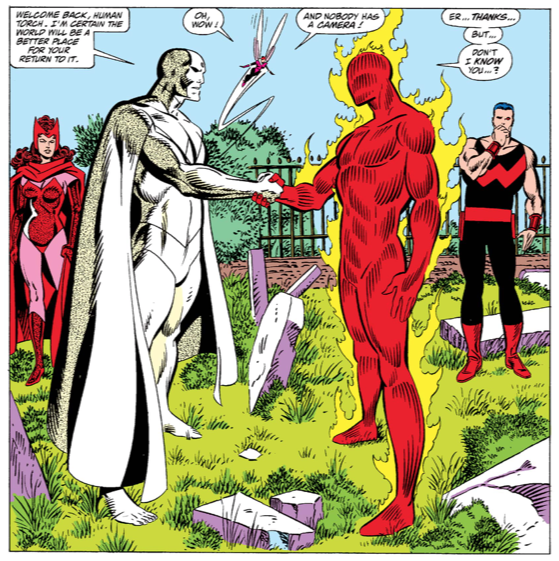
That chronology got muddled when John Byrne revived the Human Torch in West Coast Avengers 50, suggesting that he never became the Vision, but that the Vision was assembled from Horton’s spare parts.
West Coast Avengers 50 (1989 Byrne/Machlan)
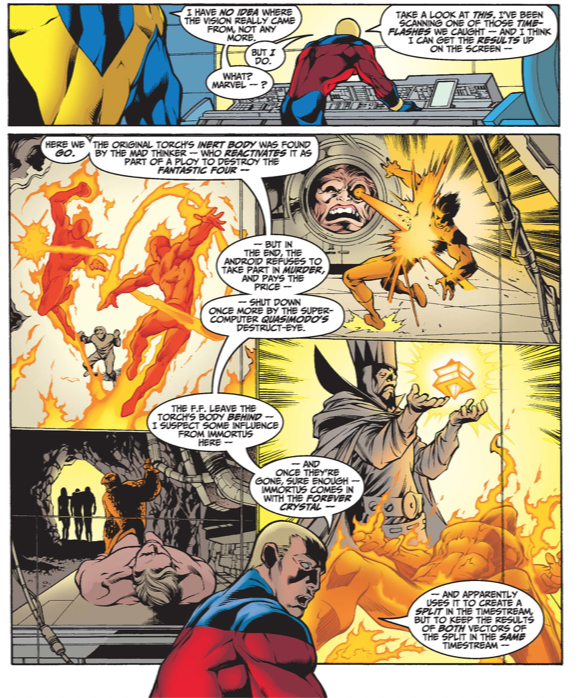
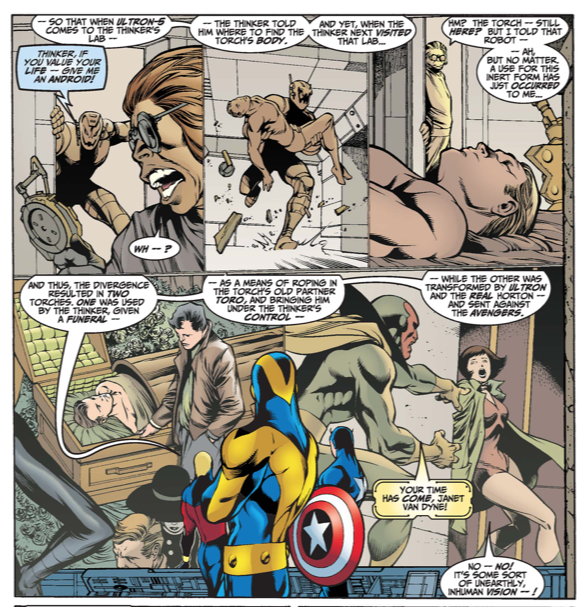
It’s all cleared up (sort of) in Avengers Forever, a limited series that tried to untangle some continuity, albeit in a very confusing way. As described by Kurt Busiek, Immortus, the tame-manipulating villain, split the Human Torch into two timelines, one of which became the Vision, the other of which remained the Human Torch. Hopefully that clears everything up.
Avengers Forever 8 (1998, Busiek, Pacheco and Merino)
The Jim Hammond Torch has resurfaced over the years, but never as a major character.
Quasimodo
Avengers Annual 4 also marks the first appearance of Quasimodo, a third-tier villain who shares only a name with the Victor Hugo character. Apparently the name is derived from “Quasi-Motivational Destruct Organ,” whatever that means. He, too, reappears on occasion, but never as a major villain.
Everybody plays the fool
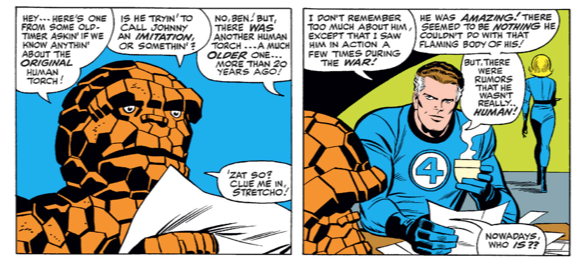
I get the story-telling purpose of Ben not knowing there was another Human Torch, but it’s a little hard to swallow. Ben did serve in World War II as well.
Frequent Flier
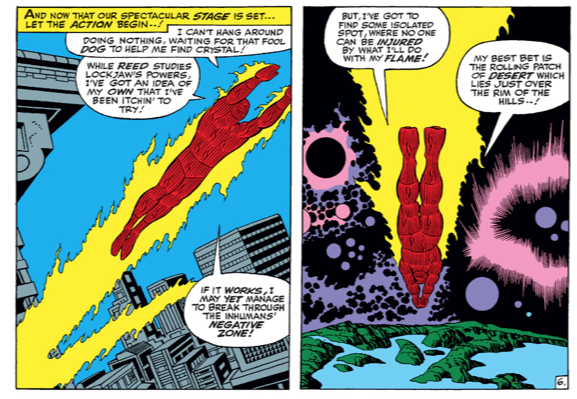
In between panels Johnny flies from the Baxter Building in midtown to … the desert? is that in New Jersey?
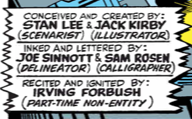
Crazy Credits
Weird Science
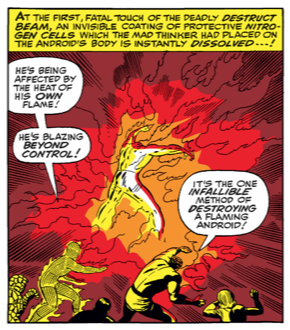
Of course, everyone knows the one infallible way to destroy a flaming android.
Ladies and gentlemen, Joe Sinnott!
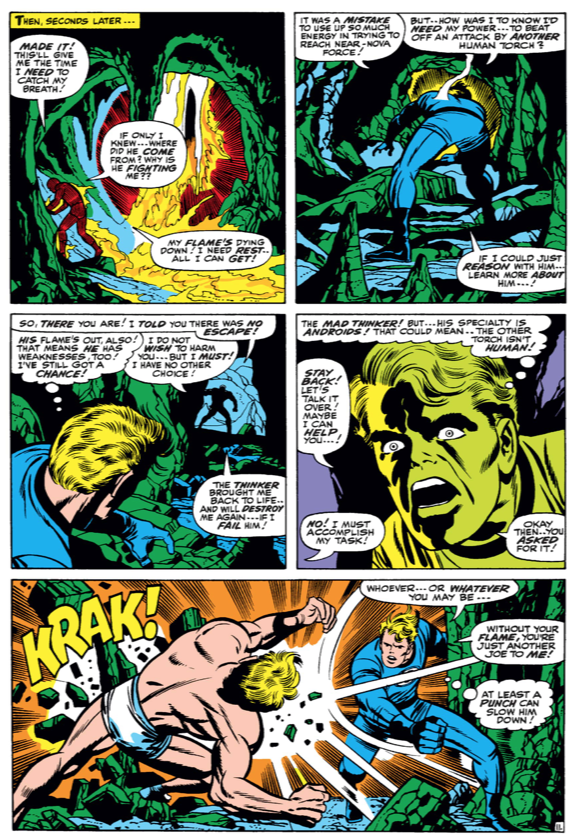
Check out the inks on this page:
Dig that Kirby Krackle
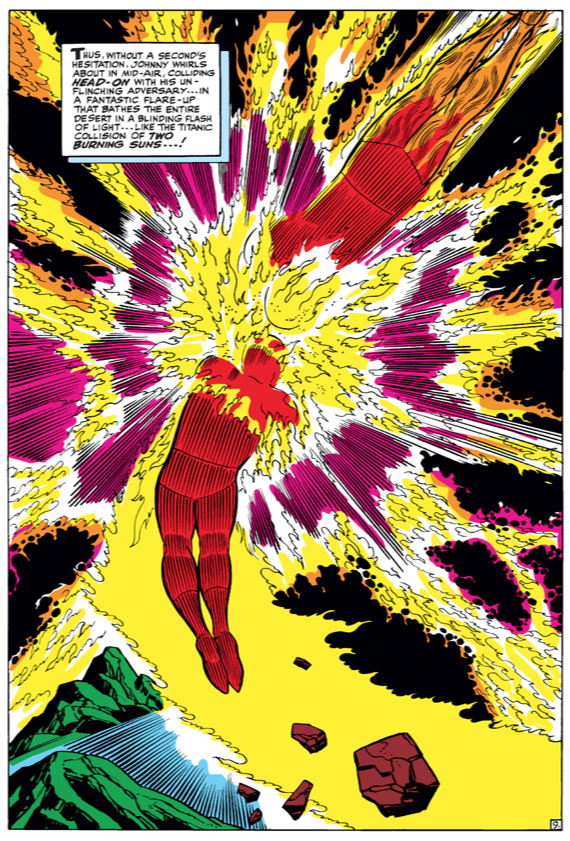
This one is hot!
Also on the newsstand this month
(This is a new feature I am experimenting with. Thanks to Mike’s Amazing World for the info.
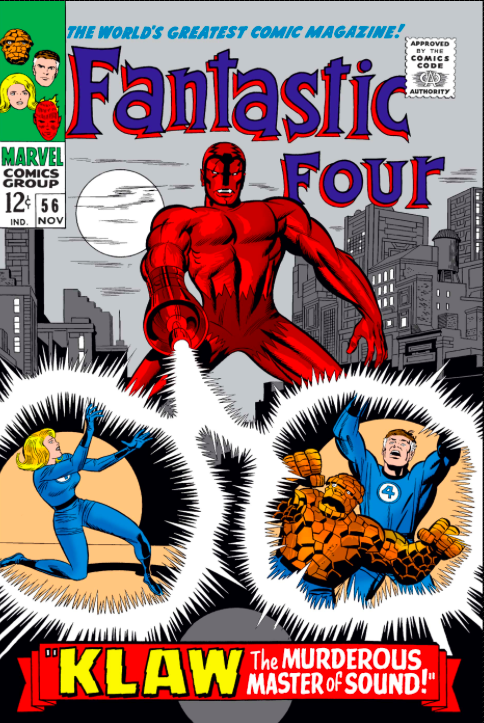
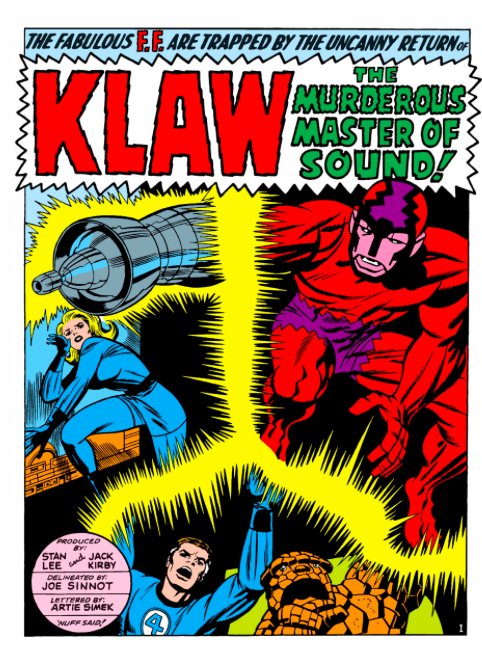
Fantastic Four 56 “Klaw, the Murderous Master of Sound!” Published: Nov. 1966 Story: Stan Lee and Jack Kirby Script:Lee Pencils: Kirby Inks: Joe Sinnott Letters: Artie Simek Cover: Kirby and Sinnott
Synopsis
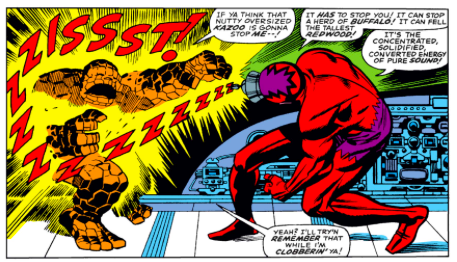
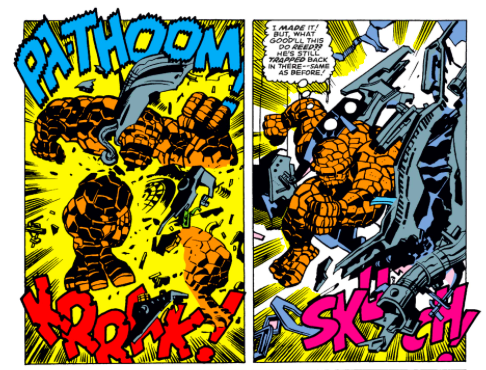
Like last issue, Fantastic Four 56 is split between the Human Torch and Wyatt Wingfoot’s quest to rescue the Inhumans, and the rest of the team in New York. In the second story, which makes up the bulk of the issue, Mr. Fantastic and the Thing are working a lab when Klaw, the villain from issue 53, reappears, now transformed into a creature of solid sound. After trapping Reed and Ben in the lab, he battles Sue, then Ben after he escapes the lab. Utilizing vibranium devices delivered from the Black Panther in Wakanda, Reed is able to absorb Klaw’s soil energy, rendering him unconscious.
In the other story line, Johnny and Wyatt try to coax Loackjaw into teleporting them back to Atillan and the Inhumans. In another arc, we check in with the Inhumans, last seen in issue 54, and learn that Black Bolt did not activate the absorb-bomb as intended because it would have destroyed the Inhumans. Medusa continues to despair. Issue 56 closes with a few panels of Dr. Doom spying on the Silver Surfer, teasing issue 57.
What’s going on here?
After a year of multiple-issue story arcs, FF 56 feels like a bit of a throwback to earlier, one-and-done issues. The story opens in the Baxter Building, with Reed and Ben kibitzing in a lab and Sue fretting about Reed’s inattentiveness. The fight with Klaw ends with the sort of deus-ex-machina reminiscent of earlier issues, too, with Reed cooking up some stratagem or device to defeat the bad guy. In this case, he calls on the Black Panther in Wakanda, signaling that he will be an ongoing part of the FF and Marvel universe into the future. In all, it’s a pretty satisfying story, and the Johnny/Wyatt/Medusa panels keeps that subplot moving as well.
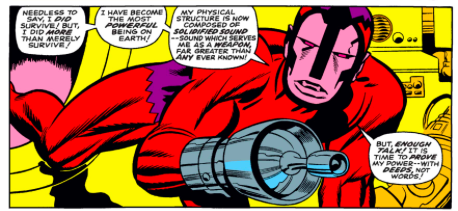
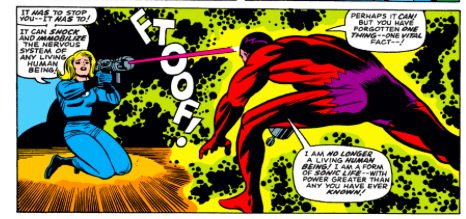
FF 56 also reintroduces Klaw as a super villain in the form we are more familiar with. It’s a great Kirby character design, and could easily have been one of the New Gods Kirby created five years later. One question is whether Stan and Jack had this transformation, and his sonic cannon in mind, when they named him Klaw in issue 53, or if his name inspired the character design. If anyone has the answer, I’d love to know.
The sexist sixties
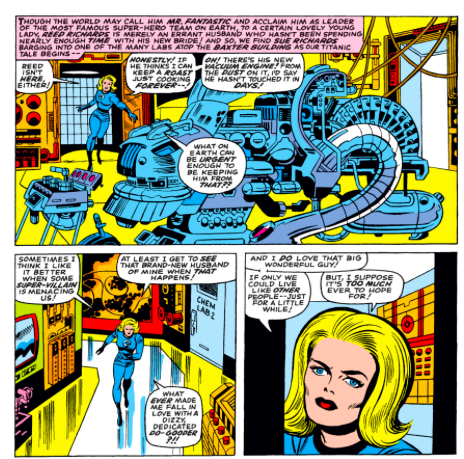
Sue is worried about her roast, and wonders why they can’t live like other people.
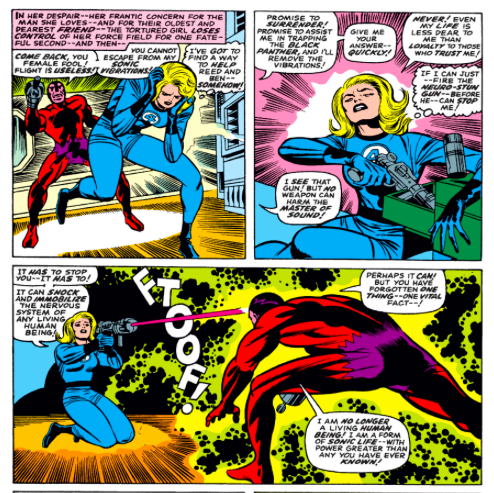
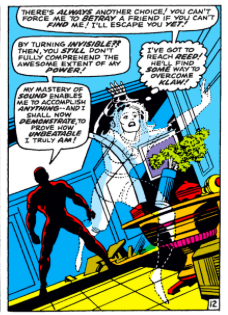
Sue does rise to the occasion later in the issue, taking on Klaw by herself.
Oops
Does Klaw have two hands here, instead of a sonic cannon where his right hand should be?
Medusa is back
She gets a melodramatic star turn in this subplot, a reminder of her status among the Inhumans, and that Stan and Jack created her long before the others.
Weird Science
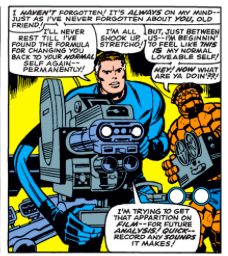
Reed and Ben appeared armed with with a movie camera and reel-to-reel tape recorder.
Comanche Blood
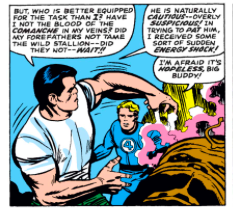
Up to now Stan and Jack have done a pretty good job of steering clear of Native American stereotypes in their treatment of Wyatt Wingfoot. Not so much here.
Dig that Kirby Krackle
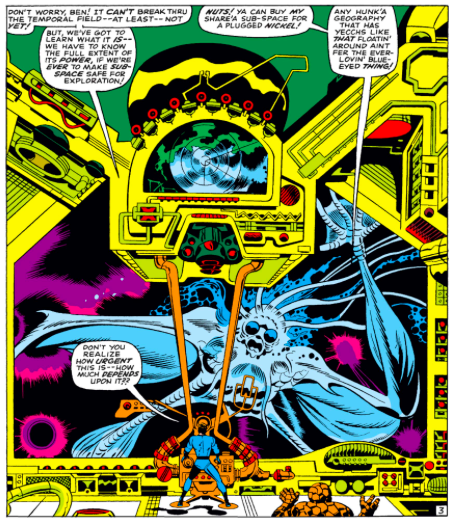
Just an amazing page here. I am pretty sure that creature makes a subsequent appearance, probably in a John Byrne FF, but I can’t place it. Anyone out there know if it reappears?
Klaw looks appropriately weird and menacing in this panel:
Some actual Krackle here:
And some great energy here:
Next issue: The original Human Torch returns in Annual No. 4!
Fantastic Four 55 “When Strikes the Silver Surfer!” Published: July 1966 Story: Stan Lee and Jack Kirby Script: Lee Pencils: Kirby Inks: Joe Sinnott Letters: Sam Rosen Cover: Kirby and Sinnott
Synopsis
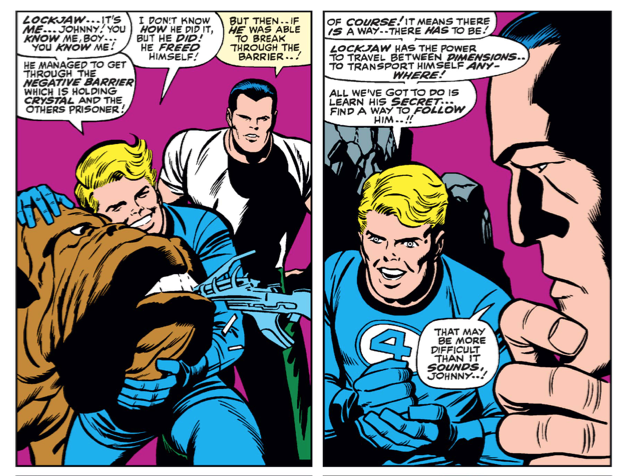
Much like last issue, there are two parallel stories in FF 55. In one, the Human Torch and Wyatt Wingfoot continue their quest to rescue Crystal and the Inhumans from the negative zone that surrounds their city. Johnny and Wyatt travel to a valley in the Himalayas, where they encounter Lockjaw, the Inhuman’s teleporting dog.
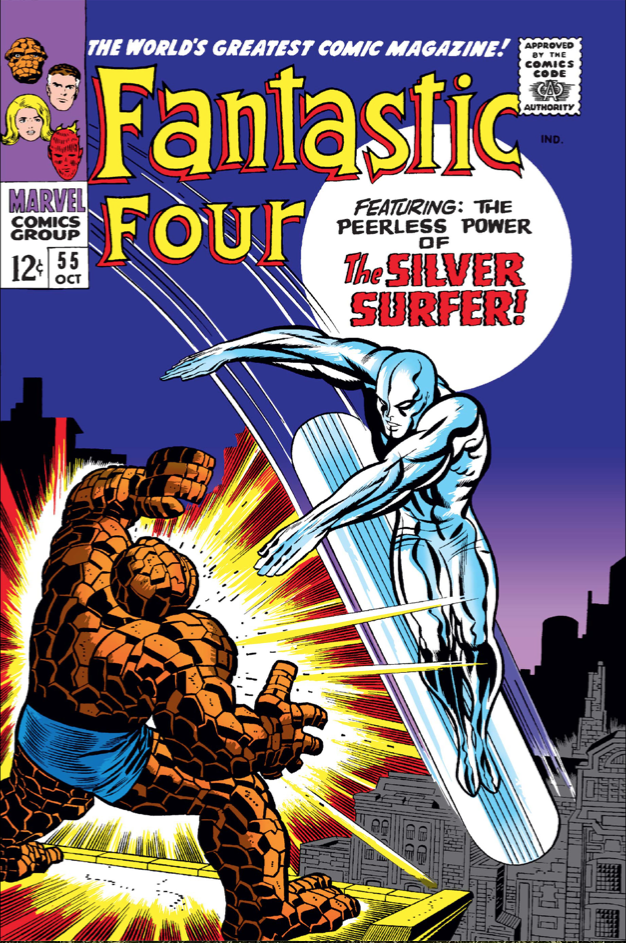
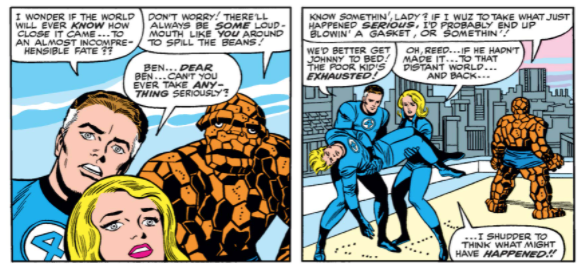
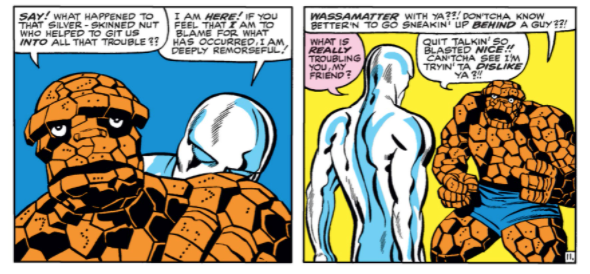
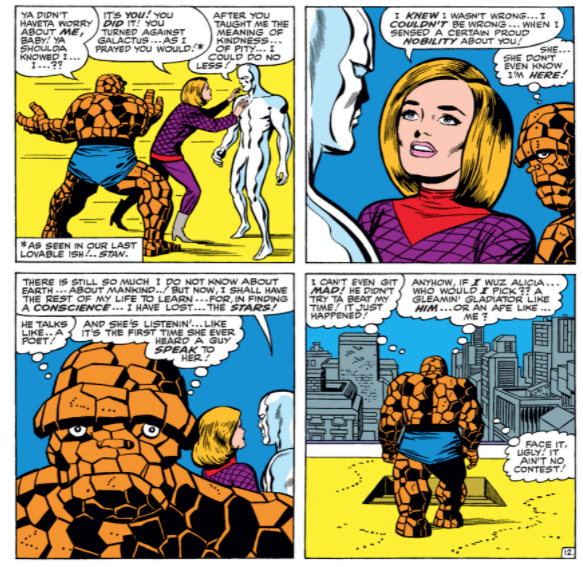
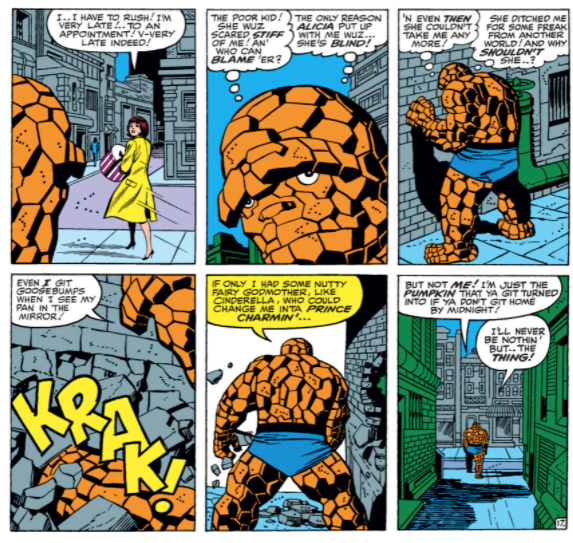
The other story, which takes up most of the issue, revolves around the Thing, who after his trip to Wakanda, visits his girlfriend Alicia. Unbeknownst to Ben, the Silver Surfer has chosen that moment to visit (quite the coincidence!) and when Ben discovers the two together, he assumes the worst. The two spend most of the issue fighting before Mr. Fantastic and the Invisible Girl settle Ben down. Ben grudgingly apologizes and the Surfer chalks it up to the strange behavior of earthlings.
What’s going on here?
Not much! As a story goes, this issue is pretty thin. It moves some chess pieces around, setting up the eventual return of the Inhumans, and reintroducing the Silver Surfer, essentially establishing him as an ongoing character.
But most of the issue is devoted to the silly fight between Ben and the Surfer, all of which—like almost all super hero fights—is based on a misunderstanding that could have been cleared up in two seconds. To a certain extent, yes, it does reveal how plagued Ben is by his insecurities and fear of losing Alicia. But mostly it’s an excuse for a massive fight. Jack and Joe do not disappoint—the fight is full of amazing art—but it’s all pretty much in the service of nothing.
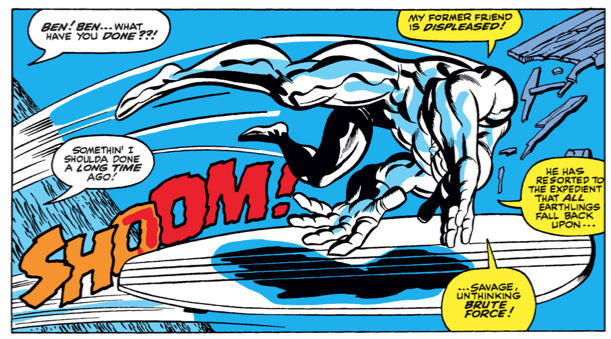
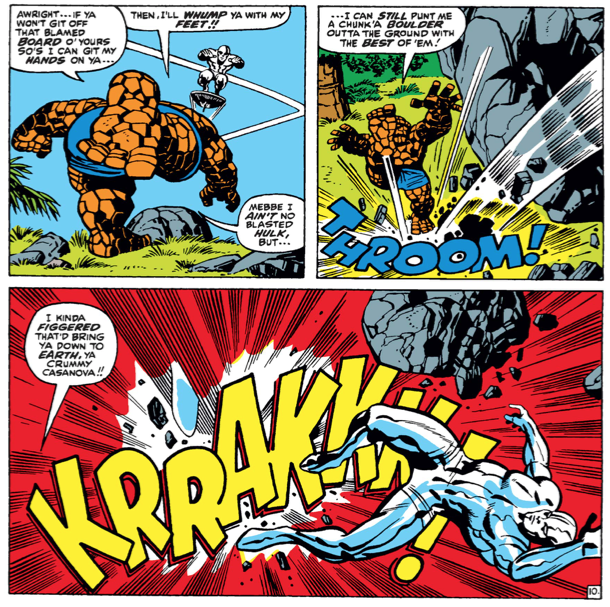
The fight kicks off with this great sequence, one of the best combinations of script, art and timing in the Lee/Kirby run:
Comic relief
There are more gags than usual in this issue, including this sequence:
And this rim-shot worthy line from Ben
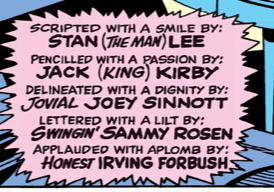
Crazy Credits
Another Forbush mention:
Weird science
Reed seems to have invented a Ring home security system
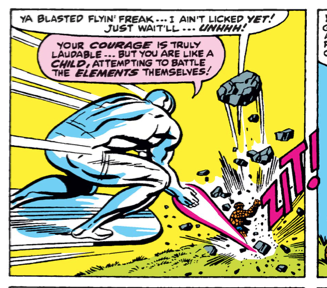
Zit!
A fun sound effect, unless you’re a self-conscious teenager.
Joltin’ Joe
Check out Sinnott’s inking in these panels
Dig that Kirby Krackle
A lot to choose from, but here are some highlights:
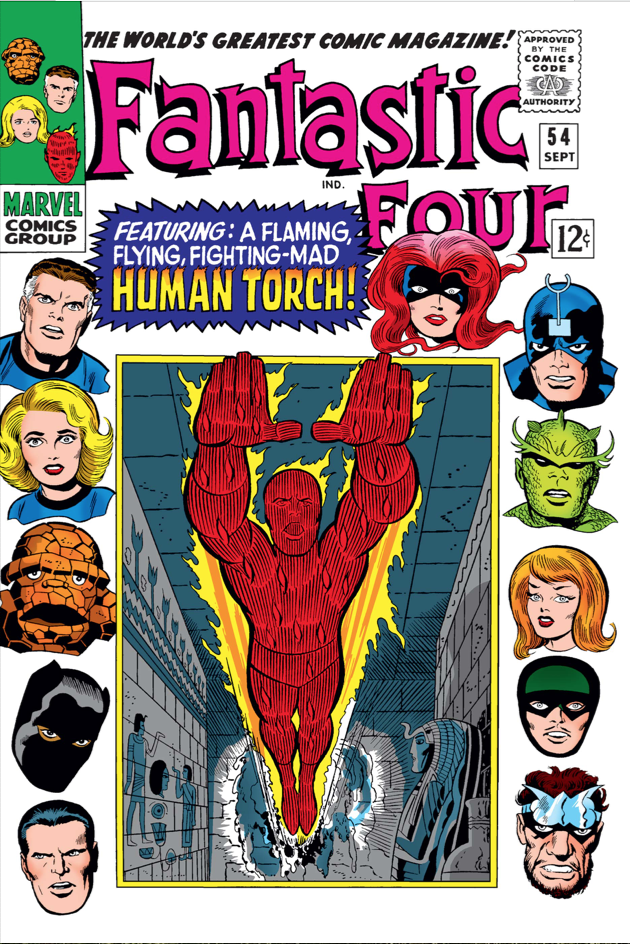
Fantastic Four 54 “Whosoever Find the Evil Eye ..!” Published June 1966 Story: Stan Lee and Jack Kirby Script: Lee Pencils: Kirby Inks: Joe Sinnott Letters: Sam Rosen Cover: Kirby and Sinnott
Synopsis
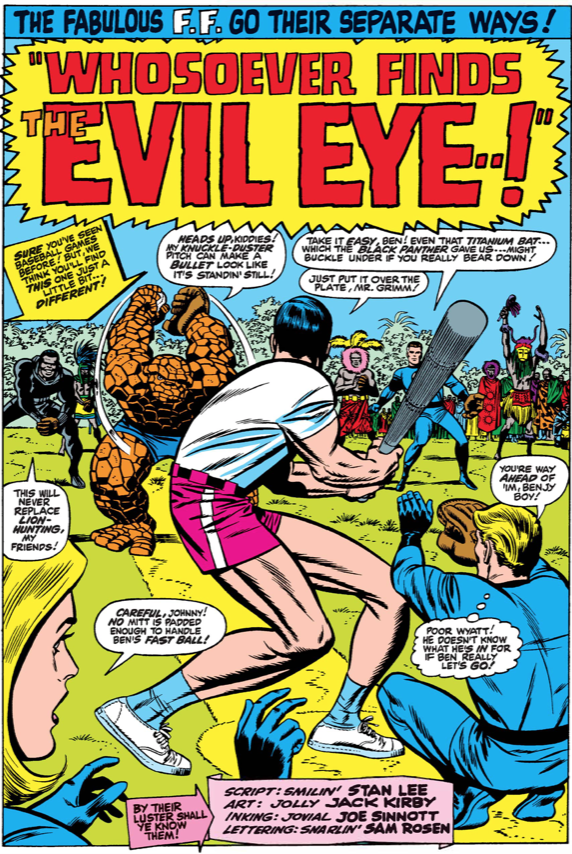
Fantastic Four 54 opens with the FF still in Wakanda, where they relax by playing baseball with the Black Panther. The Human Torch is plagued by visions of Crystal, the Inhuman trapped by the negative zone within her city of Attilan, and as the team prepares to leave Africa, he declares he will return to Attilan to try and free her. T’Challa makes him gift of a special gyroscopic vehicle, and Wyatt Wingfoot joins the Torch on his quest.
Meanwhile, in Attilan, the Inhumans are still trying to escape and the royal family attempts to coax Maximus the Mad—now truly insane—to reveal the secret of the negative zone. Running out of options Black Bolt enters the “cyclo-electronic chamber,” where he uses his power to energize the “asorba-bomb” in order to break through the barrier. The pressure is so great Black Bolt screams for the first time.
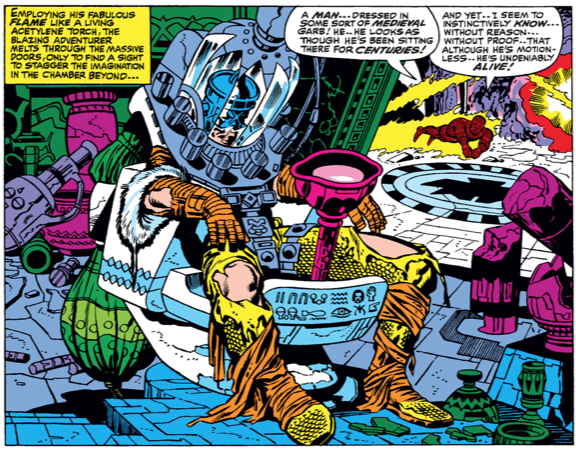
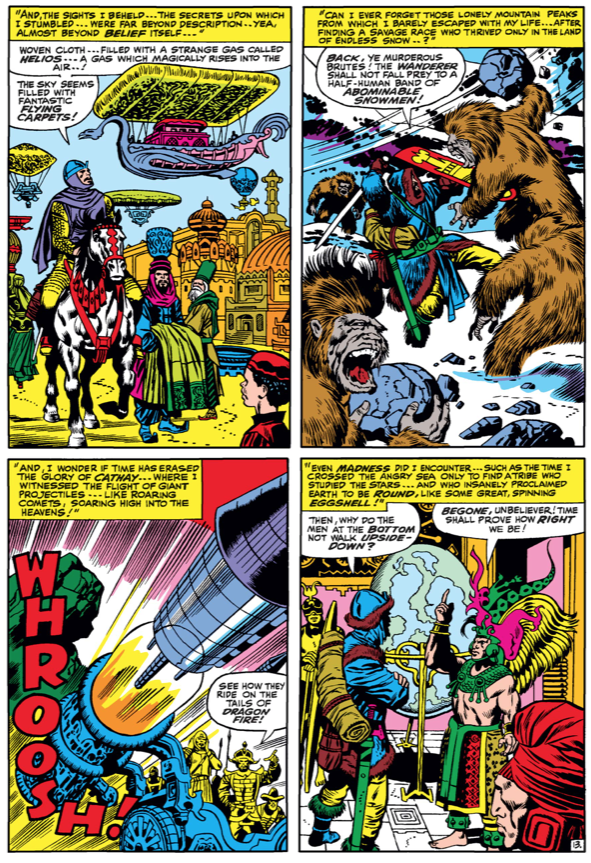
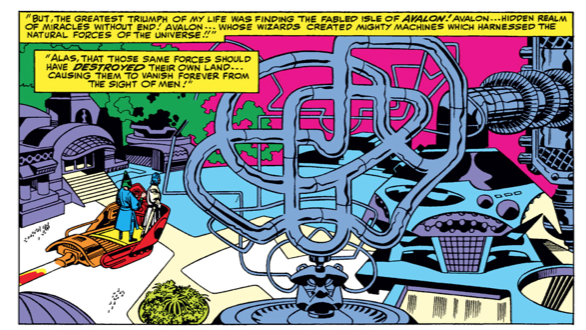
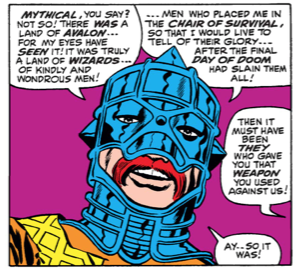
Johnny and Wyatt, traveling north through the African desert in the Wakandan vehicle, plunge through a crevice and land deep below the surface in a crypt that reveals a slumbering figure in armor. He awakens and tells the pair he is Prester John, who served Richard the Lionhearted during his crusades and afterward traveled the world before discovering Avalon, where he was given a powerful weapon called the Evil Eye. Johnny, realizing the device could be used to free Crystal and the Inhumans, steals it before Prester John can warn him it will exploded in his hands. As the Torch flees, Wyatt shoots the Evil Eye out of his hands, saving Johnny but leaving him despondent.
What’s going on here?
A lot! This comic is jammed packed, and one of the best issues to date. We get the FF enjoying some downtime, which builds their characters while simultaneously deepening our understanding of T’Challa and Wakanda. The Human Torch’s torment over Crystal, now well-established with several mentions over the last few issues, gives the story some emotional depth and drives the plot. The Inhumans arc becomes more complex as they develop into heroes, and the debut of Prester John adds an element of science fiction fantasy. Tying together the issue is some fantastic art from Jack and Joe Sinnott. The whole issue is busy, fun and very satisfying.
Who is this guy?
As with Thor, Hercules, the Black Knight and many other characters, Stan and Jack plucked the name and some basic facts about Prester John from mythology. Prester John was said to be a Christian king, descended from one of the three Magi, who ruled in a far-off kingdom in Asia or Africa. He was supposed to come to the aid of the Crusaders, but never arrived.
In Stan and Jack’s telling, he was instead an ally of Richard the Lionhearted, and at the conclusion of the crusade, traveled the world before finding Avalon, normally a fixture of Arthurian legend and not normally associated with the Crusaders. Apparently, for Stan and Jack, if it was old and English, it was good enough. It does give Jack an excuse to draw this awesomeness:
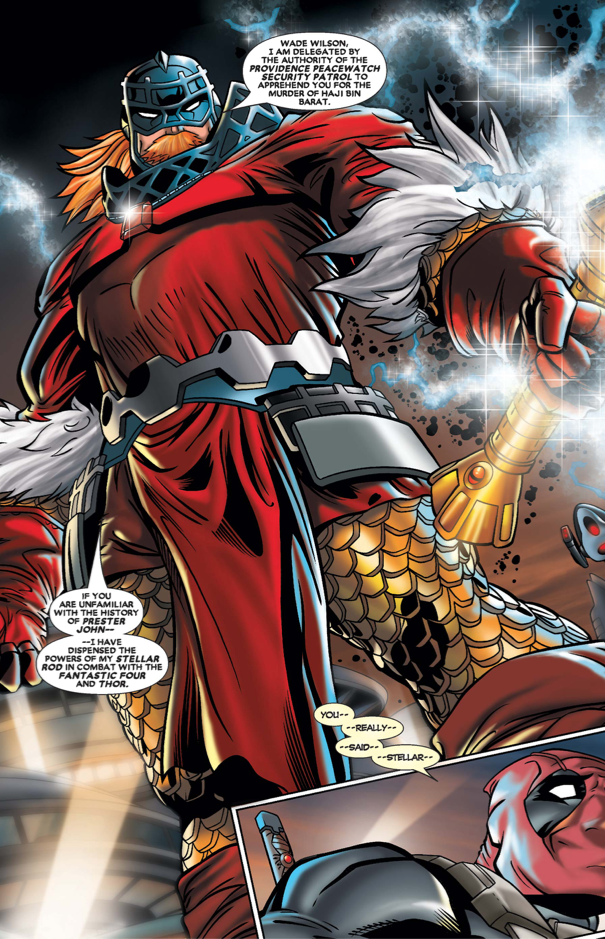
Prester John never is a major Marvel figure but he pops up a few times over the years in Thor and Defenders comics, and—bizarrely—in Deadpool & Cable:
Deadpool & Cable 14 (2004, art by Patch Zircher)
And is it just me, or does Jack’s version of Prester John look like the guy in those adds for Simplisafe home security systems?
Batter up
FF 54 opens with the Fantastic Four, Wyatt and the Black Panther playing baseball in Wakanda:
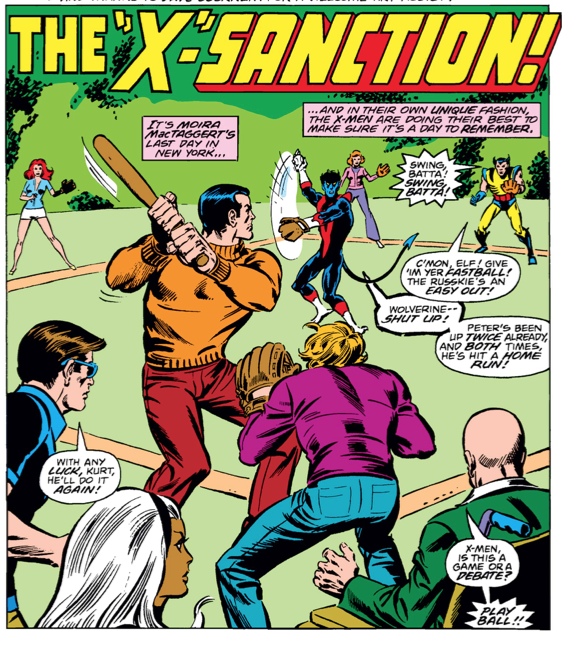
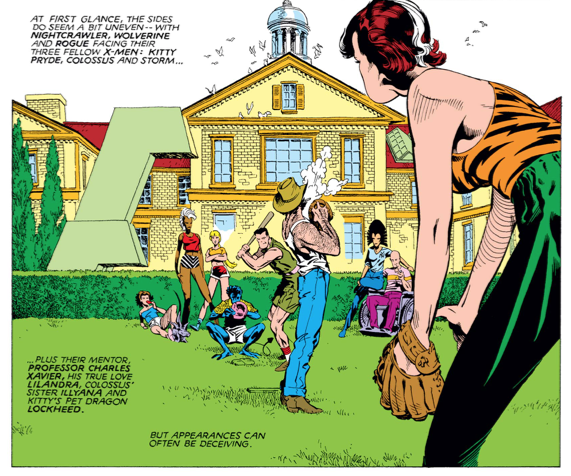
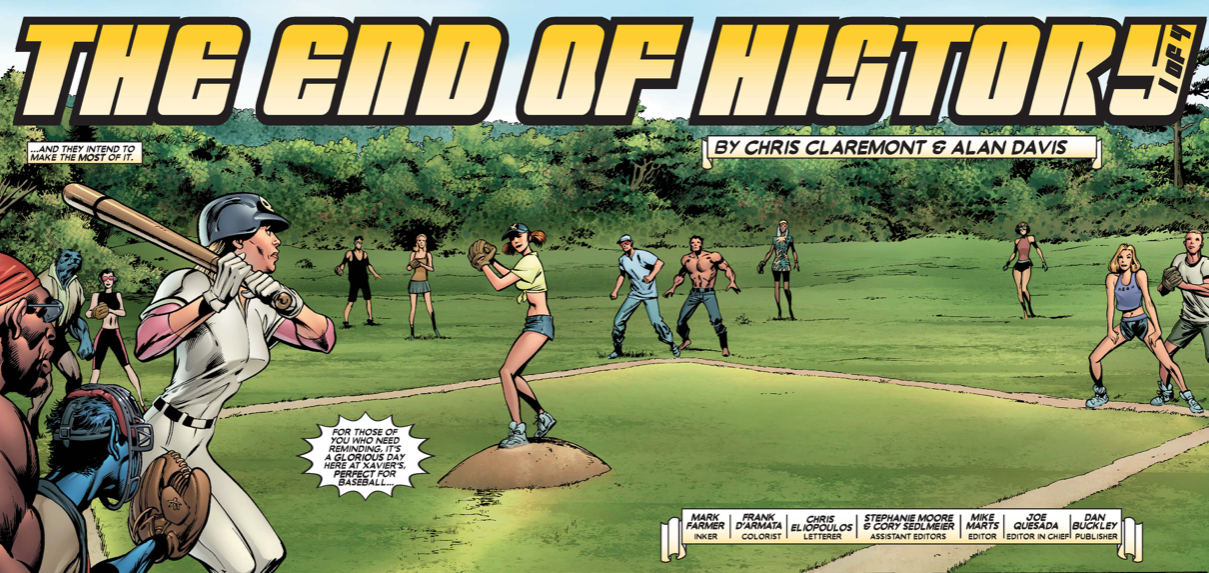
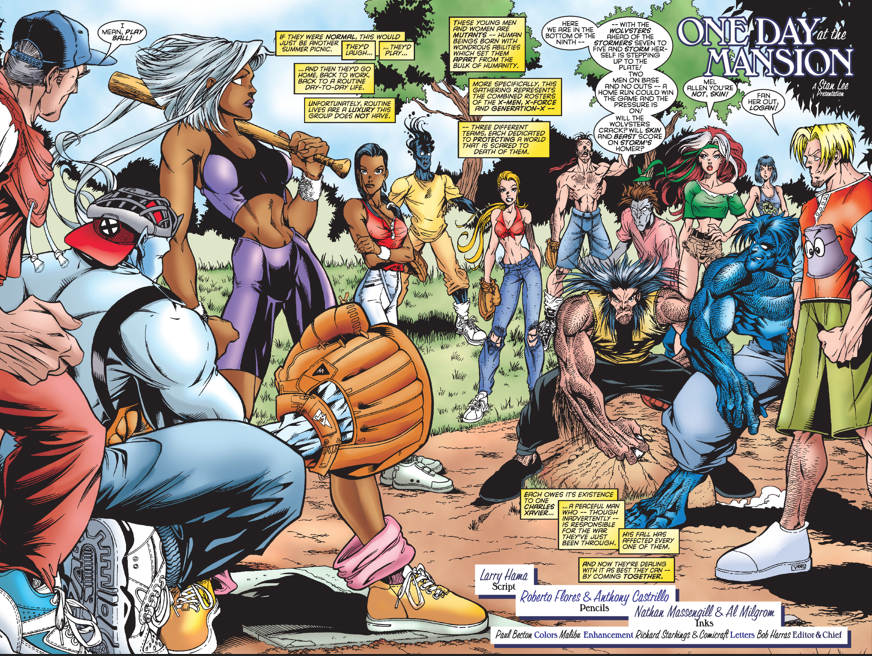
If you think a splash page of a super team playing baseball looks familiar, well, that’s because you’ve seen it many times in the ages of the X-men and related X-books. Here are a few examples from over four decades:
Uncanny X-men 110 (1978, art by Tony DeZuniga)Uncxanny X-Men Annual 7 (1983, art by Michael Golden)Uncanny X-Men 444 (2004, art by Alan Davis and Mark Farmer)X-Men ’96 (1996, art by Flores/Castrillo/Masssengill/Milgrom
I don’t know if Chris Claremont, the man behind many of these X-Men, ever acknowledged that he was borrowing from FF 54 but given how influential the Lee/Kirby FF run was to all of Marvel, perhaps it was just assumed.
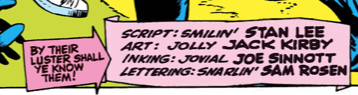
Crazy Credits
Weird Science
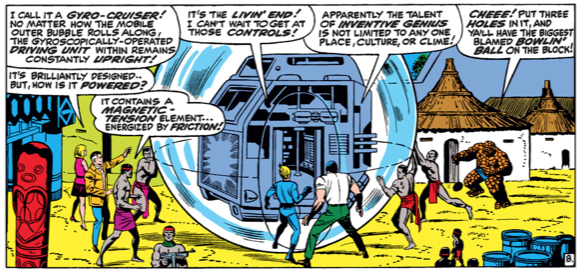
If you think Wakandan science is strange …
… you should check out what the Inhumans are up to.
The sixties are sexist
Ok, maybe this one is a bit unfair. While Sue gets new dresses as a gift from the Wakanadans—reinforcing the narrative that she only cares about clothes and her appearance—it appears that Reed gets a new outfit too. And Sue does look great here. (Note the further development of Wyatt’s backstory here).
Dig that Kirby Krackle
Really, the entire issue is great, and here are too many panels to choose from (I’ve added as many above as I could). But if I had to pick just a few:
Fantastic Four 53 “The Way it Began!” Published: May 1966 Story: Stan Lee and Jack Kirby Script: Lee Pencils: Kirby Inks: Joe Sinnott Letters: Artie Simek Cover: Kirby and Sinnott
Synopsis
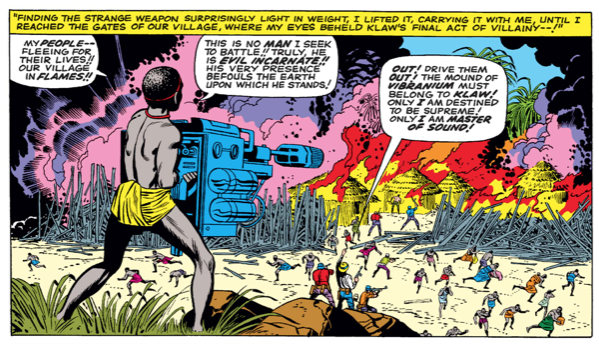
After defeating the Black Panther in the last issue, the Fantastic Four (plus Wyatt Wingfoot) are now his guests. T’Challa explains his kingdom’s wealth and technological prowess derives from vibranium, a rare mineral that can absorb vibrations. He then tells the FF his origin: His father, T’Chaka, was murdered by Klaw (later named Ulysses Klaw), a villainous scientist who attempted to steal Wakanda’s vibranium. A young T’Challa chased them off by seizing Klaw’s sound weapons, and maimed Klaw in the process. T’Challa then devoted himself to revenge by adopted the mantle of the Black Panther.
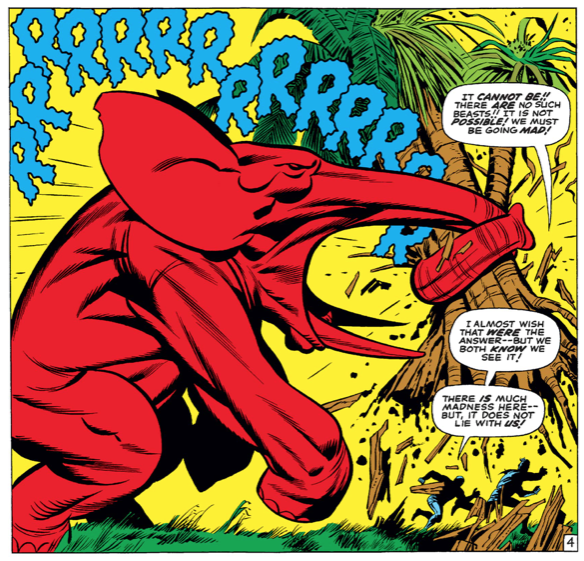
Meanwhile, strange red monsters are rampaging through the Wakanda. The FF join T’Challa to battle the creatures, which are revealed to be made of solid sound by Klaw. As the FF fight the monsters, T’Challa tracks Klaw to a cave, where they battle until the Black Panther overload’s Klaw’s machinery, causing the cave to collapse as T’Challa escapes. With the FF’s encouragement, T’Challa pledges to continue to fight injustice while a battered Klaw enters his “sound transformer” machine.
What’s going on here?
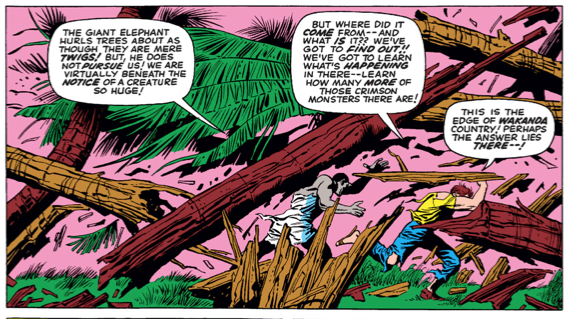
FF 53 unveils the origin of the Black Panther, a story expanded on in much greater length over the decades. The main elements remain the same: T’Challa is from a royal lineage that venerated the Black Panther totem, and he swore revenge after the murder of his father by a plundering European. Stan and Jack seem aware how cliched the story sounds, so they employ Ben to wink at the audience.
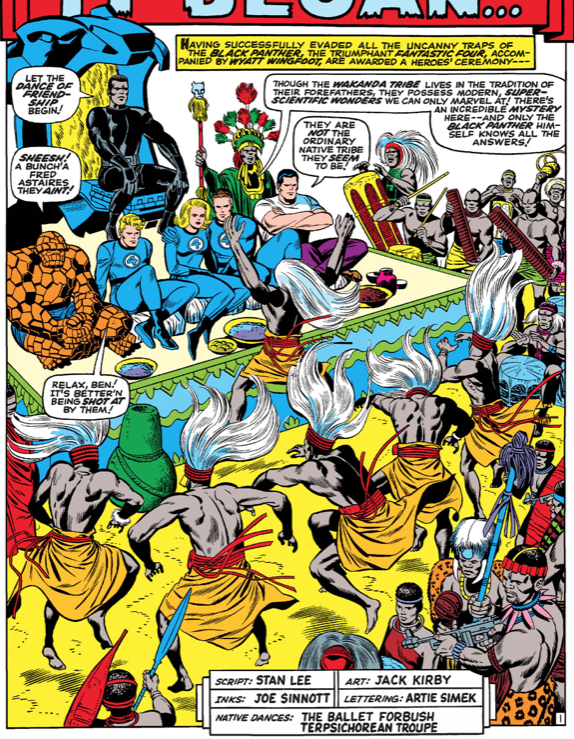
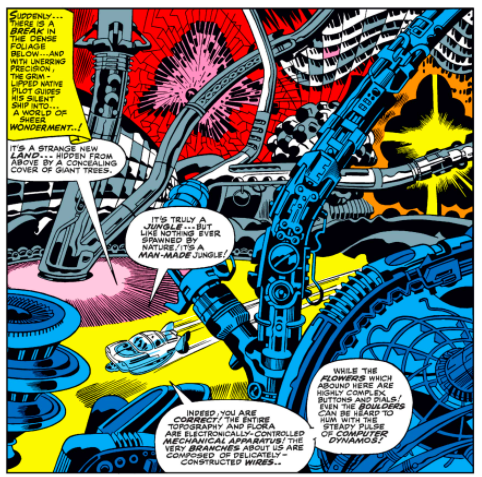
Despite the relative progressivism of the idea that Wakanda is a technologically advanced society hidden in the African jungle, it’s hard for Stan and Jack to escape the exoticism that feels inevitable when comic characters travel to Africa. The splash page, as wondrous as Kirby makes it, embodies the contradictions in the treatment of T’Challa and Wakanda.
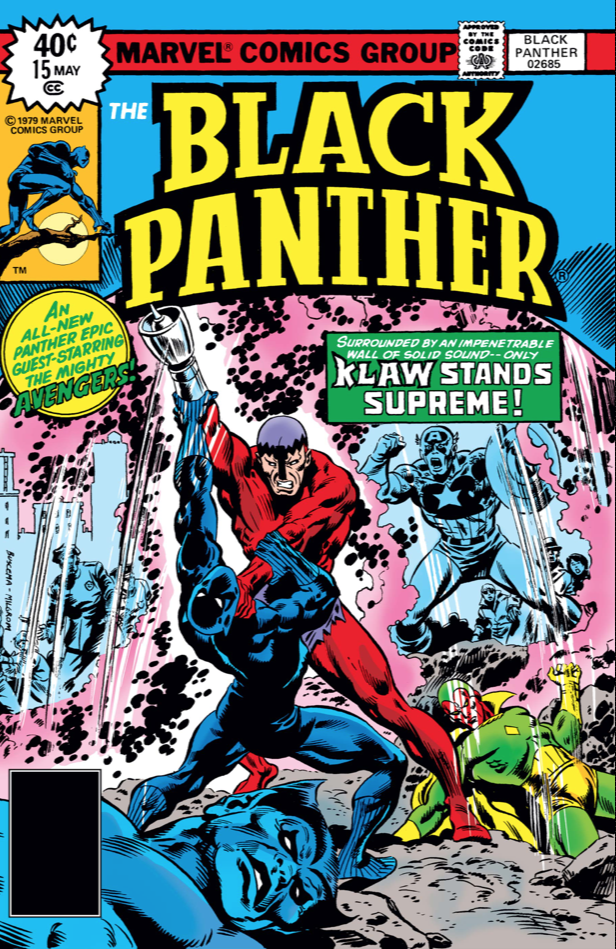
FF 53 is also the debut of Klaw, who goes on to become a major Marvel villain, who will debut a much different look in a few issues. He’s most associated with the Black Panther, but over the years battles the FF, Avengers and Daredevil, and plays a starring role in the first Secret Wars series (written as a loopy idiot by Jim Shooter).
Black Panther 15 (1979, J. Buscema/Milgrom)Secret Wars 12 (1985, Shooter/Zeck/Beatty)
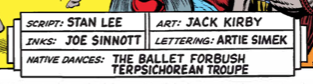
Crazy Credits
An Irving Forbush reference
Living in the future
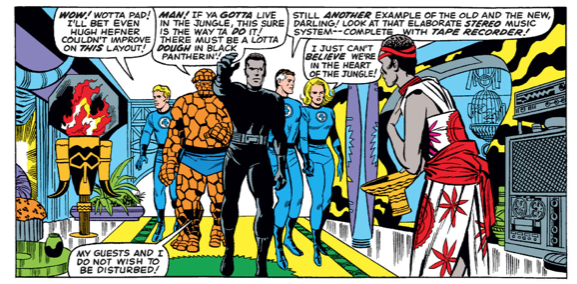
Reed is impressed by T’Challa’s hi-fi system, which includes … a tape recorder. And note the nod to Hugh Hefner.
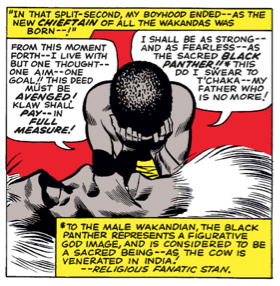
Comparative Religion 101
Stan educates the reader via footnote.
It’s Clobberin’ Time
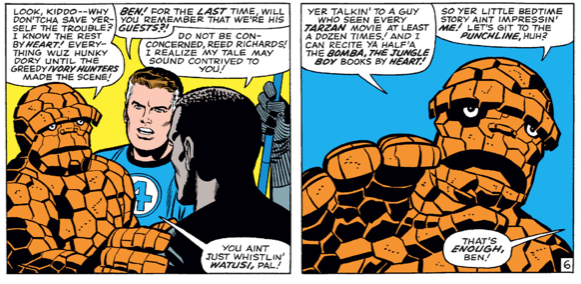
There’s something muted about its use in this panel, which is one of the first when Ben says it without simultaneously delivering a punch. This might mark it’s transition from an exclamation to an all-purpose catch phrase, as Ben even notes how “cornball” it sounds.
The sexist sixties
Only Sue is scared of the loud noises.
Dig that Kirby Krackle
Lots of cool stuff from Jack in this issue. Like this:
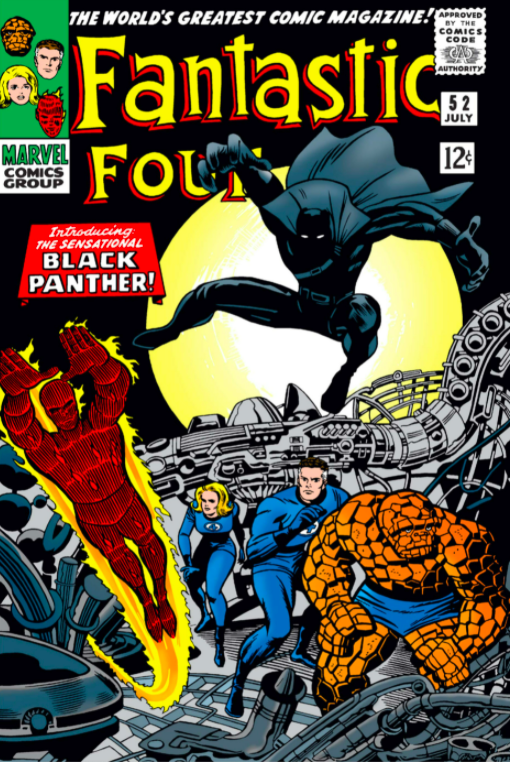
Fantastic Four 52 “The Black Panther” Published: April 1966 Story: Stan Lee and Jack Kirby Script: Lee Pencils: Kirby Inks: Joe Sinnott Letters: Sam Rosen Cover: Kirby and Sinnott
Synopsis
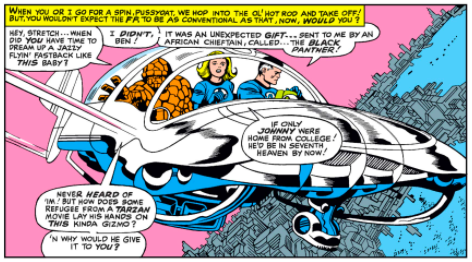
Fantastic Four 52 opens with Mr. Fantastic, the Invisible Girl and the Thing (the Human Torch is off at college) tooling around in a new flying car they received as a gift from “an African Chieftain” called the Black Panther. The Black Panther’s emissary offers the car to Reed permanently if the team accompanies him to Wakanda to take part in a hunt. Reed, saying the team needs a vacation, takes him up on the offer, first stopping to pick up Johnny and his roommate, Wyatt Wingfoot.
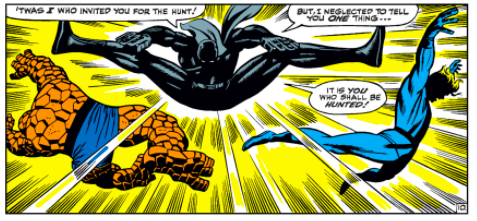
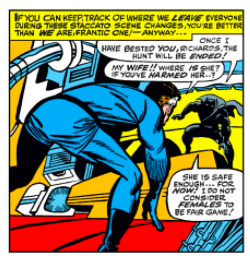
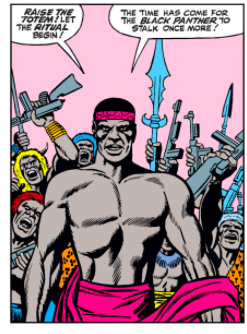
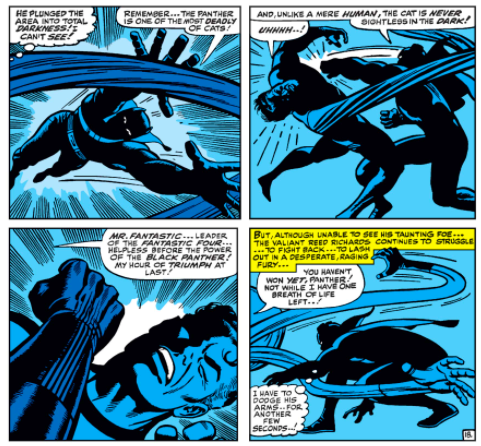
Wakanda is revealed to be technologically advanced, but when the team arrives, the emissary vanishes and the team is attacked by the Black Panther. He manages to subdue each member of the team but Wyatt manages to free them, ultimately foiling the Black Panther’s conquest. The issue ends with him beginning to explain his motives to the team.
FF 52 also cuts away from the main story to reveal the Inhumans are struggling to escape the Negative Zone that has imprisoned them, an indication that we will be seeing much more of them.
What’s going on here?
Obviously, the big development of FF 52 is the introduction of the Black Panther, a character who goes on to be a member of the Avengers (and a fill-in member of the FF for a time) and be the star of his own on-again, off-again solo title. With the success of the MCU Black Panther movie in 2018, he’s only become a bigger deal, moving in to the upper tier of Marvel characters.
The significance of the Black Panther isn’t just that he’s a black, or African, hero—although both were rarities at the time—but that he upends so many of the stereotypes of blacks and Africans that were (and to some extent still are) pervasive in comics. Wakanda, as created by Stan and Jack, isn’t a primitive backwater, but a sophisticated enclave. T’Challa isn’t a hot-blooded savage, but a calculating scientist. The Fantastic Four wasn’t lured to Africa by a villain, but by a hero. In a world where B’wana Beast was still waiting to debut, Black Panther is a remarkable creation.
Given the Black Panther’s impact, it’s easy to overlook the other big development in FF 52, which is the realization of Wyatt Wingfoot as a bona fide member of the FF’s supporting cast. Wyatt was introduced as Johnny’s college roommate in issue 50 and we learned a bit more about him last issue—his dad was a standout athlete but Wyatt had no interest in joining the college football team—but he really comes into his own here.
Like the Black Panther, Wingfoot, a Native American, refuses to conform to the comic book stereotype. He doesn’t wear a fringed jacket or a feather, he doesn’t talk like Tonto, and even if he does evince skill as a tracker, he’s more adept at thinking than fighting. Wyatt doesn’t have the same profile of the Black Panther—surprisingly, he never gains powers or becomes a real super hero—but remains a classic member of the FF’s supporting cast.
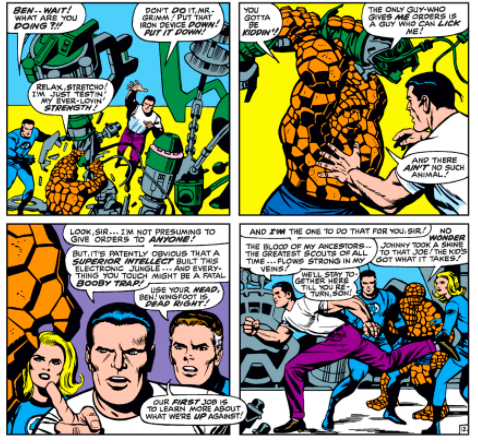
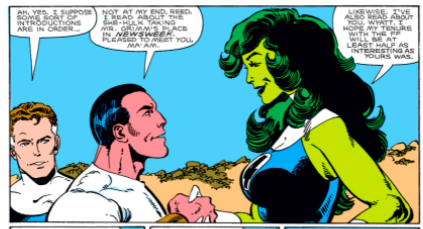
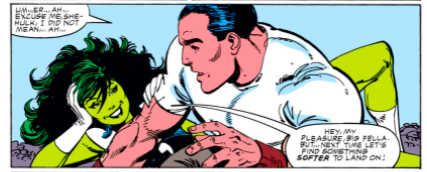
He later becomes She-Hulk’s love interest, adding a new dimension to his character (even if he is wearing the same T-shirt). They meet in FF 269-270 (written and illustrated by John Byrne).
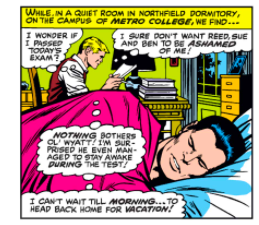
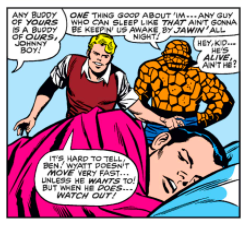
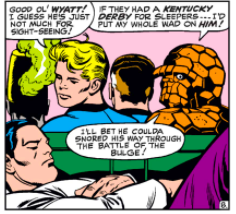
A fun running gag in FF 52 is Wyatt’s imperturbability. He seemingly can sleep through anything.
Crazy credits
The sexist sixties
The Black Panther may be technologically sophisticated, but he’s not exactly progressive.
Weird science
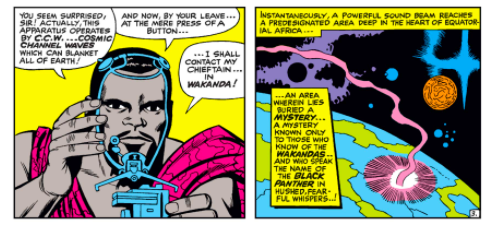
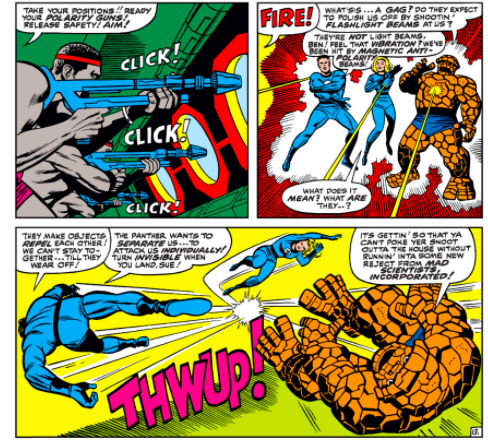
There’s a lot of dubious claims in this issue. Like these “cosmic channel waves”:
And these polarity guns:
The comic code was here
Shouldn’t T’challa have nipples?
Dig that Kirby Krackle
Some great stuff from the King:
These panels are amazing (Joe Sinnott deserves a lot of credit here, too):
Next issue: The FF and the Black Panther fight Klaw!
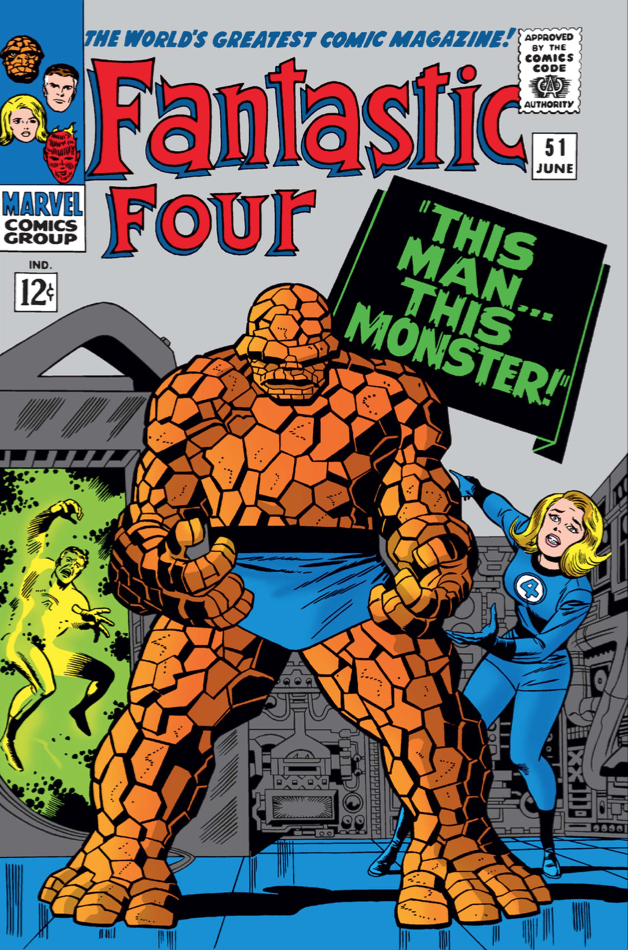
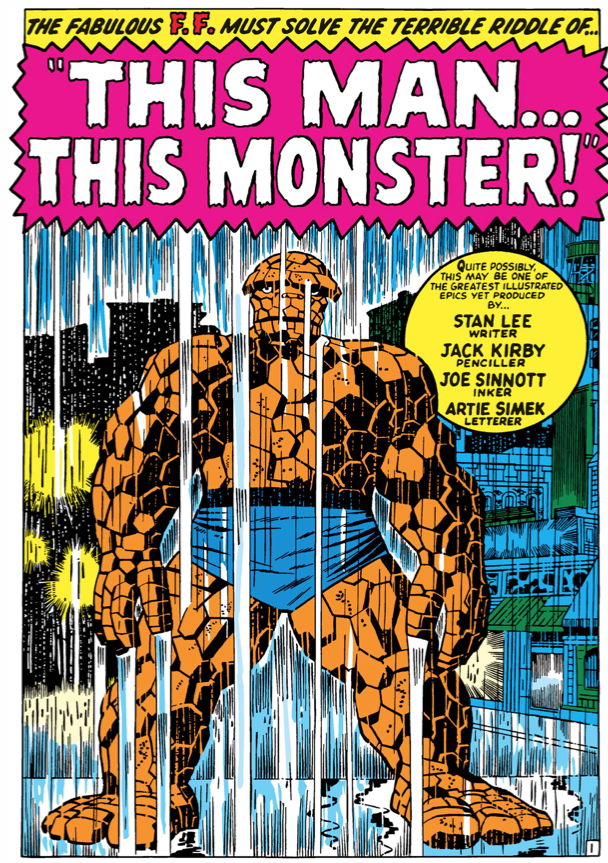
Fantastic Four 51 “The Man, This Monster” Published: March 1966 Story: Stan Lee and Jack Kirby Script: Lee Pencils: Kirby Inks: Joe Sinnott Letters: Artie Simek Cover: Kirby and Sinnott
Synopsis
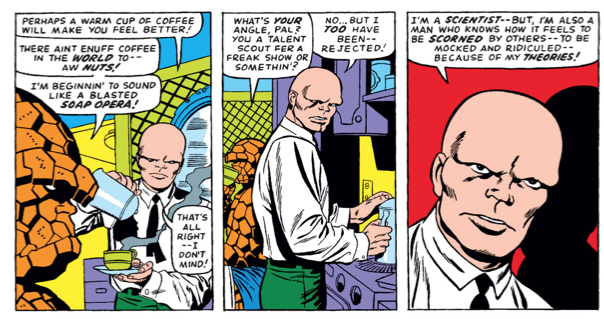
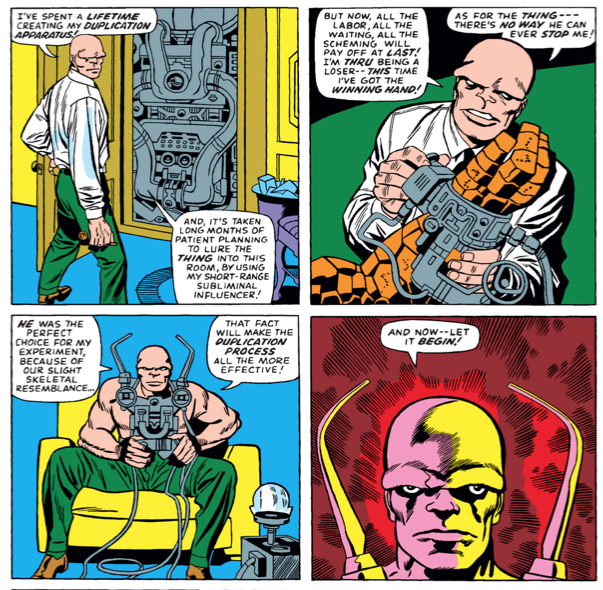
The Thing, still morose after Alicia Masters’s apparent rejection last issue, continued to wander the streets of New York. He is taken in by the unnamed bald scientist, introduced last issue, who is determined to destroy the Fantastic Four and Reed Richards, who he sees as his rival. He drugs Ben’s coffee and after the Thing has passed out, subjects him to his “duplication apparatus” which transforms the scientist into a replica of the Thing while leaving Ben in his human form.
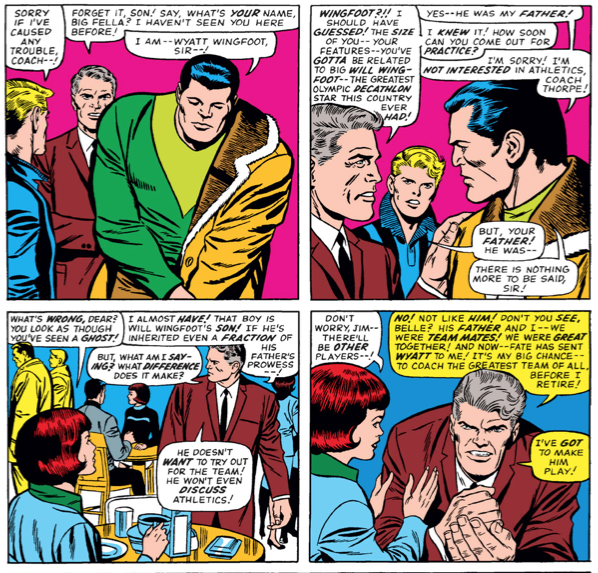
Meanwhile, the Human Torch is acclimating to life in college with his new friend, Wyatt Wingfoot, when they are confronted by the school’s quarterback/ bully Whitey Mullins. The team’s coach, who, like Mullins was introduced last issue, arrives to diffuse the situation and tries to recruit Wyatt, whose father is revealed to be a star athlete and former teammate of the coach.
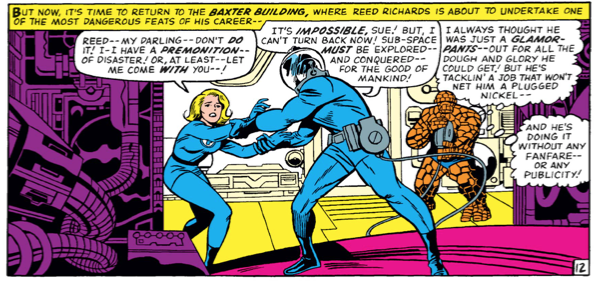
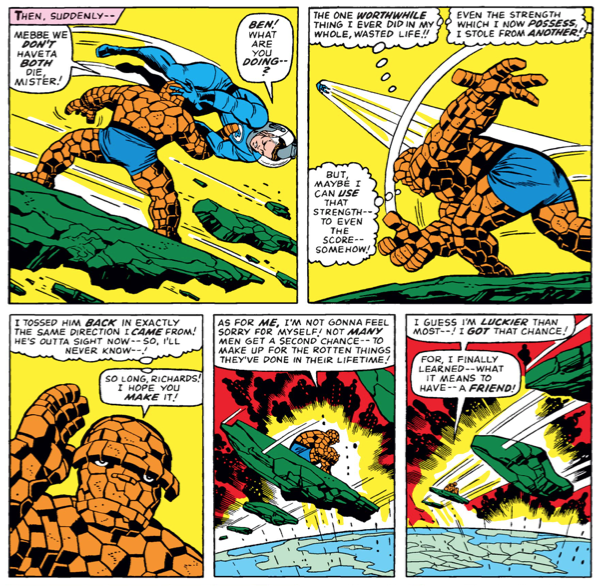
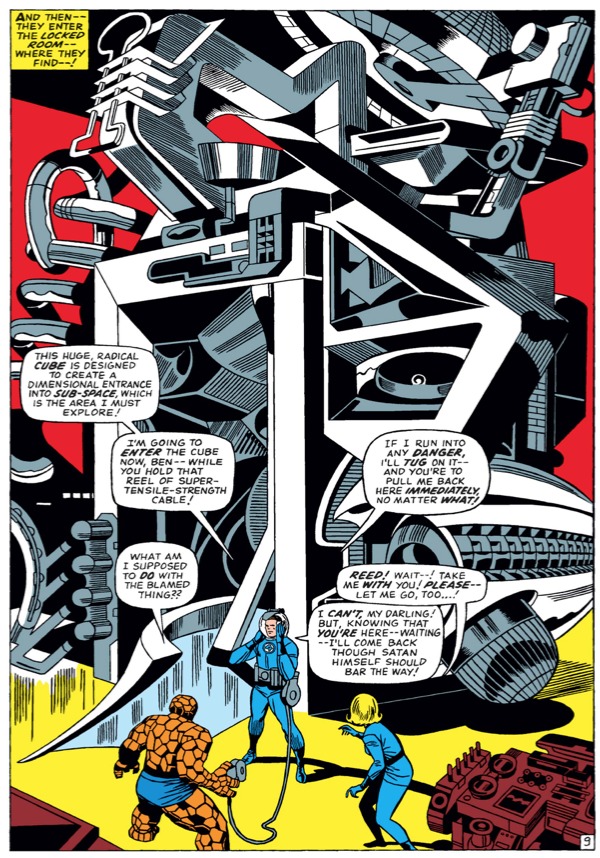
Back at the Baxter Building, the imposter Thing is enlisted by Mr. Fantastic to help with him a dangerous experiment that he hopes will unlock the secrets of faster-than-light travel and prevent incursions by threats such as Galactus. The real Ben Grimm shows up but the fake Thing convinces Reed and Sue that he’s the genuine Thing, leaving the real Ben to storm off. Reed then uses a device enters “sub-space”—which seems to be the Negative Zone—while fake Ben holds his tether. Fake Ben sees an opportunity to kill Reed, and when Reed signals to be pulled back, he hesitates. Too late, he realizes he misjudged Reed, and tries to save him. The tether snaps, so fake Ben plunges into sub-space himself then hurls Reed out. Satisfied he has redeemed himself, he goes to his death in peace. The real Ben is transformed back into the Thing, and the team is reunited.
What’s going on here?
Fantastic Four 51 is often singled out as one of the highlights of the Lee/Kirby FF run. It was voted No. 2 on a list of the top 60 FF stories, and No. 4 on a list of the top 100 Stan Lee stories, for example. Douglas Wolk began his book All of the Marvels— a literal reading of every Marvel comic—not with FF 1 but with issue 51.
Its reputation as a standout is interesting, since it’s such an odd story. After three multi-issue epics—the lengthy Frightful Four/ Doom story, the Inhumans saga and the Galactus trilogy—it’s a chance for a breather with a one-and-done story with a new and ultimately disposable villain (we never even learn his name!). In that sense, it reads a bit like earlier, sci-fi flavored FF issues.
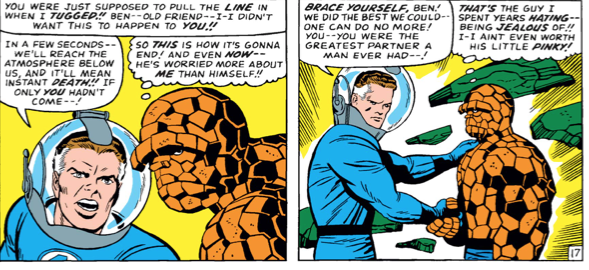
More strangely, the FF are really supporting characters in the narrative arc of the nameless villain, who begins the story scheming to destroy Reed and by the end is so impressed by his nobility and selflessness that he’s willing sacrifice himself to save Reed. In a sense, the villain serves as a window through which we see Reed with new eyes. The villain also gives as new appreciation for Ben in his absence: Reed calls Ben “the greatest partner a man ever had” and the villain, preparing to save Reed, believes he “can really be Ben Grimm,” ie. a true hero.
An unwritten—and maybe overly prosaic explanation—of his transformation from villain to hero is that the device that transformed the villain into the Thing transferred Ben’s character as well as his appearance. It would be a testament to Ben’s virtue, while explaining the radical shift in the villain’s motivations. That explanation would at least place Ben at the center of the story because despite its iconic cover, Ben is really absent for most of the issue.
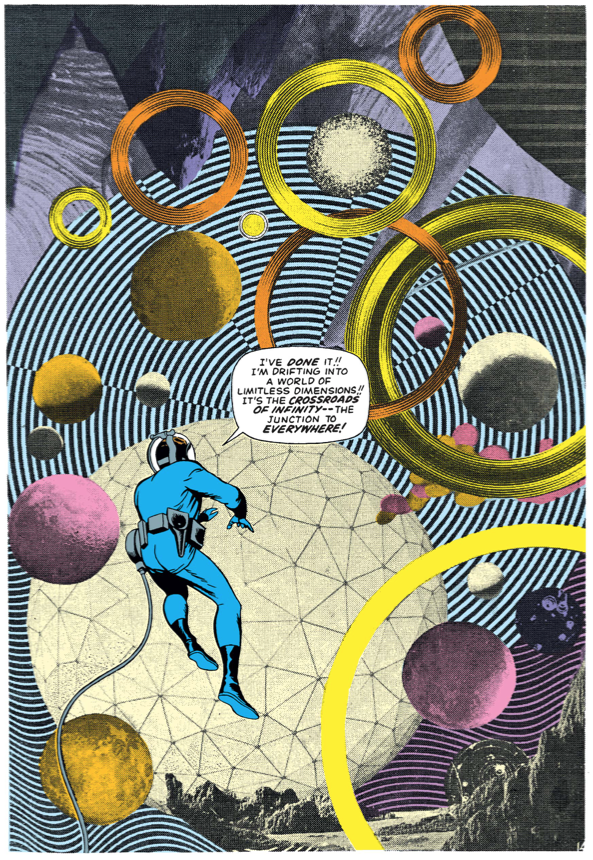
FF 51’s renown is also deserved because of Kirby’s art, which is just jaw-dropping. I’ll highlight some pages later, but it features perhaps his greatest collage:
Jack’s fantastic, cosmic art is the necessary counterbalance to Stan’s pathos-driven story. In his New York Times review of Wolk’s book, Junot Diaz identifies the magical mix that made the Lee/ Kirby Fantastic Four—and by extension the larger Marvel Universe—so powerful:
But it was in Issue 51 that Kirby and Lee hit the mother lode; discovered the precise amount of human misery you need to inflict on a superhero in order to sell the galactic and fantastic, to make it real. The galactic fantastic without human anguish: kid stuff. Human anguish without the galactic: soap opera. But the two blended together in the right proportions equaled a new type of imaginative vibranium. Once Kirby and Lee cracked the Galactus Equation, Marvel never looked back.
Meanwhile
Unlike previous issues, FF 51 breaks away from the main action to build out a subplot; in this case, Johnny’s immersion into college life and the troubling dynamic between the Metro football coach and his jerk quarterback. It’s also becoming clear Wyatt Wingfoot is shaping into a significant supporting character and he get a bit of his backstory, including learning that his father was an Olympic decathlete (the parallel to Jim Thorpe is too obvious too miss).
Weird science
There’s a lot of it in this issue, starting with the “duplication apparatus.”
Then there’s this explanation of subspace, which sound a lot like later descriptions of the Negative Zone
Mail call
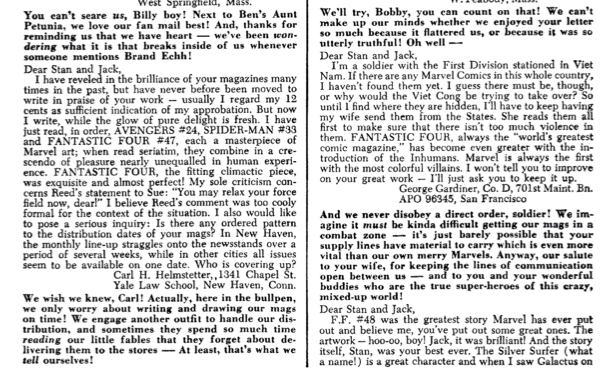
This issue features letters from a Yale Law student and a GI in Vietnam.
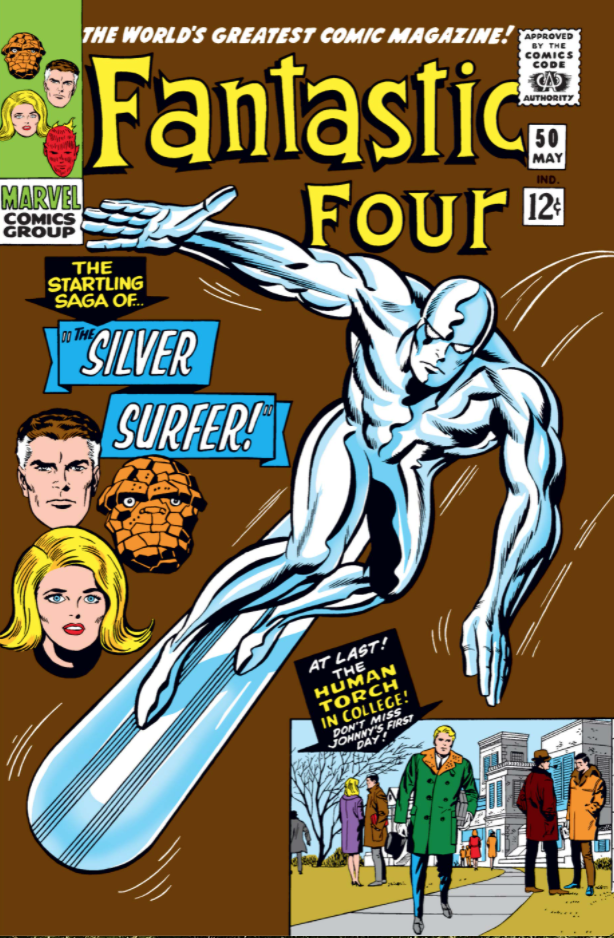
Fantastic Four 50 “The Startling Saga of the Silver Surfer” Published: Feb. 1966 Story: Stan Lee and Jack Kirby Script: Lee Pencils: Kirby Inks: Joe Sinnott Letters: Same Rosen Cover: Kirby and Sinnott
Synopsis
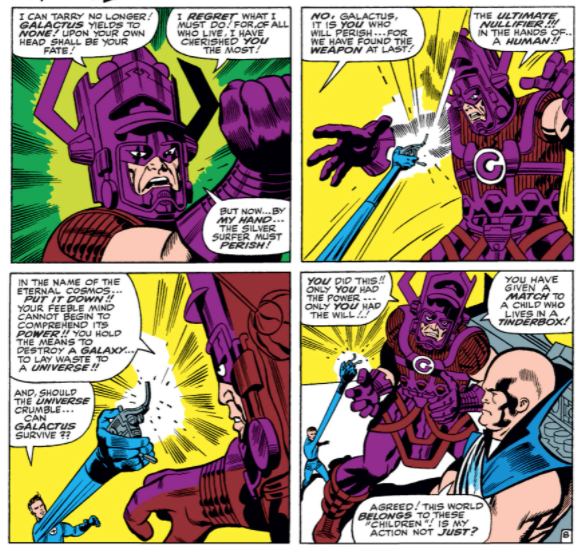
Fantastic Four 50 picks up where issue 49 left off. The Silver Surfer, having the value of humantity revealed to him by Alicia Masters last issue, confronts his master, Galactus, who is preparing to drain the earth of its energy. As the Surfer and Galactus battle, the Watcher reveals his plans for the Human Torch to Mr. Fantastic, the Invisible Girl and the Thing. When the Torch arrives from his voyage across the cosmos, he delivers the Ultimate Nullifier to the Watcher. Reed then uses it to threaten Galactus with the destruction of the universe if he doesn’t abandon his plans to consume earth. Galactus concedes, but before he leaves earth, he strips the Surfer of his ability to travel through space.
As the FF dust themselves off, Alicia shows up to praise the Surfer for helping save the world, leaving Ben jealous and despondent.
FF 50 then pivots to a series of vignettes that set up future stories. The first introduces a nameless bald villain who, after reading news accounts of the FF’s victory, announces plans to destroy the FF. The second concerns an over-the-hill college football coach and his inability to rein in his hot-headed star quarterback. Finally, Johnny enrolls at Metro College, where he meets his new roommate, Wyatt Wingfoot, while still pining away for the Inhuman, Crystal.
What’s going on here?
This is a busy comic, and not just because of the epic resolution of the Galactus storyline. In another peculiar pacing decision similar to issue 48, the main narrative essentially ends halfway through the comic, with the rest of the issues devoted to subplots and foreshadowing. A contemporary comic would use all the space available for the main tale—if there’s ever a story deserving of a space-consuming double-page splash, this was it—and sprinkle the foreshadowing elements throughout the comic. As it is, the reader is raised to the crescendo of the FF’s triumph over Galactus, only to be handed a mystifying story about a football coach.
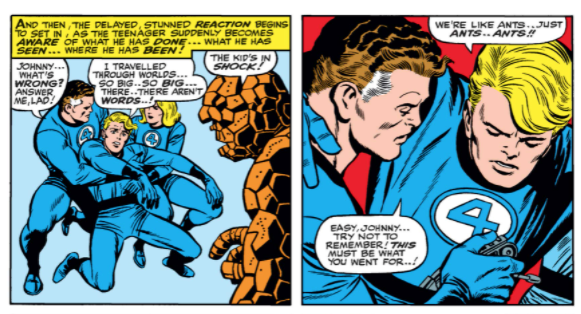
The climax of the Galactus arc, as brief as it is, gives Stan and Jack another opportunity to stretch their cosmic muscles. They make it clear here that larger forces are at work, and the Fantastic Four are mostly bystanders. Unlike most villains, Galactus isn’t defeated by Reed outwitting him or whipping up some gizmo, but by the Watcher’s machinations. Even Johnny, the ostensible hero of the story, is overcome by the scale of the universe and pretty much wrecked by his trip across the universe.
If the FF are secondary characters in their own comic, it’s also because the story of the Silver Surfer is so dramatic. After Alicia reconnects Norrin Rad to his lost humanity, he turns on Galactus to defend the earth. Galactus is surprisingly chill about the betrayal, at several points telling the Surfer how much he likes and respects him, and basically telling the Surfer he’s going through a phase.
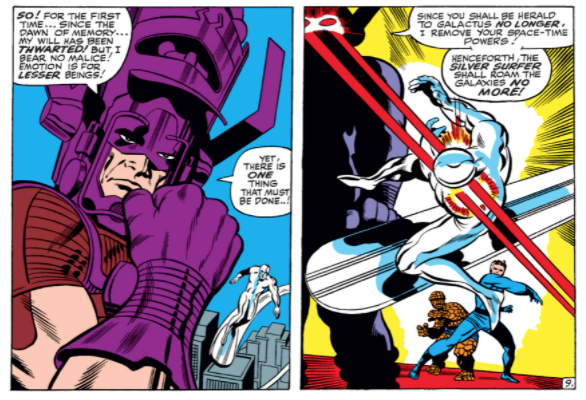
Galactus claims he bears the Surfer and FF no malice, but still he strips the Surfer of his space-faring powers. It’s not obvious if at this point Stan and Jack anticipated the Surfer having his own series, but keeping him trapped on earth was a useful plot device when his solo book eventually launched.
The Ultimate Nullifier serves as a convenient deus ex machina that solves the problem of Galactus. It reappears on occasion over the course of Marvel’s history, usually in a story with some big stakes.
What’s up with Ben?
Ben has been his usual melancholic self over the past few issues—he had an introspective sequence when the FF was in Atillan—but it kicks into overdrive in FF 50. First, there’s this revealing “kidding-not-kidding” exchange with Sue, where he explains how he uses humor to deflect his trauma.
Then the Silver Surfer, who barely knows him, senses something is amiss.
That’s followed by Ben’s jealous reaction to Alicia greeting the Surfer, as Ben’s insecurity about his appearance kicks overwhelms him.
Finally, as Ben wanders the streets of New York, he startles a woman, sending him down a spiral of self-pity that will play out next issue.
Who’s the new guy?
As if there wasn’t enough going on, FF 50 introduces Wyatt Wingfoot, a longstanding supporting character and, notably, a Native American character who isn’t reduced to a bundle of cliche and stereotypes. Here, he and Johnny meet cute.
Crazy Credits
The usual modesty
The sexist sixties
Again, another sequence of Sue stamping her feet because Reed isn’t paying her enough attention. At least Reed apologizes.
Read all about it
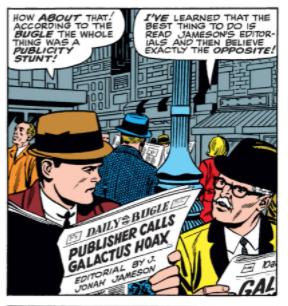
A nice connected-universe swipe at J. Jonah Jameson here.
Dig that Kirby Krackle
After using this silly phrase for 50+ blog posts, we finally get some genuine Kirby Krackle. For the uninitiated, Kirby Krackle are the black dots Jack uses to illustrate the release of energy. A trademark effect of the King’s, it hasn’t really appeared until this issue. Now we can, indeed, dig that Krackle.
Here’s some more:
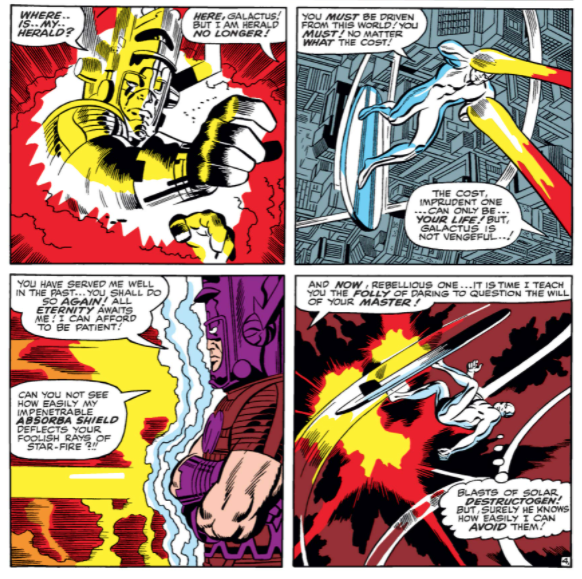
We also get a great panel of Galactus giving the ol’ stink-eye.
And Johnny tooling around campus in a sweet set of wheels.
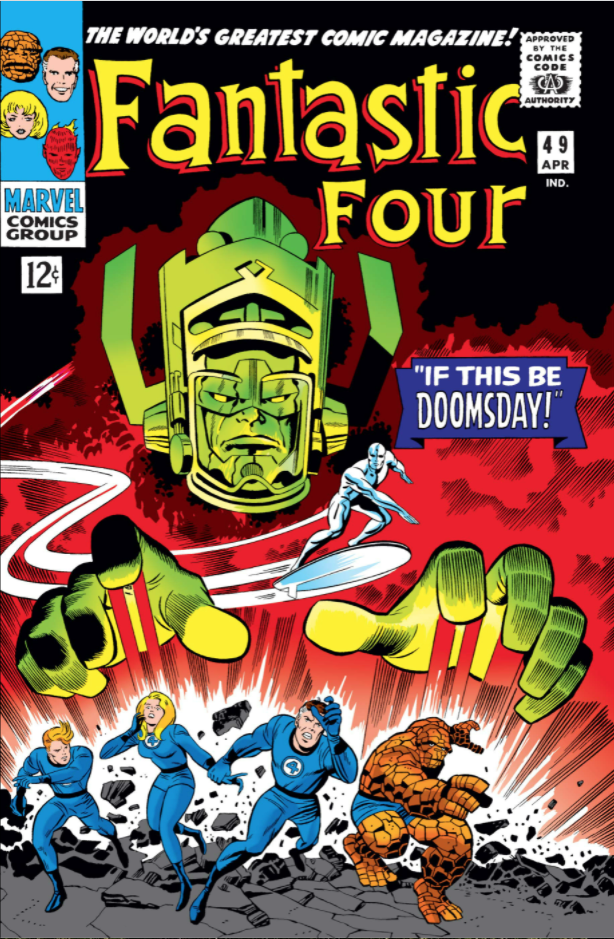
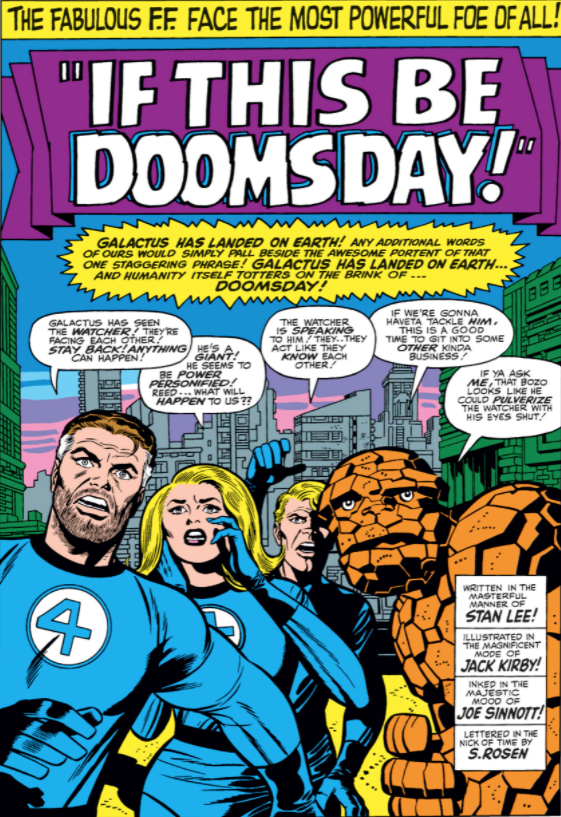
Fantastic Four 49 “If This Be Doomsday!” Published: Jan. 1966 Story: Stan Lee and Jack Kirby Script: Lee Pencils: Kirby Inks: Joe Sinnott Letters: Sam Rosen Cover: Kirby and Sinnott
Synopsis
Fantastic Four 49 picks up where issue 48 left off, after Galactus makes his entrance, intent on draining earth of its energies. The Watcher urges Galactus to reconsider, and the FF confront him, but to no avail and he begins assembling his earth-energy-sucking machine on top of the Baxter Building.
Meanwhile, the Silver Surfer, reeling from his fight with the Thing, landed on the roof of Alicia Masters’ building. She nurses him back to health and begins to awaken him to the possibility earth might be worth saving.
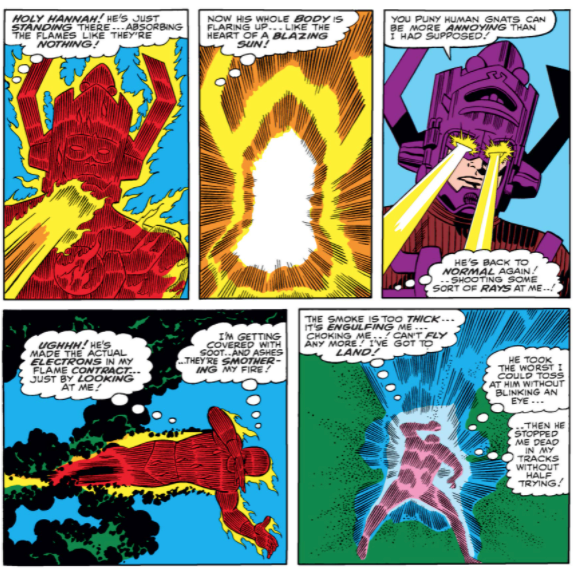
After regrouping, the Fantastic Four again engage Galactus, save for Johnny, whom the Watcher singles out for a mission. As the rest of the team fight the Punisher, a creature Galactus dispatches to deal with vermin, Johnny travels through space and time to arrive at Galactus’s enormous space station.
Back on earth, as Galactus prepares to drain the earth’s energies, Alicia appeals to the Silver Surfer’s lost humanity and convinces him to confront Galactus to save the earth. The issue ends with the Watcher warning the reader that the Surfer may disrupt his own plans and doom the earth.
What’s going on here?
FF 49 is everything you want a Fantastic Four comic to be. It’s arguably the high point of the Lee/ Kirby partnership, and showcases both at the peak of their powers (aided significantly by Joe Sinnott’s inks, of course). In Galactus, Stan finally has an antagonist worthy of his bombast and grandiosity. After years of trying to convince us Diablo or the Thinker were threats to humanity, In Galactus Stan has a villain that lives up to his over-wrought writing. And in the Surfer, he has an alien hero who can philosophize while speaking in the lofty, faux-Shakespearian tones Stan loves so much.
Kirby rises to the occasion too. The story’s huge sweep and cosmic overtones gives him the freedom to produce amazing character designs for Galactus and the Punisher, an eye-popping panel of Galactus’s space station—it’s so big that planets orbit it—and stunning visual effects of Johnny confronting Galactus and traveling through space.
The whole story just feels big—big in its scope, big in its stakes, and big in its ambition
Who is this guy?
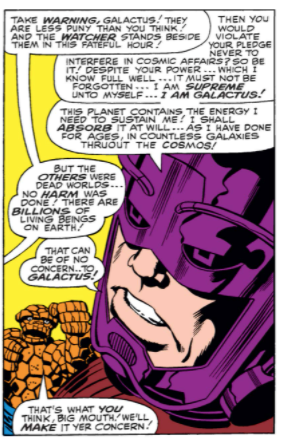
While Galactus technically made his first appearance last issue, this is really his debut. We don’t yet get the full story (more on his origin in a bit) but we get the basics, and the basics are more than enough: He’s a cosmic being of incredible power who is sustained by draining planets of their essence. Interestingly, while he has appeared in countless comics over the years, unlike other characters, he has changed very little. His costume design has remained essentially the same, and while his role in the Marvel universe has been explained and put into context, he acts pretty much as he does in his first appearance: traveling the universe looking for planets to consume.
The traditional account of Galactus’s invention is that Stan, searching for a story idea, said “let’s have them fight god.” Mark Evanier, in his biography Kirby: King of Comics, disputes that narrative and instead offers two alternative ideas. One is that Jack wanted to upend the conventional science fiction idea that if aliens arrived, they would engage with humans and exchange technology. What if they didn’t care about humans? Jack wondered, according to Evanier. What if they just wanted to eat our planet? The other idea reflects Kirby’s growing disillusionment with Marvel and the business of comics. In this interpretation, Galactus is a hostile company buying up smaller firms and draining them dry. (In the letters pages, readers projected a Vietnam metaphor on the story, with Galactus acting as hostile communist forces and the Silver Surfer as the US coming to the rescue of South Vietnam).
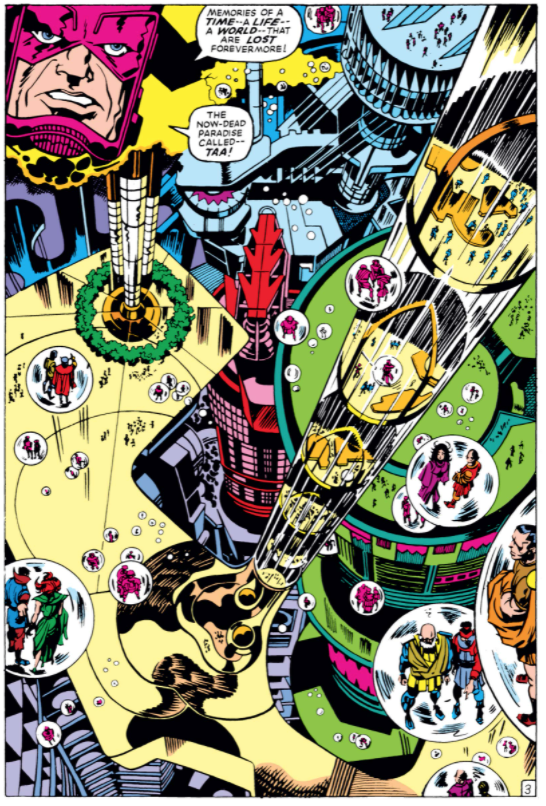
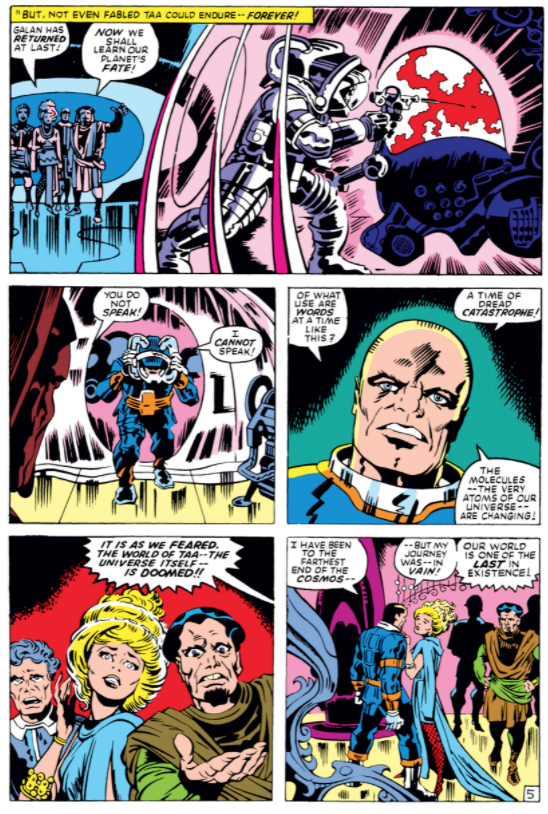
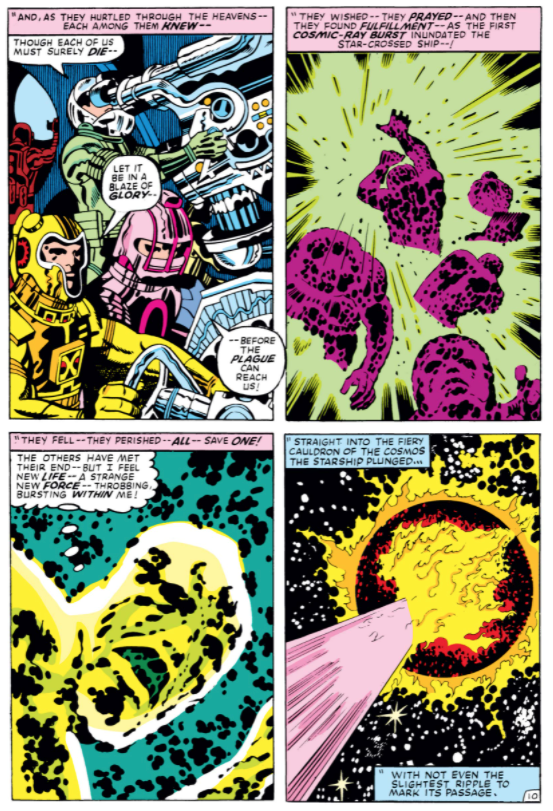
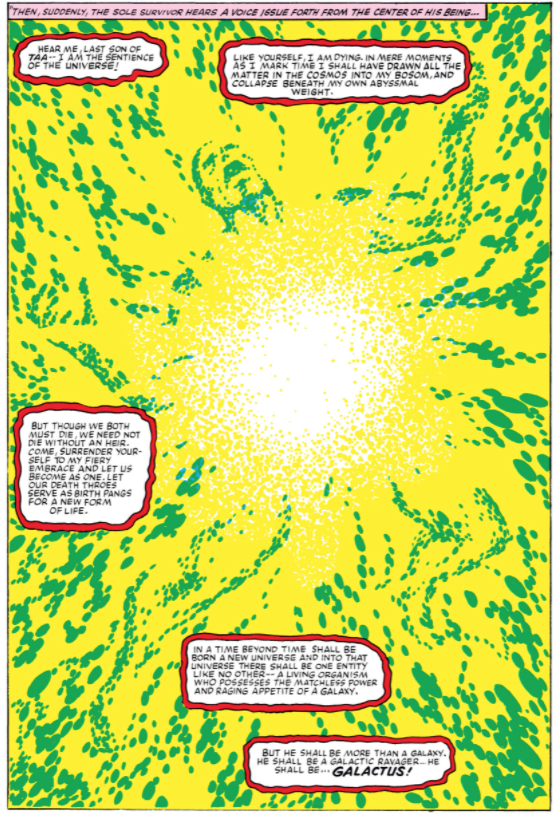
Galactus’s origin is relatively uncomplicated. In the original telling, revealed in a back-up story by Stan and Jack in Thor 169, Galactus was originally Galan, a citizen of an advanced planet called Taa. The planet is facing extinction by a plague, so Galan and three others decide to die as explorers and head into Taa’s sun. Galan survives and is eventually transformed into Galactus (as Brian Cronin notes in his Comics Should Be Good blog, this sounds like a mash-up of Superman and the FF’s origins.)
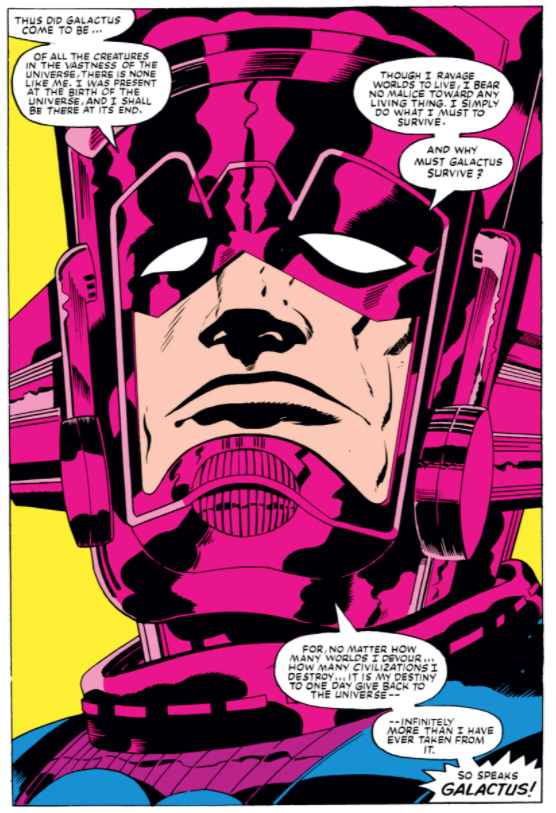
A few decades later, Marvel editor Mark Gruenwald decided to revamp Galactus’s origins. Instead of merely the last survivor of a planet, he became the last survivor of a universe, and he emerged from the Big Bang. Gruenwald basically took the Stan and Jack story, wrote over some of it with some new pages by John Byrne and Ron Wilson, and republished it in 1983 as Super-Villain Classics 1. Here are some relevant pages:
The notable thing about this origin is that establishes Galactus as a cosmic entity, a force of nature and not merely a villain, despite the destruction he causes. That tension became a major storyline during Byrne’s FF run, when Reed Richards begs Galactus to spare earth in FF 243, and Galactus basically says, “nothing personal, it’s just business.”
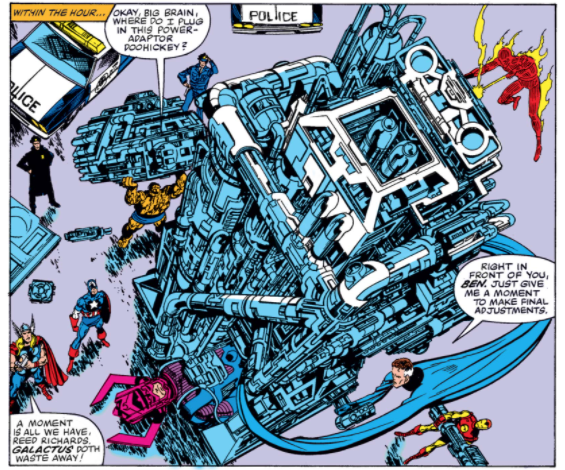
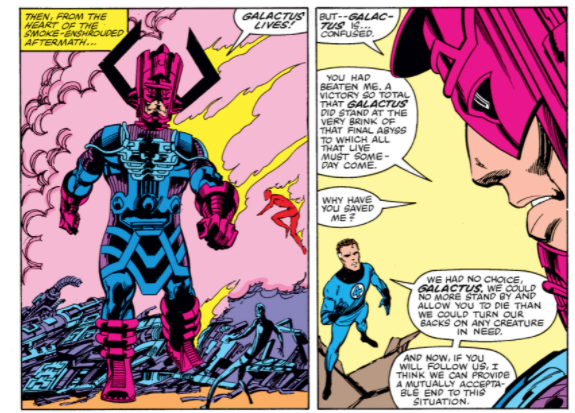
Reed, with the help of the Avengers, then saves Galactus’s life in FF 244, arguing they had a moral responsibility to prevent the death of a living thing.
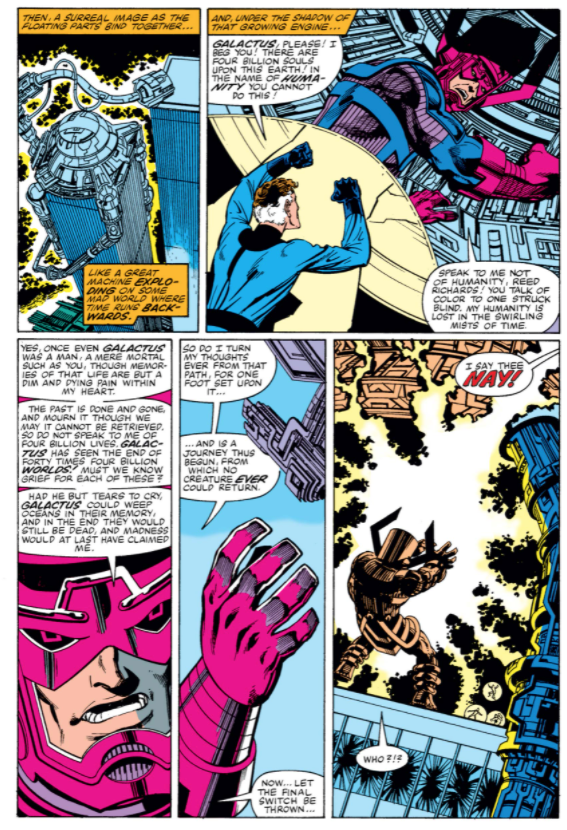
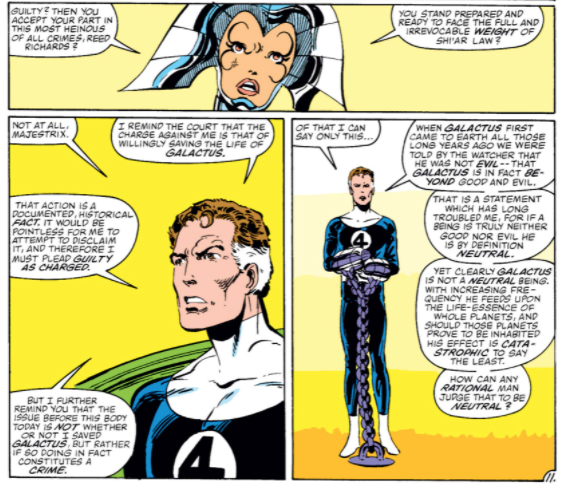
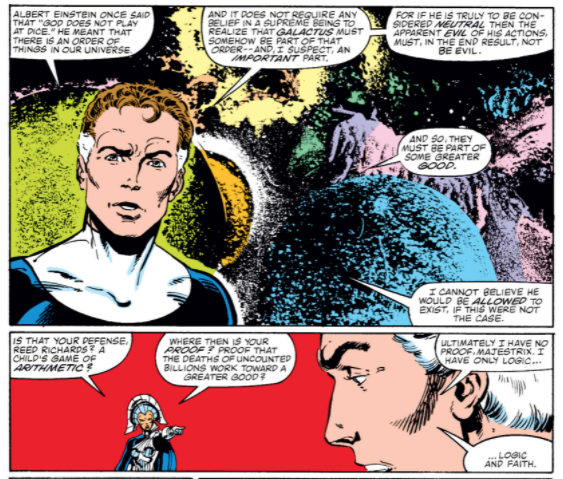
Noble as it was, that decision didn’t sit well with the survivors of the worlds Galactus destroyed, and in FF 262 Reed is summoned to be tried for his crime of saving Galactus. Through Reed, Byrne makes the case of Galactus’s importance in the universe:
There’s a lot more to it, but it serves to anchor Galactus as a unique force in the Marvel universe. On a personal note, FF 262 was the third FF comic I ever read. My 12-year-old mind was blown.
About that outfit
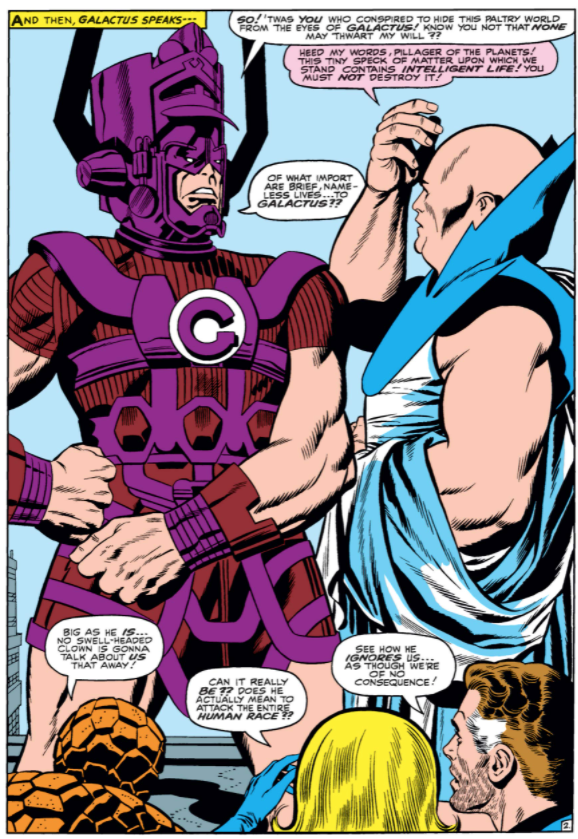
In his first appearance, Kirby has Galactus wearing shorts with a big G on his chest:
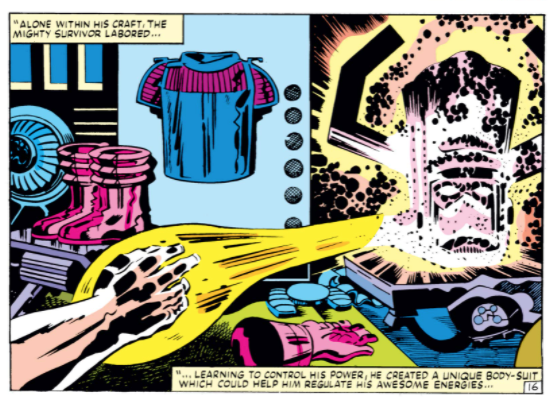
Fortunately, he soon put on long pants and got rid of the G, but his appearance, with the elaborate headgear has remained pretty much the same ever since. Yet despite its visual appeal, it’s not obvious why he’s dressed that way, given that he is a cosmic force and not a run-of-the-mill bad guy. The Lee / Kirby origin in Thor provides one answer: He was given that outfit by a Watcher, who witnessed his emergence from his incubator and created “a unique body-suit which would help him regulate his awesome energies.”
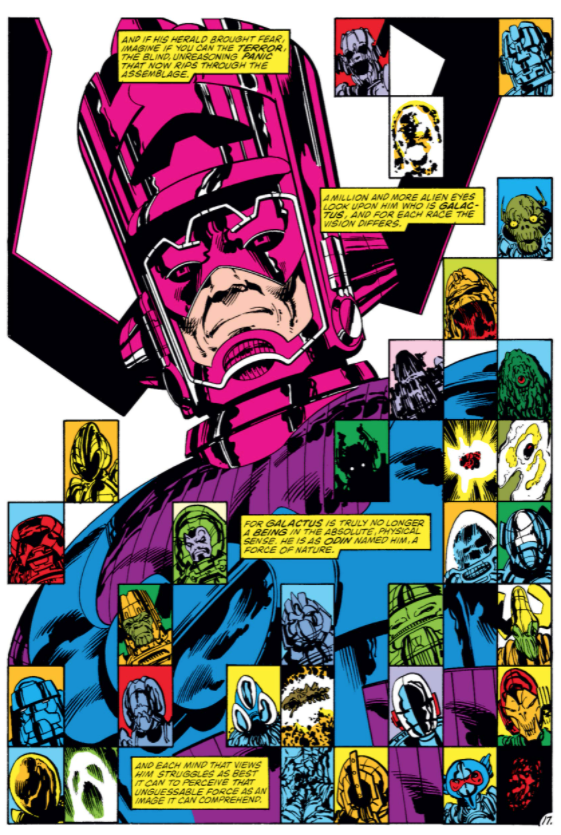
Later, Byrne in FF 262, suggests only humans see Galactus as humanoid, and that he appears to other alien races in whatever form they take (I never much liked this explanation, since he’s never depicted as anything other than humanoid, and it makes more sense to me that he’s human-like because Galan of Taa was also human-like). It’s a pretty cool page though.
Wrong guy
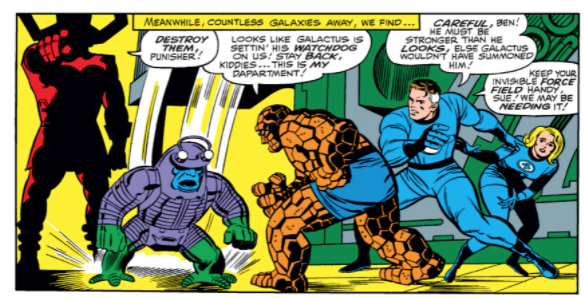
Whaddya mean there’s another Punisher?
That sounds familiar
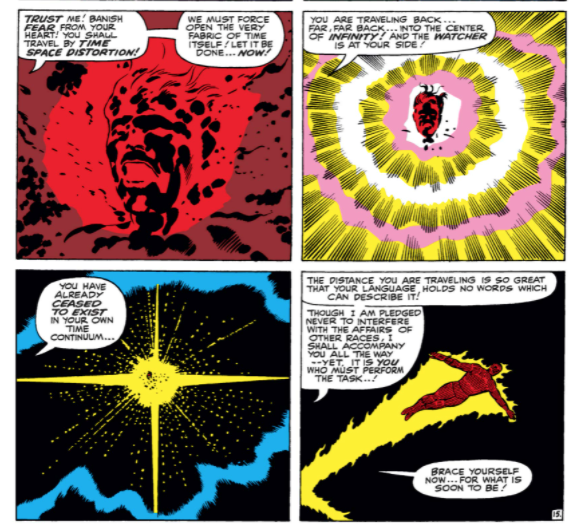
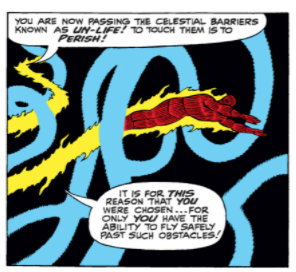
On his cosmic voyage, the Human Torch passed through “celestial barriers known as un-life” which sounds a lot like ‘anti-life,” a concept that became a big part of the Fourth World mythos Jack created at DC about five years later.
About that vow
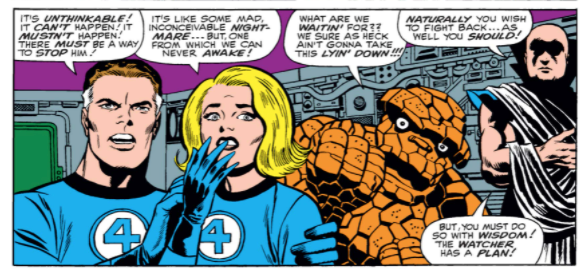
On several occasions the Watcher references his vow not to interfere in human affairs while busily interfering in human affairs
Prime real estate
A few issues ago, Dragon Man crashed into Alicia’s apartment while fighting Ben and Johnny. Now, the Silver Surfer just happens to land on her roof.
Crazy credits
It’s clobberin’ time
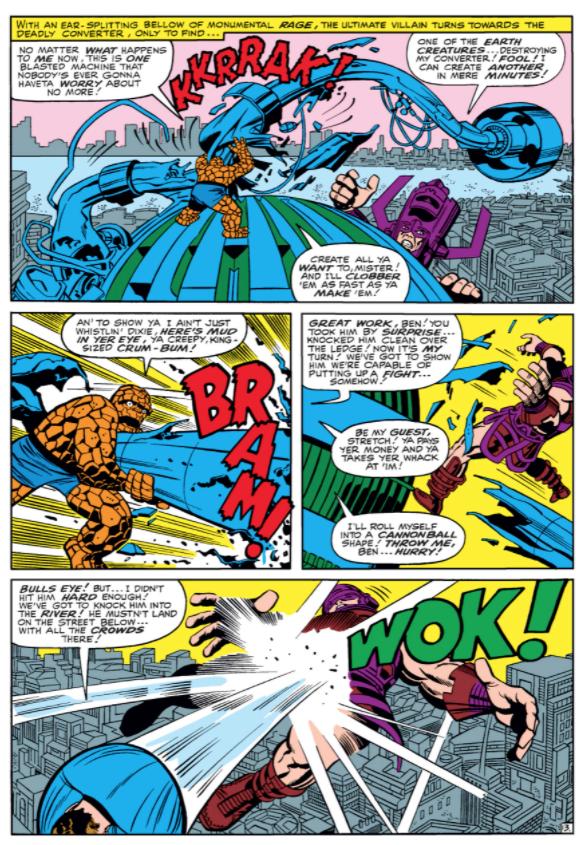
One of the more ineffective attempts to clobber from Ben
Dig that Kirby Krackle
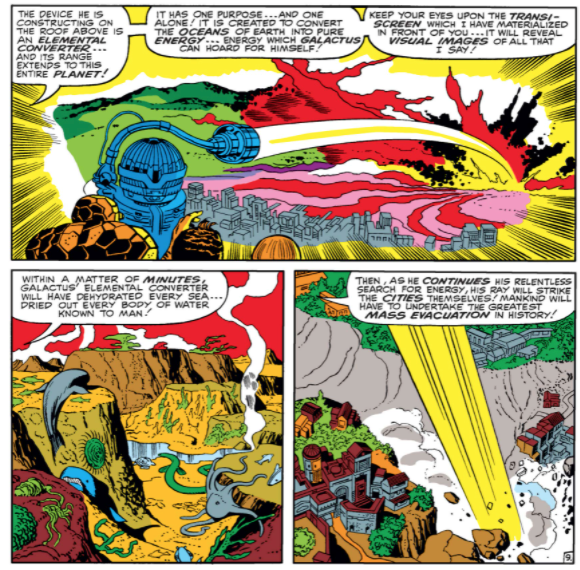
There’s a lot to choose from in this issue, but here are a few stand-out pages and panels, starting with the amazing splash page:
A very cool sequence:
And another amazing page:
Nextissue: The conclusion of the Galactus trilogy!