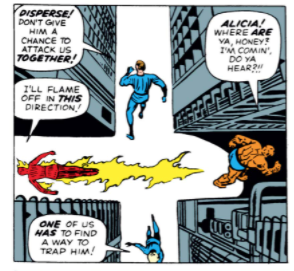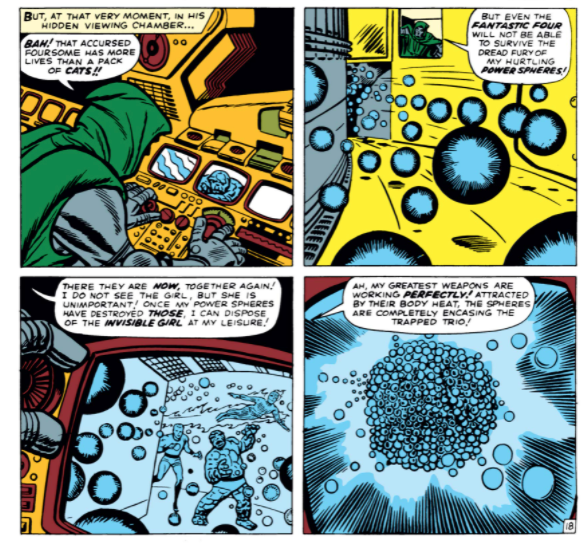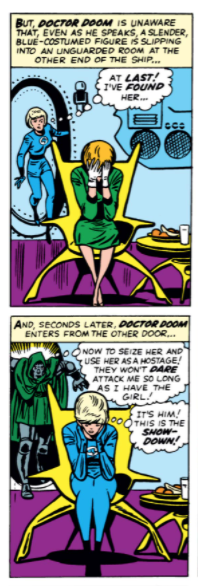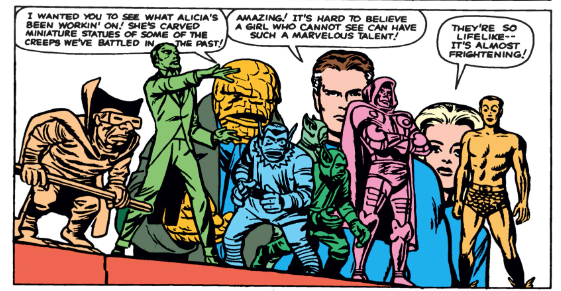
“The World’s Greatest Comic Magazine” Fantastic Four No. 18

Tags

, , , , , ,

Fantastic Four 18
“A Skrull Walks Among Us!”
Published June 1963
Story: Stan Lee and Jack Kirby
Script: Lee
Pencils: Kirby
Inks: Dick Ayers
Letters: Art Simek
Cover: Kirby and Paul Reinman

Synopsis

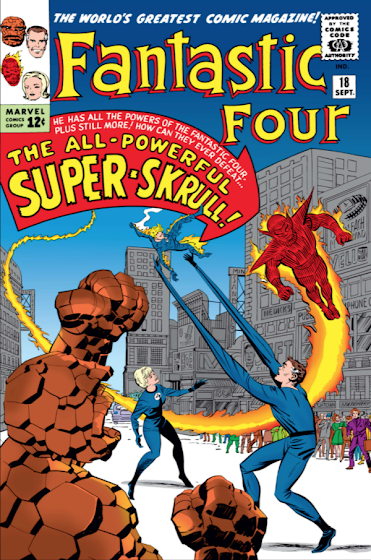
As the Fantastic Four recuperate from their recent adventures, on the home planet of the Skrulls—”in the fifth quadrant of the Andromeda Galaxy”—the Skrull Emperor plots an attack on Earth. He reviews his latest weapon, the Super-Skrull, who possesses all the powers of the Fantastic Four and then some.

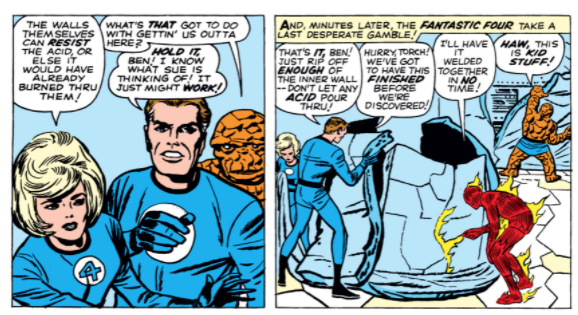
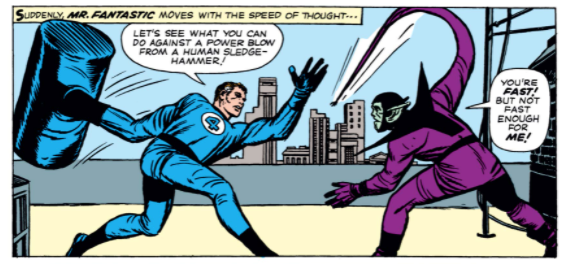
As the FF contend with a horde of shoppers in a department store, the Super-Skrull lands in Time Square and announces his dominion over the Earth. Soon the FF arrive and after a furious battle, they are overpowered by the alien and retreat. Mr. Fantastic surmises the Super-Skrull is receiving his power from an external force and builds a device to block the signal. After luring the Super-Skrull to fight the FF on a volcanic deserted island, Reed, Ben, and Johnny distract him while Sue attaches the device. No longer receiving his power from the Skrull home world, the alien is weakened. The Human Torch then seals the Skrull in a crater by fusing sand into glass.
What’s going on here?

Another whiz-bang issue—that’s three stellar issues in a row, for those keeping track—that introduces another major villain to the Marvel universe. Fantastic Four 18 follows a now familiar pattern: The FF loaf around the Baxter Building or New York, often showing off their powers among civilians, before they’re drawn into an adventure. The pace then quickens and the second half of the comic is non-stop action, usually culminating with the villain’s defeat on the final page, or even final panel.

FF 18 reintroduces the Skrulls, not seen since issue two, and adds a bit more context to the alien. We visit their home world and meet their emperor, later revealed as Dorrek VII. He goes unnamed here but eventually he and the Skrull royal family become significant characters in their own right, particularly his queen, R’Kill, and their daughter, Princess Annelle.
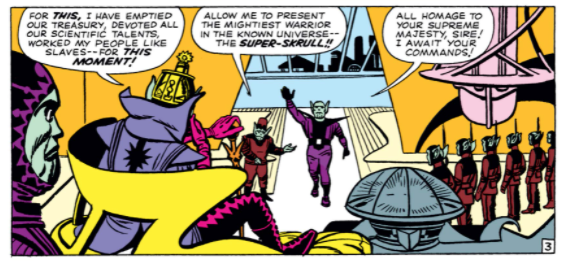
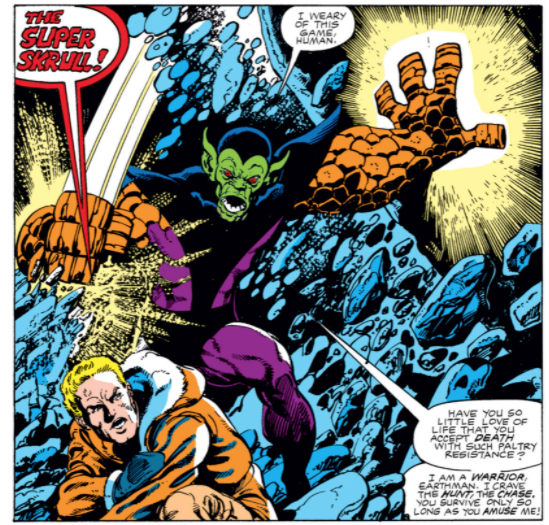
The comic also introduces the Super-Skrull, Kl’rt. He, too, isn’t named until later issues, and has a long and tangled history in the Marvel Universe. I’m partial to his appearance in John Byrne’s Alpha Flight 10, when he battled Sasquatch.
His most recent appearance came in the 2020 Empyre crossover, when he was found responsible for the genocide of an alien race. To punish him, the hero Hulkling—the new Skrull Emperor—makes him a diplomat, forcing him to make peace instead of war. (Empyre was a bit of a mess, but it was steeped in deep Marvel history and it had its moments).
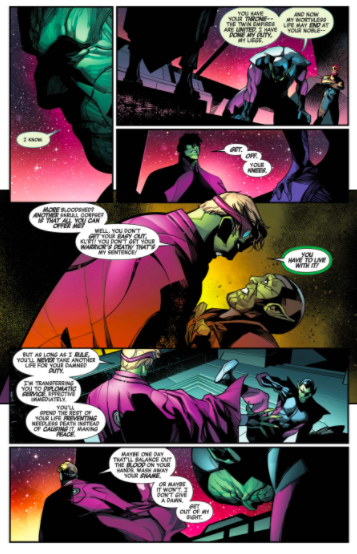
Empyre Aftermath: Avengers (Writing: Al Ewing and Dan Slott, art by Valerio Schiti)

Go Gadget Go

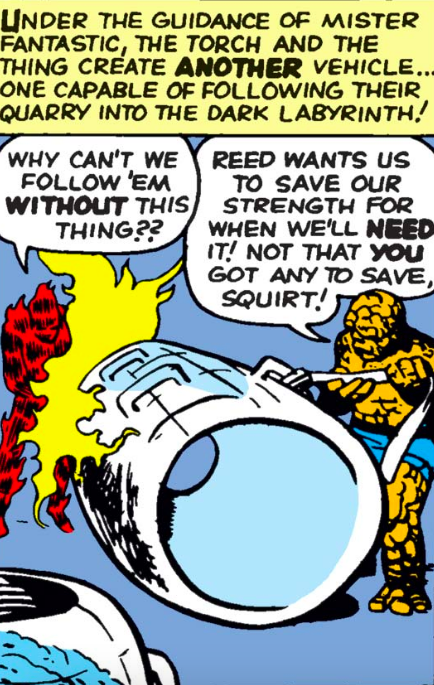
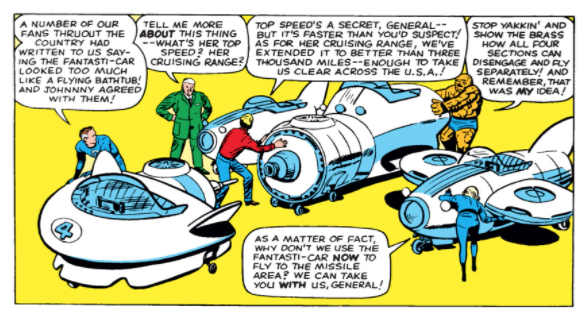
FF 18 was a big issue for cool space-age vehicles and gizmos.

First, Reed unveils the team’s new passenger ICBM for a quick trip to Hawaii with Sue.
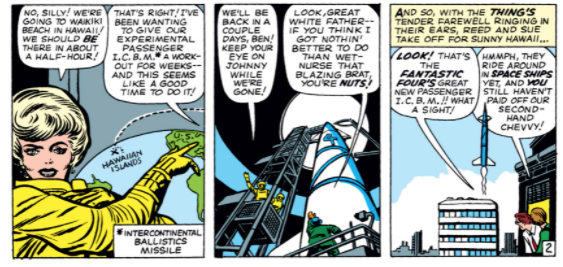
Ben and Johnny have to make do with the Fantasticars.
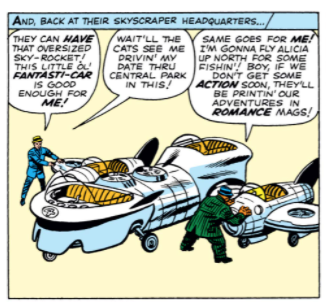
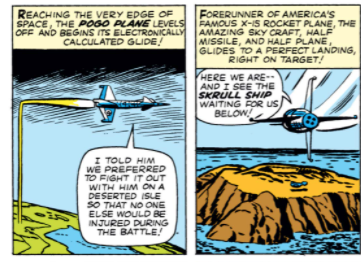
Later, the team takes off in the Pogo Plane, presumably named that because it can take off and land vertically. (Why they need both the Pogo Plane and the ICBM goes undiscussed).
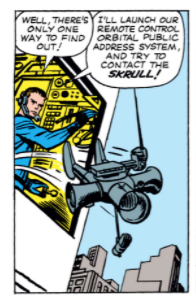
And lastly, Reed deploys a “remote control orbital public address system.”
The sexist sixties

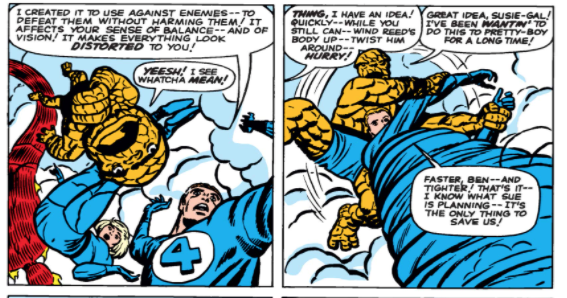
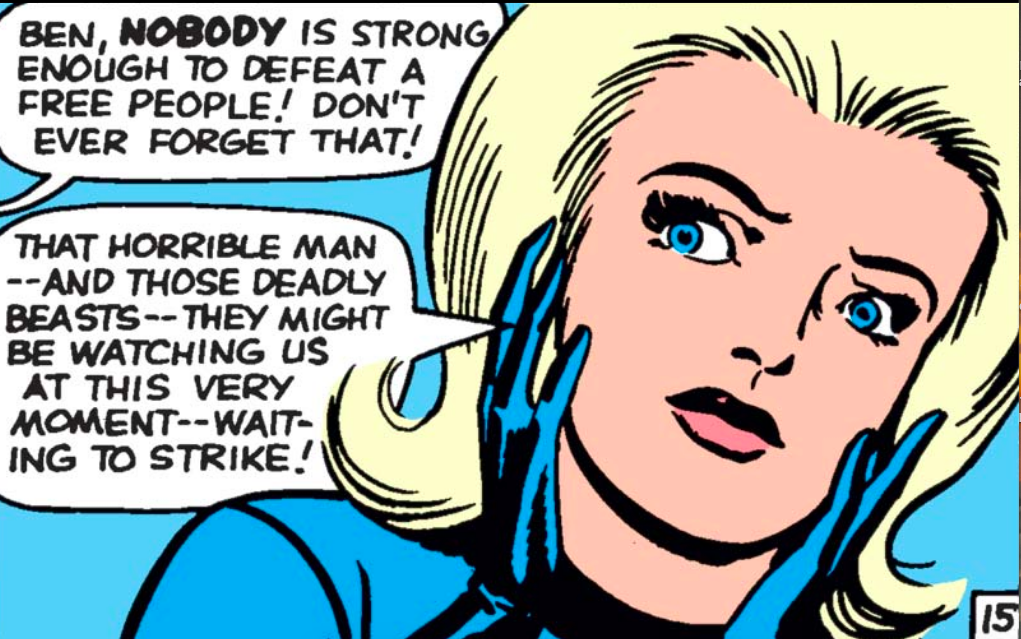
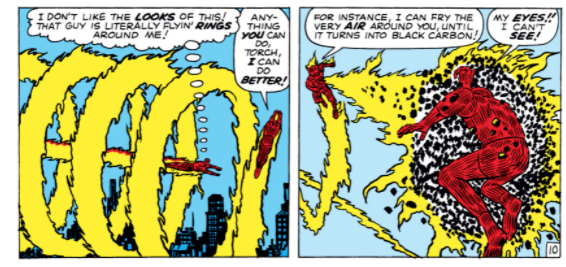
Sue spends the initial battle with the Super-Skrull “nursing” Johnny.

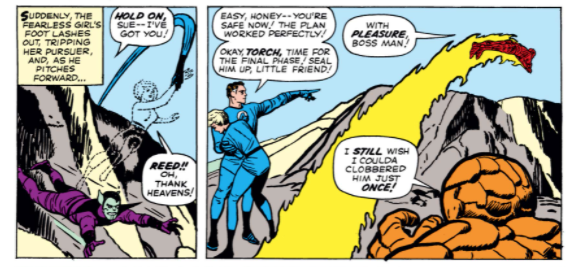
Later, even after she uses her powers to attach Reed’s device to the Super-Skrull, she’s still helpless.
Comic relief

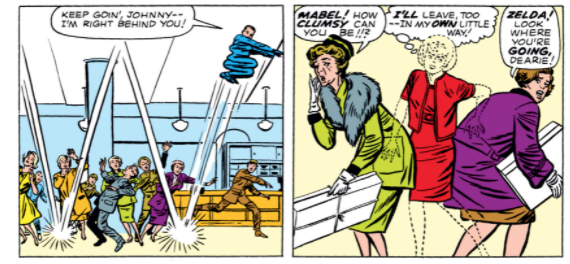
There’s a particularly silly sequence depicting the FF escaping what appears to be Macy’s. Sue’s dress is either not made of unstable molecules or the colorist didn’t get the memo.
Feats of strength

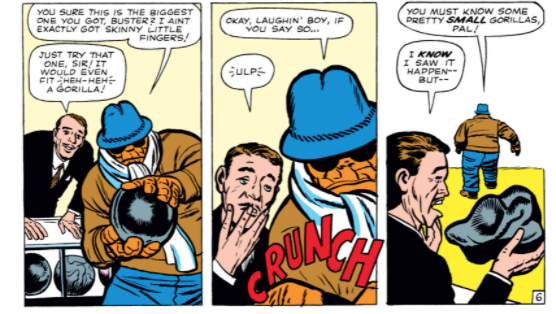
As he has done in almost every issue thus far, Ben shows off his strength by destroying property. As we shall see elsewhere in this issue, the Skrulls claim Ben can lift only five tons, a figure significantly revised upward in later issues and in the Handbook to the Marvel Universe.
They’re fighting again

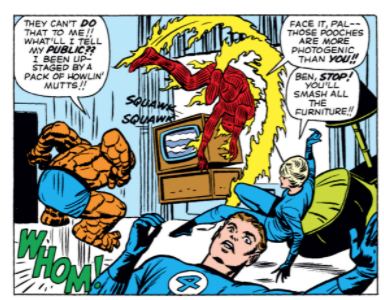
This time its over what’s on TV.
Kirby Krackle

Jack really comes alive when he gets to draw alien technology. This issue is no exception.
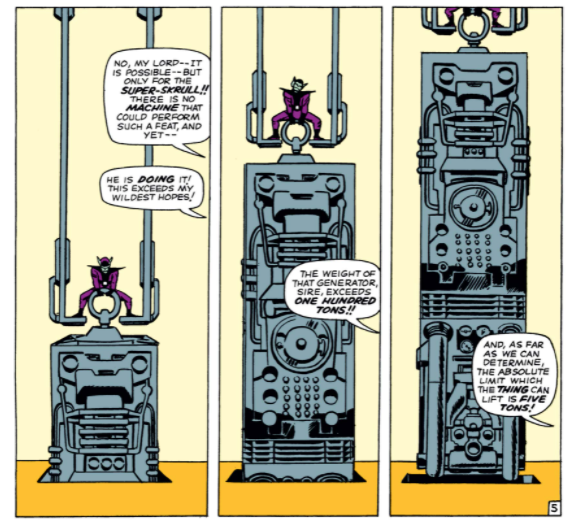
This is a pretty amazing sequence, too (undiscussed is Kl’rt’s fondness for how tunes, particularly from Annie Get Your Gun)
For sale

A mint (9.8) edition of FF 18 will set you back $47,000.

Next: The first Fantastic Four Annual!
“The World’s Greatest Comic Magazine” Fantastic Four No. 17

Tags

, , , , ,

Fantastic Four 17
“Defeated by Doctor Doom!”
Published May 9, 1963
Story: Stan Lee and Jack Kirby
Script: Lee
Pencils: Kirby
Inks: Dick Ayers
Letters: Art Simek
Cover: Kirby and Ayers

Synopsis

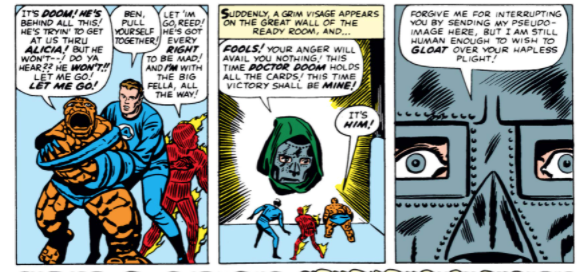
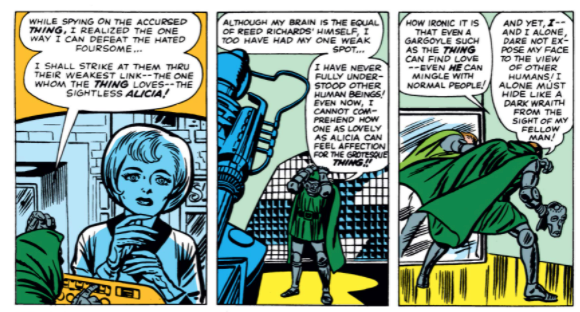
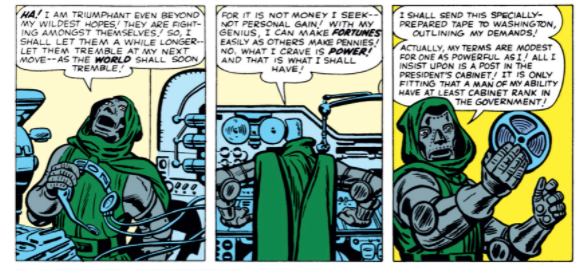
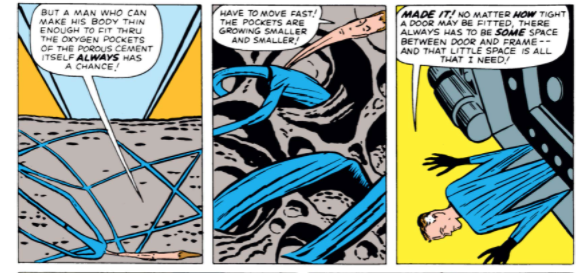
After last issue’s adventure, the Fantastic Four bid farewell to Ant-Man and begin searching for Dr. Doom on the streets of New York. Doom, disguised as the Baxter Building’s janitor, implants tracking devices on the team, who are soon followed by floating, immaterial robots. Doom then abducts Alicia Masters to use as a hostage, and blackmails the US government, disrupting the nation’s electronics in order to gain a seat on the president’s cabinet (!).

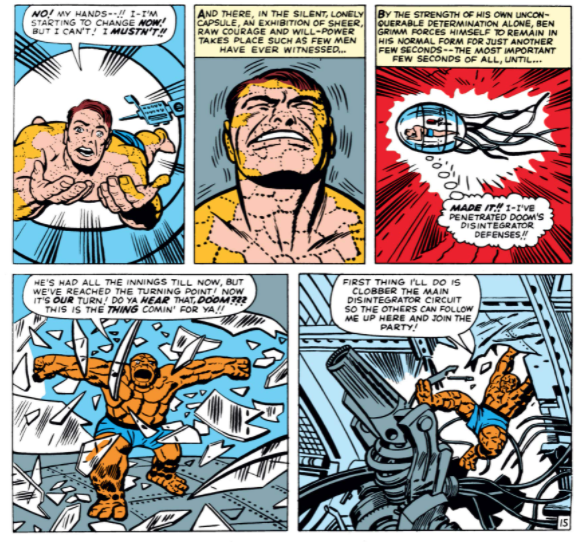
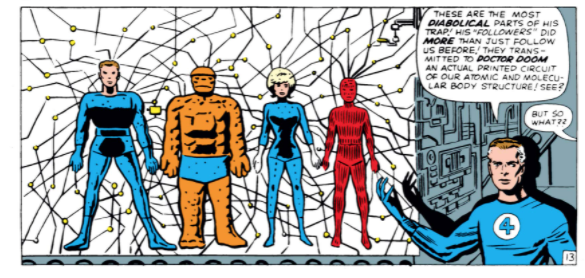
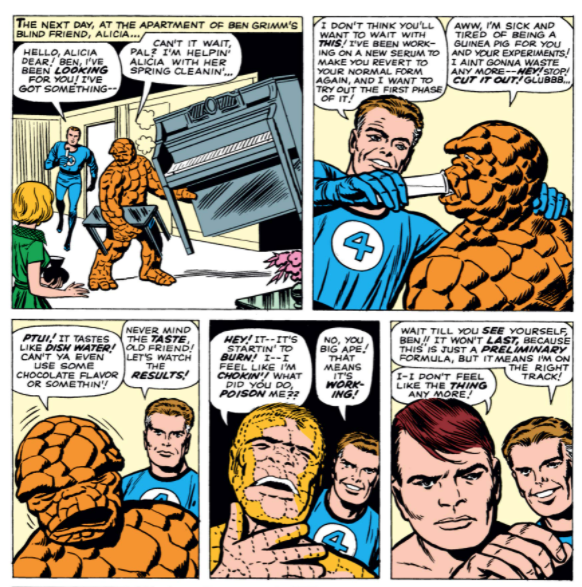
The FF launch a plan to rescue Alicia and defeat Doom but Reed recognizes Doom’s floating headquarters are protected with disintegrator rays. The rays are keyed to the team’s unique molecular structures, which were scanned by the floating robots. To bypass the rays, Reed gives the Thing a serum that changes him back to Ben Grimm, rearranging his molecules and foiling the disintegrator rays. Once aboard Doom’s ship, Ben—now changed back—destroys the ray device, and the other team members join him. Doom briefly detains the team members with individually designed traps (again) but the team escapes (again). Finally, Sue switches places with Alicia, getting close enough to Doom to stall him until the rest of the team arrives. Doom, however, escapes.

What’s going on here

Another satisfying, action packed issue, and one that helps establish both the characters of Doom and Ben. Like last issue, the story starts slowly, with comedic bits as the team tries to live normal lives in New York, before building to a crescendo aboard Doom’s ship.

While this is Doom’s fifth appearance, it’s the first where his motivations are revealed. He’s not just a power hungry villain, but an insecure man, tortured by feelings of inadequacy tied to his disfigurement.

But unlike future issues, where Doom’s plans involve world domination, here all he wants is a cabinet seat. (Which one is left unsaid: Secretary of Housing and Urban Development? Postmaster General?)

Meanwhile, after Reed changes Ben back to human—something which happens with regularity in these early issues—we learn that Ben’s heroism isn’t a function of his monstrous form. After spending much of the FF’s first year serving as the team’s comedian and hot head, we get a glimpse of the inner strength that helps define him and make him one of Marvel’s most beloved characters.

Heroic Sue

The Invisible Girl also gets some more dimension in this issue. One consequence of the introduction of Alicia to the FF’s world is Sue is no longer the most helpless woman, and she is replaced by Alicia as the designated hostage. But Sue also is toughened up a bit (although she attributes her fighting prowess to Reed’s tutelage—even when she triumphs it’s because of a man).

Byrne Baby Byrne

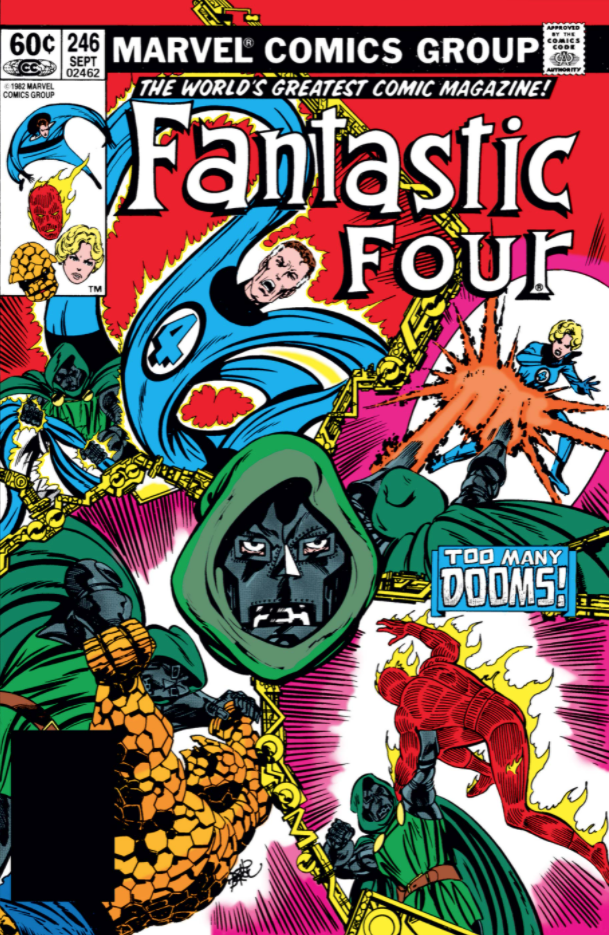
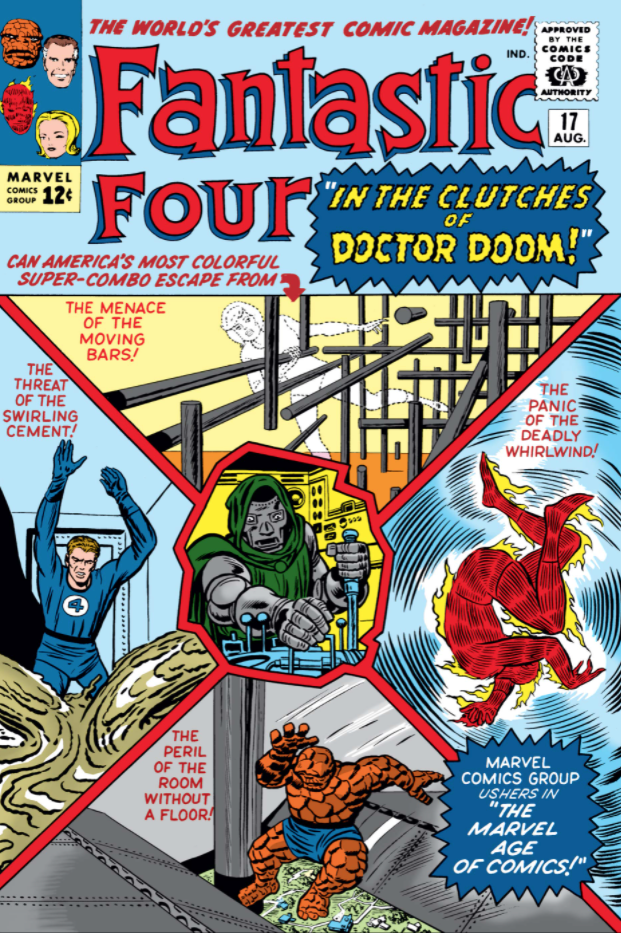
John Byrne references this issue at least twice in his subsequent comics. First, there’s this cover:

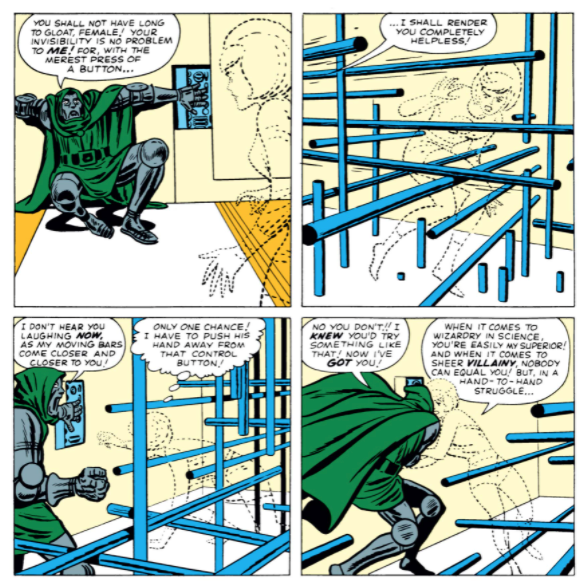
There’s also this great Kirby sequence of Sue evading a trap of rods…

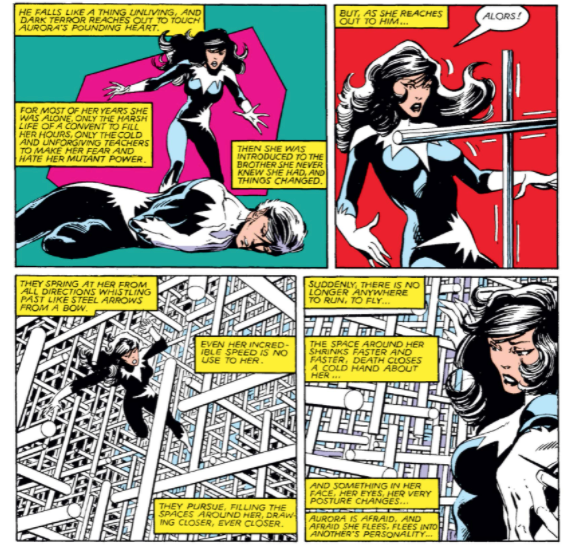
…which Byrne homages (or swipes) in Alpha Flight 3:

The Incredible Mr. Fantastic

Some cool Reed action here:

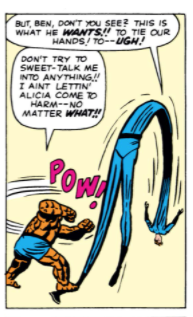
They’re fighting again

Ben is understandably upset Alicia has been captured by Doom.

Geo-politics

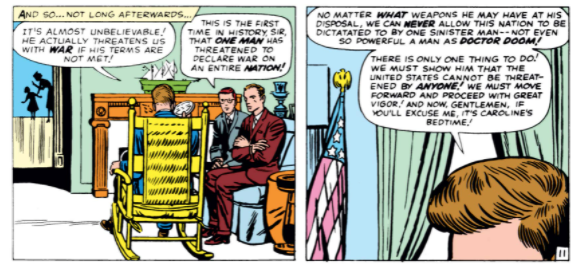
In this issue we meet JFK (or at least his hair) as he drops some identifying verbal clues, like “vigor” and his daughter’s name (and speaking of Carline Kennedy, it appears the First Lady is lecturing the future Mrs. Schlossberg in silhouette). The rocking chair may be a reference to Kennedy’s back problems.

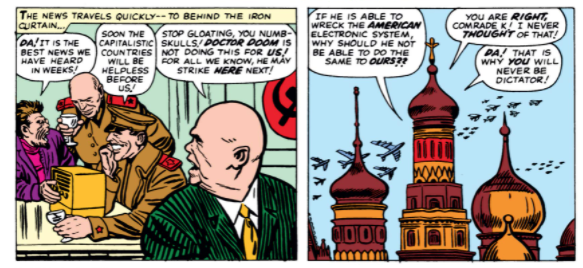
We also meet Khrushchev, here identified as Comrade K.

All dressed up

The FF looks pretty spiffy here:

Believe the hype

This issue features more the than the usual bombast from Stan. On the cover, as well as inside. The second feels like a direct attack on the Justice League of America.

Kirby Krackle

Lots of outstanding art from Jack in this issue. Like this:

… and this …

… and this …

and this.

For sale:

In mint condition (9.8) FF 17 is worth $31,000.

Next issue: The Super Skull!
Very Short Review: Superman & Lois (2021)

Tags

, , ,

The problem with Superman, most writers discover, is that he’s just too powerful. Unlike human-scaled heroes like Batman and Spider-Man, there are few opponents that can challenge the Man of Steel, and secret-identity hijinks can only go so far. Eventually, storytellers realize the best stories are ones where the conflict isn’t between Superman and a bad guy, but between Superman and Clark Kent. Reconciling the thoroughly decent and very human Clark with the power and responsibility of his god-like alter ego lies at the heart of Superman & Lois, a CW show now available on HBOMax.

In this iteration of Superman, he’s married to Lois Lane and they’re raising twin teenage boys, Jonathan and Jordan. The boys are very different—Jonathan is a jock, Jordan has emotional issues—and a central point of tension is whether he’s available for his family. It’s clear the show will be as much about Clark’s parenting as his world-saving.

I confess the last time I checked in on the Superman comics, about a decade ago, he had an adopted son named Christopher, but this premise works, too. The legend of Superman is so potent that the particular details aren’t all that important so long as the main beats of the characters are there. But this shows gets a lot of the details right, too. Lois (played by Elizabeth Tulloch) is tough, sexy, and whip smart, Lana Lang is still stuck in Smallville, and media mogul Morgan Edge looms as a real-world bad guy. The writers know the source material, and the show succeeds in part because they trust our familiarity with these characters and their world. It’s confident enough to be subtle.

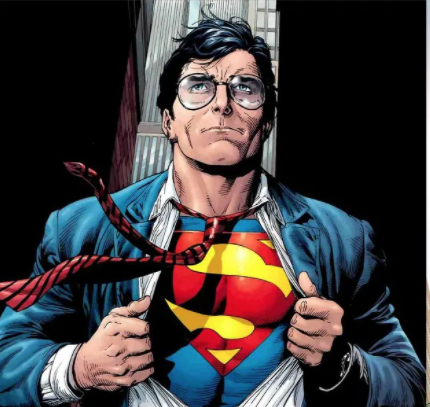
Perhaps most importantly, the show gets Superman, right. As a hero, he’s immensely powerful, but measured. As a dad, he’s visibly struggling. As a reporter, he’s recently unemployed. Tyler Hoechlin’s Superman isn’t as muscled as Henry Cavill’s and his Clark Kent isn’t as awkward as Christopher Reeve’s, but he manages to make both sides of the character convincing. It helps that he resembles Superman as drawn by longtime comic artist Gary Frank: soulful and pensive.

I’ve only seen the pilot, so the show may deteriorate, but it seems unlikely. Even its weaker moments—when the story follows the moody teenage boys doing moody teenage things—are thankfully brief. Tipping too much in that direction risks turning Superman & Lois into Riverdale with kryptonite, but so far it’s balanced with enough action and humor to offset any emo sulkiness.

After watching a few dreary episodes of The Flash and Arrow, I pretty much wrote off the CW’s foray into DC comics. Too much talk, too little respect for the comics that created them. But early on, Superman & Lois seems to get it all right.

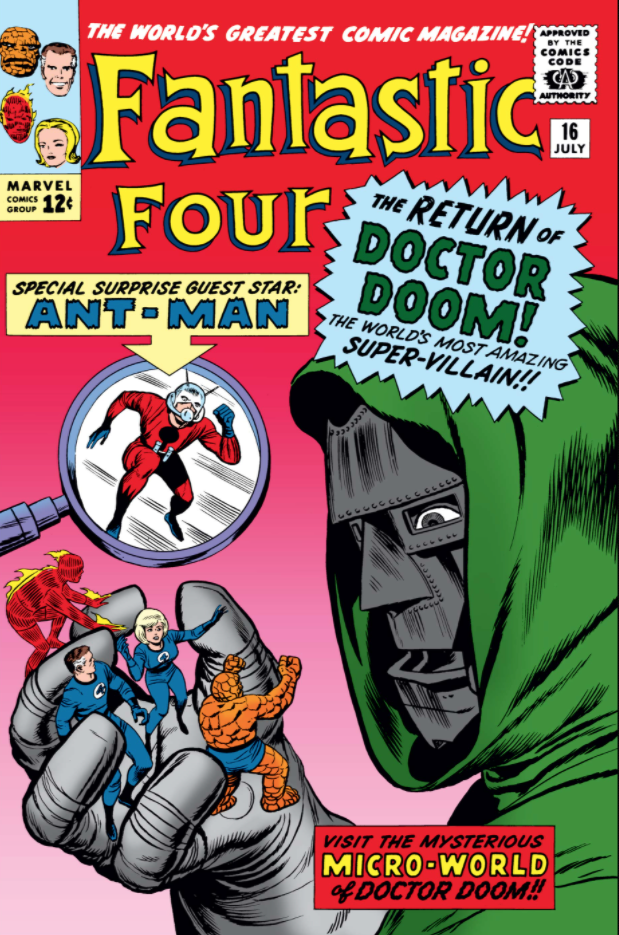
“The World’s Greatest Comic Magazine” Fantastic Four No. 16

Tags

, , , , ,

Fantastic Four 16
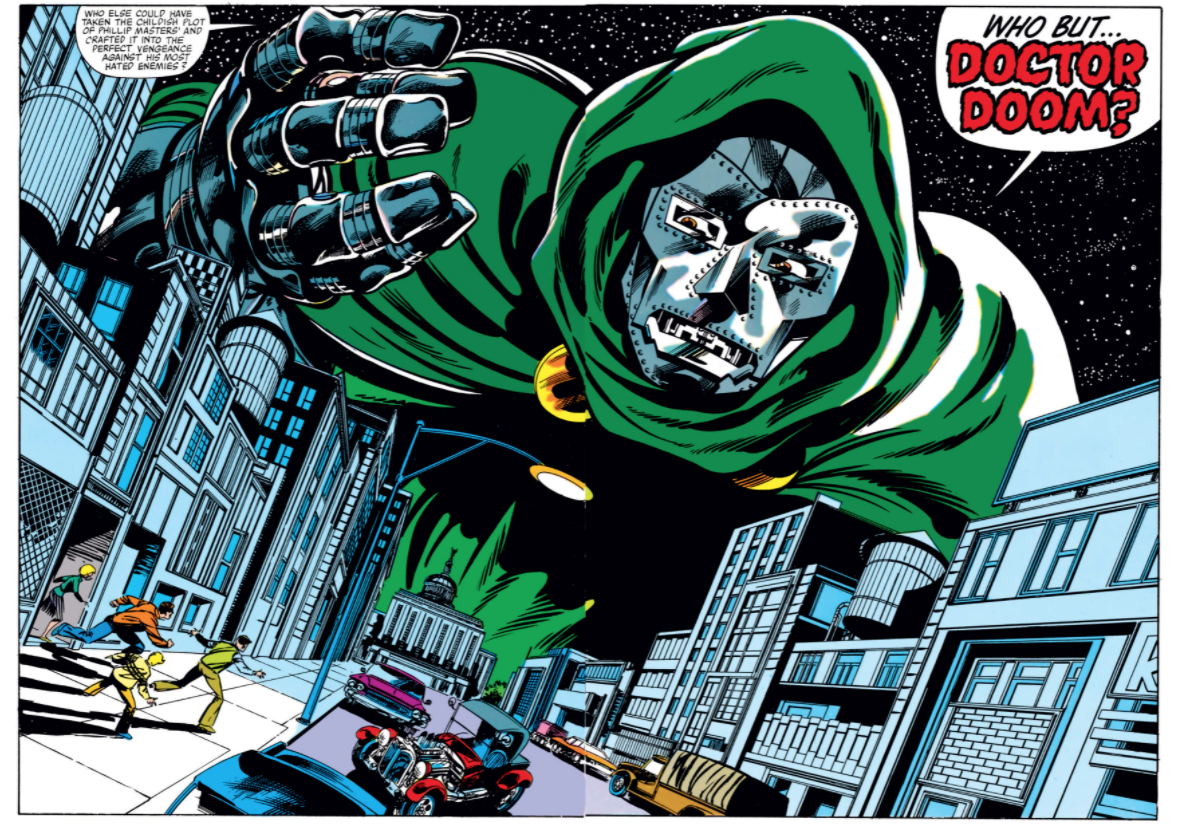
“The Micro-World of Dr. Doom”
Published: April 1963
Story: Stan Lee and Jack Kirby
Script: Lee
Pencils: Kirby
Inks: Dick Ayers
Letters: Art Simek
Cover: Kirby and Ayers

Synopsis

The Human Torch arrives at the Baxter Building to find the rest of the Fantastic Four have shrunk to a tiny size. After they recover their stature, they reveal they each had separate shrinking episodes. They summon Ant-Man for a consultation, and he leaves them with a shrinking potion so they can find the source of their affliction.

The FF resume their lives, but hear a mysterious woman’s voice warning them about Dr. Doom. Recalling Doom was last seen shrinking into nothingness (in issue 10), they connect him to their shrinking and pursue him using Ant-Man’s serum.

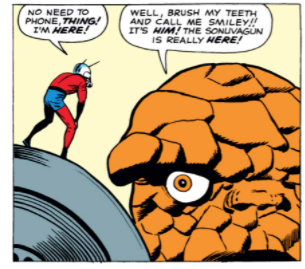
The team arrives in the Microverse (in later issues, revealed to be a separate universe accessed through shrinking), a feudal society where Doom has placed himself on the throne. Doom shrinks the FF further and, after a brief battle with his henchmen, the team is captured and imprisoned with the world’s king and his daughter Princess Pearla. It was Pearla’s voice they heard. Back in the larger world, Ant-Man discovers the team has shrunk, and travels after them, only to be captured by Doom as well.

The FF escapes their prison, free Ant-Man, and defeat Doom, who escapes capture. The team then returns to their world with Ant-Man, in pursuit of Doom.

What’s going on here?

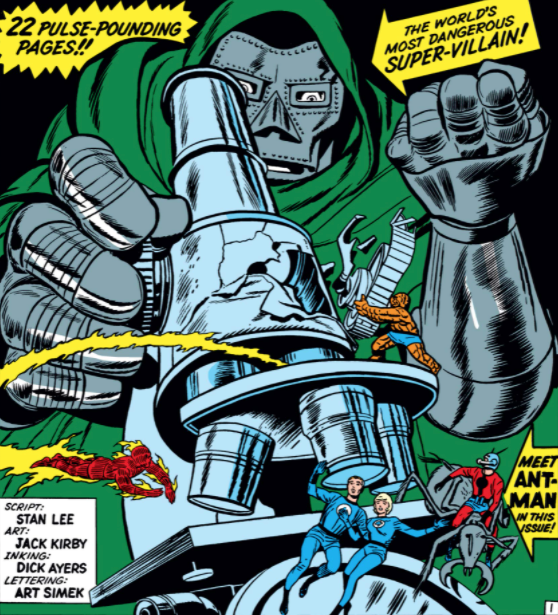
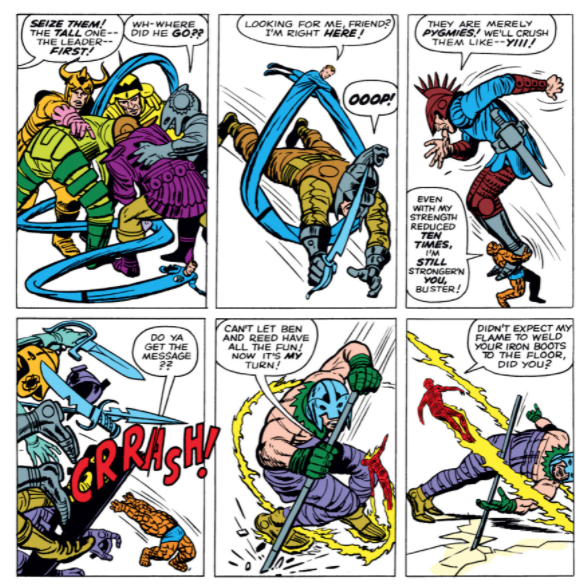
This is one of the more satisfying of Stan and Jack’s early issues. It’s a fun, well-structured story that starts with a slow boil with the team puttering around New York before picking up speed and turning into a science fiction adventure. FF 16 introduces some cool new concepts—the Microverse, and a medieval society that live in it—while including a guest star in Ant-Man and offering a plausible explanation for what happened to Doom. It also gives Jack an opportunity to have fun drawing the shrunken FF fighting larger villains.

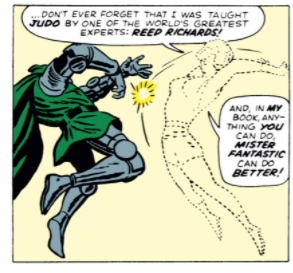
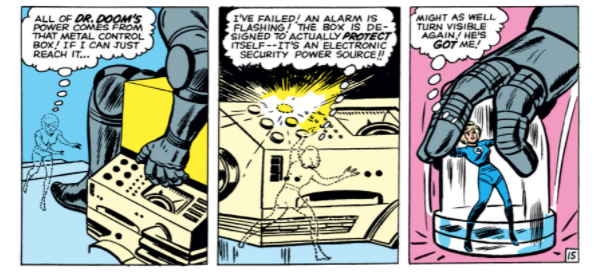
This issue was an obvious inspiration for the now classic FF 236, written and drawn by John Byrne, where shrunken versions of the FF (actually, tiny clay copies of their bodies molded by the Puppet Master) are trapped in a tiny town. Compare this panel from FF 16 …

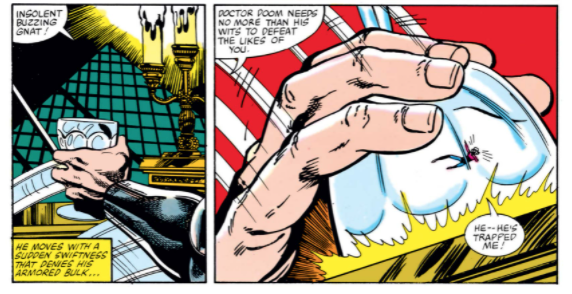
…with this one from FF 236

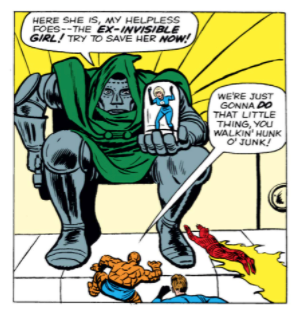
Or here, where Doom captures Sue in a jar …

…and, 20 years later, a glass

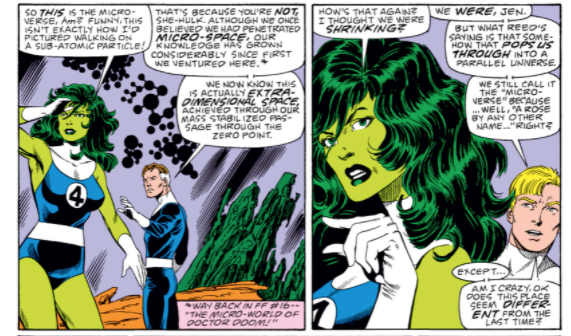
The issue is also referenced by Byrne more overtly in FF 282, when the FF shrink down in pursuit of the villainous Psycho Man.

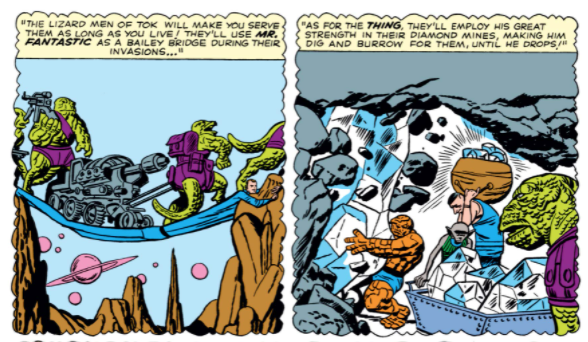
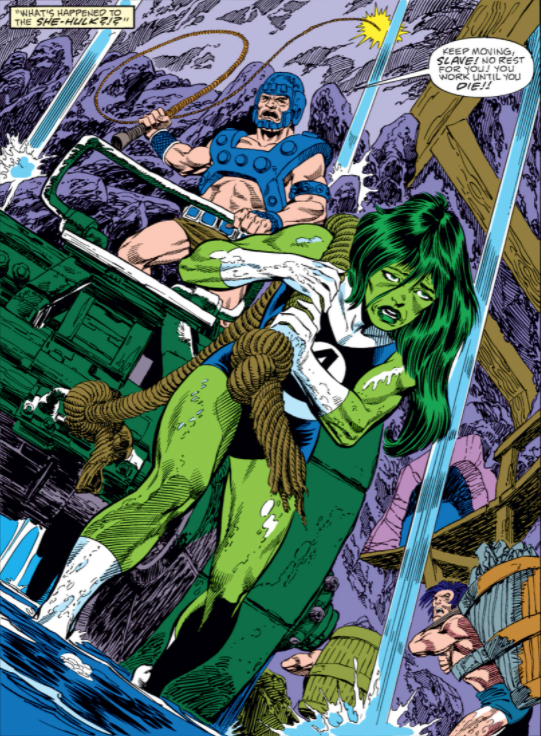
Doom’s plot in FF 16 to sell the FF to the Lizard of Men of Tok, where Ben will become a slave in their diamond mines…

… is recalled when She-Hulk is captured (no lizard men, though).

FF 283 Byrne /Ordway

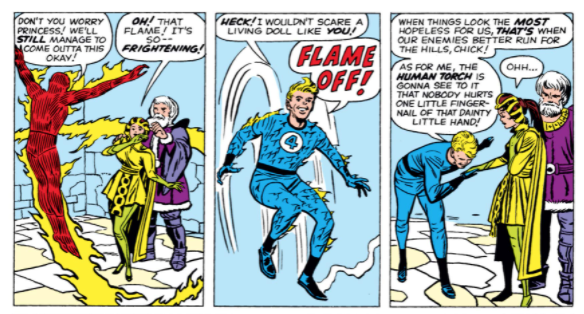
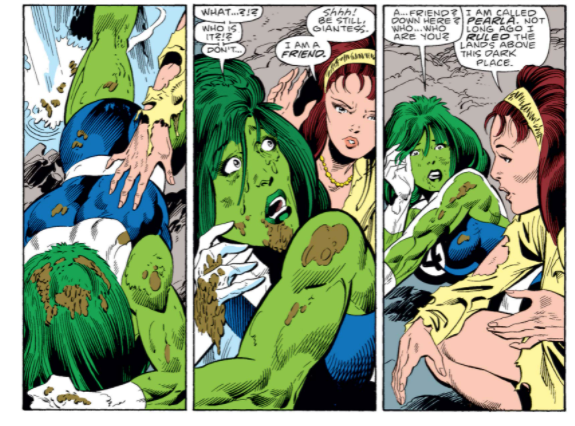
And Princess Pearla, introduced here …

… reappears in FF 284, where she helps rescue She-Hulk.

Ch-ch-changes

Ben turns human again. I’ve lost track of how many times so far, but about every other issue he changes back. That slows down pretty significantly over the years.

The Wasp

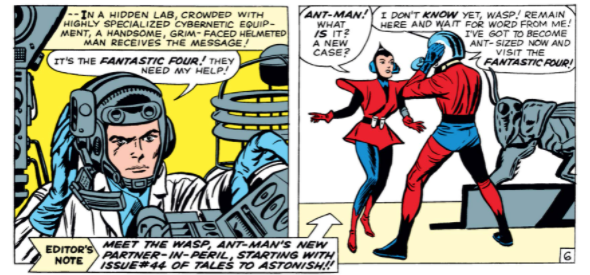
Janet Van Dyne—who will eventually spend a big chunk of time in the Microverse, both in the comics and the movies—briefly makes an appearance, just a month after her debut in Tales to Astonish 44.

Good grief!
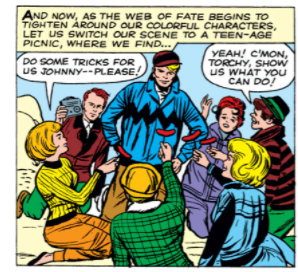
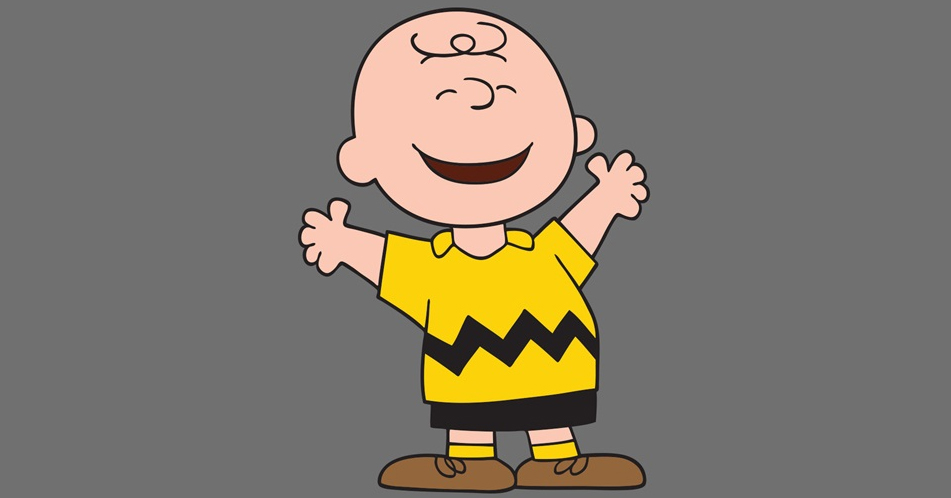
Johnny’s jacket seems to be from the Charlie Brown collection

The sexist sixties

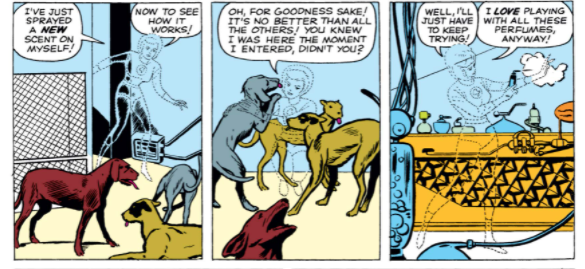
Sue just loves perfume

In fairness to Stan and Jack, Sue steps up is surprising ways in this issue, disarming Doom and coming up with a plan to escape their cell.

Kirby Krackle

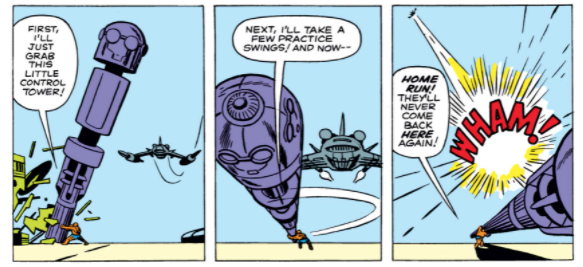
Lots of fun stiff in this issue, including the Thing taking a swing at the Lizard Men’s space ship


And a fun bit of perspective

For Sale

In mint condition (9.8) FF 16 will cost you about $17,000, quite a bit less than the last issue. Go figure.

Pin-up!
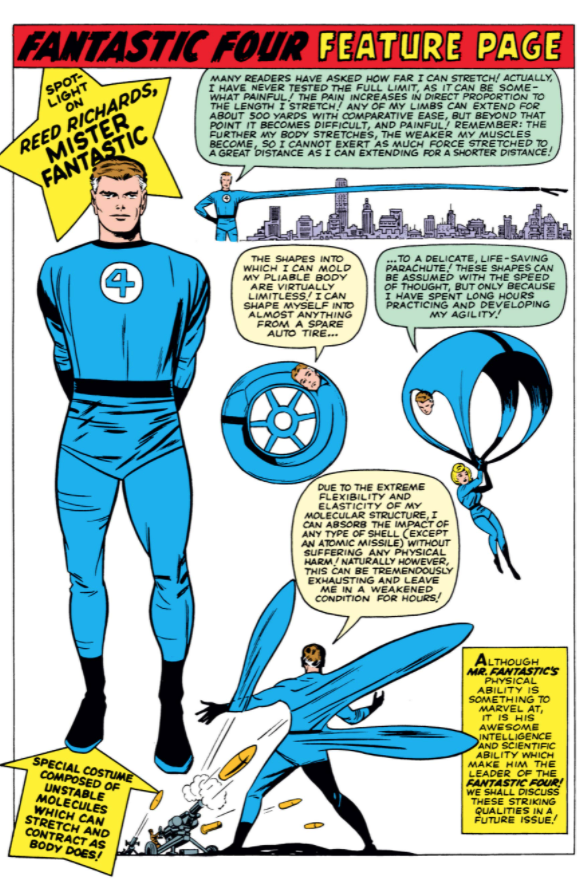
Reed gets the pin-up treatment here. By now, Jack has settled into drawing youthful, muscular version of Reed (compared to the elderly, almost wizened version in issue one).

Next issue: In pursuit of Doom!

“The World’s Greatest Comic Magazine” Fantastic Four No. 15

Tags

, , , , ,

Fantastic Four 15
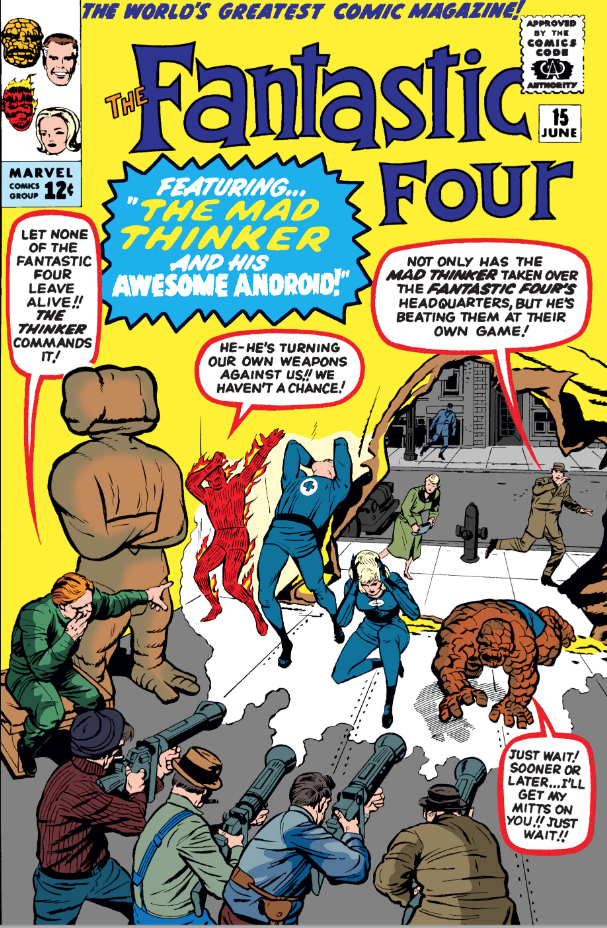
“The Mad Thinker and his Awesome Android”
Published March 1963
Story: Stan Lee and Jack Kirby
Script: Lee
Pencils: Kirby
Inks: Dick Ayers
Letters: Art Simek

Synopsis

In an echo of the first issue, Mr. Fantastic uses a flare gun to summon the team, and informs them he’s been alerted by the police that gang leaders from around the country are assembling in the city. Meanwhile, we are introduced to the Mad Thinker, a genius scientist, who has convened the crime bosses. He debuts his plan to use the predictive powers of his computers to defeat the Fantastic Four and become king of New York.

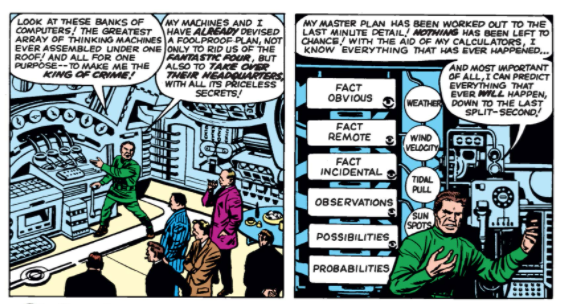
Putting his plan in place, he arranges for the FF to be drawn away from the team to pursue other goals: Johnny joins his cousins’ circus, Ben become a pro wrestler, Sue makes a movie and Reed becomes a research scientist. All are dissatisfied with their new careers, however, and return to the (newly named) Baxter Building only to find it turned to crystal by the Thinker. The team fight their way in and overcomes a series of traps and obstacles laid by the Thinker, who uses Reed’s own inventions against him. The last is an android, which adapts to its foes, that Reed designed by the Thinker built. The Thinker is finally defeated after Reed prearranged for the building’s power to cut out, shutting down the Thinker’s weapons.

What’s going on here?

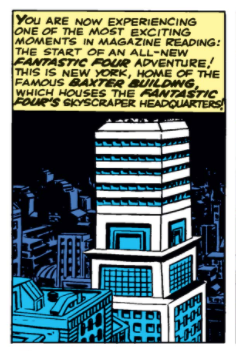
A fairly straight-forward issue that introduces the Mad Thinker to the FF’s rogues gallery. While never a first-tier bad guy, he reappears fairly steadily over the years, often teaming up with other villains. He’d often included a in run-down of the smartest characters in the Marvel Universe. The issue also features the first time their headquarters is named the “Baxter Building,” 12 issues after its first appearance in issue 3.

Those guys

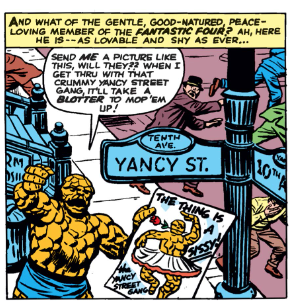
FF 15 also marks Ben’s first actual visit to Yancy Street, where he is of course harassed by the Yancy Street Gang. While the fictional Yancy Street is understood to be a stand in for Delancy Street on New York’s Lower East Side, here it’s intersecting with 10th Avenue.

Crime does pay

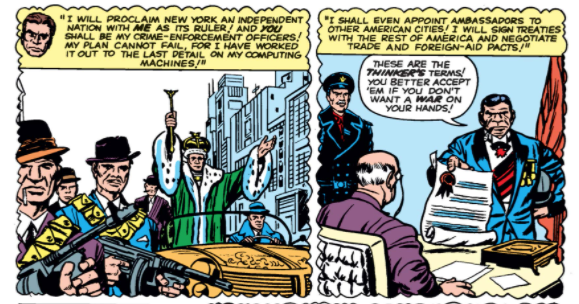
It seems strange now that the FF would be involved in a story with mafia-type criminals but Marvel had’t fully yet separated its “street-level” books like Spider-man and Daredevil from its more cosmic type comics like the FF and Avengers. So in this issue we get both mob hoods in pin-stripe suits and toothpicks and the Thinker whose ambition to become king of New York is surprisingly literal.

Rasslin’

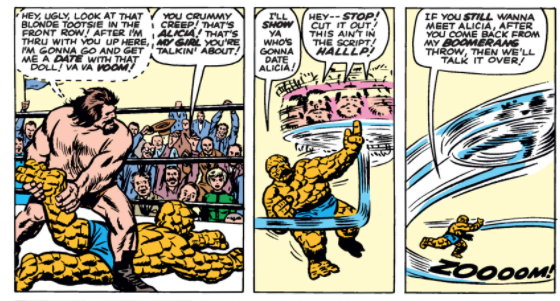
On his short sabbatical from the team, Ben becomes a pro wrestler and fights Fatal Finnegan.

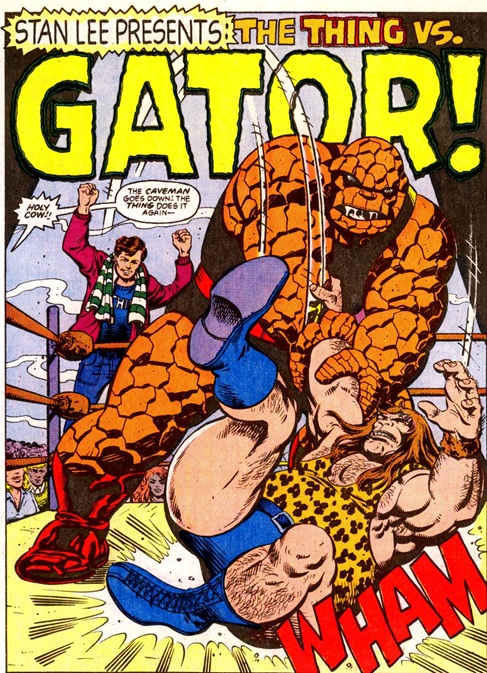
That foreshadows Ben’s foray into grappling as part of the Unlimited Class Wrestling circuit in his own series in the 1980s (a pretty forgettable story line, to be honest).

Thing 29 (1985) Art: Ron Wilson & Paul Ryan

Life and times of the Human Torch

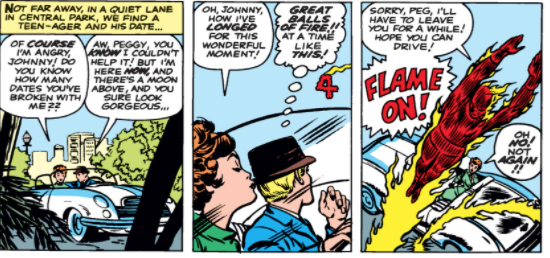
Jack Kirby again displays his questionable fashion sense, dressing teenage Johnny in a fedora while on a date.


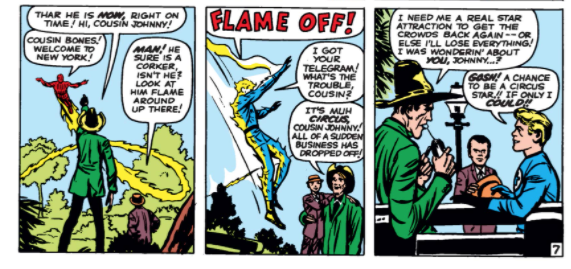
We also meet Johnny’s cousins from the Bones ‘N Bailey Circus (presumably they are also Sue’s cousins but that goes unaddressed).

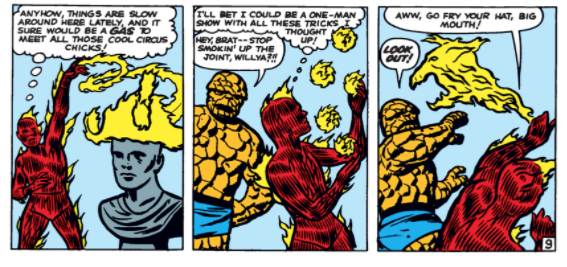
Johnny signs up, in part because can’t wait to meet those “cool circus chicks.”

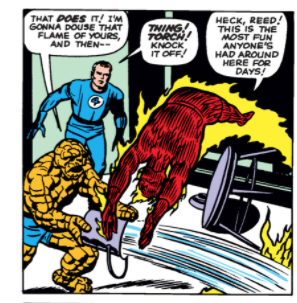
They’re fighting again

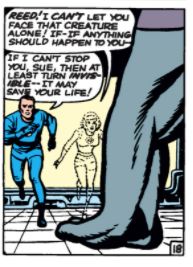
The sixties are sexist

Sue just isn’t cut out for super-heroing

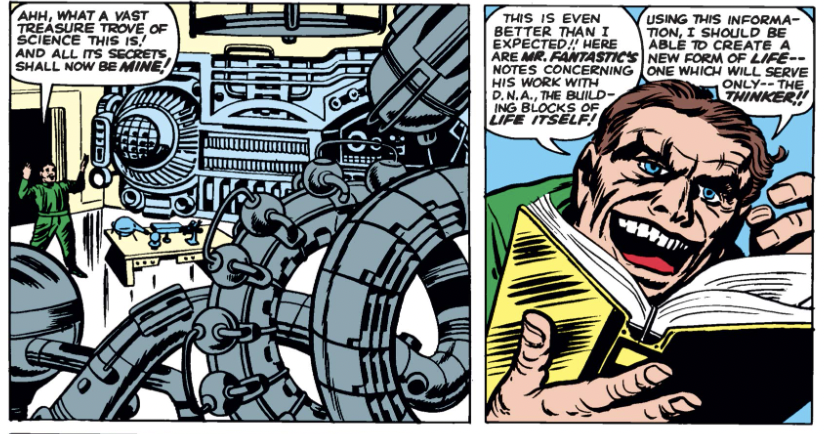
Kirby Krackle

These two panels are about as Kirby as it gets

These are fun, too.

For sale

A mint copy (9.8) will run you about $70,000.

Pin up time

A rather odd-looking Kirby pin up. I’m guessing it was drawn earlier and saved until this issue.

Next issue: Dr. Doom and the Ant-Man!

“The World’s Greatest Comic Magazine”: Fantastic Four No. 14

Tags

, , , ,

Fantastic Four 14
“The Merciless Puppet Master”
Published: Feb. 12, 1963
Story: Stan Lee and Jack Kirby
Script: Lee
Pencils: Kirby
Inks: Dick Ayers
Letters: Art Simek
Cover: Kirby and Steve Ditko

Synopsis

The Fantastic Four return from the Moon and are greeted as heroes. Meanwhile, the Puppet Master, last seen falling to his death, has survived and plots his revenge, using his radioactive clay to manipulate the Sub-Mariner into destroying the FF.

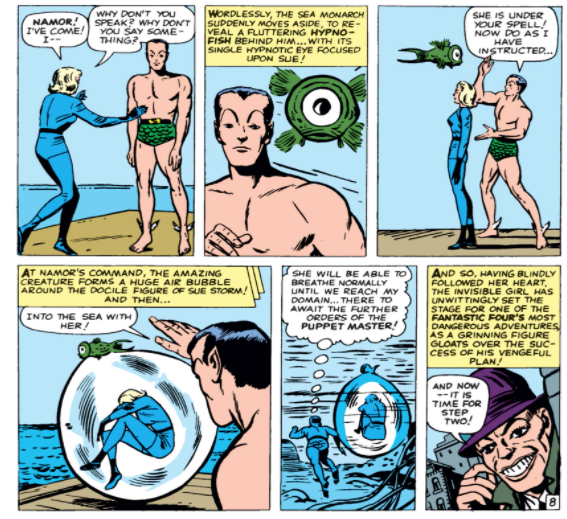
Under the control of the Puppet Master, Namor uses a “hypno-fish” to compel the Invisible Girl to join him underseas (so double mind control, for those keeping track), then taunts the rest of the team into pursuing her. Once in the Sub-Mariner’s underwater citadel, the team battles Namor, and the Thing rescues Sue from the clutches of a giant octopus. The octopus then breaks out of Namor’s lair and attacks the Puppet Master in his submarine. Once free of the Puppet Master’s control, Namor orders the FF to leave, but not before making another bid for Sue to remain at his side.

What’s going on here

A pretty straight-forward issue that recycles two previous antagonists. The story is a bit clumsy, and the FF never actually confront the villainous Puppet Master, but it has a clear beginning, middle and end. Perhaps the most significant development is the furthering of the Reed-Sue-Namor love triangle sub-plot, in which Sue’s interest in Namor now seems to be more than a passing crush.

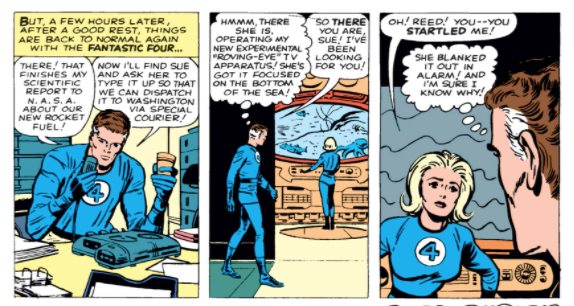
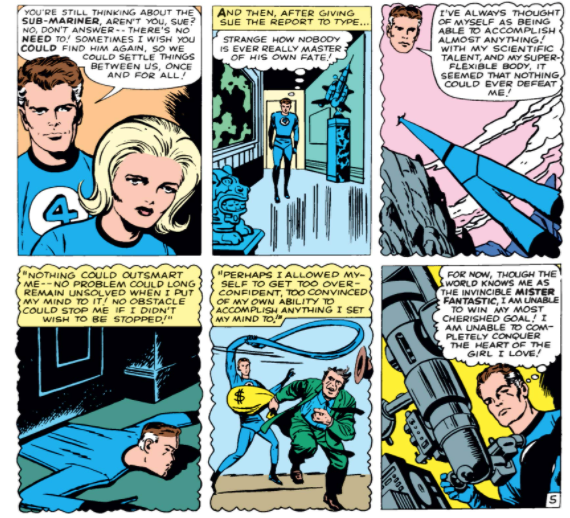
Early in the comic we see Sue using Reed’s “roving-eye” device (basically a drone with a camera) to find Namor:

Reed, naturally, is not thrilled that his fiancee is pining after the Sub-Mariner.

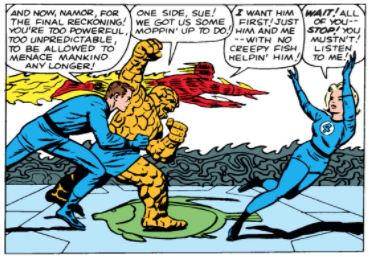
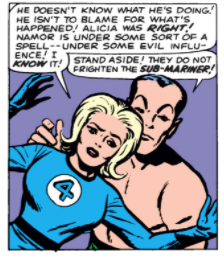
As the team battles Namor, Sue comes to his defense …

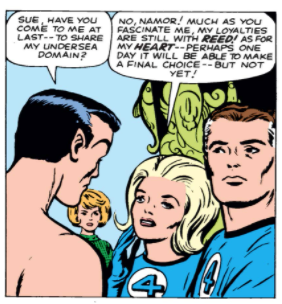
… before finally declaring that despite her “fascination” with Namor, her loyalties lie with Reed. Not exactly an ardent pledge of devotion, and Reed looks understandably skeptical.

That cover

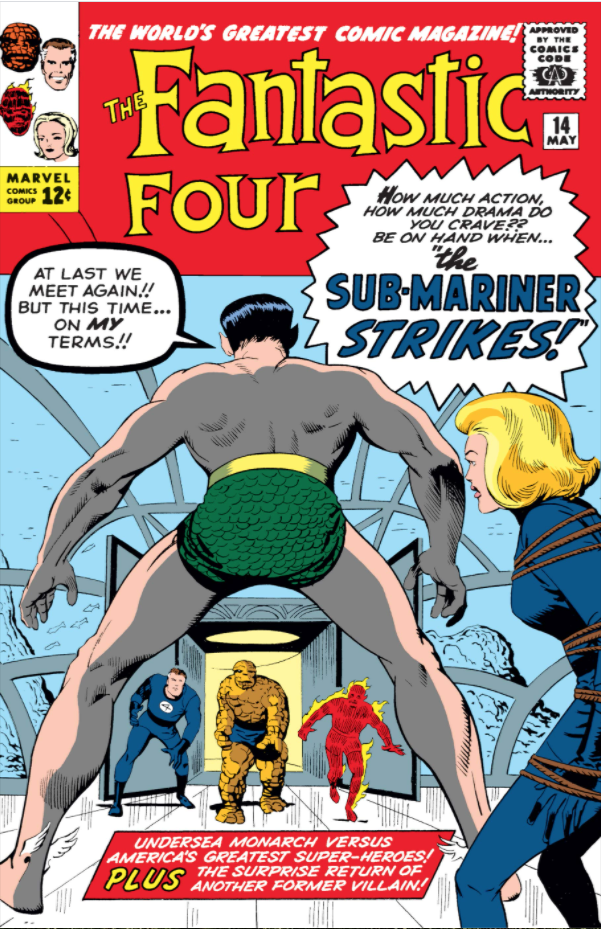
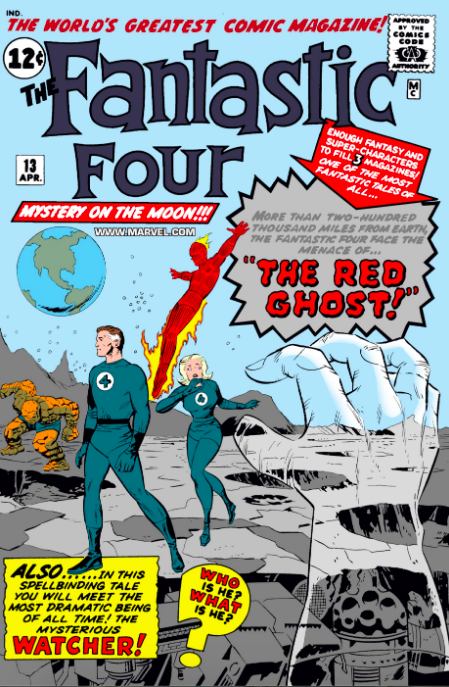
Fantastic Four 14 features a great Kirby cover inked by Steve Ditko, and introduces the cover box, which becomes a Marvel staple. Not every FF issue has a cover box—there was a stretch of about 70 issues in the 70s when it didn’t appear at all—but it always seems to reappear, often drawn by the penciler of the time and reflecting the team’s current membership. Here are few from over the years.

The Briney Deep

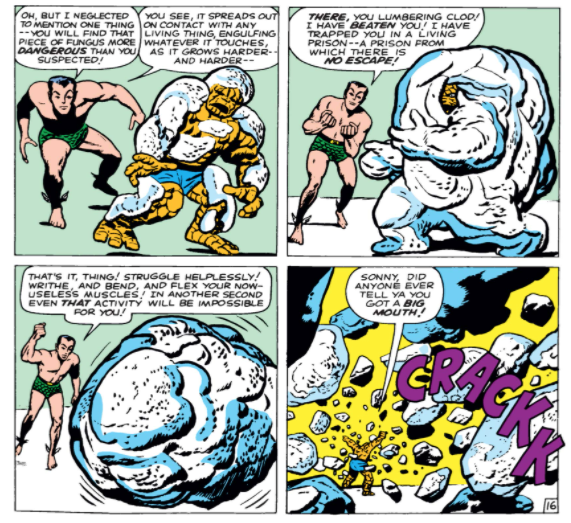
The Sub-Mariner deploys an unusual array of aquatic life in his plot to defeat the FF, some which seem suspiciously useful for the occasion.

Not only can the hypno-fish mind-control Sue across great distances, but it flies and creates an air bubble.

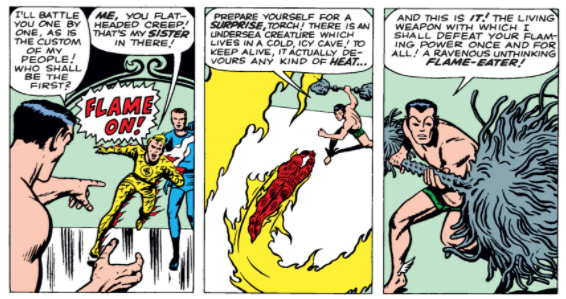
The Flame-Eater is handy when fighting the Human Torch.

And then there’s the super-strong fungus when you need to battle the Thing.

The Sexist Sixties

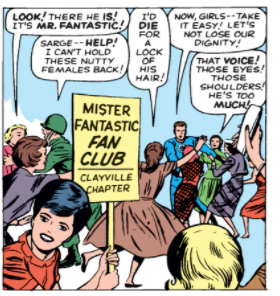
This issue may be Stan and Jack’s low point (so far, anyway). First “nutty females” mob Reed.

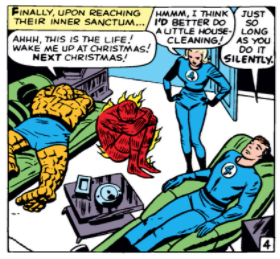
The Sue offers to do some house work over Reed’s objections. And he wonders why she’s lukewarm about him.

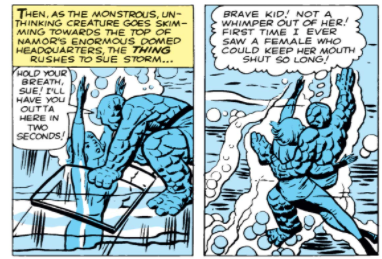
Finally, this gem from Ben.

Whoops

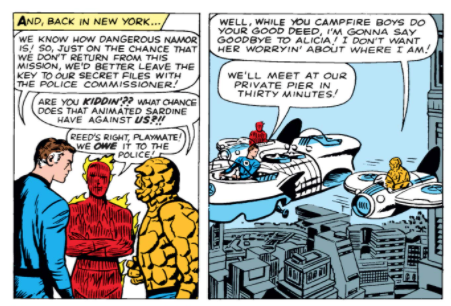
It seems the only reason Stan adds this stuff about the leaving the FF’s secret files with the police is to explain why Jack doesn’t have Reed and Johnny accompany Ben. It doesn’t get mentioned again.

Kirby Krackle

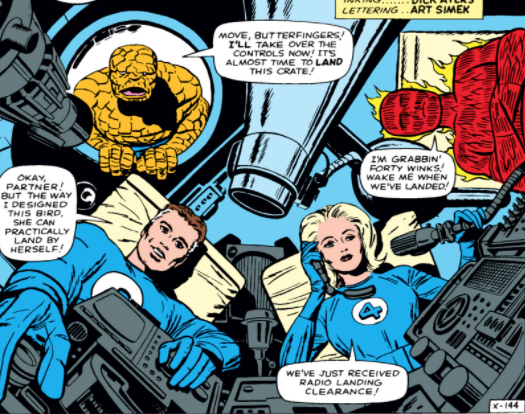
A pretty cool panel from the King. Note the Human Torch sleeping ablaze (in a space ship, no less)

For sale

A mint (9.8) copy sold for $15,000 in 2012. It would probably be closer to $20K today.

Next issue: The Mad Thinker and his Awesome Android!

“The World’s Greatest Comic Magazine” Fantastic Four No. 13

Tags

, , , , ,

Fantastic Four 13
“The Red Ghost and his Indescribable Super Apes”
Published: Jan. 1963
Story: Stan Lee and Jack Kirby
Script: Lee
Pencils: Kirby
Inks: Steve Ditko
Letters: Art Simek
Cover: Jack Kirby and Don Heck

Synopsis

In his lab, Mr. Fantastic unveils his latest discovery to the rest of the team: A substance retrieved from a meteor crater in Arizona that provides “limitless energy.” He tells the team he intends to use to travel to the Moon, as he believes the “the reds” have found a similar substance in Siberia, and he wants to win the space race. The rest of the team persuades him to bring them along.

Meanwhile, “behind the Iron Curtain,” Ivan Kragoff launches his own rocket to the moon crewed by a team of trained apes. He leaves his ship unshielded to deliberately expose himself and the apes to the same cosmic rays that transformed the Fantastic Four. His plan works and the four gain powers.

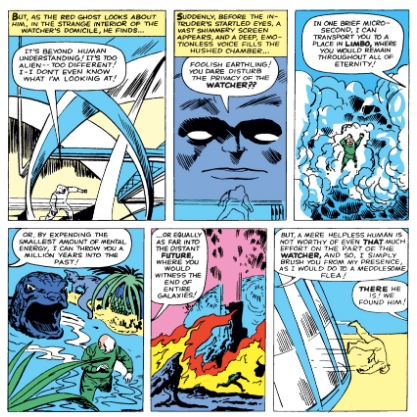
Both ships land on the Blue Area of the Moon, which contains an oxygen atmosphere and the ruins of an ancient civilization. As the Thing confronts Kragoff, now called the Red Ghost, and his apes, the Watcher appears. An ancient alien tasked with observing the Earth, he instructs the Ghost and the FF to “fight it out” for control of the moon. The Ghost captures the Invisible Girl, but as a hostage, she manages to free the apes and foil the Ghost’s plan to use a disintegrator ray on the Human Torch. The Ghost tries to escape, but is bewildered in the Watcher’s house, and is captured by a paralysis ray invented by Reed. He escapes again, only to be pursued by his apes as the FF return to Earth.

What’s going on here?

Fantastic Four 13 marks the first appearance of the Red Ghost (and his Super Apes), a recurring villain who never quite rises to the ranks of the A-list, but appears in plenty of comics over the years.

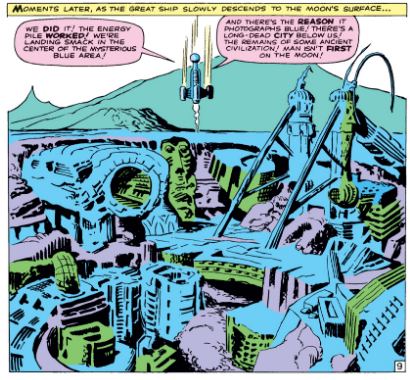
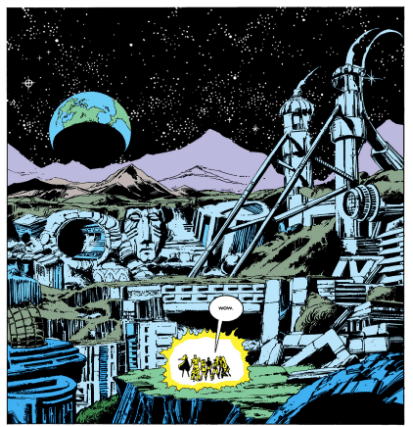
More notably, it’s the first appearance of the Blue Area of the Moon and its most famous denizen, the Watcher. Both appear prominently over the years and across Marvel’s entire line of comics. The Watcher often serves as a Greek chorus, introducing particularly big stories—among them Uncanny X-Men 137 and the death of Phoenix—and “hosted” the What If? comic, where he would introduce stories from alternative timelines. Uatu was killed in 2014’s Original Sin crossover event (he less said about that the better) before being resurrected in last year’s Empyre crossover.

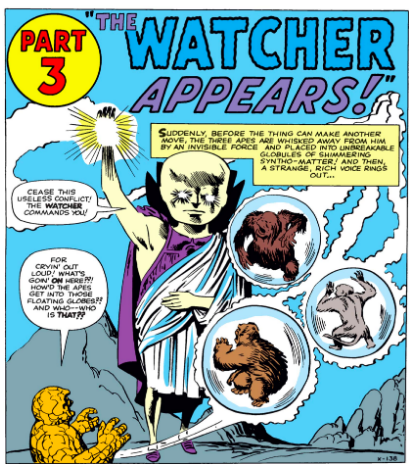
As originally drawn by Kirby in FF 13, the Watcher (not yet named Uatu) has spindly limbs and an enormous head, giving him a distinctly alien appearance.

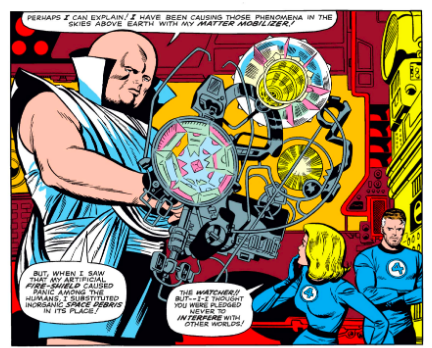
A few years later, in FF 48, Kirby made him significantly beefier.

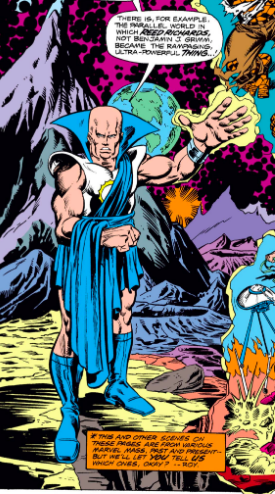
By the time What If? 1 comes out in 1977, he’s pretty much unrecognizable.

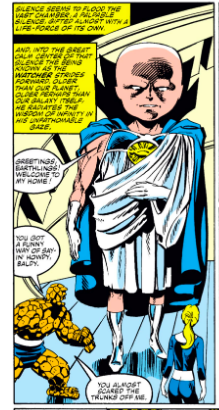
It’s not until John Byrne takes the reins of the FF does he revert back to his original proportions.

FF 261

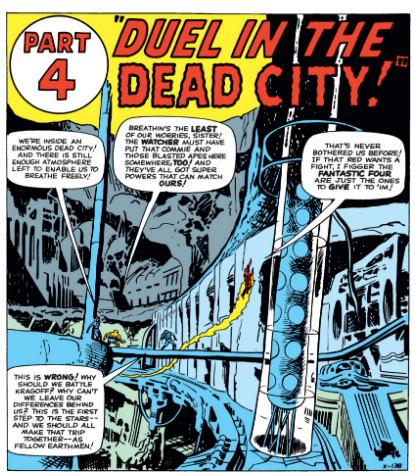
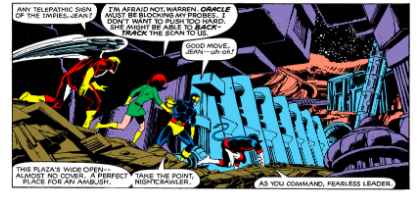
FF 13 also introduced the Blue Area of the Moon, another fixture of the Marvel universe. Created by the Skrulls, it became the home of the Inhuman’s city of Attilan, and featured prominently in X-Men 137, as a battleground between the X-Men and the Shi”ar Imperial guard. Byrne, then the X-Men’s penciler, drew heavily on FF 13 for his images of the Blue Area.

Both the FF and the X-Men arrive at the same location, for example:

Later, both the FF and the X-Men pass the same alien machinery

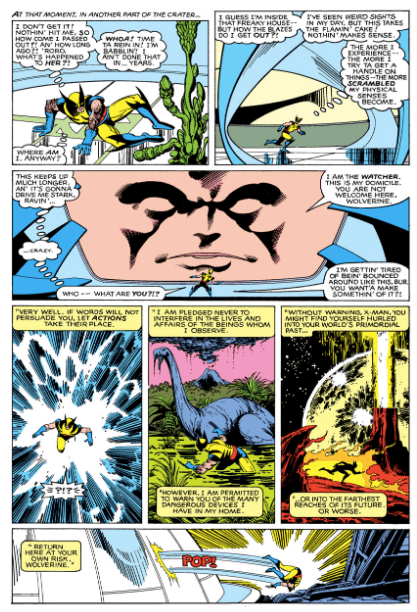
The homage extends to a sequence when the Ghost invades the Watcher’s home, which Byrne duplicates with Wolverine.

Fantastic Four 13 is also notable as the only regular issue of the comic inked by Steve Ditko (he also inked stories in a pair of annuals). Ditko, better know as the penciler of Spider-Man and Dr. Strange, is a good choice here, given the story has few Kirby-esque brawls, but is more about the spooky landscapes Ditko excels at. Despite that, I think his influence is most noticeable in close ups of the FF, and particularly Reed.

Red Menace

The Cold War and space race features prominently in the comic. Reed is determined to beat “the reds” to the Moon, while Kragoff wants to the extend the “communist empire.” Stan is notably averse to mentioning the Soviet Union by name even if Kragoff’s ship features a hammer and sickle.

They’re fighting again

This time it seems more playful.

Dig That Kirby Krackle

This is a fun sequence.

And so is this panel.

Oops

It seems like Stan is trying to explain why Jack drew this thing.

The sexist sixties

More cringing from Sue

For sale

A mint (9.8) edition of FF 13 will cost you about $68,000

Next issue: The Puppet-Master and the Sub-Mariner team up!

“The World’s Greatest Comic Magazine” Fantastic Four No. 12

Tags

, , , , ,

Fantastic Four 12
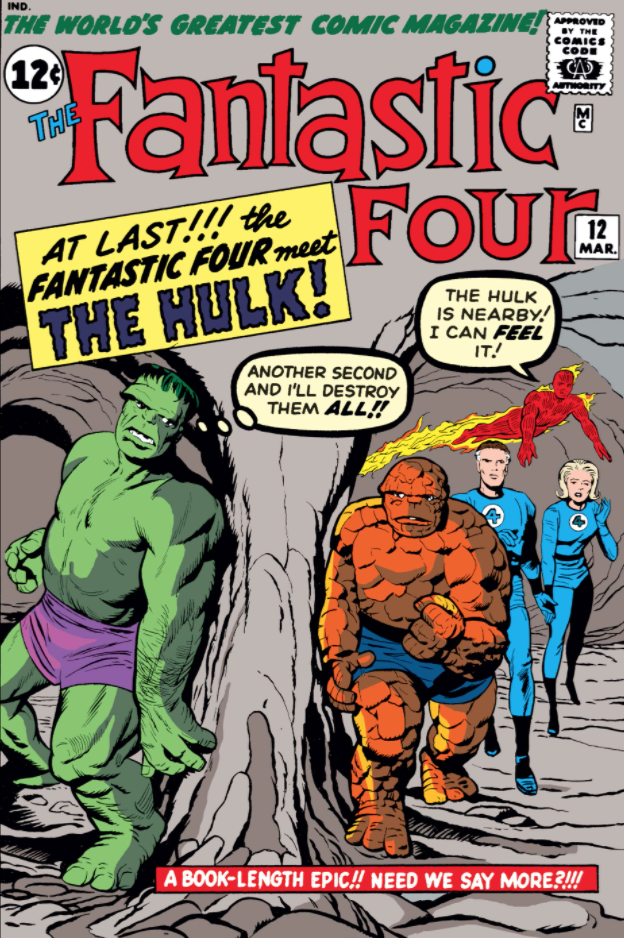
“The Incredible Hulk”
Published Dec. 1962
Story: Stan Lee and Jack Kirby
Script: Lee
Pencils: Kirby
Inks: Dick Ayers
Cover: Kirby and Ayers

Synopsis

Ben Grimm and Alicia Masters are leaving the symphony when a company of soldiers mistake Ben for the Hulk and try to capture him. Later, at the (still unnamed) Baxter Building, General Thunderbolt Ross tells the Fantastic Four the Army is searching for the Hulk, who it believes is destroying military hardware. The team discusses how they would capture the Hulk.

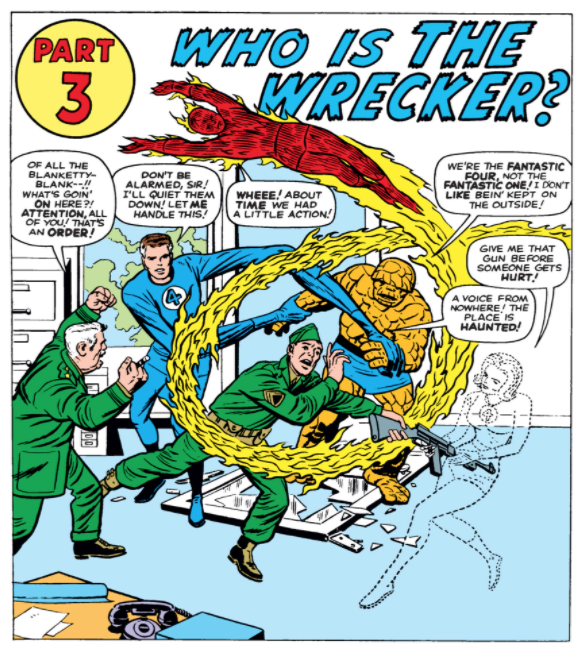
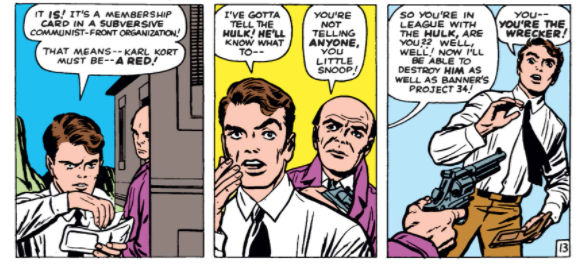
The FF and Ross fly to the southwest in a newly remodeled Fantasticar, where the meet Bruce Banner (secretly the Hulk, of course), his sidekick Rick Jones, and his new assistant Karl Kort. Banner and Jones try to persuade Ross and the FF that the Wrecker, not the Hulk, is not responsible for the damage but the FF persist in investigating. While leaving, Kort drops his wallet and when Jones finds it, he discovers Kort is a communist. Kort—in a Scoobey-Doo-esque plot twist that should surprise no one—is revealed to be the Wrecker, and takes Jones prisoner. He then blackmails the Hulk to drive the FF out of the area.

The FF searches for the Hulk in the tunnels beneath the military installation, and he finally confronts them. After a battle, the Hulk is knocked out by a ray from a giant robot wielded by the Wrecker. The Thing and the Invisible Girl apprehend Kort while the Hulk escapes.


What’s going on here?

It takes an extremely convoluted story to do it, but after 12 issues, the Fantastic Four finally cross over with another headliner in the Marvel Universe. This same month, the FF will also make a brief appearance in Amazing Spider-Man 1. These stories firmly plant the FF in the same interconnected world as other Marvel characters, and helps establish the pattern of cross overs and tie-ins that knit together the Marvel universe. That shared universe is big part of the secret sauce that makes comics, and later Marvel’s movies, so addictive to fans. It’s both the fear of missing out on a vital chapter, and the rewards that come from knowing the full story. Marvel would of course learn to cynically exploit this later with massive crossover events, but for fans who first encountered it here in its embryonic stage, it much have been thrilling.

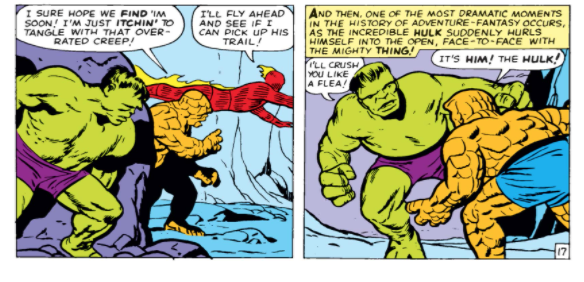
The story also features a fight between the Hulk and the Thing, the first of dozens of times they tangled. It takes 17 pages to get there, and Stan violates the first rule of writing by telling us, instead of showing us, what a big deal it is with a caption describing it as “one of the most dramatic moments in the history of adventure-fantasy.”

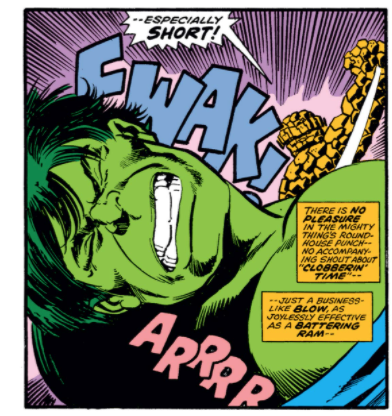
Given their roles as Marvel’s two biggest, baddest bruisers, it’s perhaps inevitable they would fight frequently. The Hulk—stronger and more ferocious—usually comes out on top, although the Thing occasionally scores a moral victory, often by displaying more “heart.”

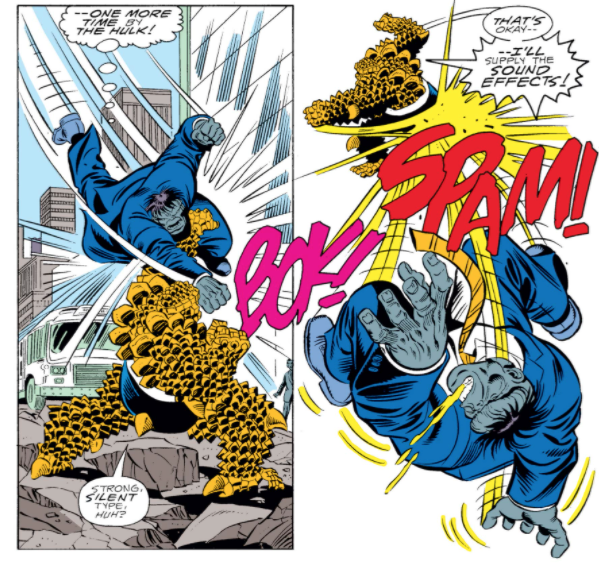
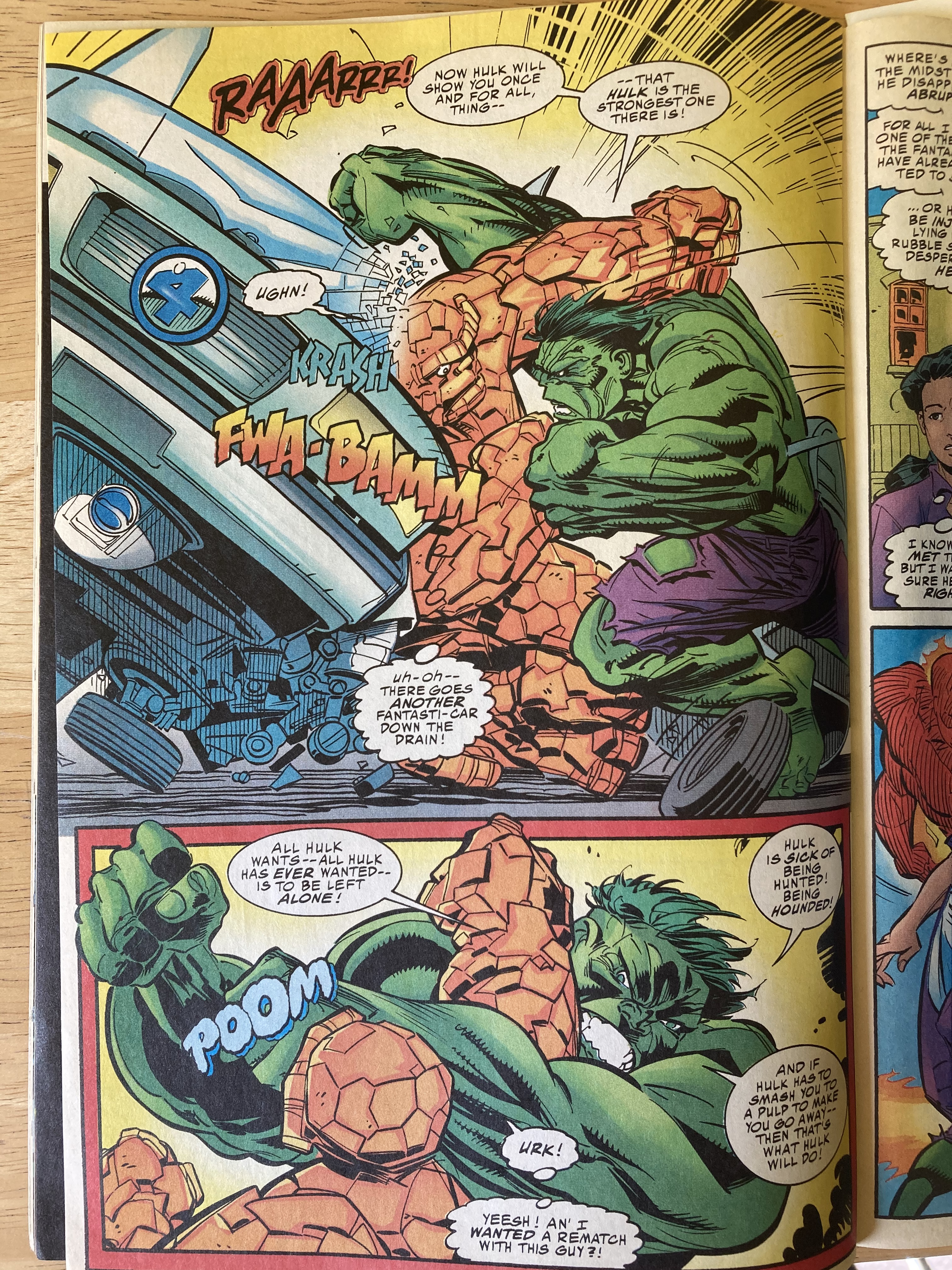
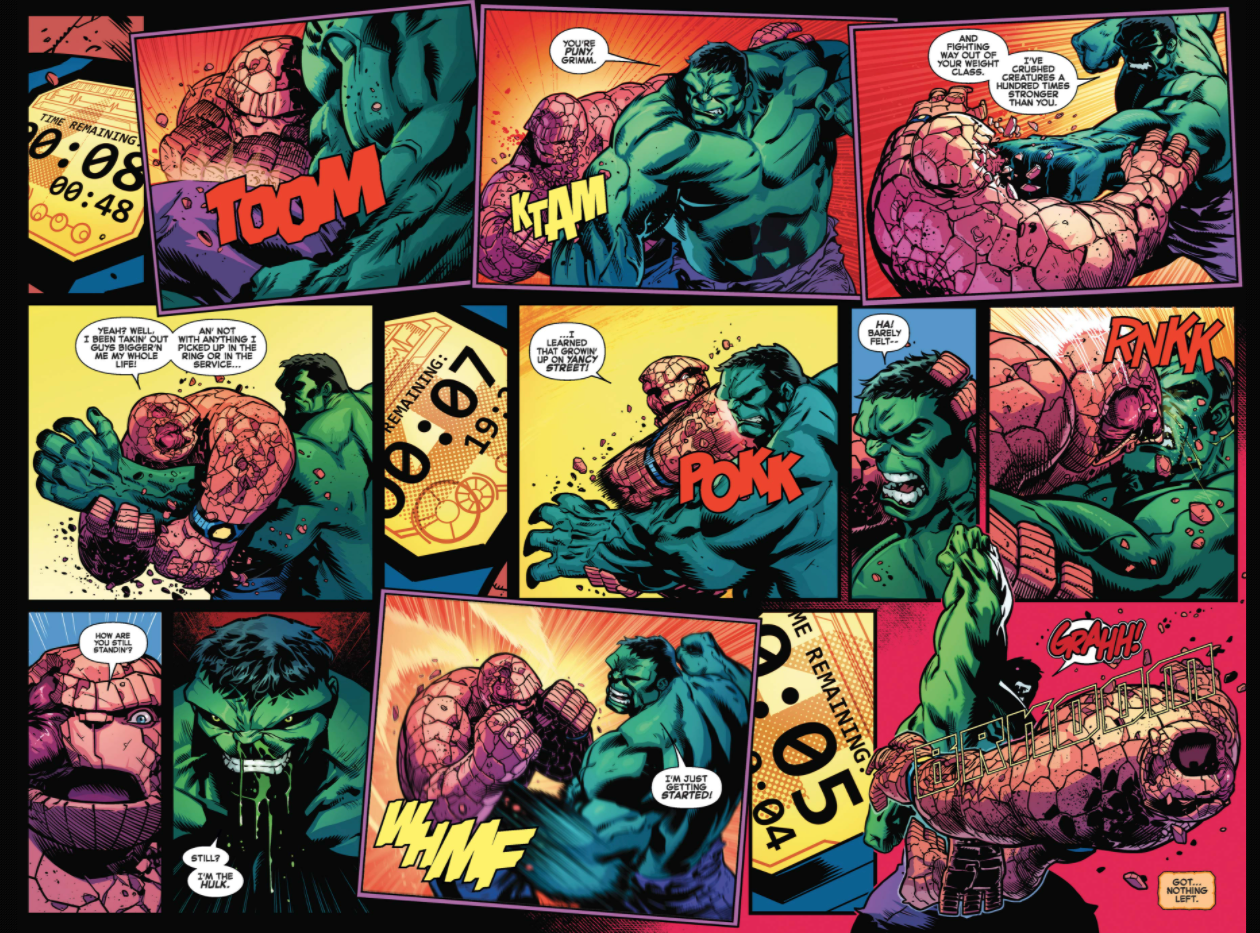
While there are far too many of these fights to recount here, (although blogger John Cimino valiantly tries to do so in his Hero Envy blog here) here’s a taste of them fighting in the 1970s …

FF 166 (1975, art by George Perez and Vince Coletta)

… in the 1980s …

FF 320 (1988, art by Keith Pollard and Joe Sinnott). FYI, both the Thing and Hulk were mutated away from their classic forms during this stretch.

… in the 1990s …

Rampaging Hulk 5 (1998, art by Rick Leonardi and Dan Green)

… and this century.

FF 13, vol. 6 (2019, art by Sean Izaakse)

New wheels

The issue debuts the new, more space-age Fantasticar. The older “flying bathtub” version will still make occasional appearences.

They’re fighting again

This time everyone joins in.

The sixties are sexist

After last issue’s defense of Sue’s contributions to the team, we sink to new lows with more painful stereotyping.

Kirby Krackle

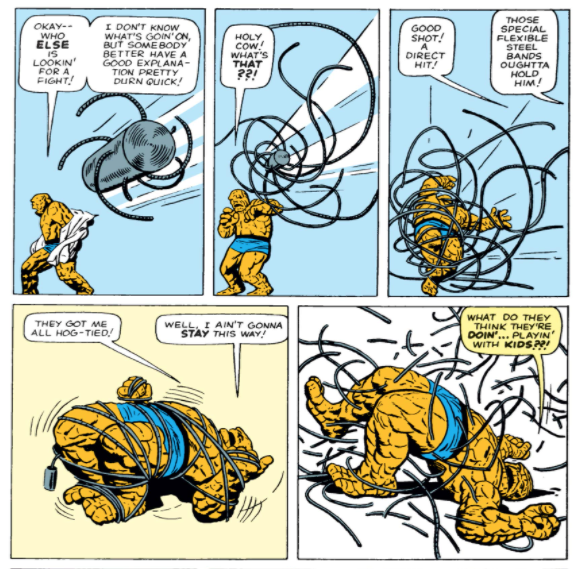
Check out this cool sequence of Ben fighting the soldiers.

The red menace

Not only does Rick Jones feel entitled to go through Kort’s wallet, but he is horrified by what he discovers.

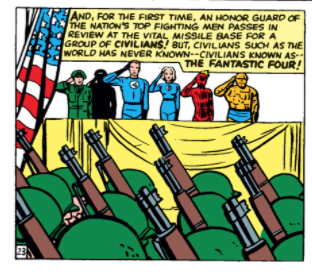
It’s an honor

The FF is treated to a rare military parade, according to Stan. At least Reed and Ben are veterans.

For Sale

Thanks to the appearance by the Hulk, FF 12 will set you back about $200,000

Next issue: The Red Ghost and his Super Apes!

“The World’s Greatest Comic Magazine” Fantastic Four No. 11

Tags

, , , , ,

FantasF

Fantastic Four 11
“A Visit with the Fantastic Four” and “The Impossible Man”
Published: Feb. 1963
Story: Stan Lee and Jack Kirby
Script: Lee
Pencils: Kirby
Inks: Dick Ayers
Cover: Kirby

Synopsis

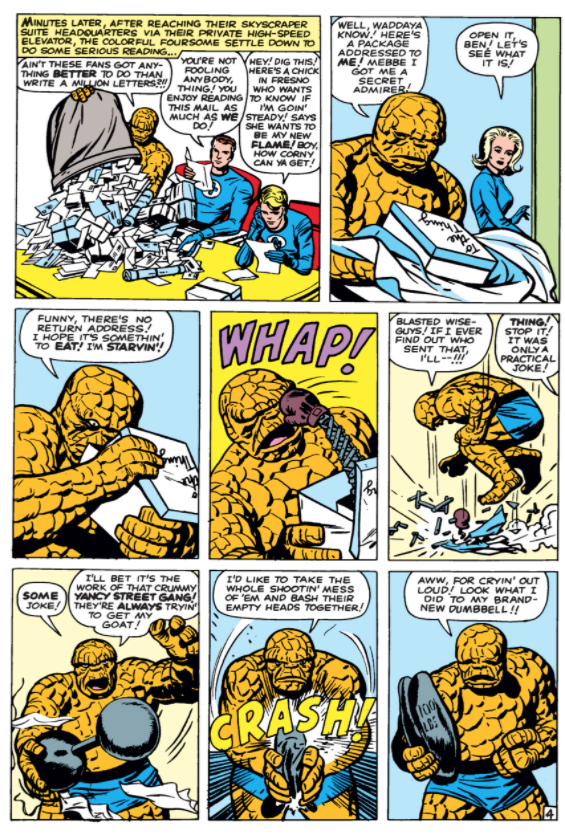
This is an unusual issue in that there are two short stories instead of one, full-length story. The first is devoted to character building and revealing more of the Fantastic Four’s back story, allegedly in response to readers’ requests. The plot, if you can call it that, begins with the FF showing off in front of their fans, then reading fan mail after Ben is (again) temporarily turned human again by a concotion of Reed’s. They recount the team’s origins, filling in some important details about Reed and Ben’s time together in college and in the military, before they have a surprise birthday party for Sue.

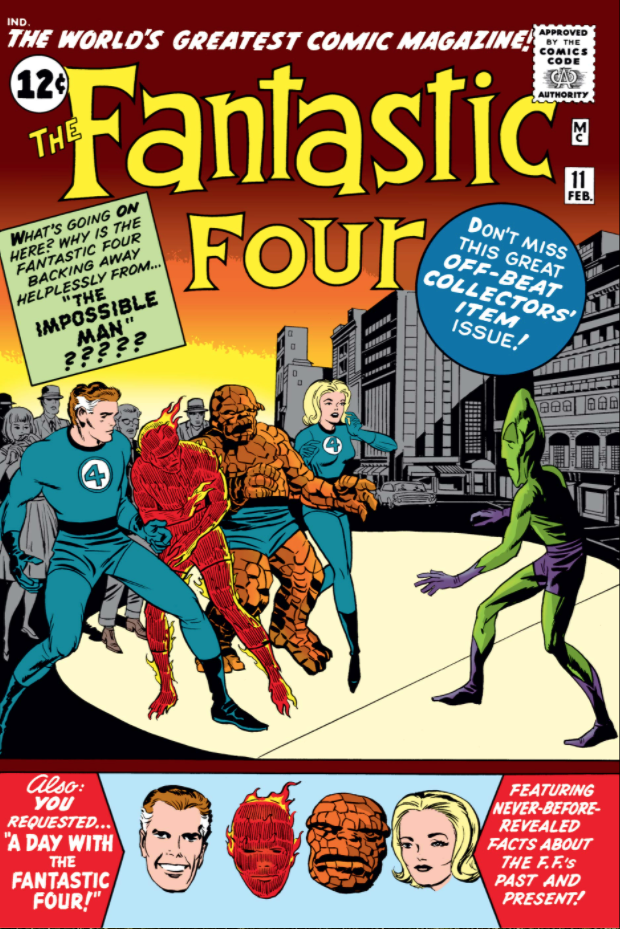
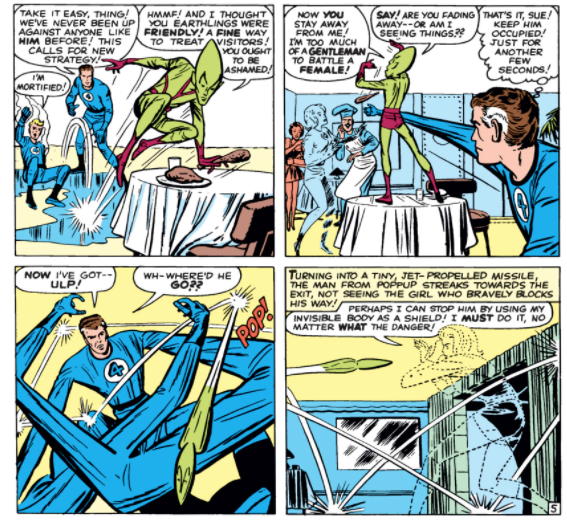
The second story introduces the Impossible Man, a recurring character—slash—blight from the planet Poppup who reappears over the years. In this story, the FF are summoned to capture the Impossible Man, who can change his form into any object or substance. After futilely chasing him around New York, Reed decides it’s best to ignore him and the Impossible Man grows bored and eventually returns home.

What’s going on here

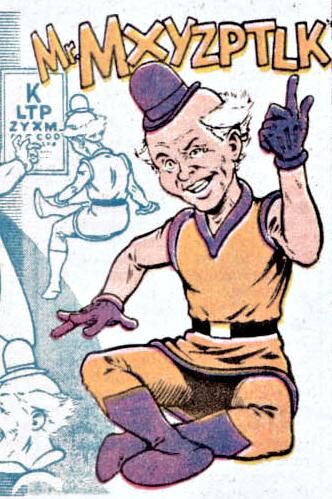
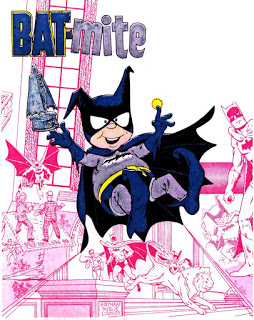
Both stories are significant, although for very different reasons. For better or worse (and it’s mostly been worse), the Impossible Man is an established part of the Marvel Universe, showing up over the decades in stories that tend to be full of gags and fourth-wall breaking. Your mileage may vary, but I tend to loathe these stories, which often feel self-indulgent and pointlessly silly. He’s very much a character of the Silver Age, and a reminder that these publications are called “comic books” for a reason. The Impossible Man owes a lot to Plastic Man, a Golden Age character with similar powers and tone, but his role as antagonist to the FF is most reminiscent of that of DC’s Mr. Mxyzptlk and Bat-Mite, who would make life miserable for Superman and Batman (and their readers), respectively.

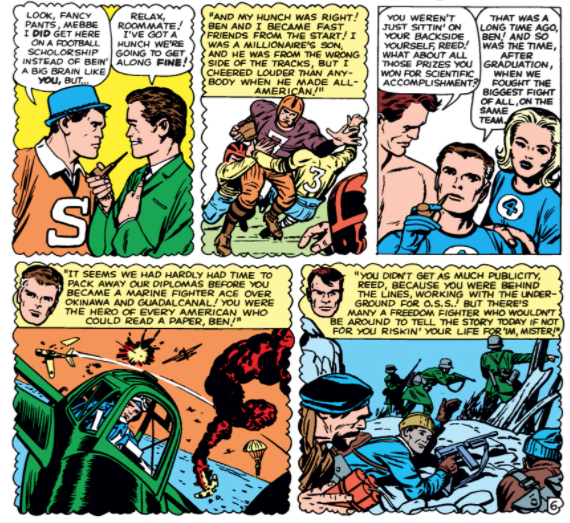
In the first story, Stan and Jack eschew the normal conventions of the genre, dispensing with a villain and fight, and instead spend 10 pages developing the characters and filling in some of the blanks of their story. We learn that Reed and Ben were roommates in college, where Ben was a football star “from the wrong side of the tracks” while Reed was a pipe-smoking “millionaire’s son.” We also discover the served in World War II—Ben as a pilot in the Pacific theater, Reed as an OSS operative—placing their ages around 40 in 1961. That eventually gets retconned as another, unnamed conflict as Marvel’s sliding time scale means they are too young to be WWII veterans.

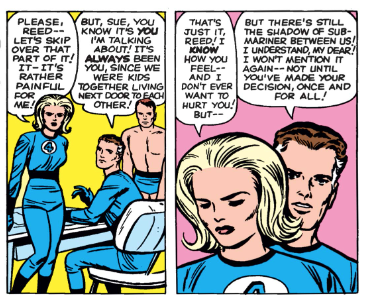
We also learn how Reed and Sue met, when Reed describes them as “kids together living next door to each other.” Sue continues to be ambivalent about Reed in this issue, which he attributes to her interest in the Sub-Mariner.

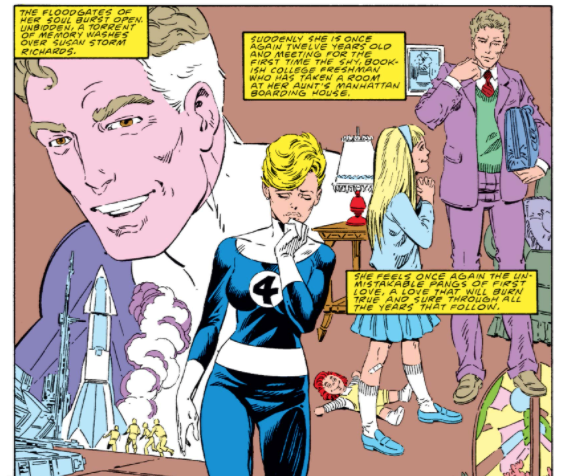
Growing up as kids would suggest they were roughly the same age, but later stories establish Reed as significantly older than Sue. In Fantastic Four 291, from 1986, John Byrne describes Sue as a 12-year old (who looks like a six-year-old, complete with doll) with a crush on the college-aged Reed.

FF 291

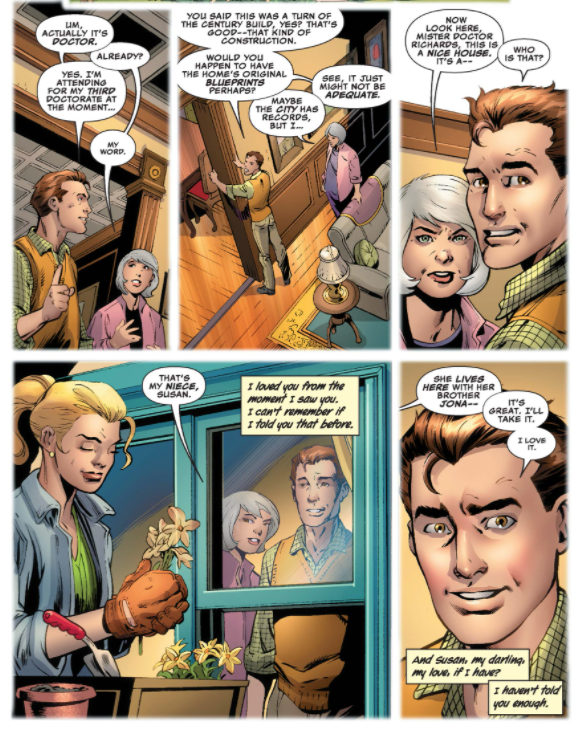
Later creators realized the creepiness of that scenario, and in 2013, writer Matt Fraction retconned Byrne’s retcon, making Sue more age appropriate.

FF 4 (vol. 3)

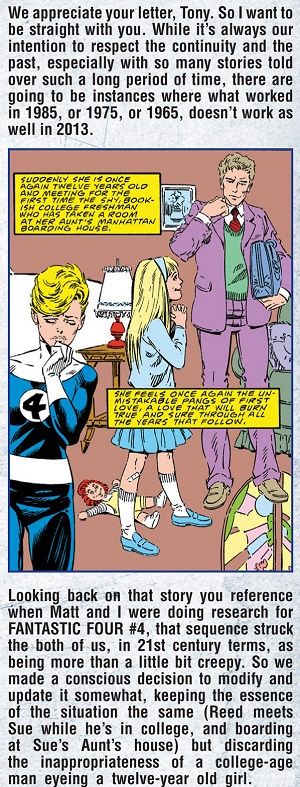
The editors were upfront about the need to address the age issue (thanks to Brian Cronin in CBR.com for detailing this history).

They’re (not) fighting again

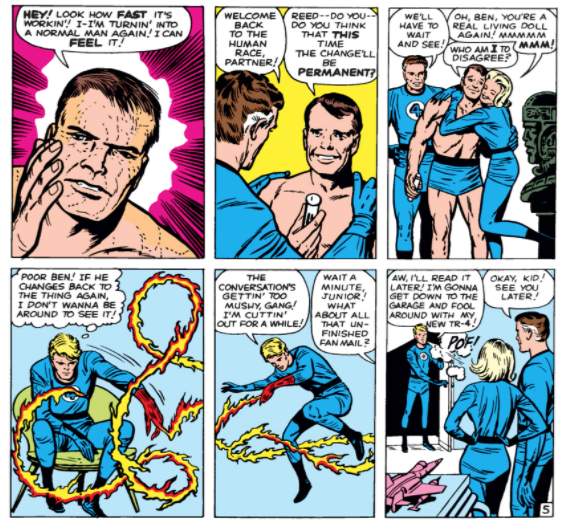
Fantastic Four 11 contains a nice moment where Johnny, concerned about the implications of Ben reverting back to human, reveals his actual feelings about his frequent sparring partner. (A TR-4 is apparently a sports car made by Triumph).

Meet the Yancy Street Gang

FF 11 also marks the first time Bn is pranked by the Yancy Street Gang, a group from his old neighborhood on the Lower East Side. The Yancy Street Gang becomes another recurring feature of the FF, and Yancy Street (a riff on the real-life Delancy Street) grows in importance as a touchstone for Ben over the decades. The FF’s current headquarters is located there.

and Willie Lumpkin

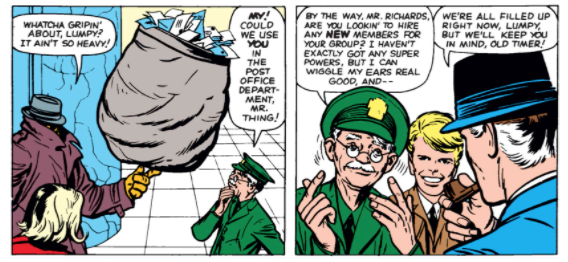
We’re also introduced to Willie Lumpkin (referred to here as Mr. Lumpkin, or Lumpy), the FF’s elderly letter carrier with the “power” to wiggle his ears.

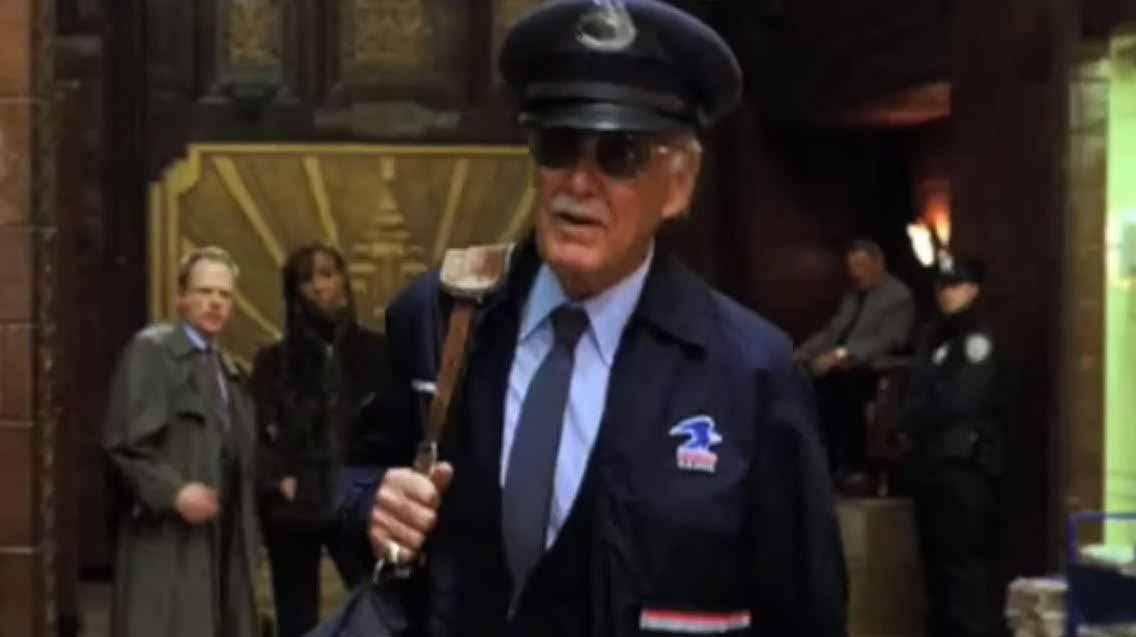
In a fun bit of casting, Stan Lee played Willie in the 2005 Fantastic Four movie.

The sexist sixties

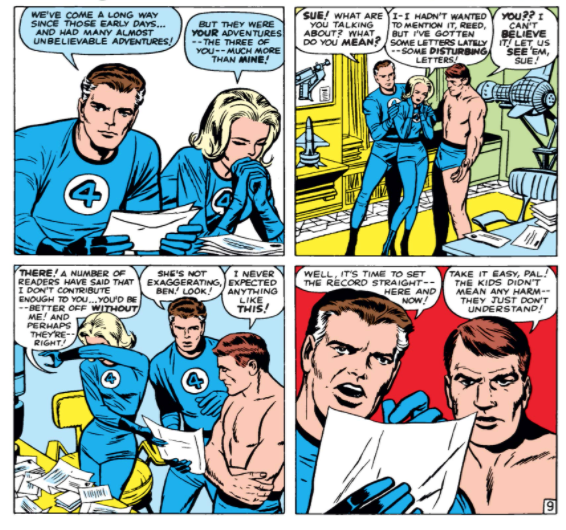
In a strange sequence, Sue recoils at the letters that point out that she’s not pulling her weight on the team (probably an accurate reflection of the real-life letters Marvel was getting).

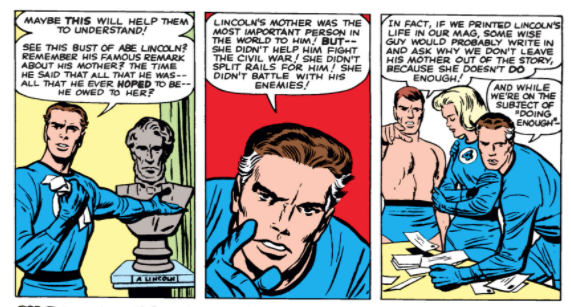
Before noting the times Sue has rescued the rest of the team, against the Skrulls and Dr. Doom, Reed makes a bizarre analogy to Abraham Lincoln’s reverence for his mother as evidence of Sue’s value (and of course the FF has a bust of Honest Abe in their home. Who doesn’t?).

Ben later suggests if readers want to watch women fight, they should “go see lady wrestlers.”

Let’s talk about us

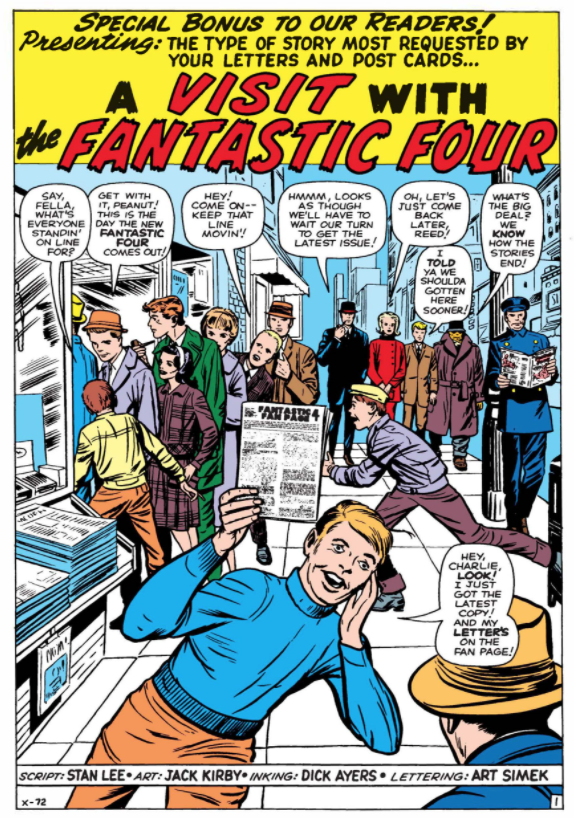
The issue opens with a knockout Kirby splash page with the FF, dressed like they’re in the 1940s, lining up to buy the latest edition of the Fantastic Four comic.

For sale

A mint (9.8) issue of FF 11 is worth about $49,000.

Pin up

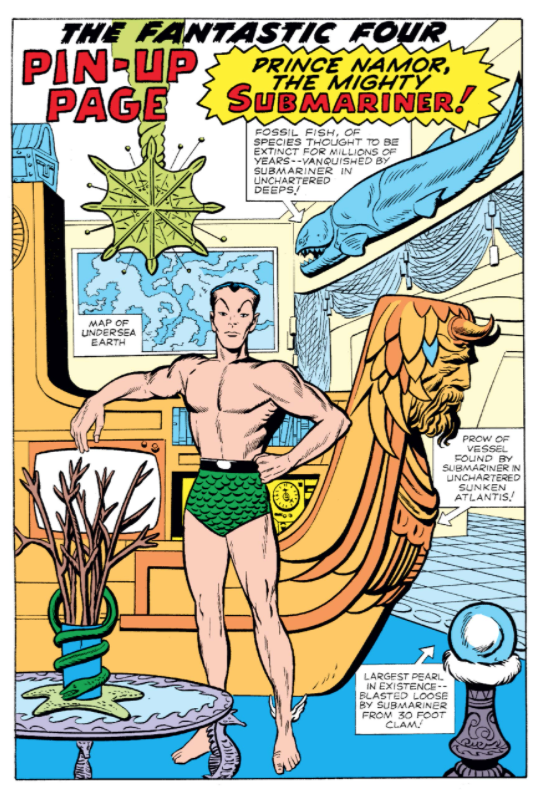
The Sub-Mariner gets his own pin-up

Next issue: The FF meet the Incredible Hulk!

“The World’s Greatest Comic Magazine” Fantastic Four No. 10

Tags

, , , , ,

Fantastic Four 10
“The Return of Doctor Doom”
Published: October 1962
Plot: Stan Lee and Jack Kirby
Script: Lee
Pencils: Kirby
Inks: Dick Ayers
Cover: Kirby and Ayers

Synopsis

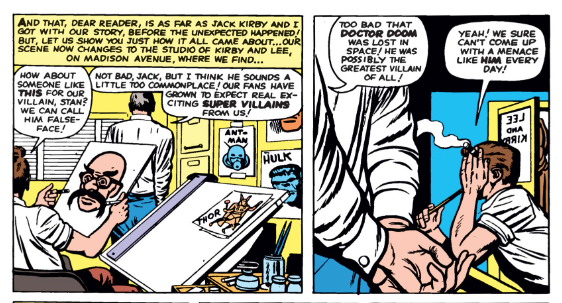
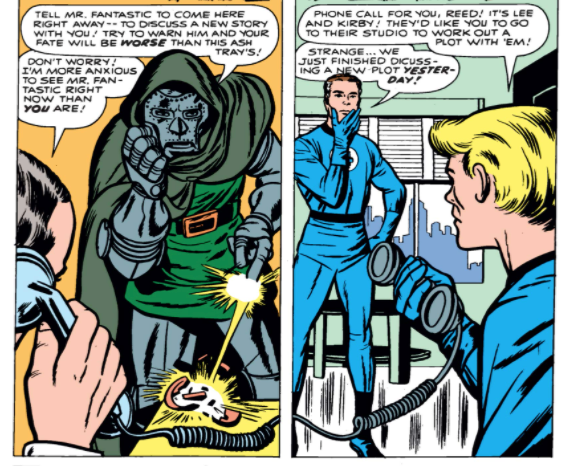
A meandering start to the comic is revealed to be a case of writer’s block from creators Stan Lee and Jack Kirby, who are plotting the issue only to be interrupted by Dr. Doom. Doom, last seen lost in space, was rescued by an the Ovoids, an alien race that taught him to the ability of transferring his mind into another body. They returned him to earth, and Doom demands Lee summon Reed Richards so that Doom can capture him and switch minds.

As planned, the rest of the FF arrive to rescue Reed, who unbeknowst to them is in the body of Doom. Doom, in the body of Reed, emprisons Reed and convinces the rest of the team to undergo a shrinking process he says will make them more powerful, but will actually reduce them to nothingness. Reed escapes and before the team undergoes the shrinking process, Johnny uses his powers to create a mirage of dynamite. While Reed (as Doom) tries to prevent it from exploding, Doom (as Reed) flees, each revealing their true nature. Confronted, a distracted Doom lets his mental power slip and he and Reed switch bodies again, returning to their true selves. As Doom tries to escape, he accidentally triggers the shrinking ray, which renders him microscopic.

What’s going on here?

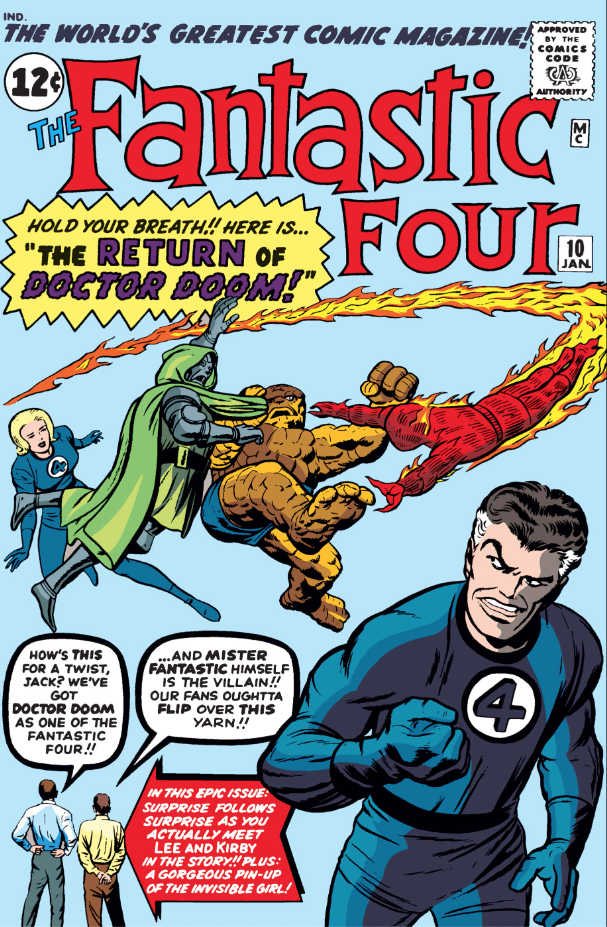
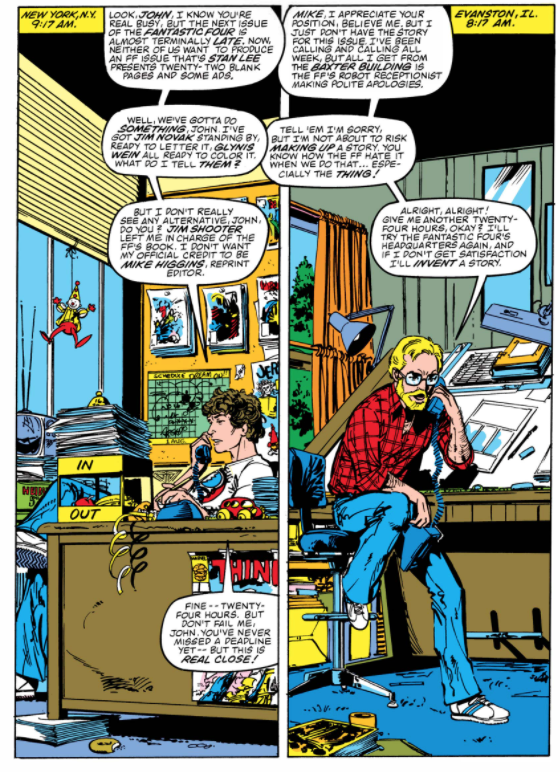
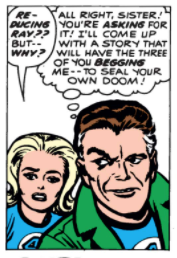
Aside from the return of Doom, this convoluted story is notable for the extremely meta insertion of the creators of the comic into the comic itself. Prior to this issue, members of the FF referred to comics, and Johnny read an issue of the Hulk, but this is the first indication that there is an in-universe Fantastic Four comic that recounts their adventures. We also learn the team is actively involved in telling their own stories to Stan and Jack, who appear in the comic (and on the cover!) but without ever revealing their faces

The conceit returns on occasion, often as a comedic device but occasionally in more serious stories, such as Fantastic Four 261, where author John Byrne is summoned into space to witness the trial of Reed Richards. The likelihood of a comic creator inserting him or herself into a story seems directly correlated to the size of the creator’s ego. (This device is similar but different from the fourth-wall breaking of comics like She-Hulk, Deadpool, and Animal Man, where the characters understand they are in a comic, and address the reader or creator directly).

FF 261

The old switcheroo

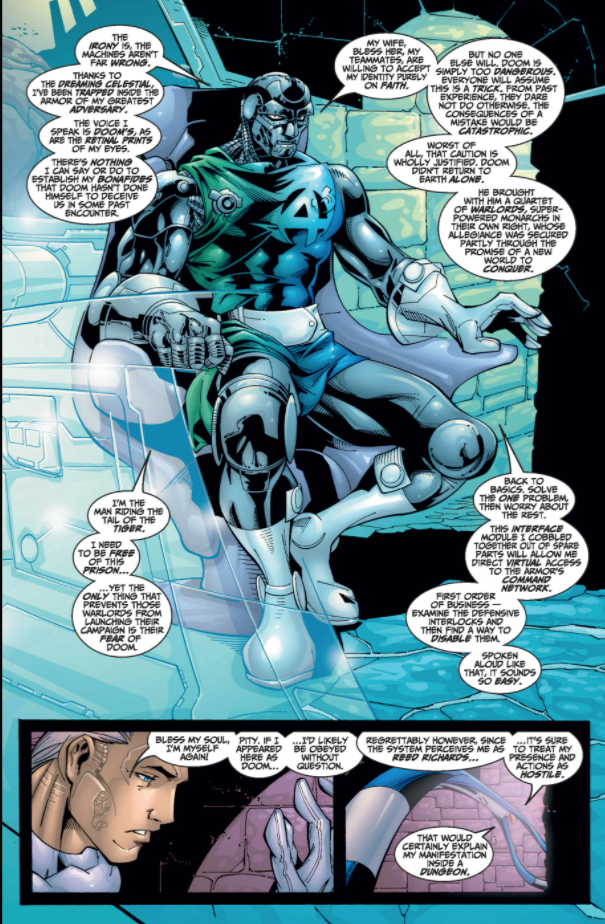
The story also is the first instance of Doom switching bodies with someone else, a power he manifests over the decades, although I don’t recall the Ovoids being mentioned again. He switches bodies with Reed at least one more time I’m aware of, in an arc written by Chris Claremont around the year 2000. In that story, the switch is performed by a Celestial, not Doom himself.

FF 27, vol. 3. Art by Salvador Larroca and Art Thibert

Back in issue 10, Doom (as Reed) talks more like a 30s gangster than the monarch of an Eastern European country.

Trapped!

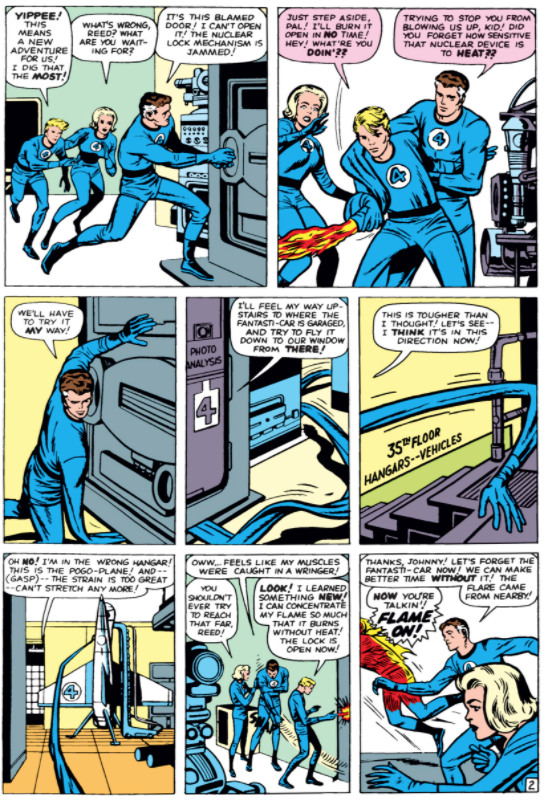
In one of the story’s odder moments, Reed, Sue, and Johnny are stuck in Reed’s lab because the “nuclear lock mechanism” is jammed. It’s yet another reminder of how atomic power is sprinkled liberally across these stories. And while the trio spend a page being trapped, it doesn’t advance the story in any way, save to show that Stan and Jack are spinning their wheels.

Weird science

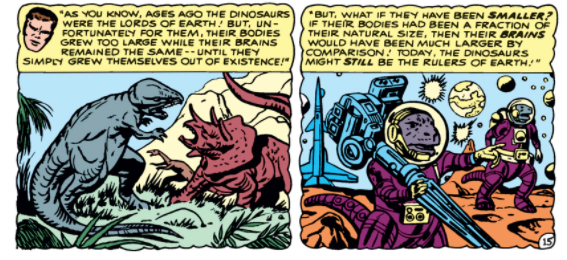
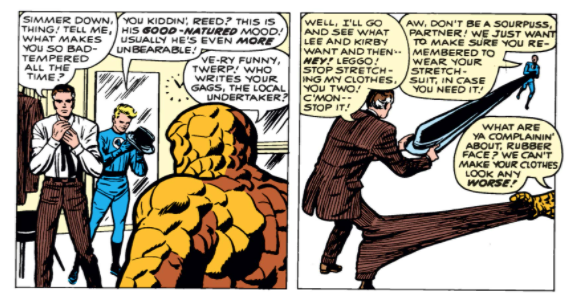
Doom, as Reed, comes up with a pseudo-scientific explanation of why the rest of the team should subject themselves to his shrinking ray (he later concedes it’s bullshit and that Reed would never have fallen for it).

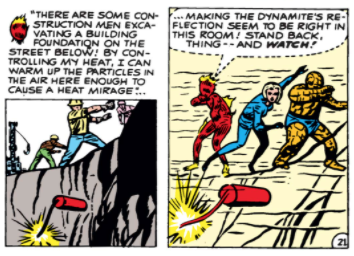
Later, Johnny uses his powers to create a mirage of a stick of dynamite so real both Reed and Doom fall for it.

We get a demonstration of unstable molecules at work in Reed’s suit and hat.

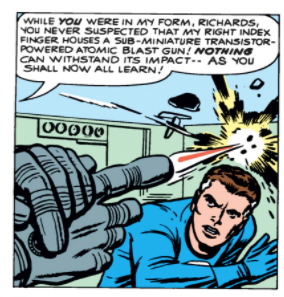
And Doom invokes nuclear power again as he fires the “sub-miniature transistor powered atomic blast gun” housed in the index finger of his armor (this weapon reappears, but never with such an awesome name).

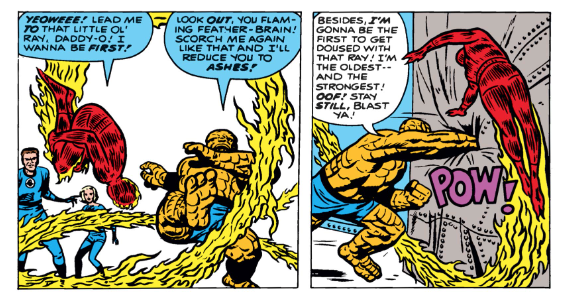
They’re fighting again

Kirby Krackle

A cool panel here from Jack

Pin up

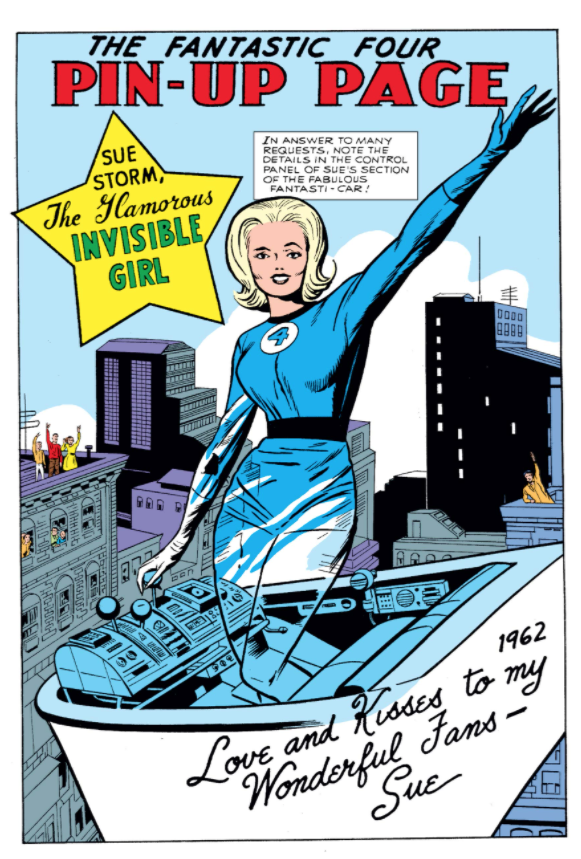
The “glamorous Invisible Girl” gets a pin up that shows the controls of the Fantasticar (apparently by popular demand).

For sale

A mint (9.8) version of Fantastic Four 10 is worth about $25,000.

Next issue: The first appearance of the Impossible Man