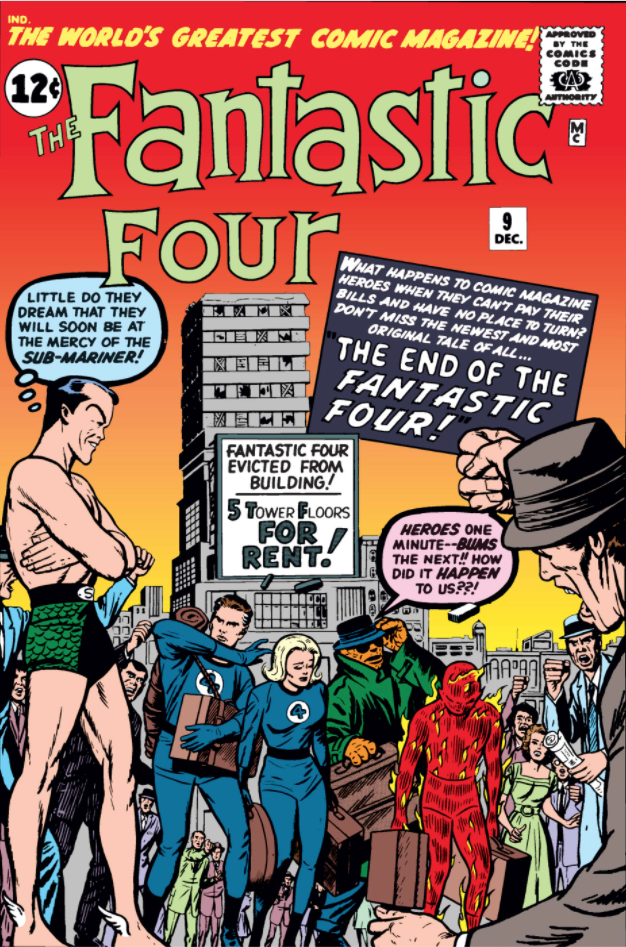
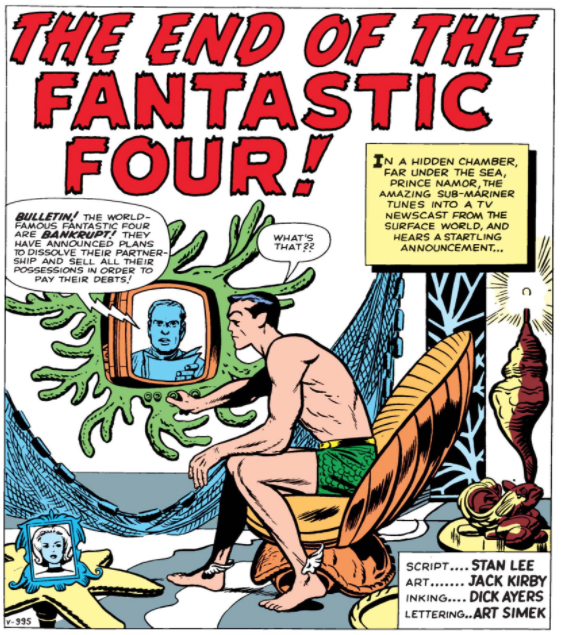
Fantastic Four 9 “The End of the Fantastic Four” Published: Sept. 1962 Plot: Stan Lee and Jack Kirby Script: Lee Pencils: Kirby Inks: Dick Ayers Lettering: Artie Simek Cover: Kirby & Ayers
Synopsis
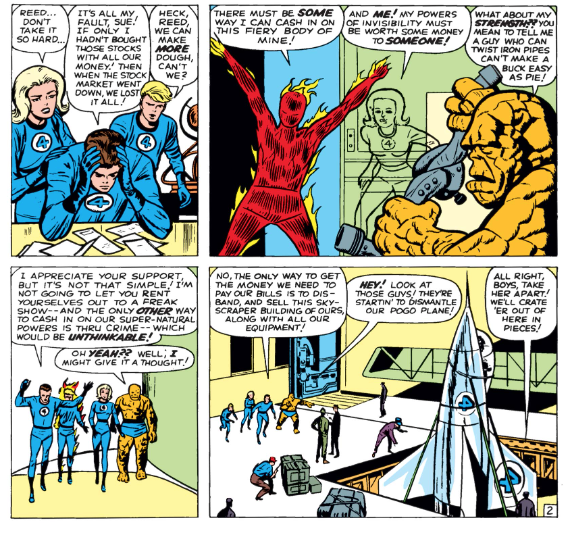
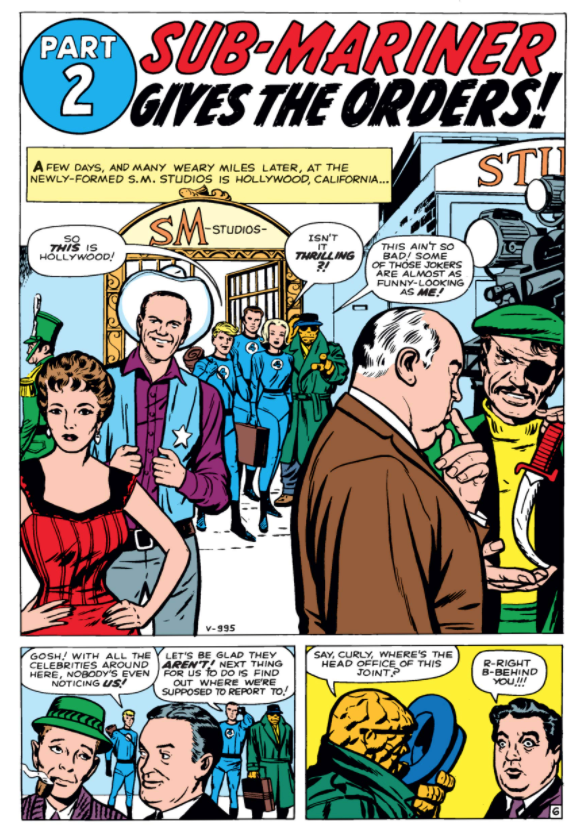
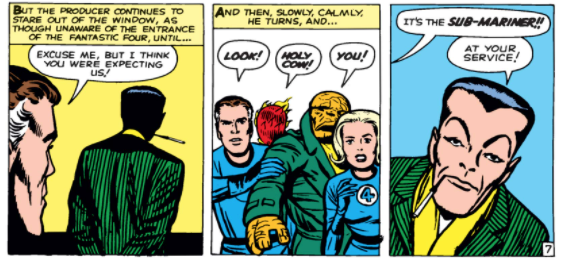
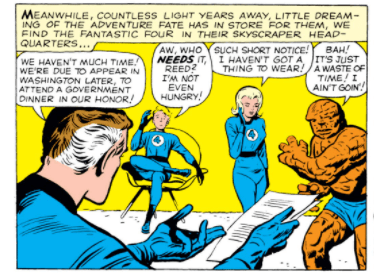
The Fantastic Four are broke, a result of Reed’s poor stock market investments, and are selling their (not-yet-named) headquarters and equipment. The Sub-Mariner gets wind of their plight and launches a plan. The team is offered $1 million to appear in a movie, which they eagerly accept only to later discover is being bankrolled by Namor.
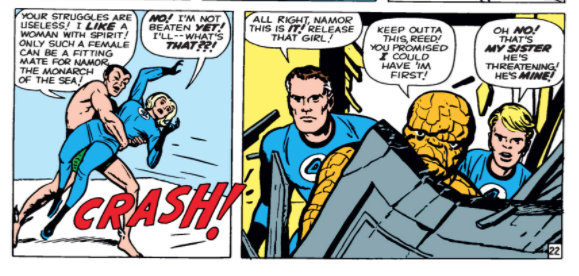
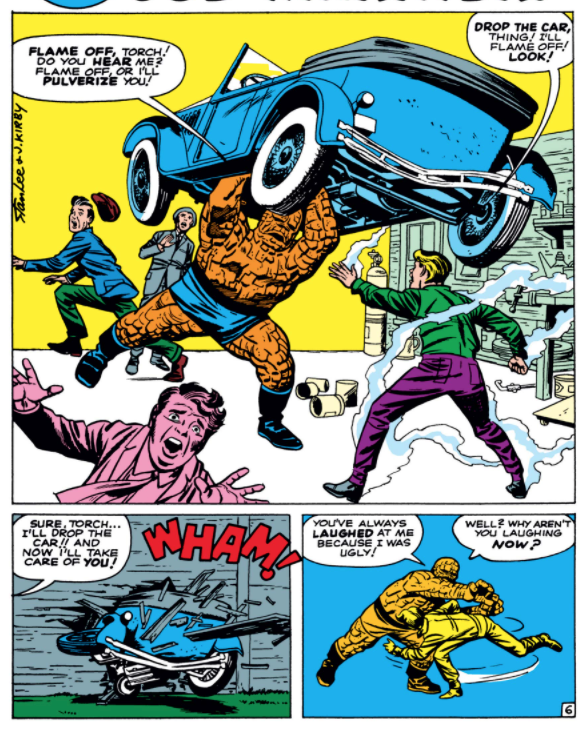
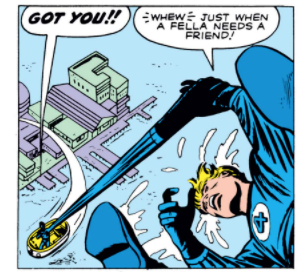
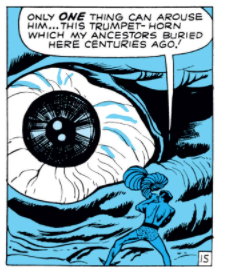
After dining with the Invisible Girl, Namor escorts the team’s male members to their “scenes” which are actually ambushes. Mr. Fantastic fights the mythical Cyclops, the Human Torch must escape a fire-proof African tribe (really) and the Thing battles Namor himself. Finally, after Sue rejects Namor’s marriage proposal, they fight before the rest of the team arrives to save her. She brokers a peace that lets the Sub-Mariner leave unharmed in exchange for the team receiving their money and appearing in the movie.
This is the first issue with proper credits (previous issues were signed by Stan and Jack), so inker Dick Ayers and letterer Artie Simek finally get their names in print.
What’s going on here?
This bizarre story strains credulity at every turn. From Reed losing everything in the stock market to Namor financing a movie studio (“SM Studios”) to the ridiculous traps he sets for the team, the comic feels more like an absurdist Julie Schwartz-era Superman that the science-fiction infused Fantastic Four. There’s very little here that advances the characters and their story, save for a brief reappearance of Alicia Masters and her deepening friendship with Ben. The issue is otherwise a madcap lark, or a waste of time, depending on your appetite for this sort of thing.
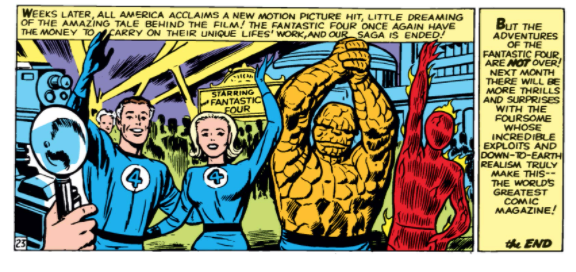
Without any indication of irony, the issue ends with the FF as movie stars and Stan boasting about the FF’s “down-to-earth realism.”
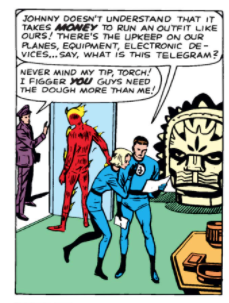
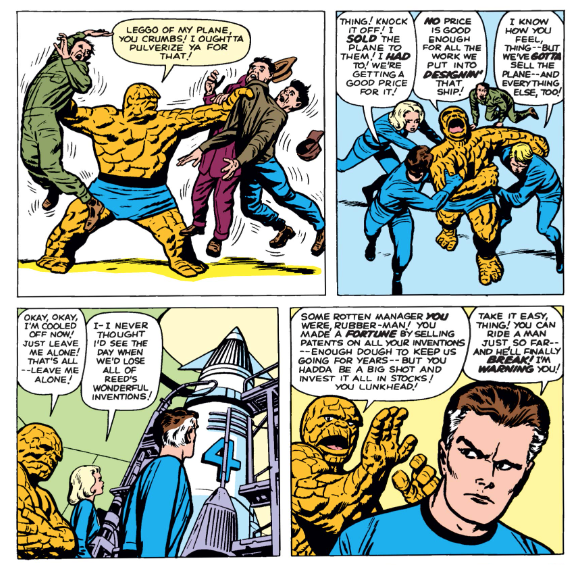
About the Fantastic Four’s money troubles
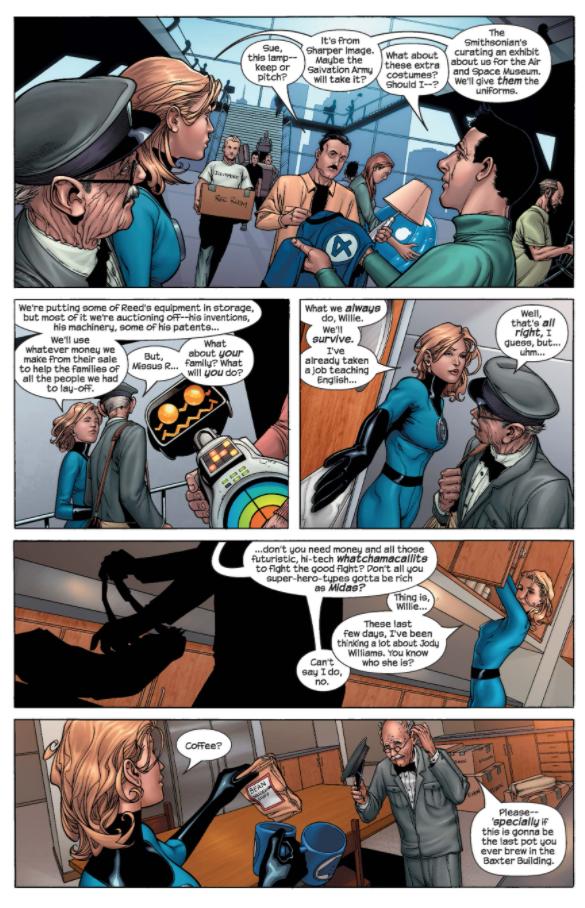
This is the first time a FF story hinges on the Fantastic Four’s financial woes or business dealings, but it won’t be the last. Over the years the FF have either owned their building and had trouble with their tenants, or been tenants and had issues with their landlord. They are also evicted again, the plot device in 2004’s Marvel Knights 4 (an FF book aimed at older readers). In that story, the City of New York refuses to indemnify the team for damages caused by their battles, and demands the Baxter Building as compensation. The FF then find “real” jobs: Sue teaches high school english, Reed performs IT support at a law firm, Johnny tries to become a firefighter and Ben works construction. The premise was as far-fetched in 2004 as it was in 1962.
To move the plot of FF 9 along, Stan and Jack suggest that Reed is both a terrible and reckless investor, but also that he has no capacity to imagine jobs for the FF outside of freak shows and crime. Again, none of this makes much sense if we are to accept Reed is one of the world’s smartest men.
Hooray for Hollywood
Jack includes some movie stars cameos as the FF go show biz.
I recognized Bing Crosby, Bob Hope and Alfred Hitchcock. The internet tells me John Wayne, Amanda Blake, Charles Bronson and Jack Benny are also there. Dean Martin appears in another panel.
The Sub-Mariner goes all-in as a movie mogul, which includes dressing like Noel Coward. Namor hangs on to his movie studio and it shows up years later, renamed Imperial Pictures.
That escalated quickly
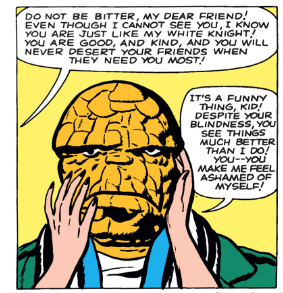
After her introduction last issue, Alicia Masters is now established as Ben’s “dear friend.” Expect to see a lot more panels like this one:
Speaking of Ben
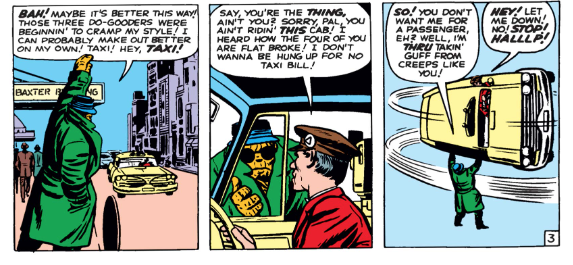
Ben has trouble catching a cab, not because he’s an orange monster but because the cabbie thinks he’ll stiff him on the fare.
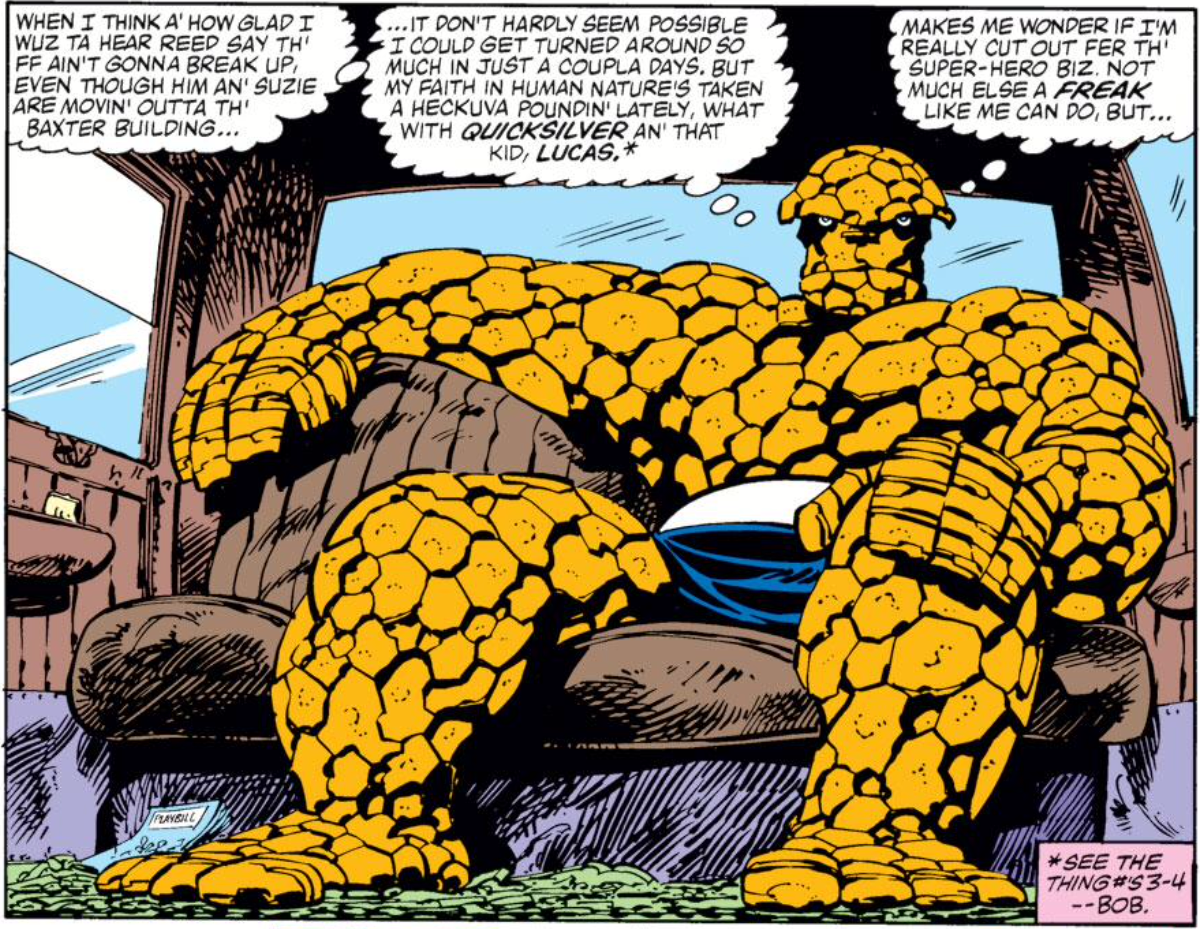
Which is as a good an excuse as any to drop in this panel of Ben taking a cab by John Byrne, one of my favorite drawings of the Thing (and which also echoes the Ben’s concern about getting a job in the real world).
Fantastic Four 249 (1983)
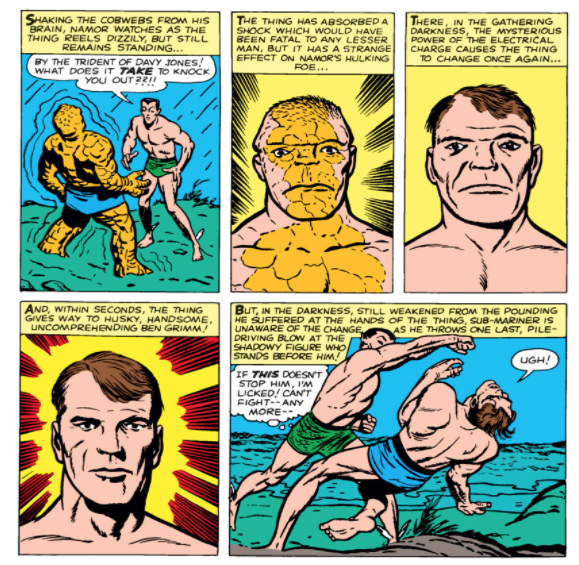
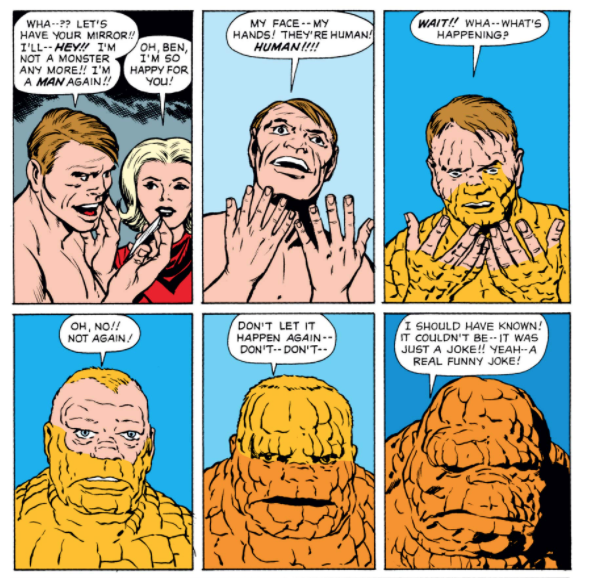
Also in issue 9, Ben also transforms to human form after being struck by lightning while fighting Namor (it’s a sign of how bananas this issue is that it’s the first time I’ve mentioned this totally random event). This marks at least the third time the Thing has reverted to human form in the first nine issues.
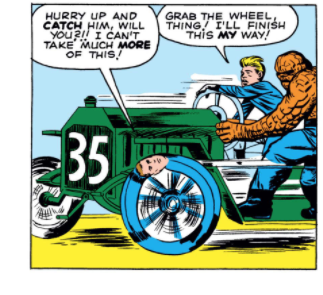
And now for my next trick
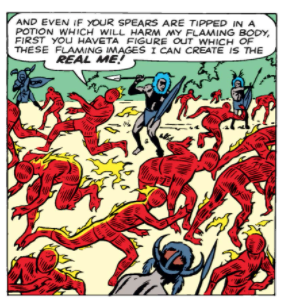
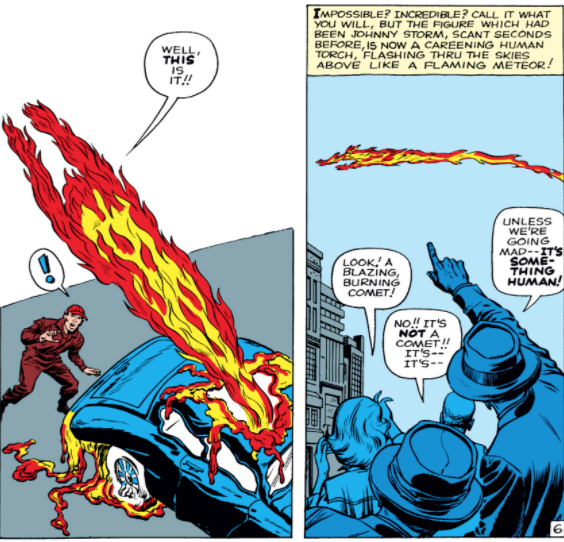
The Human Torch creates flame duplicates, I think for the first time
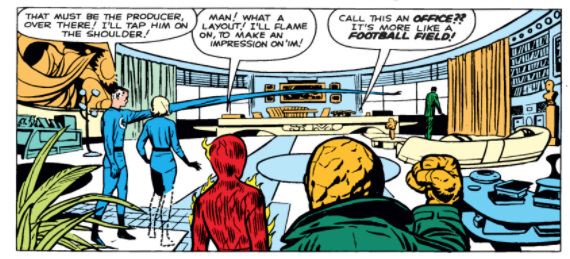
Call my decorator
Another interesting interior design choice for the FF.
Meanwhile, Namor enjoys the latest in underwater TV technology. Note the photo of Sue.
Namor’s Hollywood office is pretty groovy, too
They’re fighting again
The sexist sixties
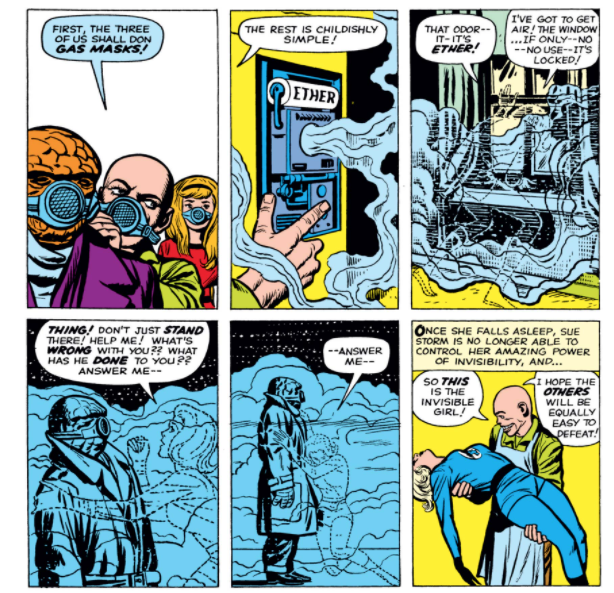
Sue needs to be rescued, because of course she does.
Kirby Krackle
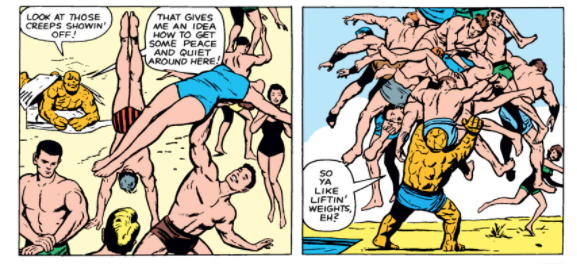
More good stuff from the King as the Thing fights some beach bullies, a la Charles Atlas
Let’s talk about us
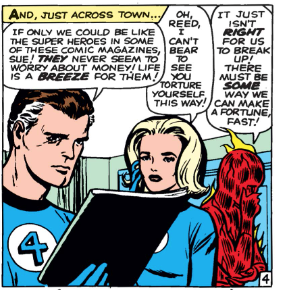
Reed is reading comics, and takes a meta-swipe at the lack of such prosaic concerns as money in (presumably) DC’s comics
For sale
A mint (9.8) copy of FF 9 is worth $14,000, quite a bit less than the previous issue.
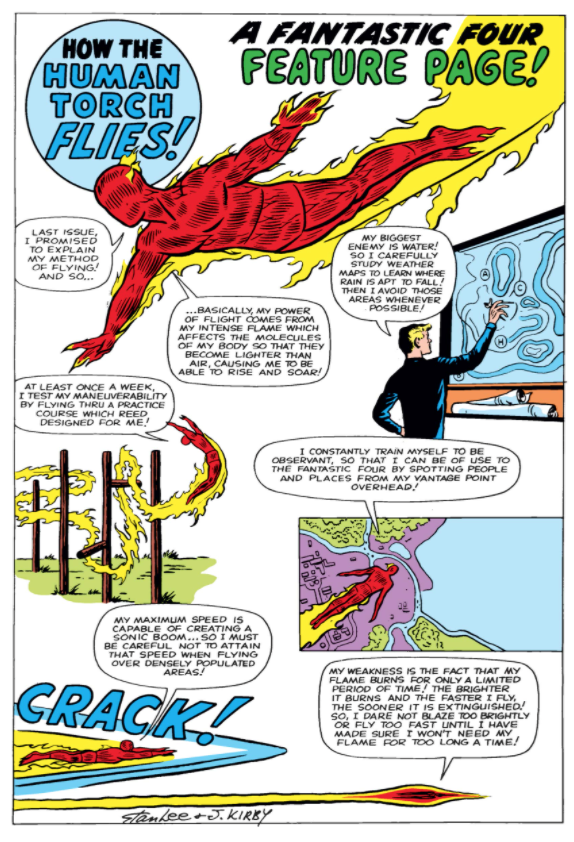
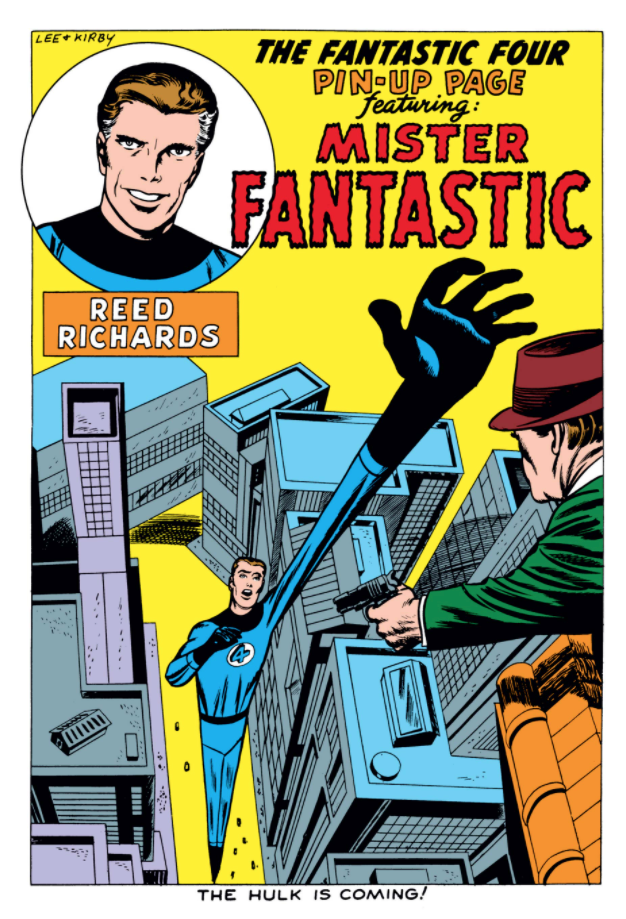
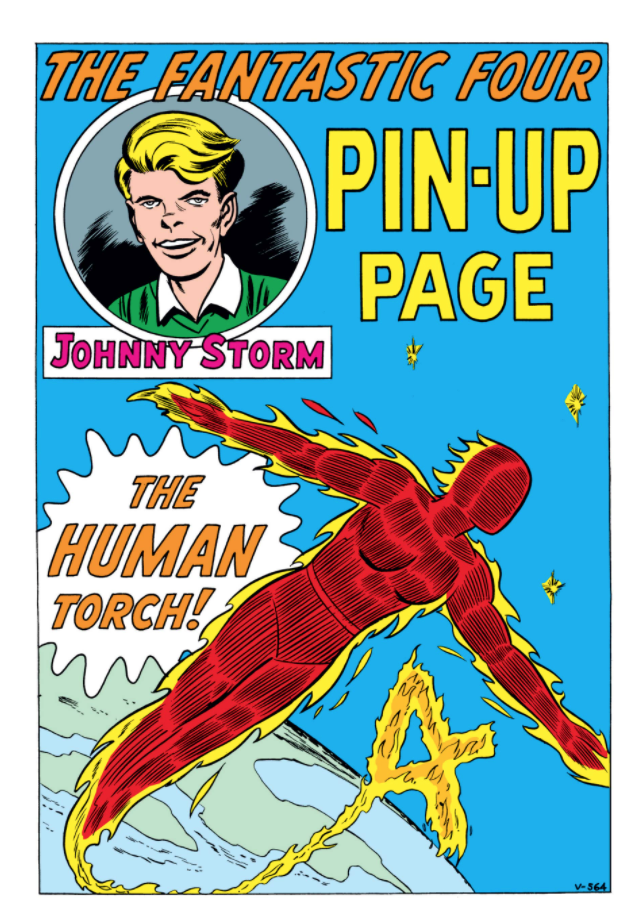
Pin up
Part 2 of the Human Torch’s explainer pin ups. He seems lot more level headed here than in actual stories.
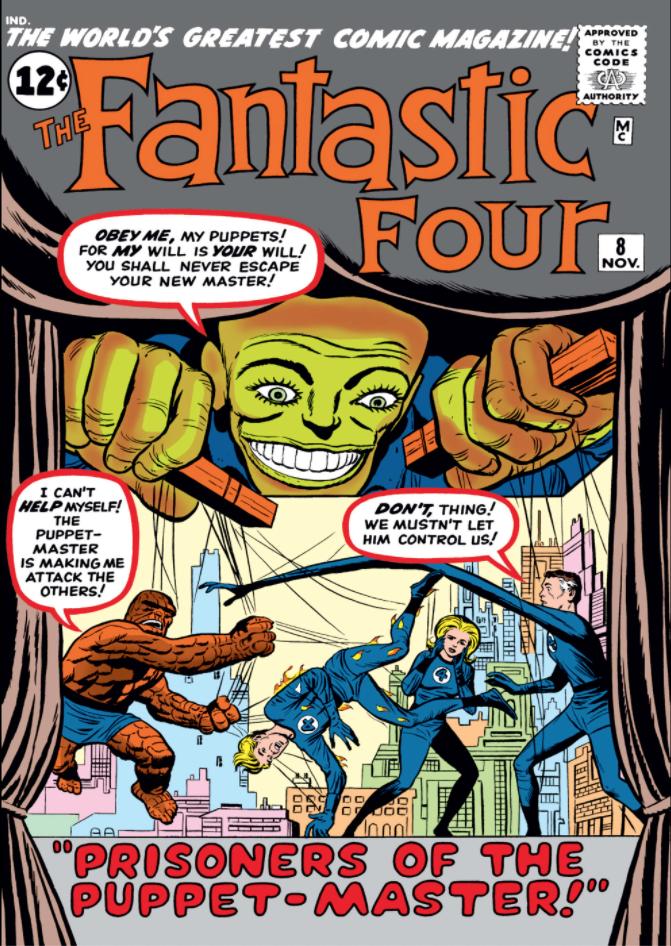
Fantastic Four 8 “Prisoners of the Puppet Master” Published: August 1962 Story: Stan Lee and Jack Kirby Script: Lee Pencils: Kirby Inks: Dick Ayers (uncredited) Cover: Kirby and Ayers
Synopsis
The Fantastic Four squabble after the rest of the team keeps the Thing from learning what Reed is working in in his lab (eventually revealed to be a cure for his condition). Later, the team rescues a man, under the thrall of the Puppet Master, who attempts suicide by jumping from a bridge. Thwarted, the Puppet Master takes control of the Thing, and later captures the Invisible Girl. He sends Alicia Masters, his blind step-daughter, disguised as Sue back with the Thing to capture the rest of the team, but Ben stumbles into Reed’s chemicals, reverting him back to human form and breaking the Puppet Master’s mind control.
Meanwhile, the Puppet Masters is using his puppets to engineer a jailbreak (apparently as a test of his abilities although it’s never really made clear). The FF rescue Sue and foil the jailbreak, although the Puppet Master evades capture. Reunited with Alicia, he reveals his plan to use his puppets to make him ruler of the world. Horrified, she grabs at his puppet and as he trips, he plummets out a window, seemingly to his death
What’s going on here?
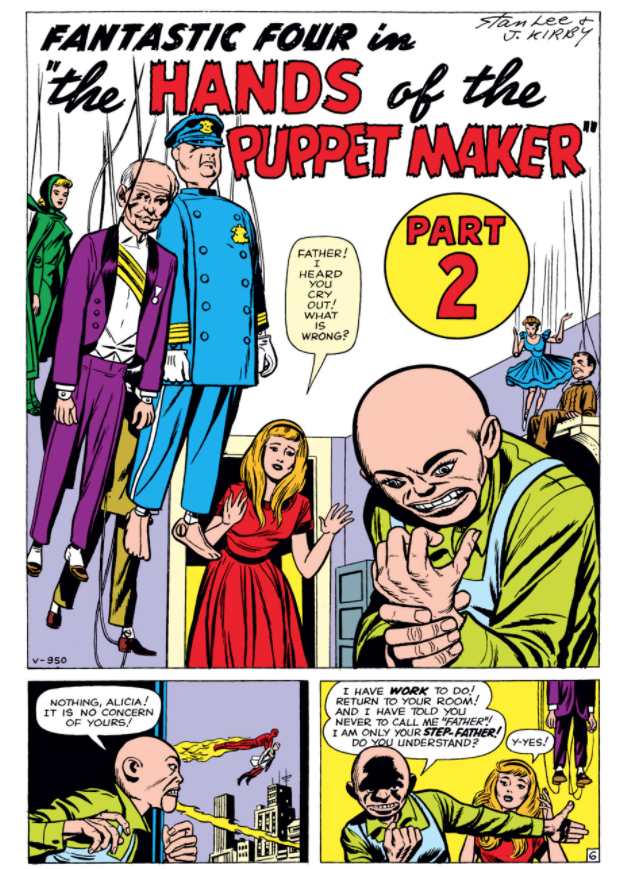
Fantastic Four 8 introduces Phillip Masters, who as the Puppet Master will be a recurring villain, and more significantly, his step daughter, Alicia. Alicia Masters becomes one of the team’s most consistent supporting characters, first as the Thing’s girlfriend and much later, his wife. She develops into a renown sculptor (although her works are invariably shown as fairly uninteresting depictions of Marvel heroes) and often served as a babysitter to young Franklin Richards when the team went on a mission. She also, unfortunately, filled in for Sue as the requisite hostage of the super villains after the Invisible Woman evolved past that role.
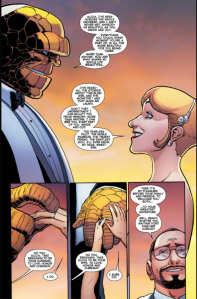
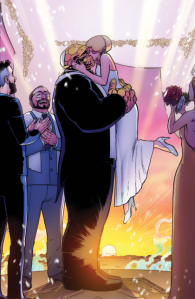
After many twists and turns in their relationship—including a period where she left Ben for Johnny in the 1980s, a betrayal later retconned as the actions of Lyja, a Skrull in disguise (the less said about that the better)—the two finally got hitched in 2018’s FF No. 5:
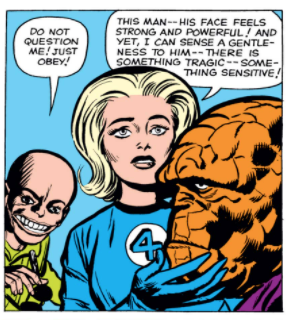
It’s clear Stan and Jack had long-term plans for Alicia as early as issue 8, as she and the Thing quickly develop feelings for each other:
Alicia, disguised as Sue
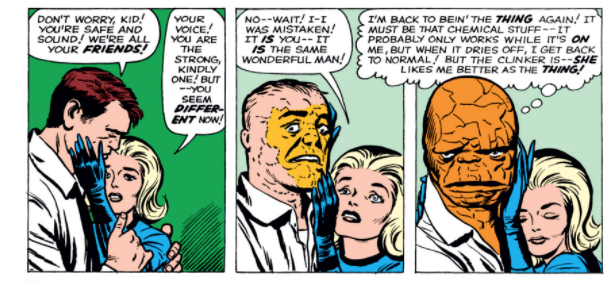
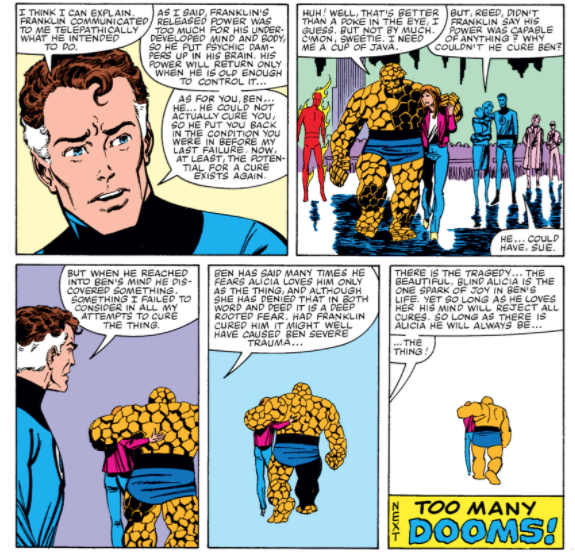
The Thing/Ben/Alicia dynamic becomes fraught over the years. It begins with the Beauty-and-the-Beast cliche, and the story-telling crutch of her blindness, because of course only a blind woman could love the Thing. Later writers, notably John Byrne, investigate whether Ben’s psychological need for Alicia’s love has prevented him from reverting back to human form. The seeds of that storyline were introduced here in issue 8, as Ben reverts back to the Thing after temporarily turning human
Byrne runs with that idea in issue 245, while giving Reed a convenient explanation for why all his attempts to return Ben to human form failed:
About that clay
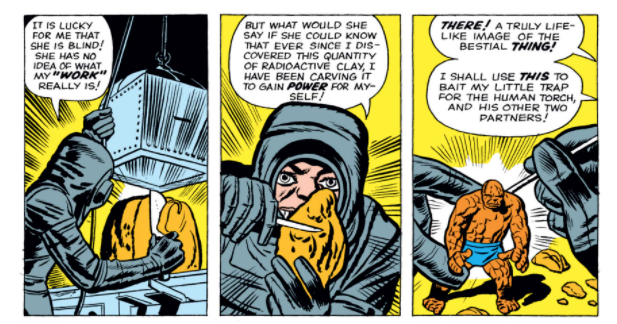
Phillip Master’s puppet powers derive from radioactive clay (another reminder of how in the ’60s, radioactivity was an all-purpose bestower of super powers), but it’s a little unclear how it actually works. Usually, he needs to mold a clay form of a living person to manipulate them, sort of like a voodoo doll.
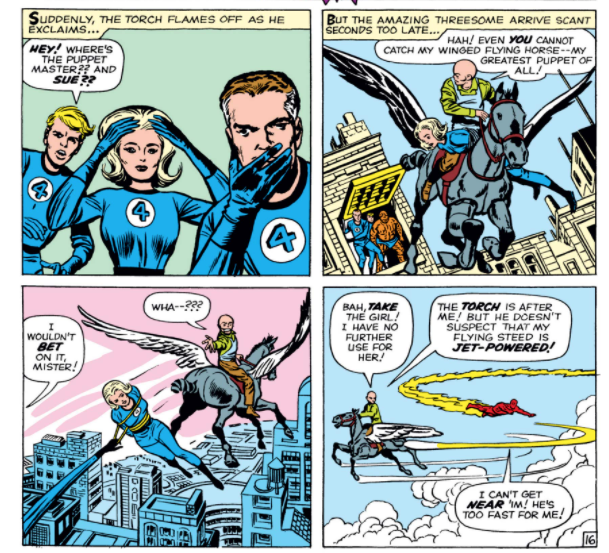
But here he has sculpted a flying, jet-propelled horse, which seems to work just fine without him using a small version of it.
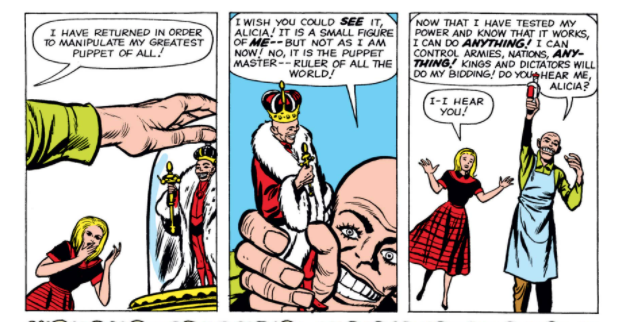
And then he plans to rule the world by sculpting himself as its king. Would he manipulate himself?
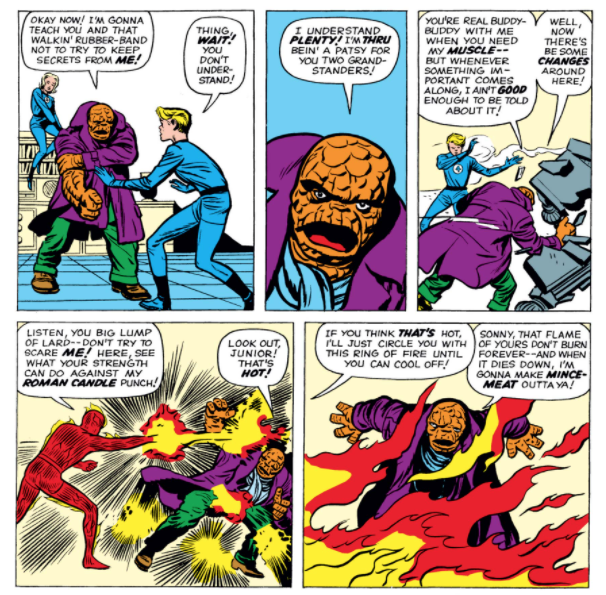
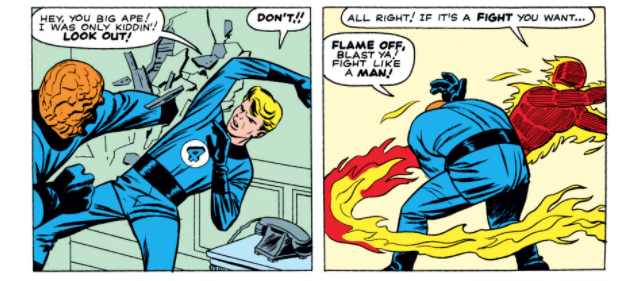
They’re fighting again
After skipping last issue, Ben and Johnny pick right up where they left off:
The sexist sixties
Sue is, of course, captured by the bad guy, for the fourth time in the first eight issues.
What year is it?
For the first time, the year is mentioned, which will become a problem for continuity hounds as Marvel’s sliding time scale means these issues no longer take place in the ’60s.
Dig thatKirby Krackle
Some great stuff from Jack in this issue.
The Incredible Mr. Fantastic
Reed finds a new use for his powers.
Pin up
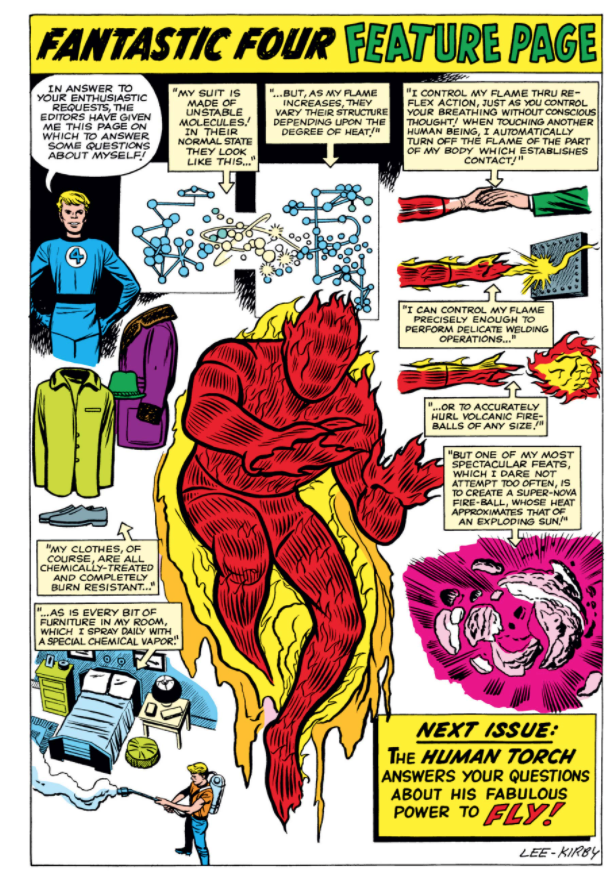
Johnny gets another pin up, this one offering scientific explanations for his powers and costume (I love the image of the unstable molecules).
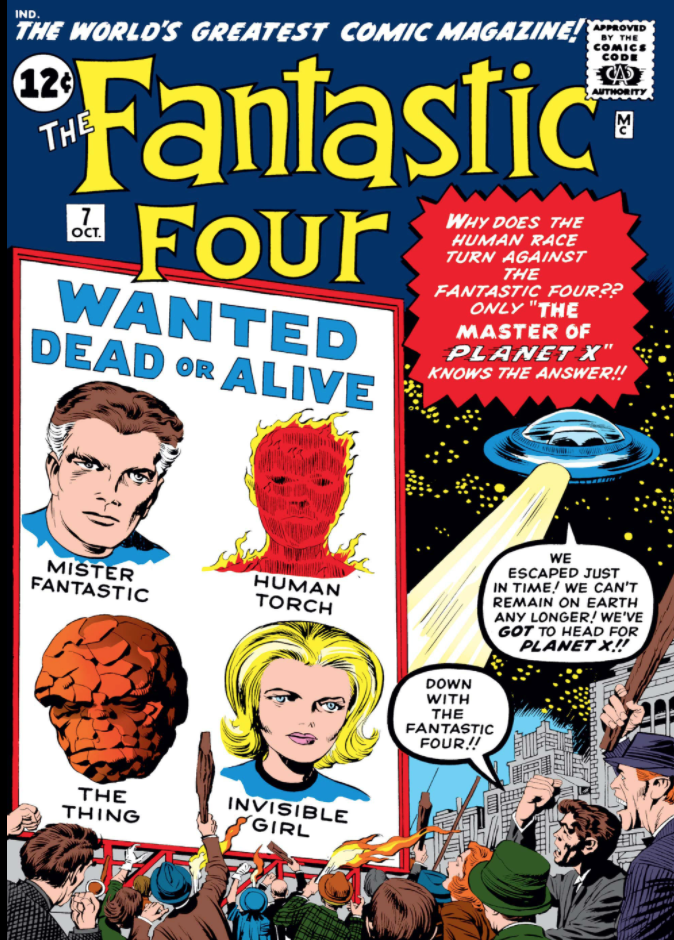
Fantastic Four 7 “Prisoners of Kurrgo, Master of Planet X” Published: July 1962 Plot: Stan Lee and Jack Kirby Script: Lee Pencils: Kirby Inks: Dick Ayers (uncredited) Cover: Kirby
Synopsis
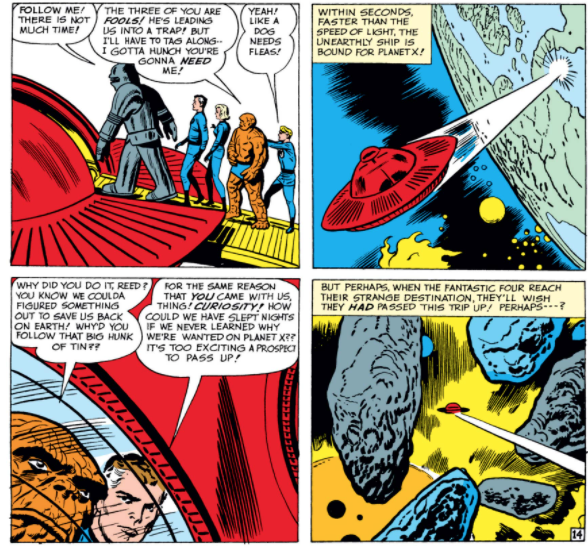
On Planet X, Kurrgo sends a spaceship piloted by a robot to capture the Fantastic Four to help him prevent the destruction of his people from a collision with a runaway asteroid, Meanwhile, on Earth, the Fantastic Four are feted at a dinner held by Congress when Kurrgo’s robot, now on Earth, unleashes an energy ray that turns the people against them. After escaping the police and military, the FF accept the ultimatum offered by the robot: perish at the hands of your countrymen or come to Planet X. Once on Planet X, Reed invents a gas that shrinks the planet’s population to tiny size, enabling them to fit on its spaceship. Kurrgo, however, plots to keep the enlarging gas for himself, planning to rule his countrymen as a giant, but encumbered by the gas canister he fails to reach the ship before it takes off. As the FF return to earth, Reed reveals there never was an enlarging gas, but he made it up so the citizens of Planet X would accept shrinking.
This is the first issue to appear on its new monthly schedule, a mark of the comic’s growing popularity.
What’s going on here?
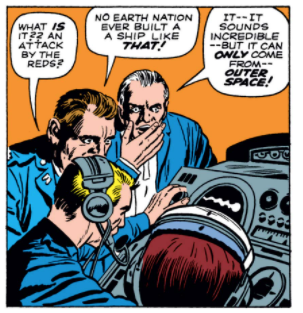
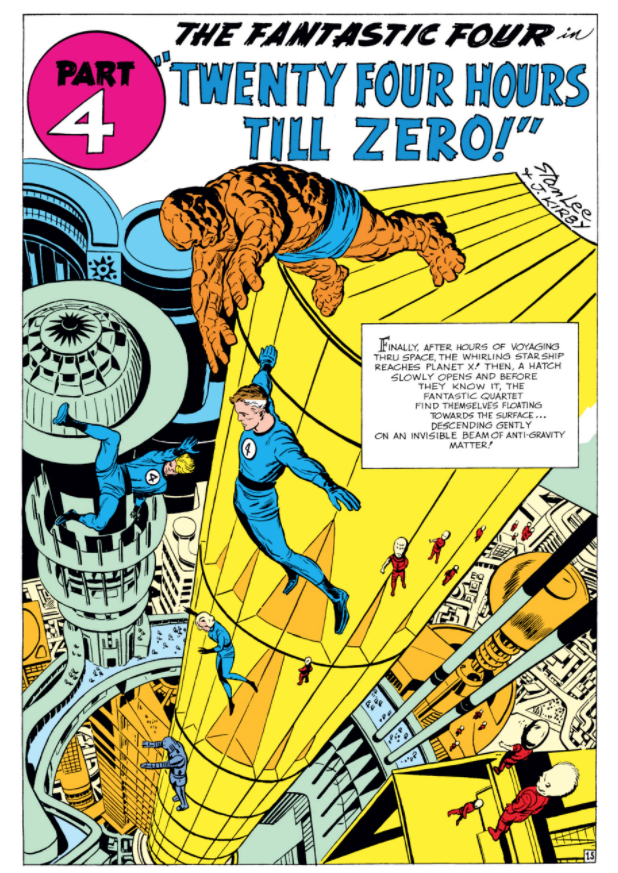
After encounters with the Sub-Mariner and Dr. Doom in the last three issues, the FF return to the Silver Age, in this silly science fiction-flavored story. It’s part of a series of comics where the FF are forced do a villain’s bidding (as they did in FF 5 with Doom), although in this case Reed admits they didn’t really need to go to Planet X, but he was curious and wanted to check it out.
The story is pretty unremarkable. Kirby gets to draw some cool outer-space stuff, we get some character building moments as the FF fret about attending a fussy dinner, and once again Reed’s genius saves the day (although he was kind of a dick about it). Kurrgo makes one more appearance, in 1973’s Marvel Feature 11, but he’s as forgettable a villain as the FF ever fight. The Marvel wikipedia identifies Planet X as Xanth, and extrapolates some details about Xanthians, but they too only appear once more.
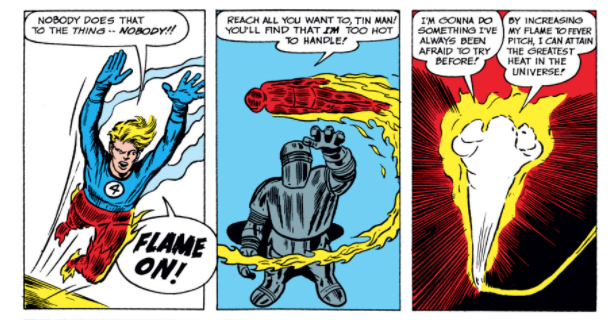
Really, the only event of significance is it marks the first time the Human Torch goes “super nova,” a manifestation of his powers where he can “attain the greatest heat in the universe.”
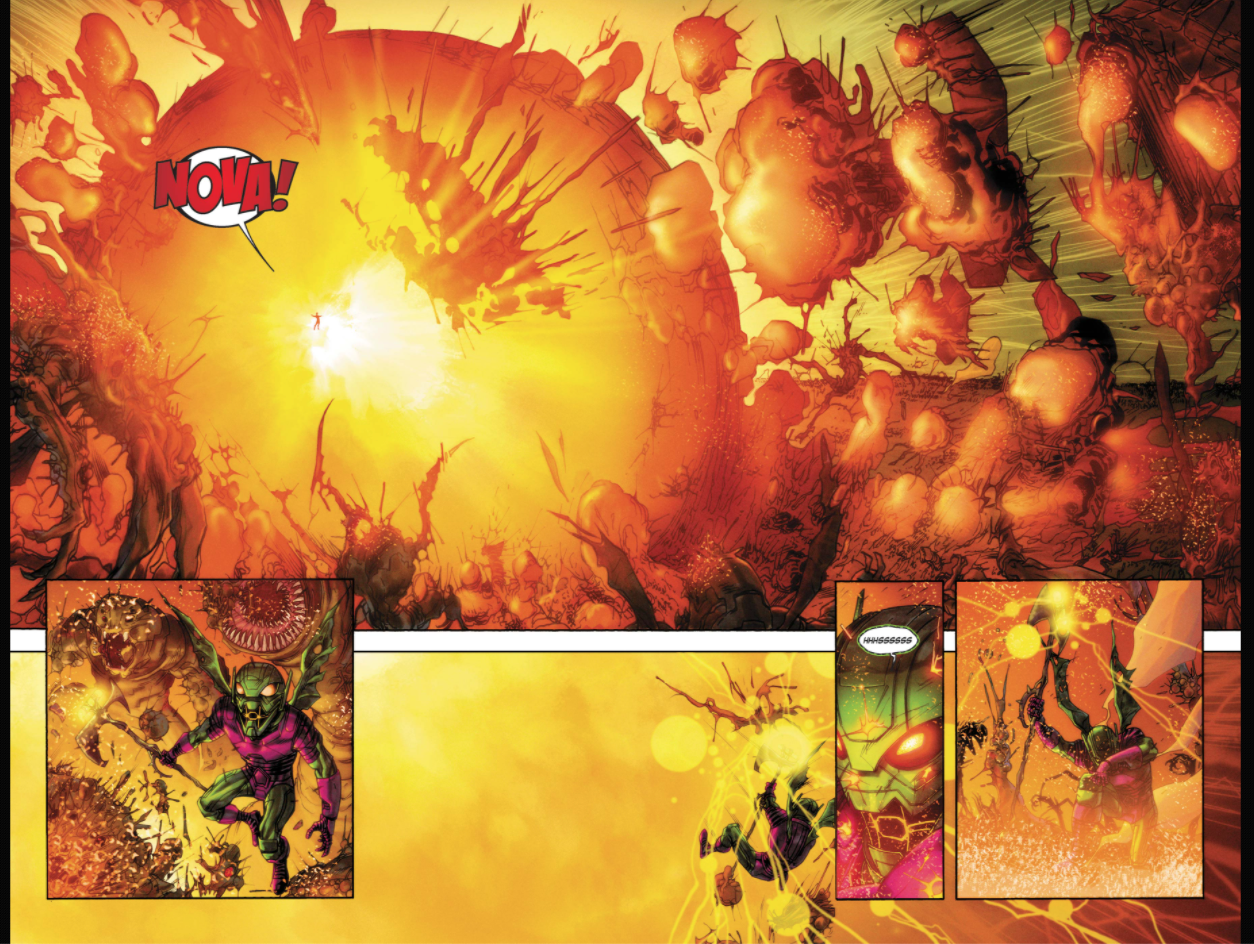
Johnny’s nova power becomes part of his arsenal of tricks and is used repeatedly over the years, although perhap never with as much spectacular impact as in Fantastic Four 600, where he uses it to incinerate Annihilus’s army as it prepares to invade Earth from the Negative Zone.
FF 600, art by Carmine Di Giandomenico
The Sexist Sixties
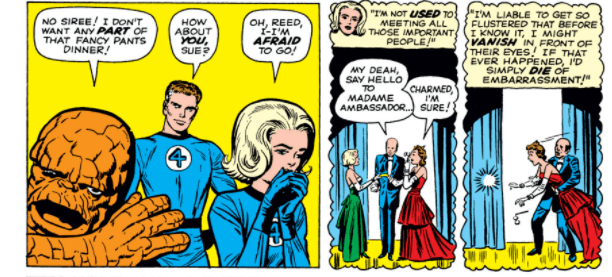
The FF’s invitation to a dinner in their honor gives Stan and Jack ample opportunity to trot out some stereotypes:
Talk to my decorator
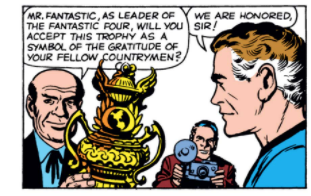
At the dinner in their honor, Reed is presented with an odd trophy from an official in a bolo tie. Apparently the FF don’t yet merit medals of honor.
Red Menace
The Cold War is still very much a thing
Kirby Krackle
It seems Jack is never happier than when he gets to draw alien machinery
For sale
A mint (9.8) copy of FF 7 should run you about $80,000
Next issue: The first appearances of Alicia Masters and the Puppet Master!
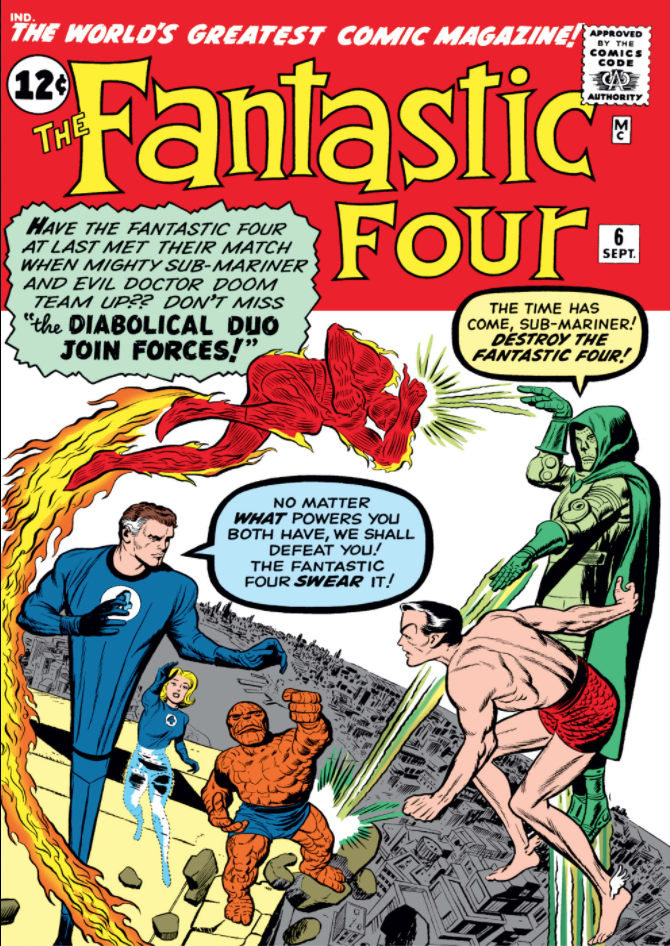
Fantastic Four 6 “Captives of the Deadly Duo!” Published June 1962 Plot: Stan Lee and Jack Kirby Pencils: Jack Kirby Script: Stan Lee Inks: Dick Ayers (uncredited) Cover: Kirby and Ayers
Synopsis
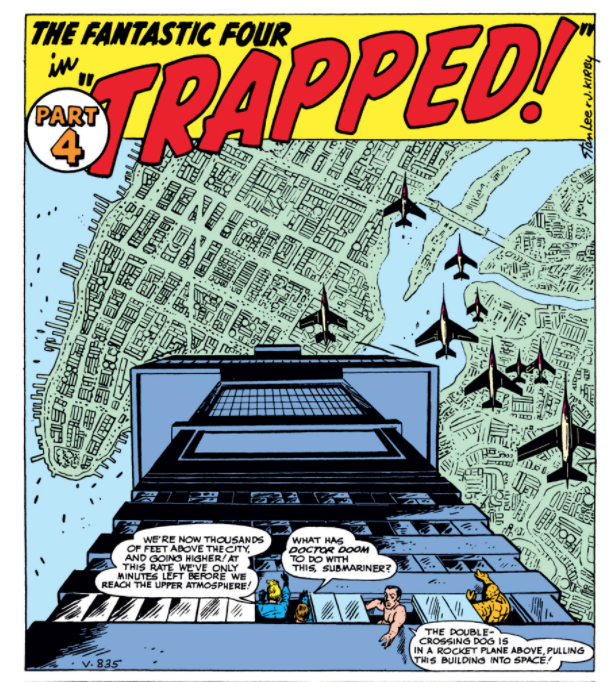
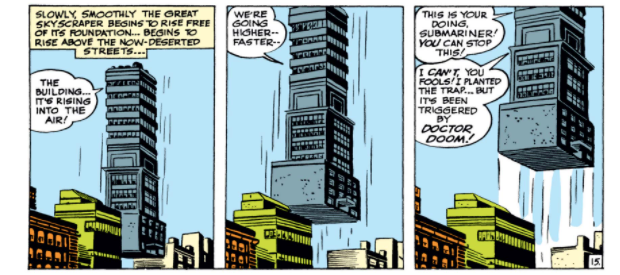
The Fantastic Four are unsuccessful at finding Dr. Doom, who escaped in the last issue. Meanwhile, Doom recruits the Sub Mariner to help him attack the FF, appealing to Namor’s desire for revenge. Namor plants a magnetic “grabber” in the the FF’s headquarters, which lifts the entire building into space. Doom, however, has double-crossed Namor, who is in the building as it leaves Earth and intends to send him into the sun with the FF. While the members of the FF are unable to reach Doom’s spaceship, Namor—revived by the FF’s water tank—successfully disables Doom’s ship, and returns the building to Earth. Doom, clinging to a meteor, is lost in space.
What’s going on here?
This is the best issue to date. The story is suspenseful, the plot is straightforward, and the villains have plausible motivations (revenge!). And Kirby delivers some gorgeous art.
Fantastic Four 6 establishes Dr. Doom as a recurring villain (oh, how he reoccurs!) and the Sub-Mariner as a more complex character, as he eventually joins forces with the FF to defeat Doom. The story also layers in more world-building, as we are introduced to various elements of the FF mythos that serve as touchstones over the years, such as the unstable molecules in their uniforms and the Yancy Street gang.
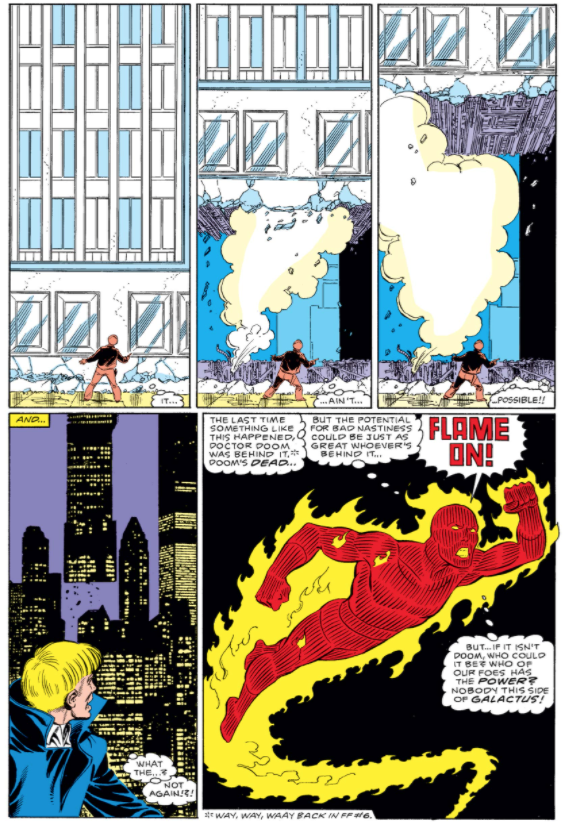
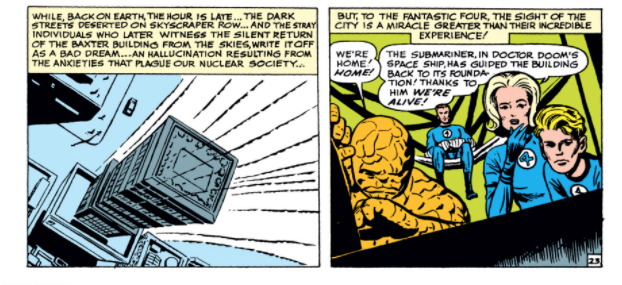
The main plot device— Dr. Doom lifts the team’s still-unnamed headquarters building into space—is delightfully absurd and Doom-ish. So delightful that John Byrne recreates the basic plot in FF 278:
What’s up with Sue?
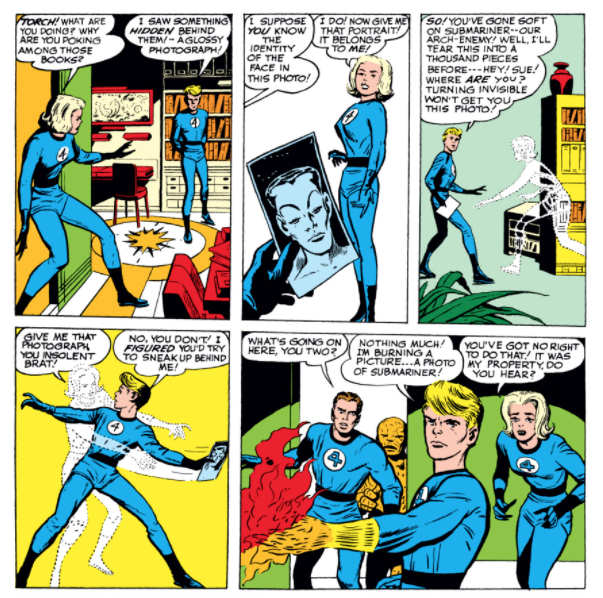
Sue is revealed to have a crush on the Sub-Mariner, hiding away a photo of him in a book shelf. Where, exactly, she got an 8×10 glossy of Subby is unclear, but the plot device reveals that Stan and Jack view Sue as little more than a silly teenage girl, despite being engaged to Reed. (She also refers to her brother as “Torch” which seems a bit weird, while Johnny calls Namor the team’s “arch-enemy,” despite only facing him once).
Inside the (not yet) Baxter Building
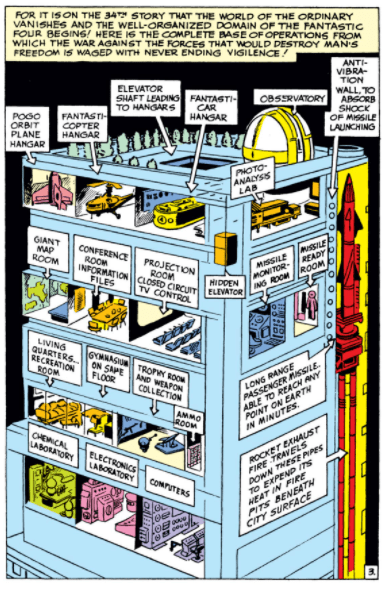
For the second time in three issues, we are treated to a cutaway illustration of the FF’s headquarters. This one is a bit more in depth and shows four floors, not just three.
FF 3
FF 6
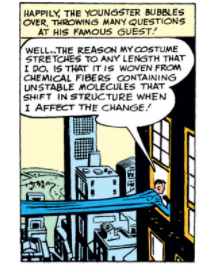
In this issue we are introduced to unstable molecules …
Want to know how Reed’s clothes stretch with him? So did a kid in a nearby hospital, whom Reed is more than happy to lecture while visiting.
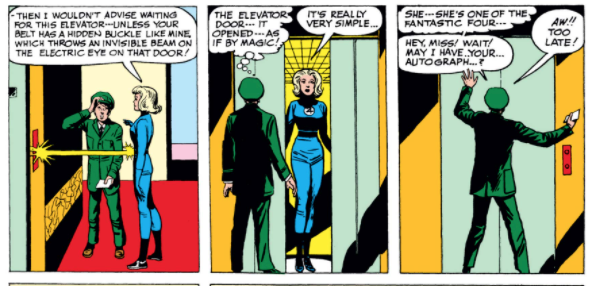
… and elevator belt buckles …
FF 6 introduces another gee-whiz aspect of the team’s gear.
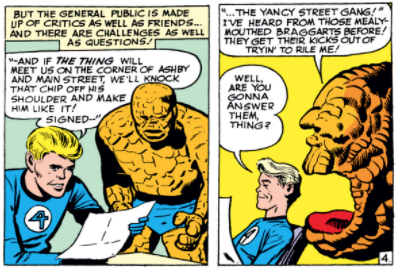
… and the Yancy Street Gang …
They don’t appear (well, they never really do) but they are first introduced here as Ben’s antagonists from his old neighborhood. “Yancy Street” is derived from Delancey Street on the Lower East Side of Manhattan, near where Kirby grew up.
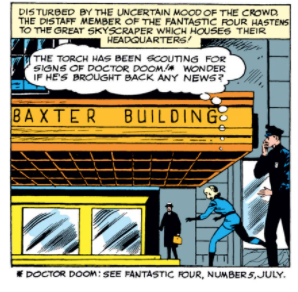
and footnotes!
Long a staple of Marvel comics, Stan started using footnotes to remind readers about what happened in past issues. Even though there have been only six issues so far.
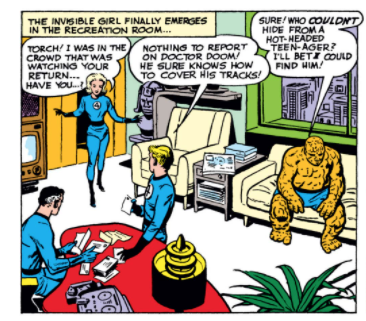
Mid-century modern
It’s never clear who decorated the FF’s headquarters, but they certainly had an eye for interesting objet d’art.
Kirby Krackle
Kirby drew some wonderful street scenes for this issue. I wonder who he used as models for the faces.
He also drew this amazing sequence of Namor leaping into space to attack Doom
The sexist sixties
In the thin air of our space, Sue is the only member to succumb from the last oxygen because of course she is. (The Sub-Mariner also wears red trunks in this issue, insead of his standard green).
Oops!
Jack draws the headquarters returning safely to its block in New York, while Stan is left to explain in a word balloon that it was Namor who somehow used Doom’s spaceship to maneuver it in place, all off-camera. It seems Stan may have had of explain just exactly how the building returned to Earth.
Fantastic Four 5 “Prisoners of Doctor Doom” Published: April 1962 Plot: Stan Lee and Jack Kirby Pencils: Kirby Script: Lee Inks: Joe Sinnott (uncredited) Cover: Kirby and Sinnott
Synopsis
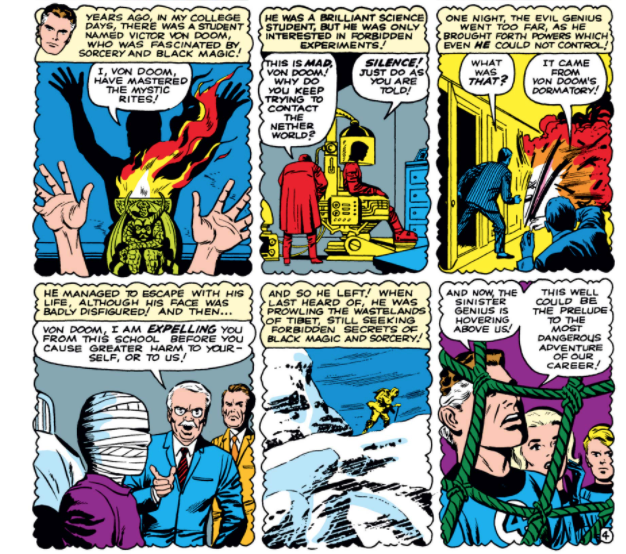
The Baxter Building is enveloped by a net that resists the Fantastic Four’s powers. Mr. Fantastic recognizes the voice of the villain responsible as that of Victor Von Doom, a college classmate who dabbled in sorcery and was expelled for reckless experiments. Doom demands Sue Storm as a hostage, then transports the team to his castle, where he sends the three male members of the FF back in time to recover the treasure chest of Blackbeard the Pirate. The team successfully disguises themselves, and joins a pirate crew to steal the treasure. The team return, but presents Doom with just the chest, without its treasure. A battle commences, Doom traps the three, and Sue rescues them before Doom escapes.
What’s going on here
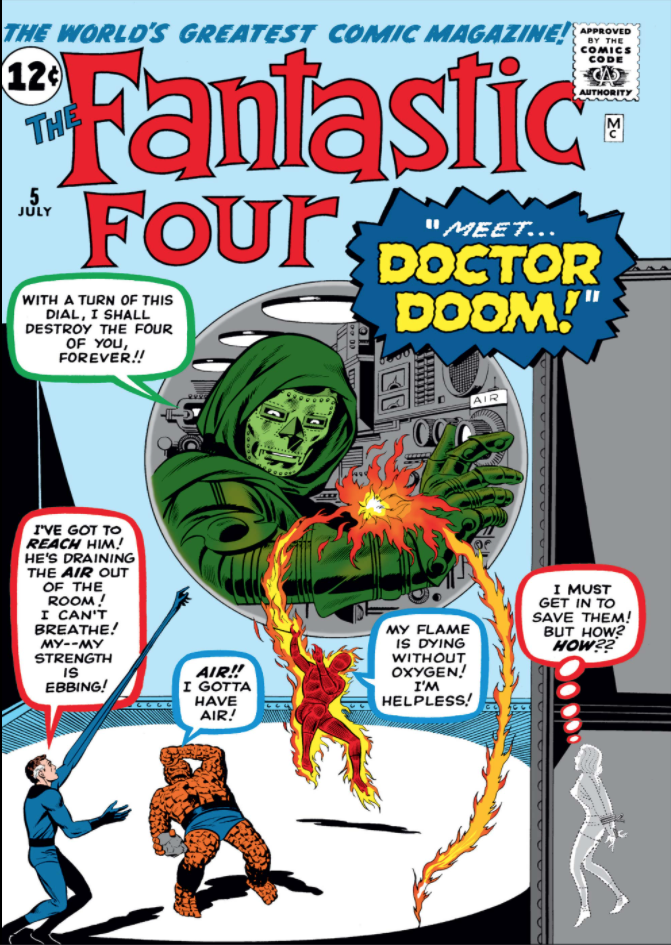
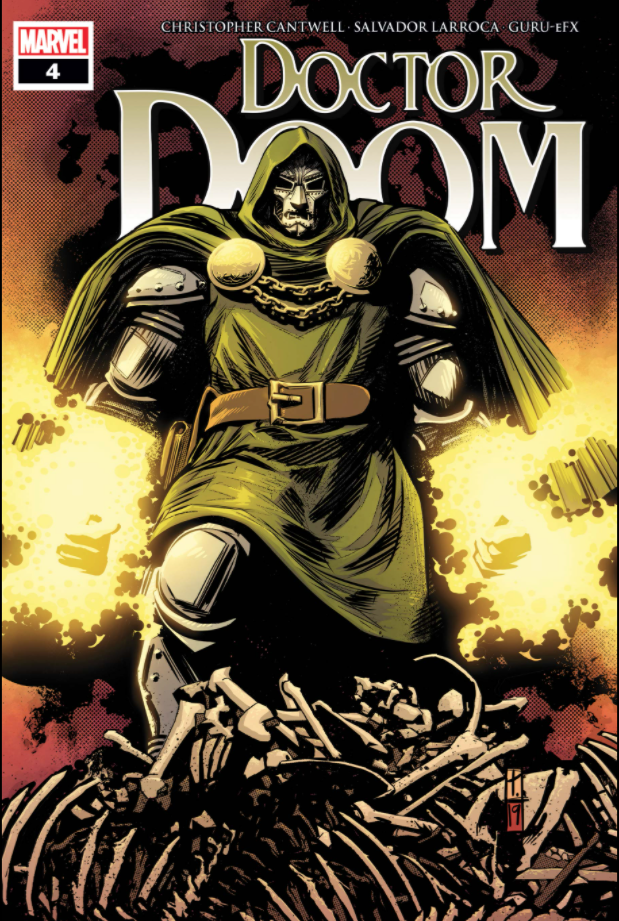
This issue introduced Dr. Doom, not just the Fantastic Four’s nemesis, but arguably the greatest villain in comics (I would put him in a small group with Magneto, Lex Luthor, Darkseid, and the Joker). Doom’s significance in the Marvel universe is hard to overstate. He was the primary antagonist in Marvel’s first big crossover event, Secret Wars in 1984, and was again when Marvel revisited the concept in 2015. He is one of the few villains to headline his own comic, and has played the bad guy to heroes from Iron Man to Luke Cage to the X-Men.
Doctor Doom 4, 2019
It’s in the Fantastic Four, of course, where he is most prominent, so much so that he’s been called the fifth member of the team. As we’ll see, it’s rare for him not to appear at least annually, and in some issues he, not the FF, is the star. In recent years his depictions have become more nuanced since he is the unofficial uncle to Valeria Richards, the daughter of Reed and Sue he mid-wifed (it’s complicated), and he spent a time trying to be a hero (it didn’t stick).
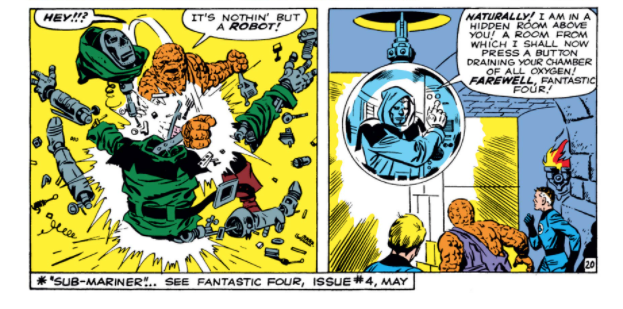
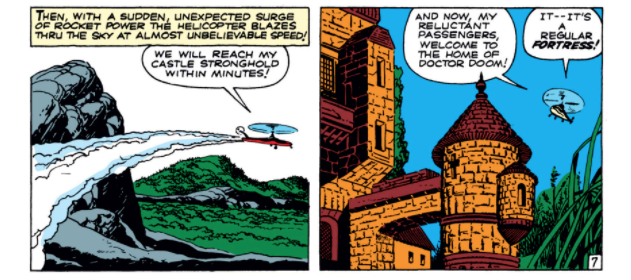
Of course, none of that could have been predicted in 1962, where Doom is the engineer of a silly time-travel plot in Fantastic Four 5, but Stan and Jack clearly intended Doom to have some staying power. In the comic, Reed quickly lays out Doom’s origin, and while many details have changed over the years, the salient points are there: Doom and Reed knew each other in college, Doom has scarred in an explosion, and Doom has fused science and sorcery.
Tying his origin to Reed—that early connection between the two becomes more explicit in future issues—helped ensure he’s not a one-note villain. In later tellings, Doom blames Reed for the explosion, and it’s reminiscent of Luthor’s origin story (at least the first version), where Superboy, trying to extinguish a lab accident with his super breath, costs Luthor his hair.
Doom’s first appearance also introduces a number of elements that become familiar aspects of his character, including his robot doubles:
His castle (although this would appear to be is castle in the Adirondack mountains of New York State, give that it is minutes away, and not his kingdom of Latveria, which has yet to be introduced):
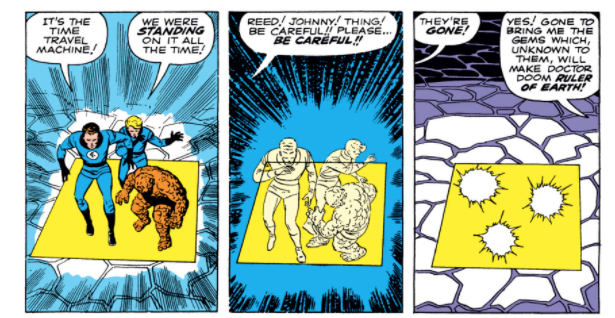
And his time machine:
About that time machine
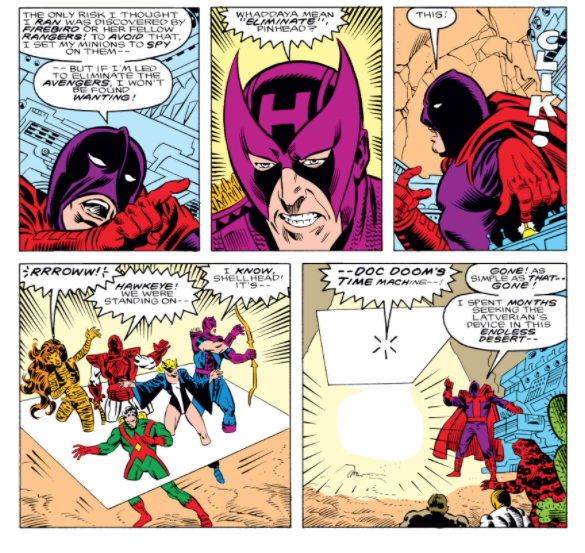
While used in the service of a particularly goofy plot in this issue, Doom’s time machine becomes a durable part of the Marvel universe, and when characters need to travel through time, it’s often their go-to device. It’s unclear if Doom leases it out, or if it’s more of a franchise business model.
I couldn’t possibly track down every instance where it was used but here’s a few memorable ones.
In the West Coast Avengers, a villain uses it to send the team back in time:
WCA 17 (1985), Story by Steve Englehart, art by Al Milgrom and Joe Sinnott
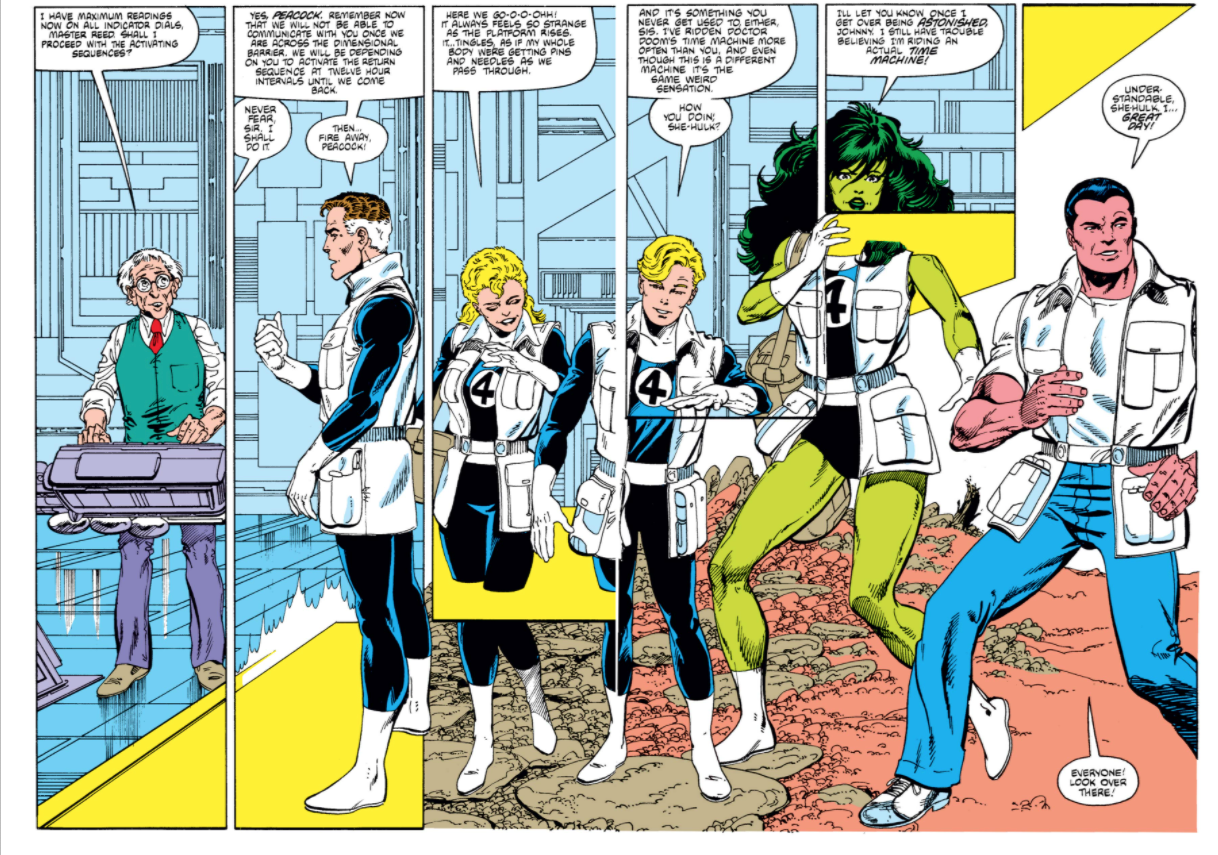
John Byrne used Doom’s time machine during his run, and I always thought this sequence was a particularly cool way to illustrate it:
FF 272 (1984)
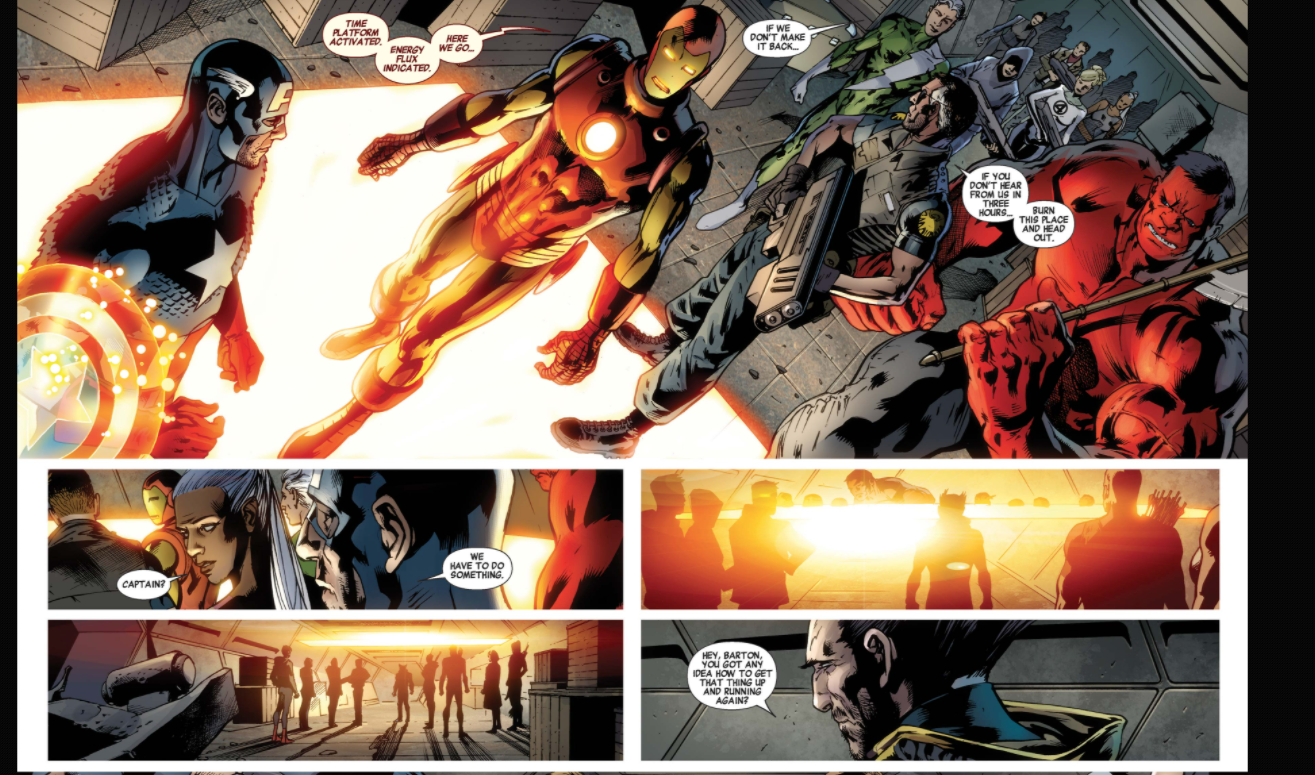
Decades later, it served an important role in the Age of Ultron crossover event:
Age of Ultron 5 (2013)
Who’s the new guy?
This is the first Fantastic Four issue inked by Joe Sinnott, who had a nearly 60-year career in comics, and has more FF credits than any single creator. He didn’t return to the FF until issue 44, but then inked almost every issue from there through issue 231, a 15 year run, and his inks created a consistency to the FF’s look that extended well beyond Kirby’s tenure. One could argue he overpowered the pencils of artists like Byrne and George Perez early in their careers, but there’s no denying his impact on the title. He died last year at age 93. Here’s a nice obituary from The Comics Journal.
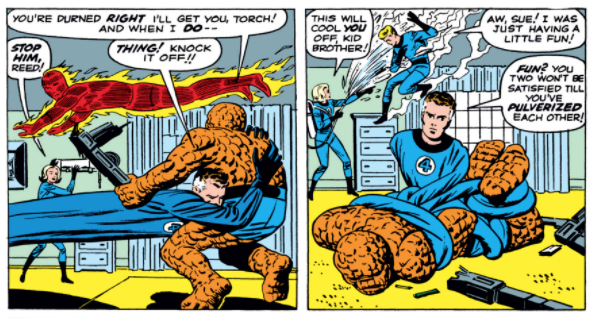
They’re fighting again
Of course they are
The torment of the Thing
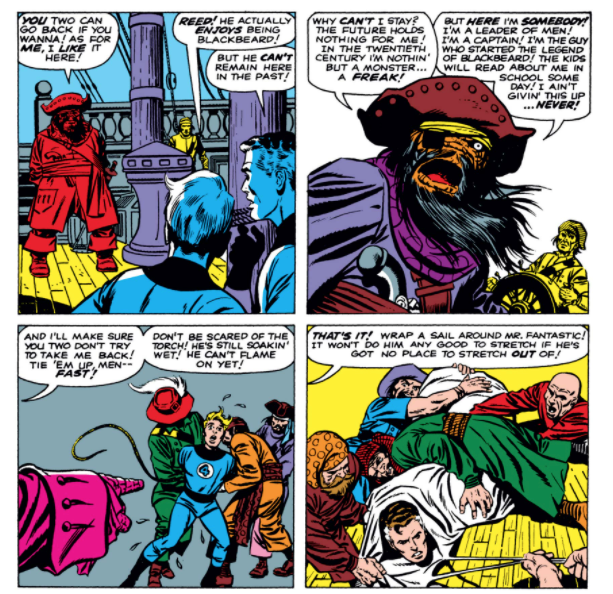
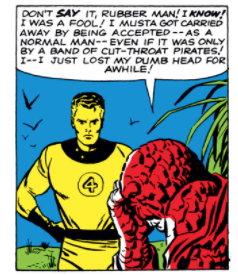
Ben gets carried away with his new identity as Blackbeard, and in a very uncharacteristic development, turns against his teammates:
He later is ashamed of his betrayal:
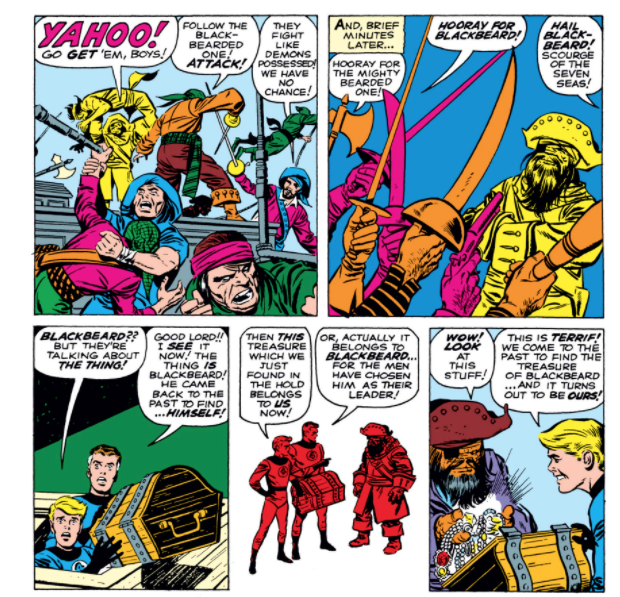
The paradox of time travel
Time travel is a perennial trope of science fiction, and in comics, the Fantastic Four are involved in as many time travel stories as any characters. The plots becomes more intricate over the years, but the revelation that Ben is the actual historic Blackbeard is a fun touch and an early indication of the story-telling possibilities.
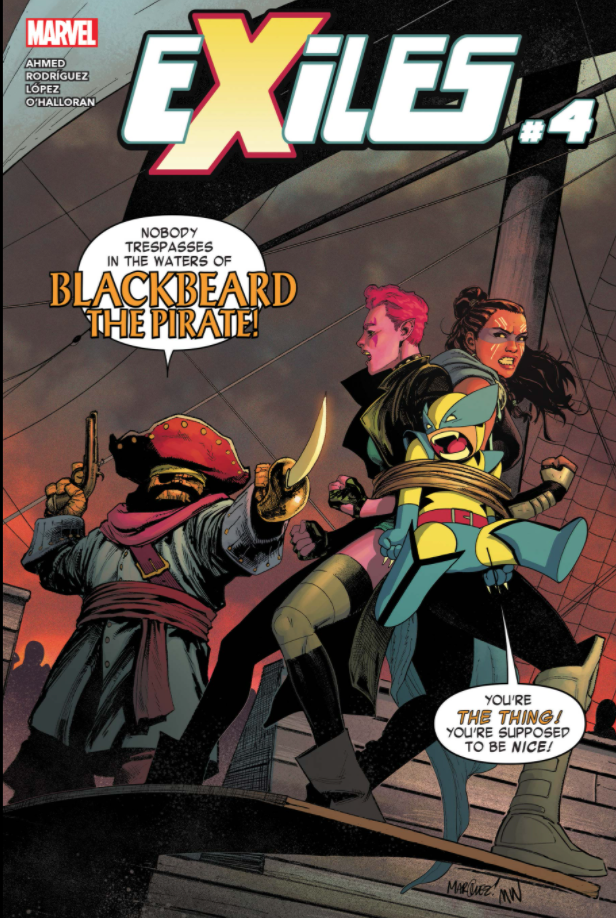
This weird footnote is revisited a few times, including on the cover of 2018’s Exiles (I have no idea what this comic is about):
The sexist sixties
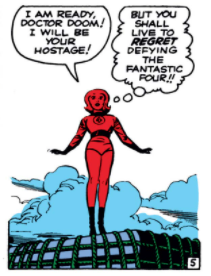
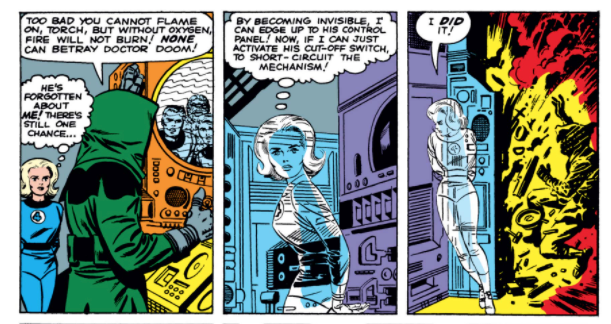
Doom demands a hostage, and of course it’s the team’s female member. Why he didn’t think the hero who’s power is to turn invisible might be useful in his treasure heist is not explained.
Stan and Jack later redeem themselves a bit by having Sue rescue the rest of the team:
Dig that Kirby Krackle
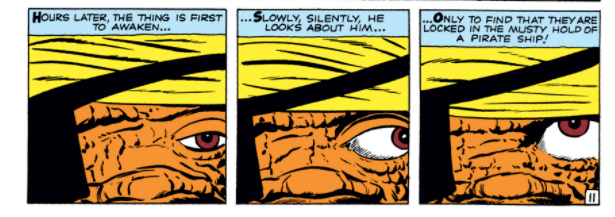
Love this sequence of Ben waking up from too much grog
For sale:
A mint (9.8) copy of FF 5 will cost you around $300,000 (and probably a lot more after Doom appears in the Marvel Cinematic Universe)
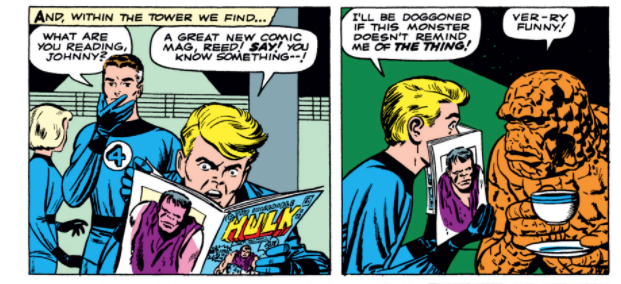
Let’s talk about us
Johnny is seen reading an issue of the Incredible Hulk
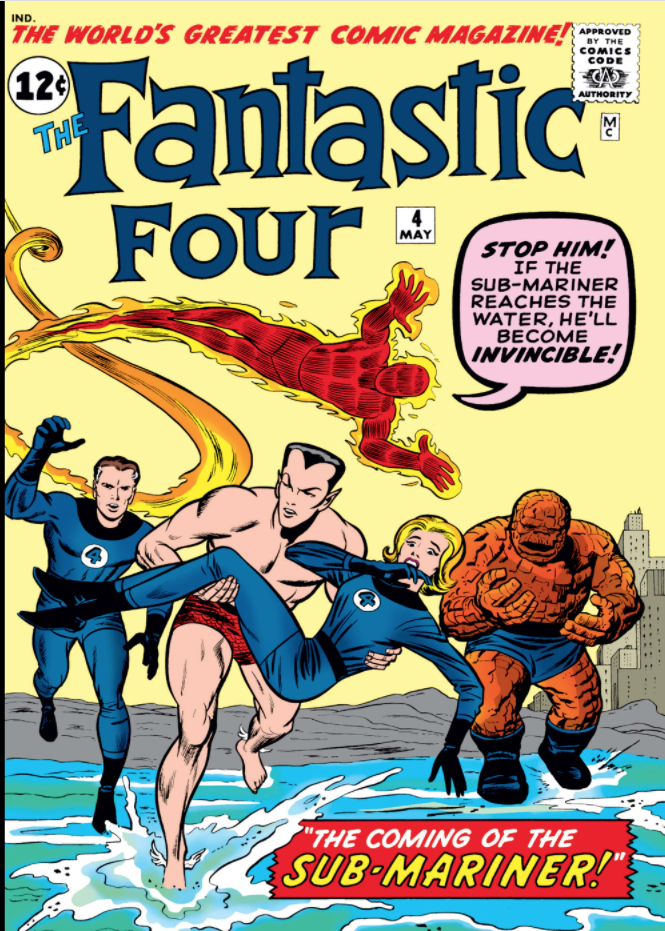
Fantastic Four 4 “The Coming of the Sub-Mariner” Published: Feb. 1962 Story: Stan Lee and Jack Kirby Pencils: Kirby Script: Lee Inks: Sol Brodsky (uncredited) Cover: Kirby and Brodsky
Synopsis
Following last issue’s departure of the Human Torch, the remaining members of the Fantastic Four search for him around New York. After a brief scuffle when he’s found by the Thing, the Torch hides in a Bowery flophouse, where he encounters a hobo with surprising strength. He’s revealed to be the amnesiac Namor the Sub-Mariner, and after the Torch drops him in the ocean, his memories are revived and he pledges revenge on surface dwellers for the destruction of Atlantis.
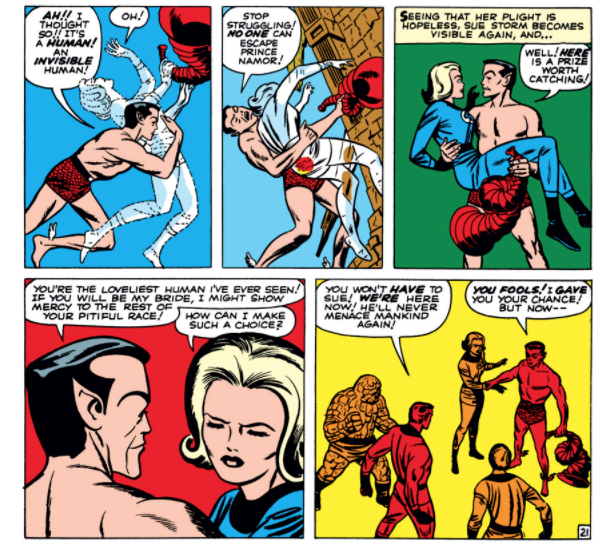
The Sub-Mariner enlists Giganto, a monstrous whale with arms, to invade New York, and it’s stopped only after the Thing detonates a nuclear bomb inside it. The Sub-Mariner then threatens to take the Invisible Woman as his bride or he’ll unleash a greater invasion. Sue agrees, but Namor, sensing her reluctance relents, and is defeated when the Torch created a tornado of fire that deposits Namor in the ocean.
What’s going on here
The issue is of course notable for the introduction of Namor to the Marvel Universe, and the beginning of his decades-long preoccupation with Sue Storm, which is occasionally reciprocated.
It’s also the best issue to date. It flows directly from the events of the previous issue, and the Fantastic Four tangle with a foe with a real backstory, plausible motivations, and the ability to cause serious trouble.
So who is this guy?
The Sub-Mariner, created by Bill Everett, first appeared in 1939. Inspired by the original Human Torch, Everett wanted to create a nautical equivalent and chose his name, Namor, because he wanted something noble-sounding (Namor is “Roman” spelled backwards). Half-human, half Atlantean, his father was a sea-captain and his mother was daughter of the emperor of Atlantis, making Namor its eventual king.
The Sub-Mariner was a mainstay of Timely Comics (Marvel’s precursor) during the 1940s, but faded out in the 1950s along with most super-heroes.
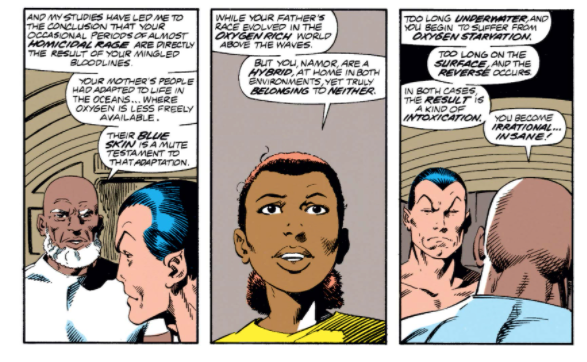
His depiction in Fantastic Four 4 is consistent with his Golden Age characterization: Arrogant and impetuous, but driven by a pursuit of justice. Initially written as a villain, Marvel gradually transitioned Namor to hero and his rages were retconned by John Byrne as a consequence of his mixed ancestry.
From Namor No. 1, 1990
Namor becomes a Marvel mainstay, starring in several versions of his own book while serving as a member of the Defenders, Avengers, and X-Men, with his ability to fly identify him as a mutant. He’s also retconned into Captain America’s World War II -era team, the Invaders.
Fantastic Four 4 also introduces the Namor-Sue entanglement, which twists and turns over the decades. One mild irony of Namor’s infatuation of Sue is that he clearly sees something in her which doesn’t become evident to the rest of us for decades, when her writer’s finally give her a personality and backbone. Until then, though, she’s mostly just a pretty face who whimpers a lot.
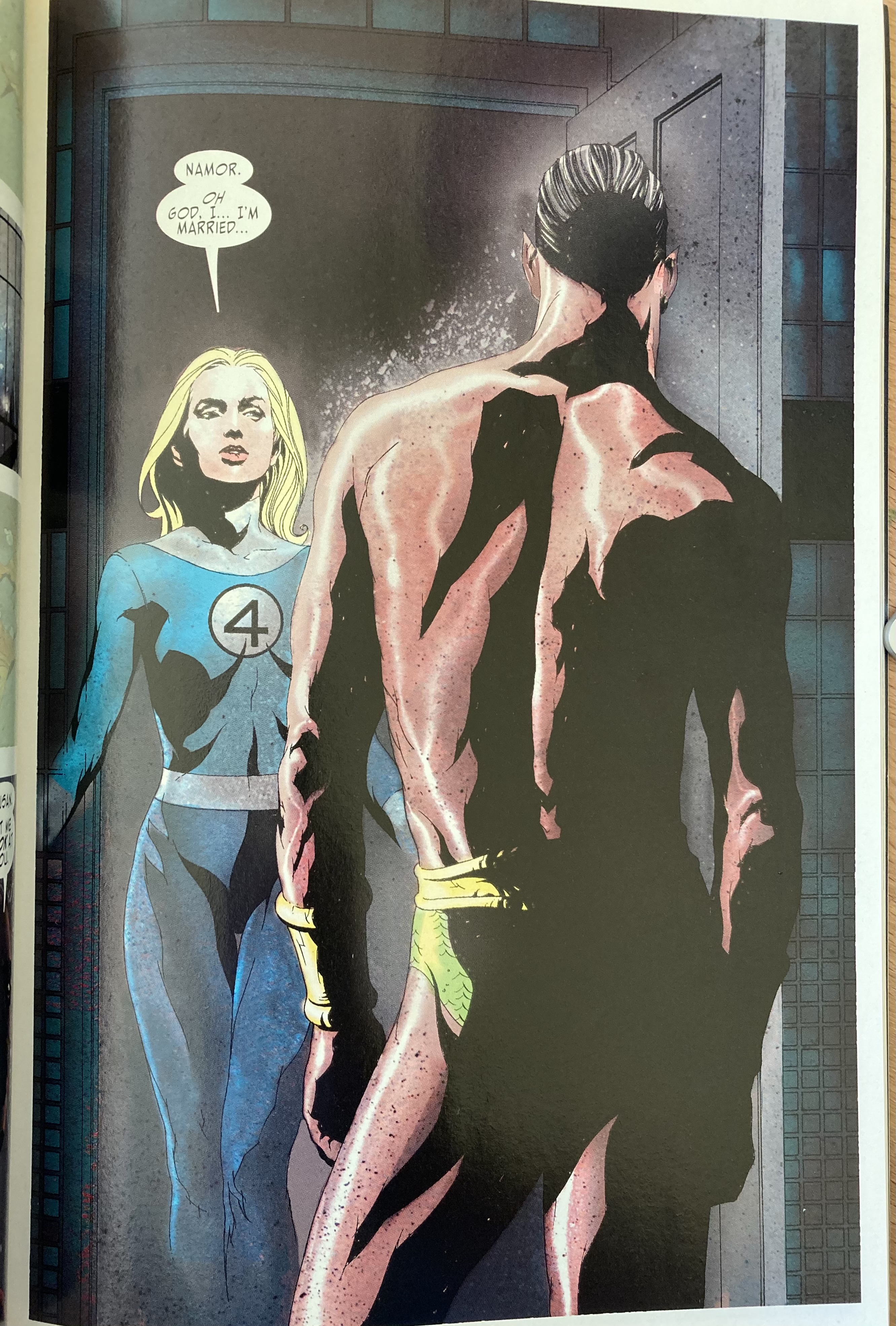
Their relationship is mostly flirtatious, although once in a while a writer will push things a bit, especially when Sue and Reed are in the midst of their occasional marital difficulties. Grant Morrison may have taken it the farthest in Fantastic Four 1234, a miniseries where Sue’s frustration with Reed’s absences comes close to a tipping point.
Fantasic Four 1234 (2001)
New York, New York
For the first time the Fantastic Four are described as living in New York instead of a fictional city like Metropolis or Gotham. That will have major repercussions for the future the Marvel Universe, and become a key differentiator of Marvel from DC as its fans celebrated the “realism” of its comics.
They’re fighting again
The Atomic Age
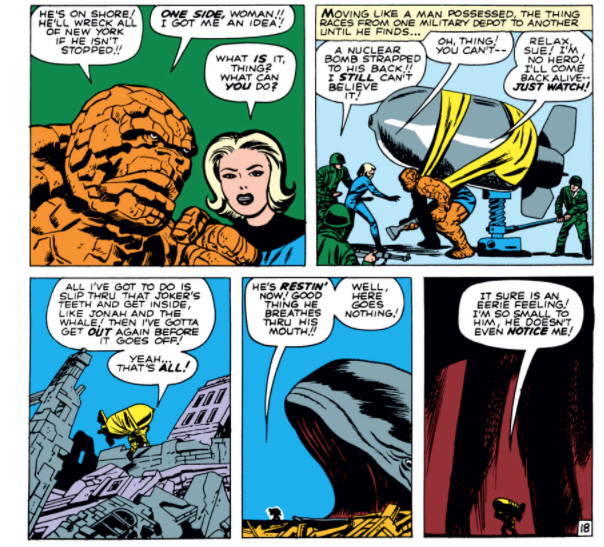
Namor plots his revenge on the surface world after discovering lingering radiation in the ruins of Atlantic, which he attributes to human and “their accursed atomic tests. And Ben somehow locates a nuclear bomb and totes it into the mouth of Giganto, Jonah-like, before detonating it.
Are you sure he’s a genius?
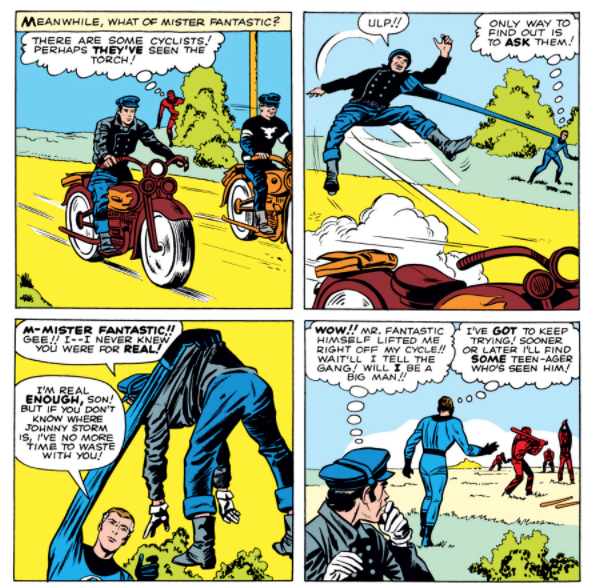
Mr. Fantastic takes a rather aggressive approach to asking some passing motorcyclists about the Torch’s whereabouts. Thankfully, they don’t press assault charges.
Dig that Kirby Krackle
Jack does a great job with this fight sequence:
With this amazing panel:
And of course with Giganto:
We’re No. 1
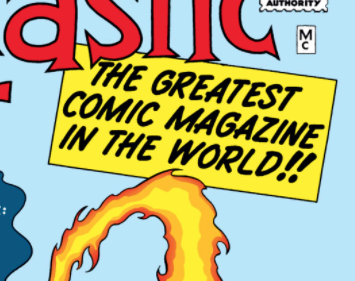
The “World’s Greatest Comic Magazine” is now affixed above the logo, where it will remain for decades:
Also, a house ad for the Hulk appears a few times at the top and bottom of the pages, a first.
For sale
A mint (9.8) copy of FF 4 will set you back around $450,000
Fantastic Four No. 3 “The Menace of the Miracle Man” Published: Dec. 1961 Story: Stan Lee and Jack Kirby Pencils: Jack Kirby Script: Stan Lee Inks: Sol Brodsky (uncredited) Cover: Kirby and Brodsky
Synopisis:
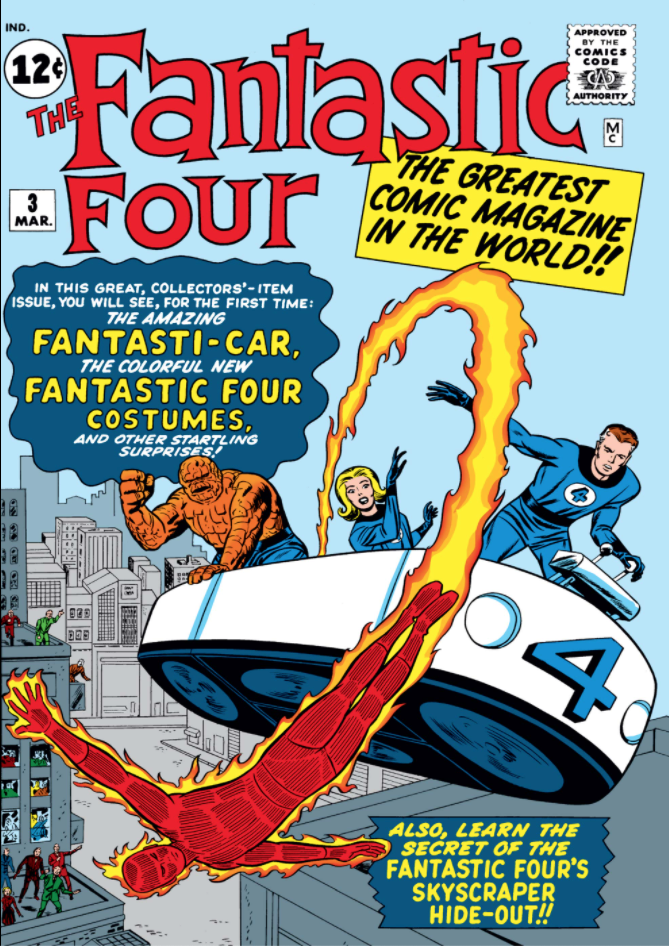
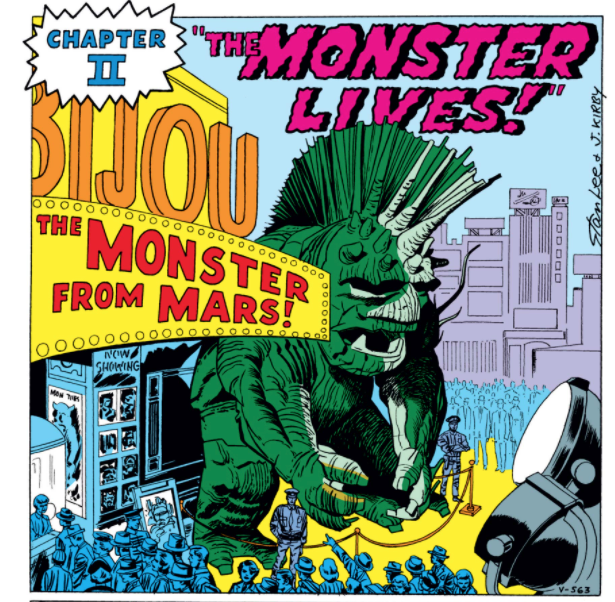
The Fantastic Four attend a performance of the Miracle Man, who demonstrates amazing powers and appears more powerful than the Thing. A worried Fantastic Four return in the Fantasticar to their skyscraper headquarters , where they watch on television as a giant statue of a monster becomes animated and rampages through the city. A note from the Miracle Man claims responsibility as the FF fail to keep the monster from stealing first jewels, then the military’s new “atomic tank.”
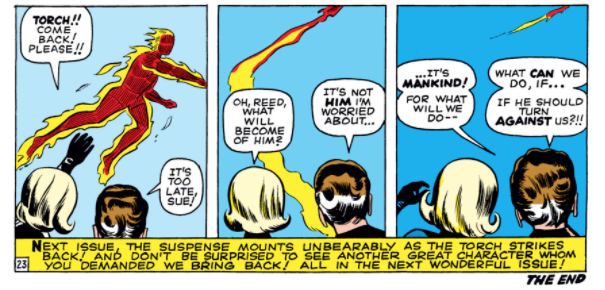
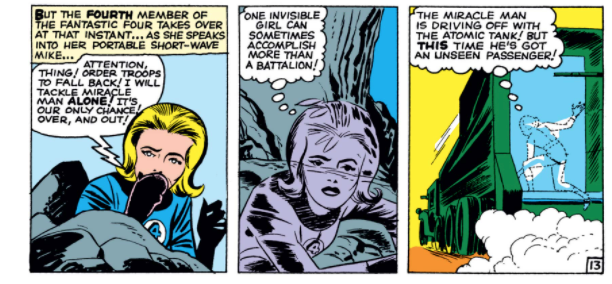
As the Miracle Man drives off with the tank, the Invisible Girl stows away. She is discovered, and hypnotized into summoning the rest of the FF. After a confrontation and another chase that culminates with the Human Torch’s flame blinding the Miracle man , Mr. Fantastic reveals the Miracle Man has a hypnotist who is powerless without his sight. The story ends with a frustrated Human Torch quitting the team.
What’s going on here
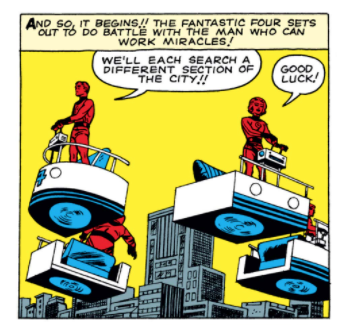
The Miracle Man story is pretty forgettable, and the big reveal—that his seeming powers were all an illusion—doesn’t hold up to much scrutiny (how did his power of illusion steal a tank?). The story is notable because it’s the first where the FF really starts to resemble the team of superheroes with which we’re familiar. The story introduces a number of elements that make up the FF brand: their blue-and-black costumes, the Baxter Building (although it’s not named in the story), and the”air-powered” Fantasticar, one of the many gizmos that become part of the FF’s identity.
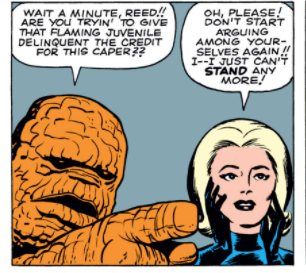
The story also further cements the fractious relationship between the members, with Ben flying off the handle, Johnny sulking, Reed trying to get them to behave and Sue cringing about it all.
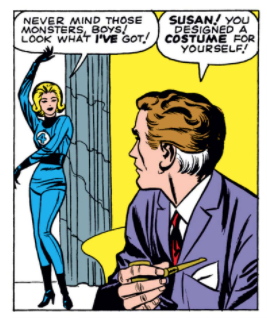
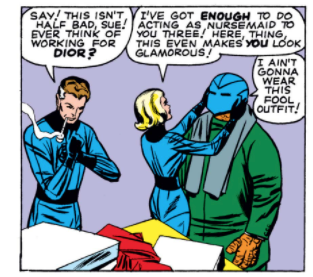
After two issues of fighting bad guys dressed as civilians, Sue presents the team with their uniforms. Ben resists and eventually tears his off, but the basic concept of matching uniforms becomes a key visual element throughout the FF’s history. Note Sue’s high heels. Ben’s helmet doesn’t last the issue, but it does reappear decades later after Wolverine’s claws injure his face.
The FF aren’t the first supergroup to wear matching uniforms, and it seems to be another aspect Kirby borrowed from his design of the Challengers of the Unknown at DC a few years earlier. Unlike the Challs, however (I love that nickname), the FF wears a “4” insignia, and I recall reading somewhere—I wish I remember where, but it might have been by Grant Morrison—that the introduction of the insignia to costumes was the key break that separated the first superheroes like Superman and Batman from the pulp-era characters like the Shadow and the Phantom that preceded them. I don’t know if Stan and Jack were consciously using the logo to attach the FF to a superhero tradition, but it worked.
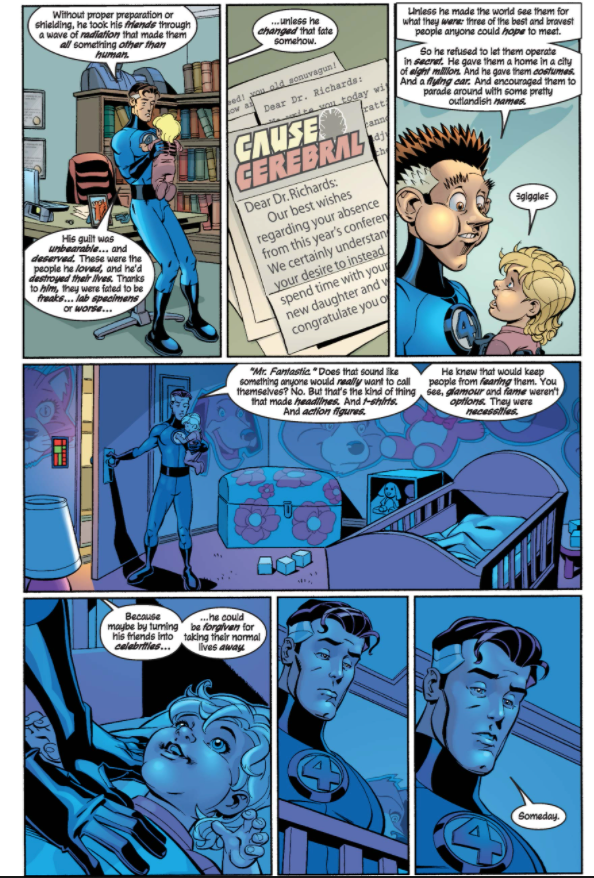
The “4” later gets added to their vehicles and even becomes part of the architecture of Four Freedoms Plaza, a building that replaced the Baxter Building for a while. The deliberate branding of the FF as public and flashy colorful, as if they were a consumer product like Pepsi, is later ret-conned into their history by writer Mark Waid in 2002. As Waid writes it, going public is an effort by Reed to help make up for the damage he caused his friends by arrogantly insisting his spaceship was ready to fly through the cosmic rays. As retcons go, it’s a pretty good one, since it attempts to solve a few of the big apparent inconsistencies in the FF’s origin: What was Reed thinking, and why are they so public?
From Fantastic Four 60 (Vol. 3)
(That run by Waid, with art mostly by Mike Wieringo, is one of the best in recent FF history).
About that headquarters
The Baxter Building won’t get its name for a few more issues, but it’s clearly established as the same team headquarters which will remain more or less intact until it’s destruction in the 1980s.
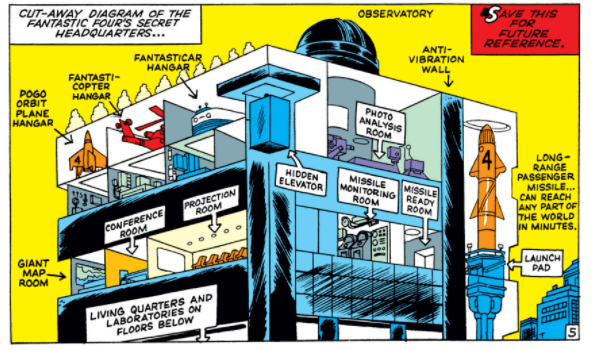
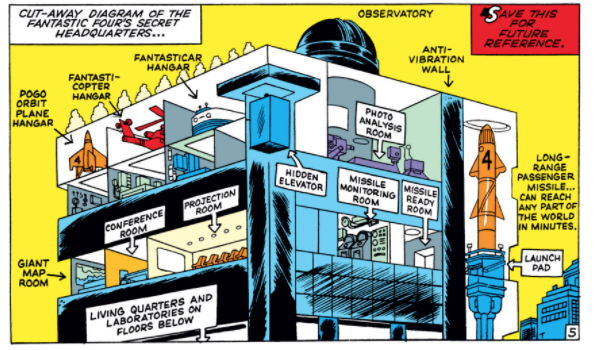
This issue features the first of many cut-away drawings that will appear over the years (and includes instructions to “save this for future reference”):
The schematic introduces the FF’s Pogo Plane and their passenger ICBM, neither of which appear again in this issue but are used in subsequent stories.
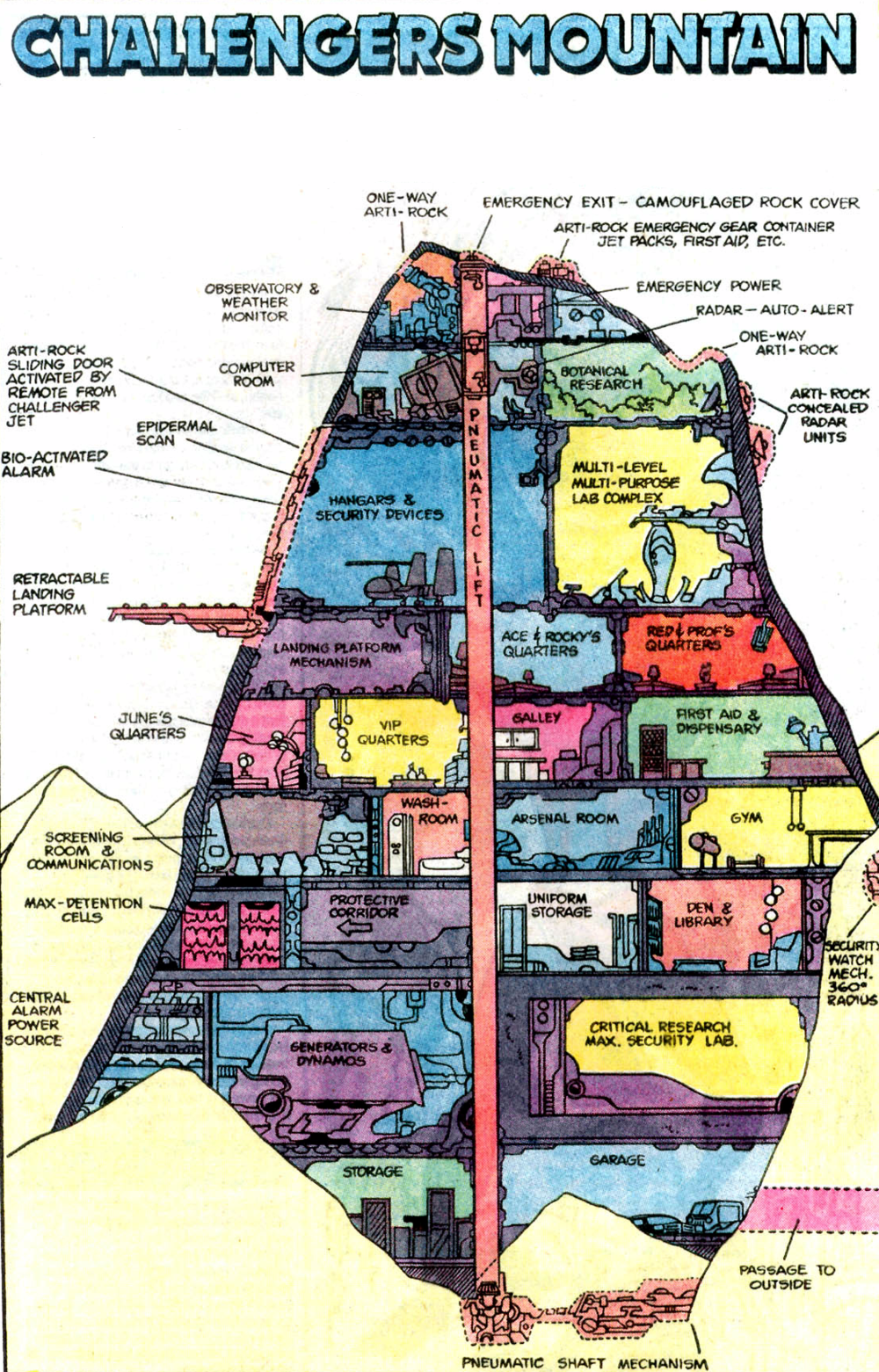
The similarity to the Challs’ mountain headquarters is noteworthy:
What’s up with Johnny?
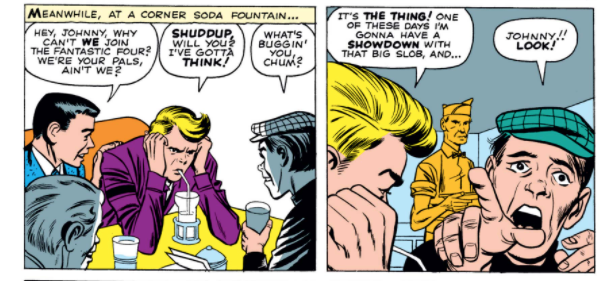
The Human Torch is particularly sulky and grumpy in this issue, perhaps an effort by Stan and Jack to clearly distinguish him as a the team’s moody teenager. At one point he goes off with his friends, who seem more like irritating hanger-ons:
Then, at the end of the issue and without much build up, he take off (literally and figuratively), setting up a bit of a cliff hanger:
By this point Johnny no longer looks like a human-shaped flame, but is much closer to the red-briquette form we’re familiar with.
We’re No. 1
For the first time, a version of the “World’s Greatest Comic” appears on the cover. I’m not sure what the FF did in the first two issues to earn the honor, but it sticks.
They’re fighting again!
The sexist sixties
Sue gets a rare turn as hero, calling off the National Guard and turning invisible to pursue the Miracle Man:
But she’s back to wimpering by the end of the story
Dig that Kirby Krackle
Jack knocks it out of the park with the movie monster, naturally
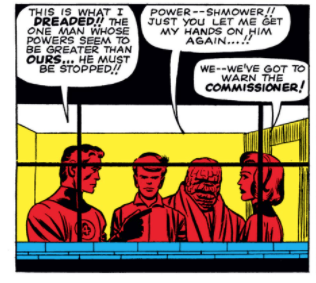
And this quieter panel, of the FF seen through a window, is pretty cool too:
Oops!
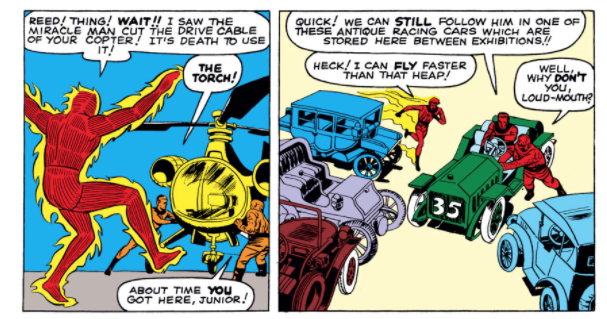
Did Stan have to write around a Jack continuity error here? It sure seems like it, since the action the Torch describes is never shown and has no real purpose in the story.
The incredible Mr. Fantastic.
At various points Reed is stretched into a web, forms a bouncing ball, and here becomes a spare tire:
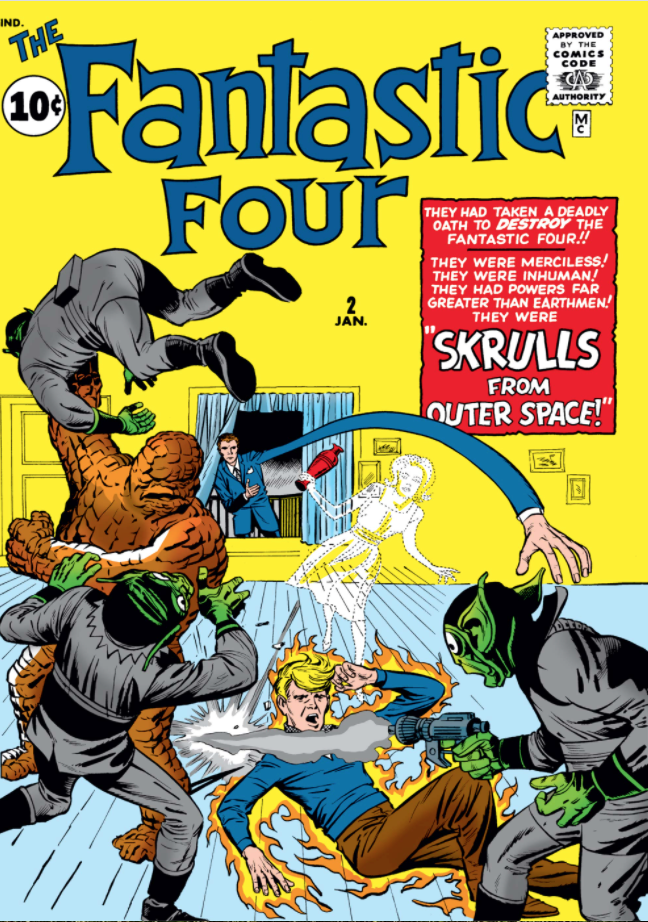
Fantastic Four No. 2 “The Fantastic Four Meet the Skrulls from Outer Space” Published: September 1961 Story: Stan Lee and Jack Kirby Pencils: Kirby Script: Lee Inks: George Klein (uncredited) Cover: Kirby and Klein
Synopsis:
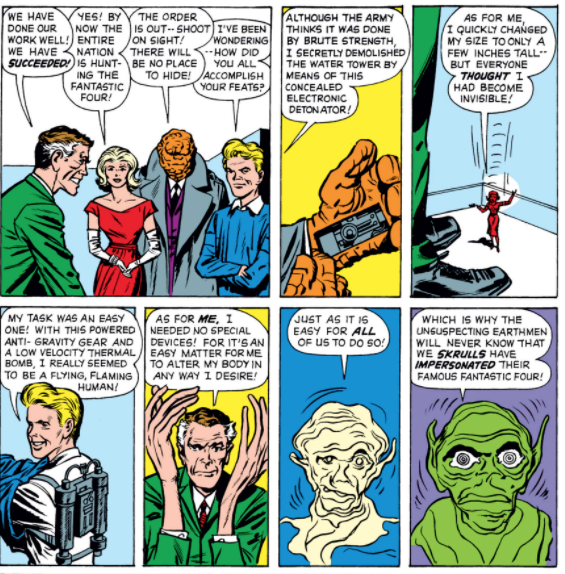
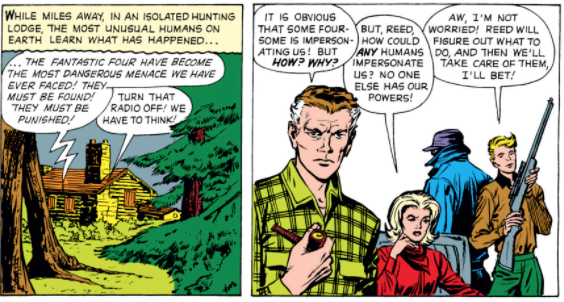
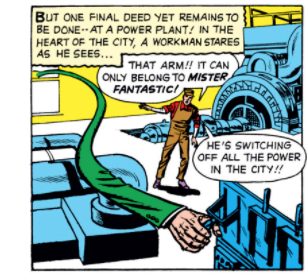
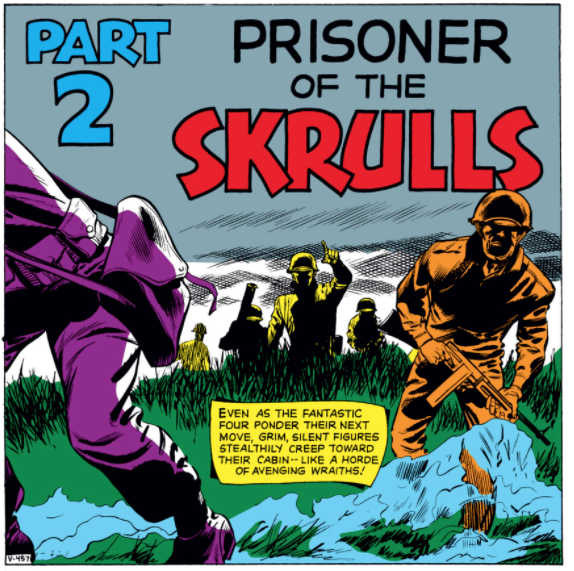
One by one, members of the Fantastic Four are shown engaged in acts of vandalism and theft: The Thing demolishes an off-shore oil rig, the Invisible Girl steals a diamond, the Human Torch melts a statue and Mr. Fantastic stretches into a power plant to switch off New York’s electricity. The four are revealed to be Skrulls, shape-shifting aliens who are framing the Fantastic Four as a prelude to their invasion of Earth. The real Fantastic Four are taken prisoner by the US Army, but the FF quickly escape the cells specially designed to hold them.
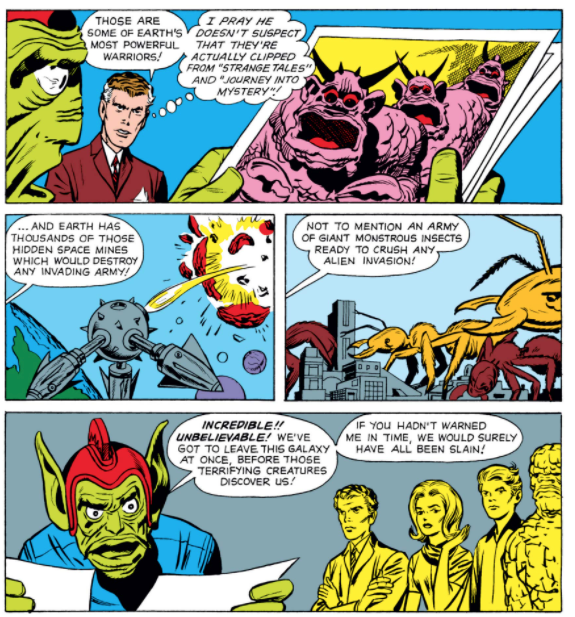
Now free, the FF devise a plan for the Human Torch to attack a rocket in order to flush out the Skrulls. The plan works, and once Johnny reaches the aliens’ headquarters, he sends a flare to attract the rest of the team who quickly subdue the Skrulls. The team then uses the Skrulls’ space craft (disguised as one of New York’s ubiquitous water towers) to fly to the orbiting mother ship, where, while masquerading as the four invading Skrulls, they present the Skrull commander evidence of the terrible monsters ready to defend Earth (in reality, images clipped from Marvel comics). Terrified, the Skrulls flee, and the FF return to Earth where they clear their name and pacify the remaining Skrulls by hypnotizing them into believing they’re cows.
Meet the Skrulls!
What’s going on here?
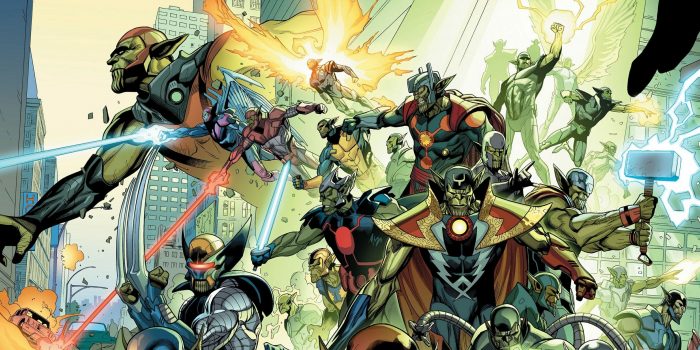
The introduction of the Skrulls is the most significant development in the Fantastic Four’s second issue. While a lot of Marvel’s Silver Age villains appeared once or twice, only to vanish in obscurity, the Skrulls go on to become a major part of the Marvel universe. The basics are all laid out here: they’re a war-like race bent on conquering Earth, and will use their shape-shifting powers to infiltrate human society. Over the years the Skrulls become one of the three major alien empires, with the Kree and Shi’ar, that feature across the Marvel line. Some Skrulls receive individual identities, including various members of the Skrull royal family. At one point it’s revealed that Johnny Storm is married not to Alicia Masters but to Lyja, a Skrull in disguise, and Hulkling, a young hero, is the product of a Skrull-Kree romance. A Skrull incursion became a major cross over event in 2008 (called Secret Invasion, naturally enough), and Skrulls played a major part in 2019s Captain Marvel movie.
The Skrulls of Secret Invasion
The Skrulls are classic Silver Age villains—literally little green men from space—and products of Cold War paranoia, with the menace Communist infiltration is a recurrent theme throughout science fiction. Their shape shifting makes them potent characters and it’s not hard to see what Lee and other writers would return to them again and again.
Anything else of note?
Stan and Jack are still figuring out what the Fantastic Four are. While their individual identities are clearly established, a lot of the team’s familiar trappings—their uniforms, their gadgets, their headquarters—won’t appear until next issue. Instead, they’re dressed as civilians, they’re hanging out in an “isolated hunting lodge,” of all places, and a text block refers to them meeting at “one of the Fantastic Four’s many secret apartment hideouts.” I’m not sure those hideouts every reappear. At this early stage, it’s not quite clear if Lee and Kirby want these characters to be superheroes, or perhaps a band of super spies, like 007.
Ye olde FF hunting lodge
Despite this being just their second issue, the Fantastic Four are apparently quite famous, and the various imposters are identified by their code names by the public.
The torment of the Thing
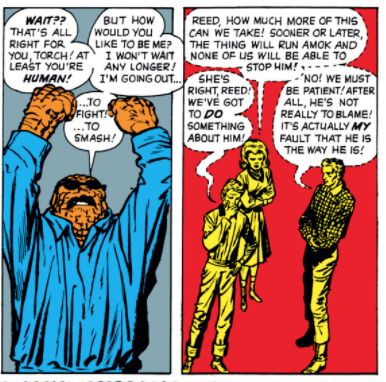
Ben Grimm’s anguish at being a monster is again on display, as it will be almost every issue for the next 60 years.
This issue also has him briefly changing back to human form as the FF again passes through “the radiation belt” (not cosmic rays), as they return to Earth from the Skrull ship in orbit. Over the years the FF go to space a lot, but I’m not aware of this happening regularly.
They’re fighting again
Another ongoing feature is Ben fighting with his teammates:
The sexist sixties
Sue is again portrayed as a helpless bystander:
Trapped!
This is the first time the FF are caged in cells designed to neutralize their powers (and which they eventually outwit) but it won’t be the last. This device appears frequently over the years.
Let’s talk about us
Reed’s use of Marvel comics (specifically “Strange tales” and “Journey into Mystery”) to fool the Skrulls is the beginning of a long tradition of Stan and Jack bending the fourth wall by inserting Marvel and its creators into their stories. The in-universe explanation, later retconned, of why this works is that the war-like Skrulls have no tradition of representational art and couldn’t perceive that the images were illustrations.
Dig that Kirby Krackle
Jack delivers some great art in this issue. Here’s a great panel of the army advancing to arrest the FF:
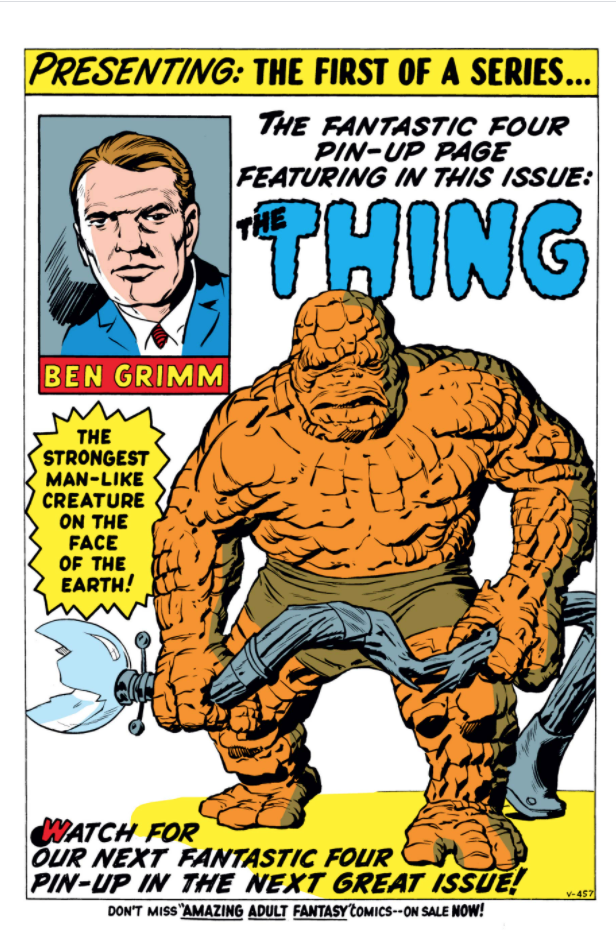
Bashful Benjamin Grimm gets his own pin-up at the end of the comic, the first in what becomes an ongoing feature. Note the careful qualification “the strongest man-like creature on the face of the earth.”
About those cows
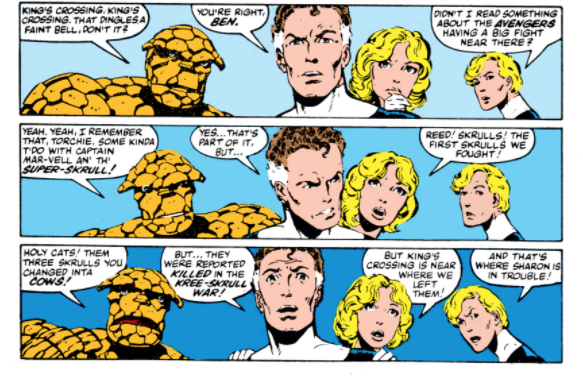
In a clever bit of story telling, and nice use of the Fantastic Four’s history, John Byrne took the throwaway line at the end, about the Skrulls being hypnotized into cows, and built a great horror story around it in 1983’s Fantastic Four Annual 17. The story essentially asks, what happens when an entire town spends years drinking Skrull milk? It’s also a useful reminder that despite Reed’s brilliance, not all of his ideas are thought through to their conclusion.
Welcome to the inaugural installment of what I’m hoping is a multi-year project to blog the entire run of the Fantastic Four, from its 1961 debut up until the present (assuming it’s still being published however many years in the future that will be).
Why the Fantastic Four? The easy answer is that it’s my favorite comic, but also because it’s steeped in history. The Fantastic Four launched the Silver Age at Marvel, and ushered in the Marvel universe as we know it, the overlapping and self-referencing world of superheroes and characters that, nearly six decades later, now spans tens of thousands of comics. The Marvel comics universe, of course, also gave birth to the Marvel Cinematic Universe, a potent pop-cultural force that has introduced many more millions (billions even) to these characters.
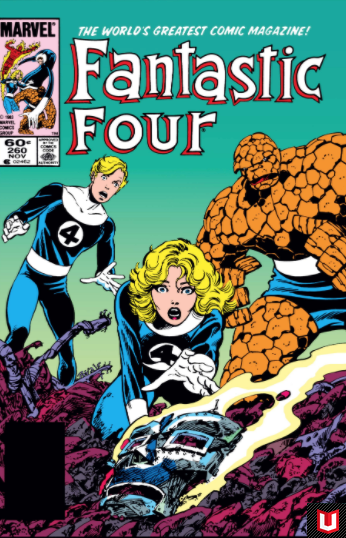
I don’t recall my first exposure to the Fantastic Four—it might have been the either the 1967 or 1978 cartoons—but I clearly remember the first FF comic I bought: issue 260, off of a spinner rack at the Amenia Variety store, near my parent’s house in Dutchess County, New York, in late August of 1983. I had spent the previous months at summer camp, and a fellow camper was Eddie Galton, son of then-Marvel president James Galton. I wasn’t particularly friendly with Eddie (now Edward, and a TV producer) but he had hundreds of comics, and they washed around our bunks. I had read comics before, mostly things like Archie and Richie Rich, but that was my first taste of modern Marvel superheroes and I was hooked (I can’t recall much of what I read that summer, although The Official Handbook to the Marvel Universe No. 11 one was definitely among them. When I got back from camp, I eagerly sought out more, and FF 260 was the first I bought.
In retrospect, you would be hard pressed to find a better single-issue introduction to Marvel comics from that era than FF 260. Written and illustrated by comics maesto John Byrne at the peak of his powers, it featured the FF tussling with their best bad guy, Dr. Doom, and guest appearances from some of prominent supporting characters like the Silver Surfer and Sub-Mariner (more about that issue when we get to it in few years). More importantly, the individual personalities of the team’s members were clearly defined, as was their relationships to each other. This was more than a team, it was a family, and it was clear from the first issue I read.
Ultimately, that dynamic is what keeps me coming back to the Fantastic Four after many decades and creative teams. They’re not a team of superheroes who banded together to fight evil, like the Justice League or Avengers; they were a family of adventurers who became super heroes. Like all families they quarrel and sometimes drift apart, but they are tied together by love and shared history.
A few notes about this project: I hope to cover one issue a week, starting with the first. This is not a new format, and there are many similar blogs tackling lengthy comic book runs (including, probably, the Fantastic Four). I was inspired by The Matt Murdock Chronicles, a sadly defunct issue-by-issue look at Daredevil, and particularly Austin Gorton’s X-aminations X-Men Reviews, a heroic attempt to document every X-Men related comic on the The Real Gentlemen of Leisure blog. If some of the features look familiar, I will confess to having borrowed some of the best elements of from those two blogs. For historic data, I’m relying on Mike’s Amazing World, a great resource.
When possible, I will take note of non-story elements that will be relevant, such as notes from Bullpen Bulletins and the letter’s page, when they appear. Unfortunately, I’m relying on my Marvel Unlimited subscription for early issues, which doesn’t include those elements, so I won’t have them available until we get to the comics I actually own. If nothing else, this exercise should help spur me to fill into the gaps in my collection.
So with all that throat clearing out of the way, here is the one that started it all, Fantastic Four No. 1:
Fantastic Four No. 1 Published: August 1961 Story: Stan Lee and Jack Kirby Pencils: Kirby Script: Lee Inks: George Klein (uncredited) Cover: Kirby and Dick Ayers
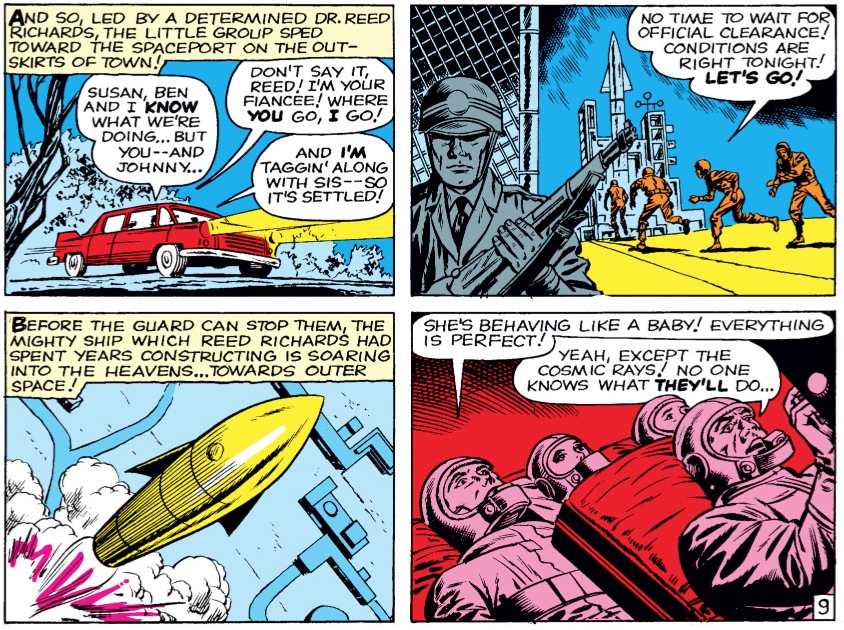
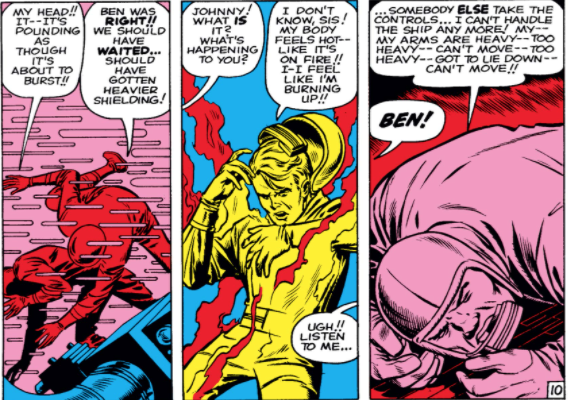
Synopsis: A mysterious man sends off a flare, summoning three strangely powered individuals: a woman who can turn invisible, a monstrous brute, and a teenager who bursts into flame. The man who summoned them is revealed to have stretching powers. A quick recap explains their origin: Scientist Reed Richards leads his best friend (Ben Grimm), his girlfriend (Sue Storm), and her younger brother (Johnny Storm) to sneak aboard a rocket for an unauthorized mission to space. Despite Grimm’s misgivings about the unknown effect of cosmic rays, he agrees to pilot the ship after his courage is called into question. In flight, the craft is bombarded by cosmic rays and after a crash landing, their powers manifest. After a brief squabble, they agree to use their powers for good.
Back in the present, Richards informs the rest of the team about atomic plants vanishing underground around the world. He pinpoints the location—Monsters Island!— and the team flies to investigate. After confronting a three-headed flying monster, Reed and Johnny are separated from Ben and Sue, tumble beneath the earth and meet the Mole Man, a misshapen man driven underground by a a cruel world. A fight ensues, Ben and Sue eventually catch up and Johnny blazes a path out of the cavern, sealing the Mole Man and his monsters beneath. An apparent nuclear explosion destroys the island as the team flies off.
What’s this all about?
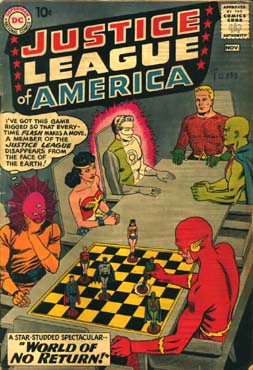
The Fantastic Four was born from a mix of influences. The genesis was a business decision: Magazine and comic publisher Martin Goodman wanted a comic that could compete with the Justice League of America, a super hero team-up book launched a year earlier by National Comics Publication, a precursor to DC. Goodman directed Stan Lee, his editor, to come up with something, and Lee recruited artist Jack Kirby, then newly arrived at what would become Marvel. Who actually contributed what to the origin is still debated, but it’s clear both Lee and Kirby played a role.
The use of space travel and cosmic rays as an origin device is very much of its time: Sputnik had launched four years earlier, and Yuri Gargarin became the first man in space in April of 1961. Space was on everyone’s minds, particularly the teenage boys the comics was targeting. The specter of communism is also present, as Sue warns that “the commies” could beat the team into space (and of course, they had).
Unlike the Justice League, which was an assembled group of existing heroes with their own origins and costumes, the Fantastic Four was created together. Their origin and uniformed appearance is very similar to that of the Challengers of the Unknown, a team Kirby created in 1958 while at National (you can read more about that here).
It’s also worth noting that the powers acquired by the team aren’t particularly unique. Invisibility is a well-established power dating to H.G. Wells’ TheInvisible Man (at least), a man who changes into a hulking monster draws from Beauty and the Beast and Dr. Jekyll and Mr. Hyde (and many others), Plastic Man was a stretching character dating from 1941, and not only did Marvel itself have a character who could burst into flames in the 1940s, but he was also called the Human Torch. At one point Stan Lee said he was riffing off of the four elements when he assigned the team their powers:air (Sue), water (Reed), earth (Ben) and fire (Johnny).
About that origin
The five short pages of origin are among the most scrutinized texts in comics. Over the years the story has been expanded and retconned, often in an attempt to address some of the story’s central mysteries: Why would Reed, allegedly one of earth’s smartest men, risk exposure to the cosmic rays that even Ben knew were a risk? Why would he take along not just his fiancee but her teenage brother? Why would he sneak aboard his own ship in the middle of the night? The in-story explanation is that Reed doesn’t have time to wait for official clearances because “conditions are right tonight,” and that Sue and Johnny insist on accompanying Reed and Ben.
Ben’s resentment at Reed for his disfiguration and Reed’s guilt and attempts to cure Ben have fueled dozens of stories and remain a potent thematic element of the Fantastic Four through the present. In one of the recent retellings, by Dan Slott in Point of Origin, the space ship was adequately protected from ordinary cosmic rays but the ship was subjected to a barrage of the rays from the alien planet Spyre, the team’s original destination (no actual destination was given in the first issue).
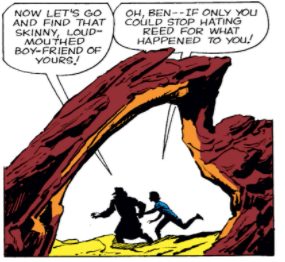
Ben’s long-simmering resentment at Reed is hinted at early on:
So who are these guys:
The first issue lays the template for hundreds of stories to come, and by-and-large the basic characters are established from the beginning, and while their appearances and powers change, the essential notes of their personalities will remain in place for years.
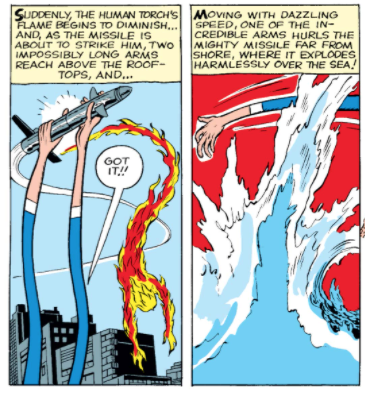
Reed, appearing with his pipe and hair that is going white at the sides, is basically the same confident, aloof professorial Reed we’ve known for decades. He is a bit overpowered in this first issue, at one point grabbing a nuclear missile aimed at Johnny out of the air and throwing it into the Atlantic (why the National Guard thinks firing a nuclear weapon over New York was prudent goes unaddressed).
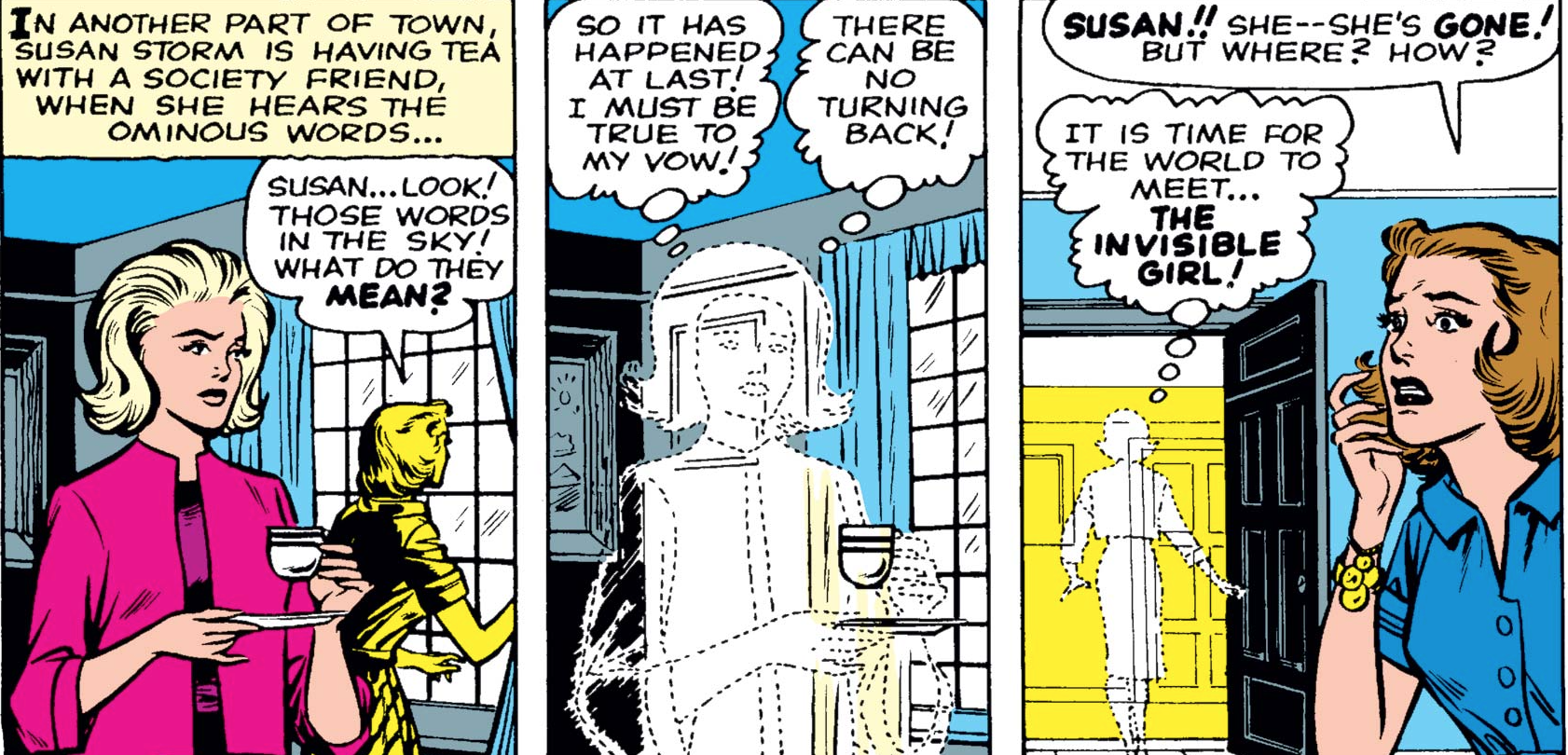
The basic character beats of Sue that persist for years are also established: She’s demure and dainty, supportive of Reed to a fault. Her power at this point remains invisibility, a metaphor for her vanishing personality, until issue 22, when she gains the ability to create force fields. It wasn’t until the 1980s and under John Byrne that those force fields are depicted as offensive weapons, and she eventually she is described as the team’s most powerful member.
Johnny is a hot-headed teen (metaphor alert!) who is crazy about cars, a long-lasting element of his character. In his first appearances he resembles an actual flame, not the red man surrounded by flames he later becomes.
The Thing is the character whose initial appearance is most unfamiliar to modern readers. It’s not just his monstrous form, which transforms into the orange rocky one gradually over the next dozen issues (apparently Kirby found that version easier to draw) but his personality undergoes a major shift. His diction in this issue is more formal and archaic (at several points he says “bah!) and has none of the dropped g’s and colloquialisms that become his trademark. Nor does he have the sense of humor that helps define the character.
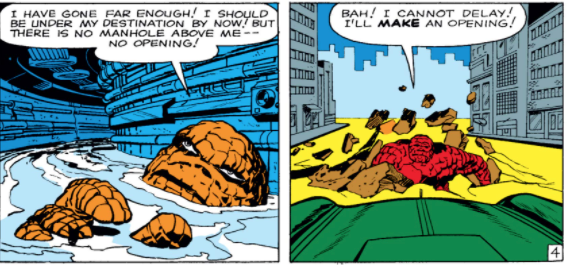
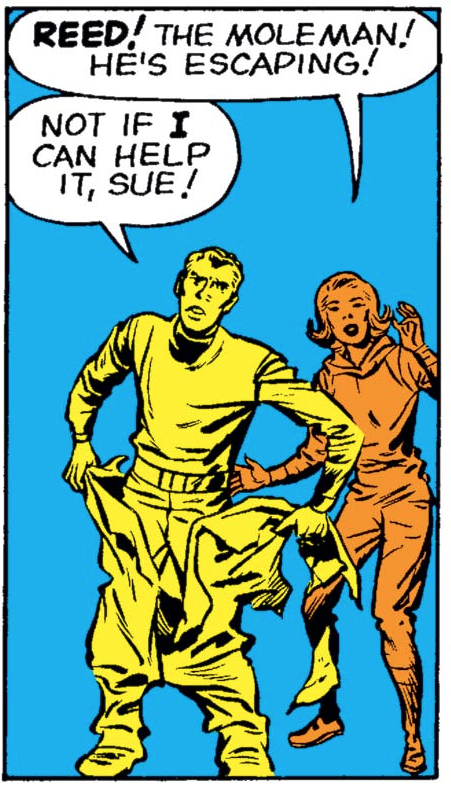
The Mole Man (here referred to as the Moleman) also debuts, and becomes a recurring villain. Although classically Silver Aged in his world-dominating ambitions, he’s given a sympathetic backstory and thus becomes a more nuanced character. Plus, he’s got some sweet moves:
The more things change
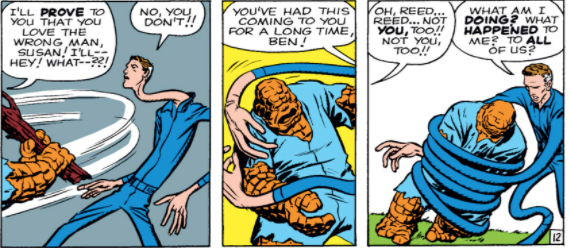
Some elements, however, will remain with the book for years. For example, they’re fighting with each other from the get go:
In what becomes a long sexist tradition, Sue stand back and reacts while the men take action:
And Kirby delivers some knockout art:
For sale
A mint condition (9.8) FF No. 1 will set you back $4.6 million
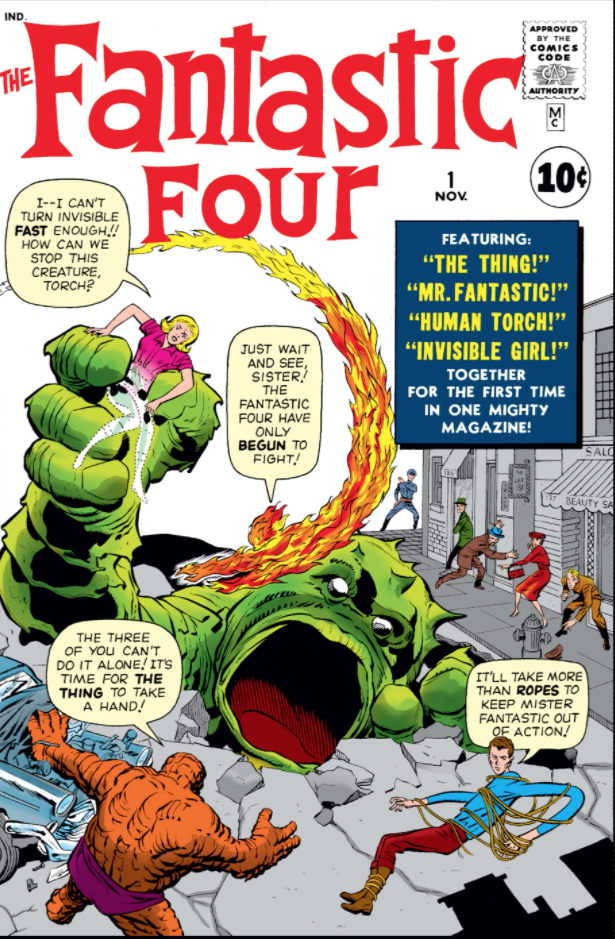
About that cover
Fantastic Four 1 is one of the most copied, parodied or homaged covers in comics. It’s delightfully silly, and has nothing to do with the interior (who put those ropes around Mr. Fantastic, anyway?) It’s notable for a few other reasons, as well. The logo, with those groovy sixties letters, will be one of the the most enduring in comics, and while Marvel will occasionally swap it out for a more modern look, it often returns. Instead of Marvel’s logo, there is a tiny “MC” in a box under the Comic’s Code Authority seal. And the blurb introducing the team promises that they’re “together for the first time,” implying this is uniting a group of individual characters, like the Justice League.
Here are some other versions of the cover (it should be said Byrne in particular loved referencing it):
After a very (very) long hiatus, I’m back blogging on Percival Henry, this time to sum up my year in reading. After a few years of feeling I haven’t read as much as I should, this year I deliberately tracked what I read and pushed myself to complete more books. And while the 18 I read still isn’t all that impressive a total, it’s an improvement over last year. As you’ll discover, I’m not particularly strategic about what books I acquire, and I’m willing to take chances on a book based on the author’s reputation, or the jacket design or because it is cheap. I have huge stacks of unread books, some which I’ve lugged from city to city (or country to country) for decades, so part of my project is whittling away the unread books in my life. When possible, the cover images below are from the edition I read.
Here the are the books, in the order I read them, with a brief review.
1, The Scavengers Guide to Haute Cuisine, by Steven Rinella (2006)
I read this in January, as part of my research for a feature I wrote for Quartz about Rinella, host of the Netflix series Meateater, which you can read here. Rinella is a big personality and a talented writer and both come across in this book, a light-hearted odyssey describing his attempts to hunt, fish, and gather all the ingredients for a 45-course feast. As I mentioned in my article, while it was obvious that Rinella is a much better hunter than I am, it was unsettling to discover he is probably a better writer, too.
2, Hillbilly Elegy, by J.D. Vance (2016)
I picked this up last year at our local library’s annual used book sale, in part because it got a lot of attention after Trump’s election and I wanted to see what the fuss was about. Vance is his most effective as guide to the the pathologies of multi-generational rural white poverty and the forces that sustain it, although it doesn’t do much to explain Trump’s election, as some have claimed and which subsequent scholarship has refuted. He’s less effective at weaving a narrative, and his weaknesses as a untrained writer are often apparent.
3, The Buried Giant, by Kazuo Isihigiro (2015)
I read Ishigiro’s The Remains of the Day years ago and loved it, so when he won the Nobel Prize in 2017 I thought I would try him again. I picked up a used copy of The Buried Giant at the Strand bookstore knowing nothing more about about than the dust jacket but the idea of turning the tropes of a fantasy novel into literary fiction intrigued me. The premise—a quest to slay a dragon set in Arthurian England amidst warring Celts and Saxons—has lots of promise. Ultimately, though, it was a disappointment. The book is really an extended allegory about memory and loss, and its characters are never fully realized but instead serve mainly to stretch out the story so Ishigiro can make his thematic points.
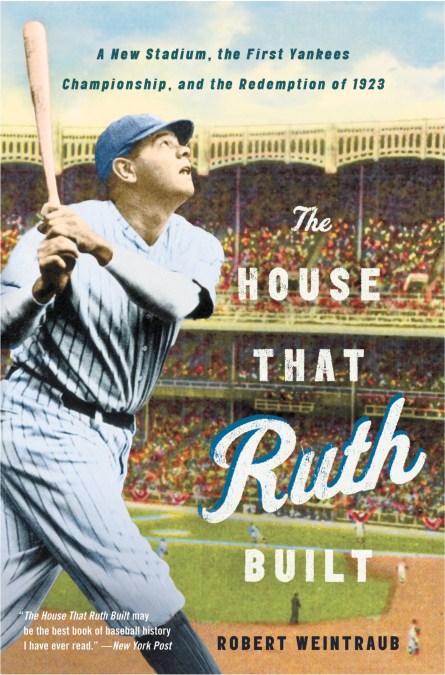
4, The House that Ruth Built, by Robert Weintraub (2011)
Another book purchased for $2 at our local library sale. Nominally a book about Babe Ruth and the 1923 Yankees, it’s actually much more. It’s an account of the founding and early years of the Yankees; a profile of the incumbent baseball power in New York, the Giants, and their ferocious manager John McGraw; and a fun tour of the speakeasies and nightclubs of early 1920s New York City. More than a baseball book, it’s a cultural history and I was surprised how much I enjoyed it.
5, Sword and Citadel (Book of the New Sun parts 3 and 4), by Gene Wolfe (1981 and 1982)
Perhaps my proudest accomplishment in this year of reading was finishing Gene Wolfe’s Book of the New Sun quadrilogy. Widely recognized as among the greatest works of science fiction (and I think justifiably), these books are intricately plotted, densely written, sophisticated in their ambition, complex in their themes, and absolutely absorbing. Broadly about the adventures of an apprentice of an executioner’s guild, the books take place in an unrecognizably distant future, on a earth that became a space-faring civilization before forgetting its achievements and descending into feudalism, with the occasional relics of science surfacing as magic. The series has a cult following that has spawned websites and even a podcast dedicated to unraveling them, and I read these books with a dictionary next to me to help decipher Wolfe’s archaic vocabulary. I recommend them wholeheartedly but they are not casual reading.
6, The Girl from Kathmandu, by Cam Simpson (2018)
One of my ambitions this year was to read the books of my friends and colleagues. I think I put off reading them out of an irrational jealousy of their accomplishments, but I have vowed to overcome my pettiness. I this case, I’m really glad I did because Cam, my former colleague from Bloomberg in London, wrote a magnificent book based on reporting he began when he was at the Chicago Tribune about the deaths of migrant workers in Iraq after the US invasion. The level of reporting on display here is breathtaking, and Cam’s almost anthropological examination of family life in rural Nepal is fascinating. Unfortunately the narrative doesn’t resolve itself with the satisfying resolution we hope for, but as Cam well knows, life can be more complicated than fiction.
7, The Wanderer, by Fritz Leiber (1964)
Probably the worst book I read in 2020. Leiber has a big reputation in science fiction and fantasy, the book won a Hugo, and the cover looked really cool, so it seemed like a good bet it would be worth my time. Dear reader, it was not. This story of how a scattered assortment of humans react to a new planet showing up in earth’s orbit is painfully dated, often sexist, and borderline racist at points. The narrative bounces among various groups of characters, none of whom solidify into real people, and while the premise is promising, the story goes completely off the rails at the end when the aliens appear and engage in intra-species sex with one of our heroes. It’s worse than it sounds.
8, Truman, by David McCullough (1992)
I have been lugging this huge book around ever since I acquired it in the early 90s (I’m assuming it was a gift, but sadly I don’t recall from whom). I remember starting it when I was in my 20s but abandoning it early, since I had no patience for McCullough’s slow unwinding of Truman’s family history. But perhaps I just wasn’t ready for it; McCullough’s books are written for middle-age dads -—there’s a reason they always appear in the weeks before Father’s Day—and I am now the target demographic. It’s a great, fascinating book about a great fascinating man. Truman is perhaps our most accidental president. His life, in many ways, was a series of occasions of falling up and if it wasn’t for his stint in the Army during World War I —which stamped him as a leader and problem solver—he might never had left his family’s farm in rural Missouri. McCullough is really a master of this sort of writing. It’s an admiring biography without ever being hagiographic, and is awash with anecdotes and Truman’s own letters that enliven the story.
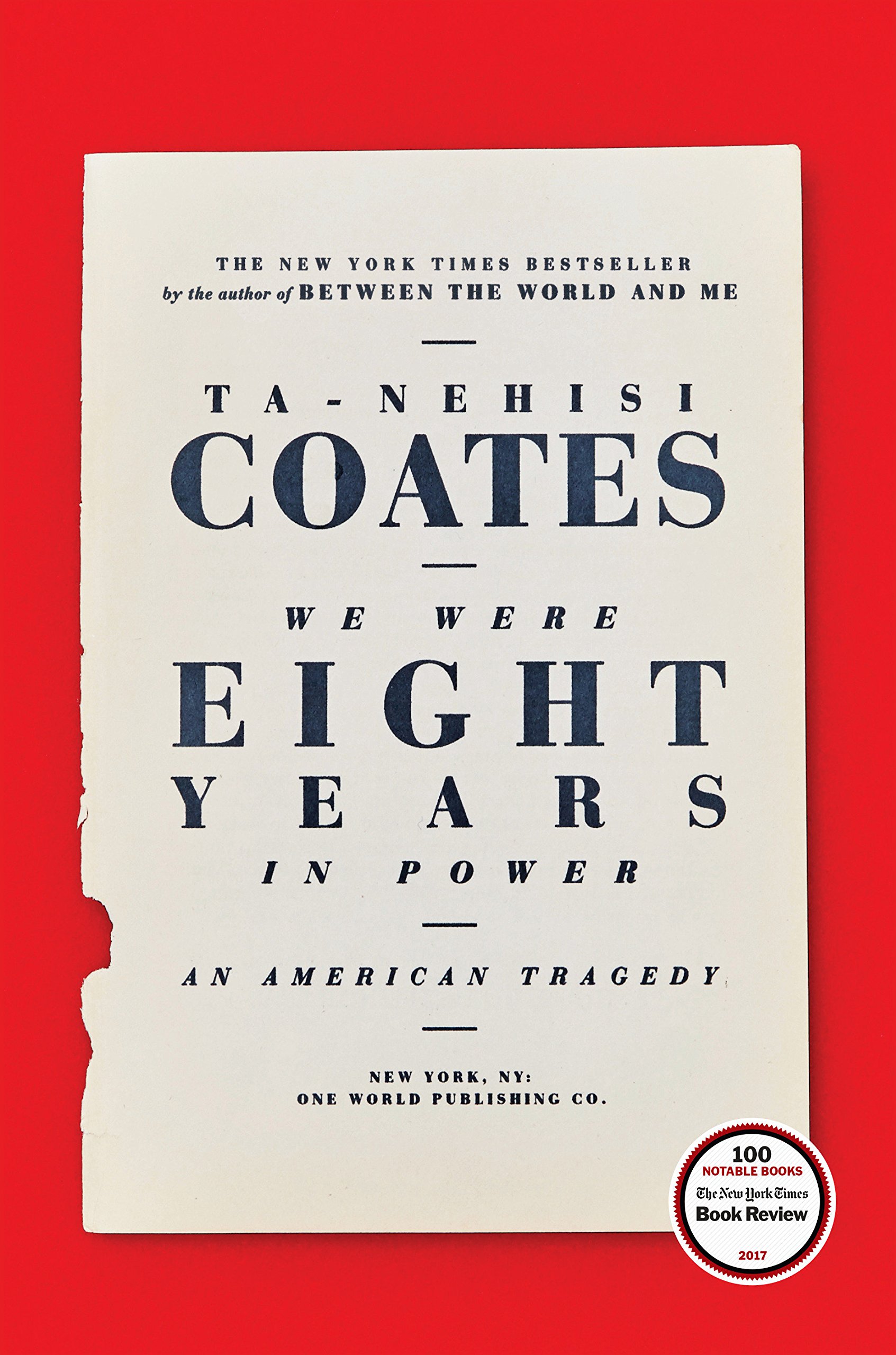
9, We were Eight Years in Power, by Ta-Nehisi Coates (2017)
I bought this collection of essays to read “The Case for Reparations,” perhaps Coates’s most well-known work, as background for a project I edited for Quartz about How to do Reparations, but went on to read them all. The book flickers around the autobiographical, and through the introductory notes before the essays Coates charts his progression from a marginally employed blogger to one a leading public intellectual invited to the White House. The Obama presidency looms large in this book, as Coates seems to wrestle between fury at Obama’s unwillingness to really grapple with the evils of racism, and grudging respect for the man’s ability to operate in a white man’s world, in a way that is alien to Coates. Coates’s seething anger at injustice is never far below the surface, and it’s bracing, sometimes startling, to have the world’s cruelty explained so plainly.
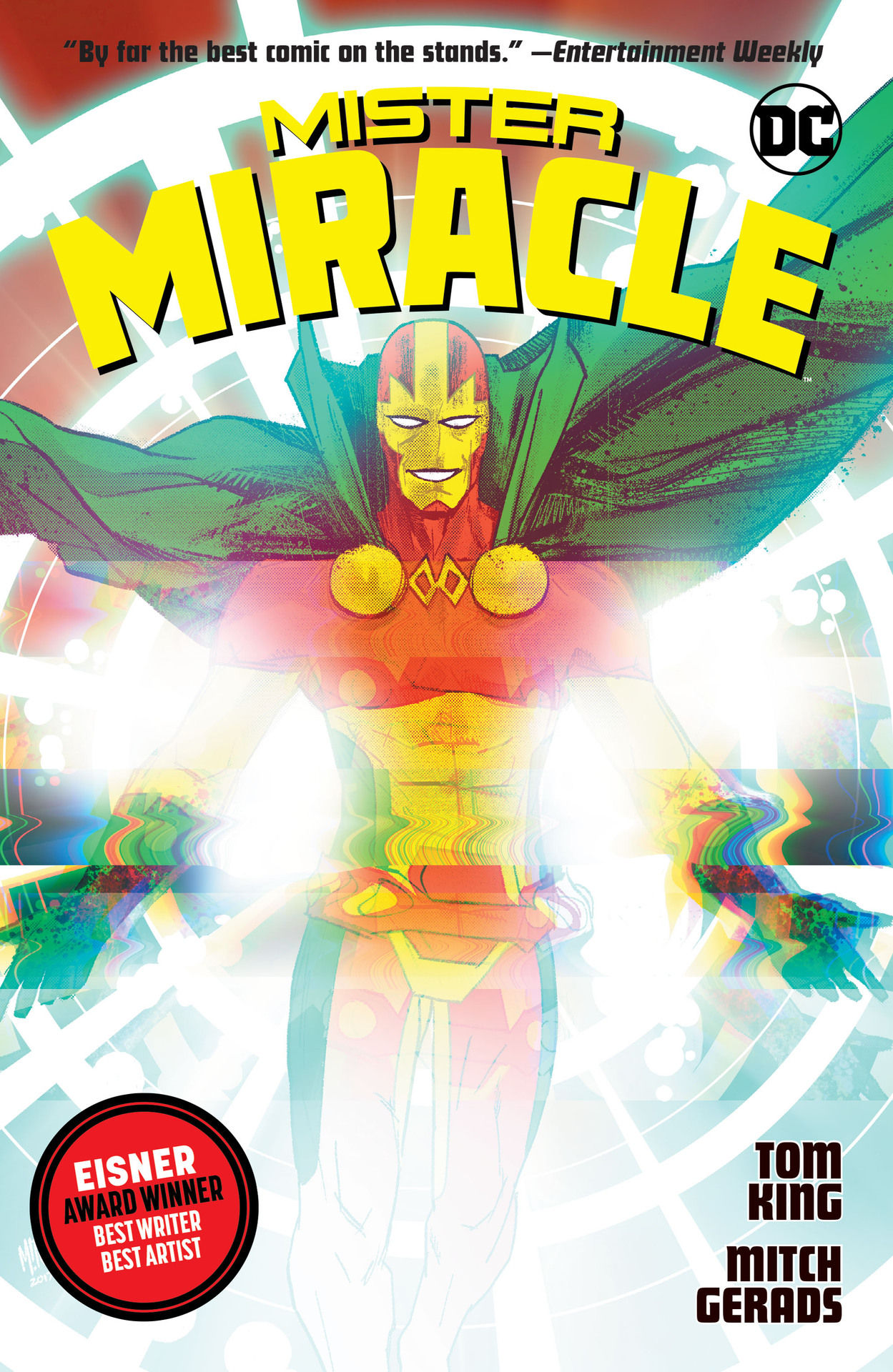
10, Mr. Miracle, by Tom King and Mitch Gerads (2019)
I read a lot of comic books and graphic novels this year, but Mr. Miracle was the only one that felt novelistic in its scope and ambition. The book, which collects a 12-issue limited series, concerns itself with the bifurcated existence of Scott Free, an escape artist and occasional superhero, who has fled the horrors of his youth on the planet Apokolips to settle into middle-class existence in Los Angeles with his wife, the warrior Big Barda. The story draws heavily on a rich web of characters and stories created by comics legend Jack Kirby in the early 1970s, and writer Tom King has fun playing off the cosmic grandeur of Kirby’s Fourth World with the banal existence of raising a family in contemporary America. But there’s a lot more going in here as Free, the ultimate escape artist, wrestles with depression and suicide, and struggles to extricate himself from his brutal past and the shadow of his monstrous adoptive father, Darkseid. King and artist Mitch Gerads take full advantage of the visual medium to play with our perceptions, and we’re never quite sure how solid a grip Free has on reality. Mr. Miracle is a book that rewards a familiarity with the characters and their backstories, so it’s unclear to me how a new reader would take it all in, but I found it both entertaining and thought provoking.
11, Finders Keepers, by Stephen King (2016)
After decades spent snobbishly dismissing Stephen King, I’ve gradually come to respect and enjoy his books. This is the second in a trilogy of crime novels centered around Bill Hodges, a retired detective, but the real star is the villain, a creepy loser obsessed with the works of a Salinger-esque novelist. The book has a lot to say about authorship and fandom, territory King probably knows better than most, but it never feels didactic.
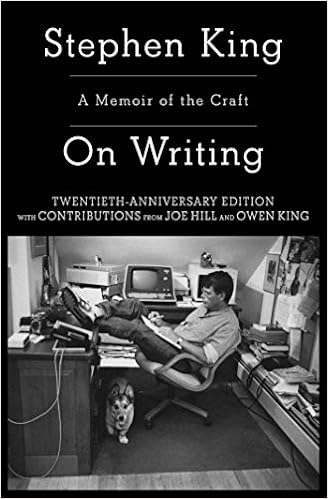
12, On Writing: A Memoir of the Craft, by Stephen King (2000)
I read this more-or-less at the same time as I read Finders Keepers, and it was fun to see King’s thought process at work. The autobiographical elements of this book were more appealing to me than the writing advice, in part because his story as a self-made writer is legitimately fascinating, and in part because his writing guidance is geared more toward aspiring novelist than jaded journalists. But I enjoyed it all.
13, Death Comes for the Archbishop, by Willa Cather (1927)
Another book that I’ve carted around most of my adult life. The account of a French cleric’s molding of the Santa Fe diocese in the years after the Mexican-American war, it’s a lyrical portrait of faith, character, and most of all, landscape. There’s no real plot, but a series of vignettes that trace the lives of Bishop Latour and his faithful companion, Father Vailland, as they navigate the complex world of Native Americans, Spanish Mexicans, and the new Americans pouring into the territory. With spare, elegant writing Cather describes life on the vast frontier and a community that seems perched on the very edge of the known world.
14, Rendezvous with Rama, by Arthur C. Clarke (1973)
The literary equivalent of comfort food. This was either the second or third time I’ve read this science fiction classic, which I bought for my son, but read on my own when he lost interest. In many ways it’s a perfect sci-fi story: an unknown vessel enters the solar system and a plucky band of astronauts is sent to investigate against a backdrop of political maneuvering back home. I remember loving it when I first read it as a teenager, and while it’s a bit dated (the casual sexism of the astronauts is ironically old fashioned) overall it holds up remarkably well. I think it’s no accident I read it in the weeks leading up to the presidential election when escapist nostalgia was very appealing.
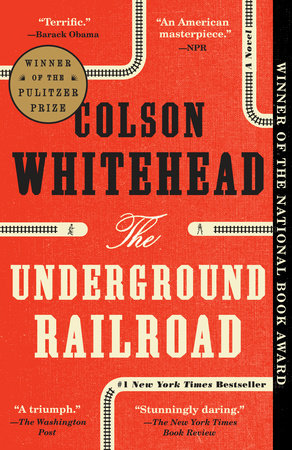
15, The Underground Railroad by Colson Whitehead (2016)
The Underground Railroad got a lot of attention when it came out, and its marriage of the brutal realities of slavery and the fanciful creation of a literal railroad buried beneath the antebellum south offers a lot. Yet for me the book was never more than the sum of its parts. Whitehead’s depiction of life on a plantation was both horrifying and unfortunately familiar, and the book only really picks up when escaped slaves Cora and Caesar find themselves in South Carolina in a situation too good to be true. I wished Whitehead had more fully embraced the alternate history aspect of his story and investigated the origins of the railroad, but it feels like he shied away making that leap, not wanting to trivialize history by turning it into fantasy.
16, Gigged, by Sarah Kessler (2018)
Another book by a former colleague which I put off reading far too long. In this case, my procrastination did Sarah’s book a disservice, because it feels we’ve already passed moment she captures in her book, when the gig economy seemed new and different, and poised to upend the traditional arrangement between management and labor. Very few people today are excited about the potential of the gig economy, and at best it seems away for workers furloughed by the pandemic to scrape together extra money, and at worst another way for Silicon Valley to siphon money from the rest of us. Sarah does a great job of rounding up characters who represent different facets of the gig economy—an Uber driver who feels suckered, a housewife hacking out a living on Amazon’s Mechanical Turk, a rural social worker matching workers and with opportunities— and smartly observes that gig work isn’t a one-size-fits-all proposition. By the time Sarah’s book came out in 2018, it was already pretty clear who the winners and losers of the gig economy, and perhaps no one should be surprised the one gig worker who flourishes in her book is the tech bro who was doing just fine before he left his full-time job.
17, Unbroken, by Laura Hillenbrand (2010)
Another volume picked up at the local library’s used book sale. I didn’t know a whole lot about it, other than it was by the author of Seabiscuit, it was about an Olympic distance runner, and the movie adaption (which I haven’t seen) was directed by Angelina Jolie. As perhaps might be expected from those clues, the book is a an stirring story about, you guessed it, someone overcoming some serious adversity. In this case, it’s Louis Zamperini, the misfit son of Italian immigrants who discovers a gift for distance running in the 1930s, races in at the Berlin Olympics, becomes a bombardier on a B-24 in World War II and becomes first a castaway, then a prisoner of war in Japan. The story, which oscillates between heroic, harrowing, and horrifying, is amazing and told 60 years later with a remarkable level of immediacy and detail that might raise the eyebrow of a more skeptical reader (or seasoned reporter). No matter how it came together, it was a riveting story to read and I learned a whole lot about the Pacific theater of World War II and probably more than I wanted to about the suffering endured by POWs.
18, Black Betty, by Walter Mosley (1994)
I think I’ve had this book since it was first published. I spent a summer as an intern at W.W. Norton & Co in 1992, right when Mosley was beginning to experience some success (if I recall correctly, he was still working in IT, not having had the breakthrough that would allow him to quit his day job). He had published two books by then, and I remember how excited we were when it was revealed that Bill Clinton was a fan. Black Betty is his fourth book, and continues the story of Ezekiel “Easy” Rawlins, an occasional amateur detective scuffling his way through a noirish Los Angeles in 1961. Mosley borrows heavily from Raymond Chandler, and like The Big Sleep, Black Betty features misunderstood dames, a hero struggling to stay afloat, and a hopelessly convoluted plot. The big difference, of course, is that Mosley’s hero is Black and so Rawlins has to navigate two worlds, that of black Angelenos, and of the whites who employ and exploit them. Rawlin’s world weariness gets a bit tedious, but despite its age and historic setting (26 and 59 years ago, respectively) the story and its concerns are remarkably contemporary.












 Percival Henry: The Fantastic Four and more