Fantastic Four 140 “Annihilus Revealed!” Published August 1973 Writer: Gerry Conway Pencils: John Buscema Inks: Joe Sinnott Letters: John Costanza Colors: George Roussos Editor: Roy Thomas Cover: Rich Buckler and Frank Giacoia
Synopsis
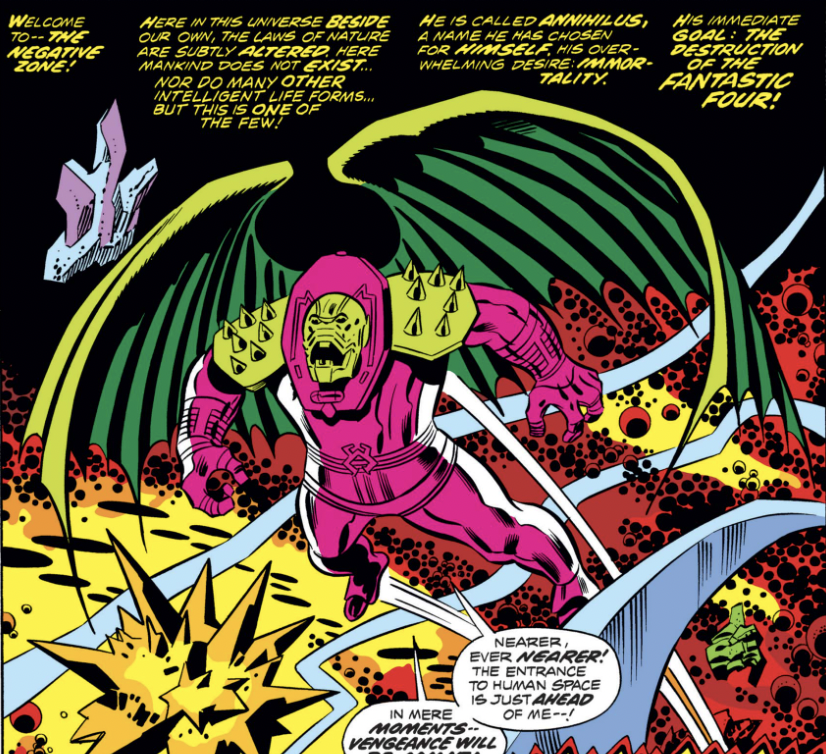
The Fantastic Four receive a distress call from Sue about Franklin’s manifesting powers, and while they race to find her in Pennsylvania, she is summoned elsewhere by Agatha Harkness. Meanwhile, Annihilus invades the Baxter Building, defeating the returning Fantastic Four and sending them to the Negative Zone before disclosing his origin to Wyatt Wingfoot.
What’s going on here?
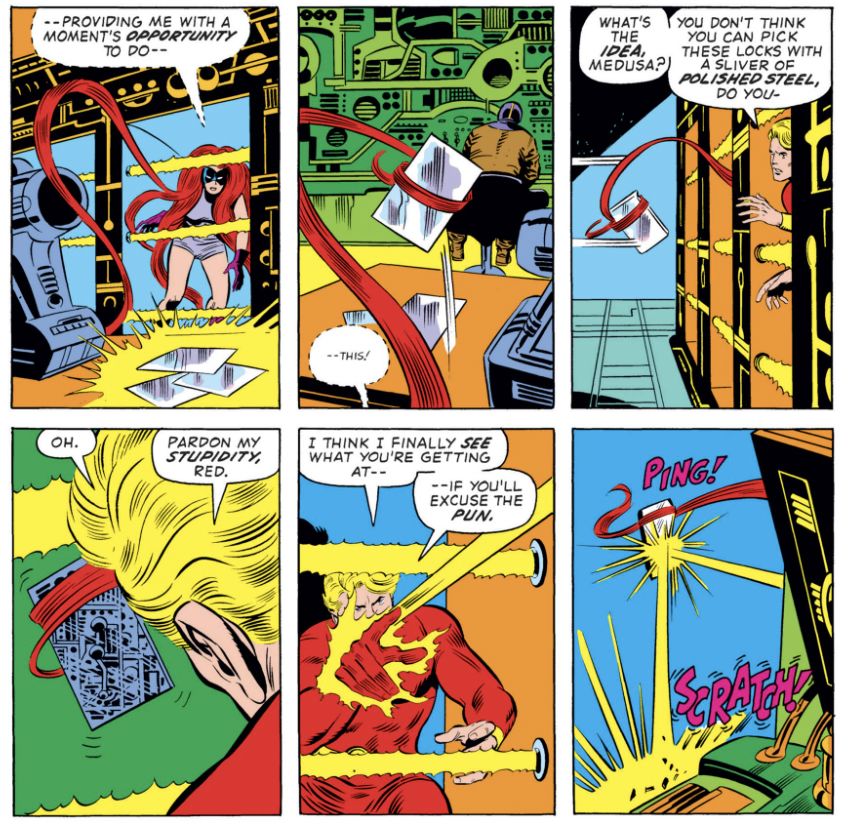
There’s a lot packed into this issue, which appears to be Gerry Conway’s first as full writer (up to this point he was credited only as a scripter, with Roy Thomas handling the plots). The highlight is the return of Annihilus, one of the FF’s best villains. and one who has been absent for a few years. The Annhilus plot was cooking in the background last issue, while the Franklin storyline has been developing for a few issues now, and it’s still not clear how (or if) they are related. We also get Annhilus’s complicated backstory, and a lot of inter-team bickering between Ben, Reed and Medusa.
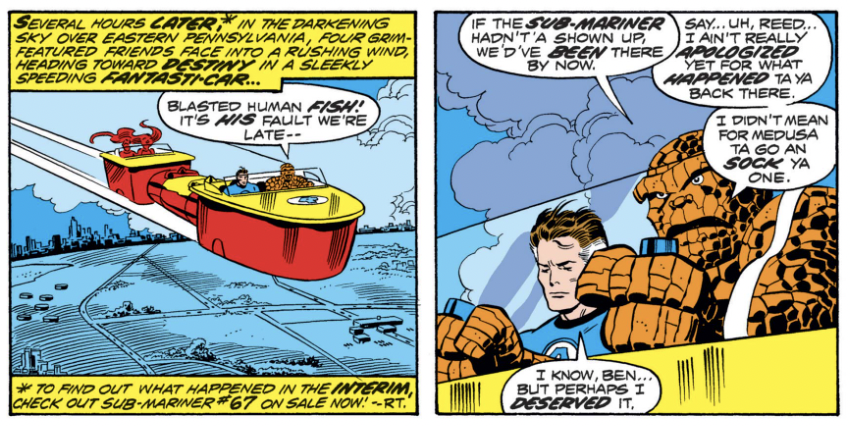
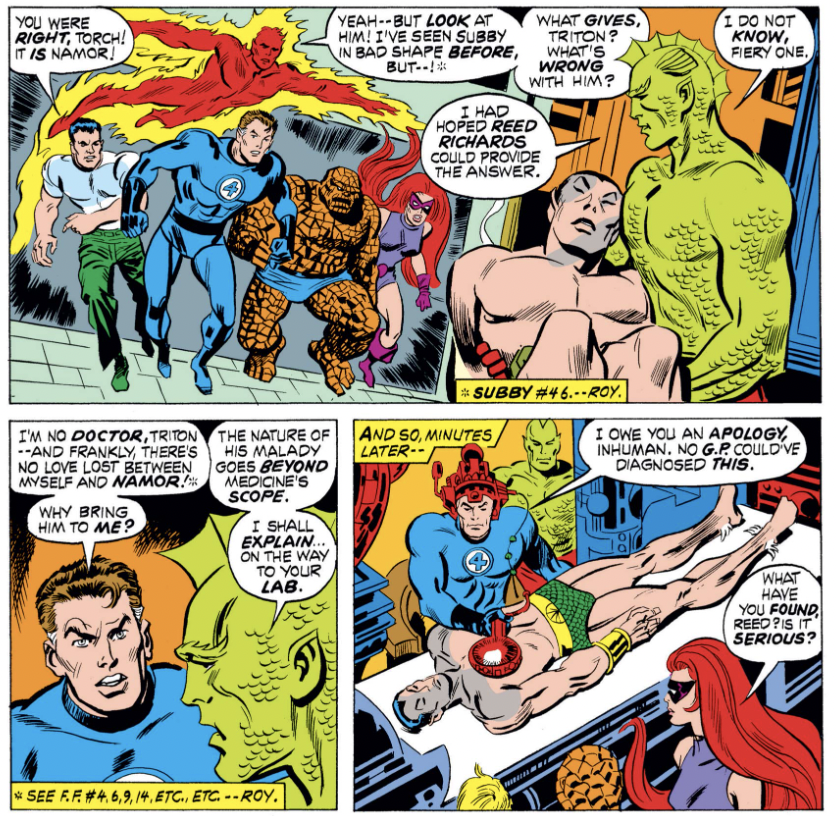
Oddly, the story is interrupted by the events of another comic, Sub-Mariner 67, which doesn’t really effect the flow of this comic, but is blamed by the Thing for the FF not being able to find Sue.
In Sub-Mariner 67, Namor is stricken by a nerve gas, and Triton the Inhuman brings him to the Baxter Building so Reed can save him. Naturally, a fight breaks out. (Story by Steve Gerber, art by Don Heck and Frank Bolle).
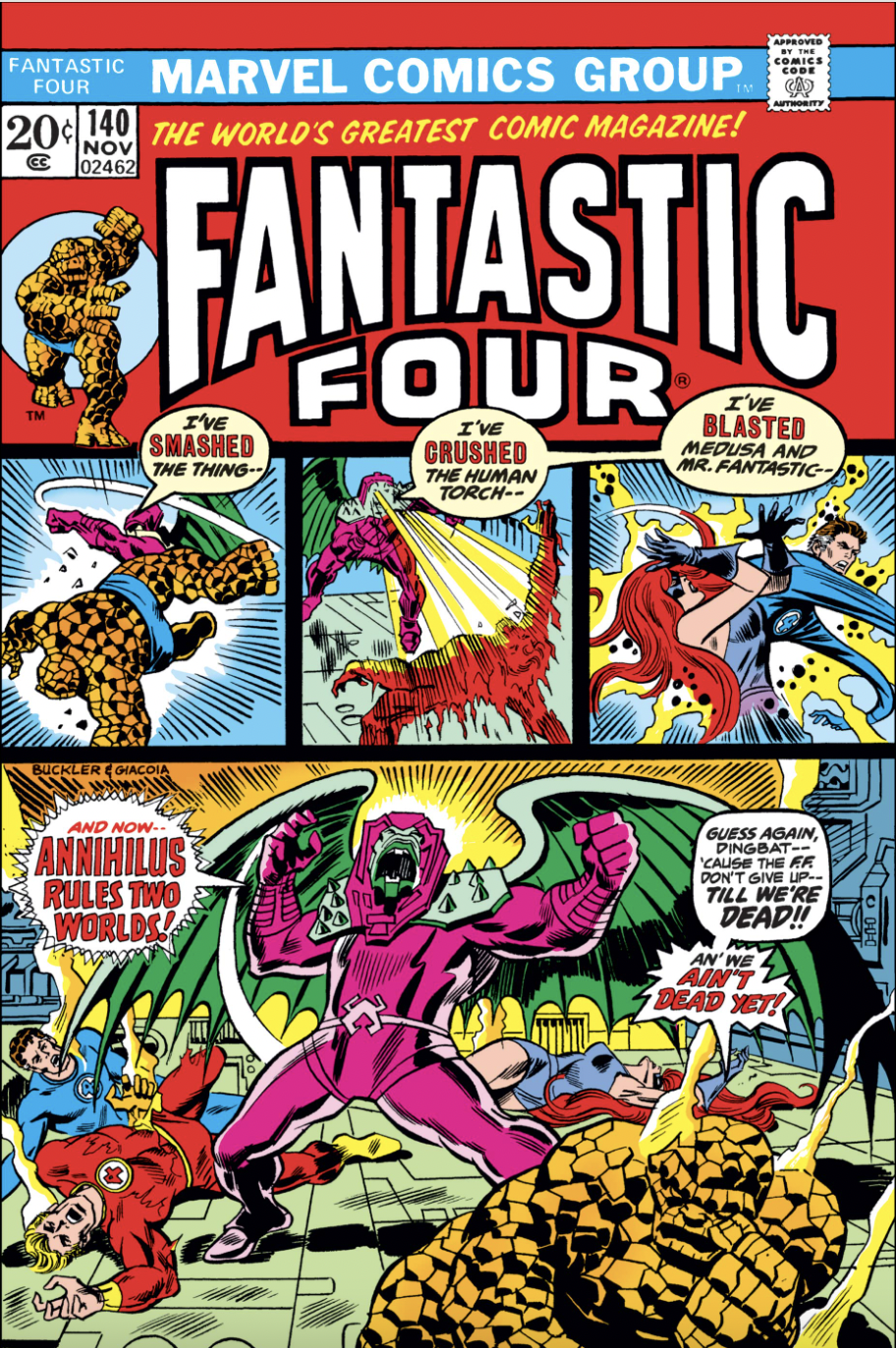
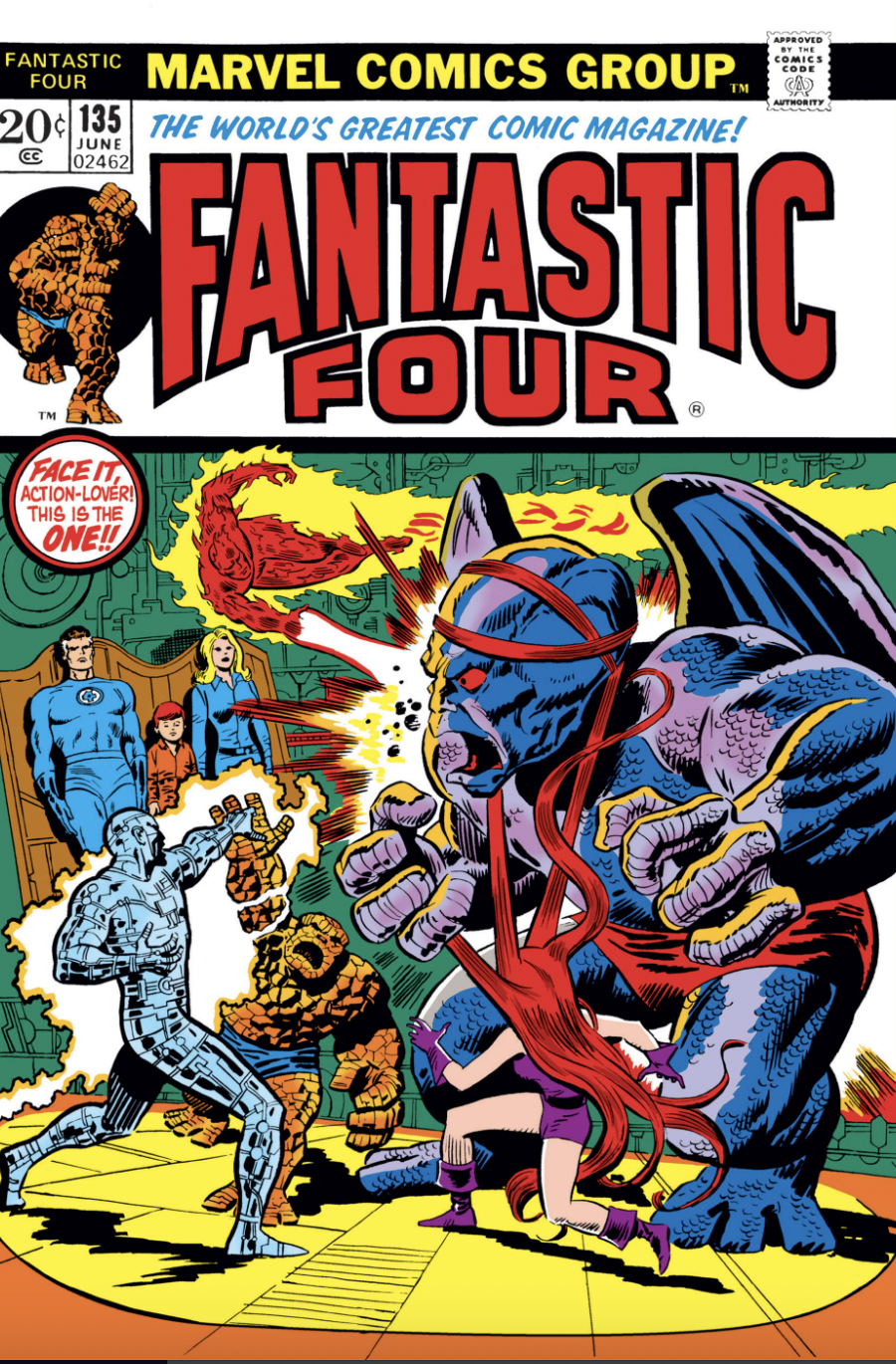
Also of note, the cover of FF 140 is drawn by Rich Buckler (with inks by Frank Giacoia), who will go on to replace John Buscema as the lead artist in a few issues. The cover, with its panels, is unusual, but seems perfectly engineered to appeal to 12 year-old comic buyers.
What I liked
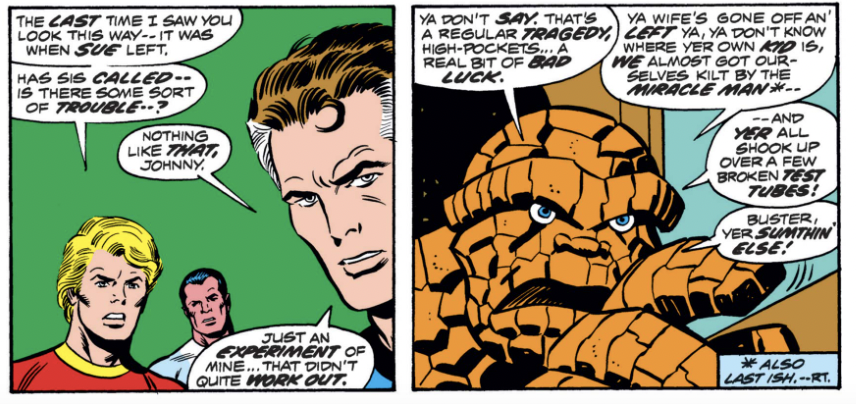
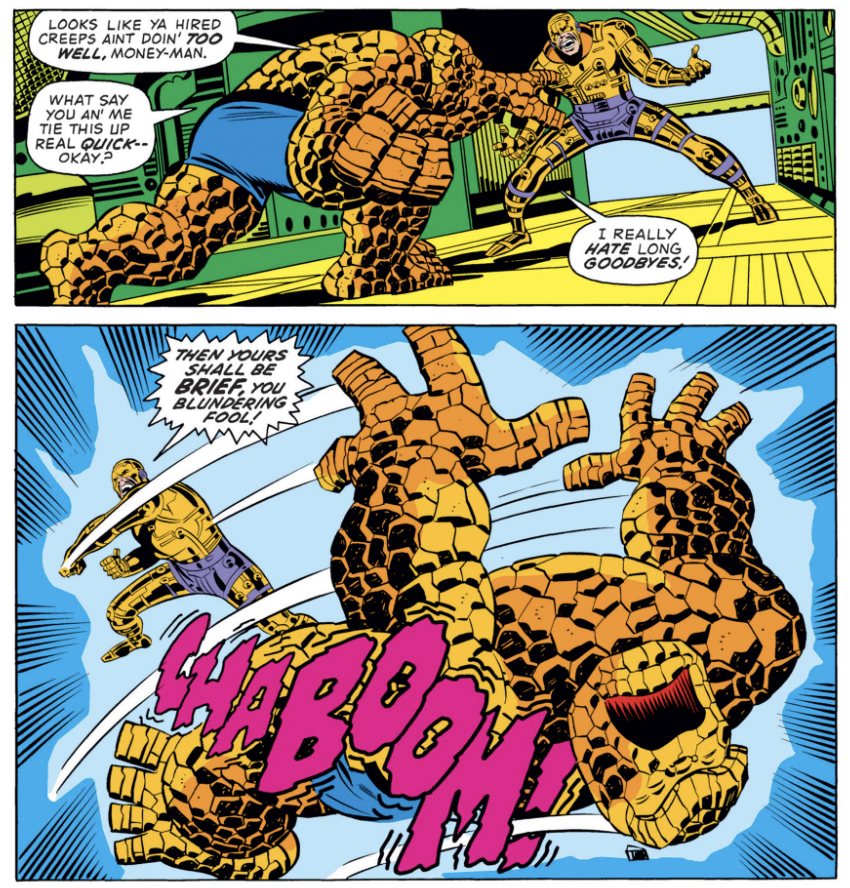
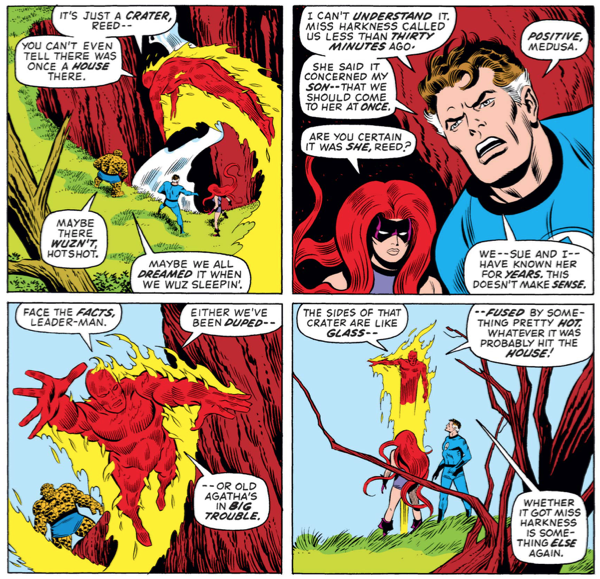
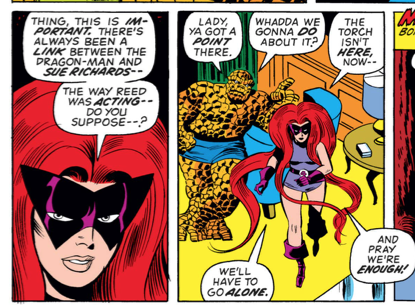
The back-and-forth between Ben and Reed was nicely handled by Conway, who seems to understand a friendship that’s both turbulent but build on longstanding respect and mutual history. Here, Ben tells off Reed:
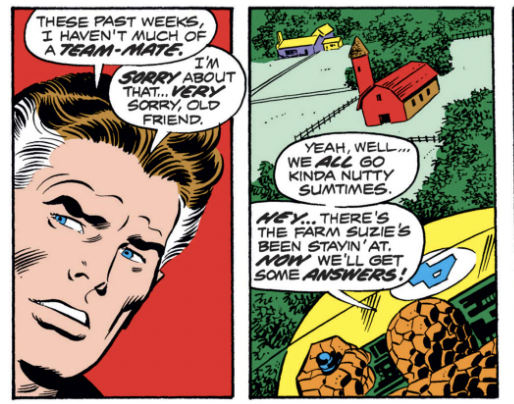
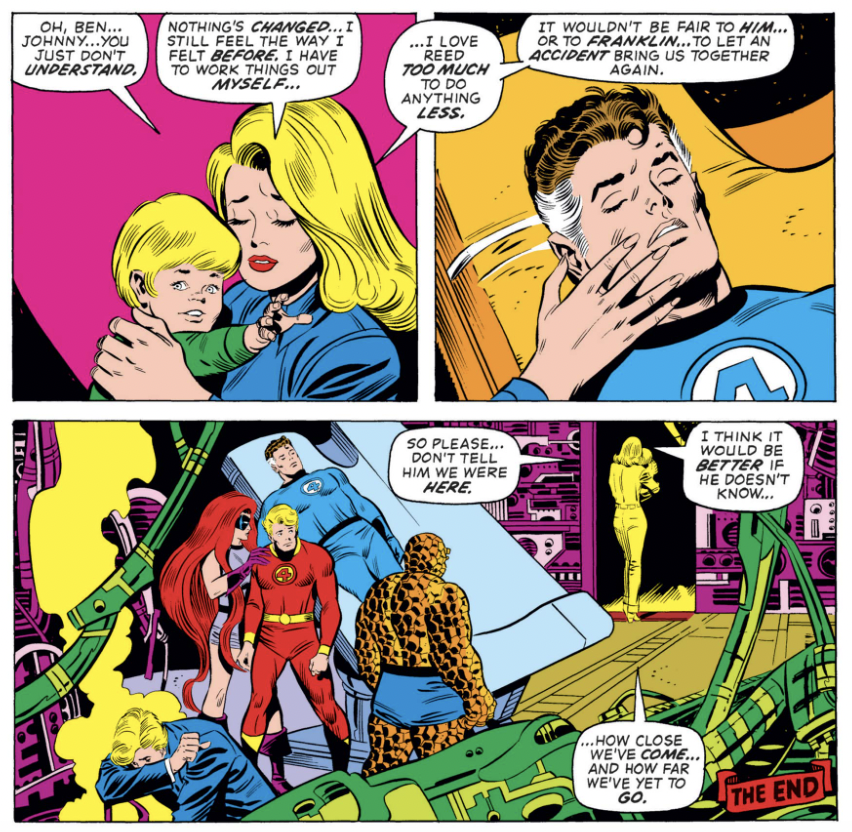
Then, after Reed goes ballistic when Sue calls for help, Ben is reassuring:
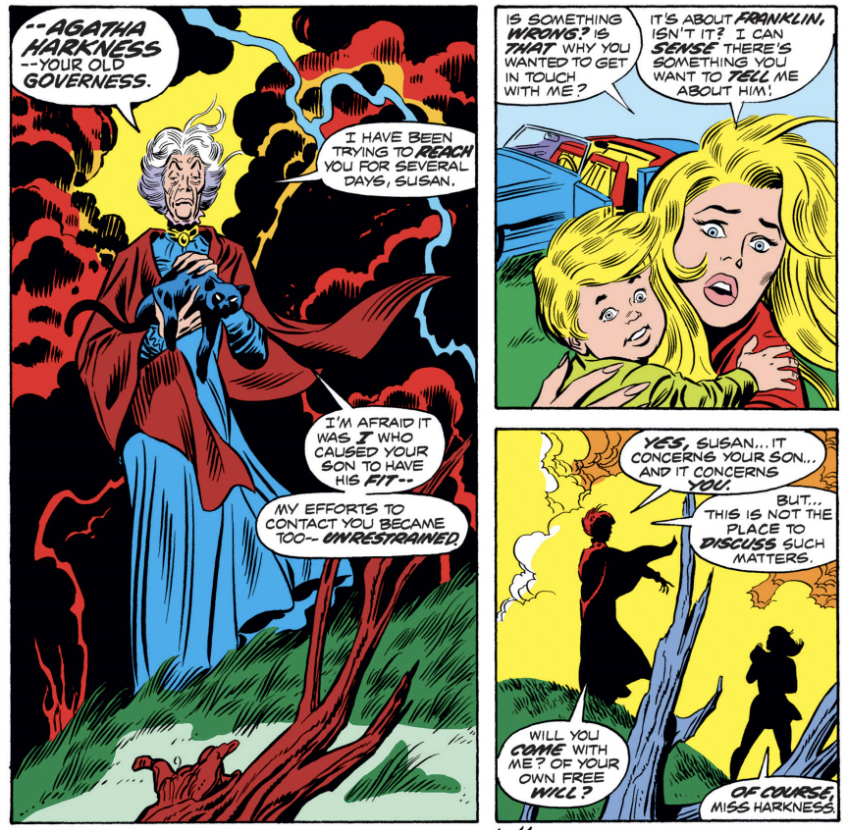
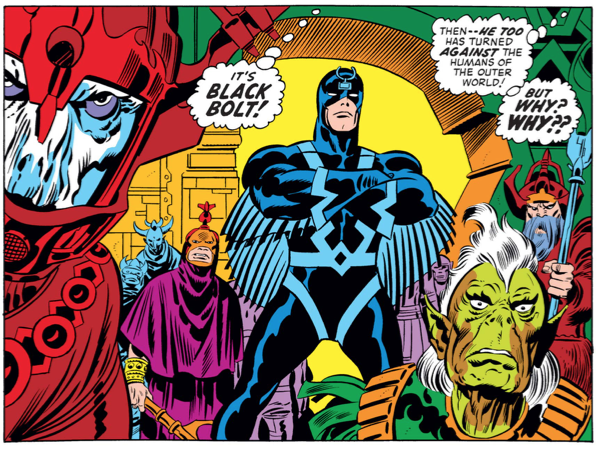
I also liked this near-splash page of Agatha Harkness by Buscema and Sinnott:
What I didn’t like
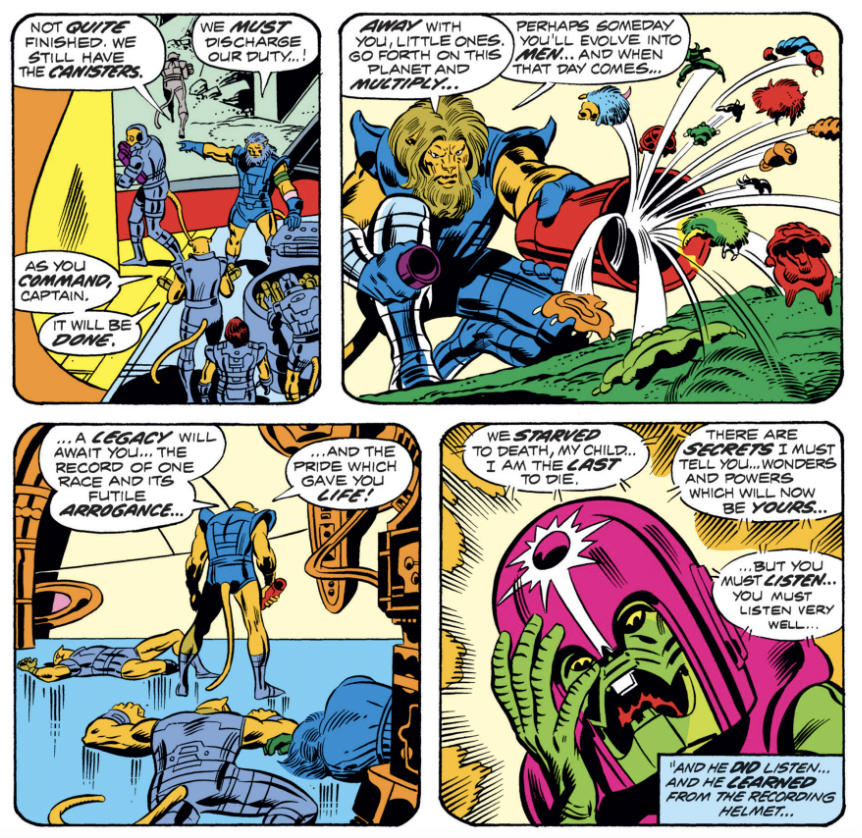
The last third or so of the comic is devoted to Annhilus telling his origin to Wyatt. It’s impossibly convoluted, since it involves his putting on a helmet left by a long-dead alien race in the Negative Zone, and then relating the narration of that species. So we are reading a story told by Annihilus to Wyatt that was told to Annihilus by this other race. And none of it seems particularly relevant to the story.
Anything else?
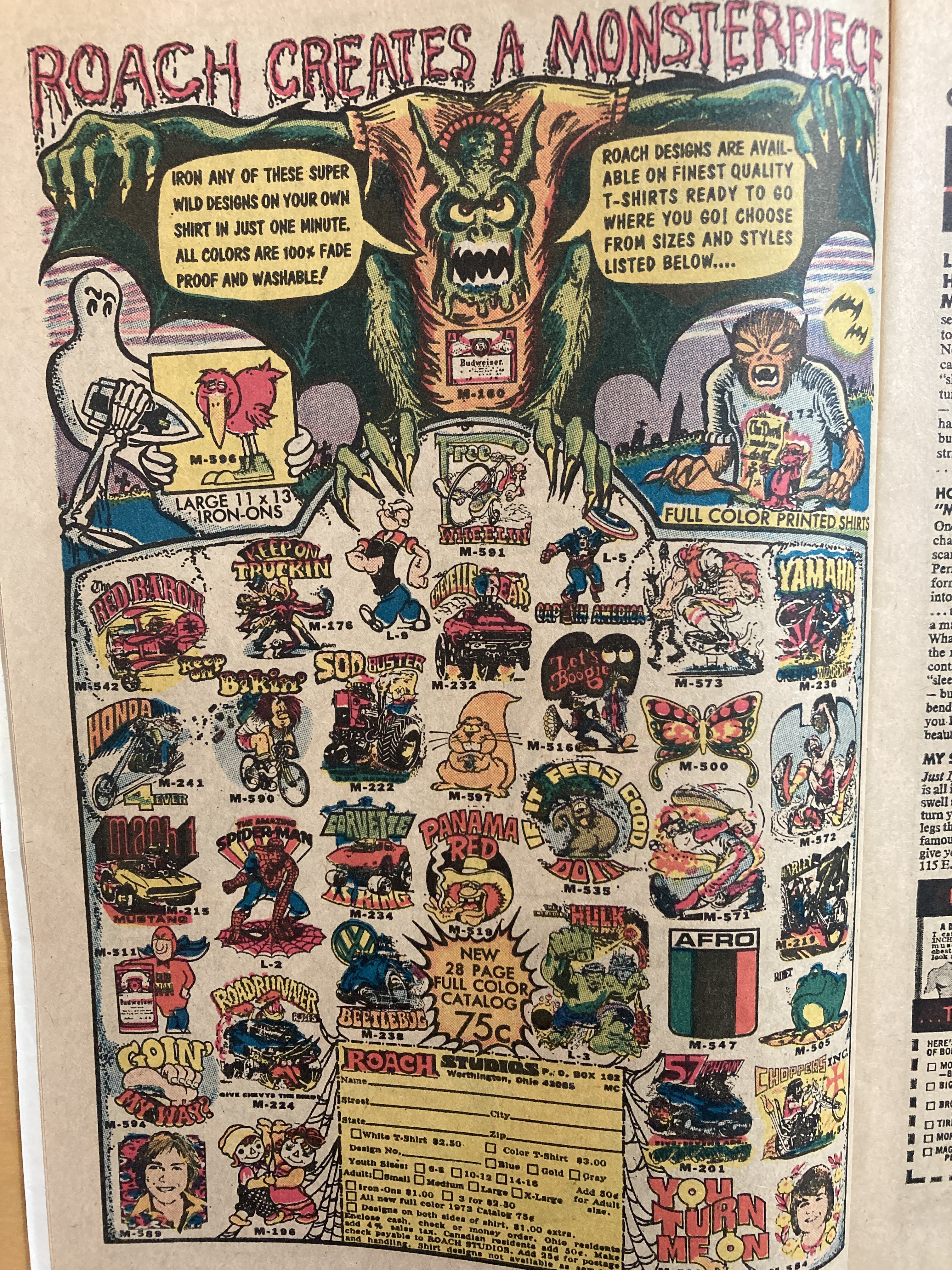
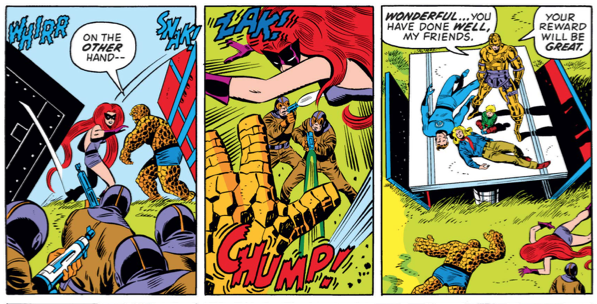
These look cool
Overall
The return of Annihilus lifts its grade to a solid B.
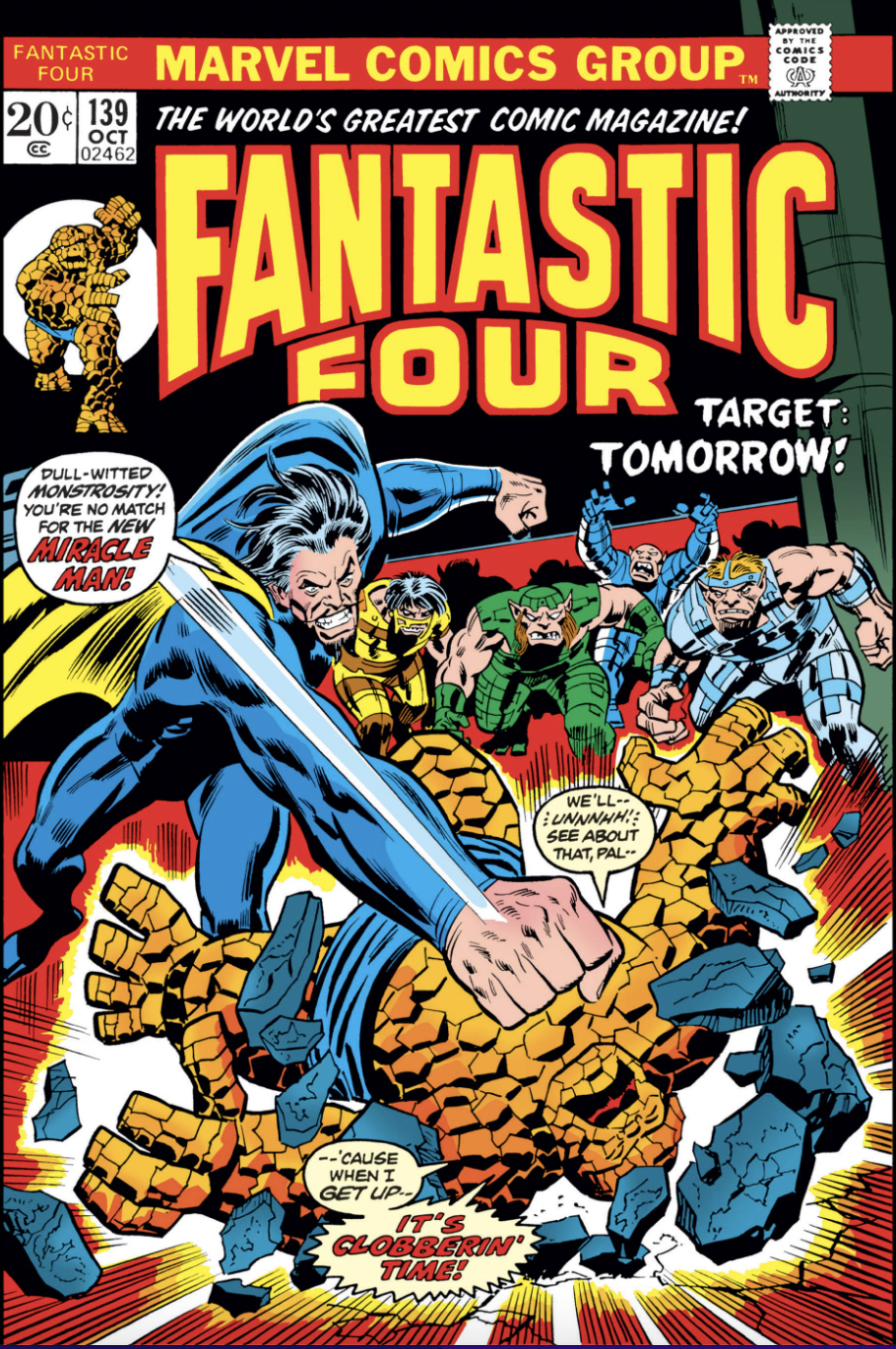
Fantastic Four 139 “Target: Tomorrow!” Published July 1973 Script: Gerry Conway Layouts: John Buscema Finishes: Joe Sinnott Letters: John Costanza Colors: Stan Goldberg Editor: Roy Thomas Cover: Buscema and Frank Giacoia
Synopsis
The Fantastic Four escape the chasm they plunged into last issue and eventually defeat the Miracle Man, with the help of the ghosts of the Native American elders that granted him his powers. Meanwhile, Franklin’s powers continue to manifest, and a nuclear catastrophe, perhaps caused by Mr. Fantastic’s experiment, looms.
What’s going on here
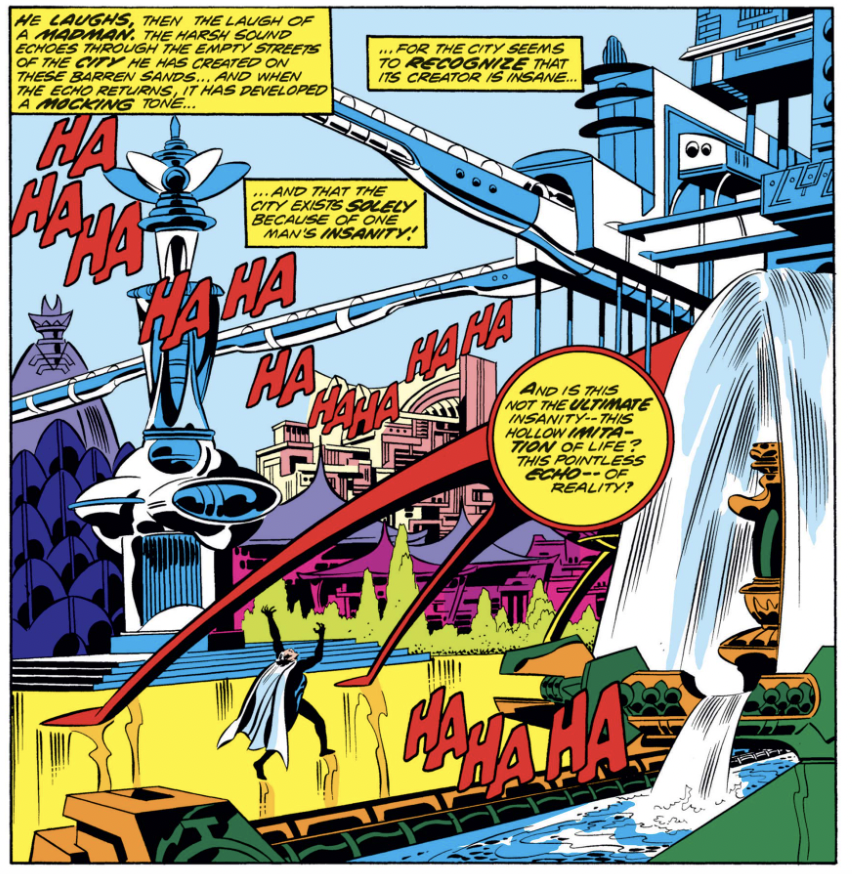
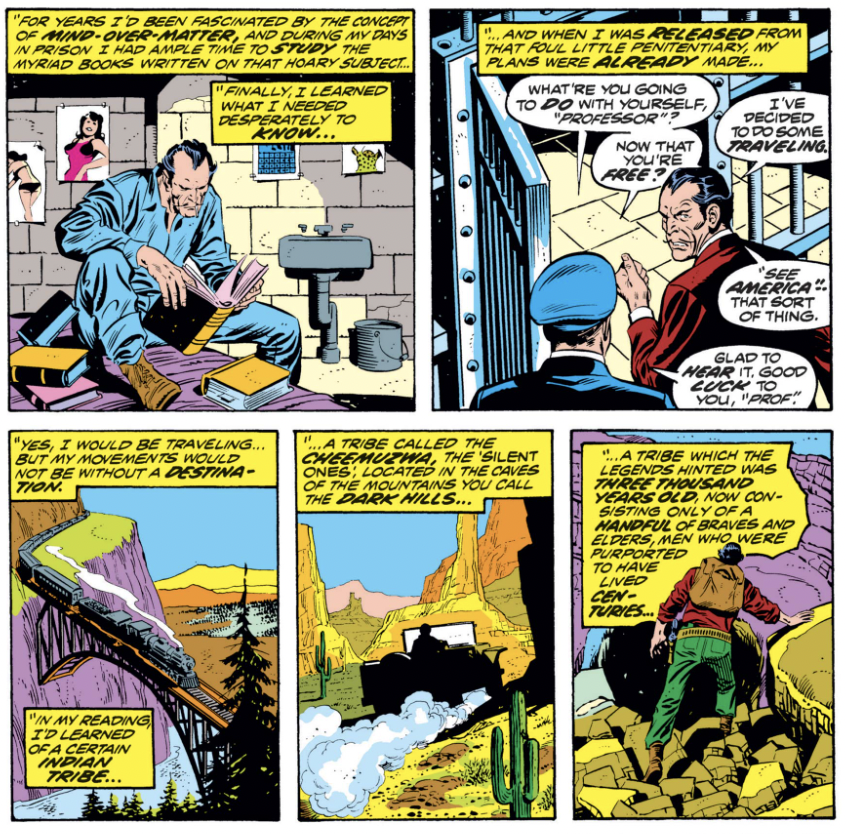
This is a more-or-less satisfying conclusion to a two-issue story that began with the re-introduction of the Miracle Man as a vastly more powerful character. Here, he displays almost Beyonder-level power, creating a new city and willing into existence quasi-living people and creatures. Given his potential impact on the Marvel universe, it’s probably just as well he’s faded away into obscurity.
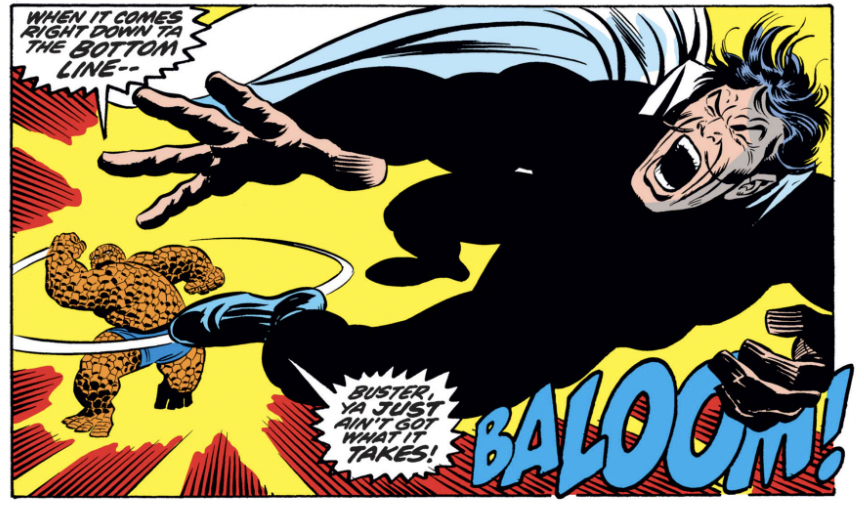
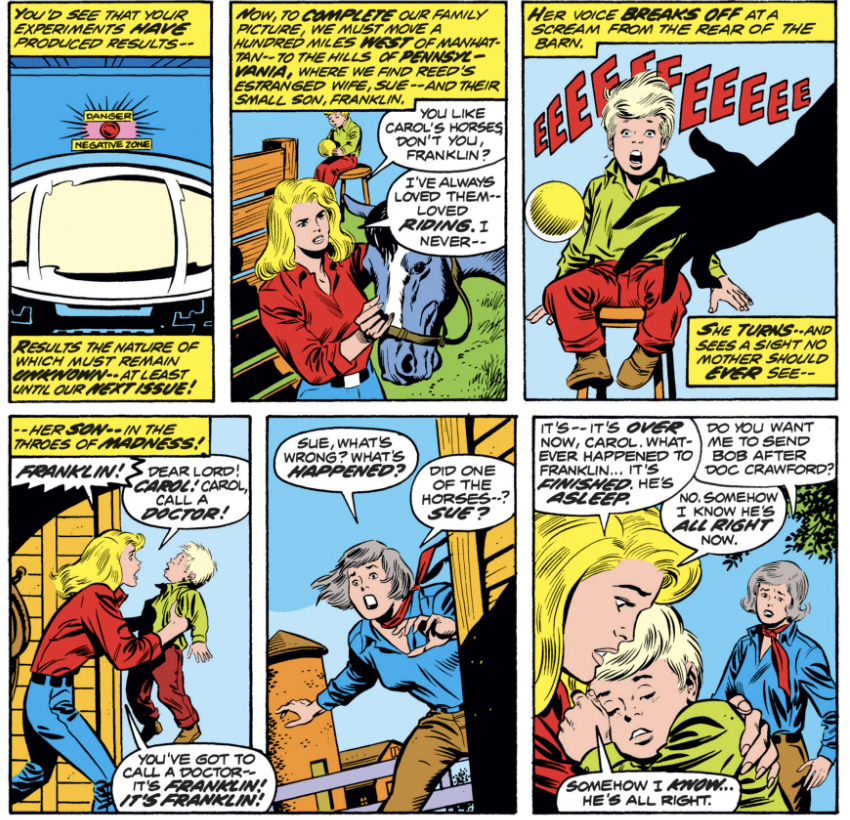
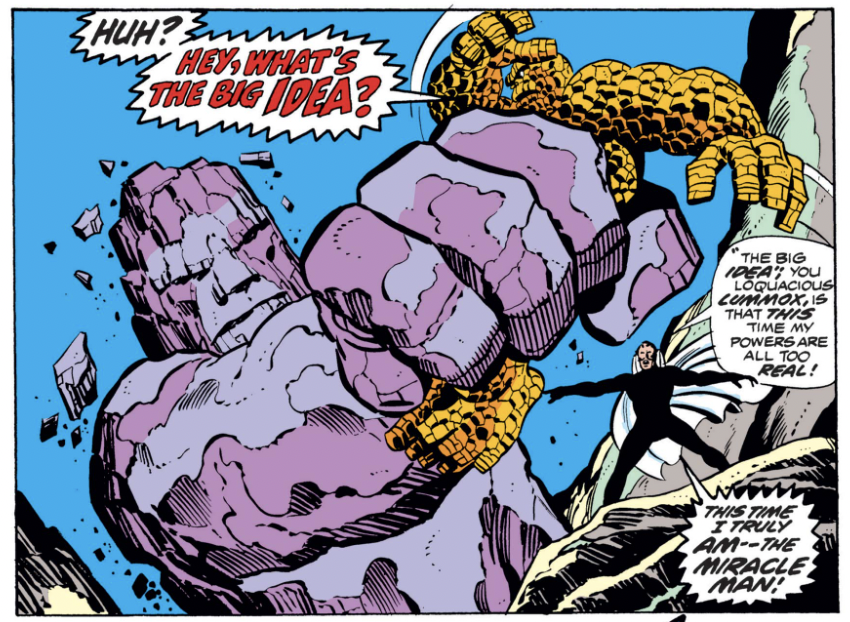
This is otherwise an unremarkable issue. It’s not helped by Gerry Conway’s hyperbolic writing (see panel above), which seems even more over-the-top than Stan or Roy’s, maybe because he’s clearly imitating both. There’s a lot of questionable physics and odd plot holes in this story, but it’s basically inoffensive. More interesting are the subplots: Reed’s tinkering with something that seems very dangerous, and more clues about Franklin’s powers. Also, it’s nice to see Sue again after a few issues of her being left out.
What I liked
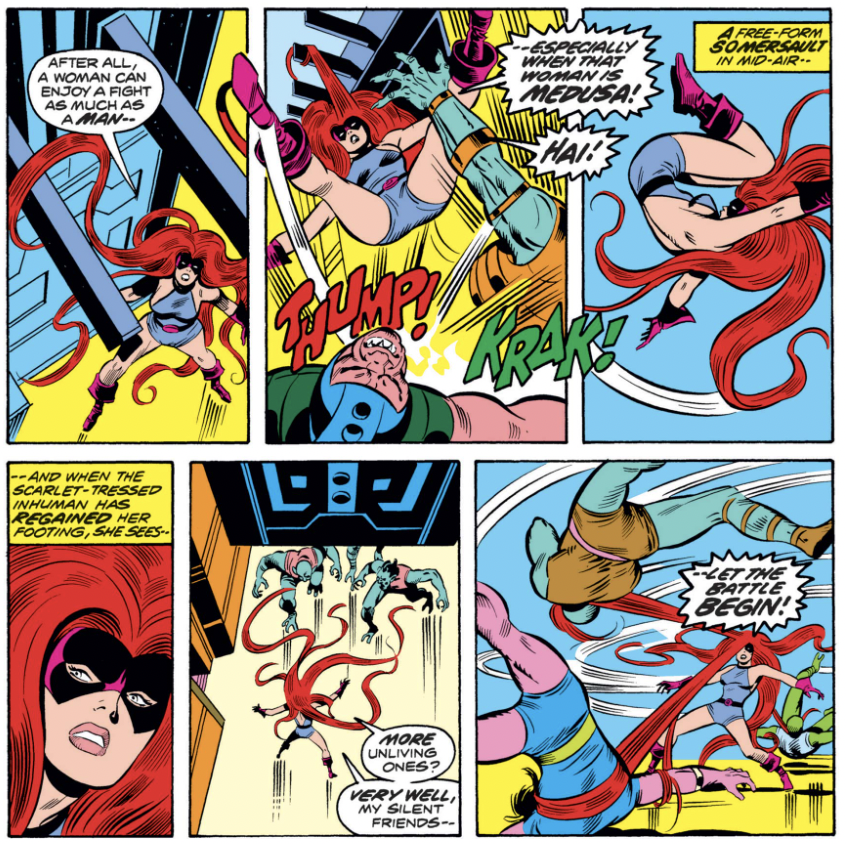
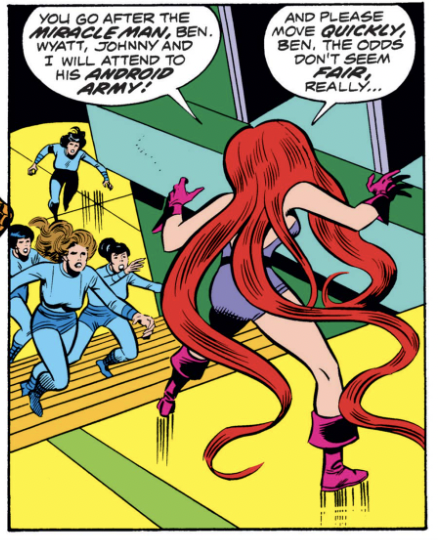
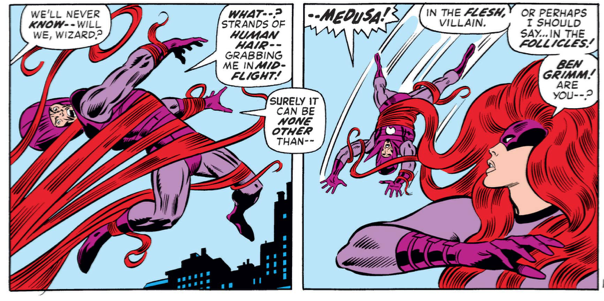
Speaking of left out, Medusa finally gets a bit more of a role. Her presence on the team still feels incidental, but at least he get a glimpse of her personality in this sequence.
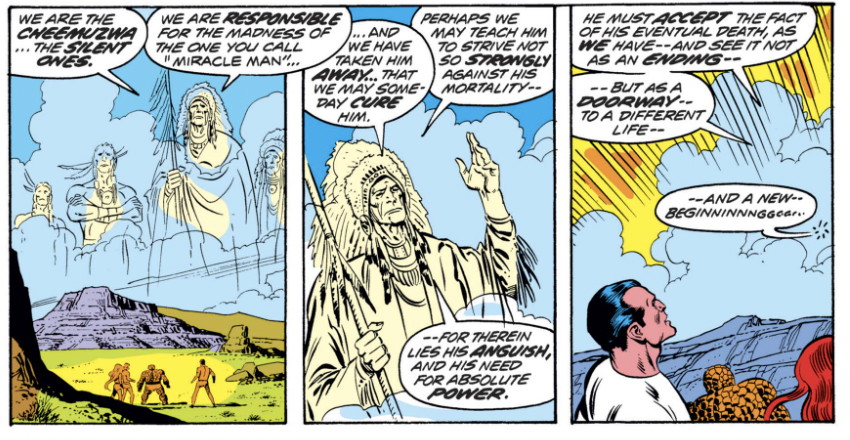
I thought the appearance of the Cheemuzwa spirits at the end was well handled. Yes, mystic Natives are a tired trope, but this was a graceful way to remove the Miracle Man from the board (he apparently shows up just once more, in Marvel Two-in-One 8)
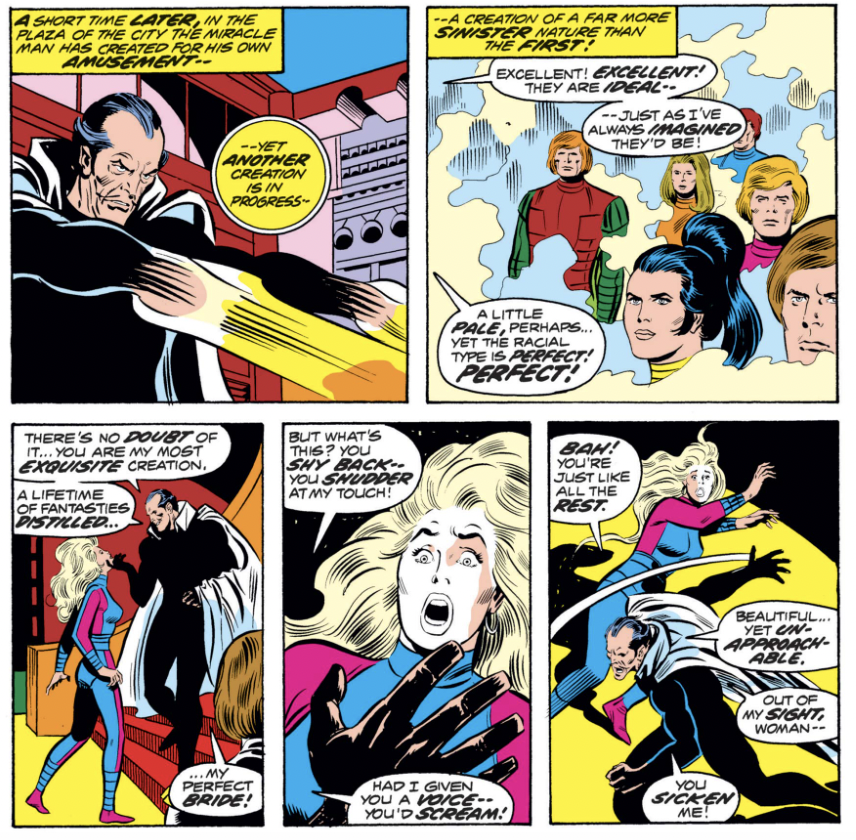
And this sequence with Miracle man being rejected by a woman he just created out of nothing was weird and creepy.
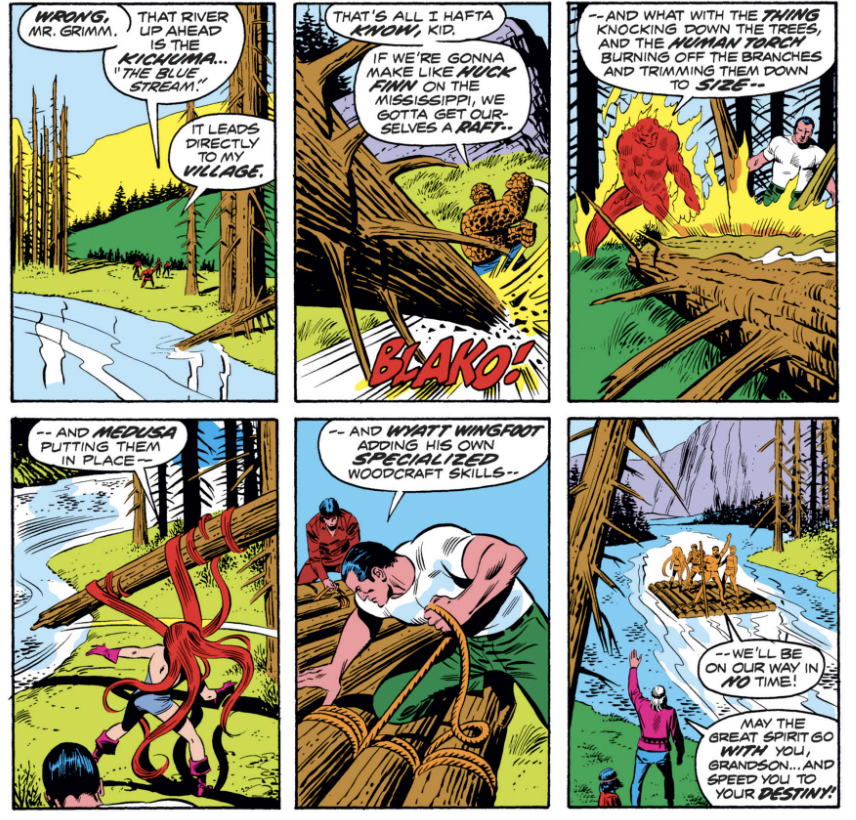
Then there’s this sequence of the FF building a raft. I wasn’t sure if I liked it or hated it, but it’s so ridiculous I think I like it. It reminds me of the montages in the A-Team TV shows, where the the team would assemble some sort of contraption as music played.
What I didn’t like
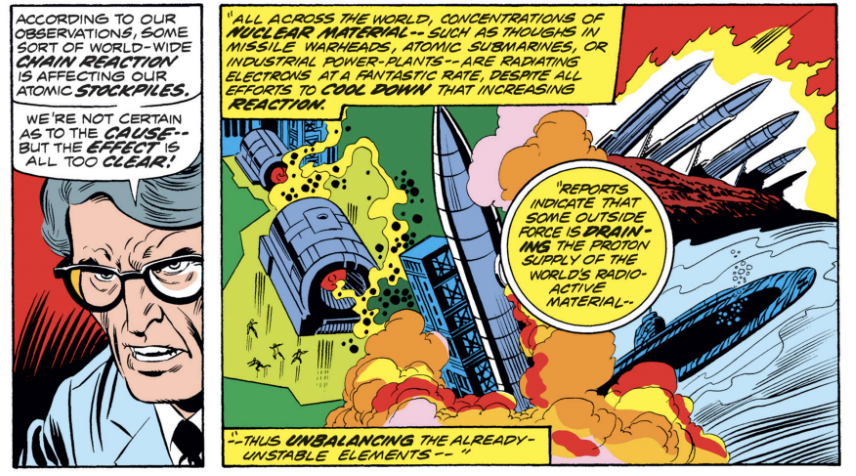
About halfway through the comic, the action cuts away and we learn of an imminent nuclear threat. It seemed like this was related to the Miracle Man, so I waited in vain to learn how, only for it to be revealed, lamely, that it’s a subplot connected to Reed’s tinkering. I have no problem with setting up next issue’s story, but this was poorly executed.
Anything else?
In previous posts I have written about Stan and Jack created very human androids (or very android-like humans), as if the distinction between alive and machine didn’t much matter. Here, the Miracle Man creates what appear to be living creatures, yet Medusa calls them “androids.” Not sure what Conway was thinking.
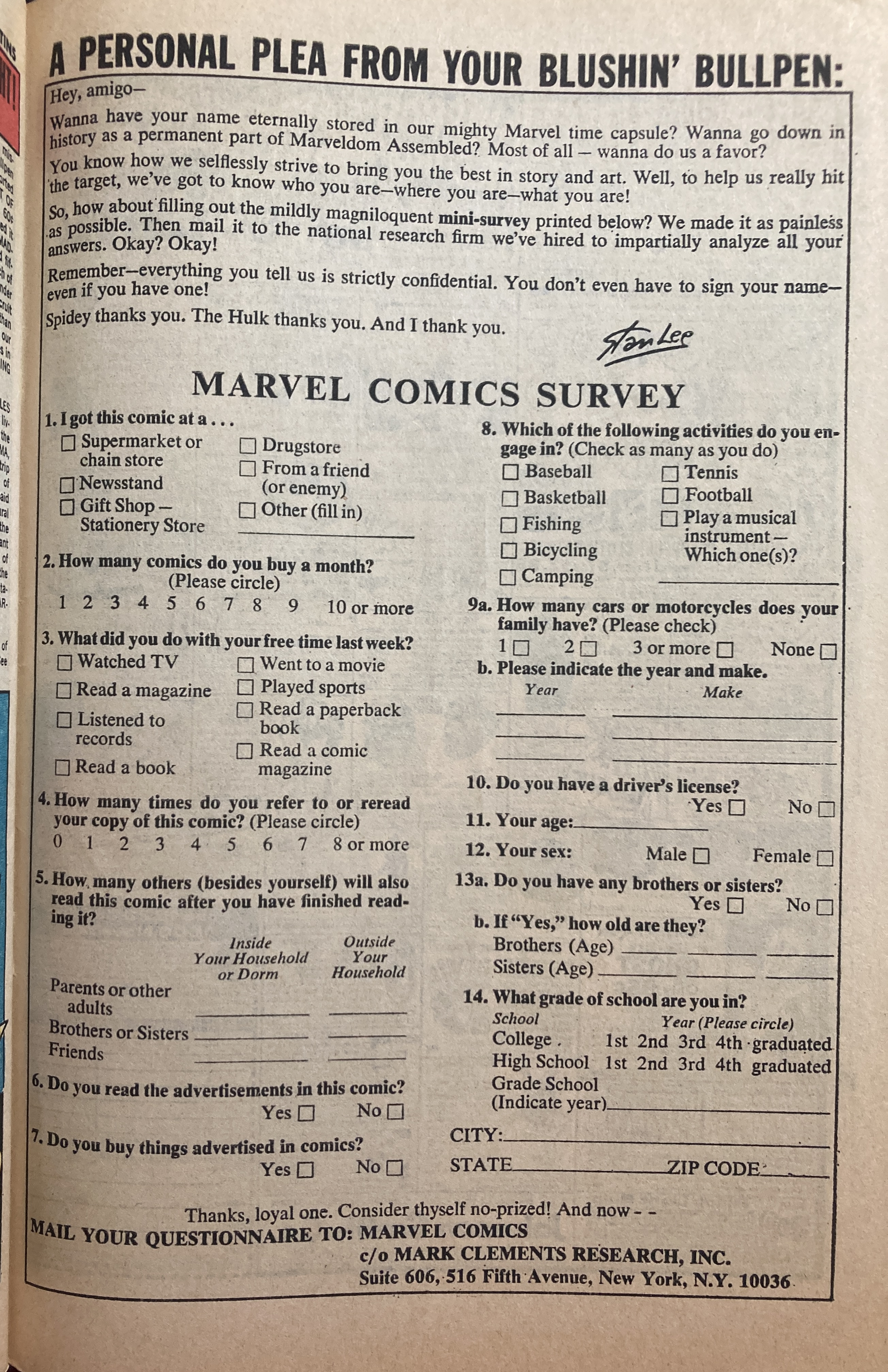
This survey seems specifically designed for advertisers. Still sort of interesting. (They seem to want auto advertising).
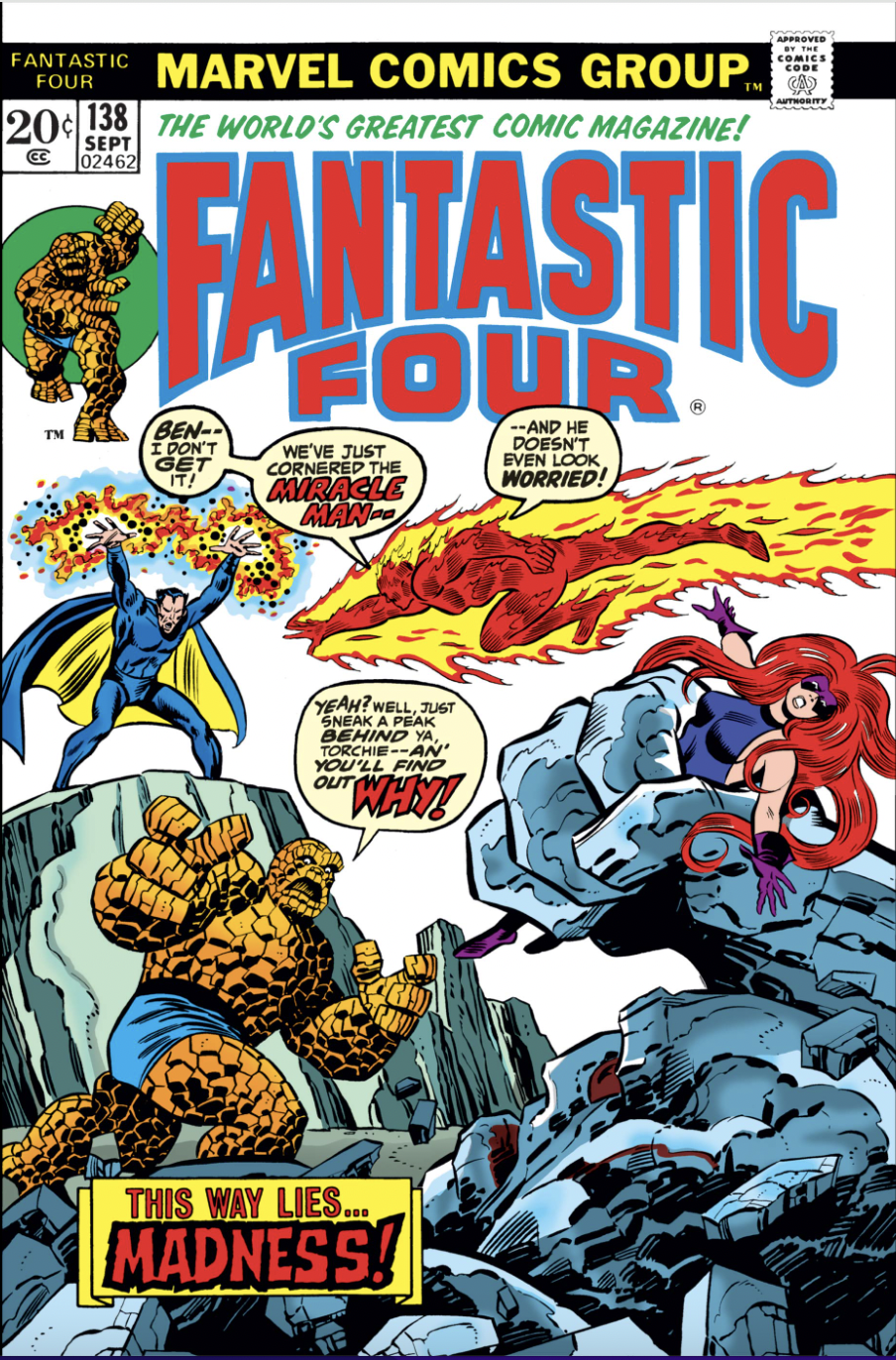
Fantastic Four 138 “Madness is … the Miracle Man!” Published June 1973 Plot: Roy Thomas Script: Gerry Conway Pencils: John Buscema Inks: Joe Sinnott Letters: John Costanza Colors: Petra Goldberg Editor: Thomas Cover: Buscema and Sinnott
NB: This issue came out after Fantastic Four Annual 10 (technically “King-Size Fantastic Four 10”) but since it consists of reprints of annuals 3 and 4, it didn’t seem worth posting about.
Synopsis
Wyatt Wingfoot reappears and asks the Fantastic Four to help with an emergency on his Oklahoma reservation. There, the team — minus Mr. Fantastic, who remained in New York — is attacked by the Miracle Man, who has discovered new powers.
What’s going on here?
This story is very similar to the Gregory Gideon arc of a few issues ago. Basically, Roy Thomas unearths an obscure villain from the early Lee/ Kirby run (in this case, the Miracle Man debuted all the way back in FF 3), gives him new powers and sets him on world domination. It’s not really clear why Thomas needs to dredge up an old character vs. create a new one – he spends so much time explaining how the Miracle Man got his powers he might as well gave invented a similar villain from scratch. Plus, there’s something odd about this former stage magician cavorting about the mesas of Oklahoma.
The positive side of Thomas’s dredging up the past is the return of Wingfoot, last seen in issue 80. Wingfoot is a fun sidekick who, despite his many appearances over the years, has never suffered the fate of so many supporting characters and been given super powers. I hope I didnt jinx him.
Otherwise the story is unremarkable. There’s some classic comic book treatment of Native Americans as noble, spiritual primitives, and a few bits of nice character moments for Ben, Johnny, Reed and Alicia. Medusa is again basically sidelined into uselessness and Sue and Franklin don’t appear at all. The story does resolve one odd subplot introduced back in issue 134 and then dropped (and surely forgotten by most readers): the mysterious muscular figure entering the Baxter Building was Wingfoot.
What I liked
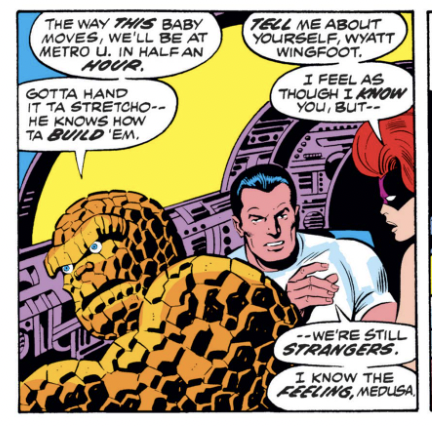
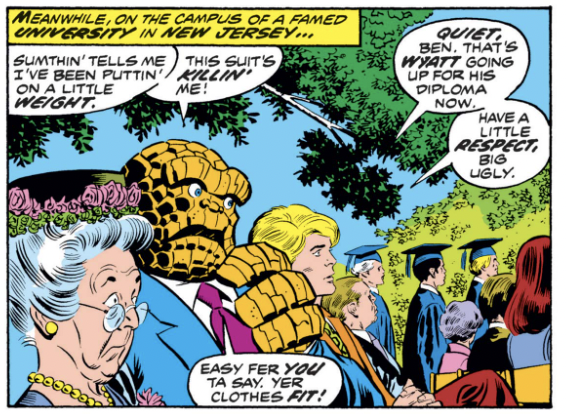
I’ve been critical of Thomas and Conway for stories that have been either absurd (the last two issues) or pedestrian, but to give credit where credit is due, this issue is well plotted and paced. It has a classic slow opening, with the FF in the Baxter Building, includes a nice scene at Metro University (last seen in issue 62), and builds to an action-filled climax without rushing to the end like so many Lee/Kirby stories. And as mentioned above, we get some character-focused scenes like this one:
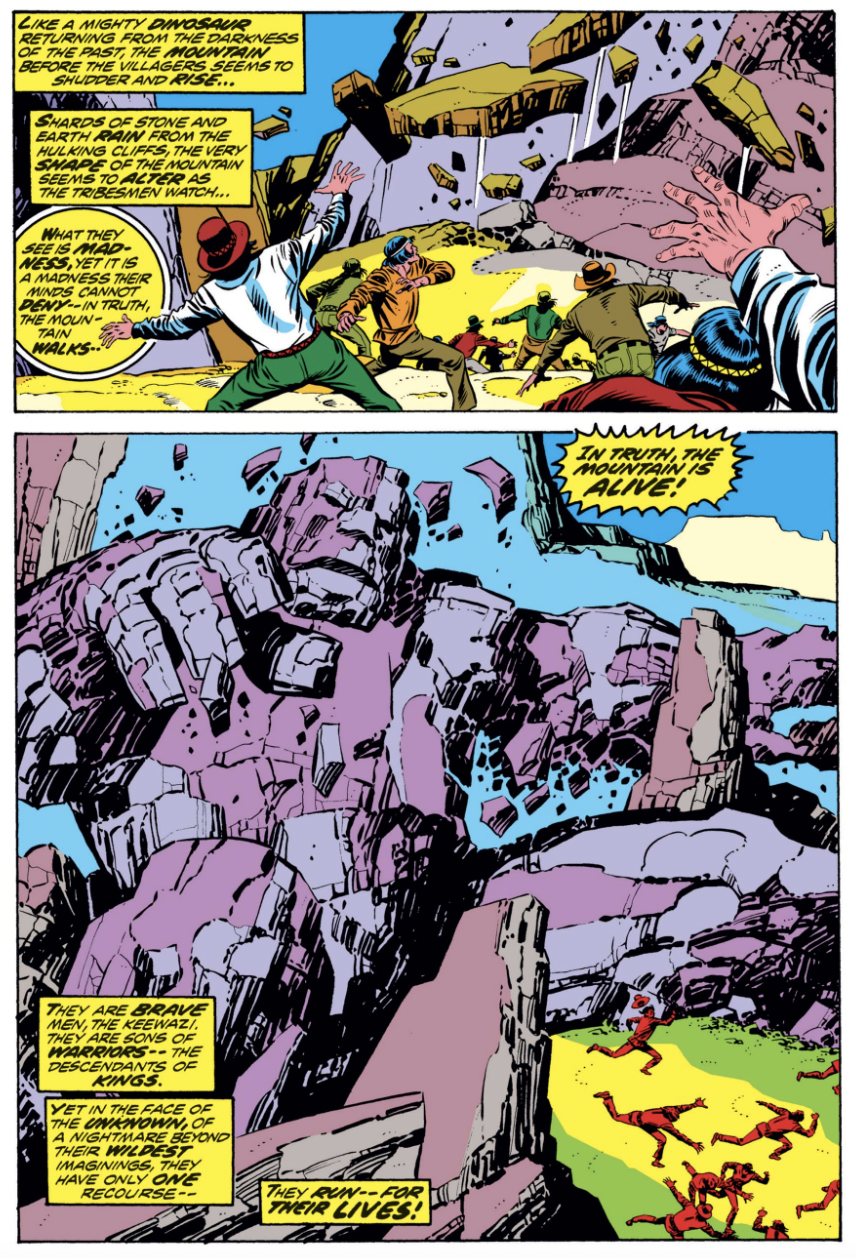
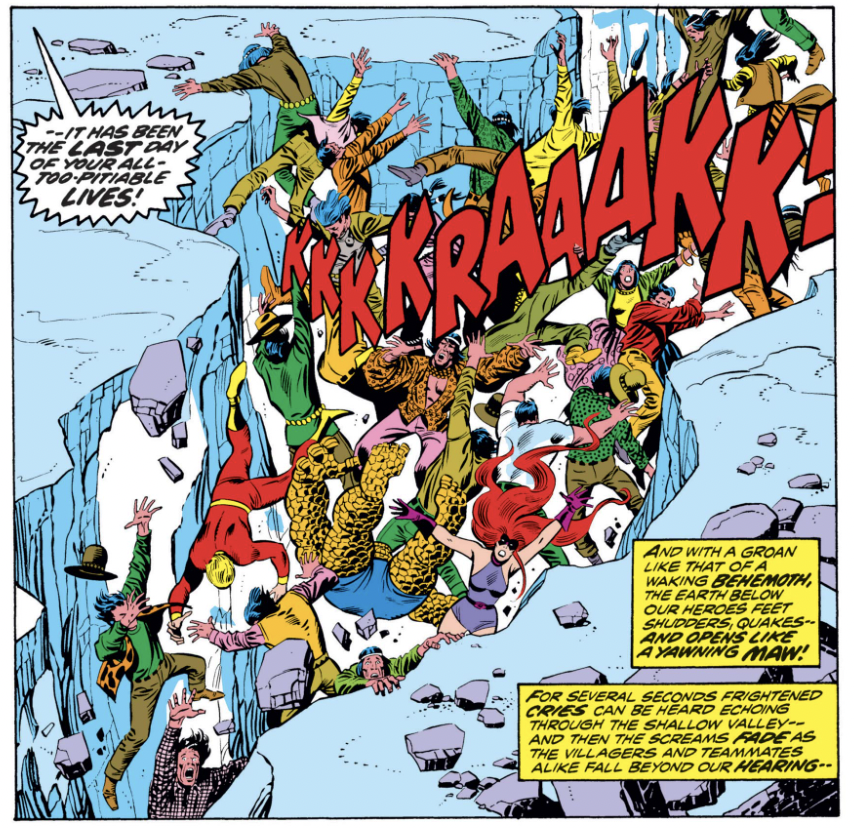
There’s also some slam-bang Buscema art in this issue, like these panels:
And this one:
What I didn’t like
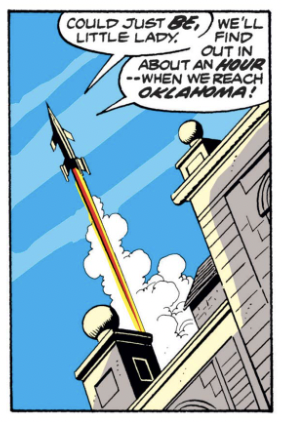
I will admit upfront this is picking nits, and maybe I only care because I am fascinated by geography, but the travel times in this issue don’t add up.
On the first part of the journey, the FF travel by Pogo Plane from New York to Metro University, which is established as somewhere in New Jersey (it’s an odd name for a NJ college but no matter). Ben says the trip will take half an hour.
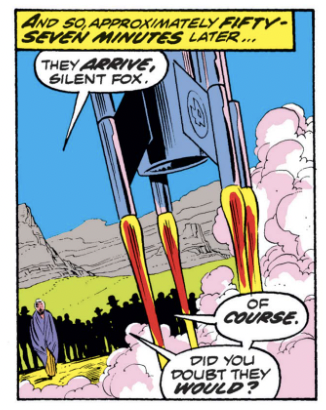
Then, on the second part to Oklahoma, the trip takes 57 minutes.
I will accept there is some time lost in taking off and landing, and maybe there is congestion in the New York New Jersey airspace, but even the farthest corner of New Jersey is just 124 miles from Manhattan. From there it’s 1,100 miles to the nearest corner of Oklahoma! It shouldn’t take just twice as long to travel 10 times as far!
Ok, geography rant over.
Anything else?
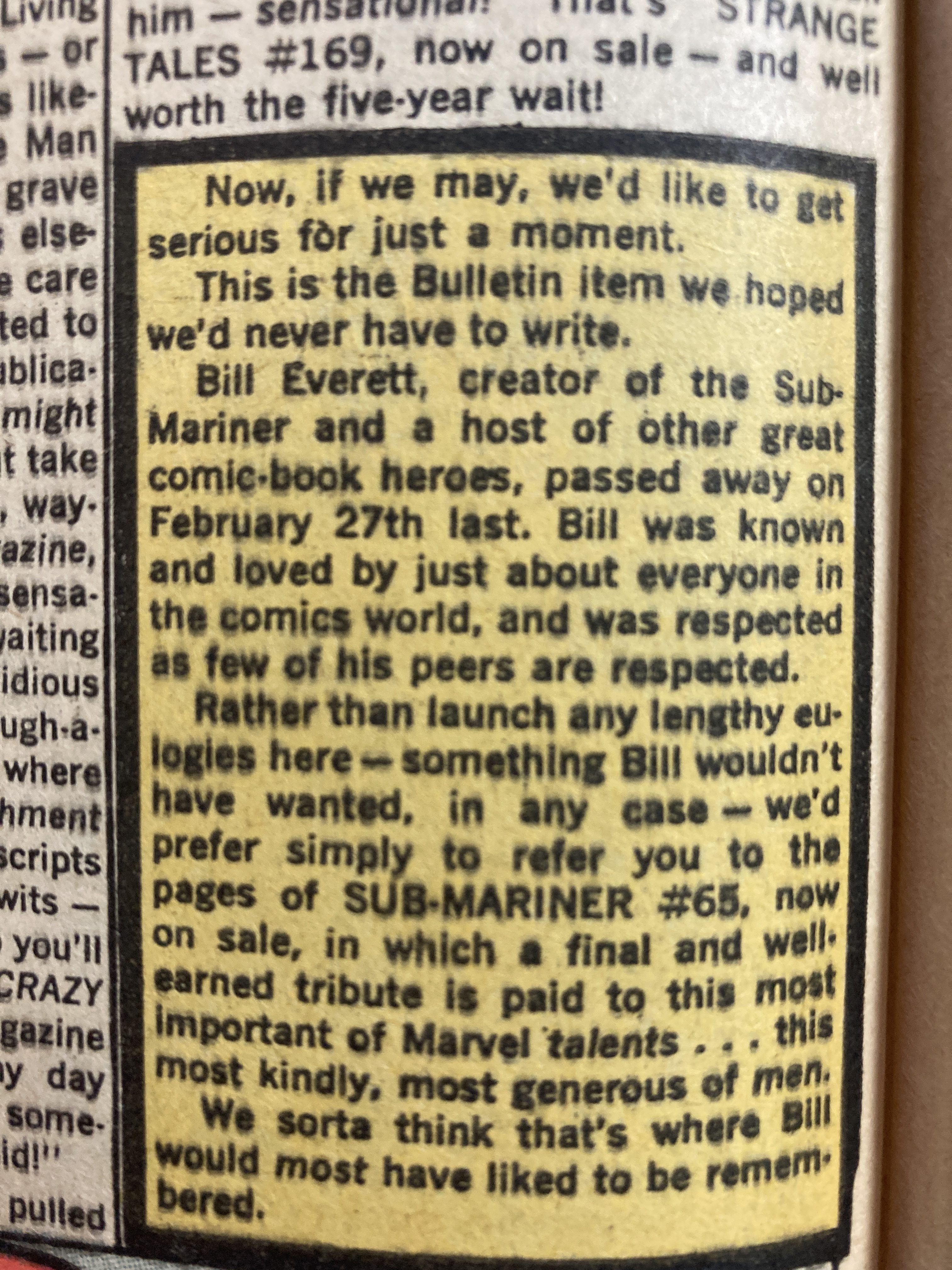
There is a nice tribute to Bill Everett, creator of the Sub-Mariner, in the Bullpen Bulletins. Oddly, this issue appeared in June, five months after he died.
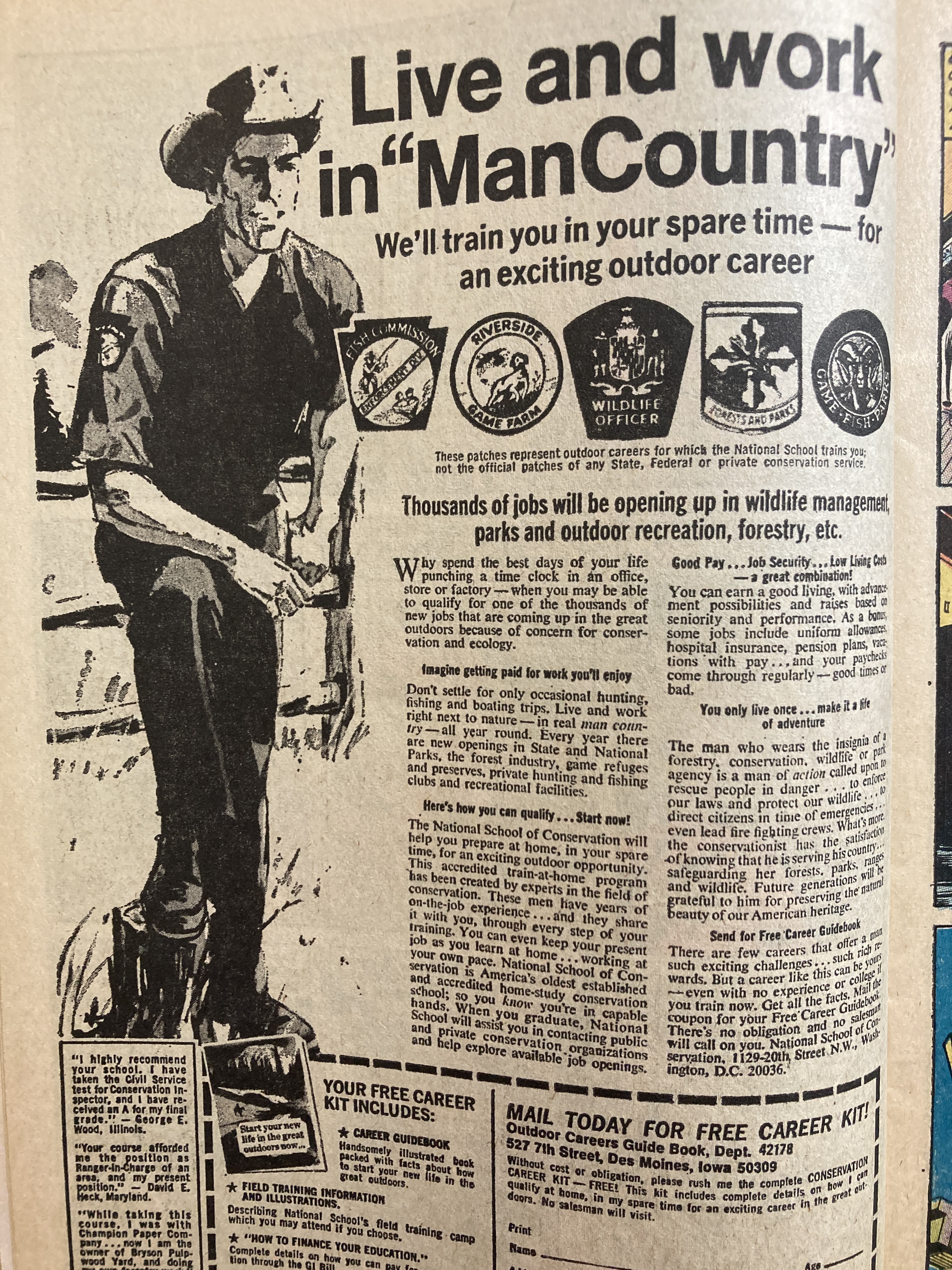
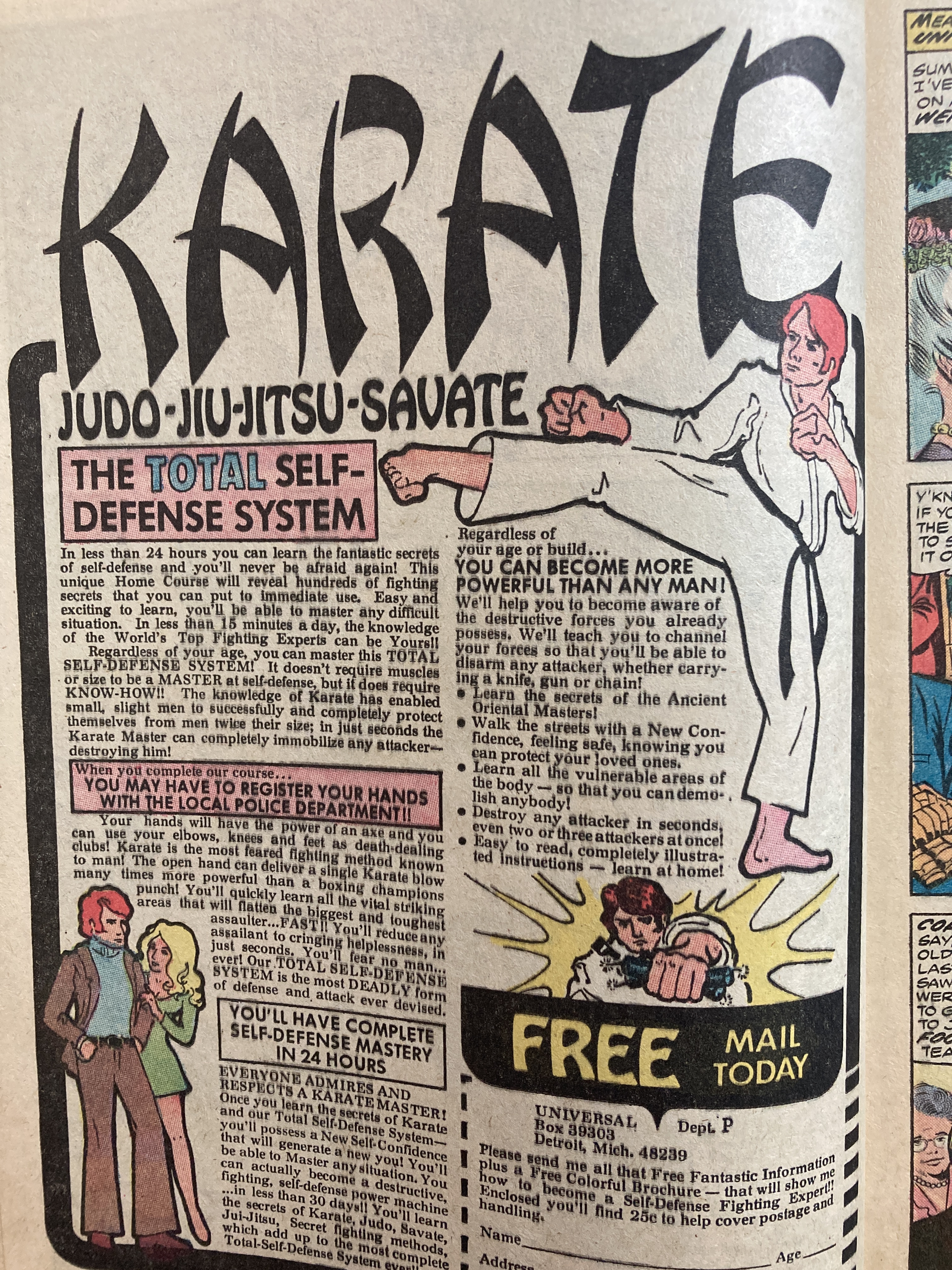
Some excellent ads in this issue. I love how the karate ad warns that, after completing the course, you may have to register your hands with the local police department. “May” is doing a lot of work there.
As per usual with comic ads, they seem designed to appeal to the (apparently low) self-esteem of the comic reader.
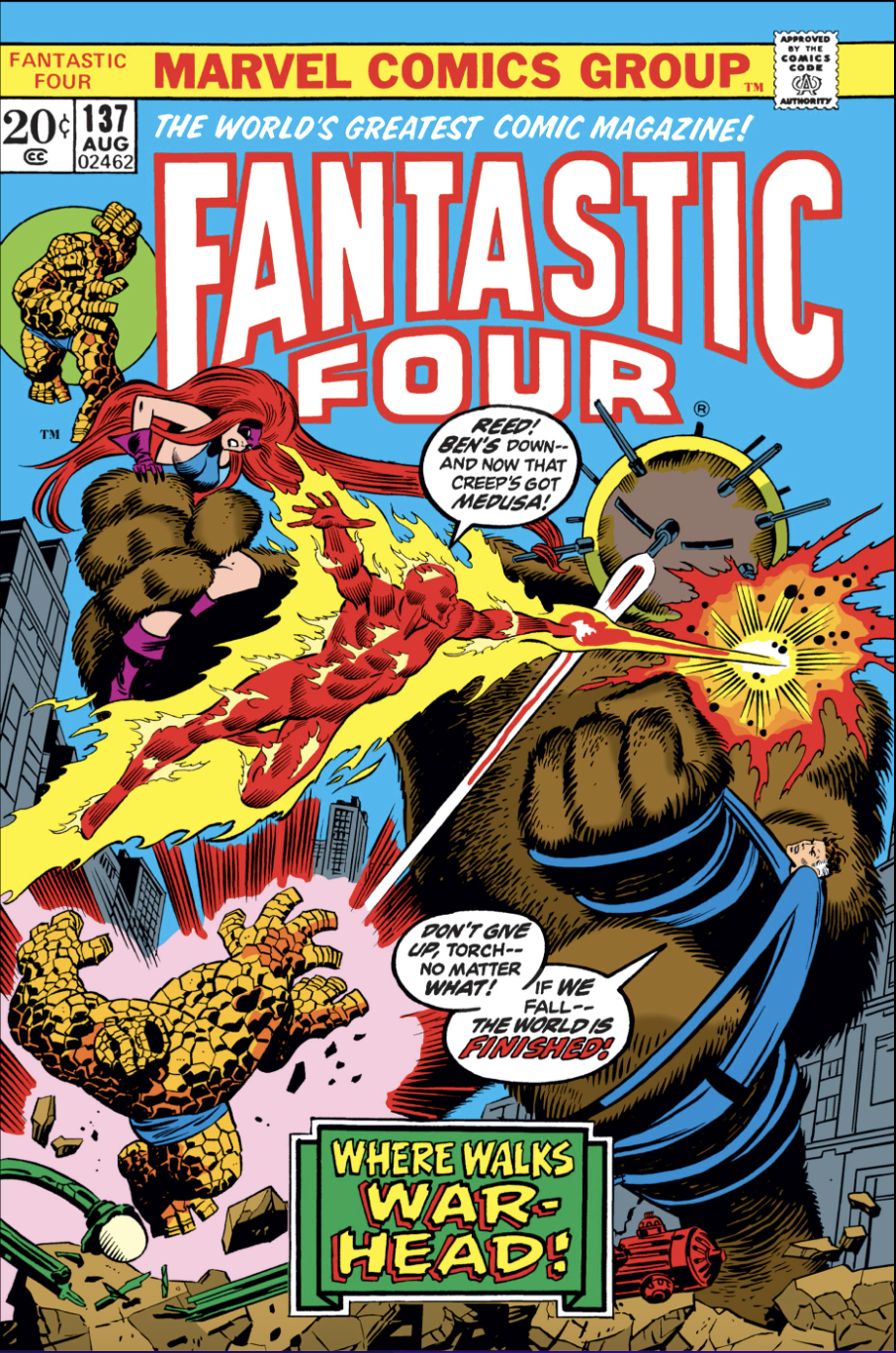
Fantastic Four 137 “Rumble on Planet 3” Published May 1973 Plot: Roy Thomas Script: Gerry Conway Pencils: John Buscema Inks: Joe Sinnott Letters: Artie Simek Colors Glynis Wein Editor: Thomas Cover: Buscema & Sinnott
Synopsis
In the alternate, 1950s-themed world created by the Shaper of Worlds, the members of the Fantastic Four clash, then join together to battle the Warhead, a monster created by the Shaper. When both 50s factions — the “youthies” and “patriots” — are confronted by newly politicized African-Americans of the 1960s, the ’50s construct dissolves. The Shaper admits he made a big mistake choosing Slugger Johnson as the vehicle for his powers, and restores the world back to the 70s.
What’s going on here?
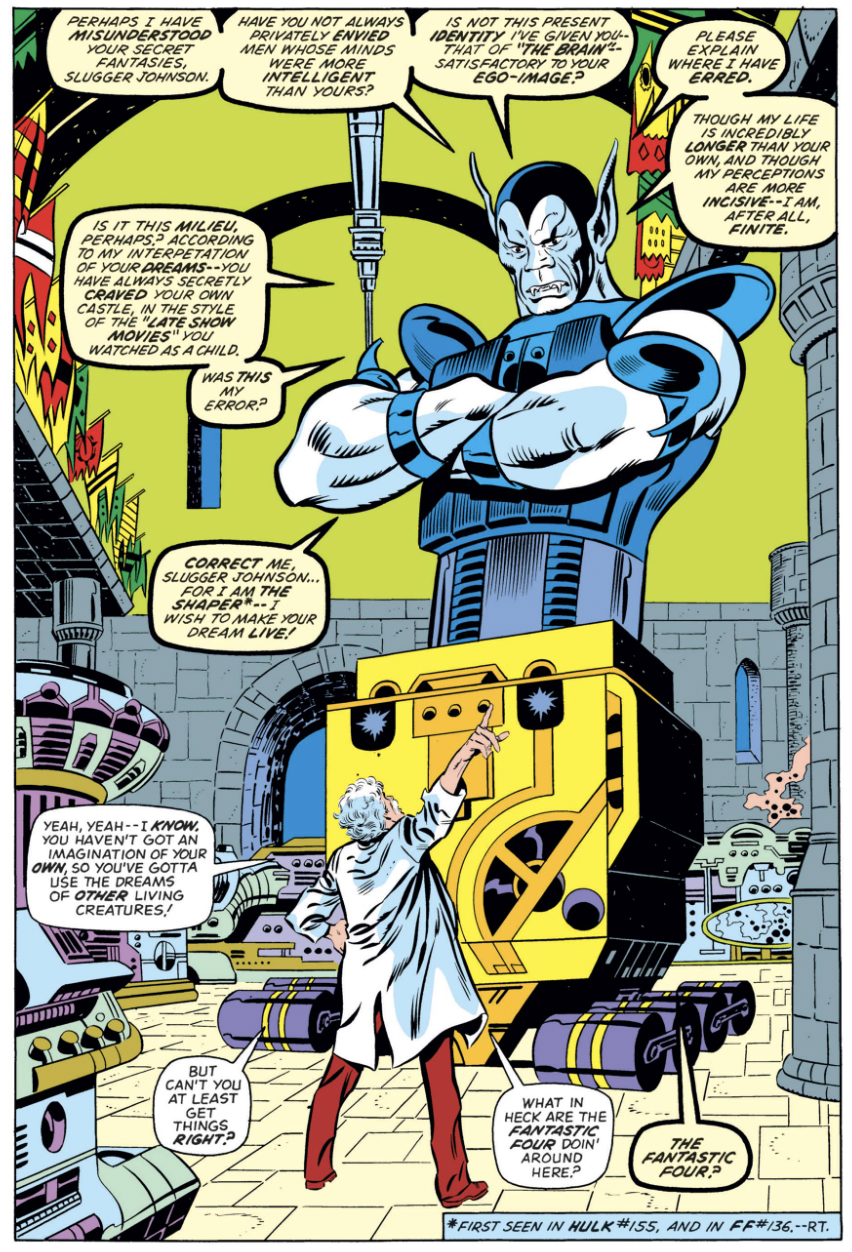
Fantastic Four 137 plays out the barely-intelligible string of last issue, filling in some blanks — we learn that The Brain is actually Slugger, who is intended to resemble Albert Einstein (he doesn’t) — while doubling down on its ham-handed analysis of mid-century sociology. The best thing about this two-issue arc is that it’s over, and seems to have left little mark on the FF or Marvel. One exception: Thomas Gideon, the orphaned son of Gregory Gideon, is whisked off by the Shaper to later become Glorian, who has a long run as a minor Hulk and Silver Surfer character.
One other note: This is the first issue of the Fantastic Four colored by Glynis Wein, who went on to have a long career, with more than 1,000 coloring credits. At this point she was married to comic writer Len Wein, but after their divorce she would return to her maiden name, Glynis Oliver.
What I liked
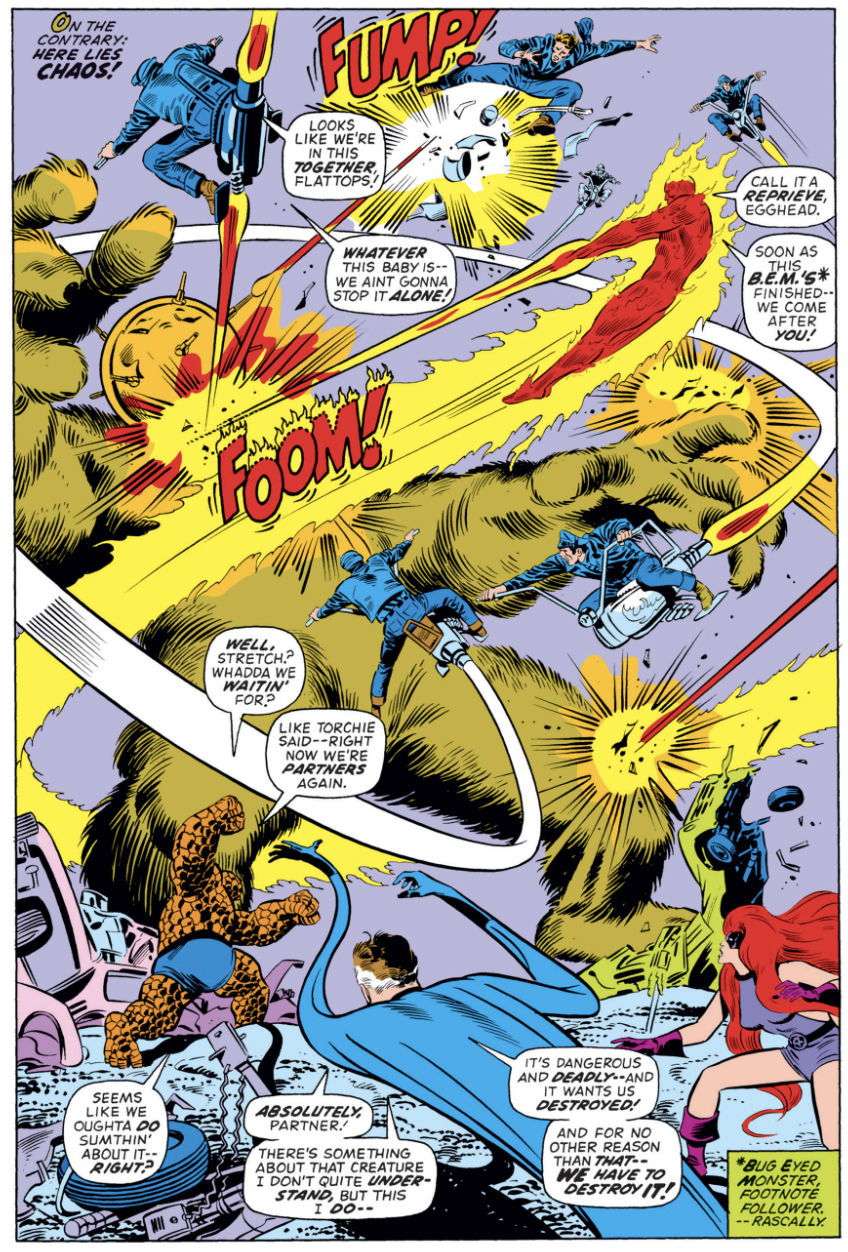
I’m generally a fan of splash pages, and there’s a few in this issue.
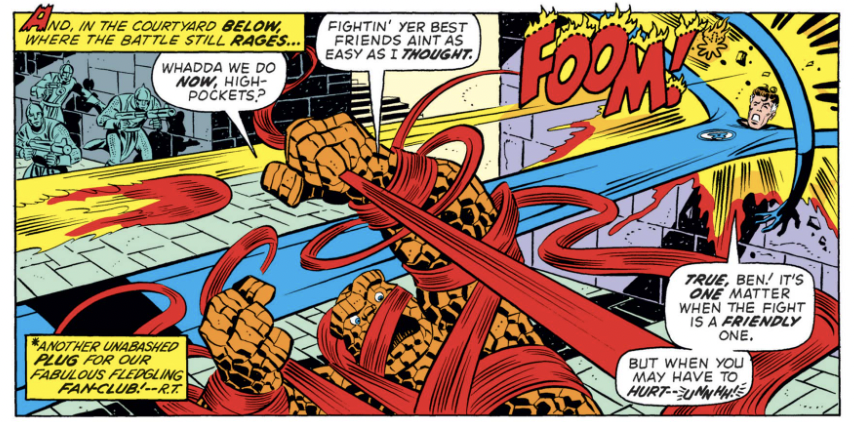
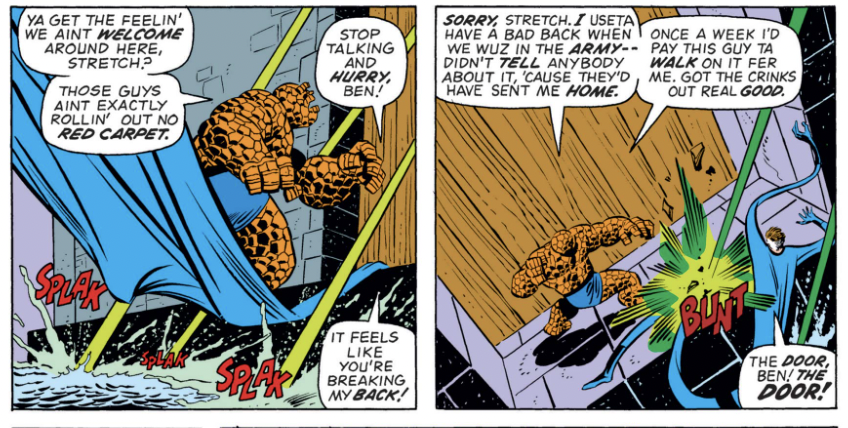
I also liked this sequence of Reed and Ben kibitzing:
What I didn’t like
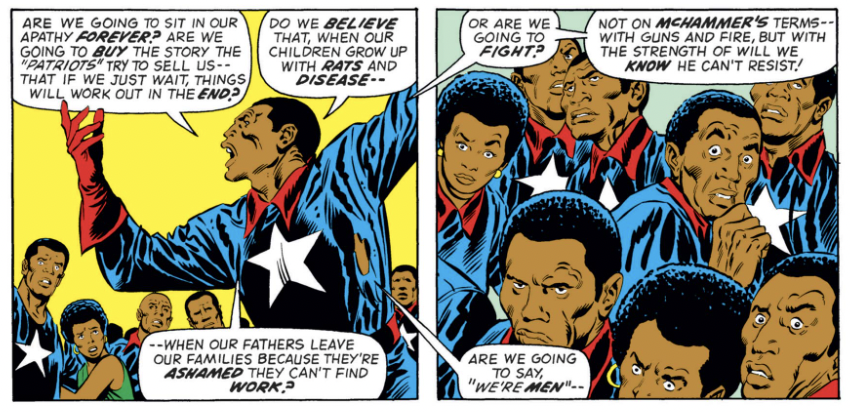
As with last issue, the story makes little sense, and ultimately feels like a silly and pointless exercise in clumsy cultural anthropology. Thomas and Conway compound their simplistic youths-vs.-olds of the 50s dynamic by introducing the Civil Rights struggle of the 60s (which actually began in the 40s). No doubt it was well intentioned, but in the absence of a coherent story it feels preachy and naive.
This new development somehow destablizes the Shaper’s entire project, until it fades away.
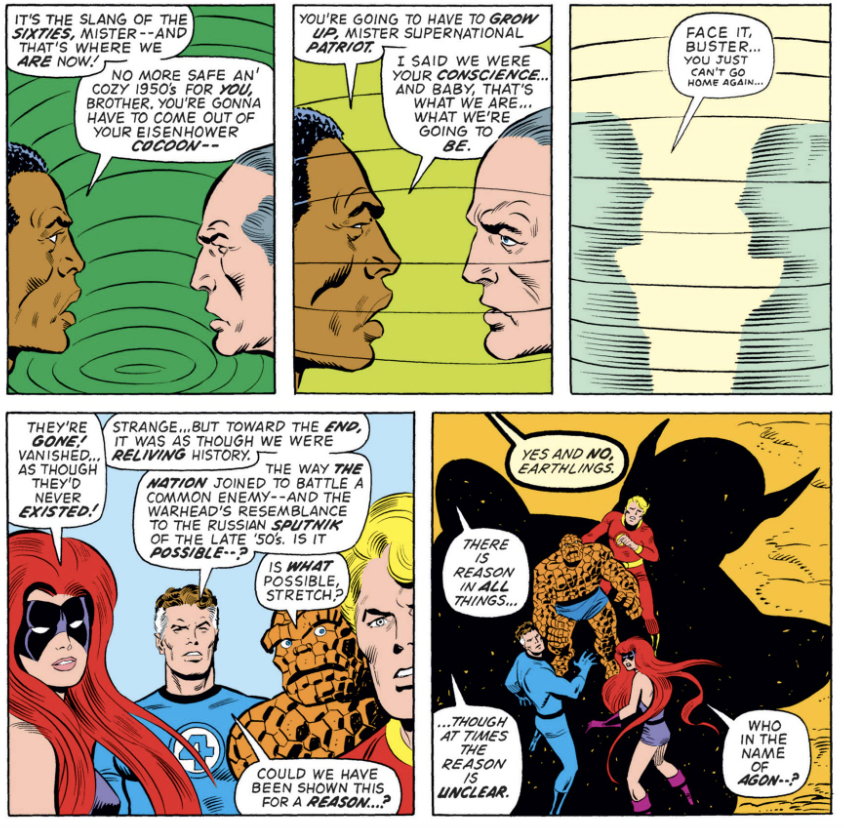
None of it makes much sense, and the Shaper acknowledges as much, telling us “the reason is unclear.” Which is another way of saying Thomas and Conway wrote themselves into a corner and had no way out. The hope is this arc was an aberration but knowing some of the stories in the next few years, I can predict more cringe to come.
Also, Warhead is one of the ugliest comic creature designs I’ve ever seen.
Fantastic Four 136 “Rock Around the Cosmos!” Published April 1973 Plot: Roy Thomas Script: Gerry Conway Breakdowns: John Buscema Finishes: Joe Sinnott Letters: Artie Simek Colors: Stan Goldberg Editor: Thomas Cover: Buscema and Frank Giacoia
Synopsis
In the aftermath of last issue’s battle, Slugger Johnson, a henchman of Gregory Godfrey who mourns for his lost youth in the 1950s, is imbued with atomic powers and identified by the Shaper of Worlds as a vehicle for its reality-bending visions. The Fantastic Four are then thrust into what appears to be a parallel universe oriented around 1950s culture, where youths battle elders, with Mr. Fantastic and the Thing on side and Medusa and the Human Torch on the other. Both pairs are brainwashed by rival camps and dispatched to retrieve a weapon from a mysterious figure called The Brain.
What’s going on here?
Where to begin? If there was proof that this was now Roy Thomas’s comic, look no further. A cynic might say this is what happens when a comic’s writer is also the editor, because this issue desperately needed editing.
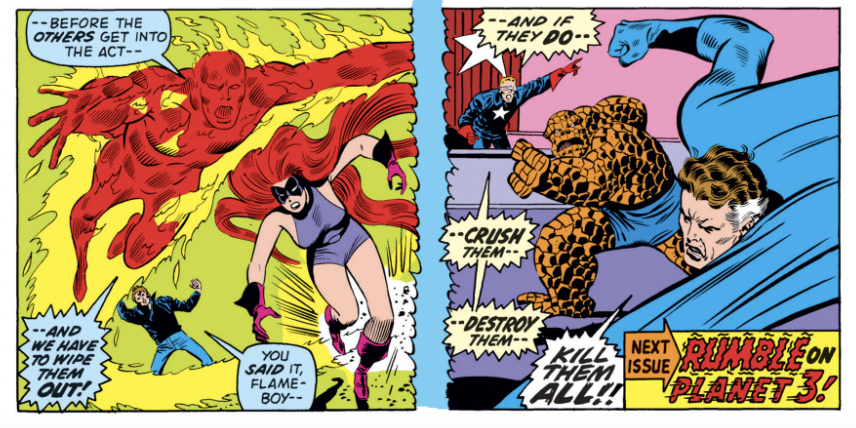
At its core, FF 136 is a multiverse story, a speciality of Thomas’s, who gave us the Squadron Supreme in the Avengers two years earlier, and who later would spin DC’s Earth 2 Justice Society into a multi-generational epic. Here, the alternate earth aspect isn’t mentioned explicitly, but it’s pretty obvious what’s going on, and the tag line previewing the next issue makes it clear.
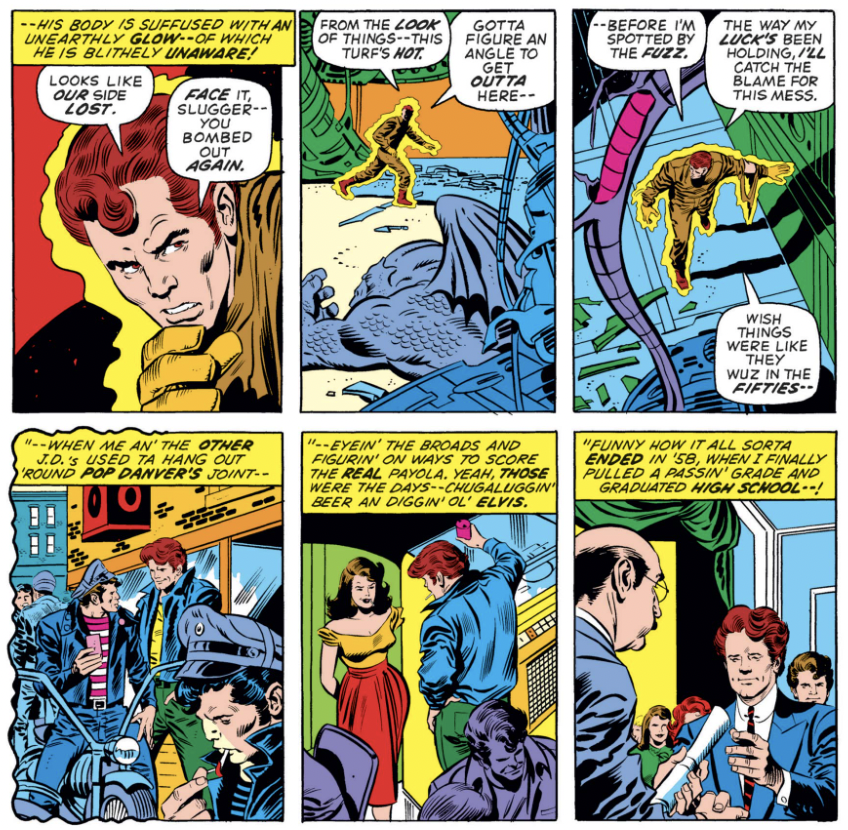
The defining nature of this alternate earth is that it is rooted in a caricatured vision of the 1950s, one drawn from the psyche for Slugger Johnson by the Shaper of Worlds. As we learn early on, Slugger really loved the 50s:
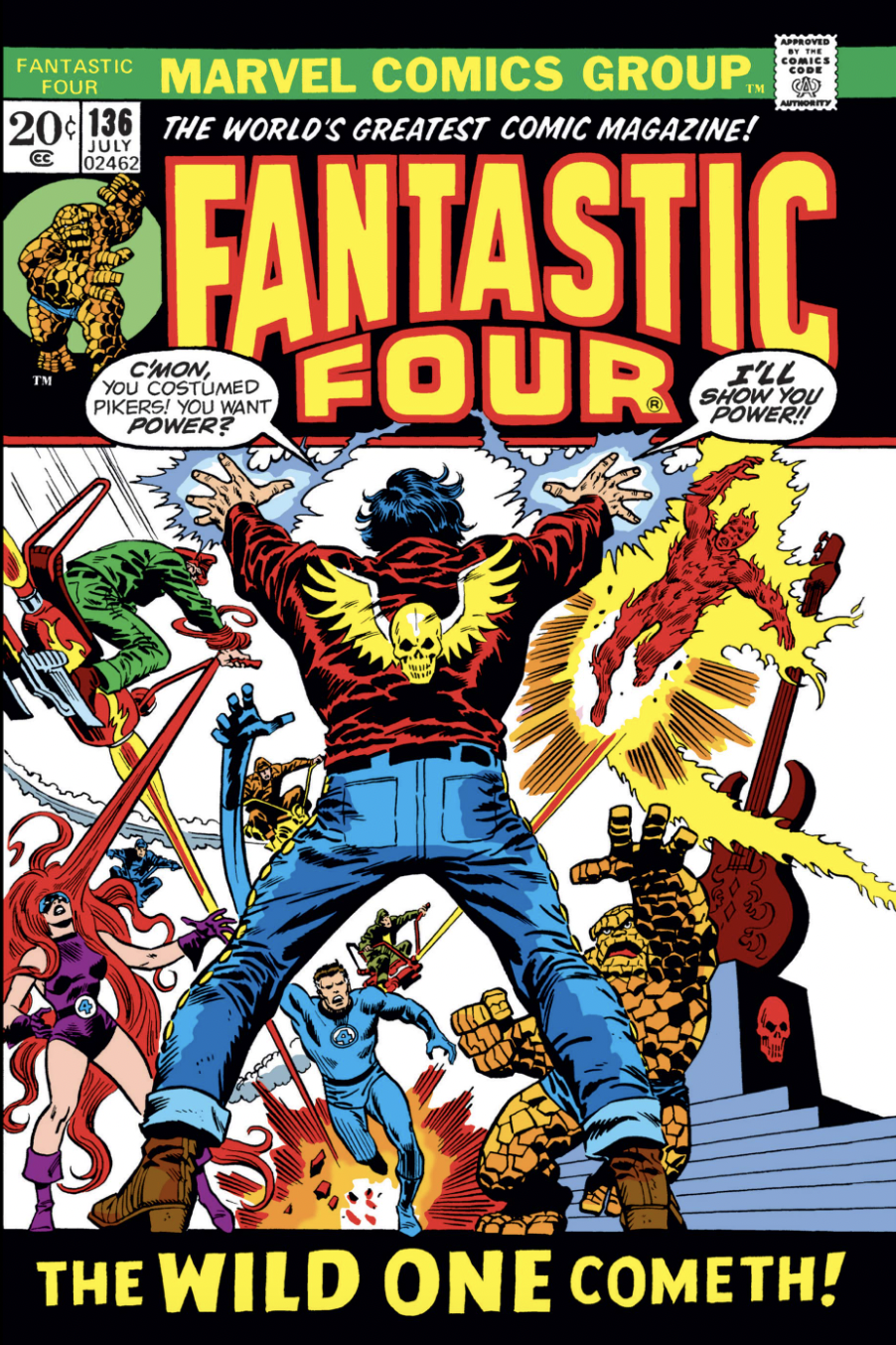
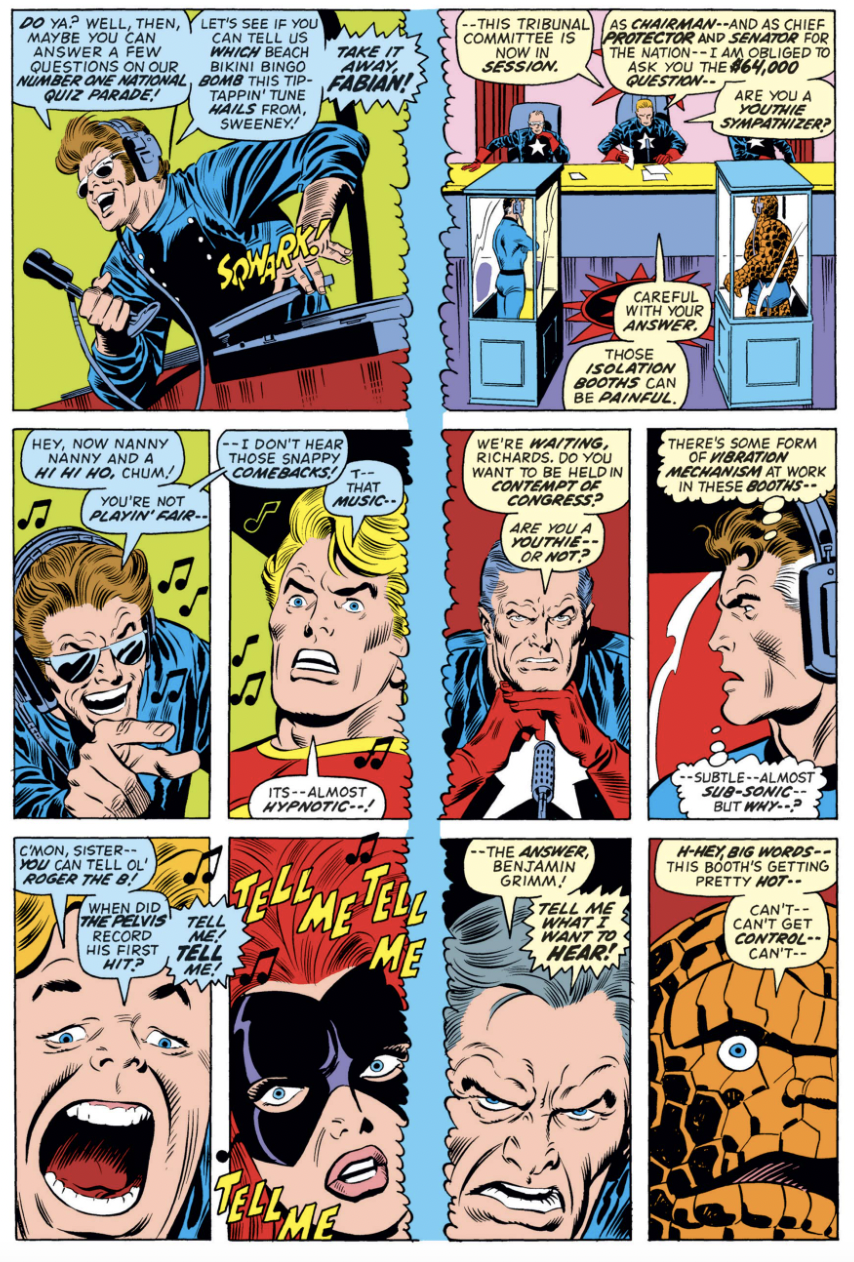
This painful 50s slang permeates the issue, and it seems clear that scripter Gerry Conway, who was born in 1952, learned it from watching B-movies on TV. What’s less clear is what lesson Thomas, who plotted the comics, wants us to draw from this extremely clumsy story. Is Thomas, born in 1940 and raised in the 50s, nostalgic for the era and its romanticized narratives of bikers rebellion and the birth of rock n’ roll? Or is he poking fun of that nostalgia? Is he using the excesses of the 50s youth culture to critique 60s youth culture? Is he hip? or is he square? Unfortunately, the story is so muddled it’s hard to know.
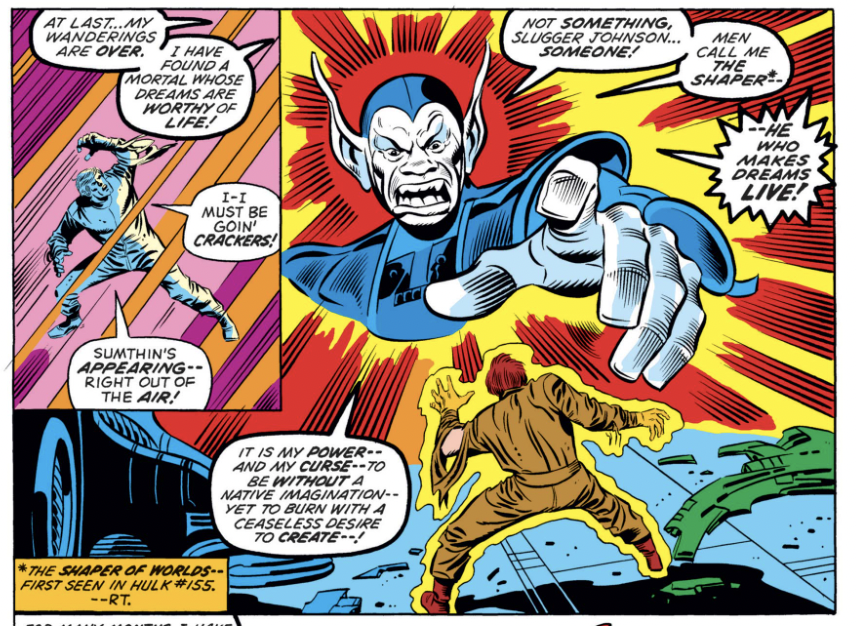
The presence of the Shaper of World’s is further evidence of the Thomasian drift of the Fantastic Four. Initially a Hulk villain created by Archie Goodwin the previous year, the Shaper is a Cosmic Cube brought to life by the Skrulls, and a character I know almost nothing about prior to this issue. But Thomas loves to play with characters from other comics, the more obscure the better, and a reality-bending cosmic creature is right up his alley. It’s fair to say Stan never would have dreamt of using it.
What I liked
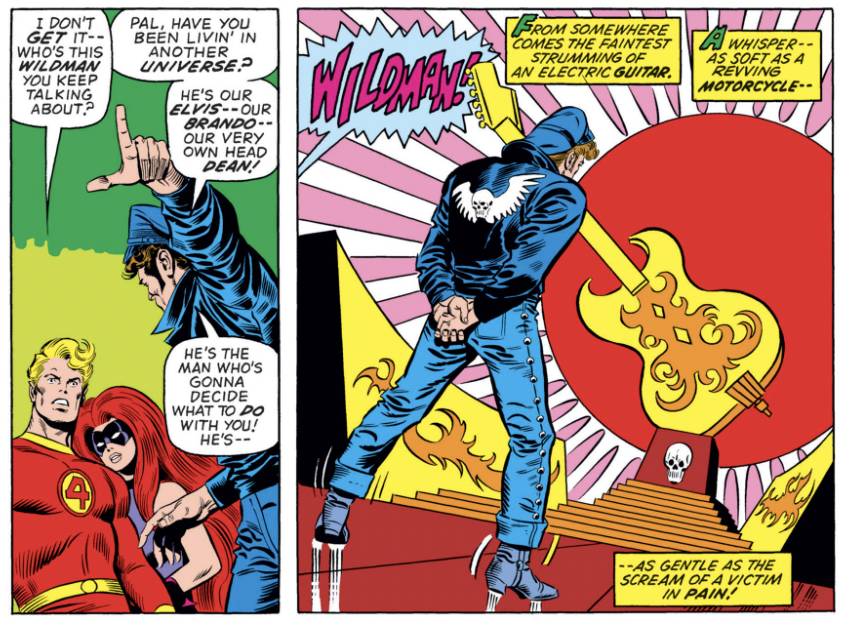
Despite its extreme goofiness, I admired how hard Thomas and Conway lean into the 50s conceit. Here is Slugger Johnson reintroduced as Wildman:
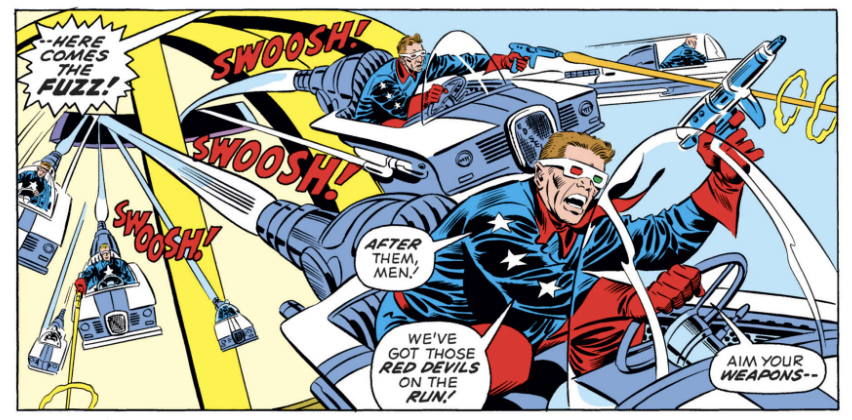
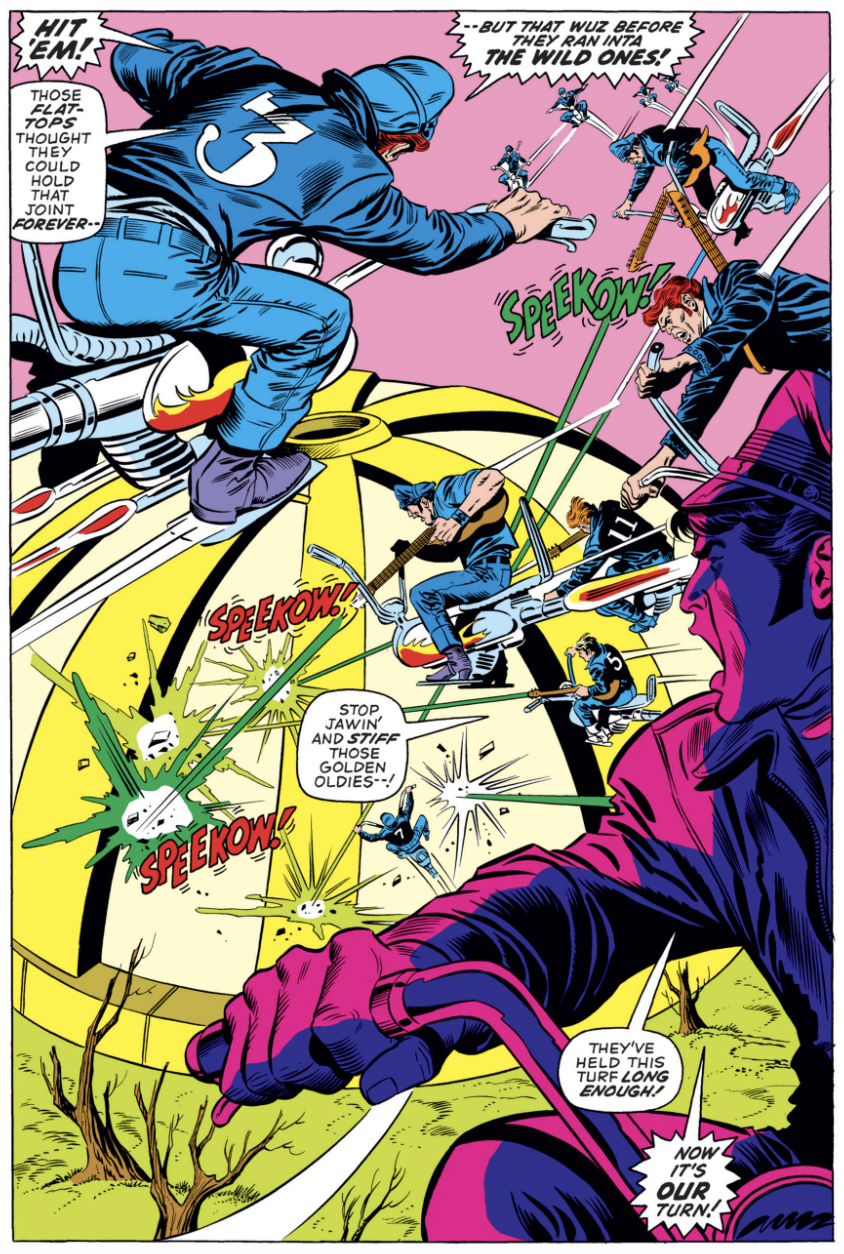
Buscema and Sinnott also deliver a socko splash page that introduces the 50s gangsters:
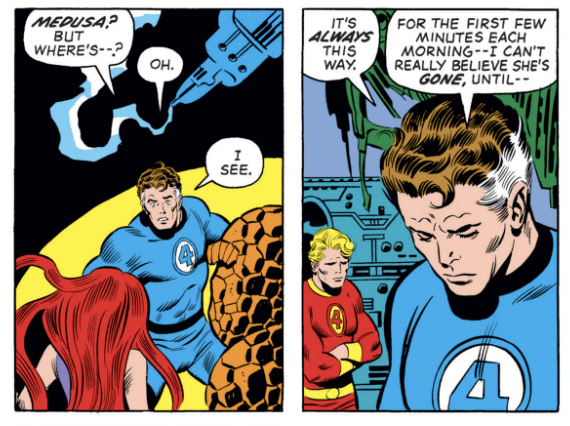
And before the silliness started, there was a touching sequence where Reed awakens from unconsciousness and imagines Medusa is Sue:
What I didn’t like
If it wasn’t obvious, this comic is an incoherent mess. The alternate earth plot is confusing and it’s never clear if Johnny and Medusa are in their right minds or not, since they attack Ben and Reed, then seem their normal selves. (And why is Medusa on the side of the youths? She’s a married Inhuman queen, hardly a teenager.)
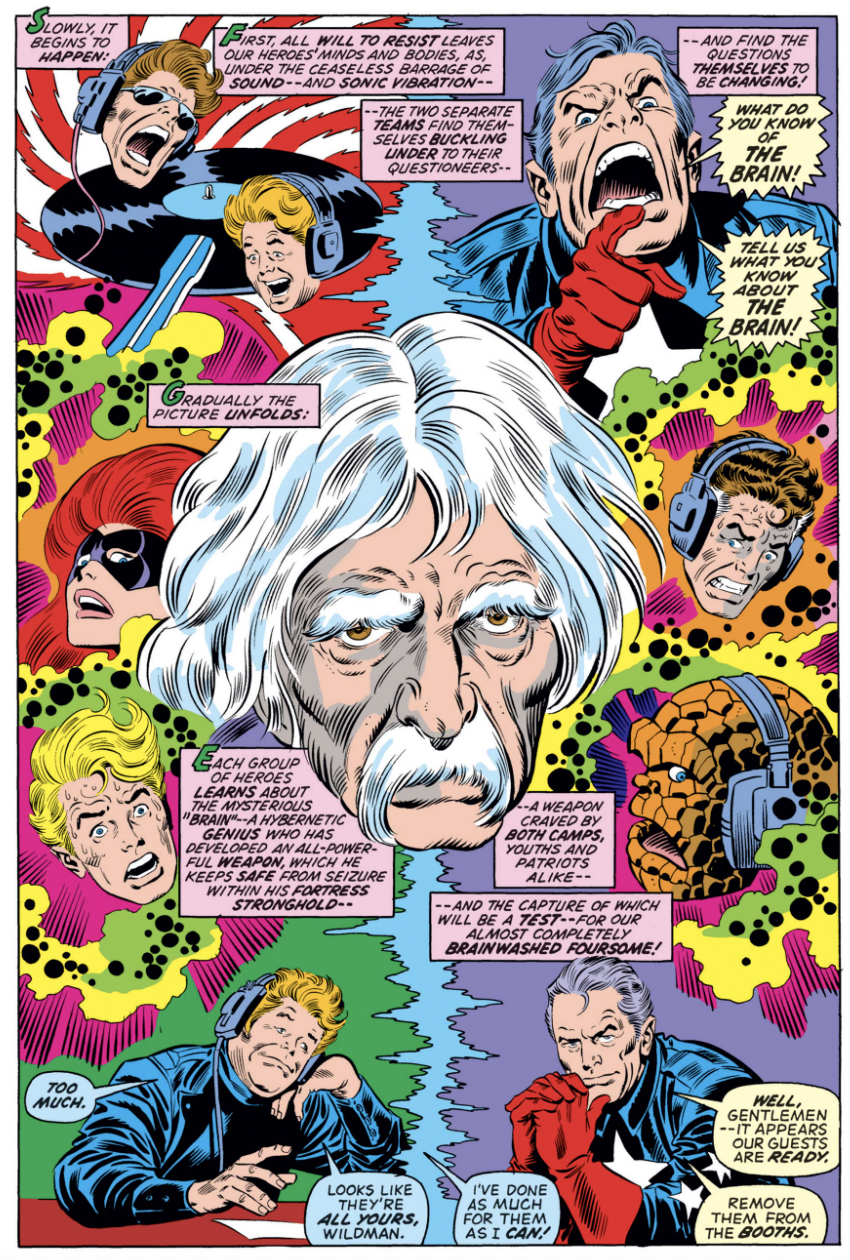
Then, instead of letting the jumbled story gel, Thomas and Conway shake it up again by introducing another character, The Brain, who we meet in this kaleidoscopic sequence:
I can’t imagine a kid picking up this comic as his or her first issue of the FF and making heads or tails of it.
Anything else?
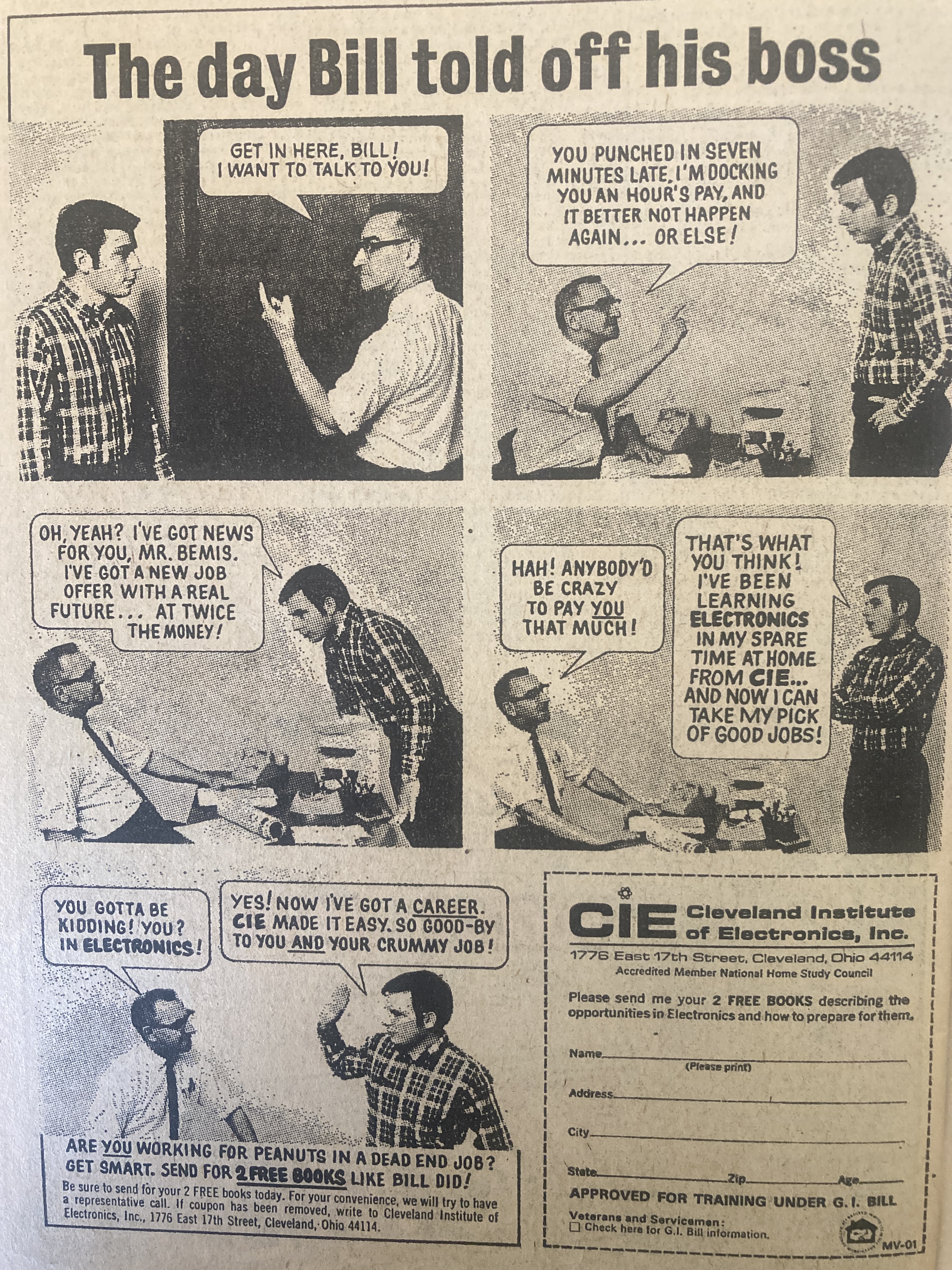
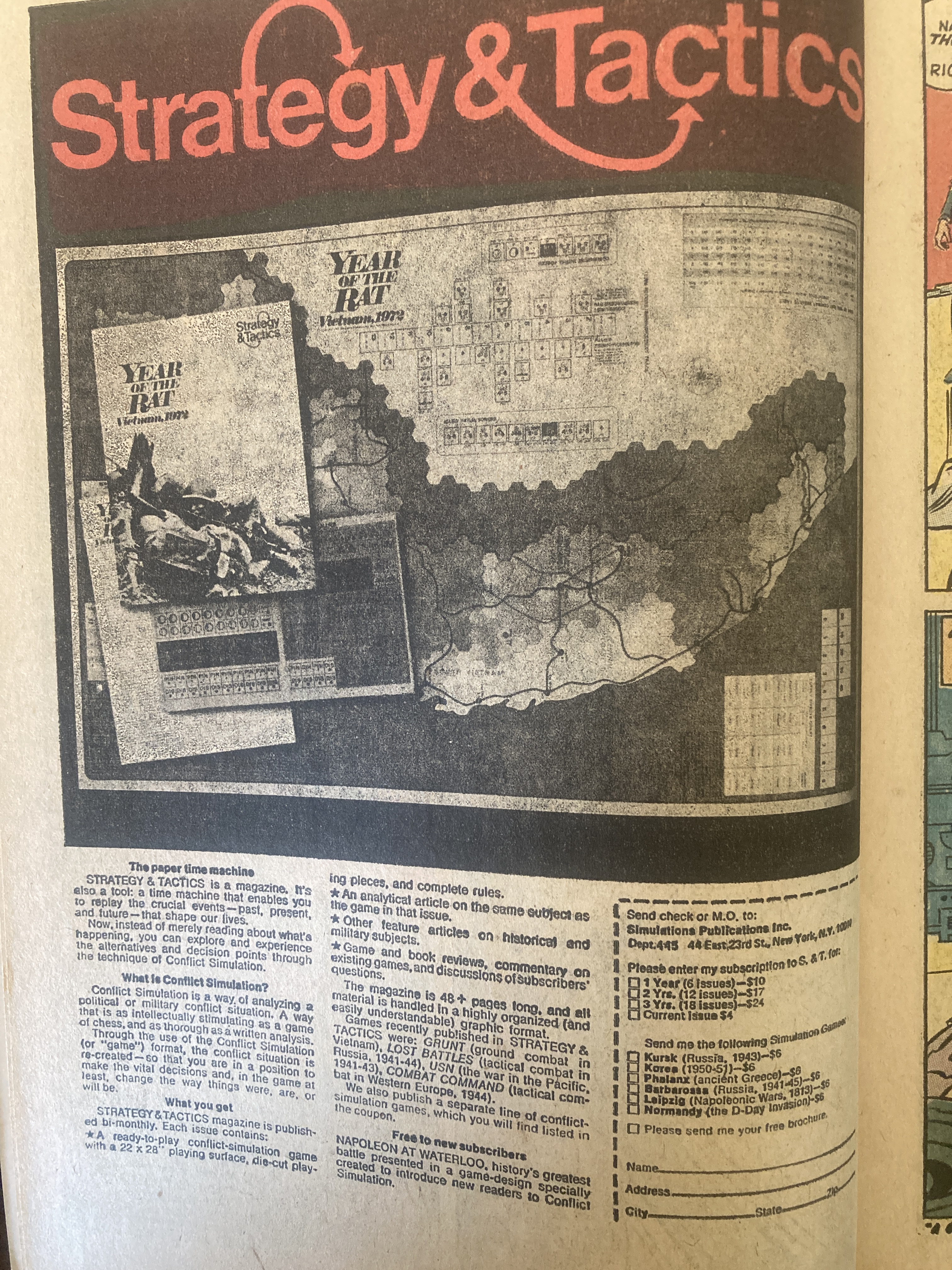
Some interesting ads in this issue. A fumetti-style ad for an anti-authoritarian trade school, and a pretty cool looking role playing magazine.
Overall
For Fantastic Four or Roy Thomas completionists only
Fantastic Four 135 “The Eternity Machine” Published: March 1973 Writer: Gerry Conway Breakdowns: John Buscema Finishes: Joe Sinnott Letterer: Artie Simek Colors: Petra Goldberg Editor: Roy Thomas Cover: Buscema and Michel Esposito
Synopsis
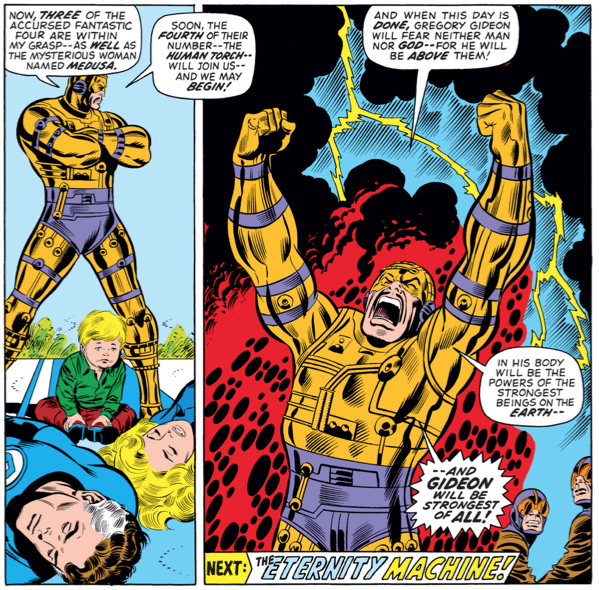
The Fantastic Four are trapped by Gregory Gideon, who reveals his plan to drain the powers of Mr. Fantastic, the Invisible Girl and their son Franklin to counter his radiation poisoning and rule the world. Thanks to new member Medusa, the team escapes their imprisonment and beats Gideon by turning Dragon Man against him.
What’s going on here?
This is a fairly straightforward story, wrapping up a two-part arc while introducing some new sub-plots. Probably the biggest development isn’t a development at all, but the continuation of Sue’s estrangement from Reed. Despite both being captured with their son, at the conclusion of the issue Sue has no interest in reconciling with Reed.
It’s a poignant and effective ending, maybe even more so given writer Gerry Conway was just 20 years old when he wrote this comic. In a 2016 interview, Conway discusses his relative immaturity during this period and how he did his best to mask it as a writer. He concedes he wasn’t always successful, and we’ll see some of that toward the end of his Fantastic Four run. But for a writer barely out of his teens, he handled the strains in Reed and Sue’s marriage with surprising deftness.
What I liked
Another notable development is the emergence of Medusa—finally—as a useful member of the team. I’ve been surprised that, as the newest member of the team, she’s been relegated to the background, but in FF 135 she plays a key role in breaking herself, Ben and Johnny out of their imprisonment, then in removing a device that allowed Gideon to control Dragon Man. I would still welcome a story that focused on her and her decision to leave the Inhumans, but this is progress.
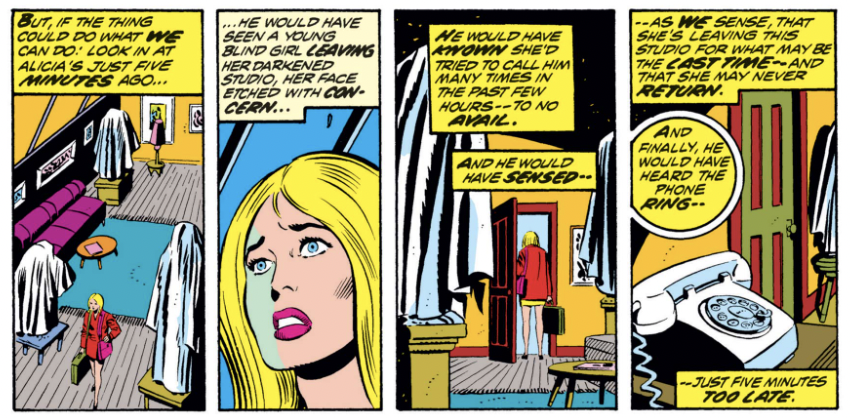
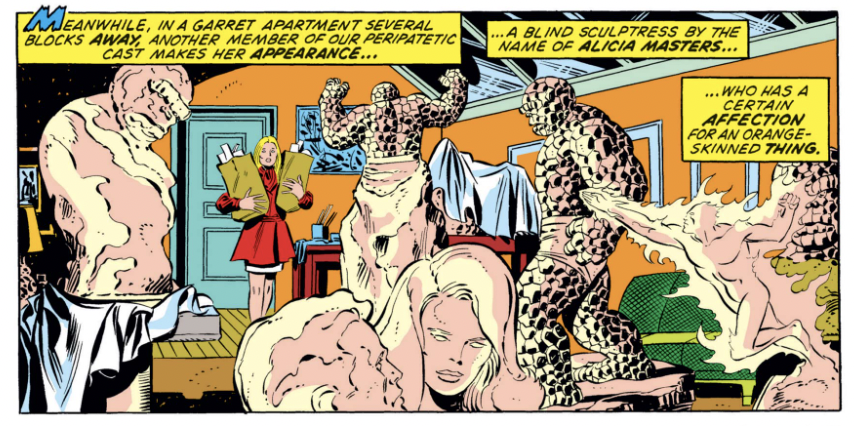
There’s also a nice interlude of Alicia pining away for Ben. It doesn’t seem to be furthering any plot point, but serves to remind us Ben’s life extends beyond the team.
This may be the first time we’ve seen Alicia crafting images of Ben. That becomes a pretty standard feature—at one point almost every appearance shows her surrounded by her sculptures of Ben and other heroes—but this is the first I recall seeing it. If anyone knows of an earlier appearance of this trope, let me know.
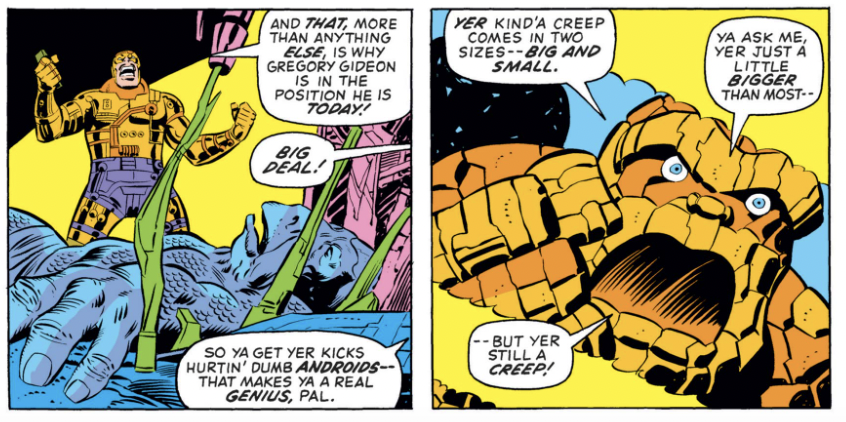
Also, I liked this exchange between Gideon and a salty Ben.
What I didn’t like
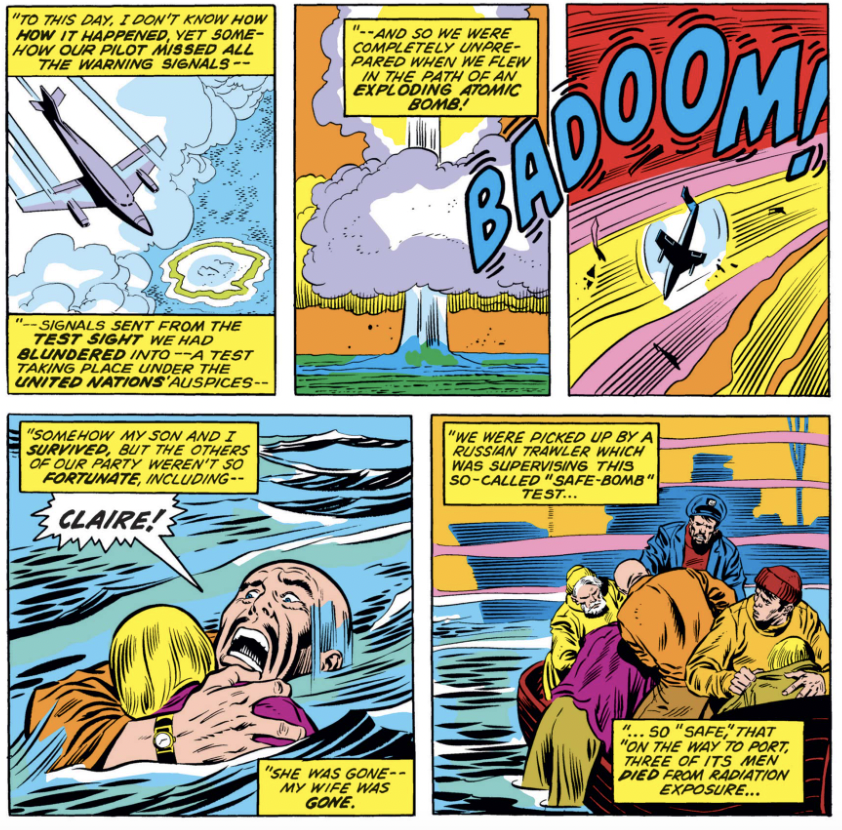
The backstory explaining Gideon’s turn from remorseful rich guy to super villain was truly absurd. His private pilot somehow flew them into a nuclear test site, killing his wife, and giving Gideon and his son radiation poisoning that would kill them in two years. The solution? Stealing the energy of half the Fantastic Four!
Also, a new subplot is introduced, when a mysterious, muscular man entering the FF’s Baxter Building headquarters. But what happened to last issues’s subplot, of Agatha Harkness’s missing house? Hopefully they tie together, or I fear we are entering Claremontian territory of subplots mushrooming without resolution.
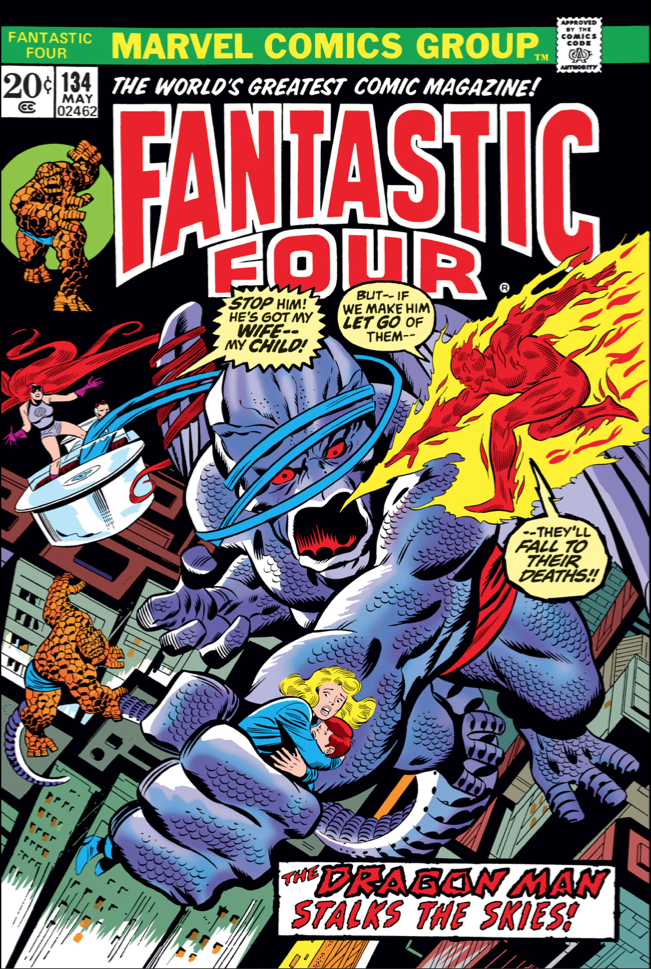
Fantastic Four 134 “A Dragon Stalks The Skies!” Published: Feb. 1973 Script: Gerry Conway Pencils: John Buscema Inks: Joe Sinnott Colors: Dave Hunt Letters: Artie Simek Editor: Roy Thomas Cover: Buscema and Sinnott
Synopsis
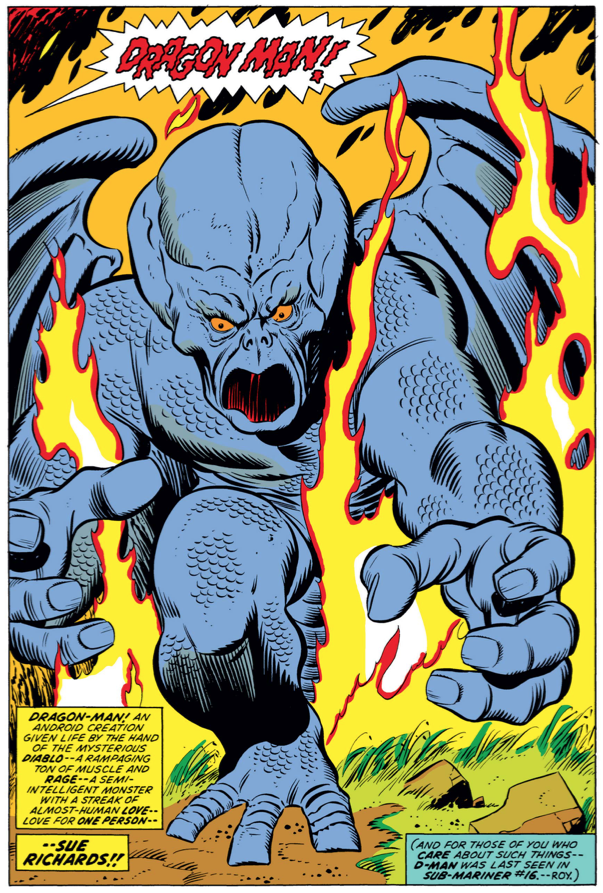
While the new-look Fantastic Four investigates Agatha Harkness’s missing home, the Invisible Girl and Franklin are abducted by Dragon Man, who is under the control of Gregory Gideon, the world’s richest man. When the rest of the FF attempt to rescue Sue and Franklin, Gideon subdues them and takes them prisoner.
What’s going on here?
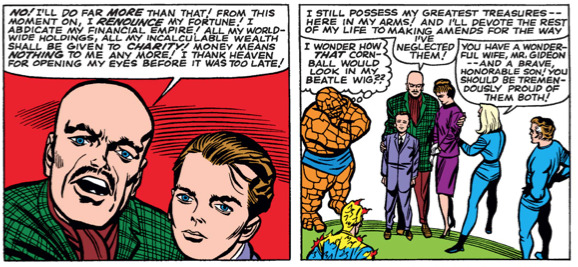
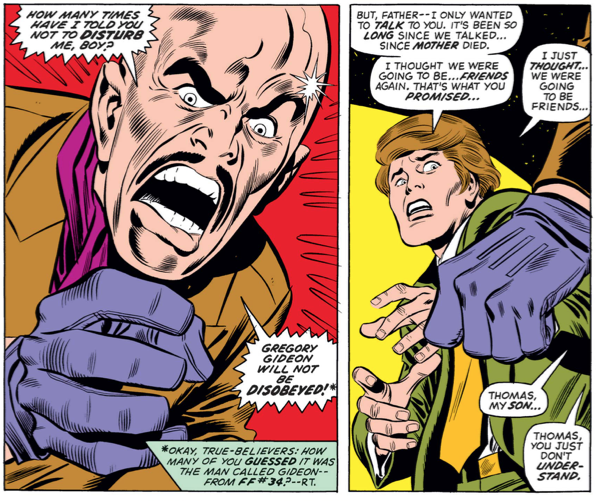
Gerry Conway is credited as the sole writer of this issue—albeit as “scripter— although a previous letters page says he is working from a Roy Thomas plot. Thomas’s influence seems obvious, since the villain is a minor figure summoned from obscurity, a very Thomasian trope. In this case, the bad guy is Gregory Gideon, who last appeared 100 issues ago in FF 34, and was then called the richest man in the world (and who, in passing, was said to have owned the Baxter Building). In FF 34, after attempting to defeat the FF to win a bet, Gideon is remorseful and the issue concludes with him renouncing his fortune and vowing to spend time with his wife and son.
It’s fair to say that his redemption didn’t take, because in FF 134 he is a raving megalomaniac. (The relationship with the son doesn’t seem much improved, either).
By the end of the issue he’s gone full-blown Lex Luthor, complete with a battle suit. But despite his transformation into a standard super villain, he never appears after the conclusion of this arc.
What I liked
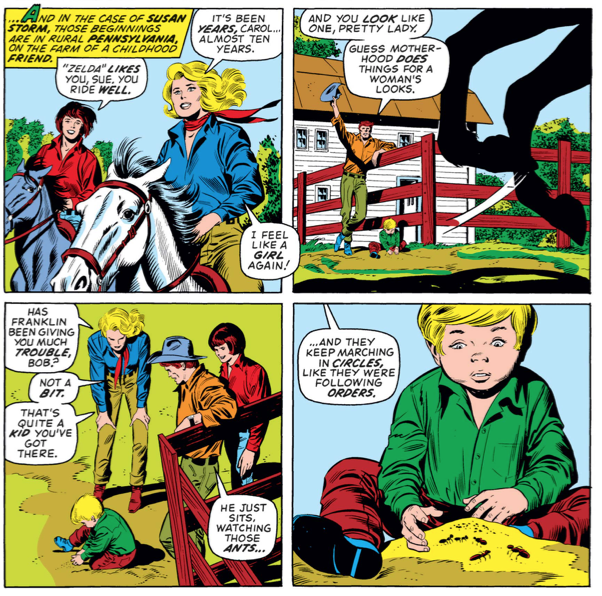
This is another place-setting issue and as such, there are some fun interludes and bits of character development. For example, Sue and Franklin are shown visiting Sue’s childhood friend Carol Landers, and her husband, Bob, on a farm in Pennsylvania. I’d never encountered the characters before but apparently they hang around for about a dozen issues before fading away. (If they appeared today, there is a 100% chance that one of them would have developed powers within 10 issues).
Note the reminder about Franklin’s powers, a plot point which will only become more prominent from here. Also note the horse is named Zelda, which happens to be the name of my dog.
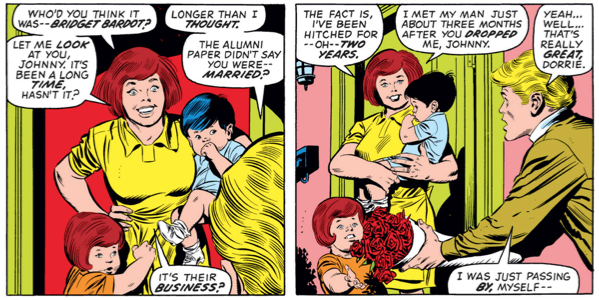
Another odd appearance is of Dorrie Evans, the Human Torch’s girlfriend in the early days of the FF, and now a rebound target after his breakup with Crystal. If they had Facebook in 1973 he might have avoided this awkwardness.
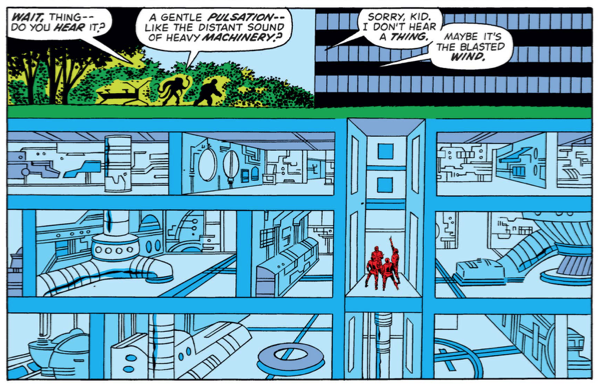
I’m also a sucker for building diagrams and cutaways. Not sure why John Buscema felt one was necessary here; maybe he was just a sucker for them too.
What I didn’t like
On an otherwise great cover, Franklin’s hair is red. Oops.
The issue opens en media res, with the FF examining a crater where Agatha Harkness’s home used to sit. The disappearance of your witch-nanny’s home seems like a big deal! But by the third page it’s basically forgotten and never referenced again. I assume Conway will back to it, but the sequence felt very abrupt and odd.
Medusa has been on the team for about a week and she already seems to know an awful lot about their history.
Also, I didn’t much care for how Gideon’s henchmen subdued Ben and Medusa so easily. It should take more than one panel to knock out the Thing.
Fantastic Four 132 “Omega: The Ultimate Enemy!” Published December 1972 Writer: Roy Thomas Pencils: John Buscema Inks: Joe Sinnott Letters: John Constanza Colors: Petra Goldberg Editor: Thomas Cover: Jim Steranko and Frank Giacoia
Synopsis
The Fantastic Four (minus the Invisible Girl), Quicksilver and the Inhuman royal family confront the monstrous Omega, later revealed to be the personification of the Inhumans’ racial animus toward the Alpha Primitive underclass. The comic ends with Medusa joining the FF to replace Sue, and Johnny and Crystal breaking up.
What’s going on here
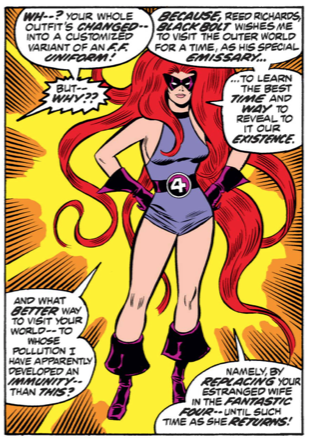
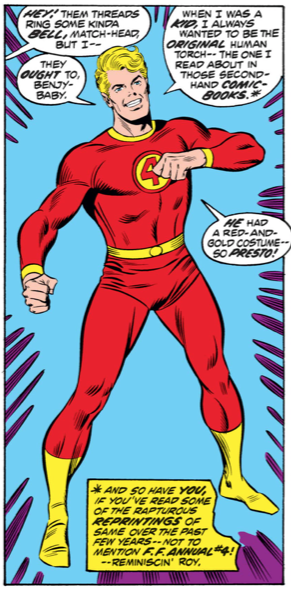
There’s a lot of action and angst in this comic, but the biggest developments come at the end. Medusa joins the team —or to be accurate, declares she is joining the team — in an arrangement that lasts more than 20 issues, a surprisingly long time. Again, it was another decision by Roy Thomas to shake up the status quo he inherited from Stan and inject some new dynamics into the team. Medusa also uses an Inhuman device to generate new costumes for herself and Johnny (Ben passes and when it’s aimed at Reed, nothing changes, which is mildly amusing).
The other major development is the official end of the romance between Crystal and Johnny after approximately 70 issues. Johnny’s obsession with Crystal frequently propelled his character and FF stories, to the point here it seems he had no other interests or character traits. Yet another example of Roy shedding the past for something new.
The cover was by Jim Steranko, with inks by Frank Giacoia, the last, and I think weakest, of the three covers he did to spell John Busecma.
There was also slight change to the interior art, flagged in a letters column an issue or two back: Instead of doing fun pencils, starting in this issue Buscema would be doing rough breakdowns, with Sinnott doing finishes. Since Sinnott had a pretty assertive inking style anyway, I’m not sure how much difference it makes. The change was made to give Buscema time to also draw Conan the Barbarian, giving him four regular books a month (the FF, Conan, Thor and a monster comic, which varied).
What I liked
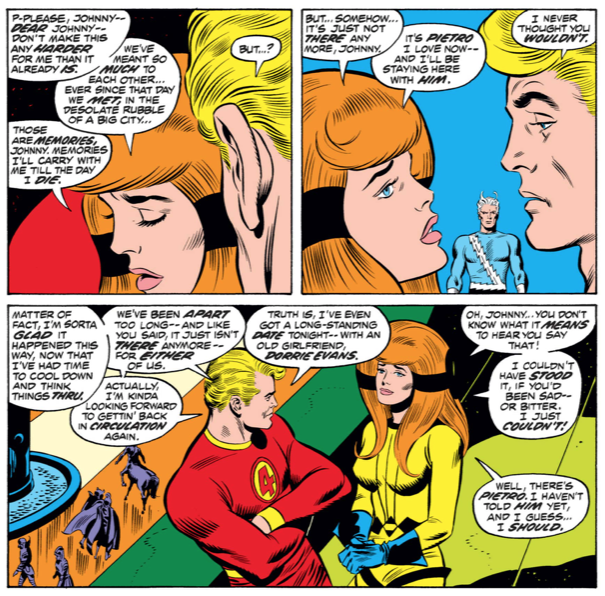
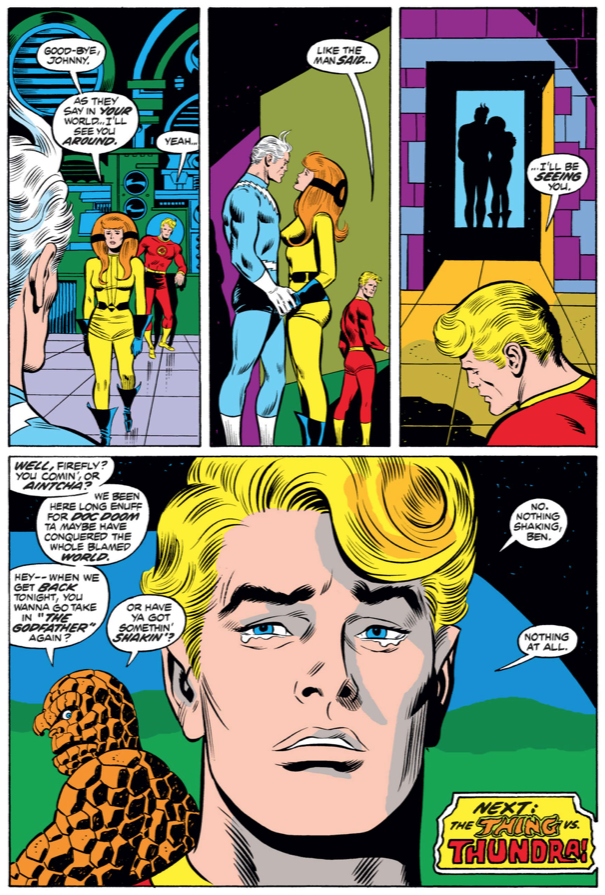
The break-up of Johnny and Crystal was handed with admirable subtlety. Johnny clearly got his anger out last issue, so by the time Crystal tells him its over, he puts on a brave face and even mentions rekindling things with long-forgotten Dorrie Evans. But the final panel says everything. All in all, a pretty mature ending to a significant relationship.
What I didn’t like
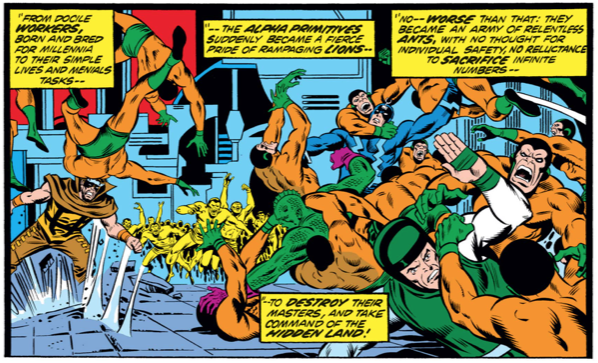
In my blog post dealing with the last issue, I took Roy to task for seemingly siding with the Inhumans in their fight to put down the revolt of the Alpha Primatives, their servant class. Given that Roy has skewered South Africa’s apartheid regime in issue 119, championing the oppressors seemed inconsistent at best.
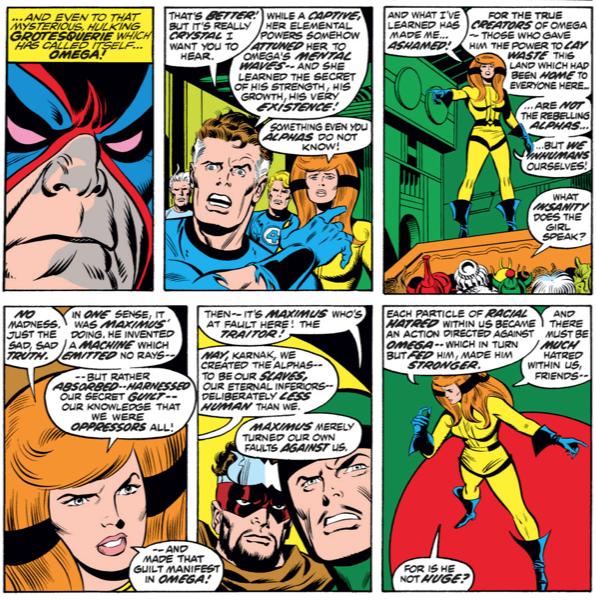
I should have given Roy more credit, because in the end, the Inhumans are shown the error of their ways. Omega, the villain, is powered by the Inhumans’ guilt and racial hatred — it’s not entirely clear which — toward the Alpha Primatives, channeled by a device constructed by Maximus the Mad. But while Roy’s sentiments are laudable, the effort feels ham-handed and falls flat.
First, leaving aside the implausibility of a machine that turns racial animosity into a living thing, Omega is designed just like a standard super villain, complete with a mask. There’s nothing about him or his powers that suggest his origin or purpose.
Secondly, Reed discovers the secret by eavesdropping on Maximus, who just happens to be ranting about his plan while leaning outside his window. It’s too convenient and not ingenious enough for Reed. And thirdly, of course Maximus is behind it all. If there’s an Inhumans’ story, Maximus is the bad guy. It’s predictable and boring.
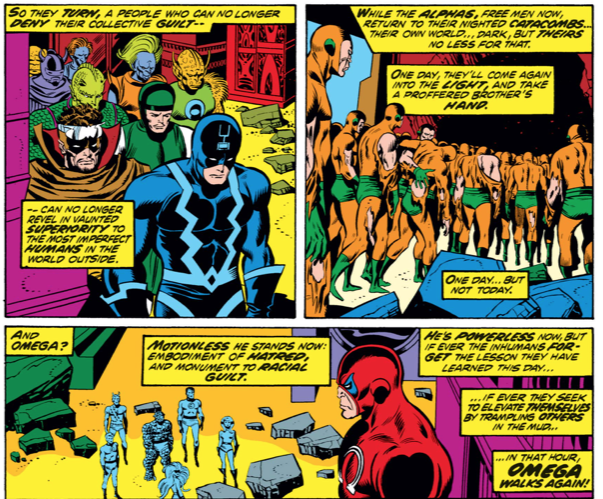
Lastly, nothing seems to change. The Alpha Primatives return underground and the Inhumans go on being the superior race. Maybe we’ll learn more about how Inhuman society evolves in future comics but at the end of this issue, all that happens is that Inhumans feel a bit guilty.
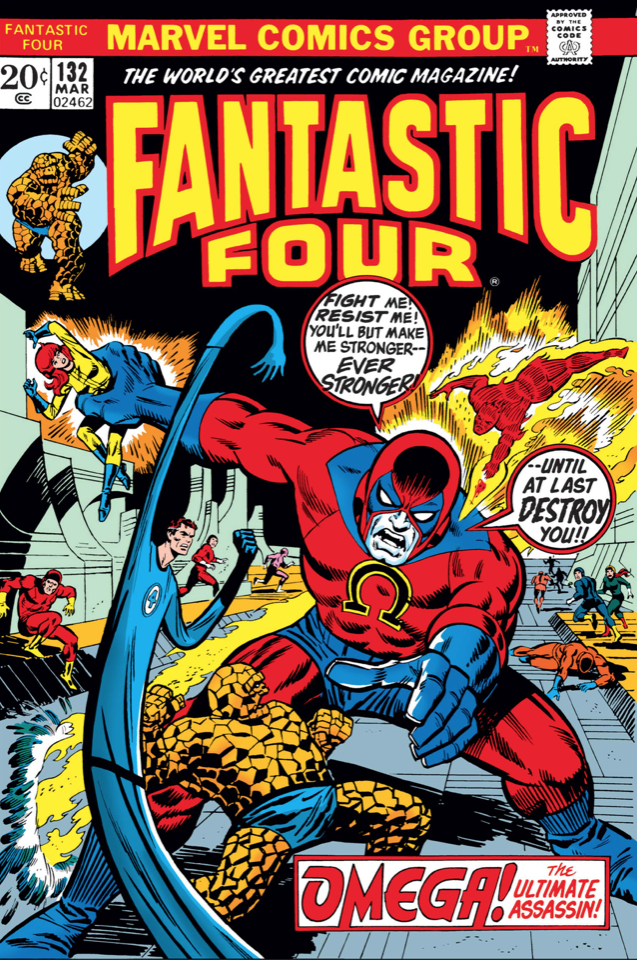
Also, is there a word missing on the cover? “Until Last Destroy You?” I’m sure someone could win a No-Prize explaining that away.
Anything else?
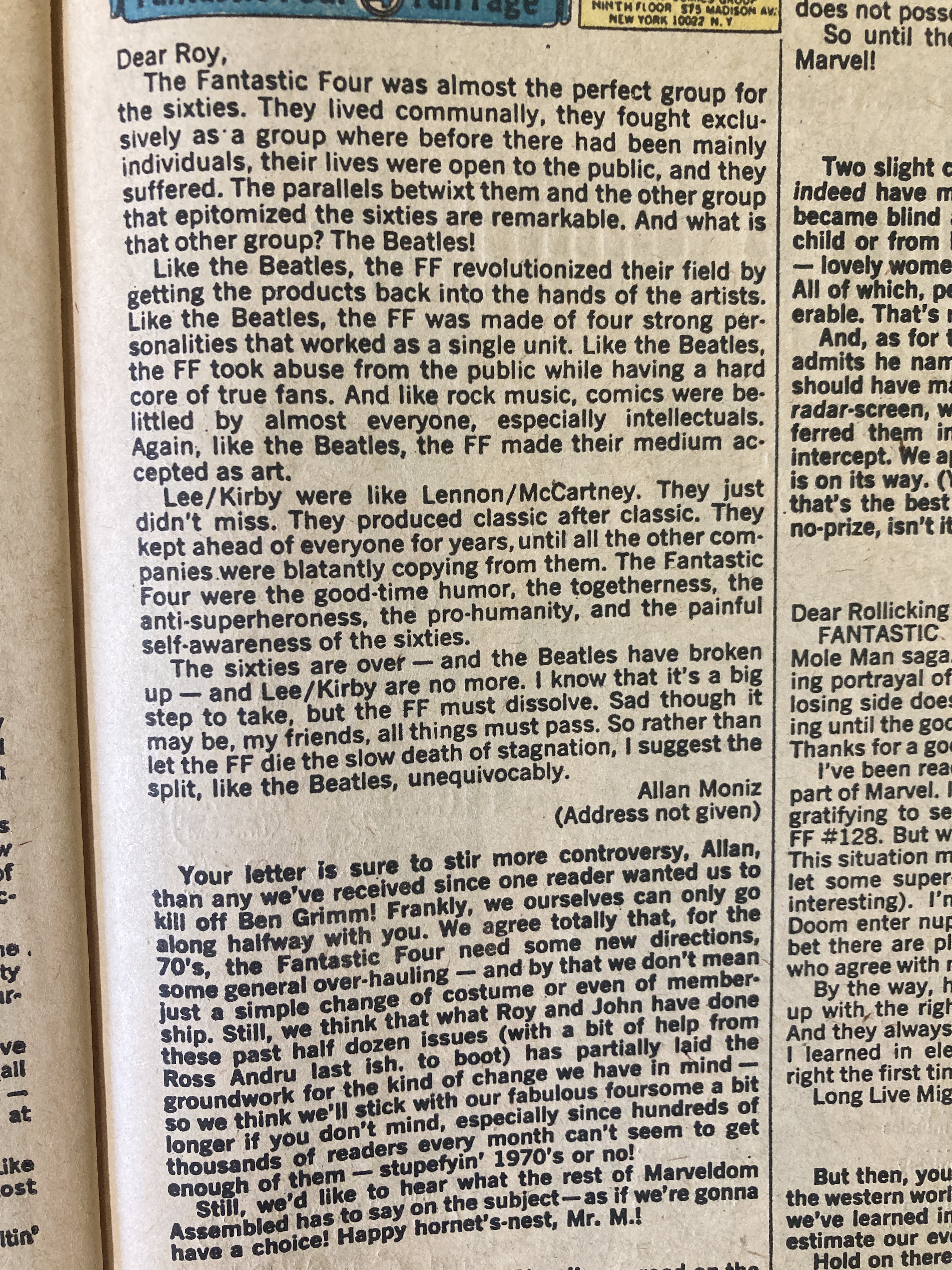
Fun letter comparing the FF to the Beatles. Who is Allen Klein in this analogy?
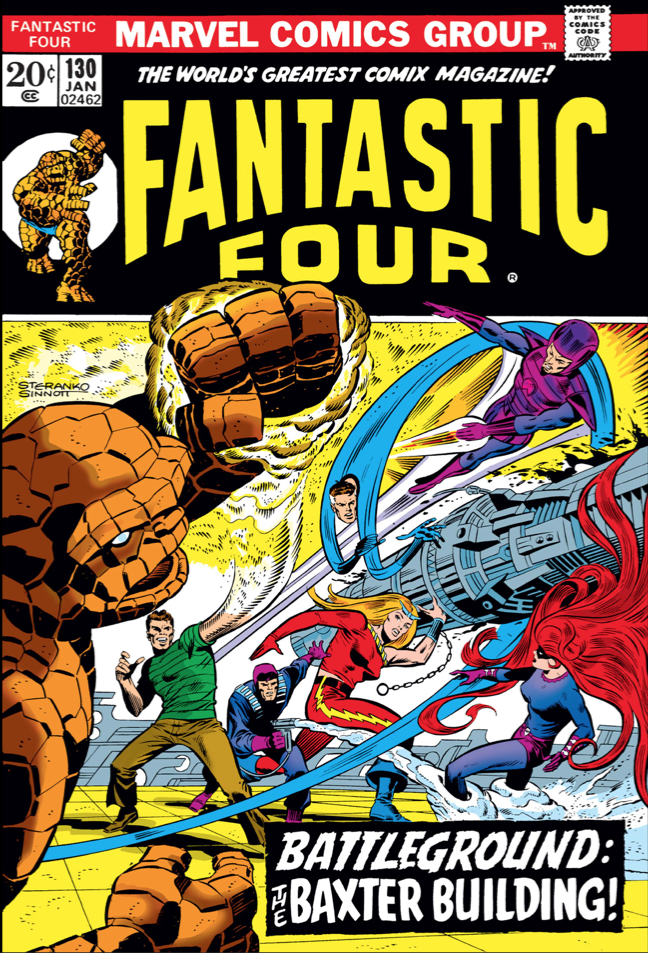
Fantastic Four 130 “Battleground: The Baxter Building!” Published Oct. 1972 Writer: Roy Thomas Pencils: John Buscema Inks: Joe Sinnott Letters: Artie Simek Colors: Petra Goldberg Editor: Thomas Cover: Jim Steranko and Sinnott
Synopsis
After subduing the Thing and Meduasa, the Frightful Four—reconstituted with Thundra—take on the rest of the Fantastic Four, minus the Human Torch, in the Baxter Building and are saved only by the awakening of Franklin’s powers. In the aftermath, Sue declares she is leaving the team. Meanwhile, in the Himalayas, the Torch confronts the Inhumans, where a secret concerning Crystal is revealed to him.
What’s going on here?
This is a jam-packed issue, with big developments in the story, and some smaller ones outside it. From an amateur-comic-historian’s perspective, it’s notable for being the first Fantastic Four issue to credit a colorist, in this case, Petra Goldberg.
The history of comic book coloring is complicated, and the technology evolves dramatically over time. But my understanding is that in the 60s, 70s and 80s, the colorist would identify what colors were needed (always a combination of cyan, magenta, yellow and black) and where they would go. They would make notes on the art (or actually color copies of the pages) that would then be used by a color separator at the printer as a guide. Because of the limitations of the process—at most, only 64 possible colors are available—and because the colorist didn’t directly work on the art like a penciler and inker, it seems they were viewed less like artists and more like technicians. Hence, they were not credited. (A pretty good explanation of all this can be found in this Comic Tropes video).
I don’t think it’s a coincidence that this changed soon after Roy Thomas became editor. Thomas also instituted an “editor” credit—here used for himself—and seemed more interested than Stan Lee in assigning proper credit where it was due (a longtime issue with Stan that we know came to haunt him).
Recall, the first issues of the Fantastic Four had no credits all, just the signatures of Stan Lee and Jack Kirby. And when credits first appeared, they were very scant and presented almost as an after thought (this is FF 10):
By FF 130, the credits for all the main creators were in place and they pretty much remained this way for decades. Note Stan Lee’s presenting credit is now his signature. That began with the previous month’s issues, and I neglected to mention it.
Also notable is that Jim Steranko penciled the cover for this issue (which is probably why the Sandman looks so much like Nick Fury). I’m not sure it’s a particularly great cover, but anything by Steranko is worth paying attention to. This is the first of three covers he did for the Fantastic Four, and are the only things he ever did with the FF during his short career.
What I liked
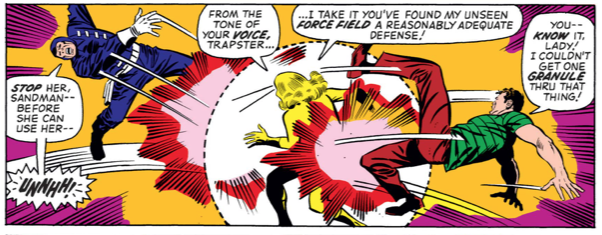
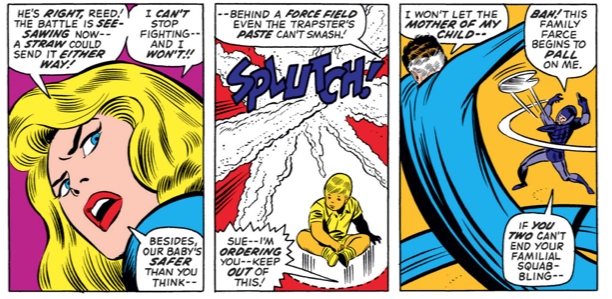
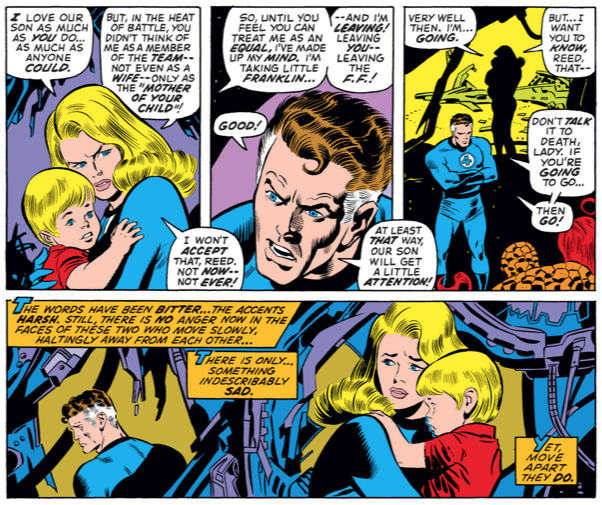
A big—but not the biggest—in-comic event in FF 130 is Sue’s decision to leave the team. This has been brewing for a few issues, and through Thomas’s writing she has voiced her displeasure with Reed and his constant demands that she be sidelined to look after Franklin.
Here, she again raises those objections and he again tries to shut her down:
It finally boils over in the last page, featuring more jerk-like behavior from Reed:
Obviously, this doesn’t stick and she eventually returns. But her departure feels like a significant milestone in the development of Sue’s character, and, perhaps, in Thomas’s repudiation of the status quo he inherited from Stan. Thomas has been writing Reed pretty much the same way Stan and Jack did for a decade, but only under Thomas did Sue finally say, enough.
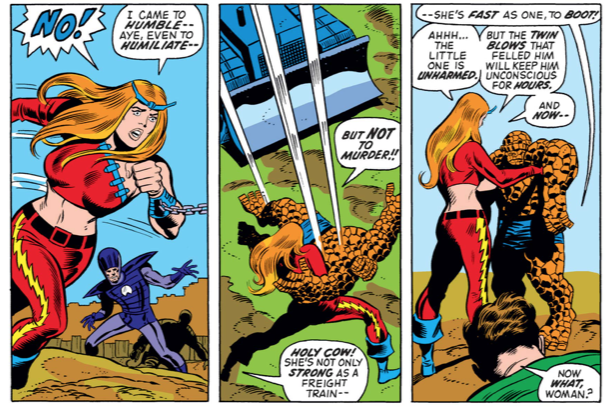
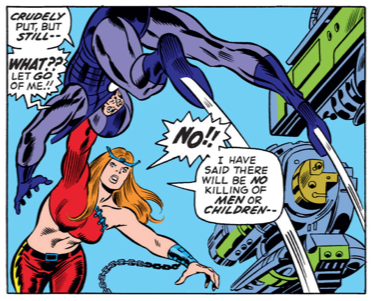
Speaking of gender dynamics, I also liked how Thomas played with cliches and stereotypes through Thundra, the Femizon from another dimension where women dominate men. Here, she picks up Ben like a doll:
Or here, where she refers to “men and children:”
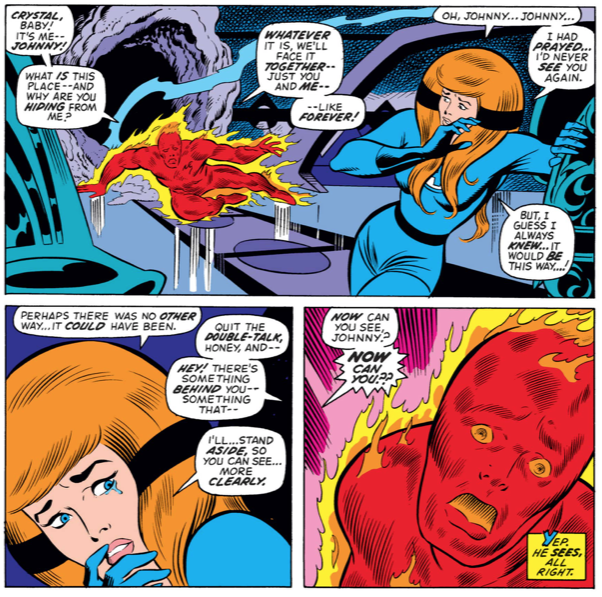
Thomas also created an interesting and suspenseful sidebar with the Human Torch and Crystal. I legitimately have no idea what he sees here (we have to wait until next issue):
The Inhuman subplot is another example of Thomas’s skill as a storyteller. There’s an awful lot going in in the main plot, yet he’s able to jump out and devote a few meaningful pages to the Johnny/Crystal dynamic that builds character and sets up future arcs, all without distracting from the bigger story. Further evidence that the FF is in very good hands.
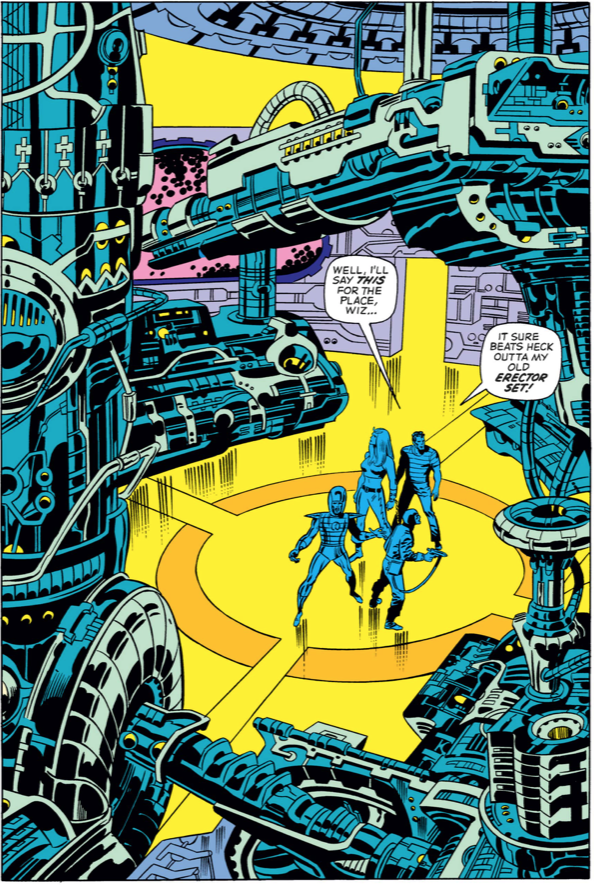
Oh, and I would remiss if I didn’t point out this jaw-dropping splash page from Big John. It doesn’t have a big impact on the plot, but it seems like it’s a fun opportunity for him to flex his Kirby muscles.
What I didn’t like
The biggest in-story development in FF 130 is the awakening of Franklin’s powers. Although hinted at a few issues ago, this is the first real manifestation of them.
In the bounds of this issue, it’s fine and I imagine for readers at the time, it must have been pretty cool. But it opened the door for decades of stories about Franklin’s powers that, on the whole, have been unsatisfying, confusing and distracting. No two writers seem to agree what to do with Franklin, and while some have embraced him as a mutant with god-like powers—Jonathan Hickman had him creating whole universes—others would be happier if he was just a kid. Dan Slott depowered him and Ryan North has a goofy retcon that has him using his powers one day a year.
I am sure Thomas didn’t know the can of worms he was opening up here, but the does-he -or doesn’t-he nature of Franklin’s powers been a perennially frustrating aspect of the Fantastic Four
Also, thumbs down for the story title—”Battleground: Baxter Building”—a combination of words which has been used probably a dozen times.
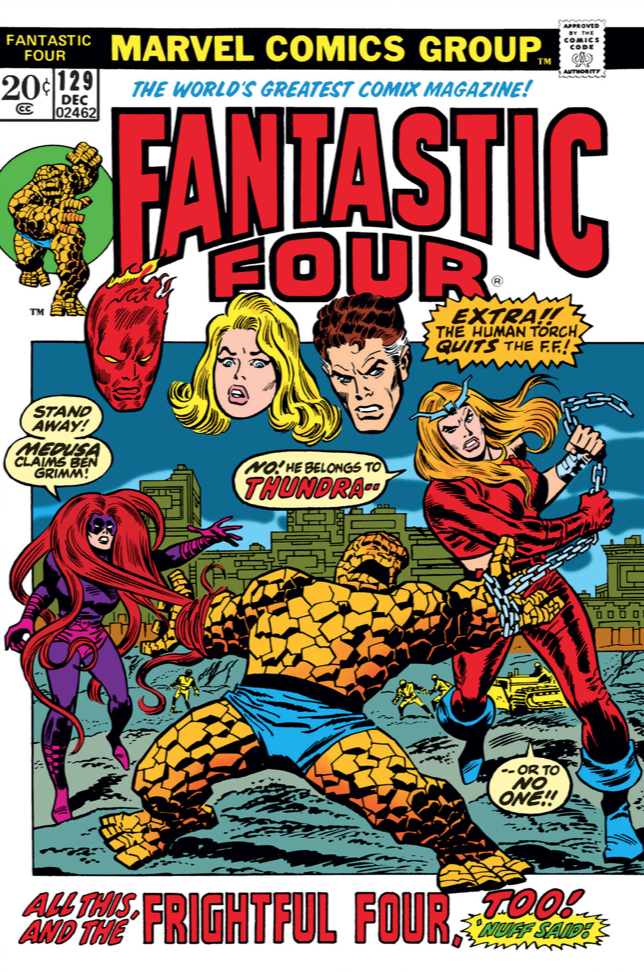
Fantastic Four 129 “The Frightful Four .. Plus One!” Published Sept. 1972 Writer: Roy Thomas Pencils: John Buscema Inks: Joe Sinnott Letters: Artie Simek Editor: Thomas Cover: Buscema and Frank Giacoia
Synopsis
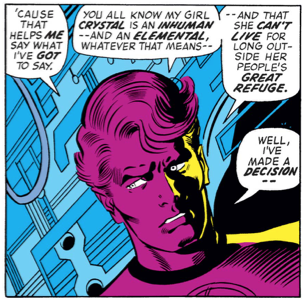
Intending to marry Crystal, the Human Torch leaves the team for the Great Refuge and is captured by Inhumans. Meanwhile, The Thing is ambushed by the Frightful Four and while one-time member Medusa comes to his aid, Thundra, a new member, attacks.
What’s going on here
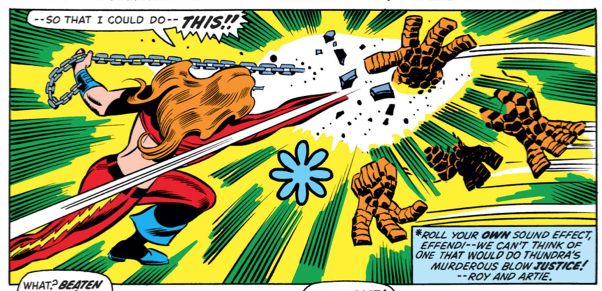
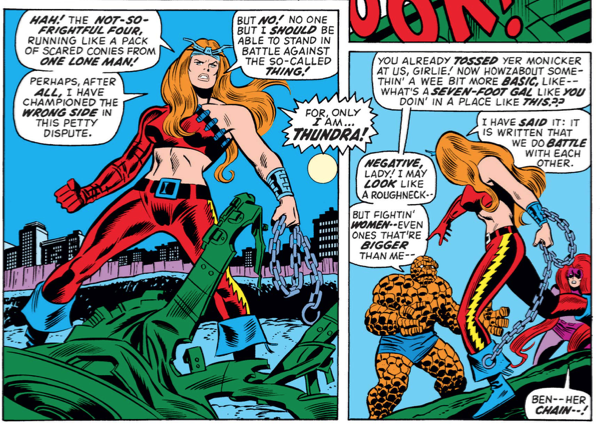
Fantastic Four 129 is probably most notable for the introduction of Thundra, the powerful, seven-foot warrior from an alternate Earrh called Femizonia. As a character she’s part Wonder Woman, part Big Barda and part pandering to the women’s liberation movement of the 1970s. As befits Thomas, her backstory is long and elaborate, and will unspool over the next few years as she becomes a semi-regular character in the Fantastic Four during this era. More recently she goes on to have a big role in the Hulk.
From a design perspective, she’s pretty cool looking and her presence adds an interesting dimension to the FF, where gender norms have been enforced by the very macho male members and the very feminine Sue and Crystal.
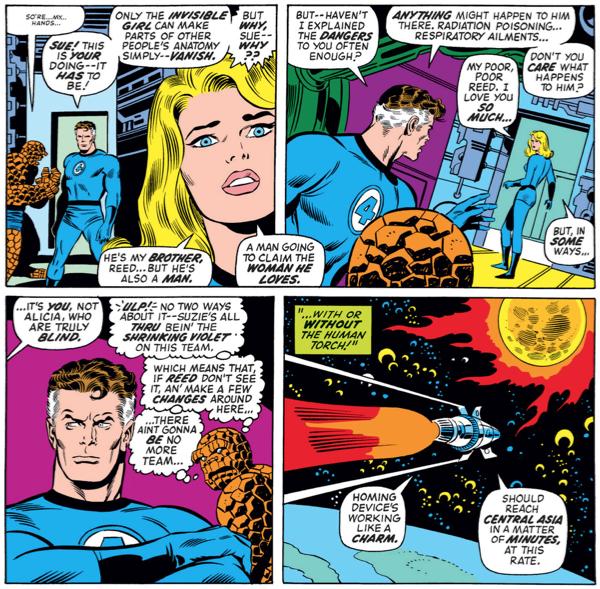
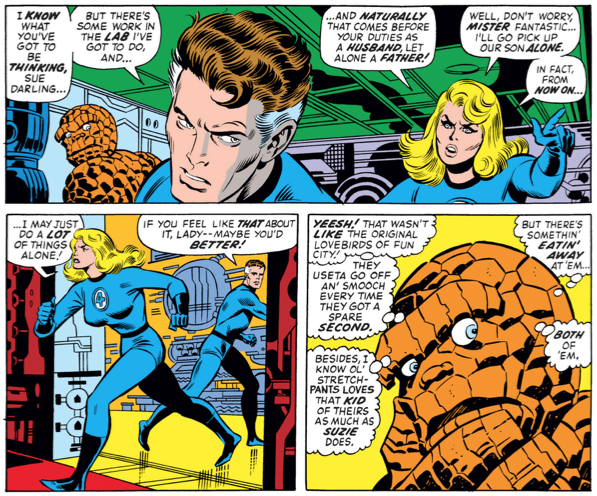
Speaking of Sue, her liberation under Thomas’s writing is becoming more pronounced. In two sequences, she puts Reed in his place in a way that would been unheard of in a Stan Lee-written book.
Here, she lets Johnny escape the team to join Crystal:
(I love the look on Reed’s face)
And here, she lets Reed knows what she thinks of his priorities while Ben looks on in amazement:
What I liked
I don’t pay Joe Sinnott’s inks enough attention and I should. I love this panel, which is obviously enhanced by the colors (at this point Marvel wasn’t naming colorists so I have no one to credit).
And this Buscema panel is wonderfully Kirby-esque:
What I didn’t like
Ben’s fight with the Frightful Four felt a bit too by-the-numbers, and the appearance of Medusa didn’t make much sense (and is not explained). Is it just a coincidence a former member of the Frightful For shows up just when Ben needs her help to fight them? Is her appearance related to Johnny’s trip to the Inhumans? Who can say?
Anything else?
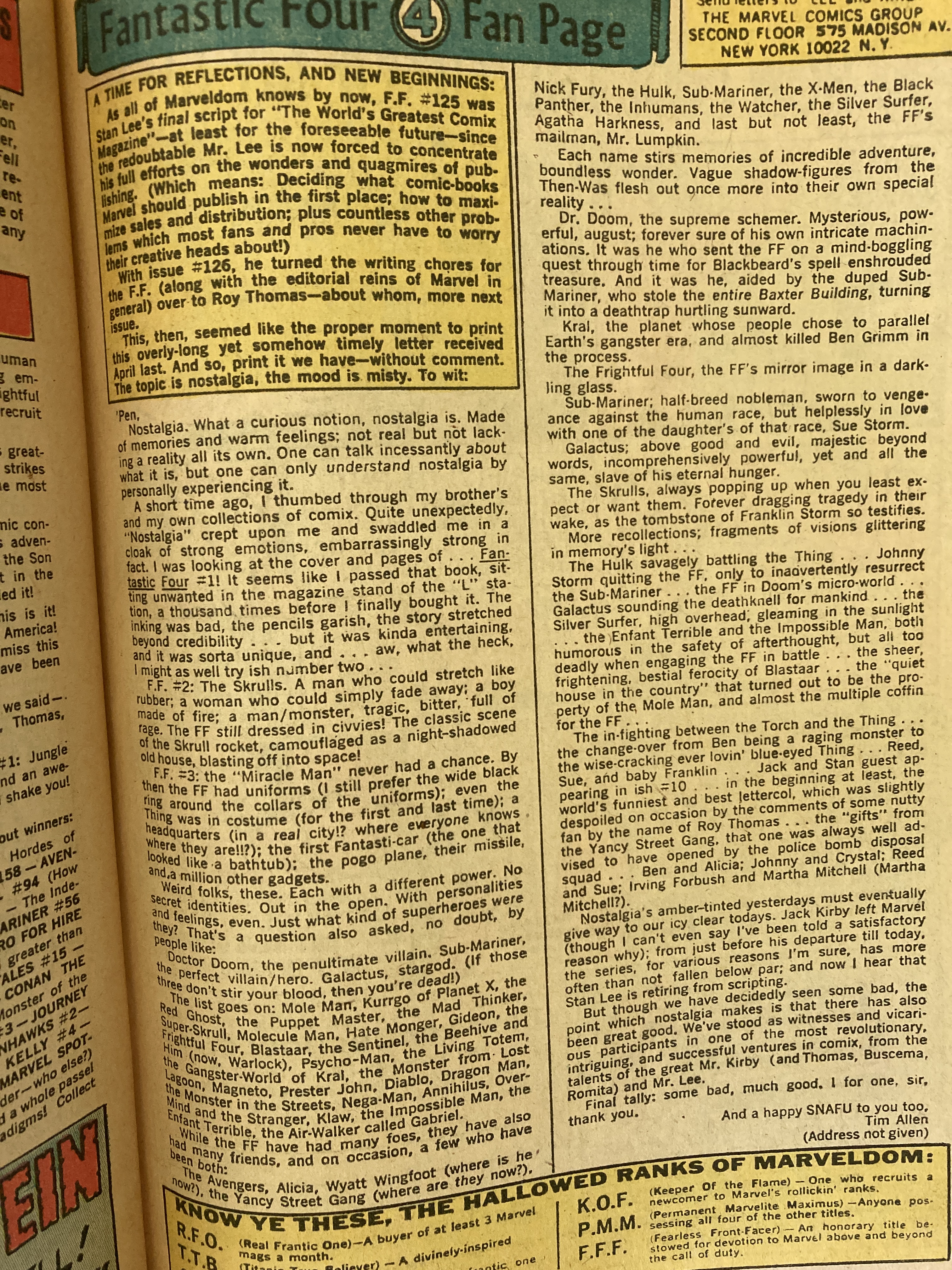
The letters page is devoted entirely to one very long, tortured letter summing up the Stan Lee ear, by a writer named Tim Allen. Unclear if it’s the Tool Time guy.