• About Percival Henry

Percival Henry: The Fantastic Four and more

~ Blogging the Fantastic Four issue by issue (plus whatever else grabs my attention)

Percival Henry: The Fantastic Four and more

Tag Archives: Marvel

“The World’s Greatest Comic Magazine!” Fantastic Four No. 145

07 Saturday Sep 2024

Posted by percivalhenry in The World's Greatest Comic Magazine

≈ Leave a comment

Tags

1974, Fantastic Four, Fantastic Four 145, Gerry Conway, Marvel, Marvel comics, Ross Andru

Fantastic Four 145
“Nightmare in the Snow!”
Published Jan. 1974
Writer: Gerry Conway
Pencils: Ross Andru
Inks: Joe Sinnott
Letters: John Costanza
Colors: Linda Lessmann
Editor: Roy Thomas
Cover: Gil Kane and Frank Giacoia

Synopsis

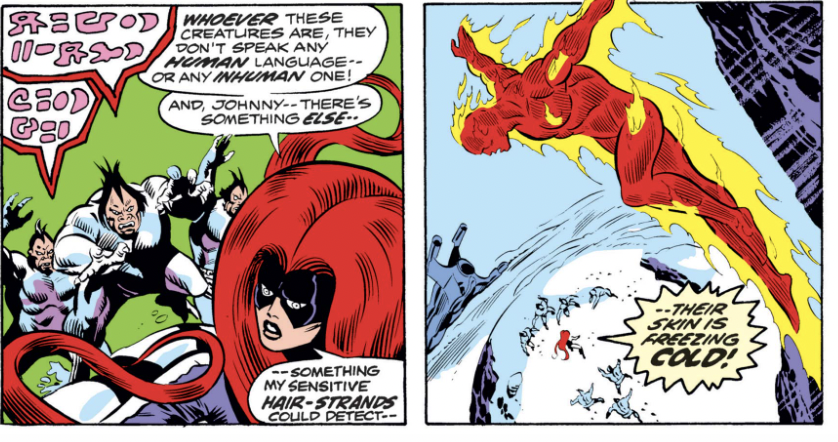
Responding to a summons from Black Bolt to return to Attilan, the Human Torch and Medusa are shot down in the Himalayas and attacked by a yeti-like tribe led by the evil Ternak. Ternak captures them, then reveals his plan to lower the world’s temperatures with his “climate cannon.”


What’s going on here

When I started this project several years I was eager to do a complete read-through of the Lee / Kirby issues, and I was looking forward to re-reading the John Byrne run. I was less certain of what I would find in between. The best case scenario would be some bronze-age gems I never would have encountered. The worst case was hokey stories with forgettable villains and inane plots. Reader, this comic represents everything I feared I might find between issues 103 and 232.

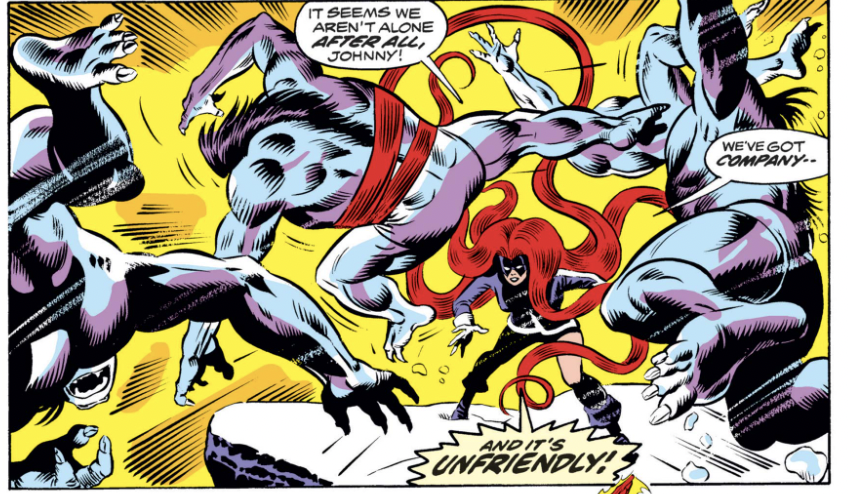
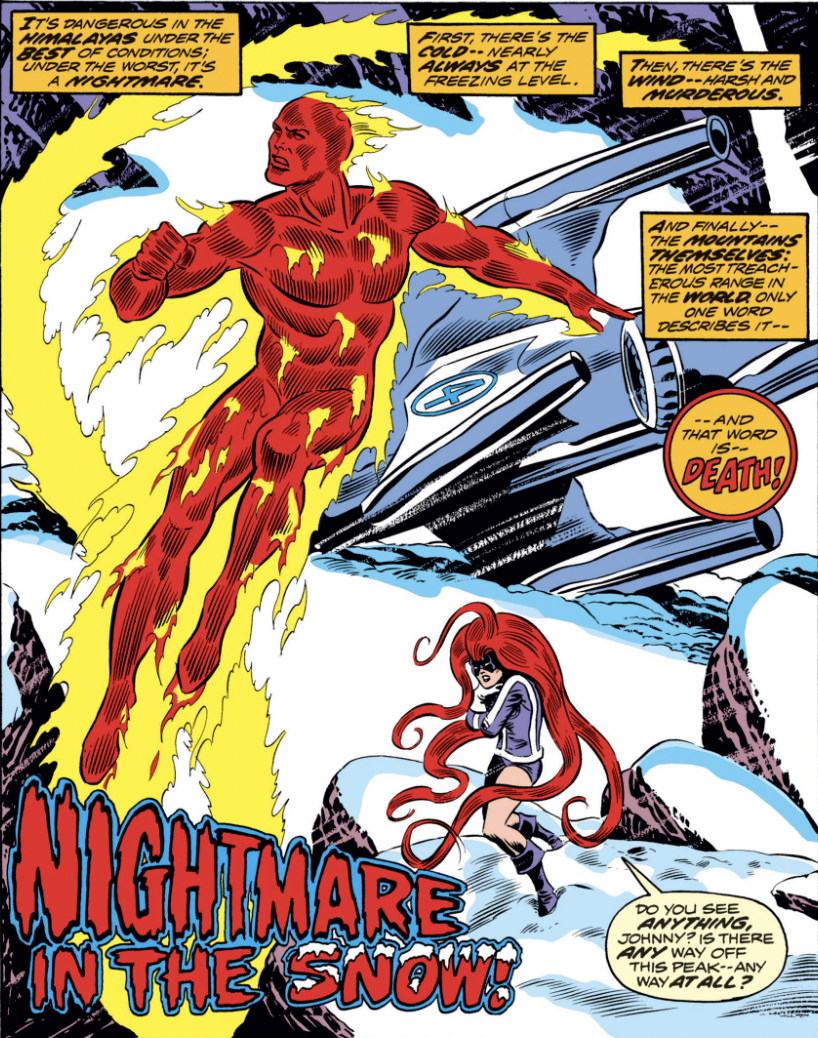
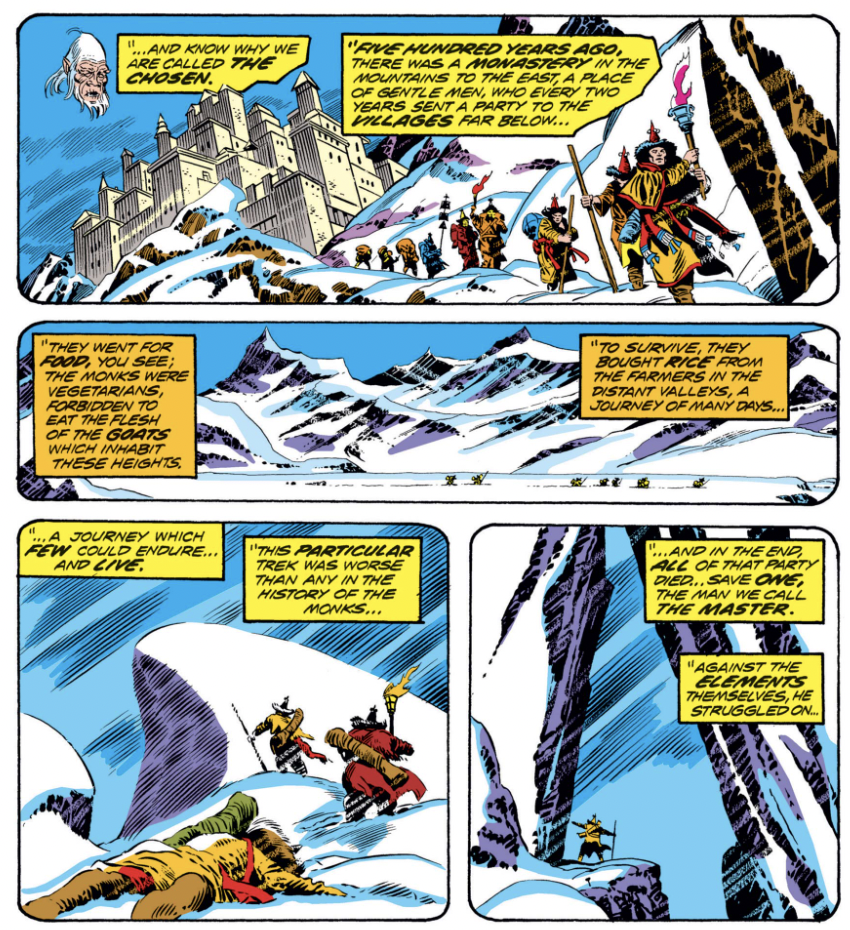
It isn’t terrible, per se, but it is deeply silly, and very forgettable. The story seems stolen from a pulp novel, and while you may believe a race of enlightened snowmen can build a machine capable of lowering the earth’s temperature, I am skeptical (today, of course, they would be celebrated as heroes). The issue’s structure is also odd, starting with the crashed pogo plane in the Himalayas, then the attacking yetis, before finally revealing via flashback how Johnny and Medusa wound up there. I had to check I was reading the right issue to make sure I hadn’t skipped one accidentally.

More compelling than the story is the appearance of some interesting names in the credits. This is Linda Lessmann’s first credited issue of the FF as colorist. She would go one to have a long career, mostly at Marvel but also at First Comics. It also marks the return of Ross Andru, who is filling in here for Rich Buckler. As usual, Sinnott’s inks give the FF a generally uniform appearance, but Andru brings his own energy to the comic and his Human Torch looks unlike anyone else’s.

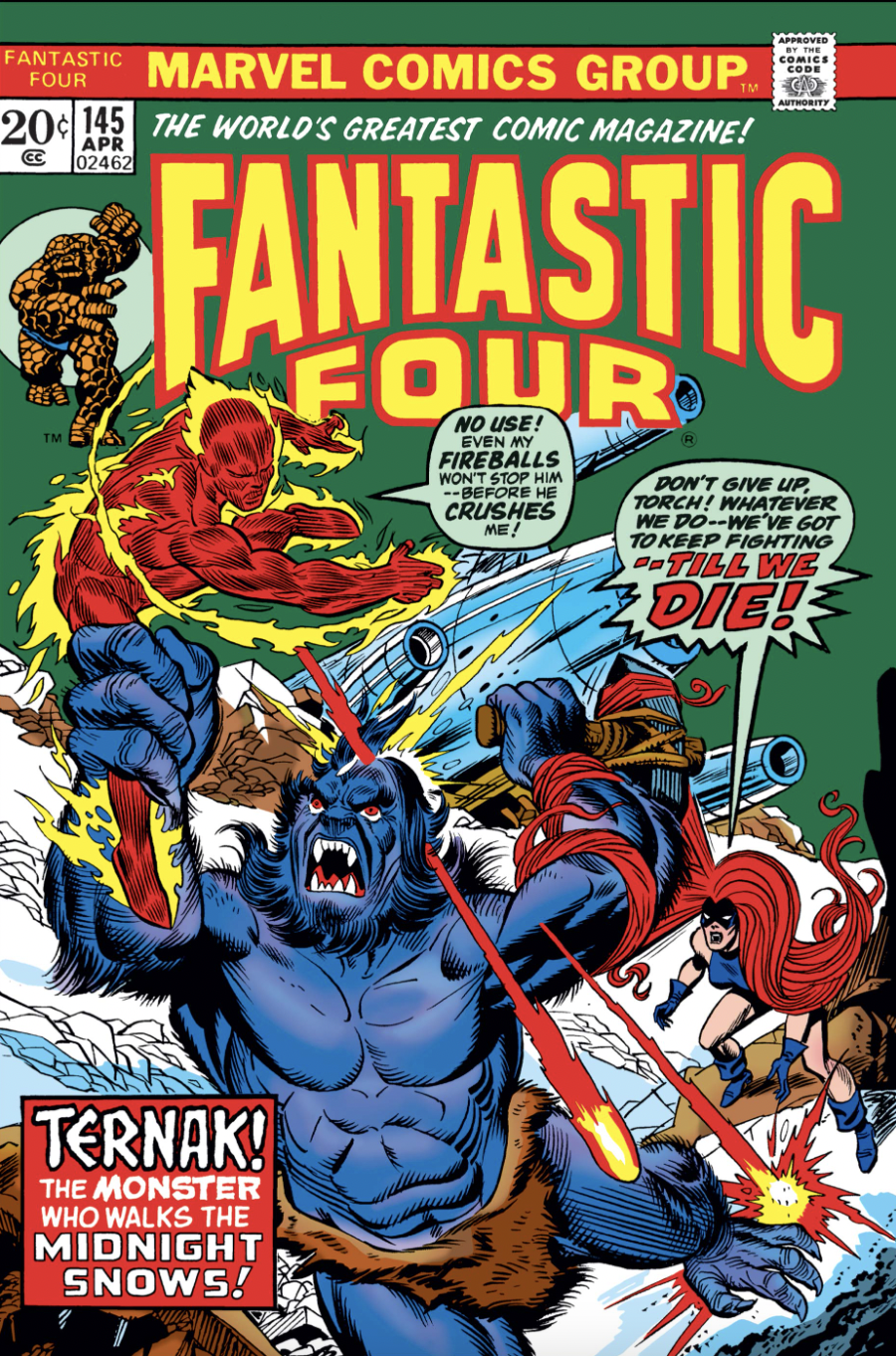
Lastly, Gil Kane is back for the cover, where he is inked by Frank Giacoia. This effort is more successful than his cover two issues ago, although I don’t know that it screams “Kane.”

What I liked

Medusa finally gets a starring role, about a dozen issues into her stint as a team member. It’s still not clear that Conway knows what to do with her, and her personality seems completely generic, but at least she gets more than two speaking panels. Plus, we now know she can feel through her hair (which seems weird?)

I also liked Andru’s handing of the backstory of the yeti-people, aka The Chosen (not to be confused with the Frozen Chosen). It’s very evocative, and reminded me of Hergé’s Tintin in Tibet.


What I didn’t like

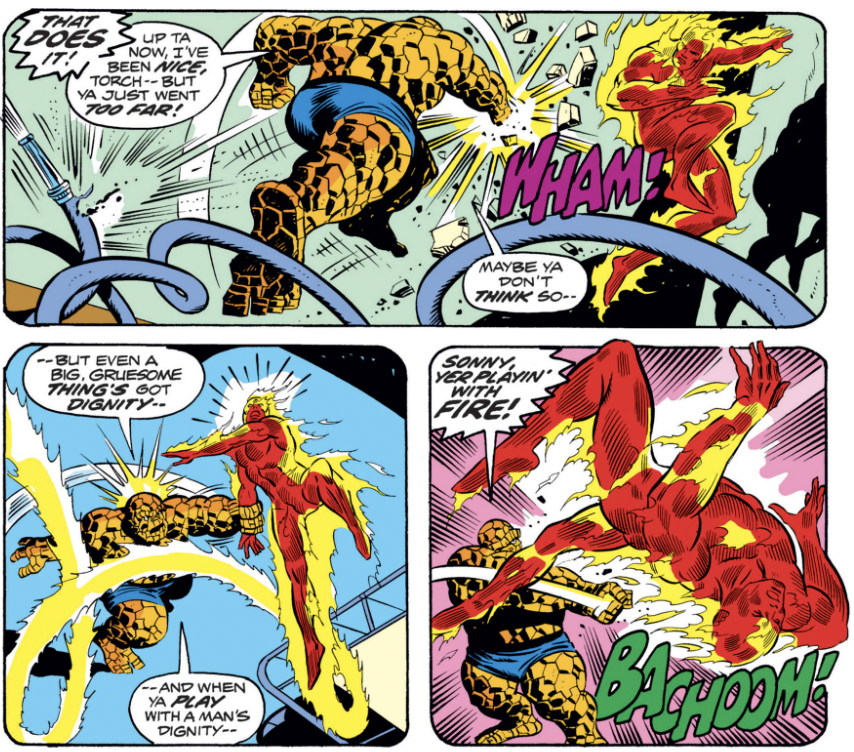
Aside from the above-mentioned critiques, the very lengthy flashback included yet another pointless fight between Ben and Johnny, one that serves no real purpose except to remind us how tedious their squabbles have become. Maybe Roy Thomas insisted Conway deploy these Lee / Kirby gimmicks, but Conway should have known better than to go back to this particular well so many times.


Anything else?

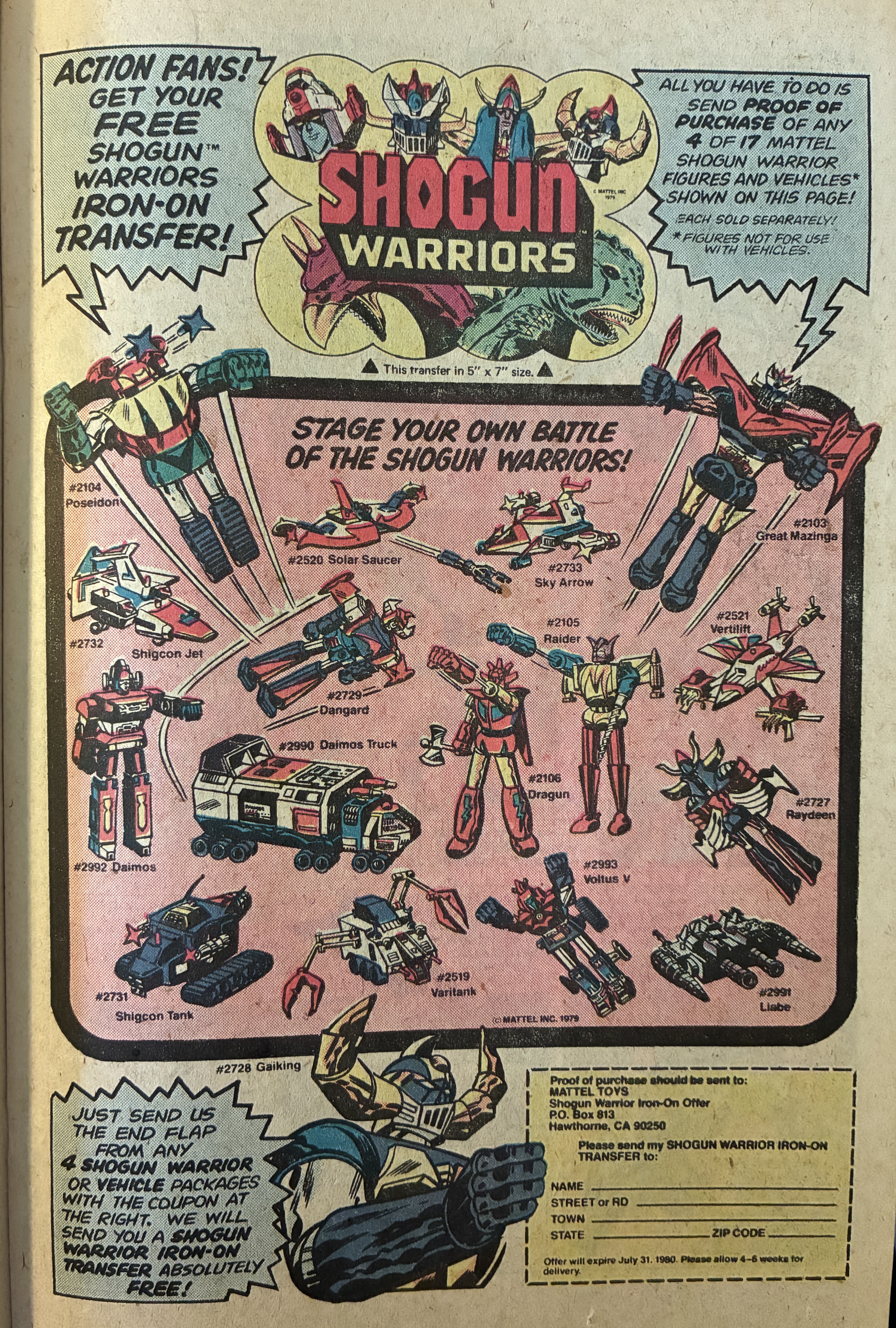
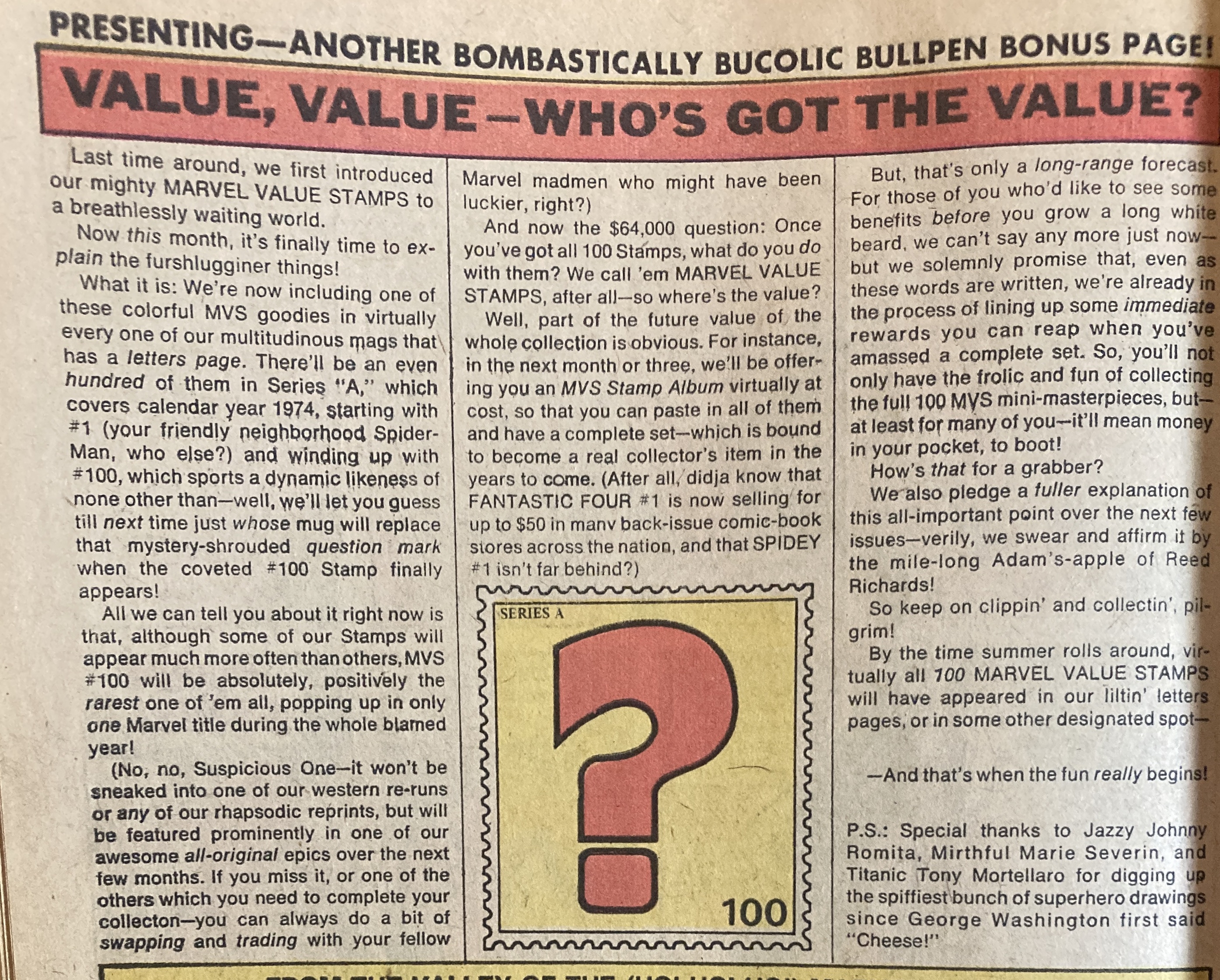
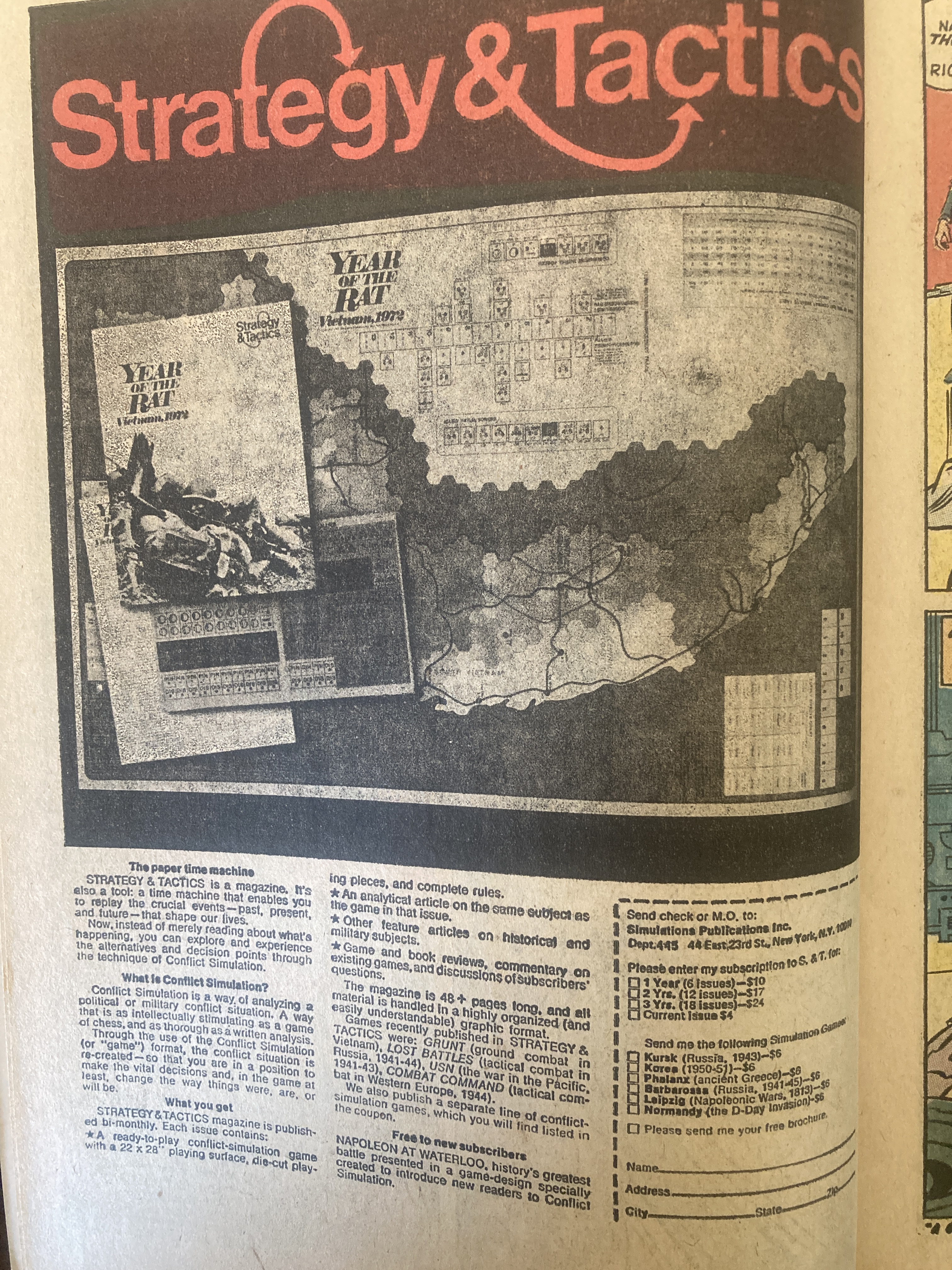
Marvel explains its value stamps (the reason this comics and the one before it have holes cut out of them) and it mostly sounds like a scam.


Overall

A thoroughly mediocre comic book
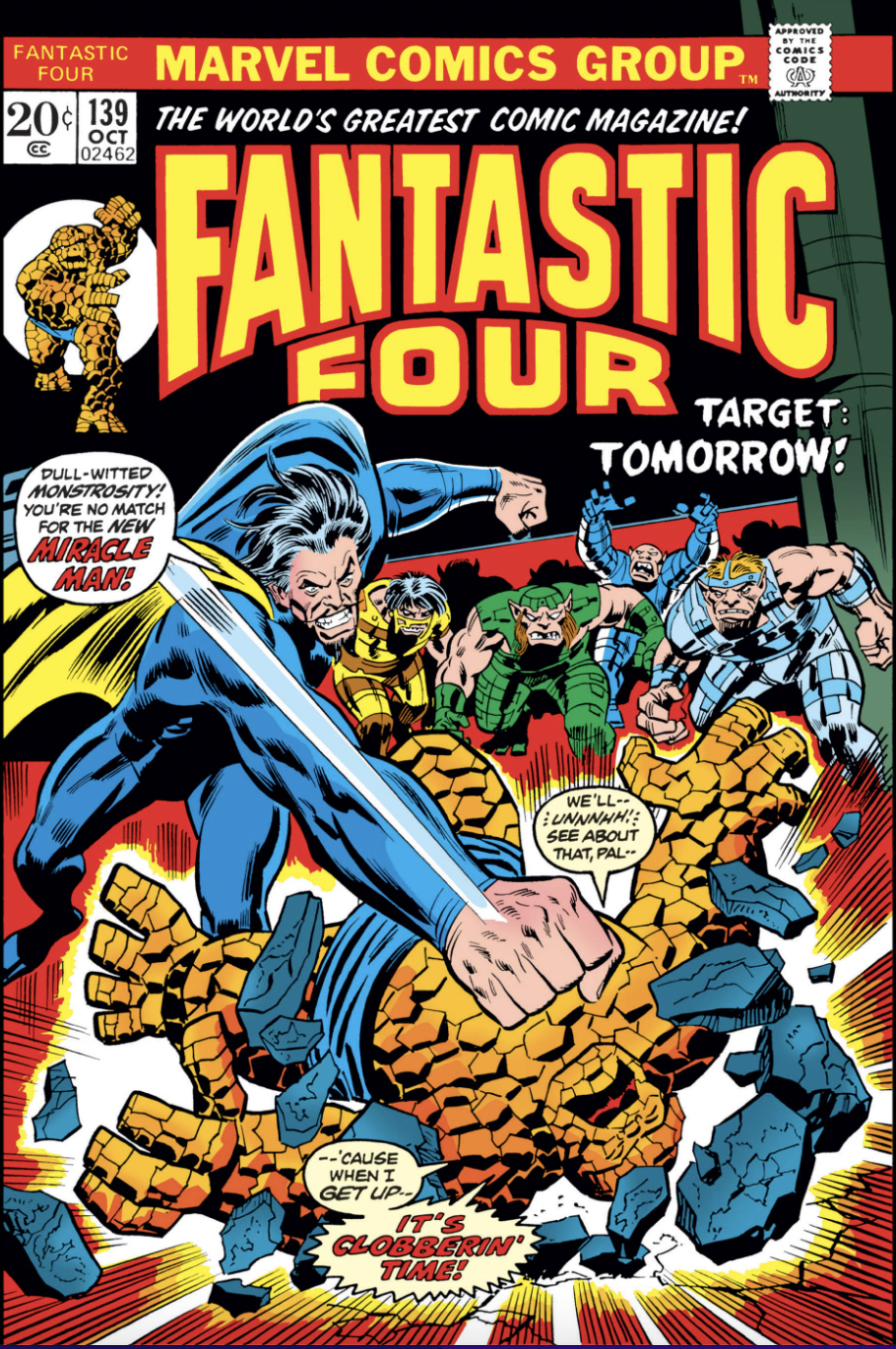
“The World’s Greatest Comic Magazine!” Fantastic Four No. 139

20 Saturday Jul 2024

Posted by percivalhenry in The World's Greatest Comic Magazine

≈ Leave a comment

Tags

1973, Fantastic Four, Fantastic Four 139, John Buscema, Marvel, Marvel comics

Fantastic Four 139
“Target: Tomorrow!”
Published July 1973
Script: Gerry Conway
Layouts: John Buscema
Finishes: Joe Sinnott
Letters: John Costanza
Colors: Stan Goldberg
Editor: Roy Thomas
Cover: Buscema and Frank Giacoia

Synopsis

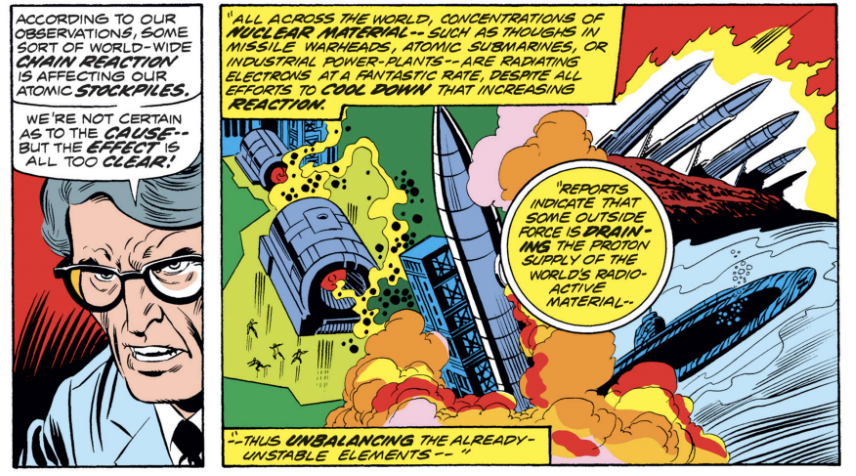
The Fantastic Four escape the chasm they plunged into last issue and eventually defeat the Miracle Man, with the help of the ghosts of the Native American elders that granted him his powers. Meanwhile, Franklin’s powers continue to manifest, and a nuclear catastrophe, perhaps caused by Mr. Fantastic’s experiment, looms.


What’s going on here

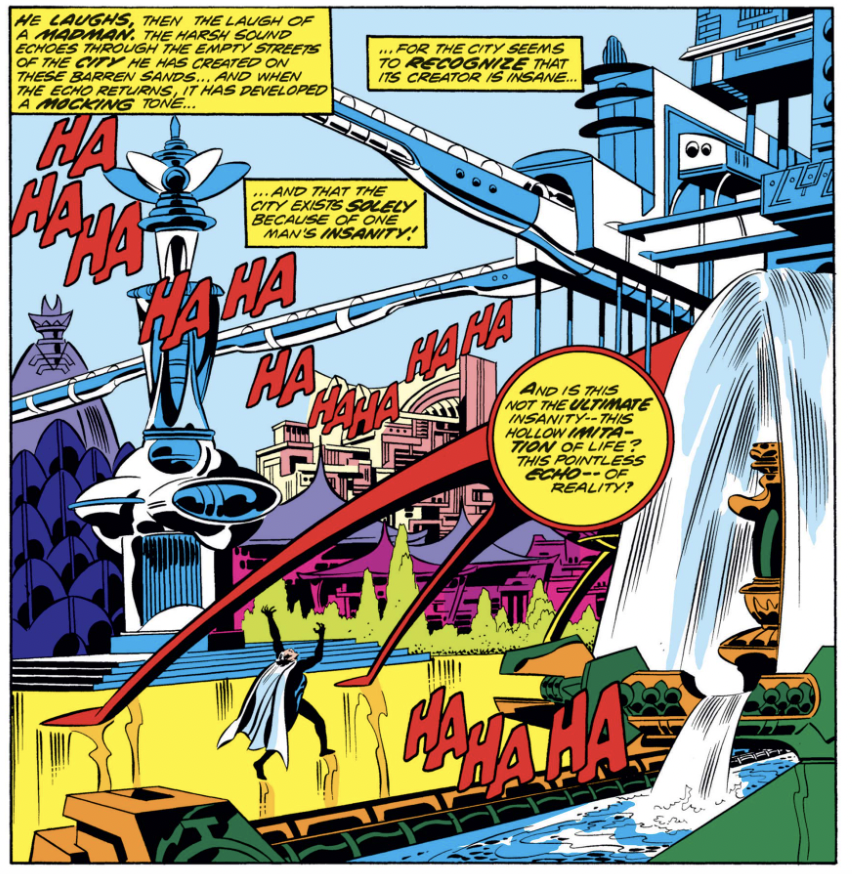
This is a more-or-less satisfying conclusion to a two-issue story that began with the re-introduction of the Miracle Man as a vastly more powerful character. Here, he displays almost Beyonder-level power, creating a new city and willing into existence quasi-living people and creatures. Given his potential impact on the Marvel universe, it’s probably just as well he’s faded away into obscurity.

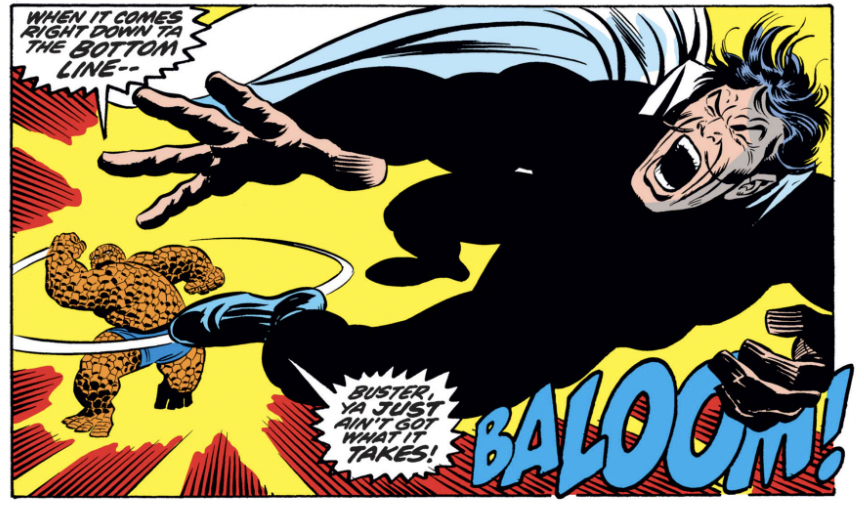
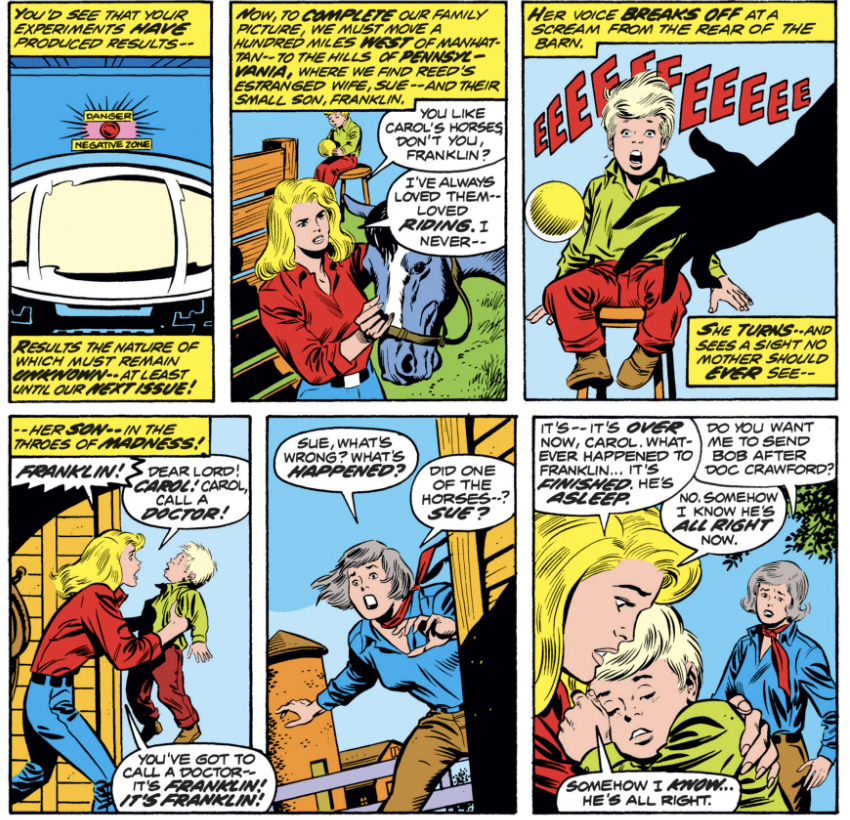
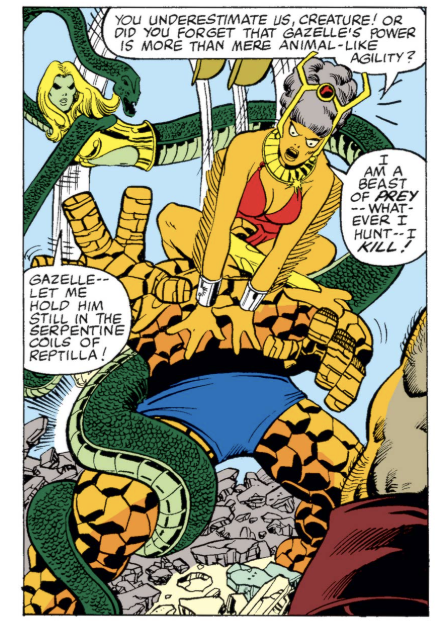
This is otherwise an unremarkable issue. It’s not helped by Gerry Conway’s hyperbolic writing (see panel above), which seems even more over-the-top than Stan or Roy’s, maybe because he’s clearly imitating both. There’s a lot of questionable physics and odd plot holes in this story, but it’s basically inoffensive. More interesting are the subplots: Reed’s tinkering with something that seems very dangerous, and more clues about Franklin’s powers. Also, it’s nice to see Sue again after a few issues of her being left out.


What I liked

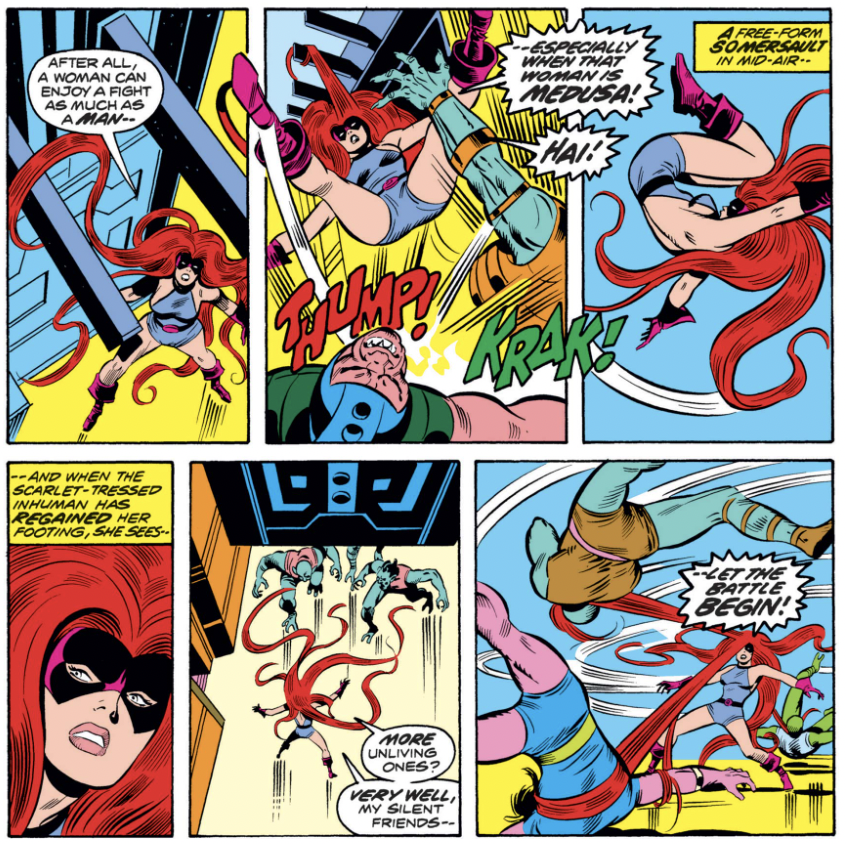
Speaking of left out, Medusa finally gets a bit more of a role. Her presence on the team still feels incidental, but at least he get a glimpse of her personality in this sequence.


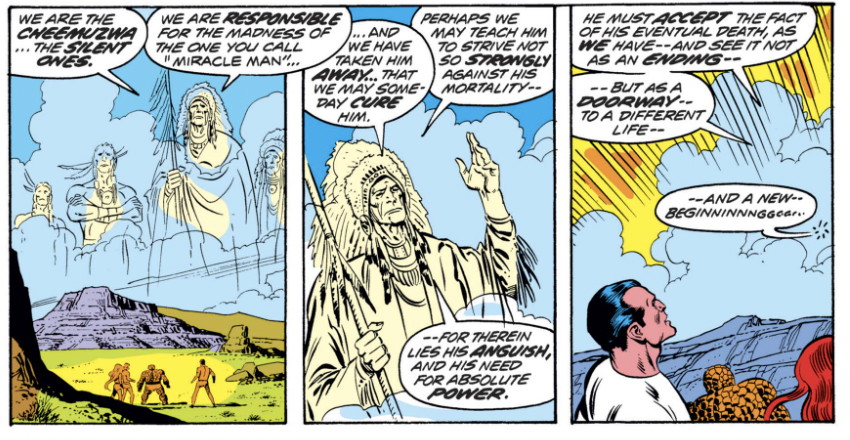
I thought the appearance of the Cheemuzwa spirits at the end was well handled. Yes, mystic Natives are a tired trope, but this was a graceful way to remove the Miracle Man from the board (he apparently shows up just once more, in Marvel Two-in-One 8)

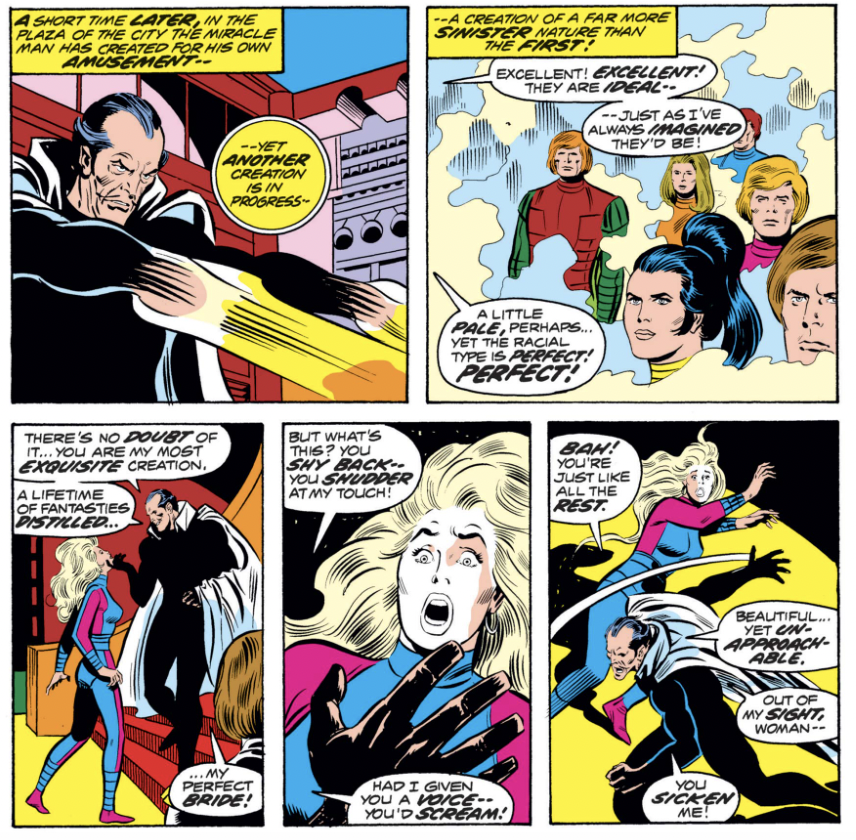
And this sequence with Miracle man being rejected by a woman he just created out of nothing was weird and creepy.


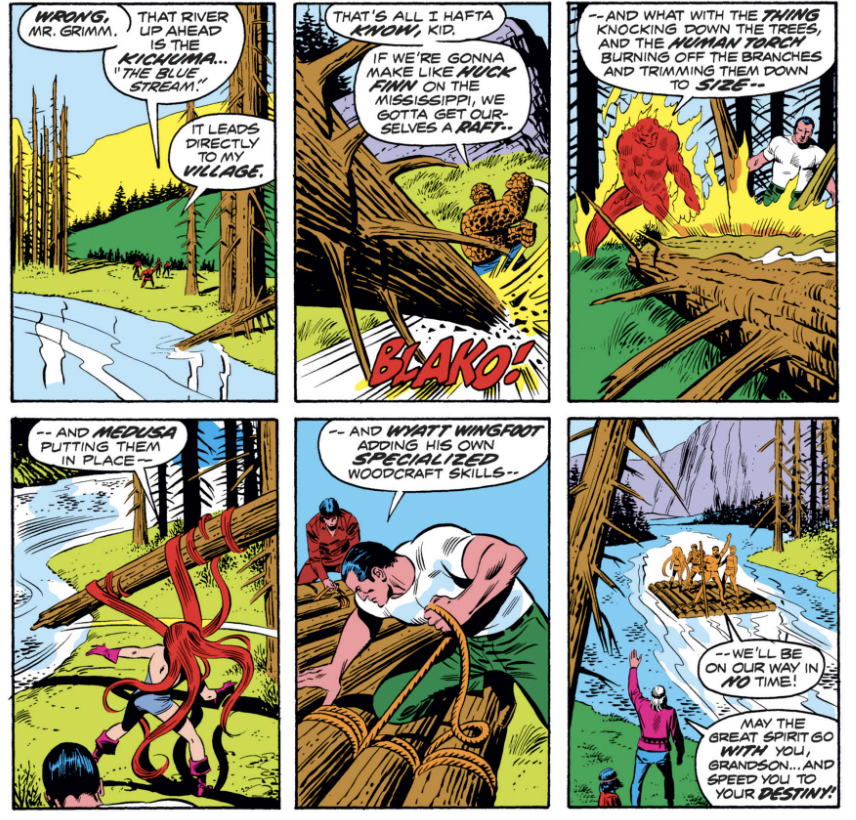
Then there’s this sequence of the FF building a raft. I wasn’t sure if I liked it or hated it, but it’s so ridiculous I think I like it. It reminds me of the montages in the A-Team TV shows, where the the team would assemble some sort of contraption as music played.


What I didn’t like

About halfway through the comic, the action cuts away and we learn of an imminent nuclear threat. It seemed like this was related to the Miracle Man, so I waited in vain to learn how, only for it to be revealed, lamely, that it’s a subplot connected to Reed’s tinkering. I have no problem with setting up next issue’s story, but this was poorly executed.


Anything else?

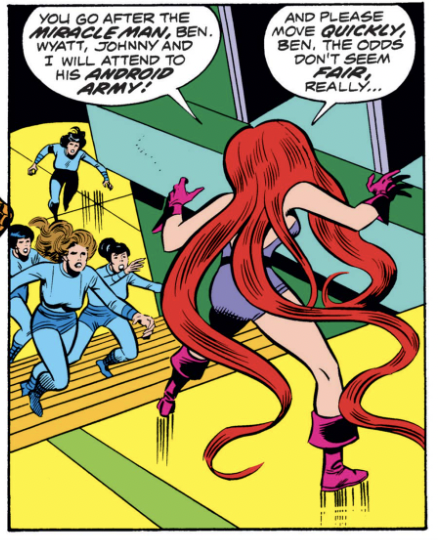
In previous posts I have written about Stan and Jack created very human androids (or very android-like humans), as if the distinction between alive and machine didn’t much matter. Here, the Miracle Man creates what appear to be living creatures, yet Medusa calls them “androids.” Not sure what Conway was thinking.


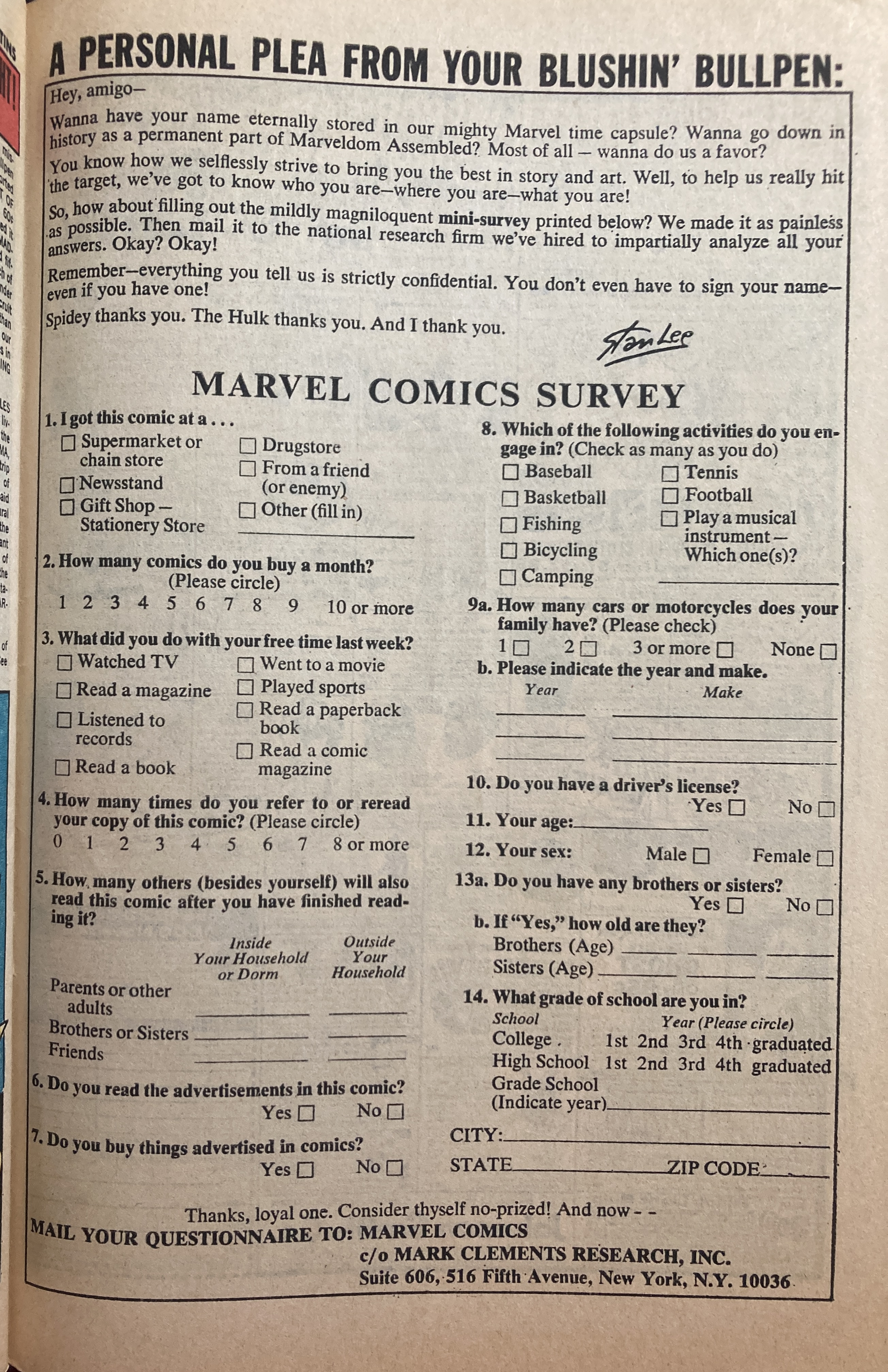
This survey seems specifically designed for advertisers. Still sort of interesting. (They seem to want auto advertising).


Overall

Just OK

“The World’s Greatest Comic Magazine!” Fantastic Four No. 137

06 Saturday Jul 2024

Posted by percivalhenry in The World's Greatest Comic Magazine

≈ 1 Comment

Tags

1973, Fantastic Four, Fantastic Four 137, John Buscema, Marvel, Roy Thomas

Fantastic Four 137
“Rumble on Planet 3”
Published May 1973
Plot: Roy Thomas
Script: Gerry Conway
Pencils: John Buscema
Inks: Joe Sinnott
Letters: Artie Simek
Colors Glynis Wein
Editor: Thomas
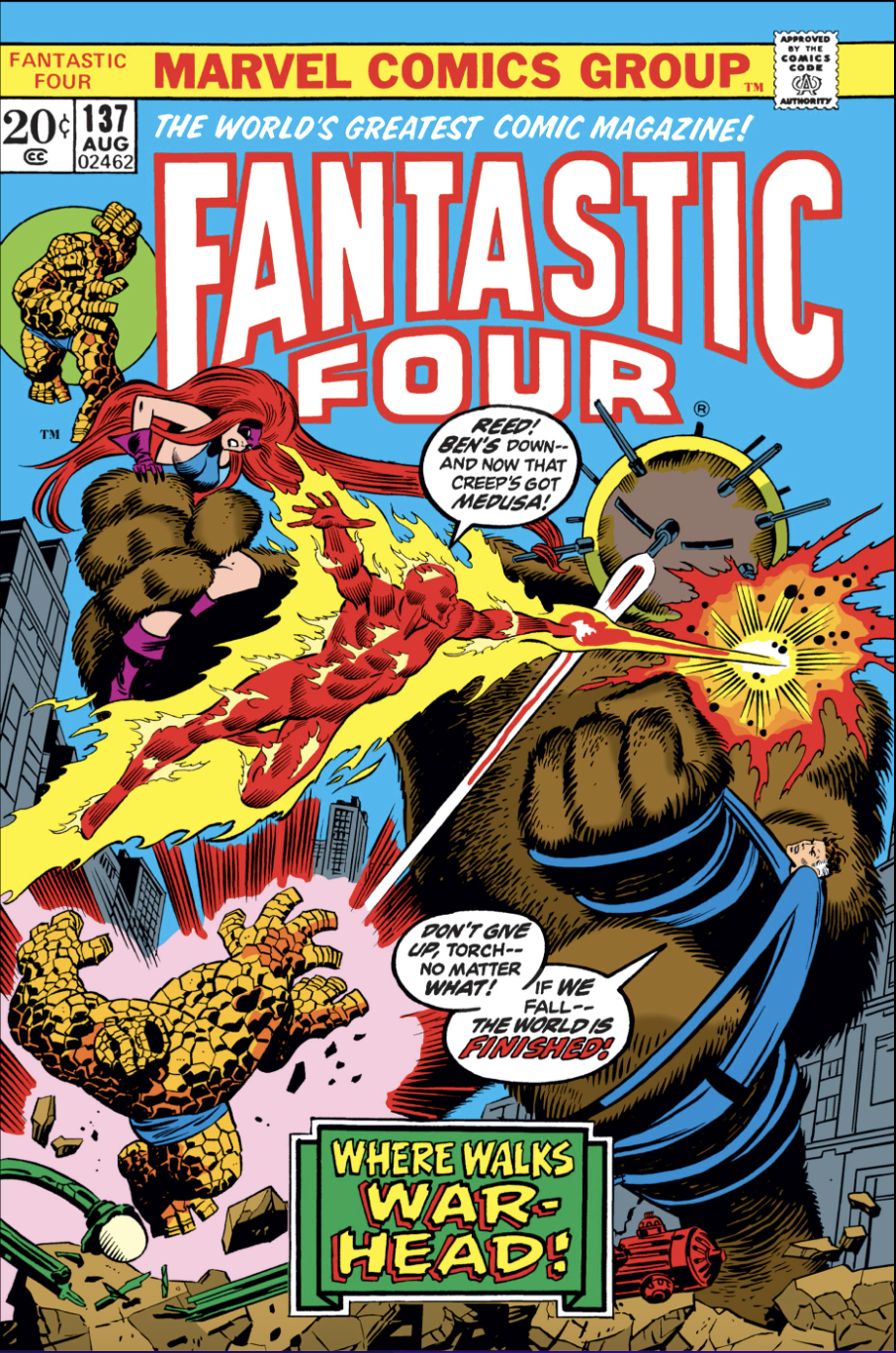
Cover: Buscema & Sinnott

Synopsis

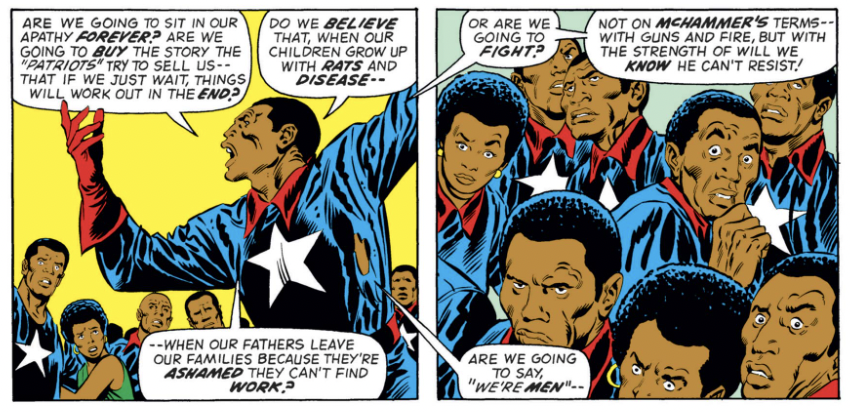
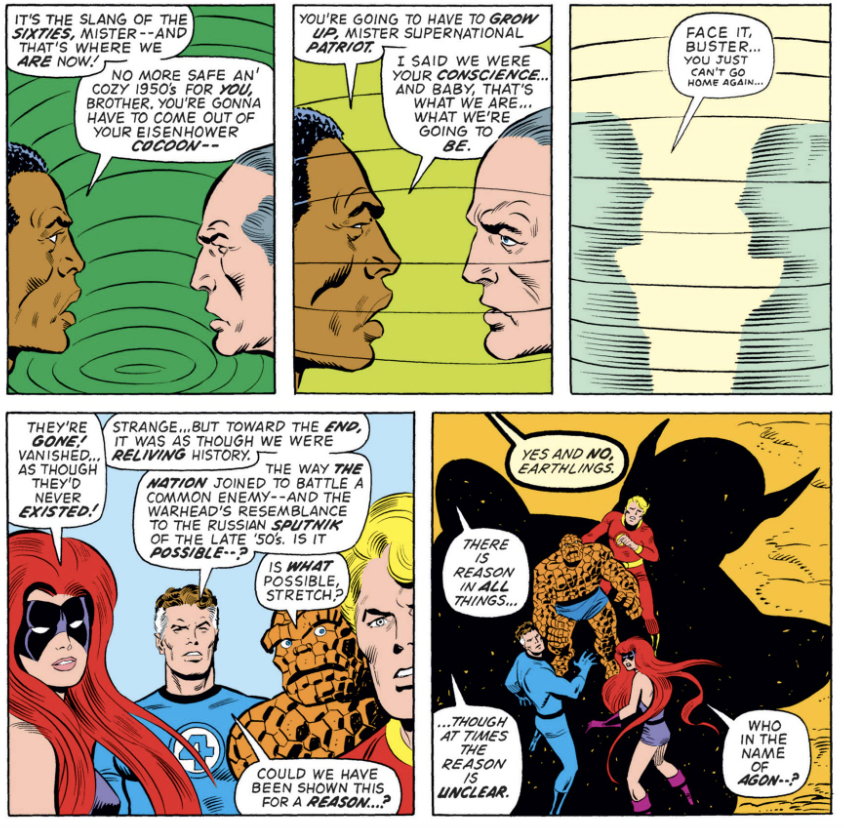
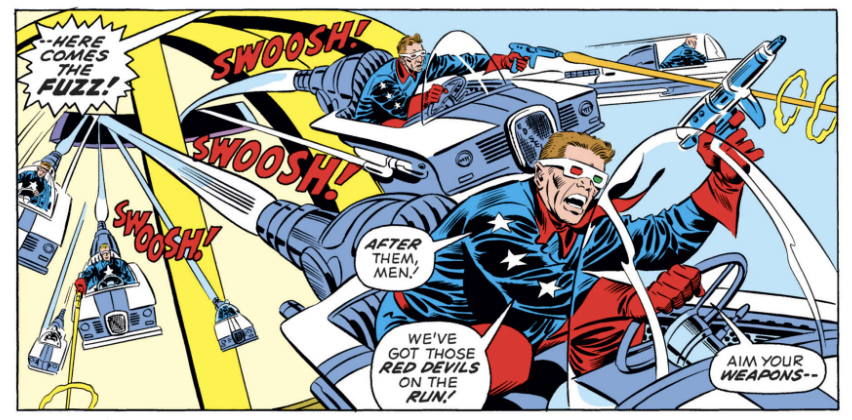
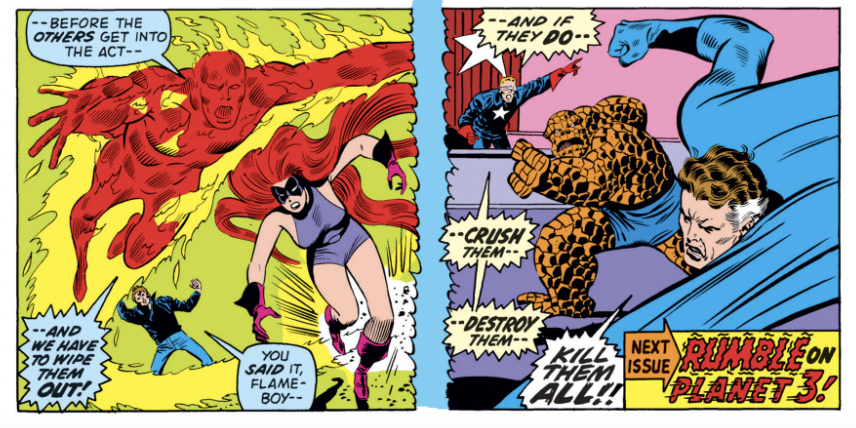
In the alternate, 1950s-themed world created by the Shaper of Worlds, the members of the Fantastic Four clash, then join together to battle the Warhead, a monster created by the Shaper. When both 50s factions — the “youthies” and “patriots” — are confronted by newly politicized African-Americans of the 1960s, the ’50s construct dissolves. The Shaper admits he made a big mistake choosing Slugger Johnson as the vehicle for his powers, and restores the world back to the 70s.


What’s going on here?

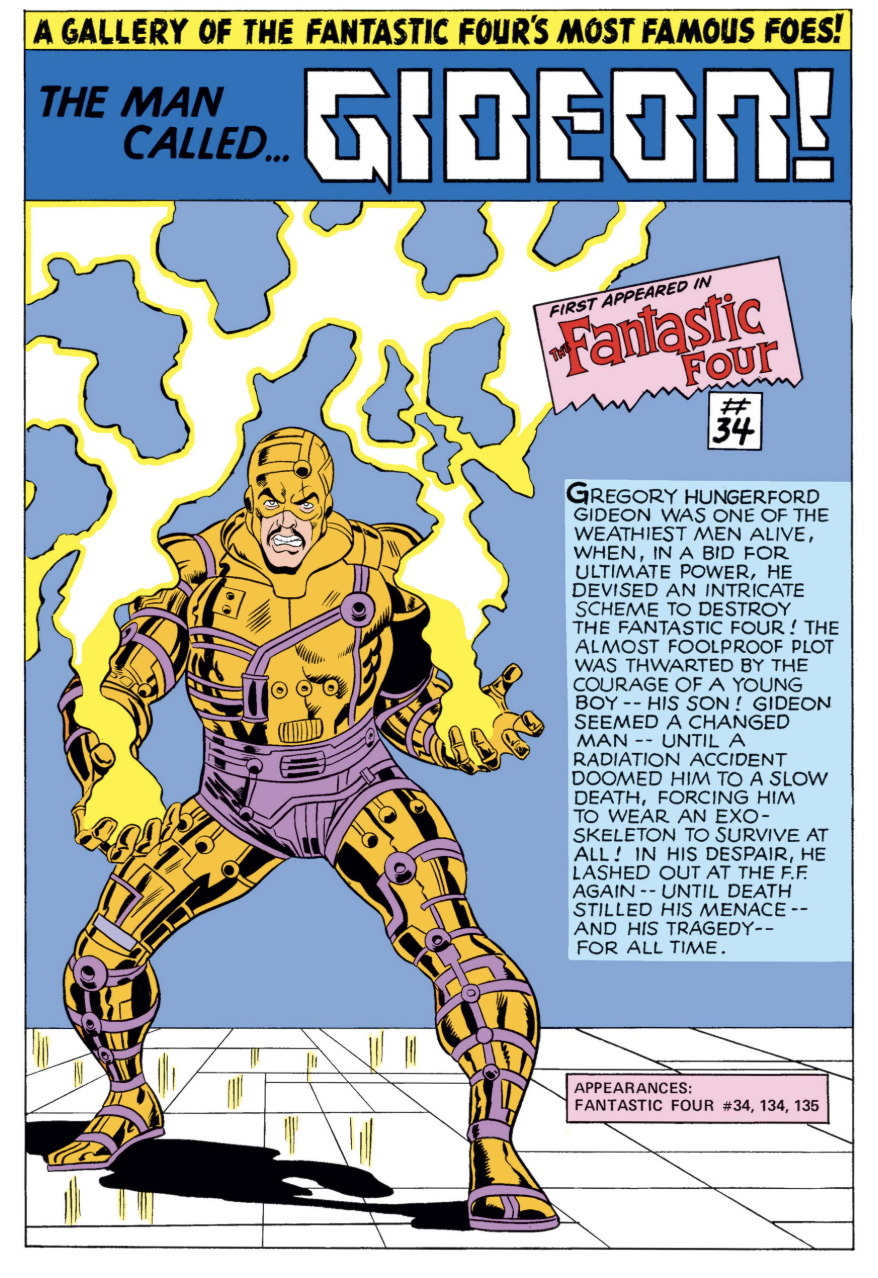
Fantastic Four 137 plays out the barely-intelligible string of last issue, filling in some blanks — we learn that The Brain is actually Slugger, who is intended to resemble Albert Einstein (he doesn’t) — while doubling down on its ham-handed analysis of mid-century sociology. The best thing about this two-issue arc is that it’s over, and seems to have left little mark on the FF or Marvel. One exception: Thomas Gideon, the orphaned son of Gregory Gideon, is whisked off by the Shaper to later become Glorian, who has a long run as a minor Hulk and Silver Surfer character.

One other note: This is the first issue of the Fantastic Four colored by Glynis Wein, who went on to have a long career, with more than 1,000 coloring credits. At this point she was married to comic writer Len Wein, but after their divorce she would return to her maiden name, Glynis Oliver.

What I liked

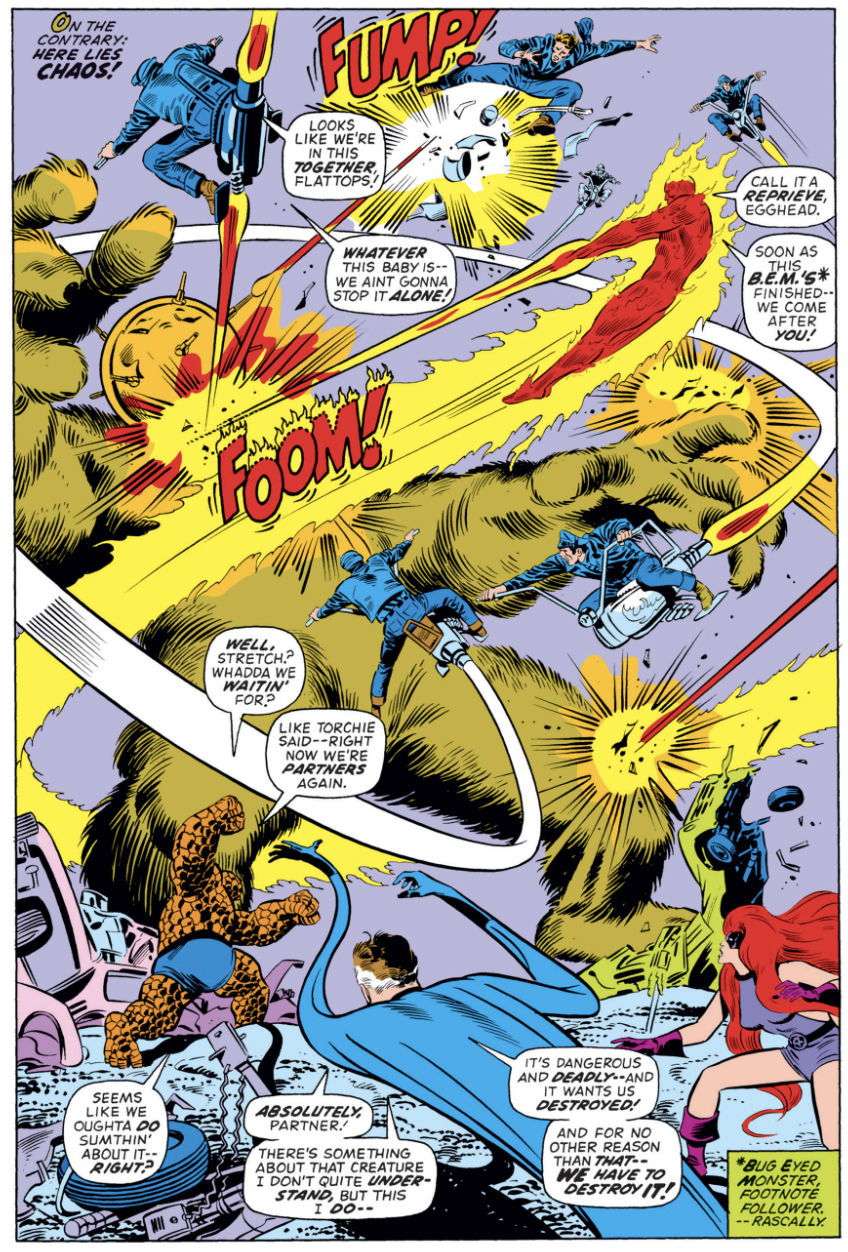
I’m generally a fan of splash pages, and there’s a few in this issue.


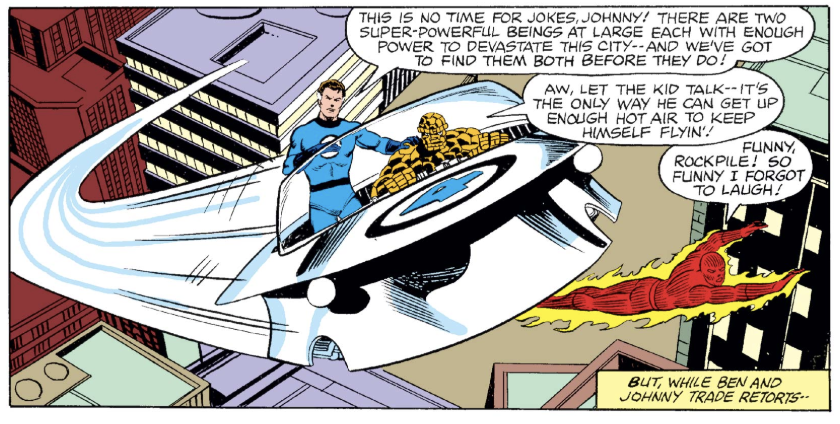
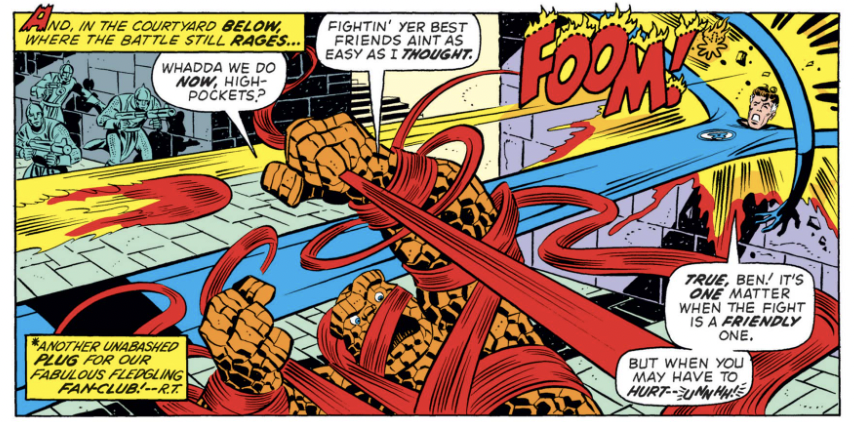
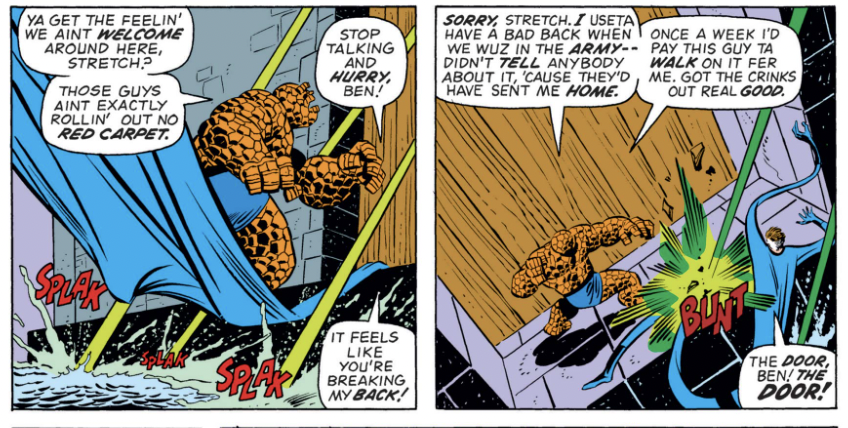
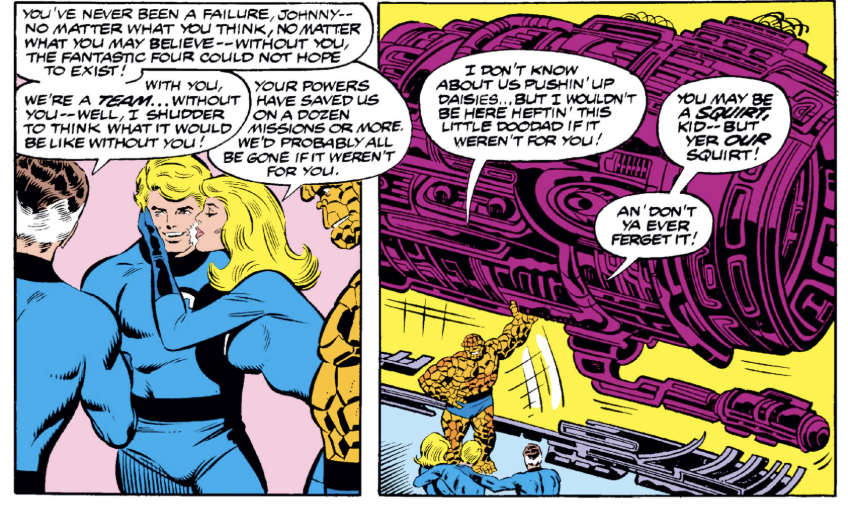
I also liked this sequence of Reed and Ben kibitzing:


What I didn’t like

As with last issue, the story makes little sense, and ultimately feels like a silly and pointless exercise in clumsy cultural anthropology. Thomas and Conway compound their simplistic youths-vs.-olds of the 50s dynamic by introducing the Civil Rights struggle of the 60s (which actually began in the 40s). No doubt it was well intentioned, but in the absence of a coherent story it feels preachy and naive.


This new development somehow destablizes the Shaper’s entire project, until it fades away.


None of it makes much sense, and the Shaper acknowledges as much, telling us “the reason is unclear.” Which is another way of saying Thomas and Conway wrote themselves into a corner and had no way out. The hope is this arc was an aberration but knowing some of the stories in the next few years, I can predict more cringe to come.

Also, Warhead is one of the ugliest comic creature designs I’ve ever seen.

Overall

Good riddance

“The World’s Greatest Comic Magazine!” Fantastic Four No. 136

04 Thursday Jul 2024

Posted by percivalhenry in The World's Greatest Comic Magazine

≈ 1 Comment

Tags

1973, Fantastic Four, Fantastic Four 136, John Buscema, Marvel, marvel-comics, Roy Thomas

Fantastic Four 136
“Rock Around the Cosmos!”
Published April 1973
Plot: Roy Thomas
Script: Gerry Conway
Breakdowns: John Buscema
Finishes: Joe Sinnott
Letters: Artie Simek
Colors: Stan Goldberg
Editor: Thomas
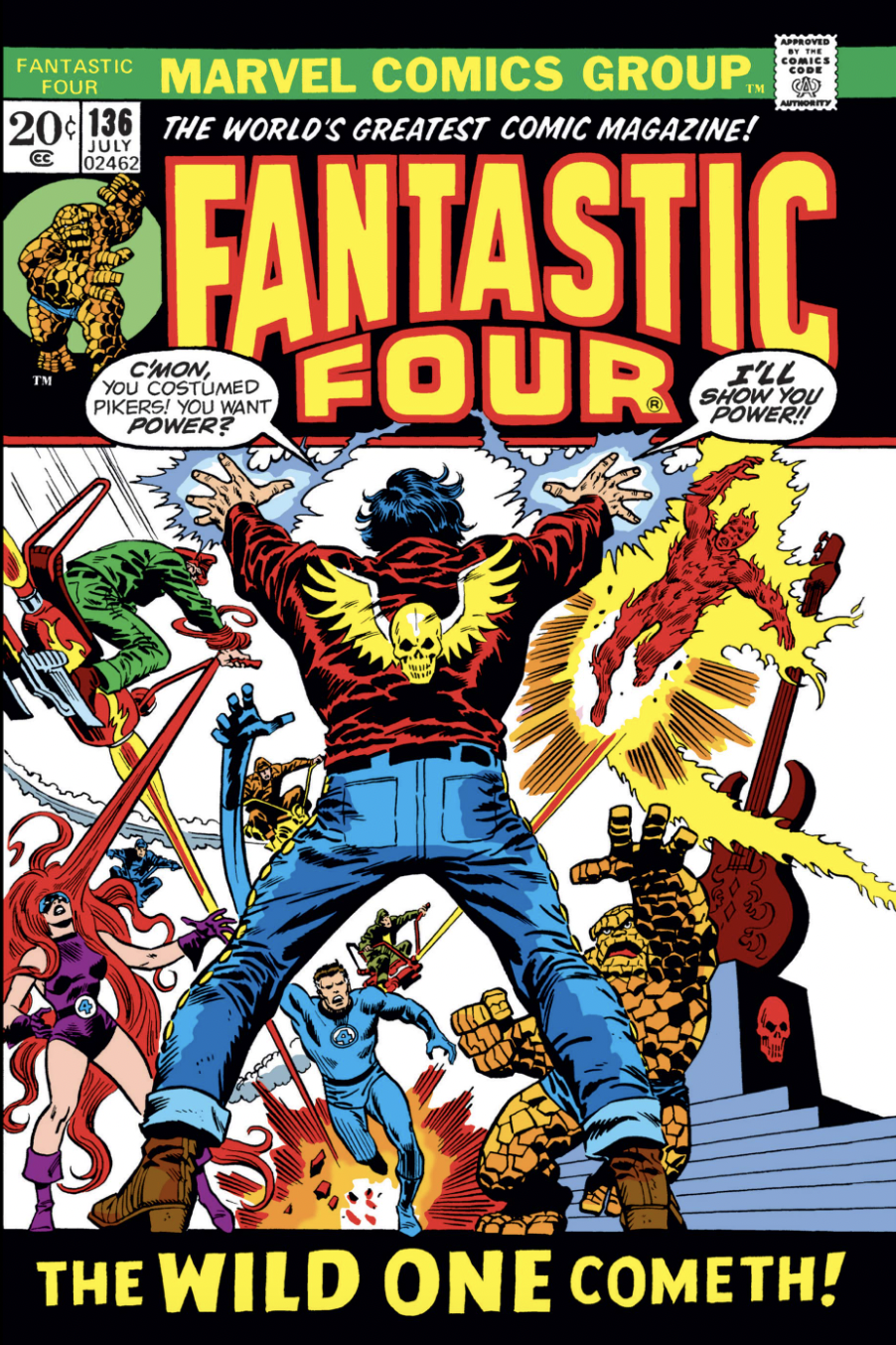
Cover: Buscema and Frank Giacoia

Synopsis

In the aftermath of last issue’s battle, Slugger Johnson, a henchman of Gregory Godfrey who mourns for his lost youth in the 1950s, is imbued with atomic powers and identified by the Shaper of Worlds as a vehicle for its reality-bending visions. The Fantastic Four are then thrust into what appears to be a parallel universe oriented around 1950s culture, where youths battle elders, with Mr. Fantastic and the Thing on side and Medusa and the Human Torch on the other. Both pairs are brainwashed by rival camps and dispatched to retrieve a weapon from a mysterious figure called The Brain.


What’s going on here?

Where to begin? If there was proof that this was now Roy Thomas’s comic, look no further. A cynic might say this is what happens when a comic’s writer is also the editor, because this issue desperately needed editing.

At its core, FF 136 is a multiverse story, a speciality of Thomas’s, who gave us the Squadron Supreme in the Avengers two years earlier, and who later would spin DC’s Earth 2 Justice Society into a multi-generational epic. Here, the alternate earth aspect isn’t mentioned explicitly, but it’s pretty obvious what’s going on, and the tag line previewing the next issue makes it clear.


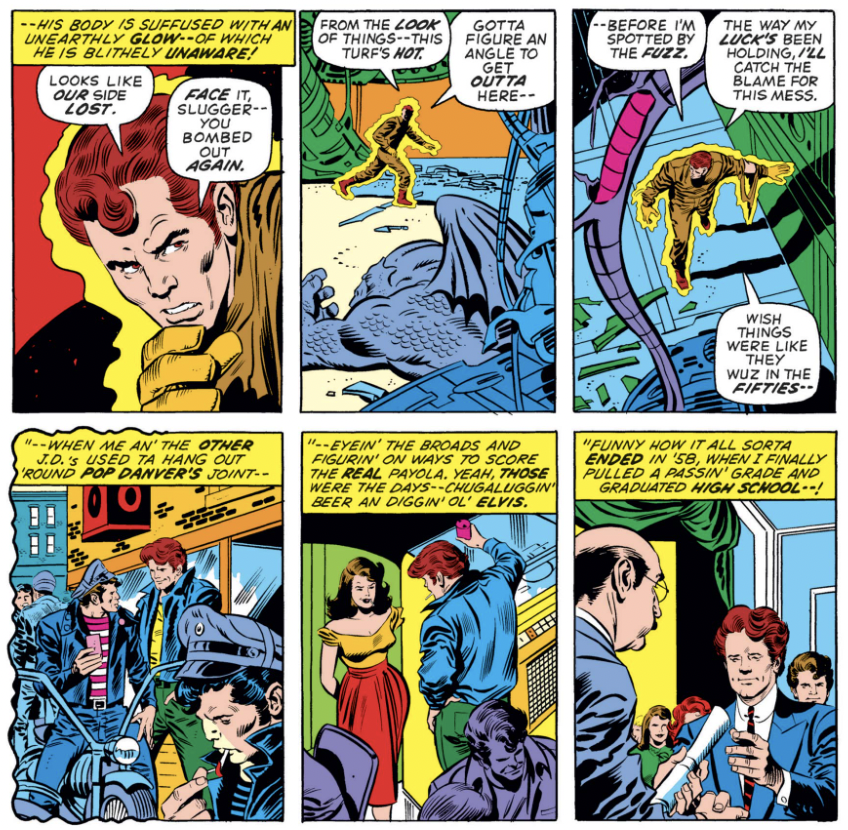
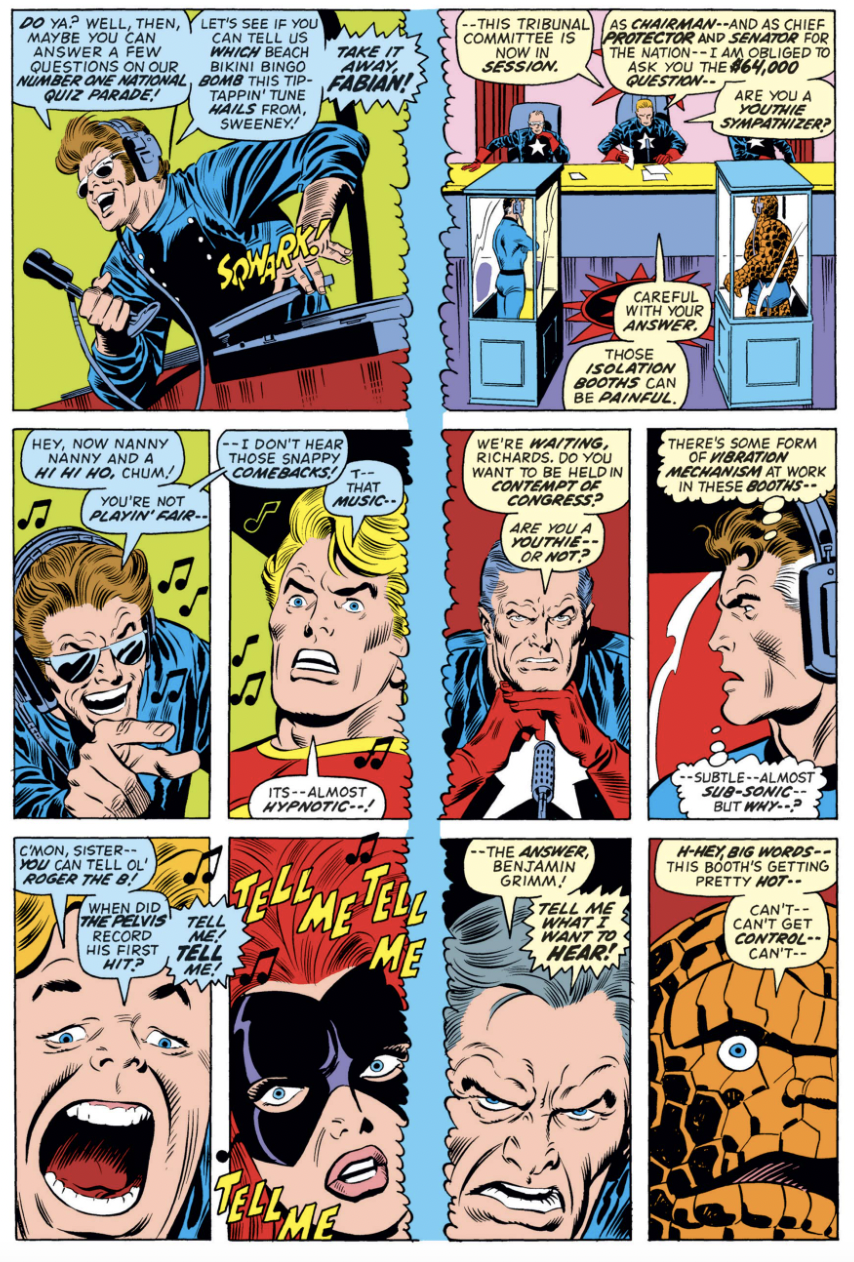
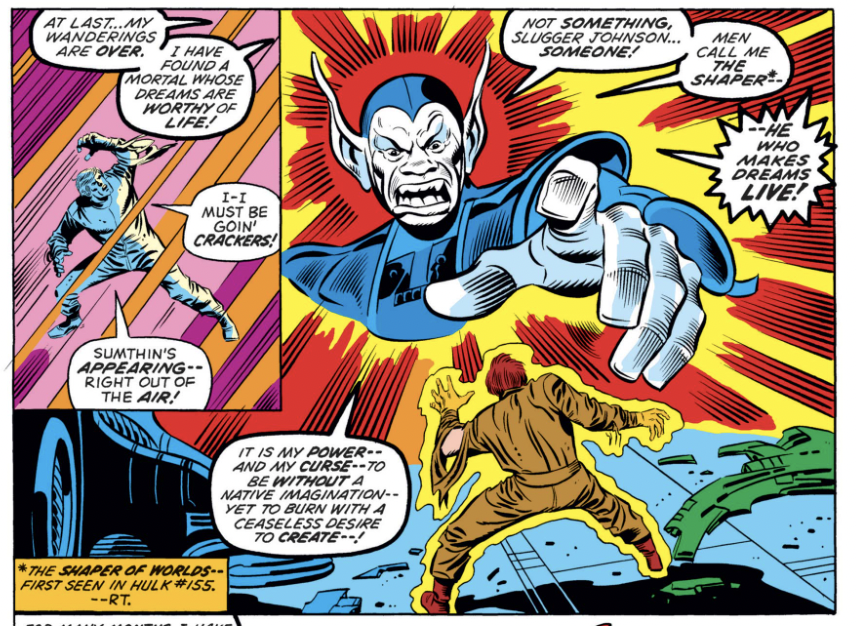
The defining nature of this alternate earth is that it is rooted in a caricatured vision of the 1950s, one drawn from the psyche for Slugger Johnson by the Shaper of Worlds. As we learn early on, Slugger really loved the 50s:


This painful 50s slang permeates the issue, and it seems clear that scripter Gerry Conway, who was born in 1952, learned it from watching B-movies on TV. What’s less clear is what lesson Thomas, who plotted the comics, wants us to draw from this extremely clumsy story. Is Thomas, born in 1940 and raised in the 50s, nostalgic for the era and its romanticized narratives of bikers rebellion and the birth of rock n’ roll? Or is he poking fun of that nostalgia? Is he using the excesses of the 50s youth culture to critique 60s youth culture? Is he hip? or is he square? Unfortunately, the story is so muddled it’s hard to know.

The presence of the Shaper of World’s is further evidence of the Thomasian drift of the Fantastic Four. Initially a Hulk villain created by Archie Goodwin the previous year, the Shaper is a Cosmic Cube brought to life by the Skrulls, and a character I know almost nothing about prior to this issue. But Thomas loves to play with characters from other comics, the more obscure the better, and a reality-bending cosmic creature is right up his alley. It’s fair to say Stan never would have dreamt of using it.


What I liked

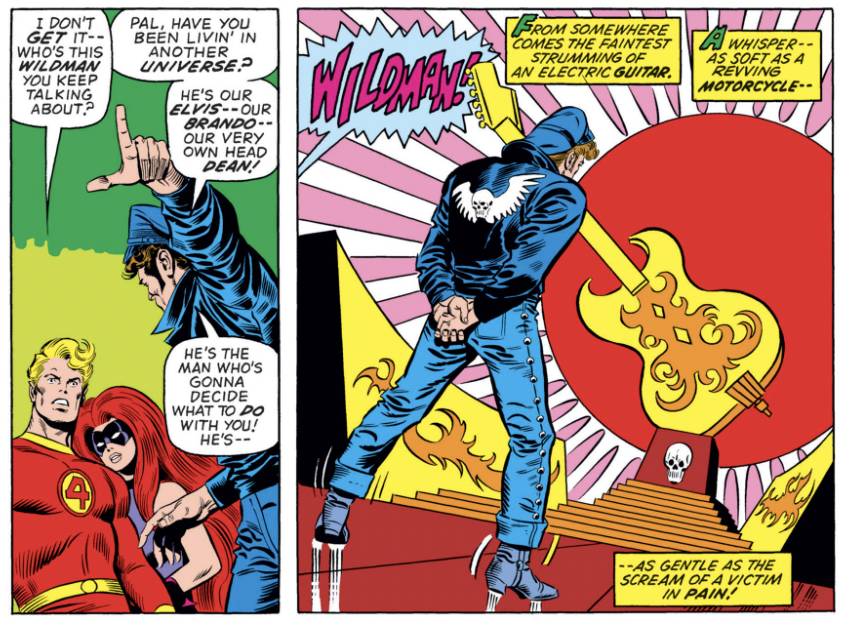
Despite its extreme goofiness, I admired how hard Thomas and Conway lean into the 50s conceit. Here is Slugger Johnson reintroduced as Wildman:


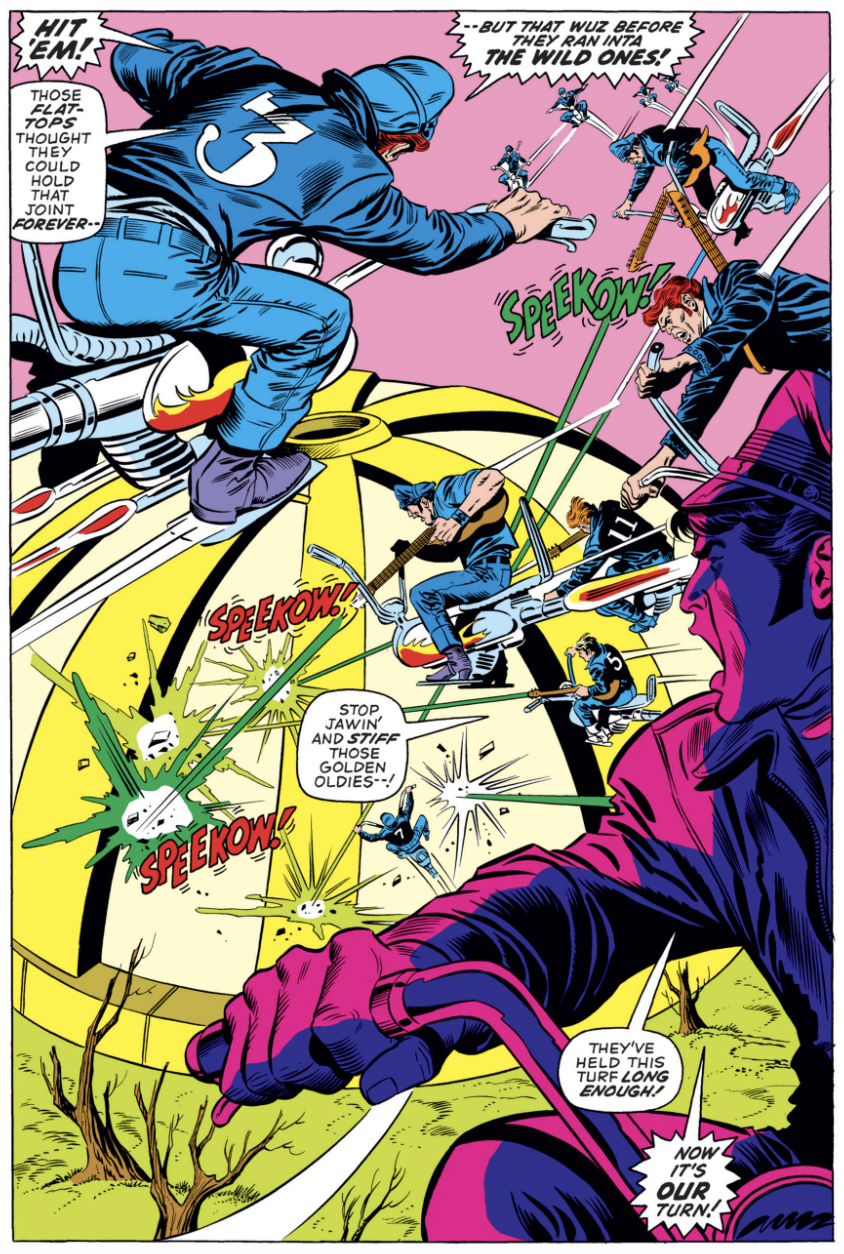
Buscema and Sinnott also deliver a socko splash page that introduces the 50s gangsters:


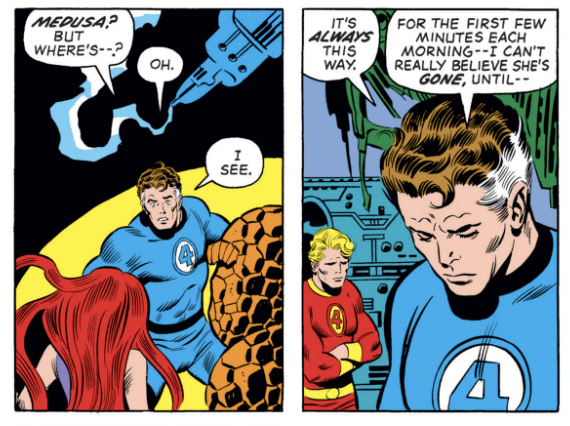
And before the silliness started, there was a touching sequence where Reed awakens from unconsciousness and imagines Medusa is Sue:


What I didn’t like

If it wasn’t obvious, this comic is an incoherent mess. The alternate earth plot is confusing and it’s never clear if Johnny and Medusa are in their right minds or not, since they attack Ben and Reed, then seem their normal selves. (And why is Medusa on the side of the youths? She’s a married Inhuman queen, hardly a teenager.)

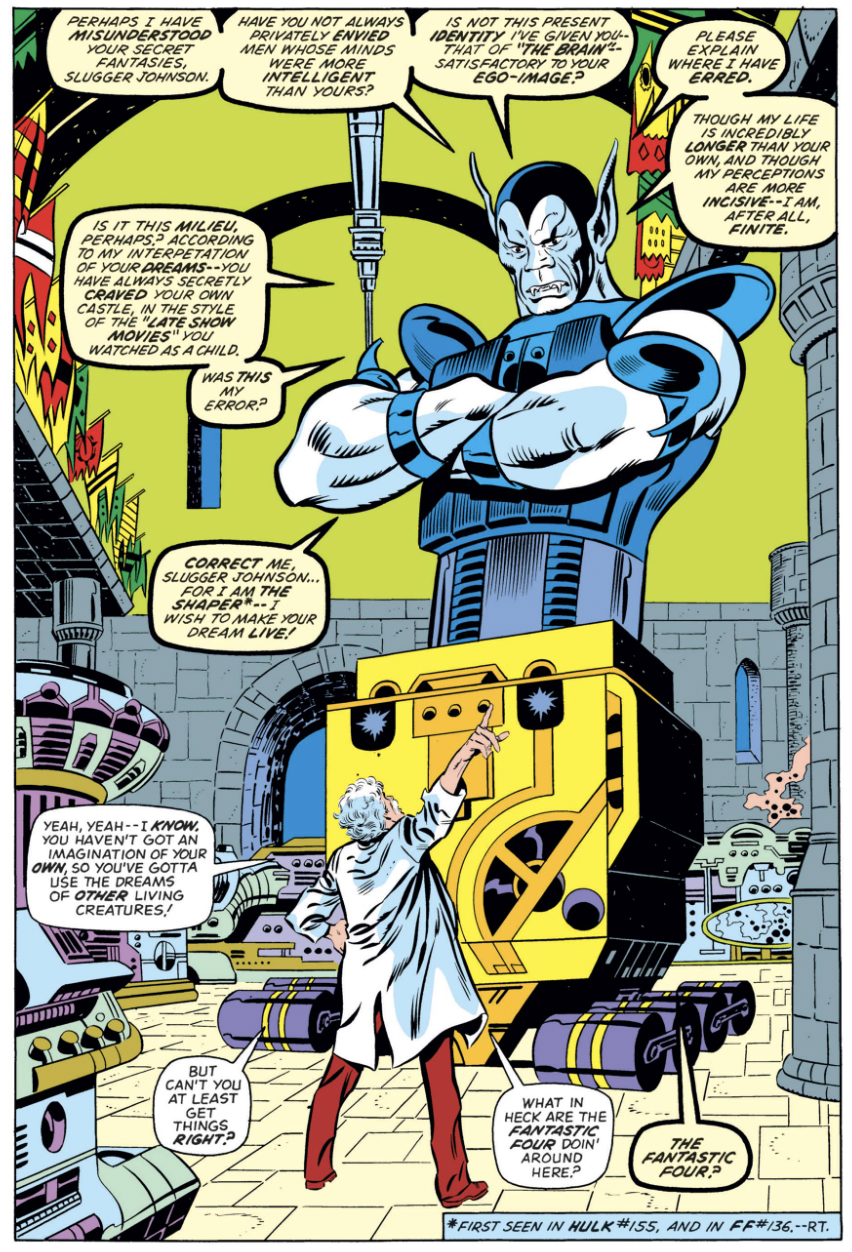
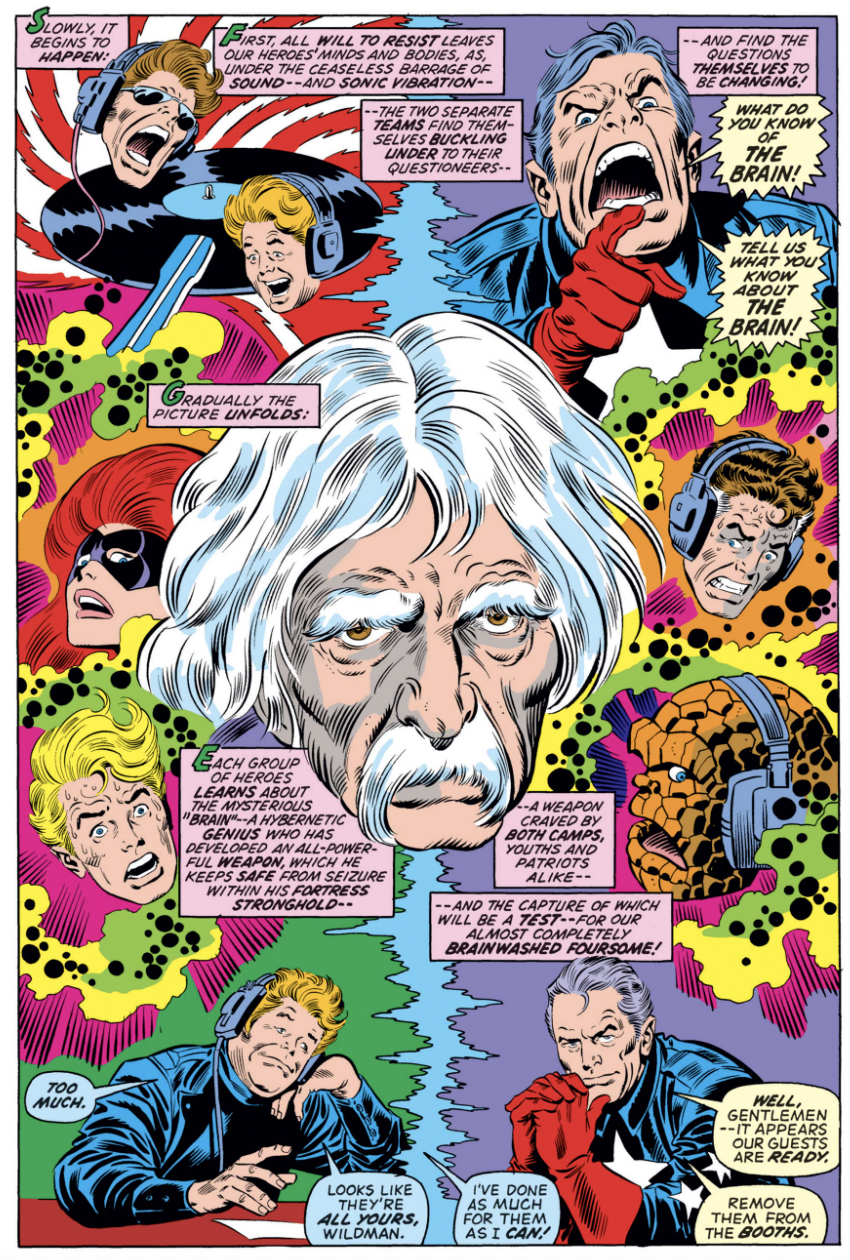
Then, instead of letting the jumbled story gel, Thomas and Conway shake it up again by introducing another character, The Brain, who we meet in this kaleidoscopic sequence:


I can’t imagine a kid picking up this comic as his or her first issue of the FF and making heads or tails of it.

Anything else?

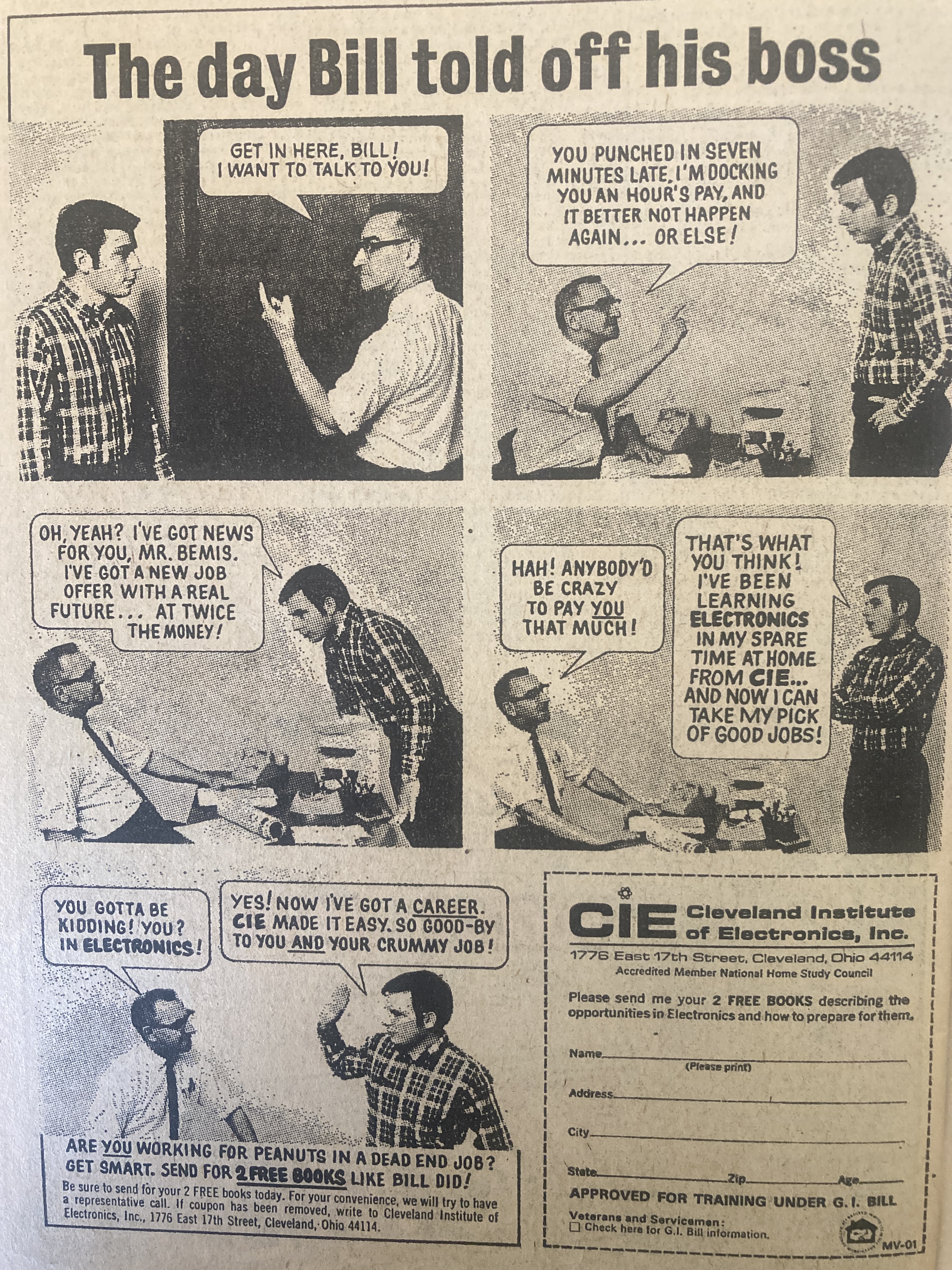
Some interesting ads in this issue. A fumetti-style ad for an anti-authoritarian trade school, and a pretty cool looking role playing magazine.


Overall

For Fantastic Four or Roy Thomas completionists only

So Random! Captain America 293

26 Sunday May 2024

Posted by percivalhenry in So Random!

≈ Leave a comment

Tags

1984, Captain America, Marvel

Captain America 293
“Field of Vision!”
Publisher: Marvel
Published: January 1984
Writer: J.M. DeMatteis
Pencils: Paul Neary
Inks: Eduardo Barreto
Letters: Diana Albers
Colors: Bob Sharen
Editor: Mark Gruenwald


Editor’s note: It’s been a while since I did one of these, so as a refresher: In So Random! posts, I pick a comic more or at less at random from my collection to re-read and analyze.

Synopsis

As Captain America tries to reconcile Bernie Rosenthal’s marriage proposal with his feelings for former love interest Sharon Carter, the villains Mother Superior, Baron Zemo and the Red Skull conspire to get their revenge on Cap. They transform Cap’s pacifist friend Dave Cox into the Slayer, who ambushes Cap and his sidekick, Nomad.

What’s going on here?

Captain America 293 came out pretty early in my collecting days, and about the time of the first Secret Wars series. J. M. DeMatteis was still writing the book and his plots were dark and intricate, particularly compared to his successor, Mark Gruenwald (RIP), who had a much more light-hearted take on Cap.

This would be a tough comic for a new reader to jump into, since so much of the story involves the back stories of Baron Zemo and Dave Cox (and Sharon Carter), but the plot moves along, and there’s plenty of action to go along with the introspection. The art by Neary and Barreto is serviceable, although it never really soars.

What I liked


I liked this scene of Cap dropping into to visit an old friend out of the blue, and disrupting his domestic life. We then get some revealing panels about Cap discussing his love life with Dave, and (oddly) skipping stones from his knees.

In group books like the Avengers, Cap tends to take on a larger-than-life quality, as he serves not just as a leader but a symbol of the American Way. But successfully written, in his own book at least, Steve Rogers is very much a human who is wrestling with his personal life. (Batman suffers from similar problems as a character who can be more symbol than person).

What I didn’t like

DeMatteis’s writing tends toward the purple and overwraught, particularly in the sequences with Zemo and Mother Superior. Consider this elaborate double page splash that attempts to sum up the history of human evil, for example:


Also, the Slayer concept feels vaguely ridiculous, and continues a longtime comic trope of taking civilian characters and making them heroes or villains. I much prefer it when ordinary people remain ordinary.


Anything else?

I always enjoyed these Q & As they ran in the letter pages of the books Gruenwald edited. This one was inspired by a recent Cap arc where he wound up in a post-apocalyptic future with Deathlok.


Overall

Standard mid-80s Marvel fare

“The World’s Greatest Comic Magazine!” Fantastic Four No. 130

18 Saturday May 2024

Posted by percivalhenry in The World's Greatest Comic Magazine

≈ Leave a comment

Tags

1972, comics, Fantastic Four, Fantastic Four 130, John Buscema, Marvel, marvel-comics, Roy Thomas

Fantastic Four 130
“Battleground: The Baxter Building!”
Published Oct. 1972
Writer: Roy Thomas
Pencils: John Buscema
Inks: Joe Sinnott
Letters: Artie Simek
Colors: Petra Goldberg
Editor: Thomas
Cover: Jim Steranko and Sinnott

Synopsis

After subduing the Thing and Meduasa, the Frightful Four—reconstituted with Thundra—take on the rest of the Fantastic Four, minus the Human Torch, in the Baxter Building and are saved only by the awakening of Franklin’s powers. In the aftermath, Sue declares she is leaving the team. Meanwhile, in the Himalayas, the Torch confronts the Inhumans, where a secret concerning Crystal is revealed to him.


What’s going on here?

This is a jam-packed issue, with big developments in the story, and some smaller ones outside it. From an amateur-comic-historian’s perspective, it’s notable for being the first Fantastic Four issue to credit a colorist, in this case, Petra Goldberg.

The history of comic book coloring is complicated, and the technology evolves dramatically over time. But my understanding is that in the 60s, 70s and 80s, the colorist would identify what colors were needed (always a combination of cyan, magenta, yellow and black) and where they would go. They would make notes on the art (or actually color copies of the pages) that would then be used by a color separator at the printer as a guide. Because of the limitations of the process—at most, only 64 possible colors are available—and because the colorist didn’t directly work on the art like a penciler and inker, it seems they were viewed less like artists and more like technicians. Hence, they were not credited. (A pretty good explanation of all this can be found in this Comic Tropes video).
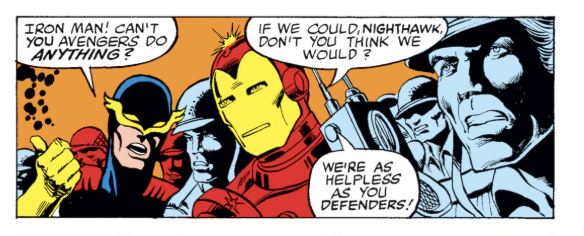
I don’t think it’s a coincidence that this changed soon after Roy Thomas became editor. Thomas also instituted an “editor” credit—here used for himself—and seemed more interested than Stan Lee in assigning proper credit where it was due (a longtime issue with Stan that we know came to haunt him).

Recall, the first issues of the Fantastic Four had no credits all, just the signatures of Stan Lee and Jack Kirby. And when credits first appeared, they were very scant and presented almost as an after thought (this is FF 10):

By FF 130, the credits for all the main creators were in place and they pretty much remained this way for decades. Note Stan Lee’s presenting credit is now his signature. That began with the previous month’s issues, and I neglected to mention it.


Also notable is that Jim Steranko penciled the cover for this issue (which is probably why the Sandman looks so much like Nick Fury). I’m not sure it’s a particularly great cover, but anything by Steranko is worth paying attention to. This is the first of three covers he did for the Fantastic Four, and are the only things he ever did with the FF during his short career.

What I liked

A big—but not the biggest—in-comic event in FF 130 is Sue’s decision to leave the team. This has been brewing for a few issues, and through Thomas’s writing she has voiced her displeasure with Reed and his constant demands that she be sidelined to look after Franklin.

Here, she again raises those objections and he again tries to shut her down:


It finally boils over in the last page, featuring more jerk-like behavior from Reed:


Obviously, this doesn’t stick and she eventually returns. But her departure feels like a significant milestone in the development of Sue’s character, and, perhaps, in Thomas’s repudiation of the status quo he inherited from Stan. Thomas has been writing Reed pretty much the same way Stan and Jack did for a decade, but only under Thomas did Sue finally say, enough.

Speaking of gender dynamics, I also liked how Thomas played with cliches and stereotypes through Thundra, the Femizon from another dimension where women dominate men. Here, she picks up Ben like a doll:


Or here, where she refers to “men and children:”


Thomas also created an interesting and suspenseful sidebar with the Human Torch and Crystal. I legitimately have no idea what he sees here (we have to wait until next issue):


The Inhuman subplot is another example of Thomas’s skill as a storyteller. There’s an awful lot going in in the main plot, yet he’s able to jump out and devote a few meaningful pages to the Johnny/Crystal dynamic that builds character and sets up future arcs, all without distracting from the bigger story. Further evidence that the FF is in very good hands.

Oh, and I would remiss if I didn’t point out this jaw-dropping splash page from Big John. It doesn’t have a big impact on the plot, but it seems like it’s a fun opportunity for him to flex his Kirby muscles.


What I didn’t like

The biggest in-story development in FF 130 is the awakening of Franklin’s powers. Although hinted at a few issues ago, this is the first real manifestation of them.

In the bounds of this issue, it’s fine and I imagine for readers at the time, it must have been pretty cool. But it opened the door for decades of stories about Franklin’s powers that, on the whole, have been unsatisfying, confusing and distracting. No two writers seem to agree what to do with Franklin, and while some have embraced him as a mutant with god-like powers—Jonathan Hickman had him creating whole universes—others would be happier if he was just a kid. Dan Slott depowered him and Ryan North has a goofy retcon that has him using his powers one day a year.

I am sure Thomas didn’t know the can of worms he was opening up here, but the does-he -or doesn’t-he nature of Franklin’s powers been a perennially frustrating aspect of the Fantastic Four

Also, thumbs down for the story title—”Battleground: Baxter Building”—a combination of words which has been used probably a dozen times.

Anything else?

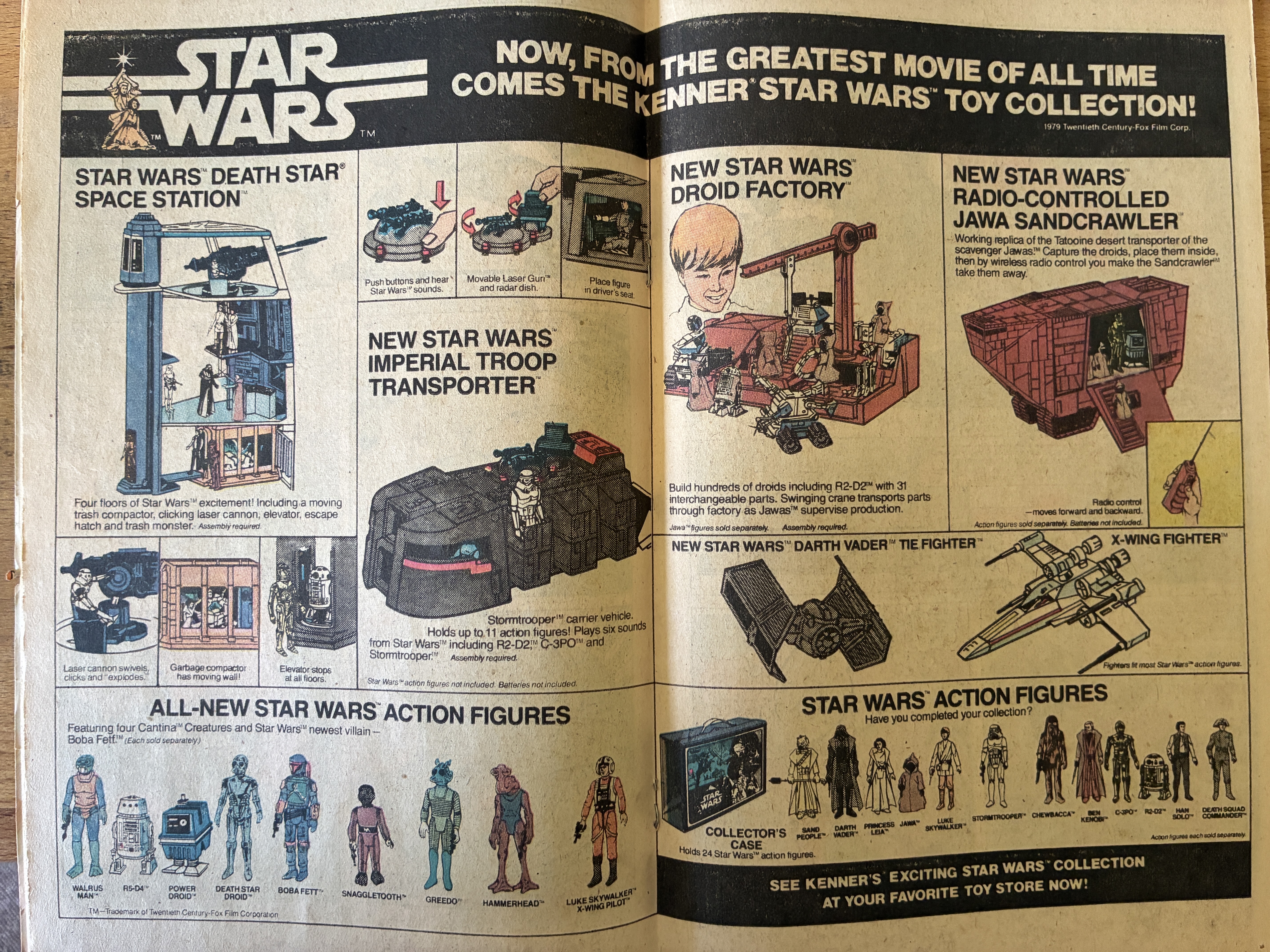
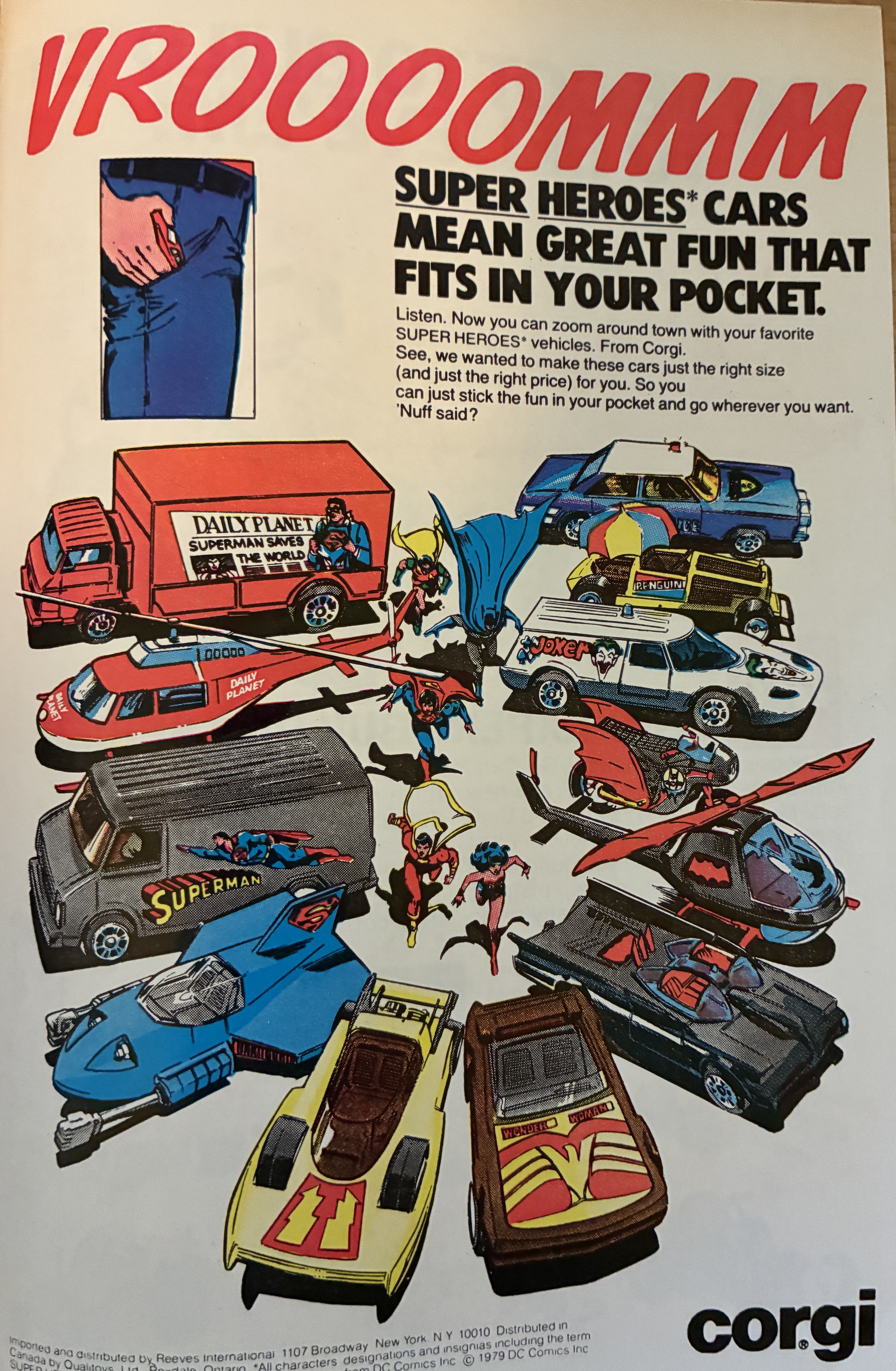
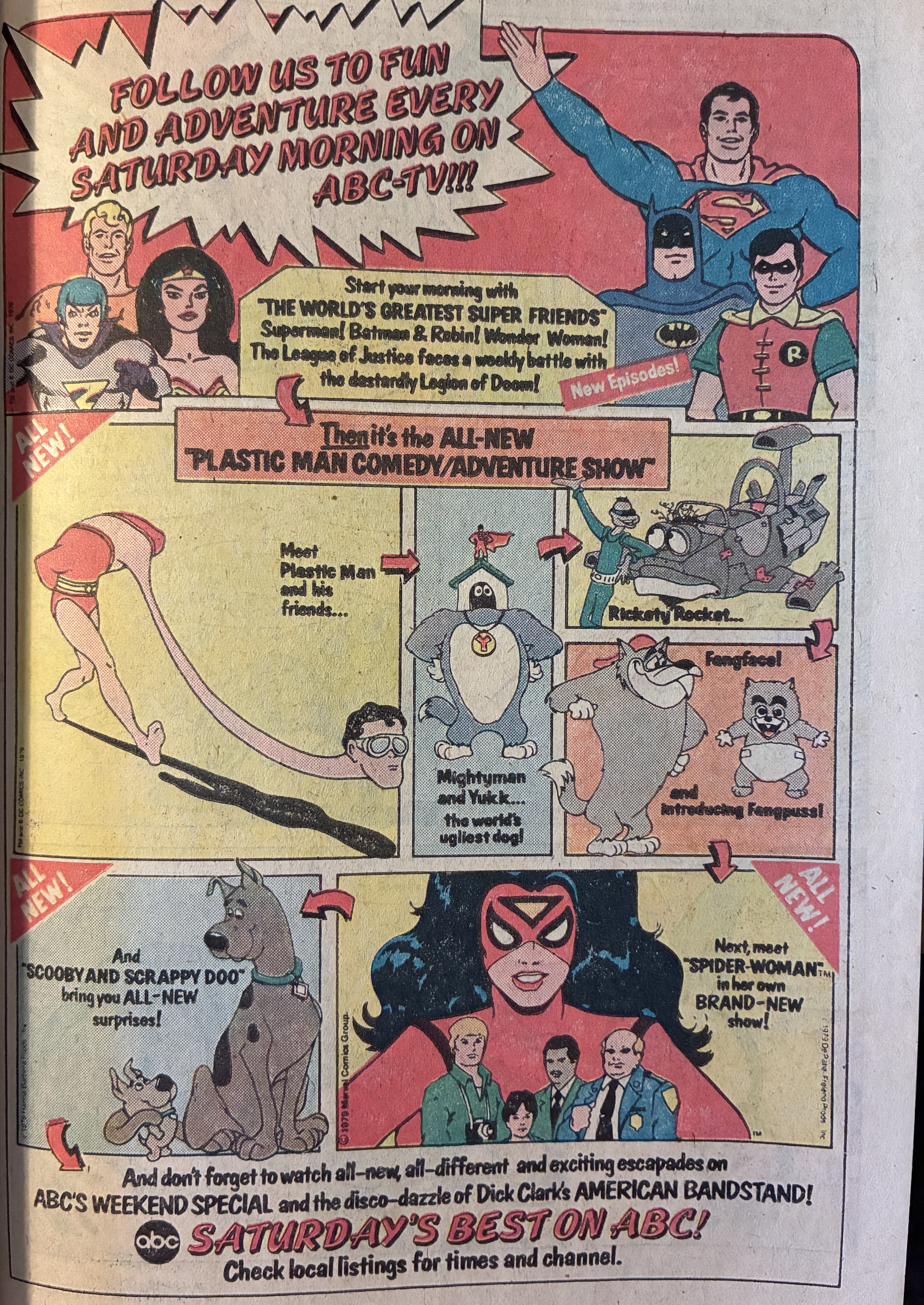
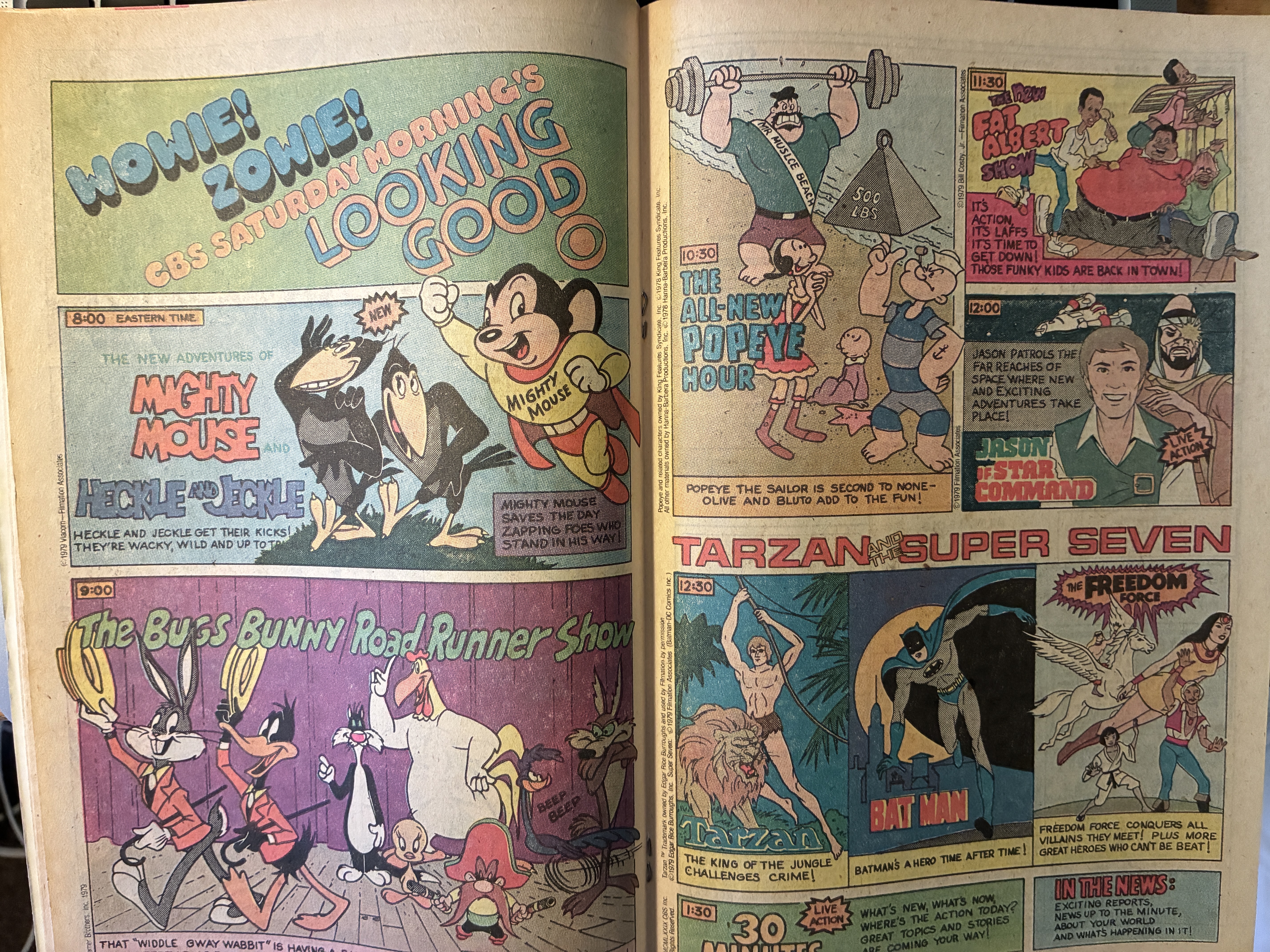
Some more ads for cool toys:


Overall

An excellent comic. Roy’s best to date.

“The World’s Greatest Comic Magazine!” Fantastic Four No. 114

13 Saturday Jan 2024

Posted by percivalhenry in The World's Greatest Comic Magazine

≈ Leave a comment

Tags

1971, Fantastic Four, Fantastic Four 114, John Buscema, Marvel, Over-mind, Stan Lee

Fantastic Four 114
“But Who Shall Stop the Over-Mind?”
Published: June 1971
Writer: Stan Lee
Pencils: John Buscema
Inks: Frank Giacoia
Letters: Sam Rosen
Cover: Buscema and Giacoia

Synopsis

Out on bail from their arrest by the NYPD and facing eviction, the Fantastic Four confront the Over-Mind, only to have the fight erased from their memories by his mental powers. To help provide answers, Agatha Harkness contacts the Watcher.

What’s going on here?

This is a much more satisfying issue than the last, as the Over-Mind developed into a formidable foe with an interesting backstory. There are some plot holes, but overall the story moves briskly, the fight is well designed, and the sequence with Agatha Harkness is appropriately creepy.

What I liked

It’s the best issue from John Buscema to date, and maybe not a coincidence that it’s the first not inked by Joe Sinnott: Frank Giacoia inked this issue, presumably filling in. There’s no arguing Sinnott’s power and style, but Giacoia has a lighter touch, which perhaps lets Buscema’s style emerge more clearly. Here’s a panel I really liked:

And this sequence:


What I didn’t like

As mentioned, there are some plot holes. In this issue, the Over-Mind apparently encounters the FF for the first time, yet at the close of last issue we saw him manipulating the mayor to have the FF arrested. Also, there’s an oddly discordant note, when, in the midst of their eviction drama, Ben gets a package with a stink bomb from the Yancy Street Gang. Rather than lighten the mood, it just seems like an annoying distraction.

There’s also the continuing nonsense of the FF’s eviction. Comics and stories about business rarely mix well, and this is no exception. There’s a dozen reasons why the landlord’s actions don’t make sense, and while maybe the average FF reader of 1971 didn’t know them, this sub-plot all seems farfetched. (Yes, I know it’s a comic based on far-fetched events, which is why real-world subjects like commercial real estate law are better left outside its pages).


Anything else?

This issue kind-of, sort-of introduced the Eternals to the Marvel universe, as the Over-Mind discusses that he is following their commands. Initially these Eternals were not connected to the Eternals later introduced by Jack Kirby in his 1976 return to Marvel (these were instead supposed to be the “Eternals of Eyung”) but they were later retconned to be another branch of the Eternals, also created by the Celestials. It’s all deeply confusing, and had no real impact on this story.


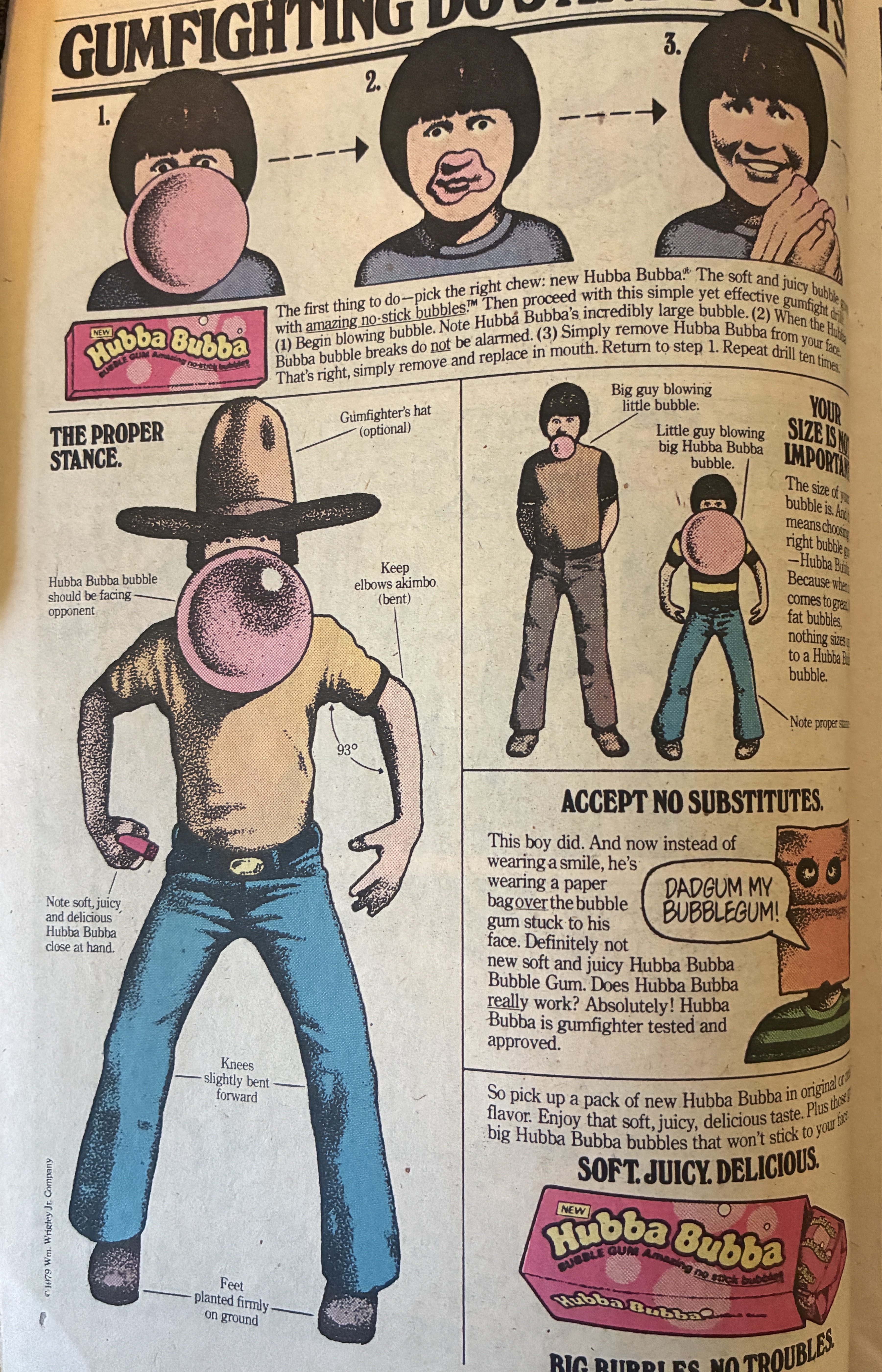
Also, some fun ads in this issue, including one with a muscle-man who looks suspiciously like a former governor of California:

Overall

Solid!

Very Short Review: Black Panther (2018)

21 Wednesday Feb 2018

Posted by percivalhenry in Very Short Review

≈ 1 Comment

Tags

Black Panther, Chadwick Boseman, entertainment, jack Kirby, Marvel, Michael B. Jordan, movies, Ryan Coogler, show business, Wakanda

For anyone paying attention, yes, it’s been a very long time since I posted on this blog. Sorry.

I was moved to pick it up again after seeing Black Panther, and leaving the multiplex with some thoughts that seemed bigger than just a Facebook post. Warning: there will be spoilers

It’s hard to separate Black Panther, the movie, from Black Panther, the cultural event. Much has rightly been made of its historic significance, a big-budget popcorn movie with a black director and mostly black cast. The New York Times had no less than 10 articles about the movie in the week before its opening, touching on everything from its hair styling decisions, to the appropriateness of white children donning Black Panther masks. When Marvel first announced the movie four years ago, it had no way of knowing it would land at such a fraught moment for race relations in the US, and for the US’s relations with the rest of the world (and particularly with “shit hole” countries). Timing in movie marketing, as in all things, is everything, and Black Panther—a declaration of African American creativity, political significance and, yes, buying power—has arrived just when we needed it most.

Also welcome is the movie’s African-ness, which makes it refreshingly distinct, and it’s one big reason to recommend the movie. Under director Ryan Coogler, fictional Wakanda isn’t merely the backdrop to the story, but virtually a leading character. Every scene reveals a new wonderment, from its interpretation of African tradition, such as T’Challa’s coronation beneath a waterfall festooned with hundreds of his countrymen in traditional attire, to a dizzying plunge into the nation’s African-influenced technological heart. Coogler’s vision of Wakanda is different from that of Jack Kirby’s, its inventor, who drew it as mechanical jungle in 1966, but it’s faithful to the spirit of Kirby’s vivid imagination. Others are more qualified than me to judge how much of its depiction of African culture is authentic and how much is Hollywood pastiche, but its world-building ambition is dazzling.

Black Panther’s challenge is presenting characters and a story to match the wonderment of Wakanda, and unfortunately that’s where it falls short. The plot hinges on the machinations of Killmonger, an exiled prince of Wakanda who returns to usurp the throne, but it takes far too long to build momentum. It’s almost derailed by a detour to Korea, and a pointless melee in a casino (maybe it’s a trend: The Last Jedi had a similarly unnecessary casino scene), before ending with a confusing and  implausible fight scene for the future of a nation that seems to involve only about two dozen combatants. There’s also a distracting and pointless plot point involving a CIA agent, played by Martin Freeman, shooting down cargo planes. Very little seems urgent, and it’s telling that one of the moments of real drama comes when Killmonger orders the burning of a few plants.

Killmonger is at least a compelling villain, with a backstory and motivations more complex and nuanced than those of 99% of comic book bad guys. As played by Michael B. Jordan, he’s easily the most charismatic character on the screen, and that’s a big part of the movie’s problem, because T’Challa, the Black Panther, never is. It’s strange for the protagonist of an action movie to fade into the background, and yet T’Challa never feels essential to his own movie. Part of the issue is the producers’ inclination to turn what should be a solo story into a team movie, and many of the qualities that make Black Panther a great comic book character are farmed off to the supporting cast: Killmonger is more assertive; his sister, Shuri, is more tech savvy; his mother, Ramonda, his more regal, Okoye, his general, is more skilled in battle; M’Baku, a rival king, is more powerful.
Chadwick Boseman plays T’Challa with a soft-spoken grace, but while that works when he’s in suit and tie, it fails him in superhero garb. He’s passive, almost indifferent, and recedes as other actors step forward. The story doesn’t serve him well, either, as it’s a catalog of his humiliations and defeats: He is tongue tied into incompetence around his love interest Nakia; he barely fends off M’baku’s challenge; he fails to capture Klaue on his ill-advised mission to Korea; he foolishly agree to fight Killmonger in ritual combat before he is soundly beaten and left for dead. He then disappears from his own movie, only to be rescued by his M’baku. And in the climactic battle, he is all but irrelevant before finally defeating Killmonger. With that record, it’s no wonder his council of elders challenges his authority at every turn.
It’s a shame T’Challa’s character is so under developed, because Black Panther has so much else going for it. The good news is, as with all superhero blockbusters, there will be a Black Panther sequel, and another chance to spin a story befitting a king.
Newer posts →
  • “The World’s Greatest Comic Magazine!” Fantastic Four No. 229
  • “The World’s Greatest Comic Magazine!” Fantastic Four No. 228
  • “The World’s Greatest Comic Magazine!” Fantastic Four No. 227
  • “The World’s Greatest Comic Magazine!” Fantastic Four No. 226
  • “The World’s Greatest Comic Magazine!” Fantastic Four No. 225
  • August 2026
  • July 2026
  • June 2026
  • May 2026
  • April 2026
  • March 2026
  • February 2026
  • January 2026
  • December 2025
  • November 2025
  • October 2025
  • September 2025
  • August 2025
  • July 2025
  • June 2025
  • May 2025
  • April 2025
  • March 2025
  • February 2025
  • January 2025
  • December 2024
  • November 2024
  • October 2024
  • September 2024
  • August 2024
  • July 2024
  • June 2024
  • May 2024
  • April 2024
  • March 2024
  • February 2024
  • January 2024
  • December 2023
  • November 2023
  • September 2023
  • July 2023
  • June 2023
  • May 2023
  • April 2023
  • March 2023
  • February 2023
  • January 2023
  • December 2022
  • November 2022
  • October 2022
  • September 2022
  • August 2022
  • July 2022
  • June 2022
  • May 2022
  • April 2022
  • March 2022
  • February 2022
  • January 2022
  • December 2021
  • November 2021
  • October 2021
  • September 2021
  • August 2021
  • July 2021
  • June 2021
  • May 2021
  • April 2021
  • March 2021
  • February 2021
  • January 2021
  • December 2020
  • February 2018
  • May 2016
  • February 2016
  • January 2016
  • December 2015
  • November 2015
  • October 2015
  • September 2015
  • August 2015
  • July 2015
  • April 2015
  • March 2015
  • January 2015
  • December 2014
  • November 2014
  • October 2014
  • September 2014
  • August 2014
  • June 2014
  • May 2014
  • April 2014
  • March 2014
  • February 2014
  • August 2026
  • July 2026
  • June 2026
  • May 2026
  • April 2026
  • March 2026
  • February 2026
  • January 2026
  • December 2025
  • November 2025
  • October 2025
  • September 2025
  • August 2025
  • July 2025
  • June 2025
  • May 2025
  • April 2025
  • March 2025
  • February 2025
  • January 2025
  • December 2024
  • November 2024
  • October 2024
  • September 2024
  • August 2024
  • July 2024
  • June 2024
  • May 2024
  • April 2024
  • March 2024
  • February 2024
  • January 2024
  • December 2023
  • November 2023
  • September 2023
  • July 2023
  • June 2023
  • May 2023
  • April 2023
  • March 2023
  • February 2023
  • January 2023
  • December 2022
  • November 2022
  • October 2022
  • September 2022
  • August 2022
  • July 2022
  • June 2022
  • May 2022
  • April 2022
  • March 2022
  • February 2022
  • January 2022
  • December 2021
  • November 2021
  • October 2021
  • September 2021
  • August 2021
  • July 2021
  • June 2021
  • May 2021
  • April 2021
  • March 2021
  • February 2021
  • January 2021
  • December 2020
  • February 2018
  • May 2016
  • February 2016
  • January 2016
  • December 2015
  • November 2015
  • October 2015
  • September 2015
  • August 2015
  • July 2015
  • April 2015
  • March 2015
  • January 2015
  • December 2014
  • November 2014
  • October 2014
  • September 2014
  • August 2014
  • June 2014
  • May 2014
  • April 2014
  • March 2014
  • February 2014
“The World’s Greatest Comic Magazine!” Fantastic Four No. 229

“The World’s Greatest Comic Magazine!” Fantastic Four No. 229

percivalhenry's avatar by percivalhenry August 30, 2026
“The World’s Greatest Comic Magazine!” Fantastic Four No. 228

“The World’s Greatest Comic Magazine!” Fantastic Four No. 228

percivalhenry's avatar by percivalhenry August 23, 2026
“The World’s Greatest Comic Magazine!” Fantastic Four No. 227

“The World’s Greatest Comic Magazine!” Fantastic Four No. 227

percivalhenry's avatar by percivalhenry August 16, 2026
“The World’s Greatest Comic Magazine!” Fantastic Four No. 226

“The World’s Greatest Comic Magazine!” Fantastic Four No. 226

percivalhenry's avatar by percivalhenry August 12, 2026
“The World’s Greatest Comic Magazine!” Fantastic Four No. 225

“The World’s Greatest Comic Magazine!” Fantastic Four No. 225

percivalhenry's avatar by percivalhenry August 3, 2026
“The World’s Greatest Comic Magazine!” Fantastic Four No. 224

“The World’s Greatest Comic Magazine!” Fantastic Four No. 224

percivalhenry's avatar by percivalhenry July 27, 2026

Blog at WordPress.com.

  • Subscribe Subscribed
    • Percival Henry: The Fantastic Four and more
    • Join 74 other subscribers
    • Already have a WordPress.com account? Log in now.
    • Percival Henry: The Fantastic Four and more
    • Subscribe Subscribed
    • Sign up
    • Log in
    • Report this content
    • View site in Reader
    • Manage subscriptions
    • Collapse this bar
Loading Comments...